EP1167464A2 - Antistatic membrane lidding for a container - Google Patents
Antistatic membrane lidding for a container Download PDFInfo
- Publication number
- EP1167464A2 EP1167464A2 EP01305276A EP01305276A EP1167464A2 EP 1167464 A2 EP1167464 A2 EP 1167464A2 EP 01305276 A EP01305276 A EP 01305276A EP 01305276 A EP01305276 A EP 01305276A EP 1167464 A2 EP1167464 A2 EP 1167464A2
- Authority
- EP
- European Patent Office
- Prior art keywords
- coating
- film layer
- antistatic
- lidding
- membrane
- Prior art date
- Legal status (The legal status is an assumption and is not a legal conclusion. Google has not performed a legal analysis and makes no representation as to the accuracy of the status listed.)
- Withdrawn
Links
Images

Classifications
-
- B—PERFORMING OPERATIONS; TRANSPORTING
- B65—CONVEYING; PACKING; STORING; HANDLING THIN OR FILAMENTARY MATERIAL
- B65D—CONTAINERS FOR STORAGE OR TRANSPORT OF ARTICLES OR MATERIALS, e.g. BAGS, BARRELS, BOTTLES, BOXES, CANS, CARTONS, CRATES, DRUMS, JARS, TANKS, HOPPERS, FORWARDING CONTAINERS; ACCESSORIES, CLOSURES, OR FITTINGS THEREFOR; PACKAGING ELEMENTS; PACKAGES
- B65D77/00—Packages formed by enclosing articles or materials in preformed containers, e.g. boxes, cartons, sacks or bags
- B65D77/10—Container closures formed after filling
- B65D77/20—Container closures formed after filling by applying separate lids or covers, i.e. flexible membrane or foil-like covers
- B65D77/2024—Container closures formed after filling by applying separate lids or covers, i.e. flexible membrane or foil-like covers the cover being welded or adhered to the container
- B65D77/2028—Means for opening the cover other than, or in addition to, a pull tab
- B65D77/2032—Means for opening the cover other than, or in addition to, a pull tab by peeling or tearing the cover from the container
-
- B—PERFORMING OPERATIONS; TRANSPORTING
- B32—LAYERED PRODUCTS
- B32B—LAYERED PRODUCTS, i.e. PRODUCTS BUILT-UP OF STRATA OF FLAT OR NON-FLAT, e.g. CELLULAR OR HONEYCOMB, FORM
- B32B27/00—Layered products comprising a layer of synthetic resin
- B32B27/06—Layered products comprising a layer of synthetic resin as the main or only constituent of a layer, which is next to another layer of the same or of a different material
- B32B27/08—Layered products comprising a layer of synthetic resin as the main or only constituent of a layer, which is next to another layer of the same or of a different material of synthetic resin
-
- C—CHEMISTRY; METALLURGY
- C09—DYES; PAINTS; POLISHES; NATURAL RESINS; ADHESIVES; COMPOSITIONS NOT OTHERWISE PROVIDED FOR; APPLICATIONS OF MATERIALS NOT OTHERWISE PROVIDED FOR
- C09D—COATING COMPOSITIONS, e.g. PAINTS, VARNISHES OR LACQUERS; FILLING PASTES; CHEMICAL PAINT OR INK REMOVERS; INKS; CORRECTING FLUIDS; WOODSTAINS; PASTES OR SOLIDS FOR COLOURING OR PRINTING; USE OF MATERIALS THEREFOR
- C09D5/00—Coating compositions, e.g. paints, varnishes or lacquers, characterised by their physical nature or the effects produced; Filling pastes
- C09D5/24—Electrically-conducting paints
Definitions
- the present invention relates to the field of containers and, more particularly, to a membrane lidding with an antistatic coating for use with a container for storing dry goods.
- Dry goods such as coffee and powders
- vacuum sealed containers come in many different configurations, such as vacuum sealed tin or aluminum cans, and composite canisters.
- the containers include a membrane cover or lidding that is attached to the top of the container.
- the membrane lidding includes a flexible laminate film that is removable from the container to permit access to the container's contents.
- the flexible film laminate provides an airtight cover which is designed to flex or bow inward upon evacuation of the container, thereby reducing the container volume.
- Ultraseal® is a registered trademark of Sonoco Products Company, Hartsville, SC.
- This lidding includes a laminate formed by adhesively bonding oriented PET, foil, nylon and Surlyn® film layers together.
- Surlyn® is a registered trademark of E.I. Du Pont de Nemours and Company, Wilmington, DE.
- This lidding includes a flexible laminate that comprises a foil film layer with an acrylic coating on one side and a heat seal coating on the opposite side.
- the present invention relates to an antistatic membrane lidding for a container.
- the membrane lidding includes a flexible film laminate that has been adapted to dissipate or prevent static electric buildup on the membrane lid.
- the antistatic coating is applied to the bottom of the flexible film laminate of a Ultraseal® or Sealed-safe membrane lid.
- the antistatic coating preferably includes at least 20% metal flakes by weight.
- the heat seal coating of a Ultraseal® or Sealed-safe membrane lidding is modified to include at least 30% metal flakes by weight.
- the membrane lidding may also include an end ring which is adapted to attach to the container. At least a portion of the flexible film laminate is removably attached to the end ring.
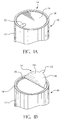
- Figure 1A illustrates a membrane lidding type container 10 for use in storing or packaging dry goods, such as coffee.
- the container typically includes a side wall 12 and a metal ring membrane lidding 14.
- the metal ring 18 of the lidding 14 is attached to the side wall 12 through any conventional means known to those skilled in the art, such as, for example, by crimping or adhesive bonding.
- the lidding 14 includes a flexible film laminate 16 which covers an opening in the metal ring 18.
- the flexible film laminate 16 is preferably removably attached to an end ring 18 which, in turn, is secured to or formed on the side wall 12.
- the flexible film laminate 16 covers an opening in the top of the container 10.
- the film laminate 16 covers an opening 20 formed in the ring 18.
- the flexible film laminate 16 is preferably removably attached to the ring 18 about the periphery of the opening 20 to provide an air-tight closure.
- a pull tab 22 may be formed on the flexible film laminate to facilitate separation of the film laminate 16 from the ring 18 and/or container 10.
- Figure 1B illustrates the flexible film laminate 16 in a partially open position, peeled back from the ring 18.
- the present invention incorporates an antistatic coating 17 as a portion of or a coating disposed on the lower surface 16L of the flexible film laminate 16 (see, Figure 2).
- the film laminate can be formed in a variety of ways known to those skilled in the art. While the present invention is described hereinafter with respect to particular preferred laminate constructions, it should be readily apparent that such constructions are provided as examples and are by no means limiting. Hence, the invention is applicable to other types of flexible lidding constructions which are known to those skilled in the art.
- an antistatic layer is applied as a coating on an existing flexible film laminate 100 of a membrane lidding 14 of the type sold by the assignee of the present invention under the trademark Ultraseal® .
- the laminate 100 includes a first layer of polymeric film 102.
- the polymeric film layer is oriented polyethylene terephthalate (OPET) film.
- the first layer can be made from oriented nylon, oriented polyolefins, or oriented polypropylene.
- the first layer 102 is attached to a metallic film layer 104 with a suitable adhesive 106.
- the metallic film layer 104 is preferably a foil film.
- the opposite side of the metallic layer 104 is attached to a first side of a nylon film layer 108 with suitable adhesive 110.
- the second side of the nylon film layer 108 is attached to a thermoplastic film layer 112 also by a suitable adhesive 114.
- the thermoplastic film layer 112 is a Surlyn® film.
- the nylon film layer 108 is adhesively laminated to a 150 gauge Suryln® film layer 112 using a two part urethane adhesive, preferably a Liofol Tycel 7975/7276 adhesive.
- the first layer 102 is preferably 48 gauge OPET, adhesively laminated to 150 gauge foil using a two part urethane adhesive system, such as a Liofol adhesive system.
- the OPET/foil laminate is then adhesively attached to the Surlyn/nylon laminate again preferably with a two part Liofol urethane adhesive system.
- An antistatic coating 116 is disposed on or applied to at least a portion of the bottom surface of the sealing layer 112. Since the antistatic coating 116 is located on the inside surface of the lidding (i.e., the surface facing the dry goods), the antistatic coating 116 must be FDA approved for direct contact with food products. Also, since the coating is likely to come into contact with the food stuffs in the container, it is preferable that the coating does not affect the taste of the food, has no discernable odor, does not appear as an oily layer on the lidding (which is not cosmetically appealing to purchasers), and does not physically stick to dry products under pressure. In one embodiment of the invention, the antistatic coating 116 is a 2% glycerol monostearate (GMS) solution mixed in alcohol.
- GMS 2% glycerol monostearate
- the antistatic coating 116 is applied in a very thin uniform coverage to the thermoplastic layer 112. Proper application of the antistatic coating is important since, if the coating is incomplete, then the static charge will not be sufficiently dissipated and will result in patches of sticking dry goods. Also, if the coating is too thick then it will result in an oily residue that would be objectionable to the customer and cause dry product to stick to the lidding.
- the coating is applied to give a GMS coverage dry of between approximately 2 to 6 grams per 100,000 square inches.
- the anti-static coating 116 is an FDA approved laquer that includes metal flakes.
- the metal flakes provide electrical conductivity in the coating which dissipates the buildup of static electricity. It is desirable that there be good contact between the flakes to provide sufficient conductivity. Testing has determined that a coating with metal flakes loading comprising at least about 20% by weight (on a final dried solids basis) provides sufficient conductivity. A preferred range would be between approximately 25% to approximately 40% by weight. Loading above 40% tends to produce a coating that is difficult to apply.
- Many types of metal flakes would be suitable in the present invention, such as aluminum flakes, provided the flakes meet FDA approval. Suitable metal flakes are available through many different commercial suppliers. The metal flakes can have any desired shape and size, although a size between about 1.0 and about 15 micron is sufficient to provide good overlap and contact to dissipate an electrical charge.
- the laquer coating can be any suitable FDA approved laquer which will mix well with metal flakes.
- the coating is a spray coating made using cellulose nitrate.
- a solvent based coating made with cellulose nitrate dissolved in alcohol, alcohol/ether, esters and/or mixtures thereof can also be used.
- Any polymeric binder can be used in the present invention provided that it binds well to the sealant surface and can be formulated with suitable levels of metal.
- the antistatic coating is applied using conventional methods and the residual solvent is removed by drying, such as in a downstream drying section of the process.
- Plasticizers such as alkyl phthalates, aryl phosphates, and alkyl polyvinyl ethers could be added to the antistatic coating, provided the plasticizers meet FDA approval. However, the addition of plasticizers is not necessary in the present invention.
- the laquer Upon curing, the laquer forms a hard layer with no residual stickiness.
- the metal flakes form a semi-continuous layer within the laquer which provides good electrical conductivity for dissipating the development of a static electrical charge.
- the flexible film laminate 200 in this embodiment is the Sealed-Safe membrane described above and manufactured by the assignee of the present invention.
- the flexible film laminate 200 includes an outer protective coating 202, which is preferably an acrylic coating.
- the outer coating 202 is formed on a metal film layer 204.
- the thickness of the metal film layer 204 will be selected depending on the intended use. In one configuration of the invention, the metal film layer 204 is a foil film that has a thickness between approximately 200 gauge and 500 gauge. In one particular embodiment, the foil film layer 204 has a thickness of approximately 250 gauge.
- the foil film layer 204 has a thickness of approximately 400 gauge. Other thicknesses, of course, can be used with the present invention.
- a heat seal coating 206 is formed on the inner surface of the foil film layer 204.
- the preferred heat seal coatings are vinyl acrylic and polyester materials that are commercially available from manufacturers, such as Watson Rhenania, Lawson Mardon, and Alcoa.
- An antistatic coating 208 similar to the antistatic coating 116 described above with respect to Figure 3 (either spray or solvent based) is applied to or disposed on the heat seal coating 206.
- the antistatic coating is added to an existing flexible film laminate.
- These embodiments would, of course, require an additional step in the manufacturing process when forming the membrane lidding, thus increasing the overall cost of manufacturing the lidding.
- the present invention also contemplates modifying the structure of the membrane lidding 14 to incorporate the antistatic coating into the flexible film laminate. This is accomplished by substituting a metal flake loaded heat seal coating for one or more components in the laminate. However, since a metal flake filled heat seal coating does not adhere well to polymeric films, such as nylon and OPET, the flexible film laminate must be reconfigured.
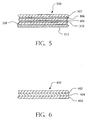
- the flexible film laminate 300 includes an outer or first layer of OPET film 302 adhesively bonded to a nylon film layer 304 through an adhesive layer 306.
- the adhesives are selected to provide suitable adhesion of the associated layers and to address the specific needs of the container.
- the antistatic heat seal layer 312 is applied to or formed on the metallic film layer 308.
- the antistatic heat seal layer 312 includes metal flakes, for providing electric conductivity, mixed in a suitable sealant. It has been determined through testing that, in order to provide sufficient conductivity, the antistatic heat seal coating 312 preferably includes at least 30% metal flakes by weight. More preferably, the metal flakes comprise at least 40% by weight of the final dried coatings solids. A preferred range of metal flakes would be between approximately 30% to approximately 50% by weight. Loading above 50% tends to result in the metal precipitating or settling out of the coating solutions. It has also been determined that higher coverage of the antistatic heat seal 56 coating provides better antistatic protection. For example, while coverage of 5 1bs./ream provides marginal antistatic protection, 10 1bs/ream provides better protection and, therefore, is more preferred.
- the film laminate 400 includes an outer protective coating 402, which is preferably an acrylic coating.
- the outer coating 402 is formed on or applied to a metallic film layer 404, such as a foil film layer.
- the thickness of the metallic film layer 404 will be selected depending on the intended use for the membrane lid.
- An antistatic heat seal coating 406 is formed on or applied to the opposite side of the metallic film layer 404 from the outer coating 402.
- the coating includes at least 30% metal flakes by weight. More preferably, the metal flakes comprise at least 40% by weight of the final dried coatings solids.
- Plasticizers can be used, if desired, in the heat seal coatings.
- plasticizers for PVC can be used.
- Those skilled in the art would be readily capable of selecting suitable plasticizers for polyester type heat seal coatings.
- the flexible film laminate 16 is heat sealed to the metal ring 18 about the periphery of the opening 20.
- the antistatic coating 17 is applied to the flexible film laminate 16 as a separate coating ( Figures 3 and 4), it is preferably not applied in the area where the flexible laminate 16 seals to the metal ring 18 since it would prevent or reduce the sealing of the flexible film laminate to the ring 18. Accordingly, it is preferable the antistatic coating 17 is applied after the flexible laminate 16 is heat sealed to the ring 18. If the antistatic coating 17 is the heat seal coating or layer of the flexible laminate 16 ( Figures 5 and 6), it would be formed as part of the flexible film laminate before the laminate is heat sealed to the metal ring 18.
- the present invention provides a novel structure for dissipating and/or preventing buildup of static electricity in a membrane-type lid.
- EDS Energy Dispersive Spectrophotometry
- SEM Scanning Electron Microscopy
- the present invention has been described as using metal within the laquer, it is also contemplated that electrically conductive pigments can be used instead.
- the pigments must have a sufficiently low resistance to allow passage of electric current through or over it.
- the pigment should have a maximum powder resistance of 125 ohm-centimeters when subjected to 2 metric tons of compression.
Landscapes
- Engineering & Computer Science (AREA)
- Chemical & Material Sciences (AREA)
- Mechanical Engineering (AREA)
- Life Sciences & Earth Sciences (AREA)
- Materials Engineering (AREA)
- Wood Science & Technology (AREA)
- Organic Chemistry (AREA)
- Closures For Containers (AREA)
- Laminated Bodies (AREA)
- Packages (AREA)
Abstract
Description
Claims (18)
- A method of forming a membrane lidding with an antistatic coating for a container of dry products, the method comprising the steps of forming a flexible film laminate, the flexible film laminate having an anti-static coating formed on at least a portion of one side of the flexible film laminate.
- A method according to claim 1 wherein the anti-static coating includes at least about 20% metal flakes by weight.
- A method according to claim 2 wherein the anti-static coating includes a nitrocellulose resin.
- A method according to claim 1 wherein the anti-static coating is formed by mixing metal flakes with a nitrocellulose coating solution, and removing residual solvent from the coating to reduce tackiness.
- A method according to claim 4, wherein the nitrocellulose coating solution is formed by dissolving cellulose nitrate in at least one component selected from a group consisting of alcohol, alcohol/ether, and esters.
- A method according to claim 2 wherein the anti-static coating includes a polymeric binder that binds well to a sealant surface and is adapted to receive high levels of metal flakes.
- A method according to claim 2 wherein the metallic flakes include at least aluminium flakes.
- A method according to claim 7 wherein the aluminium flakes have a size between about 1.0 microns and about 15 microns.
- A method according to claim 1 wherein the antistatic coating is made from a 2% glycerol monostearate (GMS) solution mixed in alcohol.
- A method according to claim 1 wherein the flexible film laminate is formed by a method comprising the steps of adhesively bonding an oriented PET film layer to a first side of a nylon film layer, and adhesively bonding a second side of the nylon film layer to a first side of a metallic film layer; and wherein the anti-static coating is a heat sealing coating that includes at least about 30% metal flakes by weight, and wherein the anti-static coating is applied to a second side of the metallic film layer.
- A method according to claim 1 wherein the membrane lidding further comprises an end ring adapted to be attached to a container, and wherein the method of forming the membrane lidding further comprises the step of heat sealing the flexible film laminate to the end ring.
- An antistatic membrane lidding for a container, the membrane lidding comprising a flexible film laminate having an antistatic coating on at least a portion of one side.
- An antistatic membrane lidding according to claim 12 wherein the flexible film laminate includes a first polymeric film layer, a metallic film layer adhesively attached to the polymeric film layer, a nylon film layer adhesively attached to the metallic film layer, and a thermoplastic film layer adhesively attached to the nylon layer; and wherein the antistatic coating is formed on the thermoplastic film layer of the flexible film laminate and is formed from a 2% glycerol monostearate (GMS) solution mixed in alcohol.
- An antistatic membrane lidding according to claim 13 wherein the antistatic coating includes electrically conductive material,.
- An antistatic membrane lidding according to claim 12 wherein the flexible film laminate includes a metallic film layer, an acrylic coating formed on one side of the metallic film layer, and a heat seal coating formed on the other side of the metallic film layer; and wherein the antistatic coating is formed on the heat seal coating of the flexible film laminate.
- An antistatic membrane lidding according to claim 15, wherein the antistatic coating includes at least 30% metal flakes by weight.
- An antistatic membrane lidding according to claim 12 wherein the flexible film laminate includes a first polymeric film layer, a nylon film layer adhesively attached to the polymeric film layer, a metallic film layer adhesively attached to the nylon film layer, and wherein the antistatic coating is an antistatic heat seal coating formed on the metallic film layer, the antistatic heat seal coating including at least 30% metal flakes by weight.
- An antistatic membrane lidding according to claim 12 wherein the flexible film laminate includes a metallic film layer, an acrylic coating formed on one side of the metallic film layer, and wherein the antistatic coating is an antistatic heat seal coating formed on the other side of the metallic film layer, the antistatic heat seal coating including at least 30% metal flakes by weight.
Applications Claiming Priority (2)
| Application Number | Priority Date | Filing Date | Title |
|---|---|---|---|
| US60242300A | 2000-06-23 | 2000-06-23 | |
| US602423 | 2000-06-23 |
Publications (2)
| Publication Number | Publication Date |
|---|---|
| EP1167464A2 true EP1167464A2 (en) | 2002-01-02 |
| EP1167464A3 EP1167464A3 (en) | 2003-04-09 |
Family
ID=24411287
Family Applications (1)
| Application Number | Title | Priority Date | Filing Date |
|---|---|---|---|
| EP01305276A Withdrawn EP1167464A3 (en) | 2000-06-23 | 2001-06-18 | Antistatic membrane lidding for a container |
Country Status (3)
| Country | Link |
|---|---|
| EP (1) | EP1167464A3 (en) |
| CA (1) | CA2351179A1 (en) |
| MX (1) | MXPA01006534A (en) |
Cited By (1)
| Publication number | Priority date | Publication date | Assignee | Title |
|---|---|---|---|---|
| GB2503899A (en) * | 2012-07-10 | 2014-01-15 | Boys Ltd 3 | Lid Having Removable Cover |
Families Citing this family (1)
| Publication number | Priority date | Publication date | Assignee | Title |
|---|---|---|---|---|
| CN111323111B (en) * | 2020-03-11 | 2022-04-22 | 北京空间飞行器总体设计部 | A modal test system suitable for thin film antenna in vacuum environment |
Family Cites Families (6)
| Publication number | Priority date | Publication date | Assignee | Title |
|---|---|---|---|---|
| DE4219410A1 (en) * | 1992-06-13 | 1993-12-16 | Hoechst Ag | Heat-sealable, antistatic-coated films and film laminates, processes for their production and their use |
| JP3563863B2 (en) * | 1996-02-09 | 2004-09-08 | 大日本印刷株式会社 | Cover tape |
| JPH09314717A (en) * | 1996-05-29 | 1997-12-09 | Dainippon Printing Co Ltd | Lid material |
| TW393405B (en) * | 1997-09-13 | 2000-06-11 | Four Pillars Entpr Co Ltd | Compound membrane for packaging |
| US5855820A (en) * | 1997-11-13 | 1999-01-05 | E. I. Du Pont De Nemours And Company | Water based thick film conductive compositions |
| JP2000033673A (en) * | 1998-07-16 | 2000-02-02 | Dainippon Printing Co Ltd | Laminate |
-
2001
- 2001-06-18 EP EP01305276A patent/EP1167464A3/en not_active Withdrawn
- 2001-06-21 CA CA 2351179 patent/CA2351179A1/en not_active Abandoned
- 2001-06-22 MX MXPA01006534 patent/MXPA01006534A/en unknown
Cited By (2)
| Publication number | Priority date | Publication date | Assignee | Title |
|---|---|---|---|---|
| GB2503899A (en) * | 2012-07-10 | 2014-01-15 | Boys Ltd 3 | Lid Having Removable Cover |
| GB2503899B (en) * | 2012-07-10 | 2015-08-05 | Boys Ltd 3 | Lid Having Removable Cover |
Also Published As
| Publication number | Publication date |
|---|---|
| EP1167464A3 (en) | 2003-04-09 |
| MXPA01006534A (en) | 2003-06-19 |
| CA2351179A1 (en) | 2001-12-23 |
Similar Documents
| Publication | Publication Date | Title |
|---|---|---|
| EP1445209B1 (en) | Container closure with inner seal | |
| EP1595808A2 (en) | Container having a metal end to which a membrane is sealed | |
| EP1598279B1 (en) | Container closure with dual heat seal and magnetic seal | |
| EP1526090A2 (en) | Container with easily removable membrane lid | |
| MXPA06004426A (en) | Reclosable rigid container assembly. | |
| WO2018003978A1 (en) | Packaging sheet and packaging body | |
| CN1516666A (en) | Airtight container and manufacturing method thereof | |
| EP0377747A1 (en) | Easily openable sealed package container | |
| JPS6228355A (en) | Heat seal vessel | |
| US20100089924A1 (en) | Metal containers | |
| GB2052455A (en) | Container lid, and package and packaging method using same | |
| CN100355564C (en) | Packaging bag material for hardenable composition | |
| CA2489218A1 (en) | Easily openable closure for a retortable container having a metal end to which a membrane is sealed | |
| CA2351179A1 (en) | Antistatic membrane lidding for a container | |
| US5952122A (en) | Battery label with primer layer | |
| CN1407940A (en) | Packing drum with melt adhesive | |
| US9688448B2 (en) | Closure cap with a multilayer seal disk for receptacles | |
| JP7360954B2 (en) | Lid material and packaging | |
| JP3744979B2 (en) | Packaging that can reduce loading pressure | |
| US12595106B2 (en) | Mono polyester material package | |
| JPH09254987A (en) | Packaging container | |
| JPH11292157A (en) | Cover material for paper containers that can be retort sterilized | |
| JPS6229303B2 (en) | ||
| JPH0126629Y2 (en) | ||
| JP4156251B2 (en) | Heat-sealable material, laminate using the same, and packaging container |
Legal Events
| Date | Code | Title | Description |
|---|---|---|---|
| PUAI | Public reference made under article 153(3) epc to a published international application that has entered the european phase |
Free format text: ORIGINAL CODE: 0009012 |
|
| AK | Designated contracting states |
Kind code of ref document: A2 Designated state(s): AT BE CH CY DE DK ES FI FR GB GR IE IT LI LU MC NL PT SE TR |
|
| AX | Request for extension of the european patent |
Free format text: AL;LT;LV;MK;RO;SI |
|
| PUAL | Search report despatched |
Free format text: ORIGINAL CODE: 0009013 |
|
| AK | Designated contracting states |
Kind code of ref document: A3 Designated state(s): AT BE CH CY DE DK ES FI FR GB GR IE IT LI LU MC NL PT SE TR Designated state(s): AT BE CH CY DE DK ES FI FR GB GR IE IT LI LU MC NL PT SE TR |
|
| AX | Request for extension of the european patent |
Extension state: AL LT LV MK RO SI |
|
| RIC1 | Information provided on ipc code assigned before grant |
Ipc: 7B 65D 77/20 B Ipc: 7B 32B 27/08 B Ipc: 7C 09D 101/18 B Ipc: 7C 09D 5/24 A |
|
| AKX | Designation fees paid | ||
| REG | Reference to a national code |
Ref country code: DE Ref legal event code: 8566 |
|
| STAA | Information on the status of an ep patent application or granted ep patent |
Free format text: STATUS: THE APPLICATION IS DEEMED TO BE WITHDRAWN |
|
| 18D | Application deemed to be withdrawn |
Effective date: 20031010 |