EP1167416A1 - Urethane resin composition for sealing optoelectric conversion devices - Google Patents
Urethane resin composition for sealing optoelectric conversion devices Download PDFInfo
- Publication number
- EP1167416A1 EP1167416A1 EP01901509A EP01901509A EP1167416A1 EP 1167416 A1 EP1167416 A1 EP 1167416A1 EP 01901509 A EP01901509 A EP 01901509A EP 01901509 A EP01901509 A EP 01901509A EP 1167416 A1 EP1167416 A1 EP 1167416A1
- Authority
- EP
- European Patent Office
- Prior art keywords
- compound
- component
- isocyanate groups
- optoelectric conversion
- isocyanate
- Prior art date
- Legal status (The legal status is an assumption and is not a legal conclusion. Google has not performed a legal analysis and makes no representation as to the accuracy of the status listed.)
- Withdrawn
Links
Classifications
-
- C—CHEMISTRY; METALLURGY
- C08—ORGANIC MACROMOLECULAR COMPOUNDS; THEIR PREPARATION OR CHEMICAL WORKING-UP; COMPOSITIONS BASED THEREON
- C08G—MACROMOLECULAR COMPOUNDS OBTAINED OTHERWISE THAN BY REACTIONS ONLY INVOLVING UNSATURATED CARBON-TO-CARBON BONDS
- C08G18/00—Polymeric products of isocyanates or isothiocyanates
- C08G18/06—Polymeric products of isocyanates or isothiocyanates with compounds having active hydrogen
- C08G18/70—Polymeric products of isocyanates or isothiocyanates with compounds having active hydrogen characterised by the isocyanates or isothiocyanates used
- C08G18/72—Polyisocyanates or polyisothiocyanates
- C08G18/77—Polyisocyanates or polyisothiocyanates having heteroatoms in addition to the isocyanate or isothiocyanate nitrogen and oxygen or sulfur
- C08G18/78—Nitrogen
- C08G18/79—Nitrogen characterised by the polyisocyanates used, these having groups formed by oligomerisation of isocyanates or isothiocyanates
- C08G18/791—Nitrogen characterised by the polyisocyanates used, these having groups formed by oligomerisation of isocyanates or isothiocyanates containing isocyanurate groups
- C08G18/792—Nitrogen characterised by the polyisocyanates used, these having groups formed by oligomerisation of isocyanates or isothiocyanates containing isocyanurate groups formed by oligomerisation of aliphatic and/or cycloaliphatic isocyanates or isothiocyanates
-
- C—CHEMISTRY; METALLURGY
- C08—ORGANIC MACROMOLECULAR COMPOUNDS; THEIR PREPARATION OR CHEMICAL WORKING-UP; COMPOSITIONS BASED THEREON
- C08G—MACROMOLECULAR COMPOUNDS OBTAINED OTHERWISE THAN BY REACTIONS ONLY INVOLVING UNSATURATED CARBON-TO-CARBON BONDS
- C08G18/00—Polymeric products of isocyanates or isothiocyanates
- C08G18/06—Polymeric products of isocyanates or isothiocyanates with compounds having active hydrogen
- C08G18/08—Processes
- C08G18/10—Prepolymer processes involving reaction of isocyanates or isothiocyanates with compounds having active hydrogen in a first reaction step
-
- C—CHEMISTRY; METALLURGY
- C08—ORGANIC MACROMOLECULAR COMPOUNDS; THEIR PREPARATION OR CHEMICAL WORKING-UP; COMPOSITIONS BASED THEREON
- C08G—MACROMOLECULAR COMPOUNDS OBTAINED OTHERWISE THAN BY REACTIONS ONLY INVOLVING UNSATURATED CARBON-TO-CARBON BONDS
- C08G18/00—Polymeric products of isocyanates or isothiocyanates
- C08G18/06—Polymeric products of isocyanates or isothiocyanates with compounds having active hydrogen
- C08G18/70—Polymeric products of isocyanates or isothiocyanates with compounds having active hydrogen characterised by the isocyanates or isothiocyanates used
- C08G18/72—Polyisocyanates or polyisothiocyanates
- C08G18/73—Polyisocyanates or polyisothiocyanates acyclic
-
- C—CHEMISTRY; METALLURGY
- C08—ORGANIC MACROMOLECULAR COMPOUNDS; THEIR PREPARATION OR CHEMICAL WORKING-UP; COMPOSITIONS BASED THEREON
- C08G—MACROMOLECULAR COMPOUNDS OBTAINED OTHERWISE THAN BY REACTIONS ONLY INVOLVING UNSATURATED CARBON-TO-CARBON BONDS
- C08G18/00—Polymeric products of isocyanates or isothiocyanates
- C08G18/06—Polymeric products of isocyanates or isothiocyanates with compounds having active hydrogen
- C08G18/70—Polymeric products of isocyanates or isothiocyanates with compounds having active hydrogen characterised by the isocyanates or isothiocyanates used
- C08G18/72—Polyisocyanates or polyisothiocyanates
- C08G18/74—Polyisocyanates or polyisothiocyanates cyclic
- C08G18/75—Polyisocyanates or polyisothiocyanates cyclic cycloaliphatic
-
- C—CHEMISTRY; METALLURGY
- C08—ORGANIC MACROMOLECULAR COMPOUNDS; THEIR PREPARATION OR CHEMICAL WORKING-UP; COMPOSITIONS BASED THEREON
- C08G—MACROMOLECULAR COMPOUNDS OBTAINED OTHERWISE THAN BY REACTIONS ONLY INVOLVING UNSATURATED CARBON-TO-CARBON BONDS
- C08G18/00—Polymeric products of isocyanates or isothiocyanates
- C08G18/06—Polymeric products of isocyanates or isothiocyanates with compounds having active hydrogen
- C08G18/70—Polymeric products of isocyanates or isothiocyanates with compounds having active hydrogen characterised by the isocyanates or isothiocyanates used
- C08G18/72—Polyisocyanates or polyisothiocyanates
- C08G18/74—Polyisocyanates or polyisothiocyanates cyclic
- C08G18/75—Polyisocyanates or polyisothiocyanates cyclic cycloaliphatic
- C08G18/751—Polyisocyanates or polyisothiocyanates cyclic cycloaliphatic containing only one cycloaliphatic ring
- C08G18/752—Polyisocyanates or polyisothiocyanates cyclic cycloaliphatic containing only one cycloaliphatic ring containing at least one isocyanate or isothiocyanate group linked to the cycloaliphatic ring by means of an aliphatic group
- C08G18/757—Polyisocyanates or polyisothiocyanates cyclic cycloaliphatic containing only one cycloaliphatic ring containing at least one isocyanate or isothiocyanate group linked to the cycloaliphatic ring by means of an aliphatic group containing at least two isocyanate or isothiocyanate groups linked to the cycloaliphatic ring by means of an aliphatic group
-
- C—CHEMISTRY; METALLURGY
- C08—ORGANIC MACROMOLECULAR COMPOUNDS; THEIR PREPARATION OR CHEMICAL WORKING-UP; COMPOSITIONS BASED THEREON
- C08G—MACROMOLECULAR COMPOUNDS OBTAINED OTHERWISE THAN BY REACTIONS ONLY INVOLVING UNSATURATED CARBON-TO-CARBON BONDS
- C08G18/00—Polymeric products of isocyanates or isothiocyanates
- C08G18/06—Polymeric products of isocyanates or isothiocyanates with compounds having active hydrogen
- C08G18/70—Polymeric products of isocyanates or isothiocyanates with compounds having active hydrogen characterised by the isocyanates or isothiocyanates used
- C08G18/72—Polyisocyanates or polyisothiocyanates
- C08G18/74—Polyisocyanates or polyisothiocyanates cyclic
- C08G18/75—Polyisocyanates or polyisothiocyanates cyclic cycloaliphatic
- C08G18/758—Polyisocyanates or polyisothiocyanates cyclic cycloaliphatic containing two or more cycloaliphatic rings
-
- C—CHEMISTRY; METALLURGY
- C08—ORGANIC MACROMOLECULAR COMPOUNDS; THEIR PREPARATION OR CHEMICAL WORKING-UP; COMPOSITIONS BASED THEREON
- C08G—MACROMOLECULAR COMPOUNDS OBTAINED OTHERWISE THAN BY REACTIONS ONLY INVOLVING UNSATURATED CARBON-TO-CARBON BONDS
- C08G18/00—Polymeric products of isocyanates or isothiocyanates
- C08G18/06—Polymeric products of isocyanates or isothiocyanates with compounds having active hydrogen
- C08G18/70—Polymeric products of isocyanates or isothiocyanates with compounds having active hydrogen characterised by the isocyanates or isothiocyanates used
- C08G18/72—Polyisocyanates or polyisothiocyanates
- C08G18/74—Polyisocyanates or polyisothiocyanates cyclic
- C08G18/76—Polyisocyanates or polyisothiocyanates cyclic aromatic
-
- C—CHEMISTRY; METALLURGY
- C08—ORGANIC MACROMOLECULAR COMPOUNDS; THEIR PREPARATION OR CHEMICAL WORKING-UP; COMPOSITIONS BASED THEREON
- C08G—MACROMOLECULAR COMPOUNDS OBTAINED OTHERWISE THAN BY REACTIONS ONLY INVOLVING UNSATURATED CARBON-TO-CARBON BONDS
- C08G18/00—Polymeric products of isocyanates or isothiocyanates
- C08G18/06—Polymeric products of isocyanates or isothiocyanates with compounds having active hydrogen
- C08G18/70—Polymeric products of isocyanates or isothiocyanates with compounds having active hydrogen characterised by the isocyanates or isothiocyanates used
- C08G18/72—Polyisocyanates or polyisothiocyanates
- C08G18/74—Polyisocyanates or polyisothiocyanates cyclic
- C08G18/76—Polyisocyanates or polyisothiocyanates cyclic aromatic
- C08G18/7614—Polyisocyanates or polyisothiocyanates cyclic aromatic containing only one aromatic ring
- C08G18/7621—Polyisocyanates or polyisothiocyanates cyclic aromatic containing only one aromatic ring being toluene diisocyanate including isomer mixtures
-
- C—CHEMISTRY; METALLURGY
- C08—ORGANIC MACROMOLECULAR COMPOUNDS; THEIR PREPARATION OR CHEMICAL WORKING-UP; COMPOSITIONS BASED THEREON
- C08G—MACROMOLECULAR COMPOUNDS OBTAINED OTHERWISE THAN BY REACTIONS ONLY INVOLVING UNSATURATED CARBON-TO-CARBON BONDS
- C08G18/00—Polymeric products of isocyanates or isothiocyanates
- C08G18/06—Polymeric products of isocyanates or isothiocyanates with compounds having active hydrogen
- C08G18/70—Polymeric products of isocyanates or isothiocyanates with compounds having active hydrogen characterised by the isocyanates or isothiocyanates used
- C08G18/72—Polyisocyanates or polyisothiocyanates
- C08G18/74—Polyisocyanates or polyisothiocyanates cyclic
- C08G18/76—Polyisocyanates or polyisothiocyanates cyclic aromatic
- C08G18/7614—Polyisocyanates or polyisothiocyanates cyclic aromatic containing only one aromatic ring
- C08G18/7628—Polyisocyanates or polyisothiocyanates cyclic aromatic containing only one aromatic ring containing at least one isocyanate or isothiocyanate group linked to the aromatic ring by means of an aliphatic group
- C08G18/7642—Polyisocyanates or polyisothiocyanates cyclic aromatic containing only one aromatic ring containing at least one isocyanate or isothiocyanate group linked to the aromatic ring by means of an aliphatic group containing at least two isocyanate or isothiocyanate groups linked to the aromatic ring by means of an aliphatic group having a primary carbon atom next to the isocyanate or isothiocyanate groups, e.g. xylylene diisocyanate or homologues substituted on the aromatic ring
-
- C—CHEMISTRY; METALLURGY
- C08—ORGANIC MACROMOLECULAR COMPOUNDS; THEIR PREPARATION OR CHEMICAL WORKING-UP; COMPOSITIONS BASED THEREON
- C08G—MACROMOLECULAR COMPOUNDS OBTAINED OTHERWISE THAN BY REACTIONS ONLY INVOLVING UNSATURATED CARBON-TO-CARBON BONDS
- C08G2190/00—Compositions for sealing or packing joints
-
- H—ELECTRICITY
- H10—SEMICONDUCTOR DEVICES; ELECTRIC SOLID-STATE DEVICES NOT OTHERWISE PROVIDED FOR
- H10H—INORGANIC LIGHT-EMITTING SEMICONDUCTOR DEVICES HAVING POTENTIAL BARRIERS
- H10H20/00—Individual inorganic light-emitting semiconductor devices having potential barriers, e.g. light-emitting diodes [LED]
- H10H20/80—Constructional details
- H10H20/85—Packages
- H10H20/852—Encapsulations
- H10H20/854—Encapsulations characterised by their material, e.g. epoxy or silicone resins
Definitions
- the present invention relates to a urethane resin for an optoelectric conversion element sealer, a urethane resin composition, use applications and production methods thereof. More specifically, it relates to a urethane resin for an optoelectric conversion element sealer which has excellent weather resistance and is hardly discolored, a urethane resin composition for an optoelectric conversion element sealer which has. good workability, an optoelectric conversion device and a light-emitting or a light-receiving device in which the urethane resin is used as a sealer, use applications of the devices and production methods thereof, and a light-emitting diode lamp and a production method thereof.
- hermetic seal by using a metal, ceramic, glass or the like, or resin seal by using a resin has been carried out.
- the hermetic seal is excellent in reliability, but it also has a problem that its production cost is high. Therefore, the resin seal, which can be accomplished at a low cost, is widely spread.
- sealers for the resin seal an epoxy resin, a silicone resin, a polyester resin and the like have been used.
- the sealer for a light-emitting element such as a light-emitting diode (LED) must have such properties as (a) moisture resistance, (b) insulation properties, (c) heat resistance, (d) moldability and workability, (e) mechanical strength, (f) purity, (g) chemical resistance and (h) light transmittance.
- an epoxy resin composition has been mainly used, and the sealer can be prepared relatively easily by transfer molding or the like of an epoxy resin composition containing an epoxy resin, a curing agent, an accelerator and a mold releasing agent.
- an epoxy resin composition examples include epoxy resins such as a bisphenol A-type, bisphenol F-type and bisphenol S-type, novolac-type epoxy resins such as ortho-cresol and phenol, and alicyclic epoxy resins.
- the curing agent include acid anhydrides such as hexahydrophthalic anhydride, methylhexahydrophthalic anhydride and tetrahydrophthalic anhydride, novolac-type resins obtained by subjecting each of phenol, cresol, xylenol, resorcin and the like and formaldehyde to condensation reaction.
- an epoxy resin composition for sealing a semiconductor device which contains an amine-based curing agent and the like.
- a reactive sealer for the LED in which an isocyanate compound and an active hydrogen compound are used.
- a light-emitting or a light-receiving device which is sealed by a liquid polymer containing at least one compound selected from the group consisting of aromatic thiol compounds and aliphatic thiol compounds and a polyisocyanate compound.
- a light-emitting or a light-receiving device is also known, which is sealed by a liquid polymer containing a polyfunctional isocyanate compound and an isocyanurate compound having a mercapto group.
- a semiconductor light-emitting device in which at least the light-extracting surface of a light-emitting element is coated with a resin having a high refractive index which is obtained by reacting 1,3-di(isocyanatemethyl)benzene with 4-mercaptomethyl-3,6-dithia-1,8-octanedithiol, and the resin is then covered with a sealing resin.
- the silicone resin has poor adhesive strength to a substrate and is liable to remain sticky.
- the polyester resin has the problems that it shrinks largely after curing and that it is poor in hydrolysis resistance.
- the epoxy resin which is generally used as a sealer for the light-emitting element of the LED has a problem that it is poor in productivity since the resin is heated for a long time period of about 10 to 20 hours to be cured, and another problem that when the curing time is shortened, the temperature rapidly increases by heat of the reaction, whereby the reaction becomes uncontrollable.
- shrinkage due to the curing after the reaction is large and occurs quickly, so that the cured resin may have cracks.
- the epoxy resin also has a problem that it is liable to be colored by heat or light, thereby lowering light transmittance, with the result that the performance of the LED deteriorates, and another problem that it does not cure on the surface of a surface-mountable LED in sealing the surface-mountable LED.
- a resin composition using a urethane (meth)acrylate a resin composition containing a urethane (meth)acrylate is known which is obtained by first producing a fluorine-containing (meth)acrylate and then reacting the fluorine-containing (meth)acrylate with a polyol and an organic polyisocyanate.
- This composition is prepared by the two steps of the reactions, and hence, it is industrially disadvantageous as the sealer for the LED.
- the refractive index of the obtained resin is liable to be relatively low.
- a urethane sealer obtained from an isocyanate compound and an active hydrogen compound containing sulfur in its molecule provides a high refractive index and transparency.
- it contains sulfur it is poor in weathering stability, and when incorporated into an LED, silver parts used in an LED lamp are liable to be sulfurated and blackened when a voltage is applied to the LED.
- the present invention has been invented to solve the above problems associated with the prior art. It is an object of the present invention to provide a urethane resin and a urethane resin composition for an optoelectric conversion element sealer which have a useful rigidity, refractive index and weathering stability as a sealer for an optoelectric conversion element such as a light-emitting diode, an optoelectric conversion device, a light-emitting or a light-receiving element, a light-emitting diode (LED) lamp, and production methods thereof.
- an optoelectric conversion element such as a light-emitting diode, an optoelectric conversion device, a light-emitting or a light-receiving element, a light-emitting diode (LED) lamp, and production methods thereof.
- the present invention is characterized by the following (1) to (24).
- the present invention relates to a urethane resin and a urethane resin composition which are suitable for an optoelectric conversion element sealer; an optoelectric conversion device sealed by the urethane resin, and their production methods.
- the urethane resin for an optoelectric conversion element sealer of the present invention has:
- this urethane resin for an optoelectric conversion element sealer contains alkali metal atoms in an amount of 10 ppm or less.
- the urethane resin composition'for an optoelectric conversion element sealer of the present invention comprises a component (A) containing a compound having at least two isocyanate groups and a component (B) containing a compound having hydroxyl groups, wherein the compound having isocyanate groups in the component (A) is at least one compound selected from the group consisting of:
- the above compound having isocyanate groups is preferably a modified isocyanurate or prepolymer of the polyisocyanates (i) to (iii).
- the initial mixing viscosity at the time of mixing the above component (A) and the above component (B) together at 20°C is preferably 10 to 10,000 mPa ⁇ s.
- a time required for a viscosity after mixing of the above component (A) and the above component (B) to become twice as much as the initial mixing viscosity is preferably in a range of 2 to 20 hours.
- the above compound having isocyanate groups is preferably a polycyclic alicyclic polyisocyanate or its modification.
- the above polycyclic alicyclic polyisocyanate is more preferably a polycyclic alicyclic diisocyanate represented by the following general formula [I]: wherein m and n each independently represent an integer of 1 to 5.
- the above polycyclic alicyclic polyisocyanate is particularly preferably a polycyclic alicyclic diisocyanate represented by the above formula [I] wherein both m and n are 1.
- the above compound having isocyanate groups is most preferably at least one compound selected from the group consisting of diisocyanatemethylbenzene, bis(1-isocyanato-1,1,-dimethyl)benzene, 4,4'-diisocyanato-dicyclohexylmethane, 1-isocyanato-3,5,5-trimethyl-3-isocyanatomethylcyclohexane and bisisocyanatomethylcyclohexane.
- the above compound having hydroxyl groups is preferably a compound having at least two hydroxyl groups.
- the content of alkali metal atoms in the above compound having at least two hydroxyl groups is more preferably 10 ppm or less.
- the optoelectric conversion device of the present invention is an optoelectric conversion device obtained by sealing an optoelectric conversion element by curing a composition comprising a component (A) containing a compound having isocyanate groups and a component (B) containing a compound having hydroxyl groups, wherein the above compound having isocyanate groups in the component (A) is at least one compound selected from the group consisting of:
- the optoelectric conversion element is preferably a light-emitting or a light-receiving element.
- the optoelectric conversion element is preferably a light-emitting diode.
- the component (B) contains a polyol, and the component (A) and the component (B) may contain other additives as required.
- the urethane resin composition for an optoelectric conversion element sealer comprises a component (A) containing a compound having isocyanate groups and a component (B) containing a compound having hydroxyl groups.
- the mixing ratio of the component (A) containing a compound having isocyanate groups and the component (B) containing a compound having hydroxyl groups are mixed together such that the molar ratio (NCO/OH ratio) of the isocyanate groups in the component (A) and the hydroxyl groups in the component (B) should be generally 0.5 to 2.5, preferably 0.6 to 1.8, more preferably 0.8 to 1.3.
- the urethane resin obtained by curing the urethane resin composition for an optoelectric conversion element sealer according to the present invention desirably has a glass transition temperature of preferably at least 75°C, more preferably at least 85°C, most preferably at least 90°C.
- a higher glass transition temperature is more preferable.
- the upper limit of the glass transition temperature is about 200°C.
- the glass transition temperature is at least 75°C
- the heat resistance and weather resistance as well as elastic modulus of the urethane resin for an optoelectric conversion element sealer improve, and the durability of the produced light-emitting diode (LED) lamp also improves advantageously.
- the urethane resin for an optoelectric conversion element sealer according to the present invention desirably has a refractive index of preferably 1.45 to 1.80, more preferably 1.46 to 1.75, most preferably 1.48 to 1.70 as measured by using a D line (587.6 nm) from a helium light source.
- a refractive index preferably 1.45 to 1.80, more preferably 1.46 to 1.75, most preferably 1.48 to 1.70 as measured by using a D line (587.6 nm) from a helium light source.
- the urethane resin for an optoelectric conversion element sealer according to the present invention has a ⁇ E of preferably 1.5 or less, more preferably 1.2 or less, particularly preferably 1.0 or less as measured after irradiation for 600 hours by a sunshine weatherometer using a carbon arc lamp.
- ⁇ E preferably 1.5 or less, more preferably 1.2 or less, particularly preferably 1.0 or less as measured after irradiation for 600 hours by a sunshine weatherometer using a carbon arc lamp.
- the ⁇ E is larger than 1.5, the color difference becomes visually perceptible, and the transparency of the urethane resin for an optoelectric conversion element sealer is impaired disadvantageously.
- the ⁇ E is 1.5 or less, the color difference is either imperceptible or extremely small advantageously.
- the urethane resin for an optoelectric conversion element sealer according to the present invention has a ⁇ E of preferably 1.5 or less, more preferably 1.2 or less, particularly preferably 1.0 or less, after treated for 300 hours in a thermostatic chamber having a relative humidity of 90% and a temperature of 80°C. Further, the urethane resin for an optoelectric conversion element sealer according to the present invention desirably has a ⁇ E of preferably 1.5 or less, more preferably 1.2 or less, most preferably 1.0 or less, after 600 hours at 90°C and 80%RH. When the ⁇ E is larger than 1.5, the color difference becomes visually perceptible, and the transparency of the urethane resin for an optoelectric conversion element sealer is impaired disadvantageously. When the ⁇ E is 1.5 or less, the color difference is either imperceptible or extremely small advantageously.
- the content of sulfur atoms in the composition is preferably 500 ppm or less, more preferably 300 ppm or less, particularly preferably 100 ppm or less.
- the sulfur atoms may react with metal components such as silver.
- the content of alkali metal atoms in the composition is preferably 10 ppm or less, more preferably 5 ppm or less, particularly preferably 3 ppm or less.
- the content of the alkali metal component is higher than 10 ppm, the leakage of electricity by ions is liable to occur at the time of passing a current, and electric characteristics are liable to deteriorate.
- the content of the alkali metal component is 10 ppm or less, the reactivity at the time of mixing the components (A) and (B) by stirring is stabilized, and not only the weathering stability of the resin but also the weathering stability and electric characteristics thereof when used to seal an LED to form a lamp improve advantageously.
- the isocyanate group-containing compound contained in the component (A) used in the present invention is an organic compound having isocyanate groups and is exemplified by:
- the uses of the above polyisocyanate derivatives and the isocyanate group-terminate urethane prepolymer are preferable from the viewpoint of improving the heat resistance of the urethane resin for an optoelectric conversion element sealer.
- an aromatic isocyanate having a structure in which the isocyanate groups are not directly bonded to the benzene ring, an aliphatic isocyanate and an alicyclic isocyanate can be used.
- a polyisocyanate having at least two terminal isocyanate groups in the molecule is used.
- aromatic isocyanate having a structure in which the isocyanate groups are not directly bonded to the benzene ring aliphatic isocyanate and alicyclic isocyanate, mixed isocyanates and isocyanate derivatives thereof such as an isocyanurate, carbodiimide, uretonimine, uretdione, allophanate and biuret, and isocyanate group-terminated urethane prepolymer of the present invention.
- pot life and workability can be secured and weathering stability can also be imparted.
- an aromatic isocyanate having a structure in which the isocyanate groups are directly bonded to the benzene ring reacts with a polyol quickly, thereby causing the problem that a desired pot life cannot be secured.
- the aromatic isocyanate having a structure in which the isocyanate groups are directly bonded to the aromatic ring may be used in combination with the above compounds, as the isocyanate group-containing component (A) in the urethane resin composition for sealing an optoelectric conversion element according to the present invention.
- Illustrative examples of the isocyanate group-containing compound (i) having a structure in which the isocyanate groups are not directly bonded to the benzene ring include 1,3-di(isocyanatomethyl)benzene (m-XDI), 1,4-di(isocyanatomethyl)benzene (p-XDI), 1,3-bis(1-isocyanato-1,1-dimethyl)benzene (m-TMXDI), 1,4-bis(1-isocyanato-1,1-dimethyl)benzene (p-TMXDI), 1-isocyanatomethyl-3-(1-isocyanato-1,1-dimethyl)benzene, 1-isocyanatomethyl-4-(1-isocyanato-1,1-dimethyl)benzene and 1,4-di(isocyanatoethyl)benzene.
- m-XDI 1,4-di(isocyanatomethyl)benzene
- Illustrative examples of the aliphatic isocyanate (ii) include 1,5 -diisocyanatopentane, 1,6-diisocyanatohexane (HDI), 1,4-diisocyanatopentane, 1,6-diisocyanato-3,5,5-trimethylhexane, 1,6-diisocyanato-3,3,5-trimethylhexane, 1,12-diisocyanatododecane, 1,8-diisocyanato-4-isocyanatomethyloctane, 1,3,6-triisocyanatohexane and 1,6,11-triisocyanatoundecane.
- HDI 1,6-diisocyanatohexane
- 1,4-diisocyanatopentane 1,6-diisocyanato-3,5,5-trimethylhexane
- the alicyclic isocyanate (iii) may be a monocyclic or polycyclic alicyclic isocyanate.
- Illustrative examples of the monocyclic alicyclic isocyanate include 1,3-diisocyanato-6-methylcyclohexane, 1,3-diisocyanato-2-methylcyclohexane, 1,4-diisocyanatocyclohexane, 1,4-diisocyanatomethylcyclohexane, 1,3-diisocyanatomethylcyclohexane, 1,4-diisocyanatoethylcyclohexane, 1-isocyanato-3,5,5-trimethyl-3-isocyanatomethylcyclohexane (IPDI), 4,4'-diisocyanatodicyclohexylmethane (H12MDI), 1,3-diisocyanatomethylcyclohexane (m-H6XDI),
- polycyclic alicyclic isocyanate examples include 2,5-diisocyanatomethylbicyclo[2.2.1]heptane, 2,6-diisocyanatomethylbicyclo[2.2.1]heptane, 2,5-diisocyanatoethylbicyclo[2.2.1]heptane, 2,6-diisocyanatoethylbicyclo[2.2.1]heptane, 2,5-diisocyanatopropylbicyclo[2.2.1]heptane, 2,6-diisocyanatopropylbicyclo[2.2.1]heptane, 2,5-diisocyanatobutylbicyclo[2.2.1]heptane, 2,6-diisocyanatobutylbicyclo[2.2.1]heptane, 2,5-diisocyanatopentylbicyclo[2.2.1]heptane, 2,6-diisocyanatopentylbicyclo[2.
- isocyanates may be used solely or in admixture of two or more as required.
- isocyanates 1,3-di(isocyanatomethyl)benzene (m-XDI), 1,4-di(isocyanatomethyl)benzene (p-XDI), 1,3-bis(1-isocyanato-1,1-dimethyl)benzene (m-TMXDI), 1,4-bis(1-isocyanato-1,1-dimethyl)benzene (p-TMXDI), 4,4'-diisocyanatodicyclohexylmethane (H12MDI), 1-isocyanato-3,5,5-trimethyl-3-isocyanatomethylcyclohexane (IPDI), 1,3-diisocyanatomethylcyclohexane (m-H6XDI), 1,4-diisocynatomethylcyclohexane (p-H6XDI) and the polycyclic alicyclic isocyanate represented by the formula [I].
- isocyanates most preferable are 1,3-di(isocyanatomethyl)benzene (m-XDI), 1,4-di(isocyanatomethyl)benzene (p-XDI), 1,3-di(isocyanatomethyl)cyclohexane (m-H6XDI), 1,4-di(isocyanatomethyl)cyclohexane (p-H6XDI), and 2,5-diisocyanatomethylbicyclo[2.2.1]heptane and 2,6-diisocyanatomethylbicyclo[2.2.1]heptane which have a bicyclo ring. These may be used solely or in admixture of two or more.
- polyisocyanates for example, aliphatic and/or alicyclic polyisocyanate derivatives such as isocyanurates, allophanates, carbodiimides, uretdiones and modified urethanes can also be preferably used.
- Methods for producing the above polyisocyanates are not particularly limited.
- 2,5-diisocyanatomethylbicyclo[2.2.1]heptane and/or 2,6-diisocyanatomethylbicyclo[2.2.1]heptane can be produced by the method disclosed in Japanese Patent Application Laid-Open No.
- 220167/1991 which comprises the steps of obtaining the hydrochloride(s) of 2,5-diaminomethylbicyclo[2.2.1]heptane and/or 2,6-diaminomethylbicyclo[2.2.1]heptane from 2,5-diaminomethylbicyclo[2.2.1]heptane and/or 2,6-diaminomethylbicyclo[2.2.1]heptane and a hydrochloric acid gas using a mixed solvent of isoamyl acetate and orthodichlorobenzene, blowing phosgene into the hydrochloride(s) at 160°C in an amount which is about 2.2 times as much as the theoretical amount to cause phosgenation, blowing an inert gas into the system after the completion of the reaction to remove the phosgene in the system, removing the solvent and rectifying the obtained product under reduced pressure.
- the isocyanate derivatives used in the present invention are generally those obtained by reacting some isocyanate groups of the above isocyanate compound.
- Illustrative examples of such isocyanate derivatives include uretdiones produced by dimerizing the above isocyanates, isocyanurates produced by trimerizing the above isocyanates, allophanates produced by the reaction of the isocyanates and urethanes, biuret produced by the reaction of the isocyanates and urea, carbodiimides obtained by decarboxylation of two isocyanate groups, and uretonimines produced by the reaction of the carbodiimides and the isocyanates. These may be used either directly in the form of a reaction solution or after unreacted components, the solvent and the like are removed therefrom by a known dropping-type thin-film evaporator or the like.
- the isocyanurate produced by trimerizing the isocyanate can be obtained by adding phosphines and the salts of alkali metals such as lithium and potassium to a polyisocyanate, and then reacting the mixture at 20 to 150°C.
- the carbodiimide obtained by decarboxylation of two isocyanate groups can be obtained by carrying out a reaction at 150 to 220°C using a trialkylphosphine as a catalyst.
- the compound having hydroxyl groups which is used for preparing the above urethane prepolymer
- a compound used for preparing a polyurethane resin obtained from a commonly used isocyanate and a compound having hydroxyl groups such as a polyol can be used.
- the compounds having hydroxyl groups which are used in the present invention, are those having hydroxyl groups that react with isocyanates, as exemplified by water and polyols (compounds having at least two hydroxyl groups in the molecule).
- polystyrene resins examples include polyhydric alcohols having a relatively low molecular weight, polyether polyols, polyester polyols, polycarbonate polyols, and modified polyether polyols and polyester polyols.
- polyhydric alcohols having a relatively low molecular weight include dihydric alcohols such as ethylene glycol (EG), diethylene glycol (DEG), propylene glycol (PG), dipropylene glycol (DPG), 1,3-butanediol (1,3-BD), 1,4-butanediol (1,4-BD), 2,2-dimethyl-1,3-propanediol (neopentyl glycol, NPG), 1,5-pentanediol, 1,6-hexanediol, 2,2-dimethyl-1,3-propanediol, 3-methyl-1,5-pentanediol, 2-methyl-2,4-pentanediol, 2-ethyl-1,3-hexanediol, and 1,3-hydroxybenzene, 1,3-bis(2-hydroxyethoxy)benzene, 4,4'-dihydroxydiphenylpropane, 4,4'-dihydroxydip
- polyether polyols include polyether polyols obtained by addition-polymerizing at least one polyhydric alcohol having a relatively low molecular weight or an aliphatic or aromatic polyamine such as ethylene diamine with at least one compound selected from the group consisting of ethylene oxide, propylene oxide, butylene oxide and styrene oxide; and polytetramethylene ether glycol (PTMEG) obtained by ring-opening polymerizing tetrahydrofuran.
- polyether polyols obtained by addition-polymerizing at least one polyhydric alcohol having a relatively low molecular weight or an aliphatic or aromatic polyamine such as ethylene diamine with at least one compound selected from the group consisting of ethylene oxide, propylene oxide, butylene oxide and styrene oxide
- PTMEG polytetramethylene ether glycol
- polyester polyols include polyester polyols obtained by polycondensing at least one compound selected from the group consisting of ethylene glycol, propylene glycol, butanediol, pentanediol, hexanediol, glycerine, trimethylolpropane and other low-molecular-weight polyols with at least one compound selected from the group consisting of glutaric acid, adipic acid, sebacic acid, terephthalic acid, isophthalic acid, dimer acid and other low-molecular-weight dicarboxylic acids and oligomer acids or by ring-opening polymerizing caprolactone or the like.
- polycarbonate polyols include polycarbonate diols obtained by polycondensation reaction of a polyhydric alcohol such as 1,4-butanediol or 1,6-hexanediol with dimethyl carbonate, diethyl carbonate or the like.
- modified polyether polyols and polyester polyols include polymer-dispersed polyols obtained by polymerizing the above known polyether polyol or polyester polyol with an ethylenically unsaturated compound such as acrylonitrile, styrene or methyl methacrylate.
- polyols are preferable, and polyhydric alcohols having a relatively low molecular weight and polyether polyols are more preferable since the material viscosity is low and the water resistance of the obtained optoelectric conversion device further improves.
- hydroxyl group-containing compounds can be used solely or in combination of two or more as required.
- a method for synthesizing the isocyanate group-terminated urethane prepolymer is not particularly limited. For example, it can be obtained by charging isocyanate groups which are used in a stoichiometrically excess amount based on hydroxyl groups and a hydroxyl group-containing compound simultaneously or successively and blending them to cause the mixture to react at 10 to 130°C for 1 to 150 hours. Further, a known catalyst may be added to the reaction to increase the rate of the reaction.
- the component (B) associated with the present invention contains a compound having hydroxyl groups and generally contains a compound having at least two hydroxyl groups in a molecule.
- hydroxyl groups-containing compounds polyols are preferable.
- the hydroxyl group-containing compound contained in the component (B) may be a urethane prepolymer having terminal hydroxyl groups which is obtained by reacting the isocyanate groups with a hydroxyl group-containing compound which is used in a stoichiometrically excess amount in relation to isocyanate groups.
- component (B) may also contain a catalyst, a diluent and a crosslinking agent as required.
- the component (B) may also contain a filler, a plasticizer, an antioxidant, an ultraviolet absorber, a light stabilizer and a thermal stabilizer. These other additives may be partially or wholly incorporated into the component (A) without impairing the effect of the present invention.
- the polyols used in the component (B) may be the same as or different from those used in the urethane prepolymer of the above component (A). They may be used solely or in combination of two or more.
- polystyrene resins examples include polyhydric alcohols having a relatively low molecular weight, polyether polyols, polyester polyols, polycarbonate polyols, and modified polyether polyols and polyester polyols.
- polyols can be used solely or in combination of two or more.
- polyhydric alcohols having a relatively low molecular weight include dihydric alcohols such as ethylene glycol (EG), diethylene glycol (DEG), propylene glycol (PG), dipropylene glycol (DPG), 1,3-butanediol (1,3-BD), 1,4-butanediol (1,4-BD), 2,2-dimethyl-1,3-propanediol (neopentyl glycol, NPG), 1,5-pentanediol, 1,6-hexanediol, 2,2-dimethyl-1,3-propanediol, 3-methyl-1,5-pentanediol, 2-methyl-2,4-pentanediol, 2-ethyl-1,3-hexanediol and 1,3-hydroxybenzene, 1,3-bis(2-hydroxyethoxy)benzene, 4,4'-dihydroxydiphenylpropane, 4,4'-dihydroxydiphen
- polyether polyols include polyether polyols obtained by addition-polymerizing at least one polyhydric alcohol having a relatively low molecular weight or an aliphatic or aromatic polyamine such as ethylene diamine with at least one compound selected from the group consisting of ethylene oxide, propylene oxide, butylene oxide and styrene oxide; and polytetramethylene ether glycol (PTMEG) obtained by ring-opening polymerizing tetrahydrofuran. Those having a hydroxyl value of 50 to 1,000 mgKOH/g are preferable.
- Illustrative examples of the method for producing the polyether polyol include a method in which anionic polymerization is carried out in the presence of a base catalyst such as lithium hydroxide, sodium hydroxide, potassium hydroxide or cesium hydroxide to obtain a crude polyol and the catalyst is then removed by rinsing the crude polyol with water or acid.
- a base catalyst such as lithium hydroxide, sodium hydroxide, potassium hydroxide or cesium hydroxide
- polyhydric alcohols and polyether polyols are preferable.
- the compound having at least two hydroxyl groups which is used in the component (B) in the present invention preferably contains the alkali metal components in the alkali metal compound in an amount of preferably 10 ppm or less, more preferably 5 ppm or less, most preferably 3 ppm or less.
- the content of the alkali metal components is higher than 10 ppm, the leakage of electricity by ions is liable to occur at the time of passing a current, and electric characteristics are liable to deteriorate.
- the content of the alkali metal components is 10 ppm or less, the reactivity at the time of mixing the components (A) and (B) by stirring is stabilized, and not only the weathering stability of the resin but also the weathering stability and electric characteristics thereof when used to seal an LED to form a lamp improve advantageously.
- the following compounds can be exemplified as the polyols other than the polyether polyols.
- polyester polyols include polyester polyols obtained by polycondensing at least one compound selected from the group consisting of ethylene glycol, propylene glycol, butanediol, pentanediol, hexanediol, glycerine, trimethylolpropane and other low-molecular-weight polyols with at least one compound selected from the group consisting of glutaric acid, adipic acid, sebacic acid, terephthalic acid, isophthalic acid, dimer acid and other low-molecular-weight dicarboxylic acids and oligomer acids or by ring-opening polymerizing caprolactone or the like.
- polycaprolactone polyols include polyols obtained from ⁇ -caprolactone and polyhydric alcohols.
- the polyols generally have a number average molecular weight of 500 to 4,000 and a hydroxyl value of about 30 to 240 mgKOH/g.
- polyhydric alcohols those used in the above polyester polyols can be used.
- polycarbonate polyols include straight-chain aliphatic diols obtained by polycondensation reaction of a polyhydric alcohol such as 1,4-butanediol or 1,6-hexanediol with dimethyl carbonate, diethyl carbonate or the like.
- the straight-chain aliphatic diols generally have a hydroxyl value of about 60 to 200 mgKOH/g.
- modified polyether polyols and modified polyester polyols include polymer polyols obtained by polymerizing the above known polyether polyol or polyester polyol with an ethylenically unsaturated compound such as acrylonitrile, styrene or methyl methacrylate.
- a polymer-dispersed polyol may be used as the polyether polyol in the present invention.
- This polymer-dispersed polyol is a vinyl polymer particle-dispersed polyol obtained by dispersion-polymerizing an ethylenically unsaturated group-containing monomer such as acrylonitrile or styrene with a radical initiator such as azobisisobutyronitrile in a polyether polyol.
- the content of the polymer in the polyether polyol is about 2 to 50% by weight.
- a polymer-dispersed polyol having a polymer content of 10 to 40% by weight is preferable.
- a polymer-dispersed polyol containing styrene as the vinyl polymer in an amount of at least 30% by weight is preferable.
- a method for synthesizing a hydroxyl group-terminated urethane prepolymer is not particularly limited, and the prepolymer may be synthesized by the same method as used for synthesizing the isocyanate group-terminated urethane prepolymer.
- the prepolymer may be synthesized by the same method as used for synthesizing the isocyanate group-terminated urethane prepolymer.
- it can be obtained by charging isocyanate groups which are used in a stoichiometrically excess amount based on hydroxyl groups and an isocyanate group-containing compound simultaneously or successively and blending them to cause the mixture to react at 10 to 130°C for 1 to 150 hours.
- a known catalyst may be added to the reaction to increase the rate of the reaction.
- Illustrative examples of the catalyst used as required in the reaction of the isocyanate group-containing compound and the hydroxyl group-containing compound in the present invention include organometallic catalysts such as organotin compounds, e.g., dibutyltin dilaurate, dioctyltin maleate, stannous octoate and dibutyltin oxide, organic titanium compounds, e.g., tetrabutyl titanate, organolead compounds, e.g., lead naphthenate and lead octoate, and organic bismuth compounds, e.g., bismuth neodecanoate and bismuth octoate; and tertiary amines such as triethylenediamine, triethylamine, tetramethylenediamine, N-methylmorpholine, N,N-dimethylethanolamine and dimethylimidazole. These catalysts can be used solely or in combination of two or more.
- the organometallic catalysts are preferable, and the organotin compounds are more preferable.
- the catalysts are used in an amount of 0.001 to 5% by weight, preferably 0.01 to 2% by weight, based on the isocyanate compound. However, it is more preferable not to use the catalysts in producing a light-emitting diode lamp.
- the diluent used as required in the reaction of the isocyanate group-containing compound and the hydroxyl group-containing compound in the present invention is not particularly limited.
- Preferable examples of the diluent include those having a relatively high boiling point and capable of securing compatibility, such as ethyl acetate, butyl acetate, 2-butanone, petroleum ether, n-hexane, toluene, xylene and mineral spirit.
- the crosslinking agent used as required in the present invention is not particularly limited and may be one which is generally used in the production of a polyurethane resin composition.
- Illustrative examples of such a crosslinking agent include polyamines such as di(aminomethyl)benzene, 1-amino-3,5,5-trimethyl-3-aminomethylcyclohexane, bis(aminomethyl)bicyclo[2.2.1]heptane, diaminodiphenylmethane and polymeric materials thereof.
- These catalysts, diluents and crosslinking agents may be used in the production of the urethane resin as required.
- the urethane resin for an optoelectric conversion element sealer according to the present invention can be produced by mixing and reacting the component (A) containing the compound having isocyanate groups with the component (B) containing the compound having hydroxyl groups.
- the material composition be fully deaerated under reduced pressure.
- the conditions for the deaeration are not particularly limited.
- the deaeration can be carried out at 10 to 100°C and 30 kPa or lower for 3 to 60 minutes.
- the content of water in the polyol in the component (B) is preferably 500 ppm or less, more preferably 300 ppm or less, most preferably 200 ppm or less.
- the polyol and other auxiliaries are preferably dehydrated under reduced pressure before use.
- the mixing method is not particularly limited.
- the component (A) and the component (B) may be stirred, mixed and discharged under low pressure using a static mixer or the like or collision-mixed under high pressure.
- at least one isocyanate selected from the group consisting of an aromatic isocyanate having a structure in which isocyanates are not directly bonded to the benzene ring, an aliphatic isocyanate, an alicyclic isocyanate and derivatives of these isocyanates is used in the urethane resin composition for an optoelectric conversion element sealer of the present invention, the reaction is moderate, and after the component (A) and the component (B) are mixed together in advance, a necessary amount can be taken out of the mixture stored in a reservoir or the like and used.
- the component (B) is preferably mixed with the component (A) containing a compound having isocyanate groups after the polyols are mixed together. It is more preferable that the polyols be compatible one another.
- the mixing ratio of the component (A) containing a compound having isocyanate groups and the component (B) containing a compound having hydroxyl groups is such that the molar ratio (NCO/OH ratio) of the isocyanate groups in the component (A) and the hydroxyl groups in the component (B) is generally 0.5 to 2.5, preferably 0.6 to 1.8, more preferably 0.8 to 1.3.
- the molding (curing) temperature is not particularly limited but is generally 5 to 220°C, preferably 20 to 200°C, more preferably 40 to 180°C.
- the molding time is preferably 1 minute to 10 hours, more preferably 1 to 7 hours. Further, after-curing is preferably carried out at 40 to 180°C for 1 to 12 hours.
- the optoelectric conversion element used in the optoelectric conversion device of the present invention is not particularly limited and is exemplified by a light-emitting diode, a semiconductor laser, a photodiode, a phototransistor, an electroluminescent element, a CCD and a solar battery.
- the optoelectric conversion device of the present invention can be produced according to application purposes by mixing the component (A) containing a compound having isocyanate groups and the component (B) containing a compound having hydroxyl groups to prepare a resin composition, applying the composition to the target portions of the optoelectric conversion element'and curing the applied composition to seal the optoelectric conversion element.
- the light-emitting or the light-receiving element used in the light-emitting or the light-receiving device according to the present invention is not particularly limited and is exemplified by a light-emitting diode, a semiconductor laser, a photodiode, a phototransistor, an electroluminescent element and a CCD which can also be used in the above optoelectric conversion device.
- the light-emitting or the light-receiving device of the present invention can be produced according to application purposes by mixing the component (A) containing a compound having isocyanate groups and the component (B) containing a compound having hydroxyl groups to prepare a resin composition, applying the composition to the target portions of the light-emitting or the light-receiving element and curing the applied composition to seal the light-emitting or the light-receiving element.
- the light-emitting diode (LED) lamp according to the present invention is obtained by sealing a light-emitting diode in a mold by use of a preparation obtained by adding additives such as antioxidants, ultraviolet absorbers, light stabilizers and thermal stabilizers, as exemplified by "IRGANOX” #1010 and #1076 (registered trademarks of Ciba Specialty Chemicals), "YOSHINOX” BHT, BB and GSY-930 (registered trademarks of Welfide Corporation), "TINUVIN” 327, 328 and B-75 (registered.trademarks of Ciba Specialty Chemicals), “TOMISORB” 800 (registered trademarks of Welfide Corporation, products of Yoshitomi Fine Chemicals), “SANOL” LS-770, 744 and 765 (registered trademarks of Sankyo Co., Ltd.) and “SUMILIZER” GA-80 (registered trademark of Sumitomo Chemical Industries, Ltd.),
- additives such as antioxidants, ultratiolet absorbers, light stabilizers and thermal stabilizers may be mixed into the component (A) or the component (B) in advance or added separately from the components (A) and (B). These additives are generally added to the component (B).
- the material of the mold for producing the light-emitting diode is not particularly limited, and a metal, glass, a resin or the like may be used. However, in consideration of releasing the cured light-emitting diode lamp from the mold, it is preferable to coat the metal or glass with a fluorocarbon resin or a mold-releasing agent before use or to use a mold made of a resin having good releasability such as polypropylene.
- the shape of the mold is also not particularly limited and may be any shape which can suitably use the light emitted from the light-emitting diode.
- Illustrative examples of the shape of the mold include a circle, triangle, rectangle, cube and cuboid.
- the light-emitting diode used in the present invention is not particularly limited and is exemplified by those using compound semiconductors such as GaAs, GaAlAs, GaP, GaAsP, ZnSe, ZnS and GaN. Further, the color of the light from the light-emitting diode is not particularly limited and is red, green, blue, yellow, orange, yellow-green or white.
- the light-emitting diode lamp of the present invention may not have to be only a so-called “lamp” type and may-also be a "surface-mounted” type.
- the light-emitting diode (LED) lamp of the present invention can be produced by placing a light-emitting diode in a mold in advance, charging the urethane resin composition for an optoelectric conversion element. sealer of the present invention which comprises the component (A) containing a compound having isocyanate groups and the. component (B) having hydroxyl groups and curing the charged composition at room temperature or under heat or by charging the urethane resin composition for an optoelectric conversion element sealer of the present invention which comprises the component (A) containing a compound having isocyanate groups and the component (B) having hydroxyl groups into a mold, immersing a light-emitting diode in the charged composition and curing the charged composition at room temperature or under heat.
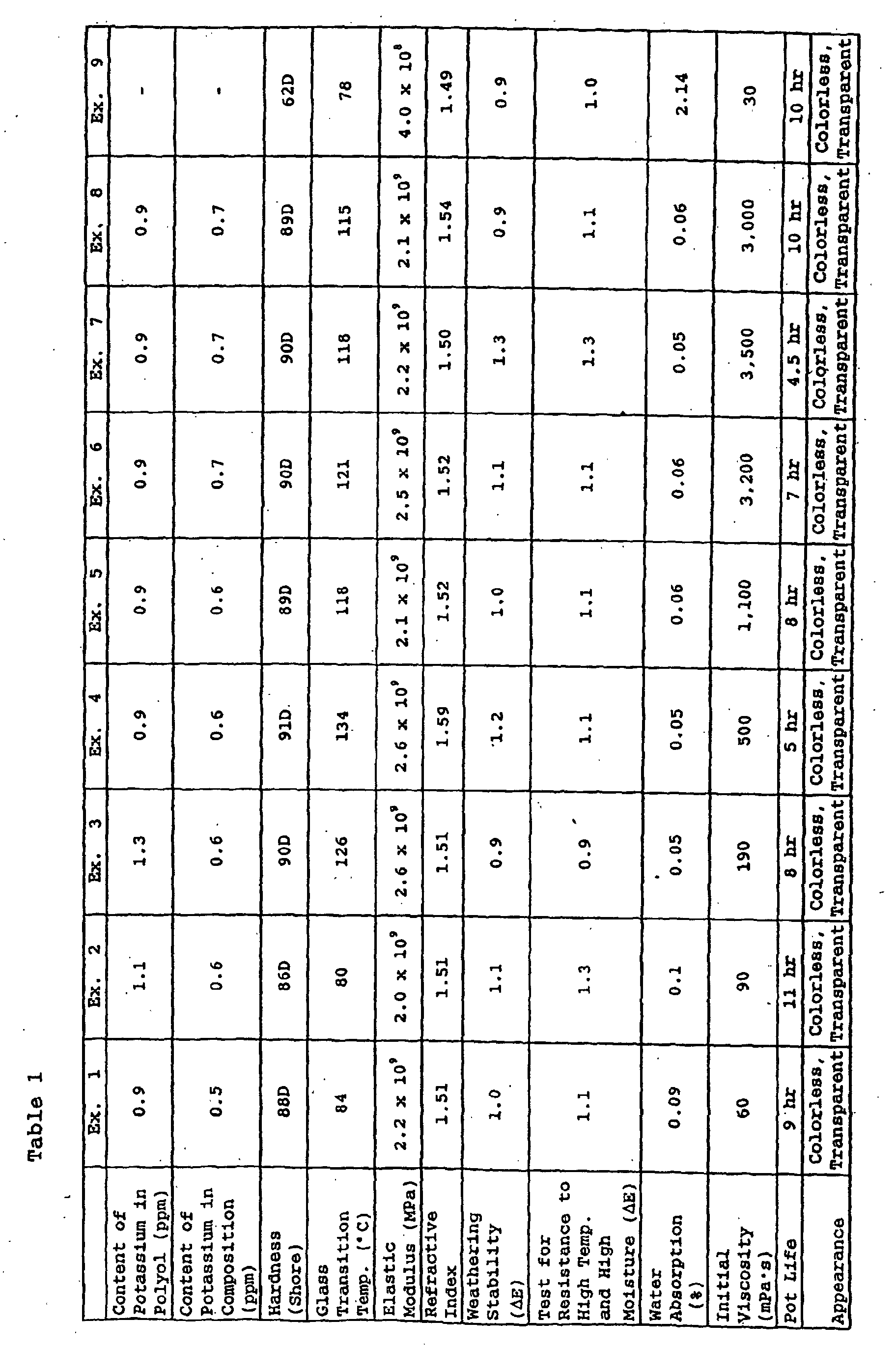
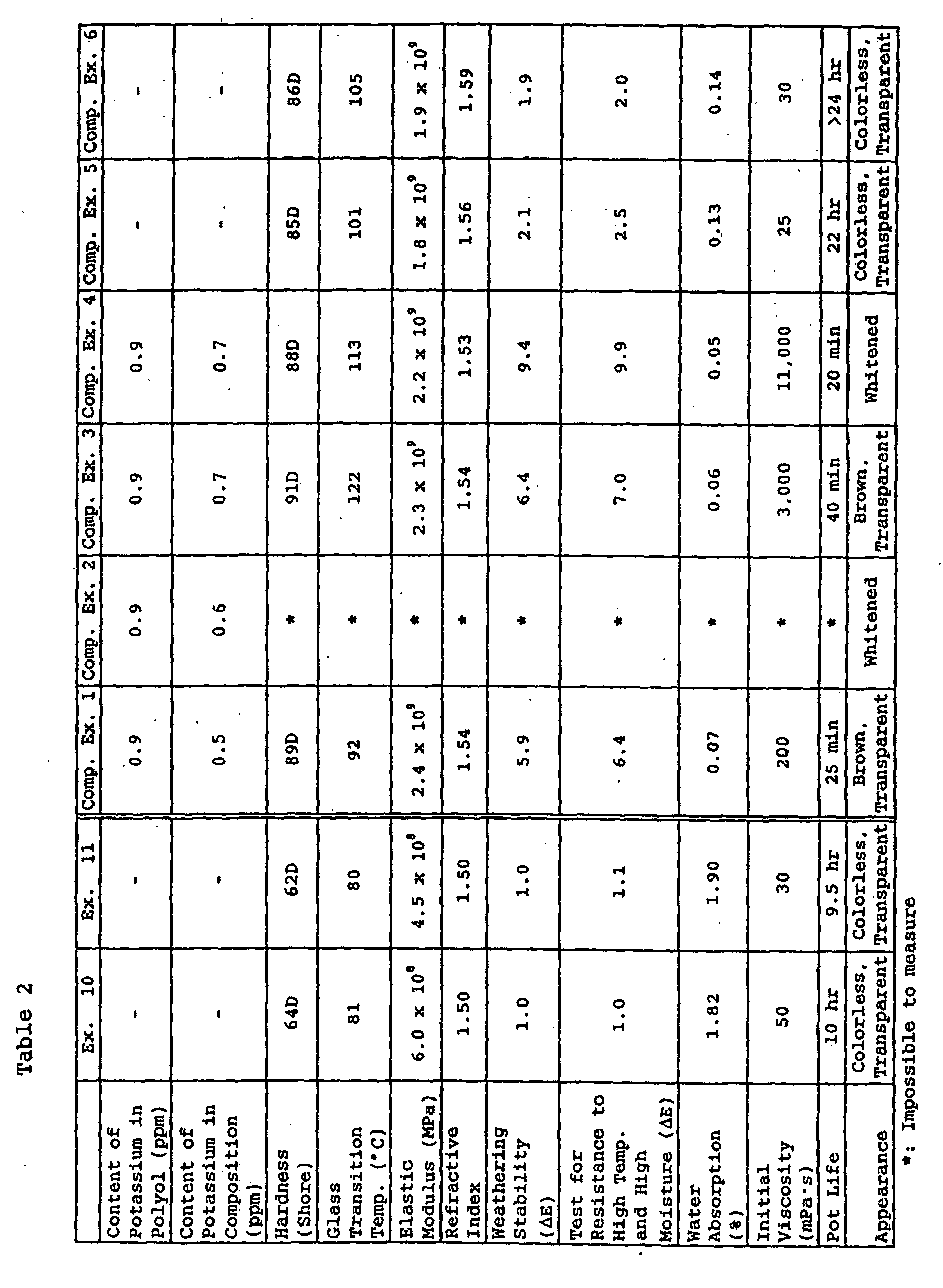
- the hydroxyl value (unit: mgKOH/g) of a polyol was measured in accordance with JIS K-1557.
- the amount (unit: ppm) of residual potassium in the polyol was determined by using an atomic absorption analyzer (product of PerkinElmer, Inc., model: 5100PC). The limit of determination was 0.1 ppm.
- Sulfur atoms were combusted to be decomposed into sulfur dioxide, and the sulfur dioxide was absorbed by a titration cell and determined by an elementary analysis method (product of Mitsubishi Chemical Corporation, model: TSX-10) in which titration was carried out by using a platinum electrode. The limit of determination was 100 ppm.
- a sample which was molded into a button shape defined in JIS K-6262 was dropped on a concrete surface from 2 meters above, and the condition of the dropped sample was examined.
- a sample was irradiated with light by using a sunshine weatherometer equipped with a carbon arc lamp for 600 hours, and the sample was then examined for yellowing.
- the degree of yellowing was determined by measuring the color difference ( ⁇ E) using the C-5120 hue and color-difference meter of Tokyo Denshoku Co., Ltd.
- a cured sample piece having a size of 50 mm x 50 mm x 2 mm was left to stand for 300 hours in a thermostatic chamber having a temperature of 80°C and a relative humidity of 90%, and a change in the appearance (or degree of yellowing) of the sample was then observed.
- the degree of yellowing was determined by measuring the color difference ( ⁇ E) using the C-5120 hue and color-difference meter of Tokyo Denshoku Co., Ltd.
- the component (A) containing a compound having isocyanate groups and the component (B) containing a compound having hydroxyl groups were measured to a total of 100 g in a chamber having a temperature of 20°C and a relative humidity of 50% and stirred for 10 minutes. Thereafter, the time required for the viscosity at 5 minutes from the start of mixing to become twice as much was measured by a B8M-type rotating viscometer and taken as the pot life.
- a cured light-emitting diode lamp was left to stand for 300 hours in a thermostatic chamber having a temperature of 80°C and a relative humidity of 90%, and a change in the appearance (or degree of yellowing) of the sample was then observed.
- the degree of yellowing was determined by measuring the color difference ( ⁇ E) using the C-5120 hue and color-difference meter of Tokyo Denshoku Co., Ltd. The ⁇ E was evaluated as "O" when it is 1.5 or less and "X". when it is higher than 1.5.
- the crude polyol A was charged into a separable flask (to be simply referred to as "separable flask” hereinafter) equipped with a thermometer, stirrer, water-cooled condenser, nitrogen-introducing pipe and decompression line and heated to 80°C.
- a separable flask to be simply referred to as "separable flask” hereinafter
- a thermometer, stirrer, water-cooled condenser, nitrogen-introducing pipe and decompression line was heated to 80°C.
- 1.03 moles of oxalic acid 5% by weight, in the form of an aqueous solution
- the reaction was carried out at the same temperature for 3 hours. Thereafter, the temperature was increased and the pressure was reduced, and eventually the same procedure was carried out at 110°C and 1.33 kPa or lower for 3 hours.
- polyols used in the following examples were synthesized in accordance with the above procedure and the hydroxyl values thereof and the amounts of potassium remaining in the polyols were determined by the above method.
- NBDI " 'COSMONATE'(registered trademark)NBDI" (mixture of 2,5-diisocyanatomethylbicyclo[2.2.1]heptane and 2,6-diisocyanatomethylbicyclo[2.2.1]heptane, product of Mitsui Chemicals, Inc. to be referred to as "NBDI" hereinafter) was charged, and 106.6 g of the polyol A obtained in Preparation Example 1 was added thereto.
- the mixture was allowed to react at 100°C under a current of nitrogen for 8 hours and then allowed to age at room temperature for one day, thereby obtaining an isocyanate group-terminated urethane prepolymer (A-1) having an NCO% of 30.0.
- the mixture was allowed to react at 100°C under a current of nitrogen for 3 hours and then allowed to age at room temperature for one day, thereby obtaining an isocyanate group-terminated urethane prepolymer (A-3) having an NCO% of 24.0.
- An isocyanurate derivative-containing polyisocyanate compound (A-7) was prepared by the method disclosed in Japanese Patent Application Laid-Open No. 302351/1999. That is, 3.0 g of 2-ethylhexane-1,3-diol was added to 3.0 g of 10% tetrabutylammonium hydroxide/methanol solution and stirred. While the mixture was stirred, methanol was removed by distilling off under reduced pressure, and 2-ethylhexane-1,3-diol was then added to prepare a trimerization catalyst solution having a concentration of about 1%.
- NBDI 100.0 Grams of NBDI was charged into a stainless cup. While the NBDI was stirred by stirrer, 62.3 g of a polyol (to be referred to as “polyol B” hereinafter) which is obtained by adding propylene oxide (to be referred to as “PO” hereinafter) to 1 mole of 2-ethyl-2-hydroxymethyl-1,3-diol (to be referred to as "TMP" hereinafter) and which has a hydroxyl value of 874 mgKOH/g and a residual potassium amount of 0.9 ppm was added to the NBDI without taking in bubbles, and they were stirred and mixed for 10 minutes to be dissolved homogeneously.
- polyol B a polyol which is obtained by adding propylene oxide (to be referred to as "PO” hereinafter) to 1 mole of 2-ethyl-2-hydroxymethyl-1,3-diol (to be referred to as "TMP” hereinafter) and which
- the homogeneous solution was transferred into a mold having a size of 50 mm x 50 mm, allowed to react in an oven heated to 100°C in a nitrogen gas atmosphere for 5 hours and then after-cured at 150°C for 3 hours to obtain a colorless, transparent polyurethane resin.
- NBDI 100.0 Grams of NBDI was charged into the same stainless cup as in Example 1. While the NBDI was stirred, 91.4 g of a polyol obtained by adding PO to TMP and having a hydroxyl value of 874 mgKOH/g and a residual potassium amount of 1.1 ppm was added to the NBDI without taking in bubbles, and they were stirred and mixed for 10 minutes to be dissolved homogeneously. The homogeneous solution was transferred into a mold having a size of 50 mm x 50 mm, allowed to react in an oven heated to 100°C in a nitrogen gas atmosphere for 5 hours and then after-cured at 150°C for 3 hours to obtain a colorless, transparent polyurethane resin.
- NBDI 100.0 Grams of NBDI was charged into the same stainless cup as in Example 1. While the NBDI was stirred, 117.9 g of a polyol obtained by adding PO to dipentaerythritol and having a hydroxyl value of 462 mgKOH/g and a residual potassium amount of 1.3 ppm was added to the NBDI without taking in bubbles, and they were stirred and mixed for 10 minutes to be dissolved homogeneously. The homogeneous solution was transferred into a mold having a size of 50 mm x 50 mm, allowed to react in an oven heated to 100°C in a nitrogen gas atmosphere for 5 hours and then after-cured at 150°C for 3 hours to obtain a colorless, transparent polyurethane resin.
- the homogeneous solution was transferred into a mold having a size of 50 mm x 50 mm, allowed to react in an oven heated to 100°C in a nitrogen gas atmosphere for 5 hours and then after-cured at 150°C for 3 hours to obtain a colorless, transparent polyurethane resin.
- NBDI NBDI
- 2-ethyl-1,3-hexanediol 2-ethyl-1,3-hexanediol
- a polyurethane resin was obtained in the same manner as in Example 1 except that 100.0 g of " 'COSMONATE'(registered trademark)T-80" (product of Mitsui Chemicals, Inc.) was used as the isocyanate group-containing component (A) and 73.7 g of the polyol B was used as the component (B).
- a polyurethane resin was obtained in the same manner as in Example 1 except that 100.0 g of the A-3 synthesized in Preparation Example 4 was used as the isocyanate group-containing component (A) and 36.7 g of the polyol B used in Example 1 was used as the component (B).
- a polyurethane resin was obtained in the same manner as in Example 1 except that 100.0 g of the A-4 synthesized in Preparation Example 5 was used as the isocyanate group-containing component (A) and 36.7 g of the polyol B used in Example 1 was used as the component (B).
- NBDI 100.0 Grams of NBDI was charged into a stainless cup. While the NBDI was stirred by stirrer, 118.6 g of pentaerythritol tetrakis(3-mercaptopropionate) was added to the NBDI without taking in bubbles, and they were stirred and mixed for 10 minutes to be dissolved homogeneously. The homogeneous solution was transferred into a mold having a size of 50 mm x 50 mm, allowed to react in an oven heated to 100°C in a nitrogen gas atmosphere for 5 hours and then after-cured at 150°C for 3 hours to obtain a colorless, transparent polyurethane resin.
- a light-emitting diode lamp was prepared by using the urethane prepolymer (A-1) and polyol used in Example 6.
- the urethane prepolymer (A-1) and the polyol were stirred and mixed for 10 minutes to be dissolved homogenously by the same method as in Examples.
- the resultant solution was subjected to deaeration under a reduced pressure of 2.6 kPa for 10 minutes and then poured into a mold having an internal diameter of 5 mm and a depth of 10 mm.
- a GaAlAs-type light-emitting diode which had been placed on a lead frame and wire-bonded, was immersed. Then, the mold was placed in an oven heated to 100°C and reaction was carried out for 3 hours, and the contents of the mold was then after-cured at 120°C for 5 hours, thereby obtaining a light-emitting diode lamp of the present invention.
- a light-emitting diode lamp was prepared in accordance with the same procedure as in Application Example 1 by the use of the components (A) and (B) in Comparative Example 5.
- a urethane resin composition for an optoelectric conversion element sealer comprises a component (A) containing a compound having isocyanate groups and a component (B) containing a compound having hydroxyl groups. Since the compound having isocyanate groups is at least one compound selected from the group consisting of an aromatic isocyanate having a structure in which the isocyanate groups are not directly bonded to the benzene ring, an aliphatic isocyanate, an alicyclic isocyanate, and derivatives of these isocyanates, the urethane resin composition is hardly colored and has excellent heat stability and weathering stability, high elastic modulus and good curing characteristics. It also has a long pot life and excellent workability.
- the light-emitting diode lamp according to the present invention has the above characteristics as well as excellent workability at the time of sealing and excellent weathering stability, since the resin composition comprising the component (A) containing at least one compound selected from the group consisting of an aromatic isocyanate having a structure in which the isocyanate groups are not directly bonded to the benzene ring, an aliphatic isocyanate and an alicyclic isocyanate and the component (B) containing hydroxyl groups reacts and is cured to seal a light-emitting diode.
- the resin composition comprising the component (A) containing at least one compound selected from the group consisting of an aromatic isocyanate having a structure in which the isocyanate groups are not directly bonded to the benzene ring, an aliphatic isocyanate and an alicyclic isocyanate and the component (B) containing hydroxyl groups reacts and is cured to seal a light-emitting diode.
Landscapes
- Chemical & Material Sciences (AREA)
- Health & Medical Sciences (AREA)
- Chemical Kinetics & Catalysis (AREA)
- Medicinal Chemistry (AREA)
- Polymers & Plastics (AREA)
- Organic Chemistry (AREA)
- Structures Or Materials For Encapsulating Or Coating Semiconductor Devices Or Solid State Devices (AREA)
- Polyurethanes Or Polyureas (AREA)
- Led Device Packages (AREA)
Abstract
Description


| Application Example 1 | Application Comparative Example 1 | |
| Appearance after Weathering Test | O | X |
Claims (24)
- A urethane resin for an optoelectric conversion element sealer, which has:1) a refractive index of 1.45 or more as measured by using a D line from a helium light source,2) a glass transition temperature (Tg) of 75°C or more, and3) a ΔE of 1.5 or less as measured after irradiation for 600 hours by a sunshine weatherometer using a carbon arc lamp.
- The resin according to claim 1, which has a ΔE of 1.5 or less after treated for 300 hours in a thermostatic chamber having a relative humidity of 90% and a temperature of 80°C.
- The resin according to claim 1 or 2, wherein the content of sulfur atoms is 500 ppm or less.
- The resin according to any one of claims 1 to 3, wherein the content of alkali metal atoms is 10 ppm or less.
- A urethane resin composition for an optoelectric conversion element sealer comprising a component (A) containing a compound having at least two isocyanate groups and a component (B) containing a compound having hydroxyl groups, wherein the compound having isocyanate groups in the component (A) is at least one compound selected from the group consisting of:(i) an aromatic polyisocyanate having a structure in which any isocyanate groups are not directly bonded to a benzene ring,(ii) an aliphatic polyisocyanate,(iii) an alicyclic polyisocyanate, and(iv) derivatives of the polyisocyanates (i) to (iii).
- The composition according to claim 5, wherein the compound having isocyanate groups is a modified isocyanurate or prepolymer of the polyisocyanates (i) to (iii).
- The composition according to claim 5 or 6, wherein an initial mixing viscosity at the time of mixing the component (A) and the component (B) together at 20°C is in a range of 10 to 10,000 mPa·s.
- The composition according to any one of claims 5 to 7, wherein a time required for a viscosity after mixing of the component (A) and the component (B) to become twice as much as the initial mixing viscosity is in a range of 2 to 20 hours.
- The composition according to any one of claims 5 to 8, wherein the compound having isocyanate groups is a polycyclic alicyclic polyisocyanate or its modification.
- The composition according to claim 9, wherein the polycyclic alicyclic polyisocyanate is a polycyclic alicyclic diisocyanate represented by the following general formula [I]:wherein m and n each independently represent an integer of 1 to 5.

- The composition according to claim 10, wherein the polycyclic alicyclic polyisocyanate is a polycyclic alicyclic diisocyanate represented by the formula [I] wherein both m and n are 1.
- The composition according to claim 5, wherein the compound having isocyanate groups is at least one compound selected from the group consisting of diisocyanatomethylbenzene, bis(1-isocyanato-1,1-dimethyl)benzene, 4,4'-diisocyanato-dicyclohexylmethane, 1-isocyanato-3,5,5-trimethyl-3-isocyanatomethylcyclohexane and bisisocyanatomethylcyclohexane.
- The composition according to any one of claims 5 to 12, wherein the compound having hydroxyl groups is a compound having at least two hydroxyl groups.
- The composition according to claim 12 or 13, wherein the content of alkali metal atoms in the compound having at least two hydroxyl groups is 10 ppm or less.
- The composition according to any one of claims 5 to 14, which has a glass transition temperature of at least 75°C after cured.
- The composition according to any one of claims 5 to 15, which has a refractive index of 1.45 to 1.80 as measured by using a D line from a helium light source after cured.
- The composition according to claim 5 or 16, which hasa ΔE of 1.5 or less as measured after irradiation for 600 hours by a sunshine weatherometer using a carbon arc lamp after cured,a ΔE of 1.5 or less after treated for 300 hours in a thermostatic chamber having a relative humidity of 90% and a temperature of 80°C,a content of sulfur atoms of 500 ppm or less, anda content of alkali metal atoms of 10 ppm or less.
- An optoelectric conversion device obtained by curing a resin composition comprising a component (A) containing a compound having isocyanate groups and a component (B) containing a compound having hydroxyl groups to seal an optoelectric conversion element, wherein the compound having isocyanate groups in the component (A) is at least one compound selected from the group consisting of:(i) an aromatic polyisocyanate having a structure in which any isocyanate groups are not directly bonded to a benzene ring,(ii) an aliphatic polyisocyanate,(iii) an alicyclic polyisocyanate, and(iv) derivatives of the polyisocyanates (i) to (iii).
- The device according to claim 18, wherein the optoelectric conversion element is a light-emitting or a light-receiving element.
- The device according to claim 19, wherein the optoelectric conversion element is a light-emitting diode.
- A method for producing a urethane resin for an optoelectric conversion element sealer which comprises heating a resin composition comprising a component (A) containing a compound having isocyanate groups and a component (B) containing a compound having hydroxyl groups to react and cure the composition, wherein the compound having isocyanate groups in the component (A) is at least one compound selected from the group consisting of:(i) an aromatic polyisocyanate having a structure in which any isocyanate groups are not directly bonded to a benzene ring,(ii) an aliphatic polyisocyanate,(iii) an alicyclic polyisocyanate, and(iv) derivatives of the polyisocyanates (i) to (iii).
- A method for producing an optoelectric conversion device which comprises sealing an optoelectric conversion element with a resin composition comprising a component (A) containing a compound having isocyanate groups and a component (B) containing a compound having hydroxyl groups by heating the resin composition to react and cure the composition, wherein the compound having isocyanate groups in the component (A) is at least one compound selected from the group consisting of:(i) an aromatic polyisocyanate having a structure in which any isocyanate groups are not directly bonded to a benzene ring,(ii) an aliphatic polyisocyanate,(iii) an alicyclic polyisocyanate, and(iv) derivatives of the polyisocyanates (i) to (iii).
- The method according to claim 22, wherein the optoelectric conversion element is a light-emitting or a light-receiving element.
- The method according to claim 23, wherein the optoelectric conversion element is a light-emitting diode.
Applications Claiming Priority (3)
| Application Number | Priority Date | Filing Date | Title |
|---|---|---|---|
| JP2000013786 | 2000-01-24 | ||
| JP2000013786 | 2000-01-24 | ||
| PCT/JP2001/000406 WO2001053374A1 (en) | 2000-01-24 | 2001-01-23 | Urethane resin composition for sealing optoelectric conversion devices |
Publications (2)
| Publication Number | Publication Date |
|---|---|
| EP1167416A1 true EP1167416A1 (en) | 2002-01-02 |
| EP1167416A4 EP1167416A4 (en) | 2002-06-26 |
Family
ID=18541329
Family Applications (1)
| Application Number | Title | Priority Date | Filing Date |
|---|---|---|---|
| EP01901509A Withdrawn EP1167416A4 (en) | 2000-01-24 | 2001-01-23 | URETHANE RESIN COMPOSITION FOR SEALING OPTOELECTRIC CONVERSION DEVICES |
Country Status (6)
| Country | Link |
|---|---|
| US (1) | US20030036620A1 (en) |
| EP (1) | EP1167416A4 (en) |
| KR (1) | KR20010110687A (en) |
| CN (1) | CN1365370A (en) |
| TW (1) | TW572925B (en) |
| WO (1) | WO2001053374A1 (en) |
Cited By (4)
| Publication number | Priority date | Publication date | Assignee | Title |
|---|---|---|---|---|
| EP1826832A2 (en) * | 2006-02-24 | 2007-08-29 | Osram Opto Semiconductors GmbH | Electronic component |
| WO2008092597A3 (en) * | 2007-01-30 | 2008-10-02 | Acomon Ag | Polymerizable liquid composition and process for the production of organic glass of the polyurethane type |
| EP2620988A1 (en) * | 2012-01-26 | 2013-07-31 | Basf Se | Transparent polyurethane encapsulating opto-electronic components |
| EP2676525A4 (en) * | 2011-02-15 | 2016-04-13 | Marimils Oy | LIGHT SOURCE AND LIGHT SOURCE BAND |
Families Citing this family (20)
| Publication number | Priority date | Publication date | Assignee | Title |
|---|---|---|---|---|
| EP1950235A4 (en) * | 2005-10-27 | 2012-12-26 | Hitachi Chemical Co Ltd | RESIN COMPOSITION AND OPTICAL ELEMENT FORMED THEREFROM |
| KR101035822B1 (en) * | 2006-03-31 | 2011-05-20 | 미쓰이 가가쿠 가부시키가이샤 | Photocurable Paint |
| US8044165B2 (en) * | 2006-10-16 | 2011-10-25 | Mitsui Chemicals, Inc. | Process for producing resin for optical material |
| CN101668786B (en) * | 2007-04-24 | 2012-12-05 | 日立化成工业株式会社 | Curable resin composition, led package, and method for production of the led package, and optical semiconductor |
| TWI388078B (en) | 2008-01-30 | 2013-03-01 | 歐斯朗奧托半導體股份有限公司 | Electronic component manufacturing method and electronic component |
| JP5277940B2 (en) * | 2008-09-29 | 2013-08-28 | 日立化成株式会社 | Curable resin composition, LED package, and manufacturing method thereof |
| TWI482301B (en) * | 2009-03-30 | 2015-04-21 | 富士軟片股份有限公司 | Photoelectric conversion device and its manufacturing method, solar cell and target |
| US9382470B2 (en) * | 2010-07-01 | 2016-07-05 | Samsung Electronics Co., Ltd. | Thiol containing compositions for preparing a composite, polymeric composites prepared therefrom, and articles including the same |
| KR101238557B1 (en) * | 2010-12-31 | 2013-02-28 | 주식회사 효성 | Manufacturing method of polyurethaneurea elastic fiber by high speed spinning method |
| US9726928B2 (en) | 2011-12-09 | 2017-08-08 | Samsung Electronics Co., Ltd. | Backlight unit and liquid crystal display including the same |
| EP2831923B1 (en) | 2012-03-27 | 2019-07-31 | Covestro Deutschland AG | Use of uv curable polyurethane resins for producing solar laminates |
| WO2013183093A1 (en) * | 2012-06-04 | 2013-12-12 | パナソニック株式会社 | Organic el element, method for producing same, organic el panel, organic el light emitting device, and organic el display device |
| CN103333307B (en) * | 2013-06-13 | 2014-12-24 | 安徽华东光电技术研究所 | Packaging material of traveling wave tube and packaging method of traveling wave tube |
| CN103627163A (en) * | 2013-09-10 | 2014-03-12 | 上纬企业股份有限公司 | A kind of LED encapsulation polyurethane resin composition |
| CN105895788A (en) * | 2014-05-08 | 2016-08-24 | 罗冠杰 | Chip type white light emitting diode, method for preparing chip type white light emitting diode, and packaging adhesive |
| US10707531B1 (en) | 2016-09-27 | 2020-07-07 | New Dominion Enterprises Inc. | All-inorganic solvents for electrolytes |
| CN106928895A (en) * | 2017-03-09 | 2017-07-07 | 宜兴市普利泰电子材料有限公司 | Flexible LED lamp bar polyurethane electronic casting glue and preparation method thereof |
| WO2018207807A1 (en) * | 2017-05-11 | 2018-11-15 | 三井化学株式会社 | Polyurethane resin, method for producing polyurethane resin, and molded article |
| CN113861376A (en) * | 2020-06-30 | 2021-12-31 | 科思创德国股份有限公司 | Polyurethane composition for producing composite materials |
| CN112079979B (en) * | 2020-09-07 | 2022-08-09 | 中海油常州涂料化工研究院有限公司 | Bio-based pentamethylene diisocyanate curing agent and preparation method and application thereof |
Family Cites Families (7)
| Publication number | Priority date | Publication date | Assignee | Title |
|---|---|---|---|---|
| JPS61115927A (en) * | 1984-11-12 | 1986-06-03 | Mitsui Toatsu Chem Inc | Thermoplastic resin |
| JPH0768326B2 (en) * | 1989-10-09 | 1995-07-26 | 三井東圧化学株式会社 | Method for manufacturing urethane lens resin |
| US5578658A (en) * | 1993-12-20 | 1996-11-26 | Mitsui Toatsu Chemicals, Inc. | High-speed polymerizable resin composition and lenses obtained therefrom |
| JPH07278250A (en) * | 1994-04-15 | 1995-10-24 | Fuso Kagaku Kogyo Kk | Polyurethane resin composition for encapsulant |
| US5637156A (en) * | 1994-09-22 | 1997-06-10 | Semiconductor Energy Laboratory Co., Ltd. | Resin Composition and an electronic device using the same |
| JP3651994B2 (en) * | 1996-01-12 | 2005-05-25 | 三井化学株式会社 | Polyoxyalkylene polyol and method for producing the same |
| JP2000049387A (en) * | 1998-07-27 | 2000-02-18 | Matsushita Electron Corp | Semiconductor light emitting device |
-
2001
- 2001-01-20 TW TW90101497A patent/TW572925B/en active
- 2001-01-23 WO PCT/JP2001/000406 patent/WO2001053374A1/en not_active Ceased
- 2001-01-23 KR KR1020017012153A patent/KR20010110687A/en not_active Ceased
- 2001-01-23 US US09/937,251 patent/US20030036620A1/en not_active Abandoned
- 2001-01-23 CN CN01800636A patent/CN1365370A/en active Pending
- 2001-01-23 EP EP01901509A patent/EP1167416A4/en not_active Withdrawn
Cited By (4)
| Publication number | Priority date | Publication date | Assignee | Title |
|---|---|---|---|---|
| EP1826832A2 (en) * | 2006-02-24 | 2007-08-29 | Osram Opto Semiconductors GmbH | Electronic component |
| WO2008092597A3 (en) * | 2007-01-30 | 2008-10-02 | Acomon Ag | Polymerizable liquid composition and process for the production of organic glass of the polyurethane type |
| EP2676525A4 (en) * | 2011-02-15 | 2016-04-13 | Marimils Oy | LIGHT SOURCE AND LIGHT SOURCE BAND |
| EP2620988A1 (en) * | 2012-01-26 | 2013-07-31 | Basf Se | Transparent polyurethane encapsulating opto-electronic components |
Also Published As
| Publication number | Publication date |
|---|---|
| KR20010110687A (en) | 2001-12-13 |
| CN1365370A (en) | 2002-08-21 |
| EP1167416A4 (en) | 2002-06-26 |
| TW572925B (en) | 2004-01-21 |
| WO2001053374A1 (en) | 2001-07-26 |
| US20030036620A1 (en) | 2003-02-20 |
Similar Documents
| Publication | Publication Date | Title |
|---|---|---|
| US20030036620A1 (en) | Urethane resin composition for sealing optoelectric conversion devices | |
| TWI229686B (en) | Impact resistant polyureaurethane and polyureaurethane prepolymer having low NCO/OH ratio | |
| KR101175836B1 (en) | Curable resin composition, led package, and method for production of the led package, and optical semiconductor | |
| CN107108873B (en) | polycarbonate resin | |
| EP1925629B1 (en) | Polythiourethane-based polymerizable composition and optical resin obtained from the same | |
| TW200300420A (en) | Impact resistant polyureaurethane and method of preparation | |
| TWI567104B (en) | Polycarbonate diol | |
| KR20170139021A (en) | Method for producing polyisocyanurate plastic | |
| KR20170139022A (en) | Solids based on polyisocyanurate polymers prepared under adiabatic conditions | |
| CN104364675B (en) | Sunproof polyurethane composition | |
| US20090292049A1 (en) | Resin composition and optical member formed from the same | |
| JP2001278941A (en) | Urethane resin composition for sealant of photoelectric conversion element | |
| US12234316B2 (en) | Acrylate oligomer and preparation method and application method thereof | |
| JP6349073B2 (en) | SEALING MATERIAL COMPOSITION, SOLAR CELL MODULE SEALING MATERIAL CURED BY THE SAME, AND SOLAR CELL MODULE MANUFACTURING METHOD USING SAME | |
| JP2015003945A (en) | Thermosetting polyurethane urea resin composition and molded article | |
| KR101915818B1 (en) | Optical Resin Composition using polytiolester composition and the Plastic Ophthalmic Lens using it | |
| KR101156599B1 (en) | Silane modified polyurethane prepolymer and preparation method thereof | |
| KR101637541B1 (en) | Optical Resin Composition Having Clear Brightness, High Thermal Resistance and High Impact Resistance, the Plastic Ophthalmic Lens and its Manufacturing Method | |
| JP7735701B2 (en) | Composition and two-component adhesive using same | |
| KR101591134B1 (en) | Curable composition | |
| CN111892897A (en) | Polyurethane adhesive and preparation method thereof | |
| KR102464880B1 (en) | Method of preparing polythiol-based compound and optical polymerizable composition including polythiol-based compound | |
| KR101166720B1 (en) | Hydroxy-substituted aminosilane and preparation method thereof | |
| EP4253443A1 (en) | Polythiol composition, optical composition, and optical product | |
| CN101296961A (en) | Resin composition and optical part using same |
Legal Events
| Date | Code | Title | Description |
|---|---|---|---|
| PUAI | Public reference made under article 153(3) epc to a published international application that has entered the european phase |
Free format text: ORIGINAL CODE: 0009012 |
|
| 17P | Request for examination filed |
Effective date: 20011016 |
|
| AK | Designated contracting states |
Kind code of ref document: A1 Designated state(s): AT BE CH CY DE DK ES FI FR GB GR IE IT LI LU MC NL PT SE TR |
|
| A4 | Supplementary search report drawn up and despatched |
Effective date: 20020515 |
|
| AK | Designated contracting states |
Kind code of ref document: A4 Designated state(s): AT BE CH CY DE DK ES FI FR GB GR IE IT LI LU MC NL PT SE TR |
|
| 17Q | First examination report despatched |
Effective date: 20021008 |
|
| GRAP | Despatch of communication of intention to grant a patent |
Free format text: ORIGINAL CODE: EPIDOSNIGR1 |
|
| STAA | Information on the status of an ep patent application or granted ep patent |
Free format text: STATUS: THE APPLICATION IS DEEMED TO BE WITHDRAWN |
|
| RAP1 | Party data changed (applicant data changed or rights of an application transferred) |
Owner name: MITSUI CHEMICALS, INC. |
|
| 18D | Application deemed to be withdrawn |
Effective date: 20040617 |