EP1165739B1 - The use of a brightener pigment in detergents or cleansers - Google Patents
The use of a brightener pigment in detergents or cleansers Download PDFInfo
- Publication number
- EP1165739B1 EP1165739B1 EP00925127A EP00925127A EP1165739B1 EP 1165739 B1 EP1165739 B1 EP 1165739B1 EP 00925127 A EP00925127 A EP 00925127A EP 00925127 A EP00925127 A EP 00925127A EP 1165739 B1 EP1165739 B1 EP 1165739B1
- Authority
- EP
- European Patent Office
- Prior art keywords
- water
- whitening agent
- urea
- brightener
- pigment
- Prior art date
- Legal status (The legal status is an assumption and is not a legal conclusion. Google has not performed a legal analysis and makes no representation as to the accuracy of the status listed.)
- Expired - Lifetime
Links
Classifications
-
- C—CHEMISTRY; METALLURGY
- C11—ANIMAL OR VEGETABLE OILS, FATS, FATTY SUBSTANCES OR WAXES; FATTY ACIDS THEREFROM; DETERGENTS; CANDLES
- C11D—DETERGENT COMPOSITIONS; USE OF SINGLE SUBSTANCES AS DETERGENTS; SOAP OR SOAP-MAKING; RESIN SOAPS; RECOVERY OF GLYCEROL
- C11D3/00—Other compounding ingredients of detergent compositions covered in group C11D1/00
- C11D3/16—Organic compounds
- C11D3/37—Polymers
- C11D3/3703—Macromolecular compounds obtained otherwise than by reactions only involving carbon-to-carbon unsaturated bonds
- C11D3/3723—Polyamines or polyalkyleneimines
-
- C—CHEMISTRY; METALLURGY
- C11—ANIMAL OR VEGETABLE OILS, FATS, FATTY SUBSTANCES OR WAXES; FATTY ACIDS THEREFROM; DETERGENTS; CANDLES
- C11D—DETERGENT COMPOSITIONS; USE OF SINGLE SUBSTANCES AS DETERGENTS; SOAP OR SOAP-MAKING; RESIN SOAPS; RECOVERY OF GLYCEROL
- C11D17/00—Detergent materials or soaps characterised by their shape or physical properties
- C11D17/06—Powder; Flakes; Free-flowing mixtures; Sheets
-
- C—CHEMISTRY; METALLURGY
- C11—ANIMAL OR VEGETABLE OILS, FATS, FATTY SUBSTANCES OR WAXES; FATTY ACIDS THEREFROM; DETERGENTS; CANDLES
- C11D—DETERGENT COMPOSITIONS; USE OF SINGLE SUBSTANCES AS DETERGENTS; SOAP OR SOAP-MAKING; RESIN SOAPS; RECOVERY OF GLYCEROL
- C11D3/00—Other compounding ingredients of detergent compositions covered in group C11D1/00
- C11D3/40—Dyes ; Pigments
- C11D3/42—Brightening agents ; Blueing agents
Definitions
- the present invention relates to the use of a brightener pigment for increasing the degree of whiteness of detergents or cleaners, of compounds thereof, and of individual raw materials comprising
- urea-formaldehyde resin of which the molar ratio of urea to formaldehyde is preferably from 1:1.3 to 2 moles.
- the urea-formaldehyde resin is also distinguished by a small particle diameter of from 2 to 10 ⁇ m and a low BET specific surface area of from 15 to 120 m 2 /g.
- the BET specific surface area of the water-insoluble urea-formaldehyde resins is ascertained according to the B runauer, E mmett and T eller method [cf. J.Am.Chem.Soc. 60 , 309-319 (1938), Chemie-Ing.Techn. 32 , 349-354 (1960) and 35 , 568-589 (1963)] according to DIN 66132.
- the water-insoluble urea-formaldehyde resins which correspond to component (a), and the preparation of those polymers, are known, for example, from A. Renner: Makromolekulare Chemie 149 , 1-27 (1971).
- the component (a) compounds are prepared by reacting formaldehyde with urea in aqueous solution in the above-described ratios.
- the reaction is carried out preferably in two steps.
- urea is reacted with formaldehyde according to a customary condensation mechanism, resulting in a low-molecular-weight, water-soluble pre-condensate.
- an acid catalyst can be used in order to accelerate the reaction and for crosslinking, an insoluble, finely divided solid being obtained.
- the water content of the reaction solution should never be lower than the total weight of the reactants present in the reaction mixture, and should be higher than the total weight of all the other components in the reaction mixture during the precipitation of the insoluble polymer particles.
- the reaction temperature in the first reaction step is usually in the range from 20 to 100°C.
- the pH can be adjusted to from 6 to 9 by the addition of a strong, aqueous, inorganic base, such as, for example, sodium hydroxide solution.
- the preparation of the pre-condensate can be carried out in the presence of a surfactant.
- the surfactant is used, for example, in amounts of from 0.5 to 5 % by weight, based on the total weight of the urea and formaldehyde. Ionic surfactants cause an increase in the specific surface area of the urea-formaldehyde polymer product, whereas non-ionic surfactants have the opposite effect.
- the first reaction step is carried out in the presence of a macromolecular water-soluble protective colloid having polyelectrolytic properties.
- protective colloids include gelatin, tragacanth, agar and polyvinylpyrrolidone, especially methacrylic acid.
- the amount of protective colloid used can be within a range of, for example, from 0.5 to 5 % by weight, based on the total weight of urea and formaldehyde.
- polyvinylpyrrolidone nor polymethacrylic acid causes an increase in the specific surface area of the water-insoluble urea-formaldehyde resin.
- Suitable catalysts include, for example, relatively strong inorganic and/or organic acids, such as, for example, sulfuric acid, sulfurous acid, sulfamic acid, phosphoric acid, hydrochloric acid, chloroacetic acid, maleic acid or maleic anhydride.
- relatively strong inorganic and/or organic acids such as, for example, sulfuric acid, sulfurous acid, sulfamic acid, phosphoric acid, hydrochloric acid, chloroacetic acid, maleic acid or maleic anhydride.
- such gel-formation catalysts should have an ionisation constant in excess of 10 -4 .
- Sulfuric acid and its acidic ammonium or amine salts and also ammonium sulfate, methylamine hydrogen sulfate and ethanolamine hydrogen sulfate, are preferred.
- the acids are generally used in the form of 1 to 15 % by weight aqueous solutions.
- As a rough guide from 20 to 100 mmoles of a crosslinking catalyst are used per mole of urea added. This causes a reduction in the pH of the reaction mixture to from 1 to 3.0 in the second reaction step during the formation of the polymer.
- reaction temperatures in the second, resin-forming reaction step usually reach from 20 to 100°C. Large differences in temperature in the reaction mixture should be avoided during the addition of the catalyst. It is therefore desirable to heat the aqueous catalyst solution to the temperature of the reaction mixture before it is added to that mixture. Generally, a white gel is obtained after only from 15 to 30 seconds.
- the crosslinking reaction is usually finished after a reaction time of from 30 minutes to 3 hours.
- the insoluble polymer is obtained in the form of a white gel and can be comminuted mechanically, treated with an approximately equal amount of water, adjusted with alkali or ammonium hydroxide to a pH of from 6 to 9, and then isolated from the aqueous phase, for example by filtration, centrifugation or concentration by evaporation.
- the drying can be carried out e.g. by spray-drying or convection-drying.
- the gel obtained is then worked up in customary manner, for example by allowing the reaction to proceed to completion, neutralising, where appropriate adding one or more of the fluorescent whitening agents mentioned hereinbelow in cases where the addition of the fluorescent whitening agent is not undertaken until after gelation, and then filtering, washing, drying and, if desired, grinding to obtain a suitable particle size.
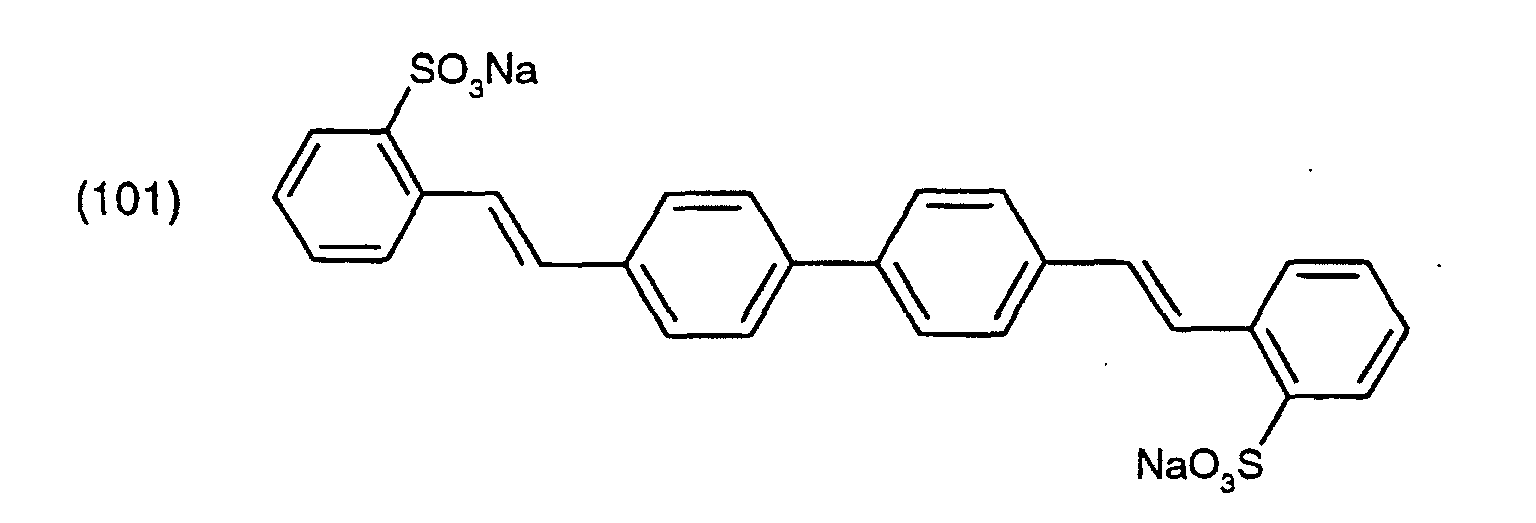
- the fluorescent whitening agent of the present invention corresponds to formula (15).
- the fluorescent whitening agent corresponding to component (b) used in accordance with the invention is employed preferably in amounts of from 0.001 to 1.0 % by weight, especially from 0.01 to 0.5 % by weight, and more especially from 0.01 to 0.5 % by weight, based on the total amount of urea-formaldehyde resin.
- the fluorescent whitening agent can be added to the urea-formaldehyde resin in the form of individual compounds or in the form of mixtures of several individual compounds.
- the brightener pigment used in accordance with the invention comprising components (a) and (b) can, in principle, be used for whitening detergents or cleansers on its own or together with other pigments.
- Other pigments that can be used include, e.g., talc, titanium dioxide, aluminium oxide, aluminium hydroxide, zinc oxide, chalk, zeolite or clays, e.g. kaolin.
- the brightener pigment used in accordance with the invention is usually prepared by adding the water-soluble fluorescent whitening agent before, during or after gelation.
- the procedure comprises dispersing the urea-formaldehyde resin in hot water with a vigorous stirring action.
- the pH is adjusted to ⁇ 10 using an aqueous alkali metal hydroxide solution and the water-soluble fluorescent whitening agent is added thereto.
- the batch is further stirred for some time, cooled, and the pH is adjusted to ⁇ 3 using a strong acid, especially sulfuric acid.
- a viscous suspension is obtained which is further processed by customary methods, such as filtration, drying and, if desired, grinding.
- the brightener pigment is subjected to a surface treatment.
- an emulsion of long-chain alcohols, of paraffin waxes, or of hydrogenated natural or synthetic resins, and especially a dodecanol emulsion is added to the viscous urea-formaldehyde resin/whitening agent suspension.
- the batch is stirred for a further 10 to 15 minutes at elevated temperature. After cooling, the batch is filtered, dried and ground in customary manner, yielding a surface-treated formaldehyde resin/whitening agent suspension.
- Dazzlingly white organic brightener pigments are obtained which have a very low content of free formaldehyde (typically less than 0.1 % DIN 58187) in which the fluorescent whitening agent has been incorporated or adsorbed.
- Such products are solid, colloidal particles having an average diameter of from 0.1 to 0.2 ⁇ m, which are agglomerated to form pigment particles having an average diameter of from 3 to 20 ⁇ m.
- the fluoresecently brightened pigments prepared in that manner are excellently suitable for improving the degree of whiteness (improvement in appearance) of commercially available detergents and cleansers, of compounds thereof, and of individual raw materials.
- the brightener pigment used in accordance with the invention is usually incorporated into the detergents or cleansers by first suspending the brightener pigment in water, with stirring, and then adding the detergent or cleanser in question to the resulting suspension with the further addition of water. A creamy slurry is obtained, which is then dried and sieved to yield a detergent or cleanser having a particle size of approximately from > 0.3 to 1 mm.
- the fluorescently brightened detergent or cleanser, compounds thereof and individual raw materials are prepared by simply dusting with the brightener pigment in powder form.
- the brightener pigment in powder form.
- compositions that can be treated in accordance with the invention with the brightener pigment comprising components (a) and (b) are detergents or cleansers in the form of powder or granules.
- Such formulations may be particulate detergents composed of one or more granular components in which at least one granular component is acted upon by the brightener pigment.
- the detergent may comprise further ingredients, e.g. surfactants, inorganic and organic builder substances, bleaching agents, substances that have a positive effect on the ability to wash out oil and grease, greying inhibitors, if desired substances that improve the solubility and the rate of dissolution of the individual granular components and/or of the entire formulations, fabric-softening substances, colorants and perfumes, and also alkaline and/or neutral salts in the form of their sodium and/or potassium salts.
- surfactants e.g. surfactants, inorganic and organic builder substances, bleaching agents, substances that have a positive effect on the ability to wash out oil and grease, greying inhibitors, if desired substances that improve the solubility and the rate of dissolution of the individual granular components and/or of the entire formulations, fabric-softening substances, colorants and perfumes, and also alkaline and/or neutral salts in the form of their sodium and/or potassium salts.
- washing-active or cleaning-active shaped forms for example detergent tablets, stain-removing salt tablets or water-softening tablets, can be provided in accordance with the invention.
- the washing-active or cleaning-active shaped forms are especially cylindrical shapes or tablets that can be used as detergents, or bleaching agents (stain-removing salts), but can also be used as pretreatment agents, for example as water softeners or bleaching agents.
- a distinction is drawn between homogeneous (homogeneously distributed ingredients) and heterogeneous (heterogenously distributed ingredients) shaped forms, which have as a special feature a disintegrator, such as, for example, starch, a starch derivative, cellulose or a cellulose derivative, which brings about the disintegration of the washing-active or cleaning-active shaped form. It is possible, in particular, for the degree of whiteness of such a disintegrator to be excellently improved by the brightener pigments used in accordance with the invention.
- the so-treated detergent is distinguished by a very high degree of whiteness, which is substantially higher than that achieved by the discrete addition of organic white pigment and fluorescent whitening agent.
- a further advantage of the detergent or cleanser treated in such a manner is that, during the actual washing operation, the brightener pigment or the fluorescent whitening agent does not contact and is not absorbed by the goods being washed.
- urea-formaldehyde condensation polymer e.g. Pergopack® M2
- Pergopack® M2 urea-formaldehyde condensation polymer
- the suspension prepared in Step a. is adjusted to a pH of 2.5 using 1N sulfuric acid and heated to 60°C. Since the solution becomes very viscous, vigorous stirring is necessary.
- a dodecanol suspension is then prepared by taking 500 ml of water, heating the water to 90°C, and adding 1 g of dodecane-1,2-diol with stirring and while cooling to 60°C.
- the dodecanol suspension is added at 60°C, with vigorous stirring, to the prepared whitening agent suspension. The solution slowly becomes very liquid.
- the filter cake is dried at 60°C and finely ground.
- Degree of whiteness of the filtered product approximately 233 points (degree of whiteness according to Ganz) and 163 points (CIE).
- urea-formaldehyde condensation polymer e.g. Pergopack® M2
- Pergopack® M2 urea-formaldehyde condensation polymer
- the pH is then adjusted to 7 using 0.07 kg of 2N sulfuric acid, and subsequently 4.0 kg of sodium chloride are introduced and the batch is stirred for a further 30 minutes at from 65 to 70°C.
- 8.0 g of the fluorescent whitening agent of formula are then added.
- 100.0 g of a commercially available urea-formaldehyde condensation polymer e.g. Pergopack® M2
- a pH of 10 is established using 0.12 kg of 1N sodium hydroxide solution.
- a further 400 ml of demineralised water that has previously been adjusted to pH 10.4 by the addition of 1N sodium hydroxide solution and subsequently heated to 60°C is then added.
- the suspension is stirred for a further 20 minutes at from 65 to 70°C and then the pH is adjusted to 7 by the addition of 2N sulfuric acid.
- Step a The resulting emulsion is then added to the suspension prepared in Step a., which has been heated to 60°C, and the dispersion is stirred for 10 minutes at 60°C and then allowed to cool to a temperature of ⁇ 40°C.
- the batch is filtered and the filter cake is dried at 60°C and finely ground.
- (A) is suspended in approximately 20 ml of deionised water, with stirring, using a pestle.
- (B) is gradually added and stirred in.
- a creamy slurry is formed to which a further 30 to 40 ml of deionised water is added in portions.
- the resulting smooth slurry is transferred to a shallow porcelain dish and dried for approximately 14 hours in a vacuum cabinet at 60°C and from 425 to 475 mbar.
- the mass After drying, the mass is cooled to room temperature and sieved.
- the first sieve has a mesh size of from 0.315 to 0.8 mm, and the second a mesh size of ⁇ 0.315 mm. Powder having a particle size of ⁇ 0.315 mm is discarded.
- the detergent formulation having the desired particle size (0.315 to 0.8 mm) is filled into brown glass bottles.
- At least 5.5 g of the prepared detergent formulation are conditioned overnight (at least 20 hours) in a controlled environment chamber.
- the conditions are 25°C and 65 % relative humidity.
- a tablet is formed by compression and the degree of whiteness according to Ganz is determined.
- Washing is carried out under the following conditions: dosage 30 g of detergent per kg of fabric liquor 5:1 (5 ml of tap water per g of fabric) washing temperature 30°C number of wash cycles 3 fabric 10 g of bleached cotton (Co-Renforcé) drying ironing
Landscapes
- Chemical & Material Sciences (AREA)
- Life Sciences & Earth Sciences (AREA)
- Engineering & Computer Science (AREA)
- Chemical Kinetics & Catalysis (AREA)
- Oil, Petroleum & Natural Gas (AREA)
- Wood Science & Technology (AREA)
- Organic Chemistry (AREA)
- Detergent Compositions (AREA)
- Organic Low-Molecular-Weight Compounds And Preparation Thereof (AREA)
Abstract
Description



| dosage | 30 g of detergent per kg of fabric |
| liquor | 5:1 (5 ml of tap water per g of fabric) |
| washing temperature | 30°C |
| number of wash cycles | 3 |
| fabric | 10 g of bleached cotton (Co-Renforcé) |
| drying | ironing |
| Detergent formulated with | Conc. [%] | Degree of whiteness of detergent | Degree of whiteness of fabric after 1 wash cycle | Degree of whiteness of fabric after 3 wash cycles |
| brightener pigment according to Example 1 | 1.48 | 158 | 76 | 85 |
| compound of formula (101) via slurry | 0.02 | 172 | 99 | 125 |
| pigment without whitening agent | 1.48 | 59 | 72 | 73 |
Claims (7)
- A use of a brightener pigment for increasing the degree of whiteness of detergents or cleansers, of compounds thereof, and of individual raw materials, comprisingwhich use comprises subjecting the pigment obtained from components (a) and (b) to a subsequent treatment with an emulsion of long-chain alcohols, of paraffin waxes, or of hydrogenated natural or synthetic resins.(a) a water-insoluble urea-formaldehyde resin and(b) a water-soluble fluorescent whitening agent of formula (15),

- A use according to claim 1, wherein the emulsion consists of long-chain alcohols.
- A use according to any one of claims 1 or 2, wherein there are used, as detergents or cleansers, formulations in powder or granular form or washing-active or cleaning-active shaped forms.
- A use according to any one of claims 1 to 3, wherein compounds and individual raw materials of detergents or cleansers are used.
- A method of preparing a brightener pigment comprisingwhich comprises adding together (a) and (b) and subsequently treating the urea-formaldehyde/whitening agent suspension with an emulsion of long-chain alcohols of paraffin waxes, or of hydrogenated natural or synthetic resins.(a) a water-insoluble urea-formaldehyde resin and(b) a water-soluble fluorescent whitening agent of formula (15),
- A method according to claim 5, which comprises carrying out the subsequent surface treatment with a dodecanol emulsion.
- Detergent or cleanser having an increased degree of whiteness comprising a brightener pigment, comprisingwherein the brightener pigment obtained from compounds (a) and (b) is subjected to a subsequent treatment with an emulsion of long-chain alcohols of paraffin waxes, or of hydrogenated natural or synthetic resins.(a) a water-insoluble urea-formaldehyde resin,(b) a water-soluble fluorescent whitening agent of formula (15), and
Applications Claiming Priority (3)
| Application Number | Priority Date | Filing Date | Title |
|---|---|---|---|
| CH58999 | 1999-03-29 | ||
| CH58999 | 1999-03-29 | ||
| PCT/EP2000/002459 WO2000058432A1 (en) | 1999-03-29 | 2000-03-21 | The use of a brightener pigment in detergents or cleansers |
Publications (2)
| Publication Number | Publication Date |
|---|---|
| EP1165739A1 EP1165739A1 (en) | 2002-01-02 |
| EP1165739B1 true EP1165739B1 (en) | 2005-06-08 |
Family
ID=4190504
Family Applications (1)
| Application Number | Title | Priority Date | Filing Date |
|---|---|---|---|
| EP00925127A Expired - Lifetime EP1165739B1 (en) | 1999-03-29 | 2000-03-21 | The use of a brightener pigment in detergents or cleansers |
Country Status (8)
| Country | Link |
|---|---|
| EP (1) | EP1165739B1 (en) |
| CN (1) | CN1263837C (en) |
| AT (1) | ATE297458T1 (en) |
| AU (1) | AU4396100A (en) |
| DE (1) | DE60020685T2 (en) |
| ES (1) | ES2242615T3 (en) |
| IL (1) | IL144881A0 (en) |
| WO (1) | WO2000058432A1 (en) |
Families Citing this family (6)
| Publication number | Priority date | Publication date | Assignee | Title |
|---|---|---|---|---|
| ATE306537T1 (en) | 2000-06-19 | 2005-10-15 | Ciba Sc Holding Ag | FLUORESCENT BRIGHTENING PIGMENT COMPOSITIONS |
| WO2005049682A1 (en) * | 2003-11-18 | 2005-06-02 | Ciba Specialty Chemicals Holding Inc. | Fluorescent whiteninig pigments |
| GB0329129D0 (en) * | 2003-12-16 | 2004-01-21 | Unilever Plc | Laundry composition |
| ES2314635T3 (en) * | 2004-03-12 | 2009-03-16 | Ciba Holding Inc. | PROCESS TO PREPARE GRINDING PIGMENTS. |
| EP1746151A1 (en) * | 2005-07-20 | 2007-01-24 | Unilever N.V. | Detergent tablet compositions |
| EP4314225A1 (en) * | 2021-03-23 | 2024-02-07 | Henkel AG & Co. KGaA | Washing agent tablet |
Family Cites Families (3)
| Publication number | Priority date | Publication date | Assignee | Title |
|---|---|---|---|---|
| GB2213161A (en) * | 1987-12-30 | 1989-08-09 | Procter & Gamble | Vividly colored laundry or cleaning products |
| DE4140830A1 (en) * | 1990-12-14 | 1992-06-17 | Ciba Geigy Ag | New inclusion cpds., useful in detergents - comprise cyclodextrin or mixts. of cyclodextrin(s), opt. with dextrin, and an optical brightener |
| GB9718081D0 (en) * | 1997-08-28 | 1997-10-29 | Ciba Geigy Ag | Fluorescent whitening agent |
-
2000
- 2000-03-21 ES ES00925127T patent/ES2242615T3/en not_active Expired - Lifetime
- 2000-03-21 AU AU43961/00A patent/AU4396100A/en not_active Abandoned
- 2000-03-21 AT AT00925127T patent/ATE297458T1/en not_active IP Right Cessation
- 2000-03-21 EP EP00925127A patent/EP1165739B1/en not_active Expired - Lifetime
- 2000-03-21 DE DE60020685T patent/DE60020685T2/en not_active Expired - Lifetime
- 2000-03-21 CN CN00805466.5A patent/CN1263837C/en not_active Expired - Fee Related
- 2000-03-21 WO PCT/EP2000/002459 patent/WO2000058432A1/en not_active Ceased
- 2000-03-21 IL IL14488100A patent/IL144881A0/en not_active IP Right Cessation
Also Published As
| Publication number | Publication date |
|---|---|
| AU4396100A (en) | 2000-10-16 |
| CN1263837C (en) | 2006-07-12 |
| ES2242615T3 (en) | 2005-11-16 |
| CN1345366A (en) | 2002-04-17 |
| DE60020685T2 (en) | 2006-03-16 |
| EP1165739A1 (en) | 2002-01-02 |
| WO2000058432A1 (en) | 2000-10-05 |
| ATE297458T1 (en) | 2005-06-15 |
| IL144881A0 (en) | 2002-06-30 |
| DE60020685D1 (en) | 2005-07-14 |
Similar Documents
| Publication | Publication Date | Title |
|---|---|---|
| US4919836A (en) | Process for the preparation of diperoxydodecanedioic acid-containing agglomerates and compositions in which these agglomerates are used as bleaching component | |
| CA1227716A (en) | Detergent bleach compositions | |
| CA1230206A (en) | Softener-containing washing agent | |
| EP0245551B1 (en) | Detergent granules | |
| US5205958A (en) | Zeolite agglomeration process and product | |
| DE69418403T2 (en) | Process for the production of amino acid particles | |
| US5457176A (en) | Acid catalyzed process for preparing amino acid polymers | |
| US3951877A (en) | Heavy-duty granular detergent composition with sodium citrate builder | |
| CA1226783A (en) | Detergent bleach compositions | |
| US5605883A (en) | Agglomerated colorant speckle exhibiting reduced colorant spotting | |
| US5024782A (en) | Zeolite agglomeration process and product | |
| US5112520A (en) | Method for improving the soil anti-redeposition properties of washing detergents and product | |
| WO2000058432A1 (en) | The use of a brightener pigment in detergents or cleansers | |
| JPS5833917B2 (en) | How to wash and bleach textiles | |
| US2376096A (en) | Detergent composition | |
| DE69319664T2 (en) | Use of amorphous silicon aluminates as the host lattice for calcium-containing precipitates | |
| EP1723223B1 (en) | Process for the preparation of brightener pigments | |
| EP0146395A2 (en) | A detergent compostion containing a novel anti-redeposition agent | |
| EP1383856B1 (en) | Detergent composition and method for preparing alkali metal silicate granules | |
| JPH03502108A (en) | Zeolites in liquid cleaning compositions | |
| JP2711544B2 (en) | Solid softener composition | |
| JPH10505874A (en) | Silicate granules and method for producing the same | |
| JPS63254199A (en) | Softener composition | |
| GB2318361A (en) | Detergent composition | |
| DE2532501B2 (en) | Process for washing, cleaning or bleaching the surfaces of solid materials, in particular textiles and means for carrying out this process |
Legal Events
| Date | Code | Title | Description |
|---|---|---|---|
| PUAI | Public reference made under article 153(3) epc to a published international application that has entered the european phase |
Free format text: ORIGINAL CODE: 0009012 |
|
| 17P | Request for examination filed |
Effective date: 20010809 |
|
| AK | Designated contracting states |
Kind code of ref document: A1 Designated state(s): AT BE CH CY DE DK ES FI FR GB GR IE IT LI LU MC NL PT SE |
|
| AX | Request for extension of the european patent |
Free format text: AL;LT;LV;MK;RO;SI |
|
| 17Q | First examination report despatched |
Effective date: 20031106 |
|
| GRAP | Despatch of communication of intention to grant a patent |
Free format text: ORIGINAL CODE: EPIDOSNIGR1 |
|
| GRAS | Grant fee paid |
Free format text: ORIGINAL CODE: EPIDOSNIGR3 |
|
| GRAA | (expected) grant |
Free format text: ORIGINAL CODE: 0009210 |
|
| AK | Designated contracting states |
Kind code of ref document: B1 Designated state(s): AT BE CH CY DE DK ES FI FR GB GR IE IT LI LU MC NL PT SE |
|
| PG25 | Lapsed in a contracting state [announced via postgrant information from national office to epo] |
Ref country code: AT Free format text: LAPSE BECAUSE OF FAILURE TO SUBMIT A TRANSLATION OF THE DESCRIPTION OR TO PAY THE FEE WITHIN THE PRESCRIBED TIME-LIMIT Effective date: 20050608 Ref country code: FI Free format text: LAPSE BECAUSE OF FAILURE TO SUBMIT A TRANSLATION OF THE DESCRIPTION OR TO PAY THE FEE WITHIN THE PRESCRIBED TIME-LIMIT Effective date: 20050608 |
|
| REG | Reference to a national code |
Ref country code: GB Ref legal event code: FG4D |
|
| REG | Reference to a national code |
Ref country code: CH Ref legal event code: EP |
|
| REF | Corresponds to: |
Ref document number: 60020685 Country of ref document: DE Date of ref document: 20050714 Kind code of ref document: P |
|
| REG | Reference to a national code |
Ref country code: IE Ref legal event code: FG4D |
|
| PG25 | Lapsed in a contracting state [announced via postgrant information from national office to epo] |
Ref country code: SE Free format text: LAPSE BECAUSE OF FAILURE TO SUBMIT A TRANSLATION OF THE DESCRIPTION OR TO PAY THE FEE WITHIN THE PRESCRIBED TIME-LIMIT Effective date: 20050908 Ref country code: GR Free format text: LAPSE BECAUSE OF FAILURE TO SUBMIT A TRANSLATION OF THE DESCRIPTION OR TO PAY THE FEE WITHIN THE PRESCRIBED TIME-LIMIT Effective date: 20050908 Ref country code: DK Free format text: LAPSE BECAUSE OF FAILURE TO SUBMIT A TRANSLATION OF THE DESCRIPTION OR TO PAY THE FEE WITHIN THE PRESCRIBED TIME-LIMIT Effective date: 20050908 |
|
| PG25 | Lapsed in a contracting state [announced via postgrant information from national office to epo] |
Ref country code: PT Free format text: LAPSE BECAUSE OF FAILURE TO SUBMIT A TRANSLATION OF THE DESCRIPTION OR TO PAY THE FEE WITHIN THE PRESCRIBED TIME-LIMIT Effective date: 20051114 |
|
| REG | Reference to a national code |
Ref country code: ES Ref legal event code: FG2A Ref document number: 2242615 Country of ref document: ES Kind code of ref document: T3 |
|
| PG25 | Lapsed in a contracting state [announced via postgrant information from national office to epo] |
Ref country code: IE Free format text: LAPSE BECAUSE OF NON-PAYMENT OF DUE FEES Effective date: 20060321 |
|
| PG25 | Lapsed in a contracting state [announced via postgrant information from national office to epo] |
Ref country code: LU Free format text: LAPSE BECAUSE OF NON-PAYMENT OF DUE FEES Effective date: 20060331 Ref country code: MC Free format text: LAPSE BECAUSE OF NON-PAYMENT OF DUE FEES Effective date: 20060331 |
|
| ET | Fr: translation filed | ||
| PLBE | No opposition filed within time limit |
Free format text: ORIGINAL CODE: 0009261 |
|
| STAA | Information on the status of an ep patent application or granted ep patent |
Free format text: STATUS: NO OPPOSITION FILED WITHIN TIME LIMIT |
|
| 26N | No opposition filed |
Effective date: 20060309 |
|
| REG | Reference to a national code |
Ref country code: IE Ref legal event code: MM4A |
|
| REG | Reference to a national code |
Ref country code: CH Ref legal event code: PFA Owner name: CIBA HOLDING INC. Free format text: CIBA SPECIALTY CHEMICALS HOLDING INC.#KLYBECKSTRASSE 141#4057 BASEL (CH) -TRANSFER TO- CIBA HOLDING INC.#KLYBECKSTRASSE 141#4057 BASEL (CH) |
|
| PG25 | Lapsed in a contracting state [announced via postgrant information from national office to epo] |
Ref country code: CY Free format text: LAPSE BECAUSE OF FAILURE TO SUBMIT A TRANSLATION OF THE DESCRIPTION OR TO PAY THE FEE WITHIN THE PRESCRIBED TIME-LIMIT Effective date: 20050608 |
|
| PGFP | Annual fee paid to national office [announced via postgrant information from national office to epo] |
Ref country code: CH Payment date: 20100331 Year of fee payment: 11 |
|
| PGFP | Annual fee paid to national office [announced via postgrant information from national office to epo] |
Ref country code: NL Payment date: 20100325 Year of fee payment: 11 |
|
| PGFP | Annual fee paid to national office [announced via postgrant information from national office to epo] |
Ref country code: BE Payment date: 20100519 Year of fee payment: 11 |
|
| PGFP | Annual fee paid to national office [announced via postgrant information from national office to epo] |
Ref country code: IT Payment date: 20110323 Year of fee payment: 12 |
|
| PGFP | Annual fee paid to national office [announced via postgrant information from national office to epo] |
Ref country code: ES Payment date: 20110428 Year of fee payment: 12 Ref country code: GB Payment date: 20110331 Year of fee payment: 12 Ref country code: FR Payment date: 20110414 Year of fee payment: 12 |
|
| BERE | Be: lapsed |
Owner name: *CIBA SPECIALTY CHEMICALS HOLDING INC. Effective date: 20110331 |
|
| PGFP | Annual fee paid to national office [announced via postgrant information from national office to epo] |
Ref country code: DE Payment date: 20110526 Year of fee payment: 12 |
|
| REG | Reference to a national code |
Ref country code: NL Ref legal event code: V1 Effective date: 20111001 |
|
| REG | Reference to a national code |
Ref country code: CH Ref legal event code: PL |
|
| PG25 | Lapsed in a contracting state [announced via postgrant information from national office to epo] |
Ref country code: BE Free format text: LAPSE BECAUSE OF NON-PAYMENT OF DUE FEES Effective date: 20110331 |
|
| PG25 | Lapsed in a contracting state [announced via postgrant information from national office to epo] |
Ref country code: CH Free format text: LAPSE BECAUSE OF NON-PAYMENT OF DUE FEES Effective date: 20110331 Ref country code: NL Free format text: LAPSE BECAUSE OF NON-PAYMENT OF DUE FEES Effective date: 20111001 Ref country code: LI Free format text: LAPSE BECAUSE OF NON-PAYMENT OF DUE FEES Effective date: 20110331 |
|
| GBPC | Gb: european patent ceased through non-payment of renewal fee |
Effective date: 20120321 |
|
| REG | Reference to a national code |
Ref country code: FR Ref legal event code: ST Effective date: 20121130 |
|
| REG | Reference to a national code |
Ref country code: DE Ref legal event code: R119 Ref document number: 60020685 Country of ref document: DE Effective date: 20121002 |
|
| PG25 | Lapsed in a contracting state [announced via postgrant information from national office to epo] |
Ref country code: GB Free format text: LAPSE BECAUSE OF NON-PAYMENT OF DUE FEES Effective date: 20120321 Ref country code: FR Free format text: LAPSE BECAUSE OF NON-PAYMENT OF DUE FEES Effective date: 20120402 |
|
| PG25 | Lapsed in a contracting state [announced via postgrant information from national office to epo] |
Ref country code: IT Free format text: LAPSE BECAUSE OF NON-PAYMENT OF DUE FEES Effective date: 20120321 |
|
| REG | Reference to a national code |
Ref country code: ES Ref legal event code: FD2A Effective date: 20130710 |
|
| PG25 | Lapsed in a contracting state [announced via postgrant information from national office to epo] |
Ref country code: ES Free format text: LAPSE BECAUSE OF NON-PAYMENT OF DUE FEES Effective date: 20120322 |
|
| PG25 | Lapsed in a contracting state [announced via postgrant information from national office to epo] |
Ref country code: DE Free format text: LAPSE BECAUSE OF NON-PAYMENT OF DUE FEES Effective date: 20121002 |