EP1164718A2 - Delay control in time diversity transmitter - Google Patents
Delay control in time diversity transmitter Download PDFInfo
- Publication number
- EP1164718A2 EP1164718A2 EP01113922A EP01113922A EP1164718A2 EP 1164718 A2 EP1164718 A2 EP 1164718A2 EP 01113922 A EP01113922 A EP 01113922A EP 01113922 A EP01113922 A EP 01113922A EP 1164718 A2 EP1164718 A2 EP 1164718A2
- Authority
- EP
- European Patent Office
- Prior art keywords
- delay
- transmission units
- transmitter
- transmission
- output
- Prior art date
- Legal status (The legal status is an assumption and is not a legal conclusion. Google has not performed a legal analysis and makes no representation as to the accuracy of the status listed.)
- Withdrawn
Links
- 230000005540 biological transmission Effects 0.000 claims abstract description 97
- 238000001514 detection method Methods 0.000 claims abstract description 34
- 230000000630 rising effect Effects 0.000 claims 2
- 239000006185 dispersion Substances 0.000 description 8
- 238000010586 diagram Methods 0.000 description 6
- 230000000694 effects Effects 0.000 description 4
- 230000003111 delayed effect Effects 0.000 description 3
- 238000010295 mobile communication Methods 0.000 description 3
- 230000006866 deterioration Effects 0.000 description 2
- 230000001939 inductive effect Effects 0.000 description 2
- 238000010276 construction Methods 0.000 description 1
- 238000000034 method Methods 0.000 description 1
Images




Classifications
-
- H—ELECTRICITY
- H04—ELECTRIC COMMUNICATION TECHNIQUE
- H04B—TRANSMISSION
- H04B7/00—Radio transmission systems, i.e. using radiation field
- H04B7/02—Diversity systems; Multi-antenna system, i.e. transmission or reception using multiple antennas
- H04B7/04—Diversity systems; Multi-antenna system, i.e. transmission or reception using multiple antennas using two or more spaced independent antennas
- H04B7/06—Diversity systems; Multi-antenna system, i.e. transmission or reception using multiple antennas using two or more spaced independent antennas at the transmitting station
-
- H—ELECTRICITY
- H04—ELECTRIC COMMUNICATION TECHNIQUE
- H04B—TRANSMISSION
- H04B7/00—Radio transmission systems, i.e. using radiation field
- H04B7/02—Diversity systems; Multi-antenna system, i.e. transmission or reception using multiple antennas
- H04B7/04—Diversity systems; Multi-antenna system, i.e. transmission or reception using multiple antennas using two or more spaced independent antennas
- H04B7/06—Diversity systems; Multi-antenna system, i.e. transmission or reception using multiple antennas using two or more spaced independent antennas at the transmitting station
- H04B7/0613—Diversity systems; Multi-antenna system, i.e. transmission or reception using multiple antennas using two or more spaced independent antennas at the transmitting station using simultaneous transmission
- H04B7/0667—Diversity systems; Multi-antenna system, i.e. transmission or reception using multiple antennas using two or more spaced independent antennas at the transmitting station using simultaneous transmission of delayed versions of same signal
-
- H—ELECTRICITY
- H04—ELECTRIC COMMUNICATION TECHNIQUE
- H04B—TRANSMISSION
- H04B7/00—Radio transmission systems, i.e. using radiation field
- H04B7/02—Diversity systems; Multi-antenna system, i.e. transmission or reception using multiple antennas
- H04B7/04—Diversity systems; Multi-antenna system, i.e. transmission or reception using multiple antennas using two or more spaced independent antennas
- H04B7/06—Diversity systems; Multi-antenna system, i.e. transmission or reception using multiple antennas using two or more spaced independent antennas at the transmitting station
- H04B7/0613—Diversity systems; Multi-antenna system, i.e. transmission or reception using multiple antennas using two or more spaced independent antennas at the transmitting station using simultaneous transmission
- H04B7/0678—Diversity systems; Multi-antenna system, i.e. transmission or reception using multiple antennas using two or more spaced independent antennas at the transmitting station using simultaneous transmission using different spreading codes between antennas
Definitions
- the present invention relates to a diversity type transmitter used for mobile communication and particularly, to a diversity type transmitter having a delay time control system for controlling the delay time of each of plural transmission units so that the difference in delay time among the transmission units is within a permissible value range.
- Dispersion in delay time among circuit parts is considered as a factor of inducing the difference in delay time among the transmission units.
- the effect of the dispersion in delay amount among IF filters to be mounted for an intermediate frequency (IF) before it is converted to RF frequency is large.
- the effect degree of the dispersion in delay time among these IF filters is increased as the transmission rate of the modulated data (chip rate) increases. Therefore, a CDMA (Code Division Multiple Access) type mobile communication system for carrying out high-speed data transmission or the like need the control of the delay time in each transmission unit in order to implement a diversity type transmitter.
- CDMA Code Division Multiple Access
- Fig. 1 is a diagram showing a transmitter used a conventional delay time control system.
- signals generated by base band signal generator 101 are delayed by delay circuits 102a and 102b of transmission units 100a and 100b, passed through modulators 103a and 103b, frequency converters 104a and 104b and amplifiers 105a and 105b, and then finally output as RF (Radio Frequency) signals A and B.
- delay amount control circuit 108 controls the delay amount with delay amount set value 109 which is calculated in advance.
- the delay amount set value 109 is calculated by measuring the delay amounts of the transmission units 100a and 100b which are actually used.
- the delay amounts of the transmission units must be actually measured in order to achieve the delay amount set value 109, and thus the productive efficiency is low.
- the delay amount set value 109 is set only at the time when a diversity type transmitter is produced. Therefore, when the difference in delay amount is varied due to a temperature variation or a secular change under operation, an expected diversity gain may not be obtained.
- An object of the present invention is to provide a transmitter which can improve the productive efficiency and achieve an expected diversity gain even when a temperature variation or a secular change under operation occurs.
- a transmission diversity type transmitter in which the same modulation waves are transmitted from plural transmission units at the same time by delaying a base band signal with delay circuits, and the modulation timing is made coincident among the modulation waves at a reception point to achieve a diversity gain, the transmitter comprising:
- Fig. 2 is a block diagram showing a first embodiment of a transmitter according to the present invention.
- Fig. 2 shows a diversity type transmitter comprising two transmission units, and the same parts as shown in Fig. 1 are represented by the same reference numerals.
- a base band signal generated in a base band signal generator 101 is input to two transmission units 100a and 100b.
- the base band signals input to the transmission units 100a and 100b are passed through delay circuits 102a and 102b, and then input to modulators 103a and 103b.
- the modulator 103a and 103b generate modulation waves from the base band signals input thereto.
- the modulation waves are converted to RF signals in frequency converters 104a and 104b, amplified by amplifiers 105a and 105b so as to have predetermined power, and then output as RF (Radio Frequency) signals A and B from the transmission units 100a and 100b.
- RF Radio Frequency
- the detectors 106a and 106b detect the RF output signals A and B of the transmission units 100a and 100b thereof, and output detection signals Ad and Bd.
- comparator 107 the detection signals Ad and Bd of the detectors 106a and 106b are compared with each other to output a comparison signal C 1 .
- delay amount control circuit 108 the delay amounts of the delay circuits 102a and 102b of the respective transmission units are controlled on the basis of the comparison signal C 1 as information. The control is automatically carried out so that the difference in delay time between the transmission units 100a and 100b is converged to a permissible value range. It is judged on the basis of the comparison signal C 1 from the comparator 107 whether the difference in delay time between the transmission units 100a and 100b is within the permissible value range.
- a dispersion in delay time between circuit parts is considered as a factor inducing the difference in delay time between the transmission units.
- the effect of the dispersion in delay amount among IF filters to be mounted for an intermediate frequency (IF) before it is converted to RF frequency is large.
- the effect degree of the dispersion in delay time among these IF filters is increased as the transmission rate of the modulated data (chip rate) increases. Therefore, a CDMA type mobile communication system for carrying out high-speed data transmission or the like need the control of the delay time in each transmission unit in order to implement a diversity type transmitter.
- the output power thereof is instantaneously varied at a rate proportional to the transmission rate of the modulation data (base band signal).
- Each of the detectors 106a and 106b outputs the instantaneous power variation of the RF signal as a detection voltage.
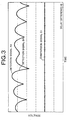
- Figs. 3 to 5 show detection signals Ad and Bd of the detectors 106a and 106b of the respective transmission units.
- Comparison signal C 1 is the difference signal between the detection signals Ad and Bd.
- the ordinate represents the detection voltage and the abscissa represents the time normalized on the basis of the transmission rate unit (chip).
- One scale of the abscissa represents the time of one chip.
- Fig. 3 is a graph showing the detection signals Ad and Bd when the difference in delay time between the transmission unit 100a and the transmission unit 100b is equal to zero. Since no difference occurs in delay time, the same amplitude variation occurs at the same time. Therefore, the detection signal Ad corresponding to the output signal of the detector 106a and the detection signal Bd corresponding to the output signal of the detector 106b are overlapped with each other.
- Figs. 4 and 5 show the detection signals Ad and Bd when there occurs a difference in delay time between the transmission unit 100a and the transmission unit 100b.
- Fig. 4 shows a case where the transmission unit 100a is delayed by 1/8 chip to the transmission unit 100b
- Fig. 5 shows a case where the transmission unit 100a is delayed by 4/8 chip to the transmission unit 100b.
- the comparator 107 compares the detection signal Ad and the detection signal Bd with each other, and outputs the difference between the detection signals Ad and Bd (detection signal Ad ⁇ detection signal Bd).
- Figs. 3 to 5 show the comparison signal C 1 as the difference between the detection signals Ad and Bd.
- the detection signal Ad and the detection signal Bd take the same value as the same time because no difference exists in delay time between the transmission units. Therefore, the comparison signal C 1 is equal to zero.
- the comparison signal C 1 is not equal to zero. As the difference in delay time is increased, the amplitude variation of the comparison signal is intensified.
- the comparison signal C 1 obtained by the comparator 107 is input to the delay amount control circuit 108 to control the delay amounts of the delay circuits 102a and 102b provided to the transmission unit 100a and 100b.
- Fig. 6 is a flowchart showing the operation of the delay amount control circuit 108.
- the delay amount control circuit 108 calculates the average amplitude Vn of the comparison signal input from the comparator 107 (step S1), and compares the average amplitude Vn with a predetermined threshold value (step S2). When the average amplitude Vn of the comparison signal is smaller than the threshold value, no control is carried out, and the processing returns to the step S1 to calculate the average amplitude of the comparison signal again. Accordingly, if the average amplitude Vn is not larger than the threshold value, the average amplitude of the comparison signal is re-calculated.
- the threshold value is preset as follows.
- the permissible difference in delay time between the transmission units is set.
- the amplitude variation of the comparison signal output from the comparator 107 is proportional to the difference in delay time. Accordingly, the permissible difference in delay time can be replaced by the value of the average amplitude of the comparison signal, and the value can be set as the threshold value.
- step S3 if the average amplitude Vn of the comparison signal is larger than the threshold value, the delay amount of the transmission unit 100a is increased by one step (step S3).
- the delay amount of the transmission unit 100a is increased by one step, the average amplitude Vn of the comparison signal is calculated again, and it is judged whether the average amplitude Vn is reduced (step S5). If the average amplitude Vn is reduced, the processing returns to the step S2 to judge again whether the value of Vn is smaller than the threshold value.
- step S6 the delay amount of the transmission unit 100b is increased by one step (step S6), the average amplitude Vn of the comparison signal is calculated again (step S7) and then it is judged whether the average amplitude Vn is smaller than the threshold value (step S8).
- control is repetitively carried out until the average amplitude Vn is equal to or smaller than the threshold value.
- control is automatically carried out so that the difference in delay time between the transmission units is equal to a permissible value or less.
- the control is automatically carried out so that the difference in delay time between the diversity type transmitters is equal to a permissible value or less. Accordingly, an expected transmission diversity characteristic can be achieved at all times.
- the dispersion of circuit parts used in the respective transmission units can be automatically corrected.
- the deterioration of the transmission diversity characteristic due to the temperature variation and the secular change under operation can be prevented.
- Fig. 7 is a block diagram showing a second embodiment of the transmitter according to the present invention.
- the transmitter of Fig. 7 includes three transmission units 100a, 100b and 100c, and each transmission unit is designed in a similar construction to that of Fig. 2.
- a base band signal generated in a base band signal generator 101 is input to two transmission units 100a, 100b and 100c.
- the base band signals input to the transmission units 100a, 100b and 100c are passed through delay circuits 102a, 102b and 102c, and then input to modulators 103a, 103b and 103c.
- the modulator 103a, 103b and 103c generate modulation waves from the base band signals input thereto.
- the modulation waves are converted to RF signals in frequency converters 104a, 104b and 104c, amplified by amplifiers 105a, 105b and 105c so as to have predetermined power, and then output as RF (Radio Frequency) signals A, B and C from the transmission units 100a, 100b and 100c.
- RF Radio Frequency
- the detectors 106a and 106b detect the RF output signals A and B of the transmission units 100a and 100b, and output detection signals Ad and Bd.
- comparator 107 1 the detection signals Ad and Bd of the detectors 106a and 106b are compared with each other to output comparison signal C 1 .
- delay amount control circuit 108 1 the delay amounts of the delay circuits 102a and 102b of the respective transmission units are controlled on the basis of the comparison signal C 1 as information.
- detector 106c detects the RF output signal C of transmission unit 100c, and output detection signal Cd.
- comparator 107 2 the detection signals Bd and Cd of the detectors 106b and 106c are compared with each other to output comparison signal C 2 .
- delay amount control circuit 108 2 the delay amounts of the delay circuits 102b and 102c of the respective transmission units are controlled on the basis of the comparison signal C 2 as information.
- the RF signal A and the RF signal B are compared in delay time by a comparator 107 1 while the RF signal B and the RF signal C are compared in delay time by comparator 107 2 , and delay control circuits 108 1 and 108 2 control the delay circuits 102a and 102b and the delay circuits 102b and 102c so that the difference in delay time is suppressed to each predetermined threshold value or less.
- the second embodiment relates to the transmitter including three transmission units.
- n is an integer larger than 1, the number of the transmission units is equal to n, and the number of the comparators and the number of the delay amount control circuits are equal to n-1, respectively), whereby the difference in delay amount between the respective transmission units can be suppressed to each threshold value or less.
- the delay circuit is disposed in front of the modulator (that is, at the end to which the base band signal is input), however, the delay circuit may be disposed at the output side of the amplifier to control the delay amount. Also, the delay circuit may be disposed between the modulator and the frequency converter or between the frequency converter and the amplifier to control the delay amount.
- the detector is disposed in the transmission unit, however, the detector may be disposed out the transmission unit.
- the same control operation can be performed even when the base band signal is transmitted while being subjected to ON/OFF control, and a method of comparing the rise-up timing and the falling timing of the detection output at the ON/OFF-control time by the comparator and controlling the delay circuits by the delay amount control circuit so that the difference therebetween can be converged to a permissible time range can be used.
- the detection signals output from the detectors of the two transmission units are compared with each other to control the delay amount, whereby the control can be automatically performed so that the difference in delay time between the diversity type transmission units can be reduced to a permissible value or less. Therefore, an expected transmission diversity characteristic can be achieved.
- the dispersion of circuit parts used for the respective transmission units can be automatically corrected, and the deterioration of the transmission diversity characteristic due to the temperature variation and the secular change under operation can be prevented.
Landscapes
- Engineering & Computer Science (AREA)
- Computer Networks & Wireless Communication (AREA)
- Signal Processing (AREA)
- Radio Transmission System (AREA)
- Transmitters (AREA)
Abstract
Description
Claims (9)
- A transmission diversity type transmitter in which the same modulation waves are transmitted from plural transmission units at the same time by delaying a base band signal with delay circuits, and the modulation timing is made coincident among the modulation waves at a reception point to achieve a diversity gain, the transmitter comprising:a detector for detecting an RF signal of each transmission unit and outputting a detection signal,a comparator for comparing the detection signals output from the two detectors of two transmission units in said plural transmission units and outputting a comparison signal, anda delay amount control circuit for controlling the delay circuits of said two transmission units on the basis of the comparison signal output from said comparator so that the modulation timing is coincident at the transmission output terminals of said two transmission units.
- The transmitter as claimed in claim 1, wherein each transmission unit contains said detector.
- The transmitter as claimed in claim 1 or 2, wherein said delay amount control circuit calculates the average amplitude of the comparison signal output from said comparator, and controls said delay circuits so that the average amplitude is equal to or lower than a threshold value, whereby the difference in delay time between said two transmission units is converged to a permissible value range.
- The transmitter as claimed in claim 1, 2 or 3, wherein, when n is an integer larger than 1, the number of said plural transmission units is equal to n, and the number of said comparators and the number of said delay amount control circuits are equal to n-1, respectively.
- The transmitter as claimed in one of claims 1 to 4, wherein each of said transmission units comprises a delay circuit, a modulator, a frequency converter and an amplifier, and said delay circuit is provided at the end to which the base band signal is input.
- The transmitter as claimed in one of claims 1 to 4, wherein each of said transmission units comprises a delay circuit, a modulator, a frequency converter and an amplifier, and said delay circuit is provided between said modulator and said frequency converter.
- The transmitter as claimed in one of claims 1 to 4, wherein each of said transmission units comprises a delay circuit, a modulator, a frequency converter and an amplifier, and said delay circuit is provided between said frequency converter and said amplifier.
- The transmitter as claimed in one of claims 1 to 4, wherein each of said transmission units comprises a delay circuit, a modulator, a frequency converter and an amplifier, and said delay circuit is provided at the output side of said amplifier.
- The transmitter as claimed in one of claims 1 to 8, wherein the base band signal is subjected to ON/OFF control, the rising timing and falling timing of the detection output when the ON/OFF control is carried out are compared with each other by said comparator, and said delay circuits are controlled by said delay amount control circuit so that the difference between the rising timing and the falling timing is within a permissible time range.
Applications Claiming Priority (2)
| Application Number | Priority Date | Filing Date | Title |
|---|---|---|---|
| JP2000177110 | 2000-06-13 | ||
| JP2000177110A JP3402363B2 (en) | 2000-06-13 | 2000-06-13 | Transmission diversity system Delay time control system in the transmitter. |
Publications (2)
| Publication Number | Publication Date |
|---|---|
| EP1164718A2 true EP1164718A2 (en) | 2001-12-19 |
| EP1164718A3 EP1164718A3 (en) | 2003-11-26 |
Family
ID=18678751
Family Applications (1)
| Application Number | Title | Priority Date | Filing Date |
|---|---|---|---|
| EP01113922A Withdrawn EP1164718A3 (en) | 2000-06-13 | 2001-06-07 | Delay control in time diversity transmitter |
Country Status (5)
| Country | Link |
|---|---|
| US (1) | US7145958B2 (en) |
| EP (1) | EP1164718A3 (en) |
| JP (1) | JP3402363B2 (en) |
| KR (1) | KR100381884B1 (en) |
| SG (1) | SG100723A1 (en) |
Cited By (5)
| Publication number | Priority date | Publication date | Assignee | Title |
|---|---|---|---|---|
| WO2006037364A1 (en) | 2004-10-07 | 2006-04-13 | Telecom Italia S.P.A. | Variable delay transmit diversity |
| WO2007038969A1 (en) * | 2005-10-05 | 2007-04-12 | Telecom Italia S.P.A | Method and system for multiple antenna communications, related apparatus and corresponding computer program product |
| WO2007048427A1 (en) * | 2005-10-27 | 2007-05-03 | Telecom Italia S.P.A. | Method and system for multiple antenna communications using multiple transmission modes, related apparatus and computer program product |
| US8509724B2 (en) | 2006-11-29 | 2013-08-13 | Telecom Italia S.P.A. | Switched beam antenna with digitally controlled weighted radio frequency combining |
| US9001803B2 (en) | 2007-12-19 | 2015-04-07 | Telecom Italia S.P.A. | Method and system for switched beam antenna communications |
Families Citing this family (7)
| Publication number | Priority date | Publication date | Assignee | Title |
|---|---|---|---|---|
| JP3631716B2 (en) * | 2001-11-22 | 2005-03-23 | 埼玉日本電気株式会社 | W-CDMA radio base station and delay time difference correction method thereof |
| JP4230238B2 (en) * | 2003-02-06 | 2009-02-25 | パナソニック株式会社 | Transmitting apparatus and adjustment method thereof |
| JP4240214B2 (en) * | 2003-07-11 | 2009-03-18 | 日本電気株式会社 | Transmitting apparatus, receiving apparatus, communication system, and multiple timing compensation method |
| US7352712B2 (en) * | 2005-10-07 | 2008-04-01 | Symbol Technologies, Inc. | System and method for detecting a delay in a computer network |
| KR101454027B1 (en) * | 2007-08-10 | 2014-10-24 | 한국전자통신연구원 | Time Division Multiplexing Communication System and Method Having Parallel Structure |
| JP2010041687A (en) * | 2008-08-08 | 2010-02-18 | Fujitsu Ltd | Wireless communication apparatus, and wireless communication controlling method |
| US9647861B1 (en) * | 2014-01-30 | 2017-05-09 | Rockwell Collins, Inc. | Multiple antenna transmission of pulsed data communication messages with phase or time dithering for reduction of static interference nulls |
Family Cites Families (23)
| Publication number | Priority date | Publication date | Assignee | Title |
|---|---|---|---|---|
| JPS61136332A (en) | 1984-12-07 | 1986-06-24 | Nippon Telegr & Teleph Corp <Ntt> | Transmission diversity communication system |
| DE3581086D1 (en) * | 1985-06-05 | 1991-02-07 | Fumio Ikegami | DIGITALIZED TRANSMISSION DEVICE. |
| JPH0683127B2 (en) * | 1985-07-22 | 1994-10-19 | 日本電気株式会社 | Diversity receiver radio |
| JPH0265423A (en) | 1988-08-31 | 1990-03-06 | Toshiba Corp | Phase synthesis type space diversity receiver |
| US5136501A (en) * | 1989-05-26 | 1992-08-04 | Reuters Limited | Anonymous matching system |
| DE4303355A1 (en) | 1993-02-05 | 1994-08-11 | Philips Patentverwaltung | Radio system |
| US5794207A (en) * | 1996-09-04 | 1998-08-11 | Walker Asset Management Limited Partnership | Method and apparatus for a cryptographically assisted commercial network system designed to facilitate buyer-driven conditional purchase offers |
| JP2876517B2 (en) * | 1994-02-16 | 1999-03-31 | 松下電器産業株式会社 | CDMA / TDD base station apparatus, CDMA / TDD mobile station apparatus, CDMA / TDD wireless communication system, and CDMA / TDD wireless communication method |
| JP3305877B2 (en) * | 1994-06-23 | 2002-07-24 | 株式会社東芝 | Spread spectrum wireless communication system and wireless communication device used in this system |
| US5717989A (en) * | 1994-10-13 | 1998-02-10 | Full Service Trade System Ltd. | Full service trade system |
| US5924042A (en) * | 1995-03-15 | 1999-07-13 | Kabushiki Kaisha Toshiba | Mobile communication system |
| US5689652A (en) * | 1995-04-27 | 1997-11-18 | Optimark Technologies, Inc. | Crossing network utilizing optimal mutual satisfaction density profile |
| US5563610A (en) | 1995-06-08 | 1996-10-08 | Metawave Communications Corporation | Narrow beam antenna systems with angular diversity |
| US5724524A (en) * | 1995-12-15 | 1998-03-03 | Pitney Bowes, Inc. | Method and system for listing, brokering, and exchanging carrier capacity |
| US5758328A (en) * | 1996-02-22 | 1998-05-26 | Giovannoli; Joseph | Computerized quotation system and method |
| JPH1028108A (en) | 1996-07-11 | 1998-01-27 | Nec Corp | Combined diversity reception method |
| JPH10178375A (en) | 1996-12-19 | 1998-06-30 | Nec Corp | Diversity wireless transceiver |
| US5764187A (en) | 1997-01-21 | 1998-06-09 | Ail Systems, Inc. | Direct digital synthesizer driven phased array antenna |
| US6038263A (en) * | 1997-07-31 | 2000-03-14 | Motorola, Inc. | Method and apparatus for transmitting signals in a communication system |
| JP2000078115A (en) * | 1998-08-27 | 2000-03-14 | Mitsubishi Electric Corp | Diversity receiver |
| US6151328A (en) * | 1998-12-31 | 2000-11-21 | Lg Information & Communications Ltd. | Apparatus and method for controlling power in code division multiple access system |
| US6327299B1 (en) * | 1999-08-31 | 2001-12-04 | Motorola, Inc. | Method and system for measuring and adjusting the quality of an orthogonal transmit diversity signal in a wireless communications system |
| JP2001257660A (en) | 2000-03-14 | 2001-09-21 | Matsushita Electric Ind Co Ltd | Transmission device, reception device, and transmission / reception method |
-
2000
- 2000-06-13 JP JP2000177110A patent/JP3402363B2/en not_active Expired - Fee Related
-
2001
- 2001-06-01 US US09/870,843 patent/US7145958B2/en not_active Expired - Fee Related
- 2001-06-07 EP EP01113922A patent/EP1164718A3/en not_active Withdrawn
- 2001-06-09 SG SG200103427A patent/SG100723A1/en unknown
- 2001-06-13 KR KR10-2001-0033127A patent/KR100381884B1/en not_active Expired - Fee Related
Cited By (8)
| Publication number | Priority date | Publication date | Assignee | Title |
|---|---|---|---|---|
| WO2006037364A1 (en) | 2004-10-07 | 2006-04-13 | Telecom Italia S.P.A. | Variable delay transmit diversity |
| US8260359B2 (en) | 2004-10-07 | 2012-09-04 | Telecom Italia S.P.A. | Variable delay transmit diversity |
| WO2007038969A1 (en) * | 2005-10-05 | 2007-04-12 | Telecom Italia S.P.A | Method and system for multiple antenna communications, related apparatus and corresponding computer program product |
| US8588710B2 (en) | 2005-10-05 | 2013-11-19 | Telecom Italia S.P.A. | Method and system for multiple antenna communications, related apparatus and corresponding computer program product |
| WO2007048427A1 (en) * | 2005-10-27 | 2007-05-03 | Telecom Italia S.P.A. | Method and system for multiple antenna communications using multiple transmission modes, related apparatus and computer program product |
| US8437712B2 (en) | 2005-10-27 | 2013-05-07 | Telecom Italia S.P.A. | Method and system for multiple antenna communications using multiple transmission modes, related apparatus and computer program product |
| US8509724B2 (en) | 2006-11-29 | 2013-08-13 | Telecom Italia S.P.A. | Switched beam antenna with digitally controlled weighted radio frequency combining |
| US9001803B2 (en) | 2007-12-19 | 2015-04-07 | Telecom Italia S.P.A. | Method and system for switched beam antenna communications |
Also Published As
| Publication number | Publication date |
|---|---|
| SG100723A1 (en) | 2003-12-26 |
| JP3402363B2 (en) | 2003-05-06 |
| US7145958B2 (en) | 2006-12-05 |
| US20010050963A1 (en) | 2001-12-13 |
| KR20010112647A (en) | 2001-12-20 |
| JP2001358623A (en) | 2001-12-26 |
| KR100381884B1 (en) | 2003-04-26 |
| EP1164718A3 (en) | 2003-11-26 |
Similar Documents
| Publication | Publication Date | Title |
|---|---|---|
| US6717464B2 (en) | Distortion compensating apparatus | |
| JP3094955B2 (en) | Transmission amplifier control circuit | |
| JP2735469B2 (en) | Method and apparatus for reducing peak average power in a multi-carrier RF communication system | |
| US8140106B2 (en) | Peak factor reduction device and base station | |
| US7145958B2 (en) | Diversity type transmitter having system for controlling the delay time of each of plural transmission units | |
| JP2003124821A (en) | Transmitting power control circuit | |
| US7310502B2 (en) | Radio communications apparatus and transmission power control method thereof | |
| US7502599B2 (en) | Cartesian loop transmitter and method of adjusting an output level of such transmitter | |
| US20030085760A1 (en) | Method and system for automated current balance adjustment for parallel combined amplification elements | |
| TW201351935A (en) | Fast and robust AGC apparatus and method using the same | |
| US6236841B1 (en) | Transmission output power control circuit for controlling each of antennas to optimal states | |
| US20030006839A1 (en) | Extended range power detector and amplifier and method | |
| EP0687080B1 (en) | Receive signal level detection system | |
| EP1638217A1 (en) | Communication system | |
| US6798845B1 (en) | Transmitter for mobile terminal with carrier leak suppressing circuit | |
| JP2546523B2 (en) | High-frequency amplifier circuit power consumption reduction method | |
| US20060009163A1 (en) | Wireless communication device | |
| US8767894B2 (en) | Wireless device and receiving method | |
| US20060029154A1 (en) | Distortion compensation device and distortion compensation method | |
| JPH06204765A (en) | Power synthesis device | |
| JP4438081B2 (en) | Reception AGC circuit | |
| KR100976638B1 (en) | System and method for providing inputs to a distributed power amplification system | |
| JPS61214825A (en) | High frequency power amplifying circuit | |
| GB2347291A (en) | Reducing out-of-band interference by performing switching of eg gain or antenna tuning when the modulated signal for transmission is low | |
| KR20040044240A (en) | Repeater detecting antenna isolation using reverse link |
Legal Events
| Date | Code | Title | Description |
|---|---|---|---|
| PUAI | Public reference made under article 153(3) epc to a published international application that has entered the european phase |
Free format text: ORIGINAL CODE: 0009012 |
|
| AK | Designated contracting states |
Kind code of ref document: A2 Designated state(s): AT BE CH CY DE DK ES FI FR GB GR IE IT LI LU MC NL PT SE TR |
|
| AX | Request for extension of the european patent |
Free format text: AL;LT;LV;MK;RO;SI |
|
| PUAL | Search report despatched |
Free format text: ORIGINAL CODE: 0009013 |
|
| AK | Designated contracting states |
Kind code of ref document: A3 Designated state(s): AT BE CH CY DE DK ES FI FR GB GR IE IT LI LU MC NL PT SE TR |
|
| AX | Request for extension of the european patent |
Extension state: AL LT LV MK RO SI |
|
| RIC1 | Information provided on ipc code assigned before grant |
Ipc: 7H 04B 1/04 B Ipc: 7H 01Q 3/26 B Ipc: 7H 04B 7/06 A |
|
| 17P | Request for examination filed |
Effective date: 20040319 |
|
| AKX | Designation fees paid |
Designated state(s): DE GB |
|
| 17Q | First examination report despatched |
Effective date: 20081030 |
|
| GRAP | Despatch of communication of intention to grant a patent |
Free format text: ORIGINAL CODE: EPIDOSNIGR1 |
|
| GRAS | Grant fee paid |
Free format text: ORIGINAL CODE: EPIDOSNIGR3 |
|
| STAA | Information on the status of an ep patent application or granted ep patent |
Free format text: STATUS: THE APPLICATION IS DEEMED TO BE WITHDRAWN |
|
| 18D | Application deemed to be withdrawn |
Effective date: 20091223 |