EP1161069A2 - System und Verfahren des Änderns von Einheitkonfigurationsinformationen während das automatisch überwachen von solche Informationen in einer Anrufzentrale - Google Patents
System und Verfahren des Änderns von Einheitkonfigurationsinformationen während das automatisch überwachen von solche Informationen in einer Anrufzentrale Download PDFInfo
- Publication number
- EP1161069A2 EP1161069A2 EP01250152A EP01250152A EP1161069A2 EP 1161069 A2 EP1161069 A2 EP 1161069A2 EP 01250152 A EP01250152 A EP 01250152A EP 01250152 A EP01250152 A EP 01250152A EP 1161069 A2 EP1161069 A2 EP 1161069A2
- Authority
- EP
- European Patent Office
- Prior art keywords
- physical location
- location information
- entity configuration
- information
- changing entity
- Prior art date
- Legal status (The legal status is an assumption and is not a legal conclusion. Google has not performed a legal analysis and makes no representation as to the accuracy of the status listed.)
- Withdrawn
Links
- 238000000034 method Methods 0.000 title claims abstract description 37
- 238000012544 monitoring process Methods 0.000 title claims abstract description 24
- 230000008859 change Effects 0.000 claims abstract description 13
- 239000003795 chemical substances by application Substances 0.000 claims description 78
- 238000004891 communication Methods 0.000 claims description 11
- 230000006870 function Effects 0.000 description 7
- 230000001960 triggered effect Effects 0.000 description 5
- 238000010586 diagram Methods 0.000 description 3
- 238000012986 modification Methods 0.000 description 2
- 230000004048 modification Effects 0.000 description 2
- 230000008520 organization Effects 0.000 description 2
- 230000005540 biological transmission Effects 0.000 description 1
- 238000001514 detection method Methods 0.000 description 1
- 230000011664 signaling Effects 0.000 description 1
- 230000000007 visual effect Effects 0.000 description 1
Images


Classifications
-
- H—ELECTRICITY
- H04—ELECTRIC COMMUNICATION TECHNIQUE
- H04M—TELEPHONIC COMMUNICATION
- H04M3/00—Automatic or semi-automatic exchanges
- H04M3/42—Systems providing special services or facilities to subscribers
- H04M3/50—Centralised arrangements for answering calls; Centralised arrangements for recording messages for absent or busy subscribers ; Centralised arrangements for recording messages
- H04M3/51—Centralised call answering arrangements requiring operator intervention, e.g. call or contact centers for telemarketing
-
- H—ELECTRICITY
- H04—ELECTRIC COMMUNICATION TECHNIQUE
- H04M—TELEPHONIC COMMUNICATION
- H04M2201/00—Electronic components, circuits, software, systems or apparatus used in telephone systems
- H04M2201/38—Displays
-
- H—ELECTRICITY
- H04—ELECTRIC COMMUNICATION TECHNIQUE
- H04M—TELEPHONIC COMMUNICATION
- H04M2242/00—Special services or facilities
- H04M2242/30—Determination of the location of a subscriber
-
- H—ELECTRICITY
- H04—ELECTRIC COMMUNICATION TECHNIQUE
- H04M—TELEPHONIC COMMUNICATION
- H04M3/00—Automatic or semi-automatic exchanges
- H04M3/42—Systems providing special services or facilities to subscribers
- H04M3/50—Centralised arrangements for answering calls; Centralised arrangements for recording messages for absent or busy subscribers ; Centralised arrangements for recording messages
- H04M3/51—Centralised call answering arrangements requiring operator intervention, e.g. call or contact centers for telemarketing
- H04M3/5175—Call or contact centers supervision arrangements
-
- Y—GENERAL TAGGING OF NEW TECHNOLOGICAL DEVELOPMENTS; GENERAL TAGGING OF CROSS-SECTIONAL TECHNOLOGIES SPANNING OVER SEVERAL SECTIONS OF THE IPC; TECHNICAL SUBJECTS COVERED BY FORMER USPC CROSS-REFERENCE ART COLLECTIONS [XRACs] AND DIGESTS
- Y10—TECHNICAL SUBJECTS COVERED BY FORMER USPC
- Y10S—TECHNICAL SUBJECTS COVERED BY FORMER USPC CROSS-REFERENCE ART COLLECTIONS [XRACs] AND DIGESTS
- Y10S379/00—Telephonic communications
- Y10S379/913—Person locator or person-specific
Definitions
- This invention relates to communications systems and, more particularly, to call centers.
- Communications systems with call centers are known. Such systems are typically used as a means of distributing telephone calls among a group of call center agents of an organization. As calls are directed to the organization from the public switch telephone network (PSTN), the communications system directs the calls to its call center agents based upon some algorithm. For example, a communications system such as an automatic call distributor (ACD), a public branch exchange (PBX), or a central office exchange service (centrex) may recognize a call target based upon an identity of an incoming trunk line and route the call accordingly.
- ACD automatic call distributor
- PBX public branch exchange
- centrex central office exchange service
- call center may contain a large number of agents. Agents are responsible for servicing customers. Call center agents may provide product support, take sales orders, and handle inquires. In essence, the call center agents provide the wide array of services that the companies that use them require. Thus, the effectiveness and efficiency of a call center depends on the call center agents. Call center supervisors manage call center agents, including scheduling their tasks and duties, and are responsible for monitoring their whereabouts.
- Such manual solutions may be inaccurate and may misrepresent an agent's physical location.
- many call centers operate in hotdesking mode where agents sit at different seats according to availability and preference on a shift by shift basis.
- the floor plan may not represent the current agent and console locations.
- the call center supervisor must make note of the change by moving the tag representing the agent either on the paper or electronic floor plan. This requires the supervisor to constantly update the floor plan. If the supervisor looses track of agent positions, then some consoles identified as occupied may be mismarked. By not adequately tracking agents or consoles, the call center becomes underutilized and inefficient. Also, by being unaware of agents' whereabouts, the call center supervisor is unable to estimate the call center's capability.
- the supervisor is not able to reassign agents and make other configuration changes from the supervisor's desk.
- the supervisor must physically walk over to an agent's console and re-assign or re-configure the agent's console. Having the supervisor walk to each agent's console and perform the necessary changes is time consuming and inefficient.
- the present invention accordingly, provides a system and method of changing entity configuration information that overcomes or reduces the disadvantageous and limitations associated with prior agent monitoring methods and systems.
- Illustrated embodiments reduce the disadvantage of manually tracking agents and consoles in a call center by automatically monitoring entities in a call center, selecting an entity in the call center, and modifying configuration information of the selected entity.
- An electronic floor plan that depicts the locations of the entities, displays the entity configuration information and is automatically updated when changes occur is disclosed.
- call center supervisors are able to view accurate physical location information for call center agents and consoles on a two-dimensional or three-dimensional electronic floor plan. Further, the call center supervisors are able to change entity configuration information by selecting an entity from the electronic floor plan.
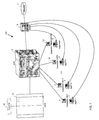
- Fig. 1 Shown in Fig. 1 is a communications system 100 shown in a context of use.
- the communications system 100 functions to selectively and automatically interconnect a caller 20 calling through the public switched telephone network (PSTN) 10 to one of a number of agent telephones 1-N (3, 6, or 11) where N may be a preselected number greater than one.
- PSTN public switched telephone network
- N may be a preselected number greater than one.
- ACD automatic call distributor
- PBX or centrex system may also be used in place of the ACD.
- implementing a call center with any of these switching systems is considered to be equivalent and variations will not be discussed further.
- automatic call distributors reference may be made to U.S. Pat. No. 5,268,903 to Jones et al.
- a packet-switched voice network or other equivalent network where voice calls are relayed to a call center may be used.
- voice calls are transmitted over a global network, such as the Internet using Internet Protocol (IP)
- IP Internet Protocol
- a packet-switched communications network may be used to implement the system of transmitting the call.
- the agent has a computer workstation consisting of a terminal and an input device, such as a keyboard or mouse.
- the agent telephone (3, 6, or 11), terminal and input device are collectively termed a "console.”
- a console is one type of physical entity in a call center.
- entity is used to refer to physical objects in a call center. For example, it may refer to an agent, console, supervisor, printer, or facsimile. In the illustrated embodiment, the term entity refers to a call center agent or a call center console; however, other physical objects may be monitored and displayed as described by the present invention.
- the ACD 9 also interfaces with a server computer 8.
- the server 8 functions to provide agent workstations (2, 5, 12) and supervisor workstation 14 with information from the ACD 9 and a database 7.
- agent workstations (2, 5, 12) and supervisor workstation 14
- call associated information e.g., ANI, DNIS, etc.
- the database 7 maintains performance statistics, customer information, and dial lists of the ACD 9 system.
- Server computer 8 may relay statistics and performance information maintained in database 7 to the supervisor workstation 14.
- a method for changing entity configuration information in a call center comprising the steps of:
- entity configuration information includes data such as staff ID, class of service, agent group, directory number, supervisor staff ID, schedule adherence threshold group, secondary agent group, agent information group, message queue, major class, and name.
- agent Bob having a staff ID of 1111 sitting at console 1234 would have the following related configuration information.
- Widget Sales Telephone Lines 1-200 directory number Staff member's phone extension 5455 supervisor staff ID Supervisor for Staff Carol Smith schedule adherence threshold group Associates Staff with certain thresholds 1 secondary agent group Sales, Service, Management, etc.
- Gizmo Sales Telephone Lines 1-220 agent information group Collection of organized agents, LINRs, or VRUs message queue ACD mail message queue to which agent is assigned 0 major class Type of staff, e.g. AGENT, SUPV, MASTER, and MAINT AGENT name Name of staff Bob Jones console Number of physical console unit 1234
- the step of automatically monitoring entities functions to provide an updated electronic floor plan of the call center to the supervisor of the call center.
- the step further comprises the steps of: (a) monitoring physical location information of entities to provide an electronic floor plan (see block 22 of FIG. 2), and (b) updating the electronic floor plan to provide and reflect a change in physical location information of the entities (see block 24).
- Physical location information includes x, y, and z Cartesian coordinates, latitude and longitude meridians, or radius vector and angle.
- console 60 may be referred to by its x, y, and z Cartesian coordinates as console (2, 2, 4). Further, the Cartesian coordinates are used to graphically describe the location of console 60 on a two-dimensional user interface.
- the step of monitoring physical location information of entities functions to provide an automatic trigger for changes in the physical location information.
- Monitoring means detecting physical location information for each entity in the system and noting changes when an entity moves.
- the step of updating an electronic floor plan means providing a call center supervisor with current entity configuration information regarding the entity within call center. Updating an electronic floor plan requires retrieving the recorded physical location information, translating the recorded physical location information into graphical form, and drawing the graphical form on an electronic floor plan.
- the physical location information is stored in the database 7 without meaning.
- the application that uses the physical location information dictates the meaning of the coordinates.
- the physical location information is represented in Cartesian x, y, z coordinates.
- a call center console projected onto a 2-dimensional device in the direction of the positive z axis has a positive x axis to the right and a positive y axis up.
- an application session begins on the supervisor workstation 14
- the supervisor workstation 14 connects to the server computer 8 (see block 1).
- an application session may begin by connecting directly to the ACD 9.
- entity objects are allocated and initialized to produce defined versions on the supervisor workstation 14 (see block 34). This step makes memory available on the supervisor workstation 14 for the physical location information of the entities in the call center.
- an event handler routine is initiated to execute whenever agent physical location information is changed (see block 36).
- the event handler runs in the background on the supervisor workstation 14 and is triggered by a change in x, y, z physical location information. If a change does occur, then the event handler executes software to update the electronic floor plan (see blocks 38-42).
- the new x, y, z physical location information is updated in the server computer 8 (see block 46). For example, when an agent moves from console 51 to console 52, the agent logs off console 51 and logs on to console 52. Thus, the agent's physical location has changed from (0, 3, 4) to (1, 3, 4).
- the new physical location information (1, 3, 4) is stored in the server computer 8.
- the new x, y, z physical location information is copied to the database 7 (see block 48).
- the new physical location information for the agent sitting at console 52 is (1, 3, 4) and is stored in the database 7.
- an application running on the supervisor workstation 14 may have a look-up table that keeps track of relationships between agents and consoles.
- the application running on the supervisor workstation would copy the physical location information from the server computer 8 or from the database 7 and maintain a look-up table of agents and consoles.
- Entity RTEvent Handler is triggered (see block 50) to perform an update of the electronic floor plan (blocks 38-42). Triggering or raising RTEvent for the new physical location information (see block 50) requires sending a signal to inform RTEvent that a change has occurred. When RTEvent receives the signal, it takes specified actions, namely updating the electronic floor plan (see blocks 38-42).
- the new physical location information is compared with the physical location information in the database 7 before RTEvent Handler was triggered. If the two are the same, then RTEvent Handler is not triggered. For example, the supervisor may delete an agent from the system and then immediately add the same agent to the same console. In such a situation, there is no need to redraw the electronic floor plan to reflect the change.
- Updating of the electronic floor plan is performed by reading the recorded physical location information, translating the recorded physical location information to graphical form, and drawing the graphical form on the electronic floor plan.
- Reading the recorded physical location information occurs when RTEvent is triggered (see block 36).
- Translating the recorded physical location information occurs by first verifying that the information contains x, y, z Cartesian coordinates (see block 38). If it does not, then the entity is placed in a list of entities with no location and displayed on the electronic floor plan as not having a location (see block 40). If the information contains x, y, z information, then the electronic floor plan is drawn to reflect this change (see block 42).
- a symbol representing an agent is placed at the console position that the agent is sitting at. For example, in FIG. 4, a graphical symbol of a man in a circle is used to depict the agent's occupied position.
- the electronic floor plan may be of any form reflecting the physical location of entities in the call center.
- the electronic floor plan may be drawn in a two-dimensional projection of the call center.
- each console 51 - 78 is displayed on the floor plan.
- the background image of the call center is predefined and may be specified as a rectangular floor plan.
- the agent who is sitting at a specific console is displayed on the electronic floor plan.
- FIG. 4 is a bitmap image of the floor plan.
- alternative embodiments may include vector or object oriented graphical images of the floor plan.
- the electronic floor plan may be drawn in a three-dimensional projection of the call center.
- a three-dimensional floor plan representing a specific call center may be created using virtual reality modeling language (VRML) and JavaScript code.
- VRML virtual reality modeling language
- the VRML electronic floor plan is updated with call center agent and console information.
- the VRML specification provides for taking Cartesian coordinates and performing a visual representation. Referring now to FIG. 5, a VRML image of a call center with six consoles is displayed. Further, the agent who is sitting at a specific console is displayed on the electronic floor plan.
- Alternative embodiments may include other three-dimensional modeling objects.
- the method may employ learning as a method of increasing the detection of changes in physical location.
- the method recognizes and learns agent location pattern regularities that appear over time. For example, agents assigned to consoles (55-60) regularly break for lunch during the noon hour. The method may recognize this pattern and learn that during such a time, the location of the agent is in the break room.
- the ability to predict physical location information may allow the call center supervisor to better predict agent absences and more efficiently manage the call center.
- the physical location information may be copied to the database 8 for use at a future date. Further, the physical location information may be archived so that the call center supervisor may perform historical analysis of the data to determine efficiencies of the call center and more particularly, call center agents.
Landscapes
- Business, Economics & Management (AREA)
- Marketing (AREA)
- Engineering & Computer Science (AREA)
- Signal Processing (AREA)
- Telephonic Communication Services (AREA)
- Selective Calling Equipment (AREA)
Applications Claiming Priority (2)
| Application Number | Priority Date | Filing Date | Title |
|---|---|---|---|
| US09/584,306 US6987846B1 (en) | 2000-05-31 | 2000-05-31 | System and method of changing entity configuration information while automatically monitoring and displaying such information in a call center |
| US584306 | 2000-05-31 |
Publications (2)
| Publication Number | Publication Date |
|---|---|
| EP1161069A2 true EP1161069A2 (de) | 2001-12-05 |
| EP1161069A3 EP1161069A3 (de) | 2003-10-29 |
Family
ID=24336767
Family Applications (1)
| Application Number | Title | Priority Date | Filing Date |
|---|---|---|---|
| EP01250152A Withdrawn EP1161069A3 (de) | 2000-05-31 | 2001-04-30 | System und Verfahren des Änderns von Einheitkonfigurationsinformationen während das automatisch überwachen von solche Informationen in einer Anrufzentrale |
Country Status (4)
| Country | Link |
|---|---|
| US (1) | US6987846B1 (de) |
| EP (1) | EP1161069A3 (de) |
| AU (1) | AU776586B2 (de) |
| CA (1) | CA2344756A1 (de) |
Families Citing this family (12)
| Publication number | Priority date | Publication date | Assignee | Title |
|---|---|---|---|---|
| US7421072B2 (en) * | 2002-10-04 | 2008-09-02 | Avaya Inc | Location-based bridging in call centers |
| US7599861B2 (en) | 2006-03-02 | 2009-10-06 | Convergys Customer Management Group, Inc. | System and method for closed loop decisionmaking in an automated care system |
| US8379830B1 (en) | 2006-05-22 | 2013-02-19 | Convergys Customer Management Delaware Llc | System and method for automated customer service with contingent live interaction |
| US7809663B1 (en) | 2006-05-22 | 2010-10-05 | Convergys Cmg Utah, Inc. | System and method for supporting the utilization of machine language |
| US8670550B2 (en) | 2010-04-14 | 2014-03-11 | Avaya Inc. | Automated mechanism for populating and maintaining data structures in a queueless contact center |
| US8619968B2 (en) * | 2010-04-14 | 2013-12-31 | Avaya Inc. | View and metrics for a queueless contact center |
| US9571654B2 (en) | 2010-04-14 | 2017-02-14 | Avaya Inc. | Bitmaps for next generation contact center |
| US9251504B2 (en) | 2011-08-29 | 2016-02-02 | Avaya Inc. | Configuring a virtual reality environment in a contact center |
| JP5728692B2 (ja) * | 2011-09-09 | 2015-06-03 | ピーアンドダブリューソリューションズ株式会社 | 配席設計装置、方法及びプログラム |
| JP5776084B2 (ja) * | 2011-09-27 | 2015-09-09 | ピーアンドダブリューソリューションズ株式会社 | 配席装置、配席方法及び配席プログラム |
| US8688684B2 (en) | 2012-04-06 | 2014-04-01 | Avaya Inc. | Qualifier set creation for work assignment engine |
| US10178473B2 (en) * | 2014-09-05 | 2019-01-08 | Plantronics, Inc. | Collection and analysis of muted audio |
Family Cites Families (9)
| Publication number | Priority date | Publication date | Assignee | Title |
|---|---|---|---|---|
| US5375161A (en) * | 1984-09-14 | 1994-12-20 | Accessline Technologies, Inc. | Telephone control system with branch routing |
| US5493692A (en) * | 1993-12-03 | 1996-02-20 | Xerox Corporation | Selective delivery of electronic messages in a multiple computer system based on context and environment of a user |
| US5515426A (en) * | 1994-02-28 | 1996-05-07 | Executone Information Systems, Inc. | Telephone communication system having a locator |
| US5465286A (en) * | 1994-05-24 | 1995-11-07 | Executone Information Systems, Inc. | Apparatus for supervising an automatic call distribution telephone system |
| US5742675A (en) * | 1995-09-26 | 1998-04-21 | Telefonaktiebolaget Lm Ericsson | Method and apparatus for automatically distributing calls to available logged-in call handling agents |
| US6064730A (en) * | 1996-06-18 | 2000-05-16 | Lucent Technologies Inc. | Customer-self routing call center |
| JP3932461B2 (ja) * | 1997-05-21 | 2007-06-20 | ソニー株式会社 | クライアント装置、画像表示制御方法、共有仮想空間提供装置および方法、並びに記録媒体 |
| US6466663B1 (en) * | 1997-09-30 | 2002-10-15 | Don Ravenscroft | Monitoring system client for a call center |
| US6577726B1 (en) * | 2000-03-31 | 2003-06-10 | Siebel Systems, Inc. | Computer telephony integration hotelling method and system |
-
2000
- 2000-05-31 US US09/584,306 patent/US6987846B1/en not_active Expired - Lifetime
-
2001
- 2001-04-18 CA CA002344756A patent/CA2344756A1/en not_active Abandoned
- 2001-04-30 EP EP01250152A patent/EP1161069A3/de not_active Withdrawn
- 2001-05-04 AU AU43721/01A patent/AU776586B2/en not_active Ceased
Non-Patent Citations (1)
| Title |
|---|
| None * |
Also Published As
| Publication number | Publication date |
|---|---|
| US6987846B1 (en) | 2006-01-17 |
| AU4372101A (en) | 2001-12-06 |
| AU776586B2 (en) | 2004-09-16 |
| EP1161069A3 (de) | 2003-10-29 |
| CA2344756A1 (en) | 2001-11-30 |
Similar Documents
| Publication | Publication Date | Title |
|---|---|---|
| US6704410B1 (en) | System for automatically assigning skill levels to multiple skilled agents in call center agent assignment applications | |
| EP1349357B1 (de) | Anrufzentralensystem | |
| US5903877A (en) | Transaction center for processing customer transaction requests from alternative media sources | |
| US10447855B1 (en) | Agent training sensitive call routing system | |
| US5715307A (en) | Integrated voice and business transaction reporting for telephone call centers | |
| US6681010B1 (en) | Methods, systems and computer program products for automatic task distribution | |
| EP0982915B1 (de) | Automatisches Anrufverteil- und Trainings-System | |
| US7085366B2 (en) | System and method for telemarketing through a hypertext network | |
| AU710186B2 (en) | Apparatus for supervising an automatic call distribution telephone system | |
| US5832059A (en) | Call path system and method for modeling and modifying a call path of a telephone call routed by a telephone switch | |
| US6987846B1 (en) | System and method of changing entity configuration information while automatically monitoring and displaying such information in a call center | |
| US20040044585A1 (en) | Customer service management system | |
| EP0802665A2 (de) | Anrufverteilungsnetzwerk mit Lokal-Vertreter mit kooperativer Steuerung | |
| JP2001517028A (ja) | エージェントの利用可能性を決定するための方法と装置 | |
| US7817796B1 (en) | Coordinating work assignments for contact center agents | |
| US9544435B1 (en) | System and method for real-time geographical call display of automatic call distributor calls | |
| US6654798B1 (en) | Automatic contact distribution system definable agent log-off reasons | |
| US20030191632A1 (en) | Utilization of agent idle time in a communication system | |
| GB2387738A (en) | Contact centre data integration with enterprise applications | |
| US8229098B2 (en) | Network router for heterogeneous ACD system | |
| JP4308081B2 (ja) | 着信呼分配システム、着信呼分配方法、及び着信呼分配制御装置 | |
| US20090185672A1 (en) | Method for Reporting Activity of Multi-Appearance Call-Center Agent | |
| US8503661B2 (en) | Single workflow for colloborative network routing over heteogeneous system | |
| JP2006185319A (ja) | 顧客対応支援方法及び顧客対応支援システム | |
| US7899176B1 (en) | Systems and methods for discovering customer center information |
Legal Events
| Date | Code | Title | Description |
|---|---|---|---|
| PUAI | Public reference made under article 153(3) epc to a published international application that has entered the european phase |
Free format text: ORIGINAL CODE: 0009012 |
|
| AK | Designated contracting states |
Kind code of ref document: A2 Designated state(s): AT BE CH CY DE DK ES FI FR GB GR IE IT LI LU MC NL PT SE TR |
|
| AX | Request for extension of the european patent |
Free format text: AL;LT;LV;MK;RO;SI |
|
| 17P | Request for examination filed |
Effective date: 20011113 |
|
| PUAL | Search report despatched |
Free format text: ORIGINAL CODE: 0009013 |
|
| AK | Designated contracting states |
Kind code of ref document: A3 Designated state(s): AT BE CH CY DE DK ES FI FR GB GR IE IT LI LU MC NL PT SE TR |
|
| AX | Request for extension of the european patent |
Extension state: AL LT LV MK RO SI |
|
| RIC1 | Information provided on ipc code assigned before grant |
Ipc: 7H 04M 3/51 B Ipc: 7H 04M 3/523 A |
|
| AKX | Designation fees paid |
Designated state(s): AT BE CH CY DE DK ES FI FR GB GR IE IT LI LU MC NL PT SE TR |
|
| 17Q | First examination report despatched |
Effective date: 20070131 |
|
| STAA | Information on the status of an ep patent application or granted ep patent |
Free format text: STATUS: THE APPLICATION IS DEEMED TO BE WITHDRAWN |
|
| 18D | Application deemed to be withdrawn |
Effective date: 20101112 |