EP1160630A1 - Process and system for producing toner particles - Google Patents
Process and system for producing toner particles Download PDFInfo
- Publication number
- EP1160630A1 EP1160630A1 EP01113176A EP01113176A EP1160630A1 EP 1160630 A1 EP1160630 A1 EP 1160630A1 EP 01113176 A EP01113176 A EP 01113176A EP 01113176 A EP01113176 A EP 01113176A EP 1160630 A1 EP1160630 A1 EP 1160630A1
- Authority
- EP
- European Patent Office
- Prior art keywords
- toner particles
- heat treatment
- process according
- vacuum heat
- temperature
- Prior art date
- Legal status (The legal status is an assumption and is not a legal conclusion. Google has not performed a legal analysis and makes no representation as to the accuracy of the status listed.)
- Granted
Links
- 239000002245 particle Substances 0.000 title claims abstract description 249
- 238000000034 method Methods 0.000 title claims abstract description 65
- 230000008569 process Effects 0.000 title claims abstract description 33
- 238000010438 heat treatment Methods 0.000 claims abstract description 153
- 239000000178 monomer Substances 0.000 claims abstract description 74
- 238000002347 injection Methods 0.000 claims abstract description 46
- 239000007924 injection Substances 0.000 claims abstract description 46
- 239000002609 medium Substances 0.000 claims abstract description 46
- 239000003086 colorant Substances 0.000 claims abstract description 26
- 239000000203 mixture Substances 0.000 claims abstract description 23
- 229920006395 saturated elastomer Polymers 0.000 claims abstract description 19
- 229920000642 polymer Polymers 0.000 claims abstract description 17
- 230000009477 glass transition Effects 0.000 claims abstract description 12
- 239000002612 dispersion medium Substances 0.000 claims abstract description 10
- 238000005406 washing Methods 0.000 claims abstract description 8
- 230000000379 polymerizing effect Effects 0.000 claims abstract description 7
- 230000018044 dehydration Effects 0.000 claims abstract description 6
- 238000006297 dehydration reaction Methods 0.000 claims abstract description 6
- XLYOFNOQVPJJNP-UHFFFAOYSA-N water Substances O XLYOFNOQVPJJNP-UHFFFAOYSA-N 0.000 claims description 46
- 239000000463 material Substances 0.000 claims description 31
- 239000003505 polymerization initiator Substances 0.000 claims description 10
- 238000000354 decomposition reaction Methods 0.000 claims 1
- 238000001035 drying Methods 0.000 description 32
- 238000006116 polymerization reaction Methods 0.000 description 31
- VYPSYNLAJGMNEJ-UHFFFAOYSA-N Silicium dioxide Chemical compound O=[Si]=O VYPSYNLAJGMNEJ-UHFFFAOYSA-N 0.000 description 28
- 239000007789 gas Substances 0.000 description 24
- 229920005989 resin Polymers 0.000 description 17
- 239000011347 resin Substances 0.000 description 17
- 239000000377 silicon dioxide Substances 0.000 description 14
- 239000003795 chemical substances by application Substances 0.000 description 13
- 230000002209 hydrophobic effect Effects 0.000 description 13
- 238000012546 transfer Methods 0.000 description 13
- 239000006185 dispersion Substances 0.000 description 12
- 238000004519 manufacturing process Methods 0.000 description 12
- CERQOIWHTDAKMF-UHFFFAOYSA-M Methacrylate Chemical compound CC(=C)C([O-])=O CERQOIWHTDAKMF-UHFFFAOYSA-M 0.000 description 11
- 150000001875 compounds Chemical class 0.000 description 9
- 239000000243 solution Substances 0.000 description 9
- PPBRXRYQALVLMV-UHFFFAOYSA-N Styrene Chemical compound C=CC1=CC=CC=C1 PPBRXRYQALVLMV-UHFFFAOYSA-N 0.000 description 8
- 238000013019 agitation Methods 0.000 description 8
- 230000000694 effects Effects 0.000 description 8
- -1 anthraquinone compounds Chemical class 0.000 description 7
- 238000005259 measurement Methods 0.000 description 7
- 239000003960 organic solvent Substances 0.000 description 7
- 238000010557 suspension polymerization reaction Methods 0.000 description 7
- IJGRMHOSHXDMSA-UHFFFAOYSA-N Atomic nitrogen Chemical compound N#N IJGRMHOSHXDMSA-UHFFFAOYSA-N 0.000 description 6
- 239000012736 aqueous medium Substances 0.000 description 6
- 239000011230 binding agent Substances 0.000 description 6
- 239000000126 substance Substances 0.000 description 6
- 238000006243 chemical reaction Methods 0.000 description 5
- 238000009833 condensation Methods 0.000 description 5
- 230000005494 condensation Effects 0.000 description 5
- 230000007423 decrease Effects 0.000 description 5
- 239000002270 dispersing agent Substances 0.000 description 5
- 238000009826 distribution Methods 0.000 description 5
- 238000001704 evaporation Methods 0.000 description 5
- 230000008020 evaporation Effects 0.000 description 5
- 238000005469 granulation Methods 0.000 description 5
- 230000003179 granulation Effects 0.000 description 5
- 239000002904 solvent Substances 0.000 description 5
- 239000003381 stabilizer Substances 0.000 description 5
- 239000001993 wax Substances 0.000 description 5
- OZAIFHULBGXAKX-UHFFFAOYSA-N 2-(2-cyanopropan-2-yldiazenyl)-2-methylpropanenitrile Chemical compound N#CC(C)(C)N=NC(C)(C)C#N OZAIFHULBGXAKX-UHFFFAOYSA-N 0.000 description 4
- FAPWRFPIFSIZLT-UHFFFAOYSA-M Sodium chloride Chemical compound [Na+].[Cl-] FAPWRFPIFSIZLT-UHFFFAOYSA-M 0.000 description 4
- 239000012159 carrier gas Substances 0.000 description 4
- 230000000052 comparative effect Effects 0.000 description 4
- 230000006866 deterioration Effects 0.000 description 4
- 239000010419 fine particle Substances 0.000 description 4
- 239000011261 inert gas Substances 0.000 description 4
- 239000000049 pigment Substances 0.000 description 4
- 239000000047 product Substances 0.000 description 4
- YGSDEFSMJLZEOE-UHFFFAOYSA-N salicylic acid Chemical class OC(=O)C1=CC=CC=C1O YGSDEFSMJLZEOE-UHFFFAOYSA-N 0.000 description 4
- QORWJWZARLRLPR-UHFFFAOYSA-H tricalcium bis(phosphate) Chemical compound [Ca+2].[Ca+2].[Ca+2].[O-]P([O-])([O-])=O.[O-]P([O-])([O-])=O QORWJWZARLRLPR-UHFFFAOYSA-H 0.000 description 4
- 229910000391 tricalcium phosphate Inorganic materials 0.000 description 4
- 239000012855 volatile organic compound Substances 0.000 description 4
- 230000009471 action Effects 0.000 description 3
- PYKYMHQGRFAEBM-UHFFFAOYSA-N anthraquinone Natural products CCC(=O)c1c(O)c2C(=O)C3C(C=CC=C3O)C(=O)c2cc1CC(=O)OC PYKYMHQGRFAEBM-UHFFFAOYSA-N 0.000 description 3
- 238000009835 boiling Methods 0.000 description 3
- 230000001276 controlling effect Effects 0.000 description 3
- 239000000498 cooling water Substances 0.000 description 3
- 238000011161 development Methods 0.000 description 3
- 238000000113 differential scanning calorimetry Methods 0.000 description 3
- 239000008151 electrolyte solution Substances 0.000 description 3
- 239000004744 fabric Substances 0.000 description 3
- 238000004817 gas chromatography Methods 0.000 description 3
- 238000009413 insulation Methods 0.000 description 3
- 239000000696 magnetic material Substances 0.000 description 3
- 238000002156 mixing Methods 0.000 description 3
- FJKROLUGYXJWQN-UHFFFAOYSA-N papa-hydroxy-benzoic acid Natural products OC(=O)C1=CC=C(O)C=C1 FJKROLUGYXJWQN-UHFFFAOYSA-N 0.000 description 3
- 238000005192 partition Methods 0.000 description 3
- 239000000843 powder Substances 0.000 description 3
- 238000010298 pulverizing process Methods 0.000 description 3
- 230000009467 reduction Effects 0.000 description 3
- 229960004889 salicylic acid Drugs 0.000 description 3
- 230000035900 sweating Effects 0.000 description 3
- WYGWHHGCAGTUCH-UHFFFAOYSA-N 2-[(2-cyano-4-methylpentan-2-yl)diazenyl]-2,4-dimethylpentanenitrile Chemical compound CC(C)CC(C)(C#N)N=NC(C)(C#N)CC(C)C WYGWHHGCAGTUCH-UHFFFAOYSA-N 0.000 description 2
- CSCPPACGZOOCGX-UHFFFAOYSA-N Acetone Chemical compound CC(C)=O CSCPPACGZOOCGX-UHFFFAOYSA-N 0.000 description 2
- KAKZBPTYRLMSJV-UHFFFAOYSA-N Butadiene Chemical compound C=CC=C KAKZBPTYRLMSJV-UHFFFAOYSA-N 0.000 description 2
- VTYYLEPIZMXCLO-UHFFFAOYSA-L Calcium carbonate Chemical compound [Ca+2].[O-]C([O-])=O VTYYLEPIZMXCLO-UHFFFAOYSA-L 0.000 description 2
- UXVMQQNJUSDDNG-UHFFFAOYSA-L Calcium chloride Chemical compound [Cl-].[Cl-].[Ca+2] UXVMQQNJUSDDNG-UHFFFAOYSA-L 0.000 description 2
- KRHYYFGTRYWZRS-UHFFFAOYSA-N Fluorane Chemical compound F KRHYYFGTRYWZRS-UHFFFAOYSA-N 0.000 description 2
- RRHGJUQNOFWUDK-UHFFFAOYSA-N Isoprene Chemical compound CC(=C)C=C RRHGJUQNOFWUDK-UHFFFAOYSA-N 0.000 description 2
- BAPJBEWLBFYGME-UHFFFAOYSA-N Methyl acrylate Chemical compound COC(=O)C=C BAPJBEWLBFYGME-UHFFFAOYSA-N 0.000 description 2
- 239000000654 additive Substances 0.000 description 2
- 238000005054 agglomeration Methods 0.000 description 2
- 230000002776 aggregation Effects 0.000 description 2
- 229910052782 aluminium Inorganic materials 0.000 description 2
- XAGFODPZIPBFFR-UHFFFAOYSA-N aluminium Chemical compound [Al] XAGFODPZIPBFFR-UHFFFAOYSA-N 0.000 description 2
- 239000008346 aqueous phase Substances 0.000 description 2
- TZCXTZWJZNENPQ-UHFFFAOYSA-L barium sulfate Chemical compound [Ba+2].[O-]S([O-])(=O)=O TZCXTZWJZNENPQ-UHFFFAOYSA-L 0.000 description 2
- 239000000981 basic dye Substances 0.000 description 2
- 230000008901 benefit Effects 0.000 description 2
- CQEYYJKEWSMYFG-UHFFFAOYSA-N butyl acrylate Chemical compound CCCCOC(=O)C=C CQEYYJKEWSMYFG-UHFFFAOYSA-N 0.000 description 2
- 239000001506 calcium phosphate Substances 0.000 description 2
- OSGAYBCDTDRGGQ-UHFFFAOYSA-L calcium sulfate Chemical compound [Ca+2].[O-]S([O-])(=O)=O OSGAYBCDTDRGGQ-UHFFFAOYSA-L 0.000 description 2
- 239000006229 carbon black Substances 0.000 description 2
- 239000000470 constituent Substances 0.000 description 2
- 238000010276 construction Methods 0.000 description 2
- 229920001577 copolymer Polymers 0.000 description 2
- XCJYREBRNVKWGJ-UHFFFAOYSA-N copper(II) phthalocyanine Chemical compound [Cu+2].C12=CC=CC=C2C(N=C2[N-]C(C3=CC=CC=C32)=N2)=NC1=NC([C]1C=CC=CC1=1)=NC=1N=C1[C]3C=CC=CC3=C2[N-]1 XCJYREBRNVKWGJ-UHFFFAOYSA-N 0.000 description 2
- 239000003431 cross linking reagent Substances 0.000 description 2
- HGCIXCUEYOPUTN-UHFFFAOYSA-N cyclohexene Chemical compound C1CCC=CC1 HGCIXCUEYOPUTN-UHFFFAOYSA-N 0.000 description 2
- 238000009792 diffusion process Methods 0.000 description 2
- 229910001873 dinitrogen Inorganic materials 0.000 description 2
- 238000004821 distillation Methods 0.000 description 2
- 239000000975 dye Substances 0.000 description 2
- 150000002148 esters Chemical class 0.000 description 2
- 238000011156 evaluation Methods 0.000 description 2
- 238000001914 filtration Methods 0.000 description 2
- 238000009472 formulation Methods 0.000 description 2
- 239000007792 gaseous phase Substances 0.000 description 2
- 230000006872 improvement Effects 0.000 description 2
- 230000002401 inhibitory effect Effects 0.000 description 2
- 150000002484 inorganic compounds Chemical class 0.000 description 2
- 229910010272 inorganic material Inorganic materials 0.000 description 2
- 239000007788 liquid Substances 0.000 description 2
- 229910052757 nitrogen Inorganic materials 0.000 description 2
- 239000012071 phase Substances 0.000 description 2
- 238000007639 printing Methods 0.000 description 2
- 150000003242 quaternary ammonium salts Chemical class 0.000 description 2
- 239000004065 semiconductor Substances 0.000 description 2
- 239000011780 sodium chloride Substances 0.000 description 2
- 238000003756 stirring Methods 0.000 description 2
- 239000004094 surface-active agent Substances 0.000 description 2
- 229940078499 tricalcium phosphate Drugs 0.000 description 2
- 235000019731 tricalcium phosphate Nutrition 0.000 description 2
- RYFMWSXOAZQYPI-UHFFFAOYSA-K trisodium phosphate Chemical compound [Na+].[Na+].[Na+].[O-]P([O-])([O-])=O RYFMWSXOAZQYPI-UHFFFAOYSA-K 0.000 description 2
- 238000001132 ultrasonic dispersion Methods 0.000 description 2
- 230000004580 weight loss Effects 0.000 description 2
- WRXCBRHBHGNNQA-UHFFFAOYSA-N (2,4-dichlorobenzoyl) 2,4-dichlorobenzenecarboperoxoate Chemical compound ClC1=CC(Cl)=CC=C1C(=O)OOC(=O)C1=CC=C(Cl)C=C1Cl WRXCBRHBHGNNQA-UHFFFAOYSA-N 0.000 description 1
- NVZWEEGUWXZOKI-UHFFFAOYSA-N 1-ethenyl-2-methylbenzene Chemical compound CC1=CC=CC=C1C=C NVZWEEGUWXZOKI-UHFFFAOYSA-N 0.000 description 1
- XHUZSRRCICJJCN-UHFFFAOYSA-N 1-ethenyl-3-ethylbenzene Chemical compound CCC1=CC=CC(C=C)=C1 XHUZSRRCICJJCN-UHFFFAOYSA-N 0.000 description 1
- JZHGRUMIRATHIU-UHFFFAOYSA-N 1-ethenyl-3-methylbenzene Chemical compound CC1=CC=CC(C=C)=C1 JZHGRUMIRATHIU-UHFFFAOYSA-N 0.000 description 1
- WHFHDVDXYKOSKI-UHFFFAOYSA-N 1-ethenyl-4-ethylbenzene Chemical compound CCC1=CC=C(C=C)C=C1 WHFHDVDXYKOSKI-UHFFFAOYSA-N 0.000 description 1
- LNETULKMXZVUST-UHFFFAOYSA-N 1-naphthoic acid Chemical class C1=CC=C2C(C(=O)O)=CC=CC2=C1 LNETULKMXZVUST-UHFFFAOYSA-N 0.000 description 1
- SMZOUWXMTYCWNB-UHFFFAOYSA-N 2-(2-methoxy-5-methylphenyl)ethanamine Chemical compound COC1=CC=C(C)C=C1CCN SMZOUWXMTYCWNB-UHFFFAOYSA-N 0.000 description 1
- QHVBLSNVXDSMEB-UHFFFAOYSA-N 2-(diethylamino)ethyl prop-2-enoate Chemical compound CCN(CC)CCOC(=O)C=C QHVBLSNVXDSMEB-UHFFFAOYSA-N 0.000 description 1
- DPBJAVGHACCNRL-UHFFFAOYSA-N 2-(dimethylamino)ethyl prop-2-enoate Chemical compound CN(C)CCOC(=O)C=C DPBJAVGHACCNRL-UHFFFAOYSA-N 0.000 description 1
- GOXQRTZXKQZDDN-UHFFFAOYSA-N 2-Ethylhexyl acrylate Chemical compound CCCCC(CC)COC(=O)C=C GOXQRTZXKQZDDN-UHFFFAOYSA-N 0.000 description 1
- WFUGQJXVXHBTEM-UHFFFAOYSA-N 2-hydroperoxy-2-(2-hydroperoxybutan-2-ylperoxy)butane Chemical compound CCC(C)(OO)OOC(C)(CC)OO WFUGQJXVXHBTEM-UHFFFAOYSA-N 0.000 description 1
- FRIBMENBGGCKPD-UHFFFAOYSA-N 3-(2,3-dimethoxyphenyl)prop-2-enal Chemical compound COC1=CC=CC(C=CC=O)=C1OC FRIBMENBGGCKPD-UHFFFAOYSA-N 0.000 description 1
- JLBJTVDPSNHSKJ-UHFFFAOYSA-N 4-Methylstyrene Chemical compound CC1=CC=C(C=C)C=C1 JLBJTVDPSNHSKJ-UHFFFAOYSA-N 0.000 description 1
- JTHZUSWLNCPZLX-UHFFFAOYSA-N 6-fluoro-3-methyl-2h-indazole Chemical compound FC1=CC=C2C(C)=NNC2=C1 JTHZUSWLNCPZLX-UHFFFAOYSA-N 0.000 description 1
- HRPVXLWXLXDGHG-UHFFFAOYSA-N Acrylamide Chemical compound NC(=O)C=C HRPVXLWXLXDGHG-UHFFFAOYSA-N 0.000 description 1
- NLHHRLWOUZZQLW-UHFFFAOYSA-N Acrylonitrile Chemical compound C=CC#N NLHHRLWOUZZQLW-UHFFFAOYSA-N 0.000 description 1
- 238000004438 BET method Methods 0.000 description 1
- 239000004342 Benzoyl peroxide Substances 0.000 description 1
- OMPJBNCRMGITSC-UHFFFAOYSA-N Benzoylperoxide Chemical compound C=1C=CC=CC=1C(=O)OOC(=O)C1=CC=CC=C1 OMPJBNCRMGITSC-UHFFFAOYSA-N 0.000 description 1
- LSNNMFCWUKXFEE-UHFFFAOYSA-M Bisulfite Chemical compound OS([O-])=O LSNNMFCWUKXFEE-UHFFFAOYSA-M 0.000 description 1
- JIGUQPWFLRLWPJ-UHFFFAOYSA-N Ethyl acrylate Chemical compound CCOC(=O)C=C JIGUQPWFLRLWPJ-UHFFFAOYSA-N 0.000 description 1
- 239000001856 Ethyl cellulose Substances 0.000 description 1
- ZZSNKZQZMQGXPY-UHFFFAOYSA-N Ethyl cellulose Chemical compound CCOCC1OC(OC)C(OCC)C(OCC)C1OC1C(O)C(O)C(OC)C(CO)O1 ZZSNKZQZMQGXPY-UHFFFAOYSA-N 0.000 description 1
- 108010010803 Gelatin Proteins 0.000 description 1
- 229920002153 Hydroxypropyl cellulose Polymers 0.000 description 1
- YIVJZNGAASQVEM-UHFFFAOYSA-N Lauroyl peroxide Chemical compound CCCCCCCCCCCC(=O)OOC(=O)CCCCCCCCCCC YIVJZNGAASQVEM-UHFFFAOYSA-N 0.000 description 1
- CERQOIWHTDAKMF-UHFFFAOYSA-N Methacrylic acid Chemical compound CC(=C)C(O)=O CERQOIWHTDAKMF-UHFFFAOYSA-N 0.000 description 1
- GYCMBHHDWRMZGG-UHFFFAOYSA-N Methylacrylonitrile Chemical compound CC(=C)C#N GYCMBHHDWRMZGG-UHFFFAOYSA-N 0.000 description 1
- 239000004372 Polyvinyl alcohol Substances 0.000 description 1
- OFOBLEOULBTSOW-UHFFFAOYSA-N Propanedioic acid Natural products OC(=O)CC(O)=O OFOBLEOULBTSOW-UHFFFAOYSA-N 0.000 description 1
- NRCMAYZCPIVABH-UHFFFAOYSA-N Quinacridone Chemical class N1C2=CC=CC=C2C(=O)C2=C1C=C1C(=O)C3=CC=CC=C3NC1=C2 NRCMAYZCPIVABH-UHFFFAOYSA-N 0.000 description 1
- BCKXLBQYZLBQEK-KVVVOXFISA-M Sodium oleate Chemical compound [Na+].CCCCCCCC\C=C/CCCCCCCC([O-])=O BCKXLBQYZLBQEK-KVVVOXFISA-M 0.000 description 1
- 229920002125 Sokalan® Polymers 0.000 description 1
- 229920002472 Starch Polymers 0.000 description 1
- KYIKRXIYLAGAKQ-UHFFFAOYSA-N abcn Chemical compound C1CCCCC1(C#N)N=NC1(C#N)CCCCC1 KYIKRXIYLAGAKQ-UHFFFAOYSA-N 0.000 description 1
- DPXJVFZANSGRMM-UHFFFAOYSA-N acetic acid;2,3,4,5,6-pentahydroxyhexanal;sodium Chemical compound [Na].CC(O)=O.OCC(O)C(O)C(O)C(O)C=O DPXJVFZANSGRMM-UHFFFAOYSA-N 0.000 description 1
- 239000002253 acid Substances 0.000 description 1
- NIXOWILDQLNWCW-UHFFFAOYSA-N acrylic acid group Chemical group C(C=C)(=O)O NIXOWILDQLNWCW-UHFFFAOYSA-N 0.000 description 1
- 239000003513 alkali Substances 0.000 description 1
- WNROFYMDJYEPJX-UHFFFAOYSA-K aluminium hydroxide Chemical compound [OH-].[OH-].[OH-].[Al+3] WNROFYMDJYEPJX-UHFFFAOYSA-K 0.000 description 1
- PNEYBMLMFCGWSK-UHFFFAOYSA-N aluminium oxide Inorganic materials [O-2].[O-2].[O-2].[Al+3].[Al+3] PNEYBMLMFCGWSK-UHFFFAOYSA-N 0.000 description 1
- ILRRQNADMUWWFW-UHFFFAOYSA-K aluminium phosphate Chemical compound O1[Al]2OP1(=O)O2 ILRRQNADMUWWFW-UHFFFAOYSA-K 0.000 description 1
- 150000001408 amides Chemical class 0.000 description 1
- 125000000751 azo group Chemical group [*]N=N[*] 0.000 description 1
- 239000002585 base Substances 0.000 description 1
- 239000000440 bentonite Substances 0.000 description 1
- 229910000278 bentonite Inorganic materials 0.000 description 1
- SVPXDRXYRYOSEX-UHFFFAOYSA-N bentoquatam Chemical compound O.O=[Si]=O.O=[Al]O[Al]=O SVPXDRXYRYOSEX-UHFFFAOYSA-N 0.000 description 1
- 150000008641 benzimidazolones Chemical class 0.000 description 1
- 235000019400 benzoyl peroxide Nutrition 0.000 description 1
- 230000015572 biosynthetic process Effects 0.000 description 1
- 230000000903 blocking effect Effects 0.000 description 1
- 150000001639 boron compounds Chemical class 0.000 description 1
- ABBZJHFBQXYTLU-UHFFFAOYSA-N but-3-enamide Chemical class NC(=O)CC=C ABBZJHFBQXYTLU-UHFFFAOYSA-N 0.000 description 1
- 239000006227 byproduct Substances 0.000 description 1
- 229910000019 calcium carbonate Inorganic materials 0.000 description 1
- 239000001110 calcium chloride Substances 0.000 description 1
- 229910001628 calcium chloride Inorganic materials 0.000 description 1
- 235000011148 calcium chloride Nutrition 0.000 description 1
- AXCZMVOFGPJBDE-UHFFFAOYSA-L calcium dihydroxide Chemical compound [OH-].[OH-].[Ca+2] AXCZMVOFGPJBDE-UHFFFAOYSA-L 0.000 description 1
- 239000000920 calcium hydroxide Substances 0.000 description 1
- 229910001861 calcium hydroxide Inorganic materials 0.000 description 1
- 235000012241 calcium silicate Nutrition 0.000 description 1
- 229910052918 calcium silicate Inorganic materials 0.000 description 1
- OYACROKNLOSFPA-UHFFFAOYSA-N calcium;dioxido(oxo)silane Chemical compound [Ca+2].[O-][Si]([O-])=O OYACROKNLOSFPA-UHFFFAOYSA-N 0.000 description 1
- ZCZLQYAECBEUBH-UHFFFAOYSA-L calcium;octadec-9-enoate Chemical compound [Ca+2].CCCCCCCCC=CCCCCCCCC([O-])=O.CCCCCCCCC=CCCCCCCCC([O-])=O ZCZLQYAECBEUBH-UHFFFAOYSA-L 0.000 description 1
- 238000011088 calibration curve Methods 0.000 description 1
- 150000001732 carboxylic acid derivatives Chemical class 0.000 description 1
- 239000012986 chain transfer agent Substances 0.000 description 1
- 230000008859 change Effects 0.000 description 1
- 238000004140 cleaning Methods 0.000 description 1
- 239000011362 coarse particle Substances 0.000 description 1
- 239000011248 coating agent Substances 0.000 description 1
- 238000000576 coating method Methods 0.000 description 1
- 229940126214 compound 3 Drugs 0.000 description 1
- 238000004132 cross linking Methods 0.000 description 1
- 230000007547 defect Effects 0.000 description 1
- 238000000151 deposition Methods 0.000 description 1
- 150000001991 dicarboxylic acids Chemical class 0.000 description 1
- 235000014113 dietary fatty acids Nutrition 0.000 description 1
- KHAYCTOSKLIHEP-UHFFFAOYSA-N docosyl prop-2-enoate Chemical compound CCCCCCCCCCCCCCCCCCCCCCOC(=O)C=C KHAYCTOSKLIHEP-UHFFFAOYSA-N 0.000 description 1
- GVGUFUZHNYFZLC-UHFFFAOYSA-N dodecyl benzenesulfonate;sodium Chemical compound [Na].CCCCCCCCCCCCOS(=O)(=O)C1=CC=CC=C1 GVGUFUZHNYFZLC-UHFFFAOYSA-N 0.000 description 1
- 238000007720 emulsion polymerization reaction Methods 0.000 description 1
- 238000005538 encapsulation Methods 0.000 description 1
- 230000002708 enhancing effect Effects 0.000 description 1
- 230000007613 environmental effect Effects 0.000 description 1
- 239000003822 epoxy resin Substances 0.000 description 1
- 229920001249 ethyl cellulose Polymers 0.000 description 1
- 235000019325 ethyl cellulose Nutrition 0.000 description 1
- 239000000194 fatty acid Substances 0.000 description 1
- 229930195729 fatty acid Natural products 0.000 description 1
- 150000004665 fatty acids Chemical class 0.000 description 1
- 239000004088 foaming agent Substances 0.000 description 1
- 230000006870 function Effects 0.000 description 1
- 229920000159 gelatin Polymers 0.000 description 1
- 239000008273 gelatin Substances 0.000 description 1
- 235000019322 gelatine Nutrition 0.000 description 1
- 235000011852 gelatine desserts Nutrition 0.000 description 1
- 150000002357 guanidines Chemical class 0.000 description 1
- LNEPOXFFQSENCJ-UHFFFAOYSA-N haloperidol Chemical compound C1CC(O)(C=2C=CC(Cl)=CC=2)CCN1CCCC(=O)C1=CC=C(F)C=C1 LNEPOXFFQSENCJ-UHFFFAOYSA-N 0.000 description 1
- RBTKNAXYKSUFRK-UHFFFAOYSA-N heliogen blue Chemical class [Cu].[N-]1C2=C(C=CC=C3)C3=C1N=C([N-]1)C3=CC=CC=C3C1=NC([N-]1)=C(C=CC=C3)C3=C1N=C([N-]1)C3=CC=CC=C3C1=N2 RBTKNAXYKSUFRK-UHFFFAOYSA-N 0.000 description 1
- 239000001863 hydroxypropyl cellulose Substances 0.000 description 1
- 235000010977 hydroxypropyl cellulose Nutrition 0.000 description 1
- 150000002460 imidazoles Chemical class 0.000 description 1
- 239000003112 inhibitor Substances 0.000 description 1
- 229910052809 inorganic oxide Inorganic materials 0.000 description 1
- 238000009434 installation Methods 0.000 description 1
- PXZQEOJJUGGUIB-UHFFFAOYSA-N isoindolin-1-one Chemical class C1=CC=C2C(=O)NCC2=C1 PXZQEOJJUGGUIB-UHFFFAOYSA-N 0.000 description 1
- 238000004898 kneading Methods 0.000 description 1
- PBOSTUDLECTMNL-UHFFFAOYSA-N lauryl acrylate Chemical compound CCCCCCCCCCCCOC(=O)C=C PBOSTUDLECTMNL-UHFFFAOYSA-N 0.000 description 1
- ZLNQQNXFFQJAID-UHFFFAOYSA-L magnesium carbonate Chemical compound [Mg+2].[O-]C([O-])=O ZLNQQNXFFQJAID-UHFFFAOYSA-L 0.000 description 1
- 239000001095 magnesium carbonate Substances 0.000 description 1
- 229910000021 magnesium carbonate Inorganic materials 0.000 description 1
- VTHJTEIRLNZDEV-UHFFFAOYSA-L magnesium dihydroxide Chemical compound [OH-].[OH-].[Mg+2] VTHJTEIRLNZDEV-UHFFFAOYSA-L 0.000 description 1
- 239000000347 magnesium hydroxide Substances 0.000 description 1
- 229910001862 magnesium hydroxide Inorganic materials 0.000 description 1
- GVALZJMUIHGIMD-UHFFFAOYSA-H magnesium phosphate Chemical compound [Mg+2].[Mg+2].[Mg+2].[O-]P([O-])([O-])=O.[O-]P([O-])([O-])=O GVALZJMUIHGIMD-UHFFFAOYSA-H 0.000 description 1
- 239000004137 magnesium phosphate Substances 0.000 description 1
- 229910000157 magnesium phosphate Inorganic materials 0.000 description 1
- 229960002261 magnesium phosphate Drugs 0.000 description 1
- 235000010994 magnesium phosphates Nutrition 0.000 description 1
- 239000011976 maleic acid Substances 0.000 description 1
- 229910052751 metal Inorganic materials 0.000 description 1
- 239000002184 metal Substances 0.000 description 1
- 150000002736 metal compounds Chemical class 0.000 description 1
- 125000005397 methacrylic acid ester group Chemical group 0.000 description 1
- 125000001434 methanylylidene group Chemical group [H]C#[*] 0.000 description 1
- 229920000609 methyl cellulose Polymers 0.000 description 1
- 239000001923 methylcellulose Substances 0.000 description 1
- 235000010981 methylcellulose Nutrition 0.000 description 1
- 150000004780 naphthols Chemical class 0.000 description 1
- 229940065472 octyl acrylate Drugs 0.000 description 1
- ANISOHQJBAQUQP-UHFFFAOYSA-N octyl prop-2-enoate Chemical compound CCCCCCCCOC(=O)C=C ANISOHQJBAQUQP-UHFFFAOYSA-N 0.000 description 1
- 150000002894 organic compounds Chemical class 0.000 description 1
- 239000012188 paraffin wax Substances 0.000 description 1
- 235000019809 paraffin wax Nutrition 0.000 description 1
- PNJWIWWMYCMZRO-UHFFFAOYSA-N pent‐4‐en‐2‐one Natural products CC(=O)CC=C PNJWIWWMYCMZRO-UHFFFAOYSA-N 0.000 description 1
- 125000002080 perylenyl group Chemical group C1(=CC=C2C=CC=C3C4=CC=CC5=CC=CC(C1=C23)=C45)* 0.000 description 1
- 235000019271 petrolatum Nutrition 0.000 description 1
- 230000000704 physical effect Effects 0.000 description 1
- 229940110337 pigment blue 1 Drugs 0.000 description 1
- 239000004584 polyacrylic acid Substances 0.000 description 1
- 229920000647 polyepoxide Polymers 0.000 description 1
- 229920000728 polyester Polymers 0.000 description 1
- 229920000098 polyolefin Polymers 0.000 description 1
- 229920002451 polyvinyl alcohol Polymers 0.000 description 1
- 235000019422 polyvinyl alcohol Nutrition 0.000 description 1
- 229940114930 potassium stearate Drugs 0.000 description 1
- ANBFRLKBEIFNQU-UHFFFAOYSA-M potassium;octadecanoate Chemical compound [K+].CCCCCCCCCCCCCCCCCC([O-])=O ANBFRLKBEIFNQU-UHFFFAOYSA-M 0.000 description 1
- 239000002244 precipitate Substances 0.000 description 1
- 230000002035 prolonged effect Effects 0.000 description 1
- RGBXDEHYFWDBKD-UHFFFAOYSA-N propan-2-yl propan-2-yloxy carbonate Chemical compound CC(C)OOC(=O)OC(C)C RGBXDEHYFWDBKD-UHFFFAOYSA-N 0.000 description 1
- PNXMTCDJUBJHQJ-UHFFFAOYSA-N propyl prop-2-enoate Chemical compound CCCOC(=O)C=C PNXMTCDJUBJHQJ-UHFFFAOYSA-N 0.000 description 1
- 150000003254 radicals Chemical class 0.000 description 1
- WPPDXAHGCGPUPK-UHFFFAOYSA-N red 2 Chemical compound C1=CC=CC=C1C(C1=CC=CC=C11)=C(C=2C=3C4=CC=C5C6=CC=C7C8=C(C=9C=CC=CC=9)C9=CC=CC=C9C(C=9C=CC=CC=9)=C8C8=CC=C(C6=C87)C(C=35)=CC=2)C4=C1C1=CC=CC=C1 WPPDXAHGCGPUPK-UHFFFAOYSA-N 0.000 description 1
- 230000001105 regulatory effect Effects 0.000 description 1
- 238000009877 rendering Methods 0.000 description 1
- 239000011369 resultant mixture Substances 0.000 description 1
- 150000003839 salts Chemical class 0.000 description 1
- 150000003377 silicon compounds Chemical class 0.000 description 1
- 239000002002 slurry Substances 0.000 description 1
- BTURAGWYSMTVOW-UHFFFAOYSA-M sodium dodecanoate Chemical compound [Na+].CCCCCCCCCCCC([O-])=O BTURAGWYSMTVOW-UHFFFAOYSA-M 0.000 description 1
- 229940080264 sodium dodecylbenzenesulfonate Drugs 0.000 description 1
- 229940082004 sodium laurate Drugs 0.000 description 1
- 229940067741 sodium octyl sulfate Drugs 0.000 description 1
- 239000001488 sodium phosphate Substances 0.000 description 1
- 229910000162 sodium phosphate Inorganic materials 0.000 description 1
- 229960000776 sodium tetradecyl sulfate Drugs 0.000 description 1
- WFRKJMRGXGWHBM-UHFFFAOYSA-M sodium;octyl sulfate Chemical compound [Na+].CCCCCCCCOS([O-])(=O)=O WFRKJMRGXGWHBM-UHFFFAOYSA-M 0.000 description 1
- SMECTXYFLVLAJE-UHFFFAOYSA-M sodium;pentadecyl sulfate Chemical compound [Na+].CCCCCCCCCCCCCCCOS([O-])(=O)=O SMECTXYFLVLAJE-UHFFFAOYSA-M 0.000 description 1
- UPUIQOIQVMNQAP-UHFFFAOYSA-M sodium;tetradecyl sulfate Chemical compound [Na+].CCCCCCCCCCCCCCOS([O-])(=O)=O UPUIQOIQVMNQAP-UHFFFAOYSA-M 0.000 description 1
- 239000007779 soft material Substances 0.000 description 1
- 239000007787 solid Substances 0.000 description 1
- 239000006104 solid solution Substances 0.000 description 1
- 239000008107 starch Substances 0.000 description 1
- 235000019698 starch Nutrition 0.000 description 1
- 238000003860 storage Methods 0.000 description 1
- 239000000725 suspension Substances 0.000 description 1
- 238000012360 testing method Methods 0.000 description 1
- 229920005992 thermoplastic resin Polymers 0.000 description 1
- JOUDBUYBGJYFFP-FOCLMDBBSA-N thioindigo Chemical class S\1C2=CC=CC=C2C(=O)C/1=C1/C(=O)C2=CC=CC=C2S1 JOUDBUYBGJYFFP-FOCLMDBBSA-N 0.000 description 1
- VZCYOOQTPOCHFL-UHFFFAOYSA-N trans-butenedioic acid Natural products OC(=O)C=CC(O)=O VZCYOOQTPOCHFL-UHFFFAOYSA-N 0.000 description 1
- 229910000406 trisodium phosphate Inorganic materials 0.000 description 1
- 229920006337 unsaturated polyester resin Polymers 0.000 description 1
- 150000003672 ureas Chemical class 0.000 description 1
- 238000001291 vacuum drying Methods 0.000 description 1
- 125000000391 vinyl group Chemical group [H]C([*])=C([H])[H] 0.000 description 1
- 229920002554 vinyl polymer Polymers 0.000 description 1
- 239000001060 yellow colorant Substances 0.000 description 1
- LRXTYHSAJDENHV-UHFFFAOYSA-H zinc phosphate Chemical compound [Zn+2].[Zn+2].[Zn+2].[O-]P([O-])([O-])=O.[O-]P([O-])([O-])=O LRXTYHSAJDENHV-UHFFFAOYSA-H 0.000 description 1
- 229910000165 zinc phosphate Inorganic materials 0.000 description 1
Images

Classifications
-
- G—PHYSICS
- G03—PHOTOGRAPHY; CINEMATOGRAPHY; ANALOGOUS TECHNIQUES USING WAVES OTHER THAN OPTICAL WAVES; ELECTROGRAPHY; HOLOGRAPHY
- G03G—ELECTROGRAPHY; ELECTROPHOTOGRAPHY; MAGNETOGRAPHY
- G03G9/00—Developers
- G03G9/08—Developers with toner particles
- G03G9/0802—Preparation methods
- G03G9/0804—Preparation methods whereby the components are brought together in a liquid dispersing medium
- G03G9/0806—Preparation methods whereby the components are brought together in a liquid dispersing medium whereby chemical synthesis of at least one of the toner components takes place
-
- G—PHYSICS
- G03—PHOTOGRAPHY; CINEMATOGRAPHY; ANALOGOUS TECHNIQUES USING WAVES OTHER THAN OPTICAL WAVES; ELECTROGRAPHY; HOLOGRAPHY
- G03G—ELECTROGRAPHY; ELECTROPHOTOGRAPHY; MAGNETOGRAPHY
- G03G9/00—Developers
- G03G9/08—Developers with toner particles
- G03G9/0802—Preparation methods
- G03G9/0815—Post-treatment
Definitions
- This invention relates to a process for producing toner particles of toners used in processes of rendering latent images visible and in toner jet recording processes, and a system for producing such toner particles.
- Toners used for such purpose have commonly been produced by melt-kneading colorants such as dyes and/or pigments into thermoplastic resins to effect uniform dispersion, followed by pulverization and classification to produce toners having the desired particle diameters.
- toners can be produced by such a production method, but there is a certain limit, i.e., a limit to the range in which toner materials are selected.
- resin-colorant dispersions must be brittle enough to be pulverizable by means of economically available production apparatus.
- resin-colorant dispersions made brittle in order to meet such a requirement tend to result in a broad particle size range of the particles formed when actually pulverized at a high speed, especially causing such a problem that fine particles tend to be included in the particles in a relatively large proportion.
- highly brittle materials tend to be further pulverized or powdered when used in development in, e.g., copying machines.
- toners may cause an increase in fog, a decrease in image density and a lowering of color mixing properties or transparency. Accordingly, care must be taken when they are dispersed. Also, colorants may come bare at rupture sections of toner particles, and may cause fluctuations in developing performance of toners.
- various polymerization toners and methods of producing such toners are proposed, including toners produced by suspension polymerization as disclosed in Japanese Patent Publications No. 36-10231, No. 43-10799 and No. 51-14895.
- a polymerizable monomer, a colorant and a polymerization initiator, and also optionally a cross-linking agent, a charge control agent and other additives are uniformly dissolved or dispersed to form a monomer composition.
- this monomer composition is dispersed in a continuous phase, e.g., an aqueous medium, containing a dispersion stabilizer, by means of a suitable agitator, and is simultaneously subjected to polymerization to obtain toner particles having the desired particle diameters.
- a continuous phase e.g., an aqueous medium, containing a dispersion stabilizer
- this method has no step of pulverization at all, the toner particles are not required to be brittle, and hence soft materials can be used. Also, since it is possible to omit the step of classification, this method is greatly effective for cost reduction on account of energy saving, reduction of production time, improvements in process yield and so forth.
- Toner itself is also required to be made multifunctional because copying machines and printers are made to satisfy demands for high-image-quality, full-color and energy-saving in recent years.
- toners are required to contain low-softening materials and to have toner particle shapes effective for improving transfer efficiency to transfer materials.
- the toners produced by polymerization are useful.
- the polymerization causes an increase in viscosity of polymerization systems with progress of polymerization in its reaction form inclusive of that for polymerization toners, to make it difficult for radicals and polymerizable monomers to move, so that unreacted polymerizable monomer components tend to remain in a large quantity.
- components having a possibility of inhibiting polymerization reaction as exemplified by dyes, pigments (in particular, carbon black), charge control agents and magnetic materials are present in polymerizable monomer systems in a large quantity in addition to the polymerizable monomers, and hence the unreacted polymerizable monomers much more tend to remain.
- any components acting as solvents for binder resins without limitation to the polymerizable monomers are present in such toner particles, they may lower the fluidity of toner to make image quality poor and besides cause a lowering of anti-blocking properties.
- performances which correlate directly as those of toners especially when organic semiconductors are used as photosensitive members, problems caused by phenomena of deterioration of photosensitive members as exemplified by memory ghost and blurred images may occur in addition to a phenomenon of melt-adhesion of toner to photosensitive drums.
- VOC volatile organic compounds
- any known means for accelerating the consumption of polymerizable monomers may be used which are used when binder resins are produced by polymerization.
- methods of removing unreacted polymerizable monomers may include a method in which they are washed with a highly volatile organic solvent capable of dissolving toner binder resins but not dissolving polymerizable monomers and/or organic solvents; a method in which they are washed with an acid or an alkali; a method in which a solvent component which does not dissolve foaming agents and polymers is put into a polymer system and the resultant toner is made porous to enlarge the area where the inside polymerizable monomer and/or organic solvent components volatilize; and a method in which polymerizable monomer and/or organic solvent components are volatilized under dry conditions.
- toner particles are dried while being dispersed in high-velocity hot-air streams and being simultaneously forwarded in parallel flow with respect to that streams, and wet colored polymer particles can continuously be fed into the high-velocity hot-air streams.
- the dryer is one having a very good efficiency. Since, however, the drying time is instantaneous, it has been difficult to remove unreacted polymerizable monomers.
- gas streams are not kept temperature-controlled by, e.g., heating, gas streams whose temperature has been lowered because of heat insulation and expansion in the course of gas feeding come to enter as they are, to more greately take heat off from toner particles, resulting in a more lowering of drying efficiency.
- any resistance due to diffusion which hinders evaporation (which, however, is less than the case when no carrier gas is used) is a main factor which determines the drying speed.
- the gas flow rate is made higher in order to improve the drying speed, it is necessary to enhance the capacity of evacuation equipment (chiefly vacuum pumps), resulting in a very high production cost. This is more remarkable in a mass production scale.
- An object of the present invention is to provide a process for producing toner particles and a production system therefor, having solved the problems discussed above.
- an object of the present invention is to provide a process for producing toner particles and a production system therefor by which volatile components present in toner particles obtained by polymerization can be removed uniformly and also in a short time.
- Another object of the present invention is to provide a process, and a system, for producing toner particles which can form high quality images having no defects caused by any remaining volatile components.
- Still another object of the present invention is to save energy and cost which are necessary to remove the volatile components.
- the present invention provides a process for producing toner particles, comprising;
- the present invention also provides a system for producing toner particles, which comprises an apparatus comprising;
- volatile components can be removed by feeding colored polymer particles into a container capable of evacuation and heating to carry out vacuum heat treatment while introducing into the container an injection medium which is any of i) saturated steam, ii) superheated steam and iii) high-humidity air having an enthalpy of 2,500 kJ/kg (dry air) or higher.
- the present inventors took note of two points that steam has a relatively small resistance due to diffusion which hinders the evaporation of volatile components present in toner particles and that it can have a larger amount of heat than a dry gas and is advantageous also in view of thermal efficiency. They have utilized these points to make it possible to remove volatile components (stated specifically, up to 100 ppm or less) from toner particles in a very short time.
- Condensative gases such as steam (or high-humidity air containing steam in a large quantity) can be recovered as liquid by condensing the steam by means of a condenser. Accordingly, with regard to the amount of exhaustion made by an evacuation unit in order to form a vacuum (a state of reduced pressure), although the whole must be exhausted when the dry gas is used as carrier gas, only the portion having not been able to be recovered by means of the condenser may be exhausted when the steam is used.
- the evacuation unit may have a small capacity, and this is greatly advantageous over the case when the dry gas is used, in view of energy and cost.
- the flash dryer used in conventional processes for producing polymerization toners is a dryer having a very good efficiency, as stated previously. Since, however, the drying time is instantaneous, there has been such a problem that the trace-component unreacted polymerizable monomers can not be removed.
- the gas such as inert gas having a small amount of heat in itself may take heat off from the toner particles having been heated, resulting in a lowering of drying efficiency.
- gas streams whose temperature has been lowered because of heat insulation and expansion in the course of gas feeding come to enter as they are, as being apparent from the fact that as disclosed in Examples of the publication a great difference is produced between heating temperature and material temperature of toner particles.
- the heat is more greatly taken off from toner particles, resulting in a more lowering of drying efficiency. This has caused such a problem that the drying time is prolonged to make longer the heat history applied to the toner, to cause deformation of particles and mutual melt-adhesion of particles, so that powder lumps may occur to lower image characteristics.
- the above gas has caused such a problem that, since it is a non-condensative gas, the gas fed must be exhausted as it is in its entirety and the capacity of evacuation equipment (chiefly vacuum pumps) must be made very large, resulting in a very high production cost.
- the injection medium used in the present invention is put under reduced pressure in the course of introduction into a container in which the vacuum heat treatment is made.
- it is saturated steam, superheated steam or high-humidity air which has been put under reduced pressure up to an operating degree of vacuum (degree of vacuum inside the vacuum heat treatment container).
- Injection medium temperature so termed in the present specification also refers to the temperature of the injection medium put into this state.
- the degree of vacuum that is useful in the present invention may preferably be 40 kPa, which is enough from the viewpoint of ensuring temperature difference ⁇ T in a large extent between the temperature of the injection medium to be introduced and the boiling point (i.e., saturation temperature) corresponding to the degree of vacuum, in order to prevent sweating (moisture condensation). More preferably, since the drying efficiency is improved with an increase in the degree of vacuum, it may be 20 kPa or below, still more preferably 15 kPa or below, and particularly preferably 10 kPa or below.
- the "saturated steam” and “superheated steam” used in the present invention exists only as steam content.
- the “saturated steam” is steam substantially kept at saturated temperature corresponding to the operating degree of vacuum, and the “superheated steam” is steam overheated to saturated temperature or above.
- the "high-humidity air” is chiefly occupied by steam content but may contain air (since air is used, here is termed “air”, which, however, may be inert gas such as nitrogen).
- the “enthalpy” of the high-humidity air refers to the sum of the quantity of heat for the sum of 1 kg of dry air per 1 kg of dry air and steam (kg) contained therein, and is expressed in units of "kJ/kg (dry air)".
- the high-humidity air used in the present invention also has a very high enthalpy because it is almost occupied by steam, as being different from the gas little containing steam.
- “Feed flow rate” (or often “flow rate”) of the injection medium used in the present invention refers to flow rate of the injection medium fed into the apparatus per unit time and per 1 kg of toner particles, and is expressed in units of "m 3 /hr ⁇ kg (toner particles)”.
- the "water content” termed in the present invention refers to mass(weight)-based water content, i.e., proportion of mass of water to the total mass (the sum of mass of dried toner and mass of water), and is determined by measuring weight loss on heating at 105°C.
- the injection medium may preferably have a temperature lower than glass transition temperature Tg of the toner particles.
- the steam introduced comes into contact with the inside of the apparatus also at its portions having not been heated, whereupon it causes a temperature drop, and the temperature may drop to a boiling point (i.e., saturated temperature) corresponding to the degree of vacuum during operation to cause sweating (moisture condensation), resulting in a lowering of drying efficiency in some cases.
- a boiling point i.e., saturated temperature
- the temperature difference ⁇ T between the temperature of the injection medium to be introduced and the boiling point (i.e., saturation temperature) corresponding to the degree of vacuum may preferably be set large (provided that, when the apparatus and toner particles are kept well heated and there is less possibility of causing the temperature drop, saturated steam corresponding to the degree of vacuum may be used).
- the steam may preferably have a temperature of 30°C or above. Steam having temperature not lower than the glass transition temperature Tg of toner particles may also cause thermal deterioration of the toner particles, so that the problems of mutual melt-adhesion of particles and powder lumps may occur.
- the high-humidity air used in the present invention may preferably be high-humidity air having an enthalpy of 2,500 kJ/kg (dry air) or higher, and preferably 6,500 kJ/kg (dry air) or higher.
- High-humidity air having an enthalpy lower than 2,500 kJ/kg (dry air) may have so small an amount of heat that it may take off heat from the toner particles having been heated, resulting in a lowering of drying efficiency.
- air having a water content of 50% or more may preferably be used because it can be easy to obtain high-humidity air having a high enthalpy, and more preferably air having a water content of 60% or more, and particularly preferably 80% or more.
- the injection medium in the present invention may be fed at a flow rate of from 0.01 to 0.5 m 3 /hr ⁇ kg (toner particles), and preferably from 0.04 to 0.27 m 3 /hr ⁇ kg (toner particles). As long as it is within this range, the drying efficiency is basically improved with an increase in the feed flow rate of the injection medium. If the injection medium is fed at a flow rate lower than 0.01 m 3 /hr ⁇ kg (toner particles), even an injection medium which can have a large amount of heat may feed a small amount of heat on the whole, resulting in a lowering of drying efficiency.
- the injection medium is fed at a flow rate higher than 0.5 m 3 /hr ⁇ kg (toner particles), it becomes necessary to use the steam at a high flow rate, so that the degree of vacuum may be often lowered and hence the temperature difference ⁇ T between the saturated temperature corresponding to the operating degree of vacuum and the steam temperature may be so small as to present a high possibility of causing sweating (moisture condensation).
- the present invention in order to cope with the restrictions on apparatus that must be placed as copying machines and printers are made more compact and personal and also to reduce VOC (volatile organic compounds) as stated previously, a trace amount of the polymerizable monomer composition which is considered present chiefly in the interiors of toner particles is also removed finally.
- the toner particles contain water in a large quantity, the water is present at particle surfaces, and hence the polymerizable monomer composition can not be reduced unless the water has been removed. Accordingly, in order to more improve the efficiency of removing volatile components, the water contained in the toner particles may preferably be removed in advance.
- the toner particles to be fed for the vacuum heat treatment may preferably be made to have a water content of 3.0% or less, and more preferably 1.0% or less.
- preliminary heat treatment may preferably be made before the vacuum heat treatment is carried out.
- the preliminary heat treatment for example, a method is available in which the toner particles are preliminarily heat-treated while being dispersed in high-velocity hot-air streams and simultaneously being forwarded in parallel flow with respect to that streams.
- a heat treatment apparatus which can continuously feed toner particles into high-velocity hot-air streams may be used so that the toner particles is previously made to have a water content of 3.0% or less and the toner particles heated to certain temperature by such preliminary heat treatment are subjected to the vacuum heat treatment as they are maintained at that temperature.
- the toner particles when the vacuum heat treatment is started may preferably have a material temperature of from 30 to 60°C.
- the toner particles have a material temperature lower than 30°C, much heat energy is required for the heating of toner particles at the time of vacuum heat treatment as stated above, and hence not only it takes a long treatment time but also, in a small-scale apparatus, the proportion of heat conduction area to the toner particles may be so small as to require a much longer treatment time. If on the other hand the toner particles have a material temperature higher than 60°C, mutual agglomeration and melt-adhesion of toner particles may occur, so that not only a problem on products may occur, but also the toner particles may melt-adhere to the interior of the vacuum heat treatment apparatus to take much labor and time for cleaning and so forth.
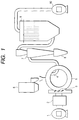
- the apparatus for heat-treating toner particles instantaneously forwarding them in parallel flow with respect to high-velocity air streams may include, but not particularly limited to, a heat treatment apparatus having a loop-type air-stream-heating tube 5 as shown in Fig. 1.
- air fed from a jet blower 1 is heated to a stated temperature and compressed in a hot-air generator 2, and hot air is jetted from an air stream diffuser 3 at a very high velocity.
- a treating material fed from a material feeder 6 is dispersed by the air streams thus formed by jetting and is instantaneously treated (in 0.5 to few seconds) in the loop-type air-stream-heating tube 5.
- An air stream draw outlet 4 is provided on the inside of the loop-type air-stream-heating tube 5, whereby a group of particles standing agglomerated and a group of particles having been dispersed and standing close to single particles are classified by the Coanda effect.
- the particles thus classified are separated from the air streams by means of a cyclone 7 and are discharged from an unloading outlet 8.
- the air streams may be driven off outside the system from an exhaust blower 10, via a bag filter 9.
- Coarse particles coming out of the loop-type air-stream-heating tube 5 may also separately be classified by means of a classifier and may be returned to the material feeder 6 so that only particles within a stated particle size may be fed to the cyclone 7 to obtain the desired toner particles, thus the classification and the heat treatment can also be made continuously.
- the type of such an air stream heat treatment apparatus may be, besides the above loop type, a direct-tube type, a type in which an expanded middle barrel is provided in order to make residence time longer, and a type in which swirling motion is imparted to particles to prevent them from depositing on the bottom of a parallel tube.
- heat treatment tubes of various types may be used. Most preferred is the loop-type air-stream-heating tube 5 of the air stream heat treatment apparatus as shown in Fig. 1.
- the heat treatment by hot-air streams may preferably be made using compressed air heated to form 40 to 150°C, and preferably from 60 to 120°C. If the heating temperature is lower than 40°C, a low drying efficiency may result, and if it is higher than 150°C, the melt-adhesion of toner may occur. Thus, such temperatures are not preferable.
- the above apparatus may specifically include Flash Jet Dryer (manufactured by Seishin Kigyo K.K.) and Flash Dryer (Hosokawa Mikuron K.K.).
- a method of making vacuum heat treatment of the toner particles temperature-raised by the preliminary heat treatment, maintaining the temperature as it is, may include, but not particularly limited to, a method in which a hopper or the like having the function of heat insulation is provided between the step of preliminary heat treatment and the step of vacuum heat treatment.
- the vacuum heat treatment apparatus used in the present invention may be any of apparatus which can effect evacuation and heat treatment and also into which the injection medium described above can be introduced, which may be used without any particular limitations. More preferred is an apparatus so systematized that the temperature of the injection medium can be detected and steam temperature A can be temperature-controlled to " 30°C ⁇ A ⁇ glass transition temperature Tg of toner particles".
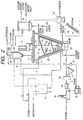
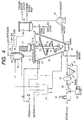
- vacuum heat treatment systems embodied as shown in Figs. 2 to 4 as diagrammatic side views may preferably be used.
- the vacuum heat treatment system shown in Fig. 2 is a system in which toner particles are fed into a reverse-conical vacuum heat treatment container 11 to effect vacuum heat treatment.
- an agitating center shaft 13 which can be driven by a drive motor 12 extends in the direction of a container center longitudinal axis, around which shaft a ribbon blade 14 having a single-spiral structure and on the outside of which connecting arms 16 supported with agitating-blade support arms 15 are provided along the container's wall surface.
- the container is constructed in this way.
- the toner particles can repeatedly be agitated and dispersed while being lifted from the lower part to the upper part, and hence materials can be agitated and mixed in a good efficiency over the whole inside of the container.
- the connecting arms 16 will be described later.
- a material feed opening 17 through which the toner particles are fed
- a bag filter 18 provided in an exhaust line through which the inside of the container is evacuated
- a jacket 20 for controlling the temperature inside the container appropriately so that the toner particles can be heat-treated at a desired temperature. Accordingly, a space is formed between the outer wall of the container and the inner wall of the jacket 20 so that heated steam or cooling water can be passed through this space, and hot water prepared in a hot-water tank 21, steam or cooling water can be fed to the jacket. At the same time, discharge lines for the hot water, steam and cooling water are also provided.
- the inside of the container is evacuated by driving off the steam inside the container from an exhaust vent through the bag filter 18 and the condenser 19 by means of a vacuum pump 22.
- the inside of the bag filter 18 is partitioned with a partition plate 23 into upper and lower two chambers.
- a cylindrical filter cloth 24 is hung on the lower side of the partition plate 23
- an exhaust line connected to the condenser 19 is provided on the upper side of the partition plate 23
- a back-wash nozzle 25 is provided at the center upper position of the filter cloth 24.
- the back-wash nozzle 25 is provided to intermittently spout nitrogen gas, air or the injection medium (preferably heated nitrogen gas, heated air or heated injection medium) to wash the filter cloth 24 by back pressure.
- the steam is commonly often fed from a boiler steam generator, and it is passed through an injection medium flow meter 36 and heated with an injection medium heater 26 (if necessary, saturated water may be removed with a separator 27). Thereafter, the steam is put under reduced pressure approximately up to an operating degree of vacuum in an expansion tank 28.
- One part of the steam is uniformly fed into the apparatus from the bottom part of the apparatus via a dispersion table 29 through which the injection medium is uniformly dispersed.
- the other part is passed through a line the interior of which is entirely hollow and through which the interior of the agitating center shaft 13, then the interior of the agitating-blade support arms 15 and then the interior of the connecting arms 16 communicate with each other, where the steam, the injection medium, is sprayed against the wall surface from a plurality of injection medium jet holes 30 provided in the connecting arms 16.
- the toner particles can be prevented from adhering to the wall surface and the efficiency of heat conduction from the wall surface can be prevented from lowering.
- the temperature of the injection medium expanded in the expansion tank 28 is also detected with an injection medium thermometer 31 and is controlled by an injection medium temperature controller 32.
- the method of changing the injection medium into the state of reduced pressure it is by no means limited to the above method.
- the piping may be made to have a large diameter.
- the injection medium is also jetted from the bottom part, whereby the toner particles can be prevented from causing blocking at the lower part of the apparatus.
- the injection medium is also jetted against the wall surface from the connecting arms 16, whereby the toner particles can be prevented from adhering to, and stagnating on, the wall surface and the particles near to the wall surface can (always) be renewed in a good efficiency.
- the heat conduction efficiency can be improved, but also the heat generated by agitation can simultaneously be prevented from being accumulated in the toner particles held in the container to cause excessive temperature rise (temperature rise to the heating temperature or above); the agitation heat being accumulated as a result of the interception of heat conduction that may otherwise be caused by adhesion or melt-adhesion of toner particles to the wall surface.
- the injection medium fed into the vacuum heat treatment container is passed through the bag filter 18 in the form of steam mixed with volatile components arising from the toner particles, and is condensed and collected in the next condenser 19. Any steam having not been able to be collected is discharged outside the system through a vacuum pump 22.
- the volatile components arising from the toner particles are in such a trace quantity that almost all volatile components can be controlled by the injection medium having been fed.
- the above injection medium, which is condensative is collected in the condenser 19 as water in its greater part, and hence the vacuum pump 22 can be in a small capacity.
- a vacuum heat treatment apparatus 37 shown in Fig. 4 is so constructed that the connecting arms shown in Fig. 2 are not provided and only the ribbon blade having a single-spiral structure is provided.
- the ribbon blade has a larger diameter, having a smaller distance between the wall surface and the ribbon blade. Hence, the effect of lifting toner particles near to the wall surface from the lower part to the upper part is greater.
- Construction of the other parts of the vacuum heat treatment system shown in Fig. 4 is common to that of the vacuum heat treatment system shown in Fig. 2 except that the steam is fed only from the bottom of the apparatus. Accordingly, description on those parts is omitted.
- a vacuum heat treatment apparatus shown in Fig. 3 is provided with a screw-type agitation member 35 connected via a drive arm 34 to a drive motor 12 disposed above a reverse-conical container, and is so constructed that the agitation member is turned being rotated, along the inner periphery of the container.
- the toner particles in the container are repeatedly agitated and dispersed while being lifted from the lower part to the upper part, and hence the toner particles in the container can be agitated and mixed in a good efficiency over the whole inside of the container.
- Construction of the other parts of the vacuum heat treatment system shown in Fig. 3 is common to that of the vacuum heat treatment system shown in Fig. 2 except that the steam is fed only from the bottom of the apparatus. Accordingly, description on those parts is omitted.
- the vacuum heat treatment apparatus to which the production process of the present invention is applicable may specifically include, in addition to the apparatus embodied as shown in Figs. 2 and 3, apparatus such as Nauta Mixer (manufactured by Hosokawa Mikuron K.K.), Ribocone Mixer (manufactured by Ohkawara Seisakuysho K.K.), PV Mixer (manufactured by Shinko Pantec Co.), a vacuum agitation dryer Inox System (manufactured by Pawrex Co.) and SV Mixer (manufactured by Shinko Pantec Co.).
- apparatus such as Nauta Mixer (manufactured by Hosokawa Mikuron K.K.), Ribocone Mixer (manufactured by Ohkawara Seisakuysho K.K.), PV Mixer (manufactured by Shinko Pantec Co.), a vacuum agitation dryer Inox System (manufactured by Pawrex Co.) and SV Mix
- the toner particles according to the present invention may preferably be toner particles having fine particle diameter in order to reproduce finer latent-image dots faithfully, because of a demand for higher image quality.
- toner particles having a weight-average particle diameter of from 4 to 10 ⁇ m and a number-average variation coefficient of 35% or less, as measured with Coulter Counter (manufactured by Coulter Co.), are particularly preferred.
- Toner particles having a weight-average particle diameter smaller than 4 ⁇ m are not preferable because transfer residual toner may greatly occur on photosensitive members or intermediate transfer members because of a poor transfer efficiency. Toner particles having a weight-average particle diameter larger than 10 ⁇ m are also not preferable because the melt-adhesion of toner to constituent members tends to occur, and such a tendency is more intensified if the toner particles have a number-average variation coefficient more than 35%.
- the toner particles may be produced by using a method in which toner particles are directly formed by suspension polymerization or emulsion polymerization as disclosed in Japanese Patent Publications No. 36-10231 and Japanese Patent Applications Laid-open No. 59-53856 and No. 59-61842.
- seed polymerization may also preferably be used in which a monomer is further adsorbed on polymerization particles once obtained and thereafter a polymerization initiator is used to carry out polymerization.
- the polymerizable monomer usable in the present invention may include styrene monomers such as styrene, o-, m- or p-methylstyrene, and m- or p-ethylstyrene; acrylic or methacrylic acid ester monomers such as methyl acrylate or methacrylate, ethyl acrylate or methacrylate, propyl acrylate or methacrylate, butyl acrylate or methacrylate, octyl acrylate or methacrylate, dodecyl acrylate or methacrylate, stearyl acrylate or methacrylate, behenyl acrylate or methacrylate, 2-ethylhexyl acrylate or methacrylate, dimethylaminoethyl acrylate or methacrylate, and diethylaminoethyl acrylate or methacrylate; and butadiene, isoprene,
- a polar resin as an additional shell resin.
- polar resin preferred are copolymers of styrene with acrylic or methacrylic acid, maleic acid copolymers, saturated or unsaturated polyester resins, and epoxy resins.
- the polar resin may particularly preferably be those not containing in the molecule any unsaturated groups that may react with the shell resin or the polymerizable monomer.
- a polar resin having such unsaturated groups is contained, cross-linking reaction with the polymerizable monomer that forms the shell resin layer takes place, so that the shell resin comes to have a too high molecular weight for the toners for forming full-color images and is disadvantageous for color mixture in the case of full-color toners making use of four color toners, a black toner, a magenta toner, a cyan toner and a yellow toner.
- a resin is not preferable.
- the low-softening substance it is preferable to use a compound showing an endothermic maximum peak value at the temperature of from 40 to 90°C as measured by DSC (differential scanning calorimetry) according to ASTM D3418-8. If the maximum peak is at a temperature lower than 40°C, the low-softening substance may have a weak self-cohesive force, resulting in weak high-temperature anti-offset properties. This is undesirable for full-color toners. If on the other hand the maximum peak is at a temperature higher than 90°C, a high fixing temperature may result, making it difficult to smoothen fixed-image surfaces appropriately. This is undesirable in view of color mixing performance.
- the low-softening substance may precipitate mostly during granulation in the aqueous medium to undesirably hinder the reaction system of suspension polymerization.
- usable as the low-softening substance are paraffin waxes, polyolefin waxes, Fischer-Tropsch waxes, amide waxes, higher fatty acids, ester waxes, and derivatives of these or grafted or blocked compounds of these.
- colorant used in the present invention carbon black, magnetic materials, and colorants toned in black by the use of yellow, magenta and cyan colorants shown below may be used as black colorants.
- yellow colorant compounds typified by condensation azo compounds, isoindolinone compounds, anthraquinone compounds, azo metal complexes, methine compounds and allylamide compounds are used. Stated specifically, C.I. Pigment Yellow 12, 13, 14, 15, 17, 62, 74, 83, 93, 94, 95, 109, 110, 111, 128, 129, 147, 168 are preferably used.
- condensation azo compounds As a magenta colorant, condensation azo compounds, diketopyrolopyyrole compounds, anthraquinone compounds, quinacridone compounds, basic dye lake compounds, naphthol compounds, benzimidazolone compounds, thioindigo compounds and perylene compounds are used. Stated specifically, C.I. Pigment Red 2, 3, 5, 6, 7, 23, 48:2, 48:3, 48:4, 57:1, 81:1, 144, 146, 166, 169, 177, 184, 185, 202, 206, 220, 221 and 254 are preferably used.
- cyan colorant copper phthalocyanine compounds and derivatives thereof, anthraquinone compounds and basic dye lake compounds may be used. Stated specifically, C.I. Pigment Blue 1, 7, 15:1, 15:2, 15:3, 15:4, 60, 62, 66 may preferably be used.
- colorants may be used alone, in the form of a mixture, or in the state of a solid solution.
- the colorants used in the present invention are selected taking account of hue angle, chroma, brightness, environmental stability, transparency on OHP films and dispersibility in toner particles.
- the colorant may preferably be used in an an amount of from 1 to 20 parts by weight based on 100 parts by weight of the binder resin.
- a magnetic material is used as the black colorant, it may be used in an amount of from 40 to 150 parts by weight based on 100 parts by weight of the binder resin, which is different from the amount of other colorants.
- charge control agent As a charge control agent which may be used in the present invention, known agents may be used. It is preferable to use charge control agents that are colorless, make toner charging speed higher and are capable of stably maintaining a constant charge quantity. When the toner particles are directly obtained by polymerization in the present invention, charge control agents having no polymerization inhibitory action and being insoluble in the aqueous system are particularly preferred. Specific compounds may include, as negative charge control agents, metal compounds of salicylic acid, naphthoic acid or dicarboxylic acids, polymer type compounds having sulfonic acid or carboxylic acid in the side chain, boron compounds, urea compounds, silicon compounds and carixarene.
- positive charge control agents may include quaternary ammonium salts, polymer type compounds having such a quaternary ammonium salt in the side chain, guanidine compounds, and imidazole compounds. Any of these charge control agent may preferably be used in a amount of from 0.5 to 10 parts by weight based on 100 parts by weight of the binder resin. In the present invention, however, the addition of the charge control agent is not essential. When two-component development is employed, the triboelectric charging with a carrier may be utilized, and also when non-magnetic one-component blade coating development is employed, the triboelectric charging with a blade member or sleeve member may be utilized. In either case, the charge control agent need not necessarily be contained in the toner particles.
- Polymerization initiators usable in the polymerization toner according to the present invention may include, e.g., azo- or diazo-type polymerization initiators such as 2,2'-azobis-(2,4-dimethylvaleronitrile), 2,2'-azobisisobutyronitrile), 1,1'-azobis-(cyclohexane-1-carbonitrile), 2,2'-azobis-4-methoxy-2,4-dimethylvaleronitrile and azobisisobutyronitrile; and peroxide-type polymerization initiators such as benzoyl peroxide, methyl ethyl ketone peroxide, diisopropylperoxy carbonate, cumene hydroperoxide, 2,4-dichlorobenzoyl peroxide and lauroyl peroxide.
- azo- or diazo-type polymerization initiators such as 2,2'-azobis-(2,4-dimethylvaleronitrile), 2,2'-azobisiso
- the polymerization initiator may usually be added in an amount of from 0.5 to 20% by weight based on the weight of the polymerizable monomer, which varies depending on the intended degree of polymerization.
- the polymerization initiator may a little vary in type depending on the methods for polymerization, and may be used alone or in the form of a mixture, with reference to its 10-hour half-life period temperature.
- any known cross-linking agent, chain transfer agent and polymerization inhibitor may further be added.
- the dispersant to be used may include, e.g., as inorganic oxides, tricalcium phosphate, magnesium phosphate, aluminum phosphate, zinc phosphate, calcium carbonate, magnesium carbonate, calcium hydroxide, magnesium hydroxide, aluminum hydroxide, calcium metasilicate, calcium sulfate, barium sulfate, bentonite, silica and alumina.
- Organic compounds may include polyvinyl alcohol, gelatin, methyl cellulose, methyl hydroxypropyl cellulose, ethyl cellulose, carboxymethyl cellulose sodium salt, polyacrylic acid and salts thereof, and starch, which may be used by dispersing them in aqueous phases. Any of the stabilizers may preferably be used in an amount of from 0.2 to 20 parts by weight based on 100 parts by weight of the polymerizable monomer.
- the inorganic compound when the inorganic compound is sued, those commercially available may be used as they are.
- the inorganic compound may be formed in the dispersion medium.
- an aqueous sodium phosphate solution and an aqueous calcium chloride solution may be mixed under high-speed agitation.
- a surface-active agent may be used in combination. This is to accelerate the intended action of the dispersion stabilizer.
- a surface-active agent may include sodium dodecylbenzenesulfonate, sodium tetradecyl sulfate, sodium pentadecyl sulfate, sodium octyl sulfate, sodium oleate, sodium laurate, potassium stearate and calcium oleate.
- the toner particles can concretely be produced by a production process as shown below.
- a release agent comprising the low-softening substance, the colorant, the charge control agent, the polymerization initiator and other additives are added in the polymerizable monomer and are uniformly dissolved or dispersed by means of, e.g., a homogenizer or a ultrasonic dispersion machine to prepare a monomer composition, which is then dispersed in an aqueous phase containing the dispersion stabilizer by means of a conventional stirrer or, e.g., CLEARMIX, a homomixer or a homogenizer.
- Granulation may preferably be carried out controlling the agitation speed and time so that droplets of the monomer composition can have the desired toner particle size.
- the polymerization may be carried out at a polymerization temperature set at 40°C or above, usually from 50 to 90°C. In the latter half of the polymerization, the temperature may be raised, and also the aqueous medium may be removed in part from the reaction system in the latter half of the polymerization reaction or after the reaction has been completed, in order to remove unreacted polymerizable monomers, by-products and so forth which may cause a smell at the time of toner fixing.
- the toner particles formed are collected by washing and filtration, followed by drying by the drying method in the present invention.
- water may usually be used as the dispersion medium preferably in an amount of from 300 to 3,000 parts by weight based on 100 parts by weight of the monomer composition.
- the Tg of the toner particles thus obtained may preferably be regulated in the range of from 40 to 75°C. If it is lower than 40°C, a problem may occur in respect of storage stability of toners and running stability of developers. If on the other hand it is higher than 75°C, a fixing point may be raised, and hence, especially in the case of full-color toners, color mixture of respective color toners may be so insufficient as to make color reproducibility poor and also to greatly lower the transparency of OHP images, thus such Tg is not preferable in view of high image quality.
- the C.I. Pigment Blue 15:3, the salicylic acid metal compound and 100 parts by weight of the styrene monomer were dispersed for 3 hours by means of an attritor (manufactured by Mitsui Miike Engineering Corporation), obtaining a colorant dispersion.
- the remaining materials of the above formulation were all added, and these were heated to 60°C to dissolve and mix them for 30 minutes.
- 10 parts by weight of a polymerization initiator 2,2'-azobis(2,4-dimethylvaleronitrile) was dissolved.
- a polymerizable monomer composition was prepared.
- the polymerizable monomer composition was introduced into the above aqueous medium to carry out granulation for 15 minutes while maintaining the number of revolutions. Thereafter, the high-speed stirrer was changed to a stirrer having propeller stirring blades, the internal temperature was raised to 80°C, and the polymerization was continued for 10 hours at 50 r.p.m. Then, distillation was carried out for 4 hours under the conditions of an internal temperature of 80°C and an in-system pressure of 47.3 kPa.
- wet colored polymer particles having a water content of 15% and a weight-average particle diameter of 7.8 ⁇ m.
- the polymerizable monomers remaining unreacted in the toner particles were in the amount of 850 ppm.
- the wet colored polymer particles thus obtained were treated, as preliminary heat treatment, by means of an air stream heat treatment apparatus whose air stream heat treatment section is embodied in the same manner as shown in Fig. 1 and has a piping diameter of 0.1016 m. Thereafter, the volatile components were removed by means of the vacuum heat treatment system embodied as shown in Fig. 2, having an operating capacity of 100 liters.
- the air stream heat treatment as preliminary heat treatment was made under the conditions of hot-air-stream temperature: 80°C; air feed rate: 480 m 3 /hr; and toner particle feed rate: 70 kg/hr. After the treatment, the water content was 0.22%, and the unreacted polymerizable monomers were in the amount of 840 ppm. Also, at this stage the glass transition temperature Tg of the toner particles was measured and found to be 62°C.
- the vacuum heat treatment was made under the conditions of heating temperature: 45°C; degree of vacuum at the time of treatment: 3 kPa; and charge weight: 30 kg.
- High-humidity air having a temperature of 45°C, an enthalpy of about 14,000 kJ/kg (dry air) and a water content of about 90% was so introduced as to be in a feed flow rate of 0.13 m 3 /hr ⁇ kg (toner particles).
- the material temperature of toner particles was 22°C.
- the vacuum heat treatment was made under the above conditions for 3 hours.
- toner particles discharged after treatment were in a 90% yield based on the amount charged at the time of the vacuum heat treatment.
- Toner particles obtained in the same manner as in Example 1 up to the preliminary heat treatment were treated by means of a vacuum heat treatment system embodied in the same manner as shown in Fig. 2.
- the vacuum heat treatment was made under the conditions of heating temperature: 45°C; degree of vacuum at the time of treatment: 3 kPa; and charge weight: 30 kg.
- High-humidity air having a temperature of 45°C, an enthalpy of about 2,500 kJ/kg (dry air) and a water content of about 60% was so introduced as to be in a feed flow rate of 0.13 m 3 /hr ⁇ kg (toner particles).
- the material temperature of toner particles was 22°C.
- the vacuum heat treatment was made under the above conditions for 3 hours.
- the unreacted polymerizable monomers were in the amount of 95 ppm. Also, the toner particles discharged after treatment were in a 89% yield.
- Example 1 the same hydrophobic silica as that used in Example 1 was also externally added in the same way to produce a developer, and image reproduction was also tested in the same manner as in Example 1.
- image reproduction tested in the environment of 30°C/80%RH solid-image blank areas caused by poor transfer slightly occurred on about the 9,500th sheet and following sheets.
- Toner particles obtained in the same manner as in Example 1 up to the preliminary heat treatment were treated by means of a vacuum heat treatment system embodied in the same manner as that shown in Fig. 2.
- the vacuum heat treatment was made under conditions of heating temperature: 45°C; degree of vacuum at the time of treatment: 3 kPa; and charge. weight: 30 kg.
- Superheated steam having a temperature of 45°C and a vapor pressure of 3 kPa was so introduced as to be in a steam feed flow rate of 0.13 m 3 /hr ⁇ kg (toner particles).
- the material temperature of toner particles was 22°C.
- the vacuum heat treatment was made under the above conditions for 3 hours.
- the unreacted polymerizable monomers were in the amount of 25 ppm. Also, the toner particles discharged after treatment were in a 90% yield.
- Example 1 To the toner particles thus obtained, the same hydrophobic silica as that used in Example 1 was also externally added in the same way to produce a developer, and image reproduction was also tested in the same manner as in Example 1. As the result, good results were obtained like those in Example 1.
- Toner particles obtained in the same manner as in Example 1 up to the preliminary heat treatment were treated by means of a vacuum heat treatment apparatus embodied in the same manner as that shown in Fig. 3, having an operating capacity of 100 liters.
- the vacuum heat treatment was made for 3 hours under the same conditions as those in Example 3.
- the material temperature of toner particles was 22°C.
- the unreacted polymerizable monomers were in the amount of 40 ppm. Also, the toner particles discharged after treatment were in a 70% yield.
- Example 1 To the toner particles thus obtained, the same hydrophobic silica as that used in Example 1 was also externally added in the same way to produce a developer, and image reproduction was also tested in the same manner as in Example 1. As a result, good results were obtained like those in Example 1.
- Toner particles obtained in the same manner as in Example 1 up to the preliminary heat treatment were treated by means of a vacuum heat treatment apparatus embodied in the same manner as that shown in Fig. 4, having an operating capacity of 100 liters.
- the vacuum heat treatment was made for 3 hours under the same conditions as those in Example 3.
- the material temperature of toner particles was 22°C.
- the unreacted polymerizable monomers were in the amount of 25 ppm. Also, the toner particles discharged after treatment were in a 83% yield.
- Example 1 To the toner particles thus obtained, the same hydrophobic silica as that used in Example 1 was also externally added in the same way to produce a developer, and image reproduction was also tested in the same manner as in Example 1. As the result, good results were obtained like those in Example 1.
- Vacuum heat treatment was made by means of the same apparatus and under the same heat treatment conditions as those in Example 3 except for using a disintegrated product comprised of toner particles having a water content of 2.8% after the preliminary heat treatment.
- the material temperature of toner particles was 20°C.
- the unreacted polymerizable monomers were in the amount of 50 ppm. Also, the toner particles discharged after treatment were in a 88% yield.
- Example 1 To the toner particles thus obtained, the same hydrophobic silica as that used in Example 1 was also externally added in the same way to produce a developer, and image reproduction was also tested in the same manner as in Example 1. As the result, good results of image reproduction were obtained like those in Example 1.
- Toner particles obtained in the same manner as in Example 1 up to the step of disintegration were treated, as preliminary heat treatment, by means of the same heat treatment system and under the same conditions as those in Example 3.
- the toner particles having a water content of 0.22%, containing residual unreacted polymerizable monomers in the amount of 840 ppm, having a toner particle glass transition temperature Tg of 62°C and having a particle temperature of 40°C immediately after the treatment were treated while maintaining that temperature, by means of the same vacuum heat treatment apparatus and under the same conditions as those in Example 3 for 3 hours.
- the unreacted polymerizable monomers were in the amount less than 20 ppm, which was the measurement limit.
- the toner particles discharged after treatment were in a 91% yield.
- Example 1 To the toner particles thus obtained, the same hydrophobic silica as that used in Example 1 was also externally added to produce a developer, and image reproduction was also tested in the same manner as in Example 1. As a result, good results were obtained like those in Example 1.
- Toner particles obtained in the same manner as in Example 1 up to the preliminary heat treatment were treated by means of a vacuum heat treatment system embodied in the same manner as that shown in Fig. 2.
- the vacuum heat treatment was made under the conditions of heating temperature: 45°C; degree of vacuum at the time of treatment: 3 kPa; and feed: 30 kg.
- Superheated steam having a temperature of 45°C and a vapor pressure of 3 kPa was so introduced as to be in a steam feed flow rate of 0.029 m 3 /hr ⁇ kg (toner particles).
- the material temperature of toner particles was 22°C.
- the vacuum heat treatment was made under the above conditions for 3 hours.
- the unreacted polymerizable monomers were in the amount of 75 ppm. Also, the toner particles discharged after treatment were in a 93% yield.
- Example 1 To the toner particles thus obtained, the same hydrophobic silica as that used in Example 1 was also externally added in the same way to produce a developer, and image reproduction was also tested in the same manner as in Example 1. As a result, good results were obtained like those in Example 1.
- Example 2 Using the toner particles having been subjected to preliminary heat treatment in Example 1, having a water content of 0.22% and containing residual unreacted polymerizable monomers in the amount of 840 ppm, a developer was produced by blending 1.5 parts by weight of the hydrophobic silica as used in Example 1 with 100 parts by weight of the toner particles, and image reproduction was also tested in the same manner as in Example 1. As a result, solid-image blank areas caused by poor transfer occurred on about the 500th sheet and following sheets, and a decrease in image density was seen on about the 700th sheet and following sheets. Also, in the image reproduction tested in an environment of 30°C/80%RH, faulty images due to the melt-adhesion of toner to the photosensitive member appeared on about the 1,000th sheet.
- Example 1 Treatment was made using the same toner particles as those of Example 1 by means of the same preliminary heat treatment apparatus and vacuum heat treatment apparatus and under the same conditions as those in Example 3, except that low-humidity air obtained by heating air of 30°C and 80%RH under reduced pressure and to 45°C to have an enthalpy of about 100 kJ/kg (dry air) and a water content of about 5% was introduced into the vacuum heat treatment apparatus.
- low-humidity air obtained by heating air of 30°C and 80%RH under reduced pressure and to 45°C to have an enthalpy of about 100 kJ/kg (dry air) and a water content of about 5% was introduced into the vacuum heat treatment apparatus.
- the material temperature of toner particles was 22°C.
- the unreacted polymerizable monomers were in the amount of 250 ppm.
- the toner particles discharged after treatment were in a 90% yield.
- a vacuum pump having a larger capacity than the vacuum pump used in Example 3 was necessary in order to keep the same degree of vacuum as that in Example 3.
- Example 2 To the toner particles thus obtained, the same hydrophobic silica as that used in Example 1 was externally added to produce a developer, and image reproduction was also tested in the same manner as in Example 1. As a result, solid-image blank areas caused by poor transfer occurred on about the 2,500th sheet and following sheets, and a decrease in image density was seen on about the 3,000th sheet and following sheets.
- Treatment was made using the same toner particles (Tg: 62°C) as those of Example 1 by means of the same preliminary heat treatment apparatus and vacuum heat treatment apparatus and under the same conditions as those in Example 3, except that superheated steam with a temperature of 70°C and a vapor pressure of 3 kPa was introduced into the vacuum heat treatment apparatus.
- the material temperature of toner particles was 22°C.
- Treatment was made using the same toner particles as those of Example 1 by means of the same preliminary heat treatment apparatus and vacuum heat treatment apparatus and under the same conditions as those in Example 3, except that the feed flow rate of the superheated steam was changed to 0.50 m 3 /hr ⁇ kg (toner particles), the degree of vacuum at the time of treatment to 5 kPa, and the vapor pressure of the superheated steam to be fed to 5 kPa.
- the material temperature of toner particles was 22°C.
- the water content of toner particles was 0.3%, and the unreacted polymerizable monomers were in the amount of 90 ppm. Also, the toner particles discharged after treatment were in a 85% yield.
- Example 2 To the toner particles thus obtained, the same hydrophobic silica as that used in Example 1 was also externally added to produce a developer, and image reproduction was also tested in the same manner as in Example 1. As a result, in the image reproduction tested in the environment of 30°C/80%RH, solid-image blank areas caused by poor transfer slightly occurred on about the 9,000th sheet.
- Example 1 Treatment was made using the same toner particles as those of Example 1 by means of the same preliminary heat treatment apparatus and vacuum heat treatment apparatus and under the same conditions as those in Example 3, except that the feed flow rate of the superheated steam was changed to 0.01 m 3 /hr ⁇ kg (toner particles).
- the material temperature of toner particles was 22°C.
- the unreacted polymerizable monomers were in the amount of 100 ppm. Also, the toner particles discharged after treatment were in a 94% yield.
- Example 2 To the toner particles thus obtained, the same hydrophobic silica as that used in Example 1 was also externally added to produce a developer, and image reproduction was also tested in the same manner as in Example 1. As a result, in the image reproduction tested in the environment of 30°C/80%RH, solid-image blank areas caused by poor transfer slightly occurred on about the 8,000th sheet.
- Example 1 Treatment was made using the same toner particles as those of Example 1 by means of the same preliminary heat treatment apparatus and vacuum heat treatment apparatus and under the same conditions as those in Example 3, except that the degree of vacuum at the time of treatment was changed to 4.2 kPa and saturated steam having a temperature of about 30°C was introduced into the vacuum heat treatment apparatus. Also, at the time the vacuum heat treatment was started, the material temperature of toner particles was 22°C.
- the water content of toner particles was 0.5%, and the unreacted polymerizable monomers were in the amount of 95 ppm. Also, the toner particles discharged after treatment were in a 88% yield.
- Example 1 To the toner particles thus obtained, the same hydrophobic silica as that used in Example 1 was also externally added to produce a developer, and image reproduction was also tested in the same manner as in Example 1. As a result, in the image reproduction tested in the environment of 30°C/80%RH, solid-image blank areas caused by poor transfer slightly occurred on about the 8,500th sheet.
- a process for producing toner particles comprising polymerizing in an aqueous dispersion medium a polymerizable monomer composition containing at least a polymerizable monomer and a colorant, to form colored polymer particles, followed by washing and then dehydration to obtain toner particles, and feeding the toner particles into an inside-evacuatable and heatable container to make vacuum heat treatment while introducing into the container an injection medium having a temperature lower than glass transition temperature Tg of the toner particles and selected from the group consisting of i) saturated steam, ii) superheated steam and iii) high-humidity air having an enthalpy of 2,500 kJ/kg (dry air) or higher. Also disclosed is a system which carries out the above process.
Landscapes
- Physics & Mathematics (AREA)
- General Physics & Mathematics (AREA)
- Developing Agents For Electrophotography (AREA)
Abstract
Description
30°C < A < glass transition temperature Tg of toner particles.
2,2'-azobis-(2,4-dimethylvaleronitrile), 2,2'-azobisisobutyronitrile),
1,1'-azobis-(cyclohexane-1-carbonitrile), 2,2'-azobis-4-methoxy-2,4-dimethylvaleronitrile and azobisisobutyronitrile; and peroxide-type polymerization initiators such as benzoyl peroxide, methyl ethyl ketone peroxide, diisopropylperoxy carbonate, cumene hydroperoxide, 2,4-dichlorobenzoyl peroxide and lauroyl peroxide. The polymerization initiator may usually be added in an amount of from 0.5 to 20% by weight based on the weight of the polymerizable monomer, which varies depending on the intended degree of polymerization. The polymerization initiator may a little vary in type depending on the methods for polymerization, and may be used alone or in the form of a mixture, with reference to its 10-hour half-life period temperature.
- GC conditions -
HEWLETT PACKARD HP6890-series capillary column (25 m x 0.2 mm, HP-INNOWAX, layer thickness: 0.4 µm)
| (by weight) | |
| Styrene monomer | 165 parts |
| n- | 35 parts |
| C.I. Pigment Blue 15:3 | 10 parts |
| Saturated | 20 parts |
| Salicylic acid metal compound | 3 |
| Ester wax | |
| 25 parts |
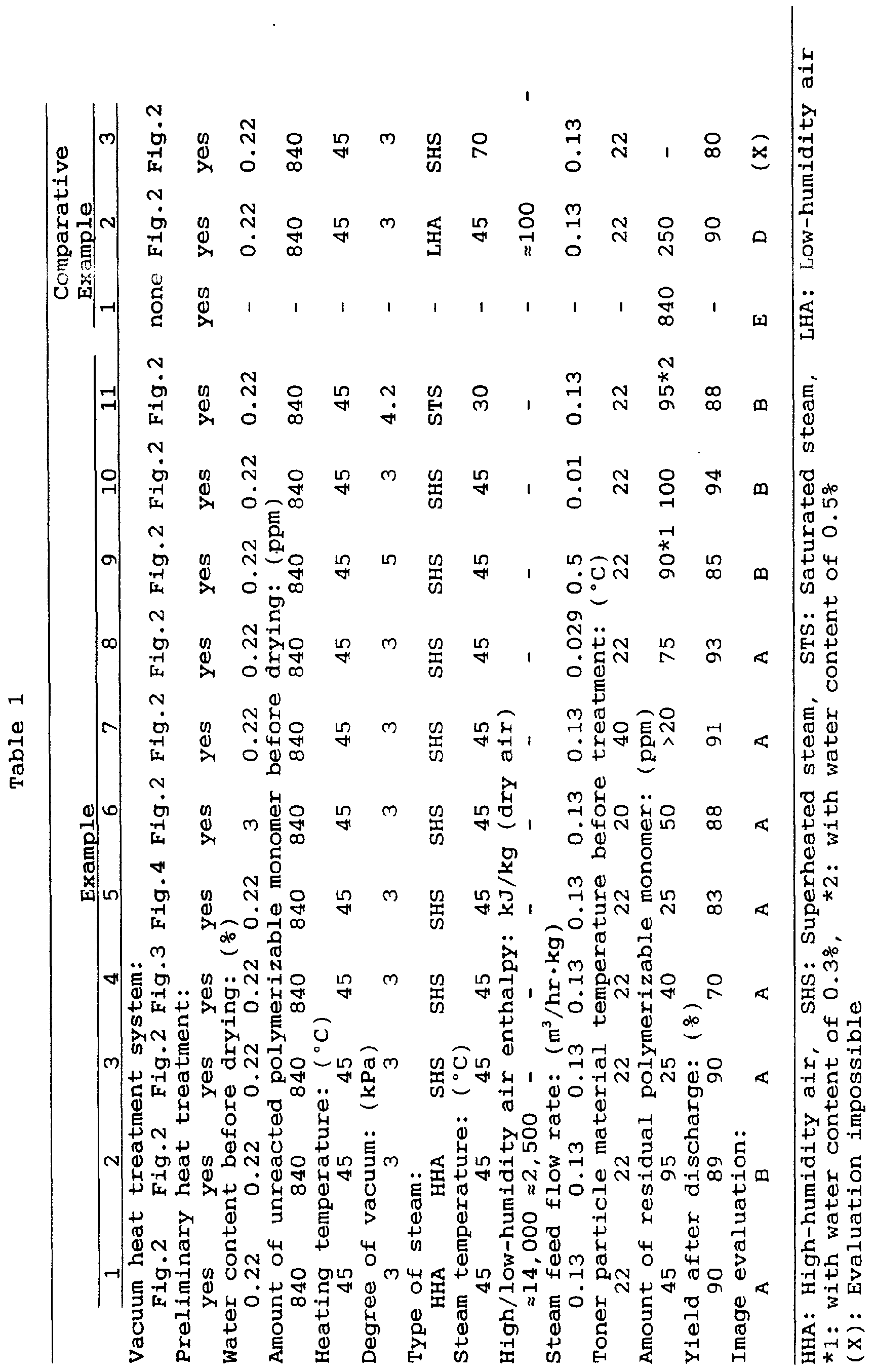
Claims (20)
- A process for producing toner particles, comprising:polymerizing in an aqueous dispersion medium a polymerizable monomer composition containing at least a polymerizable monomer and a colorant, to form colored polymer particles, followed by washing and then dehydration to obtain toner particles; andfeeding the toner particles into an evacuatable and heatable container to carry out vacuum heat treatment while introducing into the container an injection medium having a temperature lower than glass transition temperature Tg of the toner particles and selected from the group consisting of i) saturated steam, ii) superheated steam and iii) high-humidity air having an enthalpy of 2,500 kJ/kg (dry air) or higher.
- The process according to claim 1, wherein said high-humidity air has a water content of 50% or more.
- The process according to claim 1, wherein said high-humidity air has a water content of 60% or more.
- The process according to claim 1, wherein said high-humidity air has an enthalpy of 6,500 kJ/kg (dry air) or higher.
- The process according to claim 1, wherein said high-humidity air has a water content of 50% or more and an enthalpy of 6,500 kJ/kg (dry air) or higher.
- The process according to claim 1, wherein said high-humidity air has a water content of 60% or more and an enthalpy of 6,500 kJ/kg (dry air) or higher.
- The process according to claim 1, wherein said high-humidity air has a water content of 80% or more and an enthalpy of 6,500 kJ/kg (dry air) or higher.
- The process according to claim 1, wherein said injection medium is fed at a flow rate of from 0.01 m3/hr·kg to 0.5 m3/hr·kg (toner particles).
- The process according to claim 1, wherein said injection medium is fed at a flow rate of from 0.04 m3/hr·kg to 0.27 m3/hr·kg (toner particles).
- The process according to claim 1, wherein said vacuum heat treatment is the step of removing a volatile component remaining in the toner particles.
- The process according to claim 10, wherein said volatile component contains at least an unreacted polymerizable monomer.
- The process according to claim 1, wherein said vacuum heat treatment is the step of removing a volatile component remaining in the toner particles, and the treatment is made until the unreacted polymerizable monomer is reduced to 100 ppm.
- The process according to claim 10, wherein said volatile component contains at least a decomposition product of a polymerization initiator.
- The process according to claim 1, wherein said toner particles fed for the vacuum heat treatment has a water content of 3.0% or less.
- The process according to claim 1, wherein said toner particles fed for the vacuum heat treatment has a water content of 1.0% or less.
- The process according to claim 1, wherein preliminary heat treatment is made before the vacuum heat treatment to remove the aqueous dispersion medium.
- The process according to claim 16, wherein said preliminary heat treatment is the step of heat-treating wet colored polymer particles while dispersing the particles in high-velocity hot-air streams and simultaneously forwarding the particles in parallel flow with respect to that streams; said wet colored polymer particles being capable of being continuously fed into the high-velocity hot-air streams.
- The process according to claim 16, wherein in said preliminary heat treatment, after or at the same time the aqueous dispersion medium has been removed, said colored polymer particles are made to have a material temperature of from 30°C to 60°C, and are subjected to the vacuum heat treatment as the particles are maintained at that temperature.
- A system for producing toner particles, which comprises an apparatus comprising:a means for polymerizing in an aqueous dispersion medium a polymerizable monomer composition containing at least a polymerizable monomer and a colorant, to form colored polymer particles, followed by washing and then dehydration to obtain toner particles; anda means for feeding the toner particles into an inside-evacuatable and heatable container to carry out vacuum heat treatment while introducing into the container an injection medium selected from the group consisting of i) saturated steam, ii) superheated steam and iii) high-humidity air having an enthalpy of 2,500 kJ/kg (dry air) or higher;said vacuum heat treatment being performed while detecting temperature A of said injection medium and controlling the temperature A so as to fulfill the following condition.
30°C < A < glass transition temperature Tg of toner particles - The system according to claim 19, wherein a condenser is provided in the course of a line through which a volatile component generated as a result of said vacuum heat treatment is discharged, and collects steam content as water.
Applications Claiming Priority (2)
| Application Number | Priority Date | Filing Date | Title |
|---|---|---|---|
| JP2000161363 | 2000-05-31 | ||
| JP2000161363 | 2000-05-31 |
Publications (2)
| Publication Number | Publication Date |
|---|---|
| EP1160630A1 true EP1160630A1 (en) | 2001-12-05 |
| EP1160630B1 EP1160630B1 (en) | 2009-02-18 |
Family
ID=18665395
Family Applications (1)
| Application Number | Title | Priority Date | Filing Date |
|---|---|---|---|
| EP01113176A Expired - Lifetime EP1160630B1 (en) | 2000-05-31 | 2001-05-30 | Process and system for producing toner particles |
Country Status (3)
| Country | Link |
|---|---|
| US (1) | US6627374B2 (en) |
| EP (1) | EP1160630B1 (en) |
| DE (1) | DE60137666D1 (en) |
Cited By (3)
| Publication number | Priority date | Publication date | Assignee | Title |
|---|---|---|---|---|
| EP1369748A3 (en) * | 2002-06-03 | 2005-02-02 | Canon Kabushiki Kaisha | Process for producing toner particles, and toner |
| EP2056167A1 (en) * | 2007-10-29 | 2009-05-06 | Samsung Electronics Co., Ltd. | Environment-friendly toner for electrophotography and method of preparing the same |
| CN110227384A (en) * | 2019-07-17 | 2019-09-13 | 安徽奇卓粉体设备有限公司 | A kind of spiral ribbon mixer |
Families Citing this family (18)
| Publication number | Priority date | Publication date | Assignee | Title |
|---|---|---|---|---|
| CN100474133C (en) * | 2002-05-22 | 2009-04-01 | 柯尼卡株式会社 | Toner for static charge image developing and preparing method thereof, and image forming method using the same |
| US6961531B2 (en) * | 2002-10-17 | 2005-11-01 | Hewlett-Packard Development Company, L.P. | Refillable print cartridge and method of refilling |
| US7611816B2 (en) * | 2005-07-29 | 2009-11-03 | Canon Kabushiki Kaisha | Process for producing toner particles |
| JP5014015B2 (en) * | 2007-08-07 | 2012-08-29 | 株式会社リコー | Toner for electrophotography and method for producing the same |
| WO2012173263A1 (en) * | 2011-06-13 | 2012-12-20 | Canon Kabushiki Kaisha | Heat treating apparatus for powder particles and method of producing toner |
| US8940467B2 (en) | 2012-02-29 | 2015-01-27 | Canon Kabushiki Kaisha | Toner |
| JP5971985B2 (en) | 2012-02-29 | 2016-08-17 | キヤノン株式会社 | Toner production method |
| JP7062373B2 (en) | 2016-04-19 | 2022-05-06 | キヤノン株式会社 | toner |
| US10635011B2 (en) | 2018-04-27 | 2020-04-28 | Canon Kabushiki Kaisha | Toner |
| US11112712B2 (en) | 2019-03-15 | 2021-09-07 | Canon Kabushiki Kaisha | Toner |
| JP7301637B2 (en) | 2019-07-02 | 2023-07-03 | キヤノン株式会社 | toner |
| SE543689C2 (en) * | 2019-10-04 | 2021-06-08 | Mimbly Ab | Improved filter assembly with self-cleaning |
| JP7532109B2 (en) | 2020-06-22 | 2024-08-13 | キヤノン株式会社 | toner |
| CN111916656B (en) * | 2020-07-21 | 2025-05-13 | 合肥通用机械研究院有限公司 | An integrated production system for ternary materials |
| JP7784260B2 (en) | 2020-10-16 | 2025-12-11 | キヤノン株式会社 | Toner, external additives for toner, and fine particles |
| JP7604165B2 (en) | 2020-10-16 | 2024-12-23 | キヤノン株式会社 | toner |
| JP7608246B2 (en) | 2021-04-06 | 2025-01-06 | キヤノン株式会社 | Electrophotographic device, process cartridge |
| JP7703391B2 (en) * | 2021-08-02 | 2025-07-07 | キヤノン株式会社 | Air flow drying device and method for producing particles |
Citations (2)
| Publication number | Priority date | Publication date | Assignee | Title |
|---|---|---|---|---|
| EP0982635A2 (en) * | 1998-08-25 | 2000-03-01 | Canon Kabushiki Kaisha | Process for producing toner |
| JP2000143721A (en) * | 1998-11-06 | 2000-05-26 | Sanyo Chem Ind Ltd | Removal of residual monomer from resin by evaporation |
Family Cites Families (10)
| Publication number | Priority date | Publication date | Assignee | Title |
|---|---|---|---|---|
| US2297691A (en) | 1939-04-04 | 1942-10-06 | Chester F Carlson | Electrophotography |
| JPS5324197B2 (en) | 1974-07-30 | 1978-07-19 | ||
| US3988235A (en) | 1974-07-26 | 1976-10-26 | Kureha Kagaku Kogyo Kabushiki Kaisha | Vertical diaphragm type electrolytic apparatus for caustic soda production |
| JPS5953856A (en) | 1982-09-21 | 1984-03-28 | Canon Inc | Toner manufacturing method |
| JPS5961842A (en) | 1982-09-30 | 1984-04-09 | Canon Inc | Method for manufacturing magnetic toner |
| US5529873A (en) | 1993-04-20 | 1996-06-25 | Canon Kabushiki Kaisha | Toner for developing electrostatic images and process for producing toner |
| JP2984540B2 (en) | 1993-04-20 | 1999-11-29 | キヤノン株式会社 | Electrostatic image developing toner and method of manufacturing toner |
| JP3198846B2 (en) | 1994-12-07 | 2001-08-13 | 日本ゼオン株式会社 | Method for producing polymerized toner |
| JP3473667B2 (en) | 1997-01-23 | 2003-12-08 | 日本ゼオン株式会社 | Manufacturing method of toner |
| US5916726A (en) | 1997-02-10 | 1999-06-29 | Canon Kabushiki Kaisha | Process for producing toner for developing electrostatic images |
-
2001
- 2001-05-29 US US09/865,700 patent/US6627374B2/en not_active Expired - Lifetime
- 2001-05-30 EP EP01113176A patent/EP1160630B1/en not_active Expired - Lifetime
- 2001-05-30 DE DE60137666T patent/DE60137666D1/en not_active Expired - Lifetime
Patent Citations (2)
| Publication number | Priority date | Publication date | Assignee | Title |
|---|---|---|---|---|
| EP0982635A2 (en) * | 1998-08-25 | 2000-03-01 | Canon Kabushiki Kaisha | Process for producing toner |
| JP2000143721A (en) * | 1998-11-06 | 2000-05-26 | Sanyo Chem Ind Ltd | Removal of residual monomer from resin by evaporation |
Non-Patent Citations (1)
| Title |
|---|
| DATABASE WPI Section Ch Week 200040, Derwent World Patents Index; Class A10, AN 2000-454404, XP002176727 * |
Cited By (3)
| Publication number | Priority date | Publication date | Assignee | Title |
|---|---|---|---|---|
| EP1369748A3 (en) * | 2002-06-03 | 2005-02-02 | Canon Kabushiki Kaisha | Process for producing toner particles, and toner |
| EP2056167A1 (en) * | 2007-10-29 | 2009-05-06 | Samsung Electronics Co., Ltd. | Environment-friendly toner for electrophotography and method of preparing the same |
| CN110227384A (en) * | 2019-07-17 | 2019-09-13 | 安徽奇卓粉体设备有限公司 | A kind of spiral ribbon mixer |
Also Published As
| Publication number | Publication date |
|---|---|
| DE60137666D1 (en) | 2009-04-02 |
| US6627374B2 (en) | 2003-09-30 |
| EP1160630B1 (en) | 2009-02-18 |
| US20020031714A1 (en) | 2002-03-14 |
Similar Documents
| Publication | Publication Date | Title |
|---|---|---|
| US6627374B2 (en) | Process and system for producing toner particles | |
| US5712072A (en) | Toner for developing electrostatic image | |
| EP0982635B1 (en) | Process for producing toner | |
| EP0999476B1 (en) | Process for producing toner | |
| JP3957916B2 (en) | Toner manufacturing method | |
| JP3913005B2 (en) | Toner particle manufacturing method and manufacturing system | |
| JP2004226445A (en) | Manufacturing method of toner | |
| JP3748498B2 (en) | Toner production method | |
| EP0858007B1 (en) | Process for producing toner for developing electrostatic images | |
| JP3919498B2 (en) | Electrostatic charge image developing toner manufacturing method and electrostatic charge image developing toner manufacturing apparatus | |
| JP2003223014A (en) | Manufacturing method of toner | |
| JPH11344831A (en) | Manufacturing method of toner | |
| JP3984755B2 (en) | Toner production method | |
| JP3437433B2 (en) | Method for producing toner for developing electrostatic images | |
| JP4478276B2 (en) | Toner production method | |
| JP2003167379A (en) | Method for producing toner particles | |
| JP2004258589A (en) | Method for producing toner particles | |
| JP4508408B2 (en) | Method for producing toner particles | |
| JP3870007B2 (en) | Toner manufacturing method and manufacturing apparatus | |
| JP4378032B2 (en) | Toner production method and electrostatic image developing toner | |
| JP3576801B2 (en) | Manufacturing method of toner | |
| JP2000081725A (en) | Manufacturing method of toner | |
| JPH11352721A (en) | Method for producing toner for developing electrostatic images | |
| JP2002086089A (en) | Apparatus for manufacturing toner, method for cleaning the apparatus, and method for manufacturing toner | |
| JP3789094B2 (en) | Toner production method |
Legal Events
| Date | Code | Title | Description |
|---|---|---|---|
| PUAI | Public reference made under article 153(3) epc to a published international application that has entered the european phase |
Free format text: ORIGINAL CODE: 0009012 |
|
| AK | Designated contracting states |
Kind code of ref document: A1 Designated state(s): AT BE CH CY DE DK ES FI FR GB GR IE IT LI LU MC NL PT SE TR Kind code of ref document: A1 Designated state(s): DE FR GB IT |
|
| AX | Request for extension of the european patent |
Free format text: AL;LT;LV;MK;RO;SI |
|
| 17P | Request for examination filed |
Effective date: 20020418 |
|
| AKX | Designation fees paid |
Free format text: DE FR GB IT |
|
| 17Q | First examination report despatched |
Effective date: 20061117 |
|
| 17Q | First examination report despatched |
Effective date: 20061117 |
|
| 17Q | First examination report despatched |
Effective date: 20061117 |
|
| GRAP | Despatch of communication of intention to grant a patent |
Free format text: ORIGINAL CODE: EPIDOSNIGR1 |
|
| GRAS | Grant fee paid |
Free format text: ORIGINAL CODE: EPIDOSNIGR3 |
|
| GRAA | (expected) grant |
Free format text: ORIGINAL CODE: 0009210 |
|
| AK | Designated contracting states |
Kind code of ref document: B1 Designated state(s): DE FR GB IT |
|
| REG | Reference to a national code |
Ref country code: GB Ref legal event code: FG4D |
|
| REF | Corresponds to: |
Ref document number: 60137666 Country of ref document: DE Date of ref document: 20090402 Kind code of ref document: P |
|
| PLBE | No opposition filed within time limit |
Free format text: ORIGINAL CODE: 0009261 |
|
| STAA | Information on the status of an ep patent application or granted ep patent |
Free format text: STATUS: NO OPPOSITION FILED WITHIN TIME LIMIT |
|
| 26N | No opposition filed |
Effective date: 20091119 |
|
| PGFP | Annual fee paid to national office [announced via postgrant information from national office to epo] |
Ref country code: IT Payment date: 20100525 Year of fee payment: 10 |
|
| PG25 | Lapsed in a contracting state [announced via postgrant information from national office to epo] |
Ref country code: IT Free format text: LAPSE BECAUSE OF NON-PAYMENT OF DUE FEES Effective date: 20110530 |
|
| PGFP | Annual fee paid to national office [announced via postgrant information from national office to epo] |
Ref country code: GB Payment date: 20140523 Year of fee payment: 14 |
|
| GBPC | Gb: european patent ceased through non-payment of renewal fee |
Effective date: 20150530 |
|
| PG25 | Lapsed in a contracting state [announced via postgrant information from national office to epo] |
Ref country code: GB Free format text: LAPSE BECAUSE OF NON-PAYMENT OF DUE FEES Effective date: 20150530 |
|
| REG | Reference to a national code |
Ref country code: FR Ref legal event code: PLFP Year of fee payment: 16 |
|
| REG | Reference to a national code |
Ref country code: FR Ref legal event code: PLFP Year of fee payment: 17 |
|
| PGFP | Annual fee paid to national office [announced via postgrant information from national office to epo] |
Ref country code: DE Payment date: 20170531 Year of fee payment: 17 Ref country code: FR Payment date: 20170524 Year of fee payment: 17 |
|
| REG | Reference to a national code |
Ref country code: DE Ref legal event code: R119 Ref document number: 60137666 Country of ref document: DE |
|
| PG25 | Lapsed in a contracting state [announced via postgrant information from national office to epo] |
Ref country code: DE Free format text: LAPSE BECAUSE OF NON-PAYMENT OF DUE FEES Effective date: 20181201 Ref country code: FR Free format text: LAPSE BECAUSE OF NON-PAYMENT OF DUE FEES Effective date: 20180531 |