EP1160624A2 - Pellicle and method of using the same - Google Patents
Pellicle and method of using the same Download PDFInfo
- Publication number
- EP1160624A2 EP1160624A2 EP01104418A EP01104418A EP1160624A2 EP 1160624 A2 EP1160624 A2 EP 1160624A2 EP 01104418 A EP01104418 A EP 01104418A EP 01104418 A EP01104418 A EP 01104418A EP 1160624 A2 EP1160624 A2 EP 1160624A2
- Authority
- EP
- European Patent Office
- Prior art keywords
- pellicle
- light
- membrane
- adhesive
- light shielding
- Prior art date
- Legal status (The legal status is an assumption and is not a legal conclusion. Google has not performed a legal analysis and makes no representation as to the accuracy of the status listed.)
- Granted
Links
Images

Classifications
-
- G—PHYSICS
- G03—PHOTOGRAPHY; CINEMATOGRAPHY; ANALOGOUS TECHNIQUES USING WAVES OTHER THAN OPTICAL WAVES; ELECTROGRAPHY; HOLOGRAPHY
- G03F—PHOTOMECHANICAL PRODUCTION OF TEXTURED OR PATTERNED SURFACES, e.g. FOR PRINTING, FOR PROCESSING OF SEMICONDUCTOR DEVICES; MATERIALS THEREFOR; ORIGINALS THEREFOR; APPARATUS SPECIALLY ADAPTED THEREFOR
- G03F1/00—Originals for photomechanical production of textured or patterned surfaces, e.g., masks, photo-masks, reticles; Mask blanks or pellicles therefor; Containers specially adapted therefor; Preparation thereof
- G03F1/62—Pellicles, e.g. pellicle assemblies, e.g. having membrane on support frame; Preparation thereof
-
- G—PHYSICS
- G03—PHOTOGRAPHY; CINEMATOGRAPHY; ANALOGOUS TECHNIQUES USING WAVES OTHER THAN OPTICAL WAVES; ELECTROGRAPHY; HOLOGRAPHY
- G03F—PHOTOMECHANICAL PRODUCTION OF TEXTURED OR PATTERNED SURFACES, e.g. FOR PRINTING, FOR PROCESSING OF SEMICONDUCTOR DEVICES; MATERIALS THEREFOR; ORIGINALS THEREFOR; APPARATUS SPECIALLY ADAPTED THEREFOR
- G03F1/00—Originals for photomechanical production of textured or patterned surfaces, e.g., masks, photo-masks, reticles; Mask blanks or pellicles therefor; Containers specially adapted therefor; Preparation thereof
- G03F1/62—Pellicles, e.g. pellicle assemblies, e.g. having membrane on support frame; Preparation thereof
- G03F1/64—Pellicles, e.g. pellicle assemblies, e.g. having membrane on support frame; Preparation thereof characterised by the frames, e.g. structure or material, including bonding means therefor
-
- Y—GENERAL TAGGING OF NEW TECHNOLOGICAL DEVELOPMENTS; GENERAL TAGGING OF CROSS-SECTIONAL TECHNOLOGIES SPANNING OVER SEVERAL SECTIONS OF THE IPC; TECHNICAL SUBJECTS COVERED BY FORMER USPC CROSS-REFERENCE ART COLLECTIONS [XRACs] AND DIGESTS
- Y10—TECHNICAL SUBJECTS COVERED BY FORMER USPC
- Y10T—TECHNICAL SUBJECTS COVERED BY FORMER US CLASSIFICATION
- Y10T428/00—Stock material or miscellaneous articles
- Y10T428/26—Web or sheet containing structurally defined element or component, the element or component having a specified physical dimension
-
- Y—GENERAL TAGGING OF NEW TECHNOLOGICAL DEVELOPMENTS; GENERAL TAGGING OF CROSS-SECTIONAL TECHNOLOGIES SPANNING OVER SEVERAL SECTIONS OF THE IPC; TECHNICAL SUBJECTS COVERED BY FORMER USPC CROSS-REFERENCE ART COLLECTIONS [XRACs] AND DIGESTS
- Y10—TECHNICAL SUBJECTS COVERED BY FORMER USPC
- Y10T—TECHNICAL SUBJECTS COVERED BY FORMER US CLASSIFICATION
- Y10T428/00—Stock material or miscellaneous articles
- Y10T428/26—Web or sheet containing structurally defined element or component, the element or component having a specified physical dimension
- Y10T428/263—Coating layer not in excess of 5 mils thick or equivalent
- Y10T428/264—Up to 3 mils
- Y10T428/265—1 mil or less
Definitions
- the present invention relates to a pellicle used for manufacturing a semiconductor such as LSI, super LSI or the like or a liquid crystal display, and in particular, suitable for an exposure method in which light having a wavelength of substantially 220 nm is used.
- FIG. 4 is a perspective view showing a conventional pellicle attached to an original sheet
- Figure 5 is a cross-sectional view taken along a line A-A in Figure 4.
- a pellicle 1 comprises a pellicle frame 5 and a pellicle membrane 2 for transmitting exposure light, which is bonded to an opening portion of the pellicle frame 5 by an adhesive 4.
- the pellicle 1 is attached to the original sheet 7 by bonding the pellicle frame 5 to it by an adhesive 6.
- the original sheet 7 attached with the pellicle 1 can be used semi-permanently unless the pellicle membrane 2 or the pellicle frame 5 is broken, because there is no possibility of a reduction of light transmittance or invasion of dust.
- the wavelength of light for exposure used for manufacturing a semiconductor such as LSI, super LSI or the like has more and more been shortened according to a demand of minimizing the size, and at present, a technique of exposing light having a wavelength of 220 nm or less from an F 2 laser, is proposed.
- the original sheet used for such exposure may cause a reduction in transmittance of light by the deposition of an organic type gas existing in a clean room at the time of exposing light.
- the original sheet is housed in a casing made of synthetic resin such as polyacrylate, polystyrene, polypropylene, polyethylene, polycarbonate, ABS resin or the like for the purpose of storage and transporting. It has been found that such casing generates an organic type gas, and the generated gas deposits on a surface of the housed original sheet to reduce its transmittance of light.
- cleaning is conducted to the original sheet before the exposure to light.
- the inventors of this application proposed a technique of removing, as a cleaning method, in which ultra-violet rays such as F 2 laser or an X e2 * excimer lamp ( hereinbelow, referred to as "cleaning light") is irradiated to thereby decompose organic matters (PCT/JP00/01869).
- the pellicle membrane is, therefore, required to have a sufficient durability (light-resistance) to such cleaning light.
- the adhesive 4 is also required to have light-resistance as well because the cleaning light is irradiated to the adhesive 4 for bonding the pellicle membrane 2 to the pellicle frame 5.
- a polybutene resin, an acrylic resin, an epoxy resin type adhesive, a silicone type adhesive or the like is used as the adhesive 4.
- any adhesive material is not always sufficient in terms of light-resistance, and the bonding strength decreases with an increase of the number of times of irradiation of the cleaning light.
- the pellicle membrane peels off from the pellicle frame to produce a gap whereby dust-proof ability becomes insufficient, and a deteriorated portion of the adhesive becomes dust, which deposits on the pattern-written surface of the original sheet 7 as dust.
- the present invention has been achieved in view of the above-mentioned problems, and is to provide a pellicle capable of preventing the deterioration of an adhesive for bonding the pellicle membrane to the pellicle frame, due to exposure to cleaning light.
- a pellicle comprising a pellicle frame and a pellicle membrane composed of synthesized silica glass bonded to an opening of the pellicle frame by an adhesive, wherein a light shielding member for shielding ultra-violet rays irradiated to the adhesive is provided.
- the light shielding member is composed of a metal or a metal oxide. Further, it is preferable that the light shielding member is a membrane or a sheet having a thickness of 50 nm or more.
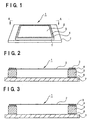
- Figures 1 and 2 show a first embodiment of the present invention.
- a pellicle 1 has such a basic construction that a pellicle membrane 2 is bonded to an opening portion of a pellicle frame 5 by adhesive 4.
- the pellicle membrane 2 is a thinned synthesized silica glass sheet so that it is suited for exposure to light having a wavelength of 220 nm or less.
- the synthesized silica glass is glass consists substantially of only silicon oxide which is obtained, for example, by growing a porous material composed of silicon oxide, called "soot", by reacting a silicon source and an oxygen source in a gaseous phase, followed by sintering.
- the adhesive 4 polybutene resin, acrylic resin, epoxy resin, a silicon type adhesive or the like can be used in the same manner as in the conventional technique.
- a light shielding member 3 is formed on the pellicle membrane 2 at a connecting portion between the pellicle membrane 2 and the pellicle frame 4. Namely, the light shielding member is formed to cover a portion where the adhesive 4 is applied.
- the light shielding member 3 although material therefore and the shape thereof are not in particular limited as long as it does not pass cleaning light, and has a sufficient light-resistance, a metal or a metal oxide formed into a film or a sheet can be used.
- the metallic sheet includes a metallic foil.
- a membrane made of chromium oxide (CrO x ), silica (SiO 2 ), alumina (Al 2 O 3 ) or the like is preferred from the reasons of light-resistance and light shielding properties.
- the thickness of the membrane although it depends on a material to be used, should have sufficient light shielding properties, and is 50 nm or more, preferably, 50 nm - 1000 nm, more preferably, 100 nm - 1000 nm.
- the light shielding member may be formed on the pellicle membrane 2 as shown in Figure 2, or it may be provided between the pellicle membrane 2 and the pellicle frame 2 so as to cover the adhesive 4 as shown in Figure 3.
- a known method such as a sputtering method, a vapor deposition method, CVD method, a printing method or the like may be selected provided that the kind of material for the membrane and adhesion properties to the pellicle membrane should be considered.
- the metallic sheet it can be fixed onto a surface of the pellicle membrane 2 or between the pellicle membrane 2 and the pellicle frame 5 by using a suitable adhesive.
- the pellicle 1 is attached onto the original sheet 7 via an adhesive 6 applied to a lower surface of the pellicle frame 4 in the same manner as the conventional technique.
- a pellicle A was prepared by using, as a pellicle membrane, a synthesized silica glass sheet polished to a thickness of 0.3 mm; bonding the pellicle membrane to a pellicle frame by a polybutene type adhesive, and forming a Cr film of 100 nm thick having the same width as the pellicle frame on a front surface of the synthesized silica glass sheet by sputtering (Example 1).
- a pellicle B was prepared by forming a Cr film of 100 nm thick having the same width as the pellicle frame on a rear surface of a synthesized silica glass sheet having the same thickness by sputtering; applying a polybutene type adhesive on the Cr film, and bonding the Cr film to the pellicle frame (Example 2).
- a pellicle C was prepared by attaching an aluminum foil subjected to a blacking treatment, instead of the Cr film used in the pellicle A (Example 3).
- a pellicle D was prepared by using a synthesized silica glass sheet of the same kind and bonding the sheet on a pellicle frame by using a polybutene type adhesive (Comparative Example).
- the pellicles A-D were respectively attached to each original sheet in a clean room.
- the number of foreign matters (e.g. dust) on the original sheet was measured by PI-1000 (manufactured by QC Optics, U.S.A.).
- light from a X e2 * excimer lamp (UER-172 made by Usio Inc.) was irradiated for 60 min. from a side of the pellicle.
- the original sheets were put into and fixed to casings respectively.
- the casings were dropped from a height of 60 cm, and the original sheets were taken out from the casings.
- Foreign matters on the surface of the original sheets were measured by using PI-1000.
- Table 1 shows amounts of deposition of the foreign matters before the irradiation and amounts of deposition of the foreign matters after the dropping. Comparative Example 1
- Example 1 Example 2
- Example 3 Light shielding member None Cr 100 nm Cr 100 nm Aluminum Amount of foreign matters Before irradiation 4.6 number/ surface 5.2 number/ surface 4.3 number/ surface 6.2 number/ surface After Irradiation 121 number/ surface 7.9 number/ surface 7.3 number/ surface 12.2 number/ surface
- the provision of the light shielding member prevents (1) the deterioration of the adhesive for bonding the pellicle membrane to the pellicle frame, the deterioration being caused by the cleaning light, (2) the deposition of foreign matters resulted from the deteriorated adhesive on the original sheet, and (3) the peeling-off of the pellicle membrane. Accordingly, the performance of the pellicle can be maintained desirably for a long period of time.
- Such deterioration-preventing effect to the adhesive provides a remarkable effect, in particular, in a technique using the exposure of light having a wavelength of 220 nm or less, which will become a main stream in a fine processing technique.
Landscapes
- Physics & Mathematics (AREA)
- General Physics & Mathematics (AREA)
- Preparing Plates And Mask In Photomechanical Process (AREA)
- Medical Preparation Storing Or Oral Administration Devices (AREA)
- Exposure And Positioning Against Photoresist Photosensitive Materials (AREA)
Abstract
Description
| Comparative Example 1 | Example 1 | Example 2 | Example 3 | ||
| Light shielding member | None | Cr 100 nm | Cr 100 nm | Aluminum | |
| Amount of foreign matters | Before irradiation | 4.6 number/ surface | 5.2 number/ surface | 4.3 number/ surface | 6.2 number/ surface |
| After Irradiation | 121 number/ surface | 7.9 number/ surface | 7.3 number/ surface | 12.2 number/ surface |
Claims (10)
- In a pellicle comprising a pellicle frame and a pellicle membrane composed of synthesized silica glass bonded to an opening portion of the pellicle frame by an adhesive, the pellicle being characterized in that a light shielding member for shielding ultra-violet rays irradiated to the adhesive is provided.
- The pellicle according to Claim 1, wherein the light shielding member is composed of a metal or a metal oxide.
- The pellicle according to Claim 2, wherein the light shielding member is composed of at least one metal selected from the group consisting of chromium, aluminum, iron, copper and an alloy thereof.
- The pellicle according to Claim 2, wherein the light shielding member is composed of at least one metal oxide selected from the group consisting of chromium oxide, silica and alumina.
- The pellicle according to Claim 1, 2, 3 or 4,
wherein the light shielding member is provided on a front surface of the pellicle membrane. - The pellicle according to Claim 1, 2, 3 or 4, wherein the light shielding member is provided between the pellicle frame and the pellicle membrane.
- The pellicle according to any one of Claims 1 to 6, wherein the light shielding member is a membrane or a sheet having a thickness of 50 nm or more.
- A method of using a pellicle characterized in that the pellicle described in any of Claims 1 to 7 is used, and ultra-violet rays are irradiated to a surface of the pellicle membrane before the pellicle is used for exposing light to an original sheet.
- The method of using a pellicle according to Claim 8, wherein the wavelength of the ultra-violet rays is 220 nm or less.
- The method of using a pellicle according to Claim 8 or 9, wherein the ultra-violet rays are an irradiated light from an excimer lamp or a F2 laser.
Applications Claiming Priority (2)
| Application Number | Priority Date | Filing Date | Title |
|---|---|---|---|
| JP2000164473 | 2000-06-01 | ||
| JP2000164473 | 2000-06-01 |
Publications (3)
| Publication Number | Publication Date |
|---|---|
| EP1160624A2 true EP1160624A2 (en) | 2001-12-05 |
| EP1160624A3 EP1160624A3 (en) | 2003-10-22 |
| EP1160624B1 EP1160624B1 (en) | 2006-04-26 |
Family
ID=18668087
Family Applications (1)
| Application Number | Title | Priority Date | Filing Date |
|---|---|---|---|
| EP01104418A Expired - Lifetime EP1160624B1 (en) | 2000-06-01 | 2001-02-26 | Pellicle and method of using the same |
Country Status (7)
| Country | Link |
|---|---|
| US (1) | US6713200B2 (en) |
| EP (1) | EP1160624B1 (en) |
| KR (1) | KR20010109470A (en) |
| AT (1) | ATE324619T1 (en) |
| DE (1) | DE60119026T2 (en) |
| IL (1) | IL141671A0 (en) |
| TW (1) | TWI269367B (en) |
Cited By (2)
| Publication number | Priority date | Publication date | Assignee | Title |
|---|---|---|---|---|
| EP1353224A1 (en) * | 2002-04-12 | 2003-10-15 | Dai Nippon Printing Co., Ltd. | Cleaning of a pellicle-mask assembly |
| WO2004109259A3 (en) * | 2003-06-04 | 2005-09-01 | 3M Innovative Properties Co | Optical filters comprising opacified portion |
Families Citing this family (11)
| Publication number | Priority date | Publication date | Assignee | Title |
|---|---|---|---|---|
| JP2000292908A (en) * | 1999-04-02 | 2000-10-20 | Shin Etsu Chem Co Ltd | Pellicle for lithography |
| US7829248B2 (en) * | 2007-07-24 | 2010-11-09 | Taiwan Semiconductor Manufacturing Company, Ltd. | Pellicle stress relief |
| JP5169206B2 (en) * | 2007-12-21 | 2013-03-27 | 日本電気株式会社 | Photomask acceptor and resist inspection method and apparatus using the same |
| JP4979088B2 (en) * | 2008-05-14 | 2012-07-18 | 信越化学工業株式会社 | Pellicle for semiconductor lithography |
| CN104160489A (en) * | 2012-04-18 | 2014-11-19 | 应用材料公司 | Apparatus and methods for particle reduction in advanced annealing processes |
| JP7091121B2 (en) | 2018-04-18 | 2022-06-27 | 信越石英株式会社 | Quartz glass plate |
| WO2020009787A1 (en) * | 2018-07-05 | 2020-01-09 | Applied Materials, Inc. | Photomask pellicle glue residue removal |
| JP7061288B2 (en) * | 2018-08-28 | 2022-04-28 | 日本軽金属株式会社 | Pellicle frame for flat panel display and its manufacturing method |
| CN113253566B (en) * | 2020-02-10 | 2024-04-09 | 永恒光实业股份有限公司 | Composite fine mask |
| CN112707016B (en) | 2021-01-04 | 2023-02-17 | 长鑫存储技术有限公司 | Photomask protection device and photomask protection system |
| KR102772556B1 (en) * | 2022-03-17 | 2025-02-27 | 주식회사 에스앤에스텍 | Method for manufacturing Pellicle for EUV Lithography |
Family Cites Families (9)
| Publication number | Priority date | Publication date | Assignee | Title |
|---|---|---|---|---|
| JPS63262651A (en) * | 1987-04-21 | 1988-10-28 | Seiko Epson Corp | photomask protective film |
| JPH01265513A (en) * | 1988-04-15 | 1989-10-23 | Nec Corp | Reduction projection aligner |
| US5531857A (en) * | 1988-07-08 | 1996-07-02 | Cauldron Limited Partnership | Removal of surface contaminants by irradiation from a high energy source |
| JP2938636B2 (en) * | 1991-09-26 | 1999-08-23 | 信越化学工業株式会社 | Pellicle for lithography |
| JPH0772617A (en) | 1993-09-02 | 1995-03-17 | Shin Etsu Chem Co Ltd | Pellicle |
| US5453816A (en) * | 1994-09-22 | 1995-09-26 | Micro Lithography, Inc. | Protective mask for pellicle |
| JP3529062B2 (en) * | 1994-10-07 | 2004-05-24 | 株式会社渡辺商行 | Pellicle and reticle |
| KR100253381B1 (en) * | 1997-12-17 | 2000-06-01 | 김영환 | Recycling Mask, Manufacturing Method and Recycling Method |
| US6197454B1 (en) * | 1998-12-29 | 2001-03-06 | Intel Corporation | Clean-enclosure window to protect photolithographic mask |
-
2001
- 2001-02-26 DE DE60119026T patent/DE60119026T2/en not_active Expired - Fee Related
- 2001-02-26 EP EP01104418A patent/EP1160624B1/en not_active Expired - Lifetime
- 2001-02-26 AT AT01104418T patent/ATE324619T1/en not_active IP Right Cessation
- 2001-02-27 IL IL14167101A patent/IL141671A0/en unknown
- 2001-02-28 KR KR1020010010344A patent/KR20010109470A/en not_active Withdrawn
- 2001-03-01 US US09/795,329 patent/US6713200B2/en not_active Expired - Fee Related
- 2001-03-29 TW TW090107534A patent/TWI269367B/en not_active IP Right Cessation
Cited By (3)
| Publication number | Priority date | Publication date | Assignee | Title |
|---|---|---|---|---|
| EP1353224A1 (en) * | 2002-04-12 | 2003-10-15 | Dai Nippon Printing Co., Ltd. | Cleaning of a pellicle-mask assembly |
| WO2004109259A3 (en) * | 2003-06-04 | 2005-09-01 | 3M Innovative Properties Co | Optical filters comprising opacified portion |
| US6984058B2 (en) | 2003-06-04 | 2006-01-10 | 3M Innovative Properties Company | Optical filters comprising opacified portion |
Also Published As
| Publication number | Publication date |
|---|---|
| KR20010109470A (en) | 2001-12-10 |
| US20020007907A1 (en) | 2002-01-24 |
| EP1160624B1 (en) | 2006-04-26 |
| TWI269367B (en) | 2006-12-21 |
| IL141671A0 (en) | 2002-03-10 |
| ATE324619T1 (en) | 2006-05-15 |
| EP1160624A3 (en) | 2003-10-22 |
| US6713200B2 (en) | 2004-03-30 |
| DE60119026D1 (en) | 2006-06-01 |
| DE60119026T2 (en) | 2006-11-30 |
Similar Documents
| Publication | Publication Date | Title |
|---|---|---|
| US6713200B2 (en) | Pellicle and method of using the same | |
| US7901846B2 (en) | Pellicle and method for manufacturing the same | |
| US8367279B2 (en) | Reflective mask blank, reflective mask, and method of manufacturing the same | |
| US20070128528A1 (en) | Mask blank and photomask having antireflective properties | |
| US8709685B2 (en) | Reflective mask blank and method of manufacturing a reflective mask | |
| US20060251973A1 (en) | Reflective-type mask blank for EUV lithography and method for producing the same | |
| EP2555052B1 (en) | Photomask unit and method of manufacturing same | |
| US6737201B2 (en) | Substrate with multilayer film, reflection type mask blank for exposure, reflection type mask for exposure and production method thereof as well as production method of semiconductor device | |
| KR20100134074A (en) | Photomask Blanks, Photomasks and Photomask Blanks Manufacturing Method | |
| JP2001133960A (en) | Pellicle for lithography and method of using pellicle | |
| KR101432803B1 (en) | Multilayer reflective film coated substrate, manufacturing method thereof, reflective mask blank, and reflective mask | |
| US20030162104A1 (en) | Reflective-type mask blank for exposure, method of producing the same, and reflective-type mask for exposure | |
| US20020114068A1 (en) | Antireflection coating for ultraviolet light at large angles of incidence | |
| JP2003243292A (en) | Reflection mask, exposure apparatus and cleaning method thereof | |
| US6593037B1 (en) | EUV mask or reticle having reduced reflections | |
| JP7803877B2 (en) | Optical elements and pellicle membranes for lithographic apparatus | |
| US6190743B1 (en) | Photomask protection system | |
| US6982133B2 (en) | Damage-resistant coatings for EUV lithography components | |
| JP4396354B2 (en) | Photo mask | |
| JPH07333829A (en) | Optical element and manufacturing method thereof | |
| JP2002055439A (en) | Pellicle and its use | |
| US6869734B1 (en) | EUV reflective mask having a carbon film and a method of making such a mask | |
| JP2003167327A (en) | Pellicle | |
| JPS63262651A (en) | photomask protective film | |
| JP2712447B2 (en) | Exposure mask |
Legal Events
| Date | Code | Title | Description |
|---|---|---|---|
| PUAI | Public reference made under article 153(3) epc to a published international application that has entered the european phase |
Free format text: ORIGINAL CODE: 0009012 |
|
| AK | Designated contracting states |
Kind code of ref document: A2 Designated state(s): AT BE CH CY DE DK ES FI FR GB GR IE IT LI LU MC NL PT SE TR |
|
| AX | Request for extension of the european patent |
Free format text: AL;LT;LV;MK;RO;SI |
|
| PUAL | Search report despatched |
Free format text: ORIGINAL CODE: 0009013 |
|
| AK | Designated contracting states |
Kind code of ref document: A3 Designated state(s): AT BE CH CY DE DK ES FI FR GB GR IE IT LI LU MC NL PT SE TR |
|
| AX | Request for extension of the european patent |
Extension state: AL LT LV MK RO SI |
|
| 17P | Request for examination filed |
Effective date: 20040304 |
|
| AKX | Designation fees paid |
Designated state(s): AT BE CH CY DE DK ES FI FR GB GR IE IT LI LU MC NL PT SE TR |
|
| 17Q | First examination report despatched |
Effective date: 20040622 |
|
| GRAP | Despatch of communication of intention to grant a patent |
Free format text: ORIGINAL CODE: EPIDOSNIGR1 |
|
| GRAS | Grant fee paid |
Free format text: ORIGINAL CODE: EPIDOSNIGR3 |
|
| GRAA | (expected) grant |
Free format text: ORIGINAL CODE: 0009210 |
|
| AK | Designated contracting states |
Kind code of ref document: B1 Designated state(s): AT BE CH CY DE DK ES FI FR GB GR IE IT LI LU MC NL PT SE TR |
|
| PG25 | Lapsed in a contracting state [announced via postgrant information from national office to epo] |
Ref country code: IT Free format text: LAPSE BECAUSE OF FAILURE TO SUBMIT A TRANSLATION OF THE DESCRIPTION OR TO PAY THE FEE WITHIN THE PRESCRIBED TIME-LIMIT;WARNING: LAPSES OF ITALIAN PATENTS WITH EFFECTIVE DATE BEFORE 2007 MAY HAVE OCCURRED AT ANY TIME BEFORE 2007. THE CORRECT EFFECTIVE DATE MAY BE DIFFERENT FROM THE ONE RECORDED. Effective date: 20060426 Ref country code: AT Free format text: LAPSE BECAUSE OF FAILURE TO SUBMIT A TRANSLATION OF THE DESCRIPTION OR TO PAY THE FEE WITHIN THE PRESCRIBED TIME-LIMIT Effective date: 20060426 Ref country code: LI Free format text: LAPSE BECAUSE OF FAILURE TO SUBMIT A TRANSLATION OF THE DESCRIPTION OR TO PAY THE FEE WITHIN THE PRESCRIBED TIME-LIMIT Effective date: 20060426 Ref country code: CH Free format text: LAPSE BECAUSE OF FAILURE TO SUBMIT A TRANSLATION OF THE DESCRIPTION OR TO PAY THE FEE WITHIN THE PRESCRIBED TIME-LIMIT Effective date: 20060426 Ref country code: FI Free format text: LAPSE BECAUSE OF FAILURE TO SUBMIT A TRANSLATION OF THE DESCRIPTION OR TO PAY THE FEE WITHIN THE PRESCRIBED TIME-LIMIT Effective date: 20060426 Ref country code: BE Free format text: LAPSE BECAUSE OF FAILURE TO SUBMIT A TRANSLATION OF THE DESCRIPTION OR TO PAY THE FEE WITHIN THE PRESCRIBED TIME-LIMIT Effective date: 20060426 |
|
| REG | Reference to a national code |
Ref country code: GB Ref legal event code: FG4D |
|
| REG | Reference to a national code |
Ref country code: IE Ref legal event code: FG4D |
|
| REF | Corresponds to: |
Ref document number: 60119026 Country of ref document: DE Date of ref document: 20060601 Kind code of ref document: P |
|
| PG25 | Lapsed in a contracting state [announced via postgrant information from national office to epo] |
Ref country code: DK Free format text: LAPSE BECAUSE OF FAILURE TO SUBMIT A TRANSLATION OF THE DESCRIPTION OR TO PAY THE FEE WITHIN THE PRESCRIBED TIME-LIMIT Effective date: 20060726 Ref country code: SE Free format text: LAPSE BECAUSE OF FAILURE TO SUBMIT A TRANSLATION OF THE DESCRIPTION OR TO PAY THE FEE WITHIN THE PRESCRIBED TIME-LIMIT Effective date: 20060726 |
|
| PG25 | Lapsed in a contracting state [announced via postgrant information from national office to epo] |
Ref country code: ES Free format text: LAPSE BECAUSE OF FAILURE TO SUBMIT A TRANSLATION OF THE DESCRIPTION OR TO PAY THE FEE WITHIN THE PRESCRIBED TIME-LIMIT Effective date: 20060806 |
|
| PG25 | Lapsed in a contracting state [announced via postgrant information from national office to epo] |
Ref country code: PT Free format text: LAPSE BECAUSE OF FAILURE TO SUBMIT A TRANSLATION OF THE DESCRIPTION OR TO PAY THE FEE WITHIN THE PRESCRIBED TIME-LIMIT Effective date: 20060926 |
|
| ET | Fr: translation filed | ||
| REG | Reference to a national code |
Ref country code: CH Ref legal event code: PL |
|
| PGFP | Annual fee paid to national office [announced via postgrant information from national office to epo] |
Ref country code: IE Payment date: 20070213 Year of fee payment: 7 |
|
| PGFP | Annual fee paid to national office [announced via postgrant information from national office to epo] |
Ref country code: GB Payment date: 20070221 Year of fee payment: 7 |
|
| PGFP | Annual fee paid to national office [announced via postgrant information from national office to epo] |
Ref country code: DE Payment date: 20070222 Year of fee payment: 7 |
|
| PG25 | Lapsed in a contracting state [announced via postgrant information from national office to epo] |
Ref country code: MC Free format text: LAPSE BECAUSE OF NON-PAYMENT OF DUE FEES Effective date: 20070228 |
|
| PLBE | No opposition filed within time limit |
Free format text: ORIGINAL CODE: 0009261 |
|
| STAA | Information on the status of an ep patent application or granted ep patent |
Free format text: STATUS: NO OPPOSITION FILED WITHIN TIME LIMIT |
|
| 26N | No opposition filed |
Effective date: 20070129 |
|
| PGFP | Annual fee paid to national office [announced via postgrant information from national office to epo] |
Ref country code: IT Payment date: 20070515 Year of fee payment: 7 |
|
| PG25 | Lapsed in a contracting state [announced via postgrant information from national office to epo] |
Ref country code: GR Free format text: LAPSE BECAUSE OF FAILURE TO SUBMIT A TRANSLATION OF THE DESCRIPTION OR TO PAY THE FEE WITHIN THE PRESCRIBED TIME-LIMIT Effective date: 20060727 |
|
| PGFP | Annual fee paid to national office [announced via postgrant information from national office to epo] |
Ref country code: FR Payment date: 20070208 Year of fee payment: 7 |
|
| PGFP | Annual fee paid to national office [announced via postgrant information from national office to epo] |
Ref country code: NL Payment date: 20080203 Year of fee payment: 8 |
|
| GBPC | Gb: european patent ceased through non-payment of renewal fee |
Effective date: 20080226 |
|
| REG | Reference to a national code |
Ref country code: FR Ref legal event code: ST Effective date: 20081031 |
|
| PG25 | Lapsed in a contracting state [announced via postgrant information from national office to epo] |
Ref country code: IE Free format text: LAPSE BECAUSE OF NON-PAYMENT OF DUE FEES Effective date: 20080226 Ref country code: DE Free format text: LAPSE BECAUSE OF NON-PAYMENT OF DUE FEES Effective date: 20080902 |
|
| PG25 | Lapsed in a contracting state [announced via postgrant information from national office to epo] |
Ref country code: FR Free format text: LAPSE BECAUSE OF NON-PAYMENT OF DUE FEES Effective date: 20080229 |
|
| PG25 | Lapsed in a contracting state [announced via postgrant information from national office to epo] |
Ref country code: GB Free format text: LAPSE BECAUSE OF NON-PAYMENT OF DUE FEES Effective date: 20080226 |
|
| PG25 | Lapsed in a contracting state [announced via postgrant information from national office to epo] |
Ref country code: CY Free format text: LAPSE BECAUSE OF FAILURE TO SUBMIT A TRANSLATION OF THE DESCRIPTION OR TO PAY THE FEE WITHIN THE PRESCRIBED TIME-LIMIT Effective date: 20060426 Ref country code: LU Free format text: LAPSE BECAUSE OF NON-PAYMENT OF DUE FEES Effective date: 20070226 Ref country code: IT Free format text: LAPSE BECAUSE OF NON-PAYMENT OF DUE FEES Effective date: 20080226 |
|
| PG25 | Lapsed in a contracting state [announced via postgrant information from national office to epo] |
Ref country code: TR Free format text: LAPSE BECAUSE OF FAILURE TO SUBMIT A TRANSLATION OF THE DESCRIPTION OR TO PAY THE FEE WITHIN THE PRESCRIBED TIME-LIMIT Effective date: 20060426 |
|
| NLV4 | Nl: lapsed or anulled due to non-payment of the annual fee |
Effective date: 20090901 |
|
| PG25 | Lapsed in a contracting state [announced via postgrant information from national office to epo] |
Ref country code: NL Free format text: LAPSE BECAUSE OF NON-PAYMENT OF DUE FEES Effective date: 20090901 |