EP1158481A2 - A video display apparatus and display method - Google Patents
A video display apparatus and display method Download PDFInfo
- Publication number
- EP1158481A2 EP1158481A2 EP01112249A EP01112249A EP1158481A2 EP 1158481 A2 EP1158481 A2 EP 1158481A2 EP 01112249 A EP01112249 A EP 01112249A EP 01112249 A EP01112249 A EP 01112249A EP 1158481 A2 EP1158481 A2 EP 1158481A2
- Authority
- EP
- European Patent Office
- Prior art keywords
- frame
- thinning
- frames
- frequency
- display apparatus
- Prior art date
- Legal status (The legal status is an assumption and is not a legal conclusion. Google has not performed a legal analysis and makes no representation as to the accuracy of the status listed.)
- Granted
Links
Images


Classifications
-
- G—PHYSICS
- G09—EDUCATION; CRYPTOGRAPHY; DISPLAY; ADVERTISING; SEALS
- G09G—ARRANGEMENTS OR CIRCUITS FOR CONTROL OF INDICATING DEVICES USING STATIC MEANS TO PRESENT VARIABLE INFORMATION
- G09G5/00—Control arrangements or circuits for visual indicators common to cathode-ray tube indicators and other visual indicators
- G09G5/36—Control arrangements or circuits for visual indicators common to cathode-ray tube indicators and other visual indicators characterised by the display of a graphic pattern, e.g. using an all-points-addressable [APA] memory
-
- G—PHYSICS
- G09—EDUCATION; CRYPTOGRAPHY; DISPLAY; ADVERTISING; SEALS
- G09G—ARRANGEMENTS OR CIRCUITS FOR CONTROL OF INDICATING DEVICES USING STATIC MEANS TO PRESENT VARIABLE INFORMATION
- G09G3/00—Control arrangements or circuits, of interest only in connection with visual indicators other than cathode-ray tubes
- G09G3/20—Control arrangements or circuits, of interest only in connection with visual indicators other than cathode-ray tubes for presentation of an assembly of a number of characters, e.g. a page, by composing the assembly by combination of individual elements arranged in a matrix no fixed position being assigned to or needed to be assigned to the individual characters or partial characters
-
- G—PHYSICS
- G09—EDUCATION; CRYPTOGRAPHY; DISPLAY; ADVERTISING; SEALS
- G09G—ARRANGEMENTS OR CIRCUITS FOR CONTROL OF INDICATING DEVICES USING STATIC MEANS TO PRESENT VARIABLE INFORMATION
- G09G2320/00—Control of display operating conditions
- G09G2320/10—Special adaptations of display systems for operation with variable images
- G09G2320/103—Detection of image changes, e.g. determination of an index representative of the image change
-
- G—PHYSICS
- G09—EDUCATION; CRYPTOGRAPHY; DISPLAY; ADVERTISING; SEALS
- G09G—ARRANGEMENTS OR CIRCUITS FOR CONTROL OF INDICATING DEVICES USING STATIC MEANS TO PRESENT VARIABLE INFORMATION
- G09G2340/00—Aspects of display data processing
- G09G2340/04—Changes in size, position or resolution of an image
- G09G2340/0407—Resolution change, inclusive of the use of different resolutions for different screen areas
- G09G2340/0435—Change or adaptation of the frame rate of the video stream
-
- G—PHYSICS
- G09—EDUCATION; CRYPTOGRAPHY; DISPLAY; ADVERTISING; SEALS
- G09G—ARRANGEMENTS OR CIRCUITS FOR CONTROL OF INDICATING DEVICES USING STATIC MEANS TO PRESENT VARIABLE INFORMATION
- G09G3/00—Control arrangements or circuits, of interest only in connection with visual indicators other than cathode-ray tubes
- G09G3/20—Control arrangements or circuits, of interest only in connection with visual indicators other than cathode-ray tubes for presentation of an assembly of a number of characters, e.g. a page, by composing the assembly by combination of individual elements arranged in a matrix no fixed position being assigned to or needed to be assigned to the individual characters or partial characters
- G09G3/34—Control arrangements or circuits, of interest only in connection with visual indicators other than cathode-ray tubes for presentation of an assembly of a number of characters, e.g. a page, by composing the assembly by combination of individual elements arranged in a matrix no fixed position being assigned to or needed to be assigned to the individual characters or partial characters by control of light from an independent source
- G09G3/36—Control arrangements or circuits, of interest only in connection with visual indicators other than cathode-ray tubes for presentation of an assembly of a number of characters, e.g. a page, by composing the assembly by combination of individual elements arranged in a matrix no fixed position being assigned to or needed to be assigned to the individual characters or partial characters by control of light from an independent source using liquid crystals
- G09G3/3611—Control of matrices with row and column drivers
Definitions
- the present invention relates to a video display apparatus and a video display method, and more particularly to a video display apparatus that displays image data output from a personal computer at a frame frequency that is lower than the frame frequency of the personal computer.
- the vertical synchronization frequency of the video signal in the display part be a low frequency. For this reason, in the case in which the vertical synchronization frequency of the input video signal is high, it is necessary to convert the frequency of the vertical synchronization signal so as to output it to the display part.
- personal computers are exhibiting a trend toward higher vertical synchronization frequencies, and an increase in the cases in which a moving image is input to a personal computer or the personal computer reproduces a moving image.
- the present invention adopts the following basic technical constitution.
- a first aspect of the present invention is a dot display type video display apparatus displaying an image having a first frame frequency at a second frame frequency that is lower than the first frame frequency
- the video display apparatus comprising: a synchronization signal generation circuit for generating a synchronization signal of the second frame frequency; a conversion frequency detector for calculating a number of frames making up an unit block at each of the frame frequencies and a number of frames to be thinned based on the first frame frequency and the second frame frequency; a frame memory for storing a first frame having the first frame frequency; a difference detector for comparing intensity data of each dot on the video display apparatus of a second frame which is currently input to the video display apparatus with intensity data of each dot of the first frame which is stored in the frame memory and which is immediately before the second frame, and detecting a difference between the two frames; a difference adder for counting a number of dots for a case in which the difference of the intensity data detected by the difference detector is greater than a prescribed value; a movement detection/jud
- a second aspect of the present invention is that the frame thinning section further comprising: a frame thinning means for executing frame thinning of the second frame; and a frame thinning stopping means for stopping the frame thinning operation of the frame thinning means within a current block including the first frame and the second frame, in a case in which, if, as a result of an execution of frame thinning by the frame thinning means, a total number of thinned frames has reached the number of frames to be thinned which is output from the conversion frequency detector.
- an area detector for detecting movement of an image within a prescribed area on the video display apparatus is provided, and detection results of the area detector being output to the movement detection/judgment section.
- the video display apparatus is a plasma display apparatus.
- the video display apparatus is a liquid-crystal display apparatus.
- Fig. 1 is a block diagram showing the configuration of a video display apparatus according to the present invention
- Fig. 2 is a flowchart showing the frame thinning operation in the present invention
- Fig. 3 is a drawing showing the relationship between original frames (a), frames (b) which are input to a video display apparatus of the present invention from a personal computer, frames (c) which are converted by the conventional system, and frames (d) which are converted by the system of the present invention.
- FIG. 1 show a dot display type video display apparatus displaying an image having a first frame frequency at a second frame frequency that is lower than the first frame frequency
- the video display apparatus comprising: a synchronization signal generation circuit 1 for generating a synchronization signal of the second frame frequency (VO_SYNC); a conversion frequency detector 2 for calculating a number of frames making up an unit block at each of the frame frequencies and a number of frames to be thinned based on the first frame frequency (VI_SYNC) and the second frame frequency (VO_SYNC); a frame memory 4 for storing a first frame having the first frame frequency (VI_SYNC); a difference detector 11 for comparing intensity data of each dot on the video display apparatus of a second frame which is currently input to the video display apparatus with intensity data of each dot of the first frame which is stored in the frame memory 4 and which is immediately before the second frame, and detecting a difference between the two frames; a difference adder 12 for counting a number of dots for a case in which
- FIG. 1 shows a video display apparatus minimally including a frame thinning means for thinning a frame (Step S3) in a case in which, when a difference detector compares image data of the second frame for which it is to be established whether or not to perform a frame thinning with image data of the first frame immediately before the second frame, and the movement detection/judgment section 13 detects that the image data of the two frames are the same, and a frame thinning stopping means (Step S5) for stopping the frame thinning operation of the frame thinning means within a current block including the first frame and the second frame, in a case in which, if, as a result of an execution of frame thinning by the frame thinning means, a total number of thinned frames has reached the number of frames to be thinned which is output from the conversion frequency detector (Step S4).
- a frame thinning stopping means for stopping the frame thinning operation of the frame thinning means within a current block including the first frame and the second frame
- an area detector 14 is provided which detects movement within a prescribed area on the video display apparatus, and the detection results output from this area detector 14 being input to the movement detection/judgment section 13.
- the video display apparatus of the present invention is either a plasma display apparatus or a liquid-crystal display apparatus.
- An original frame of the image having a frame frequency of 60 Hz shown in Fig. 3 (a) is input to a personal computer, and converted to the image having a frame frequency of 75 Hz, the image data thereof being input to the video display apparatus of the present invention, this being shown in Fig. 3 (b).
- an input signal synchronization signal is input to the synchronization signal generation circuit 1, so as to generate a vertical synchronization signal (VI_SYNC) at 75 Hz.
- the synchronization signal generation circuit 1 also generates a vertical synchronization signal (VO_SYNC) at 60Hz by using a clock signal CLK.
- the vertical synchronization signals (VI_SYNC) and (VO_SYNC) are input to a frequency detector 2,
- the frequency detector 2 detects the difference between the two different vertical synchronization signals, and calculates the number of frames for 1 block to each vertical synchronization signal, and the number of frames that are to be thinned for a frame conversion.
- An input image signal is input to the vertical synchronization converter 3.
- the input image signal is stored in the frame memory 4, and a next input image signal is compared with the input image stored in the frame memory 4 by the vertical synchronization converter 3. That is, the vertical synchronization converter 3 detects the difference values of the intensities of each dot of the input frame and the previous frame stored in the frame memory 4. If this difference value is greater than a prescribed value, a signal 11a indicating that the difference value is greater than the prescribed value is output to the difference adder 12, and the number of such events is counted by the difference adder 12.
- the movement detection/judgment section 13 judges that the two compared frames are the same image, and a signal 13a that indicates that the frame currently being received can be thinned is output from the movement detection/judgment section 13 to the frame thinning section 15.
- Frame thinning is established by the frame thinning section 15, based on the signal 2a, which indicates the number of frames to be thinned as calculated by the conversion frequency detector 2 and the signal 13a, output from the movement detection/judgment section 13, which indicates whether it is possible to perform frame thinning with regard to a currently received frame, and after vertical frequency conversion processing is performed according to frame thinning, the video signal is output from the frame thinning section 15.
- a comparison is performed between a currently received frame and the immediately previous frame thereof (steps S1 and S2), and in the case in which, as a result of the frame thinning operation (step S3), the total number of frames thinned in one block has reached the number of frames to be thinned (step S4), the frame thinning operation within the current block is stopped (step S5), thereby enabling the thinning of just the required number of frames at all times.
- FIG. 3 (a) An original image having a vertical synchronization frequency of 60 Hz is input to a personal computer, within which the vertical synchronization frequency is converted to 75 Hz (Fig. 3 (b) ) .
- the video signal output from the personal computer is input to the video display apparatus of the present invention, within which the vertical synchronization frequency is reconverted to 60 Hz for display.
- Fig. 3 (c) shows the method of the prior art
- Fig. 3 (d) shows the results of conversion according to the present invention.
- the vertical synchronization frequency is converted by adding one frame.
- a frame B' which is the same as frame B, is added.
- the video signal from the personal computer is to be input to a video display apparatus such as a plasma type video display apparatus, and reconverted to 60 Hz, because only four frames are displayed during the time for five frames, one frame is thinned.
- a video display apparatus such as a plasma type video display apparatus
- the prior art as shown in Fig. 3 (c) , four frames from the start were mechanically displayed, with the fifth frame (frame D) being thinned.
- two frames (B --> B') with the same picture can occur consecutively, and the information of frame D is missing, for example, causing non-continuities in a moving image.
- it is not possible to restrict the thinning of frames so that the actual frame to be thinned is indeterminate, depending on the particular timing, so that a moving image became non-continuous and the display was not smooth.
- the number of frames in one block required for vertical frequency conversion can be judged to be five frames before conversion and four frames after conversion, respectively, enabling calculation of the number of frames to be thinned.
- the movement detection/judgment section 13 Because it is possible from the information of the movement detection/judgment section 13 to judge that there is little movement information between frame B and frame B', the movement detection/judgment section 13 outputs to the frame thinning section 15 a signal 13a, which indicates that it is possible to thin the frame B', and the frame thinning section 15, based on the signal 13a from the movement detection/judgment section 13 and the signal 2a from the conversion frequency detector 2, which indicates the number of frames to be thinned, executes processing for thinning the frame B'.
- the number of frames to be thinned in one block is one frame, by stopping further frame thinning within this block, it is possible to reproduce a moving image continuously, with the sequence A --> B --> C --> D.
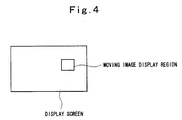
- the present invention is particularly provided with an area detector 14. This is effective, for example, as shown in Fig. 4, in the case of detection of a still image when a region of the screen is assigned for display of a moving image, with a moving image displayed only in this region.
- the area detector 14 can be configured so that it operates simultaneously with the difference adder 12, and alternately it is possible to have it configured so that either the area detector 14 or the difference adder 12 operate selectively. As shown in Fig. 1 (c), it is possible to have a configuration in which the area detector 14 is caused to operate as desired.
- a video display apparatus is capable of reproducing the smooth movement of an original moving image, without the occurrence of non-continuities in the moving image.
- the conversion frequency detector is configured not only to calculate the number of frames for one block, but also to calculate the number of frames to be thinned, thereby eliminating the need to have a large frame memory and simplifying the algorithm used for thinning frames, while reducing the scale of the circuitry used and also simplifying the circuit configuration.
Landscapes
- Engineering & Computer Science (AREA)
- Physics & Mathematics (AREA)
- Computer Hardware Design (AREA)
- General Physics & Mathematics (AREA)
- Theoretical Computer Science (AREA)
- Control Of Indicators Other Than Cathode Ray Tubes (AREA)
- Television Systems (AREA)
- Liquid Crystal (AREA)
- Liquid Crystal Display Device Control (AREA)
- Transforming Electric Information Into Light Information (AREA)
Abstract
Description
Claims (8)
- A dot display type video display apparatus displaying an image having a first frame frequency at a second frame frequency that is lower than said first frame frequency, said video display apparatus comprising:a synchronization signal generation circuit for generating a synchronization signal of said second frame frequency;a conversion frequency detector for calculating a number of frames making up an unit block at each of said frame frequencies and a number of frames to be thinned based on said first frame frequency and said second frame frequency;a frame memory for storing a first frame having said first frame frequency;a difference detector for comparing intensity data of each dot on said video display apparatus of a second frame which is currently input to said video display apparatus with intensity data of each dot of said first frame which is stored in said frame memory and which is immediately before said second frame, and detecting a difference between said two frames;a difference adder for counting a number of dots for a case in which said difference of said intensity data detected by said difference detector is greater than a prescribed value;a movement detection/judgment section for distinguishing whether or not a count value detected by said difference adder is below a prescribed value and outputting a signal indicating that thinning of said second frame is possible, when said count value of said difference adder is below said prescribed value; anda frame thinning section for thinning said second frame, in a case in which said signal indicating that frame thinning of said second frame is possible is output from said movement detection/judgment section and also a signal indicating that said number of frames to be thinned is output from said conversion frequency detector.
- A video display apparatus according to claim 1, said frame thinning section further comprising:a frame thinning means for executing frame thinning of said second frame; anda frame thinning stopping means for stopping the frame thinning operation of said frame thinning means within a current block including said first frame and said second frame, in a case in which, if, as a result of an execution of frame thinning by said frame thinning means, a total number of thinned frames has reached said number of frames to be thinned which is output from said conversion frequency detector.
- A video display apparatus according to claim 1, wherein an area detector for detecting movement of an image within a prescribed area on said video display apparatus is provided, and detection results of said area detector being output to said movement detection/judgment section.
- A video display apparatus according to claim 1, wherein said video display apparatus is a plasma display apparatus.
- A video display apparatus according to claim 1, wherein said video display apparatus is a liquid-crystal display apparatus.
- A dot display type video display apparatus displaying an image having a first frame frequency at a second frame frequency that is lower than said first frame frequency, said video display apparatus comprising:a synchronization signal generation circuit for generating a synchronization signal of said second frame frequency;a conversion frequency detector for calculating a number of frames making up an unit block at each of said frame frequencies and a number of frames to be thinned based on said first frame frequency and said second frame frequency;a frame memory for storing a first frame having said first frame frequency;a difference detector for comparing intensity data of each dot on said video display apparatus of a second frame which is currently input to said video display apparatus with intensity data of each dot of said first frame which is stored in said frame memory and which is immediately before said second frame, and detecting a difference between said two frames;a difference adder for counting a number of dots for a case in which said difference of said intensity data detected by said difference detector is greater than a prescribed value;a movement detection/judgment section for distinguishing whether or not a count value detected by said difference adder is below a prescribed value and outputting a signal indicating that thinning of said second frame is possible, when said count value of said difference adder is below said prescribed value;a frame thinning section for thinning said second frame, in a case in which said signal indicating that frame thinning of said second frame is possible is output from said movement detection/judgment section and also a signal indicating that said number of frames to be thinned is output from said conversion frequency detector; anda frame thinning stopping section for stopping the frame thinning operation of said frame thinning section within a current block including said first frame and said second frame, in a case in which, if, as a result of an execution of frame thinning by said frame thinning section, a total number of thinned frames has reached said number of frames to be thinned which is output from said conversion frequency detector.
- A plasma display apparatus displaying an image having a first frame frequency at a second frame frequency that is lower than said first frame frequency, said video display apparatus comprising:a synchronization signal generation circuit for generating a synchronization signal of said second frame frequency;a conversion frequency detector for calculating a number of frames making up an unit block at each of said frame frequencies and a number of frames to be thinned based on said first frame frequency and said second frame frequency;a frame memory for storing a first frame having said first frame frequency;a difference detector for comparing intensity data of each dot on said video display apparatus of a second frame which is currently input to said video display apparatus with intensity data of each dot of said first frame which is stored in said frame memory and which is immediately before said second frame, and detecting a difference between said two frames;a difference adder for counting a number of dots for a case in which said difference of said intensity data detected by said difference detector is greater than a prescribed value;a movement detection/judgment section for distinguishing whether or not a count value detected by said difference adder is below a prescribed value and outputting a signal indicating that thinning of said second frame is possible, when said count value of said difference adder is below said prescribed value;a frame thinning section for thinning said second frame, in a case in which said signal indicating that frame thinning of said second frame is possible is output from said movement detection/judgment section and also a signal indicating that said number of frames to be thinned is output from said conversion frequency detector; anda frame thinning stopping section for stopping the frame thinning operation of said frame thinning section within a current block including said first frame and said second frame, in a case in which, if, as a result of an execution of frame thinning by said frame thinning section, a total number of thinned frames has reached said number of frames to be thinned which is output from said conversion frequency detector.
- A display method for a dot display type video display apparatus displaying an image having a first frame frequency at a second frame frequency that is lower than said first frame frequency, said video display apparatus comprising:a synchronization signal generation circuit for generating a synchronization signal of said second frame frequency;a conversion frequency detector for calculating a number of frames making up an unit block at each of said frame frequencies and a number of frames to be thinned based on said first frame frequency and said second frame frequency;a frame memory for storing a first frame having said first frame frequency;a difference detector for comparing intensity data of each dot on said video display apparatus of a second frame which is currently input to said video display apparatus with intensity data of each dot of said first frame which is stored in said frame memory and which is immediately before said second frame, and detecting a difference between said two frames;a difference adder for counting a number of dots for a case in which said difference of said intensity data detected by said difference detector is greater than a prescribed value;a movement detection/judgment section for distinguishing whether or not a count value detected by said difference adder is below a prescribed value and outputting a signal indicating that thinning of said second frame is possible, when said count value of said difference adder is below said prescribed value; anda frame thinning section for thinning said second frame, in a case in which said signal indicating that frame thinning of said second frame is possible is output from said movement detection/judgment section and also a signal indicating that said number of frames to be thinned is output from said conversion frequency detector,said method comprising the steps of:comparing said intensity data of said first frame with that of said second frame;thinning said second frame when said intensity data of said two frames are the same;stopping said frame thinning operation within a current block including said first frame and said second frame, in a case in which, as a result of an execution of frame thinning, a total number of thinned frames has reached said number of frames to be thinned, which is output from said conversion frequency detector
Applications Claiming Priority (2)
| Application Number | Priority Date | Filing Date | Title |
|---|---|---|---|
| JP2000150695 | 2000-05-22 | ||
| JP2000150695A JP3487259B2 (en) | 2000-05-22 | 2000-05-22 | Video display device and display method thereof |
Publications (3)
| Publication Number | Publication Date |
|---|---|
| EP1158481A2 true EP1158481A2 (en) | 2001-11-28 |
| EP1158481A3 EP1158481A3 (en) | 2002-10-23 |
| EP1158481B1 EP1158481B1 (en) | 2004-07-21 |
Family
ID=18656353
Family Applications (1)
| Application Number | Title | Priority Date | Filing Date |
|---|---|---|---|
| EP01112249A Expired - Lifetime EP1158481B1 (en) | 2000-05-22 | 2001-05-18 | A video display apparatus and display method |
Country Status (5)
| Country | Link |
|---|---|
| US (1) | US6888517B2 (en) |
| EP (1) | EP1158481B1 (en) |
| JP (1) | JP3487259B2 (en) |
| KR (1) | KR100398423B1 (en) |
| DE (1) | DE60104362T2 (en) |
Cited By (2)
| Publication number | Priority date | Publication date | Assignee | Title |
|---|---|---|---|---|
| EP1640951A3 (en) * | 2004-09-27 | 2008-07-30 | Idc, Llc | Control of refresh rate for bi-stable display of e.g. a mobile phone |
| CN101017654B (en) * | 2006-02-07 | 2011-05-18 | 三星电子株式会社 | Display device and driving apparatus thereof |
Families Citing this family (18)
| Publication number | Priority date | Publication date | Assignee | Title |
|---|---|---|---|---|
| JP3749147B2 (en) * | 2001-07-27 | 2006-02-22 | シャープ株式会社 | Display device |
| US7828215B2 (en) * | 2001-10-01 | 2010-11-09 | Avante International Technology, Inc. | Reader for an optically readable ballot |
| JP3995505B2 (en) | 2002-03-25 | 2007-10-24 | 三洋電機株式会社 | Display method and display device |
| JP2005300569A (en) * | 2004-04-06 | 2005-10-27 | Pioneer Electronic Corp | Method for driving display panel |
| US20060176241A1 (en) * | 2004-09-27 | 2006-08-10 | Sampsell Jeffrey B | System and method of transmitting video data |
| US7920135B2 (en) | 2004-09-27 | 2011-04-05 | Qualcomm Mems Technologies, Inc. | Method and system for driving a bi-stable display |
| KR100777007B1 (en) * | 2005-05-23 | 2007-11-16 | 엘지전자 주식회사 | Plasma display panel driving device and driving method thereof |
| JP2008166966A (en) * | 2006-12-27 | 2008-07-17 | Toshiba Corp | Video signal processing circuit, video signal processing apparatus, and video signal processing method |
| US8115726B2 (en) * | 2007-10-26 | 2012-02-14 | Hewlett-Packard Development Company, L.P. | Liquid crystal display image presentation |
| WO2010110786A1 (en) * | 2009-03-24 | 2010-09-30 | Hewlett-Packard Development Company, L.P. | Performing remoting operations for different regions of a display surface at different rates |
| CN102810294A (en) | 2012-08-01 | 2012-12-05 | 京东方科技集团股份有限公司 | Displaying method, displaying device and displaying system |
| KR102198250B1 (en) | 2014-01-20 | 2021-01-05 | 삼성디스플레이 주식회사 | Display apparatus and driving method thereof |
| US9898797B2 (en) * | 2015-07-29 | 2018-02-20 | Mediatek Inc. | Thermal management for smooth variation in display frame rate |
| KR102390273B1 (en) * | 2015-09-03 | 2022-04-26 | 삼성디스플레이 주식회사 | Display apparatus and method of driving the same |
| CN111930998A (en) * | 2020-09-09 | 2020-11-13 | 蘑菇车联信息科技有限公司 | Video frame extraction method and device |
| TWI761064B (en) * | 2021-02-04 | 2022-04-11 | 瑞昱半導體股份有限公司 | Control circuit and control method applied to display panel |
| KR20230139910A (en) * | 2022-03-25 | 2023-10-06 | 삼성디스플레이 주식회사 | Display apparatus |
| KR102753480B1 (en) | 2024-04-12 | 2025-01-14 | 주식회사 바이오세텍 | Prosthesis for dental treatment |
Family Cites Families (10)
| Publication number | Priority date | Publication date | Assignee | Title |
|---|---|---|---|---|
| JPH04196787A (en) | 1990-11-27 | 1992-07-16 | Matsushita Electric Ind Co Ltd | System conversion device |
| US5191416A (en) * | 1991-01-04 | 1993-03-02 | The Post Group Inc. | Video signal processing system |
| JPH0651721A (en) * | 1992-07-29 | 1994-02-25 | Canon Inc | Display controller |
| JP2947400B2 (en) | 1994-05-31 | 1999-09-13 | 日本ビクター株式会社 | Frame frequency converter |
| JP3604732B2 (en) | 1994-07-01 | 2004-12-22 | キヤノン株式会社 | Video system |
| JP3544022B2 (en) | 1995-03-14 | 2004-07-21 | キヤノン株式会社 | Data processing device for display device |
| JPH09101765A (en) * | 1995-07-31 | 1997-04-15 | Canon Inc | Image processing device |
| US6069602A (en) * | 1995-08-31 | 2000-05-30 | Cassio Computer Co., Ltd. | Liquid crystal display device, liquid crystal display apparatus and liquid crystal driving method |
| JP3903498B2 (en) | 1996-07-25 | 2007-04-11 | 三菱電機株式会社 | Video signal conversion method and video signal converter |
| US6493041B1 (en) * | 1998-06-30 | 2002-12-10 | Sun Microsystems, Inc. | Method and apparatus for the detection of motion in video |
-
2000
- 2000-05-22 JP JP2000150695A patent/JP3487259B2/en not_active Expired - Fee Related
-
2001
- 2001-05-18 DE DE60104362T patent/DE60104362T2/en not_active Expired - Fee Related
- 2001-05-18 EP EP01112249A patent/EP1158481B1/en not_active Expired - Lifetime
- 2001-05-22 KR KR10-2001-0028114A patent/KR100398423B1/en not_active Expired - Fee Related
- 2001-05-22 US US09/862,918 patent/US6888517B2/en not_active Expired - Fee Related
Cited By (2)
| Publication number | Priority date | Publication date | Assignee | Title |
|---|---|---|---|---|
| EP1640951A3 (en) * | 2004-09-27 | 2008-07-30 | Idc, Llc | Control of refresh rate for bi-stable display of e.g. a mobile phone |
| CN101017654B (en) * | 2006-02-07 | 2011-05-18 | 三星电子株式会社 | Display device and driving apparatus thereof |
Also Published As
| Publication number | Publication date |
|---|---|
| DE60104362D1 (en) | 2004-08-26 |
| EP1158481B1 (en) | 2004-07-21 |
| JP3487259B2 (en) | 2004-01-13 |
| JP2001331146A (en) | 2001-11-30 |
| KR100398423B1 (en) | 2003-09-19 |
| EP1158481A3 (en) | 2002-10-23 |
| DE60104362T2 (en) | 2005-06-30 |
| KR20010107653A (en) | 2001-12-07 |
| US20020030673A1 (en) | 2002-03-14 |
| US6888517B2 (en) | 2005-05-03 |
Similar Documents
| Publication | Publication Date | Title |
|---|---|---|
| EP1158481B1 (en) | A video display apparatus and display method | |
| US6647062B2 (en) | Method and apparatus for detecting motion and absence of motion between odd and even video fields | |
| US5861924A (en) | Methods and systems for processing video signal pixel data | |
| JP4230027B2 (en) | Signal processing method for analog image signal | |
| US7280709B2 (en) | Scan line interpolation device, image processing device, image display device, and scan line interpolation method | |
| CN100361538C (en) | Device and method for detecting film mode | |
| JP4538174B2 (en) | Telecine conversion system detector for video signal | |
| JP2000341648A (en) | Video signal converting device | |
| US7705914B2 (en) | Pull-down signal detection apparatus, pull-down signal detection method and progressive-scan conversion apparatus | |
| US7019764B2 (en) | Method and apparatus for auto-generation of horizontal synchronization of an analog signal to digital display | |
| US20050128360A1 (en) | Bad editing detection device | |
| JP2006109491A (en) | Image processing apparatus and method using judder map | |
| JP4936857B2 (en) | Pull-down signal detection device, pull-down signal detection method, and progressive scan conversion device | |
| JP5188272B2 (en) | Video processing apparatus and video display apparatus | |
| US7091996B2 (en) | Method and apparatus for automatic clock synchronization of an analog signal to a digital display | |
| KR100574503B1 (en) | Film mode determination device and method | |
| US8405767B2 (en) | Image processing device | |
| KR100898133B1 (en) | Image signal discrimination apparatus and method | |
| JP4906199B2 (en) | Image format conversion pre-processing device and image display device | |
| JP2009124261A5 (en) | ||
| JP3876794B2 (en) | Vertical sync signal processing circuit | |
| KR20010073388A (en) | Frame rate converter and method for converting frame rate | |
| JP2011082932A (en) | Method and apparatus for detecting telop image | |
| CN101310527B (en) | Video sync signal detection circuit | |
| JP2013115565A (en) | Video processing device |
Legal Events
| Date | Code | Title | Description |
|---|---|---|---|
| PUAI | Public reference made under article 153(3) epc to a published international application that has entered the european phase |
Free format text: ORIGINAL CODE: 0009012 |
|
| AK | Designated contracting states |
Kind code of ref document: A2 Designated state(s): AT BE CH CY DE DK ES FI FR GB GR IE IT LI LU MC NL PT SE TR |
|
| AX | Request for extension of the european patent |
Free format text: AL;LT;LV;MK;RO;SI |
|
| PUAL | Search report despatched |
Free format text: ORIGINAL CODE: 0009013 |
|
| AK | Designated contracting states |
Kind code of ref document: A3 Designated state(s): AT BE CH CY DE DK ES FI FR GB GR IE IT LI LU MC NL PT SE TR |
|
| AX | Request for extension of the european patent |
Free format text: AL;LT;LV;MK;RO;SI |
|
| 17P | Request for examination filed |
Effective date: 20020912 |
|
| 17Q | First examination report despatched |
Effective date: 20030113 |
|
| AKX | Designation fees paid |
Designated state(s): DE FR |
|
| GRAP | Despatch of communication of intention to grant a patent |
Free format text: ORIGINAL CODE: EPIDOSNIGR1 |
|
| GRAS | Grant fee paid |
Free format text: ORIGINAL CODE: EPIDOSNIGR3 |
|
| GRAA | (expected) grant |
Free format text: ORIGINAL CODE: 0009210 |
|
| AK | Designated contracting states |
Kind code of ref document: B1 Designated state(s): DE FR |
|
| REG | Reference to a national code |
Ref country code: IE Ref legal event code: FG4D |
|
| REF | Corresponds to: |
Ref document number: 60104362 Country of ref document: DE Date of ref document: 20040826 Kind code of ref document: P |
|
| RAP2 | Party data changed (patent owner data changed or rights of a patent transferred) |
Owner name: NEC PLASMA DISPLAY CORPORATION |
|
| RAP2 | Party data changed (patent owner data changed or rights of a patent transferred) |
Owner name: PIONEER PLASMA DISPLAY CORPORATION |
|
| ET | Fr: translation filed | ||
| REG | Reference to a national code |
Ref country code: FR Ref legal event code: TP |
|
| PLBE | No opposition filed within time limit |
Free format text: ORIGINAL CODE: 0009261 |
|
| STAA | Information on the status of an ep patent application or granted ep patent |
Free format text: STATUS: NO OPPOSITION FILED WITHIN TIME LIMIT |
|
| 26N | No opposition filed |
Effective date: 20050422 |
|
| REG | Reference to a national code |
Ref country code: FR Ref legal event code: CD |
|
| REG | Reference to a national code |
Ref country code: FR Ref legal event code: TP |
|
| PGFP | Annual fee paid to national office [announced via postgrant information from national office to epo] |
Ref country code: DE Payment date: 20090514 Year of fee payment: 9 Ref country code: FR Payment date: 20090515 Year of fee payment: 9 |
|
| REG | Reference to a national code |
Ref country code: FR Ref legal event code: ST Effective date: 20110131 |
|
| PG25 | Lapsed in a contracting state [announced via postgrant information from national office to epo] |
Ref country code: DE Free format text: LAPSE BECAUSE OF NON-PAYMENT OF DUE FEES Effective date: 20101201 |
|
| PG25 | Lapsed in a contracting state [announced via postgrant information from national office to epo] |
Ref country code: FR Free format text: LAPSE BECAUSE OF NON-PAYMENT OF DUE FEES Effective date: 20100531 |