EP1158363A1 - Positive resist composition and onium salts of saccharin derivatives - Google Patents
Positive resist composition and onium salts of saccharin derivatives Download PDFInfo
- Publication number
- EP1158363A1 EP1158363A1 EP01111990A EP01111990A EP1158363A1 EP 1158363 A1 EP1158363 A1 EP 1158363A1 EP 01111990 A EP01111990 A EP 01111990A EP 01111990 A EP01111990 A EP 01111990A EP 1158363 A1 EP1158363 A1 EP 1158363A1
- Authority
- EP
- European Patent Office
- Prior art keywords
- group
- carbon atoms
- alkyl group
- compound
- formula
- Prior art date
- Legal status (The legal status is an assumption and is not a legal conclusion. Google has not performed a legal analysis and makes no representation as to the accuracy of the status listed.)
- Granted
Links
- 239000000203 mixture Substances 0.000 title claims abstract description 115
- CVHZOJJKTDOEJC-UHFFFAOYSA-N saccharin Chemical class C1=CC=C2C(=O)NS(=O)(=O)C2=C1 CVHZOJJKTDOEJC-UHFFFAOYSA-N 0.000 title description 5
- 150000003839 salts Chemical class 0.000 title description 4
- 150000001875 compounds Chemical class 0.000 claims abstract description 126
- -1 sulfonimide compound Chemical class 0.000 claims abstract description 79
- 239000002253 acid Substances 0.000 claims abstract description 76
- 229920005989 resin Polymers 0.000 claims abstract description 60
- 239000011347 resin Substances 0.000 claims abstract description 60
- 239000003513 alkali Substances 0.000 claims abstract description 17
- 230000005855 radiation Effects 0.000 claims abstract description 17
- 230000009471 action Effects 0.000 claims abstract description 12
- 125000004432 carbon atom Chemical group C* 0.000 claims description 86
- 125000000217 alkyl group Chemical group 0.000 claims description 54
- 125000003545 alkoxy group Chemical group 0.000 claims description 41
- 125000003118 aryl group Chemical group 0.000 claims description 38
- 125000004435 hydrogen atom Chemical group [H]* 0.000 claims description 38
- 125000006165 cyclic alkyl group Chemical group 0.000 claims description 35
- 125000005843 halogen group Chemical group 0.000 claims description 31
- 125000002887 hydroxy group Chemical group [H]O* 0.000 claims description 31
- 239000004094 surface-active agent Substances 0.000 claims description 29
- 125000003710 aryl alkyl group Chemical group 0.000 claims description 20
- 125000000449 nitro group Chemical group [O-][N+](*)=O 0.000 claims description 16
- XUIMIQQOPSSXEZ-UHFFFAOYSA-N Silicon Chemical group [Si] XUIMIQQOPSSXEZ-UHFFFAOYSA-N 0.000 claims description 14
- 229910052710 silicon Inorganic materials 0.000 claims description 14
- 229910052731 fluorine Inorganic materials 0.000 claims description 13
- 150000001450 anions Chemical class 0.000 claims description 9
- LSNNMFCWUKXFEE-UHFFFAOYSA-M Bisulfite Chemical compound OS([O-])=O LSNNMFCWUKXFEE-UHFFFAOYSA-M 0.000 claims description 7
- 125000004429 atom Chemical group 0.000 claims description 7
- 125000001153 fluoro group Chemical group F* 0.000 claims description 7
- 125000002947 alkylene group Chemical group 0.000 claims description 5
- 125000000732 arylene group Chemical group 0.000 claims description 5
- 125000004122 cyclic group Chemical group 0.000 claims description 5
- 229910052717 sulfur Inorganic materials 0.000 claims description 5
- 125000004434 sulfur atom Chemical group 0.000 claims description 5
- DSSYKIVIOFKYAU-XCBNKYQSSA-N (R)-camphor Chemical group C1C[C@@]2(C)C(=O)C[C@@H]1C2(C)C DSSYKIVIOFKYAU-XCBNKYQSSA-N 0.000 claims description 4
- 125000001570 methylene group Chemical group [H]C([H])([*:1])[*:2] 0.000 claims description 4
- 125000004430 oxygen atom Chemical group O* 0.000 claims description 4
- 125000000547 substituted alkyl group Chemical group 0.000 claims description 4
- 238000000034 method Methods 0.000 abstract description 27
- 230000004304 visual acuity Effects 0.000 abstract description 20
- 230000008569 process Effects 0.000 abstract description 8
- 229920001577 copolymer Polymers 0.000 description 37
- FUGYGGDSWSUORM-UHFFFAOYSA-N 4-hydroxystyrene Chemical compound OC1=CC=C(C=C)C=C1 FUGYGGDSWSUORM-UHFFFAOYSA-N 0.000 description 33
- 230000015572 biosynthetic process Effects 0.000 description 27
- 238000003786 synthesis reaction Methods 0.000 description 27
- 125000001424 substituent group Chemical group 0.000 description 25
- XEKOWRVHYACXOJ-UHFFFAOYSA-N Ethyl acetate Chemical compound CCOC(C)=O XEKOWRVHYACXOJ-UHFFFAOYSA-N 0.000 description 24
- 239000000243 solution Substances 0.000 description 24
- PPBRXRYQALVLMV-UHFFFAOYSA-N Styrene Chemical compound C=CC1=CC=CC=C1 PPBRXRYQALVLMV-UHFFFAOYSA-N 0.000 description 19
- 239000000047 product Substances 0.000 description 15
- 239000007787 solid Substances 0.000 description 15
- CVHZOJJKTDOEJC-UHFFFAOYSA-M 1,1-dioxo-1,2-benzothiazol-3-olate Chemical compound C1=CC=C2C([O-])=NS(=O)(=O)C2=C1 CVHZOJJKTDOEJC-UHFFFAOYSA-M 0.000 description 14
- XLYOFNOQVPJJNP-UHFFFAOYSA-N water Substances O XLYOFNOQVPJJNP-UHFFFAOYSA-N 0.000 description 14
- OKKJLVBELUTLKV-UHFFFAOYSA-N Methanol Chemical compound OC OKKJLVBELUTLKV-UHFFFAOYSA-N 0.000 description 12
- 238000010894 electron beam technology Methods 0.000 description 12
- 0 CCC(C)c1ccc(C(C)(C)[N+](c2ccc(*)cc2)[O-])cc1 Chemical compound CCC(C)c1ccc(C(C)(C)[N+](c2ccc(*)cc2)[O-])cc1 0.000 description 11
- 239000012295 chemical reaction liquid Substances 0.000 description 11
- 230000035945 sensitivity Effects 0.000 description 11
- 239000002904 solvent Substances 0.000 description 11
- 239000006185 dispersion Substances 0.000 description 10
- 229920000642 polymer Polymers 0.000 description 10
- LLHKCFNBLRBOGN-UHFFFAOYSA-N propylene glycol methyl ether acetate Chemical compound COCC(C)OC(C)=O LLHKCFNBLRBOGN-UHFFFAOYSA-N 0.000 description 10
- WGTYBPLFGIVFAS-UHFFFAOYSA-M tetramethylammonium hydroxide Chemical compound [OH-].C[N+](C)(C)C WGTYBPLFGIVFAS-UHFFFAOYSA-M 0.000 description 10
- ZMANZCXQSJIPKH-UHFFFAOYSA-N Triethylamine Chemical compound CCN(CC)CC ZMANZCXQSJIPKH-UHFFFAOYSA-N 0.000 description 9
- 238000004090 dissolution Methods 0.000 description 9
- 239000000178 monomer Substances 0.000 description 9
- 238000006303 photolysis reaction Methods 0.000 description 9
- CSCPPACGZOOCGX-UHFFFAOYSA-N Acetone Chemical compound CC(C)=O CSCPPACGZOOCGX-UHFFFAOYSA-N 0.000 description 8
- 238000006243 chemical reaction Methods 0.000 description 8
- 230000002401 inhibitory effect Effects 0.000 description 8
- ISWSIDIOOBJBQZ-UHFFFAOYSA-N phenol group Chemical group C1(=CC=CC=C1)O ISWSIDIOOBJBQZ-UHFFFAOYSA-N 0.000 description 8
- NDVLTYZPCACLMA-UHFFFAOYSA-N silver oxide Chemical compound [O-2].[Ag+].[Ag+] NDVLTYZPCACLMA-UHFFFAOYSA-N 0.000 description 8
- ISXSCDLOGDJUNJ-UHFFFAOYSA-N tert-butyl prop-2-enoate Chemical compound CC(C)(C)OC(=O)C=C ISXSCDLOGDJUNJ-UHFFFAOYSA-N 0.000 description 8
- WYURNTSHIVDZCO-UHFFFAOYSA-N Tetrahydrofuran Chemical compound C1CCOC1 WYURNTSHIVDZCO-UHFFFAOYSA-N 0.000 description 7
- 125000003178 carboxy group Chemical group [H]OC(*)=O 0.000 description 7
- 238000001914 filtration Methods 0.000 description 7
- 238000010438 heat treatment Methods 0.000 description 7
- 125000002496 methyl group Chemical group [H]C([H])([H])* 0.000 description 7
- 229920003986 novolac Polymers 0.000 description 7
- 239000010703 silicon Substances 0.000 description 7
- 239000000758 substrate Substances 0.000 description 7
- 125000000999 tert-butyl group Chemical group [H]C([H])([H])C(*)(C([H])([H])[H])C([H])([H])[H] 0.000 description 7
- YEJRWHAVMIAJKC-UHFFFAOYSA-N 4-Butyrolactone Chemical compound O=C1CCCO1 YEJRWHAVMIAJKC-UHFFFAOYSA-N 0.000 description 6
- YCKRFDGAMUMZLT-UHFFFAOYSA-N Fluorine atom Chemical compound [F] YCKRFDGAMUMZLT-UHFFFAOYSA-N 0.000 description 6
- 125000004036 acetal group Chemical group 0.000 description 6
- 125000002252 acyl group Chemical group 0.000 description 6
- LZCLXQDLBQLTDK-UHFFFAOYSA-N ethyl 2-hydroxypropanoate Chemical compound CCOC(=O)C(C)O LZCLXQDLBQLTDK-UHFFFAOYSA-N 0.000 description 6
- 125000001495 ethyl group Chemical group [H]C([H])([H])C([H])([H])* 0.000 description 6
- 238000011156 evaluation Methods 0.000 description 6
- 239000011737 fluorine Substances 0.000 description 6
- 230000006872 improvement Effects 0.000 description 6
- VLKZOEOYAKHREP-UHFFFAOYSA-N n-Hexane Chemical compound CCCCCC VLKZOEOYAKHREP-UHFFFAOYSA-N 0.000 description 6
- 125000004108 n-butyl group Chemical group [H]C([H])([H])C([H])([H])C([H])([H])C([H])([H])* 0.000 description 6
- 125000001997 phenyl group Chemical group [H]C1=C([H])C([H])=C(*)C([H])=C1[H] 0.000 description 6
- 239000000126 substance Substances 0.000 description 6
- CVJLQNNJZBCTLI-UHFFFAOYSA-M triphenylsulfanium;iodide Chemical compound [I-].C1=CC=CC=C1[S+](C=1C=CC=CC=1)C1=CC=CC=C1 CVJLQNNJZBCTLI-UHFFFAOYSA-M 0.000 description 6
- ZAMOUSCENKQFHK-UHFFFAOYSA-N Chlorine atom Chemical compound [Cl] ZAMOUSCENKQFHK-UHFFFAOYSA-N 0.000 description 5
- 125000003342 alkenyl group Chemical group 0.000 description 5
- 125000004453 alkoxycarbonyl group Chemical group 0.000 description 5
- 239000000460 chlorine Substances 0.000 description 5
- 229910052801 chlorine Inorganic materials 0.000 description 5
- 238000004519 manufacturing process Methods 0.000 description 5
- JAMNSIXSLVPNLC-UHFFFAOYSA-N (4-ethenylphenyl) acetate Chemical compound CC(=O)OC1=CC=C(C=C)C=C1 JAMNSIXSLVPNLC-UHFFFAOYSA-N 0.000 description 4
- ARXJGSRGQADJSQ-UHFFFAOYSA-N 1-methoxypropan-2-ol Chemical compound COCC(C)O ARXJGSRGQADJSQ-UHFFFAOYSA-N 0.000 description 4
- HUHXLHLWASNVDB-UHFFFAOYSA-N 2-(oxan-2-yloxy)oxane Chemical group O1CCCCC1OC1OCCCC1 HUHXLHLWASNVDB-UHFFFAOYSA-N 0.000 description 4
- 229920003171 Poly (ethylene oxide) Polymers 0.000 description 4
- JUJWROOIHBZHMG-UHFFFAOYSA-N Pyridine Chemical compound C1=CC=NC=C1 JUJWROOIHBZHMG-UHFFFAOYSA-N 0.000 description 4
- 125000004423 acyloxy group Chemical group 0.000 description 4
- 125000005910 alkyl carbonate group Chemical group 0.000 description 4
- 125000005907 alkyl ester group Chemical group 0.000 description 4
- 239000007864 aqueous solution Substances 0.000 description 4
- 239000002585 base Substances 0.000 description 4
- 230000008859 change Effects 0.000 description 4
- 125000004093 cyano group Chemical group *C#N 0.000 description 4
- 125000000753 cycloalkyl group Chemical group 0.000 description 4
- 125000000113 cyclohexyl group Chemical group [H]C1([H])C([H])([H])C([H])([H])C([H])(*)C([H])([H])C1([H])[H] 0.000 description 4
- SWSQBOPZIKWTGO-UHFFFAOYSA-N dimethylaminoamidine Natural products CN(C)C(N)=N SWSQBOPZIKWTGO-UHFFFAOYSA-N 0.000 description 4
- 239000012153 distilled water Substances 0.000 description 4
- 125000004185 ester group Chemical group 0.000 description 4
- CATSNJVOTSVZJV-UHFFFAOYSA-N heptan-2-one Chemical compound CCCCCC(C)=O CATSNJVOTSVZJV-UHFFFAOYSA-N 0.000 description 4
- FFUAGWLWBBFQJT-UHFFFAOYSA-N hexamethyldisilazane Chemical compound C[Si](C)(C)N[Si](C)(C)C FFUAGWLWBBFQJT-UHFFFAOYSA-N 0.000 description 4
- PNDPGZBMCMUPRI-UHFFFAOYSA-N iodine Chemical compound II PNDPGZBMCMUPRI-UHFFFAOYSA-N 0.000 description 4
- 125000001436 propyl group Chemical group [H]C([*])([H])C([H])([H])C([H])([H])[H] 0.000 description 4
- 125000006239 protecting group Chemical group 0.000 description 4
- 229940081974 saccharin Drugs 0.000 description 4
- 235000019204 saccharin Nutrition 0.000 description 4
- 239000000901 saccharin and its Na,K and Ca salt Substances 0.000 description 4
- 229910001923 silver oxide Inorganic materials 0.000 description 4
- AIBKTSSWLZGMLQ-UHFFFAOYSA-N tert-butyl 2-(4-ethenylphenoxy)acetate Chemical compound CC(C)(C)OC(=O)COC1=CC=C(C=C)C=C1 AIBKTSSWLZGMLQ-UHFFFAOYSA-N 0.000 description 4
- SGUVLZREKBPKCE-UHFFFAOYSA-N 1,5-diazabicyclo[4.3.0]-non-5-ene Chemical compound C1CCN=C2CCCN21 SGUVLZREKBPKCE-UHFFFAOYSA-N 0.000 description 3
- GZNNNNBRNHUWAI-UHFFFAOYSA-N 1-[1-(2-cyclohexylethoxy)ethoxy]-4-ethenylbenzene Chemical compound C=1C=C(C=C)C=CC=1OC(C)OCCC1CCCCC1 GZNNNNBRNHUWAI-UHFFFAOYSA-N 0.000 description 3
- RNIPJYFZGXJSDD-UHFFFAOYSA-N 2,4,5-triphenyl-1h-imidazole Chemical compound C1=CC=CC=C1C1=NC(C=2C=CC=CC=2)=C(C=2C=CC=CC=2)N1 RNIPJYFZGXJSDD-UHFFFAOYSA-N 0.000 description 3
- ZWEHNKRNPOVVGH-UHFFFAOYSA-N 2-Butanone Chemical compound CCC(C)=O ZWEHNKRNPOVVGH-UHFFFAOYSA-N 0.000 description 3
- WFDIJRYMOXRFFG-UHFFFAOYSA-N Acetic anhydride Chemical compound CC(=O)OC(C)=O WFDIJRYMOXRFFG-UHFFFAOYSA-N 0.000 description 3
- UHOVQNZJYSORNB-UHFFFAOYSA-N Benzene Chemical compound C1=CC=CC=C1 UHOVQNZJYSORNB-UHFFFAOYSA-N 0.000 description 3
- WKBOTKDWSSQWDR-UHFFFAOYSA-N Bromine atom Chemical compound [Br] WKBOTKDWSSQWDR-UHFFFAOYSA-N 0.000 description 3
- OKTJSMMVPCPJKN-UHFFFAOYSA-N Carbon Chemical group [C] OKTJSMMVPCPJKN-UHFFFAOYSA-N 0.000 description 3
- ZMXDDKWLCZADIW-UHFFFAOYSA-N N,N-Dimethylformamide Chemical compound CN(C)C=O ZMXDDKWLCZADIW-UHFFFAOYSA-N 0.000 description 3
- KWYUFKZDYYNOTN-UHFFFAOYSA-M Potassium hydroxide Chemical compound [OH-].[K+] KWYUFKZDYYNOTN-UHFFFAOYSA-M 0.000 description 3
- KYQCOXFCLRTKLS-UHFFFAOYSA-N Pyrazine Natural products C1=CN=CC=N1 KYQCOXFCLRTKLS-UHFFFAOYSA-N 0.000 description 3
- HEMHJVSKTPXQMS-UHFFFAOYSA-M Sodium hydroxide Chemical compound [OH-].[Na+] HEMHJVSKTPXQMS-UHFFFAOYSA-M 0.000 description 3
- YXFVVABEGXRONW-UHFFFAOYSA-N Toluene Chemical compound CC1=CC=CC=C1 YXFVVABEGXRONW-UHFFFAOYSA-N 0.000 description 3
- 125000004442 acylamino group Chemical group 0.000 description 3
- ZRALSGWEFCBTJO-UHFFFAOYSA-N anhydrous guanidine Natural products NC(N)=N ZRALSGWEFCBTJO-UHFFFAOYSA-N 0.000 description 3
- 125000004104 aryloxy group Chemical group 0.000 description 3
- 125000001797 benzyl group Chemical group [H]C1=C([H])C([H])=C(C([H])=C1[H])C([H])([H])* 0.000 description 3
- ZTRGRMLJLFRKFT-UHFFFAOYSA-M bis[4-(2-methylbutan-2-yl)phenyl]iodanium;iodide Chemical compound [I-].C1=CC(C(C)(C)CC)=CC=C1[I+]C1=CC=C(C(C)(C)CC)C=C1 ZTRGRMLJLFRKFT-UHFFFAOYSA-M 0.000 description 3
- GDTBXPJZTBHREO-UHFFFAOYSA-N bromine Substances BrBr GDTBXPJZTBHREO-UHFFFAOYSA-N 0.000 description 3
- 229910052794 bromium Inorganic materials 0.000 description 3
- 239000003795 chemical substances by application Substances 0.000 description 3
- 230000000052 comparative effect Effects 0.000 description 3
- 238000004132 cross linking Methods 0.000 description 3
- 125000001511 cyclopentyl group Chemical group [H]C1([H])C([H])([H])C([H])([H])C([H])(*)C1([H])[H] 0.000 description 3
- 125000001559 cyclopropyl group Chemical group [H]C1([H])C([H])([H])C1([H])* 0.000 description 3
- 230000003111 delayed effect Effects 0.000 description 3
- GLUUGHFHXGJENI-UHFFFAOYSA-N diethylenediamine Natural products C1CNCCN1 GLUUGHFHXGJENI-UHFFFAOYSA-N 0.000 description 3
- RTZKZFJDLAIYFH-UHFFFAOYSA-N ether Substances CCOCC RTZKZFJDLAIYFH-UHFFFAOYSA-N 0.000 description 3
- UHKJHMOIRYZSTH-UHFFFAOYSA-N ethyl 2-ethoxypropanoate Chemical compound CCOC(C)C(=O)OCC UHKJHMOIRYZSTH-UHFFFAOYSA-N 0.000 description 3
- 229940116333 ethyl lactate Drugs 0.000 description 3
- 239000000706 filtrate Substances 0.000 description 3
- 125000002485 formyl group Chemical group [H]C(*)=O 0.000 description 3
- 230000001678 irradiating effect Effects 0.000 description 3
- 239000012046 mixed solvent Substances 0.000 description 3
- 125000001624 naphthyl group Chemical group 0.000 description 3
- 125000001147 pentyl group Chemical group C(CCCC)* 0.000 description 3
- 150000002989 phenols Chemical class 0.000 description 3
- 239000000843 powder Substances 0.000 description 3
- 125000002914 sec-butyl group Chemical group [H]C([H])([H])C([H])([H])C([H])(*)C([H])([H])[H] 0.000 description 3
- 239000004065 semiconductor Substances 0.000 description 3
- 229940100890 silver compound Drugs 0.000 description 3
- 150000003379 silver compounds Chemical class 0.000 description 3
- 125000006296 sulfonyl amino group Chemical group [H]N(*)S(*)(=O)=O 0.000 description 3
- YLQBMQCUIZJEEH-UHFFFAOYSA-N tetrahydrofuran Natural products C=1C=COC=1 YLQBMQCUIZJEEH-UHFFFAOYSA-N 0.000 description 3
- NQRYJNQNLNOLGT-UHFFFAOYSA-N tetrahydropyridine hydrochloride Natural products C1CCNCC1 NQRYJNQNLNOLGT-UHFFFAOYSA-N 0.000 description 3
- IMFACGCPASFAPR-UHFFFAOYSA-N tributylamine Chemical compound CCCCN(CCCC)CCCC IMFACGCPASFAPR-UHFFFAOYSA-N 0.000 description 3
- RYHBNJHYFVUHQT-UHFFFAOYSA-N 1,4-Dioxane Chemical compound C1COCCO1 RYHBNJHYFVUHQT-UHFFFAOYSA-N 0.000 description 2
- AKYYGBUVZFGJNI-UHFFFAOYSA-N 1-cyclohexyl-3-(2-morpholin-4-ylethyl)thiourea Chemical compound C1CCCCC1NC(=S)NCCN1CCOCC1 AKYYGBUVZFGJNI-UHFFFAOYSA-N 0.000 description 2
- PZUWJSAMZOCKEE-UHFFFAOYSA-N 1-ethenyl-4-(1-phenylmethoxyethoxy)benzene Chemical compound C=1C=C(C=C)C=CC=1OC(C)OCC1=CC=CC=C1 PZUWJSAMZOCKEE-UHFFFAOYSA-N 0.000 description 2
- GRFNSWBVXHLTCI-UHFFFAOYSA-N 1-ethenyl-4-[(2-methylpropan-2-yl)oxy]benzene Chemical compound CC(C)(C)OC1=CC=C(C=C)C=C1 GRFNSWBVXHLTCI-UHFFFAOYSA-N 0.000 description 2
- VEOLPZLCPJMKPD-UHFFFAOYSA-N 1-ethenyl-4-[1-(2-methylpropoxy)ethoxy]benzene Chemical compound CC(C)COC(C)OC1=CC=C(C=C)C=C1 VEOLPZLCPJMKPD-UHFFFAOYSA-N 0.000 description 2
- LIPRQQHINVWJCH-UHFFFAOYSA-N 1-ethoxypropan-2-yl acetate Chemical compound CCOCC(C)OC(C)=O LIPRQQHINVWJCH-UHFFFAOYSA-N 0.000 description 2
- 238000005160 1H NMR spectroscopy Methods 0.000 description 2
- GQHTUMJGOHRCHB-UHFFFAOYSA-N 2,3,4,6,7,8,9,10-octahydropyrimido[1,2-a]azepine Chemical compound C1CCCCN2CCCN=C21 GQHTUMJGOHRCHB-UHFFFAOYSA-N 0.000 description 2
- WKBALTUBRZPIPZ-UHFFFAOYSA-N 2,6-di(propan-2-yl)aniline Chemical compound CC(C)C1=CC=CC(C(C)C)=C1N WKBALTUBRZPIPZ-UHFFFAOYSA-N 0.000 description 2
- KKFDCBRMNNSAAW-UHFFFAOYSA-N 2-(morpholin-4-yl)ethanol Chemical compound OCCN1CCOCC1 KKFDCBRMNNSAAW-UHFFFAOYSA-N 0.000 description 2
- KZTWONRVIPPDKH-UHFFFAOYSA-N 2-(piperidin-1-yl)ethanol Chemical compound OCCN1CCCCC1 KZTWONRVIPPDKH-UHFFFAOYSA-N 0.000 description 2
- XNWFRZJHXBZDAG-UHFFFAOYSA-N 2-METHOXYETHANOL Chemical compound COCCO XNWFRZJHXBZDAG-UHFFFAOYSA-N 0.000 description 2
- OJPDDQSCZGTACX-UHFFFAOYSA-N 2-[n-(2-hydroxyethyl)anilino]ethanol Chemical compound OCCN(CCO)C1=CC=CC=C1 OJPDDQSCZGTACX-UHFFFAOYSA-N 0.000 description 2
- ICSNLGPSRYBMBD-UHFFFAOYSA-N 2-aminopyridine Chemical compound NC1=CC=CC=N1 ICSNLGPSRYBMBD-UHFFFAOYSA-N 0.000 description 2
- QJQZRLXDLORINA-UHFFFAOYSA-N 2-cyclohexylethanol Chemical compound OCCC1CCCCC1 QJQZRLXDLORINA-UHFFFAOYSA-N 0.000 description 2
- PGYJSURPYAAOMM-UHFFFAOYSA-N 2-ethenoxy-2-methylpropane Chemical compound CC(C)(C)OC=C PGYJSURPYAAOMM-UHFFFAOYSA-N 0.000 description 2
- ZNQVEEAIQZEUHB-UHFFFAOYSA-N 2-ethoxyethanol Chemical compound CCOCCO ZNQVEEAIQZEUHB-UHFFFAOYSA-N 0.000 description 2
- SVONRAPFKPVNKG-UHFFFAOYSA-N 2-ethoxyethyl acetate Chemical compound CCOCCOC(C)=O SVONRAPFKPVNKG-UHFFFAOYSA-N 0.000 description 2
- XLLIQLLCWZCATF-UHFFFAOYSA-N 2-methoxyethyl acetate Chemical compound COCCOC(C)=O XLLIQLLCWZCATF-UHFFFAOYSA-N 0.000 description 2
- XLLXMBCBJGATSP-UHFFFAOYSA-N 2-phenylethenol Chemical class OC=CC1=CC=CC=C1 XLLXMBCBJGATSP-UHFFFAOYSA-N 0.000 description 2
- CUYKNJBYIJFRCU-UHFFFAOYSA-N 3-aminopyridine Chemical compound NC1=CC=CN=C1 CUYKNJBYIJFRCU-UHFFFAOYSA-N 0.000 description 2
- VHYFNPMBLIVWCW-UHFFFAOYSA-N 4-Dimethylaminopyridine Chemical compound CN(C)C1=CC=NC=C1 VHYFNPMBLIVWCW-UHFFFAOYSA-N 0.000 description 2
- LPEKGGXMPWTOCB-UHFFFAOYSA-N 8beta-(2,3-epoxy-2-methylbutyryloxy)-14-acetoxytithifolin Natural products COC(=O)C(C)O LPEKGGXMPWTOCB-UHFFFAOYSA-N 0.000 description 2
- 101001053401 Arabidopsis thaliana Acid beta-fructofuranosidase 3, vacuolar Proteins 0.000 description 2
- 102100026291 Arf-GAP with SH3 domain, ANK repeat and PH domain-containing protein 2 Human genes 0.000 description 2
- 101710112065 Arf-GAP with SH3 domain, ANK repeat and PH domain-containing protein 2 Proteins 0.000 description 2
- IJGRMHOSHXDMSA-UHFFFAOYSA-N Atomic nitrogen Chemical compound N#N IJGRMHOSHXDMSA-UHFFFAOYSA-N 0.000 description 2
- RWSOTUBLDIXVET-UHFFFAOYSA-N Dihydrogen sulfide Chemical class S RWSOTUBLDIXVET-UHFFFAOYSA-N 0.000 description 2
- IAZDPXIOMUYVGZ-UHFFFAOYSA-N Dimethylsulphoxide Chemical compound CS(C)=O IAZDPXIOMUYVGZ-UHFFFAOYSA-N 0.000 description 2
- SNRUBQQJIBEYMU-UHFFFAOYSA-N Dodecane Natural products CCCCCCCCCCCC SNRUBQQJIBEYMU-UHFFFAOYSA-N 0.000 description 2
- QUSNBJAOOMFDIB-UHFFFAOYSA-N Ethylamine Chemical compound CCN QUSNBJAOOMFDIB-UHFFFAOYSA-N 0.000 description 2
- VEXZGXHMUGYJMC-UHFFFAOYSA-N Hydrochloric acid Chemical compound Cl VEXZGXHMUGYJMC-UHFFFAOYSA-N 0.000 description 2
- SECXISVLQFMRJM-UHFFFAOYSA-N N-Methylpyrrolidone Chemical compound CN1CCCC1=O SECXISVLQFMRJM-UHFFFAOYSA-N 0.000 description 2
- CHJJGSNFBQVOTG-UHFFFAOYSA-N N-methyl-guanidine Natural products CNC(N)=N CHJJGSNFBQVOTG-UHFFFAOYSA-N 0.000 description 2
- PCNDJXKNXGMECE-UHFFFAOYSA-N Phenazine Natural products C1=CC=CC2=NC3=CC=CC=C3N=C21 PCNDJXKNXGMECE-UHFFFAOYSA-N 0.000 description 2
- 229920001214 Polysorbate 60 Polymers 0.000 description 2
- KAESVJOAVNADME-UHFFFAOYSA-N Pyrrole Chemical compound C=1C=CNC=1 KAESVJOAVNADME-UHFFFAOYSA-N 0.000 description 2
- VYPSYNLAJGMNEJ-UHFFFAOYSA-N Silicium dioxide Chemical compound O=[Si]=O VYPSYNLAJGMNEJ-UHFFFAOYSA-N 0.000 description 2
- CDBYLPFSWZWCQE-UHFFFAOYSA-L Sodium Carbonate Chemical compound [Na+].[Na+].[O-]C([O-])=O CDBYLPFSWZWCQE-UHFFFAOYSA-L 0.000 description 2
- 239000004115 Sodium Silicate Substances 0.000 description 2
- 239000007983 Tris buffer Substances 0.000 description 2
- 239000003377 acid catalyst Substances 0.000 description 2
- 125000005011 alkyl ether group Chemical group 0.000 description 2
- 125000004414 alkyl thio group Chemical group 0.000 description 2
- 125000004103 aminoalkyl group Chemical group 0.000 description 2
- 125000004659 aryl alkyl thio group Chemical group 0.000 description 2
- 125000005110 aryl thio group Chemical group 0.000 description 2
- 229940092714 benzenesulfonic acid Drugs 0.000 description 2
- 239000003054 catalyst Substances 0.000 description 2
- 239000011248 coating agent Substances 0.000 description 2
- 238000000576 coating method Methods 0.000 description 2
- 239000000470 constituent Substances 0.000 description 2
- JHIVVAPYMSGYDF-UHFFFAOYSA-N cyclohexanone Chemical compound O=C1CCCCC1 JHIVVAPYMSGYDF-UHFFFAOYSA-N 0.000 description 2
- BGTOWKSIORTVQH-UHFFFAOYSA-N cyclopentanone Chemical compound O=C1CCCC1 BGTOWKSIORTVQH-UHFFFAOYSA-N 0.000 description 2
- JQVDAXLFBXTEQA-UHFFFAOYSA-N dibutylamine Chemical compound CCCCNCCCC JQVDAXLFBXTEQA-UHFFFAOYSA-N 0.000 description 2
- 235000014113 dietary fatty acids Nutrition 0.000 description 2
- 229910001873 dinitrogen Inorganic materials 0.000 description 2
- KPUWHANPEXNPJT-UHFFFAOYSA-N disiloxane Chemical group [SiH3]O[SiH3] KPUWHANPEXNPJT-UHFFFAOYSA-N 0.000 description 2
- 125000003438 dodecyl group Chemical group [H]C([H])([H])C([H])([H])C([H])([H])C([H])([H])C([H])([H])C([H])([H])C([H])([H])C([H])([H])C([H])([H])C([H])([H])C([H])([H])C([H])([H])* 0.000 description 2
- ODQWQRRAPPTVAG-GZTJUZNOSA-N doxepin Chemical compound C1OC2=CC=CC=C2C(=C/CCN(C)C)/C2=CC=CC=C21 ODQWQRRAPPTVAG-GZTJUZNOSA-N 0.000 description 2
- 230000000694 effects Effects 0.000 description 2
- 125000003500 enol ether group Chemical group 0.000 description 2
- 239000000194 fatty acid Substances 0.000 description 2
- 229930195729 fatty acid Natural products 0.000 description 2
- 238000005227 gel permeation chromatography Methods 0.000 description 2
- 125000004051 hexyl group Chemical group [H]C([H])([H])C([H])([H])C([H])([H])C([H])([H])C([H])([H])C([H])([H])* 0.000 description 2
- XMBWDFGMSWQBCA-UHFFFAOYSA-N hydrogen iodide Chemical class I XMBWDFGMSWQBCA-UHFFFAOYSA-N 0.000 description 2
- 238000003384 imaging method Methods 0.000 description 2
- 239000003999 initiator Substances 0.000 description 2
- 125000000959 isobutyl group Chemical group [H]C([H])([H])C([H])(C([H])([H])[H])C([H])([H])* 0.000 description 2
- 125000001449 isopropyl group Chemical group [H]C([H])([H])C([H])(*)C([H])([H])[H] 0.000 description 2
- 230000000670 limiting effect Effects 0.000 description 2
- 239000004973 liquid crystal related substance Substances 0.000 description 2
- 239000000463 material Substances 0.000 description 2
- BDJSOPWXYLFTNW-UHFFFAOYSA-N methyl 3-methoxypropanoate Chemical compound COCCC(=O)OC BDJSOPWXYLFTNW-UHFFFAOYSA-N 0.000 description 2
- 229940057867 methyl lactate Drugs 0.000 description 2
- JESXATFQYMPTNL-UHFFFAOYSA-N mono-hydroxyphenyl-ethylene Natural products OC1=CC=CC=C1C=C JESXATFQYMPTNL-UHFFFAOYSA-N 0.000 description 2
- MKQLBNJQQZRQJU-UHFFFAOYSA-N morpholin-4-amine Chemical class NN1CCOCC1 MKQLBNJQQZRQJU-UHFFFAOYSA-N 0.000 description 2
- XTAZYLNFDRKIHJ-UHFFFAOYSA-N n,n-dioctyloctan-1-amine Chemical compound CCCCCCCCN(CCCCCCCC)CCCCCCCC XTAZYLNFDRKIHJ-UHFFFAOYSA-N 0.000 description 2
- 125000002347 octyl group Chemical group [H]C([*])([H])C([H])([H])C([H])([H])C([H])([H])C([H])([H])C([H])([H])C([H])([H])C([H])([H])[H] 0.000 description 2
- 239000003921 oil Substances 0.000 description 2
- 150000002896 organic halogen compounds Chemical class 0.000 description 2
- 229920002120 photoresistant polymer Polymers 0.000 description 2
- 238000006116 polymerization reaction Methods 0.000 description 2
- 229920001296 polysiloxane Polymers 0.000 description 2
- 238000002360 preparation method Methods 0.000 description 2
- WGYKZJWCGVVSQN-UHFFFAOYSA-N propylamine Chemical compound CCCN WGYKZJWCGVVSQN-UHFFFAOYSA-N 0.000 description 2
- UMJSCPRVCHMLSP-UHFFFAOYSA-N pyridine Natural products COC1=CC=CN=C1 UMJSCPRVCHMLSP-UHFFFAOYSA-N 0.000 description 2
- ZDYVRSLAEXCVBX-UHFFFAOYSA-N pyridinium p-toluenesulfonate Chemical compound C1=CC=[NH+]C=C1.CC1=CC=C(S([O-])(=O)=O)C=C1 ZDYVRSLAEXCVBX-UHFFFAOYSA-N 0.000 description 2
- 229940079877 pyrogallol Drugs 0.000 description 2
- 230000002829 reductive effect Effects 0.000 description 2
- GHMLBKRAJCXXBS-UHFFFAOYSA-N resorcinol Chemical compound OC1=CC=CC(O)=C1 GHMLBKRAJCXXBS-UHFFFAOYSA-N 0.000 description 2
- NTHWMYGWWRZVTN-UHFFFAOYSA-N sodium silicate Chemical compound [Na+].[Na+].[O-][Si]([O-])=O NTHWMYGWWRZVTN-UHFFFAOYSA-N 0.000 description 2
- 229910052911 sodium silicate Inorganic materials 0.000 description 2
- 238000004448 titration Methods 0.000 description 2
- JOXIMZWYDAKGHI-UHFFFAOYSA-N toluene-4-sulfonic acid Chemical compound CC1=CC=C(S(O)(=O)=O)C=C1 JOXIMZWYDAKGHI-UHFFFAOYSA-N 0.000 description 2
- 125000003944 tolyl group Chemical group 0.000 description 2
- 238000002834 transmittance Methods 0.000 description 2
- 238000005292 vacuum distillation Methods 0.000 description 2
- XEDWWPGWIXPVRQ-UHFFFAOYSA-N (2,3,4-trihydroxyphenyl)-(3,4,5-trihydroxyphenyl)methanone Chemical compound OC1=C(O)C(O)=CC=C1C(=O)C1=CC(O)=C(O)C(O)=C1 XEDWWPGWIXPVRQ-UHFFFAOYSA-N 0.000 description 1
- VMHPBVYLIQRFMK-UHFFFAOYSA-N (2-tert-butylphenyl)-diphenylsulfanium Chemical compound CC(C)(C)C1=CC=CC=C1[S+](C=1C=CC=CC=1)C1=CC=CC=C1 VMHPBVYLIQRFMK-UHFFFAOYSA-N 0.000 description 1
- LPMQDDUSPGKHOR-UHFFFAOYSA-N (4-butoxyphenyl)-diphenylsulfanium Chemical compound C1=CC(OCCCC)=CC=C1[S+](C=1C=CC=CC=1)C1=CC=CC=C1 LPMQDDUSPGKHOR-UHFFFAOYSA-N 0.000 description 1
- ZIHOAXBNWQIIFE-UHFFFAOYSA-M (4-butoxyphenyl)-diphenylsulfanium;iodide Chemical compound [I-].C1=CC(OCCCC)=CC=C1[S+](C=1C=CC=CC=1)C1=CC=CC=C1 ZIHOAXBNWQIIFE-UHFFFAOYSA-M 0.000 description 1
- ZRDYULMDEGRWRC-UHFFFAOYSA-N (4-hydroxyphenyl)-(2,3,4-trihydroxyphenyl)methanone Chemical compound C1=CC(O)=CC=C1C(=O)C1=CC=C(O)C(O)=C1O ZRDYULMDEGRWRC-UHFFFAOYSA-N 0.000 description 1
- RCOCMILJXXUEHU-UHFFFAOYSA-N (4-methylphenyl)-diphenylsulfanium Chemical compound C1=CC(C)=CC=C1[S+](C=1C=CC=CC=1)C1=CC=CC=C1 RCOCMILJXXUEHU-UHFFFAOYSA-N 0.000 description 1
- VSNAUDJFKGOARI-UHFFFAOYSA-M (4-methylphenyl)-phenyl-(2-phenylphenyl)sulfanium iodide Chemical compound [I-].CC1=CC=C(C=C1)[S+](C1=C(C=CC=C1)C1=CC=CC=C1)C1=CC=CC=C1 VSNAUDJFKGOARI-UHFFFAOYSA-M 0.000 description 1
- MIBMNSZFCRJUKR-UHFFFAOYSA-M (4-tert-butylphenyl)-diphenylsulfanium;iodide Chemical compound [I-].C1=CC(C(C)(C)C)=CC=C1[S+](C=1C=CC=CC=1)C1=CC=CC=C1 MIBMNSZFCRJUKR-UHFFFAOYSA-M 0.000 description 1
- MPBCUCGKHDEUDD-UHFFFAOYSA-N (5-methylpyrazin-2-yl)methanamine Chemical compound CC1=CN=C(CN)C=N1 MPBCUCGKHDEUDD-UHFFFAOYSA-N 0.000 description 1
- 229920002818 (Hydroxyethyl)methacrylate Polymers 0.000 description 1
- MIOPJNTWMNEORI-GMSGAONNSA-N (S)-camphorsulfonic acid Chemical compound C1C[C@@]2(CS(O)(=O)=O)C(=O)C[C@@H]1C2(C)C MIOPJNTWMNEORI-GMSGAONNSA-N 0.000 description 1
- FFJCNSLCJOQHKM-CLFAGFIQSA-N (z)-1-[(z)-octadec-9-enoxy]octadec-9-ene Chemical compound CCCCCCCC\C=C/CCCCCCCCOCCCCCCCC\C=C/CCCCCCCC FFJCNSLCJOQHKM-CLFAGFIQSA-N 0.000 description 1
- KYVBNYUBXIEUFW-UHFFFAOYSA-N 1,1,3,3-tetramethylguanidine Chemical compound CN(C)C(=N)N(C)C KYVBNYUBXIEUFW-UHFFFAOYSA-N 0.000 description 1
- ZORQXIQZAOLNGE-UHFFFAOYSA-N 1,1-difluorocyclohexane Chemical compound FC1(F)CCCCC1 ZORQXIQZAOLNGE-UHFFFAOYSA-N 0.000 description 1
- WSLDOOZREJYCGB-UHFFFAOYSA-N 1,2-Dichloroethane Chemical compound ClCCCl WSLDOOZREJYCGB-UHFFFAOYSA-N 0.000 description 1
- BLLFPKZTBLMEFG-UHFFFAOYSA-N 1-(4-hydroxyphenyl)pyrrole-2,5-dione Chemical compound C1=CC(O)=CC=C1N1C(=O)C=CC1=O BLLFPKZTBLMEFG-UHFFFAOYSA-N 0.000 description 1
- OZCMOJQQLBXBKI-UHFFFAOYSA-N 1-ethenoxy-2-methylpropane Chemical compound CC(C)COC=C OZCMOJQQLBXBKI-UHFFFAOYSA-N 0.000 description 1
- DTNCNFLLRLHPNJ-UHFFFAOYSA-N 1-ethenyl-4-(1-ethoxyethoxy)benzene Chemical compound CCOC(C)OC1=CC=C(C=C)C=C1 DTNCNFLLRLHPNJ-UHFFFAOYSA-N 0.000 description 1
- OMKSPPJDPPLQRK-UHFFFAOYSA-N 1-ethenyl-4-[1-(4-ethoxyphenoxy)ethoxy]benzene Chemical compound C1=CC(OCC)=CC=C1OC(C)OC1=CC=C(C=C)C=C1 OMKSPPJDPPLQRK-UHFFFAOYSA-N 0.000 description 1
- UYVDGHOUPDJWAZ-UHFFFAOYSA-N 1-methoxypropan-2-ol Chemical compound COCC(C)O.COCC(C)O UYVDGHOUPDJWAZ-UHFFFAOYSA-N 0.000 description 1
- QEDJMOONZLUIMC-UHFFFAOYSA-N 1-tert-butyl-4-ethenylbenzene Chemical compound CC(C)(C)C1=CC=C(C=C)C=C1 QEDJMOONZLUIMC-UHFFFAOYSA-N 0.000 description 1
- IKMBXKGUMLSBOT-UHFFFAOYSA-N 2,3,4,5,6-pentafluorobenzenesulfonic acid Chemical class OS(=O)(=O)C1=C(F)C(F)=C(F)C(F)=C1F IKMBXKGUMLSBOT-UHFFFAOYSA-N 0.000 description 1
- HTQNYBBTZSBWKL-UHFFFAOYSA-N 2,3,4-trihydroxbenzophenone Chemical compound OC1=C(O)C(O)=CC=C1C(=O)C1=CC=CC=C1 HTQNYBBTZSBWKL-UHFFFAOYSA-N 0.000 description 1
- KEQTWHPMSVAFDA-UHFFFAOYSA-N 2,3-dihydro-1h-pyrazole Chemical compound C1NNC=C1 KEQTWHPMSVAFDA-UHFFFAOYSA-N 0.000 description 1
- WOXFMYVTSLAQMO-UHFFFAOYSA-N 2-Pyridinemethanamine Chemical compound NCC1=CC=CC=N1 WOXFMYVTSLAQMO-UHFFFAOYSA-N 0.000 description 1
- FXRQXYSJYZPGJZ-UHFFFAOYSA-N 2-[(2-methylpropan-2-yl)oxy]ethenylbenzene Chemical compound CC(C)(C)OC=CC1=CC=CC=C1 FXRQXYSJYZPGJZ-UHFFFAOYSA-N 0.000 description 1
- CEFZYFOYXDSYJG-UHFFFAOYSA-N 2-[2,2-bis(2-hydroxyphenyl)propyl]phenol Chemical compound C=1C=CC=C(O)C=1C(C=1C(=CC=CC=1)O)(C)CC1=CC=CC=C1O CEFZYFOYXDSYJG-UHFFFAOYSA-N 0.000 description 1
- LIVUZBZMGMCQRA-UHFFFAOYSA-N 2-[4,4-bis(2-hydroxyphenyl)butan-2-yl]phenol Chemical compound C=1C=CC=C(O)C=1C(C)CC(C=1C(=CC=CC=1)O)C1=CC=CC=C1O LIVUZBZMGMCQRA-UHFFFAOYSA-N 0.000 description 1
- LCCHUGHAKKUSPK-UHFFFAOYSA-N 2-ethyl-1-hydroxypiperidine Chemical compound CCC1CCCCN1O LCCHUGHAKKUSPK-UHFFFAOYSA-N 0.000 description 1
- HLDCUFHPXYHRGF-UHFFFAOYSA-N 2-phenylpropan-2-yl 2-(4-ethenylphenoxy)acetate Chemical compound C=1C=CC=CC=1C(C)(C)OC(=O)COC1=CC=C(C=C)C=C1 HLDCUFHPXYHRGF-UHFFFAOYSA-N 0.000 description 1
- CJNRGSHEMCMUOE-UHFFFAOYSA-N 2-piperidin-1-ylethanamine Chemical compound NCCN1CCCCC1 CJNRGSHEMCMUOE-UHFFFAOYSA-N 0.000 description 1
- 125000003903 2-propenyl group Chemical group [H]C([*])([H])C([H])=C([H])[H] 0.000 description 1
- NAHHNSMHYCLMON-UHFFFAOYSA-N 2-pyridin-3-ylethanamine Chemical compound NCCC1=CC=CN=C1 NAHHNSMHYCLMON-UHFFFAOYSA-N 0.000 description 1
- IDLHTECVNDEOIY-UHFFFAOYSA-N 2-pyridin-4-ylethanamine Chemical compound NCCC1=CC=NC=C1 IDLHTECVNDEOIY-UHFFFAOYSA-N 0.000 description 1
- WRXNJTBODVGDRY-UHFFFAOYSA-N 2-pyrrolidin-1-ylethanamine Chemical compound NCCN1CCCC1 WRXNJTBODVGDRY-UHFFFAOYSA-N 0.000 description 1
- PYSRRFNXTXNWCD-UHFFFAOYSA-N 3-(2-phenylethenyl)furan-2,5-dione Chemical compound O=C1OC(=O)C(C=CC=2C=CC=CC=2)=C1 PYSRRFNXTXNWCD-UHFFFAOYSA-N 0.000 description 1
- RGDQRXPEZUNWHX-UHFFFAOYSA-N 3-methylpyridin-2-amine Chemical compound CC1=CC=CN=C1N RGDQRXPEZUNWHX-UHFFFAOYSA-N 0.000 description 1
- MCGBIXXDQFWVDW-UHFFFAOYSA-N 4,5-dihydro-1h-pyrazole Chemical compound C1CC=NN1 MCGBIXXDQFWVDW-UHFFFAOYSA-N 0.000 description 1
- DUFGYCAXVIUXIP-UHFFFAOYSA-N 4,6-dihydroxypyrimidine Chemical compound OC1=CC(O)=NC=N1 DUFGYCAXVIUXIP-UHFFFAOYSA-N 0.000 description 1
- NNNMGAILMBVCIN-UHFFFAOYSA-N 4-[1,1-bis(4-hydroxy-3,5-dimethylphenyl)propan-2-yl]-2,6-dimethylphenol Chemical compound C=1C(C)=C(O)C(C)=CC=1C(C)C(C=1C=C(C)C(O)=C(C)C=1)C1=CC(C)=C(O)C(C)=C1 NNNMGAILMBVCIN-UHFFFAOYSA-N 0.000 description 1
- ZAGCVALXKYKLJA-UHFFFAOYSA-N 4-[2,5,5-tris(4-hydroxyphenyl)hexan-2-yl]phenol Chemical compound C=1C=C(O)C=CC=1C(C=1C=CC(O)=CC=1)(C)CCC(C)(C=1C=CC(O)=CC=1)C1=CC=C(O)C=C1 ZAGCVALXKYKLJA-UHFFFAOYSA-N 0.000 description 1
- WFCQTAXSWSWIHS-UHFFFAOYSA-N 4-[bis(4-hydroxyphenyl)methyl]phenol Chemical compound C1=CC(O)=CC=C1C(C=1C=CC(O)=CC=1)C1=CC=C(O)C=C1 WFCQTAXSWSWIHS-UHFFFAOYSA-N 0.000 description 1
- NUKYPUAOHBNCPY-UHFFFAOYSA-N 4-aminopyridine Chemical compound NC1=CC=NC=C1 NUKYPUAOHBNCPY-UHFFFAOYSA-N 0.000 description 1
- 125000004203 4-hydroxyphenyl group Chemical group [H]OC1=C([H])C([H])=C(*)C([H])=C1[H] 0.000 description 1
- UQRONKZLYKUEMO-UHFFFAOYSA-N 4-methyl-1-(2,4,6-trimethylphenyl)pent-4-en-2-one Chemical group CC(=C)CC(=O)Cc1c(C)cc(C)cc1C UQRONKZLYKUEMO-UHFFFAOYSA-N 0.000 description 1
- ORLGLBZRQYOWNA-UHFFFAOYSA-N 4-methylpyridin-2-amine Chemical compound CC1=CC=NC(N)=C1 ORLGLBZRQYOWNA-UHFFFAOYSA-N 0.000 description 1
- FYTLHYRDGXRYEY-UHFFFAOYSA-N 5-Methyl-3-pyrazolamine Chemical compound CC=1C=C(N)NN=1 FYTLHYRDGXRYEY-UHFFFAOYSA-N 0.000 description 1
- WQUNBEPKWJLYJD-UHFFFAOYSA-N 5-methyl-2-(4-methylphenyl)pyrazol-3-amine Chemical compound N1=C(C)C=C(N)N1C1=CC=C(C)C=C1 WQUNBEPKWJLYJD-UHFFFAOYSA-N 0.000 description 1
- CMBSSVKZOPZBKW-UHFFFAOYSA-N 5-methylpyridin-2-amine Chemical compound CC1=CC=C(N)N=C1 CMBSSVKZOPZBKW-UHFFFAOYSA-N 0.000 description 1
- RNMDNPCBIKJCQP-UHFFFAOYSA-N 5-nonyl-7-oxabicyclo[4.1.0]hepta-1,3,5-trien-2-ol Chemical compound C(CCCCCCCC)C1=C2C(=C(C=C1)O)O2 RNMDNPCBIKJCQP-UHFFFAOYSA-N 0.000 description 1
- XZIIFPSPUDAGJM-UHFFFAOYSA-N 6-chloro-2-n,2-n-diethylpyrimidine-2,4-diamine Chemical compound CCN(CC)C1=NC(N)=CC(Cl)=N1 XZIIFPSPUDAGJM-UHFFFAOYSA-N 0.000 description 1
- QUXLCYFNVNNRBE-UHFFFAOYSA-N 6-methylpyridin-2-amine Chemical compound CC1=CC=CC(N)=N1 QUXLCYFNVNNRBE-UHFFFAOYSA-N 0.000 description 1
- VHUUQVKOLVNVRT-UHFFFAOYSA-N Ammonium hydroxide Chemical compound [NH4+].[OH-] VHUUQVKOLVNVRT-UHFFFAOYSA-N 0.000 description 1
- 229910017048 AsF6 Inorganic materials 0.000 description 1
- SDDLEVPIDBLVHC-UHFFFAOYSA-N Bisphenol Z Chemical compound C1=CC(O)=CC=C1C1(C=2C=CC(O)=CC=2)CCCCC1 SDDLEVPIDBLVHC-UHFFFAOYSA-N 0.000 description 1
- NLGMELUJAYEJCA-UHFFFAOYSA-N CC(CCC(NOS(=O)=O)=O)=O Chemical compound CC(CCC(NOS(=O)=O)=O)=O NLGMELUJAYEJCA-UHFFFAOYSA-N 0.000 description 1
- CLWLASGSYJVYJA-UHFFFAOYSA-N CCC(CC1)(C(C)(C)C1C1)C1=O Chemical compound CCC(CC1)(C(C)(C)C1C1)C1=O CLWLASGSYJVYJA-UHFFFAOYSA-N 0.000 description 1
- XWIMYKYUBWUJOH-UHFFFAOYSA-N CCCC1C=CCCC1 Chemical compound CCCC1C=CCCC1 XWIMYKYUBWUJOH-UHFFFAOYSA-N 0.000 description 1
- CIVDLFKPGACOKK-VLGSPTGOSA-N CCOC(C)Oc1ccc(C(CC(C)C)/C=C(/C)\c(cc2)ccc2O)cc1 Chemical compound CCOC(C)Oc1ccc(C(CC(C)C)/C=C(/C)\c(cc2)ccc2O)cc1 CIVDLFKPGACOKK-VLGSPTGOSA-N 0.000 description 1
- XDTMQSROBMDMFD-UHFFFAOYSA-N Cyclohexane Chemical compound C1CCCCC1 XDTMQSROBMDMFD-UHFFFAOYSA-N 0.000 description 1
- ZAFNJMIOTHYJRJ-UHFFFAOYSA-N Diisopropyl ether Chemical compound CC(C)OC(C)C ZAFNJMIOTHYJRJ-UHFFFAOYSA-N 0.000 description 1
- LFQSCWFLJHTTHZ-UHFFFAOYSA-N Ethanol Chemical compound CCO LFQSCWFLJHTTHZ-UHFFFAOYSA-N 0.000 description 1
- XXRCUYVCPSWGCC-UHFFFAOYSA-N Ethyl pyruvate Chemical compound CCOC(=O)C(C)=O XXRCUYVCPSWGCC-UHFFFAOYSA-N 0.000 description 1
- WOBHKFSMXKNTIM-UHFFFAOYSA-N Hydroxyethyl methacrylate Chemical compound CC(=C)C(=O)OCCO WOBHKFSMXKNTIM-UHFFFAOYSA-N 0.000 description 1
- CERQOIWHTDAKMF-UHFFFAOYSA-M Methacrylate Chemical compound CC(=C)C([O-])=O CERQOIWHTDAKMF-UHFFFAOYSA-M 0.000 description 1
- CERQOIWHTDAKMF-UHFFFAOYSA-N Methacrylic acid Chemical class CC(=C)C(O)=O CERQOIWHTDAKMF-UHFFFAOYSA-N 0.000 description 1
- UEEJHVSXFDXPFK-UHFFFAOYSA-N N-dimethylaminoethanol Chemical compound CN(C)CCO UEEJHVSXFDXPFK-UHFFFAOYSA-N 0.000 description 1
- PAYRUJLWNCNPSJ-UHFFFAOYSA-N N-phenyl amine Natural products NC1=CC=CC=C1 PAYRUJLWNCNPSJ-UHFFFAOYSA-N 0.000 description 1
- KHGXNKJTRISVQU-UHFFFAOYSA-N N=C(S(c1ccccc1)(=O)=O)S(c1ccccc1)(=O)=O Chemical compound N=C(S(c1ccccc1)(=O)=O)S(c1ccccc1)(=O)=O KHGXNKJTRISVQU-UHFFFAOYSA-N 0.000 description 1
- 238000005481 NMR spectroscopy Methods 0.000 description 1
- NKMFCMWRWWOFOK-UHFFFAOYSA-N O=C(CCC1=O)N1OS(=O)=O Chemical compound O=C(CCC1=O)N1OS(=O)=O NKMFCMWRWWOFOK-UHFFFAOYSA-N 0.000 description 1
- 206010034972 Photosensitivity reaction Diseases 0.000 description 1
- 239000004698 Polyethylene Substances 0.000 description 1
- 239000004793 Polystyrene Substances 0.000 description 1
- 239000004372 Polyvinyl alcohol Substances 0.000 description 1
- KDCGOANMDULRCW-UHFFFAOYSA-N Purine Natural products N1=CNC2=NC=NC2=C1 KDCGOANMDULRCW-UHFFFAOYSA-N 0.000 description 1
- WTKZEGDFNFYCGP-UHFFFAOYSA-N Pyrazole Chemical compound C=1C=NNC=1 WTKZEGDFNFYCGP-UHFFFAOYSA-N 0.000 description 1
- CZPWVGJYEJSRLH-UHFFFAOYSA-N Pyrimidine Chemical compound C1=CN=CN=C1 CZPWVGJYEJSRLH-UHFFFAOYSA-N 0.000 description 1
- 229910004074 SiF6 Inorganic materials 0.000 description 1
- IYFATESGLOUGBX-YVNJGZBMSA-N Sorbitan monopalmitate Chemical compound CCCCCCCCCCCCCCCC(=O)OC[C@@H](O)[C@H]1OC[C@H](O)[C@H]1O IYFATESGLOUGBX-YVNJGZBMSA-N 0.000 description 1
- HVUMOYIDDBPOLL-XWVZOOPGSA-N Sorbitan monostearate Chemical compound CCCCCCCCCCCCCCCCCC(=O)OC[C@@H](O)[C@H]1OC[C@H](O)[C@H]1O HVUMOYIDDBPOLL-XWVZOOPGSA-N 0.000 description 1
- 239000004147 Sorbitan trioleate Substances 0.000 description 1
- PRXRUNOAOLTIEF-ADSICKODSA-N Sorbitan trioleate Chemical compound CCCCCCCC\C=C/CCCCCCCC(=O)OC[C@@H](OC(=O)CCCCCCC\C=C/CCCCCCCC)[C@H]1OC[C@H](O)[C@H]1OC(=O)CCCCCCC\C=C/CCCCCCCC PRXRUNOAOLTIEF-ADSICKODSA-N 0.000 description 1
- 229920000147 Styrene maleic anhydride Polymers 0.000 description 1
- UCKMPCXJQFINFW-UHFFFAOYSA-N Sulphide Chemical compound [S-2] UCKMPCXJQFINFW-UHFFFAOYSA-N 0.000 description 1
- LINDOXZENKYESA-UHFFFAOYSA-N TMG Natural products CNC(N)=NC LINDOXZENKYESA-UHFFFAOYSA-N 0.000 description 1
- NRTOMJZYCJJWKI-UHFFFAOYSA-N Titanium nitride Chemical compound [Ti]#N NRTOMJZYCJJWKI-UHFFFAOYSA-N 0.000 description 1
- GSEJCLTVZPLZKY-UHFFFAOYSA-N Triethanolamine Chemical compound OCCN(CCO)CCO GSEJCLTVZPLZKY-UHFFFAOYSA-N 0.000 description 1
- IJCWFDPJFXGQBN-RYNSOKOISA-N [(2R)-2-[(2R,3R,4S)-4-hydroxy-3-octadecanoyloxyoxolan-2-yl]-2-octadecanoyloxyethyl] octadecanoate Chemical compound CCCCCCCCCCCCCCCCCC(=O)OC[C@@H](OC(=O)CCCCCCCCCCCCCCCCC)[C@H]1OC[C@H](O)[C@H]1OC(=O)CCCCCCCCCCCCCCCCC IJCWFDPJFXGQBN-RYNSOKOISA-N 0.000 description 1
- 238000010521 absorption reaction Methods 0.000 description 1
- DHKHKXVYLBGOIT-UHFFFAOYSA-N acetaldehyde Diethyl Acetal Natural products CCOC(C)OCC DHKHKXVYLBGOIT-UHFFFAOYSA-N 0.000 description 1
- 150000001241 acetals Chemical class 0.000 description 1
- 125000000738 acetamido group Chemical group [H]C([H])([H])C(=O)N([H])[*] 0.000 description 1
- 125000002777 acetyl group Chemical group [H]C([H])([H])C(*)=O 0.000 description 1
- 230000002378 acidificating effect Effects 0.000 description 1
- 150000001252 acrylic acid derivatives Chemical class 0.000 description 1
- NIXOWILDQLNWCW-UHFFFAOYSA-N acrylic acid group Chemical group C(C=C)(=O)O NIXOWILDQLNWCW-UHFFFAOYSA-N 0.000 description 1
- 125000005073 adamantyl group Chemical group C12(CC3CC(CC(C1)C3)C2)* 0.000 description 1
- 230000001476 alcoholic effect Effects 0.000 description 1
- 150000001298 alcohols Chemical class 0.000 description 1
- 125000001931 aliphatic group Chemical group 0.000 description 1
- 125000004450 alkenylene group Chemical group 0.000 description 1
- 125000003302 alkenyloxy group Chemical group 0.000 description 1
- 125000006307 alkoxy benzyl group Chemical group 0.000 description 1
- 125000003282 alkyl amino group Chemical group 0.000 description 1
- 150000001346 alkyl aryl ethers Chemical class 0.000 description 1
- 125000005157 alkyl carboxy group Chemical group 0.000 description 1
- 150000005215 alkyl ethers Chemical class 0.000 description 1
- 125000005336 allyloxy group Chemical group 0.000 description 1
- 125000003277 amino group Chemical group 0.000 description 1
- 125000005001 aminoaryl group Chemical group 0.000 description 1
- IMUDHTPIFIBORV-UHFFFAOYSA-N aminoethylpiperazine Chemical compound NCCN1CCNCC1 IMUDHTPIFIBORV-UHFFFAOYSA-N 0.000 description 1
- 229950011175 aminopicoline Drugs 0.000 description 1
- 150000003927 aminopyridines Chemical class 0.000 description 1
- QGZKDVFQNNGYKY-UHFFFAOYSA-N ammonia Natural products N QGZKDVFQNNGYKY-UHFFFAOYSA-N 0.000 description 1
- 150000003863 ammonium salts Chemical class 0.000 description 1
- 238000004458 analytical method Methods 0.000 description 1
- 150000001448 anilines Chemical class 0.000 description 1
- ILFFFKFZHRGICY-UHFFFAOYSA-N anthracene-1-sulfonic acid Chemical compound C1=CC=C2C=C3C(S(=O)(=O)O)=CC=CC3=CC2=C1 ILFFFKFZHRGICY-UHFFFAOYSA-N 0.000 description 1
- 125000002178 anthracenyl group Chemical group C1(=CC=CC2=CC3=CC=CC=C3C=C12)* 0.000 description 1
- 125000002029 aromatic hydrocarbon group Chemical group 0.000 description 1
- 125000002102 aryl alkyloxo group Chemical group 0.000 description 1
- 125000001769 aryl amino group Chemical group 0.000 description 1
- 125000005161 aryl oxy carbonyl group Chemical group 0.000 description 1
- 150000007514 bases Chemical class 0.000 description 1
- SRSXLGNVWSONIS-UHFFFAOYSA-N benzenesulfonic acid Chemical compound OS(=O)(=O)C1=CC=CC=C1 SRSXLGNVWSONIS-UHFFFAOYSA-N 0.000 description 1
- 150000008107 benzenesulfonic acids Chemical class 0.000 description 1
- 125000003236 benzoyl group Chemical group [H]C1=C([H])C([H])=C(C([H])=C1[H])C(*)=O 0.000 description 1
- 125000001231 benzoyloxy group Chemical group C(C1=CC=CC=C1)(=O)O* 0.000 description 1
- AOJOEFVRHOZDFN-UHFFFAOYSA-N benzyl 2-methylprop-2-enoate Chemical compound CC(=C)C(=O)OCC1=CC=CC=C1 AOJOEFVRHOZDFN-UHFFFAOYSA-N 0.000 description 1
- JIYWWLGWGUWAIY-UHFFFAOYSA-N bis(4-chlorophenyl)-phenylsulfanium Chemical compound C1=CC(Cl)=CC=C1[S+](C=1C=CC(Cl)=CC=1)C1=CC=CC=C1 JIYWWLGWGUWAIY-UHFFFAOYSA-N 0.000 description 1
- JMUCHDQIQQATRV-UHFFFAOYSA-M bis(4-chlorophenyl)-phenylsulfanium;iodide Chemical compound [I-].C1=CC(Cl)=CC=C1[S+](C=1C=CC(Cl)=CC=1)C1=CC=CC=C1 JMUCHDQIQQATRV-UHFFFAOYSA-M 0.000 description 1
- DNFSNYQTQMVTOK-UHFFFAOYSA-N bis(4-tert-butylphenyl)iodanium Chemical compound C1=CC(C(C)(C)C)=CC=C1[I+]C1=CC=C(C(C)(C)C)C=C1 DNFSNYQTQMVTOK-UHFFFAOYSA-N 0.000 description 1
- DHTULLYKOQYCTL-UHFFFAOYSA-M bis(4-tert-butylphenyl)iodanium;iodide Chemical compound [I-].C1=CC(C(C)(C)C)=CC=C1[I+]C1=CC=C(C(C)(C)C)C=C1 DHTULLYKOQYCTL-UHFFFAOYSA-M 0.000 description 1
- 229920001400 block copolymer Polymers 0.000 description 1
- 125000004369 butenyl group Chemical group C(=CCC)* 0.000 description 1
- 125000004106 butoxy group Chemical group [*]OC([H])([H])C([H])([H])C(C([H])([H])[H])([H])[H] 0.000 description 1
- 125000000484 butyl group Chemical group [H]C([*])([H])C([H])([H])C([H])([H])C([H])([H])[H] 0.000 description 1
- 125000004063 butyryl group Chemical group O=C([*])C([H])([H])C([H])([H])C([H])([H])[H] 0.000 description 1
- 229910052799 carbon Inorganic materials 0.000 description 1
- 238000012663 cationic photopolymerization Methods 0.000 description 1
- 229910001914 chlorine tetroxide Inorganic materials 0.000 description 1
- 238000013329 compounding Methods 0.000 description 1
- 125000002592 cumenyl group Chemical group C1(=C(C=CC=C1)*)C(C)C 0.000 description 1
- 125000001995 cyclobutyl group Chemical group [H]C1([H])C([H])([H])C([H])(*)C1([H])[H] 0.000 description 1
- 229960002887 deanol Drugs 0.000 description 1
- 238000000354 decomposition reaction Methods 0.000 description 1
- 230000007547 defect Effects 0.000 description 1
- 230000018044 dehydration Effects 0.000 description 1
- 238000006297 dehydration reaction Methods 0.000 description 1
- 239000012954 diazonium Substances 0.000 description 1
- 150000001989 diazonium salts Chemical class 0.000 description 1
- HPNMFZURTQLUMO-UHFFFAOYSA-N diethylamine Chemical compound CCNCC HPNMFZURTQLUMO-UHFFFAOYSA-N 0.000 description 1
- 238000007865 diluting Methods 0.000 description 1
- 238000010790 dilution Methods 0.000 description 1
- 239000012895 dilution Substances 0.000 description 1
- 239000012972 dimethylethanolamine Substances 0.000 description 1
- OZLBDYMWFAHSOQ-UHFFFAOYSA-N diphenyliodanium Chemical compound C=1C=CC=CC=1[I+]C1=CC=CC=C1 OZLBDYMWFAHSOQ-UHFFFAOYSA-N 0.000 description 1
- WQIRVUAXANLUPO-UHFFFAOYSA-M diphenyliodanium;iodide Chemical compound [I-].C=1C=CC=CC=1[I+]C1=CC=CC=C1 WQIRVUAXANLUPO-UHFFFAOYSA-M 0.000 description 1
- 238000010494 dissociation reaction Methods 0.000 description 1
- 230000005593 dissociations Effects 0.000 description 1
- 238000001312 dry etching Methods 0.000 description 1
- 150000002148 esters Chemical class 0.000 description 1
- 125000003754 ethoxycarbonyl group Chemical group C(=O)(OCC)* 0.000 description 1
- 229940093499 ethyl acetate Drugs 0.000 description 1
- 229940117360 ethyl pyruvate Drugs 0.000 description 1
- 229960004979 fampridine Drugs 0.000 description 1
- 150000002357 guanidines Chemical class 0.000 description 1
- 125000001188 haloalkyl group Chemical group 0.000 description 1
- XLYOFNOQVPJJNP-UHFFFAOYSA-M hydroxide Chemical compound [OH-] XLYOFNOQVPJJNP-UHFFFAOYSA-M 0.000 description 1
- 125000002768 hydroxyalkyl group Chemical group 0.000 description 1
- 125000006289 hydroxybenzyl group Chemical group 0.000 description 1
- 150000002462 imidazolines Chemical class 0.000 description 1
- 125000003453 indazolyl group Chemical class N1N=C(C2=C1C=CC=C2)* 0.000 description 1
- 239000003112 inhibitor Substances 0.000 description 1
- 230000003993 interaction Effects 0.000 description 1
- 238000011835 investigation Methods 0.000 description 1
- 238000010884 ion-beam technique Methods 0.000 description 1
- 238000001459 lithography Methods 0.000 description 1
- 229920002521 macromolecule Polymers 0.000 description 1
- FPYJFEHAWHCUMM-UHFFFAOYSA-N maleic anhydride Chemical class O=C1OC(=O)C=C1 FPYJFEHAWHCUMM-UHFFFAOYSA-N 0.000 description 1
- 239000011159 matrix material Substances 0.000 description 1
- 125000005395 methacrylic acid group Chemical group 0.000 description 1
- 239000000113 methacrylic resin Substances 0.000 description 1
- 125000001160 methoxycarbonyl group Chemical group [H]C([H])([H])OC(*)=O 0.000 description 1
- ZQMHJBXHRFJKOT-UHFFFAOYSA-N methyl 2-[(1-methoxy-2-methyl-1-oxopropan-2-yl)diazenyl]-2-methylpropanoate Chemical compound COC(=O)C(C)(C)N=NC(C)(C)C(=O)OC ZQMHJBXHRFJKOT-UHFFFAOYSA-N 0.000 description 1
- CWKLZLBVOJRSOM-UHFFFAOYSA-N methyl pyruvate Chemical compound COC(=O)C(C)=O CWKLZLBVOJRSOM-UHFFFAOYSA-N 0.000 description 1
- 238000002156 mixing Methods 0.000 description 1
- 125000002950 monocyclic group Chemical group 0.000 description 1
- XRPITCBWOUOJTH-UHFFFAOYSA-N n,n-diethylpyridin-2-amine Chemical compound CCN(CC)C1=CC=CC=N1 XRPITCBWOUOJTH-UHFFFAOYSA-N 0.000 description 1
- PSHKMPUSSFXUIA-UHFFFAOYSA-N n,n-dimethylpyridin-2-amine Chemical compound CN(C)C1=CC=CC=N1 PSHKMPUSSFXUIA-UHFFFAOYSA-N 0.000 description 1
- RWIVICVCHVMHMU-UHFFFAOYSA-N n-aminoethylmorpholine Chemical compound NCCN1CCOCC1 RWIVICVCHVMHMU-UHFFFAOYSA-N 0.000 description 1
- GNVRJGIVDSQCOP-UHFFFAOYSA-N n-ethyl-n-methylethanamine Chemical compound CCN(C)CC GNVRJGIVDSQCOP-UHFFFAOYSA-N 0.000 description 1
- PSZYNBSKGUBXEH-UHFFFAOYSA-N naphthalene-1-sulfonic acid Chemical compound C1=CC=C2C(S(=O)(=O)O)=CC=CC2=C1 PSZYNBSKGUBXEH-UHFFFAOYSA-N 0.000 description 1
- QJGQUHMNIGDVPM-UHFFFAOYSA-N nitrogen group Chemical group [N] QJGQUHMNIGDVPM-UHFFFAOYSA-N 0.000 description 1
- 239000002736 nonionic surfactant Substances 0.000 description 1
- 239000003960 organic solvent Substances 0.000 description 1
- 125000002092 orthoester group Chemical group 0.000 description 1
- 150000002905 orthoesters Chemical class 0.000 description 1
- QHGUPRQTQITEPO-UHFFFAOYSA-N oxan-2-yl 2-methylprop-2-enoate Chemical compound CC(=C)C(=O)OC1CCCCO1 QHGUPRQTQITEPO-UHFFFAOYSA-N 0.000 description 1
- 229910052760 oxygen Inorganic materials 0.000 description 1
- 239000002245 particle Substances 0.000 description 1
- VLTRZXGMWDSKGL-UHFFFAOYSA-M perchlorate Chemical compound [O-]Cl(=O)(=O)=O VLTRZXGMWDSKGL-UHFFFAOYSA-M 0.000 description 1
- 125000000951 phenoxy group Chemical group [H]C1=C([H])C([H])=C(O*)C([H])=C1[H] 0.000 description 1
- QCDYQQDYXPDABM-UHFFFAOYSA-N phloroglucinol Chemical compound OC1=CC(O)=CC(O)=C1 QCDYQQDYXPDABM-UHFFFAOYSA-N 0.000 description 1
- 229960001553 phloroglucinol Drugs 0.000 description 1
- 150000004714 phosphonium salts Chemical class 0.000 description 1
- 230000036211 photosensitivity Effects 0.000 description 1
- 239000003504 photosensitizing agent Substances 0.000 description 1
- 239000000049 pigment Substances 0.000 description 1
- 150000004885 piperazines Chemical class 0.000 description 1
- 150000003053 piperidines Chemical class 0.000 description 1
- 239000004014 plasticizer Substances 0.000 description 1
- 125000003367 polycyclic group Chemical group 0.000 description 1
- 229920000573 polyethylene Polymers 0.000 description 1
- 229920000259 polyoxyethylene lauryl ether Polymers 0.000 description 1
- 239000000249 polyoxyethylene sorbitan monopalmitate Substances 0.000 description 1
- 235000010483 polyoxyethylene sorbitan monopalmitate Nutrition 0.000 description 1
- 239000001818 polyoxyethylene sorbitan monostearate Substances 0.000 description 1
- 235000010989 polyoxyethylene sorbitan monostearate Nutrition 0.000 description 1
- 239000001816 polyoxyethylene sorbitan tristearate Substances 0.000 description 1
- 235000010988 polyoxyethylene sorbitan tristearate Nutrition 0.000 description 1
- 229920001451 polypropylene glycol Polymers 0.000 description 1
- 229920002223 polystyrene Polymers 0.000 description 1
- 229920002451 polyvinyl alcohol Polymers 0.000 description 1
- 239000002243 precursor Substances 0.000 description 1
- 150000003141 primary amines Chemical class 0.000 description 1
- QMYDVDBERNLWKB-UHFFFAOYSA-N propane-1,2-diol;hydrate Chemical compound O.CC(O)CO QMYDVDBERNLWKB-UHFFFAOYSA-N 0.000 description 1
- 125000004368 propenyl group Chemical group C(=CC)* 0.000 description 1
- ILPVOWZUBFRIAX-UHFFFAOYSA-N propyl 2-oxopropanoate Chemical compound CCCOC(=O)C(C)=O ILPVOWZUBFRIAX-UHFFFAOYSA-N 0.000 description 1
- 125000000561 purinyl group Chemical class N1=C(N=C2N=CNC2=C1)* 0.000 description 1
- 150000003216 pyrazines Chemical class 0.000 description 1
- 150000003217 pyrazoles Chemical class 0.000 description 1
- 150000003219 pyrazolines Chemical class 0.000 description 1
- YAAWASYJIRZXSZ-UHFFFAOYSA-N pyrimidine-2,4-diamine Chemical compound NC1=CC=NC(N)=N1 YAAWASYJIRZXSZ-UHFFFAOYSA-N 0.000 description 1
- 150000003230 pyrimidines Chemical class 0.000 description 1
- SBMSLRMNBSMKQC-UHFFFAOYSA-N pyrrolidin-1-amine Chemical class NN1CCCC1 SBMSLRMNBSMKQC-UHFFFAOYSA-N 0.000 description 1
- 238000006862 quantum yield reaction Methods 0.000 description 1
- 150000003242 quaternary ammonium salts Chemical class 0.000 description 1
- 150000003254 radicals Chemical class 0.000 description 1
- 238000005215 recombination Methods 0.000 description 1
- 230000006798 recombination Effects 0.000 description 1
- 230000009467 reduction Effects 0.000 description 1
- 239000011369 resultant mixture Substances 0.000 description 1
- 150000003335 secondary amines Chemical class 0.000 description 1
- SPVXKVOXSXTJOY-UHFFFAOYSA-O selenonium Chemical class [SeH3+] SPVXKVOXSXTJOY-UHFFFAOYSA-O 0.000 description 1
- 239000000377 silicon dioxide Substances 0.000 description 1
- 235000012239 silicon dioxide Nutrition 0.000 description 1
- 150000003384 small molecules Chemical class 0.000 description 1
- 229910000029 sodium carbonate Inorganic materials 0.000 description 1
- 235000019795 sodium metasilicate Nutrition 0.000 description 1
- PNGLEYLFMHGIQO-UHFFFAOYSA-M sodium;3-(n-ethyl-3-methoxyanilino)-2-hydroxypropane-1-sulfonate;dihydrate Chemical compound O.O.[Na+].[O-]S(=O)(=O)CC(O)CN(CC)C1=CC=CC(OC)=C1 PNGLEYLFMHGIQO-UHFFFAOYSA-M 0.000 description 1
- 229940035044 sorbitan monolaurate Drugs 0.000 description 1
- 239000001593 sorbitan monooleate Substances 0.000 description 1
- 235000011069 sorbitan monooleate Nutrition 0.000 description 1
- 229940035049 sorbitan monooleate Drugs 0.000 description 1
- 239000001570 sorbitan monopalmitate Substances 0.000 description 1
- 235000011071 sorbitan monopalmitate Nutrition 0.000 description 1
- 229940031953 sorbitan monopalmitate Drugs 0.000 description 1
- 239000001587 sorbitan monostearate Substances 0.000 description 1
- 235000011076 sorbitan monostearate Nutrition 0.000 description 1
- 229940035048 sorbitan monostearate Drugs 0.000 description 1
- 235000019337 sorbitan trioleate Nutrition 0.000 description 1
- 229960000391 sorbitan trioleate Drugs 0.000 description 1
- 239000001589 sorbitan tristearate Substances 0.000 description 1
- 235000011078 sorbitan tristearate Nutrition 0.000 description 1
- 229960004129 sorbitan tristearate Drugs 0.000 description 1
- 238000003756 stirring Methods 0.000 description 1
- 150000003440 styrenes Chemical class 0.000 description 1
- RWSOTUBLDIXVET-UHFFFAOYSA-O sulfonium Chemical compound [SH3+] RWSOTUBLDIXVET-UHFFFAOYSA-O 0.000 description 1
- DYHSDKLCOJIUFX-UHFFFAOYSA-N tert-butoxycarbonyl anhydride Chemical compound CC(C)(C)OC(=O)OC(=O)OC(C)(C)C DYHSDKLCOJIUFX-UHFFFAOYSA-N 0.000 description 1
- GJWMYLFHBXEWNZ-UHFFFAOYSA-N tert-butyl (4-ethenylphenyl) carbonate Chemical compound CC(C)(C)OC(=O)OC1=CC=C(C=C)C=C1 GJWMYLFHBXEWNZ-UHFFFAOYSA-N 0.000 description 1
- PTVAFUMXLZLZEZ-UHFFFAOYSA-N tert-butyl 2-(3-ethenylphenoxy)acetate Chemical compound CC(C)(C)OC(=O)COC1=CC=CC(C=C)=C1 PTVAFUMXLZLZEZ-UHFFFAOYSA-N 0.000 description 1
- KHEOWODWWPOGTJ-UHFFFAOYSA-N tert-butyl 2-(4-ethenyl-2-methylphenoxy)acetate Chemical compound CC1=CC(C=C)=CC=C1OCC(=O)OC(C)(C)C KHEOWODWWPOGTJ-UHFFFAOYSA-N 0.000 description 1
- SJMYWORNLPSJQO-UHFFFAOYSA-N tert-butyl 2-methylprop-2-enoate Chemical compound CC(=C)C(=O)OC(C)(C)C SJMYWORNLPSJQO-UHFFFAOYSA-N 0.000 description 1
- HPBNICVODIHXKB-UHFFFAOYSA-N tert-butyl 4-ethenylbenzoate Chemical compound CC(C)(C)OC(=O)C1=CC=C(C=C)C=C1 HPBNICVODIHXKB-UHFFFAOYSA-N 0.000 description 1
- 150000003512 tertiary amines Chemical class 0.000 description 1
- 229940073455 tetraethylammonium hydroxide Drugs 0.000 description 1
- LRGJRHZIDJQFCL-UHFFFAOYSA-M tetraethylazanium;hydroxide Chemical compound [OH-].CC[N+](CC)(CC)CC LRGJRHZIDJQFCL-UHFFFAOYSA-M 0.000 description 1
- 150000003527 tetrahydropyrans Chemical group 0.000 description 1
- 125000003396 thiol group Chemical group [H]S* 0.000 description 1
- 125000005425 toluyl group Chemical group 0.000 description 1
- 125000005270 trialkylamine group Chemical group 0.000 description 1
- ITMCEJHCFYSIIV-UHFFFAOYSA-N triflic acid Chemical compound OS(=O)(=O)C(F)(F)F ITMCEJHCFYSIIV-UHFFFAOYSA-N 0.000 description 1
- UTCOSYZEYALTGJ-UHFFFAOYSA-N tris(2-tert-butylphenyl)sulfanium Chemical compound CC(C)(C)C1=CC=CC=C1[S+](C=1C(=CC=CC=1)C(C)(C)C)C1=CC=CC=C1C(C)(C)C UTCOSYZEYALTGJ-UHFFFAOYSA-N 0.000 description 1
- IHSZPEXKYRWMBV-UHFFFAOYSA-M tris(2-tert-butylphenyl)sulfanium;iodide Chemical compound [I-].CC(C)(C)C1=CC=CC=C1[S+](C=1C(=CC=CC=1)C(C)(C)C)C1=CC=CC=C1C(C)(C)C IHSZPEXKYRWMBV-UHFFFAOYSA-M 0.000 description 1
- 238000001291 vacuum drying Methods 0.000 description 1
- 125000003774 valeryl group Chemical group O=C([*])C([H])([H])C([H])([H])C([H])([H])C([H])([H])[H] 0.000 description 1
- 125000000391 vinyl group Chemical group [H]C([*])=C([H])[H] 0.000 description 1
- 229920002554 vinyl polymer Polymers 0.000 description 1
- 238000005406 washing Methods 0.000 description 1
- 239000008096 xylene Substances 0.000 description 1
- 125000005023 xylyl group Chemical group 0.000 description 1
Classifications
-
- G—PHYSICS
- G03—PHOTOGRAPHY; CINEMATOGRAPHY; ANALOGOUS TECHNIQUES USING WAVES OTHER THAN OPTICAL WAVES; ELECTROGRAPHY; HOLOGRAPHY
- G03F—PHOTOMECHANICAL PRODUCTION OF TEXTURED OR PATTERNED SURFACES, e.g. FOR PRINTING, FOR PROCESSING OF SEMICONDUCTOR DEVICES; MATERIALS THEREFOR; ORIGINALS THEREFOR; APPARATUS SPECIALLY ADAPTED THEREFOR
- G03F7/00—Photomechanical, e.g. photolithographic, production of textured or patterned surfaces, e.g. printing surfaces; Materials therefor, e.g. comprising photoresists; Apparatus specially adapted therefor
- G03F7/004—Photosensitive materials
- G03F7/039—Macromolecular compounds which are photodegradable, e.g. positive electron resists
- G03F7/0392—Macromolecular compounds which are photodegradable, e.g. positive electron resists the macromolecular compound being present in a chemically amplified positive photoresist composition
- G03F7/0397—Macromolecular compounds which are photodegradable, e.g. positive electron resists the macromolecular compound being present in a chemically amplified positive photoresist composition the macromolecular compound having an alicyclic moiety in a side chain
-
- C—CHEMISTRY; METALLURGY
- C07—ORGANIC CHEMISTRY
- C07D—HETEROCYCLIC COMPOUNDS
- C07D275/00—Heterocyclic compounds containing 1,2-thiazole or hydrogenated 1,2-thiazole rings
- C07D275/04—Heterocyclic compounds containing 1,2-thiazole or hydrogenated 1,2-thiazole rings condensed with carbocyclic rings or ring systems
- C07D275/06—Heterocyclic compounds containing 1,2-thiazole or hydrogenated 1,2-thiazole rings condensed with carbocyclic rings or ring systems with hetero atoms directly attached to the ring sulfur atom
-
- C—CHEMISTRY; METALLURGY
- C07—ORGANIC CHEMISTRY
- C07C—ACYCLIC OR CARBOCYCLIC COMPOUNDS
- C07C381/00—Compounds containing carbon and sulfur and having functional groups not covered by groups C07C301/00 - C07C337/00
- C07C381/12—Sulfonium compounds
-
- G—PHYSICS
- G03—PHOTOGRAPHY; CINEMATOGRAPHY; ANALOGOUS TECHNIQUES USING WAVES OTHER THAN OPTICAL WAVES; ELECTROGRAPHY; HOLOGRAPHY
- G03F—PHOTOMECHANICAL PRODUCTION OF TEXTURED OR PATTERNED SURFACES, e.g. FOR PRINTING, FOR PROCESSING OF SEMICONDUCTOR DEVICES; MATERIALS THEREFOR; ORIGINALS THEREFOR; APPARATUS SPECIALLY ADAPTED THEREFOR
- G03F7/00—Photomechanical, e.g. photolithographic, production of textured or patterned surfaces, e.g. printing surfaces; Materials therefor, e.g. comprising photoresists; Apparatus specially adapted therefor
- G03F7/004—Photosensitive materials
- G03F7/0045—Photosensitive materials with organic non-macromolecular light-sensitive compounds not otherwise provided for, e.g. dissolution inhibitors
-
- G—PHYSICS
- G03—PHOTOGRAPHY; CINEMATOGRAPHY; ANALOGOUS TECHNIQUES USING WAVES OTHER THAN OPTICAL WAVES; ELECTROGRAPHY; HOLOGRAPHY
- G03F—PHOTOMECHANICAL PRODUCTION OF TEXTURED OR PATTERNED SURFACES, e.g. FOR PRINTING, FOR PROCESSING OF SEMICONDUCTOR DEVICES; MATERIALS THEREFOR; ORIGINALS THEREFOR; APPARATUS SPECIALLY ADAPTED THEREFOR
- G03F7/00—Photomechanical, e.g. photolithographic, production of textured or patterned surfaces, e.g. printing surfaces; Materials therefor, e.g. comprising photoresists; Apparatus specially adapted therefor
- G03F7/004—Photosensitive materials
- G03F7/0046—Photosensitive materials with perfluoro compounds, e.g. for dry lithography
-
- G—PHYSICS
- G03—PHOTOGRAPHY; CINEMATOGRAPHY; ANALOGOUS TECHNIQUES USING WAVES OTHER THAN OPTICAL WAVES; ELECTROGRAPHY; HOLOGRAPHY
- G03F—PHOTOMECHANICAL PRODUCTION OF TEXTURED OR PATTERNED SURFACES, e.g. FOR PRINTING, FOR PROCESSING OF SEMICONDUCTOR DEVICES; MATERIALS THEREFOR; ORIGINALS THEREFOR; APPARATUS SPECIALLY ADAPTED THEREFOR
- G03F7/00—Photomechanical, e.g. photolithographic, production of textured or patterned surfaces, e.g. printing surfaces; Materials therefor, e.g. comprising photoresists; Apparatus specially adapted therefor
- G03F7/004—Photosensitive materials
- G03F7/0048—Photosensitive materials characterised by the solvents or agents facilitating spreading, e.g. tensio-active agents
-
- G—PHYSICS
- G03—PHOTOGRAPHY; CINEMATOGRAPHY; ANALOGOUS TECHNIQUES USING WAVES OTHER THAN OPTICAL WAVES; ELECTROGRAPHY; HOLOGRAPHY
- G03F—PHOTOMECHANICAL PRODUCTION OF TEXTURED OR PATTERNED SURFACES, e.g. FOR PRINTING, FOR PROCESSING OF SEMICONDUCTOR DEVICES; MATERIALS THEREFOR; ORIGINALS THEREFOR; APPARATUS SPECIALLY ADAPTED THEREFOR
- G03F7/00—Photomechanical, e.g. photolithographic, production of textured or patterned surfaces, e.g. printing surfaces; Materials therefor, e.g. comprising photoresists; Apparatus specially adapted therefor
- G03F7/004—Photosensitive materials
- G03F7/039—Macromolecular compounds which are photodegradable, e.g. positive electron resists
-
- G—PHYSICS
- G03—PHOTOGRAPHY; CINEMATOGRAPHY; ANALOGOUS TECHNIQUES USING WAVES OTHER THAN OPTICAL WAVES; ELECTROGRAPHY; HOLOGRAPHY
- G03F—PHOTOMECHANICAL PRODUCTION OF TEXTURED OR PATTERNED SURFACES, e.g. FOR PRINTING, FOR PROCESSING OF SEMICONDUCTOR DEVICES; MATERIALS THEREFOR; ORIGINALS THEREFOR; APPARATUS SPECIALLY ADAPTED THEREFOR
- G03F7/00—Photomechanical, e.g. photolithographic, production of textured or patterned surfaces, e.g. printing surfaces; Materials therefor, e.g. comprising photoresists; Apparatus specially adapted therefor
- G03F7/004—Photosensitive materials
- G03F7/039—Macromolecular compounds which are photodegradable, e.g. positive electron resists
- G03F7/0392—Macromolecular compounds which are photodegradable, e.g. positive electron resists the macromolecular compound being present in a chemically amplified positive photoresist composition
-
- G—PHYSICS
- G03—PHOTOGRAPHY; CINEMATOGRAPHY; ANALOGOUS TECHNIQUES USING WAVES OTHER THAN OPTICAL WAVES; ELECTROGRAPHY; HOLOGRAPHY
- G03F—PHOTOMECHANICAL PRODUCTION OF TEXTURED OR PATTERNED SURFACES, e.g. FOR PRINTING, FOR PROCESSING OF SEMICONDUCTOR DEVICES; MATERIALS THEREFOR; ORIGINALS THEREFOR; APPARATUS SPECIALLY ADAPTED THEREFOR
- G03F7/00—Photomechanical, e.g. photolithographic, production of textured or patterned surfaces, e.g. printing surfaces; Materials therefor, e.g. comprising photoresists; Apparatus specially adapted therefor
- G03F7/004—Photosensitive materials
- G03F7/039—Macromolecular compounds which are photodegradable, e.g. positive electron resists
- G03F7/0392—Macromolecular compounds which are photodegradable, e.g. positive electron resists the macromolecular compound being present in a chemically amplified positive photoresist composition
- G03F7/0395—Macromolecular compounds which are photodegradable, e.g. positive electron resists the macromolecular compound being present in a chemically amplified positive photoresist composition the macromolecular compound having a backbone with alicyclic moieties
-
- Y—GENERAL TAGGING OF NEW TECHNOLOGICAL DEVELOPMENTS; GENERAL TAGGING OF CROSS-SECTIONAL TECHNOLOGIES SPANNING OVER SEVERAL SECTIONS OF THE IPC; TECHNICAL SUBJECTS COVERED BY FORMER USPC CROSS-REFERENCE ART COLLECTIONS [XRACs] AND DIGESTS
- Y10—TECHNICAL SUBJECTS COVERED BY FORMER USPC
- Y10S—TECHNICAL SUBJECTS COVERED BY FORMER USPC CROSS-REFERENCE ART COLLECTIONS [XRACs] AND DIGESTS
- Y10S430/00—Radiation imagery chemistry: process, composition, or product thereof
- Y10S430/1053—Imaging affecting physical property or radiation sensitive material, or producing nonplanar or printing surface - process, composition, or product: radiation sensitive composition or product or process of making binder containing
- Y10S430/1055—Radiation sensitive composition or product or process of making
- Y10S430/114—Initiator containing
- Y10S430/115—Cationic or anionic
-
- Y—GENERAL TAGGING OF NEW TECHNOLOGICAL DEVELOPMENTS; GENERAL TAGGING OF CROSS-SECTIONAL TECHNOLOGIES SPANNING OVER SEVERAL SECTIONS OF THE IPC; TECHNICAL SUBJECTS COVERED BY FORMER USPC CROSS-REFERENCE ART COLLECTIONS [XRACs] AND DIGESTS
- Y10—TECHNICAL SUBJECTS COVERED BY FORMER USPC
- Y10S—TECHNICAL SUBJECTS COVERED BY FORMER USPC CROSS-REFERENCE ART COLLECTIONS [XRACs] AND DIGESTS
- Y10S430/00—Radiation imagery chemistry: process, composition, or product thereof
- Y10S430/1053—Imaging affecting physical property or radiation sensitive material, or producing nonplanar or printing surface - process, composition, or product: radiation sensitive composition or product or process of making binder containing
- Y10S430/1055—Radiation sensitive composition or product or process of making
- Y10S430/114—Initiator containing
- Y10S430/122—Sulfur compound containing
-
- Y—GENERAL TAGGING OF NEW TECHNOLOGICAL DEVELOPMENTS; GENERAL TAGGING OF CROSS-SECTIONAL TECHNOLOGIES SPANNING OVER SEVERAL SECTIONS OF THE IPC; TECHNICAL SUBJECTS COVERED BY FORMER USPC CROSS-REFERENCE ART COLLECTIONS [XRACs] AND DIGESTS
- Y10—TECHNICAL SUBJECTS COVERED BY FORMER USPC
- Y10S—TECHNICAL SUBJECTS COVERED BY FORMER USPC CROSS-REFERENCE ART COLLECTIONS [XRACs] AND DIGESTS
- Y10S430/00—Radiation imagery chemistry: process, composition, or product thereof
- Y10S430/1053—Imaging affecting physical property or radiation sensitive material, or producing nonplanar or printing surface - process, composition, or product: radiation sensitive composition or product or process of making binder containing
- Y10S430/1055—Radiation sensitive composition or product or process of making
- Y10S430/114—Initiator containing
- Y10S430/122—Sulfur compound containing
- Y10S430/123—Sulfur in heterocyclic ring
Definitions
- the present invention relates to a positive photosensitive composition which is used for the production process of lithographic printing plates and semiconductors such as IC, etc., the production of circuit substrates such as liquid crystals, thermal heads, etc., and for other photofabrication processes.
- photosensitive composition which is used for the production process of lithographic printing plates and semiconductors such as IC, etc., the productions of circuit substrates such as liquid crystals, thermal heads, etc, and other photofabrication processes, there are various compositions, and in general, photoresist photosensitive compositions are used and the photosensitive compositions are largely classified into two groups, i.e., a positive photosensitive composition and a negative photosensitive composition.
- the chemically amplified type resist composition is a pattern-forming material of forming an acid at a exposed portions by the irradiation of a radiation such as a far-ultraviolet light, etc., and by the reaction using the acid as a catalyst, changing the solubility of the exposed portions and the unexposed portions by the active radiation in a developer, thereby, forming a pattern on a substrate.
- a radiation such as a far-ultraviolet light, etc.
- Japanese Patent Laid-Open No. 89003/1973 Japanese Patent Laid-Open No. 89003/1973
- a combination of a compound generating an acid by a photodecomposition and an ortho-ester or an amidoacetal compound Japanese Patent Laid-Open No. 120714/1976
- a combination of a compound generating an acid by a photodecomposition and an enol ether compound Japanese Patent Laid-Open No.
- the positive chemically amplified resist described above is largely classified into (i) a three-component system comprising an alkali-soluble resin, a compound generating an acid by a radiation exposure (photo-acid generator), and a dissolution-inhibiting compound to an alkali-soluble resin and having an acid-decomposable group and (ii) a two-component system comprising a resin having a group, which becomes alkali-soluble by being decomposed by the reaction with an acid and photo-acid generator.
- the resist In the positive chemically amplified resist of the two-component system or the three-component system, by the existence of an acid generated from the photo-acid generator by the exposure, after heat treatment, the resist is developed to obtain a resist pattern.
- These positive chemically amplified resist can become the effective system for the short wavelength of light source capable of super fine working as described above, but further the improvement of the resolving power and the improvement of the process allowance such as the light exposure margin and the depth of focus have been desired.
- a compound generating a strong acid such as a sulfonic acid (e.g., trifluoromethanesulfonic acid), hexafluorophosphoric acid, tetrafluoroboric acid, etc.
- a compound generating an acid by photo-decomposition is generally used as the compound generating an acid by photo-decomposition.
- the acid-decomposable protective group is once decomposed by the acid catalyst and the composition become alkali-soluble, but there is a problem that because the acid catalyst generated is a very strong acid, the release protective group is re-bonded to the resin or causes the crosslinking of the resin, whereby the alkali-solubility of the exposed portions is lowered, the resolving power is deteriorated or the development residue occurs. Also, in the points of the process allowance such as the exposure margin, the depth of focus, etc., further improvement has also been required.
- An object of the present invention is to provide a positive resist composition having an improved resolving power and an improved process allowance such as the exposure margin and depth of focus in the lithographic technique using an exposure light source having short wavelength capable of super fine working and positive chemically amplified resist.
- the positive resist composition of the invention having the following composition.
- the excellent performance can be obtained.
- incident electrons have electrostatic charges and cause interaction with the atomic nuclei and electrons of substances constituting the resist, there is a problem that when electron beam strike the resist film, a scattering always occur, thereby the pattern profile is deteriorated.
- the beam is irradiated by reducing the beam diameter in order to resolve fine patterns, there is a problem that the irradiated area is expanded by the scattering to deteriorate the resolving power.
- the composition of the invention can skillfully resolve these problems of the electron beam irradiation.
- the present invention includes;
- the composition includes both the 1st composition and the 2nd composition.
- the straight chain, branched, or cyclic alkyl group represented by R' and R" includes a straight chain or branched alkyl group having from 1 to 20 carbon atoms, such as methyl, ethyl, propyl, isopropyl, n-butyl, sec-butyl, t-butyl, hexyl, octyl, dodecyl, etc., and a cyclic alkyl group such as cyclopropyl, cyclopentyl, cyclohexyl, etc.
- These alkyl groups each may have a substituent and the preferred substituent includes an alkoxy group, an acyl group, an acyloxy group, fluorine, chlorine, bromine, iodine, etc.
- the aryl group represented by R' and R" includes an aryl group having from 6 to 20 carbon atoms, such as phenyl, tolyl, mesityl, naphthyl, etc. These aryl groups may have a substituent and preferred substituent includes an alkyl group, an alkoxy group, an acyl group, a formyl group, a nitro group, an acylamino group, a sulfonyl amino group, a halogen atom, an aryl group, an alkoxycarbonyl group, a cyano group, etc.
- the alkoxy group represented by R' and R" includes an alkoxy group having from 1 to 20 carbon atoms, such as methoxy, ethoxy, propoxy, isopropoxy, n-butoxy, isobutoxy, sec-butoxy, octyloxy, dodecyloxy, etc., and an alkoxy having a substituent, such as ethoxyethoxy, hydroxyethoxy, cyanoethoxy, etc.
- R' and R" may be bonded to each other to form a ring, and practical examples of the ring formed include the rings represented by the following formulae.
- the pKa of the compounds represented by the formula (I) is preferably in the range of from -5 to 5, more preferably from -3 to 4, and particularly preferably from 0 to 5.
- the pKa is smaller than -5, the acidity becomes strong and the recombination and the crosslinking reaction of the protective group decomposed by acid become liable to occur, while when the pKa is larger than 5, the decomposition of the acid-decomposable group becomes delayed, and the sensitivity becomes greatly lowered.
- the pKa can be calculated by a titration using a commercially available titration apparatus or a pH meter in water or a mixed solvent of water and a water-soluble organic solvent (dioxane, methanol, tetrahydrofuran, etc.).
- the pKa of saccharin which is the compound represented by the above-described formula (I) is 2.3.
- the straight chain or branched alkyl groups of R 1 to R 38 include the alkyl groups having from 1 to 5 carbon atoms, such as methyl, ethyl, propyl, n-butyl, sec-butyl, t-butyl, etc., each of which may have a substituent.
- the halogen atoms of R 1 to R 37 include fluorine, chlorine, bromine, iodine, etc.
- the aryl groups of R 38 include the aryl groups having from 6 to 14 carbon atoms, such as phenyl, tolyl, methoxyphenyl, naphthyl, etc., each of which may have a substituent.
- the preferred substituents which can be owned by the groups of R 1 to R 38 include an alkyl group having from 1 to 4 carbon atoms, a halogen atom (fluorine, chlorine, iodine, etc.), an aryl group having from 6 to 10 carbon atoms, an alkenyl group having from 2 to 6 carbon atoms, a cyano group, a hydroxy group, a carboxy group, an alkoxycarbonyl group, a nitro group, etc.
- X - is preferably the anions represented by the following formula.
- R 1 to R 37 each is preferably a hydrogen atom.
- R 3 , R 8 , and R 13 each is also preferably an alkyl group having from 1 to 5 carbon atoms (for example, methyl, ethyl, and pentyl), an alkoxy group having from 1 to 5 carbon atoms (for example, butoxy), or a halogen atom (for example, chlorine) in addition to a hydrogen atom.
- R 30 and R 35 each is also preferably an alkyl group having from 1 to 5 carbon atoms (for example, methyl, butyl, and pentyl) in addition of a hydrogen atom.
- A is preferably a sulfur atom.
- the component (A) can be used singly or as a combination of two or more kinds of them.
- the content of the compound of the component (A) in the positive resist composition of the invention is preferably from 0.1 to 20% by weight, more preferably from 0.5 to 10% by weight, and far more preferably from 1 to 7% by weight based on the solid components of the composition.
- Photo-acid generator (component (C)), which may be used together with the component (A) :
- a photo-initiator for cationic photopolymerization a photo-initiator for radical photopolymerization, a photodecolouring agent for agent, a photodiscoloring agent, a compound generating an acid by a known light used for a microresist, etc., (ultraviolet rays of from 400 to 200 nm, far ultraviolet rays, and particularly preferably g-line, h-line, I-line, a KrF excimer laser light), an ArF excimer laser light, electron beam, X-ray, a molecular beam, or an ion beam, and a mixture of them can be properly selected.
- photo-acid generators which can be used together with the component (A) include, for example, onium salts such as a diazonium salt, an ammonium salt, a phosphonium salt, an iodonium salt, a sulfonium salt, a selenonium salt, an alsonium salts, etc.; organic halogen compounds; organometal/organic halogen compounds; photo-acid generators having an o-nitrobenzyl-type protective group; compounds generating sulfonic acid by being photodecomposed, such as imino sulfonate; disulfone compounds; diazoketosulfone; and diazodisulfone compounds.
- onium salts such as a diazonium salt, an ammonium salt, a phosphonium salt, an iodonium salt, a sulfonium salt, a selenonium salt, an alsonium salts, etc.
- organic halogen compounds organometal/
- the compounds each obtained by introducing the group or the compound generating an acid by light to the main chain or the side chain of the polymer can be used together with the component (A).
- the compounds which are particularly effectively used are the compounds represented by the formula (PAG3), the formula (PAG4), the formula (PAG6) or the formula (PAG7) described below.
- R 203 , R 204 , and R 205 which are the same or different, each represents a substituted or unsubstituted alkyl group or a substituted or unsubstituted aryl group.
- Each is preferably an aryl group having from 6 to 14 carbon atoms, and alkyl group having from 1 to 8 carbon atoms, and the substituted derivatives of them.
- the preferred substituents for the aryl group include an alkoxy group having from 1 to 8 carbon atoms, an alkyl group having from 1 to 8 carbon atoms, a nitro group, a carboxy group, a hydroxy group and a halogen atom, and the preferred substituents for the alkyl group include an alkoxy group having from 1 to 8 carbon atoms, a carboxy group, and an alkoxycarbonyl group.
- Z - represents an counter anion and examples of the counter anion include BF 4 - , AsF 6 - , PF 6 - , SbF 6 - , SiF 6 - , ClO 4 - , an alkanesulfonic acid which may be substituted, a perfluoroalkanesulfonic acid, a benzenesulfonic acid which may be substituted, a naphthalenesulfonic acid which may be substituted, anthracenesulfonic acid which may be substituted, and camphorsulfonic acid which may be substituted, but Z - is not limited to them.
- Preferred anions are alkanesulfonic acid, perfluoroalkanesulfonic acid, an alkyl-substituted benzenesulfonic acid, and pentafluorobenzenesulfonic acid.
- R 206 represents a substituted or unsubstituted alkyl or aryl group
- A represents a substituted or unsubstituted alkylene, alkenylene, or arylene group
- R represents a straight chain, branched or cyclic alkyl group, or an aryl group which may be substituted.
- the compounds generating a sulfonic acid by irradiation with an actinic ray or a radiation are preferred in the point of being excellent in the sensitivity and the resolving power.
- composition of the present invention contains the compound (C) in an amount of 5 wt% or less, preferably 4 wt% or less based on the solid contents of the composition.
- the component (B) is used as the indispensable component of the 1st component of the invention.
- the component (B), that is the resin having a group, which is decomposed by an acid to increase the solubility in an alkali developer, is a resin having the group decomposable with acid at the main chain or the side chain, or at both the main chain and the side chain of the resin.
- the resin having the group decomposable with acid at the side chain is more preferred.
- the groups represented by -COOA 0 and -O-B 0 are preferable and as the group containing each of these groups, there is the group represented by -R 0 -COOA 0 or -Ar-O-B 0 .
- the acid-decomposable group preferably includes a silyl ether group, a cumyl ester group, an acetal group, a tetrahydropyranyl ether group, an enol ether group, an enol ester group, a tertiary alkyl ether group, a tertiary alkyl ester group, a tertiary alkyl carbonate group, etc., more preferably includes a tertiary alkyl ester group, a tertiary alkyl carbonate group, a cumyl ester group, an acetal group, and a tetrahydropyranyl ether group, and particularly preferably includes an acetal group.
- the matrix resin in the case of bonding the group decomposable with acid to the side chain thereof is an alkali-soluble resin having -OH or -COOH, and preferably -R 0 -COOH or -Ar-OH at the side chain.
- alkali-soluble resins described below.
- the alkali-solving speed of the alkali-soluble resin is preferably at least 170 A/second by, and particularly preferably at least 330 A/second (wherein, A shows angstrom) measuring (at 23°C) with 0.261 N of tetramethylammonium hydroxide (TMAH).
- TMAH tetramethylammonium hydroxide
- the particularly preferred alkali-soluble resins include o-, m-, or p-poly(hydroxystyrene) and the copolymers of them, hydrogenated poly(hydroxystyrene), a halogen- or alkyl-substituted poly(hydroxystyrene), an o-alkylated or o-acylated product of a part of poly(hydroxystyrene), a styrene-hydroxystyrene copolymer, an ⁇ -methylstyrene-hydroxystyrene copolymer, and a hydrogenated novolac resin.
- the resins having a group decomposable with acid which are used in the invention, can be obtained by reacting the alkali-soluble resin and precursors of the group decomposable with acid, or by copolymerizing an alkali-soluble monomer bonded to the group decomposable with acid and various monomers as disclosed in European Patent 254853, Japanese Patent Laid-Open Nos. 25850/1990, 223860/1991, 251259/1992, etc.
- the alkyl group may be a chain form, a cyclic form or a branched form.
- groups such as a cyclohexylcarbonyloxyethyl group, a t-butylcyclohexylcarbonyloxyethyl group, an n-butylcyclohexylcarbonyloxyethyl group, etc.
- the aryl group in the above-described case, there are a phenyloxyethyl group, etc., and the group may be further substituted, such as a cyclohexylphenyloxyethyl group, etc.
- the aralkyl group there are, for example, a benzylcarbonyloxyethyl group, etc.
- the above-described Z is a substituted alkyl group or a substituted aralkyl group in the point that the improvement of the edge roughness is further obtained.
- a substituent of the alkyl group a cyclic alkyl group, an aryloxy group, an alkylcarboxy group, an arylcarboxy group, and an aralkylcarboxy group are preferred.
- an alkyl group, a cyclic alkyl group, and a hydroxy group are preferred.
- the L and Z may be bonded to each other to form a 5- or 6-membered ring as described above, and as the 5- or 6-membered ring, there are a tetrahydropyran ring, a tetrahydrofuran ring, etc.
- the resin containing the repeating structural units represented by the formula (II) and the formula (III) may further contains a structural unit induced from other monomer.
- the other monomer can include hydrogenated hydroxystyrene; a halogen-, alkoxy-, or alkyl-substituted hydroxystyrene; styrene; a halogen-, alkoxy-, acyloxy-, or alkyl-substituted styrene; maleic anhydride; acrylic acid derivatives; methacrylic acid derivatives; N-substituted maleimide, etc., but the monomer is not limited to them.
- Me represents a methyl group
- Et represents an ethyl group
- nBu represents an n-butyl group
- iso-Bu represents an isobutyl group
- tBu represents a t-butyl group
- a crosslinking site of connecting a polyfunctional acetal group to the main chain of the polymer may be introduced by adding a polyhydroxy compound in the synthesis step, .
- the addition amount of the polyhydroxy compound is from 0.01 to 5 mol%, and more preferably from 0.05 to 4 mol% to the amount of the hydroxy groups of the resin.
- the polyhydroxy compound includes a polyhydroxy compound having from 2 to 6 phenolic hydroxy groups or alcoholic hydroxy groups, preferably a polyhydroxy compound having from 2 to 4 hydroxy groups, and more preferably a polyhydroxy compound having 2 or 3 hydroxy groups.
- the component (B) of the positive resist composition of the invention that is, the resin having the group decomposable by acid may be used as a mixture of two or more kinds of them.
- the using amount of the component (B) is from 40 to 99% by weight, and preferably from 60 to 98% by weight based on the solid components of the 1st composition of the invention.
- the component (D) is a component contained in the 2nd composition of the invention as the indispensable component and the component (D) is, if necessary, compounded with the 1st composition of the invention.
- the composition (D) is a low-molecular weight compound having a molecular weight of not larger than 3000, preferably from 200 to 2,000, and more preferably from 300 to 1,500, which has a group decomposable with acid and increases the solubility in an alkali developer by the action of acid.
- the component (D) has a function as a dissolution inhibitor of the non-irradiated portions to an alkali developer.
- the term "acid-decomposable dissolution-inhibiting compound" in the descriptions below has the same meaning as the component (D).
- the preferred component (D), that is, the preferred acid-decomposable dissolution-inhibiting compound is a compound having at least two groups decomposable with acid in the structure, and the distance between the acid-decomposable groups is via at least 8 bonding atoms excluding the acid-decomposable groups in the most apart positions.
- the more preferred acid-decomposable dissolution-inhibiting compounds are;
- the upper limit of the number of the above-described bonding atoms is preferably 50, and more preferably 30.
- the acid-decomposable dissolution-inhibiting compound has at least 3, and preferably at least 4 acid-decomposable groups, or even in the case where the acid-decomposable dissolution-inhibiting compound has 2 acid-decomposable groups, when the acid-decomposable groups are separated from each other at a definite distance or more, the dissolution inhibiting property to the alkali-soluble resin is greatly improved.
- the acid-decomposable dissolution-inhibiting compound may have plural acid-decomposable groups on one benzene ring but is preferably a compound comprising a skeleton having one acid-decomposable group on one benzene ring.
- the group decomposable with acid that is, the group containing -COO-A 0 or -O-B 0
- a 0 represents a group represented by -C(R 01 )(R 02 )(R 03 ), -Si(R 01 ) (R 02 ) (R 03 ), or -C(R 04 ) (R 05 )-O-R 06
- B 0 represents a group represented A 0 or -CO-O-A 0 .
- R 01 , R 02 , R 03 , R 04 , and R 05 which are the same or different, each represents a hydrogen atom, an alkyl group, a cycloalkyl group, an alkenyl group, or an aryl group, and R 06 represents an alkyl group or an aryl group.
- R 01 , R 02 , and R 03 are groups other than a hydrogen atom; two groups of R 01 , R 02 , and R 03 or R 04 , R 05 , and R 06 may be bonded to each other to form a ring.
- R 0 represents a two valent or more aliphatic or aromatic hydrocarbon group, which may have a substituent
- -Ar- represents a two valent or more aromatic group, which may be monocyclic or polycyclic, which may have a substituent
- the alkyl group is preferably an alkyl group having from 1 to 4 carbon atoms, such as methyl, ethyl, propyl, n-butyl, sec-butyl, t-butyl, etc.;
- the cycloalkyl group is preferably a cycloalkyl group having from 3 to 10 carbon atoms, such as cyclopropyl, cyclobutyl, cyclohexyl, adamantyl, etc.
- the alkenyl group is preferably an alkenyl group having from 2 to 4 carbon atoms, such as vinyl, propenyl, allyl, butenyl, etc.
- the aryl group is preferably an aryl group having from 6 to 14 carbon atoms, such as phenyl, xylyl, toluyl, cumenyl, naphthyl, anthracenyl, etc.
- substituents include a hydroxy group, halogen atoms such as fluorine, chlorine, bromine, iodine, etc.; a nitro group, a cyano group, the alkyl groups described above; alkoxy groups such as methoxy, ethoxy, hydroxyethoxy, propoxy, hydroxypropoxy, n-butoxy, iso-butoxy, sec-butoxy, t-butoxy, etc.; alkoxycarbonyl groups such as methoxycarbonyl, ethoxycarbonyl, etc.; aralkyl groups such as benzyl, phenetyl, cumyl, etc.; an aralkyloxy group; acyl groups such as formyl, acetyl, butyryl, benzoyl, cyanamyl, valeryl, etc.; acyloxy groups such as butyryloxy, etc.; the alkenyl group described above; alkenyloxy groups such as vinyloxy,
- the acid-decomposable groups preferably include a silyl ether group, a cumyl ester group, an acetal group, a tetrahydropyranyl ether group, an enol ether group, an enol ester group, a tertiary alkyl ether group, a tertiary alkyl ester group, a tertiary alkyl carbonate group, etc., and more preferably include a tertiary alkyl ester group, a tertiary alkyl carbonate group, a cumyl ester group, and a tetrahydropyranyl ether group.
- the component (D) preferably includes the compounds obtained by bonding and protecting with the above-described group, -R 0 -COO-A 0 or B 0 the whole or a part of the phenolic OH groups of the polyhydroxy compounds described in Japanese Patent Laid-Open Nos. 289946/1989, 289947/1989, 2560/1990, 128959/1991, 158855/1991, 179353/1991, 191351/1991, 200251/1991, 200252/1991, 200253/1991, 200254/1991, 200255/1991, 259149/1991, 279958/1991, 279959/1991, 1650/1992, 1651/1992, 11260/1992, 12356/1992, and 12357/1992, Japanese Patent Application Nos. 33229/1991, 230790/1991, 320438/1991, 25157/1992, 52732/1992, 103215/1992, 104542/1992, 107885/1992, 107889/1992, 152195/1992, etc.
- the component (D) includes the compounds obtained using the polyhydroxy compounds described in Japanese Patent Laid-Open Nos. 289946/1989, 128959/1991, 158855/1991, 179353/1991, 200251/1991, 200252/1991, 200255/1991, 259149/1991, 279958/1991, 1650/1992, 11260/1992, 12356/1992, and 12357/1992, Japanese Patent Application Nos.25157/1992, 103215/1992, 104542/1992, 107885/1992, 107889/1992, and 152195/1992.
- R represents a hydrogen atom, or -CH(L)-OZ (wherein L and Z each have the same meanings as those in the above-described formula (II)).
- At least two R or three R according to the structure represent groups other than a hydrogen atom, and each substituent R may not be a same group.
- the content of the component (D) is preferably from 3 to 45% by weight, more preferably from 5 to 30% by weight, and far more preferably from 10 to 20% by weight based on the solid components of the 1st composition.
- the content of the component (D) is same as the case of the above-described 1st component.
- the alkali-soluble resin (E) is the indispensable component of the 2nd composition of the invention.
- the alkali-soluble resin (E) is a component, which may be added to the 1st component of the invention.
- the alkali-soluble resin (E) is a resin, which is insoluble in water and soluble in an alkali developer, and is used for controlling the alkali-solubility of the 2nd composition of the invention.
- the resin (E) does not substantially have a group decomposable with acid.
- styrene-maleic anhydride copolymer a styrene-hydroxystyrene copolymer, an ⁇ -methylstyrene-hydroxystyrene copolymer, a carboxy group-containing methacrylic resin and the derivatives thereof, and polyvinyl alcohol derivatives, but the invention is not limited to these compounds.
- the weight average molecular weight of the novolac resin is in the range of preferably from 1,000 to 30,000. When the molecular weight is less than 1,000, the film reduction of the non-irradiated portions after development is large, while when the molecular weight exceeds 30,000, the development speed is delayed.
- the particularly preferred weight average molecular weight is in the range of from 2,000 to 20,000.
- the weight average molecular weight of the above-described polyhydroxystyrene, the derivatives thereof, and copolymers other than the novolac resin is at least 2,000, preferably from 5,000 to 20,000, and more preferably from 8, 000 to 100,000. Also, from the view point of improving the heat resistance of the resist film, the molecular weight is preferably at least 10,000.
- the weight average molecular weight is defined by the polystyrene-converted value of a gel permeation chromatography.
- the using amount of the alkali-soluble resin (E) is preferably from 40 to 97% by weight, and more preferably from 60 to 90% by weight based on the solid components of the 2nd composition of the invention.
- the preferred nitrogen-containing basic compound, in the positive resist composition of the invention is a compound having a stronger basic property than phenol.
- the nitrogen-containing compounds containing the structures represented by following formulae (A) to (E) are preferred.
- R 250 , R 251 , and R 252 which are the same or different, each represents a hydrogen atom, an alkyl group having from 1 to 6 carbon atoms, an aminoalkyl group having from 1 to 6 carbon atoms, a hydroxyalkyl group having from 1 to 6 carbon atoms, or a substituted or unsubstituted aryl group having from 6 to 20 carbon atoms.
- R 251 and R 252 may be bonded to each other to form a ring. (wherein R 253 , R 254 , R 255 , and R 256 , which are the same or difference, each represents an alkyl group having from 1 to 6 carbon atoms.).
- the preferred substituent includes an amino group, an aminoalkyl group, an alkylamino group, an aminoaryl group, an arylamino group, an alkyl group, an alkoxy group, an acyl group, an acyloxy group, an aryl group, an aryloxy group, a nitro group, a hydroxy group, and a cyano group.
- Preferred compounds of the component (F) include guanidine, 1,1-dimethylguanidine, 1,1,3,3-tetramethylguanidine, 2-aminopyridine, 3-aminopyridine, 4-aminopyridine, 2-dimethylaminopyridine, 4-dimethylaminopyridine, 2-diethylaminopyridine, 2-(aminomethyl)pyridine, 2-amino-3-methylpyridine, 2-amino-4-methylpyridine, 2-amino-5-methylpyridine, 2-amino-6-methylpyridine, 3-aminoethyl-pyridine, 4-aminoethylpyridine, 3-aminopyrolidine, piperazine, N-(2-aminoethyl)piperazine, N-(2-aminoethyl)piperidine, 4-amino-2,2,6,6-tetramethylpiperizine, 4-piperizinopiperizine, 2-iminopiperizine, 1-(2-aminoethyl)pyr
- the particularly preferred compounds include 1,5-diazabicyclo[4,3,0]nona-5-ene, 1,8-diazabicyclo-[5,4,0]undeca-7-ene, 2,4,5-triphenylimidazole, tri(n-butyl)-amine, tri(n-octyl)amine, N-phenyldiethanolamine, N-hydroxy-ethylpiperidine, 2,6-diisopropylaniline, N-cyclohexyl-N'-morpholinoethyl thiourea, and N-hydroxyethylmorpholine.
- the using amount of the nitrogen-containing basic compound is usually from 0.001 to 10% by weight, and preferably from 0.01 to 5% by weight based on the solid components of the composition of the invention.
- the using amount is less than 0.001% by weight, the effect of adding the nitrogen-containing basic compound is not obtained.
- the amount exceeds 10% by weight, there are tendencies that the sensitivity is lowered and the developing property of the non-irradiated portions is deteriorated.
- (G) a surfactant containing at least one of the group consisting of a fluorine atom and a silicon atom (component (G)) :
- the positive resist composition of the invention contains the component (G).
- the resist composition is excellent in the sensitivity, the resolving power, the adhesion with a substrate, and a dry etching resistance, the generation of particles after storing for a long period of time is less, and further resist patterns having less development defects and scum are obtained.
- surfactants there are the surfactants described, for example, in Japanese Patent Laid-Open Nos. 36663/1987, 226746/1986, 226745/1986, 170950/1987, 34540/1988, 230165/1995, 62834/1996, 54432/1997, and 5988/1997, U.S. Patents 5,405,720, 5,360,692, 5,529,881, 5,296,330, 5,436,098,5,576,143, 5,294,511, and 5,824,451, and also the following commercially available surfactants can be used as they are.
- the fluorine-containing surfactants and the silicon-containing surfactants such as, for example, Eftop EF301 and EF303 (manufactured by Shin Akita Kasei K.K.), Florad FC430 and 431 (manufactured by SUMITOMO 3M INC.), Megafac F171, F173, F176, F189, and R08 (manufactured by DAINIPPON INK & CHEMICALS, INC.), Surflon S-301, 102, 103, 104, 105, and 106 (manufactured by Asahi Glass Company Ltd.), and Troysol S-366 (manufactured Troy Chemical Industry K. K.).
- the polysiloxane polymer KP-341 can be used as a silicon-containing surfactant.
- the positive photosensitive composition of the invention can, if necessary, further comprising a dye, a pigment, plasticizer, other surfactant than those described above, a photosensitizer, a compound having at least two phenolic OH groups of accelerating the solubility in a developer, etc.
- the compound having at least two phenolic OH groups which can be used in the invention, is preferably a phenol compound having a molecular weight of not larger than 1000. Also, it is necessary that the compound contains at least two phenolic hydroxy groups in the molecule but the number of the phenolic hydroxy groups exceeds 10, the effect of improving the development latitude is lost.
- the ratio of the phenolic hydroxy groups and the aromatic rings is preferably from 0.5 to 1.4, and, thereby, the film thickness dependency, development latitude, the stability of the composition, and resolving power are excellent.
- the practical examples of the phenolic compound include resorcinol, phloroglucine, 2,3,4-trihydroxybenzo-phenone, 2,3,4,4'-tetrahydroxybenzophenone, 2,3,4,3',4',5'-hexahydroxybenzophenone, acetone-pyrogallol condensed resin, fluoroglucoside, 2,4,2',4'-biphenyltetrole, 4,4'-thiobis(1,3-dihydroxy)benzene, 2,2',4,4'-tetrahydroxydiphenyl ether, 2,2',4,4'-tetrahydroxydiphenyl sulfoxide, 2,2',4,4'-tetra-hydroxydiphenylsulfone, tris(4-hydroxyphenyl)methane, 1,1-bis(4-hydroxyphenyl)cyclohexane, 4,4-( ⁇ -mehylbenzylidene)-bisphenol, ⁇ , ⁇ ',
- each component described above is dissolved in a solvent dissolving the component and the solution prepared is coated on a support.
- the solvent used in the case includes ethylene dichloride, cyclohexanone, cyclopentanone, 2-heptanone, ⁇ -butyrolactone, methyl ethyl ketone, ethylene glycol monomethyl ether, ethylene glycol monoethyl ether, 2-methoxyethyl acetate, ethylene glycol monoethyl ether acetate, propylene glycol monomethyl ether, propylene glycol monomethyl ether acetate, toluene, ethyl acetate, methyl lactate, ethyl lactate, methyl methoxypropionate, ethyl ethoxypropionate, methyl pyruvate, ethyl pyruvate, propyl pyruvate, N,N-dimethylformamide, dimethyl sulfoxide, N-methylpyrrolidone, tetrahydrofuran, etc.
- These solvents may be used solely or as
- surfactant includes nonionic surfactants, for example, polyoxyethylene alkyl ethers such as polyoxyethylene lauryl ether, polyoxyethylene stearyl ether, polyoxyethylene cetyl ether, polyoxyethylene oleyl ether, etc.; polyoxyethylene alkylaryl ethers such as polyoxyethylene octylphenol ether, polyoxyethylene nonylphenol ether, etc.; polyoxyethylene•polyoxypropylene block copolymers; sorbitan fatty acid esters such as sorbitan monolaurate, sorbitan monopalmitate, sorbitan monostearate, sorbitan monooleate, sorbitan trioleate, sorbitan tristearate, etc; polyoxyethylenesorbitan fatty acid esters such as polyoxyethylenesorbitan monopalmitate, polyoxyethylenesorbitan monostearate, polyoxyethylenesorbitan trioleate, polyoxyethylenesorbitan
- the compounding amount of the surfactant is usually not larger than 2 parts by weight, and preferably not larger than 1 part by weight per 100 pats by weight of the solid components in the composition of the invention.
- the coated film After coating the above-described composition on a substrate (for example, silicon, silicon dioxide coating, and titanium nitride) as used for the production of precise integrated circuit devices or on such a substrate having formed thereon an anti-reflection film having a thickness of from 100 to 2,000 A, the coated film is light-exposed through a definite mask, or a direct imaging by electron beam or a mask-irradiation of electron beam is applied to the coated film, and by carrying out baking and development, good resist patterns can be obtained.
- a substrate for example, silicon, silicon dioxide coating, and titanium nitride
- an alkaline aqueous solution of inorganic alkalis such as sodium hydroxide, potassium hydroxide, sodium carbonate, sodium silicate, sodium metasilicate, aqueous ammonia, etc.; primary amines such as ethylamine, n-propylamine, etc.; secondary amines such as diethylamine, di-n-butylamine, etc.; tertiary amines such as triethylamine, methyldiethylamine, etc.; alcoholamines such as dimethyl ethanolamine, triethanolamine, etc.; quaternary ammonium salts such as tetramethylammonium hydroxide, tetraethylammonium hydroxide, etc.; cyclic amines such as pyrrole, piperidine, etc., can be used.
- inorganic alkalis such as sodium hydroxide, potassium hydroxide, sodium carbonate, sodium silicate, sodium metasilicate, aqueous ammonia,
- each component was dissolved in a solvent (ratio of each solvent was denoted by weight in mixed solvent), the solid component concentration was controlled to 15% by weight in each case, and each solution was filtered by a polyethylene filter of 0.1 ⁇ m to prepare each resist solution.
- a solvent ratio of each solvent was denoted by weight in mixed solvent
- each solution was filtered by a polyethylene filter of 0.1 ⁇ m to prepare each resist solution.
- the following evaluations were carried out.
- Each resist solution was uniformly coated on a silicon wafer subjected to a hexamethyldisilazane treatment using a spin coater and heat-dried on a hot plate at 120°C for 90 seconds to form a resist film of 0.6 ⁇ m thick.
- the limiting resolving power in an exposure amount necessary for reproducing a mask pattern of line and space (1/1) of 0.18 ⁇ m was measured.
- the exposure amount necessary for reproducing a mask pattern of line and space (1/1) of 0.16 ⁇ m is defined the optimum exposure amount, and a value of the exposure amount width of reproducing a line width of 0.16 ⁇ m ⁇ 10% divided by the optimum exposure amount was shown by percent (%). As the numeral is larger, a change of the line width owing to the change of exposure amount is less.
- the depth of focus of line and space (1/1) of 0.15 ⁇ m in an exposure amount necessary for reproducing a mask pattern of line and space (1/1) of 0.15 ⁇ m was measured. As the value is larger, the depth of focus is broader.
- Example 8 A mixture of (IV-8) and (V-1) as the main constituents was used as the component (A) Component (B) (the amount is indicated the value as solid components)
- PHS/ST of Example 31 denotes a p-hydroxystyrene/styrene (85 : 15 by mol ratio) copolymer (weight average molecular weight: 20,000, dispersion degree: 2.9), which is an alkali-soluble resin.
- a part of the examples described in Table 1 described above was controlled to the solid component concentration of 17% by weight to obtain each resist solution.
- the resist solution was uniformly coated on a silicon substrate subjected to a hexamethyldisilazane treatment by a spin coater, heated on a hot plate at 120°C for 60 seconds, and dried to form a resist film of 0.8 ⁇ m thick.
- the resist film was irradiated by an electron beam imaging apparatus (accelerating voltage 50 kev, beam diameter 0.20 ⁇ m), and immediately after the irradiation, the resist film was heated on a hot plate to 110°C for 90 seconds.
- the resist film irradiated was developed with an aqueous solution of tetramethylammonium hydroxide at a concentration of 2.38% by weight at 23°C for 60 seconds, and after rinsing with pure water for 30 seconds, the developed film was dried. From the patterns on the silicon wafer thus formed, the performance of the resist was evaluated by the following methods. The results are shown in Table 3 below.
- a contact hole pattern of 0.2 ⁇ m formed was observed by a scanning electron microscope and the profile was determined.
- a sensitivity was evaluated by the irradiation amount ( ⁇ C/cm 2 ) necessary for reproducing a contact hole pattern of 0.20 ⁇ m.
- the resolving power is shown by limiting resolving power in the irradiation amount necessary for reproducing the contact hole pattern of 0.20 ⁇ m.
- compositions of the invention further form patterns of excellent rectangular profiles by an electron beam irradiation without forming a reversed taper profile caused by scattering specific to the electron beam irradiation, at a high sensitivity and a high resolving power.
- the positive resist composition of the invention has an improved resolving power and an improved process allowability such as an exposure margin, a depth of focus, etc., in a lithography technique using an exposure light source of short wavelengths capable of super fine working and a positive chemically amplified resist. Also, even when using an electron beam as the energy beam for exposure, the resist composition of the invention shows an excellent performance.
Landscapes
- Physics & Mathematics (AREA)
- Spectroscopy & Molecular Physics (AREA)
- Chemical & Material Sciences (AREA)
- Organic Chemistry (AREA)
- General Physics & Mathematics (AREA)
- Materials For Photolithography (AREA)
- Thiazole And Isothizaole Compounds (AREA)
- Organic Low-Molecular-Weight Compounds And Preparation Thereof (AREA)
- Compositions Of Macromolecular Compounds (AREA)
Abstract
Description
- The present invention relates to a positive photosensitive composition which is used for the production process of lithographic printing plates and semiconductors such as IC, etc., the production of circuit substrates such as liquid crystals, thermal heads, etc., and for other photofabrication processes.
- As a photosensitive composition which is used for the production process of lithographic printing plates and semiconductors such as IC, etc., the productions of circuit substrates such as liquid crystals, thermal heads, etc, and other photofabrication processes, there are various compositions, and in general, photoresist photosensitive compositions are used and the photosensitive compositions are largely classified into two groups, i.e., a positive photosensitive composition and a negative photosensitive composition.
- As one of positive photoresist photosensitive compositions, there is a chemically amplified type resist composition described in U.S. Patent 4,491,628 and European Patent 249,139. The chemically amplified type resist composition is a pattern-forming material of forming an acid at a exposed portions by the irradiation of a radiation such as a far-ultraviolet light, etc., and by the reaction using the acid as a catalyst, changing the solubility of the exposed portions and the unexposed portions by the active radiation in a developer, thereby, forming a pattern on a substrate.
- As such an example, there are a combination of a compound generating an acid by a photodecomposition and acetal or an O, N-acetal compound (Japanese Patent Laid-Open No. 89003/1973), a combination of a compound generating an acid by a photodecomposition and an ortho-ester or an amidoacetal compound (Japanese Patent Laid-Open No. 120714/1976), a combination of a compound generating an acid by a photodecomposition and an enol ether compound (Japanese Patent Laid-Open No. 12995/1980), a combination of a compound generating an acid by a photodecomposition and an N-acyliminocarbonic acid compound (Japanese Patent Laid-Open No. 126236/1980), a combination of a compound generating an acid by a photodecomposition and a polymer having an ortho-ester group at the main chain (Japanese Patent Laid-Open No. 17345/1981), a combination of a compound generating an acid by a photodecomposition and a tertiary alkyl ester compound (Japanese Patent Laid-Open No. 3625/1985), a combination of a compound generating an acid by a photodecomposition and a silyl ester compound (Japanese Patent Laid-Open No. 10247/1985), and a combination of a compound generating an acid by a photodecomposition and a silyl ether compound (Japanese Patent Laid-Open Nos. 37549/1985 and 121446/1985). Because the quantum yields of these combinations exceed 1, in principle, they show a high photosensitivity.
- Similarly, as a system, which is stable with the passage of time at room temperature but is decomposed by heating in the existence of an acid to become alkali soluble, there are the combination systems of the compounds generating an acid by light exposure and the esters of a tertiary or secondary carbon (for example, t-butyl and 2-cyclohexenyl) or a carbonic acid ester compounds described in Japanese Patent Laid-Open Nos. 45439/1984, 3625/1985, 229242/1987, 27829/1988, 36240/1988, and 250642/1988, "Polym. Eng. Sce", Vol. 23, 1012(1983), "ACS. Sym.", vol. 242, 11(1984); "Semiconductor World", November 1987, page 91; "Macromolecules". Vol. 21, 1475(1988); "SPIE", Vol. 920, 42(1988), etc. These systems also have a high sensitivity and can become an effective system of using a light source having a short wavelength capable of super-fine working because the absorption in a far ultraviolet region is less.
- The positive chemically amplified resist described above is largely classified into (i) a three-component system comprising an alkali-soluble resin, a compound generating an acid by a radiation exposure (photo-acid generator), and a dissolution-inhibiting compound to an alkali-soluble resin and having an acid-decomposable group and (ii) a two-component system comprising a resin having a group, which becomes alkali-soluble by being decomposed by the reaction with an acid and photo-acid generator.
- In the positive chemically amplified resist of the two-component system or the three-component system, by the existence of an acid generated from the photo-acid generator by the exposure, after heat treatment, the resist is developed to obtain a resist pattern.
- These positive chemically amplified resist can become the effective system for the short wavelength of light source capable of super fine working as described above, but further the improvement of the resolving power and the improvement of the process allowance such as the light exposure margin and the depth of focus have been desired.
- In addition, in the above-described chemically amplified resist, a compound generating a strong acid such as a sulfonic acid (e.g., trifluoromethanesulfonic acid), hexafluorophosphoric acid, tetrafluoroboric acid, etc., is generally used as the compound generating an acid by photo-decomposition. However, when such a compound generating a strong acid is used, the acid-decomposable protective group is once decomposed by the acid catalyst and the composition become alkali-soluble, but there is a problem that because the acid catalyst generated is a very strong acid, the release protective group is re-bonded to the resin or causes the crosslinking of the resin, whereby the alkali-solubility of the exposed portions is lowered, the resolving power is deteriorated or the development residue occurs. Also, in the points of the process allowance such as the exposure margin, the depth of focus, etc., further improvement has also been required.
- However, even the above-described techniques cannot sufficiently cope with the present fine work and there leaves room for the improvement of the resolving power and the improvement of the process allowance such as the exposure margin and the depth of focus.
- An object of the present invention is to provide a positive resist composition having an improved resolving power and an improved process allowance such as the exposure margin and depth of focus in the lithographic technique using an exposure light source having short wavelength capable of super fine working and positive chemically amplified resist.
- As the result of various investigations, it has been found that the above-described object can be attained by the positive resist composition of the invention having the following composition.
- (1). A positive resist composition comprising:
- (A) a compound generating a compound represented by the formula (I) below by irradiation with an actinic ray or a radiation; and
- (B) a resin having a group which is decomposed by the
action of an acid to increase the solubility of the
composition in an alkali developer:
wherein, Y represents a single bond, -CO-, or -SO2-; R' and R", which may be the same or different, each represents a straight chain, branched, or cyclic alkyl group which may be substituted, an aryl group which may be substituted, an aralkyl group which may be substituted, or a camphor group; R' and R" may be bonded to each other to form an alkylene group, an arylene group, or an aralkylene group, thereby, the structure of the formula (I) may form a ring; and when Y is a -CO- group, R" may be a hydroxy group or an alkoxy group.

- (2). The positive resist composition according to the above item (1), which further comprises (D) a compound having a molecular weight of not larger than 3000, which is decomposed by the action of an acid to increase the solubility in an alkali developer.
- (3). The positive resist composition according to the above item (1), wherein the pKa of the compound represented by the formula (I) is in the range of from -5 to 5.
- (4). The positive resist composition according to the
above item (1), wherein the resin (B) is a resin containing
repeating structural units represented by the following
formulae (II) and (III)
wherein L represents a hydrogen atom, a straight chain, branched, or cyclic alkyl group which may be substituted, or an aralkyl group which may be substituted; Z represents a straight chain, branched, or cyclic alkyl group which may be substituted or an aralkyl group which may be substituted; and Z and L may be bonded to each other to form a 5- or 6-membered ring.

- (5). The positive resist composition according to the above item (4), wherein Z of the formula (II) is a substituted alkyl group or a substituted aralkyl group.
- (6). The positive resist composition according to the above item (1), which further comprises (F) a nitrogen-containing basic compound and (G) at least one of a fluorine atom containing surfactant and a silicon atom containing surfactant.
- (7). The positive resist composition according to the
above item (1), wherein the compound (A) is a compound having
a structure represented by one of the following formulae (IV)
to (VI):
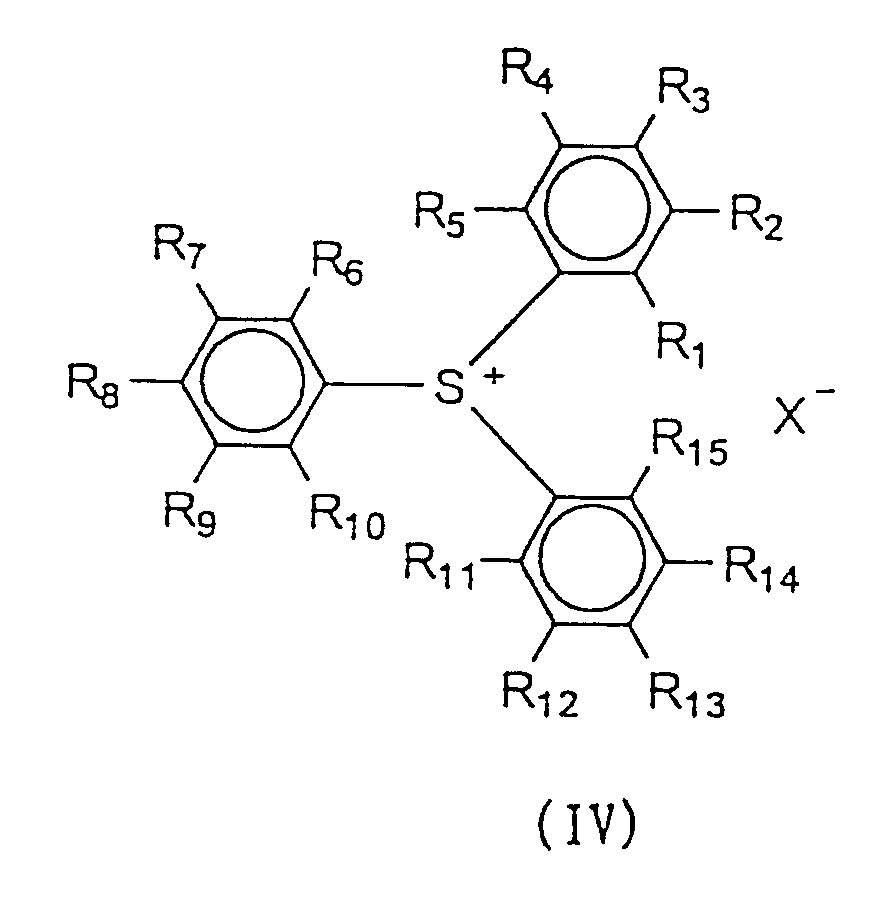
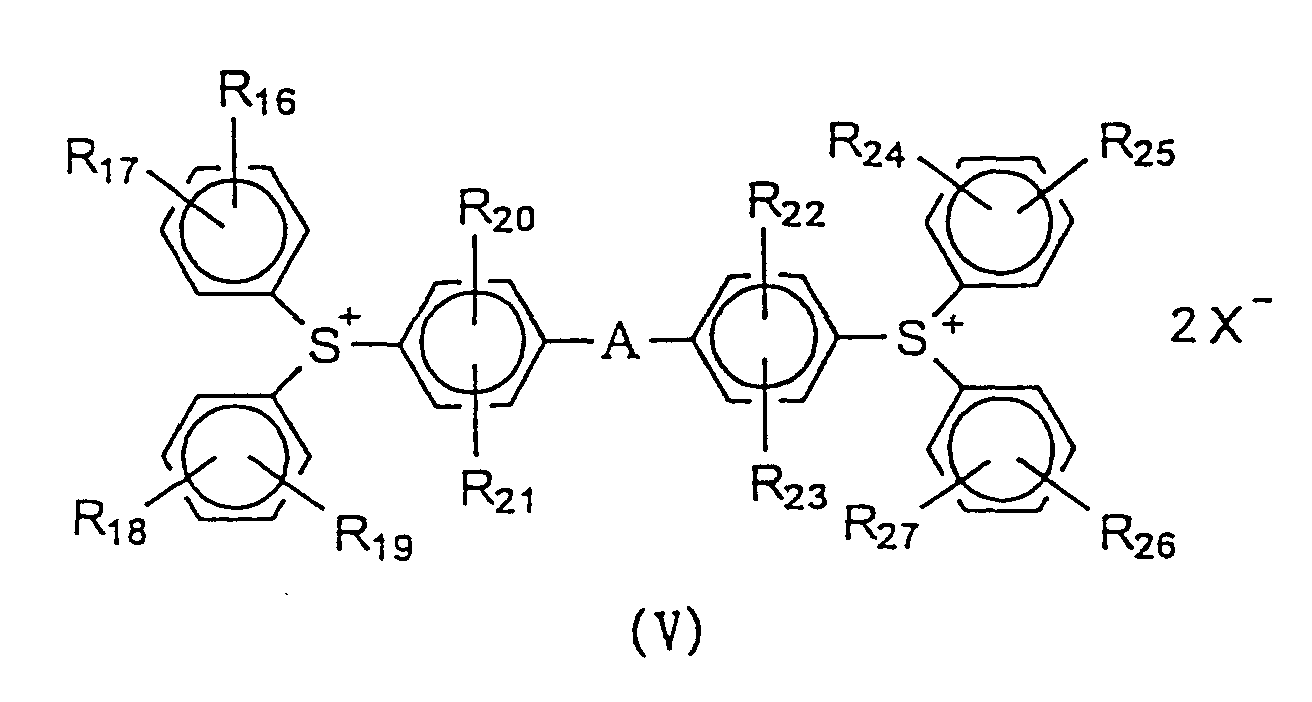 wherein R1 to R37 each independently represents a hydrogen atom, a straight chain, branched, or cyclic alkyl group, a straight chain, branched, or cyclic alkoxy group, a hydroxy group, a halogen atom, or a -S-R38 group (wherein R38 represents a straight chain, branched, or cyclic alkyl group or an aryl group); X- represents an anion of the compound represented by the formula (I); A represents a single bond, a sulfur atom, an oxygen atom, or a methylene group.
- (8). The positive resist composition according to the
above item (7), wherein X- in the formulae (IV) to (VI)
contains the following structure:

- (9). The positive resist composition according to the above item (1), which further comprises (C) a compound generating sulfonic acid by irradiation with an actinic ray or a radiation.
- (10). A positive resist composition comprising:
- (A) a compound generating a compound represented by the formula (I) below by irradiation with an actinic ray or a radiation;
- (D) a compound having a molecular weight of not larger than 3000, which is decomposed by the action of an acid to increase the solubility in an alkali developer; and
- (E) an alkali-soluble resin:
wherein, Y represents a single bond, -CO-, or -SO2-; R' and R", which may be the same or different, each represents a straight chain, branched, or cyclic alkyl group which may be substituted, an aryl group which may be substituted, an aralkyl group which may be substituted, or a camphor group; R' and R" may be bonded to each other to form an alkylene group, an arylene group, or an aralkylene group, thereby, the structure of the formula (I) may form a ring; and when Y is a -CO- group, R" may be a hydroxy group or an alkoxy group.
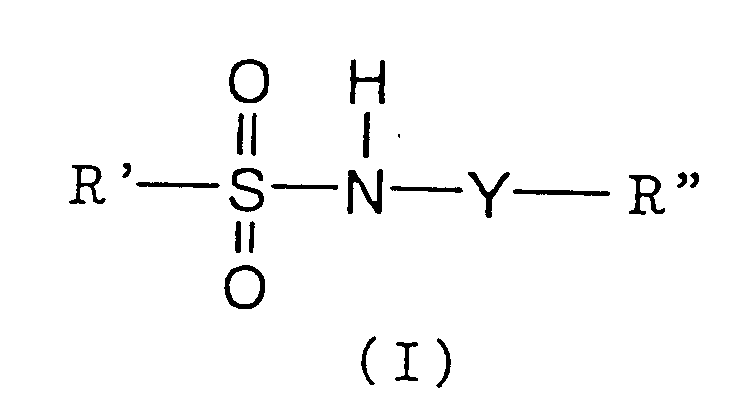
- (11). The positive resist composition according to the above item (10), wherein the pKa of the compound represented by the formula (I) is in the range of from -5 to 5.
- (12). The positive resist composition according to the above item (10), which further comprises (F) a nitrogen-containing basic compound and (G) a surfactant containing at least one of the group consisting of a fluorine atom and a silicon atom.
- (13). The positive resist composition according to the
above item (10), wherein the compound (A) is a compound having
a structure represented by one of the following formulae (IV)
to (VI):

 wherein R1 to R37 each independently represents a hydrogen atom, a straight chain, branched, or cyclic alkyl group, a straight chain, branched, or cyclic alkoxy group, a hydroxy group, a halogen atom, or a -S-R38 group (wherein R38 represents a straight chain, branched, or cyclic alkyl group or an aryl group); X- represents an anion of the compound represented by the formula (I); A represents a single bond, a sulfur atom, an oxygen atom, or a methylene group.
- (14). The positive resist composition according to the
above item (13), wherein X- in the formulae (IV) to (VI)
contains the following structure:
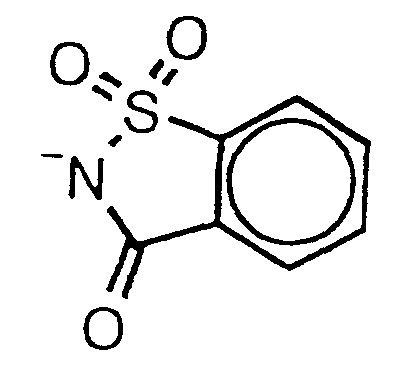
- (15). The positive resist composition according to the above item (10), which further comprises (C) a compound generating sulfonic acid by irradiation with an actinic ray or a radiation.
- (16). A sulfonium salt compound represented by the
formula (IVa):
wherein, R1 to R15 each independently represents a hydrogen atom, a straight chain or branched alkyl group having from 1 to 5 carbon atoms, a cyclic alkyl group having from 3 to 8 carbon atoms, an alkoxy group having from 1 to 4 carbon atoms, a halogen atom, or -S-R38 (wherein R38 represents a straight chain or branched alkyl group having from 1 to 5 carbon atoms, a cyclic alkyl group having from 3 to 8 carbon atoms, or an aryl group having from 6 to 14 carbon atoms); Ra and Rb each independently represents a hydrogen atom, a halogen atom, an alkyl group having from 1 to 5 carbon atoms, an alkoxy group having from 1 to 5 carbon atoms, a nitro group, or a hydroxy group.
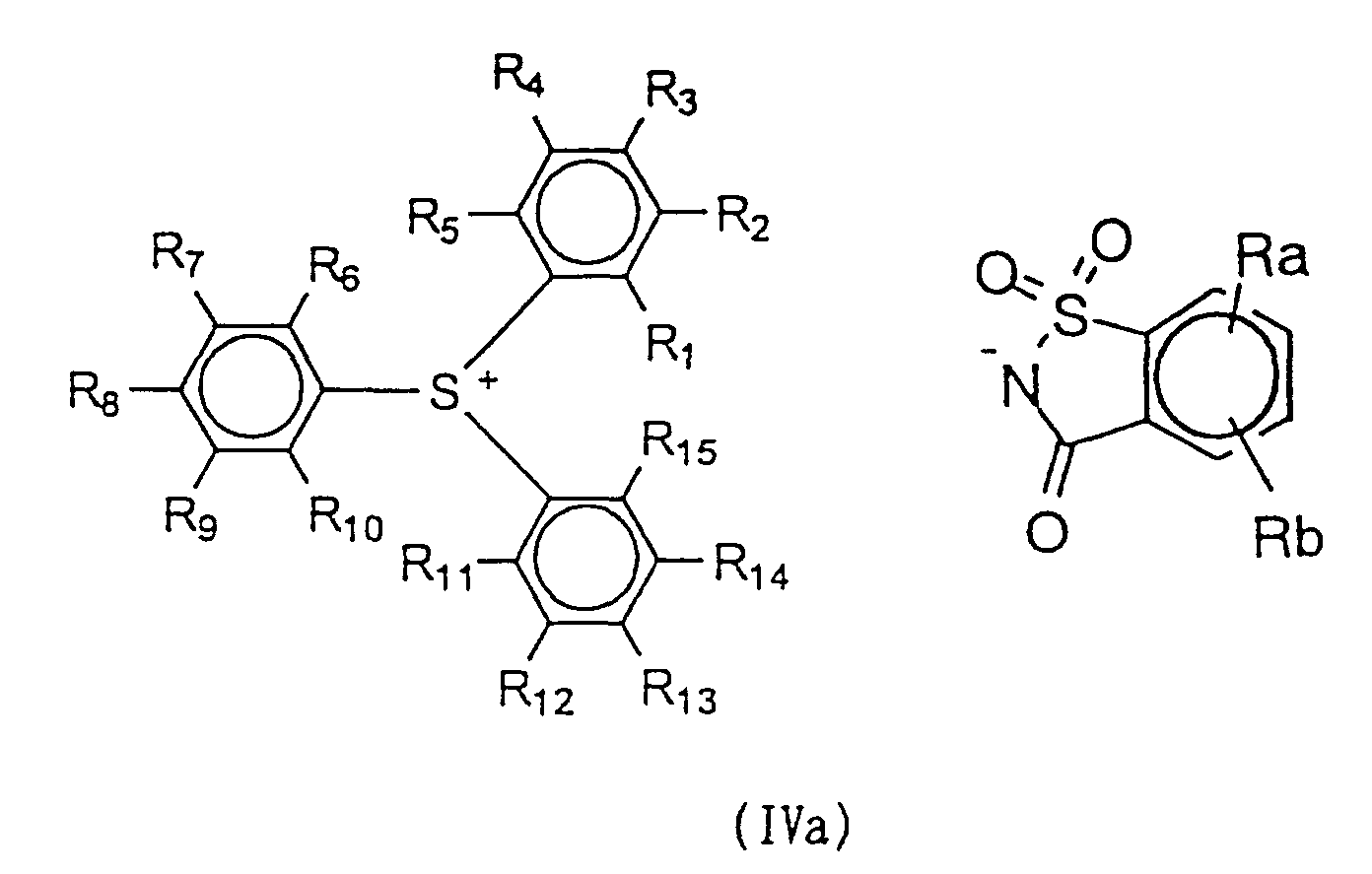
- (17). The sulfonium salt compound according to the above item (16), wherein in the formula (IVa), R1, R2, R4 to R7, R9 to R12, R14, R15, Ra, and Rb each is a hydrogen atom, and R3, R8, and R13 each independently represents a hydrogen atom, an alkyl group having from 1 to 5 atoms, an alkoxy group having from 1 to 5 carbon atoms, or a halogen atom.
- (18). A sulfonium salt compound represented by the
formula (Va):
wherein R16 to R27 each independently represents a hydrogen atom, a straight chain or branched alkyl group having from 1 to 5 carbon atoms, a cyclic alkyl group having from 3 to 8 carbon atoms, an alkoxy group having from 1 to 4 carbon atoms, a halogen atom, or -S-R38 (wherein R38 represents a straight chain or branched alkyl group having from 1 to 5 carbon atoms, a cyclic alkyl group having from 3 to 8 carbon atoms, or an aryl group having from 6 to 14 carbon atoms); Ra and Rb each independently represents a hydrogen atom, a halogen atom, an alkyl group having from 1 to 5 carbon atoms, an alkoxy group having from 1 to 5 carbon atoms, a nitro group, or a hydroxy group.

- (19). The sulfonium salt compound according to the above item (18), wherein in the formula (Va), R16 to R27, Ra, and Rb each is a hydrogen atom.
- (20). An iodonium salt compound represented by the
formula (VIa) :
wherein R28 to R37 each independently represents a hydrogen atom, a straight chain or branched alkyl group having from 1 to 5 carbon atoms, a cyclic alkyl group having from 3 to 8 carbon atoms, an alkoxy group having from 1 to 4 carbon atoms, a halogen atom, or -S-R38 (wherein R38 represents a straight chain or branched alkyl group having from 1 to 5 carbon atoms, a cyclic alkyl group having from 3 to 8 carbon atoms, or an aryl group having from 6 to 14 carbon atoms); Ra and Rb each independently represents a hydrogen atom, a halogen atom, an alkyl group having from 1 to 5 carbon atoms, an alkoxy group having from 1 to 5 carbon atoms, a nitro group, or a hydroxy group.

- (21). The iodonium salt compound according to the above item (20), wherein in the formula (VIa), R28, R29, R31 to R34, R36, R37, Ra, and Rb each is a hydrogen atom, and R30 and R35 each independently a hydrogen atom or an alkyl group having from 1 to 5 carbon atoms.
-
- According to the present invention, even an electron beam is used as an energy ray for exposure, the excellent performance can be obtained. In the case of irradiating a resist with an electron beam, because incident electrons have electrostatic charges and cause interaction with the atomic nuclei and electrons of substances constituting the resist, there is a problem that when electron beam strike the resist film, a scattering always occur, thereby the pattern profile is deteriorated. Also, even when the beam is irradiated by reducing the beam diameter in order to resolve fine patterns, there is a problem that the irradiated area is expanded by the scattering to deteriorate the resolving power. The composition of the invention can skillfully resolve these problems of the electron beam irradiation.
- Then, the invention is described in detail.
- The present invention includes;
- 1. the positive resist composition (hereinafter, is
also referred to as "the 1st composition") comprising;
- (A) a compound generating a compound represented by the formula (I) by irradiation with an actinic ray or a radiation; and
- (B) a resin having a group which is decomposed by the action of an acid to increase the solubility of the composition in an alkali developer as the indispensable components, and
- 2. the positive resist composition (hereinafter, is
also referred to as "the 2nd composition") comprising:
- (A) a compound generating a compound represented by the formula (I) by irradiation with an actinic ray or a radiation;
- (D) a compound having a molecular weight of not larger than 3000, which is decomposed by the action of an acid to increase the solubility in an alkali developer; and
- (E) an alkali-soluble resin as the indispensable components.
-
- Hereinafter, in the case of simply describing the positive resist composition or the composition of the invention, the composition includes both the 1st composition and the 2nd composition.
- At first, the components, such as the compounds, the resins, etc., which these positive resist compositions of the invention comprises are explained in detail below.
- In the formula (I), the straight chain, branched, or cyclic alkyl group represented by R' and R" includes a straight chain or branched alkyl group having from 1 to 20 carbon atoms, such as methyl, ethyl, propyl, isopropyl, n-butyl, sec-butyl, t-butyl, hexyl, octyl, dodecyl, etc., and a cyclic alkyl group such as cyclopropyl, cyclopentyl, cyclohexyl, etc. These alkyl groups each may have a substituent and the preferred substituent includes an alkoxy group, an acyl group, an acyloxy group, fluorine, chlorine, bromine, iodine, etc.
- The aralkyl group represented by R' and R" includes an aralkyl group having from 7 to 12 carbon atoms such as benzyl, phenetyl, etc. These aralkyl may have a substituent and the preferred substituent includes an alkyl group having from 1 to 4 carbon atoms, an alkoxy group having from 1 to 4 carbon atoms, a nitro group, an acetylamino group, a halogen atom, etc.
- The aryl group represented by R' and R" includes an aryl group having from 6 to 20 carbon atoms, such as phenyl, tolyl, mesityl, naphthyl, etc. These aryl groups may have a substituent and preferred substituent includes an alkyl group, an alkoxy group, an acyl group, a formyl group, a nitro group, an acylamino group, a sulfonyl amino group, a halogen atom, an aryl group, an alkoxycarbonyl group, a cyano group, etc.
- The alkoxy group represented by R' and R" includes an alkoxy group having from 1 to 20 carbon atoms, such as methoxy, ethoxy, propoxy, isopropoxy, n-butoxy, isobutoxy, sec-butoxy, octyloxy, dodecyloxy, etc., and an alkoxy having a substituent, such as ethoxyethoxy, hydroxyethoxy, cyanoethoxy, etc.
- R' and R" may be bonded to each other to form a ring, and practical examples of the ring formed include the rings represented by the following formulae.
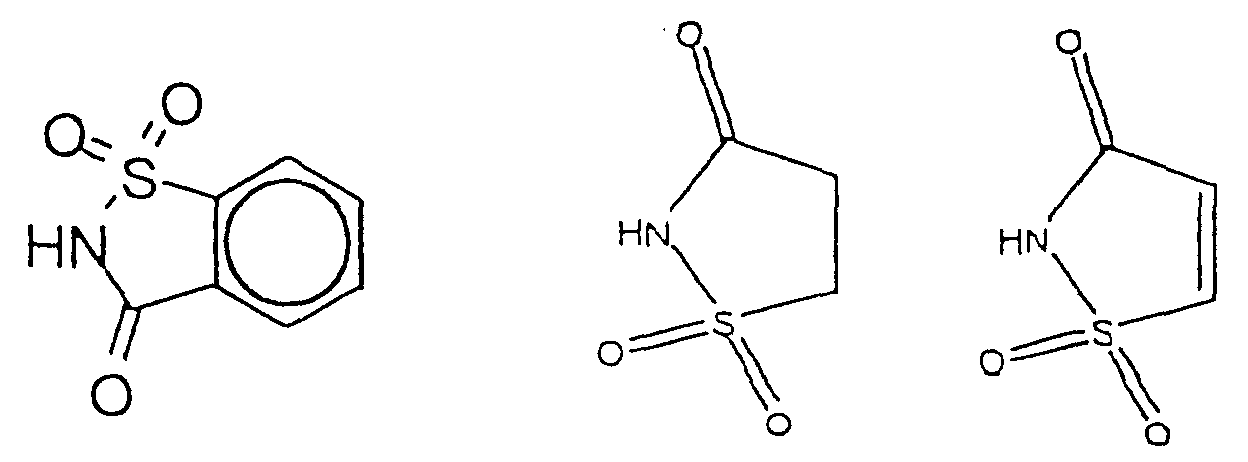
- The pKa of the compounds represented by the formula (I) is preferably in the range of from -5 to 5, more preferably from -3 to 4, and particularly preferably from 0 to 5. When the pKa is smaller than -5, the acidity becomes strong and the recombination and the crosslinking reaction of the protective group decomposed by acid become liable to occur, while when the pKa is larger than 5, the decomposition of the acid-decomposable group becomes delayed, and the sensitivity becomes greatly lowered.
- The pKa can be calculated by a titration using a commercially available titration apparatus or a pH meter in water or a mixed solvent of water and a water-soluble organic solvent (dioxane, methanol, tetrahydrofuran, etc.). The pKa of saccharin which is the compound represented by the above-described formula (I) is 2.3.
- The positive resist composition of the invention comprises the component (A) as the indispensable component.
- As the components (A), there are the sulfonium salts and the iodonium salts of the anions formed by a dissociation of N-H in the compounds represented by the formula (I). As the components (A), a compound represented by the above-described formulae (IV) to (VI) is more preferable. By using these compounds, the sensitivity, the resolving power, and the exposure margin become more excellent. By irradiating the compounds with an actinic ray or a radiation, they generate the compounds represented by the formula (I) corresponding to X- of the compounds (IV) to (VI), which function as photo-acid generator.
- In the formulae (IV) to (VI), the straight chain or branched alkyl groups of R1 to R38 include the alkyl groups having from 1 to 5 carbon atoms, such as methyl, ethyl, propyl, n-butyl, sec-butyl, t-butyl, etc., each of which may have a substituent.
- The cyclic alkyl group of R1 to R38 include the alkyl groups having from 3 to 8 carbon atoms, such as cyclopropyl, cyclopentyl, cyclohexyl, etc., each of which may have a substituent.
- The alkoxy groups of R1 to R37 include the alkoxy groups having from 1 to 4 carbon atoms, such as methoxy, ethoxy, hydroxyethoxy, propoxy, n-butoxy, isobutoxy, sec-butoxy, t-butoxy, etc.
- The halogen atoms of R1 to R37 include fluorine, chlorine, bromine, iodine, etc.
- The aryl groups of R38 include the aryl groups having from 6 to 14 carbon atoms, such as phenyl, tolyl, methoxyphenyl, naphthyl, etc., each of which may have a substituent.
- The preferred substituents which can be owned by the groups of R1 to R38 include an alkyl group having from 1 to 4 carbon atoms, a halogen atom (fluorine, chlorine, iodine, etc.), an aryl group having from 6 to 10 carbon atoms, an alkenyl group having from 2 to 6 carbon atoms, a cyano group, a hydroxy group, a carboxy group, an alkoxycarbonyl group, a nitro group, etc.
- X- is preferably the anions represented by the following formula.
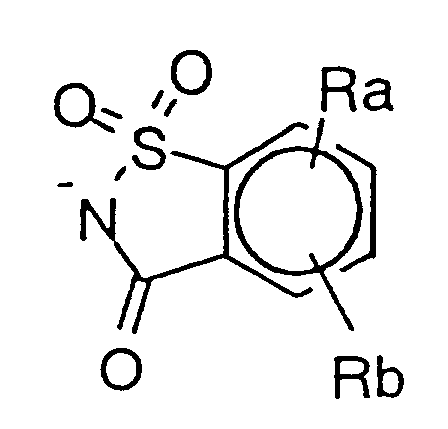
- In the above formula, Ra and Rb each independently represents a hydrogen atom, a halogen atom, an alkyl group having from 1 to 5 carbon atoms, an alkoxy group having from 1 to 5 carbon atoms, a nitro group, or a hydroxy group. Ra and Rb each is preferably a hydrogen atom.
- In the above-described formulae (IV) to (VI), R1 to R37 each is preferably a hydrogen atom. Furthermore, R3, R8, and R13 each is also preferably an alkyl group having from 1 to 5 carbon atoms (for example, methyl, ethyl, and pentyl), an alkoxy group having from 1 to 5 carbon atoms (for example, butoxy), or a halogen atom (for example, chlorine) in addition to a hydrogen atom. R30 and R35 each is also preferably an alkyl group having from 1 to 5 carbon atoms (for example, methyl, butyl, and pentyl) in addition of a hydrogen atom.
- In the formula (V), A is preferably a sulfur atom.
- Then, practical examples of the component (A) (photo-acid generator) are shown below, but the invention is not limited by these compounds.
- Practical examples (VI-1) to (IV-18) of the photo-acid generators represented by the formula (IV) described above are illustrated below.
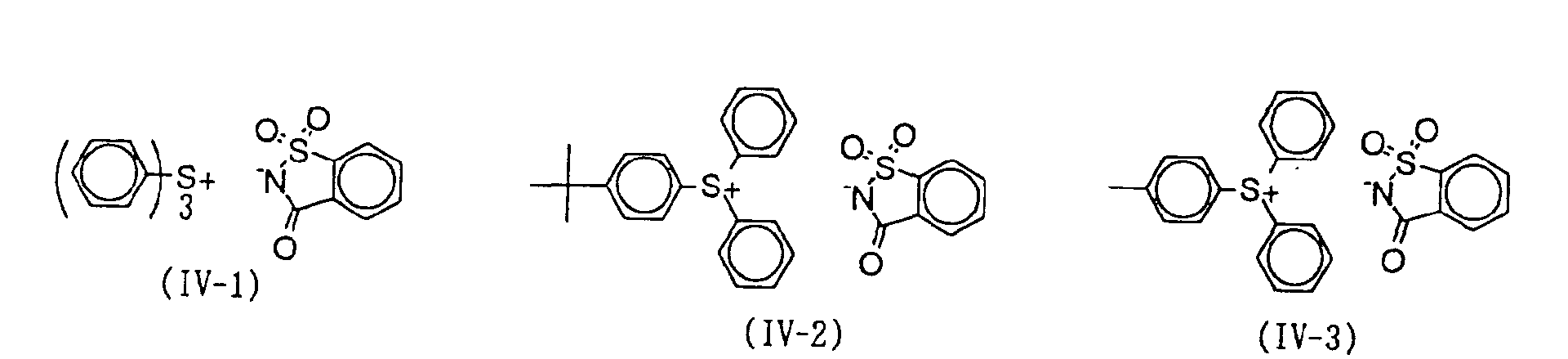
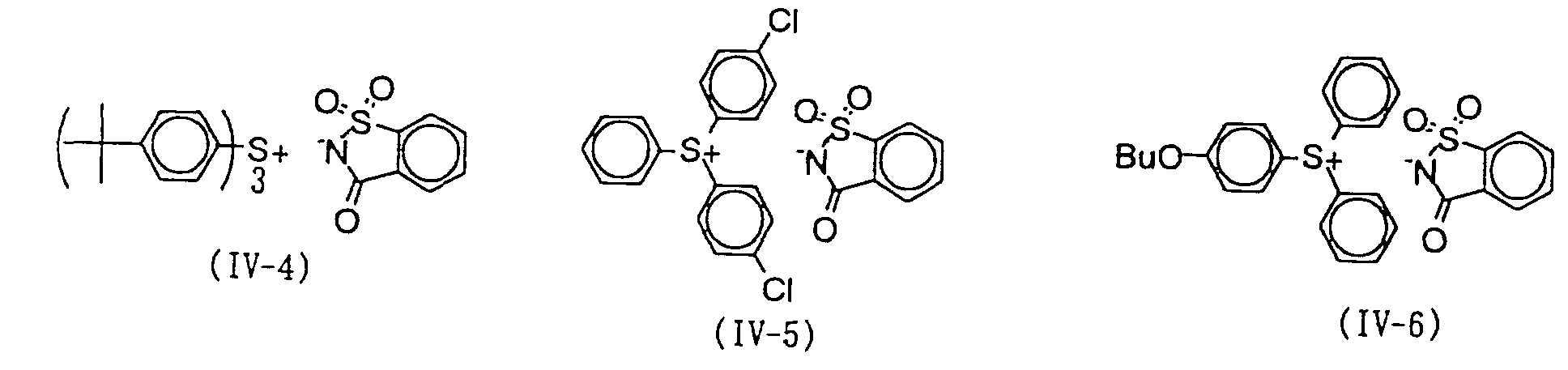






- Practical examples (V-1) to (V-7) of the photo-acid generator represented by the formula (V) are shown below.


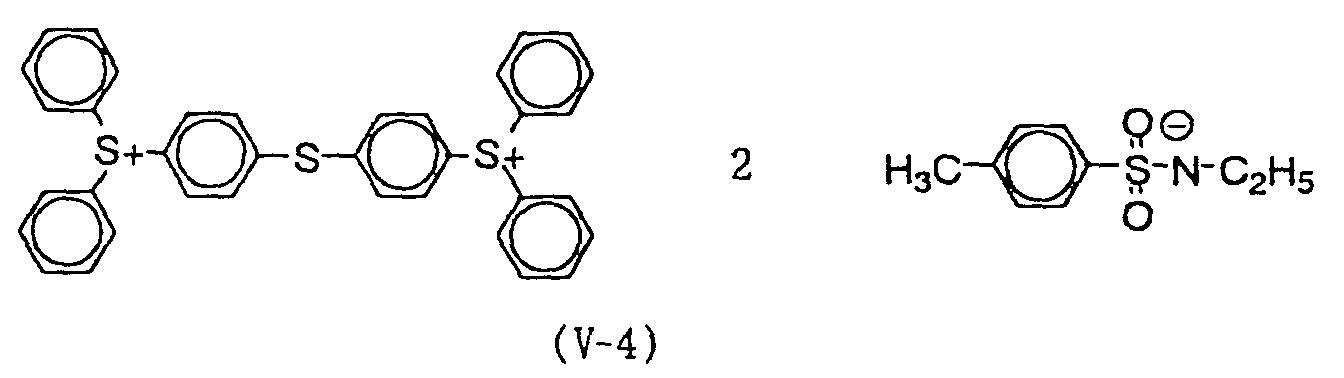
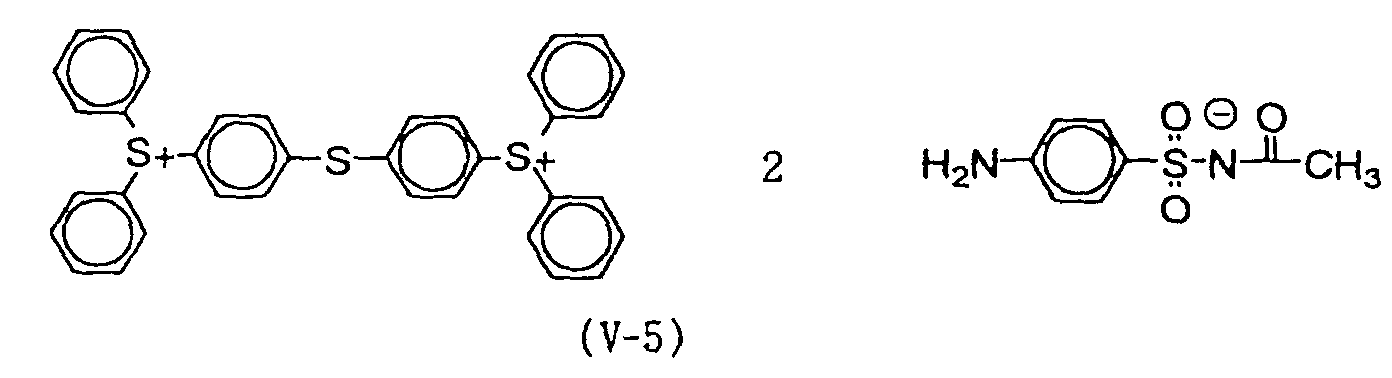

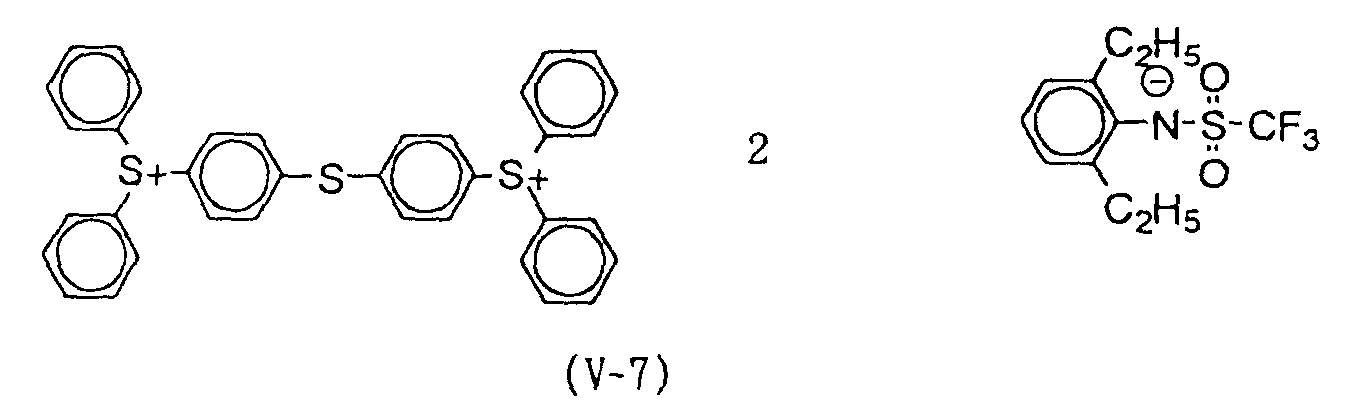
- Practical examples (VI-1) to (VI-11) of the photo-acid generators represented by the formula (VI) are shown below.





- The component (A) can be used singly or as a combination of two or more kinds of them.
- For obtaining the compound represented by the formulae (IV) to (VI), the corresponding sulfonium or iodonium halogen compound is reacted with silver oxide to covert to the onium hydroxide, and thereafter, by adding the corresponding sulfonylimide compound, the desired compound is obtained.
- The content of the compound of the component (A) in the positive resist composition of the invention is preferably from 0.1 to 20% by weight, more preferably from 0.5 to 10% by weight, and far more preferably from 1 to 7% by weight based on the solid components of the composition.
- Other photo-acid generator(component (C)) than the component (A) is used in the composition of the present invention.
- As the photo-acid generator, which can be used together with the component (A), a photo-initiator for cationic photopolymerization, a photo-initiator for radical photopolymerization, a photodecolouring agent for agent, a photodiscoloring agent, a compound generating an acid by a known light used for a microresist, etc., (ultraviolet rays of from 400 to 200 nm, far ultraviolet rays, and particularly preferably g-line, h-line, I-line, a KrF excimer laser light), an ArF excimer laser light, electron beam, X-ray, a molecular beam, or an ion beam, and a mixture of them can be properly selected.
- Also, other photo-acid generators, which can be used together with the component (A) include, for example, onium salts such as a diazonium salt, an ammonium salt, a phosphonium salt, an iodonium salt, a sulfonium salt, a selenonium salt, an alsonium salts, etc.; organic halogen compounds; organometal/organic halogen compounds; photo-acid generators having an o-nitrobenzyl-type protective group; compounds generating sulfonic acid by being photodecomposed, such as imino sulfonate; disulfone compounds; diazoketosulfone; and diazodisulfone compounds.
- Also, the compounds each obtained by introducing the group or the compound generating an acid by light to the main chain or the side chain of the polymer can be used together with the component (A).
- Furthermore, the compounds each generating an acid by light described in V.N.R.Pillai, "Synthesis", (1), 1(1980), A Abad et al., "Tetrahedron Lett", (47), 4555(1971), D.H.R. Barton et al., "J. Chem. Soc.", (C), 329(1970), U.S. Patent 3,779,778, European Patent 126,712, etc., can be also used together with the component (A).
- In the above-described compounds each generating an acid by being decomposed by irradiation with an actinic ray or a radiation, the compounds which are particularly effectively used are the compounds represented by the formula (PAG3), the formula (PAG4), the formula (PAG6) or the formula (PAG7) described below.
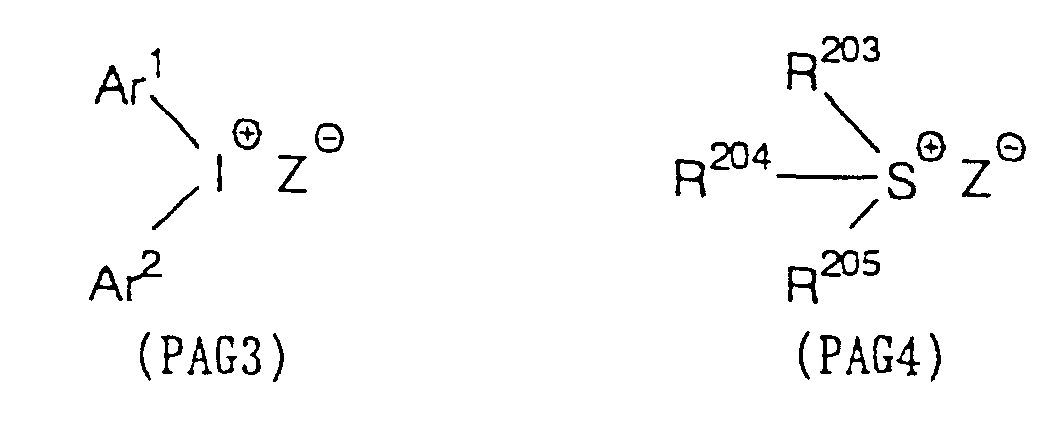
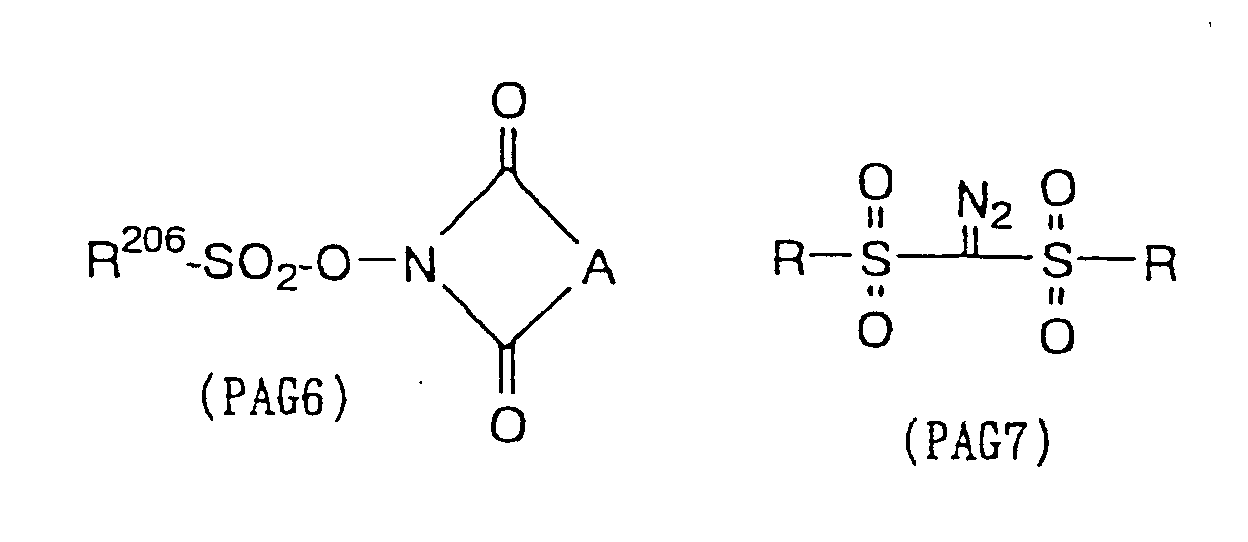
- In the formulae (PAG3) and (PAG4), Ar1 and Ar2, which are the same or different, each represents substituted or unsubstituted aryl group. The preferred substituent includes an alkyl group, a haloalkyl group, a cycloalkyl group, an aryl group, an alkoxy group, a nitro group, a carboxy group, an alkoxycarbonyl group, a hydroxy group, a mercapto group, and a halogen atom.
- Also, in the same formulae, R203, R204, and R205, which are the same or different, each represents a substituted or unsubstituted alkyl group or a substituted or unsubstituted aryl group. Each is preferably an aryl group having from 6 to 14 carbon atoms, and alkyl group having from 1 to 8 carbon atoms, and the substituted derivatives of them. The preferred substituents for the aryl group include an alkoxy group having from 1 to 8 carbon atoms, an alkyl group having from 1 to 8 carbon atoms, a nitro group, a carboxy group, a hydroxy group and a halogen atom, and the preferred substituents for the alkyl group include an alkoxy group having from 1 to 8 carbon atoms, a carboxy group, and an alkoxycarbonyl group.
- Also, Z- represents an counter anion and examples of the counter anion include BF4 -, AsF6 -, PF6 -, SbF6 -, SiF6 -, ClO4 -, an alkanesulfonic acid which may be substituted, a perfluoroalkanesulfonic acid, a benzenesulfonic acid which may be substituted, a naphthalenesulfonic acid which may be substituted, anthracenesulfonic acid which may be substituted, and camphorsulfonic acid which may be substituted, but Z- is not limited to them. Preferred anions are alkanesulfonic acid, perfluoroalkanesulfonic acid, an alkyl-substituted benzenesulfonic acid, and pentafluorobenzenesulfonic acid.
- Also, two of R203, R204, and R205 or Ar1 and Ar2 may be bonded to each other via a single bond or a substituent.
- In the formulae (PAG6) and (PAG7), R206 represents a substituted or unsubstituted alkyl or aryl group; A represents a substituted or unsubstituted alkylene, alkenylene, or arylene group; and R represents a straight chain, branched or cyclic alkyl group, or an aryl group which may be substituted.
- As the practical examples of the compounds of the above-described formulae, there are following compounds, but the is not limited to these compounds.
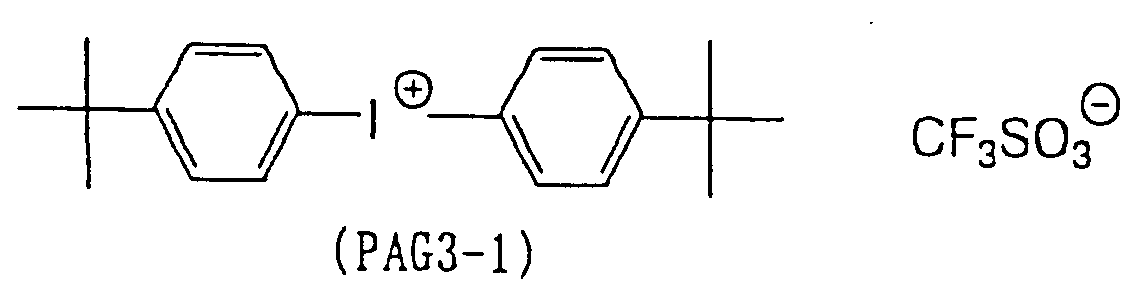


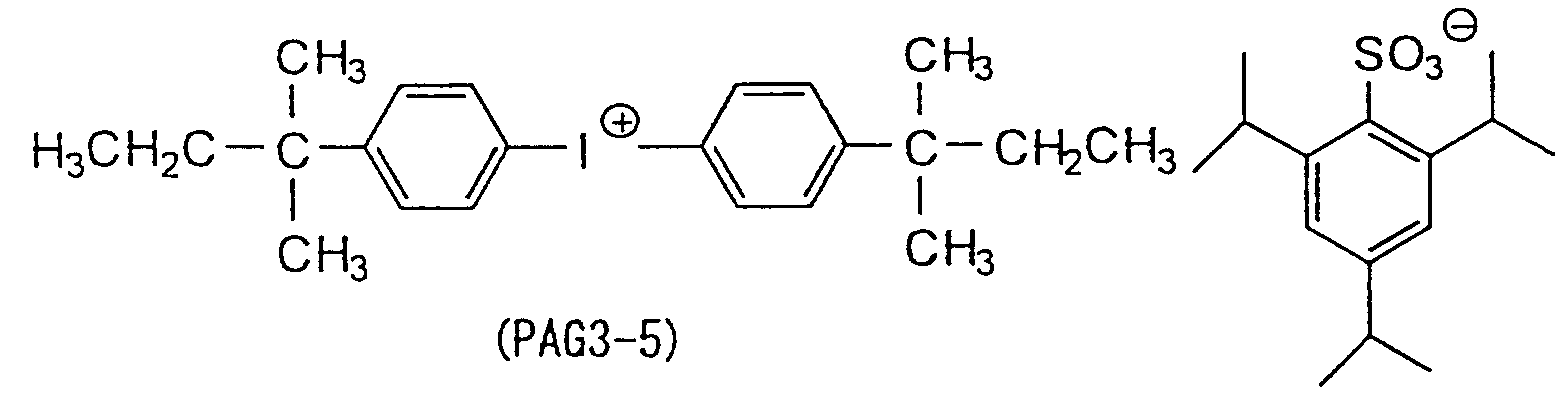
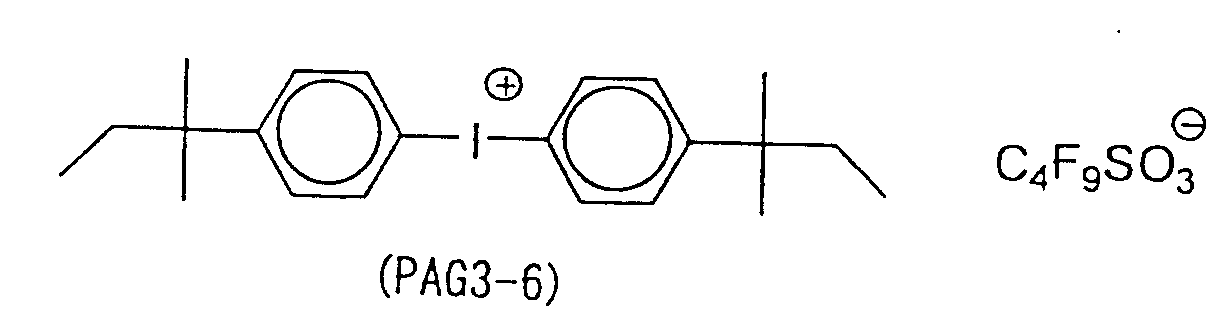


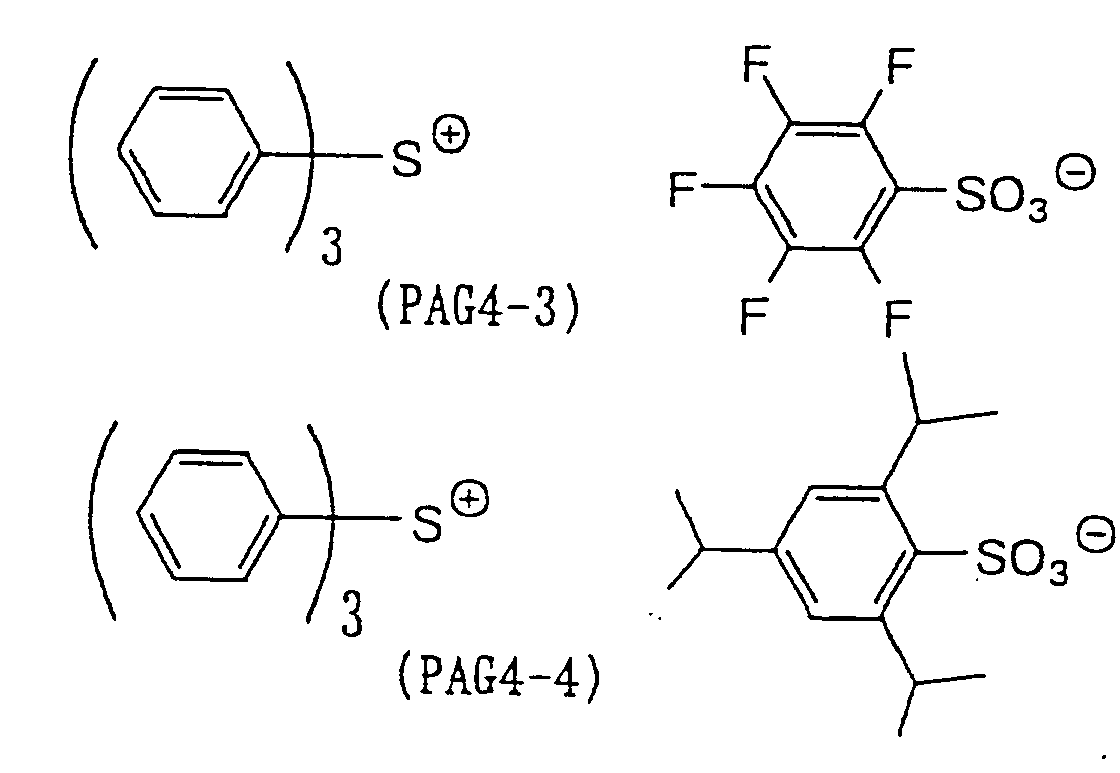
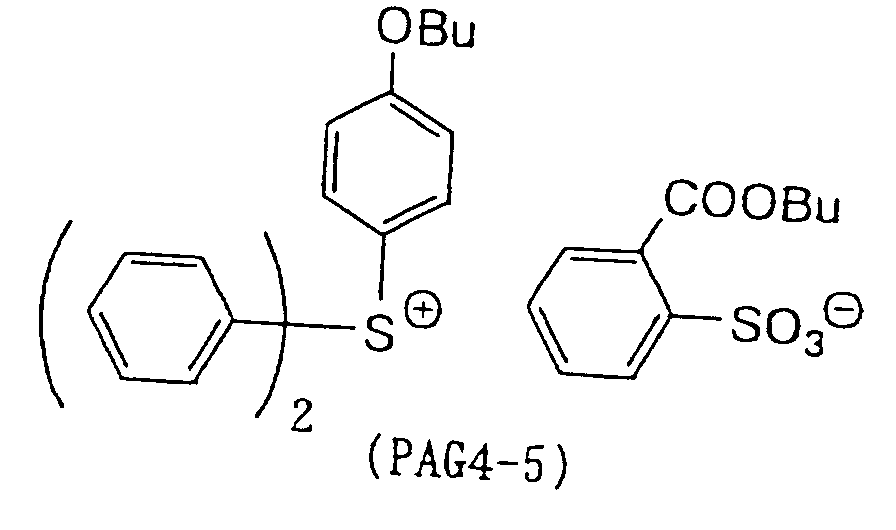
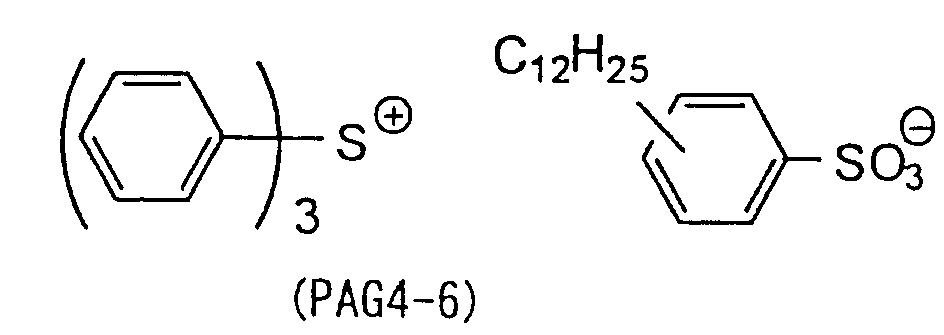


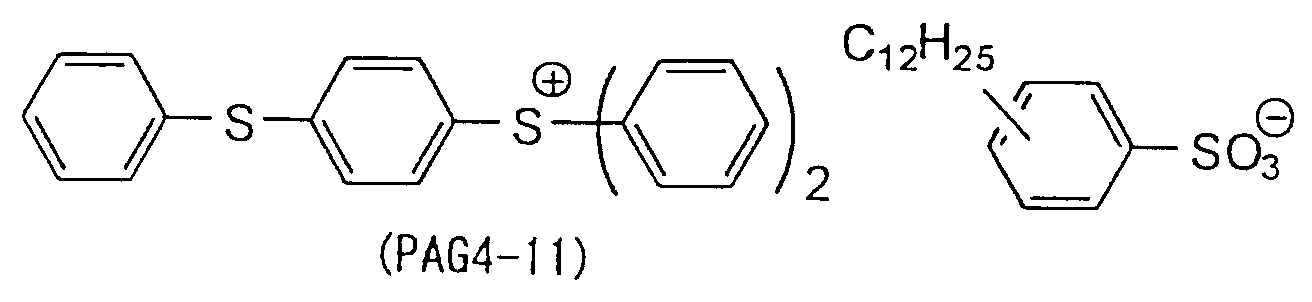


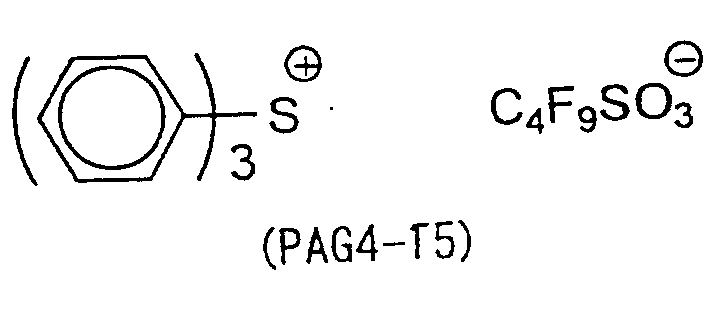


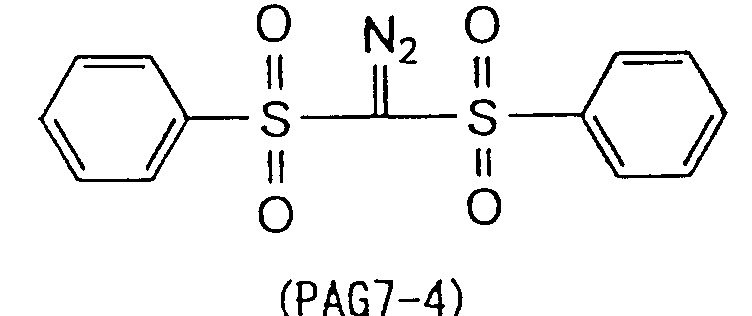

- In the invention, in the above-described photo-acid generators which are used together with the component (A) described above, the compounds generating a sulfonic acid by irradiation with an actinic ray or a radiation are preferred in the point of being excellent in the sensitivity and the resolving power.
- Also, in the invention, as the photo-acid generator which is used together with the component (A), the compounds represented by the formula (PAG-3), the formula (PAG-4) and the formula (PAG-7) described above are preferred.
- The composition of the present invention contains the compound (C) in an amount of 5 wt% or less, preferably 4 wt% or less based on the solid contents of the composition.
- The component (B) is used as the indispensable component of the 1st component of the invention.
- The component (B), that is the resin having a group, which is decomposed by an acid to increase the solubility in an alkali developer, (the group is also referred to be a group decomposable with acid), is a resin having the group decomposable with acid at the main chain or the side chain, or at both the main chain and the side chain of the resin. In these resins, the resin having the group decomposable with acid at the side chain is more preferred.
- As the group decomposable with acid, the groups represented by -COOA0 and -O-B0 are preferable and as the group containing each of these groups, there is the group represented by -R0-COOA0 or -Ar-O-B0.
- Wherein, A0 represents a group represented by -C(R01) (R02) (R03), -Si(R01) (R02) (R03), or -C(R04) (R05)-O-R06. B0 shows a group represented by A0 or -CO-O-A0 (R0, R01 to R06, and Ar have the same meanings as those described below.).
- The acid-decomposable group preferably includes a silyl ether group, a cumyl ester group, an acetal group, a tetrahydropyranyl ether group, an enol ether group, an enol ester group, a tertiary alkyl ether group, a tertiary alkyl ester group, a tertiary alkyl carbonate group, etc., more preferably includes a tertiary alkyl ester group, a tertiary alkyl carbonate group, a cumyl ester group, an acetal group, and a tetrahydropyranyl ether group, and particularly preferably includes an acetal group.
- Then, the matrix resin in the case of bonding the group decomposable with acid to the side chain thereof is an alkali-soluble resin having -OH or -COOH, and preferably -R0-COOH or -Ar-OH at the side chain. For example, where are the alkali-soluble resins described below.
- The alkali-solving speed of the alkali-soluble resin is preferably at least 170 A/second by, and particularly preferably at least 330 A/second (wherein, A shows angstrom) measuring (at 23°C) with 0.261 N of tetramethylammonium hydroxide (TMAH).
- Also, from the point of attaining a rectangular profile, the alkali-soluble resin having a high transmittance to a far ultraviolet light or an excimer laser light is preferred. It is preferred that the transmittance of a film thickness of 1 µm at 248 nm is from 20 to 90%.
- From such view points, the particularly preferred alkali-soluble resins include o-, m-, or p-poly(hydroxystyrene) and the copolymers of them, hydrogenated poly(hydroxystyrene), a halogen- or alkyl-substituted poly(hydroxystyrene), an o-alkylated or o-acylated product of a part of poly(hydroxystyrene), a styrene-hydroxystyrene copolymer, an α-methylstyrene-hydroxystyrene copolymer, and a hydrogenated novolac resin.
- The resins having a group decomposable with acid, which are used in the invention, can be obtained by reacting the alkali-soluble resin and precursors of the group decomposable with acid, or by copolymerizing an alkali-soluble monomer bonded to the group decomposable with acid and various monomers as disclosed in European Patent 254853, Japanese Patent Laid-Open Nos. 25850/1990, 223860/1991, 251259/1992, etc.
- Practical examples of the resin having the group decomposable with acid, which are used in the invention, are illustrated below but the invention is not limited to them.
- p-t-butoxystyrene/p-hydroxystyrene copolymer,
- p-(t-butoxycarbonyloxy)styrene/p-hydroxystyrene copolymer,
- p-(t-butoxycarbonylmethyloxy)styrene/p-hydroxystyrene copolymer,
- 4-(t-butoxycarbonylmethyloxy)-3-methylstyrene /4-hydroxy-3-methylstyrene copolymer,
- p-(t-butoxycarbonylmethyloxy)styrene/p-hydroxystyrene (10% hydrogenated product) copolymer,
- m-(t-butoxycarbonylmethyloxy)styrene/m-hydroxystyrene copolymer,
- o-(t- t-butoxycarbonylmethyloxy)styrene/o-hydroxystyrene copolymer,
- p-(cumyloxycarbonylmethyloxy)styrene/p-hydroxystyrene copolymer,
- cumyl methacrylate/methyl methacrylate copolymer,
- 4-t-butoxycarbonylstyrene/dimethyl maleate copolymer, benzyl methacrylate/tetrahydropyranyl methacrylate,
- p-(t-butoxycarbonylmethyloxy)styrene/p-hydroxystyrene/ styrene copolymer,
- p-t-butoxystyrene/p-hydroxystyrene/fumalonitrile copolymer,
- t-butoxystyrene/hydroxyethyl methacrylate copolymer, styrene/N-(4-hydroxyphenyl)maleimide/N-(4-t-butoxycarbon yloxyphenyl)maleimide copolymer,
- p-hydroxystyrene/t-butyl methacrylate copolymer, styrene/p-hydroxystyrene/t-butyl methacrylate copolymer,
- p-hydroxystyrene/t-butyl acrylate copolymer, styrene/p-hydroxystyrene/t-butyl acrylate copolymer,
- p-(t-butoxycarbonylmethyloxy)styrene/p-hydroxystyrene/ N-methylmaleimide copolymer,
- t-butyl methacrylate/1-adamantylmethyl methacrylate copolymer,
- p-hydroxystyrene/t-butylacrylate/p-acetoxystyrene copolymer,
- p-hydroxystyrene/t-butylacrylate/p-(t-butoxycarbonyloxy) styrene copolymer, and
- p-hydroxystyrene/t-butylacrylate/ p-(t-butoxycarbonylmethyloxy)styrene copolymer.
-
- In the invention, as the resin (component (B)) having a group decomposable with acid, resins containing the repeating units represented by the formula (II) and the formula (III) described above are preferred. By using the resin, the resist composition of the invention has a high resolution and the performance change with the passage of time from the irradiation to heating becomes less.
- As the alkyl group represented by L and Z in the formula (II) described above, there are straight chain, branched, and cyclic alkyl groups having from 1 to 20 carbon atoms, such as methyl, ethyl, propyl, isopropyl, n-butyl, isobutyl, t-butyl, pentyl, cyclopentyl, hexyl, cyclohexyl, octyl, dodecyl, etc.
- The alkyl group may have an substituent, and the preferred substituent includes an alkyl group, an alkoxy group, a hydroxy group, a halogen atom, a nitro group, an acyl group, an acylamino group, a sulfonylamino group, an alkylthio group, an arylthio group, an aralkylthio group, etc., and as the examples of the substituted alkyl group, there are a cyclohexylethyl group, an alkylcarbonyloxymethyl group, an alkylcarbonyloxyethyl group, an arylcarbonyloxyethyl group, an aralkylcarbonyloxyethyl group, an alkyloxymethyl group, an aryloxymethyl group, an aralkyloxymethyl group, an alkyloxyethyl group, an aryloxyethyl group, an aralkyloxyethyl group, an alkylthiomethyl group, an arylthiomethyl group, an aralkylthiomethyl group, an aralkylthioethyl group, an arylthioethyl group, and an aralkylthioethyl group. There is no particular restriction on the alkyl group in this case, and the alkyl group may be a chain form, a cyclic form or a branched form. For example, there are groups such as a cyclohexylcarbonyloxyethyl group, a t-butylcyclohexylcarbonyloxyethyl group, an n-butylcyclohexylcarbonyloxyethyl group, etc. Also, there is no particular restriction on the aryl group in the above-described case, there are a phenyloxyethyl group, etc., and the group may be further substituted, such as a cyclohexylphenyloxyethyl group, etc. There is also no restriction on the aralkyl group in the case, and there are, for example, a benzylcarbonyloxyethyl group, etc.
- The aralkyl groups represented by L and Z of the formula (II) include the aralkyl groups having from 7 to 15 carbon atoms, such as a substituted or unsubstituted benzyl group, a substituted or unsubstituted phenetyl group. The preferred substituents of the aralkyl group include an alkoxy group, a hydroxy group, a halogen atom, a nitro group, an acyl group, an acylamino group, a sulfonylamino group, an alkylthio group, an arylthio group, an aralkylthio group, etc., and for example, there are an alkoxybenzyl group, a hydroxybenzyl group, a phenylthiophenetyl group, etc.
- It is preferred that the above-described Z is a substituted alkyl group or a substituted aralkyl group in the point that the improvement of the edge roughness is further obtained. As the substituent of the alkyl group, a cyclic alkyl group, an aryloxy group, an alkylcarboxy group, an arylcarboxy group, and an aralkylcarboxy group are preferred. Also, as the substituent of the aralkyl group, an alkyl group, a cyclic alkyl group, and a hydroxy group are preferred.
- The L and Z may be bonded to each other to form a 5- or 6-membered ring as described above, and as the 5- or 6-membered ring, there are a tetrahydropyran ring, a tetrahydrofuran ring, etc.
- The mol ratio of repeating structural unit represented by the formula (II) and the repeating structural unit represented by the formula (III) in the above-described resin is preferably from 1/99 to 60/40, more preferably from 5/95 to 50/50, and far more preferably from 10/90 to 40/60.
- The resin containing the repeating structural units represented by the formula (II) and the formula (III) may further contains a structural unit induced from other monomer.
- The other monomer can include hydrogenated hydroxystyrene; a halogen-, alkoxy-, or alkyl-substituted hydroxystyrene; styrene; a halogen-, alkoxy-, acyloxy-, or alkyl-substituted styrene; maleic anhydride; acrylic acid derivatives; methacrylic acid derivatives; N-substituted maleimide, etc., but the monomer is not limited to them.
- The ratio of the structural units represented by the formula (II) and the formula (III) and the structural unit of other monomer, [(II) + (III)]/[other monomer component] is from 100/0 to 50/50, preferably from 100/0 to 60/40, and more preferably from 100/0 to 70/30 by mol ratio.
- Practical examples of the resin containing the repeating structural units represented by the formula (II) and the formula (III) described above and other resins which can be used in the invention are illustrated below.


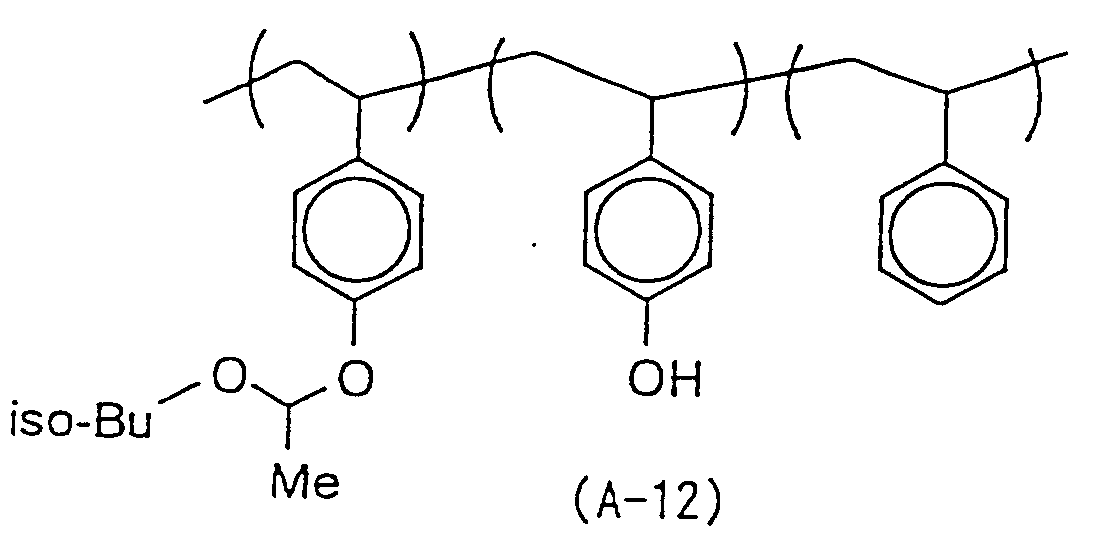
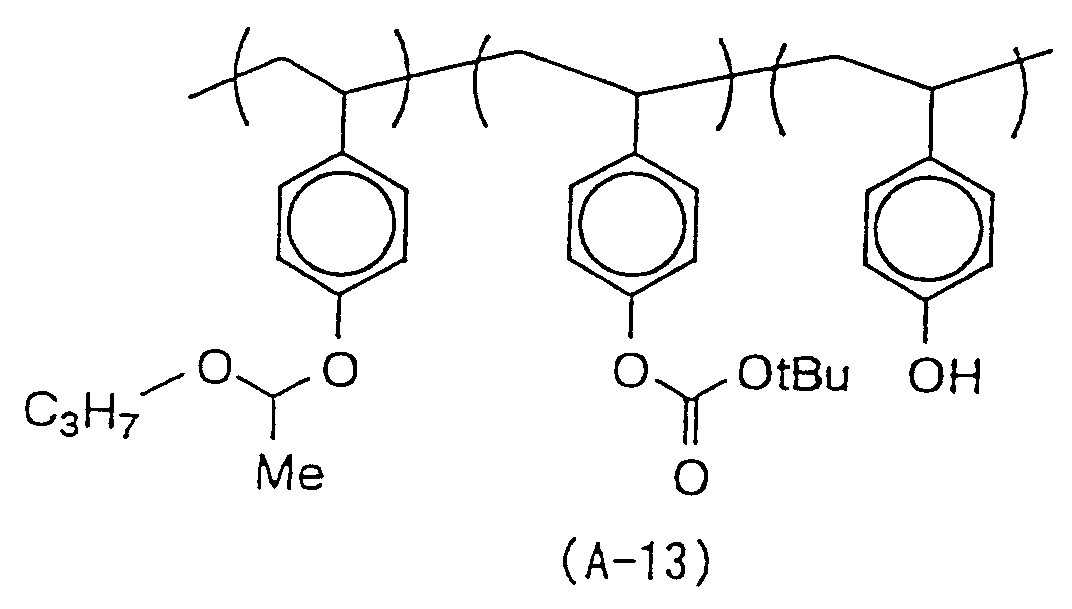

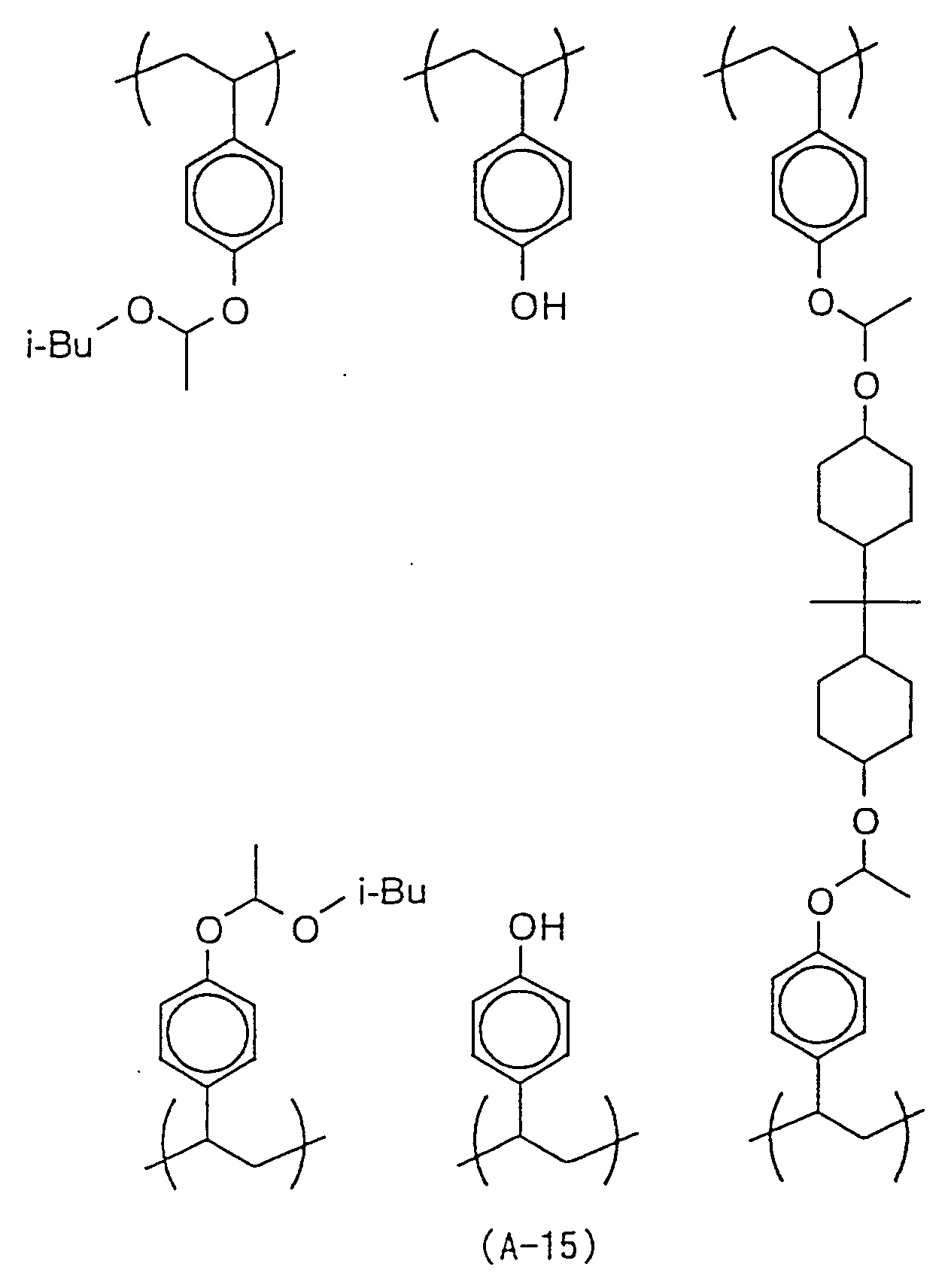

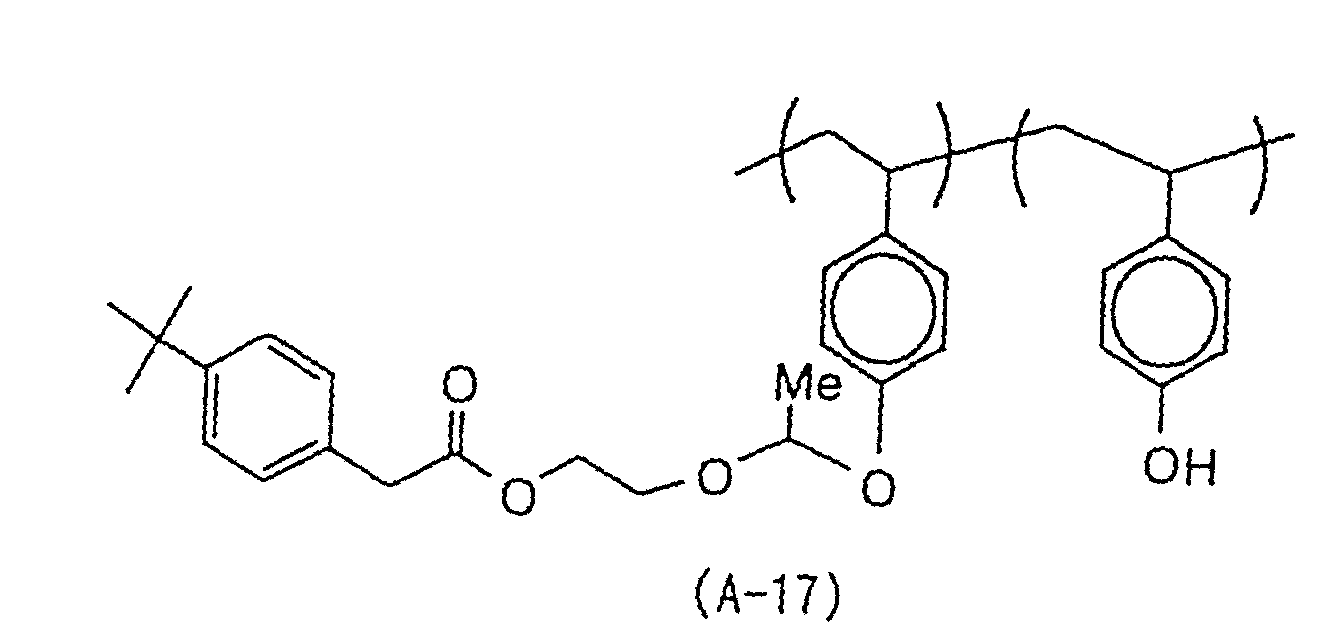


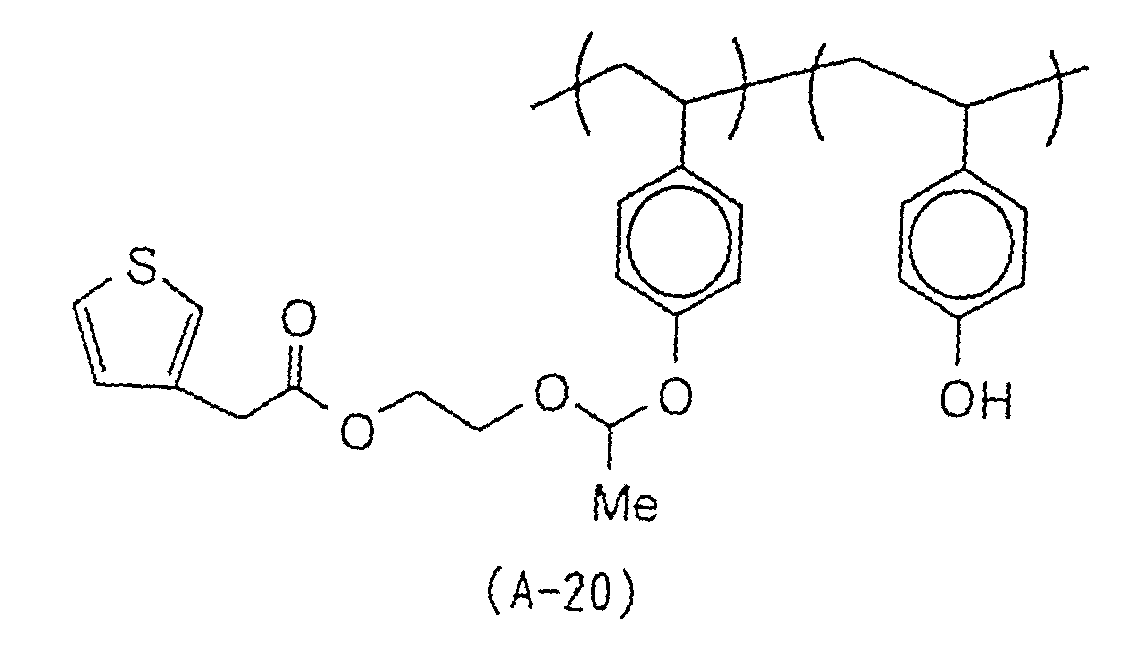
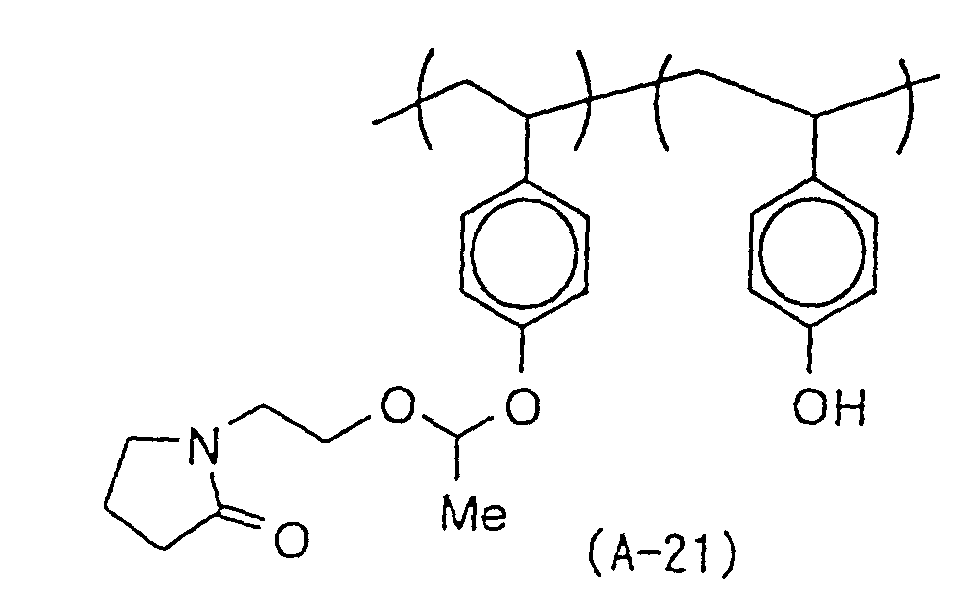


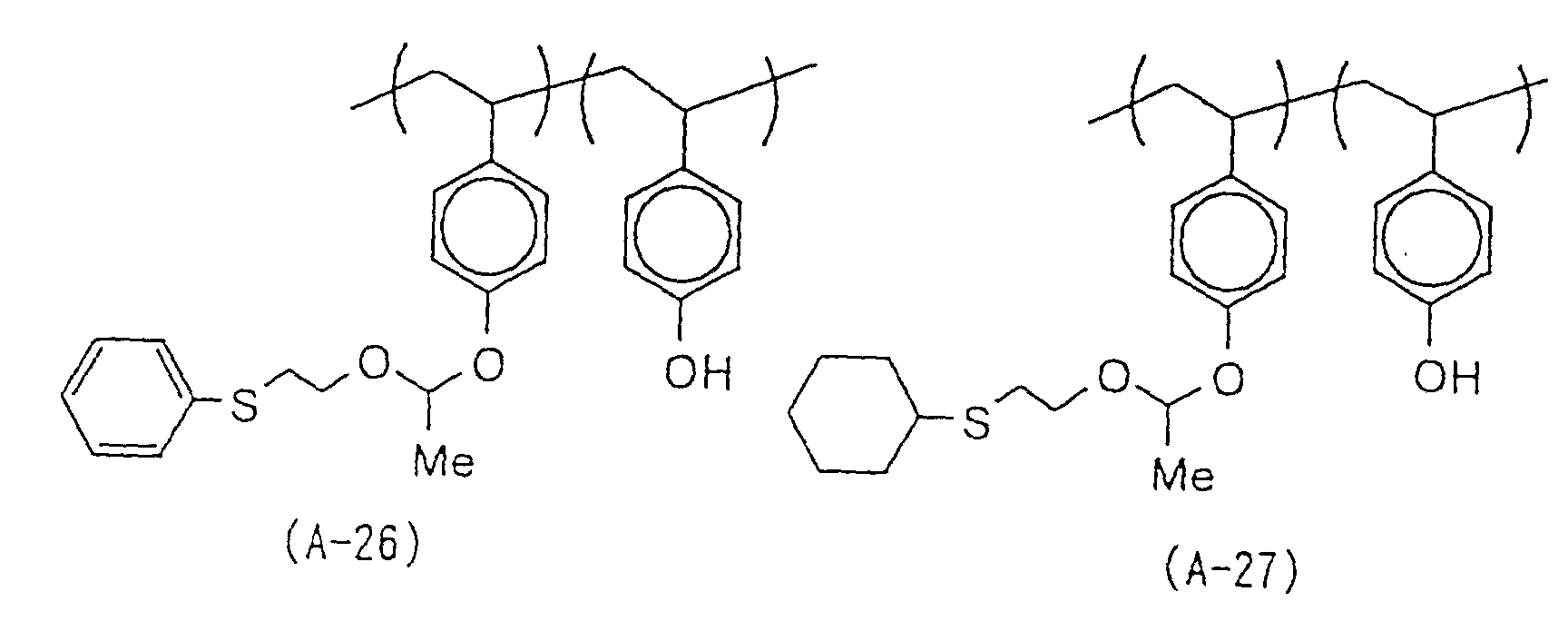

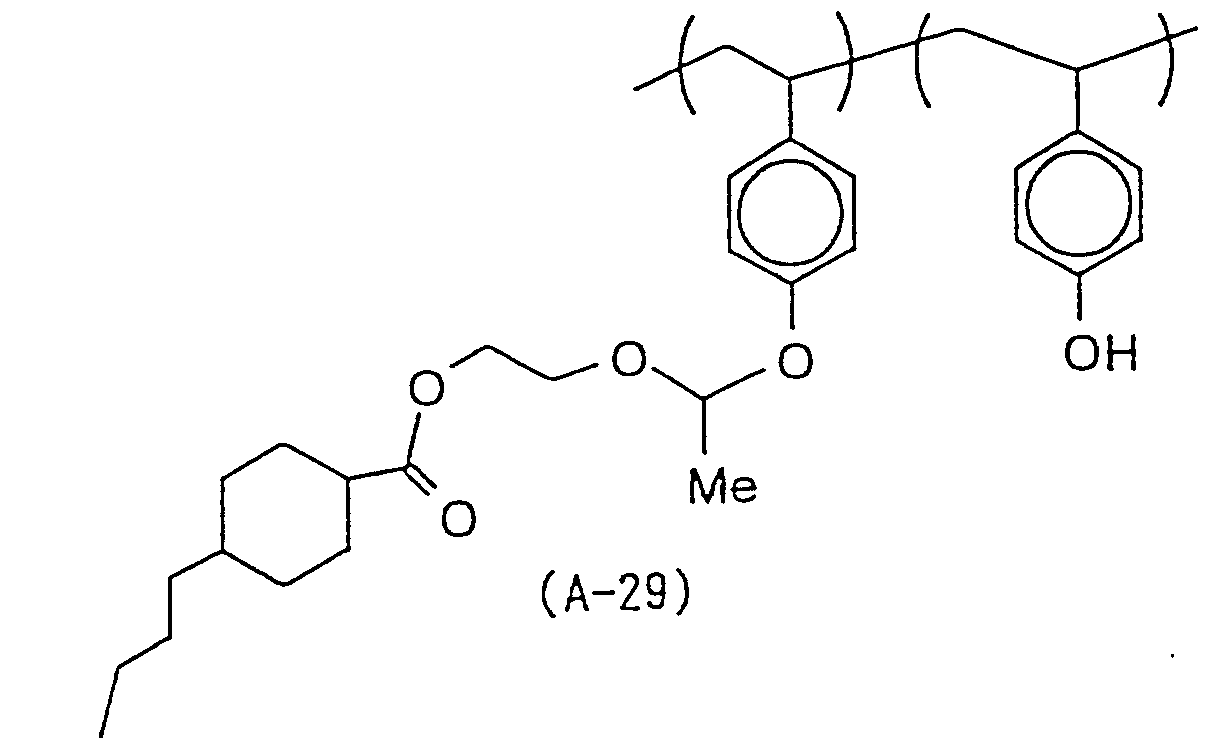


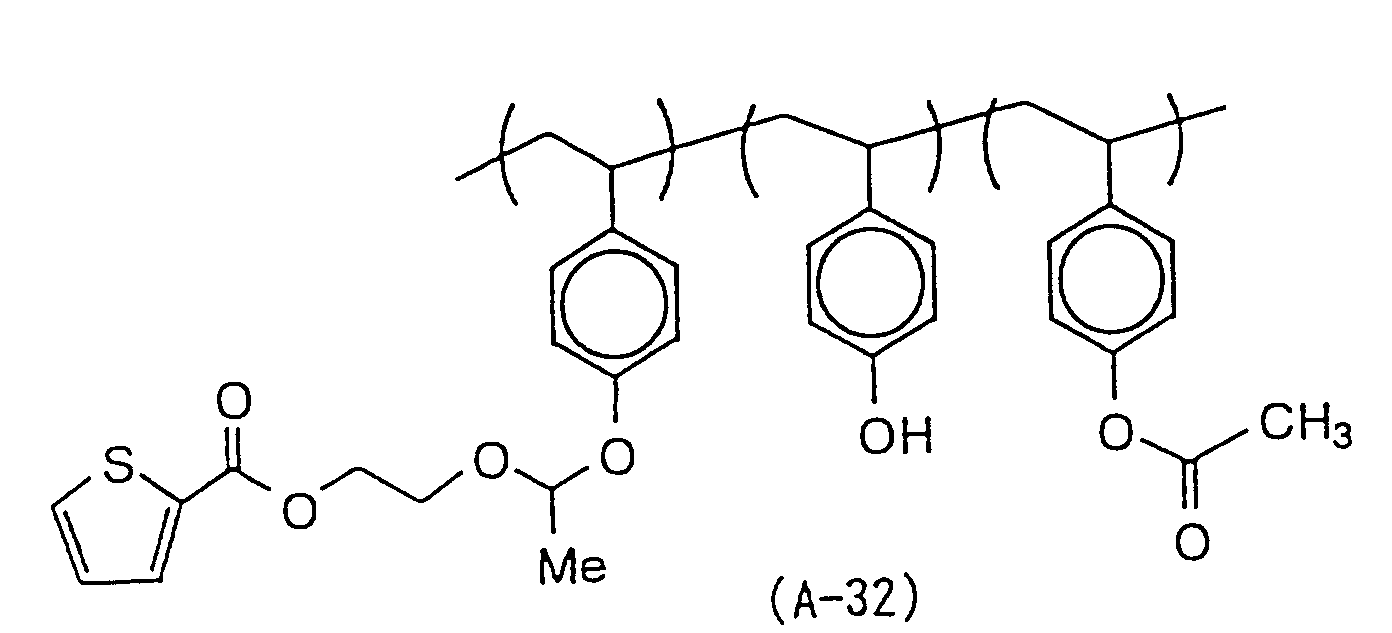

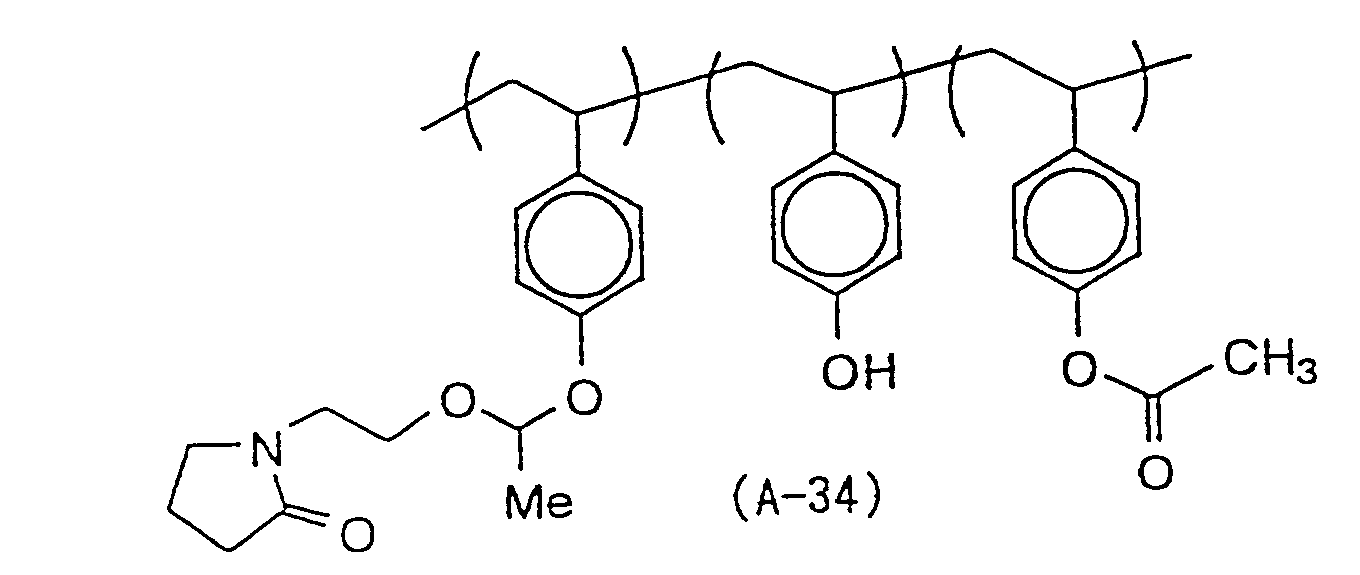
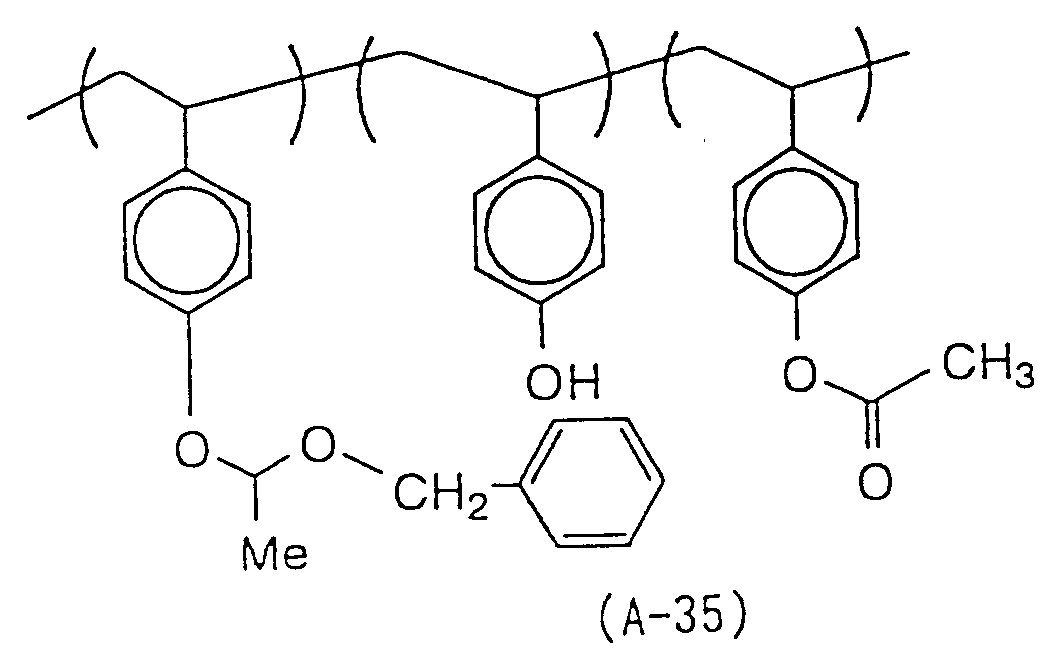
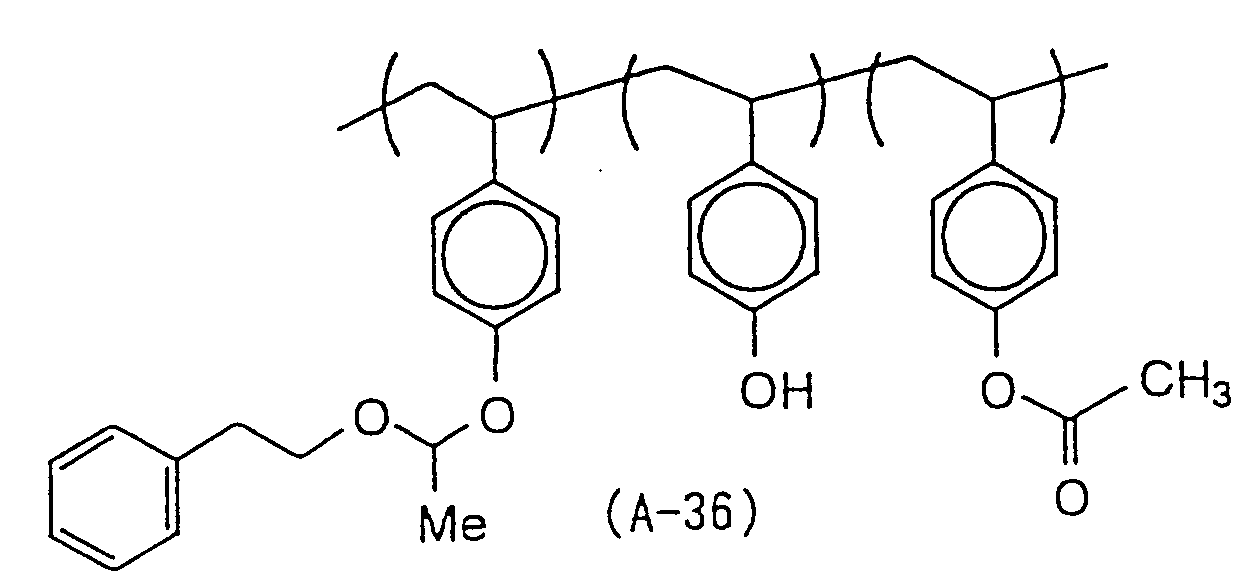

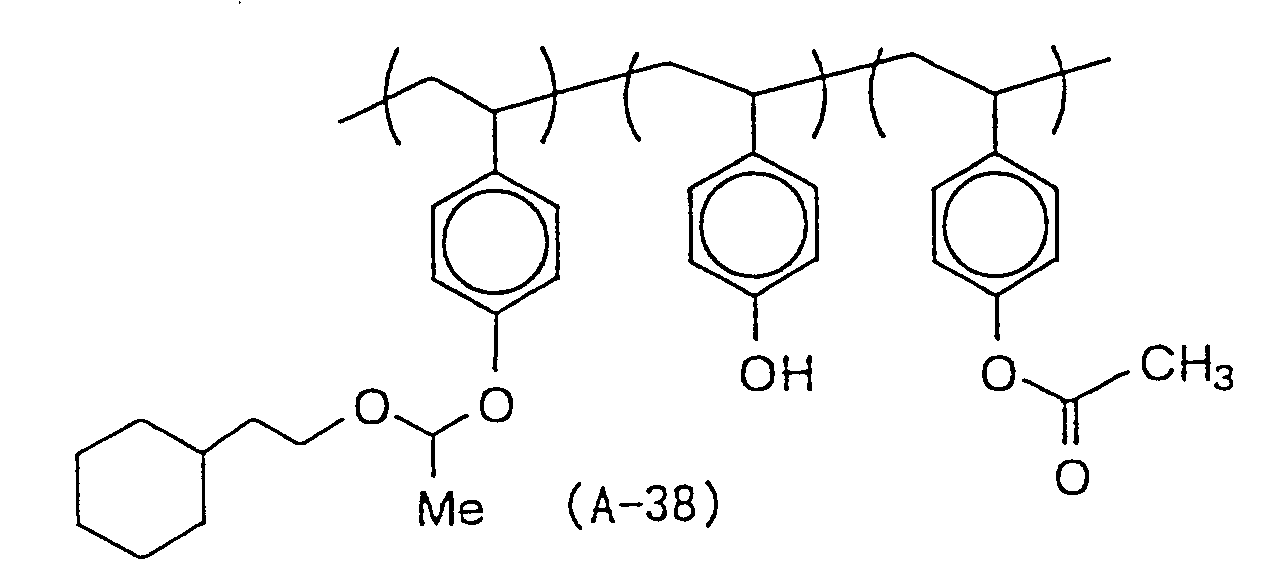


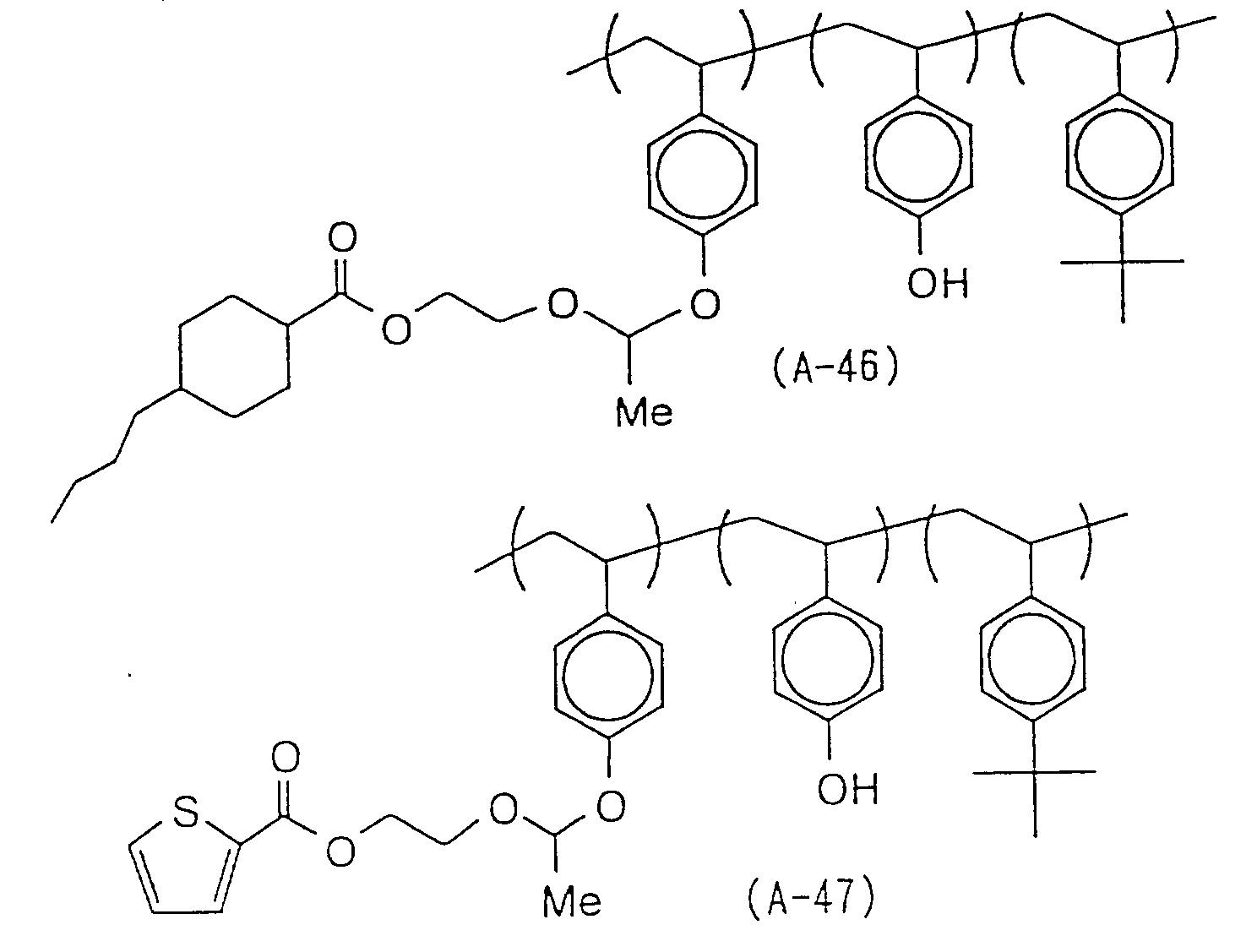
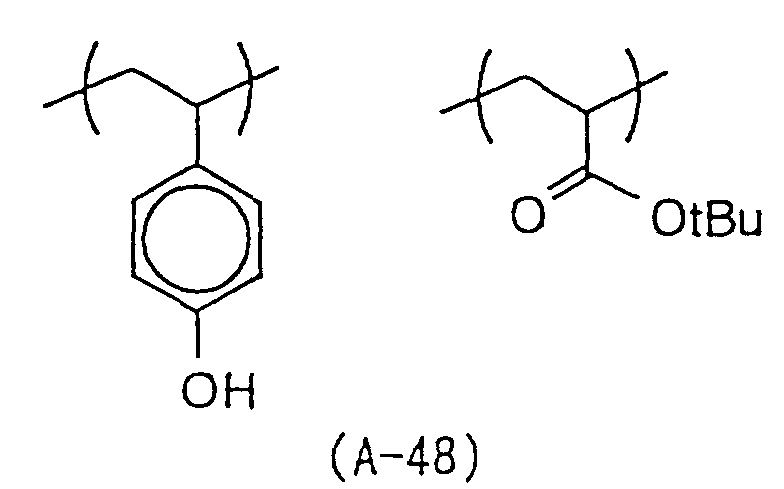

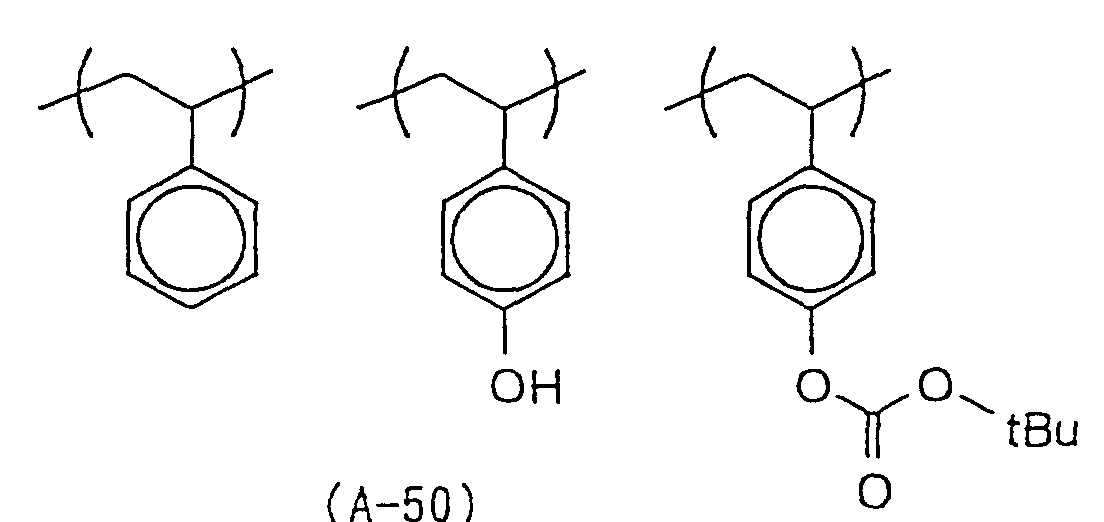

- In the above-described practical examples, Me represents a methyl group, Et represents an ethyl group, nBu represents an n-butyl group, iso-Bu represents an isobutyl group, and tBu represents a t-butyl group.
- In the case of using an acetal group as the acid-decomposable group, for controlling the alkali-solving speed and improving the heat resistance, a crosslinking site of connecting a polyfunctional acetal group to the main chain of the polymer may be introduced by adding a polyhydroxy compound in the synthesis step, . The addition amount of the polyhydroxy compound is from 0.01 to 5 mol%, and more preferably from 0.05 to 4 mol% to the amount of the hydroxy groups of the resin. The polyhydroxy compound includes a polyhydroxy compound having from 2 to 6 phenolic hydroxy groups or alcoholic hydroxy groups, preferably a polyhydroxy compound having from 2 to 4 hydroxy groups, and more preferably a polyhydroxy compound having 2 or 3 hydroxy groups.
- Then, practical examples of the polyhydroxy compound are shown below, but the invention is not limited to them.
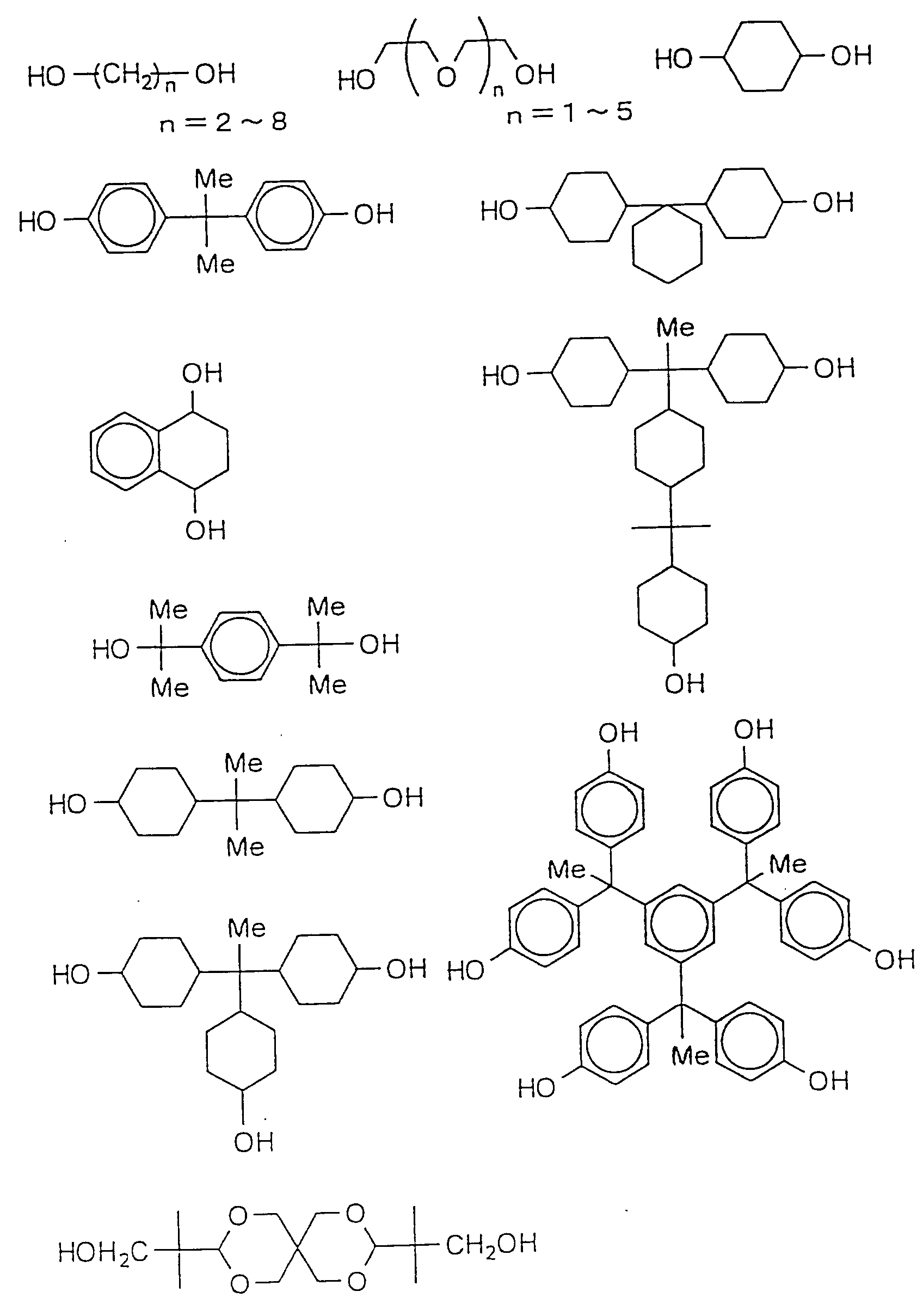
- The weight average molecular weight (Mw) of the resin (B) having a group decomposable with acid is in the range of preferably from 2,000 to 300,000. When the molecular weight is less than 2,000, by the development of the non-irradiated portions of the resist film, the decrease of the resist film at the portions is large, while the molecular weight exceeds 300,000, the dissolving speed of the resin itself in alkali is delayed and the sensitivity is lowered. In this case, the weight average molecular weight is defined by the polystyrene converted value of a gel permeation chromatography.
- Also, the component (B) of the positive resist composition of the invention, that is, the resin having the group decomposable by acid may be used as a mixture of two or more kinds of them.
- The using amount of the component (B) is from 40 to 99% by weight, and preferably from 60 to 98% by weight based on the solid components of the 1st composition of the invention.
- The component (D) is a component contained in the 2nd composition of the invention as the indispensable component and the component (D) is, if necessary, compounded with the 1st composition of the invention. The composition (D) is a low-molecular weight compound having a molecular weight of not larger than 3000, preferably from 200 to 2,000, and more preferably from 300 to 1,500, which has a group decomposable with acid and increases the solubility in an alkali developer by the action of acid. The component (D) has a function as a dissolution inhibitor of the non-irradiated portions to an alkali developer. In addition, the term "acid-decomposable dissolution-inhibiting compound" in the descriptions below has the same meaning as the component (D).
- The preferred component (D), that is, the preferred acid-decomposable dissolution-inhibiting compound is a compound having at least two groups decomposable with acid in the structure, and the distance between the acid-decomposable groups is via at least 8 bonding atoms excluding the acid-decomposable groups in the most apart positions.
- The more preferred acid-decomposable dissolution-inhibiting compounds are;
- (a) a compound having at least two groups decomposable with acid in the structure, wherein the distance between the acid-decomposable groups is via at least 10, preferably at least 11, and more preferably 12 bonding atoms excluding the acid-decomposable groups in the most apart positions, and
- (b) a compound having at least three acid-decomposable groups, and the distance between the acid-decomposable groups is via at least 9, preferably at least 10, and more preferably 11 bonding atoms excluding the acid-decomposable groups in the most apart positions.
-
- Also, the upper limit of the number of the above-described bonding atoms is preferably 50, and more preferably 30.
- In the case where the acid-decomposable dissolution-inhibiting compound has at least 3, and preferably at least 4 acid-decomposable groups, or even in the case where the acid-decomposable dissolution-inhibiting compound has 2 acid-decomposable groups, when the acid-decomposable groups are separated from each other at a definite distance or more, the dissolution inhibiting property to the alkali-soluble resin is greatly improved.
- In addition, the distance between the acid-decomposable groups is shown by the number of the bonding atoms (excluding the acid-decomposable groups) existing between the acid-decomposable groups. For example, in the cases of the compounds (1) and (2) shown below, each distance between the acid-decomposable groups is 4 bonding (carbon) atoms and in the case of compound (3) shown below, the distance between the acid-decomposable groups is 12 bonding (carbon) atoms.


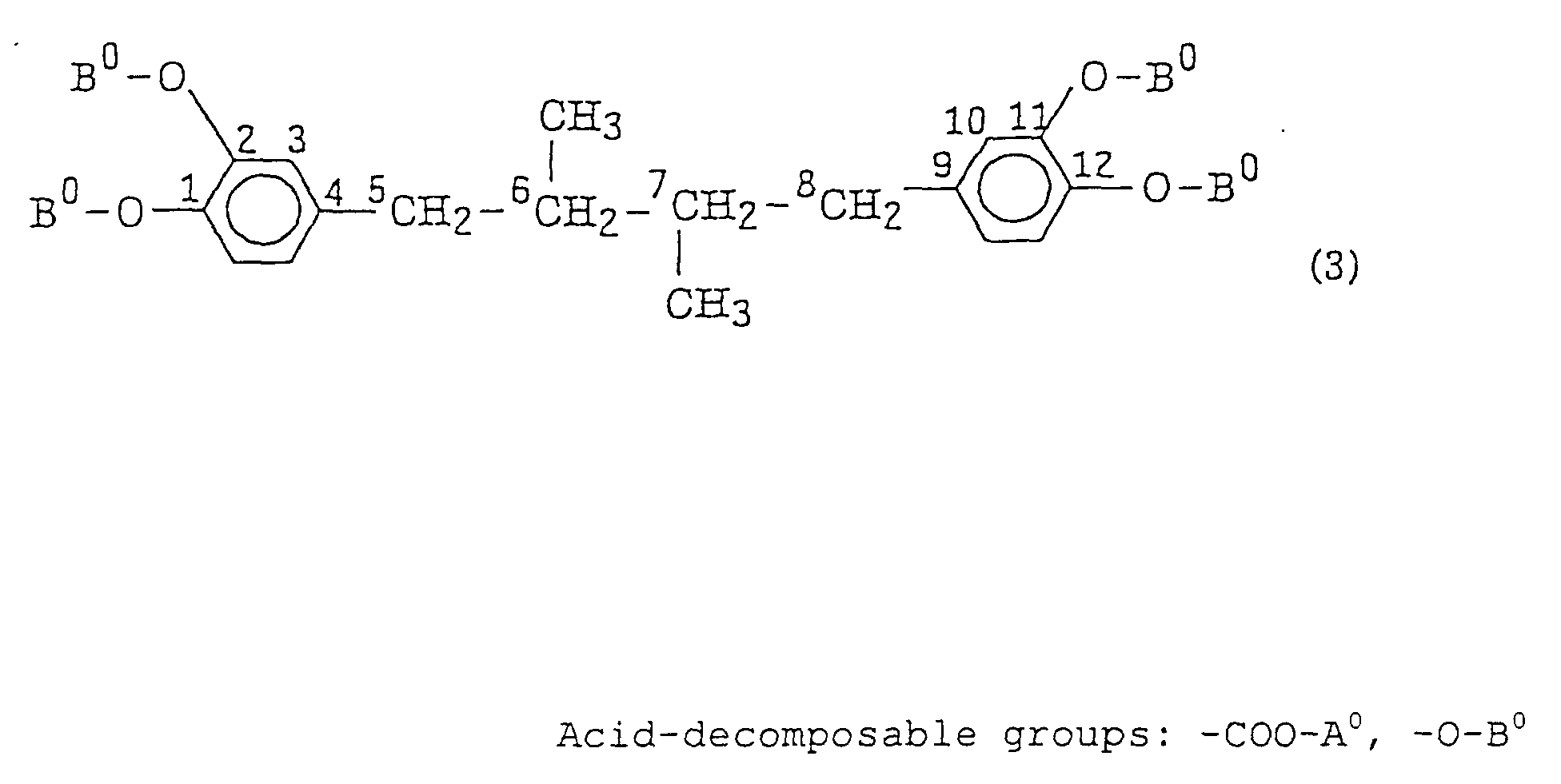
- Also, the acid-decomposable dissolution-inhibiting compound may have plural acid-decomposable groups on one benzene ring but is preferably a compound comprising a skeleton having one acid-decomposable group on one benzene ring.
- As the group decomposable with acid, that is, the group containing -COO-A0 or -O-B0, there is a group represented by -R0-COO-A0 or -Ar-O-B0.
- Wherein, A0 represents a group represented by -C(R01)(R02)(R03), -Si(R01) (R02) (R03), or -C(R04) (R05)-O-R06, and B0 represents a group represented A0 or -CO-O-A0.
- R01, R02, R03, R04, and R05, which are the same or different, each represents a hydrogen atom, an alkyl group, a cycloalkyl group, an alkenyl group, or an aryl group, and R06 represents an alkyl group or an aryl group. Wherein, however, at least two of R01, R02, and R03 are groups other than a hydrogen atom; two groups of R01, R02, and R03 or R04, R05, and R06 may be bonded to each other to form a ring. Furthermore, R0 represents a two valent or more aliphatic or aromatic hydrocarbon group, which may have a substituent, and -Ar- represents a two valent or more aromatic group, which may be monocyclic or polycyclic, which may have a substituent.
- Wherein, the alkyl group is preferably an alkyl group having from 1 to 4 carbon atoms, such as methyl, ethyl, propyl, n-butyl, sec-butyl, t-butyl, etc.; the cycloalkyl group is preferably a cycloalkyl group having from 3 to 10 carbon atoms, such as cyclopropyl, cyclobutyl, cyclohexyl, adamantyl, etc.; the alkenyl group is preferably an alkenyl group having from 2 to 4 carbon atoms, such as vinyl, propenyl, allyl, butenyl, etc.; and the aryl group is preferably an aryl group having from 6 to 14 carbon atoms, such as phenyl, xylyl, toluyl, cumenyl, naphthyl, anthracenyl, etc.
- Also, the above-described substituents include a hydroxy group, halogen atoms such as fluorine, chlorine, bromine, iodine, etc.; a nitro group, a cyano group, the alkyl groups described above; alkoxy groups such as methoxy, ethoxy, hydroxyethoxy, propoxy, hydroxypropoxy, n-butoxy, iso-butoxy, sec-butoxy, t-butoxy, etc.; alkoxycarbonyl groups such as methoxycarbonyl, ethoxycarbonyl, etc.; aralkyl groups such as benzyl, phenetyl, cumyl, etc.; an aralkyloxy group; acyl groups such as formyl, acetyl, butyryl, benzoyl, cyanamyl, valeryl, etc.; acyloxy groups such as butyryloxy, etc.; the alkenyl group described above; alkenyloxy groups such as vinyloxy, propenyloxy, allyloxy, butenyloxy, etc.; the aryl groups described above; aryloxy groups such as phenoxy, etc.; aryloxycarbonyl groups such as benzoyloxy, etc.
- The acid-decomposable groups preferably include a silyl ether group, a cumyl ester group, an acetal group, a tetrahydropyranyl ether group, an enol ether group, an enol ester group, a tertiary alkyl ether group, a tertiary alkyl ester group, a tertiary alkyl carbonate group, etc., and more preferably include a tertiary alkyl ester group, a tertiary alkyl carbonate group, a cumyl ester group, and a tetrahydropyranyl ether group.
- The component (D) preferably includes the compounds obtained by bonding and protecting with the above-described group, -R0-COO-A0 or B0 the whole or a part of the phenolic OH groups of the polyhydroxy compounds described in Japanese Patent Laid-Open Nos. 289946/1989, 289947/1989, 2560/1990, 128959/1991, 158855/1991, 179353/1991, 191351/1991, 200251/1991, 200252/1991, 200253/1991, 200254/1991, 200255/1991, 259149/1991, 279958/1991, 279959/1991, 1650/1992, 1651/1992, 11260/1992, 12356/1992, and 12357/1992, Japanese Patent Application Nos. 33229/1991, 230790/1991, 320438/1991, 25157/1992, 52732/1992, 103215/1992, 104542/1992, 107885/1992, 107889/1992, 152195/1992, etc.
- More preferably, the component (D) includes the compounds obtained using the polyhydroxy compounds described in Japanese Patent Laid-Open Nos. 289946/1989, 128959/1991, 158855/1991, 179353/1991, 200251/1991, 200252/1991, 200255/1991, 259149/1991, 279958/1991, 1650/1992, 11260/1992, 12356/1992, and 12357/1992, Japanese Patent Application Nos.25157/1992, 103215/1992, 104542/1992, 107885/1992, 107889/1992, and 152195/1992.
- Practical examples of the skeletons of the preferred compounds of the components (D) in the invention are shown below.
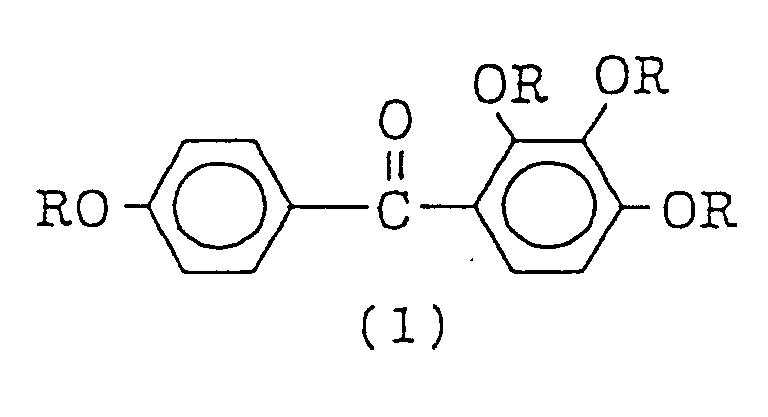
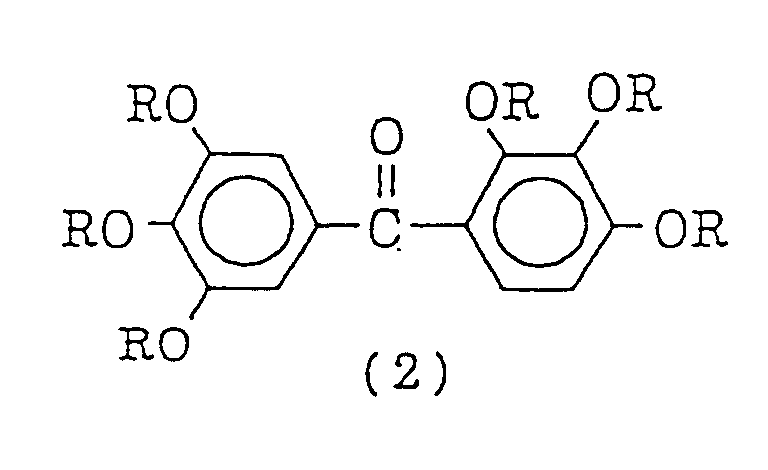


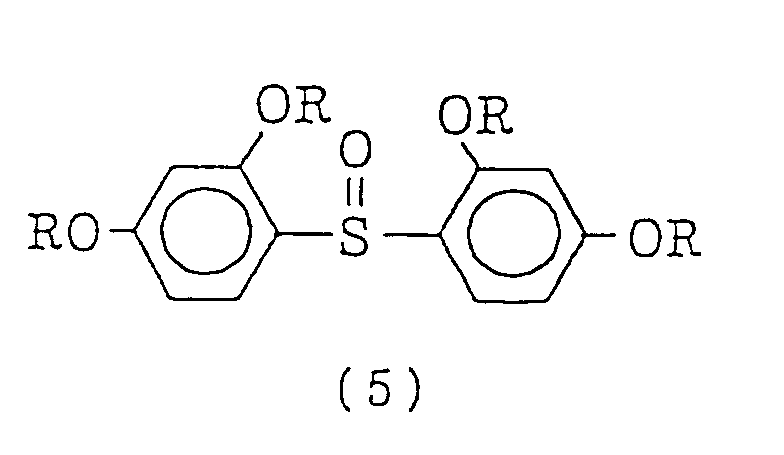
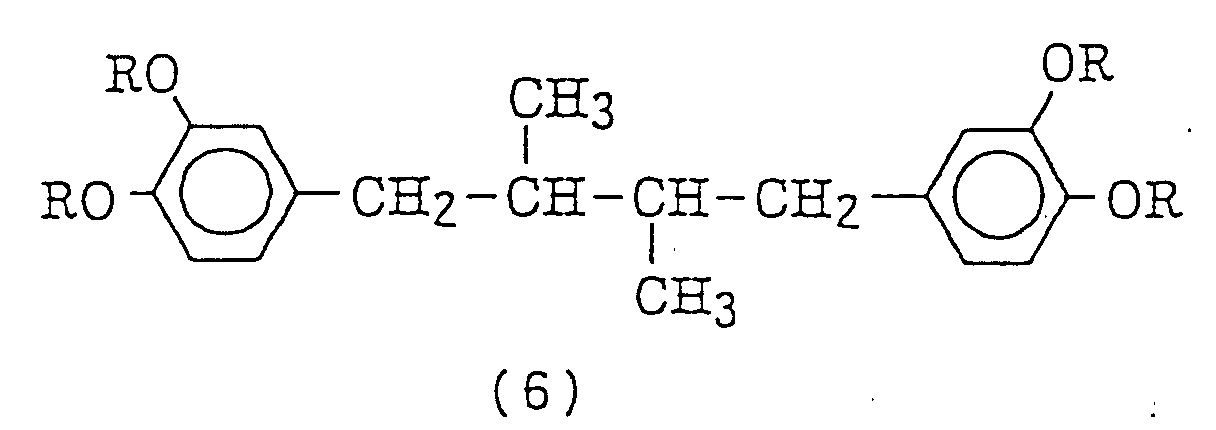
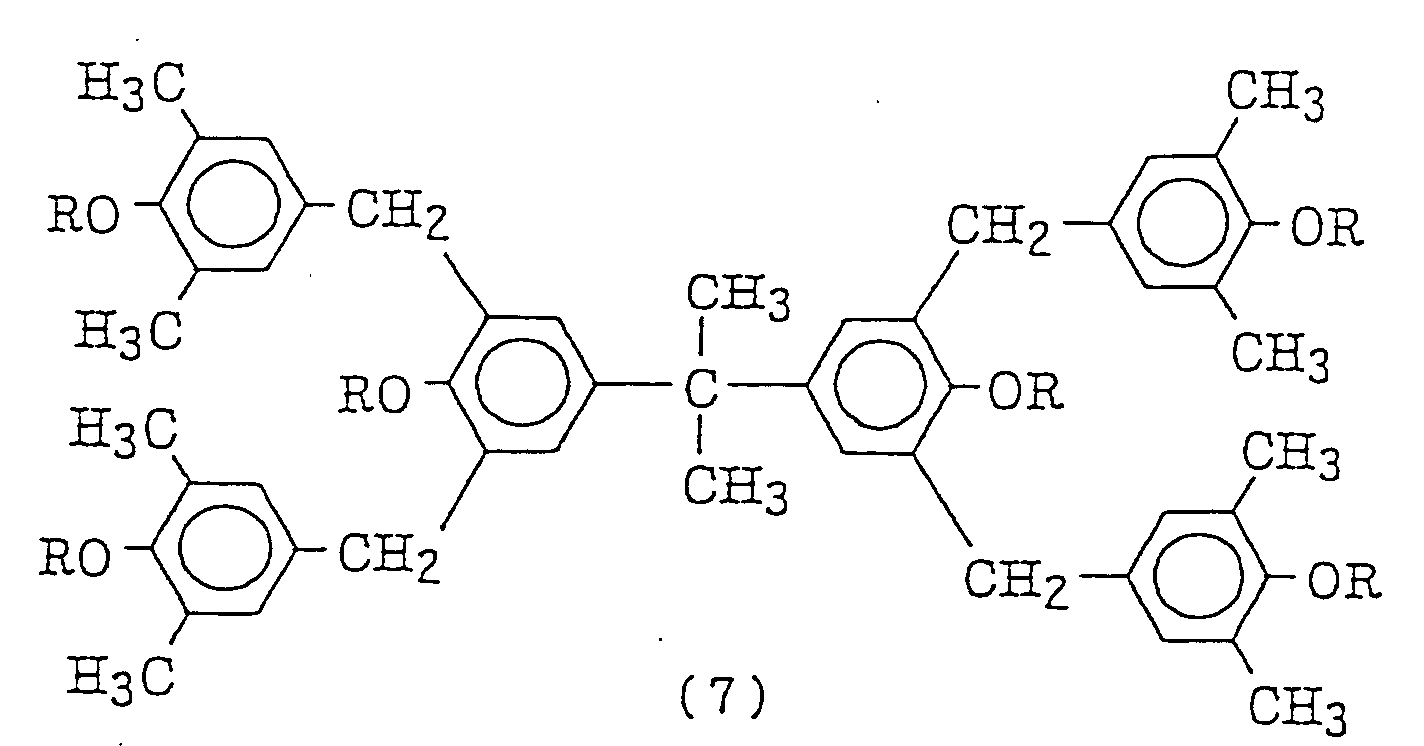

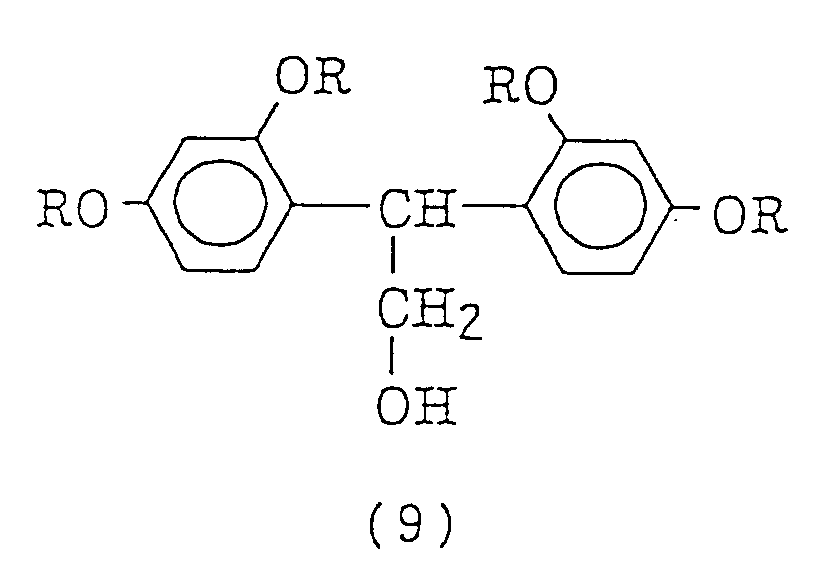
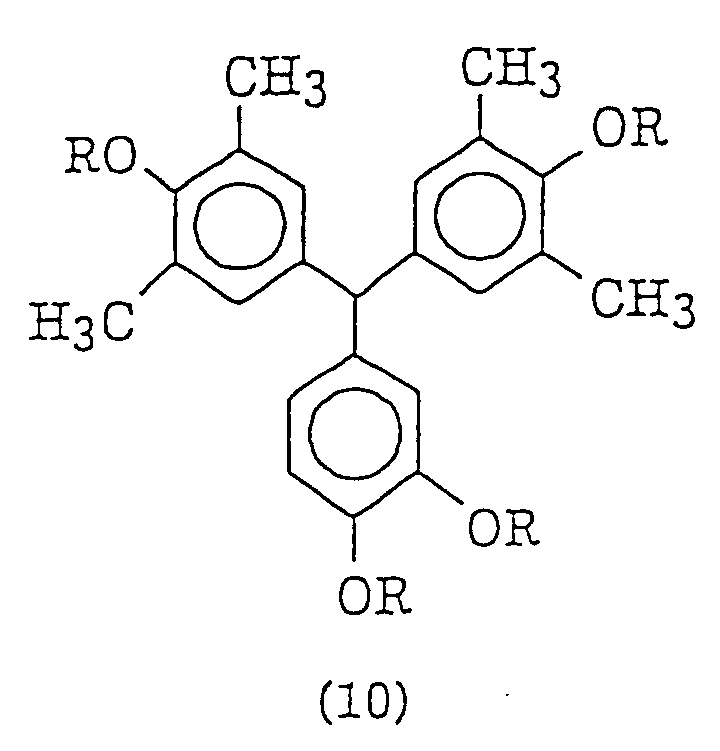
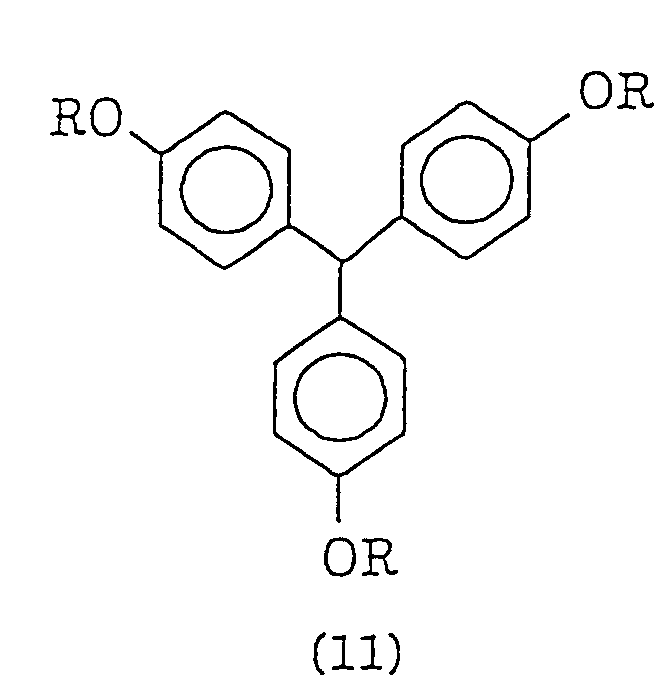

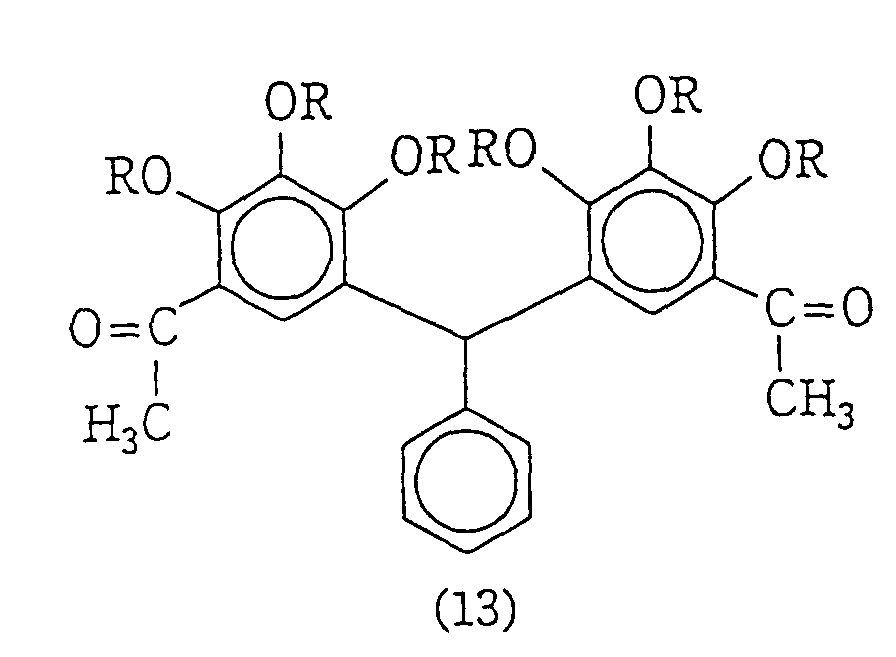
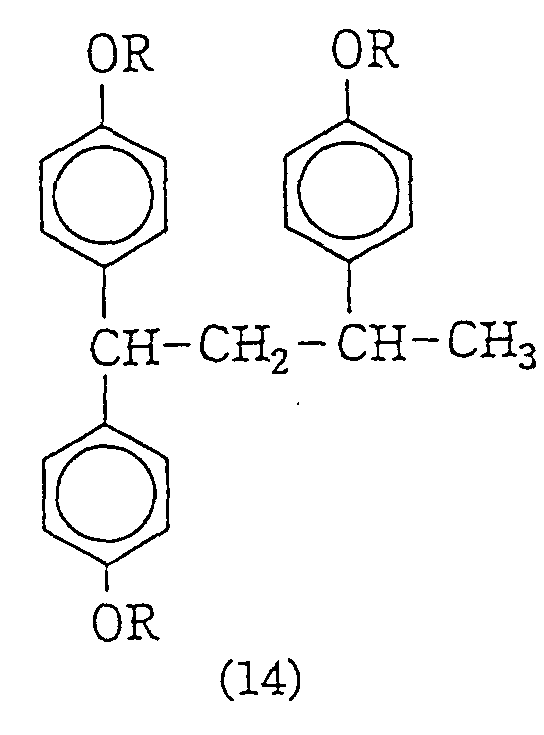
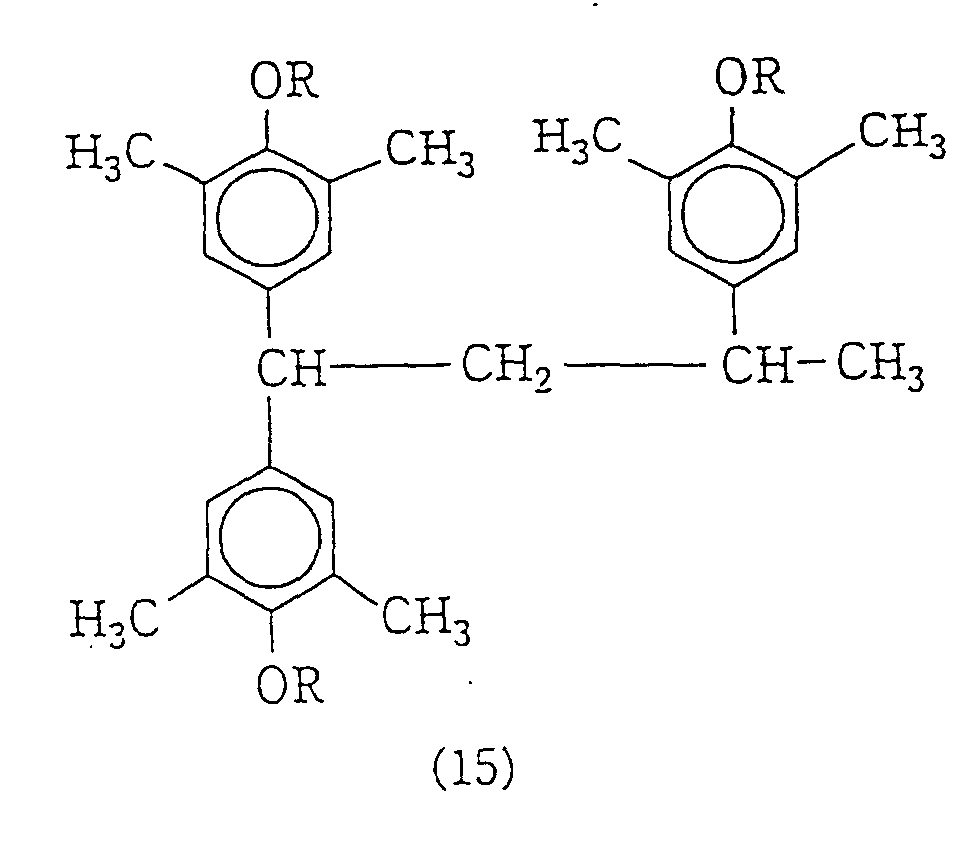
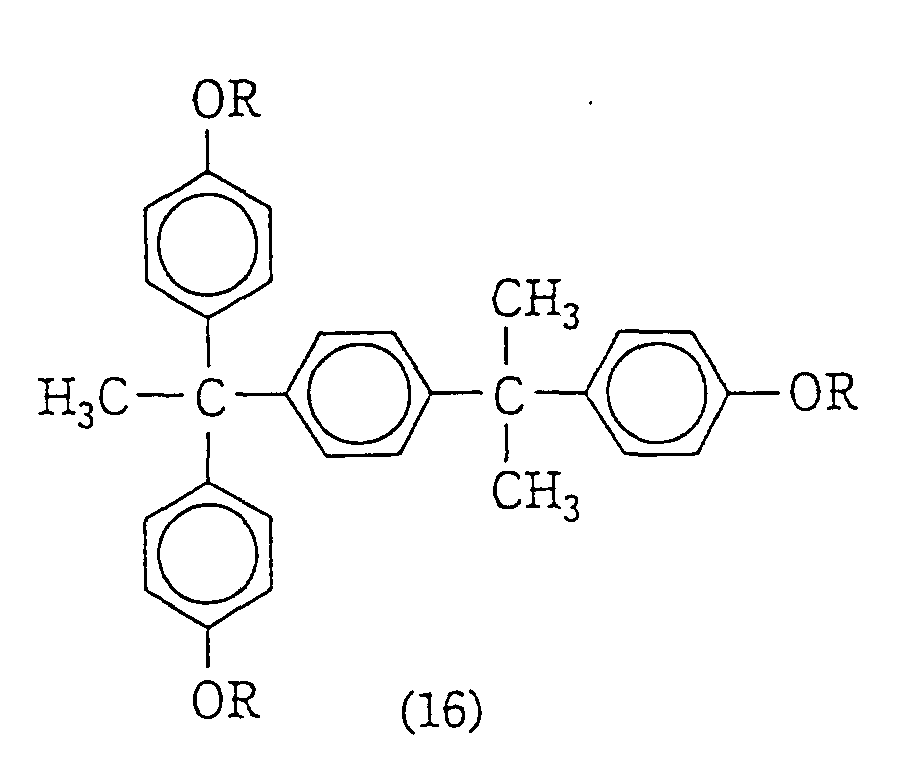

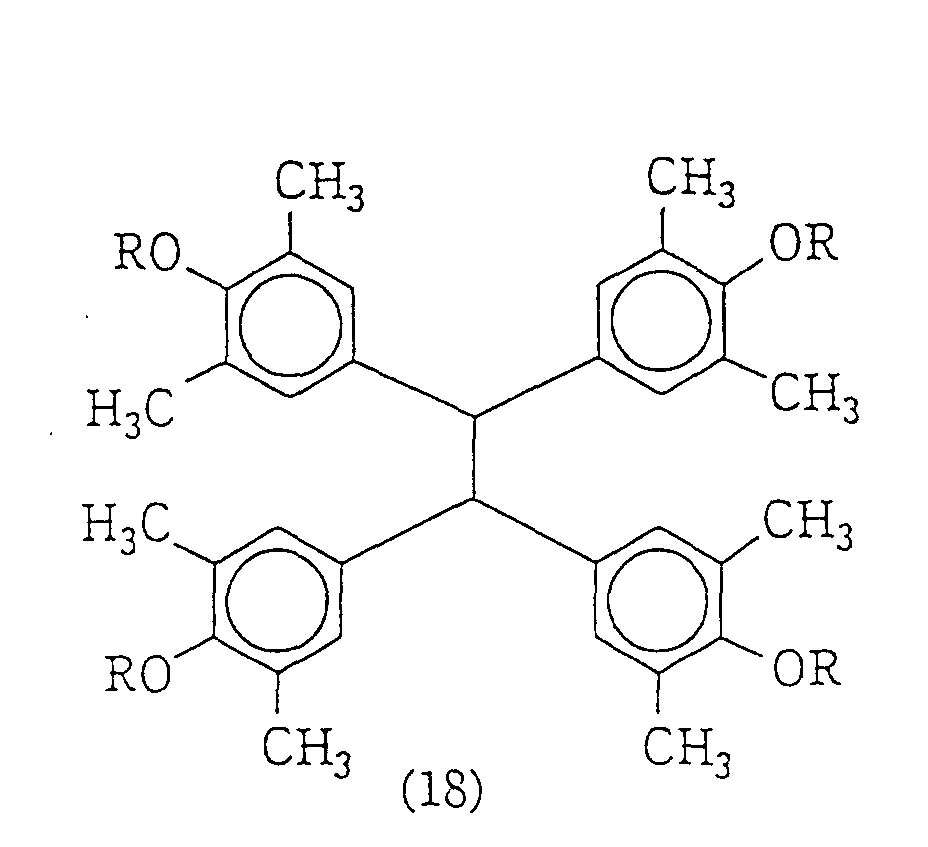


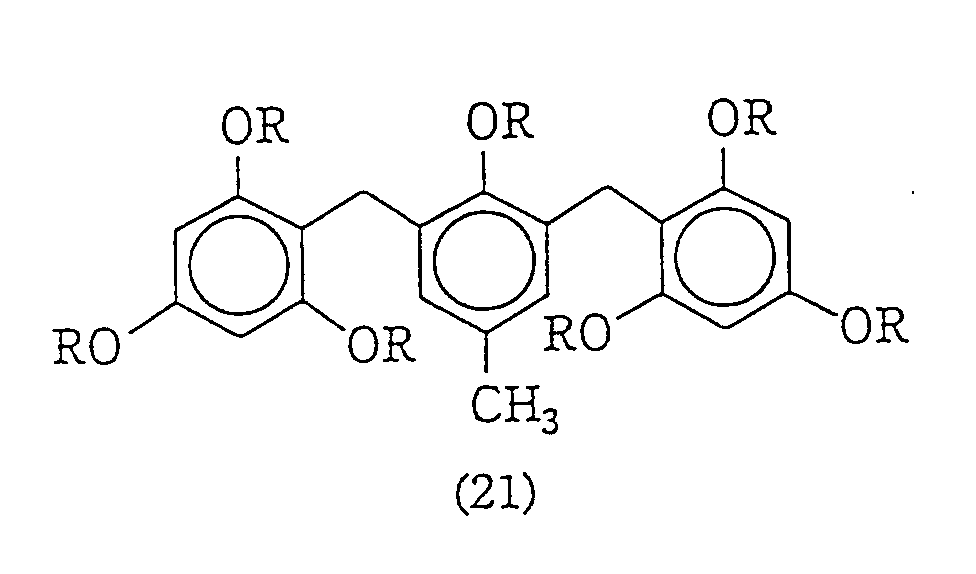
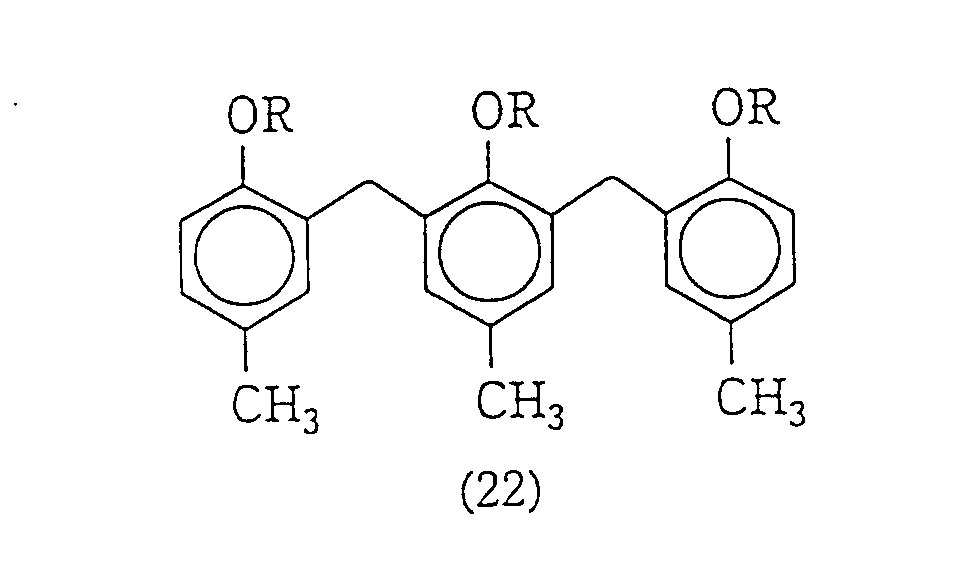


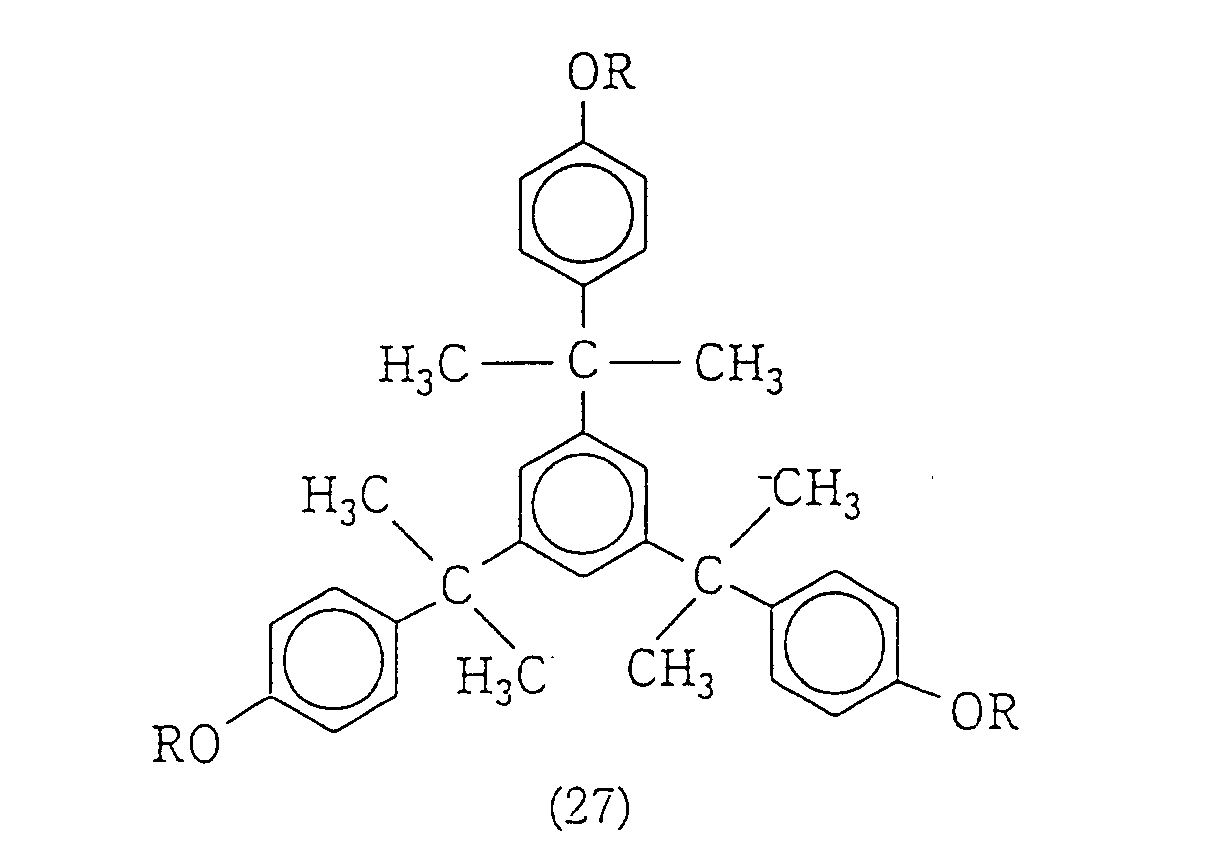

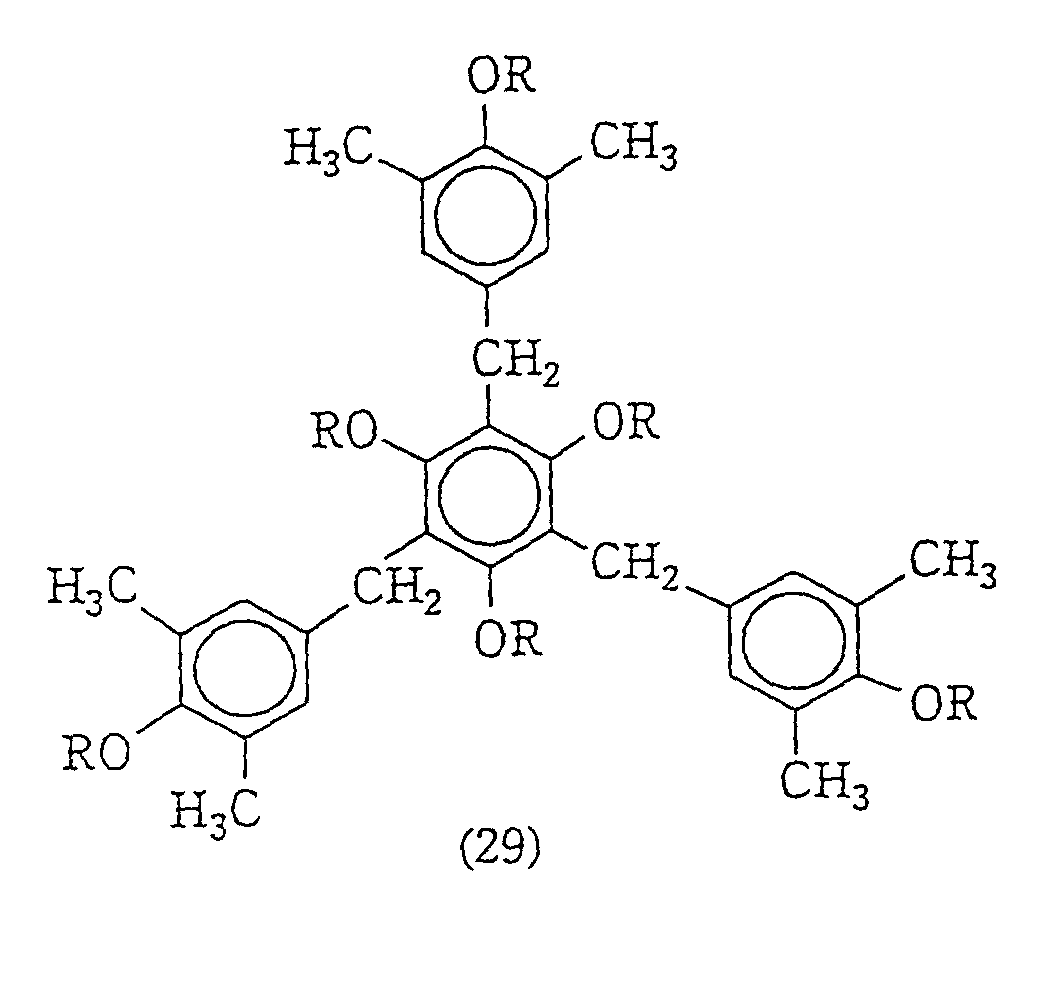
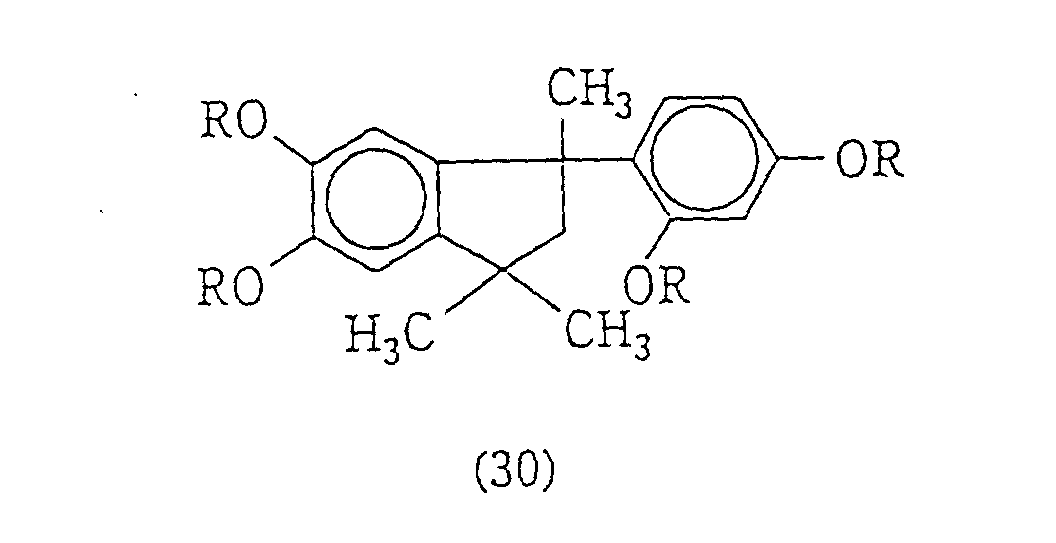
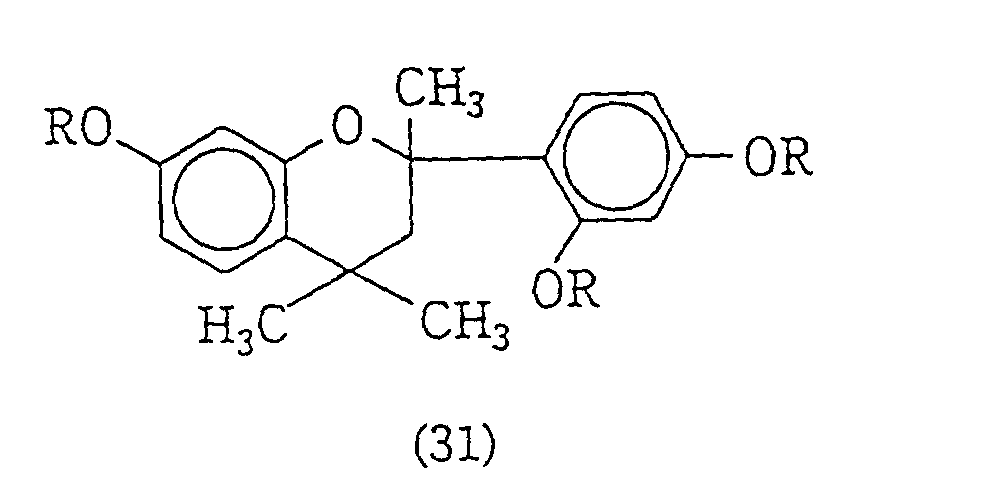

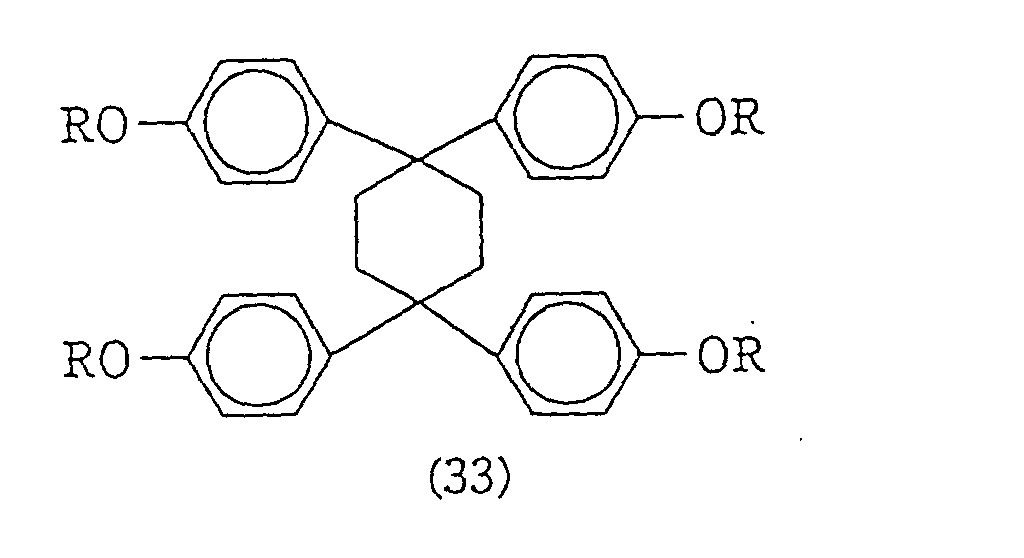

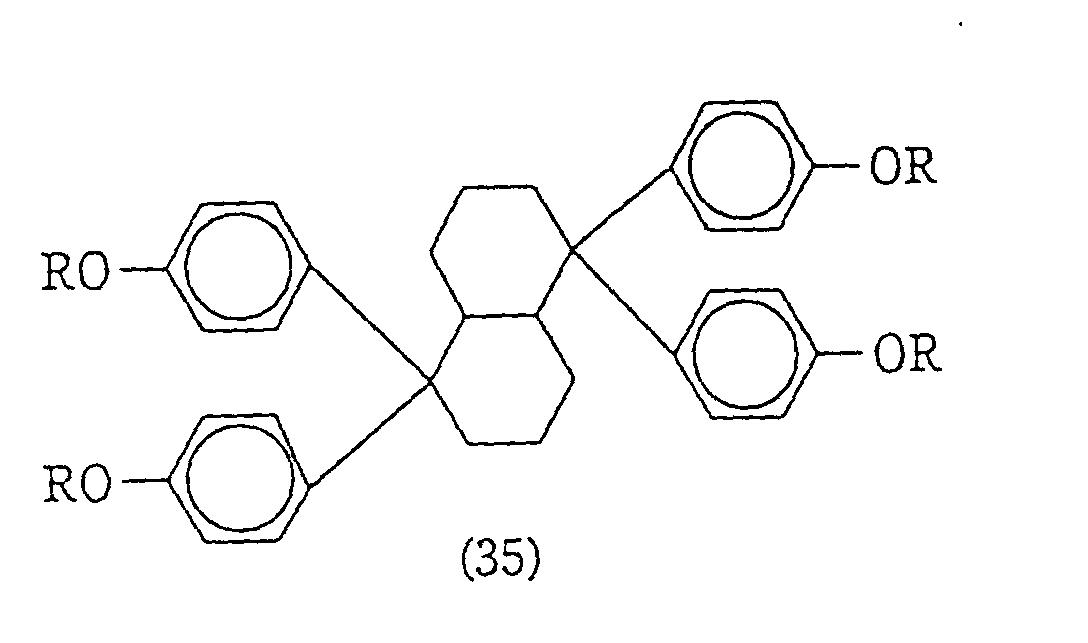
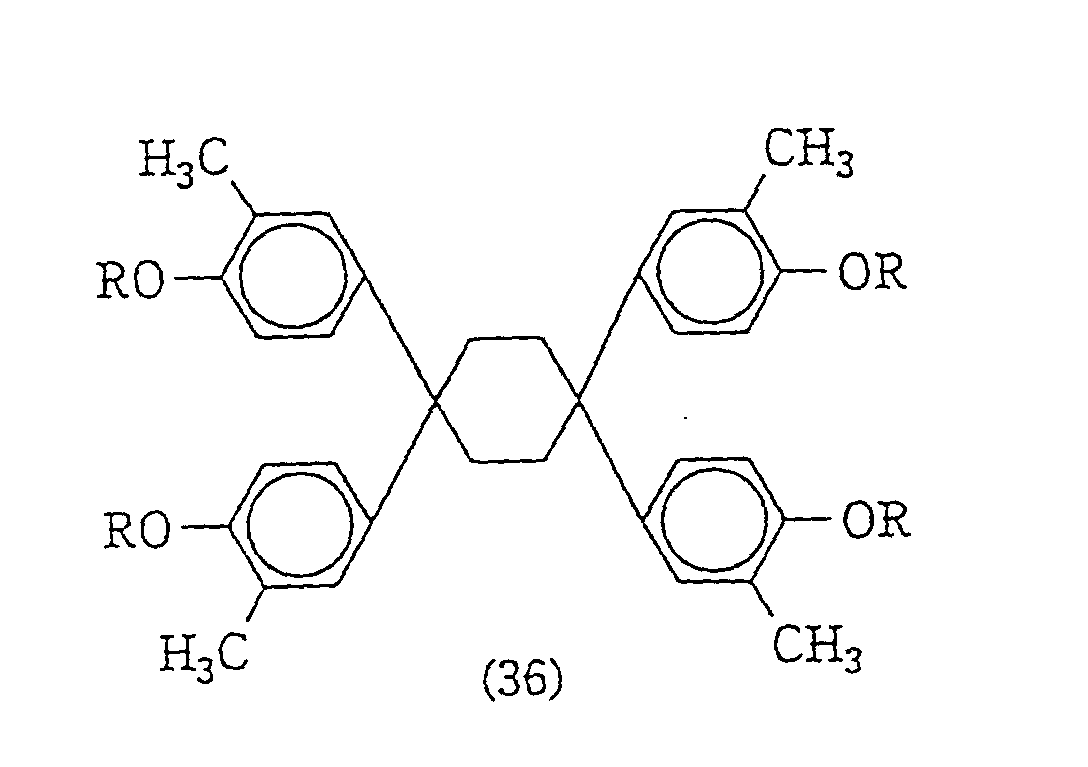

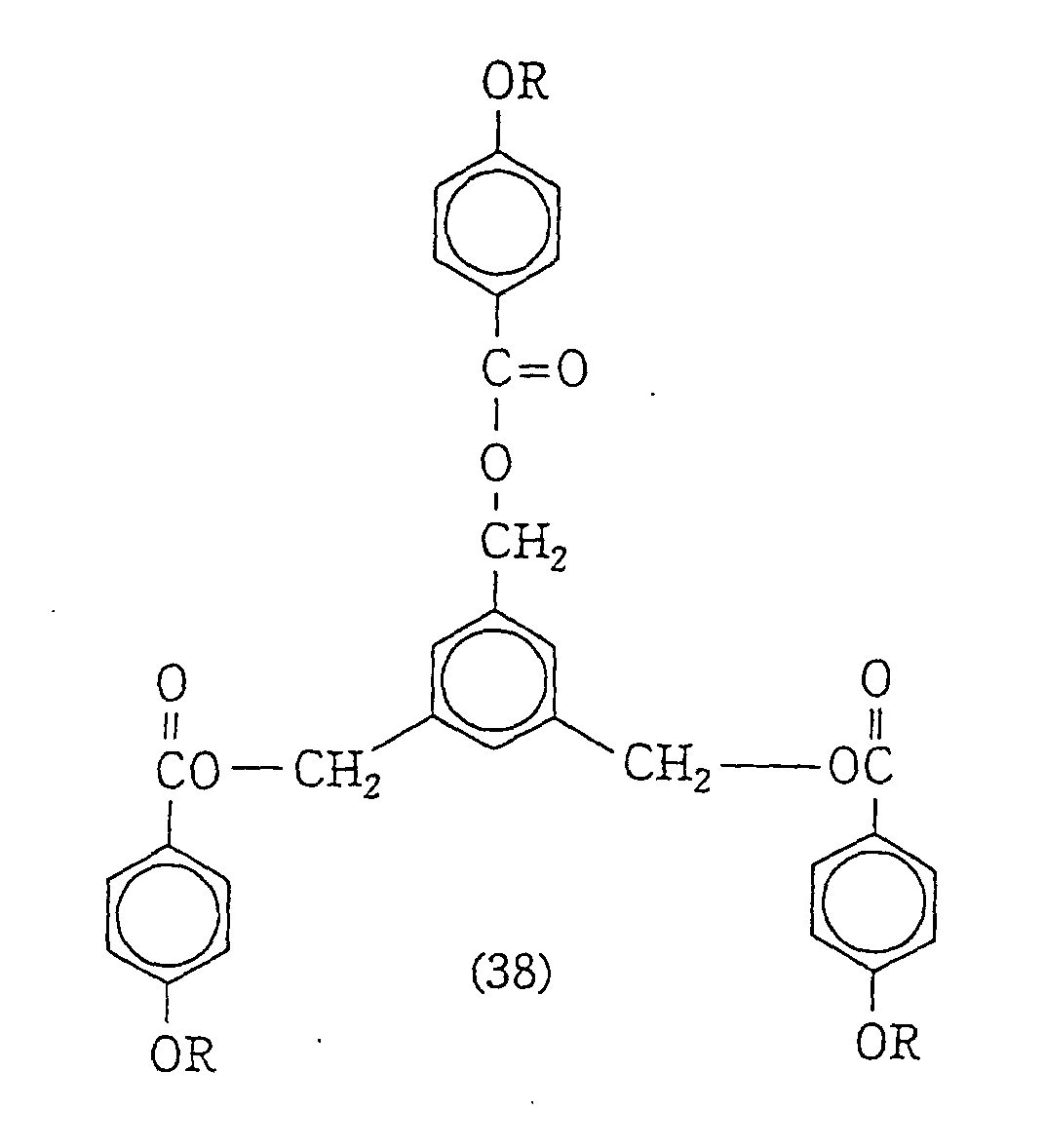

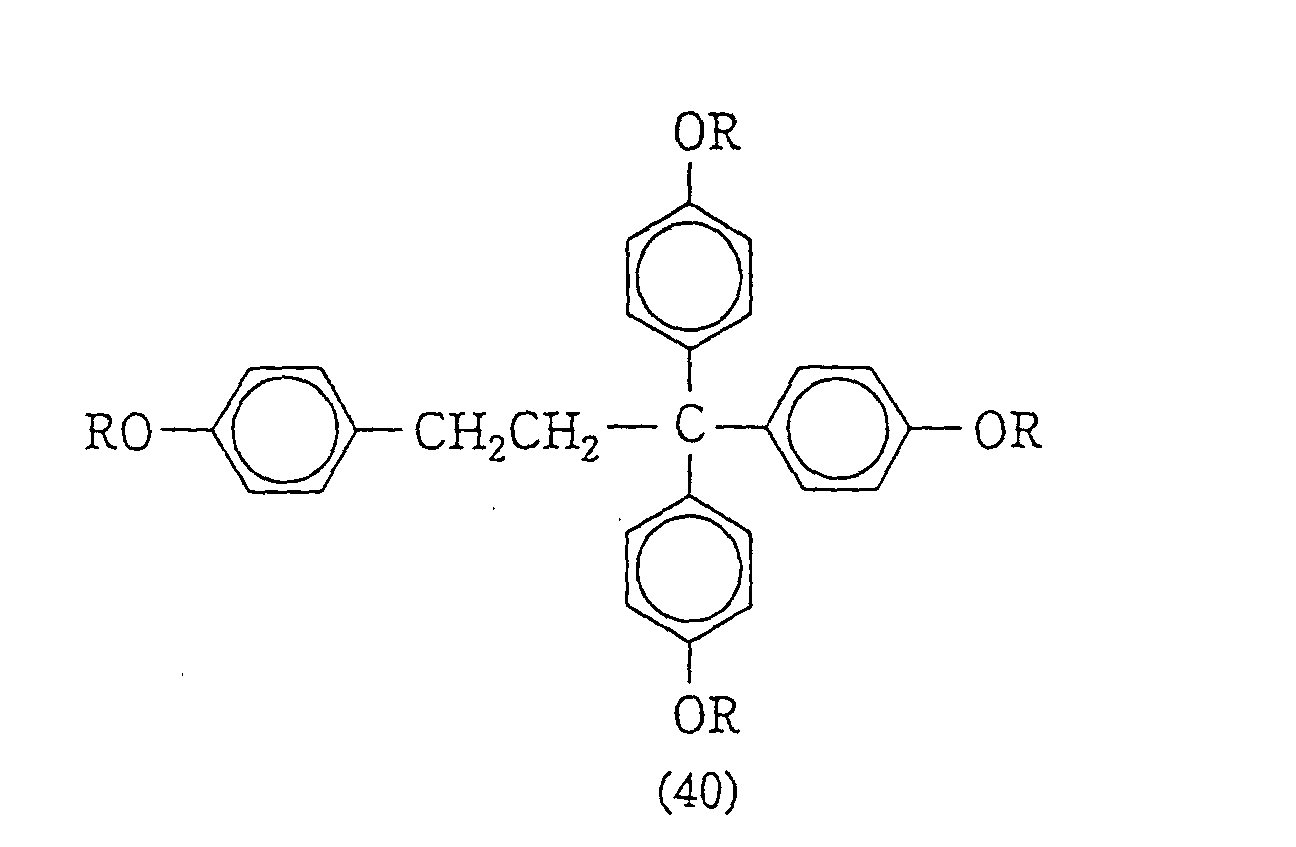
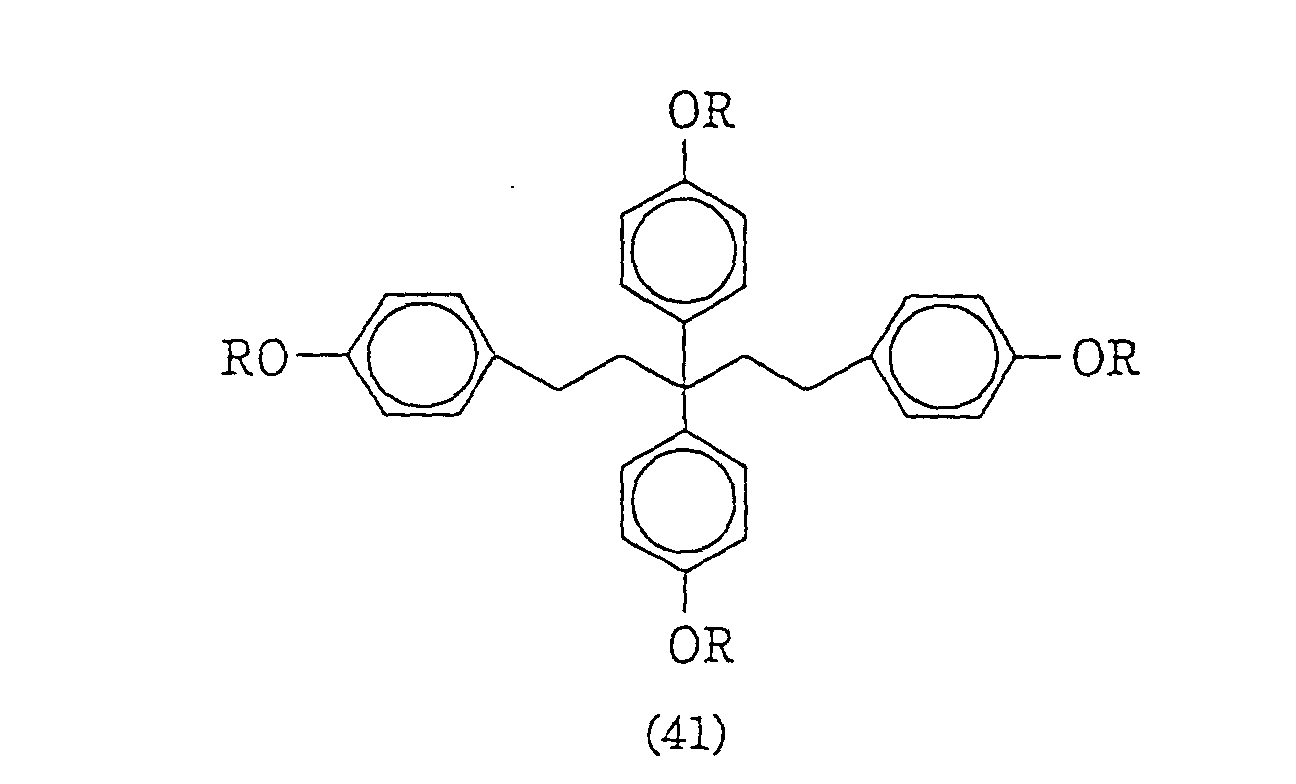

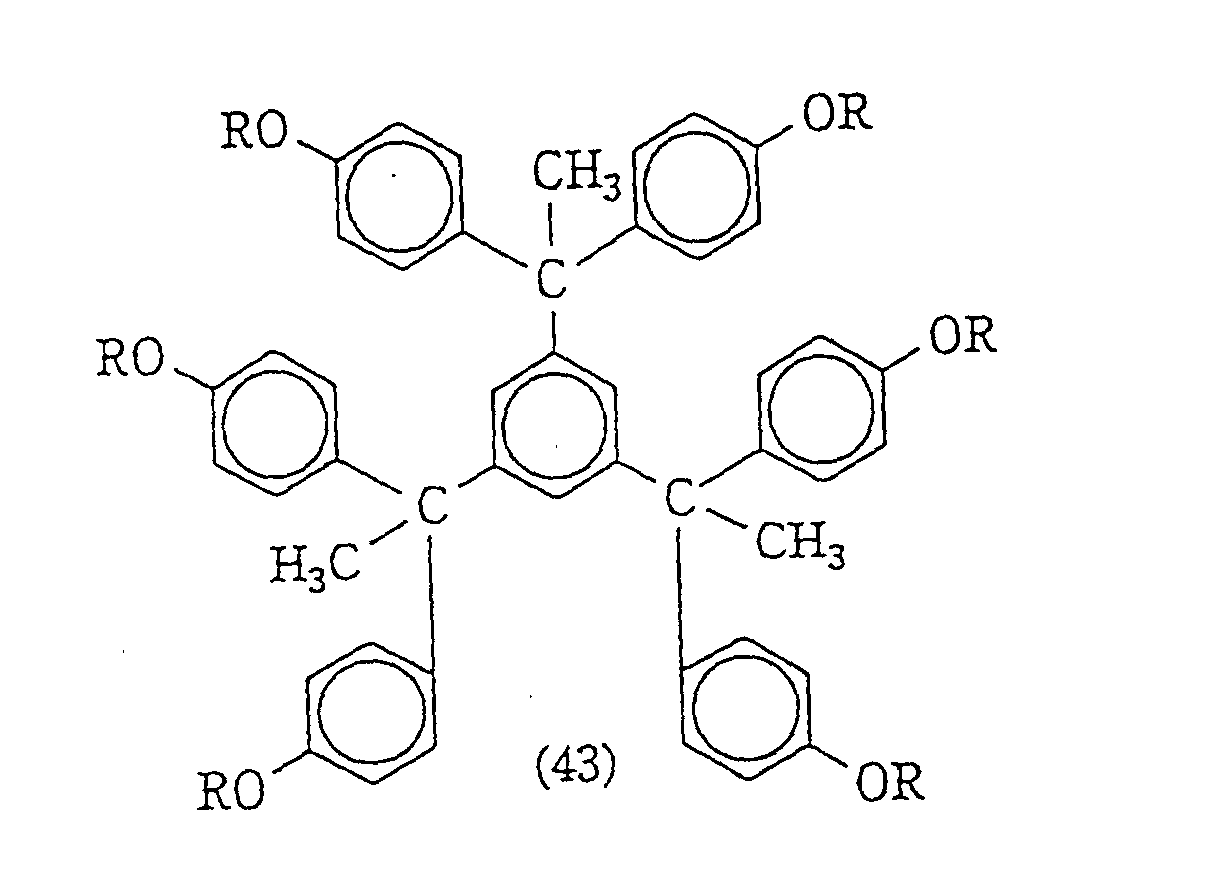
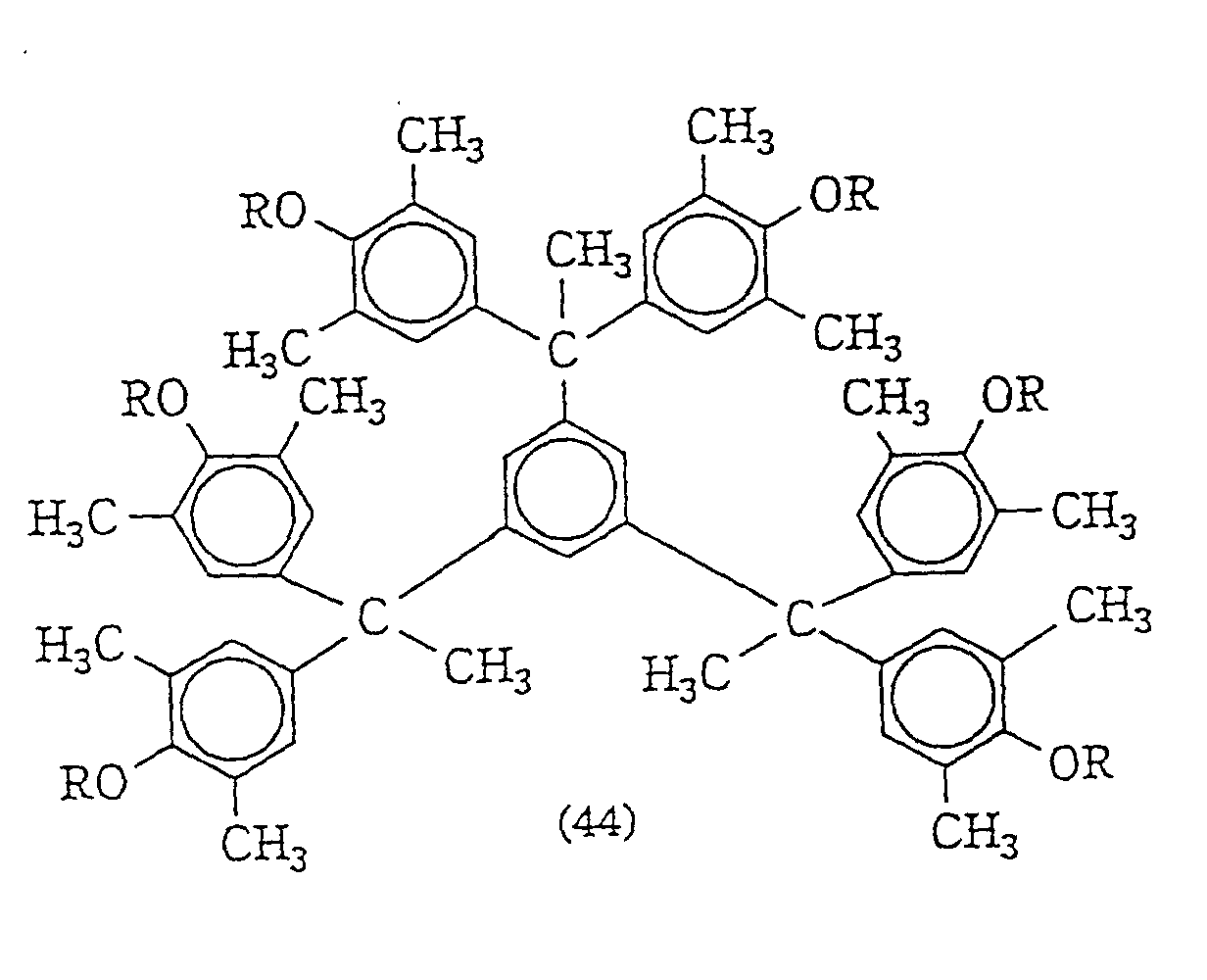
- In the compounds (1) to (44) described above, R represents a hydrogen atom,or -CH(L)-OZ (wherein L and Z each have the same meanings as those in the above-described formula (II)).

- In addition, however, at least two R or three R according to the structure, represent groups other than a hydrogen atom, and each substituent R may not be a same group.
- In the case of the 1st composition of the invention, the content of the component (D) is preferably from 3 to 45% by weight, more preferably from 5 to 30% by weight, and far more preferably from 10 to 20% by weight based on the solid components of the 1st composition.
- In the case of the 2nd composition of the invention, the content of the component (D) is same as the case of the above-described 1st component.
- The alkali-soluble resin (E) is the indispensable component of the 2nd composition of the invention. The alkali-soluble resin (E) is a component, which may be added to the 1st component of the invention. The alkali-soluble resin (E) is a resin, which is insoluble in water and soluble in an alkali developer, and is used for controlling the alkali-solubility of the 2nd composition of the invention. The resin (E) does not substantially have a group decomposable with acid.
- The component (E) includes, for example, a novolac resin, a hydrogenated novolac resin, an acetone-pyrogallol resin, o-polyhydroxystyrene, m-polyhydroxystyrene, p-polyhydroxystyrene, hydrogenated polyhydroxystyrene, a halogen- or alkyl-substituted polyhydroxystyrene, a hydroxystyrene-N-substituted maleimide copolymer, an o/p- or m/p-hydroxystyrene copolymer, a partially alkylated product to the hydroxy group of polyhydroxystyrene (for example, the 5 to 30 mol% o-methylated product, o-(1-methoxy)ethylated product, o-(1-ethoxy)ethylated product, o-2-tetrahydropyranylated product, o-(t-butoxycarbonyl)methylated product, etc.), or the o-acylated product (for example. the 5 to 30 mol% o-acetylated product, o-(t-butoxy)carbonylated product, etc.), a styrene-maleic anhydride copolymer, a styrene-hydroxystyrene copolymer, an α-methylstyrene-hydroxystyrene copolymer, a carboxy group-containing methacrylic resin and the derivatives thereof, and polyvinyl alcohol derivatives, but the invention is not limited to these compounds.
- The particularly preferred alkali-soluble resin (E) includes a novolac resin, o-polyhydroxystyrene, m-polyhydroxystyrene, p-polyhydroxystyrene, and the copolymers thereof, an alkyl-substituted polyhydroxystyrene, the partially o-alkylated or o-acylated product of polyhydroxystyrene, a styrene-hydroxystyrene copolymer, an α-methylstyrene-hydroxystyrene copolymer, a di- or tri-alkoxystyrene-hydroxystyrene copolymer.
- The novolac resin described above is obtained by addition-condensing a definite monomer as the main constituent with an aldehyde in the existence of an acidic catalyst.
- The weight average molecular weight of the novolac resin is in the range of preferably from 1,000 to 30,000. When the molecular weight is less than 1,000, the film reduction of the non-irradiated portions after development is large, while when the molecular weight exceeds 30,000, the development speed is delayed. The particularly preferred weight average molecular weight is in the range of from 2,000 to 20,000.
- Also, the weight average molecular weight of the above-described polyhydroxystyrene, the derivatives thereof, and copolymers other than the novolac resin is at least 2,000, preferably from 5,000 to 20,000, and more preferably from 8, 000 to 100,000. Also, from the view point of improving the heat resistance of the resist film, the molecular weight is preferably at least 10,000.
- In this case, the weight average molecular weight is defined by the polystyrene-converted value of a gel permeation chromatography.
- The alkali-soluble resins in the invention may be used singly or as a mixture of two or more kinds thereof.
- The using amount of the alkali-soluble resin (E) is preferably from 40 to 97% by weight, and more preferably from 60 to 90% by weight based on the solid components of the 2nd composition of the invention.
- The preferred nitrogen-containing basic compound, in the positive resist composition of the invention, is a compound having a stronger basic property than phenol. In these compounds, the nitrogen-containing compounds containing the structures represented by following formulae (A) to (E) are preferred. By using the nitrogen-containing basic compound, the performance change with the passage of time from the irradiation to heating is less.wherein, R250, R251, and R252, which are the same or different, each represents a hydrogen atom, an alkyl group having from 1 to 6 carbon atoms, an aminoalkyl group having from 1 to 6 carbon atoms, a hydroxyalkyl group having from 1 to 6 carbon atoms, or a substituted or unsubstituted aryl group having from 6 to 20 carbon atoms. Also, R251 and R252 may be bonded to each other to form a ring.
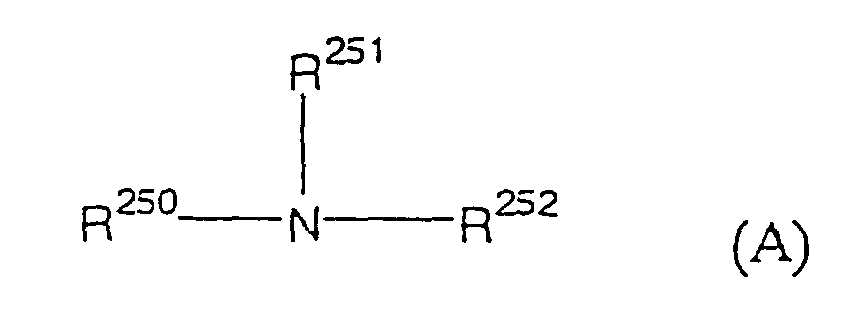
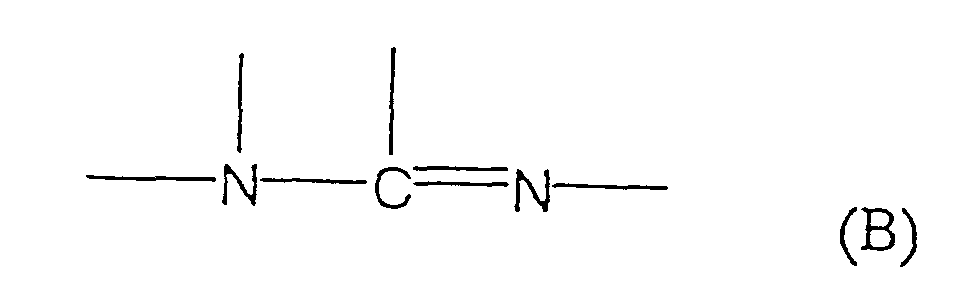
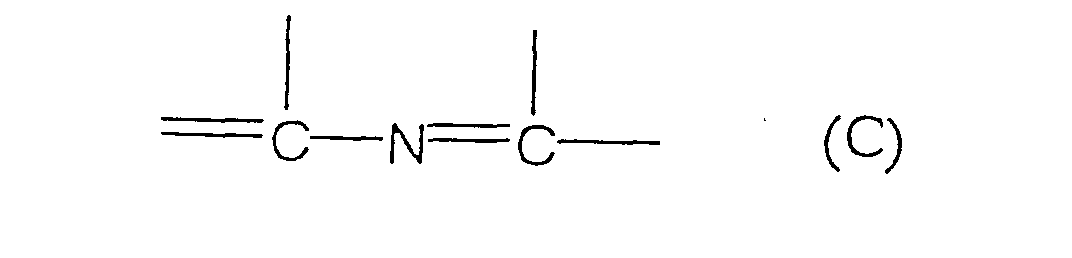
 (wherein R253, R254, R255, and R256, which are the same or difference, each represents an alkyl group having from 1 to 6 carbon atoms.).
- Preferred practical examples of the component (F) include a substituted or unsubstituted guanidine, a substituted or unsubstituted aminopyridine, a substituted or unsubstituted aminoalkylpyridine, a substituted or unsubstituted aminopyrrolidine, a substituted or unsubstituted indazole, a substituted or unsubstituted pyrazole, a substituted or unsubstituted pyrazine, a substituted or unsubstituted pyrimidine, a substituted or unsubstituted purine, a substituted or unsubstituted imidazoline, a substituted or unsubstituted pyrazoline, a substituted or unsubstituted piperazine, a substituted or unsubstituted aminomorpholine, a substituted or unsubstituted aminoalkylmorpholine, etc., and also include a mono-, di-, or tri-alkylamine, a substituted or unsubstituted aniline, a substituted or unsubstituted piperidine, a mono- or di-ethanolamine, etc.
- The preferred substituent includes an amino group, an aminoalkyl group, an alkylamino group, an aminoaryl group, an arylamino group, an alkyl group, an alkoxy group, an acyl group, an acyloxy group, an aryl group, an aryloxy group, a nitro group, a hydroxy group, and a cyano group.
- Preferred compounds of the component (F) include guanidine, 1,1-dimethylguanidine, 1,1,3,3-tetramethylguanidine, 2-aminopyridine, 3-aminopyridine, 4-aminopyridine, 2-dimethylaminopyridine, 4-dimethylaminopyridine, 2-diethylaminopyridine, 2-(aminomethyl)pyridine, 2-amino-3-methylpyridine, 2-amino-4-methylpyridine, 2-amino-5-methylpyridine, 2-amino-6-methylpyridine, 3-aminoethyl-pyridine, 4-aminoethylpyridine, 3-aminopyrolidine, piperazine, N-(2-aminoethyl)piperazine, N-(2-aminoethyl)piperidine, 4-amino-2,2,6,6-tetramethylpiperizine, 4-piperizinopiperizine, 2-iminopiperizine, 1-(2-aminoethyl)pyrrolidine, pyrazole, 3-amino-5-methylpyrazole, 5-amino-3-methyl-1-p-tolylpyrazole, pyrazine, 2-(aminomethyl)-5-methylpyrazine, pyrimidine, 2,4-diaminopyrimidine, 4,6-dihydroxypyrimidine, 2-pyrazoline, 3-pyrazoline, N-aminomorpholine, N-(2-aminoethyl)morpholine, 1,5-diazabicyclo[4,3,0]nona-5-ene, 1,8-diazabicyclo[5,4,0]-undeca-7-ene, 2,4,5-triphenylimidazole, tri(n-butyl)amine, tri(n-octyl)amine, N-phenyldiethanolamine, N-hydroxyethyl-piperidine, 2,6-diisopropylaniline, N-cyclohexyl-N'-morpholinoethyl thiourea, N-hydroxyethylmorpholine, etc., but the invention is not limited to these compounds.
- In these compounds, the particularly preferred compounds include 1,5-diazabicyclo[4,3,0]nona-5-ene, 1,8-diazabicyclo-[5,4,0]undeca-7-ene, 2,4,5-triphenylimidazole, tri(n-butyl)-amine, tri(n-octyl)amine, N-phenyldiethanolamine, N-hydroxy-ethylpiperidine, 2,6-diisopropylaniline, N-cyclohexyl-N'-morpholinoethyl thiourea, and N-hydroxyethylmorpholine.
- These nitrogen-containing basic compounds can be used singly or as a combination of two or more kinds thereof.
- The using amount of the nitrogen-containing basic compound is usually from 0.001 to 10% by weight, and preferably from 0.01 to 5% by weight based on the solid components of the composition of the invention. When the using amount is less than 0.001% by weight, the effect of adding the nitrogen-containing basic compound is not obtained. On the other hand, when the amount exceeds 10% by weight, there are tendencies that the sensitivity is lowered and the developing property of the non-irradiated portions is deteriorated.
- It is preferred that the positive resist composition of the invention contains the component (G).
- The component (G) is at least one kind of surfactant selected from a surfactant containing a fluorine atom, a surfactant containing a silicon atom, and a surfactant containing both a fluorine atom and a silicon atom.
- By containing the above-described surfactant in the positive resist composition of the invention, at using an exposure light source of a wavelength of not longer than 250 nm, and particularly not longer than 220 nm, the resist composition is excellent in the sensitivity, the resolving power, the adhesion with a substrate, and a dry etching resistance, the generation of particles after storing for a long period of time is less, and further resist patterns having less development defects and scum are obtained.
- As these surfactants, there are the surfactants described, for example, in Japanese Patent Laid-Open Nos. 36663/1987, 226746/1986, 226745/1986, 170950/1987, 34540/1988, 230165/1995, 62834/1996, 54432/1997, and 5988/1997, U.S. Patents 5,405,720, 5,360,692, 5,529,881, 5,296,330, 5,436,098,5,576,143, 5,294,511, and 5,824,451, and also the following commercially available surfactants can be used as they are.
- As the commercially available surfactants, which can be used in the invention, there are the fluorine-containing surfactants and the silicon-containing surfactants, such as, for example, Eftop EF301 and EF303 (manufactured by Shin Akita Kasei K.K.), Florad FC430 and 431 (manufactured by SUMITOMO 3M INC.), Megafac F171, F173, F176, F189, and R08 (manufactured by DAINIPPON INK & CHEMICALS, INC.), Surflon S-301, 102, 103, 104, 105, and 106 (manufactured by Asahi Glass Company Ltd.), and Troysol S-366 (manufactured Troy Chemical Industry K. K.). Also, the polysiloxane polymer KP-341 (manufactured by Shin-Etsu Chemical Co., Ltd.) can be used as a silicon-containing surfactant.
- The amount of the surfactant (G) is usually from 0.001 to 2% by weight, and preferably from 0.01 to 1% by weight based on the solid components in the composition of the invention. These surfactants may be used singly or as a combination of two or more kinds thereof.
- The positive photosensitive composition of the invention can, if necessary, further comprising a dye, a pigment, plasticizer, other surfactant than those described above, a photosensitizer, a compound having at least two phenolic OH groups of accelerating the solubility in a developer, etc.
- The compound having at least two phenolic OH groups, which can be used in the invention, is preferably a phenol compound having a molecular weight of not larger than 1000. Also, it is necessary that the compound contains at least two phenolic hydroxy groups in the molecule but the number of the phenolic hydroxy groups exceeds 10, the effect of improving the development latitude is lost. The ratio of the phenolic hydroxy groups and the aromatic rings is preferably from 0.5 to 1.4, and, thereby, the film thickness dependency, development latitude, the stability of the composition, and resolving power are excellent.
- The addition amount of the phenol compound is preferably from 2 to 50% by weight, and more preferably from 5 to 30% by weight to the alkali-soluble resin. When the addition amount exceeds 50% by weight, the development residue becomes bad and a new fault that the pattern is deformed at development undesirably occurs.
- The phenol compounds having a molecular weight of not larger than 1000 can be easily synthesized by persons skilled in the art by referring to the methods described, for example, in Japanese Patent Laid-Open Nos. 122938/1992 and 28531/1990, U.S. Patent 4,916,210, European Patent 219294, etc.
- Practical examples of the phenol compound are shown below but the phenol compounds, which can be used in the invention, are not limited to them.
- That is, the practical examples of the phenolic compound include resorcinol, phloroglucine, 2,3,4-trihydroxybenzo-phenone, 2,3,4,4'-tetrahydroxybenzophenone, 2,3,4,3',4',5'-hexahydroxybenzophenone, acetone-pyrogallol condensed resin, fluoroglucoside, 2,4,2',4'-biphenyltetrole, 4,4'-thiobis(1,3-dihydroxy)benzene, 2,2',4,4'-tetrahydroxydiphenyl ether, 2,2',4,4'-tetrahydroxydiphenyl sulfoxide, 2,2',4,4'-tetra-hydroxydiphenylsulfone, tris(4-hydroxyphenyl)methane, 1,1-bis(4-hydroxyphenyl)cyclohexane, 4,4-(α-mehylbenzylidene)-bisphenol, α,α',α"-tris(4-hydroxyphenyl)-1,3,5-triisopropyl-benzene, α,α',α"-tris(4-hydroxyphenyl)-1-ehyl-4-isopropyl-benzene, 1,2,2-tris(hydroxyphenyl)propane, 1,1,2-tris(3,5-dimethyl-4-hydroxyphenyl)propane, 2,2,5,5-tetrakis(4-hydroxy-phenyl)hexane, 1,2-tetrakis(4-hydroxyphenyl)ethane, 1,1,3-tris(hydroxyphenyl)butane, para[α,α,α',α'-tetrakis(4-hydroxyphenyl)]-xylene, etc.
- Each component contained in the positive resist compositions of the invention was explained above. Then, the preparation method of the positive resist composition of the invention and the using method thereof are explained.
- In the composition of the invention, each component described above is dissolved in a solvent dissolving the component and the solution prepared is coated on a support.
- The solvent used in the case includes ethylene dichloride, cyclohexanone, cyclopentanone, 2-heptanone, γ-butyrolactone, methyl ethyl ketone, ethylene glycol monomethyl ether, ethylene glycol monoethyl ether, 2-methoxyethyl acetate, ethylene glycol monoethyl ether acetate, propylene glycol monomethyl ether, propylene glycol monomethyl ether acetate, toluene, ethyl acetate, methyl lactate, ethyl lactate, methyl methoxypropionate, ethyl ethoxypropionate, methyl pyruvate, ethyl pyruvate, propyl pyruvate, N,N-dimethylformamide, dimethyl sulfoxide, N-methylpyrrolidone, tetrahydrofuran, etc. These solvents may be used solely or as a mixture thereof.
- In these solvents, the preferred solvents include 2-heptanone, γ-butyrolactone, ethylene glycol monomethyl ether, ethylene glycol monoethyl ether, ethylene glycol monoethyl ether acetate, propylene glycol monomethyl ether, propylene glycol monomethyl ether acetate, propylene glycol monoethyl ether acetate, methyl lactate, ethyl lactate, methyl methoxypropionate, ethyl ethoxypropionate, N-methylpyrrolidone, tetrahydrofuran, etc.
- In this case, it is preferred to add the above-described fluorine-base and/or silicon-base surfactant (G) to the above-described solvent.
- Also, other surfactant than the component (G) can be added. Such a surfactant includes nonionic surfactants, for example, polyoxyethylene alkyl ethers such as polyoxyethylene lauryl ether, polyoxyethylene stearyl ether, polyoxyethylene cetyl ether, polyoxyethylene oleyl ether, etc.; polyoxyethylene alkylaryl ethers such as polyoxyethylene octylphenol ether, polyoxyethylene nonylphenol ether, etc.; polyoxyethylene•polyoxypropylene block copolymers; sorbitan fatty acid esters such as sorbitan monolaurate, sorbitan monopalmitate, sorbitan monostearate, sorbitan monooleate, sorbitan trioleate, sorbitan tristearate, etc; polyoxyethylenesorbitan fatty acid esters such as polyoxyethylenesorbitan monopalmitate, polyoxyethylenesorbitan monostearate, polyoxyethylenesorbitan trioleate, polyoxyethylenesorbitan tristearate, etc,; and also acrylic acid-base or methacrylic acid-base (co)polymers, Polyflow No. 75 and No. 95 (manufactured by Kyoeisha Yushi Kagakukogyo K.K.), etc.
- The compounding amount of the surfactant is usually not larger than 2 parts by weight, and preferably not larger than 1 part by weight per 100 pats by weight of the solid components in the composition of the invention.
- After coating the above-described composition on a substrate (for example, silicon, silicon dioxide coating, and titanium nitride) as used for the production of precise integrated circuit devices or on such a substrate having formed thereon an anti-reflection film having a thickness of from 100 to 2,000 A, the coated film is light-exposed through a definite mask, or a direct imaging by electron beam or a mask-irradiation of electron beam is applied to the coated film, and by carrying out baking and development, good resist patterns can be obtained.
- As the developer of the composition of the invention, an alkaline aqueous solution of inorganic alkalis such as sodium hydroxide, potassium hydroxide, sodium carbonate, sodium silicate, sodium metasilicate, aqueous ammonia, etc.; primary amines such as ethylamine, n-propylamine, etc.; secondary amines such as diethylamine, di-n-butylamine, etc.; tertiary amines such as triethylamine, methyldiethylamine, etc.; alcoholamines such as dimethyl ethanolamine, triethanolamine, etc.; quaternary ammonium salts such as tetramethylammonium hydroxide, tetraethylammonium hydroxide, etc.; cyclic amines such as pyrrole, piperidine, etc., can be used.
- Furthermore, proper amounts of an alcohol and a surfactant can be added to the above-described alkaline aqueous solution.
- Then, the present invention is practically described by the following examples but the scope of the invention is not limited by these examples.
- In 400 ml of methanol was dissolved 20 g of triphenylsulfonium iodide, and after adding thereto 12.5 g of silver oxide, the mixture was stirred at room temperature (about 23°C) for 4 hours. From the reaction liquid, a silver compound was removed by filtration, and 9.9 g of saccharin was added to the filtrate. When the solution was concentrated and the solids obtained were washed with 300 ml of ethyl acetate, 22 g of the compound (IV-1) was obtained. M.P.: 147 to 149°C, 300 MHz 1H-NMR: δ7.35 to 7.4 (m. 2H), δ7.5 to 7.7 (m. 17H).
- By following the same procedure as the synthesis of (IV-1) using p-t-butylphenyldiphenylsulfonium iodide in place of triphenylsulfonium iodide, t-butylphenyldiphenylsulfonium saccharinate (IV-2) was synthesized.
- By following the same procedure as the synthesis of (IV-1) using p-methylphenylphenyldiphenylsulfonium iodide in place of triphenylsulfonium iodide, p-methylphenyldiphenylsulfonium saccharinate (IV-3) was synthesized.
- By following the same procedure as the synthesis of (IV-1) using tris(t-butylphenyl)sulfonium iodide in place of triphenylsulfonium iodide, tris(t-butylphenyl)sulfonium saccharinate (IV-4) was synthesized.
- By following the same procedure as the synthesis of (IV-1) using bis(p-chlorophenyl)phenylsulfonium iodide in place of triphenylsulfonium iodide, bis(p-chlorophenyl)phenylsulfonium saccharinate (IV-5) was synthesized.
- By following the same procedure as the synthesis of (IV-1) using p-n-butoxyphenyldiphenylsulfonium iodide in place of triphenylsulfonium iodide, p-n-butoxyphenyldiphenylsulfonium saccharinate (IV-6) was synthesized.
- In 300 ml of methanol was dissolved 10 g of bis[(4-diphenylsulfonio)phenyl]sulfide bisiodide, and after adding thereto 6.0 g of silver oxide (I), the mixture was stirred at room temperature (about 23°C) for 4 hours. From the reaction liquid, a silver compound was removed by filtration, and 4.8 g of saccharin was added to the filtrate obtained. When the solution was concentrated and washed with 300 ml of di-isopropyl ether, 6 g of the compound (V-1) was obtained.
- After mixing 100 g of bis(4-t-amylphenyl)iodonium iodide and 2000 ml of methanol, 44.4 g of silver oxide was added to the mixture, and resultant mixture was stirred at room temperature (about 23°C) for 4 hours. From the reaction liquid, a silver compound was removed by filtration, and 35.2 g of saccharin was added to the filtrate obtained. When the solution was concentrated and 700 ml of ethyl acetate was added to the oily material obtained, solids were precipitated. When the solids were collected by filtration and washed with 700 ml of ethyl acetate, 55 g of the compound (VI-1) was obtained. M.p.: 152 to 155°C, 300 MHz 1H-NMR: δ0.6(t. 6H), δ1.15(s. 12H), δ1.55(q. 4H), δ7.3(d. 4H), δ7.4 to 7.5(m. 2H), δ7.6 to 7.7(m. 2H), δ7.8(d. 2H).
- By following the same procedure as the synthesis of (VI-1) using bis (4-t-butylphenyl) iodonium iodide in place of bis(4-t-amylphenyl)iodonium iodide, bis(4-t-butylphenyl)-iodonium saccharinate (VI-2) was synthesized.
- By following the same procedure as the synthesis of (VI-1) using diphenyliodonium iodide in place of bis(4-t-amylphenyl)-iodonium iodide, diphenyliodonium saccharinate (VI-3) was synthesized.
- Other compounds were also synthesized using the similar methods.
- In 320 g of propylene glycol monomethyl ether acetate (PGMEA) was dissolved 70 g of poly p-hydroxystyrene (VP-8000 manufactured by Nippon Soda Co., Ltd., weight average molecular weight 1000) by heating and after dehydrating by a vacuum distillation, the solution was cooled to 20°C. To the solution were added 0.35 g of pyridinium-p-toluene sulfonate and 22.4 g of cyclohexane ethanol. Then, 17.5 g of t-butyl vinyl ether was slowly added to the solution and the reaction was carried out at 20°C for 5 hours. To the reaction liquid were added 0.28 g of triethylamine and 320 ml of ethyl acetate, and the mixture was washed 3 times with 150 ml of distilled water. Thereafter, the solvent was distilled off and the residue was concentrated. The oil obtained was dissolved in 100 ml of acetone and the solution was slowly poured to 2 liter of distilled water. When the powder precipitated was collected by filtration and dried, 54 g of the desired product was obtained.
- In 320 g of propylene glycol monomethyl ether acetate (PGMEA) was dissolved 70 g of poly p-hydroxystyrene (VP-8000, manufactured by Nippon Soda Co., Ltd. , weight average molecular weight 1000) by heating, and after dehydrating by a vacuum distillation, the solution was cooled to 20°C. To the solution were added 0.35 g of pyridinium-p-toluene sulfonate and 22.4 g of cyclohexane ethanol. After slowly adding 17.5 g of t-butyl vinyl ether to the solution, the reaction was carried out at 20°C for 5 hours. To the reaction liquid was added 5.53 g of pyridine and then 5.9 g of acetic anhydride was slowly added to the mixture. Thereafter, the reaction was carried out at room temperature for 1 hour, and after adding 320 ml of ethyl acetate to the reaction liquid, the mixture was washed 3 times with 150 ml of distilled water. Then, the solvent was distilled off and the residue was concentrated. The oil obtained was dissolved in 100 ml of acetone and the solution obtained was slowly poured into 2 liters of distilled water. When the powder precipitated was collected by filtration and dried, 58 g of the desired product was obtained.
-
- A-3: p-(1-Ethoxyethoxy)styrene/p-hydroxystyrene (35/65), molecular weight: 15,000, dispersion degree (Mw/Mn): 1.1.
- A-7: p-(1-iso-butoxyethoxy)styrene/p-hydroxystyrene (30/70), molecular weight: 6000, dispersion degree (Mw/Mn) 1.2.
- A-36: p-(1-phenetyloxyethoxy)styrene/p-acetoxystyrene/p-hydroxystyrene (30/10/60), molecular weight: 11000, dispersion degree (Mw/Mn): 1.2.
- A-41: p-(1-(4-t-Butylcyclohexylcarboxyethoxy)ethoxystyrene/p-acetoxystyrene/p-hydroxystyrene (30/10/60), molecular weight:12000, dispersion degree (Mw/Mn): 1.1.
- A-43: p-(1-(cyclohexylethoxy)ethoxy)styrene/p-t-butylstyrene/p-hydroxystyrene (30/8/62), molecular weight: 1800, dispersion degree (Mw/Mn): 2.3.
- A-22: p-(1-Benzyloxyethoxy)styrene/p-hydroxystyrene (25/75), molecular weight: 13000, dispersion degree (Mw/Mn): 1.3.
- A-35: p-(1-Benzyloxyethoxy)styrene/p-hydroxystyrene/p-acetoxystyrene (20/70/10), molecular weight: 9000, dispersion degree (Mw/Mn): 1.2.
-
- Furthermore, the following resins as the components (A) were synthesized.
- In 150 g of dioxane were dissolved 84.1 g of p-vinyl phenol and 22.4 g of t-butyl acrylate and a nitrogen gas stream was introduced into the system.
- Then, 6.91 g of dimethyl 2,2'-azobisisobutyrate was added to the solution, and the mixture was heated to 75°C under a nitrogen gas stream to carry out the polymerization for 12 hours. After the polymerization was finished, the reaction liquid was cooled to room temperature, after diluting the reaction liquid by adding 150 g of acetone, the solution was added dropwise to a large amount of hexane to obtain a solid polymer. The dilution with acetone and adding to hexane were repeated 3 times to remove residual monomers.
- By vacuum drying the polymer obtained at 60°C, the polymer A-48 was obtained.
- As the result of the analysis by NMR, the composition ratio of p-vinyl phenol : t-butyl acrylate was 79 : 21.
- The Mw was 12,000 and the dispersion degree (Mw/Mn) was 2.6.
- In 80 g of propylene glycol monoethyl ether acetate (PGMEA) was dissolved 20 g of the above-described polymer (A-48), after heating the solution to 60°C, the pressure of the system was gradually reduced to 20 mmHg, and PGMEA and water in the system were azeotropically dehydrated. After the azeotropic dehydration, the solution was cooled to 20°C, 2.2 g of isobutyl vinyl ether was added, and further, 3 mg of p-toluenesulfonic acid was added. Thereafter, the reaction was carried out for 2 hours, and the acid was neutralized by the addition of a small amount of triethylamine. Thereafter, ethyl acetate was added to the reaction liquid and by washing with ion-exchanged water, salts were removed. Furthermore, by distilling off ethyl acetate and water from the reaction liquid under a reduced pressure, the polymer A-16 as the desired product was obtained.
- In 40 ml of pyridine was dissolved poly p-hydroxystyrene (VP-8000, manufactured by Nippon Soda Co., Ltd., weight average molecular weight 1000), and 1.28 g of di-t-butyl dicarbonate was added to the solution with stirring at room temperature. After carrying out the reaction at room temperature for 3 hours, the reaction liquid was added to a solution of 1 liter of ion-exchanged water and 20 g of concentrated hydrochloric acid. The powder precipitated was collected by filtration, washed with water, and dried to obtain a p-hydroxystyrene/p-(t-butyloxycarbonyloxy)-styrene copolymer (60/40).
- According to the compositions shown in Table 1 below, each component was dissolved in a solvent (ratio of each solvent was denoted by weight in mixed solvent), the solid component concentration was controlled to 15% by weight in each case, and each solution was filtered by a polyethylene filter of 0.1 µm to prepare each resist solution. About the resist solutions, the following evaluations were carried out. A. KrF Excimer laser exposure evaluation:
- Each resist solution was uniformly coated on a silicon wafer subjected to a hexamethyldisilazane treatment using a spin coater and heat-dried on a hot plate at 120°C for 90 seconds to form a resist film of 0.6 µm thick. The resist film was pattern-exposed using a KrF excimer laser stepper (NA = 0.63) and using a mask for line and space, and immediately after the exposure, the resist film was heated on a hot plate at 110°C for 90 seconds. Then, the resist film was developed with an aqueous solution of 2.38% by weight tetramethylammonium hydroxide at 23°C for 60 seconds and after rinsing with pure water for 30 seconds, the resist film was dried. From the patterns on the silicon wafer obtained as described above, the performance of the resist was evaluated by the following methods. The results are shown in Table 2 below.
- The limiting resolving power in an exposure amount necessary for reproducing a mask pattern of line and space (1/1) of 0.18 µm was measured.
- The exposure amount necessary for reproducing a mask pattern of line and space (1/1) of 0.16 µm is defined the optimum exposure amount, and a value of the exposure amount width of reproducing a line width of 0.16 µm ± 10% divided by the optimum exposure amount was shown by percent (%). As the numeral is larger, a change of the line width owing to the change of exposure amount is less.
- The depth of focus of line and space (1/1) of 0.15 µm in an exposure amount necessary for reproducing a mask pattern of line and space (1/1) of 0.15 µm was measured. As the value is larger, the depth of focus is broader.
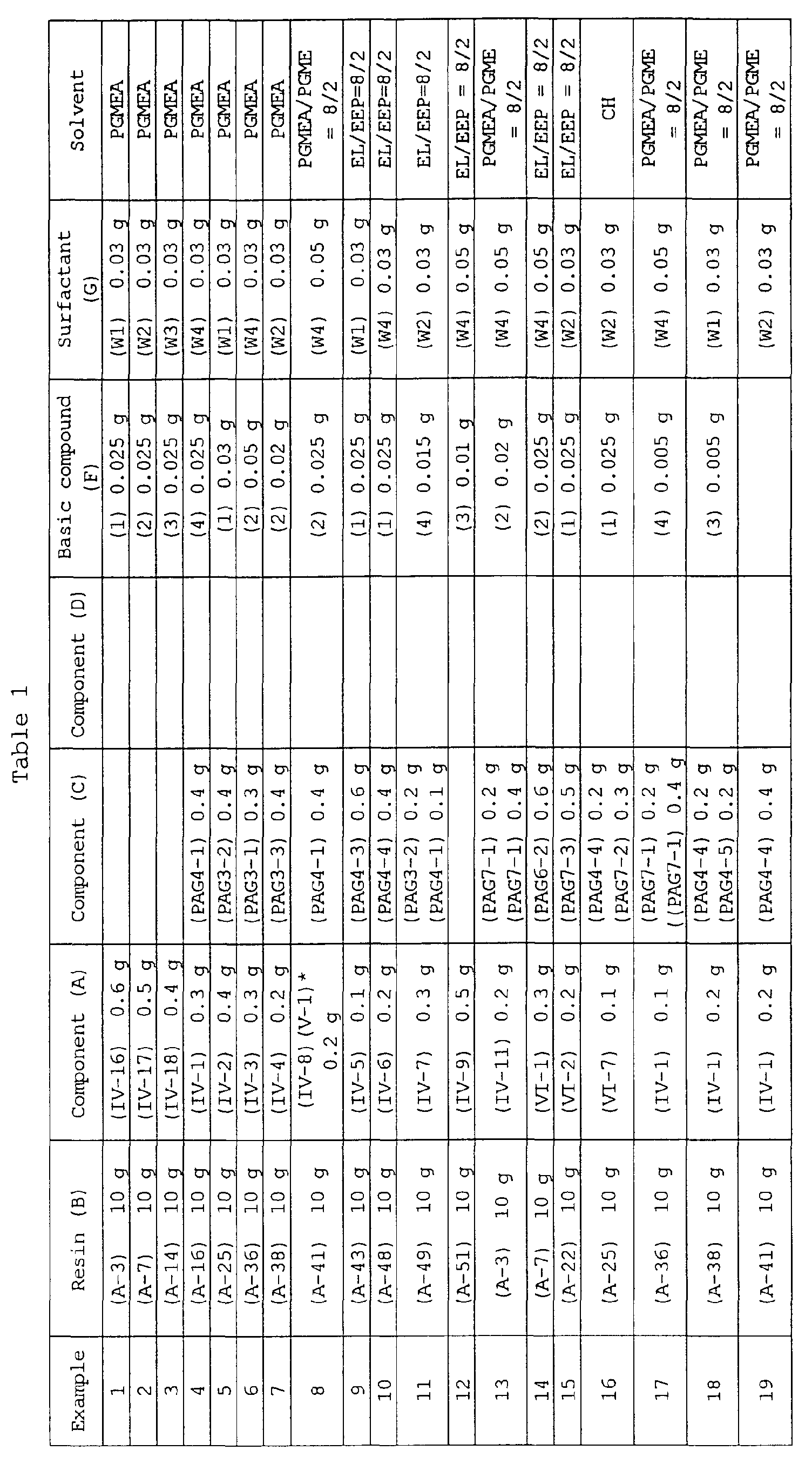
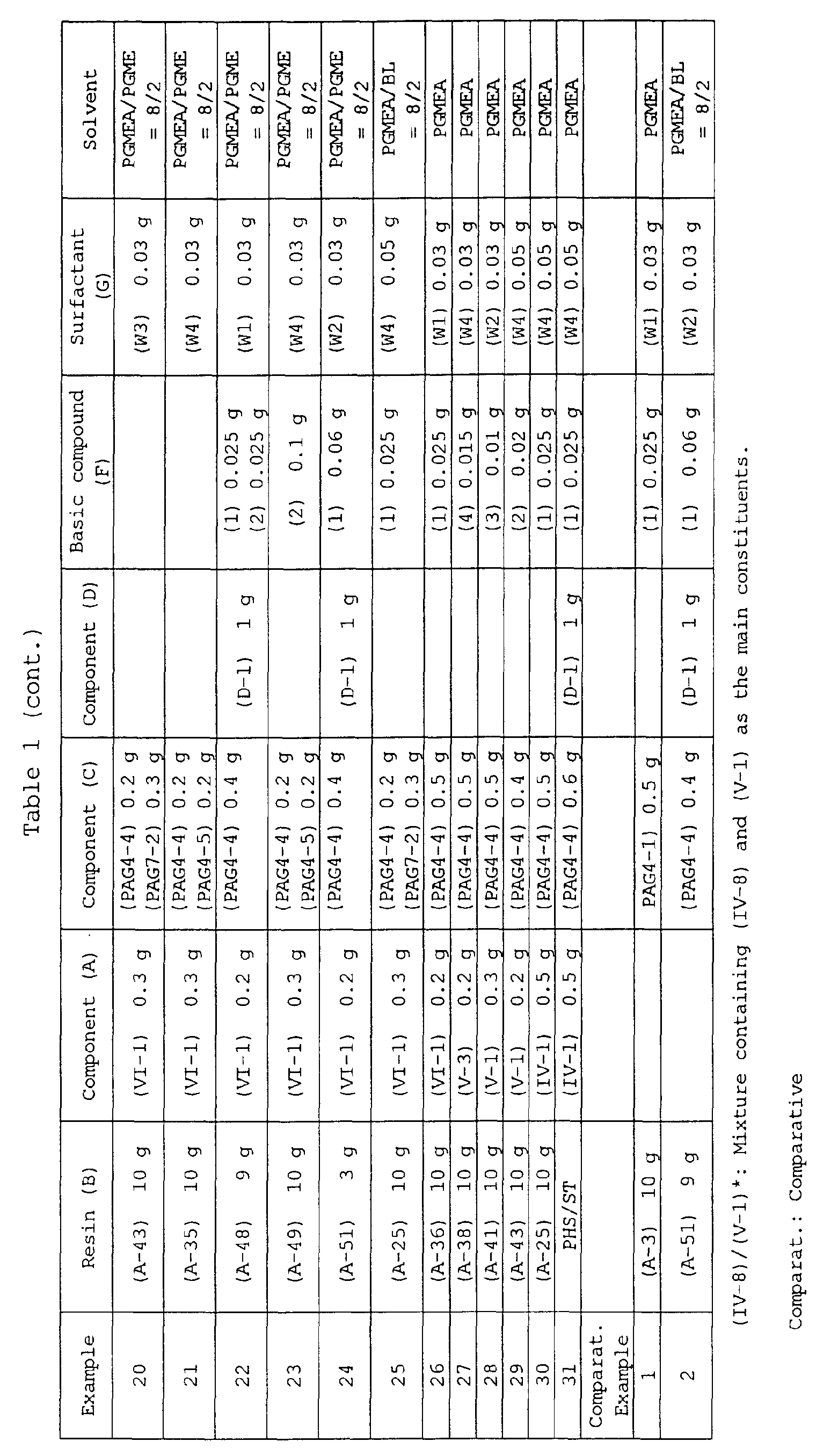
- Example 8: A mixture of (IV-8) and (V-1) as the main constituents was used as the component (A)
Component (B) (the amount is indicated the value as solid components) - PHS/ST of Example 31 denotes a p-hydroxystyrene/styrene (85 : 15 by mol ratio) copolymer (weight average molecular weight: 20,000, dispersion degree: 2.9), which is an alkali-soluble resin.
- (D-1): Compound having the following structure.
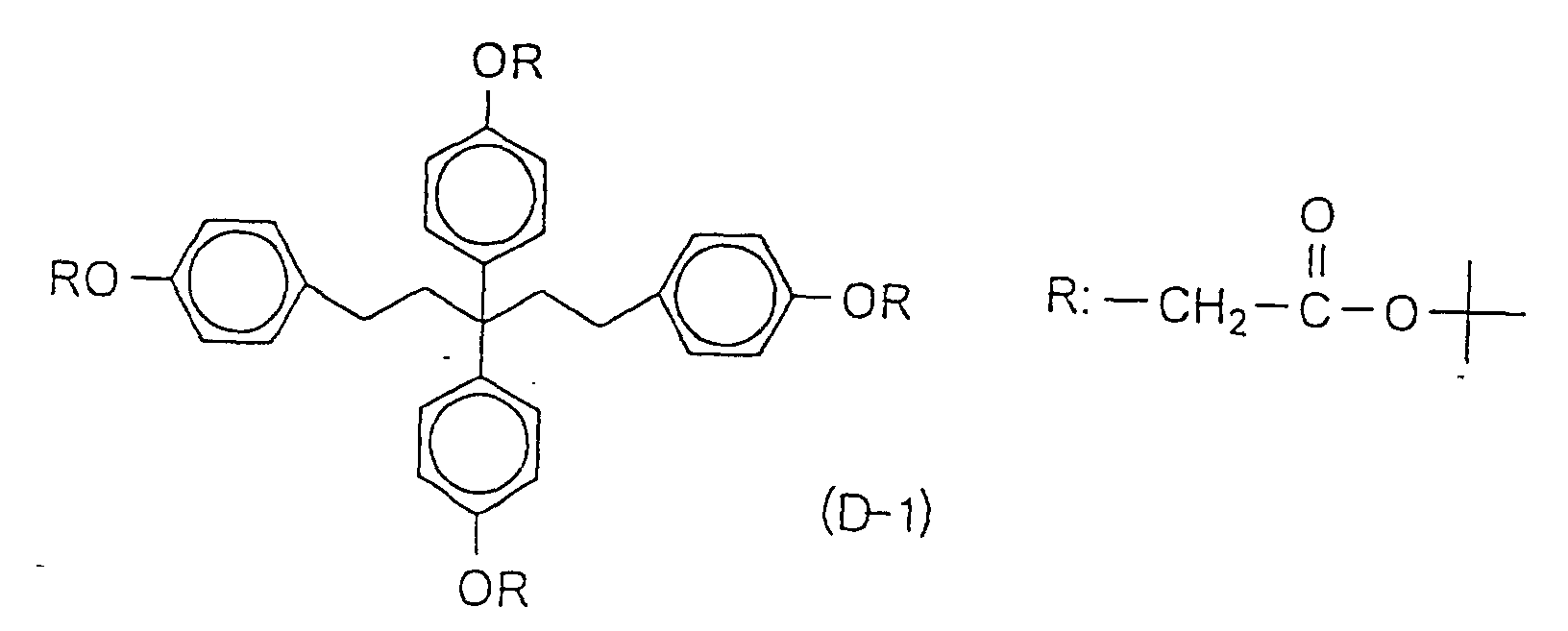
- (F) Basic compound component:
- (1): 1,5-Diazabicyclo[4,3,0]-5-nonene
- (2): 2,4,5-Triphenylimidazole
- (3): Tri-n-butylamine
- (4): N-Hydroxyethylpiperidine
-
-
- W-1: Megafac F176 (manufactured by DAINIPPON INK & CHEMICALS INC.) (fluorine-containing)
- W-2: Megafac R08 (manufactured by DAINIPPON INK & CHEMICALS INC.) (fluorine- and silicon- containing)
- W-3: Polysiloxane polymer KP-341 (manufactured by Shin-Etsu Chemical Co., Ltd)
- W-4: Troysol S-366 (manufactured by Troy Chemical Industry Inc.)
-
-
- PGMEA: Propylene glycol monomethyl ether acetate
- PGME: Propylene glycol monomethyl ether (1-methoxy-2-propanol)
- EL: Ethyl lactate
- EEP: Ethyl ethoxypropionate
- BL: γ-Butyrolactone
- CH: Cyclohexane
- Ratio in the case of using mixed solvents is indicated by a weight.
-
- From the results shown in Table 2, the following matters are clear.
- By irradiating the resist films of Examples 1 to 31, which are the positive resist compositions of the invention with a KrF laser light, which is a far ultraviolet ray, patterns are formed with having a high resolving power, a broad exposure margin, and a broad depth of focus. On the other hand, in the cases of Comparative Examples 1 and 2 without using the component (A), the light-exposure margin and the depth of focus are narrow.
- A part of the examples described in Table 1 described above (the examples shown in Table 3 below) was controlled to the solid component concentration of 17% by weight to obtain each resist solution. The resist solution was uniformly coated on a silicon substrate subjected to a hexamethyldisilazane treatment by a spin coater, heated on a hot plate at 120°C for 60 seconds, and dried to form a resist film of 0.8 µm thick. The resist film was irradiated by an electron beam imaging apparatus (accelerating voltage 50 kev, beam diameter 0.20 µm), and immediately after the irradiation, the resist film was heated on a hot plate to 110°C for 90 seconds. Then, the resist film irradiated was developed with an aqueous solution of tetramethylammonium hydroxide at a concentration of 2.38% by weight at 23°C for 60 seconds, and after rinsing with pure water for 30 seconds, the developed film was dried. From the patterns on the silicon wafer thus formed, the performance of the resist was evaluated by the following methods. The results are shown in Table 3 below.
- A contact hole pattern of 0.2 µm formed was observed by a scanning electron microscope and the profile was determined.
- A sensitivity was evaluated by the irradiation amount (µC/cm2) necessary for reproducing a contact hole pattern of 0.20 µm.
- The resolving power is shown by limiting resolving power in the irradiation amount necessary for reproducing the contact hole pattern of 0.20 µm.
Example (EB) Sensitivity (µC/cm2) Resolving Power (µm) Profile 3 2 0.10 Rectangle 4 4 0.09 Rectangle 14 6 0.09 Rectangle 20 5 0.09 Rectangle 21 6 0.08 Rectangle 24 7 0.09 Rectangle 25 9 0.08 Rectangle 31 7 0.10 Rectangle - From the results shown in Table 3 described above, it can be seen that the compositions of the invention further form patterns of excellent rectangular profiles by an electron beam irradiation without forming a reversed taper profile caused by scattering specific to the electron beam irradiation, at a high sensitivity and a high resolving power.
- As described above, the positive resist composition of the invention has an improved resolving power and an improved process allowability such as an exposure margin, a depth of focus, etc., in a lithography technique using an exposure light source of short wavelengths capable of super fine working and a positive chemically amplified resist. Also, even when using an electron beam as the energy beam for exposure, the resist composition of the invention shows an excellent performance.
| Example | Resolving Power (µm) | Exposure Margin (%) | Depth of Focus (µm) |
| 1 | 0.13 | 10.0 | 1.0 |
| 2 | 0.13 | 9.5 | 0.9 |
| 3 | 0.13 | 10.0 | 1.0 |
| 4 | 0.125 | 10.0 | 1.2 |
| 5 | 0.125 | 12.0 | 1.5 |
| 6 | 0.125 | 11.5 | 1.4 |
| 7 | 0.125 | 12.0 | 1.5 |
| 8 | 0.125 | 12.5 | 1.5 |
| 9 | 0.125 | 10.0 | 1.0 |
| 10 | 0.125 | 9.8 | 1.0 |
| 11 | 0.125 | 11.0 | 1.1 |
| 12 | 0.125 | 10.0 | 1.2 |
| 13 | 0.13 | 10.2 | 1.2 |
| 14 | 0.13 | 10.1 | 1.2 |
| 15 | 0.125 | 11.5 | 1.4 |
| 16 | 0.125 | 12.0 | 1.5 |
| 17 | 0.125 | 12.5 | 1.4 |
| 18 | 0.125 | 11.5 | 1.5 |
| 19 | 0.125 | 12.0 | 1.5 |
| 20 | 0.13 | 9.8 | 1.2 |
| 21 | 0.13 | 9.9 | 1.2 |
| 22 | 0.14 | 8.0 | 1.0 |
| 23 | 0.14 | 7.8 | 1.1 |
| 24 | 0.14 | 8.1 | 1.0 |
| 25 | 0.125 | 12.0 | 1.4 |
| 26 | 0.125 | 12.5 | 1.5 |
| 27 | 0.125 | 11.5 | 1.5 |
| 28 | 0.125 | 12.0 | 1.4 |
| 29 | 0.125 | 11.5 | 1.5 |
| 30 | 0.125 | 12.0 | 1.5 |
| 31 | 0.14 | 8.0 | 0.9 |
| Comparative Example | |||
| 1 | 0.14 | 4.2 | 0.6 |
| 2 | 0.14 | 3.4 | 0.4 |
Claims (21)
- A positive resist composition comprising:(A) a compound generating a compound represented by the formula (I) below by irradiation with an actinic ray or a radiation; and(B) a resin having a group which is decomposed by the action of an acid to increase the solubility of the composition in an alkali developer:wherein, Y represents a single bond, -CO-, or -SO2-; R' and R", which may be the same or different, each represents a straight chain, branched, or cyclic alkyl group which may be substituted, an aryl group which may be substituted, an aralkyl group which may be substituted, or a camphor group; R' and R" may be bonded to each other to form an alkylene group, an arylene group, or an aralkylene group, thereby, the structure of the formula (I) may form a ring; and when Y is a -CO- group, R" may be a hydroxy group or an alkoxy group.

- The positive resist composition according to claim 1, which further comprises (D) a compound having a molecular weight of not larger than 3000, which is decomposed by the action of an acid to increase the solubility in an alkali developer.
- The positive resist composition according to claim 1, wherein the pKa of the compound represented by the formula (I) is in the range of from -5 to 5.
- The positive resist composition according to claim 1, wherein the resin (B) is a resin containing repeating structural units represented by the following formulae (II) and (III):wherein L represents a hydrogen atom, a straight chain, branched, or cyclic alkyl group which may be substituted, or an aralkyl group which may be substituted; Z represents a straight chain, branched, or cyclic alkyl group which may be substituted or an aralkyl group which may be substituted; and Z and L may be bonded to each other to form a 5- or 6-membered ring.

- The positive resist composition according to claim 4, wherein Z of the formula (II) is a substituted alkyl group or a substituted aralkyl group.
- The positive resist composition according to claim 1, which further comprises (F) a nitrogen-containing basic compound and (G) at least one of a fluorine atom containing surfactant and a silicon atom containing surfactant.
- The positive resist composition according to claim 1, wherein the compound (A) is a compound having a structure represented by one of the following formulae (IV) to (VI):
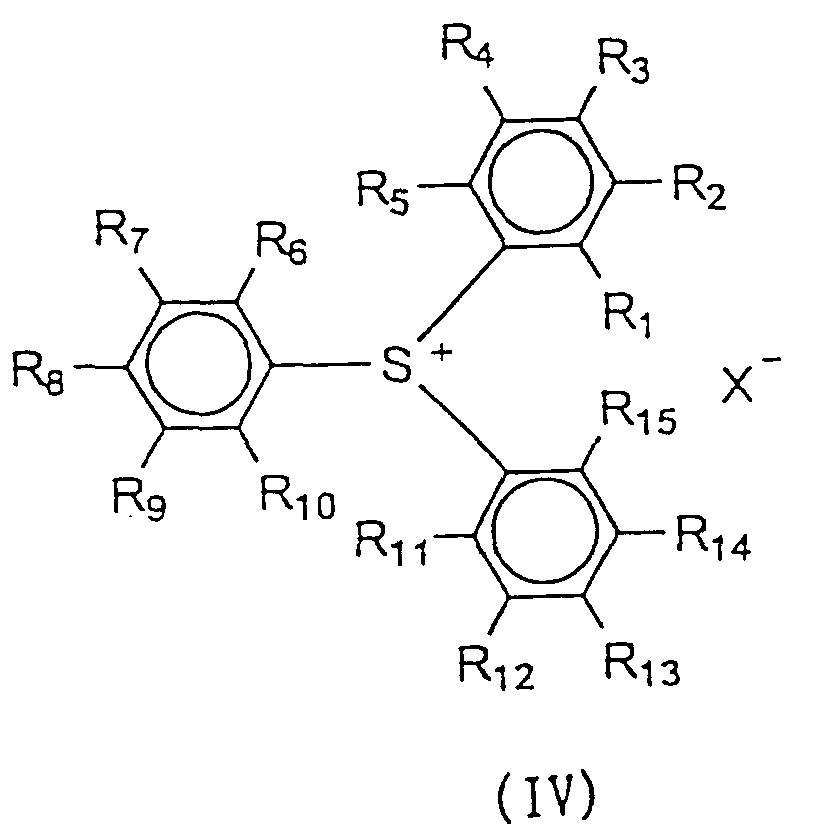
 wherein R1 to R37 each independently represents a hydrogen atom, a straight chain, branched, or cyclic alkyl group, a straight chain, branched, or cyclic alkoxy group, a hydroxy group, a halogen atom, or a -S-R38 group (wherein R38 represents a straight chain, branched, or cyclic alkyl group or an aryl group); X- represents an anion of the compound represented by the formula (I); A represents a single bond, a sulfur atom, an oxygen atom, or a methylene group.
- The positive resist composition according to claim 7, wherein X- in the formulae (IV) to (VI) contains the following structure:
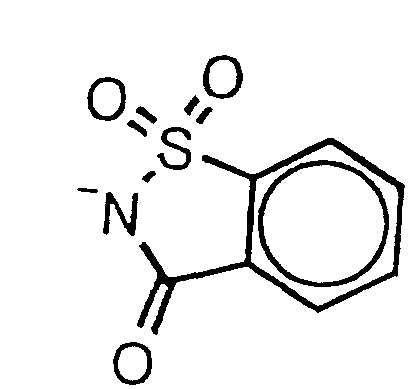
- The positive resist composition according to claim 1, which further comprises (C) a compound generating sulfonic acid by irradiation with an actinic ray or a radiation.
- A positive resist composition comprising:(A) a compound generating a compound represented by the formula (I) below by irradiation with an actinic ray or a radiation;(D) a compound having a molecular weight of not larger than 3000, which is decomposed by the action of an acid to increase the solubility in an alkali developer; and(E) an alkali-soluble resin:wherein, Y represents a single bond, -CO-, or -SO2-; R' and R", which may be the same or different, each represents a straight chain, branched, or cyclic alkyl group which may be substituted, an aryl group which may be substituted, an aralkyl group which may be substituted, or a camphor group; R' and R" may be bonded to each other to form an alkylene group, an arylene group, or an aralkylene group, and, thereby, the structure of the formula (I) may form a ring; and when Y is a -CO- group, R" may be a hydroxy group or an alkoxy group.
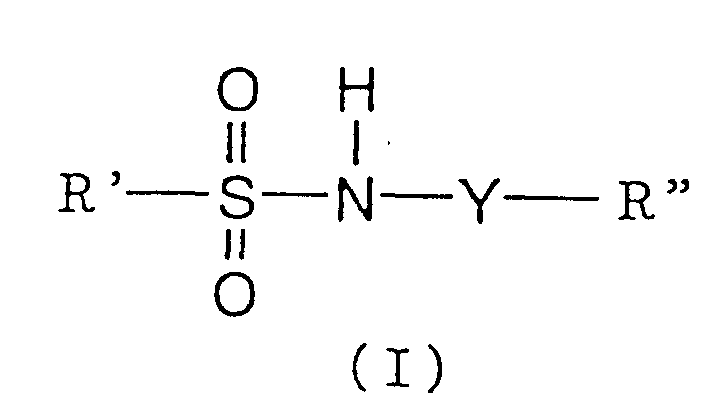
- The positive resist composition according to claim 10, wherein the pKa of the compound represented by the formula (I) is in the range of from -5 to 5.
- The positive resist composition according to claim 10, which further comprises (F) a nitrogen-containing basic compound and (G) at least one of a fluorine atom containing surfactant and a silicon atom containing surfactant.
- The positive resist composition according to claim 10, wherein the compound (A) is a compound having a structure represented by one of the following formulae (IV) to (VI) :
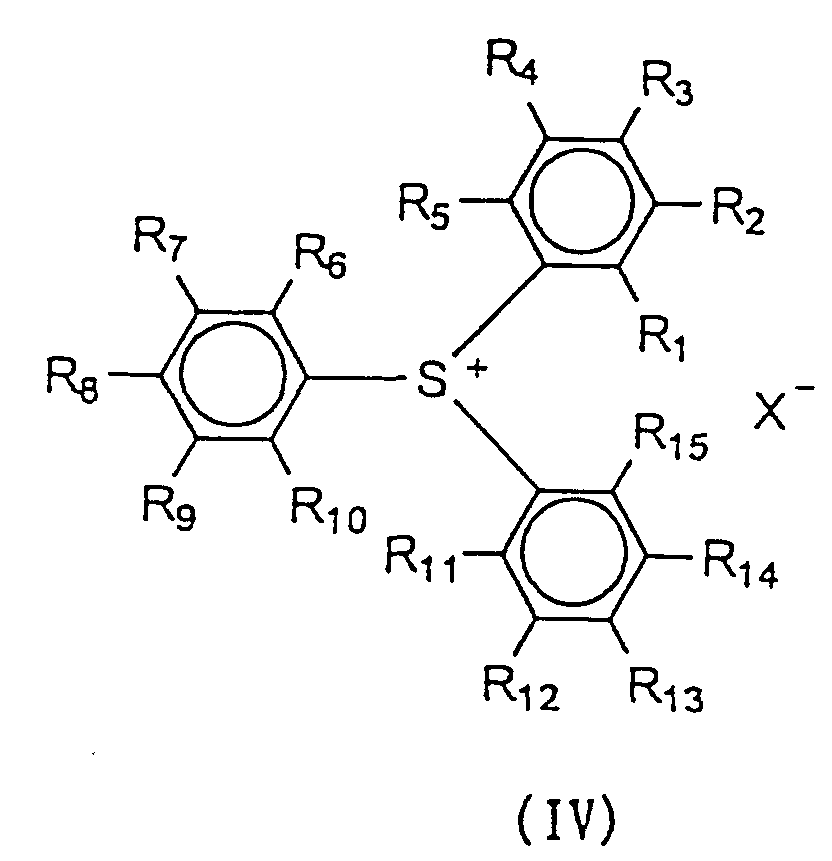
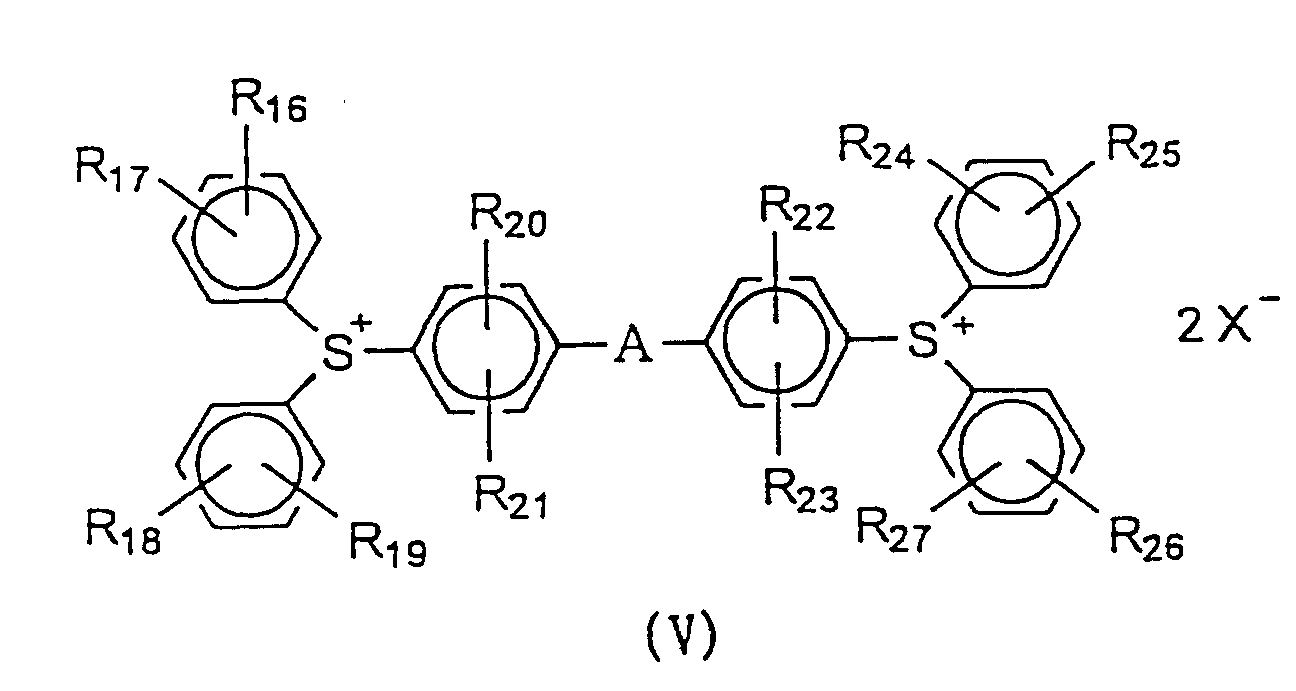 wherein R1 to R37 each independently represents a hydrogen atom, a straight chain, branched, or cyclic alkyl group, a straight chain, branched, or cyclic alkoxy group, a hydroxy group, a halogen atom, or a -S-R38 group (wherein R38 represents a straight chain, branched, or cyclic alkyl group or an aryl group); X- represents an anion of the compound represented by the formula (I); A represents a single bond, a sulfur atom, an oxygen atom, or a methylene group.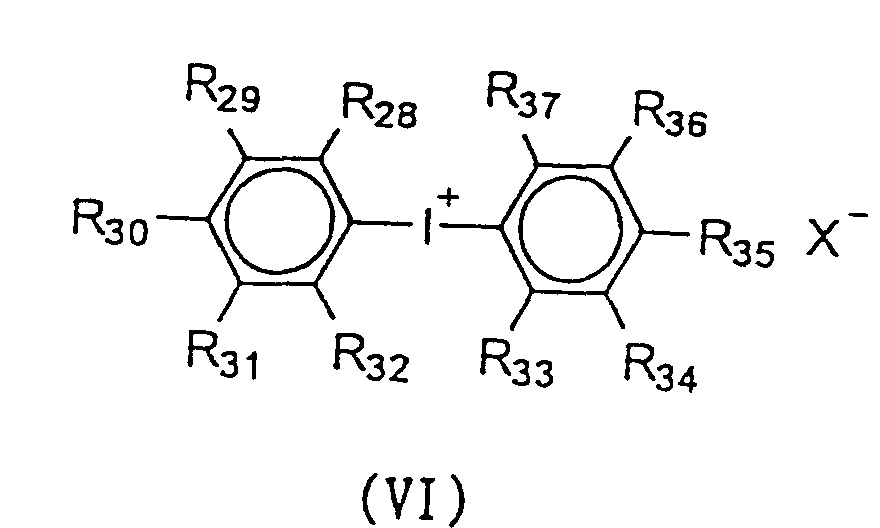
- The positive resist composition according to claim 13, wherein X- in the formulae (IV) to (VI) contains the following structure:

- The positive resist composition according to claim 10, which further comprises (C) a compound generating sulfonic acid by irradiation with an actinic ray or a radiation.
- A sulfonium salt compound represented by the formula (IVa):wherein, R1 to R15 each independently represents a hydrogen atom, a straight chain or branched alkyl group having from 1 to 5 carbon atoms, a cyclic alkyl group having from 3 to 8 carbon atoms, an alkoxy group having from 1 to 4 carbon atoms, a halogen atom, or -S-R38 (wherein R38 represents a straight chain or branched alkyl group having from 1 to 5 carbon atoms, a cyclic alkyl group having from 3 to 8 carbon atoms, or an aryl group having from 6 to 14 carbon atoms); Ra and Rb each independently represents a hydrogen atom, a halogen atom, an alkyl group having from 1 to 5 carbon atoms, an alkoxy group having from 1 to 5 carbon atoms, a nitro group, or a hydroxy group.
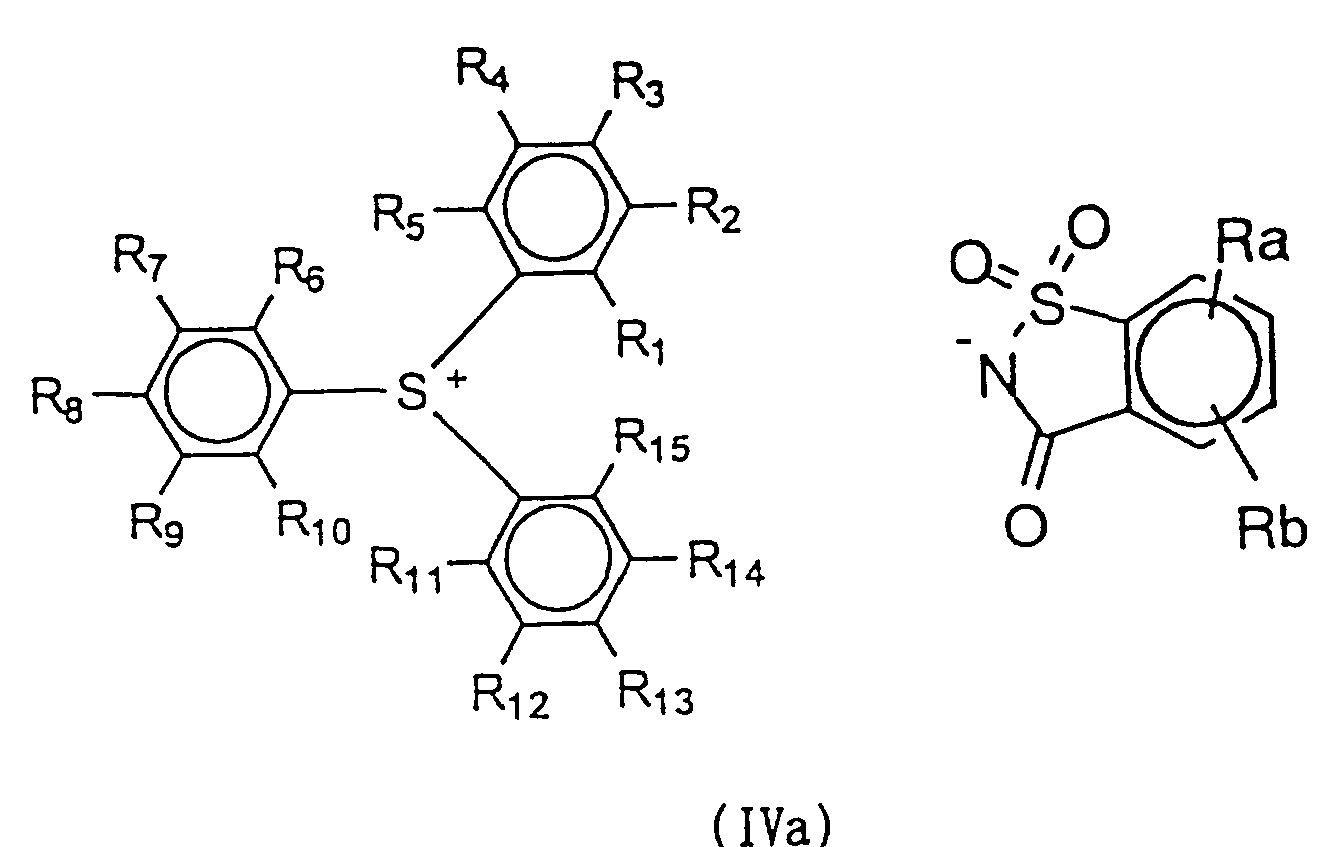
- The sulfonium salt compound according to claim 16, wherein in the formula (IVa), R1, R2, R4 to R7, R9 to R12, R14, R15, Ra, and Rb each is a hydrogen atom, and R3, R8, and R13 each independently represents a hydrogen atom, an alkyl group having from 1 to 5 atoms, an alkoxy group having from 1 to 5 carbon atoms, or a halogen atom.
- A sulfonium salt compound represented by the formula (Va) :wherein R16 to R27 each independently represents a hydrogen atom, a straight chain or branched alkyl group having from 1 to 5 carbon atoms, a cyclic alkyl group having from 3 to 8 carbon atoms, an alkoxy group having from 1 to 4 carbon atoms, a halogen atom, or -S-R38 (wherein R38 represents a straight chain or branched alkyl group having from 1 to 5 carbon atoms, a cyclic alkyl group having from 3 to 8 carbon atoms, or an aryl group having from 6 to 14 carbon atoms); Ra and Rb each independently represents a hydrogen atom, a halogen atom, an alkyl group having from 1 to 5 carbon atoms, an alkoxy group having from 1 to 5 carbon atoms, a nitro group, or a hydroxy group.

- The sulfonium salt compound according to claim 18, wherein in the formula (Va), R16 to R27, Ra, and Rb each is a hydrogen atom.
- An iodonium salt compound represented by the formula (VIa) :wherein R28 to R37 each independently represents a hydrogen atom, a straight chain or branched alkyl group having from 1 to 5 carbon atoms, a cyclic alkyl group having from 3 to 8 carbon atoms, an alkoxy group having from 1 to 4 carbon atoms, a halogen atom, or -S-R38 (wherein R38 represents a straight chain or branched alkyl group having from 1 to 5 carbon atoms, a cyclic alkyl group having from 3 to 8 carbon atoms, or an aryl group having from 6 to 14 carbon atoms); Ra and Rb each independently represents a hydrogen atom, a halogen atom, an alkyl group having from 1 to 5 carbon atoms, an alkoxy group having from 1 to 5 carbon atoms, a nitro group, or a hydroxy group.
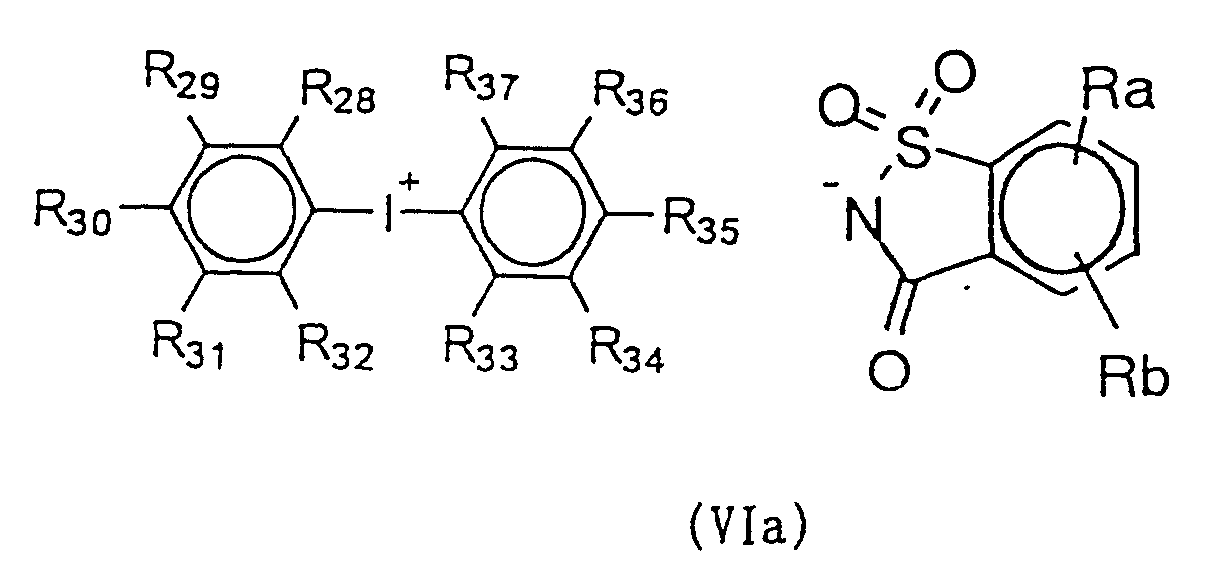
- The iodonium salt compound according to claim 20, wherein in the formula (VIa), R28, R29, R31 to R34, R36, R37, Ra, and Rb each is a hydrogen atom, and R30 and R35 each independently a hydrogen atom or an alkyl group having from 1 to 5 carbon atoms.
Applications Claiming Priority (2)
| Application Number | Priority Date | Filing Date | Title |
|---|---|---|---|
| JP2000150217A JP4177952B2 (en) | 2000-05-22 | 2000-05-22 | Positive resist composition |
| JP2000150217 | 2000-05-22 |
Publications (2)
| Publication Number | Publication Date |
|---|---|
| EP1158363A1 true EP1158363A1 (en) | 2001-11-28 |
| EP1158363B1 EP1158363B1 (en) | 2014-01-22 |
Family
ID=18655962
Family Applications (1)
| Application Number | Title | Priority Date | Filing Date |
|---|---|---|---|
| EP01111990.6A Expired - Lifetime EP1158363B1 (en) | 2000-05-22 | 2001-05-22 | Positive resist composition and onium salts of saccharin derivatives |
Country Status (5)
| Country | Link |
|---|---|
| US (1) | US6605409B2 (en) |
| EP (1) | EP1158363B1 (en) |
| JP (1) | JP4177952B2 (en) |
| KR (1) | KR100773335B1 (en) |
| TW (1) | TWI236577B (en) |
Cited By (5)
| Publication number | Priority date | Publication date | Assignee | Title |
|---|---|---|---|---|
| EP1684116A3 (en) * | 2005-01-24 | 2009-11-18 | FUJIFILM Corporation | Photosensitive composition, compound for use in the photosensitive composition and pattern forming method using the photosensitive composition |
| US8865919B2 (en) | 2011-01-03 | 2014-10-21 | Korea Kumho Petrochemical Co., Ltd. | Sulfonium compound, photo-acid generator, and method for manufacturing the same |
| EP3644122A1 (en) | 2018-10-25 | 2020-04-29 | Shin-Etsu Chemical Co., Ltd. | Onium salt, negative resist composition, and resist pattern forming process |
| US11548844B2 (en) | 2018-05-25 | 2023-01-10 | Shin-Etsu Chemical Co., Ltd. | Monomer, polymer, negative resist composition, photomask blank, and resist pattern forming process |
| EP4481493A4 (en) * | 2022-02-16 | 2025-09-03 | Fujifilm Corp | Actinic or radiation-sensitive resin composition, actinic or radiation-sensitive film, pattern formation method, method for producing an electronic device and connection |
Families Citing this family (34)
| Publication number | Priority date | Publication date | Assignee | Title |
|---|---|---|---|---|
| WO2003012900A1 (en) * | 2001-07-31 | 2003-02-13 | Tokuyama Corporation | Novel onium salt, electrolyte for nonaqueous cell containing the novel onium salt for nonaqueous cell, and method for optimizing negative electrode using electrolyte containing onium salt |
| US6818379B2 (en) * | 2001-12-03 | 2004-11-16 | Sumitomo Chemical Company, Limited | Sulfonium salt and use thereof |
| TW200304042A (en) * | 2002-02-22 | 2003-09-16 | Jsr Corp | Radiation-sensitive resin composition |
| JP4168095B2 (en) * | 2002-05-24 | 2008-10-22 | サンノプコ株式会社 | Photosensitive resin composition |
| EP1516230B1 (en) * | 2002-06-26 | 2015-12-30 | FujiFilm Electronic Materials USA, Inc. | Photosensitive compositions |
| US20040192876A1 (en) * | 2002-11-18 | 2004-09-30 | Nigel Hacker | Novolac polymer planarization films with high temparature stability |
| JP4115322B2 (en) * | 2003-03-31 | 2008-07-09 | 富士フイルム株式会社 | Positive resist composition |
| EP1649322A4 (en) | 2003-07-17 | 2007-09-19 | Honeywell Int Inc | PLANARIZATION FILMS FOR ADVANCED MICROELECTRONIC DEVICES AND APPLICATIONS AND METHODS FOR PRODUCING SAID FILMS |
| JP4418659B2 (en) * | 2003-09-26 | 2010-02-17 | 富士フイルム株式会社 | Resist composition for positive electron beam, X-ray or EUV light and pattern forming method using the same |
| US20050148679A1 (en) * | 2003-12-29 | 2005-07-07 | Chingfan Chiu | Aryl sulfonium salt, polymerizable composition and polymerization method of the same |
| KR101055215B1 (en) * | 2004-08-30 | 2011-08-08 | 동우 화인켐 주식회사 | Chemically Amplified Positive Resist Composition |
| JP2006078760A (en) | 2004-09-09 | 2006-03-23 | Tokyo Ohka Kogyo Co Ltd | Resist composition for electron beam or euv (extreme ultraviolet radiation) and resist pattern forming method |
| JP4724465B2 (en) * | 2005-05-23 | 2011-07-13 | 富士フイルム株式会社 | Photosensitive composition and pattern forming method using the photosensitive composition |
| JP4796792B2 (en) * | 2005-06-28 | 2011-10-19 | 富士フイルム株式会社 | Positive photosensitive composition and pattern forming method using the same |
| KR101334046B1 (en) * | 2005-07-01 | 2013-12-02 | 시바 홀딩 인크 | Sulfonium salt initiator |
| JP4996898B2 (en) * | 2006-03-27 | 2012-08-08 | 富士フイルム株式会社 | Positive resist composition and pattern forming method using the same |
| US20080299487A1 (en) * | 2007-05-31 | 2008-12-04 | Taiwan Semiconductor Manufacturing Company, Ltd. | Lithography material and lithography process |
| US8092976B2 (en) * | 2006-09-28 | 2012-01-10 | Fujifilm Corporation | Resist composition and pattern forming method using the same |
| JP5002393B2 (en) * | 2006-09-28 | 2012-08-15 | 富士フイルム株式会社 | Resist composition and pattern forming method using the same |
| US7601480B2 (en) * | 2006-12-20 | 2009-10-13 | Az Electronic Materials Usa Corp. | Photoactive compounds |
| TW201106101A (en) * | 2009-06-01 | 2011-02-16 | Fujifilm Electronic Materials | Chemically amplified positive photoresist composition |
| KR101813298B1 (en) | 2010-02-24 | 2017-12-28 | 바스프 에스이 | Latent acids and their use |
| KR101907705B1 (en) * | 2010-10-22 | 2018-10-12 | 제이에스알 가부시끼가이샤 | Pattern-forming method and radiation-sensitive composition |
| JP5807552B2 (en) * | 2012-01-13 | 2015-11-10 | 信越化学工業株式会社 | Pattern forming method and resist composition |
| US9529265B2 (en) | 2014-05-05 | 2016-12-27 | Taiwan Semiconductor Manufacturing Company, Ltd. | Method of preparing and using photosensitive material |
| US9994538B2 (en) | 2015-02-02 | 2018-06-12 | Basf Se | Latent acids and their use |
| JP6782540B2 (en) * | 2015-12-01 | 2020-11-11 | 東京応化工業株式会社 | Resist composition, resist pattern forming method and compound |
| JP2018109701A (en) * | 2017-01-04 | 2018-07-12 | メルク、パテント、ゲゼルシャフト、ミット、ベシュレンクテル、ハフツングMerck Patent GmbH | Chemically amplified positive photoresist composition and pattern forming method using the same |
| TWI753105B (en) * | 2017-02-22 | 2022-01-21 | 日商信越化學工業股份有限公司 | Pattern formation method |
| JP7031537B2 (en) * | 2018-09-05 | 2022-03-08 | 信越化学工業株式会社 | Sulfonium compound, positive resist composition, and resist pattern forming method |
| JP7388346B2 (en) * | 2020-02-14 | 2023-11-29 | 信越化学工業株式会社 | Resist material and pattern forming method |
| JP7494707B2 (en) * | 2020-04-01 | 2024-06-04 | 信越化学工業株式会社 | Resist material and pattern forming method |
| JP7484846B2 (en) * | 2020-09-28 | 2024-05-16 | 信越化学工業株式会社 | Molecular resist composition and pattern formation method |
| TW202402722A (en) * | 2022-07-14 | 2024-01-16 | 美商羅門哈斯電子材料有限公司 | Photoactive compounds, photoresist compositions including the same, and pattern formation methods |
Citations (2)
| Publication number | Priority date | Publication date | Assignee | Title |
|---|---|---|---|---|
| JPH09258435A (en) | 1996-03-22 | 1997-10-03 | Fuji Photo Film Co Ltd | Positive type photosensitive composition |
| US6060213A (en) | 1998-03-17 | 2000-05-09 | Fuji Photo Film Co., Ltd. | Positive-working photosensitive composition |
Family Cites Families (2)
| Publication number | Priority date | Publication date | Assignee | Title |
|---|---|---|---|---|
| US5411998A (en) * | 1992-07-24 | 1995-05-02 | Loctite Limited | Curing anaerobic compositions through thick bondlines |
| JP3851440B2 (en) * | 1998-04-22 | 2006-11-29 | 富士写真フイルム株式会社 | Positive photosensitive composition |
-
2000
- 2000-05-22 JP JP2000150217A patent/JP4177952B2/en not_active Expired - Lifetime
-
2001
- 2001-05-21 US US09/860,440 patent/US6605409B2/en not_active Expired - Lifetime
- 2001-05-22 KR KR1020010028162A patent/KR100773335B1/en not_active Expired - Lifetime
- 2001-05-22 TW TW090112241A patent/TWI236577B/en not_active IP Right Cessation
- 2001-05-22 EP EP01111990.6A patent/EP1158363B1/en not_active Expired - Lifetime
Patent Citations (2)
| Publication number | Priority date | Publication date | Assignee | Title |
|---|---|---|---|---|
| JPH09258435A (en) | 1996-03-22 | 1997-10-03 | Fuji Photo Film Co Ltd | Positive type photosensitive composition |
| US6060213A (en) | 1998-03-17 | 2000-05-09 | Fuji Photo Film Co., Ltd. | Positive-working photosensitive composition |
Non-Patent Citations (1)
| Title |
|---|
| PATENT ABSTRACTS OF JAPAN vol. 1998, no. 02 30 January 1998 (1998-01-30) * |
Cited By (7)
| Publication number | Priority date | Publication date | Assignee | Title |
|---|---|---|---|---|
| EP1684116A3 (en) * | 2005-01-24 | 2009-11-18 | FUJIFILM Corporation | Photosensitive composition, compound for use in the photosensitive composition and pattern forming method using the photosensitive composition |
| US7691558B2 (en) | 2005-01-24 | 2010-04-06 | Fujifilm Corporation | Photosensitive composition, compound for use in the photosensitive composition and pattern forming method using the photosensitive composition |
| US8865919B2 (en) | 2011-01-03 | 2014-10-21 | Korea Kumho Petrochemical Co., Ltd. | Sulfonium compound, photo-acid generator, and method for manufacturing the same |
| US11548844B2 (en) | 2018-05-25 | 2023-01-10 | Shin-Etsu Chemical Co., Ltd. | Monomer, polymer, negative resist composition, photomask blank, and resist pattern forming process |
| EP3644122A1 (en) | 2018-10-25 | 2020-04-29 | Shin-Etsu Chemical Co., Ltd. | Onium salt, negative resist composition, and resist pattern forming process |
| US11429023B2 (en) | 2018-10-25 | 2022-08-30 | Shin-Etsu Chemical Co., Ltd. | Onium salt, negative resist composition, and resist pattern forming process |
| EP4481493A4 (en) * | 2022-02-16 | 2025-09-03 | Fujifilm Corp | Actinic or radiation-sensitive resin composition, actinic or radiation-sensitive film, pattern formation method, method for producing an electronic device and connection |
Also Published As
| Publication number | Publication date |
|---|---|
| EP1158363B1 (en) | 2014-01-22 |
| KR20010107656A (en) | 2001-12-07 |
| US20020006578A1 (en) | 2002-01-17 |
| TWI236577B (en) | 2005-07-21 |
| JP4177952B2 (en) | 2008-11-05 |
| KR100773335B1 (en) | 2007-11-05 |
| US6605409B2 (en) | 2003-08-12 |
| JP2001330947A (en) | 2001-11-30 |
Similar Documents
| Publication | Publication Date | Title |
|---|---|---|
| US6605409B2 (en) | Positive resist composition | |
| JP4262402B2 (en) | Positive resist composition | |
| JP4231622B2 (en) | Positive resist composition | |
| US6485883B2 (en) | Positive photoresist composition | |
| KR100795872B1 (en) | Positive photosensitive composition | |
| KR100848045B1 (en) | Positive resist composition | |
| JP3963624B2 (en) | Positive photoresist composition for deep ultraviolet exposure | |
| KR100883541B1 (en) | Positive radiation sensitive composition | |
| JP2002139838A (en) | Positive type resist composition | |
| JP2002236358A (en) | Radiation sensitive resist composition | |
| JP4177966B2 (en) | Positive photoresist composition | |
| JP2002221787A (en) | Positive type radiosensitive composition | |
| JP2002055442A (en) | Positive type resist composition | |
| JP3841392B2 (en) | Positive photoresist composition | |
| JP2002131898A (en) | Positive radiation sensitive composition | |
| JP2002006480A (en) | Positive type resist composition | |
| JP4177970B2 (en) | Positive photoresist composition | |
| JP2002268209A (en) | Positive type radiation sensitive composition |
Legal Events
| Date | Code | Title | Description |
|---|---|---|---|
| PUAI | Public reference made under article 153(3) epc to a published international application that has entered the european phase |
Free format text: ORIGINAL CODE: 0009012 |
|
| AK | Designated contracting states |
Kind code of ref document: A1 Designated state(s): BE DE Kind code of ref document: A1 Designated state(s): AT BE CH CY DE DK ES FI FR GB GR IE IT LI LU MC NL PT SE TR |
|
| AX | Request for extension of the european patent |
Free format text: AL;LT;LV;MK;RO;SI |
|
| 17P | Request for examination filed |
Effective date: 20020430 |
|
| AKX | Designation fees paid |
Free format text: BE DE |
|
| RAP1 | Party data changed (applicant data changed or rights of an application transferred) |
Owner name: FUJIFILM CORPORATION |
|
| 17Q | First examination report despatched |
Effective date: 20081103 |
|
| GRAP | Despatch of communication of intention to grant a patent |
Free format text: ORIGINAL CODE: EPIDOSNIGR1 |
|
| INTG | Intention to grant announced |
Effective date: 20130814 |
|
| GRAS | Grant fee paid |
Free format text: ORIGINAL CODE: EPIDOSNIGR3 |
|
| GRAA | (expected) grant |
Free format text: ORIGINAL CODE: 0009210 |
|
| AK | Designated contracting states |
Kind code of ref document: B1 Designated state(s): BE DE |
|
| REG | Reference to a national code |
Ref country code: DE Ref legal event code: R096 Ref document number: 60148564 Country of ref document: DE Effective date: 20140227 |
|
| REG | Reference to a national code |
Ref country code: DE Ref legal event code: R097 Ref document number: 60148564 Country of ref document: DE |
|
| PLBE | No opposition filed within time limit |
Free format text: ORIGINAL CODE: 0009261 |
|
| STAA | Information on the status of an ep patent application or granted ep patent |
Free format text: STATUS: NO OPPOSITION FILED WITHIN TIME LIMIT |
|
| 26N | No opposition filed |
Effective date: 20141023 |
|
| REG | Reference to a national code |
Ref country code: DE Ref legal event code: R097 Ref document number: 60148564 Country of ref document: DE Effective date: 20141023 |
|
| PGFP | Annual fee paid to national office [announced via postgrant information from national office to epo] |
Ref country code: DE Payment date: 20200512 Year of fee payment: 20 |
|
| PGFP | Annual fee paid to national office [announced via postgrant information from national office to epo] |
Ref country code: BE Payment date: 20200416 Year of fee payment: 20 |
|
| REG | Reference to a national code |
Ref country code: DE Ref legal event code: R071 Ref document number: 60148564 Country of ref document: DE |
|
| REG | Reference to a national code |
Ref country code: BE Ref legal event code: MK Effective date: 20210522 |