EP1156074A1 - Artificial skin and method for evaluating uv screening agent - Google Patents
Artificial skin and method for evaluating uv screening agent Download PDFInfo
- Publication number
- EP1156074A1 EP1156074A1 EP01112243A EP01112243A EP1156074A1 EP 1156074 A1 EP1156074 A1 EP 1156074A1 EP 01112243 A EP01112243 A EP 01112243A EP 01112243 A EP01112243 A EP 01112243A EP 1156074 A1 EP1156074 A1 EP 1156074A1
- Authority
- EP
- European Patent Office
- Prior art keywords
- artificial skin
- grooves
- present
- screening agent
- skin
- Prior art date
- Legal status (The legal status is an assumption and is not a legal conclusion. Google has not performed a legal analysis and makes no representation as to the accuracy of the status listed.)
- Granted
Links
- 238000012216 screening Methods 0.000 title claims abstract description 50
- 238000000034 method Methods 0.000 title claims abstract description 11
- 230000005540 biological transmission Effects 0.000 claims abstract description 28
- 239000010409 thin film Substances 0.000 claims abstract description 15
- 229920000642 polymer Polymers 0.000 claims abstract description 11
- 239000003795 chemical substances by application Substances 0.000 claims description 50
- 229920002292 Nylon 6 Polymers 0.000 claims description 9
- 229920001778 nylon Polymers 0.000 claims description 5
- 239000010408 film Substances 0.000 claims description 4
- 238000005422 blasting Methods 0.000 claims description 3
- 239000004677 Nylon Substances 0.000 claims 2
- 230000001747 exhibiting effect Effects 0.000 claims 1
- 210000003491 skin Anatomy 0.000 description 68
- 238000012360 testing method Methods 0.000 description 20
- 230000000694 effects Effects 0.000 description 18
- 238000011156 evaluation Methods 0.000 description 18
- 239000000463 material Substances 0.000 description 18
- 239000000516 sunscreening agent Substances 0.000 description 17
- 230000000475 sunscreen effect Effects 0.000 description 16
- 230000002745 absorbent Effects 0.000 description 10
- 239000002250 absorbent Substances 0.000 description 10
- 210000002615 epidermis Anatomy 0.000 description 9
- -1 polypropylenes Polymers 0.000 description 9
- 238000001179 sorption measurement Methods 0.000 description 8
- 238000002835 absorbance Methods 0.000 description 7
- 239000004743 Polypropylene Substances 0.000 description 6
- 229920001155 polypropylene Polymers 0.000 description 6
- YBGZDTIWKVFICR-JLHYYAGUSA-N Octyl 4-methoxycinnamic acid Chemical compound CCCCC(CC)COC(=O)\C=C\C1=CC=C(OC)C=C1 YBGZDTIWKVFICR-JLHYYAGUSA-N 0.000 description 5
- 239000004615 ingredient Substances 0.000 description 5
- 239000000203 mixture Substances 0.000 description 5
- 229960001679 octinoxate Drugs 0.000 description 5
- PUPZLCDOIYMWBV-UHFFFAOYSA-N (+/-)-1,3-Butanediol Chemical compound CC(O)CCO PUPZLCDOIYMWBV-UHFFFAOYSA-N 0.000 description 4
- ALYNCZNDIQEVRV-UHFFFAOYSA-N 4-aminobenzoic acid Chemical compound NC1=CC=C(C(O)=O)C=C1 ALYNCZNDIQEVRV-UHFFFAOYSA-N 0.000 description 4
- GWEVSGVZZGPLCZ-UHFFFAOYSA-N Titan oxide Chemical compound O=[Ti]=O GWEVSGVZZGPLCZ-UHFFFAOYSA-N 0.000 description 4
- XLOMVQKBTHCTTD-UHFFFAOYSA-N Zinc monoxide Chemical compound [Zn]=O XLOMVQKBTHCTTD-UHFFFAOYSA-N 0.000 description 4
- 238000000338 in vitro Methods 0.000 description 4
- 238000005259 measurement Methods 0.000 description 4
- 239000002994 raw material Substances 0.000 description 4
- 241001507939 Cormus domestica Species 0.000 description 3
- 241001465754 Metazoa Species 0.000 description 3
- 230000006399 behavior Effects 0.000 description 3
- 239000000243 solution Substances 0.000 description 3
- 239000000126 substance Substances 0.000 description 3
- 238000000411 transmission spectrum Methods 0.000 description 3
- DSSYKIVIOFKYAU-OIBJUYFYSA-N (S)-camphor Chemical compound C1C[C@]2(C)C(=O)C[C@H]1C2(C)C DSSYKIVIOFKYAU-OIBJUYFYSA-N 0.000 description 2
- ZCTQGTTXIYCGGC-UHFFFAOYSA-N Benzyl salicylate Chemical compound OC1=CC=CC=C1C(=O)OCC1=CC=CC=C1 ZCTQGTTXIYCGGC-UHFFFAOYSA-N 0.000 description 2
- XMSXQFUHVRWGNA-UHFFFAOYSA-N Decamethylcyclopentasiloxane Chemical compound C[Si]1(C)O[Si](C)(C)O[Si](C)(C)O[Si](C)(C)O[Si](C)(C)O1 XMSXQFUHVRWGNA-UHFFFAOYSA-N 0.000 description 2
- LFQSCWFLJHTTHZ-UHFFFAOYSA-N Ethanol Chemical compound CCO LFQSCWFLJHTTHZ-UHFFFAOYSA-N 0.000 description 2
- 241000282412 Homo Species 0.000 description 2
- 239000004698 Polyethylene Substances 0.000 description 2
- 229960004050 aminobenzoic acid Drugs 0.000 description 2
- RWZYAGGXGHYGMB-UHFFFAOYSA-N anthranilic acid Chemical compound NC1=CC=CC=C1C(O)=O RWZYAGGXGHYGMB-UHFFFAOYSA-N 0.000 description 2
- 235000019437 butane-1,3-diol Nutrition 0.000 description 2
- 238000004364 calculation method Methods 0.000 description 2
- 238000005520 cutting process Methods 0.000 description 2
- 238000007429 general method Methods 0.000 description 2
- 238000001727 in vivo Methods 0.000 description 2
- 239000012528 membrane Substances 0.000 description 2
- 230000003278 mimic effect Effects 0.000 description 2
- QUAMTGJKVDWJEQ-UHFFFAOYSA-N octabenzone Chemical compound OC1=CC(OCCCCCCCC)=CC=C1C(=O)C1=CC=CC=C1 QUAMTGJKVDWJEQ-UHFFFAOYSA-N 0.000 description 2
- DXGLGDHPHMLXJC-UHFFFAOYSA-N oxybenzone Chemical compound OC1=CC(OC)=CC=C1C(=O)C1=CC=CC=C1 DXGLGDHPHMLXJC-UHFFFAOYSA-N 0.000 description 2
- ZQBAKBUEJOMQEX-UHFFFAOYSA-N phenyl salicylate Chemical compound OC1=CC=CC=C1C(=O)OC1=CC=CC=C1 ZQBAKBUEJOMQEX-UHFFFAOYSA-N 0.000 description 2
- 229920000573 polyethylene Polymers 0.000 description 2
- 239000008213 purified water Substances 0.000 description 2
- YGSDEFSMJLZEOE-UHFFFAOYSA-N salicylic acid Chemical compound OC(=O)C1=CC=CC=C1O YGSDEFSMJLZEOE-UHFFFAOYSA-N 0.000 description 2
- PRAKJMSDJKAYCZ-UHFFFAOYSA-N squalane Chemical compound CC(C)CCCC(C)CCCC(C)CCCCC(C)CCCC(C)CCCC(C)C PRAKJMSDJKAYCZ-UHFFFAOYSA-N 0.000 description 2
- XLYOFNOQVPJJNP-UHFFFAOYSA-N water Chemical compound O XLYOFNOQVPJJNP-UHFFFAOYSA-N 0.000 description 2
- 239000011787 zinc oxide Substances 0.000 description 2
- CWLGEPSKQDNHIO-JOBJLJCHSA-N (e)-n-[(e)-benzylideneamino]-1-phenylmethanimine Chemical compound C=1C=CC=CC=1/C=N/N=C/C1=CC=CC=C1 CWLGEPSKQDNHIO-JOBJLJCHSA-N 0.000 description 1
- WBYWAXJHAXSJNI-VOTSOKGWSA-M .beta-Phenylacrylic acid Natural products [O-]C(=O)\C=C\C1=CC=CC=C1 WBYWAXJHAXSJNI-VOTSOKGWSA-M 0.000 description 1
- 229940058015 1,3-butylene glycol Drugs 0.000 description 1
- DNWWTEIXNIQRQP-UHFFFAOYSA-N 1,3-dihydroxypropan-2-yl 4-aminobenzoate Chemical compound NC1=CC=C(C(=O)OC(CO)CO)C=C1 DNWWTEIXNIQRQP-UHFFFAOYSA-N 0.000 description 1
- MEZZCSHVIGVWFI-UHFFFAOYSA-N 2,2'-Dihydroxy-4-methoxybenzophenone Chemical compound OC1=CC(OC)=CC=C1C(=O)C1=CC=CC=C1O MEZZCSHVIGVWFI-UHFFFAOYSA-N 0.000 description 1
- ZXDDPOHVAMWLBH-UHFFFAOYSA-N 2,4-Dihydroxybenzophenone Chemical compound OC1=CC(O)=CC=C1C(=O)C1=CC=CC=C1 ZXDDPOHVAMWLBH-UHFFFAOYSA-N 0.000 description 1
- IYAZLDLPUNDVAG-UHFFFAOYSA-N 2-(benzotriazol-2-yl)-4-(2,4,4-trimethylpentan-2-yl)phenol Chemical compound CC(C)(C)CC(C)(C)C1=CC=C(O)C(N2N=C3C=CC=CC3=N2)=C1 IYAZLDLPUNDVAG-UHFFFAOYSA-N 0.000 description 1
- JGUMTYWKIBJSTN-UHFFFAOYSA-N 2-ethylhexyl 4-[[4,6-bis[4-(2-ethylhexoxycarbonyl)anilino]-1,3,5-triazin-2-yl]amino]benzoate Chemical compound C1=CC(C(=O)OCC(CC)CCCC)=CC=C1NC1=NC(NC=2C=CC(=CC=2)C(=O)OCC(CC)CCCC)=NC(NC=2C=CC(=CC=2)C(=O)OCC(CC)CCCC)=N1 JGUMTYWKIBJSTN-UHFFFAOYSA-N 0.000 description 1
- WSSJONWNBBTCMG-UHFFFAOYSA-N 2-hydroxybenzoic acid (3,3,5-trimethylcyclohexyl) ester Chemical compound C1C(C)(C)CC(C)CC1OC(=O)C1=CC=CC=C1O WSSJONWNBBTCMG-UHFFFAOYSA-N 0.000 description 1
- HDQAWGREPCMZMW-UHFFFAOYSA-N 4-ethyl-2-[(4-methoxyphenyl)methylidene]octanoic acid;octyl 2-methoxy-3-phenylprop-2-enoate Chemical compound CCCCCCCCOC(=O)C(OC)=CC1=CC=CC=C1.CCCCC(CC)CC(C(O)=O)=CC1=CC=C(OC)C=C1 HDQAWGREPCMZMW-UHFFFAOYSA-N 0.000 description 1
- JOKBLKCZHGIRNO-UHFFFAOYSA-N 5-benzoyl-2-hydroxybenzoic acid Chemical compound C1=C(O)C(C(=O)O)=CC(C(=O)C=2C=CC=CC=2)=C1 JOKBLKCZHGIRNO-UHFFFAOYSA-N 0.000 description 1
- RDBLNMQDEWOUIB-UHFFFAOYSA-N 5-methyl-2-phenyl-1,3-benzoxazole Chemical compound N=1C2=CC(C)=CC=C2OC=1C1=CC=CC=C1 RDBLNMQDEWOUIB-UHFFFAOYSA-N 0.000 description 1
- 241001340526 Chrysoclista linneella Species 0.000 description 1
- WBYWAXJHAXSJNI-SREVYHEPSA-N Cinnamic acid Chemical compound OC(=O)\C=C/C1=CC=CC=C1 WBYWAXJHAXSJNI-SREVYHEPSA-N 0.000 description 1
- QSACCXVHEVWNMX-UHFFFAOYSA-N N-acetylanthranilic acid Chemical compound CC(=O)NC1=CC=CC=C1C(O)=O QSACCXVHEVWNMX-UHFFFAOYSA-N 0.000 description 1
- 229920002302 Nylon 6,6 Polymers 0.000 description 1
- 239000007983 Tris buffer Substances 0.000 description 1
- DRRMRHKHTQRWMB-UHFFFAOYSA-N [3-(2-ethylhexanoyloxy)-2,2-bis(2-ethylhexanoyloxymethyl)propyl] 2-ethylhexanoate Chemical compound CCCCC(CC)C(=O)OCC(COC(=O)C(CC)CCCC)(COC(=O)C(CC)CCCC)COC(=O)C(CC)CCCC DRRMRHKHTQRWMB-UHFFFAOYSA-N 0.000 description 1
- CMPDPBDUZTUXAD-UHFFFAOYSA-N [3-hydroxy-2-(16-methylheptadecanoyloxy)propyl] 16-methylheptadecanoate Chemical compound CC(C)CCCCCCCCCCCCCCC(=O)OCC(CO)OC(=O)CCCCCCCCCCCCCCC(C)C CMPDPBDUZTUXAD-UHFFFAOYSA-N 0.000 description 1
- 238000010521 absorption reaction Methods 0.000 description 1
- 239000012790 adhesive layer Substances 0.000 description 1
- UBNYRXMKIIGMKK-RMKNXTFCSA-N amiloxate Chemical compound COC1=CC=C(\C=C\C(=O)OCCC(C)C)C=C1 UBNYRXMKIIGMKK-RMKNXTFCSA-N 0.000 description 1
- 229940062909 amyl salicylate Drugs 0.000 description 1
- 238000004458 analytical method Methods 0.000 description 1
- 125000002490 anilino group Chemical group [H]N(*)C1=C([H])C([H])=C([H])C([H])=C1[H] 0.000 description 1
- 239000011324 bead Substances 0.000 description 1
- 238000010009 beating Methods 0.000 description 1
- RWCCWEUUXYIKHB-UHFFFAOYSA-N benzophenone Chemical compound C=1C=CC=CC=1C(=O)C1=CC=CC=C1 RWCCWEUUXYIKHB-UHFFFAOYSA-N 0.000 description 1
- 239000012965 benzophenone Substances 0.000 description 1
- SODJJEXAWOSSON-UHFFFAOYSA-N bis(2-hydroxy-4-methoxyphenyl)methanone Chemical compound OC1=CC(OC)=CC=C1C(=O)C1=CC=C(OC)C=C1O SODJJEXAWOSSON-UHFFFAOYSA-N 0.000 description 1
- FOYJYXHISWUSDL-UHFFFAOYSA-N butyl 4-(dimethylamino)benzoate Chemical compound CCCCOC(=O)C1=CC=C(N(C)C)C=C1 FOYJYXHISWUSDL-UHFFFAOYSA-N 0.000 description 1
- 229960000846 camphor Drugs 0.000 description 1
- 229930016911 cinnamic acid Natural products 0.000 description 1
- 235000013985 cinnamic acid Nutrition 0.000 description 1
- CMDKPGRTAQVGFQ-RMKNXTFCSA-N cinoxate Chemical compound CCOCCOC(=O)\C=C\C1=CC=C(OC)C=C1 CMDKPGRTAQVGFQ-RMKNXTFCSA-N 0.000 description 1
- 230000000052 comparative effect Effects 0.000 description 1
- 238000007796 conventional method Methods 0.000 description 1
- 229920001577 copolymer Polymers 0.000 description 1
- 239000002537 cosmetic Substances 0.000 description 1
- FGEUKKGODAGXOD-FMIVXFBMSA-N cyclohexyl (e)-3-(4-methoxyphenyl)prop-2-enoate Chemical compound C1=CC(OC)=CC=C1\C=C\C(=O)OC1CCCCC1 FGEUKKGODAGXOD-FMIVXFBMSA-N 0.000 description 1
- 238000001514 detection method Methods 0.000 description 1
- GUJOJGAPFQRJSV-UHFFFAOYSA-N dialuminum;dioxosilane;oxygen(2-);hydrate Chemical compound O.[O-2].[O-2].[O-2].[Al+3].[Al+3].O=[Si]=O.O=[Si]=O.O=[Si]=O.O=[Si]=O GUJOJGAPFQRJSV-UHFFFAOYSA-N 0.000 description 1
- 235000013870 dimethyl polysiloxane Nutrition 0.000 description 1
- 239000004205 dimethyl polysiloxane Substances 0.000 description 1
- OGQYPPBGSLZBEG-UHFFFAOYSA-N dimethyl(dioctadecyl)azanium Chemical compound CCCCCCCCCCCCCCCCCC[N+](C)(C)CCCCCCCCCCCCCCCCCC OGQYPPBGSLZBEG-UHFFFAOYSA-N 0.000 description 1
- MCPKSFINULVDNX-UHFFFAOYSA-N drometrizole Chemical compound CC1=CC=C(O)C(N2N=C3C=CC=CC3=N2)=C1 MCPKSFINULVDNX-UHFFFAOYSA-N 0.000 description 1
- 239000010696 ester oil Substances 0.000 description 1
- KCDAMWRCUXGACP-DHZHZOJOSA-N ethyl (e)-2-cyano-3-phenylprop-2-enoate Chemical compound CCOC(=O)C(\C#N)=C\C1=CC=CC=C1 KCDAMWRCUXGACP-DHZHZOJOSA-N 0.000 description 1
- HPMLGOFBKNGJAM-ONEGZZNKSA-N ethyl (e)-3-(1h-imidazol-5-yl)prop-2-enoate Chemical compound CCOC(=O)\C=C\C1=CN=CN1 HPMLGOFBKNGJAM-ONEGZZNKSA-N 0.000 description 1
- XRLCQRMNGQRGOC-MDZDMXLPSA-N ethyl (e)-3-[2,4-di(propan-2-yl)phenyl]prop-2-enoate Chemical compound CCOC(=O)\C=C\C1=CC=C(C(C)C)C=C1C(C)C XRLCQRMNGQRGOC-MDZDMXLPSA-N 0.000 description 1
- NYNCZOLNVTXTTP-UHFFFAOYSA-N ethyl 2-(1,3-dioxoisoindol-2-yl)acetate Chemical compound C1=CC=C2C(=O)N(CC(=O)OCC)C(=O)C2=C1 NYNCZOLNVTXTTP-UHFFFAOYSA-N 0.000 description 1
- XCRHYAQWBYDRGV-UHFFFAOYSA-N ethyl 3-(4-propan-2-ylphenyl)prop-2-enoate Chemical compound CCOC(=O)C=CC1=CC=C(C(C)C)C=C1 XCRHYAQWBYDRGV-UHFFFAOYSA-N 0.000 description 1
- TXCSWUDCVVHMEH-UHFFFAOYSA-N ethyl 4-(diethoxyamino)benzoate Chemical compound CCON(OCC)C1=CC=C(C(=O)OCC)C=C1 TXCSWUDCVVHMEH-UHFFFAOYSA-N 0.000 description 1
- WQFMOOIFXWMCIR-UHFFFAOYSA-N ethyl 4-(dipropoxyamino)benzoate Chemical compound CCCON(OCCC)C1=CC=C(C(=O)OCC)C=C1 WQFMOOIFXWMCIR-UHFFFAOYSA-N 0.000 description 1
- 239000011521 glass Substances 0.000 description 1
- KWLMIXQRALPRBC-UHFFFAOYSA-L hectorite Chemical compound [Li+].[OH-].[OH-].[Na+].[Mg+2].O1[Si]2([O-])O[Si]1([O-])O[Si]([O-])(O1)O[Si]1([O-])O2 KWLMIXQRALPRBC-UHFFFAOYSA-L 0.000 description 1
- 229910000271 hectorite Inorganic materials 0.000 description 1
- 229960004881 homosalate Drugs 0.000 description 1
- 238000007654 immersion Methods 0.000 description 1
- 238000002386 leaching Methods 0.000 description 1
- 239000007788 liquid Substances 0.000 description 1
- 238000004519 manufacturing process Methods 0.000 description 1
- SJOXEWUZWQYCGL-DVOMOZLQSA-N menthyl salicylate Chemical compound CC(C)[C@@H]1CC[C@@H](C)C[C@H]1OC(=O)C1=CC=CC=C1O SJOXEWUZWQYCGL-DVOMOZLQSA-N 0.000 description 1
- 229960004665 menthyl salicylate Drugs 0.000 description 1
- 229910044991 metal oxide Inorganic materials 0.000 description 1
- 150000004706 metal oxides Chemical class 0.000 description 1
- YKWKFUUHPFWRNV-UHFFFAOYSA-N methyl 3-[2,4-di(propan-2-yl)phenyl]prop-2-enoate Chemical compound COC(=O)C=CC1=CC=C(C(C)C)C=C1C(C)C YKWKFUUHPFWRNV-UHFFFAOYSA-N 0.000 description 1
- PABHEXWDYRTPBQ-UHFFFAOYSA-N methyl 3-[2,5-di(propan-2-yl)phenyl]prop-2-enoate Chemical compound COC(=O)C=CC1=CC(C(C)C)=CC=C1C(C)C PABHEXWDYRTPBQ-UHFFFAOYSA-N 0.000 description 1
- DBQGARDMYOMOOS-UHFFFAOYSA-N methyl 4-(dimethylamino)benzoate Chemical compound COC(=O)C1=CC=C(N(C)C)C=C1 DBQGARDMYOMOOS-UHFFFAOYSA-N 0.000 description 1
- WBYWAXJHAXSJNI-UHFFFAOYSA-N methyl p-hydroxycinnamate Natural products OC(=O)C=CC1=CC=CC=C1 WBYWAXJHAXSJNI-UHFFFAOYSA-N 0.000 description 1
- MJVGBKJNTFCUJM-UHFFFAOYSA-N mexenone Chemical compound OC1=CC(OC)=CC=C1C(=O)C1=CC=C(C)C=C1 MJVGBKJNTFCUJM-UHFFFAOYSA-N 0.000 description 1
- 238000012986 modification Methods 0.000 description 1
- 230000004048 modification Effects 0.000 description 1
- 229910052901 montmorillonite Inorganic materials 0.000 description 1
- 238000000465 moulding Methods 0.000 description 1
- JXTPJDDICSTXJX-UHFFFAOYSA-N n-Triacontane Natural products CCCCCCCCCCCCCCCCCCCCCCCCCCCCCC JXTPJDDICSTXJX-UHFFFAOYSA-N 0.000 description 1
- 229960003921 octisalate Drugs 0.000 description 1
- FMJSMJQBSVNSBF-UHFFFAOYSA-N octocrylene Chemical compound C=1C=CC=CC=1C(=C(C#N)C(=O)OCC(CC)CCCC)C1=CC=CC=C1 FMJSMJQBSVNSBF-UHFFFAOYSA-N 0.000 description 1
- WCJLCOAEJIHPCW-UHFFFAOYSA-N octyl 2-hydroxybenzoate Chemical compound CCCCCCCCOC(=O)C1=CC=CC=C1O WCJLCOAEJIHPCW-UHFFFAOYSA-N 0.000 description 1
- VIKVSUVYUVJHOA-UHFFFAOYSA-N octyl 3-phenylprop-2-enoate Chemical compound CCCCCCCCOC(=O)C=CC1=CC=CC=C1 VIKVSUVYUVJHOA-UHFFFAOYSA-N 0.000 description 1
- 125000001181 organosilyl group Chemical group [SiH3]* 0.000 description 1
- FJKROLUGYXJWQN-UHFFFAOYSA-N papa-hydroxy-benzoic acid Natural products OC(=O)C1=CC=C(O)C=C1 FJKROLUGYXJWQN-UHFFFAOYSA-N 0.000 description 1
- FZUGPQWGEGAKET-UHFFFAOYSA-N parbenate Chemical compound CCOC(=O)C1=CC=C(N(C)C)C=C1 FZUGPQWGEGAKET-UHFFFAOYSA-N 0.000 description 1
- 239000002304 perfume Substances 0.000 description 1
- 229960000969 phenyl salicylate Drugs 0.000 description 1
- LYXOWKPVTCPORE-UHFFFAOYSA-N phenyl-(4-phenylphenyl)methanone Chemical compound C=1C=C(C=2C=CC=CC=2)C=CC=1C(=O)C1=CC=CC=C1 LYXOWKPVTCPORE-UHFFFAOYSA-N 0.000 description 1
- 229920000435 poly(dimethylsiloxane) Polymers 0.000 description 1
- 239000004417 polycarbonate Substances 0.000 description 1
- 229920000515 polycarbonate Polymers 0.000 description 1
- 229920006254 polymer film Polymers 0.000 description 1
- 239000011148 porous material Substances 0.000 description 1
- 238000002360 preparation method Methods 0.000 description 1
- 239000003755 preservative agent Substances 0.000 description 1
- 230000002335 preservative effect Effects 0.000 description 1
- 230000002265 prevention Effects 0.000 description 1
- 238000012545 processing Methods 0.000 description 1
- XATKDVHSLQMHSY-RMKNXTFCSA-N propan-2-yl (e)-3-(4-methoxyphenyl)prop-2-enoate Chemical compound COC1=CC=C(\C=C\C(=O)OC(C)C)C=C1 XATKDVHSLQMHSY-RMKNXTFCSA-N 0.000 description 1
- WZXKPNYMUZGZIA-RMKNXTFCSA-N propyl (e)-3-(4-methoxyphenyl)prop-2-enoate Chemical compound CCCOC(=O)\C=C\C1=CC=C(OC)C=C1 WZXKPNYMUZGZIA-RMKNXTFCSA-N 0.000 description 1
- 230000001681 protective effect Effects 0.000 description 1
- GHBFNMLVSPCDGN-UHFFFAOYSA-N rac-1-monooctanoylglycerol Chemical compound CCCCCCCC(=O)OCC(O)CO GHBFNMLVSPCDGN-UHFFFAOYSA-N 0.000 description 1
- 238000011160 research Methods 0.000 description 1
- 229960001860 salicylate Drugs 0.000 description 1
- YGSDEFSMJLZEOE-UHFFFAOYSA-M salicylate Chemical compound OC1=CC=CC=C1C([O-])=O YGSDEFSMJLZEOE-UHFFFAOYSA-M 0.000 description 1
- 229960004889 salicylic acid Drugs 0.000 description 1
- SJOXEWUZWQYCGL-UHFFFAOYSA-N salicylic acid menthyl ester Natural products CC(C)C1CCC(C)CC1OC(=O)C1=CC=CC=C1O SJOXEWUZWQYCGL-UHFFFAOYSA-N 0.000 description 1
- 150000003839 salts Chemical class 0.000 description 1
- 229920002545 silicone oil Polymers 0.000 description 1
- 229920002050 silicone resin Polymers 0.000 description 1
- 238000004088 simulation Methods 0.000 description 1
- 229940032094 squalane Drugs 0.000 description 1
- 238000003756 stirring Methods 0.000 description 1
- CXVGEDCSTKKODG-UHFFFAOYSA-N sulisobenzone Chemical compound C1=C(S(O)(=O)=O)C(OC)=CC(O)=C1C(=O)C1=CC=CC=C1 CXVGEDCSTKKODG-UHFFFAOYSA-N 0.000 description 1
- 229920002803 thermoplastic polyurethane Polymers 0.000 description 1
- 239000004408 titanium dioxide Substances 0.000 description 1
- LOIYMIARKYCTBW-OWOJBTEDSA-N trans-urocanic acid Chemical compound OC(=O)\C=C\C1=CNC=N1 LOIYMIARKYCTBW-OWOJBTEDSA-N 0.000 description 1
- LOIYMIARKYCTBW-UHFFFAOYSA-N trans-urocanic acid Natural products OC(=O)C=CC1=CNC=N1 LOIYMIARKYCTBW-UHFFFAOYSA-N 0.000 description 1
- UUJLHYCIMQOUKC-UHFFFAOYSA-N trimethyl-[oxo(trimethylsilylperoxy)silyl]peroxysilane Chemical compound C[Si](C)(C)OO[Si](=O)OO[Si](C)(C)C UUJLHYCIMQOUKC-UHFFFAOYSA-N 0.000 description 1
Images


Classifications
-
- C—CHEMISTRY; METALLURGY
- C08—ORGANIC MACROMOLECULAR COMPOUNDS; THEIR PREPARATION OR CHEMICAL WORKING-UP; COMPOSITIONS BASED THEREON
- C08J—WORKING-UP; GENERAL PROCESSES OF COMPOUNDING; AFTER-TREATMENT NOT COVERED BY SUBCLASSES C08B, C08C, C08F, C08G or C08H
- C08J5/00—Manufacture of articles or shaped materials containing macromolecular substances
- C08J5/18—Manufacture of films or sheets
-
- A—HUMAN NECESSITIES
- A61—MEDICAL OR VETERINARY SCIENCE; HYGIENE
- A61L—METHODS OR APPARATUS FOR STERILISING MATERIALS OR OBJECTS IN GENERAL; DISINFECTION, STERILISATION OR DEODORISATION OF AIR; CHEMICAL ASPECTS OF BANDAGES, DRESSINGS, ABSORBENT PADS OR SURGICAL ARTICLES; MATERIALS FOR BANDAGES, DRESSINGS, ABSORBENT PADS OR SURGICAL ARTICLES
- A61L27/00—Materials for grafts or prostheses or for coating grafts or prostheses
- A61L27/14—Macromolecular materials
-
- A—HUMAN NECESSITIES
- A61—MEDICAL OR VETERINARY SCIENCE; HYGIENE
- A61L—METHODS OR APPARATUS FOR STERILISING MATERIALS OR OBJECTS IN GENERAL; DISINFECTION, STERILISATION OR DEODORISATION OF AIR; CHEMICAL ASPECTS OF BANDAGES, DRESSINGS, ABSORBENT PADS OR SURGICAL ARTICLES; MATERIALS FOR BANDAGES, DRESSINGS, ABSORBENT PADS OR SURGICAL ARTICLES
- A61L27/00—Materials for grafts or prostheses or for coating grafts or prostheses
- A61L27/50—Materials characterised by their function or physical properties, e.g. injectable or lubricating compositions, shape-memory materials, surface modified materials
- A61L27/60—Materials for use in artificial skin
-
- C—CHEMISTRY; METALLURGY
- C12—BIOCHEMISTRY; BEER; SPIRITS; WINE; VINEGAR; MICROBIOLOGY; ENZYMOLOGY; MUTATION OR GENETIC ENGINEERING
- C12N—MICROORGANISMS OR ENZYMES; COMPOSITIONS THEREOF; PROPAGATING, PRESERVING, OR MAINTAINING MICROORGANISMS; MUTATION OR GENETIC ENGINEERING; CULTURE MEDIA
- C12N5/00—Undifferentiated human, animal or plant cells, e.g. cell lines; Tissues; Cultivation or maintenance thereof; Culture media therefor
- C12N5/06—Animal cells or tissues; Human cells or tissues
- C12N5/0697—Artificial constructs associating cells of different lineages, e.g. tissue equivalents
- C12N5/0698—Skin equivalents
-
- C—CHEMISTRY; METALLURGY
- C08—ORGANIC MACROMOLECULAR COMPOUNDS; THEIR PREPARATION OR CHEMICAL WORKING-UP; COMPOSITIONS BASED THEREON
- C08J—WORKING-UP; GENERAL PROCESSES OF COMPOUNDING; AFTER-TREATMENT NOT COVERED BY SUBCLASSES C08B, C08C, C08F, C08G or C08H
- C08J2377/00—Characterised by the use of polyamides obtained by reactions forming a carboxylic amide link in the main chain; Derivatives of such polymers
-
- C—CHEMISTRY; METALLURGY
- C12—BIOCHEMISTRY; BEER; SPIRITS; WINE; VINEGAR; MICROBIOLOGY; ENZYMOLOGY; MUTATION OR GENETIC ENGINEERING
- C12N—MICROORGANISMS OR ENZYMES; COMPOSITIONS THEREOF; PROPAGATING, PRESERVING, OR MAINTAINING MICROORGANISMS; MUTATION OR GENETIC ENGINEERING; CULTURE MEDIA
- C12N2502/00—Coculture with; Conditioned medium produced by
- C12N2502/09—Coculture with; Conditioned medium produced by epidermal cells, skin cells, oral mucosa cells
- C12N2502/094—Coculture with; Conditioned medium produced by epidermal cells, skin cells, oral mucosa cells keratinocytes
-
- C—CHEMISTRY; METALLURGY
- C12—BIOCHEMISTRY; BEER; SPIRITS; WINE; VINEGAR; MICROBIOLOGY; ENZYMOLOGY; MUTATION OR GENETIC ENGINEERING
- C12N—MICROORGANISMS OR ENZYMES; COMPOSITIONS THEREOF; PROPAGATING, PRESERVING, OR MAINTAINING MICROORGANISMS; MUTATION OR GENETIC ENGINEERING; CULTURE MEDIA
- C12N2502/00—Coculture with; Conditioned medium produced by
- C12N2502/13—Coculture with; Conditioned medium produced by connective tissue cells; generic mesenchyme cells, e.g. so-called "embryonic fibroblasts"
- C12N2502/1323—Adult fibroblasts
-
- C—CHEMISTRY; METALLURGY
- C12—BIOCHEMISTRY; BEER; SPIRITS; WINE; VINEGAR; MICROBIOLOGY; ENZYMOLOGY; MUTATION OR GENETIC ENGINEERING
- C12N—MICROORGANISMS OR ENZYMES; COMPOSITIONS THEREOF; PROPAGATING, PRESERVING, OR MAINTAINING MICROORGANISMS; MUTATION OR GENETIC ENGINEERING; CULTURE MEDIA
- C12N2533/00—Supports or coatings for cell culture, characterised by material
- C12N2533/30—Synthetic polymers
Definitions
- the present invention relates to artificial skin and to a method for evaluating UV (ultraviolet ray) screening agents by use of the artificial skin.
- UV screening agents are incorporated into a broad range of skin external compositions, such as cosmetics. Needless to say, when a UV screening agent is incorporated into a skin external composition, the agent must first be tested so as to verify its UV shielding effects.
- porous tape (TRANSPORETM surgical tape, product of 3M Healthcare) is used as a skin substitute membrane (J. Soc. Cosmet. Chem., 40, 127-133, 1989, Diffy & Robson), and in another method, a resin-made skin replica is used as a skin substitute membrane (Int. J. Cos. Sci., 9, 85-98, 1987, Stockdale; Japanese Patent Application Laid-Open ( kokai ) No. 5-248944).
- the former method which employs porous tape, is accompanied by the risk that UV screening effects might be overestimated, because the UV screening agent penetrates and is absorbed into the interior of the tape.
- silicone resins used as the material for making the resin-made skin replica involve a problem in terms of UV transmission
- urethane resins also used for the same purpose involve a problem in terms of sorption of the UV screening agent.
- the present inventors have confirmed that when a UV screening agent is applied to the skin, the agent mostly remains on the skin, and the amount of transdermal absorption of the agent is so small that the UV protective or shielding effect is not affected. Accordingly, they have found that an artificial skin capable of simulating the behaviors of UV absorbents applied to real skin can be created 1) from a material which has UV-ray transmission similar to that of the epidermis and which sorbs a minimal level of UV screening agents and 2) through processing the material so as to mimic the surface of real skin. The inventors have continued their research, and have now completed the present invention.
- the present invention provides artificial skin having a thickness of 100 to 1,000 ⁇ m, which is prepared from a polymer which, when formed into a thin film having a thickness of 100-1,000 ⁇ m, exhibits a percent transmission of light having a wavelength of 450-280 nm of at least 10%, wherein grooves which imitate furrows are provided on one surface of the artificial skin.
- the present invention also provides a method for evaluating UV screening agents (hereinafter referred to as the evaluation method of the present invention) on the basis of the relation between the UV shielding power of a UV screening agent and the degree of UV transmission through the artificial skin of the present invention to which the UV screening agent has been applied on the side having furrow-imitating grooves.
- the material of the artificial skin of the present invention is a polymer which, when formed into a thin film having a thickness of 100-1,000 ⁇ m, exhibits a percent transmission of light having a wavelength of 450-280 nm of at least 10%.
- the reason for setting the thickness to 100-1,000 ⁇ m is that the thickness of the epidermis falls approximately within this range. If the artificial skin product had a thickness that falls outside this range, such a product would not properly serve as a skin model.
- the material of the artificial skin of the present invention can thus be chosen from among polymers which, when formed into a thin film having a thickness that falls within the aforementioned range, exhibit a percent transmission of light having a wavelength of 450-280 nm of at least 10%.
- the conditions relating to wavelength and light transmission are determined from the following a) and b).
- the wavelength range of 450-280 nm covers most medium-wavelength UV rays (UV-B) and long-wavelength UV rays (UV-A).
- Example polymers that meet the above requirements include nylons in general (specific examples include nylon-6 and nylon-66), polypropylenes, and polyethylenes. Nylons are preferred, because they sorb substantially no UV screening agent and thus their use can prevent overestimation of UV shielding effect of UV screening agents.
- a thin film of the aforementioned polymer having a thickness of 100-1,000 ⁇ m can be prepared from the polymer according to a conventional method or commercially available.
- the artificial skin of the present invention must have furrow-imitating grooves on one surface thereof. This requirement is necessary in order to allow reproduction of the furrow structure of the epidermis. Reference to "one surface” is provided because the furrows found in the epidermis of real skin exist only on the skin surface (i.e., on only one surface).
- the grooves which imitate the furrows preferably satisfy the following requirements so as to mimic the average furrow structure in actual epidermis:
- the method for forming such a surface structure of the artificial skin of the present invention is not particularly limited, and cutting by use of a cutter or molding by use of a mold may be employed in order to form a desired surface structure.
- the areas other than the furrow-imitating groove portions in the surface preferably have micro-irregularities or a rough surface.
- Such micro-irregularities may be formed through, but are not limited to, chemical treatment, filing or similar means, or blasting. Blasting is preferred in that it facilitates provision of products of uniform quality in terms of micro-irregularity.
- the artificial skin of the present invention can be manufactured by forming, on one surface of a thin film of the aforementioned polymer, a furrow-imitating groove structure and preferably, on the areas other than the grooved portions in the surface, micro-irregularities, so as to meet the above-described requirements.
- UV screening agents are evaluated on the basis of the relation between the UV shielding power of a UV screening agent and the degree of UV transmission through the artificial skin of the present invention to which the UV screening agent has been applied on the side having furrow-imitating grooves.
- the performance or the characteristic features of the artificial skin of the present invention can be most precisely exhibited.
- the artificial skin of the present invention is designed so as to reflect the behaviors of UV screening agents or UV rays on actual epidermis, and thus can be properly used in the evaluation of UV screening agents.
- UV screening agents which may be used in the evaluation method of the present invention are not particularly limited, and there may be employed a broad range of UV screening agents, including those which are generally categorized as UV absorbents and those which are generally categorized as UV blockers.
- UV absorbents to which the evaluation method of the present invention can be applied include p-aminobenzoic acid-based UV absorbents such as p-aminobenzoic acid, monoglyceryl p-aminobenzoate, ethyl p-N,N-dipropoxyaminobenzoate, ethyl p-N,N-diethoxyaminobenzoate, ethyl p-N,N-dimethylaminobenzoate, butyl p-N,N-dimethylaminobenzoate, and methyl p-N,N-dimethylaminobenzoate; anthranilic acid-based UV absorbents such as homomenthyl N-acetylanthranilate; salicylic acid-based UV absorbents such as amyl salicylate, menthyl salicylate, homomenthyl salicylate, octyl salicylate, phenyl salicylate, p
- UV blockers to which the evaluation method of the present invention can be applied include metal oxides such as titanium dioxide and zinc oxide.
- the evaluation method of the present invention an essential requirement is that the degree of UV transmission of the artificial skin of the present invention (to which a UV screening agent has been applied on one surface that bears furrow-imitating grooves) be related to the UV shielding power of a UV screening agent.
- the first step is to measure the UV transmission through the artificial skin of the present invention to which the UV screening agent has been applied as specified above.
- percent UV transmission of UV rays of interest can be measured.
- Such measurement may use known means such as a spectrophotometer (preferably equipped with an integrating sphere), or a multi-photometric detector using a Xe arc solar simulator as a light source.
- UV screening agents can be compared one another in terms of the shielding power against UV rays, or, on the basis of results of such a comparison, SPF values can be calculated (e.g., according to the SPF calculation method as disclosed in Japanese Patent Application Laid-Open ( kokai ) No. 7-167781) to thereby relate the UV transmission to UV shielding power.
- the evaluation method of the present invention enables proper evaluation of the UV shielding effect of UV screening agents without use of actual epidermis, to thereby significantly reduce the number of tests to be performed on humans or animals.
- a preliminary test was carried out in order to select suitable raw materials for preparing the artificial skin of the present invention (hereinafter the raw materials are also referred to simply as the artificial skin materials).
- the percent transmission of the following thin films was obtained so as to determine, for the artificial skin material of the present invention, materials that satisfy the requirement of having "a percent transmission of light having a wavelength of 450-280 nm of at least 10%, when formed into a thin film having a thickness of 100-1,000 ⁇ m.”
- Fig. 1 shows the results of the test [in the graph, x-axis: wavelength (nm) of irradiated light, y-axis: percent transmission (%)],
- nylon-6 and polypropylene satisfy the above requirement of having "a percent transmission of light having a wavelength of 450-280 nm of at least 10%, when formed into a thin film having a thickness of 100-1,000 ⁇ m" and thus are preferred as the artificial skin material of the present invention from the viewpoint of UV transmission.
- UV screening agents In addition to UV transmission, sorption of UV screening agents also serves as a criterion for the artificial skin material of the present invention. Skin sorbs substantially no UV screening agents, and therefore materials having such sorption property are preferably selected for the artificial skin material of the present invention. In addition, when a UV screening agent is sorbed into artificial skin, there is a stronger tendency to overestimate the UV shielding effect of the UV screening agent.
- a test was carried out in the following manner.
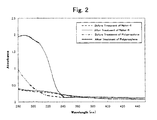
- Thin film samples (thickness: each 500 ⁇ m) of nylon-6 and polypropylene were immersed in the solution for a period of half a day. Subsequently, the samples were removed from the solution, and washed thoroughly with ethanol. Before and after the UV screening agent treatment, UV transmission was measured for each sample of the thin polymer films by use of the above-described spectrophotometer equipped with an integrating sphere.
- Fig. 2 shows the results of the above test (x-axis: wavelength (nm) of irradiated light, y-axis: absorbance)
- the absorbance after the treatment increased.
- the nylon-6 film shows no difference in absorbance before and after the treatment over the entirety of the measured range. This shows that octyl methoxycinnamate was not substantially sorbed into the nylon-6 film.
- nylon-6 thin film (thickness: 500 ⁇ m)
- nylon-6 thin film (thickness: 500 ⁇ m)
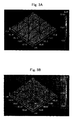
- groove structure satisfying the below-described conditions (1) to (7) was provided through cutting by use of a cutter, and furthermore micro-irregularities are provided on the areas other than the groove portions in the surface through blast treatment (treatment of beating with small glass beads at high speed) to form a rough surface, in consideration of the configuration of the surface of human skin having furrows (depth of furrow: 50-100 ⁇ m, width of furrow: about 100 ⁇ m, number of furrows: 1-2 furrows/mm) and the fact that the furrows expand when a skin external composition is applied to.
- Fig. 3A shows the surface configuration of the artificial skin of the present invention having the above-described structure
- Fig. 3B shows the surface configuration of a commercially available porous tape (TRANSPORETM surgical tape, product of 3M Healthcare) for comparison.
- the surface configuration of the artificial skin of the present invention is similar to that of human skin.
- the surface configuration of the porous tape shown in Fig. 3B is less similar to that of human skin, posing expected problems relating to the reproduction, or simulation, of the behavior of UV screening agents on real skin.
- leaching out, through pores in the porous tape, of test agents containing a UV screening agent, and permeation of UV screening agents into an adhesive layer are also expected, and these factors altogether contribute to problems related to the aforementioned reproduction,
- the artificial skin of the present invention in Fig. 3A and a porous tape shown in Fig. 3B were compared for assessment of the utility of the evaluation method according to the invention.
- W/O sunscreens of the below-described compositions (Table 1, A-F) were employed as the samples for the study of UV shielding effect.
- the artificial skin serving as a test subject was coated on its rough surface with one of the above sunscreens A-F in an amount of 2 mg/cm 2 , and subjected to analysis of UV transmission spectrum.
- the measurements were converted into in vitro SPF values according to the known SPF calculation method (Japanese Patent Application Laid-Open ( kokai ) No. 7-167781, Example 1 (described in paragraph Nos. 0024 to 0037)).
- Fig. 4 shows the results of the above comparison (x-axis: SPF values calculated by the general method, y-axis: SPF values calculated by the evaluation method of the present invention.)
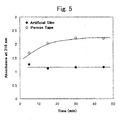
- UV absorbance of the artificial skin coated with a sunscreen was measured over time, and thus, actual effects exerted by the sorption of the sunscreen were investigated.
- the ingredients A were stirred with a homomixer, and the ingredients B were gradually added thereto with stirring, to thereby prepare a W/O sunscreen.
- the sunscreen was applied to each of the test samples (the artificial skin in Fig. 3A and the porous tape in Fig. 3B).
- the sunscreen was applied to the rough surface of the samples in an amount of 2 mg/cm 2 .
- the absorbance was measured at 310 nm over time according to the method described in the above section A in Examples.
- Fig. 5 shows the results of the above test (in the graph, x-axis: time lapsed after application, y-axis: absorbance at 310 nm).
- the UV shielding effect of the sunscreen on the artificial skin of the present invention was stable.
- the UV shielding effect of the sunscreen on the porous tape increased over time.
- the increase in the UV shielding effect as observed in the case of porous tape is considered to be attributed to sorption of the sunscreen or the UV screening agent into the tape surface.
- the UV shielding effect of the sunscreen or the UV screening agent on the porous tape is overestimated, and therefore use of the porous tape in an in vitro UV shielding effect test involves a high risk.
- the artificial skin of the present invention substantially no sorption of the sunscreen or the UV screening agent was observed, and thus the artificial skin of the present invention is particularly preferable for use in an in vitro test for verifying the UV shielding effect of a sunscreen or a UV screening agent.
- the evaluation method of the present invention is clearly useful.
Landscapes
- Health & Medical Sciences (AREA)
- Chemical & Material Sciences (AREA)
- Engineering & Computer Science (AREA)
- Life Sciences & Earth Sciences (AREA)
- Medicinal Chemistry (AREA)
- General Health & Medical Sciences (AREA)
- Biomedical Technology (AREA)
- Veterinary Medicine (AREA)
- Public Health (AREA)
- Organic Chemistry (AREA)
- Dermatology (AREA)
- Oral & Maxillofacial Surgery (AREA)
- Transplantation (AREA)
- Epidemiology (AREA)
- Animal Behavior & Ethology (AREA)
- Bioinformatics & Cheminformatics (AREA)
- Genetics & Genomics (AREA)
- Zoology (AREA)
- Wood Science & Technology (AREA)
- Biotechnology (AREA)
- Manufacturing & Machinery (AREA)
- Cell Biology (AREA)
- Polymers & Plastics (AREA)
- Microbiology (AREA)
- Materials Engineering (AREA)
- Chemical Kinetics & Catalysis (AREA)
- Biochemistry (AREA)
- General Engineering & Computer Science (AREA)
- Cosmetics (AREA)
- Investigating Or Analysing Biological Materials (AREA)
- Measurement Of The Respiration, Hearing Ability, Form, And Blood Characteristics Of Living Organisms (AREA)
Abstract
Description
| 1) Polycarbonate | (thickness: 180 µm) |
| 2) Nylon-6 | (thickness: 500 µm) |
| 3) Polypropylene | (thickness: 1,000 µm, 750 µm) |
| 4) Polyethylene | (thickness: 1,000 µm) |
| A | B | C | D | E | F | |
| Octyl methoxycinnamate | 7.5 | 5 | 5 | 7.5 | ||
| 2-Hydroxy-4-methoxybenzophenone | 0.6 | |||||
| 4-tert-Butyl-4'- | 2 | |||||
| 2,4,6-tris[4-(2-Ethylhexyloxycarbonyl)anilino]-1,3,5-triazine | 1 | |||||
| TiO2 | 7 | 3 | 5 | 6 | ||
| | 10 | |||||
| Purified Water | 38.5 | 38.5 | 38.5 | 38.5 | 38.5 | 38.5 |
| 1,3-Butylene glycol | 5.0 | 5.0 | 5.0 | 5.0 | 5.0 | 5.0 |
| Squalane | 52.0 | 52.0 | 52.0 | 52.0 | 52.0 | 52.0 |
| Glyceryl diisostearate | 3.0 | 3.0 | 3.0 | 3.0 | 3.0 | 3.0 |
| Organophylic montmorillonite | 1.5 | 1.5 | 1.5 | 1.5 | 1.5 | 1.5 |
| Preservative | q.s. | q.s. | q.s. | q.s. | q.s. | q.s. |
| Perfume | q.s. | q.s. | q.s. | q.s. | q.s. | q.s. |
| SPF | 8 | 16 | 18 | 25 | 30 | 30 |
(2) Study over time on shielding effect, against UV rays, of artificial skin coated with a sunscreen
| Ingredient | Amount (mass %) |
| (Ingredient A) | |
| octyl methoxycinnamate | 2.0 |
| decamethylcyclopentasiloxane | 30.5 |
| trimethylsiloxysilicate | 2.5 |
| dimethylpolysiloxane | 5.0 |
| POE methylpolysiloxane copolymer | 1.0 |
| dimethyldistearylammonium hectorite | 0.7 |
| (Ingredient B) | |
| 1,3-butanediol | 5.0 |
| purified water | balance |
Claims (8)
- Artificial skin having a thickness of 100 to 1,000 µm, which is prepared from a polymer which, when formed into a thin film having a thickness of 100-1,000 µm, exhibits a percent transmission of light having a wavelength of 450-280 nm of at least 10%, wherein grooves which imitate furrows are provided on one surface of the artificial skin.
- The artificial skin according to claim 1, wherein the polymer is nylon.
- The artificial skin according to claim 2, wherein the nylon is nylon-6.
- The artificial skin according to any one of claims 1 through 3, wherein the grooves which imitate furrows have the following features:1) the cross section of each groove cut along the short side has a V shape;2) the apex angle of the V shape is 60-150°;3) the depth of each groove is 30-100 µm;4) the width of each groove is 50-300 µm;5) the frequency of grooves that cross a unit length along or perpendicular to the length is 0.5-2.0 grooves/mm; and6) the frequency of grooves that obliquely cross a unit length is 0.5-2.0 grooves/mm.
- The artificial skin according to any one of claims 1 through 4, which has micro-irregularities on areas other than the furrow-imitating groove portions in the surface.
- The artificial skin according to claim 5, wherein the micro-irregularities are those formed through blasting.
- Artificial skin comprising a thin film of a polymer, the thin film having a thickness of 100-1,000 µm and exhibiting a percent transmission of light having a wavelength of 450-280 nm of at least 10%, and grooves which imitate furrows on one surface of the film.
- > A method for evaluating a UV screening agent on the basis of the relation between UV shielding power of the W screening agent and W transmission through the artificial skin as recited in any one of claims 1 through 7 after the artificial skin has been coated with the UV screening agent on the side having furrow-imitating grooves.
Applications Claiming Priority (2)
| Application Number | Priority Date | Filing Date | Title |
|---|---|---|---|
| JP2000148557 | 2000-05-19 | ||
| JP2000148557 | 2000-05-19 |
Publications (2)
| Publication Number | Publication Date |
|---|---|
| EP1156074A1 true EP1156074A1 (en) | 2001-11-21 |
| EP1156074B1 EP1156074B1 (en) | 2006-04-12 |
Family
ID=18654567
Family Applications (1)
| Application Number | Title | Priority Date | Filing Date |
|---|---|---|---|
| EP01112243A Expired - Lifetime EP1156074B1 (en) | 2000-05-19 | 2001-05-18 | Artificial skin and method for evaluating uv screening agent |
Country Status (4)
| Country | Link |
|---|---|
| US (2) | US20020045941A1 (en) |
| EP (1) | EP1156074B1 (en) |
| AT (1) | ATE323124T1 (en) |
| DE (1) | DE60118650T2 (en) |
Cited By (5)
| Publication number | Priority date | Publication date | Assignee | Title |
|---|---|---|---|---|
| FR2840686A1 (en) * | 2002-06-10 | 2003-12-12 | Oreal | PROCESS FOR DETERMINING THE ABILITY TO DIFFUSE AND / OR ABSORB THE LIGHT OF A COSMETIC PRODUCT |
| CN102369429A (en) * | 2009-03-30 | 2012-03-07 | 株式会社资生堂 | Method for applying external skin preparation, method for evaluating application by the method, device for evaluating the application and program for evaluating the application |
| FR3033891A1 (en) * | 2015-03-17 | 2016-09-23 | Centre Nat De La Rech Scient (C N R S) | SUBSTRATE FOR SOLAR PROTECTION INDEX MEASUREMENT |
| EP3184581A1 (en) * | 2015-12-23 | 2017-06-28 | Climate Invest B.V. | Texture material and surface on which the texture material according to the invention is applied |
| NL2016027B1 (en) * | 2015-12-23 | 2017-07-05 | Vm Lease B V | Structure material and substrate on which a structure material according to the invention is applied. |
Families Citing this family (13)
| Publication number | Priority date | Publication date | Assignee | Title |
|---|---|---|---|---|
| WO2007021844A2 (en) * | 2005-08-12 | 2007-02-22 | The Procter & Gamble Company | Coated substrate with properties of keratinous tissue |
| US8251998B2 (en) * | 2006-08-16 | 2012-08-28 | Biomet Sports Medicine, Llc | Chondral defect repair |
| US8417474B2 (en) * | 2006-02-10 | 2013-04-09 | The Procter & Gamble Company | Methods of use of substrate having properties of keratinous tissue |
| WO2008113109A1 (en) * | 2007-03-16 | 2008-09-25 | Australian Photobiology Testing Facility Pty Limited (Aptf) | Artificial substrate |
| JP4454695B2 (en) * | 2008-06-13 | 2010-04-21 | 株式会社資生堂 | Evaluation method of skin substitute membrane and topical skin preparation |
| WO2010014614A2 (en) * | 2008-07-28 | 2010-02-04 | The Procter & Gamble Company | Multiphase personal care composition with enhanced deposition |
| US8124064B2 (en) * | 2008-07-28 | 2012-02-28 | The Procter & Gamble Company | In-vitro deposition evaluation method for identifying personal care compositions which provide improved deposition of benefit agents |
| US20110300572A1 (en) * | 2010-06-02 | 2011-12-08 | Integrated Botanical Technologies, Llc | In vitro method and apparatus for determining efficacy and action mechanisms of a topical composition on various skin color types |
| WO2012037158A2 (en) * | 2010-09-13 | 2012-03-22 | Sena Research, Incorporated | Ultraviolet and high-performance liquid chromatography methods for the evaluation of sunscreen efficacy |
| EP2684029B1 (en) * | 2011-03-11 | 2016-02-24 | Suncare Research Laboratories, LLC | In vitro measurement of sunscreen protection |
| WO2013151725A1 (en) | 2012-04-05 | 2013-10-10 | The Regents Of The University Of California | Regenerative sera cells and mesenchymal stem cells |
| US9263800B2 (en) * | 2013-12-27 | 2016-02-16 | Toyota Motor Engineering & Manufacturing North America, Inc. | Artificial skin for radar mannequins |
| US9173830B1 (en) * | 2014-04-24 | 2015-11-03 | Avon Products, Inc | Sunscreen compositions |
Citations (3)
| Publication number | Priority date | Publication date | Assignee | Title |
|---|---|---|---|---|
| JPH05248944A (en) * | 1992-03-10 | 1993-09-28 | Pola Chem Ind Inc | Evaluation method of ultraviolet ray transmission prevention effect using artificial skin film |
| US5500533A (en) * | 1993-09-27 | 1996-03-19 | Shiseido Company, Ltd. | Method and apparatus for measuring ultraviolet protection effectiveness |
| JPH119339A (en) * | 1997-06-20 | 1999-01-19 | Kose Corp | Artificial skin model and its manufacturing method |
Family Cites Families (6)
| Publication number | Priority date | Publication date | Assignee | Title |
|---|---|---|---|---|
| US5053340A (en) * | 1989-02-24 | 1991-10-01 | National Testing Corporation | In vitro test for dermal toxic properties |
| US5691158A (en) * | 1993-10-15 | 1997-11-25 | Mary Kay Cosmetics, Inc. | System and method for determining efficacy of sunscreen formulations |
| US6093200A (en) * | 1994-02-10 | 2000-07-25 | United States Surgical | Composite bioabsorbable materials and surgical articles made therefrom |
| US5727567A (en) * | 1995-12-27 | 1998-03-17 | Carnaby; Ann J. | Artificial skin construction |
| CA2207882A1 (en) * | 1997-06-17 | 1998-12-17 | Joel Claveau | Assessment of human skin damage following exposure to harmful agents |
| JP3829001B2 (en) * | 1997-12-15 | 2006-10-04 | 株式会社資生堂 | Artificial skin |
-
2001
- 2001-05-18 EP EP01112243A patent/EP1156074B1/en not_active Expired - Lifetime
- 2001-05-18 AT AT01112243T patent/ATE323124T1/en not_active IP Right Cessation
- 2001-05-18 DE DE60118650T patent/DE60118650T2/en not_active Expired - Lifetime
- 2001-05-18 US US09/859,443 patent/US20020045941A1/en not_active Abandoned
-
2002
- 2002-12-17 US US10/320,549 patent/US7004969B2/en not_active Expired - Lifetime
Patent Citations (3)
| Publication number | Priority date | Publication date | Assignee | Title |
|---|---|---|---|---|
| JPH05248944A (en) * | 1992-03-10 | 1993-09-28 | Pola Chem Ind Inc | Evaluation method of ultraviolet ray transmission prevention effect using artificial skin film |
| US5500533A (en) * | 1993-09-27 | 1996-03-19 | Shiseido Company, Ltd. | Method and apparatus for measuring ultraviolet protection effectiveness |
| JPH119339A (en) * | 1997-06-20 | 1999-01-19 | Kose Corp | Artificial skin model and its manufacturing method |
Non-Patent Citations (3)
| Title |
|---|
| DATABASE WPI Week 9343, Derwent World Patents Index; AN 1993-340399, XP002175965 * |
| DIFFEY B L ET AL: "A NEW SUBSTRATE TO MEASURE SUNSCREEN PROTECTION FACTORS THROUGHOUT THE ULTRAVIOLET SPECTRUM", JOURNAL OF THE SOCIETY COSMETIC CHEMISTS, NEW-YORK, NY, US, vol. 40, 1989, pages 127 - 133, XP001015760 * |
| PATENT ABSTRACTS OF JAPAN vol. 1999, no. 04 30 April 1999 (1999-04-30) * |
Cited By (7)
| Publication number | Priority date | Publication date | Assignee | Title |
|---|---|---|---|---|
| FR2840686A1 (en) * | 2002-06-10 | 2003-12-12 | Oreal | PROCESS FOR DETERMINING THE ABILITY TO DIFFUSE AND / OR ABSORB THE LIGHT OF A COSMETIC PRODUCT |
| EP1371977A1 (en) * | 2002-06-10 | 2003-12-17 | L'oreal | Method for determining the aptitude of a cosmetic or dermatological product at diffusing and/or absorbing light |
| US7061617B2 (en) | 2002-06-10 | 2006-06-13 | L'oreal | Method of determining the capacity of a cosmetic to diffuse and/or absorb light |
| CN102369429A (en) * | 2009-03-30 | 2012-03-07 | 株式会社资生堂 | Method for applying external skin preparation, method for evaluating application by the method, device for evaluating the application and program for evaluating the application |
| FR3033891A1 (en) * | 2015-03-17 | 2016-09-23 | Centre Nat De La Rech Scient (C N R S) | SUBSTRATE FOR SOLAR PROTECTION INDEX MEASUREMENT |
| EP3184581A1 (en) * | 2015-12-23 | 2017-06-28 | Climate Invest B.V. | Texture material and surface on which the texture material according to the invention is applied |
| NL2016027B1 (en) * | 2015-12-23 | 2017-07-05 | Vm Lease B V | Structure material and substrate on which a structure material according to the invention is applied. |
Also Published As
| Publication number | Publication date |
|---|---|
| DE60118650D1 (en) | 2006-05-24 |
| EP1156074B1 (en) | 2006-04-12 |
| DE60118650T2 (en) | 2007-02-22 |
| US7004969B2 (en) | 2006-02-28 |
| US20020045941A1 (en) | 2002-04-18 |
| US20030109927A1 (en) | 2003-06-12 |
| ATE323124T1 (en) | 2006-04-15 |
Similar Documents
| Publication | Publication Date | Title |
|---|---|---|
| US7004969B2 (en) | Artificial skin and method for evaluating UV screening agent by use of the same | |
| McClelland et al. | Evaluation of Artecoll polymethylmethacrylate implant for soft-tissue augmentation: biocompatibility and chemical characterization | |
| Deflandre et al. | Photostability assessment of sunscreens. Benzylidene camphor and dibenzoylmethane derivatives | |
| WO2022082940A1 (en) | Sunscreen composition, sunscreen gel comprising same, and preparation method therefor | |
| Randall et al. | The measurement and interpretation of Brillouin scattering in the lens of the eye | |
| EP3616682A1 (en) | Cosmetic composition, cosmetic product, and method for producing cosmetic composition | |
| Kondo et al. | Penetration of keratinocyte‐derived cytokines into basement membrane | |
| WO2020070422A1 (en) | Hydrogel compositions | |
| JP7244494B2 (en) | Color protectant composition | |
| EP3475697B1 (en) | Juvenile atopic dermatitis models | |
| Okamoto et al. | Cervical lymph node metastasis in carcinoma of the tongue: correlation between clinical and histopathological findings and metastasis | |
| JP4373030B2 (en) | Artificial skin and method for evaluating ultraviolet shielding effect using the same | |
| US7285262B2 (en) | Natural sunlight photostable composition | |
| Becker et al. | Final report of the cosmetic ingredient review expert panel safety assessment of polymethyl methacrylate (PMMA), methyl methacrylate crosspolymer, and methyl methacrylate/glycol dimethacrylate crosspolymer | |
| Popoff et al. | Ultrastructure of the giant cell infiltrate of subcutaneously implanted bone particles in rats and mice | |
| KR20070044368A (en) | Compositions comprising polymeric emulsifiers and methods of using the same | |
| US11415506B2 (en) | In vitro method for sun protection factor determination | |
| US7309481B2 (en) | Natural sunlight photostable composition | |
| JP2024019503A (en) | Near-infrared blocker for external use on the skin | |
| Morris et al. | The cell kinetics of the epidermis and follicular epithelium of the rat: variations with age and body site | |
| FR2849202A1 (en) | METHOD FOR EVALUATING THE COSMETIC OR DERMATOLOGICAL ACTIVITY OF A PRODUCT AND USE OF PLANT MATERIAL | |
| Hancock et al. | The inflammatory response to paraffin in the peritoneal cavity of the rat | |
| CN115068362B (en) | Collagen composition, micro-essence containing composition and preparation method of composition | |
| WO2016171383A1 (en) | Method of evaluating effectiveness of infrared ray blocking material | |
| CA2952923A1 (en) | Polymer screening methods |
Legal Events
| Date | Code | Title | Description |
|---|---|---|---|
| PUAI | Public reference made under article 153(3) epc to a published international application that has entered the european phase |
Free format text: ORIGINAL CODE: 0009012 |
|
| AK | Designated contracting states |
Kind code of ref document: A1 Designated state(s): AT BE CH CY DE DK ES FI FR GB GR IE IT LI LU MC NL PT SE TR |
|
| AX | Request for extension of the european patent |
Free format text: AL;LT;LV;MK;RO;SI |
|
| 17P | Request for examination filed |
Effective date: 20020122 |
|
| AKX | Designation fees paid |
Free format text: AT BE CH CY DE DK ES FI FR GB GR IE IT LI LU MC NL PT SE TR |
|
| 17Q | First examination report despatched |
Effective date: 20030806 |
|
| GRAP | Despatch of communication of intention to grant a patent |
Free format text: ORIGINAL CODE: EPIDOSNIGR1 |
|
| GRAS | Grant fee paid |
Free format text: ORIGINAL CODE: EPIDOSNIGR3 |
|
| GRAA | (expected) grant |
Free format text: ORIGINAL CODE: 0009210 |
|
| AK | Designated contracting states |
Kind code of ref document: B1 Designated state(s): AT BE CH CY DE DK ES FI FR GB GR IE IT LI LU MC NL PT SE TR |
|
| PG25 | Lapsed in a contracting state [announced via postgrant information from national office to epo] |
Ref country code: FI Free format text: LAPSE BECAUSE OF FAILURE TO SUBMIT A TRANSLATION OF THE DESCRIPTION OR TO PAY THE FEE WITHIN THE PRESCRIBED TIME-LIMIT Effective date: 20060412 Ref country code: LI Free format text: LAPSE BECAUSE OF FAILURE TO SUBMIT A TRANSLATION OF THE DESCRIPTION OR TO PAY THE FEE WITHIN THE PRESCRIBED TIME-LIMIT Effective date: 20060412 Ref country code: NL Free format text: LAPSE BECAUSE OF FAILURE TO SUBMIT A TRANSLATION OF THE DESCRIPTION OR TO PAY THE FEE WITHIN THE PRESCRIBED TIME-LIMIT Effective date: 20060412 Ref country code: BE Free format text: LAPSE BECAUSE OF FAILURE TO SUBMIT A TRANSLATION OF THE DESCRIPTION OR TO PAY THE FEE WITHIN THE PRESCRIBED TIME-LIMIT Effective date: 20060412 Ref country code: AT Free format text: LAPSE BECAUSE OF FAILURE TO SUBMIT A TRANSLATION OF THE DESCRIPTION OR TO PAY THE FEE WITHIN THE PRESCRIBED TIME-LIMIT Effective date: 20060412 Ref country code: CH Free format text: LAPSE BECAUSE OF FAILURE TO SUBMIT A TRANSLATION OF THE DESCRIPTION OR TO PAY THE FEE WITHIN THE PRESCRIBED TIME-LIMIT Effective date: 20060412 |
|
| REG | Reference to a national code |
Ref country code: GB Ref legal event code: FG4D |
|
| REG | Reference to a national code |
Ref country code: CH Ref legal event code: EP |
|
| PG25 | Lapsed in a contracting state [announced via postgrant information from national office to epo] |
Ref country code: IE Free format text: LAPSE BECAUSE OF NON-PAYMENT OF DUE FEES Effective date: 20060518 |
|
| REF | Corresponds to: |
Ref document number: 60118650 Country of ref document: DE Date of ref document: 20060524 Kind code of ref document: P |
|
| PG25 | Lapsed in a contracting state [announced via postgrant information from national office to epo] |
Ref country code: MC Free format text: LAPSE BECAUSE OF NON-PAYMENT OF DUE FEES Effective date: 20060531 |
|
| REG | Reference to a national code |
Ref country code: IE Ref legal event code: FG4D |
|
| PG25 | Lapsed in a contracting state [announced via postgrant information from national office to epo] |
Ref country code: DK Free format text: LAPSE BECAUSE OF FAILURE TO SUBMIT A TRANSLATION OF THE DESCRIPTION OR TO PAY THE FEE WITHIN THE PRESCRIBED TIME-LIMIT Effective date: 20060712 Ref country code: GB Free format text: LAPSE BECAUSE OF NON-PAYMENT OF DUE FEES Effective date: 20060712 Ref country code: SE Free format text: LAPSE BECAUSE OF FAILURE TO SUBMIT A TRANSLATION OF THE DESCRIPTION OR TO PAY THE FEE WITHIN THE PRESCRIBED TIME-LIMIT Effective date: 20060712 |
|
| PG25 | Lapsed in a contracting state [announced via postgrant information from national office to epo] |
Ref country code: ES Free format text: LAPSE BECAUSE OF FAILURE TO SUBMIT A TRANSLATION OF THE DESCRIPTION OR TO PAY THE FEE WITHIN THE PRESCRIBED TIME-LIMIT Effective date: 20060723 |
|
| PG25 | Lapsed in a contracting state [announced via postgrant information from national office to epo] |
Ref country code: PT Free format text: LAPSE BECAUSE OF FAILURE TO SUBMIT A TRANSLATION OF THE DESCRIPTION OR TO PAY THE FEE WITHIN THE PRESCRIBED TIME-LIMIT Effective date: 20060912 |
|
| NLV1 | Nl: lapsed or annulled due to failure to fulfill the requirements of art. 29p and 29m of the patents act | ||
| REG | Reference to a national code |
Ref country code: CH Ref legal event code: PL |
|
| ET | Fr: translation filed | ||
| PLBE | No opposition filed within time limit |
Free format text: ORIGINAL CODE: 0009261 |
|
| STAA | Information on the status of an ep patent application or granted ep patent |
Free format text: STATUS: NO OPPOSITION FILED WITHIN TIME LIMIT |
|
| 26N | No opposition filed |
Effective date: 20070115 |
|
| GBPC | Gb: european patent ceased through non-payment of renewal fee |
Effective date: 20060712 |
|
| PG25 | Lapsed in a contracting state [announced via postgrant information from national office to epo] |
Ref country code: GR Free format text: LAPSE BECAUSE OF FAILURE TO SUBMIT A TRANSLATION OF THE DESCRIPTION OR TO PAY THE FEE WITHIN THE PRESCRIBED TIME-LIMIT Effective date: 20060713 |
|
| PG25 | Lapsed in a contracting state [announced via postgrant information from national office to epo] |
Ref country code: TR Free format text: LAPSE BECAUSE OF FAILURE TO SUBMIT A TRANSLATION OF THE DESCRIPTION OR TO PAY THE FEE WITHIN THE PRESCRIBED TIME-LIMIT Effective date: 20060412 Ref country code: LU Free format text: LAPSE BECAUSE OF NON-PAYMENT OF DUE FEES Effective date: 20060518 |
|
| PG25 | Lapsed in a contracting state [announced via postgrant information from national office to epo] |
Ref country code: CY Free format text: LAPSE BECAUSE OF FAILURE TO SUBMIT A TRANSLATION OF THE DESCRIPTION OR TO PAY THE FEE WITHIN THE PRESCRIBED TIME-LIMIT Effective date: 20060412 |
|
| REG | Reference to a national code |
Ref country code: FR Ref legal event code: PLFP Year of fee payment: 16 |
|
| REG | Reference to a national code |
Ref country code: FR Ref legal event code: PLFP Year of fee payment: 17 |
|
| REG | Reference to a national code |
Ref country code: FR Ref legal event code: PLFP Year of fee payment: 18 |
|
| PGFP | Annual fee paid to national office [announced via postgrant information from national office to epo] |
Ref country code: DE Payment date: 20200506 Year of fee payment: 20 Ref country code: FR Payment date: 20200414 Year of fee payment: 20 |
|
| PGFP | Annual fee paid to national office [announced via postgrant information from national office to epo] |
Ref country code: IT Payment date: 20200414 Year of fee payment: 20 |
|
| REG | Reference to a national code |
Ref country code: DE Ref legal event code: R071 Ref document number: 60118650 Country of ref document: DE |