EP1156073A1 - Shaped article of polyamide resin and production thereof - Google Patents
Shaped article of polyamide resin and production thereof Download PDFInfo
- Publication number
- EP1156073A1 EP1156073A1 EP01111225A EP01111225A EP1156073A1 EP 1156073 A1 EP1156073 A1 EP 1156073A1 EP 01111225 A EP01111225 A EP 01111225A EP 01111225 A EP01111225 A EP 01111225A EP 1156073 A1 EP1156073 A1 EP 1156073A1
- Authority
- EP
- European Patent Office
- Prior art keywords
- polyamide resin
- shaped article
- mass
- silicate
- melt
- Prior art date
- Legal status (The legal status is an assumption and is not a legal conclusion. Google has not performed a legal analysis and makes no representation as to the accuracy of the status listed.)
- Granted
Links
Classifications
-
- C—CHEMISTRY; METALLURGY
- C08—ORGANIC MACROMOLECULAR COMPOUNDS; THEIR PREPARATION OR CHEMICAL WORKING-UP; COMPOSITIONS BASED THEREON
- C08J—WORKING-UP; GENERAL PROCESSES OF COMPOUNDING; AFTER-TREATMENT NOT COVERED BY SUBCLASSES C08B, C08C, C08F, C08G or C08H
- C08J3/00—Processes of treating or compounding macromolecular substances
- C08J3/20—Compounding polymers with additives, e.g. colouring
- C08J3/22—Compounding polymers with additives, e.g. colouring using masterbatch techniques
- C08J3/226—Compounding polymers with additives, e.g. colouring using masterbatch techniques using a polymer as a carrier
-
- C—CHEMISTRY; METALLURGY
- C08—ORGANIC MACROMOLECULAR COMPOUNDS; THEIR PREPARATION OR CHEMICAL WORKING-UP; COMPOSITIONS BASED THEREON
- C08K—Use of inorganic or non-macromolecular organic substances as compounding ingredients
- C08K9/00—Use of pretreated ingredients
- C08K9/04—Ingredients treated with organic substances
-
- C—CHEMISTRY; METALLURGY
- C08—ORGANIC MACROMOLECULAR COMPOUNDS; THEIR PREPARATION OR CHEMICAL WORKING-UP; COMPOSITIONS BASED THEREON
- C08J—WORKING-UP; GENERAL PROCESSES OF COMPOUNDING; AFTER-TREATMENT NOT COVERED BY SUBCLASSES C08B, C08C, C08F, C08G or C08H
- C08J2377/00—Characterised by the use of polyamides obtained by reactions forming a carboxylic amide link in the main chain; Derivatives of such polymers
-
- C—CHEMISTRY; METALLURGY
- C08—ORGANIC MACROMOLECULAR COMPOUNDS; THEIR PREPARATION OR CHEMICAL WORKING-UP; COMPOSITIONS BASED THEREON
- C08J—WORKING-UP; GENERAL PROCESSES OF COMPOUNDING; AFTER-TREATMENT NOT COVERED BY SUBCLASSES C08B, C08C, C08F, C08G or C08H
- C08J2477/00—Characterised by the use of polyamides obtained by reactions forming a carboxylic amide link in the main chain; Derivatives of such polymers
-
- Y—GENERAL TAGGING OF NEW TECHNOLOGICAL DEVELOPMENTS; GENERAL TAGGING OF CROSS-SECTIONAL TECHNOLOGIES SPANNING OVER SEVERAL SECTIONS OF THE IPC; TECHNICAL SUBJECTS COVERED BY FORMER USPC CROSS-REFERENCE ART COLLECTIONS [XRACs] AND DIGESTS
- Y10—TECHNICAL SUBJECTS COVERED BY FORMER USPC
- Y10T—TECHNICAL SUBJECTS COVERED BY FORMER US CLASSIFICATION
- Y10T428/00—Stock material or miscellaneous articles
- Y10T428/13—Hollow or container type article [e.g., tube, vase, etc.]
-
- Y—GENERAL TAGGING OF NEW TECHNOLOGICAL DEVELOPMENTS; GENERAL TAGGING OF CROSS-SECTIONAL TECHNOLOGIES SPANNING OVER SEVERAL SECTIONS OF THE IPC; TECHNICAL SUBJECTS COVERED BY FORMER USPC CROSS-REFERENCE ART COLLECTIONS [XRACs] AND DIGESTS
- Y10—TECHNICAL SUBJECTS COVERED BY FORMER USPC
- Y10T—TECHNICAL SUBJECTS COVERED BY FORMER US CLASSIFICATION
- Y10T428/00—Stock material or miscellaneous articles
- Y10T428/13—Hollow or container type article [e.g., tube, vase, etc.]
- Y10T428/131—Glass, ceramic, or sintered, fused, fired, or calcined metal oxide or metal carbide containing [e.g., porcelain, brick, cement, etc.]
- Y10T428/1317—Multilayer [continuous layer]
- Y10T428/1321—Polymer or resin containing [i.e., natural or synthetic]
-
- Y—GENERAL TAGGING OF NEW TECHNOLOGICAL DEVELOPMENTS; GENERAL TAGGING OF CROSS-SECTIONAL TECHNOLOGIES SPANNING OVER SEVERAL SECTIONS OF THE IPC; TECHNICAL SUBJECTS COVERED BY FORMER USPC CROSS-REFERENCE ART COLLECTIONS [XRACs] AND DIGESTS
- Y10—TECHNICAL SUBJECTS COVERED BY FORMER USPC
- Y10T—TECHNICAL SUBJECTS COVERED BY FORMER US CLASSIFICATION
- Y10T428/00—Stock material or miscellaneous articles
- Y10T428/249921—Web or sheet containing structurally defined element or component
-
- Y—GENERAL TAGGING OF NEW TECHNOLOGICAL DEVELOPMENTS; GENERAL TAGGING OF CROSS-SECTIONAL TECHNOLOGIES SPANNING OVER SEVERAL SECTIONS OF THE IPC; TECHNICAL SUBJECTS COVERED BY FORMER USPC CROSS-REFERENCE ART COLLECTIONS [XRACs] AND DIGESTS
- Y10—TECHNICAL SUBJECTS COVERED BY FORMER USPC
- Y10T—TECHNICAL SUBJECTS COVERED BY FORMER US CLASSIFICATION
- Y10T428/00—Stock material or miscellaneous articles
- Y10T428/25—Web or sheet containing structurally defined element or component and including a second component containing structurally defined particles
- Y10T428/251—Mica
-
- Y—GENERAL TAGGING OF NEW TECHNOLOGICAL DEVELOPMENTS; GENERAL TAGGING OF CROSS-SECTIONAL TECHNOLOGIES SPANNING OVER SEVERAL SECTIONS OF THE IPC; TECHNICAL SUBJECTS COVERED BY FORMER USPC CROSS-REFERENCE ART COLLECTIONS [XRACs] AND DIGESTS
- Y10—TECHNICAL SUBJECTS COVERED BY FORMER USPC
- Y10T—TECHNICAL SUBJECTS COVERED BY FORMER US CLASSIFICATION
- Y10T428/00—Stock material or miscellaneous articles
- Y10T428/25—Web or sheet containing structurally defined element or component and including a second component containing structurally defined particles
- Y10T428/259—Silicic material
-
- Y—GENERAL TAGGING OF NEW TECHNOLOGICAL DEVELOPMENTS; GENERAL TAGGING OF CROSS-SECTIONAL TECHNOLOGIES SPANNING OVER SEVERAL SECTIONS OF THE IPC; TECHNICAL SUBJECTS COVERED BY FORMER USPC CROSS-REFERENCE ART COLLECTIONS [XRACs] AND DIGESTS
- Y10—TECHNICAL SUBJECTS COVERED BY FORMER USPC
- Y10T—TECHNICAL SUBJECTS COVERED BY FORMER US CLASSIFICATION
- Y10T428/00—Stock material or miscellaneous articles
- Y10T428/26—Web or sheet containing structurally defined element or component, the element or component having a specified physical dimension
-
- Y—GENERAL TAGGING OF NEW TECHNOLOGICAL DEVELOPMENTS; GENERAL TAGGING OF CROSS-SECTIONAL TECHNOLOGIES SPANNING OVER SEVERAL SECTIONS OF THE IPC; TECHNICAL SUBJECTS COVERED BY FORMER USPC CROSS-REFERENCE ART COLLECTIONS [XRACs] AND DIGESTS
- Y10—TECHNICAL SUBJECTS COVERED BY FORMER USPC
- Y10T—TECHNICAL SUBJECTS COVERED BY FORMER US CLASSIFICATION
- Y10T428/00—Stock material or miscellaneous articles
- Y10T428/26—Web or sheet containing structurally defined element or component, the element or component having a specified physical dimension
- Y10T428/268—Monolayer with structurally defined element
-
- Y—GENERAL TAGGING OF NEW TECHNOLOGICAL DEVELOPMENTS; GENERAL TAGGING OF CROSS-SECTIONAL TECHNOLOGIES SPANNING OVER SEVERAL SECTIONS OF THE IPC; TECHNICAL SUBJECTS COVERED BY FORMER USPC CROSS-REFERENCE ART COLLECTIONS [XRACs] AND DIGESTS
- Y10—TECHNICAL SUBJECTS COVERED BY FORMER USPC
- Y10T—TECHNICAL SUBJECTS COVERED BY FORMER US CLASSIFICATION
- Y10T428/00—Stock material or miscellaneous articles
- Y10T428/26—Web or sheet containing structurally defined element or component, the element or component having a specified physical dimension
- Y10T428/269—Web or sheet containing structurally defined element or component, the element or component having a specified physical dimension including synthetic resin or polymer layer or component
-
- Y—GENERAL TAGGING OF NEW TECHNOLOGICAL DEVELOPMENTS; GENERAL TAGGING OF CROSS-SECTIONAL TECHNOLOGIES SPANNING OVER SEVERAL SECTIONS OF THE IPC; TECHNICAL SUBJECTS COVERED BY FORMER USPC CROSS-REFERENCE ART COLLECTIONS [XRACs] AND DIGESTS
- Y10—TECHNICAL SUBJECTS COVERED BY FORMER USPC
- Y10T—TECHNICAL SUBJECTS COVERED BY FORMER US CLASSIFICATION
- Y10T428/00—Stock material or miscellaneous articles
- Y10T428/31504—Composite [nonstructural laminate]
-
- Y—GENERAL TAGGING OF NEW TECHNOLOGICAL DEVELOPMENTS; GENERAL TAGGING OF CROSS-SECTIONAL TECHNOLOGIES SPANNING OVER SEVERAL SECTIONS OF THE IPC; TECHNICAL SUBJECTS COVERED BY FORMER USPC CROSS-REFERENCE ART COLLECTIONS [XRACs] AND DIGESTS
- Y10—TECHNICAL SUBJECTS COVERED BY FORMER USPC
- Y10T—TECHNICAL SUBJECTS COVERED BY FORMER US CLASSIFICATION
- Y10T428/00—Stock material or miscellaneous articles
- Y10T428/31504—Composite [nonstructural laminate]
- Y10T428/31725—Of polyamide
Definitions
- the present invention relates to a polyamide resin shaped article excellent in clarity, appearance, gas barrier properties, mechanical properties, and moldability which are required in packaging materials for foods, beverages, medicines, electric parts, etc.
- the present invention further relates to a method for producing such a polyamide resin shaped article.
- Polyamide resin has been widely used as the material for injection-molding automotive parts, electric parts, electronic parts, etc. because of its excellent mechanical properties. Its application field extends to packaging materials for foods, beverages, medicines, electric parts, etc.
- a m-xylylene group-containing polyamide prepared by the polycondensation of m-xylylenediamine and an aliphatic dicarboxylic acid hereinafter may be referred to as "MX nylon”
- polyamide MXD6 prepared from m-xylylenediamine and adipic acid is utilized as a gas-barrier material for manufacturing a shaped article such as film and bottle because of its low permeability against gaseous substance such as oxygen and carbon dioxide.
- Japanese Patent Application Laid-Open Nos. 2-69562, 2-105856 and 2-305828 disclose to incorporate a layered silicate into a polyamide resin.
- the incorporation can be effected, for example, by melt-kneading the layered silicate and a polyamide in a known various types of extruders such as single or twin screw extruder and extruding the kneaded product, or by producing polyamide by melt polymerization in the presence of the layered silicate.
- the whole part of polyamide which constitutes the final material for producing shaped article is melted and kneaded with the layered silicate in an extruder, extruded from the extruder, cooled for solidifying, and formed into pellets.
- the pellets thus prepared are made flowable again by heating in T-die extruder, injection molding machine, etc. to produce final shaped articles such as film. Therefore, the whole part of polyamide to constitute shaped articles is subject to heat history at least twice.
- the polyamide is cross-linked much more to result in the formation of a large amount of gel-like substances in the final shaped articles such as film, thereby spoiling the fine appearance of the shaped articles and causing frequent breaking and rupture during the production of the shaped articles such as film to reduce the industrial and commercial values.
- the m-xylylene group-containing polyamide is liable to arise various problems such as deterioration in clarity and appearance, breaking during the shaping or molding process, etc. by the thermal decomposition and gel formation when subjected to heat history during the extrusion, etc. Since the lowering of the molecular weight by the thermal decomposition reduces the relative viscosity of the polyamide, films and sheets extruded from a T-die or circular die extruder are uneven in their thickness, and multi-layer preforms produced by injection molding has a core layer (center layer) with non-uniform section, thereby spoiling the appearance and reducing the barrier properties.
- the layered silicate is finely and uniformly dispersed into nylon 6 by conducting the polycondensation for producing nylon 6 in the presence of the layered silicate.
- this method fails to produce a m-xylylene group-containing polyamide having a high molecular weight.
- An object of the present invention is to provide a polyamide resin shaped article comprising a m-xylylene group-containing polyamide resin, in which a layered silicate treated with an organic swelling agent are uniformly dispersed throughout the resin.
- Another object of the present invention is to provide a polyamide resin shaped article which is excellent in the properties required for packaging materials such as clarity, appearance, gas-barrier properties, mechanical strength and moldability and contains less gel-like substance.
- Still another object of the present invention is to provide a production method of a polyamide resin shaped article without lowering the molecular weight of the m-xylylene group-containing polyamide during the incorporating operation of the layered silicate.
- the inventors have found that the problems can be solved by preliminarily melt-kneading the m-xylylene group-containing polyamide resin and the layered silicate in a specific ratio under specific conditions to prepare a master batch, and melt-kneading the master batch with the m-xylylene group-containing polyamide resin in a specific ratio when producing the shaped articles.
- the present invention provides a polyamide resin shaped article comprising (A) 92 to 99.7 mass % of a polyamide resin produced by polycondensation of a diamine component containing 70 mol% or more of m-xylylenediamine and a dicarboxylic acid component containing 70 mol% or more of a straight-chain, aliphatic ⁇ , ⁇ -dicarboxylic acid having 4 to 12 carbon atoms, and (B) 8 to 0.3 mass % of a silicate prepared by treating a layered silicate with an organic swelling agent with the proviso that the mass percentages are based on a sum of the polyamide resin A and the silicate B, wherein the polyamide resin shaped article is produced by preliminarily melt-kneading 70 to 95 mass % of the polyamide resin A and 30 to 5 mass % of the silicate B, on the basis of a sum of the polyamide resin A and the silicate B, to prepare a resin composition C; melt-kn
- the present invention further provides a method for producing a polyamide resin shaped article comprising (A) 92 to 99.7 mass % of a polyamide resin produced by polycondensation of a diamine component containing 70 mol% or more of m-xylylenediamine and a dicarboxylic acid component containing 70 mol% or more of a straight-chain, aliphatic ⁇ , ⁇ -dicarboxylic acid having 4 to 12 carbon atoms, and (B) 8 to 0.3 mass % of a silicate prepared by treating a layered silicate with an organic swelling agent with the proviso that the mass percentages are based on a sum of the polyamide resin A and the silicate B, the method comprising: preliminarily melt-kneading 70 to 95 mass % of the polyamide resin A and 30 to 5 mass % of the silicate B, on the basis of a sum of the polyamide resin A and the silicate B, at 250 to 300°C for a residence time of five minutes
- the polyamide resin A used in the present invention is a m-xylylene group-containing polyamide produced by the polycondensation of a diamine component comprising 70 mol% or more of m-xylylenediamine and a dicarboxylic acid component comprising 70 mol% or more of a straight-chain, aliphatic ⁇ , ⁇ -dicarboxylic acid having 4 to 12 carbon atoms.
- a diamine component comprising 70 mol% or more of m-xylylenediamine
- a dicarboxylic acid component comprising 70 mol% or more of a straight-chain, aliphatic ⁇ , ⁇ -dicarboxylic acid having 4 to 12 carbon atoms.
- polyamide MXD6 produced by the polycondensation of m-xylylenediamine and adipic acid is particularly preferable because of its high gas-barrier properties against oxygen, carbon dioxide, etc.
- diamines other than m-xylylenediamine examples include an aliphatic diamine such as tetramethylenediamine, pentamethylenediamine, hexamethylenediamine, octamethylenediamine, and nonamethylenediamine; an aromatic diamine such as p-phenylenediamine, o-xylylenediamine and p-xylylenediamine; and an alicyclic diamine such as bis(aminomethyl)cyclohexane.
- an aliphatic diamine such as tetramethylenediamine, pentamethylenediamine, hexamethylenediamine, octamethylenediamine, and nonamethylenediamine
- an aromatic diamine such as p-phenylenediamine, o-xylylenediamine and p-xylylenediamine
- an alicyclic diamine such as bis(aminomethyl)cyclohexane.
- Examples of the straight-chain, aliphatic ⁇ , ⁇ -dicarboxylic acid having 4 to 12 carbon atoms include succinic acid, glutaric acid, pimelic acid, suberic acid, azelaic acid, adipic acid, sebacic acid, undecanedioic acid, and dodecanedioic acid. Of these dicarboxylic acids, preferred is adipic acid.
- an aromatic dicarboxylic acid such as terephthalic acid, isophthalic acid and 2,6-naphthalenedicarboxylic acid can be used as the dicarboxylic acid component.
- the polyamide resin A can be produced by any known methods and under any known polymerization conditions without any specific limitation.
- the relative viscosity of the polyamide resin A is 2.45 to 3.85, preferably 2.50 to 3.70, and more preferably 2.55 to 3.65 when measured at 25°C on a 1 g/dl solution in a 96% aqueous sulfuric acid.
- the relative viscosity is lower than 2.45, the resultant shaped articles suffer from defects such as uneven thickness and non-uniform section.
- Apolyamide having a relative viscosity higher than 3.85 is difficult to produce because of the production limitation.
- the dispersibility of the silicate B is enhanced because the resins are subject to moderate pressure during the kneading and extruding operations, and the regulation of the width of films and sheets become easy because the neck-in occurs scarcely when extruded from a T-die extruder.
- the layered silicate for preparing the silicate B includes a 1:1 type layered silicate structured by one tetrahedral layer per one octahedral layer and a 2:1 type layered silicate structured by two tetrahedral layers per one octahedral layer.
- the 1:1 type layered silicate may include kaolinite, halloysite, chrysotile, etc.
- the 2:1 type layered silicate may include a smectite mineral such as montmorillonite, hectorite, beidellite, and saponite; a mica mineral such as muscovite and phlogopite; talc; pyrophyllite; vermiculite; and chlorite.
- the silicate B is prepared by contacting the layered silicate with an organic swelling agent of polymer type or organic compound type to increase the interlayer distance of the layered silicate.
- organic swelling agent examples include a quaternary ammonium salt and an ⁇ -amino acid.
- Preferred is a quaternary ammonium salt having at least one alkyl or alkenyl group having 12 or more carbon atoms.
- the organic swelling agent include a trimethylalkylammonium salt such as trimethyldodecylammonium salt, trimethyltetradecylammonium salt, trimethylhexadecylammonium salt, trimethyloctadecylammonium salt, and trimethyleicosylammonium salt; a trimethylalkenylammonium salt such as trimethyloctadecenylammonium salt and trimethyloctadecadienylammonium salt; a triethylalkylammonium salt such as triethyldodecylammonium salt, triethyltetradecylammonium salt, triethylhexadecylammonium salt, and triethyloctadecylammonium salt; a tributylalkylammonium salt such as tributyldodecylammonium salt, tributyltyl
- trimethyldodecylammonium salt trimethyltetradecylammonium salt, trimethylhexadecylammonium salt, trimethyloctadecylammonium salt, dimethyldidodecylammonium salt, dimethylditetradecylammonium salt, dimethyldihexadecylammonium salt, dimethyldioctadecylammonium salt, and dimethylditallowammonium salt.
- organic swelling agents may be used alone or in combination of two or more.
- the amount of the organic swelling agent to be used in the contact treatment of the layered silicate to increase the interlayer distance is 20 to 50 mass %, preferably 25 to 45 mass % based on the amount of the silicate B. With the use of the organic swelling agent in such an amount, the interlayer distance of the layered silicate increases moderately to ensure the uniform dispersion of the layered silicate into the polyamide resin.
- the swelling treatment may be carried out by a known method without any specific limitation.
- the content of the silicate B in the polyamide resin shaped article is preferably 0.3 to 8 mass %, and more preferably 0.5 to 5 mass %.
- the improvement in the gas-barrier properties can be obtained in a content of 0.3 mass % or higher.
- the clarity of the shaped article is not lowered when the content is 8 mass % or lower.
- the addition of the silicate B exceeding 8 mass % produces no additional improvement in the gas-barrier properties.
- the polyamide resin A and the silicate B are preliminarily melt-kneaded to prepare the resin composition C as a master batch.
- the mixing ratio, the polyamide resin A to the silicate B is 70-95 mass % to 30-5 mass %, preferably 80-93 mass % to 20-7 mass %, more preferably 85-90 mass % to 15-10 mass %.
- the ratio is selected from the above range so that the combined mass percentages of the polyamide resin A and the silicate B total 100 mass percent.
- the amount of the polyamide resin A which is exposed to both the heat history at the production of the resin composition C (first melt-kneading step) and the heat history at the production of the shaped article (second melt-kneading step) it is advisable to minimize the amount of the polyamide resin A in the resin composition C.
- the amount of the polyamide resin is less than 70 mass %, the silicate B is not well kneaded with the polyamide resin A to result in uneven dispersion of the silicate B.
- An amount of the polyamide resin A exceeding 95 mass % excessively increases the amount of the polyamide resin A which is exposed to the heat history twice, thereby forming gel much more to reduce the effect of the present invention.
- the silicate B should be uniformly dispersed throughout the polyamide resin A without locally condensed.
- uniform dispersion including its modified form means that the layered silicate is separated into flat layers in the polyamide resin and 50% or more of the separated layers have a interlayer distance of 50 ⁇ or more.
- the interlayer distance means the distance between the gravity centers of adjacent pair of the separated flat layers. The larger the interlayer distance, the layered silicate is dispersed more uniformly to provide s final film, sheet or hollow container which has a good appearance such as a high clarity and enhanced gas-barrier properties against oxygen, carbon dioxide, etc.
- the incorporation of the silicate B to the polyamide resin A is generally performed by conducting the melt polymerization for producing the polyamide resin in the presence of the silicate B under stirring, or by melt-kneading the polyamide resin A and the silicate B in various usual extruders such as a single or twin screw extruder.
- the melt kneading in a twin screw extruder is preferable in view of the productivity, its general use, etc.
- the melt kneading is carried out at 250 to 300°C for a residence time of 5 minutes or shorter.
- the screw is preferred to have at least one reverse screw element and/or at least one kneading disc to allow a portion of the melt to dwell there. If the melt-kneading temperature is lower than 250°C, the dispersibility of the layered silicate becomes poor. Since the polyamide becomes liable to undergo a thermal decomposition to reduce its molecular weight or form gel, the melt-kneading temperature higher than 300°C and the residence time longer than 5 minutes are undesirable. By providing the screw with a dwelling portion, the dispersibility of the layered silicate can be improved. In view of the dispersibility and prevention of the thermal decomposition and the gel formation, it is particularly preferable to regulate the melt-kneading time within one to five minutes.
- the incorporation of the silicate B is conducted by preliminarily melt-kneading 70 to 95 mass % of the polyamide resin A and 30 to 5 mass % of the silicate B to prepare the resin composition C, i.e., master batch, containing the layered silicate in high concentration, as described above. Then 3 to 40 mass % of the resin composition C is melt-kneaded with 97 to 60 mass % of the polyamide resin A, each mass percentage being based on the total amount of the resin composition C and the polyamide resin A, to make the final concentration of the silicate B in the polyamide resin shaped article into 0.3 to 8 mass % based on the total amount of the polyamide resin A and the silicate B.
- Preferably, 5 to 30 mass % of the resin composition C and 95 to 70 mass % of the polyamide resin A are melt-kneaded to make the final concentration of the silicate B in the polyamide resin shaped article into 0.5 to 5 mass %.
- the amount of the resin composition C is less than 3 mass %, the improvement of the gas-barrier properties becomes insufficient because of a low content of the silicate B in the polyamide resin shaped article.
- An amount of the resin composition C larger than 40 mass % is likely to cause the gel formation because an increased amount of the polyamide resin is exposed to the heat history.
- the melt kneading of the resin composition C and the polyamide resin A and the shaping or molding of the kneaded melt into the shaped article is preferably conducted by a molding machine combined with a single or twin screw extruder.
- the melt-kneading temperature is 245 to 290°C, and the residence time is preferably 20 minutes or shorter. If the melt-kneading temperature is lower than 245°C, a part of the resin may remain unmelted. If higher than 290°C or the residence time is longer than 20 minutes, the polyamide unfavorably becomes liable to undergo a thermal decomposition, thereby reducing its molecular weight or forming gel.
- the dispersibility of the layered silicate can be improved.
- the polyamide resin A it is preferred to dry-blend the polyamide resin A to the resin composition C prior to the melt-kneading step. Thereafter, the resultant blend is fed into a T-die extruder, an injection molding machine, etc. to produce a shaped article in which the silicate B is uniformly dispersed throughout the polyamide resin A without locally concentrated.
- the production method of the polyamide resin shaped article of the present invention can reduce the amount of the polyamide resin which is exposed to the heat history twice during the melt-kneading steps as compared with the conventional method which directly gives the polyamide composite material by melt-kneading the whole part of the polyamide and the layered silicate, i.e., a melt-blending method.
- the production method of the present invention not only gives a shaped article such as film which has a high oxygen-barrier property and a good appearance and contains less amount of the gel-like substance formed by the thermal degradation, but also prevents the lowering of the relative viscosity due to the decrease of the molecular weight caused by the thermal degradation of the polyamide resin A.
- the relative viscosity of the shaped article such as film and sheet of the present invention which is measured at 25°C on a 1 g/dl solution in 96% aqueous sulfuric acid, is preferably 2.45 to 3.85, and more preferably 2.50 to 3.80. If less than 2.45, the resultant shaped article suffers from uneven thickness and non-uniform section. Generally, it is difficult to produce a shaped article having a relative viscosity larger than 3.85 because of the production limitation. Even if it were to be produced, the gel formation due to the thermal degradation becomes significant because a high pressure and a high temperature are required during the extrusion operation. By regulating the relative viscosity within the above range of 2.45 to 3.85, the uneven thickness and non-uniform section can be avoided and the good moldability can be maintained.
- the number of the gel-like particles having a diameter of 50 ⁇ m or more can be easily reduced as low as 1500 particles or less per 3 ⁇ 10 -4 m 3 of the shaped article.
- the number of the gel-like particles was measured by visually counting the gel-like particles having a diameter of 50 ⁇ m or more present in the area of 100 ⁇ 100 mm of a non-stretched film.
- the production method of the present invention dose not spoil the appearance of film, etc., and hardly causes the breaking or rupture in the production of film, etc.
- the shaped article produced by the production method of the present invention has great industrial and commercial values.
- the oxygen permeability of the shaped article such as film and sheet produced by the production method of the present invention is preferably 0.65 ml ⁇ mm/m 2 ⁇ day ⁇ MPa or less when measured at 23°C and 60% relative humidity.
- the polyamide resin shaped article of the present invention is suitable as the packaging materials which are required to have high oxygen-barrier properties.
- the polyamide resin shaped article of the present invention useful as the packaging material for foods, beverages, medicines, electric parts, etc. may be in the form of non-stretched film, stretched film, multilayer film, multilayer stretched film, sheet, multilayer sheet, paper-laminated body, or multilayer hollow container such as bottle, cup, tray and tank.
- these shaped articles are preferably produced by a melt molding method such as a T-die extrusion and a blow molding.
- a non-stretched film or sheet may be produced by using a T-die extruder.
- the non-stretched sheet or film is stretched in the machine direction and/or the transverse direction to produce a stretched film, or deep-drawn into cups, trays, etc.
- Bottles, tanks can be produced by blow-molding a tubular parison which is formed using an injection molding machine or an extruder.
- the polyamide resin shaped article of the present invention may contain another resin such as nylon 6, nylon 66, nylon 6,66, polyester and olefin as far as the object of the present invention is not lost.
- the polyamide resin shaped article of the present invention may further contain an additive.
- an additive examples include an inorganic filler such as glass fiber and carbon fiber; a flat inorganic filler such as glass flake, talc, kaolin and mica; an impact modifier such as elastomers; a nucleating agent; a lubricant such as amides of fatty acids and metal salts of fatty acids; an antioxidant such as copper compounds, organic or inorganic halogen compounds, hindered phenols, hindered amines, hydrazines, sulfur compounds, and phosphorus compounds; a heat stabilizer; an anti-coloring agent; an ultraviolet absorber; a releasing agent; a plasticizer; a coloring agent; and a fire retardant.
- an inorganic filler such as glass fiber and carbon fiber
- a flat inorganic filler such as glass flake, talc, kaolin and mica
- an impact modifier such as elastomers
- a nucleating agent such as a lubricant such as amides of fatty acids and metal salts of
- the number of gel-like particles with 50 ⁇ m or more diameter present in the area of 100 ⁇ 100 mm of a non-stretched film was counted.
- a thin piece of 0.1 ⁇ m thick was cut out using a microtome to take a photomicrograph (x 100,000) showing the dispersed flat layers of layered silicate using JEM-1200EX2 transmission electron microscope manufactured by Nippon Denshi Co., Ltd.
- the distance between gravity centers of adjacent flat layers was scaled on 20 photomicrographs to determine the percentage of the flat layers having a distance of 50 ⁇ or more on the total flat layers.
- the oxygen permeability of a non-stretched film was measured according to ASTM D3985 at 23°C and 60% relative humidity.
- the thickness of a non-stretched film was measured at 20 positions taken along the machine direction with 50cm intervals and 5 cm inside the edge. The standard deviation was calculated from the measured values.
- the resultant blend was fed into a twin screw extruder having a 37 mm cylinder and a dwelling portion made by a reverse element through a metering feeder at a rate of 15 kg/hr.
- melt-kneading under conditions of 270°C cylinder temperature, 100 rpm screw rotation and one-minute residence time, the kneaded melt was extruded into a molten strand, which was then solidified by cooling air and pelletized.
- Example 1 The same procedures as in Example 1 were repeated except for changing the addition amount of the silicate B for preparing the resin composition C and the mixing ratio of the resin composition C and the polyamide resin A.
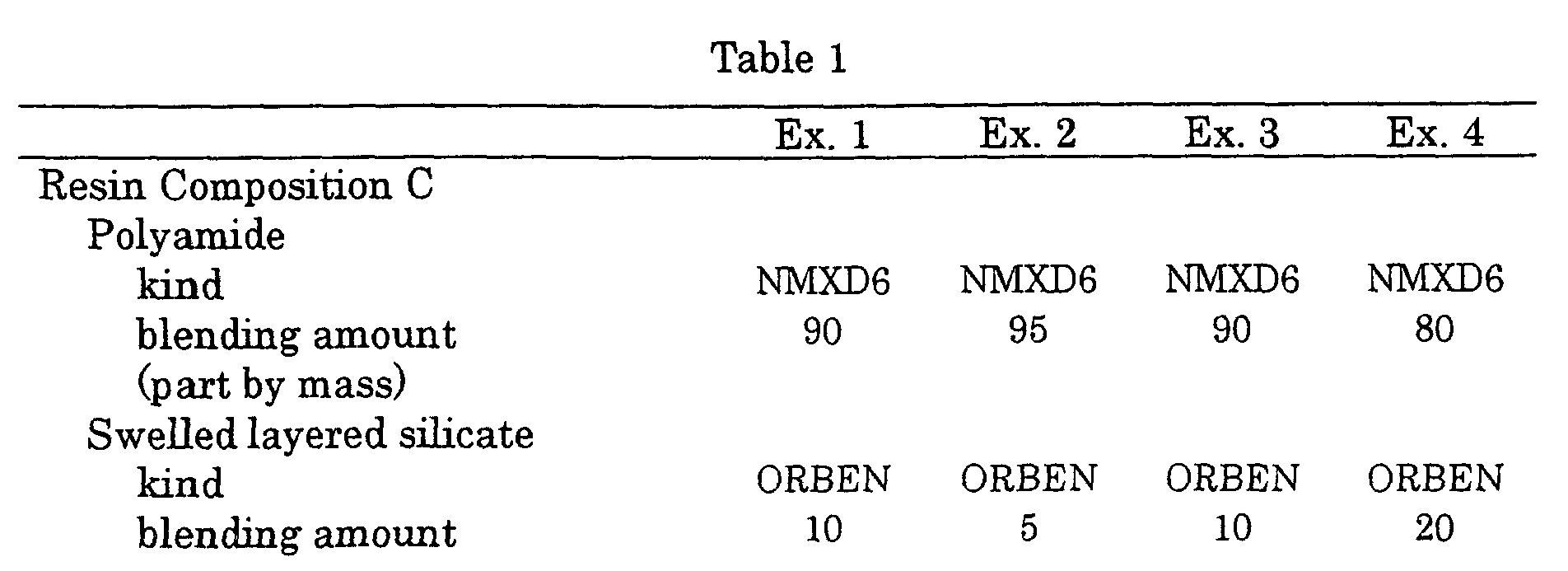
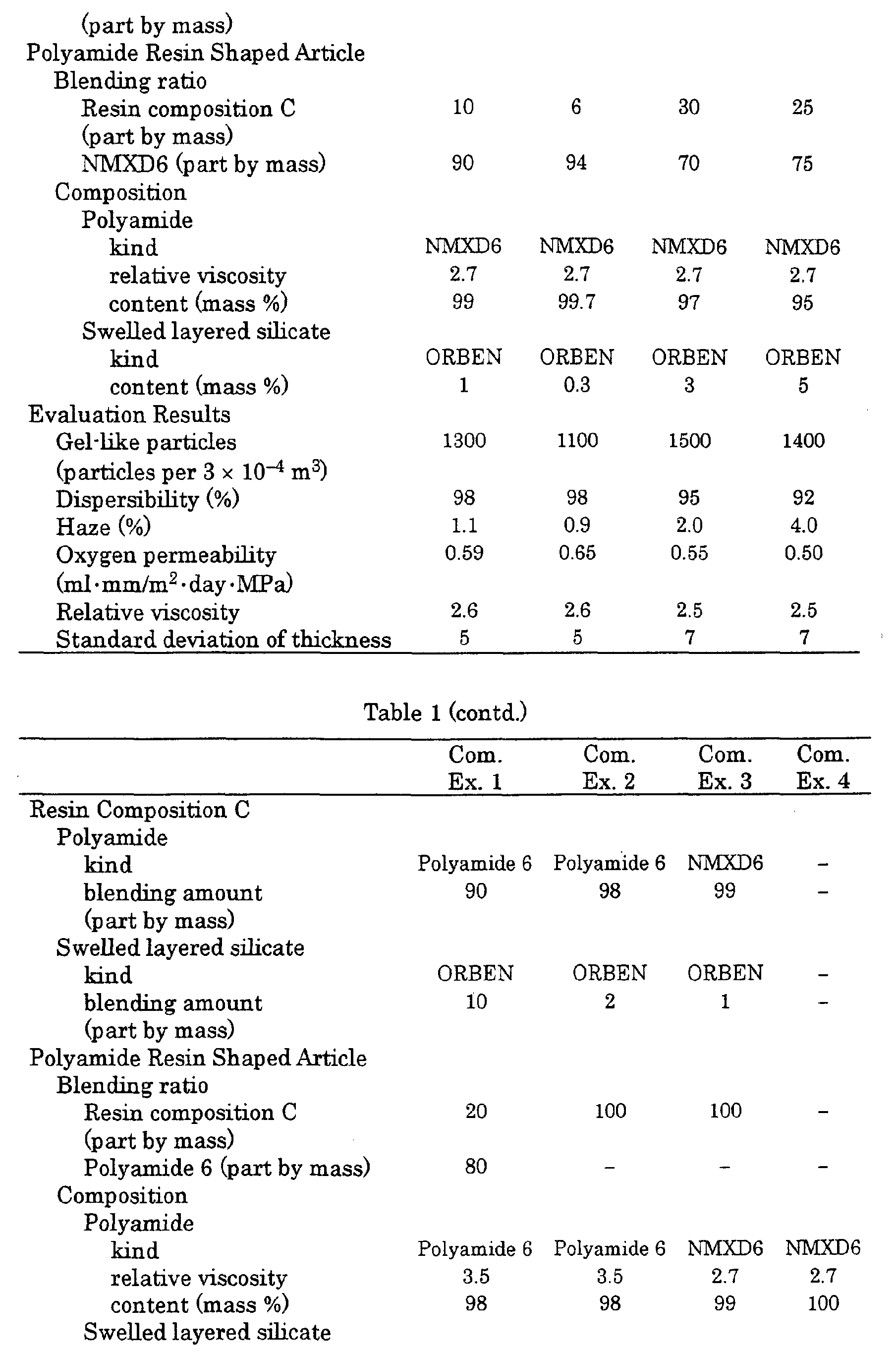
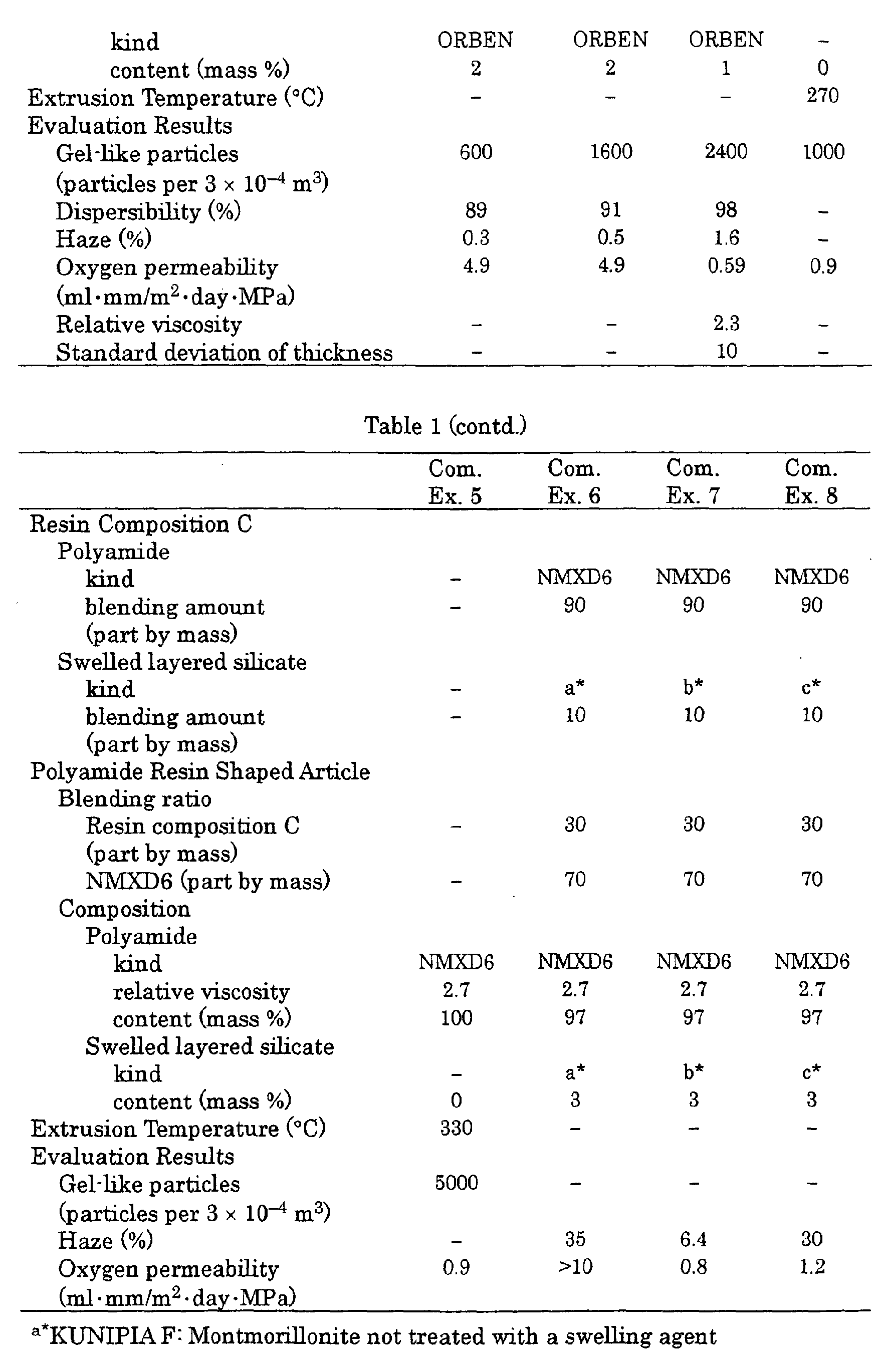
- the evaluation results of the non-stretched film are shown in Table 1.
- the pellets thus prepared were fed to a T-die twin screw extruder of 20-mm cylinder through a metering feeder at a rate of 1.2 kg/hr. After melt-kneading under conditions of 260°C cylinder temperature, 100-rpm screw rotation and two-minute residence time, the kneaded melt was extruded through the T-die into film form which was solidified on a cooling roll of 40°C while taken off at a rate of 2.7 m/min to obtain a non-stretched film of 50 ⁇ m thick. The evaluation results of the non-stretched film are shown in Table 1.
- Polyamide MXD6 (MX NYLON 6007) was fed to a T-die twin screw extruder of 20-mm cylinder through a metering feeder at a rate of 1.2 kg/hr. After melt-kneading under conditions of 270°C cylinder temperature, 100-rpm screw rotation and two-minute residence time, the kneaded melt was extruded through the T-die into film form which was solidified on a cooling roll of 70°C while taken off at a rate of 2.7 m/min to obtain a non-stretched film of 50 ⁇ m thick. The evaluation results of the non-stretched film are shown in Table 1.
- Polyamide MXD6 (MX NYLON 6007) was fed to a T-die twin screw extruder of 20-mm cylinder through a metering feeder at a rate of 1.2 kg/hr. After melt-kneading under conditions of 330°C cylinder temperature, 100-rpm screw rotation and two-minute residence time, the kneaded melt was extruded through the T-die into film form which was solidified on a cooling roll of 70°C while taken off at a rate of 2.7 m/min to obtain a non-stretched film of 50 ⁇ m thick. The evaluation results of the non-stretched film are shown in Table 1.
- the pellets (10 parts by mass) thus prepared were dry-blended with 90 parts by mass of polyamide MXD6 (MX NYLON 6007).
- polyamide MXD6 MX NYLON 6007
- PET poly(ethylene terephthalate)
- PET poly(ethylene terephthalate)
- the amount of the polyamide MXD6 was 10 mass % of the three-layer parison, and the overall length of the polyamide MXD6 layer in the three-layer parison was 85 mm from the gate portion.
- the three-layer parison thus prepared was biaxially blow-molded to obtain a 500-ml bottle.
- the oxygen permeability of the bottle was 0.004 cc/bottle ⁇ day ⁇ 0.21atm, the dispersibility of the layered silicate in the polyamide MXD6 was 98%, and the haze was 3.5.
- thermoplastic polyester resin was injected into a mold cavity from a first injection cylinder.
- a gas-barrier polyamide resin was injected into the mold cavity together with the thermoplastic polyester resin so as to fill the mold cavity, thereby producing a three-layer parison.
- the temperature conditions employed were 270°C for the first injection cylinder, 260°C for the second injection cylinder, 270°C for the resin flow path in the mold, and 15°C for the mold cooling water.
- the parison thus produced was 100 mm in the overall length, 23.5 mm ⁇ in the outer diameter, and 4.5 mm in the wall thickness, having a barrel of PET/polyamide MXD6/PET layer structure.
- the parison was preheated to 100°C and then biaxially blow-molded at a blow pressure of 30 kgf/cm 2 into a 500-ml multilayer container having an overall length of 223 mm and an outer diameter of 65 mm ⁇ .
- polyamide MXD6 MX NYLON 6007
- poly(ethylene terephthalate) R543C
- the amount of the polyamide MXD6 was 10 mass % of the three-layer parison, and the overall length of the polyamide MXD6 layer in the three-layer parison was 85 mm from the gate portion.
- the three-layer parison thus prepared was biaxially blow-molded to obtain a 500-ml bottle having an oxygen permeability of 0.008 cc/bottle ⁇ day ⁇ 0.21atm and a haze of 2.6%.
- a three-layer parison was produced.
- the amount of the polyamide MXD6 was 10 mass % of the three-layer parison, and the overall length of the polyamide MXD6 layer in the three-layer parison was 85 mm from the gate portion.
- the three-layer parison thus prepared was biaxially blow-molded to obtain a 500-ml bottle having an oxygen permeability of 0.002 cc/bottle ⁇ day ⁇ 0.21atm and a haze of 18.9%.
- the dispersibility of the layered silicate in polyamide MXD6 was 45%.
- Resin Composition C Polyamide kind NMXD6 - NMXD6 blending amount 90 - 85 (part by mass) Swelled layered silicate kind ORBEN - ORBEN blending amount 10 - 15 (part by mass) Polyamide Resin Shaped Article Blending ratio Resin composition C 10 - 100 (part by mass) NMXD6 (part by mass) 90 - - Composition Polyamide kind NMXD6 NMXD6 NMXD6 relative viscosity 2.7 2.7 2.7 content (mass %) 99 100 85 Swelled layered silicate kind content (mass %) 1 0 15 Evaluation Results Dispersibility (%) 98 - 45 Haze (%) 3.5 2.6 18.9 Oxygen permeability constant 0.2 0.4 0.1 (ml/bottle ⁇ day ⁇ MPa)
- the polyamide resin shaped article of the present invention possesses excellent clarity, gas-barrier properties and mechanical strength and contains little gel-like particles. Therefore, the shaped article is useful as a packaging material for foods, beverages, medicines, electric parts, etc.
Landscapes
- Chemical & Material Sciences (AREA)
- Health & Medical Sciences (AREA)
- Chemical Kinetics & Catalysis (AREA)
- Medicinal Chemistry (AREA)
- Polymers & Plastics (AREA)
- Organic Chemistry (AREA)
- Compositions Of Macromolecular Compounds (AREA)
- Processes Of Treating Macromolecular Substances (AREA)
- Manufacture Of Macromolecular Shaped Articles (AREA)
Abstract
Description
Still another object of the present invention is to provide a production method of a polyamide resin shaped article without lowering the molecular weight of the m-xylylene group-containing polyamide during the incorporating operation of the layered silicate.
With the use of the organic swelling agent in such an amount, the interlayer distance of the layered silicate increases moderately to ensure the uniform dispersion of the layered silicate into the polyamide resin. The swelling treatment may be carried out by a known method without any specific limitation.
Then 3 to 40 mass % of the resin composition C is melt-kneaded with 97 to 60 mass % of the polyamide resin A, each mass percentage being based on the total amount of the resin composition C and the polyamide resin A, to make the final concentration of the silicate B in the polyamide resin shaped article into 0.3 to 8 mass % based on the total amount of the polyamide resin A and the silicate B. Preferably, 5 to 30 mass % of the resin composition C and 95 to 70 mass % of the polyamide resin A are melt-kneaded to make the final concentration of the silicate B in the polyamide resin shaped article into 0.5 to 5 mass %.
The standard deviation was calculated from the measured values.
MX NYLON 6007, trade name, available from Mitsubishi Gas Chemical Company, Inc. (referred to as "NMXD6" in Tables)
Relative viscosity: 2.7
ORBEN (trade name) available from Shiraishi Kogyo Co., Ltd. Montmorillonite treated with a trimethyloctadecylammonium salt as the organic swelling agent.
Content of organic swelling agent: 34 mass %

| Ex. 5 | Com. Ex. 9 | Com. Ex. 10 | |
| Resin Composition C | |||
| Polyamide | |||
| kind | NMXD6 | - | NMXD6 |
| blending amount | 90 | - | 85 |
| (part by mass) | |||
| Swelled layered silicate | |||
| kind | ORBEN | - | ORBEN |
| blending amount | 10 | - | 15 |
| (part by mass) | |||
| Polyamide Resin Shaped Article | |||
| Blending ratio | |||
| Resin composition C | 10 | - | 100 |
| (part by mass) | |||
| NMXD6 (part by mass) | 90 | - | - |
| Composition | |||
| Polyamide | |||
| kind | NMXD6 | NMXD6 | NMXD6 |
| relative viscosity | 2.7 | 2.7 | 2.7 |
| content (mass %) | 99 | 100 | 85 |
| Swelled layered silicate | |||
| kind | |||
| content (mass %) | 1 | 0 | 15 |
| Evaluation Results | |||
| Dispersibility (%) | 98 | - | 45 |
| Haze (%) | 3.5 | 2.6 | 18.9 |
| Oxygen permeability constant | 0.2 | 0.4 | 0.1 |
| (ml/bottle·day·MPa) |
Claims (15)
- Apolyamide resin shaped article comprising (A) 92 to 99.7 mass % of a polyamide resin produced by polycondensation of a diamine component containing 70 mol% or more of m-xylylenediamine and a dicarboxylic acid component containing 70 mol% or more of a straight-chain, aliphatic α,ω-dicarboxylic acid having 4 to 12 carbon atoms, and (B) 8 to 0.3 mass % of a silicate prepared by treating a layered silicate with an organic swelling agent with the proviso that the mass percentages are based on a sum of the polyamide resin A and the silicate B, wherein the polyamide resin shaped article is produced by:preliminarily melt-kneading 70 to 95 mass % of the polyamide resin A and 30 to 5 mass % of the silicate B, on the basis of a sum of the polyamide resin A and the silicate B, to prepare a resin composition C;melt-kneading 3 to 40 mass % of the resin composition C and 97 to 60 mass % of the polyamide resin A, on the basis of a sum of the resin composition C and the polyamide resin A, at the time of producing the polyamide resin shaped article; and thenshaping or molding the melt-kneaded product into the polyamide resin shaped article in which the silicate B is uniformly and finely dispersed throughout the polyamide resin A.
- The polyamide resin shaped article according to claim 1, wherein a relative viscosity of the polyamide resin shaped article is 2.45 to 3.85 when measured at 25°C on a 1g/dl solution in a 96% aqueous solution of sulfuric acid.
- The polyamide resin shaped article according to claim 1 or 2, wherein the silicate B is at least one mineral treated with the organic swelling agent, the mineral being selected from the group consisting of kaolinite, halloysite, chrysotile, montmorillonite, hectorite, beidellite, saponite, muscovite, phlogopite, talc, pyrophyllite, vermiculite, and chlorite.
- The polyamide resin shaped article according to any one of claims 1 to 3, wherein the silicate B is a montmorillonite treated with the organic swelling agent.
- The polyamide resin shaped article according to any one of claims 1 to 4, wherein the resin composition C and the polyamide resin Ais dry-blended prior to the melt-kneading.
- The polyamide resin shaped article according to any one of claims 1 to 5, wherein the layered silicate is treated with the organic swelling agent in an amount such that a content of the organic swelling agent in a resultant silicate B is 20 to 50 mass %.
- The polyamide resin shaped article according to any one of claims 1 to 6, wherein the number of gel-like particles having a 50 µm or more diameter in the polyamide resin shaped article is 1500 or less per 3 × 10⁻⁴ m3.
- The polyamide resin shaped article according to any one of claims 1 to 7, wherein an oxygen permeability of the polyamide resin shaped article is 0.65 ml·mm/m2·day·MPa or less when measured at 23°C and 60% relative humidity.
- The polyamide resin shaped article according to any one of claims 1 to 8, which is made into a film.
- The polyamide resin shaped article according to claim 9, wherein the film is a stretched film.
- The polyamide resin shaped article according to any one of claims 1 to 8, which is made into a hollow container.
- A method for producing a polyamide resin shaped article comprising (A) 92 to 99.7 mass % of a polyamide resin produced by polycondensation of a diamine component containing 70 mol% or more of m-xylylenediamine and a dicarboxylic acid component containing 70 mol% or more of a straight-chain, aliphatic α,ω-dicarboxylic acid having 4 to 12 carbon atoms, and (B) 8 to 0.3 mass % of a silicate prepared by treating a layered silicate with an organic swelling agent with the proviso that the mass percentages are based on a sum of the polyamide resin A and the silicate B, the method comprising:preliminarily melt-kneading 70 to 95 mass % of the polyamide resin A and 30 to 5 mass % of the silicate B, on the basis of a sum of the polyamide resin A and the silicate B, at 250 to 300°C for a residence time of five minutes or shorter, thereby preparing a resin composition C;melt-kneading 3 to 40 mass % of the resin composition C and 97 to 60 mass % of the polyamide resin A, on the basis of a sum of the resin composition C and the polyamide resin A, at 245 to 290°C for a residence time of 20 minutes or shorter at the time of producing the polyamide resin shaped article; and thenshaping or molding the melt-kneaded product into the polyamide resin shaped article in which the silicate B is uniformly and finely dispersed throughout the polyamide resin A.
- The method according to claim 12, wherein a relative viscosity of the polyamide resin shaped article is 2.45 to 3.85 when measured at 25°C on a 1g/dl solution in a 96% aqueous solution of sulfuric acid.
- The method according to claim 12 or 13, wherein the resin composition C and the polyamide resin A is dry-blended prior to the melt-kneading.
- The method according to any one of claims 12 to 14, wherein the layered silicate is treated with the organic swelling agent in an amount such that a content of the organic swelling agent in the resultant silicate B is 20 to 50 mass %.
Applications Claiming Priority (2)
| Application Number | Priority Date | Filing Date | Title |
|---|---|---|---|
| JP2000147929 | 2000-05-19 | ||
| JP2000147929 | 2000-05-19 |
Publications (2)
| Publication Number | Publication Date |
|---|---|
| EP1156073A1 true EP1156073A1 (en) | 2001-11-21 |
| EP1156073B1 EP1156073B1 (en) | 2003-08-20 |
Family
ID=18654045
Family Applications (1)
| Application Number | Title | Priority Date | Filing Date |
|---|---|---|---|
| EP01111225A Expired - Lifetime EP1156073B1 (en) | 2000-05-19 | 2001-05-15 | Shaped article of polyamide resin and production thereof |
Country Status (4)
| Country | Link |
|---|---|
| US (1) | US6515099B2 (en) |
| EP (1) | EP1156073B1 (en) |
| AU (1) | AU773937B2 (en) |
| DE (1) | DE60100609T2 (en) |
Cited By (8)
| Publication number | Priority date | Publication date | Assignee | Title |
|---|---|---|---|---|
| EP1308478A1 (en) * | 2001-10-31 | 2003-05-07 | Mitsubishi Gas Chemical Company, Inc. | Polyamide resin composition |
| WO2003064503A1 (en) * | 2002-01-30 | 2003-08-07 | Ems-Chemie Ag | Method for the production of polyamide nanocomposites, corresponding packaging materials and moulded bodies |
| EP1350806A1 (en) * | 2002-04-03 | 2003-10-08 | Mitsubishi Gas Chemical Company, Inc. | Nylon MXD6 based biaxially stretched polyamide film of low permeability to gases and production method thereof |
| EP1405874A1 (en) | 2002-10-03 | 2004-04-07 | Mitsubishi Gas Chemical Company, Inc. | Process for production of polyamide composite material |
| EP1482003A1 (en) * | 2003-05-29 | 2004-12-01 | Mitsubishi Gas Chemical Company, Inc. | Masterbatch and production method of oxygen-absorbing molded article |
| EP1787802A1 (en) * | 2005-10-26 | 2007-05-23 | Degussa GmbH | Film with cover layer made of polyamid |
| US7442333B2 (en) | 2003-01-30 | 2008-10-28 | Ems-Chemie Ag | Method for the production of polyamide nanocomposites, corresponding packaging materials and moulded bodies |
| WO2010026160A1 (en) * | 2008-09-08 | 2010-03-11 | Basf Se | Method for manufacturing flat molded members or films |
Families Citing this family (9)
| Publication number | Priority date | Publication date | Assignee | Title |
|---|---|---|---|---|
| US6970591B1 (en) | 1999-11-25 | 2005-11-29 | Canon Kabushiki Kaisha | Image processing apparatus |
| EP1354906B1 (en) * | 2002-04-19 | 2012-12-05 | Mitsubishi Gas Chemical Company, Inc. | Polyamide resin |
| CN1322027C (en) * | 2003-05-06 | 2007-06-20 | 三菱瓦斯化学株式会社 | Fuel-barrier polyamide resin and multilayer shaped article |
| US10076641B2 (en) | 2005-05-11 | 2018-09-18 | The Spectranetics Corporation | Methods and systems for delivering substances into luminal walls |
| DK2311622T3 (en) * | 2006-10-19 | 2013-06-10 | Mitsubishi Gas Chemical Co | Spray-shaped object with excellent barrier property |
| PE20130056A1 (en) | 2009-12-28 | 2013-02-11 | Mitsubishi Gas Chemical Co | POLYAMIDE COMPOUND |
| EP2380604A1 (en) | 2010-04-19 | 2011-10-26 | InnoRa Gmbh | Improved coating formulations for scoring or cutting balloon catheters |
| US20210285216A1 (en) * | 2020-03-12 | 2021-09-16 | Louisiana-Pacific Corporation | Integrated ventilation and flashing in integrated roof system with engineered wood |
| CN120865672A (en) * | 2025-09-09 | 2025-10-31 | 广州简米餐具有限公司 | Melamine tableware with hollow interlayer heat insulation structure and compression molding process thereof |
Citations (2)
| Publication number | Priority date | Publication date | Assignee | Title |
|---|---|---|---|---|
| EP0398551A2 (en) * | 1989-05-19 | 1990-11-22 | Ube Industries, Ltd. | Method for preparing a polyamide composite material |
| WO2000009605A1 (en) * | 1998-08-17 | 2000-02-24 | Amcol International Corporation | Intercalates formed with mxd6 nylon intercalants |
Family Cites Families (10)
| Publication number | Priority date | Publication date | Assignee | Title |
|---|---|---|---|---|
| US4739007A (en) * | 1985-09-30 | 1988-04-19 | Kabushiki Kaisha Toyota Chou Kenkyusho | Composite material and process for manufacturing same |
| US4894411A (en) * | 1987-03-18 | 1990-01-16 | Kabushiki Kaisha Toyota Chuo Kenkyusho | Composite material and process for producing the same |
| JPH0778089B2 (en) * | 1987-03-26 | 1995-08-23 | 株式会社豊田中央研究所 | Method of manufacturing composite material |
| JPH0739540B2 (en) | 1988-09-06 | 1995-05-01 | 宇部興産株式会社 | Materials for molded articles having liquid or gas barrier properties |
| JP2603314B2 (en) | 1988-10-14 | 1997-04-23 | 宇部興産株式会社 | Polyamide film |
| AU649710B2 (en) * | 1990-09-11 | 1994-06-02 | Mitsubishi Gas Chemical Company, Inc. | Polyamide resin composition and film therefrom |
| JP2000186200A (en) * | 1998-07-07 | 2000-07-04 | Unitika Ltd | Polyamide resin composition and its production |
| US6255378B1 (en) * | 1997-04-25 | 2001-07-03 | Unitika Ltd. | Polyamide resin composition and process for producing the same |
| US6166171A (en) * | 1998-03-06 | 2000-12-26 | Mitsubishi Gas Chemical Company, Inc. | Polyamide resin composition |
| US6384121B1 (en) * | 1998-12-07 | 2002-05-07 | Eastman Chemical Company | Polymeter/clay nanocomposite comprising a functionalized polymer or oligomer and a process for preparing same |
-
2001
- 2001-05-15 DE DE60100609T patent/DE60100609T2/en not_active Expired - Lifetime
- 2001-05-15 EP EP01111225A patent/EP1156073B1/en not_active Expired - Lifetime
- 2001-05-18 US US09/859,539 patent/US6515099B2/en not_active Expired - Lifetime
- 2001-05-18 AU AU46118/01A patent/AU773937B2/en not_active Ceased
Patent Citations (2)
| Publication number | Priority date | Publication date | Assignee | Title |
|---|---|---|---|---|
| EP0398551A2 (en) * | 1989-05-19 | 1990-11-22 | Ube Industries, Ltd. | Method for preparing a polyamide composite material |
| WO2000009605A1 (en) * | 1998-08-17 | 2000-02-24 | Amcol International Corporation | Intercalates formed with mxd6 nylon intercalants |
Cited By (19)
| Publication number | Priority date | Publication date | Assignee | Title |
|---|---|---|---|---|
| EP1308478A1 (en) * | 2001-10-31 | 2003-05-07 | Mitsubishi Gas Chemical Company, Inc. | Polyamide resin composition |
| US7019064B2 (en) | 2001-10-31 | 2006-03-28 | Mitsubishi Gas Chemical Company, Inc. | Polyamide resin composition |
| WO2003064503A1 (en) * | 2002-01-30 | 2003-08-07 | Ems-Chemie Ag | Method for the production of polyamide nanocomposites, corresponding packaging materials and moulded bodies |
| KR100909924B1 (en) * | 2002-01-30 | 2009-07-29 | 이엠에스-케미에 아게 | Method for producing polyamide nanocomposites, corresponding packaging materials and moldings |
| CN1300224C (en) * | 2002-01-30 | 2007-02-14 | 埃姆斯化学股份公司 | Process for producing polyamide nanocomposites, corresponding packaging materials and molded bodies |
| EP1350806A1 (en) * | 2002-04-03 | 2003-10-08 | Mitsubishi Gas Chemical Company, Inc. | Nylon MXD6 based biaxially stretched polyamide film of low permeability to gases and production method thereof |
| US6962743B2 (en) | 2002-04-03 | 2005-11-08 | Mitsubishi Gas Chemical Company, Inc. | Biaxially stretched film and production method thereof |
| AU2003202517B2 (en) * | 2002-04-03 | 2007-04-26 | Mitsubishi Gas Chemical Company, Inc. | Nylon MXD6 based biaxially stretched polyamide film of low permeability to gases and production method thereof |
| CN100436513C (en) * | 2002-04-03 | 2008-11-26 | 三菱瓦斯化学株式会社 | Biaxially stretched film and production method thereof |
| EP1405874A1 (en) | 2002-10-03 | 2004-04-07 | Mitsubishi Gas Chemical Company, Inc. | Process for production of polyamide composite material |
| CN100457425C (en) * | 2002-10-03 | 2009-02-04 | 三菱瓦斯化学株式会社 | Producing method of polymide composite |
| US7265187B2 (en) | 2002-10-03 | 2007-09-04 | Mitsubishi Gas Chemical Company, Inc. | Process for production of polyamide composite material |
| US7442333B2 (en) | 2003-01-30 | 2008-10-28 | Ems-Chemie Ag | Method for the production of polyamide nanocomposites, corresponding packaging materials and moulded bodies |
| US7230067B2 (en) | 2003-05-29 | 2007-06-12 | Mitsubishi Gas Chemical Company, Inc. | Masterbatch and production method of oxygen-absorbing molded article |
| EP1482003A1 (en) * | 2003-05-29 | 2004-12-01 | Mitsubishi Gas Chemical Company, Inc. | Masterbatch and production method of oxygen-absorbing molded article |
| EP1787802A1 (en) * | 2005-10-26 | 2007-05-23 | Degussa GmbH | Film with cover layer made of polyamid |
| WO2010026160A1 (en) * | 2008-09-08 | 2010-03-11 | Basf Se | Method for manufacturing flat molded members or films |
| CN102143994A (en) * | 2008-09-08 | 2011-08-03 | 巴斯夫欧洲公司 | Preparation method of planar module or membrane |
| CN102143994B (en) * | 2008-09-08 | 2016-11-16 | 巴斯夫欧洲公司 | Preparation method of planar module or membrane |
Also Published As
| Publication number | Publication date |
|---|---|
| DE60100609T2 (en) | 2004-06-17 |
| AU773937B2 (en) | 2004-06-10 |
| US20010056148A1 (en) | 2001-12-27 |
| US6515099B2 (en) | 2003-02-04 |
| EP1156073B1 (en) | 2003-08-20 |
| AU4611801A (en) | 2001-11-22 |
| DE60100609D1 (en) | 2003-09-25 |
Similar Documents
| Publication | Publication Date | Title |
|---|---|---|
| EP1156073B1 (en) | Shaped article of polyamide resin and production thereof | |
| EP2025718B1 (en) | Polyamide resin composition | |
| US7265187B2 (en) | Process for production of polyamide composite material | |
| CN1269634C (en) | Oxygen Scavenging high barrier polyamide composns. for packaging applications | |
| EP1453917B1 (en) | Polyamide polymer blends and films made therefrom | |
| JP5949546B2 (en) | Polyamide resin composition | |
| JP2003535204A (en) | Polymer nanocomposites containing matrix polymers and layered clay materials with improved levels of extractables | |
| EP1713860A2 (en) | Container having barrier properties and method of manufacturing the same | |
| JP2003515648A (en) | Polymer-clay nanocomposites containing amorphous oligomers | |
| EP0787765A1 (en) | Polyamide film and process for producing the same | |
| EP1308478B1 (en) | Polyamide resin composition | |
| EP1752492A1 (en) | Fuel-barrier thermoplastic resin compositions and articles | |
| JP4321197B2 (en) | Method for producing polyamide composite material | |
| KR100909924B1 (en) | Method for producing polyamide nanocomposites, corresponding packaging materials and moldings | |
| JP2002038006A (en) | Polyamide resin composition and method for producing the same | |
| JP2000290500A (en) | Polyamide molding | |
| JPH10168310A (en) | Polyamide film with excellent slipperiness | |
| JP2004160935A (en) | Multilayer container | |
| JP4207526B2 (en) | Polyamide resin composition | |
| AU2012216788B2 (en) | Polyamide resin composition | |
| JPH10168309A (en) | Polyamide film with excellent slipperiness | |
| JP4711040B2 (en) | Multi-layer container | |
| JP4535223B2 (en) | Polyamide composite material and method for producing the same |
Legal Events
| Date | Code | Title | Description |
|---|---|---|---|
| PUAI | Public reference made under article 153(3) epc to a published international application that has entered the european phase |
Free format text: ORIGINAL CODE: 0009012 |
|
| AK | Designated contracting states |
Kind code of ref document: A1 Designated state(s): CH DE FR GB IT LI SE Kind code of ref document: A1 Designated state(s): AT BE CH CY DE DK ES FI FR GB GR IE IT LI LU MC NL PT SE TR |
|
| AX | Request for extension of the european patent |
Free format text: AL;LT;LV;MK;RO;SI |
|
| 17P | Request for examination filed |
Effective date: 20020424 |
|
| AKX | Designation fees paid |
Free format text: CH DE FR GB IT LI SE |
|
| GRAH | Despatch of communication of intention to grant a patent |
Free format text: ORIGINAL CODE: EPIDOS IGRA |
|
| GRAS | Grant fee paid |
Free format text: ORIGINAL CODE: EPIDOSNIGR3 |
|
| GRAA | (expected) grant |
Free format text: ORIGINAL CODE: 0009210 |
|
| AK | Designated contracting states |
Designated state(s): CH DE FR GB IT LI SE |
|
| REG | Reference to a national code |
Ref country code: GB Ref legal event code: FG4D |
|
| REG | Reference to a national code |
Ref country code: CH Ref legal event code: EP |
|
| REF | Corresponds to: |
Ref document number: 60100609 Country of ref document: DE Date of ref document: 20030925 Kind code of ref document: P |
|
| REG | Reference to a national code |
Ref country code: CH Ref legal event code: NV Representative=s name: A. BRAUN, BRAUN, HERITIER, ESCHMANN AG PATENTANWAE |
|
| REG | Reference to a national code |
Ref country code: SE Ref legal event code: TRGR |
|
| ET | Fr: translation filed | ||
| PLBE | No opposition filed within time limit |
Free format text: ORIGINAL CODE: 0009261 |
|
| STAA | Information on the status of an ep patent application or granted ep patent |
Free format text: STATUS: NO OPPOSITION FILED WITHIN TIME LIMIT |
|
| 26N | No opposition filed |
Effective date: 20040524 |
|
| REG | Reference to a national code |
Ref country code: CH Ref legal event code: PFA Owner name: MITSUBISHI GAS CHEMICAL COMPANY, INC. Free format text: MITSUBISHI GAS CHEMICAL COMPANY, INC.#NO. 5-2, MARUNOUCHI 2-CHOME#CHIYODA-KU, TOKYO (JP) -TRANSFER TO- MITSUBISHI GAS CHEMICAL COMPANY, INC.#NO. 5-2, MARUNOUCHI 2-CHOME#CHIYODA-KU, TOKYO (JP) |
|
| REG | Reference to a national code |
Ref country code: CH Ref legal event code: PCAR Free format text: NEW ADDRESS: HOLBEINSTRASSE 36-38, 4051 BASEL (CH) |
|
| REG | Reference to a national code |
Ref country code: FR Ref legal event code: PLFP Year of fee payment: 16 |
|
| REG | Reference to a national code |
Ref country code: FR Ref legal event code: PLFP Year of fee payment: 17 |
|
| REG | Reference to a national code |
Ref country code: FR Ref legal event code: PLFP Year of fee payment: 18 |
|
| PGFP | Annual fee paid to national office [announced via postgrant information from national office to epo] |
Ref country code: IT Payment date: 20190527 Year of fee payment: 19 Ref country code: DE Payment date: 20190430 Year of fee payment: 19 |
|
| PGFP | Annual fee paid to national office [announced via postgrant information from national office to epo] |
Ref country code: FR Payment date: 20190410 Year of fee payment: 19 Ref country code: SE Payment date: 20190513 Year of fee payment: 19 |
|
| PGFP | Annual fee paid to national office [announced via postgrant information from national office to epo] |
Ref country code: CH Payment date: 20190516 Year of fee payment: 19 |
|
| PGFP | Annual fee paid to national office [announced via postgrant information from national office to epo] |
Ref country code: GB Payment date: 20190515 Year of fee payment: 19 |
|
| REG | Reference to a national code |
Ref country code: DE Ref legal event code: R119 Ref document number: 60100609 Country of ref document: DE |
|
| PG25 | Lapsed in a contracting state [announced via postgrant information from national office to epo] |
Ref country code: LI Free format text: LAPSE BECAUSE OF NON-PAYMENT OF DUE FEES Effective date: 20200531 Ref country code: CH Free format text: LAPSE BECAUSE OF NON-PAYMENT OF DUE FEES Effective date: 20200531 Ref country code: SE Free format text: LAPSE BECAUSE OF NON-PAYMENT OF DUE FEES Effective date: 20200516 |
|
| GBPC | Gb: european patent ceased through non-payment of renewal fee |
Effective date: 20200515 |
|
| PG25 | Lapsed in a contracting state [announced via postgrant information from national office to epo] |
Ref country code: GB Free format text: LAPSE BECAUSE OF NON-PAYMENT OF DUE FEES Effective date: 20200515 Ref country code: FR Free format text: LAPSE BECAUSE OF NON-PAYMENT OF DUE FEES Effective date: 20200531 |
|
| PG25 | Lapsed in a contracting state [announced via postgrant information from national office to epo] |
Ref country code: DE Free format text: LAPSE BECAUSE OF NON-PAYMENT OF DUE FEES Effective date: 20201201 |
|
| PG25 | Lapsed in a contracting state [announced via postgrant information from national office to epo] |
Ref country code: IT Free format text: LAPSE BECAUSE OF NON-PAYMENT OF DUE FEES Effective date: 20200515 |