EP1154667A2 - Method and apparatus for multi-user resource management in wireless communication systems - Google Patents
Method and apparatus for multi-user resource management in wireless communication systems Download PDFInfo
- Publication number
- EP1154667A2 EP1154667A2 EP01303941A EP01303941A EP1154667A2 EP 1154667 A2 EP1154667 A2 EP 1154667A2 EP 01303941 A EP01303941 A EP 01303941A EP 01303941 A EP01303941 A EP 01303941A EP 1154667 A2 EP1154667 A2 EP 1154667A2
- Authority
- EP
- European Patent Office
- Prior art keywords
- loading
- allocation
- resource
- user
- transmission
- Prior art date
- Legal status (The legal status is an assumption and is not a legal conclusion. Google has not performed a legal analysis and makes no representation as to the accuracy of the status listed.)
- Granted
Links
Images

Classifications
-
- H—ELECTRICITY
- H04—ELECTRIC COMMUNICATION TECHNIQUE
- H04W—WIRELESS COMMUNICATION NETWORKS
- H04W72/00—Local resource management
- H04W72/02—Selection of wireless resources by user or terminal
-
- H—ELECTRICITY
- H04—ELECTRIC COMMUNICATION TECHNIQUE
- H04W—WIRELESS COMMUNICATION NETWORKS
- H04W28/00—Network traffic management; Network resource management
- H04W28/02—Traffic management, e.g. flow control or congestion control
- H04W28/0268—Traffic management, e.g. flow control or congestion control using specific QoS parameters for wireless networks, e.g. QoS class identifier [QCI] or guaranteed bit rate [GBR]
-
- H—ELECTRICITY
- H04—ELECTRIC COMMUNICATION TECHNIQUE
- H04W—WIRELESS COMMUNICATION NETWORKS
- H04W28/00—Network traffic management; Network resource management
- H04W28/02—Traffic management, e.g. flow control or congestion control
- H04W28/06—Optimizing the usage of the radio link, e.g. header compression, information sizing, discarding information
-
- H—ELECTRICITY
- H04—ELECTRIC COMMUNICATION TECHNIQUE
- H04W—WIRELESS COMMUNICATION NETWORKS
- H04W72/00—Local resource management
- H04W72/50—Allocation or scheduling criteria for wireless resources
- H04W72/54—Allocation or scheduling criteria for wireless resources based on quality criteria
-
- H—ELECTRICITY
- H04—ELECTRIC COMMUNICATION TECHNIQUE
- H04W—WIRELESS COMMUNICATION NETWORKS
- H04W24/00—Supervisory, monitoring or testing arrangements
-
- H—ELECTRICITY
- H04—ELECTRIC COMMUNICATION TECHNIQUE
- H04W—WIRELESS COMMUNICATION NETWORKS
- H04W72/00—Local resource management
- H04W72/04—Wireless resource allocation
Definitions
- This invention relates to wireless communication systems and, more particularly, to the management of system resource parameters as a function of a quality of service parameter.
- Wireless communication systems allow the transmission of information signals between a mobile user and a fixed based station.
- the base station will typically be interconnected with one or more landline communications networks.
- Both analog (first generation) and digital (second/third generation) systems have been developed to transmit information signals over communication channels linking the mobile user with landline networks.
- Digital methods tend to afford several advantages over analog systems, including improved immunity to channel noise and interference, increased capacity, and encryption for secure communications.
- First generation wireless systems were primarily directed to voice communication, but the digital technology of second and third- generation systems provides support for both voice and data applications.
- modulation/coding arrangements have been developed, such as frequency division multiple access (FDMA), time division multiple access (TDMA) and code division multiple access (CDMA), to increase the number of users that can access a wireless network.
- CDMA systems are more immune to multi-path distortion and co-channel interference than FDMA and TDMA systems and reduce the burden of frequency/channel planning that is common with FDMA and TDMA systems.
- the base stations of a wireless network manage a variety of resources in the establishment of communications links with their associated mobile users. Among those resources are output power and data rate. Output power and data rate are proportionally related -- the output power necessary to establish or maintain a link with a user increasing as the data rate increases. This increase in output power with increasing data rate is required to maintain the output energy per bit at a constant level.
- a base station In the management of power output, a base station must balance the transmission needs of its users, individually and collectively, against inter-channel interference among the served mobile users, as well as constraints in respect to total output power for the base station.
- the base station upon a request for entry to the wireless network by a user, the base station must evaluate the user's data rate and power demands against the current user environment and power demands. As the user environment approaches the total system capacity, the base station may delay the entry of a user onto the system to prevent overloading the output power capability of the base station.
- the allocation of the available RF power is usually dictated by a required Frame Error Rate (FER), with the power control system having a feedback mechanism for adjusting power to maintain the required FER under varying channel conditions.
- FER Frame Error Rate
- the output power will vary depending on the difference between the required FER and the FER experienced due to the channel.
- the instantaneous Eb/Io ratio essentially, the digital signal-to-noise ratio
- the power control system operates to dynamically allocate the RF power to overcome channel fades and interference in order to maintain the experienced FER within a tolerable deviation from the required FER.
- FERs are usually set between 1% and 2% to meet a required Merit of Service (MoS) parameter.
- MoS Merit of Service
- Data communication applications can generally accept a somewhat higher FER, but the selected FER must satisfy Quality of Service criteria for such applications.
- the invention provides dynamic allocation of power and system resources in proportion to user application requirements such as to achieve optimum resource allocation in a wireless system.
- the methodology of the invention operates to determine an allocation of wireless transmission resources to each user application served by the wireless system in a manner to optimize transmission resources while meeting required QoS criteria for the served user application. After all user applications have been provided a transmission resource allocation in this manner, the total allocation of transmission resources is determined and compared with a ceiling transmission resource level for the wireless system. A portion of the difference between the ceiling and currently allocated transmission resource levels is then made available, according to the method of the invention, to the served user applications in proportion to the initial allocation provided each user application.
- the determination of an initial optimum resource allocation for each user application is performed in accordance with the multi-layer resource management methodology disclosed in US patent application no. 09/568666.
- performance characteristics for a user application under consideration and of the wireless channel are determined and stored in the form of a set of tables or corresponding curves (or mathematical equivalents thereof). Data points on those curves are then determined which correspond with a required performance parameter for the user application under consideration (e.g., data throughput). Those data points from the application performance characteristic curves are then mapped to corresponding data points on performance characteristic curves for the physical channel. From that mapping, an FER and a data rate are selected to optimize system power allocation in respect to the data throughput requirement for the application and the characteristics of the selected channel.
- the total resource allocation for all users is determined -- that total allocation representing radio resource utilization for the wireless system. That total resource allocation is then compared with the maximum radio transmission resource available for the wireless system and a portion of the difference between those values is established for use in a "bonus" distribution process.
- the bonus distribution process operates to distribute the available resource loading "credit" to minimize inter-user interference for a maximized aggregated throughput in the system.
- the available resource loading remaining after making resource allocations directed to achieving required FER/QoS requirements for served users will be distributed to the users in proportion to their initial allocations, thereby increasing utilization for a system that is not fully loaded.
- a user receiving a bonus resource allocation pursuant to this procedure will be allocated increased transmission power, which will enable the completion of the transmission for a given data file at an earlier time, thereby making system resources available for another user application during that freed-up time increment.
- the invention provides a novel methodology to manage the communication channel so as to achieve an optimal utilization of wireless system resources.
- W-CDMA Wideband CDMA
- TDMA Time Division Multiple Access
- GSM Global System for Mobile communications
- the invention provides a methodology for maximizing radio channel utilization in a wireless system when the wireless system is not fully loaded. With the increased channel utilization realized through the process of the invention, a maximum system aggregate throughput is realized for the users of the wireless system.
- the invention determines the differential between the maximum transmission resource availability for a wireless system and the transmission resource level allocated to users served by the wireless system at a given time, and provides a portion of that transmission resource differential for making an additional resource allocation to some or all of the system users.
- This additional resource allocation process is characterized herein as a "bonus" distribution process.
- the bonus distribution process operates to redistribute a selected portion of the transmission resource differential (hereafter, sometimes characterized as the "loading credit”) among the served users, generally in proportion to an initial resource allocation for each user.
- an initial transmission resource allocation is made for each user application served by the wireless system, that initial allocation being generally directed to achieving a required QoS criteria for the user application and a minimum expenditure of system transmission resources.
- this initial resource allocation for each user will be performed in accordance with the multi-layer resource management methodology disclosed in US patent application no. 09/568666.
- a performance parameter which is to be met by the user application e.g., data throughput
- a set of performance characteristic curves or tables related to the application layer (of a layered protocol model for the communications channel).
- those performance characteristic curves will describe data throughput and frame-error-rate characteristics.
- multiple curves, each corresponding to a data rate supported by the wireless system will be plotted.
- a second set of performance characteristic curves (or tables) related to the physical layer (channel) is also determined and the allocation method operates to map data points corresponding to the required throughput from the application-layer performance curves to the physical layer performance curves.
- the physical-layer performance characteristic curves are described in terms of FER and Eb/No performance characteristics.
- transmission power for a channel is a function of the Eb/No parameter, and thus such a set of performance characteristic curves is also related to the output power for the channel.
- These FER -- Eb/No characteristic curves are derived from channel information such as Doppler frequency, Rician K factor, channel delay profile and other channel fading parameters.
- the application-layer characteristic curves for a given channel condition, there are also multiple curves corresponding to different data rates available in the physical layer. And, like the application-layer curves, these physical-layer characteristic curves can be derived based on general channel conditions and independent of any particular data transmission from the application layer. Thus, the ⁇ FER, data rate ⁇ data points selected from the application (TCP/RLP) performance characteristic curves may be mapped to corresponding points on these physical-channel performance characteristic curves. From that mapping, a data rate and Eb/Io parameter set can be selected which satisfies the user-application data throughput criteria with minimal resource allocation for the wireless system. It is to be noted that, for the preferred embodiment.
- the allocation for a given user will be expressed in terms of a data rate and a target FER.
- Those parameters will, in turn, be translated by the wireless system, according to known methods, to a required transmission power level needed to maintain the target FER at the selected data rate.
- a resource allocation for each user in the system is determined according to a procedure such as that just described. Those allocations are then provided to the served users and an initial operation of the wireless system at those allocation levels is begun. In the next step of the method of the invention, the total transmission power needed to maintain the user allocations determined in the preceding step is measured and compared with a maximum transmission power level for the wireless system providing those allocated transmission resources. A differential between that maximum transmission power level and the measured transmission power needed to maintain the initial user allocations is determined, and a portion of that differential, the "loading credit,” is then made available for a distribution of additional resource allocations to the served users.
- the bonus distribution process of the invention is described hereafter in the context of reverse-link power allocation, but it should be clear that the process may also be implemented for the forward link.
- the reverse link total received power (RSSI) at a base station is related to the loading and can be used to estimate the system load for the served area.
- the base station will obtain a measurement of RSSI from an average of n samples of the total received power that are measured during a predetermined sampling interval -- sample size n being chosen by the system operator based on operational and engineering considerations.
- the set of the measurements collected during the sampling interval is then sorted around a local median value -- that median value being determined by computing the cumulative density function (CDF) for the sampled values and selecting the value where the CDF is 50 percent.
- CDF cumulative density function
- RSSI_proc the randomness of the measured RSSI signals creates difficulty in a direct use of the RSSI median value. Use of the local median as described above, operates to smooth the RSSI signal.
- a loading bin associated with thresholds is first described. That loading bin is intended to provide a conceptual measure of the loading condition at a base station.
- S max is a reference point corresponding to maximum signal strength for the wireless system.
- Three thresholds are defined with respect to ⁇ . These thresholds, along with the loading bin of the invention are illustrated in Figure 1. With reference to the figure, those thresholds are defined as follows:
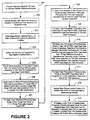
- steps 201, 202, 203 and 204 correspond respectively to the previously described steps of (1) providing an initial resource allocation for a served user (that allocation being preferably established to optimize system resource allocation), (2) operating the wireless system at the initial resource allocation levels and measuring total reverse-link received power, (3) establishing a base station loading factor, and (4) defining a set of thresholds in respect to that base station loading factor.
- the method of the invention then proceeds, at step 205, to a sorting of the users into a set ⁇ FER i ⁇ and a subset ⁇ T i ⁇ , where FER i represents the target FER for the ith user application, and T i is the time required from the present to the completion of the ith user's data transmission.
- the ⁇ FER i ⁇ set is sorted according to increasing or decreasing FERs, and, where a given target FER is common to multiple users, those common FERs are sorted according to increasing or decreasing user T i s.
- each user application is evaluated for bonus distribution, and in a preferred embodiment, that evaluation begins with the user having the maximum target FER, and continues through successively lesser target FERs. For the case of multiple users having a common target FER, the users in such a group are processed in order of increasing time for completion, T i s, of the user's data transmission.
- the invention proceeds, at step 207, to assign a new target FER for the user, where the new target FER is determined as a product of the initially allocated target FER and a factor of (1+ x ) -- x representing a small fraction chosen by the system operator to be less than the fraction of maximum system loading represented by the "loading credit.”
- x will be chosen as much smaller than the "loading credit” fraction, and the bonus distribution process recursively continued with increasing values of x until the base station loading factor, ⁇ , reaches the upper threshold of the loading bin.
- step 208 a new data throughput is determined for each new target FER assigned in the preceding step, and, in step 209, that new data throughput is evaluated against the application performance characteristic curves to determine if a new pair of ⁇ FER, data rate ⁇ data points exist which correspond to that new throughput.
- step 210 those new data points are mapped to the physical channel performance characteristic curves, and an Eb/No parameter corresponding to the mapped new data-point pair is determined.
- a difference is then determined between the Eb/No parameter corresponding to the initially allocated ⁇ FER, data rate ⁇ pair and that of the newly-mapped pair, and that difference is compared to a predetermined threshold.
- the new ⁇ FER, data rate ⁇ pair is assigned to the user application. However, if the Eb/No difference is less than the threshold amount, no change is made and the user application retains the initial allocation. In all cases where a new ⁇ FER, data rate ⁇ pair is assigned to a user application in the preceding step, a new S i is determined for the user application, at step 211. The base station loading factor, ⁇ , is then updated at step 212 to reflect the new S i for all user applications which are provided a new resource allocation.
- the updated loading factor, ⁇ is compared with the upper threshold B of the loading bin. If ⁇ is less than threshold level B, the additional, i.e., bonus, resource allocations identified in the preceding steps may be distributed to the qualifying user applications. The distribution will normally be implemented via a message to the mobile unit for a given user application authorizing the mobile to increase its output power to maintain the new FER and/or data rate corresponding to the additional resource allocation. However, if the updated ⁇ is greater than the upper threshold level B, no additional bonus distribution can be made, and the bonus distribution process stops.
- the bonus distribution process provided according to the heretofore described method of the invention operates to increase utilization for a system that is not fully loaded after the conclusion of an allocation process directed to achieving required FER/QoS criteria for served users.
- the remaining available loading will be distributed to the system users, resulting in a bonus resource allocation of increased transmission power for users.
- this bonus allocation the users are able to complete the transmission of a given data file an earlier time, thereby making system resources available for other user applications during those freed-up time increments.
- the method of the invention may be implemented in a "processor" that is capable of configuring the communication channel and is linked with a memory.
- the memory will contain tables that characterize the performance characteristics curves and the physical layer characteristics curves.
- the processor will monitor the communication channel, interact with user applications, and carry out the data gathering and processing tasks described hereinbefore for the method of the invention
- the functions performed by the processor may be provided through the use of either shared or dedicated hardware, including, but not limited to, hardware capable of executing software. Use of the term "processor” should not be construed to refer exclusively to hardware capable of executing software.
- Illustrative embodiments of the processor may comprise microprocessor and/or digital signal processor (“DSP”) hardware, read-only memory (“ROM”) for storing software performing the operations discussed below, and random access memory (“RAM”) for storing results.
- DSP digital signal processor
- ROM read-only memory
- RAM random access memory
- VLSI Very large scale integration
- the invention provides a novel method for dynamically allocating system resources in order to achieve maximum data throughput for a wireless system and optimal efficiency in the allocation of system resources.
- the method dynamically adjusts a frame error rate (FER), data rate or other application-resource parameter to utilize a loading credit for a wireless system to achieve such throughput and resource-utilization optimization.
- FER frame error rate
Landscapes
- Engineering & Computer Science (AREA)
- Computer Networks & Wireless Communication (AREA)
- Signal Processing (AREA)
- Quality & Reliability (AREA)
- Mobile Radio Communication Systems (AREA)
- Data Exchanges In Wide-Area Networks (AREA)
Abstract
Description
Claims (18)
- In a wireless communication system having a transmitter and at least one receiver coupled via a communication channel and operable to provide a communications path for at least one user application, a method for allocation of system resources among user applications comprising the steps of:determining an initial allocation of system resources for each of said user applications;determining a total operating transmission resource loading for said initial allocation for all said user applications served by said wireless transmission system, and comparing said total with a maximum transmission resource loading for said wireless transmission system to determine a differential between said operating resource loading and said maximum resource loading;selecting a portion of said resource loading differential for further allocation among said user applications;providing a subset of said served user applications with a further resource allocation from said selected portion of said resource loading differential.
- The method for resource allocation of Claim 1 wherein said step of determining an initial allocation operates to meet a required QoS criteria for a given user application with minimal allocated system transmission resources.
- The method for resource allocation of Claim 2 wherein said resource allocation for said given user is carried out according to the steps of:determining a first and a second set of performance characteristic curves based on predetermined channel condition information in respect to said communications channel;determining a Quality of Service (QOS) requirement for said user application;determining a set of data pairs on said first set of performance characteristic curves that correspond to said QOS requirement;mapping said determined set of data pairs on said first set of performance characteristic curves to a corresponding set of data pairs on said second set of performance characteristic curves, each said mapped data pair on said second set of performance characteristic curves being functionally related to a transmission power level in said communications channel;from said mapped data pairs on said second set of performance characteristic curves, selecting a pair corresponding to a lower transmission power level in said communications channel.
- The method for resource allocation of Claim 3 wherein said QOS requirement is specified in terms of a minimum throughput for data transmitted from said user application.
- The method for resource allocation of Claim 1 wherein said step of determining total operating transmission resource loading is carried out by measurement of total reverse-link received power for said wireless communication system operating at said initial resource allocation for said served user applications.
- The method for resource allocation of Claim 1 further including the steps of:providing a loading factor as a ratio of operating transmission resource loading to maximum transmission resource loading; anddefining at least one loading threshold in terms of said loading factor.
- The method for resource allocation of Claim 6 wherein said selected portion of said resource loading differential is established in respect to said at least one loading threshold.
- The method for resource allocation of Claim 1 wherein said step of providing a subset of said served user applications with a further resource allocation includes the substeps of:.selecting ones of said user applications for evaluation according to a target frame error rate (FER) assigned for each said user application during said initial allocation of system resources;computing a revised target FER for each said selected user application as a defined percentage increase over said initially allocated target FER;determining a difference between a transmission resource parameter associated with said revised target FER and a corresponding transmission resource parameter for said initially allocated target FER, and comparing said difference with a predetermined threshold;where said difference exceeds said threshold, allocating said revised target FER to said user application.
- The method for resource allocation of Claim 6 wherein said step of providing a subset of said user applications with a further resource allocation includes the further steps of:determining a revised operating transmission resource loading as a function of said further resource allocation;updating said loading factor to reflect said revised operating transmission resource loading; andcomparing said updated loading factor with one of said at least one loading thresholds and providing said further resource allocation to said user applications when said updated loading factor is less than said threshold.
- In a wireless communication system having a transmitter and at least one receiver coupled via a communication channel and operable to provide a communications path for at least one user application, an apparatus for allocating system resources among user applications comprising:processing means established to determine an initial allocation of system resources for each of said user applications;processing means established to determine a total operating transmission resource loading for said initial allocation for all said user applications served by said wireless transmission system, and to compare said total with a maximum transmission resource loading for said wireless transmission system and thereby determine a differential between said operating resource loading and said maximum resource loading;means for selecting a portion of said resource loading differential for further allocation among said user applications;loading means for providing a subset of said served user applications with a further resource allocation from said selected portion of said resource loading differential.
- The apparatus for allocating system resources of Claim 10 wherein said processing means established to determine an initial allocation operates to determine an initial allocation that meets a required QoS criteria for a given user application with minimal allocated system transmission resources.
- The apparatus for allocating system resources of Claim 11 wherein said processing means established to determine an initial allocation further comprises:a memory means established to store a first and a second set of performance characteristic curves, said curves being determined as a function of channel condition information in respect to said communications channel;means to determine a Quality of Service (QOS) requirement for said user application;means to determine a set of data pairs on said first set of performance characteristic curves that correspond to said QOS requirement;mapping means for mapping said determined set of data pairs on said first set of performance characteristic curves to a corresponding set of data pairs on said second set of performance characteristic curves, wherein each said mapped data pair on said second set of performance characteristic curves is functionally related to a transmission power level in said communications channel;selection means operative to identify and select a one of said mapped data pairs on said second set of performance characteristic curves corresponding to a lower transmission power level in said communications channel.
- The apparatus for allocating system resources of Claim 12 wherein said QOS requirement is specified in terms of a minimum throughput for data transmitted from said user application.
- The apparatus for allocating system resources of Claim 10 wherein said processing means established to determine a total operating transmission resource loading is operative to obtain a measurement of total reverse-link received power for said wireless communication system operating at said initial resource allocation for said served user applications.
- The apparatus for allocating system resources of Claim 10 further comprising:a processing means operative to determine a loading factor as a ratio of operating transmission resource loading to maximum transmission resource loading; andmeans for selecting at least one loading threshold defined in terms of said loading factor.
- The apparatus for allocating system resources of Claim 15 wherein said selected portion of said resource loading differential is established in respect to said at least one loading threshold
- The apparatus for allocating system resources of Claim 10 wherein said loading means further comprises:.means for selecting ones of said user applications for evaluation according to a target frame error rate (FER) assigned for each said user application during said initial allocation of system resources;processing means for computing a revised target FER for each said selected user application as a defined percentage increase over said initially allocated target FER;means for determining a difference between a transmission resource parameter associated with said revised target FER and a corresponding transmission resource parameter for said initially allocated target FER, and comparing said difference with a predetermined threshold;means for allocating said revised target FER to said user application where said difference exceeds said threshold.
- The apparatus for allocating system resources of Claim 15 wherein said loading means further comprises:means for determining a revised operating transmission resource loading as a function of said further resource allocation;means for updating said loading factor to reflect said revised operating transmission resource loading; andmeans for comparing said updated loading factor with one of said at least one loading thresholds and providing said further resource allocation to said user applications when said updated loading factor is less than said threshold.
Applications Claiming Priority (2)
| Application Number | Priority Date | Filing Date | Title |
|---|---|---|---|
| US09/568,921 US6519462B1 (en) | 2000-05-11 | 2000-05-11 | Method and apparatus for multi-user resource management in wireless communication systems |
| US568921 | 2000-05-11 |
Publications (3)
| Publication Number | Publication Date |
|---|---|
| EP1154667A2 true EP1154667A2 (en) | 2001-11-14 |
| EP1154667A3 EP1154667A3 (en) | 2002-03-13 |
| EP1154667B1 EP1154667B1 (en) | 2008-10-08 |
Family
ID=24273309
Family Applications (1)
| Application Number | Title | Priority Date | Filing Date |
|---|---|---|---|
| EP01303941A Expired - Lifetime EP1154667B1 (en) | 2000-05-11 | 2001-04-30 | Method and apparatus for multi-user resource management in wireless communication systems |
Country Status (9)
| Country | Link |
|---|---|
| US (2) | US6519462B1 (en) |
| EP (1) | EP1154667B1 (en) |
| JP (1) | JP3964153B2 (en) |
| KR (1) | KR100729888B1 (en) |
| CN (1) | CN1324192A (en) |
| AU (1) | AU4207801A (en) |
| BR (1) | BR0101648A (en) |
| CA (1) | CA2342282A1 (en) |
| DE (1) | DE60136033D1 (en) |
Cited By (11)
| Publication number | Priority date | Publication date | Assignee | Title |
|---|---|---|---|---|
| EP1343282A1 (en) * | 2002-03-06 | 2003-09-10 | NTT DoCoMo, Inc. | Allocation of radio resources to packets in accordance with service qualities under radio communication environment |
| GB2389486A (en) * | 2002-06-08 | 2003-12-10 | Motorola Inc | A communication network and method of setting an error rate therefor |
| WO2004043097A1 (en) | 2002-11-04 | 2004-05-21 | Zte Corporation | Wireless telecommunication system and a load control method and apparatus used in such a system |
| EP1469641A3 (en) * | 2003-04-15 | 2004-12-01 | Lucent Technologies Inc. | Scheduler and method for scheduling transmissions in a communication network |
| WO2005046105A2 (en) | 2003-10-31 | 2005-05-19 | Interdigital Technology Corporation | Adaptive radio resource management for wireless local area networks |
| WO2005053349A1 (en) * | 2003-11-20 | 2005-06-09 | Telefonaktiebolaget Lm Ericsson | Method for dynamically adjusting a target load for a reverse link channel in a cdma network |
| WO2006051026A1 (en) * | 2004-11-11 | 2006-05-18 | Siemens Aktiengesellschaft | Method for multicode transmission by a subscriber station |
| US7738508B2 (en) | 2002-05-29 | 2010-06-15 | Interdigital Technology Corporation | Packet switched connections using dedicated channels |
| CN101588595B (en) * | 2009-07-07 | 2012-01-25 | 董志 | Method for dynamically regulating data transfer rate in wireless application service system |
| US8320951B2 (en) | 2004-03-12 | 2012-11-27 | Alcatel Lucent | Power sharing process in cellular network architecture |
| CN111340344A (en) * | 2020-02-20 | 2020-06-26 | 支付宝(杭州)信息技术有限公司 | Type determination method and device |
Families Citing this family (125)
| Publication number | Priority date | Publication date | Assignee | Title |
|---|---|---|---|---|
| US6963545B1 (en) | 1998-10-07 | 2005-11-08 | At&T Corp. | Voice-data integrated multiaccess by self-reservation and stabilized aloha contention |
| US6747959B1 (en) | 1998-10-07 | 2004-06-08 | At&T Corp. | Voice data integrated mulitaccess by self-reservation and blocked binary tree resolution |
| SE521227C2 (en) * | 1999-02-22 | 2003-10-14 | Ericsson Telefon Ab L M | Mobile radio system and a method for channel allocation in a mobile radio system |
| US7173904B1 (en) * | 1999-09-23 | 2007-02-06 | Lucent Technologies Inc. | System and method for reverse link overload control |
| AU2001225361A1 (en) * | 2000-01-14 | 2001-07-24 | Qariba Limited | Resource allocation |
| EP1119213B1 (en) * | 2000-01-19 | 2007-07-11 | Lucent Technologies Inc. | Radio resource allocation method |
| US6519462B1 (en) * | 2000-05-11 | 2003-02-11 | Lucent Technologies Inc. | Method and apparatus for multi-user resource management in wireless communication systems |
| US7039032B1 (en) | 2000-07-14 | 2006-05-02 | At&T Corp. | Multipoll for QoS-Driven wireless LANs |
| US6950397B1 (en) | 2000-07-14 | 2005-09-27 | At&T Corp. | RSVP/SBM based side-stream session setup, modification, and teardown for QoS-driven wireless lans |
| US6804222B1 (en) * | 2000-07-14 | 2004-10-12 | At&T Corp. | In-band Qos signaling reference model for QoS-driven wireless LANs |
| US6999442B1 (en) | 2000-07-14 | 2006-02-14 | At&T Corp. | RSVP/SBM based down-stream session setup, modification, and teardown for QOS-driven wireless lans |
| US7151762B1 (en) * | 2000-07-14 | 2006-12-19 | At&T Corp. | Virtual streams for QoS-driven wireless LANs |
| US6970422B1 (en) | 2000-07-14 | 2005-11-29 | At&T Corp. | Admission control for QoS-Driven Wireless LANs |
| US7756092B1 (en) | 2000-07-14 | 2010-07-13 | At&T Intellectual Property Ii, L.P. | In-band QoS signaling reference model for QoS-driven wireless LANs connected to one or more networks |
| US6850981B1 (en) | 2000-07-14 | 2005-02-01 | At&T Corp. | System and method of frame scheduling for QoS-driven wireless local area network (WLAN) |
| US7068632B1 (en) | 2000-07-14 | 2006-06-27 | At&T Corp. | RSVP/SBM based up-stream session setup, modification, and teardown for QOS-driven wireless LANs |
| US6862270B1 (en) | 2000-07-14 | 2005-03-01 | At&T Corp. | Architectural reference model for QoS-driven wireless LANs |
| US7031287B1 (en) | 2000-07-14 | 2006-04-18 | At&T Corp. | Centralized contention and reservation request for QoS-driven wireless LANs |
| US7068633B1 (en) | 2000-07-14 | 2006-06-27 | At&T Corp. | Enhanced channel access mechanisms for QoS-driven wireless lans |
| US9130810B2 (en) * | 2000-09-13 | 2015-09-08 | Qualcomm Incorporated | OFDM communications methods and apparatus |
| US7295509B2 (en) | 2000-09-13 | 2007-11-13 | Qualcomm, Incorporated | Signaling method in an OFDM multiple access system |
| US6947748B2 (en) | 2000-12-15 | 2005-09-20 | Adaptix, Inc. | OFDMA with adaptive subcarrier-cluster configuration and selective loading |
| AU2002235258A1 (en) * | 2000-12-27 | 2002-07-08 | Ensemble Communications, Inc. | Adaptive call admission control for use in a wireless communication system |
| EP1227601A1 (en) * | 2001-01-25 | 2002-07-31 | TELEFONAKTIEBOLAGET L M ERICSSON (publ) | Downlink scheduling using parallel code trees |
| US7142563B1 (en) | 2001-02-20 | 2006-11-28 | At&T Corp. | Service interface for QoS-driven HPNA networks |
| US7180855B1 (en) | 2001-04-19 | 2007-02-20 | At&T Corp. | Service interface for QoS-driven HPNA networks |
| US7006483B2 (en) | 2001-02-23 | 2006-02-28 | Ipr Licensing, Inc. | Qualifying available reverse link coding rates from access channel power setting |
| US20020173315A1 (en) * | 2001-05-17 | 2002-11-21 | Mazen Chmaytelli | Method and apparatus for adapting capabilities of a wireless communication system to load requirements |
| US7191446B2 (en) * | 2001-06-01 | 2007-03-13 | Texas Instruments Incorporated | Method for resource management in a real-time embedded system |
| US7321568B2 (en) * | 2001-06-01 | 2008-01-22 | Texas Instruments Incorporated | Realtime management of processing resources |
| US7961616B2 (en) | 2001-06-07 | 2011-06-14 | Qualcomm Incorporated | Method and apparatus for congestion control in a wireless communication system |
| US6983153B2 (en) * | 2001-06-07 | 2006-01-03 | Qualcomm Incorporated | Method and apparatus for congestion control in a wireless communication system |
| DE50112159D1 (en) * | 2001-08-09 | 2007-04-19 | Ascom Schweiz Ag | Analysis of a data transmission system |
| US7272118B1 (en) * | 2002-02-06 | 2007-09-18 | Sprint Spectrum L.P. | Method and system for selecting vocoder rates and transmit powers for air interface communications |
| EP1479256B1 (en) * | 2002-02-25 | 2006-11-29 | Telefonaktiebolaget LM Ericsson (publ) | Dynamic frequency spectrum re-allocation |
| CN1526225B (en) * | 2002-05-08 | 2010-05-12 | 诺基亚有限公司 | Dynamic allocation of radio resources |
| KR100474287B1 (en) * | 2002-05-30 | 2005-03-10 | 엘지전자 주식회사 | Resource optimum method and apparatus for hand-held terminal |
| US20040037257A1 (en) * | 2002-08-23 | 2004-02-26 | Koninklijke Philips Electronics N.V. | Method and apparatus for assuring quality of service in wireless local area networks |
| US7305464B2 (en) * | 2002-09-03 | 2007-12-04 | End Ii End Communications, Inc. | Systems and methods for broadband network optimization |
| WO2004034680A1 (en) * | 2002-10-07 | 2004-04-22 | Interdigital Technology Corporation | System and method for simulation of performance of measurement-based algorithms for slotted wireless communications |
| US20040128382A1 (en) * | 2002-12-31 | 2004-07-01 | Marion Shimoda | Method and apparatus for adjusting resource availability based on power availability |
| US20040196798A1 (en) * | 2003-04-01 | 2004-10-07 | Abousleman Glen P | System and method for wireless transmission of signals using multiple channels assigned in response to signal type |
| US7392055B2 (en) * | 2003-06-23 | 2008-06-24 | Lucent Technologies Inc. | Method for allocating resources in a wireless data system based on system loading |
| US20080089347A1 (en) * | 2003-08-29 | 2008-04-17 | End Ii End Communications Inc. | Systems and methods for broadband network optimization |
| FI20031646A0 (en) * | 2003-11-12 | 2003-11-12 | Nokia Corp | Control of traffic and radio resources in a wireless communication device |
| CN100433604C (en) * | 2003-12-03 | 2008-11-12 | 上海贝尔阿尔卡特股份有限公司 | Method of realizing dynamic quickly regulating for HSDPA system |
| US20050208949A1 (en) * | 2004-02-12 | 2005-09-22 | Chiueh Tzi-Cker | Centralized channel assignment and routing algorithms for multi-channel wireless mesh networks |
| WO2005091659A1 (en) * | 2004-03-22 | 2005-09-29 | Matsushita Electric Industrial Co., Ltd. | Packet data scheduling method |
| US9148256B2 (en) * | 2004-07-21 | 2015-09-29 | Qualcomm Incorporated | Performance based rank prediction for MIMO design |
| US9137822B2 (en) | 2004-07-21 | 2015-09-15 | Qualcomm Incorporated | Efficient signaling over access channel |
| US7565110B2 (en) * | 2004-09-17 | 2009-07-21 | Alcatel-Lucent Usa Inc. | Method for determining rise over thermal for a reverse link in a wireless system |
| US8737920B2 (en) | 2004-11-10 | 2014-05-27 | Interdigital Technology Corporation | Method and apparatus for managing wireless communication network radio resources |
| US7801174B2 (en) * | 2004-12-29 | 2010-09-21 | Alcatel-Lucent Usa Inc. | Techniques for efficient control of aggregating wireless voice communications |
| US7426196B2 (en) * | 2005-01-28 | 2008-09-16 | Lucent Technologies Inc. | Method and apparatus for managing packet data resources |
| US9246560B2 (en) | 2005-03-10 | 2016-01-26 | Qualcomm Incorporated | Systems and methods for beamforming and rate control in a multi-input multi-output communication systems |
| US20060203794A1 (en) * | 2005-03-10 | 2006-09-14 | Qualcomm Incorporated | Systems and methods for beamforming in multi-input multi-output communication systems |
| US9154211B2 (en) * | 2005-03-11 | 2015-10-06 | Qualcomm Incorporated | Systems and methods for beamforming feedback in multi antenna communication systems |
| US8446892B2 (en) * | 2005-03-16 | 2013-05-21 | Qualcomm Incorporated | Channel structures for a quasi-orthogonal multiple-access communication system |
| US9143305B2 (en) | 2005-03-17 | 2015-09-22 | Qualcomm Incorporated | Pilot signal transmission for an orthogonal frequency division wireless communication system |
| US9520972B2 (en) | 2005-03-17 | 2016-12-13 | Qualcomm Incorporated | Pilot signal transmission for an orthogonal frequency division wireless communication system |
| US20090213950A1 (en) * | 2005-03-17 | 2009-08-27 | Qualcomm Incorporated | Pilot signal transmission for an orthogonal frequency division wireless communication system |
| US9461859B2 (en) | 2005-03-17 | 2016-10-04 | Qualcomm Incorporated | Pilot signal transmission for an orthogonal frequency division wireless communication system |
| US9184870B2 (en) * | 2005-04-01 | 2015-11-10 | Qualcomm Incorporated | Systems and methods for control channel signaling |
| US9036538B2 (en) | 2005-04-19 | 2015-05-19 | Qualcomm Incorporated | Frequency hopping design for single carrier FDMA systems |
| US9408220B2 (en) | 2005-04-19 | 2016-08-02 | Qualcomm Incorporated | Channel quality reporting for adaptive sectorization |
| US8565194B2 (en) | 2005-10-27 | 2013-10-22 | Qualcomm Incorporated | Puncturing signaling channel for a wireless communication system |
| US8611284B2 (en) * | 2005-05-31 | 2013-12-17 | Qualcomm Incorporated | Use of supplemental assignments to decrement resources |
| US8879511B2 (en) * | 2005-10-27 | 2014-11-04 | Qualcomm Incorporated | Assignment acknowledgement for a wireless communication system |
| US8462859B2 (en) * | 2005-06-01 | 2013-06-11 | Qualcomm Incorporated | Sphere decoding apparatus |
| US8599945B2 (en) | 2005-06-16 | 2013-12-03 | Qualcomm Incorporated | Robust rank prediction for a MIMO system |
| US9179319B2 (en) * | 2005-06-16 | 2015-11-03 | Qualcomm Incorporated | Adaptive sectorization in cellular systems |
| CN1893343B (en) * | 2005-07-05 | 2010-05-05 | 上海原动力通信科技有限公司 | Multi-carrier-wave HSDPA down-converter business channel resource distribution and data transmission method |
| US8885628B2 (en) | 2005-08-08 | 2014-11-11 | Qualcomm Incorporated | Code division multiplexing in a single-carrier frequency division multiple access system |
| US9209956B2 (en) * | 2005-08-22 | 2015-12-08 | Qualcomm Incorporated | Segment sensitive scheduling |
| US20070041457A1 (en) | 2005-08-22 | 2007-02-22 | Tamer Kadous | Method and apparatus for providing antenna diversity in a wireless communication system |
| US8644292B2 (en) * | 2005-08-24 | 2014-02-04 | Qualcomm Incorporated | Varied transmission time intervals for wireless communication system |
| US20070047495A1 (en) * | 2005-08-29 | 2007-03-01 | Qualcomm Incorporated | Reverse link soft handoff in a wireless multiple-access communication system |
| US9136974B2 (en) | 2005-08-30 | 2015-09-15 | Qualcomm Incorporated | Precoding and SDMA support |
| US20070053287A1 (en) * | 2005-09-07 | 2007-03-08 | Gang Li | System and method for selecting data rates in a wireless communication system |
| US7756126B2 (en) * | 2005-09-30 | 2010-07-13 | Aruba Networks, Inc. | VLAN mobility |
| US8660099B2 (en) * | 2005-09-30 | 2014-02-25 | Aruba Networks, Inc. | Call admission control within a wireless network |
| US20070115817A1 (en) * | 2005-10-26 | 2007-05-24 | Qualcomm Incorporated | Minimum rate guarantees on wireless channel using resource utilization messages |
| US9204428B2 (en) * | 2005-10-26 | 2015-12-01 | Qualcomm Incorporated | Interference management using resource utilization masks sent at constant PSD |
| CN101341768B (en) * | 2005-10-26 | 2014-01-29 | 高通股份有限公司 | Interference management using resource utilization masks |
| US8918114B2 (en) * | 2005-10-26 | 2014-12-23 | Qualcomm Incorporated | Using resource utilization messages in a multi-carrier MAC to achieve fairness |
| US8942161B2 (en) * | 2005-10-26 | 2015-01-27 | Qualcomm Incorporated | Weighted fair sharing of a wireless channel using resource utilization masks |
| US8081592B2 (en) * | 2005-10-26 | 2011-12-20 | Qualcomm Incorporated | Flexible medium access control (MAC) for ad hoc deployed wireless networks |
| US8477684B2 (en) | 2005-10-27 | 2013-07-02 | Qualcomm Incorporated | Acknowledgement of control messages in a wireless communication system |
| US9225488B2 (en) | 2005-10-27 | 2015-12-29 | Qualcomm Incorporated | Shared signaling channel |
| US9088384B2 (en) * | 2005-10-27 | 2015-07-21 | Qualcomm Incorporated | Pilot symbol transmission in wireless communication systems |
| US9225416B2 (en) * | 2005-10-27 | 2015-12-29 | Qualcomm Incorporated | Varied signaling channels for a reverse link in a wireless communication system |
| US8693405B2 (en) * | 2005-10-27 | 2014-04-08 | Qualcomm Incorporated | SDMA resource management |
| US9172453B2 (en) * | 2005-10-27 | 2015-10-27 | Qualcomm Incorporated | Method and apparatus for pre-coding frequency division duplexing system |
| US9144060B2 (en) * | 2005-10-27 | 2015-09-22 | Qualcomm Incorporated | Resource allocation for shared signaling channels |
| US9210651B2 (en) | 2005-10-27 | 2015-12-08 | Qualcomm Incorporated | Method and apparatus for bootstraping information in a communication system |
| US8045512B2 (en) | 2005-10-27 | 2011-10-25 | Qualcomm Incorporated | Scalable frequency band operation in wireless communication systems |
| US8582509B2 (en) * | 2005-10-27 | 2013-11-12 | Qualcomm Incorporated | Scalable frequency band operation in wireless communication systems |
| US8582548B2 (en) * | 2005-11-18 | 2013-11-12 | Qualcomm Incorporated | Frequency division multiple access schemes for wireless communication |
| JP4732924B2 (en) * | 2005-12-28 | 2011-07-27 | 株式会社エヌ・ティ・ティ・ドコモ | Mobile station apparatus, base station apparatus, and neighboring cell measurement control method |
| US8831607B2 (en) * | 2006-01-05 | 2014-09-09 | Qualcomm Incorporated | Reverse link other sector communication |
| KR20070091788A (en) * | 2006-03-07 | 2007-09-12 | 삼성전자주식회사 | Frequency Resource Allocation System and Method in a Multi-Cell Communication System |
| CN101406099B (en) | 2006-03-20 | 2013-03-27 | 松下电器产业株式会社 | Wireless communication mobile station device and wireless communication method |
| US7933344B2 (en) * | 2006-04-25 | 2011-04-26 | Mircosoft Corporation | OFDMA based on cognitive radio |
| CN101060693B (en) * | 2006-04-27 | 2011-07-06 | 华为技术有限公司 | A method for controlling the mobile virtual network operators |
| US8189621B2 (en) * | 2006-05-12 | 2012-05-29 | Microsoft Corporation | Stack signaling to application with lack of requested bandwidth |
| US8144793B2 (en) | 2006-12-12 | 2012-03-27 | Microsoft Corporation | Cognitive multi-user OFDMA |
| JP4413934B2 (en) * | 2007-02-08 | 2010-02-10 | 株式会社東芝 | Wireless communication apparatus and wireless communication method |
| US7929623B2 (en) * | 2007-03-30 | 2011-04-19 | Microsoft Corporation | FEC in cognitive multi-user OFDMA |
| US7970085B2 (en) | 2007-05-08 | 2011-06-28 | Microsoft Corporation | OFDM transmission and reception for non-OFDMA signals |
| US8346315B2 (en) * | 2007-09-10 | 2013-01-01 | Telefonaktiebolaget Lm Ericsson (Publ) | Power-aware selection of radio access technology |
| KR100927231B1 (en) * | 2007-12-17 | 2009-11-16 | 한국전자통신연구원 | Overload control device of wireless communication system and load control method using same |
| US20090175324A1 (en) * | 2008-01-04 | 2009-07-09 | Qualcomm Incorporated | Dynamic interference control in a wireless communication network |
| US8374130B2 (en) | 2008-01-25 | 2013-02-12 | Microsoft Corporation | Orthogonal frequency division multiple access with carrier sense |
| CN101926198B (en) * | 2008-02-25 | 2013-05-01 | 三菱电机株式会社 | Vehicle-mounted communication device |
| US8656404B2 (en) * | 2008-10-16 | 2014-02-18 | Palo Alto Research Center Incorporated | Statistical packing of resource requirements in data centers |
| US7773513B2 (en) * | 2008-10-30 | 2010-08-10 | Motorola, Inc. | Admission control for a heterogeneous communication system |
| US8855087B2 (en) * | 2008-12-18 | 2014-10-07 | Microsoft Corporation | Wireless access point supporting control by multiple applications |
| US20100232384A1 (en) * | 2009-03-13 | 2010-09-16 | Qualcomm Incorporated | Channel estimation based upon user specific and common reference signals |
| US20110019693A1 (en) * | 2009-07-23 | 2011-01-27 | Sanyo North America Corporation | Adaptive network system with online learning and autonomous cross-layer optimization for delay-sensitive applications |
| US8339947B2 (en) * | 2010-07-01 | 2012-12-25 | Verizon Patent And Licensing Inc. | Flow-based proactive connection admission control (CAC) in wireless networks |
| WO2016095198A1 (en) * | 2014-12-19 | 2016-06-23 | 华为技术有限公司 | Apparatus, system and method for preventing tcp connection interruption |
| US10588148B2 (en) * | 2017-08-10 | 2020-03-10 | At&T Intellectual Property I, L.P. | Configurable groups of control channel resource sets for wireless communication |
| CN111880843B (en) * | 2020-07-31 | 2023-07-07 | 重庆医科大学 | Biological big data analysis system and method based on Linux single command line |
| EP4084560B1 (en) * | 2021-04-29 | 2025-08-13 | Mitsubishi Electric R & D Centre Europe B.V. | Methods and devices for radio resource allocation |
| CN113329439B (en) * | 2021-05-28 | 2022-04-05 | 重庆邮电大学 | Resource allocation method based on transmission delay |
Family Cites Families (19)
| Publication number | Priority date | Publication date | Assignee | Title |
|---|---|---|---|---|
| US5274644A (en) * | 1991-11-05 | 1993-12-28 | At&T Bell Laboratories | Efficient, rate-base multiclass access control |
| DE4225685A1 (en) * | 1992-08-04 | 1994-02-10 | Philips Patentverwaltung | Cellular mobile radio system |
| SE469581B (en) * | 1992-08-18 | 1993-07-26 | Televerket | PROCEDURE MAKES ESTIMATES OF TRAFFIC DENSITY IN THE MOBILE PHONE |
| SE9202466L (en) * | 1992-08-28 | 1993-07-26 | Televerket | PROCEDURES AND DEVICES OF THE MOBILE TELECOMMUNICATIONS NETWORK TO DETERMINE A PREPARED CELL PLANNING |
| US5673259A (en) * | 1995-05-17 | 1997-09-30 | Qualcomm Incorporated | Random access communications channel for data services |
| DE19535360A1 (en) * | 1995-09-22 | 1997-03-27 | Siemens Ag | Method for allocating radio resources to several transmission devices of a base station within a radio communication system |
| US5844894A (en) * | 1996-02-29 | 1998-12-01 | Ericsson Inc. | Time-reuse partitioning system and methods for cellular radio telephone systems |
| DE69733816T2 (en) * | 1996-03-29 | 2006-04-06 | Motorola, Inc., Schaumburg | DEVICE AND METHOD FOR MANAGING THE SPECTRUM IN A MULTIPORT COMMUNICATION SYSTEM |
| US5790534A (en) | 1996-09-20 | 1998-08-04 | Nokia Mobile Phones Limited | Load control method and apparatus for CDMA cellular system having circuit and packet switched terminals |
| US5828672A (en) * | 1997-04-30 | 1998-10-27 | Telefonaktiebolaget Lm Ericsson (Publ) | Estimation of radio channel bit error rate in a digital radio telecommunication network |
| US6163699A (en) * | 1997-09-15 | 2000-12-19 | Ramot University Authority For Applied Research And Industrial Development Ltd. | Adaptive threshold scheme for tracking and paging mobile users |
| US6061339A (en) * | 1997-12-10 | 2000-05-09 | L-3 Communications Corporation | Fixed wireless loop system having adaptive system capacity based on estimated signal to noise ratio |
| US6278701B1 (en) * | 1998-07-10 | 2001-08-21 | Verizon Laboratories Inc. | Capacity enhancement for multi-code CDMA with integrated services through quality of services and admission control |
| IL125310A (en) * | 1998-07-12 | 2002-02-10 | Eci Telecom Ltd | Method and system for managing varying traffic load in telecommunication network |
| US6597705B1 (en) * | 1998-09-10 | 2003-07-22 | Qualcomm Incorporated | Method and apparatus for distributed optimal reverse link scheduling of resources, such as a rate and power in a wireless communication system |
| US6683853B1 (en) | 1999-12-01 | 2004-01-27 | Telefonaktiebolaget Lm Ericsson (Publ) | Dynamic upgrade of quality of service in a packet switched network |
| US6493331B1 (en) * | 2000-03-30 | 2002-12-10 | Qualcomm Incorporated | Method and apparatus for controlling transmissions of a communications systems |
| DE60040329D1 (en) * | 2000-05-09 | 2008-11-06 | Lucent Technologies Inc | Improved service quality control in a mobile telecommunications network |
| US6519462B1 (en) * | 2000-05-11 | 2003-02-11 | Lucent Technologies Inc. | Method and apparatus for multi-user resource management in wireless communication systems |
-
2000
- 2000-05-11 US US09/568,921 patent/US6519462B1/en not_active Expired - Lifetime
- 2000-05-11 US US09/569,911 patent/US6987729B1/en not_active Expired - Lifetime
-
2001
- 2001-03-26 CA CA002342282A patent/CA2342282A1/en not_active Abandoned
- 2001-04-30 BR BR0101648-2A patent/BR0101648A/en not_active Application Discontinuation
- 2001-04-30 EP EP01303941A patent/EP1154667B1/en not_active Expired - Lifetime
- 2001-04-30 DE DE60136033T patent/DE60136033D1/en not_active Expired - Lifetime
- 2001-05-04 AU AU42078/01A patent/AU4207801A/en not_active Abandoned
- 2001-05-10 CN CN01117739A patent/CN1324192A/en active Pending
- 2001-05-10 KR KR1020010025463A patent/KR100729888B1/en not_active Expired - Fee Related
- 2001-05-11 JP JP2001140919A patent/JP3964153B2/en not_active Expired - Fee Related
Cited By (18)
| Publication number | Priority date | Publication date | Assignee | Title |
|---|---|---|---|---|
| US7710977B2 (en) | 2002-03-06 | 2010-05-04 | Ntt Docomo, Inc. | Allocation of radio resources to packets in accordance with service qualities under radio communication environment |
| EP1343282A1 (en) * | 2002-03-06 | 2003-09-10 | NTT DoCoMo, Inc. | Allocation of radio resources to packets in accordance with service qualities under radio communication environment |
| US7738508B2 (en) | 2002-05-29 | 2010-06-15 | Interdigital Technology Corporation | Packet switched connections using dedicated channels |
| GB2389486A (en) * | 2002-06-08 | 2003-12-10 | Motorola Inc | A communication network and method of setting an error rate therefor |
| WO2004043097A1 (en) | 2002-11-04 | 2004-05-21 | Zte Corporation | Wireless telecommunication system and a load control method and apparatus used in such a system |
| EP1560450A4 (en) * | 2002-11-04 | 2011-06-22 | Zte Corp | RADIO COMMUNICATION SYSTEM AND CHARGE CONTROL METHOD AND APPARATUS USED IN SUCH A SYSTEM |
| KR101038227B1 (en) | 2003-04-15 | 2011-06-01 | 알카텔-루센트 유에스에이 인코포레이티드 | Scheduler and method for scheduling transmissions in a communication network |
| US7349338B2 (en) | 2003-04-15 | 2008-03-25 | Lucent Technologies Inc | Scheduler and method for scheduling transmissions in a communication network |
| EP1469641A3 (en) * | 2003-04-15 | 2004-12-01 | Lucent Technologies Inc. | Scheduler and method for scheduling transmissions in a communication network |
| EP1683377A4 (en) * | 2003-10-31 | 2007-04-25 | Interdigital Tech Corp | Adaptive radio resource management for wireless local area networks |
| WO2005046105A2 (en) | 2003-10-31 | 2005-05-19 | Interdigital Technology Corporation | Adaptive radio resource management for wireless local area networks |
| WO2005053349A1 (en) * | 2003-11-20 | 2005-06-09 | Telefonaktiebolaget Lm Ericsson | Method for dynamically adjusting a target load for a reverse link channel in a cdma network |
| US8320951B2 (en) | 2004-03-12 | 2012-11-27 | Alcatel Lucent | Power sharing process in cellular network architecture |
| WO2006051026A1 (en) * | 2004-11-11 | 2006-05-18 | Siemens Aktiengesellschaft | Method for multicode transmission by a subscriber station |
| US7941174B2 (en) | 2004-11-11 | 2011-05-10 | Nokia Siemens Networks Gmbh & Co. Kg | Method for multicode transmission by a subscriber station |
| CN101588595B (en) * | 2009-07-07 | 2012-01-25 | 董志 | Method for dynamically regulating data transfer rate in wireless application service system |
| CN111340344A (en) * | 2020-02-20 | 2020-06-26 | 支付宝(杭州)信息技术有限公司 | Type determination method and device |
| CN111340344B (en) * | 2020-02-20 | 2022-04-15 | 支付宝(杭州)信息技术有限公司 | Type determination method and device |
Also Published As
| Publication number | Publication date |
|---|---|
| US6987729B1 (en) | 2006-01-17 |
| DE60136033D1 (en) | 2008-11-20 |
| JP2002016961A (en) | 2002-01-18 |
| US6519462B1 (en) | 2003-02-11 |
| EP1154667B1 (en) | 2008-10-08 |
| CN1324192A (en) | 2001-11-28 |
| KR20010104247A (en) | 2001-11-24 |
| AU4207801A (en) | 2001-11-15 |
| EP1154667A3 (en) | 2002-03-13 |
| JP3964153B2 (en) | 2007-08-22 |
| KR100729888B1 (en) | 2007-06-18 |
| BR0101648A (en) | 2001-12-26 |
| CA2342282A1 (en) | 2001-11-11 |
Similar Documents
| Publication | Publication Date | Title |
|---|---|---|
| US6519462B1 (en) | Method and apparatus for multi-user resource management in wireless communication systems | |
| JP4558943B2 (en) | Method in communication system | |
| US6785227B1 (en) | Method and apparatus for multi-layer resource management in wireless communications systems | |
| JP4509449B2 (en) | Downlink power allocation method in code division multiple access (CDMA) communication system | |
| JP4738710B2 (en) | Power control algorithm for packet data based on queue / channel utilization | |
| EP1112624B1 (en) | Method and apparatus for distributed optimal reverse link scheduling of resources, such as rate and power, in a wireless communication system | |
| JP3737350B2 (en) | Method for adjusting transmission power level during soft handoff in a wireless communication system | |
| KR20020008219A (en) | Monitoring of cdma load and frequency reuse based on reverse link signal-to-noise ratio | |
| EP1759474B1 (en) | Common rate control method for reverse link channels in cdma networks | |
| WO2010008878A1 (en) | Priority-based admission control in a network with variable channel data rates | |
| CN100481986C (en) | Method and equipment for allocation the quantity of a channel to a mobile station as a function of the measured quality | |
| EP1400145A1 (en) | Allocation of radio resources to radio bearers | |
| CN100385830C (en) | Assigning physical channels to timeslots in a hybrid TDMA/CDMA communication system | |
| JP4012395B2 (en) | Downlink packet scheduling method and radio base station | |
| JPH10285110A (en) | Transmission power control method for terminal in cdma-type cellular communication network, base station executing the method and controller for base station | |
| KR100617846B1 (en) | Call Acceptor and Method for Guaranteeing Quality of Service in Mobile Communication Systems | |
| US20080123600A1 (en) | Method And Apparatus For Allocating Radio Resources In A Mobile Radio Network | |
| US6618598B1 (en) | Forward rate determination of high data rate channels in CDMA air interface | |
| US7924777B2 (en) | Method for deciding transmission priority of non-realtime data and apparatus and method for controlling interference between cells using the same | |
| JP4777684B2 (en) | Distributed resource management for extended dedicated channels | |
| GB2347317A (en) | Determining a cost function from the actual resource impact of supporting a subscriber in a communications system | |
| US20050113105A1 (en) | Method and a controller for controlling a connection | |
| JP2004040756A (en) | Call admission control method in cdma mobile communication system | |
| KR100330419B1 (en) | Admission Control Based on Cell Load in CDMA System | |
| WO2004021727A1 (en) | Method of operating a telecommunications system |
Legal Events
| Date | Code | Title | Description |
|---|---|---|---|
| PUAI | Public reference made under article 153(3) epc to a published international application that has entered the european phase |
Free format text: ORIGINAL CODE: 0009012 |
|
| AK | Designated contracting states |
Kind code of ref document: A2 Designated state(s): DE FI FR GB SE Kind code of ref document: A2 Designated state(s): AT BE CH CY DE DK ES FI FR GB GR IE IT LI LU MC NL PT SE TR |
|
| AX | Request for extension of the european patent |
Free format text: AL;LT;LV;MK;RO;SI |
|
| PUAL | Search report despatched |
Free format text: ORIGINAL CODE: 0009013 |
|
| AK | Designated contracting states |
Kind code of ref document: A3 Designated state(s): AT BE CH CY DE DK ES FI FR GB GR IE IT LI LU MC NL PT SE TR |
|
| AX | Request for extension of the european patent |
Free format text: AL;LT;LV;MK;RO;SI |
|
| 17P | Request for examination filed |
Effective date: 20020831 |
|
| AKX | Designation fees paid |
Free format text: DE FI FR GB SE |
|
| GRAP | Despatch of communication of intention to grant a patent |
Free format text: ORIGINAL CODE: EPIDOSNIGR1 |
|
| GRAS | Grant fee paid |
Free format text: ORIGINAL CODE: EPIDOSNIGR3 |
|
| GRAA | (expected) grant |
Free format text: ORIGINAL CODE: 0009210 |
|
| AK | Designated contracting states |
Kind code of ref document: B1 Designated state(s): DE FI FR GB SE |
|
| REG | Reference to a national code |
Ref country code: GB Ref legal event code: FG4D |
|
| REF | Corresponds to: |
Ref document number: 60136033 Country of ref document: DE Date of ref document: 20081120 Kind code of ref document: P |
|
| PG25 | Lapsed in a contracting state [announced via postgrant information from national office to epo] |
Ref country code: FI Free format text: LAPSE BECAUSE OF FAILURE TO SUBMIT A TRANSLATION OF THE DESCRIPTION OR TO PAY THE FEE WITHIN THE PRESCRIBED TIME-LIMIT Effective date: 20081008 |
|
| PLBE | No opposition filed within time limit |
Free format text: ORIGINAL CODE: 0009261 |
|
| STAA | Information on the status of an ep patent application or granted ep patent |
Free format text: STATUS: NO OPPOSITION FILED WITHIN TIME LIMIT |
|
| PG25 | Lapsed in a contracting state [announced via postgrant information from national office to epo] |
Ref country code: SE Free format text: LAPSE BECAUSE OF FAILURE TO SUBMIT A TRANSLATION OF THE DESCRIPTION OR TO PAY THE FEE WITHIN THE PRESCRIBED TIME-LIMIT Effective date: 20090108 |
|
| RAP4 | Party data changed (patent owner data changed or rights of a patent transferred) |
Owner name: LUCENT TECHNOLOGIES INC. |
|
| 26N | No opposition filed |
Effective date: 20090709 |
|
| REG | Reference to a national code |
Ref country code: GB Ref legal event code: 732E Free format text: REGISTERED BETWEEN 20131121 AND 20131127 |
|
| REG | Reference to a national code |
Ref country code: FR Ref legal event code: CD Owner name: ALCATEL-LUCENT USA INC. Effective date: 20131122 |
|
| REG | Reference to a national code |
Ref country code: FR Ref legal event code: GC Effective date: 20140410 |
|
| REG | Reference to a national code |
Ref country code: FR Ref legal event code: RG Effective date: 20141015 |
|
| REG | Reference to a national code |
Ref country code: FR Ref legal event code: PLFP Year of fee payment: 15 |
|
| REG | Reference to a national code |
Ref country code: FR Ref legal event code: PLFP Year of fee payment: 16 |
|
| REG | Reference to a national code |
Ref country code: FR Ref legal event code: PLFP Year of fee payment: 17 |
|
| PGFP | Annual fee paid to national office [announced via postgrant information from national office to epo] |
Ref country code: FR Payment date: 20170419 Year of fee payment: 17 Ref country code: GB Payment date: 20170419 Year of fee payment: 17 Ref country code: DE Payment date: 20170419 Year of fee payment: 17 |
|
| REG | Reference to a national code |
Ref country code: DE Ref legal event code: R119 Ref document number: 60136033 Country of ref document: DE |
|
| GBPC | Gb: european patent ceased through non-payment of renewal fee |
Effective date: 20180430 |
|
| PG25 | Lapsed in a contracting state [announced via postgrant information from national office to epo] |
Ref country code: DE Free format text: LAPSE BECAUSE OF NON-PAYMENT OF DUE FEES Effective date: 20181101 |
|
| PG25 | Lapsed in a contracting state [announced via postgrant information from national office to epo] |
Ref country code: GB Free format text: LAPSE BECAUSE OF NON-PAYMENT OF DUE FEES Effective date: 20180430 |
|
| PG25 | Lapsed in a contracting state [announced via postgrant information from national office to epo] |
Ref country code: FR Free format text: LAPSE BECAUSE OF NON-PAYMENT OF DUE FEES Effective date: 20180430 |
|
| REG | Reference to a national code |
Ref country code: DE Ref legal event code: R082 Ref document number: 60136033 Country of ref document: DE Representative=s name: BARKHOFF REIMANN VOSSIUS, DE Ref country code: DE Ref legal event code: R081 Ref document number: 60136033 Country of ref document: DE Owner name: WSOU INVESTMENTS, LLC, LOS ANGELES, US Free format text: FORMER OWNER: LUCENT TECHNOLOGIES INC., MURRAY HILL, N.J., US |
|
| REG | Reference to a national code |
Ref country code: GB Ref legal event code: 732E Free format text: REGISTERED BETWEEN 20201001 AND 20201007 |