EP1154499A1 - Battery - Google Patents
Battery Download PDFInfo
- Publication number
- EP1154499A1 EP1154499A1 EP00966496A EP00966496A EP1154499A1 EP 1154499 A1 EP1154499 A1 EP 1154499A1 EP 00966496 A EP00966496 A EP 00966496A EP 00966496 A EP00966496 A EP 00966496A EP 1154499 A1 EP1154499 A1 EP 1154499A1
- Authority
- EP
- European Patent Office
- Prior art keywords
- electrode terminal
- battery
- identification seal
- positive electrode
- heat
- Prior art date
- Legal status (The legal status is an assumption and is not a legal conclusion. Google has not performed a legal analysis and makes no representation as to the accuracy of the status listed.)
- Granted
Links
Images


Classifications
-
- H—ELECTRICITY
- H01—ELECTRIC ELEMENTS
- H01M—PROCESSES OR MEANS, e.g. BATTERIES, FOR THE DIRECT CONVERSION OF CHEMICAL ENERGY INTO ELECTRICAL ENERGY
- H01M50/00—Constructional details or processes of manufacture of the non-active parts of electrochemical cells other than fuel cells, e.g. hybrid cells
- H01M50/50—Current conducting connections for cells or batteries
- H01M50/572—Means for preventing undesired use or discharge
- H01M50/598—Guarantee labels
-
- Y—GENERAL TAGGING OF NEW TECHNOLOGICAL DEVELOPMENTS; GENERAL TAGGING OF CROSS-SECTIONAL TECHNOLOGIES SPANNING OVER SEVERAL SECTIONS OF THE IPC; TECHNICAL SUBJECTS COVERED BY FORMER USPC CROSS-REFERENCE ART COLLECTIONS [XRACs] AND DIGESTS
- Y02—TECHNOLOGIES OR APPLICATIONS FOR MITIGATION OR ADAPTATION AGAINST CLIMATE CHANGE
- Y02E—REDUCTION OF GREENHOUSE GAS [GHG] EMISSIONS, RELATED TO ENERGY GENERATION, TRANSMISSION OR DISTRIBUTION
- Y02E60/00—Enabling technologies; Technologies with a potential or indirect contribution to GHG emissions mitigation
- Y02E60/10—Energy storage using batteries
Definitions
- the present invention relates to a battery comprising a seal attached thereon which can be used for identifying the unused state of a battery, that is, whether the battery is new or old.
- JP 52-72029, U discloses a sealing member for a positive electrode terminal surface comprising an insulating ring made of a thermoplastic synthetic resin with a L-shaped cross section, and a bridging band-like portion formed integrally with this.
- this sealing member has a complex structure thereby making the integral formation step itself complicated. Additionally, there is another problem that the installation of the sealing member on the positive electrode terminal surface is relatively difficult. Further, this sealing member is not applicable to the negative electrode terminal surface.
- JP 54-48934, U discloses an old-or-new classification plate for dry batteries obtained by providing small pores on the periphery of the center of an insulating thin plate such as paper, and applying an adhesive on a portion thereof other than the center.
- JP 58-169768, A discloses a sealing tape for dry batteries. This tape is obtained by applying an adhesive on one surface of a band-like tape body to cause a band-like film to adhere along the central portion of the resulting adhesive surface, causing the above film to adhere on a base and forming the above film such that the sealing tape located at the central portion of the tape body can be stripped off by providing slits.
- the adhesives described in these publications are ones having the so-called adhesiveness, and applicable to both the positive electrode terminal surface and the negative electrode terminal surface; however there is a problem that they are inferior in terms of workability in adhesion.
- an object of the present invention is to obtain a battery comprising an old-or-new identification seal attached thereon, which is applicable to both the positive electrode terminal and the negative electrode terminal and is simple in terms of the attaching operation.
- the present invention provides a battery comprising an old-or-new identification seal made of an insulating base material having a heat sensitive adhesive layer, with the seal being attached on at least one of the positive electrode terminal and the negative electrode terminal via the adhesive layer.
- the insulating base material is made of a heat-shrinkable resin film.
- the seal has an adhesive-free layer on a portion thereof in contact with the positive electrode terminal surface and/or the negative electrode terminal surface.
- the battery is covered with a heat-shrinkable sheathing material and the old-or-new identification seal is formed integrally with the sheathing material.
- terminal surface in the present invention refers to the surface located on the outermost end potion of the terminal of the battery.
- the present invention provides a battery having at least one of a positive electrode terminal and a negative electrode terminal covered with an old-or-new identification seal (hereinafter, referred to as "identification seal") made of a base material having a heat sensitive adhesive layer via the adhesive layer.
- identity seal old-or-new identification seal
- the most remarkable feature of the present invention lies in that a heat sensitive adhesive layer is provided on the identification seal.
- a heat sensitive adhesive layer is provided on the identification seal.
- the presence of such a heat sensitive adhesive layer allows the identification seal to be attached on the positive electrode terminal surface and/or the negative electrode terminal surface by heating only the heat sensitive adhesive layer portion. Further, owing to the heat sensitive adhesive layer, once the identification seal is stripped, it cannot be re-attached unless there is a heat source, resulting in an advantage that the reliability in ensuring the virginity is improved.
- the identification seal in the present invention is made of an insulating base material having a heat sensitive adhesive layer.
- the insulating base material is not specifically limited insofar as it has insulation and, for example, can be bent to some extent so that it can be attached along the positive electrode terminal and the negative electrode terminal of the battery.
- paper and various resin films can be listed.
- heat-shrinkable resin film for example, it is possible to use a mono- or multi-layered film (e.g., having a thickness of approximately 0.01 to 0.2 mm) formed from polyester such as polyethylene terephthalate, polyvinyl chloride, polyethylene, polypropylene and polyamide.
- a mono- or multi-layered film e.g., having a thickness of approximately 0.01 to 0.2 mm
- polyester such as polyethylene terephthalate, polyvinyl chloride, polyethylene, polypropylene and polyamide.
- the heat sensitive adhesive which forms the heat sensitive adhesive layer for example, it is possible to use an adhesive formed by adding tackifiers such as rosin, petroleum resin and terpene resin, a plasticizer, a lubricant and the like to ethylene type resins such as polyethylene, an ethylene-vinyl acetate copolymer, an ethylene-methacrylic acid copolymer, an ethylene-acrylic acid copolymer and an ethylene-methyl methacrylate copolymer.
- tackifiers such as rosin, petroleum resin and terpene resin, a plasticizer, a lubricant and the like
- ethylene type resins such as polyethylene, an ethylene-vinyl acetate copolymer, an ethylene-methacrylic acid copolymer, an ethylene-acrylic acid copolymer and an ethylene-methyl methacrylate copolymer.
- This heat sensitive adhesive is particularly preferable in the case where a heat-shrinkable film is used as the insulating base material.
- a temperature of heat sensitive adhesion of the heat sensitive adhesive and that of heat shrinkage of the heat-shrinkable film it is possible to change the order of performing the adhesion by the heat sensitive adhesive and the heat-shrinking of the heat-shrinkable film.
- the temperature of heat sensitive adhesion of the heat sensitive adhesive is lower than that of heat shrinkage of the heat-shrinkable film, it is possible, during the attachment, to cause the identification seal to adhere first by gradual heating, followed by heat shrinking. Also, in the case where the temperature of heat sensitive adhesion of the heat sensitive adhesive is higher than that of heat shrinkage of the,heat-shrinkable film on the contrary, it is possible, during the application of the identification seal, to heat shrink the identification seal first, followed by adhesion. From the viewpoint of providing the identification seal certainly without marring the appearance, the former is considered preferable.
- the forms of the identification seal in accordance with the present invention will be explained by referring to drawings. It should be noted that the forms of the identification seal in the present invention are not limited to these, insofar as at least one of the positive electrode terminal surface and the negative electrode terminal surface can be effectively sealed.
- FIG. 1 is a perspective view of a battery comprising an identification seal attached on the positive electrode terminal according to one embodiment of the present invention.
- the battery in accordance with the present invention is configured by attaching an identification seal 3 on a positive electrode terminal 2 of a battery body 1.
- the identification seal 3 has a layer, which is formed by the application of a heat sensitive adhesive, on both end portions 3' in contact with the positive electrode terminal 2. In this manner, when only the end portions 3' has the adhesive layer, it is possible to attach the identification seal 3 on the positive electrode terminal 2 by merely heating the top surface.
- the heat sensitive adhesive layer is not provided, in other words, if an adhesive-free layer is provided, on the portion of the identification seal 3 in contact with a positive electrode terminal surface 2', which is the outermost end portion of the positive electrode terminal 2, there is an advantage that the identification seal 3 can be readily removed.
- FIG. 2 is a perspective view of a battery comprising an identification seal attached on the positive electrode terminal according to another embodiment of the present invention.
- the positive electrode terminal can take various shapes according to the type of the battery, it may be in a state in which the identification seal 3 is attached on a portion of the positive electrode terminal as shown in FIG. 2, insofar as at least the positive electrode terminal surface 2' in the positive electrode terminal 2 can be covered.
- the parts in FIG. 2 that are indicated with the same numbers with those in FIG. 1 are the same as those previously described.
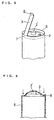
- FIG. 3 and FIG. 4 show how to attach the identification seal 3 of the present invention on a negative electrode terminal 5 of the battery body 1.
- FIG. 3 is a perspective view of a battery comprising an identification seal attached on the negative electrode terminal according to one embodiment of the present invention.
- FIG. 4 is a perspective view of a battery comprising an identification seal attached on the negative electrode terminal according to another embodiment of the present invention.
- a circular identification seal 3 capable of covering the entire surface of the negative electrode terminal 5 may be attached.
- the identification seal 3 may be in the shape of a band as shown in FIG. 3, and it is preferable not to provide the heat sensitive adhesive layer on the portion of the negative electrode terminal 5 in contact with the negative electrode terminal surface 5', but to provide it only on both end portions 3' of the identification seal 3.
- the shapes of the identification seal were exemplified for the positive electrode terminal and the negative electrode terminal, these shapes can be used interchangeably for the positive electrode terminal and the negative electrode terminal in any combinations. Furthermore, the identification seal of the present invention can be suitably modified according to the shape of battery and not limited to these forms.
- the identification seal in the present invention is formed integrally with a sheathing material covering the battery.
- FIG. 5 shows a diagram showing how to provide a battery with an identification seal formed integrally with a sheathing material in accordance with the present invention.
- the identification seal 3 is formed integrally with a sheathing material 6 and a perforation 7 is provided on the boundary portion thereof.
- a heat sensitive adhesive layer is provided on the surface of the identification seal 3 facing the positive electrode terminal 2 and a margin without the heat sensitive adhesive applied thereon is provided on the end portion 8 so as to facilitate the removal of the identification seal 3.
- the heat sensitive adhesive layer is not provided on the portion of the positive electrode terminal 2 in contact with the positive electrode terminal surface 2'.
- FIG. 6 shows a partial schematic cross-sectional view of a battery having an identification seal formed integrally with a sheathing material in accordance with the present invention.
- the end portion 8 is not attached by adhesion, pulling this allows the identification seal 3 to be readily stripped. Also, since the heat sensitive adhesive layer is not provided on the positive electrode terminal surface 2', the identification seal 3 can be easily removed.
Landscapes
- Chemical & Material Sciences (AREA)
- Chemical Kinetics & Catalysis (AREA)
- Electrochemistry (AREA)
- General Chemical & Material Sciences (AREA)
- Connection Of Batteries Or Terminals (AREA)
- Primary Cells (AREA)
- Sealing Battery Cases Or Jackets (AREA)
Abstract
Description
Claims (4)
- A battery comprising an old-or-new identification seal made of an insulating base material having a heat sensitive adhesive layer, said seal being attached on at least one of a positive electrode terminal and a negative electrode terminal via said adhesive layer.
- The battery in accordance with claim 1, wherein said insulating base material is made of a heat-shrinkable resin film.
- The battery in accordance with claim 1, wherein said old-or-new identification seal has an adhesive-free layer on a portion thereof in contact with said positive electrode terminal surface and/or said negative electrode terminal surface.
- The battery in accordance with claim 1, wherein said battery is covered with a heat-shrinkable sheathing material, and said old-or-new identification seal is formed integrally with said sheathing material.
Applications Claiming Priority (3)
| Application Number | Priority Date | Filing Date | Title |
|---|---|---|---|
| JP33251199 | 1999-11-24 | ||
| JP33251199 | 1999-11-24 | ||
| PCT/JP2000/007148 WO2001039299A1 (en) | 1999-11-24 | 2000-10-13 | Battery |
Publications (3)
| Publication Number | Publication Date |
|---|---|
| EP1154499A1 true EP1154499A1 (en) | 2001-11-14 |
| EP1154499A4 EP1154499A4 (en) | 2005-04-13 |
| EP1154499B1 EP1154499B1 (en) | 2008-05-07 |
Family
ID=18255759
Family Applications (1)
| Application Number | Title | Priority Date | Filing Date |
|---|---|---|---|
| EP00966496A Expired - Lifetime EP1154499B1 (en) | 1999-11-24 | 2000-10-13 | Battery |
Country Status (9)
| Country | Link |
|---|---|
| US (1) | US6645662B1 (en) |
| EP (1) | EP1154499B1 (en) |
| KR (1) | KR100419193B1 (en) |
| CN (1) | CN1200469C (en) |
| AT (1) | ATE394803T1 (en) |
| DE (1) | DE60038789D1 (en) |
| HK (1) | HK1043666B (en) |
| ID (1) | ID30155A (en) |
| WO (1) | WO2001039299A1 (en) |
Cited By (1)
| Publication number | Priority date | Publication date | Assignee | Title |
|---|---|---|---|---|
| EP2328207A4 (en) * | 2008-08-20 | 2012-09-05 | Toyota Motor Co Ltd | BATTERY |
Families Citing this family (4)
| Publication number | Priority date | Publication date | Assignee | Title |
|---|---|---|---|---|
| BR0304878A (en) * | 2002-05-22 | 2004-08-03 | Honda Giken Kogyo Kabashiki Ka | Label, a method of use thereof and a method and apparatus for affixing the label |
| WO2005063184A1 (en) * | 2003-12-22 | 2005-07-14 | Imrex, Inc. | Methods and compositions for oral hygiene |
| KR100601562B1 (en) | 2004-07-29 | 2006-07-19 | 삼성에스디아이 주식회사 | Electrode Assembly and Lithium Secondary Battery Using the Same |
| US20190267639A1 (en) * | 2018-02-28 | 2019-08-29 | Mingrong Zhao | Battery Cells With Removable Elements |
Family Cites Families (20)
| Publication number | Priority date | Publication date | Assignee | Title |
|---|---|---|---|---|
| JPS459926Y1 (en) * | 1967-07-07 | 1970-05-08 | ||
| JPS508179Y1 (en) * | 1968-12-13 | 1975-03-11 | ||
| JPS5019624Y1 (en) * | 1969-04-02 | 1975-06-14 | ||
| DE1939474A1 (en) * | 1969-04-08 | 1970-10-29 | Union Carbide Corp | Galvanic dry cell |
| US3655456A (en) * | 1970-06-15 | 1972-04-11 | Esb Inc | Dry cell battery |
| JPS4916832Y1 (en) * | 1970-12-15 | 1974-04-30 | ||
| JPS5526668B2 (en) | 1972-06-10 | 1980-07-15 | ||
| IT986935B (en) | 1973-04-18 | 1975-01-30 | Scm Soc Costruzione Macchine S | DEVICE FOR THE 90 DEGREE ROTATION OF WOODEN PANELS OR OTHER MATERIALS TO BE INSERTED ON TRANSFER LINES FOR THE PROCESSING OF THE SAME |
| DE2324254A1 (en) * | 1973-05-14 | 1974-11-28 | Varta Batterie | GALVANIC PRIMARY CELL |
| JPS5019624A (en) | 1973-06-22 | 1975-03-01 | ||
| JPS5272029A (en) | 1975-10-31 | 1977-06-16 | Mitsubishi Motors Corp | Air inlet apparatus for multicylinder internal combustion engine |
| JPS5336024U (en) * | 1976-09-02 | 1978-03-30 | ||
| DE2641767B2 (en) | 1976-09-14 | 1979-05-31 | Mannesmann Ag, 4000 Duesseldorf | Threaded connection for oil field pipes |
| JPS5448934A (en) | 1977-06-15 | 1979-04-17 | Velitas Kk | Rectifying type wave eliminating* water surface pollution preventing and heavy metal collecting method and their devices |
| JPS58169768A (en) | 1982-03-19 | 1983-10-06 | Toshiba Battery Co Ltd | Manufacturing method of sealing tape for dry cell |
| JPS62168564A (en) | 1986-01-21 | 1987-07-24 | Shinagawa Refract Co Ltd | Refractory laser flame-spraying apparatus |
| JPS62168564U (en) * | 1986-04-16 | 1987-10-26 | ||
| US5735404A (en) * | 1995-05-11 | 1998-04-07 | Matsushita Electric Industrial Co., Ltd. | Merchandise package and method of manufacturing the same |
| US5725966A (en) * | 1996-01-25 | 1998-03-10 | Matsushita Electric Industrial Co., Ltd. | Heat sensitive jacket label for battery and battery with the same |
| JPH09231954A (en) * | 1996-02-26 | 1997-09-05 | Taro Arimoto | Battery film packaging |
-
2000
- 2000-10-13 AT AT00966496T patent/ATE394803T1/en not_active IP Right Cessation
- 2000-10-13 CN CNB008029482A patent/CN1200469C/en not_active Expired - Fee Related
- 2000-10-13 HK HK02103666.5A patent/HK1043666B/en not_active IP Right Cessation
- 2000-10-13 EP EP00966496A patent/EP1154499B1/en not_active Expired - Lifetime
- 2000-10-13 ID IDW00200101836A patent/ID30155A/en unknown
- 2000-10-13 US US09/889,887 patent/US6645662B1/en not_active Expired - Fee Related
- 2000-10-13 KR KR10-2001-7007948A patent/KR100419193B1/en not_active Expired - Fee Related
- 2000-10-13 DE DE60038789T patent/DE60038789D1/en not_active Expired - Lifetime
- 2000-10-13 WO PCT/JP2000/007148 patent/WO2001039299A1/en not_active Ceased
Cited By (1)
| Publication number | Priority date | Publication date | Assignee | Title |
|---|---|---|---|---|
| EP2328207A4 (en) * | 2008-08-20 | 2012-09-05 | Toyota Motor Co Ltd | BATTERY |
Also Published As
| Publication number | Publication date |
|---|---|
| US6645662B1 (en) | 2003-11-11 |
| HK1043666A1 (en) | 2002-09-20 |
| CN1337071A (en) | 2002-02-20 |
| WO2001039299A1 (en) | 2001-05-31 |
| ID30155A (en) | 2001-11-08 |
| EP1154499A4 (en) | 2005-04-13 |
| ATE394803T1 (en) | 2008-05-15 |
| EP1154499B1 (en) | 2008-05-07 |
| HK1043666B (en) | 2008-07-18 |
| KR100419193B1 (en) | 2004-02-21 |
| DE60038789D1 (en) | 2008-06-19 |
| KR20010099891A (en) | 2001-11-09 |
| CN1200469C (en) | 2005-05-04 |
Similar Documents
| Publication | Publication Date | Title |
|---|---|---|
| CA2153977C (en) | Battery cell jacket | |
| US3655456A (en) | Dry cell battery | |
| US6645662B1 (en) | Battery provided with an old-or-new identification seal having a heat sensitive adhesive layer | |
| JP6666237B2 (en) | Adhesive sheet for fixing wire harness and method of fixing wire harness | |
| JP3830232B2 (en) | Seal | |
| JP4633394B2 (en) | How to apply double-sided adhesive tape with pull tab for peeling | |
| JP3853144B2 (en) | battery | |
| JP2019046797A (en) | Electrode assembly for secondary battery and manufacturing method thereof | |
| CN112703629B (en) | Multilayer packaging structure for thin film battery and method for manufacturing such structure | |
| JPH0147855B2 (en) | ||
| CN108165193A (en) | Protective film | |
| JP2004259514A (en) | Battery with seal | |
| JP2000098903A (en) | Display label body | |
| CN219586039U (en) | Back glue structure convenient for release film stripping | |
| CN215794663U (en) | Pad pasting material area structure | |
| CN214168583U (en) | Be applied to battery packaging's insulating adhesive tape | |
| JP3162287B2 (en) | Eraser packaging structure and eraser | |
| JP3719836B2 (en) | Dry cell and manufacturing method thereof | |
| JP5720177B2 (en) | Manufacturing method of cover tape | |
| JP2654411B2 (en) | Attaching a cover sheet for slide-operated electrical components | |
| JPH10242345A (en) | Electric circuit sealing structure | |
| JP3049580B2 (en) | Conductive washer | |
| WO2025241502A1 (en) | Top patch assembly and battery | |
| JPH02220350A (en) | Outer label for dry cell | |
| JP4780934B2 (en) | Pressure sensitive adhesive tape |
Legal Events
| Date | Code | Title | Description |
|---|---|---|---|
| PUAI | Public reference made under article 153(3) epc to a published international application that has entered the european phase |
Free format text: ORIGINAL CODE: 0009012 |
|
| 17P | Request for examination filed |
Effective date: 20010607 |
|
| AK | Designated contracting states |
Kind code of ref document: A1 Designated state(s): AT BE CH CY DE DK ES FI FR GB GR IE IT LI LU MC NL PT SE |
|
| AX | Request for extension of the european patent |
Free format text: AL;LT;LV;MK;RO;SI |
|
| A4 | Supplementary search report drawn up and despatched |
Effective date: 20050301 |
|
| GRAP | Despatch of communication of intention to grant a patent |
Free format text: ORIGINAL CODE: EPIDOSNIGR1 |
|
| GRAS | Grant fee paid |
Free format text: ORIGINAL CODE: EPIDOSNIGR3 |
|
| GRAA | (expected) grant |
Free format text: ORIGINAL CODE: 0009210 |
|
| AK | Designated contracting states |
Kind code of ref document: B1 Designated state(s): AT BE CH CY DE DK ES FI FR GB GR IE IT LI LU MC NL PT SE |
|
| REG | Reference to a national code |
Ref country code: GB Ref legal event code: FG4D |
|
| REG | Reference to a national code |
Ref country code: CH Ref legal event code: EP |
|
| REG | Reference to a national code |
Ref country code: IE Ref legal event code: FG4D Free format text: LANGUAGE OF EP DOCUMENT: FRENCH |
|
| REF | Corresponds to: |
Ref document number: 60038789 Country of ref document: DE Date of ref document: 20080619 Kind code of ref document: P |
|
| REG | Reference to a national code |
Ref country code: HK Ref legal event code: GR Ref document number: 1043666 Country of ref document: HK |
|
| PG25 | Lapsed in a contracting state [announced via postgrant information from national office to epo] |
Ref country code: ES Free format text: LAPSE BECAUSE OF FAILURE TO SUBMIT A TRANSLATION OF THE DESCRIPTION OR TO PAY THE FEE WITHIN THE PRESCRIBED TIME-LIMIT Effective date: 20080818 Ref country code: NL Free format text: LAPSE BECAUSE OF FAILURE TO SUBMIT A TRANSLATION OF THE DESCRIPTION OR TO PAY THE FEE WITHIN THE PRESCRIBED TIME-LIMIT Effective date: 20080507 Ref country code: FI Free format text: LAPSE BECAUSE OF FAILURE TO SUBMIT A TRANSLATION OF THE DESCRIPTION OR TO PAY THE FEE WITHIN THE PRESCRIBED TIME-LIMIT Effective date: 20080507 |
|
| NLV1 | Nl: lapsed or annulled due to failure to fulfill the requirements of art. 29p and 29m of the patents act | ||
| RAP2 | Party data changed (patent owner data changed or rights of a patent transferred) |
Owner name: PANASONIC CORPORATION |
|
| PG25 | Lapsed in a contracting state [announced via postgrant information from national office to epo] |
Ref country code: AT Free format text: LAPSE BECAUSE OF FAILURE TO SUBMIT A TRANSLATION OF THE DESCRIPTION OR TO PAY THE FEE WITHIN THE PRESCRIBED TIME-LIMIT Effective date: 20080507 |
|
| REG | Reference to a national code |
Ref country code: CH Ref legal event code: PFA Owner name: PANASONIC CORPORATION Free format text: MATSUSHITA ELECTRIC INDUSTRIAL CO., LTD#1006, OAZA-KADOMA#KADOMA-SHI, OSAKA 571-8501 (JP) -TRANSFER TO- PANASONIC CORPORATION#1006, OAZA KADOMA, KADOMA-SHI#OSAKA 571-8501 (JP) |
|
| PG25 | Lapsed in a contracting state [announced via postgrant information from national office to epo] |
Ref country code: DK Free format text: LAPSE BECAUSE OF FAILURE TO SUBMIT A TRANSLATION OF THE DESCRIPTION OR TO PAY THE FEE WITHIN THE PRESCRIBED TIME-LIMIT Effective date: 20080507 Ref country code: SE Free format text: LAPSE BECAUSE OF FAILURE TO SUBMIT A TRANSLATION OF THE DESCRIPTION OR TO PAY THE FEE WITHIN THE PRESCRIBED TIME-LIMIT Effective date: 20080807 Ref country code: PT Free format text: LAPSE BECAUSE OF FAILURE TO SUBMIT A TRANSLATION OF THE DESCRIPTION OR TO PAY THE FEE WITHIN THE PRESCRIBED TIME-LIMIT Effective date: 20081007 |
|
| PLBE | No opposition filed within time limit |
Free format text: ORIGINAL CODE: 0009261 |
|
| STAA | Information on the status of an ep patent application or granted ep patent |
Free format text: STATUS: NO OPPOSITION FILED WITHIN TIME LIMIT |
|
| PGFP | Annual fee paid to national office [announced via postgrant information from national office to epo] |
Ref country code: BE Payment date: 20081024 Year of fee payment: 9 Ref country code: IT Payment date: 20081028 Year of fee payment: 9 |
|
| 26N | No opposition filed |
Effective date: 20090210 |
|
| PG25 | Lapsed in a contracting state [announced via postgrant information from national office to epo] |
Ref country code: MC Free format text: LAPSE BECAUSE OF NON-PAYMENT OF DUE FEES Effective date: 20081031 |
|
| REG | Reference to a national code |
Ref country code: CH Ref legal event code: PL |
|
| REG | Reference to a national code |
Ref country code: IE Ref legal event code: MM4A |
|
| PG25 | Lapsed in a contracting state [announced via postgrant information from national office to epo] |
Ref country code: CH Free format text: LAPSE BECAUSE OF NON-PAYMENT OF DUE FEES Effective date: 20081031 Ref country code: IE Free format text: LAPSE BECAUSE OF NON-PAYMENT OF DUE FEES Effective date: 20081013 Ref country code: LI Free format text: LAPSE BECAUSE OF NON-PAYMENT OF DUE FEES Effective date: 20081031 |
|
| BERE | Be: lapsed |
Owner name: MATSUSHITA ELECTRIC INDUSTRIAL CO., LTD Effective date: 20091031 |
|
| PG25 | Lapsed in a contracting state [announced via postgrant information from national office to epo] |
Ref country code: LU Free format text: LAPSE BECAUSE OF NON-PAYMENT OF DUE FEES Effective date: 20081013 Ref country code: CY Free format text: LAPSE BECAUSE OF FAILURE TO SUBMIT A TRANSLATION OF THE DESCRIPTION OR TO PAY THE FEE WITHIN THE PRESCRIBED TIME-LIMIT Effective date: 20080507 |
|
| PG25 | Lapsed in a contracting state [announced via postgrant information from national office to epo] |
Ref country code: BE Free format text: LAPSE BECAUSE OF NON-PAYMENT OF DUE FEES Effective date: 20091031 Ref country code: GR Free format text: LAPSE BECAUSE OF FAILURE TO SUBMIT A TRANSLATION OF THE DESCRIPTION OR TO PAY THE FEE WITHIN THE PRESCRIBED TIME-LIMIT Effective date: 20080808 |
|
| PGFP | Annual fee paid to national office [announced via postgrant information from national office to epo] |
Ref country code: FR Payment date: 20101020 Year of fee payment: 11 |
|
| PGFP | Annual fee paid to national office [announced via postgrant information from national office to epo] |
Ref country code: DE Payment date: 20101006 Year of fee payment: 11 |
|
| PG25 | Lapsed in a contracting state [announced via postgrant information from national office to epo] |
Ref country code: IT Free format text: LAPSE BECAUSE OF NON-PAYMENT OF DUE FEES Effective date: 20091013 |
|
| PGFP | Annual fee paid to national office [announced via postgrant information from national office to epo] |
Ref country code: GB Payment date: 20101013 Year of fee payment: 11 |
|
| GBPC | Gb: european patent ceased through non-payment of renewal fee |
Effective date: 20111013 |
|
| REG | Reference to a national code |
Ref country code: FR Ref legal event code: ST Effective date: 20120629 |
|
| PG25 | Lapsed in a contracting state [announced via postgrant information from national office to epo] |
Ref country code: DE Free format text: LAPSE BECAUSE OF NON-PAYMENT OF DUE FEES Effective date: 20120501 |
|
| REG | Reference to a national code |
Ref country code: DE Ref legal event code: R119 Ref document number: 60038789 Country of ref document: DE Effective date: 20120501 |
|
| PG25 | Lapsed in a contracting state [announced via postgrant information from national office to epo] |
Ref country code: GB Free format text: LAPSE BECAUSE OF NON-PAYMENT OF DUE FEES Effective date: 20111013 Ref country code: FR Free format text: LAPSE BECAUSE OF NON-PAYMENT OF DUE FEES Effective date: 20111102 |