EP1154017A1 - Modified thermostable dna polymerase from pyrococcus kodakarensis - Google Patents
Modified thermostable dna polymerase from pyrococcus kodakarensis Download PDFInfo
- Publication number
- EP1154017A1 EP1154017A1 EP01111032A EP01111032A EP1154017A1 EP 1154017 A1 EP1154017 A1 EP 1154017A1 EP 01111032 A EP01111032 A EP 01111032A EP 01111032 A EP01111032 A EP 01111032A EP 1154017 A1 EP1154017 A1 EP 1154017A1
- Authority
- EP
- European Patent Office
- Prior art keywords
- dna polymerase
- amino acid
- histidine
- thermostable dna
- dna
- Prior art date
- Legal status (The legal status is an assumption and is not a legal conclusion. Google has not performed a legal analysis and makes no representation as to the accuracy of the status listed.)
- Granted
Links
- 108010014303 DNA-directed DNA polymerase Proteins 0.000 title claims abstract description 298
- 102000016928 DNA-directed DNA polymerase Human genes 0.000 title claims abstract description 289
- 241000205160 Pyrococcus Species 0.000 title 1
- 150000001413 amino acids Chemical class 0.000 claims abstract description 116
- 230000000694 effects Effects 0.000 claims abstract description 110
- HNDVDQJCIGZPNO-UHFFFAOYSA-N histidine Natural products OC(=O)C(N)CC1=CN=CN1 HNDVDQJCIGZPNO-UHFFFAOYSA-N 0.000 claims abstract description 84
- 235000001014 amino acid Nutrition 0.000 claims abstract description 74
- 108060002716 Exonuclease Proteins 0.000 claims abstract description 60
- 102000013165 exonuclease Human genes 0.000 claims abstract description 60
- 238000000034 method Methods 0.000 claims abstract description 60
- WHUUTDBJXJRKMK-UHFFFAOYSA-N Glutamic acid Natural products OC(=O)C(N)CCC(O)=O WHUUTDBJXJRKMK-UHFFFAOYSA-N 0.000 claims abstract description 51
- 235000013922 glutamic acid Nutrition 0.000 claims abstract description 51
- 239000004220 glutamic acid Substances 0.000 claims abstract description 51
- CKLJMWTZIZZHCS-REOHCLBHSA-N L-aspartic acid Chemical compound OC(=O)[C@@H](N)CC(O)=O CKLJMWTZIZZHCS-REOHCLBHSA-N 0.000 claims abstract description 42
- 235000003704 aspartic acid Nutrition 0.000 claims abstract description 42
- OQFSQFPPLPISGP-UHFFFAOYSA-N beta-carboxyaspartic acid Natural products OC(=O)C(N)C(C(O)=O)C(O)=O OQFSQFPPLPISGP-UHFFFAOYSA-N 0.000 claims abstract description 42
- 101710193865 Exodeoxyribonuclease 1 Proteins 0.000 claims abstract description 18
- 230000008569 process Effects 0.000 claims abstract description 8
- 108090000765 processed proteins & peptides Proteins 0.000 claims abstract description 8
- 108020004414 DNA Proteins 0.000 claims description 110
- 239000013615 primer Substances 0.000 claims description 96
- HNDVDQJCIGZPNO-YFKPBYRVSA-N L-histidine Chemical compound OC(=O)[C@@H](N)CC1=CN=CN1 HNDVDQJCIGZPNO-YFKPBYRVSA-N 0.000 claims description 72
- 229940024606 amino acid Drugs 0.000 claims description 71
- 108090000623 proteins and genes Proteins 0.000 claims description 46
- 108020004707 nucleic acids Proteins 0.000 claims description 32
- 102000039446 nucleic acids Human genes 0.000 claims description 32
- 150000007523 nucleic acids Chemical class 0.000 claims description 32
- FWMNVWWHGCHHJJ-SKKKGAJSSA-N 4-amino-1-[(2r)-6-amino-2-[[(2r)-2-[[(2r)-2-[[(2r)-2-amino-3-phenylpropanoyl]amino]-3-phenylpropanoyl]amino]-4-methylpentanoyl]amino]hexanoyl]piperidine-4-carboxylic acid Chemical compound C([C@H](C(=O)N[C@H](CC(C)C)C(=O)N[C@H](CCCCN)C(=O)N1CCC(N)(CC1)C(O)=O)NC(=O)[C@H](N)CC=1C=CC=CC=1)C1=CC=CC=C1 FWMNVWWHGCHHJJ-SKKKGAJSSA-N 0.000 claims description 29
- 239000003153 chemical reaction reagent Substances 0.000 claims description 25
- OUYCCCASQSFEME-QMMMGPOBSA-N L-tyrosine Chemical compound OC(=O)[C@@H](N)CC1=CC=C(O)C=C1 OUYCCCASQSFEME-QMMMGPOBSA-N 0.000 claims description 22
- 150000002500 ions Chemical class 0.000 claims description 22
- 235000002374 tyrosine Nutrition 0.000 claims description 22
- OUYCCCASQSFEME-UHFFFAOYSA-N tyrosine Natural products OC(=O)C(N)CC1=CC=C(O)C=C1 OUYCCCASQSFEME-UHFFFAOYSA-N 0.000 claims description 22
- 108091003079 Bovine Serum Albumin Proteins 0.000 claims description 21
- 229940098773 bovine serum albumin Drugs 0.000 claims description 21
- 241000588724 Escherichia coli Species 0.000 claims description 17
- KDXKERNSBIXSRK-UHFFFAOYSA-N Lysine Natural products NCCCCC(N)C(O)=O KDXKERNSBIXSRK-UHFFFAOYSA-N 0.000 claims description 17
- 239000004472 Lysine Substances 0.000 claims description 17
- 230000000295 complement effect Effects 0.000 claims description 17
- 235000018977 lysine Nutrition 0.000 claims description 17
- 239000000203 mixture Substances 0.000 claims description 16
- 239000007853 buffer solution Substances 0.000 claims description 15
- 238000002703 mutagenesis Methods 0.000 claims description 15
- 231100000350 mutagenesis Toxicity 0.000 claims description 15
- QNAYBMKLOCPYGJ-REOHCLBHSA-N L-alanine Chemical compound C[C@H](N)C(O)=O QNAYBMKLOCPYGJ-REOHCLBHSA-N 0.000 claims description 14
- AGPKZVBTJJNPAG-WHFBIAKZSA-N L-isoleucine Chemical compound CC[C@H](C)[C@H](N)C(O)=O AGPKZVBTJJNPAG-WHFBIAKZSA-N 0.000 claims description 14
- 235000004279 alanine Nutrition 0.000 claims description 14
- AGPKZVBTJJNPAG-UHFFFAOYSA-N isoleucine Natural products CCC(C)C(N)C(O)=O AGPKZVBTJJNPAG-UHFFFAOYSA-N 0.000 claims description 14
- 229960000310 isoleucine Drugs 0.000 claims description 14
- 239000004475 Arginine Substances 0.000 claims description 13
- ODKSFYDXXFIFQN-UHFFFAOYSA-N arginine Natural products OC(=O)C(N)CCCNC(N)=N ODKSFYDXXFIFQN-UHFFFAOYSA-N 0.000 claims description 13
- 235000009697 arginine Nutrition 0.000 claims description 13
- 238000010438 heat treatment Methods 0.000 claims description 13
- WHUUTDBJXJRKMK-VKHMYHEASA-N L-glutamic acid Chemical compound OC(=O)[C@@H](N)CCC(O)=O WHUUTDBJXJRKMK-VKHMYHEASA-N 0.000 claims description 12
- ROHFNLRQFUQHCH-YFKPBYRVSA-N L-leucine Chemical compound CC(C)C[C@H](N)C(O)=O ROHFNLRQFUQHCH-YFKPBYRVSA-N 0.000 claims description 10
- ROHFNLRQFUQHCH-UHFFFAOYSA-N Leucine Natural products CC(C)CC(N)C(O)=O ROHFNLRQFUQHCH-UHFFFAOYSA-N 0.000 claims description 10
- AYFVYJQAPQTCCC-UHFFFAOYSA-N Threonine Natural products CC(O)C(N)C(O)=O AYFVYJQAPQTCCC-UHFFFAOYSA-N 0.000 claims description 10
- 239000004473 Threonine Substances 0.000 claims description 10
- 239000013604 expression vector Substances 0.000 claims description 8
- JLVVSXFLKOJNIY-UHFFFAOYSA-N Magnesium ion Chemical compound [Mg+2] JLVVSXFLKOJNIY-UHFFFAOYSA-N 0.000 claims description 7
- 229910001425 magnesium ion Inorganic materials 0.000 claims description 7
- 229910001414 potassium ion Inorganic materials 0.000 claims description 7
- 239000013598 vector Substances 0.000 claims description 7
- ODKSFYDXXFIFQN-BYPYZUCNSA-P L-argininium(2+) Chemical compound NC(=[NH2+])NCCC[C@H]([NH3+])C(O)=O ODKSFYDXXFIFQN-BYPYZUCNSA-P 0.000 claims description 6
- KDXKERNSBIXSRK-YFKPBYRVSA-N L-lysine Chemical compound NCCCC[C@H](N)C(O)=O KDXKERNSBIXSRK-YFKPBYRVSA-N 0.000 claims description 6
- 108020004511 Recombinant DNA Proteins 0.000 claims description 6
- 239000002736 nonionic surfactant Substances 0.000 claims description 6
- QGZKDVFQNNGYKY-UHFFFAOYSA-O Ammonium Chemical compound [NH4+] QGZKDVFQNNGYKY-UHFFFAOYSA-O 0.000 claims description 5
- 108020001019 DNA Primers Proteins 0.000 claims description 5
- 239000003155 DNA primer Substances 0.000 claims description 5
- NPYPAHLBTDXSSS-UHFFFAOYSA-N Potassium ion Chemical compound [K+] NPYPAHLBTDXSSS-UHFFFAOYSA-N 0.000 claims description 5
- 238000001816 cooling Methods 0.000 claims description 5
- 108091034117 Oligonucleotide Proteins 0.000 claims description 4
- JLCPHMBAVCMARE-UHFFFAOYSA-N [3-[[3-[[3-[[3-[[3-[[3-[[3-[[3-[[3-[[3-[[3-[[5-(2-amino-6-oxo-1H-purin-9-yl)-3-[[3-[[3-[[3-[[3-[[3-[[5-(2-amino-6-oxo-1H-purin-9-yl)-3-[[5-(2-amino-6-oxo-1H-purin-9-yl)-3-hydroxyoxolan-2-yl]methoxy-hydroxyphosphoryl]oxyoxolan-2-yl]methoxy-hydroxyphosphoryl]oxy-5-(5-methyl-2,4-dioxopyrimidin-1-yl)oxolan-2-yl]methoxy-hydroxyphosphoryl]oxy-5-(6-aminopurin-9-yl)oxolan-2-yl]methoxy-hydroxyphosphoryl]oxy-5-(6-aminopurin-9-yl)oxolan-2-yl]methoxy-hydroxyphosphoryl]oxy-5-(6-aminopurin-9-yl)oxolan-2-yl]methoxy-hydroxyphosphoryl]oxy-5-(6-aminopurin-9-yl)oxolan-2-yl]methoxy-hydroxyphosphoryl]oxyoxolan-2-yl]methoxy-hydroxyphosphoryl]oxy-5-(5-methyl-2,4-dioxopyrimidin-1-yl)oxolan-2-yl]methoxy-hydroxyphosphoryl]oxy-5-(4-amino-2-oxopyrimidin-1-yl)oxolan-2-yl]methoxy-hydroxyphosphoryl]oxy-5-(5-methyl-2,4-dioxopyrimidin-1-yl)oxolan-2-yl]methoxy-hydroxyphosphoryl]oxy-5-(5-methyl-2,4-dioxopyrimidin-1-yl)oxolan-2-yl]methoxy-hydroxyphosphoryl]oxy-5-(6-aminopurin-9-yl)oxolan-2-yl]methoxy-hydroxyphosphoryl]oxy-5-(6-aminopurin-9-yl)oxolan-2-yl]methoxy-hydroxyphosphoryl]oxy-5-(4-amino-2-oxopyrimidin-1-yl)oxolan-2-yl]methoxy-hydroxyphosphoryl]oxy-5-(4-amino-2-oxopyrimidin-1-yl)oxolan-2-yl]methoxy-hydroxyphosphoryl]oxy-5-(4-amino-2-oxopyrimidin-1-yl)oxolan-2-yl]methoxy-hydroxyphosphoryl]oxy-5-(6-aminopurin-9-yl)oxolan-2-yl]methoxy-hydroxyphosphoryl]oxy-5-(4-amino-2-oxopyrimidin-1-yl)oxolan-2-yl]methyl [5-(6-aminopurin-9-yl)-2-(hydroxymethyl)oxolan-3-yl] hydrogen phosphate Polymers Cc1cn(C2CC(OP(O)(=O)OCC3OC(CC3OP(O)(=O)OCC3OC(CC3O)n3cnc4c3nc(N)[nH]c4=O)n3cnc4c3nc(N)[nH]c4=O)C(COP(O)(=O)OC3CC(OC3COP(O)(=O)OC3CC(OC3COP(O)(=O)OC3CC(OC3COP(O)(=O)OC3CC(OC3COP(O)(=O)OC3CC(OC3COP(O)(=O)OC3CC(OC3COP(O)(=O)OC3CC(OC3COP(O)(=O)OC3CC(OC3COP(O)(=O)OC3CC(OC3COP(O)(=O)OC3CC(OC3COP(O)(=O)OC3CC(OC3COP(O)(=O)OC3CC(OC3COP(O)(=O)OC3CC(OC3COP(O)(=O)OC3CC(OC3COP(O)(=O)OC3CC(OC3COP(O)(=O)OC3CC(OC3COP(O)(=O)OC3CC(OC3CO)n3cnc4c(N)ncnc34)n3ccc(N)nc3=O)n3cnc4c(N)ncnc34)n3ccc(N)nc3=O)n3ccc(N)nc3=O)n3ccc(N)nc3=O)n3cnc4c(N)ncnc34)n3cnc4c(N)ncnc34)n3cc(C)c(=O)[nH]c3=O)n3cc(C)c(=O)[nH]c3=O)n3ccc(N)nc3=O)n3cc(C)c(=O)[nH]c3=O)n3cnc4c3nc(N)[nH]c4=O)n3cnc4c(N)ncnc34)n3cnc4c(N)ncnc34)n3cnc4c(N)ncnc34)n3cnc4c(N)ncnc34)O2)c(=O)[nH]c1=O JLCPHMBAVCMARE-UHFFFAOYSA-N 0.000 claims description 3
- 230000001131 transforming effect Effects 0.000 claims description 3
- 238000012258 culturing Methods 0.000 claims description 2
- 238000003752 polymerase chain reaction Methods 0.000 abstract description 43
- 230000003321 amplification Effects 0.000 abstract description 24
- 238000003199 nucleic acid amplification method Methods 0.000 abstract description 24
- 238000004519 manufacturing process Methods 0.000 abstract description 4
- 239000000243 solution Substances 0.000 description 45
- 238000006243 chemical reaction Methods 0.000 description 39
- 239000013612 plasmid Substances 0.000 description 36
- 102000004190 Enzymes Human genes 0.000 description 29
- 108090000790 Enzymes Proteins 0.000 description 29
- 229940088598 enzyme Drugs 0.000 description 29
- WCUXLLCKKVVCTQ-UHFFFAOYSA-M Potassium chloride Chemical compound [Cl-].[K+] WCUXLLCKKVVCTQ-UHFFFAOYSA-M 0.000 description 16
- 238000000746 purification Methods 0.000 description 16
- UCSJYZPVAKXKNQ-HZYVHMACSA-N streptomycin Chemical compound CN[C@H]1[C@H](O)[C@@H](O)[C@H](CO)O[C@H]1O[C@@H]1[C@](C=O)(O)[C@H](C)O[C@H]1O[C@@H]1[C@@H](NC(N)=N)[C@H](O)[C@@H](NC(N)=N)[C@H](O)[C@H]1O UCSJYZPVAKXKNQ-HZYVHMACSA-N 0.000 description 16
- 238000012408 PCR amplification Methods 0.000 description 15
- QKNYBSVHEMOAJP-UHFFFAOYSA-N 2-amino-2-(hydroxymethyl)propane-1,3-diol;hydron;chloride Chemical compound Cl.OCC(N)(CO)CO QKNYBSVHEMOAJP-UHFFFAOYSA-N 0.000 description 14
- TWRXJAOTZQYOKJ-UHFFFAOYSA-L Magnesium chloride Chemical compound [Mg+2].[Cl-].[Cl-] TWRXJAOTZQYOKJ-UHFFFAOYSA-L 0.000 description 14
- 239000002773 nucleotide Substances 0.000 description 13
- 125000003729 nucleotide group Chemical group 0.000 description 13
- 239000000047 product Substances 0.000 description 13
- 239000012634 fragment Substances 0.000 description 12
- 239000011324 bead Substances 0.000 description 11
- XLYOFNOQVPJJNP-UHFFFAOYSA-N water Substances O XLYOFNOQVPJJNP-UHFFFAOYSA-N 0.000 description 11
- CSNNHWWHGAXBCP-UHFFFAOYSA-L Magnesium sulfate Chemical compound [Mg+2].[O-][S+2]([O-])([O-])[O-] CSNNHWWHGAXBCP-UHFFFAOYSA-L 0.000 description 10
- AVKUERGKIZMTKX-NJBDSQKTSA-N ampicillin Chemical compound C1([C@@H](N)C(=O)N[C@H]2[C@H]3SC([C@@H](N3C2=O)C(O)=O)(C)C)=CC=CC=C1 AVKUERGKIZMTKX-NJBDSQKTSA-N 0.000 description 10
- 229960000723 ampicillin Drugs 0.000 description 10
- 239000002609 medium Substances 0.000 description 10
- 238000002360 preparation method Methods 0.000 description 10
- LFQSCWFLJHTTHZ-UHFFFAOYSA-N Ethanol Chemical compound CCO LFQSCWFLJHTTHZ-UHFFFAOYSA-N 0.000 description 9
- 239000000872 buffer Substances 0.000 description 9
- 239000000523 sample Substances 0.000 description 9
- 230000035772 mutation Effects 0.000 description 8
- 239000001103 potassium chloride Substances 0.000 description 8
- 235000011164 potassium chloride Nutrition 0.000 description 8
- 229960005322 streptomycin Drugs 0.000 description 8
- 108010006785 Taq Polymerase Proteins 0.000 description 7
- 241001235254 Thermococcus kodakarensis Species 0.000 description 7
- BFNBIHQBYMNNAN-UHFFFAOYSA-N ammonium sulfate Chemical compound N.N.OS(O)(=O)=O BFNBIHQBYMNNAN-UHFFFAOYSA-N 0.000 description 7
- 238000010348 incorporation Methods 0.000 description 7
- 229910001629 magnesium chloride Inorganic materials 0.000 description 7
- 230000036438 mutation frequency Effects 0.000 description 7
- 230000002829 reductive effect Effects 0.000 description 7
- 239000006228 supernatant Substances 0.000 description 7
- 230000004543 DNA replication Effects 0.000 description 6
- 108010002747 Pfu DNA polymerase Proteins 0.000 description 6
- FAPWRFPIFSIZLT-UHFFFAOYSA-M Sodium chloride Chemical compound [Na+].[Cl-] FAPWRFPIFSIZLT-UHFFFAOYSA-M 0.000 description 6
- HEMHJVSKTPXQMS-UHFFFAOYSA-M Sodium hydroxide Chemical compound [OH-].[Na+] HEMHJVSKTPXQMS-UHFFFAOYSA-M 0.000 description 6
- 230000002378 acidificating effect Effects 0.000 description 6
- ZDXPYRJPNDTMRX-UHFFFAOYSA-N glutamine Natural products OC(=O)C(N)CCC(N)=O ZDXPYRJPNDTMRX-UHFFFAOYSA-N 0.000 description 6
- 238000012986 modification Methods 0.000 description 6
- 230000004048 modification Effects 0.000 description 6
- 239000011541 reaction mixture Substances 0.000 description 6
- 108091008146 restriction endonucleases Proteins 0.000 description 6
- DGVVWUTYPXICAM-UHFFFAOYSA-N β‐Mercaptoethanol Chemical compound OCCS DGVVWUTYPXICAM-UHFFFAOYSA-N 0.000 description 6
- KCXVZYZYPLLWCC-UHFFFAOYSA-N EDTA Chemical compound OC(=O)CN(CC(O)=O)CCN(CC(O)=O)CC(O)=O KCXVZYZYPLLWCC-UHFFFAOYSA-N 0.000 description 5
- 241000205156 Pyrococcus furiosus Species 0.000 description 5
- 239000013504 Triton X-100 Substances 0.000 description 5
- 229920004890 Triton X-100 Polymers 0.000 description 5
- 229910052921 ammonium sulfate Inorganic materials 0.000 description 5
- VHJLVAABSRFDPM-QWWZWVQMSA-N dithiothreitol Chemical compound SC[C@@H](O)[C@H](O)CS VHJLVAABSRFDPM-QWWZWVQMSA-N 0.000 description 5
- 229910052943 magnesium sulfate Inorganic materials 0.000 description 5
- 241000894006 Bacteria Species 0.000 description 4
- 102000053602 DNA Human genes 0.000 description 4
- PEDCQBHIVMGVHV-UHFFFAOYSA-N Glycerine Chemical compound OCC(O)CO PEDCQBHIVMGVHV-UHFFFAOYSA-N 0.000 description 4
- 241000205180 Thermococcus litoralis Species 0.000 description 4
- 235000011130 ammonium sulphate Nutrition 0.000 description 4
- 210000004027 cell Anatomy 0.000 description 4
- 238000005516 engineering process Methods 0.000 description 4
- 239000007788 liquid Substances 0.000 description 4
- 238000007885 magnetic separation Methods 0.000 description 4
- 239000003550 marker Substances 0.000 description 4
- 238000005259 measurement Methods 0.000 description 4
- 238000002156 mixing Methods 0.000 description 4
- 230000007935 neutral effect Effects 0.000 description 4
- 108020004418 ribosomal RNA Proteins 0.000 description 4
- 101150098466 rpsL gene Proteins 0.000 description 4
- FQENQNTWSFEDLI-UHFFFAOYSA-J sodium diphosphate Chemical compound [Na+].[Na+].[Na+].[Na+].[O-]P([O-])(=O)OP([O-])([O-])=O FQENQNTWSFEDLI-UHFFFAOYSA-J 0.000 description 4
- 229940048086 sodium pyrophosphate Drugs 0.000 description 4
- 235000019818 tetrasodium diphosphate Nutrition 0.000 description 4
- 239000001577 tetrasodium phosphonato phosphate Substances 0.000 description 4
- YNJBWRMUSHSURL-UHFFFAOYSA-N trichloroacetic acid Chemical compound OC(=O)C(Cl)(Cl)Cl YNJBWRMUSHSURL-UHFFFAOYSA-N 0.000 description 4
- 230000004544 DNA amplification Effects 0.000 description 3
- 239000006142 Luria-Bertani Agar Substances 0.000 description 3
- 239000011543 agarose gel Substances 0.000 description 3
- 238000000246 agarose gel electrophoresis Methods 0.000 description 3
- 238000000137 annealing Methods 0.000 description 3
- 210000004899 c-terminal region Anatomy 0.000 description 3
- 239000011521 glass Substances 0.000 description 3
- 210000005260 human cell Anatomy 0.000 description 3
- 244000005700 microbiome Species 0.000 description 3
- 239000002244 precipitate Substances 0.000 description 3
- 230000001915 proofreading effect Effects 0.000 description 3
- 235000018102 proteins Nutrition 0.000 description 3
- 102000004169 proteins and genes Human genes 0.000 description 3
- 238000012163 sequencing technique Methods 0.000 description 3
- 238000002741 site-directed mutagenesis Methods 0.000 description 3
- 239000011780 sodium chloride Substances 0.000 description 3
- 239000001226 triphosphate Substances 0.000 description 3
- 238000005406 washing Methods 0.000 description 3
- BHNQPLPANNDEGL-UHFFFAOYSA-N 2-(4-octylphenoxy)ethanol Chemical compound CCCCCCCCC1=CC=C(OCCO)C=C1 BHNQPLPANNDEGL-UHFFFAOYSA-N 0.000 description 2
- JKMHFZQWWAIEOD-UHFFFAOYSA-N 2-[4-(2-hydroxyethyl)piperazin-1-yl]ethanesulfonic acid Chemical compound OCC[NH+]1CCN(CCS([O-])(=O)=O)CC1 JKMHFZQWWAIEOD-UHFFFAOYSA-N 0.000 description 2
- 229920001817 Agar Polymers 0.000 description 2
- 241000203069 Archaea Species 0.000 description 2
- 241000972773 Aulopiformes Species 0.000 description 2
- HEDRZPFGACZZDS-UHFFFAOYSA-N Chloroform Chemical compound ClC(Cl)Cl HEDRZPFGACZZDS-UHFFFAOYSA-N 0.000 description 2
- 229920001917 Ficoll Polymers 0.000 description 2
- DHMQDGOQFOQNFH-UHFFFAOYSA-N Glycine Chemical compound NCC(O)=O DHMQDGOQFOQNFH-UHFFFAOYSA-N 0.000 description 2
- 239000006173 Good's buffer Substances 0.000 description 2
- 239000007995 HEPES buffer Substances 0.000 description 2
- 108091092195 Intron Proteins 0.000 description 2
- ISWSIDIOOBJBQZ-UHFFFAOYSA-N Phenol Chemical compound OC1=CC=CC=C1 ISWSIDIOOBJBQZ-UHFFFAOYSA-N 0.000 description 2
- 229920001213 Polysorbate 20 Polymers 0.000 description 2
- 229920002684 Sepharose Polymers 0.000 description 2
- MTCFGRXMJLQNBG-UHFFFAOYSA-N Serine Natural products OCC(N)C(O)=O MTCFGRXMJLQNBG-UHFFFAOYSA-N 0.000 description 2
- 238000002105 Southern blotting Methods 0.000 description 2
- 108010090804 Streptavidin Proteins 0.000 description 2
- 239000007983 Tris buffer Substances 0.000 description 2
- YZCKVEUIGOORGS-NJFSPNSNSA-N Tritium Chemical compound [3H] YZCKVEUIGOORGS-NJFSPNSNSA-N 0.000 description 2
- 238000007792 addition Methods 0.000 description 2
- 239000008272 agar Substances 0.000 description 2
- -1 ammonium ions Chemical class 0.000 description 2
- 241000617156 archaeon Species 0.000 description 2
- 238000000376 autoradiography Methods 0.000 description 2
- UDSAIICHUKSCKT-UHFFFAOYSA-N bromophenol blue Chemical compound C1=C(Br)C(O)=C(Br)C=C1C1(C=2C=C(Br)C(O)=C(Br)C=2)C2=CC=CC=C2S(=O)(=O)O1 UDSAIICHUKSCKT-UHFFFAOYSA-N 0.000 description 2
- 244000309466 calf Species 0.000 description 2
- 229940041514 candida albicans extract Drugs 0.000 description 2
- 239000013592 cell lysate Substances 0.000 description 2
- 238000010367 cloning Methods 0.000 description 2
- RGWHQCVHVJXOKC-SHYZEUOFSA-J dCTP(4-) Chemical compound O=C1N=C(N)C=CN1[C@@H]1O[C@H](COP([O-])(=O)OP([O-])(=O)OP([O-])([O-])=O)[C@@H](O)C1 RGWHQCVHVJXOKC-SHYZEUOFSA-J 0.000 description 2
- NHVNXKFIZYSCEB-XLPZGREQSA-N dTTP Chemical compound O=C1NC(=O)C(C)=CN1[C@@H]1O[C@H](COP(O)(=O)OP(O)(=O)OP(O)(O)=O)[C@@H](O)C1 NHVNXKFIZYSCEB-XLPZGREQSA-N 0.000 description 2
- 238000012217 deletion Methods 0.000 description 2
- 230000037430 deletion Effects 0.000 description 2
- 238000004925 denaturation Methods 0.000 description 2
- 230000036425 denaturation Effects 0.000 description 2
- 239000005549 deoxyribonucleoside Substances 0.000 description 2
- 239000012153 distilled water Substances 0.000 description 2
- 229940079593 drug Drugs 0.000 description 2
- 239000003814 drug Substances 0.000 description 2
- 238000001962 electrophoresis Methods 0.000 description 2
- 108010030074 endodeoxyribonuclease MluI Proteins 0.000 description 2
- 230000002708 enhancing effect Effects 0.000 description 2
- ZMMJGEGLRURXTF-UHFFFAOYSA-N ethidium bromide Chemical compound [Br-].C12=CC(N)=CC=C2C2=CC=C(N)C=C2[N+](CC)=C1C1=CC=CC=C1 ZMMJGEGLRURXTF-UHFFFAOYSA-N 0.000 description 2
- 229960005542 ethidium bromide Drugs 0.000 description 2
- 239000000499 gel Substances 0.000 description 2
- 235000011187 glycerol Nutrition 0.000 description 2
- 125000000487 histidyl group Chemical group [H]N([H])C(C(=O)O*)C([H])([H])C1=C([H])N([H])C([H])=N1 0.000 description 2
- 230000006872 improvement Effects 0.000 description 2
- 235000019341 magnesium sulphate Nutrition 0.000 description 2
- 238000000691 measurement method Methods 0.000 description 2
- 238000010369 molecular cloning Methods 0.000 description 2
- 239000008363 phosphate buffer Substances 0.000 description 2
- 239000000256 polyoxyethylene sorbitan monolaurate Substances 0.000 description 2
- 235000010486 polyoxyethylene sorbitan monolaurate Nutrition 0.000 description 2
- 230000009467 reduction Effects 0.000 description 2
- 238000011160 research Methods 0.000 description 2
- 235000019515 salmon Nutrition 0.000 description 2
- 238000003756 stirring Methods 0.000 description 2
- 239000012536 storage buffer Substances 0.000 description 2
- 238000006467 substitution reaction Methods 0.000 description 2
- 210000001541 thymus gland Anatomy 0.000 description 2
- 230000014616 translation Effects 0.000 description 2
- 235000011178 triphosphate Nutrition 0.000 description 2
- 125000002264 triphosphate group Chemical class [H]OP(=O)(O[H])OP(=O)(O[H])OP(=O)(O[H])O* 0.000 description 2
- LENZDBCJOHFCAS-UHFFFAOYSA-N tris Chemical compound OCC(N)(CO)CO LENZDBCJOHFCAS-UHFFFAOYSA-N 0.000 description 2
- 229910052722 tritium Inorganic materials 0.000 description 2
- 238000009281 ultraviolet germicidal irradiation Methods 0.000 description 2
- 239000012138 yeast extract Substances 0.000 description 2
- MTCFGRXMJLQNBG-REOHCLBHSA-N (2S)-2-Amino-3-hydroxypropansäure Chemical compound OC[C@H](N)C(O)=O MTCFGRXMJLQNBG-REOHCLBHSA-N 0.000 description 1
- 102100023912 40S ribosomal protein S12 Human genes 0.000 description 1
- DCXYFEDJOCDNAF-UHFFFAOYSA-N Asparagine Natural products OC(=O)C(N)CC(N)=O DCXYFEDJOCDNAF-UHFFFAOYSA-N 0.000 description 1
- 108090001008 Avidin Proteins 0.000 description 1
- 108020004705 Codon Proteins 0.000 description 1
- 102000012410 DNA Ligases Human genes 0.000 description 1
- 108010061982 DNA Ligases Proteins 0.000 description 1
- 101000925662 Enterobacteria phage PRD1 Endolysin Proteins 0.000 description 1
- 241001198387 Escherichia coli BL21(DE3) Species 0.000 description 1
- 239000004471 Glycine Substances 0.000 description 1
- 108091005904 Hemoglobin subunit beta Proteins 0.000 description 1
- XUJNEKJLAYXESH-REOHCLBHSA-N L-Cysteine Chemical compound SC[C@H](N)C(O)=O XUJNEKJLAYXESH-REOHCLBHSA-N 0.000 description 1
- ONIBWKKTOPOVIA-BYPYZUCNSA-N L-Proline Chemical compound OC(=O)[C@@H]1CCCN1 ONIBWKKTOPOVIA-BYPYZUCNSA-N 0.000 description 1
- DCXYFEDJOCDNAF-REOHCLBHSA-N L-asparagine Chemical compound OC(=O)[C@@H](N)CC(N)=O DCXYFEDJOCDNAF-REOHCLBHSA-N 0.000 description 1
- ZDXPYRJPNDTMRX-VKHMYHEASA-N L-glutamine Chemical compound OC(=O)[C@@H](N)CCC(N)=O ZDXPYRJPNDTMRX-VKHMYHEASA-N 0.000 description 1
- FFEARJCKVFRZRR-BYPYZUCNSA-N L-methionine Chemical compound CSCC[C@H](N)C(O)=O FFEARJCKVFRZRR-BYPYZUCNSA-N 0.000 description 1
- COLNVLDHVKWLRT-QMMMGPOBSA-N L-phenylalanine Chemical compound OC(=O)[C@@H](N)CC1=CC=CC=C1 COLNVLDHVKWLRT-QMMMGPOBSA-N 0.000 description 1
- AYFVYJQAPQTCCC-GBXIJSLDSA-N L-threonine Chemical compound C[C@@H](O)[C@H](N)C(O)=O AYFVYJQAPQTCCC-GBXIJSLDSA-N 0.000 description 1
- QIVBCDIJIAJPQS-VIFPVBQESA-N L-tryptophane Chemical compound C1=CC=C2C(C[C@H](N)C(O)=O)=CNC2=C1 QIVBCDIJIAJPQS-VIFPVBQESA-N 0.000 description 1
- KZSNJWFQEVHDMF-BYPYZUCNSA-N L-valine Chemical compound CC(C)[C@H](N)C(O)=O KZSNJWFQEVHDMF-BYPYZUCNSA-N 0.000 description 1
- 108010014251 Muramidase Proteins 0.000 description 1
- 102000016943 Muramidase Human genes 0.000 description 1
- 108010084498 Myosin Heavy Chains Proteins 0.000 description 1
- 108010062010 N-Acetylmuramoyl-L-alanine Amidase Proteins 0.000 description 1
- 108091060545 Nonsense suppressor Proteins 0.000 description 1
- 108091028043 Nucleic acid sequence Proteins 0.000 description 1
- 229910019142 PO4 Inorganic materials 0.000 description 1
- 229920002873 Polyethylenimine Polymers 0.000 description 1
- ONIBWKKTOPOVIA-UHFFFAOYSA-N Proline Natural products OC(=O)C1CCCN1 ONIBWKKTOPOVIA-UHFFFAOYSA-N 0.000 description 1
- 239000012614 Q-Sepharose Substances 0.000 description 1
- 229920005654 Sephadex Polymers 0.000 description 1
- 239000012507 Sephadex™ Substances 0.000 description 1
- 241000205188 Thermococcus Species 0.000 description 1
- 241000981880 Thermococcus kodakarensis KOD1 Species 0.000 description 1
- 241000589500 Thermus aquaticus Species 0.000 description 1
- 241000589499 Thermus thermophilus Species 0.000 description 1
- QIVBCDIJIAJPQS-UHFFFAOYSA-N Tryptophan Natural products C1=CC=C2C(CC(N)C(O)=O)=CNC2=C1 QIVBCDIJIAJPQS-UHFFFAOYSA-N 0.000 description 1
- 108010020713 Tth polymerase Proteins 0.000 description 1
- KZSNJWFQEVHDMF-UHFFFAOYSA-N Valine Natural products CC(C)C(N)C(O)=O KZSNJWFQEVHDMF-UHFFFAOYSA-N 0.000 description 1
- 239000002253 acid Substances 0.000 description 1
- 230000009471 action Effects 0.000 description 1
- 238000005273 aeration Methods 0.000 description 1
- 239000003242 anti bacterial agent Substances 0.000 description 1
- 235000009582 asparagine Nutrition 0.000 description 1
- 229960001230 asparagine Drugs 0.000 description 1
- 230000003115 biocidal effect Effects 0.000 description 1
- 230000003197 catalytic effect Effects 0.000 description 1
- 238000005119 centrifugation Methods 0.000 description 1
- 230000008859 change Effects 0.000 description 1
- 238000001311 chemical methods and process Methods 0.000 description 1
- 238000004587 chromatography analysis Methods 0.000 description 1
- 238000004440 column chromatography Methods 0.000 description 1
- 238000012790 confirmation Methods 0.000 description 1
- 238000005520 cutting process Methods 0.000 description 1
- XUJNEKJLAYXESH-UHFFFAOYSA-N cysteine Natural products SCC(N)C(O)=O XUJNEKJLAYXESH-UHFFFAOYSA-N 0.000 description 1
- 235000018417 cysteine Nutrition 0.000 description 1
- 230000009089 cytolysis Effects 0.000 description 1
- 230000007423 decrease Effects 0.000 description 1
- 230000003247 decreasing effect Effects 0.000 description 1
- 230000007547 defect Effects 0.000 description 1
- 238000010790 dilution Methods 0.000 description 1
- 239000012895 dilution Substances 0.000 description 1
- 238000012869 ethanol precipitation Methods 0.000 description 1
- 230000001747 exhibiting effect Effects 0.000 description 1
- 108010052305 exodeoxyribonuclease III Proteins 0.000 description 1
- 239000000284 extract Substances 0.000 description 1
- 238000002523 gelfiltration Methods 0.000 description 1
- 230000002068 genetic effect Effects 0.000 description 1
- 238000010353 genetic engineering Methods 0.000 description 1
- 150000002411 histidines Chemical class 0.000 description 1
- 238000009396 hybridization Methods 0.000 description 1
- 230000001771 impaired effect Effects 0.000 description 1
- 230000002779 inactivation Effects 0.000 description 1
- 230000001939 inductive effect Effects 0.000 description 1
- 230000002401 inhibitory effect Effects 0.000 description 1
- 238000003780 insertion Methods 0.000 description 1
- 230000037431 insertion Effects 0.000 description 1
- 230000003993 interaction Effects 0.000 description 1
- 229960000274 lysozyme Drugs 0.000 description 1
- 239000004325 lysozyme Substances 0.000 description 1
- 235000010335 lysozyme Nutrition 0.000 description 1
- 229910001437 manganese ion Inorganic materials 0.000 description 1
- 229930182817 methionine Natural products 0.000 description 1
- 239000003471 mutagenic agent Substances 0.000 description 1
- 231100000707 mutagenic chemical Toxicity 0.000 description 1
- 230000003505 mutagenic effect Effects 0.000 description 1
- 235000015097 nutrients Nutrition 0.000 description 1
- 238000007500 overflow downdraw method Methods 0.000 description 1
- 230000036961 partial effect Effects 0.000 description 1
- COLNVLDHVKWLRT-UHFFFAOYSA-N phenylalanine Natural products OC(=O)C(N)CC1=CC=CC=C1 COLNVLDHVKWLRT-UHFFFAOYSA-N 0.000 description 1
- 239000010452 phosphate Substances 0.000 description 1
- 230000004983 pleiotropic effect Effects 0.000 description 1
- 108091033319 polynucleotide Proteins 0.000 description 1
- 102000040430 polynucleotide Human genes 0.000 description 1
- 239000002157 polynucleotide Substances 0.000 description 1
- 238000001556 precipitation Methods 0.000 description 1
- 238000001243 protein synthesis Methods 0.000 description 1
- 230000005855 radiation Effects 0.000 description 1
- 239000011535 reaction buffer Substances 0.000 description 1
- 230000035484 reaction time Effects 0.000 description 1
- 238000003259 recombinant expression Methods 0.000 description 1
- 108010092841 ribosomal protein S12 Proteins 0.000 description 1
- 230000035945 sensitivity Effects 0.000 description 1
- 238000002415 sodium dodecyl sulfate polyacrylamide gel electrophoresis Methods 0.000 description 1
- 239000000126 substance Substances 0.000 description 1
- 230000002194 synthesizing effect Effects 0.000 description 1
- 238000012360 testing method Methods 0.000 description 1
- 238000013519 translation Methods 0.000 description 1
- 230000014621 translational initiation Effects 0.000 description 1
- 238000002525 ultrasonication Methods 0.000 description 1
- 239000004474 valine Substances 0.000 description 1
Images


Classifications
-
- C—CHEMISTRY; METALLURGY
- C12—BIOCHEMISTRY; BEER; SPIRITS; WINE; VINEGAR; MICROBIOLOGY; ENZYMOLOGY; MUTATION OR GENETIC ENGINEERING
- C12N—MICROORGANISMS OR ENZYMES; COMPOSITIONS THEREOF; PROPAGATING, PRESERVING, OR MAINTAINING MICROORGANISMS; MUTATION OR GENETIC ENGINEERING; CULTURE MEDIA
- C12N9/00—Enzymes; Proenzymes; Compositions thereof; Processes for preparing, activating, inhibiting, separating or purifying enzymes
- C12N9/10—Transferases (2.)
- C12N9/12—Transferases (2.) transferring phosphorus containing groups, e.g. kinases (2.7)
- C12N9/1241—Nucleotidyltransferases (2.7.7)
- C12N9/1252—DNA-directed DNA polymerase (2.7.7.7), i.e. DNA replicase
Definitions
- the present invention relates to a thermostable DNA polymerase with enhanced amplification efficiency and/or improved fidelity in polymerase chain reaction (PCR), and to a process for production thereof.
- the present invention further relates to a method for amplifying nucleic acid using the thermostable DNA polymerase, and a reagent kit comprising the thermostable DNA polymerase.
- thermostable DNA polymerase a thermostable DNA polymerase derived from Thermus aquaticus (Taq DNA polymerase) and a thermostable DNA polymerase derived from Thermus thermophilus (Tth DNA polymerase).
- Taq DNA polymerase thermostable DNA polymerase derived from Thermus aquaticus
- Tth DNA polymerase thermostable DNA polymerase derived from Thermus thermophilus
- the advantageous characteristics of Pol I-like DNA polymerases are high amplification efficiency and easiness to set conditions.
- these enzymes have a defect of low fidelity in nucleic acid incorporation during amplification and are considered to be unsuitable for use in the case of cloning the amplified DNA.
- thermostable DNA polymerase derived from Pyrococcus furiosus
- Ti(Vent) polymerase Japanese Unexamined Patent Publication No. 1994-7160
- thermostable DNA polymerase derived from Pyrococcus kodakaraensis KOD1 (former name: Pyrococcus sp.
- KOD1 KOD DNA polymerase, Japanese Unexamined Patent Publication No. 1995-298879.
- Advantageous characteristics of ⁇ -like DNA polymerases are that the polymerases have 3'-5' exonuclease activity (proof-reading activity) and high fidelity in nucleic acid incorporation as compared with Pol I-like DNA polymerases such as Taq DNA polymerase.
- ⁇ -like DNA polymerases have problems such as insufficient PCR amplification efficiency. Furthermore, most of the ⁇ -like DNA polymerases have the disadvantage that optimal conditions for PCR such as reaction time, enzyme amount and primer concentration are limited to narrow ranges.
- the 3'-5' exonuclease activity level is presumably a cause of the aforementioned problems with PCR amplification using ⁇ -like DNA polymerase. Stated more specifically, it is considered that nucleotides are removed from primers etc. by 3'-5' exonuclease activity during PCR, whereby PCR amplification efficiency is reduced. Further, since ⁇ -like DNA polymerase has a 3'-5' exonuclease activity domain and a DNA polymerase activity domain in a single protein, it is presumed that the interaction between the two activities and the difference between these sites in affinity to nucleic acid also affect PCR amplification.
- EXO I aspartic acid
- E glutamic acid
- E any amino acid
- exonuclease activity can be reduced to 1/10000 or less by replacement of aspartic acid and glutamic acid in the EXO I region by alanine which is a neutral amino acid.
- alanine which is a neutral amino acid.
- enzymes produced according to the above method such as variants IQ and IK prepared by replacing isoleucine(I) at the 142-position from the 5'-terminal of KOD DNA polymerase by glutamine(Q) and lysine(K) respectively, do not always show high amplification efficiency from low copy number of template DNA and therefore, can not be regarded as variants achieving high PCR efficiency (FIG. 3).
- the present inventors produced various mutants of KOD DNA polymerase and carried out extensive research to solve the above problems.
- the present inventors found that when the histidine residue that is the fourth amino acid from glutamic acid(E) of X 0 DX 1 EX 2 sequence in the EXO I region (i.e., at the 147-position; hereinafter sometimes referred to as "H") is replaced by various amino acids, there can be produced thermostable DNA polymerases with different levels of 3'-5' exonuclease activity, PCR efficiency and fidelity. Based on this finding, the present invention has been accomplished (the motif including this histidine is hereinafter referred to as DX 1 EX 2 X 3 X 4 H sequence).
- the present invention includes the following subject matters:
- DNA polymerase activity refers to a catalytic activity to template-dependently introduce deoxyribonucleoside-5'-monophosphate into deoxyribonucleic acid by covalently binding ⁇ -phosphate of deoxyribonucleoside-5'-triphosphate to the 3'-hydroxyl group of an oligonucleotide or polynucleotide annealed to a template DNA.
- activity measurement shall be carried out after the sample is diluted with a storage buffer (for example, 50 mM Tris-HCl(pH8.0), 50 mM KCl, 1 mM DTT, 0.1 % Tween 20, 0.1 % Nonidet P40, 50 % glycerin) .
- a storage buffer for example, 50 mM Tris-HCl(pH8.0), 50 mM KCl, 1 mM DTT, 0.1 % Tween 20, 0.1 % Nonidet P40, 50 % glycerin.
- 25 ⁇ l of Solution A shown below, 5 ⁇ l each of Solutions B and C shown below, 10 ⁇ l of sterilized water and 5 ⁇ l of an enzyme solution are pipetted into a microtube and reacted at 75°C for 10 minutes.
- 1 unit of enzyme activity is defined as the amount of the enzyme that catalyzes an incorporation of 10 nmole of total nucleotides into the acid-insoluble fraction (i.e., DNA fraction which becomes insoluble when Solution D is added) per 30 minutes under the above conditions.
- 3'-5' exonuclease activity refers to the activity of deleting a 3'-terminal region of DNA to release 5'-mononucleotide.
- the activity measurement method is as follows: 50 ⁇ l reaction solution (120 mM Tris-HCl (pH 8.8 at 25°C), 10 mM KCl, 6 mM ammonium sulfate, 1 mM MgCl 2 , 0.1% Triton X-100, 0.001% BSA and 5 ⁇ g of E. coli DNA labeled with tritium) are pipetted into a 1.5 ml microtube, followed by addition of DNA polymerase.
- the mixture is reacted at 75°C for 10 minutes and then cooled with ice to terminate the reaction.
- 50 ⁇ l of 0.1% BSA is added as a carrier to the reaction mixture
- 100 ⁇ l of a solution containing 10% trichloroacetic acid and 2% sodium pyrophosphate is added and mixed.
- the mixture is left on ice for 15 minutes and then centrifuged at 12,000 r.p.m. (rotations per minute) for 10 minutes to separate a supernatant from the precipitate.
- 100 ⁇ l of the supernatant is measured for radioactivity in a liquid scintillation counter (Packard) to determine the amount of the nucleotide delivered to the acid soluble fraction.
- Packard liquid scintillation counter
- DNA extension rate refers to the number of extended nucleotides per one second (bases/second) on an elongation reaction of DNA polymerase.
- the measurement method is as follows: A reaction solution of DNA polymerase (20 mM Tris-HCl (pH 7.5), 8 mM magnesium chloride, 7.5 mM dithiothreitol, 100 ⁇ g/ml BSA, 0.1 mM dNTP, 0.2 ⁇ Ci [ ⁇ - 32 P]dCTP) is reacted at 75°C with single-stranded M13mp18 DNA to which a primer had been annealed.
- the reaction is terminated by adding an equal volume (equal to the reaction mixture) of a reaction terminating solution (50 mM sodium hydroxide, 10 mM EDTA, 5% Ficoll, 0.05% Bromophenol Blue).
- a reaction terminating solution 50 mM sodium hydroxide, 10 mM EDTA, 5% Ficoll, 0.05% Bromophenol Blue.
- the DNA fragments are sized by electrophoresis on an alkaline agarose gel, and the gel is dried and subjected to autoradiography.
- As the DNA size marker labeled ⁇ /HindIII is used.
- DNA extension rate is determined by measuring the extended DNA size using a band of this marker as an indicator.
- thermostability means residual activity after mixing 5 units of DNA polymerase with 100 ⁇ l of a buffer (20 mM Tris-HCl (pH 8.8, the pH value determined at 25°C), 10 mM potassium chloride, 10 mM ammonium sulfate, 2mM magnesium sulfate, 0.1% Triton X-100, 0.1 mg/ml BSA and 5 mM 2-mercaptoethanol) and heating the mixture at 95°C for 6 hours. More specifically, thermostability is determined by measuring DNA polymerase activity after the heat treatment and comparing the value with that before the heat treatment.
- fidelity of DNA polymerase refers to the accuracy in nucleotide incorporation during DNA replication.
- Ribosomal protein S12 (rpsL) gene derived from E. coli and relating to streptomycin resistance is used as an indicator to evaluate fidelity of DNA polymerase in the present invention.
- Streptomycin is an antibiotic which inhibits protein synthesis in prokaryote. Streptomycin binds to 30S ribosomal RNA (rRNA) in prokaryote to thereby inhibit the reaction of producing a protein synthesis initiation complex and cause the misreading of genetic code. Streptomycin-resistant strains have a mutation at ribosome protein S12 locus.
- this mutation produces pleiotropic effects for enhancing translation fidelity of ribosome, for example, inhibiting suppressor tRNA from reading the end codon.
- rpsL gene As a template, a mutation is introduced with a certain probability.
- the mutation occurs at amino acid level, the rpsL protein structure will change so that streptomycin may fail to bind to 30S ribosomal RNA (rRNA). Therefore, when the strain is transformed by an amplified plasmid DNA, appearance frequency of streptomycin-resistant strains increases as more mutation is introduced.
- Plasmid pMol 21 (described in Journal of Molecular Biology (1999) 289, 835-850) is a plasmid containing rpsL gene and ampicillin resistant gene.
- the fidelity of DNA replication can be determined by a method comprising the following steps:
- the modified thermostable DNA polymerase of the present invention is an enzyme wherein in the DX 1 EX 2 X 3 X 4 H sequence (D: aspartic acid, E: glutamic acid, H: histidine, each of X 1 , X 2 , X 3 and X 4 : any amino acid) consisting of DX 1 E sequence within the EXO I region and four amino acid length peptide adjacent to said glutamic acid(E) of thermostable DNA polymerase having 3'-5' exonuclease activity, histidine(H) has been replaced by another amino acid.
- the definition of the EXO I region slightly varies in different reports. However, the DX 1 E sequence is commonly included in the EXO I region and the C-terminal of the EXO I region is any one of X 2 , X 3 and X 4 in a various reports.
- thermostable DNA polymerase having the DX 1 EX 2 X 3 X 4 H sequence consisting of a part of the C-terminal region of the EXO I region and an amino acid sequence adjacent thereto.
- thermostable DNA polymerase are KOD DNA polymerase derived from Pyrococcus kodakaraensis KOD1, thermostable DNA polymerase derived from Pyrococcus furiosus, and thermostable DNA polymerase derived from Thermococcus litoralis. According to some recent classification schemes, Pyrococcus kodakaraensis is classified as a member of Thermococcus.
- DX 1 EX 2 X 3 X 4 H sequence is "DIETLYH".
- This sequence is perfectly preserved in thermostable DNA polymerases derived from Pyrococcus kodakaraensis KOD1 and Pyrococcus furiosus.
- DIETFYH sequence in DNA polymerase derived from Thermococcus litoralis
- DIETLYH is completely preserved except that L is replaced by F (FIG. 1).
- the "other amino acids” are not particularly limited and include, for example, aspartic acid, glutamic acid and like acidic amino acids; tyrosine, alanine, glycine, valine, leucine, isoleucine, serine, proline, asparagine, glutamine, threonine, cysteine, methionine, tryptophan, phenylalanine and like neutral amino acids; lysine, arginine and like basic amino acids. Particularly preferred are aspartic acid, glutamic acid, tyrosine, alanine, lysine and arginine.
- One embodiment of the present invention is a modified thermostable DNA polymerase having significantly reduced 3'-5' exonuclease activity as compared with the enzyme before modification, the reduction of 3'-5' exonuclease activity being achieved by the following modification: in the DX 1 EX 2 X 3 X 4 H sequence (D: aspartic acid, E: glutamic acid, H: histidine, X 1 , X 2 , X 3 and X 4 : any amino acid) of DNA polymerase having 3'-5' exonuclease activity, histidine(H) is replaced by an acidic amino acid such as glutamic acid or aspartic acid.
- Another embodiment of the present invention is a modified thermostable DNA polymerase having improved amplifying efficiency, the improvement being achieved by the following modification: in the DX 1 EX 2 X 3 X 4 H sequence (D: aspartic acid, E: glutamic acid, H: histidine, X 1 , X 2 , X 3 and X 4 : any amino acid) of DNA polymerase having 3'-5' exonuclease activity, histidine(H) is replaced by an acidic amino acid such as aspartic acid or glutamic acid or a neutral amino acid such as tyrosine or alanine.
- D aspartic acid
- E glutamic acid
- H histidine
- X 1 , X 2 , X 3 and X 4 any amino acid
- a further embodiment of the present invention is a modified thermostable DNA polymerase having significantly improved 3'-5' exonuclease activity and/or fidelity on a DNA replication (amplification), the improvement being achieved by the following modification: in the DX 1 EX 2 X 3 X 4 H sequence (D: aspartic acid, E: glutamic acid, H: histidine, X 1 , X 2 , X 3 and X 4 : any amino acid) of DNA polymerase having 3'-5' exonuclease activity, histidine(H) has been replaced by a basic amino acid such as lysine or arginine.
- D aspartic acid
- E glutamic acid
- H histidine
- X 1 , X 2 , X 3 and X 4 any amino acid
- 3'-5' exonuclease activity can be reduced by replacing histidine(H) in the DX 1 EX 2 X 3 X 4 H sequence (D: aspartic acid, E: glutamic acid, H: histidine, X 1 , X 2 , X 3 and X 4 : any amino acid) of thermostable DNA polymerase having 3'-5' exonuclease activity by an acidic amino acid such as aspartic acid or glutamic acid.
- H histidine
- X 1 , X 2 , X 3 and X 4 any amino acid
- variant HE of KOD DNA polymerase (wherein histidine at the 147-position has been replaced by glutamic acid) and variant HD of KOD DNA polymerase (wherein histidine at the 147-position has been replaced by aspartic acid) actually showed about 25% and about 6.25% of 3'-5' exonuclease activity of naturally occurring KOD DNA polymerase, respectively (FIG. 2).
- thermostable DNA polymerase having 3'-5' exonuclease activity by an acidic amino acid such as glutamic acid or aspartic acid or a neutral amino acid such as tyrosine or alanine.
- variant HE wherein histidine(H) at the 147-position has been replaced by glutamic acid(E)
- variant HD wherein histidine(H) at the 147-position has been replaced by aspartic acid(D)
- variant HY wherein histidine(H) at the 147-position has been replaced by tyrosine(Y)
- variant HA wherein histidine(H) at the 147-position has been replaced by alanine(A)
- thermostable DNA polymerase can be improved by replacing histidine (H) in the DX 1 EX 2 X 3 X 4 H sequence of thermostable polymerase having 3'-5' exonuclease activity by lysine, arginine and like basic amino acids.
- variant HK wherein histidine(H) at the 147-position has been replaced by lysine(K)
- variant HR wherein histidine(H) at the 147-position has been replaced by arginine(R)
- the DNA extension rate of the modified DNA polymerase of the invention is preferably at least 20 bases/second, more preferably at least 30 bases/second. More specifically, the DNA extension rate is about 20 to about 150 bases/second, preferably about 30 to about 150 bases/second.
- the residual polymerase activity of the modified DNA polymerase of the invention after heat treatment is preferably 10% or more, preferably 40% or more, more preferably 60% or more. More specifically, the residual polymerase activity is about 10% to about 100%, preferably about 40% to about 100%, more preferably about 60% to about 100%.
- a further embodiment of the present invention is a modified thermostable DNA polymerase wherein in the DX 1 EX 2 X 3 X 4 H sequence (D: aspartic acid, E: glutamic acid, H: histidine, X 1 , X 2 , X 3 and X 4 : any amino acid) consisting of DX 1 E sequence within the EXO I region and a four amino acid length peptide adjacent to said glutamic acid(E) of thermostable DNA polymerase having 3'-5' exonuclease activity, histidine(H) has been replaced by another amino acid, the modified thermostable DNA polymerase having the following physicochemical properties:
- thermostable DNA polymerase wherein in the DX 1 EX 2 X 3 X 4 H sequence (D: aspartic acid, E: glutamic acid, H: histidine, X 1 , X 2 , X 3 and X 4 : any amino acid) consisting of DX 1 E sequence within the EXO I region and four amino acid length peptide adjacent to said glutamic acid(E) of thermostable DNA polymerase having 3'-5' exonuclease activity, histidine(H) has been replaced by another amino acid, the modified thermostable DNA polymerase having the following physicochemical properties:
- thermostable DNA polymerase having the following physicochemical properties:
- thermostable DNA polymerase having the following physicochemical properties:
- a further embodiment of the invention is a modified thermostable DNA polymerase wherein histidine at the 147-position in the amino acid sequence of SEQ ID NO: 2 has been replaced by an amino acid selected from the group consisting of glutamic acid, aspartic acid, tyrosine, alanine, lysine and arginine.
- the amino acid sequence of SEQ ID NO: 2 includes modified sequence of SEQ ID NO: 2 wherein one or more amino acids other than the histidine residue at the 147-position have been deleted, substituted or added, the modified sequence possessing DNA polymerase activity.
- modified sequence of SEQ ID NO: 2 are ones showing 95% or more homology to the amino acid sequence of SEQ ID NO: 2 and possessing DNA polymerase activity, the modification being deletion, substitution or addition of one or more amino acids.
- the present invention also provides a gene encoding the thermostable DNA polymerase as shown above.
- any of the known methods can be used.
- there is a technique which introduce a mutation in naturally occurring DNA polymerase so that a modified DNA polymerase having novel activity patterns is produced J. Biol. Chem., 264(11), 6447-6458(1989)).
- the DNA polymerase-encoding gene in which a mutation is introduced is not particularly limited.
- genes include a gene derived from Pyrococcus kodakaraensis KOD1 and defined in SEQ ID NO: 3 in the Sequence Listing; a gene derived from Pyrococcus furiosus (Nucleic Acid Res., 21 (2), 259-265(1993)); and a gene derived from Thermococcus litoralis ( Proc. Natl. Acad. Sci. USA, 89, 5577-5581(1992)).
- any of the known methods can be used. For example, use can be made of a method comprising bringing a drug as a mutagen into contact with the naturally occurring DNA polymerase gene; UV radiation method; or protein engineering techniques such as PCR or site specific mutagenesis.
- the modified DNA polymerase gene obtained as described above may be subcloned into an expression vector, if necessary.
- E. coli is transformed with the expression vector and plated on a agar medium containing a drug such as ampicillin to form a colony.
- the colony is inoculated onto a nutrient medium such as LB medium or 2 x YT medium and cultured at 37°C for 12 to 20 hours.
- the cultured bacteria were homogenized to extract a crude enzyme solution.
- Preferable vectors are pLED-MI, pBluescript, or their derivatives.
- any of the known methods may be used and include, for example, ultrasonication, French Press (High Pressure Homogenizer) , glass bead disruption and like physical disruption, or lysis using a lytic enzyme such as lysozyme.
- the crude enzyme solution is thermally treated, e.g., at 80°C for 30 minutes to inactivate polymerases derived from the host. After adjusted the DNA polymerase activities of the mutants, 3'-5' exonuclease activities were measured and compared with that of naturally occurring DNA polymerase in order to estimate changing in their 3'-5' exonuclease activities.
- any of the known means may be used and include, for example, the following method:
- the microorganism cultured in media is recovered and treated enzymatically or by physical means so that a crude enzyme solution is extracted.
- the crude enzyme extract is subjected to heat treatment, e.g., at 80°C for 30 minutes and the DNA polymerase fraction is recovered by precipitation with sulfate ammonium.
- This crude enzyme fraction can be desalted by, e.g., gel filtration on Sephadex G-25 (Amersham Pharmacia Biotech).
- the desalted enzyme is separated and purified by column chromatography such as Q-Sepharose or heparin-Sepharose to give a purified enzyme preparation.
- the enzyme preparation can be purified to such a degree that it shows an almost single band in SDS-PAGE.
- PCR efficiency can be evaluated from the occurrence or degree of amplification, and fidelity of DNA replication can also be evaluated.
- the modified DNA polymerases of the present invention have excellent DNA amplification efficiency and high amplification fidelity and are suitable for use in PCR.
- the nucleic acid amplification or extension method of the present invention includes a method for synthesizing a DNA primer extension product by reacting DNA as template, one or more kinds of primers and dNTP (i.e., four types of deoxyribonucleoside triphosphates) using the modified thermostable DNA polymerase of the present invention to extend the primers.
- dNTP i.e., four types of deoxyribonucleoside triphosphates
- primers in the present invention are complementary or substantially complementary to the template DNA.
- the method of the invention includes methods for extending nucleic acid using one primer.
- Such method includes primer extension methods and sequencing methods (including isothermal sequencing and cycle sequencing).
- the method of the invention includes methods of amplifying nucleic acid by the PCR method using two or more kinds of primers.
- the primers are 2 kinds of oligonucleotides and each of the primers is complementary to a DNA extension product of the other primer. It is preferable that heating and cooling be carried out repeatedly.
- the DNA amplification method using PCR is a method which comprises repeating a 3-step cycle comprising denaturation, annealing and extension in the presence of the template DNA, 4 types of deoxyribonucleoside triphosphates, a pair of primers and the modified thermostable DNA polymerase of the present invention to exponentially amplify the template DNA region positioned between the pair of primers (Nature, 324 (6093), 13-19(1986)).
- a nucleic acid sample is denatured in the denaturation process; in the following annealing process, each primer is hybridized to a single-stranded template DNA region which is complementary to the primer; in the subsequent extension process, new DNA chains complementary to the single strand template DNA region are extended from each primer by the action of DNA polymerase to provide double-stranded DNA.
- One double-stranded DNA is amplified to give two double-stranded DNA fragments per cycle. Therefore, if this cycle is repeated n times, the sample DNA region between the pair of primers is theoretically amplified 2 n times.
- the PCR reaction solution may include, in addition to such ions, BSA, a nonionic surfactant (e.g. Triton X-100) and a buffer solution.
- a nonionic surfactant e.g. Triton X-100
- Useful buffer solutions include, for example, good buffers such as Tris and HEPES, and phosphate buffers.
- the PCR can be carried out, for example, by repeating a cycle using 3 different temperatures. More specifically, a solution containing a reaction buffer solution (120mM Tris-HCl (pH 8.0), 10mM KCl, 6mM (NH 4 ) 2 SO 4 , 0.1% TritonX-100, 10 ⁇ g/ml BSA), 0.4 pmol/ ⁇ l each of primers, 0.2 mM dNTPs, 0.2 ng/ ⁇ l template DNA and 0.05 u/ ⁇ l modified DNA polymerase of the invention is reacted at 94°C for 15 seconds, 65°C for 2 seconds and 74°C for 30 seconds; and this cycle is repeated about 25 times.
- a reaction buffer solution 120mM Tris-HCl (pH 8.0), 10mM KCl, 6mM (NH 4 ) 2 SO 4 , 0.1% TritonX-100, 10 ⁇ g/ml BSA
- 0.4 pmol/ ⁇ l each of primers 0.2 mM
- the reagent kit for amplifying nucleic acid of the present invention comprises 2 kinds of primers, each of the primers being complementary to a DNA extension product of the other primer; dNTP; the modified thermostable DNA polymerase of the invention; divalent ion(s); monovalent ion(s) and a buffer solution.
- the reagent kit for amplifying nucleic acid of the invention comprises 2 kinds of primers, each of the primers being complementary to a DNA extension product of the other primer; dNTP; the above-mentioned modified thermostable DNA polymerase; magnesium ion; at least one ion selected from the group consisting of ammonium ion and potassium ion; BSA; nonionic surfactant(s) and buffer solution(s), as exemplified above.
- Another embodiment of the reagent kit for amplifying nucleic acid of the present invention comprises 2 kinds of primers, each of the primers being complementary to a DNA extension product of the other primer; dNTP; the modified thermostable DNA polymerase of the invention; divalent ion(s); monovalent ion(s); buffer solution(s); and optionally an antibody capable of suppressing polymerase activity and/or 3'-5' exonuclease activity of the thermostable DNA polymerase of the invention.
- antibodies include monoclonal antibodies, polyclonal antibodies and the like.
- the reagent kit for amplifying nucleic acid of the present invention is especially effective for enhancing PCR sensitivity and reducing nonspecific amplification.
- the reagent kit for amplifying nucleic acid of the present invention further includes core kits which do not contain any primer contained in the above reagent kits.
- the reagent kit for producing a mutated DNA of the present invention comprises mutagenesis primers, each of the primers being complementary to a DNA extension product of the other primer; dNTP; and the modified thermostable DNA polymerase of the present invention.
- the reagent kit may further include divalent ion(s), monovalent ion(s) and buffer solution, as exemplified above.
- each mutagenesis primer consists of about 20 to about 150 bases and has a mutation (e.g., insertion, deletion or substitution), namely, a mutated site different from the template DNA sequence, near the midpoint of the sequence.
- a mutation e.g., insertion, deletion or substitution
- the reagent kit for producing a mutated DNA of the present invention further includes core kits which do not contain any primer contained in the above reagent kits.
- buffer solutions in the nucleic acid amplification reagent kit and the reagent kit for producing a mutated DNA of the present invention are, for example, good buffers such as Tris and HEPES, and phosphate buffers. More specifically, 10 to 200 mM of various buffers (at pH 7.5 to 9.0; determined at 25°C) may be used.
- the concentration of divalent ions such as magnesium ions and manganese ions is preferably 0.5 to 2 mM in the reaction stage.
- the concentration of monovalent ions such as ammonium ions and potassium ions is preferably about 10 to about 100 mM in the reaction stage.
- the concentration of the modified DNA polymerase of the invention is preferably about 0.01 to about 0.1 unit/ ⁇ l in the reaction stage.
- the concentration of each of the primers is about 0.2 to about 2 pmol/ ⁇ l.
- modified thermostable DNA polymerase of the invention can be used as a 3'-5' exonuclease mainly by inactivation or decreasing of its polymerase activity using chemical or genetic engineering techniques.
- Another embodiment of the invention is a DNA polymerase composition
- a DNA polymerase composition comprising one or more types of modified thermostable DNA polymerases of the present invention as described above.
- a composition useful for amplification of long chain (e.g., base length: 4 to 20kb) nucleic acid e.g., long PCR.
- long chain nucleic acid e.g., long PCR.
- a method for amplifying long chain nucleic acid there is a report on a PCR method using mixed thermostable DNA polymerases (i.e.
- a combination may be, for example, a combination of modified DNA polymerase of the invention with Taq polymerase or with Tth polymerase; and a combination of DNA polymerase of the invention having lower 3'-5' exonuclease activity with DNA polymerase of the invention having higher DNA polymerase.
- composition of the invention include, for example, a buffer, divalent ion(s), monovalent ion(s), an antibody to the DNA polymerase, etc.
- Two kinds of primers i.e., 5'-GGATTAGTATAGTGCCAATGGSSGGCGA-3' and 5'-GAGGGCAGAAGTTTATTCCGAGCTT-3'(SEQ ID NO: 26 and SEQ ID NO: 27; S represents a mixture of C and G) were synthesized based on the conserved region amino acid sequence of DNA polymerase (Pfu DNA polymerase) derived from Pyrococcus furiosus. PCR was conducted using the two kinds of primers and the genomic DNA as a template.
- Pfu DNA polymerase DNA polymerase
- the DNA fragment thus amplified by PCR was sequenced. From the nucleotide sequence thus determined, its amino acid sequence was deduced. Then, the genomic DNA from the KOD1 strain was treated with a restriction enzyme, and the digest was subjected to Southern hybridization with the above amplified DNA fragment as a probe to determine the size of a fragment coding for the DNA polymerase (about 4 to about 7 Kbp). Further, the DNA fragment of this size was recovered from agarose gel and inserted into plasmid pBluescript (Stratagene). The mixture thus obtained was transformed into Escherichia coli JM109 to prepare a library. Colony hybridization with the same probe as in the Southern hybridization was conducted so that a clone strain (E. coli JM109/pBSKOD1) considered to contain the DNA polymerase gene derived from the KOD1 strain was obtained from the library.
- E. coli JM109/pBSKOD1 a clone strain
- Plasmid pBSKOD1 was recovered from the obtained clone strain and sequenced in the usual manner. Its amino acid sequence was deduced from the nucleotide sequence thus determined.
- the DNA polymerase gene derived from the KOD1 strain consisted of 5010 bases and encoded 1670 amino acids (SEQ ID NO: 1).
- the KOD DNA polymerase gene was cut out of plasmid pET-pol and subcloned in plasmid pBluescript in the following manner.
- the KOD DNA polymerase gene about 2.3 kb long, was cut out by digesting plasmid pET-pol with restriction enzymes XbaI and BamHI (manufactured by Toyobo Co., Ltd.).
- a ligation kit (Ligation high, manufactured by Toyobo Co., Ltd.) was then used for ligation of this DNA fragment into plasmid pBluescript SK(-) previously digested with XbaI and BamHI.
- the resulting plasmid was transformed into competent cells (competent high JM109, manufactured by Toyobo Co., Ltd.).
- the transformant was cultured at 35°C for 16 hours in an LB agar medium containing 100 ⁇ g/ml ampicillin (1% Bacto-trypton, 0.5% yeast extract, 0.5% sodium chloride, 1.5% agar; manufactured by Gibco), and a plasmid was prepared from the resulting colonies. From its partial nucleotide sequence, this plasmid was confirmed to carry the KOD DNA polymerase gene and designated plasmid pKOD1.
- Plasmid pKOD1 obtained in Example 1 was used to prepare a plasmid (pKOD HE) carrying a gene encoding a modified thermostable DNA polymerase of KOD DNA polymerase in which histidine(H) at the 147-position had been replaced by glutamic acid(E).
- a QuickChange site-directed mutagenesis kit (Stratagene) was used in accordance with the instruction manual.
- the mutagenesis primers used were primers as shown in SEQ ID NO: 4 and SEQ ID NO: 5. The mutant was confirmed by determining its nucleotide sequence.
- E. coli JM109 was transformed with the resulting plasmid to give E. coli JM109 (pKOD HE).
- E. coli JM109(pKOD HE) was cultured in the following manner. 6 L of sterilized TB medium containing 100 ⁇ g/ml ampicillin (described in Molecular cloning, 2nd edition, p.A.2) was introduced into a 10-L jar fermenter. Inoculated into this medium was E. coli JM109 (pKOD HE) which had been cultured at 37°C for 16 hours in 50 ml LB medium (1% Bacto-trypton, 0.5% yeast extract, 0.5% sodium chloride manufactured by Gibco) containing 100 ⁇ g/ml ampicillin (using a 500-ml Sakaguchi flask). The microorganism was grown at 35°C for 12 hours under aeration.
- the microorganism was recovered from the culture broth by centrifugation, then suspended in 400 ml of a disruption buffer (10 mM Tris-HCl (pH 8.0), 80 mM KCl, 5 mM 2-mercaptoethanol, 1 mM EDTA) and homogenized by French Press (High Pressure Laboratory Homogenizer (Rannie)) to give a cell lysate.
- the cell lysate was heated at 85°C for 30 minutes and centrifuged to remove insoluble debris.
- the supernatant was treated with polyethylene imine for removal of nucleic acids, then precipitated by adding sulfate ammonium and subjected to chromatography on heparin-Sepharose.
- thermostable DNA polymerase variant HE
- a storage buffer 50 mM Tris-HCl (pH 8.0), 50 mM potassium chloride, 1 mM dithiothreitol, 0.1% Tween 20, 0.1% Nonidet P40, 50% glycerin
- the measurement of DNA polymerase activity was conducted in the manner as shown below. When the enzyme activity was high, the sample was measured after dilution.
- This solution was filtered through a glass filter (Wattman GF/C filter), followed by extensive washing with Solution D and ethanol, and radioactivity of the filter is counted in a liquid scintillation counter (manufactured by Packard) to determine the incorporation of the nucleotide into the template DNA.
- One unit of enzyme activity was defined as the amount of enzyme that catalyzes the incorporation of 10 nmole of nucleotides into acid-insoluble fraction per 30 minutes under the above-mentioned conditions.
- a plasmid (pKOD HD) carrying a gene encoding a modified thermostable DNA polymerase of the KOD DNA polymerase in which histidine(H) at the 147-position had been replaced by aspartic acid(D) was prepared in the same manner as in Example 2.
- the mutagenesis primers used were primers as shown in SEQ ID NO: 6 and SEQ ID NO: 7. Further, the modified thermostable DNA polymerase (variant HD) was obtained using the same purification method as in Example 2.
- a plasmid (pKOD HY) carrying a gene encoding a modified thermostable DNA polymerase of the KOD DNA polymerase in which histidine(H) at the 147-position had been replaced by tyrosine(Y) was prepared in the same manner as in Example 2.
- the mutagenesis primers used were primers as shown in SEQ ID NO: 8 and SEQ ID NO: 9. Further, the modified thermostable DNA polymerase (variant HY) was obtained using the same purification method as in Example 2.
- a plasmid (pKOD HA) carrying a gene encoding a modified thermostable DNA polymerase of the KOD DNA polymerase in which histidine(H) at the 147-position had been replaced by alanine(A) was prepared in the same manner as in Example 2.
- the mutagenesis primers used were primers as shown in SEQ ID NO: 10 and SEQ ID NO: 11. Further, the modified thermostable DNA polymerase (variant HA) was obtained using the same purification method as in Example 2.
- a plasmid (pKOD HK) carrying a gene encoding a modified thermostable DNA polymerase of the KOD DNA polymerase in which histidine(H) at the 147-position had been replaced by lysine(K) was prepared in the same manner as in Example 2.
- the mutagenesis primers used were primers as shown in SEQ ID NO: 12 and SEQ ID NO: 13. Further, the modified thermostable DNA polymerase (variant HK) was obtained using the same purification method as in Example 2.
- a plasmid (pKOD HR) carrying a gene encoding a modified thermostable DNA polymerase of the KOD DNA polymerase in which histidine(H) at the 147-position had been replaced by arginine(R) was prepared in the same manner as in Example 2.
- the mutagenesis primers used were primers as shown in SEQ ID NO: 14 and SEQ ID NO: 15. Further, the modified thermostable DNA polymerase (variant HR) was obtained using the same purification method as in Example 2.
- a plasmid (pKOD HS) carrying a gene encoding a modified thermostable DNA polymerase of the KOD DNA polymerase in which histidine(H) at the 147-position had been replaced by serine(S) was prepared in the same manner as in Example 2.
- the mutagenesis primers used were primers as shown in SEQ ID NO: 16 and SEQ ID NO: 17. Further, the modified thermostable DNA polymerase (variant HS) was obtained using the same purification method as in Example 2.
- a plasmid (pKOD HQ) carrying a gene encoding a modified thermostable DNA polymerase of the KOD DNA polymerase in which histidine(H) at the 147-position had been replaced by glutamine(Q) was prepared in the same manner as in Example 2.
- the mutagenesis primers used were primers as shown in SEQ ID NO: 18 and SEQ ID NO: 19. Further, the modified thermostable DNA polymerase (variant HQ) was obtained using the same purification method as in Example 2.
- the exonuclease activities of the modified thermostable DNA polymerases obtained in Examples 2 to 9 and variants IK and IQ were determined in the following manner.
- the variants IK and IQ were prepared from KOD DNA polymerase described in Japanese Unexamined Patent Publication No. 1998-42871 by replacing isoleucine at the 142-position with lysine and glutamine respectively in accordance with the method described in Japanese Unexamined Patent Publication No.
- variants IK and IQ were the KOD DNA polymerase-variants in which isoleucine(I) at the 142-position have been replaced by lysine(K) and glutamine(Q),respectively.
- As a control the naturally occurring KOD DNA polymerase (Toyobo Co., Ltd.) was used.
- reaction solution 120 mM Tris-HCl (pH 8.8 at 25°C), 10 mM KCl, 6 mM ammonium sulfate, 1 mM MgCl 2 , 0.1% Triton X-100, 0.001% BSA, 5 ⁇ g tritium-labeled E. coli DNA
- 0.06U or 0.025U of each DNA polymerase was added to the reaction mixture. The mixture was reacted at 75°C for 10 minutes and then cooled with ice to terminate the reaction.
- FIG. 2 shows relative exonuclease activities of the DNA polymerases.
- thermostable DNA polymerases with 3'-5' exonuclease activity at different levels can be produced by the present invention.
- the modified thermostable DNA polymerases had 3'-5' exonuclease activity at the following levels: variant HD had about 6.25%; variant HE about 25%; variant HY about 90%; variant HA about 30%; variant HS about 50%; variant HQ about 50%; variant HK about 400%; variant HR about 300%; variant IK about 6.25%; and variant IQ about 25%.
- thermostability of the modified thermostable DNA polymerases obtained in Examples 2, 3 and 6 was determined in the following manner. 5 units of each purified modified DNA polymerase was mixed with 100 ⁇ l of a buffer solution (20 mM Tris-HCl pH 8.8 at 25°C, 10 mM potassium chloride, 10 mM ammonium sulfate, 2 mM magnesium sulfate, 0.1% Triton X-100, 0.1 mg/ml BSA, 5 mM 2-mercaptoethanol) and pre-incubated at 95°C. A sample was recovered from this mixture with time, and its polymerase activity was determined in the method described in Example 2.
- a buffer solution (20 mM Tris-HCl pH 8.8 at 25°C, 10 mM potassium chloride, 10 mM ammonium sulfate, 2 mM magnesium sulfate, 0.1% Triton X-100, 0.1 mg/ml BSA, 5 mM 2-mercaptoethanol
- the modified thermostable DNA polymerases obtained in Examples 2, 3, 6 and 7 were examined for DNA extension rate in the following manner.
- 1 unit of each purified modified DNA polymerase was reacted with single stranded M13mp18 DNA to which 0.2 ⁇ g of the primer (SEQ ID NO: 28) had been annealed.
- the reaction was carried out in 10 ⁇ l of a reaction solution (20 mM Tris-HCl (pH 7.5), 8 mM magnesium chloride, 7.5 mM dithiothreitol, 100 ⁇ g/ml BSA, 0.1 mM dNTP, 0.2 ⁇ Ci [ ⁇ - 32 P]dCTP) at 75°C for 20, 40, and 60 seconds respectively.
- reaction was terminated by adding an equal volume (equal to the reaction mixture) of a reaction-terminating solution (50 mM sodium hydroxide, 10 mM EDTA, 5% Ficoll, 0.05% Bromophenol Blue).
- a reaction-terminating solution 50 mM sodium hydroxide, 10 mM EDTA, 5% Ficoll, 0.05% Bromophenol Blue.
- Pfu DNA polymerase (Stratagene) and the naturally occurring KOD DNA polymerase (Toyobo Co., Ltd.) were subjected to the same procedure.
- the DNA fragments are sized by electrophoresis on an alkaline agarose gel, and the gel was dried and subjected to autoradiography.
- a DNA size marker labeled ⁇ /HindIII was used.
- the DNA extension rate was determined by measuring the size of the synthesized DNA using a band of this marker as an indicator. Table 2 shows the results. Similar to the naturally occurring KOD DNA polymerase, any of the modified DNA polymerases had an extension rate of about 120 bases/second. By contrast, Pfu DNA polymerase had an extension rate of about 20 bases/second. DNA polymerase Extension rate (base/sec.) Naturally occurring KOD DNA polymerase 120 Example 2 123 Example 3 123 Example 6 123 Example 7 120 Pfu DNA polymerase 20
- PCR was carried out using naturally occurring KOD DNA polymerase (hereinafter sometimes referred to as "WT") and modified thermostable DNA polymerases (variants HE, HD, HY, HA, HK, HR, IK and IQ).
- WT naturally occurring KOD DNA polymerase
- variants IK and IQ were prepared from KOD DNA polymerase described in Japanese Unexamined Patent Publication No. 1998-42871 by replacing isoleucine(I) at the 142-position with lysine(K) and glutamine(Q) respectively. It is known that variants HE and IQ have a similar level of 3'-5'exonuclease activity and variants HD and IK have a similar level of 3'-5'exonuclease activity.
- reaction was carried out at 94°C for 2 minutes, followed by a cycle consisting of reaction at 94°C for 15 seconds, at 60°C for 30 seconds and at 68°C for 3 minutes and 30 seconds. This cycle was repeated 30 times.
- 10 ⁇ l of the reaction solution was subjected to agarose gel electrophoresis and dyed with ethidium bromide. Under UV irradiation, amplification of about 3.6 kb target DNA fragment was confirmed.
- FIG. 3 shows the result of agarose gel electrophoresis. The result proved that as compared with the naturally occurring KOD DNA polymerase, variants HE, HD, HY and HA especially improve PCR amplification of low copy number of template DNA (10 ng).
- thermostable polymerases variants HE, HD, HY and HA which had achieved good results in Example 13, amplification of larger size DNA was attempted.
- reaction was carried out at 94°C for 2 minutes, followed by a cycle consisting of reaction at 94°C for 15 seconds, at 60°C for 30 seconds and at 68°C for 6 minutes. This cycle was repeated 30 times.
- 10 ⁇ l of the reaction solution was subjected to agarose gel electrophoresis and dyed with ethidium bromide. Under UV irradiation, amplification of about 6.2 kb target DNA fragment was confirmed. Variants HD and HE produced especially good amplification results (FIG. 4). Amplification using naturally occurring KOD DNA polymerase (WT) could not be detected (not shown in FIG. 4).
- the fidelity of naturally occurring KOD DNA polymerase and modified thermostable DNA polymerases was measured in the following manner. 1 ⁇ l (1U/ ⁇ l) of each enzyme was added to 49 ⁇ l of a reaction solution (1 x KOD-Plus-buffer (Toyobo Co., Ltd.), 1 mM MgSO 4 , 0.2 mM dNTP, 2.5 ng plasmid pMol 21 (Journal of Molecular Biology (1999) 289, 835-850), and 10 pmol each of primers shown in SEQ ID NO: 24 and SEQ ID NO: 25).
- the PCR amplification reaction was conducted under the following conditions using variants HD, HE, HY, HA, HK and HR among the obtained variants, and variants IK and IQ described in Japanese Unexamined Patent Publication No. 1998-42871.
- PCR system GeneAmp2400 Perkin-Elmer Corp.
- the reaction was carried out at 94°C for 2 minutes, followed by a cycle consisting of reaction at 94°C for 15 seconds, at 60°C for 30 seconds and at 68°C for 4 minutes. This cycle was repeated 25 times.
- an amplification reaction using rTaq DNA polymerase was carried out under the following reaction conditions.
- PCR reaction was carried out at 94°C for 2 minutes, followed by a cycle consisting of reaction at 94°C for 15 seconds, at 60°C for 30 seconds and at 68°C for 5 minutes. This cycle was repeated 25 times.
- the reaction mixture was treated with phenol/chloroform and DNA was precipitated with ethanol.
- the precipitates were dissolved in 100 ⁇ l of distilled water.
- To the solution were added 10 ⁇ l of avidin magnetic beads (manufactured by DYNAL). The mixture was subjected to invert blending for 30 minutes. The magnetic beads were concentrated using a magnetic separation stand (Magical Trapper; product of Toyobo Co., Ltd.).
- wash A (10mM Tris-HCl, (pH 8.0), 1mM EDTA and 1M NaCl) was added to the magnetic beads, followed by stirring for 10 seconds and the magnetic beads were concentrated again using the magnetic separation stand and the supernatant was discarded (washing process). The washing process was repeated once again and then the magnetic beads were washed with wash B(10mM Tris-HCl (pH 8.0), 1mM EDTA). Only the magnetic beads were collected using the magnetic separation stand and subsequently, 40 ⁇ l of distilled water, 5 ⁇ l of a restriction enzyme buffer solution and 50 U of restriction enzyme Mlu I (Toyobo Co., Ltd.) were added to the beads.
- the treatment was allowed to proceed with invert-mixing at 37°C for 3 hours. Then, the magnetic beads were concentrated again using the magnetic separation stand and only the supernatant was collected. The collected DNA solution was desalted by the ethanol precipitation method. To a 10 ng quantity of the desalted solution was added a ligation reagent (Ligation high, manufactured by Toyobo Co., Ltd.). A ligation reaction was allowed to proceed at 16°C for 16 hours. The resulting DNA was transformed into competent cells of E. coli MF-101 (Journal of Molecular Biology (1999) 289, 835-850) prepared by the method described in Molecular cloning 2nd edition 1.74-1.81.
- the transformed E. coli solution was divided into two. One was cultured on an LB agar medium (0.6%) ⁇ plate A> containing 200 ⁇ g/ml of ampicillin at 30°C for 24 hours, whereas the other was cultured on an LB agar medium (0.6%) ⁇ plate B> containing 200 ⁇ g/ml of ampicillin and 400 ⁇ g/ml of streptomycin at 30°C for 24 hours. The number of colonies appearing on the plates were counted. Mutation frequency (%) was calculated by dividing the number of colonies on plate B by the number on plate A and expressed in percentage terms (multiplied by 100). A lower mutation frequency indicates a higher DNA polymerase fidelity in DNA replication.
- Fig. 5 shows the results.
- rTaq polrmerase free of 3'-5' exonuclease (proof-reading) activity showed a high mutation frequency of 7.91%.
- all the variants obtained according to the present invention and naturally occurring DNA polymerase (WT) showed 1% or less mutation frequency.
- variants HK and HR having increased 3'-5' exonuclease activity as compared with naturally occurring DNA polymerase showed mutation frequency of 0.12% and 0.17% respectively, which are remarkable good values as compared with a mutation frequency of 0.47% achieved with naturally occurring DNA polymerase.
- thermostable DNA polymerases achieved production of thermostable DNA polymerases with different levels of DNA amplification efficiency, 3'-5' exonuclease activity and fidelity.
- the method of the present invention comprising modification of conventional archaebacteria-derived thermostable DNA polymerases produces modified thermostable DNA polymerases that are useful for various purposes such as long template amplification and high fidelity amplification.
Landscapes
- Life Sciences & Earth Sciences (AREA)
- Health & Medical Sciences (AREA)
- Chemical & Material Sciences (AREA)
- Wood Science & Technology (AREA)
- Molecular Biology (AREA)
- Engineering & Computer Science (AREA)
- Bioinformatics & Cheminformatics (AREA)
- Organic Chemistry (AREA)
- Zoology (AREA)
- Genetics & Genomics (AREA)
- Medicinal Chemistry (AREA)
- Microbiology (AREA)
- Biotechnology (AREA)
- Biochemistry (AREA)
- General Engineering & Computer Science (AREA)
- General Health & Medical Sciences (AREA)
- Biomedical Technology (AREA)
- Enzymes And Modification Thereof (AREA)
- Measuring Or Testing Involving Enzymes Or Micro-Organisms (AREA)
Abstract
Description
| Solution A | 40 mM Tris-HCl buffer (pH 7.5) |
| 16 mM magnesium chloride | |
| 15 mM dithiothreitol | |
| 100 µg/ml | |
| Solution B | |
| 2 µg/µl activated calf thymus DNA | |
| Solution C | 1.5 mM dNTP (250 cpm/pmol [3H]dTTP) |
| Solution D | 20% trichloroacetic acid (2 mM sodium pyrophosphate) |
| | 1 mg/ml salmon sperm DNA |
the modified thermostable DNA polymerase having the following physicochemical properties:
the modified thermostable DNA polymerase having the following physicochemical properties:
| A | 40 mM Tris-HCl (pH 7.5) |
| 16 mM magnesium chloride | |
| 15 mM dithiothreitol | |
| 100 µg/ | |
| B | |
| 2 µg/µl activated calf thymus DNA | |
| C | 1.5 mM dNTP (250 cpm/pmol [3H] dTTP) |
| D | 20% trichloroacetic acid (2 mM sodium pyrophosphate) |
| |
1 mg/ml salmon sperm DNA |
| DNA polymerase | Residual DNA polymerase activity |
| Naturally occurring KOD DNA polymerase | 70% |
| Example 2 | 84% |
| Example 3 | 77% |
| Example 6 | 68% |
| Taq DNA polymerase | 10% |
| DNA polymerase | Extension rate (base/sec.) |
| Naturally occurring KOD DNA polymerase | 120 |
| Example 2 | 123 |
| Example 3 | 123 |
| Example 6 | 123 |
| Example 7 | 120 |
| Pfu DNA polymerase | 20 |
- A:
- PCR using 100 ng of human cell line K562-derived DNA
- B:
- PCR using 10 ng of human cell line K562-derived DNA
- 1:
- naturally occurring DNA polymerase (WT),
- 2:
- variant HD,
- 3:
- variant HE,
- 4:
- variant HY,
- 5:
- variant HA,
- 6:
- variant HK,
- 7:
- variant HR,
- 8:
- variant IK,
- 9:
- variant IQ.
- 1:
- variant HD,
- 2:
- variant HE,
- 3:
- variant HY,
- 4:
- variant HA.

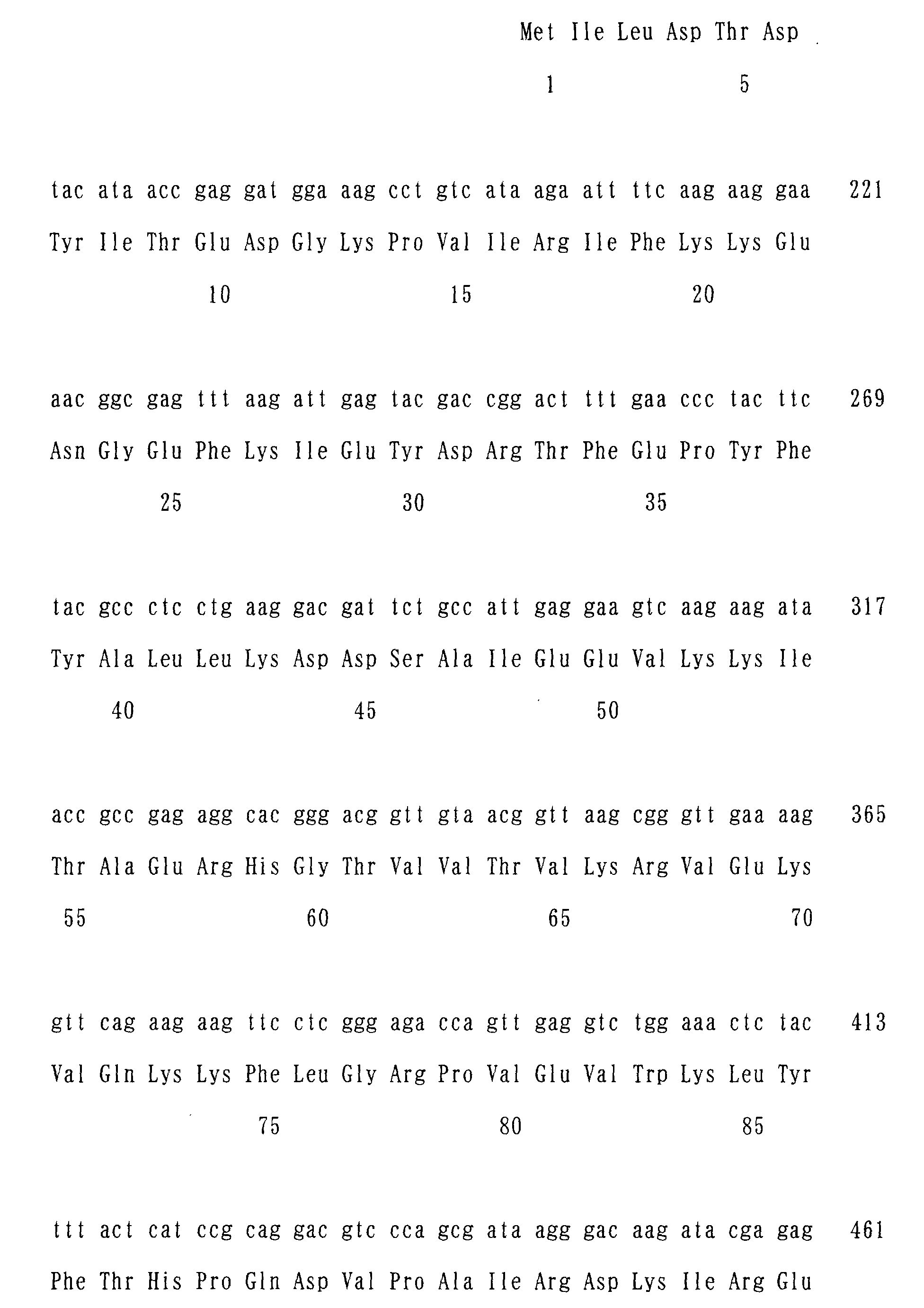


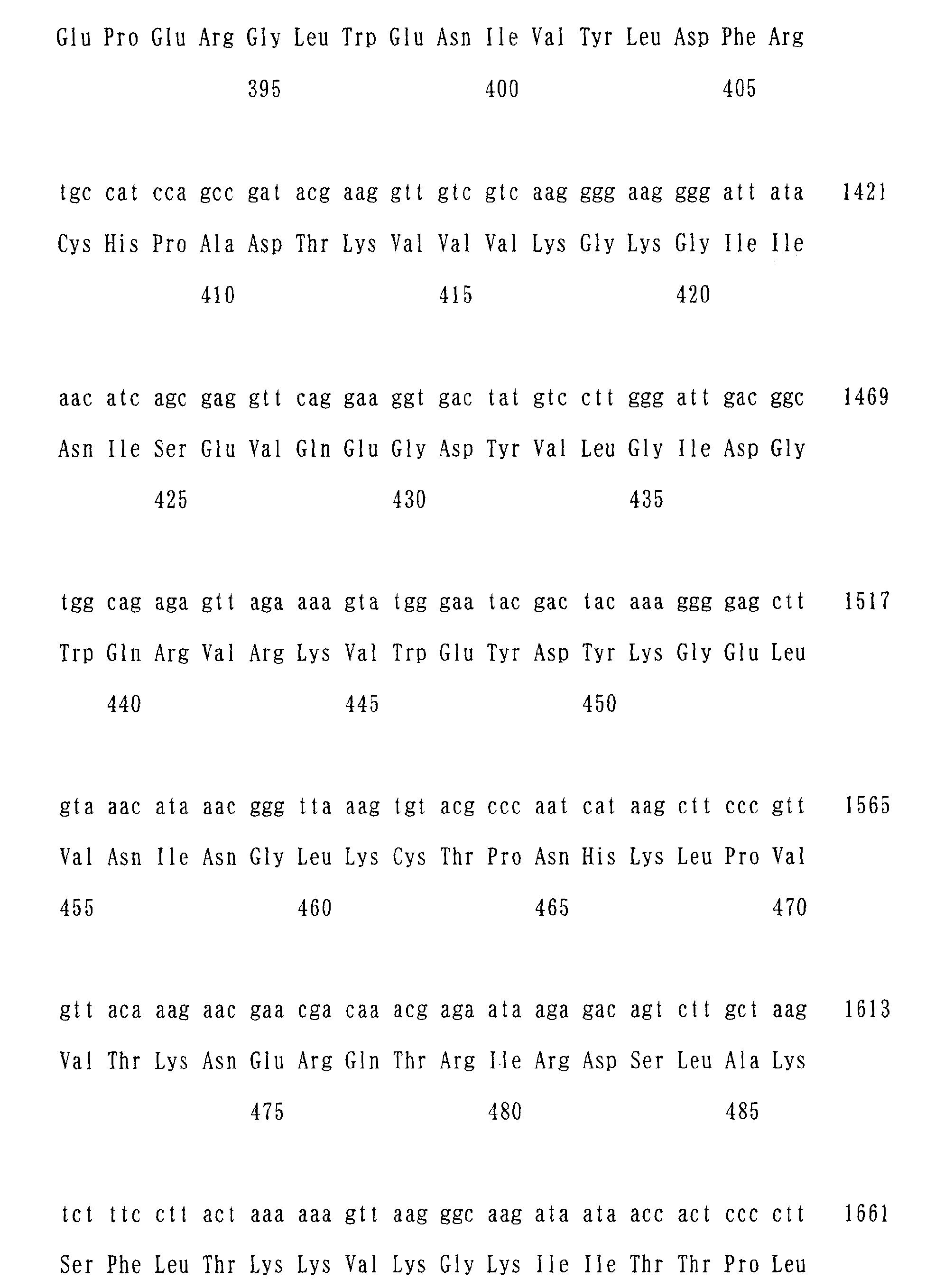
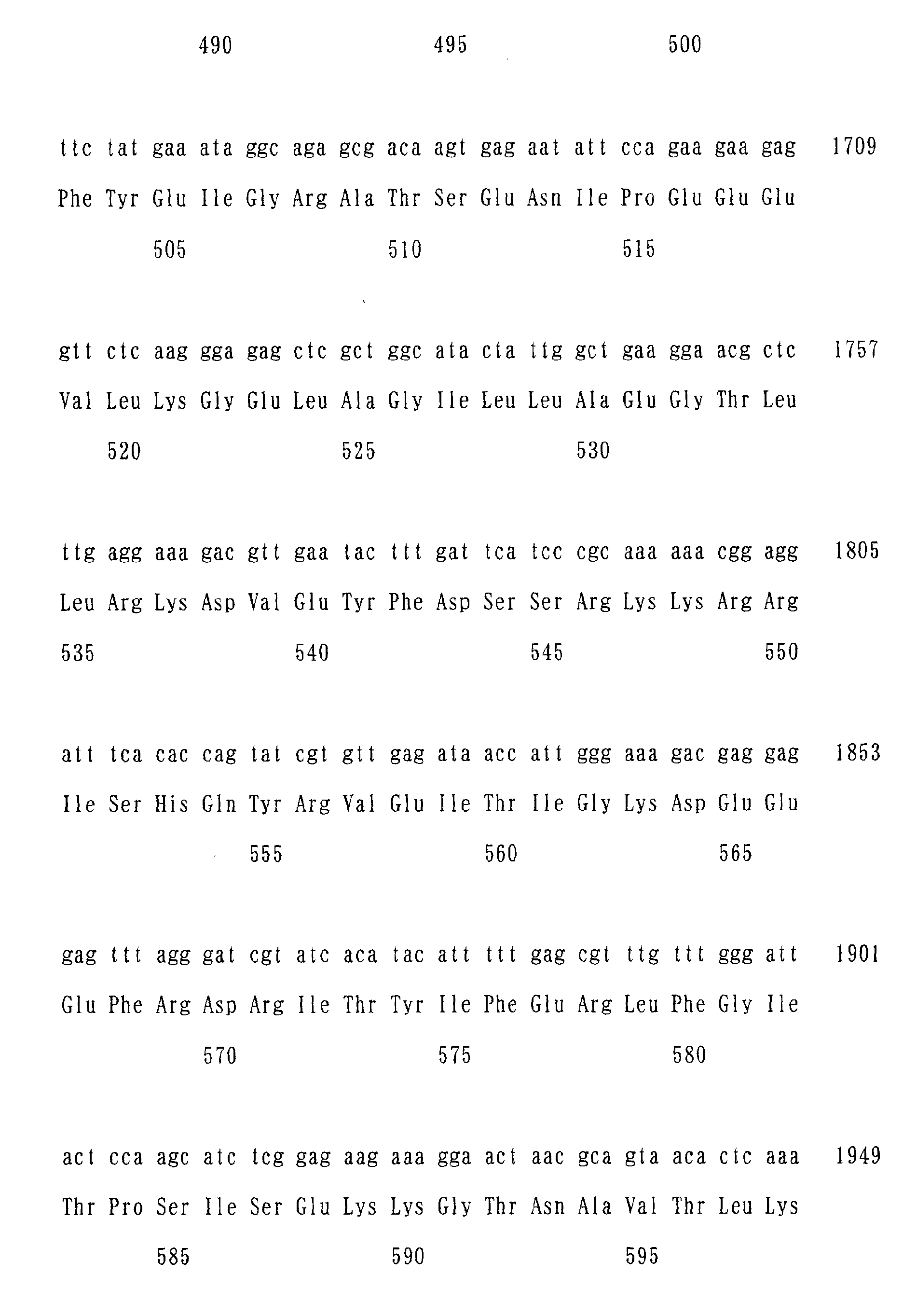

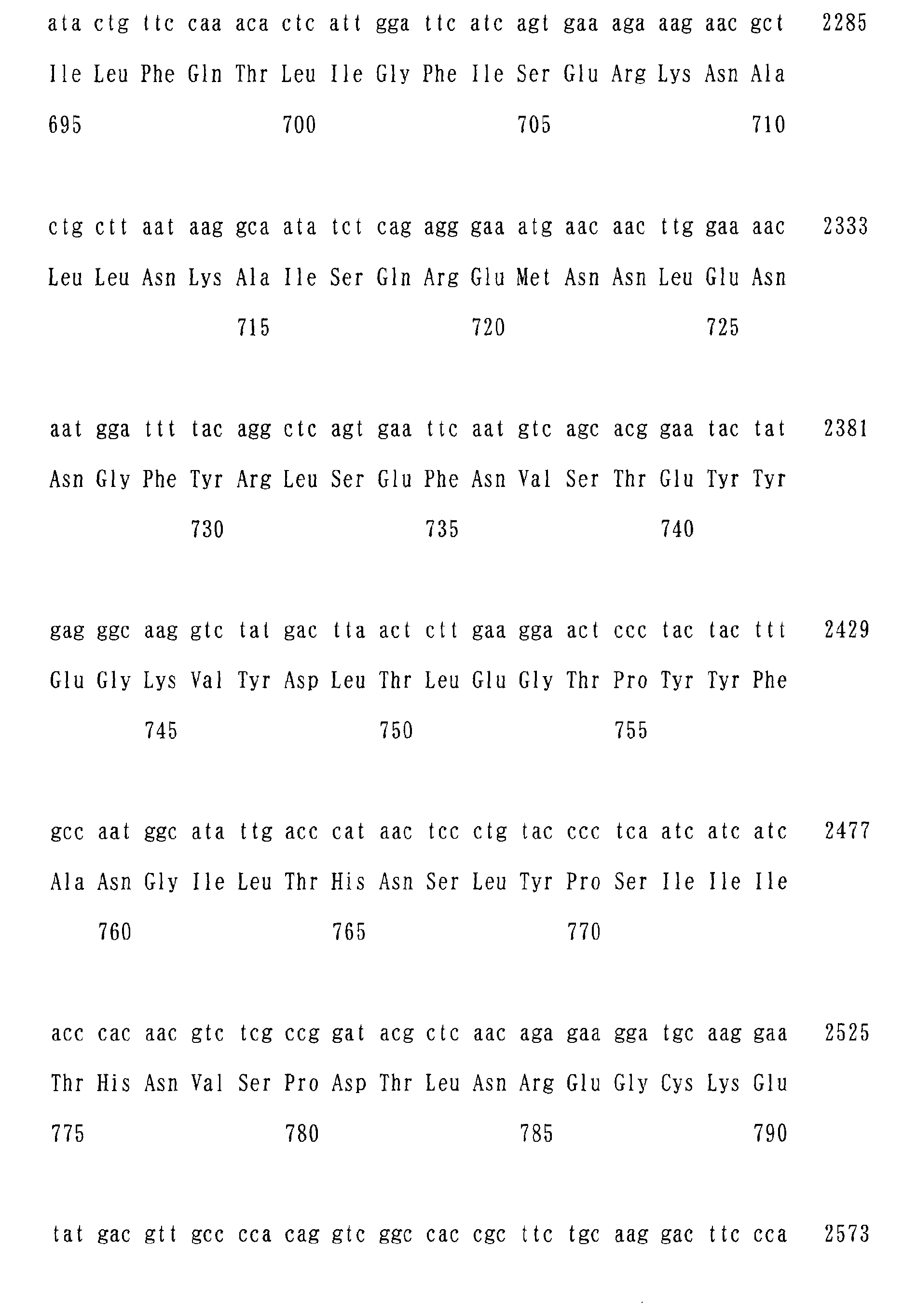
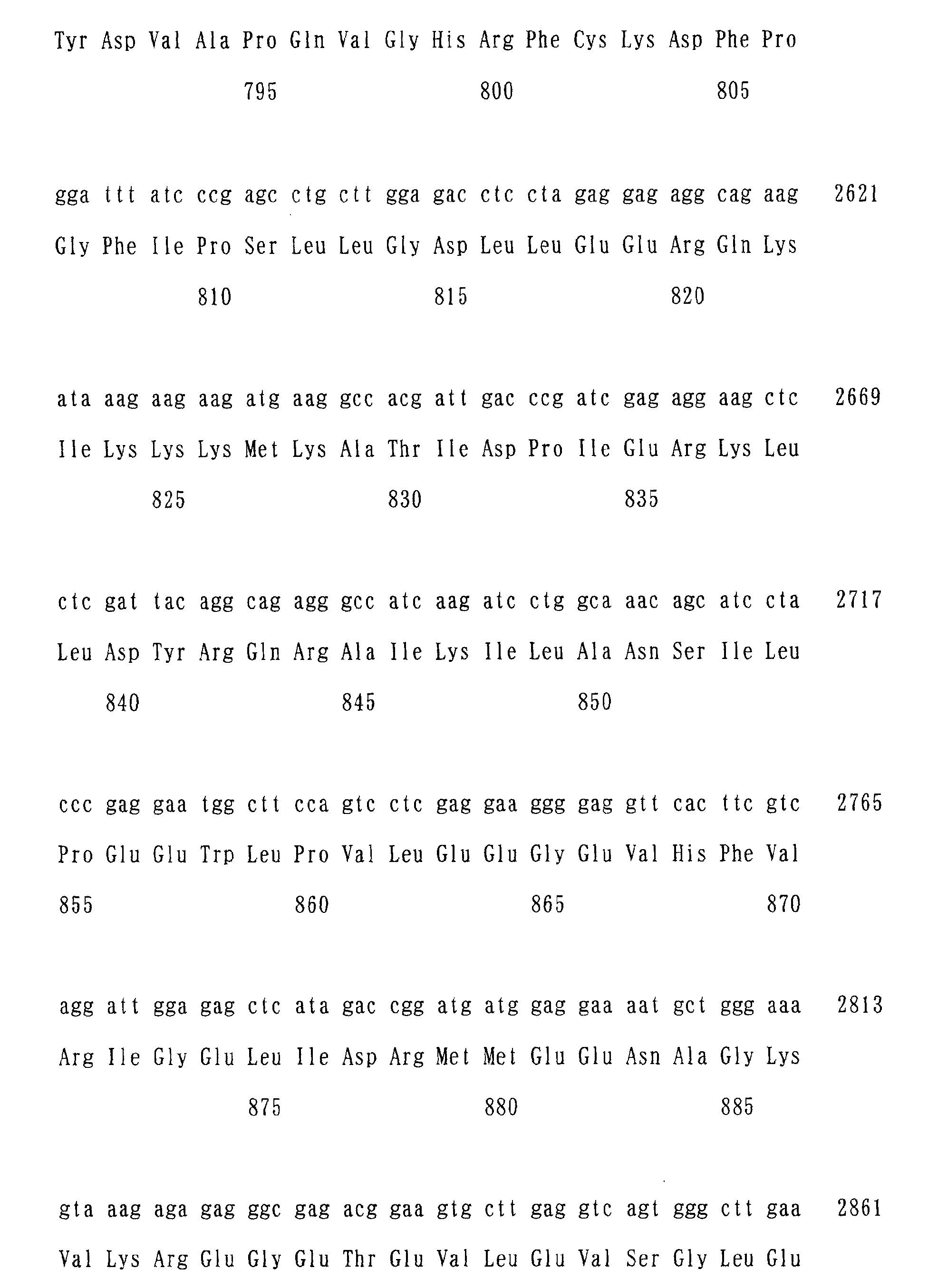
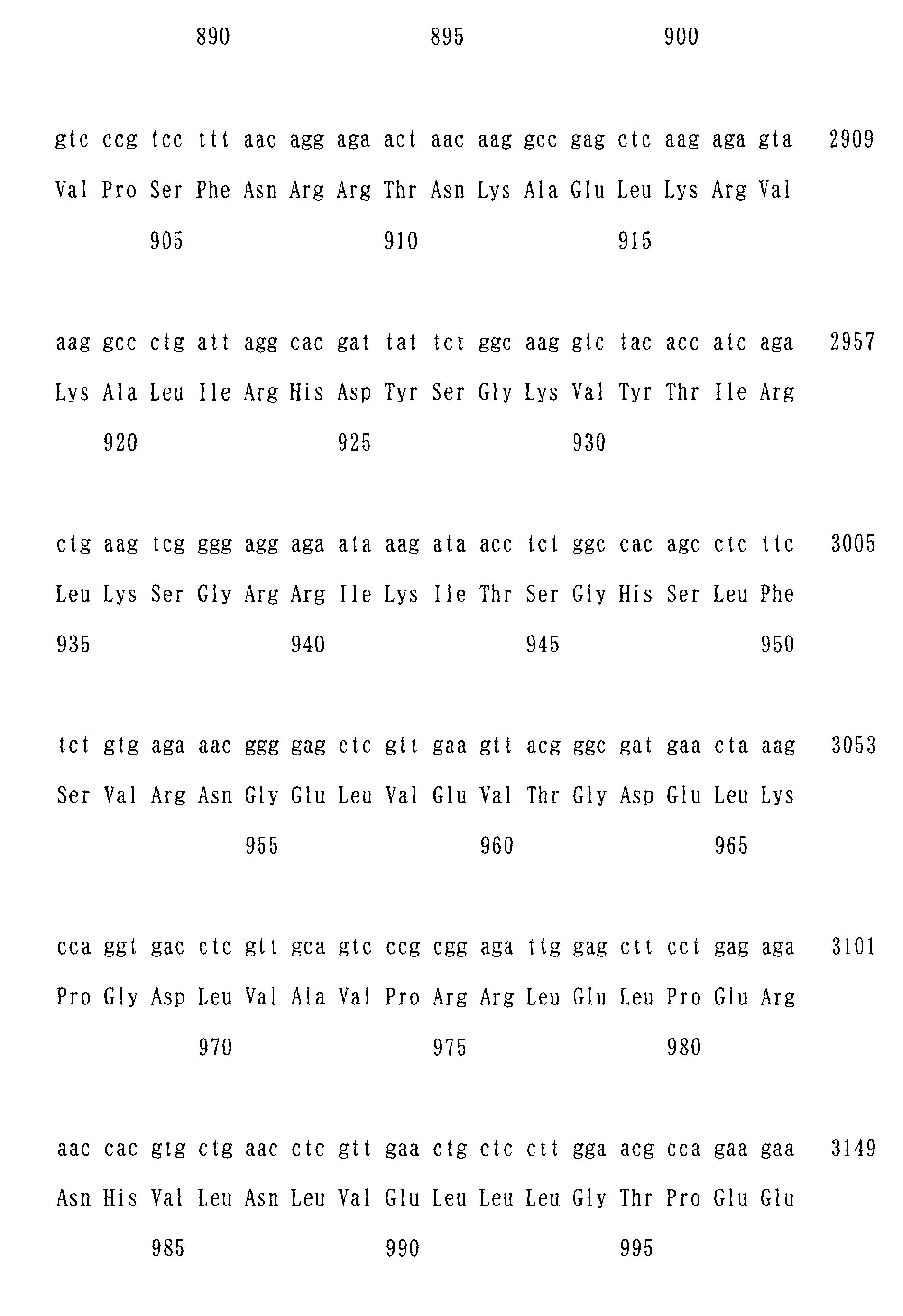
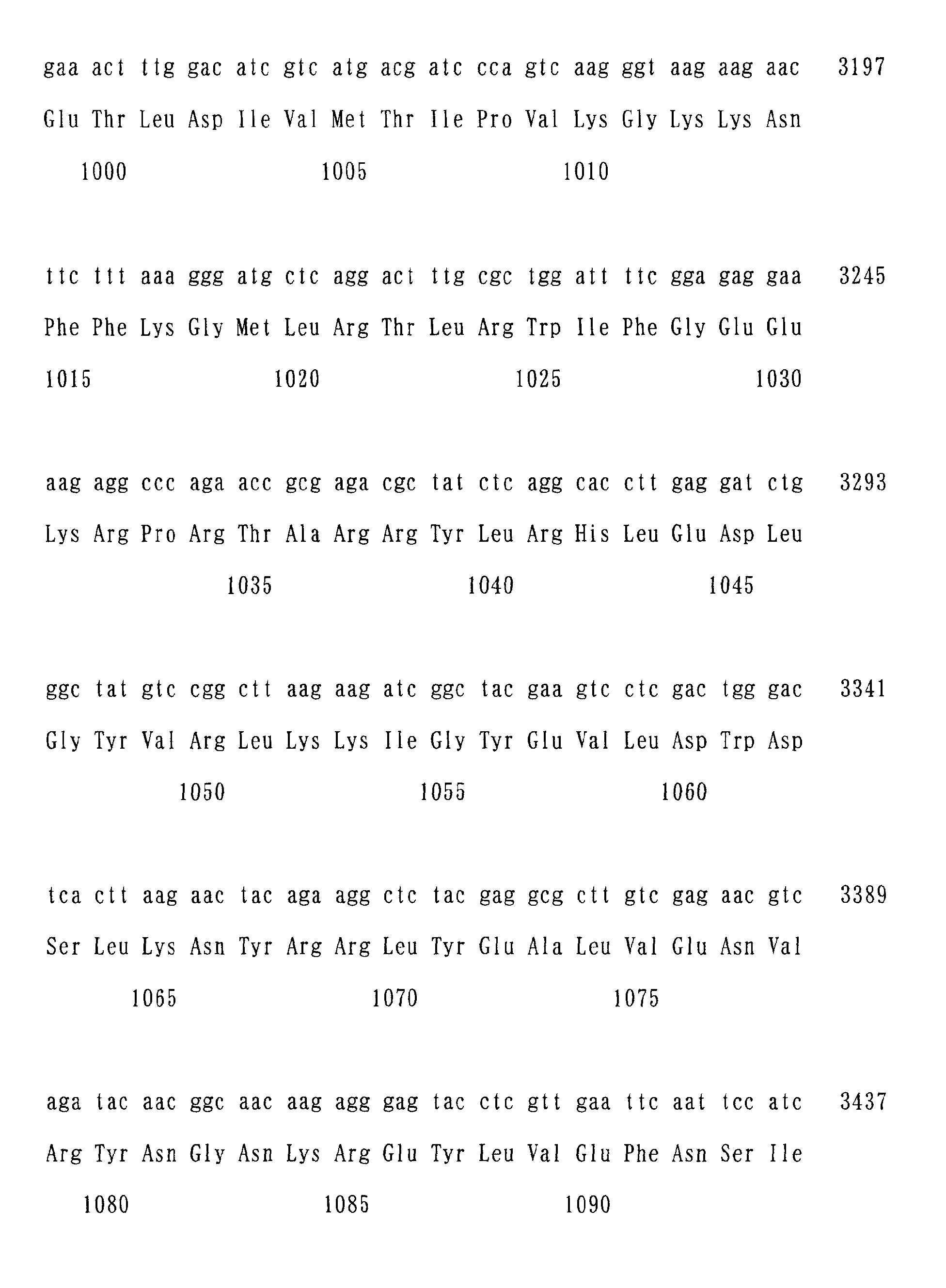


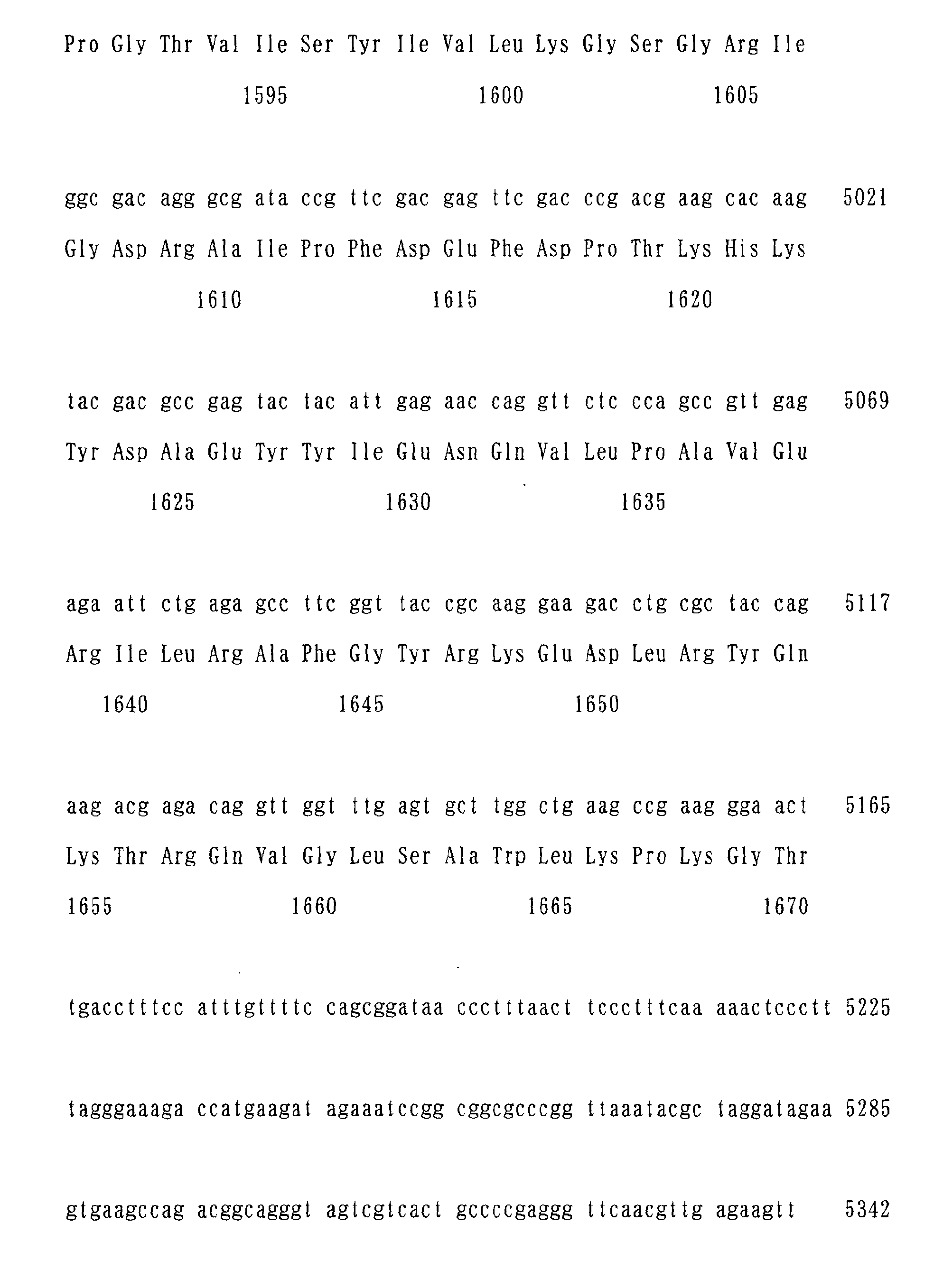
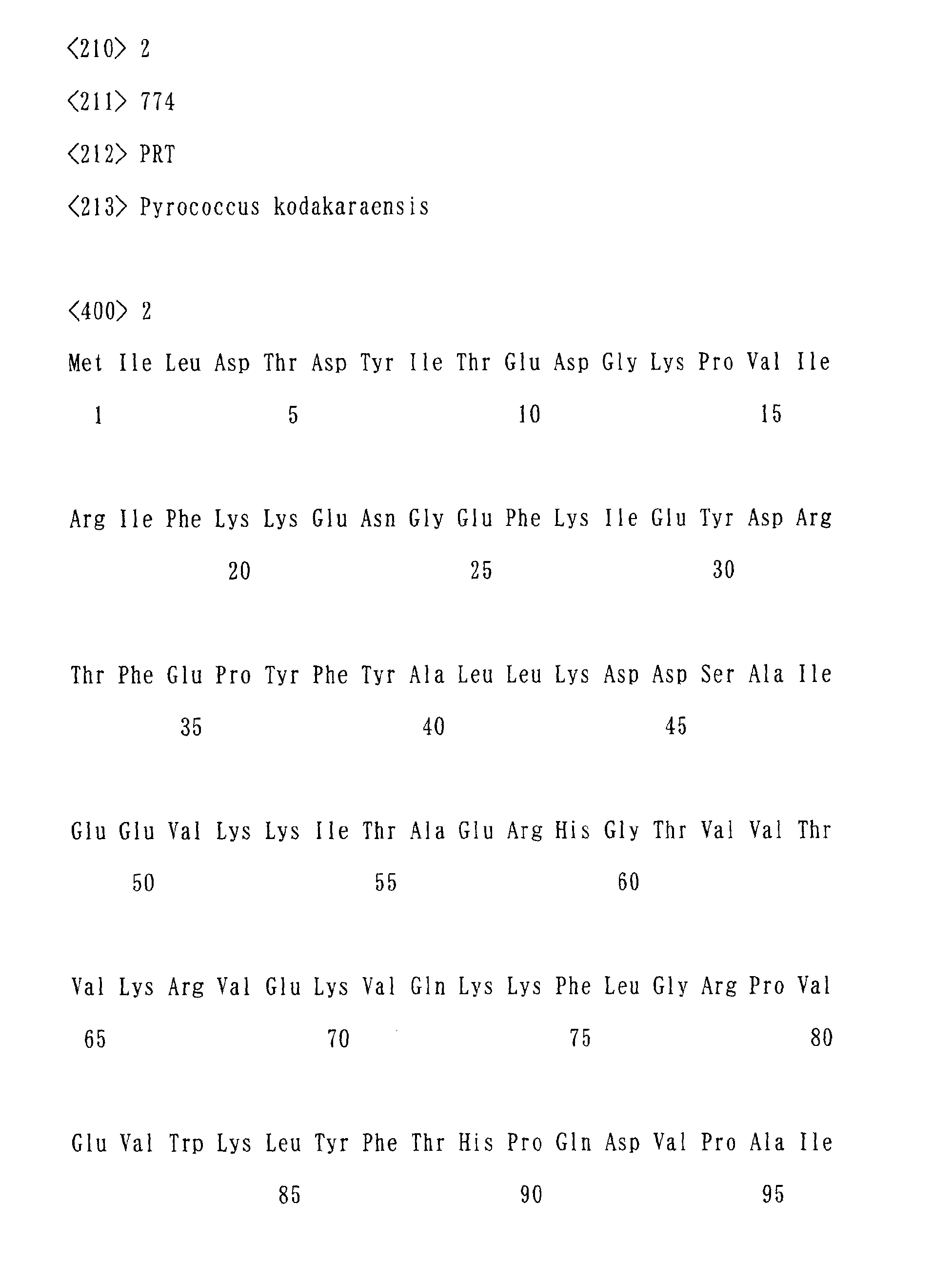
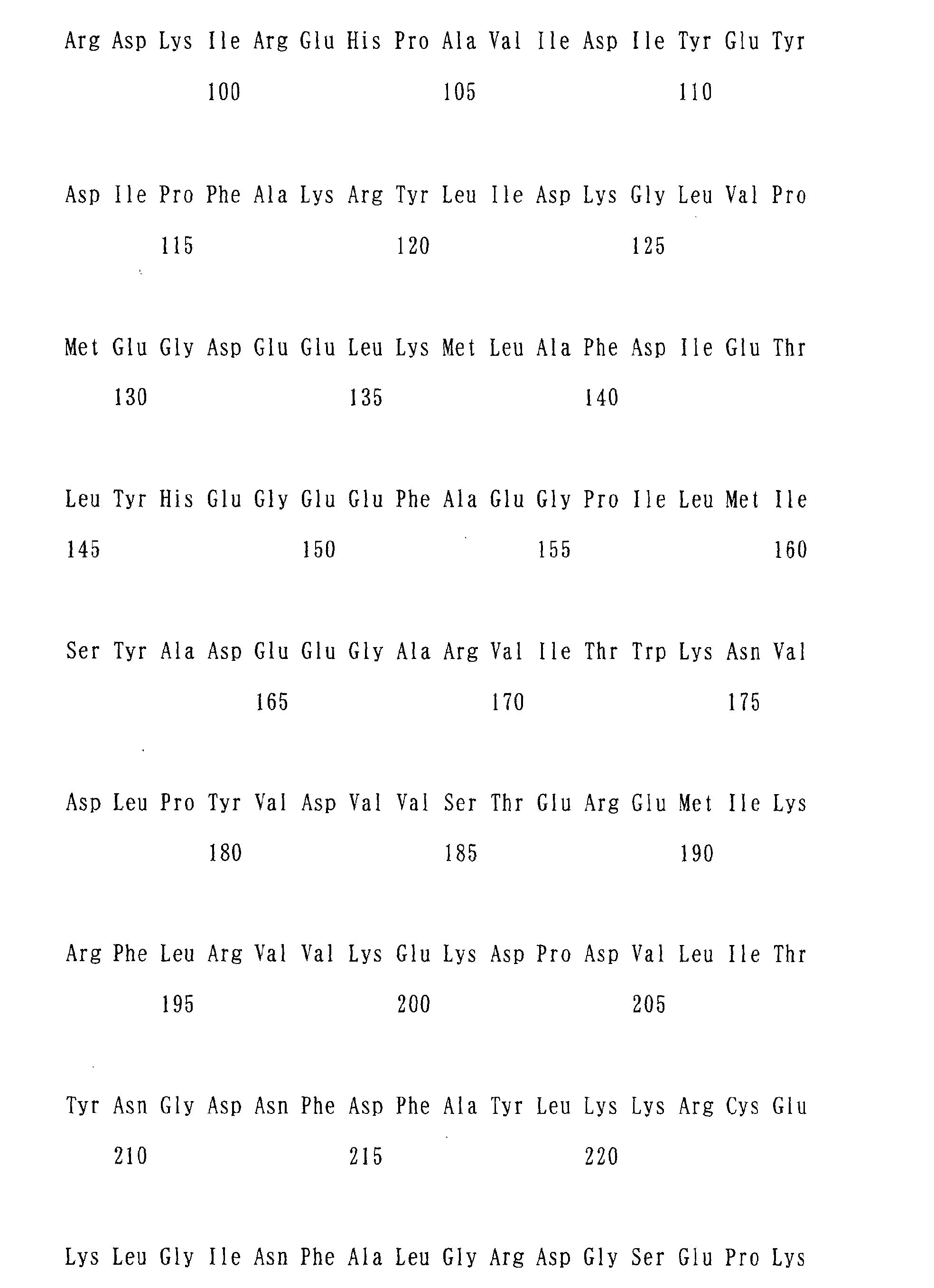
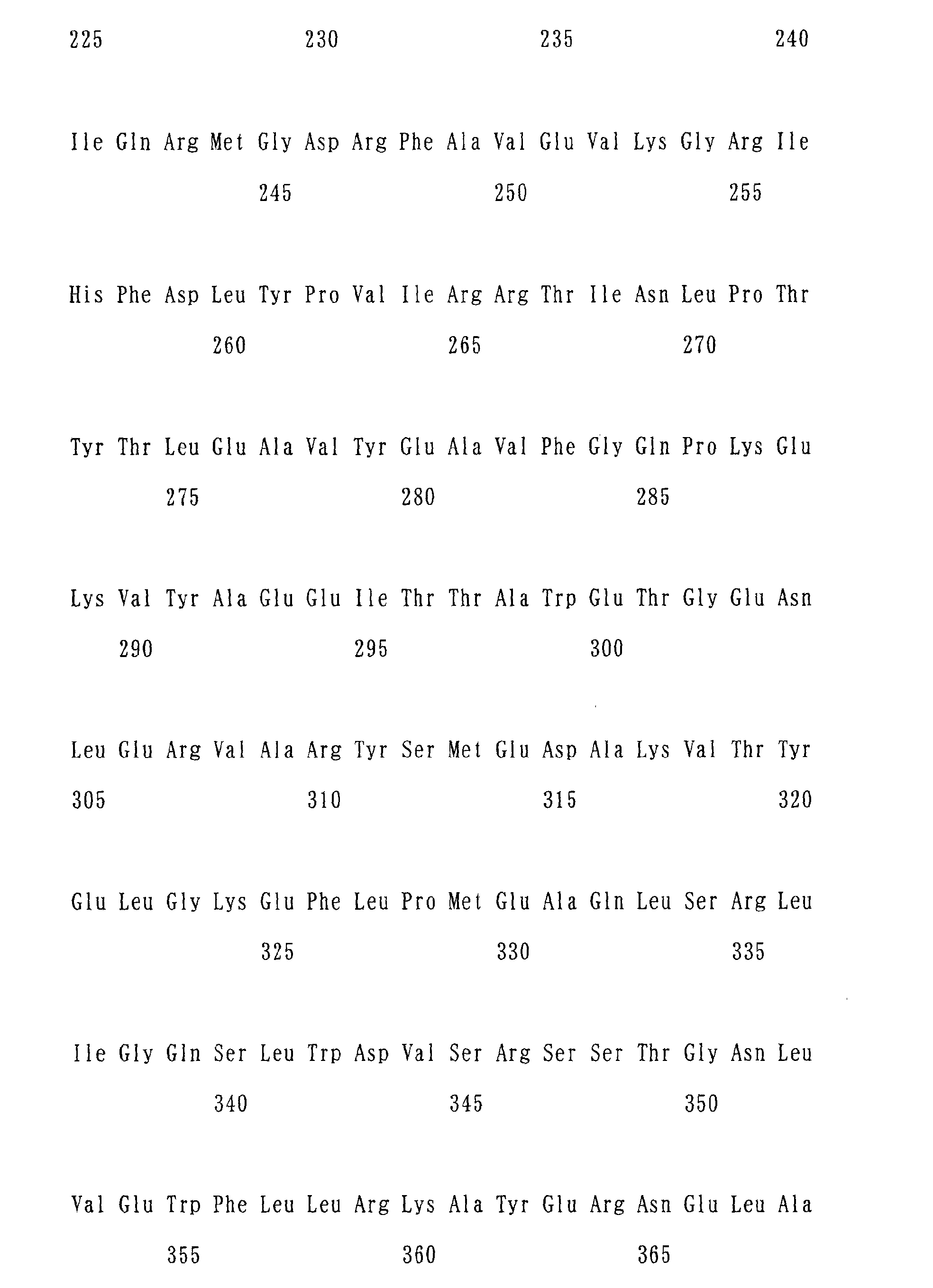
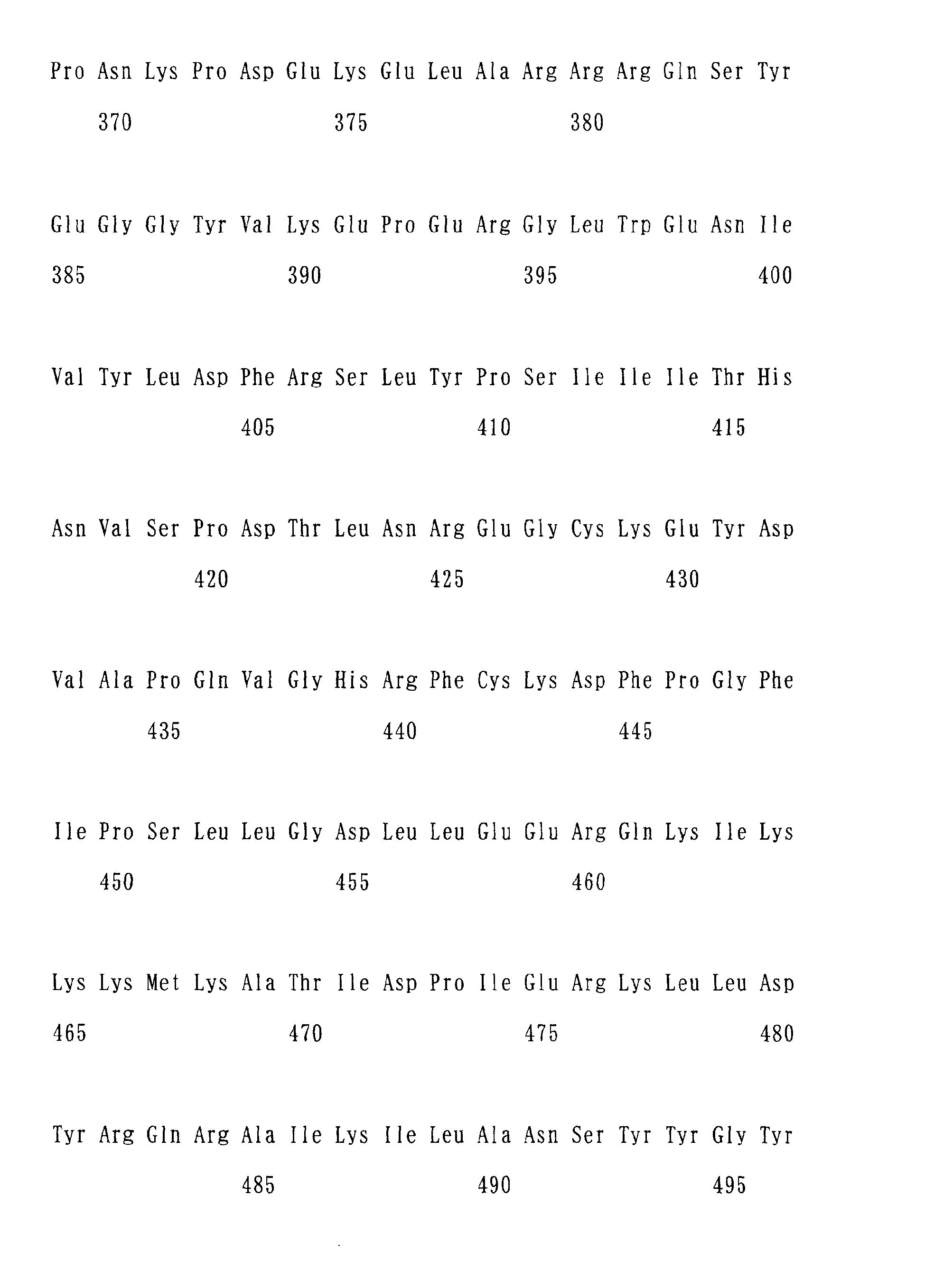


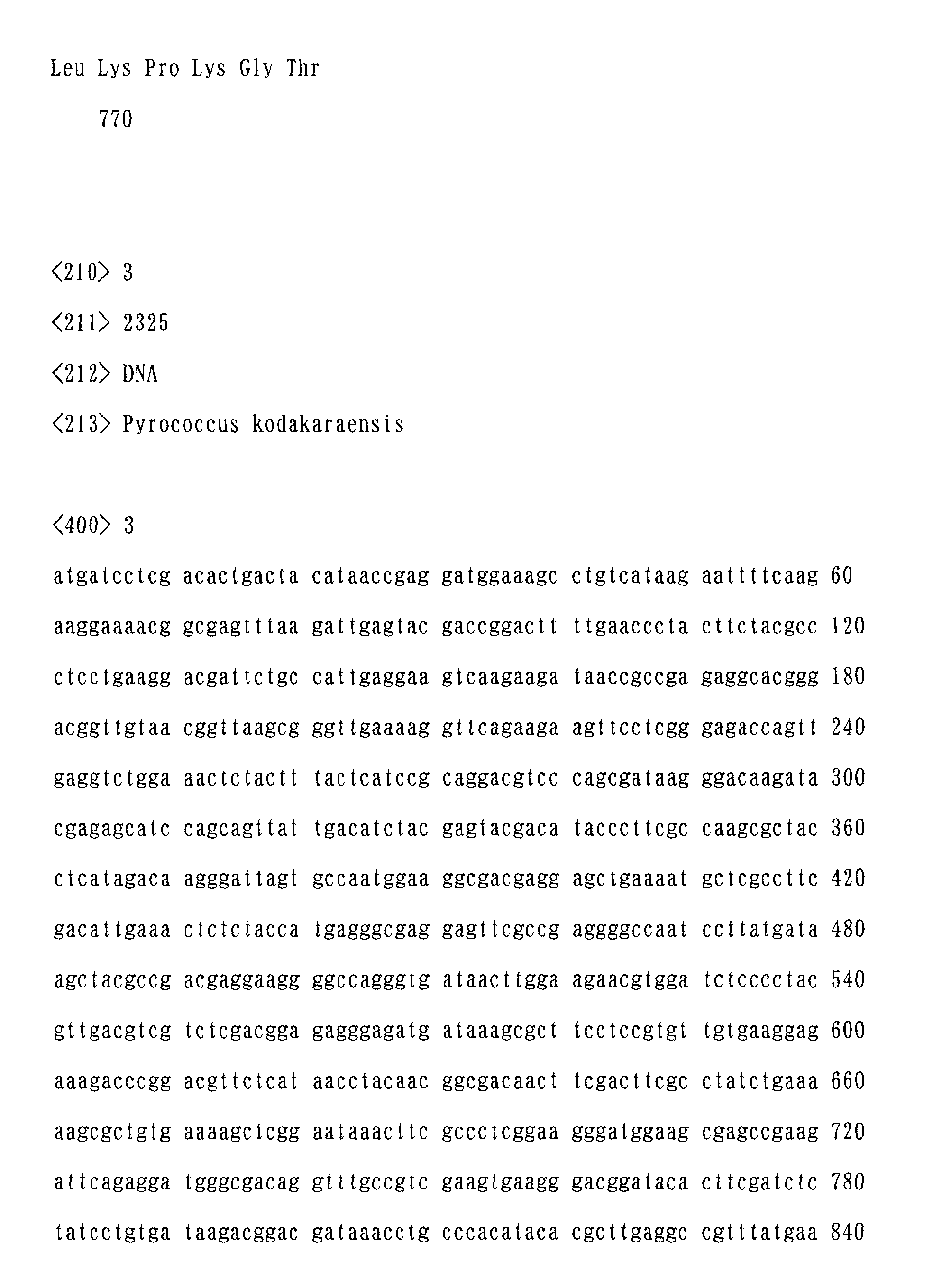


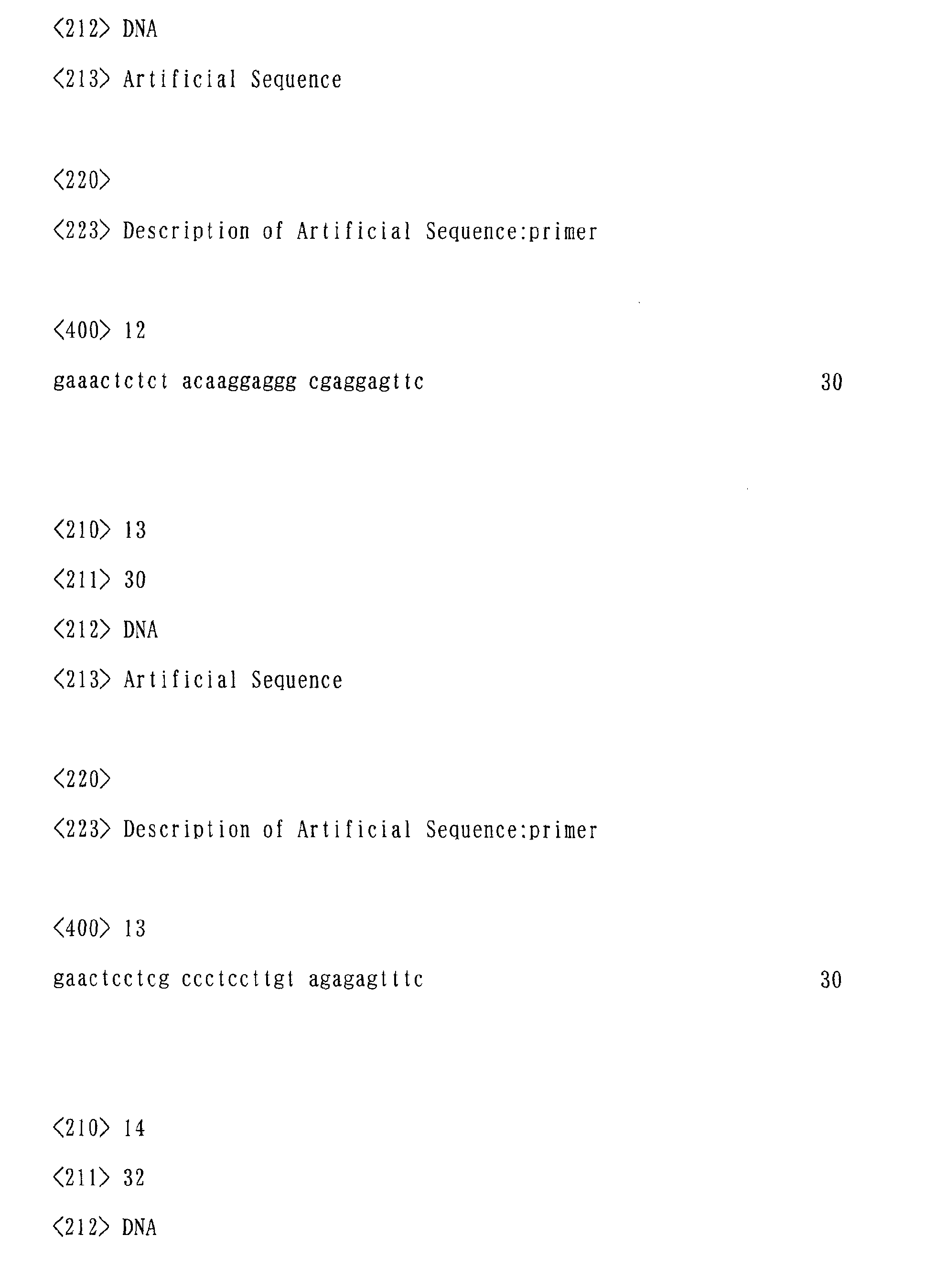
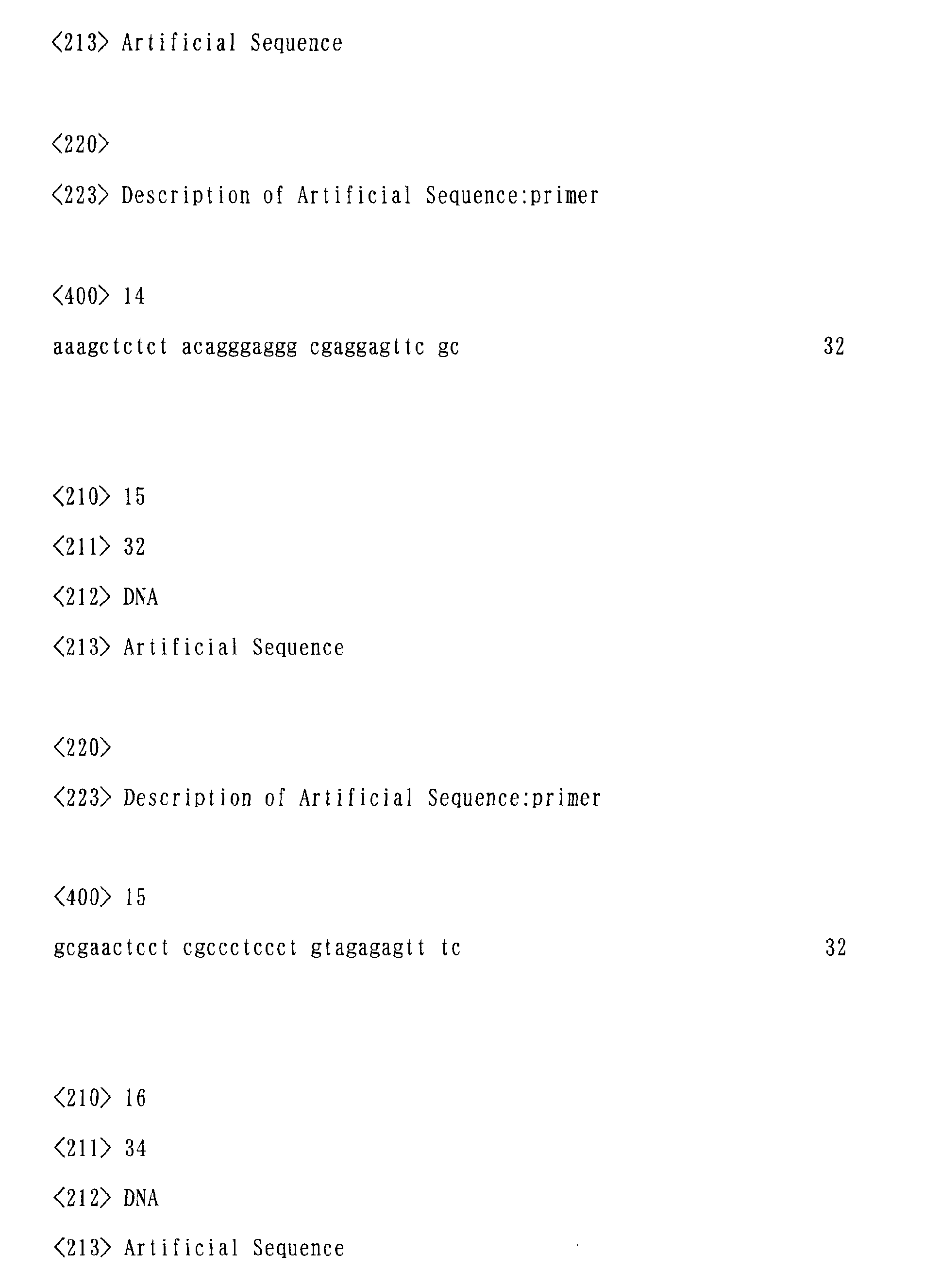
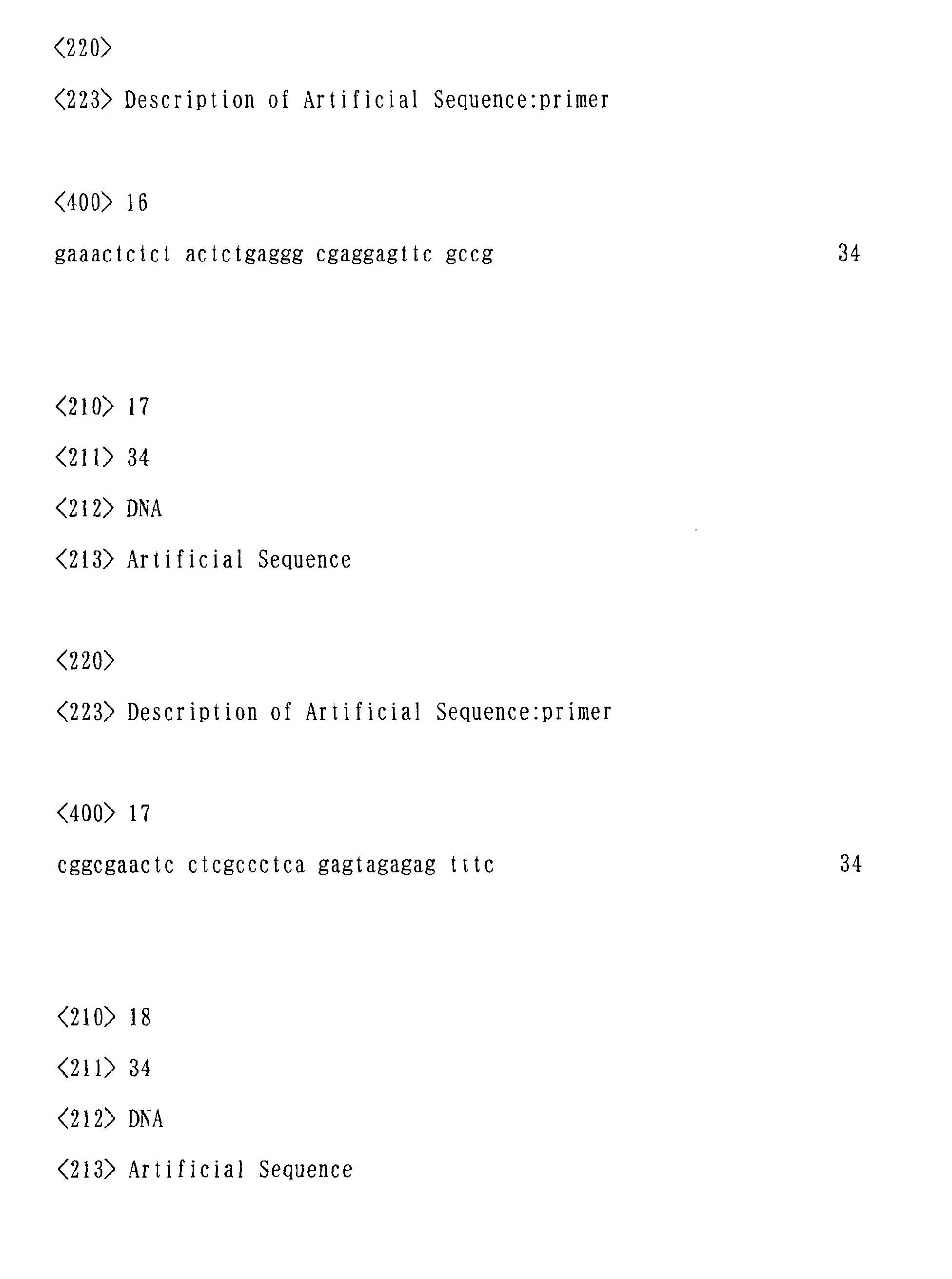
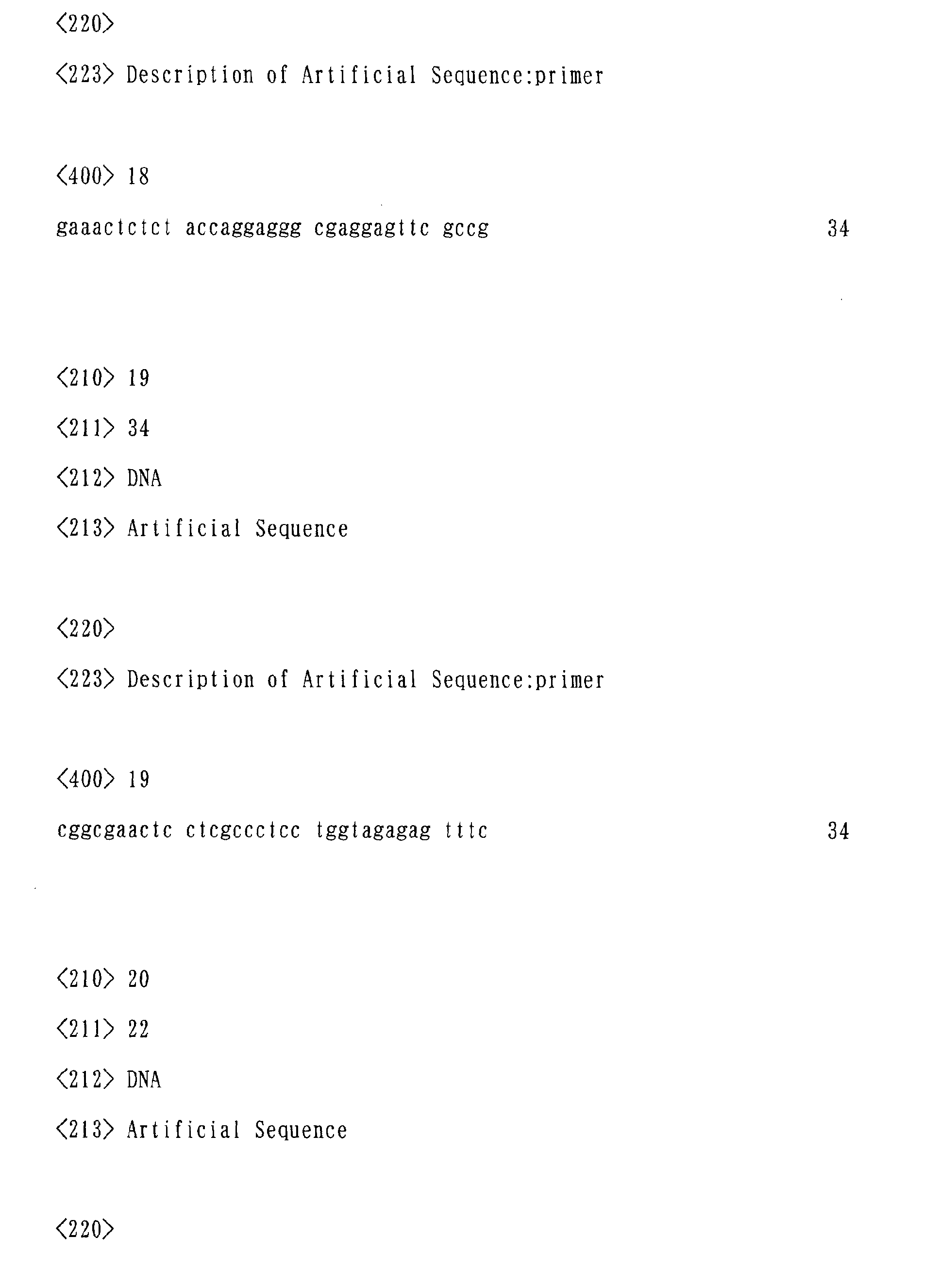


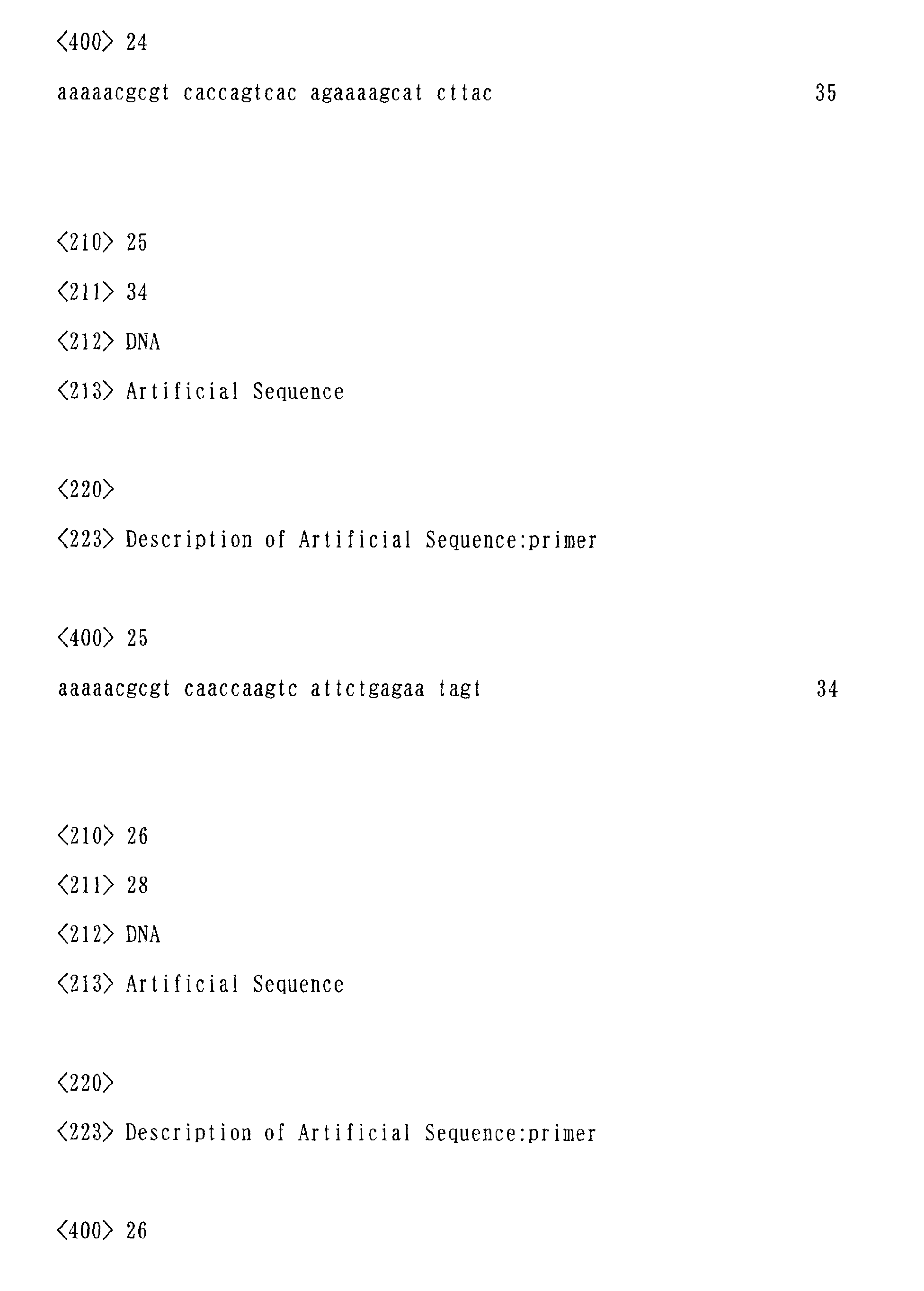

Claims (30)
- A modified thermostable DNA polymerase wherein in the DX1EX2X3X4H sequence (D: aspartic acid, E: glutamic acid, H: histidine, X1, X2, X3 and X4: any amino acid) consisting of DX1E sequence within the EXO I region and a four amino acid length peptide adjacent to said glutamic acid(E) of thermostable DNA polymerase having 3'-5' exonuclease activity, histidine(H) has been replaced by another amino acid.
- The modified thermostable DNA polymerase according to claim 1, wherein in the DX1EX2X3X4H sequence, histidine(H) has been replaced by an amino acid selected from the group consisting of aspartic acid, glutamic acid, tyrosine, alanine, lysine and arginine.
- The modified thermostable DNA polymerase according to claim 1 having the following physicochemical properties:(1) DNA extension rate: at least 20 bases/second; and(2) thermostability: it is capable of retaining 10% or more DNA polymerase activity of untreated DNA polymerase at pH 8.8 (determined at 25°C) after treatment at 95°C for 6 hours.
- The modified thermostable DNA polymerase according to claim 3 having the following physicochemical properties:(1) DNA extension rate: at least 30 bases/second;(2) thermostability: it is capable of retaining 40% or more DNA polymerase activity of untreated DNA polymerase at pH 8.8 (determined at 25°C) after treatment at 95°C for 6 hours; and(3) amino acid sequence: in the DIETLYH sequence (D: aspartic acid, I: isoleucine, E: glutamic acid, T: threonine, L: leucine, Y: tyrosine, H: histidine) located at the 141- to 147-positions in the amino acid sequence of SEQ ID NO: 2, histidine(H) has been replaced by another amino acid.
- The modified thermostable DNA polymerase according to claim 4 having the following physicochemical properties:(1) DNA extension rate: at least 30 bases/second;(2) thermostability: it is capable of retaining 60% or more DNA polymerase activity of untreated DNA polymerase at pH 8.8 (determined at 25°C) after treatment at 95°C for 6 hours; and(3) amino acid sequence: in the DIETLYH sequence (D: aspartic acid, I: isoleucine, E: glutamic acid, T: threonine, L: leucine, Y: tyrosine, H: histidine) located at the 141- to 147-positions in the amino acid sequence of SEQ ID NO: 2, histidine(H) has been replaced by another amino acid.
- The modified thermostable DNA polymerase according to claim 5, wherein in the amino acid sequence of SEQ ID NO: 2, histidine(H) at the 147-position has been replaced by an amino acid selected from the group consisting of aspartic acid, glutamic acid, tyrosine, alanine, lysine and arginine.
- The modified thermostable DNA polymerase according to claim 6, wherein in the amino acid sequence of SEQ ID NO: 2, histidine(H) at the 147-position has been replaced by aspartic acid.
- The modified thermostable DNA polymerase according to claim 6, wherein in the amino acid sequence of SEQ ID NO: 2, histidine(H) at the 147-position has been replaced by glutamic acid.
- The modified thermostable DNA polymerase according to claim 6, wherein in the amino acid sequence of SEQ ID NO: 2, histidine(H) at the 147-position has been replaced by tyrosine.
- The modified thermostable DNA polymerase according to claim 6, wherein in the amino acid sequence of SEQ ID NO: 2, histidine(H) at the 147-position has been replaced by alanine.
- The modified thermostable DNA polymerase according to claim 6, wherein in the amino acid sequence of SEQ ID NO: 2, histidine(H) at the 147-position has been replaced by lysine.
- The modified thermostable DNA polymerase according to claim 6, wherein in the amino acid sequence of SEQ ID NO: 2, histidine(H) at the 147-position has been replaced by arginine.
- A gene encoding a modified thermostable DNA polymerase wherein in the DX1EX2X3X4H sequence (D: aspartic acid, E: glutamic acid, H: histidine, X1, X2, X3 and X4: any amino acid) consisting of DX1E sequence within the EXO I region and four amino acid length peptide adjacent to said glutamic acid(E) of thermostable DNA polymerase having 3'-5' exonuclease activity, histidine(H) has been replaced by another amino acid.
- The gene according to claim 13 which encodes a modified thermostable DNA polymerase having the following physicochemical properties:(1) DNA extension rate: at least 20 bases/second; and(2) thermostability: it is capable of retaining 10% or more DNA polymerase activity of untreated DNA polymerase at pH 8.8 (determined at 25°C) after treatment at 95°C for 6 hours.
- The gene according to claim 13 which encodes a modified thermostable DNA polymerase having the following physicochemical properties:(1) DNA extension rate: at least 30 bases/second;(2) thermostability: it is capable of retaining 40% or more DNA polymerase activity of untreated DNA polymerase at pH 8.8 (determined at 25°C) after treatment at 95°C for 6 hours; and(3) amino acid sequence: in the DIETLYH sequence (D: aspartic acid, I: isoleucine, E: glutamic acid, T: threonine, L: leucine, Y: tyrosine, H: histidine) located at the 141- to 147-positions in the amino acid sequence of SEQ ID NO: 2, histidine(H) has been replaced by another amino acid.
- The gene according to claim 13 which encodes a modified thermostable DNA polymerase having the following physicochemical properties:(1) DNA extension rate: at least 30 bases/second;(2) thermostability: it is capable of retaining 60% or more DNA polymerase activity of untreated DNA polymerase at pH 8.8 (determined at 25°C) after treatment at 95°C for 6 hours; and(3) amino acid sequence: in the DIETLYH sequence (D: aspartic acid, I: isoleucine, E: glutamic acid, T: threonine, L: leucine, Y: tyrosine, H: histidine) located at the 141- to 147-positions in the amino acid sequence of SEQ ID NO: 2, histidine(H) has been replaced by another amino acid.
- A recombinant DNA vector obtained by inserting the gene of any one of claims 13 to 16 into an expression vector.
- The recombinant DNA vector according to claim 17, wherein the expression vector is pLED-MI, pBluescript or their derivatives.
- A transformant produced by transforming a host cell with the recombinant DNA vector of claim 17 or 18.
- The transformant according to claim 19 wherein the host cell is Escherichia coli.
- A process for producing a modified thermostable DNA polymerase, which comprises culturing the transformant of claim 20 and recovering the thermostable DNA polymerase from the culture broth.
- A method for amplifying or extending nucleic acid, which comprises reacting DNA as a template, one or more kinds of primers, dNTP and the thermostable DNA polymerase of any one of claims 1 to 12, thus extending the primer(s) to synthesize DNA primer extension product(s).
- The method for amplifying nucleic acid according to claim 22, wherein the primers are 2 kinds of oligonucleotides, each of the primers being complementary to a DNA extension product of the other primer.
- The method for amplifying nucleic acid according to claim 22, which comprises heating and cooling repeatedly.
- A reagent kit for amplifying nucleic acid, which comprises 2 kinds of primers, each of the primers being complementary to a DNA extension product of the other primer; dNTP; the thermostable DNA polymerase of any one of claims 1-12; divalent ion(s); monovalent ion(s); and a buffer solution.
- A reagent kit for amplifying nucleic acid, which comprises 2 kinds of primers, each of the primers being complementary to a DNA extension product of the other primer; dNTP; the thermostable DNA polymerase of any one of claims 1-12; magnesium ion; at least one of monovalent ions selected from the group consisting of ammonium ion and potassium ion; BSA (bovine serum albumin); a nonionic surfactant and a buffer solution.
- A reagent kit for amplifying nucleic acid, which comprises 2 kinds of primers, each of the primers being complementary to a DNA extension product of the other primer; dNTP; the thermostable DNA polymerase of any one of claims 1-12; magnesium ion; at least one of monovalent ions selected from the group consisting of ammonium ion and potassium ion; BSA (bovine serum albumin); a nonionic surfactant; a buffer solution and an antibody capable of suppressing at least one activity selected from polymerase activity and 3'-5' exonuclease activity of the thermostable DNA polymerase.
- A DNA polymerase composition which comprises one or more kinds of modified thermostable DNA polymerases defined in any of claims 1-12.
- A method of producing a mutated DNA which comprises reacting DNA as a template, mutagenesis primers, dNTP and the thermostable DNA polymerase of any one of claims 1 to 12, thus extending the primers to synthesize DNA primer extension products.
- A reagent kit for producing a mutated DNA which comprises mutagenesis primers, dNTP and the thermostable DNA polymerase of any one of claims 1 to 12.
Applications Claiming Priority (2)
| Application Number | Priority Date | Filing Date | Title |
|---|---|---|---|
| JP2000138796 | 2000-05-11 | ||
| JP2000138796 | 2000-05-11 |
Publications (2)
| Publication Number | Publication Date |
|---|---|
| EP1154017A1 true EP1154017A1 (en) | 2001-11-14 |
| EP1154017B1 EP1154017B1 (en) | 2010-01-20 |
Family
ID=18646359
Family Applications (1)
| Application Number | Title | Priority Date | Filing Date |
|---|---|---|---|
| EP01111032A Expired - Lifetime EP1154017B1 (en) | 2000-05-11 | 2001-05-08 | Modified thermostable dna polymerase from pyrococcus kodakarensis |
Country Status (3)
| Country | Link |
|---|---|
| US (1) | US7422882B2 (en) |
| EP (1) | EP1154017B1 (en) |
| DE (1) | DE60141097D1 (en) |
Cited By (5)
| Publication number | Priority date | Publication date | Assignee | Title |
|---|---|---|---|---|
| EP1752534A4 (en) * | 2004-05-18 | 2007-10-17 | Toyo Boseki | High-speed pcr using high-speed dna polymerase |
| US7704713B2 (en) * | 2004-06-04 | 2010-04-27 | Takara Bio Inc. | Polypeptides having DNA polymerase activity |
| EP2208796A2 (en) | 2005-01-06 | 2010-07-21 | Applied Biosystems, LLC | Polypeptides having nucleic acid binding activity and compositions and methods for nucleic acid amplification |
| US8828700B2 (en) | 2005-09-09 | 2014-09-09 | Life Technologies Corporation | SSB-polymerase fusion proteins |
| US10378050B2 (en) | 2011-06-08 | 2019-08-13 | Life Technologies Corporation | Polymerization of nucleic acids using proteins having low isoelectric points |
Families Citing this family (16)
| Publication number | Priority date | Publication date | Assignee | Title |
|---|---|---|---|---|
| WO2010062776A2 (en) | 2008-11-03 | 2010-06-03 | Kapabiosystems | Chimeric dna polymerases |
| WO2010062779A2 (en) * | 2008-11-03 | 2010-06-03 | Kapabiosystems | Modified dna polymerases |
| GB0915796D0 (en) | 2009-09-09 | 2009-10-07 | Fermentas Uab | Polymerase compositions and uses |
| EP3461807B1 (en) | 2011-06-08 | 2023-07-12 | Life Technologies Corporation | Design and development of novel detergents for use in pcr systems |
| JP6478446B2 (en) | 2012-09-28 | 2019-03-06 | 東洋紡株式会社 | Modified thermostable DNA polymerase |
| JP6742238B2 (en) | 2013-10-25 | 2020-08-19 | ライフ テクノロジーズ コーポレーション | Novel compounds for use in PCR systems and uses thereof |
| US10053676B2 (en) | 2014-11-25 | 2018-08-21 | Bio-Rad Laboratories, Inc. | Arginine improves polymerase storage stability |
| US10323243B2 (en) | 2016-01-19 | 2019-06-18 | Board Of Regents, The University Of Texas System | Thermostable reverse transcriptase |
| EP3720606A4 (en) * | 2017-07-27 | 2021-05-05 | Board Of Regents, The University Of Texas System | AMPLIFICATION OF MRNA SEQUENCES CODING PAIRED PROTEINS |
| WO2019084538A1 (en) | 2017-10-27 | 2019-05-02 | Board Of Regents, The University Of Texas System | Tumor specific antibodies and t-cell receptors and methods of identifying the same |
| CN108546749B (en) * | 2018-03-27 | 2022-01-04 | 深圳市艾伟迪生物科技有限公司 | Mixed hot start DNA polymerase composition, PCR amplification kit and application thereof |
| KR102420325B1 (en) * | 2022-01-28 | 2022-07-13 | 주식회사 에이아이더뉴트리진 | Method for snp detection and mutation using isothermal amplification reaction |
| KR102437064B1 (en) * | 2022-02-28 | 2022-08-26 | 주식회사 에이아이더뉴트리진 | Lab-on-paper platform for nucleic acid detection with simultaneous purification and detection based on an integrated system with lateral fluidity |
| WO2026055192A1 (en) * | 2024-09-05 | 2026-03-12 | Watchmaker Genomics, Inc. | Thermococcus kodakarensis (kod) dna polymerase variants with improved properties and methods of use thereof |
| CN119193528B (en) * | 2024-10-12 | 2025-10-21 | 自然资源部第三海洋研究所 | A high-fidelity and high-amplification-efficiency high-temperature-resistant DNA polymerase, its preparation method, PCR amplification method, and application |
| WO2026085401A1 (en) * | 2024-10-18 | 2026-04-23 | Watchmaker Genomics, Inc. | Modified b-family polymerases |
Citations (3)
| Publication number | Priority date | Publication date | Assignee | Title |
|---|---|---|---|---|
| EP0745675A2 (en) * | 1995-05-31 | 1996-12-04 | Toyo Boseki Kabushiki Kaisha | A method of amplifying nucleic acid and a reagent therefor |
| EP0822256A2 (en) * | 1996-07-29 | 1998-02-04 | Toyo Boseki Kabushiki Kaisha | Modified thermostable DNA polymerase, and DNA polymerase composition for nucleic acid amplification |
| JPH1042871A (en) * | 1996-07-29 | 1998-02-17 | Toyobo Co Ltd | Thermostable DNA polymerase with reduced exonuclease activity and use thereof |
Family Cites Families (3)
| Publication number | Priority date | Publication date | Assignee | Title |
|---|---|---|---|---|
| DE69232511T2 (en) | 1991-12-18 | 2002-10-24 | New England Biolabs, Inc. | Purified thermostable DNA polymerase from Pyrococcus species |
| DE69232435T2 (en) | 1991-12-18 | 2002-07-18 | New England Biolabs, Inc. | Recombinant thermostable DNA polymerase from Archaebacteria |
| JP3132624B2 (en) | 1994-05-09 | 2001-02-05 | 東洋紡績株式会社 | DNA polymerase gene derived from hyperthermophilic archaeon and uses thereof |
-
2001
- 2001-05-08 EP EP01111032A patent/EP1154017B1/en not_active Expired - Lifetime
- 2001-05-08 DE DE60141097T patent/DE60141097D1/en not_active Expired - Lifetime
- 2001-05-10 US US09/852,922 patent/US7422882B2/en not_active Expired - Lifetime
Patent Citations (3)
| Publication number | Priority date | Publication date | Assignee | Title |
|---|---|---|---|---|
| EP0745675A2 (en) * | 1995-05-31 | 1996-12-04 | Toyo Boseki Kabushiki Kaisha | A method of amplifying nucleic acid and a reagent therefor |
| EP0822256A2 (en) * | 1996-07-29 | 1998-02-04 | Toyo Boseki Kabushiki Kaisha | Modified thermostable DNA polymerase, and DNA polymerase composition for nucleic acid amplification |
| JPH1042871A (en) * | 1996-07-29 | 1998-02-17 | Toyobo Co Ltd | Thermostable DNA polymerase with reduced exonuclease activity and use thereof |
Non-Patent Citations (5)
| Title |
|---|
| DATABASE GENBANK NCBI; 4 October 2000 (2000-10-04), RUEPP ET AL.: "DNA polymerase related protein", XP002171948 * |
| KONG HUIMIN ET AL: "Characterization of a DNA polymerase from the hyperthermophile archaea Thermococcus litoralis: Vent DNA polymerase, steady state kinetics, thermal stability, processivity, strand displacement, and exonuclease activities.", JOURNAL OF BIOLOGICAL CHEMISTRY, vol. 268, no. 3, 1993, pages 1965 - 1975, XP000611227, ISSN: 0021-9258 * |
| LAWYER F C ET AL: "HIGH-LEVEL EXPRESSION, PURIFICATION, AND ENZYMATIC CHARACTERIZATIONOF FULL-LENGTH THERMUS AQUATICUS DNA POLYMERASE AND A TRUNCATED FORM DEFICIENT IN 5' TO 3' EXONUCLEASE ACTIVITY", PCR METHODS & APPLICATIONS,COLD SPRING HARBOR LABORATORY PRESS,US, vol. 2, 1993, pages 275 - 287, XP001002312, ISSN: 1054-9803 * |
| SOUTHWORTH M W ET AL: "Cloning of thermostable DNA polymerases from hyperthermophilic marine Archaea with emphasis on Thermococcus sp. 9 degree N-7 and mutations affecting 3'-5' exonuclease activity.", PROCEEDINGS OF THE NATIONAL ACADEMY OF SCIENCES OF THE UNITED STATES, vol. 93, no. 11, 1996, 1996, pages 5281 - 5285, XP002171947, ISSN: 0027-8424 * |
| UEMORI TAKASHI ET AL: "The hyperthermophilic archaeon Pyrodictium occultum has two alpha-like DNA polymerases.", JOURNAL OF BACTERIOLOGY, vol. 177, no. 8, 1995, pages 2164 - 2177, XP002171946, ISSN: 0021-9193 * |
Cited By (12)
| Publication number | Priority date | Publication date | Assignee | Title |
|---|---|---|---|---|
| EP1752534A4 (en) * | 2004-05-18 | 2007-10-17 | Toyo Boseki | High-speed pcr using high-speed dna polymerase |
| US7704713B2 (en) * | 2004-06-04 | 2010-04-27 | Takara Bio Inc. | Polypeptides having DNA polymerase activity |
| US8048987B2 (en) | 2004-06-04 | 2011-11-01 | Takara Bio Inc. | Polypeptides having DNA polymerase activity |
| EP2292767A3 (en) * | 2004-06-04 | 2011-12-07 | Takara Bio, Inc. | Polypepdides having DNA polymerase activity |
| US8344105B2 (en) | 2004-06-04 | 2013-01-01 | Takara Bio Inc. | Polypeptides having DNA polymerase activity |
| EP2208796A2 (en) | 2005-01-06 | 2010-07-21 | Applied Biosystems, LLC | Polypeptides having nucleic acid binding activity and compositions and methods for nucleic acid amplification |
| EP2813581A1 (en) | 2005-01-06 | 2014-12-17 | Applied Biosystems, LLC | Polypeptides having nucleic acid binding activity and compositions and methods for nucleic acid amplification |
| US9267130B2 (en) | 2005-01-06 | 2016-02-23 | Applied Biosystems, Llc | Polypeptides having nucleic acid binding activity and compositions and methods for nucleic acid amplification |
| US8828700B2 (en) | 2005-09-09 | 2014-09-09 | Life Technologies Corporation | SSB-polymerase fusion proteins |
| US9580743B2 (en) | 2005-09-09 | 2017-02-28 | Life Technologies Corporation | SSB-polymerase fusion proteins |
| US10378050B2 (en) | 2011-06-08 | 2019-08-13 | Life Technologies Corporation | Polymerization of nucleic acids using proteins having low isoelectric points |
| US12241119B2 (en) | 2011-06-08 | 2025-03-04 | Life Technologies Corporation | Polymerization of nucleic acids using proteins having low isoelectric points |
Also Published As
| Publication number | Publication date |
|---|---|
| EP1154017B1 (en) | 2010-01-20 |
| DE60141097D1 (en) | 2010-03-11 |
| US7422882B2 (en) | 2008-09-09 |
| US20020076768A1 (en) | 2002-06-20 |
Similar Documents
| Publication | Publication Date | Title |
|---|---|---|
| EP1154017B1 (en) | Modified thermostable dna polymerase from pyrococcus kodakarensis | |
| EP0822256B1 (en) | Modified thermostable DNA polymerase, and DNA polymerase composition for nucleic acid amplification | |
| EP1616033B1 (en) | Dna polymerase fusions and uses thereof | |
| US5912155A (en) | Cloned DNA polymerases from Thermotoga neapolitana | |
| JP3626226B2 (en) | Thermostable nucleic acid polymerase | |
| JP2000501616A (en) | Thermostable DNA polymerase from Thermoanaerobacter thermohydrosulfuricas and its mutant enzymes with exonuclease activity removed | |
| WO1992009689A1 (en) | PURIFIED THERMOSTABLE $i(PYROCOCCUS FURIOSUS) | |
| JP6579204B2 (en) | Modified thermostable DNA polymerase | |
| JP2006507012A (en) | DNA polymerase with reduced base analog detection activity | |
| JP2002506626A (en) | Thermostable DNA polymerase from Thermoanaerobacter thermohydrosulfricus | |
| JP2863738B2 (en) | DNA encoding thermostable pyrophosphatase | |
| CA2415767A1 (en) | High fidelity polymerases and uses thereof | |
| JP3891330B2 (en) | Modified thermostable DNA polymerase | |
| JP3856162B2 (en) | Thermostable DNA polymerase with reduced exonuclease activity and use thereof | |
| JP5515373B2 (en) | Improved thermostable DNA polymerase | |
| JP3487394B2 (en) | Modified thermostable DNA polymerase and use thereof | |
| US20250297236A1 (en) | Identifying the minimal catalytic core of dna polymerase d and applications thereof | |
| JP3463780B2 (en) | DNA polymerase composition for nucleic acid amplification | |
| JP2006197947A (en) | Heat-resistant dna polymerase with decreased exonuclease activity and use thereof | |
| JP2003284576A (en) | DNA polymerase composition for nucleic acid amplification | |
| JP2005065540A (en) | Method for modifying heat-resistant dna polymerase |
Legal Events
| Date | Code | Title | Description |
|---|---|---|---|
| PUAI | Public reference made under article 153(3) epc to a published international application that has entered the european phase |
Free format text: ORIGINAL CODE: 0009012 |
|
| AK | Designated contracting states |
Kind code of ref document: A1 Designated state(s): CH DE FR GB IT LI SE Kind code of ref document: A1 Designated state(s): AT BE CH CY DE DK ES FI FR GB GR IE IT LI LU MC NL PT SE TR |
|
| AX | Request for extension of the european patent |
Free format text: AL;LT;LV;MK;RO;SI |
|
| 17P | Request for examination filed |
Effective date: 20020116 |
|
| AKX | Designation fees paid |
Free format text: AT BE CH CY DE DK LI |
|
| RBV | Designated contracting states (corrected) |
Designated state(s): CH DE FR GB IT LI SE |
|
| 17Q | First examination report despatched |
Effective date: 20050307 |
|
| 17Q | First examination report despatched |
Effective date: 20050307 |
|
| GRAP | Despatch of communication of intention to grant a patent |
Free format text: ORIGINAL CODE: EPIDOSNIGR1 |
|
| GRAS | Grant fee paid |
Free format text: ORIGINAL CODE: EPIDOSNIGR3 |
|
| GRAA | (expected) grant |
Free format text: ORIGINAL CODE: 0009210 |
|
| AK | Designated contracting states |
Kind code of ref document: B1 Designated state(s): CH DE FR GB IT LI SE |
|
| REG | Reference to a national code |
Ref country code: GB Ref legal event code: FG4D |
|
| REG | Reference to a national code |
Ref country code: CH Ref legal event code: EP |
|
| REF | Corresponds to: |
Ref document number: 60141097 Country of ref document: DE Date of ref document: 20100311 Kind code of ref document: P |
|
| PG25 | Lapsed in a contracting state [announced via postgrant information from national office to epo] |
Ref country code: SE Free format text: LAPSE BECAUSE OF FAILURE TO SUBMIT A TRANSLATION OF THE DESCRIPTION OR TO PAY THE FEE WITHIN THE PRESCRIBED TIME-LIMIT Effective date: 20100120 |
|
| PLBE | No opposition filed within time limit |
Free format text: ORIGINAL CODE: 0009261 |
|
| STAA | Information on the status of an ep patent application or granted ep patent |
Free format text: STATUS: NO OPPOSITION FILED WITHIN TIME LIMIT |
|
| 26N | No opposition filed |
Effective date: 20101021 |
|
| REG | Reference to a national code |
Ref country code: CH Ref legal event code: PL |
|
| GBPC | Gb: european patent ceased through non-payment of renewal fee |
Effective date: 20100508 |
|
| REG | Reference to a national code |
Ref country code: FR Ref legal event code: ST Effective date: 20110131 |
|
| PG25 | Lapsed in a contracting state [announced via postgrant information from national office to epo] |
Ref country code: LI Free format text: LAPSE BECAUSE OF NON-PAYMENT OF DUE FEES Effective date: 20100531 Ref country code: CH Free format text: LAPSE BECAUSE OF NON-PAYMENT OF DUE FEES Effective date: 20100531 |
|
| PG25 | Lapsed in a contracting state [announced via postgrant information from national office to epo] |
Ref country code: IT Free format text: LAPSE BECAUSE OF FAILURE TO SUBMIT A TRANSLATION OF THE DESCRIPTION OR TO PAY THE FEE WITHIN THE PRESCRIBED TIME-LIMIT Effective date: 20100120 |
|
| PG25 | Lapsed in a contracting state [announced via postgrant information from national office to epo] |
Ref country code: FR Free format text: LAPSE BECAUSE OF NON-PAYMENT OF DUE FEES Effective date: 20100531 |
|
| PG25 | Lapsed in a contracting state [announced via postgrant information from national office to epo] |
Ref country code: GB Free format text: LAPSE BECAUSE OF NON-PAYMENT OF DUE FEES Effective date: 20100508 |
|
| PGFP | Annual fee paid to national office [announced via postgrant information from national office to epo] |
Ref country code: DE Payment date: 20200428 Year of fee payment: 20 |
|
| REG | Reference to a national code |
Ref country code: DE Ref legal event code: R071 Ref document number: 60141097 Country of ref document: DE |