EP1153919A1 - Substituted acetylpyridine derivatives and process for the preparation of intermediates for optically active beta3 agonist by the use of the same - Google Patents
Substituted acetylpyridine derivatives and process for the preparation of intermediates for optically active beta3 agonist by the use of the same Download PDFInfo
- Publication number
- EP1153919A1 EP1153919A1 EP00903975A EP00903975A EP1153919A1 EP 1153919 A1 EP1153919 A1 EP 1153919A1 EP 00903975 A EP00903975 A EP 00903975A EP 00903975 A EP00903975 A EP 00903975A EP 1153919 A1 EP1153919 A1 EP 1153919A1
- Authority
- EP
- European Patent Office
- Prior art keywords
- production method
- candida
- carbon atoms
- group containing
- general formula
- Prior art date
- Legal status (The legal status is an assumption and is not a legal conclusion. Google has not performed a legal analysis and makes no representation as to the accuracy of the status listed.)
- Ceased
Links
- AJKVQEKCUACUMD-UHFFFAOYSA-N 2-Acetylpyridine Chemical class CC(=O)C1=CC=CC=N1 AJKVQEKCUACUMD-UHFFFAOYSA-N 0.000 title claims abstract description 59
- 238000000034 method Methods 0.000 title claims description 48
- 239000000543 intermediate Substances 0.000 title abstract description 15
- 238000002360 preparation method Methods 0.000 title description 6
- 239000000556 agonist Substances 0.000 title 1
- 125000004432 carbon atom Chemical group C* 0.000 claims abstract description 156
- KRRKDOXZSWBUPP-UHFFFAOYSA-N 2-pyridin-2-ylethane-1,1-diol Chemical class OC(O)CC1=CC=CC=N1 KRRKDOXZSWBUPP-UHFFFAOYSA-N 0.000 claims abstract description 28
- BXGYBSJAZFGIPX-UHFFFAOYSA-N 2-pyridin-2-ylethanol Chemical class OCCC1=CC=CC=N1 BXGYBSJAZFGIPX-UHFFFAOYSA-N 0.000 claims abstract description 20
- 229910052799 carbon Inorganic materials 0.000 claims abstract description 18
- 150000002924 oxiranes Chemical class 0.000 claims abstract description 10
- NAWXUBYGYWOOIX-SFHVURJKSA-N (2s)-2-[[4-[2-(2,4-diaminoquinazolin-6-yl)ethyl]benzoyl]amino]-4-methylidenepentanedioic acid Chemical compound C1=CC2=NC(N)=NC(N)=C2C=C1CCC1=CC=C(C(=O)N[C@@H](CC(=C)C(O)=O)C(O)=O)C=C1 NAWXUBYGYWOOIX-SFHVURJKSA-N 0.000 claims abstract description 4
- 238000004519 manufacturing process Methods 0.000 claims description 102
- 239000001257 hydrogen Substances 0.000 claims description 74
- 229910052739 hydrogen Inorganic materials 0.000 claims description 74
- 150000002431 hydrogen Chemical class 0.000 claims description 71
- YXFVVABEGXRONW-UHFFFAOYSA-N Toluene Chemical compound CC1=CC=CC=C1 YXFVVABEGXRONW-UHFFFAOYSA-N 0.000 claims description 60
- 239000002904 solvent Substances 0.000 claims description 60
- 244000005700 microbiome Species 0.000 claims description 59
- 125000003277 amino group Chemical group 0.000 claims description 58
- 239000002585 base Substances 0.000 claims description 57
- KFZMGEQAYNKOFK-UHFFFAOYSA-N Isopropanol Chemical group CC(C)O KFZMGEQAYNKOFK-UHFFFAOYSA-N 0.000 claims description 56
- 108090000790 Enzymes Proteins 0.000 claims description 51
- 102000004190 Enzymes Human genes 0.000 claims description 51
- 239000000047 product Substances 0.000 claims description 51
- -1 sulfonyloxy group Chemical group 0.000 claims description 48
- OKKJLVBELUTLKV-UHFFFAOYSA-N Methanol Chemical compound OC OKKJLVBELUTLKV-UHFFFAOYSA-N 0.000 claims description 45
- 229910052736 halogen Inorganic materials 0.000 claims description 44
- 150000002367 halogens Chemical class 0.000 claims description 44
- 239000000460 chlorine Substances 0.000 claims description 41
- 239000011541 reaction mixture Substances 0.000 claims description 37
- 125000004423 acyloxy group Chemical group 0.000 claims description 35
- 229910052801 chlorine Inorganic materials 0.000 claims description 34
- 125000002915 carbonyl group Chemical group [*:2]C([*:1])=O 0.000 claims description 32
- ZAMOUSCENKQFHK-UHFFFAOYSA-N Chlorine atom Chemical compound [Cl] ZAMOUSCENKQFHK-UHFFFAOYSA-N 0.000 claims description 31
- 125000002887 hydroxy group Chemical group [H]O* 0.000 claims description 31
- UIIMBOGNXHQVGW-UHFFFAOYSA-M Sodium bicarbonate Chemical compound [Na+].OC([O-])=O UIIMBOGNXHQVGW-UHFFFAOYSA-M 0.000 claims description 30
- 125000003545 alkoxy group Chemical group 0.000 claims description 29
- LFQSCWFLJHTTHZ-UHFFFAOYSA-N Ethanol Chemical compound CCO LFQSCWFLJHTTHZ-UHFFFAOYSA-N 0.000 claims description 27
- 241000222120 Candida <Saccharomycetales> Species 0.000 claims description 26
- UHOVQNZJYSORNB-UHFFFAOYSA-N benzene Substances C1=CC=CC=C1 UHOVQNZJYSORNB-UHFFFAOYSA-N 0.000 claims description 26
- 125000000217 alkyl group Chemical group 0.000 claims description 23
- BWHMMNNQKKPAPP-UHFFFAOYSA-L potassium carbonate Substances [K+].[K+].[O-]C([O-])=O BWHMMNNQKKPAPP-UHFFFAOYSA-L 0.000 claims description 20
- 125000003710 aryl alkyl group Chemical group 0.000 claims description 19
- 239000003054 catalyst Substances 0.000 claims description 19
- 238000003797 solvolysis reaction Methods 0.000 claims description 19
- CDBYLPFSWZWCQE-UHFFFAOYSA-L Sodium Carbonate Chemical compound [Na+].[Na+].[O-]C([O-])=O CDBYLPFSWZWCQE-UHFFFAOYSA-L 0.000 claims description 18
- 150000001412 amines Chemical class 0.000 claims description 16
- 150000001721 carbon Chemical group 0.000 claims description 16
- 125000002496 methyl group Chemical group [H]C([H])([H])* 0.000 claims description 15
- FAPWRFPIFSIZLT-UHFFFAOYSA-M sodium chloride Inorganic materials [Na+].[Cl-] FAPWRFPIFSIZLT-UHFFFAOYSA-M 0.000 claims description 15
- KPZGRMZPZLOPBS-UHFFFAOYSA-N 1,3-dichloro-2,2-bis(chloromethyl)propane Chemical compound ClCC(CCl)(CCl)CCl KPZGRMZPZLOPBS-UHFFFAOYSA-N 0.000 claims description 14
- 239000002253 acid Substances 0.000 claims description 14
- 235000001968 nicotinic acid Nutrition 0.000 claims description 14
- 229960003512 nicotinic acid Drugs 0.000 claims description 14
- 239000011664 nicotinic acid Substances 0.000 claims description 14
- PVNIIMVLHYAWGP-UHFFFAOYSA-N nicotinic acid Natural products OC(=O)C1=CC=CN=C1 PVNIIMVLHYAWGP-UHFFFAOYSA-N 0.000 claims description 14
- 229910000030 sodium bicarbonate Inorganic materials 0.000 claims description 14
- 235000017557 sodium bicarbonate Nutrition 0.000 claims description 14
- 125000000999 tert-butyl group Chemical group [H]C([H])([H])C(*)(C([H])([H])[H])C([H])([H])[H] 0.000 claims description 14
- 125000000738 acetamido group Chemical group [H]C([H])([H])C(=O)N([H])[*] 0.000 claims description 13
- 150000001732 carboxylic acid derivatives Chemical class 0.000 claims description 13
- TWRXJAOTZQYOKJ-UHFFFAOYSA-L Magnesium chloride Chemical compound [Mg+2].[Cl-].[Cl-] TWRXJAOTZQYOKJ-UHFFFAOYSA-L 0.000 claims description 12
- 241000311088 Schwanniomyces Species 0.000 claims description 12
- 241000235648 Pichia Species 0.000 claims description 11
- 239000012327 Ruthenium complex Substances 0.000 claims description 11
- 125000001997 phenyl group Chemical group [H]C1=C([H])C([H])=C(*)C([H])=C1[H] 0.000 claims description 11
- 125000001453 quaternary ammonium group Chemical group 0.000 claims description 11
- 241001123674 Metschnikowia Species 0.000 claims description 10
- 241000223252 Rhodotorula Species 0.000 claims description 10
- 241000235003 Saccharomycopsis Species 0.000 claims description 10
- 241000222292 [Candida] magnoliae Species 0.000 claims description 10
- 238000010306 acid treatment Methods 0.000 claims description 10
- 125000003118 aryl group Chemical group 0.000 claims description 10
- 125000001449 isopropyl group Chemical group [H]C([H])([H])C([H])(*)C([H])([H])[H] 0.000 claims description 10
- 229910000027 potassium carbonate Inorganic materials 0.000 claims description 10
- 235000011181 potassium carbonates Nutrition 0.000 claims description 10
- 239000011736 potassium bicarbonate Substances 0.000 claims description 9
- 235000015497 potassium bicarbonate Nutrition 0.000 claims description 9
- 229910000028 potassium bicarbonate Inorganic materials 0.000 claims description 9
- TYJJADVDDVDEDZ-UHFFFAOYSA-M potassium hydrogencarbonate Chemical compound [K+].OC([O-])=O TYJJADVDDVDEDZ-UHFFFAOYSA-M 0.000 claims description 9
- 229940086066 potassium hydrogencarbonate Drugs 0.000 claims description 9
- 150000003242 quaternary ammonium salts Chemical class 0.000 claims description 9
- 229910000029 sodium carbonate Inorganic materials 0.000 claims description 9
- 235000017550 sodium carbonate Nutrition 0.000 claims description 9
- 239000011780 sodium chloride Substances 0.000 claims description 9
- 241000223254 Rhodotorula mucilaginosa Species 0.000 claims description 8
- 241000228390 Sporobolomyces johnsonii Species 0.000 claims description 8
- 239000005515 coenzyme Substances 0.000 claims description 8
- 125000003808 silyl group Chemical class [H][Si]([H])([H])[*] 0.000 claims description 8
- JRMUNVKIHCOMHV-UHFFFAOYSA-M tetrabutylammonium bromide Chemical compound [Br-].CCCC[N+](CCCC)(CCCC)CCCC JRMUNVKIHCOMHV-UHFFFAOYSA-M 0.000 claims description 8
- 241000222178 Candida tropicalis Species 0.000 claims description 7
- 241001149408 Rhodotorula graminis Species 0.000 claims description 7
- 125000004414 alkyl thio group Chemical group 0.000 claims description 7
- 239000000908 ammonium hydroxide Substances 0.000 claims description 7
- 239000007795 chemical reaction product Substances 0.000 claims description 7
- 239000013078 crystal Substances 0.000 claims description 7
- 150000003839 salts Chemical class 0.000 claims description 7
- 229910052717 sulfur Inorganic materials 0.000 claims description 7
- VDZOOKBUILJEDG-UHFFFAOYSA-M tetrabutylammonium hydroxide Chemical compound [OH-].CCCC[N+](CCCC)(CCCC)CCCC VDZOOKBUILJEDG-UHFFFAOYSA-M 0.000 claims description 7
- 244000206911 Candida holmii Species 0.000 claims description 6
- 235000002965 Candida holmii Nutrition 0.000 claims description 6
- 241000222128 Candida maltosa Species 0.000 claims description 6
- 241000235646 Cyberlindnera jadinii Species 0.000 claims description 6
- 241001149409 Cystobasidium minutum Species 0.000 claims description 6
- 241000595549 Debaryomyces fabryi Species 0.000 claims description 6
- 241000235036 Debaryomyces hansenii Species 0.000 claims description 6
- 241001123214 Debaryomyces nepalensis Species 0.000 claims description 6
- 241000222175 Diutina rugosa Species 0.000 claims description 6
- 241001465328 Eremothecium gossypii Species 0.000 claims description 6
- 241001131785 Escherichia coli HB101 Species 0.000 claims description 6
- 241000235048 Meyerozyma guilliermondii Species 0.000 claims description 6
- 241000235042 Millerozyma farinosa Species 0.000 claims description 6
- 241001489172 Ogataea glucozyma Species 0.000 claims description 6
- 241000007098 Rhodotorula dairenensis Species 0.000 claims description 6
- 235000018370 Saccharomyces delbrueckii Nutrition 0.000 claims description 6
- 241000178276 Saccharomycopsis malanga Species 0.000 claims description 6
- 241000159593 Saccharomycopsis selenospora Species 0.000 claims description 6
- 241000228391 Sporidiobolus pararoseus Species 0.000 claims description 6
- 241000228393 Sporidiobolus salmonicolor Species 0.000 claims description 6
- 244000288561 Torulaspora delbrueckii Species 0.000 claims description 6
- 235000014681 Torulaspora delbrueckii Nutrition 0.000 claims description 6
- 241000521542 Wickerhamomyces bovis Species 0.000 claims description 6
- 241000235015 Yarrowia lipolytica Species 0.000 claims description 6
- 241000203998 [Candida] fructus Species 0.000 claims description 6
- 241000192402 [Candida] galacta Species 0.000 claims description 6
- 241000192420 [Candida] gropengiesseri Species 0.000 claims description 6
- 241000191353 [Candida] haemulonis Species 0.000 claims description 6
- 241000191335 [Candida] intermedia Species 0.000 claims description 6
- 241000512905 [Candida] sonorensis Species 0.000 claims description 6
- 125000003282 alkyl amino group Chemical group 0.000 claims description 6
- 125000001691 aryl alkyl amino group Chemical group 0.000 claims description 6
- 229910001629 magnesium chloride Inorganic materials 0.000 claims description 6
- AUHZEENZYGFFBQ-UHFFFAOYSA-N mesitylene Substances CC1=CC(C)=CC(C)=C1 AUHZEENZYGFFBQ-UHFFFAOYSA-N 0.000 claims description 6
- 230000001172 regenerating effect Effects 0.000 claims description 6
- 125000003396 thiol group Chemical group [H]S* 0.000 claims description 6
- FXZKCOVKWSUNJB-UHFFFAOYSA-N (2-oxo-2-pyridin-2-ylethyl) 2,2-dimethylpropanoate Chemical class CC(C)(C)C(=O)OCC(=O)C1=CC=CC=N1 FXZKCOVKWSUNJB-UHFFFAOYSA-N 0.000 claims description 5
- 241000222173 Candida parapsilosis Species 0.000 claims description 5
- 241001123652 Candida versatilis Species 0.000 claims description 5
- 241001337994 Cryptococcus <scale insect> Species 0.000 claims description 5
- 241000878745 Cyberlindnera saturnus Species 0.000 claims description 5
- 241000235035 Debaryomyces Species 0.000 claims description 5
- 241001123229 Debaryomyces maramus Species 0.000 claims description 5
- 241001465321 Eremothecium Species 0.000 claims description 5
- DGAQECJNVWCQMB-PUAWFVPOSA-M Ilexoside XXIX Chemical compound C[C@@H]1CC[C@@]2(CC[C@@]3(C(=CC[C@H]4[C@]3(CC[C@@H]5[C@@]4(CC[C@@H](C5(C)C)OS(=O)(=O)[O-])C)C)[C@@H]2[C@]1(C)O)C)C(=O)O[C@H]6[C@@H]([C@H]([C@@H]([C@H](O6)CO)O)O)O.[Na+] DGAQECJNVWCQMB-PUAWFVPOSA-M 0.000 claims description 5
- 241000221507 Rhodotorula diobovata Species 0.000 claims description 5
- 241000007103 Rhodotorula sphaerocarpa Species 0.000 claims description 5
- 241000221523 Rhodotorula toruloides Species 0.000 claims description 5
- 241000228389 Sporidiobolus Species 0.000 claims description 5
- 241000222068 Sporobolomyces <Sporidiobolaceae> Species 0.000 claims description 5
- 241000235006 Torulaspora Species 0.000 claims description 5
- 241000235013 Yarrowia Species 0.000 claims description 5
- ZHVRIKWBTNJESJ-UHFFFAOYSA-N [2-(2-hydroxyethyl)pyridin-3-yl] 2,2-dimethylpropanoate Chemical class CC(C)(C)C(=O)OC1=CC=CN=C1CCO ZHVRIKWBTNJESJ-UHFFFAOYSA-N 0.000 claims description 5
- 241000354957 [Cryptococcus] albidus var. albidus Species 0.000 claims description 5
- 229910052783 alkali metal Inorganic materials 0.000 claims description 5
- 150000001340 alkali metals Chemical class 0.000 claims description 5
- 229910052784 alkaline earth metal Inorganic materials 0.000 claims description 5
- 150000001342 alkaline earth metals Chemical class 0.000 claims description 5
- 229940055022 candida parapsilosis Drugs 0.000 claims description 5
- 230000001419 dependent effect Effects 0.000 claims description 5
- 239000013612 plasmid Substances 0.000 claims description 5
- 125000002777 acetyl group Chemical group [H]C([H])([H])C(*)=O 0.000 claims description 4
- 125000002252 acyl group Chemical group 0.000 claims description 4
- 125000004453 alkoxycarbonyl group Chemical group 0.000 claims description 4
- PKMBLJNMKINMSK-UHFFFAOYSA-N magnesium;azanide Chemical compound [NH2-].[NH2-].[Mg+2] PKMBLJNMKINMSK-UHFFFAOYSA-N 0.000 claims description 4
- NHGXDBSUJJNIRV-UHFFFAOYSA-M tetrabutylammonium chloride Chemical compound [Cl-].CCCC[N+](CCCC)(CCCC)CCCC NHGXDBSUJJNIRV-UHFFFAOYSA-M 0.000 claims description 4
- 125000001309 chloro group Chemical group Cl* 0.000 claims description 3
- UFHFLCQGNIYNRP-UHFFFAOYSA-N Hydrogen Chemical compound [H][H] UFHFLCQGNIYNRP-UHFFFAOYSA-N 0.000 claims description 2
- UCTWMZQNUQWSLP-UHFFFAOYSA-N adrenaline Chemical compound CNCC(O)C1=CC=C(O)C(O)=C1 UCTWMZQNUQWSLP-UHFFFAOYSA-N 0.000 abstract description 22
- 239000000018 receptor agonist Substances 0.000 abstract description 12
- 229940044601 receptor agonist Drugs 0.000 abstract description 12
- 239000002994 raw material Substances 0.000 abstract description 3
- XEKOWRVHYACXOJ-UHFFFAOYSA-N Ethyl acetate Chemical compound CCOC(C)=O XEKOWRVHYACXOJ-UHFFFAOYSA-N 0.000 description 114
- VLKZOEOYAKHREP-UHFFFAOYSA-N n-Hexane Chemical compound CCCCCC VLKZOEOYAKHREP-UHFFFAOYSA-N 0.000 description 66
- 238000006243 chemical reaction Methods 0.000 description 54
- 238000006722 reduction reaction Methods 0.000 description 39
- RTZKZFJDLAIYFH-UHFFFAOYSA-N Diethyl ether Chemical compound CCOCC RTZKZFJDLAIYFH-UHFFFAOYSA-N 0.000 description 38
- 235000019439 ethyl acetate Nutrition 0.000 description 38
- WYURNTSHIVDZCO-UHFFFAOYSA-N Tetrahydrofuran Chemical compound C1CCOC1 WYURNTSHIVDZCO-UHFFFAOYSA-N 0.000 description 36
- HEMHJVSKTPXQMS-UHFFFAOYSA-M Sodium hydroxide Chemical compound [OH-].[Na+] HEMHJVSKTPXQMS-UHFFFAOYSA-M 0.000 description 33
- CSCPPACGZOOCGX-UHFFFAOYSA-N Acetone Chemical compound CC(C)=O CSCPPACGZOOCGX-UHFFFAOYSA-N 0.000 description 32
- YMWUJEATGCHHMB-UHFFFAOYSA-N Dichloromethane Chemical compound ClCCl YMWUJEATGCHHMB-UHFFFAOYSA-N 0.000 description 30
- IAZDPXIOMUYVGZ-WFGJKAKNSA-N Dimethyl sulfoxide Chemical compound [2H]C([2H])([2H])S(=O)C([2H])([2H])[2H] IAZDPXIOMUYVGZ-WFGJKAKNSA-N 0.000 description 30
- KWYUFKZDYYNOTN-UHFFFAOYSA-M Potassium hydroxide Chemical compound [OH-].[K+] KWYUFKZDYYNOTN-UHFFFAOYSA-M 0.000 description 30
- 239000000243 solution Substances 0.000 description 24
- XLYOFNOQVPJJNP-UHFFFAOYSA-N water Substances O XLYOFNOQVPJJNP-UHFFFAOYSA-N 0.000 description 24
- 239000000203 mixture Substances 0.000 description 22
- WEVYAHXRMPXWCK-UHFFFAOYSA-N Acetonitrile Chemical compound CC#N WEVYAHXRMPXWCK-UHFFFAOYSA-N 0.000 description 21
- 239000000758 substrate Substances 0.000 description 19
- WMFOQBRAJBCJND-UHFFFAOYSA-M Lithium hydroxide Chemical compound [Li+].[OH-] WMFOQBRAJBCJND-UHFFFAOYSA-M 0.000 description 18
- YLQBMQCUIZJEEH-UHFFFAOYSA-N tetrahydrofuran Natural products C=1C=COC=1 YLQBMQCUIZJEEH-UHFFFAOYSA-N 0.000 description 18
- 238000005160 1H NMR spectroscopy Methods 0.000 description 16
- BZLVMXJERCGZMT-UHFFFAOYSA-N Methyl tert-butyl ether Chemical compound COC(C)(C)C BZLVMXJERCGZMT-UHFFFAOYSA-N 0.000 description 15
- ZMXDDKWLCZADIW-UHFFFAOYSA-N N,N-Dimethylformamide Chemical compound CN(C)C=O ZMXDDKWLCZADIW-UHFFFAOYSA-N 0.000 description 15
- JUJWROOIHBZHMG-UHFFFAOYSA-N Pyridine Chemical group C1=CC=NC=C1 JUJWROOIHBZHMG-UHFFFAOYSA-N 0.000 description 15
- ZMANZCXQSJIPKH-UHFFFAOYSA-N Triethylamine Chemical compound CCN(CC)CC ZMANZCXQSJIPKH-UHFFFAOYSA-N 0.000 description 15
- 239000000284 extract Substances 0.000 description 15
- 238000000605 extraction Methods 0.000 description 15
- 239000007810 chemical reaction solvent Substances 0.000 description 14
- 235000019441 ethanol Nutrition 0.000 description 14
- 239000003960 organic solvent Substances 0.000 description 14
- WQZGKKKJIJFFOK-GASJEMHNSA-N Glucose Natural products OC[C@H]1OC(O)[C@H](O)[C@@H](O)[C@@H]1O WQZGKKKJIJFFOK-GASJEMHNSA-N 0.000 description 13
- 239000008103 glucose Substances 0.000 description 13
- 125000003349 3-pyridyl group Chemical group N1=C([H])C([*])=C([H])C([H])=C1[H] 0.000 description 12
- HEDRZPFGACZZDS-MICDWDOJSA-N Trichloro(2H)methane Chemical compound [2H]C(Cl)(Cl)Cl HEDRZPFGACZZDS-MICDWDOJSA-N 0.000 description 12
- 210000004027 cell Anatomy 0.000 description 12
- 150000001875 compounds Chemical class 0.000 description 12
- 230000003287 optical effect Effects 0.000 description 12
- 238000000746 purification Methods 0.000 description 11
- 235000011121 sodium hydroxide Nutrition 0.000 description 11
- HEDRZPFGACZZDS-UHFFFAOYSA-N Chloroform Chemical compound ClC(Cl)Cl HEDRZPFGACZZDS-UHFFFAOYSA-N 0.000 description 10
- IAZDPXIOMUYVGZ-UHFFFAOYSA-N Dimethylsulphoxide Chemical compound CS(C)=O IAZDPXIOMUYVGZ-UHFFFAOYSA-N 0.000 description 10
- MZRVEZGGRBJDDB-UHFFFAOYSA-N N-Butyllithium Chemical compound [Li]CCCC MZRVEZGGRBJDDB-UHFFFAOYSA-N 0.000 description 10
- NQRYJNQNLNOLGT-UHFFFAOYSA-N Piperidine Chemical compound C1CCNCC1 NQRYJNQNLNOLGT-UHFFFAOYSA-N 0.000 description 10
- 239000007864 aqueous solution Substances 0.000 description 10
- 239000012531 culture fluid Substances 0.000 description 10
- 235000011118 potassium hydroxide Nutrition 0.000 description 10
- 238000001644 13C nuclear magnetic resonance spectroscopy Methods 0.000 description 9
- ZWEHNKRNPOVVGH-UHFFFAOYSA-N 2-Butanone Chemical compound CCC(C)=O ZWEHNKRNPOVVGH-UHFFFAOYSA-N 0.000 description 9
- WKBOTKDWSSQWDR-UHFFFAOYSA-N Bromine atom Chemical compound [Br] WKBOTKDWSSQWDR-UHFFFAOYSA-N 0.000 description 9
- XTHFKEDIFFGKHM-UHFFFAOYSA-N Dimethoxyethane Chemical compound COCCOC XTHFKEDIFFGKHM-UHFFFAOYSA-N 0.000 description 9
- LYCAIKOWRPUZTN-UHFFFAOYSA-N Ethylene glycol Chemical compound OCCO LYCAIKOWRPUZTN-UHFFFAOYSA-N 0.000 description 9
- GDTBXPJZTBHREO-UHFFFAOYSA-N bromine Substances BrBr GDTBXPJZTBHREO-UHFFFAOYSA-N 0.000 description 9
- 229910052794 bromium Inorganic materials 0.000 description 9
- 239000012141 concentrate Substances 0.000 description 9
- 238000010898 silica gel chromatography Methods 0.000 description 9
- 239000000126 substance Substances 0.000 description 9
- 0 *c1ncc(C2OC2)cc1 Chemical compound *c1ncc(C2OC2)cc1 0.000 description 8
- OKKJLVBELUTLKV-MZCSYVLQSA-N Deuterated methanol Chemical compound [2H]OC([2H])([2H])[2H] OKKJLVBELUTLKV-MZCSYVLQSA-N 0.000 description 8
- VEXZGXHMUGYJMC-UHFFFAOYSA-N Hydrochloric acid Chemical compound Cl VEXZGXHMUGYJMC-UHFFFAOYSA-N 0.000 description 8
- 238000010438 heat treatment Methods 0.000 description 8
- 229930195733 hydrocarbon Natural products 0.000 description 8
- 150000002430 hydrocarbons Chemical class 0.000 description 8
- 229930027945 nicotinamide-adenine dinucleotide Natural products 0.000 description 8
- SCVFZCLFOSHCOH-UHFFFAOYSA-M potassium acetate Chemical compound [K+].CC([O-])=O SCVFZCLFOSHCOH-UHFFFAOYSA-M 0.000 description 8
- RYHBNJHYFVUHQT-UHFFFAOYSA-N 1,4-Dioxane Chemical compound C1COCCO1 RYHBNJHYFVUHQT-UHFFFAOYSA-N 0.000 description 7
- 239000004215 Carbon black (E152) Substances 0.000 description 7
- PMZURENOXWZQFD-UHFFFAOYSA-L Sodium Sulfate Chemical compound [Na+].[Na+].[O-]S([O-])(=O)=O PMZURENOXWZQFD-UHFFFAOYSA-L 0.000 description 7
- XJLXINKUBYWONI-DQQFMEOOSA-N [[(2r,3r,4r,5r)-5-(6-aminopurin-9-yl)-3-hydroxy-4-phosphonooxyoxolan-2-yl]methoxy-hydroxyphosphoryl] [(2s,3r,4s,5s)-5-(3-carbamoylpyridin-1-ium-1-yl)-3,4-dihydroxyoxolan-2-yl]methyl phosphate Chemical compound NC(=O)C1=CC=C[N+]([C@@H]2[C@H]([C@@H](O)[C@H](COP([O-])(=O)OP(O)(=O)OC[C@@H]3[C@H]([C@@H](OP(O)(O)=O)[C@@H](O3)N3C4=NC=NC(N)=C4N=C3)O)O2)O)=C1 XJLXINKUBYWONI-DQQFMEOOSA-N 0.000 description 7
- 238000001514 detection method Methods 0.000 description 7
- 239000003480 eluent Substances 0.000 description 7
- 239000004210 ether based solvent Substances 0.000 description 7
- 125000001495 ethyl group Chemical group [H]C([H])([H])C([H])([H])* 0.000 description 7
- 238000004128 high performance liquid chromatography Methods 0.000 description 7
- 238000002156 mixing Methods 0.000 description 7
- COFDMHHUYAGEAX-UHFFFAOYSA-N n-[5-(2-chloroacetyl)pyridin-2-yl]acetamide Chemical compound CC(=O)NC1=CC=C(C(=O)CCl)C=N1 COFDMHHUYAGEAX-UHFFFAOYSA-N 0.000 description 7
- 229910052938 sodium sulfate Inorganic materials 0.000 description 7
- 235000011152 sodium sulphate Nutrition 0.000 description 7
- 238000003756 stirring Methods 0.000 description 7
- QTBSBXVTEAMEQO-UHFFFAOYSA-N Acetic acid Chemical compound CC(O)=O QTBSBXVTEAMEQO-UHFFFAOYSA-N 0.000 description 6
- QGZKDVFQNNGYKY-UHFFFAOYSA-N Ammonia Chemical compound N QGZKDVFQNNGYKY-UHFFFAOYSA-N 0.000 description 6
- PEDCQBHIVMGVHV-UHFFFAOYSA-N Glycerine Chemical compound OCC(O)CO PEDCQBHIVMGVHV-UHFFFAOYSA-N 0.000 description 6
- 239000007836 KH2PO4 Substances 0.000 description 6
- LRHPLDYGYMQRHN-UHFFFAOYSA-N N-Butanol Chemical compound CCCCO LRHPLDYGYMQRHN-UHFFFAOYSA-N 0.000 description 6
- RWRDLPDLKQPQOW-UHFFFAOYSA-N Pyrrolidine Chemical compound C1CCNC1 RWRDLPDLKQPQOW-UHFFFAOYSA-N 0.000 description 6
- AXCZMVOFGPJBDE-UHFFFAOYSA-L calcium dihydroxide Chemical compound [OH-].[OH-].[Ca+2] AXCZMVOFGPJBDE-UHFFFAOYSA-L 0.000 description 6
- 239000000920 calcium hydroxide Substances 0.000 description 6
- 229910001861 calcium hydroxide Inorganic materials 0.000 description 6
- 235000011116 calcium hydroxide Nutrition 0.000 description 6
- 229940041514 candida albicans extract Drugs 0.000 description 6
- KRKNYBCHXYNGOX-UHFFFAOYSA-N citric acid Chemical compound OC(=O)CC(O)(C(O)=O)CC(O)=O KRKNYBCHXYNGOX-UHFFFAOYSA-N 0.000 description 6
- 239000012043 crude product Substances 0.000 description 6
- 238000002425 crystallisation Methods 0.000 description 6
- 230000008025 crystallization Effects 0.000 description 6
- 229910000402 monopotassium phosphate Inorganic materials 0.000 description 6
- GNSKLFRGEWLPPA-UHFFFAOYSA-M potassium dihydrogen phosphate Chemical compound [K+].OP(O)([O-])=O GNSKLFRGEWLPPA-UHFFFAOYSA-M 0.000 description 6
- UMJSCPRVCHMLSP-UHFFFAOYSA-N pyridine Natural products COC1=CC=CN=C1 UMJSCPRVCHMLSP-UHFFFAOYSA-N 0.000 description 6
- 239000012138 yeast extract Substances 0.000 description 6
- UOCLXMDMGBRAIB-UHFFFAOYSA-N 1,1,1-trichloroethane Chemical compound CC(Cl)(Cl)Cl UOCLXMDMGBRAIB-UHFFFAOYSA-N 0.000 description 5
- DKPFZGUDAPQIHT-UHFFFAOYSA-N Butyl acetate Natural products CCCCOC(C)=O DKPFZGUDAPQIHT-UHFFFAOYSA-N 0.000 description 5
- XDTMQSROBMDMFD-UHFFFAOYSA-N Cyclohexane Chemical compound C1CCCCC1 XDTMQSROBMDMFD-UHFFFAOYSA-N 0.000 description 5
- SECXISVLQFMRJM-UHFFFAOYSA-N N-Methylpyrrolidone Chemical compound CN1CCCC1=O SECXISVLQFMRJM-UHFFFAOYSA-N 0.000 description 5
- KEAYESYHFKHZAL-UHFFFAOYSA-N Sodium Chemical compound [Na] KEAYESYHFKHZAL-UHFFFAOYSA-N 0.000 description 5
- VMHLLURERBWHNL-UHFFFAOYSA-M Sodium acetate Chemical compound [Na+].CC([O-])=O VMHLLURERBWHNL-UHFFFAOYSA-M 0.000 description 5
- 235000011114 ammonium hydroxide Nutrition 0.000 description 5
- 238000004440 column chromatography Methods 0.000 description 5
- MNNHAPBLZZVQHP-UHFFFAOYSA-N diammonium hydrogen phosphate Chemical compound [NH4+].[NH4+].OP([O-])([O-])=O MNNHAPBLZZVQHP-UHFFFAOYSA-N 0.000 description 5
- 229910052564 epsomite Inorganic materials 0.000 description 5
- GNOIPBMMFNIUFM-UHFFFAOYSA-N hexamethylphosphoric triamide Chemical compound CN(C)P(=O)(N(C)C)N(C)C GNOIPBMMFNIUFM-UHFFFAOYSA-N 0.000 description 5
- FUZZWVXGSFPDMH-UHFFFAOYSA-N hexanoic acid Chemical compound CCCCCC(O)=O FUZZWVXGSFPDMH-UHFFFAOYSA-N 0.000 description 5
- 150000007529 inorganic bases Chemical class 0.000 description 5
- 239000002184 metal Substances 0.000 description 5
- 229910052751 metal Inorganic materials 0.000 description 5
- BDAGIHXWWSANSR-UHFFFAOYSA-N methanoic acid Natural products OC=O BDAGIHXWWSANSR-UHFFFAOYSA-N 0.000 description 5
- WAXONIBXUBSLKF-UHFFFAOYSA-N n-[5-(2-chloro-1-hydroxyethyl)pyridin-2-yl]acetamide Chemical compound CC(=O)NC1=CC=C(C(O)CCl)C=N1 WAXONIBXUBSLKF-UHFFFAOYSA-N 0.000 description 5
- 150000007530 organic bases Chemical class 0.000 description 5
- LPNYRYFBWFDTMA-UHFFFAOYSA-N potassium tert-butoxide Chemical compound [K+].CC(C)(C)[O-] LPNYRYFBWFDTMA-UHFFFAOYSA-N 0.000 description 5
- 239000001632 sodium acetate Substances 0.000 description 5
- 235000017281 sodium acetate Nutrition 0.000 description 5
- 239000012312 sodium hydride Substances 0.000 description 5
- 229910000104 sodium hydride Inorganic materials 0.000 description 5
- VTYYLEPIZMXCLO-UHFFFAOYSA-L Calcium carbonate Chemical compound [Ca+2].[O-]C([O-])=O VTYYLEPIZMXCLO-UHFFFAOYSA-L 0.000 description 4
- PXGOKWXKJXAPGV-UHFFFAOYSA-N Fluorine Chemical compound FF PXGOKWXKJXAPGV-UHFFFAOYSA-N 0.000 description 4
- VYPSYNLAJGMNEJ-UHFFFAOYSA-N Silicium dioxide Chemical compound O=[Si]=O VYPSYNLAJGMNEJ-UHFFFAOYSA-N 0.000 description 4
- WQDUMFSSJAZKTM-UHFFFAOYSA-N Sodium methoxide Chemical compound [Na+].[O-]C WQDUMFSSJAZKTM-UHFFFAOYSA-N 0.000 description 4
- RQPZNWPYLFFXCP-UHFFFAOYSA-L barium dihydroxide Chemical compound [OH-].[OH-].[Ba+2] RQPZNWPYLFFXCP-UHFFFAOYSA-L 0.000 description 4
- 229910001863 barium hydroxide Inorganic materials 0.000 description 4
- 229910000388 diammonium phosphate Inorganic materials 0.000 description 4
- 239000003759 ester based solvent Substances 0.000 description 4
- HHEIMYAXCOIQCJ-UHFFFAOYSA-N ethyl 2,2-dimethylpropanoate Chemical compound CCOC(=O)C(C)(C)C HHEIMYAXCOIQCJ-UHFFFAOYSA-N 0.000 description 4
- 239000011737 fluorine Substances 0.000 description 4
- 229910052731 fluorine Inorganic materials 0.000 description 4
- 238000004508 fractional distillation Methods 0.000 description 4
- ZCSHNCUQKCANBX-UHFFFAOYSA-N lithium diisopropylamide Chemical compound [Li+].CC(C)[N-]C(C)C ZCSHNCUQKCANBX-UHFFFAOYSA-N 0.000 description 4
- VTHJTEIRLNZDEV-UHFFFAOYSA-L magnesium dihydroxide Chemical compound [OH-].[OH-].[Mg+2] VTHJTEIRLNZDEV-UHFFFAOYSA-L 0.000 description 4
- 239000000347 magnesium hydroxide Substances 0.000 description 4
- 229910001862 magnesium hydroxide Inorganic materials 0.000 description 4
- 235000012254 magnesium hydroxide Nutrition 0.000 description 4
- SQQMAOCOWKFBNP-UHFFFAOYSA-L manganese(II) sulfate Chemical compound [Mn+2].[O-]S([O-])(=O)=O SQQMAOCOWKFBNP-UHFFFAOYSA-L 0.000 description 4
- 229910000357 manganese(II) sulfate Inorganic materials 0.000 description 4
- 229910052603 melanterite Inorganic materials 0.000 description 4
- PSHKMPUSSFXUIA-UHFFFAOYSA-N n,n-dimethylpyridin-2-amine Chemical compound CN(C)C1=CC=CC=N1 PSHKMPUSSFXUIA-UHFFFAOYSA-N 0.000 description 4
- DUTJLVHVDAXHDN-QMMMGPOBSA-N n-[5-[(1r)-1,2-dihydroxyethyl]pyridin-2-yl]acetamide Chemical compound CC(=O)NC1=CC=C([C@@H](O)CO)C=N1 DUTJLVHVDAXHDN-QMMMGPOBSA-N 0.000 description 4
- 125000004108 n-butyl group Chemical group [H]C([H])([H])C([H])([H])C([H])([H])C([H])([H])* 0.000 description 4
- 125000004123 n-propyl group Chemical group [H]C([H])([H])C([H])([H])C([H])([H])* 0.000 description 4
- BOPGDPNILDQYTO-NNYOXOHSSA-N nicotinamide-adenine dinucleotide Chemical compound C1=CCC(C(=O)N)=CN1[C@H]1[C@H](O)[C@H](O)[C@@H](COP(O)(=O)OP(O)(=O)OC[C@@H]2[C@H]([C@@H](O)[C@@H](O2)N2C3=NC=NC(N)=C3N=C2)O)O1 BOPGDPNILDQYTO-NNYOXOHSSA-N 0.000 description 4
- QJGQUHMNIGDVPM-UHFFFAOYSA-N nitrogen group Chemical group [N] QJGQUHMNIGDVPM-UHFFFAOYSA-N 0.000 description 4
- 239000003921 oil Substances 0.000 description 4
- 235000019198 oils Nutrition 0.000 description 4
- 239000002798 polar solvent Substances 0.000 description 4
- 235000011056 potassium acetate Nutrition 0.000 description 4
- 125000002924 primary amino group Chemical group [H]N([H])* 0.000 description 4
- 239000000741 silica gel Substances 0.000 description 4
- 229910002027 silica gel Inorganic materials 0.000 description 4
- WGTYBPLFGIVFAS-UHFFFAOYSA-M tetramethylammonium hydroxide Chemical compound [OH-].C[N+](C)(C)C WGTYBPLFGIVFAS-UHFFFAOYSA-M 0.000 description 4
- NWONKYPBYAMBJT-UHFFFAOYSA-L zinc sulfate Chemical compound [Zn+2].[O-]S([O-])(=O)=O NWONKYPBYAMBJT-UHFFFAOYSA-L 0.000 description 4
- 229910000368 zinc sulfate Inorganic materials 0.000 description 4
- 239000011686 zinc sulphate Substances 0.000 description 4
- LCBCRIBFOZSPJL-ZETCQYMHSA-N (1r)-2-chloro-1-pyridin-3-ylethanol Chemical compound ClC[C@H](O)C1=CC=CN=C1 LCBCRIBFOZSPJL-ZETCQYMHSA-N 0.000 description 3
- GCWXTITURVWVAX-UHFFFAOYSA-N (2-oxo-2-pyridin-3-ylethyl) 2,2-dimethylpropanoate Chemical compound CC(C)(C)C(=O)OCC(=O)C1=CC=CN=C1 GCWXTITURVWVAX-UHFFFAOYSA-N 0.000 description 3
- XNWFRZJHXBZDAG-UHFFFAOYSA-N 2-METHOXYETHANOL Chemical compound COCCO XNWFRZJHXBZDAG-UHFFFAOYSA-N 0.000 description 3
- 108020004414 DNA Proteins 0.000 description 3
- 108010050375 Glucose 1-Dehydrogenase Proteins 0.000 description 3
- WHXSMMKQMYFTQS-UHFFFAOYSA-N Lithium Chemical compound [Li] WHXSMMKQMYFTQS-UHFFFAOYSA-N 0.000 description 3
- BAWFJGJZGIEFAR-NNYOXOHSSA-N NAD zwitterion Chemical compound NC(=O)C1=CC=C[N+]([C@H]2[C@@H]([C@H](O)[C@@H](COP([O-])(=O)OP(O)(=O)OC[C@@H]3[C@H]([C@@H](O)[C@@H](O3)N3C4=NC=NC(N)=C4N=C3)O)O2)O)=C1 BAWFJGJZGIEFAR-NNYOXOHSSA-N 0.000 description 3
- KJTLSVCANCCWHF-UHFFFAOYSA-N Ruthenium Chemical compound [Ru] KJTLSVCANCCWHF-UHFFFAOYSA-N 0.000 description 3
- 239000005456 alcohol based solvent Substances 0.000 description 3
- 150000001298 alcohols Chemical class 0.000 description 3
- 229910021529 ammonia Inorganic materials 0.000 description 3
- 125000001797 benzyl group Chemical group [H]C1=C([H])C([H])=C(C([H])=C1[H])C([H])([H])* 0.000 description 3
- UAOMVDZJSHZZME-UHFFFAOYSA-N diisopropylamine Chemical compound CC(C)NC(C)C UAOMVDZJSHZZME-UHFFFAOYSA-N 0.000 description 3
- 125000006627 ethoxycarbonylamino group Chemical group 0.000 description 3
- 125000005843 halogen group Chemical group 0.000 description 3
- 239000005453 ketone based solvent Substances 0.000 description 3
- 239000003446 ligand Substances 0.000 description 3
- RMHOGFJEHWOPLT-UHFFFAOYSA-M magnesium;di(propan-2-yl)azanide;chloride Chemical compound Cl[Mg+].CC(C)[N-]C(C)C RMHOGFJEHWOPLT-UHFFFAOYSA-M 0.000 description 3
- 229950006238 nadide Drugs 0.000 description 3
- 239000012044 organic layer Substances 0.000 description 3
- 239000012074 organic phase Substances 0.000 description 3
- 239000002244 precipitate Substances 0.000 description 3
- 229910052707 ruthenium Inorganic materials 0.000 description 3
- 229920006395 saturated elastomer Polymers 0.000 description 3
- FDRCDNZGSXJAFP-UHFFFAOYSA-M sodium chloroacetate Chemical compound [Na+].[O-]C(=O)CCl FDRCDNZGSXJAFP-UHFFFAOYSA-M 0.000 description 3
- QDRKDTQENPPHOJ-UHFFFAOYSA-N sodium ethoxide Chemical compound [Na+].CC[O-] QDRKDTQENPPHOJ-UHFFFAOYSA-N 0.000 description 3
- 238000004809 thin layer chromatography Methods 0.000 description 3
- AQGSMLWDIFCFDD-FJXQXJEOSA-N (1r)-1-pyridin-3-ylethane-1,2-diol;hydrochloride Chemical compound Cl.OC[C@H](O)C1=CC=CN=C1 AQGSMLWDIFCFDD-FJXQXJEOSA-N 0.000 description 2
- WKTMCNDWNXBKQY-UHFFFAOYSA-N (2-hydroxy-2-pyridin-3-ylethyl) 2,2-dimethylpropanoate Chemical compound CC(C)(C)C(=O)OCC(O)C1=CC=CN=C1 WKTMCNDWNXBKQY-UHFFFAOYSA-N 0.000 description 2
- MFYSUUPKMDJYPF-UHFFFAOYSA-N 2-[(4-methyl-2-nitrophenyl)diazenyl]-3-oxo-n-phenylbutanamide Chemical compound C=1C=CC=CC=1NC(=O)C(C(=O)C)N=NC1=CC=C(C)C=C1[N+]([O-])=O MFYSUUPKMDJYPF-UHFFFAOYSA-N 0.000 description 2
- PBIUDEUWYGBHDW-UHFFFAOYSA-N 2-chloro-1-pyridin-3-ylethanone;hydrochloride Chemical compound Cl.ClCC(=O)C1=CC=CN=C1 PBIUDEUWYGBHDW-UHFFFAOYSA-N 0.000 description 2
- OSWFIVFLDKOXQC-UHFFFAOYSA-N 4-(3-methoxyphenyl)aniline Chemical compound COC1=CC=CC(C=2C=CC(N)=CC=2)=C1 OSWFIVFLDKOXQC-UHFFFAOYSA-N 0.000 description 2
- CSDQQAQKBAQLLE-UHFFFAOYSA-N 4-(4-chlorophenyl)-4,5,6,7-tetrahydrothieno[3,2-c]pyridine Chemical compound C1=CC(Cl)=CC=C1C1C(C=CS2)=C2CCN1 CSDQQAQKBAQLLE-UHFFFAOYSA-N 0.000 description 2
- RVDLHGSZWAELAU-UHFFFAOYSA-N 5-tert-butylthiophene-2-carbonyl chloride Chemical compound CC(C)(C)C1=CC=C(C(Cl)=O)S1 RVDLHGSZWAELAU-UHFFFAOYSA-N 0.000 description 2
- ZCYVEMRRCGMTRW-UHFFFAOYSA-N 7553-56-2 Chemical compound [I] ZCYVEMRRCGMTRW-UHFFFAOYSA-N 0.000 description 2
- DLFVBJFMPXGRIB-UHFFFAOYSA-N Acetamide Chemical compound CC(N)=O DLFVBJFMPXGRIB-UHFFFAOYSA-N 0.000 description 2
- IJGRMHOSHXDMSA-UHFFFAOYSA-N Atomic nitrogen Chemical compound N#N IJGRMHOSHXDMSA-UHFFFAOYSA-N 0.000 description 2
- CURLTUGMZLYLDI-UHFFFAOYSA-N Carbon dioxide Chemical compound O=C=O CURLTUGMZLYLDI-UHFFFAOYSA-N 0.000 description 2
- VEXZGXHMUGYJMC-UHFFFAOYSA-M Chloride anion Chemical compound [Cl-] VEXZGXHMUGYJMC-UHFFFAOYSA-M 0.000 description 2
- ZHNUHDYFZUAESO-UHFFFAOYSA-N Formamide Chemical compound NC=O ZHNUHDYFZUAESO-UHFFFAOYSA-N 0.000 description 2
- 241001443590 Naganishia albida Species 0.000 description 2
- KDLHZDBZIXYQEI-UHFFFAOYSA-N Palladium Chemical compound [Pd] KDLHZDBZIXYQEI-UHFFFAOYSA-N 0.000 description 2
- OFBQJSOFQDEBGM-UHFFFAOYSA-N Pentane Chemical compound CCCCC OFBQJSOFQDEBGM-UHFFFAOYSA-N 0.000 description 2
- XYFCBTPGUUZFHI-UHFFFAOYSA-N Phosphine Chemical compound P XYFCBTPGUUZFHI-UHFFFAOYSA-N 0.000 description 2
- 235000014680 Saccharomyces cerevisiae Nutrition 0.000 description 2
- 240000004808 Saccharomyces cerevisiae Species 0.000 description 2
- QAOWNCQODCNURD-UHFFFAOYSA-N Sulfuric acid Chemical compound OS(O)(=O)=O QAOWNCQODCNURD-UHFFFAOYSA-N 0.000 description 2
- 239000013504 Triton X-100 Substances 0.000 description 2
- 229920004890 Triton X-100 Polymers 0.000 description 2
- XSQUKJJJFZCRTK-UHFFFAOYSA-N Urea Chemical compound NC(N)=O XSQUKJJJFZCRTK-UHFFFAOYSA-N 0.000 description 2
- WKTMCNDWNXBKQY-JTQLQIEISA-N [(2r)-2-hydroxy-2-pyridin-3-ylethyl] 2,2-dimethylpropanoate Chemical compound CC(C)(C)C(=O)OC[C@H](O)C1=CC=CN=C1 WKTMCNDWNXBKQY-JTQLQIEISA-N 0.000 description 2
- 235000011054 acetic acid Nutrition 0.000 description 2
- 150000004703 alkoxides Chemical class 0.000 description 2
- 125000003275 alpha amino acid group Chemical group 0.000 description 2
- 150000001414 amino alcohols Chemical class 0.000 description 2
- 235000011130 ammonium sulphate Nutrition 0.000 description 2
- 239000012300 argon atmosphere Substances 0.000 description 2
- NDKBVBUGCNGSJJ-UHFFFAOYSA-M benzyltrimethylammonium hydroxide Chemical compound [OH-].C[N+](C)(C)CC1=CC=CC=C1 NDKBVBUGCNGSJJ-UHFFFAOYSA-M 0.000 description 2
- WQZGKKKJIJFFOK-VFUOTHLCSA-N beta-D-glucose Chemical compound OC[C@H]1O[C@@H](O)[C@H](O)[C@@H](O)[C@@H]1O WQZGKKKJIJFFOK-VFUOTHLCSA-N 0.000 description 2
- 230000015572 biosynthetic process Effects 0.000 description 2
- UORVGPXVDQYIDP-UHFFFAOYSA-N borane Chemical compound B UORVGPXVDQYIDP-UHFFFAOYSA-N 0.000 description 2
- FJDQFPXHSGXQBY-UHFFFAOYSA-L caesium carbonate Chemical compound [Cs+].[Cs+].[O-]C([O-])=O FJDQFPXHSGXQBY-UHFFFAOYSA-L 0.000 description 2
- 229910000024 caesium carbonate Inorganic materials 0.000 description 2
- 229910000019 calcium carbonate Inorganic materials 0.000 description 2
- 150000004649 carbonic acid derivatives Chemical class 0.000 description 2
- 235000015165 citric acid Nutrition 0.000 description 2
- ARUVKPQLZAKDPS-UHFFFAOYSA-L copper(II) sulfate Chemical compound [Cu+2].[O-][S+2]([O-])([O-])[O-] ARUVKPQLZAKDPS-UHFFFAOYSA-L 0.000 description 2
- 229910000366 copper(II) sulfate Inorganic materials 0.000 description 2
- HPNMFZURTQLUMO-UHFFFAOYSA-N diethylamine Chemical compound CCNCC HPNMFZURTQLUMO-UHFFFAOYSA-N 0.000 description 2
- XBDQKXXYIPTUBI-UHFFFAOYSA-N dimethylselenoniopropionate Natural products CCC(O)=O XBDQKXXYIPTUBI-UHFFFAOYSA-N 0.000 description 2
- 239000000706 filtrate Substances 0.000 description 2
- 235000019253 formic acid Nutrition 0.000 description 2
- 239000011630 iodine Substances 0.000 description 2
- 229910052740 iodine Inorganic materials 0.000 description 2
- 125000000959 isobutyl group Chemical group [H]C([H])([H])C([H])(C([H])([H])[H])C([H])([H])* 0.000 description 2
- JVTAAEKCZFNVCJ-UHFFFAOYSA-N lactic acid Chemical compound CC(O)C(O)=O JVTAAEKCZFNVCJ-UHFFFAOYSA-N 0.000 description 2
- AFRJJFRNGGLMDW-UHFFFAOYSA-N lithium amide Chemical compound [Li+].[NH2-] AFRJJFRNGGLMDW-UHFFFAOYSA-N 0.000 description 2
- 229910000103 lithium hydride Inorganic materials 0.000 description 2
- FQJYGNZBLZBJLS-UHFFFAOYSA-L magnesium;2-chloroacetate;chloride Chemical compound [Mg+2].[Cl-].[O-]C(=O)CCl FQJYGNZBLZBJLS-UHFFFAOYSA-L 0.000 description 2
- CQRPUKWAZPZXTO-UHFFFAOYSA-M magnesium;2-methylpropane;chloride Chemical compound [Mg+2].[Cl-].C[C-](C)C CQRPUKWAZPZXTO-UHFFFAOYSA-M 0.000 description 2
- NXPHGHWWQRMDIA-UHFFFAOYSA-M magnesium;carbanide;bromide Chemical compound [CH3-].[Mg+2].[Br-] NXPHGHWWQRMDIA-UHFFFAOYSA-M 0.000 description 2
- UODMSBYDFUPQHC-UHFFFAOYSA-M magnesium;di(propan-2-yl)azanide;bromide Chemical compound CC(C)N([Mg]Br)C(C)C UODMSBYDFUPQHC-UHFFFAOYSA-M 0.000 description 2
- GTDCQMPQTQGUBI-UHFFFAOYSA-M magnesium;dicyclohexylazanide;chloride Chemical compound [Mg+2].[Cl-].C1CCCCC1[N-]C1CCCCC1 GTDCQMPQTQGUBI-UHFFFAOYSA-M 0.000 description 2
- IUYHWZFSGMZEOG-UHFFFAOYSA-M magnesium;propane;chloride Chemical compound [Mg+2].[Cl-].C[CH-]C IUYHWZFSGMZEOG-UHFFFAOYSA-M 0.000 description 2
- 229910052987 metal hydride Inorganic materials 0.000 description 2
- 150000004681 metal hydrides Chemical class 0.000 description 2
- 229910000000 metal hydroxide Inorganic materials 0.000 description 2
- 150000004692 metal hydroxides Chemical class 0.000 description 2
- DVSDBMFJEQPWNO-UHFFFAOYSA-N methyllithium Chemical compound C[Li] DVSDBMFJEQPWNO-UHFFFAOYSA-N 0.000 description 2
- 239000012046 mixed solvent Substances 0.000 description 2
- IBCUJJYMYGHCMP-UHFFFAOYSA-N n-[5-(2-hydroxyacetyl)pyridin-2-yl]acetamide Chemical compound CC(=O)NC1=CC=C(C(=O)CO)C=N1 IBCUJJYMYGHCMP-UHFFFAOYSA-N 0.000 description 2
- CJZFSTRFUHALFT-UHFFFAOYSA-N n-[5-(oxiran-2-yl)pyridin-2-yl]acetamide Chemical compound C1=NC(NC(=O)C)=CC=C1C1OC1 CJZFSTRFUHALFT-UHFFFAOYSA-N 0.000 description 2
- 125000001624 naphthyl group Chemical group 0.000 description 2
- 235000015097 nutrients Nutrition 0.000 description 2
- 150000007524 organic acids Chemical class 0.000 description 2
- 235000005985 organic acids Nutrition 0.000 description 2
- 125000006503 p-nitrobenzyl group Chemical group [H]C1=C([H])C(=C([H])C([H])=C1[N+]([O-])=O)C([H])([H])* 0.000 description 2
- 125000001037 p-tolyl group Chemical group [H]C1=C([H])C(=C([H])C([H])=C1*)C([H])([H])[H] 0.000 description 2
- 239000003208 petroleum Substances 0.000 description 2
- IUGYQRQAERSCNH-UHFFFAOYSA-N pivalic acid Chemical compound CC(C)(C)C(O)=O IUGYQRQAERSCNH-UHFFFAOYSA-N 0.000 description 2
- XAEFZNCEHLXOMS-UHFFFAOYSA-M potassium benzoate Chemical compound [K+].[O-]C(=O)C1=CC=CC=C1 XAEFZNCEHLXOMS-UHFFFAOYSA-M 0.000 description 2
- NTTOTNSKUYCDAV-UHFFFAOYSA-N potassium hydride Chemical compound [KH] NTTOTNSKUYCDAV-UHFFFAOYSA-N 0.000 description 2
- 229910000105 potassium hydride Inorganic materials 0.000 description 2
- GGOZGYRTNQBSSA-UHFFFAOYSA-N pyridine-2,3-diol Chemical class OC1=CC=CN=C1O GGOZGYRTNQBSSA-UHFFFAOYSA-N 0.000 description 2
- 239000011734 sodium Substances 0.000 description 2
- 229910052708 sodium Inorganic materials 0.000 description 2
- ODZPKZBBUMBTMG-UHFFFAOYSA-N sodium amide Chemical compound [NH2-].[Na+] ODZPKZBBUMBTMG-UHFFFAOYSA-N 0.000 description 2
- WXMKPNITSTVMEF-UHFFFAOYSA-M sodium benzoate Chemical compound [Na+].[O-]C(=O)C1=CC=CC=C1 WXMKPNITSTVMEF-UHFFFAOYSA-M 0.000 description 2
- 239000004299 sodium benzoate Substances 0.000 description 2
- 235000010234 sodium benzoate Nutrition 0.000 description 2
- 239000004094 surface-active agent Substances 0.000 description 2
- JOXIMZWYDAKGHI-UHFFFAOYSA-N toluene-4-sulfonic acid Chemical compound CC1=CC=C(S(O)(=O)=O)C=C1 JOXIMZWYDAKGHI-UHFFFAOYSA-N 0.000 description 2
- 125000000026 trimethylsilyl group Chemical group [H]C([H])([H])[Si]([*])(C([H])([H])[H])C([H])([H])[H] 0.000 description 2
- POGQHJYTFDLAEG-ZETCQYMHSA-N (1r)-1-pyridin-3-ylethane-1,2-diol Chemical compound OC[C@H](O)C1=CC=CN=C1 POGQHJYTFDLAEG-ZETCQYMHSA-N 0.000 description 1
- AOGDLZQMBUCYAR-FJXQXJEOSA-N (1r)-2-chloro-1-pyridin-3-ylethanol;hydrochloride Chemical compound Cl.ClC[C@H](O)C1=CC=CN=C1 AOGDLZQMBUCYAR-FJXQXJEOSA-N 0.000 description 1
- AVFZOVWCLRSYKC-UHFFFAOYSA-N 1-methylpyrrolidine Chemical compound CN1CCCC1 AVFZOVWCLRSYKC-UHFFFAOYSA-N 0.000 description 1
- OWEGMIWEEQEYGQ-UHFFFAOYSA-N 100676-05-9 Natural products OC1C(O)C(O)C(CO)OC1OCC1C(O)C(O)C(O)C(OC2C(OC(O)C(O)C2O)CO)O1 OWEGMIWEEQEYGQ-UHFFFAOYSA-N 0.000 description 1
- HEWZVZIVELJPQZ-UHFFFAOYSA-N 2,2-dimethoxypropane Chemical compound COC(C)(C)OC HEWZVZIVELJPQZ-UHFFFAOYSA-N 0.000 description 1
- YQTCQNIPQMJNTI-UHFFFAOYSA-N 2,2-dimethylpropan-1-one Chemical group CC(C)(C)[C]=O YQTCQNIPQMJNTI-UHFFFAOYSA-N 0.000 description 1
- GHEZPCWGWSSACG-UHFFFAOYSA-N 2-amino-1-pyridin-2-ylethanone Chemical class NCC(=O)C1=CC=CC=N1 GHEZPCWGWSSACG-UHFFFAOYSA-N 0.000 description 1
- 150000003930 2-aminopyridines Chemical class 0.000 description 1
- KGIGUEBEKRSTEW-UHFFFAOYSA-N 2-vinylpyridine Chemical class C=CC1=CC=CC=N1 KGIGUEBEKRSTEW-UHFFFAOYSA-N 0.000 description 1
- QTBSBXVTEAMEQO-UHFFFAOYSA-M Acetate Chemical compound CC([O-])=O QTBSBXVTEAMEQO-UHFFFAOYSA-M 0.000 description 1
- 239000004254 Ammonium phosphate Substances 0.000 description 1
- 241000194107 Bacillus megaterium Species 0.000 description 1
- QWOJMRHUQHTCJG-UHFFFAOYSA-N CC([CH2-])=O Chemical compound CC([CH2-])=O QWOJMRHUQHTCJG-UHFFFAOYSA-N 0.000 description 1
- UXVMQQNJUSDDNG-UHFFFAOYSA-L Calcium chloride Chemical compound [Cl-].[Cl-].[Ca+2] UXVMQQNJUSDDNG-UHFFFAOYSA-L 0.000 description 1
- OKTJSMMVPCPJKN-UHFFFAOYSA-N Carbon Chemical compound [C] OKTJSMMVPCPJKN-UHFFFAOYSA-N 0.000 description 1
- PHOQVHQSTUBQQK-SQOUGZDYSA-N D-glucono-1,5-lactone Chemical compound OC[C@H]1OC(=O)[C@H](O)[C@@H](O)[C@@H]1O PHOQVHQSTUBQQK-SQOUGZDYSA-N 0.000 description 1
- YXHKONLOYHBTNS-UHFFFAOYSA-N Diazomethane Chemical compound C=[N+]=[N-] YXHKONLOYHBTNS-UHFFFAOYSA-N 0.000 description 1
- ZAFNJMIOTHYJRJ-UHFFFAOYSA-N Diisopropyl ether Chemical compound CC(C)OC(C)C ZAFNJMIOTHYJRJ-UHFFFAOYSA-N 0.000 description 1
- 241000192484 Diutina catenulata Species 0.000 description 1
- 241000588724 Escherichia coli Species 0.000 description 1
- 108090000698 Formate Dehydrogenases Proteins 0.000 description 1
- 239000007818 Grignard reagent Substances 0.000 description 1
- 108010093096 Immobilized Enzymes Proteins 0.000 description 1
- CSNNHWWHGAXBCP-UHFFFAOYSA-L Magnesium sulfate Chemical compound [Mg+2].[O-][S+2]([O-])([O-])[O-] CSNNHWWHGAXBCP-UHFFFAOYSA-L 0.000 description 1
- GUBGYTABKSRVRQ-PICCSMPSSA-N Maltose Natural products O[C@@H]1[C@@H](O)[C@H](O)[C@@H](CO)O[C@@H]1O[C@@H]1[C@@H](CO)OC(O)[C@H](O)[C@H]1O GUBGYTABKSRVRQ-PICCSMPSSA-N 0.000 description 1
- 241001123675 Metschnikowia reukaufii Species 0.000 description 1
- OKIZCWYLBDKLSU-UHFFFAOYSA-M N,N,N-Trimethylmethanaminium chloride Chemical compound [Cl-].C[N+](C)(C)C OKIZCWYLBDKLSU-UHFFFAOYSA-M 0.000 description 1
- JGFZNNIVVJXRND-UHFFFAOYSA-N N,N-Diisopropylethylamine (DIPEA) Chemical compound CCN(C(C)C)C(C)C JGFZNNIVVJXRND-UHFFFAOYSA-N 0.000 description 1
- JLTDJTHDQAWBAV-UHFFFAOYSA-N N,N-dimethylaniline Chemical compound CN(C)C1=CC=CC=C1 JLTDJTHDQAWBAV-UHFFFAOYSA-N 0.000 description 1
- AHVYPIQETPWLSZ-UHFFFAOYSA-N N-methyl-pyrrolidine Natural products CN1CC=CC1 AHVYPIQETPWLSZ-UHFFFAOYSA-N 0.000 description 1
- GRYLNZFGIOXLOG-UHFFFAOYSA-N Nitric acid Chemical compound O[N+]([O-])=O GRYLNZFGIOXLOG-UHFFFAOYSA-N 0.000 description 1
- 108091028043 Nucleic acid sequence Proteins 0.000 description 1
- CTQNGGLPUBDAKN-UHFFFAOYSA-N O-Xylene Chemical compound CC1=CC=CC=C1C CTQNGGLPUBDAKN-UHFFFAOYSA-N 0.000 description 1
- 239000001888 Peptone Substances 0.000 description 1
- 108010080698 Peptones Proteins 0.000 description 1
- ZLMJMSJWJFRBEC-UHFFFAOYSA-N Potassium Chemical compound [K] ZLMJMSJWJFRBEC-UHFFFAOYSA-N 0.000 description 1
- 235000019484 Rapeseed oil Nutrition 0.000 description 1
- CZMRCDWAGMRECN-UGDNZRGBSA-N Sucrose Chemical compound O[C@H]1[C@H](O)[C@@H](CO)O[C@@]1(CO)O[C@@H]1[C@H](O)[C@@H](O)[C@H](O)[C@@H](CO)O1 CZMRCDWAGMRECN-UGDNZRGBSA-N 0.000 description 1
- 229930006000 Sucrose Natural products 0.000 description 1
- 240000008042 Zea mays Species 0.000 description 1
- 235000005824 Zea mays ssp. parviglumis Nutrition 0.000 description 1
- 235000002017 Zea mays subsp mays Nutrition 0.000 description 1
- 125000003668 acetyloxy group Chemical group [H]C([H])([H])C(=O)O[*] 0.000 description 1
- 230000002411 adverse Effects 0.000 description 1
- 238000005273 aeration Methods 0.000 description 1
- 150000001370 alpha-amino acid derivatives Chemical class 0.000 description 1
- 235000008206 alpha-amino acids Nutrition 0.000 description 1
- 150000001408 amides Chemical class 0.000 description 1
- 235000019257 ammonium acetate Nutrition 0.000 description 1
- 229910000148 ammonium phosphate Inorganic materials 0.000 description 1
- 229940010556 ammonium phosphate Drugs 0.000 description 1
- 235000019289 ammonium phosphates Nutrition 0.000 description 1
- BFNBIHQBYMNNAN-UHFFFAOYSA-N ammonium sulfate Chemical compound N.N.OS(O)(=O)=O BFNBIHQBYMNNAN-UHFFFAOYSA-N 0.000 description 1
- 229910052921 ammonium sulfate Inorganic materials 0.000 description 1
- 229940044197 ammonium sulfate Drugs 0.000 description 1
- 238000006256 asymmetric dihydroxylation reaction Methods 0.000 description 1
- 238000009876 asymmetric hydrogenation reaction Methods 0.000 description 1
- 230000001420 bacteriolytic effect Effects 0.000 description 1
- 125000001231 benzoyloxy group Chemical group C(C1=CC=CC=C1)(=O)O* 0.000 description 1
- UUZYBYIOAZTMGC-UHFFFAOYSA-M benzyl(trimethyl)azanium;bromide Chemical compound [Br-].C[N+](C)(C)CC1=CC=CC=C1 UUZYBYIOAZTMGC-UHFFFAOYSA-M 0.000 description 1
- KXHPPCXNWTUNSB-UHFFFAOYSA-M benzyl(trimethyl)azanium;chloride Chemical compound [Cl-].C[N+](C)(C)CC1=CC=CC=C1 KXHPPCXNWTUNSB-UHFFFAOYSA-M 0.000 description 1
- GUBGYTABKSRVRQ-QUYVBRFLSA-N beta-maltose Chemical compound OC[C@H]1O[C@H](O[C@H]2[C@H](O)[C@@H](O)[C@H](O)O[C@@H]2CO)[C@H](O)[C@@H](O)[C@@H]1O GUBGYTABKSRVRQ-QUYVBRFLSA-N 0.000 description 1
- 238000010170 biological method Methods 0.000 description 1
- 229910000085 borane Inorganic materials 0.000 description 1
- 239000001110 calcium chloride Substances 0.000 description 1
- 229910001628 calcium chloride Inorganic materials 0.000 description 1
- 239000004202 carbamide Substances 0.000 description 1
- 235000013877 carbamide Nutrition 0.000 description 1
- 150000001720 carbohydrates Chemical class 0.000 description 1
- 235000014633 carbohydrates Nutrition 0.000 description 1
- 239000001569 carbon dioxide Substances 0.000 description 1
- 229910002092 carbon dioxide Inorganic materials 0.000 description 1
- 230000003197 catalytic effect Effects 0.000 description 1
- 230000007910 cell fusion Effects 0.000 description 1
- 238000005119 centrifugation Methods 0.000 description 1
- 238000001311 chemical methods and process Methods 0.000 description 1
- 239000003638 chemical reducing agent Substances 0.000 description 1
- 235000005822 corn Nutrition 0.000 description 1
- 238000012258 culturing Methods 0.000 description 1
- 230000018044 dehydration Effects 0.000 description 1
- 238000006297 dehydration reaction Methods 0.000 description 1
- SBZXBUIDTXKZTM-UHFFFAOYSA-N diglyme Chemical compound COCCOCCOC SBZXBUIDTXKZTM-UHFFFAOYSA-N 0.000 description 1
- 229940043279 diisopropylamine Drugs 0.000 description 1
- 150000002009 diols Chemical group 0.000 description 1
- QILSFLSDHQAZET-UHFFFAOYSA-N diphenylmethanol Chemical compound C=1C=CC=CC=1C(O)C1=CC=CC=C1 QILSFLSDHQAZET-UHFFFAOYSA-N 0.000 description 1
- BNIILDVGGAEEIG-UHFFFAOYSA-L disodium hydrogen phosphate Chemical compound [Na+].[Na+].OP([O-])([O-])=O BNIILDVGGAEEIG-UHFFFAOYSA-L 0.000 description 1
- 229910000397 disodium phosphate Inorganic materials 0.000 description 1
- 238000004821 distillation Methods 0.000 description 1
- 238000001035 drying Methods 0.000 description 1
- 230000000694 effects Effects 0.000 description 1
- 239000011982 enantioselective catalyst Substances 0.000 description 1
- 238000005516 engineering process Methods 0.000 description 1
- 239000003925 fat Substances 0.000 description 1
- 238000001914 filtration Methods 0.000 description 1
- 238000004817 gas chromatography Methods 0.000 description 1
- 230000002068 genetic effect Effects 0.000 description 1
- 235000012209 glucono delta-lactone Nutrition 0.000 description 1
- 229960003681 gluconolactone Drugs 0.000 description 1
- 150000004795 grignard reagents Chemical class 0.000 description 1
- 150000008282 halocarbons Chemical class 0.000 description 1
- 230000026030 halogenation Effects 0.000 description 1
- 238000005658 halogenation reaction Methods 0.000 description 1
- 125000004435 hydrogen atom Chemical group [H]* 0.000 description 1
- 239000000852 hydrogen donor Substances 0.000 description 1
- 230000007062 hydrolysis Effects 0.000 description 1
- 238000006460 hydrolysis reaction Methods 0.000 description 1
- SHFJWMWCIHQNCP-UHFFFAOYSA-M hydron;tetrabutylazanium;sulfate Chemical compound OS([O-])(=O)=O.CCCC[N+](CCCC)(CCCC)CCCC SHFJWMWCIHQNCP-UHFFFAOYSA-M 0.000 description 1
- 210000001822 immobilized cell Anatomy 0.000 description 1
- 238000011065 in-situ storage Methods 0.000 description 1
- 230000005764 inhibitory process Effects 0.000 description 1
- PNDPGZBMCMUPRI-UHFFFAOYSA-N iodine Chemical compound II PNDPGZBMCMUPRI-UHFFFAOYSA-N 0.000 description 1
- 229910052741 iridium Inorganic materials 0.000 description 1
- GKOZUEZYRPOHIO-UHFFFAOYSA-N iridium atom Chemical compound [Ir] GKOZUEZYRPOHIO-UHFFFAOYSA-N 0.000 description 1
- 239000004310 lactic acid Substances 0.000 description 1
- 235000014655 lactic acid Nutrition 0.000 description 1
- 229910052744 lithium Inorganic materials 0.000 description 1
- OTCKOJUMXQWKQG-UHFFFAOYSA-L magnesium bromide Chemical compound [Mg+2].[Br-].[Br-] OTCKOJUMXQWKQG-UHFFFAOYSA-L 0.000 description 1
- 229910001623 magnesium bromide Inorganic materials 0.000 description 1
- XRHVXXKJFOXEPJ-UHFFFAOYSA-L magnesium;2-bromoacetate;bromide Chemical compound [Mg+2].[Br-].[O-]C(=O)CBr XRHVXXKJFOXEPJ-UHFFFAOYSA-L 0.000 description 1
- QUXHCILOWRXCEO-UHFFFAOYSA-M magnesium;butane;chloride Chemical compound [Mg+2].[Cl-].CCC[CH2-] QUXHCILOWRXCEO-UHFFFAOYSA-M 0.000 description 1
- 235000013372 meat Nutrition 0.000 description 1
- VUZPPFZMUPKLLV-UHFFFAOYSA-N methane;hydrate Chemical compound C.O VUZPPFZMUPKLLV-UHFFFAOYSA-N 0.000 description 1
- 230000000813 microbial effect Effects 0.000 description 1
- 150000007522 mineralic acids Chemical class 0.000 description 1
- 239000011259 mixed solution Substances 0.000 description 1
- GIBMTDKHCXCSNA-ZIAGYGMSSA-N n-[(1r,2r)-2-amino-1,2-diphenylethyl]-1,1,1-trifluoromethanesulfonamide Chemical compound C1([C@@H](NS(=O)(=O)C(F)(F)F)[C@H](N)C=2C=CC=CC=2)=CC=CC=C1 GIBMTDKHCXCSNA-ZIAGYGMSSA-N 0.000 description 1
- UQFIIYNKTOHATG-WOJBJXKFSA-N n-[(1r,2r)-2-amino-1,2-diphenylethyl]benzenesulfonamide Chemical compound N([C@@H]([C@H](N)C=1C=CC=CC=1)C=1C=CC=CC=1)S(=O)(=O)C1=CC=CC=C1 UQFIIYNKTOHATG-WOJBJXKFSA-N 0.000 description 1
- FSRRNSLQEDUDTP-HUUCEWRRSA-N n-[(1r,2r)-2-amino-1,2-diphenylethyl]methanesulfonamide Chemical compound C1([C@@H](N)[C@H](NS(=O)(=O)C)C=2C=CC=CC=2)=CC=CC=C1 FSRRNSLQEDUDTP-HUUCEWRRSA-N 0.000 description 1
- GIBMTDKHCXCSNA-KBPBESRZSA-N n-[(1s,2s)-2-amino-1,2-diphenylethyl]-1,1,1-trifluoromethanesulfonamide Chemical compound C1([C@H](NS(=O)(=O)C(F)(F)F)[C@@H](N)C=2C=CC=CC=2)=CC=CC=C1 GIBMTDKHCXCSNA-KBPBESRZSA-N 0.000 description 1
- UQFIIYNKTOHATG-PMACEKPBSA-N n-[(1s,2s)-2-amino-1,2-diphenylethyl]benzenesulfonamide Chemical compound N([C@H]([C@@H](N)C=1C=CC=CC=1)C=1C=CC=CC=1)S(=O)(=O)C1=CC=CC=C1 UQFIIYNKTOHATG-PMACEKPBSA-N 0.000 description 1
- FSRRNSLQEDUDTP-GJZGRUSLSA-N n-[(1s,2s)-2-amino-1,2-diphenylethyl]methanesulfonamide Chemical compound C1([C@H](N)[C@@H](NS(=O)(=O)C)C=2C=CC=CC=2)=CC=CC=C1 FSRRNSLQEDUDTP-GJZGRUSLSA-N 0.000 description 1
- PVNIIMVLHYAWGP-UHFFFAOYSA-M nicotinate Chemical compound [O-]C(=O)C1=CC=CN=C1 PVNIIMVLHYAWGP-UHFFFAOYSA-M 0.000 description 1
- 229910017604 nitric acid Inorganic materials 0.000 description 1
- 229910052757 nitrogen Inorganic materials 0.000 description 1
- 239000012454 non-polar solvent Substances 0.000 description 1
- 229910000487 osmium oxide Inorganic materials 0.000 description 1
- JIWAALDUIFCBLV-UHFFFAOYSA-N oxoosmium Chemical compound [Os]=O JIWAALDUIFCBLV-UHFFFAOYSA-N 0.000 description 1
- 229910052763 palladium Inorganic materials 0.000 description 1
- 235000019319 peptone Nutrition 0.000 description 1
- 239000008363 phosphate buffer Substances 0.000 description 1
- 229910000073 phosphorus hydride Inorganic materials 0.000 description 1
- 229920000136 polysorbate Polymers 0.000 description 1
- 229960003975 potassium Drugs 0.000 description 1
- 229910052700 potassium Inorganic materials 0.000 description 1
- 239000011591 potassium Substances 0.000 description 1
- 239000004300 potassium benzoate Substances 0.000 description 1
- 235000010235 potassium benzoate Nutrition 0.000 description 1
- 229940103091 potassium benzoate Drugs 0.000 description 1
- WFMNHCSATCWAAQ-UHFFFAOYSA-M potassium;2,2-dimethylpropanoate Chemical compound [K+].CC(C)(C)C([O-])=O WFMNHCSATCWAAQ-UHFFFAOYSA-M 0.000 description 1
- 230000001737 promoting effect Effects 0.000 description 1
- 235000019260 propionic acid Nutrition 0.000 description 1
- 108090000623 proteins and genes Proteins 0.000 description 1
- IUVKMZGDUIUOCP-BTNSXGMBSA-N quinbolone Chemical compound O([C@H]1CC[C@H]2[C@H]3[C@@H]([C@]4(C=CC(=O)C=C4CC3)C)CC[C@@]21C)C1=CCCC1 IUVKMZGDUIUOCP-BTNSXGMBSA-N 0.000 description 1
- 230000035484 reaction time Effects 0.000 description 1
- 238000001953 recrystallisation Methods 0.000 description 1
- 229910052703 rhodium Inorganic materials 0.000 description 1
- 239000010948 rhodium Substances 0.000 description 1
- MHOVAHRLVXNVSD-UHFFFAOYSA-N rhodium atom Chemical compound [Rh] MHOVAHRLVXNVSD-UHFFFAOYSA-N 0.000 description 1
- 150000003335 secondary amines Chemical class 0.000 description 1
- 238000000926 separation method Methods 0.000 description 1
- SJRDNQOIQZOVQD-UHFFFAOYSA-M sodium;2,2-dimethylpropanoate Chemical compound [Na+].CC(C)(C)C([O-])=O SJRDNQOIQZOVQD-UHFFFAOYSA-M 0.000 description 1
- SESSOVUNEZQNBV-UHFFFAOYSA-M sodium;2-bromoacetate Chemical compound [Na+].[O-]C(=O)CBr SESSOVUNEZQNBV-UHFFFAOYSA-M 0.000 description 1
- 235000012424 soybean oil Nutrition 0.000 description 1
- 239000003549 soybean oil Substances 0.000 description 1
- 125000001424 substituent group Chemical group 0.000 description 1
- 238000006467 substitution reaction Methods 0.000 description 1
- 239000005720 sucrose Substances 0.000 description 1
- 239000000725 suspension Substances 0.000 description 1
- 125000001981 tert-butyldimethylsilyl group Chemical group [H]C([H])([H])[Si]([H])(C([H])([H])[H])[*]C(C([H])([H])[H])(C([H])([H])[H])C([H])([H])[H] 0.000 description 1
- MCZDHTKJGDCTAE-UHFFFAOYSA-M tetrabutylazanium;acetate Chemical compound CC([O-])=O.CCCC[N+](CCCC)(CCCC)CCCC MCZDHTKJGDCTAE-UHFFFAOYSA-M 0.000 description 1
- DPKBAXPHAYBPRL-UHFFFAOYSA-M tetrabutylazanium;iodide Chemical compound [I-].CCCC[N+](CCCC)(CCCC)CCCC DPKBAXPHAYBPRL-UHFFFAOYSA-M 0.000 description 1
- DDFYFBUWEBINLX-UHFFFAOYSA-M tetramethylammonium bromide Chemical compound [Br-].C[N+](C)(C)C DDFYFBUWEBINLX-UHFFFAOYSA-M 0.000 description 1
- DLYUQMMRRRQYAE-UHFFFAOYSA-N tetraphosphorus decaoxide Chemical compound O1P(O2)(=O)OP3(=O)OP1(=O)OP2(=O)O3 DLYUQMMRRRQYAE-UHFFFAOYSA-N 0.000 description 1
- 231100000331 toxic Toxicity 0.000 description 1
- 230000002588 toxic effect Effects 0.000 description 1
- 231100000419 toxicity Toxicity 0.000 description 1
- 230000001988 toxicity Effects 0.000 description 1
- GPRLSGONYQIRFK-MNYXATJNSA-N triton Chemical compound [3H+] GPRLSGONYQIRFK-MNYXATJNSA-N 0.000 description 1
- 229940045136 urea Drugs 0.000 description 1
- 229940088594 vitamin Drugs 0.000 description 1
- 235000013343 vitamin Nutrition 0.000 description 1
- 239000011782 vitamin Substances 0.000 description 1
- 229930003231 vitamin Natural products 0.000 description 1
- 239000008096 xylene Substances 0.000 description 1
Classifications
-
- C—CHEMISTRY; METALLURGY
- C07—ORGANIC CHEMISTRY
- C07D—HETEROCYCLIC COMPOUNDS
- C07D213/00—Heterocyclic compounds containing six-membered rings, not condensed with other rings, with one nitrogen atom as the only ring hetero atom and three or more double bonds between ring members or between ring members and non-ring members
- C07D213/02—Heterocyclic compounds containing six-membered rings, not condensed with other rings, with one nitrogen atom as the only ring hetero atom and three or more double bonds between ring members or between ring members and non-ring members having three double bonds between ring members or between ring members and non-ring members
- C07D213/04—Heterocyclic compounds containing six-membered rings, not condensed with other rings, with one nitrogen atom as the only ring hetero atom and three or more double bonds between ring members or between ring members and non-ring members having three double bonds between ring members or between ring members and non-ring members having no bond between the ring nitrogen atom and a non-ring member or having only hydrogen or carbon atoms directly attached to the ring nitrogen atom
- C07D213/24—Heterocyclic compounds containing six-membered rings, not condensed with other rings, with one nitrogen atom as the only ring hetero atom and three or more double bonds between ring members or between ring members and non-ring members having three double bonds between ring members or between ring members and non-ring members having no bond between the ring nitrogen atom and a non-ring member or having only hydrogen or carbon atoms directly attached to the ring nitrogen atom with substituted hydrocarbon radicals attached to ring carbon atoms
- C07D213/28—Radicals substituted by singly-bound oxygen or sulphur atoms
- C07D213/30—Oxygen atoms
-
- C—CHEMISTRY; METALLURGY
- C07—ORGANIC CHEMISTRY
- C07D—HETEROCYCLIC COMPOUNDS
- C07D213/00—Heterocyclic compounds containing six-membered rings, not condensed with other rings, with one nitrogen atom as the only ring hetero atom and three or more double bonds between ring members or between ring members and non-ring members
- C07D213/02—Heterocyclic compounds containing six-membered rings, not condensed with other rings, with one nitrogen atom as the only ring hetero atom and three or more double bonds between ring members or between ring members and non-ring members having three double bonds between ring members or between ring members and non-ring members
- C07D213/04—Heterocyclic compounds containing six-membered rings, not condensed with other rings, with one nitrogen atom as the only ring hetero atom and three or more double bonds between ring members or between ring members and non-ring members having three double bonds between ring members or between ring members and non-ring members having no bond between the ring nitrogen atom and a non-ring member or having only hydrogen or carbon atoms directly attached to the ring nitrogen atom
- C07D213/24—Heterocyclic compounds containing six-membered rings, not condensed with other rings, with one nitrogen atom as the only ring hetero atom and three or more double bonds between ring members or between ring members and non-ring members having three double bonds between ring members or between ring members and non-ring members having no bond between the ring nitrogen atom and a non-ring member or having only hydrogen or carbon atoms directly attached to the ring nitrogen atom with substituted hydrocarbon radicals attached to ring carbon atoms
- C07D213/26—Radicals substituted by halogen atoms or nitro radicals
-
- C—CHEMISTRY; METALLURGY
- C07—ORGANIC CHEMISTRY
- C07D—HETEROCYCLIC COMPOUNDS
- C07D213/00—Heterocyclic compounds containing six-membered rings, not condensed with other rings, with one nitrogen atom as the only ring hetero atom and three or more double bonds between ring members or between ring members and non-ring members
- C07D213/02—Heterocyclic compounds containing six-membered rings, not condensed with other rings, with one nitrogen atom as the only ring hetero atom and three or more double bonds between ring members or between ring members and non-ring members having three double bonds between ring members or between ring members and non-ring members
- C07D213/04—Heterocyclic compounds containing six-membered rings, not condensed with other rings, with one nitrogen atom as the only ring hetero atom and three or more double bonds between ring members or between ring members and non-ring members having three double bonds between ring members or between ring members and non-ring members having no bond between the ring nitrogen atom and a non-ring member or having only hydrogen or carbon atoms directly attached to the ring nitrogen atom
- C07D213/24—Heterocyclic compounds containing six-membered rings, not condensed with other rings, with one nitrogen atom as the only ring hetero atom and three or more double bonds between ring members or between ring members and non-ring members having three double bonds between ring members or between ring members and non-ring members having no bond between the ring nitrogen atom and a non-ring member or having only hydrogen or carbon atoms directly attached to the ring nitrogen atom with substituted hydrocarbon radicals attached to ring carbon atoms
- C07D213/44—Radicals substituted by doubly-bound oxygen, sulfur, or nitrogen atoms, or by two such atoms singly-bound to the same carbon atom
- C07D213/46—Oxygen atoms
- C07D213/50—Ketonic radicals
-
- C—CHEMISTRY; METALLURGY
- C07—ORGANIC CHEMISTRY
- C07D—HETEROCYCLIC COMPOUNDS
- C07D213/00—Heterocyclic compounds containing six-membered rings, not condensed with other rings, with one nitrogen atom as the only ring hetero atom and three or more double bonds between ring members or between ring members and non-ring members
- C07D213/02—Heterocyclic compounds containing six-membered rings, not condensed with other rings, with one nitrogen atom as the only ring hetero atom and three or more double bonds between ring members or between ring members and non-ring members having three double bonds between ring members or between ring members and non-ring members
- C07D213/04—Heterocyclic compounds containing six-membered rings, not condensed with other rings, with one nitrogen atom as the only ring hetero atom and three or more double bonds between ring members or between ring members and non-ring members having three double bonds between ring members or between ring members and non-ring members having no bond between the ring nitrogen atom and a non-ring member or having only hydrogen or carbon atoms directly attached to the ring nitrogen atom
- C07D213/60—Heterocyclic compounds containing six-membered rings, not condensed with other rings, with one nitrogen atom as the only ring hetero atom and three or more double bonds between ring members or between ring members and non-ring members having three double bonds between ring members or between ring members and non-ring members having no bond between the ring nitrogen atom and a non-ring member or having only hydrogen or carbon atoms directly attached to the ring nitrogen atom with hetero atoms or with carbon atoms having three bonds to hetero atoms with at the most one bond to halogen, e.g. ester or nitrile radicals, directly attached to ring carbon atoms
- C07D213/72—Nitrogen atoms
- C07D213/74—Amino or imino radicals substituted by hydrocarbon or substituted hydrocarbon radicals
-
- C—CHEMISTRY; METALLURGY
- C07—ORGANIC CHEMISTRY
- C07D—HETEROCYCLIC COMPOUNDS
- C07D213/00—Heterocyclic compounds containing six-membered rings, not condensed with other rings, with one nitrogen atom as the only ring hetero atom and three or more double bonds between ring members or between ring members and non-ring members
- C07D213/02—Heterocyclic compounds containing six-membered rings, not condensed with other rings, with one nitrogen atom as the only ring hetero atom and three or more double bonds between ring members or between ring members and non-ring members having three double bonds between ring members or between ring members and non-ring members
- C07D213/04—Heterocyclic compounds containing six-membered rings, not condensed with other rings, with one nitrogen atom as the only ring hetero atom and three or more double bonds between ring members or between ring members and non-ring members having three double bonds between ring members or between ring members and non-ring members having no bond between the ring nitrogen atom and a non-ring member or having only hydrogen or carbon atoms directly attached to the ring nitrogen atom
- C07D213/60—Heterocyclic compounds containing six-membered rings, not condensed with other rings, with one nitrogen atom as the only ring hetero atom and three or more double bonds between ring members or between ring members and non-ring members having three double bonds between ring members or between ring members and non-ring members having no bond between the ring nitrogen atom and a non-ring member or having only hydrogen or carbon atoms directly attached to the ring nitrogen atom with hetero atoms or with carbon atoms having three bonds to hetero atoms with at the most one bond to halogen, e.g. ester or nitrile radicals, directly attached to ring carbon atoms
- C07D213/72—Nitrogen atoms
- C07D213/75—Amino or imino radicals, acylated by carboxylic or carbonic acids, or by sulfur or nitrogen analogues thereof, e.g. carbamates
-
- C—CHEMISTRY; METALLURGY
- C07—ORGANIC CHEMISTRY
- C07D—HETEROCYCLIC COMPOUNDS
- C07D303/00—Compounds containing three-membered rings having one oxygen atom as the only ring hetero atom
- C07D303/02—Compounds containing oxirane rings
- C07D303/04—Compounds containing oxirane rings containing only hydrogen and carbon atoms in addition to the ring oxygen atoms
-
- C—CHEMISTRY; METALLURGY
- C07—ORGANIC CHEMISTRY
- C07D—HETEROCYCLIC COMPOUNDS
- C07D405/00—Heterocyclic compounds containing both one or more hetero rings having oxygen atoms as the only ring hetero atoms, and one or more rings having nitrogen as the only ring hetero atom
- C07D405/02—Heterocyclic compounds containing both one or more hetero rings having oxygen atoms as the only ring hetero atoms, and one or more rings having nitrogen as the only ring hetero atom containing two hetero rings
- C07D405/04—Heterocyclic compounds containing both one or more hetero rings having oxygen atoms as the only ring hetero atoms, and one or more rings having nitrogen as the only ring hetero atom containing two hetero rings directly linked by a ring-member-to-ring-member bond
Definitions
- the present invention relates to a method of producing optically active beta-3 adrenaline receptor agonist intermediates which are important in producing medicinals, and to those important intermediates.
- optically active dihydroxyethylpyridine derivatives or optically active oxirane derivatives which are intermediates of optically active beta-3 adrenaline receptor agonists and are represented by the general formula (14): in the formula, X represents a hydrogen, a halogen, an acyloxy group containing 1 to 10 carbon atoms, an alkoxy group containing 1 to 10 carbon atoms, an amino group or a substituted amino group; or by the general formula (16): in the formula, X is as defined above, are:
- the process (ii) requires the use of a stoichiometric amount of diisopinocamphenylborane chloride, which is an expensive asymmetric reducing agent, hence has a problem from the commercial viewpoint.
- the haloacetylpyridine derivative unsubstituted or substituted by chlorine in position 2, which is used as the substrate for asymmetric reduction is produced by halogenation of the methyl group of the corresponding methyl ketone.
- the methyl ketone is difficult to obtain and it is necessary to synthesize the same using diazomethane, which is difficult to handle on an industrial scale because of its toxicity and explosiveness.
- R 1 and R 2 each independently represents a hydrogen, an alkyl group containing 1 to 10 carbon atoms, an aralkyl group containing 1 to 10 carbon atoms, an acyl group containing 1 to 10 carbon atoms, or an alkyloxycarbonyl group containing 1 to 10 carbon atoms and Y 1 represents a halogen, a hydroxyl group, an acyloxy group containing 1 to 10 carbon atoms, a sulfonyloxy group containing 1 to 10 carbon atoms, an alkoxy group containing 1 to 10 carbon atoms, an amino group, an alkylamino group containing 1 to 15 carbon atoms, an aralkylamino group containing 1 to 15 carbon atoms, a sulfanyl group, an alkylsulfanyl group containing 1 to 10 carbon atoms, or an
- Those pivaloyloxyacetylpyridine derivatives represented by the general formula (2): in the formula, X represents a hydrogen, a halogen, a hydroxyl group, an acyloxy group containing 1 to 10 carbon atoms, an alkoxy group containing 1 to 10 carbon atoms, an amino group or a substituted amino group, are also expected to be important compounds in the production of intermediates of optically active beta-3 adrenaline receptor agonists. They are, however, unknown in the literature.
- optically active pivaloyloxyhydroxyethylpyridine derivatives represented by the general formula (3): in the formula, X represents a hydrogen, a halogen, a hydroxyl group, an acyloxy group containing 1 to 10 carbon atoms, an alkoxy group containing 1 to 10 carbon atoms, an amino group or a substituted amino group, are also expected to be important compounds in the production of intermediates of optically active beta-3 adrenaline receptor agonists. They are, however, unknown in the literature.
- optically active dihydroxyethylpyridine derivatives represented by the formula (4): or a salt thereof is also expected to be an important compound in the production of intermediates of optically active beta-3 adrenaline receptor agonists. It is, however, unknown in the literature.
- an object of the invention to produce an optically active dihydroxyethylpyridine derivative and an optically active oxirane derivative, which is an important intermediate in producing an optically active beta-3 adrenaline receptor agonist (as described, for example, in WO9821184 and US5561142) represented by the following general formula (17): which can readily be converted to the above-mentioned compounds (17) by expedient methods known in the art, from readily available raw materials in a safe and efficient manner and, further, in an industrially advantageous manner.
- R 1 and R 2 each independently represents a hydrogen, an alkyl group containing 1 to 10 carbon atoms, an aralkyl group containing 1 to 10 carbon atoms, an acyl group containing 1 to 10 carbon atoms or an alkyloxycarbonyl group containing 1 to 10 carbon atoms and Y 1 represents a halogen, a hydroxyl group, an acyloxy group containing 1 to 10 carbon atoms, a sulfonyloxy group containing 1 to 10 carbon atoms, an alkoxy group containing 1 to 10 carbon atoms, an amino group, an alkylamino group containing 1 to 15 carbon atoms, an aralkylamino group containing 1 to 15 carbon atoms, a sulfanyl group, an alkylsulfanyl group containing 1 to 10 carbon atom
- the invention further provides a pivaloyloxyacetylpyridine derivative represented by the general formula (2): in the formula, X represents a hydrogen, a halogen, or a hydroxyl group, an acyloxy group containing 1 to 10 carbon atoms, an alkoxy group containing 1 to 10 carbon atoms, an amino group or a substituted amino group.
- X represents a hydrogen, a halogen, or a hydroxyl group, an acyloxy group containing 1 to 10 carbon atoms, an alkoxy group containing 1 to 10 carbon atoms, an amino group or a substituted amino group.
- the invention further provides an optically active pivaloyloxyhydroxyethylpyridine derivative represented by the general formula (3): in the formula, X represents a hydrogen, a halogen, a hydroxyl group, an acyloxy group containing 1 to 10 carbon atoms, an alkoxy group containing 1 to 10 carbon atoms, an amino group or a substituted amino group.
- X represents a hydrogen, a halogen, a hydroxyl group, an acyloxy group containing 1 to 10 carbon atoms, an alkoxy group containing 1 to 10 carbon atoms, an amino group or a substituted amino group.
- the invention also provides an optically active dihydroxyethylpyridine derivative represented by the formula (4): or a salt thereof.
- the invention further provides a production method of a substituted acetylpyridine derivative represented by the general formula (7): in the formula, Y 2 represents a halogen and X represents a hydrogen, a halogen, a hydroxyl group, an acyloxy group containing 1 to 10 carbon atoms, an alkoxy group containing 1 to 10 carbon atoms, an amino group or a substituted amino group, which comprises reacting, with a base, a haloacetic acid derivative represented by the general formula (5): in the formula, Y 2 is as defined above and Z represents a hydrogen, an alkali metal, a halogenated alkaline earth metal or a silyl group containing 1 to 10 carbon atoms,
- the invention further provides a production method of an optically active hydroxyethylpyridine derivative represented by the general formula (10): in the formula, X represents a hydrogen, a halogen, a hydroxyl group, an acyloxy group containing 1 to 10 carbon atoms, an alkoxy group containing 1 to 10 carbon atoms, an amino group or a substituted amino group, Y 1 represents a halogen atom or a hydroxyl group, an acyloxy group containing 1 to 10 carbon atoms, a sulfonyloxy group containing 1 to 10 carbon atoms, an alkoxy group containing 1 to 10 carbon atoms, an amino group, an alkylamino group containing 1 to 15 carbon atoms, an aralkylamino group containing 1 to 15 carbon atoms, a sulfanyl group, an alkylsulfanyl group containing 1 to 10 carbon atoms or an aralkylsulfanyl group containing 1 to 10
- the invention further provides a production method of a substituted acetylpyridine derivative represented by the general formula (12): in the formula, X is as defined above and R 6 represents an alkyl group containing 1 to 15 carbon atoms, an aralkyl group containing 1 to 15 carbon atoms or an aryl group containing 6 to 16 carbon atoms, which comprises reacting a substituted acetylpyridine derivative represented by the above general formula (7) with a carboxylic acid represented by the general formula (11): in the formula, R 6 is as defined above, in the presence of a base and a quaternary ammonium salt.
- the invention further provides a production method of an optically active acyloxyhydroxyethylpyridine derivative represented by the general formula (13): in the formula, X represents a hydrogen, a halogen, a hydroxyl group, an acyloxy group containing 1 to 10 carbon atoms, an alkoxy group containing 1 to 10 carbon atoms, an amino group or a substituted amino group, R 6 represents an alkyl group containing 1 to 15 carbon atoms, an aralkyl group containing 1 to 15 carbon atoms or an aryl group containing 6 to 16 carbon atoms and * represents an asymmetric carbon atom, which comprises enantioselectively reducing a substituted acetylpyridine derivative represented by the above general formula (12).
- the invention further provides a production method of an optically active dihydroxyethylpyridine derivative represented by the general formula (14): in the formula, X is as definedabove and * represents an asymmetric carbon atom, which comprises subjecting an optically active acyloxyhydroxyethylpyridine derivative represented by the above general formula (13) to solvolysis in a lower alcohol solvent in the presence of a quaternary ammonium hydroxide.
- the invention still further provides a production method of an optically active hydroxyethylpyridine derivative represented by the general formula (15): in the formula, Y 2 and X are as defined above and * represents an asymmetric carbon atom,
- the invention still further provides a production method of an optically active oxirane derivative represented by the general formula (16): in the formula, X is as defined above and * represents an asymmetric carbon atom,
- the invention still further provides a production method of an optically active dihydroxyethylpyridine derivative represented by the above general formula (14) which comprises reacting a substituted acetylpyridine derivative represented by the above general formula (7) with a carboxylic acid represented by the above general formula (11) in the presence of a base and a quaternary ammonium salt to prepare a substituted acetylpyridine derivative represented by the above general formula (12) and subjecting this to enantioselective reduction to prepare an optically active acyloxyhydroxyethylpyridine derivative represented by the above general formula (13), followed by subjecting it to solvolysis.
- a production method of an optically active dihydroxyethylpyridine derivative represented by the above general formula (14) which comprises reacting a substituted acetylpyridine derivative represented by the above general formula (7) with a carboxylic acid represented by the above general formula (11) in the presence of a base and a quaternary ammonium salt to prepare a substituted
- the invention still further provides a production method of an optically active dihydroxyethylpyridine derivative represented by the above general formula (14) which comprises subjecting a substituted acetylpyridine derivative represented by the above general formula (12) to solvolysis while enantioselectively reducing in the presence of a base to thereby directly obtain the optically active dihydroxyethylpyridine derivative represented by the above general formula (14).
- optically active oxirane derivatives represented by the general formula (16) as well as optically active dihydroxyethylpyridine derivatives represented by the general formula (14).
- the processes can be outlined by the reaction schemes shown below.
- the process for producing the optically active oxirane derivatives comprises three steps, namely (a) the step of converting a substituted nicotinic acid ester represented by the general formula (6) to a substituted acetylpyridine derivative represented by the general formula (7), (b) the step of reducing the latter to a corresponding optically active hydroxyethylpyridine derivative represented by the general formula (15) and (c) the step of further treating the same with a base to derivatize the same into a corresponding optically active oxirane derivative.
- the process for producing the optically active dihydroxyethylpyridine derivatives comprises four steps, namely (a) the step of converting a substituted nicotinic acid ester represented by the general formula (6) to a substituted acetylpyridine derivative represented by the general formula (7), as mentioned above, (d) the step of converting the latter to a substituted acetylpyridine derivative having an acyloxy substituent as represented by the general formula (12), (b) the step of reducing the same to a corresponding optically active hydroxyethylpyridine derivative represented by the general formula (13), as mentioned above, and (e) the step of further derivatizing the same into a corresponding optically active dihydroxyethylpyridine derivative by solvolysis of the acyloxy group.
- these steps (a) to (e) are described in detail one by one.
- This step (a) comprises reacting, with a base, ahaloacetic acid derivative represented by the above general formula (5) to prepare an enolate, reacting the same with a substituted nicotinic acid ester represented by the above general formula (6) and subjecting the reaction product to acid treatment to thereby prepare a substituted acetylpyridine derivative represented by the above general formula (7).
- Y 2 represents a halogen. Specifically, there may be mentioned fluorine, chlorine, bromine, iodine, etc. Chlorine or bromine is preferred and chlorine is more preferred.
- Z represents hydrogen, an alkali metal, a halogenated alkaline earth metal or a silyl group containing 1 to 10 carbon atoms.
- Z includes, but is not limited to, hydrogen, lithium, sodium, potassium, magnesium chloride, magnesium bromide, calcium chloride, trimethylsilyl, tert-butyldimethylsilyl, phenyldimethylsilyl and the like.
- Preferred is sodium or magnesium chloride.
- haloacetic acid derivative represented by the general formula (5) are sodium chloroacetate, sodium bromoacetate, magnesium chloroacetate chloride and magnesium bromoacetate bromide.
- Magnesium chloroacetate chloride prepared in situ in advance by mixing sodium chloroacetate with magnesium chloride and allowing sodium chloride to precipitate out may also be used.
- haloacetic acid derivative represented by the general formula (5) is 1 to 10 molar equivalents, preferably 1 to 3 molar equivalents, relative to the substituted nicotinic acid ester represented by the general formula (6).
- the base to be used in preparing an enolate from a haloacetic acid derivative represented by the general formula (5) is not particularly restricted but includes, among others, metalamides such as lithium amide, sodium amide, lithium diisopropylamide, magnesium diisopropylamide chloride, magnesium diisopropylamide bromide and magnesium dicyclohexylamide chloride; alkylmetals such as methyllithium, n-butyllithium, methylmagnesium bromide, i-propylmagnesium chloride and tert-butylmagnesium chloride; metal alkoxides such as sodium methoxide, magnesium ethoxide and potassium tert-butoxide; and metal hydrides such as lithiumhydride, sodium hydride, potassium hydride and calcium hydride.
- metalamides such as lithium amide, sodium amide, lithium diisopropylamide, magnesium diisopropylamide chloride, magnesium diisopropylamide bromide
- R 4 and R 5 each independently represents an alkyl group containing 1 to 10 carbon atoms or a silyl group containing 1 to 10 carbon atoms.
- R 4 and R 5 may be the same or different. Specifically, they include, but are not limited to, methyl, ethyl, i-propyl, tert-butyl, n-octyl, trimethylsilyl, triethylsilyl, phenyldimethylsilyl and the like.
- R 4 and R 5 each represents an isopropyl group.
- Q represents a halogen. Chlorine, bromine or iodine is preferred and chlorine is more preferred.
- the magnesium amide represented by the general formula (8) can readily be prepared by a method known in the art (e.g. the method described in Japanese Kokai Publication Hei-8-523420) from an inexpensive and readily available secondary amine and a Grignard reagent.
- the use amount of such base is 1 to 10 molar equivalents, preferably 2 to 6 molar equivalents, relative to the substituted nicotinic acid ester represented by the general formula (6).
- X represents a hydrogen, a halogen, a hydroxyl group, an acyloxy group containing 1 to 10 carbon atoms, an alkoxy group containing 1 to 10 carbon atoms, an amino group or a substituted amino group.
- it includes, but is not limited to, hydrogen, fluorine, chlorine, bromine, iodine, hydroxyl, acetyloxy, benzoyloxy, methoxy, butoxy, benzyloxy, amino, acetylamino, benzoylamino, phthaloylamino, dimethylamino, dibenzylamino, benzyloxycarbonylamino, tert-butyloxycarbonylamino, ethoxycarbonylamino and the like.
- Preferred among them are hydrogen, halogens such as chlorine, bromine and iodine, hydroxyl, amino or substituted amino groups such as acetylamino, benzoylamino, phthaloylamino, dimethylamino, dibenzylamino, benzyloxycarbonylamino, tert-butyloxycarbonylamino and ethoxycarbonylamino. More preferred are hydrogen, chlorine, amino and substituted amino groups such as acetylamino. Particularly preferred are hydrogen, chlorine and acetylamino.
- R 3 represents an alkyl group containing 1 to 10 carbon atoms or an aralkyl group containing 1 to 10 carbon atoms. Specifically, it includes, but is not limited to, methyl, ethyl, tert-butyl, phenyl, benzyl, p-methoxybenzyl and the like. Preferred are lower alkyl groups such as methyl and ethyl.
- the order of mixing of the haloacetic acid derivative, base and substituted nicotinic acid ester is optional.
- the enolate preparation and the reaction of the enolate with the substituted nicotinic acid ester can be carried out at once by adding dropwise a base to a mixed solution containing the substituted nicotinic acid ester and haloacetic acid derivative.
- An aprotic organic solvent is preferably used as the reaction solvent in the step (a).
- the aprotic organic solvent is not particularly restricted but includes, among others, hydrocarbon solvents such as benzene, toluene, n-hexane and cyclohexane; ether solvents such as diethyl ether, tetrahydrofuran (THF), 1,4-dioxane, methyl tert-butyl ether, dimethoxyethane and ethylene glycol dimethyl ether; halogenated solvents such as methylene chloride, chloroform and 1,1,1-trichloroethane; and aprotic polar solvents such as dimethylformamide, N-methylpyrrolidone and hexamethylphosphoric triamide.
- hydrocarbon solvents such as benzene, toluene, n-hexane and cyclohexane
- ether solvents such as diethyl ether, te
- hydrocarbon solvents such as benzene, toluene, n-hexane and cyclohexane
- ether solvents such as diethyl ether, tetrahydrofuran, 1,4-dioxane, methyl tert-butyl ether, dimethoxyethane and diethylene glycol dimethyl ether.
- the reaction temperature is preferably -80°C to 100°C, more preferably -20°C to 60°C.
- the acid to be used in the acid treatment in this step (a) maybe any of general inorganic or organic acids, for example hydrochloric acid, sulfuric acid, nitric acid, acetic acid and citric acid.
- This acid treatment can be effected by mixing a sufficient amount of the acid to neutralize the base with the reaction mixture at 0°C to around room temperature and stirring the mixture for about several minutes to several hours.
- the reaction mixture is subjected to after-treatment in the conventional manner.
- an extraction procedure is performed using an ordinary extraction solvent such as ethyl acetate, diethyl ether, methylene chloride, toluene or hexane. Removal of the reaction solvent and extraction solvent from the extract thus obtained by a procedure such as heating under reduced pressure, whereupon the desired product is obtained.
- the thus-obtained desired product is almost pure, the purity thereof may further be raised by conventional means of purification, such as purification by crystallization, fractional.distillation or column chromatography.
- the step (b) comprises enantioselectively reducing a substituted acetylpyridine derivative represented by the above general formula (9) to prepare an optically active hydroxyethylpyridine derivative represented by the above general formula (10).
- the substrate to be reduced in the enantioselective reduction according to the present invention is a substituted acetylpyridine derivative represented by the general formula (9):
- X represents a hydrogen, a halogen, a hydroxyl group, an acyloxy group containing 1 to 10 carbon atoms, an alkoxy group containing 1 to 10 carbon atoms, an amino group or a substituted amino group.
- it includes, but is not limited to, hydrogen, fluorine, chlorine, bromine, iodine, hydroxyl, acetyloxy, benzoyloxy, methoxy, butoxy, benzyloxy, amino, acetylamino, benzoylamino, phthaloylamino, dimethylamino, dibenzylamino, benzyloxycarbonylamino, tert-butyloxycarbonylamino and ethoxycarbonylamino.
- halogens such as chlorine, bromine and iodine
- hydroxyl amino or substituted amino groups
- acetylamino benzoylamino, phthaloylamino, dimethylamino, dibenzylamino, benzyloxycarbonylamino, tert-butyloxycarbonylamino, ethoxycarbonylamino and the like.
- More preferred are hydrogen, chlorine, amino and substituted amino groups such as acetylamino.
- hydrogen, chlorine and acetylamino are preferred.
- Y 1 represents a halogen, a hydroxyl group, an acyloxy group containing 1 to 10 carbon atoms, a sulfonyloxy group containing 1 to 10 carbon atoms, an alkoxy group containing 1 to 10 carbon atoms, an amino group, an alkylamino group containing 1 to 15 carbon atoms, an aralkylamino group containing 1 to 15 carbon atoms, a sulfanyl group, an alkylsulfanyl group containing 1 to 10 carbon atoms or an aralkylsulfanyl group containing 1 to 10 carbon atoms.
- it includes, but is not limited to, hydrogen, fluorine, chlorine, bromine, iodine, hydroxyl, acetyloxy, benzoyloxy, trifluoroacetyloxy, methanesulfonyloxy, benzenesulfonyloxy, toluenesulfonyloxy, methoxy, tert-butyloxy, benzyloxy, amino, dimethylamino, ethylamino, phenylethylamino, p-nitrophenylethylamino, phenoxyethylamino and the like.
- halogens such as chlorine, bromine and iodine; hydroxyl; acyloxy groups such as acetyloxy and benzoyloxy; and sulfonyloxy groups such as methanesulfonyloxy, benzenesulfonyloxy and toluenesul fonyloxy. More preferred are halogens, a hydroxyl group and an acyloxy group containing 1 to 10 carbon atoms. Among the halogens, chlorine is preferred.
- Those substituted acetylpyridine derivatives [general formula (7)] in which Y 1 in general formula (9) is a halogen atom can be used as obtained in the above step (a).
- Those substituted acetylpyridine derivatives in which Y 1 in general formula (9) is a halogen atom can be derived from those represented by the general formula (7) using a method known in the art.
- a substituted acetylpyridine derivative represented by the general formula (7) is reacted with an alkoxy anion, acyloxy anion or alkylsulfanyl anion, then a substituted acetylpyridine derivative in which Y 1 is an alkoxy, acyloxy or alkylsulfanyl group, respectively, is obtained.
- hydrolysis of a substituted acetylpyridine derivative thus substituted by an acyloxy group for instance, gives the corresponding substituted acetylpyridine derivative in which Y 1 is a hydroxyl group.
- substituted acetylpyridine derivatives in which Y 1 is an acyloxy group can be derived from substituted acetylpyridine derivatives of general formula (7) by a novel method to be described later herein.
- X is as defined above.
- R 6 represents an alkyl group containing 1 to 15 carbon atoms, an aralkyl group containing 1 to 15 carbon atoms or an aryl group containing 6 to 16 carbon atoms .
- tert-butyl includes, but is not limited to, methyl, ethyl, n-propyl, i-propyl, n-butyl, i-butyl, tert-butyl, n-octyl, benzyl, anisyl, p-nitrobenzyl, phenyl, p-tolyl, naphthyl and the like.
- Methyl, ethyl, n-propyl, i-propyl, n-butyl, tert-butyl and phenyl are preferred and methyl, tert-butyl and phenyl are more preferred. Still more preferred is tert-butyl.
- the enantioselective reduction in step (b) is an asymmetric reduction carried out by a biological or chemical technique.
- a biological asymmetric reduction technique there may be mentioned asymmetric reduction by means of a microorganism or a reducing enzyme derived therefrom.
- the chemical asymmetric reduction technique there may be mentioned hydrogen transfer type reduction using a catalyst prepared from a ruthenium complex, an optically active amine and a base; asymmetric hydrogenation using an asymmetric catalyst composed of rhodium, ruthenium, iridium or palladium and a chiral phosphine ligand; and borane reduction using, as an asymmetric ligand, an amino alcohol derived from an optically active alpha-amino acid; among others.
- the reduction using a microorganism and the hydrogen transfer type reduction are preferred.
- the substrate substituted acetylpyridine derivative is reduced (R)-selectively and thus the corresponding (R)-hydroxyethylpyridine derivative can be obtained preferentially.
- the reduction reaction can be carried out using a microorganism-derived carbonyl reducing enzyme or a culture of a microorganism having an ability of producing said carbonyl reducing enzyme or a treatment product thereof.
- microorganisms belonging to the genera Ashbya , Candida , Cryptococcus , Debaryomyces , Guilliermondella , Hansenula , Metschnikowia , Pichia , Rhodotorula , Rhodosporidium , Saccharomycopsis , Schwanniomyces , Sporidiobolus , Sporobolomyces , Torulaspora and Yarrowia .
- Ashbya gossypii Candida catinulata , Candida fructus , Candida galacta , Candida gropengiesseri , Candida guilliermondii , Candida haemulonii , Candida holmii , Candida intermedia , Candida magnoliae , Candida maltosa , Candida melinii , Candida parapsilosis , Candida rugosa , Candida sonorensis , Candida tropicalis , Candida utilis , Candida versatilis , Cryptococcus albidus var. albidus , Debaryomyces hansenii var.
- Candida magnoliae IFO0705 is particularly preferred.
- microorganisms are generally obtainable from available or purchasable stock cultures. They may also be isolated from the natural world.
- the microorganisms having the ability of producing the enzyme mentioned above may be wild strains or mutants.
- microorganisms derived by a genetic method such as cell fusion or gene manipulation may also be used as the microorganisms having an ability of producing the above-mentioned enzyme.
- Genetically engineered microorganisms having the ability of producing the enzyme can be obtained, for example, by a method comprising the step of isolating and/or purifying such enzyme and determining part or the whole of the amino acid sequence thereof, the step of obtaining a DNA sequence coding for the enzyme based on that amino acid sequence, the step of introducing this DNA into another microorganism to obtain a recombinant microorganism and the step of culturing this recombinant microorganism to obtain the enzyme in question (Japanese Patent Application Hei-11-345541).
- the enzyme having the ability of regenerating said coenzyme is glucose dehydrogenase
- such transformant cells in which said glucose dehydrogenase is of the Bacillus megaterium origin such transformant cells in which the plasmidmentioned above is pNTCRG and such transformant cells which are Escherichia coli cells.
- E there may be mentioned
- coli HB101 (pNTCRG), accession number FERM-BP6898 [deposited with the Ministry of International Trade and Industry Agency of National Institute of Bioscience and Human Technology (1-3 Higashi 1-chome, Tsukuba City, Ibaraki Prefecture, Japan), deposited date: September 28, 1999].
- Any nutrient sources assimilable by such organisms can generally be used in cultivating such organisms.
- carbon sources such as carbohydrates, e.g. glucose, sucrose and maltose, organic acids, e.g. lactic acid, acetic acid, citric acid and propionic acid, alcohols, e.g. ethanol and glycerol, hydrocarbons, e.g. paraffins, fats and oils such as soybean oil and rapeseed oil, and mixtures of these, and nitrogen sources such as ammonium sulfate, ammoniumphosphate, urea, yeast extract, meat extract, peptone and corn steep liquor may be admixed.
- other inorganic salts, vitamins and like nutrients may also be incorporated in appropriate amounts as necessary.
- the microorganisms can be cultivated under ordinary conditions in general use, for example aerobically at a pH of 4.0 to 9.5 in a temperature range of 20°C to 45°C for 10 to 96 hours.
- the culture fluid of the above microorganisms can generally be submitted to the reaction as it is.
- a concentrate of the culture fluid may also be used. If a component in the culture fluid produces an adverse effect on the reaction, cells obtained by treating the culture fluid by centrifugation, for instance, or a product obtained by treating the cells is preferably used.
- the above-mentioned product of treatment of microbial cells is not particularly restricted but mention may be made of, for example, dried cells obtained by dehydration using acetone or diphosphorus pentoxide or by drying utilizing a desiccator or fan, products of treatment with a surfactant, products of treatment with a bacteriolytic enzyme, immobilized cells or cell-free extract preparations obtained by disrupting cells, among others. Furthermore, an enzyme catalyzing the asymmetric reduction as purified from the culture may also be used.
- the substrate substituted acetylpyridine derivative may be added all at once in the beginning of the reaction or in divided portions as the reaction proceeds.
- the reaction temperature is generally 10 to 60°C, preferably 20 to 40°C, and the pH during the reaction is 2.5 to 9, preferably 5 to 9.
- the microorganism concentration in the reaction mixture may be selected appropriately depending on the ability thereof to reduce the substrate.
- the substrate concentration in the reaction mixture is preferably 0.01 to 50% (w/v), more preferably 0.1 to 30%.
- the reaction is generally carried out with shaking or aeration and stirring.
- the reaction time may be selected according to the substrate concentration, microorganism concentration and other reaction conditions. Generally, the conditions are preferably selected so that the reaction may be complete in 2 to 168 hours.
- such an energy source as glucose or ethanol is preferably added to the reaction mixture in an amount of 1 to 30%, whereby better results can be obtained.
- a coenzyme such as reduced form nicotinamide adenine dinucleotide (NADH) or reduced form nicotinamide adenine dinucleotide phosphate (NADPH), which is generally required for reduction reactions using the biological method, it is also possible to promote the reaction. Specifically, such may be added directly to the reaction mixture or a reaction system having an ability of causing formation of NADH or NADPH may be added to the reaction mixture together with such a coenzyme in the oxide form.
- NADH reduced form nicotinamide adenine dinucleotide
- NADPH reduced form nicotinamide adenine dinucleotide phosphate
- reaction system in which enzyme formate dehydrogenase reduces NAD to NADH on the occasion of its forming carbon dioxide and water from formic acid, or the reaction system in which glucose dehydrogenase reduces NAD or NADP to NADH or NADPH, respectively, on the occasion of its forming gluconolactone from glucose can be utilized.
- a surfactant such as Triton (product of Nakalai Tesque), Span (product of Kanto Chemical) or Tween (product of Nakalai Tesque), to the reaction mixture.
- a water-insoluble organic solvent such as ethyl acetate, butyl acetate, isopropyl ether or toluene, maybe added to the reaction mixture.
- a water-soluble organic solvent such as methanol, ethanol, acetone, tetrahydrofuran or dimethyl sulfoxide.
- the optically active hydroxyethylpyridine derivative (10) produced by the reduction reaction is obtainedby extracting the reaction mixture, directly or after separation of cells, with a solvent such as ethyl acetate or toluene and then removing the solvent. Further purification by recrystallization or silica gel column chromatography, for instance, gives a highly pure form of the optically active hydroxyethylpyridine derivative.
- the catalyst to be used here is, for example, a catalyst prepared by mixing a ruthenium complex with an optically active amine and a base and such a catalyst can be prepared by the method described in Japanese Kokai Publication Hei-10-130289.
- Bivalent ruthenium-arene complexes are preferred as the ruthenium complex and, among them, bis ( ⁇ 6 -benzene) diruthenium tetrachloride, bis ( ⁇ 6 -p-cymene) diruthenium tetrachloride and bis ( ⁇ 6 -mesitylene)diruthenium tetrachloride are particularly preferred.
- optically active amine are optically active amine monosulfonates or optically active amino alcohols.
- 1,2-diphenylethylenediamine sulfonates specifically (S,S)-N-p-tosyl-1,2-diphenylethylenediamine, (R,R)-N-p-tosyl-1,2-diphenylethylenediamine, (S,S)-N-benzenesulfonyl-1,2-diphenylethylenediamine, (R,R)-N-benzenesulfonyl-1,2-diphenylethylenediamine, (S,S)-N-methanesulfonyl-1,2-diphenylethylenediamine, (R,R)-N-methanesulfonyl-1,2-diphenylethylenediamine, (S,S)-N-trifluoromethanesulfonyl-1,2-diphenylethylenediamine, (S,S)-N-triflu
- the base to be used in preparing the catalyst is not particularly restricted but may be an ordinary organic or inorganic base, for example n-butyllithium, sodium hydride, potassium tert-butoxide, sodium ethoxide, sodium carbonate, potassium carbonate, sodium hydrogen carbonate, potassium hydrogen carbonate, sodium hydroxide, potassium hydroxide, calcium hydroxide, lithium hydroxide, barium hydroxide, magnesium hydroxide, sodium acetate, potassium acetate, ammonia, triethylamine, pyridine, piperidine, N,N-dimethylaminopyridine or the like.
- Preferred are sodium hydroxide and potassium hydroxide.
- the base may be added in the form of an aqueous solution.
- the above ruthenium complex, optically active amine and base are mixed together in an appropriate solvent in an arbitrary order.
- the ruthenium complex/optically active amine/base mixing mole ratio is basically 1:1:1 on the ruthenium basis.
- the optically active amine and the base may be used in excess.
- the solvent for use in preparing the catalyst is not particularly restricted but the same one as the solvent for use in carrying out the reduction reaction to be mentioned below is preferably used considering the efficiency in operation.
- the temperature in catalyst preparation is 0 to 100°C, preferably 15 to 60°C.
- the time required for catalyst preparation is about 1 to 10 hours.
- the catalyst prepared in the above manner is preferably submitted to the reduction reaction as it is in the solution form, but it is also possible to use the catalyst isolated from the solution by crystallization, for instance, in the reduction reaction.
- the use amount of the catalyst is 0.001 molar equivalent to 5 molar equivalents on the ruthenium basis relative to the substituted acetylpyridine derivative, which is the reduction substrate.
- the hydrogen transfer type reduction reaction can be effected, for example, by admixing the catalyst prepared in the above manner with the substrate substituted acetylpyridine derivative and a hydrogen transfer source.
- the hydrogen transfer source namely the compound to serve as a hydrogen donor to the substrate
- isopropyl alcohol benzhydrol
- formic acid and formic acid salts for instance
- isopropyl alcohol is preferred.
- the hydrogen transfer source it is necessary to use in an amount of not less than 1 molar equivalent relative to the reduction substrate. Preferably, it is used in large excess, namely in an amount not less than 10 equivalents.
- isopropyl alcohol is used as the hydrogen transfer source, this is preferably used as the solvent.
- any arbitrary solvent can be used as the reaction solvent.
- water alcohol solvents such as methanol, ethanol, butanol, isopropyl alcohol, ethylene glycol and methoxyethanol
- amine solvents such as diethylamine, pyrrolidine and piperidine
- hydrocarbon solvents such as benzene, toluene and cyclohexane
- ether solvents such as diethyl ether, tetrahydrofuran, 1,4-dioxane, methyl tert-butyl ether and dimethoxyethane
- ester solvents such as ethyl acetate and butyl acetate
- ketone solvents such as acetone and methyl ethyl ketone
- halogenated hydrocarbon solvents such as methylene chloride, chloroform and 1,1,1-trichloroethane
- nitrogen-containing solvents such as dimethylformamide and acetonitrile
- the reaction temperature is 0 to 150°C, preferably 15 to 60°C.
- the end point of the reaction can be judged by analyzing the reactionmixture during reactionby thin layer chromatography, high performance liquid chromatography or gas chromatography, for instance, and detecting the decrease in the substrate substituted acetylpyridine derivative and the formation of the corresponding hydroxyethylpyridine derivative.
- the base to be caused to coexist for directly obtaining the optically active dihydroxypyridine derivative is not particularly restricted but may be an inorganic or organic base, for example n-butyllithium, sodium hydride, potassium tert-butoxide, sodium ethoxide, sodium carbonate, potassium carbonate, sodium hydrogen carbonate, potassium hydrogen carbonate, sodium hydroxide, potassium hydroxide, calcium hydroxide, lithium hydroxide, barium hydroxide, magnesium hydroxide, sodium acetate, potassium acetate, ammonia, triethylamine, pyridine, piperidine, N,N-dimethylaminopyridine or the like.
- Sodium hydroxide or potassium hydroxide is preferred.
- the base is used in excess in the step of catalyst preparation so that the excess base may serve as the base for directly obtaining the optically active dihydroxypyridine derivative.
- the use amount of the base is preferably 0.1 to 10 molar equivalents relative to the substrate substituted acetylpyridine derivative.
- the base may be added in the form of an aqueous solution.
- the product can be obtained from the reaction mixture by a conventional after-treatment procedure.
- water is added to the reaction mixture after completion of the reaction, followed by an extraction procedure using an ordinary extraction solvent such as ethyl acetate, diethyl ether, methylene chloride, toluene or hexane.
- an ordinary extraction solvent such as ethyl acetate, diethyl ether, methylene chloride, toluene or hexane.
- the reaction solvent and extraction solvent are distilled off by heating under reduced pressure, for instance, whereupon the desired product can be obtained.
- the reaction solvent may be immediately distilled off by heating under reduced pressure and the same procedure as above be then carried out.
- the thus-obtained product is nearly pure, its purity may further be improved by purification by conventional means such as purification by crystallization, fractional distillation or column chromatography.
- optically active hydroxyethylpyridine derivative represented by the general formula (8) either in (R) or (S) form is obtained.
- the optically active hydroxyethylpyridine derivatives which have the (R) absolute configuration are preferred, however.
- This step (c) comprises treating an optically active hydroxyethylpyridine derivative represented by the above general formula (15) with a base to give the corresponding optically active oxirane derivative represented by the above general formula (16).
- the base to be used in this step (c) is an inorganic base or organic base.
- the base includes, but is not limited to, metal hydroxides such as lithium hydroxide, sodium hydroxide, potassium hydroxide and calcium hydroxide; metal carbonates such as sodium carbonate, sodium hydrogen carbonate, potassium carbonate, potassium hydrogen carbonate and cesium carbonate; alkylmetals such as methyllithium, n-butyllithium, methylmagnesium bromide, i-propylmagnesium chloride and tert-butylmagnesium chloride; metal amides such as lithiumamide, sodium amide, lithium diisopropylamide, magnesium diisopropylamide chloride, magnesium diisopropylamide bromide, magnesium dicyclohexylamide chloride; metal alkoxides such as sodium methoxide, magnesium ethoxide and potassium tert-butoxide; metal hydrides such as lithium hydride, sodium hydride, potassium hydride and calcium hydride
- the use amount of the base in the step (c) is 1 to 10 molar equivalents, preferably 1 to 3 molar equivalents, relative to the optically active hydroxyethylpyridine derivative represented by the general formula (15).
- the reaction solvent which can be used in the step (c) is water, an organic solvent, or a mixed solvent composed of water and an organic solvent.
- the above organic solvent is not particularly restricted but includes, among others, alcohol solvents such as methanol, ethanol, butanol, isopropyl alcohol, ethylene glycol and methoxyethanol; hydrocarbon solvents such as benzene, toluene and cyclohexane; ether solvents such as diethyl ether, tetrahydrofuran (THF), 1,4-dioxane, methyl t-butyl ether and dimethoxyethane; ester solvents such as ethyl acetate and butyl acetate; ketone solvents such as acetone and methyl ethyl ketone; halogenated solvents such as methylene chloride, chloroform and 1,1,1-trichloroethane; nitrogen-containing solvents such as dimethylformamide and acetonitrile
- the step (c) is carried out at a reaction temperature of -50°C to 100°C, preferably -20°C to 30°C.
- the product is obtained from the reaction mixture by a conventional after-treatment procedure.
- water is added to the reaction mixture after completion of the reaction, followed by an extraction procedure using an ordinary extraction solvent such as ethyl acetate, diethyl ether, methylene chloride, toluene or hexane.
- an ordinary extraction solvent such as ethyl acetate, diethyl ether, methylene chloride, toluene or hexane.
- the reaction solvent and extraction solvent are distilled off by heating under reduced pressure, for instance, whereupon the desired product can be obtained.
- the reaction solvent may be immediately distilled off by heating under reduced pressure and the same procedure as above be then carried out.
- the thus-obtained product is nearly pure, its purity may further be improved by purification by conventional means such as purification by crystallization, fractional distillation or column chromatography.
- This step (d) comprises reacting the substituted acetylpyridine derivative represented by the general formula (7) as produced in the step (a) with a carboxylic acid represented by the general formula (11) in the presence of a base and a quaternary ammonium salt to prepare a substituted acetylpyridine derivative represented by the general formula (12).
- R 6 represents an alkyl group containing 1 to 15 carbon atoms, an aralkyl group containing 1 to 15 carbon atoms or an aryl group containing 6 to 16 carbon atoms. Specifically, it includes, but is not limited to, methyl, ethyl, n-propyl, i-propyl, n-butyl, i-butyl, tert-butyl, n-octyl, benzyl, anisyl, p-nitrobenzyl, phenyl, p-tolyl, naphthyl and the like.
- Methyl, ethyl, n-propyl, i-propyl, n-butyl, tert-butyl and phenyl are preferred and methyl, tert-butyl and phenyl are more preferred, and still more preferred is tert-butyl.
- the use amount of a carboxylic acid (11) is preferably 1 to 5 molar equivalents, more preferably 1 to 3 molar equivalents, relative to the substituted acetylpyridine derivative of the general formula (7).
- the base to be used in this step (d) may be any one having an ability of forming a salt with the carboxylic acid of general formula (11) and may be a conventional organic or inorganic base.
- it includes, but is not limited to, n-butyllithium, sodium hydride, potassium tert-butoxide, sodium ethoxide, sodium carbonate, potassium carbonate, sodium hydrogen carbonate, potassium hydrogen carbonate, sodium hydroxide, potassium hydroxide, calcium hydroxide, lithium hydroxide, barium hydroxide, magnesium hydroxide, triethylamine, pyridine, piperidine, N,N-dimethylaminopyridine and the like.
- Preferred are sodium hydrogen carbonate, sodium carbonate, potassium hydrogen carbonate and potassium carbonate.
- the use amount of the base is preferably 1 to 5 molar equivalents, more preferably 1 to 3 molar equivalents, relative to the substituted acetylpyridine derivative of the general formula (7).
- a salt separately prepared in advance by mixing the carboxylic acid and base together may be added.
- the salt separately prepared in advance by mixing the carboxylic acid and base together is the sodium or potassium salt of the carboxylic acid, for instance, which specifically includes sodium acetate, potassium acetate, sodiumpivalate, potassiumpivalate, sodium benzoate, potassium benzoate and the like.
- the quaternary ammonium salt to be used in this step (d) is not particularly restricted provided that it is commercially and readily available.
- quaternary ammonium halides quaternary ammonium hydroxides, quaternary ammonium sulfates, quaternary ammonium acetates and the like and, specifically, tetra(n-butyl)ammonium chloride, tetra (n-butyl) ammonium bromide, tetra (n-butyl) ammonium iodide, tetra(n-butyl)ammonium hydroxide, tetra(n-butyl) ammonium hydrogen sulfate, tetra(n-butyl)ammonium acetate, tetramethylammonium chloride, tetramethylammonium bromide, benzyltrimethylammonium chloride, benzyltrimethylammonium bromide and the like.
- the use amount of the quaternary ammonium salt is preferably 0.1 to 2 molar equivalents, more preferably 0.05 to 0.2 molar equivalent, relative to the substituted acetylpyridine derivative of the general formula (7).
- organic solvents can be used as the reaction solvents.
- organic solvents there may be mentioned, among others, hydrocarbon solvents such as benzene, toluene andcyclohexane; ether solvents such as diethyl ether, tetrahydrofuran, 1,4-dioxane, methyl tert-butyl ether and dimethoxyethane; ester solvents such as ethyl acetate and butyl acetate; halogenated solvents such as methylene chloride, chloroform and 1,1,1-trichloroethane; nitrogen-containing solvents such as N,N-dimethylformamide, acetamide, formamide and acetonitrile; and aprotic polar solvents such as dimethyl sulfoxide, N-methylpyrrolidone and hexamethylphosphoric triamide.
- hydrocarbon solvents such as benzene, toluene andcyclohexane
- ether solvents
- organic solvents may be used singly or two or more of them may be used in combination.
- the reaction temperature is preferably 0°C to 150°C, more preferably 20°C to 80°C.
- the product is obtained from the reaction mixture by a conventional after-treatmentprocedure.
- a small amount of water is added, followed by an extraction procedure using an ordinary extraction solvent such as ethyl acetate, diethyl ether, methylene chloride, toluene or hexane.
- an ordinary extraction solvent such as ethyl acetate, diethyl ether, methylene chloride, toluene or hexane.
- the reaction solvent and extraction solvent are distilled off by'heating under reduced pressure, for instance, whereupon the desired product can be obtained.
- the thus-obtained product is nearly pure, its purity may further be improved by purification by conventional means such as purification by crystallization, fractional distillation or column chromatography.
- an optically active dihydroxyethylpyridine derivative represented by the general formula (14) is produced by subjecting an optically active acyloxyhydroxyethylpyridine derivative represented by the general formula (13) among the optically active hydroxyethylpyridine derivatives obtainable in the step (b) to solvolysis.
- the solvolysis in this step (e) is carried out in water or a protic organic solvent, or a mixed solvent composed of water and a protic or aproticorganic solvent.
- the above protic organic solvent includes, among others, lower alcohol solvents such as methanol, ethanol, butanol, isopropyl alcohol, ethylene glycol and methoxyethanol; amine solvents such as diethylamine, pyrrolidine andpiperidine; and so on.
- the above aprotic organic solvent includes hydrocarbon solvents such as benzene, toluene and cyclohexane; ether solvents such as diethyl ether, tetrahydrofuran, 1,4-dioxane, methyl t-butyl ether and dimethoxyethane; ester solvents such as ethyl acetate and butyl acetate; ketone solvents such as acetone and methyl ethyl ketone; halogen-containing solvents such as methylene chloride, chloroform and 1,1,1-trichloroethane; nitrogen-containing solvents such as dimethylformamide and acetonitrile; aprotic polar solvents such as dimethyl sulfoxide, N-methylpyrrolidone and hexamethylphosphoric triamide. Water and lower alcohols are preferred and lower alcohols are more preferred. Particularly preferred is methanol.
- the solvolysis in this step (e) maybe accelerated by adding a base.
- the base usable in the solvolysis includes inorganic or organic bases, e.g. sodium carbonate, potassium carbonate, sodium hydrogen carbonate, potassium hydrogen carbonate, sodium hydroxide, potassium hydroxide, calcium hydroxide, lithium hydroxide, barium hydroxide, magnesium hydroxide, sodium acetate, potassium acetate, ammonia, triethylamine, piperidine, N,N-dimethylaminopyridine, tetra (n-butyl) ammonium hydroxide, tetramethylammonium hydroxide, benzyltrimethylammonium hydroxide and the like.
- quaternary ammonium hydroxides such as tetra(n-butyl)ammonium hydroxide, tetramethylammonium hydroxide and benzyltrimethylammonium hydroxide are preferred as the base, and tetra (n-butyl) ammonium hydroxide is more preferred.
- the use amount of the base is 0.001 to 5 equivalents, preferably 0.01 to 1.0 equivalent, relative to the optically active acyloxyhydroxyethylpyridine derivative.
- the reaction temperature in the step (e) is -20°C to 100°C, preferably -10°C to 50°C.
- the product can be obtained from the reaction mixture by a conventional after-treatment procedure.
- water is added to the reaction mixture after completion of the reaction, followed by an extraction procedure using an ordinary extraction solvent such as ethyl acetate, diethyl ether, methylene chloride, toluene or hexane.
- an ordinary extraction solvent such as ethyl acetate, diethyl ether, methylene chloride, toluene or hexane.
- the reaction solvent and extraction solvent are distilled off by heating under reduced pressure, for instance, whereupon the desired product can be obtained.
- the reaction solvent may be immediately distilled off by heating under reduced pressure and the same procedure as above be then carried out.
- the thus-obtained product is nearlypure, its purity may further be improved by purification by conventional means such as purification by crystallization, fractional distillation or column chromatography.
- the solvolysis reaction is carried out in a lower alcohol solvent using a quaternary ammonium hydroxide as the base and, after completion of the solvolysis reaction, a low-polarity solvent is added to the reaction mixture to thereby cause the desired product to precipitate out, and by filtering the same, the desired product can be obtained with high purity and good efficiency by a simple procedure.
- the lower alcohol solvent and quaternary ammonium hydroxide to be used here are as mentioned hereinabove.
- the low-polarity solvent is a solvent low in polarity, inclusive of nonpolar solvents.
- the optically active dihydroxyethylpyridine (14) is hardly soluble and which can mix with the solvolysis reaction solvent.
- a hydrocarbon solvent is preferred as the low-polarity solvent, for example, n-hexane, n-pentane, benzene, toluene, xylene, petroleum ether, petroleum benzine and the like. Toluene is more preferred.
- substituted acetylpyridine derivatives represented by the general formula (9) as mentioned above, those substituted acetylpyridine derivatives represented by the general formula (1) which have an amino group at position 2 of the pyridine ring are novel compounds for which no process has been known in the art for the production thereof and which can now be produced by the process of the present invention [step (a) and, if necessary, a subsequent substitution reaction]. These derivatives are very useful in the production of intermediates of optically active beta-3 adrenaline receptor agonists.
- R 1 and R 2 each represents a hydrogen, an alkyl group containing 1 to 10 carbon atoms, an aralkyl group containing 1 to 10 carbon atoms, an acyl group containing 1 to 10 carbon atoms or an alkyloxycarbonyl group containing 1 to 10 carbon atoms.
- R 1 and R 2 may be the same or different. Preferred is the case in which R 1 represents an acetyl group and R 2 a hydrogen.
- Y 1 is the same as that Y 1 described hereinabove referring to the general formula (9).
- the pivaloyloxyacetylpyridine derivatives represented by the general formula (2) and the optically active pivaloyloxyhydroxyethylpyridine derivatives represented by the general formula (3) are useful intermediates improved in compound stability and handleability owing to the introduction of the pivaloyl group. Furthermore, these are novel compounds for which no process for their production has been known in the art and which can be produced by the process of the present invention.
- X appearing in the general formula (2) and (3) is the same as that X described hereinabove referring to the general formula (6).
- the compound represented by the formula (4) is a novel compound the use of which as a ⁇ -3 receptor agonist intermediate has been described by the present inventors.
- Magnesium diisopropylamide chloride solution [solution prepared by adding 20 ml (0.144 mol) of diisopropylamine dropwise at 40°C to 67 ml (0.120 mol) of a 1.8 M/kg n-butylmagnesium chloride solution in THF, followed by 3 hours of stirring at 40°C] was added dropwise to this solution at 0°C over 30 minutes, and the mixture was stirred at room temperature for 27 hours.
- a solution prepared by dissolving 25 ml (0.300 mol) of concentrated hydrochloric acid in 50 ml of water was added dropwise to the reaction mixture at 0°C.
- Potassium carbonate (3mg, 0.02mmol) was added to a solution of 48 mg (0.20 mmol) of 2-[6-(methylcarboxamido)pyridin-3-yl]-2-oxoethyl ethanoate in 5 ml of methanol, and the mixture was stirred at room temperature for 2 hours.
- a semisynthetic medium 40 g glucose, 3 g yeast extract, 0.7 g KH 2 PO 4 , 1.3g (NH 4 ) 2 HPO 4 , 0.8 g MgSO 4 ⁇ 7H 2 O,
- a semisynthetic medium 40 g glucose, 3 g yeast extract, 0.7 g KH 2 PO 4 , 1.3 g (NH 4 ) 2 HPO 4 , 0.8 g Mg
- a semisynthetic medium 40 g glucose, 3 g yeast extract, 1 g KH 2 PO 4 , 6.5 g (NH 4 ) 2 HPO 4 , 0.8 g MgSO 4 ⁇ 7H 2 O, 0.06 g ZnSO 4
- the results thus obtained are shown below in Table 1.
- Microorganlsm Conversion % Optical purity %ee Absolute configuration Ashbya gossypii IFO 0560 96 99 R Candida catenulata IFO 0731 64 98 R Candida fructus IFO 1581 42 72 R Candida galacta IFO 10031 66 61 R Candida gropengiesseri IFO 0659 34 90 R Candida guilliermondii IFO 0454 75 93 R Candida haemulonii IFO 10001 66 93 R Candida holmii IFO 0660 57 73 R Candida intermedia IFO 0761 64 91 R Candida magnoliae IFO 0705 81 77 R Candida maltosa IFO 1975 78 81 R Candida melinii IFO 0747 57 95 R Candida parapsilosis IFO 0585 64 78 R Candida rugosa IFO0750 52 81 R Candida sonorensis IFO 10027 59 69 R Candida tropicalis IFO1404 62 61 R Candida utilis IFO 0639 63 100 R
- a semisynthetic medium 40 g glucose, 3 g yeast extract, 1 g KH 2 PO 4 , 6.5g (NH 4 ) 2 HPO 4 , 0.8 g MgSO 4 ⁇ 7H 2 O, 0.06 g ZnSO 4
- the results thus obtained are shown below in Table 2.
- Microorganism Substrate (9) X Y' Conversion % Optical purity ⁇ Absolute configuratton Candida intermadis IFO 0761 AcNH Cl 56 78 R Candida tropicalis IFO1404 AcNH Cl 44 67 R Cryptococcus albidus var .
- the 2-hydroxy-2-pyridin-3-ylethyl 2,2-dimethylpropanoate concentrate (2 g) obtained in Example 12 was dissolved in a methanolic hydrochloric acid solution, and the solution was refluxed for 48 hours and then concentrated under reduced pressure. The concentrate was redissolved in methanol, methyl-t-butyl ether was gradually added dropwise, and the resulting mixture was stirred at room temperature for 1 hour. The resulting white precipitate was filtered off to give 1.31 g of (R)-1-pyridin-3-ylethane-1,2-diol hydrochloride as white crystals.
- the invention which has the constitutionmentioned above, makes it possible to produce optically active dihydroxyethylpyridine derivatives and optically active oxirane derivatives, which are intermediates of beta 3 adrenaline receptor agonists, from readily available raw materials in a safe and efficient manner and in an industrially advantageous manner.
Landscapes
- Chemical & Material Sciences (AREA)
- Organic Chemistry (AREA)
- Preparation Of Compounds By Using Micro-Organisms (AREA)
- Pyridine Compounds (AREA)
- Organic Low-Molecular-Weight Compounds And Preparation Thereof (AREA)
- Plural Heterocyclic Compounds (AREA)
Abstract
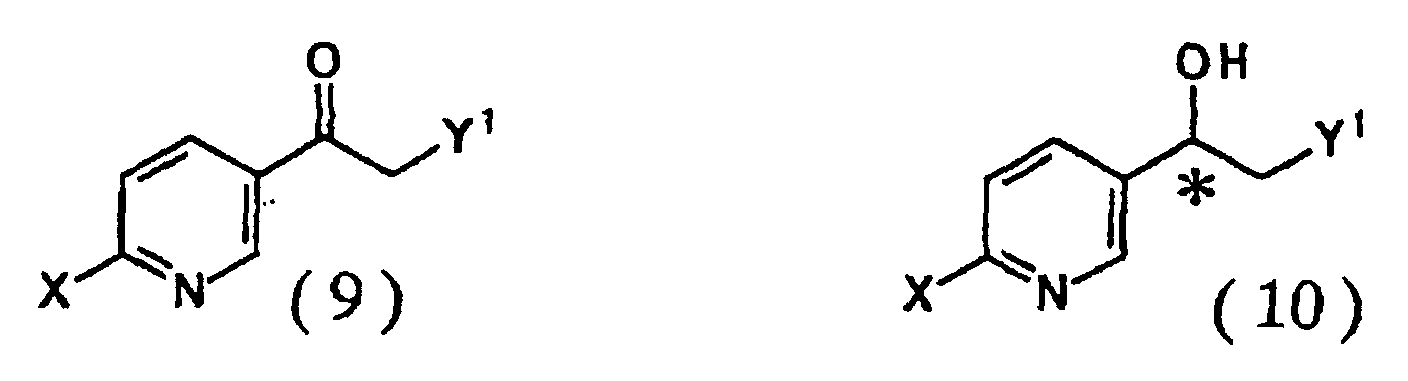
Description
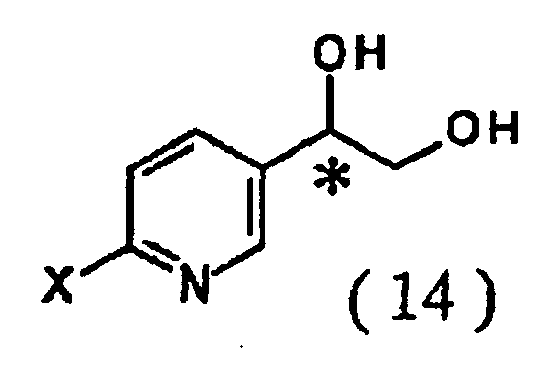
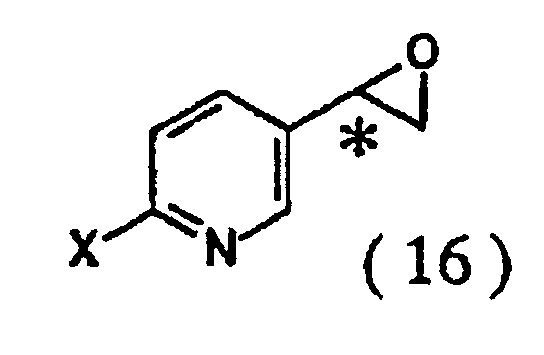

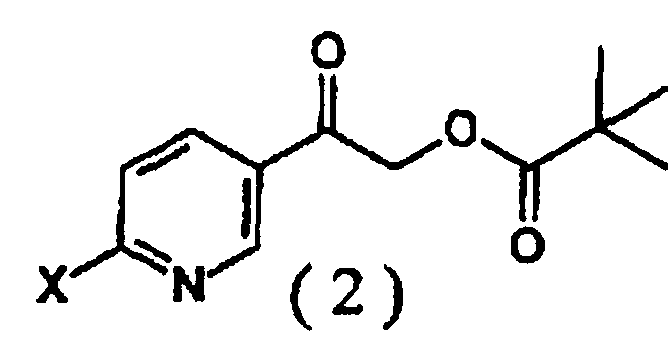


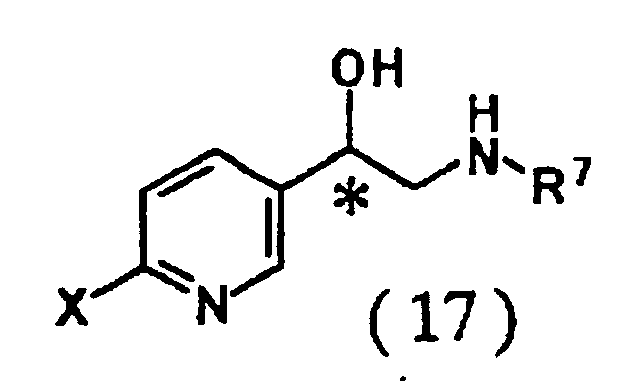


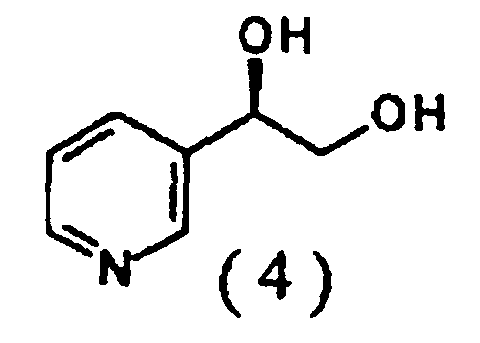

which comprises reacting, with a base, a haloacetic acid derivative represented by the general formula (5):


and then subjecting the reaction product to acid treatment.

which comprises enantioselectively reducing a substituted acetylpyridine derivative represented by the general formula (9):


which comprises reacting a substituted acetylpyridine derivative represented by the above general formula (7) with a carboxylic acid represented by the general formula (11):

in the presence of a base and a quaternary ammonium salt.
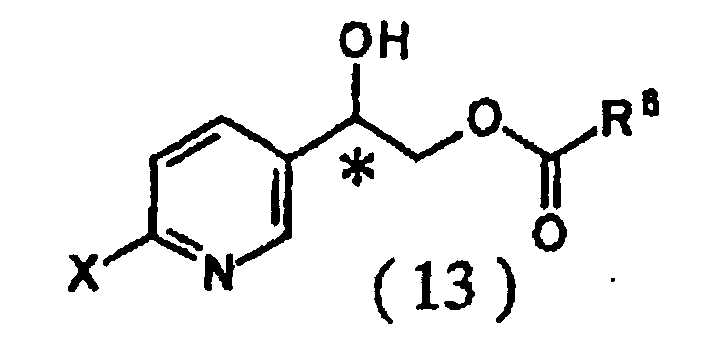
which comprises enantioselectively reducing a substituted acetylpyridine derivative represented by the above general formula (12).

which comprises subjecting an optically active acyloxyhydroxyethylpyridine derivative represented by the above general formula (13) to solvolysis in a lower alcohol solvent in the presence of a quaternary ammonium hydroxide.
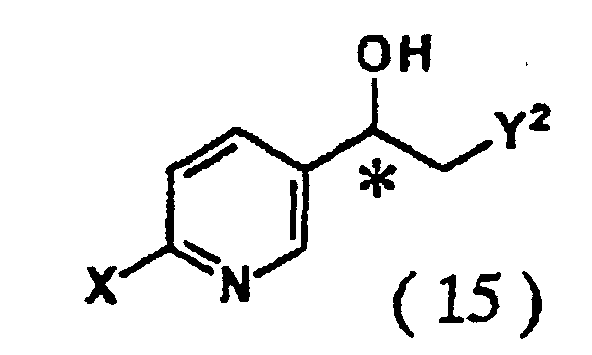

which comprises reacting a substituted acetylpyridine derivative represented by the above general formula (7) with a carboxylic acid represented by the above general formula (11) in the presence of a base and a quaternary ammonium salt to prepare a substituted acetylpyridine derivative represented by the above general formula (12) and subjecting this to enantioselective reduction to prepare an optically active acyloxyhydroxyethylpyridine derivative represented by the above general formula (13), followed by subjecting it to solvolysis.
which comprises subjecting a substituted acetylpyridine derivative represented by the above general formula (12) to solvolysis while enantioselectively reducing in the presence of a base to thereby directly obtain the optically active dihydroxyethylpyridine derivative represented by the above general formula (14).


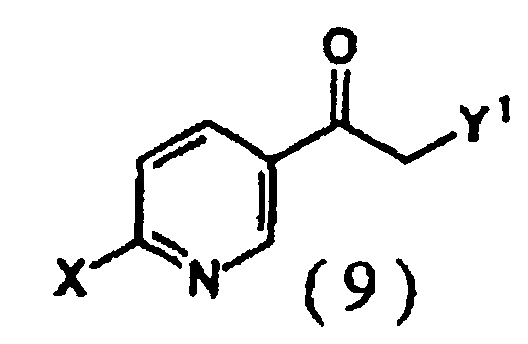


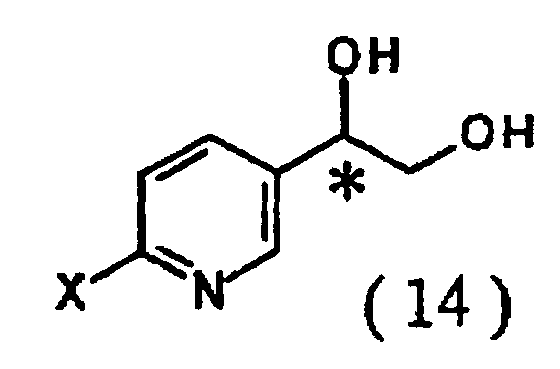
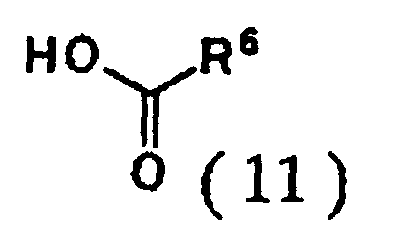

1H-NMR (400 MHz, DMSO-d6) δ 10.93 (1H, s), 8.90 (1H, s), 8.29 (1H, d, J=8.8 Hz), 8.19 (1H, d, J=8.8 Hz), 5.16 (2H, s), 2.13 (3H, s).
13C-NMR (100 MHz, DMSO-d6) δ 189.7, 170.1, 155.4, 149.4, 138.4, 125.6, 112.5, 47.4, 24.1.
IR (KBr) 1690 cm-1.
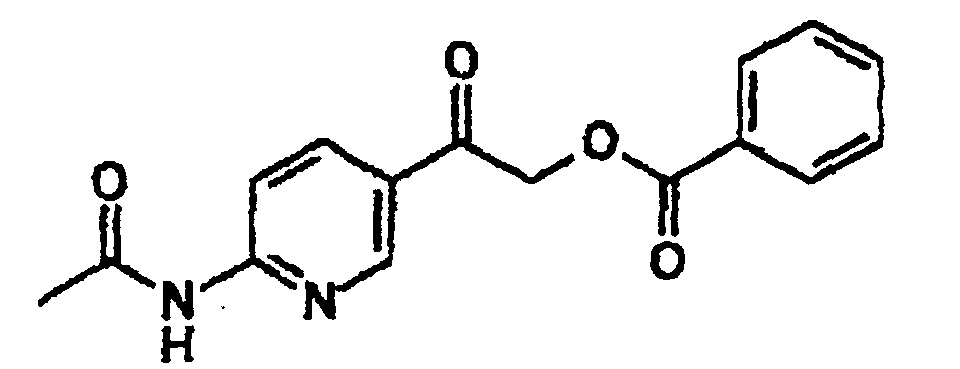
1H-NMR (400 MHz, DMSO-d6) δ 10.96 (1H, s), 8.96 (1H, d, J=2.5 Hz), 8.33 (1H, dd, J=8.8 Hz, 1.9 Hz), 8.22 (1H, d, J=8.8 Hz), 8.03 (1H, d, J=7.8 Hz), 7.70 (1H, t, J=7.2 Hz), 7.57 (2H, dd, J=7.6 Hz), 5.73 (2H, s), 2.15 (3H, s).
13C-NMR (100 MHz, DMSO-d6) δ 191.0, 170.1, 165.3, 155.6, 149.0, 138.0, 133.8, 129.4, 129.1, 128.9, 125.2, 112.6, 66.9, 24.1. IR (KBr) 1720, 1700, 1690 cm-1.

2-[6-(methylcarboxamido)pyridin-3-yl]-2-oxoethyl ethanoate. 1H-NMR (400 MHz, DMSO-d6) δ 10.93 (1H, s), 8.89 (1H, d, J=2.4 Hz), 8.28 (1H, dd, J=8.8 Hz, 2.0 Hz), 8.19 (1H, d, J=8.8 Hz), 5.43 (2H, s), 2.14 (3H, s), 2.13 (3H, s).
13C-NMR (100 MHz, DMSO-d6) δ 191.1, 170.2, 170.1, 155.6, 148.9, 138.0, 125.3, 112.6, 66.3, 24.2, 20.4.
IR (KBr) 1750, 1710, 1690 cm-1.

1H-NMR (400 MHz, DMSO-d6) δ 10.86 (1H, s), 8.85 (1H, d, J=3.4 Hz), 8.24 (1H, dd, J=4.4 Hz, 2.0 Hz), 8.18 (1H, d, J=6.4 Hz), 5.20 (1H, d, J=5.4 Hz), 4.75 (2H, d, J=5.3 Hz), 2.12 (3H, s). 13C-NMR (100 MHz, DMSO-d6) δ 197.5, 170.1, 155.2, 148.7, 137.9, 125.9, 112.6, 65.4, 24.2.
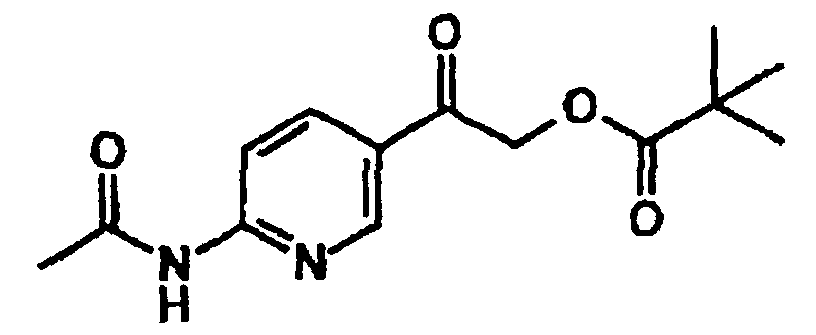
1H-NMR (400 MHz, CDCl3) δ 8.81 (1H, s), 8.32 (1H, d, J=8.6 Hz), 8.20 (1H, dd, J=8.8 Hz, 1.9 Hz), 8.10 (1H, s), 5.24 (2H, s), 2.25 (3H, s), 1.30 (9H, s).
13C-NMR (100 MHz, CDCl3) δ 190.3, 178.1, 169.0, 154.8, 148.5, 138.0, 126.1, 113.2, 65.6, 38.8, 27.1, 24.8.
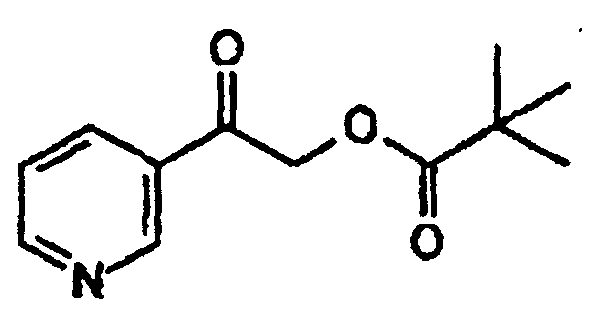
1H-NMR (400 MHz, DMSO-d6) δ 9.13 (1H, s), 8.84 (1H, d, J=4.4 Hz), 8.29 (1H, d, J=7.8 Hz), 7.59 (1H, dd, J=7.8 Hz, 4.9 Hz), 5.50 (2H, s), 1.22 (9H, s).
13C-NMR (100 MHz, DMSO-d6) δ 192.8, 177.0, 154.0, 149.0, 135.3, 129.5, 124.0, 66.4, 27.0, 26.9.
IR (KBr) 1740, 1700 cm-1.

1H-NMR (400 MHz, DMSO-d6) δ 10.46 (1H, s), 8.29 (1H, s), 8.01 (1H, d, J=8.3 Hz), 7.76 (1H, d, J=8.8 Hz), 5.90 (1H, t, J=4.4 Hz), 4.82-4.79 (1H, m), 3.79-3.74 (2H, m), 2.07 (3H, s).
13C-NMR (100 MHz, DMSO-d6) δ 169.5, 151.6, 146.3, 136.4, 132.8, 112.9, 70.2, 49.9, 24.0.
IR (KBr) 3440, 1660 cm-1.
[α]D 22: +0.032 (C = 1.00, in acetone)
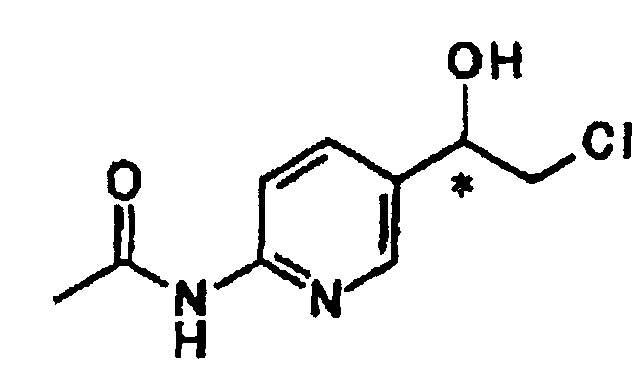
[α]D 22: -0.035 (C = 1.00, in acetone)
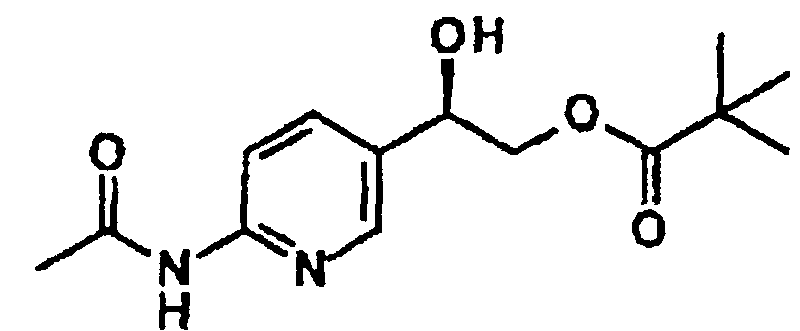
| Microorganlsm | Conversion % | Optical purity %ee | Absolute configuration | ||
| Ashbya | gossypii | IFO 0560 | 96 | 99 | R |
| Candida | catenulata | IFO 0731 | 64 | 98 | R |
| Candida | fructus | IFO 1581 | 42 | 72 | R |
| Candida | galacta | IFO 10031 | 66 | 61 | R |
| Candida | gropengiesseri | IFO 0659 | 34 | 90 | R |
| Candida | guilliermondii | IFO 0454 | 75 | 93 | R |
| Candida | haemulonii | IFO 10001 | 66 | 93 | R |
| Candida | holmii | IFO 0660 | 57 | 73 | R |
| Candida | intermedia | IFO 0761 | 64 | 91 | R |
| Candida | magnoliae | IFO 0705 | 81 | 77 | R |
| Candida | maltosa | IFO 1975 | 78 | 81 | R |
| Candida | melinii | IFO 0747 | 57 | 95 | R |
| Candida | parapsilosis | IFO 0585 | 64 | 78 | R |
| Candida | rugosa | IFO0750 | 52 | 81 | R |
| Candida | sonorensis | IFO 10027 | 59 | 69 | R |
| Candida | tropicalis | IFO1404 | 62 | 61 | R |
| Candida | utilis | IFO 0639 | 63 | 100 | R |
| Candida | versatillis | IPO 1941 | 54 | 100 | R |
| Cryptococcus | albidus var. albidas | IFO 0378 | 54 | 83 | R |
| Debaryomyces | hansenii var.fabryi | IFO 0015 | 60 | 95 | R |
| Debaryomyces | hansenii | IFO 0082 | 84 | 89 | R |
| Dabayomyces | marama | IFO 0668 | 74 | 97 | R |
| Debaryomyces | nepalensis | IFO 0039 | 22 | 88 | R |
| Guilliermondella | selenospora | IFO 1850 | 71 | 69 | R |
| Hansenula | glucozyma | IFO 1472 | 45 | 63 | R |
| Hansenula | satumus | IFO 0809 | 84 | 97 | R |
| Metschnikowia | reukaufii | IFO 0749 | 76 | 69 | R |
| Pichia | bovis | IFO 1886 | 68 | 92 | R |
| Pichia | farinosa | IFO 0463 | 86 | 92 | R |
| Rhodotorula | glutinis var.dairenensis | IFO 0415 | 96 | 100 | R |
| Rhodotorula | graminis | IFO 0190 | 45 | 95 | R |
| Rhodotorula | minuta | IFO 0928 | 39 | 73 | R |
| Rhodotorula | rubra | IFO 0383 | 73 | 94 | R |
| Rhodsporidium | diobovatum | IFO 0688 | 56 | 94 | R |
| Rhodsporidium | sphaerocarpum | IFO 1438 | 64 | 96 | R |
| Rhodsporidium | toruloides | IFO 0413 | 64 | 94 | R |
| Saccharomycopsis | malanga | IFO 1710 | 48 | 74 | R |
| Schwanniomyces | castellii | IFO 1840 | 44 | 73 | R |
| Sporidiobolus | johnsonii | IFO 6903 | 73 | 99 | R |
| Sporobolomyces | pararoseus | IFO 0471 | 45 | 84 | R |
| Sporobolomyces | salmonicolor | IAM 12249 | 41 | 83 | R |
| Torulaspora | delbrueckii | IFO 0381 | 41 | 62 | R |
| Yarrowia | lipolytica | IFO 1548 | 97 | 99 | R |
1H-NMR (400 MHz, CDCl3) δ 10.46 (1H, s), 8.26 (1H, d, J=2.5 Hz), 8.02 (1H, d, J=8.3 Hz), 7.73 (1H, dd, J=8.8 Hz, 2.5 Hz), 5.66 (1H, d, J=4.4 Hz), 4.78 (1H, dd, J=10.7 Hz, 5.9 Hz), 4.15 (1H, dd, J=10.7 Hz, 5.9Hz), 4.03 (1H, dd, J=11.6 Hz, 5.4 Hz), 2.06 (3H, s), 1.05 (9H, s).
13C-NMR (100 MHz, CDCl3) δ 177.1, 169.2, 151.4, 146.1, 136.2, 132.7, 112.6, 68.0, 67.8, 67.8, 38.2, 26.8, 23.8.

| Microorganism | Substrate (9) X | Y' | Conversion % | Optical purity ‰ | Absolute configuratton | ||
| Candida | intermadis | IFO 0761 | AcNH | Cl | 56 | 78 | R |
| Candida | tropicalis | IFO1404 | AcNH | Cl | 44 | 67 | R |
| Cryptococcus | albidus var. albidas | IFO 0378 | AcNH | Cl | 20 | 84 | R |
| Rhodotorula | graminis | IFO 0190 | AcNH | Cl | 48 | 87 | R |
| Rhodotorula | rubra | IFO 0383 | AcNH | Cl | 67 | 98 | R |
| Sporidiobolus | johnsonii | IFO 6903 | AcNH | Cl | 64 | 91 | R |
| Schwanniomyces | castellii | IFO 1840 | H | Cl | 47 | 61 | R |
| Candida | magnolise | IFO 0706 | H | OCOtBu | 100 | 71 | R |
| Sporidiobolus | johnsonii | IFO 6903 | H | OCOtBu | 70 | 66 | R |
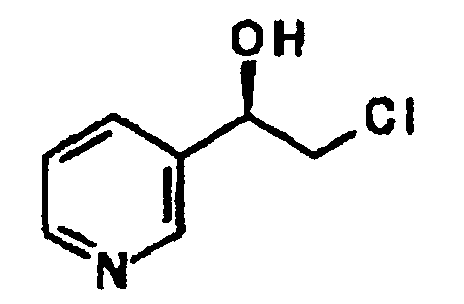
1H-NMR (400 MHz, CD3OD) δ 8.58 (d, 1H), δ 8.46 (dd, 1H), δ 7.90 (d, 1H), δ 7.44 (dd, 1H), δ 4.93 (m, 1H), δ 3.75 (m, 2H).
1H-NMR (400 MHz, CD3OD) δ 8.93 (d, 1H), δ 8.84 (dd, 1H), δ 8.72 (d, 1H), δ 8.10 (dd, 1H), δ 5.23 (m, 1H), δ 3.88 (m, 2H).

13C-NMR (100 MHz, DMSO-d6) δ 177.1, 148.6, 148.0, 137.4, 134.1, 123.3, 68.3, 67.9, 38.2, 26.8.
IR (KBr) 3200, 1730 cm-1.
[α]D 25: -22.87 (c = 1, MeOH)

1H-NMR (400 MHz, CDCl3) δ 9.14 (1H, bs), 8.27 (1H, s), 8.20 (1H, d), 7.74 (1H, dd), 4.97 (1H, dd), 4.28 (1H, dd), 4.17 (1H, dd), 2.86 (1H, bs), 2.21 (3H, s), 2.11 (3H, s), 1.69 (1H, bs).
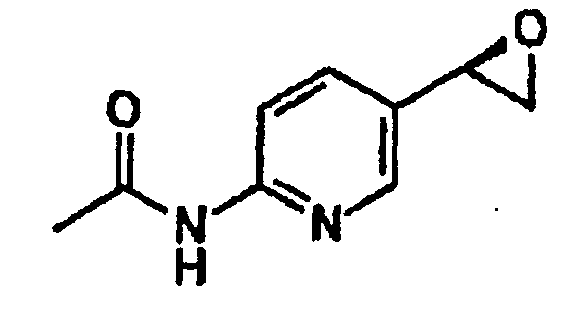
1H-NMR (400MHz, CDCl3) δ 8.47 (1H, br), 8.21 (1H, s), 8.20 (1H, d, J=12.2 Hz), 7.56 (1H, dd, J=8.8 Hz, 1.7 Hz), 3.86 (1H, s), 3.17 (1H, dd, J=4.4 Hz), 2.83 (1H, dd, J=4.9 Hz, 2.0 Hz), 2.20 (3H, s).
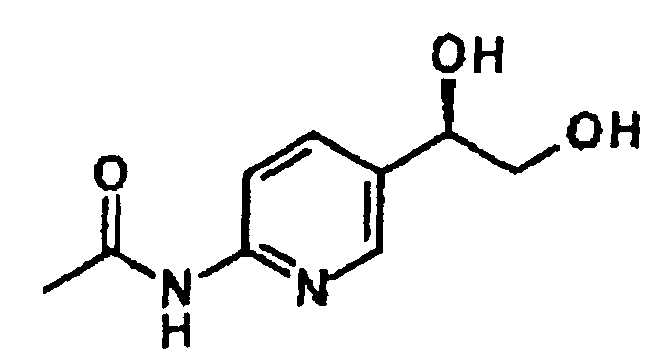
1H-NMR (400 MHz, DMSO-d6) δ 10.43 (1H, s), 8.22 (1H, d, J=2.0 Hz), 8.00 (1H, d, J=8.3 Hz), 7.69 (1H, dd, J=8.3, 2.0 Hz), 5.31 (1H, d, J=3.9Hz), 4.74-4.77 (1H, m), 4.51-4.53 (1H, m), 3.33-3.59 (2H, m), 2.07 (3H, s).
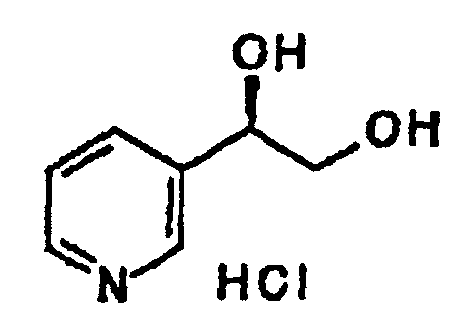
1H-NMR (400 MHz, CD3OD) δ 8.79 (d, 1H), δ 8.70 (d, 1H), δ 8.60 (d, 1H), δ 8.00 (dd, 1H), δ 4.87 (m, 1H), δ 3.68 (m, 2H).
[α]D 25: -20.99 (c = 1, MeOH)

1H-NMR (400 MHz, CD3OD) δ 8.79 (d, 1H), δ 8.70 (d, 1H), δ 8.60 (d, 1H), δ 8.00 (dd, 1H), δ 4.87 (m, 1H), δ 3.68 (m, 2H).

Claims (95)
- A substituted acetylpyridine derivative substituted by an amino group in position 2 which is represented by the general formula (1):in the formula, R1 and R2 each independently represents a hydrogen, an alkyl containing 1 to 10 carbon atoms, an aralkyl group containing 1 to 10 carbon atoms, an acyl group containing 1 to 10 carbon atoms or an alkyloxycarbonyl group containing 1 to 10 carbon atoms and Y1 represents a halogen, a hydroxyl, an acyloxy group containing 1 to 10 carbon atoms, a sulfonyloxy group containing 1 to 10 carbon atoms, an alkoxy group containing 1 to 10 carbon atoms, an amino group, an alkylamino group containing 1 to 15 carbon atoms, an aralkylamino group containing 1 to 15 carbon atoms, a sulfanyl group, an alkylsulfanyl group containing 1 to 10 carbon atoms or an aralkylsulfanyl group containing 1 to 10 carbon atoms.

- The substituted acetylpyridine derivative according to Claim 1,
wherein R1 represents an acetyl group and R2 represents a hydrogen. - The substituted acetylpyridine derivative according to Claim 1 or 2,
wherein Y1 represents a halogen. - The substituted acetylpyridine derivative according to Claim 3,
wherein Y1 represents a chlorine. - The substituted acetylpyridine derivative according to Claim 1 or 2,
wherein Y1 represents a hydroxyl group or an acyloxy group containing 1 to 10 carbon atoms. - A pivaloyloxyacetylpyridine derivative represented by the general formula (2):in the formula, X represents a hydrogen, a halogen, a hydroxyl group, an acyloxy group containing 1 to 10 carbon atoms, an alkoxy group containing 1 to 10 carbon atoms, an amino group or a substituted amino group.

- The pivaloyloxyacetylpyridine derivative according to Claim 6,
wherein X represents any of a hydrogen, a chlorine and an acetylamino group. - An optically active pivaloyloxyhydroxyethylpyridine derivative represented by the general formula (3) :in the formula, X represents a hydrogen, a halogen, a hydroxyl group, an acyloxy group containing 1 to 10 carbon atoms, an alkoxy group containing 1 to 10 carbon atoms, an amino group or a substituted amino group.

- The optically active pivaloyloxyhydroxyethylpyridine derivative according to Claim 8,
wherein X represents any of a hydrogen, a chlorine and an acetylamino group. - An optically active dihydroxyethylpyridine derivative represented by the formula (4):or a salt thereof.
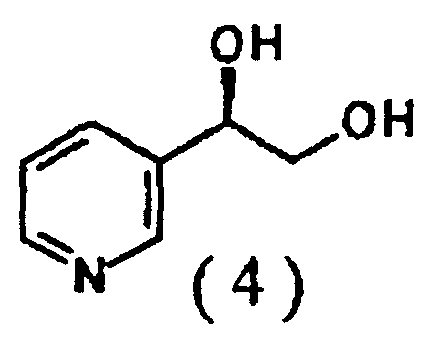
- Aproduction method of a substituted acetylpyridine derivative represented by the general formula (7):in the formula, Y2 represents a halogen andX represents a hydrogen, a halogen, a hydroxyl group, an acyloxy group containing 1 to 10 carbon atoms, an alkoxy group containing 1 to 10 carbon atoms, an amino group or a substituted amino group,

which comprises reacting, with a base, a haloacetic acid derivative represented by the general formula (5):in the formula, Y2 is as defined above and Z represents a hydrogen, an alkali metal, a halogenated alkaline earth metal or a silyl group containing 1 to 10 carbon atoms, in the formula, X is as defined above and R3 represents an alkyl group containing 1 to 10 carbon atoms or an aralkyl group containing 1 to 10 carbon atoms,to prepare an enolate,reacting the same with a substituted nicotinic acid ester represented by the general formula (6):
and then subjecting the reaction product to acid treatment. - The production method according to Claim 11,
wherein Y2 represents a chlorine. - The production method according to Claim 11 or 12,
wherein Z represents sodium or magnesium chloride. - The production method according to Claim 11, 12 or 13,
wherein the base is a magnesium amide represented by the general formula (8) :in the formula, R4 and R5 each independently represents an alkyl group containing 1 to 10 carbon atoms or a silyl group containing 1 to 10 carbon atoms and Q represents a halogen.
- The production method according to Claim 14,
wherein R4 and R5 each represents an isopropyl group. - The production method according to Claim 14 or 15,
wherein Q represents a chlorine. - The production method according to Claim 11, 12, 13, 14, 15 or 16,
wherein X represents any of a hydrogen, a chlorine and an acetylamino group. - A production method of an optically active hydroxyethylpyridine derivative represented by the general formula (10):in the formula, X represents a hydrogen, a halogen, a hydroxyl group, an acyloxy group containing 1 to 10 carbon atoms, an alkoxy group containing 1 to 10 carbon atoms, an amino group or a substituted amino group, Y1 represents a halogen, a hydroxyl group, an acyloxy group containing 1 to 10 carbon atoms, a sulfonyloxy group containing 1 to 10 carbon atoms, an alkoxy group containing 1 to 10 carbon atoms, an amino group, an alkylamino group containing 1 to 15 carbon atoms, an aralkylamino group containing 1 to 15 carbon atoms, a sulfanyl group, an alkylsulfanyl group containing 1 to 10 carbon atoms or an aralkylsulfanyl group containing 1 to 10 carbon atoms and * represents an asymmetric carbon atom,

which comprises enantioselectively reducing a substituted acetylpyridine derivative represented by the general formula (9):in the formula, X and Y1 are as defined above.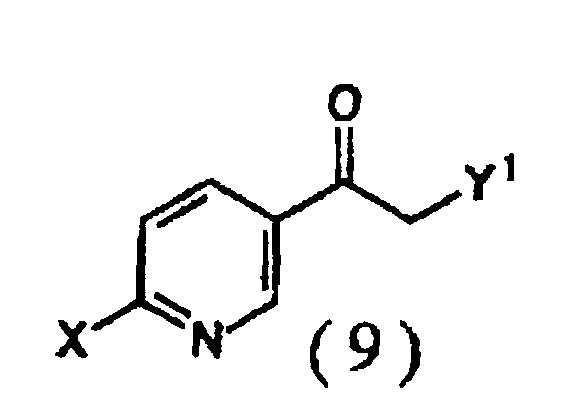
- The production method according to Claim 18,
wherein Y1 represents a chlorine. - The production method according to Claim 18 or 19,
wherein X represents any of a hydrogen, a chlorine and an acetylamino group. - The production method according to Claim 18, 19 or 20,
wherein the enantioselective reduction is carried out in the manner of (R)-selective reduction using a microorganism-derived carbonyl reducing enzyme or a culture of a microorganism having an ability of producing said carbonyl reducing enzyme or a treatment product thereof. - The production method according to Claim 21,
wherein the microorganism having an ability of producing the carbonyl reducing enzyme is a microorganism belonging to the genus Ashbya, Candida, Cryptococcus, Debaryomyces, Guilliermondella, Hansenula, Metschnikowia, Pichia, Rhodotorula, Rhodosporidium, Saccharomycopsis, Schwanniomyces, Sporidiobolus, Sporobolomyces, Torulaspora or Yarrowia. - The production method according to Claim 22,
wherein the microorganism having an ability of producing the carbonyl reducing enzyme is a microorganism selected from the group consisting of Ashbya gossypii, Candida catinulata, Candida fructus, Candida galacta, Candida gropengiesseri, Candida guilliermondii, Candida haemulonii, Candida holmii, Candida intermedia, Candida magnoliae, Candidamaltosa, Candida melinii, Candida parapsilosis, Candida rugosa, Candida sonorensis, Candida tropicalis, Candida utilis, Candida versatilis, Cryptococcus albidus var. albidus, Debaryomyces hansenii var. fabryi, Debaryomyces hansenii, Debaryomyces marama, Debaryomyces nepalensis, Guilliermondella selenospora, Hansenula glucozyma, Hansenula saturnus, Metschnikowia reukaufi, Pichia bovis, Pichia farinosa, Rhodotorula glutinis var. dairenensis, Rhodotorula graminis, Rhodotorula minuta, Rhodotorula rubra, Rhodosporidium diobovatum, Rhodosporidium sphaerocarpum, Rhodosporidium toruloides, Saccharomycopsis malanga, Schwanniomyces castellii, Sporidiobolus johnsonii, Sporobolomyces pararoseus, Sporobolomyces salmonicolor, Torulaspora delbrueckii and Yarrowia lipolytica. - The production method according to Claim 23,
wherein the microorganism having an ability of producing the carbonyl reducing enzyme is Candida magnoliae IFO 0705. - The production method according to Claim 21,
wherein the microorganism having an ability of producing the carbonyl reducing enzyme is a transformant cell transformed by a plasmid containing a DNA coding for the carbonyl reducing enzyme derived from a microorganism belonging to the genus Candida and a DNA coding for an enzyme having an ability of regenerating a coenzyme on which the former enzyme is dependent. - The production method according to Claim 25,
wherein the transformant cell is E. coli HB101 (pNTCRG), accession number FERM-BP6898. - A production method of a substituted acetylpyridine derivative represented by the general formula (12):in the formula, X represents a hydrogen, a halogen, a hydroxyl group, an acyloxy group containing 1 to 10 carbon atoms, an alkoxy group containing 1 to 10 carbon atoms, an amino group or a substituted amino group and R6 represents an alkyl group containing 1 to 15 carbon atoms, an aralkyl group containing 1 to 15 carbon atoms or an aryl group containing 6 to 16 carbon atoms,

which comprises reacting a substituted acetylpyridine derivative represented by the general formula (7)in the formula, X is as defined above and Y2 represents a halogen, with a carboxylic acid represented by the general formula (11):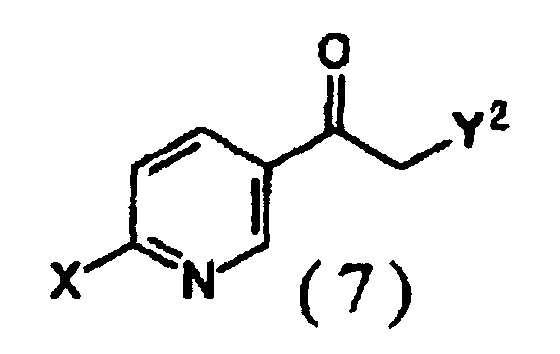 in the formula, R6 is as defined above,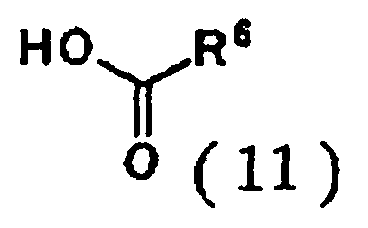
in the presence of a base and a quaternary ammonium salt. - The production method according to Claim 27,
wherein R6 represents any of methyl, tert-butyl and phenyl groups. - The production method according to Claim 27 or 28,
wherein X represents any of a hydrogen, a chlorine and an acetylamino group. - The production method according to Claim 27, 28 or 29,
wherein Y2 is a chlorine. - The production method according to Claim 27, 28, 29 or 30,
wherein the base is any of sodium hydrogen carbonate, sodium carbonate, potassium hydrogen carbonate and potassium carbonate. - The production method according to Claim 27, 28, 29, 30 or 31,
wherein the quaternary ammonium salt is any of tetra (n-butyl)ammonium chloride and tetra(n-butyl)ammonium bromide. - A production method of an optically active acyloxyhydroxyethylpyridine derivative represented by the general formula (13):in the formula, X represents a hydrogen, a halogen, a hydroxyl group, an acyloxy group containing 1 to 10 carbon atoms, an alkoxy group containing 1 to 10 carbon atoms, an amino group or a substituted amino group, R6 represents an alkyl group containing 1 to 15 carbon atoms, an aralkyl group containing 1 to 15 carbon atoms or an aryl group containing 6 to 16 carbon atoms and * represents an asymmetric carbon atom,
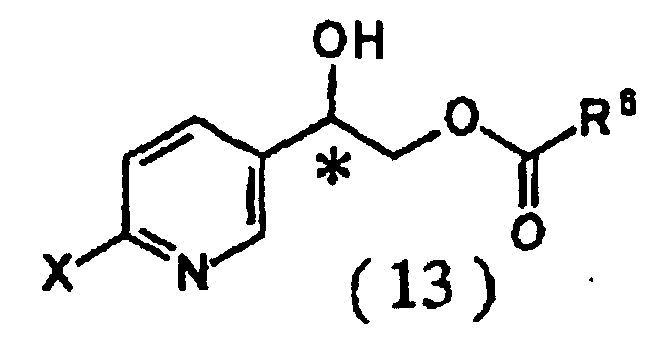
which comprises enantioselectively reducing a substituted acetylpyridine derivative represented by the general formula (12):in the formula, X and R6 are as defined above.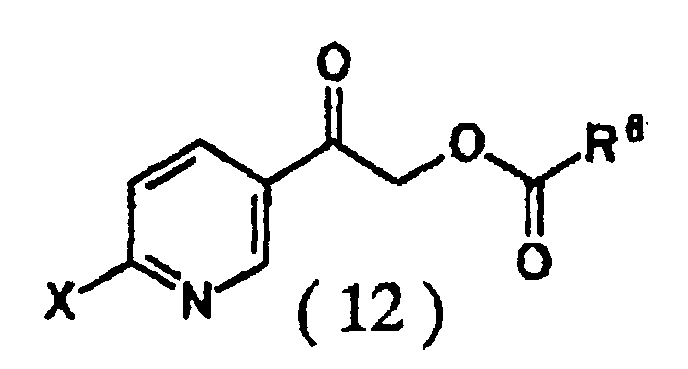
- The production method according to Claim 33,
wherein R6 represents any of methyl, tert-butyl and phenyl groups. - The production method according to Claim 33 or 34,
wherein X represents any of a hydrogen, a chlorine and an acetylamino group. - The production method according to Claim 33, 34 or 35,
wherein the optically active acyloxyhydroxyethylpyridine derivative (13) has the (R) configuration. - The production method according to Claim 33, 34, 35 or 36,
wherein the enantioselective reduction is carried out in the manner of (R)-selective reduction using a microorganism-derived carbonyl reducing enzyme or a culture of a microorganism having an ability of producing said carbonyl reducing enzyme or a treatment product thereof. - The production method according to Claim 37,
wherein the microorganism having an ability of producing the carbonyl reducing enzyme is a microorganism belonging to the genus Ashbya, Candida, Cryptococcus, Debaryomyces, Guilliermondella, Hansenula, Metschnikowia, Pichia, Rhodotorula, Rhodosporidium, Saccharomycopsis, Schwanniomyces, Sporidiobolus, Sporobolomyces, Torulaspora or Yarrowia. - The production method according to Claim 38,
wherein the microorganism having an ability of producing the carbonyl reducing enzyme is a microorganism selected from the group consisting of Ashbya gossypii, Candida catinulata, Candida fructus, Candida galacta, Candida gropengiesseri, Candida guilliermondii, Candida haemulonii, Candida holmii, Candida intermedia, Candida magnoliae, Candida maltosa, Candida melinii, Candida Srapsilosis, Candida rugosa, Candida sonorensis, Candida tropicalis, Candida utilis, Candida versatilis, Cryptococcus albidus var. albidus, Debaryomyces hansenii var. fabryi, Debaryomyces hansenii, Debaryomyces marama, Debaryomyces nepalensis, Guilliermondella selenospora, Hansenula glucozyma, Hansenula saturnus, Metschnikowia reukaufi, Pichia bovis, Pichia farinosa, Rhodotorula glutinis var. dairenensis, Rhodotorula graminis, Rhodotorula minuta, Rhodotorula rubra, Rhodosporidium diobovatum, Rhodosporidium sphaerocarpum, Rhodosporidium toruloides, Saccharomycopsis malanga, Schwanniomyces castellii, Sporidiobolus johnsonii, Sporobolomyces pararoseus, Sporobolomyces salmonicolor, Torulaspora delbrueckii and Yarrowia lipolytica. - The production method according to Claim 39,
wherein the microorganism having an ability of producing the carbonyl reducing enzyme is Candida magnoliae IFO 0705. - The production method according to Claim 37,
wherein the microorganism having an ability of producing the carbonyl reducing enzyme is a transformant cell transformed by a plasmid containing a DNA coding for the carbonyl reducing enzyme derived from a microorganism belonging to the genus Candida and a DNA coding for an enzyme having an ability of regenerating a coenzyme on which the former enzyme is dependent. - The production method according to Claim 41,
wherein the transformant cell is E. coli HB101 (pNTCRG), accession number FERM-BP6898. - The production method according to Claim 33, 34, 35 or 36,
wherein the enantioselective reduction is carried out in the manner of hydrogen transfer type reduction using a hydrogen transfer source with a catalyst prepared from a ruthenium complex, an optically active amine and a base. - The production method according to Claim 43,
wherein the hydrogen transfer source is isopropyl alcohol. - The production method according to Claim 43 or 44,
wherein any of bis (η6-benzene)diruthenium tetrachloride, bis (η6-p-cymene)diruthenium tetrachloride and bis (η6-mesitylene)diruthenium tetrachloride is used as the ruthenium complex. - The production method according to Claim 43, 44 or 45,
wherein any of (S,S)-N-p-tosyl-1,2-diphenylethylenediamine and (R,R)-N-p-tosyl-1,2-diphenylethylenediamine is used as the optically active amine. - A production method of an optically active dihydroxyethylpyridine derivative represented by the general formula (14):in the formula, X represents a hydrogen, a halogen, a hydroxyl group, an acyloxy group containing 1 to 10 carbon atoms, an alkoxy group containing 1 to 10 carbon atoms, an amino group or a substituted amino group and * represents an asymmetric carbon atom,

which comprises subjecting an optically active acyloxyhydroxyethylpyridine derivative represented by the general formula (13):in the formula, X is as defined above, R6 represents an alkyl group containing 1 to 15 carbon atoms, an aralkyl group containing 1 to 15 carbon atoms or an aryl group containing 6 to 16 carbon atoms and * represents an asymmetric carbon atom,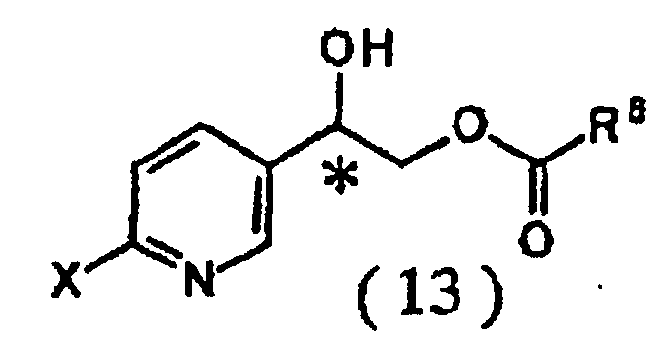
to solvolysis in a lower alcohol solvent in the presence of a quaternary ammonium hydroxide. - The production method according to Claim 47,
wherein R6 represents any of methyl, tert-butyl and phenyl groups. - The production method according to Claim 47 or 48,
wherein X represents any of a hydrogen, a chlorine and an acetylamino group. - The production method according to Claim 47, 48 or 49,
wherein methyl alcohol is used as the lower alcohol solvent. - The production method according to Claim 47, 48, 49 or 50,
wherein tetra(n-butyl)ammonium hydroxide is used as the quaternary ammonium hydroxide. - The production method according to Claim 47, 48, 49, 50 or 51,
wherein a low-polarity solvent is added to the reaction mixture after solvolysis to thereby obtain the optically active dihydroxyethylpyridine derivative (14) as a crystal. - The production method according to Claim 52, wherein toluene is used as the low-polarity solvent.
- A production method of an optically active hydroxyethylpyridine derivative represented by the general formula (15):in the formula, Y2 represents a halogen, X represents a hydrogen, a halogen, a hydroxyl group, an acyloxy group containing 1 to 10 carbon atoms, an alkoxy group containing 1 to 10 carbon atoms, an amino group or a substituted amino group and * represents an asymmetric carbon atom,

which comprises reacting, with a base, a haloacetic acid derivative represented by the general formula (5):in the formula, Y2 is as defined above and Z represents a hydrogen, an alkali metal, a halogenated alkaline earth metal or a silyl group containing 1 to 10 carbon atoms, in the formula, X is as defined above and R3 represents an alkyl group containing 1 to 10 carbon atoms or an aralkyl group containing 1 to 10 carbon atoms,to prepare an enolate,reacting the same with a substituted nicotinic acid ester represented by the general formula (6):
subjecting the reaction product to acid treatment to prepare a substituted acetylpyridine derivative represented by the general formula (7):in the formula, Y2 and X are as defined above,
followed by enantioselective reduction. - A production method of an optically active oxirane derivative represented by the general formula (16):in the formula, X represents a hydrogen, a halogen, a hydroxyl group, an acyloxy group containing 1 to 10 carbon atoms, an alkoxy group containing 1 to 10 carbon atoms, an amino group or a substituted amino group and * represents an asymmetric carbon atom,

which comprises reacting, with a base, a haloacetic acid derivative represented by the general formula (5):in the formula, Y2 represents a halogen and Z represents a hydrogen, an alkali metal, a halogenated alkaline earth metal or a silyl group containing 1 to 10 carbon atoms,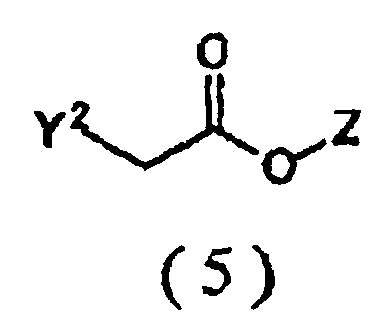 in the formula, X is as defined above and R3 represents an alkyl group containing 1 to 10 carbon atoms or an aralkyl group containing 1 to 10 carbon atoms,to prepare an enolate,reacting the same with a substituted nicotinic acid ester represented by the general formula (6):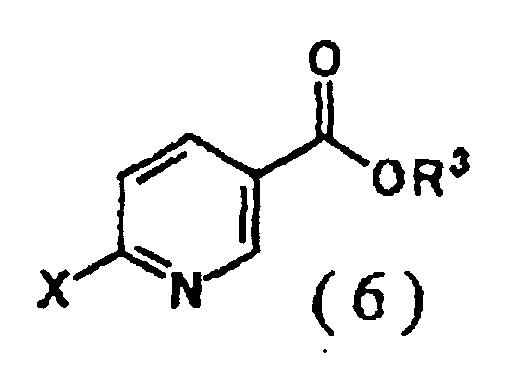
subjecting the reaction product to acid treatment to prepare a substituted acetylpyridine derivative represented by the general formula (7):in the formula, Y2 and X are as defined above,
subjecting this to enantioselective reduction to prepare an optically active hydroxyethylpyridine derivative represented by the general formula (15):in the formula, Y2 and X are as defined above and * represents an asymmetric carbon atom,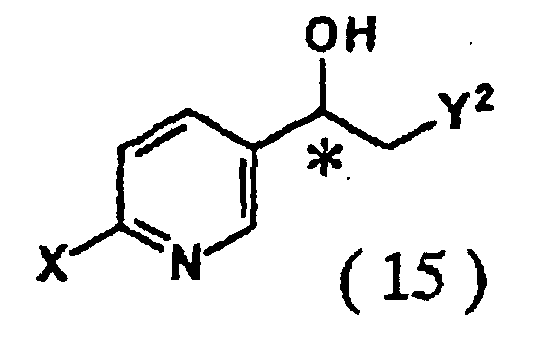
followed by treating it with a base. - The production method according to Claim 54 or 55,
wherein Y2 represents a chlorine. - The production method according to Claim 54, 55 or 56,
wherein Z represents sodium or magnesium chloride. - The production method according to Claim 54, 55, 56 or 57,
wherein the base is a magnesium amide represented by the general formula (8):in the formula, R4 and R5 each independently represents an alkyl group containing 1 to 10 carbon atoms or a silyl group containing 1 to 10 carbon atoms and Q represents a halogen.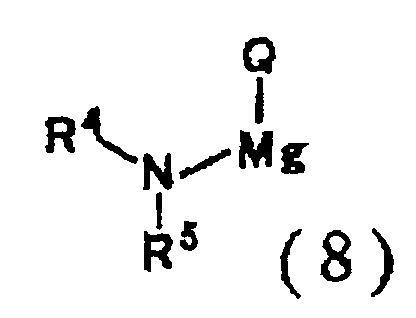
- The production method according to Claim 58,
wherein R4 and R5 each represents an isopropyl group. - The production method according to Claim 58 or 59,
wherein Q represents a chlorine. - The production method according to Claim 54, 55, 56, 57, 58, 59 or 60,
wherein X represents any of a hydrogen, a chlorine and an acetylamino group. - The production method according to Claim 54, 55, 56, 57, 58, 59, 60 or 61,
wherein the enantioselective reduction is carried out in the manner of (R)-selective reduction using a microorganism-derived carbonyl reducing enzyme or a culture of a microorganism having an ability of producing said carbonyl reducing enzyme or a treatment product thereof. - The production method according to Claim 62,
wherein the microorganism having an ability of producing the carbonyl reducing enzyme is a microorganism belonging to the genus Ashbya, Candida, Cryptococcus, Debaryomyces, Guilliermondella, Hansenula, Metschnikowia, Pichia, Rhodotorula, Rhodosporidium, Saccharomycopsis, Schwanniomyces, Sporidiobolus, Sporobolomyces, Torulaspora or Yarrowia. - The production method according to Claim 63,
wherein the microorganism having an ability of producing the carbonyl reducing enzyme is a microorganism selected from the group consisting of Ashbya gossypii, Candida catinulata, Candida fructus, Candida galacta, Candida gropengiesseri, Candida guilliermondii, Candida haemulonii, Candida holmii, Candida intermedia, Candida magnoliae, Candida maltosa, Candida melinii, Candida parapsilosis, Candida rugosa, Candida sonorensis, Candida tropicalis, Candida utilis, Candida versatilis, Cryptococcus albidus var. albidus, Debaryomyces hansenii var. fabryi, Debaryomyces hansenii, Debaryomyces marama, Debaryomyces nepalensis, Guilliermondella selenospora, Hansenula glucozyma, Hansenula saturnus, Metschnikowia reukaufi, Pichia bovis, Pichia farinosa, Rhodotorula glutinis var. dairenensis, Rhodotorula graminis, Rhodotorula minuta, Rhodotorula rubra, Rhodosporidium diobovatum, Rhodosporidium sphaerocarpum, Rhodosporidium toruloides, Saccharomycopsis malanga, Schwanniomyces castellii, Sporidiobolus johnsonii, Sporobolomyces pararoseus, Sporobolomyces salmonicolor, Torulaspora delbrueckii and Yarrowia lipolytica. - The production method according to Claim 64,
wherein the microorganism having an ability of producing the carbonyl reducing enzyme is Candida magnoliae IFO 0705. - The production method according to Claim 62,
wherein the microorganism having an ability of producing the carbonyl reducing enzyme is a transformant cell transformed by a plasmid containing a DNA coding for the carbonyl reducing enzyme derived from a microorganism belonging to the genus Candida and a DNA coding for an enzyme having an ability of regenerating a coenzyme on which the former enzyme is dependent. - The production method according to Claim 66,
wherein the transformant cell is E. coli HB101 (pNTCRG), accession number FERM-BP6898. - A production method of an optically active dihydroxyethylpyridine derivative represented by the general formula (14):in the formula, X represents a hydrogen, a halogen, a hydroxyl group, an acyloxy group containing 1 to 10 carbon atoms, an alkoxy group containing 1 to 10 carbon atoms, an amino group or a substituted amino group and * represents an asymmetric carbon atom,

which comprises reacting a substituted acetylpyridine derivative represented by the general formula (7):in the formula, X is as defined above and Y2 represents a halogen ,
with a carboxylic acid represented by the general formula (11) :in the formula, R6 represents an alkyl group containing 1 to 15 carbon atoms, an aralkyl group containing 1 to 15 carbon atoms or an aryl group containing 6 to 16 carbon atoms,
in the presence of a base and a quaternary ammonium salt to prepare a substituted acetylpyridine derivative represented by the general formula (12):in the formula, X and R6 are as defined above,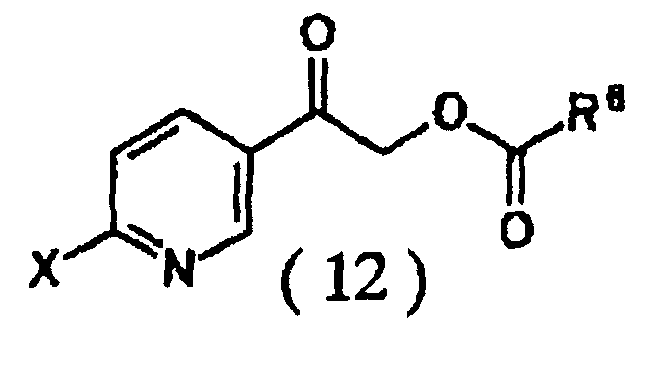
and subjecting this to enentioselective reduction to prepare an optically active acyloxyhydroxyethylpyridine derivative represented by the general formula (13) :in the formula, X and R6 are as defined above and * represents an asymmetric carbon atom,
followed by subjecting it to solvolysis. - The production method according to Claim 68,
wherein R6 represents any of methyl, tert-butyl and phenyl groups. - The production method according to Claim 68 or 69,
wherein X represents any of a hydrogen, a chlorine and an acetylamino group. - The production method according to Claim 68, 69 or 70,
wherein Y2 is a chlorine. - The production method according to Claim 68, 69, 70 or 71,
wherein the base is any of sodium hydrogen carbonate, sodium carbonate, potassium hydrogen carbonate and potassium carbonate. - The production method according to Claim 68, 69, 70, 71 or 72,
wherein the quaternary ammonium salt is any of tetra(n-butyl)ammonium chloride and tetra(n-butyl)ammonium bromide. - The production method according to Claim 68, 69, 70, 71, 72 or 73,
wherein the optically active acyloxyhydroxyethylpyridine derivative has the (R) configuration. - The production method according to Claim 68, 69, 70, 71, 72, 73 or 74,
wherein the enantioselective reduction is carried out in the manner of (R)-selective reduction using a microorganism-derived carbonyl reducing enzyme or a culture of a microorganism having an ability of producing said carbonyl reducing enzyme or a treatment product thereof. - The production method according to Claim 75,
wherein the microorganism having an ability of producing the carbonyl reducing enzyme is a microorganism belonging to the genus Ashbya, Candida, Cryptococcus, Debaryomyces, Guilliermondella, Hansenula, Metschnikowia, Pichia, Rhodotorula, Rhodosporidium, Saccharomycopsis, Schwanniomyces, Sporidiobolus, Sporobolomyces, Torulaspora or Yarrowia. - The production method according to Claim 76,
wherein the microorganism having an ability of producing the carbonyl reducing enzyme is a microorganism selected from the group consisting of Ashbya gossypii, Candida catinulata, Candida fructus, Candida galacta, Candida gropengiesseri, Candida guilliermondii, Candida haemulonii, Candida holmii, Candidaintermedia, Candidama magnoliae, Candidamaltosa, Candida melinii, Candida parapsilosis, Candida rugosa, Candida sonorensis, Candida tropicalis, Candida utilis, Candida versatilis, Cryptococcus albidus var. albidus, Debaryomyces hansenii var. fabryi, Debaryomyces hansenii, Debaryomyces marama, Debaryomyces nepalensis, Guilliermondella selenospora, Hansenula glucozyma, Hansenula saturnus, Metschnikowia reukaufi, Pichia bovis, Pichia farinosa, Rhodotorula glutinis var. dairenensis, Rhodotorula graminis, Rhodotorula minuta, Rhodotorula rubra, Rhodosporidium diobovatum, Rhodosporidium sphaerocarpum, Rhodosporidium toruloides, Saccharomycopsis malanga, Schwanniomyces castellii, Sporidiobolus johnsonii, Sporobolomyces pararoseus, Sporobolomyces salmonicolor, Torulaspora delbrueckii and Yarrowia lipolytica. - The production method according to Claim 77,
wherein the microorganism having an ability of producing the carbonyl reducing enzyme is Candida magnoliae IFO 0705. - The production method according to Claim 75,
wherein the microorganism having an ability of producing the carbonyl reducing enzyme is a transformant cell transformed by a plasmid containing a DNA coding for the carbonyl reducing enzyme derived from a microorganism belonging to the genus Candida and a DNA coding for an enzyme having an ability of regenerating a coenzyme on which the former enzyme is dependent. - The production method according to Claim 79,
wherein the transformant cell is E. coli HB101 (pNTCRG), accession number FERM-BP6898. - The production method according to Claim 68, 69, 70, 71, 72, 73 or 74,
wherein the enantioselective reduction is carried out in the manner of hydrogen transfer type reduction using a hydrogen transfer source with a catalyst prepared from a ruthenium complex, an optically active amine and a base. - The production method according to Claim 81,
wherein the hydrogen transfer source is isopropyl alcohol. - The production method according to 81 or 82,
wherein any of bis (η6-benzene) diruthenium tetrachloride, bis (η6-p-cymene)diruthenium tetrachloride and bis (η6-mesitylene)diruthenium tetrachloride is used as the ruthenium complex. - The production method according to Claim 81, 82 or 83,
wherein any of (S,S)-N-p-tosyl-1,2-diphenylethylenediamine and (R,R)-N-p-tosyl-1,2-diphenylethylenediamine is used as the optically active amine. - The production method according to Claim 68, 69, 70, 71, 72, 73, 74, 75, 76, 77, 78, 79, 80, 81, 82, 83 or 84,
wherein the solvolysis is carried out in a lower alcohol solvent. - The production method according to Claim 85,
wherein methyl alcohol is used as the lower alcohol solvent. - The production method according to Claim 68, 69, 70, 71, 72, 73, 74, 75, 76, 77, 78, 79, 80, 81, 82, 83, 84, 85 or 86,
wherein the solvolysis is carried out in the presence of a quaternary ammonium hydroxide. - The production method according to Claim 87,
wherein tetra (n-butyl) ammonium hydroxide is used as the quaternary ammonium hydroxide. - The production method according to Claim 68, 69, 70, 71, 72, 73, 74, 75, 76, 77, 78, 79, 80, 81, 82, 83, 84, 85, 86, 87 or 88,
wherein a low-polarity solvent is added to the reaction mixture after solvolysis to thereby obtain the optically active dihydroxyethylpyridine derivative (14) as a crystal. - The production method according to Claim 89,
wherein toluene is used as the low-polarity solvent. - A production method of an optically active dihydoxyethylpyridine derivative represented by the general formula (14):in the formula, X represents a hydrogen, a halogen, a hydroxyl group, an acyloxy group containing 1 to 10 carbon atoms, an alkoxy group containing 1 to 10 carbon atoms, an amino group or a substituted amino group, and * represents an asymmetric carbon atom,

which comprises subjecting a substituted acetylpyridine derivative represented by the general formula (12):in the formula, X is as defined above and R6 represents an alkyl group containing 1 to 15 carbon atoms, an aralkyl group containing 1 to 15 carbon atoms or an aryl group containing 6 to 16 carbon atoms,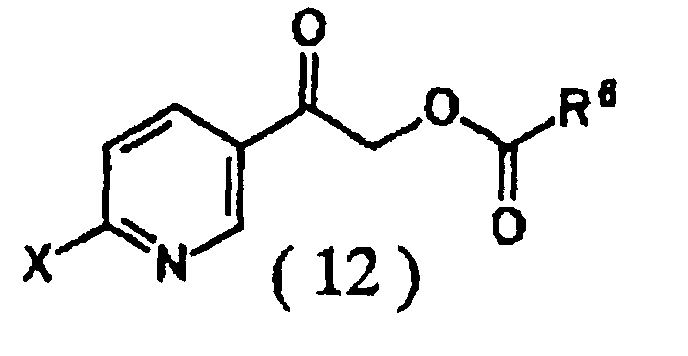
to solvolysis while enentioselectively reducing in the presence of a base to thereby directly obtain the optically active dihydroxyethylpyridine derivative (14). - The production method according to Claim 91,
wherein the enantioselective reduction is carried in the manner of hydrogen transfer type reduction using a hydrogen transfer source with a catalyst prepared from a ruthenium complex, an optically active amine and a base. - The production method according to Claim 92,
wherein the hydrogen transfer source is isopropyl alcohol. - The production method according to Claim 92 or 93,
wherein any of bis (η6-benzene) diruthenium tetrachloride, bis (η6-p-cymene)diruthenium tetrachloride and bis (η6-mesitylene)diruthenium tetrachloride is used as the ruthenium complex. - The production method according to Claim 92, 93 or 94,
wherein any of (S,S)-N-p-tosyl-1,2-diphenylethylenediamine and (R,R)-N-p-tosyl-1,2-diphenylethylenediamine is used as the optically active amine.
Applications Claiming Priority (5)
| Application Number | Priority Date | Filing Date | Title |
|---|---|---|---|
| JP3776699 | 1999-02-16 | ||
| JP3776699 | 1999-02-16 | ||
| JP35080199 | 1999-12-09 | ||
| JP35080199 | 1999-12-09 | ||
| PCT/JP2000/000861 WO2000048997A1 (en) | 1999-02-16 | 2000-02-16 | SUBSTITUTED ACETYLPYRIDINE DERIVATIVES AND PROCESS FOR THE PREPARATION OF INTERMEDIATES FOR OPTICALLY ACTIVE β3 AGONIST BY THE USE OF THE SAME |
Publications (2)
| Publication Number | Publication Date |
|---|---|
| EP1153919A1 true EP1153919A1 (en) | 2001-11-14 |
| EP1153919A4 EP1153919A4 (en) | 2002-10-02 |
Family
ID=26376915
Family Applications (1)
| Application Number | Title | Priority Date | Filing Date |
|---|---|---|---|
| EP00903975A Ceased EP1153919A4 (en) | 1999-02-16 | 2000-02-16 | Substituted acetylpyridine derivatives and process for the preparation of intermediates for optically active beta3 agonist by the use of the same |
Country Status (8)
| Country | Link |
|---|---|
| US (2) | US6515134B1 (en) |
| EP (1) | EP1153919A4 (en) |
| JP (1) | JP4676614B2 (en) |
| KR (1) | KR20010102198A (en) |
| AU (1) | AU2571300A (en) |
| CA (1) | CA2362070A1 (en) |
| HU (1) | HUP0200092A3 (en) |
| WO (1) | WO2000048997A1 (en) |
Cited By (4)
| Publication number | Priority date | Publication date | Assignee | Title |
|---|---|---|---|---|
| EP1138685A3 (en) * | 2000-03-31 | 2003-04-02 | Pfizer Products Inc. | Process for preparing substituted pyridines |
| WO2003093477A1 (en) * | 2002-04-30 | 2003-11-13 | Kaneka Corporation | Novel carbonyl reductase, gene thereof and use of the same |
| EP1405917A3 (en) * | 2002-09-26 | 2005-01-12 | Bayer Chemicals AG | Process for the production of 3-Heteroaryl-3-hydroxy-propionic acid derivatives by enantioselective microbial reduction |
| CN102574821A (en) * | 2009-10-15 | 2012-07-11 | 爱思开生物制药株式会社 | Method for preparation of carbamic acid (R)-1-aryl-2-tetrazolyl-ethyl ester |
Families Citing this family (12)
| Publication number | Priority date | Publication date | Assignee | Title |
|---|---|---|---|---|
| MXPA01007169A (en) * | 1999-01-14 | 2003-06-06 | Lonza Ag | 1-(6- methylpyridine- 3-yl)-2-[4- (methylsulfonyl) phenyl] ethanone and method for its preparation. |
| JPWO2003033468A1 (en) * | 2001-10-17 | 2005-02-03 | 株式会社カネカ | Method for producing (S) -α-halomethylpyridine methanol derivative |
| MXPA04008298A (en) * | 2002-02-27 | 2004-11-26 | Pfizer Prod Inc | PROCESSES AND INTERMEDIATES USEFUL IN PREPARING beta3. |
| CA2532963C (en) | 2003-07-14 | 2012-04-17 | Frans Nooren Afdichtingssystemen B.V. | Composition for the protection of a shaped article against corrosion |
| US20050050099A1 (en) * | 2003-08-22 | 2005-03-03 | Ge Information Systems | System and method for extracting customer-specific data from an information network |
| KR20070038571A (en) * | 2004-08-26 | 2007-04-10 | 화이자 인코포레이티드 | Enantioselective Biological Conversion for the Preparation of Protein Tyrosine Kinase Inhibitor Intermediates |
| JP5005672B2 (en) * | 2006-02-28 | 2012-08-22 | 株式会社カネカ | Novel carbonyl reductase, gene thereof, and method for producing optically active alcohol using them |
| BRPI0924997B1 (en) * | 2009-06-22 | 2024-01-16 | Sk Biopharmaceuticals Co., Ltd | METHOD FOR PREPARING A 1-ARYL-2-TETRAZOYL ETHYL CARBAMIC ACID ESTER COMPOUND |
| CN103071423B (en) * | 2013-02-19 | 2015-01-14 | 齐齐哈尔大学 | Pyridine carbamyl quaternary ammonium surfactant and preparation method thereof |
| CN104607099B (en) * | 2015-01-16 | 2016-06-29 | 齐齐哈尔大学 | (3,3 '-to diamino-benzene formoxyl) double; two N-alkyl pyridine bromine salt surfactants and preparation method thereof |
| ITUB20160227A1 (en) * | 2016-01-21 | 2017-07-21 | Menarini Int Operations Luxembourg Sa | Process for the synthesis of Nebivolol intermediates |
| CN114752634B (en) * | 2022-04-29 | 2025-02-07 | 张邦成都生物医药科技有限公司 | A preparation method of (R) 3-butyn-2-ol derivative |
Family Cites Families (17)
| Publication number | Priority date | Publication date | Assignee | Title |
|---|---|---|---|---|
| CH518937A (en) * | 1968-07-31 | 1972-02-15 | Siphar Sa | Process for the preparation of two new esters |
| BE791500A (en) | 1971-11-19 | 1973-05-17 | Hoffmann La Roche | PROCESS FOR THE PREPARATION OF 2- (2-AMINOBENZOYL) PYRIDINES |
| US3871958A (en) * | 1972-03-04 | 1975-03-18 | Ajinomoto Kk | Biological method of producing serine and serinol derivatives |
| DE3743824C2 (en) * | 1987-12-23 | 1997-03-06 | Hoechst Ag | Process for the enzymatic resolution of racemic alcohols with / in vinyl esters by transesterification |
| GB8928839D0 (en) * | 1989-12-21 | 1990-02-28 | Beecham Group Plc | Novel compounds |
| US5559256A (en) * | 1992-07-20 | 1996-09-24 | E. R. Squibb & Sons, Inc. | Aminediol protease inhibitors |
| US5541197A (en) * | 1994-04-26 | 1996-07-30 | Merck & Co., Inc. | Substituted sulfonamides as selective β3 agonists for the treatment of diabetes and obesity |
| GB2305665A (en) * | 1995-09-26 | 1997-04-16 | Merck & Co Inc | Selective ß3 agonists for the treatment of diabetes aand obesity |
| AU7484596A (en) * | 1995-11-01 | 1997-05-22 | Merck & Co., Inc. | Combination therapy for the treatment of diabetes and obesity |
| US5846791A (en) * | 1996-07-22 | 1998-12-08 | Merck & Co., Inc. | N-(R)-(2-hydroxy-2-pyridine-3-yl-ethyl)-2-(4-nitro-phenyl)-acetamide |
| AR007739A1 (en) * | 1996-07-22 | 1999-11-10 | Merck & Co Inc | A PROCESS FOR THE PREPARATION OF N- (R) - (2-HYDROXY-2-PIRIDINE-3-IL-ETIL) -2- (4-NITRO-PHENYL) -ACETAMIDE |
| US5792871A (en) * | 1996-07-22 | 1998-08-11 | Merck & Co., Inc. | Process for N-Boc-N-(R)-2(3-pyridyl)-2-hydroxy-ethyl)-N-2(4-aminophenyl)ethyl amine and 2-(4-aminophenyl)-N-2-(2(R)-hydroxy-2-phyridin-S-yl-ethyl)acetamide |
| EA199900375A1 (en) * | 1996-11-14 | 1999-12-29 | Пфайзер Инк. | METHOD OF OBTAINING SUBSTITUTED PYRIDINES |
| DE69724216T2 (en) * | 1996-11-14 | 2004-06-24 | Pfizer Inc. | Pyridine intermediates, useful for the preparation of beta-adrenergic receptor agonists |
| US6001856A (en) * | 1997-06-13 | 1999-12-14 | Pfizer Inc. | β-adrenergic agonists to reduce a wasting condition |
| EP0920864A1 (en) * | 1997-12-03 | 1999-06-09 | Pfizer Products Inc. | Combination therapy including a specific beta-3 agonist and an anorectic agent |
| US6090942A (en) * | 1998-10-15 | 2000-07-18 | Pfizer Inc. | Process and intermediates for a β3 -adrenergic receptor agonist |
-
2000
- 2000-02-16 EP EP00903975A patent/EP1153919A4/en not_active Ceased
- 2000-02-16 AU AU25713/00A patent/AU2571300A/en not_active Abandoned
- 2000-02-16 HU HU0200092A patent/HUP0200092A3/en unknown
- 2000-02-16 CA CA002362070A patent/CA2362070A1/en not_active Abandoned
- 2000-02-16 KR KR1020017010419A patent/KR20010102198A/en not_active Withdrawn
- 2000-02-16 US US09/926,021 patent/US6515134B1/en not_active Expired - Fee Related
- 2000-02-16 JP JP2000599738A patent/JP4676614B2/en not_active Expired - Fee Related
- 2000-02-16 WO PCT/JP2000/000861 patent/WO2000048997A1/en not_active Ceased
-
2002
- 2002-11-27 US US10/305,105 patent/US6642387B2/en not_active Expired - Fee Related
Cited By (9)
| Publication number | Priority date | Publication date | Assignee | Title |
|---|---|---|---|---|
| EP1138685A3 (en) * | 2000-03-31 | 2003-04-02 | Pfizer Products Inc. | Process for preparing substituted pyridines |
| US6670480B2 (en) | 2000-03-31 | 2003-12-30 | Pfizer Inc. | Process for preparing substituted pyridines |
| US6844441B2 (en) | 2000-03-31 | 2005-01-18 | Pfizer Inc | Process for preparing substituted pyridines |
| WO2003093477A1 (en) * | 2002-04-30 | 2003-11-13 | Kaneka Corporation | Novel carbonyl reductase, gene thereof and use of the same |
| EP1505155A4 (en) * | 2002-04-30 | 2006-05-03 | Kaneka Corp | Novel carbonyl reductase, gene thereof and use of the same |
| US7332312B2 (en) | 2002-04-30 | 2008-02-19 | Kaneka Corporation | Carbonyl reductase, gene thereof and use of the same |
| EP1405917A3 (en) * | 2002-09-26 | 2005-01-12 | Bayer Chemicals AG | Process for the production of 3-Heteroaryl-3-hydroxy-propionic acid derivatives by enantioselective microbial reduction |
| CN102574821A (en) * | 2009-10-15 | 2012-07-11 | 爱思开生物制药株式会社 | Method for preparation of carbamic acid (R)-1-aryl-2-tetrazolyl-ethyl ester |
| CN102574821B (en) * | 2009-10-15 | 2015-03-18 | 爱思开生物制药株式会社 | Method for preparation of carbamic acid (R)-1-aryl-2-tetrazolyl-ethyl ester |
Also Published As
| Publication number | Publication date |
|---|---|
| US6642387B2 (en) | 2003-11-04 |
| US6515134B1 (en) | 2003-02-04 |
| US20030130521A1 (en) | 2003-07-10 |
| CA2362070A1 (en) | 2000-08-24 |
| HUP0200092A3 (en) | 2003-02-28 |
| AU2571300A (en) | 2000-09-04 |
| KR20010102198A (en) | 2001-11-15 |
| EP1153919A4 (en) | 2002-10-02 |
| WO2000048997A1 (en) | 2000-08-24 |
| JP4676614B2 (en) | 2011-04-27 |
| HUP0200092A2 (en) | 2002-05-29 |
Similar Documents
| Publication | Publication Date | Title |
|---|---|---|
| US6642387B2 (en) | Substituted acetylpyridine derivatives and process for the preparation of intermediates for optically active β3 agonist by the use of the same | |
| EP1619191B1 (en) | Process for producing optically active 2-[6-(hydroxymethyl)-1,3-dioxan-4-yl] acetic acid derivatives | |
| JPWO2000048997A1 (en) | Substituted acetylpyridine derivatives and method for producing optically active beta-3 agonist intermediates using the same | |
| JP2010088455A (en) | Process for producing optically active 3-hydroxypropionic ester derivative | |
| US7189847B2 (en) | Process for producing benzoxazine derivative and production intermediate thereof | |
| JP4818507B2 (en) | Process for producing optically active 3-quinuclidinol | |
| WO2005073388A1 (en) | Processes for producing optically active 1-substituted 2-methylpyrrolidine and intermediate therefor | |
| JP4319847B2 (en) | Process for producing (1S, 2S) -2-fluorocyclopropanecarboxylic acid derivative | |
| JPWO2003040382A1 (en) | Process for producing optically active chroman derivatives and intermediates | |
| US7223859B2 (en) | Method for producing (R)-3-[4-(trifluoromethyl) phenylamino]-pentanoic acid amide derivative | |
| JPWO2004083166A1 (en) | Method for producing (R) -3- [4- (trifluoromethyl) phenylamino] -pentanoic acid amide derivative | |
| WO2001092554A1 (en) | Method for preparing an r- or s-form of alpha-substituted heterocyclic carboxylic acid and a counter enantiomeric form of alpha-substituted heterocyclic carboxylic acid ester thereto using enzyme | |
| WO2007126258A1 (en) | The method of making optically active 2-halo-2-(n-substituted phenyl)acetic acid esters and 2-halo-2-(n-substituted phenyl)acetic acids by enzymatic method | |
| EP1290208A1 (en) | Method for optically resolving a racemic alpha-substituted heterocyclic carboxylic acid using enzyme | |
| WO2007078176A1 (en) | The method of making optically active 2-chloromandelic acid esters and 2-chloromandelic acids by enzymatic method | |
| KR20070048741A (en) | Method for preparing diarylcycloalkyl derivative | |
| US20040265991A1 (en) | Process for preparation of (s)-alpha-halomethylpyridine-methanol derivatives | |
| JPH0951799A (en) | Process for producing optically active 1,4-dihydropyridine derivative | |
| JPH02275864A (en) | Optically active alcohols and its production | |
| JP2006232788A (en) | Method for producing optically active 2-chloro-3-hydroxyl-3,n-diphenyl-propanoic acid amide | |
| JP2007202563A (en) | Method for producing and purifying optically active α-trifluoromethyl lactic acid and its enantiomer ester | |
| JP2006021999A (en) | METHOD FOR PRODUCING OPTICALLY ACTIVE beta-AMINONITRILE COMPOUND AND ITS MIRROR IMAGE AMIDE COMPOUND | |
| JPH07322889A (en) | Production of optically active 2,5-pyrrolidinedione derivative |
Legal Events
| Date | Code | Title | Description |
|---|---|---|---|
| PUAI | Public reference made under article 153(3) epc to a published international application that has entered the european phase |
Free format text: ORIGINAL CODE: 0009012 |
|
| 17P | Request for examination filed |
Effective date: 20010907 |
|
| AK | Designated contracting states |
Kind code of ref document: A1 Designated state(s): AT BE CH CY DE DK ES FI FR GB GR IE IT LI LU MC NL PT SE |
|
| AX | Request for extension of the european patent |
Free format text: AL;LT;LV;MK;RO;SI |
|
| RIC1 | Information provided on ipc code assigned before grant |
Free format text: 7C 07D 213/50 A, 7C 07D 213/64 B, 7C 07D 213/72 B, 7C 07D 213/75 B, 7C 07D 405/04 B, 7C 07D 407/04 B, 7C 07D 213/30 B |
|
| A4 | Supplementary search report drawn up and despatched |
Effective date: 20020814 |
|
| AK | Designated contracting states |
Kind code of ref document: A4 Designated state(s): AT BE CH CY DE DK ES FI FR GB GR IE IT LI LU MC NL PT SE |
|
| 17Q | First examination report despatched |
Effective date: 20050405 |
|
| 17Q | First examination report despatched |
Effective date: 20050405 |
|
| REG | Reference to a national code |
Ref country code: DE Ref legal event code: R003 |
|
| STAA | Information on the status of an ep patent application or granted ep patent |
Free format text: STATUS: THE APPLICATION HAS BEEN REFUSED |
|
| 18R | Application refused |
Effective date: 20110919 |