EP1153908A2 - Method for producing 1-menthol - Google Patents
Method for producing 1-menthol Download PDFInfo
- Publication number
- EP1153908A2 EP1153908A2 EP01401180A EP01401180A EP1153908A2 EP 1153908 A2 EP1153908 A2 EP 1153908A2 EP 01401180 A EP01401180 A EP 01401180A EP 01401180 A EP01401180 A EP 01401180A EP 1153908 A2 EP1153908 A2 EP 1153908A2
- Authority
- EP
- European Patent Office
- Prior art keywords
- group
- represented
- formula
- bis
- complex
- Prior art date
- Legal status (The legal status is an assumption and is not a legal conclusion. Google has not performed a legal analysis and makes no representation as to the accuracy of the status listed.)
- Granted
Links
- 0 *c(cc1*)c(*)c(*)c1-c1c(*)c(*)c(*)cc1* Chemical compound *c(cc1*)c(*)c(*)c1-c1c(*)c(*)c(*)cc1* 0.000 description 1
Classifications
-
- C—CHEMISTRY; METALLURGY
- C07—ORGANIC CHEMISTRY
- C07C—ACYCLIC OR CARBOCYCLIC COMPOUNDS
- C07C29/00—Preparation of compounds having hydroxy or O-metal groups bound to a carbon atom not belonging to a six-membered aromatic ring
- C07C29/132—Preparation of compounds having hydroxy or O-metal groups bound to a carbon atom not belonging to a six-membered aromatic ring by reduction of an oxygen containing functional group
- C07C29/136—Preparation of compounds having hydroxy or O-metal groups bound to a carbon atom not belonging to a six-membered aromatic ring by reduction of an oxygen containing functional group of >C=O containing groups, e.g. —COOH
- C07C29/143—Preparation of compounds having hydroxy or O-metal groups bound to a carbon atom not belonging to a six-membered aromatic ring by reduction of an oxygen containing functional group of >C=O containing groups, e.g. —COOH of ketones
- C07C29/145—Preparation of compounds having hydroxy or O-metal groups bound to a carbon atom not belonging to a six-membered aromatic ring by reduction of an oxygen containing functional group of >C=O containing groups, e.g. —COOH of ketones with hydrogen or hydrogen-containing gases
-
- C—CHEMISTRY; METALLURGY
- C07—ORGANIC CHEMISTRY
- C07C—ACYCLIC OR CARBOCYCLIC COMPOUNDS
- C07C29/00—Preparation of compounds having hydroxy or O-metal groups bound to a carbon atom not belonging to a six-membered aromatic ring
- C07C29/17—Preparation of compounds having hydroxy or O-metal groups bound to a carbon atom not belonging to a six-membered aromatic ring by hydrogenation of carbon-to-carbon double or triple bonds
- C07C29/172—Preparation of compounds having hydroxy or O-metal groups bound to a carbon atom not belonging to a six-membered aromatic ring by hydrogenation of carbon-to-carbon double or triple bonds with the obtention of a fully saturated alcohol
-
- C—CHEMISTRY; METALLURGY
- C07—ORGANIC CHEMISTRY
- C07C—ACYCLIC OR CARBOCYCLIC COMPOUNDS
- C07C45/00—Preparation of compounds having >C = O groups bound only to carbon or hydrogen atoms; Preparation of chelates of such compounds
- C07C45/61—Preparation of compounds having >C = O groups bound only to carbon or hydrogen atoms; Preparation of chelates of such compounds by reactions not involving the formation of >C = O groups
- C07C45/62—Preparation of compounds having >C = O groups bound only to carbon or hydrogen atoms; Preparation of chelates of such compounds by reactions not involving the formation of >C = O groups by hydrogenation of carbon-to-carbon double or triple bonds
-
- C—CHEMISTRY; METALLURGY
- C07—ORGANIC CHEMISTRY
- C07C—ACYCLIC OR CARBOCYCLIC COMPOUNDS
- C07C45/00—Preparation of compounds having >C = O groups bound only to carbon or hydrogen atoms; Preparation of chelates of such compounds
- C07C45/61—Preparation of compounds having >C = O groups bound only to carbon or hydrogen atoms; Preparation of chelates of such compounds by reactions not involving the formation of >C = O groups
- C07C45/67—Preparation of compounds having >C = O groups bound only to carbon or hydrogen atoms; Preparation of chelates of such compounds by reactions not involving the formation of >C = O groups by isomerisation; by change of size of the carbon skeleton
- C07C45/68—Preparation of compounds having >C = O groups bound only to carbon or hydrogen atoms; Preparation of chelates of such compounds by reactions not involving the formation of >C = O groups by isomerisation; by change of size of the carbon skeleton by increase in the number of carbon atoms
- C07C45/72—Preparation of compounds having >C = O groups bound only to carbon or hydrogen atoms; Preparation of chelates of such compounds by reactions not involving the formation of >C = O groups by isomerisation; by change of size of the carbon skeleton by increase in the number of carbon atoms by reaction of compounds containing >C = O groups with the same or other compounds containing >C = O groups
-
- C—CHEMISTRY; METALLURGY
- C07—ORGANIC CHEMISTRY
- C07C—ACYCLIC OR CARBOCYCLIC COMPOUNDS
- C07C49/00—Ketones; Ketenes; Dimeric ketenes; Ketonic chelates
- C07C49/587—Unsaturated compounds containing a keto groups being part of a ring
- C07C49/647—Unsaturated compounds containing a keto groups being part of a ring having unsaturation outside the ring
-
- C—CHEMISTRY; METALLURGY
- C07—ORGANIC CHEMISTRY
- C07B—GENERAL METHODS OF ORGANIC CHEMISTRY; APPARATUS THEREFOR
- C07B2200/00—Indexing scheme relating to specific properties of organic compounds
- C07B2200/07—Optical isomers
-
- C—CHEMISTRY; METALLURGY
- C07—ORGANIC CHEMISTRY
- C07C—ACYCLIC OR CARBOCYCLIC COMPOUNDS
- C07C2601/00—Systems containing only non-condensed rings
- C07C2601/12—Systems containing only non-condensed rings with a six-membered ring
- C07C2601/14—The ring being saturated
-
- C—CHEMISTRY; METALLURGY
- C07—ORGANIC CHEMISTRY
- C07C—ACYCLIC OR CARBOCYCLIC COMPOUNDS
- C07C2601/00—Systems containing only non-condensed rings
- C07C2601/12—Systems containing only non-condensed rings with a six-membered ring
- C07C2601/16—Systems containing only non-condensed rings with a six-membered ring the ring being unsaturated
Definitions
- This invention relates to methods for the production of 1-menthol which is used as a medicament or perfume and of its intermediate pulegone.
- the method 1) can synthesize it with a selectivity of about 90% but its optical purity is a low value of 33% ee, and DMF (dimethylformamide) is used in the reaction solvent, so that this method is not industrially applicable. Also, the method 2) can synthesize it only with a selectivity of 55% and an optical purity of 15% ee, so that they are not industrially applicable levels.
- the ligand to be used in the synthesis of pulegol is a combination of (S)-BINAP and (S,S)-diphenylethylenediamine, and since optically active substances are used for both of them, this method has a problem of high catalyst cost.
- the invention contemplates solving the illustrative problems shown in the following items 1) to 3).
- the piperitenone to be used in the invention can be prepared by allowing mesityl oxide to react with methyl vinyl ketone in the presence of potassium hydroxide (cf. JP-B-57-47168; the term "JP-B” as used herein means an "examined Japanese patent publication”) or by condensing mesityl oxide with 4-diethylamino-2-butanone.
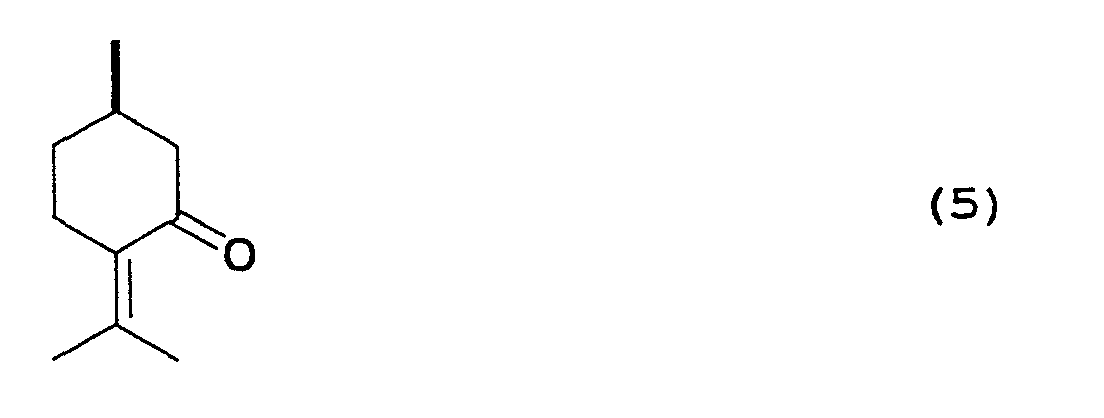
- the 2-position olefin of piperitenone is hydrogenated as the first hydrogenation reaction.
- the reaction formula is shown below.
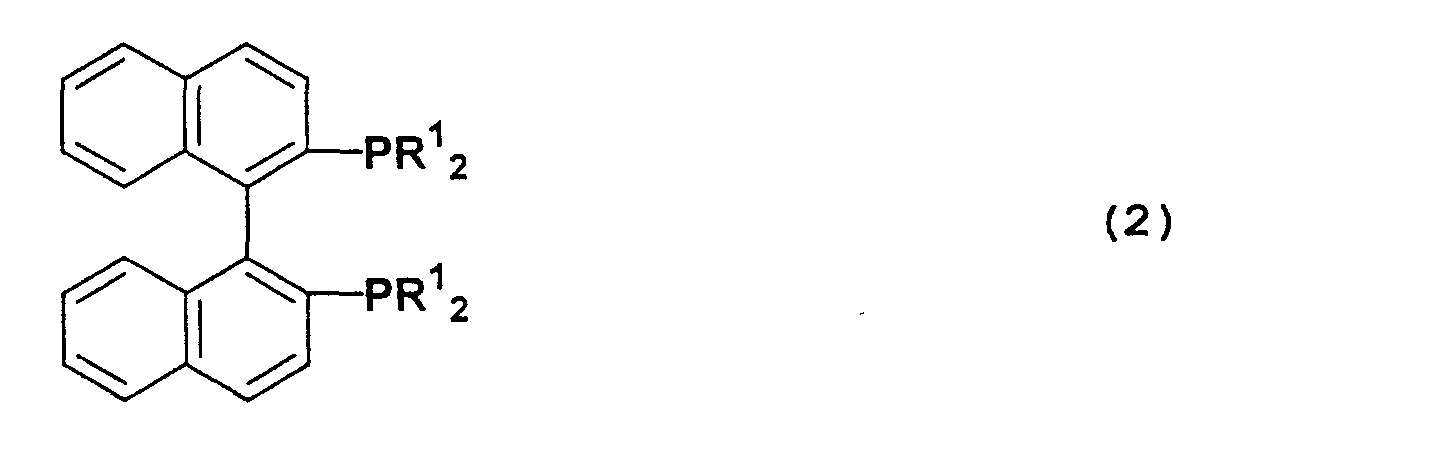
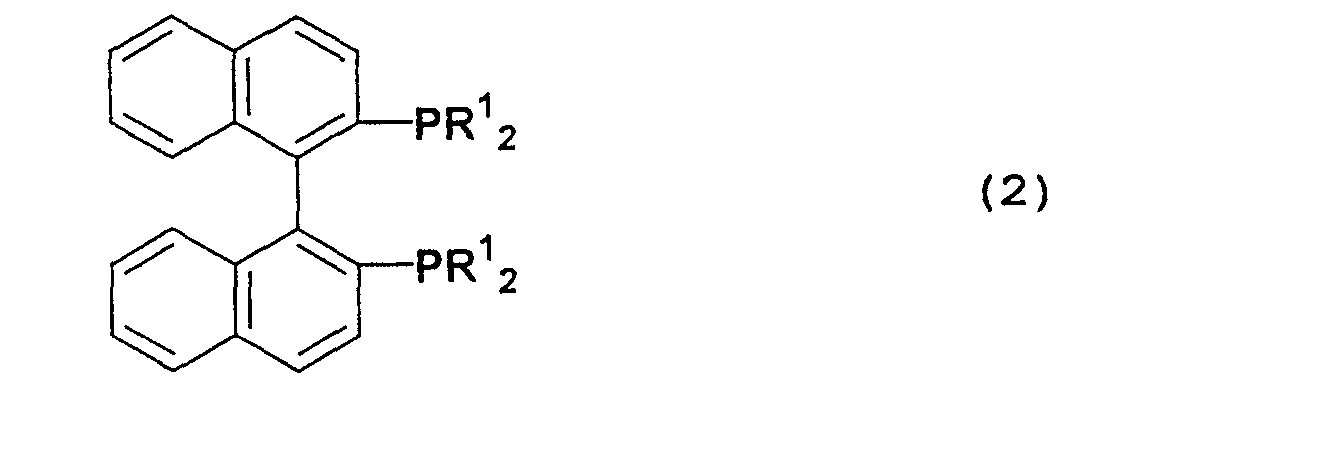
- an optically active phosphine represented by a general formula (2) wherein R 1 represents an aryl group which may have a substituent group or a cycloalkyl group having from 3 to 8 carbon atoms.
- R 1 is a phenyl group which may have a substitutent group, a naphthyl group which may have substitutent group or a cycloalkyl group having from 3 to 8 carbon atoms.
- substituents thereof include lower alkyl groups having 1 to 4 carbon atoms, such as methyl, ethyl, propyl, isopropyl, n-butyl, t-butyl, and isobutyl; halogen atoms such as fluorine, chlorine, and bromine; lower alkoxy groups having 1 to 4 carbon atoms, such as methoxy, ethoxy, propoxy, and butoxy; halogenated lower alkyl groups such as trifluoromethyl and trichloromethyl, and benzyloxy.
- lower alkyl groups having 1 to 4 carbon atoms such as methyl, ethyl, propyl, isopropyl, n-butyl, t-butyl, and isobutyl
- halogen atoms such as fluorine, chlorine, and bromine
- lower alkoxy groups having 1 to 4 carbon atoms such as methoxy, ethoxy, propoxy, and butoxy
- R 1 examples include phenyl, 4-tolyl, 3-tolyl, 4-methoxyphenyl, 3,5-xylyl, 3,5-di-tert-butylphenyl, 4-methoxy-3,5-dimethylphenyl, 4-methoxy-3,5-di-tert-butylphenyl, naphthyl, cyclohexyl and cyclopentyl.
- optically active phosphine to be desirably used according to this general formula (2) examples include tertiary phosphines described in JP-A-61-63690 and JP-A-62-265293 (the term "JP-A” as used herein means an "unexamined published Japanese patent application”), and the following can be cited as illustrative examples.
- an optically active phosphine represented by a general formula (3) wherein R 1 represents an aryl group which may have a substituent group or a cycloalkyl group having from 3 to 8 carbon atoms.
- R 1 is a phenyl group which may have a substitutent group, a naphthyl group which may have substitutent group or a cycloalkyl group having from 3 to 8 carbon atoms.
- substituents thereof include lower alkyl groups having 1 to 4 carbon atoms, such as methyl, ethyl, propyl, isopropyl, n-butyl, t-butyl, and isobutyl; halogen atoms such as fluorine, chlorine, and bromine; lower alkoxy groups having 1 to 4 carbon atoms, such as methoxy, ethoxy, propoxy, and butoxy; halogenated lower alkyl groups such as trifluoromethyl and trichloromethyl, and benzyloxy.
- lower alkyl groups having 1 to 4 carbon atoms such as methyl, ethyl, propyl, isopropyl, n-butyl, t-butyl, and isobutyl
- halogen atoms such as fluorine, chlorine, and bromine
- lower alkoxy groups having 1 to 4 carbon atoms such as methoxy, ethoxy, propoxy, and butoxy
- R 1 examples include phenyl, 4-tolyl, 3-tolyl, 4-methoxyphenyl, 3,5-xylyl, 3,5-di-tert-butylphenyl, 4-methoxy-3,5-dimethylphenyl, 4-methoxy-3,5-di-tert-butylphenyl, naphthyl, cyclohexyl and cyclopentyl.
- optically active phosphine to be desirably used according to this general formula (3) examples include tertiary phosphines described in JP-A-4-139140 (the term "JP-A" as used herein means an "unexamined published Japanese patent application”), and the following can be cited as illustrative examples.
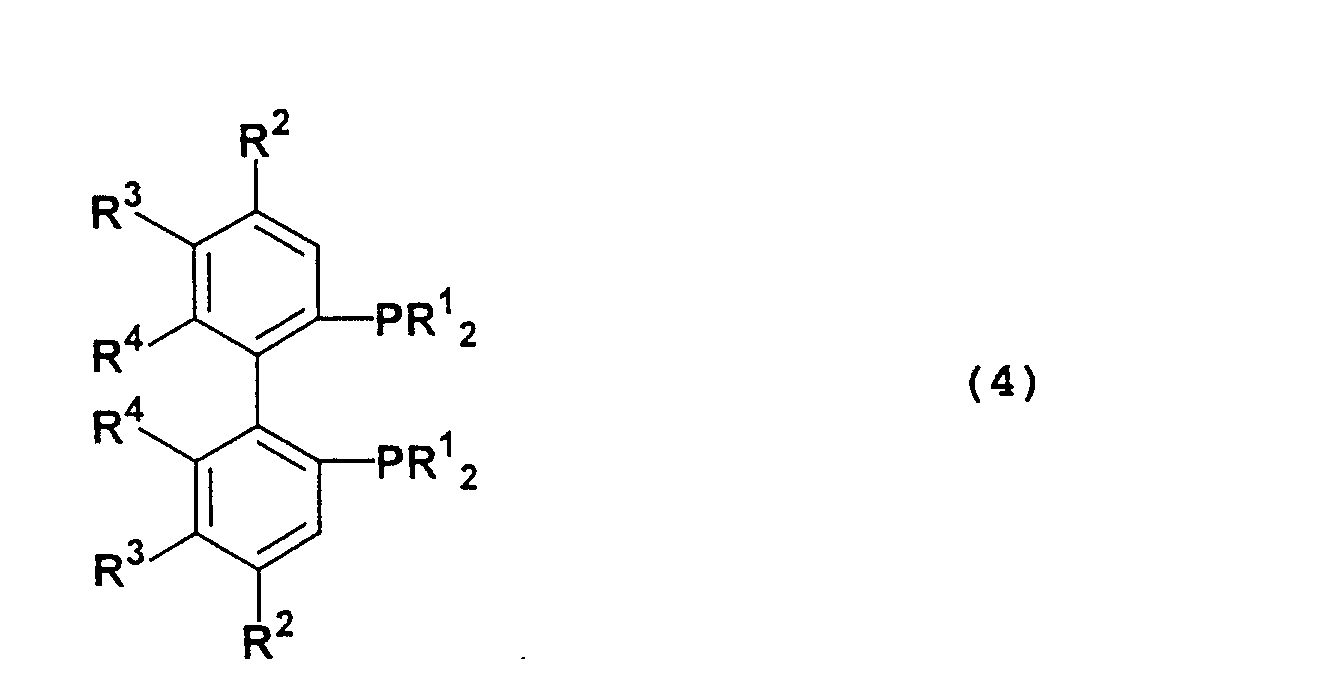
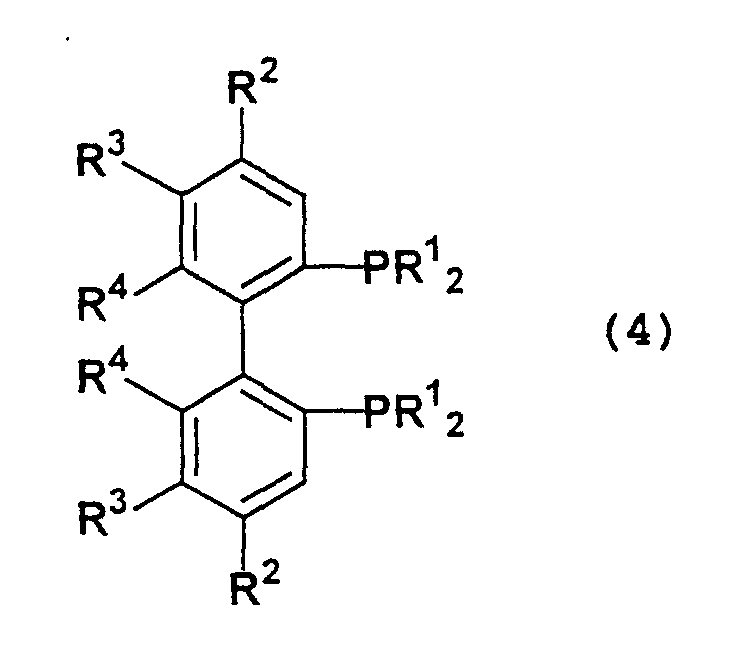
- an optically active phosphine represented by a general formula (4) wherein R 1 represents an aryl group which may have a substituent group or a cycloalkyl group having from 3 to 8 carbon atoms, R 2 represents hydrogen atom or a lower alkyl group having from 1 to 4 carbon atoms, R 3 represents hydrogen atom methyl group, methoxy group or a halogen atom, and R 4 represents methyl group or methoxy group, or R 3 and R 4 may be coupled together to form methylenedioxy group.
- R 1 represents an aryl group which may have a substituent group or a cycloalkyl group having from 3 to 8 carbon atoms
- R 2 represents hydrogen atom or a lower alkyl group having from 1 to 4 carbon atoms
- R 3 represents hydrogen atom methyl group, methoxy group or a halogen atom
- R 4 represents methyl group or methoxy group, or R 3 and R 4 may be coupled together to form methylenedioxy group.
- R 1 is a phenyl group which may have a substitutent group, a naphthyl group which may have substitutent group or a cycloalkyl group having from 3 to 8 carbon atoms.
- substituents thereof include lower alkyl groups having 1 to 4 carbon atoms, such as methyl, ethyl, propyl, isopropyl, n-butyl, t-butyl, and isobutyl; halogen atoms such as fluorine, chlorine, and bromine; lower alkoxy groups having 1 to 4 carbon atoms, such as methoxy, ethoxy, propoxy, and butoxy; halogenated lower alkyl-groups such as trifluoromethyl and trichloromethyl, and benzyloxy.
- lower alkyl groups having 1 to 4 carbon atoms such as methyl, ethyl, propyl, isopropyl, n-butyl, t-butyl, and isobutyl
- halogen atoms such as fluorine, chlorine, and bromine
- lower alkoxy groups having 1 to 4 carbon atoms such as methoxy, ethoxy, propoxy, and butoxy
- R 1 examples include phenyl, 4-tolyl, 3-tolyl, 4-methoxyphenyl, 3,5-xylyl, 3,5-di-tert-butylphenyl, 4-methoxy-3,5-dimethylphenyl, 4-methoxy-3,5-di-tert-butylphenyl, naphthyl, cyclohexyl and cyclopentyl.
- optically active phosphine to be desirably used according to this general formula (4) examples include tertiary phosphines described in JP-A-11-269,185 (the term "JP-A" as used herein means an "unexamined published Japanese patent application”), and the following can be cited as illustrative examples.
- the 2-position olefin of piperitenone is hydrogenated with a complex consisting of the optically active phosphine represented by the general formula (2), (3) or (4) and a transition metal
- the desirable catalyst to be used in this hydrogenation is a transition metal complex consisting of an optically active phosphine containing a transition metal selected from rhodium, iridium and ruthenium and a transition metal.
- the hydrogenation is carried out by further adding an ammonium salt, a phosphonium salt or an alkali metal salt to such a complex consisting of an optically active phosphine and a transition metal.
- a rhodium complex As an illustrative example of the production method of a rhodium complex, it can be synthesized by allowing bis(cycloocta-1,5-diene)rhodium (I) tetrafluoroborate to react with an optically active bidentate phosphine (L) in accordance with the method described on pages 339 to 344 of Jikken-Kagaku-Kouza 4th Edition, Vol. 18, Organic Metal Complex, 1991, edited by The Chemical Society of Japan, published by Maruzen. The following can be cited as illustrative examples of the rhodium complex.
- ruthenium complex it can be prepared by heating and stirring [Ru(p-cymene)X 2 ] 2 (X represents chlorine, bromine, and iodine) and L in methylene chloride and ethanol by the method described in a document (K. Mashima, K. Kusano, T. Ohta, R. Noyori and H. Takaya, J. Chem. Soc., Chem. Commn. , 1208 (1989)). The following can be cited as illustrative examples of the ruthenium complex.
- the iridium complex can be prepared by allowing L to react with [Ir(cod) (CH 3 CN) 2 ]BF 4 while stirring in tetrahydrofuran in accordance with the method described in a document (K. Mashima, T. Akutagawa, X. Zhang, T. Taketomi, H. Kumobayashi and S. Akutagawa, J . Organomet. Chem. , 1992, 428, 213).
- the following can be cited as illustrative examples of the iridium complex.
- EtOAc ethyl acetate
- R 5 R 6 R 7 R 8 AB (wherein each of R 5 , R 6 , R 7 and R 8 means an alkyl group having from 1 to 16 carbon atoms, phenyl group or benzyl group, A means nitrogen atom or phosphorus atom, and B means a halogen atom such as chlorine, bromine or iodine, a carboxylate or a sulfonate) is useful, and its illustrative examples include quaternary ammonium salts such as Me 4 NCl, Me 4 NBr, Me 4 NI, Et 4 NCl, Et 4 NBr, Et 4 NI, Bu 4 NCl, Bu 4 NBr, Bu 4 NI, (Benzyl)Me 3 NCl, (Benzyl)Me 3 NBr, (Benzyl) Me 3 NI, (Benzyl)
- MZ (wherein M means a metal of Li, Na or K, and Z means a halogen atom such as Cl, Br or I), and its illustrative examples include metal salts such as LiCl, LiBr, LiI, NaCl, NaBr, NaI, KCl, KBr and KI.
- Ammonium salts such as (Bn)Et 3 NCl, (Bn)Et 3 NBr and (Bn)Et 3 NI and phosphonium salts such as such as BuPh 3 PCl, BuPh 3 PBr, BuPh 3 PI, (C 6 H 13 )Ph 3 Br and BrPPh 3 (CH 2 ) 4 PPh 3 Br can be selected, from which high selectivity is obtained (in which Bn is benzyl group, Et is ethyl group, Ph is phenyl group, and Bu is butyl group).
- DM-BINAP can be selected from BINAPs
- DM-H 8 -BINAP can be selected from H 8 -BINAPs
- DTBM-SEGPHOS can be selected from SEGPHOS, from which high selectivity is obtained.
- This reaction is carried out under a hydrogen pressure of about from 5 to 100 Kg/cm 2 (0.5 to 10 Mpa), at a reaction temperature of about from 10 to 100°C and for a reaction time of about from 5 to 20 hours.
- amount of the transition metal - optically active phosphine complex to be used is about from 1/5,000 to 1/50,000 mole based on piperitenone.
- amount of the additive (an ammonium salt, a phosphonium salt or an alkali metal) to be used is about from 0.2 to 2.0 equivalent based on the transition metal - optically active phosphine complex.
- solvents are without solvent, or in a solvent such as THF, acetone and ethyl acetate.
- pulegol represented by the formula (6) is obtained by, as the second hydrogenation reaction, hydrogenating pulegone represented by the formula (5) with a ruthenium-phosphine-amine complex.
- the reaction formula is shown below.
- a system of a ruthenium complex-amine-base is most excellent in hydrogenating the obtained pulegone (5), and a result of examination revealed that an achiral ligand can be used as the ruthenium complex.
- Examples of the ruthenium complex having such a ligand are shown below.
- Et means ethyl group
- dmf means dimethylformamide
- n is from 1 to 5.
- Ru 2 Cl 4 ((S)-binap) 2 (NEt 3 ), Ru 2 Cl 4 ((S)-tol-binap) 2 (NEt 3 ), Ru 2 Cl 4 ((S)-dm-binap) 2 (NEt 3 ), RuCl 2 ((S)-binap)(dmf) n , RuCl 2 ((S)-tol-binap)(dmf) n , RuCl 2 ((S)-dmbinap)(dmf) n , RuCl 2 (PPh 3 ) 3 , RuCl 2 [(p-tolyl) 3 P] 3 , RuCl 2 [(o-tolyl) 3 P] 3 , RuCl 2 (bpbp), RuCl 2 (1,2-diphos) 2 , RuCl 2 (1,3-diphos) 2 , RuCl 2 (1,4-diphos) 2 , RuCl 2 (1,5-diphos) 2 , RuCl
- the amine compounds include a primary amine compound, a secondary amine compound, and a diamine compound.
- the following amine compounds are typical example: primary amine compounds such as methylamine, ethylamine, propylamine, butylamine, penthylamine, hexylamine, cyclopenthylamine, cyclohexylamine and benzylamine; secomndary amine compounds such as dimethylamine, diethylamine, dipropylamine, dibutylamine, dipenthylamine, dihexylamine, dicyclopenthylamine, dicyclohexylamine, dibenzylamine, diphenylamine, phenylethylamine, piperidine and piperadine; and diamine compounds such as methylenediamine, 1,2-ethylenediamine, 1,2-propanediamine, 1,3-propanediamine, 1,4-butanediamine, 2,3-butanediamine, 1,2-cyclopentanediamine, 1,2-cyclo
- 1,2-ethylenediamine, 1,3-propanediamine, 1,4-butanediamine and 1,2-diphenylethylenediamine are preferably selected, of which 1,2-ethylenediamine and 1,3-propanediamine are most superior.
- metal salts each represented by the following formula (12) M'Y wherein M' represents an alkali metal or alkaline earth metal and Y represents a hydroxy, alkoxy, mercapto, naphthyl group or carbonate, or quaternary ammonium salts can be employed.
- Specific examples include LiOH, LiOMe, LiOEt, LiOi-Pr, LiOt-Bu, NaOH, NaOMe, NaOEt, NaOi-Pr, NaOt-Bu, KOH, KOMe, KOEt, KOi-Pr, KOt-Bu, KC 10 H 8 , Li 2 CO 3 , K 2 CO 3 and Na 2 CO 3 .
- Quaternary ammonium salts are also usable.
- pottassium hydroxide (KOH) and potassium t-butoxide (KOt-Bu) are preferably selected.
- Amount of the catalyst is about from 1/1,000 to 1/30,000 mole based on the substitute pulegone.
- Amount of the amine is about from 1 to 2 equivalent based on the catalyst.
- Amount of the base is about from 0.5 to 100 equivalent, or preferably about from 10 to 50 equivalent, based on the catalyst.
- any liquid solvent is usable insofar as it can solubilize reaction raw materials (pulegone) and catalyst system.
- examples include aromatic hydrocarbon solvents such as toluene and xylene, aliphatic hydrocarbon solvents such as pentane and hexane, halogen-containing hydrocarbon solvents such as methylene chloride, ether solvents such as ether and tetrahydrofuran, alcohol solvents such as methanol, ethanol, isopropanol, butanol, and benzylalcohol, and hetro-atom-containing organic solvents such as acetonitrile, DMF and DMSO.
- the target product is an alcohol so that alcohol solvents are most suited, with isopropanol being more preferred.
- the amount of the solvent is judged from the solubility of the reaction substrate and economy.
- reaction can be effected at a low concentration of 1% or less or in a nearly solventless manner, though depending on the kind of the substrate.
- Preferred is 0.1 to 2.0 by volume.
- the hydrogen pressure within a range of 1 to 100 Kg/cm 2 (0.1 to 10 MPa) is desired, with 5 to 50 Kg/cm 2 (0.5 to 5 MPa) being more preferred.
- reaction is preferably conducted within a range of 0 to 150°C, with 10 to 50°C being more preferred.
- the reaction time differs with the concentration of the reaction substrate or reaction condition such as temperature and pressure, but reaction is completed within several minutes to 30 hours.
- High purity pulegol can be obtained by recrystallizing it using a hydrocarbon solvent such as hexane, cyclohexane, heptane, pentane, octane or isooctane.
- Amount of the hydrocarbon solvent to be used is from 0.5 to 10 times, preferably from 1 to 3 times, based on pulegol.
- the temperature at the time of crystallization is selected within the range of from -70°C to 0°C, and generally carried out within the range of from -40°C to 0°C.
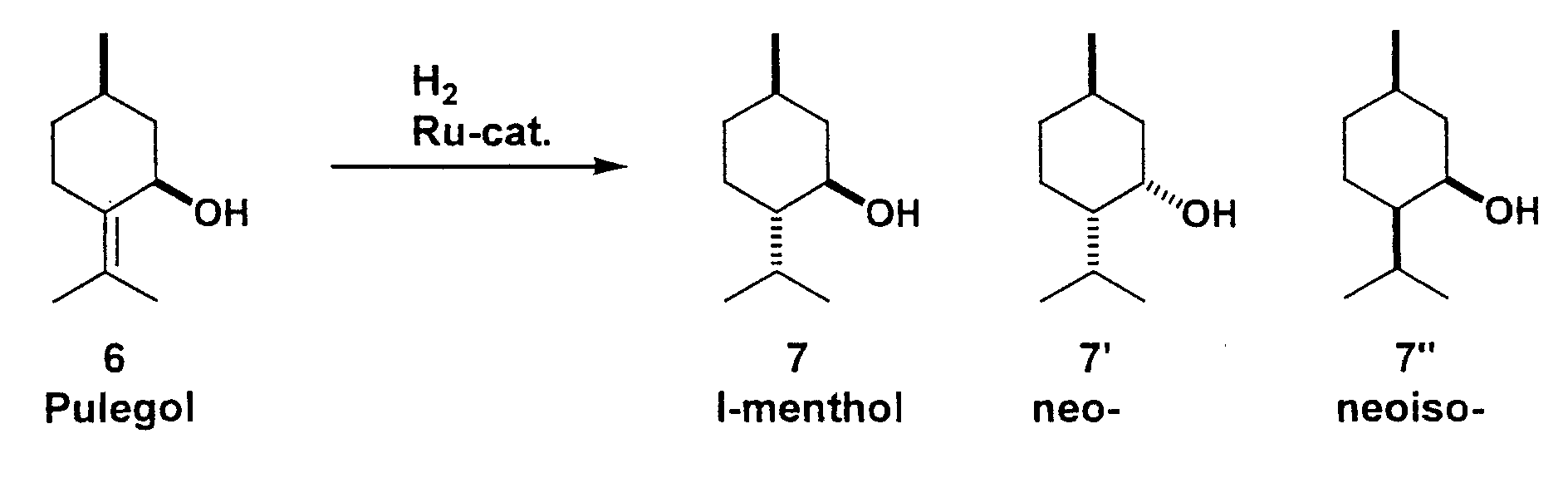
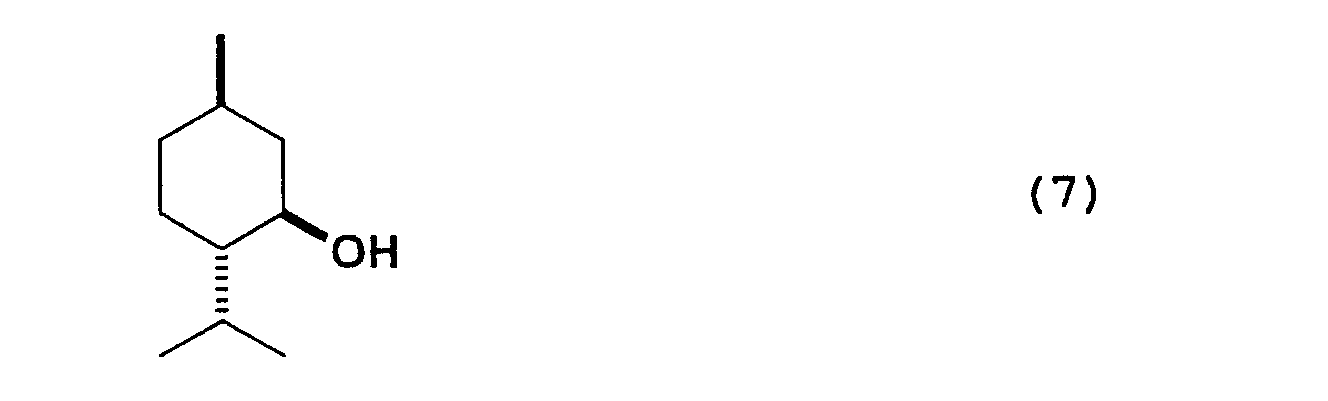
- 1-menthol represented by the formula (7) is obtained by, as the third hydrogenation reaction, hydrogenating pulegol represented by the formula (6) with a transition metal catalyst.
- the reaction formula is shown below.
- the thus obtained pulegol (6) is hydrogenated with a generally and frequently used heterogeous hydrogen catalyst.
- heterogeous hydrogen catalyst examples include Raney nickel, platinum oxide, platinum black, palladium black, rhodium black, palladium-carbon, iridium-carbon, rhodium-carbon, ruthenium-carbon, osmium-carbon, palladium-alumina, palladium-silica and palladium-silica-alumina.
- This reaction is carried out under a hydrogen pressure of about from 5 to 50 Kg/cm 2 (0.5 to 5 MPa), at a reaction temperature of about from 20 to 100°C and for a reaction time of about from 5 to 20 hours.
- mount of the catalyst to be used is about from 0.01 to 1.0 wt. % based on pulegol.
- solvents are without solvent, or in a solvent such as THF, acetone and ethyl acetate.
- a homogeneous catalyst in the form of a ruthenium-phosphine-dicarboxylate complex is used in the third hydrogenation of the thus obtained pulegol (6).
- an optically active phosphine represented by a general formula (2) wherein R 1 represents an aryl group which may have a substituent group or a cycloalkyl group having from 3 to 8 carbon atoms.
- R 1 is a phenyl group which may have a substitutent group, a naphthyl group which may have substitutent group or a cycloalkyl group having from 3 to 8 carbon atoms.
- substituents thereof include lower alkyl groups having 1 to 4 carbon atoms, such as methyl, ethyl, propyl, isopropyl, n-butyl, t-butyl, and isobutyl; halogen atoms such as fluorine, chlorine, and bromine; lower alkoxy groups having 1 to 4 carbon atoms, such as methoxy, ethoxy, propoxy, and butoxy; halogenated lower alkyl groups such as trifluoromethyl and trichloromethyl, and benzyloxy.
- lower alkyl groups having 1 to 4 carbon atoms such as methyl, ethyl, propyl, isopropyl, n-butyl, t-butyl, and isobutyl
- halogen atoms such as fluorine, chlorine, and bromine
- lower alkoxy groups having 1 to 4 carbon atoms such as methoxy, ethoxy, propoxy, and butoxy
- R 1 examples include phenyl, 4-tolyl, 3-tolyl, 4-methoxyphenyl, 3,5-xylyl, 3,5-di-tert-butylphenyl, 4-methoxy-3,5-dimethylphenyl, 4-methoxy-3,5-di-tert-butylphenyl, naphthyl, cyclohexyl and cyclopentyl.
- optically active phosphine to be desirably used according to this general formula (2) examples include tertiary phosphines described in JP-A-61-63690 and JP-A-62-265293 (the term "JP-A” as used herein means an "unexamined published Japanese patent application”), and the following can be cited as illustrative examples.
- BINAP 2,2'-Bis(diphenylphosphino)-1,1'-binaphthyl
- BINAP 2,2'-bis[di(p-tolyl)phosphino]-1,1'-binaphthyl
- Tol-BINAP 2,2'-bis[di(3,5-xylyl)phosphino]-1,1'-binaphthyl
- DM-BINAP 2,2'-bis[di(3,5-di-tert-butylphenyl)phosphino]-1,1'-binaphthyl
- (t-Bu) 2 -BINAP” 2,2'-bis[di(4-methoxy-3,5-dimethylphenyl)phosphino]-1,1'-binaphthyl
- optically active phosphines represented by a general formula (3) wherein R 1 represents an aryl group which may have a substituent group or a cycloalkyl group having from 3 to 8 carbon atoms.
- R 1 is a phenyl group which may have a substitutent group, a naphthyl group which may have substitutent group or a cycloalkyl group having from 3 to 8 carbon atoms.
- substituents thereof include lower alkyl groups having 1 to 4 carbon atoms, such as methyl, ethyl, propyl, isopropyl, n-butyl, t-butyl, and isobutyl; halogen atoms such as fluorine, chlorine, and bromine; lower alkoxy groups having 1 to 4 carbon atoms, such as methoxy, ethoxy, propoxy, and butoxy; halogenated lower alkyl groups such as trifluoromethyl and trichloromethyl, and benzyloxy.
- lower alkyl groups having 1 to 4 carbon atoms such as methyl, ethyl, propyl, isopropyl, n-butyl, t-butyl, and isobutyl
- halogen atoms such as fluorine, chlorine, and bromine
- lower alkoxy groups having 1 to 4 carbon atoms such as methoxy, ethoxy, propoxy, and butoxy
- R 1 examples include phenyl, 4-tolyl, 3-tolyl, 4-methoxyphenyl, 3,5-xylyl, 3,5-di-tert-butylphenyl, 4-methoxy-3,5-dimethylphenyl, 4-methoxy-3,5-di-tert-butylphenyl, naphthyl, cyclohexyl and cyclopentyl.
- optically active phosphine to be desirably used according to this general formula (3) examples include tertiary phosphines described in JP-A-4-139140 (the term "JP-A" as used herein means an "unexamined published Japanese patent application”), and the following can be cited as illustrative examples.
- optically active phosphines represented by a general formula (4) wherein R 1 represents an aryl group which may have a substituent group or a cycloalkyl group having from 3 to 8 carbon atoms, R 2 represents hydrogen atom or a lower alkyl group having from 1 to 4 carbon atoms, R 3 represents hydrogen atom methyl group, methoxy group or a halogen atom, and R 4 represents methyl group or methoxy group, or R 3 and R 4 may be coupled together to form methylenedioxy group.
- R 1 represents an aryl group which may have a substituent group or a cycloalkyl group having from 3 to 8 carbon atoms
- R 2 represents hydrogen atom or a lower alkyl group having from 1 to 4 carbon atoms
- R 3 represents hydrogen atom methyl group, methoxy group or a halogen atom
- R 4 represents methyl group or methoxy group, or R 3 and R 4 may be coupled together to form methylenedioxy group.
- R 1 is a phenyl group which may have a substitutent group, a naphthyl group which may have substitutent group or a cycloalkyl group having from 3 to 8 carbon atoms.
- substituents thereof include lower alkyl groups having 1 to 4 carbon atoms, such as methyl, ethyl, propyl, isopropyl, n-butyl, t-butyl, and isobutyl; halogen atoms such as fluorine, chlorine, and bromine; lower alkoxy groups having 1 to 4 carbon atoms, such as methoxy, ethoxy, propoxy, and butoxy; halogenated lower alkyl groups such as trifluoromethyl and trichloromethyl, and benzyloxy.
- lower alkyl groups having 1 to 4 carbon atoms such as methyl, ethyl, propyl, isopropyl, n-butyl, t-butyl, and isobutyl
- halogen atoms such as fluorine, chlorine, and bromine
- lower alkoxy groups having 1 to 4 carbon atoms such as methoxy, ethoxy, propoxy, and butoxy
- R 1 examples include phenyl, 4-tolyl, 3-tolyl, 4-methoxyphenyl, 3,5-xylyl, 3,5-di-tert-butylphenyl, 4-methoxy-3,5-dimethylphenyl, 4-methoxy-3,5-di-tert-butylphenyl, naphthyl, cyclohexyl and cyclopentyl.
- optically active phosphine to be desirably used according to this general formula (4) examples include tertiary phosphines described in JP-A-11-269,185 (the term "JP-A" as used herein means an "unexamined published Japanese patent application”), and the following can be cited as illustrative examples.
- BIPHEMP 2,2'-dimethyl-6,6'-bis(diphenylphosphino)-1,1'-biphenyl
- p-Tol-BIPHEMP 2,2'-dimethyl-6,6'-bis(di(p-tolyl)phosphino)-1,1'-biphenyl
- DM-BIPHEMP 2,2'-dimethyl-6,6'-bis(di(4-methoxy-3,5-dimethylphenyl)phosphino)-1,1'-biphenyl
- DDM-BIPHEMP 2,2'-dimethyl-6,6'-bis(di(4-methoxy-3,5-dimethylphenyl)phosphino)-1,1'-biphenyl
- DDMM-BIPHEMP 2,2'-dimethyl-6,6'-bis(dimethyl-6,6'-bis(di(4-methoxy-3,5-dimethylphenyl)
- phosphine represented by a general formula (8) R 1 2 P-(CH 2 ) n -PR 1 2 wherein R 1 represents an aryl group which may have a substituent group or a cycloalkyl group having from 3 to 8 carbon atoms, and n is an integer of from 1 to 7.
- R 1 is a phenyl group which may have a substitutent group, a naphthyl group which may have substitutent group or a cycloalkyl group having from 3 to 8 carbon atoms.
- substituents thereof include lower alkyl groups having 1 to 4 carbon atoms, such as methyl, ethyl, propyl, isopropyl, n-butyl, t-butyl, and isobutyl; halogen atoms such as fluorine, chlorine, and bromine; lower alkoxy groups having 1 to 4 carbon atoms, such as methoxy, ethoxy, propoxy, and butoxy; halogenated lower alkyl groups such as trifluoromethyl and trichloromethyl, and benzyloxy.
- lower alkyl groups having 1 to 4 carbon atoms such as methyl, ethyl, propyl, isopropyl, n-butyl, t-butyl, and isobutyl
- halogen atoms such as fluorine, chlorine, and bromine
- lower alkoxy groups having 1 to 4 carbon atoms such as methoxy, ethoxy, propoxy, and butoxy
- R 1 examples include phenyl, 4-tolyl, 3-tolyl, 4-methoxyphenyl, 3,5-xylyl, 3,5-di-tert-butylphenyl, 4-methoxy-3,5-dimethylphenyl, 4-methoxy-3,5-di-tert-butylphenyl, naphthyl, cyclohexyl and cyclopentyl.
- phosphines of the general formula (8) is suitably useful phosphines of the general formula (8).
- phosphine represented by a general formula (9) wherein R 1 represents an aryl group which may have a substituent group or a cycloalkyl group having from 3 to 8 carbon atoms, each of R 7 to R 10 represents hydrogen atom, methyl group, methoxy group, phenyl group, a halogen atm or trifluoromethyl group, or R 7 and R 8 , R 8 and R 9 or R 9 and R 10 together form methylenedioxy group or R 8 and R 9 together from a cycloalkyl ring.
- R 1 represents an aryl group which may have a substituent group or a cycloalkyl group having from 3 to 8 carbon atoms
- each of R 7 to R 10 represents hydrogen atom, methyl group, methoxy group, phenyl group, a halogen atm or trifluoromethyl group, or R 7 and R 8 , R 8 and R 9 or R 9 and R 10 together form methylenedioxy group or R 8 and R 9 together
- R 1 is a phenyl group which may have a substitutent group, a naphthyl group which may have substitutent group or a cycloalkyl group having from 3 to 8 carbon atoms.
- substituents thereof include lower alkyl groups having 1 to 4 carbon atoms, such as methyl, ethyl, propyl, isopropyl, n-butyl, t-butyl, and isobutyl; halogen atoms such as fluorine, chlorine, and bromine; lower alkoxy groups having 1 to 4 carbon atoms, such as methoxy, ethoxy, propoxy, and butoxy; halogenated lower alkyl groups such as trifluoromethyl and trichloromethyl, and benzyloxy.
- lower alkyl groups having 1 to 4 carbon atoms such as methyl, ethyl, propyl, isopropyl, n-butyl, t-butyl, and isobutyl
- halogen atoms such as fluorine, chlorine, and bromine
- lower alkoxy groups having 1 to 4 carbon atoms such as methoxy, ethoxy, propoxy, and butoxy
- R 1 examples include phenyl, 4-tolyl, 3-tolyl, 4-methoxyphenyl, 3,5-xylyl, 3,5-di-tert-butylphenyl, 4-methoxy-3,5-dimethylphenyl, 4-methoxy-3,5-di-tert-butylphenyl, naphthyl, cyclohexyl and cyclopentyl.
- Ru(OAc) 2 (L) Ru(OCOPh) 2 (L) Ru(OCOC 2 H 5 ) 2 (L) Ru(OCOC 3 H 7 ) 2 (L) Ri(OCO-i-C 3 H 7 ) 2 (L) Ru(OCOC 4 H 9 ) 2 (L) Ru(OCO-t-C 4 H 9 ) 2 (L) Ru(OCOCH 2 OCO)(L) Ru(OCOC 2 H 4 OCO)(L) Ru(OCOC 3 H 6 OCO)(L) Ru (OCOC 4 H 8 OCO)(L)
- L an optically active phosphine represented by the general formula (2), (3), (4), (8) or (9)
- Ac acetyl Ph: phenyl
- the reaction is carried out at a reaction temperature of from 20 to 100°C for a reaction period of from 5 to 20 hours under an hydrogen pressure of from 5 to 50 kg/cm 2 (0.5 to 5 MPa), without solvent or in a solvent such as toluene, ethyl acetate, methanol, ethanol, 2-propanol, methylene chloride or tetrahydrofuran.
- 1-menthol can be produced by carrying out selective hydrogenation of pulegone with a ruthenium-phosphine-amine complex in the presence of base to obtain pukegol and then hydrogenationg it with a transition metal catalyst. That is, there provided a method for producing 1-menthol by an inexpensive method with high yield, by repeating hydrogenation reaction there times.
- a 100 ml capacity autoclave was charged with 3 g (20 mmol) of piperitenone, 1.6 mg (0.004 mmol) of [Rh(cod) 2 ]BF 4 , 2.9 mg (0.004 mmol) of (S)-DM-BINAP, 1.7 mg (0.004 mmol) of HexPh 3 PBr and 9 ml of THF, and the reaction was carried out at 50°C for 18 hours under a hydrogen pressure of 3 MPa. The conversion ratio was 92.6% when calculated.
- the product contained 84% of pulegone, 1.5% of piperitone, 1.9% of menthone and 1.8% of isomenthone. Enantio-selectivity of pulegone was 97.4% ee.
- a 100 ml capacity autoclave was charged with 3 g (20 mmol) of piperitenone, 1.0 mg (0.002 mmol) of [Rh(cod)Cl] 2 , 2.9 mg (0.004 mmol) of (S)-DM-BINAP, 1.7 mg (0.004 mmol) of HexPh 3 PBr and 9 ml of acetone, and the reaction was carried out at 50°C for 18 hours under a hydrogen pressure of 3 MPa. The conversion ratio was 99.2% when calculated.
- the product contained 88.3% of pulegone, 2.5% of piperitone, 2.5% of menthone and 1.9% of isomenthone. Enantio-selectivity of pulegone was 96.0% ee.
- the conversion ratio was 95.5% when calculated.
- the product contained 89.2% of pulegone, 2.4% of piperitone, 2.0% of menthone and 2.4% of isomenthone.
- Enantio-selectivity of pulegone was 98.1% ee.
- a 500 ml capacity autoclave was charged with 150 g (1 mol) of piperitenone, 18.6 mg (0.04 mmol) of [Rh(cod) 2 ]PF 6 , 47.2 mg (0.04 mmol) of (S)-DTBM-SEGPHOS, 14.8 mg (0.02 mmol) of BrPPh 3 (CH 2 ) 4 PPh 3 Br and 7.5 ml of ethyl acetate, and the reaction was carried out at 50°C for 20 hours under a hydrogen pressure of 3 Mpa. After completion of the reaction, hydrogen was purged, the reaction solution was concentrated and then distillation was carried out under a reduced pressure to obtain 136.8 g of pulegol. The yield was 90%.
- a 100 ml capacity autoclave was charged with 3.04 g (20 mmol) of pulegone, 19.1 mg (0.02 mmol) of RuCl 2 (PPh 3 ) 3 , 0.2 M 1,3-diaminopropane 2-propanol solution (0.2 ml), 0.2 M potassium hydroxide 2-propanol solution (1.0 ml) and 2-propanol (14 ml), and the mixture was stirred at 25°C for 3 hours under a hydrogen pressure of 2 MPa. After completion of the reaction, hydrogen was purged, the reaction solution was concentrated and then distillation was carried out under a reduced pressure to obtain 2.61 g of pulegol. The yield was 85%.
- a 200 ml capacity autoclave was charged with 30.4 g (200 mmol) of pulegone, 19.1 mg (0.02 mmol) of RuCl 2 (PPh 3 ) 3 (propanediamine), 44.9 mg (0.4 mmol) of t-BuOK and 2-propanol (15 ml), and the mixture was stirred at 30°C for 18 hours while forcing 3 Mpa of hydrogen. After completion of the reaction, hydrogen was purged and the reaction solution was concentrated and distilled under a reduced pressure to obtain 30.2 g of pulegol. The yield was 98%.
Landscapes
- Chemical & Material Sciences (AREA)
- Organic Chemistry (AREA)
- Chemical Kinetics & Catalysis (AREA)
- Organic Low-Molecular-Weight Compounds And Preparation Thereof (AREA)
- Catalysts (AREA)
- Acyclic And Carbocyclic Compounds In Medicinal Compositions (AREA)
Abstract
Description


is useful, and its illustrative examples include quaternary ammonium salts such as Me4NCl, Me4NBr, Me4NI, Et4NCl, Et4NBr, Et4NI, Bu4NCl, Bu4NBr, Bu4NI, (Benzyl)Me3NCl, (Benzyl)Me3NBr, (Benzyl) Me3NI, (Benzyl) Et3NCl, (Benzyl)Et3NBr, (Benzyl)Et3NI, (C8H17)Me3NCl, (C8H17)Me3NBr, (C8H17)Me3NI, (C16H33)Me3NCl, (C16H33)Me3NBr, (C16H33)Me3NI, Me4NOTf, Me4NOTs, Me4NOAc, Me4NOCOCF3, n-Bu4NOTf, n-Bu4NOTs, n-Bu4NOAc and n-Bu4NOCOCF3, and quaternary phosphonium salts such as MePh3PCl, MePh3PBr, MePh3PI, EtPh3PCl, EtPh3PBr, EtPh3PI, BuPh3PCl, BuPh3PBr, BuPh3PI, Ph4PCl, Ph4PBr, Ph4PI, (C6H13)Ph3PCl, (C6H13)Ph3PBr, (C6H13)Ph3PI, (C7H15)Ph3PCl, (C7H15)Ph3PBr, (C7H15)Ph3PI, (C8H17)Ph3PCl, (C8H17)Ph3PBr, (C8H17)Ph3PI, (C16H33)Ph3PCl, (C16H33)Ph3PBr, (C16H33)Ph3PI, (C16H33)Bu3PCl, (C16H33)Bu3PBr, (C16H33)Bu3PI, ClPPh3CH2PPh3Cl, ClPPh3(CH2)2PPh3Cl, ClPPh3(CH2)3PPh3Cl, ClPPh3(CH2)4PPh3Cl, ClPPh3 (CH2) 5PPh3Cl, ClPPh3 (CH2) 6PPh3Cl, BrPPh3CH2PPh3Br, BrPPh3 (CH2) 2Ph3Br, BrPPh3 (CH2) 3Ph3Br, BrPPh3 (CH2) 4Ph3Br, BrPPh3 (CH2) 5Ph3Br, BrPPh3 (CH2) 6Ph3Br, IPPh3CH2PPh3I, IPPh3(CH2)2PPh3I, IPPh3(CH2)3PPh3I, IPPh3(CH2)4PPh3I, IPPh3(CH2)5PPh3I and IPPh3(CH2)6PPh3I.




L: an optically active phosphine represented by the general formula (2), (3), (4), (8) or (9)
Ac: acetyl
Ph: phenyl
NMR DRX500 (mfd. by Bruker)
1H-NMR (500 MHz; internal standard:
tetramethylsilane)
31P-NMR (202 MHz; internal standard: 85% phosphoric acid)
GLC 5890-II (mfd. by Hewlett Packard)
GC-Column Conversion ratio: FFAP 30 m x 0.53 mm (GL Science Ltd.)
| s/c | Diamine | Hydrogen pressure (Mpa) | Temp. (°C) | Time (h) | Conv. (%) | 6:6' (%) | |
| 9 | 1000 | diaminopropane | 3.0 | 25 | 15 | >99 | >99:1 |
| 10 | 1000 | diaminopropane | 3.0 | 25 | 17 | >99 | >99:1 |
| 11 | 1000 | - | 3.0 | 25 | 17 | >99 | >99:1 |
| 12 | 1000 | - | 3.0 | 25 | 15 | >99 | >99:1 |
| Example | Catalyst | wt% | Sov. | MPa | °C | Time | Conv. | 7:7" | 7+7" |
| 15 | 5% Pd-C | 1.0 | Tol. | 3 | 80 | 2hr | 100 | 95:5 | 57.5 |
| 16 | 5% Pd-C | 1.0 | Tol. | 3 | 50 | 2hr | 100 | 94:6 | 45.1 |
| 17 | 5% Pd-C | 1.0 | - | 3 | 50 | 1hr | 100 | 96:4 | 53.1 |
| 18 | Ra-Ni | 1.0 | - | 3 | 80 | 3hr | 100 | 73:27 | 83.6 |
| 19 | 5% Pd-Al2O3 | 1.0 | - | 3 | 50 | 3hr | 100 | 82:18 | 74.0 |
| 20 | 5% Pd-SiAlO4 | 0.5 | - | 3 | 50 | 16hr | 100 | 90:10 | 69.6 |
| 21 | 5% Rh-C | 1.0 | MeOH | 3 | 80 | 6hr | 100 | 85:15 | 40.2 |
| 22 | 5% Ru-C | 0.5 | - | 3 | 50 | 16hr | 100 | 60:40 | 70.8 |
| Example | Catalyst | Conversion ratio | 7:7':7" | 7+7'+7" |
| 24 | Ru(OAc)2((S)-dm-binap) | 100 | 90:3:7 | 93.9 |
| 25 | Ru(OAc)2((R)-dm-binap) | 99.5 | 77:3:20 | 88.4 |
| 26 | Ru(OAc)2((R)-tol-binap) | 100 | 88:2:10 | 93.0 |
| 27 | Ru(OAc)2((R)-H8-binap) | 100 | 82:2:16 | 91.8 |
| 28 | Ru(OAc)2((S)-segphos) | 45.2 | 81:6:13 | 33.5 |
| 29 | Ru(OAc)2(PPh3)2 | 38.1 | 77:9:14 | 19.5 |
| 30 | Ru(OAc)2(dppb) | 99.6 | 87:2:11 | 90.3 |
| 31 | Ru(OAc)2-(1,2-bis(diphenylphosphine)benzene) | 99.2 | 94:2:4 | 90.7 |
| 32 | Ru(OCO-t-Bu)2(dppe) | 84.6 | 95:2:3 | 76.7 |
| 33 | Ru(OCOPh)2(dppe) | 99.8 | 95:2:3 | 91.2 |
Claims (9)
- A method for producing 1-menthol represented by a formula (7),which comprises:
hydrogenation of piperitenone represented by a formula (1)with a complex of an optically active phosphine represented by a general formula (2)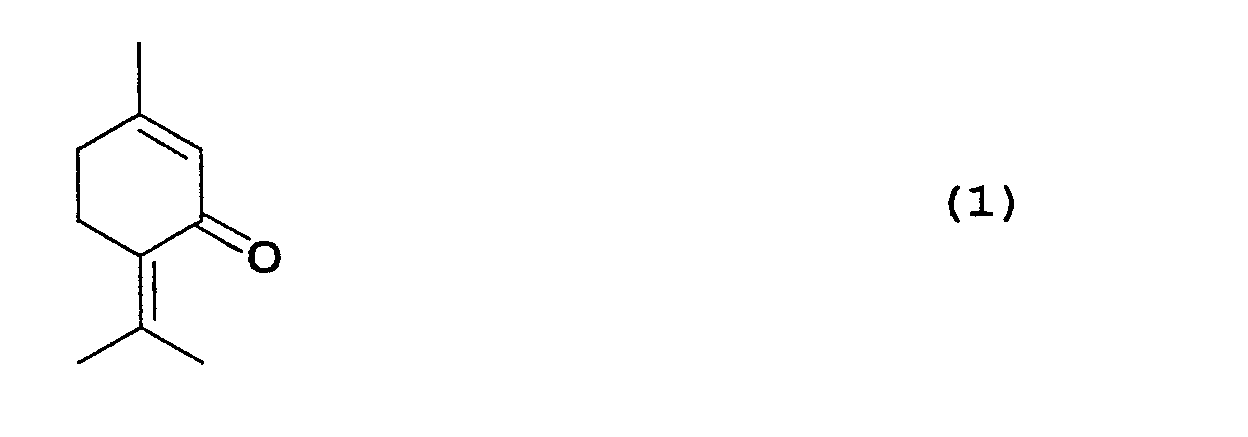 wherein R1 represents an aryl group which may have a substituent group or a cycloalkyl group having from 3 to 8 carbon atoms and a transition metal,
or a complex of an optically active phosphine represented by a general formula (3)wherein R1 represents an aryl group which may have a substituent group or a cycloalkyl group having from 3 to 8 carbon atoms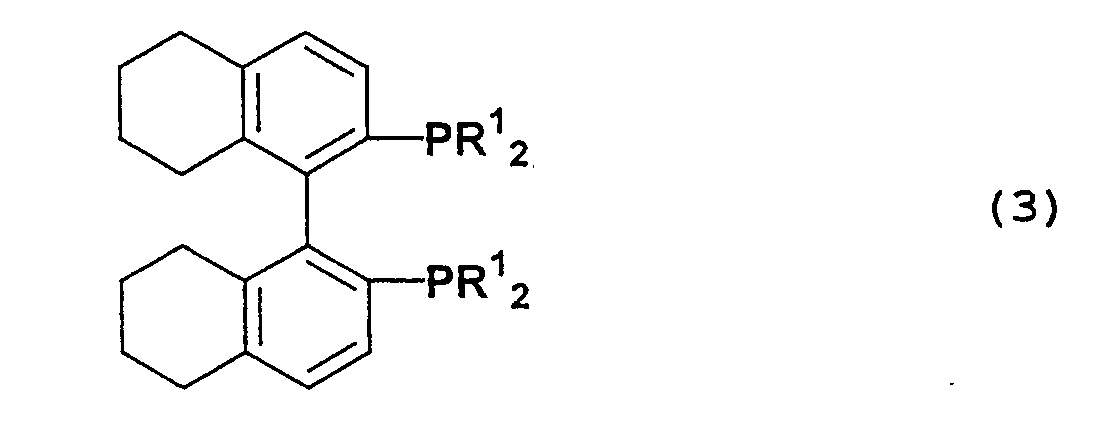
and a transition metal,
or a complex of an optically active phosphine represented by a general formula (4)wherein R1 represents an aryl group which may have a substituent group or a cycloalkyl group having from 3 to 8 carbon atoms, R2 represents hydrogen atom or a lower alkyl group having from 1 to 4 carbon atoms, R3 represents hydrogen atom, methyl group, methoxy group or a halogen atom, and R4 represents methyl group or methoxy group, or R3 and R4 together form methylenedioxy group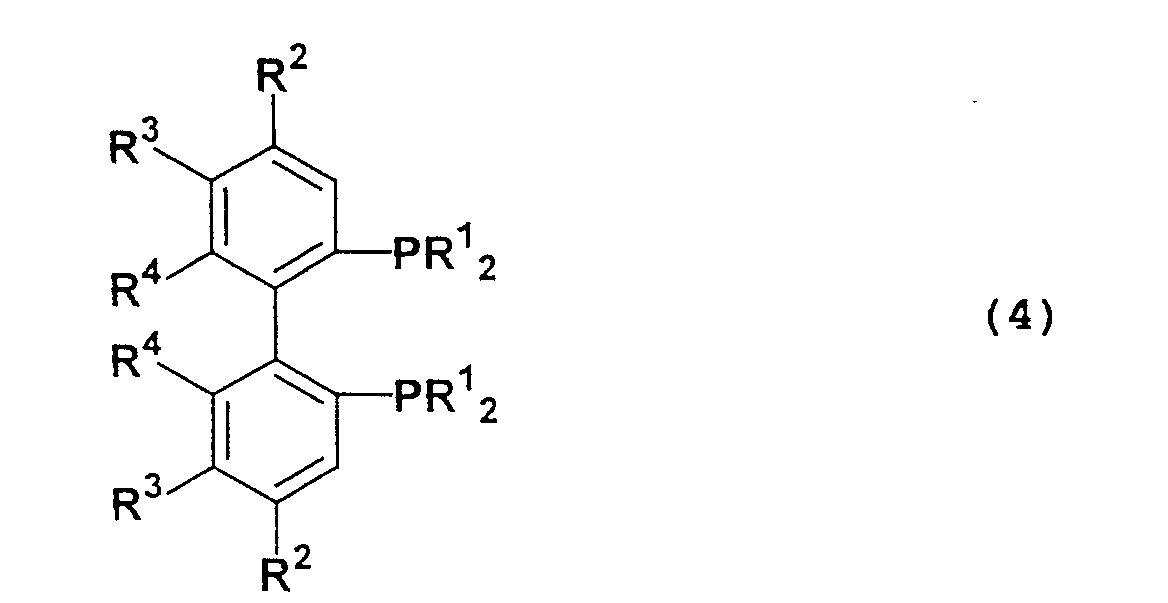
and a transition metal,
thereby producing pulegone represented by a formula (5),hydrogenation of the resulting pulegone with a ruthenium-phosphine-amine complex in the presence of a base, thereby obtaining pulegol represented by a formula (6),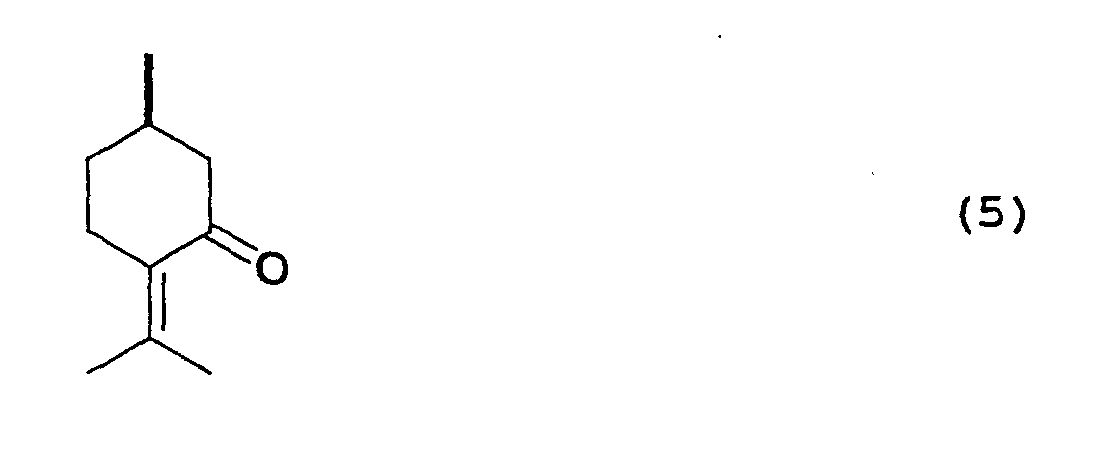 and further hydrogenation of the pulegol of the formula (6) with a transition metal catalyst.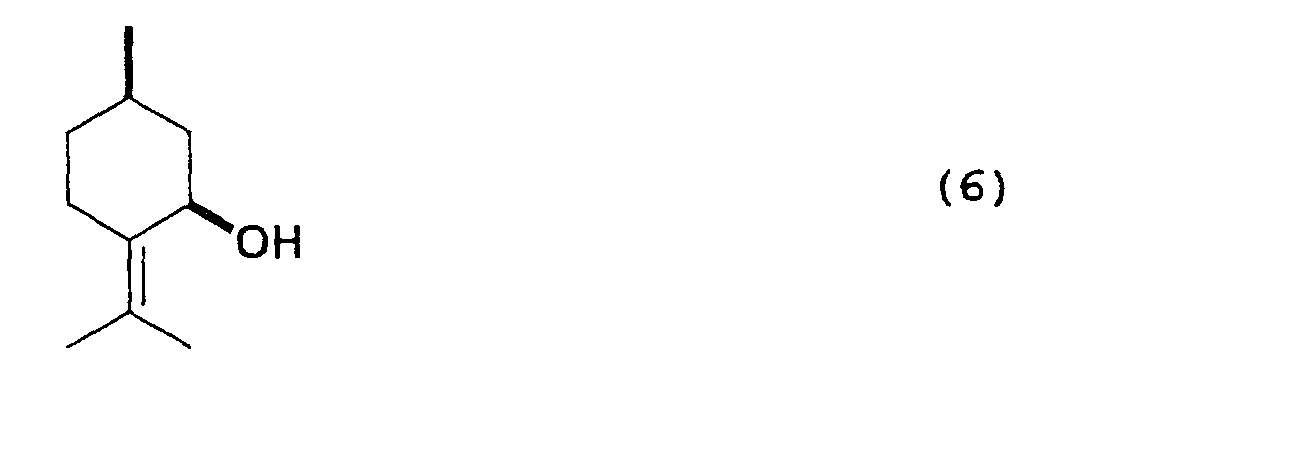
- The method for producing 1-menthol according to claim 1, wherein the transition metal in the complex of an optically active phosphine represented by a general formula (2), (3) or (4) and a transition metal in the step of hydrogenating the piperitenone represented by a formula (1) to the pulegone represented by a formula (5) is selected from the group consisting of rhodium, iridium and ruthenium.
- The method for producing 1-menthol according to claim 1 or 2, wherein the hydrogenation reaction is carried out by adding an ammonium salt, a phosphonium salt or an alkali metal salt to the complex of an optically active phosphine represented by a general formula (2), (3) or (4) and a transition metal in the step of hydrogenation of the piperitenone represented by a formula (1) to the pulegone represented by a formula (5).
- The method for producing 1-menthol according to any one of claims 1 to 3 , wherein the ruthenium-phosphine-amine complex which selectively hydrogenates carbonyl of pulegone in the step of hydrogenation of the pulegone represented by a formula (5) to the pulegol represented by a formula (6) is an achiral phosphine diamine ligand.
- A method for producing pulegone represented by a formula (5)which comprises hydrogenation of piperitenone represented by a formula (1)
 with a complex of an optically active phosphine represented by a general formula (2)
 wherein R1 represents an aryl group which may have a substituent group or a cycloalkyl group having from 3 to 8 carbon atoms
and a transition metal selected from the group consisting of rhodium, iridium and ruthenium,
or a complex of an optically active phosphine represented by a general formula (3)wherein R1 represents an aryl group which may have a substituent group or a cycloalkyl group having from 3 to 8 carbon atoms
and a transition metal selected from the group consisting of rhodium, iridium and ruthenium,
or a complex of an optically active phosphine represented by a general formula (4)wherein R1 represents an aryl group which may have a substituent group or a cycloalkyl group having from 3 to 8 carbon atoms, R2 represents hydrogen atom or a lower alkyl group having from 1 to 4 carbon atoms, R3 represents hydrogen atom, methyl group, methoxy group or a halogen atom, and R4 represents methyl group or methoxy group, or R3 and R4 together form methylenedioxy group
and a transition metal selected from the group consisting of rhodium, iridium and ruthenium. - The method for producing pulegone according to claim 5, wherein the hydrogenation reaction is carried out by adding an ammonium salt, a phosphonium salt or an alkali metal salt to the complex of an optically active phosphine and a transition metal as defined in claim 5.
- The method for producing 1-menthol according to any one of claims 1 to 4, wherein the transition metal catalyst which selectively hydrogenates the olefin of pulegol in the step of hydrogenating the pulegol represented by a formula (6) to the 1-menthol represented by a formula (7) is a heterogeneous catalyst of palladium, iridium, rhodium, ruthenium, nickel, osmium or platinum.
- The method for producing 1-menthol according to any one of claims 1 to 4, wherein the transition metal catalyst which selectively hydrogenates the olefin of pulegol in the step of hydrogenation of the pulegol represented by a formula (6) to the 1-menthol represented by a formula (7) is a homogeneous catalyst in the form of a ruthenium-phosphine-dicarboxylate complex.
- The method for producing 1-menthol according to any one of claims 1 to 4, wherein the base in the step of hydrogenation of the pulegone represented by a formula (5) to the pulegol represented by a formula (6) is selected from the group consisting of an alkali metal compound or alkaline earth metal compound.
Applications Claiming Priority (2)
| Application Number | Priority Date | Filing Date | Title |
|---|---|---|---|
| JP2000137388 | 2000-05-10 | ||
| JP2000137388 | 2000-05-10 |
Publications (3)
| Publication Number | Publication Date |
|---|---|
| EP1153908A2 true EP1153908A2 (en) | 2001-11-14 |
| EP1153908A3 EP1153908A3 (en) | 2003-10-01 |
| EP1153908B1 EP1153908B1 (en) | 2005-08-24 |
Family
ID=18645173
Family Applications (1)
| Application Number | Title | Priority Date | Filing Date |
|---|---|---|---|
| EP01401180A Expired - Lifetime EP1153908B1 (en) | 2000-05-10 | 2001-05-09 | Method for producing 1-menthol |
Country Status (6)
| Country | Link |
|---|---|
| US (1) | US6342644B1 (en) |
| EP (1) | EP1153908B1 (en) |
| AT (1) | ATE302744T1 (en) |
| DE (1) | DE60112837T2 (en) |
| ES (1) | ES2247033T3 (en) |
| IN (1) | IN191940B (en) |
Cited By (6)
| Publication number | Priority date | Publication date | Assignee | Title |
|---|---|---|---|---|
| CN101676294A (en) * | 2008-09-19 | 2010-03-24 | 高砂香料工业株式会社 | The production method of ruthenium complex |
| CN102702205A (en) * | 2012-05-16 | 2012-10-03 | 苏州新凯生物医药技术有限公司 | Preparation method of sitagliptin |
| CN104909992A (en) * | 2015-06-03 | 2015-09-16 | 黄山天香科技股份有限公司 | Method for preparing (1R,2S,5R)-2-isopropyl-5-methyl cyclohexanol from 2S-trans-5-methyl-2-(1-methylethyl)cyclohexanone |
| CN108083980A (en) * | 2017-11-27 | 2018-05-29 | 万华化学集团股份有限公司 | A kind of method for preparing optical voidness l-menthol |
| WO2019096860A1 (en) | 2017-11-16 | 2019-05-23 | Syngenta Participations Ag | Process for the preparation of enantiomerically and diastereomerically enriched cyclobutane amines and amides |
| WO2025056767A1 (en) | 2023-09-15 | 2025-03-20 | Syngenta Crop Protection Ag | Process for the preparation of enantiomerically enriched aliphatic amines |
Families Citing this family (12)
| Publication number | Priority date | Publication date | Assignee | Title |
|---|---|---|---|---|
| WO2004013339A1 (en) * | 2002-08-02 | 2004-02-12 | Aromagen Corporation | Methods for making (-) -menthol and oxygenated menthane compounds |
| US7094725B2 (en) | 2003-07-11 | 2006-08-22 | The Hong Kong Polytechnic University | Biphenyldiphosphine compounds |
| DE102004057277A1 (en) * | 2004-11-26 | 2006-06-01 | Basf Ag | Process for the preparation of menthol |
| US8575086B2 (en) * | 2005-01-18 | 2013-11-05 | Takasago International Corporation | Flavor and fragrance compositions |
| KR101686901B1 (en) | 2009-02-17 | 2016-12-15 | 나가오카 & 컴퍼니 리미티드 | Methods and apparatus for production of natural l-menthol |
| CN102010297B (en) * | 2010-11-23 | 2013-06-12 | 广东省食品工业研究所 | Method for chiral synthesis of levorotatory menthol |
| JP5780933B2 (en) | 2010-12-01 | 2015-09-16 | 高砂香料工業株式会社 | Method for producing optically active menthol |
| WO2014077323A1 (en) | 2012-11-15 | 2014-05-22 | 高砂香料工業株式会社 | Method for producing optically active isopulegol and optically active menthol |
| CN106148431A (en) * | 2016-09-04 | 2016-11-23 | 安徽爱有澄生物科技有限公司 | The preparation method of pulegium ketone derivatives |
| US10492522B2 (en) | 2017-05-03 | 2019-12-03 | R.J. Reynolds Tobacco Company | Flavored menthol-containing objects for application to smoking article components |
| WO2021254811A1 (en) | 2020-06-19 | 2021-12-23 | Dsm Ip Assets B.V. | IMPROVED PROCESS TO PRODUCE SPECIFIC α,β-UNSATURATED CARBOXYLATES |
| US20250074854A1 (en) * | 2022-01-13 | 2025-03-06 | Basf Se | Process for the selective catalytic hydrogenation of dienones |
Family Cites Families (1)
| Publication number | Priority date | Publication date | Assignee | Title |
|---|---|---|---|---|
| US3870761A (en) * | 1971-07-23 | 1975-03-11 | Basf Ag | Manufacture of piperitenone |
-
2001
- 2001-05-07 US US09/849,306 patent/US6342644B1/en not_active Expired - Fee Related
- 2001-05-09 AT AT01401180T patent/ATE302744T1/en not_active IP Right Cessation
- 2001-05-09 IN IN378MA2001 patent/IN191940B/en unknown
- 2001-05-09 ES ES01401180T patent/ES2247033T3/en not_active Expired - Lifetime
- 2001-05-09 DE DE60112837T patent/DE60112837T2/en not_active Expired - Lifetime
- 2001-05-09 EP EP01401180A patent/EP1153908B1/en not_active Expired - Lifetime
Cited By (8)
| Publication number | Priority date | Publication date | Assignee | Title |
|---|---|---|---|---|
| CN101676294A (en) * | 2008-09-19 | 2010-03-24 | 高砂香料工业株式会社 | The production method of ruthenium complex |
| CN101676294B (en) * | 2008-09-19 | 2014-06-18 | 高砂香料工业株式会社 | The production method of ruthenium complex |
| CN102702205A (en) * | 2012-05-16 | 2012-10-03 | 苏州新凯生物医药技术有限公司 | Preparation method of sitagliptin |
| CN104909992A (en) * | 2015-06-03 | 2015-09-16 | 黄山天香科技股份有限公司 | Method for preparing (1R,2S,5R)-2-isopropyl-5-methyl cyclohexanol from 2S-trans-5-methyl-2-(1-methylethyl)cyclohexanone |
| WO2019096860A1 (en) | 2017-11-16 | 2019-05-23 | Syngenta Participations Ag | Process for the preparation of enantiomerically and diastereomerically enriched cyclobutane amines and amides |
| CN108083980A (en) * | 2017-11-27 | 2018-05-29 | 万华化学集团股份有限公司 | A kind of method for preparing optical voidness l-menthol |
| CN108083980B (en) * | 2017-11-27 | 2021-02-02 | 万华化学集团股份有限公司 | Method for preparing optically pure L-menthol |
| WO2025056767A1 (en) | 2023-09-15 | 2025-03-20 | Syngenta Crop Protection Ag | Process for the preparation of enantiomerically enriched aliphatic amines |
Also Published As
| Publication number | Publication date |
|---|---|
| DE60112837D1 (en) | 2005-09-29 |
| ATE302744T1 (en) | 2005-09-15 |
| EP1153908B1 (en) | 2005-08-24 |
| EP1153908A3 (en) | 2003-10-01 |
| ES2247033T3 (en) | 2006-03-01 |
| IN191940B (en) | 2004-01-17 |
| DE60112837T2 (en) | 2006-06-14 |
| US20020007094A1 (en) | 2002-01-17 |
| US6342644B1 (en) | 2002-01-29 |
Similar Documents
| Publication | Publication Date | Title |
|---|---|---|
| EP1153908B1 (en) | Method for producing 1-menthol | |
| US5763688A (en) | Method for producing an alcohol | |
| US4766225A (en) | Ruthenium-phosphine complex | |
| US9796678B2 (en) | Method for manufacturing optically active compound | |
| US6790973B2 (en) | Ruthenium complexes and process for preparing alcoholic compounds using these | |
| US6388130B2 (en) | Method for producing axial asymmetric compounds, and intermediates for producing the same | |
| KR101085804B1 (en) | Preparation of optically active alcohol | |
| US8076503B2 (en) | Process for production of optically active aminophosphinylbutanoic acids | |
| JPH08225466A (en) | Method for producing optically active alcohols | |
| EP2264000B1 (en) | Method for producing optically active aminoalcohol compound using ruthenium compound | |
| US20170121262A1 (en) | Olefin hydroformylation methods for obtaining branched aldehydes | |
| JP4795559B2 (en) | Method for producing l-menthol | |
| JP3771615B2 (en) | Method for producing optically active benzhydrol compound | |
| US7601667B2 (en) | Sulfonate catalyst and method of producing alcohol compound using the same | |
| EP0831099B1 (en) | Process for preparing ruthenium-phosphine complex | |
| US6624320B2 (en) | Asymmetric phosphine ligand | |
| JP3905162B2 (en) | Method for producing benzhydrol derivative | |
| US5856590A (en) | Process for producing cis-4-t-butylcyclohexanol | |
| EP1371655B1 (en) | Novel diphosphine compound, production intermediate thereof, transition metal complex containing the compound as ligand and asymmetric hydrogenation catalyst containing the complex | |
| JPH10273456A (en) | Method for producing optically active alcohols | |
| JP3722215B2 (en) | Optically active dimetallocenylphosphine derivative, asymmetric catalyst, and method for producing optically active compound using the optically active dimetallocenylphosphine derivative or the asymmetric catalyst | |
| JPH09227448A (en) | Optically active carboxylic acid and method for producing the same | |
| US7351849B2 (en) | Process for producing optically active β-amino acid derivatives | |
| JPH07223976A (en) | Process for producing optically active olefin compound | |
| JP2006151842A (en) | Process for producing optically active alkylphthalides |
Legal Events
| Date | Code | Title | Description |
|---|---|---|---|
| PUAI | Public reference made under article 153(3) epc to a published international application that has entered the european phase |
Free format text: ORIGINAL CODE: 0009012 |
|
| AK | Designated contracting states |
Kind code of ref document: A2 Designated state(s): AT BE CH CY DE DK ES FI FR GB GR IE IT LI LU MC NL PT SE TR |
|
| AX | Request for extension of the european patent |
Free format text: AL;LT;LV;MK;RO;SI |
|
| PUAL | Search report despatched |
Free format text: ORIGINAL CODE: 0009013 |
|
| AK | Designated contracting states |
Kind code of ref document: A3 Designated state(s): AT BE CH CY DE DK ES FI FR GB GR IE IT LI LU MC NL PT SE TR |
|
| AX | Request for extension of the european patent |
Extension state: AL LT LV MK RO SI |
|
| 17P | Request for examination filed |
Effective date: 20040401 |
|
| AKX | Designation fees paid |
Designated state(s): AT BE CH CY DE DK ES FI FR GB GR IE IT LI LU MC NL PT SE TR |
|
| GRAP | Despatch of communication of intention to grant a patent |
Free format text: ORIGINAL CODE: EPIDOSNIGR1 |
|
| GRAS | Grant fee paid |
Free format text: ORIGINAL CODE: EPIDOSNIGR3 |
|
| GRAA | (expected) grant |
Free format text: ORIGINAL CODE: 0009210 |
|
| AK | Designated contracting states |
Kind code of ref document: B1 Designated state(s): AT BE CH CY DE DK ES FI FR GB GR IE IT LI LU MC NL PT SE TR |
|
| PG25 | Lapsed in a contracting state [announced via postgrant information from national office to epo] |
Ref country code: BE Free format text: LAPSE BECAUSE OF FAILURE TO SUBMIT A TRANSLATION OF THE DESCRIPTION OR TO PAY THE FEE WITHIN THE PRESCRIBED TIME-LIMIT Effective date: 20050824 Ref country code: FI Free format text: LAPSE BECAUSE OF FAILURE TO SUBMIT A TRANSLATION OF THE DESCRIPTION OR TO PAY THE FEE WITHIN THE PRESCRIBED TIME-LIMIT Effective date: 20050824 Ref country code: AT Free format text: LAPSE BECAUSE OF FAILURE TO SUBMIT A TRANSLATION OF THE DESCRIPTION OR TO PAY THE FEE WITHIN THE PRESCRIBED TIME-LIMIT Effective date: 20050824 |
|
| REG | Reference to a national code |
Ref country code: GB Ref legal event code: FG4D |
|
| REG | Reference to a national code |
Ref country code: CH Ref legal event code: EP |
|
| REG | Reference to a national code |
Ref country code: CH Ref legal event code: NV Representative=s name: BOVARD AG PATENTANWAELTE |
|
| REG | Reference to a national code |
Ref country code: IE Ref legal event code: FG4D |
|
| REF | Corresponds to: |
Ref document number: 60112837 Country of ref document: DE Date of ref document: 20050929 Kind code of ref document: P |
|
| PG25 | Lapsed in a contracting state [announced via postgrant information from national office to epo] |
Ref country code: DK Free format text: LAPSE BECAUSE OF FAILURE TO SUBMIT A TRANSLATION OF THE DESCRIPTION OR TO PAY THE FEE WITHIN THE PRESCRIBED TIME-LIMIT Effective date: 20051124 Ref country code: GR Free format text: LAPSE BECAUSE OF FAILURE TO SUBMIT A TRANSLATION OF THE DESCRIPTION OR TO PAY THE FEE WITHIN THE PRESCRIBED TIME-LIMIT Effective date: 20051124 Ref country code: SE Free format text: LAPSE BECAUSE OF FAILURE TO SUBMIT A TRANSLATION OF THE DESCRIPTION OR TO PAY THE FEE WITHIN THE PRESCRIBED TIME-LIMIT Effective date: 20051124 |
|
| PG25 | Lapsed in a contracting state [announced via postgrant information from national office to epo] |
Ref country code: PT Free format text: LAPSE BECAUSE OF FAILURE TO SUBMIT A TRANSLATION OF THE DESCRIPTION OR TO PAY THE FEE WITHIN THE PRESCRIBED TIME-LIMIT Effective date: 20060124 |
|
| REG | Reference to a national code |
Ref country code: ES Ref legal event code: FG2A Ref document number: 2247033 Country of ref document: ES Kind code of ref document: T3 |
|
| ET | Fr: translation filed | ||
| PG25 | Lapsed in a contracting state [announced via postgrant information from national office to epo] |
Ref country code: IE Free format text: LAPSE BECAUSE OF NON-PAYMENT OF DUE FEES Effective date: 20060509 |
|
| PG25 | Lapsed in a contracting state [announced via postgrant information from national office to epo] |
Ref country code: MC Free format text: LAPSE BECAUSE OF NON-PAYMENT OF DUE FEES Effective date: 20060531 |
|
| PLBE | No opposition filed within time limit |
Free format text: ORIGINAL CODE: 0009261 |
|
| STAA | Information on the status of an ep patent application or granted ep patent |
Free format text: STATUS: NO OPPOSITION FILED WITHIN TIME LIMIT |
|
| 26N | No opposition filed |
Effective date: 20060526 |
|
| REG | Reference to a national code |
Ref country code: IE Ref legal event code: MM4A |
|
| PGFP | Annual fee paid to national office [announced via postgrant information from national office to epo] |
Ref country code: NL Payment date: 20070515 Year of fee payment: 7 |
|
| PGFP | Annual fee paid to national office [announced via postgrant information from national office to epo] |
Ref country code: CH Payment date: 20070516 Year of fee payment: 7 |
|
| PGFP | Annual fee paid to national office [announced via postgrant information from national office to epo] |
Ref country code: IT Payment date: 20070509 Year of fee payment: 7 |
|
| PG25 | Lapsed in a contracting state [announced via postgrant information from national office to epo] |
Ref country code: TR Free format text: LAPSE BECAUSE OF FAILURE TO SUBMIT A TRANSLATION OF THE DESCRIPTION OR TO PAY THE FEE WITHIN THE PRESCRIBED TIME-LIMIT Effective date: 20050824 Ref country code: LU Free format text: LAPSE BECAUSE OF NON-PAYMENT OF DUE FEES Effective date: 20060509 |
|
| PG25 | Lapsed in a contracting state [announced via postgrant information from national office to epo] |
Ref country code: CY Free format text: LAPSE BECAUSE OF FAILURE TO SUBMIT A TRANSLATION OF THE DESCRIPTION OR TO PAY THE FEE WITHIN THE PRESCRIBED TIME-LIMIT Effective date: 20050824 |
|
| REG | Reference to a national code |
Ref country code: CH Ref legal event code: PL |
|
| PG25 | Lapsed in a contracting state [announced via postgrant information from national office to epo] |
Ref country code: CH Free format text: LAPSE BECAUSE OF NON-PAYMENT OF DUE FEES Effective date: 20080531 Ref country code: LI Free format text: LAPSE BECAUSE OF NON-PAYMENT OF DUE FEES Effective date: 20080531 Ref country code: NL Free format text: LAPSE BECAUSE OF NON-PAYMENT OF DUE FEES Effective date: 20081201 |
|
| PG25 | Lapsed in a contracting state [announced via postgrant information from national office to epo] |
Ref country code: IT Free format text: LAPSE BECAUSE OF NON-PAYMENT OF DUE FEES Effective date: 20080509 |
|
| PGFP | Annual fee paid to national office [announced via postgrant information from national office to epo] |
Ref country code: FR Payment date: 20110523 Year of fee payment: 11 |
|
| PGFP | Annual fee paid to national office [announced via postgrant information from national office to epo] |
Ref country code: GB Payment date: 20110504 Year of fee payment: 11 |
|
| PGFP | Annual fee paid to national office [announced via postgrant information from national office to epo] |
Ref country code: DE Payment date: 20120502 Year of fee payment: 12 |
|
| PGFP | Annual fee paid to national office [announced via postgrant information from national office to epo] |
Ref country code: ES Payment date: 20120518 Year of fee payment: 12 |
|
| GBPC | Gb: european patent ceased through non-payment of renewal fee |
Effective date: 20120509 |
|
| REG | Reference to a national code |
Ref country code: FR Ref legal event code: ST Effective date: 20130131 |
|
| PG25 | Lapsed in a contracting state [announced via postgrant information from national office to epo] |
Ref country code: FR Free format text: LAPSE BECAUSE OF NON-PAYMENT OF DUE FEES Effective date: 20120531 Ref country code: GB Free format text: LAPSE BECAUSE OF NON-PAYMENT OF DUE FEES Effective date: 20120509 |
|
| PG25 | Lapsed in a contracting state [announced via postgrant information from national office to epo] |
Ref country code: DE Free format text: LAPSE BECAUSE OF NON-PAYMENT OF DUE FEES Effective date: 20131203 |
|
| REG | Reference to a national code |
Ref country code: DE Ref legal event code: R119 Ref document number: 60112837 Country of ref document: DE Effective date: 20131203 |
|
| REG | Reference to a national code |
Ref country code: ES Ref legal event code: FD2A Effective date: 20140708 |
|
| PG25 | Lapsed in a contracting state [announced via postgrant information from national office to epo] |
Ref country code: ES Free format text: LAPSE BECAUSE OF NON-PAYMENT OF DUE FEES Effective date: 20130510 |