EP1153543A1 - Animals with insufficient expression of uridine phosphorylase - Google Patents
Animals with insufficient expression of uridine phosphorylase Download PDFInfo
- Publication number
- EP1153543A1 EP1153543A1 EP00981751A EP00981751A EP1153543A1 EP 1153543 A1 EP1153543 A1 EP 1153543A1 EP 00981751 A EP00981751 A EP 00981751A EP 00981751 A EP00981751 A EP 00981751A EP 1153543 A1 EP1153543 A1 EP 1153543A1
- Authority
- EP
- European Patent Office
- Prior art keywords
- gene
- uridine phosphorylase
- mice
- uridine
- cell
- Prior art date
- Legal status (The legal status is an assumption and is not a legal conclusion. Google has not performed a legal analysis and makes no representation as to the accuracy of the status listed.)
- Granted
Links
Images



Classifications
-
- C—CHEMISTRY; METALLURGY
- C12—BIOCHEMISTRY; BEER; SPIRITS; WINE; VINEGAR; MICROBIOLOGY; ENZYMOLOGY; MUTATION OR GENETIC ENGINEERING
- C12N—MICROORGANISMS OR ENZYMES; COMPOSITIONS THEREOF; PROPAGATING, PRESERVING, OR MAINTAINING MICROORGANISMS; MUTATION OR GENETIC ENGINEERING; CULTURE MEDIA
- C12N15/00—Mutation or genetic engineering; DNA or RNA concerning genetic engineering, vectors, e.g. plasmids, or their isolation, preparation or purification; Use of hosts therefor
- C12N15/09—Recombinant DNA-technology
- C12N15/63—Introduction of foreign genetic material using vectors; Vectors; Use of hosts therefor; Regulation of expression
- C12N15/79—Vectors or expression systems specially adapted for eukaryotic hosts
- C12N15/85—Vectors or expression systems specially adapted for eukaryotic hosts for animal cells
- C12N15/8509—Vectors or expression systems specially adapted for eukaryotic hosts for animal cells for producing genetically modified animals, e.g. transgenic
-
- A—HUMAN NECESSITIES
- A01—AGRICULTURE; FORESTRY; ANIMAL HUSBANDRY; HUNTING; TRAPPING; FISHING
- A01K—ANIMAL HUSBANDRY; AVICULTURE; APICULTURE; PISCICULTURE; FISHING; REARING OR BREEDING ANIMALS, NOT OTHERWISE PROVIDED FOR; NEW BREEDS OF ANIMALS
- A01K67/00—Rearing or breeding animals, not otherwise provided for; New or modified breeds of animals
- A01K67/027—New or modified breeds of vertebrates
- A01K67/0275—Genetically modified vertebrates, e.g. transgenic
- A01K67/0276—Knock-out vertebrates
-
- C—CHEMISTRY; METALLURGY
- C12—BIOCHEMISTRY; BEER; SPIRITS; WINE; VINEGAR; MICROBIOLOGY; ENZYMOLOGY; MUTATION OR GENETIC ENGINEERING
- C12N—MICROORGANISMS OR ENZYMES; COMPOSITIONS THEREOF; PROPAGATING, PRESERVING, OR MAINTAINING MICROORGANISMS; MUTATION OR GENETIC ENGINEERING; CULTURE MEDIA
- C12N9/00—Enzymes; Proenzymes; Compositions thereof; Processes for preparing, activating, inhibiting, separating or purifying enzymes
- C12N9/10—Transferases (2.)
- C12N9/1048—Glycosyltransferases (2.4)
- C12N9/1077—Pentosyltransferases (2.4.2)
-
- A—HUMAN NECESSITIES
- A01—AGRICULTURE; FORESTRY; ANIMAL HUSBANDRY; HUNTING; TRAPPING; FISHING
- A01K—ANIMAL HUSBANDRY; AVICULTURE; APICULTURE; PISCICULTURE; FISHING; REARING OR BREEDING ANIMALS, NOT OTHERWISE PROVIDED FOR; NEW BREEDS OF ANIMALS
- A01K2217/00—Genetically modified animals
- A01K2217/07—Animals genetically altered by homologous recombination
- A01K2217/072—Animals genetically altered by homologous recombination maintaining or altering function, i.e. knock in
-
- A—HUMAN NECESSITIES
- A01—AGRICULTURE; FORESTRY; ANIMAL HUSBANDRY; HUNTING; TRAPPING; FISHING
- A01K—ANIMAL HUSBANDRY; AVICULTURE; APICULTURE; PISCICULTURE; FISHING; REARING OR BREEDING ANIMALS, NOT OTHERWISE PROVIDED FOR; NEW BREEDS OF ANIMALS
- A01K2217/00—Genetically modified animals
- A01K2217/07—Animals genetically altered by homologous recombination
- A01K2217/075—Animals genetically altered by homologous recombination inducing loss of function, i.e. knock out
-
- A—HUMAN NECESSITIES
- A01—AGRICULTURE; FORESTRY; ANIMAL HUSBANDRY; HUNTING; TRAPPING; FISHING
- A01K—ANIMAL HUSBANDRY; AVICULTURE; APICULTURE; PISCICULTURE; FISHING; REARING OR BREEDING ANIMALS, NOT OTHERWISE PROVIDED FOR; NEW BREEDS OF ANIMALS
- A01K2227/00—Animals characterised by species
- A01K2227/10—Mammal
- A01K2227/105—Murine
-
- A—HUMAN NECESSITIES
- A01—AGRICULTURE; FORESTRY; ANIMAL HUSBANDRY; HUNTING; TRAPPING; FISHING
- A01K—ANIMAL HUSBANDRY; AVICULTURE; APICULTURE; PISCICULTURE; FISHING; REARING OR BREEDING ANIMALS, NOT OTHERWISE PROVIDED FOR; NEW BREEDS OF ANIMALS
- A01K2267/00—Animals characterised by purpose
- A01K2267/03—Animal model, e.g. for test or diseases
Definitions
- This invention relates to non-human animals deficient in the expression of uridine phosphorylase, and also to their offspring.
- Pyrimidine nucleoside phosphorylases are enzymes, which take part in the biosynthesis and degradation of pyrimidine in its metabolism and play an important role of regulating the in vitro nucleoside pool through degradation and synthesis of pyrimidine bases in the salvage pathway.
- pyrimidine nucleoside phosphorylases in mammals are known to include uridine phosphorylase and thymidine phosphorylase, both of which take part in the biosynthesis and degradation in its metabolism.
- Concerning such pyrimidine nucleoside phosphorylase genes cDNAs have been isolated from mice and human, and elucidation of their differences in expression is now under way on the gene level [Uchida et al., J. Biol. Chem., 270 , 12191-19196 (1995); Uchida et al., Biochem. Biophys. Res. Commun., 216 , 265-272 (1995)].
- nucleoside antimetabolites which are playing an important role in the field of cancer chemotherapy in recent years are known to be inactivated by pyrimidine nucleoside phosphorylase due to their chemical structures.
- pyrimidine nucleoside phosphorylase For the development of drugs excellent in pharmacological effects and low in side effects, it is therefore considered to be necessary to accurately grasp the mechanism of metabolism of these substances by pyrimidine nucleoside phosphorylase.
- Uridine phosphorylase and thymidine phosphorylase are, however, observed to have substantial differences in their distribution depending on species.
- thymidine phosphorylase are expressed in both normal tissues and tumor tissues, whereas in rodents such as mice and rats, uridine phosphorylase is primarily expressed centering around digestive tracts and thymidine phosphorylase is expressed only in some tissues such as livers. This has led to a problem in that the utility and the like of nucleoside anticancer agents in human cannot be precisely predicted from data on rodents.
- thymidine phosphorylase is known to function as an angiogenic factor. It has recently been identified as a causative gene of MNGIE, a mitochondrial disease.
- uridine phosphorylase expression deficient animals if available in a phyletic lineage, will be useful as experimental animals for the study of physiological functions of the protein, for the elucidation of its related diseases, and also for the development and research of pyridine nucleoside antimetabolites (anticancer agents).
- An object of the present invention is to provide a uridine phosphorylase expression deficient non-human animal or its offspring, which can be used as an experimental animal.
- the present inventors have proceeded with research in various ways on mutation of a uridine phosphorylase gene, designing of a targeting vector, and so on. As a result, the present inventors have succeeded in creating a transformed animal having a uridine phosphorylase gene which practically does not function, and its offspring, leading to the completion of the present invention.
- the present invention provides a non-human animal deficient in a function of a uridine phosphorylase gene on a chromosome, or an offspring thereof.
- a uridine phosphorylase gene on a chromosome in a somatic cell or a germ cell is different from its original structure by deletion of a part of its base sequence, insertion of or replacement with another gene, or the like and cannot produce a protein capable of functioning as uridine phosphorylase or even if a genetic product is obtained, its protein cannot function as uridine phosphorylase; and specifically, indicates destruction of the function by gene mutation, such as deletion, insertion or replacement, of the base sequence of a promoter region or coding region.
- non-human animal deficient in a function of a uridine phosphorylase gene on a chromosome means a uridine phosphorylase expression deficient animal created by modifying (manipulating) a uridine phosphorylase gene (mutant uridine phosphorylase gene) in accordance with a genetic engineering procedure.
- non-human animal can be any animal having a uridine phosphorylase gene other than human, although a non-human mammal.
- examples of the non-human mammal can include bovines, pigs, sheep, goats, rabbits, dogs, cats, guinea pigs, hamsters, mice, and rats.
- rodents featuring relatively short ontogenesis and reproduction cycle and easy breeding, especially mice and rats are preferred from the standpoint of preparation of a morbid animal model line.
- a uridine phosphorylase gene on a chromosome For the disruption of a uridine phosphorylase gene on a chromosome, it is possible to apply methods which are commonly used for disrupting genes on chromosomes. Specifically, the function of the uridine phosphorylase gene in an animal and its offspring can be rendered deficient by cloning the uridine phosphorylase gene to delete the function of the gene in vitro and then introducing the deficient gene back into the animal.
- Illustrative of methods for introducing a gene into animals are (1) injection of genetic DNA into the embryo of a germ cell in its prokaryotic stage, (2) transfection of an early embryo with a recombinant retrovirus, and (3) injection of an embryo-derived stem cell (ES cell), which has been caused to undergo homologous recombination, into a blastocyst or into an embryo in its eight cell stage.
- ES cell embryo-derived stem cell
- the gene introduction method making use of an ES cell is preferred in that it is suited for disrupting a gene by homologous recombination and its permits conducting the introduction of the ES cell into the gene and the creation of a chimeric animal as separate steps.
- a chimeric animal can firstly be created by forming a cell having a mutant uridine phosphorylase gene (for example, an ES cell) and transplanting the cell into an animal; and further, an animal in which the mutant uridine phosphorylase gene is heterogeneously or homogeneously deleted in all the constituent cells thereof can be created by mating the chimeric animal with a different individual.
- a mutant uridine phosphorylase gene for example, an ES cell
- a mutant of a uridine phosphorylase gene is obtained by deleting a part of the base sequence of the uridine phosphorylase gene, inserting another gene into the base sequence or replacing a part of the base sequence with another gene.
- a position at which the deletion, insertion or replacement is to be effected insofar as it is such a position that the deletion, insertion or replacement makes it impossible to obtain any functioning genetic product.
- the position can be in any region such as a promoter region, an intron region, an exon region or the like. To assure the deletion of the expressing ability of the gene, it is preferred to mutate at least a part of the promoter region or the coding region.
- the uridine phosphorylase gene of a mouse contains 7 coding exons and a uridine phosphorylase protein is coded over the 7 coding exons.
- the deletion of the expressing ability of the uridine phosphorylase gene it is, therefore, possible to delete one or some of these exons or to insert another gene at any one of the positions of these exons.
- the uridine phosphorylase gene can be either a genome-derived uridine phosphorylase gene isolated or extracted from an animal or cDNA cloned using a genetic engineering procedure.
- the cloned uridine phosphorylase gene can be obtained by extracting genomic DNA, for example, from the liver of a mouse, preparing a genomic DNA library from the genomic DNA by a method known per se in the art, and screening the DNA library while using as a probe a partial sequence of pre-cloned DNA which codes uridine phosphorylase mRNA, for example, cDNA [in the case of a mouse, Uchida et al., J. Biol. Chem., 270, 12191-12196 (1995)].
- reporter gene indicates a group of genes, each of which can serve as an index of expression of the gene. In general, structural genes of enzymes which catalyze a photogenic reaction or chromogenic reaction are often used.
- the reporter gene makes it possible to investigate not only whether the introduced gene has been expressed in cells but also which tissue it has been expressed in. Specifically, lacZ ( Escherichia coli ⁇ -galactosidase gene), cat (chloramphenicol acetyltransferase gene) or the like is used.
- a targeting vector is prepared for homologous recombination to delete the function of the uridine phosphorylase gene.
- the targeting vector can be designed by deleting the chromosome-derived uridine phosphorylase gene either in part or in its entirety, inserting another base sequence into the uridine phosphorylase gene or replacing a part of the uridine phosphorylase gene with another base sequence such that the upstream and downstream regions flanking the mutated part have homologous base sequences as the uridine phosphorylase gene.
- the targeting vector can also be designed in such a way that, when a reporter gene is inserted in the targeting vector, the base sequence of the reporter gene is contained in the non-homologous part of the base sequence of the targeting vector.
- the targeting vector may preferably be inserted with marker genes permitting selection of vector-incorporated cells or cells having high possibility of having undergone intended homologous recombination, for examples, a gene widely employed for the selection of drug, such as neomycin-resistant gene (neo), a herpes simplex virus thymidinekinase gene (HSV-tk), or a thymidinekinase gene (tk).
- neomycin-resistant gene a herpes simplex virus thymidinekinase gene (HSV-tk), or a thymidinekinase gene (tk).
- HSV-tk herpes simplex virus thymidinekinase gene
- tk thymidinekinase gene
- the neomycin resistant gene makes it possible to select a target gene by using G418, a neomycin analogue.
- a positive selection marker gene such as the neomycin resistant gene (neo)
- a marker gene useful for negative selection to selectively remove a target cell for example, a thymidinekinase gene (tk) (ganciclovir, FIAU or the like is used as a selecting agent, and depending on the sensitivity to the selecting agent, a non-homologous recombinant is selectively removed) or the diphtheria toxin fragment A (DT-A) gene (a non-homologous recombinant is selectively removed by diphtheria toxin expressed by DT-A).
- tk thymidinekinase gene
- DT-A diphtheria toxin fragment A
- a targeting vector can be conducted by conventional DNA recombination technology.
- a cloned uridine phosphorylase gene is used. This gene is digested with a suitable restriction enzyme to obtain a fragment, or is partially amplified by PCR to prepare a DNA fragment. The fragment or DNA fragment can then be linked to a linker DNA synthesized by a DNA synthesizer, a fragment containing a reporter gene, a fragment containing a drug-resistance marker gene and the like in a desired order in accordance with a design as described above.
- the homologous recombinational targeting vector prepared as described above is next introduced into a suitable cell commonly employed for the creation of a chimeric animal.
- Examples of the cell employed here can include an ovule and an embryo-derived stem cell (ES cell), although an ES cell is preferred in that is equipped with pluripotency sufficient to differentiate into all kinds of cells in an organism.
- the introduction of the vector DNA into the cell can be carried out by a conventional method, for example electroporation, microinjection or calcium phosphate transfection.
- An ES cell has been established from an inner cell mass of a mouse blastocyst of 129 cell line, and is a cell line growth and culture of which is feasible while maintaining its undifferentiated state. Concerning mice, a method has been established for introducing a gene by using an ES cell [Mansour, S.L., et al., Nature, 336, 348 (1988)]. Theoretically, culture of an ES cell is considered to be feasible in all species of mammals, and research is currently under way to also establish ES cells with respect to J rats, rabbits, and cattle, such as pigs and bovines, in addition to mice . Incidentally, for animal species ES cells of which are not cultured or are cultured but have not been established to such cell lines as differentiating to germ cells, mutant genes can be introduced by the above-described method (1) or (2) or a like method.
- the mutant uridine phosphorylase gene of the targeting vector can be introduced into an animal by replacing a uridine phosphorylase gene on a chromosome in a cell (for example, an ES cell) of the animal with the base sequence of the mutant uridine phosphorylase gene of the targeting vector in accordance with homologous gene recombination.
- the marker gene and reporter gene inserted in the targeting vector DNA are inserted in the uridine phosphorylase gene in the genome of the ES cell.
- the marker gene such as a drug resistant gene, in the vector DNA has also been inserted at the same time so that by culturing the cell for an appropriate period, for example, in the presence of the drug, the cell can be selected based on the expression of the gene.
- those having undergone mutation by the homologous recombination can be determined by an analysis making use of Southern hybridization in which the DNA sequence on or adjacent to the uridine phosphorylase gene is used as a probe or by an analysis making use of PCR in which the DNA sequence on the targeting vector and a DNA sequence in an adjacent region other than the mouse-derived uridine phosphorylase gene employed in the targeting vector are used as primers.
- a chimeric animal is next created in accordance with a procedure which is generally used for the creation of chimeric animals such as injection, cell aggregation or the like.
- a chimeric animal - which is composed of cells having the normal uridine phosphorylase locuses and cells having the mutated uridine phosphorylase locuses - can be obtained by injecting a cell (for example, an ES cell) with the mutated locus occurred therein into a non-human animal embryo or blastocyst in an appropriate early stage of embryo formation, for example, in its 8-cell stage and transplanting the resulting embryo in the uterus of a pseudocyetic animal.
- a cell for example, an ES cell
- Selection as to what line of animal a host embryo is to be obtained from should be made such that cells to be derived from the ES cell and those to be derived from the host embryo would be successfully distinguished depending on a phenotype such as fur colors in accordance with a usual method.
- individuals the tissues of which are all composed of cells having the mutant uridine phosphorylase locuses can be selected by a discrimination method, which relies upon the fur color or the like, from a group of individuals obtained by mating a chimeric individual with a normal individual.
- a chimeric mouse obtained using, for example, a mouse ES cell of the J1 strain and a host embryo of the C57BL/J line is mated with a C57BL/6J-line mouse
- offspring to be ejected will present the same wild color (agouti) as the mouse from which the ES cell was derived if germ cells of the chimeric mouse are derived from the recombinant ES cell, but present the same black color as the mouse from which the host embryo was derived if the germ cells of the chimeric mouse ware derived from the host embryo.
- the deleted expression of the uridine phosphorylase gene can be confirmed by performing Southern blot or PCR analysis of tail DNA from new born and fed mice.
- Non-human animals according to the present invention can embrace chimeric animals, F1 heterozygous expression deficient animals and F2 homozylous expression deficient animals.
- F2 homozylous expression deficient animals are, however, preferred from the standpoint of effects of the expression deficiency of the uridine phosphorylase gene.
- Transformed non-human animals obtained as described above are deficient in the ability to express uridine phosphorylase genes on chromosomes in somatic cells and germ cells, and the deficiency is genetically stable.
- a targeting vector for disrupting the structure of the uridine phosphorylase gene was conducted.
- a neomycin resistant gene (pGK-neo) was inserted into pBluescrptIISK(+), and the diphtheria toxin fragment A gene (DT-A) was inserted in a direction opposite to the normal direction of its transcription on the upstream 5'-end side.
- the approx. 1.8 kb SacI-SacI fragment with intron 1 of the uridine phosphorylase gene contained therein (FIG. 1: DNA 1) was inserted as a segment homologous to the genomic DNA between pGK-neo and DT-A, and the approx.
- 7.0 kb XbaI-XbaI fragment with coding exons 3-7 contained therein (FIGS. 1 and 2: DNA 2) was inserted on the downstream 3' side of pGK-neo. As a result, UP-neo (FIGS. 1 and 2) was obtained. Furthermore, an SA-NLacZ gene with a splicing acceptor (SA) and a nuclear transport signal added thereto was inserted as an expression-analyzing reporter gene between DNA1 and pGK-neo to obtain UP-LacZ (FIGS. 1 and 2). Upon introduction into ES cells, the constructs were both digested and linearized with a restriction enzyme NotI to obtain targeting vectors.
- SA splicing acceptor
- the two kinds of DNAs for homologous recombination were separately suspended in aliquots of an electroporating buffer, each of said aliquots containing 2 x 10 7 mouse ES cells (J1 strain), and under conditions of 400 V/cm field strength and 25 ⁇ F capacitance, gene introduction was conducted.
- Selective incubation was conducted at a G418 ("Genetisin", product of GIBCO BRL) concentration of 175 ⁇ g/mL from the 46 th hour after the introduction of UP-neo and from the 44 th hour after the introduction of UP-LacZ, respectively.
- Each G418 colony was transferred to a 96-well microplate, each well of which contained 0.05% trypsin-HBS-EDTA solution (40 ⁇ L), by a micropipet from the 184 th hour after the introduction of the corresponding gene. After the colony was treated for 5 minutes, it was pipetted to provide single cells. Those single cells were halved, and were then transferred to 96-well microplates, followed by incubation. After sufficient proliferation, they were transferred to 24-well microplates and incubated further. A half of the cells was stored in liquefied nitrogen, while the remaining half of the cells used for extracting DNA to be used for the detection of a recombinant by Southern hybridization.
- the DNA extraction was conducted by a method known per se in the art. As the samples were many, DNA precipitated by ProteinaseK treatment and isopropanol treatment was digested by EcoRI, followed by Southern hybridization. As a probe, an approx. 1.3 kb EcoRI-SacI fragment situated further upstream of the 5'-side homologous region employed as the targeting vector was used as illustrated in FIG. 1.
- a chimeric mouse was prepared by the method reported by Bradley et al. [Bradley, A., Production and analysis of chimeric mice in teratocarcinomas and embryonic stem cells; A practical approach. E.J. Roberson ed. (Oxford: IRL press), 113-151(1987)] or by the method proposed by Gossler et al. [Gossler, A., Doetschman, T., Korn, R., Serfling, E., and Kemler, R., Transgenesis by means of blastocyst-derived embryonic stem cell lines, Proc. Natl. Acad. Sci. USA, 83 , 9065-9069 (1986)].
- mice having homozygous mutant uridine phosphorylase locuses were obtained (FIG. 4).
- Mice so born did not show any appreciable abnormality. It has therefore been determined that such mice are born absolutely healthy.
- mice having gene types of UP +/+, +/- and -/- were born at a ratio of approx. 1:2:1 between the litter mates, it has also been determined that UP -/- mice are also born absolutely healthy irrespective of the genetic background.
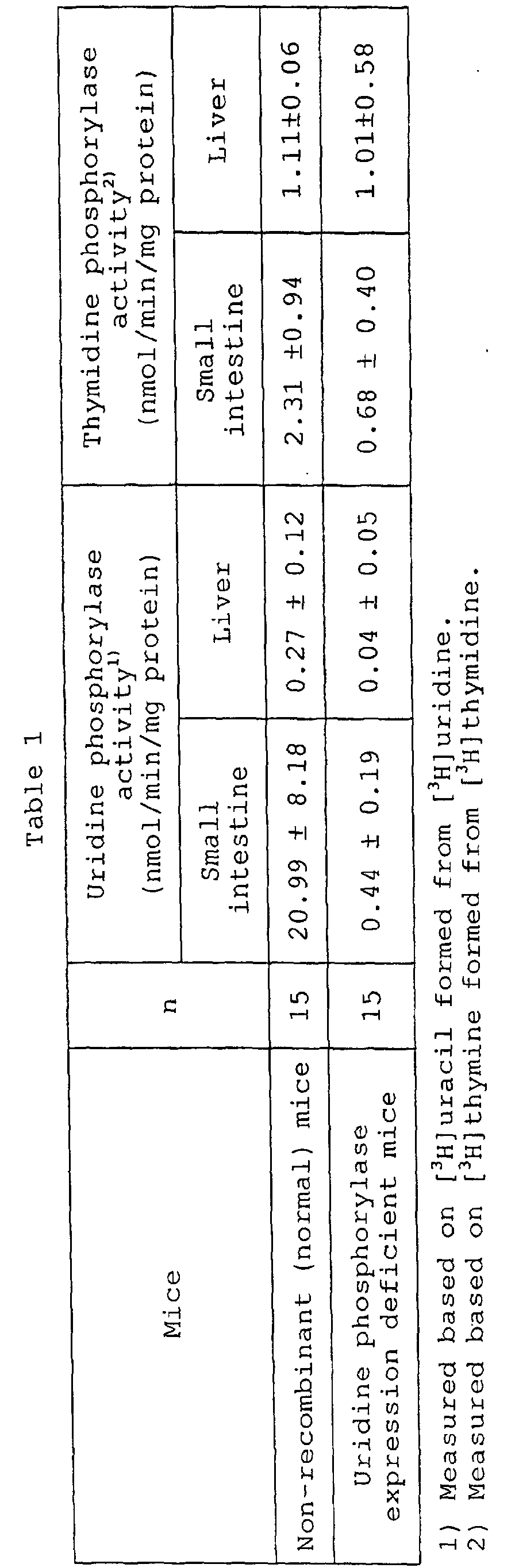
- mice having homozygous mutant uridine phosphorylase genes were investigated for the existence or non-existence of uridine phosphorylase activity. Briefly, small intestine and liver tissues from uridine phosphorylase deficient mice and parental mice (normal) as a control, showing full expression of uridine phosphorylase gene, were isolated and homogenized with 4 volumes of a buffer (50 mM Tris-HCl, 10 mM 2-mercaptoethanol, 25 mM KCl, 5 mM MgCl 2 ). Subsequent to centrifugation under 105,000 g for 60 minutes, the activity was measured using its supernatant.
- a buffer 50 mM Tris-HCl, 10 mM 2-mercaptoethanol, 25 mM KCl, 5 mM MgCl 2 .
- Uridine phosphorylase activity was measured based on [ 3 H]uridine formed from [ 3 H]uracil by the method reported by Ikenaka et al. [Ikenaka et al., Metabolism of pyrimidine nucleotides in various tissues and tumor cells from rodents. Gann. 72 (4), 590-7 (Aug., 1981)].
- the activity of thymidine phosphorylase, the other enzyme in the pyrimidine nucleoside phosphorylase group was also measured based on [ 3 H]thymine formed from [ 3 H]thymidine. The results are presented in Table 1.
- the uridine phosphorylase activity in the small intestine tissue was high in the non-recombinant (normal) mice but was markedly reduced and lost in the uridine phosphorylase expression deficient mice.
- uridine phosphorylase activity was low but thymidine phosphorylase was expressed high.
- uridine phosphorylase activity was substantially lost in the liver tissues.
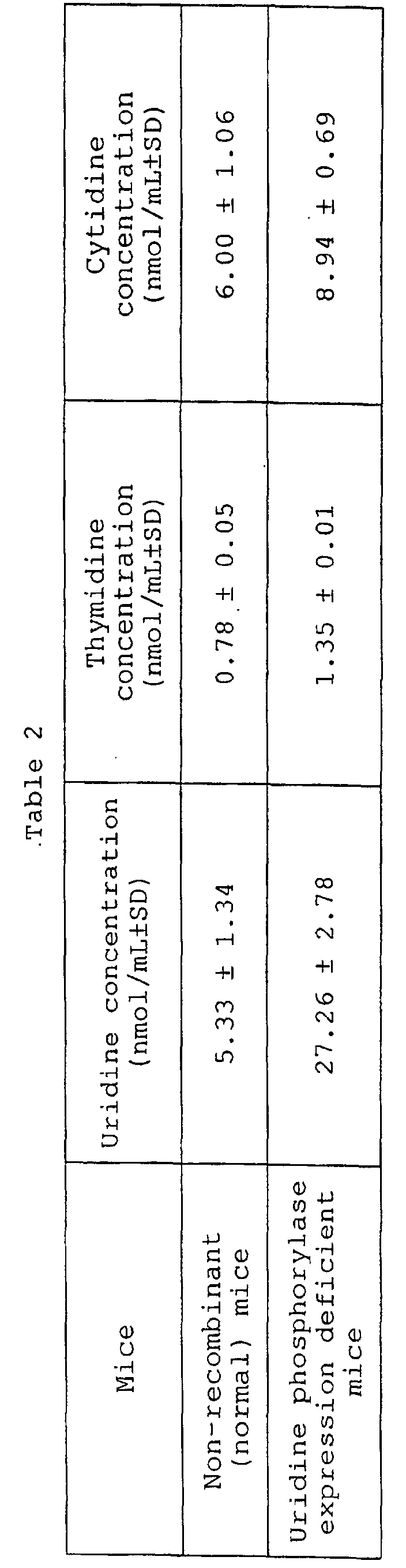
- the serum uridine level was 5.33 nmol/mL in the normal mice and 27.26 nmol/mL in the uridine phosphorylase expression deficient mice. An increase as much as about 5 times was therefore observed in the uridine phosphorylase expression deficient mice. Concerning the concentrations of thymidine and cytidine, the other blood nucleosides, only slight increases were observed in the uridine phosphorylase expression deficient mice than in the normal mice, and no substantial changes were confirmed by the knockout of the uridine phosphorylase expressing function.
- the concentration of FUR in the uridine phosphorylase expression deficient mice was about 5 times as high as that in the normal mice (the values at 15 to 30 minutes after the administration). It has, therefore, been substantiated that as a result of the deletion of uridine phosphorylase activity, the decomposition of FUR in the body is inhibited.
- the concentration of F 3 dThd in the uridine phosphorylase expression deficient mice was also 1. 6 to 17.8 times as high as the corresponding value in the normal mice from 30 minutes to 120 minutes after its oral administration. It was, hence, ascertained that the proportion of F 3 dThd decomposed by uridine phosphorylase was reduced.
- mice deficient in the function of uridine phosphorylase genes are considered to be human-resembling models, and in connection with pyrimidine nucleoside anticancer agents, their metabolic kinetics in human are predictable from their metabolic kinetics in these mice.
- genetically stable, uridine phosphorylase expression deficient animals can be obtained. These animals make it possible to elucidate pathologic functions or activities such as nucleic acid dysbolism and also to predict utility of pyrimidine nucleoside antimetabolites in human, and are useful as experimental animals.
Landscapes
- Life Sciences & Earth Sciences (AREA)
- Health & Medical Sciences (AREA)
- Engineering & Computer Science (AREA)
- Genetics & Genomics (AREA)
- Chemical & Material Sciences (AREA)
- Zoology (AREA)
- Wood Science & Technology (AREA)
- Organic Chemistry (AREA)
- Bioinformatics & Cheminformatics (AREA)
- Biotechnology (AREA)
- General Engineering & Computer Science (AREA)
- Biomedical Technology (AREA)
- General Health & Medical Sciences (AREA)
- Microbiology (AREA)
- Biochemistry (AREA)
- Molecular Biology (AREA)
- Environmental Sciences (AREA)
- Veterinary Medicine (AREA)
- Animal Husbandry (AREA)
- Animal Behavior & Ethology (AREA)
- Biodiversity & Conservation Biology (AREA)
- Medicinal Chemistry (AREA)
- Physics & Mathematics (AREA)
- Biophysics (AREA)
- Plant Pathology (AREA)
- Micro-Organisms Or Cultivation Processes Thereof (AREA)
- Enzymes And Modification Thereof (AREA)
- Saccharide Compounds (AREA)
Abstract
Description

Claims (7)
- A non-human animal deficient in a function of a uridine phosphorylase gene on a chromosome, or an offspring thereof.
- A non-human animal or an offspring thereof according to claim 1, wherein said function of said uridine phosphorylase gene has been rendered deficient by deleting a part of a DNA sequence of said uridine phosphorylase gene or by inserting or replacing another gene into or at a site of said DNA sequence.
- A non-human animal or an offspring thereof according to claim 2, wherein said another gene is a marker gene or a reporter gene.
- A non-human animal or an offspring thereof according to claim 3, wherein said marker gene is a neomycin resistant gene.
- A non-human animal or an offspring thereof according to any one of claims 1-4, comprising a mouse uridine phosphorylase gene with a neomycin resistant gene inserted in place of a second coding exon in said mouse uridine phosphorylase gene.
- A non-human animal or an offspring thereof according to any one of claims 1-5, wherein said animal is a rodent.
- A non-human animal or an offspring thereof according to claim 6, wherein said rodent is a mouse.
Applications Claiming Priority (3)
| Application Number | Priority Date | Filing Date | Title |
|---|---|---|---|
| JP35979699A JP2001169684A (en) | 1999-12-17 | 1999-12-17 | Animals lacking uridine phosphorylase expression |
| JP35979699 | 1999-12-17 | ||
| PCT/JP2000/008898 WO2001043539A1 (en) | 1999-12-17 | 2000-12-15 | Animals with insufficient expression of uridine phosphorylase |
Publications (3)
| Publication Number | Publication Date |
|---|---|
| EP1153543A1 true EP1153543A1 (en) | 2001-11-14 |
| EP1153543A4 EP1153543A4 (en) | 2002-05-08 |
| EP1153543B1 EP1153543B1 (en) | 2006-09-06 |
Family
ID=18466340
Family Applications (1)
| Application Number | Title | Priority Date | Filing Date |
|---|---|---|---|
| EP00981751A Expired - Lifetime EP1153543B1 (en) | 1999-12-17 | 2000-12-15 | Animals which are deficient in expressing uridine-phosphorylase |
Country Status (5)
| Country | Link |
|---|---|
| US (1) | US6566582B1 (en) |
| EP (1) | EP1153543B1 (en) |
| JP (1) | JP2001169684A (en) |
| DE (1) | DE60030539T2 (en) |
| WO (1) | WO2001043539A1 (en) |
Families Citing this family (3)
| Publication number | Priority date | Publication date | Assignee | Title |
|---|---|---|---|---|
| JP2003092956A (en) * | 2001-09-26 | 2003-04-02 | Taiho Yakuhin Kogyo Kk | Thymidine phosphorylase deficient animals |
| KR100574041B1 (en) * | 2003-10-27 | 2006-04-26 | 삼성전자주식회사 | Adhawk Network Wireless Communication System and Wireless Communication Method |
| US7799783B2 (en) | 2005-01-26 | 2010-09-21 | Taiho Pharmaceutical Co., Ltd. | Method of administrating an anticancer drug containing α, α, α-trifluorothymidine and thymidine phosphorylase inhibitor |
Family Cites Families (1)
| Publication number | Priority date | Publication date | Assignee | Title |
|---|---|---|---|---|
| AU2001236990A1 (en) | 2000-02-14 | 2001-08-27 | Yale University | Compositions, methods and kits relating to uridine phosphorylase gene mutations |
-
1999
- 1999-12-17 JP JP35979699A patent/JP2001169684A/en active Pending
-
2000
- 2000-12-15 WO PCT/JP2000/008898 patent/WO2001043539A1/en not_active Ceased
- 2000-12-15 US US09/890,971 patent/US6566582B1/en not_active Expired - Fee Related
- 2000-12-15 DE DE60030539T patent/DE60030539T2/en not_active Expired - Fee Related
- 2000-12-15 EP EP00981751A patent/EP1153543B1/en not_active Expired - Lifetime
Also Published As
| Publication number | Publication date |
|---|---|
| EP1153543B1 (en) | 2006-09-06 |
| EP1153543A4 (en) | 2002-05-08 |
| US6566582B1 (en) | 2003-05-20 |
| JP2001169684A (en) | 2001-06-26 |
| DE60030539D1 (en) | 2006-10-19 |
| DE60030539T2 (en) | 2007-08-30 |
| WO2001043539A1 (en) | 2001-06-21 |
Similar Documents
| Publication | Publication Date | Title |
|---|---|---|
| TsUZUKI et al. | Targeted disruption of the Rad51 gene leads to lethality in embryonic mice. | |
| Yagi et al. | Homologous recombination at c-fyn locus of mouse embryonic stem cells with use of diphtheria toxin A-fragment gene in negative selection. | |
| Xu et al. | Direct removal in the mouse of a floxed neo gene from a three‐loxP conditional knockout allele by two novel approaches | |
| US5777195A (en) | Knockout mutant mouse for DARPP-32 and use thereof | |
| US6791006B2 (en) | LKB1 gene knockout mice | |
| US20100223686A1 (en) | Mouse in which genome is modified | |
| Levin et al. | Floxed allele for conditional inactivation of the voltage‐gated sodium channel Scn8a (NaV1. 6) | |
| US6566582B1 (en) | Animals with insufficient expression of uridine phosphorylase | |
| JP2001211782A (en) | Tob gene deletion knock out non-human mammal | |
| WO1997035967A2 (en) | Transgenic organisms with altered telomerase activity | |
| EP1584232A1 (en) | Sigma receptor-deficient, mutant, non-human mammals and applications thereof | |
| JP2000515386A (en) | Ku-deficient cells and non-human transgenic animals | |
| US20120042401A1 (en) | Method for introducing mutant gene, gene having mutation introduced therein, cassette for introducing mutation, vector for introducing mutation, and knock-in non-human mammalian animal | |
| AU741340B2 (en) | Non human transgenic animal in which the expression of the gene coding for insulin is deleted | |
| EP1731601B1 (en) | INACTIVE Ca2+/CALMODULIN-DEPENDENT PROTEIN KINASE II alpha KNOCKIN ANIMAL AND KNOCKIN CELL OF THE SAME | |
| JP4590629B2 (en) | Psf1 gene-deficient animal and method of using the same | |
| US7151200B2 (en) | Histamine receptor H3 modified transgenic mice | |
| Iredale | Demystified... gene knockouts | |
| US20130291132A1 (en) | Anf-rgc in-gene knock-out animal | |
| JP2003092956A (en) | Thymidine phosphorylase deficient animals | |
| JPH1033087A (en) | Non-human animal having functionally defective glutamate transporter gene | |
| JPH1056915A (en) | Animal having inactivated ldl receptor gene | |
| JP2010220615A (en) | Mouse in which genome is modified | |
| JPH1132627A (en) | Mammalian animal of which sez-6 gene expression is suppressed | |
| JP2001299141A (en) | Knock-in non-human mammal |
Legal Events
| Date | Code | Title | Description |
|---|---|---|---|
| PUAI | Public reference made under article 153(3) epc to a published international application that has entered the european phase |
Free format text: ORIGINAL CODE: 0009012 |
|
| 17P | Request for examination filed |
Effective date: 20010725 |
|
| AK | Designated contracting states |
Kind code of ref document: A1 Designated state(s): CH DE FR GB IT LI NL |
|
| A4 | Supplementary search report drawn up and despatched |
Effective date: 20020325 |
|
| AK | Designated contracting states |
Kind code of ref document: A4 Designated state(s): CH DE FR GB IT LI NL |
|
| 17Q | First examination report despatched |
Effective date: 20030512 |
|
| RTI1 | Title (correction) |
Free format text: ANIMALS WHICH ARE DEFICIENT IN EXPRESSING URIDINE-PHOSPHORYLASE |
|
| GRAP | Despatch of communication of intention to grant a patent |
Free format text: ORIGINAL CODE: EPIDOSNIGR1 |
|
| RIN1 | Information on inventor provided before grant (corrected) |
Inventor name: FUKUSHIMA, MASAKAZV Inventor name: TSUJIMOTO, HIROAKI Inventor name: NODA, TETSUO |
|
| GRAS | Grant fee paid |
Free format text: ORIGINAL CODE: EPIDOSNIGR3 |
|
| GRAA | (expected) grant |
Free format text: ORIGINAL CODE: 0009210 |
|
| AK | Designated contracting states |
Kind code of ref document: B1 Designated state(s): CH DE FR GB IT LI NL |
|
| REG | Reference to a national code |
Ref country code: GB Ref legal event code: FG4D |
|
| REG | Reference to a national code |
Ref country code: CH Ref legal event code: EP |
|
| REF | Corresponds to: |
Ref document number: 60030539 Country of ref document: DE Date of ref document: 20061019 Kind code of ref document: P |
|
| REG | Reference to a national code |
Ref country code: CH Ref legal event code: NV Representative=s name: BOVARD AG PATENTANWAELTE |
|
| ET | Fr: translation filed | ||
| PLBE | No opposition filed within time limit |
Free format text: ORIGINAL CODE: 0009261 |
|
| STAA | Information on the status of an ep patent application or granted ep patent |
Free format text: STATUS: NO OPPOSITION FILED WITHIN TIME LIMIT |
|
| 26N | No opposition filed |
Effective date: 20070607 |
|
| PGFP | Annual fee paid to national office [announced via postgrant information from national office to epo] |
Ref country code: CH Payment date: 20081216 Year of fee payment: 9 Ref country code: NL Payment date: 20081215 Year of fee payment: 9 |
|
| PGFP | Annual fee paid to national office [announced via postgrant information from national office to epo] |
Ref country code: IT Payment date: 20081224 Year of fee payment: 9 |
|
| PGFP | Annual fee paid to national office [announced via postgrant information from national office to epo] |
Ref country code: FR Payment date: 20081212 Year of fee payment: 9 |
|
| PGFP | Annual fee paid to national office [announced via postgrant information from national office to epo] |
Ref country code: DE Payment date: 20081211 Year of fee payment: 9 |
|
| PGFP | Annual fee paid to national office [announced via postgrant information from national office to epo] |
Ref country code: GB Payment date: 20081210 Year of fee payment: 9 |
|
| REG | Reference to a national code |
Ref country code: NL Ref legal event code: V1 Effective date: 20100701 |
|
| REG | Reference to a national code |
Ref country code: CH Ref legal event code: PL |
|
| GBPC | Gb: european patent ceased through non-payment of renewal fee |
Effective date: 20091215 |
|
| REG | Reference to a national code |
Ref country code: FR Ref legal event code: ST Effective date: 20100831 |
|
| PG25 | Lapsed in a contracting state [announced via postgrant information from national office to epo] |
Ref country code: CH Free format text: LAPSE BECAUSE OF NON-PAYMENT OF DUE FEES Effective date: 20091231 Ref country code: LI Free format text: LAPSE BECAUSE OF NON-PAYMENT OF DUE FEES Effective date: 20091231 Ref country code: NL Free format text: LAPSE BECAUSE OF NON-PAYMENT OF DUE FEES Effective date: 20100701 Ref country code: FR Free format text: LAPSE BECAUSE OF NON-PAYMENT OF DUE FEES Effective date: 20091231 |
|
| PG25 | Lapsed in a contracting state [announced via postgrant information from national office to epo] |
Ref country code: DE Free format text: LAPSE BECAUSE OF NON-PAYMENT OF DUE FEES Effective date: 20100701 |
|
| PG25 | Lapsed in a contracting state [announced via postgrant information from national office to epo] |
Ref country code: GB Free format text: LAPSE BECAUSE OF NON-PAYMENT OF DUE FEES Effective date: 20091215 |
|
| PG25 | Lapsed in a contracting state [announced via postgrant information from national office to epo] |
Ref country code: IT Free format text: LAPSE BECAUSE OF NON-PAYMENT OF DUE FEES Effective date: 20091215 |