EP1153448B1 - Catalytic air cathode for air-metal batteries - Google Patents
Catalytic air cathode for air-metal batteries Download PDFInfo
- Publication number
- EP1153448B1 EP1153448B1 EP00909962A EP00909962A EP1153448B1 EP 1153448 B1 EP1153448 B1 EP 1153448B1 EP 00909962 A EP00909962 A EP 00909962A EP 00909962 A EP00909962 A EP 00909962A EP 1153448 B1 EP1153448 B1 EP 1153448B1
- Authority
- EP
- European Patent Office
- Prior art keywords
- metal
- cathode
- air
- anode
- particles
- Prior art date
- Legal status (The legal status is an assumption and is not a legal conclusion. Google has not performed a legal analysis and makes no representation as to the accuracy of the status listed.)
- Expired - Lifetime
Links
Images


Classifications
-
- H—ELECTRICITY
- H01—ELECTRIC ELEMENTS
- H01M—PROCESSES OR MEANS, e.g. BATTERIES, FOR THE DIRECT CONVERSION OF CHEMICAL ENERGY INTO ELECTRICAL ENERGY
- H01M10/00—Secondary cells; Manufacture thereof
- H01M10/42—Methods or arrangements for servicing or maintenance of secondary cells or secondary half-cells
- H01M10/4214—Arrangements for moving electrodes or electrolyte
-
- H—ELECTRICITY
- H01—ELECTRIC ELEMENTS
- H01M—PROCESSES OR MEANS, e.g. BATTERIES, FOR THE DIRECT CONVERSION OF CHEMICAL ENERGY INTO ELECTRICAL ENERGY
- H01M4/00—Electrodes
- H01M4/86—Inert electrodes with catalytic activity, e.g. for fuel cells
-
- H—ELECTRICITY
- H01—ELECTRIC ELEMENTS
- H01M—PROCESSES OR MEANS, e.g. BATTERIES, FOR THE DIRECT CONVERSION OF CHEMICAL ENERGY INTO ELECTRICAL ENERGY
- H01M12/00—Hybrid cells; Manufacture thereof
- H01M12/04—Hybrid cells; Manufacture thereof composed of a half-cell of the fuel-cell type and of a half-cell of the primary-cell type
- H01M12/06—Hybrid cells; Manufacture thereof composed of a half-cell of the fuel-cell type and of a half-cell of the primary-cell type with one metallic and one gaseous electrode
-
- H—ELECTRICITY
- H01—ELECTRIC ELEMENTS
- H01M—PROCESSES OR MEANS, e.g. BATTERIES, FOR THE DIRECT CONVERSION OF CHEMICAL ENERGY INTO ELECTRICAL ENERGY
- H01M12/00—Hybrid cells; Manufacture thereof
- H01M12/08—Hybrid cells; Manufacture thereof composed of a half-cell of a fuel-cell type and a half-cell of the secondary-cell type
-
- H—ELECTRICITY
- H01—ELECTRIC ELEMENTS
- H01M—PROCESSES OR MEANS, e.g. BATTERIES, FOR THE DIRECT CONVERSION OF CHEMICAL ENERGY INTO ELECTRICAL ENERGY
- H01M4/00—Electrodes
- H01M4/86—Inert electrodes with catalytic activity, e.g. for fuel cells
- H01M4/96—Carbon-based electrodes
-
- H—ELECTRICITY
- H01—ELECTRIC ELEMENTS
- H01M—PROCESSES OR MEANS, e.g. BATTERIES, FOR THE DIRECT CONVERSION OF CHEMICAL ENERGY INTO ELECTRICAL ENERGY
- H01M4/00—Electrodes
- H01M4/86—Inert electrodes with catalytic activity, e.g. for fuel cells
- H01M2004/8678—Inert electrodes with catalytic activity, e.g. for fuel cells characterised by the polarity
- H01M2004/8689—Positive electrodes
-
- Y—GENERAL TAGGING OF NEW TECHNOLOGICAL DEVELOPMENTS; GENERAL TAGGING OF CROSS-SECTIONAL TECHNOLOGIES SPANNING OVER SEVERAL SECTIONS OF THE IPC; TECHNICAL SUBJECTS COVERED BY FORMER USPC CROSS-REFERENCE ART COLLECTIONS [XRACs] AND DIGESTS
- Y02—TECHNOLOGIES OR APPLICATIONS FOR MITIGATION OR ADAPTATION AGAINST CLIMATE CHANGE
- Y02E—REDUCTION OF GREENHOUSE GAS [GHG] EMISSIONS, RELATED TO ENERGY GENERATION, TRANSMISSION OR DISTRIBUTION
- Y02E60/00—Enabling technologies; Technologies with a potential or indirect contribution to GHG emissions mitigation
- Y02E60/10—Energy storage using batteries
Definitions
- This invention relates to electrochemical cells in general and more particularly to an improved air cathode used in metal-air batteries.
- Metal-air batteries such as zinc air batteries offer the advantage of very high energy densities over nonconventional batteries such as alkaline, nickel, lithium ion, cadmium and other high density batteries.
- Zinc air batteries can be manufactured on a commercial production basis at low cost with a high degree of safety.
- Rechargeable zinc batteries suitable for use in automotive applications as the primary power source use a liquid electrolyte and often include a pump to recirculate the electrolyte.
- Such systems are impractical for miniature consumer applications ranging from radios to portable computers because of the mechanical complexity and other problems.
- the permeability of the gel material is selected, such that during charging of the battery, oxygen generated by the anode exerts sufficient pressure at the interface of the anode separator and gel material to cause electrolyte to be recirculated through the edges of the cloth anode separator to the opposite layer thereof, thereby preventing depletion of electrolyte to the anode.
- the battery of the Cheiky invention uses a metal powder or paste such as zinc in a semi-permeable foam, packed in an electrically conducted mesh screen to form an anode.
- a more recent metal-air cell similar to that disclosed in U.S. Patent No. 4,957,826 to Cheiky is disclosed in U.S. Patent No. 5,306,579 to Shepard Inc., et al. This patent discussed a bifunctional air-electrode having an active layer with an oxygen reduction catalyst and an oxygen evolution catalyst so as to provide a larger number of charge-discharge cycles.
- U.S. Patent No. 4,328,287 discloses an air-metal battery cell having a porous electrode through which is passed a colloid of an oxidizable gas and electrolyte.
- the cell may be a primary cell with a anode-electrode comprising consumable metals, such as zinc.
- Electrolyte is supplied to a colloid-forming region in the cell by electrolyte supply means, which includes an electrolyte recycle pump means and electrolyte treating means for removing reaction products from the electrolyte and suitably treating the electrolyte for recycling through a distributor and manifold to the colloid-forming region of the cell.
- Air-metal cells are well known in the art and generally comprise a consumable metal anode, a catalytic non-consumable oxygen consuming cathode, and a suitable electrolyte. Some of these primary fuel cells are multi-cell batteries with replaceable anodes. Other types of air-metal cells include those which are manufactured in the form of miniature button cells for hearing aids and alike.
- the typical zinc-air button cell generally includes: a cathode having at least one air port for the entrance of air and which contains a non-consumable air cathode structure usually comprising a gas permeable hydrophobic polymer film onto which is bonded a metal current collection grid and a waterproofed porous catalyst material, such as metal catalyzed active carbon mixed with a hydrophobic binder.
- the button cell also includes an anode container or can which is joined to the cathode typically by crimping and which includes a zinc anode mass, typically in the form of amalgamated zinc powder, or a porous zinc which is compacted and saturated with alkaline electrolyte, such as 30 to 40% aqua solution of KOH.
- the battery will also include an insulator between the cathode and anode, typically made of polyethylene, polypropylene, nylon, and the like, which can function as an electrolyte seal.
- an insulator between the cathode and anode typically made of polyethylene, polypropylene, nylon, and the like, which can function as an electrolyte seal.
- a typical mixture button cell is disclosed in U.S. Patent No. 5,308,711 issued to Passaniti, et al. The patent also discloses an air cathode.
- Air-metal batteries such as zinc-oxygen cells had been used as a power source for electric vehicles and the like, because they provide high energy density relative to other cell chemistries.
- Zinc-oxygen cells have also been found suitable because they may be recharged by mechanically replacing the zinc electrode, by replacing the liquid electrolyte which contains zinc particles or by electromechanically replenishing zinc to the anode while also making available a fresh oxygen supply.
- U.S. Patent No. 4,009,230 teaches an air-zinc batteries having air passages through an active carbon cathode which is surrounded by gelled electrolyte.
- U.S. Patent No. 4,137,371 describes a zinc-oxygen cell having a zinc electrode, and an oxygen porous diffusion cathode with a zincate ion diffusion restricting membrane joined directly to the oxygen electrode between the porous layer of this electrode and the zinc electrode. This is for purposes of preventing poisoning of electrochemically active material by zincate ions.
- U.S. Patent, 5,445,901 issued to Korall, et al. on August 29, 1995, discloses a multi-cell sealed zinc-oxygen battery comprising a container containing a plurality of bi-cells, each cell having a housing provided with two major surfaces and accommodating a pair of oppositely disposed space-apart air permeable, liquid impermeable cathodes in the form of oxygen reduction electrodes, and defining between them a cavity configured to accommodate an anode of the battery and electrolyte.
- air-metal batteries or cells come in many forms and sizes and have been found to provide an effective way to provide portable electrical power to a wide range of devices from electrical automobiles to miniature hearing aids.
- air-metal batteries or cells come in many forms and sizes and have been found to provide an effective way to provide portable electrical power to a wide range of devices from electrical automobiles to miniature hearing aids.
- Of course, of utmost importance to each of these different types of batteries or cells is an effective and efficient air-cathode.
- Thin porous carbon paper based electrodes such as disclosed in U.S. Patent No. 3,912,538, solves the bulk problem and has a shortened diffusion path.
- thin porous carbon paper substrates are very fragile, and they are subject to excessive flooding with electrolyte which interferes with the access of the gas to the electro catalytic sites of the electrodes.
- the carbon papers are often rendered hydrophobic by means of, for example, a Teflon coating which increases their electrical resistivity.
- Teflon coating which increases their electrical resistivity.
- the wet-proofed carbon papers have to be dense to provide a minimum of structural integrity.
- Another thin electrolytic gas diffusion electrode comprises a substantially uniform, open pore carbon or graphite substrate, having a thickness in the range to about 5 to 40 mils, and preferably about 10 to about 35 mils and includes a mixture of Teflon or similar wet-proofing particles and catalytic carbon particles imbedded and added within the cloth pores.
- This type electrode has improved electrochemical performances as well as improve structural strength and is suitable for use in free-flowing electrolytic electrochemical cells.
- the catalytic carbon particles are either metal-free catalytic carbon particles or finely divided high surface area carbons carrying suitable known noble metal catalytic particles, including platinum, palladium, radium, iridium, ruthenium, and silver, depending on the environment (e.g., acid or alkaline, air or hydrogen, and on operating conditions: temperature, current density and intended length of service).
- suitable known noble metal catalytic particles including platinum, palladium, radium, iridium, ruthenium, and silver, depending on the environment (e.g., acid or alkaline, air or hydrogen, and on operating conditions: temperature, current density and intended length of service).
- Suitable substrates are open pore uniform woven cloths made with carbonization at high temperatures of prewoven carbonation fabrics.
- the carbon content of the cloth should be in excess of 97% by weight and preferably at least 99% by weight to avoid an undesirable impurity interaction with the electrolyte.
- Still another U.S. Patent, 4,248,682 issued to Linstrum, et al., on February 3, 1991, discloses thin gas diffusion electrodes comprising open pore carbon cloth substrates, provided with the uniform mixture of catalytic carbon particles and preferably Teflon particles adhered within the cloth pores and to the yarns of the cloth, thereby forming an electrode assembly with a plurality of closely spaced, preferably noble metal current collecting contacts.
- Such a diffusion electrode is typically used in electrochemical cells, including metal-air batteries and zinc electro cells and the like operating at high current densities.
- an electrically conducting thin carbon cloth is coated with catalytic carbon particles mixed in Teflon or other hydrophobic binder, such that they adhere within the cloth openings or pores.
- Silver current carrying ribbons are interwoven within the cloth to provide current collection throughout the area of the cloth.
- U.S. Patent No. 4,091,175 issued to Höhne of Germany discloses an air electrode for electrochemical cells using silver coated carbon as a catalytic material.
- the catalytic material disclosed in this patent also contains nickel hydroxide of up to 2% by weight.
- a gas diffusion electrode and process is disclosed in U.S. Patent No. 4,377,496 issued to Solomon.
- This patent is directed to an oxygen electrode having a conductive porous contacting sintered plaque metal substitute having site depression on the active layer contacting surface.
- the active layer may use catalyzed carbon particles which interlock with the site depressions.
- a hydrophobic backing such as PTFE (polytetrafluoroethylene).
- Still another U.S. Patent No. 4,407,907 issued to Takamura, et al. discloses an air-electrode comprising an electrode body which accelerates the reaction at the microscopic three phase interface of diffused air, the solid electrode body and the electrolyte.
- the oxygen concentration at the three phase interface is increased by using a fluorine containing solvent in the solid electrode body to improve the water repellant properties of the electrode body.
- U.S. Patent No. 4,927,718 discloses a carbonaceous electrode support material formed by heat treated carbon black material to a temperature above 2500°C in an inert atmosphere. The support material is then shaped and formed into a catalyst support and then a catalytically active material is added.
- U.S. Patent No. 5,306,579 to Shepard, et al., discussed earlier with respect to batteries discloses a "bifunctional" air-electrode having an oxygen reduction catalyst and an oxygen evolution catalyst so as to increase the number of available charge discharge cycles.
- the cathode comprises an air permeable and water impermeable portion or layer formed of a matrix of carbon particles, such as for example carbon fibers or graphite, and hydrophobic particles such as for example PTFE (polytetrafluoroethylene), polyethylene, polypropylene, and polystyrene.
- An adhesive may be used to bond the matrix together into an appropriate structure.
- Adjacent the air permeable and water impermeable portion is an electrically conductive middle structure such as for example a copper or nickel mesh or other electrically conductive structure which provides sufficient passages through the conductive portion to allow a free flow of air and oxygen.
- a catalytic portion is located on the opposite side of the electrically conductive structure from the air permeable portion and is comprised of a mixture of carbon particles such as carbon fibers or graphite, a particulate material having a high surface area such as molecular sieves, zeolite, activated carbon, or other suitable material. Also included in the mixture making up the catalytic portion is a metal hydroxide such as nickel hydroxide, cobalt hydroxide, iron hydroxide, cerium hydroxide, manganese hydroxide, lanthanum hydroxide, chromium hydroxide, or other suitable metal hydroxides. An adhesive is typically included with this mixture of the catalytic layer to bond the particles together to form a usable structure.
- the basic concept of the unique air-cathode of this invention is suitable for a variety of different types of electrochemical cells and batteries, ranging from very large and complex batteries used for automobiles, boat motors, and other high powered demand devices down to small miniature button batteries typically used in tiny electronic devices such as hearing aids, watches, etc.
- a third electrode which serves as the cathode (in lieu of the air-cathode) during a recharging cycle.
- apparatus such as a small motor, to rotate or otherwise move the metal anode during the recharging cycle.
- the unique and novel air cathode of this invention allows the manufacturer of electrochemical cells and batteries which can generate a much higher power density and efficiency with a steady state of voltage and current output than presently available metal-air batteries.
- metal-air batteries such as zinc-air batteries are already known as having a very high energy content.
- the efficiency and high power density output now possible with the air-cathode of the present invention makes the cells and batteries even more attractive.
- Tests have shown that batteries and cells produced with the new air-cathode of this invention may have a useful life when under load significantly greater than that of presently available metal-air batteries of equal volume and weight.
- This dramatic increase in performance is achieved with inexpensive readily available materials, many of which are already used extensive in electrochemical cell and battery industries, means many applications and uses are now possible at low manufacturing costs which simply were impossible or impractical with presently available electrochemical cells and batteries.
- the catalytic air-cathode includes an outer portion or more specifically layer 12 which has a first surface 14 exposed to a flow of pure oxygen or other gas containing oxygen such as for example normal everyday air.
- the primary characteristics of the outer portion or layer 12 is that it is highly air or oxygen permeable, yet also highly water impermeable such that a liquid from the inside of the battery could not find its way to the exterior surface 14 of layer 12.
- Outer layer 12 also offers capacitance for storage of electrons when the air-cathode is used in a electrochemical cell or a battery.
- Laminated to surface 16 of layer 12 is an electron conductor and a current collector or conductive structure 18.
- Structure 18 may be any suitable, highly conductive material which has sufficient passageways therethrough to allow the air or oxygen flow coming from layer 12 to also pass through structure 18.
- Bonded to conductive structure 18 at juncture 20 is catalytic portion, or as shown in the embodiment of FIG. 1A, catalytic layer 22.
- Catalytic layer 22 is exposed to the free-air or oxygen flow through portion 12 and electrically conductive structure 18 on one side and electrolyte material indicated by wavy arrow 24 at its other side (inner-surface 26).
- Catalytic portion 22 provides locations for a multi-phased catalytic reaction necessary to generate the electric current of a battery.
- a particularly suitable outer portion or layer 12 of cathode 10 is made of a mixture of carbon particles, such as graphite or carbon fibers, and hydrophobic particles, such as those made from polymers such as PTFE (polytetrafluoroethylene), polyethylene, polypropylene, and polystyrene or any other material which provides the necessary hydrophobic characteristics without interfering with the electrochemical reaction required of the cathode.
- the ratio of carbon particles to hydrophobic particles should be from about 50:1 to about 3:1. An optimal ratio seems to be between about 9:1 - 6:1.
- An adhesive such as epoxy is preferably used to bond the mixture of particles together into a suitable structure for use as a cathode.
- the electrically conductive structure 18 may be made of any suitable material which can be fabricated in a sheet form and provide high electrical conductivity without interfering in the electrochemical reaction necessary for the cell or battery. Copper, nickel mesh, or electroplated nickel on copper and preferably having a mesh size of 20 to 40, has been found to be particularly suitable for use as the electrically conductive layer.
- Other suitable electrically conductive layers may be brass or copper honeycomb cores or even a row of individual conductive metal wires running from the interior of the cathode to an exterior terminal 28.
- the inner portion or layer such as catalytic portion 22 is preferably made up of a mixture of carbon particles, such as carbon fibers or graphite, a particulate material having a high surface area, such as activated carbon, molecular sieves, zeolite, or any other material having a high surface area, metal hydroxide and hydrophobic particles. It is important, of course, that the high surface area particulate material not interfere with the electrochemical reaction necessary for the electrochemical cell or battery and that it is not be adversely affected by the electrolyte which is typically a high alkaline electrolyte potassium hydroxide solution.
- Graphite or carbon fibers act as a conductive filler in the catalytic portion or layer for providing a bridge or pathway to allow electrons to transfer from the metal mesh through the non-conductive particulate matter having a high surface area.
- the high surface area particulate matter such as the activated carbon, zeolite, molecular sieves, and the like will provide a significant interface contact area for the catalytic reactions as will be discussed hereinafter. Substantially every metal hydroxide tested to date has been found to be effective at increasing the electrochemical reaction and consequently the efficiency of an electrochemical cell or battery.
- Metal hydroxides particularly effective include nickel hydroxide, cobalt hydroxide, iron hydroxide, manganese hydroxide, lanthanum hydroxide, chromium hydroxide, and cerium hydroxide.
- the mixture making up the catalytic portion or layer also includes hydrophobic particles, such as PTFE and other hydrophobic particles mentioned heretofore. These hydrophobic particles help inhibit the infusion of water under hydrostatic pressure and capillary attraction to help maintain the appropriate environment for the electrochemical reactions to take place.
- FIG. 1B there is shown another embodiment of the air cathode of the present invention wherein there is no clear delineation of an air preamble, water impermeable portion 12a and a catalytic portion 22a such as is shown in FIG. 1A.
- FIG. 1B there is a gradual change from the air permeable, water impermeable portion 12a to the catalytic portion 22a.
- the conductive structure 18 (shown as a metal mesh in FIG. 1B) is located at a point in the air cathode about midway between the change from the air permeable, water impermeable portion 12a and the catalytic portion 22a.
- FIG. 2 there is shown a cross sectional and simplified diagrammatic view of the air-cathode embodiment of FIG. 1A used in an air zinc type battery with KOH (potassium hydroxide) as a liquid electrolyte.
- KOH potassium hydroxide
- FIG. 1B could also be used.
- the zinc-air battery includes a case wall and bottom, 30 and 32 respectively, typically made out of a material that is non-reactive with a highly alkaline liquid electrolyte and which will not interfere in the electrochemical reactions necessary for the performance of the battery.
- the case walls, such as case walls 30 and 32 and two walls not shown, along with the air electrode 10 provide a container for holding the liquid electrolyte KOH 24.
- a zinc anode 34 of the type typically used in zinc-air batteries is also, as shown, it will be appreciated that although the battery as shown in FIG.
- FIG. 2 is with respect to the air-cathode and a zinc plate anode 34, suitable anodes made of other, metal materials such as iron, cadmium, copper, and aluminum may also be used.
- positive terminal 28 of the air-cathode 10 is electrically connected to a load 38 which may be any device requiring electrical power and in turn is electrically connected to terminal 36 of the anode plate 34.
- load 38 which may be any device requiring electrical power and in turn is electrically connected to terminal 36 of the anode plate 34.
- current is typically portrayed as flowing from a positive terminal 28 to a negative terminal 36. However, the flow of electrons is opposite that of the traditional accepted current flow direction. This distinction is made at this point to aid in the understanding of the electrochemical reactions discussed in the following paragraphs.
- the core of the catalytic air-electrode lies in the inner layer or the catalytic layer 22. This is where the multi-phased catalytic reactions occur and the electrical current is generated. That is, this is the location where the air, water, and solids exist and the reactions happen.
- electrons flow from the zinc plate terminal 36 through the load 38 to terminal 28 on the electric conductive layer 18 of the catalytic air electrode 10. The electrons then flow from the electrical conductive layer 18 or metal mesh to the catalytic sites which are located on the high surface area particulate matter.
- the flow of air or oxygen is through the carbon particles or graphite of the outer layer 12, and the hydrophobic particles PTFE, pass the electric conductive layer 18 and to the catalytic sites such that the reaction can take place.
- a pump 39 may be provided to increase the pressure of the air or oxygen flow to the cathode.
- air/oxygen pump 39a any kind of pump, fan, or other technique for increasing the air or oxygen pressure to the air cathode may be used including a cylinder of compressed air or oxygen as indicated by cylinder 39b. Tests have shown that there is a noticeable increase in the battery performance as the pressure of the air or oxygen to the cathode is increased.
- Equation 1 the high valance metal hydroxide captures electrons transferred from the graphite and metal mesh and is reduced to a low valance metal hydroxide. Subsequently, the low valance metal hydroxide reacts with the oxygen from the outside air flowing through the outer layer and water from the electrolyte such that the metal hydroxide moves back to the high valance state. This is shown in Equation 2 below.
- Equation 3 The overall resulting reaction is shown in Equation 3 below. It will be appreciated, that water from the electrolyte will continuously move into the catalytic layer to supplement the water being consumed and at the same time, the hydroxide root (OH - ) will continuously move out of the catalytic layer into the electrolyte toward the zinc plate. Thus at the anode of the electrochemical cell or battery, the reactions as shown in Equations 4 and 5 below take place. Also taking place at the zinc place is the reaction shown in Equation 6 below. Such that the total reaction is such as shown in Equation 7 below.
- the cathode(s) may be desirable for the cathode(s) to partially surround the metal anode as is shown in FIG. 2B. At least two sides and the bottom of the battery comprising air cathodes of this invention are shown in FIG. 2B. It is also possible of course that the other two sides and the top of the battery could also be air cathodes.
- FIG. 2C illustrates a spherical shaped air cathode completely surrounding the metal anode and the electrolyte.
- the cell is a bi-cell 40 and includes a housing 42, having two major surfaces 44 which accommodate a pair of oppositely disposed, spaced apart, air permeable, liquid impermeable cathodes 46a and 46b, which are in the form of oxygen reduction electrodes and make up the subject matter of the present invention.
- the cathode 46a and 46b defined between them a cavity 48, configured to accommodate an anode 50 and electrolyte (not shown), such as an aqueous KOH solution.
- Substantial portions of the major surfaces 44 are removed, thus exposing major portions of the oxygen-reducing cathodes, such that the oxygen or air supplied to the bi-cell 40 is able to reach and react with the cathodes 46a and 46b.
- the major surfaces 44 are partly recessed in such a way as to form in conjunction with a similarly recessed outer surface of a major surface of an adjacent cell housing a cathode gas space 52 between adjacent bi-cells 40.
- a plurality of oxygen access openings 54a, 54b & 54c leads to the gas space 52.
- Cell terminals 55 and 56 allow power connections.
- FIG. 4 there is shown a multi-cell, rechargeable, metal air battery containing a slurry of active metal anode particles, in an electrolytic solution, which is suitable for powering an electrical vehicle.
- a plurality of these cells are connected and placed in a container for holding the electrolyte solution.
- the zinc-air battery cell employ a slurry containing a mixture of zinc particles in a suitable electrolyte solution, such as KOH.
- Each outer electrode unit 58 includes an outer support frame 60 and an air electrode/gas electrode 62 which represents the subject matter of the present invention.
- Air electrode 62 is oriented such that the air flow is through the outer layer (such as layer 14 shown in FIG. 1) as indicated by arrow 64 with the catalytic layer of the cathode to the inside.
- the outer electrode units 58 are supported so as to define an interior space 67 for storing a slurry, preferably in the form of active metal particles saturated with a suitable electrolyte solution.
- the slurry of active metal particles are supported by the honeycomb structure of current collector 68 in the interior space 67 of the cell as a static bed saturated with electrolyte solution.
- the center current collector 68 is mounted within the interior space 67 of the battery, so as to be surrounded by the saturated active metal particles.
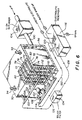
- FIGs. 5 and 6 which can use the air-cathode of this invention is generally illustrated in FIGs. 5 and 6, which comprises a case 70, containing a zinc electrode structure indicated generally at 72, a gasket member 74, a porous separator 76, an air electrode 78, which constitutes the subject matter of this invention, having a conductive tab 80, and an air electrode backing plate 82.
- a zinc air cell 69 will preferably comprise the air electrode 78 and accompanying gaskets 74, separators 76 and electrode backing plates 82 on each side of the zinc electrode structure 72.
- Case 70 may comprise any structurally strong and chemically inert insulation material, such as, for example, a hard rubber case normally used for lead acid batteries. Any other customary non-conducted battery case material may be used in the construction of the case.
- Gasket number 74 may be formed of general resilient electro elastomeric material, such as, for example, an ethylene-propylene copolymer of styrene butadiene polymer, which will be generally inert to the electrochemical reactions within the cell. Gasket 74 will be formed with the central opening 84, generally similar but slightly larger in cross section to opening 86 in zinc electrode frame 88 to permit communication to structure a zinc-impregnated electrically conductor foam 90 in electrode structure 72. Rectangular zinc electrode frame 88 may be formed from polypropylene, polyethylene, polytetrafluoroethylene or any other plastic material possessing sufficient mechanical strength and exhibiting chemical inertness to an alkaline electrolyte.
- Porous foam material 90 is mounted in opening 86 so as to form a conductive support material for the zinc electrode.
- Porous foam material 90 may comprise a carbon foam or a metal foam.
- Metal foam shavings, such as, for example, copper or nickel foams are commercially available and preferably are plated with lead before used as zinc substrates. Any other type metal may be used, provided that the position of the electromotive series, with respect to zinc, is such that the oxidation reduction of the zinc in the electrode is not interfered with.
- a conductive metal tab 94 may be mounted in the sidewall of the frame 88 so as to extend in one direction to the sidewall of frame to electrically communicate with the foam 90 in opening 86.
- Gasket 74 will be formed with a central opening 86 generally similar but slightly larger in cross-section than opening 86, of frame 88, to permit communication to the zinc impregnated foam 90 of electrode 72.
- the purpose of gasket 74 is to provide a seal between separator 76 and zinc electrode 72 to permit the alkaline electrolyte circulating within electrode 72 to wet the surface of separator 76 without permitting leakage of the electrolyte into the air space 96.
- an air electrode backing plate 82 comprising an insulation material, such as polypropylene or polytetrafluoroethylene which acts to space air electrode 78 from the sidewall case 72 as well as to make the flow or oxygen of air to air electrode 78 through a series of grooves 98, molded into the side surface of the backplate 82, facing air electrode 78.
- an insulation material such as polypropylene or polytetrafluoroethylene which acts to space air electrode 78 from the sidewall case 72 as well as to make the flow or oxygen of air to air electrode 78 through a series of grooves 98, molded into the side surface of the backplate 82, facing air electrode 78.
- the electrolyte used in the cell or battery invention comprise an alkaline electrolyte having both high conductivity and high solubility for zincate ions.
- the best electrolytes are those based on concentrated KOH with additives that improve zincate solubility, for example, potassium silicate and sorbitol.
- battery case 70 is provided with tubings 100 through which air may be admitted into the battery.
- the air which enters into space or plenum 96 between the inner surface of case 72 and the side wall of the cell members, reaches air electrodes 78 via grooves 98 in air electrodes backing plates 82 and then exits the battery through a exit port 102 in plenum 96 on the other side of the battery.
- the incoming air passes through a scrubber 104 which removes any carbon dioxide in the air.
- Scrubber 104 may comprise a lithium hydroxide scrubber or any other material capable of reacting with the carbon dioxide in the incoming air, such as for example calcium hydroxide, sodium hydroxide or mixtures of theses hydroxides, such as for example sodyl.
- inlet tubing 106 and outlet tubing 108 are provided through case 70 for passing electrolyte respectfully from inlet port 110 to outlet port 112 of each zinc electrode support structure 72.
- Inlet tubes 106 are connected to a manifold 114 through which electrolyte from an external reservoir 116 is pumped to the battery by a pump 118 through pipe 120.
- Outlet tubes 108 are connected to electrolyte outlet manifold 122 from the which the electrolyte passes into a solids filter 124, through pipe 126, which removes any solids for example carbonates in the electrolyte.
- the filtered electrolyte passes into reservoir 116 via pipe 128.
- the filtered material in solids filter 124 may comprise any material which is chemically inert to the alkaline electrolyte and capable of removing undesirable solids such as a fibrous porous foam of polytetrafluoroethylene.
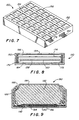
- FIGs. 7 and 8 rechargeable zinc-air battery
- the battery 150 further includes an anode 158, having an electrically perforated conductive plate or mesh screen 160 with a lead 162 extending outwardly from the conductive plate or mesh screen 160 to provide a positive terminal connection for the battery.
- the perforated conductive plate or mesh screen 160 may be formed of expanded metal or woven metal with a mesh size of 20 to 80 openings per inch (2.54 cm).
- the material of the screen 160 may be iron, tin, titanium, or other non-corrosive metals or plating of these metals on an economical substrate. Of course, noble metal screens could be used but are expensive.
- a porous layer of zinc material is packed into the mesh of the screen 160.
- the zinc material may be zinc powered flakes, granules, capsules or fibers packed to a semipermeable density.
- Corrosive inhibitors and paste forming additives may be added to the zinc material to improve the performance of the battery, if desired.
- Metals such as mercury, cadmium, tin, lead, gallium or indium provide corrosive inhibition.
- the metals may be a zinc alloy, or physically mixed with a zinc particles. Either the zinc, zinc alloys and/or the corrosive inhibiting metal can be coated or plated onto an inert substrate, such as sand, glass, ceramic, etc.
- the inhibitor metal is usually present in an amount from 0.1 to 10% by weight.
- the anode 158 is completely wrapped in a porous anode separator 164, formed of absorbent, wettable, oxygen-resistant, woven or nonwoven cloth, such as cotton, rayon, and/or wettable plastic fibers.
- the anode separator 164 may also include inert spacer material.
- Suitable, wettable materials can be the same modified polymer material, such as carboxyl, modified polymers, or polysulfone polymers, and modified polymers can be mixed with polymers, such as polypropylene to enhance the structure, capillary or wicking action of the composite.
- a carboxymethyl cellulose polymer containing 15% polypropylene can be effectively used as the anode wrapping material in the battery. As viewed in FIG.
- the anode separator 164 has a first or upper layer, 166, a second or lower layer 168, inside are edge layers 170 and 172 which interconnect the upper and lower layers 166 and 168.
- a liquid electrolyte required for operation of the battery is contained in the anode separator 164.
- Electrolyte may be a simple or mixed aqueous base, such as a group 1 metal hydroxide, such as LiOH, NaOH, KOH, C s SOH, etc., in the range of one mole to saturation, usually about 1 to 15 moles.
- the battery 150 also includes of course an air permeable cathode 174, which is the subject matter of this invention.
- the air-cathode 174 has a lead 176 extending outwardly therefrom to provide a negative terminal for the battery.
- FIG. 9 there is shown a zinc-air button cell 180 in cross-section using the air cathode of this invention.
- Conventional elements include an anode 182 of compacted zinc or amalgamated zinc powder in an anode cup 184, a complementary lower cathode cup 186 having cylindrical side walls which are crimped around the anode cup 184. The two parts are sealed with an insulating grommet spacer 188. Also included is a multilayer separator 190 which may be a fibrous cellulose metal containing alkali KOH (potassium hydroxide). An air cathode 192 incorporating the teachings of this invention is supported on and makes electrical contact with cathode cup 186.
- the bottom cup 186 defines perforations 194 and 196 therein which serves as a plurality of air-flow passages.
- the outer layer of cathode 192 (layer 12 in FIG. 1) is disposed so as to cover perforations 194 and 196 such that the outer layer 12 of its cathode and the perforation 194 and 196 control the flow of oxygen.
- the outer layer 12 is selected in the manner well known to those skilled in the art to provide the proper flow of oxygen to the catalytic layer cathode 192 so as to control the limiting current which may be drawn from the cell and its rated voltage.
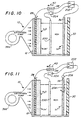
- an air-zinc type battery such as discussed with respect to FIGS. 2A, 2B, and 2C which includes a third or auxiliary electrode 200.
- This auxiliary electrode serves as a charging electrode and is made of a suitable inert and conductive material according to one embodiment, the third electrode 200 may be made of carbon fibers.
- the third or recharging electrode 200 is located in the battery case so as to be in contact with the electrolyte. During the recharging cycle, the load 38 between air-cathode 10 and anode 36 is disconnected such as by switch 202 shown for purposes of explanation only.
- disconnecting load 38 by switch 202 results in power source 204 being connected between anode 36 and the auxiliary or recharging cathode 200.
- power source 204 provides a voltage across charging cathode 200 and anode 36
- the electron and current flow is reversed so as to recharge the battery.
- Recharging reverses the electrochemical reaction at the anode. This results in the anode metal such as zinc growing or being redeposited on metal anode 36 as is well understood by those skilled in the art.
- FIG. 11 which also includes a third or recharging electrode 200.
- the embodiment of FIG. 11 is the same as that shown in FIG. 10, except it also includes apparatus 206 for slowly moving (preferably stirring or rotating anode 36).
- the apparatus 206 may simply be a very small motor connected to anode 36 to achieve rotation as indicated by arrow 208 or, alternatively, may be a solenoid connected so as to cause reciprocating motion as indicated by arrow 110.
- Slow movement of anode 36 such as rotational movement results in even redepositing or growth of the metal anode which in the embodiment of FIG. 11 is a zinc anode. This helps avoid bald spots on the anode or the formation of sharp metal spikes which could damage the battery.
Landscapes
- Chemical & Material Sciences (AREA)
- Chemical Kinetics & Catalysis (AREA)
- Electrochemistry (AREA)
- General Chemical & Material Sciences (AREA)
- Engineering & Computer Science (AREA)
- Manufacturing & Machinery (AREA)
- Hybrid Cells (AREA)
- Inert Electrodes (AREA)
- Catalysts (AREA)
Abstract
Description






Claims (34)
- A cathode for use in an electrochemical cell comprising:an air permeable and water-impermeable portion;a catalytic portion comprising a mixture of carbon particles, particulate material having a high surface area, a metal hydroxide, and hydrophobic particles; andan electrically conductive structure located between said air permeable and water impermeable portion and said catalytic portion, said electrically conductive structure defining sufficient passages to allow air to flow therethrough.
- A cathode according to claim 1, wherein said air permeable and water impermeable portion is a mixture of carbon particles and hydrophobic particles.
- A cathode according to claim 2, wherein said mixture of carbon particles and hydrophobic particles is between 50:1 and 3:1.
- A cathode according to claim 3, wherein said mixture ratio is between 9:1 and 6:1.
- A cathode according to any one of the preceding claims, wherein said carbon particles are graphite particles and the hydrophobic particles are PTFE bonded together with epoxy.
- A cathode according to any one of the preceding claims, wherein said hydrophobic particles are polymers selected from the group consisting of PTFE (polytetrafluoroethylene), polyethylene, polypropylene, and polystyrene.
- A cathode according to any one of the preceding claims, wherein said carbon particles are selected from the group of carbon fibers and graphite.
- A cathode according to any one of the preceding claims, wherein said particulate material having a high surface area is selected from the group consisting of activated carbon, molecular sieves, and zeolite.
- A cathode according to any one of the preceding claims, wherein said metal hydroxides are selected from the group consisting essentially of nickel hydroxide, cobalt hydroxide, iron hydroxide, cerium hydroxide, manganese hydroxide, lanthanum hydroxide, and chromium hydroxide.
- A cathode according to any one of the preceding claims, wherein said electric conductive structure is a honeycomb structure made from a conductive metal.
- A cathode according to any one of claims 1 to 9, wherein said electrically conductive structure is a mesh made from a conductive metal.
- A cathode according to any one of the preceding claims, wherein said air permeable, water impermeable portion is a layer bonded to one side of said electrically conductive structure and said catalytic portion is a layer bonded to the other side of said electrically conductive structure.
- A metal-air battery comprising:a cathode according to any one of the preceding claims ;a metal anode;an electrolyte in contact with said cathode and said anode; anda liquid impervious case to support said cathode, said anode and said electrolyte.
- A metal-air battery according to claim 13, wherein said electrolyte is 25% to 50% potassium hydroxide solution.
- An electrochemical cell for providing electrical power comprising:a metal anode;a cathode structure according to any one of claims 1 to 12; andan electrolyte in contact with said cathode and said anode.
- An electrochemical cell according to claim 15, wherein said cathode structure is a substantially spherical structure enclosing said metal anode.
- An electrochemical cell according to claim 15, wherein said cathode structure is a plurality of cathodes facing said metal anode.
- An electrochemical cell according to claim 17, wherein said plurality of cathodes completely surround said metal anode.
- An electrochemical cell according to any one of claims 15 to 18, further comprising an inert auxiliary electrode positioned so as to be in contact with said electrolyte, said auxiliary electrode serving as the cathode for recharging said cell.
- An electrochemical cell according to claim 19, wherein said auxiliary electrode is made of carbon fibers.
- An electrochemical cell according to either claim 19 or claim 20, further comprising a power source connected between said metal anode and said inert auxiliary electrode for recharging said metal-air battery.
- An electrochemical cell according to any one of claims 15 to 21, further comprising apparatus connected so as to move said metal anode to obtain even growth of metal on said anode during recharging.
- A electrochemical cell according to claim 22, wherein said apparatus is a motor connected to rotate said anode.
- An electrochemical cell according to any one of claims 15 to 23, wherein said anode is a metal selected from the group consisting of zinc, iron, cadmium, copper, and aluminum.
- A cathode for use in an electrochemical cell comprising:an air permeable and water-impermeable layer comprising a mixture of carbon particles and PTFE particles having a mixture ration of between 9:1 and 6:1;a conductive metal mesh bonded on one side to said air permeable layer; anda catalytic layer bonded to the other side of said metal mesh comprising a mixture of 5 parts graphite particles, 2 parts of a particulate matter having a high surface area, 4 parts of wet metal hydroxide, and 0.2 parts of hydrophobic particles.
- A cathode according to claim 25, wherein said carbon particles are graphite particles.
- A cathode according to either claim 25 or claim 26, wherein said carbon particles and said PTFE particles are bonded together with epoxy and the mixture ratio of carbon particles to PTFE particles is 6:1.
- A metal-air battery comprising:a cathode comprising an air permeable and water-impermeable layer comprising a matrix of 6 parts graphite particles and 1 parts PTFE particles bonded together with epoxy, a conductive metal mesh bonded on one side to said air permeable, water impermeable layer and a catalytic layer bonded to the other side of said metal mesh comprising a mixture of 5 parts graphite particles, 2 parts of a particulate mater having a high surface area and 4 parts of a wet metal hydroxide, and 0.2 parts of PTFE particles;a metal anode selected from the group consists of zinc, iron, cadmium, copper, and aluminum;an electrolyte in contact with said cathode and said anode; anda liquid impervious case to support said cathode, said anode and said electrolyte.
- A metal-air battery according to any one of claims 13, 14 or 28, further comprising an inert auxiliary electrode positioned within said case so as to be in contact with said electrolyte, said auxiliary electrode serving as the cathode for recharging said battery.
- A metal-air battery according to claim 29, wherein said auxiliary electrode is made of carbon fibers.
- A metal-air battery according to either claim 29 or claim 30, further comprising a power source connected between said metal anode and said inert auxiliary electrode for recharging said metal-air battery.
- A metal air battery according to any one of claims 13, 14 or 28 to 31, further comprising apparatus connected so as to move said metal anode to obtain even growth of metal on said anode during recharging.
- A metal-air battery according to claim 32, wherein said apparatus is a motor connected to rotate said anode.
- A metal-air battery according to any one of claims 13, 14 or 28 to 33, wherein said anode is a metal selected from the group consisting of zinc, iron, cadmium, copper, and aluminum.
Applications Claiming Priority (3)
| Application Number | Priority Date | Filing Date | Title |
|---|---|---|---|
| US238008 | 1999-01-26 | ||
| US09/238,008 US6127061A (en) | 1999-01-26 | 1999-01-26 | Catalytic air cathode for air-metal batteries |
| PCT/US2000/001687 WO2000044057A1 (en) | 1999-01-26 | 2000-01-25 | Catalytic air cathode for air-metal batteries |
Publications (3)
| Publication Number | Publication Date |
|---|---|
| EP1153448A1 EP1153448A1 (en) | 2001-11-14 |
| EP1153448A4 EP1153448A4 (en) | 2002-07-31 |
| EP1153448B1 true EP1153448B1 (en) | 2003-05-28 |
Family
ID=22896108
Family Applications (1)
| Application Number | Title | Priority Date | Filing Date |
|---|---|---|---|
| EP00909962A Expired - Lifetime EP1153448B1 (en) | 1999-01-26 | 2000-01-25 | Catalytic air cathode for air-metal batteries |
Country Status (16)
| Country | Link |
|---|---|
| US (1) | US6127061A (en) |
| EP (1) | EP1153448B1 (en) |
| JP (1) | JP2002535818A (en) |
| KR (1) | KR20010101692A (en) |
| CN (1) | CN1211874C (en) |
| AT (1) | ATE241858T1 (en) |
| AU (1) | AU760479B2 (en) |
| BR (1) | BR0007732A (en) |
| CA (1) | CA2360978A1 (en) |
| DE (1) | DE60002988D1 (en) |
| IL (1) | IL144263A (en) |
| MX (1) | MXPA01007548A (en) |
| RU (1) | RU2236067C2 (en) |
| TW (1) | TW503598B (en) |
| WO (1) | WO2000044057A1 (en) |
| ZA (1) | ZA200106023B (en) |
Families Citing this family (157)
| Publication number | Priority date | Publication date | Assignee | Title |
|---|---|---|---|---|
| DE19857638A1 (en) * | 1998-12-14 | 2000-06-15 | Varta Geraetebatterie Gmbh | Electric accumulator in the form of a button cell |
| US6605391B2 (en) * | 1999-02-26 | 2003-08-12 | Reveo, Inc. | Solid gel membrane |
| US6358651B1 (en) * | 1999-02-26 | 2002-03-19 | Reveo, Inc. | Solid gel membrane separator in rechargeable electrochemical cells |
| US6299998B1 (en) * | 1999-03-15 | 2001-10-09 | Reveo, Inc. | Movable anode fuel cell battery |
| US6620539B2 (en) * | 2000-03-13 | 2003-09-16 | Energy Conversion Devices, Inc. | Fuel cell cathodes and their fuel cells |
| US6524736B1 (en) * | 2000-10-18 | 2003-02-25 | General Motors Corporation | Methods of preparing membrane electrode assemblies |
| US6733639B2 (en) * | 2000-11-13 | 2004-05-11 | Akzo Nobel N.V. | Electrode |
| US6811903B2 (en) * | 2001-04-06 | 2004-11-02 | Evlonyx, Inc. | Electrochemical cell recharging system |
| US6933003B2 (en) * | 2002-06-13 | 2005-08-23 | General Motors Corporation | Method of making membrane electrode assemblies |
| US6884745B2 (en) * | 2002-06-28 | 2005-04-26 | Advanced Energy Technology Inc. | Perforated cylindrical fuel cells |
| US6979513B2 (en) | 2002-06-28 | 2005-12-27 | Firefly Energy Inc. | Battery including carbon foam current collectors |
| US20040048146A1 (en) * | 2002-09-06 | 2004-03-11 | David Adamson | Electrochemical cells and systems |
| US7332238B2 (en) * | 2002-09-06 | 2008-02-19 | The Gillette Company | Electrochemical cells and systems |
| TWI241732B (en) * | 2002-09-25 | 2005-10-11 | E I Du Pont Canada Company | Mesh reinforced fuel cell separator plate |
| AU2003291649A1 (en) * | 2002-10-23 | 2004-05-13 | Inventqjaya Sdn. Bhd. | System for convenient introduction and removal of electrolyte in mechanically rechargeable metal air cells |
| JP3861146B2 (en) * | 2002-10-25 | 2006-12-20 | 独立行政法人産業技術総合研究所 | Anode catalyst for fuel cell |
| US7033703B2 (en) * | 2002-12-20 | 2006-04-25 | Firefly Energy, Inc. | Composite material and current collector for battery |
| US7341806B2 (en) | 2002-12-23 | 2008-03-11 | Caterpillar Inc. | Battery having carbon foam current collector |
| US20040175612A1 (en) * | 2003-03-07 | 2004-09-09 | Allen Conti | Electrochemical cell |
| US20040248735A1 (en) * | 2003-06-06 | 2004-12-09 | Atomic Energy Of Canada Limited/ Energie Atomique Du Canada Limitee | Wetproofed catalysts for hydrogen isotope exchange |
| JP2005026144A (en) * | 2003-07-04 | 2005-01-27 | Toshiba Battery Co Ltd | Air cell |
| US20050026031A1 (en) * | 2003-08-01 | 2005-02-03 | Mckenzie Rodney S. | Nickel-plated screen for electrochemical cell |
| RU2260878C1 (en) * | 2004-04-23 | 2005-09-20 | Черепанов Владимир Борисович | Gas-diffusion cathode and its manufacturing method |
| US7588856B2 (en) * | 2004-08-04 | 2009-09-15 | Corning Incorporated | Resistive-varying electrode structure |
| KR100693306B1 (en) * | 2005-05-16 | 2007-03-13 | 가부시키가이샤 피코 사이언스 | Self-regenerated alkaline battery and manufacturing method thereof |
| US7534226B2 (en) | 2005-09-26 | 2009-05-19 | M2 Group Holdings, Inc. | Dispensing fluid from an infusion pump system |
| WO2007038059A2 (en) * | 2005-09-26 | 2007-04-05 | M2 Medical A/S | Infusion pump with a drive having a ratchet and pawl combination |
| US8551046B2 (en) | 2006-09-18 | 2013-10-08 | Asante Solutions, Inc. | Dispensing fluid from an infusion pump system |
| CN101326675B (en) * | 2005-12-06 | 2012-06-06 | 雷沃尔特科技有限公司 | Dual-function air electrode |
| KR20080083112A (en) * | 2005-12-06 | 2008-09-16 | 리볼트 테크놀로지 리미티드 | Bifunctional air electrode |
| US7638216B2 (en) * | 2005-12-21 | 2009-12-29 | General Electric Company | Fuel cell apparatus and associated method |
| US20070141440A1 (en) * | 2005-12-21 | 2007-06-21 | General Electric Company | Cylindrical structure fuel cell |
| US20070141432A1 (en) * | 2005-12-21 | 2007-06-21 | General Electric Company | Third electrode frame structure and method related thereto |
| KR101212369B1 (en) * | 2006-01-05 | 2012-12-13 | 에스케이이노베이션 주식회사 | Cooling structure of lithium ion secondary battery system |
| US20080240479A1 (en) * | 2006-10-03 | 2008-10-02 | Sonic Innovations, Inc. | Hydrophobic and oleophobic coating and method for preparing the same |
| US8846161B2 (en) * | 2006-10-03 | 2014-09-30 | Brigham Young University | Hydrophobic coating and method |
| EP2056037A1 (en) * | 2007-10-30 | 2009-05-06 | Büchi Labortechnik AG | Heating, method for heating and laminating, electrostatic separator, spray drier, separating device and method for separating particles |
| US8399134B2 (en) | 2007-11-20 | 2013-03-19 | Firefly Energy, Inc. | Lead acid battery including a two-layer carbon foam current collector |
| US20090130504A1 (en) * | 2007-11-20 | 2009-05-21 | Robert Van Burdine | Electrochemical discharge cell |
| US20090239132A1 (en) * | 2008-03-20 | 2009-09-24 | Excellatron Solid State, Llc | Oxygen battery system |
| DE102008020004A1 (en) | 2008-04-21 | 2009-10-22 | Akwa Gmbh | Method for current draw from electrochemical cells by means of frequency pulses and its application in a power source |
| WO2009135030A1 (en) * | 2008-04-30 | 2009-11-05 | Battelle Memorial Institute | Metal-air battery |
| US8309259B2 (en) | 2008-05-19 | 2012-11-13 | Arizona Board Of Regents For And On Behalf Of Arizona State University | Electrochemical cell, and particularly a cell with electrodeposited fuel |
| US7959598B2 (en) | 2008-08-20 | 2011-06-14 | Asante Solutions, Inc. | Infusion pump systems and methods |
| WO2010100636A1 (en) | 2009-03-03 | 2010-09-10 | Technion Research & Development Foundation Ltd. | Silicon-air batteries |
| KR20170132341A (en) * | 2009-04-30 | 2017-12-01 | 유니버시티 오브 플로리다 리서치 파운데이션, 인크. | Single wall carbon nanotube based air cathodes |
| KR101119514B1 (en) * | 2009-10-07 | 2012-02-28 | 주식회사 이엠따블유에너지 | Apparatus for Charging Metal Air Cell and Metal Air Cell Assembly and System for Charging Metal Air Cell Comprising the Same |
| AU2010303211B2 (en) | 2009-10-08 | 2014-06-12 | Fluidic, Inc. | Rechargeable metal-air cell with flow management system |
| WO2011061728A1 (en) | 2009-11-19 | 2011-05-26 | Technion Research & Development Foundation Ltd. | Silicon-air batteries |
| KR101176995B1 (en) * | 2009-11-19 | 2012-08-27 | 한국과학기술연구원 | Zinc air fuel cell with enhanced cell performance |
| US8632921B2 (en) * | 2010-02-04 | 2014-01-21 | Fluidic, Inc. | Electrochemical cell with diffuser |
| EP3352259B1 (en) * | 2010-04-13 | 2020-03-18 | NantEnergy, Inc. | Metal-air electrochemical cell with high energy efficiency mode |
| KR101153715B1 (en) * | 2010-04-16 | 2012-06-14 | 주식회사 이엠따블유에너지 | Apparatus for Charging Metal Air Cell and System fApparatus for Charging Metal Air Cell and System for Charging Metal Air Cell Comprising the Same or Charging Metal Air Cell Comprising the Same |
| US20130143133A1 (en) * | 2010-05-28 | 2013-06-06 | The University Court Of The University Of St. Andrews | Cathode catalyst for rechargeable metal-air battery and rechargeable metal-air battery |
| EP2586092B1 (en) | 2010-06-24 | 2017-01-04 | Fluidic, Inc. | Electrochemical cell with stepped scaffold fuel anode |
| JP5158150B2 (en) * | 2010-08-17 | 2013-03-06 | トヨタ自動車株式会社 | Air electrode for metal-air battery, and metal-air battery including the air electrode |
| CN102403525B (en) | 2010-09-16 | 2016-02-03 | 流体公司 | Electrochemical cell system with progressive oxygen evolution electrode/fuel electrode |
| CA2812405A1 (en) * | 2010-09-24 | 2012-03-29 | The Government Of The United States Of America, As Represented By The Se Cretary Of The Navy | Dual-function air cathode nanoarchitectures for metal-air batteries with pulse-power capability |
| WO2012044283A1 (en) * | 2010-09-28 | 2012-04-05 | Empire Technology Development Llc | Air cathode tubes for rechargeable metal air batteries |
| CN102456934B (en) | 2010-10-20 | 2016-01-20 | 流体公司 | For the battery reset process of pedestal fuel electrode |
| CN102013536B (en) * | 2010-10-28 | 2012-10-24 | 清华大学 | Liquid flow type lithium-air battery |
| JP5221626B2 (en) | 2010-10-29 | 2013-06-26 | 国立大学法人京都大学 | Air electrode for metal-air secondary battery, membrane / air electrode assembly for metal-air secondary battery and metal-air secondary battery provided with the air electrode |
| JP5908251B2 (en) | 2010-11-17 | 2016-04-26 | フルイディック,インク.Fluidic,Inc. | Multi-mode charging of hierarchical anode |
| RU2013132367A (en) | 2010-12-17 | 2015-01-27 | Юниверсити Оф Флорида Рисеч Фаундэйшн, Инк. | OXIDATION AND GENERATION OF HYDROGEN ON CARBON FILMS |
| KR101231676B1 (en) | 2011-01-28 | 2013-02-08 | 주식회사 이엠따블유에너지 | Metal Air Secondary Cell Unit and Moudle for Metal Air Secondary Cell Comprising the Same |
| WO2012111101A1 (en) * | 2011-02-16 | 2012-08-23 | 富士通株式会社 | Air secondary battery |
| SG193937A1 (en) | 2011-04-04 | 2013-11-29 | Univ Florida | Nanotube dispersants and dispersant free nanotube films therefrom |
| EP2528145A1 (en) | 2011-05-25 | 2012-11-28 | NIM Energy | Power and hydrogen generator |
| US9214708B2 (en) * | 2011-08-05 | 2015-12-15 | Fluidic, Inc. | Gas vent for electrochemical cell |
| US20130115525A1 (en) * | 2011-11-04 | 2013-05-09 | Fluidic, Inc. | External ptfe layer reinforcement for oxidant electrode |
| WO2013080968A1 (en) * | 2011-11-29 | 2013-06-06 | 日産自動車株式会社 | Water-activated air cell and water-activated air cell module |
| WO2013090680A2 (en) | 2011-12-14 | 2013-06-20 | Eos Energy Storage, Llc | Electrically rechargeable, metal anode cell and battery systems and methods |
| TW201327978A (en) * | 2011-12-20 | 2013-07-01 | Metal Ind Res & Dev Ct | Electric energy generating device and cathode thereof |
| JP6011799B2 (en) | 2012-01-27 | 2016-10-19 | 日産自動車株式会社 | Assembled battery |
| JP6070239B2 (en) * | 2012-02-22 | 2017-02-01 | 日産自動車株式会社 | Air battery |
| WO2013139370A1 (en) * | 2012-03-19 | 2013-09-26 | Toyota Motor Europe Nv/Sa | Three-dimensional carbon foam-supported electrode for metal-air batteries |
| JP2013243108A (en) * | 2012-04-23 | 2013-12-05 | Sharp Corp | Metal air battery and energy system |
| AU2012382382A1 (en) | 2012-06-12 | 2015-01-15 | Aquahydrex Pty Ltd | Breathable electrode and method for use in water splitting |
| WO2013185169A1 (en) | 2012-06-12 | 2013-12-19 | Monash University | Gas permeable electrode and method of manufacture |
| US8535851B1 (en) | 2012-06-19 | 2013-09-17 | ZAF Energy Systems, Incorporated | Metal-air battery and gas impermeable anodic conductive matrix |
| CN104602935B (en) | 2012-07-09 | 2017-07-07 | 斐源有限公司 | Systems and methods of controlling operation of metal-air batteries |
| IN2015DN00813A (en) | 2012-07-18 | 2015-06-12 | Aza Holding Pte Ltd | |
| US8454562B1 (en) | 2012-07-20 | 2013-06-04 | Asante Solutions, Inc. | Infusion pump system and method |
| EP2706608A1 (en) * | 2012-09-11 | 2014-03-12 | Neos Alternatives Inc | Fuel and electrical power generating unit |
| WO2014047137A1 (en) | 2012-09-24 | 2014-03-27 | Cornell University | Methods, systems, and applications for solar-thermal microfluidic pcr |
| RU2578196C2 (en) * | 2012-09-28 | 2016-03-27 | Общество с ограниченной ответственностью "ФМ Лаб" | Lithium-air accumulator and preparation method thereof |
| AU2013328267B2 (en) * | 2012-10-09 | 2018-06-28 | Phinergy Ltd | Electrode assembly and method for its preparation |
| KR101877300B1 (en) * | 2012-10-15 | 2018-07-11 | 에스케이이노베이션 주식회사 | Lithium air battery system |
| WO2014074504A1 (en) | 2012-11-06 | 2014-05-15 | Cornell University | Carbon dioxide assisted metal-oxygen battery and related method |
| CN103208641B (en) * | 2012-11-13 | 2015-02-18 | 郭建国 | Electric field-membrane electrode fuel cell stack and intelligent balanced electric field management system thereof |
| WO2014130698A1 (en) * | 2013-02-21 | 2014-08-28 | Robert Bosch Gmbh | Metal/oxygen battery with multistage oxygen compression |
| CN105556740B (en) * | 2013-02-21 | 2019-07-02 | 罗伯特·博世有限公司 | Metal/Oxygen Battery Pack with Multistage Oxygen Compression |
| KR102031349B1 (en) * | 2013-02-21 | 2019-10-14 | 삼성전자주식회사 | Cathode and lithium air battery comprising the cathode, and preparation method thereof |
| US20140335429A1 (en) * | 2013-05-10 | 2014-11-13 | Zinc Air Fuel Cells, Inc. | Alkaline battery with electrolyte gradient |
| US9457141B2 (en) | 2013-06-03 | 2016-10-04 | Bigfoot Biomedical, Inc. | Infusion pump system and method |
| US8728671B1 (en) * | 2013-06-05 | 2014-05-20 | ZAF Energy Systems, Incorporated | Air electrodes including perovskites |
| JP6155864B2 (en) * | 2013-06-07 | 2017-07-05 | スズキ株式会社 | Positive electrode structure of lithium air battery and positive electrode manufacturing method |
| US9054394B2 (en) | 2013-06-28 | 2015-06-09 | Dynantis Corporation | Secondary alkali metal/oxygen batteries |
| US9561324B2 (en) | 2013-07-19 | 2017-02-07 | Bigfoot Biomedical, Inc. | Infusion pump system and method |
| EP2830135A1 (en) | 2013-07-26 | 2015-01-28 | NIM Energy | Catalyzer body and hydrogen generator device |
| KR20160040614A (en) | 2013-07-31 | 2016-04-14 | 아쿠아하이드렉스 프로프라이어터리 리미티드 | Electro-synthetic or electro-energy cell with gas diffusion electrode(s) |
| JP2017504547A (en) | 2013-11-20 | 2017-02-09 | ユニバーシティー オブ フロリダ リサーチ ファウンデーション,インコーポレイテッドUniversity Of Florida Research Foundation,Inc. | Reduction of carbon dioxide with carbon-containing materials |
| US10569015B2 (en) | 2013-12-02 | 2020-02-25 | Bigfoot Biomedical, Inc. | Infusion pump system and method |
| KR101574004B1 (en) * | 2014-01-27 | 2015-12-02 | 울산대학교 산학협력단 | Zinc-air secondary cell battery and preparation method thereof |
| JP6187793B2 (en) * | 2014-03-27 | 2017-09-06 | 日産自動車株式会社 | Air battery regeneration device, air battery system, and air battery regeneration method |
| WO2015145690A1 (en) * | 2014-03-27 | 2015-10-01 | 日産自動車株式会社 | Air-battery regeneration device, air-battery system, and air-battery regeneration method |
| JP6305192B2 (en) * | 2014-04-25 | 2018-04-04 | 日本協能電子株式会社 | Air magnesium battery |
| DE102014208044A1 (en) | 2014-04-29 | 2015-10-29 | Mahle International Gmbh | Metal-air battery |
| WO2015165993A2 (en) * | 2014-04-29 | 2015-11-05 | Mahle International Gmbh | Metal-air battery |
| RU2561566C1 (en) * | 2014-05-20 | 2015-08-27 | Федеральное государственное бюджетное образовательное учреждение высшего профессионального образования "Поволжский государственный технологический университет" | Method of insertion of consumable electrode into aluminium-air current power supply |
| WO2016006292A1 (en) * | 2014-07-09 | 2016-01-14 | 日本碍子株式会社 | Separator-equipped air electrode for air-metal battery |
| US10137246B2 (en) | 2014-08-06 | 2018-11-27 | Bigfoot Biomedical, Inc. | Infusion pump assembly and method |
| US9919096B2 (en) | 2014-08-26 | 2018-03-20 | Bigfoot Biomedical, Inc. | Infusion pump system and method |
| US9985327B2 (en) * | 2014-08-29 | 2018-05-29 | Honda Motor Co., Ltd. | Air secondary battery |
| WO2016044857A1 (en) | 2014-09-15 | 2016-03-24 | Powermers Inc. | Metal air energy storage device |
| CN104393371B (en) * | 2014-12-02 | 2016-08-17 | 湖南科技大学 | A kind of all solid state type iron-air cell with solid proton acid as electrolyte and preparation method thereof |
| US9878097B2 (en) | 2015-04-29 | 2018-01-30 | Bigfoot Biomedical, Inc. | Operating an infusion pump system |
| KR102409387B1 (en) * | 2015-07-14 | 2022-06-15 | 삼성전자주식회사 | Metal air battery and operation method of the metal air battery |
| US10361460B2 (en) * | 2015-10-02 | 2019-07-23 | Nanotek Instruments, Inc. | Process for producing lithium batteries having an ultra-high energy density |
| KR20170056821A (en) * | 2015-11-16 | 2017-05-24 | 주식회사 이엠따블유에너지 | Zinc-air cell module |
| CN205122713U (en) * | 2015-11-19 | 2016-03-30 | 广州道动新能源有限公司 | High magnification zinc secondary cell of a new generation |
| RU2618232C1 (en) | 2015-12-28 | 2017-05-03 | Пауэрмерс Инк. | Cathode for metal-air current sources and metal-air current source, including such cathode |
| CN108472440B (en) | 2016-01-05 | 2021-11-09 | 比格福特生物医药公司 | Operating a multi-mode drug delivery system |
| HK1256995A1 (en) | 2016-01-14 | 2019-10-11 | Bigfoot Biomedical, Inc. | Occlusion resolution in medication delivery devices, systems, and methods |
| CN105870467B (en) * | 2016-05-17 | 2019-01-29 | 中南大学 | A kind of hydrogen reduction La (OH)3/ redox graphene composite catalyst and its preparation method and application |
| JP2019521497A (en) | 2016-07-22 | 2019-07-25 | ナントエナジー,インク. | Water and carbon dioxide management system in the electrochemical cell |
| US11228066B2 (en) | 2016-07-22 | 2022-01-18 | Form Energy, Inc. | Mist elimination system for electrochemical cells |
| JP2019530405A (en) | 2016-09-15 | 2019-10-17 | ナントエナジー,インク. | Hybrid battery system |
| JP6947498B2 (en) * | 2016-10-19 | 2021-10-13 | 藤倉コンポジット株式会社 | Metal-air battery unit |
| BR112019008041A2 (en) | 2016-10-21 | 2019-07-02 | Nantenergy Inc | corrugated fuel electrode |
| US10581061B2 (en) * | 2017-01-03 | 2020-03-03 | Phinergy Ltd | System and method for metal-air anode renovation |
| CN107579187A (en) * | 2017-08-29 | 2018-01-12 | 易祖成 | A kind of anti-electrolyte percolated metal fuel cell |
| WO2019069139A1 (en) * | 2017-10-04 | 2019-04-11 | Alumapower Corporation | Air metal battery having a rotating anode and a cathode assembly |
| JP2021502479A (en) * | 2017-11-07 | 2021-01-28 | ザ ボード オブ トラスティーズ オブ ザ レランド スタンフォード ジュニア ユニバーシティー | Artificial lung for electrocatalyst |
| CN108054472A (en) * | 2017-12-14 | 2018-05-18 | 合肥伏雷科技有限公司 | A kind of air electrode and preparation method thereof |
| CN109975706A (en) * | 2017-12-14 | 2019-07-05 | 中国科学院大连化学物理研究所 | A kind of test method in oxygen reduction cathode service life |
| EP3531480A1 (en) * | 2018-02-22 | 2019-08-28 | VARTA Microbattery GmbH | Electrode, metal/air cell, method and coating compound |
| CN112805868A (en) | 2018-06-29 | 2021-05-14 | 福恩能源公司 | Metal air electrochemical cell frame |
| CN119481486A (en) | 2018-06-29 | 2025-02-18 | 福恩能源公司 | Rolling diaphragm seal |
| CA3127358A1 (en) | 2019-02-01 | 2020-08-06 | Aquahydrex, Inc. | Electrochemical system with confined electrolyte |
| WO2020231718A1 (en) | 2019-05-10 | 2020-11-19 | Nantenergy, Inc. | Nested annular metal-air cell and systems containing same |
| CN110176658A (en) * | 2019-05-28 | 2019-08-27 | 中国科学技术大学 | Available composite zinc air secondary battery in a kind of oxygen-free environment |
| CN114207915A (en) | 2019-06-28 | 2022-03-18 | 福恩能源公司 | Device architecture for metal-air battery |
| KR102464074B1 (en) * | 2019-07-10 | 2022-11-04 | 후지쿠라 컴퍼지트 가부시키가이샤 | liquid detection sensor |
| JP7626475B2 (en) * | 2020-01-15 | 2025-02-04 | サンダージー・インダストリー・カンパニー・リミテッド | Fuel Cell Having Multiple Electrical Connectors |
| WO2021226399A1 (en) | 2020-05-06 | 2021-11-11 | Form Energy, Inc. | Decoupled electrode electrochemical energy storage system |
| US11367914B2 (en) | 2020-11-06 | 2022-06-21 | ZAF Energy Systems, Incorporated | Pouched metal-air battery cells |
| TWM635873U (en) * | 2021-01-14 | 2023-01-01 | 三鈦工業有限公司 | Zinc-air fuel cell with multiple electric connectors and a battery pack capable of performing both charging and discharging functions |
| CN112838300B (en) * | 2021-03-01 | 2025-06-13 | 广州鹏辉能源科技股份有限公司 | Air battery and air battery pack |
| CN112952109A (en) * | 2021-03-15 | 2021-06-11 | 上海簇睿低碳能源技术有限公司 | Air electrode with double-layer diffusion layer and preparation method and application thereof |
| US12132211B2 (en) | 2021-11-05 | 2024-10-29 | E-Zinc Inc. | Systems and methods for air cathodes |
| WO2023131971A1 (en) * | 2022-01-04 | 2023-07-13 | Chakr Innovation Private Limited | Electrolyte for a metal-air battery, and a metal-air battery comprising the same |
| KR20240141800A (en) | 2022-01-28 | 2024-09-27 | 폼 에너지 인코퍼레이티드 | Double-sided sealed gas diffusion electrode |
| CN114883703A (en) * | 2022-05-08 | 2022-08-09 | 肖雨 | Preparation method and application of quasi-solid zinc-based battery with breathing gas as positive electrode reaction environment |
| CN218333872U (en) * | 2022-06-21 | 2023-01-17 | 李勇 | Aluminum air battery with negative plate in and out in plasma air inlet winding mode |
| CN115632198A (en) * | 2022-11-04 | 2023-01-20 | 西安交通大学 | Button type zinc-air fuel cell |
| GB2631304A (en) * | 2023-06-27 | 2025-01-01 | Clean Hydrogen Ltd | Hydrogen and Battery Storage |
Family Cites Families (35)
| Publication number | Priority date | Publication date | Assignee | Title |
|---|---|---|---|---|
| US4009230A (en) * | 1971-06-01 | 1977-02-22 | Stark Amsterdam Nv | Device for vacuum treatment of liquids by means of a gaseous strip-medium |
| US3912538A (en) * | 1974-01-15 | 1975-10-14 | United Technologies Corp | Novel composite fuel cell electrode |
| US4007059A (en) * | 1975-08-20 | 1977-02-08 | General Motors Corporation | Electrochemical cell electrode separator and method of making it and fuel cell containing same |
| DE2549621C3 (en) * | 1975-11-05 | 1980-02-21 | Siemens Ag, 1000 Berlin Und 8000 Muenchen | Catalyst for air electrodes of electrochemical cells and process for its manufacture |
| NL7607471A (en) * | 1976-07-07 | 1978-01-10 | Electrochem Energieconversie | ELECTROCHEMICAL ZINC OXYGEN CELL. |
| US4279979A (en) * | 1978-11-09 | 1981-07-21 | The Dexter Corporation | Nonwoven fibrous substrate for battery separator |
| US4248682A (en) * | 1979-09-27 | 1981-02-03 | Prototech Company | Carbon-cloth-based electrocatalytic gas diffusion electrodes, assembly and electrochemical cells comprising the same |
| US4262062A (en) * | 1980-03-24 | 1981-04-14 | Timex Corporation | Metal-air battery with environment control for intermittent high current demand |
| JPS57105970A (en) * | 1980-12-23 | 1982-07-01 | Toshiba Corp | Air electrode |
| US4328287A (en) * | 1981-01-23 | 1982-05-04 | Institute Of Gas Technology | Gas flow through electrodes |
| US4377496A (en) * | 1981-05-04 | 1983-03-22 | Diamond Shamrock Corporation | Gas diffusion electrode and process |
| JPS58117648A (en) * | 1981-12-29 | 1983-07-13 | Matsushita Electric Ind Co Ltd | air battery |
| US4524114A (en) * | 1983-07-05 | 1985-06-18 | Allied Corporation | Bifunctional air electrode |
| US4562124A (en) * | 1985-01-22 | 1985-12-31 | Westinghouse Electric Corp. | Air electrode material for high temperature electrochemical cells |
| US5092976A (en) * | 1987-03-02 | 1992-03-03 | Westinghouse Electric Corp. | Hydrogel loaded active layer in pressure tolerant gas diffusion electrodes |
| DE3722019A1 (en) * | 1987-07-03 | 1989-01-12 | Varta Batterie | METHOD FOR PRODUCING A PLASTIC-BONDED GAS DIFFUSION ELECTRODE USING A MANGANOXIDE CATALYST OF THE PRIMARY COMPOSITION MNO (DOWN ARROW) 2 (DOWN ARROW) (DOWN ARROW * DOWN ARROW) 8 (DOWN ARROW) INCLUDED |
| US4894296A (en) * | 1987-10-27 | 1990-01-16 | Duracell Inc. | Cathode for zinc air cells |
| US4927718A (en) * | 1988-06-21 | 1990-05-22 | The United States Of America As Represented By The United States Department Of Energy | Novel air electrode for metal-air battery with new carbon material and method of making same |
| US4842963A (en) * | 1988-06-21 | 1989-06-27 | The United States Of America As Represented By The United States Department Of Energy | Zinc electrode and rechargeable zinc-air battery |
| US4957826A (en) * | 1989-04-25 | 1990-09-18 | Dreisbach Electromotive, Inc. | Rechargeable metal-air battery |
| EP0454235A1 (en) * | 1990-04-24 | 1991-10-30 | Koninklijke Philips Electronics N.V. | Optical recording medium and method of writing, reading and erasing information |
| US5360680A (en) * | 1990-07-19 | 1994-11-01 | Electric Fuel Limited | Mechanically rechargeable electric batteries and anodes for use therein |
| US5143804A (en) * | 1991-05-08 | 1992-09-01 | Duracell Inc. | Battery assembly |
| JPH05190180A (en) * | 1992-01-13 | 1993-07-30 | Ngk Insulators Ltd | Air electrode body of solid electrolyte type fuel cell, manufacture of air electrode body and solid electrolyte type fuel cell |
| TW269058B (en) * | 1992-04-29 | 1996-01-21 | Westinghouse Electric Corp | |
| DE69210604T2 (en) * | 1992-09-15 | 1996-09-26 | Electric Fuel Ltd | Fuel loading system |
| US5306579A (en) * | 1992-10-30 | 1994-04-26 | Aer Energy Resources, Inc. | Bifunctional metal-air electrode |
| RU2040832C1 (en) * | 1992-12-18 | 1995-07-25 | Научно-производственная фирма "РИКО" | Gas-diffusion electrode for chemical source of electric energy |
| US5308711A (en) * | 1993-02-09 | 1994-05-03 | Rayovac Corporation | Metal-air cathode and cell having catalytically active manganese compounds of valence state +2 |
| US5432022A (en) * | 1993-11-12 | 1995-07-11 | Dreisbach Electromotive Inc. | Coated cathode for rechargeable metal battery |
| US5445901A (en) * | 1994-03-15 | 1995-08-29 | Electric Fuel (E.F.L.) Ltd. | Zinc-oxygen battery |
| US5487955A (en) * | 1994-03-15 | 1996-01-30 | Electric Fuel (E.F.L.) Ltd. | Cooled zinc-oxygen battery |
| US5626983A (en) * | 1994-07-13 | 1997-05-06 | Rayovac Corporation | Zinc anode for reduced environmental hazard LeClanche cell having improved performance |
| US5733676A (en) * | 1995-05-05 | 1998-03-31 | Rayovac Corporation | Metal-air cathode can and electrochemical cell made therewith |
| US5665481A (en) * | 1995-11-14 | 1997-09-09 | Northrop Grumman Corporation | Metal-air battery |
-
1999
- 1999-01-26 US US09/238,008 patent/US6127061A/en not_active Expired - Fee Related
-
2000
- 2000-01-25 RU RU2001123687/09A patent/RU2236067C2/en not_active IP Right Cessation
- 2000-01-25 EP EP00909962A patent/EP1153448B1/en not_active Expired - Lifetime
- 2000-01-25 IL IL14426300A patent/IL144263A/en not_active IP Right Cessation
- 2000-01-25 KR KR1020017009366A patent/KR20010101692A/en not_active Abandoned
- 2000-01-25 WO PCT/US2000/001687 patent/WO2000044057A1/en not_active Ceased
- 2000-01-25 DE DE60002988T patent/DE60002988D1/en not_active Expired - Lifetime
- 2000-01-25 CN CNB008031266A patent/CN1211874C/en not_active Expired - Fee Related
- 2000-01-25 AT AT00909962T patent/ATE241858T1/en not_active IP Right Cessation
- 2000-01-25 JP JP2000595392A patent/JP2002535818A/en active Pending
- 2000-01-25 MX MXPA01007548A patent/MXPA01007548A/en not_active IP Right Cessation
- 2000-01-25 BR BR0007732-1A patent/BR0007732A/en not_active Application Discontinuation
- 2000-01-25 AU AU32134/00A patent/AU760479B2/en not_active Ceased
- 2000-01-25 CA CA002360978A patent/CA2360978A1/en not_active Abandoned
- 2000-01-26 TW TW089101311A patent/TW503598B/en not_active IP Right Cessation
-
2001
- 2001-07-23 ZA ZA200106023A patent/ZA200106023B/en unknown
Also Published As
| Publication number | Publication date |
|---|---|
| WO2000044057A1 (en) | 2000-07-27 |
| BR0007732A (en) | 2002-04-09 |
| ATE241858T1 (en) | 2003-06-15 |
| MXPA01007548A (en) | 2003-06-24 |
| AU3213400A (en) | 2000-08-07 |
| CN1211874C (en) | 2005-07-20 |
| EP1153448A4 (en) | 2002-07-31 |
| ZA200106023B (en) | 2003-02-12 |
| CN1338125A (en) | 2002-02-27 |
| CA2360978A1 (en) | 2000-07-27 |
| IL144263A0 (en) | 2002-05-23 |
| US6127061A (en) | 2000-10-03 |
| IL144263A (en) | 2005-06-19 |
| RU2236067C2 (en) | 2004-09-10 |
| KR20010101692A (en) | 2001-11-14 |
| JP2002535818A (en) | 2002-10-22 |
| TW503598B (en) | 2002-09-21 |
| AU760479B2 (en) | 2003-05-15 |
| DE60002988D1 (en) | 2003-07-03 |
| EP1153448A1 (en) | 2001-11-14 |
Similar Documents
| Publication | Publication Date | Title |
|---|---|---|
| EP1153448B1 (en) | Catalytic air cathode for air-metal batteries | |
| US4957826A (en) | Rechargeable metal-air battery | |
| Chakkaravarthy et al. | Zinc—air alkaline batteries—A review | |
| US5190833A (en) | Electrodes for metal/air batteries and fuel cells and bipolar metal/air batteries incorporating the same | |
| US3532548A (en) | Electrochemical cell utilizing three electrodes | |
| EP1329973B1 (en) | Method of manufacturing an electrode | |
| US4341847A (en) | Electrochemical zinc-oxygen cell | |
| TWI223903B (en) | Layered electrochemical cell and manufacturing method therefor | |
| US5145752A (en) | Electrodes for metal/air batteries and bipolar metal/air batteries incorporating the same | |
| US5599637A (en) | Performance zinc anode for batteries | |
| EP1027747B1 (en) | Primary metal-air power source and ventilation system for the same | |
| US4192914A (en) | Long-life alkaline primary battery | |
| US20020142203A1 (en) | Refuelable metal air electrochemical cell and refuelabel anode structure for electrochemical cells | |
| US5445901A (en) | Zinc-oxygen battery | |
| JPH10509554A (en) | Rechargeable electrochemical cell with vent hole for internal recombination of hydrogen and oxygen and its battery container | |
| EP0667041A1 (en) | Bifunctional airelectrode. | |
| EP2824745A1 (en) | Rechargeable zinc-air flow battery | |
| US7220501B2 (en) | Integrated hybrid electrochemical device | |
| JP6836603B2 (en) | Metal-air battery | |
| JP2512019B2 (en) | Electrochemical battery | |
| WO2024081792A1 (en) | Electrode configurations for iron-air electrochemical systems | |
| US4461812A (en) | Lightweight storage battery |
Legal Events
| Date | Code | Title | Description |
|---|---|---|---|
| PUAI | Public reference made under article 153(3) epc to a published international application that has entered the european phase |
Free format text: ORIGINAL CODE: 0009012 |
|
| 17P | Request for examination filed |
Effective date: 20010724 |
|
| AK | Designated contracting states |
Kind code of ref document: A1 Designated state(s): AT BE CH CY DE DK ES FI FR GB GR IE IT LI LU MC NL PT SE |
|
| AX | Request for extension of the european patent |
Free format text: AL;LT;LV;MK;RO;SI |
|
| A4 | Supplementary search report drawn up and despatched |
Effective date: 20020618 |
|
| AK | Designated contracting states |
Kind code of ref document: A4 Designated state(s): AT BE CH CY DE DK ES FI FR GB GR IE IT LI LU MC NL PT SE |
|
| RIC1 | Information provided on ipc code assigned before grant |
Free format text: 7H 01M 4/86 A, 7H 01M 4/90 B, 7H 01M 4/96 B, 7H 01M 8/00 B, 7H 01M 4/00 B, 7H 01M 12/06 B, 7H 01M 12/08 B |
|
| GRAH | Despatch of communication of intention to grant a patent |
Free format text: ORIGINAL CODE: EPIDOS IGRA |
|
| GRAH | Despatch of communication of intention to grant a patent |
Free format text: ORIGINAL CODE: EPIDOS IGRA |
|
| GRAA | (expected) grant |
Free format text: ORIGINAL CODE: 0009210 |
|
| AK | Designated contracting states |
Designated state(s): AT BE CH CY DE DK ES FI FR GB GR IE IT LI LU MC NL PT SE |
|
| PG25 | Lapsed in a contracting state [announced via postgrant information from national office to epo] |
Ref country code: IT Free format text: LAPSE BECAUSE OF FAILURE TO SUBMIT A TRANSLATION OF THE DESCRIPTION OR TO PAY THE FEE WITHIN THE PRESCRIBED TIME-LIMIT;WARNING: LAPSES OF ITALIAN PATENTS WITH EFFECTIVE DATE BEFORE 2007 MAY HAVE OCCURRED AT ANY TIME BEFORE 2007. THE CORRECT EFFECTIVE DATE MAY BE DIFFERENT FROM THE ONE RECORDED. Effective date: 20030528 Ref country code: BE Free format text: LAPSE BECAUSE OF FAILURE TO SUBMIT A TRANSLATION OF THE DESCRIPTION OR TO PAY THE FEE WITHIN THE PRESCRIBED TIME-LIMIT Effective date: 20030528 Ref country code: FI Free format text: LAPSE BECAUSE OF FAILURE TO SUBMIT A TRANSLATION OF THE DESCRIPTION OR TO PAY THE FEE WITHIN THE PRESCRIBED TIME-LIMIT Effective date: 20030528 Ref country code: CY Free format text: LAPSE BECAUSE OF FAILURE TO SUBMIT A TRANSLATION OF THE DESCRIPTION OR TO PAY THE FEE WITHIN THE PRESCRIBED TIME-LIMIT Effective date: 20030528 Ref country code: NL Free format text: LAPSE BECAUSE OF FAILURE TO SUBMIT A TRANSLATION OF THE DESCRIPTION OR TO PAY THE FEE WITHIN THE PRESCRIBED TIME-LIMIT Effective date: 20030528 Ref country code: CH Free format text: LAPSE BECAUSE OF FAILURE TO SUBMIT A TRANSLATION OF THE DESCRIPTION OR TO PAY THE FEE WITHIN THE PRESCRIBED TIME-LIMIT Effective date: 20030528 Ref country code: AT Free format text: LAPSE BECAUSE OF FAILURE TO SUBMIT A TRANSLATION OF THE DESCRIPTION OR TO PAY THE FEE WITHIN THE PRESCRIBED TIME-LIMIT Effective date: 20030528 Ref country code: FR Free format text: LAPSE BECAUSE OF FAILURE TO SUBMIT A TRANSLATION OF THE DESCRIPTION OR TO PAY THE FEE WITHIN THE PRESCRIBED TIME-LIMIT Effective date: 20030528 Ref country code: LI Free format text: LAPSE BECAUSE OF FAILURE TO SUBMIT A TRANSLATION OF THE DESCRIPTION OR TO PAY THE FEE WITHIN THE PRESCRIBED TIME-LIMIT Effective date: 20030528 |
|
| REG | Reference to a national code |
Ref country code: GB Ref legal event code: FG4D |
|
| REG | Reference to a national code |
Ref country code: CH Ref legal event code: EP |
|
| REG | Reference to a national code |
Ref country code: IE Ref legal event code: FG4D |
|
| REF | Corresponds to: |
Ref document number: 60002988 Country of ref document: DE Date of ref document: 20030703 Kind code of ref document: P |
|
| PG25 | Lapsed in a contracting state [announced via postgrant information from national office to epo] |
Ref country code: PT Free format text: LAPSE BECAUSE OF FAILURE TO SUBMIT A TRANSLATION OF THE DESCRIPTION OR TO PAY THE FEE WITHIN THE PRESCRIBED TIME-LIMIT Effective date: 20030828 Ref country code: SE Free format text: LAPSE BECAUSE OF FAILURE TO SUBMIT A TRANSLATION OF THE DESCRIPTION OR TO PAY THE FEE WITHIN THE PRESCRIBED TIME-LIMIT Effective date: 20030828 Ref country code: GR Free format text: LAPSE BECAUSE OF FAILURE TO SUBMIT A TRANSLATION OF THE DESCRIPTION OR TO PAY THE FEE WITHIN THE PRESCRIBED TIME-LIMIT Effective date: 20030828 Ref country code: DK Free format text: LAPSE BECAUSE OF FAILURE TO SUBMIT A TRANSLATION OF THE DESCRIPTION OR TO PAY THE FEE WITHIN THE PRESCRIBED TIME-LIMIT Effective date: 20030828 |
|
| PG25 | Lapsed in a contracting state [announced via postgrant information from national office to epo] |
Ref country code: DE Free format text: LAPSE BECAUSE OF FAILURE TO SUBMIT A TRANSLATION OF THE DESCRIPTION OR TO PAY THE FEE WITHIN THE PRESCRIBED TIME-LIMIT Effective date: 20030829 |
|
| PG25 | Lapsed in a contracting state [announced via postgrant information from national office to epo] |
Ref country code: ES Free format text: LAPSE BECAUSE OF FAILURE TO SUBMIT A TRANSLATION OF THE DESCRIPTION OR TO PAY THE FEE WITHIN THE PRESCRIBED TIME-LIMIT Effective date: 20030908 |
|
| NLV1 | Nl: lapsed or annulled due to failure to fulfill the requirements of art. 29p and 29m of the patents act | ||
| REG | Reference to a national code |
Ref country code: CH Ref legal event code: PL |
|
| PG25 | Lapsed in a contracting state [announced via postgrant information from national office to epo] |
Ref country code: LU Free format text: LAPSE BECAUSE OF NON-PAYMENT OF DUE FEES Effective date: 20040125 |
|
| PG25 | Lapsed in a contracting state [announced via postgrant information from national office to epo] |
Ref country code: IE Free format text: LAPSE BECAUSE OF NON-PAYMENT OF DUE FEES Effective date: 20040126 |
|
| PG25 | Lapsed in a contracting state [announced via postgrant information from national office to epo] |
Ref country code: MC Free format text: LAPSE BECAUSE OF NON-PAYMENT OF DUE FEES Effective date: 20040131 |
|
| PLBE | No opposition filed within time limit |
Free format text: ORIGINAL CODE: 0009261 |
|
| STAA | Information on the status of an ep patent application or granted ep patent |
Free format text: STATUS: NO OPPOSITION FILED WITHIN TIME LIMIT |
|
| 26N | No opposition filed |
Effective date: 20040302 |
|
| EN | Fr: translation not filed | ||
| REG | Reference to a national code |
Ref country code: IE Ref legal event code: MM4A |
|
| GBPC | Gb: european patent ceased through non-payment of renewal fee |
Effective date: 20070125 |
|
| PG25 | Lapsed in a contracting state [announced via postgrant information from national office to epo] |
Ref country code: GB Free format text: LAPSE BECAUSE OF NON-PAYMENT OF DUE FEES Effective date: 20070125 |
|
| PGFP | Annual fee paid to national office [announced via postgrant information from national office to epo] |
Ref country code: GB Payment date: 20060125 Year of fee payment: 7 |