EP1151663A1 - Curd-dispensing device and method for dispensing a preshaped block of curd into a container - Google Patents
Curd-dispensing device and method for dispensing a preshaped block of curd into a container Download PDFInfo
- Publication number
- EP1151663A1 EP1151663A1 EP01201452A EP01201452A EP1151663A1 EP 1151663 A1 EP1151663 A1 EP 1151663A1 EP 01201452 A EP01201452 A EP 01201452A EP 01201452 A EP01201452 A EP 01201452A EP 1151663 A1 EP1151663 A1 EP 1151663A1
- Authority
- EP
- European Patent Office
- Prior art keywords
- curd
- block
- dispensing
- container
- mould
- Prior art date
- Legal status (The legal status is an assumption and is not a legal conclusion. Google has not performed a legal analysis and makes no representation as to the accuracy of the status listed.)
- Granted
Links
Images
Classifications
-
- A—HUMAN NECESSITIES
- A01—AGRICULTURE; FORESTRY; ANIMAL HUSBANDRY; HUNTING; TRAPPING; FISHING
- A01J—MANUFACTURE OF DAIRY PRODUCTS
- A01J25/00—Cheese-making
- A01J25/11—Separating whey from curds; Washing the curds
- A01J25/111—Separating whey from curds; Washing the curds by continuous separation
- A01J25/112—Separating whey from curds; Washing the curds by continuous separation in cylinders
Definitions
- the present invention relates firstly to a curd-dispensing device, comprising a curd storage container with a curd inlet and a curd outlet, which curd outlet comprises a closable dispensing opening, for dispensing a preshaped block of curd from the curd storage container into a container, in particular a cheese mould.
- a device of this type is known, for example, from EP-A-0 235 867.
- whey is partially separated from a curd/whey mixture in a perforated column.
- the underside of this curd-processing column is adjoined by a curd storage container, which comprises a baseplate and a displaceable encircling wall.
- the content of the curd-processing column is in open communication with the curd storage container.
- the content of the curd storage container is separated from the remaining curd by cutting.
- the displaceable wall is pushed off the baseplate onto a delivery plate together with the quantity of curd which has been cut off, also known as a block of curd. Beneath the delivery plate there is a cheese mould which is to be filled. As a result of the delivery plate then being quickly pulled out from underneath the displaceable wall together with the block of curd, the block of curd falls downward out of the displaceable wall and into the cheese mould.
- the abovementioned device has certain drawbacks.
- the fact that the block of curd drops into the cheese mould means that imperfections may occur in the cheese which is ultimately obtained.
- an air rim may form.
- An air rim is formed by a large number of small air bubbles, in particular in the vicinity of the underside of the cheese. It is assumed that the air rim is formed because the separate curd particles are locally briefly separated from one another when the block of curd is dropped into the cheese mould.
- the whey which is situated between the curd particles may escape, after which air occupies the space where the whey used to be.
- This air is included in the cheese, where it forms the air bubbles known as the air rim.
- This air rim is considered to be a visual imperfection in the cheese.
- the rind becomes very thin at the air rim. As a result, there is a greatly increased risk of damage to the cheese during subsequent handling. Damage to the rind may lead to the formation of mould, also known as "green in the rind", which of course is also undesirable.
- the device comprises curd-block guide means which, when the device is in use, can extend into the container.
- the curd-block guide means guide the block of curd while it is being dispensed into the container.
- the aim is to prevent the block of curd dropping freely and thus reaching an excessive velocity. Limiting the falling velocity counteracts damage to the bottom of the block of curd as far as possible. Moreover, the dispensing takes place more accurately.
- the curd-block guide means use friction to influence the velocity of downwards movement of the block of curd. In principle, it is sufficient if the curd-block guide means extend as far as close to the highest point which is taken up by the block of curd in the container after dispensing.
- the curd-block guide means extend as far as close to the base of the container. This ensures that the block of curd is guided optimally during its movement.
- the curd-block guide means comprise a collar of flexible material which is present around the dispensing opening.
- the material of the collar is preferably selected in such a way that it exerts a sufficient braking action without there being any risk of damage to the block of curd.
- the material advantageously comprises mould netting material for this purpose.
- mould netting material is intended to indicate the material which lines the inside of a cheese mould.
- the curd-block guide means comprise two or more lips which are present around the dispensing opening.
- These lips may be made from flexible material, while it is also possible for the lips to be attached in a hinged manner in the vicinity of the dispensing opening.
- the lips define a channel through which the block of curd is guided during dispensing.
- the container will often be a cheese mould.
- the block of curd is often surrounded by a mould netting.
- the mould netting is used to discharge the remaining whey.
- the mould netting may, for example, be arranged in the cheese mould before it is filled with the block of curd.
- the dimensions of the curd-block guide means are not subject to any particular limits, provided that they are able to guide the block of curd so as to decelerate it.
- the guide means have at most the same cross section as the block of curd.
- the cross section of the curd-block guide means transversely to the intended dispensing direction is smaller than the cross section of the block of curd. In this way, it is possible to ensure optimum contact between the curd-block guide means and the block of curd during dispensing.
- the block of curd it is not necessary for the block of curd to maintain a constant low velocity during the dispensing. It is preferable if the block of curd leaves the curd storage container at a high velocity but then reaches the base of the cheese mould at a low velocity.
- the curd-block guide means taper in the intended dispensing direction. This shape ensures that the block of curd is decelerated to the desired low final velocity towards the end of the dispensing process.
- the invention also relates to a method for dispensing a preshaped block of curd into a container, which method is characterized in that the dispensing takes place with frictional guidance for at least the side of the preshaped block of curd. In this way, the risk of damage to and imperfections in the block of curd is reduced considerably.
- the preshaped block of curd is preferably guided substantially as far as the base of the container.
- a cheese mould is used as the container.
- A denotes a curd/whey separation column. It comprises a substantially cylindrical container 1 in which there is a quantity of curd/whey mixture 2, and whey-removal means, for example holes, which are not shown. At the opening 3 at the bottom, this column is closed off by a movable blade 4 which can be actuated by blade-actuating means 5.
- a curd-dispensing section B This comprises a curd storage container 6 which holds a quantity of preshaped curd 7 which has been cut off, also known as a block of curd 7.
- the curd storage container 6 has a dispensing opening 8, which can be closed off by means of a movable closure means 9.
- the closure means 9 may, for example, be designed as a movable plate or as a diaphragm comprising two or more plates.
- the closure means 9 can be actuated by means of closure-means actuating means 10.
- the curd storage container 7 and the closure means 9 rest on a support plate 11.
- the curd/whey separation column A is filled with a curd/whey mixture from the top. As this mixture is moving downwards, whey is extracted from it. The mass of curd which has been thickened in this way is ultimately blocked in the vicinity of the opening 3 of the column A by the movable blade 4, which closes off the column in the at-rest position.
- the opening 3 of the column A is opened as a result of the movable blade 4 being moved.
- the curd mixture moves slowly downwards under the influence of the force of gravity, until it is blocked by the closure means 9.
- the movable blade 4 is moved back inwards, with the result that a preshaped quantity of curd 7 is cut off the curd/whey mixture 2.
- This block of curd 7 is situated in the curd storage container 6.
- the curd storage container and the closure means are supported on the support plate 11.
- the block of curd 7 is to be introduced into a cheese mould 12.
- the cheese mould 12 on vessel-support plate 13 is pressed onto the underside of support plate 11 with the aid of actuating means 14.
- the open top side of the cheese mould 12 is, of course, aligned with the dispensing opening 8.
- the closure means 9 is opened with the aid of the closure-means actuating means 10.
- the block of curd 7 moves downwards through the dispensing opening 8 under the force of gravity.
- curd-block guide means 15 are designed as an encircling flexible collar around the dispensing opening 8. This collar extends into the cheese mould 12, as far as close to its base.
- the collar may be made from a suitable plastics material which provides sufficient rigidity for the frictional guidance and is also soft enough not to damage the block of curd.
- Mould netting material is a particularly suitable material for this purpose.
- the block of curd 7 moves slowly towards the base of the cheese mould 12. As soon as the block of curd 7 has reached the base of the cheese mould, the filling process is over. With the aid of the actuating means 14, the cheese mould, with the block of curd 7 inside it, can be moved downwards, away from support plate 11.
- Figure 2 shows another embodiment of the device according to the invention, but this time while a cheese mould 12 is being filled with a block of curd 7.
- Identical reference numerals denote corresponding components.
- the block of curd 7 has already been partially lowered into the cheese mould 12. It can clearly be seen that the block of curd 7 is in constant frictional contact with the curd-block guide means 17 which extend as far as close to the base of the cheese mould 12.
- the curd-block guide means are in this case designed as four plastic lips 17, three of which are shown. These lips 17 may be made from a flexible material or from a substantially rigid material, in which case the lips are hingedly attached to support plate 11.
- the lips 17 guide the block of curd 7, under frictional control, towards the base of the cheese mould 12. The risk of dispensing in an off-centre or skew position is considerably reduced as a result.
- a mould netting is denoted by 18. This netting is situated inside the cheese mould 12 and in principle lines its base and its walls. After the cheese mould has been filled with the block of curd 7, the block of curd is surrounded by the mould netting 18 at the bottom and at the sides.
- the device according to the invention may be a separate dispensing device which forms part of a cheese preparation device. Furthermore, the device may be fixedly connected to a curd-processing column, as in Figure 1.
- the only essential factor for the invention is that during dispensing use is made of curd guide means, in other words that a block of curd is introduced into the cheese mould under frictional guidance.
Landscapes
- Life Sciences & Earth Sciences (AREA)
- Animal Husbandry (AREA)
- Environmental Sciences (AREA)
- Packging For Living Organisms, Food Or Medicinal Products That Are Sensitive To Environmental Conditiond (AREA)
- Dairy Products (AREA)
- Supplying Of Containers To The Packaging Station (AREA)
- Basic Packing Technique (AREA)
- Beans For Foods Or Fodder (AREA)
Abstract
Description
- The present invention relates firstly to a curd-dispensing device, comprising a curd storage container with a curd inlet and a curd outlet, which curd outlet comprises a closable dispensing opening, for dispensing a preshaped block of curd from the curd storage container into a container, in particular a cheese mould.
- A device of this type is known, for example, from EP-A-0 235 867. In the said device, whey is partially separated from a curd/whey mixture in a perforated column. The underside of this curd-processing column is adjoined by a curd storage container, which comprises a baseplate and a displaceable encircling wall. The content of the curd-processing column is in open communication with the curd storage container. The content of the curd storage container is separated from the remaining curd by cutting. The displaceable wall is pushed off the baseplate onto a delivery plate together with the quantity of curd which has been cut off, also known as a block of curd. Beneath the delivery plate there is a cheese mould which is to be filled. As a result of the delivery plate then being quickly pulled out from underneath the displaceable wall together with the block of curd, the block of curd falls downward out of the displaceable wall and into the cheese mould.
- During use, the abovementioned device has certain drawbacks. The fact that the block of curd drops into the cheese mould means that imperfections may occur in the cheese which is ultimately obtained. Firstly, what is known as an "air rim" may form. An air rim is formed by a large number of small air bubbles, in particular in the vicinity of the underside of the cheese. It is assumed that the air rim is formed because the separate curd particles are locally briefly separated from one another when the block of curd is dropped into the cheese mould. As a result, the whey which is situated between the curd particles may escape, after which air occupies the space where the whey used to be. This air is included in the cheese, where it forms the air bubbles known as the air rim. This air rim is considered to be a visual imperfection in the cheese.
- Furthermore, the rind becomes very thin at the air rim. As a result, there is a greatly increased risk of damage to the cheese during subsequent handling. Damage to the rind may lead to the formation of mould, also known as "green in the rind", which of course is also undesirable.
- In addition, there may be the problem of the block of curd turning slightly while it drops. As a result, the block of curd is incorrectly positioned in the cheese mould, for example is off-centre or is to a certain extent in a skew position.
- It is an object of the present invention to provide a solution to the abovementioned problems, and to this end the invention is characterized in that in the vicinity of the dispensing opening the device comprises curd-block guide means which, when the device is in use, can extend into the container.
- The curd-block guide means guide the block of curd while it is being dispensed into the container. The aim is to prevent the block of curd dropping freely and thus reaching an excessive velocity. Limiting the falling velocity counteracts damage to the bottom of the block of curd as far as possible. Moreover, the dispensing takes place more accurately. As long as the block of curd is in contact with the curd-block guide means, the curd-block guide means use friction to influence the velocity of downwards movement of the block of curd. In principle, it is sufficient if the curd-block guide means extend as far as close to the highest point which is taken up by the block of curd in the container after dispensing.
- It should at this point be noted that various devices for dispensing a quantity of curd/whey mixture into a container are known in the prior art (cf. for example FR-A-2 595 199, FR-A-2 326 144 and FR-A-2 779 318). However, these do not relate to the dispensing of a preshaped block of curd, as is the case according to the invention, i.e. curd from which at least some of the whey has already been removed. When a quantity of curd which still contains large amounts of whey is being dispensed, the abovementioned problems of an "air rim" and "green in the rind" do not occur, since the fact that the curd/whey mixture is still liquid ensures that the cheese mould is successfully filled uniformly.
- Furthermore, it should be noted that the abovementioned known devices do not describe means for guiding a block of curd, thus preventing the block of curd from reaching an excessive dropping velocity, but rather describe means with a funnel function, i.e. for aligning a curd/whey mixture in a container which lies beneath.
- Preferably, when the device according to the invention is being used, the curd-block guide means extend as far as close to the base of the container. This ensures that the block of curd is guided optimally during its movement.
- In a preferred embodiment of the device according to the invention, the curd-block guide means comprise a collar of flexible material which is present around the dispensing opening. The material of the collar is preferably selected in such a way that it exerts a sufficient braking action without there being any risk of damage to the block of curd. The material advantageously comprises mould netting material for this purpose. The term mould netting material is intended to indicate the material which lines the inside of a cheese mould.
- In particular, the curd-block guide means comprise two or more lips which are present around the dispensing opening. These lips may be made from flexible material, while it is also possible for the lips to be attached in a hinged manner in the vicinity of the dispensing opening. The lips define a channel through which the block of curd is guided during dispensing.
- In practice, the container will often be a cheese mould. In a cheese mould, the block of curd is often surrounded by a mould netting. The mould netting is used to discharge the remaining whey. The mould netting may, for example, be arranged in the cheese mould before it is filled with the block of curd.
- In principle, the dimensions of the curd-block guide means are not subject to any particular limits, provided that they are able to guide the block of curd so as to decelerate it. By way of example, the guide means have at most the same cross section as the block of curd. Preferably, however, the cross section of the curd-block guide means transversely to the intended dispensing direction is smaller than the cross section of the block of curd. In this way, it is possible to ensure optimum contact between the curd-block guide means and the block of curd during dispensing.
- It is not necessary for the block of curd to maintain a constant low velocity during the dispensing. It is preferable if the block of curd leaves the curd storage container at a high velocity but then reaches the base of the cheese mould at a low velocity. In a preferred embodiment of the device according to the invention, the curd-block guide means taper in the intended dispensing direction. This shape ensures that the block of curd is decelerated to the desired low final velocity towards the end of the dispensing process.
- The invention also relates to a method for dispensing a preshaped block of curd into a container, which method is characterized in that the dispensing takes place with frictional guidance for at least the side of the preshaped block of curd. In this way, the risk of damage to and imperfections in the block of curd is reduced considerably.
- The preshaped block of curd is preferably guided substantially as far as the base of the container.
- In particular, a cheese mould is used as the container.
- The invention will be explained in more detail in the description of the figures which follow, with reference to the appended drawing, in which:
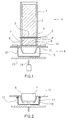
- Fig. 1 shows a diagrammatic cross section through a first embodiment of a curd-dispensing device according to the invention; and
- Fig. 2 shows a second embodiment of a curd-dispensing device according to the invention in the transverse direction.
-
- In Fig. 1, A denotes a curd/whey separation column. It comprises a substantially cylindrical container 1 in which there is a quantity of curd/
whey mixture 2, and whey-removal means, for example holes, which are not shown. At theopening 3 at the bottom, this column is closed off by amovable blade 4 which can be actuated by blade-actuating means 5. - Beneath the column A there is a curd-dispensing section B. This comprises a
curd storage container 6 which holds a quantity ofpreshaped curd 7 which has been cut off, also known as a block ofcurd 7. At the underside, thecurd storage container 6 has adispensing opening 8, which can be closed off by means of a movable closure means 9. The closure means 9 may, for example, be designed as a movable plate or as a diaphragm comprising two or more plates. The closure means 9 can be actuated by means of closure-means actuating means 10. Thecurd storage container 7 and the closure means 9 rest on asupport plate 11. - Beneath the dispensing
opening 8 there is acheese mould 12 which is supported by a mould-support plate 13. With the aid of actuating means 14, the mould-support plate 13, with thecheese mould 12 on it, can be pressed against the underside ofsupport plate 11. Curd-block guide means 15, which extend into the cheese mould while it is being filled with curd, are also shown on thesupport plate 11, in the vicinity of the dispensingopening 8. - The curd/whey separation column A is filled with a curd/whey mixture from the top. As this mixture is moving downwards, whey is extracted from it. The mass of curd which has been thickened in this way is ultimately blocked in the vicinity of the
opening 3 of the column A by themovable blade 4, which closes off the column in the at-rest position. - When a quantity of curd is to be delivered, the
opening 3 of the column A is opened as a result of themovable blade 4 being moved. The curd mixture moves slowly downwards under the influence of the force of gravity, until it is blocked by the closure means 9. Then, themovable blade 4 is moved back inwards, with the result that a preshaped quantity ofcurd 7 is cut off the curd/whey mixture 2. This block ofcurd 7 is situated in thecurd storage container 6. The curd storage container and the closure means are supported on thesupport plate 11. - The block of
curd 7 is to be introduced into acheese mould 12. To minimize the distance over which the block ofcurd 7 has to be lowered into thecheese mould 12 and therefore the risk of damage, thecheese mould 12 on vessel-support plate 13 is pressed onto the underside ofsupport plate 11 with the aid of actuating means 14. The open top side of thecheese mould 12 is, of course, aligned with the dispensingopening 8. - To introduce the block of curd into the cheese mould, the closure means 9 is opened with the aid of the closure-means actuating means 10. After the closure means 9 has been opened, the block of
curd 7 moves downwards through the dispensingopening 8 under the force of gravity. As the block ofcurd 7 is moving downwards through the dispensingopening 8, it comes into contact with curd-block guide means 15. In the figure, these guide means are designed as an encircling flexible collar around the dispensingopening 8. This collar extends into thecheese mould 12, as far as close to its base. The collar may be made from a suitable plastics material which provides sufficient rigidity for the frictional guidance and is also soft enough not to damage the block of curd. Mould netting material is a particularly suitable material for this purpose. - In constant contact with the curd-block guide means 15, the block of
curd 7 moves slowly towards the base of thecheese mould 12. As soon as the block ofcurd 7 has reached the base of the cheese mould, the filling process is over. With the aid of the actuating means 14, the cheese mould, with the block ofcurd 7 inside it, can be moved downwards, away fromsupport plate 11. - Figure 2 shows another embodiment of the device according to the invention, but this time while a
cheese mould 12 is being filled with a block ofcurd 7. Identical reference numerals denote corresponding components. - The block of
curd 7 has already been partially lowered into thecheese mould 12. It can clearly be seen that the block ofcurd 7 is in constant frictional contact with the curd-block guide means 17 which extend as far as close to the base of thecheese mould 12. The curd-block guide means are in this case designed as fourplastic lips 17, three of which are shown. Theselips 17 may be made from a flexible material or from a substantially rigid material, in which case the lips are hingedly attached to supportplate 11. Thelips 17 guide the block ofcurd 7, under frictional control, towards the base of thecheese mould 12. The risk of dispensing in an off-centre or skew position is considerably reduced as a result. - A mould netting is denoted by 18. This netting is situated inside the
cheese mould 12 and in principle lines its base and its walls. After the cheese mould has been filled with the block ofcurd 7, the block of curd is surrounded by the mould netting 18 at the bottom and at the sides. - The device according to the invention may be a separate dispensing device which forms part of a cheese preparation device. Furthermore, the device may be fixedly connected to a curd-processing column, as in Figure 1. The only essential factor for the invention is that during dispensing use is made of curd guide means, in other words that a block of curd is introduced into the cheese mould under frictional guidance.
Claims (9)
- Curd-dispensing device, comprising a curd storage container (6) with a curd inlet and a curd outlet, which curd outlet comprises a closable dispensing opening (8), for dispensing a preshaped block of curd (7) from the curd storage container (6) into a container (12), in particular a cheese mould, characterized in that in the vicinity of the dispensing opening (8) the curd-dispensing device comprises curd-block guide means (15; 17) which, when the curd-dispensing device is in use, can extend into the container (12).
- Curd-dispensing device according to claim 1, characterized in that the curd-block guide means (15; 17), when the device is being used, can extend as far as close to the base of the container (12).
- Curd-dispensing device according to claim 1 or 2, characterized in that the curd-block guide means (15; 17) comprise a collar (15) of flexible material which is present around the dispensing opening (8).
- Curd-dispensing device according to claim 3, characterized in that the collar (15) comprises mould netting material.
- Curd-dispensing device according to claim 1 or 2, characterized in that the curd-block guide means (17) comprise two or more lips which are present around the dispensing opening (8).
- Curd-dispensing device according to one or more of the preceding claims, characterized in that the curd-block guide means (15; 17) taper in the intended dispensing direction.
- Method for dispensing a preshaped block of curd (7) into a container (12), characterized in that the dispensing takes place with frictional guidance for at least the side of the preshaped block of curd (7).
- Method according to claim 7, characterized in that the preshaped block of curd (7) is guided substantially as far as the base of the container (12).
- Method according to claim 7 or 8, characterized in that the container (12) comprises a cheese mould.
Applications Claiming Priority (2)
| Application Number | Priority Date | Filing Date | Title |
|---|---|---|---|
| NL1015086 | 2000-05-02 | ||
| NL1015086A NL1015086C2 (en) | 2000-05-02 | 2000-05-02 | Curd filling device and method for filling an amount of curd in a container. |
Publications (2)
| Publication Number | Publication Date |
|---|---|
| EP1151663A1 true EP1151663A1 (en) | 2001-11-07 |
| EP1151663B1 EP1151663B1 (en) | 2004-07-07 |
Family
ID=19771299
Family Applications (1)
| Application Number | Title | Priority Date | Filing Date |
|---|---|---|---|
| EP20010201452 Expired - Lifetime EP1151663B1 (en) | 2000-05-02 | 2001-04-20 | Curd-dispensing device and method for dispensing a preshaped block of curd into a container |
Country Status (5)
| Country | Link |
|---|---|
| EP (1) | EP1151663B1 (en) |
| DE (1) | DE60104165T2 (en) |
| NL (1) | NL1015086C2 (en) |
| NO (1) | NO20012131L (en) |
| PL (1) | PL347232A1 (en) |
Cited By (2)
| Publication number | Priority date | Publication date | Assignee | Title |
|---|---|---|---|---|
| EP1982582A2 (en) | 2007-04-16 | 2008-10-22 | Universidade Catolica Portuguesa | Cheesemaking apparatus |
| EP3673739A1 (en) * | 2018-12-26 | 2020-07-01 | Tetra Laval Holdings & Finance S.A. | Tower screen dual surface finish |
Citations (4)
| Publication number | Priority date | Publication date | Assignee | Title |
|---|---|---|---|---|
| FR2326144A1 (en) | 1975-10-01 | 1977-04-29 | Burton Corblin | Curd measuring equipment on cheese making moulds - consists of a measuring trough; storage container; moulds supported by plates and moving on a carriage |
| EP0235867A1 (en) | 1986-03-04 | 1987-09-09 | Stork Friesland B.V. | Method and apparatus for conveying portions of curd from a curd dispensing column to a cheese mould on a discharge track during cheese-making |
| FR2595199A1 (en) | 1986-03-07 | 1987-09-11 | Guerin Sa Pierre | Method and device for the simultaneous filling of many cheese moulds with metered amounts of curd |
| FR2779318A1 (en) | 1998-06-09 | 1999-12-10 | Equip Tech Ind Alimentaires | Cheese mold filling process |
-
2000
- 2000-05-02 NL NL1015086A patent/NL1015086C2/en not_active IP Right Cessation
-
2001
- 2001-04-20 EP EP20010201452 patent/EP1151663B1/en not_active Expired - Lifetime
- 2001-04-20 DE DE2001604165 patent/DE60104165T2/en not_active Expired - Lifetime
- 2001-04-24 PL PL34723201A patent/PL347232A1/en unknown
- 2001-04-30 NO NO20012131A patent/NO20012131L/en not_active Application Discontinuation
Patent Citations (4)
| Publication number | Priority date | Publication date | Assignee | Title |
|---|---|---|---|---|
| FR2326144A1 (en) | 1975-10-01 | 1977-04-29 | Burton Corblin | Curd measuring equipment on cheese making moulds - consists of a measuring trough; storage container; moulds supported by plates and moving on a carriage |
| EP0235867A1 (en) | 1986-03-04 | 1987-09-09 | Stork Friesland B.V. | Method and apparatus for conveying portions of curd from a curd dispensing column to a cheese mould on a discharge track during cheese-making |
| FR2595199A1 (en) | 1986-03-07 | 1987-09-11 | Guerin Sa Pierre | Method and device for the simultaneous filling of many cheese moulds with metered amounts of curd |
| FR2779318A1 (en) | 1998-06-09 | 1999-12-10 | Equip Tech Ind Alimentaires | Cheese mold filling process |
Cited By (3)
| Publication number | Priority date | Publication date | Assignee | Title |
|---|---|---|---|---|
| EP1982582A2 (en) | 2007-04-16 | 2008-10-22 | Universidade Catolica Portuguesa | Cheesemaking apparatus |
| EP3673739A1 (en) * | 2018-12-26 | 2020-07-01 | Tetra Laval Holdings & Finance S.A. | Tower screen dual surface finish |
| US11317596B2 (en) | 2018-12-26 | 2022-05-03 | Tetra Laval Holdings & Finance S.A. | Tower screen dual surface finish |
Also Published As
| Publication number | Publication date |
|---|---|
| NL1015086C2 (en) | 2001-11-05 |
| EP1151663B1 (en) | 2004-07-07 |
| DE60104165T2 (en) | 2005-07-28 |
| NO20012131D0 (en) | 2001-04-30 |
| DE60104165D1 (en) | 2004-08-12 |
| PL347232A1 (en) | 2001-11-05 |
| NO20012131L (en) | 2001-11-05 |
Similar Documents
| Publication | Publication Date | Title |
|---|---|---|
| CN102849230B (en) | Method and apparatus for filling a container | |
| EP0365569B1 (en) | A process and a device for the filling of doughy filling material into receptacles | |
| JPH07167755A (en) | Method and apparatus for extracting an analytical sample having a proportional amount from a milking stream | |
| US6098528A (en) | Block former | |
| EP1151663B1 (en) | Curd-dispensing device and method for dispensing a preshaped block of curd into a container | |
| EP3556669A1 (en) | Apparatus for emptying bags | |
| EP1041022B1 (en) | Method for off-loading incoherent material from a container and apparatus for the implementation of the method. | |
| US6180153B1 (en) | Method and apparatus for cheese block forming with vacuum separated tower sections | |
| CA1134239A (en) | Milk receptacle with discharge valve | |
| EP0235867A1 (en) | Method and apparatus for conveying portions of curd from a curd dispensing column to a cheese mould on a discharge track during cheese-making | |
| KR0138762B1 (en) | Method and apparatus for evacuation of gas in filling facility | |
| EP1769676A1 (en) | Handling apparatus for handling compacted curd blocks | |
| CA1229582A (en) | Open top tank with flow rate control device therein | |
| EP0916256B1 (en) | Method and apparatus for producing cut fresh curd blocks | |
| US10542724B2 (en) | Method and arrangement for filling of cheese curd in moulds | |
| US11161636B2 (en) | Methods and devices for filling cups, packaging lines for cups | |
| US2755980A (en) | Machine for filling liquids into containers | |
| FI84798B (en) | FOERFARANDE, SYSTEM OCH FODRAL FOER FOERPACKNING AV LOCK. | |
| JPH0439206Y2 (en) | ||
| AU604141B2 (en) | A process and a device for the filling of doughy filling material into receptacles | |
| US2255251A (en) | Packaging method and apparatus | |
| US3609866A (en) | Device for making cheddar and similar cheese varieties | |
| EP3673739B1 (en) | Tower screen dual surface finish | |
| EP3673740B1 (en) | Cheese block former comprising a tower screen relief step | |
| CA2254177C (en) | Method and apparatus for producing cut fresh curd blocks |
Legal Events
| Date | Code | Title | Description |
|---|---|---|---|
| PUAI | Public reference made under article 153(3) epc to a published international application that has entered the european phase |
Free format text: ORIGINAL CODE: 0009012 |
|
| AK | Designated contracting states |
Kind code of ref document: A1 Designated state(s): BE DE NL Kind code of ref document: A1 Designated state(s): AT BE CH CY DE DK ES FI FR GB GR IE IT LI LU MC NL PT SE TR |
|
| AX | Request for extension of the european patent |
Free format text: AL;LT;LV;MK;RO;SI |
|
| 17P | Request for examination filed |
Effective date: 20011109 |
|
| AKX | Designation fees paid |
Free format text: BE DE NL |
|
| GRAP | Despatch of communication of intention to grant a patent |
Free format text: ORIGINAL CODE: EPIDOSNIGR1 |
|
| GRAS | Grant fee paid |
Free format text: ORIGINAL CODE: EPIDOSNIGR3 |
|
| GRAA | (expected) grant |
Free format text: ORIGINAL CODE: 0009210 |
|
| AK | Designated contracting states |
Kind code of ref document: B1 Designated state(s): BE DE NL |
|
| REF | Corresponds to: |
Ref document number: 60104165 Country of ref document: DE Date of ref document: 20040812 Kind code of ref document: P |
|
| PLBE | No opposition filed within time limit |
Free format text: ORIGINAL CODE: 0009261 |
|
| STAA | Information on the status of an ep patent application or granted ep patent |
Free format text: STATUS: NO OPPOSITION FILED WITHIN TIME LIMIT |
|
| 26N | No opposition filed |
Effective date: 20050408 |
|
| PGFP | Annual fee paid to national office [announced via postgrant information from national office to epo] |
Ref country code: DE Payment date: 20140627 Year of fee payment: 14 Ref country code: NL Payment date: 20140410 Year of fee payment: 14 |
|
| PGFP | Annual fee paid to national office [announced via postgrant information from national office to epo] |
Ref country code: BE Payment date: 20140527 Year of fee payment: 14 |
|
| REG | Reference to a national code |
Ref country code: DE Ref legal event code: R119 Ref document number: 60104165 Country of ref document: DE |
|
| REG | Reference to a national code |
Ref country code: NL Ref legal event code: MM Effective date: 20150501 |
|
| PG25 | Lapsed in a contracting state [announced via postgrant information from national office to epo] |
Ref country code: DE Free format text: LAPSE BECAUSE OF NON-PAYMENT OF DUE FEES Effective date: 20151103 |
|
| PG25 | Lapsed in a contracting state [announced via postgrant information from national office to epo] |
Ref country code: NL Free format text: LAPSE BECAUSE OF NON-PAYMENT OF DUE FEES Effective date: 20150501 |
|
| PG25 | Lapsed in a contracting state [announced via postgrant information from national office to epo] |
Ref country code: BE Free format text: LAPSE BECAUSE OF NON-PAYMENT OF DUE FEES Effective date: 20150430 |