EP1149892A1 - Surfactant composition - Google Patents
Surfactant composition Download PDFInfo
- Publication number
- EP1149892A1 EP1149892A1 EP00978068A EP00978068A EP1149892A1 EP 1149892 A1 EP1149892 A1 EP 1149892A1 EP 00978068 A EP00978068 A EP 00978068A EP 00978068 A EP00978068 A EP 00978068A EP 1149892 A1 EP1149892 A1 EP 1149892A1
- Authority
- EP
- European Patent Office
- Prior art keywords
- compound
- surfactant
- weight
- carbon atoms
- components
- Prior art date
- Legal status (The legal status is an assumption and is not a legal conclusion. Google has not performed a legal analysis and makes no representation as to the accuracy of the status listed.)
- Granted
Links
Classifications
-
- A—HUMAN NECESSITIES
- A61—MEDICAL OR VETERINARY SCIENCE; HYGIENE
- A61K—PREPARATIONS FOR MEDICAL, DENTAL OR TOILETRY PURPOSES
- A61K8/00—Cosmetics or similar toiletry preparations
- A61K8/18—Cosmetics or similar toiletry preparations characterised by the composition
- A61K8/30—Cosmetics or similar toiletry preparations characterised by the composition containing organic compounds
- A61K8/40—Cosmetics or similar toiletry preparations characterised by the composition containing organic compounds containing nitrogen
- A61K8/42—Amides
-
- A—HUMAN NECESSITIES
- A61—MEDICAL OR VETERINARY SCIENCE; HYGIENE
- A61K—PREPARATIONS FOR MEDICAL, DENTAL OR TOILETRY PURPOSES
- A61K8/00—Cosmetics or similar toiletry preparations
- A61K8/18—Cosmetics or similar toiletry preparations characterised by the composition
- A61K8/30—Cosmetics or similar toiletry preparations characterised by the composition containing organic compounds
- A61K8/40—Cosmetics or similar toiletry preparations characterised by the composition containing organic compounds containing nitrogen
- A61K8/44—Aminocarboxylic acids or derivatives thereof, e.g. aminocarboxylic acids containing sulfur; Salts; Esters or N-acylated derivatives thereof
-
- A—HUMAN NECESSITIES
- A61—MEDICAL OR VETERINARY SCIENCE; HYGIENE
- A61Q—SPECIFIC USE OF COSMETICS OR SIMILAR TOILETRY PREPARATIONS
- A61Q19/00—Preparations for care of the skin
- A61Q19/10—Washing or bathing preparations
-
- A—HUMAN NECESSITIES
- A61—MEDICAL OR VETERINARY SCIENCE; HYGIENE
- A61Q—SPECIFIC USE OF COSMETICS OR SIMILAR TOILETRY PREPARATIONS
- A61Q5/00—Preparations for care of the hair
- A61Q5/02—Preparations for cleaning the hair
-
- C—CHEMISTRY; METALLURGY
- C11—ANIMAL OR VEGETABLE OILS, FATS, FATTY SUBSTANCES OR WAXES; FATTY ACIDS THEREFROM; DETERGENTS; CANDLES
- C11D—DETERGENT COMPOSITIONS; USE OF SINGLE SUBSTANCES AS DETERGENTS; SOAP OR SOAP-MAKING; RESIN SOAPS; RECOVERY OF GLYCEROL
- C11D1/00—Detergent compositions based essentially on surface-active compounds; Use of these compounds as a detergent
- C11D1/38—Cationic compounds
- C11D1/52—Carboxylic amides, alkylolamides or imides or their condensation products with alkylene oxides
- C11D1/528—Carboxylic amides (R1-CO-NR2R3), where at least one of the chains R1, R2 or R3 is interrupted by a functional group, e.g. a -NH-, -NR-, -CO-, or -CON- group
-
- C—CHEMISTRY; METALLURGY
- C11—ANIMAL OR VEGETABLE OILS, FATS, FATTY SUBSTANCES OR WAXES; FATTY ACIDS THEREFROM; DETERGENTS; CANDLES
- C11D—DETERGENT COMPOSITIONS; USE OF SINGLE SUBSTANCES AS DETERGENTS; SOAP OR SOAP-MAKING; RESIN SOAPS; RECOVERY OF GLYCEROL
- C11D1/00—Detergent compositions based essentially on surface-active compounds; Use of these compounds as a detergent
- C11D1/38—Cationic compounds
- C11D1/645—Mixtures of compounds all of which are cationic
-
- C—CHEMISTRY; METALLURGY
- C11—ANIMAL OR VEGETABLE OILS, FATS, FATTY SUBSTANCES OR WAXES; FATTY ACIDS THEREFROM; DETERGENTS; CANDLES
- C11D—DETERGENT COMPOSITIONS; USE OF SINGLE SUBSTANCES AS DETERGENTS; SOAP OR SOAP-MAKING; RESIN SOAPS; RECOVERY OF GLYCEROL
- C11D3/00—Other compounding ingredients of detergent compositions covered in group C11D1/00
- C11D3/16—Organic compounds
- C11D3/20—Organic compounds containing oxygen
- C11D3/2003—Alcohols; Phenols
- C11D3/2065—Polyhydric alcohols
-
- C—CHEMISTRY; METALLURGY
- C11—ANIMAL OR VEGETABLE OILS, FATS, FATTY SUBSTANCES OR WAXES; FATTY ACIDS THEREFROM; DETERGENTS; CANDLES
- C11D—DETERGENT COMPOSITIONS; USE OF SINGLE SUBSTANCES AS DETERGENTS; SOAP OR SOAP-MAKING; RESIN SOAPS; RECOVERY OF GLYCEROL
- C11D1/00—Detergent compositions based essentially on surface-active compounds; Use of these compounds as a detergent
- C11D1/38—Cationic compounds
- C11D1/46—Esters of carboxylic acids with amino alcohols; Esters of amino carboxylic acids with alcohols
-
- C—CHEMISTRY; METALLURGY
- C11—ANIMAL OR VEGETABLE OILS, FATS, FATTY SUBSTANCES OR WAXES; FATTY ACIDS THEREFROM; DETERGENTS; CANDLES
- C11D—DETERGENT COMPOSITIONS; USE OF SINGLE SUBSTANCES AS DETERGENTS; SOAP OR SOAP-MAKING; RESIN SOAPS; RECOVERY OF GLYCEROL
- C11D1/00—Detergent compositions based essentially on surface-active compounds; Use of these compounds as a detergent
- C11D1/38—Cationic compounds
- C11D1/52—Carboxylic amides, alkylolamides or imides or their condensation products with alkylene oxides
- C11D1/523—Carboxylic alkylolamides, or dialkylolamides, or hydroxycarboxylic amides (R1-CO-NR2R3), where R1, R2 or R3 contain one hydroxy group per alkyl group
Definitions
- the present invention relates to a surfactant composition having an excellent foamability, thickening property, water solubility and stability.
- a detergent such as a shampoo, a rinse, a solid soap, a body shampoo, a detergent for kitchens, a detergent for clothing and a detergent for dwellings.
- an anionic surfactant such as an alkyl benzenesulfonate, an alkyl sulfate salt and a polyoxyethylene alkyl sulfate salt.
- any thereof usually shows its excellent detergency and foaming, there is a problem therein that, when solids, a stain derived from silicone or the like is present, the detergency and foamability significantly lower.
- a purpose of the present invention is to provide a surfactant composition having an excellent foamability, thickening property, water solubility and stability even within a broad pH range, even in the presence of soil.
- the present invention provides a surfactant composition
- a surfactant composition comprising the below shown component (a) and component (b) and a surfactant other than (a) and (b) at the weight ratio of (a)/(b) of from 99.99/0.01 to 80/20 or from 99.9/0.1 to 70/30.
- R 1 CO- is an acyl group as mentioned above. It is preferably a saturated or unsaturated acyl group having 8 to 18 carbon atoms. It includes for example an acyl group derived from octanoic acid, decanoic acid, dodecanoic acid, tetradecanoic acid, hexadecanoic acid, octadecanoic acid, docosanoic acid, linoleic acid, 2-ethylhexanoic acid, 2-octylundecanoic acid, isostearic acid, oleic acid, coco-fatty acid, a palm oil-fatty acid, a palm kernel oil-fatty acid, a beef tallow-fatty acid, etc.
- the more preferable is an acyl group derived from octanoic acid, decanoic acid, dodecanoic acid, tetradecanoic acid, hexadecanoic acid, octadecanoic acid, oleic acid, coco-fatty acid, palm oil-fatty acid, palm kernel oil-fatty acid and beef tallow-fatty acid.
- these acyl groups that containing not less than 50 % by weight of acyl groups derived from fatty acids having 12 to 14 carbon atoms is preferable. More preferable is that containing 40 to less than 100 percent by weight of acyl groups derived from fatty acids having 12 carbon atoms.
- R 2 is a linear or branched alkyl group having 1 to 3 carbon atoms, preferably methyl group or ethyl group. Methyl group is in particular preferable.
- R 3 is a linear or branched alkylene having 1 to 6 carbon atoms or an alkenylene group having 2 to 6 carbon atoms. It is preferably a linear or branched alkylene group having 2 or 3 carbon atoms.
- the component (a) includes, for instance, N-(2-hydroxyethyl)-N-methyl octanamide, N-(2-hydroxyethyl)-N-methyl decanamide, N-(2-hydroxyethyl)-N-methyl dodecanamide, N-(2-hydroxyethyl)-N-methyl tertadecanamide, N-(2-hydroxyethyl)-N-methyl hexadecanamide, N-(2-hydroxyethyl)-N-methyl octadecanamide, N-(2-hydroxyethyl)-N-methyl-cocofatty carboxamide, N-(2-hydroxyethyl)-N-methyl-palm kernel oil-fatty carboxamide, N-(2-hydroxypropyl)-N-ethyl dodecanamide, N-ethyl-N-(2-hydroxypropyl) oleamide and N-ethyl-N-(2-hydroxypropyl) isostearamide.
- a method for producing the component (a) is not particularly limited. For example, it can be produced by a condensation reaction or a de-alcohol reaction of a fatty acid or a lower alcohol ester of a fatty acid with an alkanolamine, a reaction of a fatty acid halide with an alkanolamine in the presence of an alkaline catalyst, an ester-amide exchanging reaction (an aminolysis) between fats and oils and an alkanolamine or others.
- the product obtained by such a method may often contain small amounts of fatty acids, inorganic salts, glycerol and the like, but they does not at all affect properties of the product.
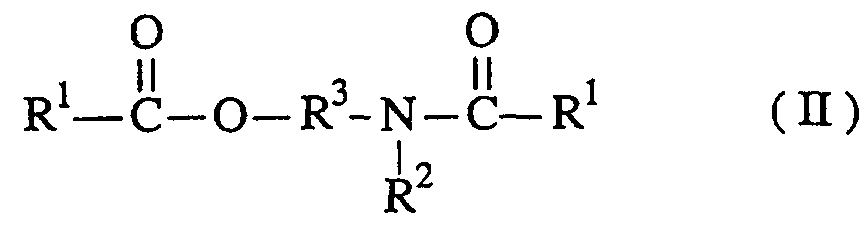
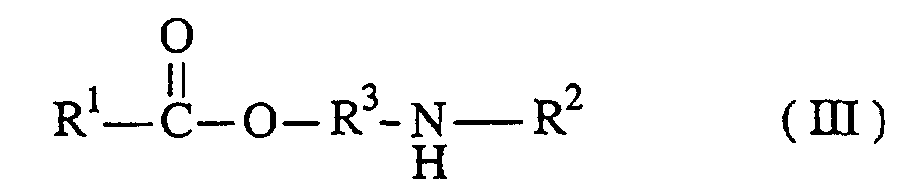
- the component (b) is selected from the compounds represented by the above-mentioned formulae (II) and (III), respectively. It is not necessarily single, but plural species may be mixed.
- R 1 CO-, R 2 and R 3 of the formulae (II) and (III) have the same meanings as those of the formula (I) .
- R 1 , R 2 and R 3 may be the same as or different from one another.
- the compound represented by the formula (II) includes, for instance, N-octanoyl-N-methylaminoethyl octanoate, N-octanoyl-N-methylaminoethyl decanoate, N-octanoyl-N-methylaminoethyl dodecanoate, N-octanoyl-N-methylaminoethyl tetradecanoate, N-octanoyl-N-methylaminoethyl hexadecanoate, N-octanoyl-N-methylaminoethyl octadecanoate, N-dodecanoyl-N-methylaminoethyl octanoate, N-dodecanoyl-N-methylaminoethyl decanoate, N-dodecanoyl-N-methylaminoethyl
- Examples of the compound represented by the formula (III), for instance, include 2-(methylamino)ethyl octanoate, 2-(methylamino)ethyl decanoate, 2-(methylamino)-ethyl dodecanoate, 2-(methylamino)ethyl tetradecanoate, 2-(methylamino)ethyl hexadecanoate, 2-(methylamino)ethyl octadecanoate, 2-(methylamino)ethyl oleate, 2-(ethylamino)ethyl octanoate, 2-(ethylamino)ethyl dodecanoate, 2-(ethylamino)ethyl tetradecanoate, 2-(ethylamino)ethyl hexadecanoate, 2-(ethylamino)ethyl octadecanoate, 2-(eth
- the blending ratio of the component (a) to the component (b), the weight ratio of (a)/(b), is from 99.99/0.01 to 80/20 or 99.9/0.1 to 70/30, preferably from 98/2 to 90/10 in view of foamability, thickening and stability.
- the compound (I) is preferably 80 to 99.99 % by weight to the sum total of them, more preferably 90 to 98 % by weight.
- the compound (II) is preferably 0.01 to 20 % by weight, more preferably 2 to 10 % by weight.
- the compound (III) is preferably 0 to 5 % by weight.
- a very high foamability and thickening property can be exhibited in the present invention by combining another surfactant (hereinafter, referred to as "other surfactant") than (a) and (b) with (a) and (b).
- the total amount of the components (a) and (b) of the composition of the present invention can be optionally selected, depending upon characters of the other surfactant.
- the blending ratio of the components (a) and (b) in total to the other surfactant is preferably from 0.5/99.5 to 50/50 by weight.
- the other surfactant used in the invention may be at least one selected from a sulfate-based or sulfonate-based surfactant such as an alkyl sulfate, a polyoxyethylene alkyl sulfate and an alkylbenzene sulfonate, an amine oxide such as an alkyldimethyl amine oxide and amidopropyldimethyl amine oxide and an amide group-containing betaine such as amidopropyl dimethylcarbobetaine.
- a sulfate-based or sulfonate-based surfactant such as an alkyl sulfate, a polyoxyethylene alkyl sulfate and an alkylbenzene sulfonate
- an amine oxide such as an alkyldimethyl amine oxide and amidopropyldimethyl amine oxide
- an amide group-containing betaine such as amidopropyl dimethylcarbobetaine.
- One or two or more can be used
- the surfactant composition of the present invention can be improved in viscosity by further containing glycerol.
- the amount of glycerol to the sum total of the components (a) and (b) and the amount of the surfactant other than the components (a) and (b) is preferably not more than 20 % by weight, more preferably from 0.01 to 15 % by weight.
- the blending ratio of the sum total of the component (a), the component (b) and glycerol to the other surfactant is preferably from 0.5/99.5 to 50/50, more preferably from 1/99 to 25/75 by weight.
- Glycerol may be added separately. It may contain that produced in the syntheses of the component (a).
- the surfactant composition of the present invention can exhibit desired performances such as foamability and thickening property at a pH of 4.0 to 11.0. It is useful as the base for a detergent.
- surfactant compositions having the formulations as shown in Table 1 were prepared and tested in foamability in the below mentioned method. Results are shown in Table 1.
- surfactant compositions having formulations as shown in Table 3 were prepared. The viscosity thereof was determined at 25 °C with an ordinary Brookfield viscometer. Results are shown in Table 3.
Landscapes
- Life Sciences & Earth Sciences (AREA)
- Health & Medical Sciences (AREA)
- Chemical & Material Sciences (AREA)
- Animal Behavior & Ethology (AREA)
- General Health & Medical Sciences (AREA)
- Public Health (AREA)
- Veterinary Medicine (AREA)
- Oil, Petroleum & Natural Gas (AREA)
- Engineering & Computer Science (AREA)
- Chemical Kinetics & Catalysis (AREA)
- Wood Science & Technology (AREA)
- Organic Chemistry (AREA)
- Epidemiology (AREA)
- Birds (AREA)
- Dermatology (AREA)
- Emergency Medicine (AREA)
- Detergent Compositions (AREA)
- Cosmetics (AREA)
Abstract

Description
- The present invention relates to a surfactant composition having an excellent foamability, thickening property, water solubility and stability.
- Not only a high detergency but also an abundant foaming are requested to a detergent such as a shampoo, a rinse, a solid soap, a body shampoo, a detergent for kitchens, a detergent for clothing and a detergent for dwellings. One which has been widely used as the main base in many products is an anionic surfactant such as an alkyl benzenesulfonate, an alkyl sulfate salt and a polyoxyethylene alkyl sulfate salt. However, although any thereof usually shows its excellent detergency and foaming, there is a problem therein that, when solids, a stain derived from silicone or the like is present, the detergency and foamability significantly lower.
- In order to improve such a lowering in detergency and/or foamability, various co-surfactants besides the main base have been investigated. There have been first proposed a fatty acid diethanolamide which has been actually and widely used in the products and then proposed in recent years a fatty acid monoethanolamide (WO 98/00507, WO 97/44434, JP-A 11-80785, etc.), a nonionic surfactant based on a sugar amide (WO 94/12610), an acylsarcosinate (WO 96/06596), etc.
- However, although these detergent compositions are improved in detergency and foamability, they are not well satisfactory yet. Moreover, since the detergents described above directly contact with the skin daily, they are demanded to exhibit a high performance at a weakly acidic pH region which is mild to the skin. However, in the conventional surfactant system, there has been mentioned such a problem that, even when the foaming is good in from neutral to basic regions, foaming does not take place at all in an acidic region.
- A purpose of the present invention is to provide a surfactant composition having an excellent foamability, thickening property, water solubility and stability even within a broad pH range, even in the presence of soil.
- The present invention provides a surfactant composition comprising the below shown component (a) and component (b) and a surfactant other than (a) and (b) at the weight ratio of (a)/(b) of from 99.99/0.01 to 80/20 or from 99.9/0.1 to 70/30.
- (a) a compound (I) represented by the following formula (I) :
in the formula (I), R1CO- is a saturated or unsaturated acyl group which has 6 to 24 carbon atoms and which may have a hydroxy group; R2 is a linear or branched alkyl group having 1 to 3 carbon atoms; and R3 is a linear or branched alkylene group having 1 to 6 carbon atoms or alkenylene group having 2 to 6 carbon atoms.

- (b) at least one compound selected from the group consisting
of the compounds (II) represented by the formula (II) and the
compounds (III) represented by the formula (III):
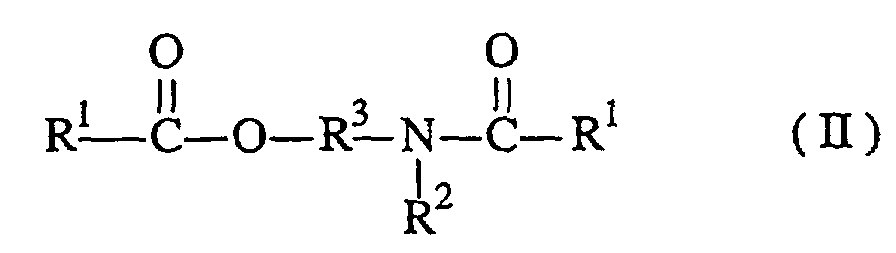 in the formulae (II) and (III), R1CO-, R2 and R3 have the same meanings as above and R1, R2 and R3 are either the same as or different from one another in each compound.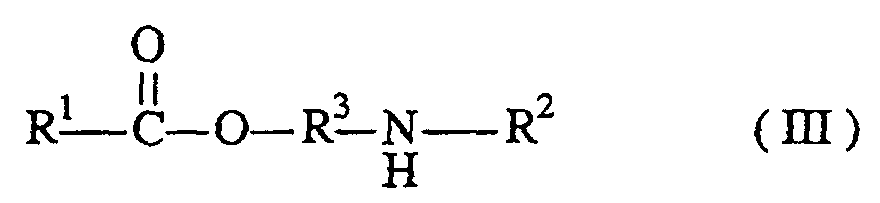
-
- In the component (a) of the present invention, R1CO- is an acyl group as mentioned above. It is preferably a saturated or unsaturated acyl group having 8 to 18 carbon atoms. It includes for example an acyl group derived from octanoic acid, decanoic acid, dodecanoic acid, tetradecanoic acid, hexadecanoic acid, octadecanoic acid, docosanoic acid, linoleic acid, 2-ethylhexanoic acid, 2-octylundecanoic acid, isostearic acid, oleic acid, coco-fatty acid, a palm oil-fatty acid, a palm kernel oil-fatty acid, a beef tallow-fatty acid, etc. The more preferable is an acyl group derived from octanoic acid, decanoic acid, dodecanoic acid, tetradecanoic acid, hexadecanoic acid, octadecanoic acid, oleic acid, coco-fatty acid, palm oil-fatty acid, palm kernel oil-fatty acid and beef tallow-fatty acid. Among these acyl groups, that containing not less than 50 % by weight of acyl groups derived from fatty acids having 12 to 14 carbon atoms is preferable. More preferable is that containing 40 to less than 100 percent by weight of acyl groups derived from fatty acids having 12 carbon atoms.
- In order not to lower foamability, R2 is a linear or branched alkyl group having 1 to 3 carbon atoms, preferably methyl group or ethyl group. Methyl group is in particular preferable. In order not to lower the surface-active performance, R3 is a linear or branched alkylene having 1 to 6 carbon atoms or an alkenylene group having 2 to 6 carbon atoms. It is preferably a linear or branched alkylene group having 2 or 3 carbon atoms.
- The component (a) includes, for instance, N-(2-hydroxyethyl)-N-methyl octanamide, N-(2-hydroxyethyl)-N-methyl decanamide, N-(2-hydroxyethyl)-N-methyl dodecanamide, N-(2-hydroxyethyl)-N-methyl tertadecanamide, N-(2-hydroxyethyl)-N-methyl hexadecanamide, N-(2-hydroxyethyl)-N-methyl octadecanamide, N-(2-hydroxyethyl)-N-methyl-cocofatty carboxamide, N-(2-hydroxyethyl)-N-methyl-palm kernel oil-fatty carboxamide, N-(2-hydroxypropyl)-N-ethyl dodecanamide, N-ethyl-N-(2-hydroxypropyl) oleamide and N-ethyl-N-(2-hydroxypropyl) isostearamide.
- A method for producing the component (a) is not particularly limited. For example, it can be produced by a condensation reaction or a de-alcohol reaction of a fatty acid or a lower alcohol ester of a fatty acid with an alkanolamine, a reaction of a fatty acid halide with an alkanolamine in the presence of an alkaline catalyst, an ester-amide exchanging reaction (an aminolysis) between fats and oils and an alkanolamine or others. The product obtained by such a method may often contain small amounts of fatty acids, inorganic salts, glycerol and the like, but they does not at all affect properties of the product.
- The component (b) is selected from the compounds represented by the above-mentioned formulae (II) and (III), respectively. It is not necessarily single, but plural species may be mixed.
- R1CO-, R2 and R3 of the formulae (II) and (III) have the same meanings as those of the formula (I) . In each compound, R1, R2 and R3 may be the same as or different from one another.
- The compound represented by the formula (II) includes, for instance, N-octanoyl-N-methylaminoethyl octanoate, N-octanoyl-N-methylaminoethyl decanoate, N-octanoyl-N-methylaminoethyl dodecanoate, N-octanoyl-N-methylaminoethyl tetradecanoate, N-octanoyl-N-methylaminoethyl hexadecanoate, N-octanoyl-N-methylaminoethyl octadecanoate, N-dodecanoyl-N-methylaminoethyl octanoate, N-dodecanoyl-N-methylaminoethyl decanoate, N-dodecanoyl-N-methylaminoethyl dodecanoate, N-dodecanoyl-N-methylaminoethyl tetradecanoate, N-dodecanoyl-N-methylaminoethyl hexadecanoate, N-dodecanoyl-N-methylaminoethyl octadecanoate, N-dodecanoyl-N-ethylaminohexyl octanoate, N-dodecanoyl-N-ethylaminohexyl decanoate, N-dodecanoyl-N-ethylaminohexyl dodecanoate, N-dodecanoyl-N-ethylaminohexyl tetradecanoate, N-dodecanoyl-N-ethylaminohexyl hexadecanoate, N-dodecanoyl-N-ethylaminohexyl octadecanoate, coco-fatty acid (N-cocoyl-N-methylaminoethyl)ester and palm kernel oil fatty acid (N-palm kerneloyl-N-methylaminoethyl) ester.
- Examples of the compound represented by the formula (III), for instance, include 2-(methylamino)ethyl octanoate, 2-(methylamino)ethyl decanoate, 2-(methylamino)-ethyl dodecanoate, 2-(methylamino)ethyl tetradecanoate, 2-(methylamino)ethyl hexadecanoate, 2-(methylamino)ethyl octadecanoate, 2-(methylamino)ethyl oleate, 2-(ethylamino)ethyl octanoate, 2-(ethylamino)ethyl dodecanoate, 2-(ethylamino)ethyl tetradecanoate, 2-(ethylamino)ethyl hexadecanoate, 2-(ethylamino)ethyl octadecanoate, 2-(ethylamino)ethyl oleate, 2-(methylamino)propyl octanoate, 2-(methylamino)propyl decanoate, 2- (methylamino)propyl dodecanoate, 2-(methylamino)propyl tetradecanoate, 2-(methylamino)propyl hexadecanoate, 2- (methylamino)propyl octadecanoate, 2-(methylamino)propyl oleate, a coco-fatty acid(2-ethylaminoethyl) ester and palm kernel fatty acid (2-ethylaminoethyl) ester.
- Further, the blending ratio of the component (a) to the component (b), the weight ratio of (a)/(b), is from 99.99/0.01 to 80/20 or 99.9/0.1 to 70/30, preferably from 98/2 to 90/10 in view of foamability, thickening and stability.
- With regard to the blending proportions of the compounds (I), (II) and (III) of the composition of the present invention to obtain a good surface activity, the compound (I) is preferably 80 to 99.99 % by weight to the sum total of them, more preferably 90 to 98 % by weight. The compound (II) is preferably 0.01 to 20 % by weight, more preferably 2 to 10 % by weight. The compound (III) is preferably 0 to 5 % by weight.
- A very high foamability and thickening property can be exhibited in the present invention by combining another surfactant (hereinafter, referred to as "other surfactant") than (a) and (b) with (a) and (b). The total amount of the components (a) and (b) of the composition of the present invention can be optionally selected, depending upon characters of the other surfactant. In view of water solubility, stability, foamability and thickening property, the blending ratio of the components (a) and (b) in total to the other surfactant is preferably from 0.5/99.5 to 50/50 by weight.
- The other surfactant used in the invention may be at least one selected from a sulfate-based or sulfonate-based surfactant such as an alkyl sulfate, a polyoxyethylene alkyl sulfate and an alkylbenzene sulfonate, an amine oxide such as an alkyldimethyl amine oxide and amidopropyldimethyl amine oxide and an amide group-containing betaine such as amidopropyl dimethylcarbobetaine. One or two or more can be used among them. It is preferable that one or more sulfate-based surfactants are co-present.
- The surfactant composition of the present invention can be improved in viscosity by further containing glycerol. The amount of glycerol to the sum total of the components (a) and (b) and the amount of the surfactant other than the components (a) and (b) is preferably not more than 20 % by weight, more preferably from 0.01 to 15 % by weight. Alternatively the blending ratio of the sum total of the component (a), the component (b) and glycerol to the other surfactant is preferably from 0.5/99.5 to 50/50, more preferably from 1/99 to 25/75 by weight. Glycerol may be added separately. It may contain that produced in the syntheses of the component (a).
- The surfactant composition of the present invention can exhibit desired performances such as foamability and thickening property at a pH of 4.0 to 11.0. It is useful as the base for a detergent.
- Using the components as shown below, surfactant compositions having the formulations as shown in Table 1 were prepared and tested in foamability in the below mentioned method. Results are shown in Table 1.
-
- Compound 1: N- (2-hydroxyethyl)-N-methyl lauramide
- Compound 2: N- (2-hydroxyethyl)-N-methyl coco-fatty carboxamide
- Compound 3: N-(2-hydroxyethyl)-N-methyl palm kernel oil-fatty carboxamide
-
-
- Compound 4: N-Lauroyl-N-methylaminoethyl laurate
- Compound 5: (N-cocoyl-N-methylaminoethyl) coco-fatty carboxylate
- Compound 6: (N-palm kerneloyl-N-methylaminoethyl) palm kernel-fatty carboxylate
- Compound 7: 2- (methylamino) ethyl laurate
- Compound 8: (2-ethylaminoethyl) coco-fatty carboxylate
- Compound 9: (2-ethylaminoethyl) palm kernel-fatty carboxylate
-
-
- AES: sodium polyoxyethylene(3) laurylsulfate
- LAPB: lauroylamidopropyl dimethylcarbobetain
- LDMAO: long-chain alkyl(C12) dimethylamine oxide
- MEA: lauroyl mono-ethanolamide
- DEA: lauroyl di-ethanolamide
- EAA: polyoxyethylene(2)coco-fatty monoethanolamide
-
- 30 mL of an aqueous solution of the surfactant composition, diluted in deionized water to 20-fold was prepared and adjusted with citric acid to have a given pH value. The aqueous solution was placed in a 300-mL mess cylinder having the inner diameter of 3 cm, equipped with a stop cock and shaken at 25°C for 10 seconds with an amplitude of 10 cm 20 times. The volume (mL) of foam was immediately determined.

- Using components shown in Table 2, surfactant compositions having formulations as shown in Table 2 were prepared and tested in foamability in the same way as Example 1. Results are shown in Table 2.

- Using components shown in Table 3, surfactant compositions having formulations as shown in Table 3 were prepared. The viscosity thereof was determined at 25 °C with an ordinary Brookfield viscometer. Results are shown in Table 3.

Claims (5)
- A surfactant composition containing the below shown component (a), the below shown component (b) and an other surfactant than (a) and (b) at the weight ratio of (a)/(b) of from 99.99/0.01 to 80/20:(a) the compound (hereinafter called the compound (I)) represented by the formula (I):wherein R1CO- is a saturated or unsaturated acyl group which has 6 to 24 carbon atoms and may have a hydroxy group; R2 is a linear or branched alkyl group having 1 to 3 carbon atoms; and R3 is a linear or branched alkylene group having 1 to 6 carbon atoms or an alkenylene group having 2 to 6 carbon atoms;
 (b) at least one compound selected from the compound (hereinafter called the compound (II)) represented by the formula (II) and the compound (hereinafter called the compound (III)) represented by the formula (III):
 wherein R1CO-, R2 and R3 have the same meanings as above and R1, R2 and R3 may be the same as or different from one another.
- The composition as claimed in Claim 1, wherein the blending proportions of the compounds (I), (II) and (III) to the sum total of them are 80 to 99.99 % by weight of the compound (I), 0.01 to 20 % by weight of the compound (II) and 0 to 5 % by weight of the compound (III).
- The composition as claimed in Claim 2, wherein the blending ratio of the sum total of the components (a) and (b) to the other surfactant than the components (a) and (b) is from 0.5/99.5 to 50/50 by weight.
- The composition as claimed in any of Claim 1 to 3, which comprises glycerol in an amount of 20 % by weight or less to the sum total of the components (a) and (b) and the other surfactant than the components (a) and (b).
- The composition as claimed in Claim 4, in which the blending ratio of the sum total of the components (a) and (b) and glycerol to the other surfactant than the components (a) and (b) is from 0.5/99.5 to 50/50 by weight.
Applications Claiming Priority (3)
| Application Number | Priority Date | Filing Date | Title |
|---|---|---|---|
| JP34164999 | 1999-12-01 | ||
| JP34164999 | 1999-12-01 | ||
| PCT/JP2000/008539 WO2001040421A1 (en) | 1999-12-01 | 2000-12-01 | Surfactant composition |
Publications (3)
| Publication Number | Publication Date |
|---|---|
| EP1149892A1 true EP1149892A1 (en) | 2001-10-31 |
| EP1149892A4 EP1149892A4 (en) | 2004-06-02 |
| EP1149892B1 EP1149892B1 (en) | 2007-04-04 |
Family
ID=18347734
Family Applications (1)
| Application Number | Title | Priority Date | Filing Date |
|---|---|---|---|
| EP00978068A Expired - Lifetime EP1149892B1 (en) | 1999-12-01 | 2000-12-01 | Surfactant composition |
Country Status (5)
| Country | Link |
|---|---|
| US (2) | US6407054B2 (en) |
| EP (1) | EP1149892B1 (en) |
| CN (1) | CN100372919C (en) |
| DE (1) | DE60034215T2 (en) |
| WO (1) | WO2001040421A1 (en) |
Cited By (1)
| Publication number | Priority date | Publication date | Assignee | Title |
|---|---|---|---|---|
| EP4299708A1 (en) * | 2022-06-27 | 2024-01-03 | The Procter & Gamble Company | Liquid hand dishwashing cleaning composition |
Families Citing this family (3)
| Publication number | Priority date | Publication date | Assignee | Title |
|---|---|---|---|---|
| JP4823430B2 (en) * | 2001-03-28 | 2011-11-24 | 花王株式会社 | Surfactant composition |
| JP4712224B2 (en) * | 2001-05-24 | 2011-06-29 | 花王株式会社 | Concentrated pearlizing agent composition |
| US6774095B2 (en) * | 2001-05-24 | 2004-08-10 | Kao Corporation | Detergent composition |
Family Cites Families (11)
| Publication number | Priority date | Publication date | Assignee | Title |
|---|---|---|---|---|
| US3932296A (en) * | 1973-05-29 | 1976-01-13 | The Dow Chemical Company | Corrosion inhibitor |
| US4370174A (en) * | 1981-08-31 | 1983-01-25 | Braithwaite Jr Charles H | Method for removing adhesive residues with an emulsion cleaner |
| CA2148096A1 (en) | 1992-11-30 | 1994-06-09 | Jean-Pol Boutique | Detergent compositions containing polyhydroxy fatty acid amide, sulfated polyhydroxy fatty acid amide and soap |
| JP3515800B2 (en) | 1993-12-29 | 2004-04-05 | 川研ファインケミカル株式会社 | Polyoxyethylene fatty acid amide sulfate ester type surfactant, method for producing the surfactant, and detergent composition |
| US5534265A (en) | 1994-08-26 | 1996-07-09 | The Procter & Gamble Company | Thickened nonabrasive personal cleansing compositions |
| JPH09137190A (en) | 1995-11-16 | 1997-05-27 | Kao Corp | Detergent composition |
| WO1997044434A1 (en) | 1996-05-17 | 1997-11-27 | The Procter & Gamble Company | Low moisture laundry detergent bar with improved bleach stability |
| CA2258626C (en) | 1996-06-28 | 2002-09-17 | The Procter & Gamble Company | Nonaqueous detergent compositions containing bleach precursors |
| JPH10339783A (en) | 1997-04-09 | 1998-12-22 | Seiko Epson Corp | Electronic clock |
| JPH10330783A (en) * | 1997-06-02 | 1998-12-15 | Lion Corp | Detergent composition |
| JP3844391B2 (en) | 1997-12-19 | 2006-11-08 | 電気化学工業株式会社 | Method for producing mortar or concrete member |
-
2000
- 2000-12-01 DE DE60034215T patent/DE60034215T2/en not_active Expired - Lifetime
- 2000-12-01 US US09/726,577 patent/US6407054B2/en not_active Expired - Lifetime
- 2000-12-01 EP EP00978068A patent/EP1149892B1/en not_active Expired - Lifetime
- 2000-12-01 CN CNB008033617A patent/CN100372919C/en not_active Expired - Lifetime
- 2000-12-01 WO PCT/JP2000/008539 patent/WO2001040421A1/en not_active Ceased
-
2001
- 2001-04-12 US US09/726,577 patent/US20010034310A1/en active Granted
Non-Patent Citations (2)
| Title |
|---|
| No further relevant documents disclosed * |
| See also references of WO0140421A1 * |
Cited By (1)
| Publication number | Priority date | Publication date | Assignee | Title |
|---|---|---|---|---|
| EP4299708A1 (en) * | 2022-06-27 | 2024-01-03 | The Procter & Gamble Company | Liquid hand dishwashing cleaning composition |
Also Published As
| Publication number | Publication date |
|---|---|
| DE60034215T2 (en) | 2007-12-20 |
| US20010034310A1 (en) | 2001-10-25 |
| EP1149892B1 (en) | 2007-04-04 |
| US6407054B2 (en) | 2002-06-18 |
| DE60034215D1 (en) | 2007-05-16 |
| WO2001040421A1 (en) | 2001-06-07 |
| CN100372919C (en) | 2008-03-05 |
| EP1149892A4 (en) | 2004-06-02 |
| CN1339059A (en) | 2002-03-06 |
Similar Documents
| Publication | Publication Date | Title |
|---|---|---|
| US6946430B2 (en) | Surfactant composition | |
| US5939059A (en) | Hair conditioner and 2 in 1 conditioning shampoo | |
| US5656586A (en) | Amphoteric surfactants having multiple hydrophobic and hydrophilic groups | |
| CN107001987A (en) | Formulation comprising biosurfactant | |
| BRPI0505310B1 (en) | process for the preparation of highly concentrated flowable and pumpable aqueous betaine solutions, solutions thus obtained and their use | |
| JPH08507538A (en) | Preparation of solid ester quarts with improved water dispersibility | |
| US20040136940A1 (en) | Cleaner compositions | |
| EP1149892B1 (en) | Surfactant composition | |
| JP4348312B2 (en) | Cleaning composition | |
| AU755252B2 (en) | Improved alkanolamides | |
| EP0500819B1 (en) | Liquid dishwashing composition | |
| JP2001514302A (en) | Highly foamable detergent mixtures containing fatty acid polyglycol ester sulfate | |
| JP3644566B2 (en) | Hair cleaning composition | |
| JP3517206B2 (en) | Surfactant composition | |
| JP4176539B2 (en) | Surfactant composition | |
| JPH0684510B2 (en) | Cleaning composition | |
| RU2559885C2 (en) | Concentrated aqueous solution of amphoteric surfactant, particularly betaine, and method for preparation thereof | |
| JP4067625B2 (en) | Fatty acid amide | |
| JP4307752B2 (en) | Surfactant composition | |
| KR20070000676A (en) | Dishwashing Liquid Detergent Composition | |
| JP2004182802A (en) | Surfactant additives | |
| CN120305156A (en) | A rhamnolipid composition and its preparation method and application | |
| JP2006117774A (en) | Thickener for cleaning agent | |
| JPH06271898A (en) | Detergent composition | |
| JPH09291017A (en) | Pearl agent dispersion |
Legal Events
| Date | Code | Title | Description |
|---|---|---|---|
| PUAI | Public reference made under article 153(3) epc to a published international application that has entered the european phase |
Free format text: ORIGINAL CODE: 0009012 |
|
| 17P | Request for examination filed |
Effective date: 20010727 |
|
| AK | Designated contracting states |
Kind code of ref document: A1 Designated state(s): AT BE CH CY DE DK ES FI FR GB GR IE IT LI LU MC NL PT SE TR |
|
| RBV | Designated contracting states (corrected) |
Designated state(s): DE FR GB |
|
| A4 | Supplementary search report drawn up and despatched |
Effective date: 20040420 |
|
| RIC1 | Information provided on ipc code assigned before grant |
Ipc: 7C 11D 1/86 B Ipc: 7C 11D 1/94 A Ipc: 7C 11D 1/46 B |
|
| GRAP | Despatch of communication of intention to grant a patent |
Free format text: ORIGINAL CODE: EPIDOSNIGR1 |
|
| GRAS | Grant fee paid |
Free format text: ORIGINAL CODE: EPIDOSNIGR3 |
|
| GRAA | (expected) grant |
Free format text: ORIGINAL CODE: 0009210 |
|
| AK | Designated contracting states |
Kind code of ref document: B1 Designated state(s): DE FR GB |
|
| REG | Reference to a national code |
Ref country code: GB Ref legal event code: FG4D |
|
| REF | Corresponds to: |
Ref document number: 60034215 Country of ref document: DE Date of ref document: 20070516 Kind code of ref document: P |
|
| ET | Fr: translation filed | ||
| PLBE | No opposition filed within time limit |
Free format text: ORIGINAL CODE: 0009261 |
|
| STAA | Information on the status of an ep patent application or granted ep patent |
Free format text: STATUS: NO OPPOSITION FILED WITHIN TIME LIMIT |
|
| 26N | No opposition filed |
Effective date: 20080107 |
|
| REG | Reference to a national code |
Ref country code: FR Ref legal event code: PLFP Year of fee payment: 16 |
|
| REG | Reference to a national code |
Ref country code: FR Ref legal event code: PLFP Year of fee payment: 17 |
|
| REG | Reference to a national code |
Ref country code: FR Ref legal event code: PLFP Year of fee payment: 18 |
|
| PGFP | Annual fee paid to national office [announced via postgrant information from national office to epo] |
Ref country code: DE Payment date: 20181120 Year of fee payment: 19 |
|
| PGFP | Annual fee paid to national office [announced via postgrant information from national office to epo] |
Ref country code: GB Payment date: 20181128 Year of fee payment: 19 Ref country code: FR Payment date: 20181121 Year of fee payment: 19 |
|
| REG | Reference to a national code |
Ref country code: DE Ref legal event code: R119 Ref document number: 60034215 Country of ref document: DE |
|
| GBPC | Gb: european patent ceased through non-payment of renewal fee |
Effective date: 20191201 |
|
| PG25 | Lapsed in a contracting state [announced via postgrant information from national office to epo] |
Ref country code: FR Free format text: LAPSE BECAUSE OF NON-PAYMENT OF DUE FEES Effective date: 20191231 Ref country code: GB Free format text: LAPSE BECAUSE OF NON-PAYMENT OF DUE FEES Effective date: 20191201 Ref country code: DE Free format text: LAPSE BECAUSE OF NON-PAYMENT OF DUE FEES Effective date: 20200701 |