EP1149685A2 - Heat-shrinkable thermoplastic resin films - Google Patents
Heat-shrinkable thermoplastic resin films Download PDFInfo
- Publication number
- EP1149685A2 EP1149685A2 EP01109712A EP01109712A EP1149685A2 EP 1149685 A2 EP1149685 A2 EP 1149685A2 EP 01109712 A EP01109712 A EP 01109712A EP 01109712 A EP01109712 A EP 01109712A EP 1149685 A2 EP1149685 A2 EP 1149685A2
- Authority
- EP
- European Patent Office
- Prior art keywords
- heat
- film
- shrinkage
- films
- shrinkable
- Prior art date
- Legal status (The legal status is an assumption and is not a legal conclusion. Google has not performed a legal analysis and makes no representation as to the accuracy of the status listed.)
- Granted
Links
Classifications
-
- C—CHEMISTRY; METALLURGY
- C08—ORGANIC MACROMOLECULAR COMPOUNDS; THEIR PREPARATION OR CHEMICAL WORKING-UP; COMPOSITIONS BASED THEREON
- C08J—WORKING-UP; GENERAL PROCESSES OF COMPOUNDING; AFTER-TREATMENT NOT COVERED BY SUBCLASSES C08B, C08C, C08F, C08G or C08H
- C08J5/00—Manufacture of articles or shaped materials containing macromolecular substances
- C08J5/18—Manufacture of films or sheets
-
- B—PERFORMING OPERATIONS; TRANSPORTING
- B29—WORKING OF PLASTICS; WORKING OF SUBSTANCES IN A PLASTIC STATE IN GENERAL
- B29C—SHAPING OR JOINING OF PLASTICS; SHAPING OF MATERIAL IN A PLASTIC STATE, NOT OTHERWISE PROVIDED FOR; AFTER-TREATMENT OF THE SHAPED PRODUCTS, e.g. REPAIRING
- B29C61/00—Shaping by liberation of internal stresses; Making preforms having internal stresses; Apparatus therefor
- B29C61/003—Shaping by liberation of internal stresses; Making preforms having internal stresses; Apparatus therefor characterised by the choice of material
-
- B—PERFORMING OPERATIONS; TRANSPORTING
- B29—WORKING OF PLASTICS; WORKING OF SUBSTANCES IN A PLASTIC STATE IN GENERAL
- B29C—SHAPING OR JOINING OF PLASTICS; SHAPING OF MATERIAL IN A PLASTIC STATE, NOT OTHERWISE PROVIDED FOR; AFTER-TREATMENT OF THE SHAPED PRODUCTS, e.g. REPAIRING
- B29C63/00—Lining or sheathing, i.e. applying preformed layers or sheathings of plastics; Apparatus therefor
- B29C63/38—Lining or sheathing, i.e. applying preformed layers or sheathings of plastics; Apparatus therefor by liberation of internal stresses
- B29C63/42—Lining or sheathing, i.e. applying preformed layers or sheathings of plastics; Apparatus therefor by liberation of internal stresses using tubular layers or sheathings
-
- Y—GENERAL TAGGING OF NEW TECHNOLOGICAL DEVELOPMENTS; GENERAL TAGGING OF CROSS-SECTIONAL TECHNOLOGIES SPANNING OVER SEVERAL SECTIONS OF THE IPC; TECHNICAL SUBJECTS COVERED BY FORMER USPC CROSS-REFERENCE ART COLLECTIONS [XRACs] AND DIGESTS
- Y10—TECHNICAL SUBJECTS COVERED BY FORMER USPC
- Y10T—TECHNICAL SUBJECTS COVERED BY FORMER US CLASSIFICATION
- Y10T428/00—Stock material or miscellaneous articles
- Y10T428/13—Hollow or container type article [e.g., tube, vase, etc.]
- Y10T428/1328—Shrinkable or shrunk [e.g., due to heat, solvent, volatile agent, restraint removal, etc.]
-
- Y—GENERAL TAGGING OF NEW TECHNOLOGICAL DEVELOPMENTS; GENERAL TAGGING OF CROSS-SECTIONAL TECHNOLOGIES SPANNING OVER SEVERAL SECTIONS OF THE IPC; TECHNICAL SUBJECTS COVERED BY FORMER USPC CROSS-REFERENCE ART COLLECTIONS [XRACs] AND DIGESTS
- Y10—TECHNICAL SUBJECTS COVERED BY FORMER USPC
- Y10T—TECHNICAL SUBJECTS COVERED BY FORMER US CLASSIFICATION
- Y10T428/00—Stock material or miscellaneous articles
- Y10T428/13—Hollow or container type article [e.g., tube, vase, etc.]
- Y10T428/1328—Shrinkable or shrunk [e.g., due to heat, solvent, volatile agent, restraint removal, etc.]
- Y10T428/1331—Single layer [continuous layer]
Definitions
- bottles have complicated shapes and the variety of shapes. This may cause a problem of shrinkage finish when the conventional heat-shrinkable films are used as full labels. Particularly, in the case of narrow-mouthed bottles with a great difference in diameter between their barrels and mouths, such as beverage bottles, there is a problem that the conventional heat-shrinkable films may exhibit insufficient shrinkage at the necks of these bottles. Therefore, heat-shrinkable films for use as full labels on such bottles are required to have excellent heat-shrinkage characteristics such as high shrinkability.
- thermoplastic resin films have not had satisfactory performance for use as full labels on the bottles.
- the present invention provides heat-shrinkable thermoplastic resin films which are suitably used as full labels, particularly on the PET bottles.
- the dicarboxylic acid components which are contained in the polyesters used in the present invention, may include aromatic dicarboxylic acids such as terephthalic acid, isophthalic acid, naphthalenedicarboxylic acid and orthophthalic acid; aliphatic dicarboxylic acids such as adipic acid, azelaic acid, sebacic acid and decanedicarboxylic acid; and alicyclic dicarboxylic acids.
- aromatic dicarboxylic acids such as terephthalic acid, isophthalic acid, naphthalenedicarboxylic acid and orthophthalic acid
- aliphatic dicarboxylic acids such as adipic acid, azelaic acid, sebacic acid and decanedicarboxylic acid
- alicyclic dicarboxylic acids alicyclic dicarboxylic acids.
- the polyesters may preferably contain no three or more functional polycarboxylic acids (e.g. , trimellitic acid, pyromellitic acid, their anhydrides).
- functional polycarboxylic acids e.g. , trimellitic acid, pyromellitic acid, their anhydrides.
- polyesters used in the heat-shrinkable polyester films of the present invention may preferably be those which have glass transition temperatures (Tg) adjusted to 60°C to 75°C by the incorporation of at least one diol of 3 to 6 carbon atoms (e.g. , propanediol, butanediol, neopentyl glycol, hexanediol).
- Tg glass transition temperatures
- diol e.g. , propanediol, butanediol, neopentyl glycol, hexanediol.
- amorphous components may preferably be added in controlled amounts; for example, amorphous polymers such as neopentyl glycol copolymerized polyesters are added in greater amounts.
- the polyesters may preferably contain neither diols of 8 or more carbon atoms (e.g. , octanediol), nor three or more functional polyhydric alcohols (e.g. , trimethylolpropane, trimethylolethane, glycerin, diglycerin).
- diols of 8 or more carbon atoms e.g. , octanediol
- three or more functional polyhydric alcohols e.g. , trimethylolpropane, trimethylolethane, glycerin, diglycerin.
- the polyesters may preferably contain none of diethylene glycol, triethylene glycol, and polyethylene glycol, if possible.
- diethylene glycol may easily be formed as a by-product component in the polymerization of polyesters.
- the polyesters used in the present invention may preferably contain diethylene glycol in amounts of smaller than 4 mol%.
- the heat-shrinkable thermoplastic resin films of the present invention may preferably be, but not particularly limited to, 10 to 200 ⁇ m, more preferably 20 to 100 ⁇ m, in thickness as the heat-shrinkable films for labels.
- the stretched film is then subjected, if necessary, to heat treatment at a temperature of 70°C to 100°C.
- a heat-shrinkable thermoplastic resin film is obtained.
- the method of stretching may include uniaxial stretching only in the transverse direction (TD) with a tenter, in which case the film can also be slightly stretched in the machine direction (MD).
- TD transverse direction
- MD machine direction
- any of the sequential or simultaneous biaxial stretching method can be employed, and the film may further be stretched, if necessary, in the machine or transverse direction.
- the transverse direction i.e. , the direction perpendicular to the direction of extrusion
- the above explanation is for an example of the film formation when the main shrinkage direction of the film is taken as the transverse direction.
- the film formation in which the main shrinkage direction of the film is taken as the machine direction i.e. , the direction of extrusion
- the unstretched film obtained from the thermoplastic resin may preferably be stretched at a temperature of (Tg - 5°C) or higher but lower than (Tg + 15°C).
- the heat-shrinkable thermoplastic resin film thus obtained is difficult to have heat shrinkability such as one of the claimed requirements of the present invention and it has deteriorated transparency, which is not preferred. If the unstretched film is stretched at a temperature of (Tg + 15°C) or higher, the heat-shrinkable thermoplastic resin film thus obtained exhibits insufficient film stiffness in the high-speed fitting and it has a remarkably deteriorated thickness distribution, which is also not preferred.
- the unstretched film may preferably be heated to a prescribed film temperature at a low air flow rate with a heat transmission coefficient of 0.0013 cal/cm 2 ⁇ sec ⁇ °C (0.0054 J/cm 2 ⁇ sec ⁇ K) or lower in the step of preheating to be carried out prior to the step of stretching when the unstretched film is stretched in the transverse direction with a tenter.
- the step of stretching may preferably be carried out at an air flow rate with a heat transmission coefficient of 0.0009 cal/cm 2 ⁇ sec ⁇ °C (0.0038 J/cm 2 ⁇ sec ⁇ K) or higher, more preferably 0.0011 to 0.0017 cal/cm 2 ⁇ sec ⁇ °C (0.0046 to 0.0072 J/cm 2 ⁇ sec ⁇ K).
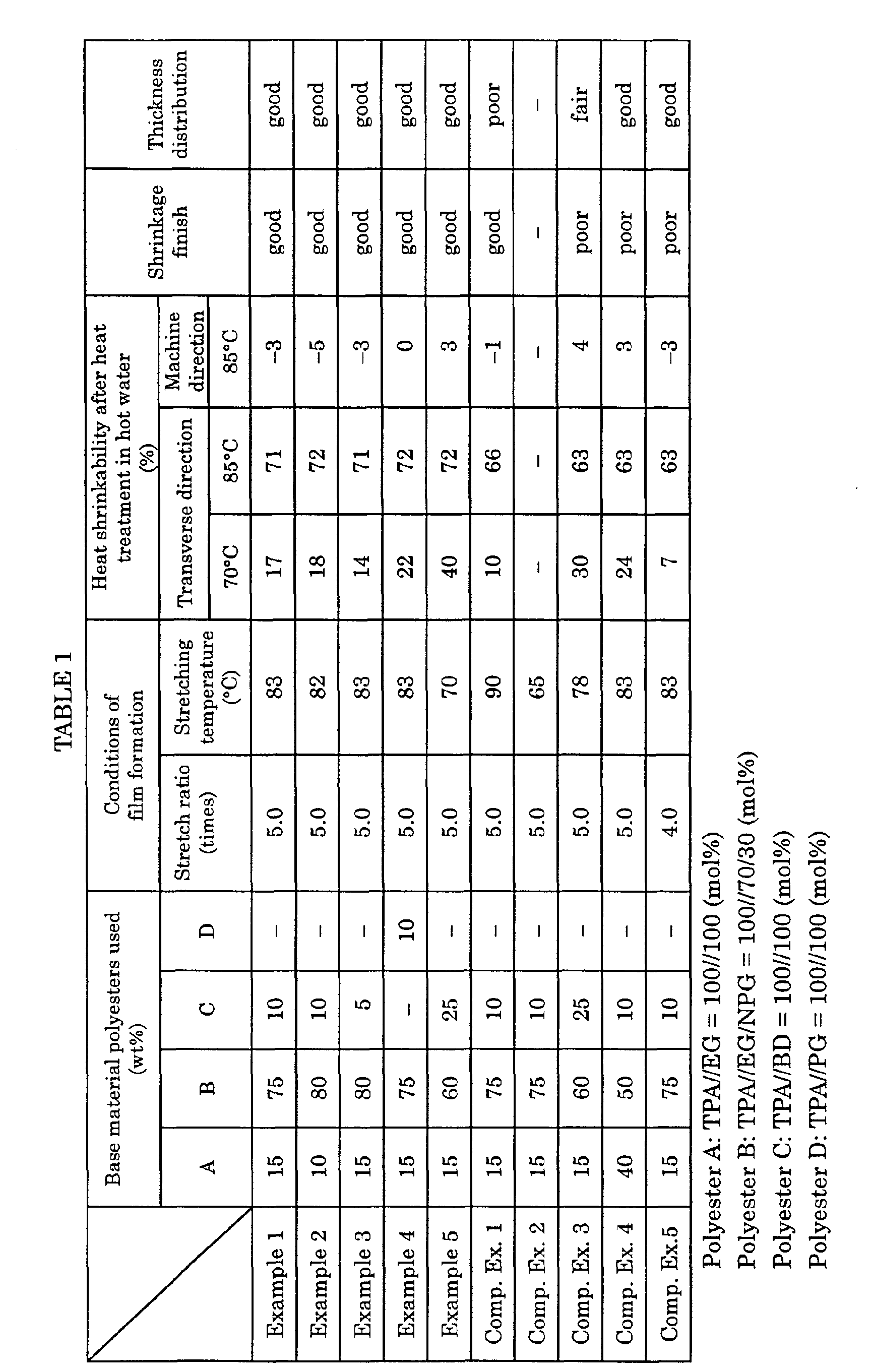
- a mixture of 10 wt% polyester A, 80 wt% polyester B, and 10 wt% polyester C was melt at 280°C and extruded from a T-die, followed by rapid cooling on chill rolls, to give an unstretched film having a Tg of 69°C.
- the unstretched film was then preheated until the film temperature came to 84°C with a heat transmission coefficient of 0.0010 cal/cm 2 ⁇ sec ⁇ °C (0.0042 J/cm 2 ⁇ sec ⁇ K) and stretched in a tenter at 82°C at a stretch ratio of 5 in the transverse direction with a heat transmission coefficient of 0.0014 cal/cm 2 ⁇ sec ⁇ °C (0.0059 J/cm 2 ⁇ sec ⁇ K) to give a heat-shrinkable polyester film of 50 ⁇ m in thickness.
- the main shrinkage direction of the film was corresponding to the transverse direction.
- a mixture of 15 wt% polyester A, 80 wt% polyester B, and 5 wt% polyester C was melt at 280°C and extruded from a T-die, followed by rapid cooling on chill rolls, to give an unstretched film having a Tg of 71°C.
- the unstretched film was treated in the same manner as described in Example 1 to give a heat-shrinkable polyester film of 50 ⁇ m in thickness.
- the unstretched film was treated in the same manner as described in Example 1 to give a heat-shrinkable polyester film of 50 ⁇ m in thickness.
- a heat-shrinkable polyester film of 50 ⁇ m in thickness was prepared in the same manner as described in Example 1, except that the stretching temperature was set at 88°C.
- a mixture of 40 wt% polyester A, 50 wt% polyester B, and 10 wt% polyester C was melt at 280°C and extruded from a T-die, followed by rapid cooling on chill rolls, to give an unstretched film having a Tg of 69°C.
- a mixture of 15 wt% polyester A, 60 wt% polyester B, and 25 wt% polyester C was melt at 280°C and extruded from a T-die, followed by rapid cooling on chill rolls, to give an unstretched film having a Tg of 62°C.
- the heat-shrinkable polyester films of Examples 1-5 had good shrinkage finish and good thickness distribution. This indicates that the heat-shrinkable thermoplastic resin films of the present invention have high quality and high practical availability, and they are particularly suitable for heat-shrinkable labels.
Landscapes
- Chemical & Material Sciences (AREA)
- Engineering & Computer Science (AREA)
- Manufacturing & Machinery (AREA)
- Materials Engineering (AREA)
- Health & Medical Sciences (AREA)
- Chemical Kinetics & Catalysis (AREA)
- Medicinal Chemistry (AREA)
- Polymers & Plastics (AREA)
- Organic Chemistry (AREA)
- Shaping By String And By Release Of Stress In Plastics And The Like (AREA)
- Manufacture Of Macromolecular Shaped Articles (AREA)
- Laminated Bodies (AREA)
Abstract
Description
Claims (2)
- A heat-shrinkable thermoplastic resin film, wherein the heat shrinkability in the main shrinkage direction of the film is 5% to 60% after treatment in hot water at 70°C for 5 seconds and 67% or higher after treatment in hot water at 85°C for 5 seconds and the heat shrinkability in a direction perpendicular to the main shrinkage direction of the film is 10% or lower after treatment in hot water at 85°C for 5 seconds.
- The heat-shrinkable thermoplastic resin film according to claim 1, wherein the thickness distribution of the film is 6% or lower.
Applications Claiming Priority (4)
| Application Number | Priority Date | Filing Date | Title |
|---|---|---|---|
| JP2000127901 | 2000-04-27 | ||
| JP2000127901 | 2000-04-27 | ||
| JP2000303936A JP4552097B2 (en) | 2000-04-27 | 2000-10-03 | Heat-shrinkable thermoplastic resin film |
| JP2000303936 | 2000-10-03 |
Publications (3)
| Publication Number | Publication Date |
|---|---|
| EP1149685A2 true EP1149685A2 (en) | 2001-10-31 |
| EP1149685A3 EP1149685A3 (en) | 2002-06-19 |
| EP1149685B1 EP1149685B1 (en) | 2007-06-13 |
Family
ID=26590990
Family Applications (1)
| Application Number | Title | Priority Date | Filing Date |
|---|---|---|---|
| EP01109712A Expired - Lifetime EP1149685B1 (en) | 2000-04-27 | 2001-04-20 | Use of heat-shrinkable thermoplastic polyester resin films |
Country Status (6)
| Country | Link |
|---|---|
| US (1) | US6548595B2 (en) |
| EP (1) | EP1149685B1 (en) |
| JP (1) | JP4552097B2 (en) |
| KR (1) | KR100780532B1 (en) |
| AT (1) | ATE364491T1 (en) |
| DE (1) | DE60128856T2 (en) |
Cited By (2)
| Publication number | Priority date | Publication date | Assignee | Title |
|---|---|---|---|---|
| WO2005037899A1 (en) | 2003-10-21 | 2005-04-28 | Toyo Boseki Kabushiki Kaisha | Heat-shrinkable polyester-based film and heat-shrinkable polyester-based film roll |
| CN101945929B (en) * | 2007-12-11 | 2014-07-16 | 可隆工业株式会社 | heat shrinkable polyester film |
Families Citing this family (14)
| Publication number | Priority date | Publication date | Assignee | Title |
|---|---|---|---|---|
| JP3767511B2 (en) * | 2001-04-26 | 2006-04-19 | 東洋紡績株式会社 | Heat-shrinkable polyester film roll |
| US20050065633A1 (en) * | 2003-11-14 | 2005-03-24 | Michael Wynblatt | Systems and methods for relative control of load motion actuators |
| US7665638B2 (en) * | 2005-10-28 | 2010-02-23 | The Sun Products Corporation | Packaged liquid laundry compositions |
| US20070095784A1 (en) | 2005-10-28 | 2007-05-03 | Conopco, Inc. | Package for liquid laundry products |
| ES2380293T3 (en) * | 2006-12-20 | 2012-05-10 | Toyo Boseki Kabushiki Kaisha | Heat shrinkable polyolefin film and process for its production |
| US20090227735A1 (en) * | 2008-03-07 | 2009-09-10 | Eastman Chemical Company | Miscible polyester blends and shrinkable films prepared therefrom |
| US10329393B2 (en) | 2012-12-12 | 2019-06-25 | Eastman Chemical Company | Copolysters plasticized with polymeric plasticizer for shrink film applications |
| US10543656B2 (en) | 2018-01-11 | 2020-01-28 | Eastman Chemical Company | Tough shrinkable films |
| WO2020076749A1 (en) | 2018-10-08 | 2020-04-16 | Eastman Chemical Company | Crystallizable shrinkable films and thermoformable sheets made from resin blends |
| TWI720461B (en) * | 2019-04-19 | 2021-03-01 | 遠東新世紀股份有限公司 | Heat-shrinkable polyester film and its manufacturing method |
| US12286516B2 (en) * | 2019-10-02 | 2025-04-29 | Toyobo Co., Ltd. | Film roll of heat-shrinkable polyester |
| KR20230009902A (en) | 2020-05-12 | 2023-01-17 | 도요보 가부시키가이샤 | Co-polyester raw material for film, heat-shrinkable polyester film, heat-shrinkable label, and package |
| JP7540493B2 (en) | 2020-08-27 | 2024-08-27 | 東洋紡株式会社 | Heat-shrinkable polyester film, heat-shrinkable label, and packaging material |
| KR20230042717A (en) | 2020-09-18 | 2023-03-29 | 다키론 씨아이 가부시키가이샤 | Polyester Shrink Film |
Family Cites Families (23)
| Publication number | Priority date | Publication date | Assignee | Title |
|---|---|---|---|---|
| JPS6291555A (en) * | 1985-10-18 | 1987-04-27 | Toyobo Co Ltd | Heat-shrinkable polyester film |
| JP2781597B2 (en) * | 1989-04-28 | 1998-07-30 | 鐘紡株式会社 | Polyester shrink film |
| JP2896578B2 (en) * | 1989-07-14 | 1999-05-31 | グンゼ株式会社 | Heat shrinkable polyester film |
| JPH0368635A (en) * | 1989-08-08 | 1991-03-25 | Mitsubishi Rayon Co Ltd | Heat-shrinkable polyester film |
| JPH0368634A (en) * | 1989-08-08 | 1991-03-25 | Mitsubishi Rayon Co Ltd | Heat-shrinkable polyester film |
| JP2629370B2 (en) * | 1989-08-29 | 1997-07-09 | 東洋紡績株式会社 | Heat shrinkable polyester film |
| JP2932596B2 (en) * | 1990-04-20 | 1999-08-09 | 東洋紡績株式会社 | Heat shrinkable polyester film |
| JPH0459333A (en) * | 1990-06-29 | 1992-02-26 | Diafoil Co Ltd | Polyester shrink film for label |
| JP3271774B2 (en) * | 1991-11-22 | 2002-04-08 | シーアイ化成株式会社 | Polyester shrink film |
| JPH07165945A (en) * | 1993-12-15 | 1995-06-27 | Mitsubishi Rayon Co Ltd | Heat shrinkable polyester film |
| JP3829353B2 (en) * | 1996-03-05 | 2006-10-04 | 東洋紡績株式会社 | Heat-shrinkable polyester film |
| JP3896604B2 (en) * | 1996-03-22 | 2007-03-22 | 東洋紡績株式会社 | Heat-shrinkable polyester film |
| US5932685A (en) | 1996-08-30 | 1999-08-03 | Toyo Boseki Kabushiki Kaisha | Heat-shrinkable polyester films |
| JP4171935B2 (en) * | 1998-01-30 | 2008-10-29 | 東洋紡績株式会社 | Heat-shrinkable polyester film |
| JP2000135737A (en) * | 1998-11-02 | 2000-05-16 | Toyobo Co Ltd | Heat-shrinkable polyester film |
| JP4267108B2 (en) * | 1998-11-02 | 2009-05-27 | 東洋紡績株式会社 | Heat-shrinkable polyester film |
| JP3941272B2 (en) * | 1998-12-02 | 2007-07-04 | 株式会社デンソー | Electric power steering control device |
| JP2000169602A (en) * | 1998-12-07 | 2000-06-20 | Toyobo Co Ltd | Heat-shrinkable polyester film |
| JP4302803B2 (en) | 1998-12-07 | 2009-07-29 | 東洋紡績株式会社 | Heat-shrinkable polyester film |
| JP2000167928A (en) * | 1998-12-07 | 2000-06-20 | Toyobo Co Ltd | Heat-shrinkable polyester film |
| KR100497872B1 (en) | 1999-01-28 | 2005-06-29 | 도요 보세키 가부시키가이샤 | Heat shrinkable polyester film |
| JP3642229B2 (en) | 1999-05-21 | 2005-04-27 | 東洋紡績株式会社 | Heat-shrinkable polyester film |
| ATE336538T1 (en) * | 2000-04-11 | 2006-09-15 | Toyo Boseki | HEAT SHRINKABLE POLYESTER FILMS |
-
2000
- 2000-10-03 JP JP2000303936A patent/JP4552097B2/en not_active Expired - Fee Related
-
2001
- 2001-04-17 US US09/835,342 patent/US6548595B2/en not_active Expired - Lifetime
- 2001-04-20 AT AT01109712T patent/ATE364491T1/en not_active IP Right Cessation
- 2001-04-20 EP EP01109712A patent/EP1149685B1/en not_active Expired - Lifetime
- 2001-04-20 DE DE60128856T patent/DE60128856T2/en not_active Expired - Lifetime
- 2001-04-24 KR KR1020010021930A patent/KR100780532B1/en not_active Expired - Fee Related
Cited By (3)
| Publication number | Priority date | Publication date | Assignee | Title |
|---|---|---|---|---|
| WO2005037899A1 (en) | 2003-10-21 | 2005-04-28 | Toyo Boseki Kabushiki Kaisha | Heat-shrinkable polyester-based film and heat-shrinkable polyester-based film roll |
| EP1681312A4 (en) * | 2003-10-21 | 2009-04-15 | Toyo Boseki | Heat-shrinkable polyester film and heat-shrinkable polyester film roll |
| CN101945929B (en) * | 2007-12-11 | 2014-07-16 | 可隆工业株式会社 | heat shrinkable polyester film |
Also Published As
| Publication number | Publication date |
|---|---|
| US20010051238A1 (en) | 2001-12-13 |
| DE60128856T2 (en) | 2008-02-21 |
| US6548595B2 (en) | 2003-04-15 |
| KR100780532B1 (en) | 2007-11-29 |
| DE60128856D1 (en) | 2007-07-26 |
| KR20010098819A (en) | 2001-11-08 |
| ATE364491T1 (en) | 2007-07-15 |
| EP1149685B1 (en) | 2007-06-13 |
| EP1149685A3 (en) | 2002-06-19 |
| JP4552097B2 (en) | 2010-09-29 |
| JP2002011790A (en) | 2002-01-15 |
Similar Documents
| Publication | Publication Date | Title |
|---|---|---|
| US6663928B2 (en) | Heat-shrinkable polyester films and labels using the same | |
| EP0751183B1 (en) | Thermo-shrinkable polyester films | |
| US6458437B1 (en) | Heat-shrinkable polyester films | |
| EP1145846B1 (en) | Heat-shrinkable polyester films | |
| EP0826482B1 (en) | Heat-shrinkable polyester films | |
| EP1149685B1 (en) | Use of heat-shrinkable thermoplastic polyester resin films | |
| EP1090739B1 (en) | Heat-shrinkable polyester films | |
| EP1264680B1 (en) | Heat-shrinkable polyester films | |
| EP1055506B1 (en) | Heat shrinkable polyester film | |
| KR20190035760A (en) | Heat-shrinkable polyester film and packaging | |
| EP1184167B1 (en) | Layered heat-shrinkable films and labels for bottles | |
| JP4267108B2 (en) | Heat-shrinkable polyester film | |
| JP2002361741A (en) | Heat-shrinkable polyester film and label | |
| JP2000135737A (en) | Heat-shrinkable polyester film | |
| JP2000167928A (en) | Heat-shrinkable polyester film | |
| JP7056322B2 (en) | Heat shrinkable polyester film | |
| JP2002046176A (en) | Heat-shrinkable polyester film | |
| JP2003266537A (en) | Heat-shrinkable polyester film and label | |
| EP1298171B1 (en) | Heat-shrinkable polyester films | |
| JP2001205703A (en) | Heat-shrinkable polyester film | |
| JP3736616B2 (en) | Heat-shrinkable polyester film | |
| JP2005022208A (en) | Heat-shrinkable polyester film and label | |
| JP4281487B2 (en) | Multilayer heat shrinkable polyester film and label | |
| JP2006181899A (en) | Multilayer heat shrinkable polyester film and label | |
| JP2005153515A (en) | Multilayer heat shrinkable polyester film and label |
Legal Events
| Date | Code | Title | Description |
|---|---|---|---|
| PUAI | Public reference made under article 153(3) epc to a published international application that has entered the european phase |
Free format text: ORIGINAL CODE: 0009012 |
|
| AK | Designated contracting states |
Kind code of ref document: A2 Designated state(s): AT BE CH CY DE DK ES FI FR GB GR IE IT LI LU MC NL PT SE TR |
|
| AX | Request for extension of the european patent |
Free format text: AL;LT;LV;MK;RO;SI |
|
| PUAL | Search report despatched |
Free format text: ORIGINAL CODE: 0009013 |
|
| AK | Designated contracting states |
Kind code of ref document: A3 Designated state(s): AT BE CH CY DE DK ES FI FR GB GR IE IT LI LU MC NL PT SE TR |
|
| AX | Request for extension of the european patent |
Free format text: AL;LT;LV;MK;RO;SI |
|
| RIC1 | Information provided on ipc code assigned before grant |
Free format text: 7B 29C 61/02 A, 7B 29C 61/06 B, 7C 08J 5/18 B |
|
| 17P | Request for examination filed |
Effective date: 20021116 |
|
| AKX | Designation fees paid |
Designated state(s): AT BE CH CY DE DK ES FI FR GB GR IE IT LI LU MC NL PT SE TR |
|
| 17Q | First examination report despatched |
Effective date: 20040212 |
|
| GRAP | Despatch of communication of intention to grant a patent |
Free format text: ORIGINAL CODE: EPIDOSNIGR1 |
|
| RTI1 | Title (correction) |
Free format text: USE OF HEAT-SHRINKABLE THERMOPLASTIC POLYESTER RESIN FILMS |
|
| GRAS | Grant fee paid |
Free format text: ORIGINAL CODE: EPIDOSNIGR3 |
|
| GRAA | (expected) grant |
Free format text: ORIGINAL CODE: 0009210 |
|
| AK | Designated contracting states |
Kind code of ref document: B1 Designated state(s): AT BE CH CY DE DK ES FI FR GB GR IE IT LI LU MC NL PT SE TR |
|
| PG25 | Lapsed in a contracting state [announced via postgrant information from national office to epo] |
Ref country code: CH Free format text: LAPSE BECAUSE OF FAILURE TO SUBMIT A TRANSLATION OF THE DESCRIPTION OR TO PAY THE FEE WITHIN THE PRESCRIBED TIME-LIMIT Effective date: 20070613 Ref country code: LI Free format text: LAPSE BECAUSE OF FAILURE TO SUBMIT A TRANSLATION OF THE DESCRIPTION OR TO PAY THE FEE WITHIN THE PRESCRIBED TIME-LIMIT Effective date: 20070613 |
|
| REG | Reference to a national code |
Ref country code: GB Ref legal event code: FG4D |
|
| REG | Reference to a national code |
Ref country code: CH Ref legal event code: EP |
|
| REG | Reference to a national code |
Ref country code: IE Ref legal event code: FG4D |
|
| REF | Corresponds to: |
Ref document number: 60128856 Country of ref document: DE Date of ref document: 20070726 Kind code of ref document: P |
|
| PG25 | Lapsed in a contracting state [announced via postgrant information from national office to epo] |
Ref country code: SE Free format text: LAPSE BECAUSE OF FAILURE TO SUBMIT A TRANSLATION OF THE DESCRIPTION OR TO PAY THE FEE WITHIN THE PRESCRIBED TIME-LIMIT Effective date: 20070913 |
|
| ET | Fr: translation filed | ||
| PG25 | Lapsed in a contracting state [announced via postgrant information from national office to epo] |
Ref country code: AT Free format text: LAPSE BECAUSE OF FAILURE TO SUBMIT A TRANSLATION OF THE DESCRIPTION OR TO PAY THE FEE WITHIN THE PRESCRIBED TIME-LIMIT Effective date: 20070613 |
|
| NLV1 | Nl: lapsed or annulled due to failure to fulfill the requirements of art. 29p and 29m of the patents act | ||
| REG | Reference to a national code |
Ref country code: CH Ref legal event code: PL |
|
| PG25 | Lapsed in a contracting state [announced via postgrant information from national office to epo] |
Ref country code: BE Free format text: LAPSE BECAUSE OF FAILURE TO SUBMIT A TRANSLATION OF THE DESCRIPTION OR TO PAY THE FEE WITHIN THE PRESCRIBED TIME-LIMIT Effective date: 20070613 |
|
| PG25 | Lapsed in a contracting state [announced via postgrant information from national office to epo] |
Ref country code: NL Free format text: LAPSE BECAUSE OF FAILURE TO SUBMIT A TRANSLATION OF THE DESCRIPTION OR TO PAY THE FEE WITHIN THE PRESCRIBED TIME-LIMIT Effective date: 20070613 Ref country code: ES Free format text: LAPSE BECAUSE OF FAILURE TO SUBMIT A TRANSLATION OF THE DESCRIPTION OR TO PAY THE FEE WITHIN THE PRESCRIBED TIME-LIMIT Effective date: 20070924 Ref country code: PT Free format text: LAPSE BECAUSE OF FAILURE TO SUBMIT A TRANSLATION OF THE DESCRIPTION OR TO PAY THE FEE WITHIN THE PRESCRIBED TIME-LIMIT Effective date: 20071113 |
|
| PLBE | No opposition filed within time limit |
Free format text: ORIGINAL CODE: 0009261 |
|
| STAA | Information on the status of an ep patent application or granted ep patent |
Free format text: STATUS: NO OPPOSITION FILED WITHIN TIME LIMIT |
|
| PG25 | Lapsed in a contracting state [announced via postgrant information from national office to epo] |
Ref country code: GR Free format text: LAPSE BECAUSE OF FAILURE TO SUBMIT A TRANSLATION OF THE DESCRIPTION OR TO PAY THE FEE WITHIN THE PRESCRIBED TIME-LIMIT Effective date: 20070914 Ref country code: IT Free format text: LAPSE BECAUSE OF FAILURE TO SUBMIT A TRANSLATION OF THE DESCRIPTION OR TO PAY THE FEE WITHIN THE PRESCRIBED TIME-LIMIT Effective date: 20070613 Ref country code: DK Free format text: LAPSE BECAUSE OF FAILURE TO SUBMIT A TRANSLATION OF THE DESCRIPTION OR TO PAY THE FEE WITHIN THE PRESCRIBED TIME-LIMIT Effective date: 20070613 |
|
| 26N | No opposition filed |
Effective date: 20080314 |
|
| PG25 | Lapsed in a contracting state [announced via postgrant information from national office to epo] |
Ref country code: MC Free format text: LAPSE BECAUSE OF NON-PAYMENT OF DUE FEES Effective date: 20080430 |
|
| PG25 | Lapsed in a contracting state [announced via postgrant information from national office to epo] |
Ref country code: FI Free format text: LAPSE BECAUSE OF FAILURE TO SUBMIT A TRANSLATION OF THE DESCRIPTION OR TO PAY THE FEE WITHIN THE PRESCRIBED TIME-LIMIT Effective date: 20070613 |
|
| PG25 | Lapsed in a contracting state [announced via postgrant information from national office to epo] |
Ref country code: IE Free format text: LAPSE BECAUSE OF NON-PAYMENT OF DUE FEES Effective date: 20080421 |
|
| PG25 | Lapsed in a contracting state [announced via postgrant information from national office to epo] |
Ref country code: CY Free format text: LAPSE BECAUSE OF FAILURE TO SUBMIT A TRANSLATION OF THE DESCRIPTION OR TO PAY THE FEE WITHIN THE PRESCRIBED TIME-LIMIT Effective date: 20070613 |
|
| PG25 | Lapsed in a contracting state [announced via postgrant information from national office to epo] |
Ref country code: TR Free format text: LAPSE BECAUSE OF FAILURE TO SUBMIT A TRANSLATION OF THE DESCRIPTION OR TO PAY THE FEE WITHIN THE PRESCRIBED TIME-LIMIT Effective date: 20070613 |
|
| REG | Reference to a national code |
Ref country code: FR Ref legal event code: PLFP Year of fee payment: 16 |
|
| REG | Reference to a national code |
Ref country code: FR Ref legal event code: PLFP Year of fee payment: 17 |
|
| PGFP | Annual fee paid to national office [announced via postgrant information from national office to epo] |
Ref country code: FR Payment date: 20170313 Year of fee payment: 17 |
|
| PGFP | Annual fee paid to national office [announced via postgrant information from national office to epo] |
Ref country code: LU Payment date: 20170410 Year of fee payment: 17 |
|
| PG25 | Lapsed in a contracting state [announced via postgrant information from national office to epo] |
Ref country code: LU Free format text: LAPSE BECAUSE OF NON-PAYMENT OF DUE FEES Effective date: 20180420 |
|
| PG25 | Lapsed in a contracting state [announced via postgrant information from national office to epo] |
Ref country code: FR Free format text: LAPSE BECAUSE OF NON-PAYMENT OF DUE FEES Effective date: 20180430 |
|
| PGFP | Annual fee paid to national office [announced via postgrant information from national office to epo] |
Ref country code: DE Payment date: 20200408 Year of fee payment: 20 |
|
| PGFP | Annual fee paid to national office [announced via postgrant information from national office to epo] |
Ref country code: GB Payment date: 20200408 Year of fee payment: 20 |
|
| REG | Reference to a national code |
Ref country code: DE Ref legal event code: R071 Ref document number: 60128856 Country of ref document: DE |
|
| REG | Reference to a national code |
Ref country code: GB Ref legal event code: PE20 Expiry date: 20210419 |
|
| PG25 | Lapsed in a contracting state [announced via postgrant information from national office to epo] |
Ref country code: GB Free format text: LAPSE BECAUSE OF EXPIRATION OF PROTECTION Effective date: 20210419 |