EP1148734A1 - Réseau, terminal d'émission et méthode de constitution d'un point d'accès dans un flux de données - Google Patents
Réseau, terminal d'émission et méthode de constitution d'un point d'accès dans un flux de données Download PDFInfo
- Publication number
- EP1148734A1 EP1148734A1 EP01201112A EP01201112A EP1148734A1 EP 1148734 A1 EP1148734 A1 EP 1148734A1 EP 01201112 A EP01201112 A EP 01201112A EP 01201112 A EP01201112 A EP 01201112A EP 1148734 A1 EP1148734 A1 EP 1148734A1
- Authority
- EP
- European Patent Office
- Prior art keywords
- data
- access points
- scene description
- description
- complete scene
- Prior art date
- Legal status (The legal status is an assumption and is not a legal conclusion. Google has not performed a legal analysis and makes no representation as to the accuracy of the status listed.)
- Withdrawn
Links
- 238000000034 method Methods 0.000 title claims description 6
- 230000004048 modification Effects 0.000 claims abstract description 22
- 238000012986 modification Methods 0.000 claims abstract description 22
- 230000005540 biological transmission Effects 0.000 claims description 20
- 230000010363 phase shift Effects 0.000 claims description 4
- 230000004907 flux Effects 0.000 description 5
- 238000010586 diagram Methods 0.000 description 3
- 238000012550 audit Methods 0.000 description 1
- 238000004590 computer program Methods 0.000 description 1
- 238000004519 manufacturing process Methods 0.000 description 1
- 230000033764 rhythmic process Effects 0.000 description 1
- 230000003068 static effect Effects 0.000 description 1
- 238000006467 substitution reaction Methods 0.000 description 1
- 230000000007 visual effect Effects 0.000 description 1
Images
Classifications
-
- H—ELECTRICITY
- H04—ELECTRIC COMMUNICATION TECHNIQUE
- H04N—PICTORIAL COMMUNICATION, e.g. TELEVISION
- H04N7/00—Television systems
- H04N7/12—Systems in which the television signal is transmitted via one channel or a plurality of parallel channels, the bandwidth of each channel being less than the bandwidth of the television signal
-
- H—ELECTRICITY
- H04—ELECTRIC COMMUNICATION TECHNIQUE
- H04N—PICTORIAL COMMUNICATION, e.g. TELEVISION
- H04N21/00—Selective content distribution, e.g. interactive television or video on demand [VOD]
- H04N21/20—Servers specifically adapted for the distribution of content, e.g. VOD servers; Operations thereof
- H04N21/23—Processing of content or additional data; Elementary server operations; Server middleware
- H04N21/234—Processing of video elementary streams, e.g. splicing of video streams or manipulating encoded video stream scene graphs
- H04N21/23412—Processing of video elementary streams, e.g. splicing of video streams or manipulating encoded video stream scene graphs for generating or manipulating the scene composition of objects, e.g. MPEG-4 objects
-
- H—ELECTRICITY
- H04—ELECTRIC COMMUNICATION TECHNIQUE
- H04N—PICTORIAL COMMUNICATION, e.g. TELEVISION
- H04N21/00—Selective content distribution, e.g. interactive television or video on demand [VOD]
- H04N21/20—Servers specifically adapted for the distribution of content, e.g. VOD servers; Operations thereof
- H04N21/23—Processing of content or additional data; Elementary server operations; Server middleware
- H04N21/234—Processing of video elementary streams, e.g. splicing of video streams or manipulating encoded video stream scene graphs
- H04N21/2343—Processing of video elementary streams, e.g. splicing of video streams or manipulating encoded video stream scene graphs involving reformatting operations of video signals for distribution or compliance with end-user requests or end-user device requirements
- H04N21/234318—Processing of video elementary streams, e.g. splicing of video streams or manipulating encoded video stream scene graphs involving reformatting operations of video signals for distribution or compliance with end-user requests or end-user device requirements by decomposing into objects, e.g. MPEG-4 objects
-
- H—ELECTRICITY
- H04—ELECTRIC COMMUNICATION TECHNIQUE
- H04N—PICTORIAL COMMUNICATION, e.g. TELEVISION
- H04N21/00—Selective content distribution, e.g. interactive television or video on demand [VOD]
- H04N21/40—Client devices specifically adapted for the reception of or interaction with content, e.g. set-top-box [STB]; Operations thereof
- H04N21/43—Processing of content or additional data, e.g. demultiplexing additional data from a digital video stream; Elementary client operations, e.g. monitoring of home network or synchronising decoder's clock; Client middleware
- H04N21/4302—Content synchronisation processes, e.g. decoder synchronisation
- H04N21/4307—Synchronising the rendering of multiple content streams or additional data on devices, e.g. synchronisation of audio on a mobile phone with the video output on the TV screen
- H04N21/43072—Synchronising the rendering of multiple content streams or additional data on devices, e.g. synchronisation of audio on a mobile phone with the video output on the TV screen of multiple content streams on the same device
-
- H—ELECTRICITY
- H04—ELECTRIC COMMUNICATION TECHNIQUE
- H04N—PICTORIAL COMMUNICATION, e.g. TELEVISION
- H04N21/00—Selective content distribution, e.g. interactive television or video on demand [VOD]
- H04N21/40—Client devices specifically adapted for the reception of or interaction with content, e.g. set-top-box [STB]; Operations thereof
- H04N21/43—Processing of content or additional data, e.g. demultiplexing additional data from a digital video stream; Elementary client operations, e.g. monitoring of home network or synchronising decoder's clock; Client middleware
- H04N21/44—Processing of video elementary streams, e.g. splicing a video clip retrieved from local storage with an incoming video stream or rendering scenes according to encoded video stream scene graphs
- H04N21/44012—Processing of video elementary streams, e.g. splicing a video clip retrieved from local storage with an incoming video stream or rendering scenes according to encoded video stream scene graphs involving rendering scenes according to scene graphs, e.g. MPEG-4 scene graphs
-
- H—ELECTRICITY
- H04—ELECTRIC COMMUNICATION TECHNIQUE
- H04N—PICTORIAL COMMUNICATION, e.g. TELEVISION
- H04N21/00—Selective content distribution, e.g. interactive television or video on demand [VOD]
- H04N21/80—Generation or processing of content or additional data by content creator independently of the distribution process; Content per se
- H04N21/83—Generation or processing of protective or descriptive data associated with content; Content structuring
- H04N21/845—Structuring of content, e.g. decomposing content into time segments
- H04N21/8455—Structuring of content, e.g. decomposing content into time segments involving pointers to the content, e.g. pointers to the I-frames of the video stream
Definitions
- the invention has important applications in the field of multi-user transmissions of multimedia data. It is for example applicable to the post-production of television, or overlaying multimedia scenes on traditional digital video for example to transmit advertising.
- the MPEG4 standard is described in particular in document ISO / IEC 14496-1 entitled “Information Technology - Very Low Bit Rate Audio-Visual Coding - part 1: systems” published by ISO in 1999.
- This standard describes means of individual coding of audio, visual or audiovisual objects, and means for composing multimedia scenes from such objects.
- Information necessary for the composition of a scene constitute the description of the scene.
- Each node of the structure corresponds to an object and contains a set of parameters, including parameters for placing the object in time and space.
- Such a tree structure is not static: the parameters of the nodes can be modified, nodes can be added, replaced, deleted.
- the MPEG-4 standard defines two types of commands relating to scene descriptions: share a scene replacement command that contains an entire scene description, and on the other hand, scene modification commands which contain modifications to bring to a scene description.
- scene replacement and modification commands scene are part of a data flow commonly called BIFS flow (from the English Binary Format For Scene).
- BIFS flow from the English Binary Format For Scene.
- the scene replacement commands are the only access points to this flow, i.e. the only points through which a user can connect to this flow.
- the invention relates to the constitution of an access point in a data flow relating to multimedia scene descriptions.
- a telecommunications network is characterized in that said transmission terminal comprises a memory for storage for storing data encoded at a given time, relating to a description of a complete scene, the stored data being intended to be used by one or more subsequent moments to constitute one or more access points.
- a terminal according to the invention and as described in the introductory paragraph is characterized by what it has a storage memory to store data encoded at a time given, relating to a description of a complete scene, the stored data being intended for be used at one or more subsequent moments to constitute one or more access points.
- a method according to the invention is characterized in that it comprises a step of storing data encoded at a given instant, relating to a description of complete scene, the stored data being intended to be used at one or more times later to constitute one or more access points.
- a signal according to the invention and as described in the introductory paragraph is characterized in that at least several successive access points are constituted by the same description full scene.
- encoded data relating to the description is stored of a complete scene, and these encoded data are then reused to constitute the The following access points to the data flow. This avoids having to re-encode a scene, each time you want to transmit an access point.
- the access points are introduced into the data flow at the rate of a replacement clock, and the data flow includes data relating to modifications to be made to a complete scene which are introduced in the flow at the rate of a modification clock having a non-zero phase shift with the clock of substitution.
- access points are transmitted every i seconds from an initial time t 0 , and data relating to scene modifications every j milliseconds from time t 1 offset by k milliseconds relative to at t 0 (with k ⁇ j).
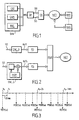
- FIG. 1 shows an example of a network according to the invention.
- This network includes a source of audio and / or video objects, DIN, which is connected to a TX transmission terminal via a OP operator station, a NET transmission medium and a plurality of reception terminals RX1, ..., RXN.
- the source of DIN objects includes, for example, a CAT catalog which contains predefined objects, a CAM camera that produces video images, and a REC tape recorder that produces audio data.
- An operator installed at the operator station OP selects objects from the data provided by the DIN source, and positions the selected objects in a scene. For this purpose, the video images produced by the CAM camera and the audio data produced by the REC tape recorder are treated as objects.
- the operator station OP delivers two data flow: a flow SO of audio / video objects, and a flow SS of scene description. These flows are transmitted to the TX transmission terminal.
- the TX transmission terminal includes in particular an encoder of ENC-O audio / video objects to encode the SO stream of audio / video objects, and an encoder of ENC-S scene description to encode the SS scene description stream.
- Object encoder audio / video ENC-O delivers AVO encoded data which is transmitted to a first device FO formatting.
- ENC-S Scene Description Encoder Delivers Data in Format BIFS, including DES scene descriptions and MOD scene modifications, which are transmitted to a second formatting device FS.
- the FS formatting device delivers AU data units which notably contain BIFS command frames (command REP scene replacement or MOD scene modification command).
- a MUX multiplexer allows multiplexing of formatted data from two devices FO and FS formatting. Multiplexed data is transmitted through the media of NET transmission.
- the TX terminal starts by sending a full scene description, and then it sends out modifications to be made to the scene that has been described.
- Reception terminals RX1 to RXN may connect to the network at any instant to receive the data transmitted by the TX transmission terminal. When they connect, they need a full scene description to be able to understand the modifications transmitted. This complete scene description is called a stream access point. BIFS. To allow reception terminals to connect at any time, the TX transmission terminal regularly transmits a complete scene description, in a scene replacement command.
- the ENC-S encoder comprises a coding block proper COD, a MEM memory which makes it possible to store the encoded data relating to a description complete of scene, and a switching block X to connect the input of the second device FS formatting, either with the output of the coding block COD, or with the output of the memory MEM.
- the encoded data is stored in MEM memory. And the access points to the BIFS stream are then trained with the encoded data that is stored in memory.
- the complete scene description which is used to constitute the access points to the BIFS stream is renewed from time to time, at the rate of a renewal clock H RNW .
- FIG. 3 shows a time diagram which indicates the different instants of transmission in the case where the transmission terminal transmits scene replacement REP commands every 2 s from an initial instant t 0 , and MOD commands to modify the scene every 40ms from time t 1 offset by 20ms from t 0 .
- the complete scene description which is used to constitute the access points to the BIFS stream is renewed every minute, so that all the commands transmitted in the time interval [t 0 ; t 0 + 1mn [relate to the same scene description S 0 , and all the commands transmitted in the time interval [t 0 + 1mn; t 0 + 2mn [relate to another scene description S 1 .
- the devices described in FIG. 2 are produced in the form of a dedicated processor managed by one or more computer programs.
- the invention has been described in the context of the BIFS scene description format described in the MPEG4 standard. This is not restrictive: it is applicable to other formats of description of scenes.
Landscapes
- Engineering & Computer Science (AREA)
- Multimedia (AREA)
- Signal Processing (AREA)
- Compression Or Coding Systems Of Tv Signals (AREA)
- Two-Way Televisions, Distribution Of Moving Picture Or The Like (AREA)
- Television Signal Processing For Recording (AREA)
- Compression, Expansion, Code Conversion, And Decoders (AREA)
Abstract
Description
- un terminal d'émission comportant un codeur de descriptions de scènes multimédia pour délivrer un flux de données qui comporte des points d'accès constitués par des données encodées relatives à une description de scène complète,
- et un terminal de réception susceptible de se connecter à un instant quelconque audit terminal d'émission pour recevoir ledit flux de données.
- un terminal comportant un codeur de descriptions de scènes multimédia pour délivrer un flux de données qui comporte des points d'accès constitués par des données encodées relatives à une description de scène complète;
- une méthode de constitution d'un point d'accès dans un flux de données, lesdits points d'accès étant constitués par des données encodées relatives à une description de scène complète;
- et un signal véhiculant un flux de données qui comporte des points d'accès constitués par des données encodées relatives à une description de scène complète.
- la figure 1 représente un exemple de réseau selon l'invention,
- la figure 2 représente un schéma en bloc d'un terminal d'émission selon l'invention,
- la figure 3 est un diagramme de temps indiquant les instants auxquels sont transmis les points d'accès et les données relatives aux modifications de scène, ainsi que les descriptions de scènes complètes auxquelles ces modifications se rapportent.
- des commandes REP de remplacement de scène contenant une description complète d'une scène initiale, au rythme d'une horloge de remplacement HREP,
- et des commandes MOD de modification de la scène initiale, au rythme d'une horloge de modification HMOD qui présente un déphasage non nul avec l'horloge de remplacement.
Claims (9)
- Réseau de télécommunications comportant au moins :caractérisé en ce que ledit terminal d'émission comporte une mémoire de stockage pour stocker des données encodées à un instant donné, relatives à une description d'une scène complète, les données stockées étant destinées à être utilisées à un ou plusieurs instants ultérieurs pour constituer un ou plusieurs points d'accès.un terminal d'émission comportant un codeur de descriptions de scènes multimédia pour délivrer un flux de données qui comporte des points d'accès constitués par des données encodées relatives à une description de scène complète,et un terminal de réception susceptible de se connecter à un instant quelconque audit terminal d'émission pour recevoir ledit flux de données,
- Terminal comportant un codeur de descriptions de scènes multimédia pour délivrer un flux de données qui comporte des points d'accès constitués par des données encodées relatives à une description de scène complète,
caractérisé en ce qu'il comporte une mémoire de stockage pour stocker des données encodées à un instant donné, relatives à une description d'une scène complète, les données stockées étant destinées à être utilisées à un ou plusieurs instants ultérieurs pour constituer un ou plusieurs points d'accès. - Terminal selon la revendication 2, caractérisé en ce que les points d'accès sont introduits dans le flux de données au rythme d'une horloge de remplacement, et en ce que le flux de données comporte des données relatives à des modifications à apporter à une scène complète qui sont introduites dans le flux au rythme d'une horloge de modification présentant un déphasage non nul avec l'horloge de remplacement.
- Terminal selon la revendication 2, caractérisé en ce que la description de scène complète pour laquelle des données encodées sont stockées dans ladite mémoire, est renouvelée au rythme d'une horloge de renouvellement.
- Méthode de constitution d'un point d'accès dans un flux de données, lesdits points d'accès étant constitués par des données encodées relatives à une description de scène complète,
caractérisée en ce qu'elle comporte une étape de stockage de données encodées à un instant donné, relatives à une ou plusieurs descriptions de scène complète, les données stockées étant destinées à être utilisées à un ou plusieurs instants ultérieurs pour constituer un ou plusieurs points d'accès. - Méthode selon la revendication 6 de constitution d'un point d'accès dans un flux de données, caractérisée en ce que les points d'accès sont introduits dans le flux de données au rythme d'une horloge de remplacement, et en ce que le flux de données comporte des données relatives à des modifications à apporter à une scène complète qui sont introduites dans le flux au rythme d'une horloge de modification présentant un déphasage non nul avec l'horloge de remplacement.
- Méthode selon la revendication 6 de constitution d'un point d'accès dans un flux de données, caractérisée en ce que la description de scène complète pour laquelle des données sont stockées est renouvelée au rythme d'une horloge de renouvellement.
- Signal véhiculant un flux de données qui comporte des points d'accès constitués par des données encodées relatives à une description de scène complète, caractérisé en ce qu'au moins plusieurs points d'accès successifs sont constitués par une même description de scène complète.
- Signal selon la revendication 8, caractérisé en ce que la description de scène complète qui est contenue dans les points d'accès change au rythme d'une horloge de renouvellement.
Applications Claiming Priority (2)
| Application Number | Priority Date | Filing Date | Title |
|---|---|---|---|
| FR0004288A FR2807268A1 (fr) | 2000-04-04 | 2000-04-04 | Reseau, terminal d'emission et methode de constitution d'un point d'acces dans un flux de donnees |
| FR0004288 | 2000-04-04 |
Publications (1)
| Publication Number | Publication Date |
|---|---|
| EP1148734A1 true EP1148734A1 (fr) | 2001-10-24 |
Family
ID=8848851
Family Applications (1)
| Application Number | Title | Priority Date | Filing Date |
|---|---|---|---|
| EP01201112A Withdrawn EP1148734A1 (fr) | 2000-04-04 | 2001-03-26 | Réseau, terminal d'émission et méthode de constitution d'un point d'accès dans un flux de données |
Country Status (6)
| Country | Link |
|---|---|
| US (1) | US20020059572A1 (fr) |
| EP (1) | EP1148734A1 (fr) |
| JP (1) | JP2001359046A (fr) |
| KR (1) | KR20010095307A (fr) |
| CN (1) | CN1190947C (fr) |
| FR (1) | FR2807268A1 (fr) |
Families Citing this family (3)
| Publication number | Priority date | Publication date | Assignee | Title |
|---|---|---|---|---|
| US20060165374A1 (en) * | 2003-07-14 | 2006-07-27 | Newton Philip S | Method and apparatus for recording a signal |
| CN101425863B (zh) * | 2007-10-30 | 2011-03-23 | 中兴通讯股份有限公司 | 一种支持富媒体业务的移动终端 |
| CN101252597B (zh) * | 2008-04-03 | 2010-07-14 | 电子科技大学 | 一种缩短富媒体场景呈现等待时间的方法 |
Citations (4)
| Publication number | Priority date | Publication date | Assignee | Title |
|---|---|---|---|---|
| US5608450A (en) * | 1994-09-07 | 1997-03-04 | Intel Corporation | Video conferencing system with fast packet loss recovery |
| EP0851685A2 (fr) * | 1996-12-27 | 1998-07-01 | Oki Electric Industry Co., Ltd. | Codeur, décodeur et système de transmission pour des données vidéo |
| EP0969668A2 (fr) * | 1998-06-29 | 2000-01-05 | Canon Kabushiki Kaisha | Protection du droit d'auteur pour des données d'image en mouvement |
| WO2000011847A1 (fr) * | 1998-08-24 | 2000-03-02 | Koninklijke Philips Electronics N.V. | Emulation de la circulation de donnees sur le reseau internet dans une application de diffusion |
Family Cites Families (13)
| Publication number | Priority date | Publication date | Assignee | Title |
|---|---|---|---|---|
| JPH08115312A (ja) * | 1994-10-14 | 1996-05-07 | Fuji Xerox Co Ltd | マルチメディア文書再生装置、マルチメディア文書編集装置およびマルチメディア文書編集再生装置 |
| JP2781738B2 (ja) * | 1995-03-29 | 1998-07-30 | 日本電気ホームエレクトロニクス株式会社 | プレゼンテーションシステム |
| US6026232A (en) * | 1995-07-13 | 2000-02-15 | Kabushiki Kaisha Toshiba | Method and system to replace sections of an encoded video bitstream |
| JP4726097B2 (ja) * | 1997-04-07 | 2011-07-20 | エイ・ティ・アンド・ティ・コーポレーション | 適応制御を行うことができるmpegコード化オーディオ・ビジュアル対象物をインターフェースで連結するためのシステムおよび方法 |
| US6801575B1 (en) * | 1997-06-09 | 2004-10-05 | Sharp Laboratories Of America, Inc. | Audio/video system with auxiliary data |
| FR2765983B1 (fr) * | 1997-07-11 | 2004-12-03 | France Telecom | Signal de donnees de modification d'une scene graphique, procede et dispositif correspondants |
| AU761202B2 (en) * | 1997-09-22 | 2003-05-29 | Sony Corporation | Generation of a bit stream containing binary image/audio data that is multiplexed with a code defining an object in ascii format |
| US6654931B1 (en) * | 1998-01-27 | 2003-11-25 | At&T Corp. | Systems and methods for playing, browsing and interacting with MPEG-4 coded audio-visual objects |
| US6766355B2 (en) * | 1998-06-29 | 2004-07-20 | Sony Corporation | Method and apparatus for implementing multi-user grouping nodes in a multimedia player |
| JP2000020742A (ja) * | 1998-06-30 | 2000-01-21 | Toshiba Corp | 映像再生装置及び映像再生方法、並びに記録媒体 |
| JP4109772B2 (ja) * | 1998-12-03 | 2008-07-02 | キヤノン株式会社 | データ処理方法及びその装置 |
| US6792047B1 (en) * | 2000-01-04 | 2004-09-14 | Emc Corporation | Real time processing and streaming of spliced encoded MPEG video and associated audio |
| US6678332B1 (en) * | 2000-01-04 | 2004-01-13 | Emc Corporation | Seamless splicing of encoded MPEG video and audio |
-
2000
- 2000-04-04 FR FR0004288A patent/FR2807268A1/fr active Pending
-
2001
- 2001-03-26 EP EP01201112A patent/EP1148734A1/fr not_active Withdrawn
- 2001-03-29 US US09/821,129 patent/US20020059572A1/en not_active Abandoned
- 2001-03-31 CN CNB011178345A patent/CN1190947C/zh not_active Expired - Fee Related
- 2001-04-02 JP JP2001103606A patent/JP2001359046A/ja active Pending
- 2001-04-04 KR KR1020010017879A patent/KR20010095307A/ko not_active Ceased
Patent Citations (4)
| Publication number | Priority date | Publication date | Assignee | Title |
|---|---|---|---|---|
| US5608450A (en) * | 1994-09-07 | 1997-03-04 | Intel Corporation | Video conferencing system with fast packet loss recovery |
| EP0851685A2 (fr) * | 1996-12-27 | 1998-07-01 | Oki Electric Industry Co., Ltd. | Codeur, décodeur et système de transmission pour des données vidéo |
| EP0969668A2 (fr) * | 1998-06-29 | 2000-01-05 | Canon Kabushiki Kaisha | Protection du droit d'auteur pour des données d'image en mouvement |
| WO2000011847A1 (fr) * | 1998-08-24 | 2000-03-02 | Koninklijke Philips Electronics N.V. | Emulation de la circulation de donnees sur le reseau internet dans une application de diffusion |
Non-Patent Citations (3)
| Title |
|---|
| A PURI ET AL: "MPEG-4: An object-based multimedia coding standard supporting mobile applications", MOBILE NETWORKS AND APPLICATIONS,BALTZER SCIENCE PUBLISHERS, BUSSUM,NL, NR. 3, PAGE(S) 5-32, ISSN: 1383-469X, XP002150680 * |
| ALEXANDROS ELEFTHERIADIS, CARSTEN HERPEL, GANESH RAJAN, LIAM WARD: "ISO/IEC 14496-1 JTC1/SC29/WG11 N2201 - CODING OF MOVING PICTURES AND AUDIO", FINAL COMMITTEE DRAFT OF INTERNATIONAL STANDARD - PART 1 : SYTEMS - ISO/IEC 14496-1, 15 May 1998 (1998-05-15), XP002133316 * |
| SIGNES J ET AL: "MPEG-4's binary format for scene description", XP002133302 * |
Also Published As
| Publication number | Publication date |
|---|---|
| CN1317909A (zh) | 2001-10-17 |
| US20020059572A1 (en) | 2002-05-16 |
| CN1190947C (zh) | 2005-02-23 |
| JP2001359046A (ja) | 2001-12-26 |
| FR2807268A1 (fr) | 2001-10-05 |
| KR20010095307A (ko) | 2001-11-03 |
Similar Documents
| Publication | Publication Date | Title |
|---|---|---|
| CN112752115B (zh) | 直播数据传输方法、装置、设备及介质 | |
| US7555715B2 (en) | Methods and systems for use in maintaining media data quality upon conversion to a different data format | |
| US8055783B2 (en) | Systems and methods for media stream processing | |
| EP2015587B1 (fr) | Procédé de mémorisation d'un objet multimédia, structure de donnée et terminal associé | |
| FR2874472A1 (fr) | Procede, article de fabrication et dispositif destines a mettre a jour un logiciel dans un dispositif individuel | |
| CN103974147A (zh) | 一种基于mpeg-dash协议的带有码率切换控制和静态摘要技术的在线视频播控系统 | |
| CA2615100C (fr) | Procede et systeme d'edition numerique a distance a l'aide de voies a bande etroite | |
| WO1999019864A2 (fr) | Systeme et procede ameliores de traitement d'informations audiovisuelles orientees objet | |
| CN113645485A (zh) | 一种实现任意流媒体协议到ndi的转换方法及装置 | |
| EP1483915B1 (fr) | Procede de transmission de flux de donnees dependants | |
| EP1148734A1 (fr) | Réseau, terminal d'émission et méthode de constitution d'un point d'accès dans un flux de données | |
| EP1302078B1 (fr) | Procede et dispositif de codage d'un flux d'images video | |
| KR101295377B1 (ko) | 파일 포맷을 구성하는 방법과 상기 파일 포맷을 가지는파일을 포함한 방송 신호를 처리하는 장치 및 방법 | |
| FR2827447A1 (fr) | Procede de transmission de flux de donnees, flux de donnees, serveur, terminal, procede de reception et utilisation correspondants | |
| KR100932055B1 (ko) | 단말에서 재생 불가한 미디어 제공 시스템 및 방법, 그리고이에 적용되는 서버 | |
| Curran et al. | Transcoding media for bandwidth constrained mobile devices | |
| US20030083864A1 (en) | File creating method and data reproduction method | |
| US20010051950A1 (en) | System and method for processing object-based audiovisual information | |
| Chiariglione | Open source in MPEG | |
| KR101656102B1 (ko) | 컨텐츠 파일 생성/제공 장치 및 방법 | |
| Holtz et al. | The Emerging Autosophy Internet | |
| WO2025061714A1 (fr) | Format optimisé de transport de données audio d'une session de communication en voix sur ip | |
| EP1383336A2 (fr) | Procédé de décompression et de restitution d'un flux de données multimédia numériques compressées comprenant une pluralité d'entités encodées. Dispositif, système et signal correspondants | |
| WO2025152050A1 (fr) | Procédé d'encapsulation de données et dispositif électronique | |
| EP2451163B1 (fr) | Procédé de mémorisation d'un objet multimédia, structure de donnée et terminal associé |
Legal Events
| Date | Code | Title | Description |
|---|---|---|---|
| PUAI | Public reference made under article 153(3) epc to a published international application that has entered the european phase |
Free format text: ORIGINAL CODE: 0009012 |
|
| AK | Designated contracting states |
Kind code of ref document: A1 Designated state(s): DE ES FR GB IT Kind code of ref document: A1 Designated state(s): AT BE CH CY DE DK ES FI FR GB GR IE IT LI LU MC NL PT SE TR |
|
| AX | Request for extension of the european patent |
Free format text: AL;LT;LV;MK;RO;SI |
|
| 17P | Request for examination filed |
Effective date: 20020424 |
|
| AKX | Designation fees paid |
Free format text: DE ES FR GB IT |
|
| STAA | Information on the status of an ep patent application or granted ep patent |
Free format text: STATUS: THE APPLICATION IS DEEMED TO BE WITHDRAWN |
|
| 18D | Application deemed to be withdrawn |
Effective date: 20081001 |