EP1147990A2 - Bottle of thermoplastic material and method for the manufacture and filing of same - Google Patents
Bottle of thermoplastic material and method for the manufacture and filing of same Download PDFInfo
- Publication number
- EP1147990A2 EP1147990A2 EP01500075A EP01500075A EP1147990A2 EP 1147990 A2 EP1147990 A2 EP 1147990A2 EP 01500075 A EP01500075 A EP 01500075A EP 01500075 A EP01500075 A EP 01500075A EP 1147990 A2 EP1147990 A2 EP 1147990A2
- Authority
- EP
- European Patent Office
- Prior art keywords
- bottle
- bottles
- accordance
- bottom part
- cap
- Prior art date
- Legal status (The legal status is an assumption and is not a legal conclusion. Google has not performed a legal analysis and makes no representation as to the accuracy of the status listed.)
- Withdrawn
Links
- 239000012815 thermoplastic material Substances 0.000 title claims abstract description 35
- 238000000034 method Methods 0.000 title claims abstract description 33
- 238000004519 manufacturing process Methods 0.000 title claims description 15
- 230000003313 weakening effect Effects 0.000 claims abstract description 32
- 239000000463 material Substances 0.000 claims abstract description 18
- 239000003292 glue Substances 0.000 claims abstract description 16
- 239000000853 adhesive Substances 0.000 claims abstract description 14
- 230000001070 adhesive effect Effects 0.000 claims abstract description 14
- 238000011049 filling Methods 0.000 claims abstract description 12
- 238000003856 thermoforming Methods 0.000 claims abstract description 6
- 238000010438 heat treatment Methods 0.000 claims abstract description 5
- 238000007789 sealing Methods 0.000 claims description 35
- 238000005520 cutting process Methods 0.000 claims description 19
- 210000003739 neck Anatomy 0.000 claims description 15
- 230000014759 maintenance of location Effects 0.000 claims description 6
- 239000004033 plastic Substances 0.000 claims description 6
- 230000000694 effects Effects 0.000 claims description 4
- 230000036961 partial effect Effects 0.000 claims description 4
- 230000000295 complement effect Effects 0.000 claims description 3
- 239000000470 constituent Substances 0.000 claims description 3
- 239000002648 laminated material Substances 0.000 claims description 2
- 238000000465 moulding Methods 0.000 claims description 2
- 229920001169 thermoplastic Polymers 0.000 abstract description 3
- 239000004416 thermosoftening plastic Substances 0.000 abstract description 3
- 230000015572 biosynthetic process Effects 0.000 description 5
- 206010003504 Aspiration Diseases 0.000 description 2
- 238000004500 asepsis Methods 0.000 description 2
- 238000000071 blow moulding Methods 0.000 description 2
- 238000007664 blowing Methods 0.000 description 2
- 238000005304 joining Methods 0.000 description 2
- 238000004080 punching Methods 0.000 description 2
- 238000010923 batch production Methods 0.000 description 1
- 238000011437 continuous method Methods 0.000 description 1
- 238000010924 continuous production Methods 0.000 description 1
- 235000013365 dairy product Nutrition 0.000 description 1
- 238000001125 extrusion Methods 0.000 description 1
- 235000013305 food Nutrition 0.000 description 1
- 235000015203 fruit juice Nutrition 0.000 description 1
- 238000003780 insertion Methods 0.000 description 1
- 230000037431 insertion Effects 0.000 description 1
- 230000000670 limiting effect Effects 0.000 description 1
- 235000013336 milk Nutrition 0.000 description 1
- 239000008267 milk Substances 0.000 description 1
- 210000004080 milk Anatomy 0.000 description 1
- 230000001681 protective effect Effects 0.000 description 1
- 230000002829 reductive effect Effects 0.000 description 1
- 238000000926 separation method Methods 0.000 description 1
- 239000002699 waste material Substances 0.000 description 1
- 235000008924 yoghurt drink Nutrition 0.000 description 1
Images




Classifications
-
- B—PERFORMING OPERATIONS; TRANSPORTING
- B65—CONVEYING; PACKING; STORING; HANDLING THIN OR FILAMENTARY MATERIAL
- B65D—CONTAINERS FOR STORAGE OR TRANSPORT OF ARTICLES OR MATERIALS, e.g. BAGS, BARRELS, BOTTLES, BOXES, CANS, CARTONS, CRATES, DRUMS, JARS, TANKS, HOPPERS, FORWARDING CONTAINERS; ACCESSORIES, CLOSURES, OR FITTINGS THEREFOR; PACKAGING ELEMENTS; PACKAGES
- B65D51/00—Closures not otherwise provided for
- B65D51/18—Arrangements of closures with protective outer cap-like covers or of two or more co-operating closures
- B65D51/20—Caps, lids, or covers co-operating with an inner closure arranged to be opened by piercing, cutting, or tearing
- B65D51/22—Caps, lids, or covers co-operating with an inner closure arranged to be opened by piercing, cutting, or tearing having means for piercing, cutting, or tearing the inner closure
- B65D51/228—Caps, lids, or covers co-operating with an inner closure arranged to be opened by piercing, cutting, or tearing having means for piercing, cutting, or tearing the inner closure a major part of the inner closure being removed from the container after the opening
-
- B—PERFORMING OPERATIONS; TRANSPORTING
- B65—CONVEYING; PACKING; STORING; HANDLING THIN OR FILAMENTARY MATERIAL
- B65D—CONTAINERS FOR STORAGE OR TRANSPORT OF ARTICLES OR MATERIALS, e.g. BAGS, BARRELS, BOTTLES, BOXES, CANS, CARTONS, CRATES, DRUMS, JARS, TANKS, HOPPERS, FORWARDING CONTAINERS; ACCESSORIES, CLOSURES, OR FITTINGS THEREFOR; PACKAGING ELEMENTS; PACKAGES
- B65D1/00—Rigid or semi-rigid containers having bodies formed in one piece, e.g. by casting metallic material, by moulding plastics, by blowing vitreous material, by throwing ceramic material, by moulding pulped fibrous material or by deep-drawing operations performed on sheet material
- B65D1/02—Bottles or similar containers with necks or like restricted apertures, designed for pouring contents
- B65D1/0223—Bottles or similar containers with necks or like restricted apertures, designed for pouring contents characterised by shape
- B65D1/023—Neck construction
- B65D1/0238—Integral frangible closures
-
- B—PERFORMING OPERATIONS; TRANSPORTING
- B65—CONVEYING; PACKING; STORING; HANDLING THIN OR FILAMENTARY MATERIAL
- B65D—CONTAINERS FOR STORAGE OR TRANSPORT OF ARTICLES OR MATERIALS, e.g. BAGS, BARRELS, BOTTLES, BOXES, CANS, CARTONS, CRATES, DRUMS, JARS, TANKS, HOPPERS, FORWARDING CONTAINERS; ACCESSORIES, CLOSURES, OR FITTINGS THEREFOR; PACKAGING ELEMENTS; PACKAGES
- B65D11/00—Containers having bodies formed by interconnecting or uniting two or more rigid, or substantially rigid, components made wholly or mainly of plastics material
- B65D11/02—Containers having bodies formed by interconnecting or uniting two or more rigid, or substantially rigid, components made wholly or mainly of plastics material of curved cross-section
- B65D11/04—Bottles or similar containers with necks or like restricted apertures designed for pouring contents
-
- B—PERFORMING OPERATIONS; TRANSPORTING
- B65—CONVEYING; PACKING; STORING; HANDLING THIN OR FILAMENTARY MATERIAL
- B65D—CONTAINERS FOR STORAGE OR TRANSPORT OF ARTICLES OR MATERIALS, e.g. BAGS, BARRELS, BOTTLES, BOXES, CANS, CARTONS, CRATES, DRUMS, JARS, TANKS, HOPPERS, FORWARDING CONTAINERS; ACCESSORIES, CLOSURES, OR FITTINGS THEREFOR; PACKAGING ELEMENTS; PACKAGES
- B65D17/00—Rigid or semi-rigid containers specially constructed to be opened by cutting or piercing, or by tearing of frangible members or portions
- B65D17/06—Integral, or permanently secured, end or side closures
-
- B—PERFORMING OPERATIONS; TRANSPORTING
- B65—CONVEYING; PACKING; STORING; HANDLING THIN OR FILAMENTARY MATERIAL
- B65D—CONTAINERS FOR STORAGE OR TRANSPORT OF ARTICLES OR MATERIALS, e.g. BAGS, BARRELS, BOTTLES, BOXES, CANS, CARTONS, CRATES, DRUMS, JARS, TANKS, HOPPERS, FORWARDING CONTAINERS; ACCESSORIES, CLOSURES, OR FITTINGS THEREFOR; PACKAGING ELEMENTS; PACKAGES
- B65D41/00—Caps, e.g. crown caps or crown seals, i.e. members having parts arranged for engagement with the external periphery of a neck or wall defining a pouring opening or discharge aperture; Protective cap-like covers for closure members, e.g. decorative covers of metal foil or paper
- B65D41/02—Caps or cap-like covers without lines of weakness, tearing strips, tags, or like opening or removal devices
- B65D41/04—Threaded or like caps or cap-like covers secured by rotation
- B65D41/0435—Threaded or like caps or cap-like covers secured by rotation with separate sealing elements
-
- B—PERFORMING OPERATIONS; TRANSPORTING
- B65—CONVEYING; PACKING; STORING; HANDLING THIN OR FILAMENTARY MATERIAL
- B65D—CONTAINERS FOR STORAGE OR TRANSPORT OF ARTICLES OR MATERIALS, e.g. BAGS, BARRELS, BOTTLES, BOXES, CANS, CARTONS, CRATES, DRUMS, JARS, TANKS, HOPPERS, FORWARDING CONTAINERS; ACCESSORIES, CLOSURES, OR FITTINGS THEREFOR; PACKAGING ELEMENTS; PACKAGES
- B65D2251/00—Details relating to container closures
- B65D2251/0003—Two or more closures
- B65D2251/0006—Upper closure
- B65D2251/0015—Upper closure of the 41-type
-
- B—PERFORMING OPERATIONS; TRANSPORTING
- B65—CONVEYING; PACKING; STORING; HANDLING THIN OR FILAMENTARY MATERIAL
- B65D—CONTAINERS FOR STORAGE OR TRANSPORT OF ARTICLES OR MATERIALS, e.g. BAGS, BARRELS, BOTTLES, BOXES, CANS, CARTONS, CRATES, DRUMS, JARS, TANKS, HOPPERS, FORWARDING CONTAINERS; ACCESSORIES, CLOSURES, OR FITTINGS THEREFOR; PACKAGING ELEMENTS; PACKAGES
- B65D2251/00—Details relating to container closures
- B65D2251/0003—Two or more closures
- B65D2251/0068—Lower closure
- B65D2251/0071—Lower closure of the 17-type
Definitions
- the present invention refers to a thermoplastic bottle of the type comprising a main body, which is essentially prismatic and moulded in a single-piece, a bottom part or base, and a mouth, as well as a method for the manufacture and filling of same.
- the invention refers to groupings of the previous bottles and to the methods of obtaining such groupings.
- thermoplastic bottle embodiments which consist of a main body which is essentially prismatic and moulded in a single-piece, a bottom part or base and a mouth.
- these bottles are manufactured conventionally by means of blow moulding methods of a preform formed from extruded grains of a thermoplastic material, conforming the main body of the bottle into a single-piece, with its mouth open by which the bottle is filled in its right-hand position and once the same has been conformed, with the product to be contained therein.
- the mouth is covered with a cap or complex laminate metalized plastic top, which is joined to the annular edge of the mouth by adhesive or, alternatively, with a screw-on-cap, possibly provided with a hermetic protective seal.
- the production of the full and closed definitive container is done according to a discontinuous batch production process, which consists of the extrusion, heating, blow moulding, filling and closing stages. These stages are carried out at different facilities which can be located in remote places, or even in very far-off production plants.
- the transportation of the bottles from one facility or location to another requires very strict hygienic measures to be adopted, which do not always guarantee the total asepsis of the materials and of the products and which are very costly, raising problems of a logistical nature.
- thermoforming technique which up to the present time, is unknown in the field of the manufacturing technique of bottles of this type.
- the object of the present invention is a new bottle of thermoplastic material, of the type mentioned, which essentially is characterized in that it comprises a hermetically sealing portion for the mouth, moulded together with the bottle body forming with the latter a single-piece, said sealing portion being delimited by a weakening of the material which constitutes the bottle, adjacent to the periphery of the mouth and the bottom part or base being constituted by a sheet of thermoplastic material integrally joined by thermowelding to the lower part of the bottle body walls, after the bottle has been filled with the product to be contained therein, all of it adapted so that upon exerting a pulling or pushing force on the sealing portion which is greater than a minimum predetermined effort, the weakening is liable to breaking, either completely or partly, in order to separate the mouth sealing portion, with the aim of achieving the opening of the mouth.
- the top is stuck by its inner face to the outer face of the sealing portion by an adhesive or glue, in such a way that, on unscrewing the top, the breaking of the annular weakening takes place.
- the bottle comprises a cap constituted by a laminate material, joined to the outer face of the sealing portion by an adhesive or glue, in such a way that on pulling the cap manually the complete or partial breaking of the weakening takes place.
- the weakening has an open arch shape and the cap comprises a pulling and retention tab, in such a way that, once the bottle has been opened by breaking the weakening, the bottle can be closed again by reversion of the opening movement of the closing part so that the cap covers the formed mouth.
- the present invention also has as an object a grouping of bottles of thermoplastic material, which is essentially characterized in that it comprises a plurality of bottles joined without interruption by their bottom part or base by easily-broken joining straps, made of the constituent thermoplastic material itself of the bottom part of the bottles.
- Another object of the present invention is a grouping of bottles of thermoplastic material, which in essence, is characterized in that by comprising a plurality of bottles and a linkage body of the same, the linkage body being constituted by straps of plastic material and at least one handle part, which links the straps to one another in a continuous manner on which multiple orifices of diameter similar to that of the bottle neck are made, provided with notches radially extending on their periphery, providing the edges of the orifices with a certain flexibility, all in such a way that the bottles can be inserted by pressure in the orifices, remaining held by the effect of the tightening of the edges of the orifices on the bottles' necks.
- the present invention also has as an object, a method of novel concept and function, applicable for the manufacture and filling of bottles and groups of bottles according to that defined in the preceding paragraphs, characterized essentially in that, starting from a sheet of thermoplastic material, it comprises the stages of:
- the method comprises the intermediate stages of applying glue or adhesive between the inner face of the screw-on-cap and the outer face of the sealing portion of the bottle mouth and of subsequently applying the cap to the mouth.
- the stage of applying glue or adhesive and of applying the screw-on-cap can be done simultaneous to the stage of conforming the body of the bottle, for which the cap itself constitutes the bottom part of the negative mould, the threading of the cap forming the surface moulding of the outer threading of the bottle.
- the stage of applying glue and applying the screw-on-cap is done immediately after stage of forming the weakening.
- the method comprises the intermediate stage of applying, by sticking, a top to the outer face of the closing part.
- the method comprises, after the thermowelding stage, the stage of separating by cutting each conformed bottle, filled and closed, from the rest of the sheets of the material which constitute the body and the bottom part of the bottles, respectively.
- the former comprises the additional stage of forming the grouping, by means of cutting of the sheets of the material that constitute the body and bottom part of the bottles, respectively.
- the method of the present invention allows for the manufacture by thermoforming and the filling and final closing of the bottles, in a totally continuous process, which consequently can give rise to modular machines and not so long as the current ones, guaranteeing asepsis in the operations and providing greatly reduced operating costs.
- bottles 1, 10 of thermoplastic material which are disclosed comprise a main body 2 and essentially prismatic moulded single-piece, a bottom part or base 5 and a mouth 3.
- the bottles 1, 10 according to the invention comprise a hermetically sealing portion 6 of the mouth 3, which in the closed and full position of the bottle, as it comes out of the factory, is moulded into a single-piece together with the body 2 of the bottle 1, 10.
- a hermetically sealing portion 6 of the mouth 3 which in the closed and full position of the bottle, as it comes out of the factory, is moulded into a single-piece together with the body 2 of the bottle 1, 10.
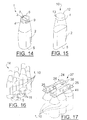
- Fig. 14 an example of bottle 1 has been represented, whose sealing portion 6 has been partly broken.
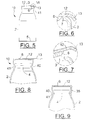
- the aforementioned sealing portion 6 is delimited, as can be clearly seen in the details of Figs. 3, 4, 6 and 7, by a weakening 7 of the thermoplastic material which constitutes the bottle, made adjacent to the periphery of the mouth 3.
- the weakening 7 is preferably circumference -shaped, although it can also adopt the shape of other, different curves.
- the weakening 7 can be open or closed curve-shaped.
- the bottom part or base 5 of the bottle 1, 10 is formed by a sheet of thermoplastic material, which preferably is the same as that of the rest of the bottle 1, 10, or, in other words, that of the body 2 and the sealing portion 6.
- the bottom part 5 is integral to the lower part of the walls of the body 2 of the bottle 1, 10 by thermowelding, after the bottle has been filled with the product it is supposed to contain.
- the embodiments of the bottle provided for closing by means of a screw-on-cap 8 are represented, of which particular illustrative examples are shown in Figs. 1 to 4 and 12 to 14.
- the closing by means of the screw-on-cap 6 works with a complementary outer threading 9 with which the neck 4 of the bottle 1 is fitted.
- the top 8 is stuck by its inner face to the outer face of the sealing portion 6 by means of an adhesive or glue 11.
- the bottles 1 of the invention can be closed by means of a cap 12 constituted by a sheet material, preferentially of a complex of inert and metalized plastic, which is joined to the outer face of the sealing portion 6 by like means of an adhesive or glue 11.
- a cap 12 constituted by a sheet material, preferentially of a complex of inert and metalized plastic, which is joined to the outer face of the sealing portion 6 by like means of an adhesive or glue 11.
- the embodiments of the bottles equipped with the cap 12 are represented by means of numerical reference 10, and specific examples of them are shown in figs. 5 to 11 and 15.
- the bottle 1, 10 can come from the factory, filled and closed and ready for the consumption of its content, in the hermetically sealed position exemplified in Figs. 2, 3, 5, 9, 11 and 13. In order to open the bottle 1, 10, it is enough to exert upon the sealing portion 6 a pulling or pushing force which is greater than a minimum predetermined effort, with which the weakening 7 breaks totally or partly, unlinking the sealing portion 6 from the mouth 3, resulting in the opening of the latter.
- the breaking of the weakening 7 for the opening of the mouth 3 is done by manually pulling the top 12.
- the top 12 is preferably equipped with a pulling tab 13 or a pulling and retention tab 35, which facilitates the operation.
- Figs. 7 and 10 both details are displayed showing the result of this pulling operation.
- Figs. 8 to 11 embodiment examples of the bottle 10 equipped with top 12 are shown, in which the weakening 7 is in open arc-shape at the ends of which a hinge is determined at the sealing portion 6.
- the tab of the top 12 adopts the form of a pulling and retention tab 35, so that, once the bottle 10 is open by breaking of the weakening 7, the former can be closed again, again lowering the sealing portion 6 against the mouth 3 and covering with the top 12 the upper part of the bottle adjoining the mouth 3.
- the neck 4 of the bottle 10 comprises at its part adjacent to the mouth 3, a split 40 or a similar formation, adapted for housing part of the pulling and retention tab 35 when the latter is tightened manually against the split 40.
- the optional and non-essential feature concurs that, in extension of the neck 4, the bottles 1, 10 comprise a neck 36 which facilitates the exit of the bottle's content.
- the bottle 10 is of the type that are closed by means of a top 12 equipped with a pulling and retention tab 35, whereas that of Figs. 12 and 13, the bottle 1 is of those intended for closing by means of a screw-on-cap 8.
- a group of bottles 1, 10 is shown which are joined in twos at their base through straps 15, which link in a continuous manner with the constituent material of the bottom part or base 5 of the bottles 1, 10, giving rise to a grouping 14 of bottles.
- Each of the bottles 1, 10, in this case ,six, of the grouping 14, can be separated from the rest by means of breaking the straps 15, for which the width of the strap 15 is small enough to facilitate its breaking.
- FIG. 17 another alternative form of the grouping 37 of a plurality of bottles 1, 10, is shown, in this case six, too, in accordance with the invention.
- the bottles 1, 10 are removably joined by means of a linkage body 24, constituted by two straps 38 of plastic material and a handle part 26, in this example in arched shape or in "half cannon", which link in a continuous manner to the straps 38.
- a linkage body 24 constituted by two straps 38 of plastic material and a handle part 26, in this example in arched shape or in "half cannon", which link in a continuous manner to the straps 38.
- holes 39 are made, one for each bottle 1, 10, of similar diameters, although somewhat smaller than that of a minimum diameter part 41 of the bottle 1, 10 in the adjacent area to the neck 4 (see Figs. 1 to 9).
- These minimum diameter parts 41 can be constituted by a hollow made in the body 2 or neck 4 of the bottle, or even at the lower edge of a screw-on-cap 8, such as in the case
- each orifice 39 is provided with four notches 25 extending radially, which provides the orifice edge with a certain flexibility or spring effect.
- the bottles 1, 10 are inserted through their neck 4, under pressure in the orifices 39, the notches 25 facilitating the insertion and remaining held by the effect of the tightening of the edges of the orifices 39 on the minimum diameter part 41 of the bottles 1, 10.
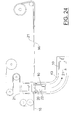
- Figs. 18 to 26 show different stages of the method, peculiar to the invention, of the filling and closing of the bottles 1, 10 and formation of the groupings 14, 37.
- Said method consists of the treatment of a sheet 16 of thermoplastic material, by means of the sequential phases which are shown below:
- Fig. 18 shows the stage in which the thermoplastic material is applied against the inner wall of the negative mould 18, under pressure or pneumatic vacuum.
- the method comprises the stage of applying glue or adhesive 11 between the inner face of the screw-on-cap 8 and the outer face of the sealing portion 6 of the mouth 3 of the bottle 1 and of subsequently applying the cap 8 to the mouth 3.
- the applying of glue or adhesive 11 and of the cap 8 can be done simultaneous to the phase of conforming the body 2 of the bottle 1 (Fig. 23).
- the mould 18 is divided in two halves 33 and 34, of which a lower movable half 34 receives, in a separated position from the upper half 33 and into a slot 42 for which purpose it is equipped, to the cap 8, after which it is situated in continuity with the upper half 33, in such a way that cap 8 itself constitutes the bottom part of the whole of the negative mould 18.
- the threading of the top 8 then goes on to constitute the surface mould for the outer threading 9 of the bottle 1.
- the stage of applying glue 11 and applying the top 8 is carried out immediately after the stage of forming the weakening 7.
- the method comprises the intermediate stage of applying by sticking, the top 12, to the outer face of the sealing portion 6.
- This stage of application of the top 12 can be simultaneous to the blowing or aspiration stage.
- Fig. 19 where it shows that cap 12 is formed by cutting by means of a clipping 46 from a sheet 47 of a suitable material and next going on to constitute the bottom part of the negative mould 18 of the bottle 10.
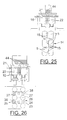
- Fig. 25 shows the mode of forming the bottle groupings 14 of Fig. 16.
- the die-cutter 44 has the right configuration to separate a cutting from the sheets 16 and 21 in such a way that the bottles, of which there are six in the case illustrated, are linked by straps 15 which are joined to the bottom parts 5 of the bottles 1, 10.
- Fig. 26 shows the conformation of the linkage body 24 for the formation of the bottle groupings 37 of Fig. 17.
- the stage of separating by means of cutting each conformed, filled and closed bottle 1, 10 is done so that the aforementioned linkage body 24 is determined directly in the cutting operation itself, starting from the excess sheets 16, 21 which have not gone on to form part of the main body 2 or bottom part 5 of the bottles.
- the cutting stage for the separation of the bottles individually can give rise to a different cutting from the one shown, so that the linkage body 24 would finish by means of a cutting operation or subsequent punching out.
- the handle 26 can be subsequently conformed in a final operation, for example by punching out with rollers in order to give it the desired shape.
- the stages of the method being made known can be performed in modular stations, easily interchangeable for the manufacture and filling of bottles 1, 10 of any closing and setting mode. In this way, the manufacture of all types of bottles 1, 10, can be done on a single machine, just by carrying out a few, easy assembling and disassembling operations of the modular stations involved in each case.
- Fig. 20 shows the example in which the application of the decorative band 31 is done simultaneously to the conformation stage of the body 2, of the bottle 1, fitted with threading 9.
- the negative mould 18 is a mould divided in two halves 28, 29, of which the lower half 29 that houses the negative of the threading 9, can be lowered to a position in which it receives the decorative band 31 in its interior, formed by cutting by means of knife 32 starting from a roller 30, which can be printed.
- bottles 1, 10 can adopt different forms from the ones explained and illustrated by way of example and features which are technical equivalents of the ones claimed.
Landscapes
- Engineering & Computer Science (AREA)
- Mechanical Engineering (AREA)
- Ceramic Engineering (AREA)
- Blow-Moulding Or Thermoforming Of Plastics Or The Like (AREA)
- Containers Having Bodies Formed In One Piece (AREA)
- Closures For Containers (AREA)
Abstract
Description
- feeding the sheet of thermoplastic material to a thermoforming machine;
- heating the sheet to a temperature greater than that of the thermofluence of the thermoplastic material;
- inserting a preform punch into a negative mould of the bottle, situated in inverted position, with the sheet interposed between the preform punch and the negative mould;
- conforming the body of the bottle by applying the thermoplastic material against the inner wall of the negative mould, by means of pressure or pneumatic vacuum, and extracting the preform punch from the mould;
- forming the weakening and the sealing portion by splitting of the thermoplastic material by means of a punch;
- filling the bottle with the product to be contained therein by the upper opening which will later be the bottom part or base of the bottle and which remains free because of the withdrawal of the preform punch; and
- thermowelding a sheet of thermoplastic material to the periphery of the aforementioned upper opening, determining the bottom part or base and, the bottle being thus finished and hermetically sealed.
Alternatively, the stage of applying glue and applying the screw-on-cap is done immediately after stage of forming the weakening.
- feeding the
sheet 16 of thermoplastic material to a thermoforming machine; - heating the
sheet 16 to a temperature greater than that of the thermofluence of the thermoplastic material; - inserting a
preform punch 17 into anegative mould 18 of thebottle sheet 16 of thermoplastic material interposed between thepreform punch 17 and the negative mould 18 (Figs. 18, 19, 20 and 23); - conforming the
body 2 of thebottle negative mould 18, by means of pressure or pneumatic vacuum, and extracting the preform punch 17 from themould 18; - forming the
weakening 7 and the sealingportion 6 by splitting the thermoplastic material by means of a punch 19 (Figs. 21 and 22). Thepunch 19 has the shape adapted to the desired conformation of the weakening 7: if this is annular, thepunch 19 will be annular, whereas if it is open-arched, the punch will consequently be open-arched. - filling the
bottle product 22 to be contained therein, by theupper opening 20 which will then be the bottom part orbase 5 of the bottle and which remains free by the withdrawal of thepreform punch 17; and - thermowelding a sheet of thermoplastic material
to the periphery of the aforementioned
upper opening 20, the bottom part orbase 5 remaining determined and, therefore, thebottle
Claims (14)
- Bottle (1, 10) of thermoplastic material, of the type comprising a main body (2) and which is essentially prismatic and moulded in a single-piece, a bottom part or base (5) and a mouth (3), characterized in that it comprises a hermetically sealing portion (6) at the mouth, moulded together with the bottle body forming with the latter a single-piece, said closing part being delimited by a weakening (7) of the material which constitutes the bottle, adjacent to the periphery of the mouth and the bottom part or base being constituted by a sheet of thermoplastic material integrally joined by thermowelding to the lower part of the bottle body walls, after the bottle has been filled with the product to be contained therein, all of it adopted so that on exerting pulling or pushing force on the sealing portion which is greater than a minimum predetermined effort, the weakening is liable to breaking, either completely or partly, in order to separate the mouth sealing portion, with the aim of achieving the opening of the mouth.
- Bottle (1) in accordance with claim 1, characterized in that, being of the type comprising a screw-on-cap (8), which works with a complementary outer threading (9) which the bottle neck is fitted with, the top is stuck by its inner face to the outer face of the sealing portion (6) by means of an adhesive or glue (11), in such a way that , on unscrewing the cap, the breaking of the annular weakening (7) takes place.
- Bottle (10) in accordance with claim 1, characterized in that it comprises a top (12) constituted by a laminate material, joined to the outer face of the sealing portion (6) by means of an adhesive or glue (11), in such a way that on pulling the top manually the complete or partial breaking of the weakening (7) takes place.
- Bottle (10) in accordance with the claim 3, characterized in that the weakening (7) has an open-arch shape and the top (12) comprises a pulling and retention tab (35), in such a way that, once the bottle has been opened by the weakening, the bottle can be closed again by reversion of the opening movement of the sealing portion (6) so that the top covers the formed mouth (3).
- Grouping (14) of bottles in accordance with the previous claims, characterized in that it comprises a plurality of bottles (1, 10) linked in a continuous way by their bottom part or base (5) by easily-broken straps (15), made of the constituent thermoplastic material itself of the bottom part of the bottles.
- Grouping (37) of bottles in accordance with claims 1 to 4, characterized in that it comprises a plurality of bottles (1, 10) and a linkage body (24) of the same, the linkage body being constituted by straps (38) of plastic material and at least one handle part (26), which links the straps to one another in a continuous manner on which multiple orifices (39) of diameter similar to that of the bottle neck are made, provided with notches (25) radially extending on their periphery, providing the edges with a certain flexibility, all in such a way that the bottles can be inserted by pressure in the orifices, remaining held by the effect of the tightening of the edges of the orifices on the bottles' necks.
- Method for the manufacture and filling of a bottle (1, 10) or group (14, 37) of bottles in accordance with the previous claims, characterized in that, starting from a sheet (16) of thermoplastic material, it comprises the stages of:feeding the sheet of thermoplastic material to a thermoforming machine;heating the sheet to a temperature greater than that of the thermofluence of the thermoplastic material;inserting a preform punch (17) into a negative mould (18) of the bottle (1), situated in inverted position, with the sheet (16) interposed between the preform punch and the negative mouldconforming the body (2) of the bottle by applying the thermoplastic material against the inner wall of the negative mould, by means of pressure or pneumatic vacuum, and extracting the preform punch from the mould;forming the weakening (7) and the sealing portion (6) by splitting of the thermoplastic material by means of a punch (19);filling the bottle with the product (22) to be contained therein, by the upper opening (20) which will later be the bottom part or base (5) of the bottle and which remains free because of the withdrawal of the preform punch; andthermowelding a sheet (21) of thermoplastic material to the periphery of the aforementioned upper opening, determining the bottom part or base and, the bottle being thus finished and hermetically sealed.
- Method in accordance with claim 7, applicable to the bottle (1) in accordance with claims 1 or 2, characterized in that it comprises the intermediate stages of applying glue or adhesive (11) between the inner face of the screw-on-cap (8) and the outer face of the sealing portion (6) of the bottle mouth (3) and of subsequently applying the cap to the mouth.
- Method in accordance with claim 8, characterized in that the stage of applying glue or adhesive and of applying the cap (8) is done simultaneously to the stage of conforming the body (2) of the bottle (1), for which the cap itself constitutes the bottom part of the negative mould (18), the threading of the cap forming the surface moulding of the outer threading (9) of the bottle.
- Method in accordance with claim 8, characterized in that the stage of applying glue and applying the screw-on-cap (8) is done immediately after the stage of forming the weakening (7).
- Method in accordance with claim 7, applicable to the bottle (10) in accordance with claims 1 or 3, characterized in that it comprises the intermediate stage of applying, by sticking, the top (12) to the outer face of the sealing portion (6).
- Method according to any of the previous claims, characterized in that, after the thermowelding stage, it comprises the stage of separating by cutting, each conformed bottle (1, 10), filled and closed, from the rest of the sheets (16, 21) of the material which constitute the body (2) and the bottom part (5) of the bottles, respectively.
- Method in accordance with claim 12, particularly applicable for the manufacture of the grouping (37) of bottles (1, 10) in accordance with claim 6, characterized in that the stage of separating by means of cutting each conformed bottle (1, 10), filled and closed, done in such a way that the linkage body (24), which comprises a handle (26) is obtained from the remainder itself of the sheets (16, 21) of the material that constitutes the body (2) and the bottom part (5) of the bottles, respectively.
- Method in accordance the claims 7 to 11, particularly applicable for the manufacture of the grouping (14) of bottles (1, 10) in accordance with claim 5, characterized in that it comprises the additional stage of forming the grouping, by means of the cutting of the sheets (16, 21) of the material that constitute the body (2) and the bottom part (5) of the bottles, respectively.
Applications Claiming Priority (2)
| Application Number | Priority Date | Filing Date | Title |
|---|---|---|---|
| ES200000946A ES2195678B1 (en) | 2000-04-12 | 2000-04-12 | BOTTLE OF THERMOPLASTIC MATERIAL AND PROCEDURE FOR THE MANUFACTURE AND FILLING OF IT. |
| ES200000946 | 2000-04-12 |
Publications (2)
| Publication Number | Publication Date |
|---|---|
| EP1147990A2 true EP1147990A2 (en) | 2001-10-24 |
| EP1147990A3 EP1147990A3 (en) | 2003-10-15 |
Family
ID=8493148
Family Applications (1)
| Application Number | Title | Priority Date | Filing Date |
|---|---|---|---|
| EP01500075A Withdrawn EP1147990A3 (en) | 2000-04-12 | 2001-03-26 | Bottle of thermoplastic material and method for the manufacture and filing of same |
Country Status (5)
| Country | Link |
|---|---|
| US (1) | US20020027122A1 (en) |
| EP (1) | EP1147990A3 (en) |
| BR (1) | BR0101260A (en) |
| ES (1) | ES2195678B1 (en) |
| MX (1) | MXPA01003260A (en) |
Cited By (6)
| Publication number | Priority date | Publication date | Assignee | Title |
|---|---|---|---|---|
| WO2005080203A1 (en) * | 2004-02-16 | 2005-09-01 | Mec-Lat Brevetti Di Bettini Eros & C. Snc | Container for liquid food products and procedure for packaging said liquid food products |
| WO2007063120A1 (en) * | 2005-12-01 | 2007-06-07 | Tetra Laval Holdings & Finance Sa | Method of producing plastic tops for sealed containers of pourable food products, and container plastic tops so produced |
| WO2008034733A1 (en) * | 2006-09-22 | 2008-03-27 | Fischbach Kg Kunststoff-Technik | Packaging container and method of producing the same |
| EP2000418A1 (en) * | 2007-06-05 | 2008-12-10 | Tetra Laval Holdings & Finance S.A. | Closure for a sealed container of a pourable food product, and method of producing thereof |
| EP2000417A1 (en) * | 2007-06-05 | 2008-12-10 | Tetra Laval Holdings & Finance S.A. | Closure for a sealed container of a pourable food product, and method of producing thereofs |
| EP2508432B1 (en) * | 2009-11-30 | 2015-07-15 | Tetra Laval Holdings & Finance S.A. | Packaging container manufacturing method, spout stopper, and packaging container |
Families Citing this family (3)
| Publication number | Priority date | Publication date | Assignee | Title |
|---|---|---|---|---|
| CA2449416C (en) * | 2001-04-18 | 2011-02-22 | Nottingham-Spirk Partners, Llc | Improved container and lid assembly |
| US8783515B2 (en) | 2012-10-25 | 2014-07-22 | Sonoco Development, Inc. | Dispenser with fitment |
| US11613397B2 (en) | 2019-09-12 | 2023-03-28 | Owens-Brockway Glass Container Inc. | Ring pull cap rim for glass containers |
Family Cites Families (7)
| Publication number | Priority date | Publication date | Assignee | Title |
|---|---|---|---|---|
| DK127376B (en) * | 1970-06-19 | 1973-10-29 | N Harild | Method of manufacture, filling and closing of plastic containers, in particular for carbonated beverages. |
| US3977153A (en) * | 1970-11-06 | 1976-08-31 | The Dow Chemical Company | Container for food products and method for making same |
| US3727754A (en) * | 1971-06-16 | 1973-04-17 | Illinois Tool Works | Container carrier |
| FR2317079A1 (en) * | 1975-07-09 | 1977-02-04 | Gatrun Anstalt | CONTAINER SUCH AS A CUP OR BOTTLE OF THERMOPLASTIC MATERIAL AND ITS MANUFACTURING PROCESS |
| SE9301788L (en) * | 1993-05-26 | 1994-11-27 | Tetra Laval Holdings & Finance | Methods of manufacturing bottle or tube-like, capsule-packed packaging containers of a polymeric material |
| US5562226A (en) * | 1993-07-26 | 1996-10-08 | Ev Family Limited Partnership | Container closure assembly |
| FR2717774B1 (en) * | 1994-03-25 | 1996-06-21 | Erca | Container such as a goblet or bottle made of thermoplastic material, installation and method for manufacturing, filling and sealing such a container. |
-
2000
- 2000-04-12 ES ES200000946A patent/ES2195678B1/en not_active Expired - Fee Related
-
2001
- 2001-03-26 EP EP01500075A patent/EP1147990A3/en not_active Withdrawn
- 2001-03-29 MX MXPA01003260A patent/MXPA01003260A/en unknown
- 2001-03-30 BR BR0101260-6A patent/BR0101260A/en not_active Application Discontinuation
- 2001-04-03 US US09/824,150 patent/US20020027122A1/en not_active Abandoned
Cited By (20)
| Publication number | Priority date | Publication date | Assignee | Title |
|---|---|---|---|---|
| WO2005080203A1 (en) * | 2004-02-16 | 2005-09-01 | Mec-Lat Brevetti Di Bettini Eros & C. Snc | Container for liquid food products and procedure for packaging said liquid food products |
| JP2009517296A (en) * | 2005-12-01 | 2009-04-30 | テトラ ラバル ホールデイングス エ フイナンス ソシエテ アノニム | Method for producing plastic top for liquid food sealed container and plastic top of container produced by the method |
| WO2007063120A1 (en) * | 2005-12-01 | 2007-06-07 | Tetra Laval Holdings & Finance Sa | Method of producing plastic tops for sealed containers of pourable food products, and container plastic tops so produced |
| RU2421385C2 (en) * | 2005-12-01 | 2011-06-20 | Тетра Лаваль Холдингз Энд Файнэнс Са | Method of producing plastic covers for tight liquid food containers and plastic cover made thereby |
| CN101316770B (en) * | 2005-12-01 | 2011-01-12 | 利乐拉瓦尔集团及财务有限公司 | Method of producing plastic tops for sealed containers of pourable food products, and container plastic tops so produced |
| WO2008034733A1 (en) * | 2006-09-22 | 2008-03-27 | Fischbach Kg Kunststoff-Technik | Packaging container and method of producing the same |
| WO2008148824A1 (en) * | 2007-06-05 | 2008-12-11 | Tetra Laval Holdings & Finance S.A. | Closure for a sealed container of a pourable food product, and method of producing thereof |
| CN101743173B (en) * | 2007-06-05 | 2012-01-18 | 利乐拉瓦尔集团及财务有限公司 | Closure for a sealed container of a pourable food product, and method of producing thereof |
| EP2177452A1 (en) | 2007-06-05 | 2010-04-21 | Tetra Laval Holdings & Finance SA | Closure for a sealed container of a pourable food product, and method of producing thereof |
| JP2010528948A (en) * | 2007-06-05 | 2010-08-26 | テトラ ラバル ホールデイングス エ フイナンス ソシエテ アノニム | Closure member for sealed food container and method for producing the closure member |
| EP2000417A1 (en) * | 2007-06-05 | 2008-12-10 | Tetra Laval Holdings & Finance S.A. | Closure for a sealed container of a pourable food product, and method of producing thereofs |
| EP2000418A1 (en) * | 2007-06-05 | 2008-12-10 | Tetra Laval Holdings & Finance S.A. | Closure for a sealed container of a pourable food product, and method of producing thereof |
| EP2390202A1 (en) | 2007-06-05 | 2011-11-30 | Tetra Laval Holdings & Finance SA | Closure for a sealed container of a pourable food product, and method of producing thereof |
| WO2008148823A1 (en) * | 2007-06-05 | 2008-12-11 | Tetra Laval Holdings & Finance S.A. | Closure for a sealed container of a pourable food product, and method of producing thereof |
| RU2468976C2 (en) * | 2007-06-05 | 2012-12-10 | Тетра Лаваль Холдингз Энд Файнэнс С.А. | Corking device for tight container with fluid and method of its production |
| US8393484B2 (en) | 2007-06-05 | 2013-03-12 | Tetra Laval Holdings & Finance S.A. | Closure for a sealed container of a pourable food product, and method of producing thereof |
| JP2013252904A (en) * | 2007-06-05 | 2013-12-19 | Tetra Laval Holdings & Finance Sa | Closure for sealed container of pourable food product, and method of producing thereof |
| US8910811B2 (en) | 2007-06-05 | 2014-12-16 | Tetra Laval Holdings & Finance S.A. | Closure for a sealed container of a pourable food product, and method of producing thereof |
| CN102556486B (en) * | 2007-06-05 | 2015-04-01 | 利乐拉瓦尔集团及财务有限公司 | Closure for a sealed container of a pourable food product, and method of producing thereof |
| EP2508432B1 (en) * | 2009-11-30 | 2015-07-15 | Tetra Laval Holdings & Finance S.A. | Packaging container manufacturing method, spout stopper, and packaging container |
Also Published As
| Publication number | Publication date |
|---|---|
| BR0101260A (en) | 2001-11-13 |
| EP1147990A3 (en) | 2003-10-15 |
| ES2195678A1 (en) | 2003-12-01 |
| MXPA01003260A (en) | 2005-04-11 |
| ES2195678B1 (en) | 2005-02-16 |
| US20020027122A1 (en) | 2002-03-07 |
Similar Documents
| Publication | Publication Date | Title |
|---|---|---|
| AP1020A (en) | Cans or groups of cans for food products with hygenic protection; Method and apparatus therefor. | |
| EP1362685B2 (en) | Hermetically sealed container with frangible web and locking lugs and method and apparatus for making same | |
| US4816093A (en) | Separable laminate container | |
| EP0425264A1 (en) | Dispensing bottle with coupling between closure head and screw cap | |
| CZ20012563A3 (en) | Tube like dispenser package and integral outlet formed from a single sheet | |
| US20020027122A1 (en) | Bottle of thermoplastic material and method for the manufacture and filling of same | |
| EP0662910A1 (en) | Method and apparatus for the manufacture of a container made from thermoformable and heat sealable Material | |
| US10315788B2 (en) | Closure system for containers and related container and process for the realization | |
| US7665281B2 (en) | Machine for making packaging with form-fit connection | |
| EP2925622B1 (en) | Packaging machine with increased functionality, particularly for small preformed bags | |
| US3112824A (en) | Product container and method of producing same | |
| AU774640B2 (en) | Process and machine for packaging food products as well as the product obtained | |
| AU745679B2 (en) | Method and apparatus for capping container cans for food products and drinks | |
| CA2193818A1 (en) | Container of thermoformable material with a closure | |
| US20060280846A1 (en) | Food container | |
| US20060094578A1 (en) | Cover for cardboard composite beverage packages, tools and methods for producing such a cover, and cardboard composite beverage packages provided therewith | |
| WO1999059890A1 (en) | Single dose package for a food product and method for obtaining the package | |
| CA1277183C (en) | Method for making a rolled lip container | |
| WO2007010373A1 (en) | Machine and method for carrying out containers and containers obtained thereby | |
| EP1974898B1 (en) | Method for forming three-dimensional containers of extensible paper material. | |
| KR101504014B1 (en) | A Cap of bottle and method for making thereof | |
| CN111712369A (en) | Method and plastic pre-container for producing plastic containers from elongated hollow parts | |
| EP2188182B1 (en) | Container, method and apparatus for packaging products | |
| EP3697696A1 (en) | Method and apparatus for making a container containing a product and corresponding container | |
| KR200351170Y1 (en) | Pressure forming mold for food package |
Legal Events
| Date | Code | Title | Description |
|---|---|---|---|
| PUAI | Public reference made under article 153(3) epc to a published international application that has entered the european phase |
Free format text: ORIGINAL CODE: 0009012 |
|
| AK | Designated contracting states |
Kind code of ref document: A2 Designated state(s): AT BE CH CY DE DK ES FI FR GB GR IE IT LI LU MC NL PT SE TR |
|
| AX | Request for extension of the european patent |
Free format text: AL;LT;LV;MK;RO;SI |
|
| PUAL | Search report despatched |
Free format text: ORIGINAL CODE: 0009013 |
|
| AK | Designated contracting states |
Kind code of ref document: A3 Designated state(s): AT BE CH CY DE DK ES FI FR GB GR IE IT LI LU MC NL PT SE TR |
|
| AX | Request for extension of the european patent |
Extension state: AL LT LV MK RO SI |
|
| 17P | Request for examination filed |
Effective date: 20040406 |
|
| AKX | Designation fees paid |
Designated state(s): AT BE CH CY DE DK ES FI FR GB GR IE IT LI LU MC NL PT SE TR |
|
| 17Q | First examination report despatched |
Effective date: 20040527 |
|
| STAA | Information on the status of an ep patent application or granted ep patent |
Free format text: STATUS: THE APPLICATION IS DEEMED TO BE WITHDRAWN |
|
| 18D | Application deemed to be withdrawn |
Effective date: 20041207 |