EP1146472A2 - Loose-gray-scale template matching - Google Patents
Loose-gray-scale template matching Download PDFInfo
- Publication number
- EP1146472A2 EP1146472A2 EP01103877A EP01103877A EP1146472A2 EP 1146472 A2 EP1146472 A2 EP 1146472A2 EP 01103877 A EP01103877 A EP 01103877A EP 01103877 A EP01103877 A EP 01103877A EP 1146472 A2 EP1146472 A2 EP 1146472A2
- Authority
- EP
- European Patent Office
- Prior art keywords
- image
- template
- templates
- pixel
- gray
- Prior art date
- Legal status (The legal status is an assumption and is not a legal conclusion. Google has not performed a legal analysis and makes no representation as to the accuracy of the status listed.)
- Granted
Links
Images





Classifications
-
- H—ELECTRICITY
- H04—ELECTRIC COMMUNICATION TECHNIQUE
- H04N—PICTORIAL COMMUNICATION, e.g. TELEVISION
- H04N1/00—Scanning, transmission or reproduction of documents or the like, e.g. facsimile transmission; Details thereof
- H04N1/40—Picture signal circuits
- H04N1/40075—Descreening, i.e. converting a halftone signal into a corresponding continuous-tone signal; Rescreening, i.e. combined descreening and halftoning
-
- G—PHYSICS
- G06—COMPUTING OR CALCULATING; COUNTING
- G06V—IMAGE OR VIDEO RECOGNITION OR UNDERSTANDING
- G06V10/00—Arrangements for image or video recognition or understanding
- G06V10/20—Image preprocessing
- G06V10/36—Applying a local operator, i.e. means to operate on image points situated in the vicinity of a given point; Non-linear local filtering operations, e.g. median filtering
-
- G—PHYSICS
- G06—COMPUTING OR CALCULATING; COUNTING
- G06V—IMAGE OR VIDEO RECOGNITION OR UNDERSTANDING
- G06V10/00—Arrangements for image or video recognition or understanding
- G06V10/40—Extraction of image or video features
- G06V10/44—Local feature extraction by analysis of parts of the pattern, e.g. by detecting edges, contours, loops, corners, strokes or intersections; Connectivity analysis, e.g. of connected components
- G06V10/443—Local feature extraction by analysis of parts of the pattern, e.g. by detecting edges, contours, loops, corners, strokes or intersections; Connectivity analysis, e.g. of connected components by matching or filtering
Definitions
- This invention relates to systems and methods for processing images using filters. More specifically, this invention relates to systems and methods for designing and implementing image processing filters using templates wherein the filters operate on gray-scale images and the templates identify gray-scale image features for the purposes of modification or for extracting some image statistic, and for the purposes of optimization for the human visual system, or compatibility with other system modules, such as, compression algorithms, recognition algorithms and those occurring in printing and display devices.
- a wide variety of digital document processing tasks are performed using template-based filters.
- digital document processing tasks include resolution conversion, enhancement, restoration, appearance tuning and de-screening of images. These tasks are commonly performed on monochrome and color images, as well as binary and continuous tone images.
- a continuous tone image may also be referred to as a gray-scale image.
- a typical filter includes template operators to perform filtering of the images, where, a filter may be characterized as an operator or device that transforms one image into another image or transforms an image to a collection of information, such as image statistics.
- the filter is formed of a number of imaging template operators, often simply referred to as templates. These templates may be, for example, stored in a look-up table and implemented using a look-up table formalism. Or other equivalent formalisms, such as Boolean logic may be employed.
- the number of templates in a filter may vary between a small number of templates to thousands of templates. Due to its versatility in design, a look-up table is typically used to implement a template-based filter.
- a raster is a one-dimensional array of image data, reflecting a single line of data across a single dimension, i.e., the length or the width, of the image.
- each location, or "picture element,” in an image may be called a "pixel.”
- each value indicating the properties of a location may be called a pixel value.
- Each pixel value is a bit in a binary form of an image, a gray-scale value in a gray-scale form of an image, or a set of color-spaced coordinates in a color coordinate form of an image.
- the binary form, gray-scale form, and color coordinate form are each arranged typically in a two-dimensional array, which defines an image.
- the filter uses the templates, transforms certain observed pixel patterns in a binary image, for example, into a corresponding enhanced binary pixel pattern.
- the filter observes an arrangement of pixels using a suitable window or mask.
- a window is an imaging algorithmic device that observes a plurality of pixels at the same time, where the plurality of pixels is located about a target pixel. The values and locations of the observed pixels are inputted into the template matching operations.
- the filter After observing the arrangement of pixels, about a target pixel, the filter then attempts to match the observed pixel pattern with one or more of the templates in the look-up table. If the look-up table contains a match to the observed pixel pattern, the look-up table generates an appropriate output.
- the output may be an enhanced pixel pattern for the target pixel that corresponds to the observed pixel pattern.
- the output could also be information in other forms; for example, the output could be a code denoting the match condition, or a data to be used for a statistical characterization of image regions.
- a 3x3 window may be used to process an image.
- the 3x3 window at various locations in the image, observes a 3x3 block, i.e., a 9-pixel block, of binary-valued pixels, for example.
- One pixel in the window is the target pixel, which is typically the center pixel, while the other pixels in the window are the neighboring pixels.
- the target pixel and the neighboring pixels form a neighborhood.
- the window is typically scanned across an image advancing from target pixel to target pixel.
- the neighborhood is then processed in some manner.
- the observed neighborhood may be transformed into a vector.
- the vector is expressed in the form of ( x 1 , x 2 ... x N ) where N i is the number of pixels in the neighborhood and is used to represent the properties of the target pixel, including the neighborhood of the target pixel.
- Each element of the vector represents one of the pixels observed in the window.
- the vector is then used in the look-up table to generate a desired output, for example.
- a look-up table may be created in a wide variety of ways. Typically, an input value is input into the look-up table and, in response, the look-up table outputs an output value. Further, the look-up table is typically created using a training image or a set of training images. "Restoration and Enhancement of Digital Documents,” by R. Loce and E. Dougherty, teaches a variety of methods for designing templates based on sets of training images.
- the training images will occur in pairs, where one member is the "typically input image,” or the “typically observed image,” i.e., the "observed image,” and the other image is the “ideal desired processed version of the image,” i.e., the “ideal image.”
- the training image pairs may be input into a computer program that acquires and analyzes pattern statistics between the two images, i.e., using computer-aided filter design techniques.
- Conventional computer-aided filter design may be accomplished through using training-sets of document bitmaps, for example.
- a training analysis system examines a target pixel at that corresponding location in the gray-scale image.
- the center of the window may be placed at the target pixel, for example.
- a "best gray-scale pixel value" is determined for processing a target pixel that possess that pattern of neighborhood pixels.
- a template is created for the target pixels in the binary image possessing similar neighborhood pixel patterns. This analysis is performed for all binary patterns that are significant.
- significance may be due to attributes such as the pixel pattern's frequency of occurrence, the pattern's effect on the generated image, or both. Accordingly, if a template, i.e., a pattern of pixels in the binary image, is considered significant with respect to template inclusion in the design process, that template will appear in the template-matching filter.
- the observed target pixel value Upon operating on an input image, if that pattern is observed, the observed target pixel value will be assigned or associated with a certain value, i.e., a corresponding gray-scale value. Both the observed neighborhood and the corresponding gray-scale value may be stored in the look-up table. Accordingly, the look-up table accepts input values and outputs a desired corresponding output value, i.e., maps input values to an ideal corresponding output value.
- Boolean logic representation pixel values are used as variables in the logic architecture, such as a logical sum of products.
- the goal of template filter design using Boolean logic representation is to derive optimized Boolean operators, preferably statistically optimized Boolean operators.
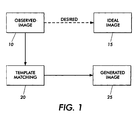
- Fig. 1 there is shown the basic process for template matching based on an observed image. Initially an observed image will occur (10) from which an ideal image is warranted (15). In order to generate an image as close as possible to the ideal image, a generated image (25) is created by utilizing a template matching operation (20). With the above understanding of the image processing setting we see that it is greatly desired to produce a generated image as similar as possible to the ideal image.
- the conventional template matching operation is a binary matching process whereby a binary template or filter is to applied to a binary image.
- a binary image (50) is initially sent to a data buffering circuit (55).
- a binary pattern matching operation (60) is performed.
- Binary templates are typically defined as possessing ones, zeros, and "don't cares.”
- Fig. 2B there is shown a typical binary matching template structure.
- the binary templates in this example are defined with ones and X's for use in the binary matching step, where "X" denotes "don't care”.
- an enhanced data buffering step (65) to create the enhanced image (70) is exercised.
- Figs. 4A, 4B, and 4C Illustrated in Figs. 4A, 4B, and 4C is the set of images associated with an image restoration application using a filter defined by templates representing particular Boolean functions applied to a received image.
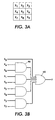
- Fig. 3A shows a representation of a 3x3 window and the positions of pixels ( x 1 ,..., x 9 ).
- the singleton template x 5 behaves as an identity operator: whatever pixels are valued one and zero in the input image are valued one and zero in the output image, respectively. ORed onto that identity image is the result of each 2-pixel logical product.
- the templates corresponding to those products possess structures that straddle the origin pixel. In this configuration a template can "fit", or yield a 1, when positioned about a hole or break in a character stroke.
- Equation 1 is an example of an image processing operator that can be employed to repair breaks in character strokes within an image.
- Fig. 4 is an example of applying Equation 1 as a filter operating on an image, where Fig.
- Equation 1 shows an ideal image
- 4B shows an input image
- 4C shows the image resulting from applying Equation 1 as a filter to the image of Fig. 4B.
- the filter defined by Equation 1 produced a character (120) more likely to be recognized in character recognition operation.
- the restoration is not perfect. A more complicated (more and different products) filter could achieve better restoration.
- Fig. 4A and Fig. 4C there are still differences between the ideal image 100 and the generated image 120 resulting from the use of the filtering process defined by Equation 1.
- a system of the prior art is shown where an input image 150 is processed by a process 165 that includes binary-template-based filters 160 and combinatorial logic 170 [changed t to match the figure]; from which an output image 175 is generated and subsequently sent to a digital printer, high resolution printer or high resolution display 180.
- Loose-gray-scale template matching is a windowed operation (filter) that operates on gray or partial gray images and signals.
- Template matching operations performed on binary data should also be performed on partial gray imaged obtained via antialiasing or scanning.
- Exact matching in gray-scale would often require a prohibitively large number of templates, hence loose fitting has been developed so that a range image signals could be matched by a single template.
- loose-gray-scale template matching would typically be performed using groups of templates where each template or subgroup of templates is associated with a particular output or action.
- loose-gray-scale template matching method introduces an additional tool that can well address other significant image process problems such as enabling a pass through mode for scanned halftones, feature recognition, and segmentation.
- loose-gray-scale template matching can be performed adaptively and in several dimensions (e.g., 2- dimensional spatial images, 3-dimensional topological images, multiple color planes, frames in a time sequence).
- an observed image and the ideal image may be received in the form of digital images.
- the design method tries to map as accurately as possible the observed image to an image that accurately corresponds to the ideal image given certain constraints such as limited number of templates.
- the observed image and the ideal image represent a typical "before” and “ideal after” set of images, respectively.
- the observed image and the ideal image can be utilized as training images for a filter design procedure.
- the observed image and the ideal image may be actual images that are selected based on expert knowledge, or they may contain particular structures that are useful to training. For instance, they may contain precise patterns of particular concern to a specific image processing task.
- This new process minimizes costs and generating time of the ideal image, and allows the observer to focus on details that the human visual perception and subsequent image processing modules will actually detect.
- the burden of designing an impractical number of exact match templates is mitigated by designing a much smaller set of loose fitting templates.
- the present invention separately provides the methods that may be used in conjunction with known methods for line width modification, resolution conversion, resolution enhancement, image restoration and the like.
- the present invention separately provides systems and methods that may be used in conjunction with filter design and implementation techniques to optimally yield images processed to better visual quality.
- a template fitting method for fitting a plurality of templates in correspondence with a gray-scale image comprising: receiving gray-scale image information of an observed image; defining a window of said gray-scale image information so as to enable a loose-gray scale fit between said defined window and said plurality of templates; extracting a plurality of pixels of said image information using said window to which to fit at least one of the plurality of templates; and fitting one of the plurality of templates to said defined window within a threshold looseness interval associated with the template wherein a looseness interval between the window of image data and the template is less than the threshold looseness interval.
- a further embodiment comprises, generating using processing circuitry a looseness interval between window of received image and each template associated therewith; and comparing the threshold looseness interval to the looseness interval using the processing circuitry .
- the template fitting method comprises fitting said plurality of templates either in a parallel or serial process.
- the processing circuitry includes algorithmic operations for associating the templates with the gray-scale image information.
- the processing circuitry stores a plurality of pixels of the window of received image information which includes image pixels surrounding a target pixel.
- a multiple template fitting method including a plurality of single templates or plurality of families of templates for correspondence with a gray-scale image , including receiving image information of an observed image; defining a window of the image information so as to enable a loose grayscale fit between the defined window and the plurality of singular or families of templates; and fitting one of the plurality of singular or families of templates to the defined window within a threshold looseness interval and outputting an item of data indicating a result of a correspondence between a single or family of templates and the received image information within a threshold looseness interval.
- said templates and said threshold looseness intervals are stored in a representation which enables fitting one of a plurality of singular or families of templates to said defined window.
- said representation is either multiple nominal pixel values with incremental corresponding upper and lower threshold values, a lower value and upper value associated with the threshold interval, a reduced quantization state with respect to a quantization state of the received image.
- a method for matching a plurality of templates with a received image wherein said received image being bitmap data including at least a plurality of gray-scale pixel tiles that define said image
- said matching method comprises: receiving said image data so as to extract pixel tile information of said received image wherein said pixel tile information being of a predetermined matrix size, matching loosely said pixel tile information with at least one of a plurality of templates so as to generate pixel-wise looseness interval values therebetween, and outputting a portion of enhanced said pixel tile information wherein said enhanced pixel tile information being formed by a matching of a template with pixel-wise looseness values.
- a further embodiment comprises storing template pixel tile information and said pixel-wise looseness values.
- a further embodiment comprises storing said templates and template-wise looseness values.
- said templates and said pixel-wise threshold looseness interval is stored in a representation which enables fitting one of a plurality of single or families of templates to said pixel tile information.
- said representation is either multiple nominal pixel values with incremental corresponding upper and lower threshold values, a lower value and upper value associated with the threshold interval, a reduced quantization state with respect to a quantization state of the received image.
- the method comprises using arithmetic or algorithmic processes to calculate the pixel-wise looseness interval values.
- the method of comprises using arithmetic or algorithmic processes to calculate the template-wise looseness values.
- the method comprises combining said pixel-wise looseness values to form template-wise looseness values.
- the outputted enhanced tile information is grayscale or high addressability information.
- said matching step generates a match identifier to match said pixel tile information.
- said matching step generates a match identifier to match said templates.
- the matching step outputs an item of data indicative of a match performed by the matching step.
- a loose-gray-scale template matching method including at least an initial point for locating within the received image a plurality of pixel points surrounding said initial point, the method including the steps of: locating said initial point and said plurality of pixel points, generating a looseness interval about said located initial point with template information associated therewith, determining which one of a plurality of templates for fitting fits within a threshold looseness interval and, outputting an item of data indicative of whether a template is within the looseness threshold thereby indicating that the template is in agreement therewith.
- a further embodiment comprises combining the pixel-wise looseness intervals to form a template-wise looseness interval.
- a further embodiment comprises in said determining step using arithmetic or algorithmic means to calculate said looseness interval.
- a further embodiment comprises storing the generated pixel-wise looseness intervals.
- a further embodiment comprises outputting grayscale, high addressability, image statistics or templates match identifiers generated by said determining step.
- a further embodiment comprises in said fitting step fitting said plurality of templates either in a parallel or serial process.
- Loose fit generates a template match identifier that may be used in subsequent processing modules, such as a module that would determine an enhanced output signal.
- system and methods of embodiments of this invention provide a method to decrease the cost of printer electronic hardware to practical levels for example by designing a filter possessing a relatively small number of gray-scale templates.
- Fig. 1 is a diagram illustrating a conventional template matching filter paradigm.
- Fig. 2A shows a flowchart of a conventional binary template matching arrangement.
- Fig. 2B shows a diagram of an example of a series of templates used in a binary matching template arrangement.
- Fig. 3A shows a representation of a 3x3 window and the positions of pixels ( x 1 ,..., x 9 ).
- Fig. 3B shows a diagram of a gate structure of the template matching operation for the templates of the example in Fig. 3A.
- Figs. 4A-C show a series of diagrams of an example of an ideal image, an observed image with holes and breaks and an image resulting from a template matching operation on the observed image.
- Fig. 5A shows a diagram of a system configuration using a template matching filter system according to the prior art.
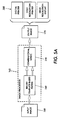
- Fig. 5B shows another diagram of a system configuration using a template matching filter system of the present invention.
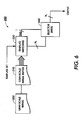
- Fig. 6 is a diagram illustrating a gray-scale matching configuration in accordance with the present invention.
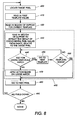
- Fig. 7 is a flowchart illustrating a serial loose-gray-scale matching system in accordance with the present invention.
- Fig. 8 is a detailed flowchart illustrating a serial test for loose-gray-scale template matching of a family of templates in accordance with the present invention.
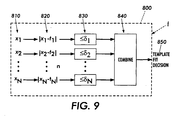
- Fig. 9 is a flowchart illustrating a parallel test for a loose-gray-scale template match with one template in accordance with the present invention.
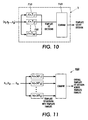
- Fig. 10 is a diagram illustrating a parallel test for a family of templates performing matching operations using loose-gray-scale template matching in accordance with the present invention.
- Fig. 11 is a diagram of multiple families of templates performing a template matching operation using loose-gray-scale template matching in accordance with the present invention.
- bitmap refers herein to a digital image quantized in a variety of forms, such as binary, 8 bits/pixel, or some intermediate number of bits/pixel, or some high resolution quantization state.
- data refers herein to physical signals that indicate or include information.
- an item of data can indicate one of a number of possible alternatives, the item of data has one of a number of "values.”
- a binary item of data also referred to as a "bit”
- bit has one of two values, interchangeably referred to as "1” and “0” or “ON” and “OFF” or “high” and “low.”
- a bit is an "inverse" of another bit if the two bits have different values.
- An N -bit item of data has one of 2 N possible values.
- data includes data existing in any physical form, and includes data that are transitory or are being stored or transmitted.
- data could exist as electrical, electromagnetic or other transmitted signals or as signals stored in electronic, magnetic, or other form.
- image signal, video data, and pixel are interchangeably used herein to describe discrete digital signals that represent the active (on) or inactive (off) state of an element within a digital image.
- shaded or crosshatched portions of image bitmaps depicted herein are intended to represent black or active pixels (having a value of 1 in a binary representation) within the bitmaps. Such a representation is not intended to limit the present invention, but to simplify the description thereof. Accordingly, the present invention may be operated in the same manner by substituting white pixel states wherever black pixels are indicated, and vice versa.
- Circuitry or a “circuit” is any physical arrangement of matter that can respond to a first signal at one location or time by providing a second signal at another location or time. Circuitry "stores” a first signal when it receives the first signal at one time and, in response, provides substantially the same signal at another time. Circuitry "transfers" a first signal when it receives the first signal at a first location and, in response, provides substantially the same signal at a second location.
- An example of a circuit is a data or address bus in an electromechanical system such as a printing system or computer.
- a “data storage medium” or “storage medium” is a physical medium that can store data. Examples of data storage media include magnetic media such as diskettes, floppy disks, and tape; optical media such as laser disks and CD-ROMs; and semiconductor media such as semiconductor ROMs and RAMs. As used herein, “storage medium” covers one or more distinct units of a medium that together store a body of data.
- Memory circuitry or “memory” is any circuitry that can store data, and may include local and remote memory and input/output devices. Examples include semiconductor ROMs, RAMs, and storage medium access devices with data storage media that they can access.
- a “memory cell” is memory circuitry that can store a single unit of data, such as a bit or other n-ary digit or an analog value.
- a “data processing system” is a physical system that processes data.
- An “image processing system” is a data processing system that processes image data.
- a “data processor” or “processor” is any component or system that can process data, and may include one or more central processing units or other processing components.
- An “array of data” or “data array” or “array” is a combination of items of data that can be mapped into an array.
- a “two-dimensional array” is a data array whose items of data can be mapped into an array having two dimensions.
- An item of data "defines" an array when it includes information sufficient to obtain or produce the array.
- an item of data defining an array may include the defined array itself, a compressed or encoded form of the defined array, a pointer to the defined array, a pointer to a part of another array from which the defined array can be obtained, or pointers to a set of smaller arrays from which the defined array can be obtained.
- Control circuitry is circuitry that provides data or other signals that determine how other components operate.
- instruction circuitry is control circuitry that provides items of data indicating instructions to a component that includes processing circuitry.
- addressing circuitry is control circuitry that provides items of data indicating addresses to a component that includes memory circuitry.
- Control circuitry provides signals that "control" transfer of data by bus circuitry if the signals determine sources and destinations of the transfers of data by the bus circuitry. For example, the control circuitry could provide signals to a source so that it provides an item of data to the bus circuitry; the control circuitry could also provide signals to one or more destinations so that they receive the item of data from the bus circuitry.
- An “image” may include characters, words, and text as well as other features such as graphics.
- a text may be included in a set of one or more images, such as in images of the pages of a document.
- An image may be divided into "segments,” each of which is itself an image.
- a segment of an image may be of any size up to and including the whole image.
- An item of data "defines" an image when the item of data includes sufficient information to produce the image.
- a two-dimensional array can define all or any part of an image, with each item of data in the array providing a value indicating the color of a respective location of the image.
- Each location in an image may be called a "pixel.”
- a "pixel” is the smallest segment into which an image is divided or accessed in a given system.
- each value indicating the color of a location may be called a "pixel value”.
- Each pixel value is, for example, a bit in a "binary form” of an image, a gray scale value in a “gray scale form” of an image, or a set of color space coordinates in a "color coordinate form” of an image, the binary form, gray scale form, and color coordinate form each being a two-dimensional array defining an image.
- the invention will hereafter be described in terms of a single-color gray-scale embodiment, however, there is no intent to limit the invention to such a single-color system as it has application to multicolor systems as well.
- An item of data "relates to" part of an image, such as a pixel or a larger segment of the image, when the item of data has a relationship of any kind to the part of the image.
- the item of data could define the part of the image, as a pixel value defines a pixel; the item of data could be obtained from data defining the part of the image; the item of data could indicate a location of the part of the image; or the item of data could be part of a data array such that, when the data array is mapped onto the image, the item of data maps onto the part of the image.
- An operation performs "image processing" when it operates on an item of data that relates to part of an image.
- Pixels are "neighbors” or “neighboring” within an image when there are no other pixels between them or they meet an appropriate criterion for neighboring. If, for example, the pixels using adjoining criteria are rectangular and appear in rows and columns, each pixel may have 4 or 8 adjoining neighboring pixels, depending on the criterion used.
- the "looseness interval" of the present invention is a measure of the difference between a template and an observed neighborhood of pixels.
- Each pixel can possess a looseness interval and a template and neighborhood can possess an overall looseness interval.
- the looseness interval could be a simple metric, such as the absolute value of the difference between an observed pixel value and a template value. More complicated intervals may also be defined, such as intervals that are dependent upon the sign of the difference, or are a function of the difference.
- the function may be arithmetic, such as multiplication by a factor, algebraic, such as being raised to a power, or some other algorithmic means to represent a degree of difference between the observed neighborhood of pixels and the template.
- An overall template looseness interval could be a combination of the pixel looseness intervals, or it could be a function directly applied to the observed pixel neighborhood and template, where that function provides a degree of difference.
- Example of the overall template looseness interval are averaging of at least a portion of the pixel looseness interval, and taking the maximum of the pixel looseness intervals.
- looseness interval we often use looseness interval to denote either or both a pixel looseness interval and an overall template looseness interval.
- threshold looseness interval is the maximum allowable value for the looseness interval that indicates a loose-fitting match.
- threshold looseness interval may be defined pixel-wise or overall-template-wise.
- Fig 5b shows grayscale image data 181 inputted to a digital printer 184.
- the printer includes a line width enhancement circuit 182 and line width enhanced bitmap 183 output to a marking engine 185 to produce an enhanced printed 186.
- Line width enhancement in such a digital printer is typically performed for one or more of several possible reasons.
- One reason for the enhancement is compensation for marking process characteristics. For instance, a given marking process may not be able to print single pixel lines, and therefore it is desired to grow those lines in the digital image prior to printing to enable their representation on the final printed image.
- Another reason for line width enhancement is user preference, where a given user may prefer a particular darkness or thickness of character strokes, and an enhancement operation transforms the strokes from a received width to the preferred width.
- Fig. 6 shows one embodiment of a generalized functional block diagram of a loose-gray-scale template matching filter generation system 250 according to this invention.
- the template matching system 220 is connected to a template set and receives as input the gray-scale image 200 over a data buffer 210.
- the gray-scale image can also be received over a line signal or other link.
- the gray-scale image buffer provides a variety of image data to the loose-gray-scale template matching system 220.
- the data source can be any one of a number of different data sources as an example such a source can be a scanner, digital copier, digital camera or any known device suitable for electronic source generation and/or storing or transmitting the electronic image. Further, the data source can be multiple devices hooked up serially or in parallel with the template matching system.
- the data received from the data source is input to the loose-gray-scale template matching module, where one or more sets of templates are applied to the image.
- the signal output from the template matching block could be a match identifier, which could be passed onto a module for final signal selection, or the matching module itself could generate the final output signal by outputting the output signal associated with a matched template.
- the output signal could be a variety of forms such as a gray-scale pixel value, a binary pixel value, a group of binary of gray-scale pixel values, or an item of data describing the match condition.
- the loose-gray-scale template matching system includes an input image which is the output of a data source and a set of templates 300.
- the input image 310 is subsequently connected to locate target pixel circuit 320 for determining a target pixel.
- a window is designated so as to extract a defined portion of the image about the target pixel 330.
- Such a window could be a 3x3, 4x4, 7x4...., etc. type of matrix.
- Loose-gray-scale templates are stored in a template storage module 300.
- a template from the template storage module is input to the template comparison module 340.
- a loose-gray-scale template match is performed 340 on the defined portion of the image data. If a loose match occurs a fit decision is created.
- a fit decision could be a code that identifies the matching template, or it could be some resultant value, such as an output value or statistic of the image. If a loose match does not occur with the given template then the next template from the set of templates 300 is tested for a loose match, until there are no templates 350 to loosely match in the set 300. If none of the templates matched a different fit decision is defined, such as "do not change the value of the input image 310".
- An example of a fit decision is an address that could be used to access an output value stored in a look-up table. The address could be a digital value formed of several binary bits.
- the NO decision is passed back to the template storage module where another template may be accessed for a subsequent matching test.
- the image processing operation could return to the original image and extract a different neighborhood of observed pixels for further matching tests. Note that the matching tests could proceed until all templates are examined to create a collection of fit decisions, or the matching operation could have concluded upon obtaining a successful match.
- a process for a serial implementation for matching multiple templates is shown.
- Fig. 8 further teaches methods with a serial implementation of loose grayscale template matching.
- a serial loose-gray-scale template matching system is shown where first a target pixel is initialized 400. About the target pixel, a set of template values is read in 410 and a particular region of support for a current template is determined. Another way of looking at this concept is a set of templates is held in memory, and successive windowed neighborhoods are compared to the stored templates. From the region of support an extraction of the group of coincidental pixel values from the image relative to the target pixel is performed 430.
- a test for a loose-gray-scale template fit is performed 440 and if the result is NO then the sequence proceeds to the next template 450 until all the templates are tested 460. If the test of the loose-gray-scale match is YES then an action based on loose-gray-scale match is generated for the target pixel 470.
- a parallel test 800 functionally denoted by f for a single template T performing a matching operation using loose-gray-scale template matching according to the present invention.
- the present invention receives a series of input pixels ( x 1 , x 2 , ..., x N ) 810 where N is the size of the neighborhood in number of pixels and applies a loose-gray-scale match
- a loose-gray-scale template is composed of the template pixels values t i and the threshold intervals ⁇ i , or a single threshold interval for the template
- the individual looseness interval decisions are evaluated in concert in combine block 840 to generate an overall fit decision 850.
- a loose-fitting template as a set of pixel values and corresponding threshold looseness intervals.
- the threshold looseness interval is not limited to be symmetric about a central value.
- loose matching could be determined by performing exact matching operations at lowered quantization, that is, an exact match using only the upper three bits of an eight bit pixel value is a loose match with respect to the pixel value at 8 bits. It is the intention of this patent to cover all such equivalent forms of the loose-fitting criteria.
- an overall template looseness interval may be computed by processing the individual pixel looseness intervals with an operation such as averaging a selected group, or taking their collective maximum value. That overall template looseness interval could then be compared to an overall threshold looseness interval to establish a match or no match condition.
- Fig. 10 there is illustrated another embodiment of the present invention of a parallel test for loose-gray-scale template matching for a set of templates functionally denoted as h.
- Template matching filters will usually be composed of multitude of template, which refer to as the template set or a template family.
- the values for each template are stored into memory as well as the corresponding threshold looseness intervals.
- the template values are channeled simultaneously to the processing step where a looseness fit is ascertained for each template in parallel.
- a fit decision is generated for each loose match test and then the information is combined in a manner to reach an overall fit decision of whether a particular template loosely matched or not.
- Parallel implementation is a preferred embodiment in applications implemented in hardware, such as an Application Specific Integrated Circuit (ASIC), whereas serial implementations as shown in Fig. 7 are typically preferred for software implementations.
- ASIC Application Specific Integrated Circuit
- the results of each individual template match decision are combined in a manner so as to generate the overall template set fit decision.
- Fig. 10 illustrates an embodiment of this template-parallel method where a serial input of digital image data is converted in parallel and combined to make the overall template fit decision.
- the combine block 740 can take a variety of forms. If the template fit decisions are disjoint, that is, only one template can loosely fit, the combine block can simply select the match decision that yielded a match.
- the combine block must in some cases arbitrate between multiple matches. In this case we have found it beneficial to give priority to certain templates to allow the combine block to select a match of higher priority.
- Useful priority criteria have been based on template size (number of pixels) and threshold looseness intervals. A smaller threshold looseness interval would tend to indicate a more exact match and would be given priority in typical applications. Note that other related arbitration criteria fall within the scope of the present invention.
- various templates may be grouped in sets wherein each set serves a particular processing task.
- the templates may be arranged or a general arbitration procedure may be defined.
- the arbitration procedure may be a logical expression or a functional combination of the individual loose matching results.
- a family-parallel embodiment of this concept is shown in Fig. 11.
- Fig. 11 the pixel values of the observed neighborhood are inputted to multiple parallel matching channels, where each will apply a filter defined by a family, or set, where matching with a set of templates is shown in Fig. 10.
- templates sets and threshold looseness intervals could be modified during the processing of an image. For instance, tag information indicating image type could select a particular set of templates to be applied to that image type, or select a threshold looseness interval that is suitable for that image type.
- prior processing history could be incorporated into loose-gray-scale template matching. For instance, although it has been described to utilize window pixel values solely from the observed image, recursive methods could be employed where the window of pixels applied to the matching operations could contain some mix of observed pixels values and recently processed pixel values. The above discussion simplifies the teaching of the general method by referring to either of these windowing methods as extracting observed pixels.
Landscapes
- Engineering & Computer Science (AREA)
- Physics & Mathematics (AREA)
- Multimedia (AREA)
- Theoretical Computer Science (AREA)
- General Physics & Mathematics (AREA)
- Computer Vision & Pattern Recognition (AREA)
- Nonlinear Science (AREA)
- Signal Processing (AREA)
- Image Processing (AREA)
- Image Analysis (AREA)
- Ultra Sonic Daignosis Equipment (AREA)
- Apparatus For Radiation Diagnosis (AREA)
- Controls And Circuits For Display Device (AREA)
Abstract
Description
A further embodiment comprises, generating using processing circuitry a looseness interval between window of received image and each template associated therewith; and comparing the threshold looseness interval to the looseness interval using the processing circuitry .
In a further embodiment the processing circuitry includes algorithmic operations for associating the templates with the gray-scale image information.
In a further embodiment the processing circuitry stores a plurality of pixels of the window of received image information which includes image pixels surrounding a target pixel.
receiving said image data so as to extract pixel tile information of said received image wherein said pixel tile information being of a predetermined matrix size, matching loosely said pixel tile information with at least one of a plurality of templates so as to generate pixel-wise looseness interval values therebetween, and outputting a portion of enhanced said pixel tile information wherein said enhanced pixel tile information being formed by a matching of a template with pixel-wise looseness values.
A further embodiment comprises storing template pixel tile information and said pixel-wise looseness values.
A further embodiment comprises storing said templates and template-wise looseness values.
In a further embodiment the method comprises using arithmetic or algorithmic processes to calculate the pixel-wise looseness interval values.
In a further embodiment the method of comprises using arithmetic or algorithmic processes to calculate the template-wise looseness values.
In a further embodiment the method comprises combining said pixel-wise looseness values to form template-wise looseness values.
In a further embodiment the outputted enhanced tile information is grayscale or high addressability information.
In a further embodiment said matching step generates a match identifier to match said pixel tile information.
In a further embodiment said matching step generates a match identifier to match said templates.
In a further embodiment the matching step outputs an item of data indicative of a match performed by the matching step.
A further embodiment comprises combining the pixel-wise looseness intervals to form a template-wise looseness interval.
A further embodiment comprises in said determining step using arithmetic or algorithmic means to calculate said looseness interval.
A further embodiment comprises storing the generated pixel-wise looseness intervals.
A further embodiment comprises outputting grayscale, high addressability, image statistics or templates match identifiers generated by said determining step.
A further embodiment comprises in said fitting step fitting said plurality of templates either in a parallel or serial process.
coordinates in a "color coordinate form" of an image, the binary form, gray scale form, and color coordinate form each being a two-dimensional array defining an image. The invention will hereafter be described in terms of a single-color gray-scale embodiment, however, there is no intent to limit the invention to such a single-color system as it has application to multicolor systems as well.

Claims (10)
- A template fitting method for fitting a plurality of templates in correspondence with a gray-scale image,, comprising:receiving gray-scale image information of an observed image;defining a window of said gray-scale image information so as to enable a loose-gray-scale fit between said defined window and said plurality of templates;extracting a plurality of pixels of said image information using said window to which to fit at least one of the plurality of templates; andfitting one of the plurality of templates to said defined window within a threshold looseness interval associated with the template wherein a looseness interval between the window of image data and the template is less than the threshold looseness interval.
- The template fitting method of claim 1, wherein the fitting step comprises:
producing an item of data which represents a fit or no fit condition. - A multiple template fitting method including a plurality of single templates or plurality of families of templates for correspondence with a gray-scale image , comprising:receiving image information of an observed image;defining a window of said image information so as to enable a loose grayscale fit between said defined window and said plurality of singular or families of templates;fitting one of the plurality of singular or families of templates to said defined window within a threshold looseness interval; andoutputting an item of data indicating a result of a correspondence between a single or family of templates and said received image information within a threshold looseness interval.
- The template fitting method of claim 3, comprising:
wherein said fitting step fitting said plurality of templates either in a parallel or serial process. - The template fitting method of claim 3, comprising:
wherein said fitting step using an arithmetic or algorithmic process to calculate said looseness interval. - A method for matching a plurality of templates with a received image wherein said received image being bitmap data including at least a plurality of gray-scale pixel tiles that define said image, said matching method comprising:receiving said image data so as to extract pixel tile information of said received image wherein said pixel tile information being of a predetermined matrix size;matching loosely said pixel tile information with at least one of a plurality of templates so as to generate pixel-wise looseness interval values therebetween; andoutputting a portion of enhanced said pixel tile information wherein said enhanced pixel tile information being formed by a matching of a template with pixel-wise looseness values.
- The method of claim 6 further comprising:
said matching step using either a template or a family of templates. - The method of claim 6 further comprising:
said matching step using template-wise looseness intervals instead of said pixel-wise looseness interval values . - A loose-gray-scale template matching method including at least an initial point for locating within the received image a plurality of pixel points surrounding said initial point, said method comprising the steps of:locating said initial point and said plurality of pixel points,generating a looseness interval about said located initial point with template information associated therewith,determining which one of a plurality of templates for fitting fits within a threshold looseness interval, andoutputting an item of data indicative of whether a template is within the looseness threshold thereby indicating that the template is in agreement therewith.
- The method of claim 9 comprising;
said determining step determining a looseness interval of a pixel-wise looseness.
Applications Claiming Priority (2)
| Application Number | Priority Date | Filing Date | Title |
|---|---|---|---|
| US505875 | 2000-02-17 | ||
| US09/505,875 US6678414B1 (en) | 2000-02-17 | 2000-02-17 | Loose-gray-scale template matching |
Publications (3)
| Publication Number | Publication Date |
|---|---|
| EP1146472A2 true EP1146472A2 (en) | 2001-10-17 |
| EP1146472A3 EP1146472A3 (en) | 2003-05-28 |
| EP1146472B1 EP1146472B1 (en) | 2010-06-02 |
Family
ID=24012230
Family Applications (1)
| Application Number | Title | Priority Date | Filing Date |
|---|---|---|---|
| EP01103877A Expired - Lifetime EP1146472B1 (en) | 2000-02-17 | 2001-02-16 | Loose-gray-scale template matching |
Country Status (4)
| Country | Link |
|---|---|
| US (3) | US6678414B1 (en) |
| EP (1) | EP1146472B1 (en) |
| JP (1) | JP2001283219A (en) |
| DE (1) | DE60142273D1 (en) |
Cited By (2)
| Publication number | Priority date | Publication date | Assignee | Title |
|---|---|---|---|---|
| GB2404808A (en) * | 2003-07-23 | 2005-02-09 | Agilent Technologies Inc | Image enhancement |
| US20120127013A1 (en) * | 2010-11-18 | 2012-05-24 | Koji Nishiyama | Method and program for detecting object of interest, and radar device |
Families Citing this family (48)
| Publication number | Priority date | Publication date | Assignee | Title |
|---|---|---|---|---|
| US6924908B1 (en) * | 2000-05-31 | 2005-08-02 | Brown University Research Foundation | Color management systems and methods with improved color matching techniques |
| US20020067509A1 (en) * | 2000-12-06 | 2002-06-06 | Roylance Eugene A. | Method, apparatus and system for dynamic switching of image processing techniques |
| US7092950B2 (en) * | 2001-06-29 | 2006-08-15 | Microsoft Corporation | Method for generic object oriented description of structured data (GDL) |
| JP4226247B2 (en) * | 2002-01-15 | 2009-02-18 | 富士フイルム株式会社 | Image processing device |
| US6876778B2 (en) * | 2002-03-11 | 2005-04-05 | Sunplus Technology Co., Ltd. | Edge enhancement method and apparatus in digital image scalar-up circuit |
| JP4375523B2 (en) * | 2002-12-20 | 2009-12-02 | 富士ゼロックス株式会社 | Image processing apparatus, image processing method, image processing program, printed material inspection apparatus, printed material inspection method, printed material inspection program |
| US20080314324A1 (en) * | 2004-03-30 | 2008-12-25 | Delaval Holding Ab | Arrangement and Method for Determining Positions of the Teats of a Milking Animal |
| EP1766552A2 (en) * | 2004-06-23 | 2007-03-28 | Strider Labs, Inc. | System and method for 3d object recognition using range and intensity |
| US7529421B2 (en) * | 2004-07-01 | 2009-05-05 | Applied Materials, Inc. | Optical proximity correction in raster scan printing based on corner matching templates |
| US7407252B2 (en) * | 2004-07-01 | 2008-08-05 | Applied Materials, Inc. | Area based optical proximity correction in raster scan printing |
| JP4208200B2 (en) * | 2004-09-28 | 2009-01-14 | シャープ株式会社 | pointing device |
| CN100369051C (en) * | 2005-01-11 | 2008-02-13 | 富士通株式会社 | Device for generating grayscale character dictionary |
| US7440139B2 (en) * | 2005-01-13 | 2008-10-21 | Xerox Corporation | Systems and methods for controlling a tone reproduction curve using error diffusion |
| US20060215291A1 (en) * | 2005-03-24 | 2006-09-28 | Jaquette Glen A | Data string searching |
| US7483179B2 (en) * | 2005-04-28 | 2009-01-27 | Xerox Corporation | Method and system for sending material |
| JP4691158B2 (en) * | 2005-06-16 | 2011-06-01 | ストライダー ラブス,インコーポレイテッド | Recognition system and method for 2D images using 3D class model |
| US7539351B2 (en) * | 2005-06-20 | 2009-05-26 | Xerox Corporation | Model-based line width control |
| US7421147B2 (en) * | 2005-08-02 | 2008-09-02 | Xerox Corporation | Hybrid template matching for imaging applications |
| US7627170B2 (en) * | 2005-10-11 | 2009-12-01 | Northrop Grumman Corporation | Process for the identification of objects |
| US7639891B2 (en) * | 2005-12-23 | 2009-12-29 | Xerox Corporation | Corner sharpening using look-up table edge pixel identification |
| US8096584B2 (en) * | 2006-07-24 | 2012-01-17 | 3M Innovative Properties Company | Document authentication using template matching with fast masked normalized cross-correlation |
| US20080037044A1 (en) * | 2006-08-08 | 2008-02-14 | Xerox Corporation | Methods for background and noise suppression in binary to grayscale image conversion |
| EP1916538A3 (en) * | 2006-10-27 | 2011-02-16 | Panasonic Electric Works Co., Ltd. | Target moving object tracking device |
| JP4803091B2 (en) * | 2007-03-30 | 2011-10-26 | コニカミノルタビジネステクノロジーズ株式会社 | Image forming apparatus |
| US20080266580A1 (en) * | 2007-04-24 | 2008-10-30 | Xerox Corporation | Scaling methods for binary image data |
| US8169657B2 (en) * | 2007-05-09 | 2012-05-01 | Xerox Corporation | Registration method using sensed image marks and digital realignment |
| TWI373034B (en) * | 2007-05-23 | 2012-09-21 | Chunghwa Picture Tubes Ltd | Pixel dithering driving method and timing controller using the same |
| US20080310721A1 (en) | 2007-06-14 | 2008-12-18 | John Jinhwan Yang | Method And Apparatus For Recognizing Characters In A Document Image |
| US7965409B2 (en) * | 2007-12-17 | 2011-06-21 | Xerox Corporation | Methods and systems for rendering and printing reverse fine features |
| JP5647761B2 (en) * | 2008-03-07 | 2015-01-07 | 株式会社日立ハイテクノロジーズ | Template creation method and image processing apparatus |
| US20100142838A1 (en) * | 2008-12-05 | 2010-06-10 | Micronic Laser Systems Ab | Gradient assisted image resampling in micro-lithographic printing |
| JP4752918B2 (en) * | 2009-01-16 | 2011-08-17 | カシオ計算機株式会社 | Image processing apparatus, image collation method, and program |
| FI20095785A7 (en) * | 2009-07-13 | 2011-01-14 | Gurulogic Microsystems Oy | Method for character recognition, character recognizer and computer program |
| JP2011059216A (en) * | 2009-09-08 | 2011-03-24 | Renesas Electronics Corp | Display device and display control method |
| US8456711B2 (en) * | 2009-10-30 | 2013-06-04 | Xerox Corporation | SUSAN-based corner sharpening |
| US8694332B2 (en) | 2010-08-31 | 2014-04-08 | Xerox Corporation | System and method for processing a prescription |
| US9106864B2 (en) * | 2013-10-18 | 2015-08-11 | Xerox Corporation | Multi-bit error diffusion |
| CN103745480B (en) * | 2014-01-26 | 2017-02-15 | 广州博冠信息科技有限公司 | Picture rendering method and device |
| US9421759B1 (en) | 2015-04-14 | 2016-08-23 | Xerox Corporation | System and method for identification of sparse patterns in image data using disjoint template matching |
| CN106403844B (en) * | 2016-08-26 | 2018-10-23 | 合肥工业大学 | A kind of available point cloud Fast Recognition Algorithm for projection measurement |
| US11159798B2 (en) * | 2018-08-21 | 2021-10-26 | International Business Machines Corporation | Video compression using cognitive semantics object analysis |
| CN109285165B (en) * | 2018-09-20 | 2021-11-23 | 易诚高科(大连)科技有限公司 | Gray scale automatic segmentation and analysis method of gray scale test card |
| CN112819779A (en) * | 2021-01-29 | 2021-05-18 | 北京明略软件系统有限公司 | Method, device and equipment for identifying bolt looseness |
| US11562555B2 (en) * | 2021-06-02 | 2023-01-24 | The Nielsen Company (Us), Llc | Methods, systems, articles of manufacture, and apparatus to extract shape features based on a structural angle template |
| CN114449199B (en) * | 2021-08-12 | 2023-01-10 | 荣耀终端有限公司 | Video processing method and device, electronic equipment and storage medium |
| CN114648464A (en) * | 2022-04-05 | 2022-06-21 | 中国科学院上海技术物理研究所 | Image restoration method and stem cell image segmentation method |
| TWI824891B (en) * | 2022-12-19 | 2023-12-01 | 大陸商北京歐錸德微電子技術有限公司 | Sub-pixel pattern detection method, display driver chip, display device and information processing device |
| CN116912526B (en) * | 2023-06-29 | 2025-11-28 | 北京航天飞腾装备技术有限责任公司 | Multi-source image template matching method and system |
Family Cites Families (32)
| Publication number | Priority date | Publication date | Assignee | Title |
|---|---|---|---|---|
| US4437122A (en) | 1981-09-12 | 1984-03-13 | Xerox Corporation | Low resolution raster images |
| US4544264A (en) | 1984-05-17 | 1985-10-01 | International Business Machines Corporation | Fine line print enhancement |
| US4646355A (en) | 1985-03-15 | 1987-02-24 | Tektronix, Inc. | Method and apparatus for input picture enhancement by removal of undersired dots and voids |
| US5067162A (en) * | 1986-06-30 | 1991-11-19 | Identix Incorporated | Method and apparatus for verifying identity using image correlation |
| US4791679A (en) | 1987-12-26 | 1988-12-13 | Eastman Kodak Company | Image character enhancement using a stroke strengthening kernal |
| US5005139A (en) | 1988-08-16 | 1991-04-02 | Hewlett-Packard Company | Piece-wise print image enhancement for dot matrix printers |
| US4847641A (en) | 1988-08-16 | 1989-07-11 | Hewlett-Packard Company | Piece-wise print image enhancement for dot matrix printers |
| JP3003936B2 (en) | 1989-06-02 | 2000-01-31 | 株式会社リコー | Electrophotographic toner |
| US5226175A (en) * | 1989-07-21 | 1993-07-06 | Graphic Edge, Inc. | Technique for representing sampled images |
| DE69132401T2 (en) | 1990-03-30 | 2001-01-04 | Lockheed Martin Corp., Bethesda | Target recognition using quantization indexes |
| US5282057A (en) | 1990-04-23 | 1994-01-25 | Xerox Corporation | Bit-map image resolution converter |
| US5193008A (en) | 1990-11-07 | 1993-03-09 | Dp-Tek, Inc. | Interleaving vertical pixels in raster-based laser printers |
| US5134495A (en) | 1990-11-07 | 1992-07-28 | Dp-Tek, Inc. | Resolution transforming raster-based imaging system |
| US5265176A (en) | 1991-04-17 | 1993-11-23 | Hewlett-Packard Company | Method and apparatus for mapping printer resolution using lock-up-tables |
| US5367578A (en) * | 1991-09-18 | 1994-11-22 | Ncr Corporation | System and method for optical recognition of bar-coded characters using template matching |
| JP3490729B2 (en) | 1991-12-20 | 2004-01-26 | ゼロックス・コーポレーション | Image fidelity enhancement reproduction by hierarchical template matching |
| US5365251A (en) | 1992-08-28 | 1994-11-15 | Xerox Corporation | Image quality improvement by hierarchical pattern matching with variable size templates |
| US5237646A (en) | 1992-10-13 | 1993-08-17 | Hewlett-Packard Company | Pixel image enhancement employing a reduced template memory store |
| US5365596A (en) * | 1992-12-17 | 1994-11-15 | Philip Morris Incorporated | Methods and apparatus for automatic image inspection of continuously moving objects |
| US5387985A (en) | 1993-12-17 | 1995-02-07 | Xerox Corporation | Non-integer image resolution conversion using statistically generated look-up tables |
| US5696845A (en) | 1993-12-17 | 1997-12-09 | Xerox Corporation | Method for design and implementation of an image resolution enhancement system that employs statistically generated look-up tables |
| US5579445A (en) * | 1993-12-17 | 1996-11-26 | Xerox Corporation | Image resolution conversion method that employs statistically generated multiple morphological filters |
| US6389163B1 (en) * | 1994-11-18 | 2002-05-14 | Xerox Corporation | Method and apparatus for automatic image segmentation using template matching filters |
| AUPN310095A0 (en) | 1995-05-22 | 1995-06-15 | Canon Kabushiki Kaisha | Image detection system |
| US5666470A (en) * | 1995-06-29 | 1997-09-09 | Xerox Corporation | Method and apparatus for appearance tuning of bitmap images |
| US5687297A (en) * | 1995-06-29 | 1997-11-11 | Xerox Corporation | Multifunctional apparatus for appearance tuning and resolution reconstruction of digital images |
| US5742703A (en) | 1995-10-11 | 1998-04-21 | Xerox Corporation | Method and apparatus for the resolution enhancement of gray-scale images that include text and line art |
| US5809171A (en) * | 1996-01-05 | 1998-09-15 | Mcdonnell Douglas Corporation | Image processing method and apparatus for correlating a test image with a template |
| US5912988A (en) * | 1996-12-27 | 1999-06-15 | Xytec Corporation | Image processing method and apparatus for distortion compensation |
| US6172718B1 (en) * | 1998-04-17 | 2001-01-09 | S3 Incorporated | Adaptive dynamic aperture correction |
| JP3405266B2 (en) * | 1998-04-20 | 2003-05-12 | 富士写真フイルム株式会社 | Image processing method and apparatus |
| US6381372B1 (en) * | 1998-12-30 | 2002-04-30 | Xerox Corporation | Systems and methods for designing image processing filters using templates |
-
2000
- 2000-02-17 US US09/505,875 patent/US6678414B1/en not_active Expired - Lifetime
- 2000-12-21 US US09/746,869 patent/US6686922B2/en not_active Expired - Lifetime
- 2000-12-26 US US09/745,623 patent/US6807304B2/en not_active Expired - Lifetime
-
2001
- 2001-02-13 JP JP2001034784A patent/JP2001283219A/en active Pending
- 2001-02-16 EP EP01103877A patent/EP1146472B1/en not_active Expired - Lifetime
- 2001-02-16 DE DE60142273T patent/DE60142273D1/en not_active Expired - Lifetime
Cited By (7)
| Publication number | Priority date | Publication date | Assignee | Title |
|---|---|---|---|---|
| GB2404808A (en) * | 2003-07-23 | 2005-02-09 | Agilent Technologies Inc | Image enhancement |
| GB2404808B (en) * | 2003-07-23 | 2007-06-13 | Agilent Technologies Inc | Image enhancement |
| US7245779B2 (en) | 2003-07-23 | 2007-07-17 | Marvell International Technology Ltd. | Image enhancement employing partial template matching |
| US7412108B2 (en) | 2003-07-23 | 2008-08-12 | Marvell International Technology Ltd. | Image enhancement employing partial template matching |
| US7711202B2 (en) | 2003-07-23 | 2010-05-04 | Marvell International Technology Ltd. | Image enhancement employing partial template matching |
| US20120127013A1 (en) * | 2010-11-18 | 2012-05-24 | Koji Nishiyama | Method and program for detecting object of interest, and radar device |
| US8830113B2 (en) * | 2010-11-18 | 2014-09-09 | Furuno Electric Company Limited | Method and program for detecting object of interest, and radar device |
Also Published As
| Publication number | Publication date |
|---|---|
| JP2001283219A (en) | 2001-10-12 |
| US6678414B1 (en) | 2004-01-13 |
| US20030161534A1 (en) | 2003-08-28 |
| US6807304B2 (en) | 2004-10-19 |
| US20020080144A1 (en) | 2002-06-27 |
| EP1146472B1 (en) | 2010-06-02 |
| DE60142273D1 (en) | 2010-07-15 |
| US6686922B2 (en) | 2004-02-03 |
| EP1146472A3 (en) | 2003-05-28 |
Similar Documents
| Publication | Publication Date | Title |
|---|---|---|
| US6678414B1 (en) | Loose-gray-scale template matching | |
| US6757431B2 (en) | Resolution conversion for anti-aliased images using loose gray scale template matching | |
| US6738517B2 (en) | Document image segmentation using loose gray scale template matching | |
| US6944341B2 (en) | Loose gray-scale template matching for image processing of anti-aliased lines | |
| US6298151B1 (en) | Method and apparatus for automatic image segmentation using template matching filters | |
| US6137918A (en) | Memory efficient method and apparatus to enable tagging of thin antialiased lines | |
| US8331731B2 (en) | Image processing method and image processing apparatus | |
| US5359423A (en) | Method for statistical generation of density preserving templates for print enhancement | |
| US6438273B1 (en) | Method and apparatus for using rotatable templates within look-up tables to enhance image reproduction | |
| US7218417B2 (en) | Resolution conversion using a morphological partial pixel mapping (MPPM) approach | |
| EP2528315A2 (en) | Image processing using hybrid lookup table | |
| EP1734737B1 (en) | Image processing method and a recording medium storing image processing program | |
| CN113870255B (en) | Mini LED product defect detection method and related equipment | |
| JP2004304543A (en) | Halftoning processing method and halftoning processing system | |
| JP3073381B2 (en) | Image processing method and apparatus | |
| JP2002290763A (en) | Image processing method and image processing apparatus | |
| JPH07121695A (en) | Image gradation conversion method and image processing apparatus | |
| JP2878695B2 (en) | Image processing apparatus and multi-value image estimation method | |
| Handley et al. | LOce et al. | |
| CN121921195A (en) | Image processing method, device, electronic equipment and readable medium | |
| JP2005018465A (en) | Image processing apparatus and method, and program | |
| JPH08278876A (en) | Image processing apparatus and method | |
| Loce et al. | Design and application of binary differencing filters | |
| JPH09247448A (en) | Image processor | |
| Velho et al. | Digital Images |
Legal Events
| Date | Code | Title | Description |
|---|---|---|---|
| PUAI | Public reference made under article 153(3) epc to a published international application that has entered the european phase |
Free format text: ORIGINAL CODE: 0009012 |
|
| AK | Designated contracting states |
Kind code of ref document: A2 Designated state(s): AT BE CH CY DE DK ES FI FR GB GR IE IT LI LU MC NL PT SE TR |
|
| AX | Request for extension of the european patent |
Free format text: AL;LT;LV;MK;RO;SI |
|
| PUAL | Search report despatched |
Free format text: ORIGINAL CODE: 0009013 |
|
| AK | Designated contracting states |
Designated state(s): AT BE CH CY DE DK ES FI FR GB GR IE IT LI LU MC NL PT SE TR |
|
| AX | Request for extension of the european patent |
Extension state: AL LT LV MK RO SI |
|
| 17P | Request for examination filed |
Effective date: 20031128 |
|
| AKX | Designation fees paid |
Designated state(s): DE FR GB |
|
| 17Q | First examination report despatched |
Effective date: 20080229 |
|
| GRAP | Despatch of communication of intention to grant a patent |
Free format text: ORIGINAL CODE: EPIDOSNIGR1 |
|
| GRAS | Grant fee paid |
Free format text: ORIGINAL CODE: EPIDOSNIGR3 |
|
| GRAA | (expected) grant |
Free format text: ORIGINAL CODE: 0009210 |
|
| AK | Designated contracting states |
Kind code of ref document: B1 Designated state(s): DE FR GB |
|
| REG | Reference to a national code |
Ref country code: GB Ref legal event code: FG4D |
|
| REF | Corresponds to: |
Ref document number: 60142273 Country of ref document: DE Date of ref document: 20100715 Kind code of ref document: P |
|
| PLBE | No opposition filed within time limit |
Free format text: ORIGINAL CODE: 0009261 |
|
| STAA | Information on the status of an ep patent application or granted ep patent |
Free format text: STATUS: NO OPPOSITION FILED WITHIN TIME LIMIT |
|
| 26N | No opposition filed |
Effective date: 20110303 |
|
| REG | Reference to a national code |
Ref country code: DE Ref legal event code: R097 Ref document number: 60142273 Country of ref document: DE Effective date: 20110302 |
|
| REG | Reference to a national code |
Ref country code: FR Ref legal event code: PLFP Year of fee payment: 15 |
|
| PGFP | Annual fee paid to national office [announced via postgrant information from national office to epo] |
Ref country code: DE Payment date: 20150122 Year of fee payment: 15 |
|
| PGFP | Annual fee paid to national office [announced via postgrant information from national office to epo] |
Ref country code: FR Payment date: 20150220 Year of fee payment: 15 Ref country code: GB Payment date: 20150123 Year of fee payment: 15 |
|
| REG | Reference to a national code |
Ref country code: DE Ref legal event code: R119 Ref document number: 60142273 Country of ref document: DE |
|
| GBPC | Gb: european patent ceased through non-payment of renewal fee |
Effective date: 20160216 |
|
| REG | Reference to a national code |
Ref country code: FR Ref legal event code: ST Effective date: 20161028 |
|
| PG25 | Lapsed in a contracting state [announced via postgrant information from national office to epo] |
Ref country code: FR Free format text: LAPSE BECAUSE OF NON-PAYMENT OF DUE FEES Effective date: 20160229 Ref country code: GB Free format text: LAPSE BECAUSE OF NON-PAYMENT OF DUE FEES Effective date: 20160216 Ref country code: DE Free format text: LAPSE BECAUSE OF NON-PAYMENT OF DUE FEES Effective date: 20160901 |