EP1144784B1 - Systeme securise pour la commande du deverrouillage d'au moins un ouvrant de vehicule automobile - Google Patents
Systeme securise pour la commande du deverrouillage d'au moins un ouvrant de vehicule automobile Download PDFInfo
- Publication number
- EP1144784B1 EP1144784B1 EP00974644A EP00974644A EP1144784B1 EP 1144784 B1 EP1144784 B1 EP 1144784B1 EP 00974644 A EP00974644 A EP 00974644A EP 00974644 A EP00974644 A EP 00974644A EP 1144784 B1 EP1144784 B1 EP 1144784B1
- Authority
- EP
- European Patent Office
- Prior art keywords
- transmission
- pseudo
- signal
- random code
- code
- Prior art date
- Legal status (The legal status is an assumption and is not a legal conclusion. Google has not performed a legal analysis and makes no representation as to the accuracy of the status listed.)
- Expired - Lifetime
Links
- 230000005540 biological transmission Effects 0.000 claims description 39
- 230000004044 response Effects 0.000 claims description 15
- 230000001360 synchronised effect Effects 0.000 claims description 7
- 230000004913 activation Effects 0.000 claims description 3
- 230000006870 function Effects 0.000 claims description 2
- 238000006243 chemical reaction Methods 0.000 description 4
- 238000005314 correlation function Methods 0.000 description 1
- 230000001934 delay Effects 0.000 description 1
- 238000010586 diagram Methods 0.000 description 1
- 230000010363 phase shift Effects 0.000 description 1
Images
Classifications
-
- G—PHYSICS
- G07—CHECKING-DEVICES
- G07C—TIME OR ATTENDANCE REGISTERS; REGISTERING OR INDICATING THE WORKING OF MACHINES; GENERATING RANDOM NUMBERS; VOTING OR LOTTERY APPARATUS; ARRANGEMENTS, SYSTEMS OR APPARATUS FOR CHECKING NOT PROVIDED FOR ELSEWHERE
- G07C9/00—Individual registration on entry or exit
- G07C9/00174—Electronically operated locks; Circuits therefor; Nonmechanical keys therefor, e.g. passive or active electrical keys or other data carriers without mechanical keys
- G07C9/00309—Electronically operated locks; Circuits therefor; Nonmechanical keys therefor, e.g. passive or active electrical keys or other data carriers without mechanical keys operated with bidirectional data transmission between data carrier and locks
-
- G—PHYSICS
- G07—CHECKING-DEVICES
- G07C—TIME OR ATTENDANCE REGISTERS; REGISTERING OR INDICATING THE WORKING OF MACHINES; GENERATING RANDOM NUMBERS; VOTING OR LOTTERY APPARATUS; ARRANGEMENTS, SYSTEMS OR APPARATUS FOR CHECKING NOT PROVIDED FOR ELSEWHERE
- G07C9/00—Individual registration on entry or exit
- G07C9/00174—Electronically operated locks; Circuits therefor; Nonmechanical keys therefor, e.g. passive or active electrical keys or other data carriers without mechanical keys
- G07C9/00309—Electronically operated locks; Circuits therefor; Nonmechanical keys therefor, e.g. passive or active electrical keys or other data carriers without mechanical keys operated with bidirectional data transmission between data carrier and locks
- G07C2009/0042—Electronically operated locks; Circuits therefor; Nonmechanical keys therefor, e.g. passive or active electrical keys or other data carriers without mechanical keys operated with bidirectional data transmission between data carrier and locks the transmitted data signal containing a code which is changed
- G07C2009/00476—Electronically operated locks; Circuits therefor; Nonmechanical keys therefor, e.g. passive or active electrical keys or other data carriers without mechanical keys operated with bidirectional data transmission between data carrier and locks the transmitted data signal containing a code which is changed dynamically
-
- G—PHYSICS
- G07—CHECKING-DEVICES
- G07C—TIME OR ATTENDANCE REGISTERS; REGISTERING OR INDICATING THE WORKING OF MACHINES; GENERATING RANDOM NUMBERS; VOTING OR LOTTERY APPARATUS; ARRANGEMENTS, SYSTEMS OR APPARATUS FOR CHECKING NOT PROVIDED FOR ELSEWHERE
- G07C9/00—Individual registration on entry or exit
- G07C9/00174—Electronically operated locks; Circuits therefor; Nonmechanical keys therefor, e.g. passive or active electrical keys or other data carriers without mechanical keys
- G07C2009/00753—Electronically operated locks; Circuits therefor; Nonmechanical keys therefor, e.g. passive or active electrical keys or other data carriers without mechanical keys operated by active electrical keys
- G07C2009/00769—Electronically operated locks; Circuits therefor; Nonmechanical keys therefor, e.g. passive or active electrical keys or other data carriers without mechanical keys operated by active electrical keys with data transmission performed by wireless means
- G07C2009/00793—Electronically operated locks; Circuits therefor; Nonmechanical keys therefor, e.g. passive or active electrical keys or other data carriers without mechanical keys operated by active electrical keys with data transmission performed by wireless means by Hertzian waves
Definitions
- the present invention relates to secure systems for control for unlocking at least one vehicle leaf automobile.
- the transponder Upon receipt of a radio frequency interrogation signal from of the vehicle, the transponder emits a signal by itself in response radio frequency identification. When this signal is received and identified by means provided for this purpose on the vehicle, these means control the unlocking the sash.
- Such a system is completely transparent to the user, since the unlocking of the doors is controlled without the user having to perform operations other than that consisting in handling the door handle.
- some “malicious” people may copy the interrogation signal sent from the vehicle to re-transmit it to proximity to the transponder, even when the user carrying this transponder would be in a place far from the vehicle.
- they memorize the signal identification issued in response by the transponder and re-emit this signal in the vicinity of the vehicle to obtain the unlocking of the doors of this one.
- An object of the invention is to propose a solution allowing to prevent this type of diversion.
- the invention provides a system for controlling means for locking / unlocking at least one opening of vehicle, in particular automobile, comprising means transmission / reception which are carried by the vehicle and means transmission / reception which are intended to be worn by a user and which, upon receipt of an interrogation signal emitted by the means emission / reception of the vehicle, are intended to emit a signal of response capable of controlling the actuation of the unlocking of the opening, characterized in that the transmission / reception means on the vehicle and the user transmission / reception means each comprise means memory forming circular shift register in which are stored at least one pseudo-random code, the transmission / reception means on the vehicle comprising means for transmitting a signal of interrogation which carries such a pseudo-random code, the means transmission / reception of the user comprising means for despreading the signal received if the pseudo-random code carried by said signal is synchronized with a corresponding pseudo-random code stored in their memory means and further comprising means for transmitting in responds to a signal which carries
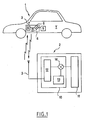
- FIG. 1 shows a vehicle V which carries means 1 RF transmission / reception intended to exchange with a module 2 RF transmission / reception carried by a user and presented by example in the form of a badge.
- the transmission / reception means 1 comprise an antenna 3 arranged for example near a door handle of the vehicle, or therein, a management unit 5, as well as means 4 for conversion signal interposed between the antenna 3 and the management unit 5.
- the signal conversion means 4 include in particular means 6 for modulating or demodulating an RF signal transmitted or received by antenna 3, a circular shift register 7 in which is stored a pseudo-random code, as well as mixing means 8 which are mounted between the management unit 5 and said means 6 for modulation / demodulation and which are able to mix the pseudo-random code with the signal demodulated by means 6 or with a signal transmitted by the management unit 5.
- the pseudo-random code of the register to circular offset 7 is cyclically swapped around on itself at some clock frequency.
- the badge 2 includes an antenna 9, a management unit 11 and signal conversion means 10 interposed between the antenna 9 and the management unit 11.
- the signal conversion means 10 also include way that means 4, means 12 for modulating or demodulating a RF signal transmitted or received by the antenna 9, a circular shift register 13 in which a pseudo-random code identical to that stored is stored in register 7, as well as mixing means 14 which are mounted between the management unit 11 and said modulation / demodulation means 12 and which are able to mix the pseudo-random code with the signal demodulated by means 12 or with a signal transmitted by the unit of management 11.
- the pseudo-random code of the circular shift register 13 is cyclically swapped at itself at the same clock frequency as that of the shift register 7.
- Vehicle V includes means for enabling detect the presence of an individual near the vehicle. These means are for example made up of sensors arranged in the handles of the doors and making it possible to detect that an individual is approaching his hand from a handle or operate it.
- the means 1 and the badge 2 synchronize their shift registers 7 and 13, for example by implementing the sequence of exchanges which is described below in detail, then the means 1 emit an RF interrogation signal.
- This RF interrogation signal is a signal modulated by the means 6, which for example use a two-phase NRZ modulation. he carries the pseudo-random code stored in register 7, mixed with a "challenge" code (key code) which is chosen by the management unit 5 among several possibilities and who will have to determine the answer that will have to give the badge 2.
- the unit of management 11 then receives means 14 the key code carried by the RF signal transmitted to badge 2.
- the correlation is maximum when the RF signal is received by antenna 9 substantially concomitantly with its emission by antenna 3. However, it is minimal as soon as it is no longer the case and by consequently as soon as delays are introduced in the chain of transmission, which is necessarily the case when means of intermediate transmission / reception are interposed by bad people between the vehicle and the user.
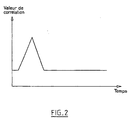
- the correlation value varies, depending on the phase shift between the pseudo-random code carried by the received signal and the shift register pseudo-random code 13, which is illustrated in figure 2. It takes its maximum value when the two codes are perfectly synchronized and becomes minimal for time shifts of at least one bit period. For shifts less than a bit period, it varies linearly between its maximum value and its minimum value.
- the pseudo-random code can be coded on 127 bits, while shift registers 7 and 13 are traversed at a clock frequency of 5 MHz, which corresponds to bit periods of 200 ns.
- Correlations are then obtained within ⁇ 30 m of the vehicle, (or then at 7, 62 km ⁇ 30 m or 15, 24 km ⁇ 30 m, etc.).
- This secret code is a code that said vehicle V expects to receive and which is a function of the key code transmitted by the vehicle V.
- This secret code is then mixed with the pseudo-random code of the shift register 13, then the signal obtained is modulated by means 10 and transmitted by the antenna 9.
- this RF signal When this RF signal is received by the antenna 3, it is demodulated, then mixed with the pseudo-random code of the shift register 7.
- the secret code is then retrieved by the management unit 5, if there is correlation between the pseudo-random code carried by said RF signal. To the reception of this secret code, the management unit 5 verifies that it is indeed the expected code and controls unlocking of the doors if this is the case.
- the secret code issued by badge 2 may not be a code mixed with a pseudo-random code, but be constituted by a code pseudo-random specific to badge 2, which therefore carries intrinsically the signature of it.
- the means 1 then include means, synchronized on badge 2, capable of despreading the signal received with this pseudo-random code.
- the vehicle When the presence of an individual near the vehicle is detected, the vehicle emits an activation signal intended to wake up the badge 2.
- the badge 2 Upon receipt of this activation signal, the badge 2 emits an RF signal which carries an identification code mixed with a short pseudo-random signal ("short" to be heard as opposed to the long pseudo-random signal, in this case 127 bits, used after the synchronization step).
- short to be heard as opposed to the long pseudo-random signal, in this case 127 bits, used after the synchronization step.
- the identification code is used to prevent other vehicles that the person concerned does not respond when the badge 2 is activated. repeated over a period sufficient for the means 1 transmission / reception of the vehicle V are synchronized on the pseudo-random signal.
- the transmission / reception means 1 transmit a response signal which marks the end of the initialization sequence. As long as this vehicle response is not received by badge 2, it repeats the emission of the signal which carries the identification code mixed with a signal short pseudo-random.
Landscapes
- Engineering & Computer Science (AREA)
- Computer Networks & Wireless Communication (AREA)
- Physics & Mathematics (AREA)
- General Physics & Mathematics (AREA)
- Lock And Its Accessories (AREA)
Description
- la figure 1 est une représentation synoptique illustrant un système conforme à l'invention ;
- la figure 2 illustre la fonction de corrélation des codes pseudo-aléatoires cycliquement permutés sur eux-mêmes, utilisés dans un système du type de celui de la figure 1.
Claims (11)
- Système pour la commande de moyens pour le verrouillage/déverrouillage d'au moins un ouvrant de véhicule, notamment automobile, comportant des moyens d'émission/réception (3, 4, 5) et des moyens mémoire (7) qui sont portés par le véhicule et des moyens d'émission/réception (9, 10, 11) et des moyens mémoire (13) qui sont destinés à être portés par un utilisateur, les moyens d'émission/réception du véhicule (3, 4, 5) formant registre à décalage circulaire dans lequel est stocké un code pseudo-aléatoire et comportant des moyens (3, 6, 7) pour émettre un signal d'interrogation qui porte un tel code pseudoaléatoire, les moyens d'émission/réception de l'utilisateur (9, 10, 11) comportant des moyens (12, 13, 14) pour désétaler le signal reçu si le code pseudo-aléatoire porté par ledit signal est synchronisé avec un code pseudo-aléatoire correspondant stocké dans leurs moyens mémoire (13) et étant destinés à émettre un signal de réponse apte à commander l'actionnement du déverrouillage de l'ouvrant,
caractérisé en ce que
les moyens mémoire (13) et les moyens d'émission/réception (9, 10, 11) de l'utilisateur forment registre à décalage circulaire et comportent en outre des moyens (9, 12, 13, 14) pour émettre en réponse un signal qui porte un code pseudo-aléatoire et une signature qui est propre auxdits moyens d'émission/réception (9, 10, 11) de l'utilisateur, les moyens d'émission/réception (3, 4, 5) sur le véhicule comportant des moyens (6, 7, 8) pour désétaler le signal reçu si le code pseudo-aléatoire porté par ledit signal de réponse est synchronisé avec un code pseudo-aléatoire correspondant stocké dans leurs moyens mémoire (7) et pour vérifier si le signal reçu porte la signature des moyens d'émission - Système selon la revendication 1, caractérisé en ce que le signal d'interrogation émis par les moyens d'émission/réception du véhicule (3, 4, 5) comporte un code clé, le signal de réponse émis par les moyens d'émission/réception (9, 10, 11) de l'utilisateur comportant un code secret déterminé par lesdits moyens d'émission/réception de l'utilisateur en fonction dudit code clé.
- Système selon la revendication 2, caractérisé en ce que les moyens d'émission/réception (3, 4, 5) du véhicule comportent des moyens (8) pour mélanger dans le signal d'interrogation ledit code clé au code pseudo-aléatoire.
- Système selon la revendication 2, caractérisé en ce que les moyens d'émission/réception (9, 10, 11) de l'utilisateur comportent des moyens (13) pour mélanger dans le signal de réponse ledit code secret au code pseudo-aléatoire.
- Système selon la revendication 2, caractérisé en ce que le code clé et/ou le code secret constitue(nt) le code pseudo-aléatoire du signal d'interrogation ou de réponse.
- Système selon la revendication 1, caractérisé en ce que la signature des moyens d'émission/réception (9, 10, 11) de l'utilisateur est constituée par le code pseudo-aléatoire du signal de réponse.
- Système selon l'une des revendications précédentes, caractérisé en ce qu'il comporte des moyens pour synchroniser les différents moyens mémoire, préalablement à l'émission du signal d'interrogation.
- Système selon la revendication 7, caractérisé en ce que les moyens d'émission/réception (3, 4, 5) du véhicule comportent des moyens pour se synchroniser sur un code pseudo-aléatoire émis par les moyens d'émission/réception de l'utilisateur lors de leur activation.
- Système selon la revendication 8, caractérisé en ce que ce code pseudo-aléatoire est un code plus court que le ou les codes pseudo-aléatoires utilisés par les moyens d'émission/réception du véhicule et de l'utilisateur après synchronisation.
- Système selon la revendication 9, caractérisé en ce que le ou les codes pseudo-aléatoires utilisés par les moyens d'émission/réception du véhicule et de l'utilisateur après synchronisation sont des codes de 127 bits.
- Système selon l'une des revendications précédentes, caractérisé en ce que les signaux d'interrogation et de réponse sont des signaux RF modulés par une modulation NRZ bi-phase.
Applications Claiming Priority (3)
| Application Number | Priority Date | Filing Date | Title |
|---|---|---|---|
| FR9913807 | 1999-11-04 | ||
| FR9913807A FR2800783B1 (fr) | 1999-11-04 | 1999-11-04 | Perfectionnements aux systemes securises pour la commande du deverrouillage d'au moins un ouvrant de vehicule automobile |
| PCT/FR2000/003065 WO2001033015A1 (fr) | 1999-11-04 | 2000-11-03 | Systeme securise pour la commande du deverrouillage d'au moins un ouvrant de vehicule automobile |
Publications (2)
| Publication Number | Publication Date |
|---|---|
| EP1144784A1 EP1144784A1 (fr) | 2001-10-17 |
| EP1144784B1 true EP1144784B1 (fr) | 2004-04-21 |
Family
ID=9551711
Family Applications (1)
| Application Number | Title | Priority Date | Filing Date |
|---|---|---|---|
| EP00974644A Expired - Lifetime EP1144784B1 (fr) | 1999-11-04 | 2000-11-03 | Systeme securise pour la commande du deverrouillage d'au moins un ouvrant de vehicule automobile |
Country Status (6)
| Country | Link |
|---|---|
| US (1) | US7227448B2 (fr) |
| EP (1) | EP1144784B1 (fr) |
| JP (1) | JP2003514150A (fr) |
| DE (1) | DE60010039T2 (fr) |
| FR (1) | FR2800783B1 (fr) |
| WO (1) | WO2001033015A1 (fr) |
Families Citing this family (3)
| Publication number | Priority date | Publication date | Assignee | Title |
|---|---|---|---|---|
| US20060178110A1 (en) * | 2005-02-09 | 2006-08-10 | Nokia Corporation | System and method for interacting with an entity by means of a mobile station via a user-wearable terminal |
| JP2009166550A (ja) * | 2008-01-11 | 2009-07-30 | Mitsubishi Electric Corp | 車載機器遠隔制御システムおよび車載機器遠隔制御方法 |
| KR102179096B1 (ko) * | 2014-12-16 | 2020-11-16 | 현대자동차주식회사 | 랜덤코드를 이용한 차량 통신 방법 및 장치 |
Family Cites Families (10)
| Publication number | Priority date | Publication date | Assignee | Title |
|---|---|---|---|---|
| GB1595797A (en) * | 1978-04-21 | 1981-08-19 | Pushman Hugh John | Security systems |
| US5367572A (en) * | 1984-11-30 | 1994-11-22 | Weiss Kenneth P | Method and apparatus for personal identification |
| FR2628471A1 (fr) * | 1988-03-09 | 1989-09-15 | Werke Gestion Securit | Ensemble electronique de fermeture |
| JPH0732499B2 (ja) * | 1988-08-16 | 1995-04-10 | 日産自動車株式会社 | 施解錠制御システム |
| IT1249903B (it) * | 1991-06-07 | 1995-03-30 | Trw Sipea Spa | Telecomando a sicurezza ottimizzata |
| JP2561232B2 (ja) * | 1992-08-31 | 1996-12-04 | 双葉電子工業株式会社 | スぺクトラム拡散受信装置及びこの装置を用いたスぺクトラム拡散送受信装置 |
| US5369706A (en) * | 1993-11-05 | 1994-11-29 | United Technologies Automotive, Inc. | Resynchronizing transmitters to receivers for secure vehicle entry using cryptography or rolling code |
| US5420925A (en) * | 1994-03-03 | 1995-05-30 | Lectron Products, Inc. | Rolling code encryption process for remote keyless entry system |
| US5736935A (en) * | 1995-03-14 | 1998-04-07 | Trw Inc. | Keyless vehicle entry and engine starting system |
| US6057779A (en) * | 1997-08-14 | 2000-05-02 | Micron Technology, Inc. | Method of controlling access to a movable container and to a compartment of a vehicle, and a secure cargo transportation system |
-
1999
- 1999-11-04 FR FR9913807A patent/FR2800783B1/fr not_active Expired - Fee Related
-
2000
- 2000-11-03 EP EP00974644A patent/EP1144784B1/fr not_active Expired - Lifetime
- 2000-11-03 DE DE60010039T patent/DE60010039T2/de not_active Expired - Lifetime
- 2000-11-03 JP JP2001535684A patent/JP2003514150A/ja active Pending
- 2000-11-03 WO PCT/FR2000/003065 patent/WO2001033015A1/fr not_active Ceased
-
2001
- 2001-06-20 US US09/883,963 patent/US7227448B2/en not_active Expired - Fee Related
Also Published As
| Publication number | Publication date |
|---|---|
| FR2800783B1 (fr) | 2002-02-22 |
| US20020163420A1 (en) | 2002-11-07 |
| JP2003514150A (ja) | 2003-04-15 |
| FR2800783A1 (fr) | 2001-05-11 |
| EP1144784A1 (fr) | 2001-10-17 |
| US7227448B2 (en) | 2007-06-05 |
| WO2001033015A1 (fr) | 2001-05-10 |
| DE60010039T2 (de) | 2004-10-21 |
| DE60010039D1 (de) | 2004-05-27 |
Similar Documents
| Publication | Publication Date | Title |
|---|---|---|
| EP0629758B1 (fr) | Système de télécommande à plusieurs portées fonctionnelles sélectionnées par seuil de détection | |
| US9584542B2 (en) | Relay attack countermeasure system | |
| FR2799297A1 (fr) | Actionnement passif d'un systeme de securite residentielle | |
| EP2633506B1 (fr) | Procede de fonctionnement d'une unite mobile de commande d'une installation domotique | |
| EP1207659A3 (fr) | Méthode de transmission de données, système de transmission de données, émetteur et recépteur | |
| MXPA04006223A (es) | Sistema y metodo para sondear una unidad de datos de protocolo de una memoria intermedia de transmision. | |
| JPH10209914A (ja) | 変調バックスキャッタシステム及びトランスポンダ | |
| US7724125B2 (en) | Remote keyless entry system for a vehicle and a method of controlling a vehicle function by the same | |
| WO2001054371A3 (fr) | Procede et systeme de transmission de donnees d'un emetteur vers un recepteur et emetteur ou recepteur a cet effet | |
| CA2359975A1 (fr) | Systeme de video a la demande | |
| WO2004100445A3 (fr) | Systeme de transmission/reception | |
| EP1052353B1 (fr) | Système sécurisé pour la commande du déverrouillage d'au moins un ouvrant de véhicule automobile | |
| FR2814842A1 (fr) | Procede d'emission et de reception, notamment pour la detection d'un generateur d'identification | |
| EP1144784A1 (fr) | Systeme securise pour la commande du deverrouillage d'au moins un ouvrant de vehicule automobile | |
| EP1407426A1 (fr) | Procede de deverrouillage "sans cle" d'une porte d'acces a un espace clos | |
| AU2001246394A1 (en) | A method and system for pushing information | |
| FR2786802A1 (fr) | Systeme de controle d'acces passifs et notamment systemes pour le verrouillage ou deverrouillage passif d'ouvrants de vehicules automobiles | |
| JP2004517777A (ja) | とりわけ自動車である対象物への立入権限、または対象物の使用権限を認証する識別システム | |
| EP1389330B1 (fr) | Procédé de communication entre un badge et un véhicule automobile | |
| FR2808549A1 (fr) | Systeme d'acces dit mains libres pour vehicule automobile | |
| EP1152107B1 (fr) | Systéme a anti-piratage pour l'accès mains libres d'un véhicule automobile | |
| FR3063947A1 (fr) | Procede d'acces securise a un vehicule automobile | |
| US10567966B1 (en) | Self-masking receive system | |
| FR2815736A1 (fr) | Systeme d'echange d'informations entre un centre serveur et des moyens informatiques embarques a bord d'un vehicule automobile | |
| FR2756691A1 (fr) | Dispositif d'emission de deux groupes de donnees de commande et cle electronique, pour vehicule automobile, comportant le dispositif |
Legal Events
| Date | Code | Title | Description |
|---|---|---|---|
| PUAI | Public reference made under article 153(3) epc to a published international application that has entered the european phase |
Free format text: ORIGINAL CODE: 0009012 |
|
| AK | Designated contracting states |
Kind code of ref document: A1 Designated state(s): AT BE CH CY DE DK ES FI FR GB GR IE IT LI LU MC NL PT SE TR |
|
| 17P | Request for examination filed |
Effective date: 20011112 |
|
| RAP1 | Party data changed (applicant data changed or rights of an application transferred) |
Owner name: VALEO SECURITE HABITACLE |
|
| GRAP | Despatch of communication of intention to grant a patent |
Free format text: ORIGINAL CODE: EPIDOSNIGR1 |
|
| RAP1 | Party data changed (applicant data changed or rights of an application transferred) |
Owner name: VALEO SECURITE HABITACLE S.A.S. |
|
| GRAS | Grant fee paid |
Free format text: ORIGINAL CODE: EPIDOSNIGR3 |
|
| GRAA | (expected) grant |
Free format text: ORIGINAL CODE: 0009210 |
|
| AK | Designated contracting states |
Kind code of ref document: B1 Designated state(s): DE ES FR GB IT |
|
| PG25 | Lapsed in a contracting state [announced via postgrant information from national office to epo] |
Ref country code: IT Free format text: LAPSE BECAUSE OF FAILURE TO SUBMIT A TRANSLATION OF THE DESCRIPTION OR TO PAY THE FEE WITHIN THE PRESCRIBED TIME-LIMIT;WARNING: LAPSES OF ITALIAN PATENTS WITH EFFECTIVE DATE BEFORE 2007 MAY HAVE OCCURRED AT ANY TIME BEFORE 2007. THE CORRECT EFFECTIVE DATE MAY BE DIFFERENT FROM THE ONE RECORDED. Effective date: 20040421 Ref country code: GB Free format text: LAPSE BECAUSE OF FAILURE TO SUBMIT A TRANSLATION OF THE DESCRIPTION OR TO PAY THE FEE WITHIN THE PRESCRIBED TIME-LIMIT Effective date: 20040421 |
|
| REG | Reference to a national code |
Ref country code: GB Ref legal event code: FG4D Free format text: NOT ENGLISH |
|
| REG | Reference to a national code |
Ref country code: IE Ref legal event code: FG4D Free format text: FRENCH |
|
| REF | Corresponds to: |
Ref document number: 60010039 Country of ref document: DE Date of ref document: 20040527 Kind code of ref document: P |
|
| PG25 | Lapsed in a contracting state [announced via postgrant information from national office to epo] |
Ref country code: ES Free format text: LAPSE BECAUSE OF FAILURE TO SUBMIT A TRANSLATION OF THE DESCRIPTION OR TO PAY THE FEE WITHIN THE PRESCRIBED TIME-LIMIT Effective date: 20040801 |
|
| GBV | Gb: ep patent (uk) treated as always having been void in accordance with gb section 77(7)/1977 [no translation filed] |
Effective date: 20040421 |
|
| REG | Reference to a national code |
Ref country code: IE Ref legal event code: FD4D |
|
| PLBE | No opposition filed within time limit |
Free format text: ORIGINAL CODE: 0009261 |
|
| STAA | Information on the status of an ep patent application or granted ep patent |
Free format text: STATUS: NO OPPOSITION FILED WITHIN TIME LIMIT |
|
| 26N | No opposition filed |
Effective date: 20050124 |
|
| PGFP | Annual fee paid to national office [announced via postgrant information from national office to epo] |
Ref country code: DE Payment date: 20101112 Year of fee payment: 11 |
|
| PGFP | Annual fee paid to national office [announced via postgrant information from national office to epo] |
Ref country code: FR Payment date: 20120106 Year of fee payment: 12 |
|
| REG | Reference to a national code |
Ref country code: FR Ref legal event code: ST Effective date: 20130731 |
|
| REG | Reference to a national code |
Ref country code: DE Ref legal event code: R119 Ref document number: 60010039 Country of ref document: DE Effective date: 20130601 |
|
| PG25 | Lapsed in a contracting state [announced via postgrant information from national office to epo] |
Ref country code: DE Free format text: LAPSE BECAUSE OF NON-PAYMENT OF DUE FEES Effective date: 20130601 |
|
| PG25 | Lapsed in a contracting state [announced via postgrant information from national office to epo] |
Ref country code: FR Free format text: LAPSE BECAUSE OF NON-PAYMENT OF DUE FEES Effective date: 20121130 |