EP1143626A1 - Method and device for evaluating the noise associated with turbocodes - Google Patents
Method and device for evaluating the noise associated with turbocodes Download PDFInfo
- Publication number
- EP1143626A1 EP1143626A1 EP01400644A EP01400644A EP1143626A1 EP 1143626 A1 EP1143626 A1 EP 1143626A1 EP 01400644 A EP01400644 A EP 01400644A EP 01400644 A EP01400644 A EP 01400644A EP 1143626 A1 EP1143626 A1 EP 1143626A1
- Authority
- EP
- European Patent Office
- Prior art keywords
- encoder
- noise
- data stream
- estimate
- issuing
- Prior art date
- Legal status (The legal status is an assumption and is not a legal conclusion. Google has not performed a legal analysis and makes no representation as to the accuracy of the status listed.)
- Withdrawn
Links
- 238000000034 method Methods 0.000 title claims description 31
- 230000009897 systematic effect Effects 0.000 claims abstract description 68
- 238000004590 computer program Methods 0.000 claims description 7
- 238000011144 upstream manufacturing Methods 0.000 claims description 2
- 238000007792 addition Methods 0.000 abstract description 19
- 238000011156 evaluation Methods 0.000 description 23
- 230000005540 biological transmission Effects 0.000 description 15
- 230000002093 peripheral effect Effects 0.000 description 8
- 238000007476 Maximum Likelihood Methods 0.000 description 4
- 238000004422 calculation algorithm Methods 0.000 description 4
- 238000010606 normalization Methods 0.000 description 4
- 238000004364 calculation method Methods 0.000 description 3
- 238000010586 diagram Methods 0.000 description 3
- 238000013500 data storage Methods 0.000 description 2
- 230000000694 effects Effects 0.000 description 2
- 238000005259 measurement Methods 0.000 description 2
- 102100029469 WD repeat and HMG-box DNA-binding protein 1 Human genes 0.000 description 1
- 101710097421 WD repeat and HMG-box DNA-binding protein 1 Proteins 0.000 description 1
- 238000009825 accumulation Methods 0.000 description 1
- 239000000654 additive Substances 0.000 description 1
- 230000000996 additive effect Effects 0.000 description 1
- 238000003491 array Methods 0.000 description 1
- 238000010276 construction Methods 0.000 description 1
- 230000003247 decreasing effect Effects 0.000 description 1
- 230000006870 function Effects 0.000 description 1
- 238000004088 simulation Methods 0.000 description 1
- 238000010972 statistical evaluation Methods 0.000 description 1
Images



Classifications
-
- H—ELECTRICITY
- H03—ELECTRONIC CIRCUITRY
- H03M—CODING; DECODING; CODE CONVERSION IN GENERAL
- H03M13/00—Coding, decoding or code conversion, for error detection or error correction; Coding theory basic assumptions; Coding bounds; Error probability evaluation methods; Channel models; Simulation or testing of codes
- H03M13/61—Aspects and characteristics of methods and arrangements for error correction or error detection, not provided for otherwise
- H03M13/612—Aspects specific to channel or signal-to-noise ratio estimation
-
- H—ELECTRICITY
- H03—ELECTRONIC CIRCUITRY
- H03M—CODING; DECODING; CODE CONVERSION IN GENERAL
- H03M13/00—Coding, decoding or code conversion, for error detection or error correction; Coding theory basic assumptions; Coding bounds; Error probability evaluation methods; Channel models; Simulation or testing of codes
- H03M13/01—Coding theory basic assumptions; Coding bounds; Error probability evaluation methods; Channel models; Simulation or testing of codes
- H03M13/015—Simulation or testing of codes, e.g. bit error rate [BER] measurements
-
- H—ELECTRICITY
- H03—ELECTRONIC CIRCUITRY
- H03M—CODING; DECODING; CODE CONVERSION IN GENERAL
- H03M13/00—Coding, decoding or code conversion, for error detection or error correction; Coding theory basic assumptions; Coding bounds; Error probability evaluation methods; Channel models; Simulation or testing of codes
- H03M13/29—Coding, decoding or code conversion, for error detection or error correction; Coding theory basic assumptions; Coding bounds; Error probability evaluation methods; Channel models; Simulation or testing of codes combining two or more codes or code structures, e.g. product codes, generalised product codes, concatenated codes, inner and outer codes
- H03M13/2957—Turbo codes and decoding
-
- H—ELECTRICITY
- H03—ELECTRONIC CIRCUITRY
- H03M—CODING; DECODING; CODE CONVERSION IN GENERAL
- H03M13/00—Coding, decoding or code conversion, for error detection or error correction; Coding theory basic assumptions; Coding bounds; Error probability evaluation methods; Channel models; Simulation or testing of codes
- H03M13/65—Purpose and implementation aspects
- H03M13/6577—Representation or format of variables, register sizes or word-lengths and quantization
- H03M13/658—Scaling by multiplication or division
Definitions
- the present invention relates to a method and device for evaluating the noise associated with turbocodes, and to systems using them.
- a conventional turbo-encoder consists of two recursive systematic convolutional (RSC) encoders and an interleaver, disposed as shown in Figure 1 .
- the turbo-encoder supplies as an output three series of binary elements (x, y1, y2), where x is the so-called systematic output of the turbo-encoder, that is to say one which has not undergone any processing with respect to the input signal x, y1 is the output encoded by the first RSC encoder, and y2 is the output encoded by the second RSC encoder after passing through the interleaver.
- Figure 2 depicts an example of a conventional turbo-decoder able to decode data supplied by a turbo-encoder like the one in Figure 1.
- the inputs x',y1 ', y2' of the turbodecoder are the outputs of the turbo-encoder altered by the transmission channel and the transmission and reception processes.
- the structure of such a turbodecoder is well known to persons skilled in the art and will therefore not be described in detail here.
- Decoder 1 and “Decoder 2” in Figure 2
- BCJR the BCJR type
- SOVA Soft Output Viterbi Algorithm
- the data supplied as an input to the decoders 1 and 2 take into account the signal to noise ratio.
- a conventional turbodecoder also requires a looping back of the output of the deinterleaver ⁇ 2 onto the input of the first decoder, in order to transmit the so-called "extrinsic" information from the second decoder to the first decoder.
- the result of the decoding depends on the noise impairing the transmission channel as well as the transmission and reception processes.
- the "noise" parameter is generally a given in the problem.
- the noise is a characteristic related to the channel and can vary from one data transmission to another, or even during the same data transmission. In fact, it is possible to know only approximate statistics of the noise.
- the decoding system can work with a highly incorrect noise estimation; nevertheless, its ability to correct the errors which have been introduced by the channel noise will be decreased.
- the encoding cost which is the redundancy of the data, is high compared with the gain in performance and makes the system inadequate.
- the assumption according to which the noise on the channel is Gaussian is an approximation. It is however possible to obtain an estimation of the noise by accumulating the measurements of the deviations of each symbol received with respect to a theoretical symbol situated at the shortest distance from this received symbol, and then dividing this accumulation by the total number of symbols received.
- a maximum likelihood criterion is applied, which assimilates a received symbol to its closest neighbour.
- the evaluation of the noise B on a modulation is effected by means of the following operation: where i is an integer, N designates the number of symbols per frame or block, "min” designates the smallest Euclidian distance between a received symbol and the theoretical points of the constellation, the sign • designates the position of the received symbols and S i designates the positions of the theoretical symbols.
- This technique is known notably in the field of modems, where it is used for obtaining a negotiation of the bit rate per symbol as a function of the state of the channel.
- the invention aims to evaluate the noise on an estimator having an identical structure for all the symbols, whether they represent the systematic data item or any one of the parity data.
- the invention also proposes a method of evaluating the noise adapted to the turbodecoder which, although going counter to the accuracy of the statistics, makes it possible to improve the performance of the decoder.
- the present invention proposes a method of evaluating the noise related to data streams issuing from a turbo-encoder having at least first and second encoders, these data streams being intended for a turbodecoder having at least first and second elementary decoders, according to which:
- the present invention thus makes it possible to establish statistics of the noise adapted to the structure of the turbodecoder, which makes it possible to improve the performance in terms of bit error rate (BER).
- BER bit error rate
- the invention can be implemented both on signal processors and on FPGAs ("Field Programmable Gate Arrays”), that is to say by means of hard-wired or programmed logic.
- the moving average of the sum of the Euclidian distances from each noisy symbol received to the closest theoretical symbol is determined, respectively for each symbol of the data stream issuing from the systematic output, for each symbol of the data stream issuing from the first encoder and for each symbol of the data stream issuing from the second encoder.
- This characteristic makes it possible to improve the decoding performances of the turbodecoder by the use of an evaluation of the noise resulting from a statistical measurement of the deviation of the symbols received during a transmission with respect to the theoretical symbols, on the basis of a decision on the maximum likelihood.
- DSP digital signal processor
- a comparison operation is performed, consisting of determining to which Vorono ⁇ region each noisy symbol received belongs.
- the method of the invention also includes a step according to which:
- This characteristic makes it possible to terminate the estimation of the noise before commencing decoding proper.
- the first and second encoders are recursive systematic convolutional encoders.
- the present invention also proposes a device for evaluating the noise related to data streams issuing from a turbo-encoder having at least first and second encoders, these data streams being intended for a turbodecoder having at least first and second elementary decoders, this device having:
- the present invention also relates to a digital signal processing apparatus, having means adapted to implement a method as above.
- the present invention also relates to a digital signal processing apparatus, having a device as above.
- the present invention also relates to a telecommunications network, having means adapted to implement a method as above.
- the present invention also relates to a telecommunications network, having a device as above.
- the present invention also relates to a mobile station in a telecommunications network, having means adapted to implement a method as above.
- the present invention also relates to a mobile station in a telecommunications network, having a device as above.
- the invention also relates to:
- the invention also relates to a computer program product comprising software code portions for implementing a method as above.
- This noise evaluation device includes a module 23 for estimating the noise related to the systematic output X k s of the turbo-encoder (the notation "+ BBAG" designating the white additive Gaussian noise affecting the data), a module 21 for estimating the noise related to the data stream X k 1p issuing from the first recursive systematic convolutional encoder included in the turbo-encoder and a module 25 for estimating the noise related to the data stream X k 2p issuing from the second recursive systematic convolutional encoder included in the turbo-encoder.
- Such noise estimation modules are detailed later in relation to Figure 7. The symbols issuing from the three outputs of the turbo-encoder being presented by blocks, the noise estimation modules 23, 21 and 25 supply an estimation of the noise over the length of each block.
- Delay application modules 22, 20 and 24 are also provided in parallel to the noise estimation modules 23, 21 and 25, on each of the three outputs of the turbo-encoder.
- the modules 22, 20 and 24 make it possible to know the result of the estimation of the noise on each output before applying a multiplying factor, taking this noise into account, to the first symbol issuing from each output and intended for the turbodecoder.
- An adder 26 adds the result of the three noise estimations supplied by the modules 23, 21 and 25, and a module 27 divides the sum obtained by 3 and then calculates the inverse of the result of this division.
- the module 27 thus supplies a normalisation factor, which is applied by multiplication firstly to the first-parity data stream, that is to say the one issuing from the first encoder, by means of a multiplier 28, secondly to the systematic data stream, by means of a multiplier 29, and finally to the second-parity data stream, that is to say the one issuing from the second encoder, by means of a multiplier 30.
- the elements 31 to 35 form a conventional turbodecoder similar to that of Figure 2, having interleavers 33 and 34, a deinterleaver 32 and two elementary decoders 31 and 35 applying, for example, the BCJR algorithm as stated in the introduction.
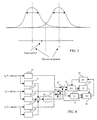
- Figure 5 illustrates a preferred embodiment of the noise evaluation device according to the invention, more in accordance than the previous one with the structure of the turbodecoder and making it possible to obtain a better performance.
- the three noise estimations are not added together, but in pairs.
- the noise evaluation device in Figure 5 has, as in the embodiment described before, a module 42 for estimating the noise related to the noisy systematic output X k s + BBAG of the turbo-encoder, a module 41 for estimating the noise related to the noisy data stream issuing from the recursive systematic convolutional encoder X k 1p + BBAG and a module 44 for estimating the noise related to the noisy data stream issuing from the second recursive systematic convolutional encoder X k 2p + BBAG.
- the noise evaluation device also has, as in the previous embodiment, three delay application modules 39, 40 and 43, disposed respectively in parallel to the noise estimation modules 42, 41 and 44.
- the noise evaluation device of Figure 5 has not one but two adders 45 and 46, disposed as follows: the adder 45 adds the results of the estimation of the noises suffered by the systematic data stream and the first-parity data stream, whilst the adder 46 adds the results of the estimation of the noises suffered by the systematic data stream and the second-parity data stream.
- a module 47 effects the division by 2, and then the inversion of the result supplied by the adder 45, so as to supply as an output the first normalisation factor or first noise factor.
- a module 48 effects the division by 2, and then the inversion of the result supplied by the adder 46, so as to supply as an output a second normalisation factor or second noise factor.
- the first noise factor is applied by multiplication to the first-parity data stream, by means of a multiplier 50, and to the systematic data stream intended for the first elementary decoder 53 of the turbodecoder, by means of a multiplier 49.
- the second noise factor is applied by multiplication to the second-parity data stream, by means of a multiplier 52, and to the systematic data stream intended for the second elementary decoder 57 of the turbodecoder, by means of a multiplier 51.
- the elements 53 to 57 form a conventional turbodecoder similar to that of Figure 2, having interleavers 55 and 56, a deinterleaver 54 and two elementary decoders 53 and 57 applying, for example, the BCJR algorithm as stated in the introduction.
- the first elementary decoder 53 applies a decoding in accordance with the trellis used in the first recursive systematic convolutional encoder of the turbo-encoder
- the second elementary decoder 57 applies a decoding in accordance with the trellis used in the second recursive systematic convolutional encoder of the turbo-encoder.
- This embodiment adapted to the structure of the turbo-encoder, makes it possible to obtain an improvement of more than 7% in the performance in terms of bit error rate compared with the signal to noise ratio.
- Figure 7 depicts schematically a noise estimation module like the modules 21, 23 and 25 in Figure 4 and the modules 41, 42 and 44 in Figure 5, in a particular embodiment.
- the noise estimator considered here applies to NRZ symbols, that is to say ones belonging to the set ⁇ -1 ; +1 ⁇ . However, this is a non-limitative example and constellation symbols with two dimensions could also be considered.
- It has a discriminating module 5 and a module 82 for calculating a moving average.
- the discriminating module 5 receives as an input a noisy signal S and compares it with 0 (see the reference numbers 10 and 13 in Figure 7) in order to determine to which Vorono ⁇ region it belongs.
- Vorono ⁇ regions of a constellation are planes delimited by the axes of symmetry of the constellation, and that they define the decision regions for reception: a point received is estimated by means of the closest point in the constellation, for example in the sense of the Euclidian distance, which amounts to estimating, by means of a given point in the constellation, all the points received which are in the same Vorono ⁇ region as this point in the constellation.
- the Vorono ⁇ regions are two half-lines delimited by the point 0.
- An adder 16 adds the results corresponding to the different Vorono ⁇ regions, which makes it possible to obtain the Euclidian distance from the symbol received to the closest theoretical point.
- the module 82 calculates the moving average of the sum of these Euclidian distances.
- an amplifier 84 applies a gain of 1/N to the result issuing from the discriminator 5, N being the number of data items in each block processed by the noise estimator.
- the result obtained is stored by means of a module 86 which applies a delay corresponding to the period between two successive data items, and then this result is amplified by an amplifier 88 which applies a gain of (N-1)/N.
- An adder 90 adds the results issuing from the amplifiers 84 and 88.
- FIG. 6 illustrates the steps of the noise evaluation method according to the invention, in a particular embodiment.
- a noise estimation operation 70 is performed, during which there is determined an estimate of the noise related to each output of the turbo-encoder, namely the systematic output, the first-parity output and the second-parity output in the case of a two-parity turbo-encoder.
- This operation can be performed by means of three noise estimators like the one which has just been described in relation to Figure 7.
- a step 70 additions in pairs of the noise estimations are effected: the estimate of the noise related to the systematic output of the turbo-encoder and the estimate of the noise related to the data stream issuing from the first recursive systematic convolutional encoder included in the turbo-encoder are added, and the estimate of the noise related to the systematic output of the turbo-encoder and the estimate of the noise related to the data stream issuing from the second recursive systematic convolutional encoder included in the turbo-encoder are added.
- step 74 the result of each of the additions effected at step 72 is divided by 2.
- step 76 consists of inverting the result of each of the previous divisions, so as to determine first and second normalisation factors or noise factors. This step 76 can form, with step 74, one and the same step.
- a step 78 consists of applying the noise factors to the different data streams before input into the turbo-encoder:
- the noise evaluation method includes a delay application operation 80, consisting of applying a delay to the data streams issuing from the three outputs of the turbo-encoder, prior to the multiplication operations of step 78; this makes it possible to terminate the calculation of the noise estimates before taking these into account for the turbodecoding.
- the peripheral stations 66 1 , 66 2 , ..., 66 M are remote from the base station SB, each connected by a radio link with the base station SB and able to move with respect to the latter.
- the peripheral station SPi has, for example, a digital camera, a computer, a printer, a server, a facsimile machine, a scanner or a digital photographic apparatus.
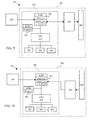
- the transmission device 220 comprises a data processing unit 240 comprising a calculation unit CPU (" Central Processing Unit ") 260, a temporary data storage means 280 (RAM memory), a data storage means 300 (ROM memory), character entry means 320, such as a keyboard for example, image retrieval means 340 such as a screen for example, and input/output means 360.
- a calculation unit CPU Central Processing Unit
- RAM memory temporary data storage means 280
- ROM memory data storage means 300
- character entry means 320 such as a keyboard for example
- image retrieval means 340 such as a screen for example
- input/output means 360 input/output means 360.
- the RAM 280 contains, in different registers:
- the peripheral station SPi also comprises a transmission unit 380 and a radio module 400 including a known transmitter with one or more modulators, filters and a radio antenna (not shown).
- the transmission device 220 by virtue of the program "Program”, which is stored in ROM 300 and whose sequence of instructions corresponds to the steps of the noise evaluation method of the invention, is able to execute the steps of the noise evaluation method illustrated in Figure 6.
- the peripheral station SPi also comprises, as shown in Figure 10, a reception device 700 which consists of a data processing unit corresponding to the data processing unit 240 already described with reference to Figure 9, a reception unit 720 and a radio module 400 with its antenna as depicted in Figure 9.
- a reception device 700 which consists of a data processing unit corresponding to the data processing unit 240 already described with reference to Figure 9, a reception unit 720 and a radio module 400 with its antenna as depicted in Figure 9.
- the RAM 280 contains, in different registers:
- the reception device 700 by virtue of the program "Program” stored in ROM 300 and whose sequence of instructions corresponds to the steps of the noise evaluation method of the invention, is able to execute the steps of the noise evaluation method illustrated in Figure 6.
- the decoder can be produced so as to be hard-wired and placed in the reception device upstream of the reception unit 720 and downstream of the data processing unit 240.
- the present invention although described previously in this application to a two-parity turbo-encoder system, applies just as well to turbocode systems with more than two parities.
- the invention applies easily to systems using quadrature amplitude modulations (QAM), with the exception of the modulation where the QAM symbol is used for transporting conjointly the systematic symbols and all the parity symbols, since in this case the noise statistics give the same results at all the outputs.
- QAM quadrature amplitude modulations
- the invention also applies easily to systems using an Orthogonal Frequency Division Multiplex (OFDM).
- OFDM Orthogonal Frequency Division Multiplex
- the invention is independent of the type of modulation used.
Landscapes
- Physics & Mathematics (AREA)
- Probability & Statistics with Applications (AREA)
- Engineering & Computer Science (AREA)
- Theoretical Computer Science (AREA)
- Error Detection And Correction (AREA)
Applications Claiming Priority (2)
| Application Number | Priority Date | Filing Date | Title |
|---|---|---|---|
| FR0004280 | 2000-04-04 | ||
| FR0004280A FR2807237A1 (fr) | 2000-04-04 | 2000-04-04 | Procede et dispositif d'evaluation du bruit associe aux turbocodes, et systemes les mettant en oeuvre |
Publications (1)
| Publication Number | Publication Date |
|---|---|
| EP1143626A1 true EP1143626A1 (en) | 2001-10-10 |
Family
ID=8848845
Family Applications (1)
| Application Number | Title | Priority Date | Filing Date |
|---|---|---|---|
| EP01400644A Withdrawn EP1143626A1 (en) | 2000-04-04 | 2001-03-12 | Method and device for evaluating the noise associated with turbocodes |
Country Status (4)
| Country | Link |
|---|---|
| US (2) | US6898251B2 (enExample) |
| EP (1) | EP1143626A1 (enExample) |
| JP (1) | JP4497744B2 (enExample) |
| FR (1) | FR2807237A1 (enExample) |
Families Citing this family (16)
| Publication number | Priority date | Publication date | Assignee | Title |
|---|---|---|---|---|
| FR2805102A1 (fr) * | 2000-02-16 | 2001-08-17 | Canon Kk | Procedes et dispositifs d'emission et de reception d'information, et systemes les mettant en oeuvre |
| US20030123563A1 (en) * | 2001-07-11 | 2003-07-03 | Guangming Lu | Method and apparatus for turbo encoding and decoding |
| FR2849514A1 (fr) * | 2002-12-26 | 2004-07-02 | Canon Kk | Code de geometrie algebrique adapte aux erreurs en rafale |
| US7269783B2 (en) * | 2003-04-30 | 2007-09-11 | Lucent Technologies Inc. | Method and apparatus for dedicated hardware and software split implementation of rate matching and de-matching |
| US20050022101A1 (en) * | 2003-07-21 | 2005-01-27 | Peter Malm | Fast iteration termination of Turbo decoding |
| FR2860360B1 (fr) * | 2003-09-29 | 2005-12-09 | Canon Kk | Dispositif de codage /decodage utilisant un codeur/decodeur de reed-solomon |
| US7463689B2 (en) * | 2003-10-09 | 2008-12-09 | Industrial Technology Research Institute | Error correction and decoding method and system for wideband code division multiple access |
| FR2863794B1 (fr) * | 2003-12-16 | 2006-03-03 | Canon Kk | Procedes et dispositifs de localisation d'erreurs pour les codes de geometrie algebrique |
| FR2865083B1 (fr) * | 2004-01-13 | 2006-04-07 | Canon Kk | Decodage pour code de geometrie algebrique associe a un produit fibre. |
| FR2866998B1 (fr) * | 2004-02-27 | 2006-05-19 | Canon Kk | Decodage et correction d'erreurs pour codes de geometrie algebrique |
| US20050289433A1 (en) * | 2004-06-25 | 2005-12-29 | Itschak Weissman | Discrete universal denoising with error correction coding |
| JP4436315B2 (ja) * | 2005-12-26 | 2010-03-24 | 京セラ株式会社 | 畳み込み符号化器、通信装置、及び畳み込み符号化方法 |
| FR2919773A1 (fr) | 2007-07-30 | 2009-02-06 | Canon Kk | Procede de decodage de blocs de donnees de contenus, produit programme d'ordinateur, moyen de stockage et dispositif de decodage correspondants |
| EP2104036B1 (en) * | 2008-03-18 | 2016-06-01 | Canon Kabushiki Kaisha | Method and device for building of a network coding scheme for data transmission, corresponding computer program product and storage means |
| FR2929063B1 (fr) * | 2008-03-20 | 2010-06-11 | Canon Kk | Procede et dispositif d'allocation de chemins de transmission de donnees dans un reseau de communication synchrone, produit programme d'ordinateur et moyen de stockage correspondants |
| FR2960725B1 (fr) | 2010-05-27 | 2015-06-26 | Canon Kk | Procede et dispositif de configuration d'un schema d'encodage/decodage global dans un reseau de communication, produit programme d'ordinateur et moyen de stockage correspondants |
Family Cites Families (10)
| Publication number | Priority date | Publication date | Assignee | Title |
|---|---|---|---|---|
| JPH03254564A (ja) * | 1989-07-27 | 1991-11-13 | Ricoh Co Ltd | データ端末装置 |
| FR2675971B1 (fr) * | 1991-04-23 | 1993-08-06 | France Telecom | Procede de codage correcteur d'erreurs a au moins deux codages convolutifs systematiques en parallele, procede de decodage iteratif, module de decodage et decodeur correspondants. |
| US6023783A (en) * | 1996-05-15 | 2000-02-08 | California Institute Of Technology | Hybrid concatenated codes and iterative decoding |
| EP0848524A1 (fr) * | 1996-12-10 | 1998-06-17 | Koninklijke Philips Electronics N.V. | MAQ à codage perforé en trellis, avec décodage itératif |
| KR19990012821A (ko) * | 1997-07-31 | 1999-02-25 | 홍성용 | 전자기파 흡수체 조성물과 이의 제조 방법, 전자기파 흡수용도료 조성물과 이의 제조 방법 및 이의 도포 방법 |
| JPH11331289A (ja) * | 1998-05-12 | 1999-11-30 | Sony Corp | 復号化装置と受信装置と通信システム |
| KR100280863B1 (ko) * | 1998-09-25 | 2001-02-01 | 윤덕용 | 터보코드의 가중치를 준 병렬형 복호화 방법및 그 장치 |
| US6028897A (en) * | 1998-10-22 | 2000-02-22 | The Aerospace Corporation | Error-floor mitigating turbo code communication method |
| FR2790621B1 (fr) * | 1999-03-05 | 2001-12-21 | Canon Kk | Dispositif et procede d'entrelacement pour turbocodage et turbodecodage |
| US6801588B1 (en) * | 1999-11-08 | 2004-10-05 | Texas Instruments Incorporated | Combined channel and entropy decoding |
-
2000
- 2000-04-04 FR FR0004280A patent/FR2807237A1/fr not_active Withdrawn
-
2001
- 2001-03-12 EP EP01400644A patent/EP1143626A1/en not_active Withdrawn
- 2001-03-14 US US09/805,176 patent/US6898251B2/en not_active Expired - Fee Related
- 2001-04-04 JP JP2001106055A patent/JP4497744B2/ja not_active Expired - Fee Related
-
2005
- 2005-04-28 US US11/116,324 patent/US7424070B2/en not_active Expired - Fee Related
Non-Patent Citations (4)
| Title |
|---|
| C. BERROU; A. GLAVIEUX; P. THITIMAJSHIMA: "Near Shannon limit error-correcting coding and decoding: turbo-codes", ICC, vol. 93 |
| HUANG X ET AL: "TURBO DECODERS WHICH ADAPT TO NOISE DISTRIBUTION MISMATCH", IEEE COMMUNICATIONS LETTERS,IEEE SERVICE CENTER, PISCATAWAY,US,US, vol. 2, no. 12, January 1999 (1999-01-01), pages 321 - 323, XP000793120, ISSN: 1089-7798 * |
| SUMMERS T A ET AL: "SNR mismatch and online estimation in turbo decoding", IEEE TRANSACTIONS ON COMMUNICATIONS, APRIL 1998, IEEE, USA, vol. 46, no. 4, pages 421 - 423, XP002154486, ISSN: 0090-6778 * |
| WANG C C: "On the optimization of channel side information for turbo decoding", 2000 IEEE AEROSPACE CONFERENCE. PROCEEDINGS (CAT. NO.00TH8484), 2000 IEEE AEROSPACE CONFERENCE PROCEEDINGS, BIG SKY, MT, USA, 18-25 MARCH 2000, 2000, Piscataway, NJ, USA, IEEE, USA, pages 311 - 315 vol.1, XP002154485, ISBN: 0-7803-5846-5 * |
Also Published As
| Publication number | Publication date |
|---|---|
| JP4497744B2 (ja) | 2010-07-07 |
| US20020041640A1 (en) | 2002-04-11 |
| US7424070B2 (en) | 2008-09-09 |
| US6898251B2 (en) | 2005-05-24 |
| FR2807237A1 (fr) | 2001-10-05 |
| US20050185735A1 (en) | 2005-08-25 |
| JP2001352249A (ja) | 2001-12-21 |
Similar Documents
| Publication | Publication Date | Title |
|---|---|---|
| US6898251B2 (en) | Method and device for evaluating the noise associated with turbocodes, and systems using them | |
| EP1383246B1 (en) | Modified Max-LOG-MAP Decoder for Turbo Decoding | |
| US6731700B1 (en) | Soft decision output generator | |
| KR100941346B1 (ko) | 다중 스케일 선택을 갖는 터보 디코더 | |
| US5933462A (en) | Soft decision output decoder for decoding convolutionally encoded codewords | |
| US8266511B2 (en) | Decoding device and decoding method | |
| EP1480347A1 (en) | Digital transmission method of the error-correcting coding type | |
| US20020131515A1 (en) | Soft-decision metric generation for higher order modulation | |
| US20040081259A1 (en) | Soft sample scaling in a turbo decoder | |
| WO2001061867A1 (en) | Turbo decoder | |
| US7165210B2 (en) | Method and apparatus for producing path metrics in trellis | |
| US20030088823A1 (en) | Decoder an decoding method | |
| US20030018941A1 (en) | Method and apparatus for demodulation | |
| US20040017857A1 (en) | Transmitter, receiver, methods, program and signal adapted to modulations having a large number of states | |
| US7272771B2 (en) | Noise and quality detector for use with turbo coded signals | |
| KR100888860B1 (ko) | 비트 대칭 그레이 코드로 변조된 수신 심볼 신호를 비트정보로 분할하는 방법 및 그 장치 | |
| US7055102B2 (en) | Turbo decoder using parallel processing | |
| Lim et al. | Hybrid log-map algorithm for turbo decoding over awgn channel | |
| TWI650954B (zh) | 用於通訊系統中迴旋碼解碼裝置的解碼方法及相關的判斷模組 | |
| Chaikalis et al. | Improving the reconfigurable SOVA/log-MAP turbo decoder for 3GPP | |
| KR20010113792A (ko) | 재귀적 컨벌루션형 심벌들을 디코딩하기 위한 방법 및 장치 | |
| Gunawardana et al. | Fast simulation of turbo codes over Rayleigh fading channels | |
| CN108111250A (zh) | 用于通信系统中回旋码解码装置的解码方法及相关的判断模块 | |
| HK1098887A (en) | Turbo decoder with multiple scale selections |
Legal Events
| Date | Code | Title | Description |
|---|---|---|---|
| PUAI | Public reference made under article 153(3) epc to a published international application that has entered the european phase |
Free format text: ORIGINAL CODE: 0009012 |
|
| AK | Designated contracting states |
Kind code of ref document: A1 Designated state(s): AT BE CH CY DE DK ES FI FR GB GR IE IT LI LU MC NL PT SE TR Kind code of ref document: A1 Designated state(s): DE FR GB |
|
| AX | Request for extension of the european patent |
Free format text: AL;LT;LV;MK;RO;SI |
|
| 17P | Request for examination filed |
Effective date: 20020301 |
|
| AKX | Designation fees paid |
Free format text: DE FR GB |
|
| 17Q | First examination report despatched |
Effective date: 20080527 |
|
| STAA | Information on the status of an ep patent application or granted ep patent |
Free format text: STATUS: THE APPLICATION HAS BEEN WITHDRAWN |
|
| 18W | Application withdrawn |
Effective date: 20160314 |