EP1143415B1 - Generation of multiple proper name pronunciations for speech recognition - Google Patents
Generation of multiple proper name pronunciations for speech recognition Download PDFInfo
- Publication number
- EP1143415B1 EP1143415B1 EP00309339A EP00309339A EP1143415B1 EP 1143415 B1 EP1143415 B1 EP 1143415B1 EP 00309339 A EP00309339 A EP 00309339A EP 00309339 A EP00309339 A EP 00309339A EP 1143415 B1 EP1143415 B1 EP 1143415B1
- Authority
- EP
- European Patent Office
- Prior art keywords
- proper name
- given
- speakers
- language
- letter
- Prior art date
- Legal status (The legal status is an assumption and is not a legal conclusion. Google has not performed a legal analysis and makes no representation as to the accuracy of the status listed.)
- Expired - Lifetime
Links
- 238000000034 method Methods 0.000 claims description 40
- 238000012549 training Methods 0.000 claims description 4
- 238000010586 diagram Methods 0.000 description 9
- 230000006870 function Effects 0.000 description 9
- 238000013459 approach Methods 0.000 description 6
- 238000013507 mapping Methods 0.000 description 5
- 238000013518 transcription Methods 0.000 description 4
- 230000035897 transcription Effects 0.000 description 4
- 238000007796 conventional method Methods 0.000 description 3
- 230000008569 process Effects 0.000 description 3
- 241001672694 Citrus reticulata Species 0.000 description 2
- 241001502883 Marcia Species 0.000 description 2
- 238000012217 deletion Methods 0.000 description 2
- 230000000694 effects Effects 0.000 description 2
- 230000003993 interaction Effects 0.000 description 2
- 238000012545 processing Methods 0.000 description 2
- 238000001228 spectrum Methods 0.000 description 2
- 238000007619 statistical method Methods 0.000 description 2
- 230000001154 acute effect Effects 0.000 description 1
- 230000003190 augmentative effect Effects 0.000 description 1
- 238000006243 chemical reaction Methods 0.000 description 1
- 238000004891 communication Methods 0.000 description 1
- 230000007423 decrease Effects 0.000 description 1
- 230000037430 deletion Effects 0.000 description 1
- 230000001419 dependent effect Effects 0.000 description 1
- 238000011161 development Methods 0.000 description 1
- 230000014509 gene expression Effects 0.000 description 1
- 230000009467 reduction Effects 0.000 description 1
- 230000004044 response Effects 0.000 description 1
- 238000012552 review Methods 0.000 description 1
- 238000013179 statistical model Methods 0.000 description 1
- 230000007704 transition Effects 0.000 description 1
Images

Classifications
-
- G—PHYSICS
- G10—MUSICAL INSTRUMENTS; ACOUSTICS
- G10L—SPEECH ANALYSIS TECHNIQUES OR SPEECH SYNTHESIS; SPEECH RECOGNITION; SPEECH OR VOICE PROCESSING TECHNIQUES; SPEECH OR AUDIO CODING OR DECODING
- G10L13/00—Speech synthesis; Text to speech systems
- G10L13/08—Text analysis or generation of parameters for speech synthesis out of text, e.g. grapheme to phoneme translation, prosody generation or stress or intonation determination
-
- G—PHYSICS
- G10—MUSICAL INSTRUMENTS; ACOUSTICS
- G10L—SPEECH ANALYSIS TECHNIQUES OR SPEECH SYNTHESIS; SPEECH RECOGNITION; SPEECH OR VOICE PROCESSING TECHNIQUES; SPEECH OR AUDIO CODING OR DECODING
- G10L15/00—Speech recognition
- G10L15/08—Speech classification or search
- G10L15/18—Speech classification or search using natural language modelling
- G10L15/183—Speech classification or search using natural language modelling using context dependencies, e.g. language models
- G10L15/187—Phonemic context, e.g. pronunciation rules, phonotactical constraints or phoneme n-grams
Definitions
- the present invention relates generally to the field of speech recognition, and more particularly to a method and apparatus for determining a meaningful set of possible pronunciations for a proper noun such as a name, for use in recognizing speech containing proper names.
- the task of speech recognition entails the automated identification of words which have been spoken by an individual, typically in order to enable an automated system to take certain (automated) actions in response thereto ( i . e ., to control the system by voice input).
- the problem of speaker-independent (as opposed to speaker-dependent) speech recognition requires that the speech of any one of a large population of possible speakers (preferably, all speakers who speak in the language or languages which are supported by the automated system) can be recognized, so that the system's resultant functions can be controlled by all possible users of the system.
- proper nouns such as personal names, or the derivatives of personal names which include geographical names (such as, for example, names of countries, cities, towns and streets), trade names, and the like, occur frequently, and may in fact comprise the essence of the speech which needs to be recognized.
- One such application for example, which has been widely advocated and implemented in various forms, is an automated telephone name dialing capability, in which a speaker requests a telecommunications network to complete a telephone call to a given person by speaking his or her name, rather than by dialing a telephone number.
- phonologically distinct pronunciations are fundamentally different pronunciations, as opposed to, for example, phonetically distinct pronunciations which include the normal slight variations that even a single person might produce with repeated utterances of the same word.
- some of these acceptable pronunciations may be quite inconsistent with the pronunciation "rules" of the language being spoken (e.g., English), which is often the result of the name being of a "foreign” origin ( i . e ., a language origin different than the language being spoken).
- the "acceptability" of some of these various pronunciations may depend on the particular context in which the name is being spoken, such as, for example, based on a given speaker population or in a given environment.
- such acceptable pronunciations may vary based on the speaker population, ranging from the recognition of speech from close associates of the given individual such as intimate friends, who are likely to be quite familiar with the "correct" pronunciation (as used by the bearer) of the name at one end of the spectrum, to the recognition of speech by remote associates such as, for example, American telemarketers making unsolicited phone calls to the person at the other end of the spectrum.
- N. Deshmukh et al., 'An advanced system to generate pronunciations of proper nouns', 1977 IEEE International Conference on Acoustics, Speech and Signal Processing, Kunststoff, Germany, vol. 2, April 1997, pages 1467-1470 discloses a method of generating a plurality of plausible pronunciations for a proper name for use in performing speech recognition of speech utterances within a given population of speakers.
- the method uses a comprehensive pronunciation dictionary of people's surnames. It consists of a large number of surnames from a diversity of ethnic origins and a larger number of corresponding pronunciations.
- multiple, yet plausible, pronunciations of a proper name are generated based on one or more potential language origins of the name, and based further on the context in which the name is being spoken - - namely, on one or more characteristics of the population of potential speakers.
- Conventional techniques such as, for example, those taught in U.S. Patent No. 4,829,580 issued to K. W. Church) may be advantageously employed to identify likely candidates for the language origin of the name, and the characteristics of the speaker population on which the set of generated pronunciations is further based may, for example, be dictated by the level of familiarity of various languages to such a population of speakers.
- the present invention provides a method and apparatus for generating a plurality of plausible pronunciations for a proper name, the method or apparatus for use in performing speech recognition of speech utterances which include the proper name by individuals within a given population of speakers, the method or apparatus comprising steps or means respectively for (a) identifying one or more of a plurality of languages as a potential origin of the proper name; and (b) generating a plurality of plausible pronunciations for the given proper name, one or more of the plurality of pronunciations based on the one or more identified languages, and the plurality of plausible pronunciations based further on one or more characteristics associated with the given population of speakers.
- the characteristics of the speaker population on which the generation of the pronunciations is further based may, for example, comprise the national origin of the population of speakers (e . g ., native speakers of the language of origin of the proper name who are likely to use letter-to-sound rules of their native language), the purpose of the speech (e.g., an unsolicited telemarketing phone call in the United States which is likely to employ English language letter-to-sound rules), the geographical location of the population of speakers ( e .
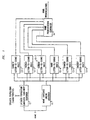
- the system shown in Figure 1 generates a plurality of plausible pronunciations for a proper name based on both an analysis of the potential language origins of the given name and on one or more characteristics of the given speaker population.
- the system of Figure 1 illustratively operates in accordance with the flow diagram shown in Fig. 2.
- the illustrative embodiment particularly described herein identifies both languages from which the given name potentially originates, and languages whose letter-to-sound rules are likely to be familiar to at least some of the individuals within the given speaker population.
- a reasonable set of plausible pronunciations for the given name is generated, which set of pronunciations can be advantageously employed in an illustrative speech recognition system providing for the recognition of spoken names.
- Name Language Origin Identifier 11 illustratively performs a statistical analysis of successive letter sequences which are contained in the given name, such as, for example, bigrams and trigrams, which analysis may be advantageously used to identify one or more potential language origins of the name.
- This statistical analysis and subsequent language identification may be advantageously performed in accordance with conventional techniques such as, for example, those taught in U.S Patent No. 4,829,580, referenced above.
- the given proper name is advantageously split into two and three letter bigrams and trigrams, respectively.
- a special symbol may be used for padding at each end in order to handle the edges (the beginning and end of the name).
- a tables of trigram and bigram probabilities may then be computed for each such bigram or trigram. If a particular trigram (for example) is not seen, its probability may be advantageously estimated using Hapex legomenon frequencies, a concept fully familiar to those of ordinary skill in the art. Then, based on these sets of probabilities, a likelihood of origin for each language may be determined by combining the computed probabilities. The selection of potential language origins may then be made based on these likelihoods. Note that it is advantageously assumed that foreign names which are not "naturally" in Latin characters are transcribed into Latin characters. In some cases ( e.g., Chinese), one or more Romanization systems may be simultaneously employed to achieve such a transcription.
- one or more languages are illustratively identified (independently from the above-described language origin identification) by Speaker Population Language Familiarity Identifier 12, as shown in Fig. 1.
- This language identification is advantageously performed based on one or more predetermined characteristics of the given speaker population.
- characteristics may be illustratively used to identify one or more languages with which individuals in the given speaker population are likely to be familiar.
- pronunciations based on letter-to-sound rules which are likely to be (correctly or incorrectly) employed by the relevant set of speakers will be advantageously taken into account.
- some illustrative characteristics include, by way of example, the national origin of the population of speakers, the purpose of the speech, the geographical location of the population of speakers, and the general level of sophistication of the given speaker population.
- one or more sets of letter-to-sound rules for each identified language are illustratively selected for use in the generation of pronunciations for the given name.
- the letter-to-sound rules may, for example, comprise hand-crafted rules which have been based on a wider set of rules obtained from tagged, annotated corpora data.
- One illustrative technique for generating such annotated data is to "play" each name in a database with an existing text-to-speech system, and asking a number of human annotators to adjust the transcription, including stress information, and "replay” the name until it sounds “right.”
- the annotators may be advantageously encouraged to provide more than one possible transcription for each name.
- an alignment process based for example on conventional dynamic programming techniques, may be advantageously used to produce letter-to-sound rules based on the annotations. (The above procedures are fully conventional and as such will be totally familiar to those of ordinary skill in the art.)
- the letter-to-sound rules may illustratively comprise finite-state grammars, fully familiar to those of ordinary skill in the art, which grammars may be advantageously compiled into finite-state transducers (FSTs), which are also fully familiar to those of ordinary skill in the art. More specifically, letter-to-sound rules may be expressed in the form ⁇ ⁇ ⁇ / ⁇ _ ⁇ , where ⁇ , ⁇ , ⁇ and ⁇ are regular expressions, with ⁇ designating the input, ⁇ designating the output, and ⁇ and ⁇ designating optional left and right contexts, respectively. ( See, e.g ., "Regular Models of Phonological Rule Systems," by R. Kaplan and M. Kay, Computational Linguistics, 20(3), pp.
- letter-to-sound rules may be advantageously provided for each of the Romanization systems and dialects. More importantly, in order to handle non-native pronunciations, a set of English-like letter-to-sound rules may also be advantageously included. This allows for "Zhang” and “Chang” to be pronounced “non-natively” as [z"a ] and [t “ ⁇ ], respectively.
- each rule may be compiled individually into an FST, and the three rules may be then composed together in the order given above.
- the three rules may be then composed together in the order given above.
- Indian languages have a large inventory of stops, including contrasts of aspirated and unaspirated stops in both voiced and voiceless stop series.
- the letter "h" after stops is used to indicate aspiration. Many of these sounds have no equivalent in English and the aspiration is simply dropped when the sounds are mapped to English, such as, for example, where ⁇ Eps ⁇ represents the empty string ⁇ .
- the letter “s” may come from two sources representing either [s] or [ ⁇ ], Some Indian annotators tend to preserve the original lexical distinction, while others transcribe it as [ ⁇ ] only when the following sound is a consonant, as in the names "Srinu” [ ⁇ r'inu], "Baskar” [b' a ⁇ k r] and "Viswa” [v'i ⁇ w a ].
- mapping of vowels can be sometimes ambiguous, but contexts and rule ordering advantageously solve the disambiguation. For example,
- Spanish letter-to-sounds rules are regular with a few lexical exceptions. Stress marking is also simple, with lexical exceptions marked in the orthography. The traditional stress rule states that if the final syllable ends in a vowel, "n”, or "s”, stress falls on the penultimate syllable; otherwise it falls on the final syllable. Exception to the stated stress rule is regularly indicted in the orthography where the stressed vowel is marked with an acute sign. This annotation is lost in the English spelling of the name, but the American pronunciation of Spanish names tends to retain the stress position, such as "Jose" being pronounced as [ho s'e ].
- the traditional stress rules may be advantageously implemented with the addition of two other regular stress patterns -- words ending in "z” tend to have penultimate stress, parallel to the stress pattern of words with a final "s". This is not surprising since the final "z” is actually pronounced as [s] in Spanish. Note that the Spanish writing system treats the two cases differently by marking the "z” words as exceptions.
- Another stress rule which may be advantageously added is the final stress of words that end in "cion”, in which case the final vowel "o" receives the stress.
- a dictionary may be compiled which includes the location of stress in those words. Naturally it is no longer necessary to include words that end in "cion” and "z” if their stress pattern is consistent with the prediction of the augmented stress rules.
- Segmental letter-to-sound rules include the following: The letter [u] is silent in the letter sequences “que”, “qui”, “gui”, and “gue”. Otherwise, the vowels ["a”, “e”, “i”, “o”, “u”] take the values [ a , e, i, o , u] respectively. Some annotators strongly prefer transcribing a word's final e as [e ], and therefore, an alternative expansion may be advantageously provided for such a case.
- the Spanish vowel rules are as follows: where ⁇ EOS ⁇ represents the end of string.
- Consonant rules unique to Spanish include the deletion of h, the mapping of intervocalic ll to [j], and the mapping of letter j to [h].
- the letter j retains the [d 3 ] reading from English.
- the letter c is softened to [s] in front of front vowels, and otherwise it is mapped to [k].
- the letter z is typically pronounced as [s].
- consonant de-germination rules and consonant combinations which are quite rare.
- the Spanish consonant rules are:
- the final step in the operation of the illustrative proper name pronunciation generation system of Fig. 1 consists of the final generation of the set of plausible pronunciations for the given name by Name Pronunciation Generator module 14.
- the selected sets of letter-to-sound rules are used to generate the actual pronunciations which will be deemed to be acceptable, and which may, for example, subsequently be used in an illustrative speech recognition system providing for the recognition of spoken names.
- the techniques for generating the actual pronunciations based on letter-to-sound rules are, as described above, fully conventional and familiar to those of ordinary skill in the art.
- processors may be provided through the use of dedicated hardware as well as hardware capable of executing software in association with appropriate software.
- the functions may be provided by a single dedicated processor, by a single shared processor, or by a plurality of individual processors, some of which may be shared.
- explicit use of the term "processor” or “controller” should not be construed to refer exclusively to hardware capable of executing software, and may implicitly include, without limitation, digital signal processor (DSP) hardware, read-only memory (ROM) for storing software, random access memory (RAM), and non-volatile storage. Other hardware, conventional and/or custom, may also be included.
- DSP digital signal processor
- ROM read-only memory
- RAM random access memory
- non-volatile storage non-volatile storage
- any switches shown in the Figs. are conceptual only. Their function may be carried out through the operation of program logic, through dedicated logic, through the interaction of program control and dedicated logic, or even manually, the particular technique being selectable by the implementor as more specifically understood from the context.
- any element expressed as a means for performing a specified function is intended to encompass any way of performing that function including, for example, (a) a combination of circuit elements which performs that function or (b) software in any form, including, therefore, firmware, microcode or the like, combined with appropriate circuitry for executing that software to perform the function.
- the invention as defined by such claims resides in the fact that the functionalities provided by the various recited means are combined and brought together in the manner which the claims call for.
Landscapes
- Engineering & Computer Science (AREA)
- Computational Linguistics (AREA)
- Health & Medical Sciences (AREA)
- Audiology, Speech & Language Pathology (AREA)
- Human Computer Interaction (AREA)
- Physics & Mathematics (AREA)
- Acoustics & Sound (AREA)
- Multimedia (AREA)
- Artificial Intelligence (AREA)
- Machine Translation (AREA)
Applications Claiming Priority (2)
| Application Number | Priority Date | Filing Date | Title |
|---|---|---|---|
| US534150 | 1990-06-06 | ||
| US09/534,150 US6272464B1 (en) | 2000-03-27 | 2000-03-27 | Method and apparatus for assembling a prediction list of name pronunciation variations for use during speech recognition |
Publications (2)
| Publication Number | Publication Date |
|---|---|
| EP1143415A1 EP1143415A1 (en) | 2001-10-10 |
| EP1143415B1 true EP1143415B1 (en) | 2002-04-24 |
Family
ID=24128879
Family Applications (1)
| Application Number | Title | Priority Date | Filing Date |
|---|---|---|---|
| EP00309339A Expired - Lifetime EP1143415B1 (en) | 2000-03-27 | 2000-10-23 | Generation of multiple proper name pronunciations for speech recognition |
Country Status (5)
| Country | Link |
|---|---|
| US (1) | US6272464B1 (enExample) |
| EP (1) | EP1143415B1 (enExample) |
| JP (1) | JP2001296880A (enExample) |
| CA (1) | CA2336459A1 (enExample) |
| DE (1) | DE60000138T2 (enExample) |
Cited By (1)
| Publication number | Priority date | Publication date | Assignee | Title |
|---|---|---|---|---|
| US20250217589A1 (en) * | 2023-12-27 | 2025-07-03 | Ringcentral, Inc. | Systems and methods for dynamically providing a correct pronunciation for a user name based on user location |
Families Citing this family (159)
| Publication number | Priority date | Publication date | Assignee | Title |
|---|---|---|---|---|
| US7251314B2 (en) * | 1994-10-18 | 2007-07-31 | Lucent Technologies | Voice message transfer between a sender and a receiver |
| US6963871B1 (en) * | 1998-03-25 | 2005-11-08 | Language Analysis Systems, Inc. | System and method for adaptive multi-cultural searching and matching of personal names |
| US8812300B2 (en) | 1998-03-25 | 2014-08-19 | International Business Machines Corporation | Identifying related names |
| US8855998B2 (en) | 1998-03-25 | 2014-10-07 | International Business Machines Corporation | Parsing culturally diverse names |
| US6411932B1 (en) * | 1998-06-12 | 2002-06-25 | Texas Instruments Incorporated | Rule-based learning of word pronunciations from training corpora |
| US8645137B2 (en) | 2000-03-16 | 2014-02-04 | Apple Inc. | Fast, language-independent method for user authentication by voice |
| US7277732B2 (en) * | 2000-10-13 | 2007-10-02 | Microsoft Corporation | Language input system for mobile devices |
| EP1217610A1 (de) * | 2000-11-28 | 2002-06-26 | Siemens Aktiengesellschaft | Verfahren und System zur multilingualen Spracherkennung |
| US20020087317A1 (en) * | 2000-12-29 | 2002-07-04 | Lee Victor Wai Leung | Computer-implemented dynamic pronunciation method and system |
| US20040002850A1 (en) * | 2002-03-14 | 2004-01-01 | Shaefer Leonard Arthur | System and method for formulating reasonable spelling variations of a proper name |
| US6618702B1 (en) * | 2002-06-14 | 2003-09-09 | Mary Antoinette Kohler | Method of and device for phone-based speaker recognition |
| US7752045B2 (en) * | 2002-10-07 | 2010-07-06 | Carnegie Mellon University | Systems and methods for comparing speech elements |
| DE10304229A1 (de) * | 2003-01-28 | 2004-08-05 | Deutsche Telekom Ag | Kommunikationssystem, Kommunikationsendeinrichtung und Vorrichtung zum Erkennen fehlerbehafteter Text-Nachrichten |
| US8285537B2 (en) * | 2003-01-31 | 2012-10-09 | Comverse, Inc. | Recognition of proper nouns using native-language pronunciation |
| US20040230431A1 (en) * | 2003-05-14 | 2004-11-18 | Gupta Sunil K. | Automatic assessment of phonological processes for speech therapy and language instruction |
| US7302389B2 (en) * | 2003-05-14 | 2007-11-27 | Lucent Technologies Inc. | Automatic assessment of phonological processes |
| US7373294B2 (en) * | 2003-05-15 | 2008-05-13 | Lucent Technologies Inc. | Intonation transformation for speech therapy and the like |
| US20040243412A1 (en) * | 2003-05-29 | 2004-12-02 | Gupta Sunil K. | Adaptation of speech models in speech recognition |
| US7280963B1 (en) * | 2003-09-12 | 2007-10-09 | Nuance Communications, Inc. | Method for learning linguistically valid word pronunciations from acoustic data |
| US7266495B1 (en) * | 2003-09-12 | 2007-09-04 | Nuance Communications, Inc. | Method and system for learning linguistically valid word pronunciations from acoustic data |
| US20070005586A1 (en) * | 2004-03-30 | 2007-01-04 | Shaefer Leonard A Jr | Parsing culturally diverse names |
| US7533018B2 (en) * | 2004-10-19 | 2009-05-12 | Motorola, Inc. | Tailored speaker-independent voice recognition system |
| US20060112091A1 (en) * | 2004-11-24 | 2006-05-25 | Harbinger Associates, Llc | Method and system for obtaining collection of variants of search query subjects |
| CN1835077B (zh) * | 2005-03-14 | 2011-05-11 | 台达电子工业股份有限公司 | 中文人名自动语音辨识输入方法及系统 |
| US8249873B2 (en) * | 2005-08-12 | 2012-08-21 | Avaya Inc. | Tonal correction of speech |
| US8677377B2 (en) | 2005-09-08 | 2014-03-18 | Apple Inc. | Method and apparatus for building an intelligent automated assistant |
| US20070233490A1 (en) * | 2006-04-03 | 2007-10-04 | Texas Instruments, Incorporated | System and method for text-to-phoneme mapping with prior knowledge |
| US8214213B1 (en) * | 2006-04-27 | 2012-07-03 | At&T Intellectual Property Ii, L.P. | Speech recognition based on pronunciation modeling |
| US7689408B2 (en) * | 2006-09-01 | 2010-03-30 | Microsoft Corporation | Identifying language of origin for words using estimates of normalized appearance frequency |
| US9318108B2 (en) | 2010-01-18 | 2016-04-19 | Apple Inc. | Intelligent automated assistant |
| US7873517B2 (en) * | 2006-11-09 | 2011-01-18 | Volkswagen Of America, Inc. | Motor vehicle with a speech interface |
| WO2008087934A1 (ja) * | 2007-01-16 | 2008-07-24 | Nec Corporation | 拡張認識辞書学習装置と音声認識システム |
| US8719027B2 (en) * | 2007-02-28 | 2014-05-06 | Microsoft Corporation | Name synthesis |
| US8977255B2 (en) | 2007-04-03 | 2015-03-10 | Apple Inc. | Method and system for operating a multi-function portable electronic device using voice-activation |
| US9330720B2 (en) | 2008-01-03 | 2016-05-03 | Apple Inc. | Methods and apparatus for altering audio output signals |
| US8401157B2 (en) * | 2008-01-24 | 2013-03-19 | Alcatel Lucent | System and method for providing audible spoken name pronunciations |
| US8996376B2 (en) | 2008-04-05 | 2015-03-31 | Apple Inc. | Intelligent text-to-speech conversion |
| US10496753B2 (en) | 2010-01-18 | 2019-12-03 | Apple Inc. | Automatically adapting user interfaces for hands-free interaction |
| US20100030549A1 (en) | 2008-07-31 | 2010-02-04 | Lee Michael M | Mobile device having human language translation capability with positional feedback |
| US9484019B2 (en) | 2008-11-19 | 2016-11-01 | At&T Intellectual Property I, L.P. | System and method for discriminative pronunciation modeling for voice search |
| US8296141B2 (en) * | 2008-11-19 | 2012-10-23 | At&T Intellectual Property I, L.P. | System and method for discriminative pronunciation modeling for voice search |
| US9959870B2 (en) | 2008-12-11 | 2018-05-01 | Apple Inc. | Speech recognition involving a mobile device |
| JP5468251B2 (ja) * | 2008-12-26 | 2014-04-09 | 株式会社西原環境 | 担体投入型生物反応装置 |
| JP5334178B2 (ja) * | 2009-01-21 | 2013-11-06 | クラリオン株式会社 | 音声認識装置およびデータ更新方法 |
| US8788256B2 (en) * | 2009-02-17 | 2014-07-22 | Sony Computer Entertainment Inc. | Multiple language voice recognition |
| US10241752B2 (en) | 2011-09-30 | 2019-03-26 | Apple Inc. | Interface for a virtual digital assistant |
| US10255566B2 (en) | 2011-06-03 | 2019-04-09 | Apple Inc. | Generating and processing task items that represent tasks to perform |
| US9858925B2 (en) | 2009-06-05 | 2018-01-02 | Apple Inc. | Using context information to facilitate processing of commands in a virtual assistant |
| US10241644B2 (en) | 2011-06-03 | 2019-03-26 | Apple Inc. | Actionable reminder entries |
| US9431006B2 (en) | 2009-07-02 | 2016-08-30 | Apple Inc. | Methods and apparatuses for automatic speech recognition |
| US9183834B2 (en) * | 2009-07-22 | 2015-11-10 | Cisco Technology, Inc. | Speech recognition tuning tool |
| US10705794B2 (en) | 2010-01-18 | 2020-07-07 | Apple Inc. | Automatically adapting user interfaces for hands-free interaction |
| US10553209B2 (en) | 2010-01-18 | 2020-02-04 | Apple Inc. | Systems and methods for hands-free notification summaries |
| US10276170B2 (en) | 2010-01-18 | 2019-04-30 | Apple Inc. | Intelligent automated assistant |
| US10679605B2 (en) | 2010-01-18 | 2020-06-09 | Apple Inc. | Hands-free list-reading by intelligent automated assistant |
| CN102687197B (zh) * | 2010-01-22 | 2014-07-23 | 三菱电机株式会社 | 声音识别用词典制作装置、声音识别装置及声音合成装置 |
| DE202011111062U1 (de) | 2010-01-25 | 2019-02-19 | Newvaluexchange Ltd. | Vorrichtung und System für eine Digitalkonversationsmanagementplattform |
| US8682667B2 (en) | 2010-02-25 | 2014-03-25 | Apple Inc. | User profiling for selecting user specific voice input processing information |
| US10762293B2 (en) | 2010-12-22 | 2020-09-01 | Apple Inc. | Using parts-of-speech tagging and named entity recognition for spelling correction |
| US8489398B1 (en) | 2011-01-14 | 2013-07-16 | Google Inc. | Disambiguation of spoken proper names |
| JP5090547B2 (ja) * | 2011-03-04 | 2012-12-05 | 楽天株式会社 | 翻字処理装置、翻字処理プログラム、翻字処理プログラムを記録したコンピュータ読み取り可能な記録媒体、及び翻字処理方法 |
| CN102682763B (zh) * | 2011-03-10 | 2014-07-16 | 北京三星通信技术研究有限公司 | 修正语音输入文本中命名实体词汇的方法、装置及终端 |
| US9262612B2 (en) | 2011-03-21 | 2016-02-16 | Apple Inc. | Device access using voice authentication |
| US10057736B2 (en) | 2011-06-03 | 2018-08-21 | Apple Inc. | Active transport based notifications |
| US8994660B2 (en) | 2011-08-29 | 2015-03-31 | Apple Inc. | Text correction processing |
| US9286894B1 (en) | 2012-01-31 | 2016-03-15 | Google Inc. | Parallel recognition |
| US10134385B2 (en) * | 2012-03-02 | 2018-11-20 | Apple Inc. | Systems and methods for name pronunciation |
| US9483461B2 (en) | 2012-03-06 | 2016-11-01 | Apple Inc. | Handling speech synthesis of content for multiple languages |
| WO2013167934A1 (en) * | 2012-05-07 | 2013-11-14 | Mls Multimedia S.A. | Methods and system implementing intelligent vocal name-selection from directory lists composed in non-latin alphabet languages |
| US9280610B2 (en) | 2012-05-14 | 2016-03-08 | Apple Inc. | Crowd sourcing information to fulfill user requests |
| US9721563B2 (en) * | 2012-06-08 | 2017-08-01 | Apple Inc. | Name recognition system |
| US9495129B2 (en) | 2012-06-29 | 2016-11-15 | Apple Inc. | Device, method, and user interface for voice-activated navigation and browsing of a document |
| US9576574B2 (en) | 2012-09-10 | 2017-02-21 | Apple Inc. | Context-sensitive handling of interruptions by intelligent digital assistant |
| US9547647B2 (en) | 2012-09-19 | 2017-01-17 | Apple Inc. | Voice-based media searching |
| US10199051B2 (en) | 2013-02-07 | 2019-02-05 | Apple Inc. | Voice trigger for a digital assistant |
| US9076347B2 (en) * | 2013-03-14 | 2015-07-07 | Better Accent, LLC | System and methods for improving language pronunciation |
| US9368114B2 (en) | 2013-03-14 | 2016-06-14 | Apple Inc. | Context-sensitive handling of interruptions |
| WO2014144579A1 (en) | 2013-03-15 | 2014-09-18 | Apple Inc. | System and method for updating an adaptive speech recognition model |
| KR101759009B1 (ko) | 2013-03-15 | 2017-07-17 | 애플 인크. | 적어도 부분적인 보이스 커맨드 시스템을 트레이닝시키는 것 |
| WO2014197336A1 (en) | 2013-06-07 | 2014-12-11 | Apple Inc. | System and method for detecting errors in interactions with a voice-based digital assistant |
| US9582608B2 (en) | 2013-06-07 | 2017-02-28 | Apple Inc. | Unified ranking with entropy-weighted information for phrase-based semantic auto-completion |
| WO2014197334A2 (en) * | 2013-06-07 | 2014-12-11 | Apple Inc. | System and method for user-specified pronunciation of words for speech synthesis and recognition |
| WO2014197335A1 (en) | 2013-06-08 | 2014-12-11 | Apple Inc. | Interpreting and acting upon commands that involve sharing information with remote devices |
| US10176167B2 (en) | 2013-06-09 | 2019-01-08 | Apple Inc. | System and method for inferring user intent from speech inputs |
| DE112014002747T5 (de) | 2013-06-09 | 2016-03-03 | Apple Inc. | Vorrichtung, Verfahren und grafische Benutzerschnittstelle zum Ermöglichen einer Konversationspersistenz über zwei oder mehr Instanzen eines digitalen Assistenten |
| AU2014278595B2 (en) | 2013-06-13 | 2017-04-06 | Apple Inc. | System and method for emergency calls initiated by voice command |
| KR101749009B1 (ko) | 2013-08-06 | 2017-06-19 | 애플 인크. | 원격 디바이스로부터의 활동에 기초한 스마트 응답의 자동 활성화 |
| US9620105B2 (en) | 2014-05-15 | 2017-04-11 | Apple Inc. | Analyzing audio input for efficient speech and music recognition |
| US10592095B2 (en) | 2014-05-23 | 2020-03-17 | Apple Inc. | Instantaneous speaking of content on touch devices |
| US9502031B2 (en) | 2014-05-27 | 2016-11-22 | Apple Inc. | Method for supporting dynamic grammars in WFST-based ASR |
| US9785630B2 (en) | 2014-05-30 | 2017-10-10 | Apple Inc. | Text prediction using combined word N-gram and unigram language models |
| US9430463B2 (en) | 2014-05-30 | 2016-08-30 | Apple Inc. | Exemplar-based natural language processing |
| US9842101B2 (en) | 2014-05-30 | 2017-12-12 | Apple Inc. | Predictive conversion of language input |
| US9734193B2 (en) | 2014-05-30 | 2017-08-15 | Apple Inc. | Determining domain salience ranking from ambiguous words in natural speech |
| US9715875B2 (en) | 2014-05-30 | 2017-07-25 | Apple Inc. | Reducing the need for manual start/end-pointing and trigger phrases |
| US10078631B2 (en) | 2014-05-30 | 2018-09-18 | Apple Inc. | Entropy-guided text prediction using combined word and character n-gram language models |
| US9760559B2 (en) | 2014-05-30 | 2017-09-12 | Apple Inc. | Predictive text input |
| US10289433B2 (en) | 2014-05-30 | 2019-05-14 | Apple Inc. | Domain specific language for encoding assistant dialog |
| EP3480811A1 (en) | 2014-05-30 | 2019-05-08 | Apple Inc. | Multi-command single utterance input method |
| US10170123B2 (en) | 2014-05-30 | 2019-01-01 | Apple Inc. | Intelligent assistant for home automation |
| US9633004B2 (en) | 2014-05-30 | 2017-04-25 | Apple Inc. | Better resolution when referencing to concepts |
| US10659851B2 (en) | 2014-06-30 | 2020-05-19 | Apple Inc. | Real-time digital assistant knowledge updates |
| US9338493B2 (en) | 2014-06-30 | 2016-05-10 | Apple Inc. | Intelligent automated assistant for TV user interactions |
| US10446141B2 (en) | 2014-08-28 | 2019-10-15 | Apple Inc. | Automatic speech recognition based on user feedback |
| US9818400B2 (en) | 2014-09-11 | 2017-11-14 | Apple Inc. | Method and apparatus for discovering trending terms in speech requests |
| US10789041B2 (en) | 2014-09-12 | 2020-09-29 | Apple Inc. | Dynamic thresholds for always listening speech trigger |
| US10127911B2 (en) | 2014-09-30 | 2018-11-13 | Apple Inc. | Speaker identification and unsupervised speaker adaptation techniques |
| US9646609B2 (en) | 2014-09-30 | 2017-05-09 | Apple Inc. | Caching apparatus for serving phonetic pronunciations |
| US9886432B2 (en) | 2014-09-30 | 2018-02-06 | Apple Inc. | Parsimonious handling of word inflection via categorical stem + suffix N-gram language models |
| US9668121B2 (en) | 2014-09-30 | 2017-05-30 | Apple Inc. | Social reminders |
| US10074360B2 (en) | 2014-09-30 | 2018-09-11 | Apple Inc. | Providing an indication of the suitability of speech recognition |
| US10552013B2 (en) | 2014-12-02 | 2020-02-04 | Apple Inc. | Data detection |
| US9711141B2 (en) | 2014-12-09 | 2017-07-18 | Apple Inc. | Disambiguating heteronyms in speech synthesis |
| US9865280B2 (en) | 2015-03-06 | 2018-01-09 | Apple Inc. | Structured dictation using intelligent automated assistants |
| US9721566B2 (en) | 2015-03-08 | 2017-08-01 | Apple Inc. | Competing devices responding to voice triggers |
| US9886953B2 (en) | 2015-03-08 | 2018-02-06 | Apple Inc. | Virtual assistant activation |
| US10567477B2 (en) | 2015-03-08 | 2020-02-18 | Apple Inc. | Virtual assistant continuity |
| US9899019B2 (en) | 2015-03-18 | 2018-02-20 | Apple Inc. | Systems and methods for structured stem and suffix language models |
| US9842105B2 (en) | 2015-04-16 | 2017-12-12 | Apple Inc. | Parsimonious continuous-space phrase representations for natural language processing |
| US10083688B2 (en) | 2015-05-27 | 2018-09-25 | Apple Inc. | Device voice control for selecting a displayed affordance |
| US10127220B2 (en) | 2015-06-04 | 2018-11-13 | Apple Inc. | Language identification from short strings |
| US10101822B2 (en) | 2015-06-05 | 2018-10-16 | Apple Inc. | Language input correction |
| US9578173B2 (en) | 2015-06-05 | 2017-02-21 | Apple Inc. | Virtual assistant aided communication with 3rd party service in a communication session |
| US10255907B2 (en) | 2015-06-07 | 2019-04-09 | Apple Inc. | Automatic accent detection using acoustic models |
| US11025565B2 (en) | 2015-06-07 | 2021-06-01 | Apple Inc. | Personalized prediction of responses for instant messaging |
| US10186254B2 (en) | 2015-06-07 | 2019-01-22 | Apple Inc. | Context-based endpoint detection |
| US10747498B2 (en) | 2015-09-08 | 2020-08-18 | Apple Inc. | Zero latency digital assistant |
| US10671428B2 (en) | 2015-09-08 | 2020-06-02 | Apple Inc. | Distributed personal assistant |
| US9697820B2 (en) | 2015-09-24 | 2017-07-04 | Apple Inc. | Unit-selection text-to-speech synthesis using concatenation-sensitive neural networks |
| US10366158B2 (en) | 2015-09-29 | 2019-07-30 | Apple Inc. | Efficient word encoding for recurrent neural network language models |
| US11010550B2 (en) | 2015-09-29 | 2021-05-18 | Apple Inc. | Unified language modeling framework for word prediction, auto-completion and auto-correction |
| US11587559B2 (en) | 2015-09-30 | 2023-02-21 | Apple Inc. | Intelligent device identification |
| US10691473B2 (en) | 2015-11-06 | 2020-06-23 | Apple Inc. | Intelligent automated assistant in a messaging environment |
| US10049668B2 (en) | 2015-12-02 | 2018-08-14 | Apple Inc. | Applying neural network language models to weighted finite state transducers for automatic speech recognition |
| US10223066B2 (en) | 2015-12-23 | 2019-03-05 | Apple Inc. | Proactive assistance based on dialog communication between devices |
| US10446143B2 (en) | 2016-03-14 | 2019-10-15 | Apple Inc. | Identification of voice inputs providing credentials |
| US9747891B1 (en) * | 2016-05-18 | 2017-08-29 | International Business Machines Corporation | Name pronunciation recommendation |
| US9934775B2 (en) | 2016-05-26 | 2018-04-03 | Apple Inc. | Unit-selection text-to-speech synthesis based on predicted concatenation parameters |
| US9972304B2 (en) | 2016-06-03 | 2018-05-15 | Apple Inc. | Privacy preserving distributed evaluation framework for embedded personalized systems |
| US10249300B2 (en) | 2016-06-06 | 2019-04-02 | Apple Inc. | Intelligent list reading |
| US10049663B2 (en) | 2016-06-08 | 2018-08-14 | Apple, Inc. | Intelligent automated assistant for media exploration |
| DK179309B1 (en) | 2016-06-09 | 2018-04-23 | Apple Inc | Intelligent automated assistant in a home environment |
| US10192552B2 (en) | 2016-06-10 | 2019-01-29 | Apple Inc. | Digital assistant providing whispered speech |
| US10586535B2 (en) | 2016-06-10 | 2020-03-10 | Apple Inc. | Intelligent digital assistant in a multi-tasking environment |
| US10509862B2 (en) | 2016-06-10 | 2019-12-17 | Apple Inc. | Dynamic phrase expansion of language input |
| US10067938B2 (en) | 2016-06-10 | 2018-09-04 | Apple Inc. | Multilingual word prediction |
| US10490187B2 (en) | 2016-06-10 | 2019-11-26 | Apple Inc. | Digital assistant providing automated status report |
| DK179049B1 (en) | 2016-06-11 | 2017-09-18 | Apple Inc | Data driven natural language event detection and classification |
| DK179415B1 (en) | 2016-06-11 | 2018-06-14 | Apple Inc | Intelligent device arbitration and control |
| DK179343B1 (en) | 2016-06-11 | 2018-05-14 | Apple Inc | Intelligent task discovery |
| DK201670540A1 (en) | 2016-06-11 | 2018-01-08 | Apple Inc | Application integration with a digital assistant |
| US10043516B2 (en) | 2016-09-23 | 2018-08-07 | Apple Inc. | Intelligent automated assistant |
| US10593346B2 (en) | 2016-12-22 | 2020-03-17 | Apple Inc. | Rank-reduced token representation for automatic speech recognition |
| DK201770439A1 (en) | 2017-05-11 | 2018-12-13 | Apple Inc. | Offline personal assistant |
| DK179496B1 (en) | 2017-05-12 | 2019-01-15 | Apple Inc. | USER-SPECIFIC Acoustic Models |
| DK179745B1 (en) | 2017-05-12 | 2019-05-01 | Apple Inc. | SYNCHRONIZATION AND TASK DELEGATION OF A DIGITAL ASSISTANT |
| DK201770432A1 (en) | 2017-05-15 | 2018-12-21 | Apple Inc. | Hierarchical belief states for digital assistants |
| DK201770431A1 (en) | 2017-05-15 | 2018-12-20 | Apple Inc. | Optimizing dialogue policy decisions for digital assistants using implicit feedback |
| DK179549B1 (en) | 2017-05-16 | 2019-02-12 | Apple Inc. | FAR-FIELD EXTENSION FOR DIGITAL ASSISTANT SERVICES |
Family Cites Families (9)
| Publication number | Priority date | Publication date | Assignee | Title |
|---|---|---|---|---|
| US4829580A (en) | 1986-03-26 | 1989-05-09 | Telephone And Telegraph Company, At&T Bell Laboratories | Text analysis system with letter sequence recognition and speech stress assignment arrangement |
| DE68913669T2 (de) * | 1988-11-23 | 1994-07-21 | Digital Equipment Corp | Namenaussprache durch einen Synthetisator. |
| US5212730A (en) * | 1991-07-01 | 1993-05-18 | Texas Instruments Incorporated | Voice recognition of proper names using text-derived recognition models |
| US5293452A (en) * | 1991-07-01 | 1994-03-08 | Texas Instruments Incorporated | Voice log-in using spoken name input |
| CA2119397C (en) * | 1993-03-19 | 2007-10-02 | Kim E.A. Silverman | Improved automated voice synthesis employing enhanced prosodic treatment of text, spelling of text and rate of annunciation |
| US5524169A (en) * | 1993-12-30 | 1996-06-04 | International Business Machines Incorporated | Method and system for location-specific speech recognition |
| US5949961A (en) * | 1995-07-19 | 1999-09-07 | International Business Machines Corporation | Word syllabification in speech synthesis system |
| CA2216224A1 (en) * | 1997-09-19 | 1999-03-19 | Peter R. Stubley | Block algorithm for pattern recognition |
| US6078885A (en) * | 1998-05-08 | 2000-06-20 | At&T Corp | Verbal, fully automatic dictionary updates by end-users of speech synthesis and recognition systems |
-
2000
- 2000-03-27 US US09/534,150 patent/US6272464B1/en not_active Expired - Lifetime
- 2000-10-23 DE DE60000138T patent/DE60000138T2/de not_active Expired - Lifetime
- 2000-10-23 EP EP00309339A patent/EP1143415B1/en not_active Expired - Lifetime
-
2001
- 2001-02-14 CA CA002336459A patent/CA2336459A1/en not_active Abandoned
- 2001-03-23 JP JP2001084632A patent/JP2001296880A/ja not_active Abandoned
Cited By (1)
| Publication number | Priority date | Publication date | Assignee | Title |
|---|---|---|---|---|
| US20250217589A1 (en) * | 2023-12-27 | 2025-07-03 | Ringcentral, Inc. | Systems and methods for dynamically providing a correct pronunciation for a user name based on user location |
Also Published As
| Publication number | Publication date |
|---|---|
| CA2336459A1 (en) | 2001-09-27 |
| JP2001296880A (ja) | 2001-10-26 |
| US6272464B1 (en) | 2001-08-07 |
| EP1143415A1 (en) | 2001-10-10 |
| DE60000138T2 (de) | 2002-10-31 |
| DE60000138D1 (de) | 2002-05-29 |
Similar Documents
| Publication | Publication Date | Title |
|---|---|---|
| EP1143415B1 (en) | Generation of multiple proper name pronunciations for speech recognition | |
| Lyu et al. | Speech recognition on code-switching among the Chinese dialects | |
| Ostendorf et al. | The Boston University radio news corpus | |
| US6067520A (en) | System and method of recognizing continuous mandarin speech utilizing chinese hidden markou models | |
| US5787230A (en) | System and method of intelligent Mandarin speech input for Chinese computers | |
| US8285537B2 (en) | Recognition of proper nouns using native-language pronunciation | |
| US6243680B1 (en) | Method and apparatus for obtaining a transcription of phrases through text and spoken utterances | |
| US5949961A (en) | Word syllabification in speech synthesis system | |
| US8065144B1 (en) | Multilingual speech recognition | |
| Siivola et al. | Unlimited vocabulary speech recognition based on morphs discovered in an unsupervised manner | |
| Kirchhoff et al. | Cross-dialectal data sharing for acoustic modeling in Arabic speech recognition | |
| Chen | Speech recognition with automatic punctuation. | |
| Chan et al. | Automatic recognition of Cantonese-English code-mixing speech | |
| Stöber et al. | Speech synthesis using multilevel selection and concatenation of units from large speech corpora | |
| Amrouche et al. | Design and Implementation of a Diacritic Arabic Text-To-Speech System. | |
| Allen | Reading machines for the blind: The technical problems and the methods adopted for their solution | |
| JP2007155833A (ja) | 音響モデル開発装置及びコンピュータプログラム | |
| Maamouri et al. | Dialectal Arabic telephone speech corpus: Principles, tool design, and transcription conventions | |
| CN109859746B (zh) | 一种基于tts的语音识别语料库生成方法及系统 | |
| Berkling | Automatic language identification with sequences of language-independent phoneme clusters | |
| CN104756183B (zh) | 在智能汉语语音口述记录校正中使用字符描述器有效输入模糊字符 | |
| Delić et al. | A Review of AlfaNum Speech Technologies for Serbian, Croatian and Macedonian | |
| Béchet et al. | Very large vocabulary proper name recognition for directory assistance | |
| Lyu et al. | A Taiwanese (min-nan) text-to-speech (TTS) system based on automatically generated synthetic units. | |
| JP2006098994A (ja) | 辞書を準備する方法、音響モデルのためのトレーニングデータを準備する方法、およびコンピュータプログラム |
Legal Events
| Date | Code | Title | Description |
|---|---|---|---|
| PUAI | Public reference made under article 153(3) epc to a published international application that has entered the european phase |
Free format text: ORIGINAL CODE: 0009012 |
|
| GRAG | Despatch of communication of intention to grant |
Free format text: ORIGINAL CODE: EPIDOS AGRA |
|
| 17P | Request for examination filed |
Effective date: 20001106 |
|
| AK | Designated contracting states |
Kind code of ref document: A1 Designated state(s): AT BE CH CY DE DK ES FI FR GB GR IE IT LI LU MC NL PT SE |
|
| AX | Request for extension of the european patent |
Free format text: AL;LT;LV;MK;RO;SI |
|
| GRAG | Despatch of communication of intention to grant |
Free format text: ORIGINAL CODE: EPIDOS AGRA |
|
| GRAH | Despatch of communication of intention to grant a patent |
Free format text: ORIGINAL CODE: EPIDOS IGRA |
|
| REG | Reference to a national code |
Ref country code: GB Ref legal event code: IF02 |
|
| GRAH | Despatch of communication of intention to grant a patent |
Free format text: ORIGINAL CODE: EPIDOS IGRA |
|
| GRAA | (expected) grant |
Free format text: ORIGINAL CODE: 0009210 |
|
| AK | Designated contracting states |
Kind code of ref document: B1 Designated state(s): DE FR GB |
|
| REG | Reference to a national code |
Ref country code: GB Ref legal event code: FG4D |
|
| REF | Corresponds to: |
Ref document number: 60000138 Country of ref document: DE Date of ref document: 20020529 |
|
| REG | Reference to a national code |
Ref country code: IE Ref legal event code: FG4D |
|
| AKX | Designation fees paid |
Free format text: DE FR GB |
|
| ET | Fr: translation filed | ||
| PLBE | No opposition filed within time limit |
Free format text: ORIGINAL CODE: 0009261 |
|
| STAA | Information on the status of an ep patent application or granted ep patent |
Free format text: STATUS: NO OPPOSITION FILED WITHIN TIME LIMIT |
|
| 26N | No opposition filed |
Effective date: 20030127 |
|
| REG | Reference to a national code |
Ref country code: IE Ref legal event code: MM4A |
|
| REG | Reference to a national code |
Ref country code: FR Ref legal event code: CD Owner name: ALCATEL-LUCENT USA INC. Effective date: 20131122 |
|
| REG | Reference to a national code |
Ref country code: FR Ref legal event code: GC Effective date: 20140410 |
|
| REG | Reference to a national code |
Ref country code: FR Ref legal event code: RG Effective date: 20141015 |
|
| REG | Reference to a national code |
Ref country code: FR Ref legal event code: PLFP Year of fee payment: 16 |
|
| REG | Reference to a national code |
Ref country code: FR Ref legal event code: PLFP Year of fee payment: 17 |
|
| REG | Reference to a national code |
Ref country code: FR Ref legal event code: PLFP Year of fee payment: 18 |
|
| REG | Reference to a national code |
Ref country code: FR Ref legal event code: PLFP Year of fee payment: 19 |
|
| PGFP | Annual fee paid to national office [announced via postgrant information from national office to epo] |
Ref country code: FR Payment date: 20180913 Year of fee payment: 19 |
|
| PGFP | Annual fee paid to national office [announced via postgrant information from national office to epo] |
Ref country code: DE Payment date: 20181009 Year of fee payment: 19 |
|
| PGFP | Annual fee paid to national office [announced via postgrant information from national office to epo] |
Ref country code: GB Payment date: 20181017 Year of fee payment: 19 |
|
| REG | Reference to a national code |
Ref country code: DE Ref legal event code: R119 Ref document number: 60000138 Country of ref document: DE |
|
| PG25 | Lapsed in a contracting state [announced via postgrant information from national office to epo] |
Ref country code: DE Free format text: LAPSE BECAUSE OF NON-PAYMENT OF DUE FEES Effective date: 20200501 |
|
| GBPC | Gb: european patent ceased through non-payment of renewal fee |
Effective date: 20191023 |
|
| PG25 | Lapsed in a contracting state [announced via postgrant information from national office to epo] |
Ref country code: FR Free format text: LAPSE BECAUSE OF NON-PAYMENT OF DUE FEES Effective date: 20191031 Ref country code: GB Free format text: LAPSE BECAUSE OF NON-PAYMENT OF DUE FEES Effective date: 20191023 |