EP1143048A1 - Process for producing meta-aromatic polyamide fiber - Google Patents
Process for producing meta-aromatic polyamide fiber Download PDFInfo
- Publication number
- EP1143048A1 EP1143048A1 EP00969969A EP00969969A EP1143048A1 EP 1143048 A1 EP1143048 A1 EP 1143048A1 EP 00969969 A EP00969969 A EP 00969969A EP 00969969 A EP00969969 A EP 00969969A EP 1143048 A1 EP1143048 A1 EP 1143048A1
- Authority
- EP
- European Patent Office
- Prior art keywords
- solution
- meta
- filaments
- type aromatic
- aromatic polyamide
- Prior art date
- Legal status (The legal status is an assumption and is not a legal conclusion. Google has not performed a legal analysis and makes no representation as to the accuracy of the status listed.)
- Granted
Links
- 238000000034 method Methods 0.000 title claims abstract description 101
- 239000004760 aramid Substances 0.000 title claims abstract description 71
- 229920003235 aromatic polyamide Polymers 0.000 title claims abstract description 71
- 239000000835 fiber Substances 0.000 title description 6
- 229920000642 polymer Polymers 0.000 claims abstract description 127
- 238000009987 spinning Methods 0.000 claims abstract description 72
- XLYOFNOQVPJJNP-UHFFFAOYSA-N water Substances O XLYOFNOQVPJJNP-UHFFFAOYSA-N 0.000 claims abstract description 66
- 238000001914 filtration Methods 0.000 claims abstract description 51
- 238000006116 polymerization reaction Methods 0.000 claims abstract description 48
- 239000002904 solvent Substances 0.000 claims abstract description 38
- VEXZGXHMUGYJMC-UHFFFAOYSA-N Hydrochloric acid Chemical compound Cl VEXZGXHMUGYJMC-UHFFFAOYSA-N 0.000 claims abstract description 37
- 229910000041 hydrogen chloride Inorganic materials 0.000 claims abstract description 33
- IXCSERBJSXMMFS-UHFFFAOYSA-N hydrogen chloride Substances Cl.Cl IXCSERBJSXMMFS-UHFFFAOYSA-N 0.000 claims abstract description 33
- 150000003839 salts Chemical class 0.000 claims abstract description 30
- 239000007788 liquid Substances 0.000 claims abstract description 22
- 238000005345 coagulation Methods 0.000 claims abstract description 19
- 230000015271 coagulation Effects 0.000 claims abstract description 19
- 230000003472 neutralizing effect Effects 0.000 claims abstract description 15
- 239000003795 chemical substances by application Substances 0.000 claims abstract description 14
- 150000008044 alkali metal hydroxides Chemical class 0.000 claims abstract description 13
- 150000003857 carboxamides Chemical class 0.000 claims abstract description 8
- 125000003118 aryl group Chemical group 0.000 claims abstract description 7
- 150000004984 aromatic diamines Chemical class 0.000 claims abstract description 6
- 238000010528 free radical solution polymerization reaction Methods 0.000 claims abstract description 5
- OFOBLEOULBTSOW-UHFFFAOYSA-N Malonic acid Chemical compound OC(=O)CC(O)=O OFOBLEOULBTSOW-UHFFFAOYSA-N 0.000 claims abstract description 4
- 239000003495 polar organic solvent Substances 0.000 claims abstract description 3
- 239000000243 solution Substances 0.000 claims description 258
- SECXISVLQFMRJM-UHFFFAOYSA-N N-Methylpyrrolidone Chemical compound CN1CCCC1=O SECXISVLQFMRJM-UHFFFAOYSA-N 0.000 claims description 94
- HEMHJVSKTPXQMS-UHFFFAOYSA-M Sodium hydroxide Chemical group [OH-].[Na+] HEMHJVSKTPXQMS-UHFFFAOYSA-M 0.000 claims description 69
- 238000006386 neutralization reaction Methods 0.000 claims description 52
- 238000005406 washing Methods 0.000 claims description 31
- 239000007864 aqueous solution Substances 0.000 claims description 22
- KWGKDLIKAYFUFQ-UHFFFAOYSA-M lithium chloride Chemical compound [Li+].[Cl-] KWGKDLIKAYFUFQ-UHFFFAOYSA-M 0.000 claims description 22
- UXVMQQNJUSDDNG-UHFFFAOYSA-L Calcium chloride Chemical compound [Cl-].[Cl-].[Ca+2] UXVMQQNJUSDDNG-UHFFFAOYSA-L 0.000 claims description 21
- KWYUFKZDYYNOTN-UHFFFAOYSA-M Potassium hydroxide Chemical compound [OH-].[K+] KWYUFKZDYYNOTN-UHFFFAOYSA-M 0.000 claims description 21
- 239000001110 calcium chloride Substances 0.000 claims description 21
- 229910001628 calcium chloride Inorganic materials 0.000 claims description 21
- AXCZMVOFGPJBDE-UHFFFAOYSA-L calcium dihydroxide Chemical compound [OH-].[OH-].[Ca+2] AXCZMVOFGPJBDE-UHFFFAOYSA-L 0.000 claims description 20
- 239000000920 calcium hydroxide Substances 0.000 claims description 20
- 229910001861 calcium hydroxide Inorganic materials 0.000 claims description 20
- WMFOQBRAJBCJND-UHFFFAOYSA-M Lithium hydroxide Chemical compound [Li+].[OH-] WMFOQBRAJBCJND-UHFFFAOYSA-M 0.000 claims description 18
- 238000002360 preparation method Methods 0.000 claims description 17
- -1 N-methylcaprolactame Chemical compound 0.000 claims description 14
- ZMXDDKWLCZADIW-UHFFFAOYSA-N N,N-Dimethylformamide Chemical compound CN(C)C=O ZMXDDKWLCZADIW-UHFFFAOYSA-N 0.000 claims description 12
- FXHOOIRPVKKKFG-UHFFFAOYSA-N N,N-Dimethylacetamide Chemical compound CN(C)C(C)=O FXHOOIRPVKKKFG-UHFFFAOYSA-N 0.000 claims description 10
- IAZDPXIOMUYVGZ-UHFFFAOYSA-N Dimethylsulphoxide Chemical compound CS(C)=O IAZDPXIOMUYVGZ-UHFFFAOYSA-N 0.000 claims description 8
- 238000010438 heat treatment Methods 0.000 claims description 7
- AVQQQNCBBIEMEU-UHFFFAOYSA-N 1,1,3,3-tetramethylurea Chemical compound CN(C)C(=O)N(C)C AVQQQNCBBIEMEU-UHFFFAOYSA-N 0.000 claims description 3
- 239000002798 polar solvent Substances 0.000 claims description 3
- 229920001577 copolymer Polymers 0.000 claims description 2
- 238000006243 chemical reaction Methods 0.000 description 38
- WZCQRUWWHSTZEM-UHFFFAOYSA-N 1,3-phenylenediamine Chemical compound NC1=CC=CC(N)=C1 WZCQRUWWHSTZEM-UHFFFAOYSA-N 0.000 description 18
- FDQSRULYDNDXQB-UHFFFAOYSA-N benzene-1,3-dicarbonyl chloride Chemical compound ClC(=O)C1=CC=CC(C(Cl)=O)=C1 FDQSRULYDNDXQB-UHFFFAOYSA-N 0.000 description 18
- 239000006185 dispersion Substances 0.000 description 18
- 239000004952 Polyamide Substances 0.000 description 17
- 229920002647 polyamide Polymers 0.000 description 17
- 239000000706 filtrate Substances 0.000 description 16
- 238000002166 wet spinning Methods 0.000 description 15
- 238000003756 stirring Methods 0.000 description 11
- FAPWRFPIFSIZLT-UHFFFAOYSA-M Sodium chloride Chemical compound [Na+].[Cl-] FAPWRFPIFSIZLT-UHFFFAOYSA-M 0.000 description 10
- IJGRMHOSHXDMSA-UHFFFAOYSA-N Atomic nitrogen Chemical compound N#N IJGRMHOSHXDMSA-UHFFFAOYSA-N 0.000 description 9
- 230000001112 coagulating effect Effects 0.000 description 9
- 229910001873 dinitrogen Inorganic materials 0.000 description 9
- 239000011259 mixed solution Substances 0.000 description 9
- 239000007787 solid Substances 0.000 description 9
- 239000006227 byproduct Substances 0.000 description 7
- 230000000052 comparative effect Effects 0.000 description 7
- 150000004985 diamines Chemical class 0.000 description 6
- 238000001556 precipitation Methods 0.000 description 6
- 238000011144 upstream manufacturing Methods 0.000 description 6
- 230000007935 neutral effect Effects 0.000 description 5
- 239000011780 sodium chloride Substances 0.000 description 5
- CURLTUGMZLYLDI-UHFFFAOYSA-N Carbon dioxide Chemical compound O=C=O CURLTUGMZLYLDI-UHFFFAOYSA-N 0.000 description 4
- 238000007334 copolymerization reaction Methods 0.000 description 4
- 229910017053 inorganic salt Inorganic materials 0.000 description 4
- 238000004519 manufacturing process Methods 0.000 description 4
- 239000002002 slurry Substances 0.000 description 4
- CDBYLPFSWZWCQE-UHFFFAOYSA-L Sodium Carbonate Chemical compound [Na+].[Na+].[O-]C([O-])=O CDBYLPFSWZWCQE-UHFFFAOYSA-L 0.000 description 3
- 150000001875 compounds Chemical class 0.000 description 3
- 230000003247 decreasing effect Effects 0.000 description 3
- 230000000694 effects Effects 0.000 description 3
- 239000007789 gas Substances 0.000 description 3
- 239000008187 granular material Substances 0.000 description 3
- 238000007654 immersion Methods 0.000 description 3
- 239000000463 material Substances 0.000 description 3
- 238000002156 mixing Methods 0.000 description 3
- VTYYLEPIZMXCLO-UHFFFAOYSA-L Calcium carbonate Chemical compound [Ca+2].[O-]C([O-])=O VTYYLEPIZMXCLO-UHFFFAOYSA-L 0.000 description 2
- WYURNTSHIVDZCO-UHFFFAOYSA-N Tetrahydrofuran Chemical compound C1CCOC1 WYURNTSHIVDZCO-UHFFFAOYSA-N 0.000 description 2
- BRPQOXSCLDDYGP-UHFFFAOYSA-N calcium oxide Chemical compound [O-2].[Ca+2] BRPQOXSCLDDYGP-UHFFFAOYSA-N 0.000 description 2
- 239000000292 calcium oxide Substances 0.000 description 2
- ODINCKMPIJJUCX-UHFFFAOYSA-N calcium oxide Inorganic materials [Ca]=O ODINCKMPIJJUCX-UHFFFAOYSA-N 0.000 description 2
- 125000004432 carbon atom Chemical group C* 0.000 description 2
- 239000001569 carbon dioxide Substances 0.000 description 2
- 229910002092 carbon dioxide Inorganic materials 0.000 description 2
- 238000000578 dry spinning Methods 0.000 description 2
- 230000002708 enhancing effect Effects 0.000 description 2
- 125000005843 halogen group Chemical group 0.000 description 2
- 229910052739 hydrogen Inorganic materials 0.000 description 2
- 239000001257 hydrogen Substances 0.000 description 2
- 229910001867 inorganic solvent Inorganic materials 0.000 description 2
- 239000003049 inorganic solvent Substances 0.000 description 2
- 239000003960 organic solvent Substances 0.000 description 2
- 238000001139 pH measurement Methods 0.000 description 2
- 238000012856 packing Methods 0.000 description 2
- 239000000843 powder Substances 0.000 description 2
- 238000012545 processing Methods 0.000 description 2
- 239000000047 product Substances 0.000 description 2
- 238000000926 separation method Methods 0.000 description 2
- 229910000029 sodium carbonate Inorganic materials 0.000 description 2
- 125000001424 substituent group Chemical group 0.000 description 2
- QAOWNCQODCNURD-UHFFFAOYSA-N sulfuric acid Substances OS(O)(=O)=O QAOWNCQODCNURD-UHFFFAOYSA-N 0.000 description 2
- CBCKQZAAMUWICA-UHFFFAOYSA-N 1,4-phenylenediamine Chemical compound NC1=CC=C(N)C=C1 CBCKQZAAMUWICA-UHFFFAOYSA-N 0.000 description 1
- IRBICNVNOXDYKS-UHFFFAOYSA-N 1-chlorocyclohexa-3,5-diene-1,3-dicarbonyl chloride Chemical compound ClC(=O)C1=CC=CC(Cl)(C(Cl)=O)C1 IRBICNVNOXDYKS-UHFFFAOYSA-N 0.000 description 1
- OCZKRTWSBSEECY-UHFFFAOYSA-N 1-methoxycyclohexa-3,5-diene-1,3-dicarbonyl chloride Chemical compound COC1(C(Cl)=O)CC(C(Cl)=O)=CC=C1 OCZKRTWSBSEECY-UHFFFAOYSA-N 0.000 description 1
- RLYCRLGLCUXUPO-UHFFFAOYSA-N 2,6-diaminotoluene Chemical compound CC1=C(N)C=CC=C1N RLYCRLGLCUXUPO-UHFFFAOYSA-N 0.000 description 1
- NGNBDVOYPDDBFK-UHFFFAOYSA-N 2-[2,4-di(pentan-2-yl)phenoxy]acetyl chloride Chemical compound CCCC(C)C1=CC=C(OCC(Cl)=O)C(C(C)CCC)=C1 NGNBDVOYPDDBFK-UHFFFAOYSA-N 0.000 description 1
- NGULVTOQNLILMZ-UHFFFAOYSA-N 2-bromobenzene-1,4-diamine Chemical compound NC1=CC=C(N)C(Br)=C1 NGULVTOQNLILMZ-UHFFFAOYSA-N 0.000 description 1
- MGLZGLAFFOMWPB-UHFFFAOYSA-N 2-chloro-1,4-phenylenediamine Chemical compound NC1=CC=C(N)C(Cl)=C1 MGLZGLAFFOMWPB-UHFFFAOYSA-N 0.000 description 1
- LKGQTURGJNTDLR-UHFFFAOYSA-N 2-chlorobenzene-1,3-diamine Chemical compound NC1=CC=CC(N)=C1Cl LKGQTURGJNTDLR-UHFFFAOYSA-N 0.000 description 1
- ZBMISJGHVWNWTE-UHFFFAOYSA-N 3-(4-aminophenoxy)aniline Chemical compound C1=CC(N)=CC=C1OC1=CC=CC(N)=C1 ZBMISJGHVWNWTE-UHFFFAOYSA-N 0.000 description 1
- ZMPZWXKBGSQATE-UHFFFAOYSA-N 3-(4-aminophenyl)sulfonylaniline Chemical compound C1=CC(N)=CC=C1S(=O)(=O)C1=CC=CC(N)=C1 ZMPZWXKBGSQATE-UHFFFAOYSA-N 0.000 description 1
- YBRVSVVVWCFQMG-UHFFFAOYSA-N 4,4'-diaminodiphenylmethane Chemical compound C1=CC(N)=CC=C1CC1=CC=C(N)C=C1 YBRVSVVVWCFQMG-UHFFFAOYSA-N 0.000 description 1
- QDBOAKPEXMMQFO-UHFFFAOYSA-N 4-(4-carbonochloridoylphenyl)benzoyl chloride Chemical compound C1=CC(C(=O)Cl)=CC=C1C1=CC=C(C(Cl)=O)C=C1 QDBOAKPEXMMQFO-UHFFFAOYSA-N 0.000 description 1
- LHSXSRQUGCHBPG-UHFFFAOYSA-N 4-(aminomethoxy)aniline Chemical class NCOC1=CC=C(N)C=C1 LHSXSRQUGCHBPG-UHFFFAOYSA-N 0.000 description 1
- HLBLWEWZXPIGSM-UHFFFAOYSA-N 4-Aminophenyl ether Chemical compound C1=CC(N)=CC=C1OC1=CC=C(N)C=C1 HLBLWEWZXPIGSM-UHFFFAOYSA-N 0.000 description 1
- ZWUBBMDHSZDNTA-UHFFFAOYSA-N 4-Chloro-meta-phenylenediamine Chemical compound NC1=CC=C(Cl)C(N)=C1 ZWUBBMDHSZDNTA-UHFFFAOYSA-N 0.000 description 1
- QZHXKQKKEBXYRG-UHFFFAOYSA-N 4-n-(4-aminophenyl)benzene-1,4-diamine Chemical compound C1=CC(N)=CC=C1NC1=CC=C(N)C=C1 QZHXKQKKEBXYRG-UHFFFAOYSA-N 0.000 description 1
- QGZKDVFQNNGYKY-UHFFFAOYSA-N Ammonia Chemical compound N QGZKDVFQNNGYKY-UHFFFAOYSA-N 0.000 description 1
- NLXLAEXVIDQMFP-UHFFFAOYSA-N Ammonia chloride Chemical compound [NH4+].[Cl-] NLXLAEXVIDQMFP-UHFFFAOYSA-N 0.000 description 1
- BVKZGUZCCUSVTD-UHFFFAOYSA-L Carbonate Chemical compound [O-]C([O-])=O BVKZGUZCCUSVTD-UHFFFAOYSA-L 0.000 description 1
- UFHFLCQGNIYNRP-UHFFFAOYSA-N Hydrogen Chemical compound [H][H] UFHFLCQGNIYNRP-UHFFFAOYSA-N 0.000 description 1
- 239000002253 acid Substances 0.000 description 1
- 150000001339 alkali metal compounds Chemical class 0.000 description 1
- 125000003545 alkoxy group Chemical group 0.000 description 1
- 125000000217 alkyl group Chemical group 0.000 description 1
- 150000001408 amides Chemical class 0.000 description 1
- 150000004982 aromatic amines Chemical class 0.000 description 1
- 150000001491 aromatic compounds Chemical class 0.000 description 1
- YAZXITQPRUBWGP-UHFFFAOYSA-N benzene-1,3-dicarbonyl bromide Chemical compound BrC(=O)C1=CC=CC(C(Br)=O)=C1 YAZXITQPRUBWGP-UHFFFAOYSA-N 0.000 description 1
- 150000001555 benzenes Chemical class 0.000 description 1
- 230000015572 biosynthetic process Effects 0.000 description 1
- 238000009835 boiling Methods 0.000 description 1
- 229910000019 calcium carbonate Inorganic materials 0.000 description 1
- 229910052799 carbon Inorganic materials 0.000 description 1
- 239000000701 coagulant Substances 0.000 description 1
- 238000007796 conventional method Methods 0.000 description 1
- 238000001816 cooling Methods 0.000 description 1
- 230000007423 decrease Effects 0.000 description 1
- 230000006866 deterioration Effects 0.000 description 1
- 238000001035 drying Methods 0.000 description 1
- 239000010419 fine particle Substances 0.000 description 1
- 238000001879 gelation Methods 0.000 description 1
- 239000013067 intermediate product Substances 0.000 description 1
- QZUPTXGVPYNUIT-UHFFFAOYSA-N isophthalamide Chemical group NC(=O)C1=CC=CC(C(N)=O)=C1 QZUPTXGVPYNUIT-UHFFFAOYSA-N 0.000 description 1
- 238000005259 measurement Methods 0.000 description 1
- 239000000203 mixture Substances 0.000 description 1
- VIUHYPPHBQZSPF-UHFFFAOYSA-N naphthalene-1,4-dicarbonyl chloride Chemical compound C1=CC=C2C(C(=O)Cl)=CC=C(C(Cl)=O)C2=C1 VIUHYPPHBQZSPF-UHFFFAOYSA-N 0.000 description 1
- KQSABULTKYLFEV-UHFFFAOYSA-N naphthalene-1,5-diamine Chemical compound C1=CC=C2C(N)=CC=CC2=C1N KQSABULTKYLFEV-UHFFFAOYSA-N 0.000 description 1
- NZZGQZMNFCTNAM-UHFFFAOYSA-N naphthalene-2,6-dicarbonyl chloride Chemical compound C1=C(C(Cl)=O)C=CC2=CC(C(=O)Cl)=CC=C21 NZZGQZMNFCTNAM-UHFFFAOYSA-N 0.000 description 1
- 239000008041 oiling agent Substances 0.000 description 1
- 239000002245 particle Substances 0.000 description 1
- 230000000149 penetrating effect Effects 0.000 description 1
- QQVIHTHCMHWDBS-UHFFFAOYSA-N perisophthalic acid Natural products OC(=O)C1=CC=CC(C(O)=O)=C1 QQVIHTHCMHWDBS-UHFFFAOYSA-N 0.000 description 1
- 230000000630 rising effect Effects 0.000 description 1
- 239000012266 salt solution Substances 0.000 description 1
- 230000009469 supplementation Effects 0.000 description 1
- 238000009864 tensile test Methods 0.000 description 1
- LXEJRKJRKIFVNY-UHFFFAOYSA-N terephthaloyl chloride Chemical compound ClC(=O)C1=CC=C(C(Cl)=O)C=C1 LXEJRKJRKIFVNY-UHFFFAOYSA-N 0.000 description 1
- YLQBMQCUIZJEEH-UHFFFAOYSA-N tetrahydrofuran Natural products C=1C=COC=1 YLQBMQCUIZJEEH-UHFFFAOYSA-N 0.000 description 1
- 239000011800 void material Substances 0.000 description 1
Classifications
-
- C—CHEMISTRY; METALLURGY
- C08—ORGANIC MACROMOLECULAR COMPOUNDS; THEIR PREPARATION OR CHEMICAL WORKING-UP; COMPOSITIONS BASED THEREON
- C08G—MACROMOLECULAR COMPOUNDS OBTAINED OTHERWISE THAN BY REACTIONS ONLY INVOLVING UNSATURATED CARBON-TO-CARBON BONDS
- C08G69/00—Macromolecular compounds obtained by reactions forming a carboxylic amide link in the main chain of the macromolecule
- C08G69/46—Post-polymerisation treatment
-
- D—TEXTILES; PAPER
- D01—NATURAL OR MAN-MADE THREADS OR FIBRES; SPINNING
- D01F—CHEMICAL FEATURES IN THE MANUFACTURE OF ARTIFICIAL FILAMENTS, THREADS, FIBRES, BRISTLES OR RIBBONS; APPARATUS SPECIALLY ADAPTED FOR THE MANUFACTURE OF CARBON FILAMENTS
- D01F6/00—Monocomponent artificial filaments or the like of synthetic polymers; Manufacture thereof
- D01F6/58—Monocomponent artificial filaments or the like of synthetic polymers; Manufacture thereof from homopolycondensation products
- D01F6/60—Monocomponent artificial filaments or the like of synthetic polymers; Manufacture thereof from homopolycondensation products from polyamides
- D01F6/605—Monocomponent artificial filaments or the like of synthetic polymers; Manufacture thereof from homopolycondensation products from polyamides from aromatic polyamides
Definitions
- the present invention relates to a process for producing meta-type aromatic polyamide filaments having improved quality and an enhanced productivity.
- a meta-type aromatic polyamide has a molecular skeleton consisting essentially of aromatic cyclic structures and thus has exhibit excellent heat resistance and flame resistance. Therefore, the meta-type aromatic polyamide is employed for the uses of filaments, films and sheets for which high heat resistance and flame resistance are important.
- meta-type aromatic polyamide which may be referred to as meta-type armide hereinafter
- poly-metaphenyleneisophthalamide filaments are generally produced by one of the following two industrial methods.
- a poly-metaphenyleneisophtalamide solution is produced by low temperature solution polymerization of meta-phenylenediamine with isophthalic acid chloride in N,N-dimethylacetamide; hydrochloric acid dissolved, as a by-product, in the above-mentioned solution is neutralized with calcium hydroxide; and the polymer solution comprising calcium chloride produced by the above-mentioned neutralization and dissolved in the solution is directly subjected to a dry-spinning procedure, as disclosed in Japanese Examined Patent Publication No. 35-14,399 and U.S. Patent No. 3,360,595.
- the content of calcium chloride contained in the polymer solution is about 45% by weight, based on the weight of the polyamide.
- meta-phenylenediamine is reacted with isophthalic acid chloride in an organic solvent, for example, tetrahydrofuran, which is not a good solvent for a meta-type aramid produced from the reaction; the reaction system is brought into contact with an aqueous solution system containing an inorganic acid-acceptor and water-soluble neutral salt, to cause the reaction to be completed; the resultant poly-metaphenyleneisophthalamide produced in a powder form is isolated (as shown in Japanese Examined Patent Publication No.
- the first method is advantageous in that the polymer solution can be used as a spinning solution without isolating the polymer, but is disadvantageous in that the spinning procedure is carried out in a dry-spinning method using an amide-type solvent having a high boiling temperature, and thus the energy cost for the spinning procedure is high, and when the number of spinning holes per spinneret is increased, the stability of the spinning procedure is significantly decreased.
- the polymer solution is subjected to a wet-spinning procedure using an aqueous coagulation liquid, to solve the above-mentioned problems, almost all of the resultant filaments are devitrificated fibers having a low mechanical strength. Therefore, this wet-spinning method has not yet industrially utilized.
- the second method is advantageous in that the problems of the first method do not occur, but is disadvantageous in that the solvent for the polymerization system is different from the solvent for the spinning system, a procedure for re-dissolving the polymer which has been isolated from the polymerization system is necessary and, to obtain a stable solution of the re-dissolved polymer, specific care and an accurate control for the re-dissolving procedure are necessary, as disclosed in Japanese Examined Patent Publication No. 48-4,661.
- Japanese Unexamined Patent Publication No. 10-88,421 and No. 10-53,920 provide a process in which a meta-type aromatic polyamide solution containing a salt, at a concentration of 3% by weight or more, is used as a spinning solution; the spinning solution is wet-spun in an aqueous coagulation bath containing a solvent and a salt each in a specific range of concentration, at a specific range of temperature; the spun filaments are treated in a condition-controlling liquid having specific ranges of solvent concentration and salt concentration at a specific temperate range; and the condition-controlled filaments are drawn in an aqueous drawing bath having specific ranges of solvent concentration and a specific salt concentration at a specific temperature range.
- Japanese Unexamined Patent Publications No. 8-74,121 and No. 8-74,122 disclose a process in which an aromatic diamine is reacted with an aromatic dicarboxylic acid chloride in an amide-type solvent; the resultant meta-type aromatic polyamide solution containing hydrochloric acid produced as a by-product is neutralized with calcium hydroxide, calcium oxide or calcium carbonate; the resultant neutralized solution containing an inorganic salt in a high concentration is mixed with specific amounts of an amide-type solvent and water; and the resultant liquid containing the polymer and water each in a specific range of content is employed as a spinning solution for a wet spinning procedure.
- the coagulating agent is prevented from penetrating into the coagulated filaments, and thus filaments having a low void content and a high transparency can be produced with a high stability.
- the filaments have a high drawability and thus drawn filaments having excellent mechanical properties can be obtained.
- This process has such a problem that when the number of extruding holes of the spinneret is large, for example, 1,000 or 30,000 per spinneret, the wet-spinning with a high stability is difficult, and thus the production of aramid filaments having excellent quality with a high productivity cannot be carried out.
- An object of the present invention is to provide a process, for producing meta-type aromatic polyamide filaments, in which process high quality filaments can be produced by a wet-spinning procedure and the productivity of the filaments can be greatly enhanced.
- Another object of the present invention is to provide a process, for producing meta-type aromatic polyamide filaments, in which process hydrogen chloride produced as a by-product in a polymerization procedure can be neutralized with a high efficiency, the by-product salt can be easily removed, and thus the resultant polymer solution can be easily employed, after only a filtration treatment, for a wet-forming procedure, for example, as a spinning solution for a wet-spinning procedure, and by which process, high quality filaments can be produced by a wet-spinning procedure and the productivity of the filaments can be greatly enhanced.
- the process of the present invention for producing meta-type aromatic polyamide filaments by preparing a polymer solution of a meta-type aromatic polyamide by a solution polymerization method and producing meta-type aromatic polyamide filaments from the polymer solution comprises the series of steps (1) to (7) of:
- the meta-type aromatic polyamide solution is added to a polar organic solvent-water mixed liquid having a water content of 25% by weight or less.
- meta-type aromatic polyamide filaments preferably 85 molar% or more of the recurring units of the meta-type aromatic polyamide obtained in the polymerization step (1) are meta-phenyleneisophthalamide units.
- the polar organic amide solvent used in the polymerization step (1) is N-methyl-2-pyrrolidone or N,N-dimethylacetamide.
- the alkali metal hydroxide which reacts with hydrogen chloride in the neutralization step (2) to form the salt insoluble in the polymerization solvent is preferably sodium hydroxide or potassium hydroxide.
- the polymer solution is added with an aqueous solution of the alkali metal hydroxide.
- the alkali metal hydroxide is preferably in a concentration of 20 to 70% in the aqueous alkali metal hydroxide solution.
- the process of the present invention for producing meta-type aromatic polyamide filaments optionally further comprises a step (8) for adding calcium chloride or lithium chloride to the copolymer solution, before the neutralization step.
- the neutralizing agent contains at least one member selected from calcium hydroxide and lithium hydroxide, and 5 to 55 molar% of the total amount of hydrogen chloride contained in the polymer solution are neutralized with calcium hydroxide and/or lithium hydroxide.
- the spinning solution preferably contains calcium chloride and/or lithium chloride in an amount of 3 to 25% by weight based on the weight of the meta-type aromatic polyamide.
- the spinning solution preferably contains the meta-type aromatic polyamide in a concentration of 12 to 18% by weight, and water in a content of 25 to 70% by weight based on the weight of the meta-type aromatic polyamide.
- the organic polar solvent comprises at least one member selected from N-methyl-2-pyrrolidone, N,N-dimethylacetamide, N,N-dimethylformamide, dimethylsulfoxide, N-methylcaprolactame, N,N,N',N'-tetramethylurea.
- a meta-type aromatic polyamide is produced by the step (1) in which the meta-type aromatic amine and the meta-type aromatic dicarboxylic acid halide, which will be exemplified below, are reacted with each other in a polar amide solvent.
- additional para-type aromatic compounds may be copolymerized as a copolymerization component.
- meta-type aromatic diamine as mentioned above, meta-phenylenediamine, 3,4'-diaminodiphenylether, and 3,4'-diaminodiphenylsulfone; and derivatives of the above-mentioned compounds having substituents such as halogen atoms and/or alkyl groups having 1 to 3 carbon atoms, attached to the aromatic cyclic structures thereof, for example, 2,4-toluylenediamine, 2,6-toluylenediamine, 2,4-diaminochlorobenzene, and 2,6-diaminochlorobenzene, may be employed.
- meta-phenylenediamine or mixed diamines containing meta-phenylene diamine in a content of 85 molar% or more, more preferably 90 molar% or more, still more preferably 95 molar% or more are employed.
- isophthalic acid halides for example, isophthalic acid chloride and isophthalic acid bromide; and derivatives of the above-mentioned compounds having substituents, for example, halogen atoms and/or alkoxy groups having 1 to 3 carbon atoms, for example, 3-chloroisophthalic acid chloride and 3-methoxyisophthalic acid chloride, may be employed.
- isophthalic acid chloride and mixed carboxylic acid halides containing isophthalic acid chloride in a content of 85 molar% or more, more preferably 90 molar% or more, still more preferably 95 molar% or more are employed.
- the comonomeric aromatic diamines include benzene derivatives such as para-phenylene diamine, 2,5-diaminochlorobenzene, 2,5-diaminobromobenzene and aminoanisidines; and 1,5-naphthylenediamine, 4,4'-diaminodiphenylether, 4,4'-diaminodiphenylketone, 4,4'-diaminodiphenylamine, 4,4'-diaminodiphenylmethane.
- benzene derivatives such as para-phenylene diamine, 2,5-diaminochlorobenzene, 2,5-diaminobromobenzene and aminoanisidines
- 1,5-naphthylenediamine 4,4'-diaminodiphenylether, 4,4'-diaminodiphenylketone, 4,4'-diaminodiphenylamine, 4,4'-d
- the comonomeric aromatic dicarboxylic acid halides include terephthalic acid chloride, 1,4-naphthalenedicarboxylic acid chloride, 2,6-naphthalenedicarboxylic acid chloride, 4,4'-biphenyldicarboxylic acid chloride and 4,4'-biphenylethercarboxylic acid chloride.
- the copolymerization component is preferably used in an amount of 15 molar% or less, more preferably 10 molar% or less, based on the total molar amount of the acid components for the polyamide.
- the preferable meta-type aromatic polyamide for the present invention is a polyamide having recurring metaphenylene isophthalamide units in a content of 85 molar% or more, more preferably 90 molar% or more, still more preferably 95 molar% or more, further preferably 100 molar% based on the total recurring units.
- the organic polar solvents usable for the present invention include N-methyl-2-pyrrolidone (NMP), dimethylformamide (DMF), dimethylacetamide (DMAc), dimethylsulfoxide (DMSO), N-methylcaprolactame, and N,N,N',N'-tetramethylurea. Particularly, NMP and DMAc are preferably employed.
- the meta-type aromatic polyamide obtained by the polymerization in step (1) preferably has a degree of polymerization corresponding to an intrinsic viscosity (IV) of 1.3 to 3.0, more preferably 1.7 to 2.2, determined by using a concentrated sulfuric acid as a solvent, at a temperature of 30°C.
- IV intrinsic viscosity
- the polymerization solution obtained by the polymerization step contains hydrogen chloride produced as a by-product of the polymerization reaction
- the polymerization solution is subjected to a neutralization treatment in step (2).
- the neutralizing agent is not necessarily limited to that of a specific type, as long as the salt produced by the neutralization reaction is a alkali metal compound insoluble in the polymerization medium (polar organic amide solvent).
- sodium hydroxide and potassium hydroxide, particularly sodium hydroxide is preferably employed.
- other neutralizing compounds may be employed.
- lithium hydroxide, calcium hydroxide and calcium oxide, which are soluble in the polymerization solvent may be employed together with the above-mentioned neutralizing agent.
- the alkali metal hydroxide may be added in the form of fine particles or in the state of a solid, or in the state of an aqueous solution.
- the aqueous solution of the alkali metal hydroxide is preferably employed to neutralize hydrogen chloride produced by the polymerization reaction with a high efficiency, and to enhance the neutralization processability and the filtering property of the neutralized salt in the filtration step (3) which will be explained hereinafter, and the concentration of the neutralizing agent in the aqueous solution is preferably 20 to 70% by weight more preferably 30 to 60% by weight.
- the concentration of the neutralizing agent in the aqueous solution is too high, the sodium hydroxide or potassium hydroxide are easily deposited as a solid during the neutralization reaction and thus the neutralization is difficult to uniformly effect.
- the neutralized salt produced as a by-product of the neutralization reaction exhibits a low solubility in the organic solvent-containing polymerization solution and, thus, is substantially not dissolved in the polymerization solution and deposits as solid particles and, therefore, the neutralized salt is removed by filtration in step (3).
- the type of the filtering system and, thus, conventional methods, for example, filtration or centrifugal separation, can be utilized.
- the filtration system and to the filtration material there is no limitation to the filtration system and to the filtration material and, thus, conventional filtration systems and materials and specifically designed systems and materials may be utilized.
- the filtration temperature is preferably in the range between 50 and 90°C, particularly between 70 and 90°C.
- a spinning solution step (4)
- water is preferably added in the state of a solution of water in a content of 25% by weight in the organic amide solvent.
- the concentration of the polymer is preferably controlled to 12 to 18% by weight, particularly 15 to 17% by weight.
- the content of water is preferably 25 to 70% by weight, more preferably 30 to 50% by weight, based on the weight of the above-mentioned polymer.
- the step stability of the wet spinning step (5) which will be explained below is enhanced, and also, the transparency of the obtained filaments is increased, and the quality of the filaments is improved.
- the meta-type aromatic polyamide-spinning solution obtained in the above-mentioned step (4) may contain therein calcium chloride and/or lithium chloride, for the purpose of enhancing the stability of the solution.
- calcium chloride and/or lithium chloride may be added to the polymerization reaction solution, or in a stage before or simultaneously with the neutralization step using sodium hydroxide and/or potassium hydroxide, a portion, (preferably 5 to 55 molar%) of hydrogen chloride produced in the polymerization step may be neutralized with calcium hydroxide and/or lithium hydroxide so that the resultant calcium chloride and/or lithium chloride produced as a by-product is dissolved and contained in the spinning solution.
- the calcium chloride and/or lithium chloride is preferably contained in a content of 3 to 25% by weight, more preferably 10 to 20% by weight based on the weight of the meta-type aromatic polyamide, in the spinning solution.
- the meta-type aromatic polyamide solution obtained in the spinning solution-preparation step (4) is fed to step (5) in which the polyamide solution is spun into polyamide filaments by using a wet spinning apparatus. Namely, the spinning solution is directly extruded into an aqueous coagulation liquid and coagulated into the form of solid filaments.
- the coagulated polyamide filaments are taken up from the coagulation bath and are immersed in water-washing liquid in the water-washing step (6) (preferably in multistage water-washing step), to control the content of the solvent and the content of the salt remaining in the filaments, and then the polyamide filaments are passed through the draw-heat treating step (7) and thereafter are optionally contained in the form of a tow in a packing can or are wound up or are directly fed to a successive step or, optionally, are crimpled, cut at a desired fiber length and then subjected to a desired processing step.
- the spinneret usable in step (5) of the process of the present invention may be a filament-spinneret having 50 to 1,000 spinning holes.
- a staple fiber-spinneret having 1,000 to 30,000 spinning holes is used for the process of the present invention, the effect of the present invention can be realized to the maximum.
- the spinning solution has a high coagulation property, and therefore, even when the spinneret has a large number of spinning holes, the resultant filamentary streams of the spinning solution can be coagulated with a high stability in the aqueous coagulating bath.
- the size of the spinning holes is 0.05 to 0.2 mm.
- the temperature of the meta-type aromatic polyamide solution is in the range of from 50°C to 90°C.
- aqueous coagulating solution for step (5) of the process of the present invention a conventional aqueous inorganic salt solution can be employed.
- aqueous solution containing calcium chloride in a content of 34 to 42% by weight and NMP in a content of 5 to 10% by weight is preferably employed.
- the temperature of the liquid is preferably in the range of from 80 to 95°C.
- the rate of withdrawing the coagulated filaments from the aqueous coagulating bath is preferably in the range of from 5 to 25 m/minute. From the view point of enhancing the productivity, the withdrawing rate is more preferably in the range of from 10 to 25 m/minute.
- the time for immersing the filaments in the coagulating liquid is preferably in the range of from 1.0 to 11 seconds.
- the filaments withdrawn from the coagulating liquid are fed into the drawing step (7) in hot water through the water-washing step (6).
- the water-washing step (6) is preferably carried out in a plurality of stages, for example, 3 to 12 stages.
- the filaments withdrawn from the coagulating liquid are cooled to a temperature of 60°C or less, and then are introduced into a first water-washing bath at a temperature of 30°C or less.
- the content of the polar inorganic solvent for example, NMP is preferably in the range of from 15 to 25% by weight, and the washing water is supplemented to the water-washing bath so that the content of the polar inorganic solvent is maintained at the above-mentioned level.
- the flow rate and the solvent content of the washing water for the supplementation are provisionally designed.
- the immersion time of the filaments in the first water-washing bath is preferably 8 to 30 seconds.
- the filaments are further washed in a second water-washing bath at a temperature of 30 to 85°C.
- the amount of the washing water and the solvent content of the washing water to be supplemented into the second water-washing bath, and the immersion time of the filaments in the second water-washing bath are optionally designed so that the amount of the solvent remaining in the filaments delivered from the water-washing step becomes 15 to 25% by weight based on the weight of the polymer and the contents of calcium chloride and/or lithium chloride in the filaments become 0.5% by weight or less.
- the resultant filaments are preferably drawn at a draw ratio of 2.8 to 3.5 in the hot water drawing step (7), while the remaining solvent and salts are wash-removed from the filaments.
- the drawing operation is preferably carried out in a plurality of drawing stages, preferably two stages or more, more preferably three stages or more.
- the drawn filaments are dried at a temperature of 100°C or more, and heat-treated by using heating rollers or sheeting plates at a temperature of 270 to 350°C.
- the filaments may be further drawn on the heating plates.
- the meta-type aromatic polyamide filaments produced through the process as mentioned above are optionally packed in the form of a tow in a packing can or wound up or fed to successive steps or, optionally, are crimped, and cut to provide staple fibers, and then are subjected to successive processing procedures.
- Meta-phenylenediamine in an amount of 12.977g was dissolved in 144.3g of dried N-methyl-2-pyrrolidone (NMP), and the solution was cooled to a temperature of -10°C in a nitrogen gas atmosphere. While the solution was stirred, 24.425g of particulate isophthalic acid chloride were added to the solution and then the resultant solution was subjected to a reaction at 50°C for 2 hours. The resultant polymer exhibited an intrinsic viscosity of 1.80. A portion of hydrogen chloride produced by the polymerization was neutralized with a NMP dispersion containing 0.954g of calcium hydroxide (in a concentration of 22.5% by weight).
- the produced hydrogen chloride was neutralized at a neutralization rate of 10.7 molar%). Then the solution was added with 17.14g of an aqueous solution of sodium hydroxide in a concentration of 50% by weight. By this addition, the neutralization reaction was effected without precipitation of the polymer. After stirring the solution for 30 minutes, the neutralization reaction was completed. After the neutralization procedure, the concentration of the polymer in the solution was 14.1% by weight, and the intrinsic viscosity of the polymer was 1.79, and the content of hydrogen chloride remaining in the solution was 0.07% by weight.
- the resultant solution was subjected to filtration under a pressure of 0.39 MPa (4 kg/cm 2 ), and a light-yellow-colored clear solution having a polymer concentration of 15% by weight was obtained. After the filtration, the content of non-reacted sodium hydroxide in the residual cake was measured. No sodium hydroxide was detected.
- the resultant filtrate solution was extruded through 100 spinning holes, each having a hole diameter of 0.09 mm, of a spinneret into a coagulation liquid comprising, as a principal component, an aqueous solution of calcium chloride in a high concentration, to form filamentary products; the resultant filaments were washed with cold water; the washed filaments were drawn at a draw ratio of 2.4 in hot water, and the drawn filaments were washed with the hot water; the drawn filaments were dried at a temperature of 170°C on heating rollers; and the dried filaments were dry-heated and drawn on a heating plate at a temperature of 340°C at a draw ratio of 1.75. As a result, glossy filaments were obtained.
- the thickness was 1.8 dtex (2.0 de)
- the tensile strength was 5.74 cN/dtex (6.5 g/de) and the ultimate elongation was 39%.
- the filtrate solution mentioned above was stored in a constant temperature vessel at a temperature of 70°C for 48 hours. As a result, no gelation of the solution occurred and the solution was light-yellow-colored and was clear.
- the polymer exhibited an intrinsic viscosity of 1.78, and deterioration of the polymer could not be detected.
- Meta-phenylenediamine in an amount of 78.942g was dissolved in 1,441.7g of dried NMP, and the solution was cooled to a temperature of -10°C in a nitrogen gas atmosphere. While the solution was stirred, 148.65g of melted isophthalic acid chloride were added at a temperature of 60°C to the solution and then the resultant solution was subjected to a reaction at 70°C for one hour. The resultant polymer exhibited an intrinsic viscosity of 2.17. Hydrogen chloride produced by the polymerization was neutralized with 122.6g of an aqueous solution of sodium hydroxide in a concentration of 48.6% by weight, while the solution was stirred to neutralize the solution.
- the filtrate solution had a pH of 7.73, and thus it was confirmed that an approximately neutral polymer solution could be obtained. Also, after the neutralization, the resultant polymer had an intrinsic viscosity of 2.14.
- Meta-phenylenediamine in an amount of 27.035g was dissolved in 259.75g of a dried NMP, and the solution was cooled to a temperature of -5°C in a nitrogen gas atmosphere. The cooled solution was mixed with 50.750g of particulate isophthalic acid chloride and then the resultant solution was subjected to a reaction at 70°C for one hour. After the polymerization was completed, the resultant polymer exhibited an intrinsic viscosity of 1.95. A portion of hydrogen chloride produced by the polymerization was neutralized with a NMP dispersion containing 5.96g of calcium hydroxide (in a concentration of 22.5% by weight). (The produced hydrogen chloride was neutralized in a neutralization rate of 32.2 molar%).
- the solution was added with 46.2g of an aqueous solution of sodium hydroxide in a concentration of 30% by weight, and the solution was stirred for 30 minutes to effect the neutralization of the solution. During the addition of the aqueous solution of sodium hydroxide, no precipitation of the polymer was found.
- Meta-phenylenediamine in an amount of 27.035g was dissolved in 259.75g of a dried NMP, and the solution was cooled to a temperature of -5°C in a nitrogen gas atmosphere.
- the cooled solution was mixed with 50.758g of particulate isophthalic acid chloride and then the resultant solution was subjected to a reaction at 70°C for one hour. After the reaction was completed, the resultant polymer exhibited an intrinsic viscosity of 1.99.
- a portion of hydrogen chloride produced by the polymerization was neutralized with a NMP dispersion containing 5.96g of calcium hydroxide (in a concentration of 22.5% by weight). (The produced hydrogen chloride was neutralized in a neutralization rate of 32.2 molar%).
- Meta-phenylenediamine in an amount of 21.628g was dissolved in 245.8g of a dried N,N-dimethylacetamide (DMAc), and the solution was cooled to a temperature of -10°C in a nitrogen gas atmosphere. While the solution was stirred, 40.7075g of ground isophthalic acid chloride were added to the resultant solution and then the resultant solution was subjected to a reaction at 50°C for 2 hours. The resultant polymer exhibited an intrinsic viscosity of 1.75. A portion of hydrogen chloride produced by the polymerization was neutralized with a NMAc dispersion containing 1.59g of calcium hydroxide (in a concentration of 22.5% by weight).
- DMAc dried N,N-dimethylacetamide
- the produced hydrogen chloride was neutralized in a neutralization rate of 10.7 molar%). Then the solution was added with 29.42g of an aqueous solution of sodium hydroxide in a concentration of 50% by weight. During the addition of the sodium hydroxide solution no precipitation of the polymer occurred. After stirring for 30 minutes, the neutralization reaction was completed. After the neutralization procedure, the concentration of the polymer in the solution was 14.1% by weight, and the intrinsic viscosity of the polymer was 1.73.
- Meta-phenylenediamine in an amount of 21.628g was dissolved in 245.8g of a dried NMP, and the solution was cooled to a temperature of -10°C in a nitrogen gas atmosphere. While the solution was stirred, 40.7075g of powdered isophthalic acid chloride were added to the solution and then the resultant solution was subjected to a reaction at 70°C for one hour. The resultant polymer exhibited an intrinsic viscosity of 1.88. A portion of hydrogen chloride produced by the polymerization was neutralized with a NMP dispersion containing 4.77g of calcium hydroxide (in a concentration of 22.5% by weight). (The produced hydrogen chloride was neutralized in a neutralization rate of 32.2 molar%).
- the solution was added with 31.35g of an aqueous solution of potassium hydroxide in a concentration of 50% by weight. During this addition, no precipitation of the polymer occurred. After stirring for 30 minutes, the neutralization reaction was completed. After the neutralization procedure, the intrinsic viscosity of the polymer was 1.85.
- Meta-phenylenediamine in an amount of 12.977g was dissolved in 144.3g of a dried N-methyl-2-pyrrolidone (NMP), and the solution was cooled to a temperature of -10°C in a nitrogen gas atmosphere. While the solution was stirred, 24.425g of particulate isophthalic acid chloride were added to the solution and then the resultant solution was subjected to a reaction at 50°C for 2 hours. The resultant polymer exhibited an intrinsic viscosity of 1.90. A portion of hydrogen chloride produced by the polymerization was neutralized with a NMP dispersion containing 8.89g of calcium hydroxide (in a concentration of 22.5% by weight). After stirring for 30 minutes, the neutralization reaction was completed.
- NMP N-methyl-2-pyrrolidone
- the concentration of the polymer in the solution was 15.0% by weight, and the intrinsic viscosity of the polymer was 1.87, and the content of hydrogen chloride remaining in the solution was 0.03% by weight. It was confirmed that the solution was slightly muddy.
- the resultant solution was subjected to a filtration under a pressure of 0.39 MPa (4 kg/cm 2 ).
- the resultant filtrate solution was subjected to the spinning procedure under the same conditions as in Polyamide Solution Preparation Example 1. As a result, it was found that a large number of breakages of individual filaments occurred, the broken filaments were wound up around rollers many times and, thus, the formation of the filaments was difficult.
- Meta-phenylenediamine in an amount of 12.977g was dissolved in 147.6g of a dried NMP, and the solution was cooled to a temperature of -10°C in a nitrogen gas atmosphere.
- 24.425g of powdered isophthalic acid chloride were added and then the resultant solution was subjected to a reaction at 50°C for 2 hours.
- the resultant polymer exhibited an intrinsic viscosity of 1.92.
- the polymerization reaction solution was added with a NMP dispersion of 0.954g of calcium hydroxide (concentration: 22.5% by weight) to neutralize a portion of hydrogen chloride produced by the polymerization.
- the solution was further neutralized by adding a dispersion of 8.57g of solid sodium hydroxide in NMP and stirring the mixed solution for 60 minutes. After the neutralization and the stirring for 30 minutes, the resultant polymer exhibited an intrinsic viscosity of 1.88, and after the stirring for 60 minutes, the intrinsic viscosity of the polymer was decreased to 1.80.
- the neutralized solution was subjected to a filtration. A sample of the resultant clear solution in an amount of 2g was dispersed in 150 ml of water and subjected to a pH measurement.
- the measured pH value was 3.5, and it was confirmed that a large amount of hydrogen chloride was remained in the solution. Also, a sample of the cake separated from the neutralized solution in an amount of 2g was dispersed in 150 ml of water and the pH of the dispersion was measured. The measured pH value was 11.1, and it was confirmed that a large amount of non-reacted sodium hydroxide is remained in the cake.
- Meta-phenylenediamine in an amount of 12.977g was dissolved in 147.6g of a dried NMP, and the solution was cooled to a temperature of -10°C in a nitrogen gas atmosphere.
- 24.425g of powdered isophthalic acid chloride were added and then the resultant solution was subjected to a reaction at 50°C for 2 hours.
- the resultant polymer exhibited an intrinsic viscosity of 1.95.
- a portion of hydrogen chloride produced by the polymerization was neutralized with a NMP dispersion containing 0.954g of calcium hydroxide (in a concentration of 22.5% by weight), and then the solution was added with 20.21g of hydrogen sodium carbonate, and stirred for 30 minutes to neutralize the solution.
- the measured pH value was 3.5. Also, a sample of the separated cake in an amount of 2g was dispersed in 150 ml of water and the pH of the dispersion was measured. The measured pH value was 10.8. Thus, it could be confirmed that the polymerization reaction solution could not be completely neutralized with a high efficiency. After the neutralization procedure was ended, the polymer exhibited an intrinsic viscosity of 1.90. The filtrate solution was stored in a constant temperature vessel at a temperature of 70°C for 24 hours. As a result, the intrinsic viscosity of the polymer was reduced to 1.68, and thus it was confirmed that the polymer was deteriorated.
- a reaction container equipped with a thermometer, a stirrer and material-feeding inlet was charged with 961.0 parts by weight of NMP having a water content of 100 ppm or less, and 100.0 parts by weight of meta-phenylenediamine were dissolved in the NMP.
- the resultant solution was cooled to a temperature of 0°C.
- 187.7 parts by weight of isophthalic acid chloride were gradually added to cause them to be reacted with each other.
- the temperature of the reaction solution raised up to 70°C.
- the resultant polymetaphenyleneisophthalamide was isolated, and the intrinsic viscosity (IV) of the polymer was measured.
- the measured IV value was 1.97.
- the concentration of the polymer was 16.0% by weight
- the content of calcium chloride was 15% by weight based on the weight of the polymer
- the content of water was 39.4% by weight based on the weight of the polymer.
- the polymer solution in an amount of 100 parts by weight was mixed with 3.22 parts by weight of a solution of NMP in water in a mixing ratio water/NMP of 25/75.
- a clear spinning solution was obtained.
- the concentration of the polymer was 15.5% by weight and the content of water was 44.4% by weight based on the weight of the polymer.
- the spinning solution (60°C) was directly extruded through a spinneret having a spinning hole diameter of 0.07 mm and 15,000 spinning holes into a coagulation liquid and the resultant filamentary product was taken up from the coagulation liquid.
- the coagulation liquid consisted of an aqueous solution comprising 40% by weight of calcium chloride and 5% by weight of NMP and had a temperature of 90°C.
- the immersion time of the filaments in the coagulation liquid was 1.7 seconds, and the coagulated filaments were taken up at a speed of 16 m/min.
- the resultant filament bundle was cooled to a temperature of 50°C, introduced into and passed through a first water-washing bath at a water temperature of 25°C, a second water-washing bath at a water temperature of 45°C and a third water-washing bath at a water temperature of 70°C, to wash, with water, the filaments to such an extent that the amount of the solvent remaining the filaments is reduced to 18% by weight based on the weight of the polymer.
- the composition of the aqueous solution for the first water-washing bath was controlled so that the contents of NMP was maintained at 22% by weight and the content of calcium chloride was maintained at 14% by weight.
- the water-washed filaments were subjected to a three step drawing procedure in a hot water at a temperature of 98°C at a first draw ratio of 1.4 in the first step, a second draw ratio of 1.95 in the second step and a third draw ratio of 1.1 in the third step.
- the drawn filaments were passed through a drying roll at a temperature of 170°C to dry the filaments; preheated on a pre-heating roller at a temperature of 200°C, heat-set on a roller at a temperature of 340°C, and cooled on a cooling roller to a temperature of 30°C.
- the cooled filaments were oiled with an oiling agent and wound up.
- a drawn filament tow of a yarn count of 33,333.3 dtex/15,000 filaments (30,000 denier/15,000 filaments) was obtained. While observing the forwarding of the filament tow after the hot water drawing procedure, the number of the detected fluffs on the filament tow was less than 1 fluff/min, which is low and good. Also, filtration pressure-rising rate of the filter located upstream to the spinneret for the spinning solution was less than 0.1 MPa/day which is low and good.
- a reaction container equipped with a thermometer, a stirrer and material-feeding inlet was charged with 993.0 parts by weight of NMP having a water content of 100 ppm or less, and 100.0 parts by weight of meta-phenylenediamine were dissolved in the NMP.
- the resultant solution was cooled to a temperature of 0°C.
- 187.7 parts by weight of isophthalic acid chloride were gradually mixed to cause them to be reacted with each other. During the reaction, the temperature of the reaction solution increased to 70°C.
- the resultant polymetaphenyleneisophthalamide was isolated, and the intrinsic viscosity (IV) of the polymer was measured.
- the measured IV value was 1.97.
- the concentration of the polymer was 15.5% by weight
- the content of calcium chloride was 15% by weight based on the weight of the polymer
- the content of water was 44.4% by weight based on the weight of the polymer.
- the polymer solution was employed as a spinning solution (60°C), and the spinning solution was subjected to spinning, water-washing, drawing and heat-treating procedures in the same manner as in Example 1.
- a drawn filament tow of a yarn count of 33,333.3 dtex/15,000 filaments (30,000 denier/15,000 filaments) was obtained.
- the filtration pressure on the filter located upstream to the spinneret increased at a rate of 0.5 MPa/hour, and thus the spinning operation could not be continued over a long time.
- the number of the detected fluffs on the filament tow was less than 1 fluff/min which is small and good.
- the resultant filaments had a high gloss.
- the filter located upstream to the spinneret was checked and it was confirmed that the filter was soiled with salt.
- the filtered polymer solution was heated to a temperature of 60°C, and subjected to the same spinning, water-washing, drawing and heat-treating procedures, and a drawn filament tow having a yarn count of 33,333 dtex/15,000 filaments (30,000 denier/15,000 filaments) was obtained.
- the filtration pressure rising rate on the filter located upstream to the spinneret was less than 0.1 MPa/day which is low and good.
- the forwarding filament tow was checked. As a result, the number of the detected fluffs was less than 1 fluff/min which is small and good.
- the filaments were glossy filaments.
- a reaction container equipped with a thermometer, a stirrer and material-feeding inlet was charged with 918.0 parts by weight of NMP having a water content of 100 ppm or less, and 100.0 parts by weight of meta-phenylenediamine were dissolved in the NMP, and the resultant solution was cooled to a temperature of 0°C in the same manner as in Example 1.
- NMP having a water content of 100 ppm or less
- meta-phenylenediamine were dissolved in the NMP
- the resultant solution was cooled to a temperature of 0°C in the same manner as in Example 1.
- Into the cooled diamine solution 187.7 parts by weight of isophthalic acid chloride were gradually added to cause them to be reacted with each other. During the reaction, the temperature of the reaction solution raised up to 70°C.
- the resultant polymetaphenyleneisophthalamide was isolated, and the intrinsic viscosity (IV) of the polymer was measured.
- the measured IV value was 1.95.
- the concentration of the polymer was 16.9% by weight
- the content of calcium chloride was 10% by weight based on the weight of the polymer
- the content of water was 43.1% by weight based on the weight of the polymer.
- the polymer solution in an amount of 100 parts by weight was mixed with 4.56 parts by weight of a solution of NMP in water in a mixing ratio of water to NMP of 25/75.
- a clear spinning solution was obtained.
- the concentration of the polymer was 16.1% by weight and the content of water was 49.9% by weight based on the weight of the polymer.
- the spinning solution (60°C) was subjected to the same spinning, water-washing, drawing and heat-treating procedures as those in Example 1.
- a drawn filament tow of a yarn count of 33,333.3 dtex/15,000 filaments (30,000 denier/15,000 filaments) was obtained. While observing the forwarding of the filament tow after the hot water drawing procedure, the number of the detected fluffs on the filament tow was less than 1 fluff/min, which is small and good. The resultant filaments were glossy. Also, filtration pressure-rising rate of the filter located upstream to the spinneret for the spinning solution is less than 0.1 MPa/day which is low and good.
- a reaction container equipped with a thermometer, a stirrer and material-feeding inlet was charged with 981.7 parts by weight of NMP having a water content of 100 ppm or less, 100.0 parts by weight of meta-phenylenediamine were dissolved in the NMP, and the resultant solution was cooled to a temperature of 0°C, in the same manner as in Example 1.
- NMP having a water content of 100 ppm or less
- meta-phenylenediamine were dissolved in the NMP
- the resultant solution was cooled to a temperature of 0°C, in the same manner as in Example 1.
- To the cooled diamine solution 187.7 parts by weight of isophthalic acid chloride were gradually added to cause them to be reacted with each other. During the reaction, the temperature of the reaction solution raised up to 70°C.
- the resultant polymetaphenyleneisophthalamide was isolated, and the intrinsic viscosity (IV) of the polymer was measured.
- the measured IV value was 1.95.
- the concentration of the polymer was 16.0% by weight
- the content of calcium chloride was 15% by weight based on the weight of the polymer
- the content of water was 30.4% by weight based on the weight of the polymer.
- the polymer solution in an amount of 100 parts by weight was mixed with 3.22 parts by weight of a solution of NMP in water in a mixing ratio of water to NMP of 25/75.
- a clear spinning solution was obtained.
- the concentration of the polymer was 15.5% by weight and the content of water was 35.4% by weight based on the weight of the polymer.
- the spinning solution (60°) was subjected to the same spinning, water-washing, drawing and heat-treating procedures as those in Example 1, and a drawn filament tow of a yarn count of 33,333.3 dtex/15,000 filaments (30,000 denier/15,000 filaments) was obtained. While observing the forwarding of the filament tow after the hot water drawing procedure, the number of the detected fluffs on the filament tow was less than 1 fluff/min, which was small and good. The resultant filaments were glossy. Also, filtration pressure-rising rate of the filter located upstream to the spinneret for the spinning solution was less than 0.1 MPa/day which was low and good.
- meta-type aromatic polyamide fibers having excellent quality can be produced from a meta-type aromatic polyamide solution having an excellent stability and a superior coagulation property in a wet-spinning procedure with excellent processability and high productivity.
Landscapes
- Chemical & Material Sciences (AREA)
- Chemical Kinetics & Catalysis (AREA)
- General Chemical & Material Sciences (AREA)
- Engineering & Computer Science (AREA)
- Textile Engineering (AREA)
- Health & Medical Sciences (AREA)
- Medicinal Chemistry (AREA)
- Polymers & Plastics (AREA)
- Organic Chemistry (AREA)
- Polyamides (AREA)
- Artificial Filaments (AREA)
Abstract
Description
- The present invention relates to a process for producing meta-type aromatic polyamide filaments having improved quality and an enhanced productivity.
- A meta-type aromatic polyamide has a molecular skeleton consisting essentially of aromatic cyclic structures and thus has exhibit excellent heat resistance and flame resistance. Therefore, the meta-type aromatic polyamide is employed for the uses of filaments, films and sheets for which high heat resistance and flame resistance are important.
- Filaments of above-mentioned meta-type aromatic polyamide (which may be referred to as meta-type armide hereinafter), for example, poly-metaphenyleneisophthalamide filaments, are generally produced by one of the following two industrial methods.
- Namely, in the first method, a poly-metaphenyleneisophtalamide solution is produced by low temperature solution polymerization of meta-phenylenediamine with isophthalic acid chloride in N,N-dimethylacetamide; hydrochloric acid dissolved, as a by-product, in the above-mentioned solution is neutralized with calcium hydroxide; and the polymer solution comprising calcium chloride produced by the above-mentioned neutralization and dissolved in the solution is directly subjected to a dry-spinning procedure, as disclosed in Japanese Examined Patent Publication No. 35-14,399 and U.S. Patent No. 3,360,595. In this method, the content of calcium chloride contained in the polymer solution is about 45% by weight, based on the weight of the polyamide.
- In the second method, meta-phenylenediamine is reacted with isophthalic acid chloride in an organic solvent, for example, tetrahydrofuran, which is not a good solvent for a meta-type aramid produced from the reaction; the reaction system is brought into contact with an aqueous solution system containing an inorganic acid-acceptor and water-soluble neutral salt, to cause the reaction to be completed; the resultant poly-metaphenyleneisophthalamide produced in a powder form is isolated (as shown in Japanese Examined Patent Publication No. 47-10,863); the polymer powder is dissolved in an amide-type solvent; and the resultant solution is subjected to a wet-spinning procedure using an inorganic salt-containing aqueous coagulation bath, as shown in Japanese Examined Patent Publication No. 48-17,551.
- The first method is advantageous in that the polymer solution can be used as a spinning solution without isolating the polymer, but is disadvantageous in that the spinning procedure is carried out in a dry-spinning method using an amide-type solvent having a high boiling temperature, and thus the energy cost for the spinning procedure is high, and when the number of spinning holes per spinneret is increased, the stability of the spinning procedure is significantly decreased. When the polymer solution is subjected to a wet-spinning procedure using an aqueous coagulation liquid, to solve the above-mentioned problems, almost all of the resultant filaments are devitrificated fibers having a low mechanical strength. Therefore, this wet-spinning method has not yet industrially utilized.
- The second method is advantageous in that the problems of the first method do not occur, but is disadvantageous in that the solvent for the polymerization system is different from the solvent for the spinning system, a procedure for re-dissolving the polymer which has been isolated from the polymerization system is necessary and, to obtain a stable solution of the re-dissolved polymer, specific care and an accurate control for the re-dissolving procedure are necessary, as disclosed in Japanese Examined Patent Publication No. 48-4,661.
- To solve the above-mentioned problems, currently various attempts have been made to obtain meta-type aramid filaments having a high mechanical strength without loss of clarity of the filaments by wet-spinning a meta-type aramid polymer solution prepared by a solution polymerization.
- For example, Japanese Unexamined Patent Publication No. 10-88,421 and No. 10-53,920 provide a process in which a meta-type aromatic polyamide solution containing a salt, at a concentration of 3% by weight or more, is used as a spinning solution; the spinning solution is wet-spun in an aqueous coagulation bath containing a solvent and a salt each in a specific range of concentration, at a specific range of temperature; the spun filaments are treated in a condition-controlling liquid having specific ranges of solvent concentration and salt concentration at a specific temperate range; and the condition-controlled filaments are drawn in an aqueous drawing bath having specific ranges of solvent concentration and a specific salt concentration at a specific temperature range. It is sure that the above-mentioned process enables filaments having excellent mechanical properties to be obtained with a reduced generation of voids. However, this process has a problem that the productivity of the filaments is lower than that of the process in which a spinning solution containing substantially no inorganic salt is used.
- As another process, Japanese Unexamined Patent Publications No. 8-74,121 and No. 8-74,122 disclose a process in which an aromatic diamine is reacted with an aromatic dicarboxylic acid chloride in an amide-type solvent; the resultant meta-type aromatic polyamide solution containing hydrochloric acid produced as a by-product is neutralized with calcium hydroxide, calcium oxide or calcium carbonate; the resultant neutralized solution containing an inorganic salt in a high concentration is mixed with specific amounts of an amide-type solvent and water; and the resultant liquid containing the polymer and water each in a specific range of content is employed as a spinning solution for a wet spinning procedure. When the above-mentioned process is carried out by using an aqueous coagulating liquid, the coagulating agent is prevented from penetrating into the coagulated filaments, and thus filaments having a low void content and a high transparency can be produced with a high stability. The filaments have a high drawability and thus drawn filaments having excellent mechanical properties can be obtained. This process, however, has such a problem that when the number of extruding holes of the spinneret is large, for example, 1,000 or 30,000 per spinneret, the wet-spinning with a high stability is difficult, and thus the production of aramid filaments having excellent quality with a high productivity cannot be carried out.
- On another hand, as processes for wet-spinning a spinning solution having a low content of the inorganic salts, various processes in which hydrogen chloride produced by the polymerization procedure is neutralized with a specific neutralizing agent which causes a salt produced by the neutralization reaction to be insoluble in the solvent for the polymerization. However, when ammonia gas is used as shown in Japanese Unexamined Patent Publication No. 35-14,399 and Japanese Unexamined Patent Publication No. 49-129,096, it is difficult to completely remove the resultant insoluble ammonium chloride salt from the neutralized intermediate product, and thus, a problem that not only the spinning nozzles are readily soiled, but also that the stability of the wet-spinning procedure is insufficient, occurs. In the processes using a solid neutralizing agent in the form of granules, for example, sodium carbonate or sodium hydroxide, since the neutralization is carried out in the manner of a solid/liquid reaction, and the resultant neutralized salt is insoluble in the solvent and thus deposited on the surfaces of the neutralizing agent granules, the neutralization cannot be completely effected.
- Also, in the neutralization procedure using hydrogen solidum carbonate in the state of a solid, as a neutralizing agent, carbon dioxide gas is generated during the neutralization reaction to remove the resultant neutralized salt from the surfaces of the solid neutralizing agent granules and to improve the efficiency of the neutralization procedure. However, the neutralization is imperfectly effected, and the generated gas causes bubbles in the resultant polymer solution and the spinnability of the polymer solution is reduced.
- An object of the present invention is to provide a process, for producing meta-type aromatic polyamide filaments, in which process high quality filaments can be produced by a wet-spinning procedure and the productivity of the filaments can be greatly enhanced.
- Another object of the present invention is to provide a process, for producing meta-type aromatic polyamide filaments, in which process hydrogen chloride produced as a by-product in a polymerization procedure can be neutralized with a high efficiency, the by-product salt can be easily removed, and thus the resultant polymer solution can be easily employed, after only a filtration treatment, for a wet-forming procedure, for example, as a spinning solution for a wet-spinning procedure, and by which process, high quality filaments can be produced by a wet-spinning procedure and the productivity of the filaments can be greatly enhanced.
- The above-mentioned objects can be attained by the process of the present invention for producing meta-type aromatic polyamide filaments.
- The process of the present invention for producing meta-type aromatic polyamide filaments by preparing a polymer solution of a meta-type aromatic polyamide by a solution polymerization method and producing meta-type aromatic polyamide filaments from the polymer solution, comprises the series of steps (1) to (7) of:
- (1) a polymerization step in which a meta-type aromatic polyamide is prepared by reacting a meta-type aromatic diamine with a meta-type aromatic dicarboxylic acid chloride in a polar organic solvent;
- (2) a neutralization step in which hydrogen chloride contained in the polymer solution obtained in the polymerization step (1) is neutralized with a neutralizing agent comprising an alkali metal hydroxide capable of producing a salt insoluble in the polymerization solvent when reacted with the hydrogen chloride;
- (3) a filtering step in which the salt deposited from the polymer solution in the neutralization step (2) is removed by filtration;
- (4) a spinning solution-preparation step in which the polymer solution obtained in the filtering step (3) is mixed with water and a polar organic amide solvent, to provide a spinning solution;
- (5) a coagulation step in which the meta-type aromatic polyamide-spinning solution obtained in the spinning solution-preparation step (4) is directly extruded in filamentary streams into an aqueous coagulation liquid to coagulate the extruded spinning solution streams into the form of filaments;
- (6) a water-washing step in which the filaments delivered from the coagulation step (5) are immersed in water to remove the salts and the solvent from the filaments; and
- (7) drawing and heat-treatment steps in which the filaments delivered from the water-washing step (6) are drawn and heat-treated.
-
- In the process of the present invention for producing meta-type aromatic polyamide filaments, preferably in the spinning solution-preparation step (4), the meta-type aromatic polyamide solution is added to a polar organic solvent-water mixed liquid having a water content of 25% by weight or less.
- In the process of the present invention for producing meta-type aromatic polyamide filaments, preferably 85 molar% or more of the recurring units of the meta-type aromatic polyamide obtained in the polymerization step (1) are meta-phenyleneisophthalamide units.
- In the process of the present invention for producing meta-type aromatic polyamide filaments, preferably the polar organic amide solvent used in the polymerization step (1) is N-methyl-2-pyrrolidone or N,N-dimethylacetamide.
- In the process of the present invention for producing meta-type aromatic polyamide filaments, the alkali metal hydroxide which reacts with hydrogen chloride in the neutralization step (2) to form the salt insoluble in the polymerization solvent is preferably sodium hydroxide or potassium hydroxide.
- In the process of the present invention for producing meta-type aromatic polyamide filaments, preferably in the neutralization step (2), the polymer solution is added with an aqueous solution of the alkali metal hydroxide.
- In the process of the present invention for producing meta-type aromatic polyamide filaments, the alkali metal hydroxide is preferably in a concentration of 20 to 70% in the aqueous alkali metal hydroxide solution.
- The process of the present invention for producing meta-type aromatic polyamide filaments optionally further comprises a step (8) for adding calcium chloride or lithium chloride to the copolymer solution, before the neutralization step.
- In the process for producing meta-type aromatic polyamide filaments, preferably in the neutralization step (2), the neutralizing agent contains at least one member selected from calcium hydroxide and lithium hydroxide, and 5 to 55 molar% of the total amount of hydrogen chloride contained in the polymer solution are neutralized with calcium hydroxide and/or lithium hydroxide.
- In the process of the present invention for producing meta-type aromatic polyamide filaments, the spinning solution preferably contains calcium chloride and/or lithium chloride in an amount of 3 to 25% by weight based on the weight of the meta-type aromatic polyamide.
- In the process of the present invention for producing meta-type aromatic polyamide filaments, the spinning solution preferably contains the meta-type aromatic polyamide in a concentration of 12 to 18% by weight, and water in a content of 25 to 70% by weight based on the weight of the meta-type aromatic polyamide.
- In the process of the present invention for producing meta-type aromatic polyamide filaments, preferably, in the polymerization step (1), the organic polar solvent comprises at least one member selected from N-methyl-2-pyrrolidone, N,N-dimethylacetamide, N,N-dimethylformamide, dimethylsulfoxide, N-methylcaprolactame, N,N,N',N'-tetramethylurea.
- In the process of the present invention, firstly a meta-type aromatic polyamide is produced by the step (1) in which the meta-type aromatic amine and the meta-type aromatic dicarboxylic acid halide, which will be exemplified below, are reacted with each other in a polar amide solvent. In this step, additional para-type aromatic compounds may be copolymerized as a copolymerization component.
- As the meta-type aromatic diamine as mentioned above, meta-phenylenediamine, 3,4'-diaminodiphenylether, and 3,4'-diaminodiphenylsulfone; and derivatives of the above-mentioned compounds having substituents such as halogen atoms and/or alkyl groups having 1 to 3 carbon atoms, attached to the aromatic cyclic structures thereof, for example, 2,4-toluylenediamine, 2,6-toluylenediamine, 2,4-diaminochlorobenzene, and 2,6-diaminochlorobenzene, may be employed. Particularly, preferably, meta-phenylenediamine or mixed diamines containing meta-phenylene diamine in a content of 85 molar% or more, more preferably 90 molar% or more, still more preferably 95 molar% or more are employed.
- Also, as the meta-type aromatic dicarboxylic acid halides, isophthalic acid halides, for example, isophthalic acid chloride and isophthalic acid bromide; and derivatives of the above-mentioned compounds having substituents, for example, halogen atoms and/or alkoxy groups having 1 to 3 carbon atoms, for example, 3-chloroisophthalic acid chloride and 3-methoxyisophthalic acid chloride, may be employed. Particularly, preferably, isophthalic acid chloride and mixed carboxylic acid halides containing isophthalic acid chloride in a content of 85 molar% or more, more preferably 90 molar% or more, still more preferably 95 molar% or more, are employed.
- In the copolymerization components usable in combination with the diamines and the carboxylic acid halides, the comonomeric aromatic diamines include benzene derivatives such as para-phenylene diamine, 2,5-diaminochlorobenzene, 2,5-diaminobromobenzene and aminoanisidines; and 1,5-naphthylenediamine, 4,4'-diaminodiphenylether, 4,4'-diaminodiphenylketone, 4,4'-diaminodiphenylamine, 4,4'-diaminodiphenylmethane. Also, the comonomeric aromatic dicarboxylic acid halides include terephthalic acid chloride, 1,4-naphthalenedicarboxylic acid chloride, 2,6-naphthalenedicarboxylic acid chloride, 4,4'-biphenyldicarboxylic acid chloride and 4,4'-biphenylethercarboxylic acid chloride.
- If the copolymerization component is employed in too large an amount, the resultant meta-type aromatic polyamide may exhibit a degraded property. Thus the copolymerization component is preferably used in an amount of 15 molar% or less, more preferably 10 molar% or less, based on the total molar amount of the acid components for the polyamide.
- The preferable meta-type aromatic polyamide for the present invention is a polyamide having recurring metaphenylene isophthalamide units in a content of 85 molar% or more, more preferably 90 molar% or more, still more preferably 95 molar% or more, further preferably 100 molar% based on the total recurring units.
- The organic polar solvents usable for the present invention include N-methyl-2-pyrrolidone (NMP), dimethylformamide (DMF), dimethylacetamide (DMAc), dimethylsulfoxide (DMSO), N-methylcaprolactame, and N,N,N',N'-tetramethylurea. Particularly, NMP and DMAc are preferably employed.
- The meta-type aromatic polyamide obtained by the polymerization in step (1) preferably has a degree of polymerization corresponding to an intrinsic viscosity (IV) of 1.3 to 3.0, more preferably 1.7 to 2.2, determined by using a concentrated sulfuric acid as a solvent, at a temperature of 30°C.
- Since the polymerization solution obtained by the polymerization step contains hydrogen chloride produced as a by-product of the polymerization reaction, the polymerization solution is subjected to a neutralization treatment in step (2). The neutralizing agent is not necessarily limited to that of a specific type, as long as the salt produced by the neutralization reaction is a alkali metal compound insoluble in the polymerization medium (polar organic amide solvent). However, from economical view point, sodium hydroxide and potassium hydroxide, particularly sodium hydroxide, is preferably employed. Also, unless the object of the present invention is hindered, other neutralizing compounds may be employed. For example, lithium hydroxide, calcium hydroxide and calcium oxide, which are soluble in the polymerization solvent, may be employed together with the above-mentioned neutralizing agent.
- In step (2), the alkali metal hydroxide may be added in the form of fine particles or in the state of a solid, or in the state of an aqueous solution. Generally, the aqueous solution of the alkali metal hydroxide is preferably employed to neutralize hydrogen chloride produced by the polymerization reaction with a high efficiency, and to enhance the neutralization processability and the filtering property of the neutralized salt in the filtration step (3) which will be explained hereinafter, and the concentration of the neutralizing agent in the aqueous solution is preferably 20 to 70% by weight more preferably 30 to 60% by weight.
- If the concentration of the neutralizing agent in the aqueous solution is too high, the sodium hydroxide or potassium hydroxide are easily deposited as a solid during the neutralization reaction and thus the neutralization is difficult to uniformly effect.
- The neutralized salt produced as a by-product of the neutralization reaction exhibits a low solubility in the organic solvent-containing polymerization solution and, thus, is substantially not dissolved in the polymerization solution and deposits as solid particles and, therefore, the neutralized salt is removed by filtration in step (3). There is no limitation to the type of the filtering system and, thus, conventional methods, for example, filtration or centrifugal separation, can be utilized. In this case, there is no limitation to the filtration system and to the filtration material and, thus, conventional filtration systems and materials and specifically designed systems and materials may be utilized.
- In the filtration step, if the temperature of the neutralized solution is too high, the stability of the solution may decreased and the content of the salt in the solution may increase, and if the neutralized solution temperature is too low, the filtration property of the solution decreases. Thus, the filtration temperature is preferably in the range between 50 and 90°C, particularly between 70 and 90°C.
- Then, into the meta-type aromatic polyamide solution obtained in the filtering step (3), water and a polar organic amide solvent are added together, to prepare a spinning solution (step (4)). In this step, water is preferably added in the state of a solution of water in a content of 25% by weight in the organic amide solvent. In the spinning solution, the concentration of the polymer is preferably controlled to 12 to 18% by weight, particularly 15 to 17% by weight. Also, the content of water is preferably 25 to 70% by weight, more preferably 30 to 50% by weight, based on the weight of the above-mentioned polymer.
- By preparing the spinning solution having the polymer concentration and the water content in the range as mentioned above, the step stability of the wet spinning step (5) which will be explained below is enhanced, and also, the transparency of the obtained filaments is increased, and the quality of the filaments is improved.
- Also, the meta-type aromatic polyamide-spinning solution obtained in the above-mentioned step (4) may contain therein calcium chloride and/or lithium chloride, for the purpose of enhancing the stability of the solution. There is no limitation to means for causing the salts to be contained in the spinning solution. For example, in a stage before the neutralization step, for example, in the polymerization step, calcium chloride and/or lithium chloride may be added to the polymerization reaction solution, or in a stage before or simultaneously with the neutralization step using sodium hydroxide and/or potassium hydroxide, a portion, (preferably 5 to 55 molar%) of hydrogen chloride produced in the polymerization step may be neutralized with calcium hydroxide and/or lithium hydroxide so that the resultant calcium chloride and/or lithium chloride produced as a by-product is dissolved and contained in the spinning solution.
- The calcium chloride and/or lithium chloride is preferably contained in a content of 3 to 25% by weight, more preferably 10 to 20% by weight based on the weight of the meta-type aromatic polyamide, in the spinning solution. By controlling the content of calcium chloride and/or lithium chloride to as mentioned above, when water is contained, the stability of the resultant spinning solution is enhanced and simultaneously the coagulating property of the polymer during the wet-spinning procedure is enhanced and thus aramid filaments having excellent quality can be obtained.
- The meta-type aromatic polyamide solution obtained in the spinning solution-preparation step (4) is fed to step (5) in which the polyamide solution is spun into polyamide filaments by using a wet spinning apparatus. Namely, the spinning solution is directly extruded into an aqueous coagulation liquid and coagulated into the form of solid filaments.
- The coagulated polyamide filaments are taken up from the coagulation bath and are immersed in water-washing liquid in the water-washing step (6) (preferably in multistage water-washing step), to control the content of the solvent and the content of the salt remaining in the filaments, and then the polyamide filaments are passed through the draw-heat treating step (7) and thereafter are optionally contained in the form of a tow in a packing can or are wound up or are directly fed to a successive step or, optionally, are crimpled, cut at a desired fiber length and then subjected to a desired processing step.
- The spinneret usable in step (5) of the process of the present invention may be a filament-spinneret having 50 to 1,000 spinning holes. When a staple fiber-spinneret having 1,000 to 30,000 spinning holes is used for the process of the present invention, the effect of the present invention can be realized to the maximum. Namely, the spinning solution has a high coagulation property, and therefore, even when the spinneret has a large number of spinning holes, the resultant filamentary streams of the spinning solution can be coagulated with a high stability in the aqueous coagulating bath. Generally the size of the spinning holes is 0.05 to 0.2 mm. Preferably, during the spinning procedure, the temperature of the meta-type aromatic polyamide solution is in the range of from 50°C to 90°C.
- An aqueous coagulating solution for step (5) of the process of the present invention, a conventional aqueous inorganic salt solution can be employed. For example, an aqueous solution containing calcium chloride in a content of 34 to 42% by weight and NMP in a content of 5 to 10% by weight is preferably employed. When this type of the coagulating liquid is employed, the temperature of the liquid is preferably in the range of from 80 to 95°C.
- The rate of withdrawing the coagulated filaments from the aqueous coagulating bath is preferably in the range of from 5 to 25 m/minute. From the view point of enhancing the productivity, the withdrawing rate is more preferably in the range of from 10 to 25 m/minute. The time for immersing the filaments in the coagulating liquid is preferably in the range of from 1.0 to 11 seconds.
- The filaments withdrawn from the coagulating liquid are fed into the drawing step (7) in hot water through the water-washing step (6). The water-washing step (6) is preferably carried out in a plurality of stages, for example, 3 to 12 stages. For example, the filaments withdrawn from the coagulating liquid are cooled to a temperature of 60°C or less, and then are introduced into a first water-washing bath at a temperature of 30°C or less. In the first water-washing bath, the content of the polar inorganic solvent, for example, NMP is preferably in the range of from 15 to 25% by weight, and the washing water is supplemented to the water-washing bath so that the content of the polar inorganic solvent is maintained at the above-mentioned level. In this case, the flow rate and the solvent content of the washing water for the supplementation are provisionally designed. The immersion time of the filaments in the first water-washing bath is preferably 8 to 30 seconds. Then the filaments are further washed in a second water-washing bath at a temperature of 30 to 85°C. The amount of the washing water and the solvent content of the washing water to be supplemented into the second water-washing bath, and the immersion time of the filaments in the second water-washing bath are optionally designed so that the amount of the solvent remaining in the filaments delivered from the water-washing step becomes 15 to 25% by weight based on the weight of the polymer and the contents of calcium chloride and/or lithium chloride in the filaments become 0.5% by weight or less.
- After the amount of the remaining solvent and the contents of calcium chloride and/or lithium chloride in the filaments are controlled respectively to desired levels or less in the water-washing step (6), the resultant filaments are preferably drawn at a draw ratio of 2.8 to 3.5 in the hot water drawing step (7), while the remaining solvent and salts are wash-removed from the filaments. To keep the drawing step in a good condition, the drawing operation is preferably carried out in a plurality of drawing stages, preferably two stages or more, more preferably three stages or more.
- In the step (7), the drawn filaments are dried at a temperature of 100°C or more, and heat-treated by using heating rollers or sheeting plates at a temperature of 270 to 350°C. Optionally, the filaments may be further drawn on the heating plates.
- The meta-type aromatic polyamide filaments produced through the process as mentioned above are optionally packed in the form of a tow in a packing can or wound up or fed to successive steps or, optionally, are crimped, and cut to provide staple fibers, and then are subjected to successive processing procedures.
- The present invention will be further explained by the following examples. In the examples, the following measurements were carried out.
- (1) Intrinsic viscosity (IV)
A sample of the aromatic polyamide was dissolved in 97% concentrated sulfuric acid and the viscosity of the solution was determined at a temperature of 30°C by an Ostwald viscometer. - (2) Thickness
The thickness of filaments was determined in accordance with JIS L 1015. - (3) Tensile strength and ultimate elongation
In accordance with JIS L 1074, a specimen having a fiber length of 20 mm was subjected to a tensile test under an initial load of 0.044 cN/dtex (0.05 g/denier) at a elongation rate of 20 mm/minute. -
- Meta-phenylenediamine in an amount of 12.977g was dissolved in 144.3g of dried N-methyl-2-pyrrolidone (NMP), and the solution was cooled to a temperature of -10°C in a nitrogen gas atmosphere. While the solution was stirred, 24.425g of particulate isophthalic acid chloride were added to the solution and then the resultant solution was subjected to a reaction at 50°C for 2 hours. The resultant polymer exhibited an intrinsic viscosity of 1.80. A portion of hydrogen chloride produced by the polymerization was neutralized with a NMP dispersion containing 0.954g of calcium hydroxide (in a concentration of 22.5% by weight). (The produced hydrogen chloride was neutralized at a neutralization rate of 10.7 molar%). Then the solution was added with 17.14g of an aqueous solution of sodium hydroxide in a concentration of 50% by weight. By this addition, the neutralization reaction was effected without precipitation of the polymer. After stirring the solution for 30 minutes, the neutralization reaction was completed. After the neutralization procedure, the concentration of the polymer in the solution was 14.1% by weight, and the intrinsic viscosity of the polymer was 1.79, and the content of hydrogen chloride remaining in the solution was 0.07% by weight. The resultant solution was subjected to filtration under a pressure of 0.39 MPa (4 kg/cm2), and a light-yellow-colored clear solution having a polymer concentration of 15% by weight was obtained. After the filtration, the content of non-reacted sodium hydroxide in the residual cake was measured. No sodium hydroxide was detected.
- The resultant filtrate solution was extruded through 100 spinning holes, each having a hole diameter of 0.09 mm, of a spinneret into a coagulation liquid comprising, as a principal component, an aqueous solution of calcium chloride in a high concentration, to form filamentary products; the resultant filaments were washed with cold water; the washed filaments were drawn at a draw ratio of 2.4 in hot water, and the drawn filaments were washed with the hot water; the drawn filaments were dried at a temperature of 170°C on heating rollers; and the dried filaments were dry-heated and drawn on a heating plate at a temperature of 340°C at a draw ratio of 1.75. As a result, glossy filaments were obtained. As the properties of the resultant drawn filaments, the thickness was 1.8 dtex (2.0 de), the tensile strength was 5.74 cN/dtex (6.5 g/de) and the ultimate elongation was 39%.
- The filtrate solution mentioned above was stored in a constant temperature vessel at a temperature of 70°C for 48 hours. As a result, no gelation of the solution occurred and the solution was light-yellow-colored and was clear. The polymer exhibited an intrinsic viscosity of 1.78, and deterioration of the polymer could not be detected.
- Meta-phenylenediamine in an amount of 78.942g was dissolved in 1,441.7g of dried NMP, and the solution was cooled to a temperature of -10°C in a nitrogen gas atmosphere. While the solution was stirred, 148.65g of melted isophthalic acid chloride were added at a temperature of 60°C to the solution and then the resultant solution was subjected to a reaction at 70°C for one hour. The resultant polymer exhibited an intrinsic viscosity of 2.17. Hydrogen chloride produced by the polymerization was neutralized with 122.6g of an aqueous solution of sodium hydroxide in a concentration of 48.6% by weight, while the solution was stirred to neutralize the solution. During the neutralization, no precipitation of the polymer was found and the neutralization could be effected uniformly. A sample of the resultant solution in an amount of 2g was dispersed in 150g of water, the pH of the dispersion was measured, the measured pH value was 9.50. A portion of the resultant solution was subjected to a filtration under pressure. A light yellow-colored clear filtrate solution was obtained.
- The filtrate solution had a pH of 7.73, and thus it was confirmed that an approximately neutral polymer solution could be obtained. Also, after the neutralization, the resultant polymer had an intrinsic viscosity of 2.14.
- Meta-phenylenediamine in an amount of 27.035g was dissolved in 259.75g of a dried NMP, and the solution was cooled to a temperature of -5°C in a nitrogen gas atmosphere. The cooled solution was mixed with 50.750g of particulate isophthalic acid chloride and then the resultant solution was subjected to a reaction at 70°C for one hour. After the polymerization was completed, the resultant polymer exhibited an intrinsic viscosity of 1.95. A portion of hydrogen chloride produced by the polymerization was neutralized with a NMP dispersion containing 5.96g of calcium hydroxide (in a concentration of 22.5% by weight). (The produced hydrogen chloride was neutralized in a neutralization rate of 32.2 molar%). Then the solution was added with 46.2g of an aqueous solution of sodium hydroxide in a concentration of 30% by weight, and the solution was stirred for 30 minutes to effect the neutralization of the solution. During the addition of the aqueous solution of sodium hydroxide, no precipitation of the polymer was found.
- After the neutralization, a sample of the resultant solution in an amount of 2g was dispersed in 150g of water, and the pH of the dispersion was measured. The measured pH value was 10.01. A portion of the solution was filtered under pressure. A light-yellow-colored clear filtrate solution was obtained. The pH of the filtration solution was 8.01. Namely, an approximately neutral polymer solution was obtained. After the neutralization, the intrinsic viscosity of the polymer was 1.92.
- Meta-phenylenediamine in an amount of 27.035g was dissolved in 259.75g of a dried NMP, and the solution was cooled to a temperature of -5°C in a nitrogen gas atmosphere. The cooled solution was mixed with 50.758g of particulate isophthalic acid chloride and then the resultant solution was subjected to a reaction at 70°C for one hour. After the reaction was completed, the resultant polymer exhibited an intrinsic viscosity of 1.99. A portion of hydrogen chloride produced by the polymerization was neutralized with a NMP dispersion containing 5.96g of calcium hydroxide (in a concentration of 22.5% by weight). (The produced hydrogen chloride was neutralized in a neutralization rate of 32.2 molar%). Then the solution was added with 21.28g of an aqueous solution of sodium hydroxide having a concentration of 65% by weight and heated to a temperature of 70°C, and stirred for 30 minutes to neutralize the solution. In addition, no precipitation of sodium hydroxide and the polymer was found.
- After the neutralization was completed, a sample of the resultant solution in an amount of 2g was dispersed in 150g of water, and the pH of the dispersion was measured. The resultant pH value was 9.88. A portion of the solution was filtered under pressure. A light-yellow-colored clear filtrate solution was obtained. The pH of the filtration solution was 8.02. Namely, an approximately neutral polymer solution was obtained. The neutralized polymer exhibited an intrinsic viscosity of 1.94.
- Meta-phenylenediamine in an amount of 21.628g was dissolved in 245.8g of a dried N,N-dimethylacetamide (DMAc), and the solution was cooled to a temperature of -10°C in a nitrogen gas atmosphere. While the solution was stirred, 40.7075g of ground isophthalic acid chloride were added to the resultant solution and then the resultant solution was subjected to a reaction at 50°C for 2 hours. The resultant polymer exhibited an intrinsic viscosity of 1.75. A portion of hydrogen chloride produced by the polymerization was neutralized with a NMAc dispersion containing 1.59g of calcium hydroxide (in a concentration of 22.5% by weight). (The produced hydrogen chloride was neutralized in a neutralization rate of 10.7 molar%). Then the solution was added with 29.42g of an aqueous solution of sodium hydroxide in a concentration of 50% by weight. During the addition of the sodium hydroxide solution no precipitation of the polymer occurred. After stirring for 30 minutes, the neutralization reaction was completed. After the neutralization procedure, the concentration of the polymer in the solution was 14.1% by weight, and the intrinsic viscosity of the polymer was 1.73.
- All of the hydrogen chloride contained in the solution was completely neutralized. When a sample of the solution in an amount of 2g was dispersed in 150 ml of water, and the pH of the dispersion was measured, the measured pH value was 9.5. The solution was filtered and a light-yellow-colored clear filtrate solution having a polymer concentration of 15% by weight was obtained. The filtrate solution was subjected to pH measurement. The measured pH value was 7.8. Namely, a neutral solution was obtained.
- Meta-phenylenediamine in an amount of 21.628g was dissolved in 245.8g of a dried NMP, and the solution was cooled to a temperature of -10°C in a nitrogen gas atmosphere. While the solution was stirred, 40.7075g of powdered isophthalic acid chloride were added to the solution and then the resultant solution was subjected to a reaction at 70°C for one hour. The resultant polymer exhibited an intrinsic viscosity of 1.88. A portion of hydrogen chloride produced by the polymerization was neutralized with a NMP dispersion containing 4.77g of calcium hydroxide (in a concentration of 22.5% by weight). (The produced hydrogen chloride was neutralized in a neutralization rate of 32.2 molar%). Then the solution was added with 31.35g of an aqueous solution of potassium hydroxide in a concentration of 50% by weight. During this addition, no precipitation of the polymer occurred. After stirring for 30 minutes, the neutralization reaction was completed. After the neutralization procedure, the intrinsic viscosity of the polymer was 1.85.
- After the neutralization, a sample of the solution in an amount of 2g was dispersed in 150 ml of water, and the pH of the dispersion was measured. The measured pH value was 10.01. The solution was filtered under pressure. A light-yellow-colored clear filtrate solution was obtained. A sample of the solution in an amount of 2g was dispersed in 150 ml of water and the pH of the dispersion was measured. The measured pH value was 8.01. From this fact, it was confirmed that an excessive fraction of potassium hydroxide was removed by the filtration.
- Meta-phenylenediamine in an amount of 12.977g was dissolved in 144.3g of a dried N-methyl-2-pyrrolidone (NMP), and the solution was cooled to a temperature of -10°C in a nitrogen gas atmosphere. While the solution was stirred, 24.425g of particulate isophthalic acid chloride were added to the solution and then the resultant solution was subjected to a reaction at 50°C for 2 hours. The resultant polymer exhibited an intrinsic viscosity of 1.90. A portion of hydrogen chloride produced by the polymerization was neutralized with a NMP dispersion containing 8.89g of calcium hydroxide (in a concentration of 22.5% by weight). After stirring for 30 minutes, the neutralization reaction was completed. After the neutralization procedure, the concentration of the polymer in the solution was 15.0% by weight, and the intrinsic viscosity of the polymer was 1.87, and the content of hydrogen chloride remaining in the solution was 0.03% by weight. It was confirmed that the solution was slightly muddy. The resultant solution was subjected to a filtration under a pressure of 0.39 MPa (4 kg/cm2).
- The resultant filtrate solution was subjected to the spinning procedure under the same conditions as in Polyamide Solution Preparation Example 1. As a result, it was found that a large number of breakages of individual filaments occurred, the broken filaments were wound up around rollers many times and, thus, the formation of the filaments was difficult.
- Meta-phenylenediamine in an amount of 12.977g was dissolved in 147.6g of a dried NMP, and the solution was cooled to a temperature of -10°C in a nitrogen gas atmosphere. Into the resultant solution, 24.425g of powdered isophthalic acid chloride were added and then the resultant solution was subjected to a reaction at 50°C for 2 hours. The resultant polymer exhibited an intrinsic viscosity of 1.92. The polymerization reaction solution was added with a NMP dispersion of 0.954g of calcium hydroxide (concentration: 22.5% by weight) to neutralize a portion of hydrogen chloride produced by the polymerization. Then, the solution was further neutralized by adding a dispersion of 8.57g of solid sodium hydroxide in NMP and stirring the mixed solution for 60 minutes. After the neutralization and the stirring for 30 minutes, the resultant polymer exhibited an intrinsic viscosity of 1.88, and after the stirring for 60 minutes, the intrinsic viscosity of the polymer was decreased to 1.80. The neutralized solution was subjected to a filtration. A sample of the resultant clear solution in an amount of 2g was dispersed in 150 ml of water and subjected to a pH measurement.
- The measured pH value was 3.5, and it was confirmed that a large amount of hydrogen chloride was remained in the solution. Also, a sample of the cake separated from the neutralized solution in an amount of 2g was dispersed in 150 ml of water and the pH of the dispersion was measured. The measured pH value was 11.1, and it was confirmed that a large amount of non-reacted sodium hydroxide is remained in the cake.
- Meta-phenylenediamine in an amount of 12.977g was dissolved in 147.6g of a dried NMP, and the solution was cooled to a temperature of -10°C in a nitrogen gas atmosphere. Into the resultant solution, 24.425g of powdered isophthalic acid chloride were added and then the resultant solution was subjected to a reaction at 50°C for 2 hours. The resultant polymer exhibited an intrinsic viscosity of 1.95. A portion of hydrogen chloride produced by the polymerization was neutralized with a NMP dispersion containing 0.954g of calcium hydroxide (in a concentration of 22.5% by weight), and then the solution was added with 20.21g of hydrogen sodium carbonate, and stirred for 30 minutes to neutralize the solution. During this procedure, a large amount of carbon dioxide gas was generated so that the solution was bubbled. The neutralized solution was subjected to a centrifugal separation, a sample of the resultant clear filtrate solution in an amount of 2g was dispersed in 150 ml of water, and the pH of the dispersion was measured.
- The measured pH value was 3.5. Also, a sample of the separated cake in an amount of 2g was dispersed in 150 ml of water and the pH of the dispersion was measured. The measured pH value was 10.8. Thus, it could be confirmed that the polymerization reaction solution could not be completely neutralized with a high efficiency. After the neutralization procedure was ended, the polymer exhibited an intrinsic viscosity of 1.90. The filtrate solution was stored in a constant temperature vessel at a temperature of 70°C for 24 hours. As a result, the intrinsic viscosity of the polymer was reduced to 1.68, and thus it was confirmed that the polymer was deteriorated.
- A reaction container equipped with a thermometer, a stirrer and material-feeding inlet was charged with 961.0 parts by weight of NMP having a water content of 100 ppm or less, and 100.0 parts by weight of meta-phenylenediamine were dissolved in the NMP. The resultant solution was cooled to a temperature of 0°C. Into the cooled diamine solution, 187.7 parts by weight of isophthalic acid chloride were gradually added to cause them to be reacted with each other. During the reaction, the temperature of the reaction solution raised up to 70°C. After the stirring was continued for 60 minutes after the start of the reaction, 98.0 parts by weight of an NMP slurry of calcium hydroxide in a concentration of 22.5 parts by weight was mixed to the solution, and then the mixed solution was stirred for 20 minutes. Then, to the resultant solution, 104.1 parts by weight of an aqueous solution of sodium hydroxide in a concentration of 44.0% by weight were mixed, the resultant mixed solution was stirred for 60 minutes to complete the reaction, and then the resultant polymer solution was taken up from the reaction container. The polymer solution was filtered at a temperature of 90°C to remove the precipitated sodium chloride. A clear polymer solution was collected. In the filtration, the filtering rate per unit filtering area was 25 kg/m2. The filtrate polymer solution was maintained at a temperature of 60°C.
- From this polymer solution, the resultant polymetaphenyleneisophthalamide was isolated, and the intrinsic viscosity (IV) of the polymer was measured. The measured IV value was 1.97. Also, in the polymer solution, the concentration of the polymer was 16.0% by weight, the content of calcium chloride was 15% by weight based on the weight of the polymer, and the content of water was 39.4% by weight based on the weight of the polymer.
- The polymer solution in an amount of 100 parts by weight was mixed with 3.22 parts by weight of a solution of NMP in water in a mixing ratio water/NMP of 25/75. A clear spinning solution was obtained. In this spinning solution, the concentration of the polymer was 15.5% by weight and the content of water was 44.4% by weight based on the weight of the polymer.
- The spinning solution (60°C) was directly extruded through a spinneret having a spinning hole diameter of 0.07 mm and 15,000 spinning holes into a coagulation liquid and the resultant filamentary product was taken up from the coagulation liquid. The coagulation liquid consisted of an aqueous solution comprising 40% by weight of calcium chloride and 5% by weight of NMP and had a temperature of 90°C. The immersion time of the filaments in the coagulation liquid was 1.7 seconds, and the coagulated filaments were taken up at a speed of 16 m/min.
- The resultant filament bundle was cooled to a temperature of 50°C, introduced into and passed through a first water-washing bath at a water temperature of 25°C, a second water-washing bath at a water temperature of 45°C and a third water-washing bath at a water temperature of 70°C, to wash, with water, the filaments to such an extent that the amount of the solvent remaining the filaments is reduced to 18% by weight based on the weight of the polymer. In this washing procedure, the composition of the aqueous solution for the first water-washing bath was controlled so that the contents of NMP was maintained at 22% by weight and the content of calcium chloride was maintained at 14% by weight.
- The water-washed filaments were subjected to a three step drawing procedure in a hot water at a temperature of 98°C at a first draw ratio of 1.4 in the first step, a second draw ratio of 1.95 in the second step and a third draw ratio of 1.1 in the third step.
- The drawn filaments were passed through a drying roll at a temperature of 170°C to dry the filaments; preheated on a pre-heating roller at a temperature of 200°C, heat-set on a roller at a temperature of 340°C, and cooled on a cooling roller to a temperature of 30°C. The cooled filaments were oiled with an oiling agent and wound up. A drawn filament tow of a yarn count of 33,333.3 dtex/15,000 filaments
(30,000 denier/15,000 filaments) was obtained. While observing the forwarding of the filament tow after the hot water drawing procedure, the number of the detected fluffs on the filament tow was less than 1 fluff/min, which is low and good. Also, filtration pressure-rising rate of the filter located upstream to the spinneret for the spinning solution was less than 0.1 MPa/day which is low and good. - A reaction container equipped with a thermometer, a stirrer and material-feeding inlet was charged with 993.0 parts by weight of NMP having a water content of 100 ppm or less, and 100.0 parts by weight of meta-phenylenediamine were dissolved in the NMP. The resultant solution was cooled to a temperature of 0°C. Into the cooled diamine solution, 187.7 parts by weight of isophthalic acid chloride were gradually mixed to cause them to be reacted with each other. During the reaction, the temperature of the reaction solution increased to 70°C. After the stirring was continued for 60 minutes after the start of the reaction, 98.0 parts by weight of an NMP slurry of calcium hydroxide in a concentration of 22.5 parts by weight was mixed to the solution, and then the mixed solution was stirred for 20 minutes. Then, the resultant solution and 115.0 parts by weight of an aqueous solution of sodium hydroxide in a concentration of 44.0% by weight were mixed, the resultant mixed solution was stirred for 60 minutes to complete the reaction, and then the resultant polymer solution was taken up from the reaction container. The polymer solution was filtered at a temperature of 90°C to remove the precipitated sodium chloride. A clear polymer solution was collected. In the filtration, the average filtering rate per unit filtering area during the time between 30 minutes to 3 hours after the start of the filtration was 30 kg/m2/hr. The resultant filtrate polymer solution was maintained at a temperature of 60°C.
- From this polymer solution, the resultant polymetaphenyleneisophthalamide was isolated, and the intrinsic viscosity (IV) of the polymer was measured. The measured IV value was 1.97. Also, in the polymer solution, the concentration of the polymer was 15.5% by weight, the content of calcium chloride was 15% by weight based on the weight of the polymer, and the content of water was 44.4% by weight based on the weight of the polymer.
- The polymer solution was employed as a spinning solution (60°C), and the spinning solution was subjected to spinning, water-washing, drawing and heat-treating procedures in the same manner as in Example 1.
- A drawn filament tow of a yarn count of
33,333.3 dtex/15,000 filaments (30,000 denier/15,000 filaments) was obtained. In the spinning procedure, the filtration pressure on the filter located upstream to the spinneret increased at a rate of 0.5 MPa/hour, and thus the spinning operation could not be continued over a long time. While observing the forwarding of the filament tow after the hot water drawing procedure, the number of the detected fluffs on the filament tow was less than 1 fluff/min which is small and good. The resultant filaments had a high gloss. - The filter located upstream to the spinneret was checked and it was confirmed that the filter was soiled with salt.
- The same polymer solution as that obtained in Comparative Example 1 was cooled to a temperature of 30°C. The cooled polymer solution was filtered at the above-mentioned temperature to remove sodium chloride. A clear polymer solution was obtained. In the filtration, the average filtration rate per unit filtration area was 9 kg/m2. Thus the polymer solution was found inappropriate to practical production of the filaments.
- The filtered polymer solution was heated to a temperature of 60°C, and subjected to the same spinning, water-washing, drawing and heat-treating procedures, and a drawn filament tow having a yarn count of
33,333 dtex/15,000 filaments (30,000 denier/15,000 filaments) was obtained. The filtration pressure rising rate on the filter located upstream to the spinneret was less than 0.1 MPa/day which is low and good. After the drawing procedure in hot water, the forwarding filament tow was checked. As a result, the number of the detected fluffs was less than 1 fluff/min which is small and good. The filaments were glossy filaments. - A reaction container equipped with a thermometer, a stirrer and material-feeding inlet was charged with 918.0 parts by weight of NMP having a water content of 100 ppm or less, and 100.0 parts by weight of meta-phenylenediamine were dissolved in the NMP, and the resultant solution was cooled to a temperature of 0°C in the same manner as in Example 1. Into the cooled diamine solution, 187.7 parts by weight of isophthalic acid chloride were gradually added to cause them to be reacted with each other. During the reaction, the temperature of the reaction solution raised up to 70°C. After the stirring was continued for 60 minutes after the start of the reaction, 65.5 parts by weight of an NMP slurry of calcium hydroxide in a concentration of 22.5 parts by weight was mixed to the solution, and then the mixed solution was stirred for 20 minutes. Then, to the resultant solution, 120.0 parts by weight of an aqueous solution of sodium hydroxide in a concentration of 44.0% by weight were mixed, and the resultant mixed solution was stirred for 60 minutes to complete the reaction. Then the resultant polymer solution was taken up from the reaction container, and filtered at a temperature of 90°C to remove the precipitated sodium chloride. A clear polymer solution was collected. In the filtration, the average filtering rate per unit filtering area during the time between 30 minutes and 3 hours after the start of the filtration was 21 kg/m2/hr. The filtrate polymer solution was maintained at a temperature of 60°C.
- From this polymer solution, the resultant polymetaphenyleneisophthalamide was isolated, and the intrinsic viscosity (IV) of the polymer was measured. The measured IV value was 1.95. Also, in the polymer solution, the concentration of the polymer was 16.9% by weight, the content of calcium chloride was 10% by weight based on the weight of the polymer, and the content of water was 43.1% by weight based on the weight of the polymer.
- The polymer solution in an amount of 100 parts by weight was mixed with 4.56 parts by weight of a solution of NMP in water in a mixing ratio of water to NMP of 25/75. A clear spinning solution was obtained. In this spinning solution, the concentration of the polymer was 16.1% by weight and the content of water was 49.9% by weight based on the weight of the polymer.
- The spinning solution (60°C) was subjected to the same spinning, water-washing, drawing and heat-treating procedures as those in Example 1.
- A drawn filament tow of a yarn count of
33,333.3 dtex/15,000 filaments (30,000 denier/15,000 filaments) was obtained. While observing the forwarding of the filament tow after the hot water drawing procedure, the number of the detected fluffs on the filament tow was less than 1 fluff/min, which is small and good. The resultant filaments were glossy. Also, filtration pressure-rising rate of the filter located upstream to the spinneret for the spinning solution is less than 0.1 MPa/day which is low and good. - A reaction container equipped with a thermometer, a stirrer and material-feeding inlet was charged with 981.7 parts by weight of NMP having a water content of 100 ppm or less, 100.0 parts by weight of meta-phenylenediamine were dissolved in the NMP, and the resultant solution was cooled to a temperature of 0°C, in the same manner as in Example 1. To the cooled diamine solution, 187.7 parts by weight of isophthalic acid chloride were gradually added to cause them to be reacted with each other. During the reaction, the temperature of the reaction solution raised up to 70°C. After the stirring was continued for 60 minutes after the start of the reaction, 98.0 parts by weight of an NMP slurry of calcium hydroxide in a concentration of 22.5 parts by weight was mixed to the solution, and then the mixed solution was stirred for 20 minutes. Then, the resultant solution and 83.9 parts by weight of an aqueous solution of sodium hydroxide in a concentration of 60.0% by weight were mixed, the resultant mixed solution was stirred for 60 minutes to complete the reaction, and then the resultant polymer solution was taken up from the reaction container. The polymer solution was filtered at a temperature of 90°C to remove the precipitated sodium chloride. A clear polymer solution was collected. In the filtration, the average filtering rate per unit filtering area during the time between 30 minutes to 3 hours after the start of the filtration was 25 kg/m2/hr. The filtrate polymerization solution was maintained at a temperature of 60°C.
- From this polymerization solution, the resultant polymetaphenyleneisophthalamide was isolated, and the intrinsic viscosity (IV) of the polymer was measured. The measured IV value was 1.95. Also, in the polymer solution, the concentration of the polymer was 16.0% by weight, the content of calcium chloride was 15% by weight based on the weight of the polymer, and the content of water was 30.4% by weight based on the weight of the polymer.
- The polymer solution in an amount of 100 parts by weight was mixed with 3.22 parts by weight of a solution of NMP in water in a mixing ratio of water to NMP of 25/75. A clear spinning solution was obtained. In this spinning solution, the concentration of the polymer was 15.5% by weight and the content of water was 35.4% by weight based on the weight of the polymer.
- The spinning solution (60°) was subjected to the same spinning, water-washing, drawing and heat-treating procedures as those in Example 1, and a drawn filament tow of a yarn count of 33,333.3 dtex/15,000 filaments (30,000 denier/15,000 filaments) was obtained. While observing the forwarding of the filament tow after the hot water drawing procedure, the number of the detected fluffs on the filament tow was less than 1 fluff/min, which was small and good. The resultant filaments were glossy. Also, filtration pressure-rising rate of the filter located upstream to the spinneret for the spinning solution was less than 0.1 MPa/day which was low and good.
- As results of the above-mentioned examples and comparative examples, the tensile strength and elongation property of the resultant filaments and the amount of voids formed in the coagulated filaments and determined by naked eye observation are shown in Table 1.
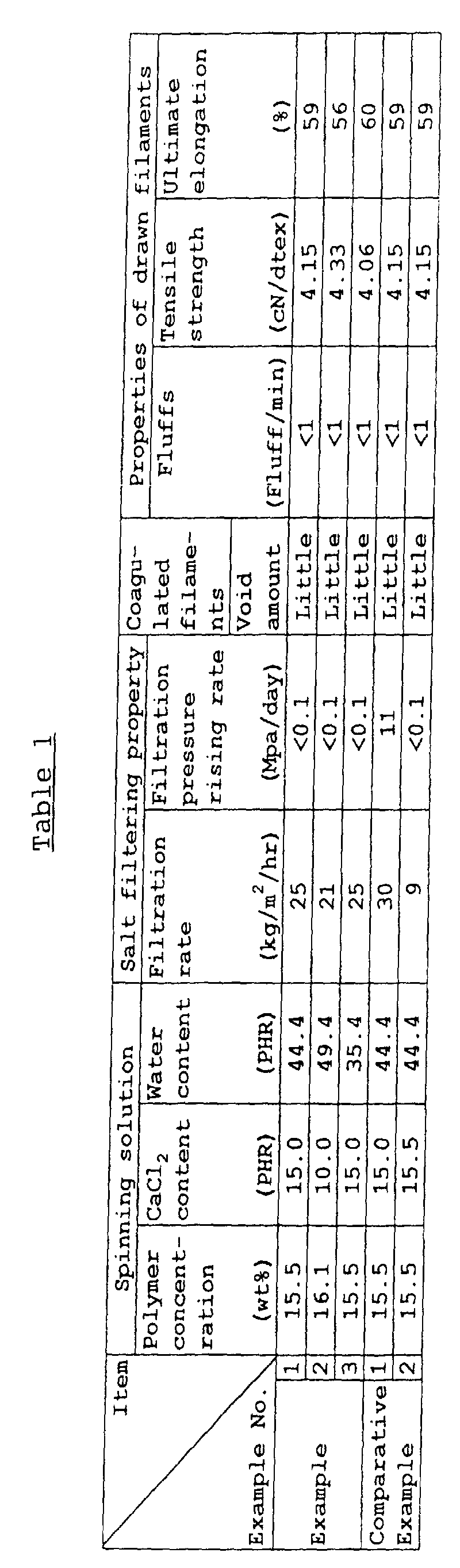
- In accordance with the production process of the present invention, meta-type aromatic polyamide fibers having excellent quality can be produced from a meta-type aromatic polyamide solution having an excellent stability and a superior coagulation property in a wet-spinning procedure with excellent processability and high productivity.
Claims (12)
- A process for producing meta-type aromatic polyamide filaments by preparing a polymer solution of a meta-type aromatic polyamide by a solution polymerization method and producing meta-type aromatic polyamide filaments from the polymer solution, which process comprises a series of steps (1) to (7) of:(1) a polymerization step in which a meta-type aromatic polyamide is prepared by reacting a meta-type aromatic diamine with a meta-type aromatic dicarboxylic acid chloride in a polar organic solvent;(2) a neutralization step in which hydrogen chloride contained in the polymer solution obtained in the polymerization step (1) is neutralized with a neutralizing agent comprising an alkali metal hydroxide capable of producing a salt insoluble in the polymerization solvent when reacted with the hydrogen chloride;(3) a filtering step in which the salt deposited from the polymer solution in the neutralization step (2) is removed by filtration;(4) a spinning solution-preparation step in which the polymer solution obtained in the filtering step (3) is mixed with water and a polar organic amide solvent, to provide a spinning solution;(5) a coagulation step in which the meta-type aromatic polyamide-spinning solution obtained in the spinning solution-preparation step (4) is directly extruded in filamentary streams into an aqueous coagulation liquid to coagulate the extruded spinning solution streams into the form of filaments;(6) a water-washing step in which the filaments delivered from the coagulation step (5) are immersed in water to remove the salts and the solvent from the filaments; and(7) drawing and heat-treatment steps in which the filaments delivered from the water-washing step (6) are drawn and heat-treated.
- The process for producing meta-type aromatic polyamide filaments as claimed in claim 1, wherein in the spinning solution-preparation step (4), the meta-type aromatic polyamide solution is added with a polar organic solvent-water mixed liquid having a water content of 25% by weight or less.
- The process for producing meta-type aromatic polyamide filaments as claimed in claim 1, wherein 85 molar% or more of the recurring units of the meta-type aromatic polyamide obtained in the polymerization step (1) are meta-phenyleneisophthalamide units.
- The process for producing meta-type aromatic polyamide filaments as claimed in claim 1, wherein the polar organic amide solvent used in the polymerization step (1) is N-methyl-2-pyrrolidone or N,N-dimethylacetamide.
- The process for producing meta-type aromatic polyamide filaments as claimed in claim 1, wherein the alkali metal hydroxide which reacts with hydrogen chloride in the neutralization step (2) to form the salt insoluble in the polymerization solvent is sodium hydroxide or potassium hydroxide.
- The process for producing meta-type aromatic polyamide filaments as claimed in claim 1, wherein in the neutralization step (2), the polymer solution is added with an aqueous solution of the alkali metal hydroxide.
- The process for producing meta-type aromatic polyamide filaments as claimed in claim 6, wherein the alkali metal hydroxide is in a concentration of 20 to 70% in the aqueous alkali metal hydroxide solution.
- The process for producing meta-type aromatic polyamide filaments as claimed in claim 1, further comprising a step (8) for adding calcium chloride or lithium chloride to the copolymer solution, before the neutralization step.
- The process for producing meta-type aromatic polyamide filaments as claimed in claim 1, wherein in the neutralization step (2), the neutralizing agent contains at least one member selected from calcium hydroxide and lithium hydroxide, and 5 to 55 molar% of the total amount of hydrogen chloride contained in the polymer solution are neutralized with calcium hydroxide and/or lithium hydroxide.
- The process for producing meta-type aromatic polyamide filaments as claimed in claim 8 or 9, wherein the spinning solution contains calcium chloride and/or lithium chloride in an amount of 3 to 25% by weight based on the weight of the meta-type aromatic polyamide.
- The process for producing meta-type aromatic polyamide filaments as claimed in claim 1, wherein the spinning solution contains the meta-type aromatic polyamide in a concentration of 12 to 18% by weight, and water in a content of 25 to 70% by weight based on the weight of the meta-type aromatic polyamide.
- The process for producing meta-type aromatic polyamide filaments as claimed in claim 1, wherein in the polymerization step (1), the organic polar solvent comprises at least one member selected from N-methyl-2-pyrrolidone, N,N-dimethylacetamide, N,N-dimethylformamide, dimethylsulfoxide, N-methylcaprolactame, N,N,N',N'-tetramethylurea.
Applications Claiming Priority (5)
| Application Number | Priority Date | Filing Date | Title |
|---|---|---|---|
| JP29949699A JP2001114889A (en) | 1999-10-21 | 1999-10-21 | Method for producing meta-type aromatic polyamide solution |
| JP29949699 | 1999-10-21 | ||
| JP35731599 | 1999-12-16 | ||
| JP35731599A JP2001172819A (en) | 1999-12-16 | 1999-12-16 | Method for producing meta-type aromatic polyamide fiber |
| PCT/JP2000/007353 WO2001029296A1 (en) | 1999-10-21 | 2000-10-20 | Process for producing meta-aromatic polyamide fiber |
Publications (3)
| Publication Number | Publication Date |
|---|---|
| EP1143048A1 true EP1143048A1 (en) | 2001-10-10 |
| EP1143048A4 EP1143048A4 (en) | 2004-07-14 |
| EP1143048B1 EP1143048B1 (en) | 2006-06-28 |
Family
ID=26561959
Family Applications (1)
| Application Number | Title | Priority Date | Filing Date |
|---|---|---|---|
| EP00969969A Expired - Lifetime EP1143048B1 (en) | 1999-10-21 | 2000-10-20 | Process for producing meta-aromatic polyamide fiber |
Country Status (11)
| Country | Link |
|---|---|
| US (1) | US6569987B1 (en) |
| EP (1) | EP1143048B1 (en) |
| KR (1) | KR100531989B1 (en) |
| CN (1) | CN1162572C (en) |
| AT (1) | ATE331826T1 (en) |
| CA (1) | CA2355316C (en) |
| DE (1) | DE60029085T8 (en) |
| ES (1) | ES2263492T3 (en) |
| ID (1) | ID28946A (en) |
| TW (1) | TW562823B (en) |
| WO (1) | WO2001029296A1 (en) |
Cited By (3)
| Publication number | Priority date | Publication date | Assignee | Title |
|---|---|---|---|---|
| WO2004099476A1 (en) * | 2003-05-08 | 2004-11-18 | Teijin Twaron B.V. | Non-fibrous polymer solution of para-aramid with high relative viscosity |
| KR100910535B1 (en) | 2008-05-21 | 2009-07-31 | 주식회사 코오롱 | Method for producing aromatic polyamide polymer, and method for producing aramid fiber using the same |
| CN114197072A (en) * | 2021-12-08 | 2022-03-18 | 上海鑫茗企业管理有限公司 | Spinning method of meta-aramid fiber |
Families Citing this family (32)
| Publication number | Priority date | Publication date | Assignee | Title |
|---|---|---|---|---|
| MY138441A (en) * | 2003-12-09 | 2009-06-30 | Teijin Aramid Bv | Aramid fibrils |
| JPWO2005103353A1 (en) * | 2004-04-26 | 2008-03-13 | 帝人テクノプロダクツ株式会社 | High-strength check yarn and manufacturing method thereof |
| KR20130141725A (en) * | 2006-01-31 | 2013-12-26 | 데이진 가부시키가이샤 | Meta-type fully aromatic polyamide fiber having excellent high-temperature processability and method for production thereof |
| KR20090089903A (en) | 2006-12-12 | 2009-08-24 | 이 아이 듀폰 디 네모아 앤드 캄파니 | Synthesis method of 3-hydroxyglutaronitrile |
| WO2008082509A2 (en) * | 2006-12-21 | 2008-07-10 | E.I. Du Pont De Nemours And Company | Process for the synthesis of diaminopyridines from glutaronitriles |
| EP2125737A2 (en) | 2006-12-21 | 2009-12-02 | E. I. Du Pont de Nemours and Company | Process for the synthesis of 2,6-diaminopyridines from glutarimidines |
| KR20100050524A (en) | 2007-08-01 | 2010-05-13 | 이 아이 듀폰 디 네모아 앤드 캄파니 | Process for the synthesis of diaminopyridine and related compounds |
| US20110130540A1 (en) * | 2007-08-17 | 2011-06-02 | E.I. Du Pont De Nemours And Company | Processes for the synthesis of 3-hydroxyglutaronitrile |
| JP5249942B2 (en) * | 2007-10-18 | 2013-07-31 | 帝人株式会社 | Aromatic polyamide nanofiber and fiber structure containing the same |
| US7771638B2 (en) * | 2007-12-19 | 2010-08-10 | E. I. Du Pont De Nemours And Company | Rapid plasticization of quenched yarns |
| US7998575B2 (en) * | 2007-12-19 | 2011-08-16 | E.I. Du Pont De Nemours And Company | Low shrinkage, dyeable MPD-I yarn |
| US7780889B2 (en) * | 2007-12-19 | 2010-08-24 | E.I. Du Pont De Nemours And Company | Multistage draw with relaxation step |
| US7771637B2 (en) * | 2007-12-19 | 2010-08-10 | E. I. Du Pont De Nemours And Company | High-speed meta-aramid fiber production |
| US7771636B2 (en) * | 2007-12-19 | 2010-08-10 | E. I. Du Pont De Nemours And Company | Single stage drawing for MPD-I yarn |
| KR100910536B1 (en) * | 2008-05-21 | 2009-07-31 | 주식회사 코오롱 | Process for preparing aromatic polyamide polymer and process for producing aramid fibers |
| KR101431275B1 (en) * | 2008-05-21 | 2014-08-20 | 코오롱인더스트리 주식회사 | Aromatic Polyamide polymer and Method of making the same, and Aramid Fiber and method of making the same |
| US7999057B2 (en) | 2008-07-08 | 2011-08-16 | E. I. Du Pont De Nemours And Company | Gas-phase process for the synthesis of diaminopyridines from glutaronitriles |
| US20110301314A1 (en) | 2008-12-18 | 2011-12-08 | E.I. Du Pont De Nemours And Company | Continuous liquid-phase process for the synthesis of diaminopyridines from glutaronitriles |
| TW201127809A (en) | 2009-09-02 | 2011-08-16 | Du Pont | Process for the synthesis of fluorinated ethers of aromatic acids |
| CN102534840B (en) * | 2010-12-29 | 2014-11-12 | 圣欧芳纶(江苏)股份有限公司 | Method for preparing meta-aramid fiber |
| KR101923749B1 (en) * | 2011-01-13 | 2018-11-29 | 이 아이 듀폰 디 네모아 앤드 캄파니 | Copolymer fibers and yarns and processes for making same |
| EP2663587B1 (en) * | 2011-01-13 | 2017-03-01 | E. I. du Pont de Nemours and Company | Neutralized copolymer crumb and processes for making same |
| CN102206882B (en) * | 2011-03-31 | 2012-12-19 | 舒均锋 | Method and equipment for continuously manufacturing poly (metaphenylene dimethyl formamide diamino diphenyl sulphone) fibers |
| KR101241118B1 (en) | 2011-06-21 | 2013-03-11 | 웅진케미칼 주식회사 | Manufacturing method of Meta Aramid for electro spinning |
| CN103113576B (en) * | 2013-01-25 | 2015-06-17 | 杭州九隆芳纶有限公司 | Aramid 1313 intermittent polymerization method |
| KR101478968B1 (en) | 2013-05-01 | 2015-01-05 | 주식회사 휴비스 | Method of Preparing Meta-Aramid Fibers with Improved Whiteness and m-aramid Fibers thereof |
| CN103696035B (en) * | 2013-12-05 | 2015-08-12 | 北京理工大学 | A kind of method removing HCl in PPTA-pulp production process |
| CN105527373A (en) * | 2016-01-08 | 2016-04-27 | 中简科技股份有限公司 | Detection method for ammonia content of polyacrylonitrile-based carbon fiber spinning solution |
| ES2950395T3 (en) | 2016-05-30 | 2023-10-09 | Sa Minera Catalano Aragonesa | Method for obtaining biodegradable polymers |
| CN106222764B (en) * | 2016-10-07 | 2018-04-06 | 上海会博新材料科技有限公司 | The device of meta-aramid fibers is prepared using dry spinning |
| CN109537096A (en) * | 2018-12-09 | 2019-03-29 | 合肥英士博户外用品科技有限公司 | A kind of fiber spinning solution |
| CN116622063A (en) * | 2023-04-28 | 2023-08-22 | 安徽元琛环保科技股份有限公司 | A kind of modified polym-phenylene isophthalamide and its preparation method and application |
Family Cites Families (9)
| Publication number | Priority date | Publication date | Assignee | Title |
|---|---|---|---|---|
| US3063966A (en) | 1958-02-05 | 1962-11-13 | Du Pont | Process of making wholly aromatic polyamides |
| GB1111974A (en) | 1964-06-16 | 1968-05-01 | Certels Ltd | Improvements in or relating to building blocks |
| DE2313308A1 (en) | 1973-03-17 | 1974-09-19 | Hoechst Ag | PROCESS FOR MANUFACTURING FABRICS, FIBERS AND FILMS FROM AROMATIC POLYAMIDES |
| EP0567987A1 (en) * | 1992-04-30 | 1993-11-03 | Hoechst Aktiengesellschaft | Process for the production of meta-aramide fibers |
| US5340519A (en) * | 1993-03-29 | 1994-08-23 | E. I. Du Pont De Nemours And Company | Preparation of poly(m-phenylene isophthalamide) filaments |
| JP2922431B2 (en) | 1994-08-30 | 1999-07-26 | 帝人株式会社 | Method for producing meta-type aromatic polyamide fiber |
| JP2971335B2 (en) | 1994-08-30 | 1999-11-02 | 帝人株式会社 | Method for producing meta-type aromatic polyamide fiber |
| JP2922432B2 (en) | 1994-08-31 | 1999-07-26 | 帝人株式会社 | Method for producing meta-type aramid fiber |
| US5667743A (en) * | 1996-05-21 | 1997-09-16 | E. I. Du Pont De Nemours And Company | Wet spinning process for aramid polymer containing salts |
-
2000
- 2000-10-20 WO PCT/JP2000/007353 patent/WO2001029296A1/en not_active Ceased
- 2000-10-20 DE DE60029085T patent/DE60029085T8/en active Active
- 2000-10-20 CA CA002355316A patent/CA2355316C/en not_active Expired - Fee Related
- 2000-10-20 US US09/868,863 patent/US6569987B1/en not_active Expired - Fee Related
- 2000-10-20 KR KR10-2001-7007762A patent/KR100531989B1/en not_active Expired - Fee Related
- 2000-10-20 ES ES00969969T patent/ES2263492T3/en not_active Expired - Lifetime
- 2000-10-20 TW TW089122130A patent/TW562823B/en active
- 2000-10-20 AT AT00969969T patent/ATE331826T1/en not_active IP Right Cessation
- 2000-10-20 ID IDW00200101347A patent/ID28946A/en unknown
- 2000-10-20 EP EP00969969A patent/EP1143048B1/en not_active Expired - Lifetime
- 2000-10-20 CN CNB008040109A patent/CN1162572C/en not_active Expired - Fee Related
Non-Patent Citations (2)
| Title |
|---|
| No further relevant documents disclosed * |
| See also references of WO0129296A1 * |
Cited By (6)
| Publication number | Priority date | Publication date | Assignee | Title |
|---|---|---|---|---|
| WO2004099476A1 (en) * | 2003-05-08 | 2004-11-18 | Teijin Twaron B.V. | Non-fibrous polymer solution of para-aramid with high relative viscosity |
| AU2004236347B2 (en) * | 2003-05-08 | 2009-03-05 | Teijin Aramid B.V. | Non-fibrous polymer solution of para-aramid with high relative viscosity |
| US7754797B2 (en) | 2003-05-08 | 2010-07-13 | Teijin Aramid B.V. | Non-fibrous polymer solution of para-aramid with high relative viscosity |
| US8415417B2 (en) | 2003-05-08 | 2013-04-09 | Teijin Aramid B.V. | Non-fibrous polymer solution of para-aramid with high relative viscosity |
| KR100910535B1 (en) | 2008-05-21 | 2009-07-31 | 주식회사 코오롱 | Method for producing aromatic polyamide polymer, and method for producing aramid fiber using the same |
| CN114197072A (en) * | 2021-12-08 | 2022-03-18 | 上海鑫茗企业管理有限公司 | Spinning method of meta-aramid fiber |
Also Published As
| Publication number | Publication date |
|---|---|
| ID28946A (en) | 2001-07-19 |
| TW562823B (en) | 2003-11-21 |
| WO2001029296A1 (en) | 2001-04-26 |
| CA2355316A1 (en) | 2001-04-26 |
| DE60029085D1 (en) | 2006-08-10 |
| ATE331826T1 (en) | 2006-07-15 |
| EP1143048B1 (en) | 2006-06-28 |
| KR100531989B1 (en) | 2005-11-30 |
| ES2263492T3 (en) | 2006-12-16 |
| CN1162572C (en) | 2004-08-18 |
| EP1143048A4 (en) | 2004-07-14 |
| CN1341169A (en) | 2002-03-20 |
| US6569987B1 (en) | 2003-05-27 |
| KR20010081085A (en) | 2001-08-25 |
| DE60029085T2 (en) | 2007-01-11 |
| CA2355316C (en) | 2005-06-14 |
| DE60029085T8 (en) | 2007-05-16 |
Similar Documents
| Publication | Publication Date | Title |
|---|---|---|
| US6569987B1 (en) | Process for producing meta-aromatic polyamide fiber | |
| US6569366B1 (en) | Process for producing meta-type wholly aromatic polyamide filaments | |
| CA2255686C (en) | Wet spinning process for aramid polymer containing salts and fiber produced from this process | |
| WO2007089008A1 (en) | Meta-type fully aromatic polyamide fiber having excellent high-temperature processability and method for production thereof | |
| EP0045934B1 (en) | Wholly aromatic polyamide fiber and film and process for preparation thereof | |
| CN102165109B (en) | Easy-to-dye meta-type fully aromatic polyamide fiber | |
| CN116490546B (en) | Heat-resistant high-toughness fiber, method for producing the same, and heat-resistant high-toughness film | |
| EP0226137B1 (en) | Process for producing a high strength polymetaphenylene isophthalamide fiber | |
| JPH0874123A (en) | Method for producing meta-aramid fiber | |
| EP2048268B1 (en) | Process for producing an aromatic copolyamide fiber | |
| EP0426049B1 (en) | Wholly aromatic copolyamide and shaped article thereof | |
| JPH0874121A (en) | Method for producing meta-type aromatic polyamide fiber | |
| EP1678355B1 (en) | Improved wet spinning process for aramid polymer containing salts | |
| JP4653612B2 (en) | Method for producing para-type aromatic polyamide fiber with improved chemical resistance | |
| US9388512B2 (en) | Para-type wholly aromatic copolyamide drawn fiber and method for producing the same | |
| JPH0327119A (en) | Fiber having improved hydrolytic stability | |
| JP2001172819A (en) | Method for producing meta-type aromatic polyamide fiber | |
| JP2001114889A (en) | Method for producing meta-type aromatic polyamide solution | |
| JP2971335B2 (en) | Method for producing meta-type aromatic polyamide fiber | |
| RU2111978C1 (en) | Anisotropic solution based on aromatic copolyamides and formed articles from this solution | |
| JP2001115333A (en) | Meta-type aromatic polyamide solution and method for producing fiber using the same | |
| JP2005213663A (en) | Method for producing meta type wholly aromatic polyamide fiber | |
| JP2023110161A (en) | Meta-type wholly aromatic polyamide fiber and method for producing the same | |
| JPS6088114A (en) | Pilling-resistant poly-m-phenylene isophthalamide fiber and its manufacture | |
| JP2005213664A (en) | Method for producing meta type wholly aromatic polyamide fiber |
Legal Events
| Date | Code | Title | Description |
|---|---|---|---|
| PUAI | Public reference made under article 153(3) epc to a published international application that has entered the european phase |
Free format text: ORIGINAL CODE: 0009012 |
|
| 17P | Request for examination filed |
Effective date: 20010622 |
|
| AK | Designated contracting states |
Kind code of ref document: A1 Designated state(s): AT BE CH CY DE DK ES FI FR GB GR IE IT LI LU MC NL PT SE |
|
| AX | Request for extension of the european patent |
Free format text: AL;LT;LV;MK;RO;SI |
|
| A4 | Supplementary search report drawn up and despatched |
Effective date: 20040602 |
|
| 17Q | First examination report despatched |
Effective date: 20041222 |
|
| GRAP | Despatch of communication of intention to grant a patent |
Free format text: ORIGINAL CODE: EPIDOSNIGR1 |
|
| GRAS | Grant fee paid |
Free format text: ORIGINAL CODE: EPIDOSNIGR3 |
|
| GRAA | (expected) grant |
Free format text: ORIGINAL CODE: 0009210 |
|
| AK | Designated contracting states |
Kind code of ref document: B1 Designated state(s): AT BE CH CY DE DK ES FI FR GB GR IE IT LI LU MC NL PT SE |
|
| PG25 | Lapsed in a contracting state [announced via postgrant information from national office to epo] |
Ref country code: IT Free format text: LAPSE BECAUSE OF FAILURE TO SUBMIT A TRANSLATION OF THE DESCRIPTION OR TO PAY THE FEE WITHIN THE PRESCRIBED TIME-LIMIT;WARNING: LAPSES OF ITALIAN PATENTS WITH EFFECTIVE DATE BEFORE 2007 MAY HAVE OCCURRED AT ANY TIME BEFORE 2007. THE CORRECT EFFECTIVE DATE MAY BE DIFFERENT FROM THE ONE RECORDED. Effective date: 20060628 Ref country code: BE Free format text: LAPSE BECAUSE OF FAILURE TO SUBMIT A TRANSLATION OF THE DESCRIPTION OR TO PAY THE FEE WITHIN THE PRESCRIBED TIME-LIMIT Effective date: 20060628 Ref country code: CH Free format text: LAPSE BECAUSE OF FAILURE TO SUBMIT A TRANSLATION OF THE DESCRIPTION OR TO PAY THE FEE WITHIN THE PRESCRIBED TIME-LIMIT Effective date: 20060628 Ref country code: NL Free format text: LAPSE BECAUSE OF FAILURE TO SUBMIT A TRANSLATION OF THE DESCRIPTION OR TO PAY THE FEE WITHIN THE PRESCRIBED TIME-LIMIT Effective date: 20060628 Ref country code: AT Free format text: LAPSE BECAUSE OF FAILURE TO SUBMIT A TRANSLATION OF THE DESCRIPTION OR TO PAY THE FEE WITHIN THE PRESCRIBED TIME-LIMIT Effective date: 20060628 Ref country code: FI Free format text: LAPSE BECAUSE OF FAILURE TO SUBMIT A TRANSLATION OF THE DESCRIPTION OR TO PAY THE FEE WITHIN THE PRESCRIBED TIME-LIMIT Effective date: 20060628 Ref country code: LI Free format text: LAPSE BECAUSE OF FAILURE TO SUBMIT A TRANSLATION OF THE DESCRIPTION OR TO PAY THE FEE WITHIN THE PRESCRIBED TIME-LIMIT Effective date: 20060628 |
|
| REG | Reference to a national code |
Ref country code: GB Ref legal event code: FG4D |
|
| REG | Reference to a national code |
Ref country code: CH Ref legal event code: EP |
|
| REG | Reference to a national code |
Ref country code: IE Ref legal event code: FG4D |
|
| REF | Corresponds to: |
Ref document number: 60029085 Country of ref document: DE Date of ref document: 20060810 Kind code of ref document: P |
|
| PG25 | Lapsed in a contracting state [announced via postgrant information from national office to epo] |
Ref country code: DK Free format text: LAPSE BECAUSE OF FAILURE TO SUBMIT A TRANSLATION OF THE DESCRIPTION OR TO PAY THE FEE WITHIN THE PRESCRIBED TIME-LIMIT Effective date: 20060928 Ref country code: SE Free format text: LAPSE BECAUSE OF FAILURE TO SUBMIT A TRANSLATION OF THE DESCRIPTION OR TO PAY THE FEE WITHIN THE PRESCRIBED TIME-LIMIT Effective date: 20060928 |
|
| PG25 | Lapsed in a contracting state [announced via postgrant information from national office to epo] |
Ref country code: IE Free format text: LAPSE BECAUSE OF NON-PAYMENT OF DUE FEES Effective date: 20061020 |
|
| PG25 | Lapsed in a contracting state [announced via postgrant information from national office to epo] |
Ref country code: MC Free format text: LAPSE BECAUSE OF NON-PAYMENT OF DUE FEES Effective date: 20061031 |
|
| PG25 | Lapsed in a contracting state [announced via postgrant information from national office to epo] |
Ref country code: PT Free format text: LAPSE BECAUSE OF FAILURE TO SUBMIT A TRANSLATION OF THE DESCRIPTION OR TO PAY THE FEE WITHIN THE PRESCRIBED TIME-LIMIT Effective date: 20061128 |
|
| NLV1 | Nl: lapsed or annulled due to failure to fulfill the requirements of art. 29p and 29m of the patents act | ||
| REG | Reference to a national code |
Ref country code: ES Ref legal event code: FG2A Ref document number: 2263492 Country of ref document: ES Kind code of ref document: T3 |
|
| REG | Reference to a national code |
Ref country code: CH Ref legal event code: PL |
|
| PLBE | No opposition filed within time limit |
Free format text: ORIGINAL CODE: 0009261 |
|
| STAA | Information on the status of an ep patent application or granted ep patent |
Free format text: STATUS: NO OPPOSITION FILED WITHIN TIME LIMIT |
|
| EN | Fr: translation not filed | ||
| 26N | No opposition filed |
Effective date: 20070329 |
|
| GBPC | Gb: european patent ceased through non-payment of renewal fee |
Effective date: 20061020 |
|
| PG25 | Lapsed in a contracting state [announced via postgrant information from national office to epo] |
Ref country code: GB Free format text: LAPSE BECAUSE OF NON-PAYMENT OF DUE FEES Effective date: 20061020 |
|
| PG25 | Lapsed in a contracting state [announced via postgrant information from national office to epo] |
Ref country code: GR Free format text: LAPSE BECAUSE OF FAILURE TO SUBMIT A TRANSLATION OF THE DESCRIPTION OR TO PAY THE FEE WITHIN THE PRESCRIBED TIME-LIMIT Effective date: 20060929 Ref country code: FR Free format text: LAPSE BECAUSE OF FAILURE TO SUBMIT A TRANSLATION OF THE DESCRIPTION OR TO PAY THE FEE WITHIN THE PRESCRIBED TIME-LIMIT Effective date: 20070511 |
|
| PG25 | Lapsed in a contracting state [announced via postgrant information from national office to epo] |
Ref country code: LU Free format text: LAPSE BECAUSE OF NON-PAYMENT OF DUE FEES Effective date: 20061020 |
|
| PG25 | Lapsed in a contracting state [announced via postgrant information from national office to epo] |
Ref country code: CY Free format text: LAPSE BECAUSE OF FAILURE TO SUBMIT A TRANSLATION OF THE DESCRIPTION OR TO PAY THE FEE WITHIN THE PRESCRIBED TIME-LIMIT Effective date: 20060628 Ref country code: FR Free format text: LAPSE BECAUSE OF FAILURE TO SUBMIT A TRANSLATION OF THE DESCRIPTION OR TO PAY THE FEE WITHIN THE PRESCRIBED TIME-LIMIT Effective date: 20060628 |
|
| PGFP | Annual fee paid to national office [announced via postgrant information from national office to epo] |
Ref country code: DE Payment date: 20101221 Year of fee payment: 11 |
|
| PGFP | Annual fee paid to national office [announced via postgrant information from national office to epo] |
Ref country code: ES Payment date: 20111019 Year of fee payment: 12 |
|
| PG25 | Lapsed in a contracting state [announced via postgrant information from national office to epo] |
Ref country code: DE Free format text: LAPSE BECAUSE OF NON-PAYMENT OF DUE FEES Effective date: 20130501 |
|
| REG | Reference to a national code |
Ref country code: DE Ref legal event code: R119 Ref document number: 60029085 Country of ref document: DE Effective date: 20130501 |
|
| REG | Reference to a national code |
Ref country code: ES Ref legal event code: FD2A Effective date: 20140527 |
|
| PG25 | Lapsed in a contracting state [announced via postgrant information from national office to epo] |
Ref country code: ES Free format text: LAPSE BECAUSE OF NON-PAYMENT OF DUE FEES Effective date: 20121021 |