EP1142968B1 - Use of ink-jet inks for reduced kogation in ink-jet pens - Google Patents
Use of ink-jet inks for reduced kogation in ink-jet pens Download PDFInfo
- Publication number
- EP1142968B1 EP1142968B1 EP01303187A EP01303187A EP1142968B1 EP 1142968 B1 EP1142968 B1 EP 1142968B1 EP 01303187 A EP01303187 A EP 01303187A EP 01303187 A EP01303187 A EP 01303187A EP 1142968 B1 EP1142968 B1 EP 1142968B1
- Authority
- EP
- European Patent Office
- Prior art keywords
- ink
- use according
- jet
- acid
- pen
- Prior art date
- Legal status (The legal status is an assumption and is not a legal conclusion. Google has not performed a legal analysis and makes no representation as to the accuracy of the status listed.)
- Expired - Lifetime
Links
- 239000000976 ink Substances 0.000 title description 171
- 239000002738 chelating agent Substances 0.000 claims description 83
- KCXVZYZYPLLWCC-UHFFFAOYSA-N EDTA Chemical compound OC(=O)CN(CC(O)=O)CCN(CC(O)=O)CC(O)=O KCXVZYZYPLLWCC-UHFFFAOYSA-N 0.000 claims description 60
- 239000000203 mixture Substances 0.000 claims description 51
- 229910052751 metal Inorganic materials 0.000 claims description 48
- 239000002184 metal Substances 0.000 claims description 48
- 150000003014 phosphoric acid esters Chemical class 0.000 claims description 25
- WJJMNDUMQPNECX-UHFFFAOYSA-N Dipicolinic acid Natural products OC(=O)C1=CC=CC(C(O)=O)=N1 WJJMNDUMQPNECX-UHFFFAOYSA-N 0.000 claims description 20
- 229910052715 tantalum Inorganic materials 0.000 claims description 20
- GUVRBAGPIYLISA-UHFFFAOYSA-N tantalum atom Chemical compound [Ta] GUVRBAGPIYLISA-UHFFFAOYSA-N 0.000 claims description 20
- CABMTIJINOIHOD-UHFFFAOYSA-N 2-[4-methyl-5-oxo-4-(propan-2-yl)-4,5-dihydro-1H-imidazol-2-yl]quinoline-3-carboxylic acid Chemical compound N1C(=O)C(C(C)C)(C)N=C1C1=NC2=CC=CC=C2C=C1C(O)=O CABMTIJINOIHOD-UHFFFAOYSA-N 0.000 claims description 19
- 239000011651 chromium Substances 0.000 claims description 18
- 239000002253 acid Substances 0.000 claims description 17
- VYZAMTAEIAYCRO-UHFFFAOYSA-N Chromium Chemical compound [Cr] VYZAMTAEIAYCRO-UHFFFAOYSA-N 0.000 claims description 16
- 229910052804 chromium Inorganic materials 0.000 claims description 16
- 239000004215 Carbon black (E152) Substances 0.000 claims description 12
- 239000003086 colorant Substances 0.000 claims description 12
- 229930195733 hydrocarbon Natural products 0.000 claims description 12
- 229910000510 noble metal Inorganic materials 0.000 claims description 12
- 150000002430 hydrocarbons Chemical class 0.000 claims description 11
- BASFCYQUMIYNBI-UHFFFAOYSA-N platinum Chemical compound [Pt] BASFCYQUMIYNBI-UHFFFAOYSA-N 0.000 claims description 10
- OFOBLEOULBTSOW-UHFFFAOYSA-N Malonic acid Chemical compound OC(=O)CC(O)=O OFOBLEOULBTSOW-UHFFFAOYSA-N 0.000 claims description 8
- 239000008135 aqueous vehicle Substances 0.000 claims description 8
- DEFVIWRASFVYLL-UHFFFAOYSA-N ethylene glycol bis(2-aminoethyl)tetraacetic acid Chemical compound OC(=O)CN(CC(O)=O)CCOCCOCCN(CC(O)=O)CC(O)=O DEFVIWRASFVYLL-UHFFFAOYSA-N 0.000 claims description 8
- YGSDEFSMJLZEOE-UHFFFAOYSA-N salicylic acid Chemical compound OC(=O)C1=CC=CC=C1O YGSDEFSMJLZEOE-UHFFFAOYSA-N 0.000 claims description 8
- 239000011248 coating agent Substances 0.000 claims description 6
- 238000000576 coating method Methods 0.000 claims description 6
- 239000003981 vehicle Substances 0.000 claims description 6
- ZOKXTWBITQBERF-UHFFFAOYSA-N Molybdenum Chemical compound [Mo] ZOKXTWBITQBERF-UHFFFAOYSA-N 0.000 claims description 5
- BQCADISMDOOEFD-UHFFFAOYSA-N Silver Chemical compound [Ag] BQCADISMDOOEFD-UHFFFAOYSA-N 0.000 claims description 5
- RTAQQCXQSZGOHL-UHFFFAOYSA-N Titanium Chemical compound [Ti] RTAQQCXQSZGOHL-UHFFFAOYSA-N 0.000 claims description 5
- QCWXUUIWCKQGHC-UHFFFAOYSA-N Zirconium Chemical compound [Zr] QCWXUUIWCKQGHC-UHFFFAOYSA-N 0.000 claims description 5
- 229950011260 betanaphthol Drugs 0.000 claims description 5
- PCHJSUWPFVWCPO-UHFFFAOYSA-N gold Chemical compound [Au] PCHJSUWPFVWCPO-UHFFFAOYSA-N 0.000 claims description 5
- 229910052737 gold Inorganic materials 0.000 claims description 5
- 239000010931 gold Substances 0.000 claims description 5
- 229910052735 hafnium Inorganic materials 0.000 claims description 5
- VBJZVLUMGGDVMO-UHFFFAOYSA-N hafnium atom Chemical compound [Hf] VBJZVLUMGGDVMO-UHFFFAOYSA-N 0.000 claims description 5
- 229910052750 molybdenum Inorganic materials 0.000 claims description 5
- 239000011733 molybdenum Substances 0.000 claims description 5
- 229910052758 niobium Inorganic materials 0.000 claims description 5
- 239000010955 niobium Substances 0.000 claims description 5
- GUCVJGMIXFAOAE-UHFFFAOYSA-N niobium atom Chemical compound [Nb] GUCVJGMIXFAOAE-UHFFFAOYSA-N 0.000 claims description 5
- 229910052697 platinum Inorganic materials 0.000 claims description 5
- 229910052709 silver Inorganic materials 0.000 claims description 5
- 239000004332 silver Substances 0.000 claims description 5
- 229910052719 titanium Inorganic materials 0.000 claims description 5
- 239000010936 titanium Substances 0.000 claims description 5
- WFKWXMTUELFFGS-UHFFFAOYSA-N tungsten Chemical compound [W] WFKWXMTUELFFGS-UHFFFAOYSA-N 0.000 claims description 5
- 229910052721 tungsten Inorganic materials 0.000 claims description 5
- 239000010937 tungsten Substances 0.000 claims description 5
- 229910052720 vanadium Inorganic materials 0.000 claims description 5
- 229910052726 zirconium Inorganic materials 0.000 claims description 5
- FCKYPQBAHLOOJQ-UHFFFAOYSA-N Cyclohexane-1,2-diaminetetraacetic acid Chemical compound OC(=O)CN(CC(O)=O)C1CCCCC1N(CC(O)=O)CC(O)=O FCKYPQBAHLOOJQ-UHFFFAOYSA-N 0.000 claims description 4
- 102100036782 Serine/threonine-protein phosphatase 2A activator Human genes 0.000 claims description 4
- 101710196539 Serine/threonine-protein phosphatase 2A activator Proteins 0.000 claims description 4
- FJKROLUGYXJWQN-UHFFFAOYSA-N papa-hydroxy-benzoic acid Natural products OC(=O)C1=CC=C(O)C=C1 FJKROLUGYXJWQN-UHFFFAOYSA-N 0.000 claims description 4
- 229920000327 poly(triphenylamine) polymer Polymers 0.000 claims description 4
- 230000001681 protective effect Effects 0.000 claims description 4
- 229960004889 salicylic acid Drugs 0.000 claims description 4
- 239000000049 pigment Substances 0.000 claims description 3
- LEONUFNNVUYDNQ-UHFFFAOYSA-N vanadium atom Chemical compound [V] LEONUFNNVUYDNQ-UHFFFAOYSA-N 0.000 claims 1
- -1 organic acid sulfonate Chemical class 0.000 description 55
- 229910019142 PO4 Inorganic materials 0.000 description 54
- 235000021317 phosphate Nutrition 0.000 description 54
- 239000010452 phosphate Substances 0.000 description 53
- 239000002244 precipitate Substances 0.000 description 53
- 239000004094 surface-active agent Substances 0.000 description 34
- 230000000694 effects Effects 0.000 description 26
- 239000000975 dye Substances 0.000 description 24
- XEEYBQQBJWHFJM-UHFFFAOYSA-N iron Substances [Fe] XEEYBQQBJWHFJM-UHFFFAOYSA-N 0.000 description 18
- KDYFGRWQOYBRFD-UHFFFAOYSA-N Succinic acid Natural products OC(=O)CCC(O)=O KDYFGRWQOYBRFD-UHFFFAOYSA-N 0.000 description 15
- 238000007792 addition Methods 0.000 description 15
- 238000012360 testing method Methods 0.000 description 14
- 229910021645 metal ion Inorganic materials 0.000 description 13
- 238000002161 passivation Methods 0.000 description 13
- 238000001556 precipitation Methods 0.000 description 13
- XLYOFNOQVPJJNP-UHFFFAOYSA-N water Substances O XLYOFNOQVPJJNP-UHFFFAOYSA-N 0.000 description 13
- UKLDJPRMSDWDSL-UHFFFAOYSA-L [dibutyl(dodecanoyloxy)stannyl] dodecanoate Chemical compound CCCCCCCCCCCC(=O)O[Sn](CCCC)(CCCC)OC(=O)CCCCCCCCCCC UKLDJPRMSDWDSL-UHFFFAOYSA-L 0.000 description 12
- 239000012975 dibutyltin dilaurate Substances 0.000 description 12
- 238000004519 manufacturing process Methods 0.000 description 12
- 150000002739 metals Chemical class 0.000 description 12
- 238000000034 method Methods 0.000 description 12
- 230000015572 biosynthetic process Effects 0.000 description 11
- 238000010304 firing Methods 0.000 description 11
- XQBCVRSTVUHIGH-UHFFFAOYSA-L [dodecanoyloxy(dioctyl)stannyl] dodecanoate Chemical compound CCCCCCCCCCCC(=O)O[Sn](CCCCCCCC)(CCCCCCCC)OC(=O)CCCCCCCCCCC XQBCVRSTVUHIGH-UHFFFAOYSA-L 0.000 description 10
- NBIIXXVUZAFLBC-UHFFFAOYSA-K phosphate Chemical compound [O-]P([O-])([O-])=O NBIIXXVUZAFLBC-UHFFFAOYSA-K 0.000 description 10
- 238000006243 chemical reaction Methods 0.000 description 9
- 238000001228 spectrum Methods 0.000 description 9
- 229920000388 Polyphosphate Polymers 0.000 description 8
- 229910052782 aluminium Inorganic materials 0.000 description 8
- 239000000872 buffer Substances 0.000 description 8
- 229910052742 iron Inorganic materials 0.000 description 8
- 239000001205 polyphosphate Substances 0.000 description 8
- 235000011176 polyphosphates Nutrition 0.000 description 8
- XAGFODPZIPBFFR-UHFFFAOYSA-N aluminium Chemical compound [Al] XAGFODPZIPBFFR-UHFFFAOYSA-N 0.000 description 7
- 239000003139 biocide Substances 0.000 description 7
- 239000003054 catalyst Substances 0.000 description 7
- 239000000523 sample Substances 0.000 description 7
- 239000000243 solution Substances 0.000 description 7
- 239000001384 succinic acid Substances 0.000 description 7
- NHNBFGGVMKEFGY-UHFFFAOYSA-N Nitrate Chemical compound [O-][N+]([O-])=O NHNBFGGVMKEFGY-UHFFFAOYSA-N 0.000 description 6
- 239000000654 additive Substances 0.000 description 6
- 230000009920 chelation Effects 0.000 description 6
- 150000001875 compounds Chemical class 0.000 description 6
- 238000011109 contamination Methods 0.000 description 6
- 239000000463 material Substances 0.000 description 6
- HNJBEVLQSNELDL-UHFFFAOYSA-N pyrrolidin-2-one Chemical compound O=C1CCCN1 HNJBEVLQSNELDL-UHFFFAOYSA-N 0.000 description 6
- 239000000126 substance Substances 0.000 description 6
- 239000000853 adhesive Substances 0.000 description 5
- 230000001070 adhesive effect Effects 0.000 description 5
- 238000005260 corrosion Methods 0.000 description 5
- 230000007797 corrosion Effects 0.000 description 5
- 239000000047 product Substances 0.000 description 5
- 238000012421 spiking Methods 0.000 description 5
- 229910002651 NO3 Inorganic materials 0.000 description 4
- ATJFFYVFTNAWJD-UHFFFAOYSA-N Tin Chemical compound [Sn] ATJFFYVFTNAWJD-UHFFFAOYSA-N 0.000 description 4
- 230000000996 additive effect Effects 0.000 description 4
- 230000003115 biocidal effect Effects 0.000 description 4
- 238000009472 formulation Methods 0.000 description 4
- 239000012535 impurity Substances 0.000 description 4
- 238000007641 inkjet printing Methods 0.000 description 4
- 230000003993 interaction Effects 0.000 description 4
- UWJJYHHHVWZFEP-UHFFFAOYSA-N pentane-1,1-diol Chemical compound CCCCC(O)O UWJJYHHHVWZFEP-UHFFFAOYSA-N 0.000 description 4
- GPPXJZIENCGNKB-UHFFFAOYSA-N vanadium Chemical compound [V]#[V] GPPXJZIENCGNKB-UHFFFAOYSA-N 0.000 description 4
- 230000004580 weight loss Effects 0.000 description 4
- BSKHPKMHTQYZBB-UHFFFAOYSA-N 2-methylpyridine Chemical compound CC1=CC=CC=N1 BSKHPKMHTQYZBB-UHFFFAOYSA-N 0.000 description 3
- OYPRJOBELJOOCE-UHFFFAOYSA-N Calcium Chemical compound [Ca] OYPRJOBELJOOCE-UHFFFAOYSA-N 0.000 description 3
- 238000005033 Fourier transform infrared spectroscopy Methods 0.000 description 3
- 238000004566 IR spectroscopy Methods 0.000 description 3
- 230000008901 benefit Effects 0.000 description 3
- DMSMPAJRVJJAGA-UHFFFAOYSA-N benzo[d]isothiazol-3-one Chemical compound C1=CC=C2C(=O)NSC2=C1 DMSMPAJRVJJAGA-UHFFFAOYSA-N 0.000 description 3
- 229910052791 calcium Inorganic materials 0.000 description 3
- 239000011575 calcium Substances 0.000 description 3
- 230000007423 decrease Effects 0.000 description 3
- 238000005530 etching Methods 0.000 description 3
- 238000002474 experimental method Methods 0.000 description 3
- 239000000706 filtrate Substances 0.000 description 3
- NBZBKCUXIYYUSX-UHFFFAOYSA-N iminodiacetic acid Chemical compound OC(=O)CNCC(O)=O NBZBKCUXIYYUSX-UHFFFAOYSA-N 0.000 description 3
- 238000002329 infrared spectrum Methods 0.000 description 3
- 239000003921 oil Substances 0.000 description 3
- 229920001223 polyethylene glycol Polymers 0.000 description 3
- 230000002265 prevention Effects 0.000 description 3
- 238000007639 printing Methods 0.000 description 3
- 150000003839 salts Chemical class 0.000 description 3
- 230000035945 sensitivity Effects 0.000 description 3
- 239000007787 solid Substances 0.000 description 3
- 238000003786 synthesis reaction Methods 0.000 description 3
- UWHCKJMYHZGTIT-UHFFFAOYSA-N tetraethylene glycol Chemical compound OCCOCCOCCOCCO UWHCKJMYHZGTIT-UHFFFAOYSA-N 0.000 description 3
- 229910052723 transition metal Inorganic materials 0.000 description 3
- 229940043375 1,5-pentanediol Drugs 0.000 description 2
- SXGZJKUKBWWHRA-UHFFFAOYSA-N 2-(N-morpholiniumyl)ethanesulfonate Chemical compound [O-]S(=O)(=O)CC[NH+]1CCOCC1 SXGZJKUKBWWHRA-UHFFFAOYSA-N 0.000 description 2
- DVLFYONBTKHTER-UHFFFAOYSA-N 3-(N-morpholino)propanesulfonic acid Chemical compound OS(=O)(=O)CCCN1CCOCC1 DVLFYONBTKHTER-UHFFFAOYSA-N 0.000 description 2
- 239000003109 Disodium ethylene diamine tetraacetate Substances 0.000 description 2
- SXRSQZLOMIGNAQ-UHFFFAOYSA-N Glutaraldehyde Chemical compound O=CCCCC=O SXRSQZLOMIGNAQ-UHFFFAOYSA-N 0.000 description 2
- KFZMGEQAYNKOFK-UHFFFAOYSA-N Isopropanol Chemical compound CC(C)O KFZMGEQAYNKOFK-UHFFFAOYSA-N 0.000 description 2
- ALQSHHUCVQOPAS-UHFFFAOYSA-N Pentane-1,5-diol Chemical compound OCCCCCO ALQSHHUCVQOPAS-UHFFFAOYSA-N 0.000 description 2
- 230000032683 aging Effects 0.000 description 2
- 125000000217 alkyl group Chemical group 0.000 description 2
- 238000004458 analytical method Methods 0.000 description 2
- 239000003945 anionic surfactant Substances 0.000 description 2
- 125000003118 aryl group Chemical group 0.000 description 2
- 230000009286 beneficial effect Effects 0.000 description 2
- 150000007942 carboxylates Chemical group 0.000 description 2
- 239000013522 chelant Substances 0.000 description 2
- 239000003795 chemical substances by application Substances 0.000 description 2
- 235000019301 disodium ethylene diamine tetraacetate Nutrition 0.000 description 2
- POULHZVOKOAJMA-UHFFFAOYSA-N dodecanoic acid Chemical compound CCCCCCCCCCCC(O)=O POULHZVOKOAJMA-UHFFFAOYSA-N 0.000 description 2
- 238000011049 filling Methods 0.000 description 2
- 238000001914 filtration Methods 0.000 description 2
- 125000001153 fluoro group Chemical group F* 0.000 description 2
- 230000036541 health Effects 0.000 description 2
- 238000010438 heat treatment Methods 0.000 description 2
- 230000006872 improvement Effects 0.000 description 2
- 238000012417 linear regression Methods 0.000 description 2
- 230000007246 mechanism Effects 0.000 description 2
- 238000002156 mixing Methods 0.000 description 2
- 239000002736 nonionic surfactant Substances 0.000 description 2
- 230000003287 optical effect Effects 0.000 description 2
- 239000011148 porous material Substances 0.000 description 2
- RPACBEVZENYWOL-XFULWGLBSA-M sodium;(2r)-2-[6-(4-chlorophenoxy)hexyl]oxirane-2-carboxylate Chemical compound [Na+].C=1C=C(Cl)C=CC=1OCCCCCC[C@]1(C(=O)[O-])CO1 RPACBEVZENYWOL-XFULWGLBSA-M 0.000 description 2
- 238000001179 sorption measurement Methods 0.000 description 2
- 238000012420 spiking experiment Methods 0.000 description 2
- 238000003860 storage Methods 0.000 description 2
- 239000000758 substrate Substances 0.000 description 2
- 238000012546 transfer Methods 0.000 description 2
- 239000001043 yellow dye Substances 0.000 description 2
- BNGXYYYYKUGPPF-UHFFFAOYSA-M (3-methylphenyl)methyl-triphenylphosphanium;chloride Chemical compound [Cl-].CC1=CC=CC(C[P+](C=2C=CC=CC=2)(C=2C=CC=CC=2)C=2C=CC=CC=2)=C1 BNGXYYYYKUGPPF-UHFFFAOYSA-M 0.000 description 1
- BFHKYHMIVDBCPC-UHFFFAOYSA-N 1,3,5,7-tetrahydro-[1,3]oxazolo[3,4-c][1,3]oxazol-7a-ylmethanol Chemical compound C1OCN2COCC21CO BFHKYHMIVDBCPC-UHFFFAOYSA-N 0.000 description 1
- ATIAIEWDRRJGSL-UHFFFAOYSA-N 1,3-bis(2-hydroxyethyl)-5,5-dimethylimidazolidine-2,4-dione Chemical compound CC1(C)N(CCO)C(=O)N(CCO)C1=O ATIAIEWDRRJGSL-UHFFFAOYSA-N 0.000 description 1
- DBYODTZQPRNIPG-UHFFFAOYSA-L 4,4-dibutyl-3,5-dioxa-11-aza-4-stannabicyclo[5.3.1]undeca-1(11),7,9-triene-2,6-dione Chemical compound CCCC[Sn+2]CCCC.[O-]C(=O)C1=CC=CC(C([O-])=O)=N1 DBYODTZQPRNIPG-UHFFFAOYSA-L 0.000 description 1
- QXNVGIXVLWOKEQ-UHFFFAOYSA-N Disodium Chemical group [Na][Na] QXNVGIXVLWOKEQ-UHFFFAOYSA-N 0.000 description 1
- ZGTMUACCHSMWAC-UHFFFAOYSA-L EDTA disodium salt (anhydrous) Chemical compound [Na+].[Na+].OC(=O)CN(CC([O-])=O)CCN(CC(O)=O)CC([O-])=O ZGTMUACCHSMWAC-UHFFFAOYSA-L 0.000 description 1
- HMEKVHWROSNWPD-UHFFFAOYSA-N Erioglaucine A Chemical compound [NH4+].[NH4+].C=1C=C(C(=C2C=CC(C=C2)=[N+](CC)CC=2C=C(C=CC=2)S([O-])(=O)=O)C=2C(=CC=CC=2)S([O-])(=O)=O)C=CC=1N(CC)CC1=CC=CC(S([O-])(=O)=O)=C1 HMEKVHWROSNWPD-UHFFFAOYSA-N 0.000 description 1
- 229910002554 Fe(NO3)3·9H2O Inorganic materials 0.000 description 1
- VTLYFUHAOXGGBS-UHFFFAOYSA-N Fe3+ Chemical compound [Fe+3] VTLYFUHAOXGGBS-UHFFFAOYSA-N 0.000 description 1
- 238000001157 Fourier transform infrared spectrum Methods 0.000 description 1
- IMQLKJBTEOYOSI-GPIVLXJGSA-N Inositol-hexakisphosphate Chemical compound OP(O)(=O)O[C@H]1[C@H](OP(O)(O)=O)[C@@H](OP(O)(O)=O)[C@H](OP(O)(O)=O)[C@H](OP(O)(O)=O)[C@@H]1OP(O)(O)=O IMQLKJBTEOYOSI-GPIVLXJGSA-N 0.000 description 1
- 239000005639 Lauric acid Substances 0.000 description 1
- 239000007993 MOPS buffer Substances 0.000 description 1
- QPCDCPDFJACHGM-UHFFFAOYSA-N N,N-bis{2-[bis(carboxymethyl)amino]ethyl}glycine Chemical compound OC(=O)CN(CC(O)=O)CCN(CC(=O)O)CCN(CC(O)=O)CC(O)=O QPCDCPDFJACHGM-UHFFFAOYSA-N 0.000 description 1
- IMQLKJBTEOYOSI-UHFFFAOYSA-N Phytic acid Natural products OP(O)(=O)OC1C(OP(O)(O)=O)C(OP(O)(O)=O)C(OP(O)(O)=O)C(OP(O)(O)=O)C1OP(O)(O)=O IMQLKJBTEOYOSI-UHFFFAOYSA-N 0.000 description 1
- XUIMIQQOPSSXEZ-UHFFFAOYSA-N Silicon Chemical compound [Si] XUIMIQQOPSSXEZ-UHFFFAOYSA-N 0.000 description 1
- ULUAUXLGCMPNKK-UHFFFAOYSA-N Sulfobutanedioic acid Chemical class OC(=O)CC(C(O)=O)S(O)(=O)=O ULUAUXLGCMPNKK-UHFFFAOYSA-N 0.000 description 1
- 229910021626 Tin(II) chloride Inorganic materials 0.000 description 1
- 239000000443 aerosol Substances 0.000 description 1
- 125000003277 amino group Chemical group 0.000 description 1
- 125000000129 anionic group Chemical group 0.000 description 1
- 230000002547 anomalous effect Effects 0.000 description 1
- 239000002216 antistatic agent Substances 0.000 description 1
- 238000011888 autopsy Methods 0.000 description 1
- 239000003833 bile salt Substances 0.000 description 1
- 239000006177 biological buffer Substances 0.000 description 1
- 239000004161 brilliant blue FCF Substances 0.000 description 1
- 235000012745 brilliant blue FCF Nutrition 0.000 description 1
- CDQSJQSWAWPGKG-UHFFFAOYSA-N butane-1,1-diol Chemical compound CCCC(O)O CDQSJQSWAWPGKG-UHFFFAOYSA-N 0.000 description 1
- KDYFGRWQOYBRFD-NUQCWPJISA-N butanedioic acid Chemical compound O[14C](=O)CC[14C](O)=O KDYFGRWQOYBRFD-NUQCWPJISA-N 0.000 description 1
- 239000006227 byproduct Substances 0.000 description 1
- 150000001732 carboxylic acid derivatives Chemical class 0.000 description 1
- 150000001768 cations Chemical class 0.000 description 1
- 239000003153 chemical reaction reagent Substances 0.000 description 1
- BFGKITSFLPAWGI-UHFFFAOYSA-N chromium(3+) Chemical compound [Cr+3] BFGKITSFLPAWGI-UHFFFAOYSA-N 0.000 description 1
- 238000004581 coalescence Methods 0.000 description 1
- 238000004891 communication Methods 0.000 description 1
- 239000012141 concentrate Substances 0.000 description 1
- 239000013068 control sample Substances 0.000 description 1
- 238000001816 cooling Methods 0.000 description 1
- 238000000354 decomposition reaction Methods 0.000 description 1
- 230000003247 decreasing effect Effects 0.000 description 1
- 238000006731 degradation reaction Methods 0.000 description 1
- 230000000593 degrading effect Effects 0.000 description 1
- 230000001419 dependent effect Effects 0.000 description 1
- AYOHIQLKSOJJQH-UHFFFAOYSA-N dibutyltin Chemical group CCCC[Sn]CCCC AYOHIQLKSOJJQH-UHFFFAOYSA-N 0.000 description 1
- 230000029087 digestion Effects 0.000 description 1
- HGQSXVKHVMGQRG-UHFFFAOYSA-N dioctyltin Chemical compound CCCCCCCC[Sn]CCCCCCCC HGQSXVKHVMGQRG-UHFFFAOYSA-N 0.000 description 1
- 231100000673 dose–response relationship Toxicity 0.000 description 1
- 239000001041 dye based ink Substances 0.000 description 1
- 230000007613 environmental effect Effects 0.000 description 1
- 150000002148 esters Chemical class 0.000 description 1
- 239000010408 film Substances 0.000 description 1
- 239000012530 fluid Substances 0.000 description 1
- 239000006260 foam Substances 0.000 description 1
- 239000011521 glass Substances 0.000 description 1
- 125000005842 heteroatom Chemical group 0.000 description 1
- 125000001183 hydrocarbyl group Chemical group 0.000 description 1
- 230000002209 hydrophobic effect Effects 0.000 description 1
- 239000004615 ingredient Substances 0.000 description 1
- 239000012212 insulator Substances 0.000 description 1
- 150000002500 ions Chemical class 0.000 description 1
- 229910000398 iron phosphate Inorganic materials 0.000 description 1
- 239000007788 liquid Substances 0.000 description 1
- 230000007774 longterm Effects 0.000 description 1
- 238000005259 measurement Methods 0.000 description 1
- 238000000386 microscopy Methods 0.000 description 1
- SLCVBVWXLSEKPL-UHFFFAOYSA-N neopentyl glycol Chemical compound OCC(C)(C)CO SLCVBVWXLSEKPL-UHFFFAOYSA-N 0.000 description 1
- 150000002823 nitrates Chemical class 0.000 description 1
- 230000006911 nucleation Effects 0.000 description 1
- 238000010899 nucleation Methods 0.000 description 1
- 125000000962 organic group Chemical group 0.000 description 1
- 238000004806 packaging method and process Methods 0.000 description 1
- 239000002245 particle Substances 0.000 description 1
- 230000002085 persistent effect Effects 0.000 description 1
- 125000002467 phosphate group Chemical group [H]OP(=O)(O[H])O[*] 0.000 description 1
- 229940085991 phosphate ion Drugs 0.000 description 1
- 150000003013 phosphoric acid derivatives Chemical class 0.000 description 1
- 239000000467 phytic acid Substances 0.000 description 1
- 229940068041 phytic acid Drugs 0.000 description 1
- 235000002949 phytic acid Nutrition 0.000 description 1
- 239000001042 pigment based ink Substances 0.000 description 1
- 239000004033 plastic Substances 0.000 description 1
- 229920003023 plastic Polymers 0.000 description 1
- 229920000570 polyether Polymers 0.000 description 1
- 239000002685 polymerization catalyst Substances 0.000 description 1
- 230000008092 positive effect Effects 0.000 description 1
- 238000003825 pressing Methods 0.000 description 1
- 230000002035 prolonged effect Effects 0.000 description 1
- 239000002994 raw material Substances 0.000 description 1
- 230000035484 reaction time Effects 0.000 description 1
- 230000009467 reduction Effects 0.000 description 1
- 238000012827 research and development Methods 0.000 description 1
- 239000012266 salt solution Substances 0.000 description 1
- 229910052710 silicon Inorganic materials 0.000 description 1
- 239000010703 silicon Substances 0.000 description 1
- NRHMKIHPTBHXPF-TUJRSCDTSA-M sodium cholate Chemical compound [Na+].C([C@H]1C[C@H]2O)[C@H](O)CC[C@]1(C)[C@@H]1[C@@H]2[C@@H]2CC[C@H]([C@@H](CCC([O-])=O)C)[C@@]2(C)[C@@H](O)C1 NRHMKIHPTBHXPF-TUJRSCDTSA-M 0.000 description 1
- APSBXTVYXVQYAB-UHFFFAOYSA-M sodium docusate Chemical compound [Na+].CCCCC(CC)COC(=O)CC(S([O-])(=O)=O)C(=O)OCC(CC)CCCC APSBXTVYXVQYAB-UHFFFAOYSA-M 0.000 description 1
- KKVTYAVXTDIPAP-UHFFFAOYSA-M sodium;methanesulfonate Chemical compound [Na+].CS([O-])(=O)=O KKVTYAVXTDIPAP-UHFFFAOYSA-M 0.000 description 1
- 239000002904 solvent Substances 0.000 description 1
- 238000006467 substitution reaction Methods 0.000 description 1
- BDHFUVZGWQCTTF-UHFFFAOYSA-M sulfonate Chemical compound [O-]S(=O)=O BDHFUVZGWQCTTF-UHFFFAOYSA-M 0.000 description 1
- 150000003871 sulfonates Chemical class 0.000 description 1
- 238000006557 surface reaction Methods 0.000 description 1
- UJMBCXLDXJUMFB-GLCFPVLVSA-K tartrazine Chemical compound [Na+].[Na+].[Na+].[O-]C(=O)C1=NN(C=2C=CC(=CC=2)S([O-])(=O)=O)C(=O)C1\N=N\C1=CC=C(S([O-])(=O)=O)C=C1 UJMBCXLDXJUMFB-GLCFPVLVSA-K 0.000 description 1
- 239000004149 tartrazine Substances 0.000 description 1
- 235000012756 tartrazine Nutrition 0.000 description 1
- XRFRTDKENRGSSX-UHFFFAOYSA-J tetrasodium;3-[[4-[[4-[(4,8-disulfonatonaphthalen-2-yl)diazenyl]-3-methylphenyl]carbamoylamino]-2-methylphenyl]diazenyl]naphthalene-1,5-disulfonate Chemical compound [Na+].[Na+].[Na+].[Na+].C1=CC=C(S([O-])(=O)=O)C2=CC(N=NC3=CC=C(NC(=O)NC=4C=C(C)C(N=NC=5C=C6C(=CC=CC6=C(C=5)S([O-])(=O)=O)S([O-])(=O)=O)=CC=4)C=C3C)=CC(S([O-])(=O)=O)=C21 XRFRTDKENRGSSX-UHFFFAOYSA-J 0.000 description 1
- 239000010409 thin film Substances 0.000 description 1
- 150000003624 transition metals Chemical class 0.000 description 1
- LENZDBCJOHFCAS-UHFFFAOYSA-N tris Chemical compound OCC(N)(CO)CO LENZDBCJOHFCAS-UHFFFAOYSA-N 0.000 description 1
- 230000000007 visual effect Effects 0.000 description 1
- 235000001892 vitamin D2 Nutrition 0.000 description 1
- 239000001060 yellow colorant Substances 0.000 description 1
Images







Classifications
-
- C—CHEMISTRY; METALLURGY
- C09—DYES; PAINTS; POLISHES; NATURAL RESINS; ADHESIVES; COMPOSITIONS NOT OTHERWISE PROVIDED FOR; APPLICATIONS OF MATERIALS NOT OTHERWISE PROVIDED FOR
- C09D—COATING COMPOSITIONS, e.g. PAINTS, VARNISHES OR LACQUERS; FILLING PASTES; CHEMICAL PAINT OR INK REMOVERS; INKS; CORRECTING FLUIDS; WOODSTAINS; PASTES OR SOLIDS FOR COLOURING OR PRINTING; USE OF MATERIALS THEREFOR
- C09D11/00—Inks
- C09D11/30—Inkjet printing inks
-
- C—CHEMISTRY; METALLURGY
- C09—DYES; PAINTS; POLISHES; NATURAL RESINS; ADHESIVES; COMPOSITIONS NOT OTHERWISE PROVIDED FOR; APPLICATIONS OF MATERIALS NOT OTHERWISE PROVIDED FOR
- C09D—COATING COMPOSITIONS, e.g. PAINTS, VARNISHES OR LACQUERS; FILLING PASTES; CHEMICAL PAINT OR INK REMOVERS; INKS; CORRECTING FLUIDS; WOODSTAINS; PASTES OR SOLIDS FOR COLOURING OR PRINTING; USE OF MATERIALS THEREFOR
- C09D11/00—Inks
- C09D11/30—Inkjet printing inks
- C09D11/38—Inkjet printing inks characterised by non-macromolecular additives other than solvents, pigments or dyes
-
- B—PERFORMING OPERATIONS; TRANSPORTING
- B41—PRINTING; LINING MACHINES; TYPEWRITERS; STAMPS
- B41J—TYPEWRITERS; SELECTIVE PRINTING MECHANISMS, i.e. MECHANISMS PRINTING OTHERWISE THAN FROM A FORME; CORRECTION OF TYPOGRAPHICAL ERRORS
- B41J2/00—Typewriters or selective printing mechanisms characterised by the printing or marking process for which they are designed
- B41J2/005—Typewriters or selective printing mechanisms characterised by the printing or marking process for which they are designed characterised by bringing liquid or particles selectively into contact with a printing material
- B41J2/01—Ink jet
-
- C—CHEMISTRY; METALLURGY
- C09—DYES; PAINTS; POLISHES; NATURAL RESINS; ADHESIVES; COMPOSITIONS NOT OTHERWISE PROVIDED FOR; APPLICATIONS OF MATERIALS NOT OTHERWISE PROVIDED FOR
- C09D—COATING COMPOSITIONS, e.g. PAINTS, VARNISHES OR LACQUERS; FILLING PASTES; CHEMICAL PAINT OR INK REMOVERS; INKS; CORRECTING FLUIDS; WOODSTAINS; PASTES OR SOLIDS FOR COLOURING OR PRINTING; USE OF MATERIALS THEREFOR
- C09D11/00—Inks
- C09D11/30—Inkjet printing inks
- C09D11/36—Inkjet printing inks based on non-aqueous solvents
Definitions
- the present invention relates to the use of ink compositions suitable for thermal ink-jet printing, for preventing kogation and prolonging resistor life in ink-jet pens.
- ink-jet printing systems has grown dramatically in recent years. This growth may be attributed to substantial improvements in print resolution and overall print quality coupled with appreciable reduction in cost.
- Today's ink-jet printers offer acceptable print quality for many commercial, business, and household applications at costs fully an order of magnitude lower than comparable products available just a few years ago. Notwithstanding their recent success, intensive research and development efforts continue toward improving ink-jet print quality, while further lowering cost to the consumer.
- An ink-jet image is formed when a precise pattern of dots is ejected from a drop-generating device known as a "printhead" onto a printing medium.
- the typical ink-jet printhead has an array of precisely formed nozzles located on a nozzle plate and attached to an ink-jet printhead substrate.
- the substrate incorporates an array of firing chambers that receive liquid ink (colorants dissolved or dispersed in a solvent) through fluid communication with one or more ink reservoirs.
- Each chamber has a thin-film resistor, known as a "firing resistor,” located opposite the nozzle so ink can collect between the firing resistor and the nozzle.
- each resistor element which is typically a pad of a resistive material, measures about 35 ⁇ m x 35 ⁇ m.
- the printhead is held and protected by an outer packaging referred to as a print cartridge, i.e., ink-jet pen.
- a droplet of ink is expelled through the nozzle toward the print medium, whether paper, transparent film or the like.
- the firing of ink droplets is typically under the control of a microprocessor, the signals of which are conveyed by electrical traces to the resistor elements, thereby forming alphanumeric and other characters on the print medium.
- the small length scale of the nozzles typically 10 to 40 ⁇ m in diameter, require that the ink not clog the nozzles.
- repeated firings of the resistor elements that must withstand many millions of firings over the life of the ink cartridge to be commercially practical, can result in fouling of the resistor elements and degrading pen performance.
- This build up of residue on the resistor elements is unique to thermal ink-jet printers and is known as kogation and defined as the build-up of residue (koga) on the resistor surface.
- thermal ink-jet printer resistor surfaces are susceptible to passivation layer damage by cavitation, contamination and many other sources. Such passivation layer damage literally results in microscopic holes on the resistor surface which significantly shorten resistor life.
- oxyanions especially phosphates
- reduce kogation reduces kogation.
- the mechanism was attributed to the additive eliminating or reducing adsorption of dye and/or decomposition products onto the resistor.
- the phosphate esters disclosed for kogation control are short chain phosphate esters, not long-chained, surface active phosphate esters as in the present invention.
- organic acid sulfonate such as sodium methane sulfonate
- bile salt e.g., sodium cholate
- kogation control is, for example, macrocyclic polyethers to complex cations in ink-jet ink compositions; isopropanol/water rinse to remove phosphate antistatic material from ink foam; and removing koga by various mechnical means such as applying pressure to the channels of the ink-jet pen or dry-firing the resistor.
- macrocyclic polyethers to complex cations in ink-jet ink compositions isopropanol/water rinse to remove phosphate antistatic material from ink foam
- removing koga by various mechnical means such as applying pressure to the channels of the ink-jet pen or dry-firing the resistor.
- phytic acid in ink-jet ink can be used to reduce foreign matter deposits on a surface of an ink-jet heating head.
- EDTA ethylenediaminetetraacetic acid
- Nitrate and phosphate ions have been used in ink-jet ink compositions to prevent kogation. In ink-jet pens currently on the market, these two solutions have proved to have little benefit and substantial drawbacks. Both nitrate and phosphate ions have potential health and environmental complications and phosphate ion has been shown to etch the tantalum surfaces of resistors in ink-jet pens. Something is therefore needed to reduce kogation on ink-jet resistors which does not have the negative effects that accompany nitrate and phosphate ions.
- the present invention relates to the use of an ink-jet ink composition
- an ink-jet ink composition comprising at least one colorant; and an aqueous vehicle, the vehicle comprising at least one refractory or noble metal-reactive component comprising phosphate esters, wherein the at least one refractory or noble metal-reactive component is in an amount sufficient, when the composition is used in an ink-jet pen, to form a protective thin layer on an outer layer of a resistor surface of the ink-jet pen, the outer layer comprising a refractory or noble metal, the refractory or noble metal being selected from the group consisting of titanium, zirconium, hafnium, vanadium, niobium, tantalum, chromium, molybdenum, tungsten, gold, silver and platinum, for reducing kogation and prolonging ink-jet pen life.
- the invention described herein is directed to ink-jet inks for printing ink-jet images using commercially available ink-jet printers such as, for example but not limited to, HP DeskJet® printers, manufactured by Hewlett-Packard Company, of Palo Alto, California.
- the inks enable production of near photographic images having little or no coalescence, excellent waterfastness, and reduced dry time, on a range of print media, in particular, for example but not limited to, plain white, 8 1 ⁇ 2" X 11", 20 lb. weight, printer paper conventionally used for office and home computers.
- phosphate esters in ink-jet inks create a beneficial microsurface on the tantalum layer of the ink-jet resistor. This microsurface has the effect of preventing passivation layer damage of the resistor by decreasing pitting and etching on the resistor surface as well as preventing kogation.
- This combination of protection of the resistor surface from etching and pitting as well as preventing kogation has the overall effect of improving resistance to early life failure of resistors, especially when compared to the effect of using phosphate, nitrate ion and the use of no ion at all.
- the combination of phosphate esters with chelating agents provides even greater kogation prevention by preventing the formation of precipitates of phosphate ester surfactants with free metal ions in pens and by preventing precipitation of the colorants with free metals.
- phosphate ester with or without chelating agent provides the best kogation resistance and improvement in the rate of resistor failure seen to date of all known solutions involving additives to normal ink components.
- Kogation is considered a "charring" of ink components on the resistor surface in a thermal-inkjet pen, leading to a buildup of a deposit on the resistor that is visible under an optical microscope.
- This deposit, or “koga,” results in a loss of both drop velocity and drop weight.
- the koga either disrupts even growth of the vapor-drive bubble by providing low energy nucleation sites, or interferes with heat transfer by acting as a thermal insulator.
- a loss of drop weight over the life of the pen reduces the chroma or optical density of the ink on the paper and thus degrades print quality.
- a loss of drop weight over the life of the pen reduces the accuracy of drop placement on the paper and thus degrades print quality.
- Addition of a surface-active phosphate ester to a thermal-inkjet ink prevents or reduces kogation and passivation layer damage and can prolong resistor life.
- the kogation/passivation layer damage prevention power of the surface-active phosphate ester is greater if combined with a metal chelating agent such as EDTA.
- a metal chelating agent such as EDTA.
- surface-active phosphate esters tend to form gummy precipitates with metal ions, especially aluminum and trivalent iron ions even at low bulk concentrations around 1 ppm. By chelating the metal ions the formation of salts with the phosphate head-group of the surface-active phosphate ester is prevented and ink is less susceptible to metal ion contamination.
- surface-active phosphate esters form viscous precipitates with organotin compounds, especially with those from dioctyltin dilaurate and dibutyltin dilaurate.
- organotin compounds especially with those from dioctyltin dilaurate and dibutyltin dilaurate.
- a chelator such as 2,6-pyridinedicarboxylic acid (a.k.a. dipicoline acid), aminodiacetic acid and 2-pydine carboxylic acid (Picoline Acid) (structures shown in Figure 17)
- Resistors in thermal-inkjet pens are coated first with passivation layers that electrically and chemically protect the resistor from the ink.
- passivation layers On top of these passivation layers is a hard refractory or noble metal layer, for example, titanium, zirconium, hafnium, vanadium, niobium, tantalum, chromium, molybdenum, tungsten, gold, silver and platinum, preferably, tantalum, that minimizes cavitation damage to the resistor during the vapor drive-bubble collapse.
- a soak of a tantalum surface in an ink containing a surface-active phosphate ester followed by a water rinse produces a surface with a higher contact angle with water (more hydrophobic) than the original surface.
- the surface-active phosphate ester reduces adsorption of dyes and other ink components onto the tantalum resistor coating. This prevents surface reactions on the tantalum that would degrade the adsorbed ink components into insoluble deposits, e.g., koga. It also prevents wearing away of the tantalum layer resulting in damage to the passivation layer, thus prolonging the life of the resistor.
- Metal ions promote kogation by either forming precipitates with the dyes or other ink components or by acting as catalysts in degradation reactions. Strong effects are seen for trivalent metal ions such as iron (III), aluminum and chromium (III). The kogation effect of iron (III) and aluminum appears to be much stronger in the presence of a surface-active phosphate ester most likely due to the strong interaction of the metal with the phosphate headgroup.
- Sources of metal ions include impurities in the raw materials, catalysts used in dye synthesis, corrosion of pen filling equipment and corrosion of metal parts within the pens. Corrosion is a particular concern because it can result in locally high metals concentrations that can precipitate the surface-active phosphate esters. These precipitates can clog print-head nozzles.
- Organotin compounds promote nozzle clogging by forming viscous precipitates with surface-active phosphate esters.
- Sources of organotin compounds include catalysts used in the synthesis of polymeric pen materials and polymeric adhesives.
- the present invention relates to an ink-jet ink composition for reducing kogation and prolonging ink-jet pen life comprising at least one colorant; and an aqueous vehicle, the vehicle comprising at least one refractory or noble metal-reactive component comprising phosphate esters, wherein the at least one refractory or noble metal-reactive component is in an amount sufficient, when the composition is used in an ink-jet pen, to form a protective thin layer on an outer layer of a resistor surface of the ink-jet pen, the outer layer comprising a refractory or noble metal, the refractory or noble metal being selected from the group consisting of titanium, zirconium, hafnium, vanadium, niobium, tantalum, chromium, molybdenum, tungsten, gold, silver and platinum.
- the refractory or noble metal-reactive component for preventing kogation and prolong resistor life is from 0.1 to 3% by weight of the ink composition. In a more preferred embodiment, for preventing kogation, the refractory or noble metal-reactive component is from 0.2 to 0.5% by weight of the ink composition. In another more preferred embodiment, for prolonging resistor life, the refractory or noble metal-reactive component is from 0.5 to 3% by weight of the ink composition.
- the at least one refractory or noble metal-reactive component of the above-described ink-jet ink composition comprises phosphate esters.
- the phosphate esters have the structure (RE x ) y PO (4-y) H (3-y) where R is a branched hydrocarbon, unbranched hydrocarbon, or perfluoronated hydrocarbon with at least eight carbons; E is an ethyoxy group (-CH 2 CH 2 O-); X is an integer greater than or equal to 0 and Y is an integer from 1 to 3.
- the refractory or noble metal coating the outer layer of the resistor surface is tantalum.
- the ink-jet pen has a minimum drop volume range of from 1 to 10 picoliters. In yet a more preferred embodiment of the ink-jet ink composition, the ink-jet pen has a minimum drop volume range of from 3 to 6 picoliters.
- the ink-jet pen can be fired at least 50 million times without being replaced and in a more preferred embodiment, the ink-jet pen can be fired at least 100 million times without being replaced. In another preferred embodiment, ink in the ink-jet pen is refillable.
- the at least one colorant is selected from a group consisting of a dye and a pigment.
- the aqueous vehicle further comprises at least one chelating agent and in a more preferred embodiment, the at least one chelating agent is from 0.1 to 1% by weight of the ink composition.
- the at least one chelating agent is selected from the group consisting of simple metal chelators and organometal chelators.
- the simple metal chelators are selected from the group consisting of EDTA, Diethylenetetraminepentaacetic acid (PTPA), trans-1,2-diaminocyclohexanetetraacetic acid (CDTA), (ethylenedioxy) diethylene dinitrilotetraacetic acid (EGTA), malonic acid, and salicylic acid.
- the organometal chelators are selected from the group consisting of 2,6-pyridinedicarboxylic acid, 1,2-pyridylazo-2-naphthol and pyrocatecholl violet.
- the present invention relates to a method for ink-jet printing comprising the step of ejecting ink, the ink comprising at least one colorant; and an aqueous vehicle, the vehicle comprising at least one refractory or noble metal-reactive component comprising phosphate esters, wherein the at least one refractory or noble metal-reactive component is in an amount sufficient, when the composition is used in an ink-jet pen, to form a protective thin layer on an outer layer of a resistor surface of the ink-jet pen, the outer layer comprising a refractory or noble metal, the refractory or noble metal being selected from the group consisting of titanium, zirconium, hafnium, vanadium, niobium, tantalum, chromium, molybdenum, tungsten, gold, silver and platinum.
- the refractory or noble metal-reactive component is from 0.1 to 3% by weight of the ink composition. In a more preferred embodiment for preventing kogation, the refractory or noble metal-reactive component is from 0.2 to 0.5% by weight of the ink composition. In another more preferred embodiment for prolonging resistor life, the refractory or noble metal-reactive component is from 0.5 to 3% by weight of the ink composition.
- the at least one refractory or noble metal-reactive component of the above-described ink-jet ink composition comprises phosphate esters.
- the phosphate esters have the structure (RE x ) y PO (4-y) H (3-y) where R is a branched hydrocarbon, unbranched hydrocarbon, or perfluoronated hydrocarbon with at least eight carbons; E is an ethyoxy group (-CH 2 CH 2 O-); X is an integer greater than or equal to 0 and Y is an integer from 1 to 3.
- the refractory or noble metal coating the outer layer of the resistor surface is tantalum.
- the ink-jet pen has a minimum drop volume range of from 1 to 10 picoliters. In yet a more preferred embodiment of the method, the ink-jet pen has a minimum drop volume range of from 3 to 6 picoliters.
- the ink-jet pen can be fired at least 50 million times without being replaced and in a more preferred embodiment, the ink-jet pen can be fired at least 100 million times without being replaced. In another preferred embodiment, ink in the ink-jet pen is refillable.
- the at least one colorant is selected from a group consisting of a dye and a pigment.
- the aqueous vehicle further comprises at least one chelating agent and in a more preferred embodiment, the at least one chelating agent is from 0.1 to 1% by weight of the ink composition.
- the at least one chelating agent is selected from the group consisting of simple metal chelators and organometal chelators.
- the simple metal chelators are selected from the group consisting of EDTA, Diethylenetraminepentaacetic acid (PTPA), trans-1,2-diaminocyclohexanetetraacetic acid (CDTA), (ethylenedioxy) diethylene dinitrilotetraacetic acid (EGTA), malonic acid, and salicylic acid.
- the organometal chelators are selected from the group consisting of 2,6-pyridinedicarboxylic acid, 1,2-pyridylazo-2-naphthol and pyrocatecholl violet.
- Surfactants suitably employed in the practice of the invention include anionic and nonionic surfactants.
- anionic surfactants include: Sulfonate surfactants such as Sulfosuccinates (Aerosol OT, A196; AY and GP, available from CYTEC) and Sulfonates (Aerosol DPOS-45, OS available from CYTEC: Witconate C-50H available from WITCO; Dowfax 8390 available from DOW); and Fluoro surfactants (Fluorad FC99C available from 3M).
- nonionic surfactants examples include: Fluoro surfactants (Fluorad FC170C available from 3M); Alkoxylate surfactants (Tergitol series 15S-5, 15S-7, and 15S-9 available from Union Carbide); and Organosilicone surfactants (Silwet L-77 and L-76-9 available from WITCO). These surfactants provide the necessary dot spread on plain paper and special media, such as photobase glossy paper, for providing excellent image quality.
- the inks made according to the present invention comprise at least one colorant, preferably at least one dye.
- the amount of dye added to the vehicle in prior compositions and the inventive compositions tend to be a function of choice, and is largely dependent upon solubility of the dye in the vehicle and the color intensity of the dye.
- Typical amounts of dye are between about 0.1 wt% to about 10 wt% of ink composition, preferably, between about 0.1 and 5 wt%.
- the dye is preferably colored rather than black, although any of the dyes used in inks for in-jet printers may be employed.
- Illustrative suitable dyes include Direct Blue 199 (available from Avecia as Projet Cyan Special), Acid Blue 9; Direct Red 9, Direct Red 227, Magenta 377 (available from Ilford AG, Rue de l'Industrie, CH-1700 Fribourg, Switzerland), Acid Yellow 23, Direct Yellow 132, Direct Yellow 86, Yellow 104 (Ilford AG), Direct Yellow 4 (BASF), Yellow PJY H-3RNA (Avecia), and Direct Yellow 50 (Avecia). More preferably, Direct Blue 199, Magenta 377, and Ilford Yellow 104 are employed as the cyan, magenta, and the yellow colorants.
- the invention is directed to dye-based ink, addition of surface active phosphate esters would also provide benefit to pigment-based ink.
- the inks of the present invention may optionally comprise components such as buffers, metal chelators, and biocides, as are well known in the art of ink-jet ink formulation.
- Buffers optionally employed in the practice of the invention to modulate pH can be organic-based biological buffers or inorganic buffers, preferably, organic-based. Further, the buffers employed should provide a pH ranging from about 3 to about 9 in the practice of the invention, preferably about 4 to about 6 and most preferably from about 4 to about 5. Examples of preferably-employed buffers include succinic acid, tris(hydroxymethyl)aminomethane, available from companies such as Aldrich Chemical (Milwaukee, Wisconsin), 4-morpholineethanesulfonic acid (MES), and 4-morpholinepropanesulfonic acid (MOPS). Most preferably, succinic acid is employed in the practice of the invention.
- the inks of the present invention optionally comprise 0 to about 1.5 wt% buffer. More preferably, the inks comprise from about 0.1 to about 0.5 wt% buffer, with a concentration from about 0.1 to about 0.3 wt% being the most preferred.
- Metal chelators optionally employed in the practice of the invention are used to bind transition metal cations that may be present in the ink.
- metal chelators include: EDTA, Diethylenetetraminepentaacetic acid (PTPA), trans-1,2-diaminocyclohexanetetraacetic acid (CDTA), (ethylenedioxy) diethylene dinitrilotetraacetic acid (EGTA), malonic acid, salicylic acid or other chelators that can bind transition metal cations. More preferably, EDTA, and DTPA, and most preferably, EDTA in its disodium salt form is employed in the practice of the invention.
- the inks of the present invention optionally comprise 0 to about 1.5 wt% metal chelator. More preferably, the inks comprise from about 0.1 to about 0.5 wt% metal chelator, with a concentration from about 0.1 to about 0.3 wt% being the most preferred.
- Organotin chelators optionally employed in the practice of the invention are used to bind organotin compound that may leach into the ink.
- organotin chelators include: 2,6-pyridinecarboxylic acid, 1,2-pyridylazo-2-naphthol and pyrocatecholl violet and other chelators that can bind organotin compounds.
- 2,6-pyridinedicarboxylic acid is employed in the practice of the invention.
- Biocides commonly employed in ink-jet inks may optionally be employed in the practice of the invention, such as Nuosept 95, available from Huls America (Piscataway, N.J.); Proxel GXL, available from Zeneca (Wilmington, Del.); and glutaraldehyde, available from Union Carbide Company (Bound Brook, N.J.) under the trade designation Ucarcide 250.
- Proxel GXL is the preferred biocide.
- the inks of the present invention optionally comprise 0 to about 1.5 wt% biocide. More preferably, the inks comprise from about 0.1 to about 0.5 wt% biocide, with a concentration from about 0.1 to about 0.3 wt% being the most preferred.
- the ink formulations are expected to find use in thermal ink-jet printing applications to increase dot gain while maintaining excellent color-to-color bleed alleviation, particularly when using photobase glossy paper.
- a control ink was prepared comprising 1% Dowfax 8390; 1.88% 2-Ethyl-2-hydroxymethyl 1,3-dipropylene glycol (EHPD); 6.13% M008-AR52 Na Salt; 8.33% 1,5-Pentanediol (96%); 8.84% 2-Pyrrolidinone; 47.2% S175517 PTD 19/120; 1.87% Succinic Acid; 0.94% Tergitol 15-S-5 Nonionic ; 0.56% Tergitol 15-S-7 Nonionic; and balance water.
- inks were prepared according to Table 1. All inks and the Control further comprised from about 0.1 wt% to about 5 wt% of a colorant with the appropriate hue for the selected ink color.
- Ink ID Aqueous Vehicle Additive Additive % Wt 761 Control (C) Dowfax® 8390, EHPD, MOO8-AR52 Na Salt; 1,5- Pentanediol 96%; 2-Pyrrolidinone; S175517 PTD 19/120; Succinic Acid; Tergitol® 15-S-5 Nonionic; Tergitol® 15-S-7 Nonionic 1.0%; 1,9 %; 6.1%; 8.3%; 8.8%; 47%; 1.9%; 0.94%; 0.56% 762 C + EDTA 0.10 % 763 C + phosphate ester surfactant 3.0% 764 C + polyphosphate 0.12% 765 C + EDTA + polyphosphate 0.10%; 0.12% 766 C + EDTA + phosphate ester surfactant
- TOE Turn-On Energy
- Turn-On Energy (TOE) curves were measured in 2.7 ng ink-jet pens (2.7 ng drop weight @ 30% OE) using Ink ID # 762 (Control + EDTA).
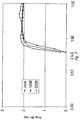
- Figure 2 shows the TOE curves for a pen initially (when the pen is new), after 100 million drops per nozzle (MDPN), and after 200 MDPN.
- the pen shows drop weight loss over its life from an initial curve at just over 2 ng drop weight to 100 M and 200 M curves which show drop weight around 1 ng.
- FIG. 3 shows the TOE curves for a pen initially (when the pen is new), after 100 million drops per nozzle (MDPN), and after 200 MDPN.
- the pen shows an initial curve at under 2 ng drop weight, a 100 M curve at over 2 ng drop weight and a 200 M curve at just under 2 ng drop weight.
- Turn-On Energy (TOE) curves were measured in 2.7 ng ink-jet pens (2.7 ng drop weight @ 30% OE) using Ink ID # 764 (Control + Polyphosphate).
- Figure 4 shows the TOE curves for a pen initially (when the pen is new), after 100 million drops per nozzle (MDPN), and after 200 MDPN. The pen shows an initial curve having a drop weight just over 2 ng, and 100 M and 200 M curves that have a drop weight around 1 ng.
- Turn-On Energy (TOE) curves were measured in 2.7 ng ink-jet pens (2.7 ng drop weight @ 30% OE) using Ink ID # 765 (Control +EDTA + polyphosphate).
- Figure 5 shows the TOE curves for a pen initially (when the pen is new), after 100 million drops per nozzle (MDPN), and after 200 MDPN. The pen shows an initial curve, a 100 M curve and a 200 M curve at around 2 ng .
- Turn-On Energy (TOE) curves were measured in 2.7 ng ink-jet pens (2.7 ng drop weight @ 30% OE) using Ink ID # 766 (Control +EDTA +phosphate ester surfactant).
- Figure 6 shows the TOE curves for a pen initially (when the pen is new), after 100 million drops per nozzle (MDPN), and after 200 MDPN. The pen shows an initial curve, a 100 M curve, and a 200 M curve at around 2 ng.
- Turn-On Energy (TOE) curves were measured in 2.7 ng ink-jet pens (2.7 ng drop weight @ 30% OE) using Ink ID # 767 (Control + phosphate ester surfactant + Polyphosphate).
- Figure 7 shows the TOE curves for a pen initially (when the pen is new), after 100 million drops per nozzle (MDPN), and after 200 MDPN. The pen shows an initial curve, a 100 M curve, and a 200 M curve at around 2 ng .
- Turn-On Energy (TOE) curves were measured in 2.7 ng ink-jet pens (2.7 ng drop weight @ 30% OE) using Ink ID # 768 (Control + phosphate ester surfactant + Polyphosphate + EDTA).
- Figure 8 shows the TOE curves for a pen initially (when the pen is new), after 100 million drops per nozzle (MDPN), and after 200 MDPN. The pen shows an initial curve, a 100 M curve, and a 200 M curve at around 2 ng .
- HR4C is an ink, which in addition to cyan dyes contains (in a typical, non-limiting embodiment): 4.00% Succinic Acid; 2.50% Mackam® OCT50 (a trademark of Mclntyre Group Limited Corp.); 0.50% phosphate ester surfactant N-3 Acid; 0.50% Tergitol® 15-S-5 (a trademark of Union Carbide Chemicals and Plastics Company); 10.19% Pentane Diol; 9.56% 2-Pyrrolidone; 4.25% Tetraethylene glycol; and balance water.
- HR4C does not contain a metal chelating agent such as EDTA. Previously anomalous kogation in a particular lot of HR4C had been traced to excess chromium in the dye concentrate. The net chromium content in the ink was 2-3 ppm. A catalyst used in the dye synthesis was the source of the chromium.
- EDTA 0.10% EDTA is added to the "bad" lot of HR4C with the intent of increasing the metal tolerance of the inks. Rather than a deliberate addition (or “spiking") of contamination in the ink, the chromium contamination in the "bad" lot represents a true ink manufacturing variation.
- the results of the experiment show that EDTA dramatically helps control kogation with the "bad" cyan lot. Without EDTA, the drop velocities degraded quickly with a small number of firings. With EDTA the drop velocities were relatively constant and not reduced by kogation . The koga is virtually eliminated on resistors fired up to 200 million drops with four different pens (See Fig. 9).
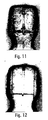
- Figure 11 is a photograph of a resistor fired 200 million drops of HR4C without EDTA.
- Figure 12 is a photograph of a resistor fired 200 million drops of HR4C with 0.10% EDTA.
- Spiking experiments are useful to determine the sensitivity of the various metals that may be added as impurities in the formulation, carried over from ink manufacturing or produced as corrosion products in the pens and ink supplies.
- a loss of drop weight over the life of the pen reduces the accuracy of drop placement on the paper and thus degrades print quality. Therefore, the consistency of the drop velocity can be used as a measure of potential print quality.
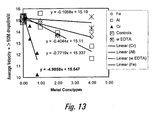
- linear regression was applied to the average drop velocity data for resistors fired 50, 100 and 200 MDPN from metal spiked HR4M ink.
- HR4M is an ink, which in addition to magenta dyes contains (in a typical, non-limiting embodiment): 5.00% Succinic Acid; 2.50% Mackam OCT50®; 0.50% phosphate ester surfactant N-3 Acid; 0.50% Tergitol 15-S-5®; 9.6% Pentane Diol; 7.00% 2-Pyrrolidone; 2.50% Tetraethylene glycol; and balance water.
- HR4M does not contain a metal chelating agent such as EDTA.
- a 1 m/s velocity decrease is predicted at the following metal concentrations: 0.2 ppm Cr, 1.3 ppm Al, and 2.5 ppm Fe. Therefore, the metal tolerance is low and addition of a chelating agent to the inks will be important. In these experiments, Na 2 EDTA at 0.10% was also shown to control both the aluminum and iron.
- HR4M contains phosphate ester surfactant N-3 Acid but no chelating agent for metal ions.
- HR4M was spiked with the nitrate salts of aluminum, chromium and iron (III).
- a nominal amount of 0.10% disodium EDTA was added to the ink to chelate the aluminum and iron ions.
- Pen performance was quantified by drop velocity measurement after firing different sets of resistors with increasing number of drops. Pens were run at 30% over energy.
- Chromium clearly has the stronger effect and causes a significant increase in the drop velocity variability. Also shown on the graph are the velocity data for pens with 0.10% EDTA with 3.3 ppm Al and 4 ppm Fe. The EDTA markedly improves the drop velocity. One pen has a lower drop velocity that may be due more to pen variations than a metals effect. In inks comprising EDTA or other metal chelating agents the metals tolerance before a kogation effect is found will be much greater compared to inks without metal chelating agents.
- HR5Y is distinguished from HR4Y primarily by the addition of 0.10% EDTA.
- HR4Y is an ink, which in addition to yellow dyes contains (in a typical, non-limiting embodiment): 3.03% Succinic Acid; 2.50% Mackam® OCT50; 0.50% phosphate ester surfactant N-3 Acid; 0.73% Tergitol® 15-S-5; 5.92% Pentane Diol; 9.56% 2-Pyrrolidone; 3.25% Tetraethylene glycol; and balance water.
- HR4Y does not contain a metal chelating agent such as EDTA. Nozzle clogs in pens with HR4Y ink are due to a "gummy precipitate" composed of an iron-phosphate ester surfactant salt.
- Samples were initially prepared by addition of a ⁇ 1% Fe(NO 3 ) 3 ⁇ 9H 2 O salt solution to the ink samples in glass test tubes. In all samples, a precipitate immediately formed upon dripping the solution onto the ink and persisted after mixing. After 4 hours the 4062-6-4 sample became much clearer; the background cloudiness disappeared with only the larger particles persisting. The 4062-6-5 was still cloudy at this time but less than the 4062-3 sample.
- the 4062-6-4 and 4062-6-5 samples were more or less clear. Selected samples were filtered through a 0.2 ⁇ m pore-size syringe filter attached to a 10 ml syringe. In filtering the 4062-6-2 sample, only ⁇ 2 ml could be pressed through the filter before the filter was blocked. Water through the same filter had considerable resistance because the filter pores were irreversibly blocked by the gummy precipitate. Both the 4062-6-4 and -5 samples could be pressed through the filter with some resistance and the heavier spiked sample with more resistance. Water passed through the same filters with little resistance, showing that the pores were not blocked by a gummy precipitate. The filtration results demonstrate the negative effect of precipitation of free metal ions with the surface-active phosphate ester and chelation of the free metal ions with EDTA can eliminate the precipitation.
- the surface-active phosphate ester in HR4Y and HR5Y inks forms gummy precipitates when combined with free metal ions, especially aluminum, iron or some combination.
- the EDTA metal chelator in the HR5Y (HR4Y does not contain EDTA) binds up the metal ions and prevents the gummy precipitate from forming.
- Iron and aluminum nitrate solutions in water were prepared (1.0 and 1.4%, respectively) and added to weighted amounts of the two inks in test tubes with screw caps. The relative amounts are shown below with the "A" samples being HR4Y and the “B” samples being HR5Y. Mole ratios of metals to EDTA and phosphate ester surfactant are also indicated. In no case did the number of moles of metal exceed the moles of EDTA. Spiking with calcium does not produce a precipitate unless high concentrations (>100 ppm) are used and the precipitate in this case is primarily a calcium slat of the dye rather than with the surface-active phosphate ester. The 9A and B samples were not spiked to provide controls for visual observations.
- the surface-active phosphate ester forms a precipitate that blocks the ink-jet pen nozzle in spite of the presence of EDTA metal chelator in the ink.
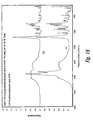
- Precipitates causing nozzle clogs were characterized by Fourier Transform Infra-Red (FTIR) microscopy to obtain a "fingerprint" spectrum that showed characteristics of phosphate ester surfactant N-3 Acid, the surface-active phosphate ester in HR5Y ink.
- the precipitate had the appearance of a viscous oil and was also found to contain phosphate and tin.
- the precipitate was shown to be an interaction between the surface active phosphate ester and dioctyltin dilaurate formulated in the adhesive of nozzle tape as a polymerization catalyst.
- Spiking HR5Y with dibutyltin dilaurate reproduced essential features of the IR spectrum of the viscous oil-like precipitate.
- the spiked sample (0.16% dibutyltin dilaurate) was heated at 90°C for two days in a test tube with a threaded cap. Initially the dibutyltin dilaurate floated on top of the ink with an oil-like appearance. After the heating an oil-like substance was found on the bottom of the test tube. Ink was poured out of the test tube with the "oil" adhering to the bottom of the tube. The sample was rinsed several times with water and transferred to a silicon wafer for IR analysis.
- the CH 2 stretching strengths are relatively stronger in the spectrum of the viscous oil-like precipitate made by interaction of the tape with the ink than the spectra of the spike-created sample.
- the longer hydrocarbon substitutions are consistent with the differences in the hydrocarbon stretching strengths of dioctyltin dilaurate relative to those of dibutyltin dilaurate.
- the viscous oil-like precipitate is due to a precipitation reaction between dioctyltin dilaurate catalyst in the tape and the surface-active phosphate ester added into the ink to provide kogation protection.
- a chelating agent for the organotin can prevent this precipitation and nozzle blockage.
- Chelating agents for organotin were tested in test tube experiments with HR5Y ink spiked with dibutyltin dilaurate. A chelating agent must bind more strongly to the organotin and the surface-active phosphate ester to prevent the formation of the viscous oil-like precipitate.
- the 2,6 pyridinedicarboxylic acid was found to be an effective chelator for the organotin. Additional EDTA, the chelator already formulated in the HR5Y ink, did not have any beneficial effect against the organotin.
- the reaction producing viscous oil-like precipitate in HR5Y occurs under accelerated storage life conditions at temperatures as low as 40°C. Some of the viscous oil-like precipitate can be blown out of the pen during initial servicing of the pen on start up. However a few nozzles remain blocked. A replacement tape without the organotin catalyst in the adhesive may not have the same balance of material properties as the current nozzle tape.
- the surface-active phosphate ester additive is needed to prevent kogation and prolong resistor life.
- a chelating agent that bonds more strongly to the organotin than phosphate ester surfactant.
- EDTA is already added to the HR5 inks. Because the tin is in an organo form not a tin salt, the EDTA is not an effective chelating agent, presumably because the alkyl groups sterically interfere with the multi-dentate binding of the EDTA.
- An additional chelator specifically for the organotin would have to be added to the ink.
- Candidates include rigid ring structures in which bonding to the organotin has less of an entropy penalty and can lock into the tin in between the covalently attached alkyl chains.
- dibutyltin dilaurate was used in place of the dioctyltin dilaurate reported to be formulated in the tape.
- the dibutyltin form is a reasonable substitute for spiking experiments and is predicted to have a very similar reaction chemistry.
- a ⁇ 0.2% mixture of dibutyltin dilaurate in HR5Y ink was prepared.
- the spiked ink is vigorously mixed with a magnetic stirrer.
- Weighed amounts of potential chelators (or dispersing aids) are added to capped test tubes.
- the ink is then separated into the test tubes and placed overnight in the 90°C oven. The following day samples are evaluated by observing the tubes in front of a light source.
- the 2,6-pyridinedicarboxylic acid (a.k.a. dipicoline acid) worked well for organotin chelation' but the 2,6-pyridinedicarboxylate-dibutyltin complex does have a limited solubility at room temperature.
- the test tube containing this chelator was removed from the oven, the ink was completely clear without a trace of the viscous oil-like precipitate.
- the ink became cloudy and a fine white precipitate settled to the bottom of the tube.
- Precipitation of the complex with the organotin may or may not be a problem.
- Additions of dibutyltin dilaurate as low as 0.2% is still well above the solubility even at 90°C.
- the solubility is expected to be even less. It is possible that the addition of less than 40 ppm or less of a chelating agent is enough to correct the viscous oil-like precipitate problem.
- the chelator with the acid and amine groups on one side of the aromatic ring is potentially very surface active on the tantalum surface and it is thought that the chelator can have strong effects on resistor health by etching away the tantalum.
- HR5Y inks with different amounts of 2,6-pyridinedicarboxylic acid has no effect on the drop velocity; even up to the 1070 ppm concentration; the drop velocity behavior is for the most part the same as the control. Even after pens were fired 200 million drops per nozzle with ink containing up to 1070 ppm of the chelator, there was no evidence of the tantalum resistor coating being eroded by high concentrations of the chelator.
- the reagent, 1,2 pyridylazo-2-naphthol, is a "metallizing" dye which turns from a pale yellow to a dark red after reacting with the organotin.
- the dye has a poor solubility in the ink and may not be an appropriate chelator because of its color except if used in very sparing amounts.
- Another metallizing dye, pyrocatecholl violet can also chelate organotin in the presence of the surface-active phosphate ester.
- the viscous oil-like precipitate is due to a precipitation reaction between dioctyltin dilaurate in the nozzle tape and the surface-active phosphate ester added in the HR5Y ink.
- a chelating agent for the organotin such as 2,6-pyridinedicarboxylic acid can prevent this precipitation and nozzle blockage.
- the control set of pens (34 pens total) filled with the. Lot 1 ink had two pens with nozzles out due to contamination that had the appearance under the light microscope of the viscous oil-like precipitate. A total of five nozzles were affected.
- the FTIR spectrum of the precipitate taken from one of the pens matched the spectrum.of the viscous oil-like precipitate formed from the precipitation reaction between the dioctyltin dilaurate in the tape and the surface-active phosphate ester.
- the second pen set (35 pens total) filled with Lot 2 ink comprised of 20 ppm of the 2,6-pyridinedicarboxylic acid had no pens affected by the viscous oil-like precipitate. Only one nozzle of one pen was blocked. it was determined that the affected nozzle was blocked by an air bubble, which may be cleared in the normal servicing of a pen in a normal printer device.
- the third set of pens (35 pens total) filled with Lot 3 ink comprising 40 ppm of the 2,6-pyridinedicarboxylic acid had no pens affected by the viscous oil-like precipitate.
- One pen had one nozzle with a solid substance clogging the nozzle.
- this solid substance was confirmed to be the precipitate of the organotin-chelator complex of dioctyltin and the 2,6-pyridinedicarboxylic acid organotin chelator.
- Addition of the 2,6-pyridinedicarboxylic acid organotin chelator at 40 and 30 ppm can completely eliminate the formation of the viscous oil-like precipitate.
- a solid substance that can block nozzles forms by the precipitation of the chelation complex.
- the precipitation of the organotin chelator complex can be prevented or minimized by the use of an organotin chelator that forms a more soluble organotin-chelator complex or by the use of small concentrations of the organotin chelator in order to reduce the rate of reaction of the organotin chelator with the organotin and to allow time for the organotin-chelator complex to diffuse into the bulk ink away from the nozzle channels before the solubility limit is reached.
- HR3Y is an ink, which in addition to yellow dyes contains (in a typical, non-limiting embodiment): 1.94% Succinic Acid; 6.00% Pentane Diol; 10.22% 2-Pyrrolidone; EHPD 4.25%; and balance water. HR3Y does not contain a metal chelating agent such as EDTA. All pens were resistor-life tested to 200 million drops per nozzle. Over 50% of the pens with 0.5% phosphate ester surfactant had one or more resistor failures at 200 MDPN. None of the 100 pens with 3% phosphate ester surfactant had resistor failures by 200 MDPN.
- RR2C is an ink, which in addition to cyan dyes contains (in a typical, non-limiting embodiment): 3.9% Butanediol; 3.2% Neopentyl glycol; 2.0% Multranol 4012; 1.6% Dantocol DHE; 0.55% Dowfax 8390; 0.5% Silwett L77; 0.5% Tergitol 15-S-7; 0.2% MOPS-buffer; 0.2% Proxel GXL-biocide and balance water. Pens were removed from the test for a drop weight loss of 10% below the original drop weight or when they had exceeded 500 MDPN.
Landscapes
- Chemical & Material Sciences (AREA)
- Life Sciences & Earth Sciences (AREA)
- Engineering & Computer Science (AREA)
- Materials Engineering (AREA)
- Wood Science & Technology (AREA)
- Organic Chemistry (AREA)
- Inks, Pencil-Leads, Or Crayons (AREA)
- Ink Jet Recording Methods And Recording Media Thereof (AREA)
- Ink Jet (AREA)
Applications Claiming Priority (2)
| Application Number | Priority Date | Filing Date | Title |
|---|---|---|---|
| US543382 | 2000-04-05 | ||
| US09/543,382 US6610129B1 (en) | 2000-04-05 | 2000-04-05 | Ink-jet inks which prevent kogation and prolong resistor life in ink-jet pens |
Publications (2)
| Publication Number | Publication Date |
|---|---|
| EP1142968A1 EP1142968A1 (en) | 2001-10-10 |
| EP1142968B1 true EP1142968B1 (en) | 2005-06-22 |
Family
ID=24167779
Family Applications (1)
| Application Number | Title | Priority Date | Filing Date |
|---|---|---|---|
| EP01303187A Expired - Lifetime EP1142968B1 (en) | 2000-04-05 | 2001-04-04 | Use of ink-jet inks for reduced kogation in ink-jet pens |
Country Status (7)
| Country | Link |
|---|---|
| US (1) | US6610129B1 (enExample) |
| EP (1) | EP1142968B1 (enExample) |
| JP (1) | JP4667628B2 (enExample) |
| KR (1) | KR100751165B1 (enExample) |
| CN (1) | CN1214083C (enExample) |
| DE (1) | DE60111589T2 (enExample) |
| TW (1) | TWI229693B (enExample) |
Families Citing this family (27)
| Publication number | Priority date | Publication date | Assignee | Title |
|---|---|---|---|---|
| US7264885B2 (en) * | 2002-08-07 | 2007-09-04 | Research Foundation Of The City University Of New York | Enhancement of the wetting of hydrophobic surfaces by aqueous surfactant solutions |
| US7033423B2 (en) * | 2003-04-30 | 2006-04-25 | Hewlett-Packard Development Company, L.P. | Gray inks for ink-jet printing |
| US7374606B2 (en) | 2003-06-27 | 2008-05-20 | Canon Kabushiki Kaisha | Water-based ink and ink recording method |
| US7388040B2 (en) * | 2004-04-08 | 2008-06-17 | Hewlett-Packard Development Company, L.P. | Anti-kogation additives compatible with cationic polymers for fixer-based printing systems |
| WO2006102524A2 (en) * | 2005-03-23 | 2006-09-28 | Imtech, Inc. | Curable thermally ejectable printing fluid |
| KR100677584B1 (ko) | 2005-05-18 | 2007-02-02 | 삼성전자주식회사 | 잉크 조성물, 이를 포함한 잉크 카트리지 및 잉크젯 기록장치 |
| EP2099869B1 (en) | 2006-10-31 | 2013-05-01 | Sensient Colors Inc. | Modified pigments and methods for making and using the same |
| JP5064782B2 (ja) * | 2006-12-18 | 2012-10-31 | キヤノン株式会社 | インク及びインクジェット記録装置 |
| US7677695B2 (en) | 2007-08-13 | 2010-03-16 | Hewlett-Packard Development Company, L.P. | Fluid transfer device including a die |
| US8658110B2 (en) * | 2007-08-13 | 2014-02-25 | Hewlett-Packard Development Company, L.P. | Fluid delivery system |
| CA3017708C (en) | 2007-08-23 | 2021-09-21 | Vincent Shing | Self-dispersed pigments and methods for making and using the same |
| WO2009078833A1 (en) * | 2007-12-14 | 2009-06-25 | Hewlett-Packard Development Company, L.P. | Phosphate-containing surfactants for use with pigment- and latex-containing ink-jet inks |
| US9221986B2 (en) | 2009-04-07 | 2015-12-29 | Sensient Colors Llc | Self-dispersing particles and methods for making and using the same |
| US8348411B2 (en) * | 2009-09-30 | 2013-01-08 | Eastman Kodak Company | Pigment based inks for reliable high speed inkjet printing |
| WO2011078842A1 (en) * | 2009-12-21 | 2011-06-30 | Hewlett-Packard Development Company, L.P. | Inkjet ink composition containing anti-kogation agents |
| JP2011235632A (ja) * | 2010-04-12 | 2011-11-24 | Fujifilm Corp | インクセット及び画像形成方法 |
| CN101982316B (zh) * | 2010-08-20 | 2012-02-08 | 北京联创佳艺影像新材料技术有限公司 | 一种清洗热泡式喷墨打印机喷头的方法及其专用清洗液 |
| US9683113B2 (en) | 2010-08-25 | 2017-06-20 | Hewlett-Packard Development Company, L.P. | Pigment particles containing a vinyl group and encapsulated by a cross-linked polymer |
| US9475948B2 (en) | 2010-09-23 | 2016-10-25 | Hewlett-Packard Development Company, L.P. | Ink jet ink with high structure pigment particles |
| US9052289B2 (en) * | 2010-12-13 | 2015-06-09 | Schlumberger Technology Corporation | Hydrogen sulfide (H2S) detection using functionalized nanoparticles |
| EP2771419B1 (en) * | 2011-10-25 | 2019-11-27 | Hewlett-Packard Development Company, L.P. | An ink composition |
| JP6111774B2 (ja) * | 2013-03-22 | 2017-04-12 | セイコーエプソン株式会社 | インクジェット用インク、記録装置および記録物 |
| AU2015268689A1 (en) | 2014-12-16 | 2016-06-30 | Stanley Black & Decker Inc. | Chalk line device |
| US11065871B2 (en) * | 2017-11-08 | 2021-07-20 | Hewlett-Packard Development Company, L.P. | Dye sublimation ink thermal inkjet printing method |
| WO2020102788A1 (en) | 2018-11-17 | 2020-05-22 | International Imaging Materials, Inc. | Outdoor durable inkjet inks |
| CN117157676A (zh) | 2021-09-16 | 2023-12-01 | 辉达公司 | 加速实时光线追踪的三角形可见性测试 |
| JP2025066201A (ja) * | 2022-03-23 | 2025-04-23 | 三菱ケミカル株式会社 | 感光性組成物及びパターン形成方法 |
Family Cites Families (17)
| Publication number | Priority date | Publication date | Assignee | Title |
|---|---|---|---|---|
| JPS5736170A (ja) * | 1980-08-14 | 1982-02-26 | Fuji Photo Film Co Ltd | Inkujetsutoinsatsuyosuiseiinki |
| US5062892A (en) | 1989-10-27 | 1991-11-05 | Hewlett-Packard Company | Ink additives for improved ink-jet performance |
| US5062893A (en) | 1990-06-22 | 1991-11-05 | Hewlett-Packard Company | Ink formulations by mixing anionic waterfast dyes containing two or more carboxyl groups |
| US5164232A (en) * | 1991-02-11 | 1992-11-17 | Xerox Corporation | Ink compositions |
| JPH06107991A (ja) * | 1992-10-01 | 1994-04-19 | Canon Inc | 記録液およびこれを利用したインクジェット記録方法および記録装置 |
| US5614007A (en) | 1994-03-29 | 1997-03-25 | Canon Kabushiki Kaisha | Ink set, and method and apparatus for image formation employing the same |
| EP0677556A3 (en) | 1994-04-15 | 1997-02-26 | Toyo Ink Mfg Co | Coated pigment and coloring composition. |
| US5792249A (en) | 1995-01-25 | 1998-08-11 | Canon Kabushiki Kaisha | Liquid composition, ink set, image-forming method and apparatus using the same |
| US6013123A (en) * | 1995-01-31 | 2000-01-11 | The Rowland Institute For Science | Inking methods and compositions for production of digitized stereoscopic polarizing images |
| US5679724A (en) * | 1995-09-29 | 1997-10-21 | Xerox Corporation | Submicron particles for ink jet inks |
| JP3466800B2 (ja) | 1995-11-30 | 2003-11-17 | キヤノン株式会社 | インクジェット用インク、インクジェット記録方法及びインクジェット機器 |
| US5683520A (en) * | 1996-01-11 | 1997-11-04 | Xerox Corporation | Method of cleaning an ink storage material |
| DE69703874T2 (de) * | 1996-12-13 | 2001-07-19 | Eastman Kodak Co., Rochester | Pigmentierte Tintenstrahl-Tinten, die phosphatierte Ester-Derivate enthalten |
| GB9702354D0 (en) * | 1997-02-05 | 1997-03-26 | Zeneca Ltd | Compounds and their use |
| JPH11256087A (ja) * | 1997-12-22 | 1999-09-21 | Seiko Epson Corp | インクジェット記録用インクの製造法およびその方法によって得られたインクジェット記録用インク |
| JP2000015800A (ja) * | 1998-06-30 | 2000-01-18 | Canon Inc | 表面弾性波を用いたインクジェットヘッド |
| US6299294B1 (en) * | 1999-07-29 | 2001-10-09 | Hewlett-Packard Company | High efficiency printhead containing a novel oxynitride-based resistor system |
-
2000
- 2000-04-05 US US09/543,382 patent/US6610129B1/en not_active Expired - Lifetime
-
2001
- 2001-01-09 TW TW090100439A patent/TWI229693B/zh not_active IP Right Cessation
- 2001-02-05 CN CNB011032081A patent/CN1214083C/zh not_active Expired - Fee Related
- 2001-03-23 JP JP2001084441A patent/JP4667628B2/ja not_active Expired - Fee Related
- 2001-04-03 KR KR1020010017706A patent/KR100751165B1/ko not_active Expired - Fee Related
- 2001-04-04 DE DE60111589T patent/DE60111589T2/de not_active Expired - Lifetime
- 2001-04-04 EP EP01303187A patent/EP1142968B1/en not_active Expired - Lifetime
Also Published As
| Publication number | Publication date |
|---|---|
| DE60111589D1 (de) | 2005-07-28 |
| JP4667628B2 (ja) | 2011-04-13 |
| CN1214083C (zh) | 2005-08-10 |
| DE60111589T2 (de) | 2006-05-24 |
| JP2001323197A (ja) | 2001-11-20 |
| EP1142968A1 (en) | 2001-10-10 |
| HK1037663A1 (en) | 2002-02-15 |
| TWI229693B (en) | 2005-03-21 |
| US6610129B1 (en) | 2003-08-26 |
| KR20010095281A (ko) | 2001-11-03 |
| CN1316472A (zh) | 2001-10-10 |
| KR100751165B1 (ko) | 2007-08-22 |
Similar Documents
| Publication | Publication Date | Title |
|---|---|---|
| EP1142968B1 (en) | Use of ink-jet inks for reduced kogation in ink-jet pens | |
| US8173215B2 (en) | Continuous ink jet ink compositions | |
| EP0997505B1 (en) | Ink-jet inks with improved performance | |
| US5725641A (en) | Lightfast inks for ink-jet printing | |
| EP1279707B1 (en) | Additives for ink-jet inks | |
| EP1086997B1 (en) | Ink, ink-set, and image recording process for improving density of ink-jet recorded image | |
| EP1213332B1 (en) | Recording liquid, ink jet recording method and recording equipment using the same | |
| US8459787B2 (en) | Aqueous inkjet printing fluid compositions | |
| CN103261343A (zh) | 具有喷射助剂的喷墨用墨组合物 | |
| EP0853107A1 (en) | Ink jet ink compositions comprising hydroxyamide derivatives and printing processes | |
| JP2001055533A (ja) | インクジェット印刷のための特殊処理顔料による優れた耐水堅牢性とブリード抑制 | |
| US6435659B1 (en) | Inkjet inks which improve drop-velocity stability and prolong resistor life in inkjet pens | |
| EP2516562B1 (en) | Inkjet ink composition containing anti-kogation agents | |
| EP2516563A1 (en) | Inkjet ink composition containing anti-kogation agents | |
| EP1350821B9 (en) | Use of Magnesium perchlorate in color ink-jet inks having improved decap | |
| EP0947569B1 (en) | Ink-jet inks and method for printing the same | |
| US8485654B2 (en) | Aqueous inkjet printing fluid compositions | |
| EP1061106A1 (en) | Ink-jet printing inks containing ester modified macromolecular chromophores | |
| JP2004269596A (ja) | 記録液、これを用いたインクジェット記録方法及び記録用機器 | |
| EP1607455B1 (en) | Water base ink for ink-jet recording | |
| HK1037663B (en) | Use of ink-jet inks for reduced kogation in ink-jet pens | |
| HK1056191B (en) | Use of magnesium perchlorate in color ink-jet inks having improved decap |
Legal Events
| Date | Code | Title | Description |
|---|---|---|---|
| PUAI | Public reference made under article 153(3) epc to a published international application that has entered the european phase |
Free format text: ORIGINAL CODE: 0009012 |
|
| AK | Designated contracting states |
Kind code of ref document: A1 Designated state(s): DE FR GB Kind code of ref document: A1 Designated state(s): AT BE CH CY DE DK ES FI FR GB GR IE IT LI LU MC NL PT SE TR |
|
| AX | Request for extension of the european patent |
Free format text: AL;LT;LV;MK;RO;SI |
|
| 17P | Request for examination filed |
Effective date: 20020321 |
|
| AKX | Designation fees paid |
Free format text: DE FR GB |
|
| 17Q | First examination report despatched |
Effective date: 20030304 |
|
| GRAP | Despatch of communication of intention to grant a patent |
Free format text: ORIGINAL CODE: EPIDOSNIGR1 |
|
| RTI1 | Title (correction) |
Free format text: USE OF INK-JET INKS FOR REDUCED KOGATION IN INK-JET PENS |
|
| GRAS | Grant fee paid |
Free format text: ORIGINAL CODE: EPIDOSNIGR3 |
|
| GRAA | (expected) grant |
Free format text: ORIGINAL CODE: 0009210 |
|
| AK | Designated contracting states |
Kind code of ref document: B1 Designated state(s): DE FR GB |
|
| REG | Reference to a national code |
Ref country code: GB Ref legal event code: FG4D |
|
| REF | Corresponds to: |
Ref document number: 60111589 Country of ref document: DE Date of ref document: 20050728 Kind code of ref document: P |
|
| REG | Reference to a national code |
Ref country code: HK Ref legal event code: GR Ref document number: 1037663 Country of ref document: HK |
|
| ET | Fr: translation filed | ||
| PLBE | No opposition filed within time limit |
Free format text: ORIGINAL CODE: 0009261 |
|
| STAA | Information on the status of an ep patent application or granted ep patent |
Free format text: STATUS: NO OPPOSITION FILED WITHIN TIME LIMIT |
|
| 26N | No opposition filed |
Effective date: 20060323 |
|
| REG | Reference to a national code |
Ref country code: GB Ref legal event code: 732E Free format text: REGISTERED BETWEEN 20120329 AND 20120404 |
|
| REG | Reference to a national code |
Ref country code: FR Ref legal event code: PLFP Year of fee payment: 16 |
|
| REG | Reference to a national code |
Ref country code: FR Ref legal event code: PLFP Year of fee payment: 17 |
|
| REG | Reference to a national code |
Ref country code: FR Ref legal event code: PLFP Year of fee payment: 18 |
|
| PGFP | Annual fee paid to national office [announced via postgrant information from national office to epo] |
Ref country code: GB Payment date: 20180321 Year of fee payment: 18 |
|
| PGFP | Annual fee paid to national office [announced via postgrant information from national office to epo] |
Ref country code: FR Payment date: 20180322 Year of fee payment: 18 |
|
| PGFP | Annual fee paid to national office [announced via postgrant information from national office to epo] |
Ref country code: DE Payment date: 20180320 Year of fee payment: 18 |
|
| REG | Reference to a national code |
Ref country code: DE Ref legal event code: R119 Ref document number: 60111589 Country of ref document: DE |
|
| GBPC | Gb: european patent ceased through non-payment of renewal fee |
Effective date: 20190404 |
|
| PG25 | Lapsed in a contracting state [announced via postgrant information from national office to epo] |
Ref country code: GB Free format text: LAPSE BECAUSE OF NON-PAYMENT OF DUE FEES Effective date: 20190404 Ref country code: DE Free format text: LAPSE BECAUSE OF NON-PAYMENT OF DUE FEES Effective date: 20191101 |
|
| PG25 | Lapsed in a contracting state [announced via postgrant information from national office to epo] |
Ref country code: FR Free format text: LAPSE BECAUSE OF NON-PAYMENT OF DUE FEES Effective date: 20190430 |