EP1142704A1 - Laminated film and vapor deposition film using the same - Google Patents
Laminated film and vapor deposition film using the same Download PDFInfo
- Publication number
- EP1142704A1 EP1142704A1 EP00954976A EP00954976A EP1142704A1 EP 1142704 A1 EP1142704 A1 EP 1142704A1 EP 00954976 A EP00954976 A EP 00954976A EP 00954976 A EP00954976 A EP 00954976A EP 1142704 A1 EP1142704 A1 EP 1142704A1
- Authority
- EP
- European Patent Office
- Prior art keywords
- layer
- film
- vapour
- polyamide
- deposition
- Prior art date
- Legal status (The legal status is an assumption and is not a legal conclusion. Google has not performed a legal analysis and makes no representation as to the accuracy of the status listed.)
- Withdrawn
Links
- 238000007740 vapor deposition Methods 0.000 title 1
- 239000004952 Polyamide Substances 0.000 claims abstract description 40
- 229920002647 polyamide Polymers 0.000 claims abstract description 40
- 229920000642 polymer Polymers 0.000 claims abstract description 26
- 239000000758 substrate Substances 0.000 claims abstract description 24
- 239000005001 laminate film Substances 0.000 claims abstract description 23
- 230000008021 deposition Effects 0.000 claims abstract description 19
- 239000004760 aramid Substances 0.000 claims abstract description 18
- 229920003235 aromatic polyamide Polymers 0.000 claims abstract description 18
- 230000009477 glass transition Effects 0.000 claims abstract description 17
- 229920006267 polyester film Polymers 0.000 claims abstract description 16
- 239000004953 Aliphatic polyamide Substances 0.000 claims abstract description 14
- 229920003231 aliphatic polyamide Polymers 0.000 claims abstract description 14
- 239000010408 film Substances 0.000 claims description 160
- 239000010409 thin film Substances 0.000 claims description 22
- 238000003851 corona treatment Methods 0.000 claims description 9
- 238000004806 packaging method and process Methods 0.000 claims description 8
- 229920006149 polyester-amide block copolymer Polymers 0.000 claims description 2
- 230000004888 barrier function Effects 0.000 abstract description 34
- 230000007704 transition Effects 0.000 abstract description 2
- 239000011521 glass Substances 0.000 abstract 1
- 239000010410 layer Substances 0.000 description 86
- 238000000151 deposition Methods 0.000 description 49
- 239000007789 gas Substances 0.000 description 38
- 238000000034 method Methods 0.000 description 35
- 239000002245 particle Substances 0.000 description 31
- CURLTUGMZLYLDI-UHFFFAOYSA-N Carbon dioxide Chemical compound O=C=O CURLTUGMZLYLDI-UHFFFAOYSA-N 0.000 description 24
- LYCAIKOWRPUZTN-UHFFFAOYSA-N Ethylene glycol Chemical compound OCCO LYCAIKOWRPUZTN-UHFFFAOYSA-N 0.000 description 21
- PNEYBMLMFCGWSK-UHFFFAOYSA-N Alumina Chemical compound [O-2].[O-2].[O-2].[Al+3].[Al+3] PNEYBMLMFCGWSK-UHFFFAOYSA-N 0.000 description 18
- -1 aliphatic glycols Chemical class 0.000 description 18
- 229920000728 polyester Polymers 0.000 description 16
- 239000001569 carbon dioxide Substances 0.000 description 12
- 229910002092 carbon dioxide Inorganic materials 0.000 description 12
- 230000008018 melting Effects 0.000 description 12
- 238000002844 melting Methods 0.000 description 12
- IJGRMHOSHXDMSA-UHFFFAOYSA-N Atomic nitrogen Chemical compound N#N IJGRMHOSHXDMSA-UHFFFAOYSA-N 0.000 description 11
- 239000012298 atmosphere Substances 0.000 description 11
- 229910052751 metal Inorganic materials 0.000 description 11
- 239000002184 metal Substances 0.000 description 11
- 239000004411 aluminium Substances 0.000 description 10
- 229910052782 aluminium Inorganic materials 0.000 description 10
- XAGFODPZIPBFFR-UHFFFAOYSA-N aluminium Chemical compound [Al] XAGFODPZIPBFFR-UHFFFAOYSA-N 0.000 description 10
- 238000001816 cooling Methods 0.000 description 10
- OFOBLEOULBTSOW-UHFFFAOYSA-N Malonic acid Chemical compound OC(=O)CC(O)=O OFOBLEOULBTSOW-UHFFFAOYSA-N 0.000 description 9
- QVGXLLKOCUKJST-UHFFFAOYSA-N atomic oxygen Chemical compound [O] QVGXLLKOCUKJST-UHFFFAOYSA-N 0.000 description 9
- 230000005540 biological transmission Effects 0.000 description 9
- 229920001577 copolymer Polymers 0.000 description 9
- 238000003475 lamination Methods 0.000 description 9
- 229910044991 metal oxide Inorganic materials 0.000 description 9
- 150000004706 metal oxides Chemical class 0.000 description 9
- 239000000203 mixture Substances 0.000 description 9
- 239000001301 oxygen Substances 0.000 description 9
- 229910052760 oxygen Inorganic materials 0.000 description 9
- 238000002834 transmittance Methods 0.000 description 9
- XLYOFNOQVPJJNP-UHFFFAOYSA-N water Substances O XLYOFNOQVPJJNP-UHFFFAOYSA-N 0.000 description 9
- VTYYLEPIZMXCLO-UHFFFAOYSA-L Calcium carbonate Chemical compound [Ca+2].[O-]C([O-])=O VTYYLEPIZMXCLO-UHFFFAOYSA-L 0.000 description 8
- JCXJVPUVTGWSNB-UHFFFAOYSA-N nitrogen dioxide Inorganic materials O=[N]=O JCXJVPUVTGWSNB-UHFFFAOYSA-N 0.000 description 8
- 238000011282 treatment Methods 0.000 description 8
- 238000001771 vacuum deposition Methods 0.000 description 8
- 238000005259 measurement Methods 0.000 description 7
- 229920000139 polyethylene terephthalate Polymers 0.000 description 7
- 239000005020 polyethylene terephthalate Substances 0.000 description 7
- 229920005989 resin Polymers 0.000 description 7
- 239000011347 resin Substances 0.000 description 7
- KKEYFWRCBNTPAC-UHFFFAOYSA-N Terephthalic acid Chemical compound OC(=O)C1=CC=C(C(O)=O)C=C1 KKEYFWRCBNTPAC-UHFFFAOYSA-N 0.000 description 6
- 238000010438 heat treatment Methods 0.000 description 6
- WGCNASOHLSPBMP-UHFFFAOYSA-N hydroxyacetaldehyde Natural products OCC=O WGCNASOHLSPBMP-UHFFFAOYSA-N 0.000 description 6
- 230000001771 impaired effect Effects 0.000 description 6
- 239000004677 Nylon Substances 0.000 description 5
- VYPSYNLAJGMNEJ-UHFFFAOYSA-N Silicium dioxide Chemical compound O=[Si]=O VYPSYNLAJGMNEJ-UHFFFAOYSA-N 0.000 description 5
- 230000000694 effects Effects 0.000 description 5
- 238000001704 evaporation Methods 0.000 description 5
- 229920001778 nylon Polymers 0.000 description 5
- 238000009736 wetting Methods 0.000 description 5
- MYMOFIZGZYHOMD-UHFFFAOYSA-N Dioxygen Chemical compound O=O MYMOFIZGZYHOMD-UHFFFAOYSA-N 0.000 description 4
- 239000000853 adhesive Substances 0.000 description 4
- WNLRTRBMVRJNCN-UHFFFAOYSA-N adipic acid Chemical compound OC(=O)CCCCC(O)=O WNLRTRBMVRJNCN-UHFFFAOYSA-N 0.000 description 4
- 229910000019 calcium carbonate Inorganic materials 0.000 description 4
- 230000000052 comparative effect Effects 0.000 description 4
- 229910001882 dioxygen Inorganic materials 0.000 description 4
- 238000011156 evaluation Methods 0.000 description 4
- 230000008020 evaporation Effects 0.000 description 4
- 230000001590 oxidative effect Effects 0.000 description 4
- 239000008188 pellet Substances 0.000 description 4
- 238000012545 processing Methods 0.000 description 4
- 125000002030 1,2-phenylene group Chemical group [H]C1=C([H])C([*:1])=C([*:2])C([H])=C1[H] 0.000 description 3
- 239000004698 Polyethylene Substances 0.000 description 3
- 229920001328 Polyvinylidene chloride Polymers 0.000 description 3
- 230000001070 adhesive effect Effects 0.000 description 3
- 239000005030 aluminium foil Substances 0.000 description 3
- 150000004984 aromatic diamines Chemical class 0.000 description 3
- 238000009833 condensation Methods 0.000 description 3
- 230000005494 condensation Effects 0.000 description 3
- 235000013305 food Nutrition 0.000 description 3
- 239000000463 material Substances 0.000 description 3
- 239000000155 melt Substances 0.000 description 3
- RXOHFPCZGPKIRD-UHFFFAOYSA-N naphthalene-2,6-dicarboxylic acid Chemical compound C1=C(C(O)=O)C=CC2=CC(C(=O)O)=CC=C21 RXOHFPCZGPKIRD-UHFFFAOYSA-N 0.000 description 3
- 230000003287 optical effect Effects 0.000 description 3
- 238000006068 polycondensation reaction Methods 0.000 description 3
- 229920006254 polymer film Polymers 0.000 description 3
- 239000005033 polyvinylidene chloride Substances 0.000 description 3
- 229920001187 thermosetting polymer Polymers 0.000 description 3
- MYRTYDVEIRVNKP-UHFFFAOYSA-N 1,2-Divinylbenzene Chemical compound C=CC1=CC=CC=C1C=C MYRTYDVEIRVNKP-UHFFFAOYSA-N 0.000 description 2
- 125000001140 1,4-phenylene group Chemical group [H]C1=C([H])C([*:2])=C([H])C([H])=C1[*:1] 0.000 description 2
- XKRFYHLGVUSROY-UHFFFAOYSA-N Argon Chemical compound [Ar] XKRFYHLGVUSROY-UHFFFAOYSA-N 0.000 description 2
- RTZKZFJDLAIYFH-UHFFFAOYSA-N Diethyl ether Chemical compound CCOCC RTZKZFJDLAIYFH-UHFFFAOYSA-N 0.000 description 2
- VGGSQFUCUMXWEO-UHFFFAOYSA-N Ethene Chemical compound C=C VGGSQFUCUMXWEO-UHFFFAOYSA-N 0.000 description 2
- 239000005977 Ethylene Substances 0.000 description 2
- FYYHWMGAXLPEAU-UHFFFAOYSA-N Magnesium Chemical compound [Mg] FYYHWMGAXLPEAU-UHFFFAOYSA-N 0.000 description 2
- GLUUGHFHXGJENI-UHFFFAOYSA-N Piperazine Chemical compound C1CNCCN1 GLUUGHFHXGJENI-UHFFFAOYSA-N 0.000 description 2
- 239000002202 Polyethylene glycol Substances 0.000 description 2
- PPBRXRYQALVLMV-UHFFFAOYSA-N Styrene Chemical compound C=CC1=CC=CC=C1 PPBRXRYQALVLMV-UHFFFAOYSA-N 0.000 description 2
- HCHKCACWOHOZIP-UHFFFAOYSA-N Zinc Chemical class [Zn] HCHKCACWOHOZIP-UHFFFAOYSA-N 0.000 description 2
- 239000001361 adipic acid Substances 0.000 description 2
- 235000011037 adipic acid Nutrition 0.000 description 2
- 230000032683 aging Effects 0.000 description 2
- 238000004380 ashing Methods 0.000 description 2
- TZCXTZWJZNENPQ-UHFFFAOYSA-L barium sulfate Chemical compound [Ba+2].[O-]S([O-])(=O)=O TZCXTZWJZNENPQ-UHFFFAOYSA-L 0.000 description 2
- IISBACLAFKSPIT-UHFFFAOYSA-N bisphenol A Chemical compound C=1C=C(O)C=CC=1C(C)(C)C1=CC=C(O)C=C1 IISBACLAFKSPIT-UHFFFAOYSA-N 0.000 description 2
- WERYXYBDKMZEQL-UHFFFAOYSA-N butane-1,4-diol Chemical compound OCCCCO WERYXYBDKMZEQL-UHFFFAOYSA-N 0.000 description 2
- OSGAYBCDTDRGGQ-UHFFFAOYSA-L calcium sulfate Chemical compound [Ca+2].[O-]S([O-])(=O)=O OSGAYBCDTDRGGQ-UHFFFAOYSA-L 0.000 description 2
- 229920006026 co-polymeric resin Polymers 0.000 description 2
- 239000011248 coating agent Substances 0.000 description 2
- 238000000576 coating method Methods 0.000 description 2
- 229920006037 cross link polymer Polymers 0.000 description 2
- 150000004985 diamines Chemical class 0.000 description 2
- 208000028659 discharge Diseases 0.000 description 2
- 229920001971 elastomer Polymers 0.000 description 2
- 238000001125 extrusion Methods 0.000 description 2
- 230000001965 increasing effect Effects 0.000 description 2
- 239000011261 inert gas Substances 0.000 description 2
- 239000010954 inorganic particle Substances 0.000 description 2
- QZUPTXGVPYNUIT-UHFFFAOYSA-N isophthalamide Chemical compound NC(=O)C1=CC=CC(C(N)=O)=C1 QZUPTXGVPYNUIT-UHFFFAOYSA-N 0.000 description 2
- QQVIHTHCMHWDBS-UHFFFAOYSA-N isophthalic acid Chemical compound OC(=O)C1=CC=CC(C(O)=O)=C1 QQVIHTHCMHWDBS-UHFFFAOYSA-N 0.000 description 2
- PQXKHYXIUOZZFA-UHFFFAOYSA-M lithium fluoride Chemical compound [Li+].[F-] PQXKHYXIUOZZFA-UHFFFAOYSA-M 0.000 description 2
- 229910052749 magnesium Inorganic materials 0.000 description 2
- 239000011777 magnesium Substances 0.000 description 2
- BDAGIHXWWSANSR-UHFFFAOYSA-N methanoic acid Natural products OC=O BDAGIHXWWSANSR-UHFFFAOYSA-N 0.000 description 2
- DNIAPMSPPWPWGF-UHFFFAOYSA-N monopropylene glycol Natural products CC(O)CO DNIAPMSPPWPWGF-UHFFFAOYSA-N 0.000 description 2
- 239000011146 organic particle Substances 0.000 description 2
- 238000007254 oxidation reaction Methods 0.000 description 2
- NAYYNDKKHOIIOD-UHFFFAOYSA-N phthalamide Chemical compound NC(=O)C1=CC=CC=C1C(N)=O NAYYNDKKHOIIOD-UHFFFAOYSA-N 0.000 description 2
- 229920001707 polybutylene terephthalate Polymers 0.000 description 2
- 229920001223 polyethylene glycol Polymers 0.000 description 2
- 238000006116 polymerization reaction Methods 0.000 description 2
- 229920005672 polyolefin resin Polymers 0.000 description 2
- 239000000700 radioactive tracer Substances 0.000 description 2
- 239000002994 raw material Substances 0.000 description 2
- 239000005060 rubber Substances 0.000 description 2
- 238000007789 sealing Methods 0.000 description 2
- CXMXRPHRNRROMY-UHFFFAOYSA-N sebacic acid Chemical compound OC(=O)CCCCCCCCC(O)=O CXMXRPHRNRROMY-UHFFFAOYSA-N 0.000 description 2
- 229910052814 silicon oxide Inorganic materials 0.000 description 2
- 238000007711 solidification Methods 0.000 description 2
- 230000008023 solidification Effects 0.000 description 2
- 230000003746 surface roughness Effects 0.000 description 2
- 238000002076 thermal analysis method Methods 0.000 description 2
- 238000001291 vacuum drying Methods 0.000 description 2
- 238000004804 winding Methods 0.000 description 2
- 239000011701 zinc Chemical class 0.000 description 2
- 229910052725 zinc Inorganic materials 0.000 description 2
- DNIAPMSPPWPWGF-VKHMYHEASA-N (+)-propylene glycol Chemical compound C[C@H](O)CO DNIAPMSPPWPWGF-VKHMYHEASA-N 0.000 description 1
- FMMUNDXXVADKHS-UHFFFAOYSA-N 1,3-dimethylpiperazine Chemical compound CC1CN(C)CCN1 FMMUNDXXVADKHS-UHFFFAOYSA-N 0.000 description 1
- 125000001989 1,3-phenylene group Chemical group [H]C1=C([H])C([*:1])=C([H])C([*:2])=C1[H] 0.000 description 1
- YPFDHNVEDLHUCE-UHFFFAOYSA-N 1,3-propanediol Substances OCCCO YPFDHNVEDLHUCE-UHFFFAOYSA-N 0.000 description 1
- RTBFRGCFXZNCOE-UHFFFAOYSA-N 1-methylsulfonylpiperidin-4-one Chemical compound CS(=O)(=O)N1CCC(=O)CC1 RTBFRGCFXZNCOE-UHFFFAOYSA-N 0.000 description 1
- JIAOVIBEPXQRNK-UHFFFAOYSA-N 2,5-diethylpiperazine Chemical compound CCC1CNC(CC)CN1 JIAOVIBEPXQRNK-UHFFFAOYSA-N 0.000 description 1
- SMZOUWXMTYCWNB-UHFFFAOYSA-N 2-(2-methoxy-5-methylphenyl)ethanamine Chemical compound COC1=CC=C(C)C=C1CCN SMZOUWXMTYCWNB-UHFFFAOYSA-N 0.000 description 1
- NIXOWILDQLNWCW-UHFFFAOYSA-N 2-Propenoic acid Natural products OC(=O)C=C NIXOWILDQLNWCW-UHFFFAOYSA-N 0.000 description 1
- ISPYQTSUDJAMAB-UHFFFAOYSA-N 2-chlorophenol Chemical compound OC1=CC=CC=C1Cl ISPYQTSUDJAMAB-UHFFFAOYSA-N 0.000 description 1
- YCGKJPVUGMBDDS-UHFFFAOYSA-N 3-(6-azabicyclo[3.1.1]hepta-1(7),2,4-triene-6-carbonyl)benzamide Chemical compound NC(=O)C1=CC=CC(C(=O)N2C=3C=C2C=CC=3)=C1 YCGKJPVUGMBDDS-UHFFFAOYSA-N 0.000 description 1
- VPWNQTHUCYMVMZ-UHFFFAOYSA-N 4,4'-sulfonyldiphenol Chemical compound C1=CC(O)=CC=C1S(=O)(=O)C1=CC=C(O)C=C1 VPWNQTHUCYMVMZ-UHFFFAOYSA-N 0.000 description 1
- OSWFIVFLDKOXQC-UHFFFAOYSA-N 4-(3-methoxyphenyl)aniline Chemical compound COC1=CC=CC(C=2C=CC(N)=CC=2)=C1 OSWFIVFLDKOXQC-UHFFFAOYSA-N 0.000 description 1
- WVDRSXGPQWNUBN-UHFFFAOYSA-N 4-(4-carboxyphenoxy)benzoic acid Chemical compound C1=CC(C(=O)O)=CC=C1OC1=CC=C(C(O)=O)C=C1 WVDRSXGPQWNUBN-UHFFFAOYSA-N 0.000 description 1
- CQPBLBQMIFRGLU-UHFFFAOYSA-N 4-(6-azabicyclo[3.1.1]hepta-1(7),2,4-triene-6-carbonyl)benzamide Chemical compound C1=CC(C(=O)N)=CC=C1C(=O)N1C2=CC=CC1=C2 CQPBLBQMIFRGLU-UHFFFAOYSA-N 0.000 description 1
- WRDNCFQZLUCIRH-UHFFFAOYSA-N 4-(7-azabicyclo[2.2.1]hepta-1,3,5-triene-7-carbonyl)benzamide Chemical compound C1=CC(C(=O)N)=CC=C1C(=O)N1C2=CC=C1C=C2 WRDNCFQZLUCIRH-UHFFFAOYSA-N 0.000 description 1
- GZVHEAJQGPRDLQ-UHFFFAOYSA-N 6-phenyl-1,3,5-triazine-2,4-diamine Chemical compound NC1=NC(N)=NC(C=2C=CC=CC=2)=N1 GZVHEAJQGPRDLQ-UHFFFAOYSA-N 0.000 description 1
- 239000005995 Aluminium silicate Substances 0.000 description 1
- 101100402628 Amanita bisporigera MSD6 gene Proteins 0.000 description 1
- 229920002799 BoPET Polymers 0.000 description 1
- OYPRJOBELJOOCE-UHFFFAOYSA-N Calcium Chemical class [Ca] OYPRJOBELJOOCE-UHFFFAOYSA-N 0.000 description 1
- KXDHJXZQYSOELW-UHFFFAOYSA-N Carbamic acid Chemical compound NC(O)=O KXDHJXZQYSOELW-UHFFFAOYSA-N 0.000 description 1
- KZBUYRJDOAKODT-UHFFFAOYSA-N Chlorine Chemical compound ClCl KZBUYRJDOAKODT-UHFFFAOYSA-N 0.000 description 1
- IMROMDMJAWUWLK-UHFFFAOYSA-N Ethenol Chemical compound OC=C IMROMDMJAWUWLK-UHFFFAOYSA-N 0.000 description 1
- 101000576320 Homo sapiens Max-binding protein MNT Proteins 0.000 description 1
- DGAQECJNVWCQMB-PUAWFVPOSA-M Ilexoside XXIX Chemical compound C[C@@H]1CC[C@@]2(CC[C@@]3(C(=CC[C@H]4[C@]3(CC[C@@H]5[C@@]4(CC[C@@H](C5(C)C)OS(=O)(=O)[O-])C)C)[C@@H]2[C@]1(C)O)C)C(=O)O[C@H]6[C@@H]([C@H]([C@@H]([C@H](O6)CO)O)O)O.[Na+] DGAQECJNVWCQMB-PUAWFVPOSA-M 0.000 description 1
- CERQOIWHTDAKMF-UHFFFAOYSA-N Methacrylic acid Chemical compound CC(=C)C(O)=O CERQOIWHTDAKMF-UHFFFAOYSA-N 0.000 description 1
- 229920000571 Nylon 11 Polymers 0.000 description 1
- 229920000299 Nylon 12 Polymers 0.000 description 1
- 229920002292 Nylon 6 Polymers 0.000 description 1
- 229920006121 Polyxylylene adipamide Polymers 0.000 description 1
- XUIMIQQOPSSXEZ-UHFFFAOYSA-N Silicon Chemical compound [Si] XUIMIQQOPSSXEZ-UHFFFAOYSA-N 0.000 description 1
- KDYFGRWQOYBRFD-UHFFFAOYSA-N Succinic acid Natural products OC(=O)CCC(O)=O KDYFGRWQOYBRFD-UHFFFAOYSA-N 0.000 description 1
- GWEVSGVZZGPLCZ-UHFFFAOYSA-N Titan oxide Chemical compound O=[Ti]=O GWEVSGVZZGPLCZ-UHFFFAOYSA-N 0.000 description 1
- 229920001807 Urea-formaldehyde Polymers 0.000 description 1
- ORLQHILJRHBSAY-UHFFFAOYSA-N [1-(hydroxymethyl)cyclohexyl]methanol Chemical compound OCC1(CO)CCCCC1 ORLQHILJRHBSAY-UHFFFAOYSA-N 0.000 description 1
- QLBRROYTTDFLDX-UHFFFAOYSA-N [3-(aminomethyl)cyclohexyl]methanamine Chemical compound NCC1CCCC(CN)C1 QLBRROYTTDFLDX-UHFFFAOYSA-N 0.000 description 1
- 239000006096 absorbing agent Substances 0.000 description 1
- 239000002253 acid Substances 0.000 description 1
- 230000004913 activation Effects 0.000 description 1
- 238000001994 activation Methods 0.000 description 1
- 230000002411 adverse Effects 0.000 description 1
- 150000001339 alkali metal compounds Chemical class 0.000 description 1
- 150000001341 alkaline earth metal compounds Chemical class 0.000 description 1
- 235000012211 aluminium silicate Nutrition 0.000 description 1
- JFCQEDHGNNZCLN-UHFFFAOYSA-N anhydrous glutaric acid Natural products OC(=O)CCCC(O)=O JFCQEDHGNNZCLN-UHFFFAOYSA-N 0.000 description 1
- 239000002518 antifoaming agent Substances 0.000 description 1
- 239000003963 antioxidant agent Substances 0.000 description 1
- 239000002216 antistatic agent Substances 0.000 description 1
- 229910052786 argon Inorganic materials 0.000 description 1
- 150000008430 aromatic amides Chemical class 0.000 description 1
- 125000003118 aryl group Chemical group 0.000 description 1
- 229910052788 barium Inorganic materials 0.000 description 1
- DSAJWYNOEDNPEQ-UHFFFAOYSA-N barium atom Chemical class [Ba] DSAJWYNOEDNPEQ-UHFFFAOYSA-N 0.000 description 1
- AYJRCSIUFZENHW-DEQYMQKBSA-L barium(2+);oxomethanediolate Chemical compound [Ba+2].[O-][14C]([O-])=O AYJRCSIUFZENHW-DEQYMQKBSA-L 0.000 description 1
- 230000015572 biosynthetic process Effects 0.000 description 1
- KDYFGRWQOYBRFD-NUQCWPJISA-N butanedioic acid Chemical compound O[14C](=O)CC[14C](O)=O KDYFGRWQOYBRFD-NUQCWPJISA-N 0.000 description 1
- 229910052791 calcium Inorganic materials 0.000 description 1
- 239000011575 calcium Substances 0.000 description 1
- QXDMQSPYEZFLGF-UHFFFAOYSA-L calcium oxalate Chemical compound [Ca+2].[O-]C(=O)C([O-])=O QXDMQSPYEZFLGF-UHFFFAOYSA-L 0.000 description 1
- 239000001506 calcium phosphate Substances 0.000 description 1
- 229910000389 calcium phosphate Inorganic materials 0.000 description 1
- 235000011010 calcium phosphates Nutrition 0.000 description 1
- 239000001175 calcium sulphate Substances 0.000 description 1
- 235000011132 calcium sulphate Nutrition 0.000 description 1
- 238000004364 calculation method Methods 0.000 description 1
- 238000006243 chemical reaction Methods 0.000 description 1
- 238000005229 chemical vapour deposition Methods 0.000 description 1
- 239000011247 coating layer Substances 0.000 description 1
- 150000001875 compounds Chemical class 0.000 description 1
- 238000002425 crystallisation Methods 0.000 description 1
- 230000008025 crystallization Effects 0.000 description 1
- 230000006378 damage Effects 0.000 description 1
- 230000007547 defect Effects 0.000 description 1
- 230000006866 deterioration Effects 0.000 description 1
- 235000014113 dietary fatty acids Nutrition 0.000 description 1
- 229910001873 dinitrogen Inorganic materials 0.000 description 1
- 238000011978 dissolution method Methods 0.000 description 1
- TVIDDXQYHWJXFK-UHFFFAOYSA-N dodecanedioic acid Chemical compound OC(=O)CCCCCCCCCCC(O)=O TVIDDXQYHWJXFK-UHFFFAOYSA-N 0.000 description 1
- 239000000975 dye Substances 0.000 description 1
- 235000006694 eating habits Nutrition 0.000 description 1
- BXKDSDJJOVIHMX-UHFFFAOYSA-N edrophonium chloride Chemical compound [Cl-].CC[N+](C)(C)C1=CC=CC(O)=C1 BXKDSDJJOVIHMX-UHFFFAOYSA-N 0.000 description 1
- 238000010894 electron beam technology Methods 0.000 description 1
- 230000002708 enhancing effect Effects 0.000 description 1
- 239000003822 epoxy resin Substances 0.000 description 1
- 239000000194 fatty acid Substances 0.000 description 1
- 229930195729 fatty acid Natural products 0.000 description 1
- 239000003063 flame retardant Substances 0.000 description 1
- 235000019253 formic acid Nutrition 0.000 description 1
- LNEPOXFFQSENCJ-UHFFFAOYSA-N haloperidol Chemical compound C1CC(O)(C=2C=CC(Cl)=CC=2)CCN1CCCC(=O)C1=CC=C(F)C=C1 LNEPOXFFQSENCJ-UHFFFAOYSA-N 0.000 description 1
- 239000012760 heat stabilizer Substances 0.000 description 1
- 239000001307 helium Substances 0.000 description 1
- 229910052734 helium Inorganic materials 0.000 description 1
- SWQJXJOGLNCZEY-UHFFFAOYSA-N helium atom Chemical compound [He] SWQJXJOGLNCZEY-UHFFFAOYSA-N 0.000 description 1
- XXMIOPMDWAUFGU-UHFFFAOYSA-N hexane-1,6-diol Chemical compound OCCCCCCO XXMIOPMDWAUFGU-UHFFFAOYSA-N 0.000 description 1
- 229920001519 homopolymer Polymers 0.000 description 1
- 238000007733 ion plating Methods 0.000 description 1
- NLYAJNPCOHFWQQ-UHFFFAOYSA-N kaolin Chemical compound O.O.O=[Al]O[Si](=O)O[Si](=O)O[Al]=O NLYAJNPCOHFWQQ-UHFFFAOYSA-N 0.000 description 1
- 150000003951 lactams Chemical class 0.000 description 1
- 239000007788 liquid Substances 0.000 description 1
- 229910001386 lithium phosphate Inorganic materials 0.000 description 1
- 239000000314 lubricant Substances 0.000 description 1
- ZLNQQNXFFQJAID-UHFFFAOYSA-L magnesium carbonate Chemical compound [Mg+2].[O-]C([O-])=O ZLNQQNXFFQJAID-UHFFFAOYSA-L 0.000 description 1
- 239000001095 magnesium carbonate Substances 0.000 description 1
- 229910000021 magnesium carbonate Inorganic materials 0.000 description 1
- GVALZJMUIHGIMD-UHFFFAOYSA-H magnesium phosphate Chemical compound [Mg+2].[Mg+2].[Mg+2].[O-]P([O-])([O-])=O.[O-]P([O-])([O-])=O GVALZJMUIHGIMD-UHFFFAOYSA-H 0.000 description 1
- 239000004137 magnesium phosphate Substances 0.000 description 1
- 229910000157 magnesium phosphate Inorganic materials 0.000 description 1
- 229960002261 magnesium phosphate Drugs 0.000 description 1
- 235000010994 magnesium phosphates Nutrition 0.000 description 1
- 238000012423 maintenance Methods 0.000 description 1
- WPBNNNQJVZRUHP-UHFFFAOYSA-L manganese(2+);methyl n-[[2-(methoxycarbonylcarbamothioylamino)phenyl]carbamothioyl]carbamate;n-[2-(sulfidocarbothioylamino)ethyl]carbamodithioate Chemical class [Mn+2].[S-]C(=S)NCCNC([S-])=S.COC(=O)NC(=S)NC1=CC=CC=C1NC(=S)NC(=O)OC WPBNNNQJVZRUHP-UHFFFAOYSA-L 0.000 description 1
- 238000004519 manufacturing process Methods 0.000 description 1
- 150000002736 metal compounds Chemical class 0.000 description 1
- 239000000178 monomer Substances 0.000 description 1
- DFFZOPXDTCDZDP-UHFFFAOYSA-N naphthalene-1,5-dicarboxylic acid Chemical compound C1=CC=C2C(C(=O)O)=CC=CC2=C1C(O)=O DFFZOPXDTCDZDP-UHFFFAOYSA-N 0.000 description 1
- WPUMVKJOWWJPRK-UHFFFAOYSA-N naphthalene-2,7-dicarboxylic acid Chemical compound C1=CC(C(O)=O)=CC2=CC(C(=O)O)=CC=C21 WPUMVKJOWWJPRK-UHFFFAOYSA-N 0.000 description 1
- SLCVBVWXLSEKPL-UHFFFAOYSA-N neopentyl glycol Chemical compound OCC(C)(C)CO SLCVBVWXLSEKPL-UHFFFAOYSA-N 0.000 description 1
- 229910052757 nitrogen Inorganic materials 0.000 description 1
- 230000003647 oxidation Effects 0.000 description 1
- RVTZCBVAJQQJTK-UHFFFAOYSA-N oxygen(2-);zirconium(4+) Chemical compound [O-2].[O-2].[Zr+4] RVTZCBVAJQQJTK-UHFFFAOYSA-N 0.000 description 1
- 229920006280 packaging film Polymers 0.000 description 1
- 239000012785 packaging film Substances 0.000 description 1
- 239000003973 paint Substances 0.000 description 1
- 230000035515 penetration Effects 0.000 description 1
- 239000000825 pharmaceutical preparation Substances 0.000 description 1
- 229940127557 pharmaceutical product Drugs 0.000 description 1
- 229920001568 phenolic resin Polymers 0.000 description 1
- 239000005011 phenolic resin Substances 0.000 description 1
- 125000001997 phenyl group Chemical group [H]C1=C([H])C([H])=C(*)C([H])=C1[H] 0.000 description 1
- 125000000843 phenylene group Chemical group C1(=C(C=CC=C1)*)* 0.000 description 1
- 150000003018 phosphorus compounds Chemical class 0.000 description 1
- 239000000049 pigment Substances 0.000 description 1
- 229920006255 plastic film Polymers 0.000 description 1
- 229920000647 polyepoxide Polymers 0.000 description 1
- 229920000573 polyethylene Polymers 0.000 description 1
- 239000011112 polyethylene naphthalate Substances 0.000 description 1
- 229920001451 polypropylene glycol Polymers 0.000 description 1
- 229920001296 polysiloxane Polymers 0.000 description 1
- 229920001343 polytetrafluoroethylene Polymers 0.000 description 1
- 239000004810 polytetrafluoroethylene Substances 0.000 description 1
- 229920000166 polytrimethylene carbonate Polymers 0.000 description 1
- 229920002635 polyurethane Polymers 0.000 description 1
- 239000004814 polyurethane Substances 0.000 description 1
- 230000002035 prolonged effect Effects 0.000 description 1
- QQONPFPTGQHPMA-UHFFFAOYSA-N propylene Natural products CC=C QQONPFPTGQHPMA-UHFFFAOYSA-N 0.000 description 1
- 125000004805 propylene group Chemical group [H]C([H])([H])C([H])([*:1])C([H])([H])[*:2] 0.000 description 1
- 238000013441 quality evaluation Methods 0.000 description 1
- 238000007151 ring opening polymerisation reaction Methods 0.000 description 1
- 238000004439 roughness measurement Methods 0.000 description 1
- 238000006748 scratching Methods 0.000 description 1
- 230000002393 scratching effect Effects 0.000 description 1
- 238000000926 separation method Methods 0.000 description 1
- 239000010703 silicon Substances 0.000 description 1
- 229910052710 silicon Inorganic materials 0.000 description 1
- 235000011888 snacks Nutrition 0.000 description 1
- 229910052708 sodium Inorganic materials 0.000 description 1
- 239000011734 sodium Substances 0.000 description 1
- 238000004544 sputter deposition Methods 0.000 description 1
- 230000001954 sterilising effect Effects 0.000 description 1
- 238000004659 sterilization and disinfection Methods 0.000 description 1
- 239000000126 substance Substances 0.000 description 1
- 238000004381 surface treatment Methods 0.000 description 1
- 230000008961 swelling Effects 0.000 description 1
- 239000000454 talc Substances 0.000 description 1
- 229910052623 talc Inorganic materials 0.000 description 1
- 150000003504 terephthalic acids Chemical class 0.000 description 1
- 238000010998 test method Methods 0.000 description 1
- 230000003685 thermal hair damage Effects 0.000 description 1
- OGIDPMRJRNCKJF-UHFFFAOYSA-N titanium oxide Inorganic materials [Ti]=O OGIDPMRJRNCKJF-UHFFFAOYSA-N 0.000 description 1
- 238000012546 transfer Methods 0.000 description 1
- QORWJWZARLRLPR-UHFFFAOYSA-H tricalcium bis(phosphate) Chemical compound [Ca+2].[Ca+2].[Ca+2].[O-]P([O-])([O-])=O.[O-]P([O-])([O-])=O QORWJWZARLRLPR-UHFFFAOYSA-H 0.000 description 1
- TWQULNDIKKJZPH-UHFFFAOYSA-K trilithium;phosphate Chemical compound [Li+].[Li+].[Li+].[O-]P([O-])([O-])=O TWQULNDIKKJZPH-UHFFFAOYSA-K 0.000 description 1
- 229920006337 unsaturated polyester resin Polymers 0.000 description 1
- 238000009834 vaporization Methods 0.000 description 1
- 230000008016 vaporization Effects 0.000 description 1
- 125000000391 vinyl group Chemical group [H]C([*])=C([H])[H] 0.000 description 1
- 229920002554 vinyl polymer Polymers 0.000 description 1
- 230000000007 visual effect Effects 0.000 description 1
- 239000001993 wax Substances 0.000 description 1
- 230000002087 whitening effect Effects 0.000 description 1
- 229910001928 zirconium oxide Inorganic materials 0.000 description 1
Classifications
-
- B—PERFORMING OPERATIONS; TRANSPORTING
- B32—LAYERED PRODUCTS
- B32B—LAYERED PRODUCTS, i.e. PRODUCTS BUILT-UP OF STRATA OF FLAT OR NON-FLAT, e.g. CELLULAR OR HONEYCOMB, FORM
- B32B27/00—Layered products comprising a layer of synthetic resin
- B32B27/06—Layered products comprising a layer of synthetic resin as the main or only constituent of a layer, which is next to another layer of the same or of a different material
- B32B27/08—Layered products comprising a layer of synthetic resin as the main or only constituent of a layer, which is next to another layer of the same or of a different material of synthetic resin
-
- B—PERFORMING OPERATIONS; TRANSPORTING
- B32—LAYERED PRODUCTS
- B32B—LAYERED PRODUCTS, i.e. PRODUCTS BUILT-UP OF STRATA OF FLAT OR NON-FLAT, e.g. CELLULAR OR HONEYCOMB, FORM
- B32B27/00—Layered products comprising a layer of synthetic resin
- B32B27/34—Layered products comprising a layer of synthetic resin comprising polyamides
-
- B—PERFORMING OPERATIONS; TRANSPORTING
- B32—LAYERED PRODUCTS
- B32B—LAYERED PRODUCTS, i.e. PRODUCTS BUILT-UP OF STRATA OF FLAT OR NON-FLAT, e.g. CELLULAR OR HONEYCOMB, FORM
- B32B27/00—Layered products comprising a layer of synthetic resin
- B32B27/36—Layered products comprising a layer of synthetic resin comprising polyesters
-
- B—PERFORMING OPERATIONS; TRANSPORTING
- B32—LAYERED PRODUCTS
- B32B—LAYERED PRODUCTS, i.e. PRODUCTS BUILT-UP OF STRATA OF FLAT OR NON-FLAT, e.g. CELLULAR OR HONEYCOMB, FORM
- B32B38/00—Ancillary operations in connection with laminating processes
- B32B38/0008—Electrical discharge treatment, e.g. corona, plasma treatment; wave energy or particle radiation
-
- B—PERFORMING OPERATIONS; TRANSPORTING
- B32—LAYERED PRODUCTS
- B32B—LAYERED PRODUCTS, i.e. PRODUCTS BUILT-UP OF STRATA OF FLAT OR NON-FLAT, e.g. CELLULAR OR HONEYCOMB, FORM
- B32B2307/00—Properties of the layers or laminate
- B32B2307/50—Properties of the layers or laminate having particular mechanical properties
- B32B2307/538—Roughness
-
- B—PERFORMING OPERATIONS; TRANSPORTING
- B32—LAYERED PRODUCTS
- B32B—LAYERED PRODUCTS, i.e. PRODUCTS BUILT-UP OF STRATA OF FLAT OR NON-FLAT, e.g. CELLULAR OR HONEYCOMB, FORM
- B32B2307/00—Properties of the layers or laminate
- B32B2307/70—Other properties
- B32B2307/724—Permeability to gases, adsorption
- B32B2307/7242—Non-permeable
- B32B2307/7244—Oxygen barrier
-
- B—PERFORMING OPERATIONS; TRANSPORTING
- B32—LAYERED PRODUCTS
- B32B—LAYERED PRODUCTS, i.e. PRODUCTS BUILT-UP OF STRATA OF FLAT OR NON-FLAT, e.g. CELLULAR OR HONEYCOMB, FORM
- B32B2307/00—Properties of the layers or laminate
- B32B2307/70—Other properties
- B32B2307/724—Permeability to gases, adsorption
- B32B2307/7242—Non-permeable
- B32B2307/7246—Water vapor barrier
-
- B—PERFORMING OPERATIONS; TRANSPORTING
- B32—LAYERED PRODUCTS
- B32B—LAYERED PRODUCTS, i.e. PRODUCTS BUILT-UP OF STRATA OF FLAT OR NON-FLAT, e.g. CELLULAR OR HONEYCOMB, FORM
- B32B2310/00—Treatment by energy or chemical effects
- B32B2310/14—Corona, ionisation, electrical discharge, plasma treatment
-
- B—PERFORMING OPERATIONS; TRANSPORTING
- B32—LAYERED PRODUCTS
- B32B—LAYERED PRODUCTS, i.e. PRODUCTS BUILT-UP OF STRATA OF FLAT OR NON-FLAT, e.g. CELLULAR OR HONEYCOMB, FORM
- B32B2367/00—Polyesters, e.g. PET, i.e. polyethylene terephthalate
-
- B—PERFORMING OPERATIONS; TRANSPORTING
- B32—LAYERED PRODUCTS
- B32B—LAYERED PRODUCTS, i.e. PRODUCTS BUILT-UP OF STRATA OF FLAT OR NON-FLAT, e.g. CELLULAR OR HONEYCOMB, FORM
- B32B2377/00—Polyamides
-
- B—PERFORMING OPERATIONS; TRANSPORTING
- B32—LAYERED PRODUCTS
- B32B—LAYERED PRODUCTS, i.e. PRODUCTS BUILT-UP OF STRATA OF FLAT OR NON-FLAT, e.g. CELLULAR OR HONEYCOMB, FORM
- B32B2439/00—Containers; Receptacles
- B32B2439/70—Food packaging
-
- B—PERFORMING OPERATIONS; TRANSPORTING
- B32—LAYERED PRODUCTS
- B32B—LAYERED PRODUCTS, i.e. PRODUCTS BUILT-UP OF STRATA OF FLAT OR NON-FLAT, e.g. CELLULAR OR HONEYCOMB, FORM
- B32B2439/00—Containers; Receptacles
- B32B2439/80—Medical packaging
-
- Y—GENERAL TAGGING OF NEW TECHNOLOGICAL DEVELOPMENTS; GENERAL TAGGING OF CROSS-SECTIONAL TECHNOLOGIES SPANNING OVER SEVERAL SECTIONS OF THE IPC; TECHNICAL SUBJECTS COVERED BY FORMER USPC CROSS-REFERENCE ART COLLECTIONS [XRACs] AND DIGESTS
- Y10—TECHNICAL SUBJECTS COVERED BY FORMER USPC
- Y10T—TECHNICAL SUBJECTS COVERED BY FORMER US CLASSIFICATION
- Y10T428/00—Stock material or miscellaneous articles
- Y10T428/31—Surface property or characteristic of web, sheet or block
-
- Y—GENERAL TAGGING OF NEW TECHNOLOGICAL DEVELOPMENTS; GENERAL TAGGING OF CROSS-SECTIONAL TECHNOLOGIES SPANNING OVER SEVERAL SECTIONS OF THE IPC; TECHNICAL SUBJECTS COVERED BY FORMER USPC CROSS-REFERENCE ART COLLECTIONS [XRACs] AND DIGESTS
- Y10—TECHNICAL SUBJECTS COVERED BY FORMER USPC
- Y10T—TECHNICAL SUBJECTS COVERED BY FORMER US CLASSIFICATION
- Y10T428/00—Stock material or miscellaneous articles
- Y10T428/31504—Composite [nonstructural laminate]
-
- Y—GENERAL TAGGING OF NEW TECHNOLOGICAL DEVELOPMENTS; GENERAL TAGGING OF CROSS-SECTIONAL TECHNOLOGIES SPANNING OVER SEVERAL SECTIONS OF THE IPC; TECHNICAL SUBJECTS COVERED BY FORMER USPC CROSS-REFERENCE ART COLLECTIONS [XRACs] AND DIGESTS
- Y10—TECHNICAL SUBJECTS COVERED BY FORMER USPC
- Y10T—TECHNICAL SUBJECTS COVERED BY FORMER US CLASSIFICATION
- Y10T428/00—Stock material or miscellaneous articles
- Y10T428/31504—Composite [nonstructural laminate]
- Y10T428/31652—Of asbestos
- Y10T428/31667—Next to addition polymer from unsaturated monomers, or aldehyde or ketone condensation product
-
- Y—GENERAL TAGGING OF NEW TECHNOLOGICAL DEVELOPMENTS; GENERAL TAGGING OF CROSS-SECTIONAL TECHNOLOGIES SPANNING OVER SEVERAL SECTIONS OF THE IPC; TECHNICAL SUBJECTS COVERED BY FORMER USPC CROSS-REFERENCE ART COLLECTIONS [XRACs] AND DIGESTS
- Y10—TECHNICAL SUBJECTS COVERED BY FORMER USPC
- Y10T—TECHNICAL SUBJECTS COVERED BY FORMER US CLASSIFICATION
- Y10T428/00—Stock material or miscellaneous articles
- Y10T428/31504—Composite [nonstructural laminate]
- Y10T428/31725—Of polyamide
-
- Y—GENERAL TAGGING OF NEW TECHNOLOGICAL DEVELOPMENTS; GENERAL TAGGING OF CROSS-SECTIONAL TECHNOLOGIES SPANNING OVER SEVERAL SECTIONS OF THE IPC; TECHNICAL SUBJECTS COVERED BY FORMER USPC CROSS-REFERENCE ART COLLECTIONS [XRACs] AND DIGESTS
- Y10—TECHNICAL SUBJECTS COVERED BY FORMER USPC
- Y10T—TECHNICAL SUBJECTS COVERED BY FORMER US CLASSIFICATION
- Y10T428/00—Stock material or miscellaneous articles
- Y10T428/31504—Composite [nonstructural laminate]
- Y10T428/31725—Of polyamide
- Y10T428/31728—Next to second layer of polyamide
-
- Y—GENERAL TAGGING OF NEW TECHNOLOGICAL DEVELOPMENTS; GENERAL TAGGING OF CROSS-SECTIONAL TECHNOLOGIES SPANNING OVER SEVERAL SECTIONS OF THE IPC; TECHNICAL SUBJECTS COVERED BY FORMER USPC CROSS-REFERENCE ART COLLECTIONS [XRACs] AND DIGESTS
- Y10—TECHNICAL SUBJECTS COVERED BY FORMER USPC
- Y10T—TECHNICAL SUBJECTS COVERED BY FORMER US CLASSIFICATION
- Y10T428/00—Stock material or miscellaneous articles
- Y10T428/31504—Composite [nonstructural laminate]
- Y10T428/31725—Of polyamide
- Y10T428/31728—Next to second layer of polyamide
- Y10T428/31732—At least one layer is nylon type
-
- Y—GENERAL TAGGING OF NEW TECHNOLOGICAL DEVELOPMENTS; GENERAL TAGGING OF CROSS-SECTIONAL TECHNOLOGIES SPANNING OVER SEVERAL SECTIONS OF THE IPC; TECHNICAL SUBJECTS COVERED BY FORMER USPC CROSS-REFERENCE ART COLLECTIONS [XRACs] AND DIGESTS
- Y10—TECHNICAL SUBJECTS COVERED BY FORMER USPC
- Y10T—TECHNICAL SUBJECTS COVERED BY FORMER US CLASSIFICATION
- Y10T428/00—Stock material or miscellaneous articles
- Y10T428/31504—Composite [nonstructural laminate]
- Y10T428/31725—Of polyamide
- Y10T428/31736—Next to polyester
-
- Y—GENERAL TAGGING OF NEW TECHNOLOGICAL DEVELOPMENTS; GENERAL TAGGING OF CROSS-SECTIONAL TECHNOLOGIES SPANNING OVER SEVERAL SECTIONS OF THE IPC; TECHNICAL SUBJECTS COVERED BY FORMER USPC CROSS-REFERENCE ART COLLECTIONS [XRACs] AND DIGESTS
- Y10—TECHNICAL SUBJECTS COVERED BY FORMER USPC
- Y10T—TECHNICAL SUBJECTS COVERED BY FORMER US CLASSIFICATION
- Y10T428/00—Stock material or miscellaneous articles
- Y10T428/31504—Composite [nonstructural laminate]
- Y10T428/31725—Of polyamide
- Y10T428/31739—Nylon type
-
- Y—GENERAL TAGGING OF NEW TECHNOLOGICAL DEVELOPMENTS; GENERAL TAGGING OF CROSS-SECTIONAL TECHNOLOGIES SPANNING OVER SEVERAL SECTIONS OF THE IPC; TECHNICAL SUBJECTS COVERED BY FORMER USPC CROSS-REFERENCE ART COLLECTIONS [XRACs] AND DIGESTS
- Y10—TECHNICAL SUBJECTS COVERED BY FORMER USPC
- Y10T—TECHNICAL SUBJECTS COVERED BY FORMER US CLASSIFICATION
- Y10T428/00—Stock material or miscellaneous articles
- Y10T428/31504—Composite [nonstructural laminate]
- Y10T428/31725—Of polyamide
- Y10T428/31765—Inorganic-containing or next to inorganic-containing
-
- Y—GENERAL TAGGING OF NEW TECHNOLOGICAL DEVELOPMENTS; GENERAL TAGGING OF CROSS-SECTIONAL TECHNOLOGIES SPANNING OVER SEVERAL SECTIONS OF THE IPC; TECHNICAL SUBJECTS COVERED BY FORMER USPC CROSS-REFERENCE ART COLLECTIONS [XRACs] AND DIGESTS
- Y10—TECHNICAL SUBJECTS COVERED BY FORMER USPC
- Y10T—TECHNICAL SUBJECTS COVERED BY FORMER US CLASSIFICATION
- Y10T428/00—Stock material or miscellaneous articles
- Y10T428/31504—Composite [nonstructural laminate]
- Y10T428/31786—Of polyester [e.g., alkyd, etc.]
Definitions
- the present invention relates to a laminate film which is outstanding in its oxygen and water vapour barrier properties, and to a vapour-deposited film employing same.
- non-transparent packaging which possesses high-level gas barrier properties
- film packaging where aluminium foil has been laminated but, when compared to polymer film, aluminium foil has poor flexing characteristics and pinholes are produced by, for example, folding-over during processing and the like, so the gas barrier properties are easily impaired, and hence there is desired a replacement film having high-level gas barrier properties matching aluminium foil.
- transparent gas barrier films there are known those where polyvinylidene chloride or ethylene/vinyl alcohol copolymer is laminated. Moreover, it is already well-known that where metal compounds are formed on a polymer film the gas barrier properties and transparency are good.
- film where a coating of silicon oxide or aluminium oxide has been formed by vapour-deposition has excellent barrier properties but, in recent years, as eating habits have become more sophisticated, and along with the appearance of various different kinds of food products and cakes/confectionary on the market, the enhancement of properties such as the barrier properties and the prolonged maintenance of product quality have come to be regarded as even more important.
- gas barrier properties which exceed those achieved hitherto have begun to be demanded to prevent oxidation or dampening of the contents, and in order to ensure fresh quality over a long period.
- JP-A-10-29264 there is described the provision of an inorganic vapour-deposited layer on a polyamide film; in JP-A-7-223305 there is described a polyester/aromatic polyamide laminate film; and in JP-A-9-174777 there is described the provision an inorganic vapour-deposited layer on the polyester side of a polyamide/modified-polyester laminate film. While the gas barrier properties are certainly improved thereby, they do not achieve the high levels recently demanded.
- the objective of the present invention lies in overcoming the problems of the prior art and, with the aim of markedly enhancing the gas barrier properties in respect of oxygen and water vapour of vapour-deposition film, offering a film for vapour deposition which is made to manifest outstanding gas barrier properties; together with a vapour-deposited film employing same.
- the present invention relates to a laminate film where a polyester film or an aliphatic polyamide film is employed as a substrate layer (the A layer), and where a polyamide layer (the C layer) in which the chief component is an aromatic polyamide of glass transition temperature at least 60°C is employed as a layer to undergo vapour deposition, and the centre-line average roughness (Ra) of the face which is to undergo vapour deposition is in the range 0.005 to 0.03 ⁇ m.
- the present invention relates to a laminate film where a polyester film or an aliphatic polyamide film is employed as a substrate layer (the A layer), and where a polyamide layer (the C layer) in which the chief component is an aromatic polyamide of glass transition temperature at least 60°C is employed as a layer to undergo vapour deposition, and between the A layer and the C layer there is interposed a layer (the B layer) comprising polymer of SP value 10 to 15.
- the present invention also relates to a packaging film where an inorganic thin film has been vapour-deposited on the vapour-deposition face of said laminate film.
- Polyester film in the present invention refers to a polymer film comprising a dicarboxylic acid component and a glycol component.
- the dicarboxylic acid component are isophthalic acid, terephthalic acid, phenyl-4,4'-dicarboxylic acid, 2,6-naphthalenedicarboxylic acid, naphthalene-2,7-dicarboxylic acid, naphthalene-1,5-dicarboxylic acid, diphenoxyethane-4,4'-dicarboxylic acid, diphenylsulphone-4,4'-dicarboxylic acid, diphenylether-4,4'-dicarboxylic acid, malonic acid, 1,1-dimethylmalonic acid, succinic acid, glutaric acid, adipic acid, sebacic acid, decamethylenedicarboxylic acid and the like but, amongst these dicarboxylic acid components, film comprising an acid component in which the chief component is terephthalic acid and
- glycol component examples include glycol components such as ethylene glycol, tetramethylene glycol, hexamethylene glycol, neopentyl glycol, 1,3-propanediol and other such aliphatic glycols, cyclohexanedimethanol and other such alicyclic glycols, and bisphenol A, bisphenol S and other such aromatic glycols, and also polyethylene glycol, polypropylene glycol, polytetramethylene glycol, and copolymer materials such as polyethylene glycol/propylene glycol copolymer but, of these, a glycol component in which ethylene glycol is the chief component is preferred.
- glycol components such as ethylene glycol, tetramethylene glycol, hexamethylene glycol, neopentyl glycol, 1,3-propanediol and other such aliphatic glycols, cyclohexanedimethanol and other such alicyclic glycols, and bisphenol A,
- the adhesive strength of the vapour-deposited film tends to be inferior and it may be difficult to obtain outstanding gas barrier properties.
- polyesters can be incorporated into the polyester film within a range such that the effects of the invention are not impaired.
- examples of such other polyesters are polyethylene terephthalate (PET), polypropylene terephthalate (PPT), polybutylene terephthalate (PBT), polyhexamethylene terephthalate (PHT), polyethylene naphthalate (PEN), polycyclohexane-dimethylene terephthalate (PCT), polyhydroxybenzoate (PHB) and copolymer resins thereof.
- aliphatic polyamide film in the present invention refers to a polyamide film obtained by the ring opening polymerization of a lactam, the polycondensation of an aminocarboxylic acid or the polycondensation of a diamine and dicarboxylic acid.
- Specific examples are polyamide 6, polyamide 12, polyamide 11, polyamide 6-6, polyamide 6-10, polyamide 6-12 and copolymers or mixtures thereof.
- the film of the present invention needs to have a substrate layer selected from polyester films and aliphatic polyamide films and, in terms of the vapour-deposition processability, a polyester film is preferred.
- the aromatic polyamide in the present invention is a polyamide in which at least 85 mol% of the amide bonds are obtained from a aromatic diamine and/or an aromatic dicarboxylic acid component.
- Specific examples thereof are poly-p-phenylene terephthalamide, poly-m-phenylene terephthalamide, poly-p-benzamide, poly-4,4'-diaminobenzamide, poly-p-phenylene-2,6-naphthalicamide, copoly-p-phenylene/4,4'-(3,3'-dimethylbiphenylene)-terephthalamide, copoly-p-phenylene/2,5-pyridylene-terephthalamide, poly-o-phenylene naphthalamide, poly-m-phenylene phthalamide, poly-p-phenylene phthalamide, poly-o-phenylene isophthalamide, poly-m-phenylene isophthalamide, poly-p-phenylene isophthalamide, poly-o-phenylene
- the laminated thickness of the C layer is preferably in the range 0.01 to 5 ⁇ m. With less than 0.01 ⁇ m, it is difficult to obtain outstanding vapour-deposited barrier properties, so this is undesirable. Conversely, if the laminated thickness exceeds 5 ⁇ m then, depending on the thickness of the substrate layer, curling of the film tends to occur and handling is impaired, so this is undesirable. More preferably, the laminated thickness is 0.05 to 5 ⁇ m and still more preferably it is 0.1 to 5 ⁇ m.
- a B layer comprising a single polymer, or a plurality of polymers, of SP value (solubility parameter) 10 to 15 be interposed between the substrate layer, that is to say the A layer comprising polyester film or aliphatic polyamide film, and the polyamide C layer.
- the A layer is an aliphatic polyamide film
- SP values are numbers which denote the compatibility of compounds
- the SP value can be determined by a measurement means such as the latent heat of evaporation method, the vapour pressure method, the dissolution method, the swelling method, the surface tension method, the critical pressure method or the thermal expansion coefficient method, or by calculation based on the molecular attraction constant method using the molecular attraction constants proposed by Small, Hoy et al (Hoy KL, J. Paint Technol. 42(541)76-(1970), Small PA, J. Appl. Chem. 3, 71-(1953)).
- the polymer B layer is preferably composed of a polyester D and a polyamide E.
- polyester D there may be used a polyester of the same kind as described above, or there can be used another polyester.
- polyamide E there may be used an aforesaid aliphatic polyamide or aromatic polyamide, or a mixture of the two, but, in terms of the adhesion properties, it is preferred than an aromatic polyamide be used.
- the compositional ratio (weight ratio) of polyester D/polyamide E in the polymer B layer is preferably from 90/10 to 10/90.
- the laminated thickness of the polymer B layer is not particularly restricted but, from the point of view of the adhesion properties, 0.1 to 10 ⁇ m is preferred and 0.2 to 5 ⁇ m is more preferred.
- the lamination method is not particularly restricted and examples include the method of lamination by coating and the method of lamination by co-extrusion, with the method based on co-extrusion being particularly preferred in terms of the adhesion properties of the respective layers, and the oxygen and water vapour barrier properties.
- the centre-line average roughness (Ra) of at least one face of the polyamide C layer be 0.005 to 0.03 ⁇ m. More preferably, it is 0.008 to 0.025 ⁇ m, and still more preferably 0.01 to 0.02. If Ra is less than 0.005 ⁇ m, the film handling characteristics tend to be impaired, so this is undesirable. If Ra exceeds 0.03 ⁇ m, then as well as the resistance to scratching being impaired, pin holes are readily produced at the time of the vapour-deposition, so this is undesirable.
- Ra lies within the aforesaid range, but the method of incorporating particles into the substrate layer is preferred, and there may also be used the method of using a metal drum with a textured surface to transfer the texture at the drum surface to the film.
- the film of the present invention preferably has a substrate layer planar orientation coefficient (f n ) lying in the range 0.155 to 0.180, and more preferably in the range 0.1625 to 0.175. If f n is less than 0.155 then, since the film orientation is lowered, there is a lowering of strength and the film is readily stretched by external forces, and the processing suitability tends to be reduced, so this is undesirable. Conversely, if it exceeds 0.180, film widthwise-direction variation in properties and whitening readily occur, so this is undesirable.
- the film of the present invention will preferably have a percentage heat shrinkage, measured at 150°C for 30 minutes, of 0.5 to 2% in the film lengthwise direction and -1.2 to 0.5% in the widthwise direction, and more preferably 1 to 2% in the film lengthwise direction and -1 to 0% in the widthwise direction.
- a percentage heat shrinkage measured at 150°C for 30 minutes, of 0.5 to 2% in the film lengthwise direction and -1.2 to 0.5% in the widthwise direction, and more preferably 1 to 2% in the film lengthwise direction and -1 to 0% in the widthwise direction.
- the heat shrinkage exceeds 2% in the film lengthwise direction or exceeds 0.5% in the widthwise direction, or again if it is less than -1.2% in the widthwise direction, dimensional changes readily occur at the time of vapour-deposition, or during processing when an external force is applied such as during lamination or printing, so this is undesirable.
- the lengthwise direction heat shrinkage at 150°C for 30 minutes be as small as possible but, since this will be at least about 0.5%, the lower limit of heat shrinkage in the lengthwise direction is essentially 0.5%.
- a minus (-) value of heat shrinkage here denotes elongation.
- the difference in Ra between that of the face which is to undergo vapour-deposition and that of the face which is not to undergo vapour-deposition is preferably in the range 0.003 to 0.045 ⁇ m. It is further preferred that ⁇ Ra be 0.005 to 0.045 ⁇ m.
- Ra for the face which is not subjected to vapour-deposition is preferably 0.008 to 0.05 ⁇ m, and more preferably 0.01 to 0.03 ⁇ m. If Ra for the face not subjected to vapour deposition exceeds 0.05 ⁇ m, the slipperiness is too great, and instead the vapour-deposition characteristics and processability are impaired, for example the handling properties are adversely affected, so this is undesirable.
- the particles added to the film of the present invention are not particularly restricted providing they are inactive in terms of the polyester but, as examples of the added particles, there are inorganic particles, organic particles, crosslinked polymer particles and particles which are internally-produced within the polymerization system. Two or more types of such particles may be added.
- the amount added is preferably from 0.01 to 10 wt% and more preferably from 0.02 to 1 wt%.
- the average size of the particles added is preferably 0.001 to 10 ⁇ m and more preferably 0.01 to 2 ⁇ m. If the average particle size exceeds 10 ⁇ m, film defects tend to be produced, which is undesirable.
- the inorganic particles used are not particularly restricted and examples include calcium carbonate, kaolin, talc, magnesium carbonate, barium carbonate, calcium sulphate, barium sulphate, lithium phosphate, calcium phosphate, magnesium phosphate, aluminium oxide, silicon oxide, titanium oxide, zirconium oxide, lithium fluoride and the like.
- organic particles examples include calcium oxalate, and the terephthalic acid salts of calcium, barium, zinc, manganese, magnesium and the like.
- crosslinked polymer particles examples include the homopolymers or copolymers of vinyl monomers such as divinyl benzene, styrene, acrylic acid and methacrylic acid. Furthermore, organic fine polymer particles of polytetrafluoroethylene, benzoguanamine resins, thermosetting epoxy resins, unsaturated polyester resins, thermosetting urea resins, thermosetting phenolic resins and the like are also favourably employed.
- particles internally-produced within the polymerization system there can be used those produced by the known method of adding an alkali metal compound or alkaline earth metal compound to the reaction system, and also by further adding a phosphorous compound.
- the film of the present invention there can be incorporated flame retardants, heat stabilizers, antioxidants, UV absorbers, antistatic agents, pigments, dyes, fatty acid esters, waxes or other organic lubricants, or antifoaming agents such as a polysiloxane.
- flame retardants heat stabilizers, antioxidants, UV absorbers, antistatic agents, pigments, dyes, fatty acid esters, waxes or other organic lubricants, or antifoaming agents such as a polysiloxane.
- the thickness of the film of the present invention is not particularly restricted but it is preferably 1 to 300 ⁇ m and more preferably 5 to 100 ⁇ m.
- the film structure may be a two-layer laminate of A/C, a three-layer laminate of A/B/C or a multi-layer laminate with more than three layers, and the lamination thickness ratio may be freely set. Furthermore, there may also be laminated layers other than these, for example an antistatic layer, a matt layer, a hard coat layer, a ready-slip coating layer, a ready-adhesion layer, a tacky adhesion layer or the like.
- the adhesion of the vapour-deposited inorganic thin film is enhanced, so this is preferably employed.
- the gas atmosphere at the time of the corona discharge treatment may be air, carbon dioxide or a mixed nitrogen/carbon dioxide system, and when, in particular, the corona treatment is carried out in carbon dioxide gas or in a mixed nitrogen/carbon dioxide gas (volume ratio in the range from 95/5 to 50/50), the surface wetting tension of the film is raised to 35 mN/m or above, so this is preferred.
- the inorganic thin film there can be favourably used an aluminium thin film and/or an oxide of a metal such as aluminium, silicon, zinc, magnesium or the like.
- a metal such as aluminium, silicon, zinc, magnesium or the like.
- the use of an aluminium oxide thin film is further preferred from the point of view of gas barrier properties and cost.
- the metal oxide may be just one of the aforesaid oxides or it may be a mixture thereof, and some metal component may also remain.
- Ordinary vacuum deposition can be employed as the method for forming these inorganic thin films by vapour-deposition but there can also be used methods such as ion plating or sputtering, or activation of an evaporated material with a plasma.
- methods such as ion plating or sputtering, or activation of an evaporated material with a plasma.
- the method of forming a metal oxide there may be favourably employed, from the point of view of productivity, the method of building-up the metal oxide by direct evaporation of a metal oxide, or by reactive vapour-deposition in an oxidizing atmosphere.
- chemical gas phase vapour deposition methods can be used as vapour deposition methods in the broad sense.
- An oxidizing atmosphere refers to the introduction into the vacuum deposition device, in the required amount, of oxygen gas by itself or oxygen gas diluted with an inert gas.
- An inert gas denotes a rare gas such as for example argon or helium, or nitrogen gas, or mixtures thereof.
- Reactive vapour deposition is a technique in which evaporation is effected from a metal or metal oxide in an oxidizing atmosphere, and an oxidation reaction brought about in the vicinity of the substrate layer so that formation is effected on the substrate layer.
- the evaporation source for such purposes may have a boat form of resistance heating system or a crucible form based on radiant or high frequency heating, or there may be used a system based on electron beam heating, but there are no particular restrictions thereon.
- the inorganic thin film is a metal oxide
- the inorganic thin film may be totally the oxide but, generally speaking, when trying to totally form the oxide there is a high likelihood of producing regions which are over-oxidized and where the gas barrier properties are inferior such that it is difficult to obtain high overall gas barrier performance.
- the inorganic thin film may be an incompletely-oxidized film in which some metal component remains.
- the light transmittance of the vapour-deposited film is preferably at least 70%, more preferably at least 80% and still more preferably at least 85%, from the point of view of being able to confirm the quality of the contents.
- the upper limit of light transmittance is restricted by the light transmittance of the polyester film in the present invention, and since the upper limit of the light transmittance of such film is 92%, the essential upper limit of light transmittance is 92%.
- the thickness of the inorganic thin film in the case of an aluminium thin film there is used a thickness of 20 to 50 nm and, by optical density (the logarithm of the reciprocal of the light transmittance) there is deposited material giving a value of 1.5 to 3 approximately.
- a thickness in the range 5 to 100 nm and more preferably 8 to 50 nm in the case of an aluminium thin film.
- the barrier properties are inadequate, while if the film thickness exceeds 100 nm, as a result of the latent heat of condensation of the metal oxide at the time of vapour-deposition there occurs thermal damage where the outermost surface of the film melts and whitens, and the flexibility of the vapour-deposited film deteriorates. Furthermore, if the film is folded-over or the like, splitting or peeling of the vapour-deposited film readily occurs. Hence, this is undesirable.
- vapour-deposited film it is possible to provide a layer of other resin on the inorganic thin-film vapour-deposited face of the vapour-deposited film.
- a film comprising for example a polyolefin resin, nylon resin or polyethylene terephthalate film is preferred, and said film may be biaxially-drawn or undrawn.
- an undrawn film of polyolefin resin is preferred, and it is desirable that such film be laminated by the extrusion-lamination method or by means of an adhesive agent.
- Such vapour-deposited film is used as a packaging bag by superimposing heat-seal layers, and then sealing.
- the film of the present invention can be produced using any conventionally-known method.
- the polymers which constitute polyester A, polymer B and polyamide C are dried using an ordinary hopper dryer, paddle dryer, vacuum dryer or the like, after which they are respectively supplied to separate extruders and melt extruded at 200-320°C via a slit-shaped three-layer die, and rapidly cooled, to produce an undrawn laminate film of polyester A/polymer B/polyamide C.
- the T-die method by employing the so-called electrostatic pinning method at the time of the rapid cooling it is possible to obtain a film of uniform thickness, and this is preferred.
- the order of drawing may be in the film lengthwise direction and then the widthwise direction, or the reverse.
- the lengthwise direction or widthwise direction drawing can be carried out twice or more.
- the method of drawing is not particularly restricted, and there may be used methods such as roll drawing or stenter drawing, and the formed film shape may be flat, tubular or the like.
- the lengthwise direction and widthwise direction draw ratios can be freely set according to the desired orientation and suitability for vapour-deposition but they are preferably in the range 1.5 to 6.0.
- the drawing temperature may be any temperature lying in the range between the glass transition temperature of the polyester and the crystallization temperature but, normally, from 30 to 150°C is preferred.
- heat treatment of the film can be carried out.
- the heat treatment temperature can be any temperature below the melting point of polyester A but, preferably, it is in the range from 200 to 240°C.
- the heat treatment may be carried out while allowing the film to relax in the lengthwise direction and/or the widthwise direction.
- the surface (polyamide C layer) of the film of the present invention which is to undergo vapour deposition may be given a known treatment to promote adhesion, for example it may be subjected to a corona discharge treatment in air or in some other kind of atmosphere, or to a flame treatment or a UV treatment.
- the gas atmosphere may be air, carbon dioxide or a mixed system of nitrogen/carbon dioxide and, in particular, when the corona treatment is carried out in carbon dioxide or a nitrogen/carbon dioxide mixed gas (volume ratio in the range 95/5 to 50/50), the surface wetting tension of the film surface will be at least 35 mN/m, so this is preferred.
- the film of the present invention is set in a vacuum deposition device equipped with a film travel device, and said film is made to travel via a cooling metal drum. While so-doing, aluminium metal is heated and caused to evaporate, and vapour-deposition is carried out.
- oxygen gas is supplied to the location of evaporation/vaporization and, while oxidizing the aluminium, condensation and deposition take place on the travelling film, forming an aluminium oxide vapour-deposited layer, and the film is then wound up.
- the interior of the vacuum deposition device is returned to normal pressure and the wound film is slit.
- ageing is carried out by leaving for at least one day at a temperature of at least 30°C, the gas barrier properties are stabilized, so this is preferred.
- Tg glass transition temperature
- Tm melting point
- Resin was eliminated from the film by a plasma low-temperature ashing treatment method and the particles exposed. Treatment conditions were selected such that ashing of the resin was effected without subjecting the particles to damage. 5,000-10,000 particles were observed under a scanning microscope and, by subjecting the image of the particles to an image analyser, the average particle size was determined from the diameter of the equivalent circle.
- the surface roughness was measured using a high precision, thin film, level difference measurement instrument ET-10 made by the Kosaka Kenkyujo. The conditions were as given below, and the average value of 20 measurements was taken as the centre-line average roughness (Ra).
- Ra and Rt are given in, for example, "Surface Roughness Measurement and Evaluation Methods" by J. Nara (Ed.), published by the Sogo Centre, 1983.
- Reference lines were provided on a film sample 200 mm apart, then the film cut to 10 mm and the film sample suspended in the lengthwise direction. A 1 g load was added in the lengthwise direction and the sample heated from 30 minutes using hot air at 150°C, after which the length between the reference lines was measured, and the percentage shrinkage (%) obtained from the ratio of the extent of film shrinkage divided by the original dimension. Where the film increased in length, this was shown by a minus (-).
- the transmittance of the vapour-deposited film was determined at a wavelength of 550 nm.
- the film cross-section was photographed under the following conditions using a transmission electron microscope (TEM), and the film thickness structure and thickness of the inorganic thin film layer were measured.
- TEM transmission electron microscope
- Undrawn propylene film (CPP) (3529T produced by Toray Plastic Films Co. Ltd, 25 ⁇ m) was affixed to the vapour-deposited face of the vapour-deposited film using a polyurethane adhesive and, after ageing for 48 hours at 40°C, the film was cut to a 15 mm width and, using a Tensilon, 180° peeling between the CCP and the vapour-deposited inorganic thin film was carried out at a peeling rate of 100 mm/minute. With regard to the peeling, this was measured dry (25°C, under a 50% RH atmosphere) and the water-resistant adhesion measured (peeling with water dropped onto the peeling interface). Evaluation of the vapour-deposited adhesion was performed, taking a value of 2 N/cm or more as O, a value of less than 1 N/cm as X, and values in-between as ⁇ .
- the raw material for the substrate layer A of the film of the present invention there was used 100 wt% polyethylene terephthalate (melting point 256°C, intrinsic viscosity 0.64 dl/g, in the form of pellets which had been melt blended so as to contain 0.05 wt% of wet-method silica particles of average particle size 1.2 ⁇ m); as the polymer B, there was used a 70/30 mixture of polyethylene terephthalate (melting point 256°C, intrinsic viscosity 0.64 dl/g) containing 0.05 wt% wet-method silica particles of average particle size 1.2 ⁇ m, and aromatic polyamide ⁇ MXD nylon 6007 produced by the Mitsubishi Gas Chemical Co., glass transition temperature 85°C, melting point 237°C, relative viscosity ( ⁇ r ) 2.6 ⁇ ; and as polyamide C there was used aromatic polyamide ⁇ MXD nylon 6007 produced by the Mitsubishi Gas Chemical Co., glass transition temperature 85°C, melting point 237°C
- the film temperature at this time was 30°C and, after leaving for 10 hours, it was slit to a narrow width.
- the film which had been slit to a narrow width was set in a vacuum deposition device equipped with a film travel means, and after applying a high vacuum of 1.00 x 10 -2 Pa, the film was made to travel via a cooling metal drum at -20°C.
- aluminium metal was heated and evaporated, and allowed to condense and build-up on the corona-discharge treated face of the travelling film, forming a thin vapour-deposited film layer of aluminium, and then the film wound up.
- the interior of the vacuum deposition device was returned to normal pressure and the wound film re-wound, allowed to age for 2 days at a temperature of 40°C and vapour-deposited film obtained.
- the thickness of the inorganic thin film on this vapour-deposited film was 45 nm.
- the raw material for the substrate layer A of the film of the present invention there was used 100 wt% polyethylene terephthalate (melting point 270°C, intrinsic viscosity 0.69 dl/g, in the form of pellets which had been melt blended so as to contain 0.05 wt% of calcium carbonate particles of average particle size 0.8 ⁇ m); as the polymer B there was used a 50/50 mixture of polyethylene terephthalate (melting point 256°C, intrinsic viscosity 0.64 dl/g) containing 0.05 wt% calcium carbonate particles of average particle size 0.8 ⁇ m and aliphatic polyamide ⁇ melting point 225°C, intrinsic viscosity 0.64 dl/g ⁇ ; and as polyamide C there was used the MSD6 nylon of Example 1 containing 0.03 wt% of calcium carbonate particles of average particle size 0.8 ⁇ m.
- This film was then held by clips, and led into a stenter heated to 100°C, where it was continuously drawn widthwise by a factor of 4.0 in a zone heated to 140°C, and then heat-treated for 5 seconds in an atmosphere at 238°C.
- the vapour-deposition film was subjected to vapour-deposition in the same way as in Example 1 and vapour-deposited film with an inorganic thin film of thickness 45 nm was obtained.
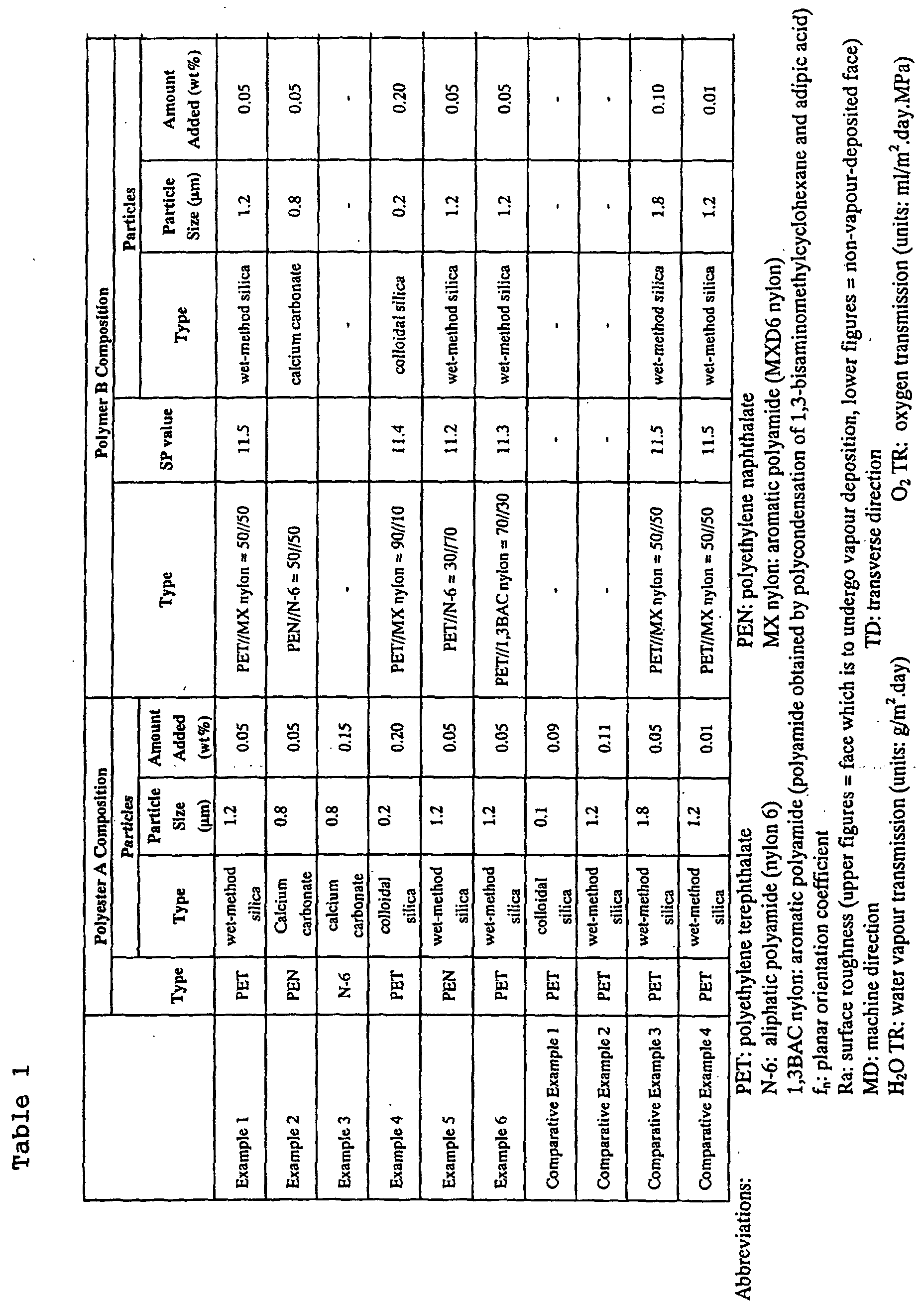
- Films for vapour-deposition of average thickness 12 ⁇ m, together with vapour-deposited films, were obtained by varying the production conditions shown in Example 1 using the substrate layer A composition, the polymer B composition, the polyamide C composition, the level of added particles and the lamination ratios shown in Table 1.
- the film temperature at this time was 30°C and, after leaving for 10 hours, it was slit to a narrow width.
- the film which had been slit to a narrow width was set in a vacuum deposition device equipped with a film travel means, and after applying a high vacuum of 1.00 x 10 -2 Pa, the film was made to travel via a cooling metal drum at -20°C.
- a cooling metal drum at -20°C.
- oxygen was supplied to the vapour region and the aluminium oxidized, and while so-doing condensation and deposition were performed on the corona-discharge treated face of the travelling film, forming a thin vapour-deposited film layer of aluminium oxide, and then the film wound up.
- the interior of the vacuum deposition device was returned to normal pressure and the wound film re-wound, allowed to age for 2 days at a temperature of 40°C and vapour-deposited film obtained.
- the thickness of the inorganic thin film on this vapour-deposited film was 45 nm and the light transmittance was 78%.
- the films for vapour-deposition obtained in Examples 1 to 6 are outstanding in their handling characteristics and vapour-deposition adhesion, and the vapour-deposited films are outstanding in their gas barrier properties.
- the vapour-deposited films obtained in Comparative Examples 1 and 2 were films of inferior gas barrier properties. Moreover, the vapour-deposited film obtained in Comparative Example 2 had poor adhesion properties and the polyamide C layer separated away. In both cases the film was unsuitable as film for vapour-deposition.
- the film for vapour-deposition obtained in the present invention by providing a 0.01 to 5 ⁇ m polyamide layer (the C layer) in which the chief component is an aromatic polyamide of glass transition temperature at least 60°C on at least one face of a substrate layer (the A layer) selected from polyester film and aliphatic polyamide film, it is possible to offer film for vapour-deposition which is outstanding in its vapour-deposition processability and gas barrier properties.
Landscapes
- Physics & Mathematics (AREA)
- Engineering & Computer Science (AREA)
- Plasma & Fusion (AREA)
- Thermal Sciences (AREA)
- Laminated Bodies (AREA)
- Physical Vapour Deposition (AREA)
Abstract
Description
- tip radius of tracer: 0.5 µm
- tracer load: 5 mg
- measurement length 1 mm
- cut-off: 0.08 mm
thickness of inorganic thin
film layer = 400,000x

Claims (14)
- A laminate film where a polyester film or an aliphatic polyamide film is employed as a substrate layer (the A layer), and where a polyamide layer (the C layer) in which the chief component is an aromatic polyamide of glass transition temperature at least 60°C is employed as a layer to undergo vapour deposition, and the centre-line average roughness (Ra) of the face which is to undergo vapour deposition is in the range 0.005 to 0.03 µm.
- A laminate film where a polyester film or an aliphatic polyamide film is employed as a substrate layer (the A layer), and where a polyamide layer (the C layer) in which the chief component is an aromatic polyamide of glass transition temperature at least 60°C is employed as a layer to undergo vapour deposition, and between the A layer and the C layer there is interposed a layer (the B layer) comprising polymer of SP value 10 to 15.
- A laminate film according to Claim 2 where the SP value of the B layer component is a value between the SP value of the A layer component and the SP value of the C layer component.
- A laminate film according to Claim 3 where the polymer layer (the B layer) has as its chief components polyester and polyamide.
- A laminate film according to Claim 2 where the B layer component is a mixed component of A layer component and C layer component.
- A laminate film according to Claim 1 where the centre-line average roughness (Ra) of the face which is to undergo vapour deposition is in the range 0.008 to 0.025 µm.
- A laminate film according to Claim 6 where the centre-line average roughness (Ra) of the face which is to undergo vapour deposition is in the range 0.01 to 0.02 µm.
- A laminate film according to Claim 1 or Claim 2 where the face which is to undergo vapour deposition is subject to a corona discharge treatment.
- A laminate film according to Claim 1 or Claim 2 where the A layer is polyester film.
- A laminate film according to Claim 1 or Claim 2 where the planar coefficient of orientation of the A layer lies in the range 0.155 to 0.180.
- A laminate film according to Claim 10 where the planar coefficient of orientation of the A layer lies in the range 0.1625 to 0.175.
- A laminate film according to Claim 1 or Claim 2 where the percentage heat shrinkage of the A layer at 150°C for 30 minutes is from 0.5 to 2% in the film longitudinal direction and in the range from -1.2 to 0.5% in the widthwise direction.
- A vapour-deposited film formed by vapour deposition of an inorganic thin film on the vapour-deposition face of the laminate film according to Claim 1 or Claim 2.
- A vapour-deposited film according to Claim 13 which is characterized in that it is used in packaging applications.
Applications Claiming Priority (3)
| Application Number | Priority Date | Filing Date | Title |
|---|---|---|---|
| JP24085199 | 1999-08-27 | ||
| JP24085199 | 1999-08-27 | ||
| PCT/JP2000/005691 WO2001015900A1 (en) | 1999-08-27 | 2000-08-24 | Laminated film and vapor deposition film using the same |
Publications (2)
| Publication Number | Publication Date |
|---|---|
| EP1142704A1 true EP1142704A1 (en) | 2001-10-10 |
| EP1142704A4 EP1142704A4 (en) | 2002-04-17 |
Family
ID=17065666
Family Applications (1)
| Application Number | Title | Priority Date | Filing Date |
|---|---|---|---|
| EP00954976A Withdrawn EP1142704A4 (en) | 1999-08-27 | 2000-08-24 | Laminated film and vapor deposition film using the same |
Country Status (5)
| Country | Link |
|---|---|
| US (1) | US6524719B1 (en) |
| EP (1) | EP1142704A4 (en) |
| KR (1) | KR20010075121A (en) |
| CN (1) | CN1127406C (en) |
| WO (1) | WO2001015900A1 (en) |
Cited By (4)
| Publication number | Priority date | Publication date | Assignee | Title |
|---|---|---|---|---|
| EP1396337A1 (en) * | 2002-09-09 | 2004-03-10 | Curwood, Inc. | Packaging films containing coextruded polyester and nylon layers |
| US7201966B2 (en) | 2002-09-09 | 2007-04-10 | Curwood, Inc. | Packaging films containing coextruded polyester and nylon layers |
| EP2138532A1 (en) * | 2008-06-25 | 2009-12-30 | Fujifilm Corporation | Barrier laminate, gas barrier film and device |
| EP3026176A1 (en) | 2014-11-28 | 2016-06-01 | Vossloh Laeis GmbH | Points component, points and production method for a points component with a heating device |
Families Citing this family (19)
| Publication number | Priority date | Publication date | Assignee | Title |
|---|---|---|---|---|
| TW573304B (en) * | 2000-11-29 | 2004-01-21 | Teijin Ltd | Polyester film for capacitors |
| US6783889B2 (en) * | 2000-12-13 | 2004-08-31 | Toray Industries, Inc. | Polyester film and magnetic recording medium using the same |
| DE10109216A1 (en) * | 2001-02-26 | 2002-09-05 | Mitsubishi Polyester Film Gmbh | Multi-layer transparent, biaxially oriented polyester film |
| JP4894108B2 (en) * | 2001-08-21 | 2012-03-14 | 東レ株式会社 | Transparent deposition polyester film and transparent deposition polyester film |
| JP4036452B2 (en) * | 2003-04-18 | 2008-01-23 | 日本テトラパック株式会社 | Method for manufacturing packaging laminate material |
| JP4720102B2 (en) * | 2003-05-06 | 2011-07-13 | 三菱瓦斯化学株式会社 | Multi-layer container |
| JP2005212389A (en) * | 2004-01-30 | 2005-08-11 | Mitsubishi Plastics Ind Ltd | Polyamide-based laminated film |
| KR100593971B1 (en) * | 2004-06-18 | 2006-06-30 | 에스케이씨 주식회사 | Impact Resistance Heat Shrinkable Polyester Film |
| US8784978B2 (en) * | 2005-11-22 | 2014-07-22 | Triton Systems, Inc. | Multilayer flame retardant barrier films and fabrics |
| US20070202337A1 (en) * | 2006-02-24 | 2007-08-30 | Curwood, Inc. | Dimensionally stable packaging film and articles made therefrom |
| DE102006023293A1 (en) * | 2006-05-18 | 2007-11-22 | Mitsubishi Polyester Film Gmbh | Biaxially oriented polyester film for sheet lamination |
| US20090045544A1 (en) * | 2007-08-14 | 2009-02-19 | General Electric Company | Method for manufacturing ultra-thin polymeric films |
| JP5654245B2 (en) * | 2010-02-17 | 2015-01-14 | 富士フイルム株式会社 | Barrier laminate and protective sheet for solar cell |
| JP2013075442A (en) * | 2011-09-30 | 2013-04-25 | Mitsubishi Plastics Inc | Metal-deposited multilayer high barrier film |
| CN103522663A (en) * | 2013-10-20 | 2014-01-22 | 江苏申凯包装高新技术股份有限公司 | Strong-alkali resistant aluminum-plated reflective composite packaging film |
| US10000849B2 (en) | 2013-12-06 | 2018-06-19 | Mitsui Chemicals, Inc. | Laminate, packaging material using the same and production process for the same |
| WO2015183898A1 (en) * | 2014-05-27 | 2015-12-03 | Dow Global Technologies Llc | Coextruded multilayer film with beta-propylene-based barrier layer |
| PH12019502029B1 (en) * | 2017-03-07 | 2023-07-26 | Toyo Boseki | Polyethylene-based film for vapor deposition substrates and vapor deposition film using same |
| JP7341107B2 (en) * | 2020-09-01 | 2023-09-08 | 信越化学工業株式会社 | Heat-resistant coated member package and method for packaging heat-resistant coated members |
Family Cites Families (16)
| Publication number | Priority date | Publication date | Assignee | Title |
|---|---|---|---|---|
| NZ222632A (en) * | 1987-11-20 | 1989-07-27 | Transpak Ind Ltd | Films comprising semi-crystalline polyamide and amorphous polyamide either as a blend or in a multi-layer film having at least one layer each of semi-crystalline and amorphous polyamide |
| CA2040638A1 (en) * | 1990-04-20 | 1991-10-21 | Gedeon I. Deak | Barrier materials useful for packaging |
| JP2964663B2 (en) * | 1991-02-26 | 1999-10-18 | 三菱化学株式会社 | Laminated biaxially stretched film and method for producing the same |
| AU646331B2 (en) * | 1991-02-28 | 1994-02-17 | Mitsubishi Chemical Corporation | Biaxially oriented polyamide laminate film |
| JPH06240134A (en) * | 1993-02-16 | 1994-08-30 | Toray Ind Inc | Polyamide film |
| JPH07125132A (en) * | 1993-10-28 | 1995-05-16 | Idemitsu Petrochem Co Ltd | Packaging material |
| JP3193565B2 (en) * | 1993-11-16 | 2001-07-30 | 電気化学工業株式会社 | Polyester multilayer sheet and container |
| US5955180A (en) * | 1995-10-26 | 1999-09-21 | Mitsubishi Gas Chemical Company, Inc. | Multi-layer film |
| JP3730696B2 (en) * | 1995-12-27 | 2006-01-05 | 東洋紡績株式会社 | Laminated polyamide film |
| US5939205A (en) * | 1996-04-16 | 1999-08-17 | Toyo Boseki Kabushiki Kaisha | Gas barrier resin film |
| JP3248448B2 (en) * | 1996-04-16 | 2002-01-21 | 東洋紡績株式会社 | Gas barrier resin film |
| JPH1024489A (en) * | 1996-07-10 | 1998-01-27 | Unitika Ltd | Method for producing stretched multilayer polyamide film |
| JP3923611B2 (en) * | 1997-08-01 | 2007-06-06 | 大日本印刷株式会社 | Laminated body and packaging bag using the same |
| US6376093B1 (en) * | 1998-05-26 | 2002-04-23 | Toyo Boseki Kabushiki Kaisha | Polyamide film and polyamide laminate film |
| JP4470229B2 (en) * | 1999-01-08 | 2010-06-02 | 東洋紡績株式会社 | Gas barrier film |
| JP4660867B2 (en) * | 1999-02-24 | 2011-03-30 | 東洋紡績株式会社 | Laminated polyamide resin film |
-
2000
- 2000-08-24 EP EP00954976A patent/EP1142704A4/en not_active Withdrawn
- 2000-08-24 KR KR1020017003332A patent/KR20010075121A/en not_active Withdrawn
- 2000-08-24 WO PCT/JP2000/005691 patent/WO2001015900A1/en not_active Ceased
- 2000-08-24 CN CN00801557A patent/CN1127406C/en not_active Expired - Fee Related
-
2001
- 2001-04-26 US US09/841,966 patent/US6524719B1/en not_active Expired - Fee Related
Cited By (7)
| Publication number | Priority date | Publication date | Assignee | Title |
|---|---|---|---|---|
| EP1396337A1 (en) * | 2002-09-09 | 2004-03-10 | Curwood, Inc. | Packaging films containing coextruded polyester and nylon layers |
| US6964816B2 (en) | 2002-09-09 | 2005-11-15 | Curwood, Inc. | Packaging films containing coextruded polyester and nylon layers |
| US7201966B2 (en) | 2002-09-09 | 2007-04-10 | Curwood, Inc. | Packaging films containing coextruded polyester and nylon layers |
| AU2003244597B2 (en) * | 2002-09-09 | 2009-05-28 | Curwood, Inc. | Packaging films containing coextruded polyester and nylon layers |
| AU2005201009B2 (en) * | 2004-03-08 | 2010-05-27 | Curwood Inc | Packaging films containing coextruded polyester and nylon layers |
| EP2138532A1 (en) * | 2008-06-25 | 2009-12-30 | Fujifilm Corporation | Barrier laminate, gas barrier film and device |
| EP3026176A1 (en) | 2014-11-28 | 2016-06-01 | Vossloh Laeis GmbH | Points component, points and production method for a points component with a heating device |
Also Published As
| Publication number | Publication date |
|---|---|
| US6524719B1 (en) | 2003-02-25 |
| US20010036551A1 (en) | 2001-11-01 |
| WO2001015900A1 (en) | 2001-03-08 |
| CN1319048A (en) | 2001-10-24 |
| KR20010075121A (en) | 2001-08-09 |
| EP1142704A4 (en) | 2002-04-17 |
| CN1127406C (en) | 2003-11-12 |
Similar Documents
| Publication | Publication Date | Title |
|---|---|---|
| US6524719B1 (en) | Laminate film and a vapour-deposited film employing same | |
| CN115243892B (en) | Biaxially stretched polyamide film | |
| KR20050045865A (en) | Peelable polyester film having improved oxygen barrier, process for its production and its use | |
| KR20040067972A (en) | Polyester film having improved oxygen barrier, comprising poly(m-xyleneadipamide) and a barrier coating, process for its production and its use | |
| JP2000127323A (en) | Biaxially oriented coextruded laminated polyester film, method for producing the same and use thereof | |
| JPH1110725A (en) | Polyester film for transparent evaporation | |
| KR20040067937A (en) | Polyester film having improved oxygen barrier, comprising poly(m-xyleneadipamide) and also an overlayer and a barrier coating, process for its production and its use | |
| EP1503898B1 (en) | Metallized high barrier lap-sealable liner for spiral wounds containers | |
| EP3904075B1 (en) | Film laminated metal sheet, substrate for flexible device, and substrate for organic el device | |
| KR20040067918A (en) | Polyester Film Having Improved Oxygen Barrier and Poly(m-xyleneadipamide)-containing Base Layer, Process for its Production and Its Use | |
| US7285322B2 (en) | Multilayer, transparent film made from polyethylene terephthalate (PET) and polyethylene naphthalate (PEN) for producing packaging composites with UV protection | |
| WO2009069965A2 (en) | Biaxially oriented laminated film for wrapping food articles and method of manufacturing same | |
| JP7680030B2 (en) | Laminated film and method for producing same | |
| US20050287382A1 (en) | Extrusion-coatable polyester film comprising poly(m--xyleneadipamide) | |
| KR20040067917A (en) | Polyester Film Having Improved Oxygen Barrier and Poly(m-xyleneadipamide)-containing Overlayer, Process for its Production and Its Use | |
| US20050287380A1 (en) | Adhesion-promoting polyester film comprising poly(m-xyleneadipamide) | |
| JP2001232739A (en) | Film for vapor deposition and vapor deposited film using the same | |
| JP2000119414A (en) | Polyester film for vapor deposition | |
| JP2003145667A (en) | Evaporated film | |
| US20050287378A1 (en) | Metallized or ceramic-coated polyester films comprising poly(m-xyleneadipamide) | |
| JP4069717B2 (en) | Laminated film | |
| JP2004042488A (en) | Evaporated film | |
| JPH06190969A (en) | Membrane laminated flexible polyester film | |
| JP4102584B2 (en) | Laminated body and packaging bag using the same | |
| JPH09123338A (en) | Gas barrier film |
Legal Events
| Date | Code | Title | Description |
|---|---|---|---|
| PUAI | Public reference made under article 153(3) epc to a published international application that has entered the european phase |
Free format text: ORIGINAL CODE: 0009012 |
|
| 17P | Request for examination filed |
Effective date: 20010525 |
|
| AK | Designated contracting states |
Kind code of ref document: A1 Designated state(s): AT BE CH CY DE DK ES FI FR GB GR IE IT LI LU MC NL PT SE |
|
| A4 | Supplementary search report drawn up and despatched |
Effective date: 20020307 |
|
| AK | Designated contracting states |
Kind code of ref document: A4 Designated state(s): AT BE CH CY DE DK ES FI FR GB GR IE IT LI LU MC NL PT SE |
|
| 17Q | First examination report despatched |
Effective date: 20041220 |
|
| STAA | Information on the status of an ep patent application or granted ep patent |
Free format text: STATUS: THE APPLICATION IS DEEMED TO BE WITHDRAWN |
|
| 18D | Application deemed to be withdrawn |
Effective date: 20050503 |