EP1142558A2 - Hair dye composition comprising a direct dye - Google Patents
Hair dye composition comprising a direct dye Download PDFInfo
- Publication number
- EP1142558A2 EP1142558A2 EP01107828A EP01107828A EP1142558A2 EP 1142558 A2 EP1142558 A2 EP 1142558A2 EP 01107828 A EP01107828 A EP 01107828A EP 01107828 A EP01107828 A EP 01107828A EP 1142558 A2 EP1142558 A2 EP 1142558A2
- Authority
- EP
- European Patent Office
- Prior art keywords
- group
- dye
- substituent
- hair
- nitrogen
- Prior art date
- Legal status (The legal status is an assumption and is not a legal conclusion. Google has not performed a legal analysis and makes no representation as to the accuracy of the status listed.)
- Granted
Links
- 0 CCCC(*)=C1N(*)c2cccc3c(*)ccc1c23 Chemical compound CCCC(*)=C1N(*)c2cccc3c(*)ccc1c23 0.000 description 2
Classifications
-
- A—HUMAN NECESSITIES
- A61—MEDICAL OR VETERINARY SCIENCE; HYGIENE
- A61Q—SPECIFIC USE OF COSMETICS OR SIMILAR TOILETRY PREPARATIONS
- A61Q5/00—Preparations for care of the hair
- A61Q5/10—Preparations for permanently dyeing the hair
-
- A—HUMAN NECESSITIES
- A61—MEDICAL OR VETERINARY SCIENCE; HYGIENE
- A61K—PREPARATIONS FOR MEDICAL, DENTAL OR TOILETRY PURPOSES
- A61K8/00—Cosmetics or similar toiletry preparations
- A61K8/18—Cosmetics or similar toiletry preparations characterised by the composition
- A61K8/30—Cosmetics or similar toiletry preparations characterised by the composition containing organic compounds
- A61K8/49—Cosmetics or similar toiletry preparations characterised by the composition containing organic compounds containing heterocyclic compounds
- A61K8/4906—Cosmetics or similar toiletry preparations characterised by the composition containing organic compounds containing heterocyclic compounds with one nitrogen as the only hetero atom
- A61K8/4913—Cosmetics or similar toiletry preparations characterised by the composition containing organic compounds containing heterocyclic compounds with one nitrogen as the only hetero atom having five membered rings, e.g. pyrrolidone carboxylic acid
- A61K8/492—Cosmetics or similar toiletry preparations characterised by the composition containing organic compounds containing heterocyclic compounds with one nitrogen as the only hetero atom having five membered rings, e.g. pyrrolidone carboxylic acid having condensed rings, e.g. indol
-
- A—HUMAN NECESSITIES
- A61—MEDICAL OR VETERINARY SCIENCE; HYGIENE
- A61Q—SPECIFIC USE OF COSMETICS OR SIMILAR TOILETRY PREPARATIONS
- A61Q5/00—Preparations for care of the hair
- A61Q5/06—Preparations for styling the hair, e.g. by temporary shaping or colouring
- A61Q5/065—Preparations for temporary colouring the hair, e.g. direct dyes
Definitions
- the present invention relates to a hair dye composition which has markedly high dyeing power, can impart the hair with a remarkably vivid color ranging from red to blue, has less color fade over time and undergoes a small color tone change in the dye even after storage.
- Hair dyes can be classified by the dye to be used therefor, or whether they have bleaching action of melanin or not.
- Typical examples include a two-part permanent hair dye composed of a first part containing an alkali agent, an oxidation dye and a direct dye such as nitro dye and a second part containing an oxidizing agent; and one-part semi-permanent hair dye containing an organic acid or an alkali agent, and a direct dye such as acid dye, basic dye or nitro dye.
- the above-described permanent hair dye is however accompanied with the drawbacks that color tone imparted by an oxidation dye is not so vivid and the color of the hair dyed with a vivid-color producing nitro dye ordinarily employed as a direct dye markedly fades over time and becomes dull soon even if the color tone rightly after dyeing is very vivid (Japanese Patent Application Laid-Open ( Kokai ) No. Hei 6-271435).
- An object of the present invention is to provide a hair dye composition featuring high hair dyeing power, less color fade over time and excellent storage stability not permitting a large color tone change of the dye after storage.
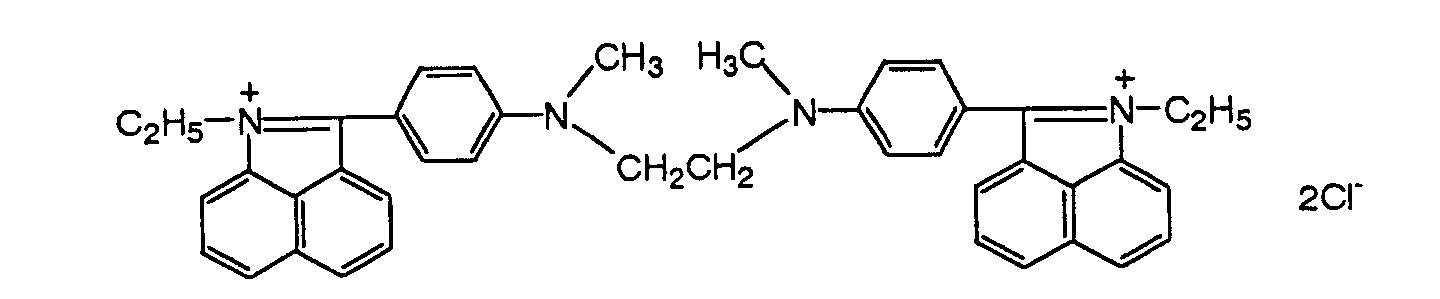
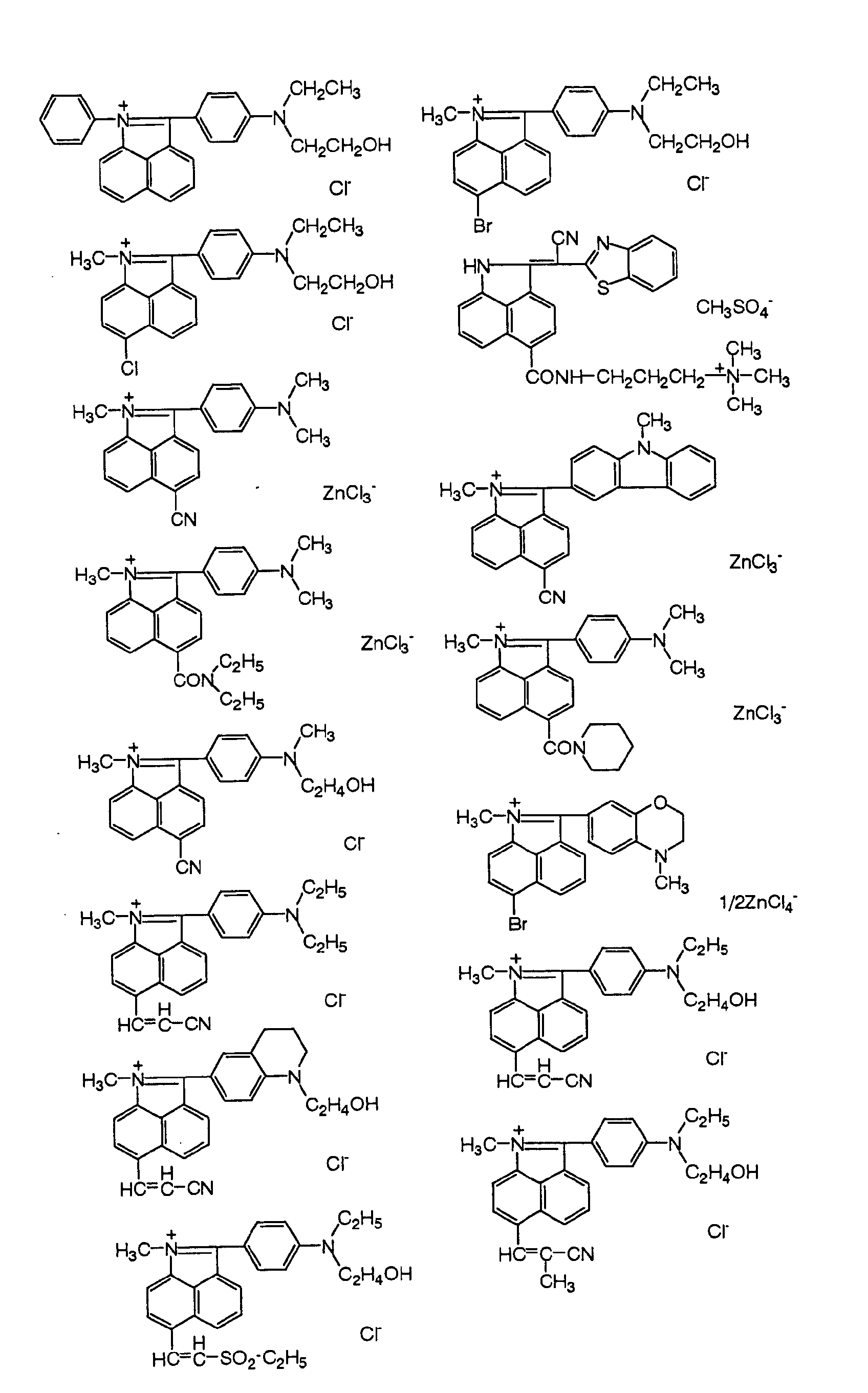
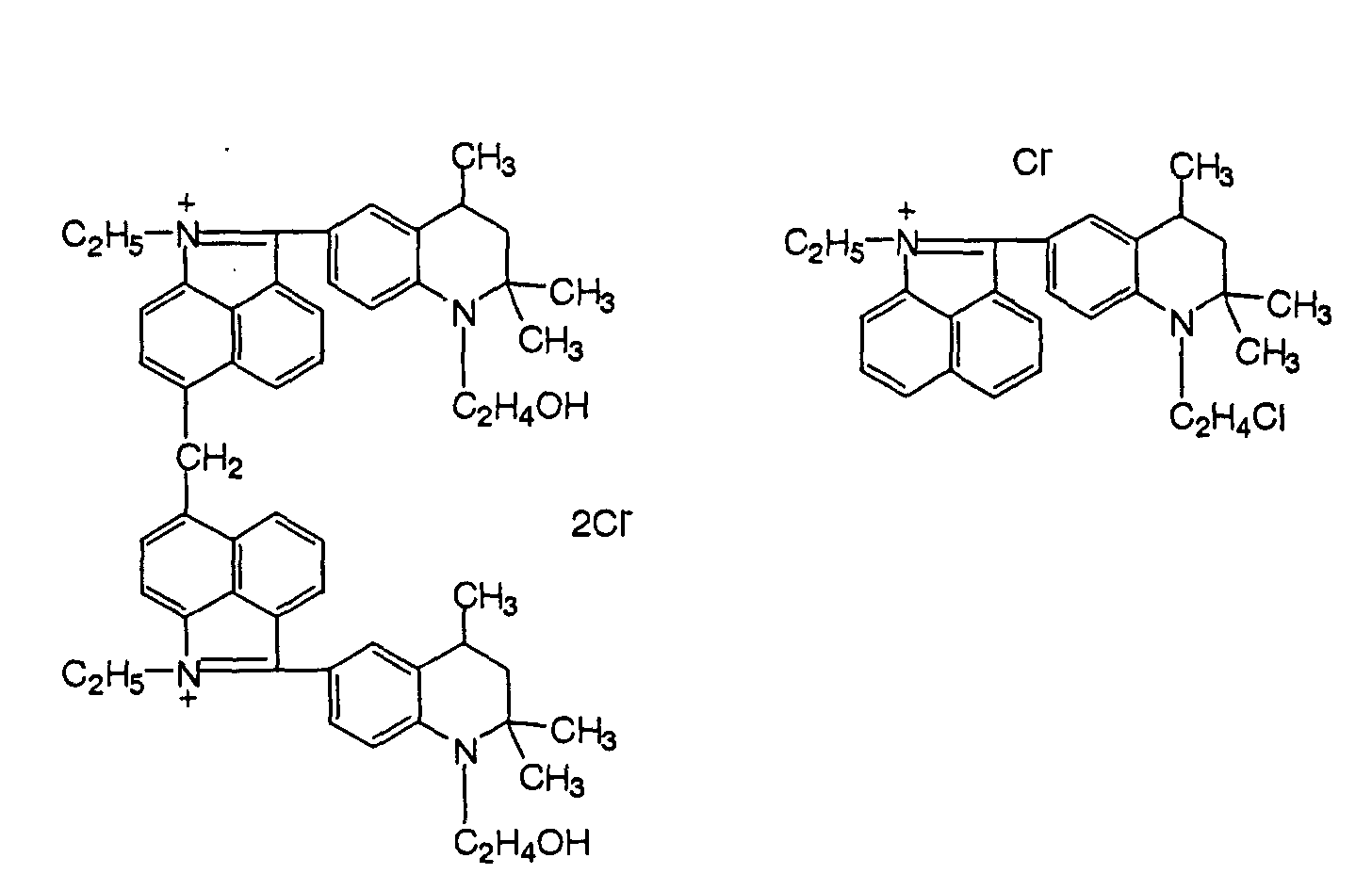
- a hair dye composition containing the below-described compound - which is known as a dye for dyeing or printing therewith fiber materials, paper or leather and is, for example, described in Japanese Patent Application Laid-Open (Kokai) No. Sho 47-9107, Japanese Patent Application Laid-Open (Kokai) No. Sho 49-108378, Japanese Patent Application Laid-Open (Kokai) No. Sho 51-8317, Japanese Patent Application Laid-Open (Kokai) No. Sho 53-27626, Japanese Patent Application Laid-Open (Kokai) No. Sho 53-27627, Japanese Patent Application Laid-Open (Kokai) No.
- Sho 55-135169, Japanese Patent Application Laid-Open (Kokai) No. Sho 63-135458, German Patentschrift DE 1569660, or Japanese Patent Application Laid-Open (Kokai) No. Sho 58-103561 - can dye the hair with high dyeing power without causing decomposition of the dye upon hair dying, can strongly impart the hair with a markedly vivid color ranging from red to blue, exhibits excellent light resistance, washing resistance, perspiration resistance, friction resistance and weather resistance, and undergoes a smaller change in color tone of the dye after storage as compared with that rightly after preparation because the dye exists in the composition stably.
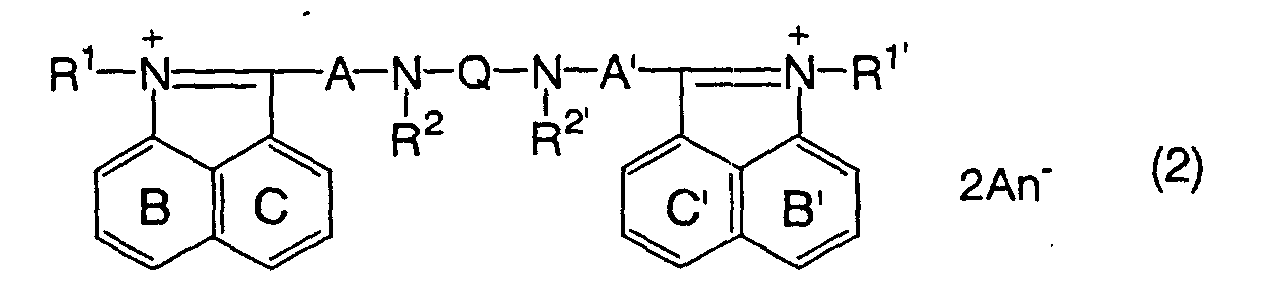
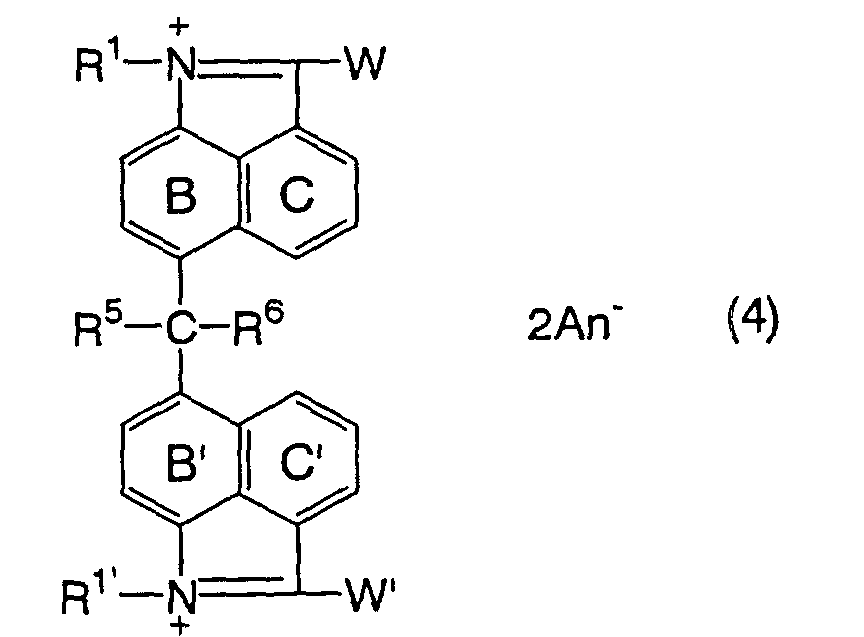
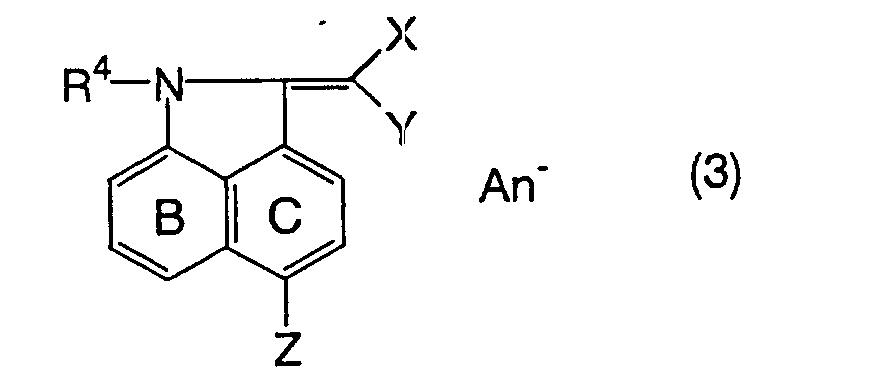
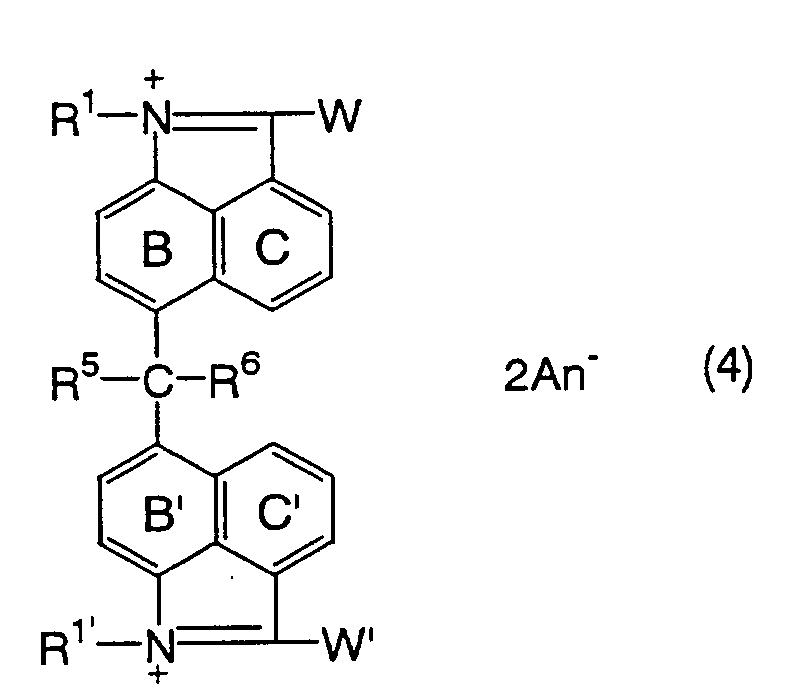
- a hair dye composition comprising, as a direct dye, a compound represented by the following formula (1), (2), (3) or (4):
- a hair dyeing method which comprises appying the above-described hair dye composition to the hair.
- examples of the C 1-6 alkyl group as R 1 , R 1' , R 2 , R 2' , R 3 , R 4 , R 5 or R 6 include methyl, ethyl, propyl, isopropyl and cyclohexyl groups, which may each be substituted by an aryl, alkoxy, amino, hydroxyl or cyano group, or a halogen atom.
- examples of the aryl group as R 1 , R 1' , R 2 , R 2' or R 3 include phenyl and naphthyl groups, which may each be substituted by an alkyl, aryl, alkoxy, amino, dialkylamino, hydroxyl, cyano or nitro group, or a halogen atom, more specifically, methyl, ethyl, methoxy, ethoxy or diethylamino group, or a chlorine or bromine atom.
- examples of the C 2-6 alkenyl group as R 4 , R 5 or R 6 include ethenyl and propenyl groups, which may each be substituted by a cyano or phenyl group.
- examples of the divalent aryl group as A or A' include phenylene and naphthylene groups.
- examples of the heterocyclic aromatic group as W or W' include indolyl, particularly 3-indolyl group, which may be substituted by an alkyl, aryl, alkoxy, amino, hydroxyl, cyano or nitro group, or a halogen atom, more specifically, a methyl, ethyl, methoxy or ethoxy group, or a chlorine or bromine atom.
- examples of the modified carboxy group as X include cyano, alkylcarbamoyl and acyl groups.
- examples of the heterocyclic group as X or Y include the following groups :
- examples of the cationic group as Z include trialkylammoniumyl groups such as trimethylammnoiumyl and triethylammoniumyl, pyridyl group and alkylcarbamoyl groups having these groups bonded thereto.
- examples of the substituent for the rings b, c, B, C, B' or C' include alkyl, alkenyl, aryl, alkoxy, amino and carbamoyl groups which may each have a substituent, hydroxyl group, cyano group, nitro group and halogen atoms.
- Specific examples include methyl group, ethyl group, methoxy group, ethoxy group, chlorine atom, bromine atom, dimethylamino group, N,N-diethylcarbamoyl group, piperidinocarbonyl group, cyanoethenyl group, cyanopropenyl group and ethylsulfonylethenyl group.
- examples of the anion represented by An - include chloride ions, bromide ions, iodide ions, trichlorozincic acid ions, tetrachlorozincic acid ions, sulfuric acid ions, hydrogensulfuric acid ions, methyl sulfate ions, phosphoric acid ions, formic acid ions and acetic acid ions.
- the direct dyes (1) to (4) one or more can be used.
- another direct dye can be used in combination.
- the combination of the direct dye of the present invention with red and blue dyes makes it possible to dye the hair with a deep and highly lustrous dark brown or black color.
- Examples of the direct dye other than the direct dyes (1) to (4) include Basic Blue 7 (C.I. 42595), Basic Blue 26 (C.I. 44045), Basic Blue 99 (C.I. 56059), Basic Violet 10 (C.I. 45170), Basic Violet 14 (C.I. 42515), Basic Brown 16 (C.I. 12250), Basic Brown 17 (C.I. 12251), Basic Red 2 (C.I. 50240), Basic Red 22 (C.I. 11055), Basic Red 76 (C.I. 12245), Basic Red 118 (C.I. 12251:1) and Basic Yellow 57(C.I. 12719); and basic dyes as described in Japanese Patent Publication No. Sho 58-2204, Japanese Patent Application Laid-Open No. Hei 9-118832, Japanese Language Laid-Open Publication (PCT) No. Hei 8-501322 or Japanese Language Laid-Open Publication (PCT) No. Hei 8-507545.
- Basic Blue 7 C.I. 42595
- the direct dyes (1) to (4) are each preferably added in an amount of 0.01 to 20 wt.%, more preferably 0.05 to 10 wt.%, especially 0.1 to 5 wt.% based on the whole composition (after mixing of all the parts when a two-part or three-part composition is employed; this will apply equally hereinafter).
- the content of it in total with the direct dye of the present invention preferably ranges from 0.05 to 10 wt.%, especially 0.1 to 5 wt.% based on the whole composition.
- the hair dye composition of the present invention is preferably adjusted to pH 6 to 11, with pH 8 to 11 being more preferred.
- the alkali agent to be used for pH adjustment include ordinarily employed ones such as ammonia, organic amines and salts thereof.
- the alkali agent is preferably added in an amount of 0.01 to 20 wt.%, more preferably 0.1 to 10 wt.%, especially 0.5 to 5 wt.% based on the whole composition.
- an oxidizing agent can be incorporated.
- hair dyeing and bleaching can be carried out simultaneously, which facilitates more vivid hair dyeing.
- oxidizing agents for example, hydrogen peroxide, persulfates such as ammonium persulfate, potassium persulfate and sodium persulfate, perborates such as sodium perborate, percarbonates such as sodium percarbonate and bromates such as sodium bromate and potassium bromate are usable. Out of them, hydrogen peroxide is especially preferred.
- the oxidizing agent is added in an amount of 0.5 to 10 wt.%, especially 1 to 8 wt.% based on the whole composition.
- an oxidation dye can be incorporated further.
- this incorporation enables remarkably vivid dyeing not attainable by the single use of an oxidation dye.
- the oxidizing agent the above-exemplified ones can be used, with hydrogen peroxide being particularly preferred.
- an oxidizing enzyme such as laccase can be employed.
- the oxidation dye known developers and couplers ordinarily employed for an oxidation type hair dye can be used.
- Examples of the developer include p-phenylenediamines having one or several groups selected from NH 2 -, NHR- and NR 2 - groups (in which, R represents a C 1-4 alkyl or hydroxyalkyl group) such as p-phenylenediamine, p-toluylenediamine, N-methyl-p-phenylenediamine, chloro-p-phenylenediamine, 2-(2'-hydroxyethylamino)-5-aminotoluene, N,N-bis-(2-hydroxyethyl)-p-phenylenediamine, 2-hydroxyethyl-p-phenylenediamine, 2,6-dimethyl-p-phenylenediamine, methoxy-p-phenylenediamine, 2,6-dichloro-p-phenylenediamine, 2-chloro-6-methyl-p-phenylenediamine, 6-methoxy-3-methyl-p-phenylenediamine, 2,5
- coupler examples include 1-naphthol, 1,5-dihydroxynaphthalene, 1,7-dihydroxynaphthalene, 2,7-dihydroxynaphthalene, 5-amino-2-methylphenol, 5-(2'-hydroxyethylamino)-2-methylphenol, 2,4-diaminoanisole, m-toluylenediamine, reE;orcin, m-phenylenediamine, m-aminophenol, 4-chlororesorcin, 2-methylresorcin, 2,4-diaminophenoxyethano:L, 2,6-diaminopyridine, 2-amino-3-hydroxypyridine, 4-hydroxyindole, 6-hydroxyindole, 2,4-diamino-6-hydroxypyrimidine, 2,4,6-triaminopyrimidine, 2-amino-4,6-dihydroxypyrimidine, 4-amino-2,6-dihydroxypyrimidine, 4,6-dia
- each of the developer and coupler one or more can be used. Although no particular limitation is imposed on the content of the developer or coupler, it is preferably added in an amount of 0.01 to 20 wt.%, especially 0.5 to 10 wt.% based on the whole composition.
- a known autoxidation dye typified by an indole or an indoline, or a known direct dye such as a nitro dye or a disperse dye can also be added.
- anionic component such as anionic surfactant or anionic polymer
- ion activity concentration means “molar concentration x ionic valence”
- Addition of a polyol, polyol alkyl ether, cationic or amphoteric polymer or silicone to the hair dye composition of the present invention is preferred for bringing about uniform hair dyeing effects and improvement in cosmetic effects.
- those ordinarily employed as a raw material for cosmetics can be added to the hair dye composition of the present invention.
- an optional component include hydrocarbons, animal or vegetable fats and oils, higher fatty acids, organic solvents, penetration promoters, cationic surfactants, natural or synthetic polymers, higher alcohols, ethers, amphoteric surfactants, nonionic surfactants, protein derivatives, amino acids, antiseptics, chelating agents, stabilizing agents, antioxidants, plant extracts, crude drug extracts, vitamins, colorants, perfumes and ultraviolet absorbers.
- the hair dye composition of the present invention can be prepared in a conventional manner into a one-part composition, a two-part composition having a first-part component containing an alkali agent and a second-part component containing an oxidizing agent or a three-part composition having, in addition to these two components, a powdery oxidizing agent such as persulfate.
- the direct dyes (1), (2), (3) and (4) can each be incorporated in either one or both of the part components of the two-part or three-part composition.
- the one-part type is applied to the hair directly, while the two- or three-part type is applied to the hair after mixing the components upon hair dyeing.
- the hair dye composition of the present invention No particular limitation is imposed on the form of the hair dye composition of the present invention. Examples include powder, transparent, liquid, emulsion, cream, gel, paste, aerosol, and aerosol foam. It preferably has a viscosity of 2000 to 100000 mPa ⁇ s when it is applied to the hair (after mixing of all the components when a two-part or three-part type composition is employed).
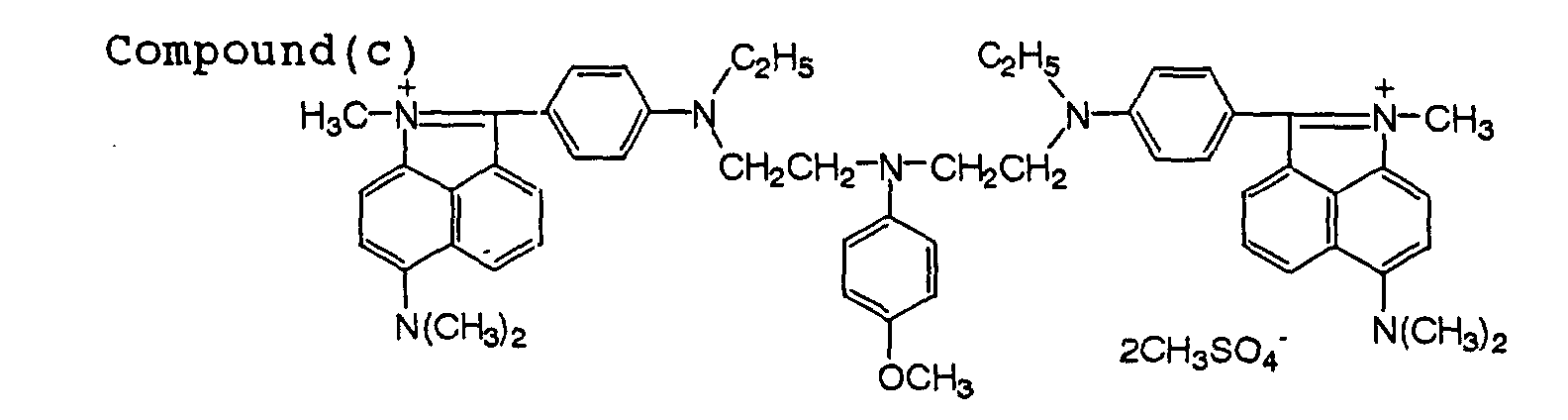
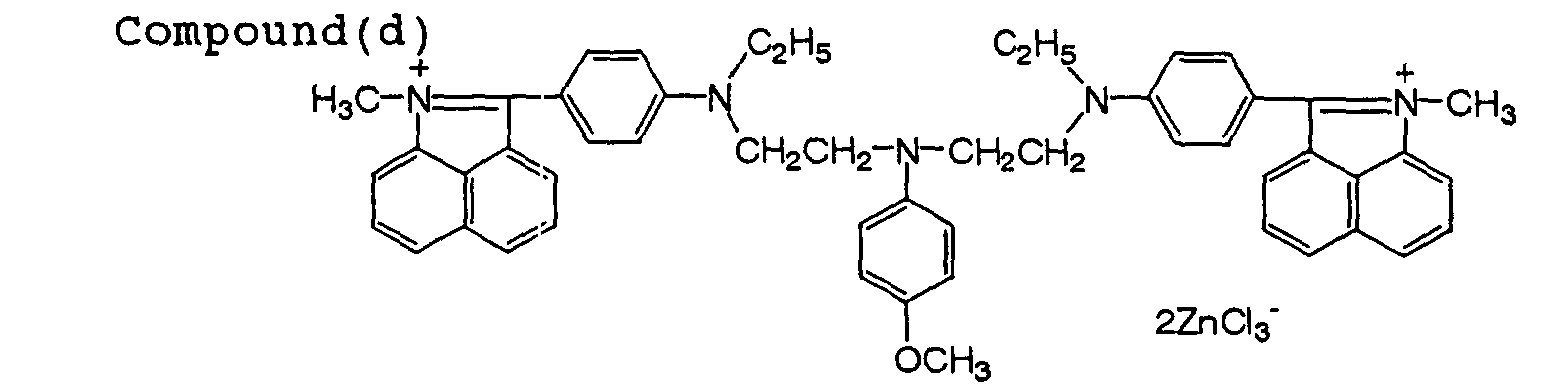
- the hair dye compositions as shown in Table 3 were prepared. (wt.%) Examples 10 11 12 1st part Toluene-2,5-diamine 2 1 Para-aminophenol 1 Resorcin 0.9 1.1 Para-amino-ortho-cresol 0.5 1.1 2,4-Diaminophenoxyethanal 0,7 Dye [Compound (i)] 0.05 Dye [Compound (h)] 0,15 Dye [Compound (c)] 0.1 28 wt.% Aqueous ammonia 5 Monoethanolamine 2 Propylene glycol 8 Polyoxyethylene (20) isostearyl ether 24 Polyoxyethylene (2) isostearyl ether 20 "Merquat 280" (trade name; product of Calgon Corp., a 35 wt.% aqueous solution) 8 "Polymer JR400" (trade name; product of Union Carbide) 0.5 "Amodimethicone SM8702C" (trade name; product of Dow Corning Toray
Landscapes
- Health & Medical Sciences (AREA)
- Life Sciences & Earth Sciences (AREA)
- Animal Behavior & Ethology (AREA)
- General Health & Medical Sciences (AREA)
- Public Health (AREA)
- Veterinary Medicine (AREA)
- Birds (AREA)
- Epidemiology (AREA)
- Cosmetics (AREA)
- Coloring (AREA)
Abstract


Description











| (wt.%) | Example | ||||
| 1 | 2 | 3 | 4 | 5 | |
| Dye [Compound (f)] | 0.2 | 0.1 | |||
| Dye [Compound (i)] | 0,5 | 0.1 | 0.2 | ||
| Dye [Compound (a)] | 0.3 | ||||
| Dye [Compound (k)] | 0.2 | 0.05 | |||
| Ethanol | 5 | 5 | 5 | ||
| Propylene glycol | 5 | 5 | |||
| Diethylene glycol monoethyl ether | 10 | ||||
| Guar gum | 1 | ||||
| Hydroxypropyl guar gum | 1 | 1 | 1 | 1 | |
| "Gufquat 734" (trade name; product of ISP Japan) | 1 | 1 | |||
| "Catinal LC100" (trade name; product of Toho Chemical Industry) | 1 | 1 | |||
| "Polyether-modified silicone KF6005" trade name; (product of Shin-Etsu Chemical) | 0.4 | ||||
| "Amodimethicone SM8702C" (product of Dow Corning Toray Silicone) | 1.5 | ||||
| Monoethanolamine | 0.1 | ||||
| Phosphoric acid | Amount to adjust pH to 9 | ||||
| Perfume | q.s. | ||||
| Water | Balance |
| (wt.%) | Example | |||
| 6 6 | 7 | 8 | 9 | |
| 1st part | Dye [Compound (g)] | 0.2 | 0.1 | |
| Dye [Compound (e)] | 0.1 | 0.15 | ||
| Dye [Compound (d)] | 0.2 | |||
| Dye [Compound (k)] | 0.1 | |||
| 28 wt.% Aqueous ammonia | 5 | |||
| Monoethanolamine | 2 | |||
| Propylene glycol | 8 | |||
| Polyoxyethylene (20) isostearyl ether | 24 | |||
| Polyoxyethylene (2) isostearyl ether | 20 | |||
| "Merquat 280" (trade name; product of Calgon Corp., 35 wt.% aqueous solution) | 8 | |||
| "Polymer JR400" (trade name; product of Union Carbide) | 0.5 | 0.5 | ||
| "Amodimethicone SM8702C" (trade name; product of Dow Corning Toray Silicone) | 2 | |||
| "Polyether modified silicone KF6005" (trade name; product of Shin-Etsu Chemical) | 0.3 | |||
| Tetrasodium ethylenediaminetetraacetate | 0.1 | |||
| Perfume | q.s. | |||
| Ammonium chloride | Amount to adjust pH to 10 | |||
| Water | Balance | |||
| 2nd part | 35 wt.% Aqueous hydrogen peroxide | 17.1 | ||
| Methylparaben | 0.1 | |||
| Phosphoric acid | Amount to adjust pH to 3.5 | |||
| Water | Balance |
| (wt.%) | Examples | ||
| 10 | 11 | 12 | |
| 1st part | Toluene-2,5-diamine | 2 | 1 |
| Para-aminophenol | 1 | ||
| Resorcin | 0.9 | 1.1 | |
| Para-amino-ortho-cresol | 0.5 | 1.1 | |
| 2,4-Diaminophenoxyethanal | 0,7 | ||
| Dye [Compound (i)] | 0.05 | ||
| Dye [Compound (h)] | 0,15 | ||
| Dye [Compound (c)] | 0.1 | ||
| 28 wt.% Aqueous ammonia | 5 | ||
| Monoethanolamine | 2 | ||
| Propylene glycol | 8 | ||
| Polyoxyethylene (20) isostearyl ether | 24 | ||
| Polyoxyethylene (2) isostearyl ether | 20 | ||
| "Merquat 280" (trade name; product of Calgon Corp., a 35 wt.% aqueous solution) | 8 | ||
| "Polymer JR400" (trade name; product of Union Carbide) | 0.5 | ||
| "Amodimethicone SM8702C" (trade name; product of Dow Corning Toray Silicone) | 2 | ||
| Sodium sulfite | 0.05 | ||
| Ascorbic acid | 0.5 | ||
| Tetrasodium ethylenediaminetetraacetate | 0.1 | ||
| Perfume | q.s. | ||
| Ammonium chloride | Amount to adjust pH to 10 | ||
| Water | Balance | ||
| 2nd part | 35 wt.% Aqueous hydrogen peroxide | 17.1 | |
| Methylparaben | 0.1 | ||
| Phosphoric acid | Amount to adjust pH to 3.5 | ||
| Water | Balance |
| (First part) | (wt.%) |
| Para-aminophenol | 1 |
| Para-amino-ortho-cresol | 1.1 |
| Compound (b) | 0.1 |
| 28 wt.% Aqueous ammonia | 5 |
| Monoethanolamine | 2 |
| Cetanol | 8.5 |
| Polyoxyethylene (40) cetyl ether | 3 |
| Polyoxyethylene (2) cetyl ether | 3.5 |
| Stearyl trimethyl ammonium chloride | 2 |
| Liquid paraffin | 0.5 |
| Sodium sulfite | 0.05 |
| Ascorbic acid | 0.5 |
| Tetrasodium ethylenediaminetetraacetate | 0.1 |
| Perfume | q.s. |
| Ammonium chloride | Amount to adjust pH to 10 |
| Water | Balance |
| (Second part) | (wt.%) |
| 35 wt.% Aqueous hydrogen peroxide | 17.1 |
| Methylparaben | 0.1 |
| Phosphoric acid | Amount to adjust pH to 3.5 |
| Water | Balance |
Claims (4)
- A hair dye composition comprising, as a direct dye, a compound represented by the following formula (1), (2), (3) or (4):
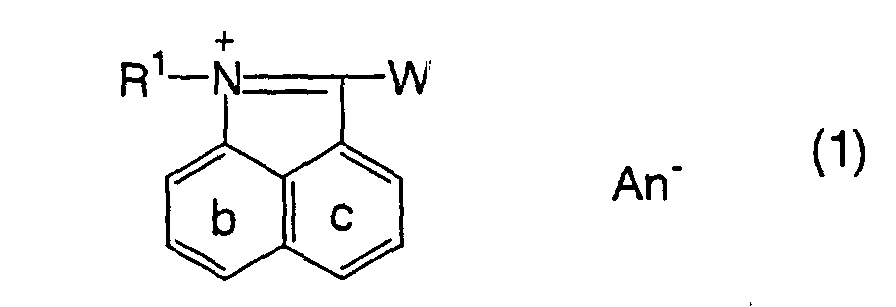
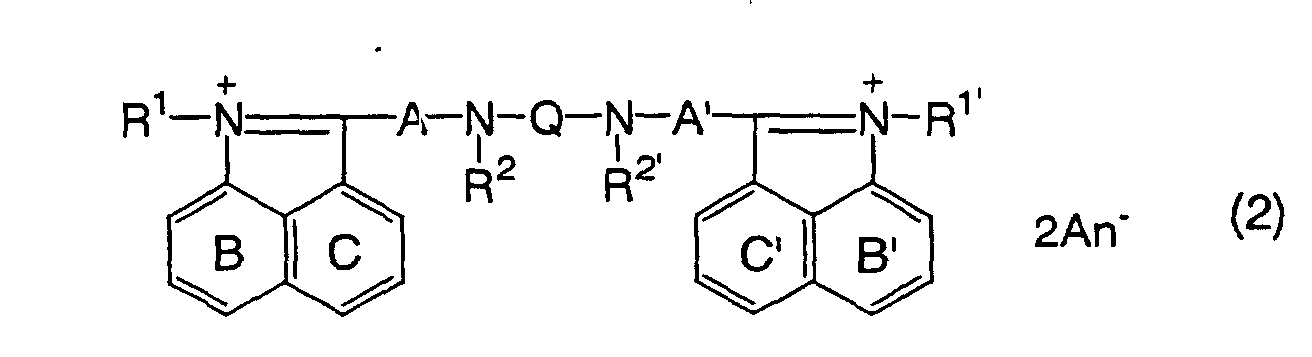

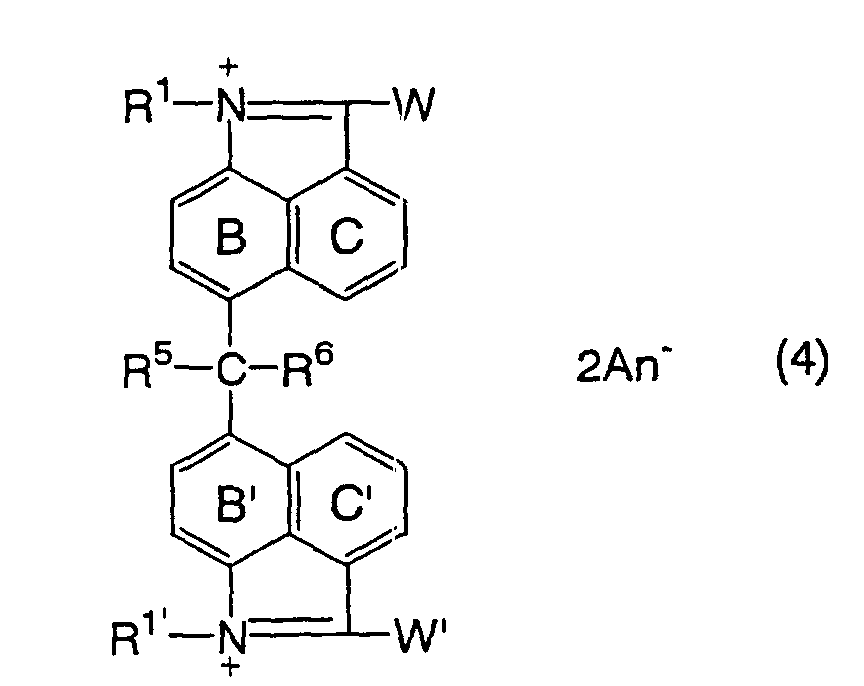 [wherein, R1 and R1' each independently represents a C1-6 alkyl group which may have a substituent or an aryl group which may have a substituent;W and W' each independently represents a group -A-NR2R3 or a heterocyclic aromatic group which may have a substituent;A and A' each independently represents a divalent aryl group which may have a substituent;R2, R2' and R3 each independently represents a hydrogen atom, a C1-6 alkyl group which may have a substituent or an aryl group which may have a substituent; or R2, R2' or R3 may be bonded to A or A', thereby forming a nitrogen-containing heterocycle, R2 and R3 are coupled to form a nitrogen-containing heterocycle, together with the adjacent nitrogen atom, or R2 and R2' are coupled to form a nitrogen-containing heterocycle together with the adjacent two nitrogen atoms and Q;R4, R5 and R6 each independently represents a hydrogen atom, a C1-6 alkyl group which may have a substituent or a C1-6 alkenyl group which may have a substituent;Q represents a divalent organic connecting group;X represents a modified carboxy group, an -SO2-T-group (in which, T represents a C1-4 alkyl group, C2-4 alkenyl group or an aryl group) or a heterocyclic group;Y represents a cyano group or a heterocyclic group;Z represents a cationic group,rings b, c, B, C, B' and C' may each have a substituent other than that described directly in the formula, or when in the formula (1), R1 represents a C1-6 alkyl group and W represents a group -A-NR2R3 (except that R2 or R3 is bonded to A to form a nitrogen-containing group), any one of the rings b, c and A has at least one substituent; andAn- represents an anion).
 - A hair dye composition according to claim 1, further comprising an oxidizing agent.
- A hair dye composition according to claim 1 or 2, further comprising an oxidation dye.
- A hair dyeing method, which comprises appying a hair dye composition as claimed in any one of claims 1 to 3 to the hair.
Priority Applications (1)
| Application Number | Priority Date | Filing Date | Title |
|---|---|---|---|
| EP04026720A EP1514535B1 (en) | 2000-04-07 | 2001-04-06 | Hair dye composition comprising a direct dye |
Applications Claiming Priority (4)
| Application Number | Priority Date | Filing Date | Title |
|---|---|---|---|
| JP2000107185 | 2000-04-07 | ||
| JP2000107185 | 2000-04-07 | ||
| JP2000193183A JP4150488B2 (en) | 2000-04-07 | 2000-06-27 | Hair dye composition |
| JP2000193183 | 2000-06-27 |
Related Child Applications (1)
| Application Number | Title | Priority Date | Filing Date |
|---|---|---|---|
| EP04026720A Division EP1514535B1 (en) | 2000-04-07 | 2001-04-06 | Hair dye composition comprising a direct dye |
Publications (3)
| Publication Number | Publication Date |
|---|---|
| EP1142558A2 true EP1142558A2 (en) | 2001-10-10 |
| EP1142558A3 EP1142558A3 (en) | 2002-01-02 |
| EP1142558B1 EP1142558B1 (en) | 2006-11-02 |
Family
ID=26589728
Family Applications (2)
| Application Number | Title | Priority Date | Filing Date |
|---|---|---|---|
| EP01107828A Expired - Lifetime EP1142558B1 (en) | 2000-04-07 | 2001-04-06 | Hair dye composition comprising a direct dye |
| EP04026720A Expired - Lifetime EP1514535B1 (en) | 2000-04-07 | 2001-04-06 | Hair dye composition comprising a direct dye |
Family Applications After (1)
| Application Number | Title | Priority Date | Filing Date |
|---|---|---|---|
| EP04026720A Expired - Lifetime EP1514535B1 (en) | 2000-04-07 | 2001-04-06 | Hair dye composition comprising a direct dye |
Country Status (4)
| Country | Link |
|---|---|
| US (1) | US6605125B2 (en) |
| EP (2) | EP1142558B1 (en) |
| JP (1) | JP4150488B2 (en) |
| DE (2) | DE60124168T2 (en) |
Families Citing this family (4)
| Publication number | Priority date | Publication date | Assignee | Title |
|---|---|---|---|---|
| JP4150485B2 (en) * | 2000-04-07 | 2008-09-17 | 花王株式会社 | Hair dye composition |
| JP3727878B2 (en) | 2001-11-14 | 2005-12-21 | 三菱重工業株式会社 | Metal film production equipment |
| WO2007071684A2 (en) * | 2005-12-22 | 2007-06-28 | L'oréal | Composition for dyeing keratin fibres with a tetraazapentamethine cationic direct dye and an amino silicone |
| FR2895242B1 (en) * | 2005-12-22 | 2008-02-15 | Oreal | DYE COMPOSITION FOR KERATINOUS FIBERS WITH TETRAAZAPENTA-METHINIC CATIONIC DIRECT COLORANT AND AMINE SILICONE |
Family Cites Families (19)
| Publication number | Priority date | Publication date | Assignee | Title |
|---|---|---|---|---|
| DE1569660A1 (en) | 1966-09-22 | 1971-01-14 | Basf Ag | Process for the production of basic dyes |
| US3687972A (en) * | 1970-09-02 | 1972-08-29 | American Cyanamid Co | AMINE DERIVATIVES OF 1,2-DIHYDROBENZ {8 cd{9 {11 INDOLES |
| GB1373081A (en) | 1970-11-06 | 1974-11-06 | Unilever Ltd | Colourant compositions for keratinous fibres |
| JPS5111229B2 (en) | 1973-02-20 | 1976-04-09 | ||
| CH599312A5 (en) | 1974-06-07 | 1978-05-31 | Ciba Geigy Ag | |
| US4260770A (en) | 1976-06-01 | 1981-04-07 | Ciba-Geigy Aktiengesellschaft | Naphtholactam dyes |
| CH618997A5 (en) | 1976-06-02 | 1980-08-29 | Ciba Geigy Ag | Process for the preparation of naphtholactam dyestuffs |
| US4332937A (en) | 1979-04-04 | 1982-06-01 | Ciba-Geigy Corporation | Naphtholactam compounds |
| DE3039116A1 (en) * | 1980-10-16 | 1982-05-13 | Bayer Ag, 5090 Leverkusen | CATIONIC DYES |
| DE3148104A1 (en) | 1981-12-04 | 1983-06-09 | Bayer Ag, 5090 Leverkusen | CATIONIC DYES, METHOD FOR THE PRODUCTION THEREOF AND THEIR USE FOR COLORING AND DIMENSIONING TEXTILE MATERIALS AND OTHER SUBSTRATES |
| CH670096A5 (en) | 1986-11-11 | 1989-05-12 | Ciba Geigy Ag | |
| JPH06271435A (en) | 1993-03-19 | 1994-09-27 | Takara Belmont Co Ltd | Hair dye |
| TW311089B (en) | 1993-07-05 | 1997-07-21 | Ciba Sc Holding Ag | |
| TW325998B (en) | 1993-11-30 | 1998-02-01 | Ciba Sc Holding Ag | Dyeing keratin-containing fibers |
| US5888252A (en) | 1993-11-30 | 1999-03-30 | Ciba Specialty Chemicals Corporation | Processes for dyeing keratin-containing fibres with cationicazo dyes |
| US5474578A (en) | 1994-10-03 | 1995-12-12 | Clairol, Inc. | Erasable hair dyeing process |
| US5520707A (en) | 1995-08-07 | 1996-05-28 | Clairol, Inc. | Methods for dyeing hair with anthraquinone hair dyes having a quaternary ammonium side chain |
| FR2741798B1 (en) | 1995-12-01 | 1998-01-09 | Oreal | LIGHTENING DYE COMPOSITION FOR KERATINIC FIBERS COMPRISING A SPECIFIC DIRECT DYE |
| FR2757387B1 (en) | 1996-12-23 | 1999-01-29 | Oreal | KERATINIC FIBER OXIDATION DYE COMPOSITION AND DYEING METHOD USING THE SAME |
-
2000
- 2000-06-27 JP JP2000193183A patent/JP4150488B2/en not_active Expired - Fee Related
-
2001
- 2001-04-05 US US09/825,842 patent/US6605125B2/en not_active Expired - Lifetime
- 2001-04-06 DE DE60124168T patent/DE60124168T2/en not_active Expired - Lifetime
- 2001-04-06 DE DE60126848T patent/DE60126848T2/en not_active Expired - Lifetime
- 2001-04-06 EP EP01107828A patent/EP1142558B1/en not_active Expired - Lifetime
- 2001-04-06 EP EP04026720A patent/EP1514535B1/en not_active Expired - Lifetime
Also Published As
| Publication number | Publication date |
|---|---|
| EP1142558A3 (en) | 2002-01-02 |
| US6605125B2 (en) | 2003-08-12 |
| EP1142558B1 (en) | 2006-11-02 |
| DE60126848D1 (en) | 2007-04-05 |
| JP4150488B2 (en) | 2008-09-17 |
| US20010044976A1 (en) | 2001-11-29 |
| EP1514535B1 (en) | 2007-02-21 |
| EP1514535A1 (en) | 2005-03-16 |
| DE60126848T2 (en) | 2007-10-31 |
| DE60124168D1 (en) | 2006-12-14 |
| DE60124168T2 (en) | 2007-09-06 |
| JP2001348315A (en) | 2001-12-18 |
Similar Documents
| Publication | Publication Date | Title |
|---|---|---|
| US6616709B2 (en) | Hair dye composition | |
| EP1133976B1 (en) | Hair dye composition | |
| EP1133975B1 (en) | Use of a compound for dyeing hair | |
| US6592630B2 (en) | Hair dye composition | |
| US6607563B2 (en) | Hair dye composition | |
| EP1166756B1 (en) | Hair dye composition | |
| US6623531B2 (en) | Hair dye composition | |
| EP1142559B1 (en) | Hair dye composition | |
| US6616708B2 (en) | Hair dye composition | |
| EP1133978B1 (en) | Hair dye composition comprising a direct dye | |
| US6605125B2 (en) | Hair dye composition | |
| EP1166755B1 (en) | Hair dye composition |
Legal Events
| Date | Code | Title | Description |
|---|---|---|---|
| PUAI | Public reference made under article 153(3) epc to a published international application that has entered the european phase |
Free format text: ORIGINAL CODE: 0009012 |
|
| AK | Designated contracting states |
Kind code of ref document: A2 Designated state(s): DE FR GB Kind code of ref document: A2 Designated state(s): AT BE CH CY DE DK ES FI FR GB GR IE IT LI LU MC NL PT SE TR |
|
| AX | Request for extension of the european patent |
Free format text: AL;LT;LV;MK;RO;SI |
|
| PUAL | Search report despatched |
Free format text: ORIGINAL CODE: 0009013 |
|
| AK | Designated contracting states |
Kind code of ref document: A3 Designated state(s): AT BE CH CY DE DK ES FI FR GB GR IE IT LI LU MC NL PT SE TR |
|
| AX | Request for extension of the european patent |
Free format text: AL;LT;LV;MK;RO;SI |
|
| RIN1 | Information on inventor provided before grant (corrected) |
Inventor name: TOTOKI, SHINTARO, KAO CORPORATION Inventor name: MIYABE, HAJIME, KAO CORPORATION Inventor name: OHASHI, YUKIHIRO, KAO CORPORATION Inventor name: MATSUNAGA, KENICHI, KAO CORPORATION Inventor name: SAITO, YOSHINORI, KAO CORPORATION |
|
| 17P | Request for examination filed |
Effective date: 20020419 |
|
| AKX | Designation fees paid |
Free format text: DE FR GB |
|
| 17Q | First examination report despatched |
Effective date: 20040701 |
|
| APBN | Date of receipt of notice of appeal recorded |
Free format text: ORIGINAL CODE: EPIDOSNNOA2E |
|
| APBR | Date of receipt of statement of grounds of appeal recorded |
Free format text: ORIGINAL CODE: EPIDOSNNOA3E |
|
| APBV | Interlocutory revision of appeal recorded |
Free format text: ORIGINAL CODE: EPIDOSNIRAPE |
|
| APAO | Information on interlocutory revision modified |
Free format text: ORIGINAL CODE: EPIDOSCIRAPE |
|
| GRAP | Despatch of communication of intention to grant a patent |
Free format text: ORIGINAL CODE: EPIDOSNIGR1 |
|
| GRAS | Grant fee paid |
Free format text: ORIGINAL CODE: EPIDOSNIGR3 |
|
| GRAA | (expected) grant |
Free format text: ORIGINAL CODE: 0009210 |
|
| AK | Designated contracting states |
Kind code of ref document: B1 Designated state(s): DE FR GB |
|
| RIC1 | Information provided on ipc code assigned before grant |
Ipc: A61K 8/49 20060101ALI20060925BHEP Ipc: A61Q 5/10 20060101ALI20060925BHEP Ipc: A61Q 5/06 20060101AFI20060925BHEP |
|
| REG | Reference to a national code |
Ref country code: GB Ref legal event code: FG4D |
|
| REF | Corresponds to: |
Ref document number: 60124168 Country of ref document: DE Date of ref document: 20061214 Kind code of ref document: P |
|
| ET | Fr: translation filed | ||
| PLBE | No opposition filed within time limit |
Free format text: ORIGINAL CODE: 0009261 |
|
| STAA | Information on the status of an ep patent application or granted ep patent |
Free format text: STATUS: NO OPPOSITION FILED WITHIN TIME LIMIT |
|
| 26N | No opposition filed |
Effective date: 20070803 |
|
| REG | Reference to a national code |
Ref country code: FR Ref legal event code: PLFP Year of fee payment: 15 |
|
| PGFP | Annual fee paid to national office [announced via postgrant information from national office to epo] |
Ref country code: GB Payment date: 20150401 Year of fee payment: 15 Ref country code: DE Payment date: 20150331 Year of fee payment: 15 |
|
| PGFP | Annual fee paid to national office [announced via postgrant information from national office to epo] |
Ref country code: FR Payment date: 20150408 Year of fee payment: 15 |
|
| REG | Reference to a national code |
Ref country code: DE Ref legal event code: R119 Ref document number: 60124168 Country of ref document: DE |
|
| GBPC | Gb: european patent ceased through non-payment of renewal fee |
Effective date: 20160406 |
|
| REG | Reference to a national code |
Ref country code: FR Ref legal event code: ST Effective date: 20161230 |
|
| PG25 | Lapsed in a contracting state [announced via postgrant information from national office to epo] |
Ref country code: GB Free format text: LAPSE BECAUSE OF NON-PAYMENT OF DUE FEES Effective date: 20160406 Ref country code: DE Free format text: LAPSE BECAUSE OF NON-PAYMENT OF DUE FEES Effective date: 20161101 Ref country code: FR Free format text: LAPSE BECAUSE OF NON-PAYMENT OF DUE FEES Effective date: 20160502 |