EP1134305A1 - Steel plate for laminated container, and method for producing can using the same and can - Google Patents
Steel plate for laminated container, and method for producing can using the same and can Download PDFInfo
- Publication number
- EP1134305A1 EP1134305A1 EP00944342A EP00944342A EP1134305A1 EP 1134305 A1 EP1134305 A1 EP 1134305A1 EP 00944342 A EP00944342 A EP 00944342A EP 00944342 A EP00944342 A EP 00944342A EP 1134305 A1 EP1134305 A1 EP 1134305A1
- Authority
- EP
- European Patent Office
- Prior art keywords
- steel sheet
- amount
- calculated
- terms
- coating
- Prior art date
- Legal status (The legal status is an assumption and is not a legal conclusion. Google has not performed a legal analysis and makes no representation as to the accuracy of the status listed.)
- Withdrawn
Links
Images

Classifications
-
- C—CHEMISTRY; METALLURGY
- C23—COATING METALLIC MATERIAL; COATING MATERIAL WITH METALLIC MATERIAL; CHEMICAL SURFACE TREATMENT; DIFFUSION TREATMENT OF METALLIC MATERIAL; COATING BY VACUUM EVAPORATION, BY SPUTTERING, BY ION IMPLANTATION OR BY CHEMICAL VAPOUR DEPOSITION, IN GENERAL; INHIBITING CORROSION OF METALLIC MATERIAL OR INCRUSTATION IN GENERAL
- C23C—COATING METALLIC MATERIAL; COATING MATERIAL WITH METALLIC MATERIAL; SURFACE TREATMENT OF METALLIC MATERIAL BY DIFFUSION INTO THE SURFACE, BY CHEMICAL CONVERSION OR SUBSTITUTION; COATING BY VACUUM EVAPORATION, BY SPUTTERING, BY ION IMPLANTATION OR BY CHEMICAL VAPOUR DEPOSITION, IN GENERAL
- C23C28/00—Coating for obtaining at least two superposed coatings either by methods not provided for in a single one of groups C23C2/00 - C23C26/00 or by combinations of methods provided for in subclasses C23C and C25C or C25D
- C23C28/30—Coatings combining at least one metallic layer and at least one inorganic non-metallic layer
- C23C28/32—Coatings combining at least one metallic layer and at least one inorganic non-metallic layer including at least one pure metallic layer
- C23C28/321—Coatings combining at least one metallic layer and at least one inorganic non-metallic layer including at least one pure metallic layer with at least one metal alloy layer
-
- C—CHEMISTRY; METALLURGY
- C23—COATING METALLIC MATERIAL; COATING MATERIAL WITH METALLIC MATERIAL; CHEMICAL SURFACE TREATMENT; DIFFUSION TREATMENT OF METALLIC MATERIAL; COATING BY VACUUM EVAPORATION, BY SPUTTERING, BY ION IMPLANTATION OR BY CHEMICAL VAPOUR DEPOSITION, IN GENERAL; INHIBITING CORROSION OF METALLIC MATERIAL OR INCRUSTATION IN GENERAL
- C23C—COATING METALLIC MATERIAL; COATING MATERIAL WITH METALLIC MATERIAL; SURFACE TREATMENT OF METALLIC MATERIAL BY DIFFUSION INTO THE SURFACE, BY CHEMICAL CONVERSION OR SUBSTITUTION; COATING BY VACUUM EVAPORATION, BY SPUTTERING, BY ION IMPLANTATION OR BY CHEMICAL VAPOUR DEPOSITION, IN GENERAL
- C23C28/00—Coating for obtaining at least two superposed coatings either by methods not provided for in a single one of groups C23C2/00 - C23C26/00 or by combinations of methods provided for in subclasses C23C and C25C or C25D
-
- C—CHEMISTRY; METALLURGY
- C23—COATING METALLIC MATERIAL; COATING MATERIAL WITH METALLIC MATERIAL; CHEMICAL SURFACE TREATMENT; DIFFUSION TREATMENT OF METALLIC MATERIAL; COATING BY VACUUM EVAPORATION, BY SPUTTERING, BY ION IMPLANTATION OR BY CHEMICAL VAPOUR DEPOSITION, IN GENERAL; INHIBITING CORROSION OF METALLIC MATERIAL OR INCRUSTATION IN GENERAL
- C23C—COATING METALLIC MATERIAL; COATING MATERIAL WITH METALLIC MATERIAL; SURFACE TREATMENT OF METALLIC MATERIAL BY DIFFUSION INTO THE SURFACE, BY CHEMICAL CONVERSION OR SUBSTITUTION; COATING BY VACUUM EVAPORATION, BY SPUTTERING, BY ION IMPLANTATION OR BY CHEMICAL VAPOUR DEPOSITION, IN GENERAL
- C23C28/00—Coating for obtaining at least two superposed coatings either by methods not provided for in a single one of groups C23C2/00 - C23C26/00 or by combinations of methods provided for in subclasses C23C and C25C or C25D
- C23C28/30—Coatings combining at least one metallic layer and at least one inorganic non-metallic layer
- C23C28/34—Coatings combining at least one metallic layer and at least one inorganic non-metallic layer including at least one inorganic non-metallic material layer, e.g. metal carbide, nitride, boride, silicide layer and their mixtures, enamels, phosphates and sulphates
- C23C28/345—Coatings combining at least one metallic layer and at least one inorganic non-metallic layer including at least one inorganic non-metallic material layer, e.g. metal carbide, nitride, boride, silicide layer and their mixtures, enamels, phosphates and sulphates with at least one oxide layer
Definitions
- the present invention relates to a steel sheet for a laminated container, as a canning material, which is particularly superior in drawing/ironing processability, weldability, corrosion resistance and a film adhesion property, a method of producing a can using the same, and a can obtained therefrom.
- Metallic containers for beverages and foods are roughly classified into two-piece cans and three-piece cans.
- a two-piece can such as a DI can
- the inside of the can is coated and the outside of the can is coated and printed.
- the surface corresponding to the inside of a can is coated and the surface corresponding to the outside of the can is printed, and then the can body portion is welded.
- the coating process is an essential process after or before canning.
- a solvent-based or water-based coating composition is used and then baking is performed.
- wastes e.g.
- Examples of the three-piece can include "Film-laminated steel strip for three-piece can and method of producing the same. (Japanese Unexamined Patent Publication (Kokai) No. 3-236954)", "Steel sheet for three-piece cans having stripe-shaped multi-layer organic coating films. (Japanese Unexamined Patent Publication (Kokai) No. 5-111979)", and "Method of producing a stripe laminated steel sheet for a three-piece can. (Japanese Unexamined Patent Publication (Kokai) No. 5-147181)).
- a chromate coating obtained by an electrolytic chromate treatment is predominantly used as the steel sheet used as a substrate for the film of these laminates.
- the chromate coating has a two-layer structure comprising a metallic Cr layer and a hydrated Cr oxide layer formed thereon. Accordingly, a laminating film (an adhesive layer in case of a film with an adhesive) secures the adhesion with a steel sheet via the hydrated Cr oxide layer of the chromate coating.
- a laminating film an adhesive layer in case of a film with an adhesive
- the mechanism is based on a hydrogen bond between the hydroxyl group of hydrated Cr oxide and a functional group such as carbonyl or ester group of the laminating film.
- a coating free from electrolytic chromate treatment is disclosed in "A coated metallic material in which an undercoat for film lamination is formed on the surface of the metallic material, and method of producing the same. (Japanese Unexamined Patent Publication (Kokai) No. 10-46101)".
- the effect of remarkably advancing global environmental conservation can be certainly obtained.
- the market of beverage containers is in a state of fierce cost and quality competition with the PET bottles, glass bottles, papers and the like. Consequently, more excellent canning processability, particularly film adhesion property, processed film adhesion properties, corrosion resistance and weldability, are required of the above steel sheets for laminate containers.
- the present inventors have intensively studied a coating utilizing an inorganic or organic resin as a new coating in place of the chromate coat. As a result, the inventors have found that a coating utilizing an inorganic substance or organic resin forms a very strong coherent bond with a laminating film to be applied on the coating, thereby obtaining excellent canning processability as compared with a conventional chromate coating. Thus, the present invention has been completed.
- the present invention provides the following in the first aspect.
- Fig. 1 is a schematic sectional view of a steel sheet for a laminated container of the present invention.
- Fig. 2 is a schematic sectional view of another steel sheet for a laminated container of the present invention.
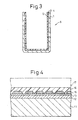
- Fig. 3 is a schematic longitudinal sectional view of a laminated container of the present invention.
- Fig. 4 is a schematic sectional view of a still another steel sheet for a laminated container of the present invention.
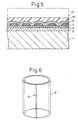
- Fig. 5 is a schematic sectional view of a further steel sheet for a laminated container of the present invention.
- Fig. 6 is a schematic view of another laminated container of the present invention.
- the substrate used in the present invention is not specifically limited, and a steel sheet usually used as a material for container is used.
- the method of producing this substrate and the material thereof are not specifically limited, and the substrate is commonly produced by way of a steel ingot manufacturing process, a hot rolling process, a pickling process, and a cold rolling process.
- a steel sheet for a laminated container which is superior in canning processability and is also superior in weldability, corrosion resistance and film adhesion properties, can be obtained by providing a surface-treatment layer containing Sn, Ni, Fe, Cr and hydrated Cr oxide on the substrate sheet.
- the method of forming the surface-treatment layer containing Sn, Ni, Fe, Cr and hydrated Cr oxide on the substrate is not specifically limited.
- known techniques such as electroplating method, vacuum deposition method and sputtering method may be used and a heat treatment for forming a diffusion layer may also be used in combination.
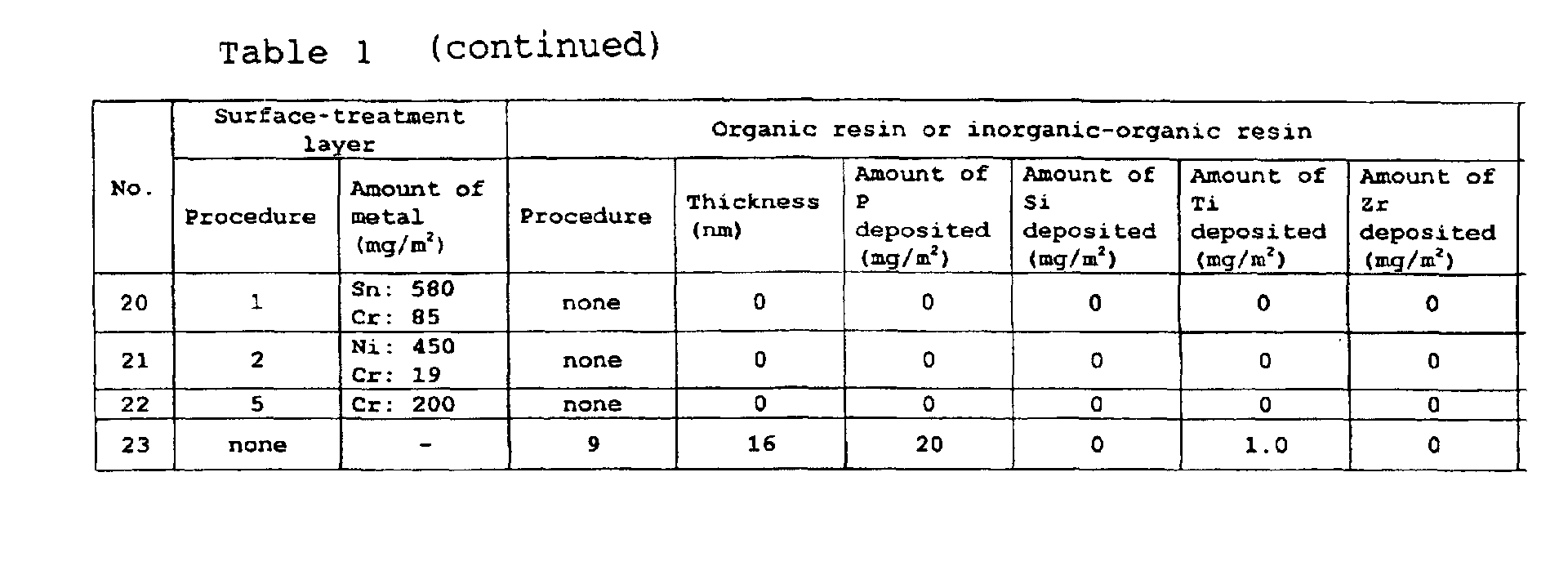
- the surface-treatment layer containing Sn, Ni, Fe, Cr and hydrated Cr oxide thus formed preferably contains Sn in the amount within a range from 80 to 6000 mg/m 2 calculated in terms of metallic Sn, Ni in the amount within a range from 10 to 800 mg/m 2 calculated in terms of metallic Ni, Fe in the amount within a range from 10 to 800 mg/m 2 calculated in terms of metallic Fe, and Cr and hydrated Cr oxide in the amount within a range from 2 to 200 mg/m 2 calculated in terms of metallic Cr.
- Sn exhibits excellent processability and weldability. If severe processing (e.g. drawing, ironing, etc.) must be preformed to reduce the thickness of the sheet to not more than half or to not more than one-third, the Sn layer can impart excellent properties, which is preferred. This effect is particularly remarkable when the Sn layer alone is formed, but is also exerted even in combination with an other plating layer in view of other properties.
- the amount of Sn deposited is preferably not less than 80 mg/m 2 calculated in terms of metallic Sn. To secure the weldability, the amount of Sn is not less than 200 mg/m 2 , and to secure a sufficient processability, the amount is more preferably not less than 1000 mg/m 2 .
- the amount of Sn is preferably not more than 6000 mg/m 2 calculated in terms of metallic Sn.
- Ni and Fe exhibit their effects in the film adhesion properties, corrosion resistance and weldability. To exert these effects, it is preferred that Ni or Fe is deposited in the amount of not less than 10 mg/m 2 calculated in terms of metallic Ni or Fe. With the increase in the amount of Ni or Fe, the effect of improving the film adhesion properties, corrosion resistance and weldability of Ni or Fe is enhanced. However, if the amount is 800 mg/m 2 or more, the improving effect is saturated and it is economically disadvantageous. Accordingly, the amount of Ni or Fe is preferably not less than 10 mg/m 2 and not more than 800 mg/m 2 calculated in terms of metallic Ni or Fe.
- Cr and hydrated Cr oxide which exert excellent film adhesion properties and corrosion resistance, are contained in an amount within a range from 2 to 200 mg/m 2 calculated in terms of metallic Cr. If the amount of Cr and hydrated Cr oxide deposited is not more than 2 mg/m 2 calculated in terms of metallic Cr, adhesion properties are poor. Accordingly, the amount of Cr and hydrated Cr oxide is preferably not less than 2 mg/m 2 calculated in terms of metallic Cr. As the amount of Cr and hydrated Cr oxide increases, the effect of improving the film adhesion properties and corrosion resistance is correspondingly enhanced. However, if the amount exceeds 200 mg/m 2 , the weldability tends to be deteriorated. Therefore, the amount of Cr and hydrated Cr oxide is preferably not more than 200 mg/m 2 calculated in terms of metallic Cr.
- an organic resin or inorganic-organic resin is provided as an essential feature of the present invention.
- a steel sheet for a laminated container which is superior in canning processability to the prior art and is particularly superior in film adhesion properties, processed film adhesion properties and corrosion resistance, can be obtained by providing the organic resin or inorganic-organic resin in combination with the surface-treatment layer containing at least one of Sn, Ni, Fe, Cr and hydrated Cr oxide.
- the organic resin coating formed in the present invention exerts an effect of forming a coherent bond with the film laminated or an adhesive layer thereof, thereby to secure high adhesion properties, as described above.
- the resin capable of obtaining this effect include epoxy-based resin, phenol-based resin, urethane-based resin, vinyl-based resin, ester-based resin, and styrene-based resin.
- a phenol-based resin exerts particularly excellent performances.
- the phenol-based resin can be prepared by a conventional method and is prepared, for example, by polycondensation of a phenol compound, a naphthol compound or bisphenols and formaldehyde.
- the organic resin of the present invention exerts its effect even when mixed with various resins, but preferably contains the content of a phenol resin in an amount of not less than 70% to exert the excellent properties of the phenol-based resin.
- An inorganic compound contained in this resin has an effect capable of remarkably improving the film adhesion properties and corrosion resistance.
- the inorganic compound include phosphoric acid-based compound, organosilicon compounds, sulfuric acid-based compounds, halogen compounds, chloric acid-based compounds, and nitric acid-based compounds.
- phosphoric acid-based compounds and organosilicon compounds exert particularly high effects of improving the film adhesion properties and corrosion resistance.
- Examples of the phosphoric compounds having this improving effect include phosphoric acid or salts thereof, condensed phosphoric acid or salts thereof, zirconium phosphate, and titanium phosphate.
- Examples of the salts include ammonium salt, alkali metal salts such as sodium salt and potassium salt.
- organosilicon compound examples include vinylethoxysilane, aminopropyltriethoxysilane, mercaptopropyltrimethoxysilane, methacryloxypropyltriethoxysilane, and ⁇ -glycidoxypropyltrimethoxysilane.
- the presence of one or more of the phosphoric acid-based compounds or organosilicon compounds exerts a remarkable improvement in film adhesion properties and corrosion resistance.
- the phosphoric acid-based compound preferably exists in an amount of not less than 0.1 mg/m 2 calculated in terms of P and the organosilicon compound preferably exists in an amount of not less than 0.1 mg/m 2 calculated in terms of Si.
- the content of the phosphoric acid-based compound or organosilicon compound in the resin increases, it is economically disadvantageous. Therefore, the content of the phosphoric acid-based compound or organosilicon compound is preferably adjusted to not more than 200 mg/m 2 calculated in terms of P or Si.
- the content of Ti or Zr or one or more compounds thereof in the inorganic-organic resin is preferably within a range from 0.2 to 300 mg/m 2 calculated in terms of Ti or Zr. If the content of Ti or Zn is smaller than 0.2 mg/m 2 , the effect of improving the film adhesion properties and corrosion resistance is small. On the other hand, if the content exceeds 300 mg/m 2 , it becomes economically disadvantageous. Therefore, the content of Ti or Zr or one or more compounds thereof in the inorganic-organic resin is preferably within a range from 0.2 to 300 mg/m 2 calculated in terms of Ti or Zr.
- the method of incorporating one or more of Ti or Zr or compounds thereof into the inorganic-organic resin is not specifically limited.
- the method can be performed by incorporating a Ti compound or a Zr compound into a treating solution described below and dipping a steel sheet in the treating solution.
- the Ti compound is not specifically limited, but a Ti salt is preferred in view of practical use or performances. Examples of the Ti salt include titanium phosphate, titanium hydrofluoric acid and lithium, sodium, ammonium and other salts thereof, titanium sulfate, and titanyl sulfate.
- the Zr compound is not specifically limited, but a Zr salt is preferred in view of practical use or performances.
- the Zr salt include zirconium phosphate, zirconium hydrofluoric acid and lithium, sodium, ammonium and other salts thereof, zirconium sulfate, zirconyl sulfate, and zirconyl nitrate.
- the inorganic-organic resin layer can be obtained by dipping in a treating solution prepared by mixing the above-described organic resin (e.g. epoxy-based resin, phenol-based resin, urethane-based resin, vinyl-based resin, ester-based resin, styrene-based resin, etc.) with the above-described phosphoric acid-based compound, organosilicon compound or Ti compound or Zr compound, followed by squeezing using a ringer roll and further drying.
- a treating solution prepared by mixing the above-described organic resin (e.g. epoxy-based resin, phenol-based resin, urethane-based resin, vinyl-based resin, ester-based resin, styrene-based resin, etc.) with the above-described phosphoric acid-based compound, organosilicon compound or Ti compound or Zr compound, followed by squeezing using a ringer roll and further drying.
- organic resin e.g. epoxy-based resin, phenol-based resin, ure
- the laminating film is not specifically limited and may be a known laminating film.
- a laminating film made of polyethylene, polycarbonate and polyester can be used.
- the thickness of the film is not specifically limited. Generally, a film having a thickness within a range from 5 to 40 ⁇ m is used.
- the laminating method is not specifically limited.
- the method of laminating by softening with heating is preferred but an adhesive may be used.
- Fig. 1 The resulting steel sheet for a laminated container according to the present invention is schematically shown in Fig. 1 and Fig. 2.
- Fig. 1 shows an example of a steel sheet for a laminated container, in which a Ni plating layer 2 is formed on the surface of a steel sheet 1 and an organic resin layer 4 is formed thereon.
- Fig. 2 shows another example of a steel sheet for a laminated container, in which a Sn plating layer 2 is formed on the surface of a steel sheet 1 and a chromate plating layer 3 is formed thereon, and an inorganic-organic resin layer 4 is further formed thereon.
- the number and combination of plating layers are not specifically limited, though one or two plating layers were formed in Fig. 1 and Fig. 2. However, it is preferred to have an Sn plating layer for particularly severe shaping process.
- Container made of a laminated steel sheet
- FIG. 3 An example using the steel sheet for a laminated container of the present invention is shown in Fig. 3.
- the container made of the laminated steel sheet of the present invention can be applied to any of a two-piece can and a three-piece can and is not limited to the example of Fig. 3, as a matter of course.
- a laminating film 5 is laminated on a surface-treating layer and an organic resin layer or an inorganic-organic resin layer 2 to 4 of the steel sheet for a laminated container shown in Fig. 2.
- a closed-end can 6 is formed by deep drawing, as shown in Fig. 3.
- a closed can is completed, after optionally necking or flanging this closed-end can 6, by curling with a cap (not shown) made of steel or Al.
- the laminating film 5 of the present invention is formed on the inside 7 of the can.
- the outside of the can is also provided with a laminating film or with a coating layer, but its construction does not cause any problem in the present invention.
- the adhesion of the laminated film to the steel sheet is not deteriorated even if a severe shaping process such as drawing is performed. Because of excellent corrosion resistance and weldability, even when used as a beverage can and stored for a long period, unpleasant odor and taste due to organic materials are not caused.
- the steel sheet for a laminated container having particularly excellent weldability as a second aspect which is a preferred embodiment of the first aspect of the present invention, will be described in detail below.
- the substrate to be used may be the same as that described previously.
- a steel sheet for a laminated container which is superior in weldability and is also superior in film adhesion properties and corrosion resistance, as a second aspect of the present invention, is provided by forming on a steel sheet, a Ni-based plating layer, an Sn-based alloy layer and an Sn-based plating layer in this order from the steel sheet, preferably, further forming a chromate layer thereon, and further an organic resin layer or an inorganic-organic resin layer thereon.
- Examples of a Ni-based plating to be applied onto the substrate include a Ni plating, a Fe-Ni alloy plating, and an Ni diffusion plating, and the Ni plating or Fe-Ni alloy plating may be performed by a known electroplating method.
- the Ni diffusion plating may be performed by Ni plating and then a heat treatment at 600-1000°C to form a Ni diffusion layer.
- a temper rolling may also be performed after forming the Ni diffusion layer, which does not depart from the essence of the present invention.
- the Ni plating layer plays a role of providing a corrosion resistance of the steel sheet of the present invention utilizing excellent corrosion resistance of metallic Ni itself. If the amount of Ni plated is smaller than 5 mg/m 2 , the resulting steel sheet does not have excellent corrosion resistance of metallic Ni itself. Therefore, the amount of not less than 5 mg/m 2 of the Ni plating is required. On the other hand, as the amount of Ni increases, the corrosion resistance is more improved. However, if the amount of Ni exceeds 500 mg/m 2 , the improving effect is saturated and, therefore, it is economically disadvantageous. Accordingly, the amount of Ni is controlled to not less than 5 mg/m 2 and not more than 500 mg/m 2 .
- Sn plating is then applied. Since Sn is a soft metal, a chromate or phenol resin layer described below is broken when interposed between electrodes during seam welding, thereby making it possible to secure good electric conduction regions. Therefore, good weldability (particularly resistance weldability) can be secured in the steel sheet of the present invention.
- An Sn plating may be performed by a known method such as Sn electroplating and is not specifically limited.
- the amount of Sn plating of not less than 100 mg/m 2 is required.
- the reason is as follows. That is, if the amount of Sn is smaller than 100 mg/m 2 , high-speed weldability required to industrial production is deteriorated and, therefore, the amount of Sn of not less than 100 mg/m 2 is required.
- the weldability of the steel sheet of the present invention is improved as the amount of Sn increases. On the other hand, if the amount of Sn exceeds 1500 mg/m 2 , the improving effect is saturated. Therefore, it is economically disadvantageous. Accordingly, the amount of Sn is controlled within a range from 100 to 1500 mg/m 2 .
- the Sn plating is followed by an Sn reflowing treatment, to form an Sn alloy layer and a dispersed Sn plating layer ("dispersed Sn (plating layer)" referred to as "a layer of Sn island regions" in this specification.) thereon.
- the Sn reflowing treatment is performed for two purposes.
- One purpose is to alloy the Ni plating layer formed previously with Sn, thereby improving the corrosion resistance, while another object is to form a dispersed Sn, thereby improving high-temperature adhesion properties of the film.
- the temperatures rises up to above the melting point of Sn, so that Sn turns into a liquid state and the film adhesion property is drastically deteriorated.
- the area ratio of dispersed Sn is controlled to 95% or less to secure the film adhesion properties at a high temperature. If the area ratio of Sn exceeds 95%, Sn is excessively exposed and the film adhesion property at a high temperature is deteriorated and, therefore, the area ratio of Sn must be controlled to 95% or less. As the area ratio of Sn is reduced, the effect of improving the film adhesion properties at high temperature is more enhanced. However, if the area ratio of Sn is smaller than 40%, excellent weldability of the metallic Sn is deteriorated and, therefore, the area ratio of Sn must be controlled to 40% or more.
- the method of dispersing Sn is not specifically limited, and the Sn-coated steel sheet may be heated to the melting point of Sn or higher by electrically or inductionally heating. In this heating, dispersion is accelerated by using a very low concentration of a flux, or water in place of the flux. Therefore, by controlling the flux concentration, dispersed Sn with a desired area ratio can be obtained.
- the Sn plating is preferably followed by formation of a chromate layer to attain more excellent film adhesion property and corrosion resistance.
- the chromate layer comprises hydrated Cr oxide, or hydrated Cr oxide and metallic Cr. It is necessary that the amount of hydrated Cr oxide deposited is not less than 2 mg/m 2 calculated in terms of metallic Cr and the amount of the entire chromate layer is within a range from 4 to 40 mg/m 2 calculated in terms of metallic Cr. This reason is as follows. This is because hydrated Cr oxide is indispensable to secure an excellent adhesion property. When the amount of hydrated Cr oxide deposited is not less than 2 mg/m 2 calculated in terms of metallic Cr, the effect of improving the adhesion property is attained.
- the chromate layer preferably exists in an amount of not less than 4 mg/m 2 calculated in terms of metallic Cr.
- the amount of the chromate layer is smaller than 4 mg/m 2 , excellent corrosion resistance of Cr is not attained and sufficient corrosion resistance is less likely to be secured.
- the amount of chromate increases, the effect of improving the corrosion resistance is also more enhanced.
- the chromate layer is an insulating coating, the weldability is rapidly deteriorated if the amount exceeds 40 mg/m 2 calculated in terms of metallic Cr. Accordingly, the amount of the chromate layer is desirably within a range from 4 to 40 mg/m 2 calculated in terms of metallic Cr.
- the method of forming the chromate layer is not specifically limited and, for example, an electrolytic treatment or a dipping treatment may be performed in a Cr acid solution, a chromic acid-sulfuric acid solution, or a chromic acid-fluoric acid solution.
- a coating made of a phenol-based resin containing a phosphoric acid-based compound in an amount of not less than 0.1 mg/m 2 calculated in terms of P is formed with a thickness of 1 - 500 nm.
- This layer may be the same as that described above.
- This laminating film may be the same as that described above.
- FIG. 4 An example of the steel sheet for a laminated container of the second aspect according to the present invention, as produced above, is schematically shown in Fig. 4 and Fig. 5.
- the numerical reference 11 denotes a steel sheet as the substrate
- 12 denotes a metallic Ni-based plating layer
- 13 denotes a Sn-based alloy layer
- 15 denotes a metallic Sn plating layer
- 16 denotes an organic resin layer.
- the numerical reference 11 denotes a steel sheet as the substrate
- 12 denotes a metallic Ni-based plating layer
- 13 denotes a Sn-based alloy layer
- 14 a dispersed metallic Sn plating layer
- 15 denotes a chromate layer
- 16 denotes an inorganic-organic resin layer.
- the surface-treatment and laminating film side including the metallic Ni-based plating layer 12, Sn-based alloy layer 13, metallic Sn plating layer 15, and organic resin layer or inorganic-organic resin layer 16 of the steel sheet for a laminated container, has been developed with the intention of being used as the inside of the container (beverage can). Accordingly, the opposite side may be optionally provided with a surface print layer or any other layers.
- FIG. 6 an example of a can, produced by welding the steel sheet for a laminated container shown in Fig. 4 or 5, is shown.
- the container as the second aspect according to the present invention is not limited thereto.
- the resulting laminated steel sheet 18 for canning is cut into a predetermined shape for can, and made into a cylindrical shape and then an edge 19 of the cylindrical portion is welded through a known welding process, preferably resistance welding.
- a known welding process preferably resistance welding.
- a substrate having been subjected to annealing and temper rolling after cold rolling was plated with Sn in a ferrostan bath, and then optionally subjected to an electrolytic treatment in a chromic acid-sulfuric acid solution, thereby to provide hydrated Cr oxide thereon.
- a substrate having been subjected to annealing and temper rolling after cold rolling was plated with Ni in a Watts bath, and then optionally subjected to an electrolytic treatment in a chromic acid-sulfuric acid solution, thereby to provide hydrated Cr oxide thereon.
- a substrate having been subjected to cold rolling was plated with Ni in a Watts bath and, after a Ni diffusion layer was formed by annealing, the sheet was optionally subjected to an electrolytic treatment in a chromic acid-sulfuric acid solution, thereby to provide hydrated Cr oxide thereon.
- a substrate having been subjected to annealing and temper rolling after cold rolling was plated with Fe in a sulfuric acid-hydrochloric acid bath, and then optionally subjected to an electrolytic treatment in a chromic acid-sulfuric acid solution, thereby to provide hydrated Cr oxide thereon.
- a substrate having been subjected to annealing and temper rolling after cold rolling was subjected to an electrolytic treatment in a chromic acid-sulfuric acid solution, thereby to provide hydrated Cr oxide thereon.
- a substrate having been subjected to annealing and temper rolling after cold rolling was plated with a Fe-Ni alloy in a sulfuric acid-hydrochloric acid bath, then plated with Sn in a ferrostan bath, subjected to a heat treatment to thereby alloy a portion of the Sn plating layer, and then optionally subjected to an electrolytic treatment in a chromic acid-sulfuric acid solution, thereby to provide hydrated Cr oxide thereon.
- a substrate having been subjected to annealing and temper rolling after cold rolling was plated with a Sn-Ni alloy in a sulfuric acid-hydrochloric acid bath, and then optionally subjected to an electrolytic treatment in a chromic acid-sulfuric acid solution, thereby to provide hydrated Cr oxide thereon.
- the above steel sheet was dipped in a treating solution prepared by dissolving a phenol resin and phosphoric acid and, optionally, titanium ammonium phosphate, and then dried, thereby to form a coating made of an inorganic-organic resin.
- the above steel sheet was dipped in a treating solution prepared by dissolving an urethane resin and monopropyltriethoxysilane and, optionally, zirconium sulfate, and then dried, thereby to form a coating made of an inorganic-organic resin.
- the above steel sheet was dipped in a treating solution prepared by dissolving 85% phenol resin-15% epoxy resin and sodium phosphate and, optionally, titanium sulfate or zirconium sulfate, and then dried, thereby to form a coating made of an inorganic-organic resin.
- the above steel sheet was dipped in a treating solution prepared by dissolving a phenol resin and titanium fluoride, and then dried, thereby to form a coating made of an inorganic-organic resin.
- the above steel sheet was dipped in a treating solution prepared by dissolving 85% phenol resin-15% epoxy resin, and then dried, thereby to form a coating made of an organic resin.
- the above treated materials were laminated with a polyethylene film having a thickness of 20 nm to make test materials, and then the performances thereof were evaluated with respect to the following items (A) to (D).
- weldability was evaluated by four-rank criteria (o ⁇ : very wide, ⁇ : good, ⁇ : poor, X: impossible to weld).
- test material was coated with normal butyl stearate as a lubricant, a cup (140 mm ⁇ ) was punched out from the test material and the drawing and ironing were performed at a draw ratio of 2.1.
- the test material was subjected to a retort treatment at 125°C for 30 minutes and the state of peeling of the film was evaluated by four-rank criteria (o ⁇ : no peel, ⁇ : very slight peel but suitable to be put into practice, ⁇ : slight peel, ⁇ : severe peel).
- a cup 140 mm ⁇ was punched out from the test material and the drawing and ironing were performed in a stepwise manner at a draw ratio of 2.1, thereby to make a can.
- the can was filled with a test solution of a 1.5% citric acid-1.5% sodium chloride mixed solution and provided with a closure, and then allowed to stand in a temperature-controlled chamber at 55°C for one month.
- the state of corrosion on the in side of the can was evaluated by four-rank criteria (o ⁇ : no corrosion is recognized, ⁇ : such a very slight corrosion but sufficiently low to be put into practice is recognized, ⁇ : slight corrosion is recognized, ⁇ : severe corrosion is recognized).
- a substrate having been subjected to annealing and temper rolling after cold rolling was electroplated with a Fe-Ni alloy, plated with Sn in a ferrostan bath, subjected to a heat treatment with a low concentration of a flux, thereby to form dispersed Sn, and then optionally subjected to an electrolytic treatment in a chromic acid-sulfuric acid solution, thereby to provide a chromate layer thereon.
- a substrate having been subjected to Ni plating by electrical plating, annealing and temper rolling after cold rolling was plated with Sn in a halogen bath, subjected to a heat treatment, thereby to form dispersed Sn, and then optionally subjected to an electrolytic treatment in a chromic acid-sulfuric acid solution, thereby to provide a chromate layer thereon.
- the above steel sheet was dipped in a treating solution prepared by dissolving a phenol resin and phosphoric acid and, optionally, titanium ammonium phosphate, and then dried, thereby to form a coating made of a phenol-based resin thereon.
- the above treated materials were laminated with a polyethylene film having a thickness of 20 nm at 200°C to make a test material, and then performances thereof were evaluated with respect to the following items.
- the weldability test was the same as that in Example 1.
- test material After stretching by 10%, the test material was subjected to a retort treatment at 125°C for 30 minutes and the state of peeling of the film was evaluated by four-rank criteria (o ⁇ : no peel, ⁇ : such a very slight peel but sufficiently low to be put into practice, ⁇ : slight peel, ⁇ : severe peel).
- a can was made by welding the bonding portion of a cylindrical body, as shown in Fig. 6, and providing a side with EOE (easy open end) made of Al.
- the can was filled with a test solution of a 1.5% citric acid-1.5% sodium chloride mixed solution and provided with a closure, and then allowed to stand in a temperature-controlled chamber at 55°C for one month.
- the state of corrosion on the inside of the can was evaluated by four-rank criteria (o ⁇ : no corrosion is recognized, ⁇ : very slight corrosion but sufficiently low to be put into practice is recognized, ⁇ : slight corrosion is recognized, X: severe corrosion is recognized).
- the test material was provided with a crosscut, which reaching the substrate steel, heated rapidly to 250°C, and then air (5 atm) was blown into the center of the crosscut.
- the state of peeling of the film was evaluated by four-rank criteria (o ⁇ : no peel, ⁇ : very slight peel but sufficiently low to be put into practice, ⁇ : slight peel, ⁇ : severe peel).
- the steel sheet for a laminated container of the present invention and the container using the same have excellent adaptability to a severe canning process as well as excellent film adhesion properties, corrosion resistance and weldability. Therefore, they are particularly useful as a container (can) for beverages and materials therefor.
Landscapes
- Chemical & Material Sciences (AREA)
- Chemical Kinetics & Catalysis (AREA)
- Engineering & Computer Science (AREA)
- Materials Engineering (AREA)
- Mechanical Engineering (AREA)
- Metallurgy (AREA)
- Organic Chemistry (AREA)
- Inorganic Chemistry (AREA)
- Other Surface Treatments For Metallic Materials (AREA)
- Laminated Bodies (AREA)
Abstract
Description
- (1) to (8), wherein said surface-treatment layer containing one or more of Sn, Ni, Fe, Cr and hydrated Cr oxide comprises Sn in an amount within a range from 80 to 6000 mg/m2 calculated in terms of the metallic Sn, Ni in an amount within a range from 10 to 800 mg/m2 calculated in terms of the metallic Ni, Fe in an amount within a range from 10 to 800 mg/m2 calculated in terms of the metallic Fe, or Cr and hydrated Cr oxide in an amount within a range from 2 to 200 mg/m2 calculated in terms of the metallic Cr. Similarly, in order to attain more improved weldability, film adhesion property and corrosion resistance, the present inventors have intensively studied about a coating utilizing an organic resin as a new coating in place of the chromate coating, formed on a dispersed Sn plating formed on an Ni plating layer, which are in turn formed on the surface of a steel sheet. As a result, they have found that the coating utilizing the organic resin forms a very strong coherent bond with a laminating film to be formed on the coating and also exhibits excellent adhesion property as compared with a conventional chromate coating and that if a chromate-treated layer also exists, more excellent adhesion property and corrosion resistance are attained, thus leading to the invention of the second aspect as preferred embodiment of the present invention.Therefore, the present invention provides the followings in the second aspect.
- (10) A steel sheet for a laminated container, characterized by having, on at least one surface of a steel sheet, in order, a Ni-based plating layer containing Ni in an amount within a range from 5 to 500 mg/m2 calculated in terms of the metallic Ni, an Sn-based alloy layer, and a metallic Sn plating layer in an amount within a range from 100 to 1500 mg/m2, and further thereon a coating made of a phenol-based resin having a thickness within a range from 1 to 500 nm, said phenol-based resin containing a phosphoric acid-based compound in an amount of not less than 0.1 mg/m2 calculated in terms of P.
- (11) A steel sheet for a laminated container, characterized by having, on at least one surface of a steel sheet, in order, a Ni-based plating layer containing Ni in an amount within a range from 5 to 500 mg/m2 calculated in terms of the metallic Ni, an Sn-based alloy layer and a dispersed metallic Sn plating layer in an amount within a range from 100 to 1500 mg/m2, and further thereon a coating made of a phenol-based resin having a thickness within a range from 1 to 500 nm, said phenol-based resin containing a phosphoric acid-based compound in an amount of not less than 0.1 mg/m2 calculated in terms of P.
- (12) A steel sheet for a laminated container, characterized by having, on at least one surface of a steel sheet, in order, a Ni-based plating layer containing Ni in an amount within a range from 5 to 500 mg/m2 calculated in terms of the metallic Ni, an Sn-based alloy layer, and a dispersed metallic Sn plating layer in an amount within a range from 100 to 1500 mg/m2, and further comprising on said dispersed metallic Sn plating layer, a chromate layer in an amount within a range from 4 to 40 g/m2 calculated in terms of the metallic Cr, and further thereon a coating made of a phenol-based resin having a thickness within a range from 1 to 500 nm, said phenol-based resin containing a phosphoric acid-based compound in an amount within a range from 0.1 to 200 mg/m2 calculated in terms of P.
- (13) A steel sheet for a laminated container, characterized by having, on at least one surface of a steel sheet, in order, a Ni-based plating layer containing Ni in an amount within a range from 5 to 500 mg/m2 calculated in terms of the metallic Ni, an Sn-based alloy layers and a dispersed metallic Sn plating layer in an amount within a range from 100 to 1500 mg/m2, and further thereon a coating made of a phenol-based resin having a thickness within a range from 1 to 500 nm, said phenol-based resin containing a phosphoric acid-based compound in an amount of not less than 0.1 mg/m2 calculated in terms of P and further containing one or more of Ti or Zr or compounds thereof in an amount within a range from 0.2 to 300 mg/m2 calculated in terms of the metal.
- (14) A steel sheet for a laminated container, characterized by having, on at least one surface of a steel sheet, in order, a Ni-based plating layer containing Ni in an amount within a range from 5 to 500 mg/m2 calculated in terms of the metallic Ni, an Sn-based alloy layer and a dispersed metallic Sn plating layer in an amount within a range from 100 to 1500 mg/m2, and further comprising on said dispersed metallic Sn plating layer, a chromate layer in an amount within a range from 4 to 40 g/m2 calculated in terms of the metallic Cr, and thereon a coating made of a phenol-based resin having a thickness within a range from 1 to 500 nm, said phenol-based resin containing a phosphoric acid-based compound in an amount within a range from 0.1 mg/m2 to 200 mg/m2 calculated in terms of P and further containing one or more of Ti or Zr or compounds thereof in an amount within a range from 0.2 to 300 mg/m2 calculated in terms of the metal.
- (15) The steel sheet for a laminated container of any one of (11) to (14), wherein an area ratio of the dispersed Sn is within a range from 40 to 95%.
- (16) The steel sheet for a laminated according to (12) or (14), wherein said chromate layer contains at least hydrated Cr oxide in an amount of not less than 2 mg/m2 calculated in terms of the metallic Cr. According to the present invention, there are also provided a method of producing a can using these steel sheets for a laminated container, and a can obtained therefrom.
- (17) A method of producing a can using a laminated steel sheet, which comprises producing a can by a drawing or ironing process using said steel sheet for a laminated container of any one of (1) to (9).
- (18) A method of producing a can using a laminated steel sheet, which comprises producing a can by a welding process using said steel sheet for a laminated container of any one of (10) to (16).
- (19) A can made of a laminated steel sheet, which is produced by a drawing or ironing process using said steel sheet for a laminated container of any one of (1) to (9).
- (20) A can made of a laminated steel sheet, comprising a welded portion, using said steel sheet for a laminated container of any one of (10) to (16).




Claims (20)
- A steel sheet for a laminated container having excellent canning processability characterized by having, on at least one surface of a steel sheet, a surface-treatment layer containing one or more of Sn, Ni, Fe, Cr and hydrated Cr oxide, and thereon a coating made of an organic resin or inorganic-organic resin having a thickness within a range from 1 to 500 nm.
- The steel sheet for a laminated container according to claim 1, wherein said coating of the organic resin is a coating of an organic resin containing one or more of phosphoric acid-based compounds in an amount of not less than 0.1 mg/m2 calculated in terms of P and organosilicon compounds in an amount of not less than 0.1 mg/m2 calculated in terms of Si.
- The steel sheet for a laminated container according to claim 1, wherein said coating of the organic resin is a coating of a phenol-based resin containing one or more of phosphoric acid-based compounds in an amount of not less than 0.1 mg/m2 calculated in terms of P and organosilicon compounds in an amount of not less than 0.1 mg/m2 calculated in terms of Si.
- The steel sheet for a laminated container according to claim 1, wherein said coating of the inorganic-organic resin is a coating of an inorganic-organic resin containing one or more of Ti or Zr or compounds thereof in an amount within a range from 0.2 to 300 mg/m2 calculated in terms of the metal.
- The steel sheet for a laminated container according to claim 1, wherein said coating of the inorganic-organic resin is a coating of a phenol-based resin containing one or more of Ti or Zr or compounds thereof in an amount within a range from 0.2 to 300 mg/m2 calculated in terms of metal.
- The steel sheet for a laminated container according to claim 1, wherein said coating of the inorganic-organic resin is a coating of an inorganic-organic resin which contains one or more of Ti or Zr or compounds thereof in an amount within a range from 0.2 to 300 mg/m2 calculated in terms of the metal and further contains one or more of phosphoric acid-based compounds in an amount of not less than 0.1 mg/m2 calculated in terms of P and organosilicon compounds in an amount of not less than 0.1 mg/m2 calculated in terms of Si.
- The steel sheet for a laminated container according to claim 1, wherein said coating made of the inorganic-organic resin is a coating of a phenol-based resin which contains one or more of Ti or Zr or compounds thereof in an amount within a range from 0.2 to 300 mg/m2 calculated in terms of the metal and further contains one or more of phosphoric acid-based compounds in an amount of not less than 0.1 mg/m2 calculated in terms of P and organosilicon compounds in an amount of not less than 0.1 mg/m2 calculated in terms of Si.
- The steel sheet for a laminated container according to claim 3, 5 or 7, wherein the content of the phenol resin in the coating of the phenol-based resin is not less than 70%.
- The steel sheet for a laminated container having excellent canning processability according to any one of claims 1 to 8, wherein said surface-treatment layer containing one or more of Sn, Ni, Fe, Cr and hydrated Cr oxide comprises Sn in an amount within a range from 80 to 6000 mg/m2 calculated in terms of the metallic Sn, Ni in an amount within a range from 10 to 800 mg/m2 calculated in terms of the metallic Ni, Fe in an amount within a range from 10 to 800 mg/m2 calculated in terms of the metallic Fe, or Cr and hydrated Cr oxide in an amount within a range from 2 to 200 mg/m2 calculated in terms of the metallic Cr.
- A steel sheet for a laminated container, characterized by having, on at least one surface of a steel sheet, in order, a Ni-based plating layer containing Ni in an amount within a range from 5 to 500 mg/m2 calculated in terms of the metallic Ni, an Sn-based alloy layer, and a metallic Sn plating layer in an amount within a range from 100 to 1500 mg/m2, and further thereon a coating made of a phenol-based resin having a thickness within a range from 1 to 500 nm, said phenol-based resin containing a phosphoric acid-based compound in an amount of not less than 0.1 mg/m2 calculated in terms of P.
- The steel sheet for a laminated container according to claim 10, wherein said metallic Sn plating layer is a dispersed metallic Sn plating layer.
- The steel sheet for a laminated container according to claim 11, further comprising on said dispersed metallic Sn plating layer, a chromate layer in an amount within a range from 4 to 40 g/m2 calculated in terms of the metallic Cr and further thereon said phenol-based resin coating layer, said phenol-based resin coating layer being a coating made of a phenol-based resin containing a phosphoric acid-based compound in an amount within a range from 0.1 to 200 mg/m2 calculated in terms of P.
- The steel sheet for a laminated container according to claim 11, wherein said phenol-based resin coating layer is a coating layer made of a phenol-based resin which contains a phosphoric acid-based compound in an amount of not less than 0.1 mg/m2 calculated in terms of P and also contains one or more of Ti or Zr or compounds thereof in an amount within a range from 0.2 to 300 mg/m2 calculated in terms of the metal.
- The steel sheet for a laminated container according to claim 12, wherein said phenol-based resin coating layer is a coating layer made of a phenol-based resin containing one or more of Ti or Zr or compounds thereof in an amount within a range from 0.2 to 300 mg/m2 calculated in terms of the metal, in addition to said phosphoric acid-based compound.
- The steel sheet for a laminated container according to any one of claims 11 to 14, wherein an area ratio of dispersed Sn in said dispersed metallic Sn plating layer is within a range from 40 to 95%.
- The steel sheet for a laminated container according to claim 12 or 14, wherein said chromate layer contains at least hydrated Cr oxide in an amount of not less than 2 mg/m2 calculated in terms of the metallic Cr.
- A method of producing a can using a laminated steel sheet, which comprises producing a can by a drawing or ironing process using said steel sheet for a laminated container of any one of claims 1 to 9.
- A method of producing a can using a laminated steel sheet, which comprises producing a can by a welding process using said steel sheet for a laminated container of any one of claims 10 to 16.
- A can made of a laminated steel sheet, which is produced by a drawing or ironing process using said steel sheet for a laminated container of any one of claims 1 to 9.
- A can made of a laminated steel sheet, comprising a welded portion, using said steel sheet for a laminated container of any one of claims 1 to 9.
Applications Claiming Priority (3)
| Application Number | Priority Date | Filing Date | Title |
|---|---|---|---|
| JP19405299 | 1999-07-08 | ||
| JP19405299A JP3742533B2 (en) | 1998-12-14 | 1999-07-08 | Steel sheet for laminated containers with excellent can-making processability |
| PCT/JP2000/004556 WO2001004380A1 (en) | 1999-07-08 | 2000-07-07 | Steel plate for laminated container, and method for producing can using the same and can |
Publications (2)
| Publication Number | Publication Date |
|---|---|
| EP1134305A1 true EP1134305A1 (en) | 2001-09-19 |
| EP1134305A4 EP1134305A4 (en) | 2008-07-23 |
Family
ID=16318158
Family Applications (1)
| Application Number | Title | Priority Date | Filing Date |
|---|---|---|---|
| EP00944342A Withdrawn EP1134305A4 (en) | 1999-07-08 | 2000-07-07 | STEEL SHEET FOR SHEET CONTAINER AND BOX MANUFACTURING METHOD USING THE SAME AND ASSOCIATED BOX |
Country Status (2)
| Country | Link |
|---|---|
| EP (1) | EP1134305A4 (en) |
| WO (1) | WO2001004380A1 (en) |
Cited By (4)
| Publication number | Priority date | Publication date | Assignee | Title |
|---|---|---|---|---|
| US20120183753A1 (en) * | 2011-01-18 | 2012-07-19 | Shigeru Hirano | Steel sheet for container having excellent organic film performance and process for producing the same |
| EP2071055A4 (en) * | 2006-09-08 | 2016-03-16 | Nippon Steel & Sumitomo Metal Corp | STEEL PLATE FOR CONTAINER AND METHOD FOR MANUFACTURING THE SAME |
| CN105408526A (en) * | 2013-07-24 | 2016-03-16 | 杰富意钢铁株式会社 | Steel sheet for container |
| EP4029797A4 (en) * | 2019-09-13 | 2023-06-14 | Daiwa Can Company | METHOD OF MAKING A TWO-PART CAN, CAN DRUM AND METAL SHEET |
Families Citing this family (1)
| Publication number | Priority date | Publication date | Assignee | Title |
|---|---|---|---|---|
| RU2356808C2 (en) * | 2007-06-21 | 2009-05-27 | Федеральное государственное унитарное предприятие "Российский Федеральный Ядерный Центр-Всероссийский Научно-Исследовательский Институт Технической Физики имени академика Е.И. Забабахина" (ФГУП "РФЯЦ-ВНИИТФ им. академ. Е.И. Забабахина") | Protection vessel for storing chemicals |
Family Cites Families (6)
| Publication number | Priority date | Publication date | Assignee | Title |
|---|---|---|---|---|
| JPS60168643A (en) * | 1984-02-14 | 1985-09-02 | 東洋製罐株式会社 | Coated steel plate for drawing die can and drawing die can |
| JPS60170532A (en) * | 1984-02-14 | 1985-09-04 | Kishimoto Akira | Manufacturing method of squeezed iron can |
| AU652630B2 (en) * | 1991-05-17 | 1994-09-01 | Daiwa Can Company Limited | Steel strip for three-piece can body, production process thereof and resistance seam welded three-piece can body |
| JP3093917B2 (en) * | 1993-11-11 | 2000-10-03 | 東洋鋼鈑株式会社 | Laminated steel sheet and its original sheet |
| JP3218927B2 (en) * | 1995-06-16 | 2001-10-15 | 日本鋼管株式会社 | Surface-treated steel sheet for painted or film-laminated two-piece can with excellent work adhesion and work corrosion resistance, and method for producing the same |
| JP3051670B2 (en) * | 1995-11-02 | 2000-06-12 | 東洋鋼鈑株式会社 | Manufacturing method of laminated steel sheet, laminated steel sheet and surface-treated steel sheet used therefor |
-
2000
- 2000-07-07 EP EP00944342A patent/EP1134305A4/en not_active Withdrawn
- 2000-07-07 WO PCT/JP2000/004556 patent/WO2001004380A1/en not_active Ceased
Cited By (8)
| Publication number | Priority date | Publication date | Assignee | Title |
|---|---|---|---|---|
| EP2071055A4 (en) * | 2006-09-08 | 2016-03-16 | Nippon Steel & Sumitomo Metal Corp | STEEL PLATE FOR CONTAINER AND METHOD FOR MANUFACTURING THE SAME |
| US20120183753A1 (en) * | 2011-01-18 | 2012-07-19 | Shigeru Hirano | Steel sheet for container having excellent organic film performance and process for producing the same |
| US20150086720A1 (en) * | 2011-01-18 | 2015-03-26 | Nippon Steel & Sumitomo Metal Corporation | Steel sheet for container having excellent organic film performance and process for producing the same |
| US9127341B2 (en) * | 2011-01-18 | 2015-09-08 | Nippon Steel & Sumitomo Metal Corporation | Steel sheet for container having excellent organic film performance and process for producing the same |
| US9752222B2 (en) | 2011-01-18 | 2017-09-05 | Nippon Steel & Sumitomo Metal Corporation | Steel sheet for container having excellent organic film performance and process for producing the same |
| CN105408526A (en) * | 2013-07-24 | 2016-03-16 | 杰富意钢铁株式会社 | Steel sheet for container |
| CN105408526B (en) * | 2013-07-24 | 2018-04-24 | 杰富意钢铁株式会社 | Steel plate for container |
| EP4029797A4 (en) * | 2019-09-13 | 2023-06-14 | Daiwa Can Company | METHOD OF MAKING A TWO-PART CAN, CAN DRUM AND METAL SHEET |
Also Published As
| Publication number | Publication date |
|---|---|
| WO2001004380A1 (en) | 2001-01-18 |
| EP1134305A4 (en) | 2008-07-23 |
Similar Documents
| Publication | Publication Date | Title |
|---|---|---|
| JP5978576B2 (en) | Steel plate for container and method for producing the same | |
| EP2006416B1 (en) | Steel sheet for containers | |
| WO2004053195A1 (en) | Surface-treated metallic material, method of surface treating therefor and resin-coated metallic material, metal can and can lid | |
| WO2005123991A1 (en) | Surface-treated metal material and surface treatment method therefor, resin-coated metal material, can and lid of can | |
| JP2006348360A (en) | Surface-treated metallic plate, method of surface treating thereof and resin-coated metallic plate, metal can and can lid | |
| CN102822387A (en) | Steel sheet for vessel having excellent corrosion resistance | |
| JP4897818B2 (en) | Steel plate for container and manufacturing method thereof | |
| CN103097580B (en) | Steel plate for tanks with excellent corrosion resistance | |
| JP2711947B2 (en) | Method for producing resin-coated tin-plated steel sheet for thinned deep drawn cans with excellent processing corrosion resistance | |
| JP2000226676A (en) | Steel plate for laminated welding can | |
| JP3742533B2 (en) | Steel sheet for laminated containers with excellent can-making processability | |
| WO2001004380A1 (en) | Steel plate for laminated container, and method for producing can using the same and can | |
| JP4293065B2 (en) | Welding cans with excellent resistance to sulfur discoloration and corrosion | |
| JP2010255065A (en) | Surface-treated steel sheet and manufacturing method thereof | |
| JP3034811B2 (en) | Thermoplastic polyester resin coated surface treated steel sheet and method for producing the same | |
| JP4569247B2 (en) | Press-molded cans and lids with excellent resistance to sulfur discoloration and corrosion | |
| JPH0824958A (en) | Resin-coated steel sheet for 2-piece cans | |
| JP2009046754A (en) | Surface treated tinned steel sheet for welded can, and welded can composed thereof | |
| JPH0274333A (en) | Precoated steel plate for di can and manufacture of di can using it | |
| JPH0230526A (en) | Steel sheet for can and can lid, can body and can lid | |
| JP2004285380A (en) | Highly functional steel sheet for containers with excellent adhesion, corrosion resistance, workability, and weldability | |
| JP3745457B2 (en) | Manufacturing method of steel sheet for welding can excellent in weldability, corrosion resistance, appearance and adhesion | |
| JP2014177678A (en) | Manufacturing method of surface-treated steel plate and surface-treated steel plate, resin-coated steel plate, and can and can top | |
| JPH0241594B2 (en) | ||
| JPS634090A (en) | Surface treated steel sheet for producing can |
Legal Events
| Date | Code | Title | Description |
|---|---|---|---|
| PUAI | Public reference made under article 153(3) epc to a published international application that has entered the european phase |
Free format text: ORIGINAL CODE: 0009012 |
|
| 17P | Request for examination filed |
Effective date: 20010406 |
|
| AK | Designated contracting states |
Kind code of ref document: A1 Designated state(s): AT BE CH CY DE DK ES FI FR GB GR IE IT LI LU MC NL PT SE |
|
| AX | Request for extension of the european patent |
Free format text: AL;LT;LV;MK;RO;SI |
|
| RBV | Designated contracting states (corrected) |
Designated state(s): DE GB NL |
|
| A4 | Supplementary search report drawn up and despatched |
Effective date: 20080625 |
|
| RAP1 | Party data changed (applicant data changed or rights of an application transferred) |
Owner name: NIPPON STEEL & SUMITOMO METAL CORPORATION |
|
| 17Q | First examination report despatched |
Effective date: 20171127 |
|
| GRAP | Despatch of communication of intention to grant a patent |
Free format text: ORIGINAL CODE: EPIDOSNIGR1 |
|
| INTG | Intention to grant announced |
Effective date: 20190228 |
|
| RAP1 | Party data changed (applicant data changed or rights of an application transferred) |
Owner name: NIPPON STEEL CORPORATION |
|
| STAA | Information on the status of an ep patent application or granted ep patent |
Free format text: STATUS: THE APPLICATION IS DEEMED TO BE WITHDRAWN |
|
| 18D | Application deemed to be withdrawn |
Effective date: 20190711 |