EP1132464A2 - Verfahren zur Leistungssteigerung mikrobieller Systeme - Google Patents
Verfahren zur Leistungssteigerung mikrobieller Systeme Download PDFInfo
- Publication number
- EP1132464A2 EP1132464A2 EP01105319A EP01105319A EP1132464A2 EP 1132464 A2 EP1132464 A2 EP 1132464A2 EP 01105319 A EP01105319 A EP 01105319A EP 01105319 A EP01105319 A EP 01105319A EP 1132464 A2 EP1132464 A2 EP 1132464A2
- Authority
- EP
- European Patent Office
- Prior art keywords
- stress
- caused
- minutes
- concentration
- intervals
- Prior art date
- Legal status (The legal status is an assumption and is not a legal conclusion. Google has not performed a legal analysis and makes no representation as to the accuracy of the status listed.)
- Withdrawn
Links
Images


Classifications
-
- C—CHEMISTRY; METALLURGY
- C12—BIOCHEMISTRY; BEER; SPIRITS; WINE; VINEGAR; MICROBIOLOGY; ENZYMOLOGY; MUTATION OR GENETIC ENGINEERING
- C12N—MICROORGANISMS OR ENZYMES; COMPOSITIONS THEREOF; PROPAGATING, PRESERVING, OR MAINTAINING MICROORGANISMS; MUTATION OR GENETIC ENGINEERING; CULTURE MEDIA
- C12N1/00—Microorganisms; Compositions thereof; Processes of propagating, maintaining or preserving microorganisms or compositions thereof; Processes of preparing or isolating a composition containing a microorganism; Culture media therefor
- C12N1/38—Chemical stimulation of growth or activity by addition of chemical compounds which are not essential growth factors; Stimulation of growth by removal of a chemical compound
-
- C—CHEMISTRY; METALLURGY
- C12—BIOCHEMISTRY; BEER; SPIRITS; WINE; VINEGAR; MICROBIOLOGY; ENZYMOLOGY; MUTATION OR GENETIC ENGINEERING
- C12N—MICROORGANISMS OR ENZYMES; COMPOSITIONS THEREOF; PROPAGATING, PRESERVING, OR MAINTAINING MICROORGANISMS; MUTATION OR GENETIC ENGINEERING; CULTURE MEDIA
- C12N1/00—Microorganisms; Compositions thereof; Processes of propagating, maintaining or preserving microorganisms or compositions thereof; Processes of preparing or isolating a composition containing a microorganism; Culture media therefor
- C12N1/20—Bacteria; Culture media therefor
Definitions
- the invention relates to a method for increasing performance the protein synthesis rate of a microbial Systems.
- the invention is therefore based on the object Provide procedures that improve performance the protein synthesis rate of a microbial Systems leads.
- the task is accomplished through a performance enhancement process the protein synthesis rate of a microbial System solved, which is characterized in that a external, cyclical stress on this system acts and the intervals from stress and subsequent rest phase less than 45 minutes each be.
- stress can be applied done in different ways:
- Substrates such as lactose, allolactose for inducing ⁇ -galactosidase, or the substrate analogue such as methyl- ⁇ -D-thiogalactoside to induce ⁇ -galactosidase become.
- time intervals of the cyclical stress application are from the microorganism species to be stressed determined. You will also depend on the composition, e.g. the activated sludge that is too stressful Mixed microorganism population, i.e. the biocenosis, determined.
- the protein synthesis performance is further enhanced by the Flow rate and by the induced substrate concentration determined.
- the specified dependencies can be solved by simple Optimize routine tests.
- Process parameters in biological reactor systems can Increases in efficiency and increased stability at Product formation against external interference in surprising and can be achieved advantageously.
- the application of the present invention leads to a especially in technical and economic terms advantageous renovation concept of existing sewage treatment plants, now that potential is being created to save possible extensions. Especially with regard there is a need for action on sewage plant sizes up to approx. because the prevailing EU treatment directive corresponding expansion measures for municipal waste water make necessary.
- the increased selection pressure also improves the training of specialized and particularly robust Microorganism populations, which is why such an operated one Sewage treatment plant also problematic such as Can mineralize cyanides biochemically.
- Another object of the invention is one the inventive method described above, the is characterized in that a temporal modulation with a frequency of up to several days of Cyclical stress application intervals performed becomes. This will result in a long-term increase in performance achieved.
- the modulation frequency will be too stressful Microorganism species, from the composition of the stressful mixed microorganism population, of which Flow rate and the inducing substrate concentration determined.
- Another object of the invention is one the inventive method described above, the is characterized in that protein synthesis with multi-stage sequential protein induction processes is carried out. This could increase the Protein synthesis performance achieved by at least 20% become.
- Figure 1 shows the change in concentrations of a substrate, of enzymes 1, 2 and 3 and of Products 1, 2 and 3.
- Figure 1 shows the simulation results of the genetic model mentioned above.
- Figure 2 shows the result of a computer simulation for the comparison of coordinative and sequential Induction. It follows that a higher mean Enzyme concentration based on the same system in the sequential induction occurs because of the delay times here between induction and repression essential are larger. A biological resonance pattern is shown.
- the mode of operation of sequential induction is therefore especially for multi-stage sequential, catabolic reactions, as they occur in industrial wastewater treatment suitable.
- the investigation was carried out in a continuously completely mixed bioreactor (Chemostat) with skimmed milk powder, with the addition of nutrient salts, as a complex substrate and activated sludge inoculum executed.
- the complex substrate assigned one municipal wastewater similar characteristics in the degradation behavior on.
- the optimal area for biological Degradation of the skimmed milk powder complex substrate was complete a periodic substrate dosing time of 15-21 minutes and through a subsequent hunger phase of 6-12 minutes characterized.
- FIG. 3 shows the results of the variation experiments with the chemostat and the synthetic complex substrate, that is comparable to municipal wastewater. This resulted in the biological resonance pattern shown with an optimum of normalized productivity of more than 70% above the value for continuous Operating mode with a substrate dosing interval of 18 minutes and a subsequent hunger phase of 9 Minutes. The cyclic addition of the substrate in Minute intervals occurred Substrate concentration in the reactor based on what the microorganisms stimulates the mixed population to do so Synthesize enzymes to degrade the starting substrate.
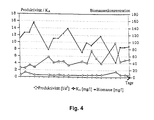
- FIG. 4 shows kinetic parameters according to the biomass inoculum under optimized conditions. The behavior of the biocenosis was examined under optimized conditions with a reduced flow rate.
- K A means the activity constant, which is a measure of the affinity of the genetic regulatory mechanisms for activating protein synthesis by the inducing substrate. The substrate intake was 18 minutes, the hunger phase 9 minutes.
Landscapes
- Chemical & Material Sciences (AREA)
- Health & Medical Sciences (AREA)
- Life Sciences & Earth Sciences (AREA)
- Engineering & Computer Science (AREA)
- Organic Chemistry (AREA)
- Biotechnology (AREA)
- Zoology (AREA)
- Wood Science & Technology (AREA)
- Genetics & Genomics (AREA)
- Bioinformatics & Cheminformatics (AREA)
- Biomedical Technology (AREA)
- Virology (AREA)
- Microbiology (AREA)
- Tropical Medicine & Parasitology (AREA)
- Medicinal Chemistry (AREA)
- Biochemistry (AREA)
- General Engineering & Computer Science (AREA)
- General Health & Medical Sciences (AREA)
- General Chemical & Material Sciences (AREA)
- Preparation Of Compounds By Using Micro-Organisms (AREA)
- Enzymes And Modification Thereof (AREA)
Abstract
Description
Claims (11)
- Verfahren zur Leistungssteigerung der Protein-Syntheserate eines mikrobiellen, prokaryontischen und induzierbaren Systems dadurch gekennzeichnet, dass eine äußere, zyklische Stressbeaufschlagung auf dieses System einwirkt und die Intervalle aus Stressbeaufschlagung und anschließender Ruhephase jeweils weniger als 45 Minuten betragen.
- Verfahren nach Anspruch 1, dadurch gekennzeichnet, dass die Intervalle aus Stressbeaufschlagung und anschließender Ruhephase jeweils 5 bis 30 Minuten betragen.
- Verfahren nach Anspruch 2, dadurch gekennzeichnet, dass die Intervalle aus Stressbeaufschlagung und anschließender Ruhephase jeweils 6 bis 20 Minuten betragen
- Verfahren nach einem der vorhergehenden Ansprüche, dadurch gekennzeichnet, dass die Stressbeaufschlagung durch Konzentrationssprünge des induzierenden Substrats hervorgerufen wird.
- Verfahren nach einem der vorangehenden Ansprüche, dadurch gekennzeichnet, dass die Stressbeaufschlagung durch Konzentrationssprünge von Cofaktoren hervorgerufen wird.
- Verfahren nach einem der vorhergehenden Ansprüche, dadurch gekennzeichnet, dass die Stressbeaufschlagung durch Konzentrationssprünge von Effektoren hervorgerufen wird.
- Verfahren nach einem der vorhergehenden Ansprüche, dadurch gekennzeichnet, dass die Stressbeaufschlagung durch Variation der Durchflussrate hervorgerufen wird.
- Verfahren nach einem der vorhergehenden Ansprüche, dadurch gekennzeichnet, dass die Stressbeaufschlagung durch Änderung des pH-Werts hervorgerufen wird.
- Verfahren nach einem der vorhergehenden Ansprüche, dadurch gekennzeichnet, dass die Stressbeaufschlagung durch Änderung der osmotischen Verhältnisse hervorgerufen wird.
- Verfahren nach einem der vorhergehenden Ansprüche, dadurch gekennzeichnet, dass eine zeitliche Modulierung mit einer Frequenz bis zu mehreren Tagen der Intervalle der zyklischen Stressbeaufschlagung durchgeführt wird.
- Verfahren nach einem der vorhergehenden Ansprüche, dadurch gekennzeichnet, dass die Proteinsynthese mit mehrstufig-sequenziellen Protein-Induktionsabläufen durchgeführt wird.
Applications Claiming Priority (2)
| Application Number | Priority Date | Filing Date | Title |
|---|---|---|---|
| DE2000111728 DE10011728B4 (de) | 2000-03-10 | 2000-03-10 | Verfahren zur Leistungssteigerung mikrobieller Systeme |
| DE10011728 | 2000-03-10 |
Publications (2)
| Publication Number | Publication Date |
|---|---|
| EP1132464A2 true EP1132464A2 (de) | 2001-09-12 |
| EP1132464A3 EP1132464A3 (de) | 2004-04-21 |
Family
ID=7634243
Family Applications (1)
| Application Number | Title | Priority Date | Filing Date |
|---|---|---|---|
| EP01105319A Withdrawn EP1132464A3 (de) | 2000-03-10 | 2001-03-07 | Verfahren zur Leistungssteigerung mikrobieller Systeme |
Country Status (2)
| Country | Link |
|---|---|
| EP (1) | EP1132464A3 (de) |
| DE (1) | DE10011728B4 (de) |
Cited By (1)
| Publication number | Priority date | Publication date | Assignee | Title |
|---|---|---|---|---|
| WO2004053111A1 (ja) | 2002-12-12 | 2004-06-24 | Showa Denko K.K. | 外来遺伝子高発現大腸菌株の選択方法、その方法により選択される大腸菌変異株及びそれを用いる酵素及び化合物の製造方法 |
Families Citing this family (2)
| Publication number | Priority date | Publication date | Assignee | Title |
|---|---|---|---|---|
| DE10330727A1 (de) * | 2003-08-29 | 2005-04-07 | Kretschmer, A., Dipl.-Ing. | Verfahren zur Erhöhung der Biogasausbeute durch Prozessregelung der Biomethanisierung |
| DE102007063091A1 (de) | 2007-12-28 | 2009-07-02 | Right-Way-Technologies Gmbh & Co. Kg | Hybridfermenter zur Erzeugung von methanreichem Biogas |
Family Cites Families (10)
| Publication number | Priority date | Publication date | Assignee | Title |
|---|---|---|---|---|
| DD248140A1 (de) * | 1984-06-05 | 1987-07-29 | Adw Ddr | Fermentationsverfahren |
| DE3538194A1 (de) * | 1985-10-26 | 1987-06-11 | Heinz Doevenspeck | Verfahren zur stoffwechsel- und/oder wachstumssteigernden behandlung von mikroorganismen sowie vorrichtung zur durchfuehrung des verfahrens |
| DE4201948A1 (de) * | 1991-01-25 | 1992-10-01 | Proizv Ob Start | Verfahren zur einwirkung auf lebendige zellen mit wellen eines hoechstfrequenzbereiches |
| DE4107028C2 (de) * | 1991-03-01 | 1999-07-08 | Gerhard Dr Kerns | Verfahren zur Steigerung der Bildung extrazellulärer Enzyme bei der aeroben Submerszüchtung von Pilzen der Klassen Deuteromycetes und Ascomycetes durch Elektrostimulation |
| DE4204590C2 (de) * | 1992-02-15 | 1995-05-04 | Dyckerhoff & Widmann Ag | Verfahren zur biologischen Abwasserreinigung in einem Belebungsbecken |
| DE4239796A1 (de) * | 1992-11-26 | 1994-06-01 | Sienknecht Christian | Verfahren zum Stimulieren von biologischen, insbesondere mikrobiologischen Prozessen |
| DE19743077A1 (de) * | 1997-09-30 | 1999-04-01 | Harald Prof Dr Dr Vos | Verfahren zur Produktion von Esterasen durch Fermentation |
| DE19839584C2 (de) * | 1998-08-31 | 2001-07-05 | Christoph Schulz | Verfahren zur Synchronisation von Zellteilungen und zellzyklusabhängige Herstellung bzw. Umsetzung von Substanzen |
| DE19903035C2 (de) * | 1999-01-26 | 2001-01-04 | Rudolf Messner | Verfahren sowie Vorrichtung zur Behandlung von Abwasser in Klärbecken |
| DE19943919B4 (de) * | 1999-09-14 | 2004-05-27 | Pharmacia Ab | Verfahren zur Steigerung der Ausbeute von rekombinanten Proteinen in mikrobiellen Fermentationsprozessen |
-
2000
- 2000-03-10 DE DE2000111728 patent/DE10011728B4/de not_active Expired - Fee Related
-
2001
- 2001-03-07 EP EP01105319A patent/EP1132464A3/de not_active Withdrawn
Cited By (3)
| Publication number | Priority date | Publication date | Assignee | Title |
|---|---|---|---|---|
| WO2004053111A1 (ja) | 2002-12-12 | 2004-06-24 | Showa Denko K.K. | 外来遺伝子高発現大腸菌株の選択方法、その方法により選択される大腸菌変異株及びそれを用いる酵素及び化合物の製造方法 |
| EP1574565A4 (de) * | 2002-12-12 | 2006-01-18 | Showa Denko Kk | Verfahren zur selektion eines einfremdgen überexprimierenden escherichia-coli-stamms, so selektionierteescherichia-coli-mutante und verfahren zur herstellung eines enzyms und einerverbindung unter verwendung davon |
| US7494801B2 (en) | 2002-12-12 | 2009-02-24 | Showa Denko K.K. | Method of selecting Escherichia coli strain which highly expresses exogenous genes, Escherichia coli mutant strains selected by this method and process for producing enzymes and compounds using the same |
Also Published As
| Publication number | Publication date |
|---|---|
| EP1132464A3 (de) | 2004-04-21 |
| DE10011728A1 (de) | 2001-09-27 |
| DE10011728B4 (de) | 2005-02-10 |
Similar Documents
| Publication | Publication Date | Title |
|---|---|---|
| Xu et al. | The impact of seasonal variations about temperature and photoperiod on the treatment of municipal wastewater by algae-bacteria system in lab-scale | |
| Lu et al. | Purple non-sulfur bacteria technology: a promising and potential approach for wastewater treatment and bioresources recovery | |
| Ferro et al. | Elucidating the symbiotic interactions between a locally isolated microalga Chlorella vulgaris and its co-occurring bacterium Rhizobium sp. in synthetic municipal wastewater | |
| Malovanyy et al. | Perspective technologies of the treatment of the wastewaters with high content of organic pollutants and ammoniacal nitrogen | |
| Monfet et al. | Defining wastewaters used for cultivation of algae | |
| Revilla et al. | An integrated mathematical model for chemical oxygen demand (COD) removal in moving bed biofilm reactors (MBBR) including predation and hydrolysis | |
| CN105645710B (zh) | 一种利用复合微生物制剂进行污泥减量的方法 | |
| EP0336281A1 (de) | Verfahren zur Steuerung biologischer Klärstufen | |
| Moriarty | Detritus and Microbial Ecology in Aquaculture: Proceedings of the Conference on Detrital Systems for Aquaculture, 26-31 August 1985, Bellagio, Como, Italy | |
| Das et al. | Two stage treatability and biokinetic study of dairy wastewater using bacterial consortium and microalgae | |
| Sharma et al. | Development of microalgae-bacteria consortium for the treatment of domestic waste water | |
| Bhattacharya et al. | Process optimization of a moving bed bioreactor undergoing simultaneous nitrification and denitrification for wastewater in the absence of organic carbon | |
| AT391856B (de) | Verfahren zur enzymatischen behandlung organischer stoffe und von biomasse | |
| CN121494208A (zh) | 一株双电红球菌在处理含异佛尔酮的废水中的应用 | |
| DE10011728B4 (de) | Verfahren zur Leistungssteigerung mikrobieller Systeme | |
| CN108342338B (zh) | 一种含抗生素类制药废水的处理方法 | |
| Das et al. | Biological treatment of dairy industry wastewater in a suspended growth batch reactor: performance evaluation and biodegradation kinetics | |
| Babu et al. | Carbon dissipation from surgical cotton production wastewater using macroalgae, microalgae, and activated sludge microbes | |
| KR100330687B1 (ko) | 유기성 담체 함유 충전층 반응기를 이용하여 폐수에서중금속을 제거하는 생물학적 방법 | |
| CN1597569A (zh) | 一种高温废水生化处理的微生物的培养方法 | |
| Aung et al. | Observational study of wastewater treatment by the use of microalgae | |
| Chaudhary et al. | Newly isolated Acutodesmus obliquus assisted phycoremediation and sequestration of CETP wastewater: an integrated management of remediation | |
| Sa’at et al. | Performance of Chlorella vulgaris in Phycoremediation of Livestock Effluent | |
| EP0562466A1 (de) | Verfahren zur simultanen biologischen Stickstoffelimination und entsprechende Biomassen | |
| Bellucci et al. | Effect of N: P ratio on microalgae/nitrifying bacteria community in agro-digestate treatment |
Legal Events
| Date | Code | Title | Description |
|---|---|---|---|
| PUAI | Public reference made under article 153(3) epc to a published international application that has entered the european phase |
Free format text: ORIGINAL CODE: 0009012 |
|
| AK | Designated contracting states |
Kind code of ref document: A2 Designated state(s): AT BE CH CY DE DK ES FI FR GB GR IE IT LI LU MC NL PT SE TR |
|
| AX | Request for extension of the european patent |
Free format text: AL;LT;LV;MK;RO;SI |
|
| PUAL | Search report despatched |
Free format text: ORIGINAL CODE: 0009013 |
|
| AK | Designated contracting states |
Kind code of ref document: A3 Designated state(s): AT BE CH CY DE DK ES FI FR GB GR IE IT LI LU MC NL PT SE TR |
|
| AX | Request for extension of the european patent |
Extension state: AL LT LV MK RO SI |
|
| AKX | Designation fees paid | ||
| REG | Reference to a national code |
Ref country code: DE Ref legal event code: 8566 |
|
| STAA | Information on the status of an ep patent application or granted ep patent |
Free format text: STATUS: THE APPLICATION IS DEEMED TO BE WITHDRAWN |
|
| 18D | Application deemed to be withdrawn |
Effective date: 20041022 |