EP1132012B1 - A method for sanitizing food products - Google Patents
A method for sanitizing food products Download PDFInfo
- Publication number
- EP1132012B1 EP1132012B1 EP00830166A EP00830166A EP1132012B1 EP 1132012 B1 EP1132012 B1 EP 1132012B1 EP 00830166 A EP00830166 A EP 00830166A EP 00830166 A EP00830166 A EP 00830166A EP 1132012 B1 EP1132012 B1 EP 1132012B1
- Authority
- EP
- European Patent Office
- Prior art keywords
- electrodes
- voltage
- food products
- electric field
- packaged food
- Prior art date
- Legal status (The legal status is an assumption and is not a legal conclusion. Google has not performed a legal analysis and makes no representation as to the accuracy of the status listed.)
- Expired - Lifetime
Links
- 238000000034 method Methods 0.000 title claims abstract description 39
- 238000011012 sanitization Methods 0.000 title claims abstract description 20
- 235000013305 food Nutrition 0.000 title claims description 19
- 230000005684 electric field Effects 0.000 claims abstract description 25
- 235000021485 packed food Nutrition 0.000 claims abstract description 16
- 230000000737 periodic effect Effects 0.000 claims abstract description 16
- 150000002500 ions Chemical class 0.000 claims abstract description 12
- 238000010891 electric arc Methods 0.000 claims abstract description 8
- 239000011810 insulating material Substances 0.000 claims abstract description 6
- 239000003990 capacitor Substances 0.000 claims description 13
- PPBRXRYQALVLMV-UHFFFAOYSA-N Styrene Chemical compound C=CC1=CC=CC=C1 PPBRXRYQALVLMV-UHFFFAOYSA-N 0.000 claims description 4
- 229920003002 synthetic resin Polymers 0.000 claims description 3
- 239000000057 synthetic resin Substances 0.000 claims description 3
- 229920005668 polycarbonate resin Polymers 0.000 claims description 2
- 239000004431 polycarbonate resin Substances 0.000 claims description 2
- 229920000728 polyester Polymers 0.000 claims 1
- 235000015173 baked goods and baking mixes Nutrition 0.000 description 8
- 239000007788 liquid Substances 0.000 description 8
- 238000004806 packaging method and process Methods 0.000 description 8
- 239000000463 material Substances 0.000 description 6
- 238000011282 treatment Methods 0.000 description 6
- 230000005855 radiation Effects 0.000 description 4
- 241000894006 Bacteria Species 0.000 description 3
- 240000004808 Saccharomyces cerevisiae Species 0.000 description 3
- 235000008429 bread Nutrition 0.000 description 3
- 244000005700 microbiome Species 0.000 description 3
- 229920003023 plastic Polymers 0.000 description 3
- XLYOFNOQVPJJNP-UHFFFAOYSA-N water Substances O XLYOFNOQVPJJNP-UHFFFAOYSA-N 0.000 description 3
- IJGRMHOSHXDMSA-UHFFFAOYSA-N Atomic nitrogen Chemical compound N#N IJGRMHOSHXDMSA-UHFFFAOYSA-N 0.000 description 2
- 229920002799 BoPET Polymers 0.000 description 2
- 241001137251 Corvidae Species 0.000 description 2
- 239000005041 Mylar™ Substances 0.000 description 2
- 230000015572 biosynthetic process Effects 0.000 description 2
- 229910010293 ceramic material Inorganic materials 0.000 description 2
- 230000000694 effects Effects 0.000 description 2
- 235000015203 fruit juice Nutrition 0.000 description 2
- 235000013336 milk Nutrition 0.000 description 2
- 239000008267 milk Substances 0.000 description 2
- 210000004080 milk Anatomy 0.000 description 2
- 239000005022 packaging material Substances 0.000 description 2
- 238000009928 pasteurization Methods 0.000 description 2
- 235000015108 pies Nutrition 0.000 description 2
- 239000004033 plastic Substances 0.000 description 2
- -1 polyethylene Polymers 0.000 description 2
- 230000001954 sterilising effect Effects 0.000 description 2
- 238000004659 sterilization and disinfection Methods 0.000 description 2
- 235000012976 tarts Nutrition 0.000 description 2
- 241000233866 Fungi Species 0.000 description 1
- 241000238631 Hexapoda Species 0.000 description 1
- 239000004698 Polyethylene Substances 0.000 description 1
- 239000004743 Polypropylene Substances 0.000 description 1
- 230000004075 alteration Effects 0.000 description 1
- 244000052616 bacterial pathogen Species 0.000 description 1
- 230000009286 beneficial effect Effects 0.000 description 1
- 238000009835 boiling Methods 0.000 description 1
- 239000011248 coating agent Substances 0.000 description 1
- 238000000576 coating method Methods 0.000 description 1
- 230000001332 colony forming effect Effects 0.000 description 1
- 230000006866 deterioration Effects 0.000 description 1
- 239000003989 dielectric material Substances 0.000 description 1
- 230000005672 electromagnetic field Effects 0.000 description 1
- 230000001747 exhibiting effect Effects 0.000 description 1
- 239000000796 flavoring agent Substances 0.000 description 1
- 235000019634 flavors Nutrition 0.000 description 1
- 239000007789 gas Substances 0.000 description 1
- 230000014509 gene expression Effects 0.000 description 1
- 239000011261 inert gas Substances 0.000 description 1
- 235000021056 liquid food Nutrition 0.000 description 1
- 238000004519 manufacturing process Methods 0.000 description 1
- 239000010445 mica Substances 0.000 description 1
- 229910052618 mica group Inorganic materials 0.000 description 1
- 244000000010 microbial pathogen Species 0.000 description 1
- 230000002906 microbiologic effect Effects 0.000 description 1
- 229910052757 nitrogen Inorganic materials 0.000 description 1
- 230000001473 noxious effect Effects 0.000 description 1
- 230000020477 pH reduction Effects 0.000 description 1
- 229920001225 polyester resin Polymers 0.000 description 1
- 239000004645 polyester resin Substances 0.000 description 1
- 229920000573 polyethylene Polymers 0.000 description 1
- 229920000139 polyethylene terephthalate Polymers 0.000 description 1
- 229920001155 polypropylene Polymers 0.000 description 1
- 239000003755 preservative agent Substances 0.000 description 1
- 229920006395 saturated elastomer Polymers 0.000 description 1
- 235000021057 semi-liquid food Nutrition 0.000 description 1
- 230000035939 shock Effects 0.000 description 1
- 239000007787 solid Substances 0.000 description 1
- 235000021055 solid food Nutrition 0.000 description 1
Images
Classifications
-
- A—HUMAN NECESSITIES
- A23—FOODS OR FOODSTUFFS; TREATMENT THEREOF, NOT COVERED BY OTHER CLASSES
- A23B—PRESERVATION OF FOODS, FOODSTUFFS OR NON-ALCOHOLIC BEVERAGES; CHEMICAL RIPENING OF FRUIT OR VEGETABLES
- A23B2/00—Preservation of foods or foodstuffs, in general
- A23B2/60—Preservation of foods or foodstuffs, in general by treatment with electric currents without heating effect
Definitions
- This invention relates to a method of sanitizing generic food products in order to extend their shelf-life.
- pasteurization and sterilization processes are best known which may include, among others, exposure to steam, infrared radiation, UV radiation or microwave, acidification at controlled pH values, addition of appropriate preservatives, moisture control and water activity (Aw) control, or combinations thereof.
- the packaging is to provide a modified atmosphere to the package interior, such as through the use of nitrogen, CO 2 , or other suitable and approved gases.
- PCT WO 95/18768 describes a process for sanitizing/purifying water and other liquids, such as fruit juice, milk and the like "pumpable" food products, which is based on pulsive electric arcing between electrodes which are dipped in the stream of liquid to be sanitized.
- the power supplied for arc formation is adequate to generate UV radiation and "mechanical shocks" which are highly effective to kill germs, bacteria, and eliminate whatever else is expected to be removed from the stream being sanitized.
- the above mentioned treatment is ultimately to face the packaging problem, and hence the aforementioned remedies which are expensive and difficult to implement.
- a food article sanitation method was recently tried which is based on the use of air ions created in an electric field between two facing electrodes, the electrodes being supplied a DC voltage and having a stream of the product to be sanitized flowed continuously through the gap therebetween, which stream is generally enriched by the airflow needed to provide said ions.
- the method disclosed in this document provides for the application of an optimized electric field exhibiting controlled current densities, rather than uniform electric fields.
- This document discloses to expose a packaged product to a field of alternating electromagnetic wave energy to attenuate the microorganism and sterilize the product.
- no provisions are taken to avoid formation of an electric arc between the generator of the electromagnetic field and the packaged product.
- the problem underlying this invention is to provide a method for sanitizing food products in their packaged condition, which method can overcome all of the aforementioned drawbacks affecting the prior art and exhibits enhanced effectiveness, as well as being applicable to any food products regardless of these being liquid and/or pumpable in nature.
- the invention also provides an apparatus for implementing the above method.
- This apparatus has the features of Claims 8 foll., and is characterized in that said capacitor is supplied a periodic voltage to generate a variable electric field between its plates, the strength of said electric field being controlled between a minimum value for producing air ions and a maximum value below the value that would strike an electric arc.
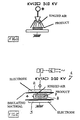
- Figure 1 shows schematically an ionization apparatus according to the prior art.
- Figure 2 shows schematically an apparatus according to the invention for sanitizing packaged food products.
- an apparatus according to this invention for sanitizing packaged food products, particularly bakery products is shown generally at 1 in schematic form.
- baking products is used here to broadly designate food products which are produced on an industrial scale by a baking process and packaged directly as they leave the baking oven, e.g. bread, sliced bread, pies, tarts, etc.. (this description makes reference to this specific application for illustration purposes only).
- the invention provides for the bakery products to be held in a variable electric field effective to ionize the air inside the package, but without allowing arcing to occur.
- the packaged food products are held within the electric field generated between two electrodes which are supplied a periodic voltage.
- the strength of this electric field is controlled between a minimum value for producing air ions and a maximum value which is smaller than the value that would strike an electric arc.
- the apparatus 1 on which this method can be implemented is shown schematically in Figure 2 and includes basically a pair of plate-like electrodes 2, 3 facing each other. These electrodes may be a pair of parallel facing plates of a plate capacitor. Preferably, the plates are arranged to lie one above the other in a horizontal plane.
- the dielectric 4 of this capacitor is essentially air, or a suitable inert gas.
- the apparatus 1 includes an electric power circuit 5 arranged to apply a periodic voltage to the plates 2, 3.
- the circuit 5 takes this voltage from a voltage or AC generator 6 which includes a plurality of controls, in the forms of manually operated controls and knobs, for adjusting the voltage value, e.g. between 10 and 50 kV, voltage frequency, e.g. between 50Hz and 200 Hz, as well as the voltage waveform, which may be sinusoidal, triangular, square, rectangular, sawtooth or the like, etc.
- a voltage or AC generator 6 which includes a plurality of controls, in the forms of manually operated controls and knobs, for adjusting the voltage value, e.g. between 10 and 50 kV, voltage frequency, e.g. between 50Hz and 200 Hz, as well as the voltage waveform, which may be sinusoidal, triangular, square, rectangular, sawtooth or the like, etc.
- At least one inward surface of the facing plates is covered with at least one layer of an insulating material having high dielectric properties.
- the inward surface of one, preferably both, plates 2, 3 would be covered with this dielectric material layer.
- any insulating material having high dielectric properties such as mica, ceramic materials such as caolin, or sheets of synthetic resins selected from styrene, polyester and polycarbonate resins, may be used.
- caolin is preferred, while among the synthetic resin materials which are suitable for use as the electrode coating, sheets of polyethyleneterephtalate, available commercially under the Mylar trade name, are to be preferred.
- this insulative layer is effective to enhance the value of the dielectric between the capacitor plates, so as to prevent the occurrence of arcing.
- a conveyor belt not shown because conventional, is interposed between the plates 2, 3 and is run by drive rollers along a parallel direction to the plates, close to the lower plate 3.
- This conveyer belt is made of an insulating plastics material, e.g. sheet Mylar, and can, therefore, substitute the insulating layer covering the lower plate 3.
- Food products 7 to be sanitized are packaged in a film 8 of a usually transparent plastics material for food applications, and are laid onto the conveyor belt.
- the plates are supplied the periodic voltage that results in a variable electric field being produced effective to ionize the air inside the package without causing arcing to occur.
- the rate of advance of the conveyer belt is adjusted to hold the packages of food products to be sanitized within the electric field for a predetermined time period which may vary between 10 and 120 seconds per package, for example.
- the invention is based on the principle that, when a periodic voltage is applied across the facing plates 2, 3 of the capacitor, the intervening dielectric 4 becomes subjected to a variable electric field and a current is induced to flow through it by the polarized air molecules.
- the extent of this ionization basically depends on the value of the variable electric field, itself a function of both the applied voltage level and the frequency of the periodic voltage.
- the periodic voltage applied across the capacitor plates is selected to lie in the 5 to 50 kV range, and the frequency of this voltage is selected in the 30 to 50x10 6 Hz range.
- the periodic voltage is an AC voltage of sinusoidal waveform.
- the method of this invention has been applied to a range of packaged food products yielding good results.
- bakery products such as bread, pies, and tarts have been processed with the inventive method after packaging in plastics film for food applications, such as polyethylene or polypropylene films.
- the bakery products exit the baking oven in a substantially sterile condition and in order to verify the effectiveness of the method according to the invention, tests were carried out by the Applicant which consisted of inoculating some food products with yeasts and/or fungi apt to affect their preservability.
- yeasts and/or fungi apt to affect their preservability.
- different osmophilic yeasts and/or xerophilic molds were inoculated which had a microbiological content of 10 6 colony-forming units.
- the food products to be sanitized are packaged under a readily ionizable modified atmosphere.
- the method of this invention will ensure sanitation of a large variety of packaged food products, by selecting suitable values for the periodic voltage and the frequency to be applied across the capacitor for a sufficient time to provide the desired degree of sanitation.
- a major advantage of the method according to this invention is that the sanitation process does not affect the organoleptic properties of the products, so that the latter will lose nothing of their taste and flavor.
- the method of this invention can be applied at a low rate of power consumption, significantly below that of other sterilization processes, such as pasteurization. And this method can be applied where other sanitation methods cannot lest the products undergo immediate deterioration of their organoleptic characteristics.
Landscapes
- Life Sciences & Earth Sciences (AREA)
- Engineering & Computer Science (AREA)
- Wood Science & Technology (AREA)
- Zoology (AREA)
- Chemical & Material Sciences (AREA)
- Food Science & Technology (AREA)
- Polymers & Plastics (AREA)
- General Preparation And Processing Of Foods (AREA)
- Food Preservation Except Freezing, Refrigeration, And Drying (AREA)
Abstract
Description
- This invention relates to a method of sanitizing generic food products in order to extend their shelf-life.
- Expressions like "food article sanitation" are used, throughout this description and the following claims, to designate any treatments directed to substantially rid food products of bacteria, pathogenic micro-organisms, spores, molds, yeasts and any other contents that may lead to quick decay thereof under both the sanitary and the organoleptic standpoint.
- Among the most widely applied treatments for the purpose, pasteurization and sterilization processes are best known which may include, among others, exposure to steam, infrared radiation, UV radiation or microwave, acidification at controlled pH values, addition of appropriate preservatives, moisture control and water activity (Aw) control, or combinations thereof.
- While their effectiveness is well recognized, all of the above processes are confronted with a problem at the packaging stage of the treated products. Where the products are sanitized in their packaged condition, as may be done with certain products using microwaves or the like radiation, or in other cases by the application of boiling liquids or saturated steam, one material may react differently dependently on the kind of packages. In fact, the packaging material may unexpectedly collapse or become scorched, and/or may interfere (expectedly or unexpectedly) with a uniformly applied treatment. Wherever the packaging operation comes next to the sanitation process, care must be exerted to prevent subsequent handling of the processed products, and/or the internal package "medium", from thwarting the effects of the sanitation process. Hence the need to have the packaging carried out in sterile rooms, using thoroughly sterilized equipment and arranging for the packaging operators to work in sterile conditions. In addition, or in other cases, the packaging is to provide a modified atmosphere to the package interior, such as through the use of nitrogen, CO2, or other suitable and approved gases.
- All this reflects in increased production costs, and hence higher retail prices.
- PCT WO 95/18768 describes a process for sanitizing/purifying water and other liquids, such as fruit juice, milk and the like "pumpable" food products, which is based on pulsive electric arcing between electrodes which are dipped in the stream of liquid to be sanitized. The power supplied for arc formation is adequate to generate UV radiation and "mechanical shocks" which are highly effective to kill germs, bacteria, and eliminate whatever else is expected to be removed from the stream being sanitized. However, besides being limited to the use with liquid or pumpable products, the above mentioned treatment is ultimately to face the packaging problem, and hence the aforementioned remedies which are expensive and difficult to implement.
- The treatment taught in PCT WO95/18768 cannot be applied to the sanitation of "solid" food products, such as bakery products, and/or prepackaged products, because the electric arc would immediately destroy the packaging material and burn the article thereunder.
- A food article sanitation method was recently tried which is based on the use of air ions created in an electric field between two facing electrodes, the electrodes being supplied a DC voltage and having a stream of the product to be sanitized flowed continuously through the gap therebetween, which stream is generally enriched by the airflow needed to provide said ions.
- This prior method is affected by the same limitations and drawbacks as that of the aforementioned international patent. In fact, it can only be used with liquid or pumpable products, is confronted with the same post-treatment packaging problems, and cannot be applied to prepackaged products since the latter, in moving past the electrodes, would cause electric arcing to occur and the package become destroyed.
- A prior art solution is disclosed in the US patent No. 5,326,530 that relates to a method for killing noxious biological organisms (bacteria, insects, etc.) in contaminated materials such as liquid, semi-liquid or solid foods. The materials treated by this method are not packaged food.
- The method disclosed in this document provides for the application of an optimized electric field exhibiting controlled current densities, rather than uniform electric fields.
- A further prior art solution is disclosed in the GB
patent 1 103 597 relating to a method for controlling microorganism in food products. - This document discloses to expose a packaged product to a field of alternating electromagnetic wave energy to attenuate the microorganism and sterilize the product. However, no provisions are taken to avoid formation of an electric arc between the generator of the electromagnetic field and the packaged product. The problem underlying this invention is to provide a method for sanitizing food products in their packaged condition, which method can overcome all of the aforementioned drawbacks affecting the prior art and exhibits enhanced effectiveness, as well as being applicable to any food products regardless of these being liquid and/or pumpable in nature.
- This problem is solved according to the invention by a method of sanitizing packaged food products by air ions, characterized in that it comprises the steps of:
- generating an electric field between two electrodes by supplying a periodic voltage to the electrodes;
- controlling said electric field between a minimum value, sufficient to generate the air ions, and a maximum value which is below that needed to strike an electric arc;
- holding the packaged food products to be sanitized within said field for a predetermined time period.
-
- The invention also provides an apparatus for implementing the above method. This apparatus has the features of
Claims 8 foll., and is characterized in that said capacitor is supplied a periodic voltage to generate a variable electric field between its plates, the strength of said electric field being controlled between a minimum value for producing air ions and a maximum value below the value that would strike an electric arc. - The features and advantages of the method and apparatus according to the invention will be apparent from the following detailed description thereof, to be read in conjunction with the accompanying drawings given by way of example.
- In the drawings:
- Figure 1 shows schematically an ionization apparatus according to the prior art.
- Figure 2 shows schematically an apparatus according to the invention for sanitizing packaged food products.
- With reference to the drawing views, an apparatus according to this invention for sanitizing packaged food products, particularly bakery products, is shown generally at 1 in schematic form.
- The term "bakery products" is used here to broadly designate food products which are produced on an industrial scale by a baking process and packaged directly as they leave the baking oven, e.g. bread, sliced bread, pies, tarts, etc.. (this description makes reference to this specific application for illustration purposes only).
- The invention provides for the bakery products to be held in a variable electric field effective to ionize the air inside the package, but without allowing arcing to occur.
- More particularly, the packaged food products are held within the electric field generated between two electrodes which are supplied a periodic voltage. The strength of this electric field is controlled between a minimum value for producing air ions and a maximum value which is smaller than the value that would strike an electric arc.
- The
apparatus 1 on which this method can be implemented is shown schematically in Figure 2 and includes basically a pair of plate-like electrodes - The dielectric 4 of this capacitor is essentially air, or a suitable inert gas.
- Advantageously in this invention, the
apparatus 1 includes anelectric power circuit 5 arranged to apply a periodic voltage to theplates - The
circuit 5 takes this voltage from a voltage or AC generator 6 which includes a plurality of controls, in the forms of manually operated controls and knobs, for adjusting the voltage value, e.g. between 10 and 50 kV, voltage frequency, e.g. between 50Hz and 200 Hz, as well as the voltage waveform, which may be sinusoidal, triangular, square, rectangular, sawtooth or the like, etc. - Advantageously in this invention, at least one inward surface of the facing plates is covered with at least one layer of an insulating material having high dielectric properties. In essence, the inward surface of one, preferably both,
plates - For the purpose, any insulating material having high dielectric properties, such as mica, ceramic materials such as caolin, or sheets of synthetic resins selected from styrene, polyester and polycarbonate resins, may be used.
- However, among the ceramic materials, caolin is preferred, while among the synthetic resin materials which are suitable for use as the electrode coating, sheets of polyethyleneterephtalate, available commercially under the Mylar trade name, are to be preferred.
- Basically, this insulative layer is effective to enhance the value of the dielectric between the capacitor plates, so as to prevent the occurrence of arcing.
- A conveyor belt, not shown because conventional, is interposed between the
plates lower plate 3. - This conveyer belt is made of an insulating plastics material, e.g. sheet Mylar, and can, therefore, substitute the insulating layer covering the
lower plate 3. -
Food products 7 to be sanitized are packaged in afilm 8 of a usually transparent plastics material for food applications, and are laid onto the conveyor belt. - As the
products 7 are moved between theplates - The rate of advance of the conveyer belt is adjusted to hold the packages of food products to be sanitized within the electric field for a predetermined time period which may vary between 10 and 120 seconds per package, for example.
- The invention is based on the principle that, when a periodic voltage is applied across the facing
plates - Tests carried out by the Applicant have unexpectedly shown that, when an appropriate high-frequency periodic voltage is applied to the facing plates of the capacitor, with the packaged
food product 7 therebetween, a variable electric field is generated which induces ionization of the air inside the package. - The extent of this ionization basically depends on the value of the variable electric field, itself a function of both the applied voltage level and the frequency of the periodic voltage.
- In a preferred embodiment, the periodic voltage applied across the capacitor plates is selected to lie in the 5 to 50 kV range, and the frequency of this voltage is selected in the 30 to 50x106 Hz range.
- Preferably, the periodic voltage is an AC voltage of sinusoidal waveform.
- The method of this invention has been applied to a range of packaged food products yielding good results.
- For example, bakery products such as bread, pies, and tarts have been processed with the inventive method after packaging in plastics film for food applications, such as polyethylene or polypropylene films.
- The bakery products exit the baking oven in a substantially sterile condition, and in order to verify the effectiveness of the method according to the invention, tests were carried out by the Applicant which consisted of inoculating some food products with yeasts and/or fungi apt to affect their preservability. For example, different osmophilic yeasts and/or xerophilic molds were inoculated which had a microbiological content of 106 colony-forming units.
- These products were then subjected to sanitation with the method of this invention.
- It was found that by placing the inoculated bakery product in its packaged state between the capacitor plates, this content of micro-organisms could be reduced by 104 times. In particular, these results were obtained by applying across the plates a periodic voltage selected in the range of 20 to 40 kV at a frequency of 50 to 200 Hz, for a 10- to 60-second duration time.
- As for the effectiveness of the method on spores as molds and the like, it was found that products so sanitized underwent organoleptic alteration significantly later, even one week later, than untreated products.
- To enhance the effectiveness of the method, it may be beneficial if the food products to be sanitized are packaged under a readily ionizable modified atmosphere.
- It can be appreciated from the foregoing that the method of this invention will ensure sanitation of a large variety of packaged food products, by selecting suitable values for the periodic voltage and the frequency to be applied across the capacitor for a sufficient time to provide the desired degree of sanitation.
- A major advantage of the method according to this invention is that the sanitation process does not affect the organoleptic properties of the products, so that the latter will lose nothing of their taste and flavor.
- In addition, the method of this invention can be applied at a low rate of power consumption, significantly below that of other sterilization processes, such as pasteurization. And this method can be applied where other sanitation methods cannot lest the products undergo immediate deterioration of their organoleptic characteristics.
- In this respect, similar results to those obtained with bakery products can be obtained with streams of water, or other liquids such as fruit juice, milk, and similar food products.
Claims (9)
- A method of sanitizing packaged food products by means of air ions to extend their shelf life and preservability at retail outlets, comprising the steps of:generating an electric field between two electrodes by supplying a periodic voltage to the electrodes;controlling said electric field between a minimum value, sufficient to generate the air ions, and a maximum value which is below that needed to strike an electric arc;holding the packaged food products to be sanitized within said field for a predetermined time period, characterized in that said electric field is formed between a pair of plate-like electrodes facing each other, and that at least one of said electrodes is coated with an insulating material while an air gap remains between the electrodes and the packaged food products.
- A method according to Claim 1, characterized in that said electric field is variable in strength.
- A method according to Claim 1, characterized in that said electric field is variable in frequency.
- A method according to Claim 1, characterized in that said periodic voltage is an alternating voltage of sinusoidal waveform.
- A method according to Claim 1, characterized in that said insulating material is a sheet of a synthetic resin selected from styrene, polyester, polyethyleneteraphtalate, and polycarbonate resins.
- An apparatus for sanitizing packaged food products (7) by means of air ions, of the type which comprises a pair of plate-like electrodes (2,3) facing each other and forming respective parallel plates of a capacitor; an electric circuit (5) interconnecting the capacitor and a voltage or current generator (6); and a conveyer belt extending between said plates to carry said food products (7) through the capacitor; characterized in that said capacitor is connected to an electric power circuit. (5) to be supplied with a periodic voltage to generate a variable electric field between its plates, the strength of said electric field being controlled between a minimum value for producing air ions and a maximum value below the value that would strike an electric arc, and that at least one of said electrodes (2,3) is coated with a layer or film of an insulating material while an air gap remains between the electrodes and the packaged food products.
- An apparatus according to Claim 6, characterized in that said generator (6) of an alternating voltage or current is provided with multiple controls for respectively adjusting the voltage value, voltage frequency, and voltage waveform.
- An apparatus according to Claim 6, characterized in that said conveyer belt is the insulating layer covering the lower electrode (3).
- An apparatus according to Claim 6, characterized in that said electric power circuit 5 is supplied by a voltage or AC generator (6) adjusting the voltage value between 10 and 50 kV and voltage frequency between 50Hz and 200 Hz.
Priority Applications (7)
| Application Number | Priority Date | Filing Date | Title |
|---|---|---|---|
| EP00830166A EP1132012B1 (en) | 2000-03-03 | 2000-03-03 | A method for sanitizing food products |
| DE60001094T DE60001094T2 (en) | 2000-03-03 | 2000-03-03 | Process for disinfecting food |
| ES00830166T ES2188495T3 (en) | 2000-03-03 | 2000-03-03 | DISINFECTION METHOD OF EDIBLE PRODUCTS. |
| PT00830166T PT1132012E (en) | 2000-03-03 | 2000-03-03 | METHOD FOR THE DISINFECTION OF FOOD PRODUCTS |
| AT00830166T ATE230218T1 (en) | 2000-03-03 | 2000-03-03 | METHOD FOR DISINFECTION OF FOOD PRODUCTS |
| DK00830166T DK1132012T3 (en) | 2000-03-03 | 2000-03-03 | Process for disinfecting food products |
| SI200030036T SI1132012T1 (en) | 2000-03-03 | 2000-03-03 | A method for sanitizing food products |
Applications Claiming Priority (1)
| Application Number | Priority Date | Filing Date | Title |
|---|---|---|---|
| EP00830166A EP1132012B1 (en) | 2000-03-03 | 2000-03-03 | A method for sanitizing food products |
Publications (2)
| Publication Number | Publication Date |
|---|---|
| EP1132012A1 EP1132012A1 (en) | 2001-09-12 |
| EP1132012B1 true EP1132012B1 (en) | 2003-01-02 |
Family
ID=8175225
Family Applications (1)
| Application Number | Title | Priority Date | Filing Date |
|---|---|---|---|
| EP00830166A Expired - Lifetime EP1132012B1 (en) | 2000-03-03 | 2000-03-03 | A method for sanitizing food products |
Country Status (7)
| Country | Link |
|---|---|
| EP (1) | EP1132012B1 (en) |
| AT (1) | ATE230218T1 (en) |
| DE (1) | DE60001094T2 (en) |
| DK (1) | DK1132012T3 (en) |
| ES (1) | ES2188495T3 (en) |
| PT (1) | PT1132012E (en) |
| SI (1) | SI1132012T1 (en) |
Families Citing this family (3)
| Publication number | Priority date | Publication date | Assignee | Title |
|---|---|---|---|---|
| GB2511057A (en) * | 2013-02-20 | 2014-08-27 | Ozonica Ltd | Packet Disinfection Method and Apparatus |
| GB2517729A (en) * | 2013-08-29 | 2015-03-04 | Ozonica Ltd | Disinfection of packaged articles |
| JP6751938B2 (en) * | 2016-08-24 | 2020-09-09 | 国立大学法人山形大学 | Sterilization method using pulse plasma and sterilized object |
Family Cites Families (11)
| Publication number | Priority date | Publication date | Assignee | Title |
|---|---|---|---|---|
| GB1103597A (en) * | 1966-05-23 | 1968-02-21 | Campbell Taggart Ass Bakeries | Method of controlling microorganisms in food products |
| GB1237693A (en) * | 1968-08-17 | 1971-06-30 | Helmut Wenzel | Arrangement for the preservation of perishable foodstuffs |
| US4524079A (en) * | 1983-11-10 | 1985-06-18 | Maxwell Laboratories, Inc. | Deactivation of microorganisms by an oscillating magnetic field |
| JPS60153784A (en) * | 1984-01-20 | 1985-08-13 | Yamakita Food Kk | Refreshing of food |
| US5069920A (en) * | 1987-01-29 | 1991-12-03 | Hildebrand Victor F | Electric conduction cooking method |
| JP2548000B2 (en) * | 1987-04-28 | 1996-10-30 | 株式会社スワーク | Food manufacturing method and apparatus |
| US5326530A (en) * | 1991-01-22 | 1994-07-05 | Iit Research Institute | Energy-efficient electromagnetic elimination of noxious biological organisms |
| DE4432228A1 (en) * | 1994-09-10 | 1996-03-14 | Stauder Norbert | Pulse width modulated, high frequency discharge method |
| US5925324A (en) * | 1996-09-30 | 1999-07-20 | Paradigm Technologies | Magnetohydrodynamic sterilization method and apparatus |
| WO1999008552A1 (en) * | 1997-08-14 | 1999-02-25 | Yamamoto Vinita Co., Ltd. | Packed food pasteurizing device and pasteurizing method |
| EP1113728A1 (en) * | 1998-09-14 | 2001-07-11 | Unilever N.V. | Apparatus and process for preserving foods |
-
2000
- 2000-03-03 EP EP00830166A patent/EP1132012B1/en not_active Expired - Lifetime
- 2000-03-03 ES ES00830166T patent/ES2188495T3/en not_active Expired - Lifetime
- 2000-03-03 DK DK00830166T patent/DK1132012T3/en active
- 2000-03-03 DE DE60001094T patent/DE60001094T2/en not_active Expired - Lifetime
- 2000-03-03 PT PT00830166T patent/PT1132012E/en unknown
- 2000-03-03 SI SI200030036T patent/SI1132012T1/en unknown
- 2000-03-03 AT AT00830166T patent/ATE230218T1/en not_active IP Right Cessation
Also Published As
| Publication number | Publication date |
|---|---|
| DE60001094D1 (en) | 2003-02-06 |
| PT1132012E (en) | 2003-03-31 |
| ATE230218T1 (en) | 2003-01-15 |
| ES2188495T3 (en) | 2003-07-01 |
| EP1132012A1 (en) | 2001-09-12 |
| SI1132012T1 (en) | 2003-06-30 |
| DE60001094T2 (en) | 2003-10-30 |
| DK1132012T3 (en) | 2003-03-17 |
Similar Documents
| Publication | Publication Date | Title |
|---|---|---|
| FI80575B (en) | Deactivation of microorganisms by an oscillating magnetic field | |
| US20160286846A1 (en) | Sterilisation of package articles | |
| JPH04211345A (en) | Bactericide-pasteurizing and homogeneously, quickly-heating for food product | |
| WO2017073641A1 (en) | Plasma sterilization device | |
| US6086932A (en) | High electric pasteurization | |
| EP0083448A2 (en) | Sterilization of packaging materials | |
| MX2013013107A (en) | Disinfection of packaged articles. | |
| US20070172560A1 (en) | Methods of controlling microorganisms in packaged foods | |
| Shabbir et al. | Applications of cold plasma technique to enhance the safety and quality of different food products | |
| US6248986B1 (en) | Preferential heating of materials by use of non-ionizing electromagnetic radiation | |
| EP1132012B1 (en) | A method for sanitizing food products | |
| Butscher et al. | Disinfection of granular food products using cold plasma | |
| AU739809B2 (en) | Treatment method for cork material and corks | |
| CN219182760U (en) | Low-frequency high-voltage pulse electric field cooperated cold plasma food sterilization equipment | |
| KR102517551B1 (en) | Sterilizing System for Powder products by low-temperature plasma | |
| JP2005278809A (en) | Sterilizer utilizing high voltage | |
| JP2002010766A (en) | Method for carrying out sterilizing treatment of object of sterilization such as cereals and seed | |
| GB2301271A (en) | Electroheating fluent foodstuffs | |
| Gupta et al. | Cold plasma for food processing | |
| JPH10309308A (en) | Sterilizing device for granular or powdery object to be processed | |
| JPH11267183A (en) | Disinfecting apparatus and method utilizing high voltage | |
| Patra et al. | Application of Cold Plasma Technology in Milk and Dairy Products-Current Status and Future Prospective | |
| Gunjal et al. | Pulsed light technology in food processing and preservation | |
| Jayasena et al. | Dielectric barrier discharge: Meat treatment | |
| AU733292B2 (en) | Preferential heating of materials by use of non-ionising electromagnetic radiation |
Legal Events
| Date | Code | Title | Description |
|---|---|---|---|
| PUAI | Public reference made under article 153(3) epc to a published international application that has entered the european phase |
Free format text: ORIGINAL CODE: 0009012 |
|
| 17P | Request for examination filed |
Effective date: 20010130 |
|
| AK | Designated contracting states |
Kind code of ref document: A1 Designated state(s): AT BE CH CY DE DK ES FI FR GB GR IE IT LI LU MC NL PT SE |
|
| AX | Request for extension of the european patent |
Free format text: AL;LT;LV;MK;RO;SI |
|
| 17Q | First examination report despatched |
Effective date: 20010927 |
|
| AKX | Designation fees paid |
Free format text: AT BE CH CY DE DK ES FI FR GB GR IE IT LI LU MC NL PT SE |
|
| AXX | Extension fees paid |
Free format text: SI PAYMENT 20020312 |
|
| GRAG | Despatch of communication of intention to grant |
Free format text: ORIGINAL CODE: EPIDOS AGRA |
|
| GRAH | Despatch of communication of intention to grant a patent |
Free format text: ORIGINAL CODE: EPIDOS IGRA |
|
| GRAH | Despatch of communication of intention to grant a patent |
Free format text: ORIGINAL CODE: EPIDOS IGRA |
|
| GRAA | (expected) grant |
Free format text: ORIGINAL CODE: 0009210 |
|
| AK | Designated contracting states |
Kind code of ref document: B1 Designated state(s): AT BE CH CY DE DK ES FI FR GB GR IE IT LI LU MC NL PT SE |
|
| AX | Request for extension of the european patent |
Free format text: SI PAYMENT 20020312 |
|
| REF | Corresponds to: |
Ref document number: 230218 Country of ref document: AT Date of ref document: 20030115 Kind code of ref document: T |
|
| REG | Reference to a national code |
Ref country code: GB Ref legal event code: FG4D Free format text: 20030102 |
|
| REG | Reference to a national code |
Ref country code: CH Ref legal event code: EP |
|
| REG | Reference to a national code |
Ref country code: IE Ref legal event code: FG4D |
|
| REF | Corresponds to: |
Ref document number: 60001094 Country of ref document: DE Date of ref document: 20030206 Kind code of ref document: P |
|
| PG25 | Lapsed in a contracting state [announced via postgrant information from national office to epo] |
Ref country code: CY Free format text: LAPSE BECAUSE OF FAILURE TO SUBMIT A TRANSLATION OF THE DESCRIPTION OR TO PAY THE FEE WITHIN THE PRESCRIBED TIME-LIMIT Effective date: 20030303 |
|
| REG | Reference to a national code |
Ref country code: DK Ref legal event code: T3 |
|
| REG | Reference to a national code |
Ref country code: CH Ref legal event code: NV Representative=s name: ING. MARCO ZARDI C/O M. ZARDI & CO. S.A. |
|
| PG25 | Lapsed in a contracting state [announced via postgrant information from national office to epo] |
Ref country code: MC Free format text: LAPSE BECAUSE OF NON-PAYMENT OF DUE FEES Effective date: 20030331 |
|
| REG | Reference to a national code |
Ref country code: PT Ref legal event code: SC4A Free format text: AVAILABILITY OF NATIONAL TRANSLATION Effective date: 20030106 |
|
| REG | Reference to a national code |
Ref country code: SE Ref legal event code: TRGR |
|
| REG | Reference to a national code |
Ref country code: GR Ref legal event code: EP Ref document number: 20030401250 Country of ref document: GR |
|
| REG | Reference to a national code |
Ref country code: ES Ref legal event code: FG2A Ref document number: 2188495 Country of ref document: ES Kind code of ref document: T3 |
|
| ET | Fr: translation filed | ||
| PLBE | No opposition filed within time limit |
Free format text: ORIGINAL CODE: 0009261 |
|
| STAA | Information on the status of an ep patent application or granted ep patent |
Free format text: STATUS: NO OPPOSITION FILED WITHIN TIME LIMIT |
|
| 26N | No opposition filed |
Effective date: 20031003 |
|
| REG | Reference to a national code |
Ref country code: SI Ref legal event code: IF |
|
| PGFP | Annual fee paid to national office [announced via postgrant information from national office to epo] |
Ref country code: DK Payment date: 20100224 Year of fee payment: 11 Ref country code: IE Payment date: 20100225 Year of fee payment: 11 Ref country code: LU Payment date: 20100224 Year of fee payment: 11 Ref country code: CH Payment date: 20100219 Year of fee payment: 11 Ref country code: PT Payment date: 20100224 Year of fee payment: 11 Ref country code: ES Payment date: 20100309 Year of fee payment: 11 |
|
| PGFP | Annual fee paid to national office [announced via postgrant information from national office to epo] |
Ref country code: FI Payment date: 20100222 Year of fee payment: 11 Ref country code: IT Payment date: 20100312 Year of fee payment: 11 |
|
| PGFP | Annual fee paid to national office [announced via postgrant information from national office to epo] |
Ref country code: BE Payment date: 20100223 Year of fee payment: 11 Ref country code: GB Payment date: 20100226 Year of fee payment: 11 Ref country code: AT Payment date: 20100219 Year of fee payment: 11 |
|
| PGFP | Annual fee paid to national office [announced via postgrant information from national office to epo] |
Ref country code: FR Payment date: 20100419 Year of fee payment: 11 |
|
| PGFP | Annual fee paid to national office [announced via postgrant information from national office to epo] |
Ref country code: NL Payment date: 20100224 Year of fee payment: 11 Ref country code: DE Payment date: 20100302 Year of fee payment: 11 |
|
| PGFP | Annual fee paid to national office [announced via postgrant information from national office to epo] |
Ref country code: SE Payment date: 20100224 Year of fee payment: 11 |
|
| PGFP | Annual fee paid to national office [announced via postgrant information from national office to epo] |
Ref country code: GR Payment date: 20100222 Year of fee payment: 11 |
|
| REG | Reference to a national code |
Ref country code: PT Ref legal event code: MM4A Free format text: LAPSE DUE TO NON-PAYMENT OF FEES Effective date: 20110905 |
|
| BERE | Be: lapsed |
Owner name: *BARILLA ALIMENTARE S.P.A. Effective date: 20110331 |
|
| REG | Reference to a national code |
Ref country code: NL Ref legal event code: V1 Effective date: 20111001 |
|
| PG25 | Lapsed in a contracting state [announced via postgrant information from national office to epo] |
Ref country code: PT Free format text: LAPSE BECAUSE OF NON-PAYMENT OF DUE FEES Effective date: 20110905 |
|
| REG | Reference to a national code |
Ref country code: CH Ref legal event code: PL Ref country code: DK Ref legal event code: EBP |
|
| REG | Reference to a national code |
Ref country code: SE Ref legal event code: EUG |
|
| GBPC | Gb: european patent ceased through non-payment of renewal fee |
Effective date: 20110303 |
|
| PG25 | Lapsed in a contracting state [announced via postgrant information from national office to epo] |
Ref country code: FI Free format text: LAPSE BECAUSE OF NON-PAYMENT OF DUE FEES Effective date: 20110303 Ref country code: AT Free format text: LAPSE BECAUSE OF NON-PAYMENT OF DUE FEES Effective date: 20110303 |
|
| REG | Reference to a national code |
Ref country code: SI Ref legal event code: KO00 Effective date: 20111008 |
|
| REG | Reference to a national code |
Ref country code: FR Ref legal event code: ST Effective date: 20111130 |
|
| PG25 | Lapsed in a contracting state [announced via postgrant information from national office to epo] |
Ref country code: BE Free format text: LAPSE BECAUSE OF NON-PAYMENT OF DUE FEES Effective date: 20110331 |
|
| REG | Reference to a national code |
Ref country code: IE Ref legal event code: MM4A |
|
| PG25 | Lapsed in a contracting state [announced via postgrant information from national office to epo] |
Ref country code: CH Free format text: LAPSE BECAUSE OF NON-PAYMENT OF DUE FEES Effective date: 20110331 Ref country code: FR Free format text: LAPSE BECAUSE OF NON-PAYMENT OF DUE FEES Effective date: 20110331 Ref country code: DE Free format text: LAPSE BECAUSE OF NON-PAYMENT OF DUE FEES Effective date: 20111001 Ref country code: IE Free format text: LAPSE BECAUSE OF NON-PAYMENT OF DUE FEES Effective date: 20110303 Ref country code: NL Free format text: LAPSE BECAUSE OF NON-PAYMENT OF DUE FEES Effective date: 20111001 Ref country code: LI Free format text: LAPSE BECAUSE OF NON-PAYMENT OF DUE FEES Effective date: 20110331 |
|
| REG | Reference to a national code |
Ref country code: DE Ref legal event code: R119 Ref document number: 60001094 Country of ref document: DE Effective date: 20111001 |
|
| PG25 | Lapsed in a contracting state [announced via postgrant information from national office to epo] |
Ref country code: GR Free format text: LAPSE BECAUSE OF NON-PAYMENT OF DUE FEES Effective date: 20111004 Ref country code: GB Free format text: LAPSE BECAUSE OF NON-PAYMENT OF DUE FEES Effective date: 20110303 Ref country code: IT Free format text: LAPSE BECAUSE OF NON-PAYMENT OF DUE FEES Effective date: 20110303 |
|
| REG | Reference to a national code |
Ref country code: ES Ref legal event code: FD2A Effective date: 20120423 |
|
| PG25 | Lapsed in a contracting state [announced via postgrant information from national office to epo] |
Ref country code: DK Free format text: LAPSE BECAUSE OF NON-PAYMENT OF DUE FEES Effective date: 20110331 |
|
| PG25 | Lapsed in a contracting state [announced via postgrant information from national office to epo] |
Ref country code: ES Free format text: LAPSE BECAUSE OF NON-PAYMENT OF DUE FEES Effective date: 20110304 |
|
| PG25 | Lapsed in a contracting state [announced via postgrant information from national office to epo] |
Ref country code: SE Free format text: LAPSE BECAUSE OF NON-PAYMENT OF DUE FEES Effective date: 20110304 |
|
| PG25 | Lapsed in a contracting state [announced via postgrant information from national office to epo] |
Ref country code: LU Free format text: LAPSE BECAUSE OF NON-PAYMENT OF DUE FEES Effective date: 20110303 |