EP1130671A1 - Polyelectrolyte, non-aqueous electrolyte, and electrical device containing the same - Google Patents
Polyelectrolyte, non-aqueous electrolyte, and electrical device containing the same Download PDFInfo
- Publication number
- EP1130671A1 EP1130671A1 EP00955081A EP00955081A EP1130671A1 EP 1130671 A1 EP1130671 A1 EP 1130671A1 EP 00955081 A EP00955081 A EP 00955081A EP 00955081 A EP00955081 A EP 00955081A EP 1130671 A1 EP1130671 A1 EP 1130671A1
- Authority
- EP
- European Patent Office
- Prior art keywords
- group
- electrolyte according
- formula
- boron atoms
- polymeric
- Prior art date
- Legal status (The legal status is an assumption and is not a legal conclusion. Google has not performed a legal analysis and makes no representation as to the accuracy of the status listed.)
- Granted
Links
Classifications
-
- H—ELECTRICITY
- H01—ELECTRIC ELEMENTS
- H01M—PROCESSES OR MEANS, e.g. BATTERIES, FOR THE DIRECT CONVERSION OF CHEMICAL ENERGY INTO ELECTRICAL ENERGY
- H01M10/00—Secondary cells; Manufacture thereof
- H01M10/05—Accumulators with non-aqueous electrolyte
- H01M10/056—Accumulators with non-aqueous electrolyte characterised by the materials used as electrolytes, e.g. mixed inorganic/organic electrolytes
- H01M10/0564—Accumulators with non-aqueous electrolyte characterised by the materials used as electrolytes, e.g. mixed inorganic/organic electrolytes the electrolyte being constituted of organic materials only
- H01M10/0565—Polymeric materials, e.g. gel-type or solid-type
-
- H—ELECTRICITY
- H01—ELECTRIC ELEMENTS
- H01M—PROCESSES OR MEANS, e.g. BATTERIES, FOR THE DIRECT CONVERSION OF CHEMICAL ENERGY INTO ELECTRICAL ENERGY
- H01M10/00—Secondary cells; Manufacture thereof
- H01M10/05—Accumulators with non-aqueous electrolyte
- H01M10/052—Li-accumulators
-
- H—ELECTRICITY
- H01—ELECTRIC ELEMENTS
- H01M—PROCESSES OR MEANS, e.g. BATTERIES, FOR THE DIRECT CONVERSION OF CHEMICAL ENERGY INTO ELECTRICAL ENERGY
- H01M10/00—Secondary cells; Manufacture thereof
- H01M10/05—Accumulators with non-aqueous electrolyte
- H01M10/056—Accumulators with non-aqueous electrolyte characterised by the materials used as electrolytes, e.g. mixed inorganic/organic electrolytes
- H01M10/0564—Accumulators with non-aqueous electrolyte characterised by the materials used as electrolytes, e.g. mixed inorganic/organic electrolytes the electrolyte being constituted of organic materials only
- H01M10/0566—Liquid materials
-
- H—ELECTRICITY
- H01—ELECTRIC ELEMENTS
- H01M—PROCESSES OR MEANS, e.g. BATTERIES, FOR THE DIRECT CONVERSION OF CHEMICAL ENERGY INTO ELECTRICAL ENERGY
- H01M10/00—Secondary cells; Manufacture thereof
- H01M10/05—Accumulators with non-aqueous electrolyte
- H01M10/056—Accumulators with non-aqueous electrolyte characterised by the materials used as electrolytes, e.g. mixed inorganic/organic electrolytes
- H01M10/0564—Accumulators with non-aqueous electrolyte characterised by the materials used as electrolytes, e.g. mixed inorganic/organic electrolytes the electrolyte being constituted of organic materials only
- H01M10/0566—Liquid materials
- H01M10/0568—Liquid materials characterised by the solutes
-
- H—ELECTRICITY
- H01—ELECTRIC ELEMENTS
- H01M—PROCESSES OR MEANS, e.g. BATTERIES, FOR THE DIRECT CONVERSION OF CHEMICAL ENERGY INTO ELECTRICAL ENERGY
- H01M6/00—Primary cells; Manufacture thereof
- H01M6/14—Cells with non-aqueous electrolyte
- H01M6/16—Cells with non-aqueous electrolyte with organic electrolyte
- H01M6/162—Cells with non-aqueous electrolyte with organic electrolyte characterised by the electrolyte
-
- H—ELECTRICITY
- H01—ELECTRIC ELEMENTS
- H01M—PROCESSES OR MEANS, e.g. BATTERIES, FOR THE DIRECT CONVERSION OF CHEMICAL ENERGY INTO ELECTRICAL ENERGY
- H01M6/00—Primary cells; Manufacture thereof
- H01M6/14—Cells with non-aqueous electrolyte
- H01M6/16—Cells with non-aqueous electrolyte with organic electrolyte
- H01M6/162—Cells with non-aqueous electrolyte with organic electrolyte characterised by the electrolyte
- H01M6/166—Cells with non-aqueous electrolyte with organic electrolyte characterised by the electrolyte by the solute
-
- H—ELECTRICITY
- H01—ELECTRIC ELEMENTS
- H01M—PROCESSES OR MEANS, e.g. BATTERIES, FOR THE DIRECT CONVERSION OF CHEMICAL ENERGY INTO ELECTRICAL ENERGY
- H01M10/00—Secondary cells; Manufacture thereof
- H01M10/05—Accumulators with non-aqueous electrolyte
- H01M10/052—Li-accumulators
- H01M10/0525—Rocking-chair batteries, i.e. batteries with lithium insertion or intercalation in both electrodes; Lithium-ion batteries
-
- H—ELECTRICITY
- H01—ELECTRIC ELEMENTS
- H01M—PROCESSES OR MEANS, e.g. BATTERIES, FOR THE DIRECT CONVERSION OF CHEMICAL ENERGY INTO ELECTRICAL ENERGY
- H01M2300/00—Electrolytes
- H01M2300/0017—Non-aqueous electrolytes
- H01M2300/0065—Solid electrolytes
- H01M2300/0082—Organic polymers
-
- Y—GENERAL TAGGING OF NEW TECHNOLOGICAL DEVELOPMENTS; GENERAL TAGGING OF CROSS-SECTIONAL TECHNOLOGIES SPANNING OVER SEVERAL SECTIONS OF THE IPC; TECHNICAL SUBJECTS COVERED BY FORMER USPC CROSS-REFERENCE ART COLLECTIONS [XRACs] AND DIGESTS
- Y02—TECHNOLOGIES OR APPLICATIONS FOR MITIGATION OR ADAPTATION AGAINST CLIMATE CHANGE
- Y02E—REDUCTION OF GREENHOUSE GAS [GHG] EMISSIONS, RELATED TO ENERGY GENERATION, TRANSMISSION OR DISTRIBUTION
- Y02E60/00—Enabling technologies; Technologies with a potential or indirect contribution to GHG emissions mitigation
- Y02E60/10—Energy storage using batteries
Definitions
- the invention has been made, and aims to provide a polymeric electrolyte and a nonaqueous electrolyte which increases a dissociation degree of an electrolytic salt, which can improve a transport rate of charge carrier ions and in which an effective concentration region of an additive is wide and an effect provided by its addition per weight is great, and an electric device using the same.
- the present inventors have assiduously conducted investigations to solve the problems. They have consequently conceived that counter ions of charge carrier ions are trapped and less moved to control a transport rate of charge carrier ions, and have found that the use of a compound containing plural trivalent boron atoms in the structure, a Lewis acid, as an additive, is effective for solving the problems. This finding has led to the completion of the invention.
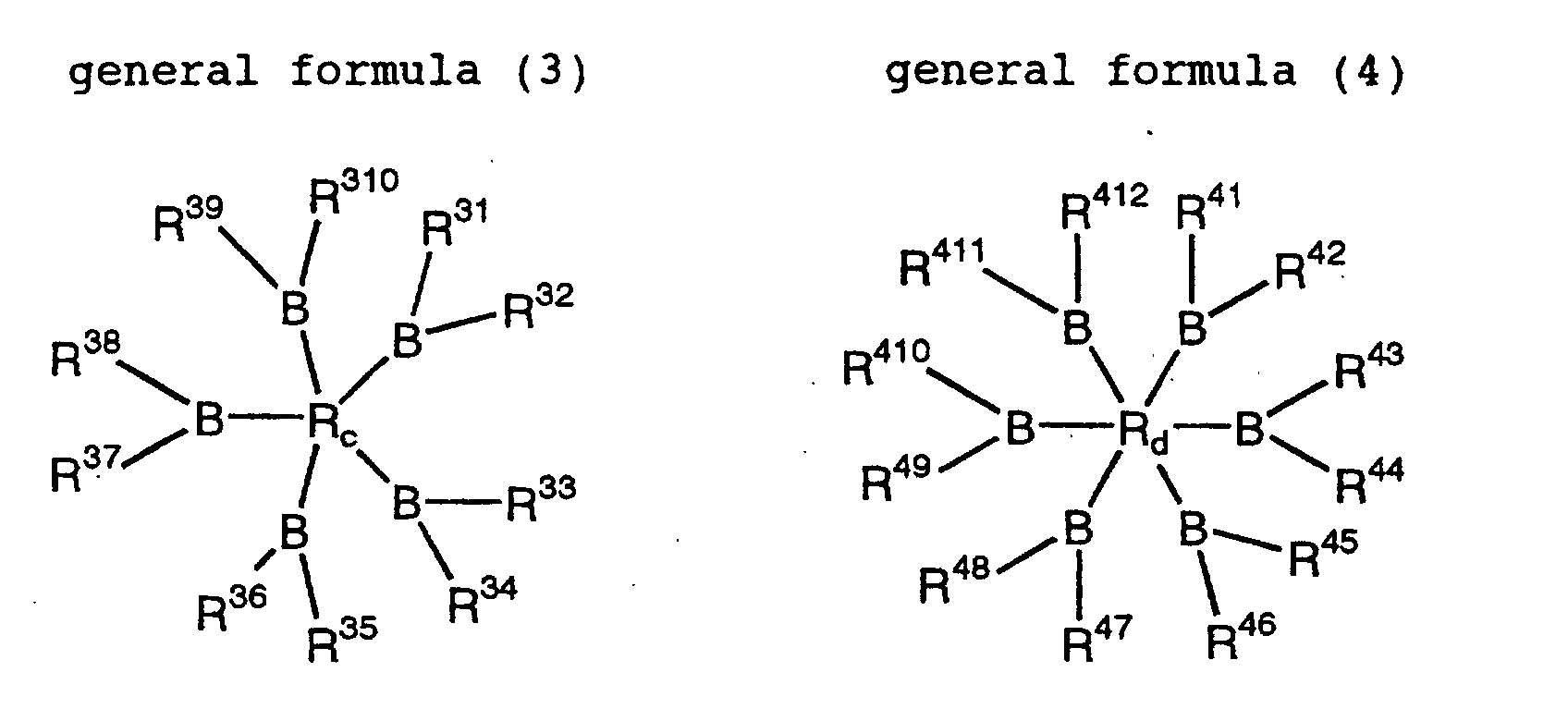
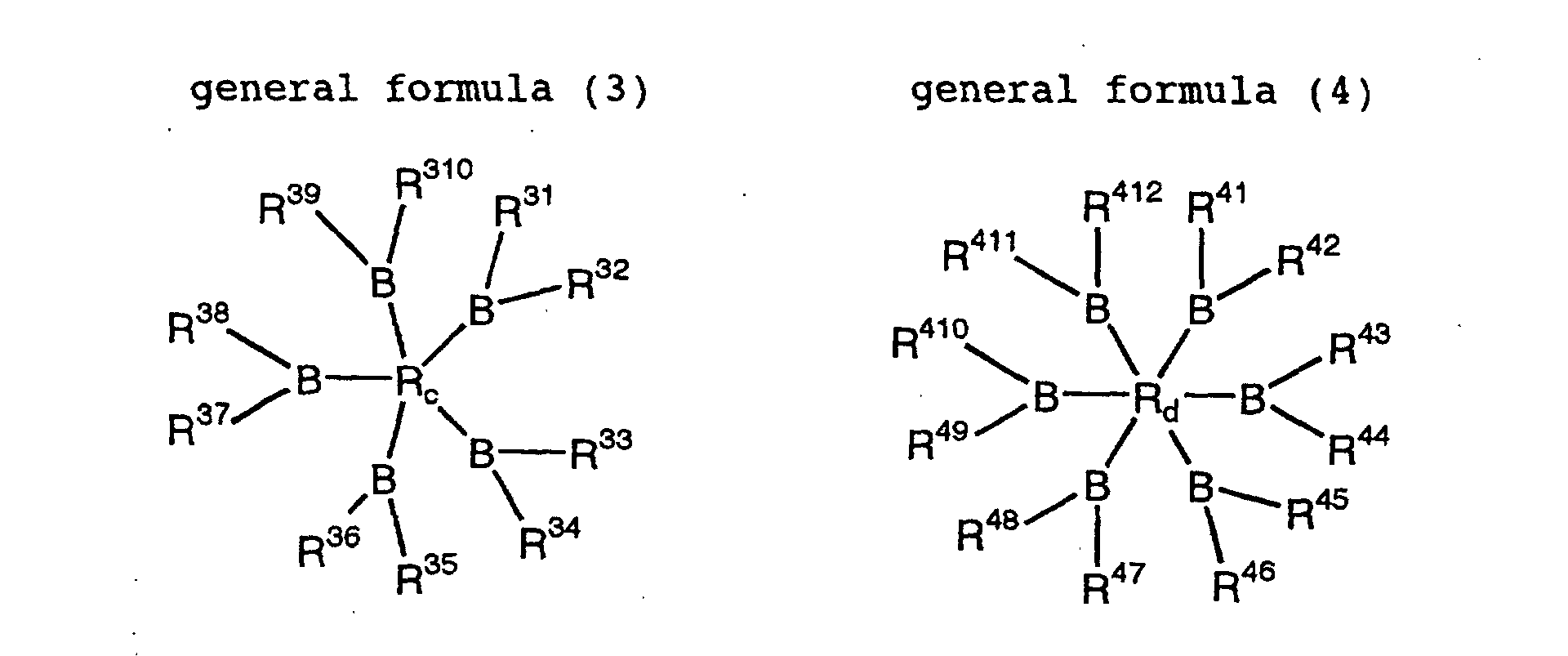
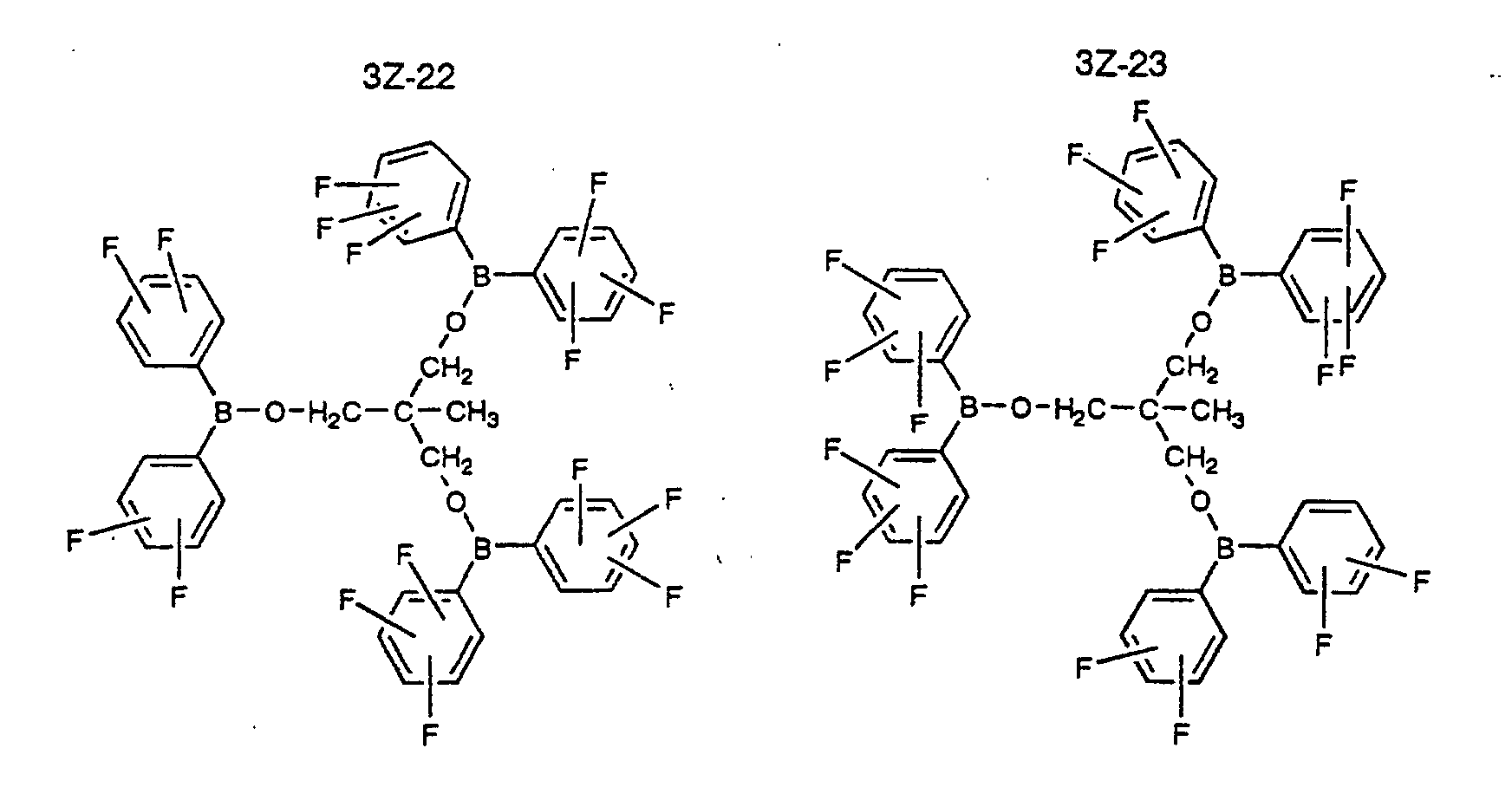
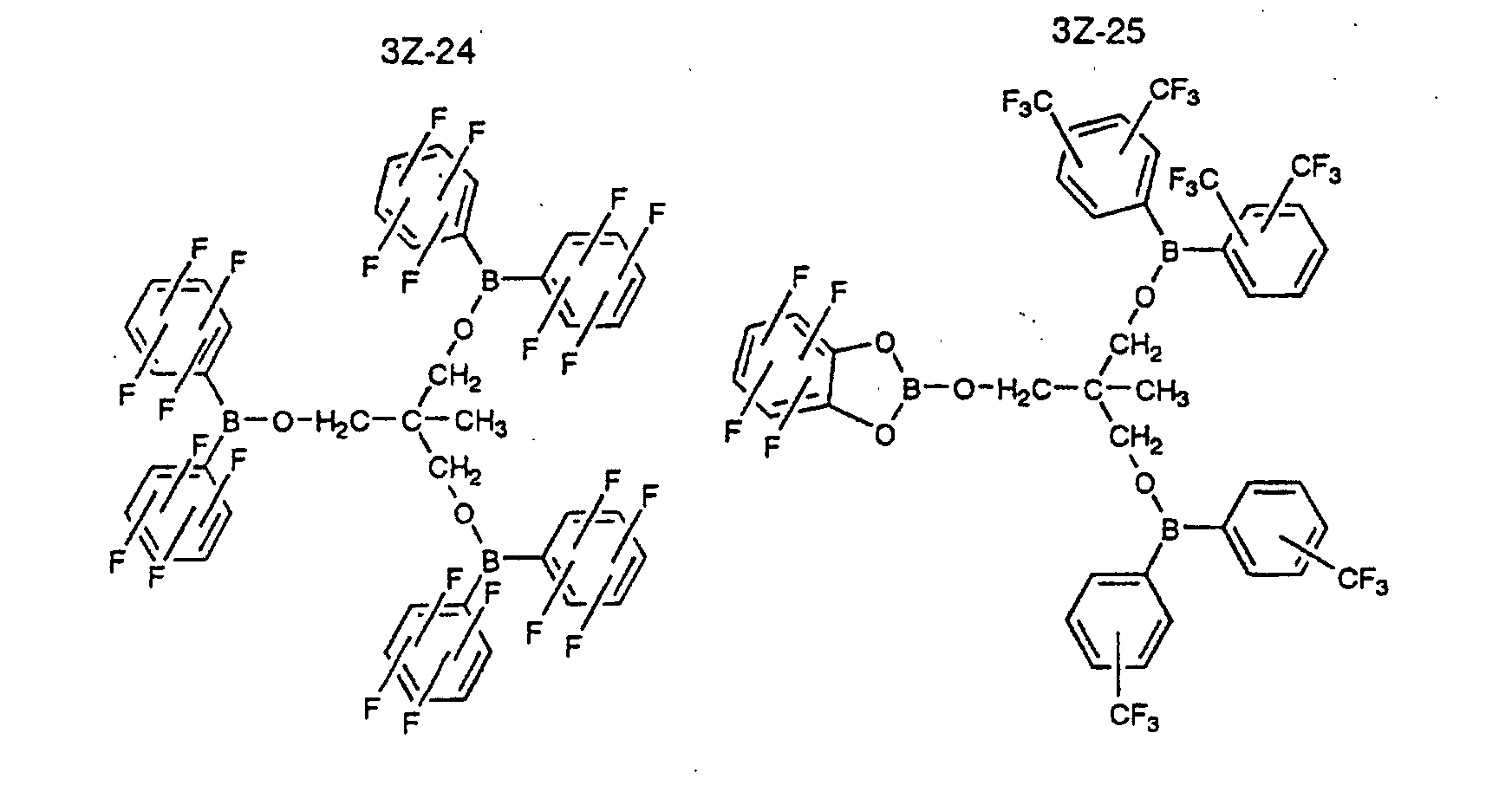
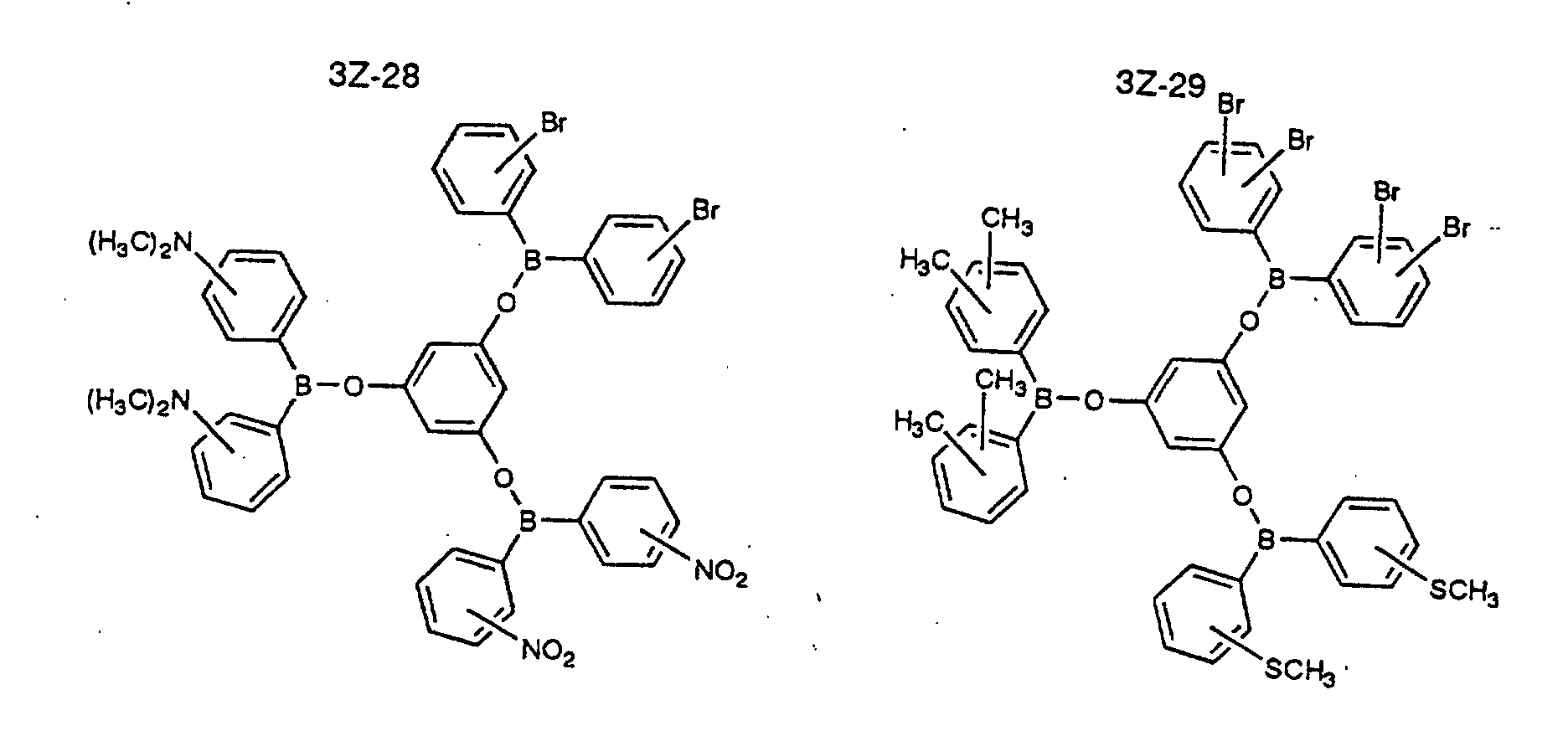
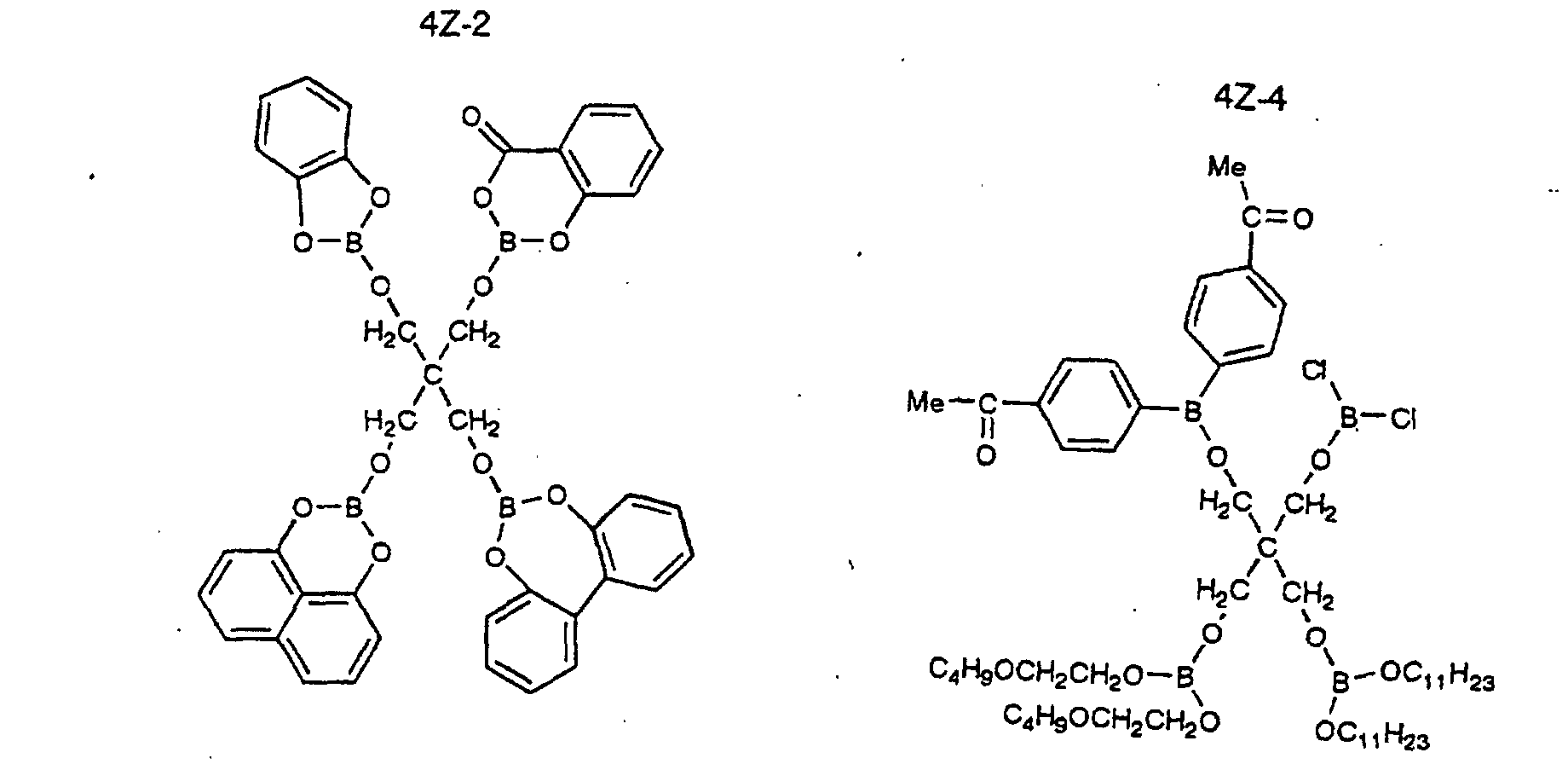
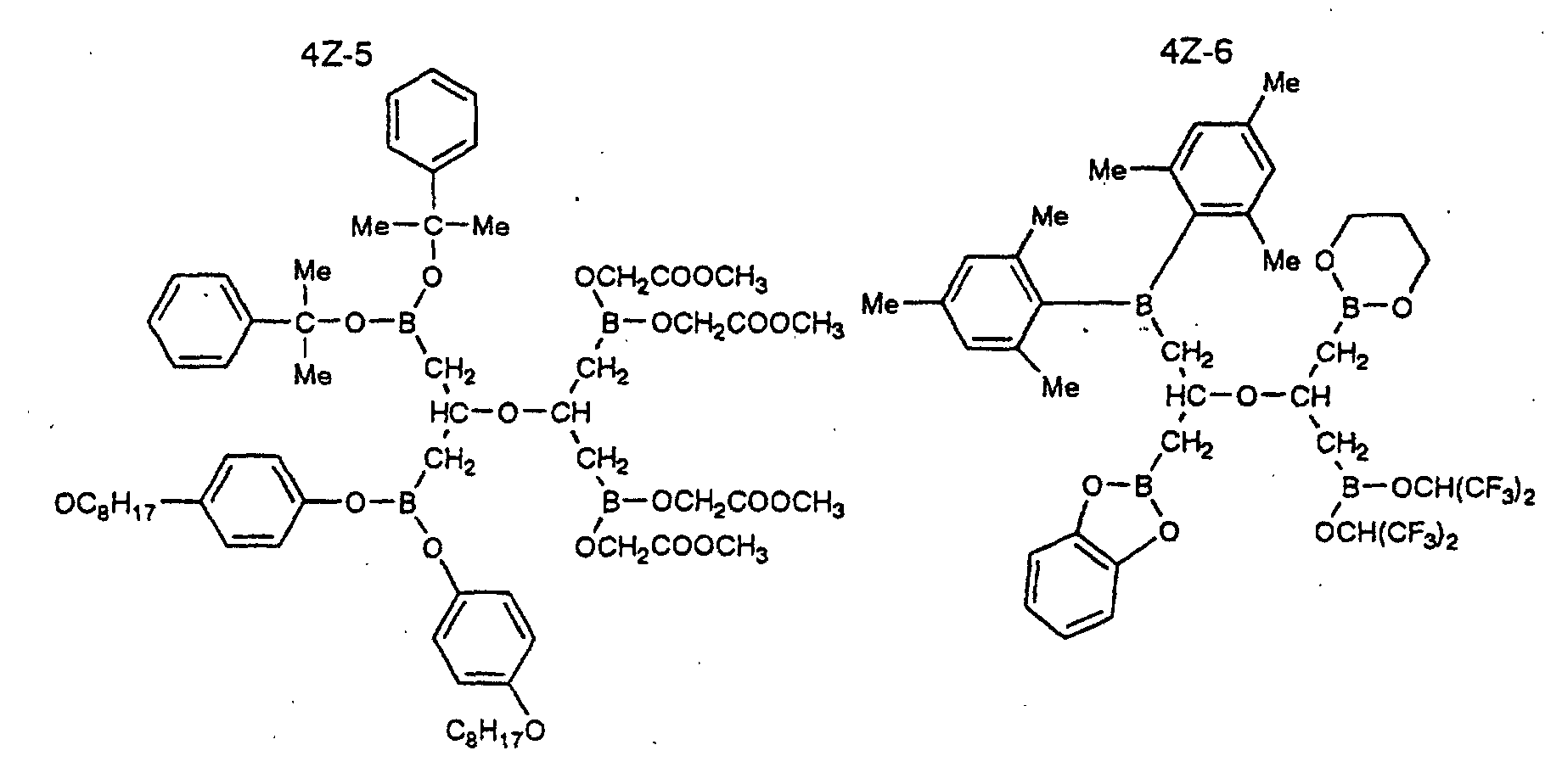
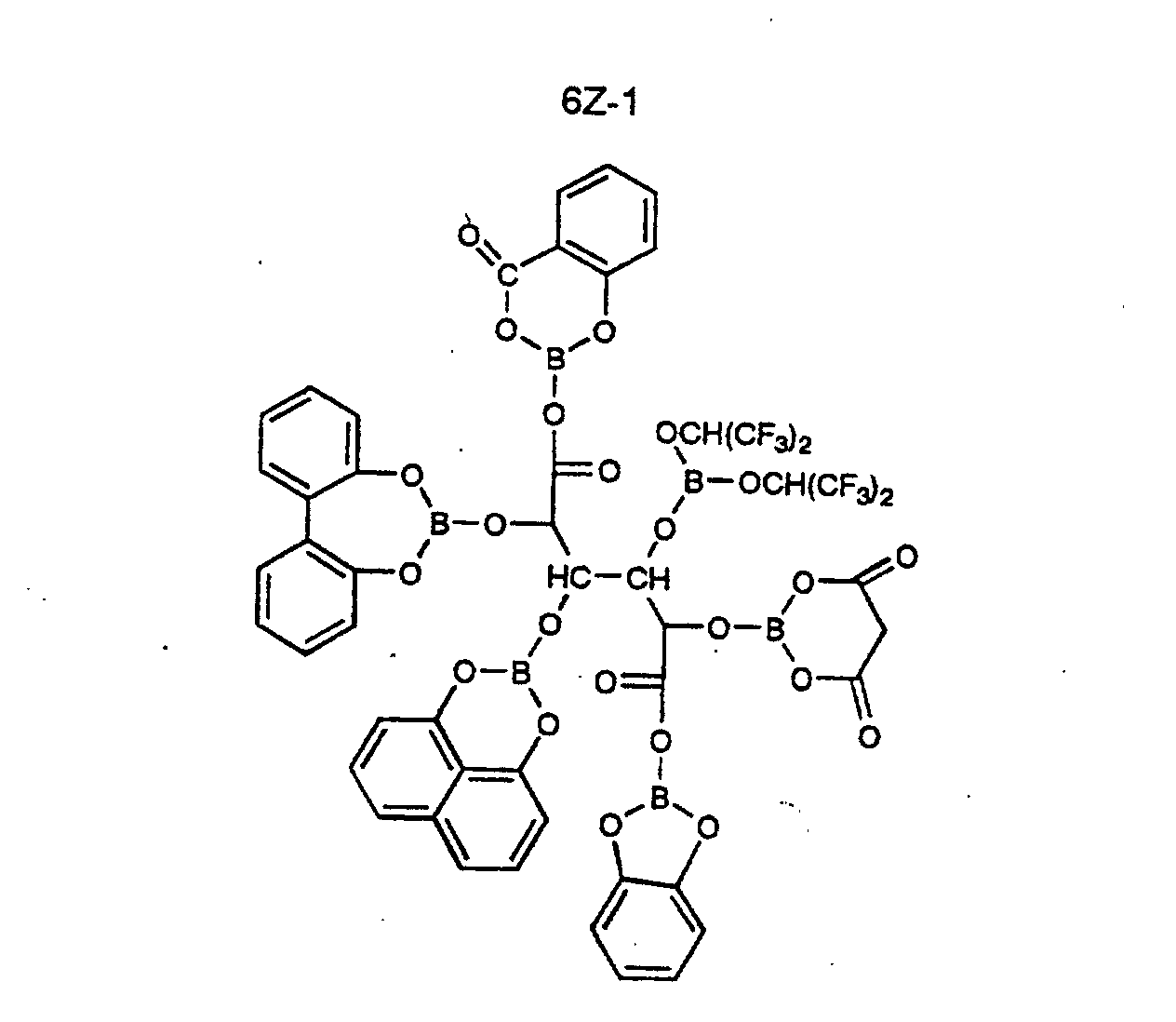
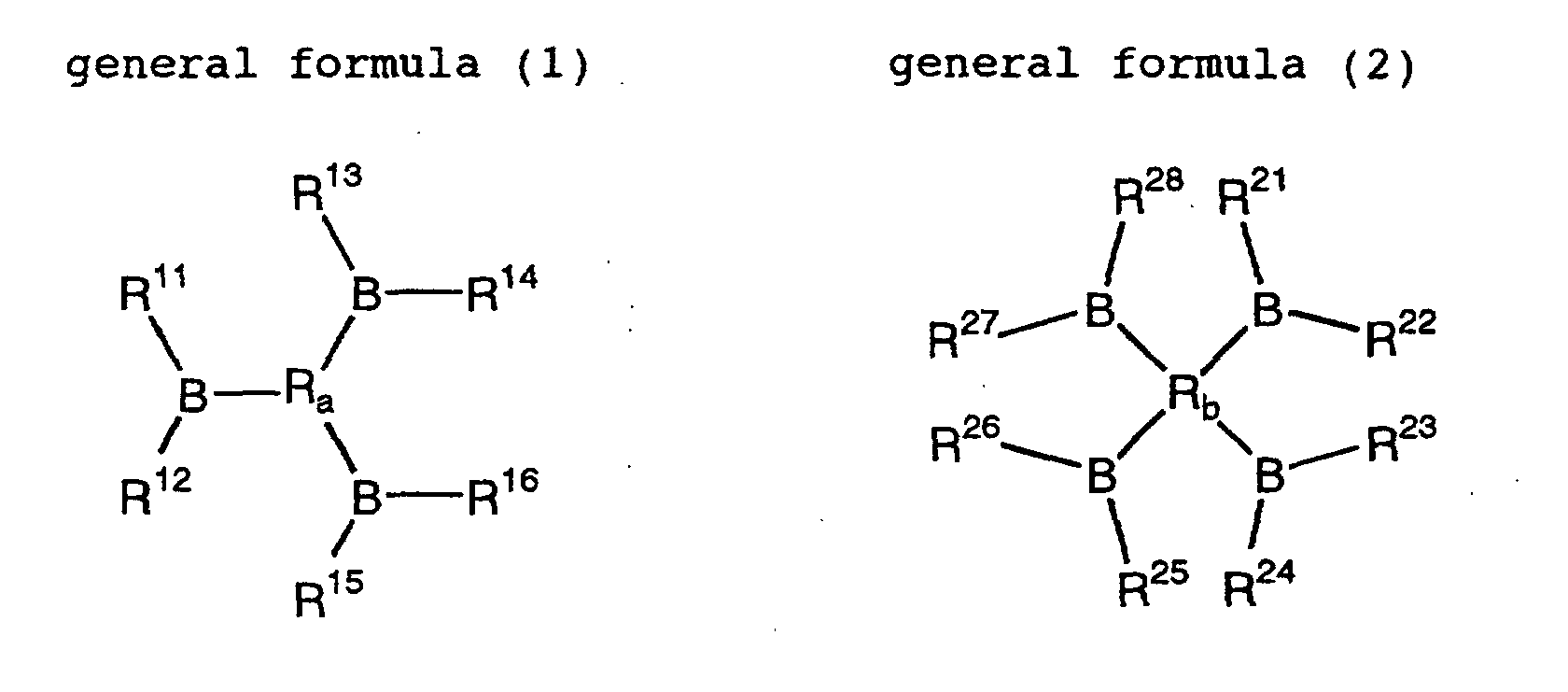
- the compound having boron atoms in the structure is preferably selected from the group consisting of compounds represented by the following general formulas (1) to (4).
- Ra in formula (1) represents a group having a site capable of being bound to at least 3 boron atoms which are the same or different
- Rb in formula (2) represents a group having a site capable of being bound to at least 4 boron atoms which are the same or different
- Rc in formula (3) represents a group having a site capable of being bound to at least 5 boron atoms which are the same or different
- Rd in formula (4) represents a group having a site capable of being bound to at least 6 boron atoms which are the same or different.
- the polymeric compound used in the polymeric electrolyte of the invention includes, for example, a polyalkylene, a polyether, a polyester, a polyamine, a polyimide, a polyurethane, a polysulfide, a polyphosphazene, a polysiloxane, derivatives thereof, copolymers thereof and crosslinked products thereof.
- the compounds represented by general formulas (1) to (4) are preferably used as described earlier.
- Examples of the monovalent group include an alkyl group, an alkoxy group, an aryl group, an alkenyl group, an alkinyl group, an aralkyl group, a cycloalkyl group, a cyano group, a hydroxyl group, a formyl group, an aryloxy group, an alkylthio group, an arylthio group, an acyloxy group, a sulfonyloxy group, an amino group, an alkylamino group, an arylamino group, a carboxyamino group, an oxysulfonylamino group, a sulfonamide group, an oxycarbonylamino group, a ureido group, an acyl group, an oxycarbonyl group, a carbamoyl group, a sulfonyl group, a sulfinyl group, an oxysulfonyl group, a sulfam
- R 11 , R 12 , R 13 , R 14 , R 15 and R 16 in formula (1), R 21 , R 22 , R 23 , R 24 , R 25 , R 26 , R 27 and R 28 in formula (2), R 31 , R 32 , R 33 , R 34 , R 35 , R 36 , R 37 , R 38 and R 310 in formula (3), and R 41 , R 42 , R 43 , R 44 , R 45 , R 46 , R 47 , R 48 , R 49 , R 410 , R 411 and R 412 in formula (4) may be bound to each other to form a ring, and this ring may have a substituent. Moreover, each group may be substituted with a group which can be substituted.
- Examples of the group having a site capable of being bound to at least 3 boron atoms which are the same or different, as represented by Ra, in formula (1) include residues such as glycerin, trimethylolethane, trihydroxybenzene, dihydroxybenzoic acid, diaminobenzoic acid, tribromobenzene and the like.
- Examples of the group having a site capable of being bound to at least 4 boron atoms which are the same or different, as represented by Rb, in formula (2) include residues such as diglycerin, pentaerythritol, tetrabromobenzene and the like.
- Examples of the group having a site capable of being bound to at least 5 boron atoms which are the same or different, as represented by Rc, in formula (3) include residues such as glucose, morin and the like.
- Examples of the group having a site capable of being bound to at least 6 boron atoms which are the same or different, as represented by Rd, in formula (4) include residues such as galactaric acid, myricetin and the like.
- polymeric compound used as the polymeric electrolyte of the invention examples include a polyalkylene, a polyether, a polyester, a polyamine, a polyimide, a polyurethane, a polysulfide, a polyphosphazene, a polysiloxane, a polyalkylene oxide, polyvinylidene fluoride, polyhexafluoropropylene, polyacrylonitrile, polymethyl methacrylate, derivatives thereof, copolymers thereof and crosslinked products thereof. They are used either singly or in combination.
- a polymeric compound made of a polyalkylene oxide, and/or derivatives thereof, and/or crosslinked products thereof is preferable.
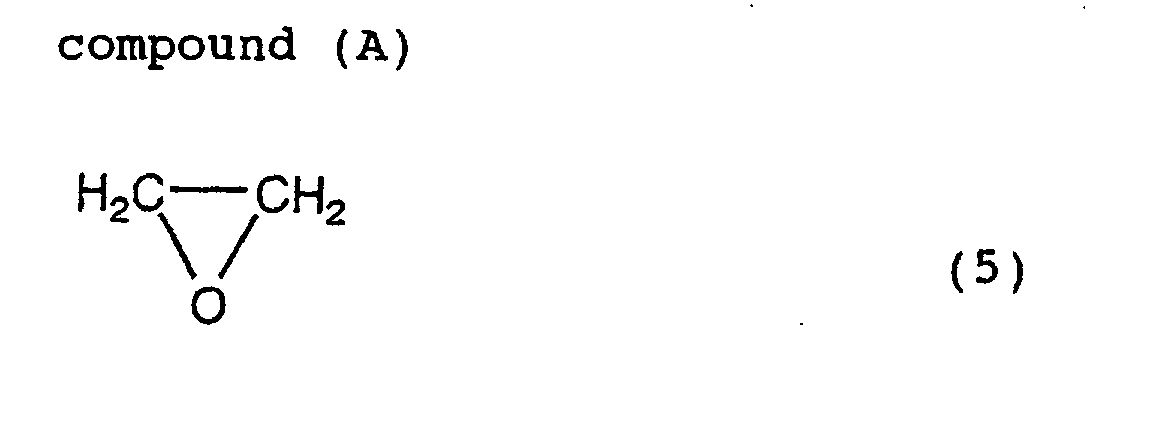
- a polymer or a copolymer of compound (A) represented by the following formula (5) and/or compound (B) represented by the following formula (6) can be used.
- R 1 represents a methyl group, an ethyl group, a propyl group, a butyl group or a group represented by the following formula (7).
- r represents 0 or an integer of 1 or more
- Ra represents a methyl group, an ethyl group, a propyl group or a butyl group.
- the electrolytic salt is preferably a metallic salt, more preferably a lithium salt.
- a metallic salt more preferably a lithium salt.
- examples thereof include LiBF 4 , LiPF 6 , LiClO 4 , LiAsF 6 , LiCF 3 SO 3 , LiN(CF 3 SO 2 ) 2 , LiN(C 2 F 5 SO 2 ) 2 , LiC(CF 3 SO 2 ) 3 , LiCl, LiF, LiBr, LiI, derivatives thereof and like. These lithium salts may be used either singly or in combination.
- the concentration of these electrolytic salts is usually 0.01 mol/kg to 10 mols/kg, preferably 0.2 mol/kg to 6 mols/kg.
- the nonaqueous solvent is preferably an aprotic solvent.
- aprotic solvent examples thereof include carbonates, lactones, ethers, sulfolanes and dioxolanes. These aprotic solvents may be used either singly or in combination.
- the polymeric compound to aprotic solvent mixing ratio is 1/99 to 99/1, preferably 5/95 to 95/5, more preferably 10/90 to 90/10 in terms of a weight ratio.
- a molar ratio of the compound having boron atoms in the structure to the electrolytic salt is preferably 0.1:100 to 300:100, more preferably 1:100 to 200:100, further preferably 50:100 to 100:100.
- the polymeric electrolyte of the invention can be applied to various electric devices, and examples thereof include cells, capacitors and the like. Typical of these are cells which are obtained by linking a positive electrode and a negative electrode through any of the foregoing polymeric electrolytes or through any of the foregoing nonaqueous electrolytes and a separator.
- a lithium metal, a lithium alloy or a substance capable of reversibly occluding and releasing lithium ions is used.
- examples of such a substance include carbon and the like.
- a porous film, a nonwoven fabric, a woven fabric or the like which can permeate lithium ions is used as the separator.
- the material thereof include olefinic polymers such as polyethylene, polypropylene and the like, fluoropolymers, cellulose-based polymers, glass fibers and the like.
- Potassium hydroxide (0.01 mol) was added to 1 mol of ethylene glycol monobutyl ether as a starting material, and a vessel was purged with nitrogen while stirring the mixture. Subsequently, the pressure inside the vessel was reduced using a vacuum pump. The temperature was then raised to 120°C, and the reaction was conducted using 1 mol of ethylene oxide as a monomer. After the completion of the reaction, the reaction mixture was cooled until the temperature inside the vessel reached room temperature. A methanol solution of 1.1 mols of sodium methylate was added, and the temperature was slowly raised to 50°C while reducing the pressure. After methanol was completely removed, 1.2 mols of epichlorohydrin was added, and the mixture was reacted for 4 hours. After the completion of the reaction, adsorption treatment was conducted. After dehydration under reduced pressure, the residue was filtered to obtain a desired product.
- a desired product was obtained in the same manner as monomer A except that ethylene glycol monomethyl ether was used as a starting material and 9 mols of ethylene oxide was used as a monomer.
- a desired product was obtained in the same manner as monomer A except that ethylene glycol monopropyl ether was used as a starting material and 2 mols of ethylene oxide was used as a monomer.
- a desired product was obtained in the same manner as monomer A except that ethylene glycol monomethyl ether was used as a starting material and 1 mol of ethylene oxide was used as a monomer.
- Potassium hydroxide (0.01 mol) was added to 0.5 mol of ethylene glycol as a starting material, and a vessel was purged with nitrogen while stirring the mixture. The pressure inside the vessel was reduced using a vacuum pump. The temperature was then raised to 120°C, and the reaction was conducted using 38,000 mols of ethylene oxide as a monomer. After the completion of the reaction, the reaction mixture was cooled until the temperature inside the vessel reached room temperature. A methanol solution of 1.1 mols of sodium methylate was added, and the temperature was slowly raised to 50°C while reducing the pressure. After methanol was completely removed, the residue was allowed to cool. One kilogram of toluene was added, and 1 mol of acrylic acid chloride was added. The mixture was reacted for 4 hours. After acid and alkali adsorption treatment was conducted, the residue was filtered, and toluene was removed under reduced pressure to obtain a desired product.
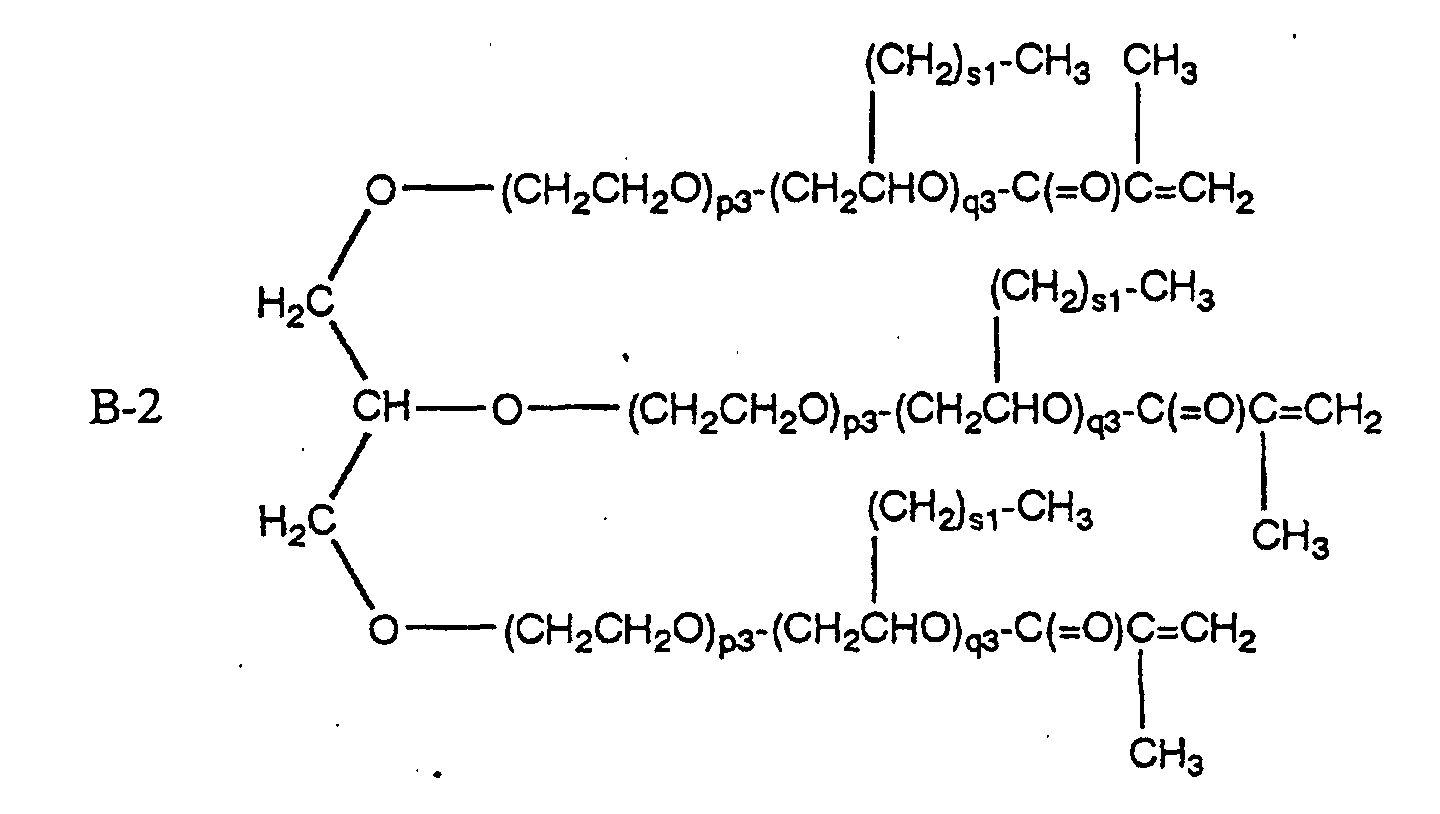
- a desired product was obtained in the same manner as polymeric compound precursor B-1 except that 0.33 mol of glycerin was used as a starting material, 28,000 mols of propylene oxide was used as a monomer and methacrylic acid chloride was used instead of acrylic acid chloride.
- a desired product was obtained in the same manner as polymeric compound precursor B-1 except that 0.25 mol of diglycerin was used as a starting material, 150 mols of ethylene oxide and 600 mols of 1,2-epoxyhexane were used as monomers, allyl chloride was used instead of acrylic acid chloride.
- a desired product was obtained in the same manner as polymeric compound precursor B-1 except that 0.33 mol of glycerin was used as a starting material and 150 mols of ethylene oxide and 29 mols of 1,2-epoxypentane were used as monomers.
- a desired product was obtained in the same manner as polymeric compound precursor B-1 except that 600 mols of monomer A was used as a monomer.
- a desired product was obtained in the same manner as polymeric compound precursor B-2 except that 50 mols of ethylene oxide and 15 mols of monomer B were used as monomers.
- a desired product was obtained in the same manner as polymeric compound precursor B-3 except that 1 mol of ethylene oxide and 1 mol of monomer C were used as monomers.
- a desired product was obtained in the same manner as polymeric compound precursor B-4 except that 1,600 mols of ethylene oxide and 400 mols of monomer D were used as monomers.
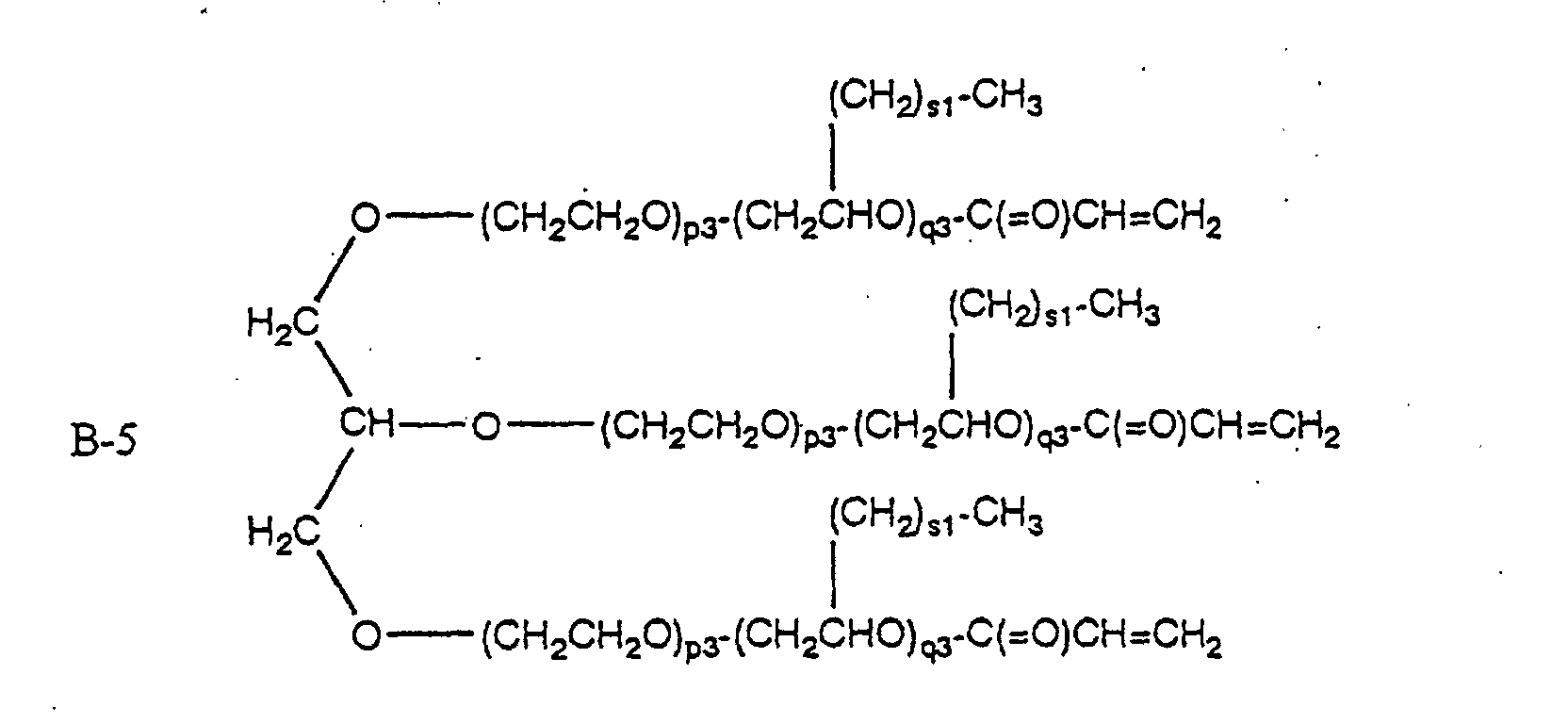
- a desired product was obtained in the same manner as polymeric compound precursor B-5 except that 126 mols of ethylene oxide and 24 mols of monomer E were used as monomers.
- Z is an active hydrogen residue.
- Compound p3 q3 s1 Y k B-1 38000 0 0 acryloyl group 2 B-2 0 28000 1 methacryloyl group 3 B-3 150 600 3 allyl group 4 B-4 2 1 1 vinyl group 2 B-5 150 29 0 acryloyl group 3 Z is an active hydrogen residue.
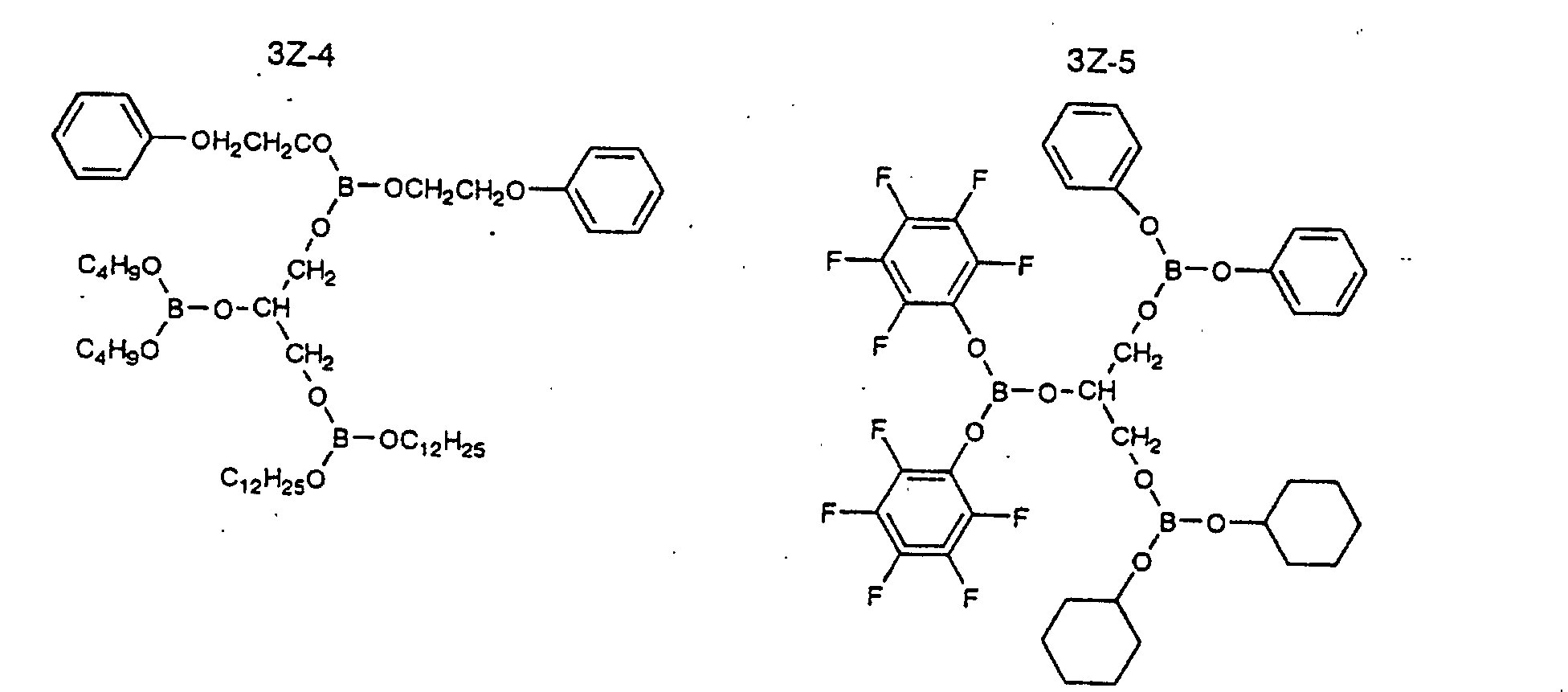
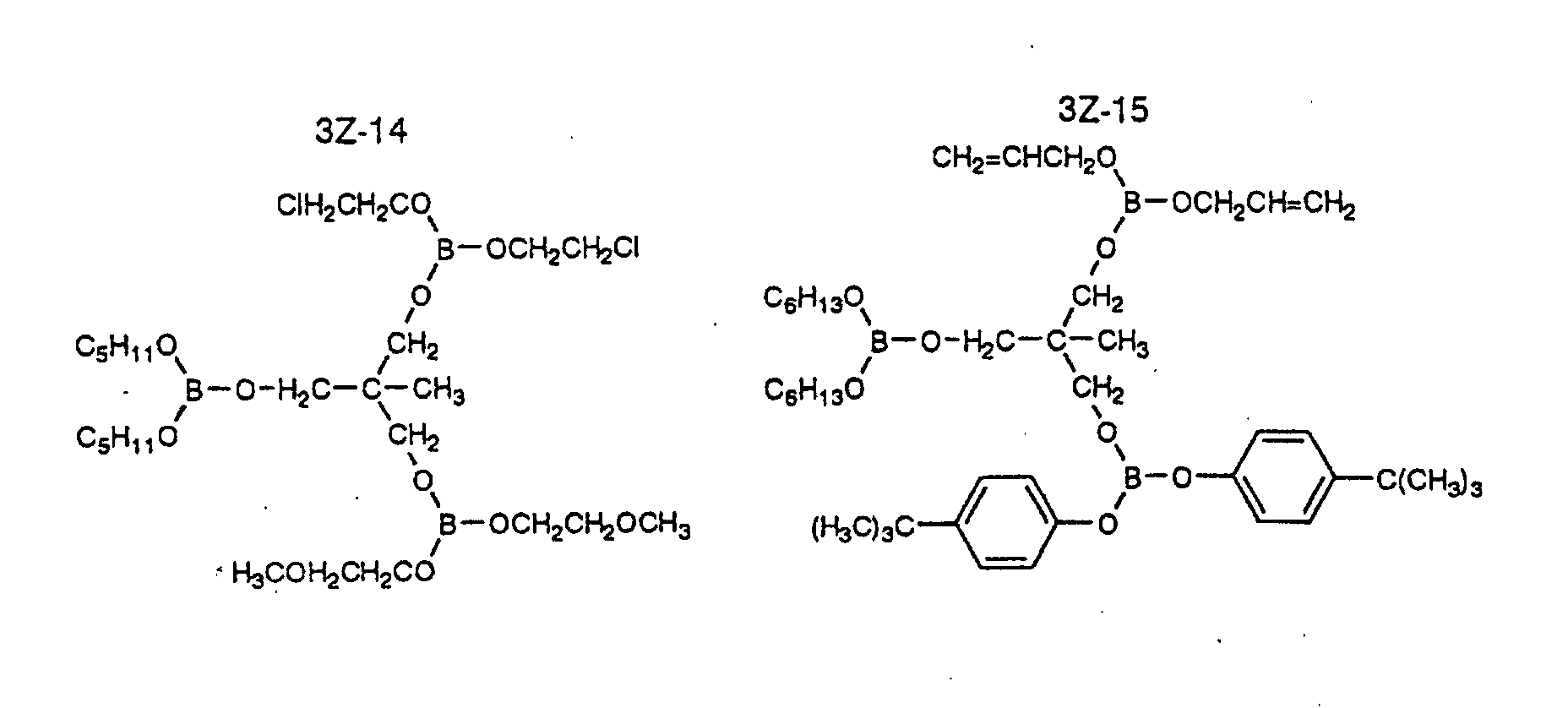
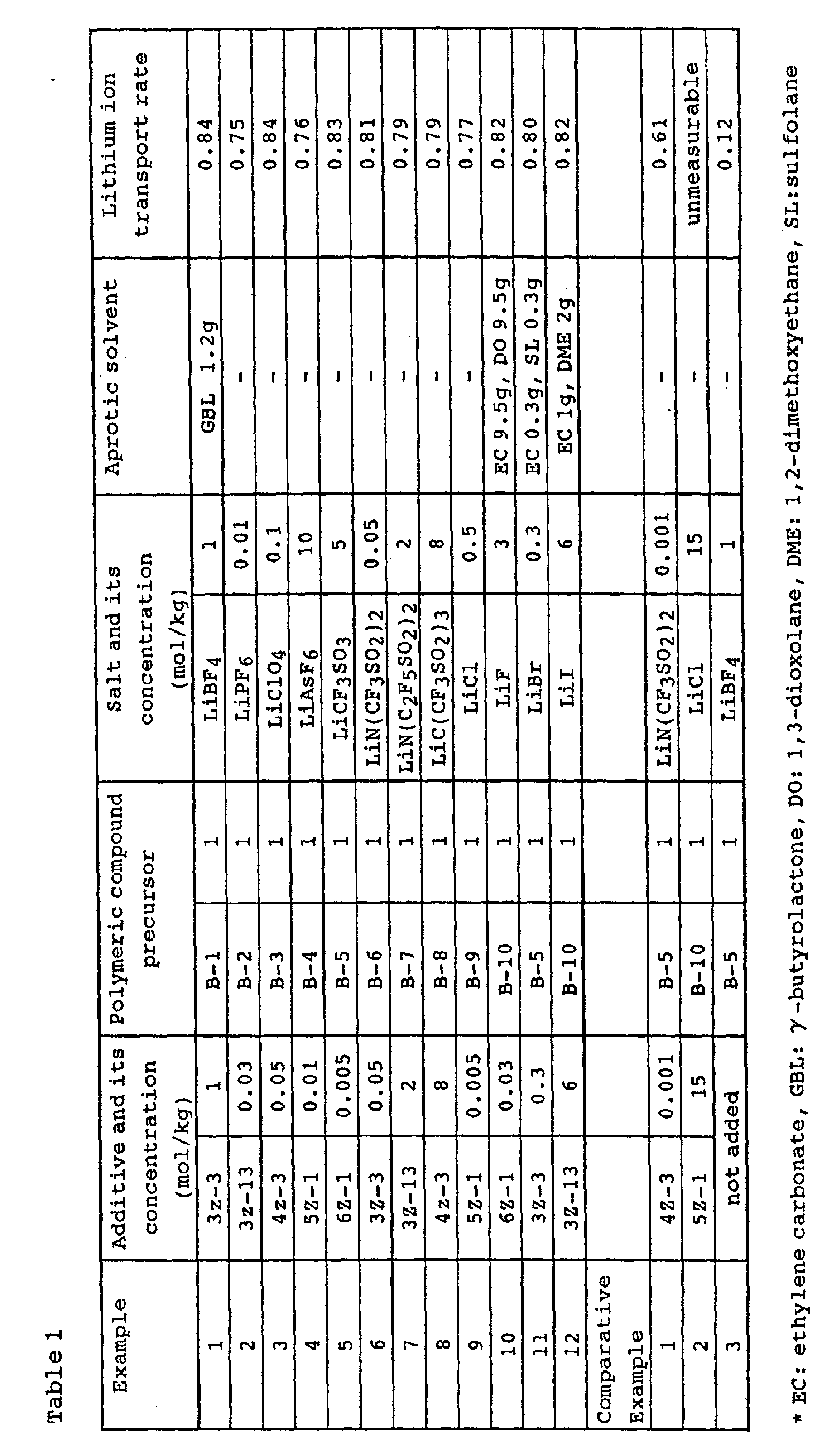
- the additive (1 mol/kg) represented by the formula 3Z-3, 1 mol/kg of LiBF 4 , 1.2 g of ⁇ -butyrolactone and a photopolymerization initiator were added to 1 g of polymeric compound precursor B-1. These were dissolved at 40°C, and poured between glass plates. The mixture was then irradiated with ultraviolet rays in an argon atmosphere to obtain a polymeric electrolyte having a thickness of 500 ⁇ m.
- Polymeric electrolytes were obtained in the same manner as in Example 1 except that types and amounts of polymeric compound precursors, additives, salts and aprotic solvents shown in Table 1 were used.
- Polymeric electrolytes were obtained in the same manner as in Example 1 except that types and amounts of polymeric compound precursors, additives, salts and aprotic solvents shown in Table 1 were used.
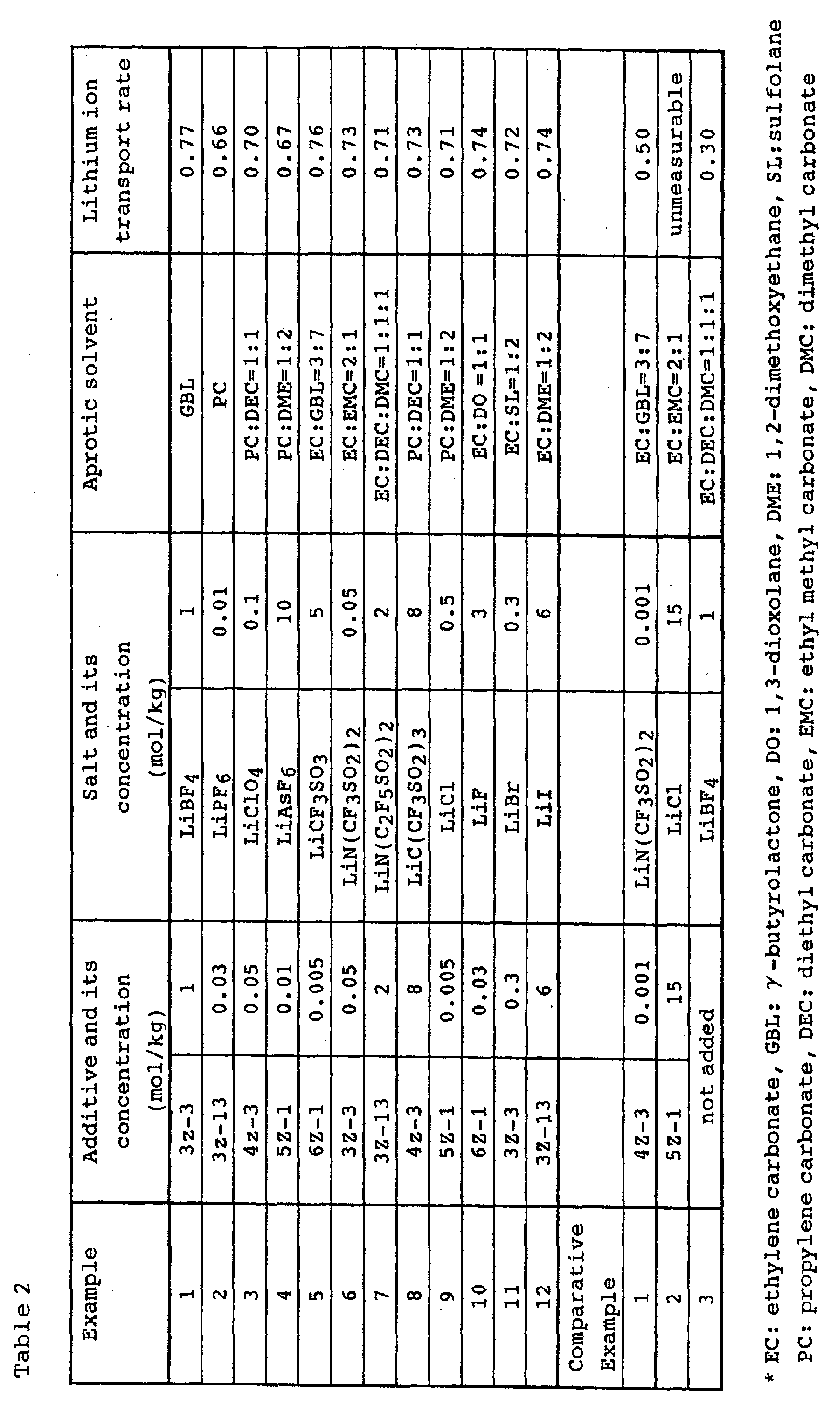
- the additive (1 mol/kg) represented by the formula 3Z-3 and 1 mol/kg of LiBF 4 were added to 1.2 g of ⁇ -butyrolactone, and these were dissolved in a globe box at 40°C to obtain a nonaqueous electrolyte.
- Nonaqueous electrolytes were obtained in the same manner as in Example 1 except that types and amounts of additives, salts and aprotic solvents shown in Table 2 were used.
- Nonaqueous electrolytes were obtained in the same manner as in Example 1 except that types and amounts of additives, salts and aprotic solvents shown in Table 2 were used.
- a polypropylene porous separator having a diameter of 13 mm was dipped with each of the nonaqueous electrolytes obtained in the foregoing Examples and Comparative Examples. After the dipping was conducted satisfactorily, the resulting separator was held between lithium metal electrodes having the same diameter. A lithium ion transport rate was measured by a DC polarization method. The results are also shown in Table 2.
- the polymeric electrolyte and the nonaqueous electrolyte of the invention can accelerate dissociation of an electrolytic salt upon using a compound having plural trivalent boron atoms in the structure, a Lewis acid, as an additive and consequently improve a transport rate of charge carrier ions. Besides, since an effect of addition per unit weight is great, the transport rate can be improved much, and an effective concentration region of the additive is also wide.
- cells having a higher voltage and a higher capacity than usual ones can provide cells having a higher voltage and a higher capacity than usual ones.
- the usage of cells is not limited, they are preferably used in portable electric appliances such as a video, a camera, a personal computer, a cellular phone and the like.
Landscapes
- Chemical & Material Sciences (AREA)
- Engineering & Computer Science (AREA)
- Manufacturing & Machinery (AREA)
- Chemical Kinetics & Catalysis (AREA)
- Electrochemistry (AREA)
- General Chemical & Material Sciences (AREA)
- Physics & Mathematics (AREA)
- Condensed Matter Physics & Semiconductors (AREA)
- General Physics & Mathematics (AREA)
- Inorganic Chemistry (AREA)
- Dispersion Chemistry (AREA)
- Secondary Cells (AREA)
- Polymers With Sulfur, Phosphorus Or Metals In The Main Chain (AREA)
Abstract

R11, R12, R13, R14, R15, R16, R21, R22, R23, R24, R25, R26, R27, R28, R31, R32, R33, R34, R35, R36, R37, R38, R39, R310, R41, R42, R43, R44, R45, R46, R47, R48, R49, R410, R411 and R412 each represent a hydrogen atom, a halogen atom or a monovalent group, or represent groups bound to each other to form a ring, and Ra, Rb, Rc and Rd each represent a group having a site capable of being bound to boron atoms which are the same or different.
Description













| Compound | p3 | q3 | s1 | Y | k |
| B-1 | 38000 | 0 | 0 | acryloyl group | 2 |
| B-2 | 0 | 28000 | 1 | methacryloyl group | 3 |
| B-3 | 150 | 600 | 3 | allyl group | 4 |
| B-4 | 2 | 1 | 1 | vinyl group | 2 |
| B-5 | 150 | 29 | 0 | acryloyl group | 3 |
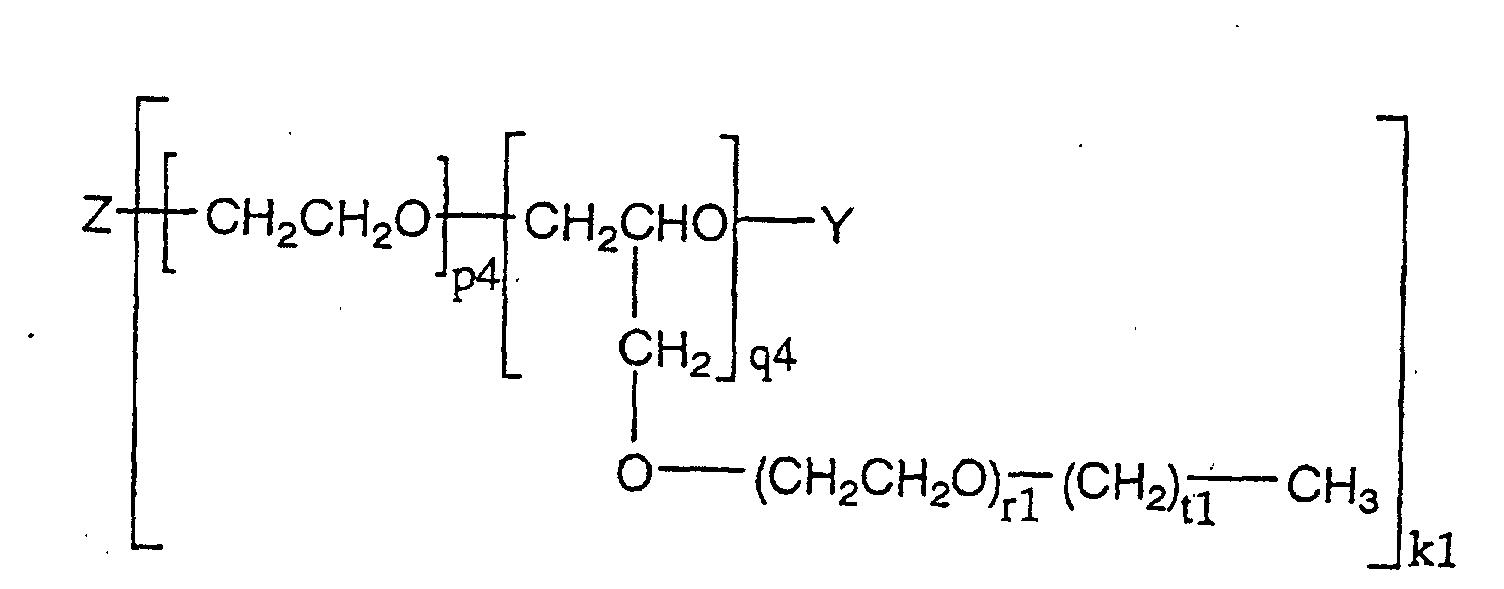
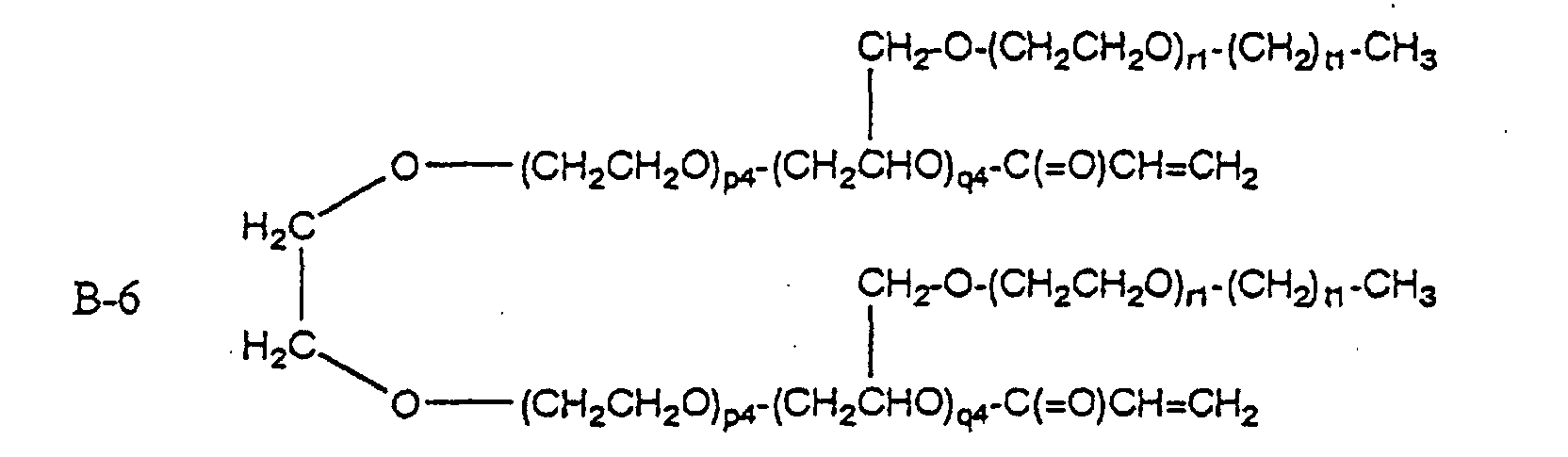
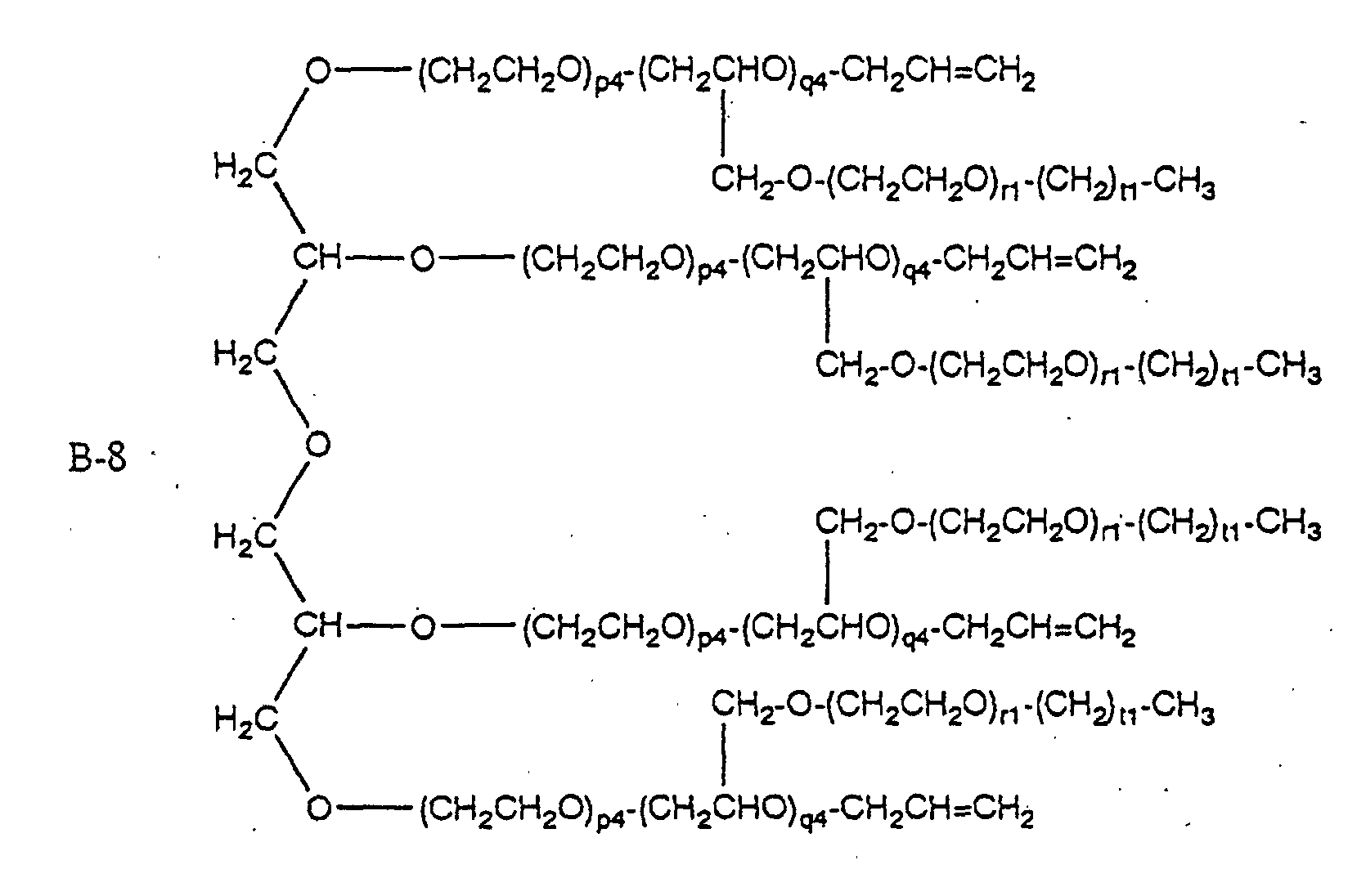
| Compound | p4 | q4 | r1 | t | Y | k |
| B-6 | 0 | 600 | 2 | 3 | acryloyl group | 2 |
| B-7 | 50 | 15 | 10 | 0 | methacryloyl group | 3 |
| B-8 | 1 | 1 | 3 | 2 | allyl group | 4 |
| B-9 | 1600 | 400 | 50 | 1 | vinyl group | 2 |
| B-10 | 126 | 24 | 2 | 0 | acryloyl group | 3 |





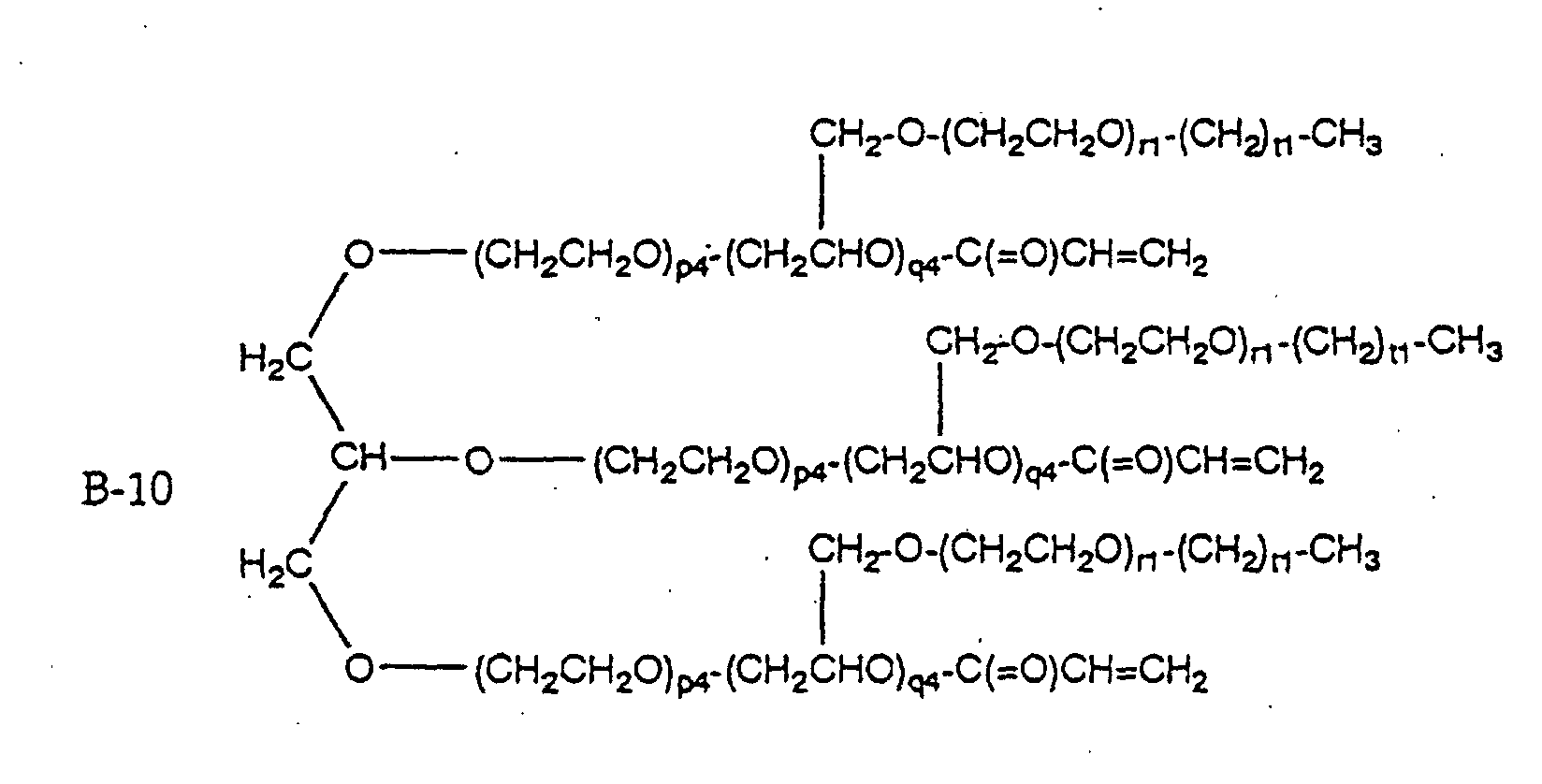
Claims (27)
- A polymeric electrolyte made of an electrolytic salt and a polymeric compound forming a complex with the electrolytic salt, characterized by containing a compound having boron atoms in the structure.
- The polymeric electrolyte according to claim 1, characterized in that the compound having boron atoms in the structure is one or more selected from the group consisting of compounds represented by the following general formulas (1) to (4).
 wherein
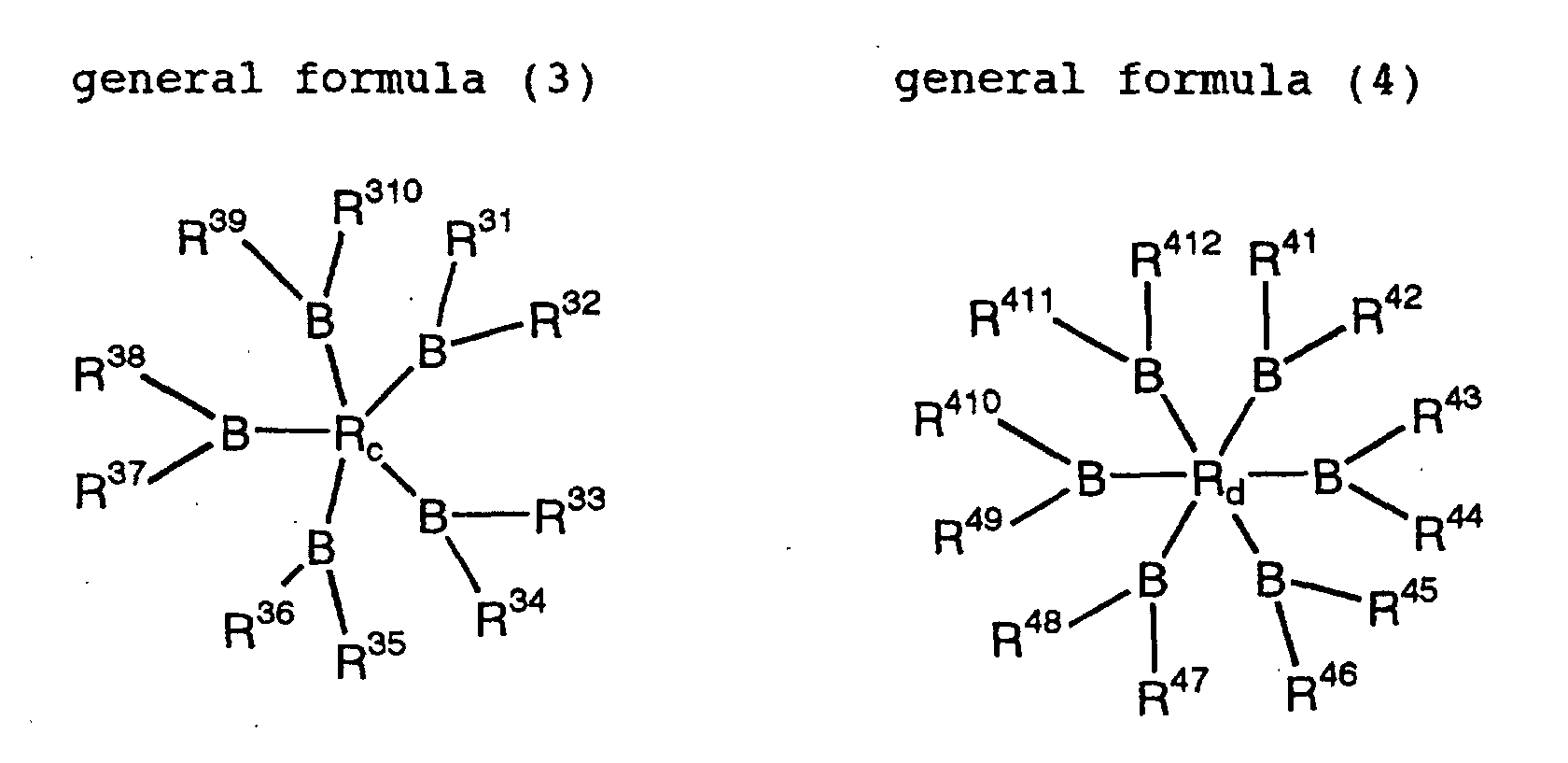 R11, R12, R13, R14, R15 and R16 in formula (1), R21, R22, R23, R24, R25, R26, R27 and R28 in formula (2), R31, R32, R33, R34, R35, R36, R37, R38, R39 and R310 in formula (3), and R41, R42, R43, R44, R45, R46, R47, R48, R49, R410, R411 and R412 in formula (4), which may be the same or different, each represent a hydrogen atom, a halogen atom or a monovalent group, or are bound to each other to form a ring,Ra in formula (1) represents a group having a site capable of being bound to at least 3 boron atoms which are the same or different, Rb in formula (2) represents a group having a site capable of being bound to at least 4 boron atoms which are the same or different, Rc in formula (3) represents a group having a site capable of being bound to at least 5 boron atoms which are the same or different, and Rd in formula (4) represents a group having a site capable of being bound to at least 6 boron atoms which are the same or different.
 - The polymeric electrolyte according to claim 2, characterized in that R11, R12, R13, R14, R15, R16, R21, R22, R23, R24 R25, R26, R27, R28, R31, R32, R33, R34, R35, R36, R37, R38, R39, R310, R41, R42, R43, R44, R45, R46, R47, R48, R49, R410, R411 and R412 are one or more groups selected from the member consisting of an alkyl group, an aryl group and fluorine-substituted derivatives thereof.
- The polymeric electrolyte according to any one of claims 1 to 3, characterized in that the polymeric compound is one or more selected from the group consisting of a polyalkylene, a polyether, a polyester, a polyamine, a polyimide, a polyurethane, a polysulfide, a polyphosphazene, a polysiloxane, derivatives thereof, copolymers thereof and crosslinked products thereof.
- The polymeric electrolyte according to any one of claims 1 to 3, characterized in that the polymeric compound is one or more selected from the group consisting of a polyalkylene oxide, polyvinylidene fluoride, polyhexafluoropropylene, polyacrylonitrile, polymethyl methacrylate, derivatives thereof, copolymers thereof and crosslinked products thereof.
- The polymeric electrolyte according to any one of claims 1 to 5, characterized in that the electrolytic salt is a metallic salt.
- The polymeric electrolyte according to claim 6, characterized in that the metallic salt is a lithium salt.
- The polymeric electrolyte according to claim 7, characterized in that the lithium salt is one or more selected from the group consisting of LiBF4, LiPF6, LiClO4, LiAsF6, LiCF3SO3, LiN(CF3SO2)2, LiN(C2F5SO2)2, LiC(CF3SO2)3, LiCl, LiF, LiBr, LiI, derivatives thereof and like.
- The polymeric electrolyte according to claims 1 to 8, characterized by further containing a nonaqueous solvent.
- The polymeric electrolyte according to claim 9, characterized in that the nonaqueous solvent is an aprotic solvent.
- The polymeric electrolyte according to claim 10, characterized in that the aprotic solvent is one or more selected from the group consisting of carbonates, lactones, ethers, sulfolanes and dioxolanes.
- The polymeric electrolyte according to claims 1 to 11, characterized in that the molar ratio of the compound having boron atoms in the structure to the electrolytic salt is 0.1:100 to 300:100.
- An electric device using the polymeric electrolyte according to any one of claims 1 to 12.
- A cell in which a positive electrode and a negative electrode are linked through the polymeric electrolyte according to any one of claims 1 to 12.
- The cell according to claim 14, characterized in that the positive electrode is made of a double metal oxide capable of occluding and releasing lithium ions, and the negative electrode is made of a lithium metal, a lithium alloy or a compound capable of reversibly occluding and releasing lithium ions.
- A nonaqueous electrolyte made of an electrolytic salt and a nonaqueous solvent that dissolves the electrolytic salt, characterized by containing a compound having boron atoms in the structure.
- The nonaqueous electrolyte according to claim 16, characterized in that the compound having boron atoms in the structure is one or more selected from the group consisting of compounds represented by the following general formulas (1) to (4)
 wherein
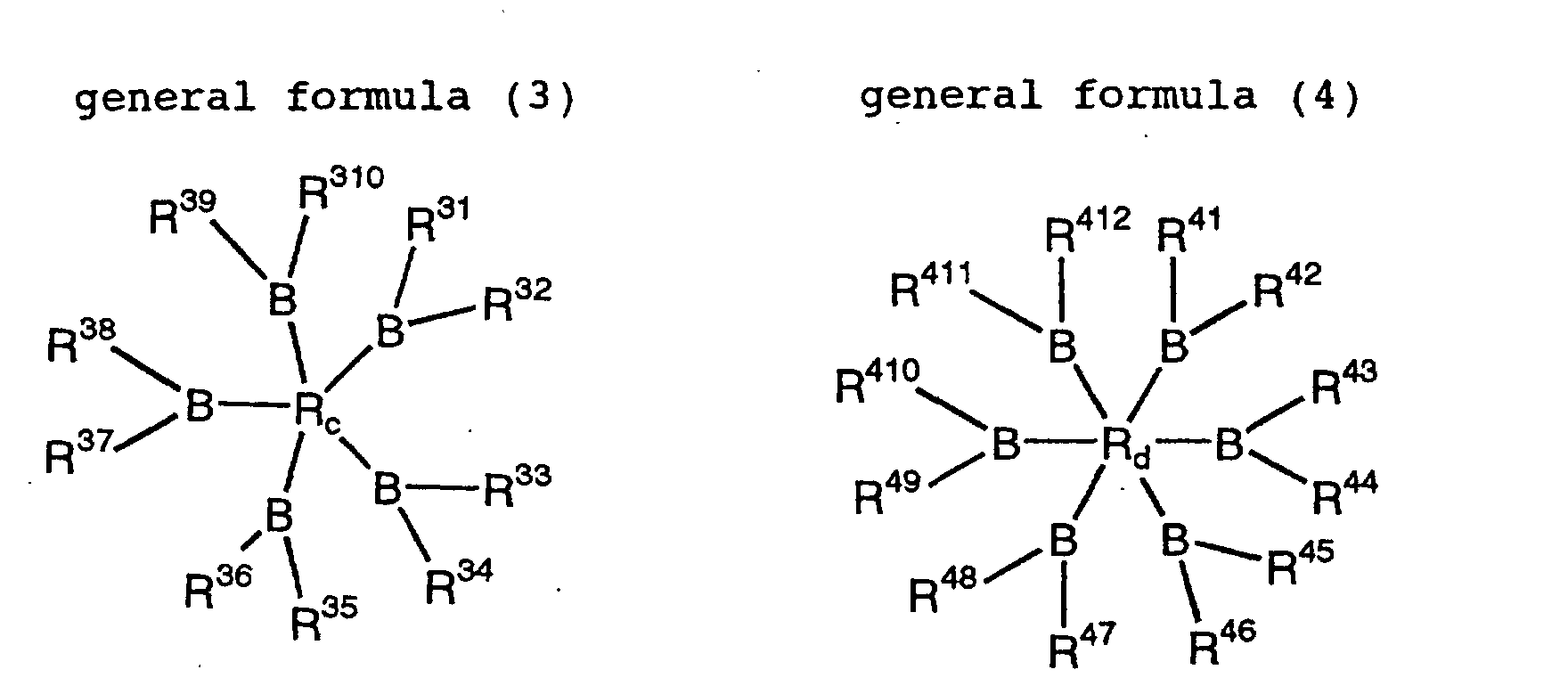 R11, R12, R13, R14, R15 and R16 in formula (1), R21, R22, R23, R24, R25, R26, R27 and R28 in formula (2), R31, R32, R33, R34, R35, R36, R37, R38, R39 and R310 in formula (3), and R41, R42, R43, R44, R45, R46, R47, R48, R49, R410, R411 and R412 in formula (4), which may be the same or different, each represent a hydrogen atom, a halogen atom or a monovalent group, or are bound to each other to form a ring,Ra in formula (1) represents a group having a site capable of being bound to at least 3 boron atoms which are the same or different, Rb in formula (2) represents a group having a site capable of being bound to at least 4 boron atoms which are the same or different, Rc in formula (3) represents a group having a site capable of being bound to at least 5 boron atoms which are the same or different, and Rd in formula (4) represents a group having a site capable of being bound to at least 6 boron atoms which are the same or different.
 - The nonaqueous electrolyte according to claim 17, characterized in that R11, R12, R13, R14, R15, R16, R21, R22, R23, R24, R25, R26, R27, R28, R31, R32, R33, R34, R35, R36, R37, R38, R39, R310, R41, R42, R43, R44, R45, R46, R47, R48, R49, R410, R411 and R412 are one or more groups selected from the member consisting of an alkyl group, an aryl group and fluorine-substituted derivatives thereof.
- The nonaqueous electrolyte according to any one of claims 16 to 18, characterized in that the electrolytic salt is a metallic salt.
- The nonaqueous electrolyte according to claim 19, characterized in that the metallic salt is a lithium salt.
- The nonaqueous electrolyte according to claim 20, characterized in that the lithium salt is one or more selected from the group consisting of LiBF4, LiPF6, LiClO4, LiAsF6, LiCF3SO3, LiN(CF3SO2)2, LiN(C2F5SO2)2, LiC(CF3SO2)3, LiCl, LiF, LiBr, LiI, derivatives thereof and the like.
- The nonaqueous electrolyte according to claims 16 to 21, characterized in that the nonaqueous solvent is an aprotic solvent.
- The nonaqueous electrolyte according to claim 22, characterized in that the aprotic solvent is one or more selected from the group consisting of carbonates, lactones, ethers, sulfolanes and dioxolanes.
- The nonaqueous electrolyte according to any one of claims 16 to 23, characterized in that the molar ratio of the compound having the boron atoms in the structure to the electrolytic salt is 0.1:100 to 300:100.
- An electric device using the nonaqueous electrolyte according to any one of claims 16 to 24.
- A cell in which a positive electrode and a negative electrode are linked through the nonaqueous electrolyte according to any one of claims 16 to 24 and a separator.
- The cell according to claim 26, characterized in that the positive electrode is made of a double metal oxide capable of occluding and releasing lithium ions, and the negative electrode is made of a lithium metal, a lithium alloy or a compound capable of reversibly occluding and releasing lithium ions.
Applications Claiming Priority (5)
| Application Number | Priority Date | Filing Date | Title |
|---|---|---|---|
| JP24889099A JP3557962B2 (en) | 1999-09-02 | 1999-09-02 | Polymer electrolyte and electrochemical device using the same |
| JP24889099 | 1999-09-02 | ||
| JP24889199 | 1999-09-02 | ||
| JP24889199A JP2001076755A (en) | 1999-09-02 | 1999-09-02 | Non-aqueous electrolyte and electrochemical device using the same |
| PCT/JP2000/005812 WO2001018898A1 (en) | 1999-09-02 | 2000-08-28 | Polyelectrolyte, non-aqueous electrolyte, and electrical device containing the same |
Publications (3)
| Publication Number | Publication Date |
|---|---|
| EP1130671A1 true EP1130671A1 (en) | 2001-09-05 |
| EP1130671A4 EP1130671A4 (en) | 2008-08-06 |
| EP1130671B1 EP1130671B1 (en) | 2010-05-05 |
Family
ID=26538989
Family Applications (1)
| Application Number | Title | Priority Date | Filing Date |
|---|---|---|---|
| EP00955081A Expired - Lifetime EP1130671B1 (en) | 1999-09-02 | 2000-08-28 | Polyelectrolyte, non-aqueous electrolyte, and electrical device containing the same |
Country Status (5)
| Country | Link |
|---|---|
| US (2) | US6673495B1 (en) |
| EP (1) | EP1130671B1 (en) |
| CA (1) | CA2344243C (en) |
| DE (1) | DE60044329D1 (en) |
| WO (1) | WO2001018898A1 (en) |
Cited By (2)
| Publication number | Priority date | Publication date | Assignee | Title |
|---|---|---|---|---|
| EP1249464A1 (en) | 2001-04-09 | 2002-10-16 | Dai-Ichi Kogyo Seiyaku Co., Ltd. | Polyether polymer compounds as well as ion conductive polymer compositions and electrochemical devices using the same |
| CN112038690A (en) * | 2019-06-04 | 2020-12-04 | 北京卫蓝新能源科技有限公司 | Boron-containing polymer solid electrolyte and application thereof |
Families Citing this family (6)
| Publication number | Priority date | Publication date | Assignee | Title |
|---|---|---|---|---|
| US6936377B2 (en) * | 2003-05-13 | 2005-08-30 | C. Glen Wensley | Card with embedded IC and electrochemical cell |
| US20040253520A1 (en) * | 2003-05-13 | 2004-12-16 | Wensley C. Glen | Polyimide matrix electrolyte and improved batteries therefrom |
| US20040229127A1 (en) | 2003-05-13 | 2004-11-18 | Wensley C. Glen | Polyimide matrix electrolyte |
| US7390336B2 (en) * | 2003-07-29 | 2008-06-24 | Solicore, Inc. | Polyimide-based lithium metal battery |
| EP1787344B1 (en) | 2004-07-22 | 2017-02-22 | BrightVolt, Inc. | Improved battery tab and packaging design |
| EP3764434A1 (en) * | 2019-07-10 | 2021-01-13 | LITRONIK Batterietechnologie GmbH | Elimination of voltage-delays and stabilisation of impedance through electrolyte additives in alkaline metal chemical cells |
Family Cites Families (11)
| Publication number | Priority date | Publication date | Assignee | Title |
|---|---|---|---|---|
| JPS60165050A (en) | 1984-02-07 | 1985-08-28 | Matsushita Electric Ind Co Ltd | Assembly equipment for plate and separator |
| AU7719896A (en) | 1995-11-03 | 1997-05-22 | Arizona Board Of Regents, The | Wide electrochemical window solvents for use in electrochemical devices and electrolyte solutions incorporating such solvents |
| US5849432A (en) * | 1995-11-03 | 1998-12-15 | Arizona Board Of Regents | Wide electrochemical window solvents for use in electrochemical devices and electrolyte solutions incorporating such solvents |
| CA2196493C (en) | 1997-01-31 | 2002-07-16 | Huanyu Mao | Additives for improving cycle life of non-aqueous rechargeable lithium batteries |
| JPH113728A (en) | 1997-04-17 | 1999-01-06 | Fuji Photo Film Co Ltd | Nonaqueous electrolyte secondary battery |
| JP3563929B2 (en) * | 1997-07-31 | 2004-09-08 | 株式会社コンポン研究所 | Substrate for ion conductor and ion conductor |
| JP3233345B2 (en) | 1997-10-31 | 2001-11-26 | 大阪府 | Method for producing ion-conductive sulfide glass fine powder for all-solid-state battery, ion-conductive sulfide glass fine powder for all-solid-state battery, solid electrolyte, and all-solid-state secondary battery |
| JPH11219730A (en) | 1998-02-03 | 1999-08-10 | Fuji Photo Film Co Ltd | Nonaqueous electrolyte secondary battery |
| JP2000082330A (en) | 1998-09-07 | 2000-03-21 | Sony Corp | Composition for electrolyte, electrolyte, method for producing the same, and battery using the same |
| JP2000090731A (en) | 1998-09-11 | 2000-03-31 | Fujikura Ltd | Solid state ion conductive composition and method for producing molded article comprising the same |
| JP2000173343A (en) | 1998-12-02 | 2000-06-23 | Japan Carlit Co Ltd:The | Ion conductive polymer electrolyte |
-
2000
- 2000-08-28 DE DE60044329T patent/DE60044329D1/en not_active Expired - Lifetime
- 2000-08-28 CA CA002344243A patent/CA2344243C/en not_active Expired - Fee Related
- 2000-08-28 US US09/787,231 patent/US6673495B1/en not_active Ceased
- 2000-08-28 WO PCT/JP2000/005812 patent/WO2001018898A1/en not_active Ceased
- 2000-08-28 EP EP00955081A patent/EP1130671B1/en not_active Expired - Lifetime
- 2000-08-28 US US11/327,829 patent/USRE40302E1/en not_active Expired - Fee Related
Cited By (4)
| Publication number | Priority date | Publication date | Assignee | Title |
|---|---|---|---|---|
| EP1249464A1 (en) | 2001-04-09 | 2002-10-16 | Dai-Ichi Kogyo Seiyaku Co., Ltd. | Polyether polymer compounds as well as ion conductive polymer compositions and electrochemical devices using the same |
| US6913851B2 (en) | 2001-04-09 | 2005-07-05 | Dai-Ichi Kogyo Seiyaku Co., Ltd. | Polyether polymer compounds as well as ion conductible polymer compositions and electrochemical devices using the same |
| CN100354336C (en) * | 2001-04-09 | 2007-12-12 | 第一工业制药株式会社 | Polyether high polymer compound, using formed ion conducing high polymer composition and electrochemical equipment |
| CN112038690A (en) * | 2019-06-04 | 2020-12-04 | 北京卫蓝新能源科技有限公司 | Boron-containing polymer solid electrolyte and application thereof |
Also Published As
| Publication number | Publication date |
|---|---|
| EP1130671B1 (en) | 2010-05-05 |
| DE60044329D1 (en) | 2010-06-17 |
| WO2001018898A1 (en) | 2001-03-15 |
| CA2344243C (en) | 2006-05-09 |
| USRE40302E1 (en) | 2008-05-06 |
| EP1130671A4 (en) | 2008-08-06 |
| US6673495B1 (en) | 2004-01-06 |
| CA2344243A1 (en) | 2001-03-15 |
Similar Documents
| Publication | Publication Date | Title |
|---|---|---|
| CN1252855C (en) | Electrolytes for lithium-ion batteries | |
| KR100804981B1 (en) | Secondary Battery Using Eutectic Mixture and Manufacturing Method Thereof | |
| KR102592147B1 (en) | Composite separator, preparing method thereof, and lithium secondary battery including the same | |
| KR102562680B1 (en) | Polymer electrolyte for lithium secondary battery and lithium secondary battery including the same | |
| US20160268633A1 (en) | Copolymers with a polyacrylic acid backbone as performance enhancers for lithium-ion cells | |
| KR20040070307A (en) | Ion-conductive electrolyte and cell employing the same | |
| KR20180000942A (en) | Polymer electrolyte, preparing method thereof, and lithium metal battery including the same | |
| KR20170047661A (en) | Random copolymer, Electrolyte, Protected anode and Lithium battery comprising Random copolymer, and Preparation method of Random copolymer | |
| EP1160268B1 (en) | Ionically conductive polymer, polymer electrolyte, and electrical device | |
| US20220302503A1 (en) | An electrolyte solution comprising an alkali metal bis (oxalato)borate salt | |
| US6673495B1 (en) | Polyelectrolyte, non-aqueous electrolyte, and electrical device containing the same | |
| JP2025502123A (en) | Solid electrolytes containing ionic bifunctional molecules and their use in electrochemistry - Patents.com | |
| JP3557961B2 (en) | Novel ion conductive polymer, polymer electrolyte and electrochemical device using the same | |
| JP5021867B2 (en) | Polyether polymer compound, ion conductive polymer composition and electrochemical device using the same | |
| JP3557962B2 (en) | Polymer electrolyte and electrochemical device using the same | |
| JP3730861B2 (en) | Electrolytes for electrochemical devices, electrolytes or solid electrolytes thereof, and batteries | |
| CN121175359A (en) | Unsaturated polymer electrolytes and methods of producing and using the same in electrochemical applications | |
| JP3557960B2 (en) | Novel ion conductive polymer, polymer electrolyte and electrochemical device using the same | |
| JP3557959B2 (en) | Novel ion conductive polymer, polymer electrolyte and electrochemical device using the same | |
| KR102488679B1 (en) | Aqueous binder for a lithium-ion secondary battery, anode comprising the same, lithium-ion secondary battery comprising the anode, and method for polymerizing copolymer comprised in the binder | |
| JP4175798B2 (en) | Electrolytes for electrochemical devices, electrolytes or solid electrolytes thereof, and batteries | |
| JP2001076755A (en) | Non-aqueous electrolyte and electrochemical device using the same | |
| PL212193B1 (en) | Application of borate compounds as receptors of anions in polymeric electrolytes and polymeric electrolyte with receptor of anions |
Legal Events
| Date | Code | Title | Description |
|---|---|---|---|
| PUAI | Public reference made under article 153(3) epc to a published international application that has entered the european phase |
Free format text: ORIGINAL CODE: 0009012 |
|
| 17P | Request for examination filed |
Effective date: 20010529 |
|
| AK | Designated contracting states |
Kind code of ref document: A1 Designated state(s): AT BE CH CY DE DK ES FI FR GB GR IE IT LI LU MC NL PT SE |
|
| RBV | Designated contracting states (corrected) |
Designated state(s): DE FR IT |
|
| A4 | Supplementary search report drawn up and despatched |
Effective date: 20080704 |
|
| 17Q | First examination report despatched |
Effective date: 20081114 |
|
| GRAP | Despatch of communication of intention to grant a patent |
Free format text: ORIGINAL CODE: EPIDOSNIGR1 |
|
| GRAS | Grant fee paid |
Free format text: ORIGINAL CODE: EPIDOSNIGR3 |
|
| GRAA | (expected) grant |
Free format text: ORIGINAL CODE: 0009210 |
|
| AK | Designated contracting states |
Kind code of ref document: B1 Designated state(s): DE FR IT |
|
| REF | Corresponds to: |
Ref document number: 60044329 Country of ref document: DE Date of ref document: 20100617 Kind code of ref document: P |
|
| PGFP | Annual fee paid to national office [announced via postgrant information from national office to epo] |
Ref country code: DE Payment date: 20100825 Year of fee payment: 11 Ref country code: IT Payment date: 20100823 Year of fee payment: 11 Ref country code: FR Payment date: 20100824 Year of fee payment: 11 |
|
| PLBE | No opposition filed within time limit |
Free format text: ORIGINAL CODE: 0009261 |
|
| STAA | Information on the status of an ep patent application or granted ep patent |
Free format text: STATUS: NO OPPOSITION FILED WITHIN TIME LIMIT |
|
| 26N | No opposition filed |
Effective date: 20110208 |
|
| REG | Reference to a national code |
Ref country code: DE Ref legal event code: R097 Ref document number: 60044329 Country of ref document: DE Effective date: 20110207 |
|
| REG | Reference to a national code |
Ref country code: FR Ref legal event code: ST Effective date: 20120430 |
|
| PG25 | Lapsed in a contracting state [announced via postgrant information from national office to epo] |
Ref country code: IT Free format text: LAPSE BECAUSE OF NON-PAYMENT OF DUE FEES Effective date: 20110828 |
|
| REG | Reference to a national code |
Ref country code: DE Ref legal event code: R119 Ref document number: 60044329 Country of ref document: DE Effective date: 20120301 |
|
| PG25 | Lapsed in a contracting state [announced via postgrant information from national office to epo] |
Ref country code: FR Free format text: LAPSE BECAUSE OF NON-PAYMENT OF DUE FEES Effective date: 20110831 |
|
| PG25 | Lapsed in a contracting state [announced via postgrant information from national office to epo] |
Ref country code: DE Free format text: LAPSE BECAUSE OF NON-PAYMENT OF DUE FEES Effective date: 20120301 |