EP1130001A2 - Aggregate, manufacturing process thereof and resin mortar containing this aggregate - Google Patents
Aggregate, manufacturing process thereof and resin mortar containing this aggregate Download PDFInfo
- Publication number
- EP1130001A2 EP1130001A2 EP00128209A EP00128209A EP1130001A2 EP 1130001 A2 EP1130001 A2 EP 1130001A2 EP 00128209 A EP00128209 A EP 00128209A EP 00128209 A EP00128209 A EP 00128209A EP 1130001 A2 EP1130001 A2 EP 1130001A2
- Authority
- EP
- European Patent Office
- Prior art keywords
- aggregate
- core
- resin
- adhesive
- surfacing material
- Prior art date
- Legal status (The legal status is an assumption and is not a legal conclusion. Google has not performed a legal analysis and makes no representation as to the accuracy of the status listed.)
- Withdrawn
Links
- 239000011347 resin Substances 0.000 title claims abstract description 67
- 229920005989 resin Polymers 0.000 title claims abstract description 67
- 238000004519 manufacturing process Methods 0.000 title claims abstract description 8
- 239000004570 mortar (masonry) Substances 0.000 title claims description 23
- 239000000463 material Substances 0.000 claims abstract description 108
- 239000002245 particle Substances 0.000 claims abstract description 21
- 238000002156 mixing Methods 0.000 claims abstract description 12
- 239000013013 elastic material Substances 0.000 claims abstract description 11
- 238000003823 mortar mixing Methods 0.000 claims abstract description 7
- 239000000853 adhesive Substances 0.000 claims description 47
- 230000001070 adhesive effect Effects 0.000 claims description 47
- 150000008117 polysulfides Polymers 0.000 claims description 7
- XLYOFNOQVPJJNP-UHFFFAOYSA-N water Substances O XLYOFNOQVPJJNP-UHFFFAOYSA-N 0.000 claims description 6
- 238000006243 chemical reaction Methods 0.000 claims description 4
- 239000005077 polysulfide Substances 0.000 claims description 4
- 229920001021 polysulfide Polymers 0.000 claims description 4
- 239000000654 additive Substances 0.000 abstract description 2
- VYPSYNLAJGMNEJ-UHFFFAOYSA-N Silicium dioxide Chemical compound O=[Si]=O VYPSYNLAJGMNEJ-UHFFFAOYSA-N 0.000 description 19
- 239000000843 powder Substances 0.000 description 18
- 239000010426 asphalt Substances 0.000 description 16
- 229920001971 elastomer Polymers 0.000 description 13
- 239000005060 rubber Substances 0.000 description 13
- 239000000203 mixture Substances 0.000 description 9
- 239000000377 silicon dioxide Substances 0.000 description 7
- 239000004568 cement Substances 0.000 description 6
- 239000004033 plastic Substances 0.000 description 6
- 229920003023 plastic Polymers 0.000 description 6
- 239000000126 substance Substances 0.000 description 6
- 238000005422 blasting Methods 0.000 description 5
- 239000004567 concrete Substances 0.000 description 5
- 238000000034 method Methods 0.000 description 5
- 239000004576 sand Substances 0.000 description 5
- 239000004575 stone Substances 0.000 description 5
- VTYYLEPIZMXCLO-UHFFFAOYSA-L Calcium carbonate Chemical compound [Ca+2].[O-]C([O-])=O VTYYLEPIZMXCLO-UHFFFAOYSA-L 0.000 description 4
- 230000000694 effects Effects 0.000 description 4
- 239000002440 industrial waste Substances 0.000 description 4
- 239000000919 ceramic Substances 0.000 description 3
- 239000000835 fiber Substances 0.000 description 3
- 230000003014 reinforcing effect Effects 0.000 description 3
- 239000002356 single layer Substances 0.000 description 3
- 239000007787 solid Substances 0.000 description 3
- 229920002803 thermoplastic polyurethane Polymers 0.000 description 3
- 239000002699 waste material Substances 0.000 description 3
- 239000004925 Acrylic resin Substances 0.000 description 2
- 229920000178 Acrylic resin Polymers 0.000 description 2
- 239000004593 Epoxy Substances 0.000 description 2
- JOYRKODLDBILNP-UHFFFAOYSA-N Ethyl urethane Chemical compound CCOC(N)=O JOYRKODLDBILNP-UHFFFAOYSA-N 0.000 description 2
- BZHJMEDXRYGGRV-UHFFFAOYSA-N Vinyl chloride Chemical compound ClC=C BZHJMEDXRYGGRV-UHFFFAOYSA-N 0.000 description 2
- 238000007259 addition reaction Methods 0.000 description 2
- 238000004026 adhesive bonding Methods 0.000 description 2
- 229910000019 calcium carbonate Inorganic materials 0.000 description 2
- 239000003795 chemical substances by application Substances 0.000 description 2
- 239000011248 coating agent Substances 0.000 description 2
- 238000000576 coating method Methods 0.000 description 2
- 230000007547 defect Effects 0.000 description 2
- 230000007613 environmental effect Effects 0.000 description 2
- 125000003700 epoxy group Chemical group 0.000 description 2
- 239000003822 epoxy resin Substances 0.000 description 2
- 239000010410 layer Substances 0.000 description 2
- 125000001570 methylene group Chemical group [H]C([H])([*:1])[*:2] 0.000 description 2
- 239000000178 monomer Substances 0.000 description 2
- 229920000647 polyepoxide Polymers 0.000 description 2
- 229920000642 polymer Polymers 0.000 description 2
- 239000002904 solvent Substances 0.000 description 2
- 238000005507 spraying Methods 0.000 description 2
- 239000010920 waste tyre Substances 0.000 description 2
- LCGLNKUTAGEVQW-UHFFFAOYSA-N Dimethyl ether Chemical group COC LCGLNKUTAGEVQW-UHFFFAOYSA-N 0.000 description 1
- 241001465754 Metazoa Species 0.000 description 1
- 229910000831 Steel Inorganic materials 0.000 description 1
- PPBRXRYQALVLMV-UHFFFAOYSA-N Styrene Chemical compound C=CC1=CC=CC=C1 PPBRXRYQALVLMV-UHFFFAOYSA-N 0.000 description 1
- NINIDFKCEFEMDL-UHFFFAOYSA-N Sulfur Chemical compound [S] NINIDFKCEFEMDL-UHFFFAOYSA-N 0.000 description 1
- 230000002745 absorbent Effects 0.000 description 1
- 239000002250 absorbent Substances 0.000 description 1
- PNEYBMLMFCGWSK-UHFFFAOYSA-N aluminium oxide Inorganic materials [O-2].[O-2].[O-2].[Al+3].[Al+3] PNEYBMLMFCGWSK-UHFFFAOYSA-N 0.000 description 1
- 230000000386 athletic effect Effects 0.000 description 1
- 239000011230 binding agent Substances 0.000 description 1
- DQXBYHZEEUGOBF-UHFFFAOYSA-N but-3-enoic acid;ethene Chemical compound C=C.OC(=O)CC=C DQXBYHZEEUGOBF-UHFFFAOYSA-N 0.000 description 1
- 239000006229 carbon black Substances 0.000 description 1
- 238000003851 corona treatment Methods 0.000 description 1
- 238000005336 cracking Methods 0.000 description 1
- -1 di-methylene group Chemical group 0.000 description 1
- 238000004090 dissolution Methods 0.000 description 1
- 235000013601 eggs Nutrition 0.000 description 1
- 239000000839 emulsion Substances 0.000 description 1
- 239000005038 ethylene vinyl acetate Substances 0.000 description 1
- 239000010881 fly ash Substances 0.000 description 1
- 239000006260 foam Substances 0.000 description 1
- 125000000524 functional group Chemical group 0.000 description 1
- 230000005484 gravity Effects 0.000 description 1
- 239000010954 inorganic particle Substances 0.000 description 1
- 239000010985 leather Substances 0.000 description 1
- 230000000116 mitigating effect Effects 0.000 description 1
- 239000003960 organic solvent Substances 0.000 description 1
- 230000000704 physical effect Effects 0.000 description 1
- 239000000049 pigment Substances 0.000 description 1
- 229920001200 poly(ethylene-vinyl acetate) Polymers 0.000 description 1
- 229920001225 polyester resin Polymers 0.000 description 1
- 239000004645 polyester resin Substances 0.000 description 1
- 230000002265 prevention Effects 0.000 description 1
- 238000011084 recovery Methods 0.000 description 1
- 238000004064 recycling Methods 0.000 description 1
- 230000001105 regulatory effect Effects 0.000 description 1
- 238000005096 rolling process Methods 0.000 description 1
- 238000007789 sealing Methods 0.000 description 1
- 238000002791 soaking Methods 0.000 description 1
- 239000010959 steel Substances 0.000 description 1
- 229910052717 sulfur Inorganic materials 0.000 description 1
- 239000011593 sulfur Substances 0.000 description 1
- 238000004381 surface treatment Methods 0.000 description 1
- 230000002194 synthesizing effect Effects 0.000 description 1
- 239000000454 talc Substances 0.000 description 1
- 229910052623 talc Inorganic materials 0.000 description 1
Images

Classifications
-
- C—CHEMISTRY; METALLURGY
- C04—CEMENTS; CONCRETE; ARTIFICIAL STONE; CERAMICS; REFRACTORIES
- C04B—LIME, MAGNESIA; SLAG; CEMENTS; COMPOSITIONS THEREOF, e.g. MORTARS, CONCRETE OR LIKE BUILDING MATERIALS; ARTIFICIAL STONE; CERAMICS; REFRACTORIES; TREATMENT OF NATURAL STONE
- C04B20/00—Use of materials as fillers for mortars, concrete or artificial stone according to more than one of groups C04B14/00 - C04B18/00 and characterised by shape or grain distribution; Treatment of materials according to more than one of the groups C04B14/00 - C04B18/00 specially adapted to enhance their filling properties in mortars, concrete or artificial stone; Expanding or defibrillating materials
- C04B20/10—Coating or impregnating
- C04B20/12—Multiple coating or impregnating
-
- C—CHEMISTRY; METALLURGY
- C04—CEMENTS; CONCRETE; ARTIFICIAL STONE; CERAMICS; REFRACTORIES
- C04B—LIME, MAGNESIA; SLAG; CEMENTS; COMPOSITIONS THEREOF, e.g. MORTARS, CONCRETE OR LIKE BUILDING MATERIALS; ARTIFICIAL STONE; CERAMICS; REFRACTORIES; TREATMENT OF NATURAL STONE
- C04B26/00—Compositions of mortars, concrete or artificial stone, containing only organic binders, e.g. polymer or resin concrete
- C04B26/02—Macromolecular compounds
-
- Y—GENERAL TAGGING OF NEW TECHNOLOGICAL DEVELOPMENTS; GENERAL TAGGING OF CROSS-SECTIONAL TECHNOLOGIES SPANNING OVER SEVERAL SECTIONS OF THE IPC; TECHNICAL SUBJECTS COVERED BY FORMER USPC CROSS-REFERENCE ART COLLECTIONS [XRACs] AND DIGESTS
- Y02—TECHNOLOGIES OR APPLICATIONS FOR MITIGATION OR ADAPTATION AGAINST CLIMATE CHANGE
- Y02W—CLIMATE CHANGE MITIGATION TECHNOLOGIES RELATED TO WASTEWATER TREATMENT OR WASTE MANAGEMENT
- Y02W30/00—Technologies for solid waste management
- Y02W30/50—Reuse, recycling or recovery technologies
- Y02W30/91—Use of waste materials as fillers for mortars or concrete
-
- Y—GENERAL TAGGING OF NEW TECHNOLOGICAL DEVELOPMENTS; GENERAL TAGGING OF CROSS-SECTIONAL TECHNOLOGIES SPANNING OVER SEVERAL SECTIONS OF THE IPC; TECHNICAL SUBJECTS COVERED BY FORMER USPC CROSS-REFERENCE ART COLLECTIONS [XRACs] AND DIGESTS
- Y10—TECHNICAL SUBJECTS COVERED BY FORMER USPC
- Y10T—TECHNICAL SUBJECTS COVERED BY FORMER US CLASSIFICATION
- Y10T428/00—Stock material or miscellaneous articles
- Y10T428/31504—Composite [nonstructural laminate]
Definitions
- the present invention relates to an aggregate mixed for use with a set-hard material.
- Cement and asphalt are usually called a "set-hard” material which may be filled or applied, during its having fluidity, in a predetermined shape or a plane to be caused to set hard naturally or with a predetermined means.
- the set-hard materials are usually mixedwith an ordinary aggregate consisting of inorganic particles for obtaining an increased quantity or for making lightweight, reinforcing, or improving troweling (workability).
- the ordinary aggregate to be mixed in an asphalt mixture may be usually macadam (crushed stones), sands, and stone powder, or, for a special use, silica sand or ceramics aggregate.
- the ordinary aggregates to be mixed in cement concrete may be similarly macadam and sands, or, for a special use, silica sand or the like.
- Those to be mixed in resin mixture may be silica sand, ceramics aggregate, or organic aggregates.
- the rubber chips aggregate lower in the set-hard material completely or partially.
- Strength of the whole set-hard material is apparently or definitely influenced by adhesion between the set-hard material and aggregate.
- adhesion between the set-hard material and aggregate is low, crack occurs between the set-hard material and aggregate, causing the aggregate to fall.
- the aggregate exposed to the outside from the set-hard material falls off (peels off and scatters) under the foregoing condition of low adhesion.
- Rubber chips aggregate which are pliable, when used for pavement has such defect as making impossible or quite difficult to trowel or rolled-fill. Namely, the pliable rubber chips aggregate cannot be smoothly applied by troweling, or, do not go into every corner (predetermined positions ) even by pressuring to then deform there and recover after releasing of the pressuring force. This means that rubber chips cannot be tightened and stiffened (compacted) by pressuring and have a quite poor workability.
- An object of the present invention is to provide a novel aggregate which uses an elastic material as an aggregate material and eliminates the defects shown in the conventional elastic aggregate.
- the present invention provides: an aggregate which is mixed for use with a set-hard material and comprises a core made of an elastic material and a surfacing material adhered thereon by use of a resin; a manufacturing process of the novel aggregate comprising such steps as mixing 100 parts by weight of a core made of an elastic material with 0.1 to 20, preferably 0.5 to 10 parts by weight of a resin to cause the resin to stick uniformly on the surface of the core, and thereafter, contacting and mixing the core with 1 or more part by weight of a surfacing material having one-tenth or less average particle diameter of that of the core; and a resin mortar mixing the novel aggregate, a resin and preferably other admixtures.
- the set-hard material referred to herein may be cement such as concrete, an asphalt mixture, an asphalt emulsion, a resin, or resin mortar, which have plasticity and can be caused to set hard.
- the core is a main body of the aggregate according to the present invention and the core part itself is just the aggregate in the conventional art.
- Materials for the core may be any elastic materials, for example, synthetic organic high polymeric substances such as rubber or plastics, or fibers of plants or animals. Elastic plastic solid called industrial wastes may be usable. Sizes and shapes of the core may be determined depending upon kinds or use of the set-hard material. Usually, average particle diameters of the core may be about 0.2 to 30mm, preferably 2 to 20mm. The average particle diameter 0.2 to 2mm may be most preferable when the aggregate is used as a resin mortar to be filled in gaps among aggregates in a draining (water-permeable) asphalt pavement (described later). Shapes of the core may be spherical, flat, crushed or fiber-like. The core may employ crushed waste tire, whereby reducing cost to produce and having effect of disposing wastes (recycling) and mitigating environmental problems.
- Adhesives to be applied on the core may use those which have function of sticking the core to a surfacing material described later. Fixing or sealing does not necessarily need sure adhesive-bonding and may sometimes be merely bonding with some degree of force since a force high enough to peel off the surfacing material from the aggregate surface and scatter the same is inherently not applied in the set-hard material. Hence, adhesive-bonding or sticking will do. To make more effective the elasticity of the core, adhesives which have some recovery property from deformation.after setting hard may be usable.
- the adhesives are urethane resin, epoxy resin, ethylene-vinyl acetate resin, vinyl chloride resin, acrylic resin (MMA resin, etc.,), or polyester resin.
- the adhesives may be mixed with solvent for making solution of solid polymer or modifying viscosity.
- Putting the adhesive on the core may be carried out in such ways as spraying, coating, soaking, or agitating inside a container. Thickness of adhesive put on may be in an extent enough to fix the surfacing material and does not necessarily need to be thicker.
- Surfacing material may employ particles or powder of silica sand, cement powder, calcium carbonate, silica, ceramics, microballoons, inorganic powder such as crushed concrete powder, organic powder such as crushed plastic products, or industrial wastes powder such as constructional wastes.
- Shapes of the materials may be powdery, particles-like, or in any odd or distorted shapes, or elongated like fibers or impalpable powdery such as fly ash. It is because chemical quality or reaction is not necessarily required in this case but physical existence and shapes are pursued first, though it is preferable that the material interlocks chemically.
- sizes of the surfacing materials may be about 0.01 * to 1mm, or further larger depending upon the cores sizes, and may be determined in correlation with the cores.
- Fibers or the like may be usable in length of the same order of the cores diameter (the longest diagonal line).
- the surfacing material may be used in a single kind or a plural kinds, for example, those in a larger size may be first fixed or sealed on the core, and thereafter, smaller surfacing materials fixed partially or locally, thereby providing the whole of aggregate with a larger uneven surface.
- fiber-like materials may be used for providing a larger surfacing material, enabling high resistance when the aggregates fall.
- Fixing the surfacing materials on the cores putting adhesives thereon may be freely carried out by covering the core with the surfacing material, for example, by rolling the cores coated with adhesives over the surfacing material, spraying the surfacing material over the cores, or placing the cores in a container having the surfacing material and agitating the cores.
- Fixing the surfacing material may be carried out simply to merely cause the surfacing material to be put on the entire circumference of the cores, without fixing excess, while exposed adhesive naturally puts thereon the surfacing material. After fixing operation, excess of the surfacing material may be removed by use of a sieve.
- the fixing operation (process) of the surfacing material and the adhesive may be once or plural times. After application of the adhesive, larger and smaller surfacing materials may be mixed and put on.
- the surfacing material particles having larger sticking area with respect to their weight tend to be put on the adhesive surface in advance.
- the cores circumference after applied with adhesive such fact does not necessarily occur that a single layer of the surfacing material uniformly cover the entire surface of aggregate.
- some surfacing material particles may lower (or be buried) in the adhesive.
- all the surfacing material particles may be buried in the adhesive.
- physical or chemical qualities of the surface of the surfacing material may be effectively made use of to facilitate adhesion with the set-hard material.
- the adhesive and the surfacing material sticking thereto or buried therein form or produce resin mortar and wrap the cores surfaces, like eggs shells or leather bags, thereby reinforcing the aggregate.
- Blasting after fixing the surfacing material (single kind, of larger and smaller two kinds, or of plural kinds) on the cores may be carried out to remove a part of the surfacing material to provide a larger unevenness on the aggregate surface.
- Blasting may be carried out by collision of small particles at high speed on the aggregate surface, or alternatively, by collision of respective mixtures of the blasting particles and aggregates at high speed, or collision of the mixtures on the surface of any solid substances.
- styrol foam which dissolves or deforms with organic solvent may be mixed and used as a part of the surfacing material particles to readily provide unevenness on the aggregate surface by treatment of solvent.
- the aggregate according to the present invention provides as foregoing that the surface of the core having elasticity is reinforced by the surfacing material, thereby improving workability and enabling rolled-fill.
- the aggregate shows a sufficient rigidity against a force required for applying the set-hard material and the rolled-fill operation, and exhibits flexibility against a larger load.
- the set-hard material as a whole but not the specific aggregates shows flexibility.
- the manufacturing process of the aggregates according to the present invention (claims 7 and 8) will be referred to.
- 100 parts by weight of a core in a suitable size is mixed with 0.1 to 20, preferably 0.5 to 10 parts by weight of an adhesive to cause the adhesive to stick uniformly on the surface of the core, and thereafter, contacting and mixing the core with 1 or more part by weight of a surfacing material having one-tenth or less average particle diameter of that of the core.
- the adhesive is less than 0.1 part by weight, there provides poor adhesion, and more than 20 parts by weight notably reducing the effect of elasticity of the cores.
- the "average particle diameter" is referred to above, the cores and surfacing materials do not necessarily need to be spherical. The average particle diameter of any shapes other than spherical ones may use or refer to rough sizes.
- the adhesive may be applied on the cores similarly to the foregoing manner. Then, a larger (or a first) surfacing material is first put on the whole surface or locally thereof of the cores, followed by applying the adhesive again, thereafter a smaller (a second) surfacing material is put on the core surface. Reversely, the smaller (second) surfacing material may be first put on, followed by application of adhesive again, then the larger (first) surfacing material is put on the whole surface or partially thereof of the cores. According to these methods, in comparison with the case using a single kind of surfacing material, a larger unevenness may be provided on the aggregate surfaces to be excellent in frictional resistance or resistance against drawing.
- the resin mortar referred to herein comprises a mixture of a resin serving as a binder and the aggregate according to the present invention.
- the resin may employ those suitable for application of the resin mortar, such as urethane resin, epoxy resin, or acrylic resin (MMA resin, etc.).
- the resin mortar disclosed in claims 9 to 14 may contain other additives, for example, hardening accelerator, pigments, ultraviolet absorbent, rigid aggregate (stones, fine aggregates, etc.), silica, calcium carbonate, talc, stone powder, carbon black, alumina, cement powder, slug powder, or the like.
- the resin may be preferably hydraulic to make reaction and harden under existence of water.
- the hydraulic resin is a resin which does almost not undergo prevention of hardening even when the resin, before hardening, contacts with water.
- the present invention may use any resin having such properties, for example, most preferably, a resin modified with polysulfide as containing one or more units each having S on the main or side chain. Since polymer is a mass of various molecular weights and S content may be different in specific monomer units, an average quantity of S may be about 0 to 3 per unit.
- the preferable resin may contain in the main or side chain such group of -X- (R 1 - Sa )b - R 2 -Y-(polysulfide chain) wherein R 1 and R 2 are di-methylene group (- CH 2 -), dimethyl ether group (- CH 2 OCH 2 -), di-isopropanol group (- CH 2 CH (OH) CH 2 - ) , diethanol group (- CH 2 CH (OH) -), or (- CH 2 CH 2 OCH 2 OCH 2 CH 2 -), (-CH 2 CH 2 O-).
- R 1 and R 2 may be the same or different to each other.
- X and Y are those to be selected among the groups - S - , - O -, and - NH -.
- "a" is an integral number of 0 to 5 for each repeating unit, and "b" of 1 to 50. In case that "a” is 0 for all the respective repeating units, at least one of X and Y is a group - S -.
- "a" is preferably 1 to 2.5.
- the foregoing polysulfide chain may be enough to be contained in the resin structure. Synthesizing process may be perfcrmed, in case of using epoxy group, by addition reaction between monomer or oligomer (including prepolymer) containing sulfur having a reacting functional group, and epoxy prepolymer having more than two epoxy groups in the molecules, or addition reaction, for example, between polysulfidepolythiol and epoxy prepolymer.
- one-pack type urethane may be enough to contain polysulfide chain on the main chains of a part or the whole of the molecules, and two-pack type to contain similarly polysulfide chain in prepolymer and/or hardening agent.
- polysulfide resin (ending with SH) itself may serve as hardening agent.
- the resin mortar may be water-permeable or non-water-permeable depending upon various applications, which is adjustable by changing the mixing ratio of the aggregate according to the present invention and the resin.
- the present aggregate/resin ratio is about 3 to 5 or more (which may be influenced or varied by true specific gravity of the aggregate and resin and the aggregates sizes)
- the resin mortar mostly becomes water-permeable.
- the resin mortar may be used first for pavement and is most suitable for the so-called paving resin.
- the resin mortar can be applied to pavement having elasticity, such as a sidewalk, a playground, an athletic ground (a tennis court, a baseball field), pavement on steel plates of bridges, and ordinary roads.
- the resin mortar may be enough to be coated, applied or sprayed. Since the circumference of the elastic cores are covered with the tough surfacing material layers, trowelling (manually or mechanically) can be carried out with an excellent workability in comparison with a case using the conventional merely soft aggregate, and also, rolled-fill is available to enable using the same paving method as the case using the conventional rigid aggregates. Furthermore, extent of scattering of the aggregate can be regulated thanks to difference between the surface structures based on specific fixing features of the surfacing materials.
- sizes and quantities of the elastic aggregates may be properly selected to adjust coefficient of elasticity and rebound, and impact to feet and provide a countermeasure for preventing noises generated by cars, etc.
- the surface After making pavement with the resin mortar, the surface may be subjected to blasting, thereby removing a hard part with the impact and partially exposing the aggregates having elasticity, whereby providing a road surface having soft aggregates projecting (a few mm) locally. If the road surface is frozen, ice can be readily broken by load of tires of cars to be scattered and removed, which feature mitigates occurrence of accidents of cars through slippage on the frozen road surface.
- the resin mortar (water-permeable or non-water - permeable) may be filled in gaps among the aggregates in asphalt pavement (water-permeable or non-water-permeable). In this case, the aggregates in smaller sizes are naturally applied.
- the resin mortar is to be filled in the gaps among aggregates for preventing asphalt aggregates from being scattered, and for reinforcing the asphalt pavement. In case that asphalt pavement is water-permeable, effects of preventing clogging and reducing noises can be obtained.
- the aggregates of the resin mortar have pliability, impact resistance and wear resistance become high. For example, if water containing sand is continuously flowed on the application surface, such surface using rigid aggregates wear early or quickly.
- the resin mortar may be applied, by making use of this quality, on the part of dam where water flows, bottoms and inner sidewalls of rivers, thereby improving wear resistance and enabling a long life.
- the resin mortar may be molded to set hard, for example, in a block or plate-like shape, which as it is can be easily applied, by coating, piling up, or mounting, on the foregoing objective surface to be applied with the invention.
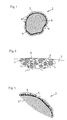
- Fig. 1 is a sectional view showing an example of an aggregate according to the present invention.
- Fig. 2 is a sectional view showing the use of the aggregate according to the present invention.
- Fig. 3 is a partial sectional view showing another example of the aggregate of the present invention.
- Fig. 4 is a sectional view showing a further example of the aggregate of the present invention.
- Fig. 5 is a partial sectional view showing a further modified example of the aggregate of the present invention.
- Fig. 1 is an enlarged sectional view of an aggregate 1 according to the present invention.
- a powder member (a surfacing material) 4 sticks to and covers the circumference of a core 2 via an adhesive 3.
- the core 2 employs rubber chips, and the adhesive 3 urethane resin, and the powder member 4 silica powder. Rubber chips are in size of about 0.5 to 2cm.
- the powder member in this example is a single layer and so uniformly sticks to the core 2 that there is almost no powder member 4 completely lowered or buried in the adhesive 3.
- Fig. 2 is a sectional view showing a road surface 5 paved using asphalt mixture mixing the aggregate 1.
- Asphalt may naturally mix or contain ordinary aggregates (stones, etc.) 6.
- This example has a water-permeable structure as a whole.
- Fig. 3 is a partial sectional view showing another example of the aggregate according to the present invention.
- This example shows that the powder member 4 (the surfacing material) does not uniformly stick, as a single layer, to the core 2, and some of the powder member 4 lower or are buried in the adhesive 3.
- the surfacing material placed on the outermost layer is not covered with the adhesive in this example.
- Fig. 4 shows an example wherein larger surfacing material particles 7 are first put on or aticked to the core 2 partially thereof, followed by applying the adhesive again, thereafter, smaller surf acing material particles are applied, whereby providing larger unevenness.
- the adhesive is not illustrated in the drawing.
- Fig. 5 shows an example that the larger surfacing material particles are first put on or sticked to the core 2, and then, plenty of smaller particles are applied (Fig. 5(a)). In this case, there is no application of the adhesive after the larger surfacing materials are put on the cores 2, so that the smaller surfacing material does not stick to the circumference of the larger ones. Under the above condition, then, blasting (or chemical treatment, dissolution, etc.,) is applied to remove the larger surfacing material (Fig. 5(b)), thereby forming the large unevenness.
- the present invention has the following notable advantages.
Landscapes
- Chemical & Material Sciences (AREA)
- Engineering & Computer Science (AREA)
- Ceramic Engineering (AREA)
- Materials Engineering (AREA)
- Structural Engineering (AREA)
- Organic Chemistry (AREA)
- Road Paving Structures (AREA)
- Compositions Of Macromolecular Compounds (AREA)
Abstract
Description
Claims (18)
- An aggregate to be mixed for use with a set-hard material and comprising a core made of an elastic material and a surfacing material fixed on the core's surface by means of an adhesive.
- An aggregate as set forth in Claim 1 wherein the surfacing material positioned on the outermost surface is not covered, at a part of the surface of the surfacing material, with the adhesive.
- An aggregate as set forth in Claim 1 wherein the surfacing material mostly does not lower in the adhesive.
- An aggregate as set forth in Claim 1 wherein the surfacing material mostly lowers in the adhesive.
- An aggregate as set forth in Claim 1 to 4 wherein the surfacing material is plural in kinds each different to one another in size, shape and kinds.
- An aggregate as set forth in Claim 1 or 2 wherein the surface of the core has a part not covered with the surfacing material.
- An aggregate as set forth in Claims 1 to 6 wherein the adhesive on the surface of the core has recovering properties from deformation.
- A manufacturing process of an aggregate comprising such steps as mixing 100 parts by weight of a core made of an elastic material with 0.1 to 20 by weight of an adhesive to cause the adhesive to stick uniformly on the surface of the core, and thereafter, contacting and mixing the core with 1 or more part by weight of a surfacing material
- A manufacturing process of an aggregate as set forth in Claim 8 wherein t having one-tenth or less average particle diameter of that of the core. he surfacing material is plural in kinds each different to one another in size, shape and kinds.
- A manufacturing process of an aggregate comprising such steps as mixing a core made of an elastic material with an adhesive to cause the adhesive to uniformly stick to the surface of the core, thereafter, contacting the core with a first surfacing material to cause the same to stick to a part of the core's surface, followed by applying again the adhesive on the core surface, and applying thereon a second surfacing material smaller than the first surfacing material.
- A manufacturing process of an aggregate comprising such steps as mixing a core made of an elastic material with an adhesive to cause the adhesive to uniformly stick to the surface of the core, thereafter, contacting and mixing the core with a second surfacing material, followed by removing the second surfacing material not yet fixed, and then by applying again the adhesive on the core surface, and applying partially thereon a first surfacing material larger than the second surfacing material.
- A resin mortar mixing an aggregate as set forth in Claim 1, a resin and preferably other admixtures.
- A resin mortar mixing an aggregate as set forth in Claim 2, a resin and preferably other admixtures.
- A resin mortar mixing an aggregate as set forth in Claim 3, a resin and preferably other admixtures.
- A resin mortar mixing an aggregate as set forth in Claim 4, a resin and preferably other admixtures.
- A resin mortar mixing an aggregate as set forth in Claim 5, a resin and preferably other admixtures.
- A resin mortar as set forth in Claim 12 wherein the resin is hydraulic to make reaction and harden under existence of water.
- A resin mortar as set forth in Claim 17 wherein the resin is a resin modified with polysulfide.
Applications Claiming Priority (2)
| Application Number | Priority Date | Filing Date | Title |
|---|---|---|---|
| JP2000055415A JP3882161B2 (en) | 2000-03-01 | 2000-03-01 | Resin paving material, resin paving method and asphalt paving surface treatment method |
| JP2000055415 | 2000-03-01 |
Publications (2)
| Publication Number | Publication Date |
|---|---|
| EP1130001A2 true EP1130001A2 (en) | 2001-09-05 |
| EP1130001A3 EP1130001A3 (en) | 2003-01-29 |
Family
ID=18576540
Family Applications (1)
| Application Number | Title | Priority Date | Filing Date |
|---|---|---|---|
| EP00128209A Withdrawn EP1130001A3 (en) | 2000-03-01 | 2000-12-22 | Aggregate, manufacturing process thereof and resin mortar containing this aggregate |
Country Status (3)
| Country | Link |
|---|---|
| US (1) | US6479570B2 (en) |
| EP (1) | EP1130001A3 (en) |
| JP (1) | JP3882161B2 (en) |
Cited By (2)
| Publication number | Priority date | Publication date | Assignee | Title |
|---|---|---|---|---|
| FR2882272A1 (en) * | 2005-02-22 | 2006-08-25 | Rincent Btp Services Soc En Co | Elastomer-based granule surface treatment to enhance interaction with hydraulic bonding agent includes application of surfactant and polymer resin |
| EP2374769A1 (en) * | 2010-04-12 | 2011-10-12 | Betonwerk Schuster GmbH | Aggregate for constructing an acoustic absorption layer of a noise insulation device and noise insulation device |
Families Citing this family (24)
| Publication number | Priority date | Publication date | Assignee | Title |
|---|---|---|---|---|
| JP2005273322A (en) * | 2004-03-25 | 2005-10-06 | Seikitokyu Kogyo Co Ltd | Pavement construction method and pavement structure |
| US8017681B2 (en) | 2006-03-30 | 2011-09-13 | Maxwell Products, Inc. | Systems and methods for providing a thermoplastic product that includes packaging therefor |
| KR100660064B1 (en) * | 2006-04-26 | 2006-12-20 | 미래피앤씨(주) | Adhesive aggregate |
| JP2008045275A (en) * | 2006-08-10 | 2008-02-28 | Bridgestone Corp | Elastic pavement body |
| JP2008138087A (en) * | 2006-12-01 | 2008-06-19 | Chugai Shoko Kk | Flooring |
| US20090252553A1 (en) * | 2007-10-11 | 2009-10-08 | Bowers Roger G | Road surface maintenance material forms |
| JP2009108628A (en) * | 2007-10-31 | 2009-05-21 | Nisshin Kasei Kk | Surface treatment material for pavement, aqueous resin dispersion for preventing aggregate detachment, and pavement construction method |
| US8555698B2 (en) | 2011-01-26 | 2013-10-15 | Bridgestone Americas Tire Operations, Llc | Engineered surfaces for laboratory tread wear testing of tires |
| JP6027109B2 (en) * | 2012-06-28 | 2016-11-16 | オサダ技研株式会社 | Pavement structure and manufacturing method thereof |
| US20150018460A1 (en) * | 2013-03-15 | 2015-01-15 | Maxwell Products, Inc. | Systems and methods for providing a thermoplastic product comprising a recycled material |
| US12623286B2 (en) | 2013-06-23 | 2026-05-12 | Robert A. Flitsch | Methods and apparatus for mobile additive manufacturing of advanced roadway systems |
| US11338505B2 (en) | 2013-06-23 | 2022-05-24 | Robert A. Flitsch | Methods and apparatus for mobile additive manufacturing of advanced roadway systems |
| US11707882B2 (en) | 2013-06-23 | 2023-07-25 | Robert A. Flitsch | Methods and apparatus for mobile additive manufacturing of advanced roadway systems |
| US10030338B2 (en) * | 2014-03-04 | 2018-07-24 | William P. Dempsey | Compositions and methods for pelletized recycled asphalt shingles |
| US9926102B2 (en) | 2014-06-05 | 2018-03-27 | Maxwell Properties, Llc | Systems and methods for providing a packaged thermoplastic material |
| US12291823B2 (en) | 2015-04-15 | 2025-05-06 | Robert A. Flitsch | Methods, materials and apparatus for mobile additive manufacturing of advanced structures and roadways |
| US11505902B2 (en) | 2015-04-15 | 2022-11-22 | Robert A. Flitsch | Methods, materials and apparatus for mobile additive manufacturing of advanced structures and roadways |
| US10358296B2 (en) | 2015-09-18 | 2019-07-23 | Maxwell Properties, Llc | Systems and methods for delivering asphalt concrete |
| US10975529B2 (en) * | 2016-02-17 | 2021-04-13 | Robert A. Flitsch | Methods, materials and apparatus for mobile additive manufacturing of advanced structures and roadways |
| US12522985B2 (en) | 2018-08-14 | 2026-01-13 | Robert A. Flitsch | Methods and apparatus for mobile additive manufacturing |
| CN110158395A (en) * | 2019-05-31 | 2019-08-23 | 成都中大长城市政工程有限公司 | A kind of polyurethane broken stone water permeability pavement construction method |
| KR102614618B1 (en) * | 2021-08-25 | 2023-12-15 | 서울과학기술대학교 산학협력단 | Concrete aggregate using waste plastic and manufacturing method thereof |
| CN113698122B (en) * | 2021-10-27 | 2022-05-03 | 沧州渤海新区市政混凝土有限公司 | Modified plant material aggregate and lightweight concrete containing same |
| KR102691713B1 (en) * | 2022-10-31 | 2024-08-05 | 국립한국해양대학교산학협력단 | choncrete using coarse aggregate of waste glass with surface coating for slip prevention and manufacturing method thereof |
Family Cites Families (13)
| Publication number | Priority date | Publication date | Assignee | Title |
|---|---|---|---|---|
| AT235738B (en) * | 1961-05-26 | 1964-09-10 | Carl Ing Neudeck | Process for producing a loose gravel and sand substitute |
| DE3908782A1 (en) * | 1989-03-17 | 1990-09-27 | Hoechst Ag | WEIGHTED REINFORCING FIBER AND FIBER REINFORCED BUILDING MATERIAL MIXTURE, METHOD FOR THE PRODUCTION AND USE THEREOF |
| JP2854342B2 (en) * | 1989-10-20 | 1999-02-03 | パブリツク技建株式会社 | Paving method |
| FR2655037B1 (en) * | 1989-11-29 | 1993-05-07 | Hericher Leon | PROCESS FOR THE MANUFACTURE OF LIGHT AGGREGATES AND PRODUCTS OBTAINED. |
| CH685558A5 (en) * | 1990-08-03 | 1995-08-15 | Bernard Ansaloni Pierre Alain | Method of manufacturing aggregates and adhesive composition for its implementation. |
| HU213905B (en) * | 1991-07-03 | 1997-11-28 | Stracke | Process for producing light concrete aggregates, light concrete, carrige way surfacing, masonry units, heat-insulating and/or levelling layer |
| JP3126825B2 (en) * | 1992-09-10 | 2001-01-22 | オーツタイヤ株式会社 | Rubber chip mat |
| DE4402432C2 (en) * | 1994-01-27 | 1996-01-18 | Schultze Kraft Andreas | Granite-like polymer artificial stones made of coated waste glass granulate |
| WO1997048654A1 (en) * | 1996-06-19 | 1997-12-24 | Alpha Brevet S.A. | Levelling fillers |
| JPH10265250A (en) * | 1997-03-24 | 1998-10-06 | Toray Ind Inc | Block molded body and method for producing the same |
| FR2772745B1 (en) * | 1997-12-18 | 2000-06-09 | Mouly Michel | WOOD CONCRETE CONTAINING CEMENT-COATED WOOD AGGREGATE |
| JP3221391B2 (en) * | 1998-03-16 | 2001-10-22 | ブリヂストンスポーツ株式会社 | Multilayer solid golf ball |
| JPH11293614A (en) * | 1998-04-08 | 1999-10-26 | Osada Giken Kk | Road pavement method |
-
2000
- 2000-03-01 JP JP2000055415A patent/JP3882161B2/en not_active Expired - Fee Related
- 2000-12-22 EP EP00128209A patent/EP1130001A3/en not_active Withdrawn
- 2000-12-22 US US09/742,068 patent/US6479570B2/en not_active Expired - Fee Related
Cited By (3)
| Publication number | Priority date | Publication date | Assignee | Title |
|---|---|---|---|---|
| FR2882272A1 (en) * | 2005-02-22 | 2006-08-25 | Rincent Btp Services Soc En Co | Elastomer-based granule surface treatment to enhance interaction with hydraulic bonding agent includes application of surfactant and polymer resin |
| WO2006090084A1 (en) * | 2005-02-22 | 2006-08-31 | Rincent Btp Services Materiaux | Method for treating surfaces of elastomer-based granular materials |
| EP2374769A1 (en) * | 2010-04-12 | 2011-10-12 | Betonwerk Schuster GmbH | Aggregate for constructing an acoustic absorption layer of a noise insulation device and noise insulation device |
Also Published As
| Publication number | Publication date |
|---|---|
| JP2001241005A (en) | 2001-09-04 |
| US20010020058A1 (en) | 2001-09-06 |
| EP1130001A3 (en) | 2003-01-29 |
| US6479570B2 (en) | 2002-11-12 |
| JP3882161B2 (en) | 2007-02-14 |
Similar Documents
| Publication | Publication Date | Title |
|---|---|---|
| US6479570B2 (en) | Aggregate, manufacturing process thereof, and resin mortar | |
| US3272098A (en) | Paving material and paving surfacing | |
| CN1219942C (en) | Paving material for walking road and its making method | |
| EP0750595A1 (en) | Road surfacing composition and process | |
| CN112390966A (en) | Method for manufacturing multi-coating film cork granule for road pavement | |
| KR101215406B1 (en) | Road paving method using polyurethan concrete | |
| KR100615557B1 (en) | Composite urethane elastic pitcher in. | |
| EP0957203A2 (en) | Elastic pavement material | |
| JP7151957B2 (en) | Pedestrian elastic pavement mixture, construction method and hardening material for pedestrian elastic pavement | |
| JP2965187B2 (en) | Permeable pavement material with durability and shock absorption capacity | |
| KR100631328B1 (en) | Elastic packaging material containing plastic resin chip | |
| JP2003342905A (en) | Construction method of elastic paving surface | |
| JP3980792B2 (en) | aggregate | |
| JP2004142991A (en) | High wear-resistant cement-based solidification material and cement-based block | |
| JP2000290960A (en) | Concrete block and manufacturing method thereof | |
| RU2651733C1 (en) | Astringent for strait of structural layers of a transport structure and method of its use for the construction of a transport structure | |
| CN1651652A (en) | Elastic permeable road surface containing waste broken polyurethane for new road and its paving method | |
| KR102876377B1 (en) | Anti-slip paving construction method for pavement | |
| JP3640009B2 (en) | Forming method of wood pavement | |
| JP2004052318A (en) | Elastic pavement structure | |
| JPH03137305A (en) | Paving method | |
| KR100701925B1 (en) | Construction method of permeable floor using recycled cement concrete and elastic chip | |
| JP2002069963A (en) | Waterway reinforcement method and reinforcement | |
| JP4995452B2 (en) | Paving material | |
| JP2002356805A (en) | Elastic pavement structure and method of manufacturing the same |
Legal Events
| Date | Code | Title | Description |
|---|---|---|---|
| PUAI | Public reference made under article 153(3) epc to a published international application that has entered the european phase |
Free format text: ORIGINAL CODE: 0009012 |
|
| AK | Designated contracting states |
Kind code of ref document: A2 Designated state(s): AT BE CH CY DE DK ES FI FR GB GR IE IT LI LU MC NL PT SE TR |
|
| AX | Request for extension of the european patent |
Free format text: AL;LT;LV;MK;RO;SI |
|
| PUAL | Search report despatched |
Free format text: ORIGINAL CODE: 0009013 |
|
| AK | Designated contracting states |
Designated state(s): AT BE CH CY DE DK ES FI FR GB GR IE IT LI LU MC NL PT SE TR |
|
| AX | Request for extension of the european patent |
Extension state: AL LT LV MK RO SI |
|
| 17P | Request for examination filed |
Effective date: 20030320 |
|
| AKX | Designation fees paid |
Designated state(s): AT BE CH CY DE DK ES FI FR GB GR IE IT LI LU MC NL PT SE TR |
|
| RAP1 | Party data changed (applicant data changed or rights of an application transferred) |
Owner name: OSADA GIKEN CO., LTD. Owner name: TORAY FINE CHEMCIALS CO., LTD. Owner name: TORAY INDUSTRIES, INC. |
|
| STAA | Information on the status of an ep patent application or granted ep patent |
Free format text: STATUS: THE APPLICATION IS DEEMED TO BE WITHDRAWN |
|
| 18D | Application deemed to be withdrawn |
Effective date: 20060307 |