EP1129730B2 - Produkte zum eindicken von körperflüssigkeiten oder körperausscheidungen - Google Patents
Produkte zum eindicken von körperflüssigkeiten oder körperausscheidungen Download PDFInfo
- Publication number
- EP1129730B2 EP1129730B2 EP99954374A EP99954374A EP1129730B2 EP 1129730 B2 EP1129730 B2 EP 1129730B2 EP 99954374 A EP99954374 A EP 99954374A EP 99954374 A EP99954374 A EP 99954374A EP 1129730 B2 EP1129730 B2 EP 1129730B2
- Authority
- EP
- European Patent Office
- Prior art keywords
- polysaccharide
- absorbent member
- thickening
- article
- excreta
- Prior art date
- Legal status (The legal status is an assumption and is not a legal conclusion. Google has not performed a legal analysis and makes no representation as to the accuracy of the status listed.)
- Expired - Lifetime
Links
Images
Classifications
-
- A—HUMAN NECESSITIES
- A61—MEDICAL OR VETERINARY SCIENCE; HYGIENE
- A61F—FILTERS IMPLANTABLE INTO BLOOD VESSELS; PROSTHESES; DEVICES PROVIDING PATENCY TO, OR PREVENTING COLLAPSING OF, TUBULAR STRUCTURES OF THE BODY, e.g. STENTS; ORTHOPAEDIC, NURSING OR CONTRACEPTIVE DEVICES; FOMENTATION; TREATMENT OR PROTECTION OF EYES OR EARS; BANDAGES, DRESSINGS OR ABSORBENT PADS; FIRST-AID KITS
- A61F13/00—Bandages or dressings; Absorbent pads
- A61F13/15—Absorbent pads, e.g. sanitary towels, swabs or tampons for external or internal application to the body; Supporting or fastening means therefor; Tampon applicators
- A61F13/53—Absorbent pads, e.g. sanitary towels, swabs or tampons for external or internal application to the body; Supporting or fastening means therefor; Tampon applicators characterised by the absorbing medium
-
- A—HUMAN NECESSITIES
- A61—MEDICAL OR VETERINARY SCIENCE; HYGIENE
- A61F—FILTERS IMPLANTABLE INTO BLOOD VESSELS; PROSTHESES; DEVICES PROVIDING PATENCY TO, OR PREVENTING COLLAPSING OF, TUBULAR STRUCTURES OF THE BODY, e.g. STENTS; ORTHOPAEDIC, NURSING OR CONTRACEPTIVE DEVICES; FOMENTATION; TREATMENT OR PROTECTION OF EYES OR EARS; BANDAGES, DRESSINGS OR ABSORBENT PADS; FIRST-AID KITS
- A61F13/00—Bandages or dressings; Absorbent pads
- A61F13/15—Absorbent pads, e.g. sanitary towels, swabs or tampons for external or internal application to the body; Supporting or fastening means therefor; Tampon applicators
- A61F13/53—Absorbent pads, e.g. sanitary towels, swabs or tampons for external or internal application to the body; Supporting or fastening means therefor; Tampon applicators characterised by the absorbing medium
- A61F13/534—Absorbent pads, e.g. sanitary towels, swabs or tampons for external or internal application to the body; Supporting or fastening means therefor; Tampon applicators characterised by the absorbing medium having an inhomogeneous composition through the thickness of the pad
-
- A—HUMAN NECESSITIES
- A61—MEDICAL OR VETERINARY SCIENCE; HYGIENE
- A61F—FILTERS IMPLANTABLE INTO BLOOD VESSELS; PROSTHESES; DEVICES PROVIDING PATENCY TO, OR PREVENTING COLLAPSING OF, TUBULAR STRUCTURES OF THE BODY, e.g. STENTS; ORTHOPAEDIC, NURSING OR CONTRACEPTIVE DEVICES; FOMENTATION; TREATMENT OR PROTECTION OF EYES OR EARS; BANDAGES, DRESSINGS OR ABSORBENT PADS; FIRST-AID KITS
- A61F13/00—Bandages or dressings; Absorbent pads
- A61F13/15—Absorbent pads, e.g. sanitary towels, swabs or tampons for external or internal application to the body; Supporting or fastening means therefor; Tampon applicators
- A61F13/84—Accessories, not otherwise provided for, for absorbent pads
- A61F13/8405—Additives, e.g. for odour, disinfectant or pH control
-
- A—HUMAN NECESSITIES
- A61—MEDICAL OR VETERINARY SCIENCE; HYGIENE
- A61L—METHODS OR APPARATUS FOR STERILISING MATERIALS OR OBJECTS IN GENERAL; DISINFECTION, STERILISATION OR DEODORISATION OF AIR; CHEMICAL ASPECTS OF BANDAGES, DRESSINGS, ABSORBENT PADS OR SURGICAL ARTICLES; MATERIALS FOR BANDAGES, DRESSINGS, ABSORBENT PADS OR SURGICAL ARTICLES
- A61L15/00—Chemical aspects of, or use of materials for, bandages, dressings or absorbent pads
- A61L15/16—Bandages, dressings or absorbent pads for physiological fluids such as urine or blood, e.g. sanitary towels, tampons
- A61L15/22—Bandages, dressings or absorbent pads for physiological fluids such as urine or blood, e.g. sanitary towels, tampons containing macromolecular materials
- A61L15/28—Polysaccharides or their derivatives
-
- A—HUMAN NECESSITIES
- A61—MEDICAL OR VETERINARY SCIENCE; HYGIENE
- A61L—METHODS OR APPARATUS FOR STERILISING MATERIALS OR OBJECTS IN GENERAL; DISINFECTION, STERILISATION OR DEODORISATION OF AIR; CHEMICAL ASPECTS OF BANDAGES, DRESSINGS, ABSORBENT PADS OR SURGICAL ARTICLES; MATERIALS FOR BANDAGES, DRESSINGS, ABSORBENT PADS OR SURGICAL ARTICLES
- A61L15/00—Chemical aspects of, or use of materials for, bandages, dressings or absorbent pads
- A61L15/16—Bandages, dressings or absorbent pads for physiological fluids such as urine or blood, e.g. sanitary towels, tampons
- A61L15/42—Use of materials characterised by their function or physical properties
- A61L15/60—Liquid-swellable gel-forming materials, e.g. super-absorbents
-
- A—HUMAN NECESSITIES
- A61—MEDICAL OR VETERINARY SCIENCE; HYGIENE
- A61F—FILTERS IMPLANTABLE INTO BLOOD VESSELS; PROSTHESES; DEVICES PROVIDING PATENCY TO, OR PREVENTING COLLAPSING OF, TUBULAR STRUCTURES OF THE BODY, e.g. STENTS; ORTHOPAEDIC, NURSING OR CONTRACEPTIVE DEVICES; FOMENTATION; TREATMENT OR PROTECTION OF EYES OR EARS; BANDAGES, DRESSINGS OR ABSORBENT PADS; FIRST-AID KITS
- A61F13/00—Bandages or dressings; Absorbent pads
- A61F13/15—Absorbent pads, e.g. sanitary towels, swabs or tampons for external or internal application to the body; Supporting or fastening means therefor; Tampon applicators
- A61F13/53—Absorbent pads, e.g. sanitary towels, swabs or tampons for external or internal application to the body; Supporting or fastening means therefor; Tampon applicators characterised by the absorbing medium
- A61F2013/530481—Absorbent pads, e.g. sanitary towels, swabs or tampons for external or internal application to the body; Supporting or fastening means therefor; Tampon applicators characterised by the absorbing medium having superabsorbent materials, i.e. highly absorbent polymer gel materials
Definitions
- the present invention relates to an article for thickening body fluids or excreta such as disposable diapers, sanitary napkins, liners for diapers, panty liners and surgical blood absorbent articles, etc. More particularly the present invention relates to an article capable of thickening body fluids or excreta which shows high leakproofing effect against high viscous liquids such as soft feces or blood.
- a superabsorbent polymer such as a crosslinked polyacrylic acid salt, dispersed in pulp fiber.
- the superabsorbent polymer does not move in the absorbent member. It is not until liquid reaches the position where the polymer exists that the polymer absorbs the liquid and fixes it. Accordingly, when a high viscous liquid having a small rate of permeation and diffusion, such as soft feces or blood, is discharged, it is likely that not all the liquid can arrive at the position where the superabsorbent polymer is, or it takes time for all the liquid to reach the position and be absorbed and fixed thereby. Meanwhile a leak can result. It is a conceivable solution to dispose the superabsorbent polymer near the wearer facing surface of the absorbent article thereby reducing the time required for the liquid to reach. In this case, however, the superabsorbent polymer tends to cause a gel blocking phenomenon which interferes with absorption.
- an absorbent article using a cross-linkable swellable polysaccharide as an absorbent in place of a superabsorbent polymer is proposed in WO 95/17147 .
- the polysaccharide is used in the form of particles which are bound to the surface of a solid substance or incorporated into the substrate matrix so that it may absorb liquid even under pressure and exhibit improved liquid retentivity for an extended period of time.
- the bound or incorporated polysaccharide itself does not diffuse in liquid waste but waits for liquid to come. It does not display absorbing and fixing effects until liquid reaches. Therefore, the above-mentioned absorbent article does not have sufficient leakproofness against high viscous liquids similarly to the conventional ones using superabsorbent articles.
- an object of the present invention is to provide an article capable of thickening body fluids or excreta which is highly effective in preventing leaks particularly of a high viscous liquid, such as soft feces or blood.
- Another object of the present invention is to provide an article capable of thickening body fluids or excreta which is particularly useful as a disposable diaper or a liner for a diaper worn by newborn babies or infants who get rid of soft feces frequently, a sanitary napkin or a panty liner.
- the inventors of the present invention have found that the above objects are accomplished by incorporating a specific polysaccharide in a specific state and utilizing the thickening effect of the polysaccharide.
- the present invention has been completed based on the above finding.
- the present invention accomplishes the above objects by providing an article for thickening body fluids or excreta comprising a liquid retentive absorbent member (4) which has a double-layered structure having an upper absorbent member (4a) and a lower absorbent member (4b) wherein a polysaccharide powder (10) capable of thickening in the presence of a polyvalent metal ion is present in the upper absorbent member (4a), in a state ready to dissolve or be dissociated in the moisture contained in body fluids or excreta, wherein said polysaccharide (10) contains no polyvalent metal ions, and wherein the lower absorbent member (4b) comprises pulp fiber (9) having superabsorbent polymer particles (12) dispersed therein or wherein the lower absorbent member (4b) consists solely of the superabsorbent polymer particles (12), wherein "upper” means facing to the wearer and wherein the upper absorbent member (4a) predominantly comprises pulp fiber (9) and the polys
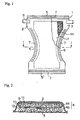
- a thickening article for thickening body fluids or excreta (hereinafter simply referred to as a thickening article) according to the present invention will be described below with reference to a disposable diaper as an example and to the accompanying drawings.
- the disposable diaper 1 of the embodiment comprises a liquid permeable topsheet 2 which is made of nonwoven fabric, a perforated film, etc.; a liquid impermeable backsheet 3 which serves as a leakproof layer; and a liquid retentive absorbent member 4 which is interposed between the topsheet 2 and the backsheet 3 as an absorbing layer.
- the absorbent member 4 has its portion corresponding to the crotch portion of the diaper 1 curved inward to form a sandglass shape.
- the topsheet 2 and the backsheet 3 also have their portion corresponding to the crotch portion of the diaper 1 curved inward in conformity to the shape of the absorbent member 4.
- the absorbent member 4 is held and fixed between the topsheet 2 and the backsheet 3.
- the topsheet 2 and the backsheet 3 extend outward from the front and the rear ends and the lateral sides of the absorbent member 4 to form a front and a rear waist portion 5' and 5 and a pair of leg portions 6 and 6.
- the front and the rear waist portions 5' and 5 and the pair of leg portions 6 and 6 are each provided with elastically stretchable members 7 for giving the waist portions 5 and 5' and the leg portions 6 and 6 a good fit to a wearer's body when put on the wearer.
- the stretchable members 7 are fixed by the topsheet 2 and the backsheet 3.
- a pair of fastening members 8, such as sets of tape fasteners, are attached to both lateral sides of the rear waist portion 5.
- a mating member such as a rectangular landing tape, is provided on the backsheet 3 in the front waist portion 5'.
- the fastening members 8 are stuck on this mating member.
- the above-mentioned constitution and structure are the same as in conventional disposable diapers.
- the absorbent member 4 has a double-layered structure having an upper absorbent member 4a and a lower absorbent member 4b as shown in Fig. 2 .
- the upper absorbent member 4a predominantly comprises pulp fiber 9.
- a polysaccharide powder 10 capable of thickening in the presence of a polyvalent metal ion is dispersed uniformly throughout the upper absorbent member 4a in planar and thickness directions. They are wrapped in thin absorbent paper 11, e.g., tissue, to form the upper absorbent member 4a.
- the lower absorbent member 4b comprises pulp fiber (not shown) having superabsorbent polymer particles 12 dispersed and mixed uniformly. As will be obvious from Examples given later, the lower absorbent member 4b can consist solely of the superabsorbent polymer particles 12.
- the polysaccharide is capable of dissolving or being dissociated in water and diffusing in water. So, once liquid waste and the polysaccharide meet, the part of the liquid that is in contact with the polysaccharide is fixed, while the polysaccharide diffuses in the liquid through dissolution or dissociation so that the part of the liquid that is distant from the polysaccharide can also be fixed. In other words, the polysaccharide has, so to speak, a positive mechanism of absorption and fixation. Therefore, even when a high viscous liquid cannot completely get to the position where the polysaccharide is, the polysaccharide is capable of fixing the high viscous liquid.
- the polysaccharide reacts with trace amounts of polyvalent metal ions present in body fluids or excreta (e.g., calcium ions and aluminum ions) to form complexes having increased viscosity, which come into contact with liquid waste and, as a result, thicken the liquid to develop a fixing effect.
- polyvalent metal ions present in body fluids or excreta (e.g., calcium ions and aluminum ions)
- Such properties of the polysaccharide enhance the leakproofing effect against high viscous liquids such as soft feces and blood as well as low viscous liquids such as urine.
- the polysaccharide does not cause gel blocking, it is possible to dispose it near the wearer facing surface of a disposable diaper, a sanitary napkin, etc.
- the polysaccharide to be used is one capable of thickening in the presence of a polyvalent metal ion. It is required for the polysaccharide, upon contact with a small amount of a high viscous liquid (moisture), to be dissolved or dissociated and diffused quickly in the high viscous liquid thereby to fix the high viscous liquid. Accordingly, it is preferred for the polysaccharide to contain no polyvalent metal ions. Further, it is preferred for the thickening article of the present invention to contain no polyvalent metal ions.
- the situation in which the polysaccharide or the thickening article contains "no polyvalent metal ions” includes cases where they are completely free from either polyvalent metal ions or substances capable of generating polyvalent metal ions in water and cases where polyvalent metal ions or substances capable of generating polyvalent metal ions in water have been unavoidably incorporated in such small amounts that do not interfere with development of thickening to a degree enough to produce a leakproofing effect.
- the polysaccharides which contain no polyvalent metal ions include polysaccharides in their free form not forming a metal salt and polysaccharides in their salt form with a monovalent metal ion.
- the polysaccharides which are not in a metal salt form include pectin, gellan gum, ⁇ -carrageenan, glucomannan, guar gum, casein, and propylene glycol alginate.
- the polysaccharides in a salt form with a monovalent metal ion include sodium alginate. From the standpoint of cost and water solubility, preferred polysaccharides are pectin, sodium alginate, gellan gum, ⁇ -carrageenan, and the like.
- the polysaccharide positively dissolves and diffuses in a discharged liquid to thicken the liquid as described above, it is soluble in water or capable of being dissociated in water.
- the term “capable of being dissociated in water” as used herein means that the polysaccharide does not completely dissolve in water but is ready to be dispersed in water, i.e., it can exist in water with its molecular chains entangled.
- the term “completely dissolve in water” means that all the molecules of the polysaccharide are individually hydrated.
- the polysaccharide is required to react sensitively with a discharged liquid to thicken the liquid. Therefore, it is necessary that the polysaccharide should be present in the thickening article in a state ready to dissolve or be dissociated in water. This is totally different from the technique of WO95/17147 supra in which the polysaccharide is incorporated into the matrix of an absorbent article to fix liquid.
- the "state ready to dissolve or be dissociated in water” includes a state in which a powdered polysaccharide is dispersed in the absorbent member as shown in Figs. 1 and 2 .
- the degree of esterification of the polysaccharide can be adjusted, or the pH can be adjusted by addition of an organic acid, etc.
- the polysaccharide can be used in a powdered form as noted above or in a particulate form. It can be encapsulated in water-soluble capsules. When used in the form of powder or particle, a preferred size is 10 to 1000 ⁇ m, particularly 50 to 500 ⁇ m. When used in the form of capsules, a preferred size of the capsules is 300 to 2000 ⁇ m, particularly 500 to 1000 ⁇ m.
- the polysaccharide is preferably used in an amount of 10 to 200 g/m 2 , particularly 30 to 100 g/m 2 , from the standpoint of cost and the thickening ability (leakproofing effect).
- the weight ratio of the polysaccharide to the pulp fiber is preferably 10/1000 to 200/50, particularly 1/5 to 1/1.
- the pulp fiber is preferably used in an amount of 50 to 1000 g/m 2 , particularly 50 to 300 g/m 2 .
- the amount of the superabsorbent polymer in the lower absorbent member 4b is preferably 0 to 500 g/m 2 , particularly 50 to 300 g/m 2 .
- the polysaccharide can be disposed either on the entire area for liquid absorption or in a specific area of the diaper 1.
- the polysaccharide can be used in combination with an antimicrobials, antiseptics, or antifungals.
- the antimicrobials include benzethonium chloride and benzalkonium chloride.
- the antiseptics include parahydroxybenzoates (e.g., ethyl p-hydroxybenzoate and methyl p-hydroxybenzoate). Growth of microorganisms during storage can be prevented in the presence of these additives. pH Buffers, antiinflammatory agents, lipase inhibitors or urease inhibitors can also be used in combination to suppress a diaper rash caused particularly by soft feces.
- the thickening article of the present invention is applicable to not only disposable diapers but other sanitary articles having an absorbent member, i.e., sanitary napkins, incontinence pads, nursing breast pads, etc.; sanitary articles having no absorbent member, i.e., diaper liners and panty liners; and surgical blood absorbent articles such as dressing; and the like.
- an absorbent member i.e., sanitary napkins, incontinence pads, nursing breast pads, etc.
- sanitary articles having no absorbent member i.e., diaper liners and panty liners
- surgical blood absorbent articles such as dressing
- a mixture of fluff pulp and pectin powder (particle size: 150 ⁇ m) was built up on absorbent paper (tissue) and enveloped in the absorbent paper to form an upper absorbent layer.
- the basis weight of the fluff pulp was 50 g/m 2
- that of the pectin powder was 50 g/m 2 .
- Particles of a superabsorbent polymer were scattered on a polyethylene sheet as a backsheet to give a basis weight of 200 g/m 2 to form a lower absorbent layer.
- the upper absorbent layer was superposed on the lower absorbent layer, and a topsheet made of suction heat-bonded nonwoven fabric of polypropylene fiber was further superposed thereon.
- the backsheet and the topsheet were joined and fixed together at their periphery with elastically stretchable members interposed therebetween at the periphery to obtain a disposable diaper shown in Figs. 1 and 2 .
- the disposable diaper (including the pectin powder) contained substantially no polyvalent metal ions.
- a disposable diaper was obtained in the same manner as in Example 1, except that the pectin powder was not used in the upper absorbent layer but sprinkled between the upper absorbent layer and the topsheet in an amount of 50 g/m 2 .
- a disposable diaper was obtained in the same manner as in Example 1, except that the pectin powder was not used in the upper absorbent layer but sprinkled on the topsheet which had been sprinkled with water in an amount of 50 g/m 2 and fixed thereto by its own adhesion.
- a disposable diaper was obtained in the same manner as in Example 1, except for replacing the pectin used in Example 1 with sodium alginate (Example 4), gellan gum (Example 5) or ⁇ -carrageenan (Example 6).
- a disposable diaper was obtained in the same manner as in Example 1, except that particles of a superabsorbent polymer were incorporated into the upper absorbent layer in place of the pectin powder used in Example 1.
- Leak ratio % number of diaper having a leak / total number of used diapers x 100
- Each of the polysaccharides used in Examples 1 and 4 to 6 was added to 500 ml of an aqueous calcium chloride solution having a calcium ion content of 0.1% by weight to become a concentration of 0.2% by weight.
- the kinematic viscosity (20°C) of the aqueous solution was measured with a B-type viscometer (Model B8M, supplied by Tokyo Keiki) before and after addition of the polysaccharide.
- the measurement after the addition of the polysaccharide was made after 30 seconds from the addition. Even if heterogeneous gelation took place, the measurement was carried out.
- the present invention provides a thickening article having high leakproofness against high viscous liquids such as soft feces and blood.
- the thickening article of the present invention is useful as a disposable diaper or a diaper liner which is worn particularly by newborn babies or infants who get rid of soft feces frequently, a sanitary napkins, a panty liner, an incontinence pad, a nursing breast pad, a surgical blood absorbent article, and so forth.
Landscapes
- Health & Medical Sciences (AREA)
- General Health & Medical Sciences (AREA)
- Epidemiology (AREA)
- Engineering & Computer Science (AREA)
- Veterinary Medicine (AREA)
- Public Health (AREA)
- Life Sciences & Earth Sciences (AREA)
- Animal Behavior & Ethology (AREA)
- Heart & Thoracic Surgery (AREA)
- Vascular Medicine (AREA)
- Biomedical Technology (AREA)
- Chemical & Material Sciences (AREA)
- Hematology (AREA)
- Materials Engineering (AREA)
- Dispersion Chemistry (AREA)
- Absorbent Articles And Supports Therefor (AREA)
- Orthopedics, Nursing, And Contraception (AREA)
Claims (3)
- Ein Gegenstand zum Eindicken von Körperflüssigkeiten oder Ausscheidungsstoffen, umfassend ein Flüssigkeit zurückhaltendes absorbierendes Element (4), das eine Doppelschichtstruktur mit einem oberen absorbierenden Element (4a) und einem unteren absorbierenden Element (4b) aufweist, wobei ein Polysaccharidpulver (10), das zur Eindickung in Gegenwart eines mehrwertigen Metallions in der Lage ist, in dem oberen absorbierenden Element (4a) in einem in der in Körperflüssigkeiten oder Ausscheidungsstoffen enthaltenen Feuchtigkeit lösungsbereiten oder dissoziierbaren Zustand vorliegt, wobei das Polysaccharid (10) keine mehrwertigen Metallionen enthält und wobei das untere absorbierende Element (4b) Zellstofffaser (9) mit darin dispergierten superabsorbierenden Polymerteilchen (12) umfasst oder wobei das untere absorbierende Element (4b) nur aus den superabsorbierenden Polymerteilchen (12) besteht, wobei "oberes" dem Träger zugewandt bedeutet und wobei das obere absorbierende Element (4a) vorwiegend Zellstofffaser (9) umfasst und das Polysaccharid (10) gleichförmig in dem oberen absorbierenden Element (4a) in Flächen- und Dickenrichtung dispergiert ist und diese in absorbierendes Papier (11) gehüllt sind, um das obere absorbierende Element (4a) zu bilden.
- Der Gegenstand zum Eindicken von Körperflüssigkeiten oder Ausscheidungsstoffen nach Anspruch 1, wobei das Polysaccharid (10) in einem Gewichtsverhältnis von Polysaccharid zu Zellstofffaser von 10/1000 bis 200/50 vorliegt.
- Der Gegenstand zum Eindicken von Körperflüssigkeiten oder Ausscheidungsstoffen nach Anspruch 1, wobei das Polysaccharid Pectin, Gellangummi, κ-Carrageenan, Glucomannan, Guarmehl, Natriumalginat oder Propylenglykolalginat umfasst.
Applications Claiming Priority (3)
| Application Number | Priority Date | Filing Date | Title |
|---|---|---|---|
| JP31792398 | 1998-11-09 | ||
| JP31792398 | 1998-11-09 | ||
| PCT/JP1999/006141 WO2000027443A1 (en) | 1998-11-09 | 1999-11-04 | Products for thickening processing bodily fluids or bodily wastes |
Publications (4)
| Publication Number | Publication Date |
|---|---|
| EP1129730A1 EP1129730A1 (de) | 2001-09-05 |
| EP1129730A4 EP1129730A4 (de) | 2008-02-27 |
| EP1129730B1 EP1129730B1 (de) | 2010-07-14 |
| EP1129730B2 true EP1129730B2 (de) | 2013-01-02 |
Family
ID=18093555
Family Applications (1)
| Application Number | Title | Priority Date | Filing Date |
|---|---|---|---|
| EP99954374A Expired - Lifetime EP1129730B2 (de) | 1998-11-09 | 1999-11-04 | Produkte zum eindicken von körperflüssigkeiten oder körperausscheidungen |
Country Status (6)
| Country | Link |
|---|---|
| EP (1) | EP1129730B2 (de) |
| JP (1) | JP4640873B2 (de) |
| CN (1) | CN1190239C (de) |
| DE (1) | DE69942583D1 (de) |
| TW (1) | TW413629B (de) |
| WO (1) | WO2000027443A1 (de) |
Families Citing this family (8)
| Publication number | Priority date | Publication date | Assignee | Title |
|---|---|---|---|---|
| JP5680817B2 (ja) * | 2008-03-31 | 2015-03-04 | ユニ・チャーム株式会社 | 吸収時に架橋を形成する吸収体 |
| JP5528022B2 (ja) * | 2009-07-13 | 2014-06-25 | ユニ・チャーム株式会社 | 吸収体及び吸収性物品 |
| JP5441532B2 (ja) * | 2009-07-13 | 2014-03-12 | ユニ・チャーム株式会社 | 吸収体及び吸収性物品 |
| JP5717686B2 (ja) * | 2012-04-02 | 2015-05-13 | ユニ・チャーム株式会社 | 吸収性物品 |
| EP2935688A2 (de) | 2012-12-20 | 2015-10-28 | ConvaTec Technologies Inc. | Verarbeitung von chemisch modifizierten cellulosefasern |
| KR101596624B1 (ko) * | 2015-01-30 | 2016-02-22 | 에스케이이노베이션 주식회사 | 흡수성 수지 및 그의 제조방법 |
| CN106619180A (zh) * | 2016-12-28 | 2017-05-10 | 黄智强 | 一种含有果胶的婴幼儿卫生用品及其制造方法 |
| JP7088731B2 (ja) * | 2018-04-27 | 2022-06-21 | 花王株式会社 | 吸収性物品 |
Citations (1)
| Publication number | Priority date | Publication date | Assignee | Title |
|---|---|---|---|---|
| US4381784A (en) † | 1981-02-17 | 1983-05-03 | Kimberly-Clark Corporation | Sanitary appliance containing blood gelling agent |
Family Cites Families (10)
| Publication number | Priority date | Publication date | Assignee | Title |
|---|---|---|---|---|
| US3070095A (en) * | 1954-06-24 | 1962-12-25 | Torr David | Disposable multi-ply product |
| US3347236A (en) * | 1963-12-02 | 1967-10-17 | Torr David | Disposable article having a layer of artificial absorbent fibers and supporting sheet |
| JPS5259651A (en) * | 1975-11-11 | 1977-05-17 | Kao Corp | Absorbent material |
| US4333461A (en) * | 1979-12-17 | 1982-06-08 | Colgate-Palmolive Company | Borated polysaccharide absorbents and absorbent products |
| JPS60104503A (ja) * | 1983-08-11 | 1985-06-08 | ザ、プロクタ−、エンド、ギヤンブル、カンパニ− | 植物吸収性材料からなる吸収性構造物 |
| JP2554354B2 (ja) * | 1988-02-23 | 1996-11-13 | ユニ・チャーム株式会社 | 吸収材の製造方法 |
| US5126382A (en) * | 1989-06-28 | 1992-06-30 | James River Corporation | Superabsorbent compositions and a process for preparing them |
| DE4206857C2 (de) * | 1992-03-05 | 1996-08-29 | Stockhausen Chem Fab Gmbh | Polymerzusammensetzung, Absorptionsmaterialzusammensetzung, deren Herstellung und Verwendung |
| CA2136810A1 (en) * | 1994-06-30 | 1995-12-31 | Franklin M. C. Chen | Absorbent structure including an adhesive |
| US5916670A (en) * | 1997-01-17 | 1999-06-29 | Rayonier Inc. | Absorbent material for use in absorbent articles |
-
1999
- 1999-11-04 WO PCT/JP1999/006141 patent/WO2000027443A1/ja not_active Ceased
- 1999-11-04 DE DE69942583T patent/DE69942583D1/de not_active Expired - Lifetime
- 1999-11-04 EP EP99954374A patent/EP1129730B2/de not_active Expired - Lifetime
- 1999-11-04 CN CN 99813001 patent/CN1190239C/zh not_active Expired - Fee Related
- 1999-11-09 TW TW88119540A patent/TW413629B/zh not_active IP Right Cessation
-
2010
- 2010-03-26 JP JP2010071234A patent/JP4640873B2/ja not_active Expired - Fee Related
Patent Citations (1)
| Publication number | Priority date | Publication date | Assignee | Title |
|---|---|---|---|---|
| US4381784A (en) † | 1981-02-17 | 1983-05-03 | Kimberly-Clark Corporation | Sanitary appliance containing blood gelling agent |
Also Published As
| Publication number | Publication date |
|---|---|
| CN1190239C (zh) | 2005-02-23 |
| DE69942583D1 (de) | 2010-08-26 |
| TW413629B (en) | 2000-12-01 |
| EP1129730A4 (de) | 2008-02-27 |
| JP4640873B2 (ja) | 2011-03-02 |
| EP1129730B1 (de) | 2010-07-14 |
| JP2010148923A (ja) | 2010-07-08 |
| CN1325313A (zh) | 2001-12-05 |
| WO2000027443A1 (en) | 2000-05-18 |
| EP1129730A1 (de) | 2001-09-05 |
Similar Documents
| Publication | Publication Date | Title |
|---|---|---|
| US8981177B2 (en) | Disposable article providing improved management of bodily exudates | |
| US5998695A (en) | Absorbent article including ionic complexing agent for feces | |
| US6018093A (en) | Absorbent article including a calcium-based feces modification agent | |
| US6395955B1 (en) | Diaper including feces modification agent | |
| JP4640873B2 (ja) | 体液又は排泄物の増粘処理物品 | |
| EP1089772A1 (de) | Reduktionsmittel für exkremente enthaltender absorbierender artikel | |
| JPH10509353A (ja) | 使い捨て吸収性物品のための通気性バックシート設計 | |
| US6580014B1 (en) | Absorbent article and the like | |
| US20020138054A1 (en) | Absorbent article having hydrophobic leak protection zones | |
| US20060149204A1 (en) | Disposable absorbent article having absorbent core exhibiting planar growth when wet | |
| JP2004089322A (ja) | 吸収性物品 | |
| JPH0236863A (ja) | 吸収性物品 | |
| JP3169585B2 (ja) | 使い捨ておむつ | |
| EP1562649B1 (de) | Absorbierende artikel auf basis von chitin zur modifizierung von faeces | |
| ZA200007463B (en) | Disposable waste management device. |
Legal Events
| Date | Code | Title | Description |
|---|---|---|---|
| PUAI | Public reference made under article 153(3) epc to a published international application that has entered the european phase |
Free format text: ORIGINAL CODE: 0009012 |
|
| 17P | Request for examination filed |
Effective date: 20010523 |
|
| AK | Designated contracting states |
Kind code of ref document: A1 Designated state(s): AT BE CH CY DE DK ES FI FR GB GR IE IT LI LU MC NL PT SE |
|
| RBV | Designated contracting states (corrected) |
Designated state(s): DE FR GB |
|
| A4 | Supplementary search report drawn up and despatched |
Effective date: 20080129 |
|
| 17Q | First examination report despatched |
Effective date: 20080526 |
|
| GRAC | Information related to communication of intention to grant a patent modified |
Free format text: ORIGINAL CODE: EPIDOSCIGR1 |
|
| GRAP | Despatch of communication of intention to grant a patent |
Free format text: ORIGINAL CODE: EPIDOSNIGR1 |
|
| GRAC | Information related to communication of intention to grant a patent modified |
Free format text: ORIGINAL CODE: EPIDOSCIGR1 |
|
| GRAS | Grant fee paid |
Free format text: ORIGINAL CODE: EPIDOSNIGR3 |
|
| GRAA | (expected) grant |
Free format text: ORIGINAL CODE: 0009210 |
|
| AK | Designated contracting states |
Kind code of ref document: B1 Designated state(s): DE FR GB |
|
| REG | Reference to a national code |
Ref country code: GB Ref legal event code: FG4D |
|
| REF | Corresponds to: |
Ref document number: 69942583 Country of ref document: DE Date of ref document: 20100826 Kind code of ref document: P |
|
| PLBI | Opposition filed |
Free format text: ORIGINAL CODE: 0009260 |
|
| PLAX | Notice of opposition and request to file observation + time limit sent |
Free format text: ORIGINAL CODE: EPIDOSNOBS2 |
|
| 26 | Opposition filed |
Opponent name: THE PROCTER & GAMBLE COMPANY Effective date: 20110414 |
|
| REG | Reference to a national code |
Ref country code: DE Ref legal event code: R026 Ref document number: 69942583 Country of ref document: DE Effective date: 20110414 |
|
| PLBB | Reply of patent proprietor to notice(s) of opposition received |
Free format text: ORIGINAL CODE: EPIDOSNOBS3 |
|
| PUAH | Patent maintained in amended form |
Free format text: ORIGINAL CODE: 0009272 |
|
| STAA | Information on the status of an ep patent application or granted ep patent |
Free format text: STATUS: PATENT MAINTAINED AS AMENDED |
|
| 27A | Patent maintained in amended form |
Effective date: 20130102 |
|
| AK | Designated contracting states |
Kind code of ref document: B2 Designated state(s): DE FR GB |
|
| REG | Reference to a national code |
Ref country code: DE Ref legal event code: R102 Ref document number: 69942583 Country of ref document: DE Effective date: 20130102 |
|
| PGFP | Annual fee paid to national office [announced via postgrant information from national office to epo] |
Ref country code: FR Payment date: 20141110 Year of fee payment: 16 Ref country code: DE Payment date: 20141029 Year of fee payment: 16 Ref country code: GB Payment date: 20141029 Year of fee payment: 16 |
|
| REG | Reference to a national code |
Ref country code: DE Ref legal event code: R119 Ref document number: 69942583 Country of ref document: DE |
|
| GBPC | Gb: european patent ceased through non-payment of renewal fee |
Effective date: 20151104 |
|
| REG | Reference to a national code |
Ref country code: FR Ref legal event code: ST Effective date: 20160729 |
|
| PG25 | Lapsed in a contracting state [announced via postgrant information from national office to epo] |
Ref country code: DE Free format text: LAPSE BECAUSE OF NON-PAYMENT OF DUE FEES Effective date: 20160601 Ref country code: GB Free format text: LAPSE BECAUSE OF NON-PAYMENT OF DUE FEES Effective date: 20151104 |
|
| PG25 | Lapsed in a contracting state [announced via postgrant information from national office to epo] |
Ref country code: FR Free format text: LAPSE BECAUSE OF NON-PAYMENT OF DUE FEES Effective date: 20151130 |