EP1127885A2 - Optically active epoxypropionate derivatives, intermediates, and processes for their production - Google Patents
Optically active epoxypropionate derivatives, intermediates, and processes for their production Download PDFInfo
- Publication number
- EP1127885A2 EP1127885A2 EP01103615A EP01103615A EP1127885A2 EP 1127885 A2 EP1127885 A2 EP 1127885A2 EP 01103615 A EP01103615 A EP 01103615A EP 01103615 A EP01103615 A EP 01103615A EP 1127885 A2 EP1127885 A2 EP 1127885A2
- Authority
- EP
- European Patent Office
- Prior art keywords
- optically active
- derivative
- reaction
- epoxypropionate
- trans
- Prior art date
- Legal status (The legal status is an assumption and is not a legal conclusion. Google has not performed a legal analysis and makes no representation as to the accuracy of the status listed.)
- Withdrawn
Links
- FUTVEZSMSOIFIM-UHFFFAOYSA-N CC(C)(C)C(C1OC1c1cc(N)ccc1)=O Chemical compound CC(C)(C)C(C1OC1c1cc(N)ccc1)=O FUTVEZSMSOIFIM-UHFFFAOYSA-N 0.000 description 1
- XWEPYYWGSUJIGW-UHFFFAOYSA-N CC(C)(C)OC(C1OC1c1cccc(N)c1)=O Chemical compound CC(C)(C)OC(C1OC1c1cccc(N)c1)=O XWEPYYWGSUJIGW-UHFFFAOYSA-N 0.000 description 1
Classifications
-
- C—CHEMISTRY; METALLURGY
- C07—ORGANIC CHEMISTRY
- C07D—HETEROCYCLIC COMPOUNDS
- C07D303/00—Compounds containing three-membered rings having one oxygen atom as the only ring hetero atom
- C07D303/02—Compounds containing oxirane rings
- C07D303/48—Compounds containing oxirane rings with hetero atoms or with carbon atoms having three bonds to hetero atoms with at the most one bond to halogen, directly attached to ring carbon atoms, e.g. ester or nitrile radicals
Definitions
- the present invention relates to an optically active epoxypropionate derivative, an intermediate thereof and processes for their production.
- the optically active propionate derivative of the present invention is useful as an intermediate for the preparation of pharmaceuticals or agricultural chemicals.
- an optically active propionate derivative one having a methoxy group introduced at the 4-position (the p-position) of a phenyl ring, is known as an intermediate for the preparation of a known diltiazem (see, for example, JP-A-60-13776 and JP-A-6-287183).
- the present invention has been made, and it is an object of the present invention to provide a novel optically active epoxypropionate derivative expected to be an intermediate for the preparation of pharmaceuticals or agricultural chemicals, an intermediate for its preparation and a process for their production.
- the present inventors have conducted an extensive study to prepare a novel optically active epoxypropionate derivative expected to be an intermediate for the preparation of pharmaceuticals or agricultural chemicals and as a result, have found the optically active epoxypropionate derivative of the above Formula (1) or (2) and an optically active epoxyenone derivative of the following Formula (3): wherein symbol * represents optically active carbon, which is an intermediate for the preparation of the compound of the above formula (1). And, they have found processes for their production by asymmetric syntheses. The present invention has been accomplished on the basis of these discoveries.
- the present invention provides the optically active epoxypropionate derivative of the above Formula (1) or (2), the optically active epoxyenone derivative of the above Formula (3) and processes for their production.
- optically active epoxypropionate derivative of the above Formula (1) of the present invention is specifically t-butyl(2S,3R)-trans-2,3-epoxy-3-(4'-fluorophenyl) propionate, t-butyl(2S,3R)-trans-2,3-epoxy-3-(3'-fluorophenyl) propionate, t-butyl(2S,3R)-trans-2,3-epoxy-3-(2'-fluorophenyl) propionate, t-butyl(2R, 3S)-trans-2,3-epoxy-3-(4'-fluorophenyl) propionate, t-butyl(2R,3S)-trans-2,3-epoxy-3-(3'-fluorophenyl) propionate, or t-butyl(2R,3S)-trans-2,3-epoxy-3-(2'-fluorophenyl) propionate.
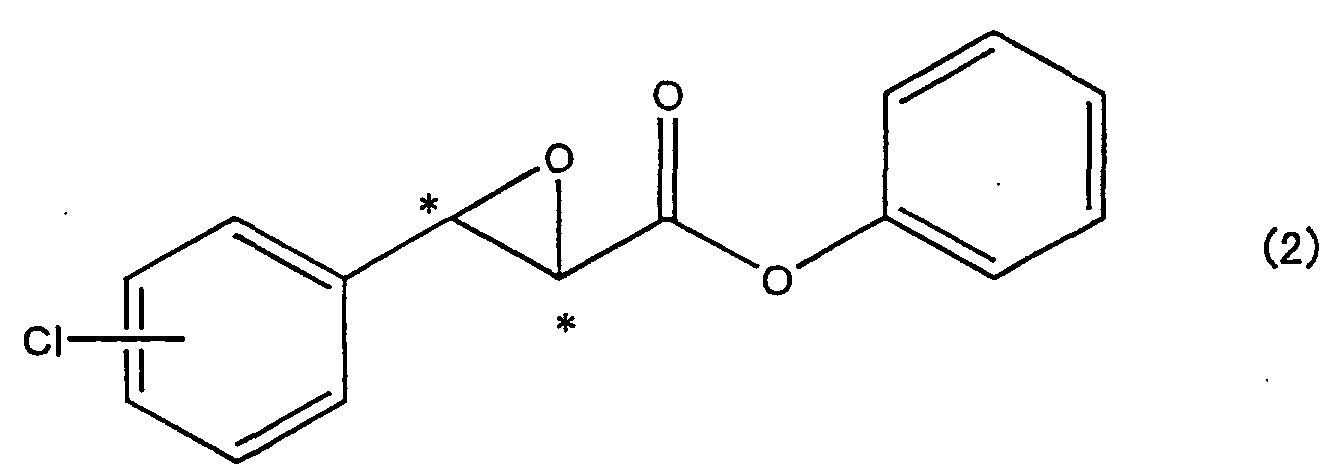
- optically active epoxypropionate derivative of the above Formula (2) of the present invention is specifically phenyl trans-3-(2-chlorophenyl)-(2S,3R)-epoxypropionate, phenyl trans-3-(3-chlorophenyl)-(2S,3R)-epoxypropionate, phenyl trans-3-(4-chlorophenyl)-(2S,3R)-epoxypropionate, phenyl trans-3-(2-chlorophenyl)-(2R,3S)-epoxypropionate, phenyl trans-3-(3-chlorophenyl)-(2R,3S)-epoxypropionate, or phenyl trans-3-(4-chlorophenyl)-(2R,3S)-epoxypropionate.
- optically active epoxyenone derivative of the above Formula (3) of the present invention is specifically (lR,2S)-trans-1,2-epoxy-1-(4'-fluorophenyl)-4,4-dimethyl-pentan-3-one, (1R,2S)-trans-1,2-epoxy-1-(3'-fluorophenyl)-4,4-dimethyl-pentan-3-one, (1R,2S)-trans-1,2-epoxy-1-(2'-fluorophenyl)-4,4-dimethyl-pentan-3-one, (1S, 2R)-trans-1,2-epoxy-1-(4'-fluorophenyl)-4,4-dimethyl-pentan-3-one, (lS,2R)-trans-1,2-epoxy-1-(3'-fluorophenyl)-4,4-dimethyl-pentan-3-one, or (1S,2R)-trans-1,2-epoxy-1-(2'-fluoroph
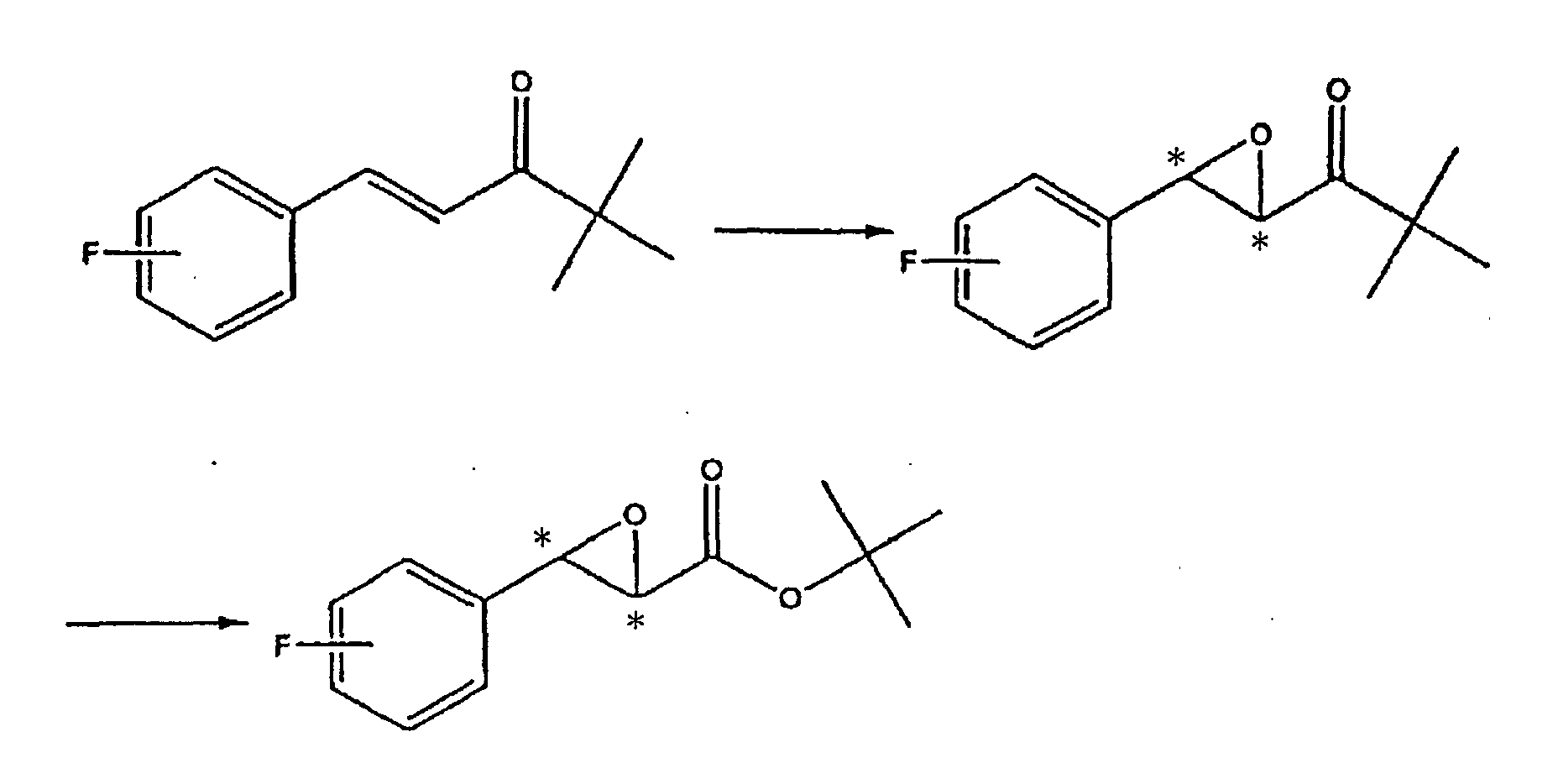
- the compound of the above Formula (1) of the present invention can be prepared by the following synthetic route using a known enone as the staring material, although the preparation is not particularly limited.
- symbol * represents optically active carbon.
- the optically active epoxyenone derivative of the above Formula (3) is prepared by asymmetric epoxidation of an enone, and further, the derivative is oxidized with an oxidizing agent, whereby the optically active epoxypropionate derivative of the above Formula (1) is prepared.
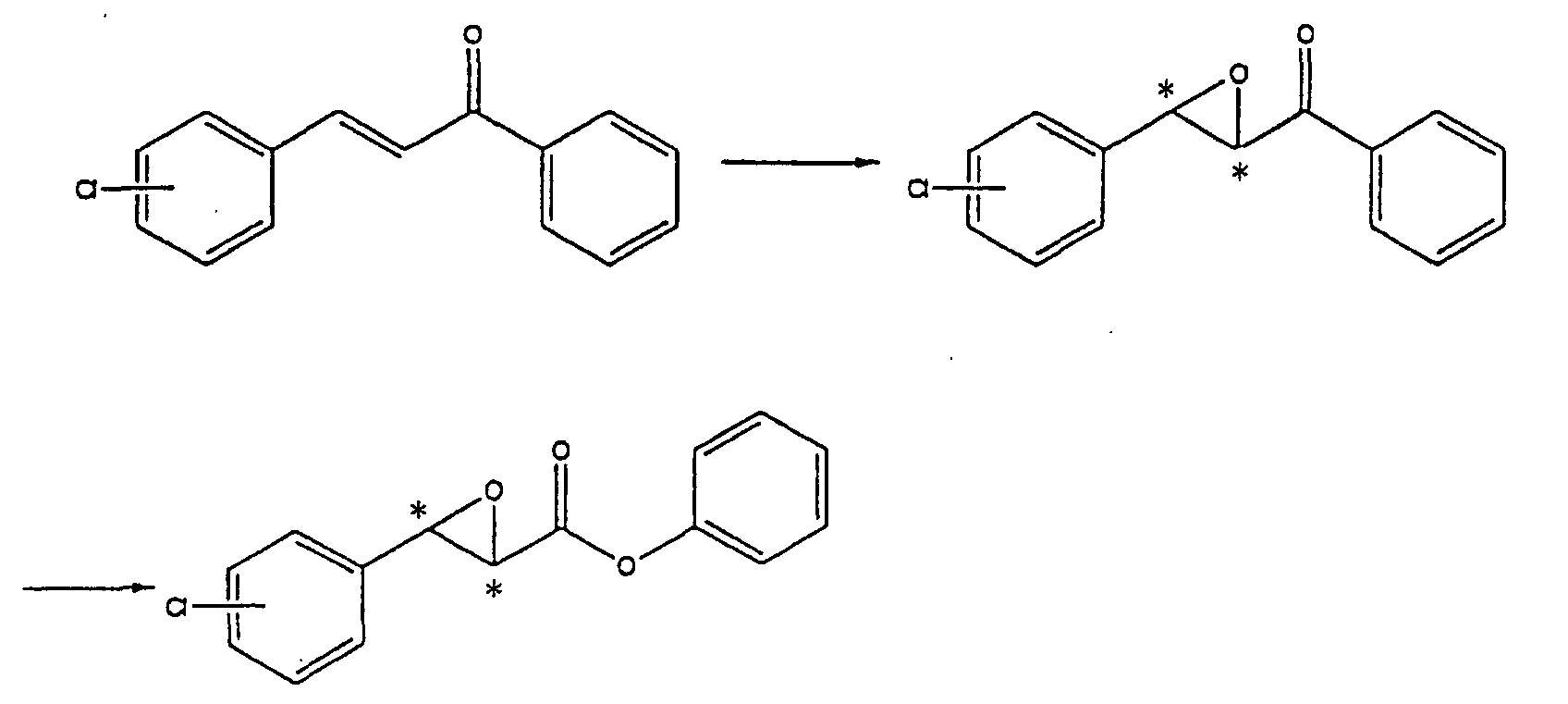
- the compound of the above Formula (2) of the present invention can be prepared by the following route by asymmetric epoxidation of an enone using a known enone as the starting material, although the preparation is not particularly limited.
- symbol * represents optically active carbon.
- any asymmetric epoxidation catalyst for enones can be used.
- a catalyst comprising:
- the respective constituting components may be present in equivalent amounts.
- the binaphthol is usually from 1 to 3 mols, preferably from 1 to 1.5 mols
- the triphenylphosphine oxide is usually from 0.1 to 10 mols, preferably from 1 to 10 mols
- CMHP or TBHP is usually from 1 to 20 mols, preferably from 1 to 10 mols, per mol of
- B) the lanthanum triisopropoxide is usually from 1 to 3 mols, preferably from 1 to 1.5 mols
- the triphenylphosphine oxide is usually from 0.1 to 10 mols, preferably from 1 to 10 mols
- CMHP or TBHP is usually from 1 to 20 mols, preferably from 1 to 10 mols, per mol of
- B the lanthanum triisopropoxide.
- the above catalyst components are preliminarily formulated into a catalyst solution in the reaction system and then used for the epoxidation reaction of an enone.
- the amount of the catalyst is not particularly limited, but it is usually within a range of from 0.01 to 50 mol%, more preferably within a range of from 0.1 to 25 mol%, based on the molar amount of the lanthanum isopropoxide, relative to the substrate subjected to the reaction.
- the solvent useful for the asymmetric epoxidation reaction of the present invention may be any solvent so long as it is a solvent inert to the catalyst and to the epoxidation reaction.
- an ether type solvent such as dimethyl ether, diisopropyl ether, 1,2-dimethoxyethane or tetrahydrofuran (hereinafter referred to as THF), is preferred, and among them, it is THF that gives the highest results.
- THF ether type solvent
- THF 1,2-dimethoxyethane or tetrahydrofuran
- Such a solvent can be used also as a solvent for the preparation of the above catalyst solution.
- the amount of the solvent is usually from 2 to 200 times, preferably from 5 to 100 times, by weight, to the enone to be subjected to the reaction.
- a complex catalyst comprising:
- the time for formation of the catalyst varies depending upon the proportions of the components constituting the catalyst, selection of the oxidizing agent, the type of the solvent and the concentration of the catalyst.
- the complex catalyst can be formed usually by maintaining the mixture for from 0.5 to 4 hours within a range of from -50°C to 100°C, and the solution after the formation of the complex shows a color of yellowish green to deep green.
- TBHP to be used as an oxidizing agent in the asymmetric epoxidation reaction of the present invention
- a commercially available solution in e.g. decane may be used as it is, or it may be extracted by toluene from a 70% or 90% aqueous solution, followed by drying over e.g. magnesium sulfate, and then may be used in the present invention.
- CMHP a commercially available 80 wt% product may be used after purification or as it is without purification.
- purified or commercially available CMHP is employed, whereby a pure optically active substance can be obtained.
- the above enone is added to the preliminarily prepared catalyst solution, and then CMHP or TBHP is supplied to carry out the reaction.
- the supply rate of the oxidizing agent the supply is carried out under such a condition that the oxidizing agent will not be in large excess in the system. Specifically, the supply rate is determined by measuring the reaction rate in the actual system, whereupon the supply is carried out. If the supply rate is higher than the reaction rate, the yield may decrease, and if it is lower, the optical purity may decrease.
- the amount of the oxidizing agent should theoretically be sufficient with an equivalent amount to the enone subjected to the reaction, as the sum of the amount used for forming the catalyst and the amount added during the reaction. However, in order to complete the reaction, it is preferably used in an amount of at least 1.1 times by mol.
- the reaction temperature in the asymmetric epoxidation reaction of the present invention varies depending upon the difference in the substrate of the enone, but it is usually within a range of from -50°C to 100°C. With respect to the reaction time, the reaction is completed usually within 48 hours.
- zeolite may be used, as the case requires, for the purpose of removing water in the system during the preparation of the catalyst and during the reaction or for the purpose of accelerating the catalyst-forming reaction or the epoxidation reaction.
- the zeolite may be used in any ratio to the enone, but it is used usually in an amount of from about 10 mg to 2 g per mmol of the enone.
- various zeolites can be used including type A zeolites represented by molecular sieves 3A, 4A, and 5A, molecular sieve 13X, type Y zeolite and type L zeolite. Among these, molecular sieve 4A is preferred.
- the process of obtaining the optically active epoxypropionate of the present invention is not particularly limited.
- the optically active epoxyenone obtained by the above method is oxidized by a Baeyer-Villiger reaction to obtain the desired product.
- any peracid or peroxide may be employed.
- potassium persulfate, hydrogen peroxide, perbenzoic acid, m-chloroperbenzoic acid, CMHP or TBHP may, for example, be mentioned.
- the reaction is carried out usually within a temperature range of from 0°C to 150°C for from 1 to 48 hours to obtain the desired product.
- an alkali metal hydroxide such as sodium hydroxide, potassium hydroxide or lithium hydroxide may be used in combination, and the reaction may be carried out in a water/alcohol solvent.
- the amount of the oxidizing agent to be used in the Baeyer-Villiger reaction of the present invention is usually from 1 to 10 times by mol, preferably from 2 to 5 times by mol, relative to the epoxyenone subjected to the reaction.
- the peracid or peroxide is deactivated, and then, the optically active epoxypropionate derivative as the desired product, can be obtained by extraction with an organic solvent, followed by drying, concentration and purification by column chromatography.
- optically active epoxypropionate derivative of the present invention has a high optical purity and is expected to be an important intermediate for various pharmaceuticals or agricultural chemicals.
- Gemini-200 manufactured by Varian, was used (200 MHz).
- molecular sieve 4A (687 mg, product preliminarily dried for 4 hours at 180°C under reduced pressure) was put and heated for 3 minutes by a heat gun under reduced pressure by means of a vacuum pump and dried. After cooling to room temperature, triphenylphosphine oxide (574 mg, 2.06 mmol) and (R)-binaphthol (197 mg, 0.69 mmol) were introduced, and the reaction system was flushed with nitrogen gas. Then, THF (20 ml) was added thereto, followed by stirring for 5 minutes for dissolution.
- CMHP 80%, 3.17 ml, 17.2 mmol
- the supply rate of CMHP was set to be 20 hours based on the conversion rate of 5.0%/hr as a result of the measurement of the rate by an equivalent reaction.
- molecular sieve 4A (1.32 g) was put, and heated and dried by a heat gun for 3 minutes under reduced pressure by means of a vacuum pump. After cooling to room temperature, triphenylphosphine oxide (1.10 g, 3.97 mmol) and (R)-binaphthol (379 mg, 1.32 mmol) were introduced, and the reaction system was flushed with nitrogen gas. Then, THF (30 ml) was added, followed by stirring for 5 minutes for dissolution.
- CMHP 80%, 6.11 ml, 33.1 mmol
- the supply rate of CMHP was set to be 12 hours, based on a conversion rate of 8.2%/hr as a result of the measurement of the rate by an equivalent reaction.
- molecular sieve 4A Into a 50 ml eggplant type flask, molecular sieve 4A (869 mg) was put, and heated and dried by a heat gun for 3 minutes under reduced pressure by means of a vacuum pump. After cooling to room temperature, triphenylphosphine oxide (725 mg, 2.61 mmol) and (R)-binaphthol (249 mg, 0.87 mmol) were introduced, and the reaction system was flushed with nitrogen gas. Then, THF (25 ml) was added, followed by stirring for 5 minutes for dissolution.
- CMHP 80%, 3.85 ml, 20.9 mmol
- the supply rate of CMHP was set to be 12 hours based on a conversion rate of 8.5%/hr as a result of the measurement of the rate by an equivalent reaction.
- trans-(1R,2S)-1,2-epoxy-1-(2'-fluorophenyl)-4,4-dimethylpentan-3-one 500 mg, 2.25 mmol
- m-chloroperbenzoic acid 80%mCPBA, 1.94 g, 9.00 mmol
- the reaction solution was cooled to room temperature, and then by a silica gel short column, the precipitated substance and the adsorbed substance were removed, followed by washing with 100 ml of dichloromethane.
- trans-(1R,2S)-epoxy-1-(3-fluorophenyl)-4,4-dimethylpentan-3-one 514 mg, 2.31 mmol obtained in Example 2 and m-chloroperbenzoic acid (80%mCPBA, 1.40 g, 6.47 mmol) were dissolved in 15 ml of toluene, followed by heating on a hot bath to carry out the reaction at 90°C for 46 hours.
- the reaction solution was cooled to room temperature, and then, by a silica gel short column, the precipitated substance and the adsorbed substance were removed, followed by washing with 100 ml of dichloromethane.
- trans-(1R,2S)-epoxy-1-(4'-fluorophenyl)-4,4-dimethylpentan-3-one (498 mg, 2.24 mmol) obtained in Example 3 and m-chloroperbenzoic acid (80%mCPBA, 1.93 g, 8.96 mmol) were dissolved in 15 ml of toluene, followed by heating to carry out the reaction at 90°C for 19 hours.
- the reaction solution was cooled to room temperature and then, by a silica gel short column, the precipitated substance and the adsorbed substance were removed, followed by washing with 100 ml of dichloromethane.
- molecular sieve 4A 827 mg, preliminarily dried produce under reduced pressure at 180°C for 4 hours was put, and heated and dried by a heat gun for 3 minutes under reduced pressure by means of a vacuum pump. After cooling to room temperature, triphenylphosphine oxide (345 mg, 1.24 mmol) and (R)-binaphthol (119 mg, 0.41 mmol) were introduced, and the reaction system was flushed with nitrogen gas. Then, THF (20 ml) was added, followed by stirring for 5 minutes for dissolution.
- trans-3-(4-chlorophenyl)-(2S,3R)-epoxy-l-phenylpropane-l-one (203 mg, 0.773 mmol) obtained in Example 1
- m-chloroperbenzoic acid 80%mCPBA, 333 mg, 1.55 mmol
- sodium hydrogencarbonate 195 mg, 2.32 mmol
- the reaction solution was cooled to room temperature, and then 20 ml of water and 20 ml of dichloromethane were added, whereupon the organic layer was separated and washed three times with 20 ml of water.
- the organic layer was dried over magnesium sulfate, and then, by a silica gel short column, the precipitated substance and the adsorbed substance were removed, followed by washing with 100 ml of dichloromethane.
Landscapes
- Chemical & Material Sciences (AREA)
- Organic Chemistry (AREA)
- Epoxy Compounds (AREA)
Abstract


Description


(S)-(-)-1,1'-bi-2-naphthol (hereinafter referred to as (S)-binaphthol).

Melting point: 61.0-62.5°C
1H―NMR(CDCl3) δ 7. 03-7. 39(m, 4H), 4. 10(d, 1H, J=1. 8Hz), 3. 84(d, 1H, J=1. 8Hz), 1. 25(s, 9H)
13C-NMR(CDCl3) δ 207. 8, 161. 4(J=246. 4Hz), 130. 1(J=8. 1 Hz), 126. 2 (J= 3. 5Hz), 124. 5 (J=3. 5Hz) , 123. 2(J=12. 9Hz), 115. 4(J=20. 2Hz), 58. 1, 54. 3, 43. 7, 25. 7
IR(KBr; v cm-1)2978, 2935, 1710, 1619, 1587, 1494, 1458, 1416, 1248, 1217, 1099, 1077, 1004, 895, 822, 764, 590, 518
EI-MS(m/z) 222(M+)
Specific rotation (c=1. 03, CHCl3) [α]28 D=+191

Melting point: 68.0 to 69.5°C
1H―NMR(CDCl3) δ 6. 97-7. 40(m, 4H), 3. 86(d, 1H, J=1. 8Hz), 3. 81(d, 1H, J=1. 8Hz), 1. 24(s, 9H)
13C-NMR(CDCl3) δ 207. 7, 163. 1 (J=245. 7Hz), 138. 3 (J= 7. 5 Hz), 130. 4 (J=8. 1Hz), 121. 5 (J=2. 9Hz), 116. O (J=25. 3Hz), 112. 4 (J= 22. 7Hz), 59. 0, 58. 6, 43. 6, 25. 7
IR(KBr; ν cm-1) 2975, 2937, 1705, 1616, 1592, 1464, 1412, 1397, 1275, 1230, 1140, 1075, 1005, 869, 775, 689, 580, 523
EI-MS(m/z) 222(M+)
Specific rotation (c=1. 015, CHCl3) [α]27 D=+236

Melting point: 65.8-66.5°C
1H―NMR(CDCl3) δ 7. 02-7. 32 (m, 4H), 3. 85 (d, 1H, J=1. 8Hz), 3. 82(d, 1H, J=1. 8Hz), 1. 24(s, 9H)
13C-NMR(CDCl3) δ 207. 9, 163. 1 (J=246. 5Hz), 130. 0 (J=144. 6Hz), 127. 4(J=8. 2Hz), 115. 8 (J=21. 9Hz), 59. 1, 58. 7, 43. 6, 25. 7
IR(KBr; v cm-1)2974, 2936, 1714, 1606, 1514, 1478, 1436, 1398, 1223, 1157, 1075, 1004, 892, 842, 786, 555, 528
EI-MS(m/z) 222(M+)
Specific rotation (c=1. 035, CHCl3) [α]28 D=+185

1H―NMR(CDCl3) δ 7. 02-7. 37(m, 4H), 4. 30(d, 1H, J=1. 8H z), 3. 41 (d, 1H, J=1. 8Hz), 1. 52(s, 9H)
13C―NMR(CDCl3) δ 166. 9, 161. 6 (J=246. 7Hz), 130. 1 (J=8. 1Hz), 126. 3 (J=3. 3Hz), 124. 4(J=3. 6Hz), 122. 9 (J=12. 6Hz), 115. 4 (J=20. 7Hz), 82. 9, 56. 7, 52. 3, 28. 0
IR(neat; v cm-1)2982, 2936, 1746, 1620, 1590, 1496, 1459, 1424, 1370, 1343, 1307, 1253, 1226, 1158, 970, 895, 759
EI-MS(m/z) 238(M+)
Specific rotation (c=1. 100, CHCl3) [α]28 D= +119

1H―NMR(CDCl3) δ 6. 94-7. 38(m,4H), 4.02(d,1H, J=1. 8Hz), 3. 37(d, 1H, J=1. 8Hz), 1. 52(s, 9H)
13C―NMR(CDCl3) δ 166. 8, 163. 1(J=246. 7Hz), 138. 1 (J=7. 4Hz), 130. 3 (J=8. 2Hz), 121. 8 (J=2. 9Hz), 115. 9 (J=21. 3Hz), 112. 7(J=22. 7Hz), 82. 9, 57. 5, 56. 9, 28. 0
IR(neat; v cm-1)2982, 2937, 1745, 1593, 1456, 1370, 1341, 1237, 1157, 971, 962, 875, 779
EI-MS(m/z) 238(M+)
Specific rotation (c=1. 205, CHCl3) [α]28 D=+150

Melting point: 48.0-49.0°C
1H―NMR(CDCl3) δ 7. 01-7. 31 (m, 4H), 4. 01 (d, 1H, J=1. 8Hz), 3. 37(d, 1H, J=1. 8Hz), 1. 52(s, 9H)
13C―NMR(CDCl3) δ 167. 0, 163. 1 (J=246. 2Hz), 131. 1 (J=2. 9Hz) , 127. 7(J=8. 4Hz), 115. 7 (J=21. 8Hz), 82. 8, 57. 4, 57. 1, 28. 0
IR(KBr; ν cm-1) 2990, 2942, 1724, 1609, 1515, 1468, 1440, 1407, 1369, 1230, 1158, 970, 877, 841, 821, 792, 770, 696, 556, 530
EI-MS (m/z) 238 (M+)
Specific rotation (c=1. 030, CHCl3) [α]28 D=+142

Melting point: 76-79°C
1H―NMR(CDCl3) δ 7.26-8. 03(m, 9H), 4. 25 (d, 1H, J=1. 8Hz), 4. 06(d, 1H,J=1. 8Hz)
13C―NMR(CDCl3) δ 192.7, 135. 4, 134. 9, 134. 1, 129.0, 128. 9, 128. 3, 127. 1, 125. 4
IR(KBr; v cm-1) 3069, 1683, 1597, 1495, 1446, 1339, 1237, 1090, 1006, 887, 843, 806, 705, 535, 476
EI-MS(m/z) 258(M+)
Elemental analysis C:69. 4%, H:4. 4%, Cl:13. 5%
(calc. C:69. 6%, H:4. 3%, Cl:13. 7%)
Specific rotation (c=1. 035, CHCl3) [α]28 D=+246°

Melting point: 107-110°C
1H―NMR(CDCl3) δ 7. 14-7. 45(m, 9H), 4. 24(d, 1H, J=1. 8Hz), 3. 69(d, 1H, J=1. 8Hz)
13C―NMR(CDCl3) δ 166. 4, 150. 2, 135. 2, 134. 5, 133. 2, 130. 3, 129. 8, 129. 6, 129. 0, 127. 9, 127. 3, 126. 4, 121. 1, 57. 7, 56. 7
IR(KBr; v cm-1)3068, 1752, 1598, 1591, 1487, 1430, 1397, 1267, 1201, 1164, 1090, 1013, 894, 831, 810, 751, 730, 688, 546, 479
EI-MS(m/z) 274(M+)
Elemental analysis C:65. 4%, H:4. 0%, Cl:13. 2%
(calc. C:65. 6%, H:4. 0%, Cl:12. 9%)
Specific rotation (c=0. 760, CHCl3) [α]28 D=+170°
Claims (9)
- An optically active epoxypropionate derivative of the following formula (1):wherein symbol * represents optically active carbon.

- An optically active epoxypropionate derivative of the following formula (2):wherein symbol * represents optically active carbon.
- A process for producing an optically active epoxypropionate derivative as defined in Claim 1, which comprises oxidizing an optically active epoxyenone derivative of the following formula (3):wherein symbol * represents optically active carbon, with an oxidizing agent.

- An optically active epoxyenone derivative of the following formula (3):wherein symbol * represents optically active carbon.

- A process for producing an optically active epoxypropionate derivative as defined in Claim 2, which comprises oxidizing an optically active epoxyenone derivative of the following formula (4):wherein symbol * represents optically active carbon, with an oxidizing agent.

- A process for producing an optically active epoxyenone derivative as defined in Claim 4, which comprises epoxidizing an enone derivative of the following formula (5):in the presence of an asymmetric catalyst.

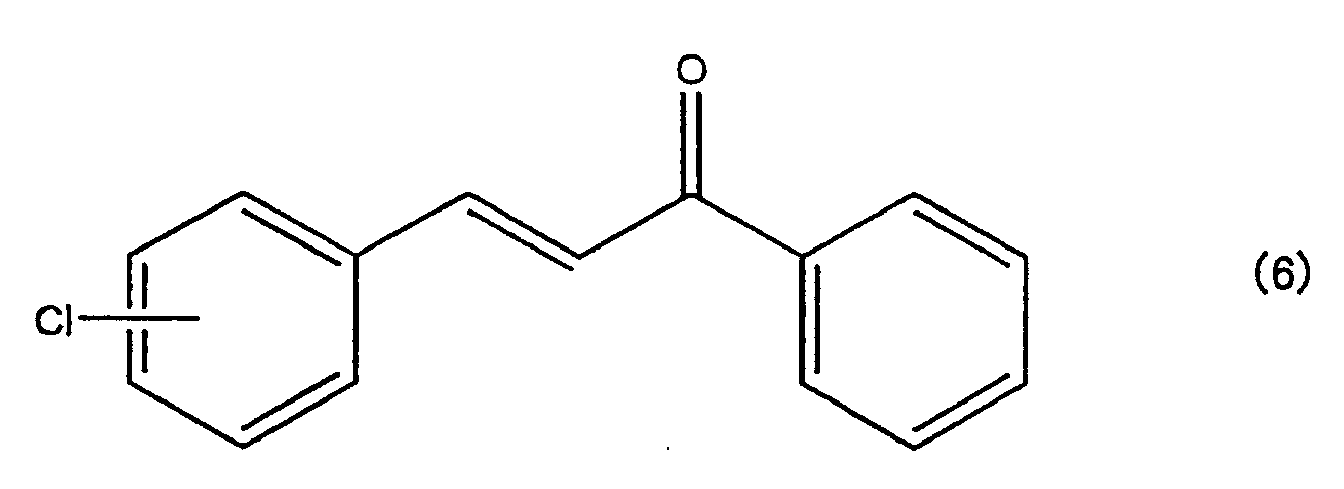
- A process for producing an optically active epoxyenone derivative as defined in Claim 5, which comprises epoxidizing an enone derivative of the following formula (6):in the presence of an asymmetric catalyst.
- The process for producing an optically active epoxyenone derivative according to Claim 6 or 7, wherein the asymmetric catalyst comprises:(A) an optically active binaphthol,(B) lanthanum triisopropoxide,(C) triphenylphosphine oxide, and(D) cumene hydroperoxide or tert-butyl hydroperoxide.
- The process for producing an optically active epoxyenone derivative according to Claim 6 or 7, wherein the asymmetric catalyst comprises:(A) (R)-(+)-l,l'-bi-2-binaphthol or (S)-(-)-1,1'-bi-2-naphthol,(B) lanthanum triisopropoxide,(C) triphenylphosphine oxide, and(D) cumene hydroperoxide or tert-butyl hydroperoxide.
Applications Claiming Priority (4)
| Application Number | Priority Date | Filing Date | Title |
|---|---|---|---|
| JP2000052268A JP2001233869A (en) | 2000-02-24 | 2000-02-24 | Optically active epoxy propionate derivatives, intermediates thereof, and methods for their production |
| JP2000052268 | 2000-02-24 | ||
| JP2000177153 | 2000-06-08 | ||
| JP2000177153A JP2001354665A (en) | 2000-06-08 | 2000-06-08 | Optically active epoxy propionate derivatives and methods for their production |
Publications (2)
| Publication Number | Publication Date |
|---|---|
| EP1127885A2 true EP1127885A2 (en) | 2001-08-29 |
| EP1127885A3 EP1127885A3 (en) | 2003-01-29 |
Family
ID=26586281
Family Applications (1)
| Application Number | Title | Priority Date | Filing Date |
|---|---|---|---|
| EP01103615A Withdrawn EP1127885A3 (en) | 2000-02-24 | 2001-02-22 | Optically active epoxypropionate derivatives, intermediates, and processes for their production |
Country Status (2)
| Country | Link |
|---|---|
| US (1) | US6787657B2 (en) |
| EP (1) | EP1127885A3 (en) |
Cited By (1)
| Publication number | Priority date | Publication date | Assignee | Title |
|---|---|---|---|---|
| EP1403260A3 (en) * | 2002-09-25 | 2004-04-14 | Tosoh Corporation | Optically active epoxy compounds and processes for their production |
Family Cites Families (7)
| Publication number | Priority date | Publication date | Assignee | Title |
|---|---|---|---|---|
| JPS57142974A (en) | 1981-02-27 | 1982-09-03 | Sumitomo Chem Co Ltd | Alkoxytriazolyl ketone compound and its preparation |
| JPS57154172A (en) | 1981-03-16 | 1982-09-22 | Sumitomo Chem Co Ltd | Preparation of triazolylvinyl ketone type geometrical isomer |
| JPS5899430A (en) | 1981-12-08 | 1983-06-13 | Sumitomo Chem Co Ltd | Methoxyketone alcohol and its preparation |
| JPS5899429A (en) | 1981-12-08 | 1983-06-13 | Sumitomo Chem Co Ltd | Alpha-diketone and its preparation |
| JPS6013776A (en) | 1983-07-05 | 1985-01-24 | Sawai Seiyaku Kk | Production of optically active 3-(p-alkoxyphenyl)-glycidic acid derivative |
| JPH01226881A (en) | 1988-03-04 | 1989-09-11 | Tanabe Seiyaku Co Ltd | Production of compound of optically active 3-phenylglycidic acid esters |
| JPH06287183A (en) | 1993-04-05 | 1994-10-11 | Nippon Chemiphar Co Ltd | Novel optically active epoxypropionate derivative |
-
2001
- 2001-02-21 US US09/788,369 patent/US6787657B2/en not_active Expired - Fee Related
- 2001-02-22 EP EP01103615A patent/EP1127885A3/en not_active Withdrawn
Cited By (2)
| Publication number | Priority date | Publication date | Assignee | Title |
|---|---|---|---|---|
| EP1403260A3 (en) * | 2002-09-25 | 2004-04-14 | Tosoh Corporation | Optically active epoxy compounds and processes for their production |
| US7169944B2 (en) | 2002-09-25 | 2007-01-30 | Tosoh Corporation | Optically active epoxy compounds and processes for their production |
Also Published As
| Publication number | Publication date |
|---|---|
| EP1127885A3 (en) | 2003-01-29 |
| US20010020106A1 (en) | 2001-09-06 |
| US6787657B2 (en) | 2004-09-07 |
Similar Documents
| Publication | Publication Date | Title |
|---|---|---|
| Hayashi et al. | Asymmetric synthesis catalyzed by chiral ferrocenylphosphine-transition metal complexes. 5. Palladium-catalyzed asymmetric allylation of active methine compounds | |
| US6130340A (en) | Asymmetric cycloaddition reactions | |
| CN110143982B (en) | A kind of synthetic method of diarylbenzylphosphine oxide compound | |
| CN114082446B (en) | Chiral zirconium catalyst for preparing chiral α-hydroxy-β-keto acid ester compound and preparation method thereof | |
| US6787657B2 (en) | Optically active epoxypropionate derivative, intermediate thereof and processes for their production | |
| US6025503A (en) | Process for producing optically active titanium alkoxide complexes | |
| JP5544596B2 (en) | Process for producing optically active cyclic ether compound and catalyst used therefor | |
| JP2001233869A (en) | Optically active epoxy propionate derivatives, intermediates thereof, and methods for their production | |
| US6090969A (en) | Process for the preparation of an asymmetric compound using a metal complex | |
| EP1439001B1 (en) | Process for producing optically active epoxides | |
| JP4525993B2 (en) | Asymmetric epoxidation catalyst and method for producing optically active epoxide | |
| JP4378826B2 (en) | Complex catalyst for asymmetric epoxidation reaction of enones and method for producing optically active epoxide using the same | |
| US7169944B2 (en) | Optically active epoxy compounds and processes for their production | |
| JP4283377B2 (en) | Asymmetric epoxidation catalyst for enones and method for producing optically active epoxide using the same | |
| JP2001354665A (en) | Optically active epoxy propionate derivatives and methods for their production | |
| US6054065A (en) | Chiral ligand and method for preparing cyanohydrins from aldehydes | |
| JP4605321B2 (en) | Optically active oxazoline compound and method for producing optically active allyl alcohol derivative using the compound | |
| JP4534457B2 (en) | Optically active epoxy compounds and method for producing the same | |
| KR100681326B1 (en) | Novel manganese-chiral compounds and methods of use thereof | |
| JP4386626B2 (en) | Novel chiral metal complex solid catalyst, intermediates thereof, method for producing them, and method for producing asymmetric epoxy compound using the catalyst | |
| JP2003160547A (en) | Cis-aminoindanol derivatives, their preparation and their use | |
| JP2518101B2 (en) | Optically active alcohol | |
| JPH0631266B2 (en) | Optically active alcohol | |
| JPH0462312B2 (en) | ||
| JPH09208566A (en) | Optically active oxazoline compound and asymmetric allyl oxidization reaction |
Legal Events
| Date | Code | Title | Description |
|---|---|---|---|
| PUAI | Public reference made under article 153(3) epc to a published international application that has entered the european phase |
Free format text: ORIGINAL CODE: 0009012 |
|
| AK | Designated contracting states |
Kind code of ref document: A2 Designated state(s): AT BE CH CY DE DK ES FI FR GB GR IE IT LI LU MC NL PT SE TR |
|
| AX | Request for extension of the european patent |
Free format text: AL;LT;LV;MK;RO;SI |
|
| PUAL | Search report despatched |
Free format text: ORIGINAL CODE: 0009013 |
|
| RIC1 | Information provided on ipc code assigned before grant |
Free format text: 7C 07D 303/48 A, 7C 07D 303/32 B, 7C 07D 301/19 B |
|
| AK | Designated contracting states |
Designated state(s): AT BE CH CY DE DK ES FI FR GB GR IE IT LI LU MC NL PT SE TR |
|
| AX | Request for extension of the european patent |
Extension state: AL LT LV MK RO SI |
|
| 17P | Request for examination filed |
Effective date: 20030618 |
|
| AKX | Designation fees paid |
Designated state(s): CH DE GB LI |
|
| 17Q | First examination report despatched |
Effective date: 20081106 |
|
| STAA | Information on the status of an ep patent application or granted ep patent |
Free format text: STATUS: THE APPLICATION IS DEEMED TO BE WITHDRAWN |
|
| 18D | Application deemed to be withdrawn |
Effective date: 20090317 |