EP1126327A2 - Toner and developer for electrophotography - Google Patents
Toner and developer for electrophotography Download PDFInfo
- Publication number
- EP1126327A2 EP1126327A2 EP01301119A EP01301119A EP1126327A2 EP 1126327 A2 EP1126327 A2 EP 1126327A2 EP 01301119 A EP01301119 A EP 01301119A EP 01301119 A EP01301119 A EP 01301119A EP 1126327 A2 EP1126327 A2 EP 1126327A2
- Authority
- EP
- European Patent Office
- Prior art keywords
- toner
- wax
- developer
- cyclic oligosaccharide
- ethyl
- Prior art date
- Legal status (The legal status is an assumption and is not a legal conclusion. Google has not performed a legal analysis and makes no representation as to the accuracy of the status listed.)
- Granted
Links
- -1 ethyl cyclic oligosaccharide Chemical class 0.000 claims abstract description 121
- 229920001542 oligosaccharide Polymers 0.000 claims abstract description 107
- 239000011230 binding agent Substances 0.000 claims abstract description 31
- 125000002353 D-glucosyl group Chemical group C1([C@H](O)[C@@H](O)[C@H](O)[C@H](O1)CO)* 0.000 claims abstract description 18
- 239000003086 colorant Substances 0.000 claims abstract description 15
- 239000001993 wax Substances 0.000 claims description 121
- 238000002844 melting Methods 0.000 claims description 42
- 230000008018 melting Effects 0.000 claims description 33
- 239000003795 chemical substances by application Substances 0.000 claims description 17
- 238000003860 storage Methods 0.000 claims description 17
- 239000012188 paraffin wax Substances 0.000 claims description 11
- 239000000155 melt Substances 0.000 claims description 7
- 238000000034 method Methods 0.000 claims description 7
- 239000004200 microcrystalline wax Substances 0.000 claims description 6
- 235000019808 microcrystalline wax Nutrition 0.000 claims description 6
- 235000007164 Oryza sativa Nutrition 0.000 claims description 4
- 150000001336 alkenes Chemical class 0.000 claims description 4
- 235000014113 dietary fatty acids Nutrition 0.000 claims description 4
- 239000000194 fatty acid Substances 0.000 claims description 4
- 229930195729 fatty acid Natural products 0.000 claims description 4
- 150000004665 fatty acids Chemical class 0.000 claims description 4
- 150000002194 fatty esters Chemical class 0.000 claims description 4
- JRZJOMJEPLMPRA-UHFFFAOYSA-N olefin Natural products CCCCCCCC=C JRZJOMJEPLMPRA-UHFFFAOYSA-N 0.000 claims description 4
- 230000035515 penetration Effects 0.000 claims description 4
- 230000008569 process Effects 0.000 claims description 4
- 235000009566 rice Nutrition 0.000 claims description 4
- 239000004204 candelilla wax Substances 0.000 claims description 3
- 235000013868 candelilla wax Nutrition 0.000 claims description 3
- 229940073532 candelilla wax Drugs 0.000 claims description 3
- 150000002191 fatty alcohols Chemical class 0.000 claims description 3
- 150000002193 fatty amides Chemical class 0.000 claims description 3
- IUJAMGNYPWYUPM-UHFFFAOYSA-N hentriacontane Chemical compound CCCCCCCCCCCCCCCCCCCCCCCCCCCCCCC IUJAMGNYPWYUPM-UHFFFAOYSA-N 0.000 claims description 3
- 240000007594 Oryza sativa Species 0.000 claims 1
- 239000000203 mixture Substances 0.000 description 57
- 239000002245 particle Substances 0.000 description 48
- 229920005989 resin Polymers 0.000 description 42
- 239000011347 resin Substances 0.000 description 42
- VYPSYNLAJGMNEJ-UHFFFAOYSA-N Silicium dioxide Chemical compound O=[Si]=O VYPSYNLAJGMNEJ-UHFFFAOYSA-N 0.000 description 28
- 230000000052 comparative effect Effects 0.000 description 18
- 239000000654 additive Substances 0.000 description 17
- 230000000996 additive effect Effects 0.000 description 17
- 229920001577 copolymer Polymers 0.000 description 17
- 230000008021 deposition Effects 0.000 description 17
- 238000011161 development Methods 0.000 description 15
- 239000000377 silicon dioxide Substances 0.000 description 14
- 239000006229 carbon black Substances 0.000 description 12
- 238000012360 testing method Methods 0.000 description 12
- 238000004321 preservation Methods 0.000 description 11
- 229920000858 Cyclodextrin Polymers 0.000 description 8
- 230000008859 change Effects 0.000 description 8
- 238000010298 pulverizing process Methods 0.000 description 8
- HFHDHCJBZVLPGP-UHFFFAOYSA-N schardinger α-dextrin Chemical compound O1C(C(C2O)O)C(CO)OC2OC(C(C2O)O)C(CO)OC2OC(C(C2O)O)C(CO)OC2OC(C(O)C2O)C(CO)OC2OC(C(C2O)O)C(CO)OC2OC2C(O)C(O)C1OC2CO HFHDHCJBZVLPGP-UHFFFAOYSA-N 0.000 description 8
- 238000002360 preparation method Methods 0.000 description 7
- PPBRXRYQALVLMV-UHFFFAOYSA-N Styrene Chemical compound C=CC1=CC=CC=C1 PPBRXRYQALVLMV-UHFFFAOYSA-N 0.000 description 6
- 230000003247 decreasing effect Effects 0.000 description 6
- 238000011156 evaluation Methods 0.000 description 6
- 125000002887 hydroxy group Chemical group [H]O* 0.000 description 6
- 150000002482 oligosaccharides Chemical class 0.000 description 6
- 239000000049 pigment Substances 0.000 description 6
- 229920000728 polyester Polymers 0.000 description 6
- 230000007423 decrease Effects 0.000 description 5
- 230000000903 blocking effect Effects 0.000 description 4
- 239000004203 carnauba wax Substances 0.000 description 4
- 235000013869 carnauba wax Nutrition 0.000 description 4
- 230000002950 deficient Effects 0.000 description 4
- 150000004676 glycans Chemical class 0.000 description 4
- 239000001257 hydrogen Substances 0.000 description 4
- 229910052739 hydrogen Inorganic materials 0.000 description 4
- 229920001282 polysaccharide Polymers 0.000 description 4
- 239000005017 polysaccharide Substances 0.000 description 4
- 241000209094 Oryza Species 0.000 description 3
- 230000007613 environmental effect Effects 0.000 description 3
- 238000003756 stirring Methods 0.000 description 3
- XLYOFNOQVPJJNP-UHFFFAOYSA-N water Substances O XLYOFNOQVPJJNP-UHFFFAOYSA-N 0.000 description 3
- RSWGJHLUYNHPMX-UHFFFAOYSA-N Abietic-Saeure Natural products C12CCC(C(C)C)=CC2=CCC2C1(C)CCCC2(C)C(O)=O RSWGJHLUYNHPMX-UHFFFAOYSA-N 0.000 description 2
- WQZGKKKJIJFFOK-GASJEMHNSA-N Glucose Natural products OC[C@H]1OC(O)[C@H](O)[C@@H](O)[C@@H]1O WQZGKKKJIJFFOK-GASJEMHNSA-N 0.000 description 2
- KHPCPRHQVVSZAH-HUOMCSJISA-N Rosin Natural products O(C/C=C/c1ccccc1)[C@H]1[C@H](O)[C@@H](O)[C@@H](O)[C@@H](CO)O1 KHPCPRHQVVSZAH-HUOMCSJISA-N 0.000 description 2
- FAPWRFPIFSIZLT-UHFFFAOYSA-M Sodium chloride Chemical compound [Na+].[Cl-] FAPWRFPIFSIZLT-UHFFFAOYSA-M 0.000 description 2
- 229930182558 Sterol Natural products 0.000 description 2
- 230000001070 adhesive effect Effects 0.000 description 2
- 239000002390 adhesive tape Substances 0.000 description 2
- 239000003513 alkali Substances 0.000 description 2
- 230000015572 biosynthetic process Effects 0.000 description 2
- HRYZWHHZPQKTII-UHFFFAOYSA-N chloroethane Chemical compound CCCl HRYZWHHZPQKTII-UHFFFAOYSA-N 0.000 description 2
- 229960003750 ethyl chloride Drugs 0.000 description 2
- 125000001495 ethyl group Chemical group [H]C([H])([H])C([H])([H])* 0.000 description 2
- 230000003993 interaction Effects 0.000 description 2
- 150000002576 ketones Chemical class 0.000 description 2
- 239000000463 material Substances 0.000 description 2
- 238000005259 measurement Methods 0.000 description 2
- 238000002156 mixing Methods 0.000 description 2
- 239000012170 montan wax Substances 0.000 description 2
- 230000003287 optical effect Effects 0.000 description 2
- 239000003960 organic solvent Substances 0.000 description 2
- 229920001225 polyester resin Polymers 0.000 description 2
- 239000004645 polyester resin Substances 0.000 description 2
- 230000001105 regulatory effect Effects 0.000 description 2
- 150000003432 sterols Chemical class 0.000 description 2
- 235000003702 sterols Nutrition 0.000 description 2
- KHPCPRHQVVSZAH-UHFFFAOYSA-N trans-cinnamyl beta-D-glucopyranoside Natural products OC1C(O)C(O)C(CO)OC1OCC=CC1=CC=CC=C1 KHPCPRHQVVSZAH-UHFFFAOYSA-N 0.000 description 2
- 238000012546 transfer Methods 0.000 description 2
- KTZVZZJJVJQZHV-UHFFFAOYSA-N 1-chloro-4-ethenylbenzene Chemical compound ClC1=CC=C(C=C)C=C1 KTZVZZJJVJQZHV-UHFFFAOYSA-N 0.000 description 1
- WCOXQTXVACYMLM-UHFFFAOYSA-N 2,3-bis(12-hydroxyoctadecanoyloxy)propyl 12-hydroxyoctadecanoate Chemical compound CCCCCCC(O)CCCCCCCCCCC(=O)OCC(OC(=O)CCCCCCCCCCC(O)CCCCCC)COC(=O)CCCCCCCCCCC(O)CCCCCC WCOXQTXVACYMLM-UHFFFAOYSA-N 0.000 description 1
- LFQSCWFLJHTTHZ-UHFFFAOYSA-N Ethanol Chemical compound CCO LFQSCWFLJHTTHZ-UHFFFAOYSA-N 0.000 description 1
- 239000013032 Hydrocarbon resin Substances 0.000 description 1
- 239000004952 Polyamide Substances 0.000 description 1
- 239000004793 Polystyrene Substances 0.000 description 1
- 229920002125 Sokalan® Polymers 0.000 description 1
- 229920007962 Styrene Methyl Methacrylate Polymers 0.000 description 1
- RTAQQCXQSZGOHL-UHFFFAOYSA-N Titanium Chemical compound [Ti] RTAQQCXQSZGOHL-UHFFFAOYSA-N 0.000 description 1
- 239000002253 acid Substances 0.000 description 1
- 230000009471 action Effects 0.000 description 1
- 230000002411 adverse Effects 0.000 description 1
- 125000002723 alicyclic group Chemical group 0.000 description 1
- 125000001931 aliphatic group Chemical group 0.000 description 1
- 125000000217 alkyl group Chemical group 0.000 description 1
- 150000001408 amides Chemical class 0.000 description 1
- 150000001412 amines Chemical class 0.000 description 1
- 125000003118 aryl group Chemical group 0.000 description 1
- 238000004140 cleaning Methods 0.000 description 1
- 230000010485 coping Effects 0.000 description 1
- 239000013078 crystal Substances 0.000 description 1
- 125000004122 cyclic group Chemical group 0.000 description 1
- 239000003822 epoxy resin Substances 0.000 description 1
- 230000001747 exhibiting effect Effects 0.000 description 1
- 239000000835 fiber Substances 0.000 description 1
- 230000009477 glass transition Effects 0.000 description 1
- 239000008103 glucose Substances 0.000 description 1
- 229920001519 homopolymer Polymers 0.000 description 1
- 229920006270 hydrocarbon resin Polymers 0.000 description 1
- 230000001771 impaired effect Effects 0.000 description 1
- 238000011835 investigation Methods 0.000 description 1
- 239000012182 japan wax Substances 0.000 description 1
- 229940119170 jojoba wax Drugs 0.000 description 1
- 239000007788 liquid Substances 0.000 description 1
- 239000000696 magnetic material Substances 0.000 description 1
- 230000007246 mechanism Effects 0.000 description 1
- ADFPJHOAARPYLP-UHFFFAOYSA-N methyl 2-methylprop-2-enoate;styrene Chemical compound COC(=O)C(C)=C.C=CC1=CC=CC=C1 ADFPJHOAARPYLP-UHFFFAOYSA-N 0.000 description 1
- 239000003208 petroleum Substances 0.000 description 1
- 230000000704 physical effect Effects 0.000 description 1
- 239000004014 plasticizer Substances 0.000 description 1
- 229920001490 poly(butyl methacrylate) polymer Polymers 0.000 description 1
- 229920003229 poly(methyl methacrylate) Polymers 0.000 description 1
- 229920002285 poly(styrene-co-acrylonitrile) Polymers 0.000 description 1
- 229920002037 poly(vinyl butyral) polymer Polymers 0.000 description 1
- 239000004584 polyacrylic acid Substances 0.000 description 1
- 229920002647 polyamide Polymers 0.000 description 1
- 229920000647 polyepoxide Polymers 0.000 description 1
- 239000004926 polymethyl methacrylate Substances 0.000 description 1
- 229920002223 polystyrene Polymers 0.000 description 1
- 229920002635 polyurethane Polymers 0.000 description 1
- 239000004814 polyurethane Substances 0.000 description 1
- 239000011118 polyvinyl acetate Substances 0.000 description 1
- 229920002689 polyvinyl acetate Polymers 0.000 description 1
- 229920000915 polyvinyl chloride Polymers 0.000 description 1
- 239000004800 polyvinyl chloride Substances 0.000 description 1
- 229920002102 polyvinyl toluene Polymers 0.000 description 1
- 239000002243 precursor Substances 0.000 description 1
- 238000010791 quenching Methods 0.000 description 1
- 230000000171 quenching effect Effects 0.000 description 1
- 239000011780 sodium chloride Substances 0.000 description 1
- 239000002904 solvent Substances 0.000 description 1
- 230000000087 stabilizing effect Effects 0.000 description 1
- 229910052712 strontium Inorganic materials 0.000 description 1
- CIOAGBVUUVVLOB-UHFFFAOYSA-N strontium atom Chemical compound [Sr] CIOAGBVUUVVLOB-UHFFFAOYSA-N 0.000 description 1
- 229920003048 styrene butadiene rubber Polymers 0.000 description 1
- 150000003440 styrenes Chemical class 0.000 description 1
- 150000003505 terpenes Chemical class 0.000 description 1
- 235000007586 terpenes Nutrition 0.000 description 1
- 229910052719 titanium Inorganic materials 0.000 description 1
- 239000010936 titanium Substances 0.000 description 1
- 239000001052 yellow pigment Substances 0.000 description 1
Images
Classifications
-
- G—PHYSICS
- G03—PHOTOGRAPHY; CINEMATOGRAPHY; ANALOGOUS TECHNIQUES USING WAVES OTHER THAN OPTICAL WAVES; ELECTROGRAPHY; HOLOGRAPHY
- G03G—ELECTROGRAPHY; ELECTROPHOTOGRAPHY; MAGNETOGRAPHY
- G03G9/00—Developers
- G03G9/08—Developers with toner particles
- G03G9/087—Binders for toner particles
- G03G9/08775—Natural macromolecular compounds or derivatives thereof
- G03G9/08782—Waxes
-
- G—PHYSICS
- G03—PHOTOGRAPHY; CINEMATOGRAPHY; ANALOGOUS TECHNIQUES USING WAVES OTHER THAN OPTICAL WAVES; ELECTROGRAPHY; HOLOGRAPHY
- G03G—ELECTROGRAPHY; ELECTROPHOTOGRAPHY; MAGNETOGRAPHY
- G03G9/00—Developers
- G03G9/08—Developers with toner particles
- G03G9/087—Binders for toner particles
- G03G9/08775—Natural macromolecular compounds or derivatives thereof
- G03G9/08777—Cellulose or derivatives thereof
Definitions
- the present invention relates to a toner and a developer for use in an electrophotographic copying machine, facsimile machine, and printer.
- a toner is softened or melted when heat is applied to the toner in an image fixing unit.
- the toner can be fixed to paper in such a way that the softened or melted toner is embedded in fibers of paper because pressure is also applied to the toner in the image fixing unit.
- the surface of the softened or melted toner tends to become sticky by the application of heat, so that the toner can be fixed to the paper.
- the melting point or softening point of a resin for use in a toner composition is required to be equal to or lower than the image fixing temperature.
- a so-called spent toner phenomenon namely, a softened or melted toner is deposited on the surface of a carrier. Further, the toner tends to adhere to the surface of a development roller to produce a toner filming phenomenon, and the toner is easily deposited on a doctor blade in the developer unit.
- image-bearing sheets after completion of image fixing, unfavorably stick to each other, which is referred to as a blocking phenomenon, depending on the environmental conditions.
- the first object is to provide a toner capable of coping with a lower image fixing temperature than the conventional image fixing temperature to achieve energy-saving, exhibiting excellent preservation stability, producing no change with time in the interaction between the toner composition and an external additive deposited thereon, and causing no problems of the spent toner phenomenon and toner filming phenomenon. Further, the first object is to provide toner particles which can be obtained by efficiently pulverizing a toner composition and a toner capable of producing toner images with preservation stability after the toner is fixed to an image receiving member.
- the first object of the present invention can be achieved by a toner for electrophotography comprising a coloring agent and a binder which comprises a wax and an ethyl cyclic oligosaccharide
- ethyl cyclic oligosaccharide comprise D-glucose units linked together by a linkage of 1,4-glycosidic bond with an ⁇ configuration, with at least one alcohol hydroxyl group in each of the D-glucose units being ethyl-etherified.
- the above-mentioned toner may be fixable at a temperature lower than a melting point of the ethyl cyclic oligosaccharide and higher than or equal to a melting point of the wax.
- a second object of the present invention is to provide a developer for electrophotography.
- the second object of the present invention can be achieved by a one-component developer for electrophotography comprising a toner which comprises a coloring agent and a binder comprising a wax and an ethyl cyclic oligosaccharide.
- a two-component developer comprising a carrier and the above-mentioned toner.
- a third object of the present invention is to provide a developer container for storing a developer therein.
- the third object of the present invention can be achieved by a developer container containing the above-mentioned one- or two-component developer for electrophotography.
- a fourth object of the present invention is to provide an image forming apparatus.
- the fourth object can be achieved by an image forming apparatus comprising a developer unit which comprises developer storage means for storing a developer therein and developer supply means for supplying the developer to a latent-image bearing surface, wherein the developer may be a one-component developer comprising a toner comprising a coloring agent and a binder which comprises a wax and an ethyl cyclic oligosaccharide, or a two-component developer comprising the above-mentioned toner and a carrier.
- the developer may be a one-component developer comprising a toner comprising a coloring agent and a binder which comprises a wax and an ethyl cyclic oligosaccharide, or a two-component developer comprising the above-mentioned toner and a carrier.
- a fifth object of the present invention is to provide a process unit with a developer unit.
- the fifth object can be achieved by a process unit comprising a developer unit which comprises developer storage means for storing a developer therein and developer supply means for supplying the developer to a latent-image bearing surface, wherein the developer may be the above-mentioned one-component developer or two-component developer.
- a binder agent for use in a toner of the present invention comprises a wax and an ethyl cyclic oligosaccharide.
- the above-mentioned ethyl cyclic oligosaccharide has a high melting point, high preservation stability, and high resistance to the spent toner phenomenon and the toner filming phenomenon.
- the ethyl cyclic oligosaccharide is dissolved in the wax and the wax solution is solidified, thereby preparing a toner composition.
- the ethyl cyclic oligosaccharide is dissolved in the wax at a temperature higher than the melting point of the wax. Even though the image fixing temperature does not attain to the melting point of the ethyl cyclic oligosaccharide, the ethyl cyclic oligosaccharide is softened or dissolved in the wax, whereby the fixing properties are exhibited. In this case, the melting point of ethyl cyclic oligosaccharide is so high that the binder resin mainly comprising ethyl cyclic oligosaccharide does not become too flexible. The result is that the toner composition comprising such a binder resin can be efficiently pulverized to have desired toner particles.
- the wax and the ethyl cyclic oligosaccharide are homogeneously compatible with each other in the toner composition of the present invention.
- the wax and the ethyl cyclic oligosaccharide are homogeneously compatible to such a degree that ethyl cyclic oligosaccharide can be dissolved in the wax at a temperature higher than or equal to the melting point of the wax in the image fixing step.
- the image fixing temperature does not attain to the melting point of the ethyl cyclic oligosaccharide, the ethyl cyclic oligosaccharide is softened or dissolved in the wax so as to exhibit the fixing properties.
- the ethyl cyclic oligosaccharide for use in the present invention may comprise D-glucose units linked together by a linkage of 1,4-glycosidic bond with an ⁇ configuration, with at least one alcohol hydroxyl group in each of the D-glucose units being ethyl-etherified. It is preferable that the number of D-glucose units in the ethyl cyclic oligosaccharide be 6, 7, or 8.
- a pigment serving as a coloring agent can efficiently get trapped in the cyclic oligosaccharide. Therefore, the pigment can be prevented from exposing on the surface of the toner particles when the toner composition is pulverized to produce toner particles. The result is that the charging characteristics on the surface of toner particles can be made stable, thereby minimizing the toner deposition on the background.
- the binder may further comprise conventional resins in addition to the ethyl cyclic oligosaccharide.
- the ethyl cyclic oligosaccharide be contained in the binder in an amount of 10 wt.% or more, more preferably 15 wt.% or more, 20 wt.% or more, 30 wt.% or more, 40 wt.% or more, and further preferably 50 wt.% or more, of the total weight of the binder.
- the amount of ethyl cyclic oligosaccharide is less than 10 wt.% of the total weight of the binder, the melting point of the obtained toner cannot be sufficiently decreased. The result is that defective image fixing cannot be inhibited.
- the composition ratio of the ethyl cyclic oligosaccharide to the wax With respect to the composition ratio of the ethyl cyclic oligosaccharide to the wax, the more the amount ratio of wax, the lower the viscosity of the resulting wax solution of ethyl cyclic oligosaccharide. With the decrease in amount ratio of the ethyl cyclic oligosaccharide, other resins than ethyl cyclic oligosaccharide, if contained in the toner composition, cannot be dissolved in the wax, so that the wax component is separated from the resin component, thereby making the preparation of toner difficult. With the increase in an amount ratio of the ethyl cyclic oligosaccharide, the viscosity of the wax solution becomes high.
- ethyl cyclic oligosaccharide and the wax be mixed at a ratio by weight of 97:3 to 5:95.
- the fixing of toner image is not always carried out in an air-conditioned place such as an office.
- the ethyl cyclic oligosaccharide and the wax be mixed at a ratio by weight of (95:5) to (20:80), and further preferably (90:10) to (30:70).
- the most preferable mixing ratio of the ethyl oligosaccharide to the wax is in the range of (80:20) to (40:60).
- the melting point of the employed wax be lower than that of the ethyl cyclic oligosaccharide.
- the wax can be melted at a temperature lower than the melting point of the ethyl cyclic oligosaccharide, and the ethyl cyclic oligosaccharide can be dissolved in the wax.
- the melting point of the obtained toner can be decreased.
- the melting point of the wax be 50 to 130°C, more preferably 50 to 110°C, further preferably 50 to 100°C, and most further preferably 50 to 90°C.
- the wax have a melt viscosity of 1 to 1,000,000 centipoise (cP) at 150°C.
- CP centipoise
- the wax When the melt viscosity of the wax exceeds 1,000,000 centipoise, defective image fixing easily occurs because of excessively high viscosity of the wax solution of ethyl cyclic oligosaccharide. Further, in fact, the image fixing is not always carried out under air-conditioned circumstances. With various image fixing environments being taken into consideration such as high and low temperatures and high and low humidities, it is preferable that the wax have a melt viscosity of 1 to 1,000,000 centipoise (cP), more preferably 1 to 100,000 cP, further preferably 1 to 10,000 cP, and further more preferably 1 to 1,000 cP at 150°C. In view of the degree of freedom in the image fixing conditions, the wax with a melt viscosity of 1 to 100 cP is most preferable.
- cP centipoise
- the ethyl cyclic oligosaccharide has an average ethoxyl group content of 1 to 3, the advantageous properties of ethyl cyclic oligosaccharide can be obtained.
- the ethoxyl group content is too low, the solubility of ethyl cyclic oligosaccharide in waxes is lowered.
- the number of alcohol hydroxyl groups is three in a D-glucose structural unit.
- the average ethoxyl group content of ethyl cyclic oligosaccharide be 1.5 to 3, and further preferably 2 to 3.
- the employed wax exhibit a penetration of 0 to 40 at 25°C.
- a wax with a high penetration exhibits high adhesion properties, so that such a wax is not suitable for the toner composition in consideration of the spent-toner phenomenon, toner filming phenomenon, and the like.
- the penetration of the employed wax be 0 to 20 at 25°C.
- wax for use in the present invention examples include paraffin wax, oxidized paraffin wax, microcrystalline wax, oxidized microcrystalline wax, rice wax, candelilla wax, montan acid, montan wax, carnauba wax, a wax derived from esparto, castor wax, Japan wax, beedswax, jojoba wax, sterol wax, ketone wax, fatty acid wax, fatty alcohol wax, fatty ester wax, fatty amide wax, and olefin wax.
- paraffin wax oxidized paraffin wax
- microcrystalline wax oxidized microcrystalline wax
- rice wax candelilla wax
- fatty acid wax fatty alcohol wax
- fatty ester wax fatty ester wax
- fatty amide wax preferably employed in the present invention.
- the solubility of the ethyl cyclic oligosaccharide in any of the above-mentioned waxes is so high that the ethyl cyclic oligosaccharide can be speedily dissolved in the wax in the preparation of a toner. It is considered that the compatibility of ethoxyl group in the ethyl cyclic oligosaccharide with the waxes are very high because of remarkably low polarities of those waxes.
- the inventor of the present invention has found an image fixing system capable of being effected at a temperature that is lower than the melting point of a resin used in the toner composition.
- the wax can work as a solvent or plasticizer at temperatures above the melting point of the wax, and the resin is dissolved on a molecular level in the wax. The result is that the resin is softened or dissolved in the wax to such an extent that the toner can be fixed.
- the toner of the present invention is fixable at temperatures adjacent to the melting point of the employed wax, and by far lower than the melting point of the employed resin.
- toner fixing can be achieved at low image fixing temperatures. This can make a contribution to energy-saving.
- the melting point of the resin is measured by a flow tester method in the present invention.
- the melting point of the wax is a temperature where the crystals are made practically amorphous to assume a transparent state. Namely, the melting point of the wax defined in the present invention is different from the glass transition temperature (Tg) by DSC method, or a top peak in an endothermic curve.
- the use of a wax in a toner composition is conventionally known.
- the wax is dispersed in a resin in the preparation of a toner composition in order to prevent the obtained toner from adhering to the surface of an image fixing roller.
- the wax dispersed in the resin oozes out in the image fixing step to improve the release properties of the obtained toner from the image fixing roller.
- the resins conventionally used for the toner composition have no solubility in the wax, so that those resins themselves cannot be dissolved or softened therein.
- the ethyl cyclic oligosaccharide is dissolved or softened in a wax of a liquid state at temperatures higher than the melting point of the wax.
- polysaccharides are not melted by the application of heat, and are completely insoluble in water, waxes, or organic solvents. This is because hydrogen bonding properties resulting from the presence of hydroxyl groups in a molecule of the polysaccharides are remarkably strong, and crystallizability is extremely high.
- the toner composition for use in the present invention employs an ethyl cyclic oligosaccharide.
- ethyl cyclic oligosaccharide ethoxyl group is substituted for hydroxyl group in a molecule thereof, so that the above-mentioned strong hydrogen bonding properties caused by the hydroxyl group as in polysaccharides are lost, with the result that the crystallizability of ethyl cyclic oligosaccharide is decreased.
- An ethyl cyclic oligosaccharide is thus synthesized as an absolutely different type of resin from a polysaccharide.
- Japanese Laid-Open Patent Application 62-94853 discloses a toner composition comprising an ethyl cyclic oligosaccharide.
- the ethyl cyclic oligosaccharide in a small amount is added to other resins to improve the cohesion of a binder resin as a whole.
- an ethyl cyclic oligosaccharide is used as the main binder resin in the present invention.
- the cohesion of the binder resin for use in the present invention tends to decrease because the ethyl cyclic oligosaccharide is dissolved in a wax to decrease the viscosity.
- the image fixing temperature is as high as the conventional image fixing temperatures.
- the fixing properties of toner are determined by the fact that the ethyl cyclic oligosaccharide serving as the main binder resin is dissolved in a wax. Namely, the image fixing temperature can be remarkably decreased.
- a cyclodextrin that is, a precursor of the ethyl cyclic oligosaccharide for use in the present invention, is not soluble in a wax.
- the cyclodextrin has D-glucose units linked together by a linkage of 1,4-glycosidic bond with a ⁇ configuration.
- three alcohol hydroxyl groups in each of the D-glucose units are partially or entirely replaced by ethoxyl group.
- the reason why the cyclodextrin is not melted when heated and why the cyclodextrin is not soluble in water, waxes, and a variety of organic solvents is that the hydrogen bonding properties of alcohol hydroxyl groups in the D-glucose unit are too strong. Therefore, the intermolecular bond strength is remarkably high and the crystallizability is high, with the result that the molecular chain is rigid.
- the oligosaccharides show a strong polarity due to strong polarity of hydroxyl groups in the molecule thereof, while the polarity of a wax is relatively low. A great difference in polarity is a cause of insolubility of oligosaccharide in waxes.
- ethyl cyclic oligosaccharide can be dissolved in waxes.
- three alcohol hydroxyl groups in a D-glucose unit are partially or entirely replaced by ethoxyl groups.
- the number of locations for hydrogen bonding is decreased, and the crystallizability is also decreased.
- the polarity of ethoxyl group is low, the affinity of ethyl cyclic oligosaccharide for the wax with a low polarity is increased, and therefore, ethyl cyclic oligosaccharide is easily dissolved in the wax.
- Waxes for general use have a straight-chain paraffin, branched olefin, fatty acid, fatty ester, fatty ketone, amine, amide, alcohol, and sterol. However, each of those portions is just a linkage or group in a part of a molecule.
- An alkyl group moiety as the main structure in the wax is quite long, so that the polarity of the wax becomes low as a whole.
- An ethyl cyclic oligosaccharide for use in the present invention is produced, for example, by the following method.
- An alkali cyclodextrin is made from a cyclodextrin.
- Ethyl chloride is allowed to react with the alkali cyclodextrin in a pressure application vessel, and the resultant oligosaccharide is washed with hot water arid dried.
- the cyclodextrin consists of chains of glucose anhydride. Each unit has originally three hydroxyl groups, but the three hydroxyl groups are partially or entirely replaced by ethoxyl groups by use of ethyl chloride.
- ethyl cyclic oligosaccharides can be prepared: C 6 H 7 O 2 (OH) 2 ONa + ClC 2 H 5 ⁇ C 6 H 7 O 2 (OH) 2 OC 2 H 5 + NaCl C 6 H 7 O 2 (ONa) 3 + 3ClC 2 H 5 ⁇ C 6 H 7 O 2 (OC 2 H 5 ) 3 + 3NaCl
- the ethyl cyclic oligosaccharides may be used in combination with other resins to prepare a toner composition in the present invention.
- resins for use in the toner include homopolymers of styrene and substituted styrenes such as polystyrene, poly-p-chlorostyrene, and polyvinyltoluene; styrene-based copolymers such as styrene - p-chlorostyrene copolymer, styrene - propylene copolymer, styrene - vinyltoluene copolymer, styrene - vinylnaphthalene copolymer, styrene -methyl acrylate copolymer, styrene - ethyl acrylate copolymer, styrene - butyl acrylate copolymer, styrene-
- a coloring agent such as carbon black or a color pigment may be kneaded and dispersed in the above-mentioned resin.
- a charge control agent may also be contained in the toner composition.
- a toner composition thus prepared is pulverized to produce toner particles.
- an additive such as silica, titanium, or strontium may be added to the toner particles.
- a one-component developer for electrophotography can be prepared using the above-mentioned toner containing the mixture of ethyl cyclic oligosaccharide and a wax. Further, such a toner may be mixed with a carrier to prepare a two-component developer.
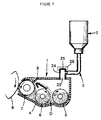
- a single figure is a schematic cross sectional view which shows one embodiment of an image forming apparatus provided with a developer container according to the present invention.
- a development section 1 developer supply means
- a developer container 2 developer storage means which stores therein an electrophotographic developer to be sent to the development section 1 are connected by developer transporting means 3.
- the development section 1 is composed of a developer housing 4 for holding a two-component developer D therein, first and second stirring screws 5 and 6 for mixing and stirring the developer D in the developer housing 4, and a development roller 7.
- the development roller 7 is opposite to a latent image bearing member, that is, an electrophotographic photoconductor 8.
- the photoconductor 8 is driven in rotation in a direction of the arrow, with the surface of the photoconductor bearing latent electrostatic images thereon.
- a connecting member 24 is connected to a developer inlet 23, and a cap 26 is fit in the connecting member 24 via a filter 25.
- the filter 25 may be inserted or not.
- charging means In the image forming apparatus, charging means, light exposure means, image transfer means, quenching means, cleaning means, and other conventional means are arranged, although not shown in the figure, around the photoconductor 8.
- the developer D is stirred by the rotating action of the stirring screws 5 and 6, whereby the toner and the carrier are charged to the opposite polarities by triboelectric charging.
- the two-component developer D is thus supplied toward the development roller 7 that is driven in rotation in a direction of the arrow, and supported on the periphery of the development roller 7.
- the developer D on the development roller 7 travels along the rotating direction of the development roller 7 while the amount of the developer D is regulated by a doctor blade 9.
- the developer D is transported to a gap between the development roller 7 and the photoconductor 8, where the toner component in the two-component developer D is electrostatically attracted to latent electrostatic images formed on the surface of the photoconductor 8.
- the toner component is transferred to the latent electrostatic images, thereby achieving development of the latent electrostatic images with a toner to form visible toner images on the photoconductor 8.
- the cooled mixture was pulverized to prepare toner particles. 100 parts by weight of the toner particles were mixed with one part by weight of silica serving as an external additive, whereby a toner No. 1 according to the present invention was obtained.
- the cooled mixture was pulverized to prepare toner particles. 100 parts by weight of the toner particles were mixed with one part by weight of silica serving as an external additive, whereby a toner No. 2 according to the present invention was obtained.
- the cooled mixture was pulverized to prepare toner particles. 100 parts by weight of the toner particles were mixed with one part by weight of silica serving as an external additive, whereby a toner No. 3 according to the present invention was obtained.
- the cooled mixture was pulverized to prepare toner particles. 100 parts by weight of the toner particles were mixed with one part by weight of silica serving as an external additive, whereby a toner No. 4 according to the present invention was obtained.
- the cooled mixture was pulverized to prepare toner particles. 100 parts by weight of the toner particles were mixed with one part by weight of silica serving as an external additive, whereby a toner No. 5 according to the present invention was obtained.
- the cooled mixture was pulverized to prepare toner particles. 100 parts by weight of the toner particles were mixed with one part by weight of silica serving as an external additive, whereby a toner No. 6 according to the present invention was obtained.
- the cooled mixture was pulverized to prepare toner particles. 100 parts by weight of the toner particles were mixed with one part by weight of silica serving as an external additive, whereby a toner No. 7 according to the present invention was obtained.
- the cooled mixture was pulverized to prepare toner particles. 100 parts by weight of the toner particles were mixed with one part by weight of silica serving as an external additive, whereby a toner No. 8 according to the present invention was obtained.
- the cooled mixture was pulverized to prepare toner particles. 100 parts by weight of the toner particles were mixed with one part by weight of silica serving as an external additive, whereby a toner No. 9 according to the present invention was obtained.
- the cooled mixture was pulverized to prepare toner particles. 100 parts by weight of the toner particles were mixed with one part by weight of silica serving as an external additive, whereby a toner No. 10 according to the present invention was obtained.
- the cooled mixture was pulverized to prepare toner particles. 100 parts by weight of the toner particles were mixed with one part by weight of silica serving as an external additive, whereby a comparative toner No. 1 was obtained.
- the cooled mixture was pulverized to prepare toner particles. 100 parts by weight of the toner particles were mixed with one part by weight of silica serving as an external additive, whereby a comparative toner No. 2 was obtained.
- the cooled mixture was pulverized to prepare toner particles. 100 parts by weight of the toner particles were mixed with one part by weight of silica serving as an external additive, whereby a comparative toner No. 3 was obtained.
- the resin component was separated from the wax component, and therefore, it was impossible to prepare a toner.
- the lower limit image fixing temperature is as high as 160°C.
- the lower limit image fixing temperature is also as high as 160°C.
- the lower limit image fixing temperature ranges from 80 to 120°C.
- each of the toners was subjected to a preservation test by allowing each toner to stand at 40°C for 2 weeks.
- the preservation stability of toner was evaluated in terms of the following two points:
- the degree of toner deposition on the background of an electrophotographic photoconductor was examined in such a manner that a transparent adhesive tape was put on the surface of the photoconductor after copying operation, and separated therefrom, and then attached to a sheet of fresh white paper.
- the optical density (ID 1 ) of the tape-attached portion was measured.
- the comparative toner No. 2 comprising a low-melting point polyester resin as the binder caused complete caking during the storage. Therefore, the measurement was not carried out after the storage.
- Each of the toners was subjected to a running test by making 2,000 copies.
- the change in charge quantity and the change in degree of toner deposition on background of the photoconductor were checked before and after the running test.
- the charge quantity and the toner deposition on the background of the photoconductor were measured in the same manner as mentioned above in the preservation test.
- the charge quantity tends to lower and the toner deposition on the background tends to increase after the running test.
- the charge quantity drastically decreases and the degree of toner deposition on the background is not acceptable for practical use.
- Each toner was used in combination with a carrier to prepare a two-component developer. Using each two-component developer, 2,000 copies were made to examine whether melted toner adhered to the surface of the carrier or not (spent toner phenomenon). Furthermore, after 2,000 copies were made using a one-component developer, it was examined whether the surface of a development roller was coated with a film of toner (toner filming phenomenon) and whether the toner particles were deposited on a doctor blade in the developer unit.
- the evaluation level 1 means that no problem occurred; the evaluation level 2, the phenomenon slightly occurred, but acceptable for practical use; and the evaluation level 3, the phenomenon was so serious that image quality was adversely affected.
- the toner filming phenomenon, the spent toner phenomenon, and the deposition of toner on the doctor blade were slightly observed.
- the toner filming phenomenon, the spent toner phenomenon, and the deposition of toner on the doctor blade were very noticeable. Because of those problems, defective images were produced. For example, the image density was uneven, the toner deposition appeared on the background of a sheet of image-receiving paper, and non-printed white stripes were observed in image portions.
- the preservability of the toner-image-bearing sheets was examined by continuously performing image formation on one side of a sheet, and on both sides of a sheet.
- the evaluation level 1 means that no problem occurred; the evaluation level 2, the rear surface of a sheet was slightly stained with toner because of transfer of toner from the underlying sheet; and the evaluation level 3, the toner deposited on the front side of one sheet and the toner deposited on the rear side of the overlying sheet produced a blocking problem.
- the sheets were stained with toner and the blocking phenomenon occurred when the comparative toner No. 2 was employed.
- the efficiency of the pulverizing step was evaluated in the course of preparation of toner particles. To be more specific, the period of time required to obtain a fixed amount of toner particles with a predetermined particle size was measured, and the inside of a pulverizer was visually observed.
- the toner of the present invention is fixable at a temperature lower than the melting point of the ethyl cyclic oligosaccharide, thereby realizing energy saving. Even though the toner is fused at a lower temperature, the preservation stability of toner is improved because the melting point of ethyl cyclic oligosaccharide itself is high. Further, the change in properties of toner can be minimized because ethyl cyclic oligosaccharide for use in the toner is a rigid resin. More specifically, the external additive can be prevented from being pushed into the toner particle, and being stained with a low-molecular-weight resin.
- the spent toner phenomenon, toner filming phenomenon and the like can be effectively inhibited because the ethyl cyclic oligosaccharide is rigid and has no adhesive properties.
- the obtained toner-image-bearing material does not cause any blocking problem.
- the toner composition of the present invention is appropriately rigid due to the ethyl cyclic oligosaccharide, so that the toner particles can be efficiently produced by pulverizing.
- the pigment gets trapped in the cyclic structure of the oligosaccharide. Therefore, exposure of the pigment to the surface of the toner particles can be prevented, thereby stabilizing the charging characteristics of toner particles, and therefore, improving the toner deposition on the background.
Landscapes
- Physics & Mathematics (AREA)
- Spectroscopy & Molecular Physics (AREA)
- General Physics & Mathematics (AREA)
- Developing Agents For Electrophotography (AREA)
Abstract
Description
a single figure is a schematic view which shows one embodiment of an image forming apparatus provided with a developer container according to the present invention.
| wt.% | |
| Ethyl cyclic oligosaccharide | 78 |
| Sazol wax | 16 |
| | 5 |
| Charge control agent | 1 |
| wt.% | |
| Ethyl cyclic oligosaccharide | 50 |
| Sazol wax | 10 |
| Magnetic material | 39 |
| Charge control agent | 1 |
| wt.% | |
| Ethyl cyclic oligosaccharide | 72 |
| Carnauba wax | 22 |
| | 5 |
| Charge control agent | 1 |
| wt.% | |
| Ethyl cyclic oligosaccharide | 72 |
| Montan wax | 39 |
| | 5 |
| Charge control agent | 1 |
| wt.% | |
| Ethyl cyclic oligosaccharide | 78 |
| Paraffin wax | 16 |
| | 5 |
| Charge control agent | 1 |
| wt.% | |
| Ethyl cyclic oligosaccharide | 74 |
| Rice wax | 20 |
| | 5 |
| Charge control agent | 1 |
| wt.% | |
| Ethyl cyclic oligosaccharide | 74 |
| Oxidized paraffin | 20 |
| | 5 |
| Charge control agent | 1 |
| wt.% | |
| Ethyl cyclic oligosaccharide | 74 |
| Oxidized paraffin | 20 |
| | 5 |
| Charge control agent | 1 |
| wt.% | |
| Ethyl cyclic oligosaccharide | 72 |
| Carnauba wax | 22 |
| | 5 |
| Charge control agent | 1 |
| wt.% | |
| Ethyl cyclic oligosaccharide | 42 |
| High-melting point polyester (mp:155°C) | 30 |
| Carnauba wax | 22 |
| | 5 |
| Charge control agent | 1 |
| wt.% | |
| High-melting point polyester (mp:155°C) | 94 |
| | 5 |
| Charge control agent | 1 |
| wt.% | |
| Low-melting point polyester (mp:94°C) | 94 |
| | 5 |
| Charge control agent | 1 |
| wt.% | |
| Ethyl cyclic oligosaccharide | 94 |
| | 5 |
| Charge control agent | 1 |
| wt.% | |
| High-melting point polyester (mp:155°C) | 78 |
| Sazol wax | 16 |
| | 5 |
| Charge control agent | 1 |
| Surface Temperature of Image Fixing Unit (°C) | |||||||
| 70 | 80 | 90 | 100 | 120 | 140 | 160 | |
| Ex. 1 | × | × | ○ | ○ | |||
| Ex. 2 | × | × | ○ | ○ | |||
| Ex. 3 | × | ○ | ○ | ||||
| Ex. 4 | ○ | ○ | |||||
| Ex. 5 | × | ○ | ○ | ||||
| Ex. 6 | × | ○ | ○ | ||||
| Ex. 7 | × | ○ | ○ | ||||
| Ex. 8 | × | ○ | ○ | ||||
| Ex. 9 | × | ○ | ○ | ||||
| Ex. 10 | × | ○ | ○ | ||||
| Comp. Ex. 1 | × | × | ○ | ||||
| Comp. Ex. 2 | × | ○ | ○ | ||||
| Comp. Ex. 3 | × | × | ○ |
| Charge Quantity (µC/g) | Toner Deposition on Background of OPC | ||||
| Condition after Storage | Before storage | After storage | Before storage | After storage | |
| Ex. 1 | ○ | -23 | -24 | 0.01 | 0.01 |
| Ex. 2 | ○ | -22 | -21 | 0 | 0.01 |
| Ex. 3 | ○ | -24 | -23 | 0.01 | 0.01 |
| Ex. 4 | ○ | -23 | -22 | 0 | 0 |
| Ex. 5 | ○ | -21 | -23 | 0.01 | 0.01 |
| Ex. 6 | ○ | -22 | -21 | 0 | 0.01 |
| EX. 7 | ○ | -23 | -23 | 0.01 | 0.01 |
| Ex. 8 | ○ | -21 | -22 | 0.01 | 0.01 |
| Ex. 9 | ○ | -21 | -21 | 0 | 0 |
| Ex. 10 | ○ | -21 | -18 | 0 | 0 |
| Comp. Ex. 1 | ○ | -23 | -17 | 0.01 | 0.04 |
| Comp. Ex. 2 | Completely solidified | -20 -20 | not measured | 0.01 | not measured |
| Comp. Ex. 3 | ○ | -22 | -20 | 0.01 | 0.01 |
| Charge Quantity (µC/g) | Toner Deposition on Background of OPC | |||
| Before running test | After running test | Before running test | After running test | |
| Ex. 1 | -22 | -21 | 0.01 | 0 |
| Ex. 2 | -23 | -21 | 0 | 0.01 |
| Ex. 3 | -22 | -23 | 0.01 | 0 |
| Ex. 4 | -22 | -21 | 0.01 | 0 |
| Ex. 5 | -22 | -22 | 0 | 0.01 |
| Ex. 6 | -21 | -23 | 0.01 | 0.01 |
| EX. 7 | -23 | -22 | 0.01 | 0.01 |
| Ex. 8 | -21 | -22 | 0.01 | 0.01 |
| Ex. 9 | -20 | -22 | 0 | 0 |
| Ex. 10 | -21 | -22 | 0 | 0 |
| Comp. Ex. 1 | -23 | -15 | 0.01 | 0.06 |
| Comp. Ex. 2 | -20 | -10 | 0.01 | 0.12 |
| Comp. Ex. 3 | -21 | -22 | 0.01 | 0 |
| Spent Toner Phenomenon | Toner Filming | Toner Deposition on Developer Blade | |
| Ex. 1 | 1 | 1 | 1 |
| Ex. 2 | 1 | 1 | 1 |
| Ex. 3 | 1 | 1 | 1 |
| Ex. 4 | 1 | 1 | 1 |
| Ex. 5 | 1 | 1 | 1 |
| Ex. 6 | 1 | 1 | 1 |
| Ex. 7 | 1 | 1 | 1 |
| Ex. 8 | 1 | 1 | 1 |
| Ex. 9 | 1 | 1 | 1 |
| Ex. 10 | 1 | 2 | 1 |
| Comp. Ex. 1 | 2 | 2 | 2 |
| Comp. Ex. 2 | 3 | 3 | 3 |
| Comp. Ex. 3 | 1 | 1 | 1 |
| Printing on One Side | Printing on Both Sides | |
| Ex. 1 | 1 | 1 |
| Ex. 2 | 1 | 1 |
| Ex. 3 | 1 | 1 |
| Ex. 4 | 1 | 1 |
| Ex. 5 | 1 | 1 |
| Ex. 6 | 1 | 1 |
| Ex. 7 | 1 | 1 |
| Ex. 8 | 1 | 1 |
| Ex. 9 | 1 | 1 |
| Ex. 10 | 1 | 1 |
| Comp. Ex. 1 | 1 | 1 |
| Comp. Ex. 2 | 2 | 3 |
| Comp. Ex. 3 | 1 | 1 |
| Time Required for Pulverizing (hr.) | Toner Deposition on Inner Wall of Pulverizer | |
| Ex. 1 | 0.25 | None |
| Ex. 2 | 0.25 | None |
| Ex. 3 | 0.25 | None |
| Ex. 4 | 0.25 | None |
| Ex. 5 | 0.25 | None |
| Ex. 6 | 0.25 | None |
| Ex. 7 | 0.25 | None |
| Ex. 8 | 0.25 | None |
| Ex. 9 | 0.25 | None |
| Ex. 10 | 0.50 | None |
| Comp. Ex. 1 | 0,75 | None |
| Comp. Ex. 2 | 2.00 | Toner particles were accumulated on the detector of the pulverizer. |
| Comp. Ex. 3 | 0.25 | None |
Claims (22)
- A toner for electrophotography comprising:a coloring agent anda binder comprising a wax and an ethyl cyclic oligosaccharide.
- The toner as claimed in claim 1, wherein said ethyl cyclic oligosaccharide comprises D-glucose units linked together by a linkage of 1,4-glycosidic bond with an α configuration, with at least one alcohol hydroxyl group in each of said D-glucose units being ethyl-etherified.
- The toner as claimed in claim 1, wherein said toner is fixable at a temperature lower than a melting point of said ethyl cyclic oligosaccharide and higher than or equal to a melting point of said wax.
- The toner as claimed in claim 2, wherein the number of said D-glucose units in said ethyl cyclic oligosaccharide is in a range of 6 to 8.
- The toner as claimed in claim 1, wherein said ethyl cyclic oligosaccharide is contained in said binder in an amount of 10 wt.% or more of the total weight of said binder.
- The toner as claimed in claim 1, wherein said ethyl cyclic oligosaccharide and said wax are mixed at a ratio by weight of 97:3 to 5:95.
- The toner as claimed in claim 1, wherein said wax has a melting point that is lower than a melting point of said ethyl cyclic oligosaccharide.
- The toner as claimed in claim 1, wherein said wax has a melt viscosity of 1 to 1,000,000 centipoise (cP) at 150°C.
- The toner as claimed in claim 1, wherein said ethyl cyclic oligosaccharide has an average ethoxyl group content of one to three.
- The toner as claimed in claim 1, wherein said wax exhibits a penetration of 0 to 40 at 25°C.
- The toner as claimed in claim 10, wherein said wax is selected from the group consisting of paraffin wax, oxidized paraffin wax, microcrystalline wax, oxidized microcrystalline wax, rice wax, candelilla wax, fatty acid wax, fatty alcohol wax, fatty ester wax, fatty amide wax, and olefin wax.
- The toner as claimed in claim 1, further comprising a charge control agent.
- A one-component developer for electrophotography comprising a toner which comprises a coloring agent and a binder comprising a wax and an ethyl cyclic oligosaccharide.
- The one-component developer as claimed in claim 13, wherein said ethyl cyclic oligosaccharide comprises D-glucose units linked together by a linkage of 1,4-glycosidic bond with an α configuration, with at least one alcohol hydroxyl group in each of said D-glucose units being ethyl-etherified.
- A two-component developer for electrophotography comprising a carrier and a toner which comprises a coloring agent and a binder comprising a wax and an ethyl cyclic oligosaccharide.
- The two-component developer as claimed in claim 15, wherein said ethyl cyclic oligosaccharide comprises D-glucose units linked together by a linkage of 1,4-glycosidic bond with an α configuration, with at least one alcohol hydroxyl group in each of said D-glucose units being ethyl-etherified.
- A developer container containing a one-component developer for electrophotography comprising a toner which comprises a coloring agent and a binder comprising a wax and an ethyl cyclic oligosaccharide.
- A developer container containing a two-component developer for electrophotography comprising a carrier and a toner which comprises a coloring agent and a binder comprising a wax and an ethyl cyclic oligosaccharide.
- An image forming apparatus comprising a developer unit which comprises developer storage means for storing a one-component developer therein and developer supply means for supplying said developer to a latent-image bearing surface, said one-component developer comprising a toner comprising a coloring agent and a binder which comprises a wax and an ethyl cyclic oligosaccharide.
- An image forming apparatus comprising a developer unit which comprises a developer storage means for storing a two-component developer therein and a developer supply means for supplying said developer to a latent-image bearing surface, said two-component developer comprising a carrier and a toner which comprises a coloring agent and a binder comprising a wax and an ethyl cyclic oligosaccharide.
- A process unit comprising a developer unit which comprises developer storage means for storing a one-component developer therein and developer supply means for supplying said developer to a latent-image bearing surface, said one-component developer comprising a toner which comprises a coloring agent and a binder comprising a wax and an ethyl cyclic oligosaccharide.
- A process unit comprising a developer unit which comprises developer storage means for storing a two-component developer therein and developer supply means for supplying said developer to a latent-image bearing surface, said two-component developer comprising a carrier and a toner which comprises a coloring agent and a binder comprising a wax and an ethyl cyclic oligosaccharide.
Applications Claiming Priority (2)
| Application Number | Priority Date | Filing Date | Title |
|---|---|---|---|
| JP2000030916 | 2000-02-08 | ||
| JP2000030916A JP2001222133A (en) | 2000-02-08 | 2000-02-08 | Developer |
Publications (3)
| Publication Number | Publication Date |
|---|---|
| EP1126327A2 true EP1126327A2 (en) | 2001-08-22 |
| EP1126327A3 EP1126327A3 (en) | 2001-09-05 |
| EP1126327B1 EP1126327B1 (en) | 2005-11-23 |
Family
ID=18555862
Family Applications (1)
| Application Number | Title | Priority Date | Filing Date |
|---|---|---|---|
| EP01301119A Expired - Lifetime EP1126327B1 (en) | 2000-02-08 | 2001-02-08 | Toner and developer for electrophotography |
Country Status (4)
| Country | Link |
|---|---|
| US (1) | US6455217B2 (en) |
| EP (1) | EP1126327B1 (en) |
| JP (1) | JP2001222133A (en) |
| DE (1) | DE60115118T2 (en) |
Cited By (1)
| Publication number | Priority date | Publication date | Assignee | Title |
|---|---|---|---|---|
| GB2478062A (en) * | 2010-03-05 | 2011-08-24 | Xerox Corp | Polysaccharide containing toner particles formed by emulsion aggregation |
Families Citing this family (16)
| Publication number | Priority date | Publication date | Assignee | Title |
|---|---|---|---|---|
| US6623897B2 (en) | 1999-12-13 | 2003-09-23 | Ricoh Company, Ltd. | Image forming method |
| JP2002229366A (en) | 2000-08-21 | 2002-08-14 | Ricoh Co Ltd | Fixing device and image forming device |
| JP2003098756A (en) * | 2001-09-19 | 2003-04-04 | Ricoh Co Ltd | Image forming device |
| JP2003345064A (en) * | 2002-05-28 | 2003-12-03 | Ricoh Co Ltd | Electrophotographic toner |
| JP3763569B2 (en) * | 2002-06-10 | 2006-04-05 | 株式会社リコー | Heating / pressurizing medium for fixing, fixing device and electrophotographic apparatus using the same |
| JP2004206079A (en) | 2002-12-13 | 2004-07-22 | Ricoh Co Ltd | Fixing device and image forming device |
| EP1690898B1 (en) * | 2003-11-28 | 2013-01-09 | Daicel Chemical Industries, Ltd. | Dispersion and process for producing colored organic solid particle |
| US7254360B2 (en) * | 2004-04-15 | 2007-08-07 | Ricoh Company, Ltd. | Image fixing apparatus, and, image forming apparatus having the same, and image forming process |
| JP2007121653A (en) * | 2005-01-26 | 2007-05-17 | Ricoh Co Ltd | Fixing method, fixing device, image forming method, and image forming apparatus |
| US7622240B2 (en) | 2005-02-28 | 2009-11-24 | International Business Machines Corporation | Low blur molecular resist |
| WO2006102280A1 (en) * | 2005-03-18 | 2006-09-28 | Battelle Memorial Institute | Toner |
| CN101722128B (en) * | 2009-11-27 | 2011-12-21 | 东莞市华立实业股份有限公司 | Novel flat plate edge sealing strip back coating treatment equipment |
| WO2012133449A1 (en) * | 2011-03-29 | 2012-10-04 | 保土谷化学工業株式会社 | Toner for developing electrostatic charge images |
| JP2013003517A (en) | 2011-06-21 | 2013-01-07 | Ricoh Co Ltd | Glossiness applying device, fixing device and image forming apparatus |
| JP5822061B2 (en) | 2011-06-21 | 2015-11-24 | 株式会社リコー | Glossiness imparting device, image forming device, color image forming device |
| JP2013007801A (en) | 2011-06-22 | 2013-01-10 | Ricoh Co Ltd | Glossing device and image forming apparatus |
Family Cites Families (4)
| Publication number | Priority date | Publication date | Assignee | Title |
|---|---|---|---|---|
| JPS6294853A (en) * | 1985-10-22 | 1987-05-01 | Ricoh Co Ltd | Developer for electrostatic latent images |
| ATE197594T1 (en) * | 1994-12-20 | 2000-12-15 | Kimberly Clark Co | IMPROVED, CHANGEABLE COMPOSITION |
| DE19711260A1 (en) * | 1997-03-18 | 1998-09-24 | Clariant Gmbh | Cyclooligosaccharide boron complex |
| JP2000089514A (en) * | 1998-09-09 | 2000-03-31 | Canon Inc | toner |
-
2000
- 2000-02-08 JP JP2000030916A patent/JP2001222133A/en active Pending
-
2001
- 2001-02-08 US US09/778,733 patent/US6455217B2/en not_active Expired - Fee Related
- 2001-02-08 EP EP01301119A patent/EP1126327B1/en not_active Expired - Lifetime
- 2001-02-08 DE DE60115118T patent/DE60115118T2/en not_active Expired - Lifetime
Cited By (3)
| Publication number | Priority date | Publication date | Assignee | Title |
|---|---|---|---|---|
| GB2478062A (en) * | 2010-03-05 | 2011-08-24 | Xerox Corp | Polysaccharide containing toner particles formed by emulsion aggregation |
| US8178269B2 (en) | 2010-03-05 | 2012-05-15 | Xerox Corporation | Toner compositions and methods |
| GB2478062B (en) * | 2010-03-05 | 2014-12-10 | Xerox Corp | Toner Compostions and methods |
Also Published As
| Publication number | Publication date |
|---|---|
| DE60115118T2 (en) | 2006-08-03 |
| EP1126327B1 (en) | 2005-11-23 |
| EP1126327A3 (en) | 2001-09-05 |
| US6455217B2 (en) | 2002-09-24 |
| DE60115118D1 (en) | 2005-12-29 |
| US20010026898A1 (en) | 2001-10-04 |
| JP2001222133A (en) | 2001-08-17 |
Similar Documents
| Publication | Publication Date | Title |
|---|---|---|
| EP1126327B1 (en) | Toner and developer for electrophotography | |
| EP1126326B1 (en) | Toner and developer for electrophotography | |
| EP1168089B1 (en) | Toner for developing electrostatic latent image, toner container containing the toner, and image forming method and apparatus using the toner | |
| EP1152297B1 (en) | Toner for use in electrophotography and image formation method using the toner | |
| US4795689A (en) | Electrostatic image developing toner for use in heat-roller fixing | |
| US6479204B1 (en) | Magnetic toner with negative polarity for developing latent electrostatic images, and image forming apparatus using the same | |
| JP3158713B2 (en) | Electrophotographic toner | |
| EP3358417B1 (en) | Electrostatic-latent-image developing toner | |
| JP4089860B2 (en) | Electrophotographic toner, developer, and image forming apparatus using the same | |
| JPS632074A (en) | Toner for developing electrostatic images | |
| JP4597417B2 (en) | Toner for electrophotography | |
| JP4089863B2 (en) | Developer | |
| JP2001215754A (en) | Developer | |
| JPH06102703A (en) | Electrophotographic toner | |
| JP4049547B2 (en) | Developer | |
| JP2001222136A (en) | Developer | |
| JP2001296699A (en) | Electrophotographic toner | |
| HK1041932B (en) | Toner for use in electrophotography and image formation method using the toner | |
| JPH1048877A (en) | Magnetic toner for developing electrostatic images | |
| JP2595269B2 (en) | Toner for developing electrostatic latent images | |
| JP3450969B2 (en) | Toner for developing electrostatic latent images | |
| JPS62166361A (en) | Blue toner for electrophotography | |
| JPH08146665A (en) | Toner, developing method and developing apparatus using the toner | |
| JPH09134032A (en) | Magnetic toner | |
| JPH03103863A (en) | Color toner for developing electrostatic images |
Legal Events
| Date | Code | Title | Description |
|---|---|---|---|
| PUAI | Public reference made under article 153(3) epc to a published international application that has entered the european phase |
Free format text: ORIGINAL CODE: 0009012 |
|
| PUAL | Search report despatched |
Free format text: ORIGINAL CODE: 0009013 |
|
| 17P | Request for examination filed |
Effective date: 20010307 |
|
| AK | Designated contracting states |
Kind code of ref document: A2 Designated state(s): AT BE CH CY DE DK ES FI FR GB GR IE IT LI LU MC NL PT SE TR Kind code of ref document: A2 Designated state(s): DE FR GB |
|
| AX | Request for extension of the european patent |
Free format text: AL;LT;LV;MK;RO;SI |
|
| AK | Designated contracting states |
Kind code of ref document: A3 Designated state(s): AT BE CH CY DE DK ES FI FR GB GR IE IT LI LU MC NL PT SE TR |
|
| AX | Request for extension of the european patent |
Free format text: AL;LT;LV;MK;RO;SI |
|
| AKX | Designation fees paid |
Free format text: DE FR GB |
|
| 17Q | First examination report despatched |
Effective date: 20031006 |
|
| GRAP | Despatch of communication of intention to grant a patent |
Free format text: ORIGINAL CODE: EPIDOSNIGR1 |
|
| GRAS | Grant fee paid |
Free format text: ORIGINAL CODE: EPIDOSNIGR3 |
|
| GRAA | (expected) grant |
Free format text: ORIGINAL CODE: 0009210 |
|
| AK | Designated contracting states |
Kind code of ref document: B1 Designated state(s): DE FR GB |
|
| REG | Reference to a national code |
Ref country code: GB Ref legal event code: FG4D |
|
| REF | Corresponds to: |
Ref document number: 60115118 Country of ref document: DE Date of ref document: 20051229 Kind code of ref document: P |
|
| ET | Fr: translation filed | ||
| PLBE | No opposition filed within time limit |
Free format text: ORIGINAL CODE: 0009261 |
|
| STAA | Information on the status of an ep patent application or granted ep patent |
Free format text: STATUS: NO OPPOSITION FILED WITHIN TIME LIMIT |
|
| 26N | No opposition filed |
Effective date: 20060824 |
|
| PGFP | Annual fee paid to national office [announced via postgrant information from national office to epo] |
Ref country code: DE Payment date: 20140219 Year of fee payment: 14 |
|
| PGFP | Annual fee paid to national office [announced via postgrant information from national office to epo] |
Ref country code: FR Payment date: 20140219 Year of fee payment: 14 |
|
| PGFP | Annual fee paid to national office [announced via postgrant information from national office to epo] |
Ref country code: GB Payment date: 20140218 Year of fee payment: 14 |
|
| REG | Reference to a national code |
Ref country code: DE Ref legal event code: R119 Ref document number: 60115118 Country of ref document: DE |
|
| GBPC | Gb: european patent ceased through non-payment of renewal fee |
Effective date: 20150208 |
|
| REG | Reference to a national code |
Ref country code: FR Ref legal event code: ST Effective date: 20151030 |
|
| PG25 | Lapsed in a contracting state [announced via postgrant information from national office to epo] |
Ref country code: DE Free format text: LAPSE BECAUSE OF NON-PAYMENT OF DUE FEES Effective date: 20150901 Ref country code: GB Free format text: LAPSE BECAUSE OF NON-PAYMENT OF DUE FEES Effective date: 20150208 |
|
| PG25 | Lapsed in a contracting state [announced via postgrant information from national office to epo] |
Ref country code: FR Free format text: LAPSE BECAUSE OF NON-PAYMENT OF DUE FEES Effective date: 20150302 |