EP1125375B1 - Verfahren zur leistungsregelung in einem kommunikationssystem - Google Patents
Verfahren zur leistungsregelung in einem kommunikationssystem Download PDFInfo
- Publication number
- EP1125375B1 EP1125375B1 EP99950952A EP99950952A EP1125375B1 EP 1125375 B1 EP1125375 B1 EP 1125375B1 EP 99950952 A EP99950952 A EP 99950952A EP 99950952 A EP99950952 A EP 99950952A EP 1125375 B1 EP1125375 B1 EP 1125375B1
- Authority
- EP
- European Patent Office
- Prior art keywords
- frame
- ratio
- communications system
- power
- base station
- Prior art date
- Legal status (The legal status is an assumption and is not a legal conclusion. Google has not performed a legal analysis and makes no representation as to the accuracy of the status listed.)
- Expired - Lifetime
Links
Images
Classifications
-
- H—ELECTRICITY
- H04—ELECTRIC COMMUNICATION TECHNIQUE
- H04W—WIRELESS COMMUNICATION NETWORKS
- H04W52/00—Power management, e.g. Transmission Power Control [TPC] or power classes
- H04W52/04—Transmission power control [TPC]
- H04W52/18—TPC being performed according to specific parameters
- H04W52/22—TPC being performed according to specific parameters taking into account previous information or commands
- H04W52/223—TPC being performed according to specific parameters taking into account previous information or commands predicting future states of the transmission
-
- H—ELECTRICITY
- H04—ELECTRIC COMMUNICATION TECHNIQUE
- H04W—WIRELESS COMMUNICATION NETWORKS
- H04W52/00—Power management, e.g. Transmission Power Control [TPC] or power classes
- H04W52/04—Transmission power control [TPC]
- H04W52/18—TPC being performed according to specific parameters
- H04W52/24—TPC being performed according to specific parameters using SIR [Signal to Interference Ratio] or other wireless path parameters
- H04W52/241—TPC being performed according to specific parameters using SIR [Signal to Interference Ratio] or other wireless path parameters taking into account channel quality metrics, e.g. SIR, SNR, CIR or Eb/lo
-
- H—ELECTRICITY
- H04—ELECTRIC COMMUNICATION TECHNIQUE
- H04W—WIRELESS COMMUNICATION NETWORKS
- H04W52/00—Power management, e.g. Transmission Power Control [TPC] or power classes
- H04W52/04—Transmission power control [TPC]
- H04W52/18—TPC being performed according to specific parameters
- H04W52/24—TPC being performed according to specific parameters using SIR [Signal to Interference Ratio] or other wireless path parameters
- H04W52/247—TPC being performed according to specific parameters using SIR [Signal to Interference Ratio] or other wireless path parameters where the output power of a terminal is based on a path parameter sent by another terminal
Definitions
- the present invention relates to a method of and apparatus for power control, of the type used in a communication system, for example, in a spread-spectrum communication system, such as a Code Division Multiple Access (CDMA) communication system.
- a spread-spectrum communication system such as a Code Division Multiple Access (CDMA) communication system.
- CDMA Code Division Multiple Access
- power control is used to equalize signal to noise (S/N) ratios of the signals received at a base station from various mobile terminals.
- S/N signal to noise
- the term 'noise' is intended to include interference in the form of signals from other mobile terminals, as well as background noise.
- a known technique involves measuring the S/N ratio in respect of signals received from a given mobile terminal over a measurement interval and comparing the measured S/N ratio against a desired threshold. If the measured S/N ratio exceeds the desired threshold, a binary 1 (or 0, depending upon the convention employed) is transmitted (within the plurality of signals transmitted from the base station) to the mobile terminal originating the given signal. If the measured S/N ratio is lower than the desired threshold, a binary 0 (or 1, depending upon the convention employed) is transmitted to the given mobile terminal. The mobile terminal, in turn, responds by reducing its transmission power by, for example, 1 dB if a 1 (or 0) is received or by increasing its power by 1 dB if a 0 (or 1) is received. In this way, the received S/N ratio is held approximately constant as path loss between the given mobile station and the base station varies and/or as the level of interference at the base station from other mobile terminals varies.
- the mobile terminal must set its initial transmitter power according to a so-called open loop power control technique.
- the base station signals to the mobile terminal(s) the power at which the base station is transmitting; this can be either the total power received or the power of a particular signal which the mobile(s) station is receiving, and the interference level at the base station.
- the mobile terminal measures the power level of the corresponding signal received from the base station and uses the signalled information, i.e.
- the frequency used for transmission from the base station to the mobile terminal is different from the frequency used for transmission from the mobile terminal to the base station (up-link).
- FDD Frequency Division Duplex
- propagation of signals is non-reciprocal in the short term, for example, multi-path fading on the down-link is uncorrelated with multi-path fading on the up-link. This effect can be mitigated somewhat by averaging the power measurements at the mobile terminal over the likely fading period.
- this does not cater for the instantaneous path level fluctuations in the up-link direction, resulting in the power transmitted by the mobile terminal being too high or too low at the start of the frame.
- FEC Forward Error Correction
- interleaving is employed in order to mitigate the effects of fading and interference from other signals operating on the same frequency.
- FEC Forward Error Correction
- the effect of the interleaving is to make the probability of uncorrectable errors in an interleaved frame a function more of the average S/N ratio over the frame rather than, for example, the worst case S/N ratio. Consequently, if the S/N ratio at the start of a frame is too high, implementation of power control reduces the S/N ratio to the required threshold by the end of the frame, but the overall average will be higher than necessary. Conversely, if the S/N ratio at the start of a frame is too low, implementation of power control increases the S/N ratio to the required threshold by the end of the frame, but the overall average will be lower than necessary.
- a method of power control in a communications system capable of transmitting a frame having a plurality of time intervals, the method comprising the steps of: selecting a time interval in respect of which a power level is to be determined; summing any previously measured power levels in respect of any time intervals preceding the selected time interval; determining the number of any remaining time intervals in the current frame, and setting the power level in respect of the selected time interval based upon the sum of previously measured power levels and the number of remaining intervals in order to achieve a predetermined average S/N ratio over the frame.
- the power level is set during transmission of the frame in such a way as to tend to keep the received signal to noise averaged over the frame constant.
- the method will ensure that the signal will be received at a level lower than the nominal S/N ratio by the end of the frame. Where multi-path fading occurs the use of this method will result in smaller variation in average power over the frame, leading to an improvement in system capacity. This differs from known techniques which try to modify the power level within each time interval so as to substantially keep to the predetermined signal to noise ratio during each interval.
- the time interval is a time slot.
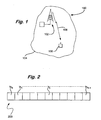
- a CDMA system comprises at least one base station 102 supporting a cell 104, the base station 102 being arranged to communicate with a mobile terminal 106 over a radio-frequency (RF) interface 108 by transmitting a frame 200 of data ( Figure 2).
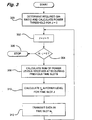
- the frame 200 comprises N time slots ts 0 , ..., ts N-1 .
- the frame 200 is transmitted from the mobile terminal 106 to the base station 102, during which power control is achieved by N adjustments of power corresponding to N time slots in the frame 200.
- a required average S/N ratio ⁇ d at the base station 102 over the duration of the frame 200 is initially determined and set (step 300).
- a power level is then set so that the average S/N ratio ⁇ d per time slot at the base station 102 will be substantially met (step 300).
- a subsequent time slot, ts j , for which the power level is to be adjusted, is then selected (step 302) and the number of any remaining time slots, N-j , is determined (step 304). If the number of time slots remaining, N-j , is zero, no further power levels are set for the frame 200 (step 306). If, however, one or more time slots remain, the sum of respective measured power levels received at the base station 102 during previous time slots is calculated (step 308). The calculation can be generally expressed as: where ⁇ i is the S/N ratio received in the i th slot.
- a predicted S/N ratio, ⁇ p is then calculated (step 310) and the value of ⁇ p is used to calculate the power level at which the mobile terminal 106 transmits signals to the base station 102.
- the equation used to calculate the predicted S/N ratio ⁇ p is derived as follows.
- the predicted S/N ratio ⁇ p is calculated based upon the assumption that a target, of the average S/N ratio, ⁇ d , across the frame 200, will be met if the calculated predicted S/N ratio ⁇ p is maintained throughout the remainder of the frame 200, thereby keeping the average S/N ratio ⁇ d substantially constant over the frame 200.
- the mobile terminal 106 transmits at the power level set (step 312) corresponding to the associated predicted S/N ratio ⁇ p .
- a subsequent time slot is then selected (step 302) and the above-described procedure for calculating and setting power levels is repeated (steps 304 to 312).
Landscapes
- Engineering & Computer Science (AREA)
- Computer Networks & Wireless Communication (AREA)
- Signal Processing (AREA)
- Quality & Reliability (AREA)
- Mobile Radio Communication Systems (AREA)
- Transmitters (AREA)
Claims (5)
- Verfahren zur Leistungssteuerung in einem Kommunikationssystem, das in der Lage ist, einen Datenübertragungsblock zu übertragen, der eine Vielzahl von Zeitintervallen aufweist, wobei das Verfahren die folgenden Schritte umfasst:Wählen eines Zeitintervalls, in Bezug auf das ein Leistungspegel zu bestimmen ist;Aufsummieren aller zuvor gemessenen Leistungspegel in Bezug auf alle Zeitintervalle, die dem gewählten Zeitintervall im aktuellen Datenübertragungsblock vorausgehen;Bestimmen der Anzahl aller eventuell verbleibenden Zeitintervalle im aktuellen Datenübertragungsblock; undFestlegen des Leistungspegels in Bezug auf das gewählte Zeitintervall auf der Basis der Summe der zuvor gemessenen Leistungspegel und der Anzahl der verbleibenden Intervalle, um einen vorgegebenen mittleren Rauschabstand für den Datenübertragungsblock zu erreichen.
- Verfahren nach Anspruch 1, wobei das Zeitintervall ein Time-Slot ist.
- Verfahren nach Anspruch 1, wobei das Kommunikationssystem ein Spreizband-Kommunikationssystem ist.
- Verfahren nach Anspruch 3, wobei das Spreizband-Kommunikationssystem ein CDMA-Kommunikationssystem ist.
- Verfahren nach Anspruch 4, wobei durch den Schritt des Festlegens des Leistungspegels ein Rauschabstand yp erreicht wird, welcher durch die folgende Formel gegeben ist:wobei γ i der an der Basisstation empfangene Rauschabstand im i-ten Intervall ist,
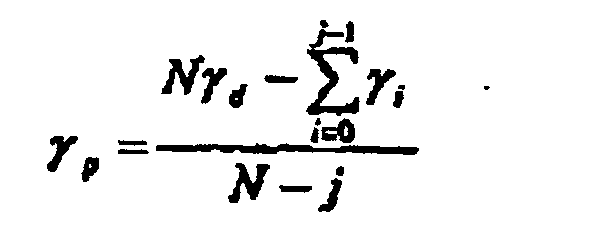 die Summe der den vorhergehenden Zeitintervallen entsprechenden empfangenen Rauschabstände ist und Nγd die gewünschte Gesamtsumme der Rauschabstände für den Datenübertragungsblock ist.
Applications Claiming Priority (3)
| Application Number | Priority Date | Filing Date | Title |
|---|---|---|---|
| GB9823396 | 1998-10-27 | ||
| GBGB9823396.8A GB9823396D0 (en) | 1998-10-27 | 1998-10-27 | Method of and apparatus for power control |
| PCT/GB1999/003496 WO2000025444A1 (en) | 1998-10-27 | 1999-10-27 | Method of and apparatus for power control |
Publications (2)
| Publication Number | Publication Date |
|---|---|
| EP1125375A1 EP1125375A1 (de) | 2001-08-22 |
| EP1125375B1 true EP1125375B1 (de) | 2004-03-17 |
Family
ID=10841297
Family Applications (1)
| Application Number | Title | Priority Date | Filing Date |
|---|---|---|---|
| EP99950952A Expired - Lifetime EP1125375B1 (de) | 1998-10-27 | 1999-10-27 | Verfahren zur leistungsregelung in einem kommunikationssystem |
Country Status (8)
| Country | Link |
|---|---|
| US (1) | US7009944B1 (de) |
| EP (1) | EP1125375B1 (de) |
| JP (1) | JP2002528998A (de) |
| CN (1) | CN1126287C (de) |
| DE (1) | DE69915662T2 (de) |
| ES (1) | ES2217817T3 (de) |
| GB (2) | GB9823396D0 (de) |
| WO (1) | WO2000025444A1 (de) |
Families Citing this family (23)
| Publication number | Priority date | Publication date | Assignee | Title |
|---|---|---|---|---|
| JP3414357B2 (ja) * | 2000-04-25 | 2003-06-09 | 日本電気株式会社 | Cdma移動通信システムにおける送信電力制御方式 |
| WO2002101341A2 (en) | 2001-06-08 | 2002-12-19 | Broadcom Corporation | Receiver having integrated spectral analysis capability |
| JP3865212B2 (ja) * | 2001-10-17 | 2007-01-10 | 株式会社エヌ・ティ・ティ・ドコモ | 送信電力設定方法、移動通信システム及び基地局 |
| EP1526658B1 (de) * | 2002-06-06 | 2008-02-13 | NTT DoCoMo, Inc. | Paketkommunikationssystem, paketkommunikationsverfahren, basisstation, mobilstation, kontroller und paketkommunikationsprogramm |
| WO2005020508A1 (en) * | 2003-08-21 | 2005-03-03 | Koninklijke Philips Electronics N.V. | Wireless transmission control in uwb (ultra wide band) technology |
| GB2407454B (en) | 2003-10-20 | 2005-12-28 | Motorola Inc | An apparatus and method of radio access management for a radio communication system |
| EP1605655A3 (de) * | 2004-06-07 | 2008-02-27 | Broadcom Corporation | Leistungsreduzierung im Aufwärtskanal |
| EP1779543B1 (de) * | 2004-07-30 | 2012-04-25 | Andrew Richardson | Signalübertragungsverfahren aus einem lokalen netzwerkknoten |
| EP1782551B1 (de) | 2004-07-30 | 2016-10-05 | CommScope Technologies LLC | Leistungsregelung in einem lokalen netzwerkknoten (lnn) |
| US7480517B2 (en) * | 2005-04-27 | 2009-01-20 | Motorola, Inc. | Method of power control in a wireless communication system |
| US8195097B2 (en) * | 2006-09-08 | 2012-06-05 | Qualcomm Incorporated | Serving sector interference broadcast and corresponding RL traffic power control |
| KR101396430B1 (ko) * | 2007-10-31 | 2014-05-20 | 삼성전자주식회사 | 전자식별시스템에서 태그 충돌 방지 방법 및 장치 |
| US9871544B2 (en) | 2013-05-29 | 2018-01-16 | Microsoft Technology Licensing, Llc | Specific absorption rate mitigation |
| US10893488B2 (en) | 2013-06-14 | 2021-01-12 | Microsoft Technology Licensing, Llc | Radio frequency (RF) power back-off optimization for specific absorption rate (SAR) compliance |
| US9813997B2 (en) | 2014-01-10 | 2017-11-07 | Microsoft Technology Licensing, Llc | Antenna coupling for sensing and dynamic transmission |
| US10044095B2 (en) | 2014-01-10 | 2018-08-07 | Microsoft Technology Licensing, Llc | Radiating structure with integrated proximity sensing |
| US9769769B2 (en) | 2014-06-30 | 2017-09-19 | Microsoft Technology Licensing, Llc | Detecting proximity using antenna feedback |
| US9785174B2 (en) * | 2014-10-03 | 2017-10-10 | Microsoft Technology Licensing, Llc | Predictive transmission power control for back-off |
| US9871545B2 (en) | 2014-12-05 | 2018-01-16 | Microsoft Technology Licensing, Llc | Selective specific absorption rate adjustment |
| DE102015215177B3 (de) * | 2015-08-07 | 2016-11-10 | Deutsches Zentrum für Luft- und Raumfahrt e.V. | Verfahren zur Steuerung der Sendeleistung |
| US10013038B2 (en) | 2016-01-05 | 2018-07-03 | Microsoft Technology Licensing, Llc | Dynamic antenna power control for multi-context device |
| US10461406B2 (en) | 2017-01-23 | 2019-10-29 | Microsoft Technology Licensing, Llc | Loop antenna with integrated proximity sensing |
| US10224974B2 (en) | 2017-03-31 | 2019-03-05 | Microsoft Technology Licensing, Llc | Proximity-independent SAR mitigation |
Family Cites Families (6)
| Publication number | Priority date | Publication date | Assignee | Title |
|---|---|---|---|---|
| US5305468A (en) * | 1992-03-18 | 1994-04-19 | Motorola, Inc. | Power control method for use in a communication system |
| US5710982A (en) * | 1995-06-29 | 1998-01-20 | Hughes Electronics | Power control for TDMA mobile satellite communication system |
| BR9611481A (pt) | 1995-11-10 | 1999-02-02 | Ionica Int Ltd | Método e aparelho para controle de potência em um sistema telefônico |
| JP2785804B2 (ja) | 1996-05-30 | 1998-08-13 | 日本電気株式会社 | 移動通信システム |
| US6418137B1 (en) * | 1998-12-14 | 2002-07-09 | Nortel Networks Limited | Transmitted signal power control in cellular communications systems |
| US6184829B1 (en) * | 1999-01-08 | 2001-02-06 | Trueposition, Inc. | Calibration for wireless location system |
-
1998
- 1998-10-27 GB GBGB9823396.8A patent/GB9823396D0/en not_active Ceased
-
1999
- 1999-10-27 CN CN99812712A patent/CN1126287C/zh not_active Expired - Fee Related
- 1999-10-27 WO PCT/GB1999/003496 patent/WO2000025444A1/en not_active Ceased
- 1999-10-27 GB GB9925369A patent/GB2345415A/en not_active Withdrawn
- 1999-10-27 US US09/830,408 patent/US7009944B1/en not_active Expired - Lifetime
- 1999-10-27 JP JP2000578926A patent/JP2002528998A/ja active Pending
- 1999-10-27 DE DE69915662T patent/DE69915662T2/de not_active Expired - Fee Related
- 1999-10-27 EP EP99950952A patent/EP1125375B1/de not_active Expired - Lifetime
- 1999-10-27 ES ES99950952T patent/ES2217817T3/es not_active Expired - Lifetime
Also Published As
| Publication number | Publication date |
|---|---|
| EP1125375A1 (de) | 2001-08-22 |
| JP2002528998A (ja) | 2002-09-03 |
| DE69915662D1 (de) | 2004-04-22 |
| GB9823396D0 (en) | 1998-12-23 |
| CN1324528A (zh) | 2001-11-28 |
| GB2345415A (en) | 2000-07-05 |
| ES2217817T3 (es) | 2004-11-01 |
| CN1126287C (zh) | 2003-10-29 |
| DE69915662T2 (de) | 2005-02-10 |
| US7009944B1 (en) | 2006-03-07 |
| GB9925369D0 (en) | 1999-12-29 |
| WO2000025444A1 (en) | 2000-05-04 |
Similar Documents
| Publication | Publication Date | Title |
|---|---|---|
| US7009944B1 (en) | Method of and apparatus for power control | |
| EP2285167B1 (de) | Leistungsregelung mit äusserer Schleife/gewichteter offener Schleife in einem Zeitduplex-Kommunikationssystem | |
| US6603797B1 (en) | Outer loop/weighted open loop power control in a time division duplex communication system | |
| KR100626628B1 (ko) | Tdd 통신 시스템의 다중 하향 링크 시간 슬롯에 대한하향 링크 전력 제어 시스템 및 방법 | |
| WO1998023044A2 (en) | Method and apparatus for adjusting thresholds and measurements of received signals by anticipating power control commands yet to be executed | |
| EP1442537B1 (de) | Funkkommunikationssystem | |
| JP3543759B2 (ja) | 送信電力制御方法、送受信装置、基地局及び移動局 | |
| WO2001018991A1 (en) | Link selection in a communication system | |
| KR20040084852A (ko) | 이동 통신 시스템, 무선 기지국 장치 및 그에 이용하는전력 제어 방법 | |
| US6331975B1 (en) | User data indicator for discontinuous transmission | |
| HK1062505B (en) | Outer loop/weighted open loop power control in a time division duplex communication system | |
| HK1154449B (en) | Outer loop/weighted open loop power control in a time division duplex communication system | |
| HK1085856B (en) | Outer loop/weighted open loop power control in a time division duplex communication system | |
| HK1154449A (en) | Outer loop/weighted open loop power control in a time division duplex communication system | |
| MXPA01009199A (en) | Outer loop/weighted open loop power control in a time division duplex communication system |
Legal Events
| Date | Code | Title | Description |
|---|---|---|---|
| PUAI | Public reference made under article 153(3) epc to a published international application that has entered the european phase |
Free format text: ORIGINAL CODE: 0009012 |
|
| 17P | Request for examination filed |
Effective date: 20010420 |
|
| AK | Designated contracting states |
Kind code of ref document: A1 Designated state(s): AT BE CH CY DE DK ES FI FR GB GR IE IT LI LU MC NL PT SE |
|
| 17Q | First examination report despatched |
Effective date: 20021126 |
|
| GRAP | Despatch of communication of intention to grant a patent |
Free format text: ORIGINAL CODE: EPIDOSNIGR1 |
|
| GRAS | Grant fee paid |
Free format text: ORIGINAL CODE: EPIDOSNIGR3 |
|
| GRAA | (expected) grant |
Free format text: ORIGINAL CODE: 0009210 |
|
| AK | Designated contracting states |
Kind code of ref document: B1 Designated state(s): DE ES FR GB IT |
|
| PG25 | Lapsed in a contracting state [announced via postgrant information from national office to epo] |
Ref country code: IT Free format text: LAPSE BECAUSE OF FAILURE TO SUBMIT A TRANSLATION OF THE DESCRIPTION OR TO PAY THE FEE WITHIN THE PRESCRIBED TIME-LIMIT;WARNING: LAPSES OF ITALIAN PATENTS WITH EFFECTIVE DATE BEFORE 2007 MAY HAVE OCCURRED AT ANY TIME BEFORE 2007. THE CORRECT EFFECTIVE DATE MAY BE DIFFERENT FROM THE ONE RECORDED. Effective date: 20040317 Ref country code: FR Free format text: LAPSE BECAUSE OF FAILURE TO SUBMIT A TRANSLATION OF THE DESCRIPTION OR TO PAY THE FEE WITHIN THE PRESCRIBED TIME-LIMIT Effective date: 20040317 |
|
| REG | Reference to a national code |
Ref country code: GB Ref legal event code: FG4D Ref country code: GB Ref legal event code: 732E |
|
| RAP2 | Party data changed (patent owner data changed or rights of a patent transferred) |
Owner name: SIEMENS AKTIENGESELLSCHAFT |
|
| REG | Reference to a national code |
Ref country code: IE Ref legal event code: FG4D |
|
| REF | Corresponds to: |
Ref document number: 69915662 Country of ref document: DE Date of ref document: 20040422 Kind code of ref document: P |
|
| REG | Reference to a national code |
Ref country code: ES Ref legal event code: FG2A Ref document number: 2217817 Country of ref document: ES Kind code of ref document: T3 |
|
| PLBE | No opposition filed within time limit |
Free format text: ORIGINAL CODE: 0009261 |
|
| STAA | Information on the status of an ep patent application or granted ep patent |
Free format text: STATUS: NO OPPOSITION FILED WITHIN TIME LIMIT |
|
| EN | Fr: translation not filed | ||
| 26N | No opposition filed |
Effective date: 20041220 |
|
| PGFP | Annual fee paid to national office [announced via postgrant information from national office to epo] |
Ref country code: ES Payment date: 20071030 Year of fee payment: 9 Ref country code: DE Payment date: 20071025 Year of fee payment: 9 |
|
| PGFP | Annual fee paid to national office [announced via postgrant information from national office to epo] |
Ref country code: GB Payment date: 20071023 Year of fee payment: 9 |
|
| REG | Reference to a national code |
Ref country code: GB Ref legal event code: 732E Free format text: REGISTERED BETWEEN 20090129 AND 20090204 |
|
| GBPC | Gb: european patent ceased through non-payment of renewal fee |
Effective date: 20081027 |
|
| PG25 | Lapsed in a contracting state [announced via postgrant information from national office to epo] |
Ref country code: DE Free format text: LAPSE BECAUSE OF NON-PAYMENT OF DUE FEES Effective date: 20090501 |
|
| PG25 | Lapsed in a contracting state [announced via postgrant information from national office to epo] |
Ref country code: GB Free format text: LAPSE BECAUSE OF NON-PAYMENT OF DUE FEES Effective date: 20081027 |
|
| REG | Reference to a national code |
Ref country code: ES Ref legal event code: FD2A Effective date: 20081028 |
|
| PG25 | Lapsed in a contracting state [announced via postgrant information from national office to epo] |
Ref country code: ES Free format text: LAPSE BECAUSE OF NON-PAYMENT OF DUE FEES Effective date: 20081028 |