EP1124800B1 - Compounds comprising polyene chain structure and processes for preparing the same - Google Patents
Compounds comprising polyene chain structure and processes for preparing the same Download PDFInfo
- Publication number
- EP1124800B1 EP1124800B1 EP99951244A EP99951244A EP1124800B1 EP 1124800 B1 EP1124800 B1 EP 1124800B1 EP 99951244 A EP99951244 A EP 99951244A EP 99951244 A EP99951244 A EP 99951244A EP 1124800 B1 EP1124800 B1 EP 1124800B1
- Authority
- EP
- European Patent Office
- Prior art keywords
- sulfide
- preparing
- compound
- carotene
- diallylic
- Prior art date
- Legal status (The legal status is an assumption and is not a legal conclusion. Google has not performed a legal analysis and makes no representation as to the accuracy of the status listed.)
- Expired - Lifetime
Links
- AHMHCMXRNLIHOG-FCXRPNKRSA-N C/C(/C(I)=O)=C\CNC/C=C(\C)/C(I)=O Chemical compound C/C(/C(I)=O)=C\CNC/C=C(\C)/C(I)=O AHMHCMXRNLIHOG-FCXRPNKRSA-N 0.000 description 1
Images
Classifications
-
- C—CHEMISTRY; METALLURGY
- C07—ORGANIC CHEMISTRY
- C07C—ACYCLIC OR CARBOCYCLIC COMPOUNDS
- C07C403/00—Derivatives of cyclohexane or of a cyclohexene or of cyclohexadiene, having a side-chain containing an acyclic unsaturated part of at least four carbon atoms, this part being directly attached to the cyclohexane or cyclohexene or cyclohexadiene rings, e.g. vitamin A, beta-carotene, beta-ionone
- C07C403/24—Derivatives of cyclohexane or of a cyclohexene or of cyclohexadiene, having a side-chain containing an acyclic unsaturated part of at least four carbon atoms, this part being directly attached to the cyclohexane or cyclohexene or cyclohexadiene rings, e.g. vitamin A, beta-carotene, beta-ionone having side-chains substituted by six-membered non-aromatic rings, e.g. beta-carotene
-
- C—CHEMISTRY; METALLURGY
- C07—ORGANIC CHEMISTRY
- C07C—ACYCLIC OR CARBOCYCLIC COMPOUNDS
- C07C315/00—Preparation of sulfones; Preparation of sulfoxides
- C07C315/02—Preparation of sulfones; Preparation of sulfoxides by formation of sulfone or sulfoxide groups by oxidation of sulfides, or by formation of sulfone groups by oxidation of sulfoxides
-
- C—CHEMISTRY; METALLURGY
- C07—ORGANIC CHEMISTRY
- C07C—ACYCLIC OR CARBOCYCLIC COMPOUNDS
- C07C319/00—Preparation of thiols, sulfides, hydropolysulfides or polysulfides
- C07C319/14—Preparation of thiols, sulfides, hydropolysulfides or polysulfides of sulfides
- C07C319/20—Preparation of thiols, sulfides, hydropolysulfides or polysulfides of sulfides by reactions not involving the formation of sulfide groups
-
- C—CHEMISTRY; METALLURGY
- C07—ORGANIC CHEMISTRY
- C07C—ACYCLIC OR CARBOCYCLIC COMPOUNDS
- C07C323/00—Thiols, sulfides, hydropolysulfides or polysulfides substituted by halogen, oxygen or nitrogen atoms, or by sulfur atoms not being part of thio groups
- C07C323/01—Thiols, sulfides, hydropolysulfides or polysulfides substituted by halogen, oxygen or nitrogen atoms, or by sulfur atoms not being part of thio groups containing thio groups and halogen atoms, or nitro or nitroso groups bound to the same carbon skeleton
- C07C323/02—Thiols, sulfides, hydropolysulfides or polysulfides substituted by halogen, oxygen or nitrogen atoms, or by sulfur atoms not being part of thio groups containing thio groups and halogen atoms, or nitro or nitroso groups bound to the same carbon skeleton having sulfur atoms of thio groups bound to acyclic carbon atoms of the carbon skeleton
- C07C323/05—Thiols, sulfides, hydropolysulfides or polysulfides substituted by halogen, oxygen or nitrogen atoms, or by sulfur atoms not being part of thio groups containing thio groups and halogen atoms, or nitro or nitroso groups bound to the same carbon skeleton having sulfur atoms of thio groups bound to acyclic carbon atoms of the carbon skeleton the carbon skeleton being acyclic and unsaturated
-
- C—CHEMISTRY; METALLURGY
- C07—ORGANIC CHEMISTRY
- C07C—ACYCLIC OR CARBOCYCLIC COMPOUNDS
- C07C323/00—Thiols, sulfides, hydropolysulfides or polysulfides substituted by halogen, oxygen or nitrogen atoms, or by sulfur atoms not being part of thio groups
- C07C323/10—Thiols, sulfides, hydropolysulfides or polysulfides substituted by halogen, oxygen or nitrogen atoms, or by sulfur atoms not being part of thio groups containing thio groups and singly-bound oxygen atoms bound to the same carbon skeleton
- C07C323/11—Thiols, sulfides, hydropolysulfides or polysulfides substituted by halogen, oxygen or nitrogen atoms, or by sulfur atoms not being part of thio groups containing thio groups and singly-bound oxygen atoms bound to the same carbon skeleton having the sulfur atoms of the thio groups bound to acyclic carbon atoms of the carbon skeleton
- C07C323/14—Thiols, sulfides, hydropolysulfides or polysulfides substituted by halogen, oxygen or nitrogen atoms, or by sulfur atoms not being part of thio groups containing thio groups and singly-bound oxygen atoms bound to the same carbon skeleton having the sulfur atoms of the thio groups bound to acyclic carbon atoms of the carbon skeleton the carbon skeleton being acyclic and unsaturated
-
- C—CHEMISTRY; METALLURGY
- C07—ORGANIC CHEMISTRY
- C07C—ACYCLIC OR CARBOCYCLIC COMPOUNDS
- C07C323/00—Thiols, sulfides, hydropolysulfides or polysulfides substituted by halogen, oxygen or nitrogen atoms, or by sulfur atoms not being part of thio groups
- C07C323/22—Thiols, sulfides, hydropolysulfides or polysulfides substituted by halogen, oxygen or nitrogen atoms, or by sulfur atoms not being part of thio groups containing thio groups and doubly-bound oxygen atoms bound to the same carbon skeleton
-
- C—CHEMISTRY; METALLURGY
- C07—ORGANIC CHEMISTRY
- C07C—ACYCLIC OR CARBOCYCLIC COMPOUNDS
- C07C45/00—Preparation of compounds having >C = O groups bound only to carbon or hydrogen atoms; Preparation of chelates of such compounds
- C07C45/56—Preparation of compounds having >C = O groups bound only to carbon or hydrogen atoms; Preparation of chelates of such compounds from heterocyclic compounds
- C07C45/57—Preparation of compounds having >C = O groups bound only to carbon or hydrogen atoms; Preparation of chelates of such compounds from heterocyclic compounds with oxygen as the only heteroatom
- C07C45/60—Preparation of compounds having >C = O groups bound only to carbon or hydrogen atoms; Preparation of chelates of such compounds from heterocyclic compounds with oxygen as the only heteroatom in six-membered rings
-
- C—CHEMISTRY; METALLURGY
- C07—ORGANIC CHEMISTRY
- C07C—ACYCLIC OR CARBOCYCLIC COMPOUNDS
- C07C2601/00—Systems containing only non-condensed rings
- C07C2601/12—Systems containing only non-condensed rings with a six-membered ring
- C07C2601/16—Systems containing only non-condensed rings with a six-membered ring the ring being unsaturated
Definitions
- the present invention relates to compounds having polyene chain structure, and processes for preparing the same. More specifically, it relates to intermediate compounds, which can be effectively used in the synthesis of ⁇ -carotene, processes for preparing the same, processes for preparing ⁇ -carotene by using the intermediate compounds, and "retinyl sulfide" named by the present inventors, and a process for preparing the same.
- Carotenoid compounds have polyene chain structure, and specific examples of such include ⁇ -carotene, lycopene, astaxanthin, or the like. Among them, ⁇ -carotene is known as pro-vitamin A which decomposes to vitamin A according to the necessity of living body.
- Carotenoid compounds are generally used as natural pigments for foodstuffs, and are apt to selectively react with carcinogens such as singlet oxygen, radical and the like, so that they are expected as a prophylactic agent for cancers. To meet the expectation, the necessity of developing a process, which can effectively synthesize the polyene chain structure, is getting increased.
- BASF synthesizes ⁇ -carotene via Wittig reaction of C 15 phosphonium salt and C 10 dialdehyde, as is shown in Scheme 2 below.
- the technical object of the present invention is to provide intermediate compounds used for the efficient synthesis of the polyene chain structure with fully taking advantage of its symmetry and with solving the problem of by-products such as phosphine oxide by the employment of the Julia type sulfone olefination strategy, processes for preparing the same, and processes for preparing ⁇ -carotene by using the same.
- Another technical object of the present invention is to provide a novel compound having polyene chain structure which is synthesized via said intermediate compound, and a process for preparing the same.
- the first object of the present invention is achieved by diallylic sulfide represented by the following Chemical Formula 1: wherein, R 1 and R 2 are independently selected from the group consisting of -CHO, -CH 2 Cl, -CH 2 Br, -CH 2 I, -CH 2 OH, -CH 2 OSO 2 CF 3 , -CH 2 OSO 2 Ph, -CH 2 OSO 2 C 6 H 4 CH 3 and -CH 2 OSO 2 CH 3 .
- R 1 and R 2 both are -CHO or -CH 2 Cl.
- the second object of the present invention is achieved by a process for preparing diallylic sulfide represented by Chemical Formula 1, which comprises the steps of
- R 1 and R 2 are independently selected from the group consisting of -CHO, -CH 2 Cl, -CH 2 Br, -CH 2 I, -CH 2 OH, -CH 2 OSO 2 CF 3 , -CH 2 OSO 2 Ph, -CH 2 OSO 2 C 6 H 4 CH 3 and -CH 2 OSO 2 CH 3 , and X represents Cl, Br or I.
- allylic sulfides represented by Chemical Formula 1, wherein R 1 and R 2 are -CH 2 Cl, -CH 2 Br or -CH 2 I, are synthesized by further performing steps of reducing and halogenating the resultant product from step (c-1), after step (c-1).
- Step (c-1) is preferably performed via the sequence of adding a catalytic amount of acid to the allylic halide (A) in alcoholic solvent to form an acetal in situ, and of reacting said acetal with sodium sulfide for a predetermined period, and then of evaporating the solvent and hydrolyzing the residue.
- a third object of the present invention is achieved by a process for preparing ⁇ -carotene represented by Chemical Formula 3, which comprises the steps of
- step (a-3) is preferably performed by adding a stoichiometric amount of sodium iodide (NaI) in terms of reactivity.
- the selective oxidation of step (b-3) is preferably carried out by adding a mixture of UHP and phthalic anhydride dropwise to a solution containing the sulfide compound (D) at low temperature.
- the base used in step (d-3) is not specifically restricted.
- NaNH 2 /NH 3 or metal alkoxides such as CH 3 OK/CH 3 OH, CH 3 CH 2 OK/CH 3 CH 2 OH and CH 3 CH 2 ONa/CH 3 CH 2 OH, t -BuOK/ t -BuOH may be mentioned. Among them, metal alkoxides are more preferable.
- the fourth technical object of the present invention can be achieved by retinyl sulfide represented by the following Chemical Formula 4:
- the present invention provides a process for preparing retinyl sulfide represented by the Chemical Formula 4, which comprises Wittig reaction of diallylic sulfide (C-1) and the Wittig salt (K).
- X is a halogen atom.
- the diallylic sulfide represented by Chemical Formula 1, which is used as a basic material in the synthesis of a compound having polyene chain structure, is synthesized according to the following procedure (Scheme 3).
- isoprene is oxidized to obtain isoprene monoxide.
- the oxidation may be carried out under the condition of using an oxidant such as m -chloroperoxybenzoic acid (MCPBA), or the condition of forming a corresponding halohydrin, which is then reacted with a base ( J. Am. Chem. Soc . 1950 , 72 , 4608), or the like.
- MCPBA m -chloroperoxybenzoic acid
- base J. Am. Chem. Soc . 1950 , 72 , 4608
- cupric halide CuX 2 ⁇ 2H 2 O
- lithium halide LiX
- allylic halide A
- the reaction condition disclosed in literature J. Org. Chem . 1976 , 41 , 1648
- the reaction condition of cupric chloride (CuCl 2 ⁇ 2H 2 O)/ lithium chloride (LiCl) is preferably employed.
- allylic halide (A) is allylated to obtain diallylic sulfide (C-1) which has aldehyde functional groups at both ends.
- the allylation is preferably carried out by adding a catalytic amount of acid such as p -toluenesulfonic acid ( p -TsOH) in alcoholic solvent to form an acetal, which is then reacted with sodium sulfide and hydrolyzed. In such a reaction condition, allylation can be proceeded without side reactions.
- the acid such as p- TsOH serves as a catalyst that promotes the formation of acetal.
- R 1 and R 2 of the allylic sulfide of Chemical Formula 1 are -CH 2 X (wherein, X is a halogen atom)
- the allylic sulfide (C-1) is firstly reduced to give the corresponding diol compound, which is then halogenated to obtain diallylic sulfide (C) in which halogen atoms have been introduced at both ends (Scheme 4).
- the halogenation of diol compounds may be carried out under various reaction conditions. For example, halogenation is performed by using a reaction condition of CH 3 SO 2 Cl/LiCl, HCl, HBr, PPh 3 /CCl 4 , or the like.
- the process for preparing ⁇ -carotene according to the present invention is characterized in that Ramberg-Bailedlund reaction is performed on diallylic sulfone which was obtained by the oxidation of diallylic sulfide.
- allylic sulfide (C) and 2 equivalent or more of sulfone compound (B) based on the amount of the allylic sulfide are firstly coupled according to the Julia process ( Bull. Soc. Chim. Fr . 1973 ).
- the allylic sulfide (D) which contains all the carbons required for the synthesis of ⁇ -carotene.
- the coupling reaction of allylic sulfide (C) with sulfone compound (B) may be carried out under various reaction conditions. If X is Cl, it is preferable to quantitatively add sodium iodide (NaI). Under such a reaction condition, the halogen atoms at both end of allylic sulfide (C) are substituted by iodine, and then allylation of the sulfone compound actively occurs.
- the selective oxidation is preferably carried out under the reaction condition of adding an oxidant to the allylic sulfide compound at low temperature. Under such a reaction condition, the double bond of allylic sulfide (D) is not oxidized, but only the sulfur is selectively oxidized.
- compound (F) is heated in the presence of alcoholic solvent and alkoxide base such as sodium alkoxide to remove two benzenesulfonyl groups, thereby obtaining ⁇ -carotene of Chemical Formula 3.
- alkoxide base such as sodium alkoxide
- Retinyl sulfide can be obtained by Wittig reaction of allylic sulfide (C-1) having aldehyde groups at both ends, with Wittig salt (K).
- Retinyl sulfide of Chemical Formula 4 has a structure wherein the units of vitamin A are linked by a sulfur atom, and the compound is expected to have an activity of vitamin A.
- the reaction mixture was heated under reflux for 10 h with vigorous stirring.
- reaction mixture was diluted with toluene (100 ml), and washed with 1 M HCl (30 mL x 2). The organic layer was dried over anhydrous Na 2 SO 4 , filtered, and concentrated. The crude product was purified by flash chromatography over silica gel to give retinyl sulfide (2.75 g, 4.82 mmol) comprising three stereo isomers in 68% yield.
- the allylic sulfide compounds of Chemical Formula 1 according to the present invention may be effectively used as an intermediate for the synthesis of compounds having polyene chain structure such as ⁇ -carotene.
- allylic sulfide compound (D) is oxidized to provide the corresponding diallylic sulfone compound, to which Ramberg-Boothlund reaction is applied to provide the carotene compound of Chemical Formula 3, having the polyene chain structure.
- ⁇ -carotene is prepared according to the present invention, the process can be easily performed as compared to the conventional process according to BASF or Roche, and problems involved with by-products can be avoided.
- retinyl sulfide of Chemical Formula 4 is expected to have the activity of vitamin A.
Landscapes
- Chemical & Material Sciences (AREA)
- Organic Chemistry (AREA)
- Chemical Kinetics & Catalysis (AREA)
- Organic Low-Molecular-Weight Compounds And Preparation Thereof (AREA)
Abstract
Description
- The present invention relates to compounds having polyene chain structure, and processes for preparing the same. More specifically, it relates to intermediate compounds, which can be effectively used in the synthesis of β -carotene, processes for preparing the same, processes for preparing β -carotene by using the intermediate compounds, and "retinyl sulfide" named by the present inventors, and a process for preparing the same.
- Carotenoid compounds have polyene chain structure, and specific examples of such include β -carotene, lycopene, astaxanthin, or the like. Among them, β -carotene is known as pro-vitamin A which decomposes to vitamin A according to the necessity of living body.
- Carotenoid compounds are generally used as natural pigments for foodstuffs, and are apt to selectively react with carcinogens such as singlet oxygen, radical and the like, so that they are expected as a prophylactic agent for cancers. To meet the expectation, the necessity of developing a process, which can effectively synthesize the polyene chain structure, is getting increased.
- Meanwhile, β-carotene has been manufactured by Hoffmann-La Roche since 1954, and by BASF since 1972 (Paust, J. Pure Appl. Chem. 1991, 63, 45-58).
- According to the process of Roche, two C19 molecular units are connected by using bis(magnesium halide) acetylide, and the resulting product is subjected to partial hydrogenation of the triple bond and dehydration in the presence of acid catalyst, to provide β -carotene, as shown in Scheme 1 below:
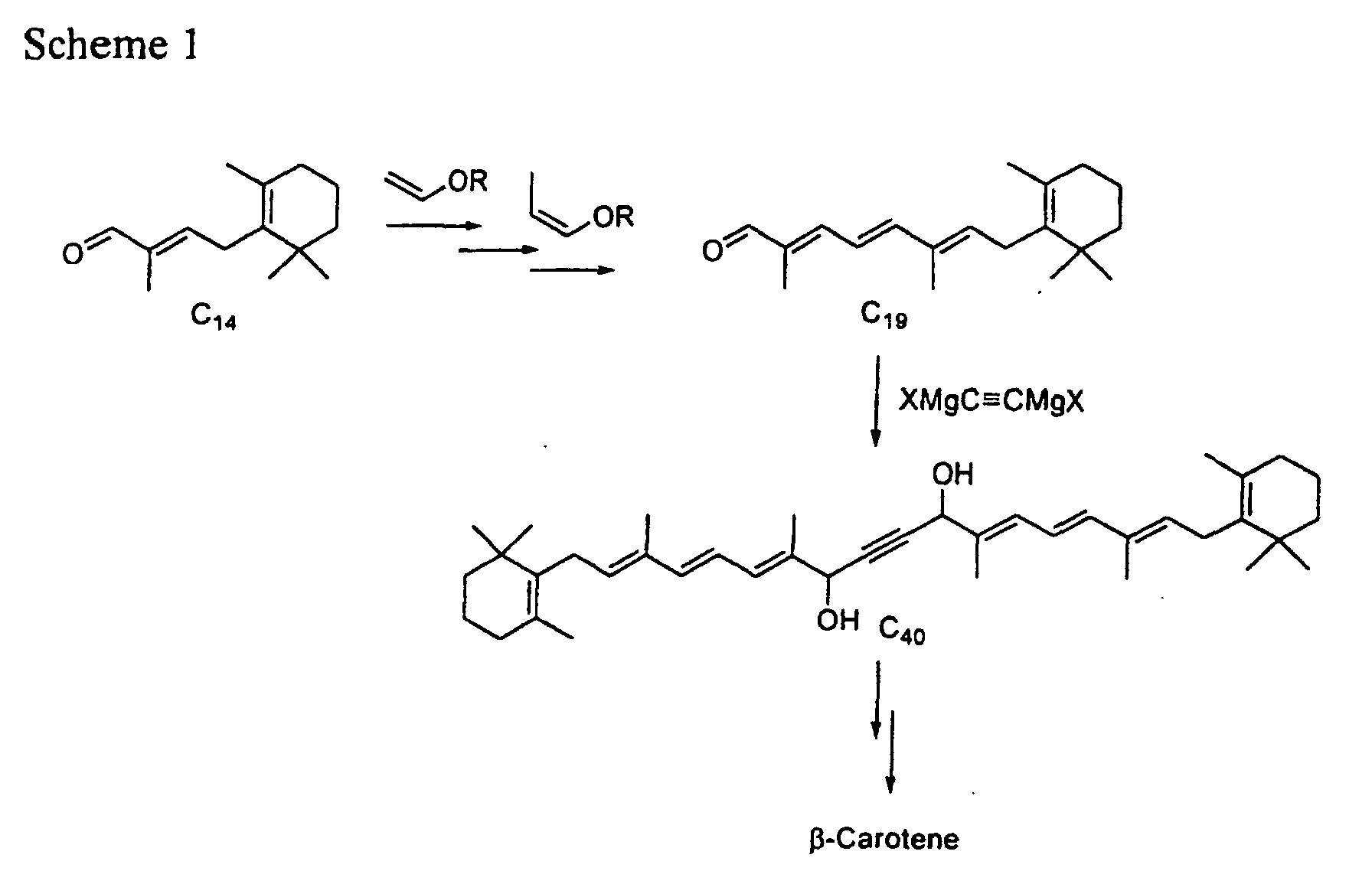
- However, in the Roche process, the synthesis of C19 compound from C14 compound is not a convergent process, which requires two consecutive enol ether condensations, thereby having low effectiveness.
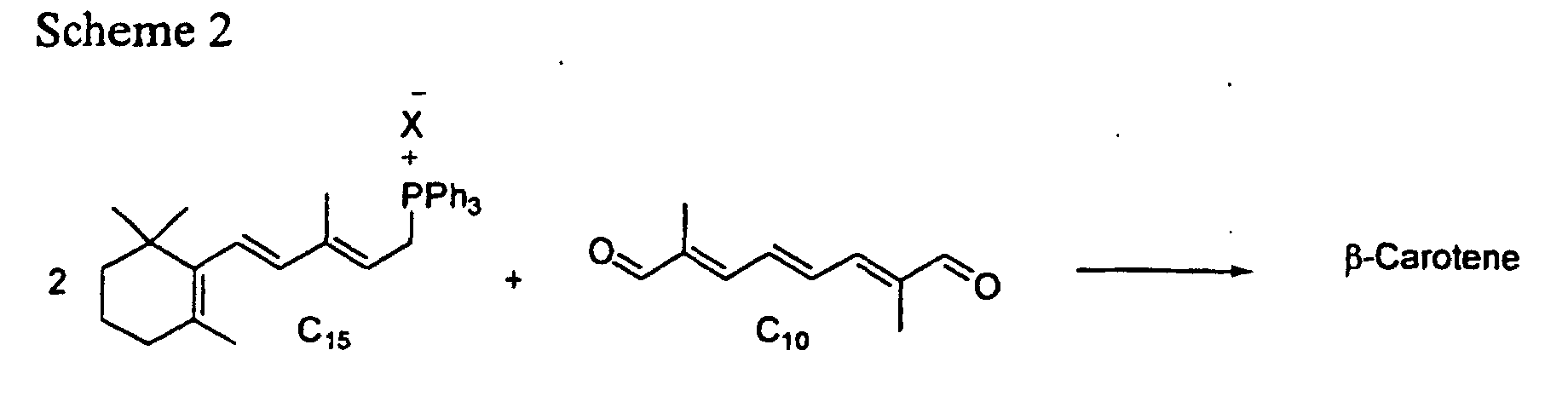
- On the other hand, BASF synthesizes β -carotene via Wittig reaction of C15 phosphonium salt and C10 dialdehyde, as is shown in Scheme 2 below.
- According to this process, double bond can be effectively formed by Wittig reaction, however, the process has a problem in that phosphine oxide (Ph3P=O) produced as a by-product, cannot be easily separated or removed.
- The technical object of the present invention is to provide intermediate compounds used for the efficient synthesis of the polyene chain structure with fully taking advantage of its symmetry and with solving the problem of by-products such as phosphine oxide by the employment of the Julia type sulfone olefination strategy, processes for preparing the same, and processes for preparing β -carotene by using the same.
- Another technical object of the present invention is to provide a novel compound having polyene chain structure which is synthesized via said intermediate compound, and a process for preparing the same.
- The first object of the present invention is achieved by diallylic sulfide represented by the following Chemical Formula 1:wherein, R1 and R2 are independently selected from the group consisting of -CHO, -CH2Cl, -CH2Br, -CH2I, -CH2OH, -CH2OSO2CF3, -CH2OSO2Ph, -CH2OSO2C6H4CH3 and -CH2OSO2CH3.

- Preferably, R1 and R2 both are -CHO or -CH2Cl.
- The second object of the present invention is achieved by a process for preparing diallylic sulfide represented by Chemical Formula 1, which comprises the steps of
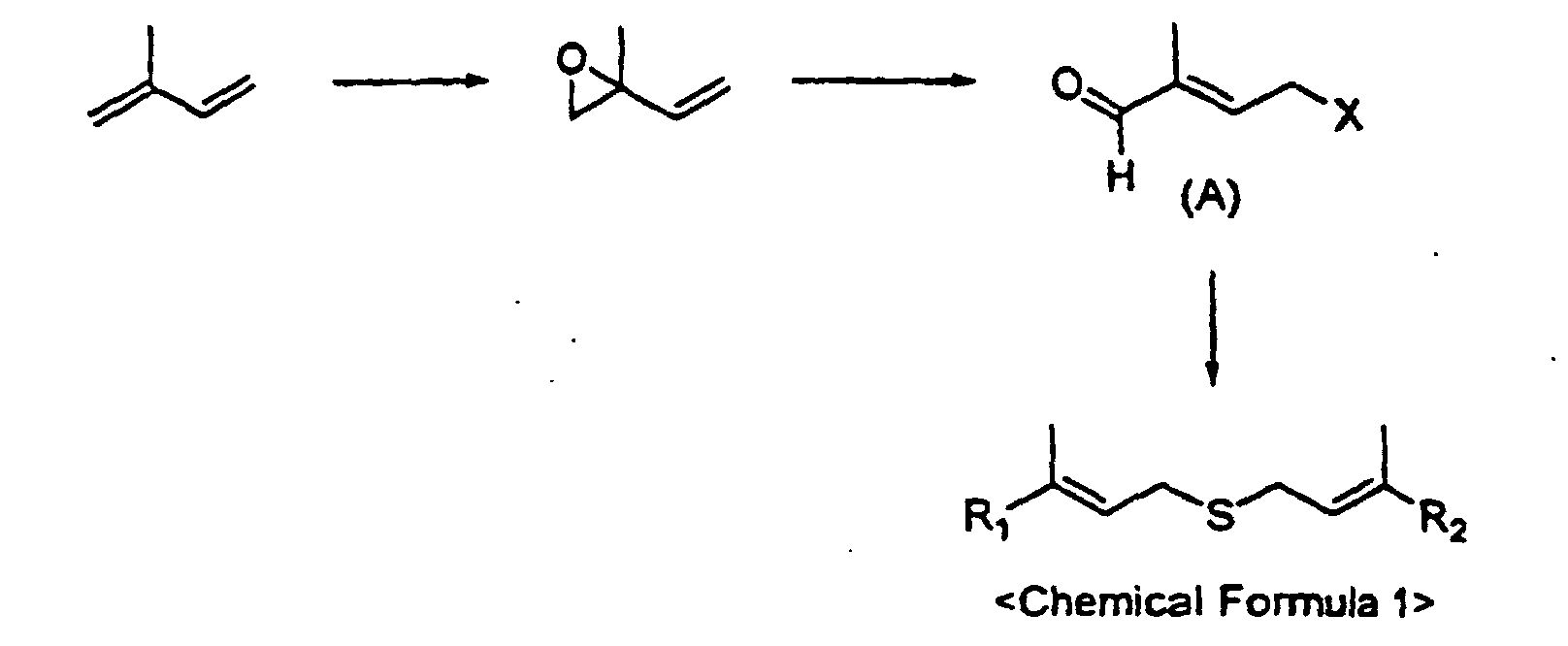
- (a-1) oxidizing isoprene to give isoprene monoxide;
- (b-1) reacting the isoprene monoxide with cupric halide (CuX2)/lithium halide (LiX) to provide an allylic halide (A); and
- (c-1) reacting the allylic halide (A) with sodium sulfide (Na2S).
-
- In the Formula, R1 and R2 are independently selected from the group consisting of -CHO, -CH2Cl, -CH2Br, -CH2I, -CH2OH, -CH2OSO2CF3, -CH2OSO2Ph, -CH2OSO2C6H4CH3 and -CH2OSO2CH3, and X represents Cl, Br or I.
- The allylic sulfides represented by Chemical Formula 1, wherein R1 and R2 are -CH2Cl, -CH2Br or -CH2I, are synthesized by further performing steps of reducing and halogenating the resultant product from step (c-1), after step (c-1).
- Step (c-1) is preferably performed via the sequence of adding a catalytic amount of acid to the allylic halide (A) in alcoholic solvent to form an acetal in situ, and of reacting said acetal with sodium sulfide for a predetermined period, and then of evaporating the solvent and hydrolyzing the residue.
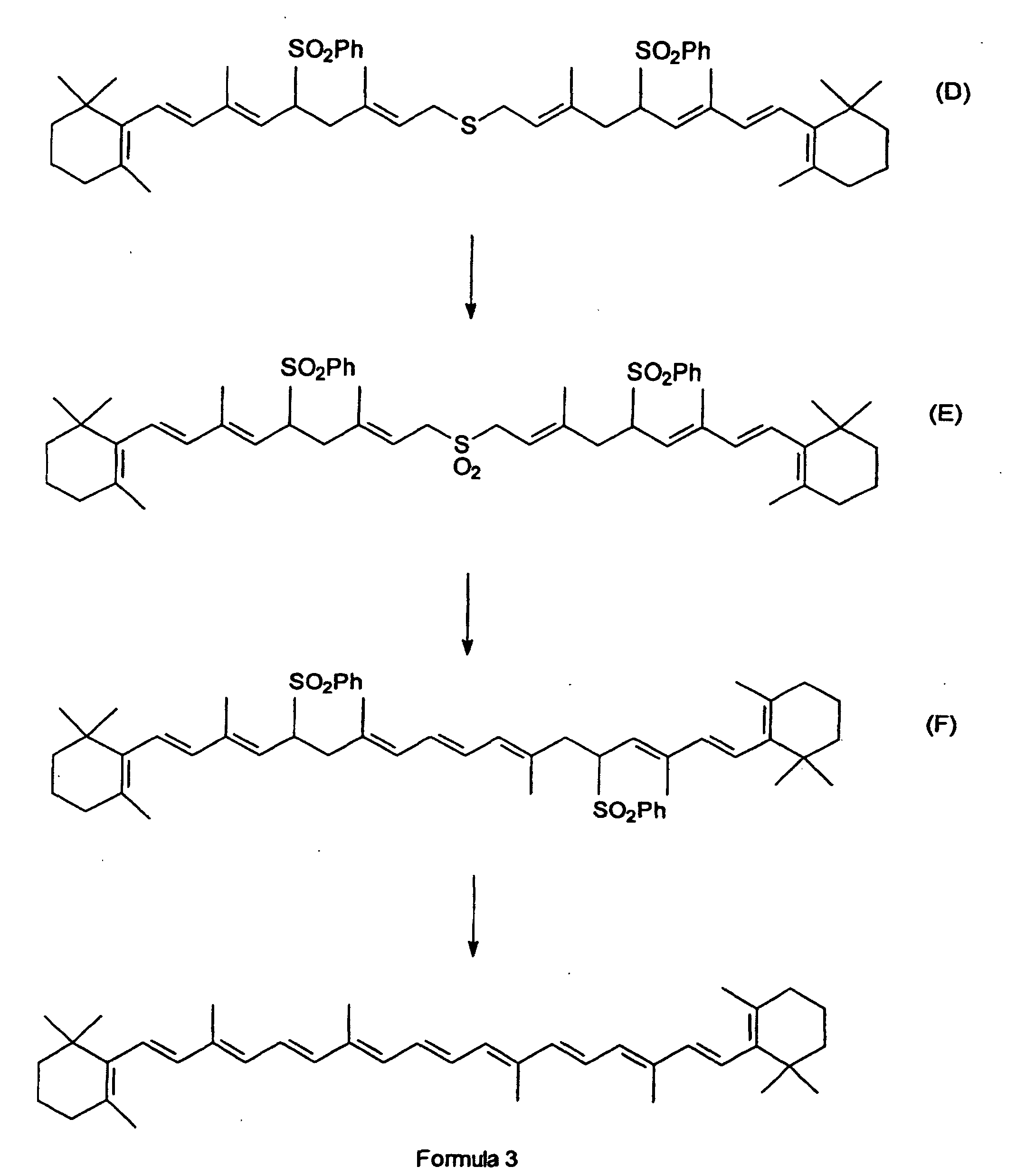
- A third object of the present invention is achieved by a process for preparing β -carotene represented by Chemical Formula 3, which comprises the steps of
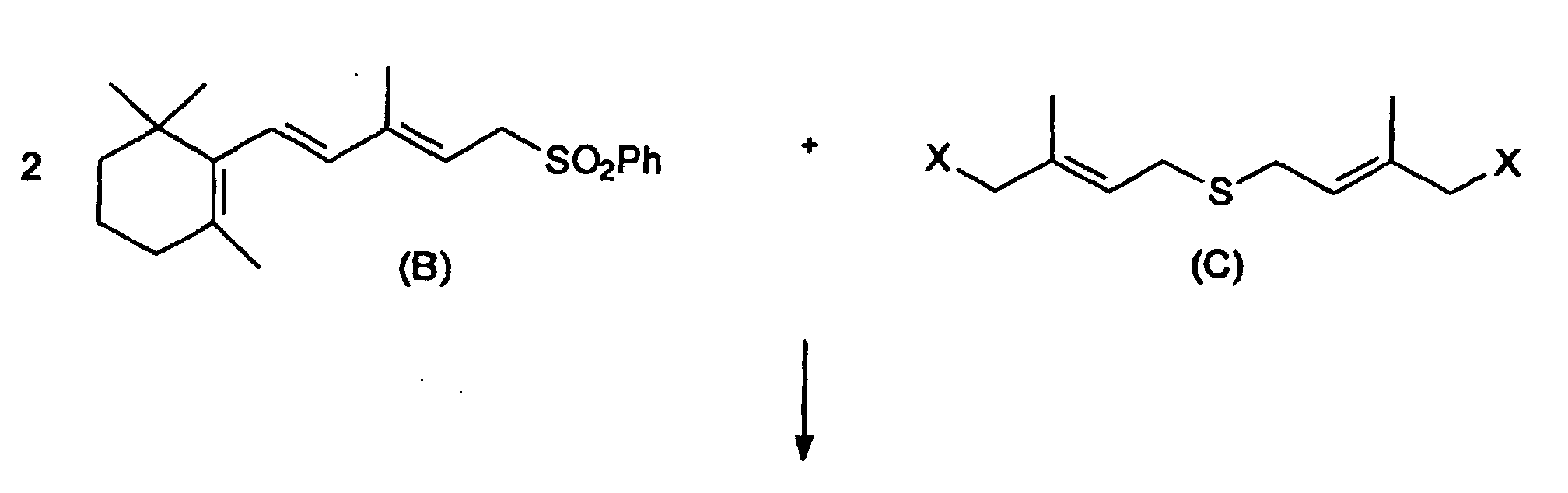
- (a-3) deprotonating the sulfone compound (B), and reacting not more than 1/2 equivalent (based on the sulfone compound) of allylic sulfide represented by Chemical Formula 1 (C) (R1, R2=CH2X, X=halogen atom) thereto, to provide sulfide compound (D);
- (b-3) selectively oxidizing the sulfide compound (D) to prepare the sulfone compound (E);
- (c-3) subjecting the sulfone compound (E) to Ramberg-Bäcklund reaction to prepare 11,20-di(benzenesulfonyl)-11,12,19,20-tetrahydro-β -carotene (F); and
- (d-3) reacting
11,20-di(benzenesulfonyl)-11,12,19,20-tetrahydro-β -carotene (F) with a
base.

-
- In case that X is Cl, step (a-3) is preferably performed by adding a stoichiometric amount of sodium iodide (NaI) in terms of reactivity. The selective oxidation of step (b-3) is preferably carried out by adding a mixture of UHP and phthalic anhydride dropwise to a solution containing the sulfide compound (D) at low temperature.
- The base used in step (d-3) is not specifically restricted. As specific examples of the base, NaNH2/NH3, or metal alkoxides such as CH3OK/CH3OH, CH3CH2OK/CH3CH2OH and CH3CH2ONa/CH3CH2OH, t-BuOK/t-BuOH may be mentioned. Among them, metal alkoxides are more preferable.
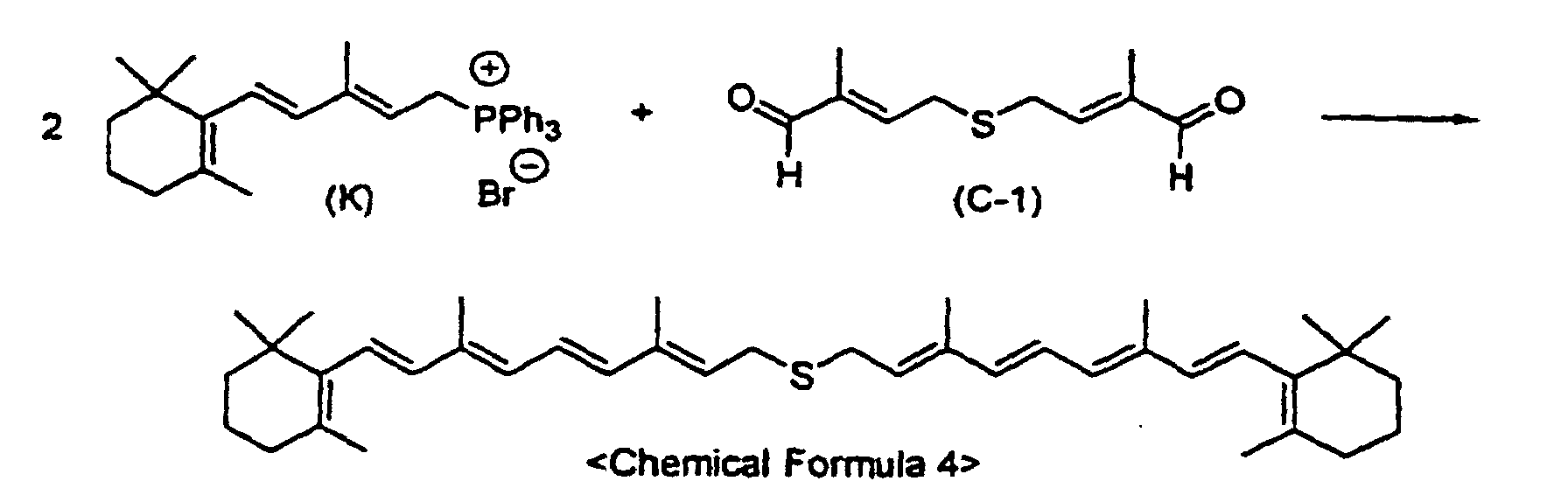
- The fourth technical object of the present invention can be achieved by retinyl sulfide represented by the following Chemical Formula 4:

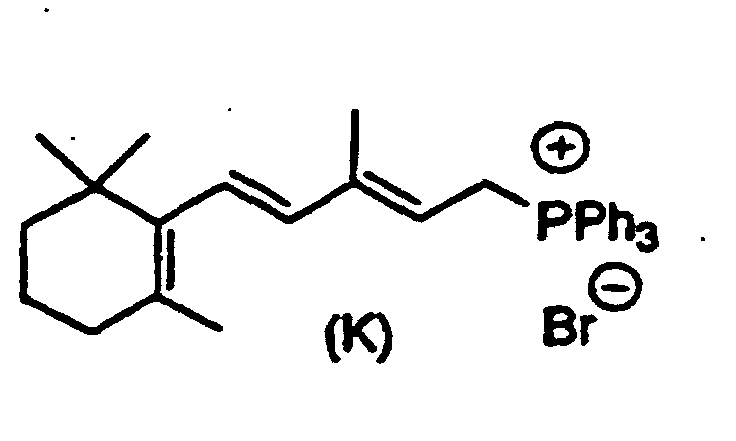
- In order to achieve the fifth technical object, the present invention provides a process for preparing retinyl sulfide represented by the Chemical Formula 4, which comprises Wittig reaction of diallylic sulfide (C-1) and the Wittig salt (K).
- In the formula, X is a halogen atom.
- The diallylic sulfide represented by Chemical Formula 1, which is used as a basic material in the synthesis of a compound having polyene chain structure, is synthesized according to the following procedure (Scheme 3).
- First, isoprene is oxidized to obtain isoprene monoxide. The oxidation may be carried out under the condition of using an oxidant such as m-chloroperoxybenzoic acid (MCPBA), or the condition of forming a corresponding halohydrin, which is then reacted with a base (J. Am. Chem. Soc. 1950, 72, 4608), or the like. Among these, the latter process is more preferable, when considering the regio-selectivity on two double bonds of isoprene.
- Then, said isoprene monoxide is subjected to ring opening reaction by reacting with cupric halide (CuX2·2H2O)/ lithium halide (LiX), to obtain allylic halide (A). For the ring opening reaction, the reaction condition disclosed in literature (J. Org. Chem. 1976, 41, 1648) is referred, and the reaction condition of cupric chloride (CuCl2·2H2O)/ lithium chloride (LiCl) is preferably employed.
- Then, from the allylic halide (A), allylic sulfide represented by Chemical Formula 1 is obtained (Scheme 3).

- In case that R1 and R2 of the allylic sulfide of Chemical Formula 1 are aldehyde groups, allylic halide (A) is allylated to obtain diallylic sulfide (C-1) which has aldehyde functional groups at both ends. The allylation is preferably carried out by adding a catalytic amount of acid such as p-toluenesulfonic acid (p-TsOH) in alcoholic solvent to form an acetal, which is then reacted with sodium sulfide and hydrolyzed. In such a reaction condition, allylation can be proceeded without side reactions. The acid such as p-TsOH serves as a catalyst that promotes the formation of acetal.
- In case that R1 and R2 of the allylic sulfide of Chemical Formula 1 are -CH2X (wherein, X is a halogen atom), the allylic sulfide (C-1) is firstly reduced to give the corresponding diol compound, which is then halogenated to obtain diallylic sulfide (C) in which halogen atoms have been introduced at both ends (Scheme 4). The halogenation of diol compounds may be carried out under various reaction conditions. For example, halogenation is performed by using a reaction condition of CH3SO2Cl/LiCl, HCl, HBr, PPh3/CCl4, or the like.

- Now, the process for preparing β -carotene of Chemical Formula 3, according to the present invention, is described (Scheme 5).
- The process for preparing β -carotene according to the present invention is characterized in that Ramberg-Bäcklund reaction is performed on diallylic sulfone which was obtained by the oxidation of diallylic sulfide.
- In order to prepare β -carotene, allylic sulfide (C) and 2 equivalent or more of sulfone compound (B) based on the amount of the allylic sulfide are firstly coupled according to the Julia process (Bull. Soc. Chim. Fr. 1973). As a result of the coupling, obtained is the allylic sulfide (D) which contains all the carbons required for the synthesis of β -carotene. The coupling reaction of allylic sulfide (C) with sulfone compound (B) may be carried out under various reaction conditions. If X is Cl, it is preferable to quantitatively add sodium iodide (NaI). Under such a reaction condition, the halogen atoms at both end of allylic sulfide (C) are substituted by iodine, and then allylation of the sulfone compound actively occurs.
- Then, only the sulfur atom of allylic sulfide (D) is selectively oxidized to obtain the corresponding sulfone compound (E). The selective oxidation is preferably carried out under the reaction condition of adding an oxidant to the allylic sulfide compound at low temperature. Under such a reaction condition, the double bond of allylic sulfide (D) is not oxidized, but only the sulfur is selectively oxidized.
- Subsequently, SO2 of the central part of the structure of sulfone compound (E) is removed by forming a double bond, to give compound (F). The reaction is preferably carried out by applying Ramberg-Bäcklund reaction to sulfone compound (E).
- Finally, compound (F) is heated in the presence of alcoholic solvent and alkoxide base such as sodium alkoxide to remove two benzenesulfonyl groups, thereby obtaining β -carotene of Chemical Formula 3.

- In the meanwhile, the process for preparing retinyl sulfide of Chemical Formula 4 is described with reference to Scheme 6 below.
- Retinyl sulfide can be obtained by Wittig reaction of allylic sulfide (C-1) having aldehyde groups at both ends, with Wittig salt (K).

- Retinyl sulfide of Chemical Formula 4 has a structure wherein the units of vitamin A are linked by a sulfur atom, and the compound is expected to have an activity of vitamin A.
-
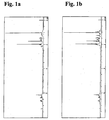
- Fig. 1a is the 1H NMR spectrum of trans-β -carotene as the authentic sample;
- Fig. 1b is the 1H NMR spectrum of trans-β -carotene prepared according to Synthetic Example 6 of the present invention; and
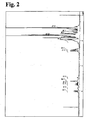
- Fig. 2 is the 1H NMR spectrum of retinyl sulfide (Chemical Formula 4) prepared according to Synthetic Example 9 of the present invention.
-
- Now, the present invention is described in detail with reference to Examples. However, it should be noted that these examples are not intended to limit or restrict the scope of this invention in any way.
- To a solution of 4-chloro-2-methyl-2-buten-1-al (10.48 g, 88.2 mmol) in MeOH (80 mL) was added p-TsOH (48 mg, 0.25 mmol). The mixture was stirred for 1 h, and then Na2S•9H2O (10.59 g, 44.1 mmol) was added. The resulting mixture was stirred at room temperature for 10 h.
- When the reaction was completed, most of solvent was removed by evaporating the reaction mixture under reduced pressure. After adding 1 M HCl (50 mL) thereto, the resultant mixture was stirred for 1 h, and extracted with methylene chloride (50 mL x 3). The combined methylene chloride layer was dried over anhydrous Na2SO4, filtered, and concentrated under reduced pressure. The crude product was purified by flash chromatography over silica gel to give di-(3-formyl-3-methyl-2-propenyl) sulfide (7.43 g, 37.5 mmol) in 85% yield.
1H NMR δ 1.78 (6H, s), 3.44 (4H, d, J = 7.7 Hz), 6.53 (2H, t, J = 7.7 Hz), 9.49 (2H, s)
13C NMR 9.3, 29.1, 140.9, 147.5, 194.4 - To a stirred solution of di(3-formyl-3-methyl-2-propenyl) sulfide (10.5 g, 53.0 mmol) in THF (80 mL) was added LiAlH4 (1.33 g, 35.0 mmol). The mixture was stirred for 1 h, and then quenched with 1 M HCl (30 mL). The mixture was extracted with EtOAc (50 mL x 3). The combined organic layer was dried over anhydrous Na2SO4, filtered, and concentrated under reduced pressure.
- The above residue was dissolved in CH3CN (50 mL), and then PPh3 (30.43 g, 0.116 mol) and CCl4 (20 mL) were added thereto. The resulting mixture was stirred for about 5 h, diluted with ether (100 ml), and subsequently washed with 1 M HCl (20 mL x 2) and H2O (30 mL).
- The organic phase was dried over anhydrous Na2SO4, filtered and concentrated under reduced pressure. The crude product was purified by flash chromatography over silica gel to produce di(4-chloro-3-methyl-2-butenyl) sulfide (9.26 g, 38.7 mmol) in 73% yield.
1H NMR δ 1.78 (6H, s), 3.14 (4H, d, J = 7.7 Hz), 4.03 (4H, s), 5.62 (2H, t, J = 7.7 Hz)
MS (El, 70eV): 240 [(M+2)+], 239 [(M+1)+], 238 (M+), 203, 135, 102, 67 - To a stirred solution of sulfone compound (B) (14.4 g, 41.8 mmol) in THF (80 mL), was added NaH (1.20 g, 50.1 mmol). The mixture was stirred for 15 min, and then di(4-chloro-3-methyl-2-butenyl) sulfide (5.0 g, 20.9 mmol) and NaI (7.5 g, 50.1 mmol) were added consecutively. The resulting mixture was stirred at room temperature for 15 h and diluted with ether. The dilute mixture was subsequently washed with 1 M HCl (20 mL x 2) and distilled water (30 mL), dried over anhydrous Na2SO4, filtered, and concentrated under reduced pressure. The crude product was purified by flash chromatography over silica gel to give di(11-benzenesulfonyl-11,12-dihydroretinyl) sulfide (D) (15.7 g, 17.8 mmol) in 85% yield.
1H NMR δ 0.93 (6H, s), 0.96 (6H, s), 1.21 (6H, s), 1.45-1.65 (8H, m), 1.63 (12H, s), 2.00 (4H, t, J = 6.0 Hz), 2.39 (2H, dd, J = 13.2, 11.5 Hz), 2.90 (4H, d, J = 6.8 Hz), 2.90-3.10 (2H, m), 4.02 (2H, dt, Jd = 3.1, Jt = 11.0 Hz), 5.07 (2H, d, J = 10.3 Hz), 5.21 (2H, t, J = 7.0 Hz), 5.93 (4H, s), 7.45-7.53 (4H, m), 7.58-7.65 (2H, m), 7.78-7.84 (4H, m)
13C NMR 12.3, 16.0, 16.0, 19.2, 21.6, 28.9, 28.9, 33.0, 34.2, 37.4, 39.5, 64.1, 122.3, 125.8, 129.2, 129.6, 130.2, 130.4, 134.0, 134.4, 136.8, 138.1,138.5, 143.2 - The mixture of UHP (6.88 g, 73.1 mmol) and phthalic anhydride (5.41 g, 36.5 mmol) in CH3CN (70 mL) was stirred vigorously at room temperature for 2 h to give a clear solution. This solution was charged in a dropping funnel, and slowly added over three hour period to a solution of di(11-benzenesulfonyl-11,12-dihydroretinyl) sulfide (D) (10.8 g, 12.2 mmol) in CH3CN (30 mL). The temperature of the reaction mixture was adjusted to be maintained at 0 °C.
- When the dropping was completed, the reaction mixture was stirred at 0 °C for 1 h. After adding 1 M aqueous HCl (30 mL) thereto, the reaction mixture was extracted with ether (50 mL x 2). The combined ether layer was dried over anhydrous Na2SO4, filtered, and concentrated under reduced pressure to give a white solid. The crude solid was dissolved in CHCl3, and insoluble solid was filtered off. The filtrate was concentrated, and the residue was purified by flash chromatography over silica gel to give di(11-benzenesulfonyl-11,12-dihydroretinyl) sulfone (8.06 g, 8.77 mmol) in 72% yield. Two stereo isomers of the obtained allylic sulfone compound were found, and one of which was isolated in pure state through silica gel column chromatography.
1H NMR δ 0.91 (6H, s), 0.96 (6H, s), 1.22 (6H, s), 1.37-1.49 (4H, m), 1.55-1.67 (4H, m), 1.62 (6H, s), 1.65 (6H, s), 1.99 (4H, t, J = 5.9 Hz), 2.47 (2H, dd, J = 13.0, 11.3 Hz), 3.05 (2H, d, J = 13.0 Hz), 3.47 (4H, d, J = 4.5 Hz), 4.06 (2H, dt, Jd = 3.1, Jt = 10.8 Hz), 5.07 (2H, d, J = 10.5 Hz), 5.24 (2H, t, J = 7.4 Hz), 5.92 (2H, A of ABq, J = 16.4 Hz), 5.97 (2H, B of ABq, J = 16.4 Hz), 7.40-7.55 (4H, m), 7.55-7.70 (2H, m), 7.75-7.90 (4H, m)
13C NMR 12.3, 17.0, 19.1, 21.5, 28.7, 28.8, 32.8, 34.0, 37.3, 39.3, 51.0, 63.4, 114.1, 121.0, 128.8, 129.0, 129.3, 129.7, 133.7, 135.5, 137.1, 137.2, 140.8, 142.8 - To a stirred solution of di(11-benzenesulfonyl-11,12-dihydroretinyl) sulfone (E) (1.51 g, 1.64 mmol) in t-BuOH (20 mL) and CCl4 (20 mL), was added KOH (1.85 g, 32.9 mmol) under argon atmosphere. The mixture was stirred vigorously for 5 h.
- When the reaction was completed, most of solvent was removed from the reaction mixture under reduced pressure. The crude product was dissolved in CH2Cl2 (60 mL) and washed with 1 M HCl (20 mL). The combined methylene chloride layer was dried over anhydrous Na2SO4, filtered, and concentrated. The crude product was purified by flash chromatography over silica gel to give 11,20-dibenzenesulfonyl-11,12,19,20-tetrahydro-β -carotene (F) (932 mg, 1.13 mmol) in 69% yield.
1H NMR δ 0.93 (6H, s), 0.96 (6H, s), 1.20 (6H, s), 1.37-1.50 (4H, m), 1.53-1.65 (4H, m), 1.63 (6H, s), 1.68 (6H, s), 1.98 (4H, br s), 2.45 (2H, dd, J = 13.0, 11.6 Hz), 3.04 (2H, d, J = 14.2 Hz), 4.05 (2H, dt, Jd = 3.0, Jt = 10.9 Hz), 5.82-5.98 (2H, m), 5.92 (4H, s), 6.15-6.28 (2H, m), 7.40-7.54 (4H, m), 7.56-7.67 (2H, m), 7.76-7.90 (4H, m)
13C NMR 12.3, 12.3, 16.7, 16.8, 19.1, 21.5, 28.8, 32.8, 34.1, 39.4, 64.2, 121.4, 127.8, 128.1, 128.7, 129.0, 129.3, 129.5, 132.9, 133.5, 136.0, 137.2, 137.6, 142.1 - Sodium (674 mg, 29.3 mmol) was added to a stirred solution of 11,20-di(benzenesulfonyl)-11,12,19,20-tetrahydro-β -carotene (F) (602 mg, 0.73 mmol) in EtOH (20 mL) under argon atmosphere.
- The reaction mixture was heated under reflux for 10 h with vigorous stirring.
- When the reaction was completed, the reaction mixture was concentrated under reduced pressure to remove most of the solvent. Toluene (50 mL) was added thereto to dissolve the residue, and the resultant mixture was washed with 1 M HCl, dried over anhydrous Na2SO4, filtered, and concentrated under reduced pressure. The crude product was purified by flash chromatography over silica gel to give exclusively trans-β -carotene of Chemical Formula 3 (295 mg, 0.55 mmol) in 75% yield.
NMR spectrum (JEOL, 300 MHz) data of trans-β-carotene is shown in Fig. 1b. The NMR data of the synthetic sample was identical to that of the authentic sample, shown in Fig. 1a. - Wittig salt compound (K) (7.75 g, 14.2 mmol) and di(3-formyl-3-methyl-2-propenyl)sulfide (1.41 g, 7.1 mmol) of Chemical Formula 1 were dissolved in DMF (50 mL). The reaction mixture was sufficiently stirred at -20 °C.
- To the reaction mixture, sodium methoxide (8.1 g, 0.15 mmol) was added, and the resultant mixture was stirred for 30 minutes. After raising the temperature to room temperature, the reaction mixture was further stirred for 3 h.
- The reaction mixture was diluted with toluene (100 ml), and washed with 1 M HCl (30 mL x 2). The organic layer was dried over anhydrous Na2SO4, filtered, and concentrated. The crude product was purified by flash chromatography over silica gel to give retinyl sulfide (2.75 g, 4.82 mmol) comprising three stereo isomers in 68% yield.
1H NMR for the major isomer δ 0.97 (6H, s), 1.38∼1.47 (2H, m), 1.54 (3H, s), 1.55∼1.65 (2H, m), 1.59 (3H, s), 1.77 (3H, s), 1.92 (2H, t, J = 6.3 Hz), 2.88 (2H, d, J = 6.4 Hz), 4.96 (1H, m), 5.24 (3H, m), 5.54 (1H, t, J = 6.8 Hz), 6.05 (1H, d, J = 15.6 Hz). Characteristic, peaks for the minor isomers: δ 1.55 (3H, s), 1.58 (3H, s), 2.69 (2H, d, J = 7.1 Hz), 2.69 (2H, d, J = 6.8 Hz), 5.49 (1H, t, J = 6.4 Hz), 6.01 (1H, d, J = 7.5 Hz). - As described above, in case that β -carotene is prepared according to Synthetic Examples 1 to 6, the process becomes simpler as compared to the conventional processes, and the problem involved with the by-products such as phosphine oxide can be avoided.
- In addition, the yield of retinyl sulfide of Chemical Formula 4 prepared according to Synethetic Example 7 was 68%. Retinyl sulfide is expected to have an activity of vitamin A.
- The allylic sulfide compounds of Chemical Formula 1 according to the present invention may be effectively used as an intermediate for the synthesis of compounds having polyene chain structure such as β -carotene.
- According to the present invention, allylic sulfide compound (D) is oxidized to provide the corresponding diallylic sulfone compound, to which Ramberg-Bäcklund reaction is applied to provide the carotene compound of Chemical Formula 3, having the polyene chain structure. In case that β -carotene is prepared according to the present invention, the process can be easily performed as compared to the conventional process according to BASF or Roche, and problems involved with by-products can be avoided.
- In the meanwhile, retinyl sulfide of Chemical Formula 4 is expected to have the activity of vitamin A.
Claims (9)
- A diallylic sulfide represented by Formula 1:wherein, R1 and R2 are independently selected from the group consisting of -CHO, - CH2Cl, -CH2Br, -CH2I, -CH2OH, -CH2OSO2CF3, -CH2OSO2Ph, -CH2OSO2C6H4CH3 and - CH2OSO2CH3.

- A process for preparing a diallylic sulfide as claimed in claim 1 wherein R1 and R2 are -CHO, the process comprising:wherein the allylic halide (A) is:adding a catalytic amount of acid to an allylic halide (A) in the presence of alcoholic solvent to form an acetal, and reacting the acetal with sodium sulfide (Na2S) in situ for a predetermined time, concentrating the solvent, and hydrolyzing the product,and X is Cl, Br or I.
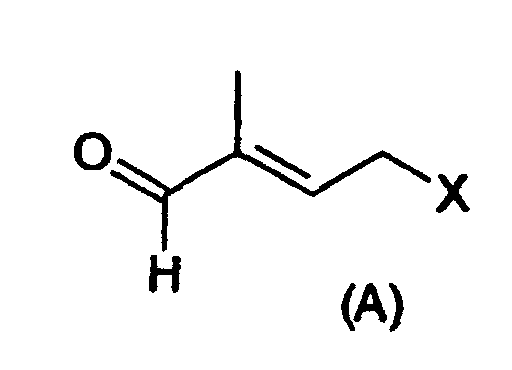
- A process for preparing a diallylic sulfide as claimed in claim 1 wherein R1 and R2 are -CH2Cl, -CH2Br or -CH2I, the process comprising:wherein the allylic halide (A) is:(a) adding a catalytic amount of acid to an allylic halide (A) in the presence of alcoholic solvent to form an acetal, and reacting the acetal with sodium sulfide (Na2S) in situ for a predetermined time, concentrating the solvent, and hydrolyzing the product; and(b) reducing and halogenating the product of step (a),and X is Cl, Br or I.

- A process for preparing a β-carotene represented by Formula 3, the process comprising the steps of:(a) deprotonating a sulfone compound (B), and reacting not more than 1/2 equivalent, based on the sulfone compound, of allylic sulfide represented by Formula (C) thereto, wherein X is a halogen atom, to provide sulfide compound (D);(b) selectively oxidizing the sulfide compound (D) to prepare sulfone compound (E);(c) subjecting the sulfone compound (E) to Ramberg-Bäcklund reaction to prepare 11,20-di(benzenesulfonyl)-11,12,19,20-tetrahydro- β-carotene (F); and(d) reacting 11,20-di(benzenesulfonyl)-11,12,19,20-tetrahydro-β-carotene (F) with a base
- A process as claimed in claim 4, wherein step (a) is performed by adding a stoichiometric amount of sodium iodide (NaI) and X is Cl.
- A process as claimed in claim 4, wherein step (b) is carried out by adding a reaction mixture of UHP and phthalic anhydride dropwise to a solution containing the sulfide compound (D) at low temperature.
- A process as claimed in claim 4, wherein the base used in step (d) is a metal alkoxide.
- Retinyl sulfide represented by Formula 4:

- A process for preparing retinyl sulfide as claimed in claim 8, the process comprising a Wittig reaction of diallylic sulfide (C-1) and the Wittig salt (K)

Applications Claiming Priority (3)
| Application Number | Priority Date | Filing Date | Title |
|---|---|---|---|
| KR1019980047549A KR20000031491A (en) | 1998-11-06 | 1998-11-06 | Polyene branch structure containing compound and preparation tereof |
| KR9847549 | 1998-11-06 | ||
| PCT/KR1999/000648 WO2000027810A1 (en) | 1998-11-06 | 1999-10-28 | Compounds comprising polyene chain structure and processes for preparing the same |
Publications (2)
| Publication Number | Publication Date |
|---|---|
| EP1124800A1 EP1124800A1 (en) | 2001-08-22 |
| EP1124800B1 true EP1124800B1 (en) | 2004-01-07 |
Family
ID=19557410
Family Applications (1)
| Application Number | Title | Priority Date | Filing Date |
|---|---|---|---|
| EP99951244A Expired - Lifetime EP1124800B1 (en) | 1998-11-06 | 1999-10-28 | Compounds comprising polyene chain structure and processes for preparing the same |
Country Status (8)
| Country | Link |
|---|---|
| US (3) | US6297416B1 (en) |
| EP (1) | EP1124800B1 (en) |
| JP (1) | JP2002529448A (en) |
| KR (2) | KR20000031491A (en) |
| CN (1) | CN1324345A (en) |
| AU (1) | AU6371399A (en) |
| DE (1) | DE69914097T2 (en) |
| WO (1) | WO2000027810A1 (en) |
Families Citing this family (15)
| Publication number | Priority date | Publication date | Assignee | Title |
|---|---|---|---|---|
| KR100400261B1 (en) * | 2001-01-03 | 2003-10-01 | 구상호 | Allylic sulfones containing conjugated polyene moieties, preparation thereof, and a process for preparing lycopene by using the same compound as an intermediate |
| KR100477899B1 (en) * | 2001-04-12 | 2005-03-18 | 구상호 | Practical Synthetic Method of Retinoid and Carotenoid Compounds |
| KR100536342B1 (en) * | 2001-10-31 | 2005-12-12 | 구상호 | Method of preparing 4-chloro-3-methyl-2-butenylphenyl sulfide and di(4-chloro-3-methyl-2-butenyl) sulfide for synthesis of natural carotenoid products |
| KR101081115B1 (en) | 2003-12-19 | 2011-11-07 | 구상호 | Preparation method of -carotene |
| KR101019787B1 (en) | 2003-12-23 | 2011-03-04 | 구상호 | Method for Preparing Canthaxanthin |
| KR100634884B1 (en) * | 2004-10-05 | 2006-10-20 | 구상호 | Efficient preparation of beta-carotene |
| KR100733023B1 (en) * | 2006-06-05 | 2007-06-28 | 구상호 | Dialdehyde compound, preparation method thereof, and synthesis method of carotene compound using same |
| CN103172504B (en) * | 2011-12-26 | 2014-10-08 | 南京工业大学 | Synthesis method of 2, 7-dimethyl-2, 4, 6-octatriene-1, 8-dialdehyde |
| CN111138703B (en) * | 2019-12-30 | 2022-02-15 | 四川大学 | A method for preparing linear polyene pigment by laser irradiation of polymer resin |
| CN112961089B (en) * | 2021-03-12 | 2022-09-27 | 上虞新和成生物化工有限公司 | Method for reducing viscosity of beta-carotene oil |
| CN114149343B (en) * | 2021-12-06 | 2023-10-20 | 中节能万润股份有限公司 | Preparation method of high-purity 1, 4-dicyano-2-butene |
| CN114292218B (en) * | 2022-01-06 | 2023-01-13 | 万华化学集团股份有限公司 | Method for synthesizing beta-carotene by taking C20 phosphonium salt of VA as raw material |
| CN114213303B (en) * | 2022-02-09 | 2023-01-13 | 万华化学集团股份有限公司 | A kind of preparation method of β-carotene |
| CN114426508B (en) * | 2022-02-09 | 2022-11-08 | 万华化学集团股份有限公司 | Preparation method of beta-carotene intermediate polyene thioether |
| KR102887346B1 (en) * | 2023-10-20 | 2025-11-17 | 명지대학교 산학협력단 | Novel polyene precursor containing sulfur and preparing method thereof |
Family Cites Families (9)
| Publication number | Priority date | Publication date | Assignee | Title |
|---|---|---|---|---|
| US3686326A (en) * | 1970-02-11 | 1972-08-22 | Exxon Research Engineering Co | Allylic sulfide reaction products |
| US3859360A (en) * | 1970-02-11 | 1975-01-07 | Exxon Research Engineering Co | Allylic sulfide reaction products |
| US5185468A (en) * | 1990-06-14 | 1993-02-09 | Kuraray Company Ltd. | Process for producing β-carotene, and intermediate compounds useful for the process |
| US5107030A (en) * | 1991-03-04 | 1992-04-21 | Loyola University Of Chicago | Method of making 2,7-dimethyl-2,4,6-octatrienedial and derivatives thereof |
| DE4112272A1 (en) * | 1991-04-15 | 1992-10-22 | Basf Ag | 2,5-BIS- (1 ', 1'-DIALKOXY-2'-PROPYL) -2,5-DIHYDROFURANE, METHOD FOR THE PRODUCTION THEREOF AND THE USE THEREOF FOR THE PRODUCTION OF CAROTINOIDS |
| DE4123994A1 (en) | 1991-07-19 | 1993-01-21 | Basf Ag | IMPROVED METHOD FOR PRODUCING POLYENES |
| JPH07309832A (en) * | 1994-03-25 | 1995-11-28 | Takeda Chem Ind Ltd | Production of carotene compound |
| US5471005A (en) * | 1994-11-18 | 1995-11-28 | Loyola University Of Chicago | Method of making 2,7-dimethyl-2,4,6-octatrienedial, a key intermediate in the commercial syntheses of various carotenoids |
| KR100365696B1 (en) * | 2000-03-02 | 2002-12-26 | 구상호 | General synthetic entry to carotenoid polyene chain compounds |
-
1998
- 1998-11-06 KR KR1019980047549A patent/KR20000031491A/en active Pending
-
1999
- 1999-10-28 CN CN99812480A patent/CN1324345A/en active Pending
- 1999-10-28 WO PCT/KR1999/000648 patent/WO2000027810A1/en not_active Ceased
- 1999-10-28 AU AU63713/99A patent/AU6371399A/en not_active Abandoned
- 1999-10-28 KR KR10-2001-7003782A patent/KR100400262B1/en not_active Expired - Fee Related
- 1999-10-28 DE DE69914097T patent/DE69914097T2/en not_active Expired - Fee Related
- 1999-10-28 JP JP2000580990A patent/JP2002529448A/en active Pending
- 1999-10-28 EP EP99951244A patent/EP1124800B1/en not_active Expired - Lifetime
- 1999-11-05 US US09/435,336 patent/US6297416B1/en not_active Expired - Fee Related
-
2001
- 2001-06-04 US US09/873,672 patent/US6326519B1/en not_active Expired - Fee Related
- 2001-09-27 US US09/965,059 patent/US6403838B1/en not_active Expired - Fee Related
Also Published As
| Publication number | Publication date |
|---|---|
| US20020026082A1 (en) | 2002-02-28 |
| AU6371399A (en) | 2000-05-29 |
| US6403838B1 (en) | 2002-06-11 |
| DE69914097D1 (en) | 2004-02-12 |
| JP2002529448A (en) | 2002-09-10 |
| KR20010079875A (en) | 2001-08-22 |
| KR20000031491A (en) | 2000-06-05 |
| DE69914097T2 (en) | 2004-06-09 |
| CN1324345A (en) | 2001-11-28 |
| EP1124800A1 (en) | 2001-08-22 |
| KR100400262B1 (en) | 2003-10-01 |
| US6297416B1 (en) | 2001-10-02 |
| US6326519B1 (en) | 2001-12-04 |
| WO2000027810A1 (en) | 2000-05-18 |
Similar Documents
| Publication | Publication Date | Title |
|---|---|---|
| US6403838B1 (en) | Process for preparing 2,7-dimethyl-2,4,6-octatriene-1,8-dial | |
| EP0882724B1 (en) | Cyclic phenol sulfide containing sulfinyl or sulfonyl group and process for preparing the same | |
| JP4903774B2 (en) | 4-Chloro-3-methyl-2-butenylphenyl sulfide, di (4-chloro-3-methyl-2-butenyl) sulfide and di (4-chloro-3-methyl-) for the synthesis of natural carotenoid products Preparation of 2-butenyl) sulfone | |
| EP1283826B1 (en) | A process for preparing carotenoid polyene chain compounds and intermediates for preparing the same | |
| KR100776102B1 (en) | Phosphine oxide vitamin d precursors | |
| US7470822B2 (en) | C10 dialdehyde, synthetic method thereof, and synthetic method of beta-carotene using the same | |
| KR100398652B1 (en) | Carbon chain extending method of allylic sulfide | |
| KR102332262B1 (en) | Method for manufacturing 3-(alkyl sulfonyl)pyridine-2-carboxylic acid | |
| JP3174968B2 (en) | Method for producing 2-halogeno-6-substituted thiobenzonitrile | |
| DE69802465T2 (en) | Polyalcohol derivatives and process for the preparation thereof | |
| JP2582396B2 (en) | Method for producing 1α, 3β-dihydroxy steroid-5-enes | |
| KR101019787B1 (en) | Method for Preparing Canthaxanthin | |
| JP2003183245A (en) | Method for producing aryl sulfone | |
| JP3777818B2 (en) | Halogen compounds, triene derivatives and methods for producing them | |
| JPH0318617B2 (en) | ||
| JP2001520220A (en) | S- (4-biphenyl) -thiosulfuric acid and salts thereof, method for producing the same, and production of 4-mercaptobiphenyl | |
| JPH1143454A (en) | Polyene alcohol derivatives, sulfone derivatives and methods for producing them | |
| JPS63227564A (en) | Production of allylsulfone |
Legal Events
| Date | Code | Title | Description |
|---|---|---|---|
| PUAI | Public reference made under article 153(3) epc to a published international application that has entered the european phase |
Free format text: ORIGINAL CODE: 0009012 |
|
| 17P | Request for examination filed |
Effective date: 20010507 |
|
| AK | Designated contracting states |
Kind code of ref document: A1 Designated state(s): AT BE CH CY DE DK ES FI FR GB GR IE IT LI LU MC NL PT SE |
|
| AX | Request for extension of the european patent |
Free format text: AL;LT;LV;MK;RO;SI |
|
| 17Q | First examination report despatched |
Effective date: 20020812 |
|
| GRAP | Despatch of communication of intention to grant a patent |
Free format text: ORIGINAL CODE: EPIDOSNIGR1 |
|
| GRAS | Grant fee paid |
Free format text: ORIGINAL CODE: EPIDOSNIGR3 |
|
| GRAA | (expected) grant |
Free format text: ORIGINAL CODE: 0009210 |
|
| AK | Designated contracting states |
Kind code of ref document: B1 Designated state(s): CH DE FR GB LI |
|
| REG | Reference to a national code |
Ref country code: GB Ref legal event code: FG4D |
|
| REG | Reference to a national code |
Ref country code: CH Ref legal event code: EP |
|
| REG | Reference to a national code |
Ref country code: IE Ref legal event code: FG4D |
|
| REF | Corresponds to: |
Ref document number: 69914097 Country of ref document: DE Date of ref document: 20040212 Kind code of ref document: P |
|
| REG | Reference to a national code |
Ref country code: CH Ref legal event code: NV Representative=s name: MOINAS & SAVOYE SA |
|
| LTIE | Lt: invalidation of european patent or patent extension |
Effective date: 20040107 |
|
| ET | Fr: translation filed | ||
| PLBE | No opposition filed within time limit |
Free format text: ORIGINAL CODE: 0009261 |
|
| STAA | Information on the status of an ep patent application or granted ep patent |
Free format text: STATUS: NO OPPOSITION FILED WITHIN TIME LIMIT |
|
| 26N | No opposition filed |
Effective date: 20041008 |
|
| PGFP | Annual fee paid to national office [announced via postgrant information from national office to epo] |
Ref country code: DE Payment date: 20071026 Year of fee payment: 9 |
|
| PGFP | Annual fee paid to national office [announced via postgrant information from national office to epo] |
Ref country code: CH Payment date: 20071105 Year of fee payment: 9 |
|
| PGFP | Annual fee paid to national office [announced via postgrant information from national office to epo] |
Ref country code: GB Payment date: 20071022 Year of fee payment: 9 Ref country code: FR Payment date: 20071026 Year of fee payment: 9 |
|
| REG | Reference to a national code |
Ref country code: CH Ref legal event code: PL |
|
| GBPC | Gb: european patent ceased through non-payment of renewal fee |
Effective date: 20081028 |
|
| REG | Reference to a national code |
Ref country code: FR Ref legal event code: ST Effective date: 20090630 |
|
| PG25 | Lapsed in a contracting state [announced via postgrant information from national office to epo] |
Ref country code: DE Free format text: LAPSE BECAUSE OF NON-PAYMENT OF DUE FEES Effective date: 20090501 |
|
| PG25 | Lapsed in a contracting state [announced via postgrant information from national office to epo] |
Ref country code: LI Free format text: LAPSE BECAUSE OF NON-PAYMENT OF DUE FEES Effective date: 20081031 Ref country code: FR Free format text: LAPSE BECAUSE OF NON-PAYMENT OF DUE FEES Effective date: 20081031 Ref country code: CH Free format text: LAPSE BECAUSE OF NON-PAYMENT OF DUE FEES Effective date: 20081031 |
|
| PG25 | Lapsed in a contracting state [announced via postgrant information from national office to epo] |
Ref country code: GB Free format text: LAPSE BECAUSE OF NON-PAYMENT OF DUE FEES Effective date: 20081028 |