EP1124235A2 - Composite reinforced electrical transmission conductor - Google Patents
Composite reinforced electrical transmission conductor Download PDFInfo
- Publication number
- EP1124235A2 EP1124235A2 EP01102558A EP01102558A EP1124235A2 EP 1124235 A2 EP1124235 A2 EP 1124235A2 EP 01102558 A EP01102558 A EP 01102558A EP 01102558 A EP01102558 A EP 01102558A EP 1124235 A2 EP1124235 A2 EP 1124235A2
- Authority
- EP
- European Patent Office
- Prior art keywords
- cable
- core
- current carrying
- sections
- cables
- Prior art date
- Legal status (The legal status is an assumption and is not a legal conclusion. Google has not performed a legal analysis and makes no representation as to the accuracy of the status listed.)
- Granted
Links
- 239000004020 conductor Substances 0.000 title claims abstract description 45
- 239000002131 composite material Substances 0.000 title claims abstract description 34
- 230000005540 biological transmission Effects 0.000 title claims abstract description 16
- 239000000835 fiber Substances 0.000 claims abstract description 28
- 239000002990 reinforced plastic Substances 0.000 claims abstract description 9
- 238000000034 method Methods 0.000 claims description 19
- 229920005989 resin Polymers 0.000 claims description 11
- 239000011347 resin Substances 0.000 claims description 11
- 238000010438 heat treatment Methods 0.000 claims description 4
- 238000004519 manufacturing process Methods 0.000 claims description 4
- 230000006872 improvement Effects 0.000 claims description 3
- 239000011159 matrix material Substances 0.000 claims description 2
- 239000012783 reinforcing fiber Substances 0.000 claims description 2
- 229920001169 thermoplastic Polymers 0.000 claims description 2
- 239000004416 thermosoftening plastic Substances 0.000 claims description 2
- 238000004804 winding Methods 0.000 claims description 2
- 239000011208 reinforced composite material Substances 0.000 claims 2
- 229910000831 Steel Inorganic materials 0.000 description 17
- 229910052782 aluminium Inorganic materials 0.000 description 17
- XAGFODPZIPBFFR-UHFFFAOYSA-N aluminium Chemical compound [Al] XAGFODPZIPBFFR-UHFFFAOYSA-N 0.000 description 17
- 239000010959 steel Substances 0.000 description 17
- 229920005992 thermoplastic resin Polymers 0.000 description 4
- 229920001187 thermosetting polymer Polymers 0.000 description 4
- OKTJSMMVPCPJKN-UHFFFAOYSA-N Carbon Chemical compound [C] OKTJSMMVPCPJKN-UHFFFAOYSA-N 0.000 description 3
- 229910052799 carbon Inorganic materials 0.000 description 3
- 239000000463 material Substances 0.000 description 3
- ZOXJGFHDIHLPTG-UHFFFAOYSA-N Boron Chemical compound [B] ZOXJGFHDIHLPTG-UHFFFAOYSA-N 0.000 description 2
- AZDRQVAHHNSJOQ-UHFFFAOYSA-N alumane Chemical group [AlH3] AZDRQVAHHNSJOQ-UHFFFAOYSA-N 0.000 description 2
- 238000005452 bending Methods 0.000 description 2
- 229910052796 boron Inorganic materials 0.000 description 2
- 238000005516 engineering process Methods 0.000 description 2
- 239000011152 fibreglass Substances 0.000 description 2
- 230000008569 process Effects 0.000 description 2
- 230000008439 repair process Effects 0.000 description 2
- 239000007787 solid Substances 0.000 description 2
- 239000012815 thermoplastic material Substances 0.000 description 2
- 229910000975 Carbon steel Inorganic materials 0.000 description 1
- RYGMFSIKBFXOCR-UHFFFAOYSA-N Copper Chemical compound [Cu] RYGMFSIKBFXOCR-UHFFFAOYSA-N 0.000 description 1
- 239000004593 Epoxy Substances 0.000 description 1
- 239000004743 Polypropylene Substances 0.000 description 1
- 238000000137 annealing Methods 0.000 description 1
- 239000011230 binding agent Substances 0.000 description 1
- 239000010962 carbon steel Substances 0.000 description 1
- 238000009960 carding Methods 0.000 description 1
- 230000015556 catabolic process Effects 0.000 description 1
- 239000000919 ceramic Substances 0.000 description 1
- 238000010276 construction Methods 0.000 description 1
- 229910052802 copper Inorganic materials 0.000 description 1
- 239000010949 copper Substances 0.000 description 1
- 238000006731 degradation reaction Methods 0.000 description 1
- 230000008030 elimination Effects 0.000 description 1
- 238000003379 elimination reaction Methods 0.000 description 1
- 230000007613 environmental effect Effects 0.000 description 1
- 125000003700 epoxy group Chemical group 0.000 description 1
- 238000001125 extrusion Methods 0.000 description 1
- 239000011521 glass Substances 0.000 description 1
- 239000003365 glass fiber Substances 0.000 description 1
- 238000009434 installation Methods 0.000 description 1
- 229910052751 metal Inorganic materials 0.000 description 1
- 239000002184 metal Substances 0.000 description 1
- 230000004048 modification Effects 0.000 description 1
- 238000012986 modification Methods 0.000 description 1
- 229920003217 poly(methylsilsesquioxane) Polymers 0.000 description 1
- 239000004417 polycarbonate Substances 0.000 description 1
- 229920000515 polycarbonate Polymers 0.000 description 1
- 229920000647 polyepoxide Polymers 0.000 description 1
- 229920000728 polyester Polymers 0.000 description 1
- 235000013824 polyphenols Nutrition 0.000 description 1
- -1 polypropylene Polymers 0.000 description 1
- 229920001155 polypropylene Polymers 0.000 description 1
- 230000002787 reinforcement Effects 0.000 description 1
- 230000003014 reinforcing effect Effects 0.000 description 1
- 239000012779 reinforcing material Substances 0.000 description 1
- 238000006467 substitution reaction Methods 0.000 description 1
Images

Classifications
-
- G—PHYSICS
- G02—OPTICS
- G02B—OPTICAL ELEMENTS, SYSTEMS OR APPARATUS
- G02B6/00—Light guides; Structural details of arrangements comprising light guides and other optical elements, e.g. couplings
- G02B6/24—Coupling light guides
- G02B6/255—Splicing of light guides, e.g. by fusion or bonding
-
- G—PHYSICS
- G02—OPTICS
- G02B—OPTICAL ELEMENTS, SYSTEMS OR APPARATUS
- G02B6/00—Light guides; Structural details of arrangements comprising light guides and other optical elements, e.g. couplings
- G02B6/44—Mechanical structures for providing tensile strength and external protection for fibres, e.g. optical transmission cables
- G02B6/4401—Optical cables
- G02B6/4415—Cables for special applications
- G02B6/4416—Heterogeneous cables
-
- G—PHYSICS
- G02—OPTICS
- G02B—OPTICAL ELEMENTS, SYSTEMS OR APPARATUS
- G02B6/00—Light guides; Structural details of arrangements comprising light guides and other optical elements, e.g. couplings
- G02B6/46—Processes or apparatus adapted for installing or repairing optical fibres or optical cables
- G02B6/56—Processes for repairing optical cables
- G02B6/564—Repair sets
-
- H—ELECTRICITY
- H01—ELECTRIC ELEMENTS
- H01B—CABLES; CONDUCTORS; INSULATORS; SELECTION OF MATERIALS FOR THEIR CONDUCTIVE, INSULATING OR DIELECTRIC PROPERTIES
- H01B5/00—Non-insulated conductors or conductive bodies characterised by their form
- H01B5/08—Several wires or the like stranded in the form of a rope
- H01B5/10—Several wires or the like stranded in the form of a rope stranded around a space, insulating material, or dissimilar conducting material
- H01B5/102—Several wires or the like stranded in the form of a rope stranded around a space, insulating material, or dissimilar conducting material stranded around a high tensile strength core
- H01B5/105—Several wires or the like stranded in the form of a rope stranded around a space, insulating material, or dissimilar conducting material stranded around a high tensile strength core composed of synthetic filaments, e.g. glass-fibres
-
- H—ELECTRICITY
- H01—ELECTRIC ELEMENTS
- H01R—ELECTRICALLY-CONDUCTIVE CONNECTIONS; STRUCTURAL ASSOCIATIONS OF A PLURALITY OF MUTUALLY-INSULATED ELECTRICAL CONNECTING ELEMENTS; COUPLING DEVICES; CURRENT COLLECTORS
- H01R4/00—Electrically-conductive connections between two or more conductive members in direct contact, i.e. touching one another; Means for effecting or maintaining such contact; Electrically-conductive connections having two or more spaced connecting locations for conductors and using contact members penetrating insulation
- H01R4/58—Electrically-conductive connections between two or more conductive members in direct contact, i.e. touching one another; Means for effecting or maintaining such contact; Electrically-conductive connections having two or more spaced connecting locations for conductors and using contact members penetrating insulation characterised by the form or material of the contacting members
- H01R4/62—Connections between conductors of different materials; Connections between or with aluminium or steel-core aluminium conductors
-
- H—ELECTRICITY
- H02—GENERATION; CONVERSION OR DISTRIBUTION OF ELECTRIC POWER
- H02G—INSTALLATION OF ELECTRIC CABLES OR LINES, OR OF COMBINED OPTICAL AND ELECTRIC CABLES OR LINES
- H02G1/00—Methods or apparatus specially adapted for installing, maintaining, repairing or dismantling electric cables or lines
- H02G1/02—Methods or apparatus specially adapted for installing, maintaining, repairing or dismantling electric cables or lines for overhead lines or cables
-
- H—ELECTRICITY
- H02—GENERATION; CONVERSION OR DISTRIBUTION OF ELECTRIC POWER
- H02G—INSTALLATION OF ELECTRIC CABLES OR LINES, OR OF COMBINED OPTICAL AND ELECTRIC CABLES OR LINES
- H02G15/00—Cable fittings
- H02G15/08—Cable junctions
- H02G15/18—Cable junctions protected by sleeves, e.g. for communication cable
-
- H—ELECTRICITY
- H02—GENERATION; CONVERSION OR DISTRIBUTION OF ELECTRIC POWER
- H02G—INSTALLATION OF ELECTRIC CABLES OR LINES, OR OF COMBINED OPTICAL AND ELECTRIC CABLES OR LINES
- H02G7/00—Overhead installations of electric lines or cables
- H02G7/04—Arrangements or devices for relieving mechanical tension
-
- Y—GENERAL TAGGING OF NEW TECHNOLOGICAL DEVELOPMENTS; GENERAL TAGGING OF CROSS-SECTIONAL TECHNOLOGIES SPANNING OVER SEVERAL SECTIONS OF THE IPC; TECHNICAL SUBJECTS COVERED BY FORMER USPC CROSS-REFERENCE ART COLLECTIONS [XRACs] AND DIGESTS
- Y10—TECHNICAL SUBJECTS COVERED BY FORMER USPC
- Y10T—TECHNICAL SUBJECTS COVERED BY FORMER US CLASSIFICATION
- Y10T29/00—Metal working
- Y10T29/49—Method of mechanical manufacture
- Y10T29/49002—Electrical device making
- Y10T29/49117—Conductor or circuit manufacturing
-
- Y—GENERAL TAGGING OF NEW TECHNOLOGICAL DEVELOPMENTS; GENERAL TAGGING OF CROSS-SECTIONAL TECHNOLOGIES SPANNING OVER SEVERAL SECTIONS OF THE IPC; TECHNICAL SUBJECTS COVERED BY FORMER USPC CROSS-REFERENCE ART COLLECTIONS [XRACs] AND DIGESTS
- Y10—TECHNICAL SUBJECTS COVERED BY FORMER USPC
- Y10T—TECHNICAL SUBJECTS COVERED BY FORMER US CLASSIFICATION
- Y10T29/00—Metal working
- Y10T29/49—Method of mechanical manufacture
- Y10T29/49002—Electrical device making
- Y10T29/49117—Conductor or circuit manufacturing
- Y10T29/49174—Assembling terminal to elongated conductor
-
- Y—GENERAL TAGGING OF NEW TECHNOLOGICAL DEVELOPMENTS; GENERAL TAGGING OF CROSS-SECTIONAL TECHNOLOGIES SPANNING OVER SEVERAL SECTIONS OF THE IPC; TECHNICAL SUBJECTS COVERED BY FORMER USPC CROSS-REFERENCE ART COLLECTIONS [XRACs] AND DIGESTS
- Y10—TECHNICAL SUBJECTS COVERED BY FORMER USPC
- Y10T—TECHNICAL SUBJECTS COVERED BY FORMER US CLASSIFICATION
- Y10T29/00—Metal working
- Y10T29/49—Method of mechanical manufacture
- Y10T29/49002—Electrical device making
- Y10T29/49117—Conductor or circuit manufacturing
- Y10T29/49194—Assembling elongated conductors, e.g., splicing, etc.
-
- Y—GENERAL TAGGING OF NEW TECHNOLOGICAL DEVELOPMENTS; GENERAL TAGGING OF CROSS-SECTIONAL TECHNOLOGIES SPANNING OVER SEVERAL SECTIONS OF THE IPC; TECHNICAL SUBJECTS COVERED BY FORMER USPC CROSS-REFERENCE ART COLLECTIONS [XRACs] AND DIGESTS
- Y10—TECHNICAL SUBJECTS COVERED BY FORMER USPC
- Y10T—TECHNICAL SUBJECTS COVERED BY FORMER US CLASSIFICATION
- Y10T29/00—Metal working
- Y10T29/51—Plural diverse manufacturing apparatus including means for metal shaping or assembling
- Y10T29/5187—Wire working
-
- Y—GENERAL TAGGING OF NEW TECHNOLOGICAL DEVELOPMENTS; GENERAL TAGGING OF CROSS-SECTIONAL TECHNOLOGIES SPANNING OVER SEVERAL SECTIONS OF THE IPC; TECHNICAL SUBJECTS COVERED BY FORMER USPC CROSS-REFERENCE ART COLLECTIONS [XRACs] AND DIGESTS
- Y10—TECHNICAL SUBJECTS COVERED BY FORMER USPC
- Y10T—TECHNICAL SUBJECTS COVERED BY FORMER US CLASSIFICATION
- Y10T428/00—Stock material or miscellaneous articles
- Y10T428/29—Coated or structually defined flake, particle, cell, strand, strand portion, rod, filament, macroscopic fiber or mass thereof
- Y10T428/2913—Rod, strand, filament or fiber
- Y10T428/2933—Coated or with bond, impregnation or core
Definitions
- This invention relates in general to certain new and useful improvements in electrical transmission cables and, more particularly, to electrical transmission cables which have a composite reinforced component to provide load carrying capabilities.
- the present invention relates in general to electrical current carrying conductors which utilize an inner load bearing core formed of a reinforced plastic composite material in place of the conventional steel core.
- the current carrying cable of the present invention in outer appearance is very similar to the conventional electrical current carrying cable having the inner steel core.
- the cable of the present invention can be used in precisely those locations in which conventional cables are presently used and they can be mounted in precisely the same manner.
- substitution of a cable of the type provided in accordance with the present invention can be accomplished easily and at low cost and, more importantly, with existing cable laying equipment.
- the current carrying conductor of the present invention includes the reinforced plastic composite core, as aforesaid.
- this core is formed of individual segments which are fitted together to operate as a single composite fiber reinforced core.
- the individual segments are somewhat trapezoidal shaped with the outer surfaces thereof being arcuate.
- the trapezoidal shaped pieces as, for example, six individual pieces or segments of the core, are arranged in a cylindrical format so that the core actually is cylindrical when assembled.
- the inner core is formed of a plurality of fibers or strands of reinforcing material, such as fiberglass, boron, carbon or the like, and which are held together by a binding agent, such as a thermoplastic or thermosetting resin.
- a binding agent such as a thermoplastic or thermosetting resin.
- Thermoplastic material is preferred due to the fact that it can be easily heated and bonded on a job site and also the heating and bonding occurs much more quickly with a thermoplastic material than with a thermosetting material.
- the present invention also provides a proposed method and system for splicing the ends of the individual cables.
- the cables can only be carried to a job site in finite lengths. Consequently, the splicing of cable lengths is necessary for long distance transmission.
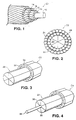
- C 1 illustrates an electrical transmission cable having a reinforced plastic composite load bearing core 10 and a plurality of outer layers of aluminum wire 12 and 14 extending thereabout.
- the load bearing core 10 is a solid reinforced plastic composite member. Also, in the embodiment as illustrated in Figure 1 and the subsequently illustrated and described embodiments, there are three outer aluminum layers 12, 18 and 14 (see Figure 1), although it should be understood that any number of outer layers could be employed depending upon the desired thickness of the outer current conducting sheath to be formed over the core. It can be observed that in this construction, the cable C 1 is similar in appearance to a conventional steel core cable. Consequently, it can be laid in the same fashion or suspended in the same fashion and using the same equipment as that employed for a steel core cable.
- the strands are formed of any suitable reinforcing fiber, such as glass, boron, carbon or the like.
- the resin matrix which is used to bind the strands may be formed of any suitable thermoplastic resin or thermosetting resin.
- thermosetting resins which may be used include, for example, various phenolics and epoxies and many polyesters which are conventionally known for that purpose.
- the thermoplastic resins are preferred and include, for example, polypropylene, polycarbonates, etc.
- the resin strands can be commingled with the fiber strands and they can be applied as a bundle. Otherwise, the resin strands can be applied individually with the fiber strands. Upon heating, the resin will then soften and liquefy and flow around the individual fiber containing strands. When the resin is allowed to harden, an inner core will therefore be formed.
- the composite core can be formed in any of a variety of ways.
- the composite core could be extruded, as such.
- the reinforced composite when formed as a rod in the embodiment as shown would preferably be pultruded.
- U.S. patents as, for example, U.S. Patent No. 3,650,864 to William Brandt Goldsworthy, U.S. Patent No. 3,576,705 to William Brandt Goldsworthy, U.S. Patent No. 3,769,127 to William Brandt Goldsworthy, and U.S. Patent No. 3,579,402 to William Brandt Goldsworthy, et al.
- the embodiment of Figure 1 is primarily effective for only short length cables. This is due to the fact that the reinforced plastic core 10 is not capable of significant bending movement. It may be appreciated that the entire cable must be capable of being wound about a drum and transported for a substantial distance where it would then be unwound from the drum and either suspended or laid at a site of use.
- the central core 10 is preferably formed of a plurality of individually shaped core sections 20, as best shown in the cable C 2 of Figure 2. In this particular case, the individual sections 20, when assembled together, create a cylindrically shaped cable 22.
- the cable C 2 is also wrapped with layers of electrically conductive material as, for example, individual strands of aluminum wire 24 and 26 which form the two outer electrically conductive layers. Again, any desired number of layers could be used. Furthermore, in the embodiment of Figure 2, the individual strands 24 and 26 are helically wound about the central load bearing core 22.
- Figure 3 illustrates an embodiment of a cable C 3 forming part of the present invention also having a segmented central core 22 and a pair of electrically conductive outer layers 30 and 32 wrapped about the central core.
- Figure 4 illustrates an embodiment of a cable C 4 similar to the cable C 3 , except that in this particular case, the individual pie-shaped sections 20 of the core 22 are formed with an arcuately shaped recess 34 formed at their inner most ends.
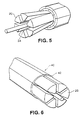
- the inner most ends 34 as shown in Figures 4 and 5, form a cylindrically shaped central, axially extending bore 36 which are sized to receive a fiber optic cable 38.
- This embodiment of a cable C 4 is highly effective in that it not only provides for substantial current carrying capacity, but it also allows for the carrying of a fiber optic cable in such manner that the cable is not subjected to environmental degradation or the constant repair required for such cable.
- each of the individual sections 20 may be pre-formed in an extrusion operation, or otherwise a pultrusion operation, as previously described.
- These individual sections when hardened, are then threaded through a die plate or carding plate 40 having individual tubes 42 with essentially the same shape as the individual core sections 20, but sized to receive these core sections 20.
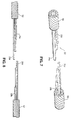
- Figures 7 and 8 illustrate a preferred embodiment for splicing the ends of the electrical transmission cable in accordance with the present invention.
- the individual cable sections 20 are each spliced with staggered ends, as best shown in Figure 7.
- one of the individual sections 20 a on one fiber optic cable 50 has a length which is longer than any other section of that cable 50.
- That particular core section 20 a will match and mate with the shortest cable section 20 b on an opposite cable 52 to be spliced.
- a shorter cable section 20 c on the cable 50 will match and mate with a cable section 20 d in the cable 52.
- each staggered length will mate with a corresponding staggered length of the opposite cable.
- the individual cable sections will then fit together much in the manner as pieces of a puzzle fit together.
- the individual staggered sections After the individual staggered sections have been brought together, they can be heated slightly to cause the thermoplastic resin or other resin to liquefy and flow between the staggered ends to thereby bind the staggered ends together.
- outer aluminum layers can then be coupled to one another in the same manner as they are presently coupled with steel core cables.
- outer electrically conductive layers of one cable 50 are connected to the outer electrically conductive layers of the cable 52 by use of electrically conductive sleeves which are secured thereto and extend over the joined ends, as best seen in Figure 9.
- the cable is brought to a ground level for connecting the ends of fiber optic cable sections.
- the technique for this arrangement is shown in the composite of Figures 9a through 9c.
- the two cable sections 50 and 52 when the splicing is completed are covered with an outer sheath 60, as shown in Figure 9a.
- Figure 9b which is a cross-section of Figure 9a, it can be seen that after the ends of the two cable sections 50 and 52 are spliced, the outer aluminum conductors 64 and 66 respectively on these cable sections are then brought together when the aluminum sleeve 60 is disposed thereover.
- the fiber optic cables Prior to actually installing the sheath, the fiber optic cables are brought to a ground level for purposes of splicing same. It can be seen by reference to Figure 9c that the cable sections are actually extended down toward a ground level for splicing at a splicing station and thereafter raised and located in the region of the sleeve 60 much in the manner as shown in Figure 9c.
- the electrical transmission cables of the invention also are adapted to carry more electrical current then a comparably sized steel core conductor. This is due to the fact that more of the highly conductive metal, such as aluminum, is capable of being carried with a reinforced plastic core then would be carried with a similarly sized steel cable with no weight increase and some weight decrease. As a result, support towers do not need to be rebuilt to accommodate heavier equivalent capacity conductors.
- the cables of the present invention will actually carry five percent more electrical current compared to a steel reinforced aluminum conductor. In addition, there is a reduced mechanical elongation or line sag at high operating temperatures. Further, it has actually been established that the cables of the invention are two hundred fifty percent stronger then the steel reinforced aluminum conductor of essentially the same size and, moreover, is seventy-five percent lighter than steel reinforced aluminum conductors.
Landscapes
- Physics & Mathematics (AREA)
- General Physics & Mathematics (AREA)
- Optics & Photonics (AREA)
- Engineering & Computer Science (AREA)
- Plasma & Fusion (AREA)
- Communication Cables (AREA)
- Processing Of Terminals (AREA)
- Non-Insulated Conductors (AREA)
- Superconductors And Manufacturing Methods Therefor (AREA)
- Conductive Materials (AREA)
- Electric Cable Installation (AREA)
- Suspension Of Electric Lines Or Cables (AREA)
Abstract
Description
Claims (11)
- An improved electrical current carrying conductor for long distance transmission of electrical current and having a central load carrying conductor and an outer sheath therearound, the improvement in said current carrying conductor further characterized in that:a) the load carrying core being formed of a fiber containing reinforced composite material; andb) the outer highly conductive electrical current carrying sheath completely surrounding said load carrying core.
- The improved electrical current carrying conductor of Claim 1 further characterized in that said reinforced composite material is comprised of a plurality of aligned reinforcing fibers embedded in a thermoplastic composite matrix.
- The improved electrical current carrying conductor of Claim 1 further characterized in that said central load carrying core is comprised of a plurality of individual sections which are capable of being separated from one another for purposes of splicing.
- The improved electrical current carrying conductor of Claim 3 further characterized in that said individual sections are concentrically arranged to form a cylindrically shaped conductor and that said individual sections are somewhat trapezoidal shaped and form a central bore sized to receive a fiber optic cable.
- An improved method for producing a long distance transmission current carrying conductor of Claim 1 wherein the improved method is characterized in the steps of:a) bringing a plurality of individual reinforced plastic composite sections together to form a generally cylindrically shaped conductor core; andb) locating on an outer cylindrically shaped surface of said core an outer highly conductive electrical current carrying conductor.
- The improved method for producing a long distance transmission current carrying conductor of Claim 5 further characterized in that said step of locating the current carrying conductor comprises winding strands of a highly conductive current carrying conductor about said central core.
- The improved method for producing a long distance transmission current carrying conductor of Claim 5 further characterized in that said method comprises the bringing of the composite sections together about a fiber optic cable so that the current carrying conductor also includes a fiber optic cable therein.
- A method for splicing ends of improved first and second current carrying cables of Claim 5 comprised of a fiber containing reinforced plastic composite core and an outer highly conductive current carrying sheath, said method comprising:a) cutting the ends of the individual sections of a first cable to be spliced at staggered lengths relative to one another so that each section of the central core of that cable has a length different from the length of any other section of that first cable;b) cutting the ends of the individual sections of a second cable to be spliced at staggered lengths relative to one another so that each section of the central core of that second cable has a length different from the length of any other section of that second cable;c) matching the ends of the first cable sections with corresponding ends of the second cable so that the ends of the first cable sections will abut against corresponding ends of the second cable sections when all of the individual sections are abutted;d) heating spliced ends of the individual cable sections as abutted to cause a resin impregnated in the cables to partially liquefy and effectively flow around corresponding ends; ande) allowing the resin to cool thereby permanently bonding the core sections of the first cable to the core sections of the second cable.
- The method of splicing cables of Claim 8 further characterized in that said method comprises matching the shortest length of a cable section of the first cable with the longest length cable section of the second cable and correspondingly matching the longest length section of the first cable with the correspondingly shortest length section of the second cable.
- The method of splicing cables of Claim 9 further characterized in that said method comprises securing the ends of an electrically conductive current carrying sheath on said first and second cables together in order to permit electrical conductivity through the sheaths of said cables.
- The method of splicing cables of Claim 8 further characterized in that said method also comprises splicing the ends of fiber optic cables carried in the core of each of the individual first and second cables.
Priority Applications (1)
| Application Number | Priority Date | Filing Date | Title |
|---|---|---|---|
| EP08004899A EP1930914A3 (en) | 2000-02-08 | 2001-02-06 | Composite reinforced electrical transmission conductor |
Applications Claiming Priority (2)
| Application Number | Priority Date | Filing Date | Title |
|---|---|---|---|
| US50028500A | 2000-02-08 | 2000-02-08 | |
| US500285 | 2000-02-08 |
Related Child Applications (1)
| Application Number | Title | Priority Date | Filing Date |
|---|---|---|---|
| EP08004899A Division EP1930914A3 (en) | 2000-02-08 | 2001-02-06 | Composite reinforced electrical transmission conductor |
Publications (3)
| Publication Number | Publication Date |
|---|---|
| EP1124235A2 true EP1124235A2 (en) | 2001-08-16 |
| EP1124235A3 EP1124235A3 (en) | 2002-11-06 |
| EP1124235B1 EP1124235B1 (en) | 2008-10-15 |
Family
ID=23988756
Family Applications (2)
| Application Number | Title | Priority Date | Filing Date |
|---|---|---|---|
| EP08004899A Withdrawn EP1930914A3 (en) | 2000-02-08 | 2001-02-06 | Composite reinforced electrical transmission conductor |
| EP01102558A Expired - Lifetime EP1124235B1 (en) | 2000-02-08 | 2001-02-06 | Composite reinforced electrical transmission conductor |
Family Applications Before (1)
| Application Number | Title | Priority Date | Filing Date |
|---|---|---|---|
| EP08004899A Withdrawn EP1930914A3 (en) | 2000-02-08 | 2001-02-06 | Composite reinforced electrical transmission conductor |
Country Status (9)
| Country | Link |
|---|---|
| US (4) | US7015395B2 (en) |
| EP (2) | EP1930914A3 (en) |
| JP (1) | JP2001307552A (en) |
| AT (1) | ATE411607T1 (en) |
| DE (1) | DE60136116D1 (en) |
| DK (1) | DK1124235T3 (en) |
| ES (1) | ES2315249T3 (en) |
| GE (1) | GEP20105120B (en) |
| TW (1) | TW480497B (en) |
Cited By (12)
| Publication number | Priority date | Publication date | Assignee | Title |
|---|---|---|---|---|
| WO2003091008A1 (en) | 2002-04-23 | 2003-11-06 | Composite Technology Corporation | Aluminum conductor composite core reinforced cable and method of manufacture |
| WO2005089410A3 (en) * | 2004-03-17 | 2006-03-09 | Gift Technologies Lp | Electrical conductor cable and method for forming the same |
| US7019217B2 (en) | 2002-04-23 | 2006-03-28 | Ctc Cable Corporation | Collet-type splice and dead end use with an aluminum conductor composite core reinforced cable |
| US7179522B2 (en) | 2002-04-23 | 2007-02-20 | Ctc Cable Corporation | Aluminum conductor composite core reinforced cable and method of manufacture |
| US7298957B2 (en) | 2005-07-11 | 2007-11-20 | Gift Technologies, Lp | Method for controlling sagging of a power transmission cable |
| EP1928001A1 (en) * | 2006-12-01 | 2008-06-04 | Nexans | Electrical transport conductor for overhead line |
| EP1678063A4 (en) * | 2003-10-22 | 2008-10-08 | Ctc Cable Corp | Aluminum conductor composite core reinforced cable and method of manufacture |
| US7438971B2 (en) | 2003-10-22 | 2008-10-21 | Ctc Cable Corporation | Aluminum conductor composite core reinforced cable and method of manufacture |
| US7563983B2 (en) | 2002-04-23 | 2009-07-21 | Ctc Cable Corporation | Collet-type splice and dead end for use with an aluminum conductor composite core reinforced cable |
| US20100181012A1 (en) * | 2002-04-23 | 2010-07-22 | Ctc Cable Corporation | Method for the manufacture of a composite core for an electrical cable |
| CN101807446A (en) * | 2010-04-01 | 2010-08-18 | 张国志 | Cable composite core and manufacturing method thereof |
| EP1992053A4 (en) * | 2006-03-07 | 2016-10-19 | 3M Innovative Properties Co | Installation of spliced electrical transmission cables |
Families Citing this family (89)
| Publication number | Priority date | Publication date | Assignee | Title |
|---|---|---|---|---|
| EP1930914A3 (en) * | 2000-02-08 | 2009-07-22 | Gift Technologies, LLC | Composite reinforced electrical transmission conductor |
| FI119583B (en) * | 2003-02-26 | 2008-12-31 | Imbera Electronics Oy | Procedure for manufacturing an electronics module |
| US20050186410A1 (en) * | 2003-04-23 | 2005-08-25 | David Bryant | Aluminum conductor composite core reinforced cable and method of manufacture |
| US7131308B2 (en) * | 2004-02-13 | 2006-11-07 | 3M Innovative Properties Company | Method for making metal cladded metal matrix composite wire |
| US20050181228A1 (en) * | 2004-02-13 | 2005-08-18 | 3M Innovative Properties Company | Metal-cladded metal matrix composite wire |
| US20050279526A1 (en) * | 2004-06-17 | 2005-12-22 | Johnson Douglas E | Cable and method of making the same |
| US20050279527A1 (en) * | 2004-06-17 | 2005-12-22 | Johnson Douglas E | Cable and method of making the same |
| US7093416B2 (en) * | 2004-06-17 | 2006-08-22 | 3M Innovative Properties Company | Cable and method of making the same |
| JP2006339144A (en) * | 2005-05-31 | 2006-12-14 | Ngk Insulators Ltd | Plasma processing equipment |
| US7262595B2 (en) * | 2005-07-27 | 2007-08-28 | Simmonds Precision Products, Inc. | Segmented core for an inductive proximity sensor |
| FR2896911B1 (en) * | 2006-02-01 | 2008-03-21 | Nexans Sa | ELECTRICAL TRANSPORT CONDUCTOR FOR AERIAL LINE |
| US8024908B2 (en) | 2006-05-18 | 2011-09-27 | Williams Donald S | Pultruded utility structures |
| US8359814B2 (en) * | 2006-05-18 | 2013-01-29 | Duratel, Inc. | Pultruded/extruded utility lighting, mounting and climbing structures |
| US8322105B2 (en) * | 2006-05-18 | 2012-12-04 | Duratel, Llc | Pultruded utility support structures |
| US20110135423A1 (en) * | 2006-05-18 | 2011-06-09 | Duratel, Llc | Apparatus for transporting and raising pultruded/extruded utility support structures |
| US7390963B2 (en) * | 2006-06-08 | 2008-06-24 | 3M Innovative Properties Company | Metal/ceramic composite conductor and cable including same |
| US7403686B1 (en) * | 2006-11-30 | 2008-07-22 | The United States Of America As Represented By The Secretary Of The Navy | Fiber optic cable splicing technique |
| US8246393B2 (en) * | 2007-03-12 | 2012-08-21 | Hubbell Incorporated | Implosion connector and method for use with transmission line conductors comprising composite cores |
| US8471416B2 (en) * | 2008-05-29 | 2013-06-25 | Lionel O. Barthold | In situ reconstruction of high voltage electric power lines |
| JP4883051B2 (en) * | 2008-06-19 | 2012-02-22 | トヨタ自動車株式会社 | Wire Harness |
| EP2301045B1 (en) | 2008-06-27 | 2013-02-20 | Union Carbide Chemicals & Plastics Technology LLC | Pultrusion process for the manufacture of fiber reinforced composites |
| CA2729741A1 (en) * | 2008-07-01 | 2010-01-07 | Dow Global Technologies Inc. | Fiber-polymer composite |
| KR101709368B1 (en) | 2009-07-16 | 2017-02-22 | 쓰리엠 이노베이티브 프로퍼티즈 컴파니 | Submersible composite cable and methods |
| EP2499175B2 (en) | 2009-11-11 | 2022-08-17 | Borealis AG | A polymer composition and a power cable comprising the polymer composition |
| EP2499176B2 (en) | 2009-11-11 | 2022-08-10 | Borealis AG | Power cable comprising a polymer composition comprising a polyolefin produced in a high pressure process |
| CN102666602B (en) | 2009-11-11 | 2015-11-25 | 博瑞立斯有限公司 | There is crosslinkable polymer composition and the cable of favourable electrical property |
| CN102597093B (en) | 2009-11-11 | 2015-01-07 | 博瑞立斯有限公司 | A cable and production process thereof |
| US8308505B2 (en) * | 2009-12-09 | 2012-11-13 | Scott Hatton | Guarded coaxial cable assembly |
| US9362022B2 (en) * | 2010-01-20 | 2016-06-07 | Furukawa Electric Co., Ltd. | Composite electric cable and process for producing same |
| EP2532012A1 (en) * | 2010-02-01 | 2012-12-12 | 3M Innovative Properties Company | Stranded thermoplastic polymer composite cable, method of making and using same |
| WO2011127248A1 (en) * | 2010-04-08 | 2011-10-13 | Ncc Nano, Llc | Apparatus for curing thin films on a moving substrate |
| US10422578B2 (en) * | 2010-04-08 | 2019-09-24 | Ncc Nano, Pllc | Apparatus for curing thin films on a moving substrate |
| US8648254B2 (en) * | 2010-04-27 | 2014-02-11 | Michels Corporation | Device and method for stringing overhead cable |
| US20110298981A1 (en) * | 2010-06-07 | 2011-12-08 | Mark Kenneth Eyer | Scripted Access to Hidden Multimedia Assets |
| US8568015B2 (en) | 2010-09-23 | 2013-10-29 | Willis Electric Co., Ltd. | Decorative light string for artificial lighted tree |
| EP2450910B1 (en) | 2010-11-03 | 2019-09-25 | Borealis AG | A polymer composition and a power cable comprising the polymer composition |
| JP5698971B2 (en) * | 2010-12-28 | 2015-04-08 | 宇部エクシモ株式会社 | Manufacturing method of spacer for optical cable |
| WO2012102762A1 (en) | 2011-01-24 | 2012-08-02 | Gift Technologies, Llc | Composite core conductors and method of making the same |
| HUE033251T2 (en) | 2011-04-12 | 2017-11-28 | Southwire Co Llc | Electrical transmission cables with composite cores |
| TW201308362A (en) | 2011-04-12 | 2013-02-16 | Ticona Llc | Composite core for electrical transmission cables |
| EP2697041B1 (en) | 2011-04-12 | 2018-10-17 | Ticona LLC | Impregnation section of die and method for impregnating fiber rovings |
| WO2012141688A1 (en) | 2011-04-12 | 2012-10-18 | Ticona Llc | Die and method for impregnating fiber rovings |
| EP2697043A1 (en) | 2011-04-12 | 2014-02-19 | Ticona LLC | Continious fiber reinforced thermoplastic rod and pultrusion method for its manufacture |
| CN103477020A (en) | 2011-04-12 | 2013-12-25 | 提克纳有限责任公司 | Umbilicals for subsea applications |
| CA2775442C (en) | 2011-04-29 | 2019-01-08 | Ticona Llc | Impregnation section with upstream surface and method for impregnating fiber rovings |
| PL2701886T3 (en) | 2011-04-29 | 2017-06-30 | Ticona Llc | Die with flow diffusing gate passage and method for impregnating fiber rovings |
| CA2775445C (en) | 2011-04-29 | 2019-04-09 | Ticona Llc | Die and method for impregnating fiber rovings |
| US10336016B2 (en) | 2011-07-22 | 2019-07-02 | Ticona Llc | Extruder and method for producing high fiber density resin structures |
| US8569960B2 (en) | 2011-11-14 | 2013-10-29 | Willis Electric Co., Ltd | Conformal power adapter for lighted artificial tree |
| US9157587B2 (en) | 2011-11-14 | 2015-10-13 | Willis Electric Co., Ltd. | Conformal power adapter for lighted artificial tree |
| US9624350B2 (en) | 2011-12-09 | 2017-04-18 | Ticona Llc | Asymmetric fiber reinforced polymer tape |
| WO2013086259A1 (en) | 2011-12-09 | 2013-06-13 | Ticona Llc | Die and method for impregnating fiber rovings |
| US9283708B2 (en) | 2011-12-09 | 2016-03-15 | Ticona Llc | Impregnation section for impregnating fiber rovings |
| WO2013086267A1 (en) | 2011-12-09 | 2013-06-13 | Ticona Llc | Impregnation section of die for impregnating fiber rovings |
| US9289936B2 (en) | 2011-12-09 | 2016-03-22 | Ticona Llc | Impregnation section of die for impregnating fiber rovings |
| US8474221B1 (en) | 2012-01-20 | 2013-07-02 | Trident Industries, LLC | Telescoping fiberglass utility pole |
| US9044056B2 (en) | 2012-05-08 | 2015-06-02 | Willis Electric Co., Ltd. | Modular tree with electrical connector |
| WO2013188644A1 (en) | 2012-06-15 | 2013-12-19 | Ticona Llc | Subsea pipe section with reinforcement layer |
| US9859038B2 (en) | 2012-08-10 | 2018-01-02 | General Cable Technologies Corporation | Surface modified overhead conductor |
| CN102903424B (en) * | 2012-09-28 | 2017-10-27 | 中国电力科学研究院 | One kind is sparsely stranded type expanded diameter conductor |
| US10957468B2 (en) | 2013-02-26 | 2021-03-23 | General Cable Technologies Corporation | Coated overhead conductors and methods |
| US9157588B2 (en) * | 2013-09-13 | 2015-10-13 | Willis Electric Co., Ltd | Decorative lighting with reinforced wiring |
| US11306881B2 (en) | 2013-09-13 | 2022-04-19 | Willis Electric Co., Ltd. | Tangle-resistant decorative lighting assembly |
| US9140438B2 (en) | 2013-09-13 | 2015-09-22 | Willis Electric Co., Ltd. | Decorative lighting with reinforced wiring |
| US20150104641A1 (en) | 2013-10-10 | 2015-04-16 | Emisshield, Inc. | Coated overhead conductor |
| AR099038A1 (en) | 2014-01-08 | 2016-06-22 | General Cable Tech Corp | COVERED AIR CONDUCTOR |
| EP3129991B1 (en) * | 2014-04-09 | 2021-03-03 | De Angeli Prodotti S.r.l. | Conductor for bare overhead electric lines, especially for middle-high thermal limit, and low expansion at high electronic loads |
| BR112017002151A2 (en) | 2014-08-05 | 2018-07-03 | Gen Cable Technologies Corp | fluorine coatings copolymers for air conductors |
| WO2016049191A1 (en) | 2014-09-23 | 2016-03-31 | General Cable Technologies Corporation | Electrodeposition mediums for formation of protective coatings electrochemically deposited on metal substrates |
| LT3213327T (en) * | 2014-09-26 | 2021-01-11 | Jianping Huang | Energy efficient conductors with reduced thermal knee points and the method of manufacture thereof |
| US9633766B2 (en) * | 2014-09-26 | 2017-04-25 | Jianping Huang | Energy efficient conductors with reduced thermal knee points and the method of manufacture thereof |
| WO2016122446A1 (en) | 2015-01-26 | 2016-08-04 | Schlumberger Canada Limited | Electrically conductive fiber optic slickline for coiled tubing operations |
| US10726975B2 (en) | 2015-07-21 | 2020-07-28 | General Cable Technologies Corporation | Electrical accessories for power transmission systems and methods for preparing such electrical accessories |
| CN105680391B (en) * | 2015-09-06 | 2018-03-02 | 北京帕尔普线路器材有限公司 | A kind of composite core strengthens cable strain clamp |
| EP3363025B1 (en) | 2015-10-14 | 2021-12-08 | General Cable Technologies Corporation | Cables and wires having conductive elements formed from improved aluminum-zirconium alloys |
| CA2946387A1 (en) | 2015-10-26 | 2017-04-26 | Willis Electric Co., Ltd. | Tangle-resistant decorative lighting assembly |
| CN108431146A (en) | 2015-11-13 | 2018-08-21 | 通用线缆技术公司 | Cable coated with fluorinated copolymer coating |
| BR112018072705A2 (en) | 2016-05-04 | 2019-04-24 | General Cable Technologies Corporation | compositions and coatings that reduce adhesion and ice build-up on them |
| US10049789B2 (en) | 2016-06-09 | 2018-08-14 | Schlumberger Technology Corporation | Compression and stretch resistant components and cables for oilfield applications |
| US9755734B1 (en) * | 2016-06-09 | 2017-09-05 | Google Inc. | Subsea optical communication network |
| WO2018075934A1 (en) | 2016-10-20 | 2018-04-26 | General Cable Technologies Corporation | Durable coating compositions and coatings formed thereof |
| HUE064330T2 (en) | 2016-10-28 | 2024-03-28 | Gen Cable Technologies Corp | Ambient cured coating compositions for cables and cable accessories |
| US11107604B2 (en) * | 2017-02-08 | 2021-08-31 | Prysmian S.P.A | Cable or flexible pipe with improved tensile elements |
| CN109448917A (en) * | 2018-11-02 | 2019-03-08 | 江苏中天科技股份有限公司 | A kind of energy-saving low arc drop extra-heavy steel reinforced soft aluminum strand and its production technology |
| CN110660518A (en) * | 2019-10-14 | 2020-01-07 | 江苏泰祥电线电缆有限公司 | High-strength tensile cable for ladle car |
| US11854721B2 (en) | 2022-03-28 | 2023-12-26 | Ts Conductor Corp. | Composite conductors including radiative and/or hard coatings and methods of manufacture thereof |
| CA3250374A1 (en) | 2022-04-26 | 2023-11-02 | Ts Conductor Corp. | Earth wire including composite core and encapsulation layer and method of use thereof |
| CL2022001746A1 (en) * | 2022-06-24 | 2022-11-18 | Cable for laying overhead power lines with catenary for railways with pantograph. | |
| US12580094B2 (en) | 2023-10-12 | 2026-03-17 | Prysmian S.P.A. | Overhead conductors with high-temperature resistant cured coatings |
Family Cites Families (40)
| Publication number | Priority date | Publication date | Assignee | Title |
|---|---|---|---|---|
| US32374A (en) * | 1861-05-21 | Portfolio foe filing music | ||
| FR959407A (en) | 1947-01-11 | 1950-03-30 | ||
| US2901725A (en) * | 1954-12-13 | 1959-08-25 | Fargo Mfg Co Inc | Line splice clamp |
| US3324233A (en) * | 1965-04-08 | 1967-06-06 | Amphenol Corp | Cable complex employing strand twist reversal to absorb longitudinal expansion |
| US3384247A (en) * | 1965-10-22 | 1968-05-21 | Harold C. Teagle | Universal mount apparatus |
| US3576705A (en) | 1967-10-12 | 1971-04-27 | William B Goldsworthy | Uncured resin coated filament reinforced product |
| US3579402A (en) | 1968-04-23 | 1971-05-18 | Goldsworthy Eng Inc | Method and apparatus for producing filament reinforced tubular products on a continuous basis |
| US3769127A (en) | 1968-04-23 | 1973-10-30 | Goldsworthy Eng Inc | Method and apparatus for producing filament reinforced tubular products on a continuous basis |
| US3650864A (en) | 1969-07-23 | 1972-03-21 | Goldsworthy Eng Inc | Method for making filament reinforced a-stage profiles |
| US3717720A (en) * | 1971-03-22 | 1973-02-20 | Norfin | Electrical transmission cable system |
| US3996417A (en) * | 1974-09-12 | 1976-12-07 | Aluminum Company Of America | Cable core grip, electrical cable and connector assembly, and electrical connector kit |
| GB1478705A (en) * | 1974-09-13 | 1977-07-06 | Furukawa Electric Co Ltd | Connector for fibre reinforced plastics filaments or cord |
| CA1112310A (en) * | 1977-05-13 | 1981-11-10 | Peter Fearns | Overhead electric transmission systems |
| FR2422969A1 (en) * | 1978-03-31 | 1979-11-09 | Kokusai Denshin Denwa Co Ltd | FIBER OPTIC UNDERWATER CABLE |
| DE3169897D1 (en) * | 1980-12-19 | 1985-05-15 | Kupferdraht Isolierwerk Ag | Overhead cable with tension members |
| US4441787A (en) * | 1981-04-29 | 1984-04-10 | Cooper Industries, Inc. | Fiber optic cable and method of manufacture |
| JPS6045212A (en) * | 1983-08-23 | 1985-03-11 | Sumitomo Electric Ind Ltd | fiber optic cable |
| IT1174109B (en) * | 1984-05-29 | 1987-07-01 | Pirelli Cavi Spa | IMPROVEMENT OF SUBMARINE OPTICAL CABLES FOR TELECOMMUNICATIONS |
| GB8600294D0 (en) * | 1986-01-07 | 1986-02-12 | Bicc Plc | Optical cable |
| US5285613A (en) * | 1992-01-31 | 1994-02-15 | Goldsworthy W Brandt | Pultruded joint system and tower structure made therewith |
| US4770489A (en) * | 1986-08-27 | 1988-09-13 | Sumitomo Electric Research Triangle, Inc. | Ruggedized optical communication cable |
| DE3935017A1 (en) * | 1989-10-20 | 1991-04-25 | Kabelmetal Electro Gmbh | Jointing system for electric cable with high tensile core - has modified crimp connector with transverse holes for anchoring high tensile plastic core using conventional tools |
| JPH07113068B2 (en) | 1989-12-11 | 1995-12-06 | 東レ株式会社 | Fiber-reinforced foam and method for producing the same |
| DE4000605A1 (en) * | 1990-01-11 | 1991-07-18 | Philips Patentverwaltung | ELECTRICAL WIRING CABLE WITH INTEGRATED OPTICAL NEWS LINE |
| DE9013175U1 (en) * | 1990-09-17 | 1991-02-21 | Felten & Guilleaume Energietechnik AG, 5000 Köln | Electro-optical overhead cable with 24 or more optical fibers |
| FR2675963B1 (en) * | 1991-04-29 | 1993-07-23 | Electricite De France | HELICOPTERED PLATFORM AND METHOD OF USING THE SAME TO REPLACE A PORTION OF AN AIR CABLE. |
| JPH05154919A (en) * | 1991-12-03 | 1993-06-22 | Fujikura Ltd | How to connect FRP filament |
| DE4142047C2 (en) | 1991-12-19 | 2001-03-01 | Siemens Ag | Method for covering at least one optical waveguide with a protective layer and for attaching reinforcing elements |
| CA2058412C (en) * | 1991-12-31 | 1994-12-06 | Toru Kojima | Twisted cable |
| US6343363B1 (en) * | 1994-09-22 | 2002-01-29 | National Semiconductor Corporation | Method of invoking a low power mode in a computer system using a halt instruction |
| JP2588486Y2 (en) | 1992-06-30 | 1999-01-13 | 古河電気工業株式会社 | Overhead wire |
| JPH08335357A (en) * | 1995-06-08 | 1996-12-17 | Fujitsu Ltd | Storage device |
| US6245425B1 (en) * | 1995-06-21 | 2001-06-12 | 3M Innovative Properties Company | Fiber reinforced aluminum matrix composite wire |
| US5808239A (en) * | 1996-02-29 | 1998-09-15 | Deepsea Power & Light | Video push-cable |
| US5822484A (en) * | 1996-06-21 | 1998-10-13 | Lucent Technologies Inc. | Lightweight optical groundwire |
| US5714870A (en) * | 1996-12-18 | 1998-02-03 | Intel Corporation | Method for measuring suspend-time power consumption in a battery-powered electronic device |
| JPH10321048A (en) * | 1997-05-16 | 1998-12-04 | Furukawa Electric Co Ltd:The | Tension member, lightweight low-loose overhead wire using it |
| JP2001154844A (en) * | 1999-11-30 | 2001-06-08 | Nec Corp | Single chip microcomputer |
| EP1930914A3 (en) * | 2000-02-08 | 2009-07-22 | Gift Technologies, LLC | Composite reinforced electrical transmission conductor |
| US6986070B2 (en) * | 2000-12-28 | 2006-01-10 | Denso Corporation | Microcomputer that cooperates with an external apparatus to be driven by a drive signal |
-
2001
- 2001-02-06 EP EP08004899A patent/EP1930914A3/en not_active Withdrawn
- 2001-02-06 EP EP01102558A patent/EP1124235B1/en not_active Expired - Lifetime
- 2001-02-06 DE DE60136116T patent/DE60136116D1/en not_active Expired - Lifetime
- 2001-02-06 AT AT01102558T patent/ATE411607T1/en active
- 2001-02-06 DK DK01102558T patent/DK1124235T3/en active
- 2001-02-06 ES ES01102558T patent/ES2315249T3/en not_active Expired - Lifetime
- 2001-02-08 JP JP2001032774A patent/JP2001307552A/en active Pending
- 2001-03-27 TW TW090102655A patent/TW480497B/en not_active IP Right Cessation
- 2001-12-28 US US10/037,814 patent/US7015395B2/en not_active Expired - Fee Related
-
2005
- 2005-07-27 US US11/191,863 patent/US20060016616A1/en not_active Abandoned
-
2008
- 2008-01-09 US US12/008,389 patent/US7752754B2/en not_active Expired - Fee Related
-
2010
- 2010-05-10 GE GEAP201011791A patent/GEP20105120B/en unknown
- 2010-05-26 US US12/788,182 patent/US8371028B2/en not_active Expired - Fee Related
Cited By (23)
| Publication number | Priority date | Publication date | Assignee | Title |
|---|---|---|---|---|
| US7368162B2 (en) | 2002-04-23 | 2008-05-06 | Ctc Cable Corporation | Aluminum conductor composite core reinforced cable and method of manufacture |
| WO2003091008A1 (en) | 2002-04-23 | 2003-11-06 | Composite Technology Corporation | Aluminum conductor composite core reinforced cable and method of manufacture |
| US7019217B2 (en) | 2002-04-23 | 2006-03-28 | Ctc Cable Corporation | Collet-type splice and dead end use with an aluminum conductor composite core reinforced cable |
| EP1506085B1 (en) | 2002-04-23 | 2016-12-07 | CTC Global Corporation | Aluminum conductor composite core reinforced cable and method of manufacture |
| US7060326B2 (en) | 2002-04-23 | 2006-06-13 | Composite Technology Corporation | Aluminum conductor composite core reinforced cable and method of manufacture |
| US7179522B2 (en) | 2002-04-23 | 2007-02-20 | Ctc Cable Corporation | Aluminum conductor composite core reinforced cable and method of manufacture |
| US7211319B2 (en) | 2002-04-23 | 2007-05-01 | Ctc Cable Corporation | Aluminum conductor composite core reinforced cable and method of manufacture |
| US9093191B2 (en) | 2002-04-23 | 2015-07-28 | CTC Global Corp. | Fiber reinforced composite core for an aluminum conductor cable |
| US20100181012A1 (en) * | 2002-04-23 | 2010-07-22 | Ctc Cable Corporation | Method for the manufacture of a composite core for an electrical cable |
| US7563983B2 (en) | 2002-04-23 | 2009-07-21 | Ctc Cable Corporation | Collet-type splice and dead end for use with an aluminum conductor composite core reinforced cable |
| US7041909B2 (en) | 2002-04-23 | 2006-05-09 | Compsite Technology Corporation | Methods of installing and apparatuses to install an aluminum conductor composite core reinforced cable |
| US8022301B2 (en) | 2003-04-23 | 2011-09-20 | Ctc Cable Corporation | Collet-type splice and dead end for use with an aluminum conductor composite core reinforced cable |
| US7608783B2 (en) | 2003-04-23 | 2009-10-27 | Ctc Cable Corporation | Collet-type splice and dead end for use with an aluminum conductor composite core reinforced cable |
| EP1678063A4 (en) * | 2003-10-22 | 2008-10-08 | Ctc Cable Corp | Aluminum conductor composite core reinforced cable and method of manufacture |
| US7438971B2 (en) | 2003-10-22 | 2008-10-21 | Ctc Cable Corporation | Aluminum conductor composite core reinforced cable and method of manufacture |
| AU2004284079B2 (en) * | 2003-10-22 | 2011-08-18 | Ctc Cable Corporation | Aluminum conductor composite core reinforced cable and method of manufacture |
| WO2005089410A3 (en) * | 2004-03-17 | 2006-03-09 | Gift Technologies Lp | Electrical conductor cable and method for forming the same |
| US7298957B2 (en) | 2005-07-11 | 2007-11-20 | Gift Technologies, Lp | Method for controlling sagging of a power transmission cable |
| EP1992053A4 (en) * | 2006-03-07 | 2016-10-19 | 3M Innovative Properties Co | Installation of spliced electrical transmission cables |
| FR2909481A1 (en) * | 2006-12-01 | 2008-06-06 | Nexans Sa | ELECTRICAL TRANSPORT CONDUCTOR FOR AERIAL LINE |
| US7683262B2 (en) * | 2006-12-01 | 2010-03-23 | Nexans | Power transmission conductor for an overhead line |
| EP1928001A1 (en) * | 2006-12-01 | 2008-06-04 | Nexans | Electrical transport conductor for overhead line |
| CN101807446A (en) * | 2010-04-01 | 2010-08-18 | 张国志 | Cable composite core and manufacturing method thereof |
Also Published As
| Publication number | Publication date |
|---|---|
| EP1930914A2 (en) | 2008-06-11 |
| ES2315249T3 (en) | 2009-04-01 |
| US7015395B2 (en) | 2006-03-21 |
| GEP20105120B (en) | 2010-11-25 |
| US20060016616A1 (en) | 2006-01-26 |
| US8371028B2 (en) | 2013-02-12 |
| EP1930914A3 (en) | 2009-07-22 |
| US20040026112A1 (en) | 2004-02-12 |
| US20080172873A1 (en) | 2008-07-24 |
| TW480497B (en) | 2002-03-21 |
| DK1124235T3 (en) | 2009-02-16 |
| US7752754B2 (en) | 2010-07-13 |
| DE60136116D1 (en) | 2008-11-27 |
| EP1124235A3 (en) | 2002-11-06 |
| EP1124235B1 (en) | 2008-10-15 |
| US20100293783A1 (en) | 2010-11-25 |
| JP2001307552A (en) | 2001-11-02 |
| ATE411607T1 (en) | 2008-10-15 |
Similar Documents
| Publication | Publication Date | Title |
|---|---|---|
| EP1124235B1 (en) | Composite reinforced electrical transmission conductor | |
| US8798418B2 (en) | Optical cable with improved strippability | |
| US4606604A (en) | Optical fiber submarine cable and method of making | |
| US3717720A (en) | Electrical transmission cable system | |
| RU2501109C2 (en) | Insulated composite electric cable and method of its manufacturing and use | |
| US5374780A (en) | Composite insulator structure and method of construction | |
| JP2001307552A5 (en) | ||
| EP1168374A2 (en) | Composite reinforced electrical transmission conductor | |
| CA2255175A1 (en) | Fiber optic cable | |
| JPH09218329A (en) | Fiber optic micro cable | |
| JPH0564807U (en) | Optical cable element | |
| US5619606A (en) | Method of manufacturing a reinforced cable containing optical fibers apparatus for implementing the method and a cable obtained by performing the method | |
| EP0110507A1 (en) | Optical fibre cables | |
| GB2079485A (en) | Armoured wire splices | |
| US20050205287A1 (en) | Electrical conductor cable and method for forming the same | |
| CN200990254Y (en) | Compound reinforced electric transmission conductor | |
| HK1122395A (en) | Composite reinforced electrical transmission conductor | |
| JP7843712B2 (en) | Termination arrangement of overhead electrical cables with tensile strain sheaths | |
| GB2262470A (en) | Process and apparatus for the formation of elongate composite pultrusions | |
| WO2003050825A1 (en) | High voltage electrical power transmission cable having composite-composite wire with carbon or ceramic fiber reinforcement | |
| EP1325373B1 (en) | A method and a device for ensuring a satisfactory tensile strength when jointing a submarine cable | |
| EP3680696A1 (en) | Carbon nanotube yarns and optical fibers composite ribbon cable | |
| JP3472149B2 (en) | Spacer for optical fiber cable and method of manufacturing the same | |
| JPH01304408A (en) | Optical fiber cable | |
| JPH0511224U (en) | Optical fiber composite lead-in wire |
Legal Events
| Date | Code | Title | Description |
|---|---|---|---|
| PUAI | Public reference made under article 153(3) epc to a published international application that has entered the european phase |
Free format text: ORIGINAL CODE: 0009012 |
|
| AK | Designated contracting states |
Kind code of ref document: A2 Designated state(s): AT BE CH CY DE DK ES FI FR GB GR IE IT LI LU MC NL PT SE TR |
|
| AX | Request for extension of the european patent |
Free format text: AL;LT;LV;MK;RO;SI |
|
| PUAL | Search report despatched |
Free format text: ORIGINAL CODE: 0009013 |
|
| RAP1 | Party data changed (applicant data changed or rights of an application transferred) |
Owner name: W. BRANDT GOLDSWORTHY & ASSOCIATES, INC. |
|
| RIN1 | Information on inventor provided before grant (corrected) |
Inventor name: W. BRANDT GOLDSWORTHY & ASSOCIATES, INC. |
|
| AK | Designated contracting states |
Kind code of ref document: A3 Designated state(s): AT BE CH CY DE DK ES FI FR GB GR IE IT LI LU MC NL PT SE TR |
|
| AX | Request for extension of the european patent |
Free format text: AL;LT;LV;MK;RO;SI |
|
| REG | Reference to a national code |
Ref country code: DE Ref legal event code: 8566 |
|
| 17P | Request for examination filed |
Effective date: 20030505 |
|
| AKX | Designation fees paid |
Designated state(s): AT BE CH CY DE DK ES FI FR GB GR IE IT LI LU MC NL PT SE TR |
|
| 17Q | First examination report despatched |
Effective date: 20070618 |
|
| GRAP | Despatch of communication of intention to grant a patent |
Free format text: ORIGINAL CODE: EPIDOSNIGR1 |
|
| RIN1 | Information on inventor provided before grant (corrected) |
Inventor name: KORZENIOWSKI, GEORGE Inventor name: GOLDSWORTHY, WILLIAM BRANDT |
|
| GRAS | Grant fee paid |
Free format text: ORIGINAL CODE: EPIDOSNIGR3 |
|
| GRAA | (expected) grant |
Free format text: ORIGINAL CODE: 0009210 |
|
| AK | Designated contracting states |
Kind code of ref document: B1 Designated state(s): AT BE CH CY DE DK ES FI FR GB GR IE IT LI LU MC NL PT SE TR |
|
| REG | Reference to a national code |
Ref country code: CH Ref legal event code: EP Ref country code: GB Ref legal event code: FG4D |
|
| REG | Reference to a national code |
Ref country code: IE Ref legal event code: FG4D |
|
| REF | Corresponds to: |
Ref document number: 60136116 Country of ref document: DE Date of ref document: 20081127 Kind code of ref document: P |
|
| REG | Reference to a national code |
Ref country code: CH Ref legal event code: NV Representative=s name: FIAMMENGHI-FIAMMENGHI |
|
| REG | Reference to a national code |
Ref country code: CH Ref legal event code: PUE Owner name: GIFT TECHNOLOGIES, LLC Free format text: W. BRANDT GOLDSWORTHY & ASSOCIATES, INC.#23920-40 MADISON STREET#TORRANCE, CALIFORNIA 90505 (US) -TRANSFER TO- GIFT TECHNOLOGIES, LLC#24030 FRAMPTON AVENUE#HARBOR CITY, CA 90710 (US) |
|
| REG | Reference to a national code |
Ref country code: SE Ref legal event code: TRGR |
|
| RAP2 | Party data changed (patent owner data changed or rights of a patent transferred) |
Owner name: GIFT TECHNOLOGIES, LLC |
|
| REG | Reference to a national code |
Ref country code: DK Ref legal event code: T3 |
|
| REG | Reference to a national code |
Ref country code: GB Ref legal event code: 732E Free format text: REGISTERED BETWEEN 20090129 AND 20090204 |
|
| NLS | Nl: assignments of ep-patents |
Owner name: GIFT TECHNOLOGIES, LLC Effective date: 20090122 |
|
| NLT2 | Nl: modifications (of names), taken from the european patent patent bulletin |
Owner name: GIFT TECHNOLOGIES, LLC Effective date: 20090211 |
|
| REG | Reference to a national code |
Ref country code: ES Ref legal event code: FG2A Ref document number: 2315249 Country of ref document: ES Kind code of ref document: T3 |
|
| PG25 | Lapsed in a contracting state [announced via postgrant information from national office to epo] |
Ref country code: PT Free format text: LAPSE BECAUSE OF FAILURE TO SUBMIT A TRANSLATION OF THE DESCRIPTION OR TO PAY THE FEE WITHIN THE PRESCRIBED TIME-LIMIT Effective date: 20090316 |
|
| PG25 | Lapsed in a contracting state [announced via postgrant information from national office to epo] |
Ref country code: BE Free format text: LAPSE BECAUSE OF FAILURE TO SUBMIT A TRANSLATION OF THE DESCRIPTION OR TO PAY THE FEE WITHIN THE PRESCRIBED TIME-LIMIT Effective date: 20081015 |
|
| PLBE | No opposition filed within time limit |
Free format text: ORIGINAL CODE: 0009261 |
|
| STAA | Information on the status of an ep patent application or granted ep patent |
Free format text: STATUS: NO OPPOSITION FILED WITHIN TIME LIMIT |
|
| 26N | No opposition filed |
Effective date: 20090716 |
|
| PG25 | Lapsed in a contracting state [announced via postgrant information from national office to epo] |
Ref country code: MC Free format text: LAPSE BECAUSE OF NON-PAYMENT OF DUE FEES Effective date: 20090228 |
|
| PG25 | Lapsed in a contracting state [announced via postgrant information from national office to epo] |
Ref country code: GR Free format text: LAPSE BECAUSE OF FAILURE TO SUBMIT A TRANSLATION OF THE DESCRIPTION OR TO PAY THE FEE WITHIN THE PRESCRIBED TIME-LIMIT Effective date: 20090116 |
|
| PG25 | Lapsed in a contracting state [announced via postgrant information from national office to epo] |
Ref country code: LU Free format text: LAPSE BECAUSE OF NON-PAYMENT OF DUE FEES Effective date: 20090206 |
|
| PG25 | Lapsed in a contracting state [announced via postgrant information from national office to epo] |
Ref country code: CY Free format text: LAPSE BECAUSE OF FAILURE TO SUBMIT A TRANSLATION OF THE DESCRIPTION OR TO PAY THE FEE WITHIN THE PRESCRIBED TIME-LIMIT Effective date: 20081015 |
|
| PGFP | Annual fee paid to national office [announced via postgrant information from national office to epo] |
Ref country code: FR Payment date: 20120306 Year of fee payment: 12 Ref country code: CH Payment date: 20120224 Year of fee payment: 12 Ref country code: IE Payment date: 20120224 Year of fee payment: 12 |
|
| PGFP | Annual fee paid to national office [announced via postgrant information from national office to epo] |
Ref country code: TR Payment date: 20120228 Year of fee payment: 12 Ref country code: DE Payment date: 20120228 Year of fee payment: 12 |
|
| PGFP | Annual fee paid to national office [announced via postgrant information from national office to epo] |
Ref country code: SE Payment date: 20120228 Year of fee payment: 12 Ref country code: DK Payment date: 20120224 Year of fee payment: 12 Ref country code: GB Payment date: 20120224 Year of fee payment: 12 Ref country code: FI Payment date: 20120228 Year of fee payment: 12 Ref country code: IT Payment date: 20120224 Year of fee payment: 12 |
|
| PGFP | Annual fee paid to national office [announced via postgrant information from national office to epo] |
Ref country code: NL Payment date: 20120228 Year of fee payment: 12 |
|
| PGFP | Annual fee paid to national office [announced via postgrant information from national office to epo] |
Ref country code: AT Payment date: 20120221 Year of fee payment: 12 |
|
| PGFP | Annual fee paid to national office [announced via postgrant information from national office to epo] |
Ref country code: ES Payment date: 20120227 Year of fee payment: 12 |
|
| REG | Reference to a national code |
Ref country code: NL Ref legal event code: V1 Effective date: 20130901 |
|
| REG | Reference to a national code |
Ref country code: DK Ref legal event code: EBP |
|
| REG | Reference to a national code |
Ref country code: CH Ref legal event code: PL |
|
| REG | Reference to a national code |
Ref country code: SE Ref legal event code: EUG |
|
| REG | Reference to a national code |
Ref country code: AT Ref legal event code: MM01 Ref document number: 411607 Country of ref document: AT Kind code of ref document: T Effective date: 20130228 |
|
| GBPC | Gb: european patent ceased through non-payment of renewal fee |
Effective date: 20130206 |
|
| PG25 | Lapsed in a contracting state [announced via postgrant information from national office to epo] |
Ref country code: SE Free format text: LAPSE BECAUSE OF NON-PAYMENT OF DUE FEES Effective date: 20130207 Ref country code: FI Free format text: LAPSE BECAUSE OF NON-PAYMENT OF DUE FEES Effective date: 20130206 Ref country code: CH Free format text: LAPSE BECAUSE OF NON-PAYMENT OF DUE FEES Effective date: 20130228 Ref country code: LI Free format text: LAPSE BECAUSE OF NON-PAYMENT OF DUE FEES Effective date: 20130228 Ref country code: AT Free format text: LAPSE BECAUSE OF NON-PAYMENT OF DUE FEES Effective date: 20130228 Ref country code: NL Free format text: LAPSE BECAUSE OF NON-PAYMENT OF DUE FEES Effective date: 20130901 |
|
| REG | Reference to a national code |
Ref country code: FR Ref legal event code: ST Effective date: 20131031 |
|
| REG | Reference to a national code |
Ref country code: IE Ref legal event code: MM4A |
|
| REG | Reference to a national code |
Ref country code: DE Ref legal event code: R119 Ref document number: 60136116 Country of ref document: DE Effective date: 20130903 |
|
| PG25 | Lapsed in a contracting state [announced via postgrant information from national office to epo] |
Ref country code: IT Free format text: LAPSE BECAUSE OF NON-PAYMENT OF DUE FEES Effective date: 20130206 |
|
| PG25 | Lapsed in a contracting state [announced via postgrant information from national office to epo] |
Ref country code: IE Free format text: LAPSE BECAUSE OF NON-PAYMENT OF DUE FEES Effective date: 20130206 Ref country code: GB Free format text: LAPSE BECAUSE OF NON-PAYMENT OF DUE FEES Effective date: 20130206 Ref country code: FR Free format text: LAPSE BECAUSE OF NON-PAYMENT OF DUE FEES Effective date: 20130228 Ref country code: DK Free format text: LAPSE BECAUSE OF NON-PAYMENT OF DUE FEES Effective date: 20130228 Ref country code: DE Free format text: LAPSE BECAUSE OF NON-PAYMENT OF DUE FEES Effective date: 20130903 |
|
| REG | Reference to a national code |
Ref country code: ES Ref legal event code: FD2A Effective date: 20140509 |
|
| PG25 | Lapsed in a contracting state [announced via postgrant information from national office to epo] |
Ref country code: ES Free format text: LAPSE BECAUSE OF NON-PAYMENT OF DUE FEES Effective date: 20130207 |
|
| PG25 | Lapsed in a contracting state [announced via postgrant information from national office to epo] |
Ref country code: TR Free format text: LAPSE BECAUSE OF NON-PAYMENT OF DUE FEES Effective date: 20130206 |