EP1122971A2 - Datenkanalreservierung in einem optischen Netzwerk mit Bündelbetrieb - Google Patents
Datenkanalreservierung in einem optischen Netzwerk mit Bündelbetrieb Download PDFInfo
- Publication number
- EP1122971A2 EP1122971A2 EP01102108A EP01102108A EP1122971A2 EP 1122971 A2 EP1122971 A2 EP 1122971A2 EP 01102108 A EP01102108 A EP 01102108A EP 01102108 A EP01102108 A EP 01102108A EP 1122971 A2 EP1122971 A2 EP 1122971A2
- Authority
- EP
- European Patent Office
- Prior art keywords
- data channel
- burst
- channel
- optical
- reservation
- Prior art date
- Legal status (The legal status is an assumption and is not a legal conclusion. Google has not performed a legal analysis and makes no representation as to the accuracy of the status listed.)
- Withdrawn
Links
- 230000003287 optical effect Effects 0.000 title claims abstract description 159
- 238000000034 method Methods 0.000 claims abstract description 57
- 239000000835 fiber Substances 0.000 claims description 38
- 230000011664 signaling Effects 0.000 claims description 37
- 238000004891 communication Methods 0.000 claims description 22
- 230000008569 process Effects 0.000 claims description 17
- 230000005540 biological transmission Effects 0.000 claims description 14
- 238000012544 monitoring process Methods 0.000 claims description 8
- 238000013507 mapping Methods 0.000 claims description 6
- 239000011159 matrix material Substances 0.000 claims description 4
- 238000012790 confirmation Methods 0.000 claims description 3
- 238000012545 processing Methods 0.000 claims 2
- 230000008901 benefit Effects 0.000 description 5
- 238000005516 engineering process Methods 0.000 description 5
- 238000013459 approach Methods 0.000 description 4
- 238000010586 diagram Methods 0.000 description 4
- 230000007246 mechanism Effects 0.000 description 4
- 239000013307 optical fiber Substances 0.000 description 2
- 230000003044 adaptive effect Effects 0.000 description 1
- 230000004075 alteration Effects 0.000 description 1
- 230000008859 change Effects 0.000 description 1
- 230000007257 malfunction Effects 0.000 description 1
- 230000006855 networking Effects 0.000 description 1
- 238000006467 substitution reaction Methods 0.000 description 1
- 238000011144 upstream manufacturing Methods 0.000 description 1
Images






Classifications
-
- H—ELECTRICITY
- H04—ELECTRIC COMMUNICATION TECHNIQUE
- H04J—MULTIPLEX COMMUNICATION
- H04J14/00—Optical multiplex systems
- H04J14/02—Wavelength-division multiplex systems
- H04J14/0227—Operation, administration, maintenance or provisioning [OAMP] of WDM networks, e.g. media access, routing or wavelength allocation
-
- H—ELECTRICITY
- H04—ELECTRIC COMMUNICATION TECHNIQUE
- H04J—MULTIPLEX COMMUNICATION
- H04J14/00—Optical multiplex systems
- H04J14/02—Wavelength-division multiplex systems
- H04J14/0227—Operation, administration, maintenance or provisioning [OAMP] of WDM networks, e.g. media access, routing or wavelength allocation
- H04J14/0241—Wavelength allocation for communications one-to-one, e.g. unicasting wavelengths
-
- H—ELECTRICITY
- H04—ELECTRIC COMMUNICATION TECHNIQUE
- H04Q—SELECTING
- H04Q11/00—Selecting arrangements for multiplex systems
- H04Q11/0001—Selecting arrangements for multiplex systems using optical switching
- H04Q11/0062—Network aspects
- H04Q11/0066—Provisions for optical burst or packet networks
-
- H—ELECTRICITY
- H04—ELECTRIC COMMUNICATION TECHNIQUE
- H04J—MULTIPLEX COMMUNICATION
- H04J14/00—Optical multiplex systems
- H04J14/02—Wavelength-division multiplex systems
- H04J14/0278—WDM optical network architectures
- H04J14/0284—WDM mesh architectures
-
- H—ELECTRICITY
- H04—ELECTRIC COMMUNICATION TECHNIQUE
- H04Q—SELECTING
- H04Q11/00—Selecting arrangements for multiplex systems
- H04Q11/0001—Selecting arrangements for multiplex systems using optical switching
- H04Q11/0062—Network aspects
- H04Q11/0071—Provisions for the electrical-optical layer interface
-
- H—ELECTRICITY
- H04—ELECTRIC COMMUNICATION TECHNIQUE
- H04Q—SELECTING
- H04Q11/00—Selecting arrangements for multiplex systems
- H04Q11/0001—Selecting arrangements for multiplex systems using optical switching
- H04Q11/0062—Network aspects
- H04Q2011/0086—Network resource allocation, dimensioning or optimisation
-
- H—ELECTRICITY
- H04—ELECTRIC COMMUNICATION TECHNIQUE
- H04Q—SELECTING
- H04Q11/00—Selecting arrangements for multiplex systems
- H04Q11/0001—Selecting arrangements for multiplex systems using optical switching
- H04Q11/0062—Network aspects
- H04Q2011/0088—Signalling aspects
Definitions
- the present invention relates generally to optical network systems, and more particularly to a system and method for providing data channel reservation in an optical burst-switched network.
- DWDM dense-wavelength division multiplexing
- One problem with switching user data channels entirely in the optical domain is that it is difficult to setup a data channel path across an optical burst-switched network without wasting network resources such as transmission and switching capacity.
- Each data channel within an optical path can range from ten (10) Gbps to forty (40) Gbps and the roundtrip delay of an optical path is very long when using conventional signaling approaches.
- setting up an optical path with bandwidth of one or more data channels in an optical burst-switched network takes a long time and wastes a huge amount of bandwidth. If the connection time is not sufficiently long, the bandwidth wasted may not be well justified.
- Schedulers within switch control units of core routers in the optical burst-switched network are responsible for scheduling burst payloads and their corresponding burst header packets on data channel groups (DCG) and control channel groups (CCG), respectively.
- DCG data channel groups
- CCG control channel groups
- LAUC Latest Available Unscheduled Channel
- Horizon algorithm the Latest Available Unscheduled Channel
- LAUC algorithm only one value, the future available/unscheduled time, is remembered for each data channel.
- the LAUC algorithm results in high burst loss ratio and thus low channel utilization due to the gaps/voids between bursts.
- Other more sophisticated scheduling algorithms usually lead to less burst loss ratio, but their implementation are very difficult since the scheduler has to work at a very high speed (e.g., about 100 nanoseconds per burst).
- a simple and fast scheduling algorithm is needed to reduce the burden of schedulers in optical burst-switched networks and to improve the performance of data channel scheduling.
- the present invention provides an optical burst-switched network that substantially eliminates or reduces disadvantages and problems associated with previously developed optical burst-switched networks used for switching data channels.
- the present invention provides a system and method for reserving data channels in an optical burst-switched network.
- a data channel along an optical path in an optical burst-switched network is reserved by first transmitting a data channel reservation request from an electronic ingress edge router to a reservation termination node. Next, the data channel reservation request is processed at the reservation termination node. A data channel reservation acknowledgement is then transmitted from the reservation termination node to the electronic ingress edge router. Finally, the data channel path is reserved once an initial burst(s) which contains a reserve data channel bit reaches the reservation termination node.
- the present invention provides an important technical advantage by providing a mechanism to use "cross connect" in the optical burst-switched network whenever possible without losing the efficiency and flexibility of burst switching.
- the present invention provides another technical advantage by avoiding unnecessary hop-by-hop burst scheduling.
- the present invention provides yet another technical advantage by reducing'the load on schedulers of switch control units in optical core routers.
- the present invention provides yet another technical advantage by reducing the gaps/voids between bursts transmitted on the reserved data channels, which in turn increases the data channel utilization.
- FIGUREs Preferred embodiments of the present invention are illustrated in the FIGUREs, like numerals being used to refer to like and corresponding parts of the various drawings.
- FIGURE 1 shows one example of an optical burst-switched network 100.
- the optical burst switched network includes multiple electronic ingress edge routers 105, multiple optical core routers 110, multiple electronic egress edge routers 115, and multiple dense-wavelength division multiplexing (DWDM) optical links 120.
- the DWDM optical links 120 connect the electronic ingress edge routers 105, the optical core routers 110, and the electronic egress edge routers 115 together.
- the electronic ingress edge routers 105 and the electronic egress edge routers 115 perform burst assembly/disassembly functions and serve as legacy interfaces between the optical burst-switched network 100 and conventional electronic routers. Note that, although electronic ingress edge router and electronic egress edge router are logically distinguished in FIGURE 1, both functions are often physically combined in a single physical edge router device.
- a burst the basic data block to be transferred through the optical burst-switched network, is a collection of data packets which have the same destination (network egress address) or destinations and other attributes such as quality of service (QoS) requirements.
- a burst consists of a burst header packet (BHP) and a burst payload.
- the format of the burst header packet may consists of an Internet protocol (IP) header (e.g., IPv4, IPv6) or a multi-protocol label switching (MPLS) shim header if MPLS is used or both, together with the optical burst switching specific information which will be used by switch control units to route bursts and by electronic egress edge routers 115 to receive bursts.
- IP Internet protocol
- MPLS multi-protocol label switching
- FIGURE 2 shows a more detailed example of the optical burst-switched network 100.
- Each DWDM optical link 120 can have many data channels 205.
- Each data channel 205 carries a single wavelength ⁇
- R bits per second (bps) Packets are assembled into bursts at electronic ingress edge routers 105 according to a burst assembly mechanism. The bursts are then forwarded at layer 3 or switched at layer 2 (if a MPLS type label switching mechanism is used) through the optical burst-switched network 100 to their electronic egress edge routers 115.
- a burst flow can be defined as a set of bursts which have the same electronic ingress edge router 105, follow the same path, and are destined to the same reservation termination node (RTN).
- the RTN can either be an electronic egress edge router 115 or an optical core router 110.
- a more strict definition of a burst flow requires that the bursts have the same or similar attributes like quality of service (QOS).
- QOS quality of service
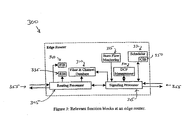
- FIGURE 3 shows a functional block diagram of an electronic edge router 300 according to the present invention.
- the electronic edge router 300 can consist of both an electronic ingress edge router 105 and an electronic egress edge router 115.
- the electronic edge router 300 includes a routing processor 305, a fiber and channel database 310, a signaling processor 315, a data channel path (DCP) management module 320, a burst flow monitoring module 325, a scheduler 330, a routing information base (RIB) 335, a forwarding information base (FIB) 340, and input and output ports 355.
- the scheduler 330 contains a channel information base (CIB) 350.
- the routing processor 305 transmits to and receives network information from neighboring communication devices through the input and output ports 355.
- the neighboring communication devices can be another electronic edge router 300, optical core router 110, or other communication devices.
- the routing processor 305 runs the routing protocols (some are optical burst switching specific), exchanges information with neighboring communication devices, and updates the RIB 335 and FIB 340.
- the RIB 335 contains all the necessary routing information for the network.
- the RIB information constantly changes and is updated with current network routing information through the routing processor 305.
- the FIB 340 contains next hop (i.e. outbound DCG) information for arriving bursts. The next hop could either be an electronic egress edge router 115 or an optical core router 110.
- the FIB 340 is created and maintained by the routing processor 305 using the RIB 335.
- the fiber and channel database 310 receives and stores network information from the routing processor 305 and the signaling processor 315.
- This network information includes (1) the inbound and outbound fibers and the wavelengths within each fiber; (2) the inbound and outbound data channel groups, control channel groups, and channels within each group; (3) the mapping of data channel groups, control channel groups, and channels within each group to the physical fibers and wavelengths; and (4) the status of each inbound/outbound data channel 205.
- the data channels 205 can be in one of three possible states. The three states are the unreserved state, the reservation in progress state, and the reserved state. When a data channel 205 is in the unreserved state, the burst flow is being scheduled on the data channel 205 in the normal way. When a data channel 205 is in the reservation in progress state, the data channel 205 is reserved, but not committed.
- a "0" is placed in the CIB 350 under the status field to represent the reservation in progress state. When a data channel 205 is in the reserved state, this means that the data channel 205 is committed and bursts cannot be scheduled on the reserved data channel 205 in the normal fashion.
- the signaling processor 315 also transmits to and receives network information from neighboring communication devices through input and output ports 355.
- the burst flow monitoring module 325 monitors the burst flow to optical core routers 110 and electronic egress edge routers 115 and informs the signaling processor 315 when the average bit rate of a flow of bursts exceeds or drops below a given threshold.
- the threshold is defined here as a bit rate which is no less than a data channel bit rate. If the bit rate of a flow of bursts exceeds the given threshold, the data channel 205 can be reserved. If the bit rate of a flow of bursts drops below the given threshold, part of the reserved data channel 205 is not being used, thus reservation of the reserved data channel 205 will be terminated.
- the DCP management module 320 transmits and receives information to and from the signaling processor 315.
- the purpose of the DCP management module 320 is to keep track of all the data channel 205 paths either already reserved or in the process of being reserved.
- the scheduler 330 also transmits and receives information to and from the signaling processor 315.
- the purpose of the scheduler 330 is to schedule the transmission of bursts and their associated burst header packets on data channel groups and control channel groups, respectively. There can be a scheduler 330 for a pair of data channel group and control channel group, or a set of data/control channel group pairs. Without loss of generality, FIGURE 3 shows one scheduler 330 per data/control channel group pair.
- the channel information base 350 in the scheduler 330 contains a subset of the fiber and channel database 310. This subset can include all inbound data channel groups, the outbound data channel groups and control channel groups, and the mapping to (physical) fibers and wavelengths.
- the outbound data channels 205 are divided into two subgroups. The two subgroups include (1) unreserved and reservation in progress data channels and (2) reserved data channels. Data channels 205 which are in the reservation in progress state operate exactly the same as data channels which are in the unreserved state. The use of reservation in progress outbound data channels is the same as unreserved outbound data channels.
- the channel information base 350 maintains a table for the reserved inbound and outbound data channels 205.
- FIGURE 5 shows a functional block diagram of an optical core router 110 according to the present invention.
- the optical core router 110 includes a routing processor 505, a fiber and channel database 510, a signaling processor 515, a data channel path (DCP) management module 520, a routing information base (RIB) 525, a switch control unit (SCU) 530 and input and output ports 555.
- the SCU includes a forwarding information base (FIB) 540, a label information base (LIB) 545, and a scheduler 535.
- the scheduler 530 contains a channel information base (CIB) 550.
- the routing processor 505 transmits to and receives network information from neighboring communication devices through the input and output ports 555.
- the neighboring communication devices can be another electronic edge router 300, optical core router 110, or other communication devices.
- the routing processor 505 runs the routing protocols (some are optical burst switching specific), exchanges information with neighboring communication devices, and updates the RIB 525, FIB 540, and LIB 545.
- the RIB 525 contains all the necessary routing information for the network.
- the routing information base constantly changes and is updated with current network routing information through the routing processor 505.
- the FIB 540 contains next hop (i.e. outbound DCG) information for arriving bursts. The next hop could either be an electronic egress edge router 115 or an optical core router 110.
- the FIB 540 is created and maintained by the routing processor 505 using the RIB 525.
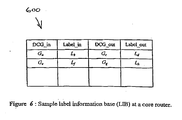
- the LIB 545 is established when a label-swapping technique like the MPLS is used to switch bursts at layer 2. Shown in FIGURE 6 is an example of the LIB 545.
- the fiber and channel database 510 receives and stores network information from the routing processor 505 and the signaling processor 515.
- This network information includes (1) the inbound and outbound fibers and the wavelengths within each fiber; (2) the inbound and outbound data channel groups, control channel groups, and channels within each group; (3) the mapping of data channel groups, control channel groups, and channels within each group to the physical fibers and wavelengths; and (4) the status of each inbound/outbound data channel 205.
- the data channels 205 can be in one of three possible states. The three states are the unreserved state, the reservation in progress state, and the reserved state. When a data channel 205 is in the unreserved state, the burst flow is being scheduled on a data channel 205 in the normal way.
- a data channel 205 When a data channel 205 is in the reservation in progress state, the data channel 205 is reserved, but not committed. This means that the data channel 205 will still be used in the normal fashion (i.e., as an unreserved data channel) Thus, no data channel 205 bandwidth is wasted.
- a "0" is placed in the CIB 550 under the status field to represent the reservation in progress state. When a data channel 205 is in the reserved state, this means that the data channel 205 is committed and bursts cannot be scheduled on the reserved data channel 205 in the normal fashion.
- the signaling processor 515 also transmits to and receives network information from neighboring communication devices through input and output ports 555.
- the DCP management module 520 transmits and receives information to and from the signaling processor 515.
- the purpose of the DCP management module 520 is to keep track of all the data channel paths either already reserved or in the process of being reserved.
- the scheduler 535 also transmits and receives information to and from the signaling processor 515.
- the purpose of the scheduler 535 is to schedule the transmission of bursts and their associated burst header packets on data channel groups and control channel groups, respectively.
- the scheduler 535 at the optical core router 110 schedules the switching of bursts from the inbound data channel groups to the outbound data channel groups and the transmission of the associated burst header packets on the outbound control channel groups.
- the channel information base 550 in the scheduler 535 contains a subset of the fiber and channel database 510. This subset can include all inbound data channel groups, the outbound data channel groups and control channel groups, and the mapping to (physical) fibers and wavelengths.
- the outbound data channels are divided into two subgroups. The two subgroups include (1) unreserved and reservation in progress data channels and (2) reserved data channels. Data channels 205 which are in the reservation in progress state operate exactly the same as data channels which are in the unreserved state.
- the channel information base 550 maintains a table for the reserved inbound and outbound data channels 205 (see FIGURE 9).
- a burst can only be transmitted at the bit rate of a data channel 205, although the total transmission capacity of a DWDM optical link 120 is much larger than that of a single data channel 205. If the average bit rate of a flow of bursts from an electronic ingress edge router 105 to an electronic egress edge router 115 is identified to be larger than a data channel rate, at least one data channel 205 could be reserved on the path between the electronic ingress edge router 105 to the electronic egress edge router 115, either via default route or explicit route. By doing so, gaps/voids could be largely eliminated on the reserved data channels 205 along the path right from the electronic ingress edge router 105.
- the load of the corresponding schedulers is reduced as no scheduling needs to be done for a reserved data channel 205, except updating the data channel 205 unscheduled (or future available) time.
- Traffic flow that cannot be accommodated by the reserved data channel 205 path can be forwarded hop-by-hop to the electronic egress edge router 115 as before.
- This methodology is not limited to an electronic ingress edge router 105 and electrocnic egress edge router 115 pair. It can also be extended to any pair of electronic ingress edge router 105 and optical core routers 110 in the optical burst-switched network 100.
- the average bit rate X of a burst flow from electronic ingress edge router E 1 to a RTN, say optical core router C 4 is detected by the burst flow monitoring module 325 to be R + ⁇ bps where ⁇ 0.
- the burst flow monitoring module 325 will first notify the signaling processor 315.
- the signaling processor 315 first consults with the routing processor 305 for a route from the electronic ingress edge router E 1 to the optical core router C 4 .
- the route given by the routing processor 305 is E 1 -C 1 -C 2 -C 3 -C 4 , which could be an existing route used by the flow or a new route.
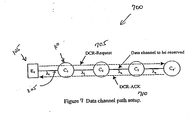
- the signaling processor 315 at electronic ingress edge router E 1 first finds an unreserved outbound data channel 205 connecting to the optical core router C 1 , say ⁇ i , from the fiber and channel database 310. It then sends out a Data-Channel-Reservation-Request (DCR-Request) message 705 to optical core router C 1 , indicating that outbound data channel ⁇ i will be reserved for the flow as shown in FIGURE 7.
- DCR-Request Data-Channel-Reservation-Request
- the status of ⁇ i is changed by the signaling processor 315 from unreserved to reservation in progress in the fiber and channel database 310 as well as in the CIB 350.
- the DCR-Request message 705 contains the path information and the outbound data channel identifier among others, e.g., (E 1 , C 1 , C 2 , C 3 , C 4 , ⁇ i ) in this case.
- the information carried by the DCR-Request message 705 will be stored in the DCP management module 320.
- the signaling processor 515 at optical router C 1 determines that the next hop is optical core router C 2 from the received DCR-Request message 705 sent by electronic edge router E 1 . It assigns an unreserved outbound data channel 205, say ⁇ j , to the burst flow and then sends the modified DCR-Request message 705 - (now with ⁇ j ) to the next optical core router C 2 .
- the status of ⁇ i and ⁇ j are changed by the signaling processor 515 from the unreserved state to the reservation in progress state in the fiber and channel database 510 and the status of ⁇ j is also changed in the corresponding CIB 550 of optical core router C 1 .
- the information carried by the DCR-Request message 705 will be stored in the DCP management module 520. It is assumed here that the error-free transmission of messages between two adjacent signaling processors is guaranteed by the lower layer protocols.
- optical core router C 4 The same procedure is repeated at optical core routers C 2 , C 3 and C 4 .
- outbound data channel ⁇ n of optical core router C 3 is chosen for the path (see FIGURE 7).
- the CIB 550 simply records that inbound channel ⁇ n is in the status of reservation in progress (set by optical core router C 3 ) as shown in FIGURE 8, where status "1" means the channels are reserved, “0” means the channels are in the reservation process, and symbol "-" means this optical core router C 4 is a RTN.
- Optical core router C 4 will send back a DCR-acknowledgement (DCR-ACK) message 710 to optical core router C 3 , which in turn goes through optical core routers C 2 , C 1 , and finally reaches electronic ingress edge router E 1 .
- DCR-ACK DCR-acknowledgement
- a router core 110 or edge 105 in the path will create a new entry in the CIB of the scheduler, specifying that the inbound and outbound data channels 205 are in the reservation process.
- An example of CIB 550 at optical core router C 1 is shown in FIGURE 9.
- FIGURE 9 shows a channel information base 550 table.
- the CIB 550 table shows the name of the DCG_in, G r .
- the CIB 550 shows that channel_in has a wavelength of ⁇ x , channel_out has a wavelength of ⁇ y , and the status of the data channel 205 is "1", which means the data channel 205 is reserved.
- the CIB 550 table in FIGURE 9 also shows another DCG_in, G s .
- the CIB 550 also shows that channel_in has a wavelength of ⁇ i , channel_out has a wavelength of ⁇ j , and the status of the data channel 205 is "0", which means the data channel reservation is in progress. The initial data channel reservation process is now completed.
- DCR-NAK DCR-acknowledgement
- the signaling processor both 315 and 515) may be required to send back an acknowledgement (ACK) message to its upstream node when it receives a DCR-Request, DCR-ACK or DCR-NAK.
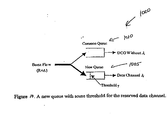
- Electronic ingress edge router E 1 creates a new queue 1005 after receiving the DCR-ACK 710 from optical core router C 1 as shown in FIGURE 10.
- This new queue 1005 is used to accommodate the flow bursts to be sent on the reserved data channel ⁇ i .
- a threshold ⁇ is maintained for the new queue 1005, the value of which could be the traffic volume in bytes or the number of bursts in the new queue 1005. Once the threshold ⁇ is exceeded, the burst flow will be directed to the common queue 1010 until the quantity in the new queue 1005 is dropped below the threshold.
- a special bit in the burst header packet, called reserved data channel (RC) bit is used to indicate whether a burst is transmitted on the reserved data channel 205. For bursts sent on the reserved data channel 205, their RC bit is set to 1.
- the actual reservation of the data channels 205 along the optical path is made by the first bursts of the burst flow sent from electronic ingress edge router E 1 on outbound data channel ⁇ i .
- the scheduler 535 of optical core router C 1 will do the following: (1) reserve the outbound data channel ⁇ j and configure the optical switching matrix to connect inbound data channel ⁇ i to outbound data channel ⁇ j when the first burst is switched; (2) update the status bit in the CIB 550 (see FIGURE 9) from 0 to 1, indicating data channel ⁇ i and data channel ⁇ j are now reserved, (3) move data channel ⁇ j from the unreserved and reservation in progress channel subset to the reserved channel subset in the CIB 550, and (4) change the status of data channel ⁇ i and data channel ⁇ j from reservation in progress to reserved in the fiber and channel database 510.
- bursts received on the reserved data channel path will have their RC bits reset to 0 by the scheduler 535 (optical core router C 4 is a RTN). Note that no bandwidth is wasted during the entire data channel reservation process as bursts are still forwarded or switched as before during this period. Note also that BHPs are always forwarded or switched at the switch control unit (SCU) 530 although data channels ⁇ i and ⁇ j are cross-connected. A CIB 550 table lookup is required for bursts received from reserved data channels.
- SCU switch control unit
- a timer (not shown) is maintained in each router (105, 110 or 115) along the path, which should be reset by a refresh message sent by the electronic ingress edge router 105 before it expires. If the timer expires, the corresponding router will terminate the channel reservation and inform others routers.
- the average bit rate of the flow is m ⁇ R+ ⁇ ( m ) where m is a nonnegative integer
- up to m data channel 205 paths could be reserved. These data channel 205 paths may follow the same route or different routes, but have the same RTN.
- the number of channels in a data channel 205 path could be more than one.
- the threshold ⁇ ( m ) now is a function of m .
- the above data channel reservation method is also valid if an electronic ingress edge router 105 has more than one RTN.
- the data channel reservation method of the present invention is flow-driven, initiated by ingress edge router on demand, protocol independent, and adaptive to the average bit rate of a flow of bursts.
- the data channel reservation method of the present invention is also suitable for both loose and strict definitions of burst flows.
- a burst flow is loosely defined as a set of bursts which have the same electronic ingress edge router 105, follow the same path, and are destined to the same reservation termination node (RTN).
- RTN reservation termination node
- the strict definition of a burst flow requires that the bursts have the same or similar attributes like quality of service (QOS).
- QOS quality of service
- the data channel reservation method can also be combined with a layer 2 protocol like MPLS to establish a label switched path (LSP) with bandwidth reservation. Note that the above data channel reservation approach is also suitable for establishing a path with certain reserved bandwidth (of data channels 205) in the optical burst-switched network 100 even if the flow driven factor is not considered
- the present invention provides a system and method for reserving data channels in an optical burst-switched network.
- a data channel (or a multiple of data channels) along an optical path in an optical burst-switched network is reserved by first transmitting a data channel reservation request from an electronic ingress edge router to a reservation termination node. Next, the data channel reservation request is processed at all nodes along the path. A data channel reservation acknowledgement is then transmitted from the reservation termination node to the electronic ingress edge router. Finally, the data channel path is reserved once an initial burst(s) which contains a reserve data channel bit reaches the reservation termination node.
Landscapes
- Engineering & Computer Science (AREA)
- Computer Networks & Wireless Communication (AREA)
- Signal Processing (AREA)
- Data Exchanges In Wide-Area Networks (AREA)
- Optical Communication System (AREA)
Applications Claiming Priority (2)
| Application Number | Priority Date | Filing Date | Title |
|---|---|---|---|
| US497254 | 2000-02-03 | ||
| US09/497,254 US6671256B1 (en) | 2000-02-03 | 2000-02-03 | Data channel reservation in optical burst-switched networks |
Publications (2)
| Publication Number | Publication Date |
|---|---|
| EP1122971A2 true EP1122971A2 (de) | 2001-08-08 |
| EP1122971A3 EP1122971A3 (de) | 2008-09-03 |
Family
ID=23976078
Family Applications (1)
| Application Number | Title | Priority Date | Filing Date |
|---|---|---|---|
| EP01102108A Withdrawn EP1122971A3 (de) | 2000-02-03 | 2001-01-31 | Datenkanalreservierung in einem optischen Netzwerk mit Bündelbetrieb |
Country Status (6)
| Country | Link |
|---|---|
| US (1) | US6671256B1 (de) |
| EP (1) | EP1122971A3 (de) |
| CN (1) | CN100512200C (de) |
| AU (1) | AU1675901A (de) |
| CA (1) | CA2334131A1 (de) |
| SG (1) | SG84621A1 (de) |
Cited By (16)
| Publication number | Priority date | Publication date | Assignee | Title |
|---|---|---|---|---|
| WO2002080407A1 (en) * | 2001-03-28 | 2002-10-10 | Brilliant Optical Networks | Control of obs/lobs and other burst switched network devices |
| KR100453834B1 (ko) * | 2002-08-28 | 2004-10-20 | 경북대학교 산학협력단 | 다중 홉 환경의 광 버스트 교환망에서 종단간 성능 향상을위한 홉 단위 우선순위 증가 방법 |
| WO2005032204A1 (en) * | 2003-09-23 | 2005-04-07 | Intel Corporation | Method and system to recover optical burst switched network resources upon data burst loss |
| US7266295B2 (en) | 2003-04-17 | 2007-09-04 | Intel Corporation | Modular reconfigurable multi-server system and method for high-speed networking within photonic burst-switched network |
| US7266296B2 (en) | 2003-06-11 | 2007-09-04 | Intel Corporation | Architecture and method for framing control and data bursts over 10 Gbit Ethernet with and without WAN interface sublayer support |
| US7272310B2 (en) | 2003-06-24 | 2007-09-18 | Intel Corporation | Generic multi-protocol label switching (GMPLS)-based label space architecture for optical switched networks |
| US7298973B2 (en) | 2003-04-16 | 2007-11-20 | Intel Corporation | Architecture, method and system of multiple high-speed servers to network in WDM based photonic burst-switched networks |
| US7310480B2 (en) | 2003-06-18 | 2007-12-18 | Intel Corporation | Adaptive framework for closed-loop protocols over photonic burst switched networks |
| US7315693B2 (en) | 2003-10-22 | 2008-01-01 | Intel Corporation | Dynamic route discovery for optical switched networks |
| US7340169B2 (en) | 2003-11-13 | 2008-03-04 | Intel Corporation | Dynamic route discovery for optical switched networks using peer routing |
| US7428383B2 (en) | 2003-02-28 | 2008-09-23 | Intel Corporation | Architecture, method and system of WDM-based photonic burst switched networks |
| US7526202B2 (en) | 2003-05-19 | 2009-04-28 | Intel Corporation | Architecture and method for framing optical control and data bursts within optical transport unit structures in photonic burst-switched networks |
| US7734176B2 (en) | 2003-12-22 | 2010-06-08 | Intel Corporation | Hybrid optical burst switching with fixed time slot architecture |
| CN101170838B (zh) * | 2007-09-28 | 2010-09-15 | 武汉虹信通信技术有限责任公司 | 基于光交换的无线载波资源配置系统 |
| TWI424704B (zh) * | 2009-12-25 | 2014-01-21 | Ind Tech Res Inst | 都會型光封包交換網路的媒體存取控制裝置及方法 |
| US8660427B2 (en) | 2002-09-13 | 2014-02-25 | Intel Corporation | Method and apparatus of the architecture and operation of control processing unit in wavelenght-division-multiplexed photonic burst-switched networks |
Families Citing this family (55)
| Publication number | Priority date | Publication date | Assignee | Title |
|---|---|---|---|---|
| US6763192B1 (en) * | 2000-03-03 | 2004-07-13 | Alcatel | Integration of all-optical crossconnect functionality in an optical packet switching apparatus |
| EP1295504A1 (de) * | 2000-05-11 | 2003-03-26 | Ilotron Limited | Optische transportnetzwerke |
| AU2001273112A1 (en) * | 2000-06-29 | 2002-01-14 | Cinta Corporation | Improved shortest path first restoration routing in a fiberoptic network |
| US6782200B1 (en) * | 2000-10-20 | 2004-08-24 | Nortel Networks Limited | Packet-based optical communications networks |
| US7092633B2 (en) * | 2000-11-14 | 2006-08-15 | University Of Texas System Board Of Regents | System and method for configuring optical circuits |
| US6804196B1 (en) * | 2000-11-20 | 2004-10-12 | Nortel Networks Limited | Determining traffic information in a communications network |
| US6999686B1 (en) * | 2001-02-01 | 2006-02-14 | Ciena Corporation | Wavelength management in an optical network |
| JP4316822B2 (ja) * | 2001-05-18 | 2009-08-19 | 富士通株式会社 | パスの経路を変更する方法及びこれを用いるスイッチ装置 |
| AU2002304386A1 (en) * | 2001-06-27 | 2003-03-03 | Nokia Corporation | Method and system for efficient management and transport of traffic over a network |
| US20030067919A1 (en) * | 2001-10-04 | 2003-04-10 | Chunming Qiao | Labeled analog burst switching for any high-layer-over-signal channel integration |
| US7289437B2 (en) * | 2001-10-10 | 2007-10-30 | Alcatel Lucent | System and method for routing stability-based integrated traffic engineering for GMPLS optical networks |
| CA2410143C (en) * | 2001-11-02 | 2010-02-02 | Nippon Telegraph And Telephone Corporation | Optical dynamic burst switch |
| CA2410064C (en) * | 2001-11-02 | 2007-12-04 | Nippon Telegraph And Telephone Corporation | Optical dynamic burst switch |
| CA2410137C (en) * | 2001-11-02 | 2008-04-15 | Nippon Telegraph And Telephone Corporation | Optical dynamic burst switch |
| US7187654B1 (en) * | 2001-11-13 | 2007-03-06 | Nortel Networks Limited | Rate-controlled optical burst switching |
| EP1313346A1 (de) * | 2001-11-16 | 2003-05-21 | Alcatel | Verfahren und Vorrichtung zur Ermittlung von Verlustmerkmale in DWDM Verbindungen |
| KR100434335B1 (ko) * | 2001-11-27 | 2004-06-04 | 학교법인 한국정보통신학원 | 광 버스트 스위칭 네트워크의 제어패킷과 데이터 버스트생성방법 |
| US7020110B2 (en) * | 2002-01-08 | 2006-03-28 | Qualcomm Incorporated | Resource allocation for MIMO-OFDM communication systems |
| US7209655B2 (en) * | 2002-04-12 | 2007-04-24 | Fujitsu Limited | Sharing of power level information to support optical communications |
| US7209656B2 (en) * | 2002-04-12 | 2007-04-24 | Fujitsu Limited | Management of optical links using power level information |
| US7212742B2 (en) * | 2002-04-12 | 2007-05-01 | Fujitsu Limited | Power level management in optical networks |
| US7477657B1 (en) * | 2002-05-08 | 2009-01-13 | Juniper Networks, Inc. | Aggregating end-to-end QoS signaled packet flows through label switched paths |
| US7257127B1 (en) * | 2002-06-21 | 2007-08-14 | Alcatel Lucent | Method and apparatus for burst scheduling |
| US7656905B2 (en) * | 2002-12-24 | 2010-02-02 | Samir Sheth | Apparatus and method for aggregation and transportation of gigabit ethernet and other packet based data formats |
| US7782778B2 (en) * | 2002-12-24 | 2010-08-24 | Samir Satish Sheth | Apparatus and method for fibre channel distance extension embedded within an optical transport system |
| US7848649B2 (en) * | 2003-02-28 | 2010-12-07 | Intel Corporation | Method and system to frame and format optical control and data bursts in WDM-based photonic burst switched networks |
| DE10339039A1 (de) * | 2003-08-25 | 2005-04-07 | Siemens Ag | Verfahren zur Übertragung von Datenpaketen |
| US7397792B1 (en) * | 2003-10-09 | 2008-07-08 | Nortel Networks Limited | Virtual burst-switching networks |
| US8064341B2 (en) * | 2003-10-10 | 2011-11-22 | Nortel Networks Limited | Temporal-spatial burst switching |
| WO2005067234A1 (en) * | 2004-01-08 | 2005-07-21 | Agency For Science, Technology & Research | A control device and a method for controlling an optical data transmission, and a shared storage network system |
| KR100534617B1 (ko) * | 2004-01-29 | 2005-12-07 | 삼성전자주식회사 | 다중 룩업 부하 감소기능이 구비된 엠피엘에스 에지라우터 및 그 제어방법 |
| US7359635B2 (en) * | 2004-05-03 | 2008-04-15 | Avago Technologies Fiber Ip Pte Ltd | Optically-controlled optical network and switching node therefor |
| US20060047795A1 (en) * | 2004-05-18 | 2006-03-02 | Marconi Communication, Inc. | Service object for network management |
| FR2877797B1 (fr) * | 2004-11-10 | 2006-12-15 | Cit Alcatel | Dispositif de selection d'informations de routage pour un routeur d'un reseau de communication |
| EP1657952B1 (de) * | 2004-11-12 | 2008-07-02 | Nokia Siemens Networks Gmbh & Co. Kg | Ein Ringnetz für ein Burst-geschaltetes Netz mit verteiltem Management |
| KR100643760B1 (ko) * | 2004-12-31 | 2006-11-10 | 삼성전자주식회사 | 타임-슬롯 광 버스트 스위칭 시스템 및 스위칭방법 |
| CN1794880B (zh) * | 2005-12-21 | 2010-05-05 | 中国科学院计算技术研究所 | 一种光突发交换网中的并行调度处理方法 |
| US8849109B2 (en) * | 2006-03-30 | 2014-09-30 | Alcatel Lucent | Fault isolation and provisioning for optical switches |
| FR2903830B1 (fr) * | 2006-07-11 | 2008-08-22 | Alcatel Sa | Procede et dispositif de surveillance des chemins optiques de connexion pour un reseau optique transparent |
| US8150264B2 (en) * | 2007-11-09 | 2012-04-03 | University Of Houston | Methods for non-wavelength-converting multi-lane optical switching |
| US7548545B1 (en) * | 2007-12-14 | 2009-06-16 | Raptor Networks Technology, Inc. | Disaggregated network management |
| US8467403B2 (en) * | 2010-04-29 | 2013-06-18 | Cisco Technology, Inc. | Coordinated updating of forwarding information bases in a multistage packet switching device |
| WO2013185327A1 (zh) * | 2012-06-14 | 2013-12-19 | 华为技术有限公司 | 传送、接收客户信号的方法和装置 |
| US8917997B2 (en) * | 2012-10-05 | 2014-12-23 | Applied Micro Circuits Corporation | Collimated beam channel with four lens optical surfaces |
| US10212101B2 (en) | 2014-01-14 | 2019-02-19 | Nant Holdings Ip, Llc | Low level provisioning of network fabrics |
| US9917728B2 (en) | 2014-01-14 | 2018-03-13 | Nant Holdings Ip, Llc | Software-based fabric enablement |
| US9769087B2 (en) * | 2015-08-03 | 2017-09-19 | Infinera Corporation | Providing ownership-based view and management of shared optical network resources |
| US9883264B2 (en) * | 2015-12-31 | 2018-01-30 | Infinera Corporation | Systems and methods for multilayer peering |
| CN109952744B (zh) | 2016-09-26 | 2021-12-14 | 河谷控股Ip有限责任公司 | 云网络中提供虚拟电路的方法和设备 |
| US10412005B2 (en) * | 2016-09-29 | 2019-09-10 | International Business Machines Corporation | Exploiting underlay network link redundancy for overlay networks |
| US11533265B2 (en) * | 2020-07-23 | 2022-12-20 | Vmware, Inc. | Alleviating flow congestion at forwarding elements |
| US12547438B2 (en) | 2022-05-18 | 2026-02-10 | Oracle International Corporation | Single hop approach for distributed block storage via a network virtualization device |
| US12021757B2 (en) | 2022-03-18 | 2024-06-25 | Oracle International Corporation | Bandwidth control inside a shared network interface card |
| US12346565B2 (en) | 2022-05-18 | 2025-07-01 | Oracle International Corporation | Persistent memory based caching for intelligent network interface cards |
| US11924086B2 (en) * | 2022-05-18 | 2024-03-05 | Oracle International Corporation | Load-based management for NVME over TCP connections |
Family Cites Families (8)
| Publication number | Priority date | Publication date | Assignee | Title |
|---|---|---|---|---|
| EP0547836B1 (de) | 1991-12-16 | 2001-12-19 | AT&T Corp. | Optische Paketvermittlungstelle |
| US5416769A (en) | 1993-07-13 | 1995-05-16 | At&T Corp. | Controlled-feedback packet switching system |
| US5486943A (en) | 1993-07-14 | 1996-01-23 | Nippon Telegraph And Telephone Corp. | Photonic frequency division multiplexed FIFO buffer |
| DE69329834T2 (de) * | 1993-10-19 | 2001-05-31 | International Business Machines Corp., Armonk | Zugriffssteuerungssystem für einen mehrkanal-übertragungsring |
| FR2725528B1 (fr) | 1994-10-11 | 1996-11-22 | Alcatel Nv | Ligne a retard optique selectif en longueur d'onde |
| FR2726726A1 (fr) | 1994-11-04 | 1996-05-10 | Guillemot Christian | Systeme de commutateur pour paquets optiques |
| US5781537A (en) | 1995-07-07 | 1998-07-14 | International Business Machines Corporation | Setting up, taking down and maintaining connections in a communications network |
| US20020054732A1 (en) * | 1999-11-02 | 2002-05-09 | Zheng Si Q. | Optical burst scheduling using partitioned channel groups |
-
2000
- 2000-02-03 US US09/497,254 patent/US6671256B1/en not_active Expired - Lifetime
-
2001
- 2001-01-31 EP EP01102108A patent/EP1122971A3/de not_active Withdrawn
- 2001-02-01 AU AU16759/01A patent/AU1675901A/en not_active Abandoned
- 2001-02-01 SG SG200100612A patent/SG84621A1/en unknown
- 2001-02-02 CN CN01111917.9A patent/CN100512200C/zh not_active Expired - Fee Related
- 2001-02-02 CA CA002334131A patent/CA2334131A1/en not_active Abandoned
Non-Patent Citations (1)
| Title |
|---|
| QIAO ET AL.: "Polymorphic control for cost-effective design of optical networks", MULTICHANNEL OPTICAL NETWORKS: THEORY AND PRACTICE, DIMACS WORKSHOP, 1998, pages 157 - 166 |
Cited By (16)
| Publication number | Priority date | Publication date | Assignee | Title |
|---|---|---|---|---|
| WO2002080407A1 (en) * | 2001-03-28 | 2002-10-10 | Brilliant Optical Networks | Control of obs/lobs and other burst switched network devices |
| KR100453834B1 (ko) * | 2002-08-28 | 2004-10-20 | 경북대학교 산학협력단 | 다중 홉 환경의 광 버스트 교환망에서 종단간 성능 향상을위한 홉 단위 우선순위 증가 방법 |
| US8660427B2 (en) | 2002-09-13 | 2014-02-25 | Intel Corporation | Method and apparatus of the architecture and operation of control processing unit in wavelenght-division-multiplexed photonic burst-switched networks |
| US7428383B2 (en) | 2003-02-28 | 2008-09-23 | Intel Corporation | Architecture, method and system of WDM-based photonic burst switched networks |
| US7298973B2 (en) | 2003-04-16 | 2007-11-20 | Intel Corporation | Architecture, method and system of multiple high-speed servers to network in WDM based photonic burst-switched networks |
| US7266295B2 (en) | 2003-04-17 | 2007-09-04 | Intel Corporation | Modular reconfigurable multi-server system and method for high-speed networking within photonic burst-switched network |
| US7526202B2 (en) | 2003-05-19 | 2009-04-28 | Intel Corporation | Architecture and method for framing optical control and data bursts within optical transport unit structures in photonic burst-switched networks |
| US7266296B2 (en) | 2003-06-11 | 2007-09-04 | Intel Corporation | Architecture and method for framing control and data bursts over 10 Gbit Ethernet with and without WAN interface sublayer support |
| US7310480B2 (en) | 2003-06-18 | 2007-12-18 | Intel Corporation | Adaptive framework for closed-loop protocols over photonic burst switched networks |
| US7272310B2 (en) | 2003-06-24 | 2007-09-18 | Intel Corporation | Generic multi-protocol label switching (GMPLS)-based label space architecture for optical switched networks |
| WO2005032204A1 (en) * | 2003-09-23 | 2005-04-07 | Intel Corporation | Method and system to recover optical burst switched network resources upon data burst loss |
| US7315693B2 (en) | 2003-10-22 | 2008-01-01 | Intel Corporation | Dynamic route discovery for optical switched networks |
| US7340169B2 (en) | 2003-11-13 | 2008-03-04 | Intel Corporation | Dynamic route discovery for optical switched networks using peer routing |
| US7734176B2 (en) | 2003-12-22 | 2010-06-08 | Intel Corporation | Hybrid optical burst switching with fixed time slot architecture |
| CN101170838B (zh) * | 2007-09-28 | 2010-09-15 | 武汉虹信通信技术有限责任公司 | 基于光交换的无线载波资源配置系统 |
| TWI424704B (zh) * | 2009-12-25 | 2014-01-21 | Ind Tech Res Inst | 都會型光封包交換網路的媒體存取控制裝置及方法 |
Also Published As
| Publication number | Publication date |
|---|---|
| EP1122971A3 (de) | 2008-09-03 |
| SG84621A1 (en) | 2001-11-20 |
| CN100512200C (zh) | 2009-07-08 |
| AU1675901A (en) | 2001-08-09 |
| CA2334131A1 (en) | 2001-08-03 |
| US6671256B1 (en) | 2003-12-30 |
| CN1321019A (zh) | 2001-11-07 |
Similar Documents
| Publication | Publication Date | Title |
|---|---|---|
| US6671256B1 (en) | Data channel reservation in optical burst-switched networks | |
| US5953312A (en) | Method and apparatus for determining alternate routes in a network using a connection-oriented protocol | |
| EP0752795B1 (de) | Verbindungsreservation in Kommunikationsnetzwerken | |
| US6680948B1 (en) | System and method for transmitting packets over a long-haul optical network | |
| US7796511B2 (en) | Self-routed layer 4 packet network system and method | |
| US7257120B2 (en) | Quality of service (QoS) based supervisory network for optical transport systems | |
| Chlamtac et al. | Scalable WDM access network architecture based on photonic slot routing | |
| Sengupta et al. | From network design to dynamic provisioning and restoration in optical cross-connect mesh networks: An architectural and algorithmic overview | |
| US20050010685A1 (en) | Method and a system for enabling data to be stored in a computer network; a method and a system for storing data in a computer network | |
| US20030043745A1 (en) | Path modifying method, label switching node and administrative node in label transfer network | |
| US20040057724A1 (en) | Maintaining quality of packet traffic in optical network when a failure of an optical link occurs | |
| US7414985B1 (en) | Link aggregation | |
| US7031312B1 (en) | Method and system for assigning multiprotocol label switching (MPLS) VC (VC) labels when transporting asynchronous transfer mode (ATM) data over MPLS network | |
| EP0854604A1 (de) | Gruppenadressierung für Mehrfachsendung | |
| US20040165597A1 (en) | Service level agreement driven route table selection | |
| US7016302B1 (en) | Apparatus and method for controlling queuing of data at a node on a network | |
| Gurel et al. | nOBS: an ns2 based simulation tool for performance evaluation of TCP traffic in OBS networks | |
| US20040218923A1 (en) | Method and apparatus for multiple-homing route diversification for UNI clients | |
| Chaskar et al. | Robust transport of IP traffic over WDM using optical burst switching | |
| Düser et al. | Timescale analysis for wavelength-routed optical burst-switched (WR-OBS) networks | |
| US6865178B1 (en) | Method and system for establishing SNA connection through data link switching access services over networking broadband services | |
| US7042882B2 (en) | Layer-structured path setup method and node apparatus for implementing same | |
| US6985443B2 (en) | Method and apparatus for alleviating traffic congestion in a computer network | |
| US7493410B2 (en) | Method and apparatus for switched physical alternate links in a packet network | |
| KR100680179B1 (ko) | 광 버스트 반복전송에 의한 광 버스트 스위칭시스템과 방법 |
Legal Events
| Date | Code | Title | Description |
|---|---|---|---|
| PUAI | Public reference made under article 153(3) epc to a published international application that has entered the european phase |
Free format text: ORIGINAL CODE: 0009012 |
|
| AK | Designated contracting states |
Kind code of ref document: A2 Designated state(s): AT BE CH CY DE DK ES FI FR GB GR IE IT LI LU MC NL PT SE TR |
|
| AX | Request for extension of the european patent |
Free format text: AL;LT;LV;MK;RO;SI |
|
| RIN1 | Information on inventor provided before grant (corrected) |
Inventor name: CANKAYA, HAKKI C. Inventor name: VANDENHOUTE, MARC L.J. Inventor name: AGRAWAL, ANSHUL Inventor name: XIONG, YIJUN |
|
| PUAL | Search report despatched |
Free format text: ORIGINAL CODE: 0009013 |
|
| AK | Designated contracting states |
Kind code of ref document: A3 Designated state(s): AT BE CH CY DE DK ES FI FR GB GR IE IT LI LU MC NL PT SE TR |
|
| AX | Request for extension of the european patent |
Extension state: AL LT LV MK RO SI |
|
| 17P | Request for examination filed |
Effective date: 20090312 |
|
| 17Q | First examination report despatched |
Effective date: 20090406 |
|
| AKX | Designation fees paid |
Designated state(s): AT BE CH CY DE DK ES FI FR GB GR IE IT LI LU MC NL PT SE TR |
|
| GRAP | Despatch of communication of intention to grant a patent |
Free format text: ORIGINAL CODE: EPIDOSNIGR1 |
|
| STAA | Information on the status of an ep patent application or granted ep patent |
Free format text: STATUS: THE APPLICATION IS DEEMED TO BE WITHDRAWN |
|
| 18D | Application deemed to be withdrawn |
Effective date: 20111214 |