EP1121823B1 - Radio communication system - Google Patents
Radio communication system Download PDFInfo
- Publication number
- EP1121823B1 EP1121823B1 EP00956300A EP00956300A EP1121823B1 EP 1121823 B1 EP1121823 B1 EP 1121823B1 EP 00956300 A EP00956300 A EP 00956300A EP 00956300 A EP00956300 A EP 00956300A EP 1121823 B1 EP1121823 B1 EP 1121823B1
- Authority
- EP
- European Patent Office
- Prior art keywords
- random access
- channel
- access channel
- station
- primary station
- Prior art date
- Legal status (The legal status is an assumption and is not a legal conclusion. Google has not performed a legal analysis and makes no representation as to the accuracy of the status listed.)
- Expired - Lifetime
Links
Images

Classifications
-
- H—ELECTRICITY
- H04—ELECTRIC COMMUNICATION TECHNIQUE
- H04W—WIRELESS COMMUNICATION NETWORKS
- H04W74/00—Wireless channel access
- H04W74/002—Transmission of channel access control information
- H04W74/006—Transmission of channel access control information in the downlink, i.e. towards the terminal
-
- H—ELECTRICITY
- H04—ELECTRIC COMMUNICATION TECHNIQUE
- H04W—WIRELESS COMMUNICATION NETWORKS
- H04W74/00—Wireless channel access
- H04W74/08—Non-scheduled access, e.g. ALOHA
- H04W74/0833—Random access procedures, e.g. with 4-step access
-
- H—ELECTRICITY
- H04—ELECTRIC COMMUNICATION TECHNIQUE
- H04W—WIRELESS COMMUNICATION NETWORKS
- H04W28/00—Network traffic management; Network resource management
- H04W28/02—Traffic management, e.g. flow control or congestion control
- H04W28/10—Flow control between communication endpoints
- H04W28/12—Flow control between communication endpoints using signalling between network elements
-
- H—ELECTRICITY
- H04—ELECTRIC COMMUNICATION TECHNIQUE
- H04W—WIRELESS COMMUNICATION NETWORKS
- H04W4/00—Services specially adapted for wireless communication networks; Facilities therefor
- H04W4/20—Services signaling; Auxiliary data signalling, i.e. transmitting data via a non-traffic channel
Definitions
- the present invention relates to a radio communication system having a random access channel for the transmission of data from a secondary station to a primary station, and further relates to primary and secondary stations for use in such a system and to a method of operating such a system. While the present specification describes a system with particular reference to the emerging Universal Mobile Telecommunication System (UMTS), it is to be understood that the techniques described are equally applicable to use in other mobile radio systems.
- UMTS Universal Mobile Telecommunication System
- random access channel refers to the logical channel on which random access transmissions take place, which would typically consist of a number of distinct physical channels.
- a random access channel is a normal component of a radio communication system, enabling a Mobile Station (MS) to send short messages to a Base Station (BS).
- Applications include signalling to the BS when the MS is turned on, sending a packet of data to the BS when the MS may not be engaged in a call, and requesting the BS to allocate a resource for the MS to use.
- a number of random access packet channels available to a MS there are a number of random access packet channels available to a MS.
- a request for access to a packet channel sent by the MS is encoded with a randomly-chosen signature, which corresponds to one of the packet channels. If the channel is available for use, the BS allocates it to the requesting MS.
- the European Application EP-A 0 557 175 discloses a method for transmitting short data wherein the availability of data channels is transmitted to user equipements.
- the US patent No 5,528,664 discloses a cellular telephone system having a primary station (base station).
- the base station transmits periodically an available channel signature for indicating the available channnels on each available channel.
- the signalling is made by means of specific signatures on the plurality of available data channels.
- each secondary station mobile station has to monitor all channels to obtain this signalling.
- An object of the present invention is to provide an efficient signalling about availability of resources in a random access channel having improved throughput and reduced transmission delays.
- a radio communication system comprising a primary station and a plurality of secondary stations and having a random access channel for the transmission of data from a secondary station to the primary station, wherein the primary station has means for transmitting a random access channel status message indicating the availability of random access channel resources during unused bits in a paging indicator channel or acquisition indicator channel, using the same channelisation code as that channel and the secondary station has means for receiving the status message and means for using the contents of the message to determine what random access channel resources to request.
- a primary station for use in a radio communication system having a random access channel for the transmission of data from a secondary station to the primary station, wherein means are provided for transmitting a random access channel status message indicating the availability of random access channel resources during unused bits in a paging indicator channel or acquisition indicator channel, using the same channelisation code as that channel.
- a secondary station for use in a radio communication system having a random access channel for the transmission of data to a primary station, wherein means are provided for receiving a random access channel status message during unused bits in a paging indicator channel or an acquisition indicator channel, using the same channelisation code as that channel transmitted by the primary station and for using the contents of the message to determine what random access channel resources to request.
- a method of operating a radio communication system having a random access channel for the transmission of data from a secondary station to a primary station, characterised by the primary station transmitting a random access channel status message indicating the availability of random access channel resources during unused bits in a paging indicator channel or acquisition indicator channel, using the same channelisation code as that channel; and by the secondary station receiving the status message and using the contents of the message to determine what random access channel resources to request.
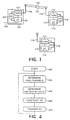
- a radio communication system comprises a primary station (BS) 100 and a plurality of secondary stations (MS) 110.
- the BS 100 comprises a microcontroller ( ⁇ C) 102, transceiver means (Tx/Rx) 104 connected to antenna means 106, power control means (PC) 107 for altering the transmitted power level, and, connection means 108 for connection to the PSTN or other suitable network.
- Each MS 110 comprises a microcontroller ( ⁇ C) 112, transceiver means (Tx/Rx) 114 connected to antenna means 116, and power control means (PC) 118 for altering the transmitted power level.
- Communication from BS 100 to MS 110 takes place on a downlink channel 122, while communication from MS 110 to BS 100 takes place on an uplink channel 124.
- a basic scheme for a random access packet channel operating in a frequency division duplex system is shown in Figure 2, with the uplink channel 124 drawn above the downlink channel 122.
- the MS 110 first transmits a preamble (P) 202, encoded with a signature randomly chosen from a set of 16 possible signatures, at a low power level in a particular access slot.
- a signature is a signal characterised by its scrambling code and channelisation code modulated by a specific bit sequence.
- a mutually orthogonal set of signatures can be obtained by defining a set of mutually orthogonal bit sequences for the modulation.
- a different set of signatures can be obtained by changing the scrambling code or the channelisation code (i.e.
- the choice of preamble signature for encoding the access preamble 202 determines the physical channel requested by the MS 110, with each preamble signature corresponding to a limited number of uplink and downlink channels. If the BS 100 receives and decodes the preamble correctly it transmits a preamble acknowledgement (A) 206.
- A preamble acknowledgement
- the MS 110 After the first preamble 202 is transmitted no acknowledgement is returned in the slot 204 allocated for it (which might typically be 1 ms in length). The MS 110 therefore transmits another preamble 202 at a higher power level. Again no acknowledgement is received in the slot 204, so the MS 110 transmits another preamble 202 at a still higher power. This is received and decoded by the BS 100, which transmits an acknowledgement 206 and thereby completes the access phase.
- the acknowledgement 206 may be positive, to signal that the requested channels are free, or negative, to signal that they are in use and access is denied to the MS 110.
- a negative acknowledgement (NACK) may be indicated by the BS 100 inverting the phase of the signature (with respect to some reference or pilot signal). Alternatively, some of the signatures used by the BS 100 for acknowledgement may also be used as a NACK.
- the BS 100 will only transmit one acknowledgement for each access slot, however many preambles 202 were transmitted.
- One basis for the selection could be to acknowledge the preamble 202 received with the highest power.
- the initial power level at which a MS 110 transmits the preamble 202 is typically determined by the MS 110 using open loop power control, so that a MS 110 is not at a disadvantage compared to another MS 110 nearer to the BS 100. If more than one preamble 202 was transmitted but each preamble was encoded with a different signature then each MS 110 will know whether or not its preamble 202 was received correctly. However, it is possible that more than one MS 110 selected the same signature, and therefore believes that its preamble 202 has been received. If each of these mobile stations 110 begins to transmit its data the result will be a collision, with none of the data likely to be received correctly.
- a contention resolution phase follows the transmission of an acknowledgement 206 which indicated that the requested channels were free.
- Each MS 110 which transmitted a preamble 202 encoded with a signature corresponding to that acknowledged by the BS 100 now transmits a further contention resolution preamble (CP) 208.
- This preamble 208 is encoded with a signature randomly selected from another set of 16 possible signatures. This set may be different from the set used for the access preamble 202 (either by changing the set of modulating bit sequences, the scrambling code or the channelisation code), or alternatively the set of signatures may be shared between access and contention resolution phases.
- the BS 100 then issues a contention resolution acknowledgement (CA) 210 corresponding to the selected preamble 208, for example that received with the highest power, which acknowledgement 210 enables the MS 110 to transmit its data.
- CA contention resolution acknowledgement
- the BS 100 After this contention resolution phase the BS 100 begins transmission of a Physical Control CHannel (PCCH) 212, which includes power control information to instruct the MS 110 to adjust its transmission power as necessary, and the MS 110 transmits one or more data packets (PKT) 214 on the allocated packet channel, which is normally on a different physical channel to those used for the preamble transmissions.
- PCCH Physical Control CHannel
- PTT data packets
- the PCCH 212 may begin simultaneously with the transmission of the data 214, or may precede it sufficiently for closed loop power control to be established before the data transmission.
- a particular problem with the basic scheme described above is that a MS 110 may be denied access to a packet channel corresponding to its selected preamble signature, even though other suitable channels may be available. This makes it likely that a MS 110 will spend significant time waiting for a channel to become available, particularly when traffic loading is high.
- a MS 110 can determine what packet channel resources are available (if any) before attempting to send a packet, and also to help in selecting an appropriate preamble signature.
- One known way in which this can be done is for the MS 110 to monitor system activity, for example by listening for access preambles 202 and acknowledgements 206, for an extended period before packet transmission.
- this leads to significant transmission delays for the MS 110, and the information may not be completely reliable (since the MS 110 may not be able to receive all the preambles 202 and acknowledgements 206 transmitted in a cell).
- FIG. 3 An improved system, in accordance with the present invention, is shown in Figure 3 in which the BS 100 repeatedly broadcasts a packet channel availability (AV) message 302, which informs a MS 110 about the resources currently available. Broadcasting the AV message 302 once per frame is a reasonable compromise between downlink overhead and delay, since the overall transmission delay will be dominated by the time taken to transmit the data packets 214, typically a few frames. If necessary, the AV message 302 could probably be broadcast less often without major impact. A system supporting up to 16 packet channels would require 16 bits of status information per AV message 302 to indicate the availability of each channel individually.
- AV packet channel availability
- a particularly convenient location for this message in a UMTS embodiment is as part of a paging indicator channel (PICH), which channel is used to inform a MS 110 that there is a message waiting for it.
- PICH paging indicator channel
- the channel has the capacity to transmit 300 bits per 10ms frame, but only 288 are required for paging indication messages. The remaining 12 bits per frame could be used to transmit an AV message 302.
- the AV message 302 could be transmitted as paging messages, or in another physical channel having the same channelisation code as the PICH but only occupying the space left by the unused bits in the PICH, or as part of any other channel having similar characteristics.
- the AV message 302 is transmitted as part of a PICH it is useful to allow a power offset between the page indication bits and the AV bits. This could allow for different quality of service requirements for the two types of information, as well as the possibility that each has different degrees of repetition coding applied. If a 3 bit AV message 302 is sent in the unused bits of a PICH, 4 times repetition coding could be applied. If a format of AV message 302 requiring more than 12 bits is selected then the message could be split, for example over two frames.
- AICH Acquisition Indicator Channel
- the AV message 302 is preferably sent regularly. In some circumstances exact regularity may not be possible. For example if the number of bits in the AV message 302 is not an exact sub-multiple of the number of bits available in the desired transmission period, some special measures may be needed. Some bits could be left unused. Another possibility would be to change dynamically the number of repetitions applied to the AV message 302, which would lead to variation in the interval between transmissions of the AV message. Yet another possibility is that different parts of the message may have different repetition factors, to allow the transmission interval to be filled.
- the BS 100 may inform the MS 110 of the power level of the AV message 302 in order to aid more reliable detection. Such information could be sent on a common broadcast channel (BCH).
- BCH common broadcast channel
- the power level may be specified in relation to some other downlink channel such as a common pilot channel (CPICH).
- CPICH common pilot channel
- a flow chart summarising a method in accordance with the present invention for a BS 100 broadcasting an AV message 302 is shown in Figure 4.
- the method starts, at step 402, when the BS 100 activates a random access packet channel.
- the BS 100 determines which of the potentially available packet channels are not in use. From this information the BS 100 determines, at step 406, the highest bit rate available to a MS 110 having data for transmission on the random access packet channel.
- the BS 100 uses this information to construct an AV message 302, which it transmits at step 410. Steps 404 to 410 are then repeated, typically once per frame.
- a particular advantage of a method in accordance with the present invention is that the BS 100 has the flexibility to assign bit rates to channels only when they are requested, rather than pre-assigning bit rates to channels in the hope that the assignment will meet traffic requirements.
- the BS 100 may limit the bit rate indicated in an AV message 302, even if capacity is currently available, if such capacity may be required for other purposes.
- the present invention could be applied in other types of communication system.
- it could be used in a Time Division Multiple Access (TDMA) system provided that the uplink transmissions take place in different time slots to the downlink transmissions.
- TDMA Time Division Multiple Access
- the present invention is applicable to a range of radio communication systems, for example UMTS.
Landscapes
- Engineering & Computer Science (AREA)
- Computer Networks & Wireless Communication (AREA)
- Signal Processing (AREA)
- Mobile Radio Communication Systems (AREA)
- Small-Scale Networks (AREA)
- Time-Division Multiplex Systems (AREA)
Applications Claiming Priority (5)
| Application Number | Priority Date | Filing Date | Title |
|---|---|---|---|
| GBGB9918130.7A GB9918130D0 (en) | 1999-08-03 | 1999-08-03 | Radio communication system |
| GB9918130 | 1999-08-03 | ||
| GB9921548 | 1999-09-14 | ||
| GBGB9921548.5A GB9921548D0 (en) | 1999-08-03 | 1999-09-14 | Radio communication system |
| PCT/EP2000/007192 WO2001010158A1 (en) | 1999-08-03 | 2000-07-24 | Radio communication system |
Publications (2)
| Publication Number | Publication Date |
|---|---|
| EP1121823A1 EP1121823A1 (en) | 2001-08-08 |
| EP1121823B1 true EP1121823B1 (en) | 2008-01-02 |
Family
ID=26315817
Family Applications (1)
| Application Number | Title | Priority Date | Filing Date |
|---|---|---|---|
| EP00956300A Expired - Lifetime EP1121823B1 (en) | 1999-08-03 | 2000-07-24 | Radio communication system |
Country Status (5)
| Country | Link |
|---|---|
| EP (1) | EP1121823B1 (enExample) |
| JP (1) | JP4446642B2 (enExample) |
| CN (3) | CN1196371C (enExample) |
| TW (1) | TW549002B (enExample) |
| WO (1) | WO2001010158A1 (enExample) |
Families Citing this family (11)
| Publication number | Priority date | Publication date | Assignee | Title |
|---|---|---|---|---|
| WO2002071652A2 (en) * | 2001-03-01 | 2002-09-12 | Nortel Networks, Ltd. | System and method for wireless code division multiple access communication |
| KR100446532B1 (ko) * | 2001-12-10 | 2004-09-01 | 삼성전자주식회사 | 유엠티에스에서의 기지국 접속시간 감소 방법 |
| TWI259731B (en) * | 2002-09-26 | 2006-08-01 | Interdigital Tech Corp | Method for providing fast feedback information for random access channel in a wireless communication system |
| US7876837B2 (en) | 2002-09-30 | 2011-01-25 | Motorola Mobility, Inc. | Method for reducing access noise in a spread spectrum communication system |
| US8611263B2 (en) | 2005-10-27 | 2013-12-17 | Qualcomm Incorporated | Methods and apparatus for saving power by designating frame interlaces in communication systems |
| GB2445336B (en) * | 2005-11-04 | 2010-12-08 | Nec Corp | Wireless communication system and method of controlling a transmission power |
| DE102006025295A1 (de) * | 2006-05-31 | 2007-12-06 | Rheinmetall Defence Electronics Gmbh | Lastverteilungsverfahren in einem Funkkommunikationssystem |
| US8428077B2 (en) * | 2008-03-31 | 2013-04-23 | Qualcomm Incorporated | Methods and apparatus for dynamic load balancing with E-AICH |
| US8902826B2 (en) * | 2008-09-29 | 2014-12-02 | Qualcomm Incorporated | Physical random access channel resource selection |
| CN101754403B (zh) * | 2008-12-08 | 2012-04-25 | 华为技术有限公司 | 无线网络小区接入的方法和移动终端 |
| KR101810820B1 (ko) | 2014-06-30 | 2017-12-19 | 후아웨이 테크놀러지 컴퍼니 리미티드 | 액세스 제어 디바이스, 액세스 디바이스 및 방법 |
Family Cites Families (10)
| Publication number | Priority date | Publication date | Assignee | Title |
|---|---|---|---|---|
| GB2232326A (en) * | 1989-05-26 | 1990-12-05 | Philips Electronic Associated | Data transmission over a tdm duplex frequency channel |
| CA2063901C (en) * | 1991-03-25 | 2002-08-13 | Arunas G. Slekys | Cellular data overlay system |
| FR2687525B1 (fr) * | 1992-02-17 | 1994-04-01 | Alcatel Radiotelephone | Procede de transmission de donnees courtes entre un equipement radio et une unite de traitement. |
| NL9201167A (nl) * | 1992-06-30 | 1994-01-17 | Meyn Maschf | Inrichting voor het confectioneren van een geslachte vogel. |
| GB2281470B (en) * | 1993-04-02 | 1998-07-15 | Motorola Ltd | Multichannel random access communications system |
| US5822311A (en) * | 1996-03-05 | 1998-10-13 | Ericsson Inc. | Random access scheme for mobile satellite communications |
| EP0841763B1 (en) * | 1996-10-25 | 2003-12-10 | Nokia Corporation | Method for radio resource control |
| US6091717A (en) * | 1997-05-05 | 2000-07-18 | Nokia Mobile Phones Limited | Method for scheduling packet data transmission |
| GB9816159D0 (en) * | 1998-07-25 | 1998-09-23 | Motorola Ltd | Communication system and method therefor |
| KR100429540B1 (ko) * | 1998-08-26 | 2004-08-09 | 삼성전자주식회사 | 이동통신시스템의패킷데이터통신장치및방법 |
-
2000
- 2000-02-29 TW TW089103483A patent/TW549002B/zh not_active IP Right Cessation
- 2000-07-24 CN CNB008021414A patent/CN1196371C/zh not_active Expired - Fee Related
- 2000-07-24 CN CNB2004100489758A patent/CN100381002C/zh not_active Expired - Fee Related
- 2000-07-24 EP EP00956300A patent/EP1121823B1/en not_active Expired - Lifetime
- 2000-07-24 CN CNB2004100489743A patent/CN1303845C/zh not_active Expired - Fee Related
- 2000-07-24 WO PCT/EP2000/007192 patent/WO2001010158A1/en not_active Ceased
- 2000-07-24 JP JP2001513925A patent/JP4446642B2/ja not_active Expired - Fee Related
Also Published As
| Publication number | Publication date |
|---|---|
| CN1196371C (zh) | 2005-04-06 |
| TW549002B (en) | 2003-08-21 |
| EP1121823A1 (en) | 2001-08-08 |
| WO2001010158A1 (en) | 2001-02-08 |
| CN100381002C (zh) | 2008-04-09 |
| JP2003506932A (ja) | 2003-02-18 |
| CN1561131A (zh) | 2005-01-05 |
| JP4446642B2 (ja) | 2010-04-07 |
| CN1561139A (zh) | 2005-01-05 |
| CN1303845C (zh) | 2007-03-07 |
| CN1327696A (zh) | 2001-12-19 |
Similar Documents
| Publication | Publication Date | Title |
|---|---|---|
| EP1118236B1 (en) | Method and system for allocating a random access channel in a radio communication system | |
| EP1203506B1 (en) | Radio communication system | |
| EP1044514B1 (en) | Radio communication system | |
| EP1062829B1 (en) | Signalling configuration in a radio communication system | |
| EP1157583B1 (en) | Radio communication system | |
| EP1190594B1 (en) | Use of time offsets to encode information in a random access channel | |
| US6738638B1 (en) | Radio communication system | |
| US6708037B1 (en) | Radio communication system | |
| EP1121823B1 (en) | Radio communication system | |
| US20120270543A1 (en) | Radio communication system | |
| EP1118237A1 (en) | Random access channel optimisation |
Legal Events
| Date | Code | Title | Description |
|---|---|---|---|
| PUAI | Public reference made under article 153(3) epc to a published international application that has entered the european phase |
Free format text: ORIGINAL CODE: 0009012 |
|
| AK | Designated contracting states |
Kind code of ref document: A1 Designated state(s): AT BE CH CY DE DK ES FI FR GB GR IE IT LI LU MC NL PT SE |
|
| AX | Request for extension of the european patent |
Free format text: AL;LT;LV;MK;RO;SI |
|
| 17P | Request for examination filed |
Effective date: 20010808 |
|
| RBV | Designated contracting states (corrected) |
Designated state(s): DE FR GB IT |
|
| 17Q | First examination report despatched |
Effective date: 20061030 |
|
| GRAP | Despatch of communication of intention to grant a patent |
Free format text: ORIGINAL CODE: EPIDOSNIGR1 |
|
| GRAS | Grant fee paid |
Free format text: ORIGINAL CODE: EPIDOSNIGR3 |
|
| GRAA | (expected) grant |
Free format text: ORIGINAL CODE: 0009210 |
|
| AK | Designated contracting states |
Kind code of ref document: B1 Designated state(s): DE FR GB IT |
|
| REG | Reference to a national code |
Ref country code: GB Ref legal event code: FG4D |
|
| REF | Corresponds to: |
Ref document number: 60037637 Country of ref document: DE Date of ref document: 20080214 Kind code of ref document: P |
|
| ET | Fr: translation filed | ||
| PLBE | No opposition filed within time limit |
Free format text: ORIGINAL CODE: 0009261 |
|
| STAA | Information on the status of an ep patent application or granted ep patent |
Free format text: STATUS: NO OPPOSITION FILED WITHIN TIME LIMIT |
|
| 26N | No opposition filed |
Effective date: 20081003 |
|
| PGFP | Annual fee paid to national office [announced via postgrant information from national office to epo] |
Ref country code: GB Payment date: 20120731 Year of fee payment: 13 |
|
| PGFP | Annual fee paid to national office [announced via postgrant information from national office to epo] |
Ref country code: IT Payment date: 20120725 Year of fee payment: 13 Ref country code: FR Payment date: 20120814 Year of fee payment: 13 |
|
| PGFP | Annual fee paid to national office [announced via postgrant information from national office to epo] |
Ref country code: DE Payment date: 20121001 Year of fee payment: 13 |
|
| REG | Reference to a national code |
Ref country code: DE Ref legal event code: R119 Ref document number: 60037637 Country of ref document: DE |
|
| GBPC | Gb: european patent ceased through non-payment of renewal fee |
Effective date: 20130724 |
|
| REG | Reference to a national code |
Ref country code: FR Ref legal event code: ST Effective date: 20140331 |
|
| PG25 | Lapsed in a contracting state [announced via postgrant information from national office to epo] |
Ref country code: DE Free format text: LAPSE BECAUSE OF NON-PAYMENT OF DUE FEES Effective date: 20140201 Ref country code: GB Free format text: LAPSE BECAUSE OF NON-PAYMENT OF DUE FEES Effective date: 20130724 |
|
| REG | Reference to a national code |
Ref country code: DE Ref legal event code: R079 Ref document number: 60037637 Country of ref document: DE Free format text: PREVIOUS MAIN CLASS: H04Q0007380000 Ipc: H04W0004000000 |
|
| PG25 | Lapsed in a contracting state [announced via postgrant information from national office to epo] |
Ref country code: FR Free format text: LAPSE BECAUSE OF NON-PAYMENT OF DUE FEES Effective date: 20130731 Ref country code: IT Free format text: LAPSE BECAUSE OF NON-PAYMENT OF DUE FEES Effective date: 20130724 |
|
| REG | Reference to a national code |
Ref country code: DE Ref legal event code: R119 Ref document number: 60037637 Country of ref document: DE Effective date: 20140201 Ref country code: DE Ref legal event code: R079 Ref document number: 60037637 Country of ref document: DE Free format text: PREVIOUS MAIN CLASS: H04Q0007380000 Ipc: H04W0004000000 Effective date: 20140527 |