EP1120988A2 - Method for upgrading fiber optics networks rings - Google Patents
Method for upgrading fiber optics networks rings Download PDFInfo
- Publication number
- EP1120988A2 EP1120988A2 EP01400171A EP01400171A EP1120988A2 EP 1120988 A2 EP1120988 A2 EP 1120988A2 EP 01400171 A EP01400171 A EP 01400171A EP 01400171 A EP01400171 A EP 01400171A EP 1120988 A2 EP1120988 A2 EP 1120988A2
- Authority
- EP
- European Patent Office
- Prior art keywords
- fiber optics
- ring
- fiber
- network
- interface blocks
- Prior art date
- Legal status (The legal status is an assumption and is not a legal conclusion. Google has not performed a legal analysis and makes no representation as to the accuracy of the status listed.)
- Withdrawn
Links
- 239000000835 fiber Substances 0.000 title claims abstract description 141
- 238000000034 method Methods 0.000 title claims abstract description 29
- 230000003287 optical effect Effects 0.000 claims description 14
- 230000002457 bidirectional effect Effects 0.000 abstract 1
- 238000010586 diagram Methods 0.000 description 5
- 230000005540 biological transmission Effects 0.000 description 3
- 230000007246 mechanism Effects 0.000 description 3
- 230000007175 bidirectional communication Effects 0.000 description 2
- 238000012986 modification Methods 0.000 description 2
- 230000004048 modification Effects 0.000 description 2
- 230000011664 signaling Effects 0.000 description 2
- 102100029674 E3 ubiquitin-protein ligase TRIM9 Human genes 0.000 description 1
- 229910052691 Erbium Inorganic materials 0.000 description 1
- 101000795280 Homo sapiens E3 ubiquitin-protein ligase TRIM9 Proteins 0.000 description 1
- 101000588012 Homo sapiens SREBP regulating gene protein Proteins 0.000 description 1
- 230000015556 catabolic process Effects 0.000 description 1
- 230000006854 communication Effects 0.000 description 1
- 238000004891 communication Methods 0.000 description 1
- 238000006731 degradation reaction Methods 0.000 description 1
- UYAHIZSMUZPPFV-UHFFFAOYSA-N erbium Chemical compound [Er] UYAHIZSMUZPPFV-UHFFFAOYSA-N 0.000 description 1
- 238000003780 insertion Methods 0.000 description 1
- 230000037431 insertion Effects 0.000 description 1
- 230000002452 interceptive effect Effects 0.000 description 1
- 230000001902 propagating effect Effects 0.000 description 1
- 230000001360 synchronised effect Effects 0.000 description 1
Images


Classifications
-
- H—ELECTRICITY
- H04—ELECTRIC COMMUNICATION TECHNIQUE
- H04Q—SELECTING
- H04Q11/00—Selecting arrangements for multiplex systems
- H04Q11/0001—Selecting arrangements for multiplex systems using optical switching
- H04Q11/0062—Network aspects
-
- H—ELECTRICITY
- H04—ELECTRIC COMMUNICATION TECHNIQUE
- H04J—MULTIPLEX COMMUNICATION
- H04J14/00—Optical multiplex systems
- H04J14/02—Wavelength-division multiplex systems
- H04J14/0278—WDM optical network architectures
- H04J14/0283—WDM ring architectures
-
- H—ELECTRICITY
- H04—ELECTRIC COMMUNICATION TECHNIQUE
- H04J—MULTIPLEX COMMUNICATION
- H04J14/00—Optical multiplex systems
- H04J14/02—Wavelength-division multiplex systems
- H04J14/0287—Protection in WDM systems
- H04J14/0289—Optical multiplex section protection
- H04J14/0291—Shared protection at the optical multiplex section (1:1, n:m)
-
- H—ELECTRICITY
- H04—ELECTRIC COMMUNICATION TECHNIQUE
- H04Q—SELECTING
- H04Q11/00—Selecting arrangements for multiplex systems
- H04Q11/0001—Selecting arrangements for multiplex systems using optical switching
- H04Q11/0005—Switch and router aspects
- H04Q2011/0007—Construction
- H04Q2011/0035—Construction using miscellaneous components, e.g. circulator, polarisation, acousto/thermo optical
-
- H—ELECTRICITY
- H04—ELECTRIC COMMUNICATION TECHNIQUE
- H04Q—SELECTING
- H04Q11/00—Selecting arrangements for multiplex systems
- H04Q11/0001—Selecting arrangements for multiplex systems using optical switching
- H04Q11/0062—Network aspects
- H04Q2011/009—Topology aspects
- H04Q2011/0092—Ring
Definitions
- the present invention relates to a method for upgrading a fiber optics network ring, in particular MS-SPRING ring.
- the present invention also relates to a fiber optics network ring upgraded by such a method.
- the present invention concerns a method for signaling failures in telecommunication networks, in particular MS-SPRING fiber optics telecommunication networks, comprising nodes joined by spans, which method provides for protecting information traffic on said telecommunications networks by defining an operative channel and a protection channel and switching operations between said operating channel and protection channel, said switching operations being driven by protection words exchanged between the nodes of said telecommunications network.
- telecommunication networks in particular fiber optics networks, are provided with protection mechanisms against failures of their network elements and/or fiber spans.
- MS-SPRING Multiplexed-Shared Protection Ring
- a shared protection mechanism is implemented for automatic traffic restoration should any faults occur in the connection fibers.
- MS-SPRING networks perform automatic traffic restoration through a synchronized rerouting of such traffic, which is anyway performed at each ring node.
- This operation is controlled by a protocol consisting of 16-bit patterns, which are continuously exchanged between adjacent nodes. Said protocol and the corresponding operations with reference to the various bit patterns are defined by many international Standards issued by ANSI, ITU-T and ETSI.
- Standards define two MS-SPRING network types, one for two-fiber rings, i.e. each ring node is connected to another node by a span consisting of only two fiber optics carrying signals propagating in opposite directions between them, the other for four-fiber rings, capable of carrying higher traffic.
- FIG. 1 a basic schematics of a 2-fiber MS-SPRING network ring 1 is represented.
- Said ring 1 comprises six network elements NE, also called network nodes.
- the network elements NE in an MS-SPRING network may range from 2 to 16 (or also higher in certain circumstances).
- Each network element NE comprises two bi-directional communication gates PO, namely each gate operating for both transmission and reception.
- One of the communication gates PO is dedicated to the traffic transmitted in clockwise direction E and the other to the traffic transmitted in counter-clockwise direction W.
- Two adjacent network elements NE in the ring 1 are joined by a span SP consisting of two connections CN, each one obtained by means of a fiber optics and carrying the traffic in opposite directions, namely one in a clockwise direction E and the other in a counter-clockwise direction W.
- bandwidth in MS-SPRING network ring 1 is split in two halves of equal capacity, called working capacity (working channel) and protection capacity (protection channel).
- working capacity working channel
- protection capacity protection capacity
- Figure 1 they are identified by a different color, grey or white, of the arrows representing the connections CN.
- Working channel is used for high priority traffic
- protection channel is used for low priority traffic, namely a traffic that may go lost should a failure occurr.
- Protection in MS-SPRING network ring 1 is implemented according to a so-called "Bridge & Switch” mechanism, which comprises the step of rerouting traffic by properly modifying the inner connections of the network elements, i.e. switching over from working channel to protection channel.
- a Bridge operation will substantially cause a node to transmit the same traffic both on the working channel and protection channel, whereas a Switch operation selects the traffic passing on the protection channel instead of the traffic passing on the working channel.
- each network element must be provided with a device inside, called APS controller, which is capable of detecting line failures, transmitting and receiving information related to the other network elements and performing Bridge and Switch switching.
- APS controller Auto Protection Switch
- 4-fiber rings can support working capacity and protection capacity on respective fibers instead of supporting them both on one fiber alone. For this reason, 4-fiber rings offer other advantages in addition to the possibility of doubling traffic volume.
- 4-fiber MS-SPRINGs are able to overcome multiple span failures without loss of any traffic, in particular the failures affecting only the working channel, whereas 2-fiber MS- SPRINGs are only able to overcome one failure at a time without traffic loss, since one single failure will affect both the working channel and protection channel of one span, because they are carried by the same fiber.
- a failure may be originated by a fiber interruption, degradation of the fiber itself or of its connector or by a failure of the optical interface or similar component.
- the basic idea of the present invention is to use the 2-fiber ring as a 4-fiber ring by employing one of the two fibers for bi-directionally carrying the high priority traffic, or protected traffic, and by using the second of said two fibers for bi-directionally carrying the low priority traffic.
- the present invention relates to a method for upgrading a fiber optics network ring comprising: a number of network elements; and fiber optics spans connecting the network elements to form a ring, each fiber optics span comprising a first number of fiber optics on which traffic travels in a respective single direction.
- the method is characterized by comprising the step of providing said first number of fiber optics with a bi-directional travelling functionality so that the functionality associated to a ring having a second number of fiber optics is obtained, the second number of fiber optics being greater than the first one.
- the invention also concerns a fiber optics network ring comprising: a number of network elements; and fiber optics spans connecting the network elements to form a ring, each fiber optics span comprising a first number of fiber optics on which traffic travels in a respective single direction.
- the ring according to the invention is characterized by comprising means for providing said first number of fiber optics with a bi-directional travelling functionality so that the functionality associated to a ring having a second number of fiber optics is obtained, the second number of fiber optics being greater than the first one.
- FIGS. 2a, 2b and 2c illustrate the method for upgrading a fiber optics network ring, in particular MS-SPRING, according to the present invention.
- the basic idea of the present invention is to use the 2-fiber ring as a 4-fiber ring by employing one of the two fibers for bi-directionally carrying the high priority traffic, or protected traffic, and by using the second of said two fibers for bi-directionally carrying the low priority traffic.
- Figure 2a is representing a basic diagram of the 2-fiber ring 1 of Figure 1, wherein both a high priority traffic TH and low priority traffic TL are carried through the bi-directional gate PO and connections CN.
- Figure 2b shows a detail of a 4-fiber ring 11, wherein a first fiber pair 1CN carries the high priority traffic TH in both directions, whereas a second fiber pair 2CN carries the low priority traffic TL.
- the first pair 1CN is associated to a first bi-directional gate PO1 of a node 4NE for 4-fiber rings, whereas the second pair 2CN is associated to a second bi-directional gate PO2 pertaining to the same node 4NE.
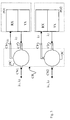
- FIG 2c a detailed basic diagram of a 2-fiber ring 21 according to the present invention is shown, the figure illustrating a first fiber CN1 and a second fiber CN2, which fibers carry high priority traffic TH and low priority traffic TL, respectively, in a bi-directional manner on a single fiber. Therefore, an interface block CB is provided for adapting the bi-directional high priority traffic TH, which is single-fiber bidirectionally travelling on the first fiber CN1, for two-fiber unidirectional transportation towards the bi-directional gate P01. Said unidirectional transportation on two fibers is symbolized by optical connections C1 and C2, incoming and outgoing, respectively, which connect the gate PO1 to the interface block CB. Similarly, the interface block CB will adapt the single-fiber bi-directional low priority traffic TL, which is travelling on the second fiber CN2, to two-fiber unidirectional transportation towards the bi-directional gate PO2 of the node 4NE.
- the node 4NE is the same as the node of Figure 2b.
- the only additional step is providing proper interface blocks CB able to implement single-fiber bi-directional transmission on both fibers CN1 and CN2.
- a further additional step is providing corresponding short lengths of fibers for unidirectional transmission between interfaces and corresponding network elements.
- the interface block CB shown by way of example in Figure 3 comprises e.g. for each fiber CN1 an optical circulator, interfacing an optical transmitter TX and an optical receiver RX contained in each bi-directional gate PO1 or PO2.
- the optical circulator OC can be employed using two different wavelengths ⁇ 1 and ⁇ 2 pertaining to the second window (1300 nm area) or pertaining to the third window (1500 nm area).
- upgrading the fiber optics network can take place without having to change the optical transmitters TX of gates PO1 and PO2.
- This solution also has low insertion losses and a good tolerance to reflections.
- a control method must be provided for controlling the reflections that may occur in the instance of a span interruption. This can be done by introducing a direction signaling bit in the SDH frame or by utilizing, for the same signal, a byte arrangement which is available in the control bytes implementing MS-SPRING protection.
- a wavelength selective coupler operating at 1300 and 1500 nm wavelength can be inserted instead of the optical circulator OC.
- Said selective coupler LSA operates at 1300 nm in one direction and at 1500 nm in the other direction for bi-directional communication on the same fiber using wavelengths in two different fiber windows. In this instance one of the transmitter has to be replaced.
- the selective coupler LSA may also be chosen for operation with both working wavelength in the 1500 nm window, so as to exploit the low attenuation values in the fiber and possibly may use an optical amplifier with erbium doped fiber. In this instance, wavelength controlled transmitters should be used and the original node transmitters be replaced.
- optical amplifiers are also possible with optical circulators.
Landscapes
- Engineering & Computer Science (AREA)
- Computer Networks & Wireless Communication (AREA)
- Signal Processing (AREA)
- Small-Scale Networks (AREA)
- Nitrogen And Oxygen Or Sulfur-Condensed Heterocyclic Ring Systems (AREA)
Applications Claiming Priority (2)
| Application Number | Priority Date | Filing Date | Title |
|---|---|---|---|
| ITTO200076 | 2000-01-26 | ||
| IT2000TO000076A IT1319811B1 (it) | 2000-01-26 | 2000-01-26 | Metodo di aggiornamento di reti in fibra ottica ms-spring |
Publications (1)
| Publication Number | Publication Date |
|---|---|
| EP1120988A2 true EP1120988A2 (en) | 2001-08-01 |
Family
ID=11457319
Family Applications (1)
| Application Number | Title | Priority Date | Filing Date |
|---|---|---|---|
| EP01400171A Withdrawn EP1120988A2 (en) | 2000-01-26 | 2001-01-19 | Method for upgrading fiber optics networks rings |
Country Status (4)
| Country | Link |
|---|---|
| US (1) | US20010038733A1 (it) |
| EP (1) | EP1120988A2 (it) |
| CA (1) | CA2331994A1 (it) |
| IT (1) | IT1319811B1 (it) |
Families Citing this family (2)
| Publication number | Priority date | Publication date | Assignee | Title |
|---|---|---|---|---|
| KR100480246B1 (ko) * | 2002-11-07 | 2005-04-07 | 삼성전자주식회사 | 중앙 기지국에서 생성된 다파장 광의 루프백을 이용하는수동형 광통신망 |
| US8233800B2 (en) | 2003-06-26 | 2012-07-31 | Fujitsu Limited | Method and system for upgrading a fiber optics network |
-
2000
- 2000-01-26 IT IT2000TO000076A patent/IT1319811B1/it active
-
2001
- 2001-01-19 EP EP01400171A patent/EP1120988A2/en not_active Withdrawn
- 2001-01-23 CA CA002331994A patent/CA2331994A1/en not_active Abandoned
- 2001-01-25 US US09/768,311 patent/US20010038733A1/en not_active Abandoned
Also Published As
| Publication number | Publication date |
|---|---|
| CA2331994A1 (en) | 2001-07-26 |
| ITTO20000076A1 (it) | 2001-07-26 |
| IT1319811B1 (it) | 2003-11-03 |
| US20010038733A1 (en) | 2001-11-08 |
Similar Documents
| Publication | Publication Date | Title |
|---|---|---|
| US7197241B2 (en) | Optical transmission systems including optical protection systems, apparatuses, and methods | |
| US6567194B1 (en) | Optical communication network and protection methods | |
| EP0848873B1 (en) | Optical communication system | |
| US6246667B1 (en) | Backwards-compatible failure restoration in bidirectional multiplex section-switched ring transmission systems | |
| US7072580B2 (en) | Autoprotected optical communication ring network | |
| US6295146B1 (en) | System and method for sharing a spare channel among two or more optical ring networks | |
| US6661972B1 (en) | Method and apparatus for transparent optical communication with two-fiber bidirectional ring with autoprotection and management of low priority traffic | |
| US6061156A (en) | Optical transmission system | |
| RU2048703C1 (ru) | Двунаправленная световодная система телесвязи | |
| CA2319905A1 (en) | Equipment, transponder and methods for optical fiber transmission | |
| CN1279548A (zh) | 用于采用波分复用的环形网的光学分插设备 | |
| WO2004015485A1 (en) | Optical communications systems, devices, and methods | |
| US7546034B2 (en) | Circuit arrangement for line protection of optical data transmission | |
| US7756416B2 (en) | Optical communication node and optical network system | |
| JP3233204B2 (ja) | 波長光adm装置 | |
| US6768831B2 (en) | Optical add-drop multiplexing apparatus | |
| CN1135752C (zh) | 光网络 | |
| US20010038733A1 (en) | Method for upgrading fiber optics network rings | |
| JP5287956B2 (ja) | 受動光ネットワーク通信方法及び受動光ネットワーク通信システム | |
| EP0928082B1 (en) | Method and apparatus for transparent optical communication with two-fiber bidirectional ring with autoprotection and management of low priority traffic | |
| US6643423B2 (en) | System and method for bridge and roll in a photonic switch | |
| CN1787417B (zh) | 一种用于波分复用系统的光转发装置 | |
| Neggah et al. | Study of a passive optical protection system | |
| CN1754339B (zh) | 用于通过光学数据网传输工作信号和保护信号的方法和装置 | |
| JP2012511277A (ja) | 双方向波長分割多重化のための波長変換構成及び方法 |
Legal Events
| Date | Code | Title | Description |
|---|---|---|---|
| PUAI | Public reference made under article 153(3) epc to a published international application that has entered the european phase |
Free format text: ORIGINAL CODE: 0009012 |
|
| AK | Designated contracting states |
Kind code of ref document: A2 Designated state(s): AT BE CH CY DE DK ES FI FR GB GR IE IT LI LU MC NL PT SE TR |
|
| AX | Request for extension of the european patent |
Free format text: AL;LT;LV;MK;RO;SI |
|
| RAP1 | Party data changed (applicant data changed or rights of an application transferred) |
Owner name: ALCATEL LUCENT |
|
| STAA | Information on the status of an ep patent application or granted ep patent |
Free format text: STATUS: THE APPLICATION IS DEEMED TO BE WITHDRAWN |
|
| 18D | Application deemed to be withdrawn |
Effective date: 20070201 |