EP1117089B1 - Perceptual audio coder bit allocation scheme providing improved perceptual quality consistency - Google Patents
Perceptual audio coder bit allocation scheme providing improved perceptual quality consistency Download PDFInfo
- Publication number
- EP1117089B1 EP1117089B1 EP00306720A EP00306720A EP1117089B1 EP 1117089 B1 EP1117089 B1 EP 1117089B1 EP 00306720 A EP00306720 A EP 00306720A EP 00306720 A EP00306720 A EP 00306720A EP 1117089 B1 EP1117089 B1 EP 1117089B1
- Authority
- EP
- European Patent Office
- Prior art keywords
- frames
- coding
- perceptual
- bit
- qualities
- Prior art date
- Legal status (The legal status is an assumption and is not a legal conclusion. Google has not performed a legal analysis and makes no representation as to the accuracy of the status listed.)
- Expired - Lifetime
Links
- 238000000034 method Methods 0.000 claims description 34
- 230000005236 sound signal Effects 0.000 claims description 12
- 238000013139 quantization Methods 0.000 claims description 10
- 230000000873 masking effect Effects 0.000 claims description 4
- 238000000638 solvent extraction Methods 0.000 claims description 2
- 230000006870 function Effects 0.000 description 15
- 230000008569 process Effects 0.000 description 12
- 230000003595 spectral effect Effects 0.000 description 7
- 230000008859 change Effects 0.000 description 5
- 238000010586 diagram Methods 0.000 description 3
- 238000012986 modification Methods 0.000 description 2
- 230000004048 modification Effects 0.000 description 2
- 230000009467 reduction Effects 0.000 description 2
- 230000006978 adaptation Effects 0.000 description 1
- 230000005540 biological transmission Effects 0.000 description 1
- 238000007796 conventional method Methods 0.000 description 1
- 230000003247 decreasing effect Effects 0.000 description 1
- 230000000694 effects Effects 0.000 description 1
- 230000003993 interaction Effects 0.000 description 1
- 238000012804 iterative process Methods 0.000 description 1
- 230000002045 lasting effect Effects 0.000 description 1
- 230000007774 longterm Effects 0.000 description 1
- 238000005070 sampling Methods 0.000 description 1
- 230000007704 transition Effects 0.000 description 1
Images
Classifications
-
- G—PHYSICS
- G10—MUSICAL INSTRUMENTS; ACOUSTICS
- G10L—SPEECH ANALYSIS TECHNIQUES OR SPEECH SYNTHESIS; SPEECH RECOGNITION; SPEECH OR VOICE PROCESSING TECHNIQUES; SPEECH OR AUDIO CODING OR DECODING
- G10L19/00—Speech or audio signals analysis-synthesis techniques for redundancy reduction, e.g. in vocoders; Coding or decoding of speech or audio signals, using source filter models or psychoacoustic analysis
- G10L19/002—Dynamic bit allocation
-
- G—PHYSICS
- G10—MUSICAL INSTRUMENTS; ACOUSTICS
- G10L—SPEECH ANALYSIS TECHNIQUES OR SPEECH SYNTHESIS; SPEECH RECOGNITION; SPEECH OR VOICE PROCESSING TECHNIQUES; SPEECH OR AUDIO CODING OR DECODING
- G10L19/00—Speech or audio signals analysis-synthesis techniques for redundancy reduction, e.g. in vocoders; Coding or decoding of speech or audio signals, using source filter models or psychoacoustic analysis
- G10L19/02—Speech or audio signals analysis-synthesis techniques for redundancy reduction, e.g. in vocoders; Coding or decoding of speech or audio signals, using source filter models or psychoacoustic analysis using spectral analysis, e.g. transform vocoders or subband vocoders
- G10L19/0204—Speech or audio signals analysis-synthesis techniques for redundancy reduction, e.g. in vocoders; Coding or decoding of speech or audio signals, using source filter models or psychoacoustic analysis using spectral analysis, e.g. transform vocoders or subband vocoders using subband decomposition
- G10L19/0208—Subband vocoders
Definitions
- the present invention relates generally to the field of perceptual audio coding (PAC) techniques and more particularly to a bit allocation scheme which achieves relatively consistent perceptual quality across consecutively coded frames.
- PAC perceptual audio coding
- perceptual models for use in coding signals representative of, for example, speech and music, for purposes of storage or transmission are typically employed to reduce the number of bits required to code a given signal.
- "transparent" coding i . e ., coding having no perceptible loss of quality
- the signal to be coded is first partitioned into individual frames, with each frame comprising a small time slice of the signal, such as, for example, a time slice of approximately twenty milliseconds.
- the signal for the given frame is transformed into the frequency domain, typically with use of a filter bank.
- the resulting spectral coefficients may then be quantized and coded.
- the quantizer which is used in a perceptual audio coder to quantize the spectral coefficients is advantageously controlled by a psychoacoustic model (i.e., a model based on the performance of the human auditory system), and by the specific number of bits that are available to code the given frame.
- PAC Perceptual Audio Coder
- bit demand i.e ., the number of bits requested by the quantizer to code the given frame
- bit allocation scheme which, inter alia, makes sure that the average bit rate remains relatively close to the desired bit rate (e . g ., the bit rate of the channel over which the coded signal is ultimately to be transmitted, or the amount of available storage per frame if the coded signal is simply to be stored).
- bit allocation scheme must ensure that the coder's output "bit buffer” or “bit reservoir” (which provides the coder with the bits which are available) never runs empty (which is referred to as an underflow condition) or full (which is referred to as an overflow condition). (The use of a bit buffer or reservoir in audio coders is fully familiar to those of ordinary skill in the art.)
- a typical prior art bit allocation scheme is described, for example, in U.S. Patent No. 5,627,938, issued on May 6, 1997 to J. Johnston, and assigned to the assignee of the present invention.
- this prior art bit allocation scheme operates as follows.
- Each frame of the signal to be coded is initially coded with quantizer step sizes that are determined by a masked threshold which is computed by the psychoacoustic model.
- the masked threshold corresponds to a transparent coding quality. That is, setting the quantizer step sizes based on the masked threshold will, in general, provide for a coding which when reconstructed will sound (to the human ear) identical to the original signal.
- the bit allocation scheme decides how many bits are actually given to the quantizer to code the frame. That is, the bit allocator can be viewed as a controller which controls the number of bits allowed, given both the initial bit demand and the buffer state. Specifically, the quantizer step sizes are then modified in an attempt to match the allowed number of bits, and the frame is then re-coded with the modified step sizes, after which the bit allocator again makes a determination of the number of bits to actually be given to the quantizer.
- This process iterates until the frame is quantized and coded with a number of bits close to the number actually granted by the bit allocator. (This iterative process is referred to in the audio coding art as the “rate loop,” and the processor which performs it is referred to as the “rate loop processor.”)
- bit buffer necessarily has a substantial influence on the bit allocation.
- the process fails to adequately account for the perceptual impact of the resulting bit allocation.
- the bit buffer becomes essentially the sole factor in the decision of how much the allocated number of bits diverge from the actual number of initially demanded bits.
- prior art audio coders such as PAC employ what is known as a noise threshold, which exceeds the masked threshold by a predetermined amount. Typically, this results in an average bit demand which is closer to the desired bit rate. In this manner, the bit buffer state remains relatively well behaved ( i.e. , having a low risk of suddenly running empty or of overflowing), and the control task of the bit allocator becomes relatively straightforward.
- the bit demand of the noise threshold which results in an appropriate given range of average bit demand can be well below the bit rate which would be necessary to achieve transparency. Therefore, one disadvantage of having to use different noise thresholds for different target bit rates is the necessity of manually tuning the psychoacoustic model of the coder for each specific target bit rate, in order to achieve a reasonable level of efficiency and performance.
- different types of audio signals result in significantly different bit demands, even providing for such a manual tuning process may not result in a coder that works well for all types of audio signals, or even one that works well for a single audio signal having characteristics which change over time.
- the coder provides a quality level which often varies significantly (over time), due to a failure of the bit allocator to allocate bits to consecutive frames in such a manner so as to ensure that they are coded with a relatively consistent quality level.
- this inconsistent behavior becomes more severe with increasing divergence between the target bit rate and the bit demand of the initially coded frames.
- bit allocation process is further controlled by taking into account the characteristics of a plurality of frames and by analyzing the bit requirements of coding each of these frames at various levels of perceptual quality.
- the present invention provides a method (and apparatus) for coding an audio signal, the method comprising the steps of partitioning the audio signal into a sequence of successive frames; calculating one or more noise thresholds for each of a plurality of frames in the sequence, each noise threshold for a particular one of the frames corresponding to a different perceptual coding quality for the particular frame; estimating a bit demand for each of a corresponding one or more perceptual coding qualities for each frame, wherein each estimated bit demand comprises a number of bits which would be used to code a given frame at the corresponding perceptual coding quality; selecting one of the perceptual coding qualities for the coding of a particular frame based upon the estimated bit demand for the perceptual coding quality for the particular frame, and further based on one or more bit demands estimated for one or more other frames; and coding the particular frame based on the noise threshold corresponding to the selected perceptual coding quality for the particular frame.
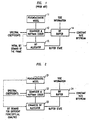
- Fig. 1 shows an overview of the bit allocation portion of an illustrative conventional prior art audio coder such as PAC.
- Fig. 2 shows an overview of the bit allocation portion of a perceptual audio coder in accordance with an illustrative embodiment of the present invention.
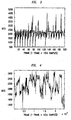
- Fig. 3 shows a graphical illustration of the bit demand as a function of time at a constant perceptual quality for a typical perceptual audio coder applied to a typical stereo audio signal.
- Fig. 4 shows a graphical illustration of an averaged bit demand as a function of time at a constant perceptual quality for a typical perceptual audio coder applied to a given sequence of audio clips.
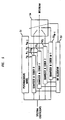
- Fig. 5 shows an implementation of a bit allocation scheme employing a set of discrete perceptual qualities in accordance with a first illustrative embodiment of the present invention.
- Fig. 1 shows an overview of the bit allocation portion of an illustrative conventional prior art audio coder such as PAC.
- the figure shows psychoacoustic model 11, quantizer and Huffman coder 12, bit allocator 13 and bit buffer 14.
- psychoacoustic model 11 provides masked thresholds which are used by the quantizer (of quantizer and Huffman coder 12) to determine quantization step sizes which initially provide for transparent coding of the given frame of the audio signal. Based on these step sizes, the spectral coefficients of the given frame are quantized and the resultant data is Huffman coded by quantizer and Huffman coder 12, which results in an initial bit demand (i.e., the number of bits which would be required by the resultant encoding). This bit demand is provided to bit allocator 13, which is aware of the required bit rate ( i . e ., the rate of the constant rate bitstream which is to be ultimately output by bit buffer 14).
- bit buffer 14 provides the buffer state (i.e., the degree of fullness or emptiness) to bit allocator 13. If the initial bit demand is consistent with the buffer state and the given required bit rate, the frame is coded with the given encoding (as determined by quantizer and Huffman coder 12), but if it is not (as is most typical), quantizer and Huffman coder 12 is instructed by bit allocator 13 to re-code the frame with different quantization step sizes, and the process iterates until a bit demand consistent with the buffer state and the given required bit rate is achieved.
- the buffer state i.e., the degree of fullness or emptiness
- Fig. 2 shows an overview of the bit allocation portion of a perceptual audio coder in accordance with an illustrative embodiment of the present invention.
- the figure shows psychoacoustic model 21, quantizer and Huffman coder 22, enhanced bit allocator 23, and bit buffer 24.
- psychoacoustic model 21 provides one or more noise thresholds (i.e ., the masked threshold with a given amount of additional noise added thereto) representing one or more corresponding perceptual qualities therefor.
- noise thresholds i.e ., the masked threshold with a given amount of additional noise added thereto
- psychoacoustic model may, for example, provide a threshold representing a transparent perceptual quality for the given frame, and several other thresholds representing successively lower perceptual qualities.
- quantizer and Huffman coder 22 determines corresponding bit demands for the various different perceptual qualities.
- each of these thresholds translate into particular quantization step sizes, and based on these step sizes, the spectral coefficients of the given frame are quantized and the resultant data is Huffman coded by quantizer and Huffman coder 12, which results in a set of bit demands corresponding to the various perceptual qualities.
- enhanced bit allocator 23 determines at which perceptual quality level the given frame is to be coded.
- the selection of a perceptual quality level at which to code the given frame is advantageously based upon a number of factors. These include the required bit rate (i.e. , the rate of the constant rate bitstream which is to be ultimately output by bit buffer 24); the state of the bit buffer (as provided to it by bit buffer 24); the various bit demands required to code the given frame at each of the various perceptual qualities (as determined by quantizer and Huffman coder 22); and, in accordance with the principles of the present invention, an analysis of the bit demands at one or more perceptual qualities for one or more other frames. These other frames may, for example, advantageously include a number of frames previous to the given frame ( i . e ., "past" frames) and/or a number of frames subsequent to the given frame ( i . e ., "future" frames).
- Fig. 3 shows a graphical illustration of the bit demand as a function of time at a constant perceptual quality for a typical perceptual audio coder applied to a typical stereo audio signal.
- the average bit rate is 68 kilobits per second, with a 32 kilohertz sampling rate for a stereo signal.
- the bit demand b ( k , Q ) is a function of time k (the frame number) and the perceptual quality Q , where Q is typically a number that monotonically increases as the perceived quality increases.
- a perceptual audio coder runs at a relatively constant perceptual quality Q because short bursts of low quality audio tend to reduce the perceived quality of the overall signal.
- bit demand for a constant perceptual quality can vary substantially from frame to frame, as shown illustratively in Fig. 3, due to variations in the given frame's signal energy and due to variations in the amount of both irrelevancy reduction and relevancy reduction achieved by the coding process.
- the bits are advantageously allocated such that successive frames are coded at a relatively constant perceptual quality under the given constraints of the average bit rate and the size of the bit buffer.
- Fig. 4 shows a graphical illustration of an averaged bit demand as a function of time at a constant perceptual quality for a typical perceptual audio coder applied to a sequence of audio clips.
- the illustrative sequence comprises approximately 25 music and speech clips lasting approximately 15 minutes. Note from the figure that different clips have differing averaged bit demands. Therefore, given an output bit buffer of a relatively modest size, a perceptual audio coder is not likely to be able to code a series of such clips with a constant perceptual quality.
- the perceptual quality Q ( k ) is adapted over time.
- Two conditions are advantageously applied to such an adaptation.
- the average demand is advantageously maintained at a value close to the desired bit rate.
- the perceptual quality is advantageously permitted to change only slowly from frame to frame.
- the performance of the illustrative embodiment of the present invention at least approximates the "ideal" scenario of maintaining a constant perceptual quality.
- vector w ( i ) comprises a weighting vector for estimating the mean bit demand, which in various illustrative embodiments of the present invention may weight the computed mean value towards the bit demands of those frames which are more proximate to the given frame.
- the perceptual quality at which each given frame is coded is updated based on the current conditions.
- the perceptual quality Q ( k ) at which the estimated mean bit demand m ( k , Q) is equal to the average number of bits B which are available for each frame at the desired bit rate, as follows: m ( k, Q ( k )) B
- bit buffer control may also be employed to ensure that the bit buffer does not run empty or full.
- the instant inventive technique typically ensures that the bit allocation tracks fairly close to the given bit rate, such bit buffer control is likely to have only a minor influence on the resultant bit allocation.
- bit allocation scheme described above can be advantageously extended to provide for simultaneous bit allocation over N perceptual audio coders which run in parallel.
- Such multiple audio coders may, for example, be used to code a plurality of independent audio programs, or they may be used to code multiple channels of the same program.
- the joint mean bit demand of the multiple (e.g ., N ) audio coders may be advantageously estimated over time, as follows:
- the perceptual quality Q ( k ) is advantageously computed at each point in time k such that the estimated mean bit demand m ( k , Q ( k )) as computed above is equal or nearly equal to the average number of bits per frame B at the given bit rate, as shown in equation (2).
- the different perceptual qualities ( Q ) may be defined in any of a number of ways, many of which would be obvious to those of ordinary skill in the art.
- a psychoacoustic model which computes a noise level (i .e., a noise threshold) for each possible perceptual quality (or for a fixed number of possible perceptual qualities) may be derived based on conventional techniques involving, for example, psychoacoustic experimentation.
- noise may be systematically added to the masked threshold (as presently computed by conventional psychoacoustic models) in order to estimate a noise threshold corresponding to a desired perceptual quality.
- masked threshold as presently computed by conventional psychoacoustic models
- noise threshold corresponding to a desired perceptual quality.
- a relatively simple implementation of multiple perceptual qualities may be obtained by merely assuming that two frames are being coded at the same perceptual quality if their masked thresholds are increased or decreased by the same offset (to thereby produce corresponding noise thresholds) -- specifically, to decrease the perceptual quality of two frames by the same amount, their corresponding masked thresholds may be advantageously made higher by the same offset in a logarithmic scale ( i . e ., the same factor on a linear scale).
- the signal for the given frame can be coded in order to compute the number of bits required for a given perceptual quality -- namely, the bit demand, b ( k , Q ).
- the computational complexity is advantageously reduced with the use of either of the two following implementation schemes.
- Fig. 5 shows an implementation of a bit allocation scheme employing a set of discrete perceptual qualities in accordance with a first illustrative embodiment of the present invention. Specifically, for each frame, only a relatively small set of bit demands are advantageously computed, one for each of a small number of discrete perceptual qualities.
- a limited number of discrete perceptual qualities are predetermined as corresponding to a certain offset of the masking threshold (or, more generally, to the masked threshold with a certain amount of additional noise), as described above.
- these offsets are advantageously set based on the bit rate and the system designer's expectations of the system's performance. For example, for relatively high bit rates, where transparent coding can sometimes be achieved, the "highest" perceptual quality may be set to a fully transparent quality ( e . g ., by using the original masking threshold), and each successively lower quality may be set to be "less transparent" than the previous one by an approximately equal amount.
- one of the "middle" perceptual qualities might be advantageously chosen to be the average "expected” quality, with higher and lower quality levels being approximately equally spaced successively above and successively below the average quality level, respectively.
- the bit demand b ( k , Q j ) at each of a set of M predetermined discrete perceptual qualities (0 # j ⁇ M ) is computed as follows.
- a quantization noise threshold n j for a specific perceptual quality Q j is computed by the psychoacoustic model as described above.
- the spectral coefficients for the given frame k are quantized with a quantization error corresponding to n j , Huffman coded, and the corresponding bit demand b ( k , Q j ) is calculated for each j .
- psychoacoustic model 51 produces M distinct noise thresholds n 0 through n M -1 , and provides each of these to a corresponding quantizer and coder, 52 0 through 52 M -1 , each of which quantizes and codes the spectral coefficients for each of a plurality of frames at the corresponding perceptual quality level. Then, for each frame k , bit allocator 53 chooses the quality Q j which most closely satisfies Equation (2), allocates b ( k , Q j ) bits to the frame, and directs switch 54 to provide the encoding produced by quantizer and coder 52 j to the encoded bitstream.
- the levels of the perceptual qualities are advantageously adapted slowly over time. For example, this may be implemented by advantageously choosing the best quality Q 0 (adaptively) such that the long term mean of the bit demand at Q 0 is slightly higher than the average number of bits per frame B at the desired bit rate.
- the lowest quality Q M -1 may be advantageously chosen such that the estimated mean bit demand (Equation (1)) never or at most rarely exceeds B. The quality levels in between Q 0 and Q M -1 may then be perceptually equally spaced therebetween.
- an "escape" quality Q E may also be advantageously provided in order to provide additional assurance that the bit buffer does not run empty ( i . e ., so that no bits are available to code subsequent frames).
- the escape quality Q E is chosen to be well below the other perceptual qualities, and bit allocator 53 selects this quality to code the given frame any time the bit buffer runs dangerously low. (In practice, however, such a selection will need to be made rarely, if ever.)
- the scheme in accordance with the first illustrative embodiment of the present invention eliminates the need for a rate loop as employed in typical prior art perceptual audio coders.
- the process not only results in a well controlled bit allocation and thereby improved perceptual performance, but it is also ensured to require at most a fixed number of iterations.
- the degree to which the computational load varies in the resulting coder is significantly reduced as compared to that of a conventional prior art audio coder, thus making the implementation easier, particularly for real-time applications.
- the bit demand for different perceptual qualities is estimated without actually coding and counting the number of bits used.
- a rough estimation of the bit demand b ( k , Q ) may be obtained, and based on this estimation, the quality level to be used for the coding of each frame is selected.
- the rate loop (similar to that of an otherwise conventional perceptual audio coder) can be made to iterate (changing the quantizer step sizes) until approximately b ( k ) bits are used to code frame k.
- the implementation in accordance with this second illustrative embodiment can be advantageously integrated into an existing audio coder with only minimal modifications thereto.
- this implementation uses only a simple formula to estimate the bit demand as a function of perceptual quality, it is likely to be less perceptually controlled than, for example, the implementation in accordance with the first illustrative embodiment described above.
- the simplicity of this approach, and the ease with which an existing coder can be modified to use it, offer certain advantages.
- bit demand may be estimated as a function of perceptual quality by computing a few data points (as is done by the above-described first illustrative embodiment), and then a more "precise" quality level choice may be advantageously obtained by interpolating in between two of these data points (in accordance with the approach of the second illustrative embodiment).
- an iterative rate loop which limits its iterations to be between two pre-calculated perceptual qualities may be used to obtain certain of the advantages of both the first and second illustrative embodiments as described above.
- processors may be provided through the use of dedicated hardware as well as hardware capable of executing software in association with appropriate software.
- the functions may be provided by a single dedicated processor, by a single shared processor, or by a plurality of individual processors, some of which may be shared.
- explicit use of the term "processor” or “controller” should not be construed to refer exclusively to hardware capable of executing software, and may implicitly include, without limitation, digital signal processor (DSP) hardware, read-only memory (ROM) for storing software, random access memory (RAM), and non-volatile storage. Other hardware, conventional and/or custom, may also be included.
- DSP digital signal processor
- ROM read-only memory
- RAM random access memory
- non-volatile storage non-volatile storage
- any switches shown in the Figs. are conceptual only. Their function may be carried out through the operation of program logic, through dedicated logic, through the interaction of program control and dedicated logic, or even manually, the particular technique being selectable by the implementor as more specifically understood from the context.
- any element expressed as a means for performing a specified function is intended to encompass any way of performing that function including, for example, (a) a combination of circuit elements which performs that function or (b) software in any form, including, therefore, firmware, microcode or the like, combined with appropriate circuitry for executing that software to perform the function.
- the invention as defined by such claims resides in the fact that the functionalities provided by the various recited means are combined and brought together in the manner which the claims call for.
Landscapes
- Engineering & Computer Science (AREA)
- Physics & Mathematics (AREA)
- Computational Linguistics (AREA)
- Signal Processing (AREA)
- Health & Medical Sciences (AREA)
- Audiology, Speech & Language Pathology (AREA)
- Human Computer Interaction (AREA)
- Acoustics & Sound (AREA)
- Multimedia (AREA)
- Spectroscopy & Molecular Physics (AREA)
- Compression, Expansion, Code Conversion, And Decoders (AREA)
- Transmission Systems Not Characterized By The Medium Used For Transmission (AREA)
Applications Claiming Priority (2)
| Application Number | Priority Date | Filing Date | Title |
|---|---|---|---|
| US477314 | 1995-06-07 | ||
| US09/477,314 US6499010B1 (en) | 2000-01-04 | 2000-01-04 | Perceptual audio coder bit allocation scheme providing improved perceptual quality consistency |
Publications (2)
| Publication Number | Publication Date |
|---|---|
| EP1117089A1 EP1117089A1 (en) | 2001-07-18 |
| EP1117089B1 true EP1117089B1 (en) | 2001-11-14 |
Family
ID=23895405
Family Applications (1)
| Application Number | Title | Priority Date | Filing Date |
|---|---|---|---|
| EP00306720A Expired - Lifetime EP1117089B1 (en) | 2000-01-04 | 2000-08-07 | Perceptual audio coder bit allocation scheme providing improved perceptual quality consistency |
Country Status (5)
| Country | Link |
|---|---|
| US (1) | US6499010B1 (enExample) |
| EP (1) | EP1117089B1 (enExample) |
| JP (1) | JP4219551B2 (enExample) |
| CA (1) | CA2327405C (enExample) |
| DE (1) | DE60000047T2 (enExample) |
Families Citing this family (35)
| Publication number | Priority date | Publication date | Assignee | Title |
|---|---|---|---|---|
| DE19947877C2 (de) * | 1999-10-05 | 2001-09-13 | Fraunhofer Ges Forschung | Verfahren und Vorrichtung zum Einbringen von Informationen in einen Datenstrom sowie Verfahren und Vorrichtung zum Codieren eines Audiosignals |
| US6778953B1 (en) * | 2000-06-02 | 2004-08-17 | Agere Systems Inc. | Method and apparatus for representing masked thresholds in a perceptual audio coder |
| US6987889B1 (en) * | 2001-08-10 | 2006-01-17 | Polycom, Inc. | System and method for dynamic perceptual coding of macroblocks in a video frame |
| US6934677B2 (en) | 2001-12-14 | 2005-08-23 | Microsoft Corporation | Quantization matrices based on critical band pattern information for digital audio wherein quantization bands differ from critical bands |
| US7240001B2 (en) * | 2001-12-14 | 2007-07-03 | Microsoft Corporation | Quality improvement techniques in an audio encoder |
| US7110941B2 (en) * | 2002-03-28 | 2006-09-19 | Microsoft Corporation | System and method for embedded audio coding with implicit auditory masking |
| US20030220800A1 (en) * | 2002-05-21 | 2003-11-27 | Budnikov Dmitry N. | Coding multichannel audio signals |
| JP4676140B2 (ja) | 2002-09-04 | 2011-04-27 | マイクロソフト コーポレーション | オーディオの量子化および逆量子化 |
| US7299190B2 (en) * | 2002-09-04 | 2007-11-20 | Microsoft Corporation | Quantization and inverse quantization for audio |
| US7502743B2 (en) | 2002-09-04 | 2009-03-10 | Microsoft Corporation | Multi-channel audio encoding and decoding with multi-channel transform selection |
| KR100477699B1 (ko) * | 2003-01-15 | 2005-03-18 | 삼성전자주식회사 | 양자화 잡음 분포 조절 방법 및 장치 |
| US7724827B2 (en) | 2003-09-07 | 2010-05-25 | Microsoft Corporation | Multi-layer run level encoding and decoding |
| US7460990B2 (en) | 2004-01-23 | 2008-12-02 | Microsoft Corporation | Efficient coding of digital media spectral data using wide-sense perceptual similarity |
| GB0428160D0 (en) * | 2004-12-22 | 2005-01-26 | British Telecomm | Variable bit rate processing |
| US8599925B2 (en) | 2005-08-12 | 2013-12-03 | Microsoft Corporation | Efficient coding and decoding of transform blocks |
| KR100979624B1 (ko) * | 2005-09-05 | 2010-09-01 | 후지쯔 가부시끼가이샤 | 오디오 부호화 장치 및 오디오 부호화 방법 |
| US8332216B2 (en) | 2006-01-12 | 2012-12-11 | Stmicroelectronics Asia Pacific Pte., Ltd. | System and method for low power stereo perceptual audio coding using adaptive masking threshold |
| JP4548348B2 (ja) * | 2006-01-18 | 2010-09-22 | カシオ計算機株式会社 | 音声符号化装置及び音声符号化方法 |
| US7831434B2 (en) | 2006-01-20 | 2010-11-09 | Microsoft Corporation | Complex-transform channel coding with extended-band frequency coding |
| US7953604B2 (en) * | 2006-01-20 | 2011-05-31 | Microsoft Corporation | Shape and scale parameters for extended-band frequency coding |
| US8190425B2 (en) | 2006-01-20 | 2012-05-29 | Microsoft Corporation | Complex cross-correlation parameters for multi-channel audio |
| FR2898443A1 (fr) * | 2006-03-13 | 2007-09-14 | France Telecom | Procede de codage d'un signal audio source, dispositif de codage, procede et dispositif de decodage, signal, produits programme d'ordinateur correspondants |
| US8032371B2 (en) * | 2006-07-28 | 2011-10-04 | Apple Inc. | Determining scale factor values in encoding audio data with AAC |
| US8010370B2 (en) * | 2006-07-28 | 2011-08-30 | Apple Inc. | Bitrate control for perceptual coding |
| JP2008233436A (ja) * | 2007-03-19 | 2008-10-02 | Fujitsu Ltd | 符号化装置、符号化プログラムおよび符号化方法 |
| US7774205B2 (en) | 2007-06-15 | 2010-08-10 | Microsoft Corporation | Coding of sparse digital media spectral data |
| US7885819B2 (en) | 2007-06-29 | 2011-02-08 | Microsoft Corporation | Bitstream syntax for multi-process audio decoding |
| GB2454208A (en) * | 2007-10-31 | 2009-05-06 | Cambridge Silicon Radio Ltd | Compression using a perceptual model and a signal-to-mask ratio (SMR) parameter tuned based on target bitrate and previously encoded data |
| JP4618325B2 (ja) * | 2008-04-28 | 2011-01-26 | ソニー株式会社 | 情報処理装置及び情報処理方法並びにプログラム |
| US8346547B1 (en) * | 2009-05-18 | 2013-01-01 | Marvell International Ltd. | Encoder quantization architecture for advanced audio coding |
| US9026450B2 (en) | 2011-03-09 | 2015-05-05 | Dts Llc | System for dynamically creating and rendering audio objects |
| KR20140017338A (ko) * | 2012-07-31 | 2014-02-11 | 인텔렉추얼디스커버리 주식회사 | 오디오 신호 처리 장치 및 방법 |
| US9558785B2 (en) | 2013-04-05 | 2017-01-31 | Dts, Inc. | Layered audio coding and transmission |
| US20150025894A1 (en) * | 2013-07-16 | 2015-01-22 | Electronics And Telecommunications Research Institute | Method for encoding and decoding of multi channel audio signal, encoder and decoder |
| CN109451309B (zh) * | 2018-12-04 | 2022-07-26 | 南京邮电大学 | Hevc全i帧编码基于显著性的ctu层码率分配方法 |
Family Cites Families (10)
| Publication number | Priority date | Publication date | Assignee | Title |
|---|---|---|---|---|
| NL9000338A (nl) * | 1989-06-02 | 1991-01-02 | Koninkl Philips Electronics Nv | Digitaal transmissiesysteem, zender en ontvanger te gebruiken in het transmissiesysteem en registratiedrager verkregen met de zender in de vorm van een optekeninrichting. |
| US5040217A (en) * | 1989-10-18 | 1991-08-13 | At&T Bell Laboratories | Perceptual coding of audio signals |
| EP0559348A3 (en) | 1992-03-02 | 1993-11-03 | AT&T Corp. | Rate control loop processor for perceptual encoder/decoder |
| KR970005131B1 (ko) * | 1994-01-18 | 1997-04-12 | 대우전자 주식회사 | 인간의 청각특성에 적응적인 디지탈 오디오 부호화장치 |
| JP4005154B2 (ja) * | 1995-10-26 | 2007-11-07 | ソニー株式会社 | 音声復号化方法及び装置 |
| US5956674A (en) * | 1995-12-01 | 1999-09-21 | Digital Theater Systems, Inc. | Multi-channel predictive subband audio coder using psychoacoustic adaptive bit allocation in frequency, time and over the multiple channels |
| JPH1035876A (ja) | 1996-07-19 | 1998-02-10 | Daifuku Co Ltd | 仕分け装置 |
| US6108372A (en) * | 1996-10-30 | 2000-08-22 | Qualcomm Inc. | Method and apparatus for decoding variable rate data using hypothesis testing to determine data rate |
| GB2326572A (en) * | 1997-06-19 | 1998-12-23 | Softsound Limited | Low bit rate audio coder and decoder |
| JP3802219B2 (ja) * | 1998-02-18 | 2006-07-26 | 富士通株式会社 | 音声符号化装置 |
-
2000
- 2000-01-04 US US09/477,314 patent/US6499010B1/en not_active Expired - Lifetime
- 2000-08-07 DE DE60000047T patent/DE60000047T2/de not_active Expired - Lifetime
- 2000-08-07 EP EP00306720A patent/EP1117089B1/en not_active Expired - Lifetime
- 2000-11-27 CA CA002327405A patent/CA2327405C/en not_active Expired - Fee Related
- 2000-12-27 JP JP2000396662A patent/JP4219551B2/ja not_active Expired - Fee Related
Also Published As
| Publication number | Publication date |
|---|---|
| JP2001236099A (ja) | 2001-08-31 |
| DE60000047T2 (de) | 2002-07-11 |
| CA2327405C (en) | 2005-05-03 |
| EP1117089A1 (en) | 2001-07-18 |
| DE60000047D1 (de) | 2002-02-21 |
| JP4219551B2 (ja) | 2009-02-04 |
| CA2327405A1 (en) | 2001-07-04 |
| US6499010B1 (en) | 2002-12-24 |
Similar Documents
| Publication | Publication Date | Title |
|---|---|---|
| US6499010B1 (en) | Perceptual audio coder bit allocation scheme providing improved perceptual quality consistency | |
| JP3955600B2 (ja) | 背景ノイズエネルギーレベルを見積もる方法と装置 | |
| EP2077550B1 (en) | Audio encoder and decoder | |
| CN105144288B (zh) | 高级量化器 | |
| RU2505921C2 (ru) | Способ и устройство кодирования и декодирования аудиосигналов (варианты) | |
| CN105247614A (zh) | 音频编码器和解码器 | |
| US8589155B2 (en) | Adaptive tuning of the perceptual model | |
| EP0922278B1 (en) | Variable bitrate speech transmission system | |
| US8442819B2 (en) | Distortion-based method and apparatus for buffer control in a communication system | |
| EP1139336A2 (en) | Determination of quantizaion coefficients for a subband audio encoder | |
| KR102486258B1 (ko) | 스테레오 신호 인코딩 방법 및 인코딩 장치 | |
| EP1673765A2 (en) | A method for grouping short windows in audio encoding | |
| US7640157B2 (en) | Systems and methods for low bit rate audio coders | |
| RU2866685C2 (ru) | Аудиокодер и декодер | |
| RU2793725C2 (ru) | Аудиокодер и декодер | |
| EP0574523A4 (en) | VARIABLE BIT RATE VOICE ENCODER. | |
| HK40114881A (en) | Audio encoder and decoder | |
| CN122337218A (zh) | 一种音频压缩比特分配和量化的实现方法及处理终端 | |
| HK40001137A (en) | Audio encoder and decoder | |
| JPH06291679A (ja) | オーディオ信号のためのしきい値制御量子化決定法 | |
| HK1127152B (en) | Variable rate vocoder | |
| MXPA96002142A (en) | Speech classification with voice / no voice for use in decodification of speech during decorated by quad |
Legal Events
| Date | Code | Title | Description |
|---|---|---|---|
| GRAG | Despatch of communication of intention to grant |
Free format text: ORIGINAL CODE: EPIDOS AGRA |
|
| GRAG | Despatch of communication of intention to grant |
Free format text: ORIGINAL CODE: EPIDOS AGRA |
|
| GRAH | Despatch of communication of intention to grant a patent |
Free format text: ORIGINAL CODE: EPIDOS IGRA |
|
| PUAI | Public reference made under article 153(3) epc to a published international application that has entered the european phase |
Free format text: ORIGINAL CODE: 0009012 |
|
| 17P | Request for examination filed |
Effective date: 20000817 |
|
| AK | Designated contracting states |
Kind code of ref document: A1 Designated state(s): AT BE CH CY DE DK ES FI FR GB GR IE IT LI LU MC NL PT SE |
|
| AX | Request for extension of the european patent |
Free format text: AL;LT;LV;MK;RO;SI |
|
| GRAH | Despatch of communication of intention to grant a patent |
Free format text: ORIGINAL CODE: EPIDOS IGRA |
|
| GRAA | (expected) grant |
Free format text: ORIGINAL CODE: 0009210 |
|
| AK | Designated contracting states |
Kind code of ref document: B1 Designated state(s): DE FR GB |
|
| AX | Request for extension of the european patent |
Free format text: AL;LT;LV;MK;RO;SI |
|
| LTIE | Lt: invalidation of european patent or patent extension | ||
| REG | Reference to a national code |
Ref country code: IE Ref legal event code: FG4D |
|
| REG | Reference to a national code |
Ref country code: GB Ref legal event code: IF02 |
|
| REF | Corresponds to: |
Ref document number: 60000047 Country of ref document: DE Date of ref document: 20020221 |
|
| AKX | Designation fees paid |
Free format text: DE FR GB |
|
| PLBE | No opposition filed within time limit |
Free format text: ORIGINAL CODE: 0009261 |
|
| STAA | Information on the status of an ep patent application or granted ep patent |
Free format text: STATUS: NO OPPOSITION FILED WITHIN TIME LIMIT |
|
| 26N | No opposition filed | ||
| REG | Reference to a national code |
Ref country code: IE Ref legal event code: MM4A |
|
| PGFP | Annual fee paid to national office [announced via postgrant information from national office to epo] |
Ref country code: FR Payment date: 20130808 Year of fee payment: 14 |
|
| REG | Reference to a national code |
Ref country code: FR Ref legal event code: ST Effective date: 20150430 |
|
| PG25 | Lapsed in a contracting state [announced via postgrant information from national office to epo] |
Ref country code: FR Free format text: LAPSE BECAUSE OF NON-PAYMENT OF DUE FEES Effective date: 20140901 |
|
| PGFP | Annual fee paid to national office [announced via postgrant information from national office to epo] |
Ref country code: GB Payment date: 20150724 Year of fee payment: 16 |
|
| GBPC | Gb: european patent ceased through non-payment of renewal fee |
Effective date: 20160807 |
|
| PG25 | Lapsed in a contracting state [announced via postgrant information from national office to epo] |
Ref country code: GB Free format text: LAPSE BECAUSE OF NON-PAYMENT OF DUE FEES Effective date: 20160807 |
|
| PGFP | Annual fee paid to national office [announced via postgrant information from national office to epo] |
Ref country code: DE Payment date: 20190828 Year of fee payment: 20 |
|
| REG | Reference to a national code |
Ref country code: DE Ref legal event code: R071 Ref document number: 60000047 Country of ref document: DE |