EP1115045A2 - A clock - Google Patents
A clock Download PDFInfo
- Publication number
- EP1115045A2 EP1115045A2 EP00311570A EP00311570A EP1115045A2 EP 1115045 A2 EP1115045 A2 EP 1115045A2 EP 00311570 A EP00311570 A EP 00311570A EP 00311570 A EP00311570 A EP 00311570A EP 1115045 A2 EP1115045 A2 EP 1115045A2
- Authority
- EP
- European Patent Office
- Prior art keywords
- clock
- time
- oscillator
- occasion
- setting
- Prior art date
- Legal status (The legal status is an assumption and is not a legal conclusion. Google has not performed a legal analysis and makes no representation as to the accuracy of the status listed.)
- Ceased
Links
- 238000000034 method Methods 0.000 claims abstract description 13
- 238000004891 communication Methods 0.000 claims description 5
- 239000013078 crystal Substances 0.000 description 5
- 230000006399 behavior Effects 0.000 description 4
- 230000032683 aging Effects 0.000 description 2
- 239000003990 capacitor Substances 0.000 description 2
- 230000001413 cellular effect Effects 0.000 description 2
- 230000000694 effects Effects 0.000 description 2
- 230000006870 function Effects 0.000 description 2
- 238000004519 manufacturing process Methods 0.000 description 2
- 230000002035 prolonged effect Effects 0.000 description 2
- 230000000717 retained effect Effects 0.000 description 1
Images


Classifications
-
- G—PHYSICS
- G04—HOROLOGY
- G04G—ELECTRONIC TIME-PIECES
- G04G3/00—Producing timing pulses
- G04G3/02—Circuits for deriving low frequency timing pulses from pulses of higher frequency
-
- G—PHYSICS
- G04—HOROLOGY
- G04R—RADIO-CONTROLLED TIME-PIECES
- G04R20/00—Setting the time according to the time information carried or implied by the radio signal
-
- G—PHYSICS
- G04—HOROLOGY
- G04R—RADIO-CONTROLLED TIME-PIECES
- G04R40/00—Correcting the clock frequency
- G04R40/06—Correcting the clock frequency by computing the time value implied by the radio signal
Definitions
- the present invention relates to maintaining the accuracy of a clock, and is especially, but not exclusively applicable to clocks within portable radio communication devices, such as radiotelephones.
- a radiotelephone it is well known for a radiotelephone to include time-keeping circuitry which enables it to serve additionally as a clock for the user.
- the clock is driven from a crystal oscillator the output signal of which is also used as timing base for the other functions which the radiotelephone performs.
- a dedicated oscillator is provided to drive the clock. In either case, the stability of the output frequency of the oscillator has a great impact on the accuracy of the clock.
- the present invention may provide a method for maintaining the accuracy of a clock, comprising the steps of:-
- the accuracy of the clock can be maintained within reasonable bounds in the face of drift-causing influences, not by increasing the cost or complexity of the clock circuitry itself to arrive at the required accuracy, but by using feedback from an external, more accurate source to adjust the time-keeping operation of the clock to compensate for the drift-causing influences.
- the clock comprises an oscillator and processing means for processing the signal from the oscillator on the basis of a timing parameter to produce an indication of clock time.
- the time-keeping operation of the clock may be adjusted by directly re-tuning the crystal of the oscillator.
- the timing parameter of the processing means may be adjusted.
- the clock time may be set manually by the user.
- the clock is implemented as part of a radio communication device, it can be automatically reset from time to time from an accurate remote source via the radio interface.
- the clock cannot only passively adjust its time-keeping operations to adjust to past conditions, but can also based on predictive models of the behaviour of the oscillator in different environments temperature-wise, the behaviour of the oscillator as it ages and the like, the clock can also seek to pre-compensate for frequency drift before or as it is happening.
- the present invention may provide a clock comprising time-setting means to set the clock time; and adjustment means for adjusting the time-keeping operation of the clock when the clock time is reset.
- the clock comprises an oscillator and processing means to process the signal from the oscillator on the basis of a timing parameter to produce an indication of clock time.
- the adjustment means includes means for re-tuning the oscillator.
- the adjustment means is operable to adjust the timing parameter.
- the present invention may provide a radio communication device including a clock as previously discussed.
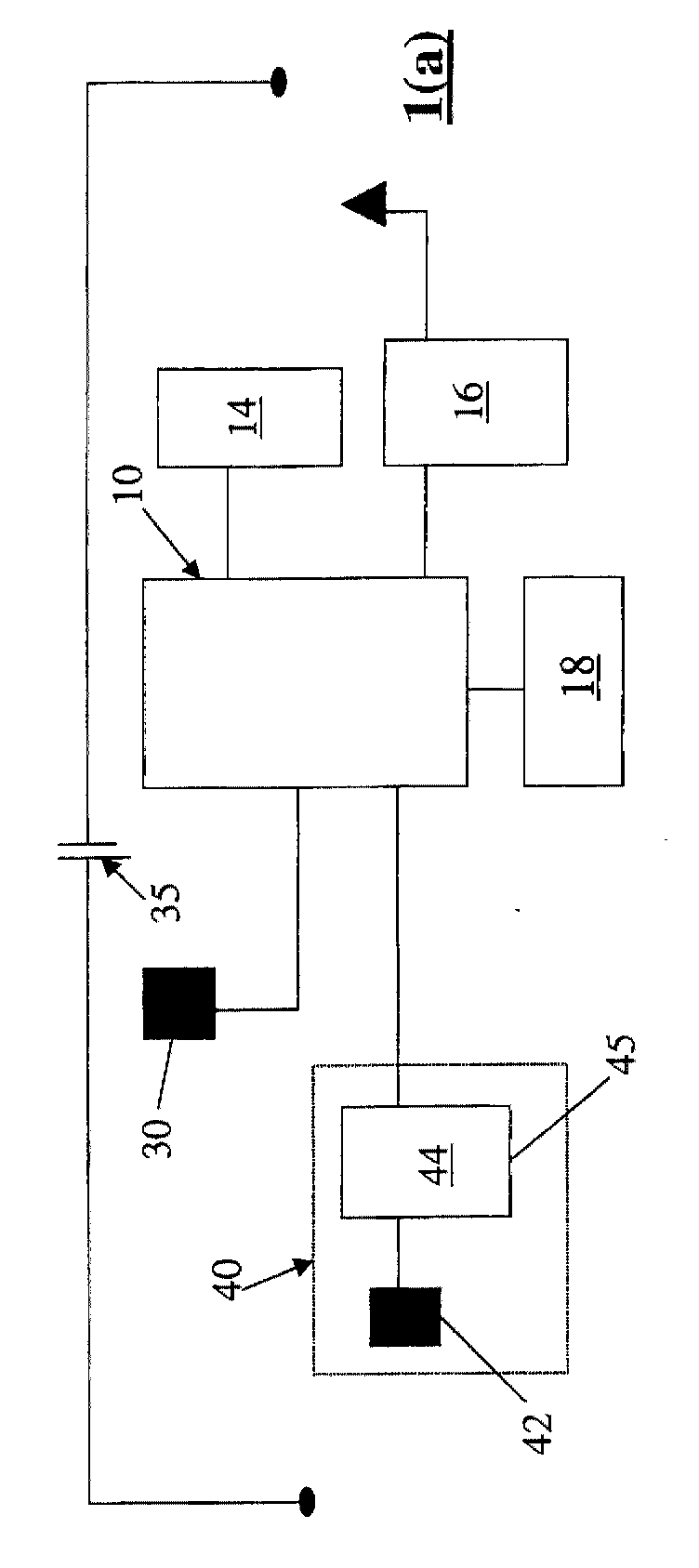
- the radiotelephone comprises a baseband unit 10 for controlling the general operation of the radiotelephone.
- the baseband unit 10 is also coupled to a display 14, a radio interface 16 by which the telephone can communicate over the air with a base station, a key pad 18.
- the timing base for the baseband unit 10 is provided by a crystal oscillator 30.
- a clock unit 40 also supplies clock time data to the baseband unit 10 which depending on the mode in which the radiotelephone is being used can be displayed on the display 14.
- the clock unit 40 includes a dedicated crystal oscillator 42 which produces an output signal at a nominal frequency f after it has been tuned during manufacture.
- the clock unit 40 also comprises a processing unit 44 which keeps time in clock time format, i.e. date/hours/minutes, and counts the pulses produced by the oscillator 42 to provide an indication of the passage of time so that the clock time be appropriately updated.
- the processing unit 44 also includes semi-permanent memory 45.
- the clock time held by the processing means can be set from the user via the key pad 18.
- the radiotelephone is powered from a removable battery power supply 35. When the battery power is removed, the oscillator clock unit 40 continues to operate normally for a short while deriving its power from a large capacitor (not shown). Once the capacitor runs down the clock unit 40 stops operating.
- T initial this time, is stored in the semi-permanent memory 45.
- Timing parameter P is also stored in the semi-permanent memory 45.
- the processing unit 44 calculates (1) t period , the time since the clock time was last reset, T end - T initial , and (ii) ⁇ T calculates the difference in clock time as the clock is reset, T reset , and the clock time momentarily before the clock time is reset, Tend. By calculating t periods , ⁇ T, the processing unit 44 can then evaluate the average error per unit time over the interval T reset and make a correction to the timing parameter P to reflect this error.
- the processing unit 44 seeks to use the knowledge of the time-keeping error made over the interval t period to adjust the time-keeping operation of the clock unit 40 to keep time more accurately in the future.
- a radiotelephone 1 in accordance with a second embodiment of the present invention is shown.
- This embodiment differs from the first embodiment in that the oscillator 30 for driving the baseband unit is dispensed with and, instead, the clock oscillator 42 is used to provide the time base for baseband unit 10 also.
- the clock unit 40 includes an oscillator tuning unit 40.
- an added advantage of this second embodiment of the invention is that the frequency output of the oscillator 42 is brought back towards its nominal value f and this is advantageous to the reliability of the operation of the rest of the radiotelephone.
- the clock time will assume a zero default status. As the clock time includes a date field as well this condition will be very easy to detect as a zero day or month does not exist normally. Where the user enters an erroneous clock time, this can be detected by setting a threshold for ⁇ T above which it is assumed that there has been a user error. In both these cases, the time-keeping operation of the clock unit 44 is not adjusted.
- the radiotelephone 1 automatically requests an accurate version of clock time from a base station 100 of a cellular network, or from the internet 110 which it gains access to via the base station 110.
- the base station 100 can regularly update the radiotelephone 1 with the correct clock time which it supplies from its own accurate clock or which it requests from the internet 110.
- the radio telephone 1 cannot only passively adjust its time-keeping operations to adjust to pas conditions, but can also based on predictive models of the behaviour of the oscillator in different environments temperature-wise, the behaviour of the oscillator as it ages and the like, the clock can seek to pre-compensate for frequency drift before or as it is happening.
Landscapes
- Physics & Mathematics (AREA)
- General Physics & Mathematics (AREA)
- Engineering & Computer Science (AREA)
- Mathematical Physics (AREA)
- Theoretical Computer Science (AREA)
- Electric Clocks (AREA)
Abstract
Description
time-setting means to set the clock time; and
adjustment means for adjusting the time-keeping operation of the clock when the clock time is reset.
Claims (12)
- A method for maintaining the accuracy of a clock, comprising the steps of:-setting the clock time on a first occasion;setting the clock time of on a second occasion; andadjusting the time-keeping operation of the clock on the basis of the time which elapsed between the first and second occasions, and the difference in clock time just prior to the second occasion and as set on the second occasion.
- A method as in Claim 1, wherein the clock comprises an oscillator and processing means for processing the signal from the oscillator on the basis of a timing parameter to produce an indication of clock time.
- A method as in Claims 1 or 2, wherein the time-keeping operation of the clock is adjusted by re-tuning the frequency of the oscillator.
- A method as in Claim 2, wherein the timing parameter of the processing means is adjusted.
- A method as in any preceding claim, wherein the setting of the clock time is performed by the user.
- A method as in any of Claims 1 to 5, when the clock forms part of the radio device, wherein clock time is set by a remote time reference via the radio interface of the radio device.
- A clock suitable for a radio communication device comprising time-setting means to set the clock time of the processing means; and
adjustment means for adjusting the time-keeping operation of the clock when the clock time is reset. - A clock as in Claim 7, comprising an oscillator and processing means to process the signal from the oscillator on the basis of a timing parameter to produce an indication of clock time.
- A clock as in Claims 7 or 8, wherein the adjustment means includes means for re-tuning the oscillator.
- A clock as in Claims 8 or 9, wherein the adjustment means is operable to adjust the timing parameter.
- A clock as in Claims 7 to 10, including means to adjust the time keep-operation of the clock based on predictive models of the behaviour of the components of the clock.
- A portable radio communication device having a radio interface and including a clock as in any of Claims 7 to 11, further comprising means for obtaining an accurate time reference by which to set the clock time via the radio interface.
Applications Claiming Priority (2)
| Application Number | Priority Date | Filing Date | Title |
|---|---|---|---|
| GB9930736 | 1999-12-29 | ||
| GB9930736A GB2358490B (en) | 1999-12-29 | 1999-12-29 | A clock |
Publications (2)
| Publication Number | Publication Date |
|---|---|
| EP1115045A2 true EP1115045A2 (en) | 2001-07-11 |
| EP1115045A3 EP1115045A3 (en) | 2006-11-02 |
Family
ID=10867109
Family Applications (1)
| Application Number | Title | Priority Date | Filing Date |
|---|---|---|---|
| EP00311570A Ceased EP1115045A3 (en) | 1999-12-29 | 2000-12-21 | A clock |
Country Status (3)
| Country | Link |
|---|---|
| US (1) | US20010020279A1 (en) |
| EP (1) | EP1115045A3 (en) |
| GB (1) | GB2358490B (en) |
Cited By (3)
| Publication number | Priority date | Publication date | Assignee | Title |
|---|---|---|---|---|
| EP2120343A2 (en) | 2008-04-14 | 2009-11-18 | PGS Onshore, Inc. | Dithering control of oscillator frequency to reduce cumulative timing error in a clock |
| WO2012164068A1 (en) * | 2011-06-03 | 2012-12-06 | St-Ericsson Sa | Correction of low accuracy clock |
| CN105722210A (en) * | 2016-03-02 | 2016-06-29 | 广东欧珀移动通信有限公司 | Crystal oscillator static frequency error calibration method and system |
Families Citing this family (1)
| Publication number | Priority date | Publication date | Assignee | Title |
|---|---|---|---|---|
| US10509434B1 (en) * | 2016-09-27 | 2019-12-17 | Amazon Technologies, Inc. | Oscillator profiling for time synchronization |
Family Cites Families (20)
| Publication number | Priority date | Publication date | Assignee | Title |
|---|---|---|---|---|
| BE789976A (en) * | 1971-10-15 | 1973-02-01 | Centre Electron Horloger | TIME-GUARD |
| JPS6015905B2 (en) * | 1975-06-18 | 1985-04-22 | セイコーエプソン株式会社 | electronic clock |
| US4142360A (en) * | 1977-07-07 | 1979-03-06 | Kabushiki Kaisha Suwa Seikosha | Electronic timepiece |
| JPS54134669A (en) * | 1978-04-11 | 1979-10-19 | Citizen Watch Co Ltd | Electronic watch |
| US4407589A (en) * | 1981-02-13 | 1983-10-04 | Davidson John R | Error correction method and apparatus for electronic timepieces |
| US4394539A (en) * | 1981-03-24 | 1983-07-19 | Chu Tsan Chen | Timepiece with automatic time setting system thru dial telephone line and automatic speed adjusting system |
| GB2100890B (en) * | 1981-07-01 | 1985-01-30 | Chu Tsan Chen | Automatic correction of electronic timepiece. |
| JPH03218494A (en) * | 1989-11-08 | 1991-09-26 | Seiko Epson Corp | Time accuracy self-correcting clock |
| JPH05507162A (en) * | 1990-01-29 | 1993-10-14 | アメリカ合衆国 | Apparatus and method for providing accurate time and/or frequency |
| JPH07109434B2 (en) * | 1991-11-19 | 1995-11-22 | 株式会社精工舎 | clock |
| JP2624176B2 (en) * | 1994-05-20 | 1997-06-25 | 日本電気株式会社 | Electronic clock and time correction method |
| US5677895A (en) * | 1994-08-18 | 1997-10-14 | Mankovitz; Roy J. | Apparatus and methods for setting timepieces |
| US5717661A (en) * | 1994-12-20 | 1998-02-10 | Poulson; T. Earl | Method and apparatus for adjusting the accuracy of electronic timepieces |
| JPH09113654A (en) * | 1995-10-16 | 1997-05-02 | Nec Ic Microcomput Syst Ltd | Intermittent receiver controller |
| JPH10160874A (en) * | 1996-12-03 | 1998-06-19 | Nec Corp | Automatic error correcting clock |
| JP3062995B2 (en) * | 1997-03-27 | 2000-07-12 | セイコーインスツルメンツ株式会社 | Electronic clock |
| US5915108A (en) * | 1997-06-30 | 1999-06-22 | Delco Electronics Corporation | Method of measurement and compensation of an inaccurate clock signal |
| US5918041A (en) * | 1997-11-26 | 1999-06-29 | International Business Machines Corporation | Method and apparatus for automatically adjusting a clock |
| US6616328B1 (en) * | 1999-10-26 | 2003-09-09 | Seiko Instruments Inc. | High accuracy timepiece |
| US6304517B1 (en) * | 1999-06-18 | 2001-10-16 | Telefonaktiebolaget Lm Ericsson (Publ) | Method and apparatus for real time clock frequency error correction |
-
1999
- 1999-12-29 GB GB9930736A patent/GB2358490B/en not_active Expired - Fee Related
-
2000
- 2000-12-21 EP EP00311570A patent/EP1115045A3/en not_active Ceased
- 2000-12-22 US US09/741,806 patent/US20010020279A1/en not_active Abandoned
Cited By (8)
| Publication number | Priority date | Publication date | Assignee | Title |
|---|---|---|---|---|
| EP2120343A2 (en) | 2008-04-14 | 2009-11-18 | PGS Onshore, Inc. | Dithering control of oscillator frequency to reduce cumulative timing error in a clock |
| EP2120343A3 (en) * | 2008-04-14 | 2010-12-15 | PGS Onshore, Inc. | Dithering control of oscillator frequency to reduce cumulative timing error in a clock |
| WO2012164068A1 (en) * | 2011-06-03 | 2012-12-06 | St-Ericsson Sa | Correction of low accuracy clock |
| US8749313B2 (en) | 2011-06-03 | 2014-06-10 | St-Ericsson Sa | Correction of low accuracy clock |
| RU2579716C2 (en) * | 2011-06-03 | 2016-04-10 | Ст-Эрикссон Са | Correction of low-accuracy clock generator |
| EP3502805A1 (en) * | 2011-06-03 | 2019-06-26 | Telefonaktiebolaget LM Ericsson (publ) | Correction of low accuracy clock |
| CN105722210A (en) * | 2016-03-02 | 2016-06-29 | 广东欧珀移动通信有限公司 | Crystal oscillator static frequency error calibration method and system |
| CN105722210B (en) * | 2016-03-02 | 2019-03-08 | Oppo广东移动通信有限公司 | Calibration method and calibration system for static frequency error of crystal oscillator |
Also Published As
| Publication number | Publication date |
|---|---|
| EP1115045A3 (en) | 2006-11-02 |
| GB9930736D0 (en) | 2000-02-16 |
| US20010020279A1 (en) | 2001-09-06 |
| GB2358490B (en) | 2004-08-11 |
| GB2358490A (en) | 2001-07-25 |
Similar Documents
| Publication | Publication Date | Title |
|---|---|---|
| CN107329399B (en) | Low-power-consumption control method of satellite time service clock system and clock system | |
| US7412266B2 (en) | Aligning a frame pulse of a high frequency timer using a low frequency timer | |
| US7307919B2 (en) | Radio-controlled timepiece and method of adjusting the time kept by a radio-controlled timepiece | |
| JPH05142365A (en) | Clock | |
| EP2715457B1 (en) | Correction of low accuracy clock | |
| JPH08251656A (en) | Wireless phone | |
| CN101276232A (en) | Real-time clock correction method and device | |
| CN110462528B (en) | Method for adjusting the operating frequency of an electronic watch | |
| EP1395072B1 (en) | Radio communication apparatus and its reception timing estimating method | |
| JP2003279678A (en) | Radio-controlled clock and method of controlling radio-controlled clock | |
| US20010020279A1 (en) | Clock | |
| CN103092068A (en) | Timing method and timing system | |
| JP2000199792A (en) | Clock device and time correction method | |
| JP2001051077A (en) | Information output device for correcting time and automatic time correcting clock | |
| JP2023162365A (en) | Electronic equipment, electronic clocks, time adjustment systems, time adjustment methods and programs | |
| CN100565424C (en) | Correction method and device | |
| JP2002139585A (en) | Clock correction method and device | |
| JP4411869B2 (en) | Electronic device, electronic device control method, program, and recording medium | |
| JPH06265650A (en) | Timepiece | |
| JP2004279107A (en) | Radio-controlled clock and control method thereof | |
| JP2003270369A (en) | Time correction method and time correction device for real-time clock | |
| KR101034045B1 (en) | Standard time synchronization device using CDM RF signal and its control method | |
| JP3837093B2 (en) | Alarm clock with radio wave correction function | |
| JP2003004876A (en) | Automatically correcting clock | |
| JP2000258565A (en) | Time correction device, clock provided with the same, and device |
Legal Events
| Date | Code | Title | Description |
|---|---|---|---|
| PUAI | Public reference made under article 153(3) epc to a published international application that has entered the european phase |
Free format text: ORIGINAL CODE: 0009012 |
|
| AK | Designated contracting states |
Kind code of ref document: A2 Designated state(s): AT BE CH CY DE DK ES FI FR GB GR IE IT LI LU MC NL PT SE TR |
|
| AX | Request for extension of the european patent |
Free format text: AL;LT;LV;MK;RO;SI |
|
| RAP1 | Party data changed (applicant data changed or rights of an application transferred) |
Owner name: NOKIA CORPORATION |
|
| PUAL | Search report despatched |
Free format text: ORIGINAL CODE: 0009013 |
|
| AK | Designated contracting states |
Kind code of ref document: A3 Designated state(s): AT BE CH CY DE DK ES FI FR GB GR IE IT LI LU MC NL PT SE TR |
|
| AX | Request for extension of the european patent |
Extension state: AL LT LV MK RO SI |
|
| 17P | Request for examination filed |
Effective date: 20070417 |
|
| AKX | Designation fees paid |
Designated state(s): DE FR NL |
|
| 17Q | First examination report despatched |
Effective date: 20080313 |
|
| STAA | Information on the status of an ep patent application or granted ep patent |
Free format text: STATUS: THE APPLICATION HAS BEEN REFUSED |
|
| 18R | Application refused |
Effective date: 20110218 |