EP1114840A1 - Process for producing polyhydroxycarboxylic acid - Google Patents
Process for producing polyhydroxycarboxylic acid Download PDFInfo
- Publication number
- EP1114840A1 EP1114840A1 EP00939114A EP00939114A EP1114840A1 EP 1114840 A1 EP1114840 A1 EP 1114840A1 EP 00939114 A EP00939114 A EP 00939114A EP 00939114 A EP00939114 A EP 00939114A EP 1114840 A1 EP1114840 A1 EP 1114840A1
- Authority
- EP
- European Patent Office
- Prior art keywords
- acid
- polyhydroxycarboxylic acid
- molecular weight
- temperature
- polyhydroxycarboxylic
- Prior art date
- Legal status (The legal status is an assumption and is not a legal conclusion. Google has not performed a legal analysis and makes no representation as to the accuracy of the status listed.)
- Granted
Links
- 239000002253 acid Substances 0.000 title claims abstract description 197
- 238000000034 method Methods 0.000 title description 27
- 238000006068 polycondensation reaction Methods 0.000 claims abstract description 128
- 239000008188 pellet Substances 0.000 claims abstract description 86
- 239000007790 solid phase Substances 0.000 claims abstract description 72
- 238000010438 heat treatment Methods 0.000 claims abstract description 61
- 238000002844 melting Methods 0.000 claims abstract description 46
- 230000008018 melting Effects 0.000 claims abstract description 46
- 238000004519 manufacturing process Methods 0.000 claims abstract description 22
- 238000002425 crystallisation Methods 0.000 claims abstract description 19
- 230000008025 crystallization Effects 0.000 claims abstract description 19
- 238000003756 stirring Methods 0.000 claims abstract description 15
- 238000004458 analytical method Methods 0.000 claims abstract description 12
- 230000009477 glass transition Effects 0.000 claims abstract description 9
- 229920005989 resin Polymers 0.000 claims description 50
- 239000011347 resin Substances 0.000 claims description 50
- 239000007791 liquid phase Substances 0.000 claims description 38
- 239000002245 particle Substances 0.000 claims description 35
- 239000011248 coating agent Substances 0.000 claims description 28
- 238000000576 coating method Methods 0.000 claims description 28
- JVTAAEKCZFNVCJ-UHFFFAOYSA-N lactic acid Chemical compound CC(O)C(O)=O JVTAAEKCZFNVCJ-UHFFFAOYSA-N 0.000 claims description 20
- 238000001816 cooling Methods 0.000 claims description 16
- BVKZGUZCCUSVTD-UHFFFAOYSA-N carbonic acid Chemical compound OC(O)=O BVKZGUZCCUSVTD-UHFFFAOYSA-N 0.000 claims description 14
- 235000014655 lactic acid Nutrition 0.000 claims description 10
- 239000004310 lactic acid Substances 0.000 claims description 9
- 125000001931 aliphatic group Chemical group 0.000 claims description 5
- 230000000903 blocking effect Effects 0.000 abstract description 7
- 229920000747 poly(lactic acid) Polymers 0.000 description 54
- 239000004626 polylactic acid Substances 0.000 description 54
- 238000006243 chemical reaction Methods 0.000 description 43
- -1 aliphatic hydroxy carboxylic acids Chemical class 0.000 description 26
- 239000000463 material Substances 0.000 description 24
- 239000003960 organic solvent Substances 0.000 description 18
- 239000007789 gas Substances 0.000 description 16
- USIUVYZYUHIAEV-UHFFFAOYSA-N diphenyl ether Chemical compound C=1C=CC=CC=1OC1=CC=CC=C1 USIUVYZYUHIAEV-UHFFFAOYSA-N 0.000 description 15
- 239000000047 product Substances 0.000 description 15
- 239000002904 solvent Substances 0.000 description 14
- XLYOFNOQVPJJNP-UHFFFAOYSA-N water Substances O XLYOFNOQVPJJNP-UHFFFAOYSA-N 0.000 description 14
- LYCAIKOWRPUZTN-UHFFFAOYSA-N Ethylene glycol Chemical compound OCCO LYCAIKOWRPUZTN-UHFFFAOYSA-N 0.000 description 13
- RFFLAFLAYFXFSW-UHFFFAOYSA-N 1,2-dichlorobenzene Chemical compound ClC1=CC=CC=C1Cl RFFLAFLAYFXFSW-UHFFFAOYSA-N 0.000 description 12
- CERQOIWHTDAKMF-UHFFFAOYSA-N Methacrylic acid Chemical compound CC(=C)C(O)=O CERQOIWHTDAKMF-UHFFFAOYSA-N 0.000 description 12
- 229910052751 metal Inorganic materials 0.000 description 12
- 239000002184 metal Substances 0.000 description 12
- 238000000465 moulding Methods 0.000 description 12
- 229920000642 polymer Polymers 0.000 description 11
- 239000000843 powder Substances 0.000 description 11
- VGGSQFUCUMXWEO-UHFFFAOYSA-N Ethene Chemical compound C=C VGGSQFUCUMXWEO-UHFFFAOYSA-N 0.000 description 10
- 239000005977 Ethylene Substances 0.000 description 10
- 239000003054 catalyst Substances 0.000 description 10
- 239000012299 nitrogen atmosphere Substances 0.000 description 10
- 229920002126 Acrylic acid copolymer Polymers 0.000 description 9
- IJGRMHOSHXDMSA-UHFFFAOYSA-N Atomic nitrogen Chemical compound N#N IJGRMHOSHXDMSA-UHFFFAOYSA-N 0.000 description 9
- 230000004927 fusion Effects 0.000 description 9
- 229920000728 polyester Polymers 0.000 description 9
- QQVIHTHCMHWDBS-UHFFFAOYSA-N isophthalic acid Chemical compound OC(=O)C1=CC=CC(C(O)=O)=C1 QQVIHTHCMHWDBS-UHFFFAOYSA-N 0.000 description 8
- 239000007788 liquid Substances 0.000 description 8
- 238000002360 preparation method Methods 0.000 description 7
- 239000000243 solution Substances 0.000 description 7
- JVTAAEKCZFNVCJ-REOHCLBHSA-N L-lactic acid Chemical compound C[C@H](O)C(O)=O JVTAAEKCZFNVCJ-REOHCLBHSA-N 0.000 description 6
- YXFVVABEGXRONW-UHFFFAOYSA-N Toluene Chemical compound CC1=CC=CC=C1 YXFVVABEGXRONW-UHFFFAOYSA-N 0.000 description 6
- 239000011261 inert gas Substances 0.000 description 6
- 150000002739 metals Chemical class 0.000 description 6
- 238000006116 polymerization reaction Methods 0.000 description 6
- QHGNHLZPVBIIPX-UHFFFAOYSA-N tin(ii) oxide Chemical compound [Sn]=O QHGNHLZPVBIIPX-UHFFFAOYSA-N 0.000 description 6
- 239000012298 atmosphere Substances 0.000 description 5
- 239000002775 capsule Substances 0.000 description 5
- 238000004140 cleaning Methods 0.000 description 5
- 125000004122 cyclic group Chemical group 0.000 description 5
- 238000007599 discharging Methods 0.000 description 5
- 235000013305 food Nutrition 0.000 description 5
- WGCNASOHLSPBMP-UHFFFAOYSA-N hydroxyacetaldehyde Natural products OCC=O WGCNASOHLSPBMP-UHFFFAOYSA-N 0.000 description 5
- 238000002156 mixing Methods 0.000 description 5
- WHBMMWSBFZVSSR-UHFFFAOYSA-N 3-hydroxybutyric acid Chemical compound CC(O)CC(O)=O WHBMMWSBFZVSSR-UHFFFAOYSA-N 0.000 description 4
- FMHKPLXYWVCLME-UHFFFAOYSA-N 4-hydroxy-valeric acid Chemical compound CC(O)CCC(O)=O FMHKPLXYWVCLME-UHFFFAOYSA-N 0.000 description 4
- 241000251468 Actinopterygii Species 0.000 description 4
- XKRFYHLGVUSROY-UHFFFAOYSA-N Argon Chemical compound [Ar] XKRFYHLGVUSROY-UHFFFAOYSA-N 0.000 description 4
- CURLTUGMZLYLDI-UHFFFAOYSA-N Carbon dioxide Chemical compound O=C=O CURLTUGMZLYLDI-UHFFFAOYSA-N 0.000 description 4
- HEDRZPFGACZZDS-UHFFFAOYSA-N Chloroform Chemical compound ClC(Cl)Cl HEDRZPFGACZZDS-UHFFFAOYSA-N 0.000 description 4
- AEMRFAOFKBGASW-UHFFFAOYSA-N Glycolic acid Chemical compound OCC(O)=O AEMRFAOFKBGASW-UHFFFAOYSA-N 0.000 description 4
- AFVFQIVMOAPDHO-UHFFFAOYSA-N Methanesulfonic acid Chemical compound CS(O)(=O)=O AFVFQIVMOAPDHO-UHFFFAOYSA-N 0.000 description 4
- XLOMVQKBTHCTTD-UHFFFAOYSA-N Zinc monoxide Chemical compound [Zn]=O XLOMVQKBTHCTTD-UHFFFAOYSA-N 0.000 description 4
- 150000007513 acids Chemical class 0.000 description 4
- WNLRTRBMVRJNCN-UHFFFAOYSA-N adipic acid Chemical compound OC(=O)CCCCC(O)=O WNLRTRBMVRJNCN-UHFFFAOYSA-N 0.000 description 4
- 229910052799 carbon Inorganic materials 0.000 description 4
- 150000001875 compounds Chemical class 0.000 description 4
- 238000005520 cutting process Methods 0.000 description 4
- 235000019688 fish Nutrition 0.000 description 4
- 238000005227 gel permeation chromatography Methods 0.000 description 4
- 235000021156 lunch Nutrition 0.000 description 4
- 235000014214 soft drink Nutrition 0.000 description 4
- JOXIMZWYDAKGHI-UHFFFAOYSA-N toluene-4-sulfonic acid Chemical compound CC1=CC=C(S(O)(=O)=O)C=C1 JOXIMZWYDAKGHI-UHFFFAOYSA-N 0.000 description 4
- 239000002699 waste material Substances 0.000 description 4
- IWHLYPDWHHPVAA-UHFFFAOYSA-N 6-hydroxyhexanoic acid Chemical compound OCCCCCC(O)=O IWHLYPDWHHPVAA-UHFFFAOYSA-N 0.000 description 3
- NIXOWILDQLNWCW-UHFFFAOYSA-M Acrylate Chemical compound [O-]C(=O)C=C NIXOWILDQLNWCW-UHFFFAOYSA-M 0.000 description 3
- OKTJSMMVPCPJKN-UHFFFAOYSA-N Carbon Chemical compound [C] OKTJSMMVPCPJKN-UHFFFAOYSA-N 0.000 description 3
- MUBZPKHOEPUJKR-UHFFFAOYSA-N Oxalic acid Chemical compound OC(=O)C(O)=O MUBZPKHOEPUJKR-UHFFFAOYSA-N 0.000 description 3
- DNIAPMSPPWPWGF-UHFFFAOYSA-N Propylene glycol Chemical compound CC(O)CO DNIAPMSPPWPWGF-UHFFFAOYSA-N 0.000 description 3
- GWEVSGVZZGPLCZ-UHFFFAOYSA-N Titan oxide Chemical compound O=[Ti]=O GWEVSGVZZGPLCZ-UHFFFAOYSA-N 0.000 description 3
- 229910052782 aluminium Inorganic materials 0.000 description 3
- XAGFODPZIPBFFR-UHFFFAOYSA-N aluminium Chemical compound [Al] XAGFODPZIPBFFR-UHFFFAOYSA-N 0.000 description 3
- 239000011230 binding agent Substances 0.000 description 3
- 125000003178 carboxy group Chemical group [H]OC(*)=O 0.000 description 3
- 238000002485 combustion reaction Methods 0.000 description 3
- 230000000052 comparative effect Effects 0.000 description 3
- 230000006378 damage Effects 0.000 description 3
- MTHSVFCYNBDYFN-UHFFFAOYSA-N diethylene glycol Chemical compound OCCOCCO MTHSVFCYNBDYFN-UHFFFAOYSA-N 0.000 description 3
- 229910001873 dinitrogen Inorganic materials 0.000 description 3
- 239000004210 ether based solvent Substances 0.000 description 3
- 238000001125 extrusion Methods 0.000 description 3
- 239000003337 fertilizer Substances 0.000 description 3
- 239000000203 mixture Substances 0.000 description 3
- 239000002808 molecular sieve Substances 0.000 description 3
- 229910052757 nitrogen Inorganic materials 0.000 description 3
- 229920006280 packaging film Polymers 0.000 description 3
- 239000012785 packaging film Substances 0.000 description 3
- 229920000515 polycarbonate Polymers 0.000 description 3
- 239000004417 polycarbonate Substances 0.000 description 3
- 229920000098 polyolefin Polymers 0.000 description 3
- 239000011342 resin composition Substances 0.000 description 3
- URGAHOPLAPQHLN-UHFFFAOYSA-N sodium aluminosilicate Chemical compound [Na+].[Al+3].[O-][Si]([O-])=O.[O-][Si]([O-])=O URGAHOPLAPQHLN-UHFFFAOYSA-N 0.000 description 3
- 238000005979 thermal decomposition reaction Methods 0.000 description 3
- 210000001519 tissue Anatomy 0.000 description 3
- PUPZLCDOIYMWBV-UHFFFAOYSA-N (+/-)-1,3-Butanediol Chemical compound CC(O)CCO PUPZLCDOIYMWBV-UHFFFAOYSA-N 0.000 description 2
- QPFMBZIOSGYJDE-UHFFFAOYSA-N 1,1,2,2-tetrachloroethane Chemical compound ClC(Cl)C(Cl)Cl QPFMBZIOSGYJDE-UHFFFAOYSA-N 0.000 description 2
- OHBQPCCCRFSCAX-UHFFFAOYSA-N 1,4-Dimethoxybenzene Chemical compound COC1=CC=C(OC)C=C1 OHBQPCCCRFSCAX-UHFFFAOYSA-N 0.000 description 2
- NQMUGNMMFTYOHK-UHFFFAOYSA-N 1-methoxynaphthalene Chemical compound C1=CC=C2C(OC)=CC=CC2=C1 NQMUGNMMFTYOHK-UHFFFAOYSA-N 0.000 description 2
- IAXFZZHBFXRZMT-UHFFFAOYSA-N 2-[3-(2-hydroxyethoxy)phenoxy]ethanol Chemical compound OCCOC1=CC=CC(OCCO)=C1 IAXFZZHBFXRZMT-UHFFFAOYSA-N 0.000 description 2
- WAZGHFVLQATGBC-UHFFFAOYSA-N 2-butyl-2-hydroxyheptanoic acid Chemical compound CCCCCC(O)(C(O)=O)CCCC WAZGHFVLQATGBC-UHFFFAOYSA-N 0.000 description 2
- MBIQENSCDNJOIY-UHFFFAOYSA-N 2-hydroxy-2-methylbutyric acid Chemical compound CCC(C)(O)C(O)=O MBIQENSCDNJOIY-UHFFFAOYSA-N 0.000 description 2
- KNOSPDPCNMAPLA-UHFFFAOYSA-N 2-hydroxy-2-pentyloctanoic acid Chemical compound CCCCCCC(O)(C(O)=O)CCCCC KNOSPDPCNMAPLA-UHFFFAOYSA-N 0.000 description 2
- NZOYNUHVHDHPNI-UHFFFAOYSA-N 2-hydroxy-2-propylhexanoic acid Chemical compound CCCCC(O)(C(O)=O)CCC NZOYNUHVHDHPNI-UHFFFAOYSA-N 0.000 description 2
- RGMMREBHCYXQMA-UHFFFAOYSA-N 2-hydroxyheptanoic acid Chemical compound CCCCCC(O)C(O)=O RGMMREBHCYXQMA-UHFFFAOYSA-N 0.000 description 2
- BWLBGMIXKSTLSX-UHFFFAOYSA-N 2-hydroxyisobutyric acid Chemical compound CC(C)(O)C(O)=O BWLBGMIXKSTLSX-UHFFFAOYSA-N 0.000 description 2
- AEXMKKGTQYQZCS-UHFFFAOYSA-N 3,3-dimethylpentane Chemical compound CCC(C)(C)CC AEXMKKGTQYQZCS-UHFFFAOYSA-N 0.000 description 2
- KEGHVPSZIWXTPY-UHFFFAOYSA-N 3-hydroxy-3-methylpentanoic acid Chemical compound CCC(C)(O)CC(O)=O KEGHVPSZIWXTPY-UHFFFAOYSA-N 0.000 description 2
- AXFYFNCPONWUHW-UHFFFAOYSA-N 3-hydroxyisovaleric acid Chemical compound CC(C)(O)CC(O)=O AXFYFNCPONWUHW-UHFFFAOYSA-N 0.000 description 2
- NDPLAKGOSZHTPH-UHFFFAOYSA-N 3-hydroxyoctanoic acid Chemical compound CCCCCC(O)CC(O)=O NDPLAKGOSZHTPH-UHFFFAOYSA-N 0.000 description 2
- REKYPYSUBKSCAT-UHFFFAOYSA-N 3-hydroxypentanoic acid Chemical compound CCC(O)CC(O)=O REKYPYSUBKSCAT-UHFFFAOYSA-N 0.000 description 2
- ALRHLSYJTWAHJZ-UHFFFAOYSA-N 3-hydroxypropionic acid Chemical compound OCCC(O)=O ALRHLSYJTWAHJZ-UHFFFAOYSA-N 0.000 description 2
- SJZRECIVHVDYJC-UHFFFAOYSA-N 4-hydroxybutyric acid Chemical compound OCCCC(O)=O SJZRECIVHVDYJC-UHFFFAOYSA-N 0.000 description 2
- LAWNVEFFZXVKAN-UHFFFAOYSA-N 5-hydroxy-octanoic acid Chemical compound CCCC(O)CCCC(O)=O LAWNVEFFZXVKAN-UHFFFAOYSA-N 0.000 description 2
- PHOJOSOUIAQEDH-UHFFFAOYSA-N 5-hydroxypentanoic acid Chemical compound OCCCCC(O)=O PHOJOSOUIAQEDH-UHFFFAOYSA-N 0.000 description 2
- OZJPLYNZGCXSJM-UHFFFAOYSA-N 5-valerolactone Chemical compound O=C1CCCCO1 OZJPLYNZGCXSJM-UHFFFAOYSA-N 0.000 description 2
- KDMSVYIHKLZKET-UHFFFAOYSA-N 8-hydroxyoctanoic acid Chemical compound OCCCCCCCC(O)=O KDMSVYIHKLZKET-UHFFFAOYSA-N 0.000 description 2
- KWOLFJPFCHCOCG-UHFFFAOYSA-N Acetophenone Chemical compound CC(=O)C1=CC=CC=C1 KWOLFJPFCHCOCG-UHFFFAOYSA-N 0.000 description 2
- 239000004215 Carbon black (E152) Substances 0.000 description 2
- BVKZGUZCCUSVTD-UHFFFAOYSA-L Carbonate Chemical compound [O-]C([O-])=O BVKZGUZCCUSVTD-UHFFFAOYSA-L 0.000 description 2
- VEXZGXHMUGYJMC-UHFFFAOYSA-N Hydrochloric acid Chemical compound Cl VEXZGXHMUGYJMC-UHFFFAOYSA-N 0.000 description 2
- TWRXJAOTZQYOKJ-UHFFFAOYSA-L Magnesium chloride Chemical compound [Mg+2].[Cl-].[Cl-] TWRXJAOTZQYOKJ-UHFFFAOYSA-L 0.000 description 2
- CTQNGGLPUBDAKN-UHFFFAOYSA-N O-Xylene Chemical compound CC1=CC=CC=C1C CTQNGGLPUBDAKN-UHFFFAOYSA-N 0.000 description 2
- 239000004952 Polyamide Substances 0.000 description 2
- 239000004721 Polyphenylene oxide Substances 0.000 description 2
- 239000004793 Polystyrene Substances 0.000 description 2
- KDYFGRWQOYBRFD-UHFFFAOYSA-N Succinic acid Natural products OC(=O)CCC(O)=O KDYFGRWQOYBRFD-UHFFFAOYSA-N 0.000 description 2
- QAOWNCQODCNURD-UHFFFAOYSA-N Sulfuric acid Chemical compound OS(O)(=O)=O QAOWNCQODCNURD-UHFFFAOYSA-N 0.000 description 2
- KKEYFWRCBNTPAC-UHFFFAOYSA-N Terephthalic acid Chemical compound OC(=O)C1=CC=C(C(O)=O)C=C1 KKEYFWRCBNTPAC-UHFFFAOYSA-N 0.000 description 2
- ATJFFYVFTNAWJD-UHFFFAOYSA-N Tin Chemical compound [Sn] ATJFFYVFTNAWJD-UHFFFAOYSA-N 0.000 description 2
- 239000006096 absorbing agent Substances 0.000 description 2
- 239000000654 additive Substances 0.000 description 2
- 239000001361 adipic acid Substances 0.000 description 2
- 235000011037 adipic acid Nutrition 0.000 description 2
- 235000013334 alcoholic beverage Nutrition 0.000 description 2
- VSCWAEJMTAWNJL-UHFFFAOYSA-K aluminium trichloride Chemical compound Cl[Al](Cl)Cl VSCWAEJMTAWNJL-UHFFFAOYSA-K 0.000 description 2
- GUNJVIDCYZYFGV-UHFFFAOYSA-K antimony trifluoride Chemical compound F[Sb](F)F GUNJVIDCYZYFGV-UHFFFAOYSA-K 0.000 description 2
- 229910052786 argon Inorganic materials 0.000 description 2
- 235000013527 bean curd Nutrition 0.000 description 2
- 235000013405 beer Nutrition 0.000 description 2
- QMKYBPDZANOJGF-UHFFFAOYSA-N benzene-1,3,5-tricarboxylic acid Chemical compound OC(=O)C1=CC(C(O)=O)=CC(C(O)=O)=C1 QMKYBPDZANOJGF-UHFFFAOYSA-N 0.000 description 2
- 235000013361 beverage Nutrition 0.000 description 2
- 239000007844 bleaching agent Substances 0.000 description 2
- 229920001400 block copolymer Polymers 0.000 description 2
- 238000000071 blow moulding Methods 0.000 description 2
- 238000009835 boiling Methods 0.000 description 2
- QARVLSVVCXYDNA-UHFFFAOYSA-N bromobenzene Chemical compound BrC1=CC=CC=C1 QARVLSVVCXYDNA-UHFFFAOYSA-N 0.000 description 2
- WERYXYBDKMZEQL-UHFFFAOYSA-N butane-1,4-diol Chemical compound OCCCCO WERYXYBDKMZEQL-UHFFFAOYSA-N 0.000 description 2
- 239000001569 carbon dioxide Substances 0.000 description 2
- 229910002092 carbon dioxide Inorganic materials 0.000 description 2
- 150000004649 carbonic acid derivatives Chemical class 0.000 description 2
- 150000007942 carboxylates Chemical class 0.000 description 2
- 239000004568 cement Substances 0.000 description 2
- 239000000919 ceramic Substances 0.000 description 2
- MVPPADPHJFYWMZ-UHFFFAOYSA-N chlorobenzene Chemical compound ClC1=CC=CC=C1 MVPPADPHJFYWMZ-UHFFFAOYSA-N 0.000 description 2
- 239000002361 compost Substances 0.000 description 2
- 239000002537 cosmetic Substances 0.000 description 2
- VEIOBOXBGYWJIT-UHFFFAOYSA-N cyclohexane;methanol Chemical compound OC.OC.C1CCCCC1 VEIOBOXBGYWJIT-UHFFFAOYSA-N 0.000 description 2
- 235000013365 dairy product Nutrition 0.000 description 2
- 239000003599 detergent Substances 0.000 description 2
- TXCDCPKCNAJMEE-UHFFFAOYSA-N dibenzofuran Chemical compound C1=CC=C2C3=CC=CC=C3OC2=C1 TXCDCPKCNAJMEE-UHFFFAOYSA-N 0.000 description 2
- MHDVGSVTJDSBDK-UHFFFAOYSA-N dibenzyl ether Chemical compound C=1C=CC=CC=1COCC1=CC=CC=C1 MHDVGSVTJDSBDK-UHFFFAOYSA-N 0.000 description 2
- 150000001991 dicarboxylic acids Chemical class 0.000 description 2
- FLKPEMZONWLCSK-UHFFFAOYSA-N diethyl phthalate Chemical compound CCOC(=O)C1=CC=CC=C1C(=O)OCC FLKPEMZONWLCSK-UHFFFAOYSA-N 0.000 description 2
- 238000009826 distribution Methods 0.000 description 2
- SNRUBQQJIBEYMU-UHFFFAOYSA-N dodecane Chemical compound CCCCCCCCCCCC SNRUBQQJIBEYMU-UHFFFAOYSA-N 0.000 description 2
- 235000013399 edible fruits Nutrition 0.000 description 2
- 229920005648 ethylene methacrylic acid copolymer Polymers 0.000 description 2
- 238000010097 foam moulding Methods 0.000 description 2
- 238000010528 free radical solution polymerization reaction Methods 0.000 description 2
- 239000011521 glass Substances 0.000 description 2
- 150000002334 glycols Chemical class 0.000 description 2
- 229910052736 halogen Inorganic materials 0.000 description 2
- 150000002367 halogens Chemical class 0.000 description 2
- 239000001307 helium Substances 0.000 description 2
- 229910052734 helium Inorganic materials 0.000 description 2
- SWQJXJOGLNCZEY-UHFFFAOYSA-N helium atom Chemical compound [He] SWQJXJOGLNCZEY-UHFFFAOYSA-N 0.000 description 2
- 229930195733 hydrocarbon Natural products 0.000 description 2
- 150000002430 hydrocarbons Chemical class 0.000 description 2
- 239000004615 ingredient Substances 0.000 description 2
- 235000008446 instant noodles Nutrition 0.000 description 2
- 239000012212 insulator Substances 0.000 description 2
- 229920000554 ionomer Polymers 0.000 description 2
- 229910052743 krypton Inorganic materials 0.000 description 2
- DNNSSWSSYDEUBZ-UHFFFAOYSA-N krypton atom Chemical compound [Kr] DNNSSWSSYDEUBZ-UHFFFAOYSA-N 0.000 description 2
- 235000013372 meat Nutrition 0.000 description 2
- 229940098779 methanesulfonic acid Drugs 0.000 description 2
- QPJVMBTYPHYUOC-UHFFFAOYSA-N methyl benzoate Chemical compound COC(=O)C1=CC=CC=C1 QPJVMBTYPHYUOC-UHFFFAOYSA-N 0.000 description 2
- 239000000178 monomer Substances 0.000 description 2
- 210000004400 mucous membrane Anatomy 0.000 description 2
- BDJRBEYXGGNYIS-UHFFFAOYSA-N nonanedioic acid Chemical compound OC(=O)CCCCCCCC(O)=O BDJRBEYXGGNYIS-UHFFFAOYSA-N 0.000 description 2
- XNGIFLGASWRNHJ-UHFFFAOYSA-N phthalic acid Chemical compound OC(=O)C1=CC=CC=C1C(O)=O XNGIFLGASWRNHJ-UHFFFAOYSA-N 0.000 description 2
- WLJVNTCWHIRURA-UHFFFAOYSA-N pimelic acid Chemical compound OC(=O)CCCCCC(O)=O WLJVNTCWHIRURA-UHFFFAOYSA-N 0.000 description 2
- 239000011505 plaster Substances 0.000 description 2
- 229920002647 polyamide Polymers 0.000 description 2
- 229920000570 polyether Polymers 0.000 description 2
- 229920002223 polystyrene Polymers 0.000 description 2
- 150000003839 salts Chemical class 0.000 description 2
- 239000004576 sand Substances 0.000 description 2
- CXMXRPHRNRROMY-UHFFFAOYSA-N sebacic acid Chemical compound OC(=O)CCCCCCCCC(O)=O CXMXRPHRNRROMY-UHFFFAOYSA-N 0.000 description 2
- UQDJGEHQDNVPGU-UHFFFAOYSA-N serine phosphoethanolamine Chemical compound [NH3+]CCOP([O-])(=O)OCC([NH3+])C([O-])=O UQDJGEHQDNVPGU-UHFFFAOYSA-N 0.000 description 2
- 238000009987 spinning Methods 0.000 description 2
- 239000007858 starting material Substances 0.000 description 2
- 230000001954 sterilising effect Effects 0.000 description 2
- TYFQFVWCELRYAO-UHFFFAOYSA-N suberic acid Chemical compound OC(=O)CCCCCCC(O)=O TYFQFVWCELRYAO-UHFFFAOYSA-N 0.000 description 2
- XOLBLPGZBRYERU-UHFFFAOYSA-N tin dioxide Chemical compound O=[Sn]=O XOLBLPGZBRYERU-UHFFFAOYSA-N 0.000 description 2
- 229910001887 tin oxide Inorganic materials 0.000 description 2
- LTSUHJWLSNQKIP-UHFFFAOYSA-J tin(iv) bromide Chemical compound Br[Sn](Br)(Br)Br LTSUHJWLSNQKIP-UHFFFAOYSA-J 0.000 description 2
- HPGGPRDJHPYFRM-UHFFFAOYSA-J tin(iv) chloride Chemical compound Cl[Sn](Cl)(Cl)Cl HPGGPRDJHPYFRM-UHFFFAOYSA-J 0.000 description 2
- RSJKGSCJYJTIGS-UHFFFAOYSA-N undecane Chemical compound CCCCCCCCCCC RSJKGSCJYJTIGS-UHFFFAOYSA-N 0.000 description 2
- 235000013311 vegetables Nutrition 0.000 description 2
- ABDKAPXRBAPSQN-UHFFFAOYSA-N veratrole Chemical compound COC1=CC=CC=C1OC ABDKAPXRBAPSQN-UHFFFAOYSA-N 0.000 description 2
- 235000015041 whisky Nutrition 0.000 description 2
- 229910052724 xenon Inorganic materials 0.000 description 2
- FHNFHKCVQCLJFQ-UHFFFAOYSA-N xenon atom Chemical compound [Xe] FHNFHKCVQCLJFQ-UHFFFAOYSA-N 0.000 description 2
- 239000008096 xylene Substances 0.000 description 2
- 235000013618 yogurt Nutrition 0.000 description 2
- 150000003751 zinc Chemical class 0.000 description 2
- 239000011787 zinc oxide Substances 0.000 description 2
- ULPMRIXXHGUZFA-UHFFFAOYSA-N (R)-4-Methyl-3-hexanone Natural products CCC(C)C(=O)CC ULPMRIXXHGUZFA-UHFFFAOYSA-N 0.000 description 1
- OCJBOOLMMGQPQU-UHFFFAOYSA-N 1,4-dichlorobenzene Chemical compound ClC1=CC=C(Cl)C=C1 OCJBOOLMMGQPQU-UHFFFAOYSA-N 0.000 description 1
- RKDVKSZUMVYZHH-UHFFFAOYSA-N 1,4-dioxane-2,5-dione Chemical compound O=C1COC(=O)CO1 RKDVKSZUMVYZHH-UHFFFAOYSA-N 0.000 description 1
- ALVZNPYWJMLXKV-UHFFFAOYSA-N 1,9-Nonanediol Chemical compound OCCCCCCCCCO ALVZNPYWJMLXKV-UHFFFAOYSA-N 0.000 description 1
- OSIGJGFTADMDOB-UHFFFAOYSA-N 1-Methoxy-3-methylbenzene Chemical compound COC1=CC=CC(C)=C1 OSIGJGFTADMDOB-UHFFFAOYSA-N 0.000 description 1
- YAWIAFUBXXPJMQ-UHFFFAOYSA-N 1-bromo-4-(4-bromophenoxy)benzene Chemical compound C1=CC(Br)=CC=C1OC1=CC=C(Br)C=C1 YAWIAFUBXXPJMQ-UHFFFAOYSA-N 0.000 description 1
- DURPTKYDGMDSBL-UHFFFAOYSA-N 1-butoxybutane Chemical compound CCCCOCCCC DURPTKYDGMDSBL-UHFFFAOYSA-N 0.000 description 1
- URUJZHZLCCIILC-UHFFFAOYSA-N 1-chloro-4-(4-chlorophenoxy)benzene Chemical compound C1=CC(Cl)=CC=C1OC1=CC=C(Cl)C=C1 URUJZHZLCCIILC-UHFFFAOYSA-N 0.000 description 1
- OQDTVHIDNIUURR-UHFFFAOYSA-N 1-methoxy-3-(3-methoxyphenoxy)benzene Chemical compound COC1=CC=CC(OC=2C=C(OC)C=CC=2)=C1 OQDTVHIDNIUURR-UHFFFAOYSA-N 0.000 description 1
- CBDLNOVOFXJEOB-UHFFFAOYSA-N 1-methoxy-4-(4-methoxyphenoxy)benzene Chemical compound C1=CC(OC)=CC=C1OC1=CC=C(OC)C=C1 CBDLNOVOFXJEOB-UHFFFAOYSA-N 0.000 description 1
- ZRJGNCLNUWKEFU-UHFFFAOYSA-N 1-methoxy-4-phenoxybenzene Chemical compound C1=CC(OC)=CC=C1OC1=CC=CC=C1 ZRJGNCLNUWKEFU-UHFFFAOYSA-N 0.000 description 1
- FDLFMPKQBNPIER-UHFFFAOYSA-N 1-methyl-3-(3-methylphenoxy)benzene Chemical compound CC1=CC=CC(OC=2C=C(C)C=CC=2)=C1 FDLFMPKQBNPIER-UHFFFAOYSA-N 0.000 description 1
- UDONPJKEOAWFGI-UHFFFAOYSA-N 1-methyl-3-phenoxybenzene Chemical compound CC1=CC=CC(OC=2C=CC=CC=2)=C1 UDONPJKEOAWFGI-UHFFFAOYSA-N 0.000 description 1
- YWYHGNUFMPSTTR-UHFFFAOYSA-N 1-methyl-4-(4-methylphenoxy)benzene Chemical compound C1=CC(C)=CC=C1OC1=CC=C(C)C=C1 YWYHGNUFMPSTTR-UHFFFAOYSA-N 0.000 description 1
- RTBFRGCFXZNCOE-UHFFFAOYSA-N 1-methylsulfonylpiperidin-4-one Chemical compound CS(=O)(=O)N1CCC(=O)CC1 RTBFRGCFXZNCOE-UHFFFAOYSA-N 0.000 description 1
- RNFJDJUURJAICM-UHFFFAOYSA-N 2,2,4,4,6,6-hexaphenoxy-1,3,5-triaza-2$l^{5},4$l^{5},6$l^{5}-triphosphacyclohexa-1,3,5-triene Chemical compound N=1P(OC=2C=CC=CC=2)(OC=2C=CC=CC=2)=NP(OC=2C=CC=CC=2)(OC=2C=CC=CC=2)=NP=1(OC=1C=CC=CC=1)OC1=CC=CC=C1 RNFJDJUURJAICM-UHFFFAOYSA-N 0.000 description 1
- IRLYGRLEBKCYPY-UHFFFAOYSA-N 2,5-dimethylbenzenesulfonic acid Chemical compound CC1=CC=C(C)C(S(O)(=O)=O)=C1 IRLYGRLEBKCYPY-UHFFFAOYSA-N 0.000 description 1
- LXVSANCQXSSLPA-UHFFFAOYSA-N 2-Ethyl-2-hydroxy-butyric acid Chemical compound CCC(O)(CC)C(O)=O LXVSANCQXSSLPA-UHFFFAOYSA-N 0.000 description 1
- FGTYTUFKXYPTML-UHFFFAOYSA-N 2-benzoylbenzoic acid Chemical compound OC(=O)C1=CC=CC=C1C(=O)C1=CC=CC=C1 FGTYTUFKXYPTML-UHFFFAOYSA-N 0.000 description 1
- DNBCAFOBPPRTAC-UHFFFAOYSA-N 2-butyl-2-hydroxyhexanoic acid Chemical compound CCCCC(O)(C(O)=O)CCCC DNBCAFOBPPRTAC-UHFFFAOYSA-N 0.000 description 1
- OABQDADUTBNQJO-UHFFFAOYSA-N 2-butyl-2-hydroxyoctanoic acid Chemical compound CCCCCCC(O)(C(O)=O)CCCC OABQDADUTBNQJO-UHFFFAOYSA-N 0.000 description 1
- MQZGVSODTKLSED-UHFFFAOYSA-N 2-ethyl-2-hydroxyheptanoic acid Chemical compound CCCCCC(O)(CC)C(O)=O MQZGVSODTKLSED-UHFFFAOYSA-N 0.000 description 1
- KSHXTPINHVBHGH-UHFFFAOYSA-N 2-ethyl-2-hydroxyhexanoic acid Chemical compound CCCCC(O)(CC)C(O)=O KSHXTPINHVBHGH-UHFFFAOYSA-N 0.000 description 1
- XCWGNVPLXFLFQY-UHFFFAOYSA-N 2-ethyl-2-hydroxyoctanoic acid Chemical compound CCCCCCC(O)(CC)C(O)=O XCWGNVPLXFLFQY-UHFFFAOYSA-N 0.000 description 1
- XNWOZRNYOBIXTL-UHFFFAOYSA-N 2-ethyl-2-hydroxypentanoic acid Chemical compound CCCC(O)(CC)C(O)=O XNWOZRNYOBIXTL-UHFFFAOYSA-N 0.000 description 1
- JZGKFZINSNRNNB-UHFFFAOYSA-N 2-hexyl-2-hydroxynonanoic acid Chemical compound CCCCCCCC(O)(C(O)=O)CCCCCC JZGKFZINSNRNNB-UHFFFAOYSA-N 0.000 description 1
- ZNTANCSYJWABEN-UHFFFAOYSA-N 2-hexyl-2-hydroxyoctanoic acid Chemical compound CCCCCCC(O)(C(O)=O)CCCCCC ZNTANCSYJWABEN-UHFFFAOYSA-N 0.000 description 1
- YLYIMWJVICNSGF-UHFFFAOYSA-N 2-hydroxy-2-methylheptanoic acid Chemical compound CCCCCC(C)(O)C(O)=O YLYIMWJVICNSGF-UHFFFAOYSA-N 0.000 description 1
- HNQAXDPWMQIKEE-UHFFFAOYSA-N 2-hydroxy-2-methylhexanoic acid Chemical compound CCCCC(C)(O)C(O)=O HNQAXDPWMQIKEE-UHFFFAOYSA-N 0.000 description 1
- QYOCUAIWQDTFOK-UHFFFAOYSA-N 2-hydroxy-2-methyloctanoic acid Chemical compound CCCCCCC(C)(O)C(O)=O QYOCUAIWQDTFOK-UHFFFAOYSA-N 0.000 description 1
- BIEZUWIUHAKFHZ-UHFFFAOYSA-N 2-hydroxy-2-methylpentanoic acid Chemical compound CCCC(C)(O)C(O)=O BIEZUWIUHAKFHZ-UHFFFAOYSA-N 0.000 description 1
- UNBWNTLSFASFGN-UHFFFAOYSA-N 2-hydroxy-2-pentylheptanoic acid Chemical compound CCCCCC(O)(C(O)=O)CCCCC UNBWNTLSFASFGN-UHFFFAOYSA-N 0.000 description 1
- MZZZAFCQXPRNIL-UHFFFAOYSA-N 2-hydroxy-2-propylheptanoic acid Chemical compound CCCCCC(O)(C(O)=O)CCC MZZZAFCQXPRNIL-UHFFFAOYSA-N 0.000 description 1
- LUFJKPUEIMEAQE-UHFFFAOYSA-N 2-hydroxy-2-propyloctanoic acid Chemical compound CCCCCCC(O)(C(O)=O)CCC LUFJKPUEIMEAQE-UHFFFAOYSA-N 0.000 description 1
- AFENDNXGAFYKQO-UHFFFAOYSA-N 2-hydroxybutyric acid Chemical compound CCC(O)C(O)=O AFENDNXGAFYKQO-UHFFFAOYSA-N 0.000 description 1
- NYHNVHGFPZAZGA-UHFFFAOYSA-N 2-hydroxyhexanoic acid Chemical compound CCCCC(O)C(O)=O NYHNVHGFPZAZGA-UHFFFAOYSA-N 0.000 description 1
- JRHWHSJDIILJAT-UHFFFAOYSA-N 2-hydroxypentanoic acid Chemical compound CCCC(O)C(O)=O JRHWHSJDIILJAT-UHFFFAOYSA-N 0.000 description 1
- SKEZDZQGPKHHSH-UHFFFAOYSA-J 2-hydroxypropanoate;tin(4+) Chemical compound [Sn+4].CC(O)C([O-])=O.CC(O)C([O-])=O.CC(O)C([O-])=O.CC(O)C([O-])=O SKEZDZQGPKHHSH-UHFFFAOYSA-J 0.000 description 1
- KNSUNQNOMOWILN-UHFFFAOYSA-N 3-ethyl-3-hydroxyheptanoic acid Chemical compound CCCCC(O)(CC)CC(O)=O KNSUNQNOMOWILN-UHFFFAOYSA-N 0.000 description 1
- REOKLMBQNUBLNU-UHFFFAOYSA-N 3-ethyl-3-hydroxyhexanoic acid Chemical compound CCCC(O)(CC)CC(O)=O REOKLMBQNUBLNU-UHFFFAOYSA-N 0.000 description 1
- DASKITKQPRQJBY-UHFFFAOYSA-N 3-ethyl-3-hydroxyoctanoic acid Chemical compound CCCCCC(O)(CC)CC(O)=O DASKITKQPRQJBY-UHFFFAOYSA-N 0.000 description 1
- QFDBOMUFRUMJQP-UHFFFAOYSA-N 3-ethyl-3-hydroxypentanoic acid Chemical compound CCC(O)(CC)CC(O)=O QFDBOMUFRUMJQP-UHFFFAOYSA-N 0.000 description 1
- PFCHFHIRKBAQGU-UHFFFAOYSA-N 3-hexanone Chemical compound CCCC(=O)CC PFCHFHIRKBAQGU-UHFFFAOYSA-N 0.000 description 1
- UPHHAMJAKDJQGQ-UHFFFAOYSA-N 3-hydroxy-3-methylheptanoic acid Chemical compound CCCCC(C)(O)CC(O)=O UPHHAMJAKDJQGQ-UHFFFAOYSA-N 0.000 description 1
- RGRNSTGIHROKJB-UHFFFAOYSA-N 3-hydroxy-3-methylhexanoic acid Chemical compound CCCC(C)(O)CC(O)=O RGRNSTGIHROKJB-UHFFFAOYSA-N 0.000 description 1
- VHOZGIBKJJMDLO-UHFFFAOYSA-N 3-hydroxy-3-methyloctanoic acid Chemical compound CCCCCC(C)(O)CC(O)=O VHOZGIBKJJMDLO-UHFFFAOYSA-N 0.000 description 1
- MVSKRGPUQMYSKY-UHFFFAOYSA-N 3-hydroxy-3-pentyloctanoic acid Chemical compound CCCCCC(O)(CC(O)=O)CCCCC MVSKRGPUQMYSKY-UHFFFAOYSA-N 0.000 description 1
- AREIENVPOBJUFY-UHFFFAOYSA-N 3-hydroxy-3-propylheptanoic acid Chemical compound CCCCC(O)(CCC)CC(O)=O AREIENVPOBJUFY-UHFFFAOYSA-N 0.000 description 1
- HEOUUPQKAMHMIW-UHFFFAOYSA-N 3-hydroxy-3-propylhexanoic acid Chemical compound CCCC(O)(CCC)CC(O)=O HEOUUPQKAMHMIW-UHFFFAOYSA-N 0.000 description 1
- HCEVMGOXAKUQTK-UHFFFAOYSA-N 3-hydroxy-3-propyloctanoic acid Chemical compound CCCCCC(O)(CCC)CC(O)=O HCEVMGOXAKUQTK-UHFFFAOYSA-N 0.000 description 1
- OXSSIXNFGTZQMZ-UHFFFAOYSA-N 3-hydroxyheptanoic acid Chemical compound CCCCC(O)CC(O)=O OXSSIXNFGTZQMZ-UHFFFAOYSA-N 0.000 description 1
- HPMGFDVTYHWBAG-UHFFFAOYSA-N 3-hydroxyhexanoic acid Chemical compound CCCC(O)CC(O)=O HPMGFDVTYHWBAG-UHFFFAOYSA-N 0.000 description 1
- SXFJDZNJHVPHPH-UHFFFAOYSA-N 3-methylpentane-1,5-diol Chemical compound OCCC(C)CCO SXFJDZNJHVPHPH-UHFFFAOYSA-N 0.000 description 1
- NPDACUSDTOMAMK-UHFFFAOYSA-N 4-Chlorotoluene Chemical compound CC1=CC=C(Cl)C=C1 NPDACUSDTOMAMK-UHFFFAOYSA-N 0.000 description 1
- MYCCAWPBMVOJQF-UHFFFAOYSA-N 4-Hydroxyenanthoic acid Chemical compound CCCC(O)CCC(O)=O MYCCAWPBMVOJQF-UHFFFAOYSA-N 0.000 description 1
- JDUYPUMQALQRCN-UHFFFAOYSA-N 4-bromophenyl phenyl ether Chemical compound C1=CC(Br)=CC=C1OC1=CC=CC=C1 JDUYPUMQALQRCN-UHFFFAOYSA-N 0.000 description 1
- XVTYSSCXDZMFHI-UHFFFAOYSA-N 4-butyl-4-hydroxyoctanoic acid Chemical compound CCCCC(O)(CCCC)CCC(O)=O XVTYSSCXDZMFHI-UHFFFAOYSA-N 0.000 description 1
- CCJQKFDCALYPHN-UHFFFAOYSA-N 4-ethyl-4-hydroxyheptanoic acid Chemical compound CCCC(O)(CC)CCC(O)=O CCJQKFDCALYPHN-UHFFFAOYSA-N 0.000 description 1
- ITDTYAGDPIEMLC-UHFFFAOYSA-N 4-ethyl-4-hydroxyhexanoic acid Chemical compound CCC(O)(CC)CCC(O)=O ITDTYAGDPIEMLC-UHFFFAOYSA-N 0.000 description 1
- XPNAWRVTVVSUFC-UHFFFAOYSA-N 4-ethyl-4-hydroxyoctanoic acid Chemical compound CCCCC(O)(CC)CCC(O)=O XPNAWRVTVVSUFC-UHFFFAOYSA-N 0.000 description 1
- PXLXLDXWOZBOEU-UHFFFAOYSA-N 4-hydroxy-4-methylheptanoic acid Chemical compound CCCC(C)(O)CCC(O)=O PXLXLDXWOZBOEU-UHFFFAOYSA-N 0.000 description 1
- BHWOTLCMMUBASI-UHFFFAOYSA-N 4-hydroxy-4-methylhexanoic acid Chemical compound CCC(C)(O)CCC(O)=O BHWOTLCMMUBASI-UHFFFAOYSA-N 0.000 description 1
- YYGFYELQEHGNMH-UHFFFAOYSA-N 4-hydroxy-4-methyloctanoic acid Chemical compound CCCCC(C)(O)CCC(O)=O YYGFYELQEHGNMH-UHFFFAOYSA-N 0.000 description 1
- PQJUMPXLDAZULJ-UHFFFAOYSA-N 4-hydroxy-4-methylpentanoic acid Chemical compound CC(C)(O)CCC(O)=O PQJUMPXLDAZULJ-UHFFFAOYSA-N 0.000 description 1
- YVUXKCLHKYPTNZ-UHFFFAOYSA-N 4-hydroxy-4-propylheptanoic acid Chemical compound CCCC(O)(CCC)CCC(O)=O YVUXKCLHKYPTNZ-UHFFFAOYSA-N 0.000 description 1
- WSJAURRRIOZTNJ-UHFFFAOYSA-N 4-hydroxy-4-propyloctanoic acid Chemical compound CCCCC(O)(CCC)CCC(O)=O WSJAURRRIOZTNJ-UHFFFAOYSA-N 0.000 description 1
- ZRNOVONGMRDZEL-UHFFFAOYSA-N 4-hydroxy-octanoic acid Chemical compound CCCCC(O)CCC(O)=O ZRNOVONGMRDZEL-UHFFFAOYSA-N 0.000 description 1
- 229940006015 4-hydroxybutyric acid Drugs 0.000 description 1
- OYZFWLCBGLSFFR-UHFFFAOYSA-L 4-methylbenzenesulfonate;tin(2+) Chemical compound [Sn+2].CC1=CC=C(S([O-])(=O)=O)C=C1.CC1=CC=C(S([O-])(=O)=O)C=C1 OYZFWLCBGLSFFR-UHFFFAOYSA-L 0.000 description 1
- FZGCPVQNQOGZMY-UHFFFAOYSA-N 5-ethyl-5-hydroxyheptanoic acid Chemical compound CCC(O)(CC)CCCC(O)=O FZGCPVQNQOGZMY-UHFFFAOYSA-N 0.000 description 1
- SCJOECHASGIUJS-UHFFFAOYSA-N 5-ethyl-5-hydroxyoctanoic acid Chemical compound CCCC(O)(CC)CCCC(O)=O SCJOECHASGIUJS-UHFFFAOYSA-N 0.000 description 1
- SQBXJODJOQHEJX-UHFFFAOYSA-N 5-hydroxy-5-methylheptanoic acid Chemical compound CCC(C)(O)CCCC(O)=O SQBXJODJOQHEJX-UHFFFAOYSA-N 0.000 description 1
- AEXLMBPGSBBPPF-UHFFFAOYSA-N 5-hydroxy-5-methylhexanoic acid Chemical compound CC(C)(O)CCCC(O)=O AEXLMBPGSBBPPF-UHFFFAOYSA-N 0.000 description 1
- WFVQJPFYFKJLOZ-UHFFFAOYSA-N 5-hydroxy-5-methyloctanoic acid Chemical compound CCCC(C)(O)CCCC(O)=O WFVQJPFYFKJLOZ-UHFFFAOYSA-N 0.000 description 1
- GOFQWJPPUZEPOR-UHFFFAOYSA-N 5-hydroxy-5-propyloctanoic acid Chemical compound CCCC(O)(CCC)CCCC(O)=O GOFQWJPPUZEPOR-UHFFFAOYSA-N 0.000 description 1
- GSHCJBIIWMOGAW-UHFFFAOYSA-N 6-ethyl-6-hydroxyoctanoic acid Chemical compound CCC(O)(CC)CCCCC(O)=O GSHCJBIIWMOGAW-UHFFFAOYSA-N 0.000 description 1
- BUKOWKOPJSGGQK-UHFFFAOYSA-N 6-hydroxy caprylic acid Chemical compound CCC(O)CCCCC(O)=O BUKOWKOPJSGGQK-UHFFFAOYSA-N 0.000 description 1
- IJNLAYGCIOTLQQ-UHFFFAOYSA-N 6-hydroxy-6-methylheptanoic acid Chemical compound CC(C)(O)CCCCC(O)=O IJNLAYGCIOTLQQ-UHFFFAOYSA-N 0.000 description 1
- LQDWUPBSEYEPPP-UHFFFAOYSA-N 6-hydroxy-6-methyloctanoic acid Chemical compound CCC(C)(O)CCCCC(O)=O LQDWUPBSEYEPPP-UHFFFAOYSA-N 0.000 description 1
- UBIZMIFHVVCVEJ-UHFFFAOYSA-N 6-hydroxyheptanoic acid Chemical compound CC(O)CCCCC(O)=O UBIZMIFHVVCVEJ-UHFFFAOYSA-N 0.000 description 1
- NAKFRQULMGLXBT-UHFFFAOYSA-N 6-methoxyquinolin-8-ol Chemical compound N1=CC=CC2=CC(OC)=CC(O)=C21 NAKFRQULMGLXBT-UHFFFAOYSA-N 0.000 description 1
- MLEDOULHCHXKCZ-UHFFFAOYSA-N 7-hydroxy-7-methyloctanoic acid Chemical compound CC(C)(O)CCCCCC(O)=O MLEDOULHCHXKCZ-UHFFFAOYSA-N 0.000 description 1
- PNAJBOZYCFSQDJ-UHFFFAOYSA-N 7-hydroxyheptanoic acid Chemical compound OCCCCCCC(O)=O PNAJBOZYCFSQDJ-UHFFFAOYSA-N 0.000 description 1
- OFCMTSZRXXFMBQ-UHFFFAOYSA-N 7-hydroxyoctanoic acid Chemical compound CC(O)CCCCCC(O)=O OFCMTSZRXXFMBQ-UHFFFAOYSA-N 0.000 description 1
- GJCOSYZMQJWQCA-UHFFFAOYSA-N 9H-xanthene Chemical compound C1=CC=C2CC3=CC=CC=C3OC2=C1 GJCOSYZMQJWQCA-UHFFFAOYSA-N 0.000 description 1
- 235000010585 Ammi visnaga Nutrition 0.000 description 1
- 244000153158 Ammi visnaga Species 0.000 description 1
- ABIKNKURIGPIRJ-UHFFFAOYSA-N DL-4-hydroxy caproic acid Chemical compound CCC(O)CCC(O)=O ABIKNKURIGPIRJ-UHFFFAOYSA-N 0.000 description 1
- NIQCNGHVCWTJSM-UHFFFAOYSA-N Dimethyl phthalate Chemical compound COC(=O)C1=CC=CC=C1C(=O)OC NIQCNGHVCWTJSM-UHFFFAOYSA-N 0.000 description 1
- 235000010469 Glycine max Nutrition 0.000 description 1
- 244000068988 Glycine max Species 0.000 description 1
- JHWNWJKBPDFINM-UHFFFAOYSA-N Laurolactam Chemical compound O=C1CCCCCCCCCCCN1 JHWNWJKBPDFINM-UHFFFAOYSA-N 0.000 description 1
- FYYHWMGAXLPEAU-UHFFFAOYSA-N Magnesium Chemical compound [Mg] FYYHWMGAXLPEAU-UHFFFAOYSA-N 0.000 description 1
- OFOBLEOULBTSOW-UHFFFAOYSA-N Malonic acid Chemical compound OC(=O)CC(O)=O OFOBLEOULBTSOW-UHFFFAOYSA-N 0.000 description 1
- 229920000299 Nylon 12 Polymers 0.000 description 1
- 229920002292 Nylon 6 Polymers 0.000 description 1
- 229920002302 Nylon 6,6 Polymers 0.000 description 1
- CBENFWSGALASAD-UHFFFAOYSA-N Ozone Chemical compound [O-][O+]=O CBENFWSGALASAD-UHFFFAOYSA-N 0.000 description 1
- 239000004743 Polypropylene Substances 0.000 description 1
- QFLVRKWAUNYOIV-UHFFFAOYSA-N Propylhydroxypentanoic acid Chemical compound CCCC(O)(C(O)=O)CCC QFLVRKWAUNYOIV-UHFFFAOYSA-N 0.000 description 1
- KZTYYGOKRVBIMI-UHFFFAOYSA-N S-phenyl benzenesulfonothioate Natural products C=1C=CC=CC=1S(=O)(=O)C1=CC=CC=C1 KZTYYGOKRVBIMI-UHFFFAOYSA-N 0.000 description 1
- 235000021355 Stearic acid Nutrition 0.000 description 1
- ZJCCRDAZUWHFQH-UHFFFAOYSA-N Trimethylolpropane Chemical compound CCC(CO)(CO)CO ZJCCRDAZUWHFQH-UHFFFAOYSA-N 0.000 description 1
- XTXRWKRVRITETP-UHFFFAOYSA-N Vinyl acetate Chemical compound CC(=O)OC=C XTXRWKRVRITETP-UHFFFAOYSA-N 0.000 description 1
- HCHKCACWOHOZIP-UHFFFAOYSA-N Zinc Chemical compound [Zn] HCHKCACWOHOZIP-UHFFFAOYSA-N 0.000 description 1
- FMRLDPWIRHBCCC-UHFFFAOYSA-L Zinc carbonate Chemical compound [Zn+2].[O-]C([O-])=O FMRLDPWIRHBCCC-UHFFFAOYSA-L 0.000 description 1
- YIMQCDZDWXUDCA-UHFFFAOYSA-N [4-(hydroxymethyl)cyclohexyl]methanol Chemical compound OCC1CCC(CO)CC1 YIMQCDZDWXUDCA-UHFFFAOYSA-N 0.000 description 1
- 239000011358 absorbing material Substances 0.000 description 1
- ZOIORXHNWRGPMV-UHFFFAOYSA-N acetic acid;zinc Chemical compound [Zn].CC(O)=O.CC(O)=O ZOIORXHNWRGPMV-UHFFFAOYSA-N 0.000 description 1
- HDYRYUINDGQKMC-UHFFFAOYSA-M acetyloxyaluminum;dihydrate Chemical compound O.O.CC(=O)O[Al] HDYRYUINDGQKMC-UHFFFAOYSA-M 0.000 description 1
- 238000003916 acid precipitation Methods 0.000 description 1
- 239000002390 adhesive tape Substances 0.000 description 1
- 239000003905 agrochemical Substances 0.000 description 1
- 150000007933 aliphatic carboxylic acids Chemical class 0.000 description 1
- 229910052783 alkali metal Inorganic materials 0.000 description 1
- 229910052784 alkaline earth metal Inorganic materials 0.000 description 1
- 150000001336 alkenes Chemical class 0.000 description 1
- 150000004703 alkoxides Chemical class 0.000 description 1
- DIZPMCHEQGEION-UHFFFAOYSA-H aluminium sulfate (anhydrous) Chemical compound [Al+3].[Al+3].[O-]S([O-])(=O)=O.[O-]S([O-])(=O)=O.[O-]S([O-])(=O)=O DIZPMCHEQGEION-UHFFFAOYSA-H 0.000 description 1
- 229940009827 aluminum acetate Drugs 0.000 description 1
- JFCQEDHGNNZCLN-UHFFFAOYSA-N anhydrous glutaric acid Natural products OC(=O)CCCC(O)=O JFCQEDHGNNZCLN-UHFFFAOYSA-N 0.000 description 1
- RDOXTESZEPMUJZ-UHFFFAOYSA-N anisole Chemical compound COC1=CC=CC=C1 RDOXTESZEPMUJZ-UHFFFAOYSA-N 0.000 description 1
- 229910000410 antimony oxide Inorganic materials 0.000 description 1
- 239000003963 antioxidant agent Substances 0.000 description 1
- 230000003078 antioxidant effect Effects 0.000 description 1
- 239000002216 antistatic agent Substances 0.000 description 1
- 210000000436 anus Anatomy 0.000 description 1
- 125000003118 aryl group Chemical group 0.000 description 1
- YCOXTKKNXUZSKD-UHFFFAOYSA-N as-o-xylenol Natural products CC1=CC=C(O)C=C1C YCOXTKKNXUZSKD-UHFFFAOYSA-N 0.000 description 1
- QVGXLLKOCUKJST-UHFFFAOYSA-N atomic oxygen Chemical compound [O] QVGXLLKOCUKJST-UHFFFAOYSA-N 0.000 description 1
- 230000004323 axial length Effects 0.000 description 1
- SRSXLGNVWSONIS-UHFFFAOYSA-N benzenesulfonic acid Chemical compound OS(=O)(=O)C1=CC=CC=C1 SRSXLGNVWSONIS-UHFFFAOYSA-N 0.000 description 1
- 229940092714 benzenesulfonic acid Drugs 0.000 description 1
- RWCCWEUUXYIKHB-UHFFFAOYSA-N benzophenone Chemical compound C=1C=CC=CC=1C(=O)C1=CC=CC=C1 RWCCWEUUXYIKHB-UHFFFAOYSA-N 0.000 description 1
- 239000012965 benzophenone Substances 0.000 description 1
- VEZXCJBBBCKRPI-UHFFFAOYSA-N beta-propiolactone Chemical compound O=C1CCO1 VEZXCJBBBCKRPI-UHFFFAOYSA-N 0.000 description 1
- 230000015572 biosynthetic process Effects 0.000 description 1
- 239000004305 biphenyl Substances 0.000 description 1
- 235000010290 biphenyl Nutrition 0.000 description 1
- JALQQBGHJJURDQ-UHFFFAOYSA-L bis(methylsulfonyloxy)tin Chemical compound [Sn+2].CS([O-])(=O)=O.CS([O-])(=O)=O JALQQBGHJJURDQ-UHFFFAOYSA-L 0.000 description 1
- RBGLVWCAGPITBS-UHFFFAOYSA-L bis(trifluoromethylsulfonyloxy)tin Chemical compound [Sn+2].[O-]S(=O)(=O)C(F)(F)F.[O-]S(=O)(=O)C(F)(F)F RBGLVWCAGPITBS-UHFFFAOYSA-L 0.000 description 1
- 239000008280 blood Substances 0.000 description 1
- 210000004369 blood Anatomy 0.000 description 1
- 150000001642 boronic acid derivatives Chemical class 0.000 description 1
- QDHFHIQKOVNCNC-UHFFFAOYSA-N butane-1-sulfonic acid Chemical compound CCCCS(O)(=O)=O QDHFHIQKOVNCNC-UHFFFAOYSA-N 0.000 description 1
- KDYFGRWQOYBRFD-NUQCWPJISA-N butanedioic acid Chemical compound O[14C](=O)CC[14C](O)=O KDYFGRWQOYBRFD-NUQCWPJISA-N 0.000 description 1
- 159000000007 calcium salts Chemical class 0.000 description 1
- 125000004432 carbon atom Chemical group C* 0.000 description 1
- 150000001732 carboxylic acid derivatives Chemical group 0.000 description 1
- 150000001733 carboxylic acid esters Chemical class 0.000 description 1
- 239000000969 carrier Substances 0.000 description 1
- 239000007795 chemical reaction product Substances 0.000 description 1
- 239000003795 chemical substances by application Substances 0.000 description 1
- 150000001868 cobalt Chemical class 0.000 description 1
- 239000003086 colorant Substances 0.000 description 1
- 235000009508 confectionery Nutrition 0.000 description 1
- 239000000470 constituent Substances 0.000 description 1
- 150000001879 copper Chemical class 0.000 description 1
- 239000013078 crystal Substances 0.000 description 1
- QYQADNCHXSEGJT-UHFFFAOYSA-N cyclohexane-1,1-dicarboxylate;hydron Chemical compound OC(=O)C1(C(O)=O)CCCCC1 QYQADNCHXSEGJT-UHFFFAOYSA-N 0.000 description 1
- 230000018044 dehydration Effects 0.000 description 1
- 238000006297 dehydration reaction Methods 0.000 description 1
- ICKVZOWXZYBERI-UHFFFAOYSA-N delta-hydroxy enanthoic acid Chemical compound CCC(O)CCCC(O)=O ICKVZOWXZYBERI-UHFFFAOYSA-N 0.000 description 1
- 239000000551 dentifrice Substances 0.000 description 1
- 230000002542 deteriorative effect Effects 0.000 description 1
- JGFBRKRYDCGYKD-UHFFFAOYSA-N dibutyl(oxo)tin Chemical compound CCCC[Sn](=O)CCCC JGFBRKRYDCGYKD-UHFFFAOYSA-N 0.000 description 1
- HQWPLXHWEZZGKY-UHFFFAOYSA-N diethylzinc Chemical compound CC[Zn]CC HQWPLXHWEZZGKY-UHFFFAOYSA-N 0.000 description 1
- 238000000113 differential scanning calorimetry Methods 0.000 description 1
- LTYMSROWYAPPGB-UHFFFAOYSA-N diphenyl sulfide Chemical compound C=1C=CC=CC=1SC1=CC=CC=C1 LTYMSROWYAPPGB-UHFFFAOYSA-N 0.000 description 1
- SZXQTJUDPRGNJN-UHFFFAOYSA-N dipropylene glycol Chemical compound OCCCOCCCO SZXQTJUDPRGNJN-UHFFFAOYSA-N 0.000 description 1
- 239000003814 drug Substances 0.000 description 1
- 230000000694 effects Effects 0.000 description 1
- 230000003028 elevating effect Effects 0.000 description 1
- 230000007613 environmental effect Effects 0.000 description 1
- 239000003759 ester based solvent Substances 0.000 description 1
- CCIVGXIOQKPBKL-UHFFFAOYSA-M ethanesulfonate Chemical compound CCS([O-])(=O)=O CCIVGXIOQKPBKL-UHFFFAOYSA-M 0.000 description 1
- 125000001495 ethyl group Chemical group [H]C([H])([H])C([H])([H])* 0.000 description 1
- 229920006242 ethylene acrylic acid copolymer Polymers 0.000 description 1
- 238000011156 evaluation Methods 0.000 description 1
- 239000003063 flame retardant Substances 0.000 description 1
- 229910052732 germanium Inorganic materials 0.000 description 1
- GNPVGFCGXDBREM-UHFFFAOYSA-N germanium atom Chemical compound [Ge] GNPVGFCGXDBREM-UHFFFAOYSA-N 0.000 description 1
- YBMRDBCBODYGJE-UHFFFAOYSA-N germanium oxide Inorganic materials O=[Ge]=O YBMRDBCBODYGJE-UHFFFAOYSA-N 0.000 description 1
- 239000012760 heat stabilizer Substances 0.000 description 1
- SXCBDZAEHILGLM-UHFFFAOYSA-N heptane-1,7-diol Chemical compound OCCCCCCCO SXCBDZAEHILGLM-UHFFFAOYSA-N 0.000 description 1
- QVTWBMUAJHVAIJ-UHFFFAOYSA-N hexane-1,4-diol Chemical compound CCC(O)CCCO QVTWBMUAJHVAIJ-UHFFFAOYSA-N 0.000 description 1
- XXMIOPMDWAUFGU-UHFFFAOYSA-N hexane-1,6-diol Chemical compound OCCCCCCO XXMIOPMDWAUFGU-UHFFFAOYSA-N 0.000 description 1
- 229920001903 high density polyethylene Polymers 0.000 description 1
- 239000004700 high-density polyethylene Substances 0.000 description 1
- 125000002887 hydroxy group Chemical group [H]O* 0.000 description 1
- 238000002347 injection Methods 0.000 description 1
- 239000007924 injection Substances 0.000 description 1
- 238000001746 injection moulding Methods 0.000 description 1
- 239000013067 intermediate product Substances 0.000 description 1
- SNHMUERNLJLMHN-UHFFFAOYSA-N iodobenzene Chemical compound IC1=CC=CC=C1 SNHMUERNLJLMHN-UHFFFAOYSA-N 0.000 description 1
- 239000003456 ion exchange resin Substances 0.000 description 1
- 229920003303 ion-exchange polymer Polymers 0.000 description 1
- 150000002500 ions Chemical class 0.000 description 1
- 125000000959 isobutyl group Chemical group [H]C([H])([H])C([H])(C([H])([H])[H])C([H])([H])* 0.000 description 1
- 238000005304 joining Methods 0.000 description 1
- 150000002576 ketones Chemical class 0.000 description 1
- 210000003734 kidney Anatomy 0.000 description 1
- 238000004898 kneading Methods 0.000 description 1
- JJTUDXZGHPGLLC-UHFFFAOYSA-N lactide Chemical compound CC1OC(=O)C(C)OC1=O JJTUDXZGHPGLLC-UHFFFAOYSA-N 0.000 description 1
- QDLAGTHXVHQKRE-UHFFFAOYSA-N lichenxanthone Natural products COC1=CC(O)=C2C(=O)C3=C(C)C=C(OC)C=C3OC2=C1 QDLAGTHXVHQKRE-UHFFFAOYSA-N 0.000 description 1
- 229920000092 linear low density polyethylene Polymers 0.000 description 1
- 239000004707 linear low-density polyethylene Substances 0.000 description 1
- 229910003002 lithium salt Inorganic materials 0.000 description 1
- 159000000002 lithium salts Chemical class 0.000 description 1
- 229920001684 low density polyethylene Polymers 0.000 description 1
- 239000004702 low-density polyethylene Substances 0.000 description 1
- 239000000314 lubricant Substances 0.000 description 1
- 229910052749 magnesium Inorganic materials 0.000 description 1
- 239000011777 magnesium Substances 0.000 description 1
- ZLNQQNXFFQJAID-UHFFFAOYSA-L magnesium carbonate Chemical compound [Mg+2].[O-]C([O-])=O ZLNQQNXFFQJAID-UHFFFAOYSA-L 0.000 description 1
- 239000001095 magnesium carbonate Substances 0.000 description 1
- 229910000021 magnesium carbonate Inorganic materials 0.000 description 1
- 229910001629 magnesium chloride Inorganic materials 0.000 description 1
- 239000000395 magnesium oxide Substances 0.000 description 1
- CPLXHLVBOLITMK-UHFFFAOYSA-N magnesium oxide Inorganic materials [Mg]=O CPLXHLVBOLITMK-UHFFFAOYSA-N 0.000 description 1
- 159000000003 magnesium salts Chemical class 0.000 description 1
- AXZKOIWUVFPNLO-UHFFFAOYSA-N magnesium;oxygen(2-) Chemical compound [O-2].[Mg+2] AXZKOIWUVFPNLO-UHFFFAOYSA-N 0.000 description 1
- BZQRBEVTLZHKEA-UHFFFAOYSA-L magnesium;trifluoromethanesulfonate Chemical compound [Mg+2].[O-]S(=O)(=O)C(F)(F)F.[O-]S(=O)(=O)C(F)(F)F BZQRBEVTLZHKEA-UHFFFAOYSA-L 0.000 description 1
- 150000002696 manganese Chemical class 0.000 description 1
- 238000005259 measurement Methods 0.000 description 1
- 239000012567 medical material Substances 0.000 description 1
- 239000000155 melt Substances 0.000 description 1
- AUHZEENZYGFFBQ-UHFFFAOYSA-N mesitylene Substances CC1=CC(C)=CC(C)=C1 AUHZEENZYGFFBQ-UHFFFAOYSA-N 0.000 description 1
- 125000001827 mesitylenyl group Chemical group [H]C1=C(C(*)=C(C([H])=C1C([H])([H])[H])C([H])([H])[H])C([H])([H])[H] 0.000 description 1
- 229910001507 metal halide Inorganic materials 0.000 description 1
- 150000005309 metal halides Chemical class 0.000 description 1
- 229910044991 metal oxide Inorganic materials 0.000 description 1
- 150000004706 metal oxides Chemical class 0.000 description 1
- 229940095102 methyl benzoate Drugs 0.000 description 1
- 125000002496 methyl group Chemical group [H]C([H])([H])* 0.000 description 1
- 235000013336 milk Nutrition 0.000 description 1
- 239000008267 milk Substances 0.000 description 1
- 210000004080 milk Anatomy 0.000 description 1
- PSZYNBSKGUBXEH-UHFFFAOYSA-N naphthalene-1-sulfonic acid Chemical compound C1=CC=C2C(S(=O)(=O)O)=CC=CC2=C1 PSZYNBSKGUBXEH-UHFFFAOYSA-N 0.000 description 1
- RXOHFPCZGPKIRD-UHFFFAOYSA-N naphthalene-2,6-dicarboxylic acid Chemical compound C1=C(C(O)=O)C=CC2=CC(C(=O)O)=CC=C21 RXOHFPCZGPKIRD-UHFFFAOYSA-N 0.000 description 1
- KVBGVZZKJNLNJU-UHFFFAOYSA-N naphthalene-2-sulfonic acid Chemical compound C1=CC=CC2=CC(S(=O)(=O)O)=CC=C21 KVBGVZZKJNLNJU-UHFFFAOYSA-N 0.000 description 1
- SLCVBVWXLSEKPL-UHFFFAOYSA-N neopentyl glycol Chemical compound OCC(C)(C)CO SLCVBVWXLSEKPL-UHFFFAOYSA-N 0.000 description 1
- 229940117969 neopentyl glycol Drugs 0.000 description 1
- 230000003472 neutralizing effect Effects 0.000 description 1
- 150000002815 nickel Chemical class 0.000 description 1
- 231100000956 nontoxicity Toxicity 0.000 description 1
- QIQXTHQIDYTFRH-UHFFFAOYSA-N octadecanoic acid Chemical compound CCCCCCCCCCCCCCCCCC(O)=O QIQXTHQIDYTFRH-UHFFFAOYSA-N 0.000 description 1
- OQCDKBAXFALNLD-UHFFFAOYSA-N octadecanoic acid Natural products CCCCCCCC(C)CCCCCCCCC(O)=O OQCDKBAXFALNLD-UHFFFAOYSA-N 0.000 description 1
- OEIJHBUUFURJLI-UHFFFAOYSA-N octane-1,8-diol Chemical compound OCCCCCCCCO OEIJHBUUFURJLI-UHFFFAOYSA-N 0.000 description 1
- XZZXKVYTWCYOQX-UHFFFAOYSA-J octanoate;tin(4+) Chemical compound [Sn+4].CCCCCCCC([O-])=O.CCCCCCCC([O-])=O.CCCCCCCC([O-])=O.CCCCCCCC([O-])=O XZZXKVYTWCYOQX-UHFFFAOYSA-J 0.000 description 1
- JRZJOMJEPLMPRA-UHFFFAOYSA-N olefin Natural products CCCCCCCC=C JRZJOMJEPLMPRA-UHFFFAOYSA-N 0.000 description 1
- 230000003287 optical effect Effects 0.000 description 1
- 235000006408 oxalic acid Nutrition 0.000 description 1
- TWNQGVIAIRXVLR-UHFFFAOYSA-N oxo(oxoalumanyloxy)alumane Chemical compound O=[Al]O[Al]=O TWNQGVIAIRXVLR-UHFFFAOYSA-N 0.000 description 1
- VTRUBDSFZJNXHI-UHFFFAOYSA-N oxoantimony Chemical compound [Sb]=O VTRUBDSFZJNXHI-UHFFFAOYSA-N 0.000 description 1
- PVADDRMAFCOOPC-UHFFFAOYSA-N oxogermanium Chemical compound [Ge]=O PVADDRMAFCOOPC-UHFFFAOYSA-N 0.000 description 1
- 239000001301 oxygen Substances 0.000 description 1
- 229910052760 oxygen Inorganic materials 0.000 description 1
- 239000005022 packaging material Substances 0.000 description 1
- 238000004806 packaging method and process Methods 0.000 description 1
- WXZMFSXDPGVJKK-UHFFFAOYSA-N pentaerythritol Chemical compound OCC(CO)(CO)CO WXZMFSXDPGVJKK-UHFFFAOYSA-N 0.000 description 1
- DLRJIFUOBPOJNS-UHFFFAOYSA-N phenetole Chemical compound CCOC1=CC=CC=C1 DLRJIFUOBPOJNS-UHFFFAOYSA-N 0.000 description 1
- BOTNYLSAWDQNEX-UHFFFAOYSA-N phenoxymethylbenzene Chemical compound C=1C=CC=CC=1COC1=CC=CC=C1 BOTNYLSAWDQNEX-UHFFFAOYSA-N 0.000 description 1
- ZUOUZKKEUPVFJK-UHFFFAOYSA-N phenylbenzene Natural products C1=CC=CC=C1C1=CC=CC=C1 ZUOUZKKEUPVFJK-UHFFFAOYSA-N 0.000 description 1
- 230000019612 pigmentation Effects 0.000 description 1
- 239000004014 plasticizer Substances 0.000 description 1
- 229920003207 poly(ethylene-2,6-naphthalate) Polymers 0.000 description 1
- 229920001083 polybutene Polymers 0.000 description 1
- 229920001748 polybutylene Polymers 0.000 description 1
- 229920001707 polybutylene terephthalate Polymers 0.000 description 1
- 239000011112 polyethylene naphthalate Substances 0.000 description 1
- 229920000139 polyethylene terephthalate Polymers 0.000 description 1
- 239000005020 polyethylene terephthalate Substances 0.000 description 1
- 230000000379 polymerizing effect Effects 0.000 description 1
- 229920000306 polymethylpentene Polymers 0.000 description 1
- 239000011116 polymethylpentene Substances 0.000 description 1
- 229920005672 polyolefin resin Polymers 0.000 description 1
- 229920001155 polypropylene Polymers 0.000 description 1
- XAEFZNCEHLXOMS-UHFFFAOYSA-M potassium benzoate Chemical compound [K+].[O-]C(=O)C1=CC=CC=C1 XAEFZNCEHLXOMS-UHFFFAOYSA-M 0.000 description 1
- 230000035935 pregnancy Effects 0.000 description 1
- 238000004321 preservation Methods 0.000 description 1
- KCXFHTAICRTXLI-UHFFFAOYSA-N propane-1-sulfonic acid Chemical compound CCCS(O)(=O)=O KCXFHTAICRTXLI-UHFFFAOYSA-N 0.000 description 1
- 229960000380 propiolactone Drugs 0.000 description 1
- 150000003254 radicals Chemical class 0.000 description 1
- 230000035484 reaction time Effects 0.000 description 1
- 238000011084 recovery Methods 0.000 description 1
- 238000010992 reflux Methods 0.000 description 1
- 239000012779 reinforcing material Substances 0.000 description 1
- 230000028327 secretion Effects 0.000 description 1
- 239000002453 shampoo Substances 0.000 description 1
- 238000007086 side reaction Methods 0.000 description 1
- 230000000391 smoking effect Effects 0.000 description 1
- 239000000344 soap Substances 0.000 description 1
- 159000000000 sodium salts Chemical class 0.000 description 1
- 239000008117 stearic acid Substances 0.000 description 1
- 238000004659 sterilization and disinfection Methods 0.000 description 1
- 239000000758 substrate Substances 0.000 description 1
- 150000003871 sulfonates Chemical class 0.000 description 1
- 150000003460 sulfonic acids Chemical class 0.000 description 1
- 150000003467 sulfuric acid derivatives Chemical class 0.000 description 1
- 239000000829 suppository Substances 0.000 description 1
- 238000003786 synthesis reaction Methods 0.000 description 1
- 229920001897 terpolymer Polymers 0.000 description 1
- HNKJADCVZUBCPG-UHFFFAOYSA-N thioanisole Chemical compound CSC1=CC=CC=C1 HNKJADCVZUBCPG-UHFFFAOYSA-N 0.000 description 1
- 150000003568 thioethers Chemical class 0.000 description 1
- FAKFSJNVVCGEEI-UHFFFAOYSA-J tin(4+);disulfate Chemical compound [Sn+4].[O-]S([O-])(=O)=O.[O-]S([O-])(=O)=O FAKFSJNVVCGEEI-UHFFFAOYSA-J 0.000 description 1
- OGIDPMRJRNCKJF-UHFFFAOYSA-N titanium oxide Inorganic materials [Ti]=O OGIDPMRJRNCKJF-UHFFFAOYSA-N 0.000 description 1
- 229910052723 transition metal Inorganic materials 0.000 description 1
- YJGJRYWNNHUESM-UHFFFAOYSA-J triacetyloxystannyl acetate Chemical compound [Sn+4].CC([O-])=O.CC([O-])=O.CC([O-])=O.CC([O-])=O YJGJRYWNNHUESM-UHFFFAOYSA-J 0.000 description 1
- ZIBGPFATKBEMQZ-UHFFFAOYSA-N triethylene glycol Chemical compound OCCOCCOCCO ZIBGPFATKBEMQZ-UHFFFAOYSA-N 0.000 description 1
- ITMCEJHCFYSIIV-UHFFFAOYSA-N triflic acid Chemical compound OS(=O)(=O)C(F)(F)F ITMCEJHCFYSIIV-UHFFFAOYSA-N 0.000 description 1
- QXJQHYBHAIHNGG-UHFFFAOYSA-N trimethylolethane Chemical compound OCC(C)(CO)CO QXJQHYBHAIHNGG-UHFFFAOYSA-N 0.000 description 1
- BIKXLKXABVUSMH-UHFFFAOYSA-N trizinc;diborate Chemical class [Zn+2].[Zn+2].[Zn+2].[O-]B([O-])[O-].[O-]B([O-])[O-] BIKXLKXABVUSMH-UHFFFAOYSA-N 0.000 description 1
- 238000007666 vacuum forming Methods 0.000 description 1
- 210000001215 vagina Anatomy 0.000 description 1
- 229920001567 vinyl ester resin Polymers 0.000 description 1
- 125000000391 vinyl group Chemical group [H]C([*])=C([H])[H] 0.000 description 1
- 238000010792 warming Methods 0.000 description 1
- 239000004246 zinc acetate Substances 0.000 description 1
- 239000011667 zinc carbonate Substances 0.000 description 1
- 229910000010 zinc carbonate Inorganic materials 0.000 description 1
- 235000004416 zinc carbonate Nutrition 0.000 description 1
- NWONKYPBYAMBJT-UHFFFAOYSA-L zinc sulfate Chemical compound [Zn+2].[O-]S([O-])(=O)=O NWONKYPBYAMBJT-UHFFFAOYSA-L 0.000 description 1
- 229960001763 zinc sulfate Drugs 0.000 description 1
- 229910000368 zinc sulfate Inorganic materials 0.000 description 1
- ZMLPZCGHASSGEA-UHFFFAOYSA-M zinc trifluoromethanesulfonate Chemical compound [Zn+2].[O-]S(=O)(=O)C(F)(F)F ZMLPZCGHASSGEA-UHFFFAOYSA-M 0.000 description 1
- CITILBVTAYEWKR-UHFFFAOYSA-L zinc trifluoromethanesulfonate Substances [Zn+2].[O-]S(=O)(=O)C(F)(F)F.[O-]S(=O)(=O)C(F)(F)F CITILBVTAYEWKR-UHFFFAOYSA-L 0.000 description 1
- PAPBSGBWRJIAAV-UHFFFAOYSA-N ε-Caprolactone Chemical compound O=C1CCCCCO1 PAPBSGBWRJIAAV-UHFFFAOYSA-N 0.000 description 1
Images

Classifications
-
- C—CHEMISTRY; METALLURGY
- C08—ORGANIC MACROMOLECULAR COMPOUNDS; THEIR PREPARATION OR CHEMICAL WORKING-UP; COMPOSITIONS BASED THEREON
- C08G—MACROMOLECULAR COMPOUNDS OBTAINED OTHERWISE THAN BY REACTIONS ONLY INVOLVING UNSATURATED CARBON-TO-CARBON BONDS
- C08G63/00—Macromolecular compounds obtained by reactions forming a carboxylic ester link in the main chain of the macromolecule
- C08G63/78—Preparation processes
- C08G63/80—Solid-state polycondensation
-
- B—PERFORMING OPERATIONS; TRANSPORTING
- B29—WORKING OF PLASTICS; WORKING OF SUBSTANCES IN A PLASTIC STATE IN GENERAL
- B29B—PREPARATION OR PRETREATMENT OF THE MATERIAL TO BE SHAPED; MAKING GRANULES OR PREFORMS; RECOVERY OF PLASTICS OR OTHER CONSTITUENTS OF WASTE MATERIAL CONTAINING PLASTICS
- B29B9/00—Making granules
- B29B9/12—Making granules characterised by structure or composition
-
- B—PERFORMING OPERATIONS; TRANSPORTING
- B29—WORKING OF PLASTICS; WORKING OF SUBSTANCES IN A PLASTIC STATE IN GENERAL
- B29B—PREPARATION OR PRETREATMENT OF THE MATERIAL TO BE SHAPED; MAKING GRANULES OR PREFORMS; RECOVERY OF PLASTICS OR OTHER CONSTITUENTS OF WASTE MATERIAL CONTAINING PLASTICS
- B29B9/00—Making granules
- B29B9/16—Auxiliary treatment of granules
-
- C—CHEMISTRY; METALLURGY
- C08—ORGANIC MACROMOLECULAR COMPOUNDS; THEIR PREPARATION OR CHEMICAL WORKING-UP; COMPOSITIONS BASED THEREON
- C08G—MACROMOLECULAR COMPOUNDS OBTAINED OTHERWISE THAN BY REACTIONS ONLY INVOLVING UNSATURATED CARBON-TO-CARBON BONDS
- C08G63/00—Macromolecular compounds obtained by reactions forming a carboxylic ester link in the main chain of the macromolecule
- C08G63/78—Preparation processes
-
- B—PERFORMING OPERATIONS; TRANSPORTING
- B29—WORKING OF PLASTICS; WORKING OF SUBSTANCES IN A PLASTIC STATE IN GENERAL
- B29K—INDEXING SCHEME ASSOCIATED WITH SUBCLASSES B29B, B29C OR B29D, RELATING TO MOULDING MATERIALS OR TO MATERIALS FOR MOULDS, REINFORCEMENTS, FILLERS OR PREFORMED PARTS, e.g. INSERTS
- B29K2995/00—Properties of moulding materials, reinforcements, fillers, preformed parts or moulds
- B29K2995/0037—Other properties
- B29K2995/0041—Crystalline
-
- C—CHEMISTRY; METALLURGY
- C08—ORGANIC MACROMOLECULAR COMPOUNDS; THEIR PREPARATION OR CHEMICAL WORKING-UP; COMPOSITIONS BASED THEREON
- C08G—MACROMOLECULAR COMPOUNDS OBTAINED OTHERWISE THAN BY REACTIONS ONLY INVOLVING UNSATURATED CARBON-TO-CARBON BONDS
- C08G63/00—Macromolecular compounds obtained by reactions forming a carboxylic ester link in the main chain of the macromolecule
- C08G63/02—Polyesters derived from hydroxycarboxylic acids or from polycarboxylic acids and polyhydroxy compounds
- C08G63/06—Polyesters derived from hydroxycarboxylic acids or from polycarboxylic acids and polyhydroxy compounds derived from hydroxycarboxylic acids
Definitions
- This invention concerns a process for preparing a polyhydroxycarboxylic acid and, more specifically, it relates to a process for preparing a polyhydroxycarboxylic acid comprising a step of heating to crystallize pellets of a polyhydroxycarboxylic acid under a specified condition and a step of solid phase polycondensation thereof under a specified condition.
- polyhydroxycarboxylic acids can be mentioned, for example, as those capable of satisfying the demand described above.
- polylactic acid as a kind of the polyhydroxycarboxylic acids has high transparency, high strength and has an easily hydrolyzable characteristic under the presence of water and, when it is used as the general-purpose resin, it is decomposed without contaminating the environment after disposal, thus gentle to the environment.
- a case of being dwelt in a living body as a medical material it can be decomposed and absorbed in the living body giving no toxicity to the living body after attaining the purpose, so that such excellent natures gentle to the living body has already been noted prior to the filing of this application.
- Japanese Open-Laid Patent Application No. Hei 5-255488 discloses a preparation method of using a so-called solid phase polymerization, of conducting polycondensing reaction for polyhydroxycarboxylic acids (so-called low molecular weight polymer) below the melting point thereof.
- a crystallizing step is disposed before the solid phase polycondensation reaction step and, after heating to crystallize the polyhydroxycarboxylic acid by way of the liquid phase polycondensation reaction step, it is used for the solid phase polycondensation reaction step.
- the polyhydroxycarboxylic acid used for the solid phase polycondensation reaction has low molecular weight and has low melting viscosity, particles of uniform shape can not be obtained by a strand cut system, underwater cut system or hot cut system used in the pelleting of usual polymers.
- the polyhydroxycarboxylic acid of low molecular weight can not be formed into pellets but has to be handled in the shape of a fine powder such as powders or flakes. That is, the powdery form is difficult to be handled with, preparation of a polyhydroxycarboxylic acid of high molecular weight by the solid phase polycondensation reaction in an economical preparation process is difficult, as well as the processing stability was poor since the fine powder can not be supplied stably to molding machines.
- an object of the invention is to overcome the foregoing problems in the prior art and provides a process for preparing a polyhydroxycarboxylic acid of high molecular weight efficiently.
- the present inventors have made an earnest study for solving the foregoing subject and, as a result, have found conditions capable of efficiently preparing a polyhydroxycarboxylic acid of high molecular weight for the process for preparing a polyhydroxycarboxylic acid of high molecular weight, with no blocking or fusion of pellets of the polyhydroxycarboxylic acid of low molecular weight in the system, by way of a step of heating to crystallize pellets of a polyhydroxycarboxylic acid of low molecular weight under a specified condition and, successively, a step of conducting solid phase polycondensation reaction under a specified condition.
- the crystallizing step and the solid phase polycondensation reaction step can be conducted efficiently when the pellet of a polyhydroxycarboxylic acid of low molecular weight used in the crystallizing step and the solid phase polycondensation reaction step has a special form or specified layer structure obtained under the specified preparation conditions.
- this invention provides the following features (1) to (7).
- Fig. 1 shows a schematic perspective view of a polyhydroxycarboxylic acid pellet according to the invention.
- Fig. 2 shows an example for the result of measurement for a polyhydroxycarboxylic acid measured by a differential scanning calorimeter.
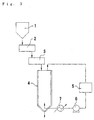
- Fig. 3 is a conceptional view illustrating a heating apparatus used in examples.
- the invention has a feature in a process for preparing a polyhydroxycarboxylic acid of high molecular weight comprising a crystallizing step of heating to crystallize pellets of the polyhydroxycarboxylic acid of low molecular weight obtained by a liquid polycondensation reaction step and a solid phase polycondensation reaction step of heating the same to a temperature not lower than the crystallizing temperature, in which the crystallizing step and the solid phase polycondensation reaction step are conducted under specified conditions.
- the polyhydroxycarboxylic acid of low molecular weight used for the crystallizing and solid phase polycondensation reaction steps is obtained, for example, by way of the following liquid phase polycondensation reaction step.
- the liquid phase polycondensation reaction step is a step of preparing a polyhydroxycarboxylic acid of low molecular weight by dehydrating polycondensation reaction of a hydroxy-carboxylic acid as a monomer in a liquid state, that is, in a solution state or a molten state.
- hydroxy-carboxylic acid used in the invention providing that it is a carboxylic acid having a hydroxyl group.
- aliphatic hydroxy carboxylic acids such as 2-hydroxyetanoic acid, 2-hydroxypropanoic acid, 2-hydroxybutanoic acid, 2-hydroxypentanoic acid, 2-hydroxyhexanoic acid, 2-hydroxyheptanoic acid, 2-hydroxyoctanoic acid, 2-hydroxy-2-methylpropanoic acid, 2-hydroxy-2-methylbutanoic acid, 2-hydroxy-2-ethylbutanoic acid, 2-hydroxy-2-methylpentanoic acid, 2-hydroxy-2-ethylpentanoic acid, 2-hydroxy-2-propylpentanoic acid, 2-hydroxy-2-butylpentanoic acid, 2-hydroxy-2-methylhexanoic acid, 2-hydroxy-2-ethylhexanoic acid, 2-hydroxy-2-propylhexanoic acid, 2-hydroxy-2-butylhexanoic acid, 2-hydroxy-2-pentylhexanoic acid, 2-hydroxy-2-methylheptanoic acid, 2-hydroxyetanoic
- cyclic dimers of the glycolides and the lactides can include specifically, for example, cyclic ester intermediate products of hydroxy-carboxylic acids, for example, lactide as a cyclic dimer of lactic acid, glycolide as a cyclic dimer of glycolic acid, ⁇ -caprolactone as a cyclic ester of 6-hydroxycapronic acid, as well as ⁇ -propiolactone, ⁇ -butylolactone and ⁇ -valerolactone.
- preferred specific examples can include, for example, lactic acid, glycolic acid, 3-hydroxybutyric acid, 4-hydroxybutyric acid, 4-hydroxyvaleric acid, 5-hydroxyvaleric acid, and 6-hydroxycapronic acid.
- Lactic acid is particularly preferred in view of the transparency of the obtained polyhydroxycarboxylic acid.
- These hydroxycarboxylic acids may be used in a combination of two or more of them.
- asymmetric carbon is present in the molecule as in lactic acid
- D form, L form and equimolar mixture (racemic form) thereof are present and any one of them can be used providing that the resultant polyester polymer has crystallinity.
- L-lactic acid is particularly preferred.
- the polyhydroxycarboxylic acid is prepared using the hydroxy-carboxylic acid as the starting material, and 20 mol% or less of di-carboxylic acid and/or glycol may also be used.
- dicarboxylic acids used in the invention include, for example, aliphatic di-carboxylic acid such as succinic acid, oxalic acid, maronic acid, glutaric acid, adipic acid, pimelic acid, suberic acid, azelaic acid, sebacinic acid, undecane diacid, dodecane diacid, and 3,3-dimethylpentane diacid, cycloaliphatic dicarboxylic acid such as cyclohexane dicarboxylic acid, and aromatic di-carboxylic acid such as terephthalic acid, isophthalic acid, phthalic acid, diphenyl dicarboxylic acid, diphenoxy ethanedicarboxylic acid and 2,6-naphthalene dicarboxylic acid.
- aliphatic di-carboxylic acid such as succinic acid, oxalic acid, maronic acid, glutaric acid, adipic acid, pimelic acid, sube
- Such dicarboxylic acids may be used alone or as a combination of two or more of them. Further, in a case where an asymmetric carbon is present in the molecule, D-form, L-form and an equimolar mixture (racemic form) thereof are present and any one of them can be used.
- glycols used in the invention include, for example, ethylene glycol, diethylene glycol, triethylene glycol, propylene glycol, dipropylene glycol, 1,3-butanediol, 1,4-butanediol, 3-methyl-1,5-pentanediol, 1,6-hexanediol, 1,7-heptanediol, 1,8-octanediol, 1,9-nonanediol, neopentylglycol, polytetramethylene glycol, 1,4-hexanediol and 1,4-cyclohexanedimethanol.
- the glycols may be used alone or as a combination of two or more of them. Further, in a case where an asymmetric carbon is present in the molecule, D-form, L-form and an equimolar mixture (racemic form) thereof are present and any one of them can be used.
- the polyhydroxycarboxylic acid is prepared by using the hydroxy-carboxylic acid as the starting material and the starting hydroxy-carboxylic acid can be incorporated with other compounds, for example, monofunctional compounds such as benzoyl benzoic acid, diphenyl sulfone monocarboxylic acid, stearic acid, methoxypolyethylene glycol and phenoxypolyethylene glycol, and polyfunctional compounds such as trimesic acid, trimethylol ethane, trimethylol propane and pentaerythritol.
- monofunctional compounds such as benzoyl benzoic acid, diphenyl sulfone monocarboxylic acid, stearic acid, methoxypolyethylene glycol and phenoxypolyethylene glycol
- polyfunctional compounds such as trimesic acid, trimethylol ethane, trimethylol propane and pentaerythritol.
- Such other compounds can be added to the hydroxy-carboxylic acid in an amount of 0. 01 mol% to 20 mol%, preferably, 0.05 mol% to 10 mol%.
- the catalyst can include, for example, metals, belonging to the groups II, III, IV and V of the periodical table, and oxides and salts thereof.
- metals such as zinc powder, tin powder, aluminum, magnesium and germanium, metal oxides such as tin oxide (II), antimony oxide (III), zinc oxide, aluminum oxide, magnesium oxide, titanium oxide (IV) and germanium oxide (IV), metal halides such as tin chloride (II), tin chloride (IV), tin bromide (II), tin bromide (IV), antimony fluoride (III), antimony fluoride (V), zinc oxide, magnesium chloride and aluminum chloride, sulfates such as tin sulfate (II), zinc sulfate and aluminum sulfate, carbonates such as magnesium carbonate and zinc carbonate, borates such as zinc borates, organic carboxylates such as tin acetate (II), tin octanoate (II), tin lactate (II), zinc acetate and aluminum acetate, organic sulfonates such as tin trifluo
- tin powder metal powder
- tin oxide II
- p-toluene sulfonic acid methane sulfonic acid
- the amount of the catalyst used varies depending on the kind of the catalyst used and, generally, it is preferably within a range from 0.00005 to 5% by weight of the polyhydroxycarboxylic acid of low molecular weight to be obtained and it is preferred within a range from 0.0001 to 2% by weight in view of the economical performance.
- the dehydrating polycondensation reaction can be conducted by properly selecting the conditions such as use of the organic solvent in accordance with the desired weight average molecular weight (Mw) and the convenience and the simplicity of the operation (solution polymerization reaction system).
- a prepolymer having a weight average molecular weight (Mw) of 15, 000 or more can be obtained efficiently.
- the method of not using the organic solvent (melt-polycondensation reaction system) has a feature that the operation is simple and convenient since the labor of distilling off the organic solvent can be saved in the prepolymer solidifying step.
- organic solvent in a case of using the organic solvent in the liquid phase polycondensation reaction step providing that the solvent can substantially maintain the progress of the dehydrating polycondensation reaction and they may be used alone or as a combination of two or more of them.
- organic solvent can include, for example, hydrocarbon solvents such as toluene, xylene and mesitylene, halogen type solvents such as chlorobenzene, bromobenzene, iodobenzene, p-dichlorobenzene, 1,1,2,2-tetrachloroethane and p-chlorotoluene, ketone type solvents such as 3-hexanone, acetophenone and benzophenone, ether solvents such as dibutyl ether, anisol, phenetol, o-dimethoxybenzene, p-dimethoxybenzene, 3-methoxytoluene, dibenzyl ether, benzylphenyl ether and methoxynaphthalene, thioether solvents such as phenylsulfide and thioanisol, ester solvents such as methyl benzoate, methyl phthalate and ethyl phthalate
- the boiling point of the solvent usable in the liquid phase polycondensation reaction step is preferably 100°C or higher, more preferably, 135°C or higher and, further preferably, 170°C or higher.
- the reaction temperature so long as the liquid state of the organic solvent in the reaction system can be maintained substantially and the progress of the dehydrating polycondensation reaction can be maintained in view of the forming rate and the thermal decomposition of the polyester.
- the reaction temperature in the liquid phase polycondensation reaction step is preferably within a range from 100°C to 200°C and, more preferably, within a range from 110°C to 180°C.
- the reaction temperature When the reaction is conducted under a normal pressure (atmospheric pressure) by using the organic solvent in the liquid phase polycondensation reaction step, the distilling temperature of the organic solvent at the normal pressure (atmospheric pressure) is usually adopted as the reaction temperature.
- the distilling temperature under pressure in the reaction system of the organic solvent is usually adopted as the reaction temperature.
- the pressure in the reaction system may be lowered in order conduct the reaction at a preferred reaction temperature.
- the dehydrating polycondensation reaction can be proceeded efficiently with no undesired side reactions by conducting the dehydrating polycondensation reaction at a low temperature and under high vacuum.
- the amount of the organic solvent used in the liquid phase polycondensation reaction step is set generally while considering the reaction rate, the purity of the reaction products (polyhydroxycarboxylic acid), volumic efficiency or recovery of solvent with an industrial point of view.
- concentration of the polyhydroxycarboxylic acid to be obtained it is 10% or more and, preferably, 50% by weight or more and, further preferably, 80% by weight or more.
- reaction temperature when the organic solvent is not used in the liquid phase polycondensation reaction step, providing that the progress of the dehydrating polycondensation reaction can be maintained.
- the reaction is conducted at the temperature not lower than the melting point of the polymer present in the reaction system while considering the forming rate and the thermal decomposition rate of the polyhydroxycarboxylic acid. It is preferred to conduct reaction within a temperature range of melting point or higher to 250°C or lower. Among them, the range form 100°C to 200°C is preferred and a range of 110°C to 180°C is further preferred.
- the liquid phase polycondensation reaction system can be conducted either by continuous or batch type polymerization system.
- the method of recovering the polyhydroxycarboxylic acid from the reactor after the completion of the liquid phase polycondensation reaction there is no particular restriction for the method of recovering the polyhydroxycarboxylic acid from the reactor after the completion of the liquid phase polycondensation reaction.
- the liquid phase polycondensation reaction is conducted in a molten state
- the polyhydroxycarboxylic acid is recovered after the completion of the reaction in the form of strands.
- a poor solvent to the polyhydroxycarboxylic acid is added to the reaction solution or the reaction solution is discharged into a poor solvent, by which the polyhydroxycarboxylic acid can be separated as crystals.
- the weight average molecular weight (Mw) of the polyhydroxy-dicarboxylic acid polymer of low molecular weight thus obtained in the liquid phase polycondensation reaction step is preferably from 2,000 to 100,000, and, further preferably, from 5,000 to 30,000.
- the weight average molecular weight (Mw) of the polyhydroxycarboxylic acid is determined with reference to a polystyrene standard sample by a gel permeation chromatography (GPC, column temperature: 40°C, chloroform solvent).
- the exothermic peak area corresponding to the heat of crystallization observed upon temperature elevation analysis of the polyhydroxycarboxylic acid obtained from the liquid phase polycondensation reactor by using a differential scanning calorimeter is 30 J/g or more.
- the thus obtained polyhydroxycarboxylic acid of low molecular weight is usually molded into pellets and supplied to the subsequent crystallizing step.
- the polyhydroxycarboxylic acid of low molecular weight has low melting viscosity, it is difficult to obtain particles of uniform shape by a strand cut, underwater cut or hot cut method used in pelleting of usual polymers and no satisfactory pellets are formed but they tend to be in a finely powdery form such as a powder or a flake.
- Such finely powdery form is not only difficult to handle with but also cause blocking of the polyhydroxycarboxylic acid when used in the subsequent crystallizing step and the solid phase polycondensation reaction step and the crystallizing step and the solid phase polycondensation reaction step can not be conducted efficiently, so that they are preferably pelleted by way of the following step.
- Pellets usable for the preparation of the polyhydroxycarboxylic acid of high molecular weight by crystallization and solid phase polycondensation reaction of the invention can be obtained in the particulate state, for example, by melting, dropping and cooling to solidify the polyhydroxycarboxylic acid of low molecular weight prepared by the method described above.
- the polyhydroxycarboxylic acid of low molecular weight is dropped after being formed in a liquid (molten) state, and the method of cooling to solidify the droplets is conducted, concretely, by cooling the droplets in contact with a cooled plate, drum or belt.
- the temperature of the droplets may be a temperature not lower than the melting point of the polyhydroxycarboxylic acid and when the polyhydroxycarboxylic acid is polylactic acid, it is preferably from 140°C to 200°C and, particularly, preferably from 150°C to 190°C. If it is lower than the temperature described above, the polylactic acid is solidified, whereas it is higher than the temperature described above, it tends to lower the molecular weight and cause pigmentation by thermal decomposition, which is not so preferred.
- the melting viscosity of the low molecular weight polyhydroxycarboxylic acid is preferably from 0.01 poise to 100 poise, more preferably, from 0.1 poise to 50 poise and, particularly preferably, from 0.5 poise to 30 poise.
- the particle diameter of the thus obtained particulate low molecular weight polyhydroxycarboxylic acid is preferably from 0.1 mm to 20 mm, more preferably, from 0.5 mm to 15 mm and, particularly preferably, from 1 mm to 10 mm. If the diameter of the particles is less than the particle diameter described above, it tends to form fine powder, whereas if it is larger particle diameter, the particle is sometimes difficult to handle with in the subsequent handling, which is not so preferred.
- the standard deviation of the particle size is preferably within 1 mm and, particularly preferably, within 0.7 mm. If the standard deviation is larger, that is, the particle size distribution is broader, it is not preferred since the flowability of the particles in the solid phase polycondensation reaction, molecular weight distribution between each of the particles and the stability of supply to the molding machine tends to become poor.
- the temperature of the plate, drum or belt used for cooling is preferably not higher than the glass transition temperature of the low molecular weight polyhydroxycarboxylic acid and in a case where the low molecular weight polyhydroxycarboxylic acid is polylactic acid, it is preferably 70°C or lower.
- the temperature of the low molecular weight polyhydroxycarboxylic acid to be cooled and recovered after dropping is desirably not higher than the glass transition point.
- the droplet pelleting machine for preparing particulate polyhydroxycarboxylic acid by melting, dropping and cooling to solidify the low molecular weight polyhydroxycarboxylic acid of the invention can include, specifically, ROTOFORMER, manufactured by SANDVIK Co., rotary type drop former and piston type drop former, manufactured by Kaiser Co. and hybrid former manufactured by Nippon Belding Co.
- pellets obtained by the following methods are also preferably used in the subsequent crystallizing step and solid phase polycondensation reaction step.
- the pellet comprises a inner core portion (I) and an outer coating portion (II) covering the inner core portion which is illustrated, for example, in Fig. 1.
- Fig. 1 shows a schematic perspective view as one example of a polyhydroxycarboxylic acid pellet according to this invention.
- reference 1 denotes an inner core portion
- reference 2 denotes an outer coating portion.
- the outer coating portion is sometimes referred to as a sheath.
- the shape of the pellet is optional and it is preferably columnar or square post shape as shown in Fig. 1.
- the axial length of the pellet is usually within a range from 0.5 mm to 5.0 mm, preferably, from 1.5 mm to 4.5 mm.
- the diameter of the polyhydroxycarboxylic acid pellet is desirably within a range usually from 0.5 mm to 5.0 mm and, preferably, from 1.5 mm to 4.5 mm.
- the weight ratio between the outer coating portion and the inner core portion is optional and the weight of the inner core portion is within a range from 40 to 98% by weight and, preferably from 50 to 95% by weight.
- the outer coating portion comprises a resin containing a polyhydroxycarboxylic acid having a weight average molecular weight (Mw) of 30,000 to 200,000, preferably, from 30,000 to 100,000 resin.
- Mw weight average molecular weight
- the resin containing the polyhydroxycarboxylic acid constituting the outer coating portion comprises a resin containing 50 to 100% by weight, preferably, 65 to 100% by weight of polyhydroxycarboxylic acid.
- the resin constituting the outer coating portion of the polyhydroxycarboxylic acid pellet of the invention is preferably comprises only the polyhydroxycarboxylic acid but it may be a resin composition of polyhydroxycarboxylic acid and a resin other than polyhydroxycarboxylic acid.
- the blending amount of the resin other than the polyhydroxycarboxylic acid is from 0 to 50% by weight, preferably, 0 to 35% by weight based on the resin constituting the outer coating portion.
- the resin other than the polyhydroxycarboxylic acid described above can include polyethylene terephthalate, polyester containing comonomers such as 20 mol% or more of isophthalic acid and cyclohexane dimethanol, polyester containing 20 mol% or more of isophthalic acid and 1 mol% or more of 1,3-bis (hydroxyethoxy)benzene, polyester-polyester block copolymer containing an aliphatic carboxylic acid such as adipic acid or sebacic acid as a comonomer, polyester-polyether block copolymer having polyether such as polybutylene glycol as a soft segment and polyesters such as polybutylene terephthalate and polyethylene naphthalate.
- polyethylene terephthalate polyester containing comonomers such as 20 mol% or more of isophthalic acid and cyclohexane dimethanol
- polyolefins containing constituent units derived from olefin monomers of 2 to 6 carbon atoms can also be used.
- Such polyolefins can include low density polyethylene, high density polyethylene, linear low density polyethylene, polypropylene, polybutene, polypentene and polymethylpentene.
- the blending amount of the resin is from 0 to 10% by weight, preferably, from 0 to 5% by weight based on the resin constituting the outer coating portion.
- ethylene (meth)acrylic acid copolymer may also be used as the resin other than polyhydroxycarboxylic acid.
- the ethylene-(meth)acrylic acid copolymer can include, for example, ethylene-methacrylic acid copolymer, ethylene-acrylic acid copolymer and ethylene-acrylic acid-methacrylic acid terpolymer.
- the ethylene (meth) acrylic acid copolymer may also contain other ingredient than ethylene and (meth)acrylic acid copolymerized by a small amount and the ingredient other than ethylene and (meth)acrylic acid can include unsaturated carboxylic acid esters such as methyl(meth)acrylate, ethyl(meth)acrylate and isobutyl (meth) acrylate and vinyl esters such as vinyl acetate.
- the blending amount of the resin is from 0 to 10% by weight and, preferably, from 0 to 5% by weight based on the resin constituting the outer coating portion.
- the (meth)acrylic acid content in the ethylene-methacrylic acid copolymer is preferably from 0.5 to 8% by weight and, particularly, from 1 to 6% by weight.
- the crystallizing rate upon temperature elevation can be improved while maintaining the transparency of the polyhydroxycarboxylic acid resin composition obtained by blending with the polyhydroxycarboxylic acid.
- the ethylene (meth) acrylic acid copolymer has MFR (190°C) according to ASTM D 1238 of usually from 0.05 to 100g/10 min. and, preferably, 0.1 to 50 g/10 min.
- the ethylene(meth)acrylic acid copolymer may include those in which carboxyl groups present on the side chain are not bonded with metals and, in addition, those at least a portion thereof is present in the form of metal carboxylate (ionomer).
- the metal salt is preferably an alkali metal salt such as sodium salt, lithium salt or potassium salt, a bivalent transition metal salt such as zinc salt, cobalt salt, nickel salt, manganese salt, and copper salt, and an alkaline earth metal salt such as calcium salt and magnesium salt.
- zinc salt is desirable since it can maintain the transparency of the polyhydroxycarboxylic acid resin composition.
- ethylene(meth)acrylic acid copolymer is an ionomer
- the ratio of carboxyl groups bonded with the metals relative to the entire carboxyl groups there is no particular restriction for the ratio of carboxyl groups bonded with the metals relative to the entire carboxyl groups, and it is within a range usually from 3% to 100%.
- Such ethylene- (meth) acrylic acid copolymer is prepared, for example, by a method of copolymerizing ethylene and (meth) acrylic acid and, optionally, other comonomer by a high pressure radical polymerizing method and then optionally neutralizing with ions of the metal described above.
- the resin other than the polyhydroxycarboxylic acid described above can include, for example, polyamides such as nylon 6, nylon 6,6 and nylon 12, and polycarbonates such as polyester carbonates and polycarbonates.
- the blending amount of the resin is from 0 to 10% by weight, preferably, from 0 to 5% by weight based on the resin constituting the outer coating portion.
- polyesters containing comonomers such as 20 mol% or more of isophthalic acid and cyclohexane dimethanol, polyesters containing 1 mol% or more of 1,3-bis(hydroxyethoxy)benzene, polyolefins and ethylene(meth)acrylic acid copolymers are preferred.
- the resin constituting the outer coating portion may contain usual additives, for example, colorant, antioxidant, oxygen absorber, UV-ray absorber, antistatic agent, flame retardant, bluing agent, (external) lubricant and heat stabilizer.
- the inner core portion comprises a resin containing polyhydroxycarboxylic acid having the weight average molecular weight (Mw) within a range from 2,000 to 30,000.
- the resin containing polyhydroxycarboxylic acid constituting the inner core portion comprises a resin containing 50 to 100% by weight, preferably, 65 to 100% by weight or polyhydroxycarboxylic acid.
- the resin constituting the inner core portion has a melting point lower than that of the resin constituting the outer coating portion or shows no melting point.
- the difference of the melting point between the resin constituting the inner core portion and the resin constituting the outer coating portion is preferably within a range from 5°C to 40°C, particularly, 8°C to 30°C.
- the polyhydroxycarboxylic acid constituting the inner core portion is prepared by the same method as for the polyhydroxycarboxylic acid in the outer coating portion and it is preferably only by the liquid phase polycondensation reaction step.
- other resins exemplified for the resin constituting the outer coating portion may be blended by 50% by weight or less, preferably, 35% by weight based on the entire resin that constitutes the inner core portion within a range not deteriorating the purpose of the invention.
- the polyhydroxycarboxylic acid pellet having the outer coating portion and the inner core portion of the invention can be prepared by a method of melt kneading the resin constituting the outer coating portion and the resin constituting the inner core portion respectively by separate extruders, then joining them in a dice and extruding them and by cooling in a customary method, for example, cutting in air and dropping into water, or a method of introducing the molten resin into water and then palletizing the same.
- a pelleting method used customarily by the underwater cut and strand cut can of course be adopted.
- the extruder may be a single screw extruder or a twin screw extruder, or a vacuum vent line may be disposed optionally in the midway of the extruder.
- the polyhydroxycarboxylic acid resin used for the outer coating portion and the polyhydroxycarboxylic acid resin used for the inner core portion may or may not be dried previously before charging into the extruder.
- the thus obtained pellet is usually in a columnar or square post shape.
- the cross sectional shape is optional and can be formed into a desired shape by selecting an appropriate dice.
- the pellet can be deformed or the cut face shape may be deformed upon cutting in accordance with the cooling condition for the strand, the shape of the cutter blade, the take-up speed and the number of rotation of the cutter blade.
- pellet height and the pellet diameter can be changed optionally by the change for the cutting conditions such as the form of the cutting blade, the take-up rate and the number of rotation of the cutter blade.
- the thus obtained pellet is used suitably to the flowing crystallizing step and the solid phase polycondensation reaction step.
- the crystallizing step is a step of heating the pellet of the polyhydroxycarboxylic acid obtained in the step described above to a temperature lower than the temperature for conducting the solid phase polycondensation reaction to be described later.
- This step intends to increase the crystallinity of the polyhydroxycarboxylic acid so that the blocking or fusion of polyhydroxycarboxylic acid pellets of low molecular weight take place upon conducting the solid phase polycondensation reaction.
- there are various methods for recognizing that an aimed crystallization is obtained.
- areas for the endothermic peak and exothermic peak by differential scanning calorimetry to be described later is used. That is, the degree of crystallinity of the polyhydroxycarboxylic acid is hither as the endothermic peak area is smaller and the exothermic peak area is larger.
- This step comprises a step (A) and a step (B) to be described below specifically.
- the heating temperature is preferably from 55°C to 130°C and, further preferably, 65°C to 110°C.
- the pellet of the low molecular weight polyhydroxycarboxylic acid When the pellet of the low molecular weight polyhydroxycarboxylic acid is put to temperature elevation analysis by using the differential scanning calorimeter, an exothermic peak corresponding to the heat of crystallization is observed on the side of lower temperature and then an endothermic peak corresponding to the heat of melting is observed on the side of higher temperature.
- the end point of the crystallizing step is determined in accordance with the area for the exothermic peak and the area for the endothermic peak in this analysis.
- the exothermic peak and the endothermic peak by the differential scanning calorimeter are measured as below. That is, using Pyrisl type differential scanning calorimeter manufactured by Perkin Elmer Co., a slice of 5 mg of specimen taken from a central portion of a pellet of the polyhydroxycarboxylic acid dried at 60°C under a pressure of 5 mmHg for about 5 hours or more is sealed in a nitrogen atmosphere in an aluminum liquid pan and measured. The areas for the exothermic peak and the endothermic peak are detected upon temperature elevation at a rate of 10°C from 20°C as the measuring condition. Then, it is converted based on the weight of the specimen into the heat calorie per unit weight (melting heat calorie per 1 g(unit: joule)).
- Fig. 2 shows an example of a differential scanning thermal curve for the polyhydroxycarboxylic acid measured by the differential scanning calorimeter.
- a vertical or horizontal stirring device with a stirring blade can be adopted for instance.
- the stirring device is preferably of such a continuous type that pellets of polyhydroxycarboxylic acid are supplied on one side and discharged from the other side.
- the step (A) is conducted by using, for example, the stirring device as described above and supplying pellets of polyhydroxycarboxylic acid from one side of the device, heating the pellets of polyhydroxycarboxylic acid while stirring them under flow of a heating gas and then discharging them form the other side.
- step (A) is desirably conducted within an inert gas atmosphere or liquid.
- the inert gas used in this case can include, for example, nitrogen gas, helium gas, argon gas, xenon gas, krypton gas and gaseous carbon dioxide.
- the residence time (heating time) of the polyhydroxycarboxylic acid in the step (A) is from 1 min. to 180 min. and, preferably, from 3 min. to 60 min.
- step (B) of elevating the temperature of the pellets of polyhydroxycarboxylic acid under stirring from the temperature described above to the temperature for solid phase polycondensation reaction is conducted.
- the heating temperature in the step (B) is preferably at a temperature within a range from the temperature for the solid phase polycondensation reaction step to (temperature for solid phase polycondensation reaction step -40°C).
- polyhydroxycarboxylic acid is polylactic acid
- the range from 100°C to 150°C is preferred and from 120°C to 140°C is further preferred.
- the stirring device is preferably of a continuous type in which pellets of polyhydroxycarboxylic acid from one side is supplied and then discharged from the other of them.
- step (B) is preferably conducted in the same inert gas atmosphere as that in the step (A). Further, the inert gas used is identical with that for the step (A).
- the residence time (heating time) of the polyhydroxycarboxylic acid in the step (B) is from 1 min. to 180 min., preferably, 3 min. to 60 min.
- the polyhydroxycarboxylic acid is crystallized such that the endothermic peak area is 5 J/g or less, preferably, 3 J/g or less and the exothermic peak area is 38 J/g or more, preferably, 42 J/g or more.
- pellets of the polyhydroxycarboxylic acid crystallized and preheated in this step are supplied to the next solid phase polycondensation reaction step.
- the solid phase polycondensation reaction step in the invention comprises at least one stage.
- the reaction temperature for the solid phase polycondensation reaction step is at or lower than the endothermic start temperature of the endothermic peak recognized upon temperature elevation analysis for the pellets of the polyhydroxycarboxylic acid crystallized and preheated in the steps (A) and (B) by using the differential scanning calorimeter.
- the polycondensation temperature is preferably from 100°C to 165°C and, more preferably, from 115°C to 160°C.
- the endothermic start temperature of the endothermic peak shifts toward the higher temperature region.
- the step may be in a multi-stage such that the temperature for solid phase polycondensation reaction is lower than the endothermic start temperature as the endothermic start temperate of the endothermic peak shifts.
- the solid phase polycondensation reaction step is conducted under a pressure of the condition usually of 1 kg/cm 2 -G to 10 Torr, preferably from ambient pressure to 10 Torr.
- the solid phase polycondensation reaction step is usually conducted in an inert gas atmosphere such as of nitrogen gas, helium gas, argon gas, xenon gas, krypton gas and gaseous carbon dioxide.
- the solid phase polycondensation reaction may be conducted also at a high temperature and under a reduced pressure.
- the water content in the gases used in the solid phase polycondensation reaction step is preferably as low as possible and, substantially, in an anhydrous state. If the water content is higher, since water formed by the dehydrating polycondensation reaction can not be removed efficiently, to sometimes reduce the polymerization rate, and it is not preferred. In such a case, the gas is used after dehydration by passing through a layer filled with molecular sieves or ion exchange resins.
- the dew point of the gas is preferably -20°C or lower and, more preferably -50°C or lower.
- the weight average molecular weight of the polyhydroxycarboxylic acid obtained by way of the solid phase polycondensation reaction step (Mw) is preferably within a range of 50,000 to 1,000,000 and, further preferably, from 100,000 to 500,000.
- the solid phase polycondensation reaction step may be conducted either by continuous or batch type polymerization system.
- the catalyst may or may not be used for the solid phase polycondensation reaction step.
- the catalyst usable in the liquid phase polycondensation reaction system can be used in an amount used for the liquid phase polycondensation reaction step. Further, the amount can be added while considering the amount of the catalyst carried from the liquid phase polycondensation reaction step.
- the polyhydroxycarboxylic acid of high molecular weight prepared in the invention can be used suitably as substitutes for those resins used generally for medical application uses and food packaging application uses which had been publicly known and used prior to the filing of the application.
- the molding methods of the polyhydroxycarboxylic acid of high molecular weight can include, specifically, injection molding, extrusion molding, inflation molding, extrusion expansion molding, foam molding, calendar molding, blow molding, balloon molding, vacuum forming and spinning.
- injection molding, extrusion molding, inflation molding, extrusion expansion molding, foam molding and spinning being further preferred.
- the polyhydroxycarboxylic acid can be used suitably by appropriate molding process, for example, also to materials for writing tools such as ball point pen and mechanical pencils, stationary materials, golf tees, materials for smoking golf ball for use in first ball throwing ceremony, capsules for oral pharmaceuticals, suppositories for anus and vagina, carriers for skin and mucous membrane plasters, capsules for use in agricultural chemicals, capsules for fertilizers, capsules for seeds and seedlings, compost bags, fishing reels, fishing buoys, fishing lures, lures, fishing buoys, hunting decoys, capsules for hunting shots, camp goods such as tablewares, pegs, spikes, binders, antislipping materials for muddy and snowy roads and blocks.
- materials for writing tools such as ball point pen and mechanical pencils, stationary materials, golf tees, materials for smoking golf ball for use in first ball throwing ceremony
- capsules for oral pharmaceuticals suppositories for anus and vagina, carriers for skin and mucous membrane plasters
- the films or the sheets including the polyhydroxycarboxylic acid of high molecular weight according to the invention can be used suitably also as shopping bags, garbage bags, compost bags, cement bags, fertilizer bags, sand bags, packaging films for food stuffs and candies, food wrapping films, films for agricultural or horticultural uses, green house films, packaging films for magnetic tape cassette products for video or audio equipments, packaging films for floppy disks, fences, oil fences for sea, river and lake uses, adhesive tapes, tapes, binders, water proof sheets, umbrellas and tents.
- foamed products containing the polyhydroxycarboxylic acid of high molecular weight according to the invention can also be used suitably, for example, also to lunch boxes, tablewares, containers for lunches and daily dishes sold in convenience stores, cups for instant noodles, cups such as used in automatic vending machines, containers and trays for foods such as fishes, meats, vegetables and fruits, soybean curds, fermented soybeans and daily dishes, carrier boxes such as used in fish markets, containers for dairy products such as milk, yogurts and lactic acid beverages, bottles for soft drinks such as carbonate drinks and soft drinks, bottles for alcoholic drinks such as beer and whisky, cosmetic containers, detergent containers, bleach containers, cold keeping boxes, planters, buffer materials for use upon transportation of domestic electronic products such as television or stereo sets, buffer materials for use upon transportation of precision machines such as computers, printers and watches, buffer materials used for transportation of optical equipments such as cameras, spectacles, microscopes and telecopier, buffer materials used for transportation of pottery products such as glass and ceramics, light shielding materials, heat insulators
- the foamed products including the polyhydroxycarboxylic acid of high molecular weight according to the invention can be used suitably also to medical or hygiene uses.
- they can be used suitably as bandages, plaster supports for skin and mucous membrane uses, triangle bandages, plaster patches, towels, disposable towels, disposable wet towels, wet hand towels, mops, tissues, sanitary wet tissues for cleaning and sterilization, wet tissues for cleaning infants' hips, disposable diapers, napkins for sanitary and secretion uses, sanitary tampons, blood absorbing tampons for surgical and maternity uses, sanitary cover stock materials and sterilizing bags.
- they can be used suitably for general industrial uses including agriculture, fishery, forestry, industry, civil engineering and traffic, as well as recreation uses including leisure and sport uses.
- they can be used suitably as agricultural cheesecloth, oil absorbing materials, soft/weak ground reinforcing materials, artificial leathers, substrate for floppy disks, cement bags, fertilizer bags, sand bags, heat insulators, sound proof materials, cushioning materials, cushioning materials for furnitures, such as beds and chairs, floor cushioning materials, packaging materials, binder materials and antislipping materials for muddy and snowy roads.
- the weight average molecular weight (Mw) of the obtained polyhydroxycarboxylic acid was determined by gel permeation chromatography (GPC, column temperature at 40°C, in chloroform solvent), in comparison with a standard polystyrene sample.
- the melting point of the polyhydroxycarboxylic acid is measured by a differential scanning calorimeter (Pyrisl model differential scanning calorimeter manufactured by Perkin Elmer Co.). Referring to the measuring conditions, a slice of 5 mg of a specimen taken from a central portion of a pellet of polyhydroxycarboxylic acid dried at 60°C under a pressure of 5 mmHg for about 5 hours or more was sealed in a nitrogen atmosphere in an aluminum liquid pan, and the temperature for the endothermic peak detected upon temperature elevation at a rate of 10°C from 20°C is determined.
- the molten polymer was supplied at 140 kg/Hr by way of a gear pump to a droplet pelleting machine ROTOFORMER 3,000 type (trade name of products manufactured by SANDVIK Co.).
- the pelleting machine had dropping outer shell width of 480 mm, the dropping nozzle diameter of 2.0 mm and the dropping nozzle pitch of 7 mm, and the shell temperature was 170°C.
- the cooling belt had a belt width of 600 mm (effective width 480 mm), a belt length of 6.5m (effective length: 6.0m), with a belt cooling temperature at 20 °C and a belt speed of 8 m/min.
- a molten polymer with a melting viscosity of 10 poise could provide uniform polylactic acid particles at a particle temperature of 30°C, with a particle size of 3.5 mm, the standard deviation for the particle size of 0.4 mm and with the weight of 0.029 g/particle.
- the exothermic peak area recognized upon temperature elevation analysis of the particle by using the differential scanning calorimeter was 35 J/g and the glass transition temperature was 42°C.
- the polylactic acid pellets were supplied continuously to a reaction apparatus having a horizontal continuous heating vessel 2, a horizontal continuous heating vessel 3 and a solid phase polycondensation reaction vessel 4 to conduct crystallization and solid phase polycondensation.
- a feed hopper 1 In Fig. 3, are shown a feed hopper 1, a nitrogen cleaning device 5, a blower 6 and a heating device 7, respectively.
- a step (A) of supplying pellets of polyhydroxycarboxylic acid from one side of the heating vessel and discharging the pellets of the polyhydroxycarboxylic acid under heating and stirring from the other side is conducted in the horizontal continuous heating vessel 2.
- a step (B) of supplying the pellets of the polyhydroxycarboxylic acid by way of the step (A) from one side of the heating vessel and discharging the pellets of the polyhydroxycarboxylic acid under heating and stirring from the other side is conducted.
- Pellets as the polylactic acid liquid phase polycondensates prepared by the method described above were supplied from one side of the horizontal continuos heating vessel 2 and stirred while being heated to 70°C.
- the residence time in the step (A) was 40 min.
- the polylactic acid obtained by the step (A) had an exothermic peak area of 2 J/g and an endothermic peak area of 43 J/g when measured by the differential scanning calorimeter.
- the pellets of the polylactic acid prepared in the step (A) were supplied to the horizontal heating vessel 3 and stirred while being heated to 130°C.
- the residence time in the step (B) was 30 min.
- the polylactic acid obtained by the step (B) had an endothermic peak area of 48 J/g and an endothermic start temperature of 142°C.
- the pellets of the polylactic acid obtained by the crystallizing step as described above were supplied to the solid phase polycondensation reaction vessel 4 and heated in the reaction vessel in a nitrogen atmosphere at 140°C for 40 hours to conduct solid phase polycondensation reaction.
- the weight average molecular weight of the polylactic acid obtained in the solid phase polycondensation reaction step was 140,000.
- the polylactic acid did not cause fusion and could be prepared efficiently.
- the polylactic acid had an endothermic peak area of 60 J/g and an endothermic start temperature of 157°C.
- the pellets were again supplied to the solid phase polycondensation reaction vessel 4 and heated in a nitrogen atmosphere at 155°C to conduct solid phase polycondensation.
- the weight average molecular weight of the resultant polylactic acid was 152,000.
- the polylactic acid did not cause fusion and could be prepared efficiently.
- Pellets of liquid phase polycondensation products of polylactic acid having a weight average molecular weight of 20, 000 were obtained in the same manner as in Example 1 except for changing the reaction time at 160°C, 10 mmHg in the liquid phase polycondensation reaction step to 14 hours in Example 1.
- pellets of the liquid phase polycondensation products of the polylactic acid prepared by the method described above were supplied from one side of the horizontal continuous heating vessel 2 and stirred while being heated to 90°C.
- the residence time in this step (A) was 20 min.
- the polylactic acid obtained by the step (A) had an exothermic peak area of 0 J/g and an endothermic peak area of 48 J/g as measured by a differential scanning calorimeter.
- the pellets of the polylactic acid prepared in the step (A) were supplied to the horizontal heating vessel 3 and stirred while being heated to 130°C.
- the residence time in the step (B) was 30 min.
- the polylactic acid obtained by the step (B) had an endothermic peak area of 50 J/g and an endothermic start temperature of 145°C.
- the pellets of the polylactic acid obtained by the crystallizing step as described above were supplied to the solid phase polycondensation reaction vessel 4 and heated in the reaction vessel in a nitrogen atmosphere at 140°C for 40 hours to conduct solid phase polycondensation reaction.
- the weight average molecular weight of the polylactic acid obtained in the solid phase polycondensation reaction step was 147,000.
- the polylactic acid did not cause fusion and could be prepared efficiently.
- the liquid phase polycondensation reaction was conducted in the same manner as in Example 1, to obtain a molten polylactic acid. After cooling to solidify the molten liquid, it was pulverized. The flowability of the resultant particles (powder) was poor.
- the polylactic acid powder was heated at 70°C for 90 min. to crystallize.
- the powder after crystallization formed fused lamps which could not flow.
- the molten polylactic acid lamps were pulverized and heated at 140°C in a nitrogen gas stream for 40 hours. Although the weight average molecular weight of the resultant polylactic acid was 128,000, powders were fused to each other and the particles (powder) could not flow.
- the pellets of the polylactic acid polycondensation products were supplied to the horizontal continuous heating vessel 2 and stirred while being heated to 40°C.
- the residence time in the step (A) was 20 min.
- the polylactic acid obtained by the step (A) had an exothermic peak area of 33 J/g and an endothermic peak area of 40 J/g as measured by the differential scanning calorimeter.
- Polylactic acid particles were obtained in the same manner as in Example 1 except for conducting reaction at 160°C/10 mmHg for 15 hours in the solution polycondensation reaction step to obtain the polylactic acid of 150,000 Mw (melting viscosity: 15 poise, supplied temperature: 175°C).
- the resultant particles were at a particle temperature of 30°C and uniform polylactic acid particles having a particle size of 4 mm, with the particle size standard deviation of 0.5 mm having a weight of 0.045g/particle.
- the polylactic acid prepared in the same manner as in Example 1 was supplied at 120 kg/hr by way of a gear pump to a droplet pelleting machine ROTOFORMER 3,000 type (trade name of products manufactured by SANDVIK Co.).
- the pelleting machine has dropping outer shell width of 480 mm, the dropping nozzle diameter of 2.0 mm and the dropping nozzle pitch of 6 mm, and the shell temperature was 170°C.
- the cooling belt had a belt width of 600 mm (effective width 480 mm), a belt length of 6.5 m (effective length: 6.0 m), with a belt cooling temperature at 20 °C and a belt speed of 11.6 m/min.
- a molten polymer with a melting viscosity of 10 poise could provide uniform polylactic acid particles at a particle temperature of 25°C, with a particle size of 2.5 mm, the standard deviation for the grain size of 0.35 mm and with the weight of 0.012 g/particle.
- the DEANSTARK trap was detached, and a tube filled with 30 g of molecular sieve 3A and containing 54 kg of o-dichlorobenzene with a water content of 10 ppm or less was attached such that the solvent distilled out by reflux was returned again through the molecular sieve into the system and 144 kg of o-dichlorobenzene was further added to the reaction mass and stirred under heating at 140°C/270 mmHg for 8 hours such that water was not intruded into the system.
- the polylactic acid had a weight average molecular weight of 66,000 and a melting point of 156°C. The polylactic acid was used as an outer coating portion in the pelleting step.
- the discharge port of the single screw extruder was joined with a dice of the twin screw extruder and they were extruded as a strand into air, cooled in water and then pelleted by a strand cutter, to obtain pellets of a polylactic acid.
- the feeding amount to the extruders was controlled such that the weight ratio of the polylactic acid between the outer coating portion and the inner core portion was 20:80.
- the pellets of the polylactic acid were supplied continuously to a reaction apparatus having a horizontal continuous heating vessel 2, a horizontal continuous heating vessel 3 and a solid phase polycondensation reaction vessel 4 as shown in Fig. 3 to conduct crystallization and solid phase polycondensation.
- a feed hopper 1 In Fig. 3, are shown a feed hopper 1, a nitrogen cleaning device 5, a blower 6 and a heating device 7 respectively.
- a step (A) of supplying pellets of polyhydroxycarboxylic acid from one side of the heating vessel and discharging the pellets of the polyhydroxycarboxylic acid under heating and stirring from the other side is conducted in the horizontal continuous heating vessel 2.
- a step (B) of supplying the pellets of the polyhydroxycarboxylic acid by way of the step (A) from one side of the heating vessel and discharging the pellets of the polyhydroxycarboxylic acid under heating and stirring from the other side is conducted.
- Pellets of the polylactic acid prepared by the method described above were supplied from one side of the horizontal continuos heating vessel 2 and stirred while being heated to 70°C.
- the staying time in the step (A) was 40 min.
- the pellets of the polylactic acid preparation in the step (A) were supplied to the horizontal heating vessel 3 and stirred while being heated to 140°C.
- the staying time in the step (B) was 20 min.
- the pellets of the polylactic acid obtained by the crystallizing step as described above were supplied to the solid phase polycondensation reaction vessel 4 and heated in the reaction vessel in a nitrogen atmosphere at 140°C for 40 hours to conduct solid phase polycondensation reaction.
- the weight average molecular weight of the polylactic acid obtained in the solid phase polycondensation reaction step was 140,000.
- the polylactic acid did not cause fusion and could be prepared efficiently.
- Crystallizing and solid phase polycondensation reaction steps were conducted by using the same reaction apparatus as in Example 6, except for using pellets of polyhydroxycarboxylic acid consisting only of the inner core portion of Example 6.
- polylactic acid pellets were supplied to the horizontal continuous heating vessel 2 and stirred while being heated to 70°C.
- the feeding amount was controlled such that the staying time in the step (A) was 40 min.
- heating in the succeeding step was impossible.
- polyhydroxycarboxylic acid of high molecular weight can be prepared efficiently without blocking or fusion of pellets of the polyhydroxycarboxylic acid of low molecular weight.
- particles of the polyhydroxycarboxylic acid of low molecular weight with a uniform shape which can not be attained in the prior art process can be obtained.
- handling of the particles becomes simple and convenient in the subsequent crystallizing step and the solid phase polycondensation reaction step, it is possible to obtain polyhydroxycarboxylic acid of high molecular weight at good productivity and reduced cost economically.
Landscapes
- Chemical & Material Sciences (AREA)
- Health & Medical Sciences (AREA)
- Chemical Kinetics & Catalysis (AREA)
- Medicinal Chemistry (AREA)
- Polymers & Plastics (AREA)
- Organic Chemistry (AREA)
- Engineering & Computer Science (AREA)
- Mechanical Engineering (AREA)
- Polyesters Or Polycarbonates (AREA)
Abstract
Description
a step of conducting solid phase polycondensation of the polyhydroxycarboxylic acid at the temperature not higher than the start temperature of the endothermic peak as recognized upon conducting temperature elevation analysis of the polyhydroxycarboxylic acid by using a differential scanning calorimeter.
Claims (9)
- A process for preparing a polyhydroxycarboxylic acid of high molecular weight having a weight average molecular weight of 50,000 to 1,000,000 comprising a crystallizing step of heating to crystallize a polyhydroxycarboxylic acid of low molecular weight obtained by way of a liquid phase polycondensation reaction step and a solid phase polycondensation reaction step of heating the same to a temperature not lower than crystallizing temperature, in which the crystallizing step comprises:the solid phase polycondensation reaction step comprises:(A) a step of heating pellets of a polyhydroxycarboxylic acid having a weight average molecular weight of 2,000 to 100,000 under stirring at a temperature not lower than the glass transition point and not higher than the melting point, and heating the same till an exothermic peak area corresponding to the heat of crystallization is at most 10 J/g or less and an endothermic peak area corresponding to the heat of melting is 38 J/g or more as recognized upon conducting temperature elevation analysis of the polyhydroxycarboxylic acid by using a differential scanning calorimeter and, successively,(B) a step of heating to elevate the temperature of the polyhydroxycarboxylic acid to a temperature for the solid phase polycondensation reaction and
a step of conducting solid phase polycondensation of the polyhydroxycarboxylic acid at or lower than the endothermic start temperature of the endothermic peak recognized upon conducting temperature elevation analysis of the polyhydroxycarboxylic acid by using a differential scanning calorimeter. - A process for preparing polyhydroxycarboxylic acid having a weight average molecular weight of 50,000 to 1,000,000 according to claim 1, wherein the average grain size of the pellet of the polyhydroxycarboxylic acid before crystallization is within a range from 0.1 mm to 20 mm and the standard deviation of the particle diameter is within 1 mm.
- A process for preparing polyhydroxycarboxylic acid having a weight average molecular weight of 50,000 to 1,000,000 according to claim 1, wherein the pellets of the polyhydroxycarboxylic acid before crystallization are pellets of particulate polyhydroxycarboxylic acid prepared by melting a polyhydroxycarboxylic acid having a weight average molecular weight of 2,000 to 100,000, and dropping and cooling to solidify the molten polyhydroxycarboxylic acid having a melting viscosity of 0.01 to 100 poise.
- A process for preparing polyhydroxycarboxylic acid having a weight average molecular weight of 50, 000 to 1,000,000 according to claim 2, wherein the pellets of polyhydroxycarboxylic acid before crystallization are pellets of particulate polyhydroxycarboxylic acid prepared by melting a polyhydroxycarboxylic acid having a weight average molecular weight of 2,000 to 100,000, dropping and cooling to solidify the molten polyhydroxycarboxylic acid with a melting viscosity of 0.01 to 100 poise.
- A process for preparing polyhydroxycarboxylic acid having a weight average molecular weight of 50,000 to 1,000,000 according to claim 3, wherein the melting temperature is from 140°C to 200°C.
- A process for preparing polyhydroxycarboxylic acid having a weight average molecular weight of 50,000 to 1,000,000 according to claim 4, wherein the melting temperature is from 140°C to 200°C.
- A process for preparing polyhydroxycarboxylic acid having a weight average molecular weight of 50,000 to 1,000,000 according to claim 1, wherein pellet of the polyhydroxycarboxylic acid before crystallization is a pellet comprising a inner core portion (I) and an outer portion (II) covering the inner core portion, in which
the inner core portion (I) comprises a resin containing a polyhydroxycarboxylic acid having a weight average molecular weight (Mw) within a range from 2,000 to 30,000,
the outer coating portion (II) comprises a resin containing a polyhydroxycarboxylic acid having a weight average molecular weight (Mw) of 30,000 to 100,000,
the resin constituting the inner core portion has a melting point lower than that of the resin constituting the outer coating portion or shows no melting point. - A process for preparing polyhydroxycarboxylic acid having a weight average molecular weight of 50, 000 to 1,000, 000 according to any one of claims 1 to 7, wherein the hydroxy-carboxylic acid is an aliphatic hydroxy-carboxylic acid.
- A process for preparing polyhydroxycarboxylic acid having a weight average molecular weight of 50, 000 to 1,000, 000 according to claim 8, wherein the aliphatic hydroxy-carboxylic acid contains lactic acid.
Applications Claiming Priority (7)
| Application Number | Priority Date | Filing Date | Title |
|---|---|---|---|
| JP17492299 | 1999-06-22 | ||
| JP17492199 | 1999-06-22 | ||
| JP17492199 | 1999-06-22 | ||
| JP17492299 | 1999-06-22 | ||
| JP22918699A JP3966650B2 (en) | 1999-08-13 | 1999-08-13 | Polyhydroxycarboxylic acid pellets |
| JP22918699 | 1999-08-13 | ||
| PCT/JP2000/004069 WO2000078840A1 (en) | 1999-06-22 | 2000-06-22 | Process for producing polyhydroxycarboxylic acid |
Publications (3)
| Publication Number | Publication Date |
|---|---|
| EP1114840A1 true EP1114840A1 (en) | 2001-07-11 |
| EP1114840A4 EP1114840A4 (en) | 2002-02-13 |
| EP1114840B1 EP1114840B1 (en) | 2005-11-09 |
Family
ID=27324019
Family Applications (1)
| Application Number | Title | Priority Date | Filing Date |
|---|---|---|---|
| EP00939114A Expired - Lifetime EP1114840B1 (en) | 1999-06-22 | 2000-06-22 | Process for producing polyhydroxycarboxylic acid |
Country Status (8)
| Country | Link |
|---|---|
| US (1) | US6429280B1 (en) |
| EP (1) | EP1114840B1 (en) |
| KR (1) | KR100395076B1 (en) |
| CN (1) | CN1130411C (en) |
| AU (1) | AU5428500A (en) |
| DE (1) | DE60023831T2 (en) |
| TW (1) | TW500739B (en) |
| WO (1) | WO2000078840A1 (en) |
Cited By (6)
| Publication number | Priority date | Publication date | Assignee | Title |
|---|---|---|---|---|
| WO2004058853A1 (en) * | 2002-12-30 | 2004-07-15 | Plastic Systems S.P.A. | A process for the polymerization of polyester resins in the solid state, in particular of polyethylene terephthalate, and apparatus operating in accordance with the process |
| WO2005115707A1 (en) * | 2004-05-26 | 2005-12-08 | Treofan Germany Gmbh & Co. Kg | Process for crystallising amorphous plastic granulates |
| WO2006082862A1 (en) * | 2005-02-02 | 2006-08-10 | Mitsui Chemicals, Inc. | Glycolic acid based polymer and method for production thereof |
| WO2009024144A3 (en) * | 2007-08-17 | 2009-04-09 | Grafe Color Batch Gmbh | Extrusion process for producing plastic granules having a statically dissipative effect |
| US8795900B2 (en) | 2008-12-12 | 2014-08-05 | Treofan Germany Gmbh & Co. Kg | Single-layer microporous foil for batteries having shut-off function |
| US8802270B2 (en) | 2008-12-12 | 2014-08-12 | Treofan Germany Gmbh & Co. Kg | Multi-layer microporous film for batteries having shut-off function |
Families Citing this family (18)
| Publication number | Priority date | Publication date | Assignee | Title |
|---|---|---|---|---|
| US8507253B2 (en) | 2002-05-13 | 2013-08-13 | Algae Systems, LLC | Photobioreactor cell culture systems, methods for preconditioning photosynthetic organisms, and cultures of photosynthetic organisms produced thereby |
| US20050239182A1 (en) * | 2002-05-13 | 2005-10-27 | Isaac Berzin | Synthetic and biologically-derived products produced using biomass produced by photobioreactors configured for mitigation of pollutants in flue gases |
| JP2004043682A (en) * | 2002-07-12 | 2004-02-12 | Nippon Shokubai Co Ltd | Preparation method for polyglycolic acid |
| CN102219889B (en) * | 2004-03-18 | 2013-03-20 | 株式会社吴羽 | Process for producing aliphatic polyester reduced in residual cyclic ester content |
| JP4446385B2 (en) * | 2004-10-04 | 2010-04-07 | 株式会社ジェイエスピー | Multi-layer polylactic acid resin foam for thermoforming |
| CN101522798B (en) * | 2006-06-01 | 2012-11-28 | 东赛璐株式会社 | Moldings of polylactic acid compositions |
| US8110395B2 (en) | 2006-07-10 | 2012-02-07 | Algae Systems, LLC | Photobioreactor systems and methods for treating CO2-enriched gas and producing biomass |
| EP2045281A4 (en) * | 2006-07-21 | 2010-02-24 | Teijin Ltd | Aromatic polyester and method for producing the same |
| DE102007012450A1 (en) | 2007-03-15 | 2008-09-18 | Rieter Automatik Gmbh | Process for granulation and crystallization of thermoplastic polymers |
| EP2139777B1 (en) * | 2007-03-16 | 2012-09-26 | Treofan Germany GmbH & Co.KG | Packaging for uv sterilization |
| EP2152848A2 (en) | 2007-04-27 | 2010-02-17 | Greenfuel Technologies Corporation | Photobioreactor systems positioned on bodies of water |
| CN101492531B (en) * | 2008-01-22 | 2012-07-25 | 东丽纤维研究所(中国)有限公司 | Method of preparing high-molecular weight polylactic acid |
| TWI532787B (en) * | 2009-06-17 | 2016-05-11 | 東麗股份有限公司 | Method for producing crystallization polyester |
| NZ743055A (en) | 2013-03-08 | 2020-03-27 | Xyleco Inc | Equipment protecting enclosures |
| US20170282410A1 (en) * | 2016-03-31 | 2017-10-05 | Fina Technology, Inc. | Production processing aid |
| CN106397388B (en) * | 2016-09-07 | 2019-02-01 | 南京大学科技园发展有限公司 | A kind of technique of crude product cyclic ester purifying preparation high-purity cyclic ester |
| CN111282306B (en) * | 2020-03-26 | 2025-04-01 | 苏州龙杰特种纤维股份有限公司 | A nitrogen purification system for solid phase polycondensation |
| CN115725060B (en) * | 2021-08-31 | 2024-04-09 | 华润化学材料科技股份有限公司 | Block copolyester and its preparation method and application |
Family Cites Families (9)
| Publication number | Priority date | Publication date | Assignee | Title |
|---|---|---|---|---|
| US4161578A (en) * | 1978-05-12 | 1979-07-17 | Bepex Corporation | Process for solid phase polymerization of polyester |
| IT1249045B (en) * | 1991-02-21 | 1995-02-11 | Himont Inc | SOLID STATE SYNTHESIS PROCESS OF LACTIC ACID POLYMERS AND PRODUCTS SO OBTAINED |
| US5770683A (en) * | 1994-11-02 | 1998-06-23 | Mitsui Toatsu Chemicals, Inc. | Preparation process of polyhydroxycarboxylic acid |
| JP3350606B2 (en) * | 1995-01-13 | 2002-11-25 | カネボウ株式会社 | Method for producing polylactic acid |
| JP3127770B2 (en) | 1995-03-29 | 2001-01-29 | 株式会社島津製作所 | Polylactic acid production method |
| DE69631305T2 (en) * | 1995-07-25 | 2004-11-18 | Toyota Jidosha K.K., Toyota | Process for the production of polylactic acid |
| DE19813015A1 (en) * | 1998-03-25 | 1999-10-07 | Voith Turbo Kg | Control unit and/or characteristic store located on a retarder |
| US6114495A (en) * | 1998-04-01 | 2000-09-05 | Cargill Incorporated | Lactic acid residue containing polymer composition and product having improved stability, and method for preparation and use thereof |
| US6140458A (en) * | 1998-04-28 | 2000-10-31 | Mitsui Chemicals, Inc. | Preparation process of polyester |
-
2000
- 2000-06-22 WO PCT/JP2000/004069 patent/WO2000078840A1/en not_active Ceased
- 2000-06-22 AU AU54285/00A patent/AU5428500A/en not_active Abandoned
- 2000-06-22 CN CN00801706A patent/CN1130411C/en not_active Expired - Fee Related
- 2000-06-22 KR KR10-2001-7002276A patent/KR100395076B1/en not_active Expired - Fee Related
- 2000-06-22 US US09/763,242 patent/US6429280B1/en not_active Expired - Lifetime
- 2000-06-22 DE DE60023831T patent/DE60023831T2/en not_active Expired - Lifetime
- 2000-06-22 EP EP00939114A patent/EP1114840B1/en not_active Expired - Lifetime
- 2000-06-22 TW TW089112262A patent/TW500739B/en not_active IP Right Cessation
Cited By (7)
| Publication number | Priority date | Publication date | Assignee | Title |
|---|---|---|---|---|
| WO2004058853A1 (en) * | 2002-12-30 | 2004-07-15 | Plastic Systems S.P.A. | A process for the polymerization of polyester resins in the solid state, in particular of polyethylene terephthalate, and apparatus operating in accordance with the process |
| WO2005115707A1 (en) * | 2004-05-26 | 2005-12-08 | Treofan Germany Gmbh & Co. Kg | Process for crystallising amorphous plastic granulates |
| US7771493B2 (en) | 2004-05-26 | 2010-08-10 | Treofan Germany Gmbh & Co. Kg | Process for crystallising amorphous plastic granulates |
| WO2006082862A1 (en) * | 2005-02-02 | 2006-08-10 | Mitsui Chemicals, Inc. | Glycolic acid based polymer and method for production thereof |
| WO2009024144A3 (en) * | 2007-08-17 | 2009-04-09 | Grafe Color Batch Gmbh | Extrusion process for producing plastic granules having a statically dissipative effect |
| US8795900B2 (en) | 2008-12-12 | 2014-08-05 | Treofan Germany Gmbh & Co. Kg | Single-layer microporous foil for batteries having shut-off function |
| US8802270B2 (en) | 2008-12-12 | 2014-08-12 | Treofan Germany Gmbh & Co. Kg | Multi-layer microporous film for batteries having shut-off function |
Also Published As
| Publication number | Publication date |
|---|---|
| KR100395076B1 (en) | 2003-08-19 |
| DE60023831D1 (en) | 2005-12-15 |
| CN1130411C (en) | 2003-12-10 |
| TW500739B (en) | 2002-09-01 |
| EP1114840B1 (en) | 2005-11-09 |
| DE60023831T2 (en) | 2006-08-10 |
| KR20010074842A (en) | 2001-08-09 |
| EP1114840A4 (en) | 2002-02-13 |
| CN1320134A (en) | 2001-10-31 |
| WO2000078840A1 (en) | 2000-12-28 |
| US6429280B1 (en) | 2002-08-06 |
| AU5428500A (en) | 2001-01-09 |
Similar Documents
| Publication | Publication Date | Title |
|---|---|---|
| EP1114840B1 (en) | Process for producing polyhydroxycarboxylic acid | |
| EP0829503B1 (en) | Degradable polymer and preparation process of the same | |
| JP4421657B2 (en) | Polyester manufacturing method | |
| JP3386245B2 (en) | Method for producing lactic acid-based copolymer | |
| KR20010023260A (en) | Condensation Copolymers having Surpressed Crystallinity | |
| US6417266B1 (en) | Process for preparing aliphatic polyester | |
| JP4139516B2 (en) | Polyester manufacturing method | |
| US6528617B1 (en) | Process for producing aliphatic polyester excellent in stability | |
| JP3966650B2 (en) | Polyhydroxycarboxylic acid pellets | |
| JP2001064375A (en) | Method for producing polyhydroxycarboxylic acid | |
| JP5276240B2 (en) | Solid phase polymerization method of aliphatic polyester | |
| JP2001064400A (en) | Preparation of polyhydroxycarboxylic acid | |
| JP3301505B2 (en) | Polylactic acid copolymer | |
| JP3407772B2 (en) | Method for producing high molecular weight lactic acid-based copolyester and molded product thereof | |
| JP5291273B2 (en) | Method for producing aliphatic polyester | |
| JP2001192443A (en) | Method for producing polyester | |
| JP2001122954A (en) | Method for producing aliphatic polyester | |
| TW200403274A (en) | Process for crystallizing at least a portion of a crystallizable condensation homopolymer to form solid particles | |
| JP4234043B2 (en) | Method for crystallizing aliphatic polyester | |
| JP2007056138A (en) | Aliphatic polyester production method | |
| JP2001192445A (en) | Method for producing polyester | |
| JP2007009157A (en) | Method for producing aliphatic polyester |
Legal Events
| Date | Code | Title | Description |
|---|---|---|---|
| PUAI | Public reference made under article 153(3) epc to a published international application that has entered the european phase |
Free format text: ORIGINAL CODE: 0009012 |
|
| 17P | Request for examination filed |
Effective date: 20010213 |
|
| AK | Designated contracting states |
Kind code of ref document: A1 Designated state(s): AT BE CH CY DE DK ES FI FR GB GR IE IT LI LU MC NL PT SE |
|
| AX | Request for extension of the european patent |
Free format text: AL;LT;LV;MK;RO;SI |
|
| A4 | Supplementary search report drawn up and despatched |
Effective date: 20020102 |
|
| AK | Designated contracting states |
Kind code of ref document: A4 Designated state(s): AT BE CH CY DE DK ES FI FR GB GR IE IT LI LU MC NL PT SE |
|
| RIC1 | Information provided on ipc code assigned before grant |
Free format text: 7C 08G 63/78 A, 7C 08G 63/80 B |
|
| RBV | Designated contracting states (corrected) |
Designated state(s): DE ES FR GB IT NL |
|
| 17Q | First examination report despatched |
Effective date: 20040603 |
|
| RAP1 | Party data changed (applicant data changed or rights of an application transferred) |
Owner name: MITSUI CHEMICALS, INC. |
|
| GRAP | Despatch of communication of intention to grant a patent |
Free format text: ORIGINAL CODE: EPIDOSNIGR1 |
|
| RBV | Designated contracting states (corrected) |
Designated state(s): DE FR GB |
|
| GRAS | Grant fee paid |
Free format text: ORIGINAL CODE: EPIDOSNIGR3 |
|
| GRAA | (expected) grant |
Free format text: ORIGINAL CODE: 0009210 |
|
| AK | Designated contracting states |
Kind code of ref document: B1 Designated state(s): DE FR GB |
|
| REG | Reference to a national code |
Ref country code: GB Ref legal event code: FG4D |
|
| REF | Corresponds to: |
Ref document number: 60023831 Country of ref document: DE Date of ref document: 20051215 Kind code of ref document: P |
|
| ET | Fr: translation filed | ||
| PLBE | No opposition filed within time limit |
Free format text: ORIGINAL CODE: 0009261 |
|
| STAA | Information on the status of an ep patent application or granted ep patent |
Free format text: STATUS: NO OPPOSITION FILED WITHIN TIME LIMIT |
|
| 26N | No opposition filed |
Effective date: 20060810 |
|
| REG | Reference to a national code |
Ref country code: FR Ref legal event code: PLFP Year of fee payment: 17 |
|
| PGFP | Annual fee paid to national office [announced via postgrant information from national office to epo] |
Ref country code: DE Payment date: 20160621 Year of fee payment: 17 Ref country code: GB Payment date: 20160621 Year of fee payment: 17 |
|
| PGFP | Annual fee paid to national office [announced via postgrant information from national office to epo] |
Ref country code: FR Payment date: 20160627 Year of fee payment: 17 |
|
| REG | Reference to a national code |
Ref country code: DE Ref legal event code: R119 Ref document number: 60023831 Country of ref document: DE |
|
| GBPC | Gb: european patent ceased through non-payment of renewal fee |
Effective date: 20170622 |
|
| REG | Reference to a national code |
Ref country code: FR Ref legal event code: ST Effective date: 20180228 |
|
| PG25 | Lapsed in a contracting state [announced via postgrant information from national office to epo] |
Ref country code: DE Free format text: LAPSE BECAUSE OF NON-PAYMENT OF DUE FEES Effective date: 20180103 Ref country code: GB Free format text: LAPSE BECAUSE OF NON-PAYMENT OF DUE FEES Effective date: 20170622 |
|
| PG25 | Lapsed in a contracting state [announced via postgrant information from national office to epo] |
Ref country code: FR Free format text: LAPSE BECAUSE OF NON-PAYMENT OF DUE FEES Effective date: 20170630 |