EP1114129B1 - Gasification of biomass in a fluidised bed containing anti-agglomerating bed material - Google Patents
Gasification of biomass in a fluidised bed containing anti-agglomerating bed material Download PDFInfo
- Publication number
- EP1114129B1 EP1114129B1 EP99939476A EP99939476A EP1114129B1 EP 1114129 B1 EP1114129 B1 EP 1114129B1 EP 99939476 A EP99939476 A EP 99939476A EP 99939476 A EP99939476 A EP 99939476A EP 1114129 B1 EP1114129 B1 EP 1114129B1
- Authority
- EP
- European Patent Office
- Prior art keywords
- particles
- circulation
- fluidized bed
- gasifying
- fuel
- Prior art date
- Legal status (The legal status is an assumption and is not a legal conclusion. Google has not performed a legal analysis and makes no representation as to the accuracy of the status listed.)
- Expired - Lifetime
Links
- 239000000463 material Substances 0.000 title claims abstract description 22
- 239000002028 Biomass Substances 0.000 title abstract description 4
- 238000002309 gasification Methods 0.000 title description 2
- 239000002245 particle Substances 0.000 claims abstract description 109
- 238000000034 method Methods 0.000 claims abstract description 50
- 239000002956 ash Substances 0.000 claims abstract description 42
- 235000002918 Fraxinus excelsior Nutrition 0.000 claims abstract description 35
- 239000000446 fuel Substances 0.000 claims abstract description 27
- 239000004576 sand Substances 0.000 claims abstract description 16
- 238000005245 sintering Methods 0.000 claims abstract description 13
- 235000019738 Limestone Nutrition 0.000 claims abstract description 12
- 239000002551 biofuel Substances 0.000 claims abstract description 12
- 239000006028 limestone Substances 0.000 claims abstract description 12
- 230000008018 melting Effects 0.000 claims abstract description 12
- 238000002844 melting Methods 0.000 claims abstract description 12
- XLYOFNOQVPJJNP-UHFFFAOYSA-N water Substances O XLYOFNOQVPJJNP-UHFFFAOYSA-N 0.000 claims abstract description 10
- 239000010459 dolomite Substances 0.000 claims abstract description 8
- 229910000514 dolomite Inorganic materials 0.000 claims abstract description 8
- 235000007237 Aegopodium podagraria Nutrition 0.000 claims abstract description 5
- 244000045410 Aegopodium podagraria Species 0.000 claims abstract description 5
- 235000014429 Angelica sylvestris Nutrition 0.000 claims abstract description 5
- 239000002154 agricultural waste Substances 0.000 claims abstract description 5
- 239000000203 mixture Substances 0.000 claims abstract description 5
- 239000011148 porous material Substances 0.000 claims abstract description 5
- 238000005243 fluidization Methods 0.000 claims abstract description 4
- 239000010902 straw Substances 0.000 claims description 8
- 239000007787 solid Substances 0.000 claims description 7
- 241000196324 Embryophyta Species 0.000 claims description 3
- 241000124033 Salix Species 0.000 claims description 3
- 229910052500 inorganic mineral Inorganic materials 0.000 claims description 3
- 239000011707 mineral Substances 0.000 claims description 3
- 238000001914 filtration Methods 0.000 claims 1
- 239000012620 biological material Substances 0.000 abstract description 3
- 238000004519 manufacturing process Methods 0.000 abstract description 3
- JTJMJGYZQZDUJJ-UHFFFAOYSA-N phencyclidine Chemical class C1CCCCN1C1(C=2C=CC=CC=2)CCCCC1 JTJMJGYZQZDUJJ-UHFFFAOYSA-N 0.000 abstract 1
- 239000007789 gas Substances 0.000 description 19
- VYPSYNLAJGMNEJ-UHFFFAOYSA-N Silicium dioxide Chemical compound O=[Si]=O VYPSYNLAJGMNEJ-UHFFFAOYSA-N 0.000 description 13
- 238000005054 agglomeration Methods 0.000 description 11
- 230000002776 aggregation Effects 0.000 description 11
- 238000002474 experimental method Methods 0.000 description 10
- PNEYBMLMFCGWSK-UHFFFAOYSA-N Alumina Chemical compound [O-2].[O-2].[O-2].[Al+3].[Al+3] PNEYBMLMFCGWSK-UHFFFAOYSA-N 0.000 description 9
- 229910052799 carbon Inorganic materials 0.000 description 9
- OKTJSMMVPCPJKN-UHFFFAOYSA-N Carbon Chemical compound [C] OKTJSMMVPCPJKN-UHFFFAOYSA-N 0.000 description 8
- 238000006243 chemical reaction Methods 0.000 description 8
- 238000000926 separation method Methods 0.000 description 6
- ZLMJMSJWJFRBEC-UHFFFAOYSA-N Potassium Chemical compound [K] ZLMJMSJWJFRBEC-UHFFFAOYSA-N 0.000 description 5
- 239000000428 dust Substances 0.000 description 5
- 229910052700 potassium Inorganic materials 0.000 description 5
- 239000011591 potassium Substances 0.000 description 5
- VTYYLEPIZMXCLO-UHFFFAOYSA-L Calcium carbonate Chemical compound [Ca+2].[O-]C([O-])=O VTYYLEPIZMXCLO-UHFFFAOYSA-L 0.000 description 4
- 239000000654 additive Substances 0.000 description 4
- 239000010882 bottom ash Substances 0.000 description 4
- 239000003610 charcoal Substances 0.000 description 4
- UHOVQNZJYSORNB-UHFFFAOYSA-N Benzene Chemical compound C1=CC=CC=C1 UHOVQNZJYSORNB-UHFFFAOYSA-N 0.000 description 3
- 239000003337 fertilizer Substances 0.000 description 3
- 230000003449 preventive effect Effects 0.000 description 3
- 239000011734 sodium Substances 0.000 description 3
- DGAQECJNVWCQMB-PUAWFVPOSA-M Ilexoside XXIX Chemical compound C[C@@H]1CC[C@@]2(CC[C@@]3(C(=CC[C@H]4[C@]3(CC[C@@H]5[C@@]4(CC[C@@H](C5(C)C)OS(=O)(=O)[O-])C)C)[C@@H]2[C@]1(C)O)C)C(=O)O[C@H]6[C@@H]([C@H]([C@@H]([C@H](O6)CO)O)O)O.[Na+] DGAQECJNVWCQMB-PUAWFVPOSA-M 0.000 description 2
- XEEYBQQBJWHFJM-UHFFFAOYSA-N Iron Chemical compound [Fe] XEEYBQQBJWHFJM-UHFFFAOYSA-N 0.000 description 2
- 238000009825 accumulation Methods 0.000 description 2
- 230000005587 bubbling Effects 0.000 description 2
- 229910000019 calcium carbonate Inorganic materials 0.000 description 2
- 239000000460 chlorine Substances 0.000 description 2
- 230000000694 effects Effects 0.000 description 2
- 239000011133 lead Substances 0.000 description 2
- 229910052708 sodium Inorganic materials 0.000 description 2
- 241000894007 species Species 0.000 description 2
- 239000000126 substance Substances 0.000 description 2
- 239000005995 Aluminium silicate Substances 0.000 description 1
- ZAMOUSCENKQFHK-UHFFFAOYSA-N Chlorine atom Chemical compound [Cl] ZAMOUSCENKQFHK-UHFFFAOYSA-N 0.000 description 1
- AFCARXCZXQIEQB-UHFFFAOYSA-N N-[3-oxo-3-(2,4,6,7-tetrahydrotriazolo[4,5-c]pyridin-5-yl)propyl]-2-[[3-(trifluoromethoxy)phenyl]methylamino]pyrimidine-5-carboxamide Chemical compound O=C(CCNC(=O)C=1C=NC(=NC=1)NCC1=CC(=CC=C1)OC(F)(F)F)N1CC2=C(CC1)NN=N2 AFCARXCZXQIEQB-UHFFFAOYSA-N 0.000 description 1
- 239000006004 Quartz sand Substances 0.000 description 1
- 241000209140 Triticum Species 0.000 description 1
- 235000021307 Triticum Nutrition 0.000 description 1
- 240000000359 Triticum dicoccon Species 0.000 description 1
- HCHKCACWOHOZIP-UHFFFAOYSA-N Zinc Chemical compound [Zn] HCHKCACWOHOZIP-UHFFFAOYSA-N 0.000 description 1
- 230000000996 additive effect Effects 0.000 description 1
- 239000003513 alkali Substances 0.000 description 1
- 229910052783 alkali metal Inorganic materials 0.000 description 1
- 150000001340 alkali metals Chemical class 0.000 description 1
- 235000012211 aluminium silicate Nutrition 0.000 description 1
- 230000001174 ascending effect Effects 0.000 description 1
- 239000011230 binding agent Substances 0.000 description 1
- 230000000903 blocking effect Effects 0.000 description 1
- BRPQOXSCLDDYGP-UHFFFAOYSA-N calcium oxide Chemical compound [O-2].[Ca+2] BRPQOXSCLDDYGP-UHFFFAOYSA-N 0.000 description 1
- 239000000292 calcium oxide Substances 0.000 description 1
- ODINCKMPIJJUCX-UHFFFAOYSA-N calcium oxide Inorganic materials [Ca]=O ODINCKMPIJJUCX-UHFFFAOYSA-N 0.000 description 1
- 229910052801 chlorine Inorganic materials 0.000 description 1
- 150000001805 chlorine compounds Chemical class 0.000 description 1
- 239000011362 coarse particle Substances 0.000 description 1
- 239000010881 fly ash Substances 0.000 description 1
- 239000002737 fuel gas Substances 0.000 description 1
- 239000008187 granular material Substances 0.000 description 1
- 229910001385 heavy metal Inorganic materials 0.000 description 1
- 229910052742 iron Inorganic materials 0.000 description 1
- NLYAJNPCOHFWQQ-UHFFFAOYSA-N kaolin Chemical compound O.O.O=[Al]O[Si](=O)O[Si](=O)O[Al]=O NLYAJNPCOHFWQQ-UHFFFAOYSA-N 0.000 description 1
- 230000007774 longterm Effects 0.000 description 1
- WPBNNNQJVZRUHP-UHFFFAOYSA-L manganese(2+);methyl n-[[2-(methoxycarbonylcarbamothioylamino)phenyl]carbamothioyl]carbamate;n-[2-(sulfidocarbothioylamino)ethyl]carbamodithioate Chemical compound [Mn+2].[S-]C(=S)NCCNC([S-])=S.COC(=O)NC(=S)NC1=CC=CC=C1NC(=S)NC(=O)OC WPBNNNQJVZRUHP-UHFFFAOYSA-L 0.000 description 1
- 239000004579 marble Substances 0.000 description 1
- 239000000155 melt Substances 0.000 description 1
- 239000011343 solid material Substances 0.000 description 1
- 230000003068 static effect Effects 0.000 description 1
- 150000003467 sulfuric acid derivatives Chemical class 0.000 description 1
- 239000002023 wood Substances 0.000 description 1
- 239000011701 zinc Substances 0.000 description 1
- 229910052725 zinc Inorganic materials 0.000 description 1
Images
Classifications
-
- C—CHEMISTRY; METALLURGY
- C10—PETROLEUM, GAS OR COKE INDUSTRIES; TECHNICAL GASES CONTAINING CARBON MONOXIDE; FUELS; LUBRICANTS; PEAT
- C10J—PRODUCTION OF PRODUCER GAS, WATER-GAS, SYNTHESIS GAS FROM SOLID CARBONACEOUS MATERIAL, OR MIXTURES CONTAINING THESE GASES; CARBURETTING AIR OR OTHER GASES
- C10J3/00—Production of combustible gases containing carbon monoxide from solid carbonaceous fuels
- C10J3/46—Gasification of granular or pulverulent flues in suspension
- C10J3/54—Gasification of granular or pulverulent fuels by the Winkler technique, i.e. by fluidisation
-
- C—CHEMISTRY; METALLURGY
- C10—PETROLEUM, GAS OR COKE INDUSTRIES; TECHNICAL GASES CONTAINING CARBON MONOXIDE; FUELS; LUBRICANTS; PEAT
- C10J—PRODUCTION OF PRODUCER GAS, WATER-GAS, SYNTHESIS GAS FROM SOLID CARBONACEOUS MATERIAL, OR MIXTURES CONTAINING THESE GASES; CARBURETTING AIR OR OTHER GASES
- C10J3/00—Production of combustible gases containing carbon monoxide from solid carbonaceous fuels
- C10J3/46—Gasification of granular or pulverulent flues in suspension
- C10J3/48—Apparatus; Plants
- C10J3/482—Gasifiers with stationary fluidised bed
-
- C—CHEMISTRY; METALLURGY
- C10—PETROLEUM, GAS OR COKE INDUSTRIES; TECHNICAL GASES CONTAINING CARBON MONOXIDE; FUELS; LUBRICANTS; PEAT
- C10K—PURIFYING OR MODIFYING THE CHEMICAL COMPOSITION OF COMBUSTIBLE GASES CONTAINING CARBON MONOXIDE
- C10K1/00—Purifying combustible gases containing carbon monoxide
- C10K1/02—Dust removal
- C10K1/024—Dust removal by filtration
-
- C—CHEMISTRY; METALLURGY
- C10—PETROLEUM, GAS OR COKE INDUSTRIES; TECHNICAL GASES CONTAINING CARBON MONOXIDE; FUELS; LUBRICANTS; PEAT
- C10K—PURIFYING OR MODIFYING THE CHEMICAL COMPOSITION OF COMBUSTIBLE GASES CONTAINING CARBON MONOXIDE
- C10K1/00—Purifying combustible gases containing carbon monoxide
- C10K1/02—Dust removal
- C10K1/026—Dust removal by centrifugal forces
-
- C—CHEMISTRY; METALLURGY
- C10—PETROLEUM, GAS OR COKE INDUSTRIES; TECHNICAL GASES CONTAINING CARBON MONOXIDE; FUELS; LUBRICANTS; PEAT
- C10K—PURIFYING OR MODIFYING THE CHEMICAL COMPOSITION OF COMBUSTIBLE GASES CONTAINING CARBON MONOXIDE
- C10K1/00—Purifying combustible gases containing carbon monoxide
- C10K1/04—Purifying combustible gases containing carbon monoxide by cooling to condense non-gaseous materials
-
- C—CHEMISTRY; METALLURGY
- C10—PETROLEUM, GAS OR COKE INDUSTRIES; TECHNICAL GASES CONTAINING CARBON MONOXIDE; FUELS; LUBRICANTS; PEAT
- C10G—CRACKING HYDROCARBON OILS; PRODUCTION OF LIQUID HYDROCARBON MIXTURES, e.g. BY DESTRUCTIVE HYDROGENATION, OLIGOMERISATION, POLYMERISATION; RECOVERY OF HYDROCARBON OILS FROM OIL-SHALE, OIL-SAND, OR GASES; REFINING MIXTURES MAINLY CONSISTING OF HYDROCARBONS; REFORMING OF NAPHTHA; MINERAL WAXES
- C10G2300/00—Aspects relating to hydrocarbon processing covered by groups C10G1/00 - C10G99/00
- C10G2300/10—Feedstock materials
- C10G2300/1011—Biomass
-
- C—CHEMISTRY; METALLURGY
- C10—PETROLEUM, GAS OR COKE INDUSTRIES; TECHNICAL GASES CONTAINING CARBON MONOXIDE; FUELS; LUBRICANTS; PEAT
- C10J—PRODUCTION OF PRODUCER GAS, WATER-GAS, SYNTHESIS GAS FROM SOLID CARBONACEOUS MATERIAL, OR MIXTURES CONTAINING THESE GASES; CARBURETTING AIR OR OTHER GASES
- C10J2300/00—Details of gasification processes
- C10J2300/09—Details of the feed, e.g. feeding of spent catalyst, inert gas or halogens
- C10J2300/0913—Carbonaceous raw material
- C10J2300/0916—Biomass
-
- C—CHEMISTRY; METALLURGY
- C10—PETROLEUM, GAS OR COKE INDUSTRIES; TECHNICAL GASES CONTAINING CARBON MONOXIDE; FUELS; LUBRICANTS; PEAT
- C10J—PRODUCTION OF PRODUCER GAS, WATER-GAS, SYNTHESIS GAS FROM SOLID CARBONACEOUS MATERIAL, OR MIXTURES CONTAINING THESE GASES; CARBURETTING AIR OR OTHER GASES
- C10J2300/00—Details of gasification processes
- C10J2300/09—Details of the feed, e.g. feeding of spent catalyst, inert gas or halogens
- C10J2300/0953—Gasifying agents
- C10J2300/0956—Air or oxygen enriched air
-
- C—CHEMISTRY; METALLURGY
- C10—PETROLEUM, GAS OR COKE INDUSTRIES; TECHNICAL GASES CONTAINING CARBON MONOXIDE; FUELS; LUBRICANTS; PEAT
- C10J—PRODUCTION OF PRODUCER GAS, WATER-GAS, SYNTHESIS GAS FROM SOLID CARBONACEOUS MATERIAL, OR MIXTURES CONTAINING THESE GASES; CARBURETTING AIR OR OTHER GASES
- C10J2300/00—Details of gasification processes
- C10J2300/09—Details of the feed, e.g. feeding of spent catalyst, inert gas or halogens
- C10J2300/0953—Gasifying agents
- C10J2300/0973—Water
- C10J2300/0976—Water as steam
-
- C—CHEMISTRY; METALLURGY
- C10—PETROLEUM, GAS OR COKE INDUSTRIES; TECHNICAL GASES CONTAINING CARBON MONOXIDE; FUELS; LUBRICANTS; PEAT
- C10J—PRODUCTION OF PRODUCER GAS, WATER-GAS, SYNTHESIS GAS FROM SOLID CARBONACEOUS MATERIAL, OR MIXTURES CONTAINING THESE GASES; CARBURETTING AIR OR OTHER GASES
- C10J2300/00—Details of gasification processes
- C10J2300/09—Details of the feed, e.g. feeding of spent catalyst, inert gas or halogens
- C10J2300/0983—Additives
- C10J2300/0993—Inert particles, e.g. as heat exchange medium in a fluidized or moving bed, heat carriers, sand
-
- C—CHEMISTRY; METALLURGY
- C10—PETROLEUM, GAS OR COKE INDUSTRIES; TECHNICAL GASES CONTAINING CARBON MONOXIDE; FUELS; LUBRICANTS; PEAT
- C10J—PRODUCTION OF PRODUCER GAS, WATER-GAS, SYNTHESIS GAS FROM SOLID CARBONACEOUS MATERIAL, OR MIXTURES CONTAINING THESE GASES; CARBURETTING AIR OR OTHER GASES
- C10J2300/00—Details of gasification processes
- C10J2300/09—Details of the feed, e.g. feeding of spent catalyst, inert gas or halogens
- C10J2300/0983—Additives
- C10J2300/0996—Calcium-containing inorganic materials, e.g. lime
-
- Y—GENERAL TAGGING OF NEW TECHNOLOGICAL DEVELOPMENTS; GENERAL TAGGING OF CROSS-SECTIONAL TECHNOLOGIES SPANNING OVER SEVERAL SECTIONS OF THE IPC; TECHNICAL SUBJECTS COVERED BY FORMER USPC CROSS-REFERENCE ART COLLECTIONS [XRACs] AND DIGESTS
- Y02—TECHNOLOGIES OR APPLICATIONS FOR MITIGATION OR ADAPTATION AGAINST CLIMATE CHANGE
- Y02P—CLIMATE CHANGE MITIGATION TECHNOLOGIES IN THE PRODUCTION OR PROCESSING OF GOODS
- Y02P30/00—Technologies relating to oil refining and petrochemical industry
- Y02P30/20—Technologies relating to oil refining and petrochemical industry using bio-feedstock
Definitions
- the object of this invention is a method for gasifying biofuel in a fluidized bed reactor according to which method fuel and gasifying gas are fed to a flow including solid fluidized particles that is led through the reactor.
- the same effect may be produced by chlorides and sulphates of zinc, manganese, lead and iron.
- These biomaterials ashes may melt or sinter even under temperatures of 700 - 800 °C, that is at temperatures that are insufficient to cause the carbon conversion that is essential for efficient gasifying.
- One way to avoid this problem is to gasify biofuel mixed in charcoal such that the proportion of biomass in the mixture is less than 50% by weight.
- the biofuel is thus an extension of the charcoal that is the main fuel of the plant.
- This procedure does not furnish a solution for gasifying biofuel as such in its own reactor such that the ashes that is produced mainly free of heavy metals could be returned as fertilizer back to the woods or fields.
- the present invention aims at eliminating the problems mentioned above with a solution that makes possible gasifying biofuels such as various agricultural wastes and energy biomasses that are difficult to gasify at temperatures high enough from the point of view of charcoal conversion without the problem of agglomeration caused by the melting or sintering ashes and without the need of using expensive additives in order to avoid agglomeration all the while the ashes remaining from the fuel is useful as fertilizer for fields or woods.
- the inventive method for gasifying is characterized in that a circulation is maintained through the reactor that contains a part of the processed fluidized particles, that the gasifying is conducted at a temperature that is higher than the melting point or sintering point temperature of the ashes produced from the fuel, that the particles contained in the fluidized bed are comprised of particles that are of a hard, essentially non-grindable material in adamixture with particles that are of an easily grindable porous material, whereby said porous particles are pulverized in fluidization while at the same time binding ash upon themselves, that porous particles are added to the circulation and that finely ground ash containing particles are removed from the circulation.
- the larger sized particles that are mainly of the aforementioned hard material stay in the process mostly in place in a stationary fluidized bed while the finer particles the main part of which consist of the aforementioned porous material circulate in the circulation and thus penetrate repeatedly the stationary fluidized bed including hard particles where the porous particles when colliding with the hard particles are ground finer and finer.
- suitable separation means which includes at least a cyclone outside the reactor space proper. The continous removal of finer particles keeps the amount of ashes in the process low.
- the circulation contains a sufficient amount of relatively coarse fluidized particles in the circulation that sweep the walls of the reactor and of the circulation channels such that creation of harmful solid deposits is avoided.
- fluidized particles in the process according to the invention may preferably be used inexpensive materials, as hard non-grindable particles suitably sand with a particle size of about 0.1 - 0.6 mm and as grindable particles a porous mineral such as limestone or dolomite with a particle size at the time of feed of about 0.1 - 0.6 mm.
- hard non-grindable particles suitably sand with a particle size of about 0.1 - 0.6 mm and as grindable particles a porous mineral such as limestone or dolomite with a particle size at the time of feed of about 0.1 - 0.6 mm.
- the smaller sand particles that end up in circulation possess an efficient cleansing effect on the reactor and channel walls.
- the grinding of the last mentioned proceeds however rapidly without hindrance of the ashes bound thereupon while lots of specific area is produced for the ashes to bind upon.
- a major part of fluidized particles is composed of hard, non-grindable material such as sand.
- the particles in the fluidized bed and in the circulation can thus comprehend 70% - 90%, preferably about 80% by weight, hard non-grindable particles and 10% - 30%, preferably about 20% by weight grindable, porous particles.
- Both aforementioned hard and porous particles may be added to the fluidized bed layer or to the circulation during the gasifying process as need may be.
- Porous particles such as limestone or dolomite particles are added suitably at about 1% - 4% by weight of the amount of fuel fed, while the hard, non-grindable particles such as sand particles, may be added at about 1% - 3% by weight of the amount of fuel fed.
- the lesser percentage of porous particles mentioned in fluidized particles is due to the particles' shorter residence time in the process. Adding hard particles to the process will make up for their loss from the bottom of the fluidized bed reactor in context of removing the ashes accumulated thereupon.
- the gasifying gas be composed of a mixture of air and water vapour where the percentage of water vapour is at the most about 30% by volume while most preferred is about 10% - 30% by volume. According to the experiments, even water vapour has a significant impact upon the hindering of agglomeration of the fluidized bed.
- the gasifying temperature used is preferably 800 °C or more.
- the gasifying temperature may then be about 50 - 200 °C higher than the melting or sintering temperature of the fuel ashes.
- the inventive method is particularly preferred for gasifying such biofuels by which the melting or sintering temperature of ashes is low because of sodium or potassium present.
- materials suitable for energy production are straws or like agricultural wastes of plant origin and energy willow or like cultivated fast growing biomass.
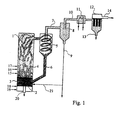
- the equipment according to this drawing comprises a vertical cylindrical reactor 1 functioning as a fluidized bed reactor whose lower part is provided with a grate 2.
- a stationary fluidized bed layer 3 that is composed of larger fluidized particles, and on top of this the reactor 1 contains in circulation smaller fluidized particles 4.
- the gas flow along with particles contained therein are transferred from the upper part of the reactor I to a primary cyclone 5 from which the circulating particles are circulated along a conduit 6 back to the reactor 1.
- the product gas along with the smallest particles leaving reactor 1 in upwardly circulation 4 travel through primary cyclone 5 and therefrom along a conduit 7 to a secondary cyclone 8 where most of the aforementioned particles are separated as a removable fraction 9.
- the medium along with the finest particles contained therein are transferred from the secondary cyclone 8 along a conduit 10 to a gas cooler 11 and therefrom to a filter 12.
- the filter 12 separates the finest dust fraction 13 from the purified fuel gas 14 obtained as the final result of the process.
- Fig. 1 schematically with arrows such that the arrow 15 stands for fuel, arrow 16 stands for the hard, non grindable particles to be added to the process, the arrow 17 for the grindable, porous particles, the arrow 18 for air and the arrow 19 for water vapour.
- arrow 15 stands for fuel
- arrow 16 stands for the hard, non grindable particles to be added to the process
- the arrow 17 for the grindable, porous particles
- the arrow 18 for air
- the arrow 19 for water vapour.
- From the bottom on the reactor 1 starts a channel 20 for the bottom ashes removed from the process along with larger sized particles contained therein.
- reference number 21 is pointed the optional return of the particle fraction 9 separated by the secondary cyclone 8 to the reactor 1 whereby the ash containing particles to be removed from the process is represented by the fraction 13 removed from the filter 12.
- the feed 15, e.g. wheat straw is fed to the reactor 1 on top of the stationary fluidized bed layer 3 situated in the bottom part of the reactor 1.
- the hard, non-grindable particle material 16 e.g. sand or aluminium oxide
- the porous, grindable particle material 17, e.g. limestone or dolomite may be fed together with the fuel 15 or by means of separate feed equipment.
- the non-grindable particles 16 are suitably sized 0.1 - 0.6 mm whereby a part of these particles remains at all times in the stationary fluidized bed layer 3 while another part is part of the circulation 4, 5, 6.
- the grindable porous material 17 may at the time of the feed be sized 0.1 - 0.6 mm, but due to the fast grinding of the particles they will be mainly in the process circulation 4, 5, 6. If the grindable material is limestone calcium carbonate will at the process temperature be calcinated to calcium oxide while at the same time grinding increases the porous surface of the particles.
- Gasifying gas is composed of air 18 and water vapour 19 that are fed to the reactor from under the grate 2 in order to support the fluidized bed 3 and the circulation.
- the ashes that are freed from the biofuel gasified in the process partly melts and/or becomes vaporized and partly remains as extremely finely sized, easily adhering solid material. Most part of the ashes is bound to finely sized, grindable porous particles.
- the primary-cyclone 5 lets the finest, e.g. the ones sized under 20 ⁇ m, particles to the leaving product gas containing flow 7 from which the secondary cyclone 8 separates particle fraction 9 that contains ground ash containing particks leaving the process.
- the filter 12 functions thereby as final cleansing means of the gas from the dust remaining.
- the ashes at the bottom of the reactor 1 and coarse particles are removed from time to time from the reactor to the passage 20.
- the material to be gasified was wheat straw at a humidity of 10.5% by weight, average particle size 2 mm, dry substance content of 47.5% C, 5.9% H, 0.7% N and 4.8% ashes plus from the point of view of gasifying problematic elementary contents of 6 120 ppm Cl, 140 ppm Na and 16 730 ppm K.
- This material which had been found to cause strong agglomeration of the fluidized bed and accumulation of ashes to the upper parts of the reactor in traditional fluidized bed gasifying, was gasified according to the invention in an equipment according to the included Fig. 1 where the inner diameter of the reactor was 154 mm.
- the gasifying was accomplished at the temperature of 805 - 819 °C and from under the stationary fluidized bed was blown 14.7 g/sec air plus 2.7 g/sec water vapour.
- the fuel feed was at 11.3 g/sec.
- 0.42 g/sec limestone with a particle size of 0.1 - 0.6 mm, and at 0.42 g/sec sand the particle size of which was likewise 0.1 - 0.6 mm.
- the pressure difference across the fluidized bed was kept constant by removing from the bottom of the reactor bed material composed mainly of sand.
- the conditions of gasifying along with essential results achieved are represented in the table below.
- the total duration of the gasifying experiment was about 10 hours during which time no problems were detected in the process.
- Main part of the ashes of the fuel were removed by means of the secondary cyclone and the filter. Of the potassium in the straw 49% were removed along with the cyclone dust, 30% were removed by filter and 21% in bottom ashes.
- the same biomaterial as in example 1 was gasified in conditions that are represented in the following table.
- the gasifying was conducted at the temperature of 833 - 841 °C.
- the amount of sand fed was distincly reduced when compared to example 1.
- the solids separated by the secondary Cyclone were returned back to the stationary fluidized bed layer of the gasifying equipment.
- From the reactor bottom mainly material composed of sand particles was removed, all of the fly ashes was removed by the filter.
- the total duration of the experiment was about 10 hours and the results obtained are represented in the table.
- the ashes removed from the reactor bottom were found to contain small agglomerates of about 1 - 2 mm, however, these didn't yet pose problems to the functioning of the process.
- Example 1 the gasifying equipment was operated as in example 2 except that the dust separated in the secondary cyclone was not recycled back to the circulation. Even this experiment the results of which are represented in the table was successful and the carbon conversion attained was only about 1.5 percentage units lower than in experiment 2. The total duration of the experiment was 11 hours during which time no problems were encountered. The amount of agglomerates in the bottom ashes was clearly lower than in example 2.
- Example 1 2 3 Air coefficient 0.26 0.28 0.27 Temperature of solid fluidized bed. °C 819 841 842 Temperature of the ascending circulation. °C 805 833 836 Pressure difference of fluidized bed. mbar 53 54 53 Dust recycle/separation in secondary cyclone Separation Recycle Separation Temperature of gas after secondary cyclone.
Landscapes
- Chemical & Material Sciences (AREA)
- Engineering & Computer Science (AREA)
- Combustion & Propulsion (AREA)
- Oil, Petroleum & Natural Gas (AREA)
- Organic Chemistry (AREA)
- General Chemical & Material Sciences (AREA)
- Chemical Kinetics & Catalysis (AREA)
- Processing Of Solid Wastes (AREA)
- Devices And Processes Conducted In The Presence Of Fluids And Solid Particles (AREA)
- Treatment Of Sludge (AREA)
- Preparation Of Compounds By Using Micro-Organisms (AREA)
- Gasification And Melting Of Waste (AREA)
- Solid Fuels And Fuel-Associated Substances (AREA)
- Fluidized-Bed Combustion And Resonant Combustion (AREA)
Applications Claiming Priority (3)
| Application Number | Priority Date | Filing Date | Title |
|---|---|---|---|
| FI981817 | 1998-08-25 | ||
| FI981817A FI108942B (fi) | 1998-08-25 | 1998-08-25 | Menetelmä biopolttoaineen kaasuttamiseksi |
| PCT/FI1999/000695 WO2000011115A1 (en) | 1998-08-25 | 1999-08-24 | Gasification of biomass in a fluidised bed containing anti-agglomerating bed material |
Publications (2)
| Publication Number | Publication Date |
|---|---|
| EP1114129A1 EP1114129A1 (en) | 2001-07-11 |
| EP1114129B1 true EP1114129B1 (en) | 2003-10-08 |
Family
ID=8552354
Family Applications (1)
| Application Number | Title | Priority Date | Filing Date |
|---|---|---|---|
| EP99939476A Expired - Lifetime EP1114129B1 (en) | 1998-08-25 | 1999-08-24 | Gasification of biomass in a fluidised bed containing anti-agglomerating bed material |
Country Status (8)
| Country | Link |
|---|---|
| EP (1) | EP1114129B1 (da) |
| AT (1) | ATE251663T1 (da) |
| AU (1) | AU5375999A (da) |
| DE (1) | DE69911983T2 (da) |
| DK (1) | DK1114129T3 (da) |
| ES (1) | ES2209478T3 (da) |
| FI (1) | FI108942B (da) |
| WO (1) | WO2000011115A1 (da) |
Cited By (1)
| Publication number | Priority date | Publication date | Assignee | Title |
|---|---|---|---|---|
| WO2022182274A1 (en) * | 2021-02-23 | 2022-09-01 | Phoenix Biopower Ip Services Ab | An apparatus and a method for gasification of a solid fuel in a fluidized bed gasifier |
Families Citing this family (15)
| Publication number | Priority date | Publication date | Assignee | Title |
|---|---|---|---|---|
| DE102006031671A1 (de) | 2006-07-08 | 2008-01-10 | Lanxess Deutschland Gmbh | Nicht agglomerierende Ionenaustauscher-Mischbetten |
| DE102006052345B4 (de) * | 2006-11-07 | 2009-04-23 | Herlt, Christian, Dipl.-Ing. | Verfahren und Vorrichtung zur Verminderung der Feinstaubbildung bei der thermischen Vergasung von halmartiger und stückiger Biomasse in Form von Ballen |
| US8562701B2 (en) | 2007-05-02 | 2013-10-22 | Pall Corporation | Gasification apparatus and method for generating syngas from gasifiable feedstock material |
| RU2505588C2 (ru) | 2007-08-17 | 2014-01-27 | Милан ПТАШЕК | Топливо, способ и установка для получения тепловой энергии из биомассы |
| US8580019B2 (en) * | 2010-05-14 | 2013-11-12 | Frontline Bioenergy, Llc | Apparatus and method of optimized acid gas and toxic metal control in gasifier produced gases |
| DE102010045537A1 (de) | 2010-09-15 | 2012-03-15 | Uhde Gmbh | Verfahren zur Erzeugung von Synthesegas |
| CN102012029B (zh) * | 2010-11-01 | 2013-11-13 | 广州迪森热能技术股份有限公司 | 生物质气加热系统 |
| CN102002399A (zh) * | 2010-11-15 | 2011-04-06 | 国电长源电力股份有限公司 | 一种采用打包燃料的流化床气化反应方法及反应器 |
| CN104804777B (zh) * | 2015-04-10 | 2018-08-07 | 陕西煤业化工集团神木天元化工有限公司 | 一种粉煤热解/干馏油气的除尘装置及除尘方法 |
| FI20150289A (fi) * | 2015-10-19 | 2017-04-20 | Kyösti Ruotanen | Menetelmä tuhkan määrän, koostumuksen ja ominaisuuksien hallitsemiseksi leijupetiprosessissa |
| FR3044014B1 (fr) * | 2015-11-20 | 2020-02-14 | Haffner Energy | Dispositif et procede de thermolyse |
| CN106635177B (zh) * | 2017-02-27 | 2022-06-14 | 周广砥 | 高效低耗高氢煤气发生系统 |
| FI20177048A1 (fi) * | 2017-04-19 | 2018-10-20 | Biominerals Finland Oy | Leijupetiprosessi erityisesti kuivaamattomien hakkuutähteiden ja harvennusenergiapuun sekä viherbiomassan polttamista tai kaasuttamista varten |
| CN109082306B (zh) * | 2018-08-02 | 2021-07-06 | 哈尔滨工业大学 | 生物质气化耦合燃煤发电联产生物质炭的装置及方法 |
| EP4127101A1 (en) * | 2020-03-26 | 2023-02-08 | Teknologian Tutkimuskeskus VTT OY | Method and process arrangement for producing solid product and use |
Family Cites Families (5)
| Publication number | Priority date | Publication date | Assignee | Title |
|---|---|---|---|---|
| US4448589A (en) * | 1980-01-23 | 1984-05-15 | Kansas State University Research Foundation | Pyrolytic conversion of carbonaceous solids to fuel gas in quartz sand fluidized beds |
| US4391612A (en) * | 1981-05-28 | 1983-07-05 | The Halcon Sd Group, Inc. | Gasification of coal |
| US4597771A (en) * | 1984-04-02 | 1986-07-01 | Cheng Shang I | Fluidized bed reactor system for integrated gasification |
| FR2586941B1 (fr) * | 1985-09-09 | 1987-12-04 | Framatome Sa | Dispositif de traitement de matieres solides sous forme de particules, en lit fluidise circulant, en particulier dispositif de gazeification |
| DE4235412A1 (de) * | 1992-10-21 | 1994-04-28 | Metallgesellschaft Ag | Verfahren zum Vergasen von brennbare Bestandteile enthaltenden Abfallstoffen |
-
1998
- 1998-08-25 FI FI981817A patent/FI108942B/fi not_active IP Right Cessation
-
1999
- 1999-08-24 EP EP99939476A patent/EP1114129B1/en not_active Expired - Lifetime
- 1999-08-24 WO PCT/FI1999/000695 patent/WO2000011115A1/en not_active Ceased
- 1999-08-24 DE DE69911983T patent/DE69911983T2/de not_active Expired - Lifetime
- 1999-08-24 AT AT99939476T patent/ATE251663T1/de not_active IP Right Cessation
- 1999-08-24 AU AU53759/99A patent/AU5375999A/en not_active Abandoned
- 1999-08-24 DK DK99939476T patent/DK1114129T3/da active
- 1999-08-24 ES ES99939476T patent/ES2209478T3/es not_active Expired - Lifetime
Cited By (1)
| Publication number | Priority date | Publication date | Assignee | Title |
|---|---|---|---|---|
| WO2022182274A1 (en) * | 2021-02-23 | 2022-09-01 | Phoenix Biopower Ip Services Ab | An apparatus and a method for gasification of a solid fuel in a fluidized bed gasifier |
Also Published As
| Publication number | Publication date |
|---|---|
| DK1114129T3 (da) | 2004-02-16 |
| WO2000011115A1 (en) | 2000-03-02 |
| AU5375999A (en) | 2000-03-14 |
| ES2209478T3 (es) | 2004-06-16 |
| FI981817A0 (fi) | 1998-08-25 |
| DE69911983T2 (de) | 2004-07-29 |
| EP1114129A1 (en) | 2001-07-11 |
| ATE251663T1 (de) | 2003-10-15 |
| FI981817A7 (fi) | 2000-02-26 |
| DE69911983D1 (de) | 2003-11-13 |
| FI108942B (fi) | 2002-04-30 |
Similar Documents
| Publication | Publication Date | Title |
|---|---|---|
| EP1114129B1 (en) | Gasification of biomass in a fluidised bed containing anti-agglomerating bed material | |
| US10519389B2 (en) | System and method for integrated waste storage | |
| EP1432779B1 (en) | Method and apparatus for the gasification of fuel in a fluidised bed reactor | |
| EP0384454B1 (en) | Apparatus for gasifying or combusting solid carbonaceous material | |
| US5154732A (en) | Apparatus for gasifying or combusting solid carbonaceous | |
| RU2581092C2 (ru) | Реакторы плазменной газификации с модифицированными углеродными слоями и пониженной потребностью в коксе | |
| EP0197577B1 (en) | Method of cleaning contaminated soil | |
| US6840184B2 (en) | Method and apparatus for the treatment and utilization of solid and liquid waste mixtures | |
| JPS6129781B2 (da) | ||
| AU2006201957B2 (en) | Process and plant for producing char and fuel gas | |
| CN87107443A (zh) | 将煤和石膏转化为价值较高的产品的方法 | |
| US4657702A (en) | Partial oxidation of petroleum coke | |
| US4402275A (en) | Process for the continuous blowing of fine-particled reducing agents consisting predominantly of mineral coal into a shaft furnace | |
| US4708819A (en) | Reduction of vanadium in recycle petroleum coke | |
| CZ281282B6 (cs) | Způsob zneškodňování pevných a kapalných odpadních látek ve zplyňovacím procesu při tlakovém zplynování v pevném loži | |
| Buekens | Resource recovery and waste treatment in Japan | |
| US4681700A (en) | Partial oxidation of upgraded petroleum coke | |
| Kurkela et al. | Fluidised-bed gasification of high-alkali biomass fuels | |
| Osowski et al. | Gasification of biogenic solid fuels | |
| JPS56139586A (en) | Gasification method of coal |
Legal Events
| Date | Code | Title | Description |
|---|---|---|---|
| PUAI | Public reference made under article 153(3) epc to a published international application that has entered the european phase |
Free format text: ORIGINAL CODE: 0009012 |
|
| 17P | Request for examination filed |
Effective date: 20010131 |
|
| AK | Designated contracting states |
Kind code of ref document: A1 Designated state(s): AT BE CH CY DE DK ES FI FR GB GR IE IT LI LU MC NL PT SE |
|
| AX | Request for extension of the european patent |
Free format text: AL;LT;LV;MK;RO;SI |
|
| GRAH | Despatch of communication of intention to grant a patent |
Free format text: ORIGINAL CODE: EPIDOS IGRA |
|
| GRAS | Grant fee paid |
Free format text: ORIGINAL CODE: EPIDOSNIGR3 |
|
| GRAA | (expected) grant |
Free format text: ORIGINAL CODE: 0009210 |
|
| AK | Designated contracting states |
Kind code of ref document: B1 Designated state(s): AT BE CH CY DE DK ES FI FR GB GR IE IT LI LU MC NL PT SE |
|
| PG25 | Lapsed in a contracting state [announced via postgrant information from national office to epo] |
Ref country code: LI Free format text: LAPSE BECAUSE OF FAILURE TO SUBMIT A TRANSLATION OF THE DESCRIPTION OR TO PAY THE FEE WITHIN THE PRESCRIBED TIME-LIMIT Effective date: 20031008 Ref country code: FI Free format text: LAPSE BECAUSE OF FAILURE TO SUBMIT A TRANSLATION OF THE DESCRIPTION OR TO PAY THE FEE WITHIN THE PRESCRIBED TIME-LIMIT Effective date: 20031008 Ref country code: CY Free format text: LAPSE BECAUSE OF FAILURE TO SUBMIT A TRANSLATION OF THE DESCRIPTION OR TO PAY THE FEE WITHIN THE PRESCRIBED TIME-LIMIT Effective date: 20031008 Ref country code: CH Free format text: LAPSE BECAUSE OF FAILURE TO SUBMIT A TRANSLATION OF THE DESCRIPTION OR TO PAY THE FEE WITHIN THE PRESCRIBED TIME-LIMIT Effective date: 20031008 Ref country code: BE Free format text: LAPSE BECAUSE OF FAILURE TO SUBMIT A TRANSLATION OF THE DESCRIPTION OR TO PAY THE FEE WITHIN THE PRESCRIBED TIME-LIMIT Effective date: 20031008 |
|
| REG | Reference to a national code |
Ref country code: GB Ref legal event code: FG4D |
|
| REG | Reference to a national code |
Ref country code: CH Ref legal event code: EP |
|
| REG | Reference to a national code |
Ref country code: IE Ref legal event code: FG4D |
|
| REF | Corresponds to: |
Ref document number: 69911983 Country of ref document: DE Date of ref document: 20031113 Kind code of ref document: P |
|
| PG25 | Lapsed in a contracting state [announced via postgrant information from national office to epo] |
Ref country code: GR Free format text: LAPSE BECAUSE OF FAILURE TO SUBMIT A TRANSLATION OF THE DESCRIPTION OR TO PAY THE FEE WITHIN THE PRESCRIBED TIME-LIMIT Effective date: 20040108 |
|
| REG | Reference to a national code |
Ref country code: SE Ref legal event code: TRGR |
|
| REG | Reference to a national code |
Ref country code: DK Ref legal event code: T3 |
|
| LTIE | Lt: invalidation of european patent or patent extension |
Effective date: 20031008 |
|
| REG | Reference to a national code |
Ref country code: CH Ref legal event code: PL |
|
| REG | Reference to a national code |
Ref country code: ES Ref legal event code: FG2A Ref document number: 2209478 Country of ref document: ES Kind code of ref document: T3 |
|
| ET | Fr: translation filed | ||
| PLBE | No opposition filed within time limit |
Free format text: ORIGINAL CODE: 0009261 |
|
| STAA | Information on the status of an ep patent application or granted ep patent |
Free format text: STATUS: NO OPPOSITION FILED WITHIN TIME LIMIT |
|
| PG25 | Lapsed in a contracting state [announced via postgrant information from national office to epo] |
Ref country code: LU Free format text: LAPSE BECAUSE OF NON-PAYMENT OF DUE FEES Effective date: 20040824 Ref country code: IE Free format text: LAPSE BECAUSE OF NON-PAYMENT OF DUE FEES Effective date: 20040824 Ref country code: GB Free format text: LAPSE BECAUSE OF NON-PAYMENT OF DUE FEES Effective date: 20040824 Ref country code: AT Free format text: LAPSE BECAUSE OF NON-PAYMENT OF DUE FEES Effective date: 20040824 |
|
| PG25 | Lapsed in a contracting state [announced via postgrant information from national office to epo] |
Ref country code: MC Free format text: LAPSE BECAUSE OF NON-PAYMENT OF DUE FEES Effective date: 20040831 |
|
| 26N | No opposition filed |
Effective date: 20040709 |
|
| GBPC | Gb: european patent ceased through non-payment of renewal fee |
Effective date: 20040824 |
|
| REG | Reference to a national code |
Ref country code: IE Ref legal event code: MM4A |
|
| PG25 | Lapsed in a contracting state [announced via postgrant information from national office to epo] |
Ref country code: PT Free format text: LAPSE BECAUSE OF NON-PAYMENT OF DUE FEES Effective date: 20040308 |
|
| PGFP | Annual fee paid to national office [announced via postgrant information from national office to epo] |
Ref country code: NL Payment date: 20140820 Year of fee payment: 16 Ref country code: DE Payment date: 20140821 Year of fee payment: 16 Ref country code: DK Payment date: 20140820 Year of fee payment: 16 |
|
| PGFP | Annual fee paid to national office [announced via postgrant information from national office to epo] |
Ref country code: ES Payment date: 20140821 Year of fee payment: 16 Ref country code: FR Payment date: 20140821 Year of fee payment: 16 Ref country code: SE Payment date: 20140820 Year of fee payment: 16 |
|
| PGFP | Annual fee paid to national office [announced via postgrant information from national office to epo] |
Ref country code: IT Payment date: 20140826 Year of fee payment: 16 |
|
| REG | Reference to a national code |
Ref country code: DE Ref legal event code: R119 Ref document number: 69911983 Country of ref document: DE |
|
| REG | Reference to a national code |
Ref country code: DK Ref legal event code: EBP Effective date: 20150831 |
|
| REG | Reference to a national code |
Ref country code: SE Ref legal event code: EUG |
|
| PG25 | Lapsed in a contracting state [announced via postgrant information from national office to epo] |
Ref country code: IT Free format text: LAPSE BECAUSE OF NON-PAYMENT OF DUE FEES Effective date: 20150824 |
|
| REG | Reference to a national code |
Ref country code: NL Ref legal event code: MM Effective date: 20150901 |
|
| PG25 | Lapsed in a contracting state [announced via postgrant information from national office to epo] |
Ref country code: SE Free format text: LAPSE BECAUSE OF NON-PAYMENT OF DUE FEES Effective date: 20150825 |
|
| REG | Reference to a national code |
Ref country code: FR Ref legal event code: ST Effective date: 20160429 |
|
| PG25 | Lapsed in a contracting state [announced via postgrant information from national office to epo] |
Ref country code: NL Free format text: LAPSE BECAUSE OF NON-PAYMENT OF DUE FEES Effective date: 20150901 |
|
| PG25 | Lapsed in a contracting state [announced via postgrant information from national office to epo] |
Ref country code: DE Free format text: LAPSE BECAUSE OF NON-PAYMENT OF DUE FEES Effective date: 20160301 |
|
| PG25 | Lapsed in a contracting state [announced via postgrant information from national office to epo] |
Ref country code: DK Free format text: LAPSE BECAUSE OF NON-PAYMENT OF DUE FEES Effective date: 20150831 Ref country code: FR Free format text: LAPSE BECAUSE OF NON-PAYMENT OF DUE FEES Effective date: 20150831 |
|
| REG | Reference to a national code |
Ref country code: ES Ref legal event code: FD2A Effective date: 20170228 |
|
| PG25 | Lapsed in a contracting state [announced via postgrant information from national office to epo] |
Ref country code: ES Free format text: LAPSE BECAUSE OF NON-PAYMENT OF DUE FEES Effective date: 20150825 |