EP1112098B1 - Use of a composition comprising heparin as a non-thrombogenic surface coating agent for preventing arterial thrombosis - Google Patents
Use of a composition comprising heparin as a non-thrombogenic surface coating agent for preventing arterial thrombosis Download PDFInfo
- Publication number
- EP1112098B1 EP1112098B1 EP99944937A EP99944937A EP1112098B1 EP 1112098 B1 EP1112098 B1 EP 1112098B1 EP 99944937 A EP99944937 A EP 99944937A EP 99944937 A EP99944937 A EP 99944937A EP 1112098 B1 EP1112098 B1 EP 1112098B1
- Authority
- EP
- European Patent Office
- Prior art keywords
- heparin
- use according
- stents
- functional groups
- high affinity
- Prior art date
- Legal status (The legal status is an assumption and is not a legal conclusion. Google has not performed a legal analysis and makes no representation as to the accuracy of the status listed.)
- Expired - Lifetime
Links
- 229960002897 heparin Drugs 0.000 title claims abstract description 73
- 229920000669 heparin Polymers 0.000 title claims abstract description 73
- HTTJABKRGRZYRN-UHFFFAOYSA-N Heparin Chemical compound OC1C(NC(=O)C)C(O)OC(COS(O)(=O)=O)C1OC1C(OS(O)(=O)=O)C(O)C(OC2C(C(OS(O)(=O)=O)C(OC3C(C(O)C(O)C(O3)C(O)=O)OS(O)(=O)=O)C(CO)O2)NS(O)(=O)=O)C(C(O)=O)O1 HTTJABKRGRZYRN-UHFFFAOYSA-N 0.000 title claims abstract description 61
- 239000000203 mixture Substances 0.000 title claims abstract description 10
- 230000001453 nonthrombogenic effect Effects 0.000 title claims abstract description 10
- 206010003178 Arterial thrombosis Diseases 0.000 title claims description 10
- 239000011248 coating agent Substances 0.000 title description 10
- 230000015572 biosynthetic process Effects 0.000 claims description 10
- 125000000524 functional group Chemical group 0.000 claims description 9
- 150000004676 glycans Chemical class 0.000 claims description 5
- 229920000642 polymer Polymers 0.000 claims description 5
- 229920002873 Polyethylenimine Polymers 0.000 claims description 4
- 150000003384 small molecules Chemical class 0.000 claims description 4
- -1 aldehydo Chemical group 0.000 claims description 3
- 150000001875 compounds Chemical class 0.000 claims description 3
- 229920001282 polysaccharide Polymers 0.000 claims description 3
- 239000005017 polysaccharide Substances 0.000 claims description 3
- 125000002924 primary amino group Chemical group [H]N([H])* 0.000 claims description 3
- LMDZBCPBFSXMTL-UHFFFAOYSA-N 1-ethyl-3-(3-dimethylaminopropyl)carbodiimide Chemical compound CCN=C=NCCCN(C)C LMDZBCPBFSXMTL-UHFFFAOYSA-N 0.000 claims description 2
- SXRSQZLOMIGNAQ-UHFFFAOYSA-N Glutaraldehyde Chemical compound O=CCCCC=O SXRSQZLOMIGNAQ-UHFFFAOYSA-N 0.000 claims description 2
- 108010039918 Polylysine Proteins 0.000 claims description 2
- 239000004372 Polyvinyl alcohol Substances 0.000 claims description 2
- 229920002125 Sokalan® Polymers 0.000 claims description 2
- 239000002253 acid Substances 0.000 claims description 2
- 150000007513 acids Chemical class 0.000 claims description 2
- CADWTSSKOVRVJC-UHFFFAOYSA-N benzyl(dimethyl)azanium;chloride Chemical class [Cl-].C[NH+](C)CC1=CC=CC=C1 CADWTSSKOVRVJC-UHFFFAOYSA-N 0.000 claims description 2
- 229920001002 functional polymer Polymers 0.000 claims description 2
- 210000003709 heart valve Anatomy 0.000 claims description 2
- 125000002887 hydroxy group Chemical group [H]O* 0.000 claims description 2
- 239000012528 membrane Substances 0.000 claims description 2
- 150000002894 organic compounds Chemical class 0.000 claims description 2
- 239000004584 polyacrylic acid Substances 0.000 claims description 2
- 229920000768 polyamine Polymers 0.000 claims description 2
- 229920000656 polylysine Polymers 0.000 claims description 2
- 229920002451 polyvinyl alcohol Polymers 0.000 claims description 2
- 150000005846 sugar alcohols Polymers 0.000 claims description 2
- SBHRWOBHKASWGU-UHFFFAOYSA-M tridodecyl(methyl)azanium;chloride Chemical compound [Cl-].CCCCCCCCCCCC[N+](C)(CCCCCCCCCCCC)CCCCCCCCCCCC SBHRWOBHKASWGU-UHFFFAOYSA-M 0.000 claims description 2
- 150000001735 carboxylic acids Chemical group 0.000 claims 1
- 230000008321 arterial blood flow Effects 0.000 abstract description 2
- 208000007536 Thrombosis Diseases 0.000 description 25
- 102000004411 Antithrombin III Human genes 0.000 description 10
- 108090000935 Antithrombin III Proteins 0.000 description 10
- 229960005348 antithrombin iii Drugs 0.000 description 10
- 238000000576 coating method Methods 0.000 description 10
- 238000000034 method Methods 0.000 description 10
- 230000014508 negative regulation of coagulation Effects 0.000 description 10
- 230000002965 anti-thrombogenic effect Effects 0.000 description 9
- 230000000694 effects Effects 0.000 description 9
- 206010047249 Venous thrombosis Diseases 0.000 description 8
- 210000004369 blood Anatomy 0.000 description 8
- 239000008280 blood Substances 0.000 description 8
- 230000002785 anti-thrombosis Effects 0.000 description 7
- 239000003055 low molecular weight heparin Substances 0.000 description 7
- 239000000463 material Substances 0.000 description 7
- 238000002360 preparation method Methods 0.000 description 7
- FAPWRFPIFSIZLT-UHFFFAOYSA-M Sodium chloride Chemical compound [Na+].[Cl-] FAPWRFPIFSIZLT-UHFFFAOYSA-M 0.000 description 6
- 239000002565 heparin fraction Substances 0.000 description 6
- IOVCWXUNBOPUCH-UHFFFAOYSA-N Nitrous acid Chemical compound ON=O IOVCWXUNBOPUCH-UHFFFAOYSA-N 0.000 description 5
- 210000001367 artery Anatomy 0.000 description 5
- 229940079593 drug Drugs 0.000 description 5
- 239000003814 drug Substances 0.000 description 5
- 230000005764 inhibitory process Effects 0.000 description 5
- 230000004048 modification Effects 0.000 description 5
- 238000012986 modification Methods 0.000 description 5
- 230000008569 process Effects 0.000 description 5
- 239000000758 substrate Substances 0.000 description 5
- 108010074860 Factor Xa Proteins 0.000 description 4
- 229920002684 Sepharose Polymers 0.000 description 4
- 206010043647 Thrombotic Stroke Diseases 0.000 description 4
- 230000035508 accumulation Effects 0.000 description 4
- 238000009825 accumulation Methods 0.000 description 4
- 238000001042 affinity chromatography Methods 0.000 description 4
- 238000003556 assay Methods 0.000 description 4
- 230000015271 coagulation Effects 0.000 description 4
- 238000005345 coagulation Methods 0.000 description 4
- 208000010125 myocardial infarction Diseases 0.000 description 4
- 230000002792 vascular Effects 0.000 description 4
- 210000003462 vein Anatomy 0.000 description 4
- BSYNRYMUTXBXSQ-UHFFFAOYSA-N Aspirin Chemical compound CC(=O)OC1=CC=CC=C1C(O)=O BSYNRYMUTXBXSQ-UHFFFAOYSA-N 0.000 description 3
- 229920001661 Chitosan Polymers 0.000 description 3
- 206010051055 Deep vein thrombosis Diseases 0.000 description 3
- 108010062466 Enzyme Precursors Proteins 0.000 description 3
- 102000010911 Enzyme Precursors Human genes 0.000 description 3
- 108090000790 Enzymes Proteins 0.000 description 3
- 102000004190 Enzymes Human genes 0.000 description 3
- 102000009123 Fibrin Human genes 0.000 description 3
- 108010073385 Fibrin Proteins 0.000 description 3
- BWGVNKXGVNDBDI-UHFFFAOYSA-N Fibrin monomer Chemical compound CNC(=O)CNC(=O)CN BWGVNKXGVNDBDI-UHFFFAOYSA-N 0.000 description 3
- 241000282898 Sus scrofa Species 0.000 description 3
- 108090000190 Thrombin Proteins 0.000 description 3
- 102100030951 Tissue factor pathway inhibitor Human genes 0.000 description 3
- 230000004913 activation Effects 0.000 description 3
- 125000003172 aldehyde group Chemical group 0.000 description 3
- 238000010171 animal model Methods 0.000 description 3
- 230000008901 benefit Effects 0.000 description 3
- 230000017531 blood circulation Effects 0.000 description 3
- 210000004556 brain Anatomy 0.000 description 3
- DOBMPNYZJYQDGZ-UHFFFAOYSA-N dicoumarol Chemical class C1=CC=CC2=C1OC(=O)C(CC=1C(OC3=CC=CC=C3C=1O)=O)=C2O DOBMPNYZJYQDGZ-UHFFFAOYSA-N 0.000 description 3
- 230000003292 diminished effect Effects 0.000 description 3
- 201000010099 disease Diseases 0.000 description 3
- 208000037265 diseases, disorders, signs and symptoms Diseases 0.000 description 3
- 238000005516 engineering process Methods 0.000 description 3
- 229940088598 enzyme Drugs 0.000 description 3
- 210000003743 erythrocyte Anatomy 0.000 description 3
- 229950003499 fibrin Drugs 0.000 description 3
- 230000006872 improvement Effects 0.000 description 3
- 108010013555 lipoprotein-associated coagulation inhibitor Proteins 0.000 description 3
- 239000011159 matrix material Substances 0.000 description 3
- 230000007246 mechanism Effects 0.000 description 3
- 230000009805 platelet accumulation Effects 0.000 description 3
- 230000002265 prevention Effects 0.000 description 3
- 239000011780 sodium chloride Substances 0.000 description 3
- 229960004072 thrombin Drugs 0.000 description 3
- 230000002885 thrombogenetic effect Effects 0.000 description 3
- UJOBWOGCFQCDNV-UHFFFAOYSA-N 9H-carbazole Chemical compound C1=CC=C2C3=CC=CC=C3NC2=C1 UJOBWOGCFQCDNV-UHFFFAOYSA-N 0.000 description 2
- 108010039209 Blood Coagulation Factors Proteins 0.000 description 2
- 102000015081 Blood Coagulation Factors Human genes 0.000 description 2
- IAYPIBMASNFSPL-UHFFFAOYSA-N Ethylene oxide Chemical compound C1CO1 IAYPIBMASNFSPL-UHFFFAOYSA-N 0.000 description 2
- 108010049003 Fibrinogen Proteins 0.000 description 2
- 102000008946 Fibrinogen Human genes 0.000 description 2
- 241001465754 Metazoa Species 0.000 description 2
- 241000282520 Papio Species 0.000 description 2
- 241001504519 Papio ursinus Species 0.000 description 2
- 208000010378 Pulmonary Embolism Diseases 0.000 description 2
- 229960001138 acetylsalicylic acid Drugs 0.000 description 2
- 230000002776 aggregation Effects 0.000 description 2
- 238000004220 aggregation Methods 0.000 description 2
- 239000003146 anticoagulant agent Substances 0.000 description 2
- 239000003114 blood coagulation factor Substances 0.000 description 2
- 230000036770 blood supply Effects 0.000 description 2
- 239000003593 chromogenic compound Substances 0.000 description 2
- 238000002474 experimental method Methods 0.000 description 2
- 238000002513 implantation Methods 0.000 description 2
- 229940127215 low-molecular weight heparin Drugs 0.000 description 2
- 210000004165 myocardium Anatomy 0.000 description 2
- 230000003647 oxidation Effects 0.000 description 2
- 238000007254 oxidation reaction Methods 0.000 description 2
- 150000004804 polysaccharides Polymers 0.000 description 2
- 208000010110 spontaneous platelet aggregation Diseases 0.000 description 2
- 239000000126 substance Substances 0.000 description 2
- XTWYTFMLZFPYCI-KQYNXXCUSA-N 5'-adenylphosphoric acid Chemical compound C1=NC=2C(N)=NC=NC=2N1[C@@H]1O[C@H](COP(O)(=O)OP(O)(O)=O)[C@@H](O)[C@H]1O XTWYTFMLZFPYCI-KQYNXXCUSA-N 0.000 description 1
- XTWYTFMLZFPYCI-UHFFFAOYSA-N Adenosine diphosphate Natural products C1=NC=2C(N)=NC=NC=2N1C1OC(COP(O)(=O)OP(O)(O)=O)C(O)C1O XTWYTFMLZFPYCI-UHFFFAOYSA-N 0.000 description 1
- 102000008186 Collagen Human genes 0.000 description 1
- 108010035532 Collagen Proteins 0.000 description 1
- 208000032843 Hemorrhage Diseases 0.000 description 1
- 102000016943 Muramidase Human genes 0.000 description 1
- 108010014251 Muramidase Proteins 0.000 description 1
- 108010062010 N-Acetylmuramoyl-L-alanine Amidase Proteins 0.000 description 1
- 208000005764 Peripheral Arterial Disease Diseases 0.000 description 1
- 208000030831 Peripheral arterial occlusive disease Diseases 0.000 description 1
- 241000288906 Primates Species 0.000 description 1
- QAOWNCQODCNURD-UHFFFAOYSA-L Sulfate Chemical compound [O-]S([O-])(=O)=O QAOWNCQODCNURD-UHFFFAOYSA-L 0.000 description 1
- 206010062546 Thrombosis in device Diseases 0.000 description 1
- 206010052428 Wound Diseases 0.000 description 1
- 208000027418 Wounds and injury Diseases 0.000 description 1
- 230000009471 action Effects 0.000 description 1
- 239000000654 additive Substances 0.000 description 1
- 230000002411 adverse Effects 0.000 description 1
- 125000003277 amino group Chemical group 0.000 description 1
- 230000000702 anti-platelet effect Effects 0.000 description 1
- 229940127218 antiplatelet drug Drugs 0.000 description 1
- 229940127217 antithrombotic drug Drugs 0.000 description 1
- QVGXLLKOCUKJST-UHFFFAOYSA-N atomic oxygen Chemical compound [O] QVGXLLKOCUKJST-UHFFFAOYSA-N 0.000 description 1
- 239000012620 biological material Substances 0.000 description 1
- 208000034158 bleeding Diseases 0.000 description 1
- 230000000740 bleeding effect Effects 0.000 description 1
- 230000023555 blood coagulation Effects 0.000 description 1
- 239000003130 blood coagulation factor inhibitor Substances 0.000 description 1
- 210000004204 blood vessel Anatomy 0.000 description 1
- 239000013590 bulk material Substances 0.000 description 1
- 150000001732 carboxylic acid derivatives Chemical class 0.000 description 1
- 238000013131 cardiovascular procedure Methods 0.000 description 1
- 210000004027 cell Anatomy 0.000 description 1
- 210000001627 cerebral artery Anatomy 0.000 description 1
- 230000008859 change Effects 0.000 description 1
- 238000012512 characterization method Methods 0.000 description 1
- 239000003795 chemical substances by application Substances 0.000 description 1
- 230000004087 circulation Effects 0.000 description 1
- 238000003776 cleavage reaction Methods 0.000 description 1
- 229920001436 collagen Polymers 0.000 description 1
- 210000004351 coronary vessel Anatomy 0.000 description 1
- 230000008878 coupling Effects 0.000 description 1
- 238000010168 coupling process Methods 0.000 description 1
- 238000005859 coupling reaction Methods 0.000 description 1
- 238000011161 development Methods 0.000 description 1
- 230000003467 diminishing effect Effects 0.000 description 1
- 239000012636 effector Substances 0.000 description 1
- 238000011156 evaluation Methods 0.000 description 1
- 229940012952 fibrinogen Drugs 0.000 description 1
- 239000003527 fibrinolytic agent Substances 0.000 description 1
- 238000007429 general method Methods 0.000 description 1
- 230000036541 health Effects 0.000 description 1
- 230000005802 health problem Effects 0.000 description 1
- 230000023597 hemostasis Effects 0.000 description 1
- 239000002634 heparin fragment Substances 0.000 description 1
- 239000007943 implant Substances 0.000 description 1
- 238000001727 in vivo Methods 0.000 description 1
- 230000000968 intestinal effect Effects 0.000 description 1
- 230000005923 long-lasting effect Effects 0.000 description 1
- 210000004072 lung Anatomy 0.000 description 1
- 229960000274 lysozyme Drugs 0.000 description 1
- 239000004325 lysozyme Substances 0.000 description 1
- 235000010335 lysozyme Nutrition 0.000 description 1
- 210000003097 mucus Anatomy 0.000 description 1
- 239000001301 oxygen Substances 0.000 description 1
- 229910052760 oxygen Inorganic materials 0.000 description 1
- KHIWWQKSHDUIBK-UHFFFAOYSA-N periodic acid Chemical compound OI(=O)(=O)=O KHIWWQKSHDUIBK-UHFFFAOYSA-N 0.000 description 1
- 229920000307 polymer substrate Polymers 0.000 description 1
- 229920003226 polyurethane urea Polymers 0.000 description 1
- 102000004196 processed proteins & peptides Human genes 0.000 description 1
- 108090000765 processed proteins & peptides Proteins 0.000 description 1
- 102000004169 proteins and genes Human genes 0.000 description 1
- 108090000623 proteins and genes Proteins 0.000 description 1
- 238000011084 recovery Methods 0.000 description 1
- 230000009467 reduction Effects 0.000 description 1
- 238000009877 rendering Methods 0.000 description 1
- 230000007017 scission Effects 0.000 description 1
- 238000000926 separation method Methods 0.000 description 1
- 229910001220 stainless steel Inorganic materials 0.000 description 1
- 239000010935 stainless steel Substances 0.000 description 1
- 238000003786 synthesis reaction Methods 0.000 description 1
- 229920001059 synthetic polymer Polymers 0.000 description 1
- 230000009885 systemic effect Effects 0.000 description 1
- 230000001960 triggered effect Effects 0.000 description 1
- 230000008320 venous blood flow Effects 0.000 description 1
Images
Classifications
-
- A—HUMAN NECESSITIES
- A61—MEDICAL OR VETERINARY SCIENCE; HYGIENE
- A61L—METHODS OR APPARATUS FOR STERILISING MATERIALS OR OBJECTS IN GENERAL; DISINFECTION, STERILISATION OR DEODORISATION OF AIR; CHEMICAL ASPECTS OF BANDAGES, DRESSINGS, ABSORBENT PADS OR SURGICAL ARTICLES; MATERIALS FOR BANDAGES, DRESSINGS, ABSORBENT PADS OR SURGICAL ARTICLES
- A61L33/00—Antithrombogenic treatment of surgical articles, e.g. sutures, catheters, prostheses, or of articles for the manipulation or conditioning of blood; Materials for such treatment
- A61L33/0005—Use of materials characterised by their function or physical properties
- A61L33/0011—Anticoagulant, e.g. heparin, platelet aggregation inhibitor, fibrinolytic agent, other than enzymes, attached to the substrate
- A61L33/0029—Anticoagulant, e.g. heparin, platelet aggregation inhibitor, fibrinolytic agent, other than enzymes, attached to the substrate using an intermediate layer of polymer
-
- C—CHEMISTRY; METALLURGY
- C08—ORGANIC MACROMOLECULAR COMPOUNDS; THEIR PREPARATION OR CHEMICAL WORKING-UP; COMPOSITIONS BASED THEREON
- C08B—POLYSACCHARIDES; DERIVATIVES THEREOF
- C08B37/00—Preparation of polysaccharides not provided for in groups C08B1/00 - C08B35/00; Derivatives thereof
- C08B37/006—Heteroglycans, i.e. polysaccharides having more than one sugar residue in the main chain in either alternating or less regular sequence; Gellans; Succinoglycans; Arabinogalactans; Tragacanth or gum tragacanth or traganth from Astragalus; Gum Karaya from Sterculia urens; Gum Ghatti from Anogeissus latifolia; Derivatives thereof
- C08B37/0063—Glycosaminoglycans or mucopolysaccharides, e.g. keratan sulfate; Derivatives thereof, e.g. fucoidan
- C08B37/0075—Heparin; Heparan sulfate; Derivatives thereof, e.g. heparosan; Purification or extraction methods thereof
- C08B37/0078—Degradation products
Definitions
- the present invention relates to the use of a composition comprising heparin for preparing a non-thrombogenic surface for preventing formation of arterial thrombosis.
- Thrombosis is a major health problem in the industrialized world. Thrombosis related diseases cause the death of several millions of people every year and the health care costs have been estimated to be over 90 billion US dollars just for the USA.
- the arterial thrombus is formed at high flow rates and platelets are the main component. Platelets are small cells, diameter around 2 ⁇ m, circulating in the blood. Their main function is to participate in the haemostasis. When platelets are exposed to collagen in damaged or altered vessel walls or in wounds or when exposed to foreign surfaces they adhere to the surfaces, become activated and start to form aggregates. When this occurs in an artery a thrombus with aggregated platelets is formed.
- the arterial thrombus has also been called the white thrombus because of its appearance which is due to the fact that it mainly contains platelets and very few erythrocytes (red blood cells).
- the venous thrombus is formed at low flow rates and the blood coagulation system is the major participant. In plasma a number of proenzymes and effector proteins are present that together constitute the coagulation system. The system can be triggered in several ways and in a cascade-like process one enzyme activates a proenzyme and the formed enzyme activates the next proenzyme. The final enzyme formed is thrombin and that cleaves off two peptides from the plasma protein fibrinogen, which then results in a rapid aggregation of the modified fibrinogen to form a gel, and a fibrin clot or thrombus is formed. The venous thrombus is called the red thrombus because it contains erythrocytes embedded in fibrin.
- myocardial infarction a thrombus is formed in one of the coronary arteries and the blood supply to the corresponding part of the heart muscle is stopped or strongly diminished resulting in death of that part of the heart muscle.
- thrombotic stroke the blood flow in a cerebral artery is blocked by a thrombus, which usually has been formed somewhere else in the circulation and followed the blood flow to the brain. As the brain is very sensitive to oxygen deprivation, the part of the brain supplied by blood from this artery will be damaged.
- Myocardial infarction and thrombotic stroke are very serious conditions with high mortality and therefore, many treatment efforts today intend to prevent them from occurring.
- the mostly used drug is aspirin (acetylsalicylic acid), which inhibits the activation and aggregation of platelets and thereby prevents the arterial thrombus formation.
- Aspirin acetylsalicylic acid
- Large clinical studies have shown that one aspirin a day significantly reduces the risk for having myocardial infarction.
- Ticlopedin which also inhibits platelet aggregation but through somewhat different mechanisms than aspirin.
- DVT deep venous thrombosis
- pulmonary embolism a thrombus is formed in one of the veins in the extremities usually the legs. That thrombus diminishes the return flow of blood and results in diminished blood supply to that part of the leg or arm. The leg or arm becomes swollen and painful. The condition as such is not life-threatening but if not treated the thrombus can grow and extend and pieces can leave by the return flow and get stuck in the lungs. That condition which is life-threatening is called pulmonary embolism.
- the clinical practice in dealing with venous thrombosis can be divided into prevention and treatment.
- the drugs used are the same - the difference is in the dosing and time of treatment.
- the drugs used are heparin, low molecular weight heparin and dicoumarol derivatives. All of them act as to diminish coagulation and fibrin formation, which is the key process in venous thrombosis.
- Heparin is a sulfate-containing polysaccharide, which on large scale is isolated from intestinal mucus of swine. It has for many decades been used clinically as an agent for the treatment and prevention of venous thrombosis. Heparin is heterogeneous with a molecular weight from 5,000 to 30,000 daltons and with an average molecular weight of about 12,000 - 15,000 daltons.
- Heparin and low molecular weight heparin exert anticoagulant activity by drastically increasing the rate whereby the physiological coagulation inhibitor, antithrombin III (AT), inactivates activated coagulation factors.
- AT physiological coagulation inhibitor
- Only about one third of heparin molecules do bind AT and have a strong anticoagulant activity. This is related to the fact that they contain a specific pentasaccharide sequence with a strong affinity for AT.
- This fraction of heparin is called the high affinity or HA-fraction.
- the residual part, the low affinity (LA) fraction is essentially devoid of anticoagulant activity.
- Heparin also affects platelets but it acts as a weak stimulator of platelet aggregation and it also potentiates the platelet aggregatory action of adenosine diphosphate. There is no difference between the HA- and LA-heparin regarding their ability to affect platelets in this respect as shown by Holmer et al., Thromb Res 1980; 18 : 861-69.
- Dicoumarol derivatives have antithrombotic action through diminishing synthesis of some coagulation factors in their biologically active forms. That process takes some time and that is why the dicoumarol derivatives cannot be used for immediate antithrombotic treatment.
- Heparin has the advantage compared to synthetic polymers that it is a physiological compound. It is also the most strongly negatively charged molecule that can be found in the human body. There is no difference between HA- and LA-heparin in this respect.
- This technology has made it possible to prepare stable and well-defined antithrombogenic surface modifications for medical devices.
- EP-B-0309473 Another antithrombogenic surface modification which may be mentioned is described in EP-B-0309473.
- the surface of the device is modified through the coating with a layer of lysozyme or a derivative thereof to which heparin is adhered.
- the layered antithrombogenic surface comprises a polymeric substrate, a chitosan bonded to the polymeric substrate and an antithrombogenic agent bonded to the chitosan coating.
- Japanese Patent Laid-Open No. 04-92673 relates to an antithrombogenic hemofilter also using a chitosan layer for binding heparin.
- the listing of prior art processes for preparing antithrombogenic surfaces is by no means complete, and it is a clear indication that it is difficult to prepare such coated medical articles which exhibit the properties necessary of successful use in patients, namely stability of the coating, no adverse change of properties of the substrate to be coated and sufficiently high and long lasting antithrombogenic activity.
- the present application describes the preparation and characterization of HA- and LA-heparin, intended for coating of surfaces, as obtained by affinity chromatography on matrix bound AT. It further deals with coating of surfaces of devices with the HA- and LA-heparin preparations. Separation of HA- and LA-fractions of heparin followed by coupling to surface has previously been performed by Yuan et al. (J Biomed Mater Res 1993; 27: 811-20 and J Appl Biomater 1995; 6: 259-66). In the study of Yuan et al. (1995) it was found that the LA-heparin coated surface had higher anticoagulant activity, measured as anti Factor Xa activity, than the HA-heparin coated surface.
- a surface coated vascular implant was investigated in an animal experimental thrombosis model.
- the animal model used was an arterio-venous shunt model in baboons. In that model the blood from one artery passes through a tubing containing the material to be studied and then to a vein.
- the thromboses formed in this model are of the arterial type and the thrombus formation is followed by measuring the accumulation of radiolabelled platelets.
- One object of the invention is the use of a composition comprising heparin for preparing a non-thrombogenic surface for preventing formation of arterial thrombosis.
- One object of the invention is the use of a composition comprising heparin enriched with respect to high affinity, HA, heparin, coupled to a surface, optionally together with a suitable carrier, for preparing a non-thrombogenic surface for preventing formation of arterial thrombosis.
- the composition comprises heparin purified with respect to high affinity, HA, heparin. It is also preferred that the HA heparin is coupled to a surface by end point attachment.
- composition used according to the invention is optionally combined with a carrier to effect the immobilization of the heparin onto the surface of the medical device.
- the carrier is selected from the group of organic compounds carrying functional groups such as amino, aldehydo, hydroxyl, carboxylic acid, carbodiimido or other reactive functional groups that can be bound to functional groups present in or introduced into the heparin.
- the functional compounds could be low molecular weight compounds or polymers.
- low molecular weight compounds carrying functional groups are tridodecylmethylammonium chloride, benzalkonium chloride derivatives, ethyl dimethylaminopropyl carbodiimide and glutaraldehyde.
- polymers are e.g. polyamines such as polyethylenimine (PEI) or polylysine, polycarboxylic acids like polyacrylic acid, polyalcohols like polyvinyl alcohol or polysaccharides and other functional polymers or combinations thereof.
- the functional groups are present in such an extent that a sufficient amount of HA-heparin can be bound and a strong antithrombogenic activity can be obtained.
- HA heparin is coupled to the surface of a device.
- a suitable device is selected from but not limited to the group consisting of stents, grafts, stent-grafts, catheters, heart-valves, filters, tubings and membrane containing devices.
- Pig mucosal heparin was depolymerized by nitrous acid as described in Larm et al. EP-86186B1.
- the resulting depolymerized heparin was fractionated by affinity chromatography on matrix bound antithrombin III into its HA- and LA-fractions (Andersson LO et al. Tromb Res 1979; 9: 575-83).
- the HA-fraction showed very high anticoagulant activity whereas the LA-fraction had very low activity.
- Two groups of stents of stainless steel (Palmaz-Schatz, PS153, Cordis, Warren, N.J. USA) were then coated (Larm et al. EP-86186B1) with the two fractions, respectively.
- Stents are a kind of tublar nets that are used to support the vascular walls and they are used in connection with invasive cardiovascular procedures. Determination of degree of heparin binding showed that essentially the same amounts of the HA-fraction the and LA-fraction, respectively, had been coupled to the surfaces of the two groups of stents.
- the model used was an arterio-venous shunt model in baboons. In that model the blood from one artery passes through a tubing containing the material to be studied and then to a vein. The thromboses formed in this model are of the arterial type and the thrombus formation is followed by measuring the accumulation of radiolabelled platelets (Cadroy Y et al. J Lab Clin Med 1989; 113: 436-48).
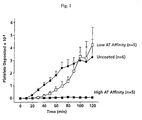
- Stents were placed and expanded in the ex-vivo arterio-venous shunt in a non-anticoagulated baboon that had been injected with radiolabelled platelets. Accumulation of platelets to the stent surface was intermittently monitored by a gamma camera and recorded for a two hour period. Non-coated stents were used as controls. In the control stents platelets immediately started to adhere and continued to accumulate for the duration of the experiment. Stents coated with the LA-heparin fraction showed initially significantly less platelet accumulation than the control but after 40 minutes accumulation started to occur and after two hours there was as much platelet as with the control stents. In contrast no platelet accumulation occurred on the stents coated with the HA-heparin fraction. Even after two hours there was no sign of platelet accumulation. Thus the stents coated with HA-heparin fraction have superior non-thrombogenic properties.
- stents have been chosen as the type of device and artificial surface to be investigated. The reason being that the stent is well suited for evaluation in this animal model for arterial thrombosis.
- the type of device whether it is catheters, filters, tubings, vascular grafts or stents is not important for the thrombogenicity of the surface. That is determined by the properties of the surface rather than by the device itself or its bulk material.
- the conclusions regarding non-thrombogenicity of surfaces reached for the stents are not limited to stents but covers all types of artificial device surfaces in contact with arterial blood.
- Figure 1 is a graph showing the adhesion of platelets to stents coated with the HA- and LA- heparin fractions, respectively, and to control stents. Uncoated PS153 stents were used as controls. The numbers in parentheses relate to the number of experiments and animals used in every case.
- Pig mucosal heparin was depolymerized by nitrous acid as described in Larm et al. EP-0086186B1.
- the resulting depolymerized heparin was fractionated by affinity chromatography on matrix bound AT into its HA- and LA-fractions (Andersson LO et al. Tromb Res 1976; 9: 575-83).
- Human AT was obtained from Pharmacia & Upjohn, Sweden.
- Activated CH Sepharose 4B was obtained from Pharmacia Biotech AB, Uppsala, Sweden.
- Coronary stents, Palmaz-Schatz, PS153, were supplied by Cordis, Warren, USA.
- Chromogenic substrates S-2238 and S-2765 were from Chromogenix AB, Mölndal, Sweden.
- the 4th International Standard for Heparin activity was obtained from the National Institute for Biological Standard and Control, Hertfordshire, United Kingdom.
- AT-Sepharose Preparation of AT-Sepharose was performed according to gel manufacturers instructions.
- the lyophilized gel 125 g was reconstituted in buffer and was then reacted with 4 g of AT.
- the resulting AT-Sepharose 400 ml had the capacity to bind about 100 mg of HA-heparin.
- the anticoagulant activities of heparin fractions were determined by a thrombin inhibition assay and by a Factor Xa inhibition assay essentially according the European Pharmacopoeia methods for Low Molecular Mass Heparin using the chromogenic substrates S-2238 and S-2765, respectively. Standard curves were constructed using the 4th International Standard for Heparin and the specific activities were expressed in international units per mg (IU/mg).
- the heparin content of the heparin subfractions was determined by the carbazole-H 2 SO 4 method.
- the amount of heparin bound to the surfaces was determined by a chemical method and expressed as amount of heparin per unit surface area ( ⁇ g/cm 2 ).
- heparin Partially nitrous acid depolymerized heparin was separated into its HA- and LA-fractions by affinity chromatography on AT-Sepharose essentially according to Andersson et al. 1976. Heparin loads of 200 mg in 4 ml of 0.15M NaCl were applied to the column and eluted by 500 ml of 0.15M NaCl followed by 500 ml of 2.0M NaCl. The eluate was collected in tubes in 10 ml portions and their heparin content was analyzed by the carbazole method. Tubes containing the LA-and HA-heparin respectively were collected. Each run yielded about 140 mg LA- and 50 mg HA-heparin. The resulting HA- and LA-fractions were characterized with respect to anticoagulant activity. Results are shown in Table 1.
- the HA-fraction expressed high anticoagulant activities, 344 IU/mg and 318 IU/mg, in the thrombin- and factor Xa inhibition assays, respectively.
- the LA-fraction was essentially devoid of activity ( ⁇ 5 IU/mg) by both assays (Table 1).
- Coronary stents were coated with the heparin fractions using technology essentially as previously described (Larm et al. EP-86186B1). Two batches of fifty stents were coated with the HA-fraction and the LA-fraction, respectively. The coated stents were then sterilized using ethylene oxide (EO). The heparin density of the stents is shown in Table 2. The heparin density was essentially the same, about 5 ⁇ g/cm 2 , for the two preparations.
- the LA-stents showed slightly less adhesion than the control stent up to 1 hour but after 2 hours this difference was abolished and the LA-stent behaved essentially as the control stents.
- Anticoagulant activities of HA- and LA-fractions of partially depolymerized heparin Preparation Recovery % Activity thrombin inhibition IU/mg Activity Factor Xa inhibition IU/mg HA 27 344 318 LA 67 ⁇ 5 ⁇ 5 Heparin density on PS153 stents coated with partly depolymerized heparin and its HA- and LA-fractions.
- Preparation Heparin density ⁇ g/cm 2 HA 4.5 LA 4.3
Landscapes
- Health & Medical Sciences (AREA)
- Chemical & Material Sciences (AREA)
- Life Sciences & Earth Sciences (AREA)
- Engineering & Computer Science (AREA)
- Materials Engineering (AREA)
- General Health & Medical Sciences (AREA)
- Public Health (AREA)
- Biochemistry (AREA)
- Animal Behavior & Ethology (AREA)
- Surgery (AREA)
- Hematology (AREA)
- Veterinary Medicine (AREA)
- Molecular Biology (AREA)
- Epidemiology (AREA)
- Chemical Kinetics & Catalysis (AREA)
- Medicinal Chemistry (AREA)
- Polymers & Plastics (AREA)
- Organic Chemistry (AREA)
- Materials For Medical Uses (AREA)
- Pharmaceuticals Containing Other Organic And Inorganic Compounds (AREA)
- Acyclic And Carbocyclic Compounds In Medicinal Compositions (AREA)
- Paints Or Removers (AREA)
Abstract
Description
The drugs used are heparin, low molecular weight heparin and dicoumarol derivatives. All of them act as to diminish coagulation and fibrin formation, which is the key process in venous thrombosis. Heparin is a sulfate-containing polysaccharide, which on large scale is isolated from intestinal mucus of swine. It has for many decades been used clinically as an agent for the treatment and prevention of venous thrombosis. Heparin is heterogeneous with a molecular weight from 5,000 to 30,000 daltons and with an average molecular weight of about 12,000 - 15,000 daltons. Heparin and low molecular weight heparin exert anticoagulant activity by drastically increasing the rate whereby the physiological coagulation inhibitor, antithrombin III (AT), inactivates activated coagulation factors. Only about one third of heparin molecules do bind AT and have a strong anticoagulant activity. This is related to the fact that they contain a specific pentasaccharide sequence with a strong affinity for AT. This fraction of heparin is called the high affinity or HA-fraction. The residual part, the low affinity (LA) fraction, is essentially devoid of anticoagulant activity. Regarding the more important thing, the in vivo antithrombotic activity, the situation is more complex, as not only activation of AT is important but also other mechanisms, such as release of Tissue Factor Pathway Inhibitor (TFPI) contribute to the antithrombotic effect. LA-heparin releases TFPI and thus contributes to the antithrombotic effect of whole heparin despite having no anticoagulant activity.
The listing of prior art processes for preparing antithrombogenic surfaces is by no means complete, and it is a clear indication that it is difficult to prepare such coated medical articles which exhibit the properties necessary of successful use in patients, namely stability of the coating, no adverse change of properties of the substrate to be coated and sufficiently high and long lasting antithrombogenic activity.
- sufficient non-thrombogenicity can be obtained with lower quantities of immobilized heparin. This is especially important for material and devices associated with difficulties to immobilize large amounts of heparin.
- higher non-thrombogenicity can be obtained with the same amount of immobilized heparin. This is especially important in applications with strong thrombogenic stimuli e.g. in situations with low blood flow and applications like catheters and vascular grafts with narrow lumen or in cases where the patient otherwise would require additional systemic heparinization.
| Anticoagulant activities of HA- and LA-fractions of partially depolymerized heparin | |||
| Preparation | Recovery % | Activity thrombin inhibition IU/mg | Activity Factor Xa inhibition IU/mg |
| HA | 27 | 344 | 318 |
| LA | 67 | <5 | <5 |
| Heparin density on PS153 stents coated with partly depolymerized heparin and its HA- and LA-fractions. | |
| Preparation | Heparin density µg/cm2 |
| HA | 4.5 |
| LA | 4.3 |
Claims (6)
- Use of a composition comprising heparin enriched with respect to high affinity, HA, heparin, coupled to a surface, optionally together with a suitable carrier, for preparing a non-thrombogenic surface for preventing formation of arterial thrombosis.
- Use according to claim 1, characterized in that the high affinity, HA, heparin is purified.
- Use according to claim 1, characterized in that the high affinity, HA, heparin is coupled to a surface by end point attachment.
- Use according to claim 1, characterized in that the carrier is selected from the group of organic compounds carrying functional groups such as amino, aldehydo, hydroxyl, carboxylic acid, carbodiimido or other reactive functional groups that can be bound to functional groups present in or introduced into the heparin, wherein the functional compounds could be low molecular weight compounds or polymers, wherein examples of low molecular weight compounds carrying functional groups are tridodecylmethylammonium chloride, benzalkonium chloride derivatives, ethyl dimethylaminopropyl carbodiimide and glutaraldehyde, and examples of polymers are e.g. polyamines such as polyethylenimine (PEI) or polylysine, polycarboxylic acids like polyacrylic acid, polyalcohols like polyvinyl alcohol or polysaccharides and other functional polymers or combinations thereof.
- Use according to any of the preceding claims, characterized in that the high affinity, HA, heparin is coupled to a surface of a device.
- Use according to claim 5, characterized in that the device is selected from the group consisting of stents, grafts, stent-grafts, catheters, heart-valves, filters, tubings and membrane containing devices.
Applications Claiming Priority (3)
| Application Number | Priority Date | Filing Date | Title |
|---|---|---|---|
| NO984144A NO984144L (en) | 1998-09-09 | 1998-09-09 | Composition comprising heparin as a non-thrombogenic surface coating |
| NO984144 | 1998-09-09 | ||
| PCT/NO1999/000278 WO2000013719A1 (en) | 1998-09-09 | 1999-09-09 | Composition comprising heparin as a non-thrombogenic surface coating agent |
Publications (2)
| Publication Number | Publication Date |
|---|---|
| EP1112098A1 EP1112098A1 (en) | 2001-07-04 |
| EP1112098B1 true EP1112098B1 (en) | 2003-02-05 |
Family
ID=19902394
Family Applications (1)
| Application Number | Title | Priority Date | Filing Date |
|---|---|---|---|
| EP99944937A Expired - Lifetime EP1112098B1 (en) | 1998-09-09 | 1999-09-09 | Use of a composition comprising heparin as a non-thrombogenic surface coating agent for preventing arterial thrombosis |
Country Status (13)
| Country | Link |
|---|---|
| US (1) | US6559132B1 (en) |
| EP (1) | EP1112098B1 (en) |
| JP (1) | JP4489297B2 (en) |
| KR (1) | KR100603224B1 (en) |
| AT (1) | ATE232113T1 (en) |
| AU (1) | AU762201B2 (en) |
| BR (1) | BR9913517A (en) |
| CA (1) | CA2342992C (en) |
| DE (1) | DE69905258T2 (en) |
| DK (1) | DK1112098T3 (en) |
| ES (1) | ES2192860T3 (en) |
| NO (1) | NO984144L (en) |
| WO (1) | WO2000013719A1 (en) |
Cited By (1)
| Publication number | Priority date | Publication date | Assignee | Title |
|---|---|---|---|---|
| US6926690B2 (en) | 1998-09-10 | 2005-08-09 | Percardia, Inc. | Transmyocardial shunt and its attachment mechanism, for left ventricular revascularization |
Families Citing this family (64)
| Publication number | Priority date | Publication date | Assignee | Title |
|---|---|---|---|---|
| US6290728B1 (en) | 1998-09-10 | 2001-09-18 | Percardia, Inc. | Designs for left ventricular conduit |
| US6254564B1 (en) | 1998-09-10 | 2001-07-03 | Percardia, Inc. | Left ventricular conduit with blood vessel graft |
| JP2003524444A (en) * | 1998-09-10 | 2003-08-19 | パーカーディア,インコーポレイティド | TMR shunt |
| US6641610B2 (en) | 1998-09-10 | 2003-11-04 | Percardia, Inc. | Valve designs for left ventricular conduits |
| US6409697B2 (en) | 1999-05-04 | 2002-06-25 | Heartstent Corporation | Transmyocardial implant with forward flow bias |
| US7033372B1 (en) | 1999-08-04 | 2006-04-25 | Percardia, Inc. | Corkscrew reinforced left ventricle to coronary artery channel |
| US6638237B1 (en) | 1999-08-04 | 2003-10-28 | Percardia, Inc. | Left ventricular conduits and methods for delivery |
| JP3782297B2 (en) * | 2000-03-28 | 2006-06-07 | 株式会社東芝 | Solid-state imaging device and manufacturing method thereof |
| US6854467B2 (en) * | 2000-05-04 | 2005-02-15 | Percardia, Inc. | Methods and devices for delivering a ventricular stent |
| US20020032478A1 (en) * | 2000-08-07 | 2002-03-14 | Percardia, Inc. | Myocardial stents and related methods of providing direct blood flow from a heart chamber to a coronary vessel |
| US6976990B2 (en) | 2001-01-25 | 2005-12-20 | Percardia, Inc. | Intravascular ventriculocoronary bypass via a septal passageway |
| US6783525B2 (en) | 2001-12-12 | 2004-08-31 | Megadyne Medical Products, Inc. | Application and utilization of a water-soluble polymer on a surface |
| US6949118B2 (en) | 2002-01-16 | 2005-09-27 | Percardia, Inc. | Encased implant and methods |
| US7008397B2 (en) | 2002-02-13 | 2006-03-07 | Percardia, Inc. | Cardiac implant and methods |
| US6685704B2 (en) | 2002-02-26 | 2004-02-03 | Megadyne Medical Products, Inc. | Utilization of an active catalyst in a surface coating of an electrosurgical instrument |
| US6619357B1 (en) | 2002-04-24 | 2003-09-16 | The Goodyear Tire & Rubber Company | Belt package for super single truck tires |
| US6951559B1 (en) | 2002-06-21 | 2005-10-04 | Megadyne Medical Products, Inc. | Utilization of a hybrid material in a surface coating of an electrosurgical instrument |
| US7326219B2 (en) * | 2002-09-09 | 2008-02-05 | Wilk Patent Development | Device for placing transmyocardial implant |
| US6702850B1 (en) | 2002-09-30 | 2004-03-09 | Mediplex Corporation Korea | Multi-coated drug-eluting stent for antithrombosis and antirestenosis |
| FR2846520B1 (en) * | 2002-11-06 | 2006-09-29 | Roquette Freres | USE OF MALTODEXTRINS BRANCHED AS BLEACHES OF GRANULATION |
| US7201870B2 (en) * | 2003-01-14 | 2007-04-10 | Medtronic, Inc. | Active air removal system operating modes of an extracorporeal blood circuit |
| US7335334B2 (en) * | 2003-01-14 | 2008-02-26 | Medtronic, Inc. | Active air removal from an extracorporeal blood circuit |
| US7204958B2 (en) * | 2003-01-14 | 2007-04-17 | Medtronic, Inc. | Extracorporeal blood circuit air removal system and method |
| US7198751B2 (en) * | 2003-01-14 | 2007-04-03 | Medtronic, Inc. | Disposable, integrated, extracorporeal blood circuit |
| US7189352B2 (en) * | 2003-01-14 | 2007-03-13 | Medtronic, Inc. | Extracorporeal blood circuit priming system and method |
| EP1735024A1 (en) * | 2004-03-26 | 2006-12-27 | SurModics, Inc. | Process and systems for biocompatible surfaces |
| CA2560507C (en) * | 2004-03-26 | 2011-08-16 | Surmodics, Inc. | Composition and method for preparing biocompatible surfaces |
| US20050281857A1 (en) * | 2004-05-25 | 2005-12-22 | Heyer Toni M | Methods and reagents for preparing biomolecule-containing coatings |
| US20060154894A1 (en) * | 2004-09-15 | 2006-07-13 | Massachusetts Institute Of Technology | Biologically active surfaces and methods of their use |
| US20060159650A1 (en) * | 2005-01-14 | 2006-07-20 | Bacterin, Inc. | Composition and method for covalently coupling an antithrombotic substance and a hydrophilic polymer |
| DE102005003632A1 (en) | 2005-01-20 | 2006-08-17 | Fraunhofer-Gesellschaft zur Förderung der angewandten Forschung e.V. | Catheter for the transvascular implantation of heart valve prostheses |
| US20090281059A1 (en) * | 2007-02-21 | 2009-11-12 | Robert Falotico | Coating for a medical device having an anti-thrombotic conjugate |
| US20080200421A1 (en) * | 2007-02-21 | 2008-08-21 | Zhao Jonathon Z | Coating for a medical device having an anti-thrombotic conjugate |
| US8114465B2 (en) * | 2007-04-02 | 2012-02-14 | Ension, Inc. | Process for preparing a substrate coated with a biomolecule |
| US9693841B2 (en) | 2007-04-02 | 2017-07-04 | Ension, Inc. | Surface treated staples, sutures and dental floss and methods of manufacturing the same |
| US7896915B2 (en) | 2007-04-13 | 2011-03-01 | Jenavalve Technology, Inc. | Medical device for treating a heart valve insufficiency |
| US8383156B2 (en) | 2007-04-30 | 2013-02-26 | Cordis Corporation | Coating for a medical device having an anti-thrombotic conjugate |
| US20090018646A1 (en) * | 2007-07-10 | 2009-01-15 | Zhao Jonathon Z | Coating Employing an Anti-Thrombotic Conjugate |
| US20090036841A1 (en) * | 2007-08-01 | 2009-02-05 | Mckale James M | Coatings for blood and bone marrow-contacting devices |
| US20090192079A1 (en) * | 2007-10-09 | 2009-07-30 | Genzyme Corporation | Prolonged delivery of heparin-binding growth factors from heparin-derivatized collagen |
| WO2011104269A1 (en) | 2008-02-26 | 2011-09-01 | Jenavalve Technology Inc. | Stent for the positioning and anchoring of a valvular prosthesis in an implantation site in the heart of a patient |
| US9044318B2 (en) | 2008-02-26 | 2015-06-02 | Jenavalve Technology Gmbh | Stent for the positioning and anchoring of a valvular prosthesis |
| GB0816783D0 (en) | 2008-09-15 | 2008-10-22 | Carmeda Ab | Immobilised biological entities |
| EP2398525B1 (en) * | 2009-02-21 | 2012-12-05 | Sofradim Production | Medical device with degradation-retarding coating |
| US8968818B2 (en) * | 2009-02-21 | 2015-03-03 | Covidien Lp | Medical devices having activated surfaces |
| US20110196478A1 (en) * | 2010-02-10 | 2011-08-11 | Beoptima Inc. | Devices and methods for lumen treatment |
| US10856978B2 (en) | 2010-05-20 | 2020-12-08 | Jenavalve Technology, Inc. | Catheter system |
| CA2799459A1 (en) | 2010-05-25 | 2011-12-01 | Jenavalve Technology Inc. | Prosthetic heart valve and transcatheter delivered endoprosthesis comprising a prosthetic heart valve and a stent |
| US9180274B2 (en) | 2010-09-09 | 2015-11-10 | W. L. G ore & Associates, Inc | Indwelling luminal devices |
| IT1402059B1 (en) * | 2010-09-29 | 2013-08-28 | Rand Srl | WEARABLE SYSTEM TO CARRY OUT PURIFYING THERAPIES OF ORGANIC FLUIDS WITH THE USE OF EXTRACORPY CIRCUITS |
| US9775933B2 (en) | 2012-03-02 | 2017-10-03 | W. L. Gore & Associates, Inc. | Biocompatible surfaces and devices incorporating such surfaces |
| JP6432346B2 (en) | 2013-04-12 | 2018-12-05 | 東レ株式会社 | Artificial blood vessel with antithrombotic properties |
| CN105491978A (en) | 2013-08-30 | 2016-04-13 | 耶拿阀门科技股份有限公司 | Radially collapsible frame for a prosthetic valve and method for manufacturing such a frame |
| EP3270825B1 (en) | 2015-03-20 | 2020-04-22 | JenaValve Technology, Inc. | Heart valve prosthesis delivery system |
| EP3632378B1 (en) | 2015-05-01 | 2024-05-29 | JenaValve Technology, Inc. | Device with reduced pacemaker rate in heart valve replacement |
| EP3095509A1 (en) | 2015-05-18 | 2016-11-23 | Defymed | Membranes functionalized with heparin for bioartificial organs |
| US11065138B2 (en) | 2016-05-13 | 2021-07-20 | Jenavalve Technology, Inc. | Heart valve prosthesis delivery system and method for delivery of heart valve prosthesis with introducer sheath and loading system |
| EP3318294A1 (en) | 2016-11-08 | 2018-05-09 | Defymed | Kit for in situ delivery of a compound of interest |
| CN110392557A (en) | 2017-01-27 | 2019-10-29 | 耶拿阀门科技股份有限公司 | Heart valve simulation |
| KR20200037574A (en) | 2018-10-01 | 2020-04-09 | (주)우리비앤비 | Cosmetic composition for preventing hair loss comprising heparin |
| WO2021204935A1 (en) | 2020-04-09 | 2021-10-14 | Defymed | Membranes for medical devices |
| EP3892259A1 (en) | 2020-04-09 | 2021-10-13 | Defymed | Membranes for medical devices |
| CA3188829A1 (en) * | 2020-08-14 | 2022-02-17 | Idris Oncology B.V. | A process for applying a coating comprising hyaluronic acid onto the surface of a medical sampling device, and the medical sampling device for capture of circulating tumor cells p rovided with the coating |
| US12171658B2 (en) | 2022-11-09 | 2024-12-24 | Jenavalve Technology, Inc. | Catheter system for sequential deployment of an expandable implant |
Family Cites Families (3)
| Publication number | Priority date | Publication date | Assignee | Title |
|---|---|---|---|---|
| US4446126A (en) * | 1980-09-30 | 1984-05-01 | Cutter Laboratories, Inc. | Antithrombin-heparin complex and method for its production |
| SE456347B (en) * | 1982-02-09 | 1988-09-26 | Ird Biomaterial Ab | SURFACE MODIFIED SOLID SUBSTRATE AND PROCEDURES FOR PRODUCING THEREOF |
| US6174326B1 (en) | 1996-09-25 | 2001-01-16 | Terumo Kabushiki Kaisha | Radiopaque, antithrombogenic stent and method for its production |
-
1998
- 1998-09-09 NO NO984144A patent/NO984144L/en not_active Application Discontinuation
-
1999
- 1999-09-09 CA CA2342992A patent/CA2342992C/en not_active Expired - Lifetime
- 1999-09-09 AT AT99944937T patent/ATE232113T1/en active
- 1999-09-09 ES ES99944937T patent/ES2192860T3/en not_active Expired - Lifetime
- 1999-09-09 BR BR9913517-5A patent/BR9913517A/en not_active Application Discontinuation
- 1999-09-09 DE DE69905258T patent/DE69905258T2/en not_active Expired - Lifetime
- 1999-09-09 AU AU57653/99A patent/AU762201B2/en not_active Expired
- 1999-09-09 KR KR1020017002937A patent/KR100603224B1/en not_active Expired - Lifetime
- 1999-09-09 WO PCT/NO1999/000278 patent/WO2000013719A1/en not_active Ceased
- 1999-09-09 EP EP99944937A patent/EP1112098B1/en not_active Expired - Lifetime
- 1999-09-09 DK DK99944937T patent/DK1112098T3/en active
- 1999-09-09 US US09/763,856 patent/US6559132B1/en not_active Expired - Lifetime
- 1999-09-09 JP JP2000568524A patent/JP4489297B2/en not_active Expired - Lifetime
Cited By (1)
| Publication number | Priority date | Publication date | Assignee | Title |
|---|---|---|---|---|
| US6926690B2 (en) | 1998-09-10 | 2005-08-09 | Percardia, Inc. | Transmyocardial shunt and its attachment mechanism, for left ventricular revascularization |
Also Published As
| Publication number | Publication date |
|---|---|
| JP2002524153A (en) | 2002-08-06 |
| AU5765399A (en) | 2000-03-27 |
| NO984144L (en) | 2000-03-10 |
| NO984144D0 (en) | 1998-09-09 |
| ES2192860T3 (en) | 2003-10-16 |
| JP4489297B2 (en) | 2010-06-23 |
| CA2342992A1 (en) | 2000-03-16 |
| WO2000013719A1 (en) | 2000-03-16 |
| EP1112098A1 (en) | 2001-07-04 |
| US6559132B1 (en) | 2003-05-06 |
| KR100603224B1 (en) | 2006-07-24 |
| DE69905258T2 (en) | 2003-11-06 |
| BR9913517A (en) | 2001-06-05 |
| DK1112098T3 (en) | 2003-05-05 |
| KR20010079758A (en) | 2001-08-22 |
| AU762201B2 (en) | 2003-06-19 |
| DE69905258D1 (en) | 2003-03-13 |
| CA2342992C (en) | 2010-11-23 |
| ATE232113T1 (en) | 2003-02-15 |
Similar Documents
| Publication | Publication Date | Title |
|---|---|---|
| US6559132B1 (en) | Composition comprising heparin as a non-thrombogenic surface coating agent | |
| EP0357242B1 (en) | A biocompatible, thromboresistant substance comprising hirudin, analogs or fragments thereof, and methods of producing the same | |
| US6303179B1 (en) | Method for attachment of biomolecules to surfaces through amine-functional groups | |
| US5112615A (en) | Soluble hirudin conjugates | |
| CA1148468A (en) | Antithrombogenic articles | |
| US5298255A (en) | Antithrombic medical material, artificial internal organ, and method for production of antithrombic medical material | |
| EP0366564B1 (en) | Antithrombic medical material, artificial internal organ, and method for production of antithrombic medical material | |
| AU3988289A (en) | Biocompatible substance with thromboresistance | |
| EP0923390B1 (en) | Method for making improved heparinized biomaterials | |
| Fougnot et al. | Modifications to polymer surfaces to improve blood compatibility | |
| Keogh et al. | Biocompatibility of sulphonated polyurethane surfaces | |
| US20030161938A1 (en) | Composition and method for coating medical devices | |
| Eloy et al. | Heparinization of medical grade polyurethanes | |
| Hubbell | Pharmacologic modification of materials | |
| CA3256864A1 (en) | Multifunctional surface modification of biomaterials with agents to reduce thrombosis | |
| Vulić et al. | Heparin-containing block copolymers: Part II In vitro and ex vivo blood compatibility | |
| NO321372B1 (en) | Use of a composition comprising heparin for the preparation of a non-thrombogenic surface. | |
| WO1992005749A1 (en) | Soluble thrombogenesis inhibitor conjugates | |
| Keogh | Albumin-binding surfaces for implantable medical devices | |
| Okano et al. | Improved blood compatibility of heparin immobilization and PEO-PDMS-heparin triblock copolymer coating on surfaces of segmented polyurethaneurea | |
| EP0480843A2 (en) | Antithrombogenic medical material and medical device | |
| JPH02305575A (en) | Antithrombus material and manufacture thereof |
Legal Events
| Date | Code | Title | Description |
|---|---|---|---|
| PUAI | Public reference made under article 153(3) epc to a published international application that has entered the european phase |
Free format text: ORIGINAL CODE: 0009012 |
|
| 17P | Request for examination filed |
Effective date: 20010316 |
|
| AK | Designated contracting states |
Kind code of ref document: A1 Designated state(s): AT BE CH CY DE DK ES FI FR GB GR IE IT LI LU MC NL PT SE |
|
| AX | Request for extension of the european patent |
Free format text: AL;LT;LV;MK;RO;SI |
|
| 17Q | First examination report despatched |
Effective date: 20020110 |
|
| RAP1 | Party data changed (applicant data changed or rights of an application transferred) |
Owner name: CARMEDA AB |
|
| RTI1 | Title (correction) |
Free format text: USE OF A COMPOSITION COMPRISING HEPARIN AS A NON-THROMBOGENIC SURFACE COATING AGENT FOR PREVENTING ARTERIAL THROMBOSIS |
|
| GRAH | Despatch of communication of intention to grant a patent |
Free format text: ORIGINAL CODE: EPIDOS IGRA |
|
| RTI1 | Title (correction) |
Free format text: USE OF A COMPOSITION COMPRISING HEPARIN AS A NON-THROMBOGENIC SURFACE COATING AGENT FOR PREVENTING ARTERIAL THROMBOSIS |
|
| GRAH | Despatch of communication of intention to grant a patent |
Free format text: ORIGINAL CODE: EPIDOS IGRA |
|
| GRAA | (expected) grant |
Free format text: ORIGINAL CODE: 0009210 |
|
| AK | Designated contracting states |
Designated state(s): AT BE CH CY DE DK ES FI FR GB GR IE IT LI LU MC NL PT SE |
|
| REG | Reference to a national code |
Ref country code: GB Ref legal event code: FG4D |
|
| REG | Reference to a national code |
Ref country code: CH Ref legal event code: EP |
|
| REG | Reference to a national code |
Ref country code: IE Ref legal event code: FG4D |
|
| REF | Corresponds to: |
Ref document number: 69905258 Country of ref document: DE Date of ref document: 20030313 Kind code of ref document: P |
|
| REG | Reference to a national code |
Ref country code: GR Ref legal event code: EP Ref document number: 20030401044 Country of ref document: GR |
|
| REG | Reference to a national code |
Ref country code: CH Ref legal event code: NV Representative=s name: E. BLUM & CO. PATENTANWAELTE |
|
| REG | Reference to a national code |
Ref country code: DK Ref legal event code: T3 |
|
| REG | Reference to a national code |
Ref country code: SE Ref legal event code: TRGR |
|
| ET | Fr: translation filed | ||
| REG | Reference to a national code |
Ref country code: ES Ref legal event code: FG2A Ref document number: 2192860 Country of ref document: ES Kind code of ref document: T3 |
|
| PLBE | No opposition filed within time limit |
Free format text: ORIGINAL CODE: 0009261 |
|
| STAA | Information on the status of an ep patent application or granted ep patent |
Free format text: STATUS: NO OPPOSITION FILED WITHIN TIME LIMIT |
|
| 26N | No opposition filed |
Effective date: 20031106 |
|
| REG | Reference to a national code |
Ref country code: CH Ref legal event code: PFA Owner name: CARMEDA AB Free format text: CARMEDA AB#KANALVAEGEN 3B#194 61 UPPLANDS VAESBY (SE) -TRANSFER TO- CARMEDA AB#KANALVAEGEN 3B#194 61 UPPLANDS VAESBY (SE) |
|
| REG | Reference to a national code |
Ref country code: FR Ref legal event code: PLFP Year of fee payment: 18 |
|
| REG | Reference to a national code |
Ref country code: FR Ref legal event code: PLFP Year of fee payment: 19 |
|
| REG | Reference to a national code |
Ref country code: FR Ref legal event code: PLFP Year of fee payment: 20 |
|
| PGFP | Annual fee paid to national office [announced via postgrant information from national office to epo] |
Ref country code: IT Payment date: 20180921 Year of fee payment: 20 Ref country code: FR Payment date: 20180917 Year of fee payment: 20 Ref country code: IE Payment date: 20180911 Year of fee payment: 20 Ref country code: MC Payment date: 20180925 Year of fee payment: 20 Ref country code: DE Payment date: 20180919 Year of fee payment: 20 Ref country code: LU Payment date: 20180918 Year of fee payment: 20 |
|
| PGFP | Annual fee paid to national office [announced via postgrant information from national office to epo] |
Ref country code: DK Payment date: 20180917 Year of fee payment: 20 Ref country code: GR Payment date: 20180919 Year of fee payment: 20 Ref country code: GB Payment date: 20180917 Year of fee payment: 20 Ref country code: AT Payment date: 20180926 Year of fee payment: 20 Ref country code: FI Payment date: 20180917 Year of fee payment: 20 Ref country code: SE Payment date: 20180917 Year of fee payment: 20 Ref country code: NL Payment date: 20180917 Year of fee payment: 20 Ref country code: BE Payment date: 20180917 Year of fee payment: 20 Ref country code: CH Payment date: 20180918 Year of fee payment: 20 |
|
| PGFP | Annual fee paid to national office [announced via postgrant information from national office to epo] |
Ref country code: PT Payment date: 20180823 Year of fee payment: 20 |
|
| PGFP | Annual fee paid to national office [announced via postgrant information from national office to epo] |
Ref country code: ES Payment date: 20181001 Year of fee payment: 20 |
|
| PGFP | Annual fee paid to national office [announced via postgrant information from national office to epo] |
Ref country code: CY Payment date: 20180904 Year of fee payment: 20 |
|
| REG | Reference to a national code |
Ref country code: DE Ref legal event code: R071 Ref document number: 69905258 Country of ref document: DE |
|
| REG | Reference to a national code |
Ref country code: NL Ref legal event code: MK Effective date: 20190908 |
|
| REG | Reference to a national code |
Ref country code: CH Ref legal event code: PL |
|
| REG | Reference to a national code |
Ref country code: DK Ref legal event code: EUP Effective date: 20190909 |
|
| REG | Reference to a national code |
Ref country code: GB Ref legal event code: PE20 Expiry date: 20190908 |
|
| REG | Reference to a national code |
Ref country code: AT Ref legal event code: MK07 Ref document number: 232113 Country of ref document: AT Kind code of ref document: T Effective date: 20190909 |
|
| REG | Reference to a national code |
Ref country code: BE Ref legal event code: MK Effective date: 20190909 |
|
| REG | Reference to a national code |
Ref country code: SE Ref legal event code: EUG |
|
| REG | Reference to a national code |
Ref country code: IE Ref legal event code: MK9A |
|
| PG25 | Lapsed in a contracting state [announced via postgrant information from national office to epo] |
Ref country code: PT Free format text: LAPSE BECAUSE OF EXPIRATION OF PROTECTION Effective date: 20190917 |
|
| PG25 | Lapsed in a contracting state [announced via postgrant information from national office to epo] |
Ref country code: GB Free format text: LAPSE BECAUSE OF EXPIRATION OF PROTECTION Effective date: 20190908 |
|
| PG25 | Lapsed in a contracting state [announced via postgrant information from national office to epo] |
Ref country code: IE Free format text: LAPSE BECAUSE OF EXPIRATION OF PROTECTION Effective date: 20190909 |
|
| REG | Reference to a national code |
Ref country code: ES Ref legal event code: FD2A Effective date: 20201204 |
|
| PG25 | Lapsed in a contracting state [announced via postgrant information from national office to epo] |
Ref country code: ES Free format text: LAPSE BECAUSE OF EXPIRATION OF PROTECTION Effective date: 20190910 |